Author Archives: rajani

Safty and Efficacy of Collagen Tissudura in Repair of Underlying Dural Defects after Craniotomy

DOI: 10.31038/SRR.2018111

Abstract

Reconstruction and restoration of dura is an important issue in many cases of craniotomy. In cases that must be replaced large defects of dura, the usage of artificial dura is increasing.

During the period between 2013 till 2017, a total of 94 patients who underwent craniotomy for various reasons and collagen Dural plates were applied for Dural defects repairing were recruited to the study. During the follow-up of these patients, 10 patients were excluded from the study, which from the total of the remaining 84 patients, 11 cases of infection “13%” were observed. Eight cases of infection occurred as subdural empyema which were cured with reoperation treatment and evacuation of pus and dural repair. Cerebrospinal fluid leakage was seen 15.4% in 13 patients that all of them were improved with non-surgical supportive care.

Conclusion

With regards to the ease of using and least complications associated with the use of these artificial dural plates, it can be recommended to use it to dural restoration in the various craniotomy surgeries

Introduction

Proper Dural repair should be done to prevent cerebrospinal fluid leakage occurrence in craniotomy with any reason. In the cases that the primary defect of dura is too large that cannot be restored by the primary Dural tissue of the brain, we have to use alternatives to repair the underlying Dura. It is recommended to use a various type of dural alternatives that include the use of fasciae latae or peri-cranial tissue or artificial synthetic dura or ultimately tissues derived from allografts (cadaveric Dura) that each one has its own advantages and disadvantages [1–5].The usage of fasciae latae auto grafts don’t have much attractive due to the need for cutting and additional procedures with possible complications and pain caused by the removal of grafts ‘site or in cases where there are some reports from transmission of Creutzfeldtjakob caused by the use of allograft cases[6–8]. Synthetic collagen dural sheets are also safe alternatives to use as dural repair; because they are both easy to use and their reports of granulomatous reaction occurrence are rare[5, 9–12].In this study, we have discussed about results of the use of “ Aesculap onlay dura mater “ which exist as an artificial sticky sheets of Dura.

Materials and method

During the period between2013 till 2017, a total of 94 patients who underwent craniotomy for various reasons and collagen Dural plates were applied for Dural defects repairing were recruited prospectively to the study. The reasons that Patients were undergoing craniotomy include: tumors, brain hemorrhages, cerebral infarction and cerebro-vascular disease. In the process of dural restoration, we have used absorbable collagen plates of Dura “Aesculap onlay dura mater” in the size of 10cm × 10cm for each patient based on the underlying dural defects. These plates have been made of the underlying collagen scaffolds [10–12]. Sheets application is without the need for suture them to underlying dura. It will be embedded with the cover margin of at least 1cm from surrounding healthy Dura on the defect site (figure 1). Patients were followed up for three months after surgery. During the follow-up period, 10 patients died in a short period after surgery due to underlying medical conditions and were excluded from study. Of the remaining 84 patients, 25 patients “29.7%” had been subjected to surgery because of trauma, and 11 patients “% 13” had undergone craniotomy for brain infarction, 15 patients (17.8%) due to cerebral hemorrhage, and 12 patients “14.2%” for brain tumor and 21 patients “% 25” followed by cerebro-vascular lesions. (Table 1)

Table 1. Collagen dura usage results in patients

All cases

Sub-galeal space Infections

Sub-dural empyema

Leak of cerebrospinal fluid

trauma

25

2

4

4

Cerebral infarctions

11

0

0

0

Cerebral hemorrhage

15

1

1

1

Tumor

12

0

1

2

Vascular lesions

21

0

2

6

total

84

3

8

13

SRR 2018-103 - Safari H Iran_F1

Figure 1. Collagen tissue dura sheets application

Underlying dural defects in traumatic bifrontal craniotomy , without the need for suture collagen tissue dura sheet is embedded with the cover margin of at least 1cm from surrounding healthy Dura on the defect site.

Results

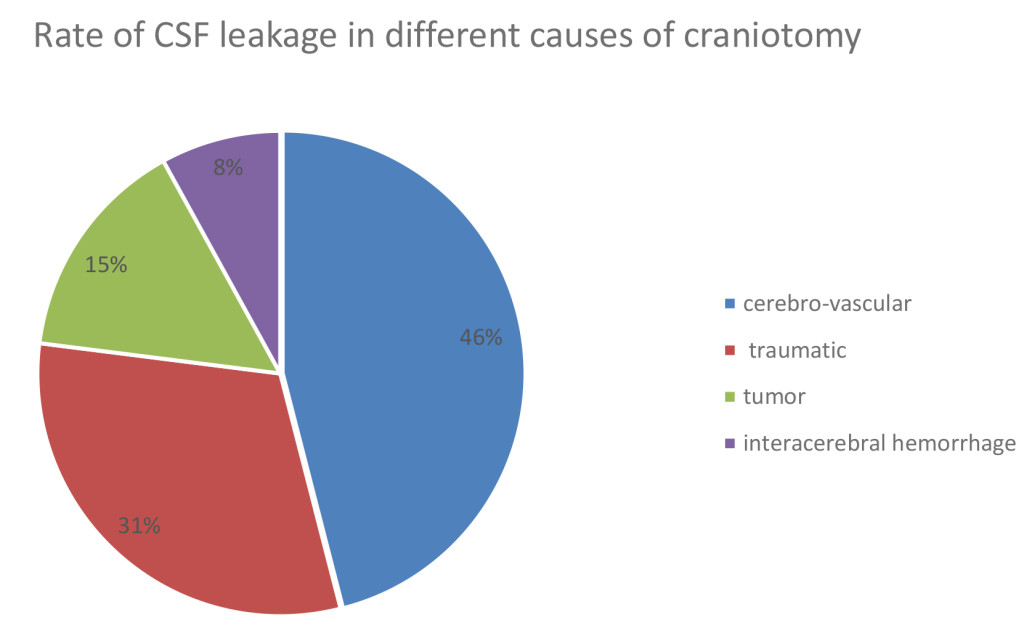
Totally, infection was observed in 11 patients (13%) during follow-up period (Table1). According to the clinical and MRI findings, eight cases “% 9.5” were diagnosed as subdural empyema infection. sub-galeal space infection in three cases (3.5%). Diagnosis of sub-galeal space infection was obtained by pus discharge at the incision site and MRI findings. The cerebrospinal fluid leakage was observed in a total of 13 patients (15.4%) as a discharge of cerebrospinal clear fluid secretions from the incision site during the follow-up period. Of the total cases suffered from leakage, six cases of them were underwent surgery for cerebro-vascular lesions (46%) and four cases underwent surgery for traumatic brain injury (% 31); tumor and brain hemorrhage were constituted two patients (15%) and one patient (8%) respectively (Chart 1). All of CSF leakages were treated by conservative measures; however, there were three cases from four patients with cerebrospinal fluid leaks among patients undergoing surgery due to traumatic events experiencing subdural empyema. Two cases of cerebrospinal fluid leakage were among patients that undergoing surgery due to cerebro-vascular lesions who were experiencing subdural empyema. Cerebrospinal fluid leak in patients with cerebral hemorrhage and brain tumors has been improved by the conservative measures generally and none of the cases led to subdural empyema, or infection.

SRR 2018-103 - Safari H Iran_F2

Chart 1. Rate of CSF leakage in different causes of craniotomy

Epidural accumulation of pus was occurred in all the three patients that two of them were observed in traumatic patients and one case occurred in a patient who was undergoing surgery due to brain hemorrhage. Subdural empyema patients were undergoing reoperation and the products of previous synthetic dura and pus collection were irrigated and evacuated completely, so that it was used from fasciaelatae autograft tissue to repair dural defect. After drainage, washing and continuing antibiotic treatment, six patients of a total of eight patients with subdural empyema were improved completely and pus accumulation in the subdural space was resolved in subsequent imaging and did not recur. These two patients were again subjected to surgery and re-drainage of the pus and subdural space washing due to the formation of pus in the subdural space that full recovery was observed with surgical repetition in these patients.

Of the three patients with sub-galeal accumulation, all of them were initially subjected to reoperation and pus discharge from the space of sub-galeal. One patient had fully recovered by this action and re-accumulation of pus was not found, but two other patients were undergoing surgical removal of previous synthetic dural tissues and replacing it with autograft Fasciae latae tissue due to re-accumulation of pus in follow-up MRIs which finally resulted in complete remission in these patients.

Discussion

Overall, infections in our patients was ultimately 13% during follow-up period. Infection rate of traumatic patients was totally more than the other groups that were subjected to surgery [54% of overall infection cases]. The least infections were among patients with cerebral infarction (no patient).

According to the Setsuko et al. (2003) which finally completed on 56 patients[13].The overall infection rates(14.3%) were reported in the use of artificial dural plates which was slightly higher than our study of collagen plates in the repair process. The percentage of sub-dural empyema incidence was reported 12.5% after the use of Dura plates here. While it has been observed 9.5% in our research.

Generally, the incidence of CSF leakage has been reported between4 -17% in other studies [14, 15], that is defined as sub-galeal accumulations of cerebrospinal fluid and its outflow through the sutures or its surrounding areas as the rhinorrhea or othorrhea . Totally, cerebrospinal fluid leakage was 15.4% in all of our studied patients. Highest amount of observed leakage was happened among the patients undergoing surgery for cerebro-vascular lesions “46%”, and the lowest amount was in patients undergoing surgery for cerebral infarctions that no case of leakage was found among them. The CSF leakage in patients who subjected to cerebro-vascular lesions surgery may be due to the need for a wider dissection in the sub-arachnoid space during surgery to create a wider space and visibility.

In the research of Than ko (2008), the amount of CSF leakage in the patients who had been used artificial dura to repair dural defects, was reported10%[14]. Huttera et al (2014) did not report any advantage in the reduction of CSF leakage by this method on patients using artificial dura as a normal suture compared to the use of artificial dura as a strengthening method; but in general, announced their two groups of patients CSF leakage incidence as 13.5% [15].

In general, it has been used artificial collagen plates in the studies and have shown good results, also the granulomatous reactions are relatively little to it. According to the present studies, fibroblastic cells begin to multiply after about a month in underlying tissue of artificial dura and coverage of fibroblastic tissue will be created along with surrounding dura [16, 17].

In our study, all the patients with subdural or sub-galeal infections were eventually recovered completely by reoperation, washing and removing the remnants of artificial dura and using fasciae latae tissue to repair underlying dura.

By comparing the results of similar studies in the use of artificial dural plates and the results of our study, the acceptable complications rate and control power to prevent the cerebrospinal fluid leakage incidence was perfect in the use of artificial dural plates, although using this material could be imagine a proper alternative to dural repair and prevention of a cerebro-spinal fluid leakage considering to the easiness of these artificial dural plates and no need to remove autograft tissue to repairing dura, which has its own complications.

Conclusion

With regards to the ease of using and least complications associated with the use of these artificial dural plates, it can be recommended to use it to dural restoration in the various craniotomy surgeries.

References

  1. Costa BS, Cavalcanti-Mendes Gde A, de Abreu MS, de Sousa AA. (2010) Clinical experience with a novel bovine collagen dura mater substitute. Asian J Neurosurg. 5(2): 31–4. [Crossref]
  2. Danish SF, Samdani A, Hanna A, Storm P, Sutton L. (2006) Experience with acellular humandura and bovine collagen matrix for duraplasty after posterior fossa decompression for Chiari malformations. Journal of neurosurgery. 104(1 Suppl): 16–20. [Crossref]
  3. Knopp U, Christmann F, Reusche E, Sepehrnia A. (2005) A new collagen biomatrix of equine origin versus a cadaveric dura graft for the repair of dural defects–a comparative animal experimental study. Acta neurochirurgica. 147(8): 877–87. [Crossref]
  4. Vakis A, Koutentakis D, Karabetsos D, Kalostos G. (2006) Use of polytetrafluoroethylene dural substitute as adhesionpreventive material during craniectomies. Clinical neurology and neurosurgery. 108(8): 798–802. [Crossref]
  5. Zahrai A, Shah J, Narotam P, M. G. (2005) A PROSPECTIVE CLINICAL STUDY OF THE USE OF COLLAGEN MATRIX AS A DURAL GRAFT IN SPINAL SURGERY. J Bone Joint Surg. 87: 295. [Crossref]
  6. Fushimi M, Sato K, Shimizu T, Hadeishi H. (2002) PLEDs in Creutzfeldt-Jakob disease following a cadaveric dural graft. Clinical neurophysiology: official journal of the International Federation of Clinical Neurophysiology. 113(7): 1030–5. [Crossref]
  7. Heath CA, Barker RA, Esmonde TF, Harvey P, Roberts R, Trend P, et al. (2006) Dura mater-associated Creutzfeldt-Jakob disease: experience from surveillance in the UK. Journal of neurology, neurosurgery, and psychiatry. 77(7): 880–2. [Crossref]
  8. Martinez-LageJF, Rabano A, Bermejo J, Martinez Perez M, Guerrero MC, Contreras MA, et al. (2005) Creutzfeldt-Jakob disease acquired via a dural graft: failure of therapy with quinacrine and chlorpromazine. Surgical neurology. 64(6): 542–5, discussion 5. [Crossref]
  9. Dongmei He, David G. Genecov, Morley Herbert, Raul Barcelo, Mohammed E. Elsalanty, Bradley E. Weprin, et al. (2010) Effect of recombinant human bone morphogenetic protein–2 on bone regeneration in large defects of the growing canine skull after dura mater replacement with a dura mater substitute. Journal of neurosurgery. 112(2): 319–28. [Crossref]
  10. Parlato C, di Nuzzo G, Luongo M, Parlato RS, Accardo M, Cuccurullo L, et al. (2011) Use of a collagen biomatrix (TissuDura) for dura repair: a long-term neuroradiological and neuropathological evaluation. Acta neurochirurgica. 153(1): 142–7. [Crossref]
  11. Ruediger Stendel, Marco Danne, Ingo Fiss, Ilse Klein, Andreas Schilling, Stefanie Hammersen, et al. (2008) Efficacy and safety of a collagen matrix for cranial and spinal dural reconstruction using different fixation techniques. Journal of neurosurgery. 109(2): 215–21. [Crossref]
  12. Narotam PK, Qiao F, Nathoo N. (2009) Collagen matrix duraplasty for posterior fossa surgery: evaluation of surgical technique in 52 adult patients. Clinical article. Journal of neurosurgery. 111(2): 380–6. [Crossref]
  13. Nakagawa S1, T. H. (2003) Postoperative infection after duraplasty with expanded polytetrafluoroethylene sheet. Neurol Med Chir (Tokyo). 43(3): 120–4. [Crossref]
  14. Than KD, Baird CJ, Olivi A. (2008) Polyethylene glycol hydrogel dural sealant may reduce incisional cerebrospinal fluid leak after posterior fossa surgery. Neurosurgery. 63(1 Suppl 1): ONS182–6; discussion ONS6-7. [Crossref]
  15. Hutter G, von Felten S, Sailer MH, Schulz M, Mariani L. (2014) Risk factors for postoperative CSF leakage after elective craniotomy and the efficacy of fleece-bound tissue sealing against dural suturing alone: a randomized controlled trial. Journal of neurosurgery. 121(3): 735–44. [Crossref]
  16. Neulen A, Gutenberg A, Takacs I, Weber G, Wegmann J, Schulz-Schaeffer W, et al. (2011) Evaluation of efficacy and biocompatibility of a novel semisynthetic collagen matrix as a dural onlay graft in a large animal model. Acta neurochirurgica. 153(11): 2241–50. [Crossref]
  17. Matsumoto Y, Aikawa H, Tsutsumi M, Narita S, Yoshida H, Etou H, et al. (2013) Histological examination of expanded polytetrafluoroethylene artificial dura mater at 14 years after craniotomy: case report. Neurol Med Chir (Tokyo). 53(1): 43–6. [Crossref]

A Component of the Puzzle, When Attempting to Understand Antipsychotics: A Theoretical Study of Chemical Reactivity Indexes

DOI: 10.31038/JPPR.2018115

Abstract

Schizophrenia is a human condition that has attracted the attention of researchers. There is no cure for schizophrenia but several treatments can help control symptoms (hallucinations and delusions). Dopamine D2 receptor antagonists are mainly effective for the treatment of psychotic symptoms, hence the name “antipsychotic”. This study principally aims to conduct a quantum chemical analysis of one family of antipsychotics. New physical insights have attempted to explain the pharmacological action mechanism of these drugs. Two questions for which we found a possible answer are: why the Defined Daily Dose (DDD) of these drugs varies and what do we have to consider when attempting to improve the effectiveness of medications? Although DDD is a complex concept related with pharmacokinetics, in this investigation we report some insights concerning the chemical reactivity that could be useful. These drugs are antagonists of dopamine. This means that they occupy the same receptor, but refrain from activating it. We found that the more they differ from those found in dopamine, the lower DDD is required. Chemical reactivity indexes of antipsychotics should to be different from those of dopamine. These ideas represent an aspect of the complex puzzle that contributes to define the pharmacological action of antipsychotics.

Keywords

Antioxidant, DAM, Density Functional Theory, Lagartil®, Schizophrenia

Note: *On sabbatical leave at Departamento de Química, División de Ciencias Básicas e Ingeniería, Universidad Autónoma Metropolitana-Iztapalapa, CDMX.

Introduction

Psychosis comprises a group of symptoms. An episode of psychosis is recognized when people “break” with reality. One type of psychosis is known as schizophrenia. Schizophrenia is a chronic brain disorder, affecting one percent of the global population [1–12]. The symptoms of this disorder include delusions and hallucinations. When these symptoms are treated, most people with schizophrenia improve their social function and can be re-integrated into their family and workplace. Specific treatment can help people with schizophrenia to become highly productive and develop social skills, which allow them to become adapted to their social environment.

Schizophrenia is a human condition that has attracted the attention of researchers. The etiology is complex and unknown. Moreover, there is no cure for schizophrenia, although several remedies can control symptoms [5–8]. Until the 1950s, a number of medicines manifesting restricted clinical effectiveness were used to treat the symptoms of psychosis. Electroconvulsive therapy or treatments containing a number of unspecified pharmacological agents, such as opium, morphine and cocaine, were administered with limited success [9]. The most important advance occurred in 1952 with the serendipitous observations by Laborit, which described the effect of chlorpromazine on patients suffering an episode of psychosis [10,11]. This drug has mainly proved effective for the treatment of psychotic symptoms (hallucinations and delusions), hence the name “antipsychotic”. Chlorpromazine is considered as the prime antipsychotic drug and works as a dopamine D2 receptor antagonist. Since the initial discovery of chlorpromazine, many investigations have focused on the development of new and safer treatments [12–19].

The introduction of chlorpromazine represented the first selective and effective approach to the treatment of schizophrenia, initiating the psychopharmacological era [10–19]. Ever since this finding, many investigations were undertaken, focusing on the synthesis of numerous antipsychotic drugs [1]. Those that function as a dopamine D2 receptor antagonist are considered as the first generation of antipsychotics and include different chemical compounds, such as derivatives of phenothiazine. They can be classified according to their clinical potency that correlates with dopamine D2 receptor affinity [19].

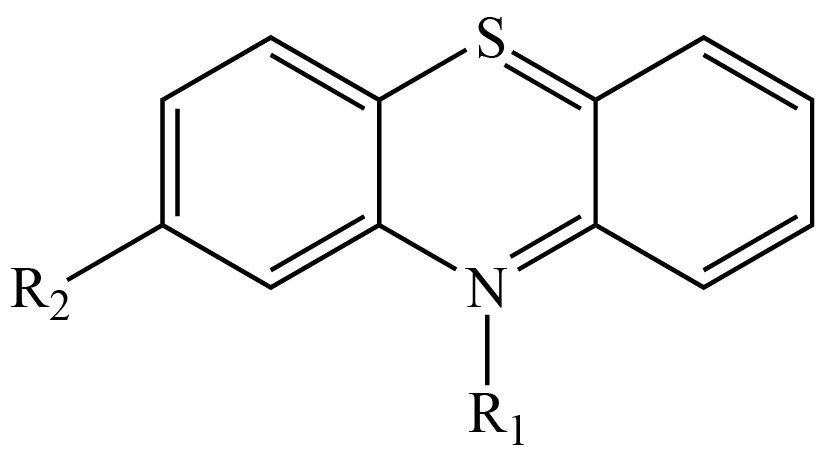
Phenothiazine is an organic compound, the molecular formula for which is presented in Figure 1. Derivatives of phenothiazine are substances that present antiemetic, antipsychotic, antihistaminic and anticholinergic activities [20–23]. The phenothiazine group of drugs is used when patients do not respond to other antipsychotics and they were one of the most widely prescribed psychotropic drugs in the world [22]. Information relating to the toxic and beneficial effects of these drugs has been discussed [21] and the value of gaining a comprehensive knowledge about their mechanism of action in order to ensure appropriate clinical application of phenothiazines [22] is recognized. Other reports suggest that the level of substitutions [23] is a factor defining the efficaciousness of this group of drugs and it has been proposed that the involvement of different molecular orbitals is related to the expression of distinct biological activities. Previous results reported that pharmacological action is influenced by the nature of substitutions, which modify receptor specificity [24, 25].

Although many studies have investigated the pharmacological action of these drugs, the exact antagonistic mechanism of the dopamine D2-receptor is still unknown. In this investigation, we aim to undertake a quantum chemical analysis of antipsychotics derived from phenothiazine. Principally, our strategy is to apply simple quantum chemical models in order to reveal the complex operation of these molecules. We applied chemical reactivity indexes and electron transfer models, previously used to successfully explain a number of reactions [26–29], to provide new explanations for the pharmacological action mechanism of these drugs. We found a possible answer to the following questions: why the Defined Daily Dose (DDD) of these antipsychotics varies, and which future strategies appear competent for improving the effectiveness of medications? Any possible solutions, not only relate to geometry, but also to electron transfer ability. Results from this research indicate that different doses of medication, reported previously, relate to electron donor-acceptor capacity. These drugs are antagonists of dopamine, because they occupy the same receptor without activating it. This leads us to the conclusion that an effective antagonist of dopamine, in the form of antipsychotic drugs, must have different electron donor acceptor properties and moreover, the more they vary from dopamine, the more efficient they will be. The outcomes reported here help to elucidate the complicated action mechanism manifested by drugs used in the treatment of schizophrenia (Figure 1).

JPPR-18-105-Ana Martinez_Mexico_F1

Figure 1. Molecular formula of different phenothiazine derivatives. R1 is equal to H for phenothiazine.

Computational Details

Gaussian09 was used for all electronic calculations [30]. Geometry optimizations without symmetry constraints were implemented at M06/6-311+G(2d, p) level of theory [31–35], while applying the continuum solvation model density (SMD) with water, in order to mimic a polar environment [36]. Harmonic analyses were calculated to verify local minima (zero imaginary frequencies). Initial geometries were obtained from PubChem database, but different conformers of each molecule were also optimized. The ground states are those that come from PubChem [37].

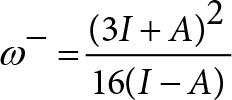
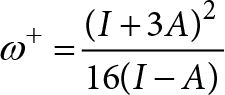
In order to analyze electron-donor acceptor properties, vertical ionization energy (I) and vertical electron affinity (A) were obtained from single point calculations of the corresponding cationic and anionic molecules, using the optimized structure of the neutrals. The same level of theory was used for all computations. Electrodonating (ω) and electroaccepting (ω+) power was previously reported by Gázquez et al [38, 39]. These authors defined the propensity to donate charge or ω as follows:

JPPR-18-105-Ana Martinez_Mexico_Eq1 (1)

Whereas the propensity to accept charge or ω+ is defined as

JPPR-18-105-Ana Martinez_Mexico_Eq2 (2)

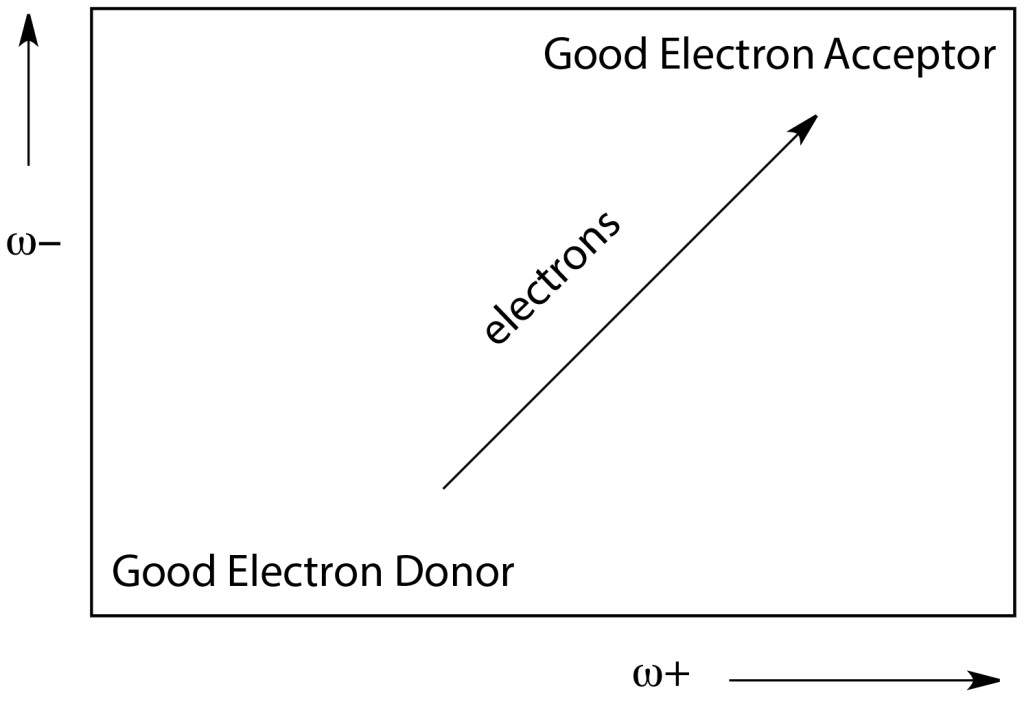
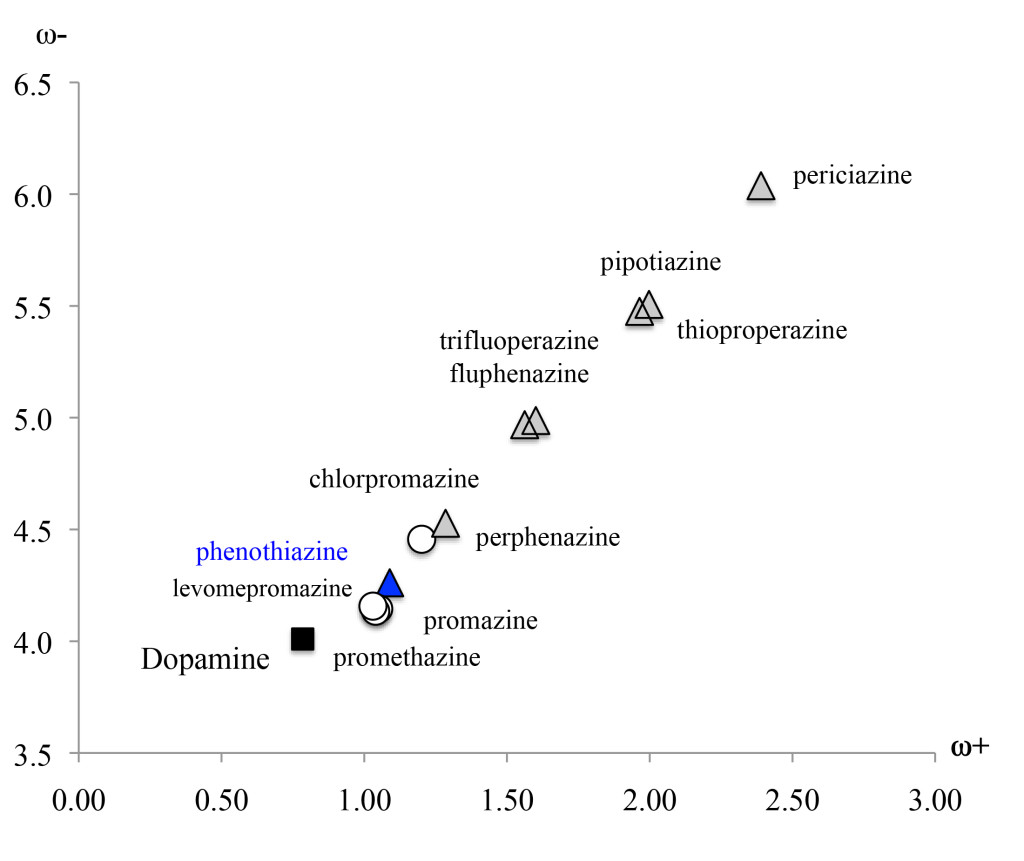
Lower values of ω imply greater capacity for donating charge. Higher values of ω+ imply greater capacity for accepting charge. In contrast to I and A, ω and ω+ refer to fractional charge transfer. This definition is based on a simple charge transfer model expressed in terms of chemical potential and hardness. The Donor-Acceptor Map defined previously [40, 41] is a useful graphic tool. We have plotted ω and ω+ (Figure 2) on this map, enabling us to classify substances as either electron donors or acceptors. Electrons are transferred from good donor systems (down to the left of the map) to good electron acceptor systems (up to the right of the map) (Figure 2).

JPPR-18-105-Ana Martinez_Mexico_F2

Figure 2. Donor-Acceptor Map (DAM).

Results and Discussion

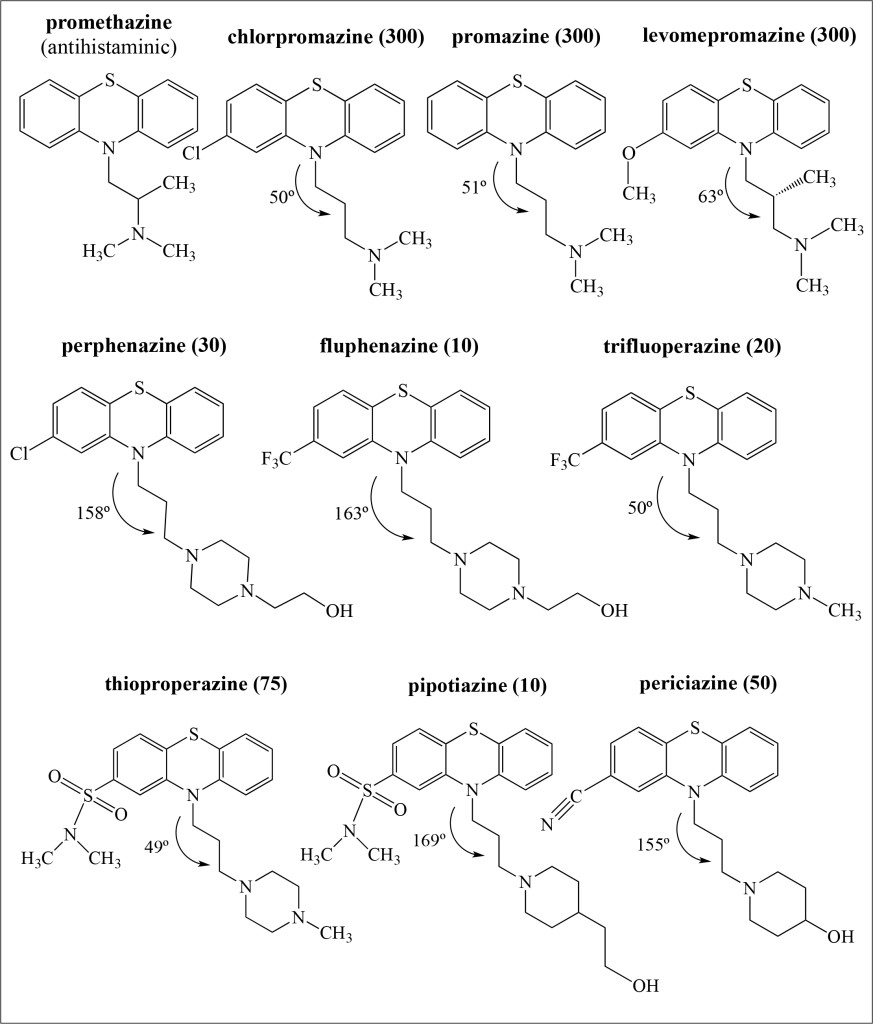
Figure 3 presents a schematic representation of the compounds that are analyzed in this investigation. There are phenothiazine-derivatives with different substituents. Promethazine is not an antipsychotic drug and is included for comparison purposes. Defined Daily Doses (DDDs) are also cited, as this parameter relates to the efficacy and potency of the compounds. Certain reports correlate the action at the receptor levels of these drugs with required doses. Those that require smaller doses are more effective and usually present fewer side effects [42 – 44]. In this investigation, we correlate DDD with different structural parameters and distinct electronic properties.

JPPR-18-105-Ana Martinez_Mexico_F3

Figure 3. Schematic representation of the molecular formula of phenothiazine derivatives investigated in this work. Defined Daily Doses (DDDs) are included (as mg/day) as is the NCCC dihedral angles (in degrees) for the optimized structures obtained in this investigation.

All antipsychotic drugs in Figure 3 are molecules that include R1 as their substituent with the following chain; -CH2-CH2-CH2-N-. Promethazine contains a substituent that is -C-C-N-, and it is not an antipsychotic drug. The first three antipsychotic molecules presented in Figure 3 have similar structures and the same DDD. Apparently, the presence of -Cl, -O-CH3, or -CH3 groups does not modify their efficacy. Molecules with lower DDDs are those compounds with a six-member ring instead of methyl groups in R1. In order to increase their efficacy and therefore decrease DDD, it is important to replace the methyl groups with a six-member ring. Comparing the NCCC dihedral angles, also depicted in Figure 3, there are two types of compounds: those for which NCCC < 100º and those for which NCCC > 150º. DDD is less for compounds with larger dihedral angles than for those antipsychotic molecules with smaller dihedral angles; the only exception is trifluoperazine. These observations show that as expected, geometrical structure and chain composition relate to DDD. All these molecules bind to D2 receptors in the brain and act as dopamine D2 receptor antagonists. Therefore geometry is important.

Even when most R2 in the antipsychotic molecules represent electron-withdrawing substituents, different effects are evident. Comparing the molecular formula of perphenazine with that of fluphenazine, the difference is the R2 substituent (Cl and CF3, respectively) and the DDD of fluphenazine is one third that of perphenazine. When we compare trifluoperazine and thioproperazine, results are the same. Molecular structures are similar with different R2 substituents. Trifluoperazine contains CF3 substituent, whereas thioproperazine does not; DDD of trifluoperazine is also almost one third of thioproperazine. It appears that the presence of CF3 in the molecule decreases the required doses, i.e. efficacy increases (Figure 3).

Likewise, comparisons indicate that thioproperazine and pipotiazine have the same R2 but different R1 (with -NCH3 and -CH-CH2-CH2-OH, respectively). The last of these is more effective than the first. We can assume that the presence of OH in the chain increases efficiency. The last compound in Figure 3 has CN as R2 and OH in R1. The required dose is not one of the smallest (50). It seems that potency is not associated with the presence of CN. With all these evaluations, it is apparent that chemical structure does not completely explain the variation in required doses.

An association can be found between DDD and electron transfer capacity using ω+ and ω−. For this purpose, figure 4 reports the DAM of the antipsychotic drugs. Phenothiazine and dopamine are also included for comparison. All compounds that need greater DDD are located down to the left (good electron donors), whereas compounds that required lower DDD are situated up to the left (good electron acceptors). The antipsychotics promazine and levopromazine represent the best electron donors, followed by chlorpromazine. Periciazine, pipotiazine and thioproperazine are the best electron acceptors. Compounds containing DDD equal to 300 mg/day constitute better electron donors than those with DDD of less than 100 mg/day. Moreover, antipsychotics that require a dose of less than 100 mg/day are better electron acceptors (ω+ > 1.5). The only exception is perphenazine, as ω+ is less than 1.5 but its DDD is 30 mg/day (Figure 4).

JPPR-18-105-Ana Martinez_Mexico_F4

Figure 4. DAM of the antipsychotic drugs studied in this investigation. Other compounds are included for comparison.

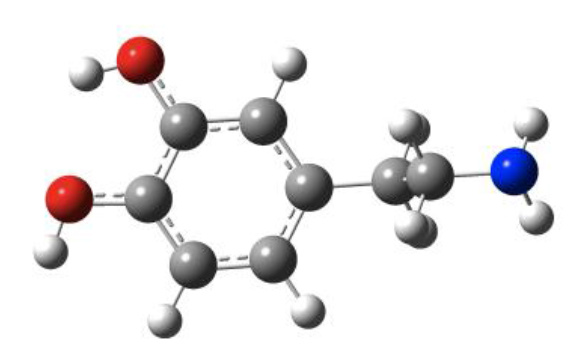
These antipsychotics are dopamine D2 receptor antagonists. Therefore, it is interesting to compare these with dopamine’s electron donor acceptor capacity. The optimized structure of dopamine is reported in Figure 5. The ω− and ω+ values are smaller for dopamine than for other compounds, meaning that it represents the best electron donor and also the worst electron acceptor. More efficient compounds (lower DDD) are those that differ most from dopamine. Apparently, it is not necessary to manifest an electron donor acceptor capacity similar to dopamine in order to be an effective antipsychotic. On the contrary, these differences appear to be necessary. One way of understanding these results is to bear in mind that these drugs are antagonists of dopamine. They occupy the same receptor but do not activate it. This activation may partly relate to the transfer of electrons. Concurring with this idea, if the dopamine D2 receptor is blocked without activating it, the capacity to transfer electrons should be different. This explains why those antipsychotics that require lower DDD are those that differ most from dopamine (Figure 5).

JPPR-18-105-Ana Martinez_Mexico_F5

Figure 5. Optimized structure of dopamine.

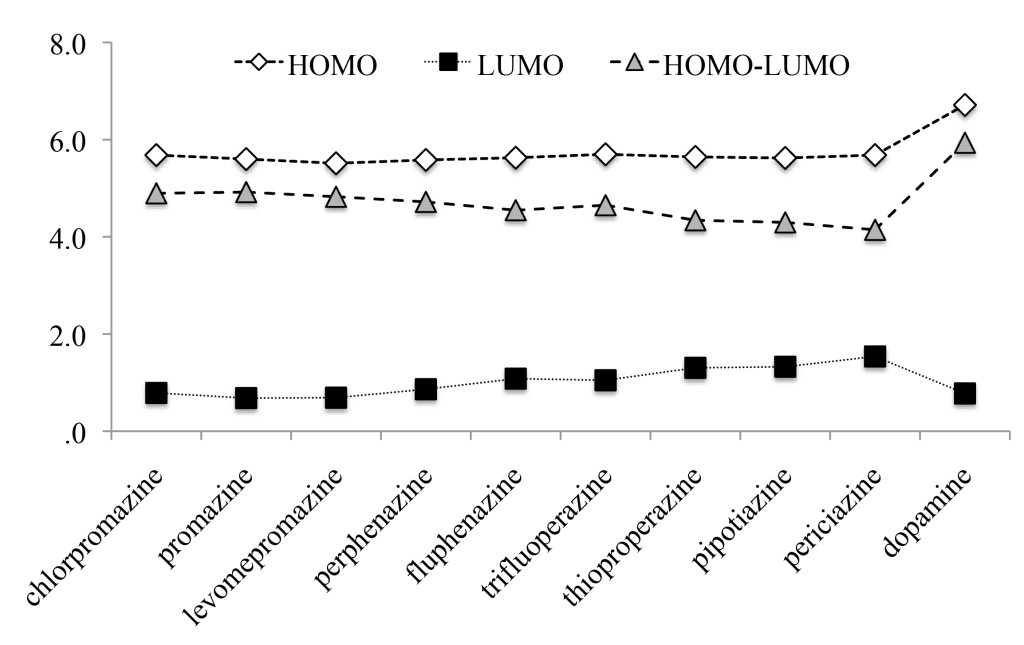
Other chemical indexes are valuable in this analysis, as they provide further physical insights that will enable us to answer the principal questions. These include first excitation energy and molecular hardness (η). The gap of the frontier orbitals (HOMO-LUMO gap) in the Kohn-Sham context is an approximation to the first excitation energy [45, 46]. An approximation of η is obtained with the following equation [38, 39, 47].

η = I – A (3)

The absolute values for eigenvalues of the Highest Occupied Molecular Orbitals (HOMO) and the Lowest Unoccupied Molecular Orbitals (LUMO) are reported in Figure 6. The HOMO-LUMO gap is also included. HOMO eigenvalues are similar (5.51–5.68 eV) but LUMO values show more variation (0.68–1.54 eV). The largest HOMO-LUMO gap is for dopamine (5.94 eV) and the smallest for periziacine (4.14 eV). There seems to be a correlation between HOMO-LUMO gap and efficacy, as the smallest values correspond to antipsychotics drugs that require lower doses. According to Figure 6, lower excitation energies correlate with lower DDDs. This means that they are more efficient as antipsychotic drugs. As antagonists, these molecules also differ from dopamine in terms of this property. The excitation energy may also relate to the activation of the D2 receptor. In order to be an antagonist, excitation energy should be less than that of dopamine. Accordingly, the antagonist will not activate the receptor (Figure 6).

JPPR-18-105-Ana Martinez_Mexico_F6

Figure 6. Eigenvalues (absolute values in eV) of HOMO and LUMO of the molecules studied here. HOMO-LUMO gap is also reported.

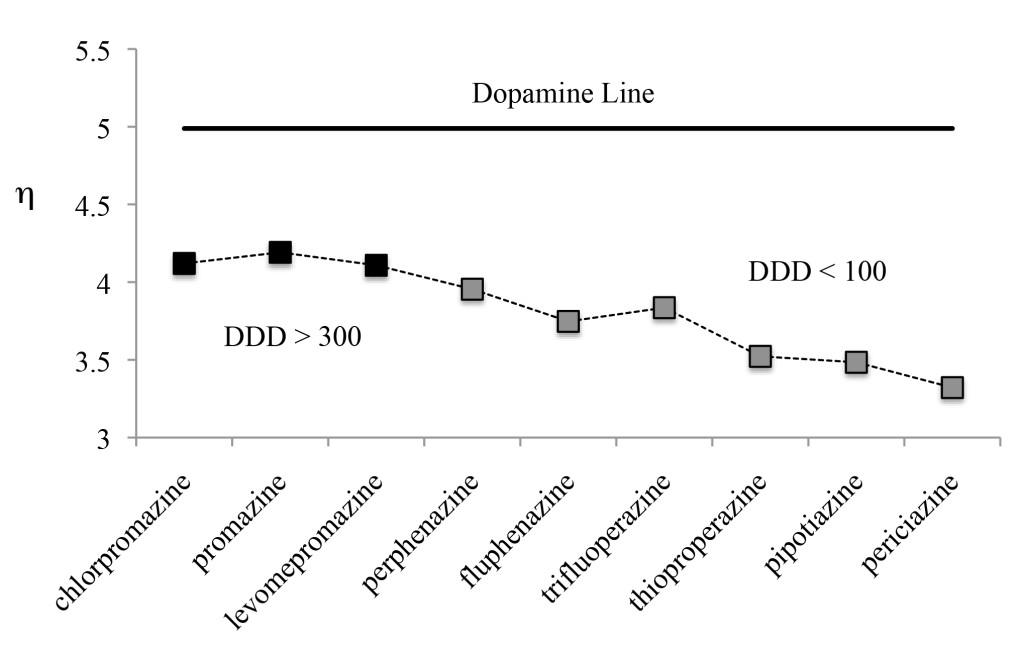
Figure 7 presents the results for η. In conformity with ideas from Parr et al [47], systems are more reactive when η is small. In our systems, lower values of η are associated with lower DDD values and therefore, greater efficiency. For example, the η of periciazine is 0.8 eV smaller than the corresponding value for chlorpromazine, and for periciazine it is 1.8 eV smaller than the corresponding value for dopamine. Compounds that require lower DDD manifest the greatest variation, when compared to dopamine. To be an effective antagonist, η has to be smaller than the corresponding value for dopamine. This could be related with the receptor binding affinity of antipsychotics. Investigations concerning the receptor and the interactions with these drugs are in process. However, these results could explain why there is a need for varying DDD and they also provide inspiration concerning possible strategies to improve the effectiveness of medications (Figure 7).

JPPR-18-105-Ana Martinez_Mexico_F7

Figure 7. Molecular hardness (η = Ι−Α) of antipsychotics. Dopamine value is included for comparison. Values in eV

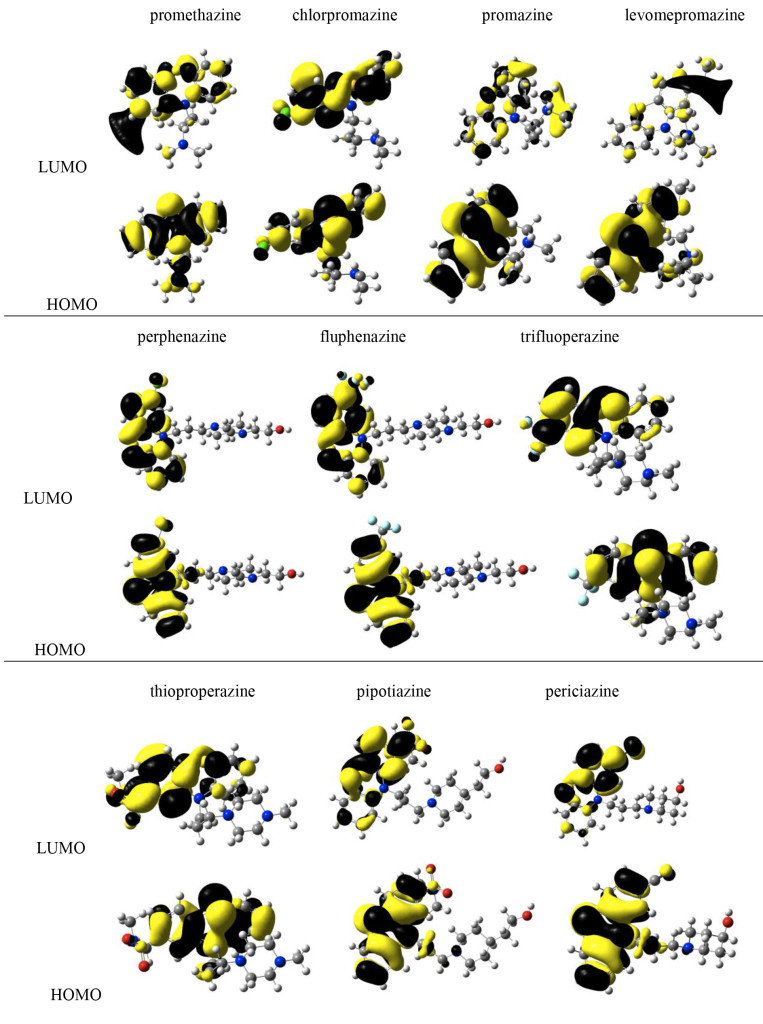
In summary, electron donor acceptor capacity, excitation energies and molecular hardness are global chemical indexes that could help us to explain different DDD values. In order to investigate local properties, we analyzed frontier molecular orbitals and Model Electrostatic Potential (MEP). It was previously reported that different molecular orbitals might relate to distinct biological activities. Figure 8 reports HOMO and LUMO of the compounds under study. In all cases, HOMOs and LUMOs are π bonding orbitals located in the phenothiazine fragment. The exceptions are for pipotiazine and periciazine, as LUMOs are antibonding π orbitals. No system has the participation of halogens, sulfur or CN in the frontier molecular orbitals. Because there are no differences, it is not possible to use molecular orbitals in order to explain dissimilarities in the efficacy and potency of these drugs. According to these results, the involvement of different molecular orbitals is not related to the expression of distinct activities (Figure 8).

JPPR-18-105-Ana Martinez_Mexico_F8

Figure 8. Frontier molecular orbitals of the systems being studied.

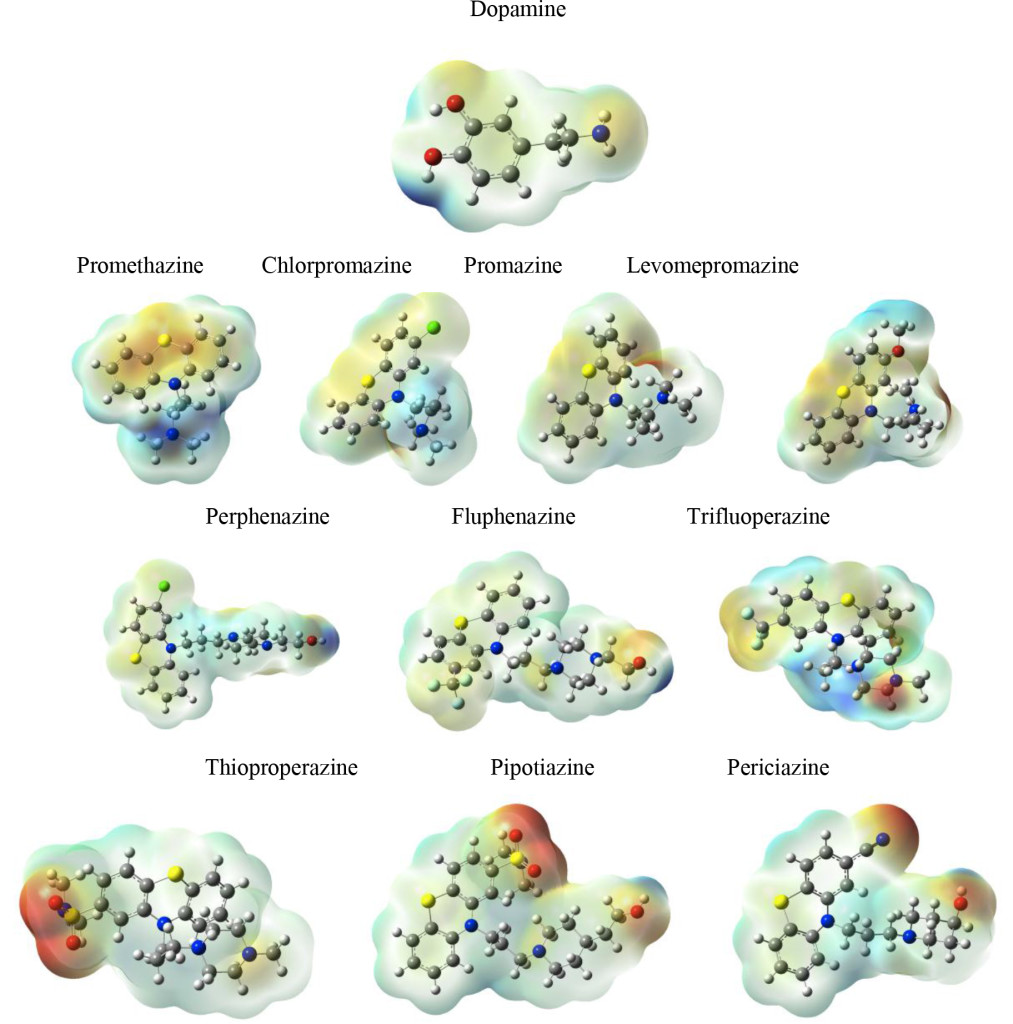
Figure 9 reports MEP for all compounds under study. Red zones are negative regions, whereas blue sections are positive. The biggest difference is the presence of negative sections in those compounds that require lower DDD. Dopamine does not present these red zones, possibly indicating that local properties need to differ from those of dopamine, in order to increase efficiency (Figure 9).

JPPR-18-105-Ana Martinez_Mexico_F9

Figure 9. Molecular Electrostatic Potential (MEP) of the systems under study.

Conclusions

All results reported in this investigation focus on the properties of one family of antipsychotic drugs. It is apparent that the geometry and nature of substituents are important for increasing efficiency. This is a logical finding, as all these molecules bind to D2 receptors in the brain, acting as dopamine D2 receptor antagonists. Structure should be an important factor, in terms of occupying the receptor site. Nevertheless, geometrical comparisons are not sufficient to explain differences in DDD as no differences were found. Neither is possible to use frontier molecular orbitals to explain dissimilarities in the efficacy and potency of these drugs.

Electronic properties allow us to classify the best antipsychotic drugs as good electron acceptors and also as molecules that have negative sections in the MEP. Lesser hardness and lower excitation energies are also associated with lower DDD values. Dopamine is the best electron donor and the worse electron acceptor, whereas one of the most efficient antipsychotic drugs (pipotiazine) represents one of the best electron acceptors and one of the worst electron donors. Concerning molecular hardness, dopamine presents the greatest hardness, whereas the best antipsychotics present the least. Similar results are observed when comparing excitation energies. In summary, compounds with greater efficiency (lower DDD) constitute those that differ most from dopamine. It appears that it is not necessary to have similar capacities to those manifested by dopamine. Contrarily, given that these antipsychotics act as antagonists that occupy the receptor but do not activate it, their properties should vary from those of dopamine. Although the DDD concept is complicated and it is related with the pharmacokinetics, these results allow us to give some insights concerning the activity of these drugs. The results presented here represent a component in the complex puzzle that defines the action mechanism of antipsychotics.

Acknowledgment

This study was funded by DGAPA-PAPIIT, Consejo Nacional de Ciencia y Tecnología (CONACyT), and resources provided by the Instituto de Investigaciones en Materiales (IIM). This work was carried out using a NES super computer, provided by Dirección General de Cómputo y Tecnologías de Información y Comunicación (DGTIC), Universidad Nacional Autónoma de México (UNAM). We would like to thank the DGTIC of UNAM for their excellent and free supercomputing. We also thank the Laboratorio de Supercómputo y Visualización en Paralelo at the Universidad Autónoma Metropolitana- Iztapalapa for the access to its computer facilities. Authors would like to acknowledge Oralia L Jiménez A., María Teresa Vázquez and Caín González for their technical support.

References

  1. Li P, Snyder GL, Vanover KE (2016) Dopamine Targeting Drugs for the Treatment of Schizophrenia: Past, Present and Future. Curr Top Med Chem 16: 3385–3403. [crossref]
  2. Wickelgren I (1998) A new route to treating schizophrenia? Science 281: 1264–1265. [crossref]
  3. Marino MJ, Knutsen LJ, Williams M (2008) Emerging opportunities for antipsychotic drug discovery in the postgenomic era. J Med Chem 51: 1077–1107. [crossref]
  4. Forray C, Buller R (2017) Challenges and opportunities for the development of new antipsychotic drugs. Biochem Pharmacol 143: 10–24. [crossref]
  5. Hosák L, Hosakova J (2015) The complex etiology of schizophrenia general state of the art. Neuro. Endocrinol Lett 36: 631–637. [crossref]
  6. Rădulescu A (2009) A multi-etiology model of systemic degeneration in schizophrenia. J Theor Biol 259: 269–279. [crossref]
  7. Walker E, Kestler L, Bollini A, Hochman KM (2004) Schizophrenia: etiology and course. Annu Rev Psychol 55: 401–430. [crossref]
  8. Dean B (2012) Neurochemistry of schizophrenia: the contribution of neuroimaging postmortem pathology and neurochemistry in schizophrenia. Curr Top Med Chem 12: 2375–2392. [crossref]
  9. Delay J, Deniker P, Harl JM (1952) [Therapeutic method derived from hiberno-therapy in excitation and agitation states]. Ann Med Psychol (Paris) 110: 267–273. [crossref]
  10. Laborit H, Huguenard P, Alluaume R (1952) [A new vegetative stabilizer; 4560 R.P..]. Presse Med 60: 206–208. [crossref]
  11. López-Muñoz F, Alamo C, Cuenca E, Shen WW, Clervoy P, et al. (2005) History of the discovery and clinical introduction of chlorpromazine. Ann Clin Psychiatry 17: 113–135. [crossref]
  12. Ban TA (2007) Fifty years chlorpromazine: a historical perspective. Neuropsych Disease Treat 3: 495–500. [crossref]
  13. Kim DH, Maneen MJ, Stahl SM (2009) Building a better antipsychotic: receptor targets for the treatment of multiple symptom dimensions of schizophrenia. Neurotherapeutics 6: 78–85. [crossref]
  14. Mailman RB, Murthy V (2010) Third generation antipsychotic drugs: partial agonism or receptor functional selectivity?. Curr Pharm Des 16: 488–501. [crossref]
  15. CARLSSON A, LINDQVIST M (1963) EFFECT OF CHLORPROMAZINE OR HALOPERIDOL ON FORMATION OF 3METHOXYTYRAMINE AND NORMETANEPHRINE IN MOUSE BRAIN. Acta Pharmacol Toxicol (Copenh) 20: 140–144. [crossref]
  16. Creese I, Burt DR, Snyder SH (1976) Dopamine receptor binding predicts clinical and pharmacological potencies of antischizophrenic drugs. Science 192: 481–483. [crossref]
  17. Madras BK (2013) History of the discovery of the antipsychotic dopamine D2 receptor: a basis for the dopamine hypothesis of schizophrenia. J Hist Neurosci 22: 62–78. [crossref]
  18. Meltzer HY (2013) Update on typical and atypical antipsychotic drugs. Annu Rev Med 64: 393–406. [crossref]
  19. Samara MT, Cao H, Helfer B, Davis JM, Leucht S (2014) Chlorpromazine versus every other antipsychotic for schizophrenia: a systematic review and meta-analysis challenging the dogma of equal efficacy of antipsychotic drugs. Eur Neuropsychopharmacol 24: 1046–1055. [crossref]
  20. Jaszczyszyn A, GÄ…siorowski K, ÅšwiÄ…tek P, Malinka W, CieÅ›lik-Boczula K, et al. (2012) Chemical structure of phenothiazines and their biological activity. Pharmacol Rep 64: 16–23. [crossref]
  21. Sudeshna G, Parimal K (2010) Multiple non-psychiatric effects of phenothiazines: a review. Eur J Pharmacol 648: 6–14. [crossref]
  22. Fourrier A, Gasquet I, Allicar MP, Bouhassira M, Lépine JP, et al. (2000) Patterns of neuroleptic drug prescription: a national cross-sectional survey of a random sample of French psychiatrists. Br J Clin Pharmacol 49: 80–86. [crossref]
  23. Molnár J, Sakagami H, Motohashi N (1993) Diverse biological activities displayed by phenothiazines, benzo[a]phenothiazines and benz[c]acridins (review). Anticancer Res 13: 1019–1025. [crossref]
  24. Horn AS, Snyder SH (1971) Chlorpromazine and dopamine: conformational similarities that correlate with the antischizophrenic activity of phenothiazine drugs. Proc Natl Acad Sci U S A 68: 2325–2328. [crossref]
  25. Ford JM, Prozialeck WC, Hait WN (1989) Structural features determining activity of phenothiazines and related drugs for inhibition of cell growth and reversal of multidrug resistance, Mol Pharmacol 35: 105–115. [crossref]
  26. Reina M, Martínez A (2017) Silybin interacting with Cu4, Ag4 and Au4 clusters: do these constitute antioxidant materials. Comput Theor Chem 1112: 1–9.
  27. Reina M, Martínez A (2017) How the presence of metal atoms and clusters can modify the properties of silybin: a computational prediction. Comput Theor Chem 1099: 174–184.
  28. Pillegowda M, Periyasamy G (2018) DFT studies on interaction between bimetallic [Au2M] clusters and cellobiose, Comput Theor Chem 1129: 26–36.
  29. Martínez A, Vargas R, Galano A (2018) Citric acid: a promising copper scavenger. Comput Theor Chem 1133: 47–50.
  30. Frisch MJ, Trucks GW, Schlegel HB, Scuseria GE, et al. (2009) Gaussian 09, Revision A.08 Inc. Wallingford, CT.
  31. Zhao Y, Truhlar DG (2008) The M06 suite of density functionals for main group thermochemistry, thermochemical kinetics, noncovalent interactions, excited states, and transition elements: two new functionals and systematic testing of four M06-class functionals and 12 other functionals, Theor Chem Acc 120: 215–241.
  32. Petersson GA, Bennett A, Tensfeldt TG, Al-Laham MA, William A. Shirley (1988) A complete basis set model chemistry. I. The total energies of closed-shell atoms and hydrides of the first-row atoms, J Chem Phys 89: 2193.
  33. Petersson GA, Al-Laham MA (1991) A complete basis set model chemistry. II. Open-shell systems and the total energies of the first-row atoms, J Chem Phys 94: 6081.
  34. McLean AD, Chandler GS (1980) Contracted Gaussian-basis sets for molecular calculations. 1. 2nd row atoms, Z = 11–18. J Chem Phys 72: 5639.
  35. Raghavachari K, Binkley JS, Seeger R, Pople JA (1980) Self-Consistent Molecular Orbital Methods. 20. Basis set for correlated wave-functions. J Chem Phys 72: 650.
  36. Marenich AV, Cramer CJ, Truhlar DG (2009) Universal solvation model base on solute electron density and on a continuum model of the solvent defined by the bulk dielectric constant and atomic surface tensions. J Phys Chem. 113: 6378.
  37. Kim S, Thiessen PA, Bolton EE, Chen J, Fu G, et al. (2016) PubChem Substance and Compound databases. Nucleic Acids Res 44: D1202–1213. [crossref]
  38. Gázquez JL, Cedillo A, Vela A (2007) Electrodonating and electroaccepting powers. J Phys Chem A 111: 1966–1970. [crossref]
  39. Gázquez JL (2008) Perspectives on the density functional theory of Chemicals reactivity. J Mex Chem Soc 52: 3.
  40. Martínez A, Rodríguez-Gironés MA, Barbosa A, Costas M (2008) Donator acceptor map for carotenoids, melatonin and vitamins. J Phys Chem A 112: 9037–9042. [crossref]
  41. Martínez A (2009) Donator acceptor map of psittacofulvins and anthocyanins: are they good antioxidant substances? J Phys Chem B 113: 4915–4921. [crossref]
  42. Danivas V, Venkatasubramanian G (2013) Current perspectives on chlorpromazine equivalents: comparing apples and oranges! Indian J. Psych 55: 207–208.
  43. Leucht S, Samara M, Heres S, Davis JM (2016) Dose Equivalents for Antipsychotic Drugs: The DDD Method. Schizophr Bull 42: 90–94. [crossref]
  44. Andreasen NC, Pressler M, Nopoulos P, Miller D, Ho BC (2010) Antipsychotic dose equivalents and dose-years: a standardized method for comparing exposure to different drugs. Biol Psychiatry 67: 255–262. [crossref]
  45. Baerends EJ, Gritsenko OV, van Meer R (2013) The Kohn-Sham gap, the fundamental gap and the optical gap: the physical meaning of occupied and virtual Kohn-Sham orbital energies. Phys Chem Chem Phys 15: 16408–16425. [crossref]
  46. Vargas R, Garza J, Cedillo A (2005) Koopmans-like approximation in the Kohn-Sham method and the impact of the frozen core approximation on the computation of the reactivity parameters of the density functional theory. J Phys Chem A 109: 8880–8892. [crossref]
  47. Parr RG, Gázquez JL (1993) Hardness fuctional. J Phys Chem 97: 3939–3940.

How to Help Women When Providing Outreach Visits to Rural and Remote Areas of a Low Income Country (LIC)

DOI: 10.31038/AWHC.2018125


In Papua New Guinea (PNG), as in many LICs, there are areas of the country where people do not have access to health services – either because there are no health services or because their village does not have a road link to the nearest (or not so near) health facility. In PNG it is estimated that 20% of people live more than 4 hours walk (travel) from the nearest health facility. In addition, over the past 30 years more than 50% of rural health posts have closed because of health funding, lack of supervisory support, lack of community support and tribal conflict issues. This means that there are large swathes of PNG where nowadays women have no access to health care for their pregnancies.

The maternal mortality ratio (MMR) for women having a supervised birth in a provincial hospital is 50–100 (per 100,000 live births); in a rural health facility the figure is about 200. But if a woman delivers at home and there is little possibility of transfer to a health facility if some serious complication develops (as it does in about 2% of births), then the woman is in great danger of dying; for these reasons the MMR risk of home birth in PNG is about 800/100,000 live births. (In high income countries MMRs are typically less than 10). Therefore, one of the most cost effective ways of helping women not die from pregnancy complications is to help them not get pregnant when they are not wanting to do so; ie. provide them with effective contraception.

In PNG the total fertility rate is 4.4, and Demographic Health Surveys [1] consistently show that women (and men) generally have a desired family size of one child less than the total fertility rate; this indicates a huge unmet need for family planning services. This unmet need for family planning is also an issues in urban areas and rural areas with access to health services, but in remote rural areas where there are no health services women have virtually no choice at all with regards fertility regulation. Research shows that 40% of pregnancies in PNG are unplanned and 20% are unwanted as well [2]; this means that out of the 250,000 births each year in PNG 50,000 – 100,000 are unplanned/unwanted, and probably result in 200–400 additional maternal deaths pa [3].

To be effective strategies to assist women and families obtain and use family planning need to be tailored for individuals, communities and socio-demographic circumstances. Recently a number of hospitals in PNG started offering contraceptive Implants to women as a family planning option for insertion immediately postpartum. Women are counselled in antenatal clinics and indicate to the maternity carers before their due date if they would like to take up this option. Last year about 7000 women received Implants the day after their supervised birth in a health facility, and this provided about 25,000 couple years of protection (CYPs) [4]. However, only 40% of women in PNG currently access a supervised birth: this being the case then how can we assist women and families who live in remote rural areas where there is no opportunity or reasonable access for supervised birth or contraceptive services.

In colonial days (ie prior to independence in 1975) rural health workers would regularly walk to remote areas from their rural health facilities to provide outreach services like immunization and family planning. Very little outreach of this kind continues today. The Missionary Aviation Fellowship is proposing that outreach to remote areas with no health services could be conducted using their small planes by flying a health outreach team into a remote rural airstrip. The outreach team conducts health and medical work over 2–3 days and then is picked up again by another flight. The question is how can we provide something useful for women on these proposal ‘fly in- fly out’ health outreach trips?

When health outreach patrols take place sick people come, women bring their newborns for vaccination services and their babies for ‘a health check’, and pregnant women also come for a ‘check up’. In remote areas fertility control is not something that people are aware of or consider as a life option. Therefore, couples do not present for ‘family planning’ assistance. Women who bring small babies for checks and vaccination can be offered Implants and there may be good uptake for these women because few women are contemplating another pregnancy in the near future when they have a small breast feeding baby. However, who can the outreach team assist the pregnant women who attend the outreach mobile clinic?

One antenatal check (with no possibility of a supervised birth) does not actually provide much benefit for the woman, her pregnancy nor improve the chance that she will survive when it comes to lab or and delivery time. However, effective contraception for several years after the birth will at least ensure that, if she survives this birth, she does not die from another (probably unplanned pregnancy) in the near future. Fly in fly out outreach health patrols of this kind are not provided on a regular basis, and even if there will be another such patrol in the same area when the currently pregnant women have delivered there is no guarantee that they will present or have access to the clinic at that time. For this reason we are considering offering pregnant women a 5 year contraceptive Implant (Jadelle) insertion while they are in the current pregnancy in these exceptional circumstances where supervised birth is not possible and post partum contraception not available either. The World Health Organization (WHO) has declared that inadvertent insertion of progestergen based Implants have no negative impact on a pregnancy [5]. It is reasonable therefore to suggest that ‘advertent’ insertion of the Implant in pregnancy will likewise have no negative impact, and in these circumstances offer the very great benefit to the woman of about 4 years of postpartum contraception.

References

  1. Papua New Guinea Demographic Health surveys; 1996, 2006, 2016. National Statistics Office, Kumul Ave, Port Moresby, Papua New Guinea
  2. Sanga K, Mola G, Wattimena J, Justesen A, Black KI (2014) Unintended pregnancy amongst women attending antenatal clinics at the Port Moresby General Hospital. Aust N Z J Obstet Gynaecol 54: 360–365. [crossref]
  3. Mola G, Kirby B (2013) Discrepancies between national maternal mortality data and international estimates: the experience of Papua New Guinea. Reprod Health Matters, 23:191–202. [crossref]
  4. Annual Report of the Division of Obstetrics and Gynaecology of the Port Moresby General hospital and annual report of the Post Partum Implant program, Marie Stopes PNG 2017
  5. World Health Organization Family Planning Decision Making Tool, 2016

A Parallel Computation Approach to Detailed 3D Modelling of the Complete Oxygen Distribution in Large Tumours

DOI: 10.31038/CST.2018343

Abstract

Purpose

To develop a general course of action for oxygen distribution calculations, in macroscopic tumours, using Graphics Processing Units (GPU) for parallel computation.

Methods

A vessel tree structure and an associated macroscopic (about 100 g) tumour were generated, using a stochastic method and Bresenham’s line algorithm. The vessel dimensions were adjusted to correspond to measured values and each vessel voxel was assigned an oxygen value, based on its distance from an incoming large vessel. Diffusion and consumption were modelled using a Green’s function approach together with Michaelis-Menten kinetics. The tumour was inscribed in a matrix of 1012 elements. The computations were performed using a parallel method (CUDA), where the tumour was sectioned into about 18000 sub-matrices, overlapping to avoid edge effects, which were processed individually by three GPU: s. The result matrices were cropped to original size to enable concatenation.

Results

The entire process took approximately 48 hours, corresponding to 20 seconds per sub-matrix, which is more than fifty times faster when compared to the equivalent CPU calculation. Sample images illustrate the oxygen distribution of our poorly vascularised example tumour.

Conclusions

Regardless of the model accuracy and performance, the improvement in computation time using GPU calculations is highly advantageous. The preferred, parallel calculation method lowers the computation time by over 98% in this example, while maintaining full quality of performance. This is a remarkable improvement, which makes it possible to test and develop relevant models significantly faster. This computation approach does not depend on how the tumour model was created, nor is it limited to the type of model used here, but may be applied to a variety of problems, involving element-wise operations on large matrices.

Keywords

Parallel Computing, Modelling, Hypoxia, Radiosensitivity

Introduction

Numerical approaches to diffusion-consumption problems are frequently used for estimating tumour tissue oxygen transport [1–5]. When used in combination with oxygen consumption calculations, using for example the Michaelis-Menten model [6], they can provide valuable information on the characteristics of tumour oxygenation. However, there are limitations due to the extensive calculations and required computer memory. Provided sufficient accuracy, the computation times depend basically on volume and resolution. In practice, this limits decent computers to downsized experiments. This is unfortunate, since some oxygenation related effects need to be studied on clinically relevant tumour volumes in order to be properly evaluated. As we have established in previous studies, simplified calculations, e.g. through collapsing dimensions, and sub-sampling, rarely generate adequate results [5, 7].

In the previous studies we investigated the accuracy of two different approximative methods aiming to give a fast, detailed estimation of the oxygenation in a large tumour [7]. With the first method, the Individual Tree Method (ITM), we calculated the oxygen contribution from each microvessel tree in the tumour vasculature individually, down sampling the results to 100 µm cubical voxels and superposing them according to the entire vasculature. In the second method, the combined tree method, the distribution including all microvessel trees simultaneously in a 10 µm voxel model was calculated, but only for five randomly selected sample volumes of the entire tumour model. The conclusion, however, was that neither ITM nor CTM, applied to tumour samples, was sufficient to describe the oxygen status of the tumour, but that highly resolved calculations must be applied to the whole tumour. In this study, we attempt to find a way to perform such calculations and bypass the above limitations, performing parallel computations on graphical processing units (GPU) using CUDA®.

Methods

A macrovessel tree was generated, using the same method and parameter values as in Lagerlöf et al 2016. A total of 100 microvessel trees were generated accordingly and randomly assigned to each of the leaf nodes of the macrovessel tree. The combined vessel tree defines the irregularly shaped tumour, with a total volume of 100 cm3 used in these calculations. The microvessel voxels were assigned pO2-values, depending on distance from the origin of the microvessel tree, ranging from 100 to 40 mmHg [7].

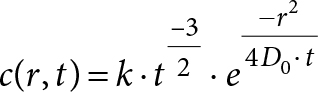
The smallest cuboid volume span by the vessels measured 9 × 10 × 11 cm3, approximately 1012 voxels, side 10 µm. The calculations were made using a Gaussian diffusion kernel (equation 1) [8,9] for repeated convolution with the oxygen distribution matrix in time steps of
100 ms.

CST 2018_117_Eq1(1)

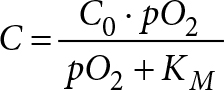
The Michaelis-Menten model (Equation 2) was used to model concentration dependent oxygen consumption at every time step.

CST 2018_117_Eq2(2)

In total, this required four single precision floating point number arrays (using 4 bytes of memory per element), holding vessel information, current oxygenation, oxygen consumption and the calculation result. For faster calculations, also the fourier transform of the oxygenation and of the diffusion kernel are needed, since convolution in the spatial domain is equivalent to multiplication in the frequency domain and the latter operation is faster for large matrices [8]. This would, in turn, require 6 · 4 · 1012 bytes (21.8 TB) of available memory, which corresponds to 700 well equipped workstations. Therefore, sectioning the tumour matrix into sub-matrices was inevitable.

A large number of fairly simple, independent, matrix operations like these are well suited for performing on the computers (GPU). For this purpose, we used a computer equipped with three CUDA-compatible Nvidia titan X (gaming) GPUs. For optimum performance on the GPU, the preferred matrix size was 512 × 512 × 512, corresponding to 512 MB of data. With the purpose of limiting the edge effects of the convolutions to below 1%, each matrix needed 70 voxels of padding in all directions. This was achieved by overlapping the sub-matrices in the sectioning, leaving 372 × 372 × 372 voxels of valid data per sub-matrix, requiring a total of 18720 sub-matrices, of which 10156 were outside the actual tumour, therefore containing no oxygen or vessel data and thus were omitted from the calculations, leaving 8564 tumour sub-matrices. The sub-matrices were indexed to preserve the geometrical information of the original matrix.

Each of the matrices was passed to the first available GPU, along with the fourier transform of the 100ms oxygen diffusion kernel. On the GPU, the current oxygen distribution (at first iteration equal to vessel oxygen content) was fourier transformed and multiplied with the fourier transformed kernel. The resulting matrix was inversely transformed, the voxel-wise oxygen consumption was calculated (according to equation 2) and subtracted; the vessel oxygen data was restored. The process was repeated 300 times and the resulting matrices were returned to the CPU, where the padded edges were trimmed, an oxygen histogram was calculated and the data was saved to file. For quality assurance, the result of an individual sub-matrix calculation was compared voxel-wise to the equivalent CPU-calculation.

The indexing of the sub-matrices allows for any slice or (sufficiently small) sub-volume of the tumour to be easily loaded into the computer memory, for further calculation, visualisation or analysis.

Results

The entire process took approximately 48 hours, corresponding to 20 seconds per sub-matrix. When performed on an Intel® Core™ i7 CPU @ 2,7 GHz (representing normal conditions), the corresponding calculations would endure approximately four months (based on slightly over 20 minutes per sub-matrix in the comparative test calculations), providing the exact same result.

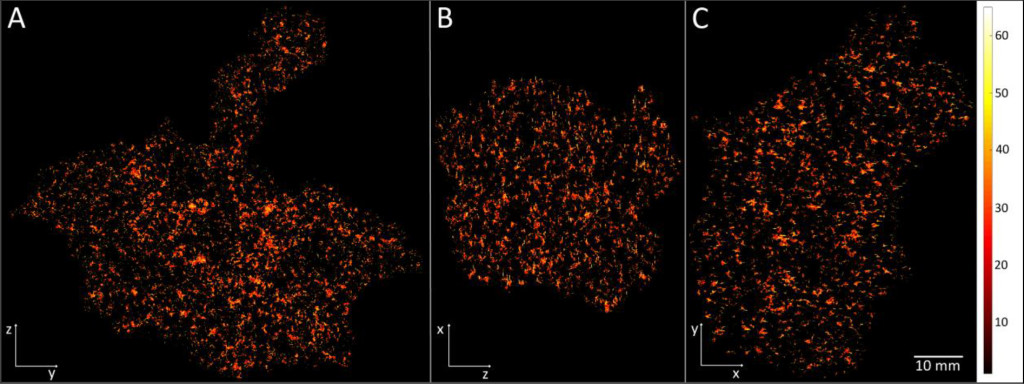
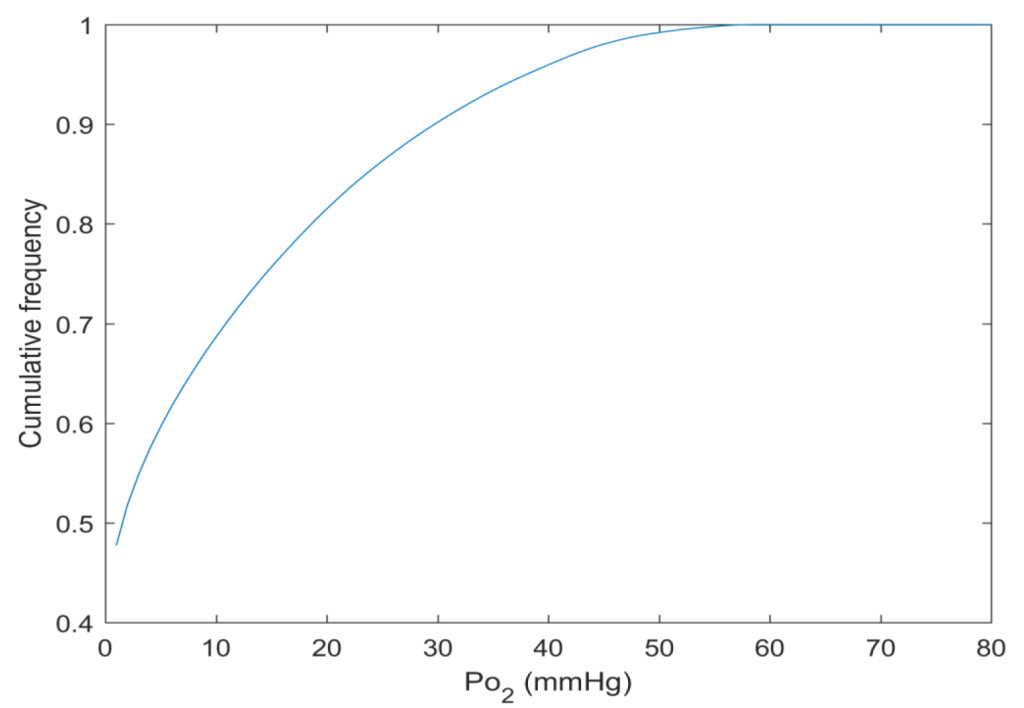
By this new simulation strategy of running the computations in parallel on GPUs detailed information about the oxygen level can be visualised and quantified. Figure 1 a-c shows the oxygenation in a central slice of the tumour in the x, y and z direction respectively. Irregular oxygen distributions are observed, and the oxygen level range from approximately 0 to 80 mmHg. Figure 2 illustrates the oxygen distribution in a 400 megavoxel sample in the centre of the tumour. Demonstrating the large variation in oxygen pressure within the tumour centre. A high fraction of the cells in this region will have a low oxygen pressure, which is non-beneficial for treatment strategies as radiation therapy.

CST 2018_117_F1

Figure 1. Illustration of the simulated oxygen distribution in the tumour centre slices in x (A), y (B) and z (C) direction. The colour bar shows the oxygen level from 0 to 65 mmHg. The white length scale is 10 mm.

CST 2018_117_F2

Figure 2. The cumulative oxygen distribution in a 400 megavoxel sample in the tumour centre.

Discussion

Regardless of the model accuracy and performance, the improvement in computation time using GPU calculations is highly advantageous. The preferred, parallel calculation method lowers the computation time by over 98% in this example, while maintaining full quality of performance. This is a remarkable improvement, which makes it possible to test and develop relevant models significantly faster. This computation approach does not depend on how the tumour model was created, nor is it limited to the type of model used here, but may be applied to a variety of problems, involving element-wise operations on large matrices and it only requires one standard workstation with GPU:s.

There is room for further progress though. Using state of the art equipment (newest NVIDIA Tesla GPUs dedicated for computation) there is roughly a speed gain of 6 compared to the GPUs used in this study [10]. Increasing the number of GPU:s to the maximum (8) gives another 2.7, which means that the calculation times may be reduced by approximately 16 times compared to what is presented here, which theoretically gives a total computation time of about three hours, 99.9 % faster than the estimated 120 days in our CPU comparison.

In addition, these GPUs are able to perform two arithmetic operations at the same time (under certain conditions), on half precision floating-point numbers. Lowering the precision to 16 bit also allows for twice the amount of data to be passed to the GPU per unit time, which means that the efficiency would increase by up to 4 and the computation time ideally could become as short as 45 minutes, a reduction by 99.97 %. However, this could possibly introduce rounding errors (depending on the numerical values used in the model) due to lowered precision. The results therefore would have to be validated. At these rates, the over-head times (data transfer between CPU, GPU and data storage) could become an issue, which makes it hard to estimate the actual time gain. In the event of lost performance due to this, the CPU may be bypassed and data transferred directly to and from GPU memory [11].

Finally, the maximum data transfer rates (8564 · 512 · 512 · 512 · 16/8 Bytes per 45 minutes) would exceed even the theoretical limitations of Superspeed+ (USB 3.1 gen 2 of 0.6 GB/s) as well as of conventional hard drives. Therefore, for convenient writing and reading of data to and from file, using current technology, a solid state drive (SSD) and an interface with sufficient throughput (PCI express or Thunderbolt 3), or at least two SSD:s (if Superspeed+, SATA III or Serial attached SCSI interface is preferred), are advised [12–15].

However, performance is continually improving and within a near future we can expect computation times to further decrease considerably, making this field of tumour modelling research even more exciting. The major initial advantage of faster computations is that it accelerates the evolution of realistic models due to a notable decrease in development cycle time. By extension it enables more accurate calculations to be performed faster, perhaps essentially in real time in clinical settings, for instance diagnostic imaging.

References

  1. Harting C, Peschke P, Borkenstein K, Karger CP (2007) Single-cell-based computer simulation of the oxygen-dependent tumour response to irradiation. Phys Med Biol 52: 4775–4789. [crossref]
  2. Adhikarla V, Jeraj R (2012) An imaging-based stochastic model for simulation of tumour vasculature. Phys Med Biol 57: 6103–6124. [crossref]
  3. Dasu A, Toma-Dasu I, Karlsson M (2003) Theoretical simulation of tumour oxygenation and results from acute and chronic hypoxia. Physics in medicine and biology 48: 2829–2842.
  4. Lagerlöf JH, Kindblom J, Cortez E, Pietras K, Bernhardt P (2013) Image-based 3D modeling study of the influence of vessel density and blood hemoglobin concentration on tumor oxygenation and response to irradiation. Medical physics 40: 024101.
  5. Lagerlof JH, Kindblom J, Bernhardt P (2014) The impact of including spatially longitudinal heterogeneities of vessel oxygen content and vascular fraction in 3D tumor oxygenation models on predicted radiation sensitivity. Med Phys 41: 044101.
  6. Secomb TW, Hsu R, Dewhirst MW, Klitzman B, Gross JF (1993) Analysis of oxygen transport to tumor tissue by microvascular networks. International journal of radiation oncology, biology, physics 25: 481–489.
  7. Lagerlof JH, Bernhardt P (2016) Oxygen Distributions—Evaluation of Computational Methods, Using a Stochastic Model for Large Tumour Vasculature, to Elucidate the Importance of Considering a Complete Vascular Network. PloS one 11: 0166251.
  8. ter Haar Romeny BM (2003) The Gaussian kernel,” Front-End Vision and Multi-Scale Image Analysis: Multi-Scale Computer Vision Theory and Applications. written in Mathematics 37–51.
  9. Lagerlöf J, Diss Göteborg Göteborgs universitet (2014) Department of Radiation Physics, Institute of Clincial Sciences, The Sahlgrenska Academy, University of Gothenburg, Sweden.
  10. WHAT IS GPU-ACCELERATED COMPUTING?, http://www.nvidia.com/object/what-is-gpu-computing.html
  11. NVIDIA GPUDirect., https://developer.nvidia.com/gpudirect
  12. Superspeed USB., http://www.usb.org/developers/ssusb
  13. Thunderbolt 3 tehology brief.,
    https://thunderbolttechnology.net/sites/default/files/HBD16235_Thunderbolt_TB_r05.pdf
  14. SATA-IO Releases SATA Revision 3.0 Specification.,
    https://sata-io.org/sites/default/files/documents/SATA-Revision-3.0-Press-Release-FINAL-052609.pdf
  15. Serial Attached SCSI Technology Roadmap.,
    http://www.scsita.org/content/library/serial_attached_scsi_technology_roadmap/

The Effect of Health Insurance Expansion under the Affordable Care Act on Maternal Mortality Rates

DOI: 10.31038/AWHC.2018124

Abstract

Although the risk of death from complications of pregnancy in the last century has decreased dramatically, maternal mortality rates are rising in the United States. A significant proportion of these events are preventable with a timely access to medical care. This study estimates the effect of insurance access and Medicaid expansion under the Affordable Care Act on the variance in maternal mortality rates across states. We use maternal mortality data as estimated by the Centers for Disease Control and Prevention (CDC) and multivariate regression analysis to explain the wide variation in maternal mortality across states. Regression results indicate that insurance has a significant impact on state maternal mortality rates (p<0.05). Medicaid expansion does not affect mortality rates but is effective at decreasing maternal mortality in states with higher poverty rates (p<0.1). This study finds that access to insurance and early medical interventions as measured by a prenatal care visit before the third trimester can have a statistically significant effect on decreasing maternal mortality in the United States.

Introduction

The Word Health Organization defines maternal death as: “The death of a woman while pregnant or within 42 days of termination of pregnancy, irrespective of the duration and the site of the pregnancy, from any cause related to or aggravated by the pregnancy or its management, but not from accidental or incidental causes” [1]. Worldwide between 1990 and 2013 maternal mortality rates decreased in nearly every country, except the United States where it increased [2]. Data from the Centers for Disease Control and Prevention’s (CDC) Pregnancy Mortality Surveillance System show that maternal mortality increased from about 10 deaths per 100,000 live births in the early 1990s to 16 deaths per 100,000 live births by 2010 [3]. Overall, 40% of pregnancy-related deaths are potentially preventable with improved use of medical care being the most important factor in decreasing maternal mortality statistics [4]. Previous research shows that in the United States maternity rates and trends vary widely by state. While California is showing a declining MMR trend, Texas MMR is increasing over time, doubling between 2011 and 2012 [5]. Overall, MMR for 48 states and Washington DC is increasing and this trend places the United States far behind other developed nations [5]. This study attempts to isolate the role of health insurance in explaining the variance in MMR across states.

When the Affordable Care Act (ACA) was passed in 2010, it mandated the expansion of Medicaid (effective January 1, 2014), increasing eligibility for nearly all US residents with household incomes up to 138% of the federal poverty level. However, the US Supreme Court struck down the mandatory expansion of Medicaid in 2012 and ruled that each state could choose whether to expand this state program. In 2016 (the year of the data in this study), 30 states and Washington, DC, have elected to expand Medicaid, whereas 20 states have not. Yet evidence regarding the effects of Medicaid on health outcomes remains unclear. On one hand, randomized Medicaid trial in Oregon showed no significant effect of Medicaid expansion on mortality rates despite higher medical care utilization rates [6]. On the other hand, Sommers et al. [7] find that state Medicaid expansions were associated with a significant reduction in adjusted all-cause mortality that benefited older adults, minorities and the poor the most. Since 40 percent of maternity-related deaths are potentially preventable with improved quality of medical care [4] we hypothesize that insurance will play a greater role in decreasing MMR than overall mortality rates.

Empirical Model

This study attempts to explain the variance in MMR rates across states in the United States. Empirical model below shows the estimating equation:

MMR = α + β0 (Medicaid Expansion) + β2 (Uninsured) + β3 (Poverty) + β4 (Poverty*Medicaid Expansion) + β5 (Median Income) + β6 (Food Stamps) + β7 (Teen Births)+ β8 (Dedicated Health Provider) + β9(Physical Inactivity) + β10 (Obesity) + β11 (Smoking) + β12 (Prenatal Visit)

Our dependent variable (MMR) measures maternal mortality rates across states. Our independent variables of interest are percent uninsured, Medicaid expansion and interaction variable between Medicaid expansion and poverty rates. Medicaid expansion equals 1 for all states that expanded Medicaid under the Affordable Care Act and 0 for states that did not expand. Since Medicaid expansion benefits states with higher poverty rates the most, interaction between Medicaid expansion and Poverty rate will capture this effect. We hypothesize that Medicaid expansion may not affect all states but rather states with higher proportion of lower income households. We run the model above with and without the interaction variable.

Data

This study uses 2015-2017 publicly available state-level data. Our dependent variable is measured as the number of deaths from any cause related to or aggravated by pregnancy or its management (excluding accidental or incidental causes) during pregnancy and childbirth or within 42 days of termination of pregnancy, irrespective of the duration and site of the pregnancy, per 100,000 births. The data source is CDC WONDER Mortality Files, 2011-2015; it is available at: https://wonder.cdc.gov. CDC WONDER reports maternal mortality for all states except Vermont and Alaska.

Data sources for state female obesity rates, proportion of women with a dedicated health care provider, female inactivity rates, and female smoking rates are based on the Behavioral Risk Factor Surveillance System (BRFSS), an ongoing, state-based, random-digit-dialed telephone survey of non-institutionalized civilian adults aged 18 years and older. Information about the BRFSS is available at http://www.cdc.gov/brfss/index.html.

Dedicated health care provider variable measures percentage of women aged 18 to 44 who reported having one or more people they think of as their personal doctor or health care provider. Female obesity rate is defined as percentage of adult women in a state who are either overweight or obese. An adult who has a BMI between 25 and 29.9 is considered overweight. An adult who has a BMI of 30 or higher is considered obese. In this study we use state obesity rates for women only as reported by the CDC. State characteristics include poverty rate (percent of the population at or below poverty) and average annual median income. All state characteristics were obtained for 2016 from the Kaiser Family Foundation. Finally, data on the proportion of uninsured women at the state level was obtained from the U.S. Census Bureau, American Community Survey, 2016. Table 1 below presents descriptive statistics (Table 1).

Table 1. Descriptive Statistics.

Variable

Mean

(standard deviation)

Minimum value

Maximum value

MMR

20.88
(9.56)

4.5

46.2

Medicaid Expansion

0.647
(0.483)

0

1

% Below poverty line

12.607
(3.047)

7

21

% Uninsured women

11.027
(4.78)

2.8

25.1

Interaction
(Poverty * Medicaid Expansion)

7.94
(6.404)

0

20

Median income, $1000’s

59.34
(9.087)

41.09

76.26

Average food stamps benefits per month

124.4
(18.48)

102.03

228.33

Teen birth rate

22.72
(7.34)

9.4

38

% Women with a dedicated healthcare provider

75.34
(6.91)

59.6

88.3

% Women who are physically inactive

21.092
(4.183)

13.9

30.4

% Obese women

27.20
(4.86)

17.9

38

% Women smoking

17.808
(5.19)

7.8

32.2

% Women who made prenatal care visit before third trimester

94.22
(1.97)

90.1

98.4

% Minority population

28.68
(15.37)

5.6

77.3

Table 1 above shows that MMR varied widely across states from low 4.5 per 100,000 births in California to high 46.2 per 100,000 births in Georgia with a mean value of 20.88 per 100,000 live births. At the same time, uninsurance rates among women varied from 2.8% in Massachusetts (the first state to expand Medicaid and adopt health insurance mandate) to 25.1% in Texas.

Empirical Results

Table 2 presents regression results with and without our interaction variable. Both models show that states with higher proportion of uninsured women have higher MMR (p = 0.05). Medicaid expansion results in lower MMR but results are only statistically significant in our second specification (p < 0.1). At the same time, states with higher poverty rates benefited more from Medicaid expansion where additional coverage did translate into lower mortality rates. Therefore, insurance is an important determinant of MMR rates across all states (Table 2).

Table 2. Regression Results. Dependent Variable: State Maternal Mortality Rates.

Regressor

Model 1

Model 2

Medicaid Expansion

-0.824
(3.623)

-21.525*
(12.454)

% Below poverty line

1.473**
(0.736)

0.530
(0.898)

% Uninsured women

1.024**
(0.5057)

1.372**
(0.531)

Interaction
(Poverty * Medicaid Expansion)

-1.657*
(0.956)

Median income, $1000’s

0.416
(0.314)

0.523
(0.311)

Average food stamps benefits per month

0.107
(0.126)

0.134
(0.123)

Teen birth rate

0.396
(0.515)

0.191
(0.612)

% Women with a dedicated healthcare provider

0.402
(0.374)

0.516
(0.421)

% Women who are physically inactive

0.531
(0.433)

0.571
(0.422)

% Obese women

0.385
(0.619)

0.191
(0.612)

% Women smoking

0.285
(0.530)

0.183
(0.519)

% Women who made prenatal care visit before third trimester

-2.088**
(1.039)

-0.234**
(1.014)

% Minority population

0.387*
(0.211)

0.371*
(0.206)

R-squared
N
F statistic

0.493
48
2.84***

0.534
48
3.00***

Notes: standard errors are in parenthesis;
* indicates significance at 10%;
** indicates significance at 5% and
*** indicates significance at 1%.

Other important determinants of state MMR are percent of women who made a prenatal visit before their third trimester and minority population. We find that states with higher minority population have higher MMR even after we control for insurance, income and poverty rates. This result is consistent with previous literature that shows that minority women have higher MMR. Finally, early access to prenatal care leads to significantly lower MMR (p < 0.05). Therefore, early interventions can have a significant impact on decreasing state MMR.

Conclusions and Policy Implications

Empirical results show that insurance expansions can improve mortality statistics for causes of mortality that are amenable to medical care, such as maternal mortality. States with high MMR tend to have lower insurance rates and Medicaid insurance rates. While uninsurance tends to correlate with low income and poverty status that lead to poor health outcomes, state Medicaid expansion can decrease negative effects of poverty on health outcomes.

Results of this study are not without limitations. First, we collect data at the state level rather than individual data and cannot control for individual risk factors, such as preeclampsia. Second, data sources for state female obesity rates, proportion of women with a dedicated health care provider, female inactivity rates, and female smoking rates are based on the Behavioral Risk Factor Surveillance System (BRFSS) and were self-reported. Finally, collecting data overtime and looking at changes in MMR as states expand Medicaid would provide better estimates of the effects of this program on health outcomes. Unfortunately, accurate and consistent MMR statistics are not available before the Affordable Care Act. As our ability to measure MMR consistently across states improves, further research is necessary to determine the best ways to decrease MMR in the United States.

References

  1. World Health Organization. Health statistics and information systems: Maternal mortality ratio (per 100 000 live births)”. World Health Organization. http://www.who.int/healthinfo/statistics/indmaternalmortality/en/
  2. Retrieved November 1, 2018.
  3. Kassebaum NJ, Barber RM, Bhutta ZA, Dandona L, Gething PW, et al. (2016) Global, Regional, and National Levels of Maternal Mortality, 1990–2015: A Systematic Analysis for the Global Burden of Disease Study 2015. Lancet 388: 1775–1812. [crossref]
  4. Creanga AA, Syverson C, Seed K, Callaghan WM (2017) Pregnancy-Related Mortality in the United States, 2011-2013. Obstet Gynecol 130: 366–373. [crossref]
  5. Berg CJ, Harper MA, Atkinson SM, Bell EA, Brown HL, et al. (2005) Preventability of Pregnancy-Related Deaths: Results of a State-Wide Review. Obstet Gynecol 106: 1228–1234. [crossref]
  6. MacDorman MF, Declercq E, Cabral H, Morton C (2016) Recent Increases in the U.S. Maternal Mortality Rate: Disentangling Trends from Measurement Issues. Obstet Gynecol 128: 447–455. [crossref]
  7. Finkelstein A, Taubman S, Wright B, Bernstein M, Gruber J, et al. (2012) THE OREGON HEALTH INSURANCE EXPERIMENT: EVIDENCE FROM THE FIRST YEAR. Q J Econ 127: 1057–1106. [crossref]
  8. Sommers BD, Baicker K, Epstein AM (2012) Mortality and access to care among adults after state Medicaid expansions. N Engl J Med 367: 1025–1034. [crossref]

Social Support as a Predictor Variable of Life Satisfaction in Transgender People in Spain

DOI: 10.31038/AWHC.2018123

Abstract

This article analysed the relationship between social support from family and friends and life satisfaction in transgender people. The participants comprised 110 transgender women and 43 transgender men, who were recruited via associations using the snowball sampling technique. The results show that satisfaction with emotional support from friends, financial help from the family, and income level are predictors of satisfaction with life. The implications of these results are discussed as well as potential future research.

Keywords

Disclosure, Medical and surgical treatment, Social support, Satisfaction with life, Transgender

Studies on social support in other groups have shown that it has a positive effect on a wide variety of health-related issues, from the perception of physical health and functional autonomy [1,2] to its relationship to morbid conditions such as infarction [3]. In contrast, it has been demonstrated that a lack of social support is associated with disorders such as depression, neurosis, and schizophrenia [4–8]. It has also been observed that social networks have an effect on satisfaction with life and psychological wellbeing [9,10]. Several authors have shown that the positive effect of social support on wellbeing is associated with the capacity of social networks to foster resilience and adaptive behaviour [11–14]. Other studies have suggested that social support has a major influence on psychological adjustment in high-stress situations [15–17].

Although social support is a multidimensional construct, researchers typically use measures that do not differentiate between the various types and sources of social support under investigation. However, differences have been found between types of social support [18,19] and between sources of social support [20]. The term transsexual was introduced into the medical literature via the work of David O. Cauldwell, who reported the case of a boy who had been assigned as a girl at birth. Caudwell defined the child’s status as “Psychopathia transsexualis”.

In 1953, [21] the endocrinologist Harry Benjamin defined transsexual people as people who feel unhappy with their assigned sex, which was determined based on their anatomical structures, and who are fully convinced of belonging to the other sex. Transsexuality can affect either men or women. Thus, male transsexuality refers to a person born with the biological sex and attributes of woman but who feels like a man and female transsexuality refers to a person born with the biological sex and attributes of a man but who feels like woman. The term transgender has recently come into use to refer to people who feel they do not fit within the binary concept of sex and gender. Burgess [22] noted that the term transgender is an inclusive term that refers to transvestites, drag kings, drag queens, transsexuals, androgynous people, and so on. In fact the term transgender include people who have a gender identity that differs from their assigned sex.

Within the field of psychology, previous editions of the Diagnostic and Statistical Manual of Mental Disorders (DSM) classified transsexualism as a disorder. Although the current edition of the DSM has replaced the term “gender identity disorder” by “Gender Dysphoria”, gender nonconformity remains classified as a mental disorder [23]. This change in terminology does not address the demands made by sectors against the pathologization of transexuality. Thus, the International Network for Trans Depathologization was created in 2012, which denounced the practice of treating transexuality as a disorder based on mistaking non-normative identities (those outside the dominant cultural order) for pathological identities. In fact, due to the manner in which the DSM conceptualized transsexuality, psychological research has broadly centred on the assessment, etiology, and treatment of individuals with this disorder [24], and thus pathological aspects have been investigated more than collective psychosocial aspects, such as social support or social wellbeing.

Transgender people begin to experience visibility problems at an early age. Transgender youth exhibit atypical gender behaviour that makes them a particularly vulnerable population that faces prejudice and discrimination in areas such as education, employment, and medical care [25–28]. According to several studies the relationship between psychological distress and discrimination is mediated by a lack of social support for one’s same-sex attraction or gender variation [29, 30]. For that matter, Davey, et al. [31] found that individuals with Gender Dysphoria perceived less social support in comparison with the control group (adults who identified themselves as not having Gender Dysphoria or being transgender).

Finally, Wilkerson, et al. [32] found that youth participating in a drop-in program for LGBTQ youth reported improved social support, lower depressive symptomatology and increased self-esteem and coping. The global aim of this research was to examine social support networks and the type of support received, from the perspective of both frequency and satisfaction with support. In this regard, it is important to note that, although some other studies have analysed social support given transgender people, this study analyses this variable taking in account both the frequency of the support received from their social network and their degree of satisfaction with the support received from the sources analysed. We also analysed the relationship between social support and life satisfaction. It was hypothesised that social support from friends and family would be positively associated with the level of satisfaction with life in transsexual people.

Methods

Participants

The study included 153 participants comprisig 110 transgender women and 43 transgender men from Spain. Of these participants, 75.2% were Spanish and 24.8% were mainly from Latin American countries (Brazil, Ecuador, Argentina, etc.). The age of the participants ranged from 15 years to 69 years (mean 35.5 years; SD = 11.7). Most of the participants were single (71.2%), followed by legally partnered (13.1%), married (9.2%), and separated or divorced (6.5%). In total, 59.5% reported not having a partner and 40.5% reported having a partner. A total of 54 (37%) individuals stated that their partnership had lasted between 1 year and 4 years. The socio-economic data showed that the majority of the sample (34.5%) had a monthly income of less than € 600, when taking into account all members of the household including the respondent, whereas 30.4% had an income of more than € 1,200 per month, 23.7% had an income between € 600 and € 1200 per month, and 11.4% did not know or did not answer. The majority of the participants (35.3%) were unemployed, whereas 22.2% were employed with a contract, and 11.1% were employed without a contract. Table 1 shows the employment status of the sample  (Table 1).

Table 1. Employment status in percentages.

Percentage

Professional situation

Unemployed

35.3

Studying

9.2

Working with a contract

22.2

Working without a contract

11.1

Self-employed with employees

3.3

Self-employed without employees

3.3

Homemaker or caregiver without remuneration

1.3

Retired with contributory pension

3.3

Retired with non-contributory pension

4.6

Retired with other financial help

0.7

Retired without pension or financial help

2.0

Other situations

3.9

Instruments

The questionnaire comprised the following dimensions:

Sociodemographic characteristics

These included age, nationality, educational level, household, income, and employment status.

Awareness, visibility, and treatment

A set of ad hoc questions addressed the following issues: becoming aware of transgender (e.g., At what age did you become aware of being transgender?); visibility (At what age did you come out about your transgender identity?, Who did you first tell about your transgender identity?, Did you come out while you were still in education?; the workplace (Did work colleagues know you were transsexual?); and medical and surgical treatment (Have you undergone hormone therapy?, Have you undergone surgical treatment?, Have you undergone genital reconstruction surgery?).

Social support

Social support was measured using the Frequency of and Satisfaction with Social Support Questionnaire [33]. This questionnaire assesses the frequency of contact with the social network, the degree of satisfaction with this relationship, and the type of support provided by the network. The present study analysed family and friendships as the sources of support. Emotional support and financial support were analysed in terms of frequency (e.g., How often do you receive emotional or financial support from family or friends?) and satisfaction (e.g., How satisfied are you with the emotional or financial support provided by family or friends?). Each item is rated on a 1–5 scale, where 1 = none/dissatisfied and 5 = a lot/very satisfied. Cronbach’s alpha coefficient was 0.80 for the questionnaire. A multiple-choice question was included on the person who had provided the most social support (Who has provided you with the most support regarding your transgender identity?).

Satisfaction with life

This dimension was measured using the Satisfaction with Life Scale [34]. This instrument comprises 5 items that provide a global measure of satisfaction with life. Each item is rated on a 1–7 scale, where 1 = “strongly disagree” and 7 = “strongly agree”. The questionnaire had a good reliability index (α = 0.84). The SWLS provides a score for each item and a global score based on the cut off points suggested by Diener. Table 3 shows the means and standard deviations of the items of the SWLS.

Procedure

A cross-sectional design was followed using questionnaires administered to participants throughout Spain. Participants were recruited via the Spanish Federation of Lesbians, Gays, Transsexuals, and Bisexuals (FELGTB), which contacted associations that work with trans people. The snowball sampling technique was used, in which the people who are originally contacted nominate other people who might be included in the sample. Participation was voluntary and anonymous.

Results

Becoming aware of trans and coming out

The participants became aware of their trans identity at a mean age of 10.8 years (SD = 7.61). In contrast, they came out for the first time at a mean age of 18.8 years (SD = 9.10).

The first person they told was a member of the family (40.9%;
n = 60), followed by a male homosexual friend (18.8%), then a female heterosexual friend (10.1%). The remaining percentages were divided between a female trans friend, a male heterosexual friend, a male trans friend, and other individuals.

Within families, the first person they told was the mother (48.3%) followed by a sister (13.3%), father and mother (10%), grandmother (6.7%), female cousin (6.7%), the family itself (5%), father (3.3%), and others (6.7%).

Treatment

It should be noted that the treatment of trans people via the public health system is not regulated at a national level in Spain; rather, each Spanish Autonomous Community decides whether such treatment forms part of the service they provide. In addition, Esteva de Antonio et al. [35] have noted that there is no standardised protocol for the treatment of trans people in Spain. Genital reconstruction surgery is only available in four of the 17 Spanish Autonomous Communities.

Hormone treatment

Most of the respondents (86.9%) had undergone hormone treatment, whereas 11.8% had not, and 1.3% did not reply. In total, 133 participants replied to the question on where hormone treatment was administered; of these, 89.5% chose their place of residence and 10.5% chose another city.

Surgical treatment

There was little difference in the percentages of respondents who had or had not undergone surgical treatment: 55.6% had undergone surgery, 42.5% had not, and 2% did not reply. In total, 85 participants responded to the question on the place of surgical treatment; of these, 63.5% chose their place of residence and 36.5% chose another place.

Genital reconstruction surgery

In total, 83% of the participants reported not having undergone genital reconstruction surgery, whereas 15% had, and 2% did not reply. In total, 23 participants replied to the question on the place where genital reconstruction surgery was performed; of these, 56.5% chose their place of residence and 43.5% chose a different place or city.

Social support

Main source of support

The participants could choose from one or more options regarding the main source of support. Thus, the family (39.2%) was the main source of support followed by friends (24.9%), partner (11.1%), family and partner (9.8%), family and friends (7.1%), partner and friends (2%), LGTB association (2%), and did not reply/did not know (3.9%).

Types and sources of support

This study analysed family and friends as the sources of support because these two groups provide the highest level of support. Emotional and financial support were assessed in relation to trans people. (Table 2) shows the means and standard deviations of the sources and types of support.

Table 2. Means and standard deviations of the sources and types of support (Frequency and Satisfaction).

Frequency

Satisfaction

Emotional support

Family

3.42

(SD = 1.47)

3.33

(SD = 1.54)

Friends

3.93

 (SD = 1.23)

3.76

(SD = 1.20)

Financial support

Family

2.43

(SD = 1.56)

2.96

 (SD = 1.50)

Friends

1.90

 (SD = 1.15)

2.68

 (SD = 1.25)

The Student test was used to compare means. Significant differences were found in the frequency of emotional support, with friends being the main source (t (147) = 3,497; p <.005). Significant differences were also found in satisfaction with emotional support; friends were also the main source of satisfaction (t (142) = 2,871, p <.005).

Significant differences were found in the frequency of financial support, the family being the most frequent source of this type of support (t (144) = 3.531, p <.005). No differences were found between family and friends in satisfaction with financial support (t (137) = 1.786, p = 0.076).

Satisfaction with life

Pavot and Diener [36] proposed a group of criteria to classify people according to their score on the SWLS: 30–35 (very satisfied); 25–29 (satisfied); 20–24 (slightly satisfied); 15–19 (slightly dissatisfied); 10–14 (dissatisfied); and 5–9 (very dissatisfied).

The mean global score was 19.44 (SD = 8.34). Based on the recommended cut off points, the participants reported small but significant problems in several areas of their lives. Attention should be drawn to the last item (If I could live my life over, I would change almost nothing); 53.7% of participants disagreed or strongly disagreed with this statement. Table 3 shows the means and standard deviations of the items of the SWLS (Table 3).

The SWLS used by permission of Diener at al [34]. Participants who had undergone genital reconstruction surgery had a mean score of 23.13 (SD = 8.60) in satisfaction with life versus a mean of 18.75 (SD = 8.09) among those who had not undergone surgery. The chi-squared test showed that there was a significant association between undergoing genital reconstruction surgery and level of satisfaction with life: chi-squared test (1, N = 150) = 72,107, p < 0.000.

Table 3. Means and standard deviations of the SWLS.

Mean

SD

Item 1. In most ways my life is close to my ideal

3.95

2.17

Item 2. The conditions of my life are excellent

3.82

1.96

Item 3. I am satisfied with my life

4.39

2.08

Item 4. So far I have gotten the important things I want in life

4.48

2.03

Item 5. If I could live my life over, I would change almost nothing

2.99

2.23

Relationship between social support and satisfaction with life

Linear correlation analysis was conducted to determine the association between social support variables and level of satisfaction with life. Significant correlations were found between emotional and financial support from the family in both dimensions (frequency and satisfaction) and satisfaction with life. Significant correlations were also found between emotional support from friends in both dimensions (frequency and satisfaction) and satisfaction with life. However, a significant correlation was only found between satisfaction with financial support from friends and satisfaction with life, but not between frequency of frequency of financial support and satisfaction with life. (Table 4) shows the correlations between the two variables.

Table 4. Correlation between different dimensions of social support and satisfaction with life.

Types of support

Satisfaction with life

Family

Emotional support (frequency)

.350*

Emotional support (satisfaction)

.350*

Financial support (frequency)

.318*

Financial support (satisfaction)

.461*

Friends

Emotional support (frequency)

.328*

Emotional support (satisfaction)

.337*

Financial support (frequency)

.111

Financial support (satisfaction)

.235**

*≤.001; **≤.005

Finally, stepwise linear regression was conducted to determine the variables that predicted satisfaction with life using the participants’ total score on the SWLS as the criterion variable. As predictor variables, sociodemographic variables (age and level of monthly income) were entered in the first step and social support variables (frequency of and satisfaction with each type of support) were entered in the second step for each of the sources of support analysed (R² = .34, F (126, 4) = 16.32, p <0.001). The analysis of the results showed that the main variables that predicted satisfaction with life were satisfaction with emotional support from friends, satisfaction with financial support from the family, level of monthly income, and frequency of emotional support from the family. (Table 5) shows the relative weights of each of the predictor variables.

Table 5. Stepwise linear regression between predictor variables and satisfaction with life.

B

SD

Beta

t

Sig.

Age

.107

1.453

.149

Monthly income

.466

.208

.163

2.242

.027

Family

Emotional support (frequency)

1.212

.544

.210

2.229

.028

Emotional support (satisfaction)

–.053

–.322

.748

Financial support (frequency)

–.033

–.316

.752

Financial support (satisfaction)

1.501

.545

.266

2.756

.007

Friends

Emotional support (frequency)

.112

1.073

.285

Emotional support (satisfaction)

1.821

.534

.255

3.409

.001

Financial support (frequency)

–.024

–.305

.761

Financial support (satisfaction)

.025

.290

.772

Discussion

The following conclusions are suggested, taking into account of the aims and hypothesis of the study.

Personal and social characteristics

Regarding socioeconomic data, the financial precariousness of the participants is indicated by the fact that 34.5% had a monthly income of less than € 600, which was clearly due to the high level of unemployment among them (35.3%). Positive discrimination actions are needed to integrate transgender people in the workplace.

Regarding sexual identity, the mean age at which the participants were aware of their trans identity was 10.8 years, which coincides with the onset of puberty (between 10 years and 12 years). In fact, puberty is a developmental period that is associated with high levels of gender dissatisfaction among many young transgender, particularly because this is the time when the first signs of sexual maturity begin to emerge [25]. However, the participants came out to other people when they were much older. This could indicate the difficulties that trans-gender people perceive when there is a discrepancy between the sex assigned them at birth and their gender identity. In this regard, several authors have suggested that adolescents who identify as trans or who feel they do not fit within the binary gender system are particularly susceptible to experiencing negative life situations, such as becoming homeless, being victimized, and experiencing stigmatization or rejection [27, 37, 38]. For these reasons, school should also become a setting of both awareness and support, which would involve the development of specific training for teachers.

Regarding treatments for the physical aspect of sexual identity, the majority of the participants had undergone hormone therapy or surgical treatment. However, fewer had undergone surgical treatment than those who had undergone hormone therapy. Finally, only 15% had undergone sex reassignment surgery. The high percentages of participants who had undergone hormone therapy and surgical treatment could be an indication of the importance they place on the social presentation of their actual identity, whereas the small percentage of participants who had undergone genital reconstruction may have been due to the following reasons, among others: this treatment has limited availability in Spain; fears of unsatisfactory outcomes; the perception that this type of operation is unnecessary to feel completely fulfilled; and emotional burnout due to a therapeutic journey that has gone on for too long. Despite the foregoing, the results show that the participants who had undergone genital reconstruction surgery had a higher level of satisfaction with life. Further research is needed to clarify the reasons for their greater satisfaction and to follow-up people who have undergone genital reconstruction to know how they are progressing.

Social support and satisfaction with life

Family and friends were the main sources of social support. Significant differences were found between the two sources of emotional and financial support: friends provided more emotional support and generated higher levels of satisfaction. A possible explanation for these results is that trans identity may be more accepted by friends than by family, particularly if it is taken into account that the network of friends is freely chosen. The relative lack of emotional support from the family suggests the need to work with families in order to increase this particular aspect of support. Community psychology offers a range of resources to transform oppressive and unjust situations through the participation of community members (social support and self-help groups, the creation of spaces for community and political participation, etc).

The family was the main source of financial support, although no significant differences were found between family and friends in the level of satisfaction with this type of support. This is noteworthy because although the family provided more financial support than friends, no significant differences were found between family and friends in the level of satisfaction with this type of support. Factor and Rothblum [24] compared transgender people (transgender men, transgender women, and genderqueers) to nontransgender brothers and sisters, and found that the transgender group perceived less social support from the family. Studies on homosexual people have also shown that they receive more social support from friends than from the family [9, 39–42]. A possible explanation for this finding may involve the “connection” dimension proposed by Tardy [43], who suggested that the effectiveness of a specific type of support in many cases depends on its source.

Taking into account the cut off points established by Pavot and Diener [36], the global score on satisfaction with life was slightly less than the average score. This finding is understandable if it is taken into account that, from the moment trans people first come out, they face many problems and challenges in a range of environments that include education, family, workplace, and healthcare. In this regard, Clements-Nolle, Mark and Katz [44] conducted a study in San Francisco that included 392 trans women and 123 trans men and demonstrated a prevalence of 32% in attempted suicide, where depression, gender discrimination, and victimization were the variables associated with the attempt.

Finally, the variable satisfaction with life was associated with social support. The trans group experienced greater satisfaction with life the greater the frequency of and satisfaction with the emotional and financial support provided by the family. Satisfaction with life is also increased by an increase in the frequency of and satisfaction with the emotional support provided by friends. Satisfaction with financial support from friends was associated with satisfaction with life. However, the results of the regression analysis show that the main variables associated with satisfaction with life were emotional support from friends, financial support from the family, and income level. These results may be related to the financial precariousness experienced by most of the trans group, who receive financial support from the family, although emotional support from friends is considered more important. In addition, the results on instrumental support from the family show that the frequency of support does not always coincide with satisfaction with support; rather, satisfaction depends on the social network itself as well as the quality of the relationship with the sources of support [45].

These results are relevant because they are indicative of the situation of trans people in Spain. In addition, they show that increased social support from friends and family leads to greater satisfaction with life. Although most families experience some kind of conflict and crisis by having a transgender child [46,47], an effective intervention with the family can significantly reduce distress among trans people, who often feel misunderstood or rejected by their relatives.

Clearly, it remains important to continue research on this group; as Carroll, Gilroy, and Ryan [48] have pointed out, there are few studies that have reliably analysed the characteristics and experiences of transgender people. Future research should investigate different clinical treatments and to what extent these are associated with satisfaction with life and the mediating role of social support. This study was conducted in Spain, and thus studies in other countries are needed in order to be able to generalise the results to other social and cultural contexts.

Moreover, even though no significant differences were found between native and non-native trans, it would be of interest to investigate this aspect using a larger sample. Studies such as that conducted by Chavez [49] in Southern Arizona have shown that LGBTQ immigrants encounter many problems due to economic and legal restrictions.

Finally, it is especially important to consider the variable social support from the viewpoint of intervention in order to develop actions that will improve the level of support by strengthening social networks. We would like to thank the FELGTB and particularly Ms. Mar Cambrollé Jurado (President of the Sylvia-Ribera Association of Andalusian Transsexuals) for their help and trust in the research team.

References

  1. Angel JL, Angel RJ (1992) Age at migration, social connections, and wellbeing among elderly Hispanics. Journal of Aging and Health 4: 480–499.
  2. Sasao T, y Chun CA (1994) After the Sa-i-gu (April 29) Los Angeles Riots: correlates of subjective well-being in the Korean-American Community. Journal of Community Psychology 22: 136–152.
  3. Rodríguez-Artalejo F, Guallar-Castillón P, Herrera MC, Otero CM, Chiva MO, et al. (2006) Social network as a predictor of hospital readmission and mortality among older patients with heart failure. J Card Fail 12: 621–627. [crossref]
  4. Gottlieb BH (1983) Social support strategies: Guidelines for mental health practice. Beverly Hills, Sage Publications, USA
  5. Lakey B, Cronin A (2008) Low social support and major depression: Research, theory and methodological issues. In K. S. Dobson & D. J. A. Dozois (Eds.), Risk factors in depression (pp. 385–408). San Diego, CA, US: Elsevier Academic Press.
  6. Pore V, Heikkilä M, Ritala M, Leskelä M, Areva S (2006) Atomic layer deposition of TiO2-xNx thin films for photocatalytic applications. Journal of Photochemistry and Photobiology, A: Chemistry 177: 68–75.
  7. Nezlek JB, Hampton CP, Shean GD (2000) Clinical depression and day-to-day social interaction in a community sample. J Abnorm Psychol 109: 11–19. [crossref]
  8. Pattison EM, Defrancisco D, Wood P, Frazier H, Crowder J (1975) A psychosocial kinship model for family therapy. Am J Psychiatry 132: 1246–1251. [crossref]
  9. Domínguez-Fuentes JM, Hombrados-Mendieta MI, García-Leiva P (2012) Social support and life satisfaction among gay men in Spain. Journal of Homosexuality 59: 241–255.
  10. Gottlieb BH (1981) Social networks and social support in community mental health. In: BH Gottlieb (ed.). Social networks and social support. Sage London.
  11. Brito RC, Koller SH (1999) Human development and social and affective support networks. In: A. M. A. Carvalho (ed.). The social world of the child: nature and culture in action. São Paulo: House of the Psychologis.
  12. Garmezy N, Masten AS (1994) Chronic adversities. In: M. Rutter, E. Taylor y L. Hersov (eds.). Child and adolescent psychiatry: modern approaches. London: Blackwell.
  13. Rodríguez E, Lanborena N, Errami M, Rodríguez A, Pereda C, et al. (2009) Relationship between migrant status and social support and quality of life in Moroccans in the Basque Country (Spain). Gaceta Sanitaria, 23: 29–37.
  14. Rutter M (1987) Parental mental disorder as a psychiatric risk factor. In: Hales R., Frances A. (eds). American Psychiatric Association annual review. (6thVol), American Psychiatric Press, Inc.; Washington, DC.
  15. Cohen S, Wills TA (1985) Stress, social support and the buffering hypothesis. Psychological Bulletin 98: 310–357.
  16. Simons C, Aysan F, Thompson D, Hamarat E, Steele D (2002) Coping resource availability and level of perceived stress as predicators of life satisfaction in a cohort of Turkish college students. College Student Journal, 36, 129–141.
  17. Rees T, Freeman P (2007) The effects of perceived and received support on self-confidence. J Sports Sci 25: 1057–1065. [crossref]
  18. Cheng C (1998) Getting the right kind of support: functional differences in the types of social support on depression for Chinese adolescents. Journal of Clinical Psychology 54: 845–849.
  19. Demaray M K, Malecki K (2003) Perceptions of the Frequency and Importance of Social Support by Students Classified as Victims, Bullies, and Bully/Victims in an Urban Middle School. School Psychology Review 32: 471–489.
  20. Clark-Lempers DS, Lempers JD, Ho C (1991) Early, middle, and late adolescents’ perceptions of their relationships with significant others. Journal of Adolescent Research, 6: 296–315.
  21. Benjamin H (1953) Transvestism and transsexualism. International Journal of Sexology 153: 391–396.
  22. Burgess C (1999) Internal and external stress factors associated with the identity development of transgendered youth. In: G.P. Mallon (ed.). Social services with transgendered youth. Harrington Park Press, Binghamton, NY, USA.
  23. American Psychiatric Association (2013) Diagnostic and statistical manual of mental disorders. (5thedn), American Psychiatric Association, Washington, DC, USA.
  24. Factor RJ, Rothblum ED (2007) A study if transgender adults and their non-transgender siblings on demographic characteristics, social support, and experiences of violence. Journal of LGBT Health Research 3: 11–30.
  25. Grossman AH, D’Augelli AR (2006) Transgender youth: invisible and vulnerable. J Homosex 51: 111–128. [crossref]
  26. Lombardi E (2001) Enhancing transgender health care. Am J Public Health 91: 869–872. [crossref]
  27. Mallon GP (1999) Knowledge for practice with transgendered persons. Journal of Gay and Lesbian Social Services 10: 1–18.
  28. Ryan C, Futterman D (1997) Lesbian and gay youth: Care and counseling. Adolescent Medicine: State of the Art Reviews 8: 207–374.
  29. Hatzenbuehler ML, Dovidio JF, Nolen-Hoeksema S, Phills CE (2009) An Implicit Measure of Anti-Gay Attitudes: Prospective Associations with Emotion Regulation Strategies and Psychological Distress. J Exp Soc Psychol 45: 1316–1320. [crossref]
  30. Hatzenbuehler ML, McLaughlin KA, Xuan Z (2012) Social Networks and Risk for Depressive Symptoms in a National Sample of Sexual Minority Youth. Social Science & Medicine 75: 1184–1191.
  31. Davey A, Bouman WP, Arcelus J, Meyer C (2014) Social support and psychological well-being in gender dysphoria: A comparison of patients with matched controls. The Journal of Sexual Medicine 11: 2976–2985.
  32. Wilkerson JM, Schick VR, Romijnders KA, Bauldry J, Butame SA (2016) Social support, depression, self-esteem, and coping among LGBTQ adolescents participating in Hatch Youth. Health Promotion Practice 17: 1–8.
  33. Hombrados-Mendieta MI, Gómez-Jacinto L, Domínguez-Fuentes JM, García-Leiva P, Castro-Travé M (2012) Types of Social Support Provided by Parents, Teachers and Classmates During Adolescence. Journal of Community Psychology 40: 645–664.
  34. Diener E, Emmons RA, Larsen RJ, Griffin S (1985) The Satisfaction With Life Scale. J Pers Assess 49: 71–75. [crossref]
  35. Esteva de Antonio I, Gómez-Gil E, Almaraz MC, Martínez-Tudela J, Bergero T, et al. (2012) Organización de la asistencia a la transexualidad en el sistema sanitario público español. Gaceta Sanitaria 26: 203–209.
  36. Pavot W, Diener E (1993) Review of the Satisfaction with Life Scale. Psychological Assessment 5: 164–172.
  37. Israel GE, Tarver DE (1997) Transgender Care: Recommended Guidelines, Practical Information, and Personal Accounts. Temple University Press, Philadelphia, USA.
  38. Rosenberg M (2002) Children with gender identity issues and their parents in individual and group treatment. Journal of the American Academy of Child and Adolescent Psyquiatry 41: 619–621.
  39. Berguer RM, Mallon D (1993) Social support networks of gay men. Journal of Sociology and Social Welfare 20: 155–174.
  40. Detrie PM, Lease SH (2007) The relation of social support, connectedness, and collective self-esteem to the psychological well-being of lesbian, gay, and bisexual youth. J Homosex 53: 173–199. [crossref]
  41. Kurdek LA (1988) Perceived social support in gays and lesbians in cohabitating relationships. Journal of Personality and Social Psychology 54: 504–509.
  42. Kurdek LA, Schmitt JP (1987) Perceived emotional support from family and friends in members of homosexual, married, and heterosexual cohabiting couples. Journal of Homosexuality 14: 57–68.
  43. Tardy CH (1985) Social support measurement. American Journal of Community Psychology 13: 187–202.
  44. Clements-Nolle K, Marx R, Katz M (2006) Attempted suicide among transgender persons: The influence of gender-based discrimination and victimization. Journal of Homosexuality 51: 53–69.
  45. Cohen S, Syme SL (1985) Issues in the study and application of social support. In: S. Cohen & L. Syme (eds.). Social support and health. Academic Press, San Francisco Pg No: 3–22.
  46. Borhek MW (1994) Coming Out to Parents: A Two-way Survival Guide for Lesbians and Gay Men and Their Parents. (2nd edn), Pilgrim press, New York, USA.
  47. Morrow DF (2000) Coming out to families: Guidelines for intervention with gay and lesbian clients. Journal of Family Social Work 5: 53–66.
  48. Carroll LC, Gilroy PJ, Ryan J (2002) Counselling transgendered, transsexual, and gender-variant clients. Journal of Counselling & Development 80: 131–139.
  49. Chavez KR (2011) Identifying the needs of LGBTQ immigrants and refugees in Southern Arizona. J Homosex 58: 189–218. [crossref]

Documentation Thoughts

DOI: 10.31038/AWHC.2018122


The rules and legality of documentation do not change despite writing styles and delivery mode of documents.

Each profession has their own language and their own acronyms. Often the lingo obscures the actual documentation. I believe there is a false sense that the complex verbiage somehow indicates a level of competency that the non-professional may perceive as skilled. One remedy many organizations use is a template. While documentation conformity increases, detailed and “additional information” documentation in addition to the template requirements may be missing and the resulting recorded information may be subject to misinterpretation. Think of some of the surveys you have completed; do they seem to lead you down a predetermined and limited path?

I have edited reports, reviewed cases, medical reviews and cost containment documentation for more than 2 decades. My first suggestion for better documentation is to determine your audience. Who is reading the documentation? Are you writing or documenting for the CEO of an insurance company or the insurance commissioner? Would your documentation be different? Then ask yourself why. In our organization, I always ask if the case management report will be relevant in 2–5 years. Will your decision process and those corresponding events be adequately described in your report? I like reports that can stand alone, reports not dependent on the previous reporting. This may be a personal professional preference.

Are you documenting that certain tasks have been completed? Have you done your due diligence? Staying within your scope of practice or license when documenting should always be foremost when writing and editing.

Where is the report (report, form or template) to be used? I am referring to the institutional, more codified venues such as hospitals, financial institutions, and transportation, insurance, engineering and legal professions.

Many organizations have developed documentation methods for decision making that are exact to their standards.

Those of us who develop documentation tools, forms and guidelines most likely have access to the specific who, what, why and where questions and the form the answers need to take. Professional standards are always implied in documentation guidelines and tools. In developing the document standards, always check on the complexity of what is needed. I refer back to answer the question, who is the intended audience?

I have been at times the person to fill in forms and document or decipher what is being asked in cases where the documentation limitations would have led me to non-compliance or confusion. I’ll admit it, I just did not do it. The result was “no documentation” or delayed reporting. Humans and water always fall into the line of least resistance. When I knew exactly what was needed, knew upfront who was reading my document and had the help of a trusted editor, I was compliant. I got great job satisfaction from my reports. Some of my consulting reports were admitted in court hearings. So I ask each documentation developer to actually do the hands-on effort, personally, and develop feedback for phase II utilization of the documentation, which can improve your compliance and basic cooperation. Great editors are also teachers who give feedback and develop skills important to your organization.

Documents that cannot be altered, revised, amended or documentation that can be changed, must be determined at the development stage. Our world of “do-overs” is almost expected by the populace. Legal versus informational purpose should be decided at the very beginning of the development. Most likely, the information within the document/report also has a legal implication. Those dreaded errors and omissions!

When I worked as a medical/legal researcher, I first set up a timeline. Did I go through boxes of documents and reports first? No, I went to the line item billing first. This always gave me a roadmap. I also discovered errors between billing and documented services and intervening circumstances within the reports. If it is not documented, did it happen? Billing or invoicing records what was done, and should show evidence of other professional reviews or opinions taken into account.

Line item billing sometimes can be used for unravelling the acronyms of the profession as well, so this was a time saver. For those running audits, review of the billing at the start can be a big timesaver, if applicable.

Actually providing the documentation takes time and experience. It is a skill learned and practiced. In my case management world, I have met Master-level educated case managers who cannot write, let alone document a full month of case management activity and interactions. Did they provide perfect case management? Yes, when speaking with them and looking at activity notes. No, when looking solely at their reports. Great documentation takes practice, openness to critique, education and a trust in the editor. Organizations develop skills that protect their organization and provide informational documentation to their customers. In my world experience is everything, skill is learned, and documentation keeps our licenses in good order.

I really appreciate when documenters ask or are receptive to suggestions, additions or revisions that make the report so valuable. Another set of eyes on the document (editor/reviewer) is, in my opinion, necessary to finalize the document before submission. Evidence-based, documentation as opposed to summation is my preference. Again, ask if the report will be relevant in 2–5 years? Does the document state what occurred to aid the professional in their decision making or activity? That is the purpose, after all, of documentation.

Taking time to document, taking proper notes, following the lines of proper grammar and writing, including proper citation, are activities not done distracted and not done well last minute. Value-based documentation is integral to true professional case management and is the elusive competitive edge.

Document with thought, purpose and insight. You will have successfully recorded all your hard work. Should you ever need to review a decision 2–5 years later, you can revisit with confidence, who, what, when and where of your professional decision.

Total Laparoscopic Hysterectomy for Adenomyosis in a Patient Receiving Peritoneal Dialysis: A Case Report

DOI: 10.31038/IGOJ.2018125

Abstract

Peritoneal dialysis is a common supportive therapy for chronic renal failure, whereas laparoscopic surgery has rarely been performed. We herein report laparoscopic hysterectomy in a patient receiving peritoneal dialysis. A 44-year-old patient receiving peritoneal dialysis underwent laparoscopic hysterectomy due to a large amount of vaginal bleeding caused by adenomyosis. At surgery, the peritoneum turned whitish with inflammation. The small intestine was adhered to the peritoneum, omentum or both; however, no serious adhesion was found in the pelvic cavity. After hysterectomy, the peritoneal defect was completely repaired out of consideration of the need for peritoneal dialysis after surgery. There were no complications during or after surgery. No peritoneal leakage was observed. Laparoscopic hysterectomy was suggested to be safe and feasible in patients who are receiving peritoneal dialysis.

Keywords

peritoneal dialysis, hysterectomy, laparoscopy, total laparoscopic hysterectomy, adenomyosis

Introduction

Peritoneal Dialysis (PD) is an established management for patients with stage 5 chronic kidney disease [1]. Although laparotomy has been considered the standard treatment for PD patient candidates for intra-abdominal surgery to reduce the risk of complications, a high incidence of perioperative complications, including dialysate fluid leakage, wound dehiscence, incisional hernia, peritonitis and hemoperitoneum, has been reported [2,3]. A recent study showed that laparoscopic surgery was well accepted as being a conservative procedure associated with a less-invasive approach, lower peritoneal membrane stress and better preservation of the peritoneum integrity than laparotomic surgery [4–6]. However, few reports have been published concerning laparoscopic hysterectomy for patients with PD.

We herein report a case of total laparoscopic hysterectomy for adenomyosis in a patient who was receiving PD.

Case Presentation

A 44-year-old nulliparous woman had a large amount of vaginal bleeding caused by adenomyosis. The patient had completely lost her renal function due to chronic renal failure and had been receiving PD for 7 years. While receiving PD, the patient had an irregular menstrual cycle and had not menstruated for the past six months. Transvaginal ultrasound and magnetic resonance imaging revealed that the patient had an enlarged uterus (the size of that at 12 weeks’ gestation) that was suspected of being adenomyosis. An endometrial biopsy showed complex endometrial hyperplasia without atypia. After hospitalization, the patient received hemodialysis because she needed a blood transfusion and hydration. Laparoscopic hysterectomy was scheduled because the patient had a continuous large amount of vaginal bleeding despite hormone therapy.

Total laparoscopic hysterectomy with bilateral salpingo-oophorectomy was performed with pneumoperitoneum under general anesthesia. A 12-mm port was placed through the transumbilical incision for the operative laparoscope via the open method. Three ancillary 5-mm ports were positioned; two in each lower quadrant and one in the suprapubic area. The small intestine were found to be adhered to the peritoneum, omentum or both (Figure 1A); however, no serious adhesion was found in the pelvic cavity (Figure 1B). A catheter for PD had been placed through the left abdominal wall to the vesico-uterine pouch (Figure 1C). No adhesion was found around the PD catheter. Most of the peritoneum turned whitish. The peritoneum was dissected near the uterus in order to repair the peritoneum defect. At hysterectomy, a 5-cm transverse incision was made on the suprapubic area to remove the uterus. After hysterectomy, the opened peritoneum and retroperitoneum were completely sutured (Figure 1D). The operative duration was 183 min with an estimated blood loss of only a few milliliters. There were no perioperative complications, including dialysate fluid leakage, wound dehiscence, incisional hernia, peritonitis and hemoperitoneum.

IGOJ 2018-111 - Tomohito Tanaka Japan_F1

Figure 1. (A) At surgery, the small intestine was found to be adhered to the peritoneum, omentum or both.
(B) No serious adhesion was found in the pelvic cavity. The uterus was enlarged to the size of that at 12 weeks of gestation. (C) The catheter for PD had been placed through the left abdominal wall to the vesico-uterine pouch. (D) After hysterectomy, the opened peritoneum and retroperitoneum were completely sutured.

PD was restarted on postoperative day 16. Pathologically, the uterus was diagnosed with adenomyosis. Six months have passed since the treatment, and PD has been performed as before surgery without issue.

Discussion

In the current case, we performed laparoscopic hysterectomy for adenomyosis in a patient receiving PD. No perioperative complications were found because the peritoneal defect was completely repaired. PD was successfully restarted 16 days after surgery.

Generally, surgery in the peritoneal cavity for patients receiving PD is associated with complications, including leakage of dialysis fluid, infection and peritonitis. Some patients may have a decreased peritoneal clearance due to a postoperative peritoneal defect and leakage [7]. Laparoscopic surgery is well accepted as being a conservative procedure associated with a less-invasive approach, lower peritoneal membrane stress and better preservation of the peritoneum integrity than laparotomic surgery [5,6]. For these reasons, laparoscopic surgery has been a standard method for cholecystectomy, appendectomy and nephrectomy in patients with PD [7]. However, there are few reports concerning laparoscopic hysterectomy in patients receiving PD.

Kakuda et al. performed total laparoscopic hysterectomy for endometrial cancer in a renal transplant patient receiving PD. While they successfully performed the procedure, PD could not be restarted due to dialysate fluid leakage [8]. Lew et al. reported a case of robotic-assisted total laparoscopic hysterectomy for endometrial cancer in a PD patient, and PD was able to be restarted three days after surgery, although the patient suffered from perioperative complications, including opiate-associated constipation and peritonitis [9].

In the current case, the peritoneum turned whitish with inflammation, and the small intestine was found to adhere to the peritoneum, omentum or both at surgery; however, no perioperative complications were noted after surgery, and PD was able to be restarted 16 days after surgery.

In conclusion, we performed laparoscopic hysterectomy for adenomyosis in a patient receiving PD without unexpected complications. The lack of perioperative complications thanks to the complete repair of the peritoneal defect enabled the patient to restart PD without issue.

Acknowledgment

The authors report no conflicts of interest. The authors alone are responsible for the content and writing of the paper. This case report was approved by a constituted ethics committee of our hospital, and it conforms to the provisions of the 1995 Declaration of Helsinki (as revised in Brazil 2013). Written informed consent was obtained from the patient, and patient anonymity was preserved.

References

  1. Lukowsky LR, Mehrotra R, Kheifets L, Arah OA, Nissenson AR, et al. (2013) Comparing mortality of peritoneal and hemodialysis patients in the first 2 years of dialysis therapy: a marginal structural model analysis. Clinical journal of the American Society of Nephrology CJASN 8: 619–628.
  2. Moffat FL, Deitel M, Thompson DA (1982) Abdominal surgery in patients undergoing long-term peritoneal dialysis. Surgery 92: 598–604.
  3. Rais-Bahrami S, Romero FR, Lima GC, Kohanim S, Kavoussi LR (2006) Reinstatement of continuous ambulatory peritoneal dialysis after transperitoneal laparoscopic nephrectomy. Urology 68: 715–717. [crossref]
  4. Ha JF, Chandraratna H (2009) Laparoscopic cholecystectomy in chronic ambulatory peritoneal dialysis. The Ochsner journal 9: 17–19.
  5. Kleinpeter MA, Krane NK (2006) Perioperative management of peritoneal dialysis patients: review of abdominal surgery. Advances in peritoneal dialysis Confe on Peritoneal Dialysis 22: 119–123.
  6. Keshvari A, Fazeli MS, Meysamie A, Seifi S, Taromloo MK (2010) The effects of previous abdominal operations and intraperitoneal adhesions on the outcome of peritoneal dialysis catheters. Peritoneal dialysis international: journal of the International Society for Peritoneal Dialysis 30: 41–45.
  7. Mari G, Scanziani R, Auricchio S, Crippa J, Maggioni D (2017) Laparoscopic Surgery in Patients on Peritoneal Dialysis: A Review of the Literature. Surgical innovation 24: 397–401.
  8. Kakuda M, Kobayashi E, Tanaka Y, Ueda Y, Yoshino K, et al. (2017) Total laparoscopic hysterectomy for endometrial cancer in a renal transplantation patient receiving peritoneal dialysis: Case report and literature review. The journal of obstetrics and gynaecology research 43: 1232–1237.
  9. Lew SQ, Chernofsky MR (2016) Uninterrupted Peritoneal Dialysis after Robotic-Assisted Total Laparoscopic Hysterectomy. Peritoneal dialysis international: journal of the International Society for Peritoneal Dialysis 36: 349–350.

Is Metformin a Drug or a Buffer and why is this Significant? Further Evidence that the Brain Regulates the Autonomic Nervous System, in Particular Prevailing Levels of Intercellular pH

DOI: 10.31038/EDMJ.2018243

Abstract

This paper builds upon a body of research which illustrates that the main function of the brain is to modulate the coherent function of the organ networks more commonly known as physiological systems and hence ensure our optimum physiological stability and function. The aim of this article is to further develop this hypothesis and illustrate examples which support it.

Moreover the existence of the neurological paradigm i.e. the mechanism by which the brain regulates the coherent function of the physiological systems, by comparison to the contemporary biological paradigm, illustrates fundamental conceptual limitations of biomedicine and, in particular, of the most widely used diabetes drug metformin; in particular that at normal dosage metformin does not appear to function as a drug but instead as a biological buffer which regulates plasma pH at indicatively 6.9–7.1 thereby adversely changing plasma pH to a level which, for many, ensures that their diabetes persists for as long as they are taking this medication and which for the obese may defer the progression of more severe diabetic comorbidities.

Such an observation requires a fundamental rethink of what exactly is diabetes and has significant implications re what is diabetes, how it should be measured, and how it should be treated i.e. by dealing with the neurological origins of the condition or by treating the biomedical consequences, or by a combination of both approaches.

Keywords

stress, genotype, phenotype, autonomic nervous system, physiological systems, mathematical model, metformin, pH, acidity

Introduction

Stress is experienced through the senses, alters sense perception, and is often manifest as a myriad of pathological symptoms. This illustrates that the brain is intimately involved in the regulation of the body’s biochemistry [1]. Moreover that there are pathological changes at the molecular level indicates that there must also be changes at the cellular level, changes to the structure and function of organs, and also to the coherent function of the organ networks which are more commonly known as the physiological systems.

Medical research provides us with a range of biomedical indicators which can be used to characterise the patient’s health however a GP’s training, and their examination of their patient(s), is based upon a rudimentary understanding of the physiological systems.

  • The relationship between brain function and pathological onset has been extensively studied by clinical psychologists who recognise that stress causes pathological onset [1] i.e. exposure to stress, by magnitude or longevity, influences the stable and coherent function of the physiological systems.
  • Cognitive psychologists have recognised that changes of sense perception, in particular of colour perception, have pathological significance [2,3].
  • Neurologists increasingly recognise that there is a link between pathological onset and the EEG frequencies i.e. the synchronous and coordinated operation of the brain [4]. Although the link is recognised it remains experiential i.e. the fundamental relationship remains poorly defined * (see Note 1).
  • Sports physiologists recognise that the brain continuously regulates and adjusts the stable and coherent function of the body systems [5]. Accordingly ‘what are the nature of these physiological systems? [6]’ and ‘why is this so significant? [7,8]?’

That there is a feedback mechanism from the visceral organs to the brain is the fundamental basis for modern medicine and/or pharmaceutics (see figure 1) and, in particular the delivery of psychotropic substances to the brain. It also serves to explain how the various acupuncture modalities stimulate the network of acupuncture points/meridians, release endorphins which, in turn, and influence the coherent function of the neural components in the brain.

*Note 1: the author is CEO of Mimex Montague Healthcare: a company devoted to the commercialisation of the first technology (Strannik) to be based upon a precise and sophisticated mathematical model of how the brain regulates the autonomic nervous system and physiological systems.
EDMJ 2018-113 - Graham Wilfred Ewing UK_F1

Figure 1. The Structural Nature of the Autonomic Nervous System

The problem faced by biomedicine is that it has developed a range of experientially derived markers in order to characterize various medical conditions e.g. the measurement of HbA1c, LDL and/or HDL cholesterol, etc; however such markers are the consequence of autonomic dysfunction and the failure of the brain to regulate the coherent function of the autonomic nervous system and physiological systems; and are often convenient compromises which contrast with the basic pathological processes involving (i) the rate of expression of particular proteins arising from the coherent function of a number of genes (genotype); and (ii) the rate at which the expressed protein in its reactive coiled form reacts with its reactive substrate (phenotype/the stress response). In addition, medicine has characterized the stress response – deviations from homeostasis of the autonomic nervous system – as the sympathetic nervous system and as the parasympathetic nervous system; and has also embraced genetic screening. Both are entirely logical and useful observations if considered fully i.e. the autonomic nervous system covers how the brain reacts to stress and alters normal biological processes with subsequent onset of changes to cellular and molecular biology i.e. pathological onset; however the focus upon genetics covers only an estimated 5–10% of pathological onset whereas phenotype (lifestyle/environment/the stress response) – upon which biomedicine is based – is responsible for the remaining 90–95% of pathological onset.

Biomedicine is completely dependent upon understanding, manipulating, and masking and/or otherwise modulating the function of the autonomic nervous system i.e. with the exception of antibiotics it often treats the physiological consequences of autonomic dysfunction rather than its cause(s). See Figure 1.

Behavioural psychologists have recognised that a person’s behavioural characteristics are influenced by their genetic profile [9]. If so, it follows that their behavioural, psychological and/or psychoemotional profile(s) must also be influenced by pathological onset i.e. their genotype AND phenotype (see figure 1). It follows therefore that the administration of drugs must materially influence how a person functions, thinks, etc. This has been referred to and/or variously recognized as their rationality and emotionality [10].

Various types of behaviours have been linked to genetically expressed proteins and hormones e.g. leptin, insulin and ghrelin are associated with feelings of appetite, hunger and satedness; therefore the extent of these behaviours must be associated with the rate of genetic expression of the particular protein or hormone (genotype) which is responsible for the particular behaviour and/or the rate at which the protein or hormone subsequently reacts with its reactive substrate(s) (the stress response/phenotype) [11]. This blurs the conventional distinction between the function of the brain and the function of the body/visceral organs i.e. both function in a biodynamic relationship.

Moreover, that genotype and phenotype are components in cells and organs in physiological systems which perform a physiological function illustrates how pathological onset must to some extent influences particular functions and associated thought patterns. For example emergent pathologies in any of the organs in the system which regulates sleep e.g. the brain, spinal cord [12], ears [13], nose [14], adrenal and thyroid glands; will influence the quality and quantity of sleep.

In addition, one person’s behaviour (sensory output) can be another person’s stress (sensory input) [15].

If we do not have good quality, or sufficient, sleep this may often disrupt our feelings of appetite, hunger and satedness to the extent that we become overweight or obese which influences our speed of action i.e. our vitality, function, and ultimately the state of our physiological and mental health. There is a biodynamic and structural relationship between the function of the brain, the senses [16–18] and molecular biology in which the brain regulates the coherent function of the organ networks which subsequently results in both genetic and phenotypic changes; and that emergent genetic and/or phenotypic changes influence brain function (which explains how psychotropic drugs influence brain chemistry and often results in changes of systemic stability e.g. of blood glucose levels, weight gain, etc). On the one hand, stress [1] influences how the brain regulates the body’s function and results in pathological onset (phenotype) and; on the other hand, how pathological and biological changes, perhaps introduced by gene-altering moieties, influence brain function.

In the case of diabetes, pathological onset in a wide range of physiological systems e.g. sleep [19], sexual function, pH [20], blood pressure [21], blood volume; each of which contributes to instability in the system which maintains optimal blood glucose levels [22]; and of pathological onset in the pancreas but also in the adrenal [23], pituitary [24], and thyroid glands [25]; kidneys [26], liver [27], small intestine [28], brain [28], and sexual organs [29]; influences blood glucose levels and thereby contributes to the onset of what is commonly known as diabetes mellitus. This supports the earlier observation that the regulation of blood glucoseis that of a neurally regulated physiological system which incorporates the maintenance of plasma pH at typically 7.35–7.45 [30], and the optimisation of blood glucose levels within normal regulated parameters of indicatively 4–8 mmol/litre.

The issue is further complicated by considering whether diabetes has genetic origins (type 1) or non- genetic origins (type 2) or a combination of both genotype and phenotype ** (See Note 2) i.e. which if misdiagnosed will influence the selection of therapeutic approach [31].

**Note 2: reduced expression of protein (genotype) is effectively a measure of physiological capacity whilst reduced protein reactivity (phenotype) is effectively a measure of psychophysiological demand i.e. the body becomes progressively less able to function if the level of psychophysiological demand exceeds the supply of a particular component. Every medical condition must therefore, to some extent, comprise a combination of genotype and phenotype.

Accordingly, the diagnosis and measurement of diabetes and diabetic comorbidities should determine whether pathological onset in any of these and/or other systems and organs materially contributes to unstable or abnormal blood glucose levels [32].

This raises a number of issues regarding the etiology of diabetes, the techniques used to measure diabetes, and the effectiveness of drugs used to treat diabetes. Furthermore, the onset of Diabetes is often accompanied by various comorbidities including depression [33–35], cardiovascular pathologies [36–39], kidney disease, cancer(s) [40], etc.

Current diagnostic methods are unable to precisely determine the onset of pre-diabetes, to determine the fundamental causal factors which are responsible for the onset of diabetes. They measure blood glucose levels – effectively seeking to establish how effectively the brain is regulating the level of the physiological system blood glucose i.e. they consider blood glucose as a molecular marker rather than a measure of systemic stability [21] and that type 1 and type 2 diabetes are separate conditions when both exist as comorbidities – which can often lead to misdiagnosis [41]; and there are no current tests (see Note 1) which are able to define, in significant detail, the complex correlates of what is now considered to be type 3 diabetes [42] yet which is the onset of the complex multi-systemic progression of the chronic condition [43,44].

The tests used to diagnose diabetes have significant limitations [41–49] e.g. blood glucose test results can vary according to sample storage temperature; exposure of samples to sunlight, pH; levels of Haemoglobin (in most situations the test is based upon the observation that only 60–80% of the available Hb is glycated); HbA1c test results may be ca 40% irreproducible after one month [42]; whilst the accuracy of the test is poor in hypoglycaemia e.g. the true frequency of hypoglycaemia is often difficult to determine [43]; and increases with hyperglycaemia.

Erroneous results are associated with a wide range of factors e.g. opiate addiction, alcoholism; levels of iron, vitamin B9 (folate), B12, C and E; medications e.g. dapsone, antiretrovirals, methylene blue, phenacetin, nitrites, salicylates, etc; and a range of medical conditions including liver disease, splenectomy, hysterectomy, rheumatoid arthritis, lymphocytic leukaemia, haemolysis, hyperbilirubinaemia, hypertriglyceridaemia, haemodialysis, etc. If taken to its logical and exhaustive conclusion i.e. checking patients for such issues, this leads to a situation of enormous complexity and cost.

The Limited Success of Diabetes tests and Drugs

It is an inescapable observation that the incidence of diabetes continues to increase throughout the world. In 2005 333 million persons were recorded with diabetes and by 2015 this had increased to 435million.

Medicine evolved over hundreds of years during which many different techniques have been used to treat the patient, sometimes with disastrous outcomes. It is an experiential paradigm. By the 19th and early 20th centuries modern medicine i.e. the doctor’s physical examination and/or consultation, was based upon a rudimentary understanding of the physiological systems. Indeed it remains the case that the doctor will often seek in his consultation to establish the stability or otherwise of the patient’s physiological systems in their forensic efforts to establish what ails the patient e.g. by measuring body temperature, pH of their urine, whether the patient’s excrement is well formed, whether the patient’s posture is satisfactory, their blood pressure, blood glucose, heart rate, temperature, etc.

By the early-mid 20th century the advent of biomedicine originated out of the realisation that drugs could be delivered which could eradicate a bacterial infection, that insulin could be used to treat diabetes, that some herbal medicines had medicinal properties, etc. This has led to the proliferation of biomedical test methods which, it is assumed, can be used to characterise the patient’s health and hence select an appropriate drug treatment. Such an observation assumes that the measured parameters are the cause of the condition – it follows the precedent set re bacterial infection and antibiotics – however research conducted in the late 20th and early 21st century have questioned the fundamental basis of this assumption e.g. (i) If someone is stressed as a result of a bereavement the symptoms arising from the stress are merely the consequence of this problem, not its cause. The symptoms will recede when the stress is managed by the patient. (ii) If someone eats and drinks too much of the wrong things and becomes diabetic and obese ‘why do we think that giving a drug will stop them being diabetic or obese?’ Becoming diabetic and/or obese is the consequence of eating and drinking too many of the wrong things. If we give a drug to treat diabetes and/or obesity this will have very little effect upon their health and will merely delay the date when more significant, invasive and costly interventions are required unless the patient reduces their calorific intake. The biomedical consequences of the problem have been widely researched however the neurological origins of the problem remain poorly researched.

Moreover the steadily increasing numbers of diabetic and obese patients, despite the immense amounts of medications which have been administered over the last 25–50 years, have done little to address the problem [50–53]

“there is no conclusive evidence that improved glucose control with oral agents leads to a decrease in the complications of type 2 diabetes.[53]”

If diabetes and the occurrence of diabetic comorbidities and complications continues to escalate, as is clearly the case, it appears reasonable to question the effectiveness of diabetes medications i.e. (i) Are diabetes medications merely masking the incidence of diabetes? (ii) What are the numbers and/or % of patients being successfully treated by medications i.e. who are no longer considered to be diabetic? (iii) Are diabetes medications merely masking diabetes until the emergence of diabetic comorbidities of ever greater complexity and cost? and (iv) What are the fundamental issues responsible for the ever-increasing levels of diabetes? Is it due to calorific control i.e. the balance between calorific intake and energy expenditure, as most people now recognise?

Perhaps the issues are most glaringly exposed by recognising the limitations of the biomedical tests which are used to diagnose a particular medical condition and which lead to claims of misdiagnosis; the adverse use of drugs which lead to claims of misprescribing; and more generally the limitations of biomedicine and healthcare; arising from inadequate etiology of many medical conditions due to the rigid adherence to the reductionist principles upon which the biomedical paradigm is slavishly based e.g.

  1. The idea that one gene produces one protein – upon which the genetic paradigm was originally based – is a discredited concept. In most cases many genes cooperate in the expression of a particular protein. There are few, if any, examples whereby only one gene is responsible for the expression of a single protein.
  2. That the chemical structure of the genes explains the expression of a particular protein. Replacing a gene by gene editing techniques often has very low levels of success therefore a broader phenomenon, including gene morphology, has to be taken into account [54].
  3. That a particular protein reacts with another protein or substrate ignores the complex range of factors which influence this process and determine the rate at which this reaction proceeds e.g. pH, levels of essential minerals, the coiled or uncoiled nature of proteins [32], and their reactive substrates, etc;
  4. That the body’s inorganic chemistry is largely ignored in favour of considering mainly its biology [55] yet the prevailing levels of essential minerals clearly influence genetic expression, the rate at which coiled proteins react with their reactive substrates, metabolic rate;
  5. That the body’s function proceeds independently of the brain, upon which biomedicine is based, is now recognised to have significant limitations [7]. The brain functions as a neuromodulator.
  6. The significance of the body’s physiological systems [56] i.e. of body temperature, osmotic pressure, rate of blood circulation, blood viscosity; influence the body’s function;
  7. How stress – either as a psychological or psychophysiological phenomena – adversely influences the body’s function [57] and, in particular, autonomic stability;
  8. The influence of protein coiling/uncoiling [58] and/or the photostimulating effect of light [59] i.e. proteins are visually active. Light provides the energy which raises proteins to their reactive state and enables the protein to react with its reactive substrate.

Consequently, irrespective of the cause(s), the health services are faced with an epidemic of diabesity which is resulting in ever greater demand for the most expensive interventions i.e. cancer treatments [60], cardiac interventions, bariatric surgery, prostate cancer interventions [61–62], etc.

Metformin is Eliminated Unmetabolised

The most commonly prescribed anti-diabetes medication is metformin yet it is eliminated from the body almost completely unmetabolised. It is the most widely prescribed medication for diabetes yet the evidence to support its use is elusive [63] and suggests that it is not a drug. Indeed, if it were a drug it would be metabolised! Despite this observation various novel and elegant pathways have been proposed [64,65]. Nevertheless the generally accepted mechanism of metformin’s effect is that it stimulates Adenosine Monophosphate (AMP)-Activated Protein Kinase (AMPK) i.e. AMPK is directly activated by an increase in AMP:ATP ratio in metabolic stress conditions including hypoxia and glucose deprivation.

Drugs depend upon the autonomic nervous system for their effect therefore understanding how the autonomic nervous system functions and, in particular, is regulated will lead to a greater understanding of diabetes and thereby explain how metformin influences the function of the autonomic nervous system by a mechanism which does not ‘directly’ act upon the function of the autonomic nervous system and, in particular, its biology.

The body is regulated to function at a plasma pH of 7.35–7.45 however this applies mainly to the adult population, and less to young children, the elderly, and/or many who have chronic autonomic dysfunction. Irrespective, maintenance of pH is one of the body’s essential functions [20] and is carried out by a network of organs, a physiological system, involving the coherent function of the brain, pituitary gland, thyroid gland, adrenal glands, liver, pancreas, blood and peripheral blood vessels, lungs and bronchi, skin, stomach, duodenum, small Intestine, large Intestine, kidneys.

Accordingly, deviations from optimal pH are indicative of the stress response commonly known as the sympathetic nervous system.

Long-term or large magnitude exposure to conditions which elevate the sympathetic nervous system e.g. to psychological or psychophysiological stress; leads to the situation whereby the brain often considers the elevated state, of autonomic dysfunction, to be the stable ‘chronic’ state. It is an acidifying process which lowers plasma pH [20]. So too is excess weight – the weight being largely comprised body fat (the accumulation of fatty ‘acids’ e.g. triglycerides, glycated proteins, etc). As we age we become physically less active and less able to eliminate CO2 (which binds with water to form carbonic acid).

We consume carbonated and acidified (often acidified with phosphoric acid) beverages, and alcoholic beverages which are, directly or indirectly, acidifying; demineralise the body of essential minerals; and influence the metabolic rate of all body systems. These are some of the fundamental factors which influence the stable function of the autonomic nervous system and are ultimately expressed as a plethora of lifestyle-related pathologies.

This is significant because Metformin appears to exhibit the characteristics of a biological buffer or secretagogue i.e. a chemical which ‘secretly’ influences metabolic processes.

It is a biguanide with the chemical structure (CH3)2–N–C(=NH)–NH–C(=NH)–NH2
EDMJ 2018-113 - Graham Wilfred Ewing UK_E1

Metformin is not metabolised in the liver, does not bind to proteins to any significant extent, is eliminated in urine in an almost completely unmetabolised form [66] and has a pKa value of 12.33 [67]. The pH of a 1% aqueous solution of metformin hydrochloride is 6.68 therefore the pH of an 0.1% solution can be expected to be more typically in the range 6.9–7.1.

By contrast other diabetes medications e.g.

Glimepiride
EDMJ 2018-113 - Graham Wilfred Ewing UK_E2

Glibenclamide

EDMJ 2018-113 - Graham Wilfred Ewing UK_E3

Glipizide

EDMJ 2018-113 - Graham Wilfred Ewing UK_E4

Gliclazide

EDMJ 2018-113 - Graham Wilfred Ewing UK_E5

are extensively bound to proteins and metabolised in the liver. It is considered that they stimulate the production of insulin, which reduces plasma levels of blood glucose, and enhances insulin reactivity [68]; however sulphonyl urea drugs are ineffective on patients with type 1 diabetes. If so the main effect is more likely to be to enhance the reactivity of insulin, perhaps by elevating pH and/or enhancing the levels of coiled reactive insulin [69,70] i.e. reducing insulin-resistance; rather than stimulating the expression of insulin.

Note 3: insulin is a polar substance which is characterised by –COOH and –NH2 groups. Accordingly it’s structure and function is pH dependent. At neutral pH it is a coiled protein however the degree of coiling starts to change as pH declines.

One report highlighted that there was no conclusive evidence of efficacy of this new generation of anti-diabetes medications [71] and questioned the focus of metformin upon the management of blood glucose levels whilst another [72] indicated, paradoxically, that all of the drugs were equally good at lowering glucose and were better than diet alone; but that despite lowering blood glucose levels the patient’s weight increased (typically – over the study period – a 5kg weight gain with sulphonyl ureas, a 7kgs weight gain with insulin, and a 1 kg weight gain with metformin) which is quite extraordinary when considering that >90% of type 2 diabetes is considered to be due to excess weight and that the use of metformin is to assist patients to manage their blood glucose levels and their weight.

The most widely accepted explanation is that sulphonyl ureas bind to ATP-sensitive K (Katp) channels which has the effect of preventing the departure of potassium, opening calcium channels, which leads to increased secretion of insulin. Moreover the ratio of ATP to ADP is a Magnesium dependent reaction [73,74], and levels of Mg are largely pH dependent, therefore the ratio of ATP to ADP must also be pH dependent.

These diabetes medications exhibit a minor structural similarity to biological buffers [75] which exert a buffering effect upon biological systems however with metformin this structural similarity is most striking. The idea that metformin functions as a buffer is intriguing. It is a very stable molecule in which there is a core with delocalised electrons across five nitrogen atoms whereas the sulphonyl ureas have a core -C6H4-SO2-NH-CO-NH- structure which is intrinsically more reactive. This is intriguing because [68] some researchers argue that the levels of the sulphonyl urea, glibenclamide, are too low to explain the drug’s effect. Is it conceivable therefore that such drugs have a mild buffering effect before being metabolised and binding to ATP-sensitive K (Katp) channels?

The body is buffered by three individual buffers: the carbonic Acid/bicarbonate buffer exuded by the pancreas into the duodenum which maintains pH at levels which maintain the bioavailability of Zn (also Magnesium, Calcium and Chromium) and hence facilitates the release of CO2 by carbonic anhydrase in the lungs and bronchii, and neutralises excess stomach acidity, thereby ensuring appropriate digestive motility in the intestines; the phosphate buffer system which neutralises excess alkalinity in the intercellular environment; and the protein buffer system which helps to neutralise intercellular acidity. Each acts upon different species and thereby influences the normal regulated level of plasma pH. Accordingly, it is entirely plausible that various drugs have a mild and temporary buffering effect (until metabolised) due to their unique chemistry which, for example, influences the levels of microbiotic species in the intestines [76]. Moreover several chemotherapy drugs are co-administered with Sodium Bicarbonate [77] – which is also used to treat severe ketoacidosis [78–80]. If so, how much of the effect of the drug is actually due to the effect of the bicarbonate?

There has been a heated debate over this issue for decades since the publication of texts promoting the use of sodium bicarbonate as a therapeutic modality yet the body eliminates acidity via the kidneys and urine [81–83], skin [84], lungs and saliva. Excess acidity is associated with obesity/excess body fat, metabolic syndrome, the consumption of alcoholic and acidic beverages, stress, etc. To illustrate the point: urine with acidity <5.5 is often encountered in type 2 diabetes patients [81–83]. See Note 4.

Note 4: pH is used as a measure of the hydrogen ion concentration. pH= -log10[H]. It should be noted that pH7 is equivalent to zero hydrogen ion concentration; pH6 is therefore equivalent to 10, and pH5 to 100. Accordingly the use of pH – by 1unit – can overlook the actual increase of acidity and its biochemical significance. That the body favours a pH of 7.35–7.45 illustrates that it prefers a low level of hydroxyl ion concentration i.e. that hydrogen ion concentrations are inherently pathological.

Metformin exists as hydrophilic cationic species at physiological pH whereas sulphonylurea drugs are insoluble anionic species. The pKa of 11.5 (and 2.8) makes metformin a stronger base than many other drugs [see Table 1], which conceivably explains why lactic acidosis occasionally occurs after the administration of metformin, and is characterised by decreased plasma pH, associated electrolyte disturbances, etc [85]. It does not stimulate insulin secretion, or cause hypoglycemia or hyperinsulinemia which are common side effects associated with other antidiabetic drugs [86]. It increases glucose metabolism, increases insulin reactivity/signaling, decreases fatty acid and triglyceride synthesis, and increases fatty acid metabolism. It may also increase glucose metabolism in peripheral tissues [87], reduce appetite, and reduce glucose absorption in the intestines. If taken with alcohol, or a sulphonylurea, metformin could trigger a ‘hypo’glycaemic event.

Table 1. pKa values of Common Diabetes Medications Acidic Basic

Acidic

Basic

References

Metformin

11.5

2.8

https://www.drugbank.ca/drugs/DB00331[67]

Glibenclamide

4.32

-1.20

https://www.drugbank.ca/drugs/DB01016

Glimepiride

2.23

-0.36

https://www.drugbank.ca/drugs/DB00222

Glipizide

4.32

-0.059

https://www.drugbank.ca/drugs/ DB01067

Gliclazide

4.07

1.38

https://www.drugbank.ca/drugs/DB01120

If, as outlined in this paper, metformin acts as a buffer which influences plasma pH, typically in the range of 6.9–7.1*, it can be expected to have a differential effect between the normally functioning and healthy patient, in particular between the pre-diabetic patient, the typical type-2 diabetic, and the heavily type 2 diabetic and/or obese patient i.e. with patients who have levels of plasma acidity which is above or below the pH of metformin.

It is not possible to give clear delineations between diabetic patients. The precise level of plasma pH which accompanies their diabetes differs for many reasons e.g. the amount of food consumed, the nature of the food consumed, the level of daily exercise, what they drink, how much they drink, their exposure to stress, etc. Figure 2 is meant only to illustrate the point raised in the text i.e. that metformin can reasonably be expected to worsen type 2 diabetes in the prediabetic and improve the management of diabetes in the severely diabetic and obese patient but also that metformin does not, and cannot, relieve a patient of their diabetes and hence should not therefore be considered to be a long-term solution.
EDMJ 2018-113 - Graham Wilfred Ewing UK_F2

Figure 2. Prevailing levels of pH in the Diabetic patient/expected influence of Metformin

There is increasing interest in the use of metformin, a drug commonly used to lower blood glucose levels and treat diabetes, as a drug for the treatment of heart disease [88,89] e.g. to lower systolic BP in prediabetic and obese patients, cancer [90–93], and immunoregulation; improve the management of PCOS [94], depression [95], schizophrenia [96], dementia and the anti-aging process, suicide and alcohol-related matters; yet despite its widespread use – it is the major drug for the treatment of type 2 diabetes – the etiology of this drug remains poorly defined.

Metformin worsens the occurrence of prostate cancer [97] yet improves outcomes in colorectal cancer [98]. This is intriguing because if, as stated earlier, metformin buffers plasma at an estimated pH of 6.9–7.1 it stimulates the stress response i.e. the sympathetic nervous system, and thereby contributes to pathological onset in the pre-diabetic patient but lessens the stress response in the diabetic [99] and in diabetic comorbidities including cancer [40,100–102].

Discussion

The etiology of metformin appears to be marked by contradictions which are difficult to explain if metformin is considered to be a drug which acts upon a specific pathological process; however metformin has numerous applications which illustrates that it has a broad spectrum of activity, more typical of a systemic level intervention rather than as a solely biological intervention i.e. as a biological buffer regulating pH, rather than that of a drug.

As illustrated in the earlier research metformin does not stimulate insulin secretion or cause hypoglycaemia or hyperinsulinemia [88]. It reduces glucose levels by increasing the activity of insulin [87], reduces the absorption of glucose from the intestines, and reduces the glycation of plasma proteins. Such observations are consistent with metformin’s mode of action as a biological buffer and with pH being a neurally regulated physiological system which regulates plasma acidity at a normally regulated pH (indicatively 7.35–7.45 in the adult male) and which is adversely influenced by pathological onset which alters brain function, the stable and coherent function of the physiological systems, and subsequently the normal regulated function of the organs in each physiological system, and the cellular and molecular processes therein which are manifest as inflammatory processes [103]. This conceivably explains the often contradictory observations associated with metformin i.e. how it can be effective in one set of patients and yet by ineffective or damaging to another subset of patients. One subset has a higher level of intercellular acidity whilst the other subset has a lower level of intercellular acidity.

Metformin stabilises plasma acidity at indicatively 6.9–7.1 so (i) for patients with pre-diabetes and plasma acidity in the range 6.9–7.1 to 7.35–7.45 the administration of metformin enhances their predisposition to diabetes i.e. instead of being prediabetic they can be expected to develop the symptoms of diabetes; (ii) for patients with plasma pH indicatively 6.9–7.1 there is likely to be little effect; however (iii) for patients with much greater levels of diabetes i.e. plasma acidity below pH 6.9, which are characterised by high levels of diabetes markers e.g. blood glucose and HbA1c levels, their prevailing level of plasma pH will be increased to circa 6.9–7.1 and they can be expected to exhibit lower levels of diabetes markers e.g. blood glucose, HbA1c. Their insulin resistance (and also leptin resistance and ghrelin resistance) [32] will decline and they will have more normal appetite and satedness, and be less hungry.

This highlights the need for a more complete and rigorous scientific understanding of how the body regulates its functions [103] which can be applied to improve the quality of healthcare and thereby reduce misdiagnoses, misprescribing of drugs, unnecessary prescribing of drugs, etc. Indeed this limited understanding leads to a wide range of misconceptions e.g. which lead to the use of anti- depressants and induce weight gain [104]; which reduce heart rate in order to reduce blood pressure but subsequently have the knock-on effect of effectively reducing metabolic rate and leads to the effect which the drug was intended to prevent – weight-gain [105, 106] and the onset of diabetic comorbidities, in particular cardiovascular disease(s); the use of bariatric surgery and complications which arise therefrom [107, 108]; the occurrence of cancer [109], etc.

Acknowledgement

The author recognises the contribution of the many researchers who through their research have made this article possible, in particular Dr Igor Gennadyevich Grakov, developer of the Strannik technology; and encouragement by Dr Syed Hasan Parvez, Professor Paolo Pozzilli, Professor Shahidul Islam and others.

Abbreviations

EEG: Electroencephalograph, GP: General Practitioner, HbA1c: Glycated Haemoglobin.

References

  1. Ranabir S, Reetu K (2011) Stress and hormones. Indian J Endocrinol Metab 15: 18–22. [crossref]
  2. Ewing GW, Ewing EN (2008) Cognition, the Autonomic Nervous System and the Physiological Systems. Biogenic Amines 22: 140–163.
  3. Ewing GW, Parvez SH, Grakov IG (2011) Further Observations on Visual Perception: the influence of pathologies upon the absorption of light and emission of bioluminescence. The Open Systems Biology Journal 4: 1–7.
  4. Pinotsis DA, Buschman TJ, Miller EK. Working Memory Load Modulates Neuronal Coupling. Cerebral Cortex. Published March 28 2018.
  5. St Clair Gibson A, Swart J, Tucker R (2017) The interaction of psychological and physiological homeostatic drives and role of general control principles in the regulation of physiological systems, exercise and the fatigue process – The Integrative Governor theory. European Journal of Sport Science 18: 25–36.
  6. Ewing GW, Parvez SH (2008) Systemic Regulation of Metabolic Function. Biogenic Amines 22: 279–294.
  7. Ewing G (2016) What is the function of the Brain? What does it do and how does it do it? It functions as a Neuroregulator, which continuously regulates the Autonomic Nervous System and Physiological Systems, and enables us to Recognise that Sleep Exhibits the Characteristics of a Neurally Regulated Physiological System. J Neurol Psychol 4: 9.
  8. Marks AR (2008) Physiological systems under pressure. J Clin Invest 118: 411–412. [crossref]
  9. Hopwood CJ, Donnellan MB, Blonigen DM, Krueger RF, McGue M, et al. (2011) Genetic and environmental influences on personality trait stability and growth during the transition to adulthood: A three wave longitudinal study. J Pers Soc Psychol 100: 545–556.
  10. Kirman A, Livet P, Teschl M (2010) Rationality and emotions. Philos Trans R Soc Lond B Biol Sci 365: 215–219. [crossref]
  11. Pfaff DW (1997) Hormones, genes, and behavior. Proc Natl Acad Sci U S A 94: 14213–14216. [crossref]
  12. Castriotta RJ, Wilde MC, Sahay S (2012) Sleep Disorders in Spinal Cord Injury. Sleep Medicine Clinics 7: 643–653.
  13. Test T, Canfi A, Eyal A, Shoam-Vardi I, Sheiner EK (2011) The Influence of Hearing Impairment on Sleep Quality Among Workers Exposed to Harmful Noise. Sleep 34: 25–30.
  14. Park CY, Hong JH, Lee JH, Lee KE, Cho HS, Lim SJ, et al. (2014) Clinical Effect of Surgical Correction for Nasal Pathology on the Treatment of Obstructive Sleep Apnea Syndrome. PLoS ONE 9:  98765.
  15. Schneiderman N, Ironson G, Siegel SD (2005) STRESS AND HEALTH: Psychological, Behavioral, and Biological Determinants. Annu .Rev. Clin. Psychol 1:607–628.
  16. Riera CE, Tsaousidou E, Halloran J, Follett P, Hahn O, et al. (2017) The Sense of Smell Impacts Metabolic Health and Obesity. Cell Metab 26: 198–211. [crossref]
  17. Aguilera G, Subburaju S, Young S, Chen J (2008) The parvocellular vasopressinergic system and responsiveness of the hypothalamic pituitary adrenal axis during chronic stress. Prog. Brain Res 170:29–39.
  18. Neary NM, Goldstone AP, Bloom SR (2004) Appetite regulation: from the gut to the hypothalamus. Clin Endocrinol (Oxf) 60: 153–160. [crossref]
  19. Vetter C, Dashti HS et al. (2018) Night Shift Work, Genetic Risk, and Type 2 Diabetes in the UK Biobank. Diabetes Care 41: 762–769. [crossref]
  20. Ewing GW (2012) The Regulation of pH is a Physiological System. Increased Acidity alters Protein Conformation and Cell Morphology and is a Significant Factor in the onset of Diabetes and other common pathologies. The Open Systems Biology Journal5: 1–12.
  21. Ewing GW, Parvez SH (2011) Mathematical Modeling the Systemic Regulation of Blood Glucose: ‘a top- down’ Systems Biology Approach. NeuroEndocrine Letters 32: 371–379
  22. Ewing GW (2010) Mathematical Modeling the Neuroregulation of Blood Pressure using a Cognitive Top-down Approach. N.Am.J.Med.Sci 2: 341–352.
  23. Nestler JE, McClanahan MA (1992) Diabetes and adrenal disease. Baillieres Clin Endocrinol Metab 6: 829–847. [crossref]
  24. Lupi I, Raffaelli V, Di Cianni G, Caturegli P, Manetti L, et al (2013) Pituitary autoimmunity in patients with diabetes mellitus and other endocrine disorders. J.Endocrinol.Invest. 36: 127–31.
  25. Hage M, Zantout MS, Azar ST (2011) Thyroid disorders and diabetes mellitus. J Thyroid Res 2011: 439463. [crossref]
  26. Koppe L, Nyam E, Vivot K, Manning Fox JE, Dai X-Q, et al (2016) Urea impairs ß cell glycolysis and insulin secretion in chronic kidney disease. Journal of Clinical Investigation
  27. Blendea MC, Thomson MJ, Malkani S (2010) Diabetes and Chronic Liver Disease: Etiology and Pitfalls in Monitoring. Clinical Diabetes 28: 139–144
  28. Luo J, Manson JE, Urrutia RP, Hendryx M, LeBlanc ES, Margolis KL (2017) Risk of Diabetes After Hysterectomy With or Without Oophorectomy in Postmenopausal Women. Am. J. Epidemiol 185: 777–785.
  29. Feingold KR (1989) Importance of Small Intestine in Diabetic Hypercholesterolemia. Diabetes 38: 141–145.
  30. Marunaka Y (2015) Roles of interstitial fluid pH in diabetes mellitus: Glycolysis and mitochondrial function. World J. Diabetes. 6: 125–135.
  31. Mohd Nor NS, Jalaludin MY, Harun F (2013) Misdiagnosis of type 1 diabetes mellitus. Int.J.Pediatr.Endocrinol : 23.
  32. Ewing GW (2018) A Different Perspective on Diabetes & Obesity – what it is and how it can be measured. Case Reports in Clinical Medicine 7: 269–287
  33. Yu R, Y-Hua L, Hong L (2010) Depression in newly diagnosed type 2 diabetes. Int J Diabetes Dev Ctries 30: 102–104. [crossref]
  34. Badescu SV, Tataru C, Kobylinska L, Georgescu EL, Zahiu DM (2016) The association between Diabetes mellitus and Depression. J .Med. Life. 9: 120–125.
  35. Hare DL, Toukhsat SR, Johansson P, Jaarsma T (2014) Depression and cardiovascular disease: a clinical review. European Heart Journal 35: 1365–1372
  36. Dhar AK, Barton DA (2016) Depression and the Link with Cardiovascular Disease. Front Psychiatry 7: 33. [crossref]
  37. Wynn A (1967) Unwarranted emotional distress in men with ischaemic heart disease (IHD). Med J Aust 2: 847–851. [crossref]
  38. Ritchie SA, Connell JM (2007) The link between abdominal obesity, metabolic syndrome and cardiovascular disease. Nutr. Metab. Cardiovasc. Dis. 17: 319–326.
  39. Giovannucci E, Michaud D (2007) The role of obesity and related metabolic disturbances in cancers of the colon, prostate, and pancreas. Gastroenterology 132: 2208–2225.
  40. Ewing GW (2013) The ‘Biology of Systems’ or the ‘Systems of Biology’: Looking at Diabetes from the Systemic Perspective. International Journal of Systems Biology 4: 45–56.
  41. Gooderick D, Dashora U, Kumar S (2011) Ketoacidosis in type 2 diabetes–is it type 1 and 1/2 diabetes? BMJ Case Rep 2011. [crossref]
  42. McDonald TJ, Warren R (2014) Diagnostic confusion? Repeat HbA1c for the diagnosis of diabetes. Diabetes Care 37: e135–136. [crossref]
  43. Elliott L, Fidler C, Ditchfield A, Stissing T (2016) Hypoglycemia Event Rates: A Comparison Between Real-World Data and Randomized Controlled Trial Populations in Insulin-Treated Diabetes. Diabetes Ther 7: 45–60.
  44. English E1, Idris I, Smith G, Dhatariya K, Kilpatrick ES, et al. (2015) The effect of anaemia and abnormalities of erythrocyte indices on HbA1c analysis: a systematic review. Diabetologia 58: 1409–1421. [crossref]
  45. Ewald N, Hardt PD (2013) Diagnosis and treatment of diabetes mellitus in chronic pancreatitis. World J Gastroenterol 19: 7276–7281. [crossref]
  46. Mayor S (2017) Type 3c diabetes associated with pancreatic disease is often misdiagnosed, finds study. British Medical Journal  359
  47. Ewing GW (2015) Case Study: the Determination a Complex Multi-Systemic Medical Condition by a Cognitive, Virtual Scanning Technique. Case Reports in Clinical Medicine 4: 209–221
  48. Ewing GW (2016) The Use of Strannik Virtual Scanning as a Modality for the Earliest Screening of the Pathological Correlates of Alzheimer’s Disease. Human Frontier Science Program (HFSP) Journal 10: 2–20
  49. Ewing GW (2013) A Comparison of the Diagnostic Scope of Biomarker techniques, Genetic Screening and Virtual Scanning. Immunology, Endocrine & Metabolic Agents in Medicinal Chemistry 13: 35–45.
  50. Klonoff DC (2009) The increasing incidence of diabetes in the 21st century. J Diabetes Sci Technol 3: 1–2. [crossref]
  51. Thibault V, Bélanger M, LeBlanc E, Babin L, Halpine S, et al (2016) Factors that could explain the increasing prevalence of type 2 diabetes among adults in a Canadian province: a critical review and analysis. Diabetol.Metab.Syndr 8:71.
  52. Ingelfinger JR, Jarcho JA (2017) Increase in the Incidence of Diabetes and Its Implications. N Engl J Med 376: 1473–1474. [crossref]
  53. Therapeutics Initiative (1998) Management of type 2 diabetes. Therapeutics Letter 23:1–4.
  54. Ewing GW (2017) The Interpretation of Genetic Data – Considering the Effect of Changes to Gene Conformation — If the facts don’t support the theory, change the theory – how does this contribute to understanding Diabetes? J.Genet. Disor. Genet. Rep 6: 1–4
  55. Seo JW1, Park TJ (2008) Magnesium metabolism. Electrolyte Blood Press 6: 86–95. [crossref]
  56. Bartsch RP, Liu KK, Bashan A, et al. (2015) Network Physiology: How Organ Systems Dynamically Interact. PLoS One 10: 142143. [crossref]
  57. Yaribeygi H, Panahi Y, Sahraei H, Johnston TP, Sahebkar A (2017) The impact of stress on body function: A review. EXCLI J 16: 1057–1072. [crossref]
  58. Ewing GW, Parvez SH, Grakov IG (2011) Further Observations on Visual Perception: the influence of pathologies upon the absorption of light and emission of bioluminescence. The Open Systems Biology Journal 4:1–7.
  59. Ewing GW (2009) A Theoretical Framework for Photosensitivity: Evidence of Systemic Regulation. Journal of Computer Science and System Biology 2: 287–297.
  60. Stattin P, Björ O, Ferrari P, Lukanova A, Lenner P, et al. (2007) Prospective study of hyperglycemia and cancer risk. Diabetes Care 30: 561–567. [crossref]
  61. Freedland SJ, Aronson WJ (2004) Examining the relationship between obesity and prostate cancer. Rev Urol 6: 73–81. [crossref]
  62. Parikesit D, Mochtar CA, Umbas R, Hamid AR (2016) The impact of obesity towards prostate diseases. Prostate Int 4: 1–6. [crossref]
  63. Jensen JB, Sundelin EI, Jakobsen S, Gormsen LC, Munk OL, et al (2016) 11C-Labeled Metformin Distribution in the Liver and Small Intestine Using Dynamic Positron Emission Tomography in Mice Demonstrates Tissue-Specific Transporter Dependency. Diabetes 65: 1724–1730.
  64. Hundal RS, Krssak M, Dufour S, Laurent D, Lebon V, et al (2000) Mechanism by which metformin reduces glucose production in type 2 diabetes. Diabetes 49: 2063–2069.
  65. Foretz M, Guigas B, Bertrand L, Pollak M, Viollet B (2014) Metformin: from mechanisms of action to therapies. Cell Metab 20: 953–966. [crossref]
  66. Pentikäinen PJ, Neuvonen PJ, Penttilä A (1979) Pharmacokinetics of metformin after intravenous and oral administration to man. Eur J Clin Pharmacol 16: 195–202. [crossref]
  67. https://www.drugbank.ca/drugs/DB00331
  68. Proks P, Reimann F, Green N, Gribble F, Ashcroft F (2002) Sulfonylurea stimulation of insulin secretion. Diabetes 51: 368–376.
  69. Gupta S, Chattopadhyay, Pal Singh M, Surolia A (2010) Supramolecular insulin assembly II for a sustained treatment of type 1 diabetes mellitus. PNAS 107: 13246–13251.
  70. Mukherjee A, Morales-Scheihing D, Butler PC, Soto C (2015) Type 2 diabetes as a protein misfolding disease. Trends Mol Med 21: 439–449. [crossref]
  71. (1998) Is the current ‘glucocentric’ approach to management of type 2 diabetes misguided? Therap.Letter; issue 23, Jan-Mar
  72. (1995) United Kingdom Prospective Diabetes Study (UKPDS). 13: Relative efficacy of randomly allocated diet, sulphonylurea, insulin, or metformin in patients with newly diagnosed non-insulin dependent diabetes followed for three years. BMJ 310: 83–88. [crossref]
  73. Gout E, Rébeillé F, Douce R, Bligny R (2014) Interplay of Mg2+, ADP, and ATP in the cytosol and mitochondria: unravelling the role of Mg2+ in cell respiration. Proc Natl Acad Sci U S A 111:  4560–4567. [crossref]
  74. Ko YH, Hong S, Pedersen PL (1999) Chemical mechanism of ATP synthase. Magnesium plays a pivotal role in formation of the transition state where ATP is synthesized from ADP and inorganic phosphate. J. Biol. Chem. 274:28853–28856.
  75. https://en.wikipedia.org/wiki/Good%27s_buffers.
  76. Rothschild D, Weissbrod O, Barkan E, et al. (2018) Environment dominates over host genetics in shaping human gut microbiota. Nature 555: 210–215. [crossref]
  77. Raghunand N, Gillies RJ (2001) pH and chemotherapy. Novartis Found Symp 240: 199–211. [crossref]
  78. Lever E, Jaspan JB (1983) Sodium bicarbonate therapy in severe diabetic ketoacidosis. The American Journal of Medicine 75: 263–268
  79. Rodríguez-Gutiérrez R, Cámara-Lemarroy CR, Quintanilla-Flores DL, González-Moreno EI, González-Chávez JM, et al (2015)  Severe Ketoacidosis (pH = 6.9) in Type 2 Diabetes: More Frequent and Less Ominous Than Previously Thought. BioMed. Research International :5
  80. Green SM, Rothrock SG, Ho JD et al (1998) Failure of adjunctive bicarbonate to improve outcome in severe pediatric diabetic ketoacidosis. Annals of Emergency Medicine 31: 41–48.
  81. Otsuki M, Kitamura T, Goya K, Saito H, Mukai M, et al (2011) Association of urine acidification with visceral obesity and the metabolic syndrome. Endocr .J. 58: 363–367.
  82. Maalouf NM, Cameron MA, Moe OW, Sakhaee K (2010) Metabolic basis for low urine pH in type 2 diabetes. Clin J Am Soc Nephrol 5: 1277–1281. [crossref]
  83. Hashimoto Y, Hamaguchi M, Nakanishi N, Ohbora A, Kojima T et al (2017) Urinary pH is a predictor of diabetes in men; a population based large scale cohort study. J.Diabetes Research & Clinical Practice 130: 9–14.
  84. Mackiewicz-Wysocka M, Araszkiewicz A, Niedzwiedzki P, Schlaffke J, Micek I, et al (2015) Skin pH Is Lower in Type 1 Diabetes Subjects and Is Related to Glycemic Control of the Disease. Diabetes Technology & Therapeutics 17:
  85. Desai D, Wong B, Huang Y, Ye QM, Guo H (2015) Wetting Effects Versus Ion Pairs Diffusivity: Interactions of Anionic Surfactants with Highly Soluble Cationic Drugs and Its Impact on Tablet Dissolution. Journal of Pharmaceutical Sciences 104: 2255–2265.
  86. Gong L, Goswami S, Giacomini KM, Altman RB, Klein TE (2012) Metformin pathways: pharmacokinetics and pharmacodynamics. Pharmacogenet. Genomics 22: 820–827.
  87. Hayata H, Miyazaki H, Niisato N, Yokoyama N, Marunaka Y (2014) Lowered extracellular pH is involved in the pathogenesis of skeletal muscle insulin resistance. Biochem. Biophys. Res. Commun 445: 170–174.
  88. Zhou L, Liu H, Wen X, Peng Y, Tian Y (2017) Effects of metformin on blood pressure in nondiabetic patients: a meta-analysis of randomized controlled trials. J. Hypertens 35: 18- 26.
  89. Romero-Corral A, Montori VM, Somers VK, et al (2006) Association of bodyweight with total mortality and with cardiovascular events in coronary artery disease: a systematic review of cohort studies. Lancet 368: 666–678.
  90. Papanas N, Maltezos E, Mikhailidis DP (2010) Metformin and cancer: licence to heal? Expert Opin Investig Drugs 19: 913–917. [crossref]
  91. Tseng C-H (2011) Diabetes and Risk of Prostate Cancer. A study using the National Health Insurance. Diabetes Care 34: 616–621
  92. Hershcopf RJ, Bradlow HL (1987) Obesity, diet, endogenous estrogens, and the risk of hormone-sensitive cancer. Am J Clin Nutr 45: 283–289. [crossref]
  93. Berger NA (2014) Obesity and cancer pathogenesis. Ann N Y Acad Sci 1311: 57–76. [crossref]
  94. Lashen H (2010) Role of metformin in the management of polycystic ovary syndrome. Ther Adv Endocrinol Metab 1: 117–128. [crossref]
  95. Guo M, Mi J, Jiang QM, Xu JM, Tang YY, et al (2014) Metformin may produce antidepressant effects through improvement of cognitive function among depressed patients with diabetes mellitus. Clin. Exp. Pharmacol. Physiol 41: 650–656.
  96. Allison DB, Fontaine KR, Heo M, Mentore JL, Cappelleri JC, et al. (1999) The distribution of body mass index among individuals with and without schizophrenia. J Clin Psychiatry 60: 215–220. [crossref]
  97. Murtola TJ, Tammela TLJ, Määttänen L, Huhtala H, Platz EA, et al (2010) Prostate cancer and PSA among statin users in the Finnish prostate cancer screening trial. IJC 127: 1650–1659.
  98. Cima I, Kong SL, Sengupta D, Tan IB, Phyo WM, et al (2016) Tumor- Derived Circulating Endothelial Cell Clusters in Colorectal Cancer. Science Translational Medicine
  99. Saisho Y (2015) Metformin and Inflammation: Its Potential Beyond Glucose-lowering Effect. Endocr. Metab. Immune Disord. Drug Targets 15: 196–205.
  100. Cameron AR, Morrison VL, Levin D, Mohan M, Forteath C, et al (2016) Anti- Inflammatory Effects of Metformin Irrespective of Diabetes Status. Circ Res. 119: 652–665.
  101. Hirsch HA, Iliopoulos D, Struhl K (2013) Metformin inhibits the inflammatory response associated with cellular transformation and cancer stem cell growth. Proc. Natl. Acad. Sci. U S A. 110: 972–977.
  102. Le CP, Nowell CJ, Kim-Fuchs C, Hiller JG, Ismail H, et al (2016) Chronic stress remodels lymph vasculature for metastatic dissemination. Nature Communications 2016 7:10634.
  103. Piening BD, Zhou W, Contrepois K, Röst H, Gu Urban GJ, et al. (2018) Integrative Personal Omics Profiles during Periods of Weight Gain and Loss. Cell Syst 6: 157–170. [crossref]
  104. Deeny SR, Steventon A (2015) Making sense of the shadows: priorities for creating a learning healthcare   system based on routinely collected data BMJ Qual.Saf. Published Online First: 10 June 2015.
  105. Gafoor R, Booth HP, Gulliford MC (2018) Antidepressant utilisation and incidence of weight gain during 10 years’ follow-up: population based cohort study. British Medical Journal 2018: 361
  106. Messerli FH, Bell DS, Fonseca V, Katholi RE, McGill JB, et al. (2007) Body weight changes with beta-blocker use: results from GEMINI. Am J Med 120: 610–615. [crossref]
  107. Schulman AR, Thompson CC (2017) Complications of Bariatric Surgery: What You Can Expect to See in Your GI Practice. Am J Gastroenterol 112: 1640–1655. [crossref]
  108. Ma IT, Madura JA (2015) Gastrointestinal Complications After Bariatric Surgery. Gastroenterol .Hepatol .(N Y). 11: 526–535.
  109. Swietach P, Vaughan-Jones RD, Harris AL, Hulikova A (2014) The chemistry, physiology and pathology  of pH in cancer. Philos Trans R Soc Lond B Biol Sci 369: 20130099. [crossref]
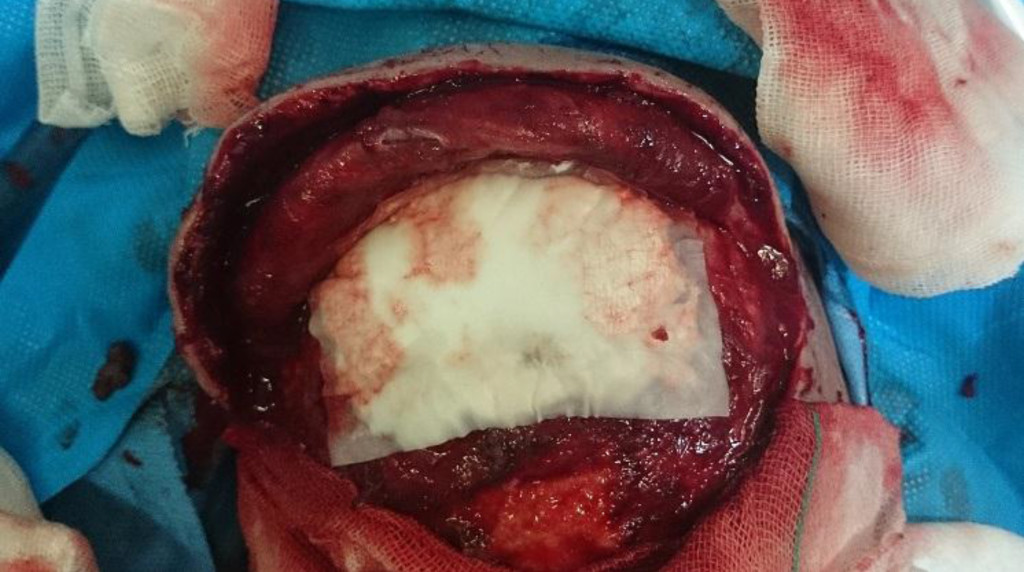
Klinefelter Syndrome in a Patient with Type 1 Diabetes and Growth Arrest: An Atypical Combination

DOI: 10.31038/EDMJ.2018242

Abstract

Klinefelter Syndrome (KS) occurs in about 1 in 1,000 males. Affected individuals with this condition have an additional X chromosome or 47, XXY. Clinical findings are usually not evident at birth and are non-specific such as tall stature, learning disabilities and gynecomastia during childhood. Diagnosis is commonly made in adulthood when they present with infertility or gynecomastia. Tall stature is also one of the most common findings in affected individuals. Patients are also at increased risk of developing autoimmune conditions such as type-1 diabetes, thyroiditis and rheumatological disorders. We present a case of a patient with type-1 diabetes subsequently diagnosed with Klinefelter syndrome after presenting with growth arrest. Physical exam revealed testicular volume of 5ml bilaterally with sexual maturity rating of 5. This emphasizes the importance of pubertal exam in every adolescent patient.

Introduction

Klinefelter Kyndrome (KS) occurs in about 1 in 1,000 males. Affected individuals with this condition have an additional X chromosome or 47, XXY. Clinical findings are usually not evident at birth and are non-specific such as tall stature, learning disabilities and gynecomastia during childhood. Diagnosis is commonly made in adulthood when they present with infertility or gynecomastia. Patients are also at increased risk of developing autoimmune conditions such as type-1 diabetes, thyroiditis and rheumatological disorders. We present a case of a patient with type-1 diabetes subsequently diagnosed with Klinefelter syndrome after presenting with growth arrest.

Case

Informed consent: No patient identifiers will be included in this paper. Patient is not part of any experiment. Patient is a 15 year old Hispanic male with type-1 diabetes since he was 7 years of age. He has been followed in Diabetes clinic since diagnosis. Patient’s diabetes has been poorly controlled with a hemoglobin A1c of 9%-10% over the past 2 years. During regular diabetes follow up, growth velocity was noted to have slowed down to 1–2 cm/yr. Previous growth velocity was noted to be 5–6cm /year (Figure 1). Pubertal exam revealed testicular volume of 5 ml bilaterally with sexual maturity rating of 5 for pubic hair. Over the previous year, there had been no progression in testicular size. On physical exam, the patient was found to have minimal acne and no gynecomastia. Upper to lower segment and arm span were within normal limits. Laboratory work up revealed FSH of 31.3 MLU/ML (1.5–14), LH 12 MLU/ML (1.4–7.7) and testosterone of 358 ng/dL (194–783). His IGF-1 level was normal at 292ng/mL (102–520). A bone age was read as 15 years old which was consistent with the chronological age of 15. Chromosomal analysis showed each cell contained XXY (Figure 2). On further review with the family, mom reported patient to be having difficulties in school as well as difficulties with managing his insulin pump. The patient also appears to be introverted with difficulty in communicating and this has negatively affected his grades in school.

Discussion

Clinical features of KS are usually caused by testosterone deficiency such as decreased facial hair, gynecomastia and microphallus. Men with KS also tend to have small testicles and infertility. In children, work up is usually done in patients with tall stature and gynecomastia in combination with a learning disability. Although tall stature, with slender body habitus is one of the most common clinical finding of patients with KS, some uncommon variants are associated with short stature (49 XXXXXY, isochrome Xq) [1]. Few reported cases of KS has been reported in patients with short stature due to growth hormone deficiency [1,2]. These patients presented pre-pubertal. KS is usually not diagnosed until adolescence or adulthood when men present with effects of hypogonadism or infertility. Patients with KS are frequently able to initiate puberty. However, pubertal arrest happens as testosterone level declines towards mid to late puberty [3,4]. In most cases, the most important therapeutic measure is testosterone supplementation. Testosterone replacement therapy not only help stimulate male pubertal development, improve sexual function and increase bone density, but it also produce in KS-associated increased risk for metabolic syndrome and cardiovascular disease [5]. Early diagnosis is vital for patients’ quality of life and better medical treatment.

EDMJ2018-110- Jacqueline Chan USA_F1

Figure 1. Patient’s growth chart showing decrease in growth velocity

EDMJ2018-110- Jacqueline Chan USA_F2

Figure 2. Patient’s karyogram showing 47XXY

We report a case of unusual presentation of 47 XXY Klinefelter Syndrome with growth arrest as well as Type-1 diabetes. This emphasizes the importance of pubertal exam in every adolescent patient.

Authorship Contribution

Dr J Chan wrote the manuscript.

Dr C. Boucher Berry reviewed and edited the manuscript

References

  1. Bahíllo-Curieses MP, Fournier-Carrera M, Morán-López J, Martínez-Sopena MJ (2011) Klinefelter syndrome and short stature: an unusual combination. Endocrine 39 3: 294–295.
  2. Ramesh, Jayanthy, Mudiganti Nagasatyavani, Javvadii Venkateswarlu, Jakka Nagender (2014) An Unusual Combination of Klinefelter Syndrome and Growth Hormone Deficiency in a Prepubertal Child. Journal of Clinical Research in Pediatric Endocrinology 187–189.
  3. Simpson, Joe Leigh, Felix De La Cruz, Swerdloff RS, Carole Samango-Sprouse, et al. (2003) Klinefelter syndrome: Expanding the phenotype and identifying new research directions. Genetics in Medicine 5: 460–468.
  4. Bonomi M, Rochira V, Pasquali D, Balercia G, Jannini EA, et al. (2016) Klinefelter syndrome (KS): genetics, clinical phenotype and hypogonadism. Journal of Endocrinological Investigation 40: 123–134.
  5. Vignozzi L, Corona G, Forti G, Janini EA, Maggi M (2010) Clinical and Therapeutic Aspects of Klinefelters Syndrome: Sexual Funtion. Molecular Human reproduction 16: 418–424.