Author Archives: rajani

An NT5E Gene Polymorphism Associates with Low Bone Mineral Density in Chronic Kidney Disease Patients

DOI: 10.31038/JCRM.2018125

Abstract

Arterial calcification is an independent predictor of all-cause and cardiovascular mortality in end-stage renal disease. CD73, a GPI-linked plasma membrane ecto-enzyme encoded by NT5E gene, is involved in vascular calcification inhibition. Mutations in NT5E gene are linked to premature onset of arterial and distal joint calcification in families, possibly due to the downstream effects of CD73 on tissue-non-specific-alkaline-phosphatase (TNAP), an important enzyme in the calcification process. We hypothesised that common single nucleotide polymorphisms (SNPs) in NT5E gene may contribute to the risk of calcifcation in patients with chronic kidney disease (CKD), and explored rs4373339C>T, rs2229523A>G, rs10944128A>G SNPs role on bone mineral density (BMD) and aortic pulse wave velocity (aPWV), the markers of calcification. 302 CKD patients from LACKABO study with calcification markers, haemodynamic and genetic data were studied. The mean age of the CKD cohort was 57.8 ± 15.6 years. rs2229523 SNP showed allele specific differences in BMD, a marker of vascular bone axis; and AA genotype was associated with lower levels of BMD at initial (93.9 versus 125.7 mg/cm3, p = 0.0182) and follow-up (80.4 versus 109.4 mg/cm3, p = 0.0126) screening. These relationships held after adjustments for known confounders of the calcification process. Similar relationship was observed for aPWV with rs2229523 AA genotype. We demonstrated for the first time a non-synonymous variant modulates BMD. These findings offer new insights into the bone-vascular axis in CKD, identifying a novel role for CD73 of potential clinical importance, but further studies are needed to expound the biology driving these observations.

Keywords

NT5E gene, polymorphisms, bone mineral density, aortic pulse wave velocity, and chronic kidney disease

Introduction

Arterial calcification is a strong and independent predictor of all-cause and cardiovascular mortality in end-stage renal disease (ESRD) [1], and is associated with bone loss, fractures, and arterial stiffening [2–4]. Within chronic kidney disease (CKD), vascular calcification is an aggregate of both intimal (atherosclerotic) and medial calcification [5], with a high prevalence of risk factors for both in this population [6]. Previously, this phenomenon was believed to result from the passive precipitation of calcium-phosphorus product in plasma. Over the past two decades, however, experimental studies suggest that it is actually an active, tightly-regulated, cell-mediated process, resembling bone and/or cartilage formation, which can be modulated by both activators and inhibitors [7, 8]. Genetic studies suggest that certain endogenous inhibitors are essential for the normal suppression of this process in arteries and soft tissues [7] and that a deficiency in any of these inhibitors is sufficient to unleash calcification.

Pyrophosphate (PPi) is one of the most important of these inhibitors, produced in almost all extracellular matrices [9] and shown to inhibit calcification through direct physiochemical inhibition of hydroxyapatite formation in vitro [10]. Deficiency in PPi caused by inherited mutations in the ENPPI gene, which encodes the PPi-generating enzyme, ectonucleotide-pyrophosphatase-phosphodiesterase (ENPPI), result in rare calcification disorders like generalised arterial calcification of infancy (GACI, OMIM: 20800) [11], and the ENPP1 genotype has been shown to associate with higher coronary artery calcification score in patients with ESRD [12]. Mutations in NT5E gene, which encodes CD73, have also been implicated in pyrophosphate regulation and associate with extensive lower extremity arterial calcification and small joint capsule calcification in some families (arterial calcification due to CD73 deficiency (ACDC) or calcification of joints and arteries (CALJA), OMIM: 211800) [11, 13–17]. Pyrophosphate regulation is believed to play a particularly important role in the development of vascular calcification in CKD, as suggested by the negative association between plasma PPi levels and quantity of vascular calcification in ESRD [18]. Therefore, genes associated with pyrophosphate deficiency, would be ideal candidates to explore further. Though mutations in NT5E gene have been implicated in conditions like ACDC or CALJA, the most common single nucleotide polymorphisms (SNPs) in this gene have not been investigated in the general CKD population.

The NT5E gene (NM_002526.3) is located on chromosome 6q14-q21, and encodes a 574 amino-acid glycosylphosphatidylinositol (GPI)-linked plasma membrane ecto-enzyme known as CD73. CD73 binds extracellular AMP and converts it to adenosine and inorganic phosphate [19] and is expressed widely in different tissues [20]. Within the vasculature, it is expressed in endothelial cells, vascular smooth muscle cells and fibroblasts [20], as well as in circulating lymphocytes [21]. CD73 indirectly inhibits calcification through its effects on tissue-non-specific alkaline phosphatase (TNAP) expression, with a resultant reduction in PPi hydrolysis [12]. Adenosine, released through CD73 activity, is thought to be the relevant mediator here, through its inhibitory effects on TNAP expression [13]. The relationship between ENPP1 and CD73 in PPi regulation is well described by Rutsch et al. [22].

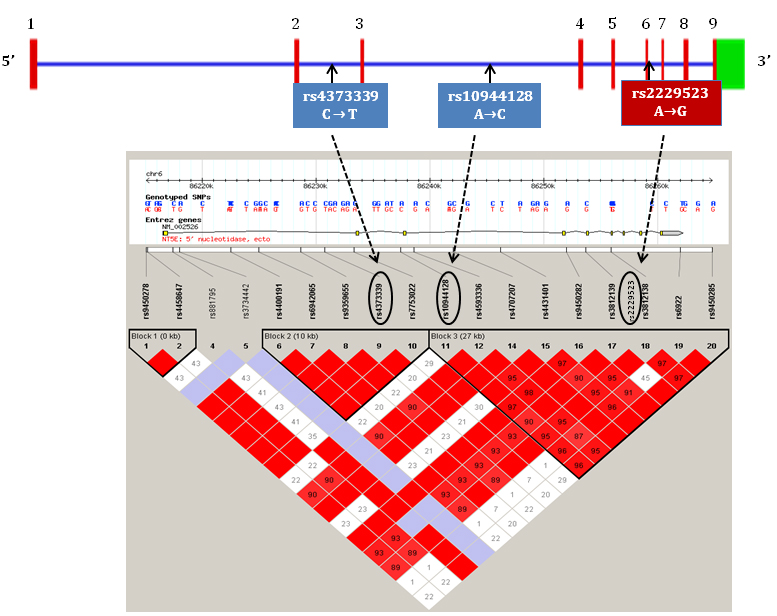
We hypothesised that the common polymorphisms in NT5E gene contribute to the development of calcification and associate with related indices such as bone loss and arterial stiffness. We therefore explored the relationship of polymorphic variation in NT5E with calcification (coronary artery, CAC, and aortic, AC, scores), bone mineral density (BMD), and aortic stiffness (aPWV) in pre-dialysis CKD patients. Three tagging SNPs (tagSNPs) selected from two large linkage disequilibrium (LD) blocks due to their high r2 values of >0.8, covering 37kb region were genotyped. Of the three SNPs, two were intronic (rs4373339 C>T, rs10944128 A>C) and one was a non-synonymous coding SNP (rs2229523 A>G) (see Figure 1).
JCRM2018-110-Yasmin UK_F1

Figure 1. Schematic representation of NT5E gene with exons, introns, LD blocks and genotyped tagSNPs.

Material and Methods

Patients

Pre-dialysis CKD patients (stage 2–5) enrolled in The London Arterial Calcification, Kidney and Bone Outcomes (LACKABO) study, a single-centre prospective study aimed to assess the natural history of vascular calcification were studied [23]. Men were included if their serum creatinine was greater than or equal to 150 μmol/l and women were included if their serum creatinine was greater than or equal to130 μmol/l. All participants were 18 years or older. Patients were excluded if on renal replacement therapy. 302 patients were originally recruited into this study at baseline. However, arterial calcification scores and genetic data were available for only 229 and 279 participants, respectively, unless otherwise stated in the tables. Therefore, the primary phenotype-genotype analysis was performed on these participants, hence the number of subjects differed for each analysis.

After a mean of 49 months, participants were invited again to have follow-up scans and just over 50% of patients attended. The study complied with the Declaration of Helsinki, ethical approval was obtained from the Local Research Ethics Commitees and written informed consent provided by all study participants.

Demographic and clinical characteristics

Demographic data including age, gender, height and weight were recorded and BMI calculated at study entry (baseline). Past and present medical history, prescribed medications and cardiovascular risk factors were also noted. Majority of the patients were Caucasians (72.5%) and others included were Asians (12.3%), Black (9.5%), Chinese (1.7%) and of mixed ethnicity (4%).

Arterial calcification phenotype measurements

Coronary artery calcification (CAC) and aortic calcification (AC)

Coronary artery and aortic calcification was measured using Electron Beam Computed Tomography (EBCT). Briefly, the scanning was performed at the Royal Brompton Hospital, London using a C-150 scanner (GE-Imatron) with a 100 msec scanning time and a single slice of 3mm for the section between the carina to the level of the diaphragm. 36 to 40 slices were obtained during a single-breathhold. Patients were exposed to an overall radiation dose (0.9 msv), which is equivalent to approximately one third of the annual exposure from background radiation. CAC and AC scores were determined from the computed pixels of calcification. A pixel was defined as having a minimal density of 130 Hounsefield units (HU) and a surface area of >0.51mm2. Calcification was defined as a plaque of at least 3 contiguous pixels of calcification. Calcification scores were recorded in both the aorta and in individual coronary arteries including the left circumflex, left main stem, left anterior descending, and right coronary artery. The total coronary calcification score was determined by averaging the four individual arterial scores and this value was used for subsequent analysis.

There are no agreed cut-off values for EBCT calcification score categories. We therefore, used the 5 numerical categories used by Shaw et al [24]. and adapted it by applying a descriptive term to each category (ranging from low to very high), based on category interpretations from a recent systematic review [25]: 0–10 (low); 10.1–100 (moderate); 101–400 (moderately high); 400–1000 (high); >1000 (very high).

Bone mineral density (BMD)

BMD was assessed in 238 patients from individual EBCT scans described above, which were performed to assess aortic calcification. The average of 3 lumbar vertebrae on each EBCT scan was used to calculate BMD and used in the subsequent analysis.

Blood pressure (BP) and aortic pulse wave velocity (aPWV)

All measurements were obtained in a quiet temperature-controlled room. Peripheral blood pressure and heart rate were recorded from the brachial artery of the non-dominant arm using validated oscillometric technique (HEM-705CP; Omron Corporation). aPWV, defined as the speed of pulse waves travelling along the length of an artery, was determined from sequential readings of ECG-gated carotid and femoral artery waveforms using SphygmoCor system [26]. All measurements were made in duplicate and average values were used for analysis.

Biochemical markers

Blood samples were obtained to measure vascular calcification-related biomarkers including blood lipids, glucose, serum creatinine, urea, calcium, phosphate. Estimated glomerular filtration rate (eGFR) was calculated from serum creatinine using the Modification of Diet in Renal Disease method [27].

Genetic analysis

Genomic DNA (gDNA) was isolated using standard method and stored at -80oC for genetic analysis. Allelic discrimination was performed using AB17500 Taqman system and Taqman SNP genotyping assays (Applied Biosystems). Briefly, each assay contains two fluorescent-labelled probes corresponding to the alleles harboured by the SNP of interest. The probes carry reporter fluorescent dyes that are cleaved and released into solution during PCR by Taq polymerase when the corresponding DNA is being replicated. The colour of the released dye identifies the genotype; this is detected when the assay is analysed using the accompanying Taqman software (version 2.0.4).

For genotyping, 1ng of gDNA was mixed with 2x Taqman Universal Master Mix, No AmpErase UNG, labelled probe (FAM and VIC dye-labelled) and MQ H2O to a total volume of 15 µL for each sample. This mixture was dispensed into a standard MicroAMPTM Optical 96-Well Reaction Plate, and amplified using Taqman real-time PCR system. Postive and negative standards were also included on each plate. The PCR conditions consisted of a pre-PCR read at 60oC (1min), a holding stage at 95oC (10min), followed by 46 PCR cycles (15 secs at 95 oC, 1min at 60 oC for each cycle) and a final post-PCR read at 60oC (1min). Allelic discrimination was carried out by detecting allele specific fluorescence and data was analysed off-line with the sequence detectionsoftware. If the genotype clusters were unambiguous, manual calling was performed or the sample was re-genotyped for that SNP. As small amounts of DNA was available in some patients, the company recommended reaction mixture concentrations were adjusted for all assays and all samples. These concentrations have been standardised and used in our previous genetic studies (>95% success rate).

Statistical analysis

Data were analysed using SPSS (version 25.0) and GraphPad Prism (version 5.0) software. All variables were checked for normal distribution and skewed variables were transformed before further analysis. Normally distributed data are presented as means ± standard deviation (SD), skewed data as median and inter-quartile range (IQR) and as geometric means, and categorical data as percentages. Oneway analysis of variance (ANOVA) was used to investigate the genotype differences in phenotype(s), and Welch’s t-tests compared average BMD and aPWV differences between the two homozygous allele carriers. And since rs2229523 SNP showed a dose dependent pattern of inheritance on BMD, SNP association was tested assuming a standard additive model using a regression analysis that adjusted for known factors that influence the calcification process (age, gender, MAP, eGFR). Paired t-tests were performed to see changes in BMD and aPWV after 49 months. A p-value of <0.05 was considered significant, in all statistical tests.

Results

Demographic, clinical and calcification-related characteristics at baseline

Demographic and baseline clinical characteristics of the LACKABO study participants are given in Table 1. The mean age was 57.8 years (age range: 19–91) and the eGFR average was 40.4 ml/min, consistent with pre-dialysis stage 3 CKD. As expected, 80% of these patients were hypertensive, 20% had diabetes and 8% had a past incident of myocardial infarction. About half of these CKD patients were also on cardiovascular drugs; hence the lipid profile and blood pressures were in the normal range (Tables 1–2).

Table 1. Clinical and demographic characteristics in 302 subjects.

Parameters

Mean ± SD

Demographics

Age (years)

57.8 ± 15.6

Gender (M/F)

221/81

Height (m)

1.71 ± 0.1

Weight (kg)

81.1 ± 18.8

BMI (kg/m2)

27.6 ± 5.5

Renal parameters

eGFR (mL/min)

39.2 (25.8–50.9)

Calcium (nM)

2.27 ± 0.2

Phosphate (nM)

1.3 ± 0.8

CV Risk Factors

Current smokers (%)

13.2

Hypertension (%)

80.1

Diabetes (%)

20.2

Previous myocardial infarction (%)

7.6

Total cholesterol (mmol/l)

4.7 ± 1.15

HDL cholesterol (mmol/l)

1.5 ± 0.5

LDL cholesterol (mmmol/l)

2.4 ± 1.0

Triglyceride (mmol/l)

2.5 ± 6.98

Blood glucose (mmol/l)

5.7 ± 2.8

NTProBNP (pmol/l)

74.5 ± 361

C-reactive protein (mg/L)

1.57 (0.72–3.61)

CVD medications (%)

 ACE Inhibitor

 Aspirin

 α-Blocker

 α2-Blocker

 β-Blocker

 Ca2+ Channel Antagonists

 Diuretics

 Nitrates

 Statins

 Warfarin

47.4

37.7

19.2

39.7

30.8

34.1

52.6

 5.3

53.0

 4.0

BMI = body mass index; eGFR = estimated glomerular filtration rate;
CVD = cardiovascular disease; BP = blood pressure; HDL = high density lipoprotein;
LDL = low density lipoprotein.
† = median with interquartile range.

Table 2. Vascular calcification and other related measures.

Parameters

Mean ± SD

Arterial Calcification Scores (n = 229)

Coronary Calcification Grade (%)

 Low (0–10)

 Moderate (10.1–100)

 Moderately high (100.1–400)

 High (400.1–1000)

 Very High (>1000)

40

18.3

18.8

10.8

12.1

Total Coronary Calcification Score (baseline, n = 240)

46.6 (0.0–344.4)

Aortic calcification score (baseline, n = 241)

52.7 (6.2–397.1)

Blood Pressure and Arterial Stiffness (n = 302)

Peripheral systolic BP (mmHg)

132.7 ± 18.9

Peripheral diastolic BP (mmHg)

79.1 ± 11.4

Peripheral pulse pressure (mmHg)

53.6 ± 16.7

Mean arterial pressure (mmHg)

97.0 ± 12.0

Heart rate (bpm)

68.8 ± 12.9

aPWV (m/s; baseline, n = 217)

9.06 ± 3.0

aPWV (m/s; follow up, n = 88)

8.24 ± 3.8

Vascular-Bone Axis Marker (n = 238)

Bone mineral density (mg/cm3; baseline, n = 238)

120.8 (96.4–152)

Bone mineral density (mg/cm3; follow up, n = 159)

103.2 (79–137.2)

BP = blood pressure; aPWV = aortic pulse wave velocity.
† = median with interquartile range.

The results for arterial calcification and other related markers are presented in Table 2. Approximately 12% of patients were in the highest score category of >1000, and median score for the population was 46.6 (IQR: 0.0–344.3). Exclusion of those with a calcification score of 0 (n = 74), resulted in a median calcification score of 169.5 (IQR: 42.9–681.8).

Genotype and allele frequencies

Two hundred and seventy nine patients had DNA available, and all samples were successfully genotyped for rs2229523 and rs4373339 SNPs, but for rs10944128 only 236 samples were genotyped due to DNA depletion. Hardy-Weinberg equilibrium was satisfied for rs2229523 and rs4373339 SNPs, but not for rs10944128 SNP. This could be due to the difficulty in calling the genotypes accurately or the assay failure for this SNP. The minor allele frequencies were similar when compared to CEU HapMap data (0.28 versus 0.30 for rs2229523, 0.17 versus 0.13 for rs4373339, and 0.45 versus 0.39 for rs10944128 respectively).

Association of NT5E SNPs with BMD and aPWV, but not with arterial calcification indices

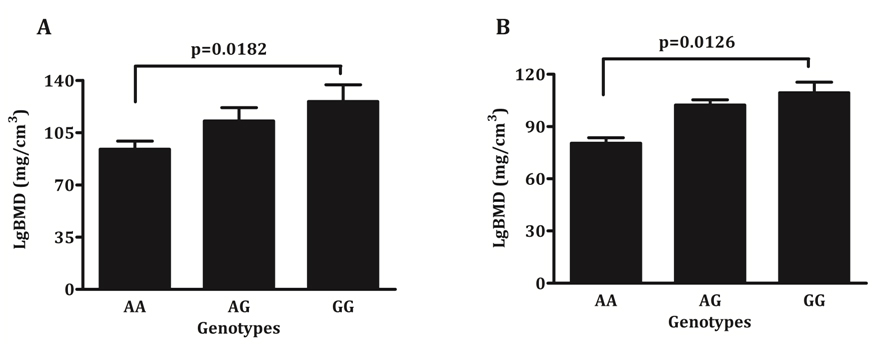
One way ANOVA demonstrated whether patient genotypes differed for BMD and aPWV (Table 3), whilst Welch’s t-test examined differences in the phenotype between the two homozygous allele carriers (Figure 2). Only rs2229523 SNP, showed a significant association and an allele dose trend with BMD. Patients with AA genotype demonstrated significantly lower BMD values than patients with GG genotypes (93.9 versus 125.7 mg/cm3, p = 0.0182) at baseline screening (Figure 2). A similar trend was also noted in patients screened after 49 months (80.4 versus 109.4 mg/cm3, p = 0.0126). In regression models adjusted for age, gender, mean arterial pressure and eGFR, rs2229523 AA genotype was also associated with a lower BMD. As seen in Table 4, the AA genotype remained significantly and independently associated with BMD in patients screened at baseline and during follow-up. These findings held true when data were analysed excluding non-Europeans and patients on CVD drugs.
JCRM2018-110-Yasmin UK_F2

Figure 2. Average bone mineral density according to rs2229523 genotypes, A) Baseline and B) Follow-up.

Table 3. Genotype differences in BMD and aPWV at baseline and follow-up.

BMD (mg/cm3)*

aPWV (m/s)*

Baseline

Mean ± SD (n)

Follow-up

Mean ± SD (n)

Baseline

Mean ± SD (n)

Follow-up

Mean ± SD (n)

rs2229523 A>G

AA

93.9 ± 1.7 (24)

80.4 ± 1.6 (19)

7.84 ± 1.3 (21)

7.19 ± 1.5 (11)

AG

112.7 ± 1.4 (76)

103.4 ± 1.5 (50)

8.69 ± 1.4 (70)

7.67 ± 1.7 (26)

GG

125.7 ± 1.5 (118)

109.4 ± 1.5 (77)

8.63 ± 1.4 (109)

7.28 ± 1.5 (42)

**p =

0.0182

0.0126

0.350

0.901

rs10944128 A>G

AA

114.7 ± 1.5 (69)

99.9 ± 1.6 (45)

8.64 ± 1.4 (58)

6.94 ± 1.5 (23)

AC

123.7 ± 1.4 (50)

102.0 ± 1.5 (31)

9.01 ± 1.4 (45)

7.25 ± 1.5 (22)

CC

114.1 ± 1.6 (67)

104.5 ± 1.5 (45)

8.54 ± 1.4 (61)

8.14 ± 1.6 (24)

p =

0.462

0.880

0.708

0.464

rs4373339 C>T

CC

116.3 ± 1.5 (150)

99.0 ± 1.5 (96)

8.69 ± 1.4 (137)

7.38 ± 1.6 (52)

CT

121.3 ± 1.4 (9)

112.4 ± 1.6 (7)

7.92 ± 1.5 (9)

6.33 ± 1.3 (4)

TT

117.9 ± 1.5 (57)

110.3 ± 1.6 (42)

8.33 ± 1.4 (54)

7.60 ± 1.5 (23)

p =

0.921

0.384

0.628

0.564

* Geometric means and SD
** Welch’s t-test comparing two homozygous allele carriers.

Table 4. Stepwise regression results showing an independent association of rs2229523 SNP with log transformed BMD.

Dependent variable: LgBMD

Beta value

t-value

Significance level (P = )

R 2 Change

Baseline model

Age

–0.450

–7.444

 <0.001

0.218

rs2229523 SNP

–0.163

–2.699

 0.0075

0.025

Gender

0.121

1.991

0.048

0.014

 R square = 0.257; F = 23.608; P<0.001

Follow-up model

Age

–0.548

–7.984

 <0.001

0.312

rs2229523 SNP

-0.167

–2.432

 0.0163

0.028

 R square = 0.340; F = 36.268; P<0.001

Excluded variables in baseline model were: mean arterial pressure, eGFR.
Excluded variables in follow-up model were: gender, mean arterial pressure, eGFR.

Genotype differences were found with aPWV for rs2229523 SNP (Table 3); aPWV is reduced in patients carrying the rs2229523 AA genotype compared with the GG genotype. This non-significant trend was observed at both visits (baseline: 7.84 versus 8.63 m/s, p=0.350; follow-up: 7.19 versus 7.28 m/s, p=0.901).

No association was found between the SNPs and the arterial calcification indices (CAC, AC) in this CKD group.

Changes in BMD and aPWV at 49 months

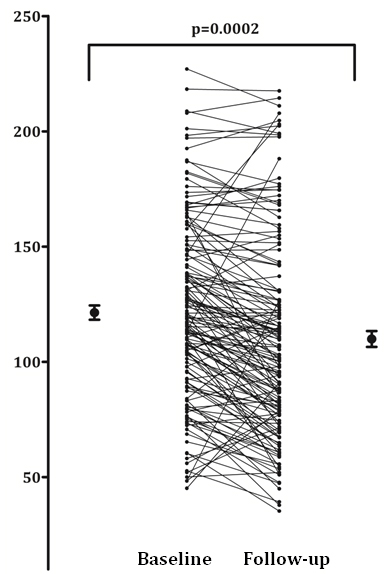
Follow up data was available for just over 50% of the participants who returned for a scan. After a mean of 49 months, the vascular bone axis marker (BMD) reduced significantly (113.9 versus 103 mg/cm3;
p = 0.0002; Figure 3), whilst the aPWV reduced to a much lesser extent (8.55 versus 7.89 m/s; p = 0.057, data not shown).
JCRM2018-110-Yasmin UK_F3

Figure 3. Average bone mineral density values at baseline and follow up.

Associations between age and calcification phenotypes

As expected, age associated significantly with BMD, PWV, CAC and AC (r = –0.46, r = 0.49, 0.60, 0.51; p = 0.001 respectively, data not shown), and when this relationship was explored further by examining just CAC in men and women according to decades of age, the average CAC score increased with each decade in both men and women (Table 5); the lowest mean values were observed in the younger patients and highest values in older patients.

Table 5. Coronary artery calcification score in CKD patients by age and gender.

Age Groups

(n)

Men

 (Mean ± SEM)

Women

(Mean ± SEM)

<40 years (31)

4.5±3.0

0.13±0.1

41–50 years (34)

89.3±59.3

77.5±51.4

51–60 years (47)

425±194

54.6±18.7

61–70 years (53)

762±196

75.8±26.3

>71 years (74)

875±138

213±130

SEM = standard error of mean.

BMD also associated inversely with AC (r = –0.30, p = 0.001, data not shown) and aPWV (r = –0.16, p = 0.032, data not shown), which suggests that low BMD and increasing arterial calcification have common features [28]. The positive correlation between calcification scores and stiffness (aortic: 0.40, p = 0.001; coronary artery: 0.22, p = 0.015, data not shown), demonstrates the associated changes in the vessel wall of CKD patients [29].

Discussion

This study sought to determine the influence of common SNPs in the NT5E gene on calcification phenotypes (BMD, aPWV) in pre-dialysis CKD patients. For the first time, we identified a significant independent association between a single NT5E gene polymorphism (rs2229523 SNP) and BMD, a marker of the vascular-bone axis. Independent of risk factors like age, gender, mean arterial pressure and eGFR, we found that rs2229523 AA genotype associated with lower BMD. This relationship was found in patients screened both at baseline and after 49 months of follow up. The rs2229523 AA genotype also showed reduced aortic stiffness (aPWV). However, no independent SNP associations were observed with aPWV or with coronary artery or aortic calcification (CAC, AC).

Significant association between rs2229523 SNP and BMD

The finding that an NT5E rs2229523 SNP is associated with BMD suggests a role for CD73 in bone formation. This is supported by the finding of osteopenia, reduced osteoblastic markers and impaired osteroblastic differentiation in CD73 knockout mice [30]. In the same study, induced overexpression of CD73 was associated with increased osteoblastic differentiation, and increased expression of osteocalcin and bone sialoprotein, the effects of which were reversed by an A2B receptor antagonist [30]. These findings suggest that the effects of CD73 on bone metabolism are mediated by CD73-derived adenosine signalling. The role of CD73 in bone metabolism is further supported by another study where CD73 expression is regulated by the Wnt-b-catenin signalling pathway, a known critical pathway in both bone metabolism and osteogenic vascular calcification [31]. In addition, the inducible HIF-1 alpha transcription factor, which regulates many factors involved in bone regeneration and development, also regulates CD73 expression [32].

The regression analysis findings suggest that rs2229523 AA genotype predicts a lower BMD after adjustments of confounding factors like age, gender, mean arterial pressure and eGFR. The exact mechanisms behind the the lower BMD and reduced aPWV observed in patients with AA genotype are currently unclear and outside the scope of this study, but merits further investigation. The SNP in question is a non-synonymous coding SNP which results in a change in amino-acid from threonine to alanine at position 376. It is believed that this results in an alternative shorter isoform of the protein. The clinical implication of this isoform change is not known, but this is the first study linking this SNP to BMD. As rs2229523 is a tagSNP, the observed relationship may relate to this amino-acid change or may, alternatively, relate to another SNP within the same LD block.

None of the SNPs in this study, associated with BMD or bone mineral content in published genome wide association studies (GWAS) [33,34], and this could be explained by the populations or phenotypes studied or the genechips used. But the present finding of an association between BMD and rs2229523 SNP, and its role in the regulation of vascular calcification is not surprising given the known reciprocal and parallel relationship between arterial and skeletal mineralisation. A significant inverse assocation between vascular calcification and BMD has been demonstrated in non-CKD populations [35] as well as in dialysis [2] and pre-dialysis CKD populations [29], a finding replicated in our study. This relationship appears to be particularly strong in CKD, which provides an ideal milieu for both arterial calcification and osteopenia due to synergism between hyperphosphataemia, hyperparathyroidism, and the treatments associated with CKD [29,36]. Pre-clinical studies showed that inflammatory markers such as lipids and cytokines appear to accelerate vascular calcification while they promote bone loss [38]. Similarly, osteogenic agents, like PTH and BMP-7, promote skeletal mineralisation but suppress this process in arteries [36]. The mechanism linking arterial calcification to bone loss is unknown and the temporal nature of events has not been established. One theory is that both share a common aetiology and use common factors [38]. CD73 provides a link between the two conditions; its osteogenic role in bone in parallel with its anti-inflammatory role in the vasculature would result in bone loss and calcification in the event of deficiency, consistent with the reciprocal relationship observed between the two conditions.

Significant associations found between arterial calcification phenotypes, but not between calcification phenotypes and NT5E SNPs

We replicated previous positive associatons between age, arterial calcification (aortic and coronary artery) and arterial stiffness (aPWV) [29, 37, 38]. However, we did not find these phenotypes to associate with any of the NT5E SNPs. There are several possible explanations for the lack of associations between the SNPs and arterial calcification. First, the inability to measure medial calcification independent of intimal calcification may have prevented detection of an association. Histopathological evidence from specimens derived from arterial calcification due to deficiency of CD73 (ACDC) patients suggest, that the calcification process resulting from CD73 deficiency is confined to the arterial media [20]; therefore, medial calcification is the relevant phenotype. As current instruments do not have the capability of distinguishing between medial and intimal calcification [39], the measured phenotype in this study was actually an aggregate of both intimal and medial calcification, diluting the relevant phenotype.

Second, the lack of an assocation might be due to measurement of central artery rather than peripheral artery calcification. It is important to note that the ACDC phentotype is characterised by heavy calcification specifically in the large lower limb peripheral arteries, with relative sparing of the coronary and aortic arteries [20,13]. Therefore, a CD73-related protein family member, such as CD39, or its related isoforms, may compensate for CD73 deficiency in other vascular beds [40]. Given this, it is not surprising that NT5E SNPs were not associated with coronary or aortic calcfication in this study.

Third, it is possible that the relationship between NT5E mutations and calcification observed in ACDC [12] is non-causal. The proposed mechanism linking CD73 deficiency to arterial calcification is based upon in vitro experiments in skin fibroblasts [12], which may differ signficantly from vascular endothelial cells. Furthermore, the vascular calcification phenotype has not been recapitulated in in vivo mice studies, where CD73 deletion has been found to be associated with multi-organ fulminant vascular leakage rather than calcification [41].

Fourth, it may be that NT5E genetic variation does cause calcification but it does not do so by affecting the essential pyrophosphate pathway, instead it affects non-essential pathways. For example, the calcification phenotype produced by NT5E mutations is more likely to be explained by the anti-inflammatory role of CD73 rather than its indirect effects on pyrophosphate hydrolysis [42]. A polymorphism in an anti-inflammatory pathway is less likely to be of clinical significance due to the upregulation of alternative anti-inflammatory pathways in CKD.

Lastly, 27% of patients had an arterial calcification score of 0, which resulted in reduced power, and the SNPs investigated do not represent the whole gene, so it is possible that relevant variations reside in the other unexplored regions. Therefore, the relationship between NT5E genetic variation and arterial calcificaiton merits further investigation and replication in other independent CKD population.

Conclusion

For the first time, we have shown that rs2229523, a non-synonymous coding SNP resulting in an amino-acid change (threonine to alanine), and AA genotype is associated with lower BMD in patients with CKD seen before and after 49 months . Further work is necessary to evaluate the identified associations in other CKD cohorts. Functional studies are also required to elucidate the biological mechanisms underlying the observed relationship between NT5E rs2229523 SNP and BMD. The role of adenosine, adenosine regulators and adenosine receptor agonists as potential therapeutic agents in relation to vascular calcification and osteopenia also warrants extensive further exploration. Overall, this study offers new insights into the bone-vascular axis in chronic kidney disease, identifying a novel role for CD73 of potential clinical importance.

Acknowledgements We thank all the individuals who participated in the LACKABO study. The LACKABO study participants were recruited by a grant from the Kidney Research (Grant No. VC1/2002), and the genotyping costs were supported by the Addenbrooke’s Charitable Trust (Ref No. 23/08(B) (F). We also thank Dr Michael Rubens for performing scans, Dr Sharon Barrett and Dr Melanie Chan with pulse wave analysis measurements.

Conflict of interest The authors declare no conflict of interest.

References

  1. Blacher J, Guerin AP, Pannier B, Marchais SJ, London GM. (2001) Arterial Calcifications, Arterial Stiffness, and Cardiovascular Risk in End-Stage Renal Disease. Hypertension. 38(4): 938–42.
  2. Aoki A, Kojima F, Uchida K, Tanaka Y, Nitta K. (2009) Associations between vascular calcification, arterial stiffness and bone mineral density in chronic hemodialysis patients. Geriatrics & Gerontology International. 9(3): 246–52.
  3. Blacher J, Guerin AP, Pannier B, Marchais SJ, Safar ME, London GM. (1999) Impact of aortic stiffness on survival in end-stage renal disease. Circulation. 99(18): 2434–9.
  4. Shoji T, Emoto M, Shinohara K, Kakiya R, Tsujimoto Y, Kishimoto H, et al. (2001) Diabetes mellitus, aortic stiffness, and cardiovascular mortality in end-stage renal disease. Journal of American Society of Nephrology. 12(10): 2117–24.
  5. Goodman WG, London G, Amann K, Block Ga, Giachelli C, Hruska Ka, et al. (2004) Vascular calcification in chronic kidney disease. American Journal of Kidney Diseases. 43(3): 572–9.
  6. Román-García P, Rodríguez-García M, Cabezas-Rodríguez I, López-Ongil S, Díaz-López B, Cannata-Andía JB. (2011) Vascular calcification in patients with chronic kidney disease: types, clinical impact and pathogenesis. Medical Principles and Practice. 20(3): 203–12.
  7. Schinke T, Karsenty G. (2000) Vascular calcification–a passive process in need of inhibitors. Nephrology Dialysis Transplantation. 15(9): 1272–4.
  8. Schinke T, McKee MD, Kiviranta R, Karsenty G. (1998) Molecular determinants of arterial calcification. Annals of Medicine. 30(6): 538–41.
  9. Schoppet M, Shanahan CM. (2008) Role for alkaline phosphatase as an inducer of vascular calcification in renal failure? Kidney International. 73(9): 989–91.
  10. Meyer JL. (1984) Can biological calcification occur in the presence of pyrophosphate? Archives of Biochemistry and Biophysics. 231(1): 1–8.
  11. Rutsch F, Vaingankar S, Johnson K, Goldfine I, Maddux B, Schauerte P, et al. (2001) PC-1 nucleoside triphosphate pyrophosphohydrolase deficiency in idiopathic infantile arterial calcification. American Journal of Pathology. 158(2): 543–54.
  12. Eller P, Hochegger K, Feuchtner GM, Zitt E, Tancevski I, Ritsch A, et al. (2008) Impact of ENPP1 genotype on arterial calcification in patients with end-stage renal failure. Nephrology Dialysis Transplantation. 23(1): 321–7.
  13. St Hilaire C, Ziegler SG, Markello TC, Brusco A, Groden C, Gill F, et al. (2011) NT5E mutations and arterial calcifications. The New England Journal of Medicine. 364(5): 432–42.
  14. Sharp J. (1954) Heredo-familial vascular and articular calcification. Annals of the Rheumatic Diseases. 13(1): 15–27.
  15. Mori H, Yamaguchi K, Fukushima H, Oribe Y, Kato N, Wakamatsu T, et al. (1992) Extensive arterial calcification of unknown etiology in a 29-year-old male. Heart Vessels. 7(4): 211–4.
  16. Zhang Z, He JW, Fu WZ, Zhang CQ, Zhang ZL. (2015) Calcification of joints and arteries: second report with novel NT5E mutations and expansion of the phenotype. Journal of Human Genetics. 60(10): 561–4.
  17. Yoshioka K, Kuroda S, Takahashi K, Sasano T, Furukawa T, Matsumura A. (2017) Calcification of joints and arteries with novel NT5E mutations with involvement of upper extremity arteries. Vascular Medicine. 22(6): 541–3.
  18. O’Neill WC, Sigrist MK, McIntyre CW. (2010) Plasma pyrophosphate and vascular calcification in chronic kidney disease. Nephrology Dialysis Transplantation. 25(1): 187–91.
  19. Colgan SP, Eltzschig HK, Eckle T, Thompson LF. (2006) Physiological roles for ecto-5’-nucleotidase (CD73). Purinergic Signal. 2(2): 351–60.
  20. Markello TC, Pak LK, St C, Dorward H, Ziegler SG, Chen MY, et al. (2011) Vascular pathology of medial arterial calcifications in NT5E deficiency: implications for the role of adenosine in pseudoxanthoma elasticum. Molecular Genetics & Metabolism. 103(1): 44–50.
  21. Hasegawa T, Bouis D, Liao H, Visovatti SH, Pinsky DJ. (2008) Ecto-5’ nucleotidase (CD73)-mediated adenosine generation and signaling in murine cardiac allograft vasculopathy. Circulation Research. 103(12): 1410–21.
  22. Rutsch F, Nitschke Y, Terkeltaub R. (2011) Genetics in arterial calcification: pieces of a puzzle and cogs in a wheel. Circulation Research. 109(5): 578–92.
  23. Caplin B, Nitsch D, Gill H, Hoefield R, Blackwell S, MacKenzie D, et al. (2010) Circulating methylarginine levels and the decline in renal function in patients with chronic kidney disease are modulated by DDAH1 polymorphisms. Kidney International. 77(5): 459–67.
  24. Shaw LJ, Raggi P, Schisterman E, Berman DS, Callister TQ. (2003) Prognostic value of cardiac risk factors and coronary artery calcium screening for all-cause mortality. Radiology. 228(3): 826–33.
  25. Dendukuri N, Chiu K, Brophy JM. (2007) Validity of electron beam computed tomography for coronary artery disease: asystematic review and meta-analysis. BMC Medicine. 5: 35.
  26. Wilkinson IB, Fuchs SA, Jansen IM, Spratt JC, Murray GD, Cockcroft JR, et al. (1998) Reproducibility of pulse wave velocity and augmentation index measured by pulse wave analysis. Journal of Hypertension. 16(12 Pt 2): 2079–84.
  27. Hallan S, Asberg A, Lindberg M, Johnsen H. (2004) Validation of the Modification of Diet in Renal Disease formula for estimating GFR with special emphasis on calibration of the serum creatinine assay. American Journal of Kidney Disease. 44(1): 84–93.
  28. Kooman JP, Kotanko P, Schols AM, Shiels PG, Stenvinkel P. (2014) Chronic kidney disease and premature ageing. Nature Reviews Nephrology. 10(12): 732–42.
  29. Toussaint ND, Lau KK, Strauss BJ, Polkinghorne KR, Kerr PG. (2008) Associations between vascular calcification, arterial stiffness and bone mineral density in chronic kidney disease. Nephrology Dialysis Transplantation. 23(2): 586–93.
  30. Takedachi M, Oohara H, Smith BJ, Iyama M, Kobashi M, Maeda K, et al. (2012) CD73-generated adenosine promotes osteoblast differentiation. Journal of Cellular Physiology. 227(6): 2622–31.
  31. Spychala J, Kitajewski J. (2004) Wnt and beta-catenin signaling target the expression of ecto-5’-nucleotidase and increase extracellular adenosine generation. Experimental Cell Research. 296(2): 99–108.
  32. Synnestvedt K, Furuta GT, Comerford KM, Louis N, Karhausen J, Eltzschig HK, et al. (2002) Ecto-5’-nucleotidase (CD73) regulation by hypoxia-inducible factor-1 mediates permeability changes in intestinal epithelia. Journal of Clinical Investigation. 110(7): 993–1002.
  33. Rivadeneira F, Styrkársdottir U, Estrada K, Halldórsson BV, Hsu YH, Richards JB, et al. (2009) Twenty bone-mineral-density loci identified by large-scale meta-analysis of genome-wide association studies. Nature Genetics. 41(11): 1199–206.
  34. Styrkarsdottir U, Halldorsson BV, Gretarsdottir S, Gudbjartsson DF, Walters GB, Ingvarsson T, et al. (2009) New sequence variants associated with bone mineral density. Nature Genetics. 41(1): 15–7.
  35. Lin T, Liu JC, Chang LY, Shen CW. (2011) Association between coronary artery calcification using low-dose MDCT coronary angiography and bone mineral density in middle-aged men and women. Osteoporosis International. 22(2): 627–34.
  36. Demer LL, Tintut Y. (2008) Vascular calcification: pathobiology of a multifaceted disease. Circulation. 117(22): 2938–48.
  37. Raggi P, Bellasi A, Ferramosca E, Islam T, Muntner P, Block GA. (2007) Association of pulse wave velocity with vascular and valvular calcification in hemodialysis patients. Kidney International. 71(8): 802–7.
  38. Temmar M, Liabeuf S, Renard C, Czernichow S, Esper NE, Shahapuni I, et al. (2010) Pulse wave velocity and vascular calcification at different stages of chronic kidney disease. Journal of Hypertension. 28(1): 163–9.
  39. Goodman WG, London G. (2004) Vascular Calcification in Chronic Kidney Disease. American Journal of Kidney Diseases. 43(3): 572–9.
  40. Rutsch F, Nitschke Y, Terkeltaub R. (2011) Genetics in arterial calcification: Pieces of a puzzle and cogs in a wheel. Circulation Research. 109(5): 578–92.
  41. Thompson LF, Eltzschig HK, Ibla JC, Van De Wiele CJ, Resta R, Morote-Garcia JC, et al. (2004) Crucial role for ecto-5’-nucleotidase (CD73) in vascular leakage during hypoxia. The Journal of Experimental Medicine. 200(11): 1395–405.
  42. Schrader J. (2011) NT5E mutations and arterial calcifications. The New England Journal of Medicine. 364(16): 1578–9.
The Failure to Provide an Effective Veterinary Service to Sheep in Australia

DOI: 10.31038/IJVB.2018233

Introduction

Sheep have been the pre-eminent livestock species in Australia and wool production has been the country’s greatest contribution to the world’s economy, so why is it that there isn’t an effective veterinary service to sheep in place there?

Sheep are not native to Australia and were originally imported; 44 sheep were among the animals transported from Great Britain to the penal colony established on the east coast of Terra Australis in January 1788 http://firstfleetfelowshp.org.au.

The following brief account of the history of wool in Australia is taken from “The Australian Merino” which began;

The Australian Merino…comprised one of the greatest creative expressions of domestic animal species by and for mankind…one of the greatest contributions to the world economy [1].

These original sheep were for human provisions and consisted of fat-tailed native sheep from the Cape of Good Hope, but the primary source of sheep for the first three or four decades of Australia’s history were from Bengal, the closest British colony to Australia. The Macarthur family were the first wool sheep breeders in the new colony of New South Wales (NSW) and in 1807 Australian wool first appeared in the English customs returns and in 1811, Samuel Marsden dispatched the first significant shipment of between 4,000 and 5,000 pounds of Australian wool to England.

Wool production followed the development of the colony, beginning in NSW and Van Diemen’s Land (Tasmania) and extended as new grasslands were discovered. Legal settlement was followed by illicit occupation into the Port Phillip region (Victoria) with sheep coming from both NSW and Tasmania and from there they travelled west into South Australia (SA) and north into the New England district of NSW on into Queensland (Qld). The “Squatting era” occurred between the 1830s and 1840s and a “Squatter” was an illegal Occupier of crown land beyond the prescribed limits of settlement. By the late 1840s, the authorities recognized the economic good derived form this activity and issued licences for their sheep runs and tenure. The 1850s saw an influx of immigrants, including miners drawn to Australia by the discovery of gold, and thereafter, the colonies passed “Selection Acts” which provided for the sale of land at auction, forcing squatters to bid against others for the land they had previously controlled by leasehold.

From this time onward, sheep spread throughout the whole continent, including the harsh areas that became known as pastoral regions. Sheep studs were located in the more favourable regions, but commercial flocks were found everywhere and by Federation in 1901, most areas had been settled. During the latter part of the 19th century, Australia rose to become the premier supplier of wool to the world and during the 20th century that position was consolidated. However, the wool industry collapsed during the latter part of the 20th century;

In 2006, Fifteen years after the collapse of the Australian Wool Corporation’s Reserve Price Scheme, Australia’s Merino studs were selling one-third the number of rams of 1990, over half Australia’s professional woolgrowers had ceased growing wool as their main enterprise; the wool fibre’s global market share has continued a steady decline since 1991 [2].

Veterinary Literature Review

The veterinary art has been known since antiquity, but the modern era is considered to have begun in the 18th century with the establishment of university education for veterinarians [3].

Since that time veterinary schools were established everywhere, including Australia, for in 1888, William Tyson Kendall established the Melbourne Veterinary College in conjunction with his private practice in Melbourne [4].

In 1909, this college was absorbed into the veterinary school established at the University of Melbourne. The University of Sydney established a school in 1910; the University of Queensland in 1936 and in 1974, Murdoch established one in Perth [5–8].

During the first half of the 20th century, government veterinarians dominated the profession, whereas practitioners, especially those in rural practice, struggled to survive [9, 10]. At the time of World War II, there was even talk about nationalisation of the profession [11, 7]. In 1951, an article on research of sheep disease during the first half of the 20th century was published which demonstrated that most of the significant sheep diseases had been researched about 40 governments, academic and industry veterinarians [12].

In 1958, articles appeared on rural veterinary services highlighting the different roles of the state service and private practice [13] and at the Annual General Meeting (AGM) of the Australian Veterinary Association (AVA) that year, three practitioners spoke on the subject of organising and developing a practice in sheep districts [14]. From Young in NSW, the first speaker said;

I would say that it is impossible to make a living as a practitioner in a sheep district where, few, if any, studs exist and where there are no other sources of income…in any such practice small animals are the bread and butter of the practitioner.

This speaker thought the future was “precarious” and blamed the government free-service and suggested nationalisation of the veterinary profession [14, 15]. The second speaker spoke of his experience during three-years developing a practice in the New England region of NSW and he began with;

In a practice specialising in sheep work, the majority of cases concern animals other than sheep.

As a result, he changed the method for charging sheep work from the traditional fee-for service to an annual contract. When he did this, the sheep work increased from 12% to 24%.

Encouraged, he proposed that three factors were necessary for the conduct of a veterinary practice with sheep: firstly, the industry must be “stable” and “prosperous”; secondly the wool-grower “must be well educated, intelligent and progressive”; and, thirdly, the veterinarian must be able “to render useful service” [16].

From Skipton, in Victoria, the third speaker began;

Practice in a sheep district obviously involves certain difficulties not met with in most dairying districts, and establishment of a practice in any one district, based principally upon the sheep of that district, is unlikely.

And concluded;

The first rule in practice in a sheep district should be to place little reliance on sheep work…A practice in a sheep district cannot be established without a large amount of cattle work or a good small animal practice or the sale of sheep medicines [17].

In 1959, after listening to what rural practitioners had to say about the difficulties of providing a service to livestock producers, an academic veterinary stated; This is a serious situation that cannot wait indefinitely to be remedied. Have we been fiddling while our farm market of veterinary service has been burning down? [18].

Sixty years ago, Gordon reported that Australia’s veterinary profession was not providing a service to the farming community and warned that the opportunity to do so may have already been lost. The next practitioner to venture into sheep practice did so in 1964, described his experience with what he termed the “Whole Farm Approach”. After a research career, he spent a short time developing a consulting service in the New England region of NSW, before accepting an academic post. He emphasised the need to examine both animal and farm productivity.

In 1971, when Australia had 100 thousand wool-growers and 180 million sheep, the veterinarian employed by the farmer’s co-operative, Gazcos, provided his thoughts on the future of the sheep industry and implications for the veterinary profession [19] stating;

Most of the veterinary work associated with the sheep industry had been carried out by Government veterinarians either in health services or research…practitioners have possibly contributed least of all.

And concluded;

I doubt if we can afford to have duplication which now exists in the rural areas between Government veterinarians and practitioners…This is controversial but it is a problem we have to face [19] (Cole 1971–72).

In 1978, a practitioner spoke at the AGM of the AVA on his experience with a Preventive Medicine/ Animal Production Sheep Consultancy Service in the south-west of Western Australia [20]. In this, and later publications [21, 22] (he outlined the research conducted, results achieved and the subsequent failure of the service and demonstrated that the problem providing an effective veterinary service to Wool-growers and sheep-breeders was not due to the service provided, but because the latter did not want to pay for such a service.

Since then, apart from a tribute to Professor Blood [23] and a Post Graduate Foundation Proceedings [24, 25], little has been documented regarding the servicing of sheep by practitioners in Australia.

In 2002, the Australian Government examined the status of the veterinary profession and its services in an enquiry titled “Review of Rural Veterinary Services” [26]. The Review provided a sombre assessment of veterinary services to economic livestock; its assessment of services was accurate, but its recommendations proved ineffective.

In 2007, it was reported that no more than 12% of Australia’s veterinary effort was devoted to farm animals; in other words, only one in eight of Australia’s veterinarians attended livestock [27].

Current research

In 2015, the author began a post-doctoral thesis to examine the impact of the Frawley Review on Australia’s veterinarians. Three areas raised in the review, namely, rural veterinary services, animal quarantine and education, were the subject of the research [28].

Method

A national on-line survey of Australia’s veterinary services was undertaken, whilst, one-on-one, oral history interviews were conducted with quarantine personnel and Deans and Heads, both past and present, of Australia’s veterinary schools.

A 40-question, on-line survey was designed and each of Australia’s veterinary boards was contacted to seek co-operation in the study. Seven of the eight boards agreed to participate and the survey was posted in February 2016 and closed in June of that year.

Results of the survey

The number of registered veterinarians in Australia at 30 June 2016 for the seven participating veterinary boards was 9,076 and 555 responses were received to the survey (personal communication, Australasian Veterinary Boards Council).

The mean age of all respondents was 45 years. The mean age for female respondents was 40 years, which was significantly younger than for males which was 53 years.

Table 1. Respondent Demographics

Criteria

Number

 Percentages (95% Cl)

Gender:

 Female

 Male

 Total

Place of birth:

 Australia

 Overseas

 Total

Background:

 Rural

 Urban

 Total

 356

 199

 555

 405

 146

 551

 209

 342

 551

 64.1 (60.0, 68.1)

 35.9 (31.8, 40.0)

 73.5 (69.6, 77.1)

 26.5 (22.9, 30.3)

 37.9 (33.9, 42.1)

 62.1 (57.9, 66.1)

Sixty-four percent of respondents were female, 74% were born in Australia and 62% grew up in an urban environment.

Table 2. Employment at graduation and at time of survey

Employment

At Graduation

At Survey

 n

%

(95% Cl)

 n

%

(95%CI)

Practice

Government

Teaching / research

Other

Total

463

32

23

11

87.5

6.0

4.3

2.1

(84.4, 90.2)

(4.2, 8.4)

(2.8, 6.4)

(1.0, 3.7)

529

364

 52

 48

 68

532

68.4

9.8

9.0

12.8

(64.3, 72.4)

(7.4, 12.6)

(6.7, 11.8)

(10.1, 15.9)

Eighty-eight percent of respondents stated that they entered practice at graduation, but at the time of the survey 68% were employed there; 6% entered government service, but at the time of the survey 10% were employedthere; 4% entered research and teaching, but now 9% were employed there; 2% were initially classified as “Other or Sundry”, whilst now 13% were employed there. Nine percent of respondents reported that they worked “on-farm”.

Table 3. Rural and Urban employment at graduation and at time of survey

Where service provided

At graduation

At Survey

 n

%

(95% Cl)

 n

%

(95% Cl)

Rural

Urban

Total

289

241

530

54.5

45.5

(50.2, 58.8)

(41.2, 49.8)

147

372

519

28.3

71.7

(24.5, 32.4)

(67.6, 75.5)

Fifty-five percent of respondents initially worked in the country, whilst at the time of the survey 28% were employed there. Significantly more males commenced work in rural practice than did females, however, at the time of the survey there was no significant difference between the sexes. Eighty-one per cent of males and 84% of females who worked in rural practice at the time of the survey, began their career there.

Table 4. Comparison of full-time vs part-time and continuous vs discontinuous

Options

Number

Percentage

(95% Cl)

Full-time employment

Part-time employment

Total

Continuous employment

Discontinuous employment

Total

 319

 229

 549

428

121

549

58.2

41.8

78.0

22.0

(54.9, 62.4)

(37.6, 46.0)

(74.3, 81.4)

(18.6, 25.7)

Fifty-eight per cent of respondents worked full-time during their careers and the proportion of males was similar to that of females. Seventy-eight per cent of respondents worked continuously at their veterinary career; 86% of males worked continuously, which was significantly higher than that of females at 73%.

Table 5. Satisfaction with various aspects of veterinary science

Satisfaction

Education

Position

Income

Status

n

%

n

%

n

%

n

%

Completely

Mostly

Generally

Not satisfied

Total

112

269

119

 34

 534

21.0

50.4

22.2

6.4

 97

235

116

 87

535

18.4

43.9

21.7

16.3

50

102

162

219

533

9.4

19.1

30.4

41.1

95

182

157

101

535

17.8

34.0

29.3

18.9

Six percent of respondents were dissatisfied with their education, 16% with their work as a veterinarian, 41% with their income, and 18% with their social status.

Table 6. Occupational hazards and their consequences

Options

 Numbers

Percentages

(95% Cl)

Occupational illness/injuries:

 Yes

 No

 Total

Results:

 Impaired capacity

 Cause retirement

 No incapacity

 Total

289

243

532

 84

 43

 198

 289

54.3

45.7

16.6

14.9

 68.5

(50.0, 58.6)

(41.4,50.0)

(12.5, 21.4)

(11.0, 19.5)

(62.8, 73.8)

Fifty-four percent suffered a work-related Injury or Illness during their career and of those, 17% reported that it impaired their capacity to perform their duty and 15% reported that as a result they were leaving veterinary service.

Table 7. Changes since the Frawley Review

Options

Numbers

Percentages

(95% Cl)

Increase livestock caseload:

 Yes

 No

 Total

Increase livestock income:

 Yes

 No

 Total

Supply problem:

Demand problem:

 Total

Want cheap service:

 Yes

 No

 Total

Treat female vets different:

 Yes

 No

 No opinion

 Total

 60

 393

 453

 56

 398

 454

 88

 364

 452

 363

 92

 455

 310

 43

 127

 480

13.2

 86.8

12.3

 87.7

 19.5

 80.5

 79.8

 20.2

 64.6

 9.0

 26.5

(10.3, 16.7)

(83.3, 89.7)

(9.5, 15.7)

(84.3, 90.5)

(15.9, 23.4)

(76.6, 84.1)

(75.8, 83.4)

(16.6, 24.2)

(60.1, 68.7)

(6.6, 11.9)

(22.6, 30.6)

Since the release of the Frawley Review in 2003, 87% and 88% respectively reported that there had been no increase in caseload or income derived from livestock and 80% of respondents reported that the problem with rural veterinary service was that farmers did not utilise the service, whilst the balance considered the problem to be the service offered.

That is, it was a demand problem not a supply problem. Eighty percent of respondents reported that farmers shop around for the cheapest veterinary service and 65% reported that farmers treated female veterinarians differently than their male colleagues.

Discussion

In this survey, 6% of registered veterinarians responded, so bias is possible and the results may not accurately reflect the views of the whole Australian veterinary population. Further, as the mean age of respondents was 45 years, it is likely that the responding cohort was generally older and represented presumably more experienced graduates than non-respondents.

The mean age of female respondents (40 years) was significantly younger than for males (53 years). This was not surprising given the change in the gender distribution of veterinary students and graduates that have occurred over the past 20 to 30 years [26–28].

In this survey, two-thirds of respondents had an urban background and it is likely this is partly responsible for their preference to work in urban environs in practices predominantly servicing companion animals. The limited attraction of rural service and the change in location from rural to urban environments by veterinarians as they age has been highlighted in the work of Heath.

At the time of graduation, significantly more male survey respondents entered rural service than females, but at the time of the survey there was no significant difference in the proportion of males and females who had remained in rurally based practices. In contrast, and not surprisingly, very few respondents who began their career in urban service, ventured into rural service later in their careers.

At graduation the majority of respondents (88%) entered private practice with the balance distributed between government service, academia, industry and this is consistent with the findings of others [27, 21]

At the time of the survey, 68% of the respondents were in private practice and those who have changed had primarily moved into the “other” categories. This work may be less stressful than private practice and perhaps more interesting, as practice can become routine.

At the time of the survey, slightly more than half (58%) of the respondents worked full-time and approximately three-quarters of these had worked continuously as a veterinarian since graduating. This contrasts with earlier eras where most graduates worked as veterinarians all of their working life [29, 13, 21].

In this sample, less than 10% of respondents performed veterinary work on-farm, which is in marked contrast to much of the 20th century, when many government veterinary officers and private practitioners functioned on-farm [13, 21].

Dissatisfaction with various aspects of veterinary life was canvassed in the survey and 6% were dissatisfied with undergraduate education, 16% with work as a veterinarian, 41% with the income they received, and 21% with the status achieved as veterinarians. In an earlier study, dissatisfaction with various aspects of their life as students and then as veterinarians, were recorded for WA veterinarians [21]. These results need sober reflection, as they indicate a relatively high level of dissatisfaction with life, income and status as a veterinarian in Australia.

More than half of the survey respondents suffered an injury or illness during their career as veterinarians, with 17% of these stating it affected their capacity to function and 15% stating that it would lead to their leaving the occupation of a veterinarian. In a previous study of WA veterinarians, 50% incurred a major physical injury or disease during their career and of these 59% stated that it had impaired their performance as a veterinarian and 20% considered leaving practice as a result [21].

The Frawley Review was commissioned for a number of reasons, one being because Australia’s animal health system was being directed towards companion animals instead of production animals and another being that both government veterinary services and rural practices were unlikely to be sustained [26]. Frawley concluded that this would only be reversed if the earning opportunities for rural practice were improved and a better balance in teaching of all animal species could be achieved. There needed to be a significant increase in demand for private practice services by livestock producers and, to stimulate demand, Frawley made recommendations which they considered could be helpful. However, unless there was a significant increase in the demand for rural veterinary services, the situation would not improve.

As relatively few livestock producers utilised veterinary practitioners on a regular basis, from the 1970s most rural practices turned to servicing companion animals to remain viable [26, 27]. This survey supports those observations.

The survey respondents reported that since the Frawley Review there had been no increase in either case-load or income from economic livestock. This does not apply to those few rural practices in Australia that provide speciality services for livestock.

The results of the survey, together with those from the oral history interviews were analysed in the thesis and alternatives were discussed. This research led to the questioning of the currently models being used in veterinary science; the models may have outlived their usefulness and for there to be a future for veterinarians in Australia, new models may need to be created.

Conclusion

Why is it that during the 130-year (1888 to 2018) history of educating veterinarians in Australia, they have failed to provide a service which wool-growers valued? Is it because veterinarians did not provide the right service or because wool-growers do not want to pay for veterinary services? Is it a supply problem or a demand problem?

My analysis is that both are to blame – veterinarians do not provide a service wool-grower’s value and wool-growers don’t want to pay for a service which they consider they are entitled to! The collapse of Australia’s wool industry has been described;

In the mid twentieth century the Australian wool-growing industry was the greatest wool economy the world had ever seen. It was the backbone of the nation’s economy for 120 years, being the nations largest export earner and wealth-builder for all but a decade of that period…Then, in a little over two decades at the end of the twentieth century, the wool industry self-destructed [30].

This collapse has been accompanied by further contraction of veterinary services to sheep and other livestock producers. Frawley was a watershed moment for Australia’s veterinary profession, but, unfortunately, that opportunity was not acted upon by this country’s veterinary profession [31–35]. Perhaps we are too late, for today veterinarians are little interested in providing a service to economic livestock and Australia has turned its back on agriculture in its search of a new identity.

References

  1. Massy C (2007a) Introduction. In: The Australian Merino: The Story of a Nation. Random House Australia P/L, Sydney: xvii.
  2. Massy C (2007b) Wool growing and Merino Breeding after 1950. In: The Australian Merino: The Story of a Nation. Random House Australia P/L, Sydney: 1054.
  3. Gunn RMC (1927) Veterinary education. Australian Veterinary Journal 2: 44–47.
  4. Albiston HE (1951) Veterinary Education in Victoria. Australian Veterinary Journal 27: 253–257.
  5. Anon (1925a) The Veterinary Schools of Australia. I. The Sydney University Veterinary School. Australian Veterinary Journal 1: 40–41.
  6. Anon (1925b). The Veterinary Schools of Australia. II. The Melbourne University Veterinary School. Australian veterinary journal 1: 75–77.
  7. Anon (1941) Nationalization of the Veterinary Profession. Australian Veterinary Journal 17: 2–3.
  8. Clarke WT and Grandage J (2005). Early history of the Murdoch Veterinary School. Australian Veterinary History Record 43: 10–24.
  9. Stewart JD (1913). Presidential Address. Australian Association for the Advancement of Science: 14th Meeting. Melbourne. XIV: 695–702.
  10. Albiston HE (1947) Rural Veterinary Service. Australian Veterinary Journal 22: 78.
  11. Bull LB (1938) Possible Developments in the Organisation of Veterinary Services: A National Veterinary Service in Australia. Australian Veterinary Journal 14: 222–226.
  12. Bull LB (1951). The Study of Etiology and Control of Sheep Diseases in Australia during the first half Century, 1900–1950. Australian Veterinary Journal 36: 237–245.
  13. Needham NA (1958) Establishment and Maintenance of Veterinary Services in Rural Areas. Australian Veterinary Journal 34: 51–53.
  14. Webster W (1958) Veterinary Practice in Rural Areas. Australian Veterinary Journal 34: 48–50.
  15. Cole AR (1958) Organisation of veterinary practice in sheep district. Australian Veterinary Journal 34: 423–427.
  16. Osborne HG (1958) The development of a veterinary practice in a sheep district. Australian Veterinary Journal 34: 428–431.
  17. Taylor PF (1958). The organization of veterinary practice in a sheep district. Australian Veterinary Journal 34: 432–435.
  18. Gordon HMcL (1959) Veterinary education. Australian Veterinary Journal 35: 64.
  19. Cole V (1971-2) The future of the sheep industry. Implications for the veterinary profession. Victorian Veterinary Proceedings 1971–72
  20. Maxwell JAL (1978) A Preventive Medicine – Animal Production service in Western Australia. Proceedings 55th Annual Conference of the Australian Veterinary Association. Sydney 55: 72–73.
  21. Maxwell JAL (2008) A short history of rural veterinary practice in Western Australia: 1964 to 2007. Australian Veterinary History Record 52: 13–24.
  22. Maxwell JAL (2009) Rural veterinary practice in Western Australia: 1964 to 2007. Murdoch University Veterinary Faculty. PhD Thesis 1–233.
  23. Hughes KL (1985) Editor. Proceedings of Internationals Conference on Veterinary Preventive Medicine and Animal Production. Melbourne, Australian Veterinary Journal.
  24. Bell KJ (1988) The future direction for private veterinary service to the sheep industry. Proceedings 110: Sheep Health & Production, Sydney. Post Graduate Committee in Veterinary science, University of Sydney. 110: 135–145.
  25. Abbott KA (1988) Financial Analysis on Farms. Proceedings 110: Sheep Health & Production, Sydney. Post Graduate Committee in Veterinary Science, University of Sydney.110: 249–278.
  26. Frawley PT (2003) Review of Rural Veterinary Services. Department of Agriculture, Fisheries & Forestry. Commonwealth of Australia 1–109.
  27. Heath T (2007) Where have all the planners gone? Aust Vet J 85: 435–436. [crossref]
  28. Maxwell JAL (2018). Australia’s Veterinarians and the Frawley Review of 2002. Murdoch University Veterinary Faculty. DVetMedSc Thesis: 1–218.
  29. Niederer SL (1958) The Establishment and Maintenance of a Rural Veterinary practice. Australian Veterinary Journal 34: 54–56.
  30. Massy C (2011) Introduction. In: Breaking the Sheep’s Back. The shocking and true story of the decline and fall of the Australian wool industry. University of Queensland Press, St Lucia, p xxi.
  31. Hall RA (1963) Government and private Practitioner Veterinary Service in New South Wales. Australian Veterinary Journal 39: 105–107
  32. Johnstone IL (1966) An example of whole farm consultation in Australia. N Z Vet J 14: 155–160. [crossref]
  33. Maxwell JAL, Costa ND, Layman LL and Robertson ID (2007) Rural veterinary services in Western Australia: Part B. Rural Practice. Australian Veterinary Journal 86: 74–80.
  34. Meldrum GK (1963) Government and Private Practitioner Veterinary Services in Tasmania. Australian Veterinary Journal 39: 327–329.
  35. Smith WS (1963) Government and Private Practice Veterinary service in South Australia. Australian Veterinary journal 39: 102–104.

Novel Case of 9p- Deletion in a Patient with Cardiac Pathology and a Review of the Literature

DOI: 10.31038/JCRM.2018124

Abstract

Our case focuses on a patient with a rare mutation, 9pter-9p22.2 interstitial deletion, associated with unique presentation and specific cardiac abnormalities which have not previously been associated with this condition. The subject was a term male infant born with an omphalocele which had been diagnosed prenatally. Upon delivery he was noted to have craniofacial and limb abnormalities, and found to be persistently hypoglycemic, requiring a significantly elevated glucose infusion rate. On echocardiogram an aortic coarctation was identified. He underwent cardiac repair, but ultimately developed severe pulmonary hypertension complicated by multiple episodes of cardiopulmonary arrest. To our knowledge there are only 26 previously identified patients with similar copy number variants on this region reprinted in the literature or identified in the Decipher database. This case report is not only able to help build knowledge which can be used to predict phenotypes, but it can also shed light on some of the more devastating characteristics possible with this condition. While this subject did have two of the most common symptoms involved, craniofacial and musculoskeletal, he also had cardiovascular abnormalities, which had only been identified in one other patient with 9pter-9p22.2 interstitial deletion. It was also a goal of this report to identify similarities and differences between 9pter-9p22.2 interstitial deletion with the much more well-known disease, 9p minus syndrome. Of patients with 9p minus, craniofacial and musculoskeletal abnormalities are very common. Patients also frequently have visceral defects, intellectual disabilities, hypoglycemia, genital defects, and a small incidence of cardiovascular defects. More subjects are needed for further evaluation, but it appears that 9pter-9p22.2 interstitial deletion may be much more similar to the larger 9p minus syndrome than previously appreciated.

Introduction/Background

Current advancements in pediatric critical care as well as the evolution of human genomic investigations have revealed a wide range of clinical pathologies warranting further classification and, in-turn, clinical correlations by providers. The DECIPHER database has focused on cataloguing specific mutations with correlated phenotypes to better characterize genetic abnormalities [1].

9p deletion syndrome is a pathologic genetic copy number variant initially identified in 1973 by Alfi and colleagues [2]. Since this time, more than 100 cases of 9p minus have been reported worldwide. The syndrome represents a heterogeneous condition, characterized upon initial presentation with craniofacial abnormalities (including trigonocephaly, midface hypoplasia, upslanting palpebral fissures, anteverted nostrils, depressed nasal bridge, long philtrum, and hypertelorism), short neck, increased inter-nipple distance, positional limb defects, nonketotic hypoglycemia, external genitalia anomalies, and cardiac abnormalities [3]. Follow up and longitudinal assessments demonstrate neurocognitive difficulties including low IQ (mean of 49), global developmental delays, hypotonia, and behavioral problems [4]. Visceral abnormalities including inguinal or umbilical hernias and omphaloceles have also been reported [5,6]. Swinkels et al. previously observed approximately 15% of patients with 9p- syndrome had an omphalocele [7].

More specifically, 9pter-9p22.2 interstitial deletion, is a micro-deletion syndrome which has demonstrated an emerging clinical significance and has currently been diagnosed in 26 patients across the globe. As shown in Table 1, these patients share many phenotypic similarities to 9pminus, but 9pter-9p22.2 interstitial deletion is subtyped with an even stronger association with craniofacial deformities and developmental delays [8].

With the apparent rise in the frequency of 9pminus diagnosis and concomitant presentations of the 9pter-9p22.2 interstitial deletion subtype, our report serves to catalogue and summarize the available data to provide initial diagnosing providers and follow up clinicians with a more robust clinical picture to best manage these complex patients.

Table 1. Phenotypic abnormalities in known patients with 9pter-9p22.2 interstitial deletion [8].

Phenotypic Abnormality

Number with abnormality (N = 26)

% with abnormality

Head, ears, eyes, nose, throat

10

38.5

Developmental

10

38.5

Musculoskeletal

6

23.1

Endocrine

3

11.5

Neurologic

2

7.7

Skin

3

11.5

Cardiovascular

1

3.8

Gastrointestinal

1

3.8

Genitourinary

1

3.8

Pulmonology

0

0.0

Fetal

1

3.8

Other

0

0.0

Unknown

10

38.5

Clinical Report

The subject of concern was a term male singleton born to a 25 year old G3P1 mother with insignificant past medical history. The pregnancy management involved a multi-disciplinary approach including maternal fetal medicine, neonatology, pediatric cardiology, and genetics due to concern for omphalocele with hepatic effect appreciated on prenatal anatomy ultrasound.

The child was delivered via scheduled cesarean section and received routine newborn resuscitation from the intensive care team with the use of a bowel bag. The initial transition period was complicated by hypoglycemia requiring a glucose intravenous infusion bolus in addition to an escalation of the glucose infusion rate to a maximum 9.9 mg/kg/min at 24 hours of life.

The patient’s remarkable findings on physical exam consisted of: frontal bossing with prominent metopic ridge, up-slanting palpebral fissures, posteriorly rotated ears; heart sounds auscultated with continuous machine-like murmur; 3 cm omphalocele; wide-spaced nipples; sandal gap deformity, talipes equinovares of the left foot.

Given the patient’s constellation of clinical signs and symptoms, the neonatal team proceeded down the diagnostic pathway for Beckwith Wiedemann syndrome by obtaining an echocardiogram. The study revealed biventricular hypertrophy with normal function, a hypoplastic transverse arch with coarctation, and a PFO with left to right shunting. Following intubation in preparation for transfer, the patient was started on Prostaglandin 0.05mcg/kg/min. Prior to transfer, and due to the presumptive clinical diagnosis of Beckwith Wiedemann, blood was obtained for genetic analysis. This investigation later revealed the etiology of the child’s defects was 9pter-9p22.2 interstitial deletion.

After transfer to a higher level of care, the child underwent aortic arch repair. Preoperative echocardiogram demonstrated moderate to severe hypoplasia of the transverse and distal arch, multiple ventricular septal defects (perimembranous and muscular) with occasional bi-directional shunting, a stable atrial septal defect, as well as a bicuspid aortic valve. He ultimately required multiple surgeries including the previously stated aortic arch repair, hemidiaphragm plication, tracheostomy, gastrostomy-tube with Nissen fundoplication, and omphalocele repair. He spent several weeks in intensive care units during which multiple desaturation and code events occurred. Ultimately, at 5 months of life, palliative measures were put in place and shortly after the child died.

Discussion

The purpose of this report was to present the current knowledge known on 9pter-9p22.2 interstitial deletion, expand the available literature concerning the more well recognized 9p minus syndrome, and compare 9p minus syndrome to 9pter-9p22.2 interstitial deletion. This will ideally enable providers to better identify this subtype, as well as formulate appropriate treatment, surveillance, and prognostic plans.

The available cases of 9pter-9p22.2 interstitial deletion revealed craniofacial abnormalities (38.5%), developmental delays (38.5%) and musculoskeletal abnormalities (23%) as the most common features typically identified. While our subject exhibited craniofacial and musculoskeletal abnormalities, he also demonstrated a less well recognized condition: congenital cardiac abnormalities. Prior to this report only one patient had been identified with cardiac dysfunction. While it is unclear specifically what cardiac abnormalities the previous patient had, our patient had significant cardiovascular compromise, including aortic coarctation, aortic hypoplasia, an atrial septal defect, ventricular septal defects and a bicuspid aortic valve. Due to such a small sample size, each additional patient with a specific feature, such as cardiac abnormalities has the potential to change the current associated risk related to that feature. Ultimately, subjects with the more common craniofacial and musculoskeletal abnormalities may warrant baseline echocardiograms and chest radiographs to evaluate for congenital cardiac defects. This may facilitate early recognition of deadly, congenital defects and hasten transfer, management and therapy at the appropriate facility.

Conclusion

Ideally, this report will aid clinicians in identifying and managing patients with 9pter-9p22.2 interstitial deletion. It is a significant copy number variant which, while sometimes fairly benign, has the potential to be devastating, and potentially fatal. Patients with confirmed or suspected 9pter-9p22.2 interstitial deletion would likely benefit from cardiovascular screening as well as potential transfer to a pediatric heart center.

Conflicts of Interest and Source of Funding:  Salary support was provided for Drs. Koslow, Reeves, Anchan, and Rohena by the United States Department of Defense. The authors have no conflicts of interest.

Disclaimer: This work was prepared as part of the official duties of Drs. Koslow, Reeves, Anchan, and Rohena who are employed by the United States Army and Air Force. The views expressed in this article are those of the authors and do not reflect the official policy or position of the United States Army, Air Force, Department of Defense, or the United States Government. Title 17 U.S.C. 105 provides that “Copyright protection under this title is not available for any work of the United States Government.” Title 17 U.S.C. 101 defines a United States Government work as a work prepared by a military service member or employee of the United States Government as part of that person’s official duties.

This study makes use of data generated by the DECIPHER community. A full list of centres who contributed to the generation of the data is available from hhttp: //decipher.sanger.ac.uk and via email from decipher@sanger.ac.uk. Funding for the project was provided by Wellcome.

Authors contributions:

Elizabeth Koslow conceptualized the study, interpreted the data analysis, drafted the manuscript, and approved the final manuscript.

Patrick Reeves conceptualized the study, interpreted the data analysis, drafted the manuscript, and approved the final manuscript.

Joshua Anchan contributed to study design, developed the data analysis plan, interpreted the data, and revised the manuscript.

Luis Rohena contributed to study design, interpreted the data, and revised the manuscript.

All authors approved the final version of the manuscript.

References

  1. Antonarakis, S. E. (2013). Human Gene Mutation in Inherited Disease: Molecular Mechanisms and Clinical Consequences. In D. Rimoin (Ed.), Emery and Rimoin’s Essential Medical Genetics. Elsevier/AP.
  2. Alfi OS. (1973) Delation of the short arm of chromosome# 9 (46, 9P-): A new deletion syndrome. Ann Genet. 16: 17–22.
  3. Boby, J., Karande, S., Lahiri, K., Jain, M., & Kanade, S. (1994). 9p-Syndrome. Journal of Postgraduate Medicine. 40(1), 40–1.
  4. Jones, K., Jones, M., & Del Campo, M. (2013). Deletion 9P Syndrome (9P Monosome, 9P- Syndrome). In Smith’s Recognizable Patterns of Human Malformation. Elsevier Health Sciences .
  5. Spazzapan, P., Arnaud, E., Baujat, G., Nizon, M., Malan, V., Brunelle, F., & Di Rocco , F. (2016). Clinical and neuroradiological features of the 9p deletion syndrome. Child’s Nervous System, 32(2), 327–335. [Crossref]
  6. Hou, Q.-F., Wu, D., Chu, Y., & Liao, S.-X. (2016). Clinical findings and molecular cytogenetic study of de novo pure chromosome 9p deletion: Pre- and postnatal diagnosis. Taiwanese Journal of Obstetrics and Gynecology, 55(6), 867–870. [Crossref]
  7. Swinkels, M., Simons, A., Smeets, D., Vissers, L., Veltman, J., Pfundt, R., . . . van Ravenswaaii-Arts, C. (2008). Clinical and cytogenetic characterization of 13 Dutch patients with deletion 9p syndrome: Delineation of the critical region for a consensus phenotype. America Journal of Medical Genetics A, 146A(11), 1430–8. [Crossref]
  8. Firth, H., Richards, S., Bevan , A., Clayton, S., Corphas, M., Rajan, D., . . . Carter, N. (2009). DECIPHER: database of chromosomal imbalance and phenotype in humans using ensemble resources. The American Journal of Human Genetics , 84(4), 524–33. [Crossref]

Improvement in Bone Density with Calcitriol Substitution for Cholecalciferol in Refractory Osteoporosis induced by Prednisone

DOI: 10.31038/EDMJ.2018233

Summary

Low BMD in subjects receiving chronic prednisone therapy is attributed to osteoporosis. This study demonstrates that osteomalacia induced by lowering of biologically active vitamin D by prednisone induced inhibition of hepatic 25 hydroxyase may also be a major contributing factor.

Abstract

Introduction/ Purpose: Decline in BMD following prednisone therapy is attributed to osteoporosis. However, osteomalacia due to low 125 OH Vitamin D and resulting hyperparathyroidism may also be contributors. Therefore, administration of 125 OH vitamin D3, Calcitriol on BMD was examined in subjects receiving chronic prednisone therapy and low BMD (T< 2.5) refractory to therapy with bisphosphanate, calcium and vitamin D3, Cholecalciferol.

Methods: 21 subjects, ages 45–56 years receiving prednisone ≥3 years with declining BMD despite therapy with Cholecalciferol, CaCO3 and bisphosphanate were divided into 2 groups. Both groups continued Calcium and bisphosphanate. 10 subjects (group 1) received increased dose of Cholecalciferol, 2000 units daily while in 11 subjects (group 2), it was substituted by Calcitriol. Comprehensive metabolic panels (CMP) including serum calcium and alkaline phosphatase as well as 25 OH Vit D and 125 OH Vit D levels were determined every 6 months. BMD was determined at yearly interval.

Results: CMP including calcium and phosphorus remained normal in both groups while alkaline phosphatase declined in group 2 alone. Serum 25 OH Vit D levels were subnormal (<20 pg/ml) in both groups and normalized (53 ±6 pg/ml) only in group 2. BMD continued to decline in group1 while improving (p<0.01) in group 2; BMD being significantly greater than group 1 (p<0.01).

Conclusion: In subjects receiving chronic prednisone therapy, low BMD is induced by multiple mechanisms: osteomalacia caused by decreased 125 OH Vit D and osteoporosis caused by matrix collagen breakdown, hypogonadism and secondary hyperparathyroidism. Role of osteomalacia is confirmed by rising BMD on substituting active 125 OH vitamin D3, Calcitriol for inactive vitamin D3, Cholecalciferol.

Key Words

Prednisone, Osteoporosis, Osteomalacia, Low 125 OH Vitamin D, Hyperparathyroidism

Introduction

Occurrence of a significant decline in bone mineral density (BMD) following chronic therapy with immunosuppressive agents including prednisone in subjects undergoing organ transplant is well established [1–4]. Many organizations have recommended repeatedly over last several years, use of therapeutic agents in conjunction with life style modification including appropriate weight bearing exercises as tolerated by individual subject as well as adequate daily intake of vitamin D, mostly cholecalciferol 1200 units and elemental calcium, 1200 – 1500 mg in order to prevent or improve decline in bone mineral density [5–10]. Unfortunately though, the progress in implementation of these guidelines regarding preventive and therapeutic strategies has been apparently slow and less than adequate for unclear reasons [11–20].

The decline in BMD is mainly attributed to osteoporosis secondary to bone resorption [21–25]. However, several other factors may contribute to pathogenesis. Central hypogonadism caused by suppression of hypothalamic pituitary gonadal axis by prednisone may be a contributing factor [26, 27]. Alternatively, osteomalacia caused by low circulating biologically active 125 OH vitamin D induced via inhibition of hepatic hydroxylase by Prednisone may be another major pathophysiologic contributor [28–30]. Therefore, we examined impact of administration of biologically active 125 OH vitamin D3 (Calcitriol) on BMD in subjects receiving prednisone and lack of significant (3%) improvement in low BMD (T < 2.5) despite persistent therapy with biologically inert vitamin D3 Cholecalciferol, calcium and Risedronate (Proctor and Gamble Pharmaceuticals, USA) continuously over prior 3 years.

Subjects and Methods

21 adult subjects, 17 women and 4 men with ages 45–56 years while receiving prednisone ≥10 mg daily continuously for ≥3 years were referred to Endocrinology clinic at an academic Medical Center for further assessment and management for lack of improvement in low bone mineral density assessed at 2 consecutive years despite being concurrently administered daily vitamin D3 (Cholecalciferol) 1200 units, Calcium carbonate (elemental calcium, 1200- 1500 mg) and Risedronate 5 mg. All subjects had received organ transplants, e.g. Liver, kidney or heart prior to administration of prednisone along with other immunosuppressive agents, cyclosporine and methylphenidate. All women had ceased to have menstrual cycles at the time of enrollment. Subjects being treated for chronic disorders e.g. hypertension, dyslipidemia, diabetes mellitus, coronary artery disease, hypothyroidism etc were included if stable while receiving medications in the same daily dose for duration of at least 6 months prior to entry into the study. Exclusion criteria included hospitalization for surgery, myocardial infarction, stroke and uncontrolled diabetes mellitus during 6 months prior to entry into the study. Subjects manifesting elevated liver enzymes > 2x normal, decreased effective glomerular filtration rate < 50 ml / hour and disorders of calcium metabolism and inability to sign informed consent were excluded as well.

The subjects were divided into 2 groups. In 10 subjects, 8 women and 2 men (group 1), vitamin D3 Cholecalciferol was increased to 2000 units daily while in group 2 consisting of 11 subjects, 9 women and 2 men, Cholecalciferol was substituted by 125 OH vitamin D3 Calcitriol (Rocaltrol, Validus Pharmaceuticals, Parsippany, New Jersey, USA) 0.5 mcg daily . All subjects in both groups continued Calcium and Risedronate ( Actonel, Warner Chilcott (US), LLC Rockaway, NJ 07866, USA) in the same daily doses. Subjects also continued to receive immunosuppressive drugs and other previously prescribed medications for management of other disorders in the same daily dose. Hormone replacement therapy in post menopausal women and testosterone administration in men were continued with the same formulations and the same daily dose as well. Comprehensive metabolic panels (CMP) including serum calcium, phosphorus and alkaline phosphatase as well as 25 OH Vit D and 125 OH Vit D levels were determined by local laboratory in all subjects prior to grouping and at every 6 months until the end of the period of observation. BMD was determined by DEXA using the same equipment (Hologic ) at yearly interval. The subjects were followed every 3 months to ensure adherence and compliance with therapeutic recommendations as well as for adverse events.

Results

In all participants, comprehensive metabolic panels including serum urea nitrogen, creatinine, liver enzymes, electrolytes, calcium and phosphorus concentrations were all normal prior to the entry into study and remained without significant changes at 2 years. However, serum alkaline phosphatase levels were normal prior to entry and remained unaltered in all subjects in group 1 whereas they were elevated in 8 out of 11 subjects in group 2 but declined significantly in all subjects individually as well as a group. Serum 25 OH Vit D (< 20 ng/ml) were subnormal at entry into the study prior to increasing the daily dose of Cholecalciferol in group 1 and prior to change over to Calcitriol in group 2 and remained unaltered in both groups at the end of observation period of 2 years. In contrast, 125 OH Vit D levels were subnormal (< 25 pg/ml) in both groups prior to entry into study and remained subnormal in group 1 (Table1). Moreover, in subjects belonging to group 2, 125 OH Vit D concentrations normalized by 6 months and remained within normal range at 2 years (Table 1). BMD (T score) continued to decline in group1 (Table 2) whereas in group 2, BMD improved significantly from baseline within a year and the improvement was progressive till the end of the study period at 2 years (Table2). Thus, BMD in group 2 was significantly greater at both year 1 and year 2 in comparison to group 1 (p < 0.01).

Table 1. 25 Hydroxy (OH) Vitamin D and 125 OH vitamin D in subjects increasing Cholecalciferol daily dose (Group1) and changing to Calcitriol (Group 2)

Time in years

-2

-1

0

1

2

25 OH Vit D Group 1

20 ± 3

19 ± 4

22 ± 5

20 ± 4

24 ± 5

25 OH Vit D Group 2

21 ± 3

22 ± 5

21 ± 4

22 ± 5

23 ± 5

125 OH Vit D Group 1

18 ± 2

19 ± 3

18 ± 3

21 ± 4

21 ± 5

125 OH Vit D Group 2

18 ± 3

19 ± 4

19 ± 5

48 ± 7*†

53 ± 6*†

* p < 0.01 vs Group 1
† p < 0.001 VS 0 TIME IN Group 2

Table 2. Bone Mineral density (BMD) in subjects increasing Cholecalciferol daily dose (Group1) and changing to Calcitriol (Group 2)

Time in Years

-2

-1

0

1

2

BMD Group 1

-2.8 ± 0.2

-3.0 ± 0.3

-2.9 ± 0.3

-3.1 ± 0.3

-3.3 ± 0.1

BMD Group 2

-2.9 ± 0.3

-3.0 ± 0.4

-3.1 ± 0.3

-2.6 ± 0.2*†

-2.3 ± 0.1*†

* p<0.05 vs Time 0
† p<0.01 vs Group 1

Discussion

The decline in BMD in subjects receiving immunosuppressive therapy including prednisone may be attributed to multiple factors [21–30]. Enhanced catabolism of matrix collagen induced by prednisone apparently plays a major pathophysiologic role in osteoporosis as evident by increased bone resorption [21–26]. Alternatively, central hypogonadism caused by suppression of hypothalamic pituitary-gonadal axis by prednisone is also a contributing factor [27–30]. Moreover, osteomalacia due to decline in circulating biologically active 125 OH Vitamin D secondary to lowered 25 OH Vitamin D due to inhibition of hepatic 25 hydroxylase induced by prednisone may facilitate the decline in BMD [31–35]. Finally, secondary hyperparathyroidism in response to decreased active vitamin D may also promote the decline in BMD [21–26,31–35].

This study demonstrates that BMD continued to decline in subjects in group 1 despite increasing the daily dose of vitamin D3, Cholecalciferol while continuing other therapeutic strategy including drugs. This data is consistent with several previous clinical trials using same therapeutic strategies including either drugs inhibiting bone resorption or anabolic agents and vitamin D3, Cholecalciferol or its derivative, alfacalcifedol [31,32,34–39]. In contrast, supplementation with calcitriol following substitution for Cholecalciferol improved bone mineral density markedly in our study (Table 2). Lack of improvement or even stability of BMD may be attributed to impaired generation of 25 OH vitamin D from Cholecalciferol due to inhibition of hepatic 25 hydroxylase by prednisone resulting in persistent lowering of biologically active 125 OH vitamin D concentration (Table1). Alternatively, a marked rise in biologically active125 OH vitamin D levels on administration of Calcitriol instead of cholecalciferol (Table1) may have contributed to improvement in BMD via promotion of bone mineralization and inhibition of bone resorption induced by normalization of PTH. Thus, the decline or lack of stabilization or improvement in BMD in subjects receiving prednisone is a consequence of osteomalacia and secondary hyperparathyroidism in conjunction with bone resorption caused by matrix protein catabolism and hypogonadism as described previously. In the final analysis, it is apparent that decline in BMD induced by prednisone is multi factorial and is induced by osteomalacia due to lack of adequate biologically active 125 OH Vitamin D and concurrently increased bone resorption secondary to matrix collagen breakdown induced by prednisone itself as well as exacerbation by secondary hyperparathyroidism and hypogonadism. Moreover, appropriate therapy consisting of Calcitriol and adequate calcium supplementation as well as sex hormones and antiresorptive or anabolic agents based on pathophysiology alone is likely to maintain preservation or promote improvement in BMD in subjects receiving chronic prednisone administration. Therefore, we recommend that guidelines for management of glucocorticoid induced bone disease include calcitriol for vitamin D supplementation as an integral part of a total protocol including all therapeutic modalities.

Acknowledgements: The data was presented in part at Endocrine Society’s 96th Annual Meeting and Expo, June, 2014

Conflict of Interest: The author Udaya M Kabadi declares that he has no conflict of interest and no disclosures.

References

  1. Rich GM, Mudge GH, Laffel GL, LeBoff MS. Cyclosporine A and prednisone-associated osteoporosis in heart transplant recipients. J Heart Lung Transplant. 1992 Sep-Oct; 11(5): 950–8.
  2. Tałałaj M, Gradowska L, Marcinowska-Suchowierska E, Durlik M, Gaciong Z, Lao M. Efficiency of preventive treatment of glucocorticoid-induced osteoporosis with 25-hydroxyvitamin D3 and calcium in kidney transplant patients. Transplant Proc. 1996 Dec; 28(6): 3485–7.
  3. Cremer J, Strüber M, Wagenbreth I, Nischelsky J, Demertzis S, Graeter T, Abraham C, Haverich A. Progression of steroid-associated osteoporosis after heart transplantation. Ann Thorac Surg. 1999 Jan; 67(1): 130–3.
  4. Monegal A, Navasa M, Guañabens N, Peris P, Pons F, Martínez de Osaba MJ, Rimola A, Rodés J, Muñoz-Gómez J Bone mass and mineral metabolism in liver transplant patients treated with FK506 or cyclosporine A. Calcif Tissue Int. 2001 Feb; 68(2): 83–6.
  5. Torregrosa JV, Moreno A, Gutierrez A, Vidal S, Oppenheimer F. Alendronate for treatment of renal transplant patients with osteoporosis. Transplant Proc. 2003 Jun; 35(4): 1393–5.
  6. Adler RA1, Hochberg MC. Suggested guidelines for evaluation and treatment of glucocorticoid-induced osteoporosis for the Department of Veterans Affairs. Arch Intern Med. 2003 Nov 24; 163(21): 2619–24.
  7. Pereira RM, Carvalho JF, Paula AP, Zerbini C, Domiciano DS, Gonçalves H, Danowski JS, Marques Neto JF, Mendonça LM, Bezerra MC, Terreri MT, Imamura M, Weingrill P, Plapler PG, Radominski S, Tourinho T, Szejnfeld VL, Andrada NC; Committee for Osteoporosis and Bone Metabolic Disorders of the Brazilian Society of Rheumatology; Brazilian Medical Association; Brazilian Association of Physical Medicine and Rehabilitation. Guidelines for the prevention and treatment of glucocorticoid-induced osteoporosis.Rev Bras Reumatol. 2012 Aug; 52(4): 580–93. English, Portuguese.
  8. Thanou A, Ali T, Haq O, Kaitha S, Morton J, Stavrakis S, Humphrey MB. Utilization of Preventive Measures for Glucocorticoid-Induced Osteoporosis among Veterans with Inflammatory Bowel Disease. ISRN Gastroenterol. 2013 Apr 21; 2013: 862312. doi: 10.1155/2013/862312. Print 2013. Erratum in: Int Sch Res Notices. 2017 Sep 18; 2017: 2365840.
  9. Mazzantini M1, Di Munno O Glucocorticoid-induced osteoporosis: 2013 update. Reumatismo. 2014 Jul 28; 66(2): 144–52. doi: 10.4081/reumatismo.2014.787.
  10. Briot S K, Cortet B, Roux C, Fardet L, Abitbol V, Bacchetta J, Buchon D, Debiais F, Guggenbuhl P, Laroche M, Legrand E, Lespessailles E, Marcelli C, Weryha G, Thomas T; Bone Section of the French Society for Rheumatology (SFR) and Osteoporosis Research and Information Group (GRIO). 2014 update of recommendations on the prevention and treatment of glucocorticoid-induced osteoporosis. Joint Bone Spine. 2014 Dec; 81(6): 493–5
  11. Buckley L, Guyatt G, Fink HA, Cannon M, Grossman J, Hansen KE, Humphrey MB, Lane NE, Magrey M, Miller M, Morrison L, Rao M, Robinson AB, Saha S, Wolver S, Bannuru RR, Vaysbrot E, Osani M, Turgunbaev M, Miller AS, McAlindon T. 2017 American College of Rheumatology Guideline for the Prevention and Treatment of Glucocorticoid-Induced Osteoporosis.Arthritis Rheumatol. 2017 Aug; 69(8): 1521–1537. doi: 10.1002/art.40137. Epub 2017 Jun 6. Review. Erratum in: Arthritis Rheumatol. 2017 Nov; 69(11): 2246.
  12. Yood RA, Harrold LR, Fish L, Cernieux J, Emani S, Conboy E, Gurwitz J. Prevention of glucocorticoid-induced osteoporosis: experience in a managed care setting. Arch Intern Med. 2001 May 28; 161(10): 1322–7.
  13. Curtis JR, Westfall AO, Allison JJ, Becker A, Casebeer L, Freeman A, Spettell CM, Weissman NW, Wilke S, Saag KG. Longitudinal patterns in the prevention of osteoporosis in glucocorticoid-treated patients.Arthritis Rheum. 2005 Aug; 52(8): 2485–94.
  14. van Staa TP. The pathogenesis, epidemiology and management of glucocorticoid-induced osteoporosis. Calcif Tissue Int. 2006 Sep; 79(3): 129–37. Epub 2006 Sep 11.
  15. Cruse LM, Valeriano J, Vasey FB, Carter JD. Prevalence of evaluation and treatment of glucocorticoid-induced osteoporosis in men. J Clin Rheumatol. 2006 Oct; 12(5): 221–5.
  16. Civitelli R, Ziambaras K. Epidemiology of glucocorticoid-induced osteoporosis. J Endocrinol Invest. 2008 Jul; 31(7 Suppl): 2–6.
  17. Weinstein RS. Clinical practice. Glucocorticoid-induced bone disease. N Engl J Med. 2011 Jul 7; 365(1): 62–70. doi: 10.1056/NEJMcp1012926.
  18. McKeown E, Bykerk VP, De Leon F, Bonner A, Thorne C, Hitchon CA, Boire G, Haraoui B, Ferland DS, Keystone EC, Pope JE; CATCH Investigators. Quality assurance study of the use of preventative therapies in glucocorticoid-induced osteoporosis in early inflammatory arthritis: results from the CATCH cohort. Rheumatology (Oxford). 2012 Sep; 51(9): 1662–9. Epub 2012 Apr 25.
  19. Massafra U, Migliaccio S, Bancheri C, Chiacchiararelli F, Fantini F, Leoni F, Martin LS, Migliore A, Muccifora B, Napolitano C, Pastore R, Ragno A, Ronzoni S,Rotondi M, Tibaldi M, Villa P, Vinicola V, D’Erasmo E, Falaschi P, Minisola G Approach in glucocorticoid-induced osteoporosis prevention: results from the Italian multicenter observational EGEO study. J Endocrinol Invest. 2013 Feb; 36(2): 92–6. doi: 10.3275/8288. Epub 2012 Mar 6.
  20. Thanou A, Ali T, Haq O, Kaitha S, Morton J, Stavrakis S, Humphrey MB. Utilization of Preventive Measures for Glucocorticoid-Induced Osteoporosis among Veterans with Inflammatory Bowel Disease. ISRN Gastroenterol. 2013 Apr 21; 2013: 862312. doi: 10.1155/2013/862312. Print 2013.
  21. Naranjo A, López R, García-Magallón B, Cáceres L, Francisco F, Jiménez-Palop M, Ojeda-Bruno S. Longitudinal practice patterns of prophylaxis of glucocorticoid-induced osteoporosis in patients with polymyalgia rheumatica. Rheumatol Int. 2014 Oct; 34(10): 1459–63. doi: 10.1007/s00296-014-3014-2. Epub 2014
  22. Conti A, Sartorio A, Ferrero S, Ferrario S, Ambrosi B. Modifications of biochemical markers of bone and collagen turnover during corticosteroid therapy. J Endocrinol Invest. 1996 Feb; 19(2): 127–30.
  23. Ardissone P, Rota E, Durelli L, Limone P, Isaia GC. Effects of high doses of corticosteroids on bone metabolism. J Endocrinol Invest. 2002 Feb; 25(2): 129–33
  24. Ton FN, Gunawardene SC, Lee H, Neer RM. Effects of low-dose prednisone on bone metabolism. J Bone Miner Res. 2005 Mar; 20(3): 464–70. Epub 2004 Nov 29.
  25. Mitra R. Adverse effects of corticosteroids on bone metabolism: a review. PM R. 2011 May; 3(5): 466–71; quiz 471. doi: 10.1016/j.pmrj.2011.02.017. Review.
  26. Kauh E, Mixson L, Malice MP, Mesens S, Ramael S, Burke J, Reynders T, Van Dyck K, Beals C, Rosenberg E, Ruddy M. Prednisone affects inflammation, glucose tolerance, and bone turnover within hours of treatment in healthy individuals. Eur J Endocrinol. 2012 Mar; 166(3): 459–67. doi: 10.1530/EJE-11-0751. Epub 2011 Dec 17.
  27. Martens HF, Sheets PK, Tenover JS, Dugowson CE, Bremner WJ, Starkebaum G. Decreased testosterone levels in men with rheumatoid arthritis: effect of low dose prednisone therapy. J Rheumatol. 1994 Aug; 21(8): 1427–3
  28. Odell W. Testosterone treatment of men treated with glucocorticoids. Arch Intern Med. 1996 Jun 10; 156(11): 1133–4.
  29. Kung AW, Chan TM, Lau CS, Wong RW, Yeung SS.Osteopenia in young hypogonadal women with systemic lupus erythematosus receiving chronic steroid therapy: a randomized controlled trial comparing calcitriol and hormonal replacement therapy. Rheumatology (Oxford). 1999 Dec; 38(12): 1239–44.
  30. Crawford BA, Liu PY, Kean MT, Bleasel JF, Handelsman DJ. Randomized placebo-controlled trial of androgen effects on muscle and bone in men requiring long-term systemic glucocorticoid treatment. J Clin Endocrinol Metab. 2003 Jul; 88(7): 3167–76.
  31. Kano K, Suda T. Serum 25 (OH) D and 24,25 (OH)2 levels in childhood nephrosis under different therapeutic regimens of steroid administration. Eur J Pediatr. 1982 Mar; 138(2): 162–5.
  32. Rickers H, Deding A, Christiansen C, Rødbro P, Naestoft J. Corticosteroid-induced osteopenia and vitamin D metabolism. Effect of vitamin D2, calcium phosphate and sodium fluoride administration. Clin Endocrinol (Oxf). 1982 Apr; 16(4): 409–15.
  33. Lems WF, Van Veen GJ, Gerrits MI, Jacobs JW, Houben HH, Van Rijn HJ, Bijlsma JW. Effect of low-dose prednisone (with calcium and calcitriol supplementation) on calcium and bone metabolism in healthy volunteers. Br J Rheumatol. 1998 Jan; 37(1): 27–33.
  34. Guzman-Clark JR, Fang MA, Sehl ME, Traylor L, Hahn TJ. Barriers in the management of glucocorticoid-induced osteoporosis. Arthritis Rheum. 2007 Feb 15; 57(1): 140–6.
  35. Mok CC, Ying KY, To CH, Ho LY, Yu KL, Lee HK, Ma KM. Raloxifene for prevention of glucocorticoid-induced bone loss: a 12-month randomised double-blinded placebo-controlled trial. Ann Rheum Dis. 2011 May; 70(5): 778–84. doi: 10.1136/ard.2010.143453. Epub 2010 Dec
  36. Lakatos P, Nagy Z, Kiss L, Horvath C, Takacs I, Foldes J, Speer G, Bossanyi Prevention of corticosteroid-induced osteoporosis by alfacalcidol. Z Rheumatol. 2000; 59 Suppl 1: 48–52.
  37. de Nijs RN, Jacobs JW, Lems WF, Laan RF, Algra A, Huisman AM, Buskens E, de Laet CE, Oostveen AC, Geusens PP, Bruyn GA, Dijkmans BA, Bijlsma JW; STOP Investigators. Alendronate or alfacalcidol in glucocorticoid-induced osteoporosis. N Engl J Med. 2006 Aug 17; 355(7): 675–84.
  38. de Nijs RN, Jacobs JW, Lems WF, Laan RF, Algra A, Huisman AM, Buskens E, de Laet CE, Oostveen JC, Geusens PP, Bruyn GA, Dijkmans BA, Bijlsmat JW. [Alendronate more effective than alfacalcidol in the prevention of osteoporosis in patients with rheumatic disease who are starting glucocorticoid therapy]. Ned Tijdschr Geneeskd. 2007 May 26; 151(21): 1178–85. Dutch.
  39. Hoes JN, Jacobs JW, Hulsmans HM, De Nijs RN, Lems WF, Bruyn GA, Geusens PP, Bijlsma JW.High incidence rate of vertebral fractures during chronic prednisone treatment in spite of bisphosphonate or alfacalcidol use. Extension of the alendronate or alfacalcidol in glucocorticoid-induced osteoporosis-trial. Clin Exp Rheumatol. 2010 May-Jun; 28(3): 354–9. Epub 2010 Jun 23.
  40. Dechant KL, Goa KL Calcitriol. A review of its use in the treatment of postmenopausal osteoporosis and its potential in corticosteroid-induced osteoporosis. Drugs Aging. 1994 Oct; 5(4): 300–17
  41. Lambrinoudak, Chan DT, Lau CS, Wong RW, Yeung SS, Kung AW Effect of calcitriol on bone mineral density in premenopausal Chinese women taking chronic steroid therapy. A randomized, double blind, placebo controlled study. J Rheumatol. 2000 Jul; 27(7): 1759–65.
  42. Neuhaus R, Kubo A, Lohmann R, Rayes N, Hierholzer J, Neuhaus P Calcitriol in prevention and therapy of osteoporosis after liver transplantation. Transplant Proc. 1999 Feb-Mar; 31(1–2): 472–3.
  43. Sivri A, Karaduman A, Gökçe-Kutsal Y, Atakan N. Calcitriol treatment of glucocorticoid-induced osteoporosis in subjects with pemphigus vulgaris. J Eur Acad Dermatol Venereol. 2002 Jan; 16(1): 89–91.
  44. Chen Y, Wan JX, Jiang DW, Fu BB, Cui J, Li GF, Chen CM.Efficacy of calcitriol in treating glucocorticoidinduced osteoporosis in patients with nephrotic syndrome: an open-label, randomized controlled study. Clin Nephrol. 2015 Nov; 84(5): 262–9. doi: 10.5414/CN108473.

Dichloroacetate (DCA) as an Oncology Chemotherapeutic Agent – What’s all the Hype and is it Warranted?

DOI: 10.31038/CST.2018341

Abstract

Cancer remains as one of the most challenging diseases to treat. However, this era has commenced with the introduction of novel drug treatments that are safer, and less toxic. The efficacy of a novel metabolic therapy, dichloroacetate sodium (DCA) was investigated.

27 solid-tumors were studied; 3 of 27 exhibited high or intermediate sensitivity to DCA as a single agent; 7 of 27 exhibited high or intermediate sensitivity to DCA in combination with chemotherapeutic agent(s). 9 of 27 exhibited no sensitivity to DCA as a single agent or in combination.

Clinical outcomes further validated the in vitro data.

Our findings indicate a potential role for DCA in oncology therapeutics in a wide range of cancer types. However, the diversity of the tumor responses among organ-specific cancer types underscores the necessity to conduct clinical studies on an individual basis rather than with a “one-size-fits-all” approach. The relative clinical safety, well- characterized pharmacodynamic profile, low side effects, and low cost of DCA further makes it an ideal candidate for development as an effective anticancer agent. Ideally, randomized controlled clinical trials should be designed to further correlate and validate this preliminary pilot study in the oncology setting and to fully appreciate the impact of DCA on cancer recurrence, response rates and survival rates.

Key Words

DCA, mitochondria, solid-tumors, oncology, chemotherapy, Warburg Effect

Introduction

Cytotoxic chemotherapeutic treatment regimens tend to be deleterious and toxic to cancer patients. Furthermore, these treatments often come with significant trade-offs: treatment may have to be halted because of cumulative toxicity; treatment may produce long-term complications; or the drug(s) that kill the cancer may permanently damage healthy organs [1] , or worse. Thus, today many clinicians are changing their clinical practices by opting for targeted and/or ancillary drug treatments that kill the tumor cell populations while sparing healthy cells, thus affording the patient a valuable quality-of-life.

It is known that greater than 70% of all cancer types rely on aerobic glycolysis for energy production, which is an inefficient means of generating ATP, a feature that becomes an advantageous biomarker. Aerobic glycolysis is a result of malfunctioning/hyperpolarized mitochondria. Cancer cells generally express increased aerobic glycolysis in the cytosol (Warburg Effect/lactic acid fermentation) [2] rather than oxidative phosphorylation (normal cells) for energy production,[3] thus producing excessive lactate and therefore inducing a low pH microenvironment [4].

In 2007, Drs. Archer and Michelakis from the University of Alberta, Canada, [5] decreed the use of Dichloroacetate (DCA) as a general use metabolic chemotherapeutic agent that could reverse this mitochondrial hyperpolarized state thus inducing cancer cells to undergo apoptosis.

The ability of DCA to decrease lactate production has been used for more than 30 years in the treatment of lactic acidosis in inherited mitochondrial diseases in humans [6] Lactic acidosis is a physiological condition characterized by low pH in the body tissues and blood accompanied by the buildup of lactate [7]. The condition typically occurs when cells become hypoxic thus impairing cellular respiration leading to the lower pH levels (acidosis). Simultaneously, cells are forced to metabolize glucose anaerobically, which leads to lactate formation. Therefore, elevated lactate is indicative of tissue hypoxia, hypoperfusion, manifesting in possible tissue damage [8]. The characteristics of mitochondrial diseases in humans are virtually identical to tumorigenesis, complete with the inefficient bioenergetic mitochondria. This property has led to trials of DCA for the treatment in humans presenting with a variety of cancers [9].

The generic drug sodium dichloroacetate (DCA) is an orally bioavailable small molecule that, by inhibiting pyruvate dehydrogenase kinase (PDK), increases the flux of pyruvate into the mitochondria, promoting glucose oxidation. This reverses the suppressed mitochondrial apoptosis in cancer cells and results in suppression of tumor growth in vitro and in vivo [6]. Thus, it would be reasonable to propose that cells with mitochondrial defects, or cells in a high glycolytic and hypoxic environment would likely be more sensitive to glycolytic inhibition by DCA. Therefore, a prospective study of the efficacy of DCA as a potential chemotherapeutic agent was conducted.

Materials and Methods

A variety of fresh solid tumor specimens (27) were procured from patients of a private clinic, Medicor Cancer Centres Inc. (Toronto, Ontario, Canada) The tumor specimens were either obtained from biopsies of superficial metastases, superficial lymph nodes infiltrated with metastases, or at the time of major cancer surgery. The tumor specimens were accredited by the attending pathologist to be comprised of tumor tissue. Patients were provided with a written informed consent to perform the CS/CR (chemosensitivity / chemoresistance) assay. The live tumor samples obtained were then mechanically disaggregated to obtain single-cell heterogenates (SCH). The SCH were then incubated at 360C / 5% CO2 for 48 hours in a humidified chamber to allow for equilibration. Following incubation, the SCH were washed, counted, and a small aliquot stained with trypan blue, to assess initial viability. Twenty thousand cells were added per analysis tube. The chemotherapeutic agents (obtained from Sigma-Aldrich; Selleck Chemical, and McKesson) were added at peak plasma concentrations (Cmax), plus/minus DCA (at peak plasma concentration/Cmax), and incubated at 360C / 5% CO2 for 72 hours in a humidified chamber. After 72 hours, the SCH were washed and tagged with green fluorescein LIVE/DEAD® Fixable Stains for Flow Cytometry (Molecular Probes). The reactive dye can permeate the compromised membranes of dead cells and react with free amines on the interior and exterior of the cell, whereas only membrane-exterior free amines of viable cells are available to react with the dye, resulting in intense or dim staining, respectively. SCH in vitro chemotherapy response was determined using a Becton Dickinson FACScan flow cytometer* and SCH analyzed for percentage of live versus dead cell populations against a live non-drug control. A dead cell control was also used consisting of SCH placed at 560C for 1 hour.

 *All specimens were high grade / metastatic tumors unless noted; no tumor was naïve; no tumor was a primary 10,000 events were counted for each SCH aliquot.

Results:

CST 2018-116_F1

CST 2018-116_F2

CST 2018-116_F3

Figure 1. Histograms/Graphs

Unless Noted: DCA inhibited the conventional therapeutic drug; or no synergy was noted with the conventional therapeutic drug; or if synergy was LDS; or inhibition of both agents when combined. This is noted by the Dark Colored Histograms.

Red Colored Histograms (X); Synergy (HDS) when conventional chemotherapeutic drug was combined with DCA

Blue Colored Histograms (X); Synergy (IDS) when conventional chemotherapeutic drug was combined with DCA

Note: 1) In our assay if percent kill was not > 33%, treatment was designated as LDS (Low Drug Sensitivity) and as such was not considered an efficacious treatment option; 34%-65% kill was designated as IDS (Intermediate Drug Sensitivity) a partial response may be obtained; > 66% kill was designated as HDS (High Drug Sensitivity) and a favorable response could be expected.

2) Definitions: Permissive: drug as a single agent is non-effective unless in combination with another agent; Additive: in combination the drugs produce a total effect the same as the sum of the individual effects; Synergy: in combination the drugs produce a total effect that enhance or magnify the sum of the individual effects; Inhibition: in combination the drugs produce a total effect that inhibits the sum of the efficacy of the effective drug(s).

Table 1. SAMPLE CLINICAL RESULTS: Previously Un-Published and Unrelated to Figure 1 Data

Total-27 solid-Tumors Sensitivity to DCA

Single Agent

Efficacy

Combination

Efficacy

11%

HDS

15%

HDS

15%

IDS

22%

IDS

33%

LDS/NONE

33%

LDS/NONE

11/27 Breast solid-Tumors Sensitivity to DCA

Single Agent

Efficacy

Combination

Efficacy

24%

HDS

15%

HDS

6%

IDS

24%

IDS

33%

LDS/NONE

33%

LDS/NONE

4/27 Colon solid-Tumors Sensitivity to DCA

Single Agent

Efficacy

Combination

Efficacy

0%

HDS

25%

HDS

25%

IDS

50%

IDS

0%

LDS/NONE

0%

LDS/NONE

  1. 32 year old male, leg melanoma, treated with wide excision and inguinal node dissection, local recurrence and progressive inguinal lymphadenopathy post-op while receiving natural therapy only, CT proven complete response to oral DCA therapy for over 3 yearswith no concurrent conventional therapies.
  2. 63 year old female, non-Hodgkins lymphoma treated with standard chemotherapy, marrow injury from chemo (stopped), progression while off treatment, CT-proven stable disease for 2 years while taking oral DCA and no concurrent conventional therapy.
  3. 80 year old male with transitional cell bladder carcinoma, recurrent disease after multiple resections and BCG, cystoscopy- proven tumour shrinkage with short course of oral DCA (6 weeks), re-treated after 1 year, delayed radical cystectomy for 4 years.
  4. 31 year old female with frontotemporal grade 3 astrocytoma transformed to glioblastoma, treated with debulking surgery followed by chemoradiation. Patient received DCA for 3 months following chemoradiation, with no concurrent chemotherapy, and no subsequent conventional therapy. Initial MRI appeared to show rapid progression with patient remaining asymptomatic. MRI deemed to reflect pseudoprogression. Patient had a complete response and remains alive and well 6 years post-treatment.
  5. 67 year old female with recurrent transitional cell bladder carcinoma following multiple TURBT procedures and intravesical chemotherapy. Treated with oral DCA 26mg/kg/day for 6 weeks on a cycle of 2 weeks on and 1 week off. DCA stopped due to neuropathy. Disappearance of recurrent solitary bladder tumour by pelvic ultrasound, confirmed by cystoscopy and repeated negative urine cytology reports. Patient remained clear at 6 months post-DCA therapy. Started low dose naltrexone combined with purified honokiol (magnolia extract) for recurrence prevention. Remains clear of bladder cancer 3 years following therapy.

Results/Discussion

Early carcinogenesis occurs in a hypoxic microenvironment and thus the transformed cells initially rely on aerobic glycolysis for energy production [4]. However, this early metabolic adaptation appears to also offer a proliferative advantage, suppressing apoptosis. Furthermore, the byproducts of glycolysis (i.e. lactate and acidosis) contribute to the breakdown of the extracellular matrix, facilitate cell mobility, and increase the metastatic potential [11]. Moreover, even though the tumors eventually become vascularized and O2 levels increase, the glycolytic phenotype persists, resulting in the ‘‘paradox’’ of glycolysis during aerobic conditions, the Warburg effect [2].

Aerobic glycolysis is a common metabolic alteration of tumor cells that results in overt lactic acid production, adapting the cells to tumor microenvironments and is necessary for their survival. Although lactate production results in less ATP per molecule of glucose, it has been shown that increased glycolysis and decreased oxidative phosphorylation may serve to increase the rate of ATP production without producing reactive oxygen species [2]. Indeed tumor cells do not suffer from ATP deficiency; in fact they generate more energy than normal cells, by increasing the level of glycolysis several-fold to support their enhanced growth and proliferation.12 It has also been shown that the Warburg effect is also involved in the avoidance of apoptosis [2]. Alternatively and paradoxically, the Warburg effect might serve to increase the biomass to provide nucleotides and lipid material necessary for rapidly dividing cells [13]. This theory is supported by the fact that signaling pathways such as AKT/mTOR, are known to play a role in biomass production, which also control aspects of the Warburg effect [13].

Moreover, it is well established that solid tumors tend to have a more acidic microenvironment than normal tissues [2]. Intracellular acidic water holds very little oxygen while an alkaline water micromilieu can hold large amounts of oxygen. It follows, then, that the more acidic the tumor cells, the less intracellular oxygen will be available. Thus this acidic phenotype would further support enhanced proliferation and hence tumorigenesis [15]. Indeed, it has been reported that due to this acidic milieu, an unusual reprogramming phenomenon will be the fate of some somatic cells. They can be drastically altered through changes and committed to a specific lineage and thus converted into a pluripotent state (capable of differentiating into nearly all cell types) when exposed to an environmental stress, in this case short exposure to low pH. This reprogramming process does not need nuclear manipulation or the introduction of transcription factors, thought to be necessary to induce pluripotency. This research group calls the phenomenon “stimulus-triggered acquisition of pluripotency” (STAP) [16].

Further support for tumors utilizing this bioenergetic inefficient, non-mitochondrial means of generating ATP has been shown by tumor cells exclusive expression of the embryonic M2 isoform of pyruvate kinase M2 which is necessary for aerobic glycolysis [14]. This unique phenotype provides a selective growth advantage for tumor cells in vivo and is associated with suppression of mitochondrial function and thus resistance to apoptosis, a further hallmark that characterizes cancer.

The Parra-Bonilla group demonstrate that pulmonary artery microvessel endothelial cells preferentially utilize glycolysis to generate ATP (Warburg effect), which may be necessary to sustain their growth and other rapidly growing untransformed cells [17]. Others have also demonstrated that AKT (Protein Kinase B, a serine/threonine-specific protein kinase that plays a key role in multiple cellular processes such as glucose metabolism, apoptosis, cell proliferation, transcription and cell migration). is activated by latent Kaposi’s sarcoma-associated herpes virus (KSHV) infection of endothelial cells [18,19]. KSHV infection of endothelial cells also activates hypoxia-induced factors HIF -1 and HIF-2 [19]. Further, AKT and HIFs have been shown to play prominent roles in the Warburg effect. During latent infection of endothelial cells, KSHV induces aerobic glycolysis and lactic acid production while decreasing oxygen consumption, leading to endothelial cell activation and thus angiogenesis promotion via the hypoxic milieu [20].

Lactic acidosis is characterized by tissue lactate levels of >5 mmol/L concurrently with serum levels of pH <7.35. [21]. Researchers at the University of Regensburg, Germany [22] show that intratumoral concentrations of lactic acid vary by tumor type as well as from tumor burden. They collected serum of 160 patients suffering from different malignancies and determined that patients with high tumor burden indeed present with a significant increase in serum lactate levels. Furthermore, since a characteristic feature of the tumor environment is local acidosis, they investigate the direct effect of lactic acid on T-cell proliferation, showing lactic acid inhibits T-cell proliferation as well as an intracellular increase concentration of lactic acid in the T-cell itself of10–20 mmol/L [22].

Taken in totality, it appears that virtually all cells associated with the tumor microenvironment play prominent roles in the Warburg effect.

But, Michelakis et al, demonstrate that this metabolic-electrical remodeling is an adaptive response and thus reversible. Since cancer cells are relatively deficient in Kv channels, [5,11] one could reverse the suppression of PDC (pyruvate dehydrogenase complex) activity, and thus increase apoptosis. The metabolic and the apoptotic pathways converge in the mitochondria and thus not independent from each other and therefore the glycolytic phenotype is associated with a state of apoptosis resistance [23].

Many glycolytic enzymes have been recognized to also regulate apoptosis, and several oncoproteins also induce the expression of glycolytic enzymes [24]. For example, AKT, which stimulates glycolysis and induces resistance to apoptosis, activates hexokinase, an enzyme catalyzing the first and irreversible step in glycolysis [25]. Via its downstream mediator glycogen synthase kinase 3 (GSK3), AKT induces the translocation of hexokinase to the mitochondrial membrane where it binds to the voltage-dependent anion channel (VDAC), suppressing apoptosis [25]. Inhibition of GSK3 in cancer cells causes unbinding of hexokinase from VDAC, induces apoptosis, and increases sensitivity to chemotherapyv [26].

DCA enters the cancer cell switching cancer promoting/inhibiting genes on or off including mtDNA. However, it appears that DCA requires an ectopic membrane transporter protein called SLC5A8 to enter the cancer cells. SLC5A8 mediates acetate transport in a Na+-coupled manner, with the affinity of dichloroacetate for the transporter ~45-fold higher than that of Na+, (dichloroaceate/ Na+ stoichiometry for the transport process is 2: 1.) [27]. When it does so, it restores mitochondrial function by reversing the ionic remodeling of hyperpolarized mitochondria, thus restoring apoptosis, allowing cancer cells to commit “suicide” which results in tumor shrinkage. Indeed, it has been shown that DCA does have broad spectrum anticancer properties with minimal toxicity in animal models, and has efficacy in humans including the treatment of glioblastoma (by virtue of its ability to cross the blood-brain barrier). DCA causes depolarization of mitochondria in GBM tissue but not in healthy brain tissue, as this tissue possesses ectopic expression of the SLC5A8 transporter [28].

Several studies have shown that DCA induces apoptosis, in a variety of cancer cell lines and as the mitochondria-K+ channel axis is suppressed in cancer and its normalization promotes apoptosis and inhibits cancer growth [29–31]. However, a recent investigation was not able to confirm these findings [32]. In correlation with our pilot studies we also observed that even though DCA was able to induce mitochondrial depolarization (Figure 2), we observed highly variable induction of apoptosis or necrosis when DCA was used as a single agent, or even as a chemosensitizer (Figure 1). Nonetheless, long and continuous in vivo exposure may be required as demonstrated by Bradford and Khan [33] and/or DCA may cause cell growth inhibition without causing apoptosis [34] and hence account for minimal in vitro results noted in the third decade (apoptosis) and thus account for the clinical ‘stable disease’ case noted above(as well as other unpublished cases observed at Medicor Cancer Centres)

Reversal of the glycolytic phenotype by dichloroacetate inhibits metastatic breast cancer cell growth in vitro and in vivo [35]. This would not be detected by the ChemoFit assay. We show that DCA selectively targets cells with defects in the mitochondrial and could demonstrate apoptosis or necrosis when DCA was combined with conventional chemotherapies thus acting as a chemosensitizer inducing synergistic effects on various tumor types. Moreover, Stockwin et al [32] demonstrate that a very high concentration of the compound (≥25 mM) was required to induce apoptosis, wherein our studies incorporated peak plasma concentrations as well as exposure time of the SCH to DCA was 72 hours and not beyond. A limiting factor in the study is the use of “fresh” tumor cells (not cell lines) and thus the inability to use cultures for extended periods of time, which would be required to measure growth inhibition.

CST 2018-116_F4

Figure 2. “X” scale – logarithm – fluorescence intensity spanning four decades (a 10,000-fold range)

“Y” scale – logarithm – cell Number

EXAMPLE-When live tumor cells are run through the flow cytometer without any drugs added, the histogram exhibits a peak in the 100–102 as noted in “A” the “ghost” peak; whereas if DCA is added to the aliquot of live tumor cells, the peak becomes very narrow, less ‘choppy’, and falls square in the middle of the 2 decades, as noted in “B” the “solid” peak– indicating reversing of the hyperpolarized mitochondria – the cell populations are “healthier?” [Unpublished Data]

A 1982 and a 1988 paper by Chen, et al. show that rhodamine 123 accumulates by various cancers and normal cells. The rhodamine 123 molecule, carries a net positive charge, and as such is accumulated and retained in areas of the cell that are more negatively charged in greater amounts and for longer periods of time than in less negatively charged areas [34–35]. Thus, retention of Rh123 in the mitochondria of many carcinomas suggests that the mitochondria in such cells are hyperpolarized. Due to this biochemical property, Chen points to two types of cancer that do not retain Rh123, sarcoma and oat cell lung cancer (SCLC). The 1988 paper also mentions as exceptions “large cell carcinomas of the lung” and “poorly differentiated carcinoma of the colon.” This is not definitive since there is certainly much variation among all types of cancer cells, but in light of the data contained in the Chen papers, and given the importance of the normalization of mitochondrial membrane potential to the apoptosis-inducing mechanism described by Michelakis, [36] it seems reasonable to assume that sarcomas, and small cell lung cancers are unlikely to respond to DCA and perhaps partially explain the results of our current study. However, in clinical practice of using DCA for over 7 years, Khan has observed both sarcoma and small cell lung cancers respond well (unpublished data), again highlighting the variability of individual tumor behaviors and the need to individualize therapy. Although neurotoxicity is a known and rather common side-effect and was indeed noted in the patients, it was reversible upon withdrawal of the drug or when treated with natural neuroregenerative medicinessuch as lipoic acid and B vitamins

Many of the patients who supplied tumours listed in Fig 1 could not be followed to determine if the in vivo responses matched the in vitro results noted above. The reasons were:

  1. the patient’s condition changed, and they were unable to take chemotherapy,
  2. the patient’s oncologist refused to prescribe the assay-guided therapy,
  3. the patient was lost to follow-up.

Since DCA had been used for years to treat rare metabolic disorders and was known to be relatively safe, [6] the potential existed for rapid translation of these findings to clinical use in the oncology setting. However, our pilot studies using DCA to restore normal generation of ATP and therefore reverse the resistant apoptosis phenotype, show that most of the tumors did not respond to DCA as a single agent or in combination with conventional agents. 3 of 10 breast cancer subtypes had intermediate or high sensitivity to DCA as a single agent, DCA also exhibited high efficacy when combined with various chemotherapeutic agents in the same 3 breast tumors. We noted 1 of 4 colon cancer subtypes had intermediate sensitivity to DCA as a single agent, and the only bile duct cancer tested had high sensitivity to DCA as a single agent.

Actually our data indicates that DCA inhibited the sensitivity of many of the conventional agents used including those used on breast and brain tissue that we hypothesized would be effective as noted above by other research groups. It should also be noted that although we analyzed “fresh” tumor tissue and any components associated with the micromilieu, many research groups tested DCA on human cells cultured outside the body and found that it killed lung, breast and brain cancer cells, but not healthy cells [29–32]. The issue of using fresh tissue versus cells lines; cells in cultures always present with concern and relevance. Cell lines are homogeneous rather than representing the heterogenic milieu of a specific patient’s tumor mass. As such, results for a given therapeutic agent(s) may not represent the individual‘s specific response and actually may reflect false positive or false negative effects. Further, allowing cells to proliferate in vitro does not represent the original tumor mass and thus not reflect in vivo response dynamics.

As mentioned, not all of the tumors responded to DCA as a single agent or in combination with conventional agents. There are several possible explanations for this. It is possible that the resistant tumors do not express the membrane transporter protein SLC5A8. It is known to be silenced in many tumors and not ectopic, which has been shown to be required for DCA entry into the cancer cells [28]. The tumor specimens analyzed were high grade / metastatic tumors and hence had prior exposure, if not multiple exposures, to drugs and radiation prior to analyses. It is also possible that the tumors had developed cross resistance to DCA as a result of prior treatment with multiple cytotoxic agents. It has also been shown that when the tumor bulk has not been effectively eradicated, the risk of recurrence and metastasis is high, [37] hence, the efficacy of DCA may be higher when it is administered in patients with low tumor burden. Thus, as mentioned above, most of our patient population was of high tumor burden explaining our subdued results. Another conjecture is that certain tumors may be able to utilize alternate fuels to generate ATP when glycolysis is shut down by DCA (e.g. ketone bodies or free fatty acids). Moreover, a limitation of the assay is based on altered cell membrane permeability but the initial site of cellular damage caused by some toxic agents is intracellular. Therefore, cells may be irreversibly damaged and committed to die, while the plasma membrane is still intact. Thus this assay could underestimate cell death. Despite this fact, these types of assays are widely used, accepted and correlate with clinical outcomes [38]. Finally, if DCA is cytostatic (growth inhibition without apoptosis) as shown by Blackburn’s group, [36] instead of cytolytic/cytotoxic, a cell death assay will not detect this influence [37, 39, 40].

Conclusion

Despite the challenges that remain in treating cancer, this era has commenced with the introduction of novel drug treatments that are safer, and less toxic. Thus, many clinicians are changing their clinical practices by opting for these “gentler” “targeted” treatments that kill the tumor cells and leave normal cells unaffected. Furthermore, it appears that with the advent of targeted therapies, and the prediction that individualizing therapy is now an appropriate method for treating cancer, many physicians are now realizing the value of CS/CR testing, and advocating its use to guide them in choosing a chemotherapeutic regimen. Microscopic histological “sameness” does not equate to tumor genetic, epigenetic and phenotypic “sameness”. Indeed, the characteristics and behavior of specific cancer types differs widely from individual-to-individual [12]. However, It can be deduced that since tumor evolution is likely to be non-linear, and substantial genetic heterogeneity is expected in tumor cell populations, this heterogeneity will be reflected epigenetically and hence may be treated in-vivo by in-vitro guidance assays. This forms the basis of individualized/personalized medicine, in which one takes the diagnostic information from a person’s own cancer to develop a highly individualized treatment for a given cancer patient, rather than relying on the challenge of empiric “one-size-fits-all” treatment modalities [10].

Since DCA had been used for years to treat rare metabolic disorders and was known to be relatively safe, [6] our data demonstrates the potential for rapid translation into clinical practice. It becomes central to develop new agents that effectively kill the cancer cells and overcome drug resistance associated with hypoxia and mitochondrial respiratory defects. Furthermore, these agents should favor cytolysis rather than cytostatic effects, so that tumor cell populations are actually killed and not merely “dazed”, if one is to achieve totally eradication of the tumor. However, if the anticancer agent is cytostatic, long-term use may still yield acceptable clinical outcomes and augmented survival rates keeping the patient in a chronic “stable” state.

Simultaneously, controlled clinical trials of DCA must be conducted to thoroughly delineate the value of DCA in cancer treatment. It is apparent that empirically-selected chemotherapy has tremendous room for improvement, since the published response rates are low in many types of cancers especially if metastaticb [39] The identification and stratification of patients to predict DCA benefit and response can easily be performed in vitro, prior to in vivo administration [40]. Toxicity is the main reason for the high failure rate (40–50%) [39] (and acquired resistance), of chemotherapeutic interventions thus, predicting how the individual oncology patient will respond to DCA (and other agents) and differentiating between direct and indirect effects [40] may be challenging but is certainly not insurmountable. Personalized treatment remains the current endeavor as improperly treated cancer takes a huge toll on our healthcare system and, more importantly, on the lives of patients and their families. Improving response rates and survival must be a priority. Thus, the initiation of new focused clinical trials containing strong correlative science components on a range of cancer patients becomes fundamental.

Abbreviations

IDC=invasive ductal carcinoma,

NSCLC= non-small cell lung cancer,

*chlor-Chlorambucil;

ix-Ixempra;

lap-Lapatinib;

lom-Lomustine;

TMZ-Temozolomide;

eto-Etoposide;

met-Metformin;

riba-Ribvirin;

rapa-Rapammune;

tam-Tamoxifen;

cis-Cisplatin;

tar-Tarceva;

MTX-Methotrexate;

dox-Doxorubicin;

tax-Taxol;

fem-Femara;

chlor-Chloroquine;

FU-Fluorouracil;

mito-Mitomycin;

vin-vinblastine;

carbo-Carboplatin;

gem-Gemcitabine;

nav-Navelbine;

iri-Irinotecan;

oxi-Oxilaplatin;

HD-High Drug Concentration = 10X Peak Plasma Concentration;

LD = Low Drug Concentration = 50% Peak Plasma Concentration

References

  1. Resnick MJ, Koyama T, Fan KH, Albertsen PC, Goodman M, et al. (2013) Long-term functional outcomes after treatment for localized prostate cancer. N Engl J Med 368: 436–445. [crossref]
  2. WARBURG O (1956) On respiratory impairment in cancer cells. Science 124: 269–270. [crossref]
  3. Krebs HA (1972) The Pasteur effect and the relations between respiration and fermentation. Essays Biochem 8: 1–34. [crossref]
  4. Gatenby RA1, Gillies RJ (2004) Why do cancers have high aerobic glycolysis? Nat Rev Cancer 4: 891–899. [crossref]
  5. ED Michelakis, L Webster, J R Mackey, Dichloroacetate (DCA) as a potential metabolic-targeting therapy for cancer. British Journal of Cancer 99: 989–994, 2008
  6. Stacpoole PW, Kurtz TL, Han Z, Langaee T (2006) Role of dichloroacetate in the treatment of genetic mitochondrial diseases. Advanced drug delivery reviews 60: 1478–87.
  7. Luft FC (2001) Lactic acidosis update for critical care clinicians. J Am Soc Nephrol 12 Suppl 17: S15–19. [crossref]
  8. Pfeffer G, Majamaa K, Turnbull DM, Thorburn D, Chinnery PF (2012) “Treatment for mitochondrial disorders”. In Chinnery, Patrick F. The Cochrane database of systematic reviews 4: 2012.
  9. Kato M, Li J, Chuang JL, Chuang DT (2006) Distinct Structural Mechanisms for Inhibition of Pyruvate Dehydrogenase Kinase Isoforms by AZD7545, Dichloroacetate, and Radicicol. Structure 15: 992–1004, 2006.
  10. Hanauske AR (2000) In: Vitro and In Vivo Predictive Tests;, Chpt 43, Holland-Frei Cancer Medicine. 5th edition, Hamilton (ON): Editor: BC Decker.
  11. Bonnet S, Archer SL, Michelakis ED, et al. (2007) A Mitochondria-K+ Channel Axis Is Suppressed in Cancer and Its Normalization Promotes Apoptosis and Inhibits Cancer Growth. Cancer Cell Volume 37–51, 2007
  12. Semenza GL (2007) Hypoxia and cancer. Cancer Metastasis Rev 26: 223–224. [crossref]
  13. Delgado T, Carroll, PA, Punjabi, AS, et al, (2010) Induction of the Warburg effect by Kaposi’s sarcoma herpesvirus is required for the maintenance of latently infected endothelial cells. Proc Natl Acad Sci U S A. 107: 10696–10701.
  14. Christofk, HR, Vander Heiden, MG, et al, (2008) The M2 splice isoform of pyruvate kinase is important for cancer metabolism and tumor growth. Nature 452: 230–233.
  15. PLoS One (2011) : e22445 [German] Epub 2011 Jul 26.
  16. Haruko Obokata, Teruhiko Wakayama, et al (2014) Stimulus-triggered fate conversion of somatic cells into pluripotency. Nature 505: 2014.
  17. Parra-Bonilla, G, Alvarez, DF, Cioffi, DL, Stevens, T (2008) Lung microvascular endothelial cells utilize aerobic glycolysis (e.g. Warburg effect) to sustain rapid proliferation. The FASEB Journal. 22: 1178–9.
  18. Morris VA, Punjabi AS, Lagunoff M (2008) Activation of Akt through gp130 receptor signaling is required for Kaposi’s sarcoma-associated herpesvirus-induced lymphatic reprogramming of endothelial cells. J Virol. 82: 8771–8779.
  19. Wang L, Damania B (2008) Kaposi’s sarcoma-associated herpes virus confers a survival advantage to endothelial cells. Cancer Res 68: 4640–4648.
  20. Sadagopan S, et al. (2007) Kaposi’s sarcoma-associated herpesvirus induces sustained NF-kappaB activation during de novo infection of primary human dermal microvascular endothelial cells that is essential for viral gene expression. J Virol 81: 3949–3968.
  21. Pfeffer G, Majamaa K, Turnbull DM, Thorburn D, Chinnery PF (2012) Treatment for mitochondrial disorders. Cochrane Database Syst Rev : CD004426. [crossref]
  22. Fischer, K, Hoffmann, P, Voelkl, S, et al. (2007) Inhibitory effect of tumor cell–derived lactic acid on human T cells. The dichloroacetate ion stimulates the activity of the enzyme pyruvate dehydrogenase by inhibiting the enzyme pyruvate dehydrogenase kinase. Blood 3812–3819.
  23. Plas DR, Thompson CB (2002) Cell metabolism in the regulation of programmed cell death. Trends Endocrinol Metab 13: 75–78. [crossref]
  24. Kim JW, Dang CV (2005) Multifaceted roles of glycolytic enzymes. Trends Biochem Sci 30: 142–150. [crossref]
  25. Elstrom RL, Bauer DE, Buzzai M, Karnauskas R, Harris MH, et al. (2004) Akt stimulates aerobic glycolysis in cancer cells. Cancer Res 64: 3892–3899. [crossref]
  26. Pastorino L, Cusano R, Nasti S, et al. (2005) Molecular characterization of Italian nevoid basal cell carcinoma syndrome patients. Hum Mutat 25: 322–3, 2005.
  27. Babu, E, Ramachandran, S, CoothanKandaswamy, V, et al. (2011) Role of SLC5A8 a plasma membrane transporter and a tumor suppressor, in the antitumor activity of dichloroacetate Oncogene, 30: 4026–403.
  28. Georg T Wondrak (2009) Redox-Directed Cancer Therapeutics: Molecular Mechanisms and Opportunities. Antioxid Redox Signal 11: 3013–3069.
  29. Bonnet S, Archer SL, Allalunis-Turner J, Haromy A, Michelakis ED, et al. (2007) A mitochondria-K+ channel axis is suppressed in cancer and its normalization promotes apoptosis and inhibits cancer growth. Cancer Cell 11: 37–51, 2007.
  30. Wong JY, Huggins GS, Debidda M, Munshi NC, De Vivo I (2008) Dichloroacetate induces apoptosis in endometrial cancer cells. Gynecol Oncol 109: 394–402. [crossref]
  31. Cao W, Yacoub S, Shiverick KT, Namiki K, Sakai Y, et al. (2008) Dichloroacetate (DCA) sensitizes both wild-type and over expressing Bcl-2 prostate cancer cells in vitro to radiation. Prostate 68: 1223–1231. [crossref]
  32. Stockwin LH, Yu SX, Borgel S, Hancock C, Wolfe TL, Phillips LR, Hollingshead MG, Newton DL (2010) Sodium dichloroacetate selectively targets cells with defects in the mitochondrial ETC. Int J Cancer 127: 2510–9.
  33. Bradford SA, Khan A (2013) Individualizing Chemotherapy using the Anti-Diabetic Drug, Metformin, as an “Adjuvant”: An Exploratory Study. J Cancer Sci Ther 5: 120–125. 2013.
  34. Chen LB(1988) Mitochondrial membrane potential in living cells. Annu Rev Cell Biol 4: 155–181. [crossref]
  35. Summerhayes IC, Lampidis TJ, Bernal SD, Nadakavukaren JJ, Nadakavukaren KK, et al. (1982) Unusual retention of rhodamine 123 by mitochondria in muscle and carcinoma cells. Proc Natl Acad Sci U S A 79: 5292–5296. [crossref]
  36. Sun RC, Fadia M, Dahlstrom JE, Parish CR, Board PG, Blackburn AC (2010) Reversal of the glycolytic phenotype by dichloroacetate inhibits metastatic breast cancer cell growth in vitro and in vivo. Breast Cancer Res Treat 120: 253–60. 2010.
  37. Yongzhuang Su (2014) Cancer Chemosensitivity Testing: Review. Journal of Cancer Therapy 5: 672–679.
  38. Vermorken JB, Specenier P (2010) Optimal treatment for recurrent/metastatic head and neck cancer. Ann Oncol 21 Suppl 7: vii252–261. [crossref]
  39. Venil N. Sumantran (2011) Cellular Chemosensitivity Assays: An Overview Methods in Molecular Biology Volume 731: 219–236.
  40. Verma, M, Khoury, MJ, Ioannidis, JPA (2013) Opportunities and Challenges for Selected Emerging Technologies in Cancer Epidemiology: Mitochondrial, Epigenomic, Metabolomic, and Telomerase Profiling Cancer Epidermal Biomarkers Prev 22; 189.

Analysis of Clinical Features and Risk Factors of Death in Patients Admitted to Hospital with Acute Mushroom Poisoning: A Retrospective Analysis of 315 Cases

DOI: 10.31038/JCRM.2018123

Abstract

Aim: To review the clinical features and identify mortality risk factors of patients admitted to hospital for acute mushroom poisoning (AMP) .

Methods: We retrospectively analyzed a database of 315 patients who underwent acute mushroom poisoning between September 2003 and December 2017 at our hospital. The patients were divided into the survival group (n = 272) and death group (n = 43) based on the prognosis. Multivariate logistic regression was used to evaluate the risk factors associated with death.

Results: Overall, 315 cases were enrolled into the statistical analysis. The average age of them was 40.66 ± 20.86 years and there were 193 (61.27%) male. Patients with latency of 6–24 hours had a higher rate of composition (54.60%) and mortality (11.75%) . Liver was the most commonly involved organ (152/523, 29.06%) and patients with liver damage had the highest mortality (40/315,12.70%) . There was significant relationship between the number of organs involvement and mortality rate. Three or more organs damage could obviously increase mortality rate (P﹤0.05) . Compared with survival group, patients in death group had higher levels of alanine aminotransferase (ALT) , total bilirubin direct (TBIL) , direct bilirubin (DBIL) , prothrombin time (PT) , activated partial thrombin time (APTT) , creatine kinase MB (CK-MB) , myoglobin (Mb) , lactate dehydrogenase (LDH) and lower levels of albumin (ALB) and sodium (Na+) (P < 0.05) . ALT ≥ 200U/L, PT ≥ 20s and ALB≤30g/L were identified as independent risk factors of the death in AMP (P < 0.05) .

Conclusion: We found that the number of organs involvement, ALT ≥ 200U/L, PT ≥ 20s and ALB≤30g/L were significantly associated with mortality. Clinicians should be aware the dynamic changes in the above factors so that they can be detected early and treated as soon as possible.

Key words

acute mushroom poisoning; survival group; death group; clinical features; risk factors; multiple organ dysfunction syndrome; retrospective analysis

Introduction

Poisonous mushroom has many types, colors, sizes and morphologies. It is difficult to visually distinguish it from edible mushrooms. Therefore, AMP is a common phenomenon. Some poisonous mushrooms are rich in toxins, which are heat stable and not inactivated by cooking .The chemical structure of toxins is similar to the herbicides diquat and paraquat, they can lead to nausea, vomiting, abdominal pain, diarrhea and it can even make the disease progress rapidly and cause multiple organ dysfunction syndrome (MODS) to death [1,2]. Amanita poisoning has long been a worldwide problem, because it accounts for about 90% of fatality[3]. The lethal dose of α-amanitin is very low, only 0.1mg / kg, and some mushroom can contain up to 15 mg. That’s one of the reasons why the mortality of α-amanitin is high and it’s known as the most poisonous toxins [4,5]. It had been reported that there were 50 to 100 deaths in Western European countries each year, and it was relatively rare in the United States, but there were also approximately 100 deaths in five years [6,7]. In China, the mortality of AMP is still high even as high as 21.2% and there are no special antidotes [8,9]. Although the disease has a high mortality rate, at present, most articles on AMP are case reports or series, and limited data exist on the clinical characteristics and possible mortality risk factors of patients admitted to hospital for AMP. To better identify the disease clinical features that are related to the fatal outcome of AMP patients admitted to hospital , we collected clinical data of 315 AMP patients admitted to our hospital from September 2003 to December 2017 and analyzed the clinical features and risk factors of the death, based on data from the initial admission.

Materials and Methods

Participant enrollment and inclusion/exclusion criteria

The patients who were diagnosed as AMP in our hospital between September 2003 and December 2017 were enrolled in the retrospective study. All these patients were included in the study according to the following inclusion: (1) . They had a clear history of eating wild poisonous mushrooms and duration did not exceed three days. (2). Co-fed persons had different symptoms of poisoning, while others had not. (3) . They all had relevant laboratory abnormalities. (4) .Clinical datas were complete and successfully received follow-up for at least six months. The patients with history of related diseases including drugs of abuse, viral hepatitis, glomerulonephritis or other which could lead to liver, kidney and other organs damage were excluded from this study. This study strictly followed the ethical principles of human medical research in the Declaration of Helsinki and was approved by the hospital ethics committee and obtained the informed consent of all patients or their relatives.

Diagnostic criterias for organs involvement

The diagnostic criterias for organs involvement were as follows: (1). Elevated alanine aminotransferase ( ≥ 200 U/L) six-fold greater than the upper limit of normal concentration (5~35 U/L) , and/or the presence of total bilirubindirect ( ≥ 35umol/L) (normal range:0~27 umol/L), both of them were defined as liver damage. (2) Increased prothrombin time ( ≥ 20s) (normal range:0~14 s) and/or activated partial thrombin time ( ≥ 40s) (normal range:20~40 s) was considered to be coagulation abnormalities. (3). Elevated creatine kinase MB ( ≥ 5ug/ml) (normal range: 0.01–4.94 ng/ml) was defined as heart involvement. (4) . Increased creatinine ( ≥ 160umol/L) double than the normal concentration (normal range:45–84 umol/L) was considered to be kidney involvement. (5). The presence of relevant symptoms and/or signs (delirium, coma, twitch and irritability) was defined as damage to nervous system. (6). The appearance of abdominal signs and increased serum amelase ( ≥ 300 U/L) three-fold greater than the upper limit of normal concentration (28–100 U/L) , and/or videography showed pancreatitis, both of them were defined as pancreas damage.

Collection of clinical information

The data we collected including gender, age, duration of hospitalization, latency period, laboratory indicators (including blood routine indexes, liver function indexes, renal function indexes, coagulation function indexes, myocardial injury markers, electrolytes indexes) and prognosis.

Statistical analysis

All statistical analyses were performed using SPSS version 22.0 for Windows (SPSS Corp, Chicago, IL, USA) . Kolmogorov-Smirnov test was used to test the normality of measurement data. Normal distribution data were expressed as the mean ± standard deviation (SD) . Inter-group comparisons of continuous variables were performed by a 2-sample t-test or t’ test when the variance was uneven. While non-normal distribution of measurement data were described using median and interquartile range (IQR) values and rank sum test was used to compare the difference between the two groups. Frequencies and percentage were used to indicate categorical variables, and inter-group comparisons were performed by Chi-square test. To identify independent factors associated with death, explanatory items were selected using univariate analysis, followed by multivariate logistic regression. We considered p values less than 0.05 as statistically significant.

Result

1. Baseline clinical features of all patients with acute mushroom poisoning

During the study period, a total number of 315 patients were enrolled, including 272 (86.35%) survival cases and 43 (13.65%) death cases. Among all the patients, 193 (61.27%) were male. The mean age was 40.66 ± 20.86 (range, 1- 92) years. Table I shows the clinical baseline datas of all patients. The mean value of first recorded laboratory indexes were as follows: ALT 111.50 (26.1, 1087.40) U/L, TBIL 19.70 (11.70, 38.70) umol/L, ALB 44.90 ± 7.39 g/L, PT 14.20 (12.70,19.40) seconds, APTT 35.00 (30.20,45.00) seconds, CK-MB 1.54 (0.52,3.71) ng/m, LDH 340.20 (211.40,875.80) U/L and Na+ 136.31 ± 5.93 mmol/L.

Poisonous mushroom’ colors are varied. For the specific shapes of them, such as wearing “hat”, waist “skirt”, wearing “shoes”, patients could not describe clearly. The intake amount was not equal, ranging from 20–500g. Regional distribution was significantly different, mostly in Sichuan, Yunnan and Guizhou province. Most patients were collective disease, while a small number of them was single.

2. Multiple organ involvement of all the patients

Liver (152 / 523, 29.06%) was the most affected organs, followed by heart (134 / 523, 25.62%) and coagulation system (107 / 523, 20.46%) (Figure. 1A) . The patients with liver damage had the highest mortality (40 / 315, 12.70%) , then followed by coagulation disorders (35 / 315, 11.11% ) and heart damage (34/315, 10.79%) , respectively (Figure. 1B) . In addition, the more affected organs or systems, the higher mortality rate (0.00%, 5.36%, 7.69%, 21.95%,47.37%, 53.85%). The mortality of patients with four organs damage was higher than those who had three organs damage (47.37% vs. 21.95%; P < 0.05), and the latter is higher than that of patients with two organs damage (21.95% vs. 7.69%; P < 0.05) (Figure.1C) .

3. Comparisons of clinical factors and outcomes in acute mushroom poisoning

Late onset (latent period was 6–24 hours) (86.05% vs. 49.63% ) was more common in death group and a total of 37 (11.75%) patients became dead. According to data analysis, patients in death group had higher levels of ALT (P < 0.001) , TBIL (P = 0.002) , DBIL (P < 0.001), PT (P < 0.001) , APTT (P < 0.001) , CK-MB (P < 0.001) , Mb (P < 0.001) , LDH (P < 0.001) and lower levels of ALB (P = 0.001) and Na+ (P < 0.001) . Table I summarizes the patients’clinical data and outcomes of AMP.

4. Risk assessment of clinical features associated with the death of acute mushroom poisoning patients

Univariate logistic regression indicated that whether or not to adjust related confounding factors (age, gender and latency) ,WBC ≥ 12×109/L,ALT ≥ 200 U/L, TBIL ≥ 35umol/l, DBIL ≥ 20umol/l, ALB≤30g/L, PT ≥ 20s, APTT ≥ 40 s , CK-MB ≥ 5 μg/L, MB ≥ 140 μg/L, LDH ≥ 500 U/L and Na+≤135 mmol/L were signifcantly associated with death in AMP (Table II) . The above indicators were all included in the multivariate regression analysis, results showed that only ALT ≥ 200 U/L (OR = 4.50, 95%CI:1.01–20.10, P = 0.049) , PT ≥ 20s (OR = 6.14, 95%CI:1.61–23.41, P = 0.008) and ALB≤30g/L (OR = 5.78, 95%CI:1.05–31.98, P = 0.044) were identified as independent risk factors for death. Among them PT ≥ 20s had the highest lethal risk and increased the risk of death by 5.14 times.

JCRM 2018-108_F1

Figure 1. (A) Composition ratio of organ damage in patients with acute mushroom poisoning. They were 29.06%, 25.62%, 20.46%, 15.68%, 7.07%, 2.49%, respectively.

(B) The comparison of organ damage in patients with different prognosis.

(C) Relationship between organ damage and mortality rate. The number of organs damage from one to four, mortality rates were 0.00%, 5.36%, 7.69%, 21.95%, 47.37%. *P < 0.05 was considered statistically significant.

Table I. The clinical baseline datas of 315 patients with acute mushroom poisoning

Parameters

Total (n = 315)

Survival (n = 272)

Death (n = 43)

P value

Male , n (%)

193 (61.27%)

163 (59.93%)

30 (69.77%)

0.218

Age , years

40.66 ± 20.86

40.46 ± 20.16

41.95 ± 25.04

0.710

Latent period, n (%)

 < 0.001

 < 6 hours

125 (39.68%)

120 (44.12%)

5 (11.63%)

6–24 hours

172 (54.60%)

135 (49.63%)

37 (86.05%)

>24 hours

18 (5.71%)

17 (6.25%)

1 (2.33%)

White blood cell (×109/L)

11.56 ± 5.77

11.03 ± 5.24

14.81 ± 7.43

0.002

Red blood cell (×1012/L)

4.81 ± 0.79

4.78 ± 0.79

5.04 ± 0.69

0.043

Alanine transaminas (U/L)

111.50 (26.1,1087.40)

67.20 (23.60,796.98)

1383.00 (342.10,2691.50)

 < 0.001

Total bilirubin (umol/L)

19.70 (11.70,38.70)

17.35 (10.98,32.78)

48.20 (22.50,75.10)

0.002

Direct bilirubin (umol/L)

7.0 (3.9,21.00)

6.20 (3.70,13.18)

36.00 (14.10,56.70)

 < 0.001

Albumin (g/L)

44.90 ± 7.39

45.10 ± 22.56

40.82 ± 7.98

0.001

Prothrombin time (s)

14.20 (12.70,19.40)

13.85 (12.50,17.00)

28.20 (17.40,67.80)

 < 0.001

Activated partial thrombin time (s)

35.00 (30.20,45.00)

34.20 (29.13,39.78)

57.30 (41.00,76.30)

 < 0.001

Creatine kinase-MB (ng/ml)

1.54 (0.52,3.71)

1.24 (0.45,3.02)

3.71 (1.48,15.32)

 < 0.001

Myoglobin (ng/ml)

69.22 (39.44,181.36)

62.83 (37.99,157.30)

163.00 (77.22,982.09)

 < 0.001

Lactate dehydrogenase (U/L)

340.20 (211.40,875.80)

289.15 (203.25,609.63)

1083.70 (492.60,2987.80)

 < 0.001

Sodium (mmol/L)

136.31 ± 5.93

136.88 ± 5.58

132.76 ± 6.85

 < 0.001

Table II. The risk factors of death in acute mushroom poisoning analyzed by univariate logistic regression

Parameters

Occurrence rate No. (%)

Unadjusted

Pa value

Adjusted

Pb value

Survival (n = 272)

Death (n = 43)

OR [95% CI]

OR [95% CI]

Age ≥ 16years

221 (81.25%)

32 (74.42%)

0.67 (0.32–1.42)

0.295

Male (n/%)

193 (61.27%)

163 (59.93%)

0.65 (0.32–1.30)

0.218

Latent period ≥ 6h

152 (55.88%)

38 (88.37%)

6.00 (2.29–15.71)

 < 0.001

White blood cell ≥ 12×109/L

84 (30.88%)

25 (58.13%)

3.11 (1.61–6.00)

 < 0.001

2.88 (1.46–5.70)

0.002

Red blood celll ≥ 5×10¹²/L)

109 (40.07%)

26 (60.46%)

2.29 (1.19–4.42)

0.012

2.03 (0.99–4.16)

0.054

Alanine transaminas ≥ 200U/L

103 (37.86%)

40 (93.02%)

21.88 (6.60–72.53)

 < 0.001

11.65 (3.95–34.35)

 < 0.001

Total bilirubin ≥ 35umol/L

62 (22.79%)

29 (67.44%)

7.02 (3.49–11.10)

 < 0.001

5.26 (2.57–10.80)

 < 0.001

Direct bilirubin ≥ 20umol/L

66 (24.26%)

33 (76.74%)

10.30 (4.82–22.02)

 < 0.001

6.17 (2.98–12.78)

 < 0.001

Albumin≤30g/L

7 (2.57%)

5 (11.62%)

4.98 (1.51–16.49)

0.004

5.18 (1.46–18.43)

0.011

Prothrombin time ≥ 20s

43 (15.80%)

29 (67.44%)

11.03 (5.39–22.58)

 < 0.001

15.81 (6.80–36.73)

 < 0.001

Activated partial thrombin time ≥ 40s

38 (13.97%)

29 (67.44%)

12.76 (6.18–26.31)

 < 0.001

9.07 (4.04–20.37)

 < 0.001

Creatine kinase-MB ≥ 5ng/ml

37 (13.60%)

20 (46.51%)

5.52 (2.76–11.04)

 < 0.001

4.26 (2.05–8.84)

 < 0.001

Myoglobin ≥ 140ng/ml

73 (26.83%)

23 (53.48%)

3.14 (1.63–6.04)

 < 0.001

2.14 (1.08–4.23)

0.029

Lactate dehydrogenase ≥ 500U/L

78 (28.67%)

32 (74.41%)

7.24 (3.47–15.07)

 < 0.001

5.60 (2.64–11.88)

 < 0.001

Sodium≤135mmol/L)

74 (27.20%)

26 (60.46%)

4.09 (2.10–7.97)

 < 0.001

3.17 (1.59–6.34)

0.001

Abbreviatoins: OR, odds ratio; CI, confidence interval;

a Univariate analyses (Continuity correction χ2 test) were performed to evaluate the risk factors associated with death. Unadjustment of age, gender and latent period, P < 0.05 is considered statistically significant.

b Adjustment of age, gender and latent period, P < 0.05 is considered statistically significant.

Table III. The independent risk factors of death in acute mushroom poisoning analyzed by multivariate logistic regression

B

S.E.

Wald

Exp (B)

95% C.I

P value

Latent period ≥ 6h

.95

.56

2.81

2.57

.85

7.78

0.094

White blood cell ≥ 12×109/L

.83

.47

3.13

2.28

.92

5.69

0.077

Alanine transaminas ≥ 200U/L

1.50

.76

3.88

4.50

1.01

20.10

0.049

Total bilirubin ≥ 35umol/L

-.11

.85

.02

.90

.17

4.76

0.901

Direct bilirubin ≥ 20umol/L

.26

.91

.08

1.30

.22

7.72

0.777

Albumin≤30g/L

1.76

.87

4.04

5.78

1.05

31.98

0.044

Prothrombin time ≥ 20s

1.82

.68

7.08

6.14

1.61

23.41

0.008

Activated partial thrombin time ≥ 40s

-.26

.74

.13

.77

.18

3.29

0.723

Creatine kinase-MB ≥ 5ng/ml

-.35

.61

.33

.70

.21

2.32

0.564

Myoglobin ≥ 140ng/ml

.41

.54

.58

1.51

.53

4.31

0.447

Lactate dehydrogenase ≥ 500U/L

.19

.54

.13

1.21

.42

3.48

0.724

Sodium≤135mmol/L)

.49

.43

1.28

1.63

.70

3.80

0.259

Discussion

Mushrooms are widely distributed in the world, their species are more than 5000, of which 50 to 100 species had been identified as toxic species, including more than 30 species could cause human death [10]. Mushroom poisoning mortality is up to 21.2% and this study described a mortality of 13.7%, indicating that it has become one of the most important causes of death [11]. The prognosis of patients with AMP was very different, and may be influenced by many factors, such as the types of poisonous mushrooms, toxin dose, clinical phenotype, laboratory indexes, medical treatment and hemodialysis and so on [12,13]. Yilmaz et al.[14] also suggested that white poison umbrella intake dose was closely related to the severity of the disease. Basing on the clinical characteristics of patients admitted to hospital for AMP, we mainly analyze the risk factors of death, to lay the foundation for guiding clinical treatment.

Different structures of poisonous mushrooms contain different concentrations of toxins, they can accumulate in different organs, making it difficult to detect in blood or urine [14,15], so, we can’t accurately analyze poisonous mushrooms’ species and toxins in our study. According to previous study, Cevik ea tl.[16] reported that age was closely related to the mortality of mushroom poisoning and they thought organ function of the elderly gradually depletes, so that it was difficult to tolerate toxins to death. Schmutz et al. [17] found that children who were younger than 6 years old were more prone to poisoning, but they did not specifically analyze the relationship between age and mortality. In our study, there were no significant differences in age between the two groups. The reason may be that we only compared the differences between children and adults and did not divide them more specifically. In terms of gender, Yardan et al. suggested that there were more women in the poisoning case than men, but some author described that males were more susceptible to toxins [7,18,19]. We also revealed that the ratio of male to female was 1.34: 1, however, gender differences have no effect on prognosis in AMP.

The clinical classification of mushroom poisoning varies greatly at home and abroad, and clinical types may overlap, there is still much controversy over the existence of hybrids. So far, there is no definitive guideline or consensus to define their classification accurately. Diza ea tl.[20] divided it into three types: early onset ( < 6 hours) , late onset (6 ~ 24 hours) and delayed onset (> 24 hours) . As already reported, latent period was crucial for the prognosis, but it was not a specific predictor [21,22]. In general, early-onset has the highest survival rate , but late-onset has the highest mortality rate, it can easily lead to liver and kidney failure [22,23]. At the present study, we inferred that late onset had the highest incidence and mortality, based on it, we conducted univariate logistic regression analysis, showing that the incubation period which was greater than or equal to 6 hours was indeed one of the risk factors for toadstool poisoning to death. Clinicians should pay attention to such patients early and adequately.

Liver is the most important organ in patients with AMP, accounting for 29.06% in all organ or system involvement, this finding is consistent with previous literature [24]. The mortality of liver failure is relatively high, it was 12.70% in this study, however, past literature reported that it was as high as 50% to 90% [25]. The reason may be that difference in evaluation criteria of liver damage can leads to difference in mortality, and widespread use of blood purification may effectively reduce mortality, but, so far, the most effective method to rescue liver failure is still liver transplantation [26]. Heart damage is also common, death group had high level of CK-MB, but it was within the normal range and logistic regression analysis showed that it had no effect on prognosis. The possible reason is that the effect of poisonous mushrooms on the cardiovascular system was mainly reflected in the abnormal electrocardiogram and blood pressure, as Ali [27] said. So the markers of myocardial injury are often normal and not a risk factor for death.

In our study, most patients have more than two organs or systems damage. Therefore, we hypothesized that there was a link between the number of organs damage and mortality rate. Finally, the results confirmed that the number of organs damage from one to four, the mortality were 5.36%, 7.69%, 21.95%, 47.37%. A small number of patients have five or six organs damage, so the mortality has not been counted. Three or more organs damage could obviously increase mortality rate, thus, early assessment of organ damage by clinicians has a positive effect on guiding clinical outcomes.

For the analysis of risk factors of experimental indicators, first of all, we compared the level of each index of two groups and select the index of difference statistically, excluding some of the error caused by unpredictable factors and selecting an appropriate range for logistic regression analysis, respectively. Because ALT mainly exists in the cytoplasm of hepatocytes and can be more sensitive to the damage of liver function and combined with changes in coagulation parameters, we found that when the ALT was less than 200 U / L, the changes of PT and APTT were not obvious. While it was more than 200 U / L, the changes of all of them were almost the same. Therefore, ALT ≥ 200 U / L for prognosis of AMP patients have a very important guiding significance. In our study, ALT in death group was significantly higher than survival group, 143 (45.40%) patients had the ALT of more than 200 U / L, including 103 (37.86%) cases in survival group and 40 (93.02%) cases in death group. The multivariate logistic regression analysis showed ALT ≥ 200 U / L was the independent risk factors of the death in AMP. However, Bita et al. [28] suggested that even though ALT increased to more than 10 times of normal limits, it played no role in prognosis. The hepatotoxicity mechanism may be that metabolite of toxins, not the toxins, can binds to hepatocyte DNA-dependent RNA polymerase II and terminates intracellular protein synthesis, ultimately leading to cell death and releasing ALT [29,30,31]. Therefore, in order to prevent the occurrence of the risk factors of death, we can start from the mechanism to study the treatment.

Liver is a major site for the synthesis of many clotting factors in the human body and hepatic damage can be associated with irreversible coagulation abnormalities [32]. In our study, 107 (33.97%) patients had coagulation disorders, with prolonged PT and APTT, which was consistent with the conclusion that Trabulus et al. and Bita et al. proposed [28,33]. But not the same, they thought that both of them were closely related to death, however, we only confirmed that PT ≥ 20s was independently associated with death in AMP. Also, liver plays an important role in the synthesis of albumin. Ahishali ea tl.[34] found that toxins inhibit protein synthesis and cause hepatocyte necrosis, even lead to death. Our present study showed that albumin level in death group (40.82 ± 7.98g/L) was lower than control group (45.10 ± 22.56g/L) and it was an independent risk factor to death. As to the reason of low albumin, on the one hand, liver function may be severely damaged; On the other hand, gastrointestinal inflammation is more likely to cause intestinal congestion it and poor diet, resulting in malnutrition. For prevention, patients with AMP must not only be hepatopro tective but also need to strengthen nutritional support treatment.

Limitation

Some limitations of our study should be discussed. Firstly, as a retrospective study, we need to extract information from medical records and some necessary data are not noted precisely, prone to selection bias. Secondly, poisonous mushrooms samples are difficult to collect and preserve and there’s a lack of mushroom toxicology appraisal agencies. Therefore, we cannot analyze the influence of mushrooms type and prognosis. Thirdly, another challenging issue is difficulty in accurate determination of organs toxicity, so, in this study, self-defining analysis of the damage of various organs is conducted, which may also be one of the reasons leading to differences between the research conclusions and the past. Finally, our study is only a single center retrospective study , large-scale prospective studies can be carried out in the future to compare the prognosis of patients with high-risk and non-high-risk, so that the correlation between risk factors and clinical prognosis can be confirmed more accurately.

Conclusion

In summary, ALT ≥ 200U/L, PT ≥ 20s and ALB≤30g/L are independent risk factors for the death, this implies that clinicians should carefully monitor these indexes for the development of AMP. Three organs damage could significantly increase mortality rate, especially liver. With the increase of liver damage, it may lead to coagulation and protein synthesis disorders. Therefore, hepatotoxic mushroom poisoning should be regarded as a medical emergency. However, the avoidance of re-exposure are sufficient treatment recommendations for mushroom poisoning.

Conflict of interest: The authors declare that there is no potential conflicts of interest.

Acknowledgments: We would like to thank the personnel of medical records department and in particular the department of nephrology, emergency, hemotology and infections for their kind cooperation.

Refernces

  1. Schumacher T, Hoiland K. Mushroom poisoning caused by species of the genus Cortinarius Fries. Arch Toxicol 1983; 53 (2): 87–106.
  2. James H. Diaz, MD, DrPH. Amatoxin-Containing Mushroom Poisonings: Species,Toxidromes, Treatments, and Outcomes. Wilderness Environ Med. 2018; 29 (1): 111–118.
  3. Yilmaz I , Kaya E , Sinirlioglu ZA, ea tl. Clinical importance of toxin concentration in Amanita verna mushroom. Toxicon. 2014; 87: 68–75.
  4. Block SS, Stephens RL, Barreto A,ea tl. Chemical identification of the Amanita toxin in mushrooms. Science; 1955;121 (3145): 505–506
  5. Broussard, CN, Aggarwal, A, Lacey, SR, ea tl. Mushroom poisoning-from diarrhea to liver transplantation. Am J Gastroenterol. 2001;96 (11): 3195–3198.
  6. Yardan T, Baydin A, Eden AO, et al. Wild mushroom poisonings in the Middle Black Sea region in Turkey: Analyses of 6 years. Hum Exp Toxicol. 2010; 29 (9): 767–771.
  7. Karvellas CJ, Tillman H, Leung AA, et al. Acute liver injury and acute liver failure from mushroom poisoning in North America. Liver Int. 2016;36 (7): 1043–1050.
  8. Dinis-Oliveira RJSoares MRocha-Pereira C, ea tl. Human and experimental toxicology of orellanine. Hum Exp Toxicol. 2016;35 (9): 1016–1029.
  9. Eren SH, Demirel Y, Ugurlu S, ea tl. Mushroom poisoning: retrospective analysis of 294 cases. Clinics (Sao Paulo) . 2010;65 (5): 491–496.
  10. Cervellin G , Comelli I , Rastelli G, ea tl. Epidemiology and clinics of mushroom poisoning in Northern Italy: A 21-year retrospective analysis. Hum Exp Toxicol.2017 Jan 1:960327117730882.
  11. Lima AD, Costa Fortes R, Carvalho Garbi Novaes MR, ea tl. Poisonous mushrooms: a review of the most common intoxications. Nutr Hosp; 2012;27 (2): 402–408.
  12. Cevik AA, Unluoglu I. Factors Affecting Mortality and Complications in Mushroom Poisonings Over a 20 Year Period: Report from Central AnatoliaPeA Report from Central Anatolia. Turk J Emerg Med. 2016;14 (3): 104–110.
  13. Yilmaz IKaya ESinirlioglu ZA, ea tl. Clinical importance of toxin concentration in Amanita verna mushroom. Toxicon. 2014;87:68–75.
  14. Frank H, Zilker T, Kirchmair M, et al. Acute renal failure by ingestion of Cortinarius species confounded with psychoactive mushrooms: a case series and literature survey. Clin Nephrol; 2009; 71 (5): 557–562.
  15. Cevik AA , Unluoglu I. Factors Affecting Mortality and Complications in Mushroom Poisonings Over a 20 Year Period: A Report from Central Anatolia.Turk J Emerg Med. 2016; 14 (3): 104–110.
  16. Schmutz M , Carron PN , Yersin B. ea tl. Mushroom poisoning: a retrospective study concerning 11-years of admissions in a Swiss Emergency Department.Intern Emerg Med. 2018;13 (1): 59–67.
  17. Danel VC, Saviuc PF, and Garon D. Main features of Cortinarius spp. poisoning: a literature review. Toxicon 2001; 39 (7): 1053–1060.
  18. Short AI, Watling R, MacDonald MK, et al. Poisoning by Cortinarius speciosissimus. Lancet 1980; 2 (8201): 942–944.
  19. Diaz JH.Syndromic diagnosis and management of confirmed mushroom poisoning[J].Crit Care Med,2005,33 (2): 427–436.
  20. Erguven M, Yilmaz O, Deveci M, et al. Mushroom poisoning. Indian J Pediatr. 2007; 74 (9): 847–852.
  21. Erden A, Esmeray K, Karagoz H, ea tl. Acute liver failure caused by mushroom poisoning: a case report and review of the literature. Int Med Case Rep J. 2013, 22; 6: 85–90.
  22. Schmutz MCarron PNYersin B. ea tl. Mushroom poisoning: a retrospective study concerning 11-years of admissions in a Swiss Emergency Department. Intern Emerg Med. 2018; 13 (1): 59–67.
  23. Jan M, Alina O, Marzena PO. ea tl. Early morphological and functional alterations in canine hepatocytes due to -amanitin, a major toxin of Amanita phalloides. Arch Toxicol (2009) 83: 55–60.
  24. Santi L, Maggioli C, Mastroroberto M, ea tl. Acute liver failure caused by Amanita phalloides poisoning. Int J Hepatol. 2012; 2012: 487480.
  25. Diaz JH. Amatoxin-Containing Mushroom Poisonings: Species,Toxidromes, Treatments, and Outcomes. Wilderness Environ Med. 2018;29 (1): 111–118.
  26. Erenler AKDoğan TKoçak C, ea tl. Investigation of Toxic Effects of Mushroom Poisoning on the Cardiovascular System. Basic Clin Pharmacol Toxicol. 2016 ;119 (3): 317–321.
  27. Dadpour BTajoddini SRajabi M, ea tl. Mushroom Poisoning in the Northeast of Iran; a Retrospective 6-Year Epidemiologic Study. Emerg (Tehran) . 2017;5 (1): e23.
  28. Wieland T. The toxic peptides from Amanita mushrooms. Int J Pept Protein Res. 1983;22 (3): 257–276.
  29. Diaz JH. The syndromic diagnosis and management of confirmed mushroom poisonings. Crit Care Med. 2005;33 (2): 427–436.
  30. Baumann K, Münter K, Faulstich H. Identification of structural features involved in binding of α-amanitin to monoclonal antibody. Biochemistry. 1993;32 (15): 4043–4050.
  31. Enjalbert F, Rapior SNouguier-Soulé J, ea tl. Treatment of Amatoxin Poisoning:20-Year Retrospective Analysis. J Toxicol Clin Toxicol. 2002;40 (6): 715–757.
  32. Trabulus S, Altiparmak MR.Clinical features and outcome of patients with amatoxin-containing mushroom poisoning.Clin Toxicol (Phila) 2011;49:303–310.
  33. Ahishali E, Boynuegri B, Ozpolat E, et al. Approach to mushroom intoxication and treatment:can we decrease mortality? Clin Res Hepatol Gastroenterol. 2012;36 (2): 139–145.

Study of the Bond at the Zirconia / Feldspathic Ceramic Interface

DOI: 10.31038/JDMR.2018112

Abstract

The growing aesthetic demands of patients have led to the development of different types of all-ceramic crowns. Y-TZP zirconia-based restorations with feldspathic ceramic guarantee more satisfaction in terms of mimicry and biocompatibility than the metal-ceramic crowns. However, the bond at the zirconia and veneered porcelain interface seems to be the weakest link in this type of restoration. Indeed, numerous cases of interfacial decohesion of the cosmetic ceramic have been reported. For this purpose, numerous scientific studies have been carried out to further explore and accurately describe the characteristics of the interface at these two ceramics in order to strengthen the bond of bilayered ceramics.

Keywords

Y-TZP Zirconia, Veneered Porcelain, Interface, Bond Strength, Decohesion

1. Introduction

The objective of fixed dental prosthesis has always been to restore the morphology and occlusal function of the teeth to give the patient satisfactory chewing by integrating the prosthetic element seamlessly.

The metal-ceramic crown meets these mechanical and aesthetic requirements is still considered to be the gold standard in fixed prosthesis. However, the importance of aesthetics is growing rapidly in today’s society, and the metal-ceramic system, although clinically reliable in the long term, gives less satisfaction in terms of mimicry and biocompatibility. “The restoration of the natural appearance of a smile cannot be designed without the use of all-ceramic systems.” (John MacLean, 1975)

Nowadays, the development of new ceramic which is more resistant and offers excellent light transmission has made it possible to extend to all the clinical situations the application of all-ceramic crown to all clinical situations. The alliance of professional skills and innovations in biomaterials brought Y-TZP zirconia-based infrastructures (Yttrium Tetragonal Zirconia Polycrystal) forward in the early 1990s. Given its mechanical properties, Y-TZP zirconia can now expand the indications of this all-ceramic system to multi-prosthetic processes. In response to today’s growing demands of biocompatibility and aesthetics, Y-TZP zirconia infrastructures appear as a prosthetic solution that should not be overlooked.

However, the problem durability of ceramo-ceramic restorations arises. Indeed, many cases of cosmetic ceramics fracture along the interface with the Y-TZP zirconia-based infrastructure have been reported [1]. This clinical observation was the subject of many scientific studies aiming to explore the existing link between the Y-TZP zirconia-based infrastructure and the veneered ceramic.

The aim of this article is the synthesis of scientific data acquired through experimental research, in regards to both the origin and propagation mode of the various cracks in the ceramic, as well as the strength of the bond at the zirconia / feldspathic ceramic interface, and the factors influencing it.

2. Characteristics of the Interface

The long term success of the ceramo-ceramic crowns consisting of veneering ceramic to zirconia is a critical issue. Indeed, the zirconia-based restorations constitute a high percentage of cosmetic ceramics fracture. As a matter of fact, the rate of fracture in vivo of laminating ceramics is 15% after 24 months, 25% after 31 months, whereas it is only 2.9% after 36 months for metal-ceramic restorations [2]. The location of the interface as an original defect was reported, suggesting that the link between the veneering ceramic and the zirconia-based infrastructure is the weakest link in this type of restoration [3].

2.1 The Different Modes of Interaction Occurring between the Structural Ceramic and the Cosmetic Ceramic

Existing studies have focused on some critical clinical perspective issues regarding the quality of the connection at the level of the interface of zirconia and the veneered ceramic.

It was shown that the combination of structural analysis techniques such as Raman confocal microscopy (Figure1) and the recently introduced FIB / SEM (Figure 2, 3) analysis in microscopy ensured a better understanding of the relationship between the two similar but physically incomparable ceramic materials. Indeed, feldspathic ceramic has a biphasic structure: vitreous and crystalline, while zirconia is a polycrystalline ceramic.

JDMR2018-102-NASRElie-Revised_F1

Figure 1. Confocal Raman microscopic analysis of the zirconia / feldspathic ceramic interface. (Durand et al, 2012)

JDMR2018-102-NASRElie-Revised_F2

Figure 2. Microstructural analysis FIB / SEM of the zirconia and the veneered ceramic interface. (Mainjot et al, 2013)

JDMR2018-102-NASRElie-Revised_F3

Figure 3. The FIB / SEM analysis of the interdiffusion zone, shows the presence of zirconia crystals (white arrows) within the feldspathic ceramic. (Mainjot et al, 2013)

Microscopic observations revealed three different structural layers. However, the presence of an intermediate layer of 50 μm thickness in the cosmetic ceramic in contact with zirconia, has defined a process of interdiffusion (i.e. mutual diffusion). Thus, this transition layer is characterized by the presence of zirconia particles (certified by the EDS), up to 20 μm in size in the glass matrix.

2.1.1 Chemical Interaction

Existing literature gives little evidence as to the presence of a chemical bond between the zirconia-based infrastructure and veneered feldspathic ceramic. No scientific evidence of a chemical bond between the two materials has been put forward.

The adhesion between the structural and cosmetic ceramic depends on the basic material. In the case of a glass-infiltrated ceramic infrastructure (e.g. InCeram Spinell, InCeram Alumina, InCeram Zirconia), a chemical bond is established by diffusion of the glass into the cosmetic ceramic during sintering.

Polycrystalline ceramics have low vitreous mass (1%), which calls into question the presence of a chemical bond between zirconia and the veneered ceramic.

2.1.2 Mechanical Interaction

The absence of tangible evidence indicating the presence of a chemical bond between the zirconia-based infrastructure and veneered feldspathic ceramic, suggests that it is the mechanical link that plays the major role in the integration of the two materials together.

The mechanical phenomena are very well documented and widely accepted by the scientific community. Accordingly, they can be broken down into two principles.

2.1.2.1 The Compressive Stresses

The development of compressive stresses by the cosmetic ceramic on the infrastructure is mechanically favorable, since direction of these stresses opposes the propagation of cracks from inter-facial defects and compensates for the tension stresses at the surface of the zirconia. These compressive stresses arise from the difference in the coefficients of thermal expansion between two ceramics.

The coefficient of thermal expansion is a characteristic of the dimensional changes of a sample of material that depends on the variation in temperature. It is given by the following relation: L = α . L0 . ∆T

With: – L: Length variation of the sample (m)

– α: Coefficient of thermal expansion (K-1 or oC-1)

– L0: Initial length of the sample (m)<

T: Temperature variation (K or oC)

The higher the value of the coefficient of thermal expansion, the more the material will tend to expand during sintering, and shrink upon cooling. This explains the importance of having similar coefficients of thermal expansion between the structural ceramic and the cosmetic ceramic in order to avoid expansion cracks.

Ideally, the two coefficients of thermal expansion should be identical with a slightly lower coefficient of thermal expansion for the cosmetic ceramic compared to the structural ceramic, so as not to generate a crack in the veneered ceramic during its cooling. Indeed, the fragile cosmetic ceramic is mechanically more resistant when it is compressed compared to when it is in a state of tension. Mastering the thermal properties of different ceramics is essential to ensure a sustainable, durable restoration. In order to increase the bond strength between the zirconia framework and the veneered ceramic, the coefficient of thermal expansion of the cosmetic ceramic should be slightly less than the coefficient of thermal expansion of the infrastructure. Thus, the compressive stresses created reinforce the bond between the two ceramics.

2.1.2.2 Micromechanical Retention

It corresponds to the “entanglement rate” of the feldspathic ceramic in the infrastructure. This mechanical locking between the two materials is due to surface irregularities of the zirconia that are present prior to the veneering procedure.

This micromechanical adhesion will be dependent on the surface roughness of the infrastructure due to the milling, polishing, and sandblasting procedures, as well as the ability of the cosmetic ceramic to lodge in these rough edges (size grains, wettability).

The preparation of the surfaces of the infrastructure must provide sufficient roughness to increase the surface area in contact with the provided mass of the cosmetic ceramic. However, excessive roughness leads to deep grooves that reduce grip and weaken the bond strength.

2.2 Experimental Values of the Bond Strength

In order to study the bond strength at the zirconia and the veneered ceramic interface, Ozkurt et al. [2] selected four types of zirconia-based ceramics: Zirkonzahn, Cercon, Lava, and DC-Zircon. For each zirconia system, 30 disk samples were veneered with IPS e.max Ceram, Vita VM9, and a coating ceramic recommended by the manufacturer. (Tabel 1) A SBS (Shear Bond Strength) test was performed, and a fracture surface analysis was also conducted to determine failure modes, categorized as follows:

  • Cohesive fracture : Rupture within the cosmetic ceramic.
  • Adhesive fracture : Rupture at the interface.
  • Combined fracture : Combination of the two aforementioned fracture modes.

Table 1. Average bond strength (MPa) and fracture mode (%) for different combinations of zirconia-based and veneered ceramics. (Ozkurt et al, 2010)

Zirconia Infrastructure Ceramic

Feldspathic

Bond Strength

Failure Mode

Cosmetic Ceramic

(MPa)

(%)

Zirkonzahn

Ice Keramik®

24,46

50% adhesive

50% combined

IPS e.max Ceram®

26,04

50% adhesive

50% combined

Vita VM9®

26,52

100% combined

Cercon

Cercon Ceram®

20,19

80% adhesive

20% combined

IPS e.max Ceram®

24,17

50% adhesive

50% combined

Vita VM9®

21,67

100% combined

Lava

Lava Ceram®

27,11

30% adhesive

70% combined

IPS e.max Ceram®

23,05

60% adhesive

40% combined

Vita VM9®

18,66

50% adhesive

50% combined

DC-Zirkon

Triceram®

40,49

50% adhesive

50% combined

IPS e.max Ceram®

21,38

50% adhesive

50% combined

Vita VM9®

31,51

100% combined

3. The Fracture

The use of innovative materials, such as Y-TZP zirconia for ceramo-ceramic reconstructions, constitutes a breakthrough in the field of prosthetics. Its harmonious color and biological integration with the surrounding tissue perfectly match the current trends in aesthetics and biocompatibility.

However, the long term success of this type of restoration is still a major concern. Different fracture lines can be observed in these ceramo-ceramic crowns that break abruptly without prior plastic deformation. Moreover, the fracture occurs by propagation of a crack from an initial defect.

In this sense, various clinical studies were conducted to understand the possible failure mechanisms. In fact, the study of the origin and path of the fracture line is of great importance to determine the factors allowing or limiting the propagation of the crack along the zirconia and veneered ceramic interface.

3.1 Origin of the Fracture

Descriptive fractography is an effective imaging tool applied in dentistry to clinical failure analyses of ceramic restorations [4].

The analysis of the fractured surface at the level of defective ceramic crowns contributes to determine the direction of propagation of the crack, and trace the origin of the fracture [5].

3.1.1 Occlusal

One of the emerging causes of fracture in all-ceramic dental restorations is the generation of micro-cracks due to occlusal contacts and wear. This occlusal load falls under the bi-axial type; during a masticatory cycle the compression is always followed by a lateral sliding movement (Figure 4). These forces trigger a series of conical cracks in the cosmetic ceramic [6]. According to a study by Aboushelib et al. [7] the majority of porcelain zirconia single unit restorations fracture by initiation and propagation of conical cracks from the occlusal surface to the interface.

JDMR2018-102-NASRElie-Revised_F4

Figure 4. Schematic representation of the forces involved during occlusal contact in a masticatory cycle. (Kim et al, 2007)

3.1.2 Interface

The fracture can also arise at the level of the zirconia and ceramic lamination interface. This type of failure is related to the low adhesive strength between the two ceramics used as well as the presence of localized tensile stresses at the interface level. These constraints which have a significant effect on the weakening of the bond are due to the incompatibility of the coefficients of thermal expansion between the two materials.

Aboushelib et al. [7] analyzed clinically fractured zirconia layered ceramics restorations; out of 19 examined unit crowns, 6 exhibited an interfacial decohesion (Figure 5).

JDMR2018-102-NASRElie-Revised_F5

Figure 5. The SEM analysis of the zirconia and the veneered ceramic interface shows an interfacial decohesion. (Aboushelib et al, 2009)

3.1.3 Bridge Connections

Generally, bridge connections are weak spots and favor the concentration of constraints. Indeed, the connections are subject to constraints of tension and bending.

According to a study from Toskanak et al. [4], in the case of an Y-TZP zirconia-based infrastructure of a three-unit bridge veneered with a feldspathic ceramic, the fracture takes place in four of the five samples at the connection level, more specifically on the gingival side (Figure 6).

3.2  The Crack Propagation

A crack originates at a point of major stress concentration. It spreads when it receives the energy necessary for its elongation. However, the propagation of the crack is mainly dependent on the composition of the ceramic, the shape, the size, and the orientation of the grain, but is also affected by the rate of residual stresses in the material [8].

JDMR2018-102-NASRElie-Revised_F6

Figure 6. The 3D numerical modeling is used to simulate the fracture initiation sites of an Y-TZP bridge. (Kou et al, 2011)

3.2.1 The Hertzian Cone Cracks

These cracks progress very quickly, at relatively low charges (<100N), but generally do not broadcast very far inside the sample. They initially develop in the form of a superficial ring then spread unstably and stop taking the form of a cone. They are able to maintain stability without causing a fracture.

3.2.2 The Internal Cone Cracks

These cracks appear only after repetitive loads. They spread quickly and deeply in the direction of the zirconia / feldspathic ceramic interface, which can cause the mass fracture of the restoration.

3.2.3 The Radial Cracks

These cracks are formed at high and continuous loads (200 to 600N). They originate from a pre-existing defect at the inner surface of the cosmetic ceramic, when the tensile stress exceeds the flexural strength of the material.

This type of crack has been identified as the main mode of failure in all-ceramic crowns [9].

4. The Required Criteria to Achieve a Better Ceramo-Ceramic Connection

Thanks to various scientific researches, light was shed on the multiple variables affecting the ceramo-ceramic bond strength. In fact, understanding the characteristics of the interface between zirconia and the veneered ceramic made it possible to adjust the various parameters, thus leading to the design of a sustainable restoration.

4.1 Surface Treatment

In what follows, we will describe the procedures commonly used in the surface treatment of zirconia before the veneering procedure.

4.1.1 Sandblasting

Nowadays, it is commonly accepted that sandblasting with alumina oxide at 50 μm with a pressure of 2 bar causes a significant increase in the mechanical properties of zirconia by allowing the formation of a compressive layer on the surface.

The impact of sand on the surface of zirconia induces residual stresses that promote the conversion of tetragonal particles into monoclinic particles. This phase transformation is accompanied by a volume increase of 3 to 5% of the monoclinic crystals inducing the formation of a compressive surface layer.

However, the surface defects introduced by sandblasting (Figure 7) must be less deep than the thickness of the compressive layer to obtain an increase in the fracture resistance.

JDMR2018-102-NASRElie-Revised_F7

Figure 7. Observation under an electron microscope, the surface of the zirconia before (A) and after (B) sandblastinging with alumina oxide at 50 μm. (Hjerppe et al, 2016)

Fischer et al. [10] studied the effect of sandblasting of zirconia on bond strength with feldspathic ceramic. By observing the fracture mode of the specimens, they deduced that the crack propagates towards the interface, but against the compressive layer, the latter changes direction and diffuses parallel to the interface in the thickness of the cosmetic ceramics.

The sandblasting technique, which is widely used in the dental prosthesis laboratory, proves to be advantageous in terms of mechanical strength resistance of the zirconia-based infrastructure.

4.1.2 Application of a Liner

The “liner” corresponds to a specific layer composed of feldspathic ceramic enriched with selenium (Se), used initially to mask the color of the zirconia, which is too white, by generating a colored background [11].

However, its application on zirconia infrastructure before veneering is not recommended [12] since its use decreases the ceramo-ceramic adhesion force [13, 14].

4.2 The Cooling Speed

Zirconia is a bad thermal conductor, and this is an important factor to take into consideration to correct the sintering mechanisms of the cosmetic ceramic.

Tan et al. [3] have shown that the mechanical properties of a veneered zirconia framework restoration are doubled by the use of slow heating and cooling regimes.

However, it is the cooling speed that greatly influences the ceramo-ceramic bond strength. Indeed, during cooling after sintering, the surface of the cosmetic ceramic cools quickly while the cosmetic interface progressively cools. This “gradient solidification” entails the incorporation of numerous residual thermal stresses between the infrastructure and veneered ceramic.

According to Rues et al. and Guazzato et al. [15, 16] fast cooling results in compressive residual stresses while slow cooling results in the formation of extensive residual stresses.

The presence of compressive stresses increases the bond strength of zirconia and veneered ceramic, but also promotes the probability of chipping of the cosmetic ceramic. On the other hand, extensive stresses decrease the ceramo-ceramic bond strength, but prevent cosmetic chips [15].

Therefore, the residual thermal stresses must be controlled in order to strengthen the ceramo-ceramic adhesion without risking to weaken the veneered ceramic.

Currently, the slow heating and cooling regimes are widely adopted by dental technicians.

5. Conclusion

The growing demand for aesthetic restorations that replicate natural looks and the increasing concerns about the metal restorations have been the driving force behind the development of new materials and techniques in the field of the fixed dental prosthesis.

Nowadays, all-ceramic crowns are gaining well-deserved ground. Indeed, the Y-TZP zirconia-based infrastructure veneered with a feldspathic ceramic meets the rational requirements of the patient in search for aesthetics, biocompatibility and function.

However, clinical studies report an increased incidence and severity of fractures in this type of restoration. The fractographic analysis makes it possible to determine the failure modes, the origins of rupture and the propagation of cracks at the level of these ceramo-ceramic crowns.

The various types of failures found such as cohesive fracture or “chipping” at the level of cosmetic ceramics and interfacial decohesion are complex and depend on the internal factors (compositions, properties) and external factors (masticatory forces applied) to the materials.

The bond at the zirconia and veneered ceramic interface has proven to be a real challenge. Below are the criteria that must be adapted to obtain a viable restoration, able to withstand intraoral conditions:

  • Sandblasting with alumina oxide at 50 μm with a pressure of 2 bar on the surface of the zirconia.
  • Controlled cooling regimes during the different sintering phases.
  • Similar coefficients of thermal expansion with a coefficient of expansion slightly lower for the ceramic overlay compared to that of the structural ceramic.

Thus, in order to overcome the problems of bilayer structures, monolithic crowns made from polychromatic zirconia, characterized by a fine and homogeneous structure, and shaped using CAD / CAM procedures have been placed on the market. The latter are promising in terms of aesthetics and mechanics. In the meantime, only clinical and in vitro studies will provide the data needed to the universal consent to their use in the near future.

References

  1. Baldassarri M, Zhang Y, Thompson VP, Rekow ED, Stappert CFJ (2011) Reliability and failure modes of implant-supported zirconium-oxide fixed dental prostheses related to veneering techniques. J Dent 39: 489–498.
  2. Ozkurt Z, Kazazoglu E, Unal A (2010) In vitro evaluation of shear bond strength of veneering ceramics to zirconia. Dent Mater J 29: 138–146. [crossref]
  3. Tan JP, Sederstrom D, Polansky JR, McLaren EA, White SN (2012) The use of slow heating and slow cooling regimens to strengthen porcelain fused to zirconia. J Prosthet Dent 107: 163–169. [crossref]
  4. Taskonak B, Yan J, Mecholsky JJ Jr, Sertgöz A, Koçak A (2008) Fractographic analyses of zirconia-based fixed partial dentures. Dent Mater 24: 1077–1082. [crossref]
  5. Pang Z, Chughtai A, Sailer I, Zhang Y (2015) A fractographic study of clinically retrieved zirconia-ceramic and metal-ceramic fixed dental prostheses. Dent Mater 31: 1198–1206.
  6. Kim JW, Kim JH, Thompson VP, Zhang Y (2007) Sliding contact fatigue damage in layered ceramic structures. J Dent Res 86: 1046–1050. [crossref]
  7. Aboushelib MN, Feilzer AJ, Kleverlaan CJ, (2009) Bridging the gap between clinical failure and laboratory fracture strength tests using a fractographic approach. Dent Mater 25: 383–391.
  8. Etman MK (2009) Confocal examination of subsurface cracking in ceramic materials. J Prosthodont 18: 550–559. [crossref]
  9. Lawn BR, Deng Y, Lloyd IK, Janal MN, Rekow ED, et al. (2002) Materials design of ceramic-based layer structures for crowns. J Dent Res 81: 433–438. [crossref]
  10. Fischer J, Stawarczyk B, Hämmerle CH (2008) Flexural strength of veneering ceramics for zirconia. J Dent 36: 316–321. [crossref]
  11. Fouquier R (2008) La zirconne comment je m’y accroche. Tech Dent 263: 7–17.
  12. Alghazzawi TF, Janowski GM (2016) Effect of liner and porcelain application on zirconia surface structure and composition. Int J Oral Sci 8: 164–171. [crossref]
  13. Ishibe M, Raigrodski AJ, Flinn BD, Chung KH, Spiekerman C, et al. (2011) Shear bond strengths of pressed and layered veneering ceramics to high-noble alloy and zirconia cores. J Prosthet Dent 106: 29–37. [crossref]
  14. Wang G, Zhang S, Bian C, Kong H (2014) Interface toughness of a zirconia-veneer system and the effect of a liner application. J Prosthet Dent 112: 576–583. [crossref]
  15. Rues S, Kröger E, Müller D, Schmitter M (2010) Effect of firing protocols on cohesive failure of all-ceramic crowns. J Dent 38: 987–994. [crossref]
  16. Guazzato M, Walton TR, Franklin W, Davis G, Bohl C, et al. (2010) Influence of thickness and cooling rate on development of spontaneous cracks in porcelain/zirconia structures. Aust Dent J 55: 306–310. [crossref]

Pattern of Anti-Epileptic Drug use in Libyan Children and Their Effects on Liver Enzyme Activities

DOI: 10.31038/JPPR.2018113

Abstract

Epilepsy is one of the most common chronic neurological disease that characterized by recurrent, spontaneous brain seizures. Anti-epileptic drug is used clinically to control the epilepsy or reduce the frequency of the attacks. Liver is the primary and main organ for drug metabolism and elimination of several drugs such as anti-epileptic drugs (AEDs). Thus, drug-induced toxicity may occur. Since liver enzymes can serve as biological markers of hepatocellular injury, this study was aimed to evaluate the effect of anti-epileptic drugs used in patients treated at the Department of Neurology in Benghazi Children Hospital, on activities of liver enzymes; aspartate aminotransferase (AST), alanine aminotransferase (ALT) and alkaline phosphatase (ALP). Out of 58 patients selected randomly in this study 38% of them were female with age ranged from four months to five years old. Male patients were more susceptible to the adverse effects than the female patients. Mode of therapy and age of the patient did not show any effect on the levels of enzyme changes. Sodium valproate was the frequent drug used and level of ALP of the majority of patient was elevated above the normal level. Routine screening of hepatic enzymes level during the chronic use of anti-epileptic drugs is recommended and the need for obtaining baseline liver function tests is also essential before starting anti-epileptic therapy in Libyan children.

Keywords

Anti-epileptic drug, Liver enzyme, Adverse effect, Child, Libya

Introduction

Epilepsy is one of the oldest neurological conditions known to mankind. It is characterized by recurrent, spontaneous brain seizures. Epilepsy affecting about 50 million individuals worldwide and 90% of them are from developing countries [1]. About, 70 – 80% of the patients who develop epilepsy may expect to have their seizures controlled with optimal anti-epileptic therapy [2]. All anti-convulsant medications are associated with adverse effects which may have significantly impact on the quality of life and contributing to non-compliance and, in rare circumstances be, potentially life-threatening [3]. Some anti-convulsants, particularly phenytoin and carbamazepine induce and increase the production of hepatic enzymes. This can result in clinically significant drug interactions by increasing the metabolism of some co-administered drugs. Other enzyme inducing anti-epileptics include phenobarbitone sodium and primidone. Topiramate and oxcarbazepine are inducers at high dose but at lower doses have some inhibiting properties. Sodium valproate is an inhibitor of specific isoenzymes and typically increases the concentrations of other anticonvulsants, particularly lamotrigine and the active metabolite of carbamazepine. Doses of lamotrigine should be halved while taking sodium valproate [4]. Since liver is the primary organ for drug metabolism and elimination for many antiepileptic drugs (AEDs) thus, drug-induced toxicity may occur. Hepatotoxic reactions, ranged from mild and transient elevations of hepatic enzymes to fatal hepatic failure. Chronic therapy with AED causes abnormalities in calcium metabolism, including hypocalcemia, hypophosphatemia, elevated levels of serum alkaline phosphatase and serum parathyroid hormone, reduced serum levels of biologically active vitamin D metabolites, radiologic evidence of rickets, and histologic evidence of osteomalacia [5].

It has been found that, carbamazepine, phenytoin and sodium valproate are associated with mild elevations of liver enzymes, which may occur in up to 50% of patients. Although this elevation is usually transitory or dose-related and do not appear to be associated with hepatocellular injury [6], the liver enzymes can serve as biological markers of hepatocellular injury [7]. Since the adverse metabolic effects of AED treatments have only recently received attention, the objectives of the present study are to investigate the pattern and the clinical effects of these drugs on the liver enzyme activities of young children admitted to Department of Neurology, Benghazi Children Hospital, second major city in Libya.

Materials and Methods

A descriptive serious case study was conducted on 58 medical record selected from Pediatric Neurology Unit at the Benghazi Children Hospital, Benghazi, Libya during 2016. The study included epileptic patients receiving anti-epileptic drugs only. Exclusion subjects: Epileptic patients who had concomitant liver diseases, using other drugs causing elevation of liver enzymes (e.g. antibiotics, anti-rheumatic drugs, statins and on steroidal anti-inflammatory drugs) were excluded from this study.

Liver enzyme assessed

Laboratory investigations were investigated to assess the liver enzyme activities which include: alanine aminotransferase (ALT, reference range of 5.0 – 41.0 U/L), aspartate aminotransferase (AST, reference range of 5.0 – 41.0 U/L) and alkaline phosphatase (ALP, reference range of 40.0 – 129.0 U/L). Data was presented as a descriptive analysis (mean and standard deviation).

Results and Discussion

From a total number of pediatric patients admitted to the Department of neurology in Benghazi Children Hospital, only 58 patients from randomly selected files were included. Out of total, 36 patients were males and the rest of them (n = 22) were female patients; accordingly, as demonstrated in (Figure 1), the majority of children admitted were male and formed 62% of total. The age of the included patients were ranged from four months up to 17 years old. They were divided into three sub-groups according to their ages as following: group 1: up to five years old (n = 36, 62.0%), group 2: included children from 6 to 10 years old (n = 9, 15.5%) and group 3: from 11 to 17 years old (n = 13, 23.5%) as shown in (Figure 2).

JPPR-18-104_F1

Figure 1. The percentage of male and female.

JPPR-18-104_F2

Figure 2. Distribution of patients with regard to Age.

According to the records, several AEDs with different mechanisms of action were used for treatment of the admitted patients (8). The most frequently drug used, as shown in table 1, was sodium valproate which administered by 42 of the patients, while only one patient was receiving clonazepam. The number of patients which received phenytoin, carbamazepine, diazepam and levetiracetam was almost equal for each drug. While, phenobarbital, lamotrigine and clonazepam were the lowest frequency in use (Table 1).

Table 1. Frequency of antiepileptic drugs prescribed for the patients.

Anti-epileptic drug

Frequency of use No. (%)

Sodium Valproate

42 (72.4%)

Phenytoin

18 (31.0%)

Carbamazepine

17 (29.3%)

Diazepam

16 (27.5%)

Levetiracetam

15 (25.8 %)

Phenobarbital

6 (10.3%)

Lamotrigine

3 (5.1)%

Clonazepam

1 (1.7%)

Most of the patients included in this study were belongs the group 1 and represent 62% of all the patients, while the percentage of patients belongs to group 2 and group 3 were 15.5% and 22.4%, respectively. The mean age for each group was 2.50  ± 1.65, 7.89 ± 1.54 and 12.54 ± 1.90 in that order. In order to assess whether AEDs have changed the level of liver enzyme activities of the admitted patients; the results of investigation recorded in patient’s files were tabulated to evaluate and abnormal levels of AST, ALT and ALP. According to (Figure 3), out of the total number of patients respected; only 9 (16%) children of them had no changes in their enzymes level while, the level of same enzymes of 49 (84%) patients were increased to be more than the normal range (Table 2).

Table 2. frequency with percentage of Libyan patients for abnormal liver enzyme activities.

Enzyme

AST

ALT

ALP

No. of patients with changed enzyme levels

17

3

47

Percentages

29.30%

5.20%

81.00%

JPPR-18-104_F3

Figure 3. Percentage of patients with normal and abnormal enzyme level

Our finding was in line with the study performed on 2010 which reported that liver enzymes were elevated as a result of AEDs adverse reaction [2]. It was reported that hepatotoxic reactions ranged from mild and transient elevations of hepatic enzymes to fatal hepatic failure [6] and the level of liver enzymes can serve as biological markers of hepatocellular injury as confirmed by Ahmed and Siddiqi [7]. Accordingly, present results indicate that AEDs may leads to hepatocellular injury which appeared as elevation in level of liver enzymes. It has been found that, levels of both AST and ALP enzyme in all the groups have been increased above the normal range, whereas, ALT level has elevated in only group 1 (Table 3). The present results also indicated that ALP level of the majority of patients (81%) was increased to be more than normal range meanwhile, AST was above the range in 29.3 % of patients. Only three patients (5.20%) had high level of AST.

Table 3. Abnormal level of liver enzyme in each group (Mean ±STD).

Enzyme Levels in U/L

AST

ALT

ALP

group 1

52.77 ± 15.26

52.73 ± 12.13

218.00 ± 59.14

group 2

48

192.25 ± 64.51

group 3

54.33 ± 9.16

190.91 ± 43.50

It has been reported that, sodium valproate is more hepatotoxic than other AEDs, phenytoin and Carbamazepine [8], and according to our findings shown in table 2, subsequently, it could be proposed that the elevation in lever enzyme was a results of sodium valproate, phenytoin and Carbamazepine administration. The number of patients (female /male) had abnormal level enzyme in each group were illustrated in (Table 4). It has been found that percentage of boys with abnormal level of liver enzyme formed a higher percentage of the total patients included see table 4. The number of boys was approximately double of girl’s in both groups 1 and 3 while it was 3 fold in group 2 as seen in table. Since there was a marked difference between male and female patients in our result, it may indicate that male is more susceptible to liver injury due to AEDs.

Table 4. Male and female who had abnormal level of liver enzyme in each group.

Groups/gender

Female

Male

Group 1

27.70%

55.50%

Group 2

22.20%

66.60%

Group 3

30.80%

61.50%

Regarding mode of therapy; the epileptic patients were divided into 2 subgroups; patients who were treated by receiving a single AED (monotherapy) and patients who received multiple AEDs (polytherapy). The effect of mode of therapy, in term of single and multiple drug use, in the level of liver enzyme been evaluated. Thus, as demonstrated in (Figure 4); 17 patients (29.3%) were on single therapy (7 of them were on sodium valproate and 5 were on carbamazepine while only 3 and 2 of were on diazepam and phenytoin respectively). Level of respected enzyme of 14 of them has been elevated to become above the normal range. The rest of the patients were on multiple therapy (receive two or more AEDs) and were represented 70.7 % of the patients. Enzymes level of 36 of these patients was affected.

JPPR-18-104_F4

Figure 4. Frequency (percentage) of the patients received different mode of therapy.

Regarding single therapy, the level of liver enzyme of 14 patients has increased and mean level of AST, ALT and ALP were 47.15, 42 and 231.88, respectively. Similarly, the levels of respected enzymes of patients (n = 36) on multiple therapies were also increased to become 55.96, 58.1 and 198.33 in the same order as shown in (Figure 5).

JPPR-18-104_F5

Figure 5. Effect of mode of therapy in the level of liver enzymes.

According to the present finding, it seems more likely that there is no marked change between AST and ALT levels in both mode of therapy. Although the level of ALP of patients on single therapy was higher than that who received more than one AED, however, with no marked difference. It has found that receiving more than one AEDs may decrease inducing enzyme liver but remain higher than normal range. Therefore it could said that mode of therapy did not affect the level of respected enzymes. However, there is no clear answer on whether to combine AEDs but different strategies are needed in different patients to control epilepsy and adverse effects [9, 10].

Conclusion and Recommendation

In Libya, male patients were more admitted to neurology unit and age of the patients was ranged from four months to five years old. Multiple therapies have been used to control epilepsy more than single treatment. Sodium valproate was the most frequent drug used followed by phenytoin and carbamazepine. Mode of therapy and age did not show any effect in level of enzyme during the treatment with AEDs. On contrast, the difference in gender has a marked effect in the level of respected enzyme as male was more susceptible to liver injury during AEDs treatment. Elevation in the levels of liver enzyme (AST and ALP) to 2-3 fold during AEDs was confirmed and precautions should be taken when using anti-epileptic drugs in Libyan epileptic patients. Routine screening of hepatic enzymes level during chronic use of anti-epileptic drugs is recommended and the need for obtaining baseline liver function tests is essential before starting antiepileptic therapy.

References

  1. Kumar H, Chandi M, Kandar C, Das S K, Lakshmkanta Ghosh L, et al. (2012) Epilepsy and its management: A review. J Pharma Sci Tech 1: 20–26.
  2. Naithani M, Chopra S, Lsomani B, Ksingh R (2010) Studies on adverse metabolic effects of antiepileptics and their correlation with blood components. Curr Neurobiol 1: 117–120.
  3. Tatum WO (2010) Antiepileptic drugs: adverse effects and drug interactions. Continuum (Minneap Minn) 16: 136–158. [crossref]
  4. Stein MA, Kanner AM (2009) Management of newly diagnosed epilepsy: a practical guide to monotherapy. Drugs 69: 199–222. [crossref]
  5. Farhat G, Yamout B, Mikati MA, Demirjian S, Sawaya R, et al. (2002) Effect of antiepileptic drugs on bone density in ambulatory patients. Neurology 58: 1348–1353. [crossref]
  6. Arroyo S, de la Morena A (2001) Life-threatening adverse events of antiepileptic drugs. Epilepsy Res 47: 155–174. [crossref]
  7. Ahmed SN, Siddiqi ZA (2006) Antiepileptic drugs and liver disease. Seizure 15: 156–164. [crossref]
  8. Hussein RS, Soliman RH, Ali AM, Tawfeik MH, Abdelhaleem ME (2013) Effect of anti-epileptic drugs on liver enzymes. Beni-suef Univ J Basic App Sci 2: 14–19.
  9. Sherif FM (2015) Pharmacological profile of the GABA-transaminase inhibitor vigabatrin. World Journal Pharmacy Pharmaceutical Sciences 4: 139–148.
  10. Stephen LJ, Brodie MJ (2012) Antiepileptic drug monotherapy versus polytherapy: pursuing seizure freedom and tolerability in adults. Curr Opin Neurol 25: 164–172. [crossref]

General Practitioners’ Current and Emerging Views about Pay for Performance Schemes

DOI: 10.31038/JCRM.2018122

Abstract

In many healthcare system, General Practitioners play a crucial role for those requiring medical services. Using financial incentives to directly reward “performance” and “quality” is a new compensation method developed in more countries.

One of the biggest examples of payment for performance is the Quality and Outcome Framework (QOF) started in United Kingdom in 2004.

Despite the proliferation of these different programs across the world, the evidence to support their use is widely debated.

The main aim of this study was to provide an overview about different General Practitioners perceptions related to the design and implementation of pay-for-performance initiatives. To achieve this aim we reviewed recent studies published from 2004, with a particular focus on general practitioners’ views about pay for performance remuneration schemes.

The results suggest that despite pay for performance is successfully accepted, in few cases does appear to have had a negative impact on some aspects of medical professionalism, and reduced clinical autonomy.

Keywords

Pay for performance; General practitioners; primary care; financial incentives

Introduction

In several healthcare systems, General Practitioners (GPs) are the primary contact for those requiring health care and act as gatekeepers to hospital services. Therefore, they play a vital role to healthcare system performance.[1]

The use of different ways of paying primary care physicians in an attempt to increase quality of care, including the use of financial incentives to directly reward “performance” and “quality”, is increasing in many countries.[2]

The rationale of pay for performance schemes is based on the premise that income is a key motivating factor for GPs. [1]

One of the biggest examples of payment for performanc­e anywhere in the world is the Quality and Outcome Framework (QOF), a new contract for family practices in United Kingdom (UK).[3]

The scheme attached financial rewards for meeting 146 quality targets in relation to clinical, organizational, and patient experience indicators and in 2006 it was modified to 135 indicators.[4]

QOF payments represented up to 20% of GPs’ income in the first year of its introduction.[5]

Despite the proliferation of P4P programs, the evidence to support their use is still inconclusive. [6, 7] one of the reasons may be the differences between P4P programs. Incentives in current programs vary in terms of number and type of indicators, professional standards and quality domains (clinical care, patient experience, organization of care).[5, 8]

The size of the incentive and the unit of assessment in P4P programs can influence their effectiveness.[9]

The intended consequences of the new contractual arrangements were to reward quality of care rather than numbers of registered patients, to improve data capture and care processes, and to improve patient outcomes and doctors’ working conditions.[3, 10]

Financial incentives can change behavior and policy-makers have sought to improve quality by making more payments to health professionals dependent on performance against predetermined standards.[11]

The main aim of this study was to provide an overview about different General Practitioners perceptions related to the design and implementation of pay-for-performance initiatives. To achieve this aim we reviewed recent studies published from 2004, with a particular focus on general practitioners’ views about pay for performance remuneration schemes.

GPs views toward quality based compensation scheme

Despite perceptions of the negative consequences on workload and autonomy before the introduction of the scheme, some authors reported that GPs were more positive than they had anticipated on its impact on the quality of care. About that, Whalley et al., [12]evaluated physicians’ views in United kingdom of their working life and quality of care before and after the new contract and showed that overall job satisfaction increased, from 4.58 out of 7 in 2004 to 5.17 in 2005; the average worked hours reported decreased from 44.5 to 40.8 and average income rose from £ 73 400 in 2004 to £ 92 600 in 2005, contrary to what they had anticipated before the introduction of the QOF.

Also Beckman et al.,[13] demonstrated that despite primary care physicians were skeptical, after the introduction of the new remuneration scheme created by United States Excellus BlueCross BlueShield and its individual practice association (IPA) partner, the Rochester Individual Practice Association (RIPA), were positive influenced on making improvements in quality, satisfaction, and practice efficiency.

Attitudes towards the contract were largely positive, McDonald et al.,[14]explored the impact of financial incentives for quality of care on practice organization, clinical autonomy, and internal motivation of doctors and nurses working in primary care over a five month period after the introduction of the contract. They showed that there was an increase in the use of templates to collect data on quality of care, although discontent was higher in the practice with a more intensive surveillance regimen. Nurses expressed more concern than doctors about changes to their clinical practice but also appreciated being given responsibility for delivering on targets in particular disease areas.

Physicians and nurses interviewed by Campbell et al., [10] in 22 nationwide representative practices across England between February and August 2007 believed that the objectives of the scheme were achieved in terms of improvements in the specific processes for the patient’s care and their income, as well as better data acquisition. However, it also led to side effects, such as the emergence of a double QOF-patient program in consultations, a decline in personal / relational continuity of care between doctors and patients and resentment by group members who do not benefit of payments.

In addition, GPs and practice managers described a sense of decreased clinical autonomy and loss of professionalism.[15]

Participants to the study by Maisey et al., [16] reported substantial improvements in teamwork and in the organization, consistency and recording of care for conditions incentivized under QOF scheme, but not for non-incentivized activities and patients’ concerns may receive less clinical attention.

A Scottish study by Feng et al., [17] investigated whether and how a change in performance-related payment motivated GPs and evaluated the effect of increases in the performance thresholds required for maximum payment under the QOF. They found that the increase in the maximum performance thresholds increased GPs’ performance by 1.77% on average. Low-performing GPs improved significantly more (13.22%) than their high-performing counterparts (0.24%).

Kirschner and Grol, [18]conducted a qualitative study in 29 general practices in the Netherlands in order to explore general practices’ experiences with pay-for- performance in primary care about feasibility, feedback and the bonus and spending of the bonus. They found that the feasibility of the program was questioned due to the substantial time investment. The feedback on clinical care, practice management and patient experience was mostly discussed in the team, and used for improvement plans. The bonus was considered a stimulus to improve quality of care and was mainly spent on new equipment or team building.

A key factor in designing pay-for-performance programs is determining what entity the incentive should be awarded to individual clinicians or to groups of clinicians working in teams. The study of Greene et al., [19] examined primary care clinicians’ perceptions of a team-based quality incentive awarded at the clinic level. Clinicians reported the strengths of the clinic-based quality incentive were quality improvement for the team and less patient “dumping,” or shifting patients with poor outcomes to other clinicians.

Allen et al., [1] used data on 1920 GPs in order to verify correlation between changes in GPs’ job satisfaction before and after the introduction of the QOF and the proportion of their income. They found no significant effects of P4P exposure on overall job satisfaction .The level of exposure to P4P does not harm job satisfaction or other aspects of working lives such as: working hours; intentions to quit; life satisfaction.

Contrary, Krauth et al.,.,[20]showed that among 2493 general practitioners (GPs) in Lower Saxony the participation rate to P4P increased from 28% (at a bonus of 2.5%) to 50% (at a bonus of 20%).

Discussion

There has been a growing interest in the use of financial incentives in order to improve quality of healthcare.[21]

In this article, the authors reviewed different GPs perceptions relate to the design and implementation of pay-for-performance initiatives.

A crucial element for the successful implementation of P4P is to gain acceptance with health care providers.[20]

The impact of these new remuneration schemes is also likely to be influenced by a number of other factors such as levels of physician understanding of the purpose and involvement in the development of the scheme; the nature, appropriateness, and adequacy of measures used; the feasibility of implementation; and the magnitude of an incentive necessary to produce the behavioral change required to achieve targets. Other factors include the balance between team and individual incentives.[6, 22–24]

Most practices considered the bonus a stimulus to improve quality of care, in addition to compensation for their effort and time invested.[18]

Our study provides qualitative evidence that practices incentivized had made substantial changes in systems, and that the changes were focused on delivering improved care.

Nevertheless, the efficiency of this additional payment is debated, and the need to implement target payment schemes is questionable because the relationship between pay and performance has not been well understood.[1]

This study suggests that despite pay for performance is successfully accepted, in few cases does appear to have had a negative impact on some aspects of medical professionalism, with a perception that it was, in part, responsible for GPs prioritizing their own pay rather than patients’ interests and reduced clinical autonomy.

In order to convince GPs to participate in P4P, better evidence for the effectiveness of P4P is required and program implementation must be well communicated and thoroughly discussed with health care providers.[20]

References

  1. Allen T, Whittaker W, Sutton M (2017) Does the proportion of pay linked to performance affect the job satisfaction of general practitioners?.Social Science & Medicine. 1;173: 9–17. [crossref]
  2. Scott A, Sivey P, Ait Ouakrim D, Willenberg L et al. (2011) The effect of financial incentives on the quality of health care provided by primary care physicians. In Cochrane Database of Systematic Reviews. John Wiley&Sons,Ltd. Retrieved from http://onlinelibrary.wiley.com/doi/10.1002/14651858.CD008451.pub2/ abstract [crossref]
  3. Martin Roland D. (2004) Linking physicians’ pay to the quality of care—a major experiment in the United Kingdom. New England Journal of Medicine. 351: 1448–54.27;355(4): 375–84. [crossref]
  4. Campbell S, Reeves D, Kontopantelis E, Middleton E et al. (2007) Quality of primary care in England with the introduction of pay for performance. New England Journal of Medicine. 12;357(2): 181–90.
  5. Doran T, Fullwood C, Gravelle H, Reeves D,et al.(2006) Pay-for-performance programs in family practices in the United Kingdom. New England Journal of Medicine.
  6. Rosenthal MB, Frank RG, Li Z, Epstein AM. (2005) Early experience with pay-for-performance: from concept to practice. Jama. 294(14): 1788–93. [crossref]
  7. Petersen LA, Woodard LD, Urech T, Daw C, et al. (2006) Does pay-for-performance improve the quality of health care?. Annals of internal medicine. 145(4): 265–72. [crossref]
  8. Campbell SM, Reeves D, Kontopantelis E, Sibbald B, et al. (2009) Effects of pay for performance on the quality of primary care in England. New England Journal of Medicine. 361(4): 368–78.
  9. Kirschner K, Braspenning J, Jacobs JA, Grol R. (2012) Design choices made by target users for a pay-for-performance program in primary care: an action research approach. BMC Family Practice. 13(1): 25.
  10. Campbell SM, McDonald R, Lester H. (2008) The experience of pay for performance in English family practice: a qualitative study. The Annals of Family Medicine. 6(3): 228–34. [crossref]
  11. Chaix-Couturier C, Durand-Zaleski I, Jolly D, Durieux P (2000) Effects of financial incentives on medical practice: results from a systematic review of the literature and methodological issues. International Journal for Quality in Health Care. 12(2): 133–42. [crossref]
  12. Whalley D, Gravelle H, Sibbald B (2008) Effect of the new contract on GPs’ working lives and perceptions of quality of care: a longitudinal survey. Br J Gen Pract. 58(546): 8–14. [crossref]
  13. Beckman H, Suchman AL, Curtin K, Greene RA (2006) Physician reactions to quantitative individual performance reports. American Journal of Medical Quality. 21(3): 192–9.
  14. McDonald R, Harrison S, Checkland K, Campbell SM, et al. (2007) Impact of financial incentives on clinical autonomy and internal motivation in primary care: ethnographic study. Bmj. 334(7608): 1357.
  15. Lester H, Matharu T, Mohammed MA, Lester D,et al.(2013) Implementation of pay for performance in primary care: a qualitative study 8 years after introduction. Br J Gen Pract. 63(611): e408–15. [crossref]
  16. Maisey S, Steel N, Marsh R, Gillam S, et al. (2008) Effects of payment for performance in primary care: qualitative interview study. Journal of health services research & policy. 13(3): 133–9. [crossref]
  17. Feng Y, Ma A, Farrar S, Sutton M. (2015) The Tougher the Better: an economic analysis of increased payment thresholds on the performance of General Practices. Health economics. 24(3): 353–71.
  18. Kirschner K, Braspenning J, Jacobs JA, Grol R. (2013) Experiences of general practices with a participatory pay-for-performance program: a qualitative study in primary care. Australian journal of primary health. 19(2): 102–6.
  19. Greene J, Hibbard JH, Overton V. (2015) Large performance incentives had the greatest impact on providers whose quality metrics were lowest at baseline. Health Affairs. 34(4): 673–80. [crossref]
  20. Krauth C, Liersch S, Jensen S, Amelung VE. (2016) Would German physicians opt for pay-for-performance programs? A willingness-to-accept experiment in a large general practitioners’ sample. Health Policy. 120(2): 148–58. [crossref]
  21. Christianson JB, Leatherman S, Sutherland K (2008) Lessons from evaluations of purchaser pay-for-performance programs. Medical Care Research and Review. 65(6_suppl): 5S-35S. [crossref]
  22. Young GJ, White B, Burgess Jr JF, Berlowitz D, et al. (2005) Conceptual issues in the design and implementation of pay-for-quality programs. American Journal of Medical Quality. 20(3): 144–50. [crossref]
  23. Town R, Kane R, Johnson P, Butler M (2005) Economic incentives and physicians’ delivery of preventive care: a systematic review. American journal of preventive medicine. 28(2): 234–40. [crossref]
  24. Fisher ES. (2006) Paying for performance—risks and recommendations. New England Journal of Medicine. 355(18): 1845–7.

Genome and Epigenomic Study of Psoriasis

DOI: 10.31038/JMG.2018115

Abstract

Genome-wide association studies (GWAS) of psoriasis have identified 86 susceptibility loci. Most of these loci are located in non-coding regions,which makes it difficult for researchers to determine the functional effect of these risk-associated variants. One hypothesis is that these single nucleotide polymorphisms (SNPs) cause changes in gene expression levels rather than changes in protein function. In this review, we will focus on advances in psoriasis genomics and introduce epigenomic approaches that incorporate functional annotation of regulatory elements to prioritize the disease risk-associated SNPs which are located in non-coding regions of the genome.

Keywords

GWAS, psoriasis, SNP, epigenomic, ATAC-seq

Psoriasis (Ps) is a common inflammatory skin disorder caused by genetic and epigenetic factors with various environmental triggers in predisposed individuals.[1] The first study that sought to illuminate the genetic architecture of psoriasis is based on linkage analysis. Up to now, nine different regions have been identified (known as Psoriasis Susceptibility (PSORS)1-9).[2] The PSORS1 locus maps to the Major Histocompatibility Complex (MHC) on chromosome 6p21, has been robustly validated in all examined cohorts. [2] PSORS2 and PSORS 4 have been found to show weaker linkage signals, [3,4] while linkage to the remaining PSORS regions (PSORS-3, -5, -6, -7, -8, -9) could not be replicated in independent studies.[2]

In the early 2000s, researchers witnessed important advances in the effort to catalogue human genetic variation and in the development of high-throughput genotyping technology. In 2009, we reported the first large GWAS in a Chinese population, identified a new susceptibility locus within the LCE gene.[5] By now, the number of susceptibility loci had grown to 86. Meanwhile, samples sizes grew at a steady pace, with the latest published GWAS reporting the analysis of 19,000 cases and 280,000 controls.[6] The candidate genes identified so far tend to cluster around immune pathways. These include antigen presentation (HLA-C and ERAP1), innate antiviral signaling (IFIH1DDX58TYK2RNF114) and most notably, the interleukin 23 (IL-23)/T-helper 17 (TH17) pathway.[7]

Genetic studies of psoriasis have revealed robust and reproducible signals that implicate genes involved in core immunologic processes,[8] but only a small number of these genomic segments span a single gene, with the majority encompassing multiple transcripts and some mapping to gene deserts. What is the most relevant path for psoriasis genetics research going forward? Finding more genes through ever-larger case-control studies, with smaller and smaller detectable effects, remains a useful pursuit, however, it has been proven that in addition to genetic predisposition factors, epigenetic factors also play a role in the onset and progression of Ps. Additionally, most noncoding risk variants, including those that alter gene expression, affect non-canonical sequence determinants which are not well-explained. Thus, it is of key importance to use epigenomics engineering to understand the pathogenesis of Ps, armed with the genetic information we have.

In 2016, we first present epigenome-wide association analysis in large samples size in Chinese Han Ps patients, identified nine skin DNA methylation loci for psoriasis. We found that 11 of 93 SNP-CpG pairs, composed of 5 unique SNPs and 3 CpG sites, presented a methylation-mediated relationship between SNPs and psoriasis. Which supported the evidence that DNA methylation can be controlled by genetic factors.[9, 10]

 According to data, above 90% of index SNPs in the GWAS catalog that have been associated with specific diseases or traits lie within non-coding regions. This holds true even when we employ fine mapping techniques to pinpoint the location of these risk-associated variants. Besides, as we attempt to sift through the long list of SNPs, we require some criteria for determining which SNPs are most deserving of follow-up analysis. One such criterion is to determine whether a given SNP falls within a functional region of the genome. Recently, a great progress in genome-wide epigenomic technique, make large-scale epigenetic biomarker annotation of diseases possible, these techniques including (i) Bisulfite sequencing to determine DNA methylation at base-pair resolution, (ii) Chip-Seq to identify protein binding sites on the genome, (iii) DNasel-Seq /ATAC-Seq to profile open chromatin and (iv) 4C-Seq and HiC-Seq to determine the spatial organization of chromosomes.[11]

One kind of functional SNP are the SNPs located in regulatory regions of the genome (regulatory SNPs). Recently, ATAC-seq, a method that employs an engineered Tn5 transposase to measure chromatin accessibility, has been used to define genomic maps of open chromatin. The entire set of DHSs (DNase-hypersensitive) includes promoter regions, distal enhancer regions, and sites of binding of structural TFs. Chip-seq and antibodies specific to histone modifications can be used to further refine the set of distal DHSs to include only active enhancers. Several studies have shown that index and corrected SNPs are enriched in enhancers, and several of these index SNPs created or disrupted TF motifs in the identified enhancers.[12]

Another way to identify risk-associated SNPs is to focus on the subset that show allele-specific gene expression differences, based on expression quantitative trait loci (eQTL). Which are defined as genomic regions that harbor one or more nucleotide variants that correlate with differences in gene expression.[13] For eQTL analyses, SNPs are mapped using a genotyping array and mRNA abundance is measured by RNA-seq using hundreds of samples from cell lines or tissues. Statistical methods are then used to associate SNPs with transcripts to identify eQTLs.[14] Expression associated SNPs can be statistically significantly associated with genes that are located in a genomic region near to or far from the SNP in question, named cis- and trans- eQTL separately. Most studies focus on cis-eQTL because trans-eQTL require multiple testing to gain statistical power.[15] One compensatory technique of finding genes affected by a risk-associated effect far away is Circular chromosome confirmation capture (4C-seq) assay or Hi-C.

The combination of methods discussed above offer a general methodology for the investigation of risk-associated SNPs in non-coding regions of the genome. One article which demonstrates this approach is “genetic determinants of co-accessible chromatin regions in activated T cells across humans” published in Nature Genetics. To understand how variants in non-coding regions modulate gene regulation in health and disease, the authors carried out ATAC-seq, RNA-seq and Hi-C, in T helper cells with a large sample size. They showed that 15% percent of genetic variants located within ATAC-peaks affected the accessibility of the corresponding peak (local-ATAC-QTLs). Local-ATAC-QTLs have their largest effects on co-accessible peaks, are associated with gene expression, and are enriched for autoimmune disease variants. This research shed light on the epigenomic study of autoimmune diseases.

Finally, we must bear in mind the overall rationale for the use of GWAS experiments. This is to help us better understand the complete set of genes which contribute to the predisposition to, and pathogenesis of Ps. We must be cognizant of the fact that non-coding SNPs can affect the expression of downstream genes both directly and indirectly. For this reason, multi-layered experimental designs, which include identification of risk-associated loci, genomic manipulation, and subsequent gene expression analyses are of particular importance as we continue to search for novel diagnostic and therapeutic targets.

References

  1. Gudjonsson JE, Krueger G. A role for epigenetics in psoriasis: methylated cytosine-guanine sites differentiate lesional from non- lesional skin and from normal skin. J Invest Dermatol. 2012 Mar 132. DOI: 10.1038/jid.2011.364.
  2. International Psoriasis Genetics Consortium. The International Psoriasis Genetics Study: Assessing linkage to 14 candidate susceptibility loci in a cohort of 942 affected sib pairs. Am J Hum Genet. 2003 Aug 73. DOI:10.1086/377159
  3. Enlund F, Samuelsson L, Enerback C, Inerot A, et al. Analysis of three suggested psoriasis susceptibility loci in a large Swedish set of families: Confirmation of linkage to chromosome 6p (HLA region), and to 17q, but not to 4q. Hum Hered. 1999 Jan 49. DOI: 10.1159/000022832.
  4. Capon F, Novelli G, Semprini S, Clementi M, et al. Searching for psoriasis susceptibility genes in Italy: Genome scan and evidence for a new locus on chromosome 1. J. Investig. Dermatol. 1999 Jan 112. DOI: 10.1046/j.1523-1747.1999.00471.x.
  5. Zhang XJ, Huang W, Yang S, Sun LD et al. Psoriasis genome-wide association study identifies susceptibility variants within LCE gene cluster at 1q21. Nat Genet. 2009 Feb 41. DOI: 10.1038/ng.310.
  6. Tsoi LC, Stuart PE, Tian C, Gudjonsson JE, et al. Large scale meta-analysis characterizes genetic architecture for common psoriasis associated variants. Nat. Commun. 2017 May 24,DOI: 10.1038/ncomms15382.
  7. Francesca C. The Genetic Basis of Psoriasis Int J Mol Sci. 2017 Nov 25.DOI: 10.3390/ijms18122526.
  8. Tsoi LC, Stuart PE, Tian C, Gudjonsson JE, et al. Large scale meta-analysis characterizes genetic architecture for common psoriasis associated variants. Nat Commun. 2017 May 24. DOI: 10.1038/ncomms15382.
  9. Zhou F#1,2,3, Shen C#1,4, et al. (2016) Epigenome-wide association data implicates DNA methylation-mediated genetic risk in psoriasis. Clin Epigenetics 8: 131. [crossref]
  10. Zhou F1, Wang W2, Shen C2, Li H2, Zuo X2, et al. (2016) Epigenome-Wide Association Analysis Identified Nine Skin DNA Methylation Loci for Psoriasis. J Invest Dermatol 136: 779–787. [crossref]
  11. Dirks RA1, Stunnenberg HG1, Marks H1 (2016) Genome-wide epigenomic profiling for biomarker discovery. Clin Epigenetics 8: 122. [crossref]
  12. Ernst J1, Kheradpour P, Mikkelsen TS, Shoresh N, Ward LD, et al. (2011) Mapping and analysis of chromatin state dynamics in nine human cell types. Nature 473: 43–49. [crossref]
  13. Albert FW1, Kruglyak L2 (2015) The role of regulatory variation in complex traits and disease. Nat Rev Genet 16: 197–212. [crossref]
  14. Gibson G, Powell JE2, Marigorta UM1. Expression quantitative trait locus analysis for translational medicine. Genome Med. 2015 Jun 24. DOI: 10.1186/s13073-015-0186-7.
  15. Westra HJ, Peters MJ, Esko T, Yaghootkar H, et al., Systematic identification of trans eQTLs as putative drivers of known disease associations. Nat Genet. 2013 Oct 45. DOI: 10.1038/ng.2756.