Author Archives: rajani

Personal Things become Professional – Self-experience in Nursing

DOI: 10.31038/PSYJ.2022424

Abstract

Self-experience in nursing leads to an expansion of personal and professional scope. Emotionality, empathy and perception become, as it were an instrument, more precise and coherent to use. Self-awareness raises questions, as well as directing one’s gaze to wherever the entanglement is located. Where patterns are repeated over and over again or internal laws require compliance it becomes clear why, and what of it should remain the same or be changed. Self-experience raises awareness and reduces psychodynamic symptoms.

Keywords

Nursing, Self-awareness, Affect resonance training

Good nursing depends on the ability to experience childlike reactions without ceasing to be an adult. This ability can be strengthened and promoted [1]. This usually requires training, supervision and self-awareness. This enables openness, thoughtfulness, consideration, attention and creative thinking in a challenging work environment [2]. Through mechanisms such as bonding or identification, we get infected by the feelings or states of others. By letting in, we learn to empathize, to have compassion as well as setting boundaries and by that we tempt to develop a proper self. During the process of self-awareness, conflicts of one’s own are re-activated and are therefore, as Steinberger [3] writes “…subjects to constant self-control. The ability to mobilize one’s own conflicts or affects, thoughts and feelings from the past is the key to understand the patient, it is fundamental to be able to empathize”. Self-experience goes against the belief in speed. It takes time to develop its effectiveness, it needs a safe and clear space in which the knots and entanglements along the life story become visible. Usually no new memories are generated. Memories are often given a different meaning, a different reference. The network is being rebuilt. In the context of self-experience, Quinodoz emphasizes that apparently incompatible parts such as fear of being incomprehensible, being flooded or not to be able to hold up one’s own barriers, are conscientized and made accessible and useful. This is important in the context of nursing because personal and interpersonal experiences as well as being in a caretaking position, one’s own experiences and dynamics are always triggered. Past, damaging relationship patterns and experiences of patients are relived. The intensity depends on how severe current mental disorders are. Patients thereby reveal existential needs, abilities as well as anxieties that run the risk of making no sense whatsoever if they are not interpreted the right way. In a caretaking position to understand these states, behaviors or scenes and being able to deal with them without getting lost is a main goal. Especially people whose neediness, anger or even hate, anxieties and forlornness have taken almost unbearable measures, need an opposite who is able to deal with it. Understanding is therefore fundamental for a relationship-oriented work.

Relationship is a Highly Effective Factor

The course and intensity of mental disorders are best predictable if different sources of information are brought together. In order to maximize the chance of a prediction it requires a deep understanding, including all its complexities, of the past and the current condition of the patient. The most effective tool this regarding is the patient-nurse bonding [4]. The forming and perception of relationships have become a highly acknowledged and effective factor in the work with mentally ill people. For a long time already these bondings were seen as a significant element of the setting in the health care system. However, it was only through the systematic research of psychodynamic processes that it became evidently and undeniable how fundamental this sort of relationship is.

Nurses experience most of their interpersonal contacts in open social space, where unconscious processes are more difficult to identify due to the amount of information perceived simultaneously. The emotional impact of these interactions is considered rather unpredictable due to their complexity and the rapidity with which they unfold [5]. Them who are not aware of the power and presence of these unconscious processes, run the risk of being pushed into the restaged role of a spear carrier by the patients. Using basic psychoanalytic skills such as transference, countertransference, containment, as well as identifying more complicated psychodynamic processes such as “projective identification” [6-9] are a strong basis for relationship-oriented work. By transference it is meant, that the patient transfers old expectations and feelings to whom is offering a boding. The idea of using this to relieve suffering dates back to Freud [10]. Countertransference indicates what is triggered by the patient in the caretaking person [11]. Building on this, Melanie Klein describes that children project unbearable feelings onto their minder, sometimes to such an extent that this minder unconsciously identifies with these feelings and consciously assumes that these are his or her own feelings. Identification then means that the baby’s original fear became the mother’s fear, which in turn makes feel the baby her (inherited) fear. These dreadful conditions in the child thus appear to be confirmed (projective identification). Klein also emphasizes on the important observation that children need to learn and practice to build up an inner acceptance for loving and hating others at the same time. Upon this, Bion [12] was able to design his “Container/Contained-Model”: Containing suggests that at the moment of occurrence, the patient’s projections ought to be taken up kept by oneself at first, not to operate with them. It means to help the patient to slowly and step by step become aware of these transferences and projections and to keep them in their conscious mind. Children (and later on as adults as well) internalize feedbacks, reactions and correlations of and about their behavior and upon this they create their subjective world. What occurs, how this can be understood, which solutions become visible and tangible, depends on the inner possibilities the caregiver has to offer and the bigger the neediness is the stronger is the dependency. If these caregivers cannot offer enough support (containment), the child creates connections which could cause lifetime long psychological suffering if they are not comprehended accordingly.

Quality of Overwhelming

It is often hard for patients to accept help. The combination of urgent, existential need for help that is inextricably linked to the doubt whether they even are to be helped at all is an all too common life experience. In emotionally overwhelming situations, it can be difficult for patients to differentiate between inner and outer reality. If the subsequent projections are particularly violent or cruel, it is an important indication of the patient losing his or her ability to symbolize and feeling exceedingly overwhelmed. Under these circumstances memories, experiences and current emotions become fuzzy. Patients undergo such strong and intense states of emotion that these cannot be put into words. They act them out and present them in a scenic, interpersonal manner. This can be very challenging and even devastating for the whole team considering all groups of professionals. Patients suffering from severe personality disorders tend to activate multiple emotional states simultaneously. An inexperienced counterpart can be confused and overwhelmed by the situation. The important thing in this context is to understand the intensity and the features of these states of distress and confusion through self-experience in order to be able to ascertain what is going on in whom [13].

Aiyegbusi and Kelly remark the fact that the more unstable, unadjusted and critical the patients are experienced, the less positive feelings or empathy they receive. Without a compassionate and reflective attitude towards the patient there is neither the possibility of a delimitation from him nor a bonding with him. In order to keep oneself safe one might incline towards the idea that complex behavior can be treated (controlled) without having to understand the context or circumstances. It is then when in team meetings it is claimed that there are to be taken educational measures instead of looking for an appropriate treatment. If on the part of the caretaking persons no skills are acquired in order to deal with these grudges to be able to digest these attacking projections, interactions of clinical processes and procedures come into play which undermine the containment function. Succeeding the frightening sources – i.e. the patients – are rationalized and treated very strict and rigidly.

During or after severe breakdowns or in exceptional states of distress, patients are existentially dependent on being caught and handled by someone able to prevail his caring function throughout ardous emotional situations. Self-experience helps to remain self-reflective, insightful and to keep an intersubjective thinking [14,15]. Unprocessed trauma reactivates a vast force and is projected onto and into the nursing staff by patients. This way patients subconsciously tempt to reduce their own dreadful fear. They often experience the respective institution as unwelcoming, uninterested and uncomprehending. People with severe mental disorders are often not able to keep internal conditions (such as emotions or thoughts) to themselves neither can they talk about them. Instead, they tempt to act them out in an explicit manner. If there are many reproaches and complaints from the patient, they must be classified by the one encountering them. Do they concern the other person? Are they aimed at the institution? Or all of it together? A common reaction of defense when a situation becomes rampant, is to escape into structural and procedural processes in order to build a (seemingly) safer framework. However, this makes the team emotionally inaccessible and tears them apart from the patients. This can trigger feelings of isolation and create an inadequate, debilitating and sometimes even re-traumatizing environment for patients. In addition, due the fear of patients being harmful to themselves or to others, as well as through mistakes or misjudgments on behalf of the team, a conduct of blaming each other, paranoia and rigid defense-positions might arise, instead of enhancing openness and exchange. Another unpleasant side effect, which is often encouraged by schemes which do not lay their focus on psychodynamic, is the feeling of guilt on behalf of the patient. On behalf of the caretaking professionals, the before mentioned elements or this type of “work culture” are risky components which could cause Burnout and might lead to moral decline.

Aiygebusi and Kelly assume that being constantly confronted with people going through severe emotional pain can be experienced as afflicting and also frightening. Being exposed to this can also provoke intense inner states which, without professional coaching and schooling, can be perceived as very disruptive and thus have to be warded off appropriately. This can create the most challenging situation in nursing professions, being attacked, denigrated or threatened. It takes the development or strengthening of the inner capacity to endure on one hand, as well as to remain flexible on the other hand. For some patients contact or closeness is only to be established via pain and aggression. If such an encounter gets to emerge a caretakers’ unprocessed trauma, sadomasochistic alludings among the staff can be an attempt to gain back control over their own feelings. Accordingly, unconscious requests from patients in seriously severe conditions, to enter into their dynamics can generate powerful, sadomasochistic projections amongst the nursing staff. If these projections are recognized as such, they can provide important clues of how internalized relationships are organized within this patient and thus it can be reacted accordingly upon it.

From a psychoanalytical perspective, according to Berliner [16], masochistic aggression indicates suffering in order to be loved. That being so, suffering suggests a link towards someone else and thus implicates proximity. Suffering can also be regarded as a longing for autonomy. In this case the suffering person fantasizes to feel on a more equal level (‘I can take the pain’). If patients see no other way than to accept the sadism of a certain caregiver, they will merely take it. In order not to lose this caregiver, an inner arrangement is created to make sadism somehow bearable. On this matter masochism is the internalized sadism, which was previously experienced with another important person to this patient, which is now turn against himself. This is how abuse is interpreted as care and aggression as love. So what masochism means is to love a person who’s endowments are abuse, disinterest or suffering. Masochism remarks that experiences as of how it feels to be loved, to be paid attention to and to be taken care of, through the powerful mechanisms of introjection, identification and the emerging internalized legislators (superego), the sadism of the loved ones transformed into something that is experienced as one’s own and is charged libidinally.

It can be affirmed that the more deficiencies there are in a system, the more authoritarian and controlling it becomes trying to minimize the risks [17]. For people in big institutions in which the number of interactions are numerous and scope of power is incomprehensible, it is often difficult to maintain an adequate sense of individual identity within the working-context. The power of large-group-dynamics often causes feelings of vulnerability, pressure to adapt, being determined [18,19]. Institutionalized health systems, with their rejection of fear or anxiety are therefore a current example. According to Evans, it can be observed that institutions dealing with recovery shift these feelings of deficiency or inferiority into phantasies of omnipotence of how much or how quickly the risks of a breakdown, violence or suicide/murder can be prevented. The danger that “magical solutions” (e.g. ten therapy units or eight weeks of treatment for severe or chronic disorders) or that hatred and rejection will promote is particularly critical when those who are primarily confronted with the anxieties or dreadfulness of the patients, are suddenly made responsible for them – and this usually affects the caretaking professionals.

Autonomy and Good Practice

The capability of being good to others includes inner acceptance and the ability or insight of being dependent on others. To internalize this constructively is an important step towards autonomy and good practice for nursing professions. This is where the potential for stabilization, recovery and healing lies. In order to be able to perceive one’s own sensations in a retrospective and prospective manner, concepts as of emotion-response training (ART) are required, through which self-reflective behavior as well as reflecting on others can be practiced [20]. As for German-speaking areas, Johann Steinberger’s team has been working on this topic in the Viennese nursing school at the Otto Wagner Hospital for already ten years. Emotion-response training as a self-experience is an essential component training. Through this training, consisting of self-experience and two stages of supervision, there can be seen significant improvements in the capability to empathize and more openness towards actively forming liaisons. In addition, it was found that the emotion-response training enhances a clearer differentiation between perception and communication.

In nursing professions, it is worked, felt and communicated with as well as within in bodies. A great deal of the perception of what we are and what we aspire is shaped by the unconsciousness. In order to understand oneself and the world, the amount of information perceived has to be reduced categorized. People long for categories as well as for mutuality and separation in order to be able to be in proximity. Unconscious communication occurs in a quick and complex matter without a veil of adjustment. A bonding establishes rapidly and might in some cases be a riddle over years. Like the life-shaping rhythm of the heart and blood, there is a melody of the psyche within everyone which has an unstoppable and effective sound. We know how contagious yawning can be, but the question Hustvedt [21] proposes is “what about the contagiousness of emotions which are documented over a long time span and over various contexts and different parts of the world?” (P. 337f). Unconscious communication delivers and receives on all channels simultaneously. It is hard to let body and psyche/mind talk simultaneously. Often there is an inclination towards a certain position whilst communicating. In an attempt to use the biopsychosocial model in reference to communication, it can be seen the effort it takes to think of these different systems as correlating or as a conjunction.

Contiguity as well as language, in fact every getting into contact, unleashes memories. Concrete physical contact in a familiar setting which appeals to openness, generates a profound psychological response which, if it can be discussed, can enable important changes [22]. Concerning self-awareness, however, sensory touch needs the translation from emotion into language with all the possible interpretations as well as the awareness of the complexity and interweaving of these processes. The therapeutic slogan which unfolded upon this regard is that reflective, emotional, ideally open talks can be a meaningful and tangible reduction. Starting with self-experience in one’s own encounters and acquisitions and later on in the context of nursing, the developed consciousness is to be treated with special care. According to Quinodoz, language can open up a path to physical experiences on a very young psychological stage of development. Via the free associative speech, it is possible that traces of memory are forgotten. Memories, which strongly influence the body, indicate that no or insufficient words have been found for them. This can be understood as an indication the point where irritation has scratched into life history (there were no words yet) or how strongly it had to be repressed (the words must not be true). By fantasizing and remembering in the context of a secure relationship, emotions can be transformed into symbolic thinking and neuronal patterns can be (re) activated and changed. In this context, Kradin [23] refers to a connection between placebo-reactions and a person’s ability to bond. In his model, the physiological effect of a placebo presupposes an internalization and evaluation of interpersonal significant experiences that have been repressed and are therefore unconscious. In concrete terms, this means that an encounter or its particular manner triggers a related somatic reaction. Babies are unable to distinguish physical from psychological conditions at the beginning. Babies may feel physical pain and simultaneously have the feeling of being hated, or not to be able to distinguish frustration from the whole-body state of hunger. Hustvedt raises the question, whether a simple classic conditioning is also a form of memory. Where and how does a memory become a somatic reaction (and vice versa)? Where does desire, a thought, flow into the body? Where is a physical reaction ultimately a repeating narration of a past experience? Sensory as well as memorized memories or evaluations model and offer structure and framings. Thus memories are or become something like an opportunity to fulfill a life plan [24]. Outspoken memories help detecting formerly established connections which can subsequently be enhanced or discarded and rebuilt.

Language as a Medicine

Language is the preferred tool in self-experience. There are remarkable features of therapeutic speech, hearing and performing [25-27]. “Language as a remedy” is an effective platform upon which one is enabled to get closer to oneself. Lorenzer even considers therapeutic speaking to be equivalent to an “operation of speech” (p. 98). Language also represents a Zeitgeist. It has long been observed that human functions are engaged to the most modern metaphors. We find ourselves situated within processes, we possess memory and capacity and are in need for updates. In institutionalized healthcare systems particularly, there is a propensity towards a mechanized use of language, which can be useful due to its sophistication and reliability on one hand, but on the other hand it can be an obstacle for the development of relationships, for it tends to be rigid and excludes metaphors, imagination and intuition. Words such as reactions as a symbol emphasize on a certain reality, make other realities disappear and thus form personal, social or political processes [28]. Learning a ‘psychic technique’ and using it as a tool, makes it seem comprehensible, handy and applicable. This has major advantages. It provides security, it can be standardized, it is comprehensible, deductible and provable – it is “neat”. Neatness has high priority in hospitals. “The recognition of a shared involvement and the associated acknowledgement of a shared fear of what is to be discovered is reduced by the idea of having a right theory, a proper technique,” emphasizes Steinberger. However, he argues further, technology can be equated to a framework within which the respective idea of encounter and relationship is embedded. “Technology and metapsychological ideas build a frame of reference for the displacement and thus the description of the invisible. The reiteration and reduction of fear is based on the ability to abstract and generalize, and to find a broad purpose in language for dealing with our concerns”. Relationship and getting involved are terms which sound opposing towards technology and tools. Scarvaglieri takes into consideration that self-experience via psychotherapeutic speaking and being in a relationship, might untie mental processes and thereby effectuate changes. According to Quinodoz, language which transcends the rational and the informative, brings to light buried inner images and fantasies and lets physical, psychological and historical memories resurrect. Hence Steinberger adds, that the sensory impressions we selectively take in and react upon, are always placed alongside our psychological understanding as well as in response to clarifications and interpretations of feelings. He emphasizes: “This ability to comprehend develops as a result of labeling or by using language as a displacement employing metaphors (language), so as not to be at the surrendered by one’s own impulsiveness and the behavior resulting of it. In order to be “objective”, we have to be deeply “subjective” in our understanding. Without influence, there can be no understanding and no impact on the construction of reality”. Words determine something and help us to live interacting with each other. Depending on which words are spoken at what point, they can either hit with force or fizzle out in empty space. The use of metaphors, images and analogies helps to get in contact with the ability and capacity of symbolizing. This in turn strengthens and opens your own inner space.

It is important to keep on speaking (this includes moments of silence), even if it comes awkward or complicated situations between the participants. Only then suitable boundaries and proper containment can be established, as in two sides to a coin. It takes awareness of what is being spoken out and what is to be held back. It needs clarity about who is the one speaking and who is the one listening, and what this might represent and imply. There has to be paid attention to behaviors that communicate something in place of language. It takes practice in order for language to lead to freedom of action. In order to be able to communicate, it takes openness for whatever unfolds, as well as the augmenting the ability to understand and to be understood. Complicated situations might require having to soak in a lot and consequently react to it in appropriate dosages of words and actions (containing). So, it is important to raise awareness as well enhancing ones listening skills. Narrating and listening are subjects to continuous transformation. There is always the possibility to illuminate or recognize different elements of an experience. A rational, deliberate nuance can prevail on the front for a long time, until a symbolic or previously unconscious and unlinked aspect is suddenly perceived. It is beneficial to find a mutual exchange whereas there can be shared laugh even over serious, difficult or sinister topics. “Growth…”, Steinberger emphasizes (2019),”… also implies reflecting about feelings of inhibition, shame, ignorance”. He continues to emphasize: “…. it is also important to enhance the ability of accepting new thoughts as well as being able to stand ignorance”.

Nursing encounters are complex and take place in a wide variety of contexts. Deconstructing one’s own ideas and basic attitudes as well as one’s profession helps to achieve a more comprehensive experience in the work context. “To handle complex work situations reflectively, to face oneself as well as the others acceptingly, to recognize ambiguities of situations and the fact that there may exist different solutions to one problem, as well as withstanding the pressure of having to act in order generate solutions” are set as main achievements. Misconceived and unbearable fear provokes the search for a certainty in which there can be found classification (‘this is how it is’) and reiteration (‘it stays this way’), in order to be able to secure the perceived truth. However, if fear can be understood as an information carrier and thus establish a connection between all those involved in the arising situation, it might imply that by making use of the fear employing comprehension and classification, it could ultimately expand the leeway. Self-experience means allowing, accepting and respecting subjectivity, enjoying it and making use of it, for the emotional impact in the working environment can be perceived to be more complex. Thus the structures of the relationships tempt to incline more towards respect, empathy, authenticity, clarity and openness.

If in collective reflection in a familiar environment, openness, emotional self-revelation, criticism and discussion are constructively accepted, the participants will enhance their ability to engage in dialogue, and there will be more space for discussions and there will be less fear of asking questions or of being questioned [29]. The better the nurses’ own difficult experiences are treated, the less damaging interactions there are to expect. The more precisely the understanding and acceptance is of oneself, the more precisely it can be differentiated between one’s own reactions based on one’s own experiences and what ultimately has more to do with or results from the other person, as well as being understood. Every encounter and every relationship has its unique quality, which only results from the presence of the people taking part at that time. The psychoanalytic model offers a constructive framework in order to recognize and comprehend subjective and unconscious beliefs, roles or structures within oneself as well as in patients and thus being able to deal with them. So it aims to achieve acceptance, transformation and growth. Steinberger on this: “The influence on the patient unfolds from the realization the therapists conceive about themselves and through this being able to develop a different approach towards the patient”. If there is success creating a link between the current behavior of patients and their life history, disregarding its fierceness, more positive evaluations and subsequent more positive attitudes towards the patient can be observed. Following the paradigm of keeping out private matters out of professional matters, it can now be summarized that if private and professional issues are combined in a specific way, it leads to strengthening and preservation of relationships and actions in caring professions.

References

  1. Quinodoz D (2003) Words that touch. The International Journal of Psychoanalysis 84: 1469-1485.
  2. Evans M (2006) Making room for madness in mental health: the importance of analytically-informed supervision of nurses and other mental health professionals. Psychoanalytic Psychotherapy 20:16-29.
  3. Steinberger J (2019) Supervision als intersubjektiver, relationaler Prozess. Feedback – Zeitschrift für Gruppentherapie und Beratung 51-63.
  4. Aiyegbusi A, Kelly D (2015) ‘This is the pain I feel!’ Projection and emotional pain in the nurse-Patient relationship with people diagnosed with personality disorder in forensic and specialist personality disorder services: findings from a mixed methods study. Psychoanalytic Psychotherapy 29: 276-294.
  5. Aiyegbusi A (2009) The Psychodynamics of Forensik Mental Health Nusery. International Forum of Psychoanalysis 18: 30-36.
  6. Frank C (2007) Projektive Identifizierung: Ein Schlüsselkonzept der psychoanalytischen Therapie. Stuttgart: Klett-Cotta.
  7. Goretti GR (2008) Projektive Identifizierung: Kleins »Bemerkungen über einige schizoide Mechanismen« als Ausgangspunkt einer theoretischen Untersuchung des Konzepts. Internationale Psychoanalyse 3: 64-192.
  8. Klein M (1952) Some Theoretical Conclusions regarding the Emotional Life of the Infant. In: The Writings of Melanie Klein, Volume 8: Envy and Gratitude and Other Works. London: Hogarth Press, London
  9. O’Shaughnessy E (2003) Eine invasive projektive Identifizierung: Wie Patienten in Denken und Fühlen des Analytikers eindringen. Jahrbuch der Psychoanalyse 46: 9-28.
  10. Freud S, Breuer J (1895) Studien über Hysterie. Wien: Fischer.
  11. Segal H (2008) Gebrauch und Mißbrauch von Gegenübertragung. Jahrbuch der Psychoanalyse 59: 9-22.
  12. Bion W (1992) Lernen durch Erfahrung (5. Auflage). Wien: Suhrkamp.
  13. Bolm T (2009) Mentalisierungsbasierte Therapie (MBT) für Borderline-Störungen und chronifizierte Traumafolgen. Köln: Deutscher Ärzte Verlag.
  14. Steinberger J, Sieberth W, Zemann E (2013) P2: Ein mentalisierungsgestütztes Pädagogik-Konzept in der Ausbildung für Krankenpflegepersonal. Wien: Springer.
  15. Zemann, E, Gundaker C, Schossmaier G, Steinberger J, Totzauer G (2017) Affektresonanztraining ART© in der speziellen Grundausbildung in der psychiatrischen Gesundheits- und Krankenpflege am Otto-Wagner-Spital der Stadt Wien. Österreichische Pflegezeitschrift 26-28.
  16. Berliner B (1947) On Some Psychodynamics of Masochism. Psychoanalytic Quarterly.16: 459-471.
  17. Kernberg O (1998) Ideology, Conflict and Leadership in Groups and Organizations. Yale University Press.
  18. Platen A (1998) Die Großgruppen. Luzifer-Amor: Zeitschrift zur Geschichte der Psychoanalyse 11: 85-91.
  19. Schindler R, Spaller C, Wirnschimmel K, Tippe A, Lamatsch J etal. (2016). Das lebendige Gefüge der Gruppe: ausgewählte Schriften. Psychosozial-Verlag.
  20. Sieberth W, Steinberger J (2013) Beobachtung: Ein mentalisierungsgestütztes Pädagogikkonzept. In E. S, , C. Meyer, Praxis geschlechtersensibler und interkultureller Bildung. Wiesbaden: Springer.
  21. Hustvedt S (2018) Die Illusion der Gewissheit. Reinbek bei Hamburg: Rowohlt.
  22. King A (2011) Touch as Relational Affirmation. Attachment: New Directions in Psychotherapy and Relational Psychoanalys 5: 108-124
  23. Kradin R (2004) The placebo response complex. Journal of Analytical Psycholog 49: 617-634.
  24. Lorenzer A (1983) Sprsche, Lebenspraxis und szenisches Verstehen in der psychoanalytischen Therapie. Psyche 37: 97-115.
  25. Dorner K, Plog U, Teller C, Wendt F (2015) Irren ist menschlich. Lehrbuch der Psychiatrie und Psychotherapie. Köln: Psychiatrie Verlag.
  26. Ogden TH (2008) Träumerisches Sprechen. Internationale Psychoanalyse 3: 198-218.
  27. Scarvaglieri C (2011) Sprache als Symptom, Sprache als Arznei. Die linguistische Erfrorschung von Psychotherapie. Psychotherapie und Sozialwissenschaft 13: 37-58.
  28. Gentile J (2017) Tugging at the Umbilical Cord: Birtherism, Nativism, and the Plotline of Trump’s Delivery. Contemporary Psychoanalysis 53: 489-504.
  29. Ghedin S, Piredda C, Rosario D’addario M, Petricola F, Caldironi L, Marogna C (2014) Weaving Thoughts: Group Experience with Nurses in a Hospice. Journal of the American Psychoanalytic Association 62: NP21-NP23.
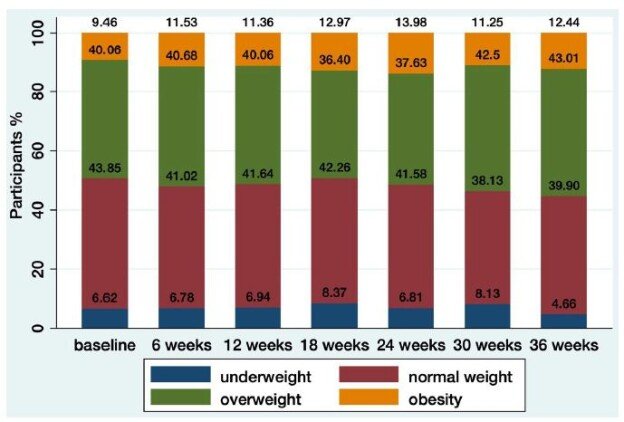
fig 1

Association of Latin-American Ethnicity with an Increase in Weight in an HIV-Infected Outpatient Population

DOI: 10.31038/IDT.2022312

Abstract

Objective: To explore weight gain in regular practice involving naïve patients, those who continue the same treatment for at least 6 months or those who changed their antiretroviral treatment.

Methods: We performed a retrospective analysis of patients followed-up between 2013 and 2019. This study included 3 groups of participants (naïve patients, those who had been on viral suppression for more than 6 months, and those with a treatment change).

Results: 317 people living with HIV (PLHIV) participated. The proportion of participants in the overweight and obese categories increased over time, from 40 to 43% and from 9.46% to 12.43% respectively. Proportion of metabolic syndrome increased overtime from 3.79 to 6.22%. Stratification by both sex and ethnicity, showed the greatest weight gain among Latin male. Considering the risk factors for HIV infection, men that had sex with men (MSM) and heterosexual patients gained 2.03 (95% CI, 0.42-3.65; p=0.013) and 1.57 (95% CI 0.12-3.02; p=0.034) kg more than those who were former intravenous drug users (IDU). Patients taking boosted protease inhibitors (PI) experienced more weight gain 1.94 kg [95% CI, 0.13-3.75; p=0.036], than those taking integrase strand transfer inhibitors (INSTI). Globally and in decreasing order, rilpivirine [RPV] (+4 kg (IQR: -3.30,5.40]), Lopinavir/ritonavir [LPV/r] (+2.6 kg [IQR 2.40-3]) and Elvitegravir [EVG/c] (+2.20 kg [IQR 0-4.60]) were the “third” drugs most commonly associated with weight gain. Raltegravir [RAL] (-0.40 kg [IQR: -3.20, 3.40]) and nevirapine [NVP] (0.40 kg [-0.80, 0.50]) were the least. cART (combined antiretroviral treatment) based on tenofovir alafenamide (TAF) (5.87 kg [95% CI, 2.65-9.09; p<0.0001]; abacavir (ABV) [3.79 kg (95%CI, 0.83-6.75; p=0.012] and tenofovir disoproxil fumarate (TDF) [3.02 kg (95%CI, 0.24-5.80; p=0.033], gained more weight compared to monotherapy with boosted PI.

Conclusions: Our results suggest that there are demographic, HIV and treatment related contributors to weight gain in PLHIV. Latin-American ethnic race was associated with weight gain, particularly in male sex. We could not find any association of weight gain with sex, age or group of treatment (naïve, treatment continued for six months or change of it). We found boosted PI-based regimens, LPV/r, EVG/c and RPV, and TAF among nucleoside reverse transcriptase inhibitors (NRTI) pairs, associated with the greatest weight gain. We need to improve clinical attention to the maintenance of a healthy weight and implement lifestyle modifications and exercise not only for patients starting treatment but also for those with a long experience in antiretroviral treatment.

Keywords

Antiretroviral treatment, HIV, Latin American men, Weight change

Introduction

The current obesogenic environment is the result of an imbalance between caloric intake and energy expenditure that started in the 1960s-1970s [1]. Disruptive chemical sources have contributed to an inappropriate weight gain altering lipid homeostasis, fat accumulation, energy balance and modifying appetite and satiety regulation [2]. It is important to understand factors related to obesity in PLHIV (people living with HIV) the analysis and understanding of fat changes is gaining importance. Their relationship with HIV and cART (combined antiretroviral treatment), although not yet fully elucidated, seem to be a challenge in this era of long-life antiretroviral treatment. White adipose tissue composed of both innate and adapted immunity cells, is an extremely complex system that allows us to defend ourselves against foreign agents by identifying and eliminating viruses and other pathogens. This way, adipose tissue regulates processes against infection. A characteristic change in HIV infection is the shift towards a predominance of CD8+ T subpopulations which are particularly important in adipose tissue in the context of obesity [3,4]. Infiltration of CD8+ T cells is a necessary factor for recruiting macrophages which, in the context of obesity, produce TNF-α, IL-6 and IL-12 [5]. In obese people, the level of CD4 regulating T-cells (Tregs) is lower, making it easier the arrival of pro-inflammatory and macrophage T cells also [6]. Therefore, both adipose tissue related factors and metabolic dysfunction from HIV infection contribute to tissue inflammation and therefore, immune cell disfunction in obese PLHIV. There is a lot of data suggesting that integrase strand transfer inhibitor (INSTI) based antiretroviral treatment (ART) is associated with increased weight gain. In cell cultures, elvitegravir (EVG) has been shown to inhibit adipocyte differentiation and expression of genes that control adipogenesis. So, cART, modulated by features such as race, female sex and intestinal integrity would enhance the weight gain effect of a high-fat diet in PLHIV [7,8]. Cohort analyses have suggested that integrase inhibitors may increase weight gain, being higher in dolutegravir (DTV) and elvitegravir/cobicistat (EVG/c) than in raltegravir (RAL) treated patients. Regarding to the genetic aspects that influence weight gain, we have to mention the melanocortin-4 receptor (MC4R) gene and the fat mass and obesity-associated gene. Several studies show an statistically significant relationship between some mutations of these genes and an increased adiposity, higher if both mutations are present [9]. MCR4 plays a very important role in regulating energy homeostasis and intake. Deficiency of this receptor is associated with monogenic obesity. In vitro studies, a 64% inhibitory effect of dolutegravir (DTG) on the binding of radiolabeled melanocyte-stimulating hormone (MSH) to MC4R has been demonstrated [10]. Other studies seem to deny the possibility of a direct interference of the MC4R receptor by INSTI at therapeutic doses, inhibiting it only at much higher doses [11]. This paper purpose is to explore the weight gain process in our usual practice, involving three groups of patients, naïve patients who initiated treatment, a second group who were six months on it and a third one of patients changing treatment. We try to explore the possible clinical factors and factors related to the combination of antiretroviral treatment on the weigh changes of our patients in our current clinical practice.

Material and Methods

Design and Population of This Study

This retrospective observational study was carried out between January 2013 and January 2019 in a cohort of HIV-infected patients followed at Severo Ochoa University Hospital, in the southwest of Madrid (Leganés). Severo Ochoa University Hospital has a urban population of 180,000 inhabitants. The patients analyzed in this study are included in the COMESEM cohort, a larger cohort of HIV-1 infected patients followed at five different hospitals (Metropolitan Crown of southeastern Madrid, including Leganés, Alcorcón, Getafe, Móstoles and Alcalá de Henares hospitals). It is an open and dynamic cohort with data collected both in a retrospective and prospective way. The COMESEM cohort organization and functioning as well as the written informed consent of the patients were approved by the Clinical Research and Ethics Committee as required [12]. Patients gave their informed consent to be included in the cohort and their data to be used for this and other research purposes. They were verbally informed of the information that was going to be obtained in the study. From the 550 patients of the COMESEM cohort followed in our hospital, 317 whose weight and height had been recorded in the clinical history for at least 6 months were included in this analysis. We report 3-year data. Exclusion criteria were pregnancy and recent opportunistic infection. Three groups of patients were considered depending on their treatment status at the initial visit: group 1, patients who started antiretroviral treatment (naïve), group 2, those who had been on viral suppression for more than 6 months and continue with their treatment and finally, group 3, those whose treatment was changed in that visit (treatment switch). There was no subject on the new integrase inhibitor bictegravir.

Variables and Laboratory Measurements

Age, gender, ethnicity, clinical data including weight and height, the history of HIV infection and cART were collected in each clinical visit. These data included risk practice for HIV acquisition, smoking habits, alcohol consumption, methadone therapy, current CD4 cell count, CD4:CD8 ratio, current and previous therapy and HIV RNA level. No patient was a current illicit drug injection user. Blood samples were collected to analyze HIV related parameters (current CD4 cell count and current HIV viral load). As a rule, blood samples were obtained within one month of clinical visits.

Statistical Analysis

The study objective was to analyze the change of weight adjusted by ethnicity, gender, antiretroviral treatment, risk practice for HIV acquisition and other factors related to HIV infection. Description of variables was done showing frequencies and proportions for categorical and mean, median, and range for continuous variables respectively. A linear regression model was created with the change of weight considered as a continuous dependent variable. Analyses were processed using statistical package Stata/IC 14.2 for Mac (64-bit Intel). In order to estimate the predictive model of all the possible equations, we used user-command “all sets”. A p value less than 0.05 was considered statistically significant. For statistical calculation only differences at 2 years were considered, as data on weight gain was available for 88% as compared with only for 60.88% at 3 years.

Results

Population, Demographics, and Baseline Disease Characteristics

At basal visit, median body max index (BMI) was 24.87 kg/m2; 9.46% were obese (BMI6   ≥30 kg/m2) 40.06% overweight (BMI 25-29.9 kg/m2) and 50.47% normal (18.5-24.9kg/m2) or underweight (<18.5 kg/m2). Additional baseline weight and demographic data are summarized in Table 1, and baseline disease characteristics are summarized in Table 2. In the naïve patients, contrary to age and viral load which were significantly different, we could not find statistically significant differences with respect to BMI or immune system parameters.

Table 1: Baseline and demographic characteristics

Overall

Naïve On viral suppression for more than 6 months Treatment switch

p

N

317

7 61

249

Age (years)

0.0222*

Media (SD)

53.22 (9.72)

43.91 (11.86) 52.31 (9.13)

53.7 (9.69)

Median(Q1,Q3)

54.41(49.27-58.07)

50.29(32.31-53.95) 53.95(49.27-58.4)

54.54(49.28-58.4)

Sex

0.528

Men

217 (69.09%)

6 (85.71%) 40 (65.57%)

173 (69.48%)

Women

98 (30.91%)

1 (14.29%) 21 (34.43%)

76 (30.52%)

Ethnicity

0.228

Spanish

272 (85.74%)

6 (85.71%) 53 (86.89%)

215 (86.34%)

Black

15 (4.73%)

1 (14.29%) 4 (6.56%)

10 (4.02%)

Latin-American

27 (8.52%)

27 (8.52%)

24 (9.64%)

Asian

1 (0.32%)

1 (1.64%)

Sex and ethnicity

0.487

Spanish Men

200 (63.09%)

5 (71.43%) 36 (59.02%)

159 (63.86%)

Spanish Women

74 (23.34%)

1 (14.29%) 17 (27.87%)

56 (22.49%)

Black Men

9 (2.84%)

1 (14.29%) 2 (3.28%)

6 (2.41%)

Black Women

6 (1.89%)

0 2 (3.28%)

4 (1.61%)

Latin Men

9 (2.84%)

0 1 ( 1.64%)

8 (3.21%)

Latin Women.

18 (5.68%)

0 2 (3.28%)

16 (6.43%)

Weight

0.8151

Media (SD)

72.36 (14.40)

73.37 (10.08) 71.33 (15.72)

72.59 (14.20)

Median (Q1,Q3)

71.4 (62.6-80.8)

73.8 (64.2-80.8) 70.4 (59.4- 81.6)

72.1 (63-80.6)

Baseline BMI kg/m2

0.4752

Media (SD)

25.05 (4.25)

23.78 (3.22) 24.62 (4.31)

25.19 (4.27)

Median (Q1,Q3)

24.87(22.26-27.39)

23.99(22.04-24.98) 24.63(22.36-26.70)

25.14(22.21-27.8)

Underweight <18.5

21 (6.62%)

0 6 (9.84%)

15 (6.02%)

Normal Weight 18-5-24.99

139 (43.85%)

6 (85.71%) 26 (42.62%)

107 (42.97%)

Overweight 25-25.9

127 (40.06%)

1 (14.29%) 24 (39.34%)

102 (40.96%)

Obesity >30

30 (9.46%)

0 5 (8.20%)

25 (10.04%)

BMI: body mass index. *p<0.05 categorical variables are expressed as number of cases (percentage of the total); continuous variables are expressed as median (interquartile range) and media (standard deviation); Q1 percentile 25%; Q3 percentile 75%; SD standard deviation.

Table 2: Baseline disease characteristics

Overall

Naïve On viral suppression for more than 6 months Treatment switch

p

N

317

7 61

249

HIV-1 RNA, log10

copies/mL

0.0001*

Media (SD)

0.69 (1.31)

5.17 (0.40) 0.62 (0.98)

0.58 (1.17)

Median (Q1,Q3)

0 (0-1.4)

5.3 ( 4.7-5.53) 0 (0-1.4)

0 (0-0)

CD4 count, cells/µL

0.0983

Media (SD)

563.89 (333.86)

772 (545.47) 507.0328 (304.25)

571.96 ( 332.19)

Median (Q1,Q3)

502 (318-764)

839 (295-1106) 454 (30- 682) 520 (335-766)
CD4 count category, cells/µL

0.715

< 200

42 (13.25%)

1 (14.29%) 10 (16.39%)

31 (12.45%)

>200

275 (86.75%)

6 (85.71%) 51 (83.61%)

218 (87.55 %)

CD8 count, cells/µL

0.0737

Media (SD)

1027.43 (559.51)

1426.14 (841.83) 1098.87 (716.2)

998.72 (501.08)

Median (Q1,Q3)

923 (692-1281)

1300 (728-1670) 974 (800-1205)

900 (642-1278)

Ratio CD4/CD8

0.1399

Media (SD)

0.68 (0.55)

0.62 (0.54) 0.56 (0.43)

0.71 (0.57)

Median (Q1,Q3)

0.542(0.32-0.89)

0.35 (0.20-1.24) 0.53 (0.27-0.76)

0.56 (0.33-0.97)

Ratio CD4/CD8

(category)

0.541

<0.5

141 (44.48%)

4 (57.14%) 30 (49.18%)

107 (42.97%)

>0.5

176 (55.52%)

3 (42.86%) 31 (50.82%)

102 (57.03%)

Weight Gain in Participants Receiving Treatment

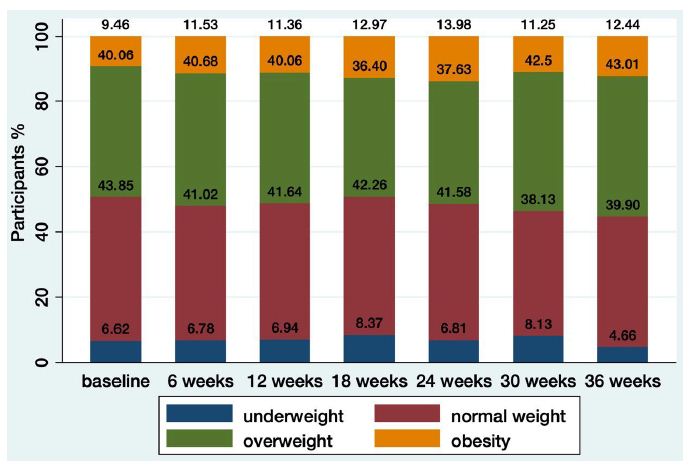
Although median weight gain was 1.0 kg (interquartile range [IQR], −1.4 , 3.8) at 36-month, the proportion of participants in overweight and obese BMI categories increased over time, from 40.06 to 43% and from 9.46 to 12.43% in overweight and obese BMI categories respectively (Figure 1). The proportion of participants that met the International Diabetes Federation definition of metabolic syndrome (central obesity (BMI ≥ 30) plus any two of the following: hypertriglyceridemia, low HDL-cholesterol, hypertension, or hyperglycemia) increased overtime from 3.79% to 6.22%. Participants gained respectively 2.59 (IQR 0.80, 3), 0.70 (IQR-1.80, 3.70) and 1 (IQR: -1.40, 3.80) Kg in group 1, 2 and 3 without statistically significant differences between groups 1 and 2 (-0.70 (95% CI: -5.17, 3.78), p=0.759) nor 1 and 3 (-0.50, (95% CI: -4.84, 3.83); p=0.819).

fig 1

Figure 1: Distribution of BMI over time

Risk Factors for Weight Gain

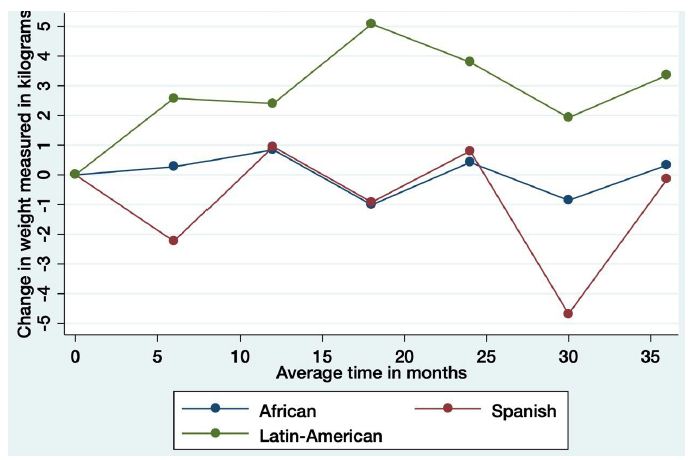
Considering the risk factors for HIV infection, men that had sex with men (MSM) and heterosexual patients gained 2.03 (95% CI 0.42, 3.65); p=0.013 and 1.57 (95% CI 0.12, 3.02); p=0.034, kg more than those who were former intravenous drug users (IDU) respectively (Table 3) Female sex and age > 50 years had not statistically significant correlations with weight gain (0.44, (95% CI: -0.78, 1.67) p=0.478 and -1.27 (95% CI: -3.20, 0.67) p=0.199 respectively. We further explored these findings by using longitudinal models to assess the relationship between sex, ethnicity, and weight gain. Latin-American gained significantly more weight (2.83 kg (95% CI, 0.80-4.85); p=0.006) than non-Latin-Americans participants (Figure 2). Stratification by both sex and race showed the greatest weight gain among Latin-male participants. Compared to Spanish men and to African women, they gained 5.37 (95% CI 1.66-9.08); p=0.005 and 7.18 (95% CI 2.20-12.35); p=0.007 Kg more respectively (Table 3).

Table 3: Risk factors associated with weight change

Variables

Difference in kg 95%CI

p

Risk group of infection (ref former IDU)
MSM

2.03

0.42-3.65

0.013*

HTX

1.57

0.12 3.02

0.034*

Ethnicity adjusted by sex (ref. Latin Men)
Spanish Men

-5.37

-9.08-(-1.66)

0.005**

Spanish Women

-5.17

-8.94-(-1.40)

0.007**

Black Men

-5.32

-10.29-(-.35)

0.032*

Black women

-7.18

-12.35-(-2.02)

0.007**

Latin women

-3.99

-8.19-0.20

0.062

cART type (ref. INSTI)
Boosted PI

1.94

0.13- 3.75

0.036*

NNRTI

1.45

-0.23-3.12

0.090

Backbone (Ref monotherapy with boosted PI)
TAF

5.87

2.65-9.09

<0.0001**

TDF

3.02

0.24-5.80

0.033*

ABV

3.79

0.83-6.75

0.012*

IDU: Intravenous drug user; MSM: Men who have sex with men; HTX: Sex among men and women; cART: Combined antiretroviral therapy; INSTI: Integrase Strand Transfer Inhibitor; PI protease inhibitor; NNRTI: Nonnucleoside reverse transcriptase inhibitor; NRTI: nucleoside reverse transcriptase inhibitor; TAF: Tenofovir Alafenamide Fumarato; TDF: Tenofovir Disoproxil Fumarate; ABV: Abacavir.
*p<0.05; **p<0.01.

 
fig 2

Figure 2: Change in weight in relation to ethnicity

Association of Antiretroviral Regimen Components with Weight Gain

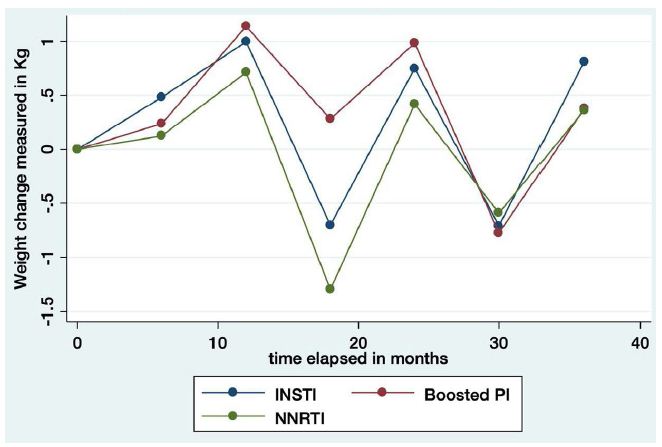
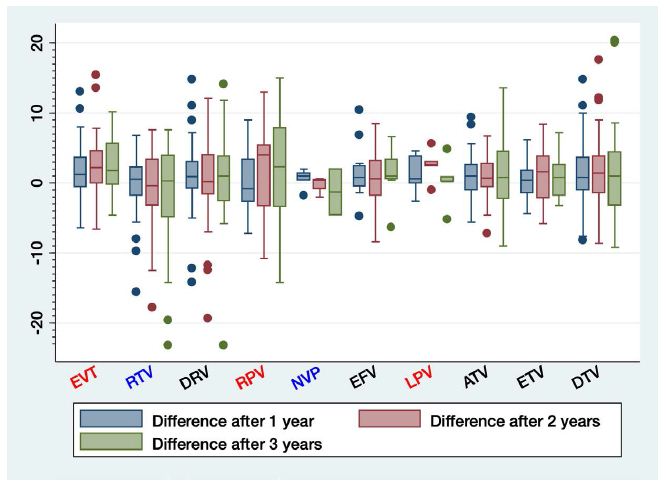
The longitudinal model of weight gain and treatment showed that participants taking boosted PI experienced more weight gain (1.94 kg [95% CI, 0.13-3.75], p=0.036) than those taking INSTI. Weight gain was similar between the NNRTI and INSTI treatment groups (Table 3 and Figure 3). We studied the effect of changing treatment on weight changes with no difference between them. Those patients who changed from INSTI to NNRTI were those in whom we observed the greatest decrease, although not statistically significant: -5.39 (95% CI: -19.12, 7.66) p=0.399. Globally and in decreasing order, rilpivirine [RPV] (+4 kg (IQR: -3.30,5.40]), Lopinavir/ritonavir [LPV/r] (+2.6 kg (IQR 2.40-3) and Elvitegravir [EVG/c] (+2.20 kg (IQR 0-4.60) were the most commonly associated with weight gain, whilst raltegravir [RAL] (-0.40 kg (IQR: -3.20, 3.40) and nevirapine [NVP] (0.40 kg (-0.80, 0.50) were the least (Figure 4). We assessed the association between weight gain and the specific INSTI used. Participants taking EVG/c or DTG demonstrated greater weight gain than those taking RAL (3.00 (95% CI, 0.97, 5.07); p=0.004) and 1.89 (95% CI: -0.034, 3.82); p=0.054) kg respectively. Among participants taking NNRTI, there were no statistically significant differences, although the greatest difference was between rilpivirine and efavirenz (2.46 (95% CI: -0.30, 5.24), p=0.081). Among participants taking boosted PI-containing regimens, those taking lopinavir/ritonavir gained more weight compared to those taking ritonavir and cobicistat-boosted atazanavir (2.57 kg (95% CI 0.80, 4.35) p=0.005) and those taking cobicistat-boosted darunavir (DRV/p) (1.83 kg (95% CI: -0.52, 3.72), p=0.057). Finally, we assessed whether specific nucleoside reverse transcriptase inhibitors (NRTIs) were associated with weight gain compared to boosted PI. At 96 weeks, patients with tenofovir alafenamide (TAF) (5.87 kg (95% CI, 2.65,-9.09; p<0.0001)); abacavir (ABV) (3.79 kg (95%CI, 0.83, 6.75; p=0.012)) and tenofovir disoproxil fumarate (TDF), gained more weight (3.02 kg (95%CI, 0.24, 5.80; p=0.033)) than those in monotherapy with boosted PI.

fig 3

Figure 3: Weight change by the third agent-class

fig 4

Figure 4: Weight change by the third agent

Discussion

Several authors have postulated many factors that would drive the weight gain in PLHIV on treatment with cART. Mainly, we can define them as HIV-related, traditional risk factors and factors related to antiretroviral therapy. An increase in the weight related to the “return to health” itself is observed as the patient improves. An increased survival has been demonstrated in PLHIV who are underweight when gaining weight [13]. On the other hand, the obesogenic environment is increasing obesity and its associated risks in the general population. Scientific evidence was published in 2016 indicating a 39% and 13% of adults in the general population being overweight and obese respectively [14]. This is especially important when we consider that about 50% of patients who start antiretroviral therapy are overweight [15,16]. In the case of our sample the obesity percentage was 9.46% at the start of the study and the mean BMI was 24.87 kg/m2. These values are similar to those of general population. There is increasing evidence of the effects in weight gain owed to lipoatrophy and lipohypertrophy induced by current treatments [17]. Those patients treated with old cART regimens presented lipodystrophy, defined by central obesity and peripheral lipoatrophy, as well as an increased cardiovascular risk. In contrast, those treated with modern cART regimens experienced modest or minimal weight gain Patients exposed to the actual obesogenic environment will have two different outcomes. Whilst patients treated with older cART regimens will have worsening central obesity but persistence of peripheral lipoatrophy, those treated with modern cART regimens will be overweight or obese, with augmented risk of metabolic disease in both cases [2]. Several authors have presented the results of PLHIV cohort studies in different regions of the world in order to demonstrate the relevance of the weight gaining phenomenon with cART and its impact. It is important to keep in mind that environmental factors determine population differences. We have analyzed some of those factors in our cohort of PLHIV who are treated with cART living in Leganés (a village in the South of Madrid, Spain) to clarify which of them determine the weight gain in our population. In our analysis of PLHIV ranging from the years 2013 to 2019, we found that independently of initiating, changing treatment or maintaining viral suppression, all of them had an increase in overweight, obesity and metabolic syndrome, although absolute weight gain was not significant during the 3 years of observation and was independent of the reason for receiving treatment. A study was conducted with the VACS cohort where it was shown that a 5 lb [18]. Weight gain resulted in a 14% increased risk of diabetes in PLHIV vs. 8% in HIV negative controls. Likewise, other authors from the D:A:D cohort showed a 13% increased risk of diabetes for every unit of BMI gained [19]. An observational study called SCOLTA with a cohort followed at least for one year showed significant evidence of INSTI producing weight gain [20]. The study NA-ACCORD compared the weight gain between patients treated with INSTI, PI and NNRTI-based combinations. Patients treated with INSTI-based combinations had greater weight gain, and within this group of drugs, especially combinations with DTV [21]. We did not observe these differences as our patients exposed to boosted PI gained the greatest weight. Among the NNRTIs, efavirenz was associated with the least weight gain and rilpivirine the greatest. Among the INSTIs, RAL had the least and EVG the greatest weight gain probably because this last one was used co-formulated with TAF. In another retrospective cohort study, they analyzed the effect of treatment change on weight gain in patients receiving EFV/TDF or TAF /emtricitabine (FTC) combinations who switched to INSTI or boosted PI. They were followed for 18 months and a significant weight gain was observed in those treated with INSTI and, above all, in those treated with DTV [22]. We did not find these differences. This can be related to the fact that there are multiple combinations in our study patients, following a real life situation, preventing it from having statistical power. Pre-exposure prophylaxis allows direct comparisons face-to face. The iPrEx study showed weight reduction in those patients treated with TDF (-0.3 kg) versus those who received placebo (+0.5 kg) at 48 weeks [23]. On the other hand, the DISCOVER study [24,25] compared two groups of patients, one with TDF and the other with TAF. Weight loss with TDF was observed up to week 24, as in the iPrEx study, reaching the least weight at 48 weeks but with weight gain at week 96 (+0.5 kg). On the other hand, those treated with TAF showed a sustained increase which reached 1 kg at week 48 and 1.7 kg at week 96. Other double-blind clinical trials on Hepatitis B virus (HBV) mono-infection support this evidence by demonstrating a weight gain of 0.8 kg with TAF and a lost of 0.7 kg with TDF (difference of 1.5 kg) at week 48 [26]. In the AMBER double-blind clinical trial, they compared face to face TAF vs. TDF with a weight gain at 48 weeks 1 kg higher in the former group [27]. These data are consistent with the results of our study in which we found a 2.85 kg weight difference at 96 weeks. The least weight gain was with nucleoside analog-free therapy (monotherapy based on boosted PI). The first clinical trial to report the largest increase in weight in naïve patients treated with TAF and DTV was the ADVANCE study. It was carried out in Johannesburg, South Africa. During 96 weeks 3 groups of patients were randomized to receive treatment TAF/FTC+DTG, TDF/FTC+DTG or TDF/FTC/EFV. Obesity in terms of BMI increase was significantly higher in TAF/FTC+DTG [28]. The baseline characteristics of the study were very different from ours so the conclusions of that study cannot be extrapolated to our population. 59% were women (twice as many as in our sample) and 100% were African subjects (no white or Latin American individuals were studied). As in the ADVANCE study, we were able to show that the main treatment factor associated with obesity was the use of TAF/FTC+DTG. Other study made in Africa is the NAMSAL clinical trial [29]. It was conducted at three sites in Yaoundé, Cameroon. The population characteristics were different from those of our cohort (66% were women, 100% were African subjects) and this was a randomized phase III study in which they compared the combination of DTG+TDF/3TC with EFV+TDF/3TC. The combination based on DTG had a statistically significant greater weight gain (5 vs. 3kg). In our cohort the mean weight gain in the African ethnicity was 4.66 kg at 96 weeks and it was higher in African women. Unlike our sample, they could not analyze ethnic differences because only African subjects were studied. Paul Sax analyzed factors related to weight gain in a pooled analysis of eight randomized clinical trials with a control group of untreated PLHIV [30]. The biological factors associated with greater weight gain were female sex, African ethnicity, and non-being IDU. Factors related to basal HIV were a decreased CD4 count, a higher viral load, a low or normal weight, and being symptomatic HIV. ART-related factors that resulted in the greatest weight gain were DTG/BIC versus EVG and RPV versus VTE use in the INSTI and the NNRTIs family respectively. Within the ITINNs family TAF was the one that increased more the weight. In our sample, the biggest increase in weight was not seen in the African ethnicity (although they augmented weight as well) but in Latin American ethnicity (3.97 kg more than in whites of Spanish nationality). Participants who had no history of consumption of intravenous drugs at baseline had more weight increase. We postulate we could not find an association between weight gain and HIV disease characteristics because baseline median of CD4 count, viral load copies and CD4/CD8 ratio were respectively 502 cel/mm3, < 20 copies/ml y > 0.5, in line with immune reconstitution and so, the return-to-health phenomenon did not take place. Among the comparisons by third agent-class we observed that those who had the greatest weight gain were those who received LPV/r, EVT/c and RPV. We could not find statistically significant differences between the 3 groups of treatment. Probably the small number of “naïve” patients and the absence of immunologic differences in their group with respect to the others, prevented us to see the weight gain expected for the effect of “the return to health”. Although methodologically this is a lower quality study than the clinical trials as it is a retrospective study, we are confident of its great utility because of being a real life study. There are several limitations to our analyses. It did not evaluate aspects such as psychiatric comorbidities, concomitant medications, diet, physical activity, or smoking. In the study, third agents were generally co-administered with NRTIs, with the exception of those regimes based on boosted PI monotherapy where no analogs were used. This makes it difficult to find a link between weight gain and an individual agent. Two or three year’s follow-up does not allow conclusions to be drawn about the long term metabolic disturbances because of the usual clinical practice of addition of new drugs and frequent changes in therapy. Additional important areas for investigation include the magnitude, clinical significance, and biologic mechanisms of ART-related weight gain.

Conclusions

In our study a mix of demographic, HIV disease-specific and ART-specific factors were associated with weight increase during follow-up. Latin-American ethnicity was associated with weight gain. This association was particularly important among Latin-American male, who gained more weight than males of other ethnics. The mechanism underlying this observation is unknown, but it´s probably related to dietary habits and not genetic issues. These findings highlight the need for increased obesity awareness, monitoring and clinical intervention in this population. We could not find any association of weight gain with sex or group of treatment (naïve, treatment continued for six months or change of it). We found PI-based regimens and among NRTI pairs, TAF, associated with the greatest weight gain. Our findings show us that we need to improve clinical attention to the maintenance of a healthy body weight and implement lifestyle modifications and exercise not only for patients starting treatment but also for those with a long experience in antiretroviral treatment.

Acknowledgement

FUNDACIÓN PARA LA INVESTIGACIÓN BIOMÉDICA DEL H.U.PUERTA DE HIERRO had participated in the expenses for the publication in the journal.

Funding

The authors received no funding for this work.

Conflict of Interest

The authors declare that they have no conflicts of interest.

References

  1. Finkelstein EA, Khavjou OA, Thompson H, Trogdon JG, Pan L, et al. (2012) Obesity and Severe Obesity Forecasts Through 2030. Am J Prev Med 42: 563-570. [crossref]
  2. Veiga-Lopez A, Pu Y, Gingrich J, Padmanabhan V (2018) Obesogenic Endocrine Disrupting Chemicals: Identifying Knowledge Gaps. Trends Endocrinol Metabol 29:607-625. [crossref]
  3. Damouche A, Pourcher G, Pourcher V, Benoist S, Busson E, et al. (2017) High proportion of PD-1-expressing CD4 +T cells in adipose tissue constitutes an immunomodulatory microenvironment that may support HIV persistence. Eur J Immunol 47: 2113-2123. [crossref]
  4. Koethe JR, McDonnell W, Kennedy A, Abana CO, Pilkinton M, et al. (2018) Adipose Tissue is Enriched for Activated and Late-Differentiated CD8+T Cells and Shows Distinct CD8+ Receptor Usage, Compared With Blood in HIV-Infected Persons. JAIDS 77:e14-e21. [crossref]
  5. Nishimura S, Manabe I, Nagasaki M, Eto K, Yamashita H, et al. (2009) CD8+ effector T cells contribute to macrophage recruitment and adipose tissue inflammation in obesity. Nature Medicine 15: 914-920. [crossref]
  6. Feuerer M, Herrero L, Cipolletta D, Naaz A, Wong J, et al. (2009) Lean, but not obese, fat is enriched for a unique population of regulatory T cells that affect metabolic parameters. Nature Medicine 15: 930-939. [crossref]
  7. Vrouenraets SM, Wit FW, Fernandez Garcia E, Moyle GJ, Jackson AG, et al. (2011) Randomized comparison of metabolic and renal effects of saquinavir/r or atazanavir/r plus tenofovir/emtricitabine in treatment-naïve HIV-1-infected patients. HIV Med 12: 620-631. [crossref]
  8. El Kamari V, Moser C, Hileman CO, Currier JS, Brown TT, Johnston L, et al. (2018) Lower Pretreatment Gut Integrity Is Independently Associated With Fat Gain on Antiretroviral Therapy. Clinical Infectious Diseases 68: 1394-1401.
  9. Hetherington MM, Cecil JE (2010) Gene-Environment Interactions in Obesity. Forum Nutr 63:195-203.
  10. International non-proprietary name: dolutegravir. Assesment report. London, United Kingdom European Medicines Agency, Committee for Medicinal Products for Human Use CHMP. 2014;Report No.:EMA/CHMP/772068/2013.
  11. McMahon C, Trevaskis JL, Carter C, Holsapple K, White K, et al. (2020) Lack of an association between clinical INSTI- related body weight gain and direct interference with MC4 receptor (MC4R), a key central regulator of body weight. PLoS One 15: e0229617. [crossref]
  12. Castilla V, Alberdi JC, Barros C, Gómez J, Gaspar G, et al. (2003) [Multicenter cohort of patients with HIV infection in the Madrid south-eastern metropolitan crown (COMESEM): basis, organization and initial results]. Rev Clín Esp 203: 170-177. [crossref]
  13. Yuh B, Tate J, Butt AA, Crothers K, Freiberg M, et al. (2015) Weight Change After Antiretroviral Therapy and Mortality. Clin Infect Dis 60: 1852-1859. [crossref]
  14. Obesity and Overweight (2018) Fact sheet WHO.
  15. Koethe JR, Jenkins CA, Lau B, Shepherd BE, Justice AC, et al. (2016) Rising Obesity Prevalence and Weight Gain Among Adults Starting Antiretroviral Therapy in the United States and Canada. AIDS Res Hum Retroviruses 32: 50-58. [crossref]
  16. Tate T, Willig AL, Willig JH, Raper JL, Moneyham L, et al. (2012) HIV infection and obesity: where did all the wasting go? Antivir Ther 17: 1281-1289. [crossref]
  17. Finkelstein JL, Gala P, Rochford R, Glesby MJ, Mehta S (2015) HIV/AIDS and lipodystrophy: Implications for clinical management in resource-limited settings. JIAS 18:19033. [crossref]
  18. Herrin M, Tate JP, Akgün KM, Butt AA, Crothers K, et al. (2016) Weight Gain and Incident Diabetes Among HIV-Infected Veterans Initiating Antiretroviral Therapy Compared With Uninfected Individuals. JAIDS 73: 228-236. [crossref]
  19. Achhra AC, Mocroft A, Reiss P, Sabin C, Ryom L, et al. (2015) Short-term weight gain after antiretroviral therapy initiation and subsequent risk of cardiovascular disease and diabetes: the D:A:D study. HIV Med 17: 255-268. [crossref]
  20. Taramasso L, Ricci E, Menzaghi B, Orofino G, Passerini S, et al. (2017) Weight Gain: A Possible Side Effect of All Antiretrovirals. Open Forum Infec Dis 4: 121-123. [crossref]
  21. Bourgi K, Jenkins CA, Rebeiro PF, Palella F, Moore RD, et al. (2020) Weight gain among treatment-naïve persons with HIV starting integrase inhibitors compared to non-nucleoside reverse transcriptase inhibitors or protease inhibitors in a large observational cohort in the United States and Canada. JIAS 23: e25484. [crossref]
  22. Norwood J, Turner M, Bofill C, Rebeiro P, Shepherd B, et al. (2017) Weight Gain in Persons with HIV Switched from Efavirenz-based to Integrase Strand Transfer Inhibitor-based Regimens. JAIDS 76: 527-531.
  23. Glidden DV, Mulligan K, McMahan V, Anderson PL, Guanira J, et al. (2018) Metabolic Effects of Preexposure Prophylaxis With Coformulated Tenofovir Disoproxil Fumarate and Emtricitabine. Clin Infect Dis 67: 411-419. [crossref]
  24. Spinner CD, Brunetta J, Shalit P, Prins M, Cespedes M, et al. (2019) DISCOVER study for HIV pre-exposure prophylaxis (PrEP): F/TAF has a more rapid onset and longer sustained duration of HIV protection compared with F/TDF. http://programme.ias2019.org. Mexico.
  25. Ruane P, Clarke A, Post FA, Schembri G, Jessen H, et al. (2019) Phase3 Randomized, Controlled DISCOVER Study of Daily F/TAF or F/TDF for HIV Pre-exposure Prophylaxis: Week 96 Results Basel; https://onlinelibrary.wiley.com /doi/10.1111/hiv.12814 PE3/16.
  26. Buti M, Gane E, Seto WK, Chan HL, Chuang WL, et al. (2016) Tenofovir alafenamide versus tenofovir disoproxil fumarate for the treatment of patients with HBeAg-negative chronic hepatitis B virus infection: a randomised, double-blind, phase 3, non-inferiority trial. Lancet Gastroenterol Hepatol 1: 196-206. [crossref]
  27. Eron JJ, Orkin C, Gallant J, Molina JM, Negredo E, et al. (2018) A week-48 randomized phase-3 trial of darunavir/cobicistat/emtricitabine/tenofovir alafenamide in treatment-naïve HIV-1 patients. AIDS 32: 1431-1442. [crossref]
  28. Venter WDF, Moorhouse M, Sokhela S, Fairlie L, Mashabane N, et al. (2019) Dolutegravir plus Two Different Prodrugs of Tenofovir to Treat HIV. N Engl J Med 381: 803-815. [crossref]
  29. The NAMSAL ANRS 12313 Study Group, Kouanfack C, Mpoudi-Etame M, Omgba Bassega P, Eymard-Duvernay S, et al. (2019) Dolutegravir-Based or Low-Dose Efavirenz-Based Regimen for the Treatment of HIV-1. N Engl J Med 381: 816-826. [crossref]
  30. Sax PE, Erlandson KM, Lake JE, McComsey GA, Orkin C, Esser S, et al. Weight Gain Following Initiation of Antiretroviral Therapy: Risk Factors in Randomized Comparative Clinical Trials. Clin Infec Dis 71: 1379-1389. [crossref]

Multisystemic Side Effects of Lithium in Older Adults: A Case Report

DOI: 10.31038/ASMHS.2022632

Abstract

We report a case of a 73-year-old male with bipolar affective disorder. Three years prior to this admission the patient was diagnosed with lithium induced posterior reversible encephalopathy syndrome (PRES) and lithium was discontinued. This year he presented with mania and later delirium. Investigations revealed a delayed presentation of multiple lithium-associated side effects emerging including hypercalcemia, hyperparathyroidism, and nephrogenic diabetes insipidus (NDI). Healthcare professionals should be cognizant that lithium-related side effects might trigger or exacerbate each other and may present late in the elderly. Therefore, close follow-up and clinical supervision are important for the early diagnosis and treatment of these side effects.

Keywords

Lithium, Side effects, Bipolar affective disorder (BPAD), Posterior reversible encephalopathy syndrome (PRES), Nephrogenic diabetes insipidus (NDI)

Introduction

Lithium is a widely used and effective treatment for mood disorders. It is one of the first treatment options for bipolar affective disorder and it has been used in modern psychiatry since 1949 [1]. Although its efficacy has been proven as a prophylactic in the relapse and recurrence of unipolar depression, hypomania, mania, short-term mortality, and suicidal risk, it has also many side effects [1,2].

Patient Information

DR is a 73-year-old male, previously diagnosed with bipolar affective disorder, who was admitted to the acute psychiatric unit for a manic episode marked by agitation, paranoia, and reduced oral intake. His past history was significant for controlled essential hypertension.

DR had a history of multiple manic episodes and had been on lithium 1200 mg per day for more than twenty years with no adverse effects. Three years ago, he was admitted to an acute medical unit with delirium and episodes of unresponsiveness. MRI revealed findings consistent with posterior reversible encephalopathy syndrome (PRES). Therefore, lithium was stopped and sodium valproate and quetiapine were initiated. He returned to baseline and received regular community follow up. In community a history of polyuria and polydipsia was noted.

His inpatient stay was complicated by reduced oral intake since the start of the manic episode and subsequent delirium. Clinical examination was unremarkable apart from confusion and signs of dehydration. He developed significant dysphagia shortly after and was declared NPO due to risk of aspiration. Despite being initially responsive to IV fluid therapy, his hypercalcaemia persisted (Table 1).

Table 1: Laboratory Values

Serum Na+ 147 mmol/L (135-145)
Serum K+ 5.3mmol/L (3.5-5.2)
Serum Cl- 109 mmol/L (95-108)
Urea 22 mmol/L (2.8-8.1)
Creatinine 134 µmol/L (53-106)
Serum Ca+ 2.95mmol/L (2.05-2.55)
Serum Osmolality 294mmol/kg (275-295)
Urine Osmolality 199 mOsm/kg (400-1000)
Thyroid stimulating hormone 1.21 mU/L (0.27-4.20)
Parathyroid hormone 50 pg/mL (15-65)
Sodium Valproate level 45 mg/L (50-100)

Endocrinology input was sought and after investigation he was diagnosed with nephrogenic diabetes insipidus secondary to lithium. He was managed with intravenous fluid replacement via a peripheral line and was allowed to drink as desired. Delirium was managed with adjusted doses of quetiapine. After 4 weeks, he did remarkably well and blood parameters returned to normal levels with his hypercalcaemia managed by a fluids guideline of 3L/day before discharge home.

Discussion

Lithium therapy is the most common cause of nephrogenic diabetes insipidus (DI), occurring in as much as 10-15% of patients. Lithium’s impact on renal function is well known, likely through several mechanisms still under exploration [3,4].

Our case had an atypical presentation that delayed treatment due to the temporal disparity between the causative medication and the presentation of symptoms. DI typically presents with marked hypernatremia and concurrent hypercalcaemia [5]. The proposed chain of events was that long term lithium induced nephrogenic diabetes insipidus that lead to parathyroid hyperplasia and hypercalcaemia, which was then compensated by his polydipsia in community. However, when he became manic, his oral intake decreased and the subsequent electrolyte imbalance led to a delirium, with a dysphagia secondary to the rising calcium that then worsened the pre-existing imbalance.

It may benefit clinicians to be aware that lithium induced DI may present slowly with significant time delay from the period of lithium treatment and symptom presentation and that the presentation can be masked by more prominent major mental health disorders. Additionally patients that may be on maintenance therapy for long periods are still vulnerable to uncommon and serious adverse events.

Conclusion

We report an elderly patient who presented with acute hypocalcaemia and dysphagia during a manic episode three years after cessation of lithium. Lithium was stopped due to PRES, which occurred after two decades of uneventful lithium therapy. Therefore, rare adverse side effects are a concern even in previously stable patients and the development of NDI is not always overtly evident after lithium therapy.

Acknowledgements

The authors would like to thank all colleagues who were involved in the care and management of this patient. We would also thank the patient for his willingness to provide informed consent for this report.

Informed consent

Informed consent was obtained from the patient prior to publication.

References

  1. Geddes JR, Miklowitz DJ (2013) Treatment of bipolar disorder. The Lancet 381: 1672-1682.
  2. Cipriani A, Hawton K, Stockton S, Geddes JR (2013) Lithium in the prevention of suicide in mood disorders: updated systematic review and meta-analysis. British Medical Journal 346: 3646.
  3. Sirois F (2004) Lithium-Induced Nephrogenic Diabetes Insipidus in a Surgical Patient. Psychosomatics 45: 82-83.
  4. Presne C, Fakhouri F, Noel LH, Stengel B, Kreis H, et al. (2003) Lithium induced nephropathy: Rate of progression and prognostic factors. Kidney Int 64: 585-592. [crossref]
  5. Hopadhyay D, Gokulkrihnan L, Mohanaruban, K (2001) Lithium-induced nephrogenic diabetes insipidus in older people. Age Ageing 30: 347-350. [crossref]

Counselling the Zeitgeist: Reflections of a Counsellor on Values and Attitudes to Life

DOI: 10.31038/ASMHS.2022624


“I’m not strange, weird, off, nor crazy, my reality is just different than yours.” – The Cheshire Cat (Alice in Wonderland)

“Could it be”, Frankl (2004, p. 157) [1,2] asks “that this illness of the age (the zeitgeist) is identical to that with which all psychotherapy is concerned, that is, with neurosis [3]. Frankl proposed four characteristics of what he termed “the collective neurosis”, the spirit of the age. This paper suggests that in different ways these characteristics persist and have been identified in different ways by various authors. It suggests that an important task of therapy is to address the zeitgeist rather than to immediately address the presenting symptoms.

As a counsellor dealing with life issues I often find that the most important step is to work gently with the client to help them overcome their “should’s” of life. Life “should” somehow be different and that attitude has caused the stress in the relationship, or the personal anxiety or the depression that has brought the client here today.

However, what the client believes about how life “should” be can be heavily influenced by the general beliefs of society about life. Viktor Frankl, the founder of Logotherapy and survivor of the concentration camps wrote extensively about what he terms the “collective neurosis” [4-6]. For Frankl there are four manifestations of societal beliefs in his time (the zeitgeist):

  • Provisional existential attitude. The person believes life itself has little meaning apart from personal satisfaction and hence it is not necessary to do anything particular except live for the moment.
  • Fatalism. A person who succumbs to a provisional existential attitude may go one step further and convince themselves not only that it’s not necessary to change anything but it’s not actually not possible to do so. The feeling of personal powerlessness against whatever life brings is a constant issue in counselling.
  • Collectivism. The person who believes it’s not possible to change can go further and simply desire just to sink into the crowd and “go with the flow”.
  • Fanaticism. As one is swept up in the prevailing belief of the age it is also possible to become totally convinced of the correctness of a particular direction in life. In that case only one opinion counts and that is my own and that of the, now supportive, collective crowd I have joined as I seek for certainty and support.

Such certainties about the reality of life for a client can also lead to counselling difficulties as the individual’s belief structure can obstruct personal progress.

This short paper will maintain that the topic of the “collective neurosis” continues to be a focus of critical analysis in sociology. Although the language used may differ, the frameworks are remarkably similar [7,8]. I will suggest both that the collective neurosis is alive and well in our time and that source of this life today is an over-emphasis on individuality and personal happiness. This is at the expense of attitudes: gratitude for what live gives to each of us, generosity in what I give back to others and acceptance of the inevitable suffering that life brings.

Brooks (pp. xi to xxxiii) suggests that the (western) world encourages us to pursue our own self-interest: career wins, high status and personal happiness. While these are the goals of what he terms the first mountain he suggests that at some point individuals will find they are no longer interested in these goals. They begin to desire goals that are truly worth pursuing and that is the second mountain. These are goals that require a personal commitment, to a cause or to a person. The Logotherapy approach runs parallel. It has a focus is on the future, and meanings to be fulfilled in the future. It is about helping clients to be prepared to climb that second mountain or at least to see it on the horizon as a challenge to be accepted.

At some stage in life, Brooks (pp. 14ff.) suggests we lose the incentive to climb that first mountain. Perhaps it becomes impossible to scale, or having scaled it, we realise it was not worth it. In both cases we descend to the valley. He suggests there at four social crises typical of the valley:

  • Loneliness: an increasing number of people live alone or as single parents.
  • Distrust: living alone and not knowing who potentially lives even next door can lead to alienation and lack of trust in others.
  • Crises of meaning: as I exist in the valley is it possible to find a place where I can find a cause to which to devote myself or even a person to whom I can devote myself?
  • Tribalism: this can become the way forward because I now join in a common cause which has a community (perhaps a virtual one) and which shares common hatred for some group or other or a common rejection of particular ideas.

Are these the collective neurosis described in a new way? [9]. How did we get here? If a disease of western society is a crowded valley, the collective neurosis rebranded, how did we succumb to the neurosis?

Brooks (pp.26ff.) goes on to suggest that the valley has intergenerational roots. He suggests young people in a western society are presented with what he terms “empty boxes” as ideals. As an example of this he recounts the ritual of graduation from University. The invited inspirational speaker is a famous and successful person who urges the graduands “don’t be afraid to fail“. Good advice but hard to accept without some clear pathways of what life goals are really important. What is the benchmark for “pass” or “fail”? However, the graduation speech can go further to suggest real empty boxes:

  • Freedom: The purpose of life is to be free and personal freedom is equivalent to happiness
  • Set your own path: You can be anything you want. Your future is limitless you can be whatever you want to be. Is this true? It may be hard to accept if I am unsure just what life is about and who I might become.
  • Authenticity: Be yourself and follow your own dreams and passion. Define your own mountain? That may be good, as long as it is really worth the climb.
  • Autonomy: create your own values. They belong to you alone. So the climb is up to each person? That is good as far as it goes, but no serious climber would attempt a difficult ascent without proper equipment. What values do I need to define the self?

Metaphorically, these are akin to looking around and refining the car’s interior without concentrating on the road ahead and the second mountain in the far distance.

Brooks sees all of these as simply “empty boxes”. So what happens when young people, having opened the gift of education and the “boxes” that have been presented to them throughout, find they are empty? Somehow they have been told lies? It may take some time and not all may realise that what has been presented to them is not the full truth about life.

It can take one of the “d’s” of life: a death, a divorce, a disaster, a difficult event, a personal rock on the path, to bring this home. I then realise that life is tough, it can be hard, there will be suffering, and I decide to come to counselling. If the counselling is helpful, I may be able discern the second mountain, and even begin that climb. I am convinced now that my life has meaning (the Logotherapy message), and I can find it.

However, what happens if I stay in the valley, realise the first mountain had poor foundations and was composed of empty boxes but cannot see the second mountain, that of meaning in life.

Inayatullah (p.22) believes there are four pathways many young people take:

  • Go with the flow. Develop your career and join the BMW set, perhaps putting off the crisis until mid-life.
  • Seek certainty. In an uncertain world this can be found in political and religious fanaticism.
  • Surrender. Youth suicide is on the rise.
  • Violence. Violence and youth crime are major factors of life in some cities and districts.

This is the collective neurosis in action, perhaps not only for the young [10].

Where does this leave the counsellor, with a client who has come because of one of the “d’s” of life? The interior of the metaphorical car has been badly compromised, the windscreen needs to be cleaned so that that second mountain can be seen clearly. Questions such as: “who does your family need you to be now?”; “what do you hope your children will say at your eulogy?”; “what courageous decision does life demand now?” are at the core of logotherapy. Once the therapeutic relationship has been established, they must be confronted. Not to do so is to simply re-arrange empty boxes.

Brooks (pp.87 ff.) sees climbing the second mountain as a next step in life. This “second journey” (see O’Collins p.14) is usually triggered by some life event, in the same way as a life event triggers the client to seek counselling support. The classic “second journey” for O’Collins is undertaken in mid-life. It is characterised first by an outer component – a restlessness that keeps a person travelling in the hope that “if I relocate, I will find the solution’. Then there is a feelings component, it feels like being lost in a forest. The journey takes the form of a search for new meanings, fresh values and different goals. It is also characterised by a deep sense of loneliness.

O’Collins suggests the journey ends gently. “We come to ourselves in a self-discovery and final self-identification, which allows us to reach out to others and be more productive, “to give something back”, as the saying goes.”

Our clients are not all ready to climb that second mountain. They may be too young for a mid-life crisis. They have come because of one of the “d’s” of life. However, “almost every problem that’s brought into therapy is implicitly about the meaning of life [11].” To address this implicit issue will frequently, according to Lukas [12] either reduce the presenting symptoms or at least make them manageable. It is a prime task of therapy and this paper contends it can only be achieved by addressing the implicit beliefs of the zeitgeist.

Metaphorically the therapist must of course help the client clean the interior of the car, perhaps even providing new seat covers, a better sound system and other changes to layout and systems. However, the real task is to clean the windscreen, to enable to client to look outwards to causes and people beyond the self that can be embraced now and towards that second mountain, whether imminent or in the distance.

References

  1. Zietgeist – the defining spirit or mood of a particular period of history as shown by the ideas and beliefs of the time.
  2. Frankl, V (2004) On the theory and therapy of mental disorders. (Introduction and translation James du Bois). New York, NY. Brunner-Routledge.
  3. Neurosis – a relatively mild mental illness, involving symptoms of stress (depression, anxiety, obsessive behaviour, hypochondria) but not a radical loss of touch with reality.
  4. See Frankl V (1987) Man’s search for meaning: an introduction to logotherapy. London, UK., Hodder and Stoughton.
  5. Frankl V (1988). The will to meaning. New York, NY. Meridian.
  6. Frankl V (2004) On the theory and therapy of mental disorders. (Introduction and translation James du Bois). New York, NY. Brunner-Routledge.
  7. See Brooks, D (2019). The second mountain: The quest for a moral life. London, Random House UK. Inayatullah, S. Youth Dissent: Multiple perspectives on youth futures in Youth Futures: Comparative research and transformative visions, (Gidley, J. and Inaatullah S. Eds.) Westport, CT. Praeger publishers. 2002:19-30.
  8. Mackay, H (2013). The good life: What makes a life worth living? Sydney, Aust. McMillan O’Collins, G. (2021) Second Journeys in The Tablet June 5 2021. London, UK.
  9. Comparisons in language and concept: Loneliness — provisional existential attitude; Distrust – fatalism; Crises of meaning – collectivism; Tribalism – Fanaticism
  10. Inayatullah’s categories can be linked to Frankl’s collective neurosis (not perfect as there is a cross-fertilisation perhaps: Go with the flow — provisional existential attitude; Seek certainty – collectivism; Surrender – fatalism; violence – fanaticism.
  11. Hill, C. E. (2018). Meaning in life: A therapist’s guide. Washington, DC: American Psychological Association. https://doi.org/10.1037/0000083-000
  12. Lukas, E. (1986/2020) Meaningful Living: Introduction to Logotherapy Theory and Practice. (pp. 153-183).
fig 2

The “MN” Virus (Multiple Nucleons) or COVID-19 Energy Immunodeficiency Virus Origin

DOI: 10.31038/PSYJ.2022423

Introduction

The Gravity syndrome start up field is the planet “Amenis” which encompasses 2 meteorites X&Y=centering points of the major meteorite Z=points determined as negative agents on “a red axis plane ⇒ point of alert” with a constant decent towards the earth and produce ecological deficiency at the atmospheric level. The major meteorites Z ejection climax and radical sustaining negative energy causing nitrogen atmospheric praise Z symmetry games supporting electromagnetic charges and its center point warn of a peak viral reaction. Therefore, the ultimate determination of this pint is the central axis of the two parallel crossing points which rises -0°C from the central axis to be able to propagate a symmetrical infrared wave to the point of tracing of the line which aims at the random path of the perpendicular C. This central axis is at -0°C from the central axis of the radioactive detection wave. The point of release of the hydraulic driving force is a reflection of the atmospheric energy D that is the basic energy of the support of the central axis. The metaphysical equation of gravity syndrome G ⇒ appropriate formula of viral displacement at a peak speed towards a -0°C axis in the direction of planet earth [1-7].

The “MN” virus (Multiple Nucleons) or COVID-19 is the virus of the century which comes from the atmosphere, the result is: the gas bulbs cause an expansion of the molecules composing the tissues of the ozone layer and a bursting of the radioactive ions protecting against the ultraviolet rays of the sun, which causes a very dense and contaminated humidity at the level of the atmospheric layer which is held by the electric current of the force of the waters and the force of attraction of the earth collected by the orbit speed of the planet Jupiter/side East/and ejection on the West ozone layer. Currently very low resistance of the ozone layer: (0.0174691 CL O2). The “MN” virus (Multiple Nucleons) or COVID-19’s bulbs cause the molecules to expand and the protective radioactive ions to explode, which causes a viral contamination. The viral wave causes hyper radioactive failure which reacts directly on the aquatic energy and propels effects on atmospheric energy which in turn reacts on earth energy first and on the ozone layer second. The “MN” virus (Multiple Nucleons) or COVID-19 viral spread at the terrestrial level: [(a + b) + c ⇒ √2,142 ⇒ II ⇒ [(0.013736.666)] km from the axis of gravity at the equatorial level which is a resistance of the perforation path of the electromagnetic system of the planet of the support of the rhesus and the density of the influx of the current of the water at the terrestrial level, element which accentuates the contamination of the waters and causes their deoxygenating something which facilitates the growth of bacteria and the poisoning of atomic nuclei by this fact: the manipulation of the cells goes towards the decrease and stagnates the evolution of the aquatic purgative act. Subordinate detection at a rate of 1000 km/h with a coetaneous breach of an X-ray in the parallel direction of an ejection of a radioactive wave. The “MN” virus (Multiple Nucleons) or COVID-19 spreads via a powered wave detecting the mid-axis diverging at a specifically acute angle parallel to the sun. This reaction diverges around the terrestrial globe to accentuate the distribution factor of toxic gases coming from Pluto. The infrared rejection which propels in the east direction of the wave of projection of a solar ray towards the symmetrical path and parallel to the axis of projection of an ultraviolet ray is based on a curved and radioactive wave. The carbon reacts simultaneously to radioactive functioning and this easily accentuates the rejection of infrared waves propelled into the cell mixing zone located at the level of the Atlantic Ocean and surrounded by pushed radioactivity produces a pulse field set at a regular rate and this to allow the systemic functioning of the cycle of energy reproduction. The energy failure in the solar system disrupts the normal cycle of C energy density at the earth level, causing disturbance in the earth’s crusts and causing repeated earthquakes. The relaxation of the cells that make up neurons reflects a stunning subordination through the circuit of toxin destruction in all the gases floating in the universe. The relative conjunctivitis of a fixed point of reference with an angle of 70°C in a position symmetrical or parallel to the sun. The random path is in the form of a combined circuit activated by cells rich in Uranium, an element beneficial to the maintenance of the various components of the atmospheric layers, a point of attachment of the magnetic field that maintains the balance of this entire universe. The origin of the “MN” virus (Multiple Nucleons) or COVID-19 is planet Amenis. Its location is 130,000,000.000 Km from the planet Mars which with its environment rich in nuclear energy maintains a very humid surrounding climate but unfortunately unlivable because of the excess of hydrogen in its atmosphere and the existence of l Sulfide agent in its soil. The virus spreads via a powered wave detecting the mid-axis diverging at a specifically acute angle parallel to the sun. This reaction diverges around the terrestrial globe to accentuate the distribution factor of toxic gases coming from Pluto. The planet Amenis anatomical residue is transmitted through the closed space of an axial and perpendicular reflection of a diagonal. To 1/1000 meadows the calculations were exact. The malfunction is due to atmospheric disturbances and the congestion of energies and more precisely magnetic ones which is an obstacle to the activity of the radiation of the detection waves. Only atmospheric energy is transmitted without difficulty, it is the atmospheric energy B which is captured by detection waves at a speed equal to 120.000.0000 Km/second. The infrared rejection which propels in the east direction of the wave of projection of a solar ray towards the symmetrical path and parallel to the axis of projection of an ultraviolet ray is based on a curved and radioactive wave. An “MN” virus (Multiple Nucleons) or COVID-19 viral wave causes hyper radioactive failure which reacts directly to aquatic energy and propels effects on atmospheric energy which in turn reacts on earth energy first and on the ozone layer in a second step.

Unlike solar energy, the lunar energy reacts humbly on the mechanism of the heating of the planet which by viral interference stops atmospheric radiations in parallel direction while accentuating the crossing of the active viral ions at the level of the atmospheric layer. The relative conjunctivitis of a fixed point of reference with an angle of 70°C in a position symmetrical or parallel to the sun. The random path is in the form of a combined circuit activated by cells rich in Uranium, an element beneficial to the maintenance of the various components of the atmospheric layers, a point of attachment of the magnetic field that maintains the balance of this entire universe. The planet Amenis is maintaining its gravitational support with two  2 electromagnetic fields, held from the tuning center located at the North-West level of the planet via an energy network fixed to a point C which is the central energy force of the Bermuda triangle. Point C reacts on the mechanics of shrinking and widening the Triangle. The 4 opposite angles but connected under a divergence of electric waves under an attraction of the planet Venus only. The amount of hydrogen located in this area is fed from the lunar atmosphere, allowing the operation of the hydraulic system of Amenis in its movement in space. Amenis encompasses in its atmospheric environment three meteorites adjusting three energetic circuits of the atmospheric environment of the planet, each circuit plays a radical role in maintaining a livable atmosphere, Amenis is the source of the Pandemic of COVID-19. It has the same soil structure as Earth. The soil is rich of Granite: Sand + Volcanic rocks Copper & Iron. Amenis contains following energies allowing life on its soil: Oxygen-rich Molecular Mass tuning fork center, Plutonium Molecular Mass, Chemical Energy: Atomic Energy; Substantial Nuclear Energy. As well as it encompasses the following source of energies: Oxygen, Hydrogen, Uranium, Potassium, Methane, Oil, Sulfur, Iodine, Zinc, Aluminum, Sodium.

Mechanism of Viral Transmission

Atmospheric Stage

Crash of the virus of the atmosphere in the aquatic energy network while enveloping itself in walls which allow it to resist the aquatic environment and to make its crossing in the aquatic energy networks to the EAST which is the point the crash of the viral network.

Aquatic Stage

The virus sneaks into the depths thanks to its energetic molecular composition rich in Hydrogen, the low temperature favors its survival the time necessary to capture its adopted nest, of which I am quoting a candidate marine animal of point of life morphology and its residence: The Blobfish

Land Stage

This stage includes an expansion segment: Contamination occurs by transfer of the virus from the atmospheric stage to the aquatic stage through the phenomenon of evaporation.

Animal to Human Virus Transmission

The animal candidate for viral transmission to human is the“blobfish”. Seawater, the concentration of viral particles, It has been known since the end of the 20th century that the world ocean is an immense reservoir of viruses from the surface to hydrothermal vents via the Arctic and marine sediments. In seawater, the concentration of viral particles is 106 to 108 particles per milliliter. On the surface and near the shore, the virus concentrations usually encountered are of the order of 107 viruses per milliliter (i.e. ten thousand viruses per cubic millimeter (one thousandth of a milliliter); the concentration decreases with depth and distance from the shore. Higher concentrations (108 to 109/cm3) are found in marine sediments near the surface.

Blobfish Morphology

To resist it, the flesh of the fish consists mainly of a gelatinous mass whose density is lower than that of water, which allows it to float a little above the ocean floor without having to spend its precious energy while swimming. Gelatin is a protein of animal origin. It is made up of 84 to 90% protein and about 1% mineral salts, the rest being water. It feeds exclusively on marine snow from the upper layers of the water layer. Fish and seafood remain one of the primary sources of dietary mercury in the world. The cartilages of this fish are also very light. This low density flesh is an alternative to the swim bladder found in most surface fish. The blobfish therefore has few muscles. It measures at most 30 cm long. Its morphology is permeable to viruses, even that the cells of its structure are not enveloped.

Blobfish Location

The viral energy trajectory starts from Amenis to reach an impact on the EAST of the earth, more exactly at the maritime level (the Pacific Ocean) and from this point the transfer of the viral configuration from the atmospheric aspect takes its aquatic structure in order to nest at the bottom of the ocean where the cold temperature is ideal for its conversion and multiplication. The blobfish is found at depths where the pressure is nearly a hundred times that of the surface. Very favorable place for the viral implant. The geographical areas of its location are the North Atlantic, the North Pacific and some specific areas of the Southern Hemisphere: Australia, New Zealand, South Africa, and South America.

Schematic Presentation

Schema 1

Meteorites X.Y&Z

  • X=1.726 al ⇒ exact speed of radioactive viral displacement of point x.
  • Y=0.234 al ⇒ exact speed of rejection of the driving force of hydrogen molecules defensive agent.
  • Z=(x + y) ≥ (y. 0 al) ⇒ vital point of viral infection.
  • 500 al ⇒ time allocated for viral displacement.
  • Z=0 ⇒ -0.3180 al ⇒ Z < 0.3180 al.
  • SG =Z=0 → on an exact scale (Figure 1)

fig 1

Figure 1: In the schema we can see in Red Lines the viral circuit trajectory from “Amenis” to Earth, ‘Amenis’ gravity in the galaxy is maintained with three(3) Meteorites X, Y & Z supported by an electromagnetic circuit based in “The triangle de Bermuda”. The schema shows the Location of “Amenis” in the Galaxy. “Amenis” is the atmospheric energetic deficiency platform among the Interplanetary Solar System causing both Pandemic and Climate Change.

Schema 2

The zone of perseverance at the center point of the radioactive viral infection Na- towards a limited axis on a complex zone composed of two agents: nitrogen + manganese in the raw state.

The defective pinching at the level of the centering axis (X & Y) thus forms a blockade at the level of the earth’s magnetic field. The subordinate axis of X acts directly on the interplanetary electromagnetic resistance and increases the power of the atmospheric nuclear energy on the gravity of the axis of centering equivocal with the positive radiation of the interplanetary system against the offensive insight of the terrestrial globe, in case of failure the nucleus reacts directly on the molecular atmospheric energy mechanism and reacts directly on atomic division, which affects the resistance of the organic immune system (Figure 2).

fig 2

Figure 2: This schema shows the exact viral trajectory Viral Trajectory caused by “Amenis” supported by the sun UV motor force from the East and the motor force of “Amenis” energetic circuit from the West. This geometry shows the Central point of the Virus Impact on Earth.

Schema 3

  • The circuit maintained by X: Ozone layer.
  • The circuit maintained by X: Ozone layer
  • The circuit maintained by Y: Perforation layer rich in aquatic energy.
  • The circuit maintained by Z: Magnesium-rich UV layer reflecting atmospheric radioactivity outside the environment of the planet Amenis adjusting a hydraulic circuit for pumping space radioactive particles (Figure 3).

fig 3

Figure 3: The schema shows “Amenis” Atmospheric Energies Trajectory’s Strategy to Earth-1. A global impact on the intensity of the motor force of energetic system on Earth through the “Triangle de Bermudes”, the most intensive in & out energy source that activates the Eastern part of earth and maintains the Hydraulic intensity of the Earth Gravity among the atmosphere, creating a central axis for the transfer of atmospheric particles on Earth.

Conclusion

“MN” (Multiple Nucleons) or (COVID-19) Theory

“It is the virus of the century which affects the atmosphere, as a result: the bulbs of gas cause an expansion of the molecules composing the tissues of the ozone layer and a bursting of the protective radioactive ions against the ultraviolet rays of the sun, which causes a very dense and contaminated moisture at the level of the atmospheric layer which is held from the electric current of the force of the waters and the force of attraction of the earth collects by the speed of orbit of the planet Jupiter/East side/and the massive ejection of the planet Mars by pressure on the West ozone layer. Currently very low resistance of the ozone layer: (0.0174691 CL O2)”.

Keywords

COVID-19, Solar system, Gravity, Meteorite, Ozone layer, Blobfish

References

  1. The Theory of Relativity and Other Essays, Secaucus, N.J.: Carol Pub. Group, 1996,©1950, 75 Pages (Einstein, Albert, 1879-1955)
  2. Web: https://www.cdc.gov/mmwr/preview/mmwrhtml/mm5313a2.htm
  3. Article: Influenza Activity — United States, 2003–04 Season
  4. CDC/https://www.cdc.gov/NASA https://cneos.jpl.nasa.gov/news/news146.html
  5. Article: Near-Earth Asteroid 2004 MN4 Reaches Highest Score To Date On Hazard Scale.
  6. Wikipedia: https://fr.wikipedia.org/wiki/(99942)_Apophis
  7. Wikipedia: https://fr.wikipedia.org/wiki/Blobfish
  8. Gravity Syndrome https://www.morebooks.de/store/gb/book/gravity-syndrome/isbn/978-613-8-80089-7

Why Diversity Matters in Providing Geriatric Care – An Academic Perspective

DOI: 10.31038/ASMHS.2022631


The year of 2020 and the ensuing years of 2021 and 2022 have been very insightful to the health care status of our country and the capabilities of providing care within our dental profession in many ways. The early deaths of our elderly population at nursing homes and other assisted living facilities have shown us the deficiencies in caring for this population. More than 75.5% of the deaths that occurred during the pandemic were those patients in the age group of 65 and over. I am proposing a perspective that will encourage us to re-evaluate how we identify, train, and prepare a pool of health care providers to help alleviate this problem in the future.

According to the 2010 Census, the US population 65 and older was the largest in terms of size and percent of the population. The group grew at a faster rate than the total population between 2000 and 2010. The 2010 Census determined that there were 40.3 million people 65 and older on April 1, 2010, increasing by 5.3 million since the 2000 Census when this population numbered 35.0 million. The population of those 65 and older grew at 15.1 percent while the total population grew at 9.7 percent. More so according to the US Administration on Aging, the population of Americans older than 65 years is expected to double to about 71 million by 2040. (Speed 2015-quality Oral Health Care for the elderly population: an academic and patient awareness perspective-HSOA Journal of Gerontology and Geriatric medicine) [1].

As we move into another decade, we find the numbers of the US population 65 and older has increased significantly. In 2019 the population age 65 and over was 54 million, an increase of 14 million from the 2010 census. It expected that this number will reach 80 million by the year 2040 and 94 million by the year 2060. The population grew at a rate of 16% in 2019 compared to 15% in 2010. That rate is forecast to be an increase of 21.6% by 2040. The population of 85 and older is projected to more than double from 6.6 million in 2019 to 14.4 million in 2040 (a 118% increase). 2020 Profile of Older Americans May 2021 US Department of Health and Human Services [2].

Academic papers have noted that the dental needs of these patients have increased given that more individuals are keeping their teeth much longer with much more involved dental restorative needs. Thru conversation with peers, general dentists are seeing an increase in dental cosmetic, social and functional expectations of this population. In that it is not unusual for a 70-80-year-old patient to request comprehensive restorative treatment plans options with the expectation that they will need their teeth for many more years. While conversely, the population of dental professionals willing and skillful to provide this level of specialized dentistry is limited and at the very least the number of available dental providers to perform this work is unclear.

In fact, a recent review of dental specialists as identify by the US Dental School programs does not include Geriatric dentistry as a specialty. Paralleling this is the resultant workforce of available dentists trained for this consistently changing clinical and technical work. To provide quality oral care to the elderly population we must first identify them as a priority group that needs specialized oral health care. This declaration will lead to the establishment of guideposts for educational and practical outcomes generally and specifically for the establishment of dental training facilities designed to treat these patients.

Withstanding this formal identification of a population in need, a systematic academic and patient – awareness process of addressing this challenge should include dental school admissions programs establishing criteria that will help create a pool of applicants with a demonstrated commitment and thus more likely to work with the elderly population. The establishment of a Geriatric dentistry core curriculum that focus on didactic and chairside training of students must become a priority. As well as the proper training of current and future dental students, the dental profession must create selective and quality resources of continuing dental education training for the general dentistry professional. While the utilization of currently practicing general dentists to provide these needed dental services seems like a reasonable solution, the proper avenue to address this challenge is to develop appropriate and formal standards within our educational institutions. These programs should specifically be designed to train current students as well as be a reliable resource of training for all practicing general dentists to become clinically competent to serve these patients. These clinical standards should include not only upgraded clinical technique and procedures for establishing and maintaining a quality, functioning and healthy oral environment, restoring existing dental restorations or aggressive root caries treatment and management but also exploring progressive treatment plans that will properly serve these patients. These upgraded standards developed with the oversite of our National Dental Accreditation body should be embraced by organized dental organizations such as our national and local dental societies.

Racial and Ethnic Populations

There are several reasons we must consider why we must diversify our profession. The ethnic and racial makeup will increase significantly along with an increase in a population of elderly patients over 65. According to a report by the ADA Health Policy Institute in February 2021, the dentist workforce compared to the US population consists of (use Graph from Health Policy Institute paper) 18% Asian (US population 5.6%), Blacks 3.8 % (US population 12.4%), Hispanic 3.5% (18.4%), White 70% (60% US population) and other 2.2% (3.6%) [3].

Knowledge of the racial and ethnic make-up of the US population is critical to establishing our approach to providing dental care for these populations. It has been widely researched and referenced that minority patients are most likely to inquire and accept medical, dental and other health care from those of their racial and ethnic groups. Given that fact, we must understand that the populations of these racial and ethnic groups increased from 7.8 million in 2009 (20% of older Americans) to 12.9 million in 2019. This projection of racial and ethnic minority populations is predicted to increase to by 29% by 2040 which represents a 115% increase. African Americans and Hispanics are disproportionally in their numbers within the population compared to the numbers of dentists available to provide care for them. This is true in the medical area as well. The pandemic demonstrated that deaths among elderly populations were higher for those age 65 and over with a breakdown of 65-74 years (22.2% deaths), age 75-84 (26% deaths) and 85 and over (27.3% deaths. This represents more than 75.5% of all the deaths in the US from COVID 19. Many of these patients lived alone and had other underlining health issues. The minority populations need health care providers that are willing and dedicated to providing services for them) [4].

The Economic Factor

Even though a 65-year-old individual has an average life expectancy of more than an additional 19.6 years (20.8 for women and 18.2 years for men). The income of these individuals does not meet the standards for them to acquire adequate health care. Thus, many are placed in facilities that are lacking the staff and services which they need, leading to the crisis of 2020. The lack of Black and brown dentists, physicians, nurses, counselors and other clinical decision-makers and professional providers of care is a detrimental to patient care. Having health providers that are similar in cultural exchanges and capable of providing familiar modes of communication during this stage of their life will be immeasurable. The resultant medical and social impact will provide a greater quality of life for our elders at a time that is most precious to them. This is information is significantly important when statists from deaths of Black and brown populations were shown to be disproportionally higher than for whites for COVID 19 [5].

Process and Recommendations for Change

The process to increase the number of minority health care providers should began early in an individual’s life. Thus, we must identify individuals most likely to want to serve these patients, as dentists we should become more involved in those underserved communities to help inspire students of color to become interested in the health profession – this process may begin by volunteering in the schools and community centers wherein respectful and trusted relations can develop. Many of my white colleagues/dentists have received mentoring from family dentists’ members such as mothers, fathers, uncles, aunts, and other relatives as well. However most Black, Hispanic, Native Americans and Pacific Islanders do not have these role models and mentors in their lives.

Another process to increase the number of minority dentists is by dentists becoming more involved in the admissions process of the dental schools. Particularly, the public dental schools wherein we have a personal stake to ensure that these schools are meeting the requirements of providing services to all populations.

Community services events and organizations such as the Community Health Professions Academy within dental schools provides wonderful opportunities for dentists or health professionals to meet with young students and by example encourage them to consider the health field – specifically those areas of Geriatrics. Our elderly populations deserve nothing less than health professionals taking steps to ensure their access to care and quality of life is available to them when it is most needed. Our health system administrators, leaders and providers should closely review the literature and then evaluate the impact of a lack of health providers available in general and minority providers in particularly to care for our seniors during the years of 2020 and 2021. Without doing this work and taking active steps in creating a stream of individuals with a compassion to care for our elderly population we are most certain to see a repeat of lost of lives and at the very least the creation of a structure of less than the optimum health care. The resultant of which is a far distance from the care that we all seek and deserve.

References

  1. Speed HSQA Journal 2015.
  2. 2020 Profile of Older Americans May 2021 US Department of Health and Human Services.
  3. ADA Health Policy Institute 2021.
  4. CDC statists 2022.
  5. Race Equity and Health Policy.

Dinosaurs – Mystery of Growth and Extinction of Giant Animals

DOI: 10.31038/GEMS.2022422

Abstract

It has been considered that mass extinction of dinosaurs – a complex problem of geology – has happened due to impact of a huge stone on earth as suggested by the father and son team of Alvarez who in 1980 proposed the view. Despite some criticisms, the view of Alvarez and Alvarez has been overwhelmingly supported by a large section of geologists, including paleontologists and other branches of sciences. Here the author presents a substantially dissimilar view on extinction of dinosaurs for which it has been considered prerequisite to comprehend the cause of growth of the huge animals. From the extensive coal deposits of the Permian and Carboniferous era, it can be assumed that due to widespread photosynthesis of glossopteris-rich forests, oxygen content of the atmosphere of the Triassic period – that immediately followed – became significantly high. From this view possible reason for rapid growth of some animals can be assumed to be due to favorable oxygen-enriched environment with plenty of food material that prevailed during the Triassic period. In consequence, the animals that roamed in oxygen-enriched environment of that time where plenty of food was also available, naturally grew up to large size. Nevertheless, a completely contrasting situation prevailed during the K-T boundary stage when extensive volcanism took place in various parts of the globe for which oxygen content of the atmosphere was substantially reduced. This selectively caused extinction of the large animals which required higher amount of oxygen for sustenance, whereas the smaller animals remained unaffected.

Introduction

In “The Problems of Philosophy” Bertrand Russell [1] in his inimitable style expressed:

Is there any knowledge in the world which is so certain that no reasonable man could doubt it? When we have realized the obstacles inthe way for a straightforward and confident answer, we shall be well launched on the study of philosophy – for philosophy is merely the attempt to answer such ultimate questions, not carelessly and dogmatically as we do in ordinary life and even in the sciences, but critically after exploring all that makes such questions puzzling, and after realizing all the vagueness and confusion that underlies our ordinary ideas. …”. Regarding apparently unquestionable notions, Sir Bertrand further pointed out that “Yet, all these may be reasonably doubted and all of it requires much careful discussions before we can be sure that we have stated it in a form that is wholly true.”

The present author [2] has pointed out that many of our concepts and axioms which are extensively been applied in earth sciences for a long time have been considered to be authentic and of paramount importance, require sensible evaluation, modification, and revision and in certain cases total rejection in the interest of science. Meaningful and judicious upgrading and circumspective analysis of our previous thinking may compel us to unlearn many well-known concepts of earth sciences [1]. The author would be satisfied if he can utilize the rich scientific heritage developed through protracted studies by the scientists from all over the globe in an honest and meaningful manner avoiding fairy tale-like imagination and dogma.

Discussion

The subject matter of the article is dinosaurs – a creature of huge dimension and because of their sheer dimension they aroused much interest and enthusiasm to all, especially to the avid museum visitors. Dinosaurs are a varied group of vertebrate animals which also include birds and are usually bipedal and egg-laying. From fossil evidence more than 900 distinct genera of these extinct animals have been identified. A most intriguing subject to all scientists is the cause of sudden disappearance of these species which once ruled the earth. A large number of scientists have attempted to understand the cause of extinction of dinosaurs amongst them the work of Alverez and co-workers suggesting impact of meteorite has attracted wide attention, appreciation, as well, as criticism. Although the credit of developing the concept of mass extinction of dinosaurs due to impact of a huge stone on earth goes to the father and son team of Alvarez [3] who in 1980 suggested the view. In 1953 almost a similar view was suggested by Allan O. Kelly and Frank Dachille [4] who consider that due to impact of asteroids angular shift in axis of the planet occurred associated with features like global floods, atmospheric occlusion and termination of the dinosaurs. According to the theory put forward by Nobel Laurate physicist Luis Alvarez [3] along with his geologist son Walter Alvarez that mass extinction of dinosaurs and certain other fauna was caused due to impact of an enormous meteorite over the surface of the earth during the Cretaceous–Paleogene period. The theory has been supported by many including a team of scientists who consider that a giant meteorite of about 15 km thickness fell at Chicxulub in Mexico causing this unusual event. Alvarez and co-workers consider that such impact would inject about 60 times the object’s mass in to atmosphere as pulverized rock, a fraction of which would stay in the stratosphere for several years and distributed worldwide. The resulting darkness would suppress photosynthesis, and the expected biological consequences match quite closely with the extinctions observed in the paleontological record. The present author considers that in case of such event the following possibilities would have taken place:

  1. Almost all the flora and fauna would have faced extinction, possibly including large and robust animals.
  2. Some large and robust animals would have escaped extinction while small and relatively weaker animals would have perished.
  3. The view cannot explain the reason of selective extinction all dinosaurs during the K-T period.
  4. It is not clear how the pulverized rocks are distributed worldwide in the stratosphere defying the force of gravity.
  5. The theoretical concept that pulverized rocks would have stayed in atmosphere for several years cannot be considered as sacrosanct and beyond any doubt. In all probability owing to gravitational attraction such debris would soon fall over the surface of the earth and due to that many animals, especially, the smaller ones would have died while larger ones too would have either died or severely injured. Extra-iridium content in rocks on earth’s surface could have also been caused owing to igneous intrusion, especially like the event of Deccan volcanism. Earlier, Charles Officer and Jake Page [5] pointed out that instead of an impact crater of Cretaceous-Tertiary age Chicxulub structure is possibly the remnant of a volcano of late Cretaceous age. Officer and Page consider that iridium might have been ejected from volcanoes. They also opined that even if a meteoric impact occurred at K-T time causing interruption of sunlight, many species remained unaffected. One of the criticizers of the Alvarez hypothesis Gerta Keller [6] thinks that Deccan volcanism to be a possible cause of extinction of dinosaurs in a gradual manner.

Author’s View

The author presents here a substantially different view for the cause of extinction of dinosaurs for which, to start with, the cause of growth of the huge animals is vital to understand. The concept suggests that the Permian and Carboniferous era marked is by rich Gondwana coal deposits formed from glossopteris-rich forests of that era. These thick forests would cause extensive process of photosynthesis, thereby producing considerable amount of oxygen that would enrich the atmosphere. Hence it can be visualized that oxygen content of the atmosphere of Triassic period must be high compared to the earlier periods. In consequence it is seems that the animals of the Triassic period roamed in an oxygen-rich environment where plenty of food was also available. The fossil records point out that animals of that period became huge in size, which can, therefore, reasonably be related to the oxygen-rich environment associated with availability of food of that period. However, during K-T boundary stage a contrasting situation prevailed when widespread volcanism occurred in various parts of the globe for which oxygen content of the atmosphere substantially reduced. This led large animals which required larger quantum of oxygen for sustenance to face selective extinction whereas smaller animals were not affected. Hence, it seems in the pertinent geological ages the following events took place (Table 1).

Table 1: Pertinent geological ages

Period

Age (m. years) Main Event

Main Result

Cretaceous 65-130 Igneous Activity Dinosaur Extinction
Jurassic 130-165 Reign of Dinosaurs Dinosaur Supremacy
Triassic 165-230 Oxygen-rich-Globe Growth-of-Dinosaurs
Permian 230-265 Photosynthesis Oxygen Production
Carboniferous 265-355 Photosynthesis Oxygen Production

Conclusion

The author considers that cause of extinction of large sized animals of various types which also consist of birds, bipedal and quadrupedal animals of both herbivorous and carnivorous types, commonly termed as dinosaurs, was not due to impact of meteorites, but depletion of oxygen of the atmosphere. During the Triassic period oxygen content of the atmosphere was greatly enhanced owing widespread photosynthesis of the glossopteris forests. In such a congenial oxygen-enriched environment with plenty of foods, the animals grew up to large size. However, due to the incidences of igneous activities that occurred during the Cretaceous period oxygen content of the atmosphere was significantly depleted when the large-sized animals that required more oxygen selectively faced extinction while the smaller animals remained unaffected.

References

  1. Russell, Bertrand (1912), The Problems of Philosophy, Home University Library, Oxford University Press paperback, 1959 Reprinted, 1971-72.
  2. Sen, Subhasis (2007) Earth – The Planet Extraordinary, Allied Publisher, New Delhi, pg: 232.
  3. Alvarez LW, Alvarez W, Asaro F, Michel HV (1980) Extraterrestrial cause for the Cretaceous–Tertiary extinction. Science 208 (4448): 1095-1108.
  4. Kelly AO, Dachille F (1953) Target: Earth – The Role of Large Meteors in Earth Science. California, Pensacola Engraving Company.
  5. Charles B. Officer, Jake Page (1996) The Great Dinosaur Extinction Controversy, Addison-Wesley.
  6. Gerta K, Paula M, Jahnavi P, Hassan K, Brian G, et al. (2018) Environmental changes during the Cretaceous-Paleogene mass extinction and Paleocene-Eocene Thermal Maximum: Implications for the Anthropocene. Gondwana Research 56: 69-89.
fig 3

Effects of Solar Wind on Earth’s Climate

DOI: 10.31038/GEMS.2022421

Abstract

The mechanism of climate in conventional explanations is caused by the Sun’s irradiation under daily rotation of Earth. However, the effects of solar wind have been ignored. The Earth’s climate depends on the wind. The daily weather moves along latitudes, spreading to the same latitude, and a wide range of weather travels in cycles of several days from west to east along longitude. In Conventional theory of heat convection of air cannot explain why the weather rotates faster than the Earth’s rotation. The solar wind collides with the Earth at an angle corresponding to the state of tilted Earth’s rotation axis. Although magnetic field caused by isolated moving charged particle decreases at the place far from the source, chained magnetic coupling of charged particles with solar wind exist at the surface of rotating Earth. The solar wind passing at high speeds through the east side of the Earth’s atmosphere move the weather from east to west because it has a greater acceleration effect than the western deceleration effect. These facts are the evidence that the solar wind has been affecting the Earth’s climate.

Keywords

Climate change, Solar wind, Trade wind, Westerlies

Introduction

Human-caused global warming is a current phenomenon [1]. The Holocene epoch [2], however, was superimposed on a naturally varying climate. Wind depends on the hourly atmospheric pressure arrangements. As the strike angle of solar wind depends on the tilt of the rotational axis of Earth, seasonal changes in wind not only depend on the irradiation angle of the Sun, but also on solar wind. Milankovitch cycles [3] describe the long-term effects of changes caused by Earth’s movements. These cycles depend on Earth’s orbital eccentricity, axial tilt, and precession. However, none had recognized the importance effects by the solar wind. In conventional terms, solar wind does not reach Earth’s surface owing to the geomagnetic field; this description on the geomagnetic field induces to misunderstand as “the solar wind does not affect the climate of the Earth.” Atmospheric molecules at upper boundary the Earth collide with the solar wind H+ to ionize, and there is a locally magnetic interaction among the motioning charged particles. So, the atmosphere links with the solar wind by magnetic coupling among moving charged particles. Solar wind has an escape velocity (Ve = 617.5 km/s) characterized by anti-clockwise motion (V = 1.89 km/s) due to the rotation of the Sun. When solar wind collides head-on near the equator, the momentum of V provides a driving force in the clockwise direction based on the gear mechanism on the daytime. Thus, solar wind collides with the atmosphere during the daytime and generates trade winds that flows from the east to the west. Atmospheric flow links with the H+ in solar wind via the magnetic coupling of moving charged particles traveling in parallel. Magnetic coupling occurs for parallel-running charged particles, but it causes a repulsive action for anti-parallel charged particles. Therefore, solar wind that passes through the eastern region of Earth accelerates atmospheric rotation. However, solar wind passing through the west side region of Earth slows atmospheric rotation. The magnetic interaction of solar wind causes a strong acceleration in parallel-running charged particles. So, solar wind drives the westerly wind. Many explanations exist based on the Coriolis effect which can be applied to the movement of rotating objects. As the Coriolis force is perpendicular to the axis of an object, it is zero at the equator. Conventional explanations did not explain the mechanism: “why does weather, characterized by a large quantity of air, rotate faster than Earth’s rotation?”

The Geomagnetic Field that Expands by Magnetic Coupling of Moving Charged Particles

The density peak of hydrogen in the atmosphere of Earth is 1013 m–3, and occurs at an altitude of approximately 80 km, while that of the oxygen atom is 1017 m–3 at an altitude of 100 km [4]. Although H+ escapes from Earth’s gravity, the peak density of H+ exists based on a continuous supply of H+ via solar wind.

The conventional “bow-shock” concept has frequently been mispresented as “solar wind exhibits a decreasing velocity owing to a repulsive force in the geomagnetic field.” The bow-shock concept results from the collision of particles with solar wind in the upper boundary of the atmosphere. The idea that the geomagnetic field prevents solar wind is incorrect. The magnetic field is the result of line integral from the electric current in a closed circle. Isolated moving electrons in a coil always change the direction. The isolated charged particle in motion affects the local motion of other moving charged particles. According to the Aharonov–Bohm effect [5], the magnetic field (B) is a mathematical entity for contiguously moving electrons and the vector potential (A) physically influences a moving isolated electron. In other words, the A–B effect states that a moving charged particle should be described by A instead of B.

Quantum theory uses the magnetic coupling energy among charged motioning particles via A (B = rot A). Equation (1) indicates that A caused by current j provides energy (Em) to another current (i). Em = –A・i        (1)

Although there is horizontal magnetic coupling on parallel traveling protons (H+), there is repulsive magnetic force between the parallel traveling H+ and electrons (e). This magnetic effect maintains the plasma state of solar wind. The movement of the scalar potential (V) generates vector potential A. The static potential V (E = grad V) and vector potential A have an identical form of distance dependency [6]. The magnetic field decreases at a location far from the source. The H+ in solar wind collides with an atom or a molecule in cosmic space; the ionized particles contribute to expansion of magnetic field by the chains of additions due to parallel-moving charged particles. So, the chain of coupled charged particles traveling in parallel expands the magnetosphere of the Planet (Figure 1).

fig 1

Figure 1: A model of Van Allen belt that is formed via chained magnetic coupling of moving charged particles

As shown in Figure 1, the inner van Allen belt is located at approximately 1.6 Re (Re = 6,378km; Earth radius). The Outer van Allen Belt is located at approximately 4.0 Re. There is a “gap” region between these belts at the distance of 2.2 Re [7]. The offset mechanism related to the magnetic coupling among charged particles causes this gap region.

Effects of Solar Wind on Planetary Wind

Comparison of the Wind on Planets

The sun emits high-speed H+ as solar wind. The rotational component of solar wind, i.e., 1.89 km/s, is perpendicular to a radiation velocity for several hundred kilometers. The charged particles emitted from the Sun travel over a long distance, eventually colliding with each other. Thus, the rotational component of the momentum of solar wind decreases owing to magnetic coupling. The charged particles of solar wind form a disk shape on a plane perpendicular to the Sun’s rotation axis via the magnetic coupling of parallel currents. Comparative planetology has revealed that solar wind drives the atmosphere of a planet. Solar wind passing at high speeds through the eastern region of Earth’s atmosphere pushes weather from the east to west because it has a greater acceleration effect than the western deceleration effect. Figure 2 shows the effects of solar wind on atmospheric flow on Venus, Earth, Jupiter, and Saturn. Mousis et al. describe atmospheric flow on the outer planets [8]. The wind flow on Saturn was overwritten by using illustrated data in [9].

fig 2

Figure 2: Atmospheric flow on Venus, Earth, Jupiter, and Saturn. Original images of each planet

Effects of Solar Wind on Super Rotation of Venus

Venus rotates in a direction opposite to that of other planets. The rotational period is 243 days, the orbital period is 224.7 days, and the angle of orbital inclination is 3.39°. The rotational speed of Venus’s atmosphere reaches 100 m/s at an altitude of approximately 70 km. Super rotation does not occur by Venus’s rotation itself, because there is little angular momentum. The clockwise rotational velocity of the atmosphere of Venus is explained caused by the collisions of solar wind with anticlockwise rotational velocity of1.89 km/s. However, the atmosphere on the nightside of Venus receives solar wind from the direction opposite to that of the dayside. A large bow-like pattern was captured by the mid-infrared camera (LIR) onboard Akatsuki, the Venus climate orbiter, in December 2015 [10], as shown in Figure 3. This pattern remained in approximately the same place for more than four days. The dayside and nightside continued rotating for more than 100 days. So, the temperature on the dayside increased while that on the nightside decreased. Therefore, the high-temperature atmosphere of the dayside passes through the upper layer of the low-temperature atmosphere on the nightside at the boundary.

fig 3

Figure 3: Hot temperature atmosphere of dayside on Venus passes through at upper layer of low temperature atmosphere on nightside at the atmospheric boundary

Effects of Solar Wind on Earth’s Winds

Charged Particle in Earth’s Upper Atmosphere

The charged particle density increases at noon owing to ultraviolet rays and light emitted by the Sun. As the mass of electrons is negligible compared with that of H+, H+ of solar wind moves in a counterclockwise direction, together with ions in the upper earth’s sky. The magnetism caused by the rotating charged particles combines with the geomagnetism caused by the inner core. Auroras occur at a latitude of 75–80° on the daytime side. However, auroras exist at a latitude of approximately 65–70° on the nightside. The difference in the latitudes of auroras between the dayside and night side is due to irradiation from the Sun (Figure 4).

As shown in Figure 4a, the increase in aurora luminescence shifts from the west side to the east side at night, but the decrease in aurora luminescence shifts from the dayside to the nightside. Auroras observed at night are not only caused by the effects of daylight but also by the neutralization of ions by free electrons. As shown in Figure 4b, the trade winds blowing from the east to the west shift the charged particles on the daytime side. The westerlies blow at high latitudes and on the nightside.

fig 4

Figure 4: Differences between the Sun-facing side and nightside, as observed from the North Pole

Weather in Equatorial Area Related to Solar Wind

Daily Changes in Weather in Equatorial Areas

During the daytime in equatorial areas, where solar irradiation occurs directly from the front, wind is characterized by a clockwise flow as solar wind enters the upper atmosphere. In contrast, solar wind drives the counterclockwise flow of the atmosphere at the nightside. Therefore, rain occurs in the evening along the equator. Madden–Julien oscillation (MJO) is a weather phenomenon in the equatorial region generated in the western Indian Ocean, wherein alternate wet and dry areas move eastward with a slow repetitive cycle of approximately 1~2 months [11]. Th slow speed at which weather migrates east over a wide area in the tropics can be understood as an effect of solar wind. The counterclockwise flow of the atmosphere at nighttime is offset by the effect of trade winds blowing from the east to west.

Mechanism of Typhoon

Typhoons occur in the Pacific Ocean during summer in the northern hemisphere. The most irradiated region during the summer solstice is around northern latitude of 23.4°. In this area, although trade winds blow in the daytime on end of June, westerlies of counterclockwise direction blow on both sides of the trade wind. Since the earth’s axis of rotation tilts at 23.4°, the solar wind has a moving component of north direction. So, when water vapor uprises at the southern region of the trade wind blows in the summer, that is the region where westerlies wind blows, the vapor of water moves northwest with counterclockwise rotation and collides with the trade wind of clock rotation. The collision forms an anticlockwise vortex. In the vortex, water vapor condenses, and rains, causes a tropical cyclone. This tropical cyclone moves northwest in a clockwise trade wind while develops into a typhoon. Then, the typhoon collides with the westerly winds of counterclockwise rotation and travels northeast direction. Figure 5 shows an illustration of the typhoon mechanism.

fig 5

Figure 5: Typhoon mechanism in the northern hemisphere during summer

Conclusion

Weather and climate rely on the winds blowing over a wide area affected by solar wind. The tilt of Earth causes seasonal changes in the wind owing to solar wind. The flows of atmosphere are linked to solar wind via magnetic coupling among moving charged particles.

This study described effects of solar wind on the weather and the climate of Earth. This will be helpful when discussing research in a wide range of fields such as global warming.

Acknowledgement

I would like to thank Editage (www.editage.com) for English language editing.

References

  1. Syvitski J, Colin NW, John D, John DM, Colin S, et al. (2020) Extraordinary human energy consumption and resultant geological impacts beginning around 1950 CE initiated the proposed Anthropocene Epoch. Communications Earth & Environment 1.
  2. Walker MJC, Berkelhammer M, Björck S, Cwynar LC, Fisher DA, et al. (2012) Formal subdivision of the Holocene Series/Epoch: a Discussion Paper by a Working Group of INTIMATE (Integration of ice-core, marine and terrestrial records) and the Subcommission on Quaternary Stratigraphy (International Commission on Stratigraphy). Journal of Quaternary Science 27: 649-659.
  3. Buis A (2020) Milankovitch (Orbital) Cycles and Their Role in Earth’s Climate. NASA’s Jet Propulsion Laboratory.
  4. CIRA, COSPAR international reference atmosphere 1972, Chronological Scientific Tables, 2020, pg: 872, 57, Marzen Publishing Co, Ltd. 2019.
  5. Aharonov Y, Bohm D (1959) Significance of Electromagnetic Potentials in the Quantum theory. Physical Review 115: 485-491.
  6. Feynman RP, Leighton RB, Sands M, Treiman SB (1964) “The Feynman lectures on physics. Physics Today 17: 45-46.
  7. NASA, The deadly van Allen Belts?
  8. Mousis O, David HA, Richard A, Sushil A, Don B, et al. (2021) In situ exploration of the giant planets. Experimental Astronomy.
  9. García-Melendo E, Pérez-Hoyos S, Sánchez-Lavega A, Hueso R (2011) Saturn’s zonal wind profile in 2004–2009 from Cassini ISS images and its long-term variability. Icarus. 215 (1): 62-74.
  10. Fukuhara T, Masahiko F, George LH, Takeshi H, Takeshi I, et al. (2017) Large stationary gravity wave in the atmosphere of Venus. Nature Geoscience 10 (2): 85-88.
  11. Wang B, Chen G, Liu F (2019) “Diversity of the Madden–Julian oscillation”, Science Advances 5.
fig 1

Role of Alpha Fetoprotein in Hepatocellular Carcinoma

DOI: 10.31038/CST.2022723

Abstract

Hepatocellular carcinoma prevalence rate is higher in Pakistan due to HCV mortality rate, consumption of Alchol, and regular smoking, higher level of AFP progression normal liver cells into fatty liver cells, after inflammation it convert into HCC. In this study, we find the correlation between AFP and hepatocellular carcinoma. AFP involve in development of liver cancer, LFT’s test elevation and HCV also cause of cancer.

Keywords

Hepatocellular carcinoma, Alpha fetoprotein, Alanine amino transferases, Aspartate aminotransferases

Introduction

Hepatocellular carcinoma is the 4th most common malignancy in worldwide and it is leading cause of cancer like disease in liver, and it exceed more than 1 million deaths per year by 2030 [1]. Acute hepatitis and acute liver failure are the most serious medical condition that require early diagnosis by release of IL-6, TNF-α and elevated alanine amino transferases, aspartate aminotransferases, alkaline phosphatase and α-Fetoprotein that progress healthy liver in to fatty liver known as steatosis and then inflammation occur in this and leads to hepatocellular carcinoma [2]. Most cases of HCC due to the virus like HCV and HBV, Diabetic and obesity, alcohol related diseases, non-alcohol related diseases, carcinogens like aflatoxins compounds [3]. HCC is the most common cancer that have high mortality rate in cancers due to mortality of HCV and NLFD. In Pakistan HCC ratio high due to prevalence and mortality rate of HCV [4]. The major treatment of HCC is chemotherapy, radiotherapy, transplantation and surgery. Because the most cases diagnose at the late stage, surgery cannot be performed and drugs are the only treatment of HCC [5]. Most patients in HCC become more drug resistance drug resistance. Drug treatment is the best choice of patients who are not edible for surgery. HCC is usually resistance to chemotherapeutic drugs because it hinders liver cancer treatment. In recent years targeted drugs use as medication and immune checkpoint inhibitors are introduce for treatment [6].

In the previous research evidence indicates that alpha-fetoprotein has high false-positive rate in diagnosis of early stage of HCC. The EASL clinic practices shows that AFP as a biomarker for liver transplantation and drug indicator [7]. The AFP level increased in many patients’ ad its risk for progression of HCC. AFP, currently the only biomarker available for HCC drug treatment, function as immune suppressor and promote malignancy transformation in HCC [8].

HCC is resistant to traditional chemotherapeutic agents such as doxorubicin, tetrahydrofolate, oxaliplatin, cisplatin, and gemcitabine. Currently the recommended drugs include such as targeted therapeutics and immune checkpoint inhibitors [9].

AFP is a glycoprotein that secreted by endoderm embryonic tissue. The lower level of AFP in blood due to AFP is decrease in mature hepatocytes and that AFP gene expression is blocked. It is possible that AFP involved in HCC development and progression becomes an important factor affecting HCC diagnosis and treatment. AFP plays an important role in promoting cancer cell proliferation and, inhibition cancer cell apoptosis.

LFT’s test performed for liver injury, alanine aminotransferases, aspartate aminotransferases and alkaline phosphatase. These enzymes are commonly elevated in liver disease patients. Alkaline phosphatase and AFP play important role in the diagnosis of cancer.

Case Study

The patient name was sikandar, age 56 patient feel pain in their abdomen and sudden loss of weight. The patient has already hepatitis C infection and their PCR results were positive with high viral load. Due to serious illness it admitted in emergency ward 12, Nishter Hospital Multan. The doctor panel referred some test and kept in observations for better health condition.

The total bilirubin level was 2.05 mg/dl in their blood and their normal values 0.6-1.2. The serum glutamate-pyruvate transaminase level is 43 U/L and normal values up to 40. Aspartate amino transferases and alkaline phosphatase level were high in blood respectively 151 U/L and 493 U/l show in Figure 1. It indicates liver injury and cirrhosis. The AFP test indicates correlation with Hepatocellular carcinoma. The AFP level in patient was 6101 ng/ml and normal values were 0.1 – 10. Higher level of AFP indicates that HCC have positive relation with AFP to proliferate cancer. The test formed by fully automated state of the Art analyzer Beckman Coulter 700 AIJ.

fig 1

Figure 1: Liver function and Alpha Feto Protein test in patient

After blood reports, doctor suggest ultarosund Computrised Tomography whole abdominal view. In view, spleen size becomes enlarged 6 cm, calculi in gall bladder, heterogeneous patchy atrial enhancement of right lobe, and some nodules seen in both lobes of liver. The doctor finds the AFP correlation with HCC, splenomegaly, ascites, cholelithiasis and protosystematic collaterals (Figure 2).

fig 2

Figure 2: Ultrasound Computrised Tomography whole abdomen

The patient diagnosed with hepatocellular carcinoma at last stage, and doctor referred to liver transplantation in India. But after 4 weeks he cannot survive.

Conclusion

Hepatitis C was the major risk of hepatocellular carcinoma in Pakistan. Smoking and alcohol have big problem to influence HCC in humans. The case study shows that alpha fetoprotein has correlation with HCC. Higher Alkaline phosphatase and serum Bilirubin level enhance the liver carcinoma. AFP play role in cell proliferation, cancer cell differentiation and cell cycle arrest.

References

  1. Yang JD, Hainaut P, Gores GJ, Amadou A, Plymoth A, Roberts LR (2019) A global view of hepatocellular carcinoma: trends, risk, prevention and management. Nature Reviews Gastroenterology & Hepatology. 16: 589-604.[crossref]
  2. Effenberger M, Grander C, Grabherr F, Griesmacher A, Ploner T. et al. (2021) Systemic inflammation as fuel for acute liver injury in COVID-19. Digestive and Liver Disease. 53: 158-165.[crossref]
  3. Du J, Ma YY, Yu CH, Li YM (2014) Effects of pentoxifylline on nonalcoholic fatty liver disease: a meta-analysis. World Journal of Gastroenterology. 20: 569.[crossref]
  4. Ashtari S, Pourhoseingholi MA, Sharifian A, Zali MR (2015) Hepatocellular carcinoma in Asia: Prevention strategy and planning. World Journal of Hepatology. 7: 1708. [crossref]
  5. Daher S, Massarwa M, Benson AA, Khoury T (2018) Current and future treatment of hepatocellular carcinoma: an updated comprehensive review. Journal of Clinical and Translational Hepatology. 6: 69.
  6. Liu X, Qin S (2019) Immune checkpoint inhibitors in hepatocellular carcinoma: opportunities and challenges. The Oncologist. 24: S3-S10. [crossref]
  7. Wong RJ, Ahmed A, Gish RG (2015) Elevated alpha-fetoprotein: differential diagnosis-hepatocellular carcinoma and other disorders. Clinics in Liver Disease. 19: 309-323. [crossref]
  8. Trevisani F, Garuti F, Neri A (2019) Alpha-fetoprotein for diagnosis, prognosis, and transplant selection. Seminars in Liver Disease. [crossref]
  9. Galluzzi L, Senovilla L, Zitvogel L, Kroemer G (2012) The secret ally: immunostimulation by anticancer drugs. Nature Reviews Drug Discovery. 11: 215-233. [crossref]
fig 1

COVID 19 Impact on Medical Students in Jordan, Cross-Sectional, Prospective Study

DOI: 10.31038/JCRM.2022514

Abstract

Introduction: COVID 19, the global pandemic that was first identified in December 2019 in Wuhan, China, caused by severe acute respiratory syndrome coronavirus 2 (SARS-CoV-2) and adversely affected global life style, was reported in Jordan in March 2020. Due to its high contagious dissemination, the rapid virus spread caused global lifestyle modifications. Medical schools in Jordan as other facilities were highly affected and had alterations related to education. Here we focus, discuss and conclude the final alterations impact according to students impressions to end up with recommendations for future pandemic education.

Methods: This cross sectional, prospective study explores the impact of COVID-19 pandemic on medical students’ academic performance in Jordan from their point of view. A survey questionnaire was developed to investigate the issue related to the study subject and to answer certain questions. Mainly we needed to find out if COVID-19 pandemic affected medical students’ academic performance in Jordan? In which aspects? And in what direction? Due to the nature of this study, and the circumstances during the study period, an online survey questionnaire was conducted through Google Forms and reflected the found outcome.

Results: The study population consists of approximately 6500 representing all medical students in each academic year from the six medical schools in Jordan. Appropriately found formula was used to determine the required sample size. Finalising that most but not all criteria used measures were negatively affected.

Conclusion: All the academic performance components -that we have assumed- have been affected negatively by the pandemic with the exception of medical knowledge. E-learning infrastructure and pre-experience in distance learning might have an improvement effect and may be better outcome than classical learning.

Introduction

COVID 19, the global pandemic that was first identified in December 2019 in Wuhan, China, caused by severe acute respiratory syndrome coronavirus 2 (SARS-CoV-2) and adversely affected global life style, was reported in Jordan in March 2020 [1]. Due to its high contagious dissemination and the variable symptoms from subclinical to severe lethal pneumonia [2,3], the rapid virus spread caused global lifestyle modifications. Most governments worldwide applied new regulations trying to flatten the escalating spread curves caused by the pandemic. Face masks wearing, strict hygiene, social distancing, travel restrictions, borders closing, and closing schools, colleges and Universities physically were all utilized. The higher educational institutions around the world have been fully or partially, closing their campuses to limit the rapid spread of COVID19 infection. All those alterations led to massive disrupt at all educational levels in general [4]. Therefore, such consequences forced the worldwide higher educational institutes to adopt distance learning mode. Taking in consideration that any unforeseen judgment would probably lead to massive derangement in the critical and civilian cervices [5].

Moreover, all students perspectives in general, were distorted due to the misbelief of expected curricula modification to fit for the new so-called remote learning. In addition, remote electronic exams (E-exams) were considered as the new mode of assessment. Distance learning, teaching, and assessment were never the fundamental one applied in Jordan schools of medicine. Lack of experience in both parties of electronic services created an unsecured atmosphere. The issue of having distance learning as being the solely one used in medical schools was growing over and over. Debate started to expand between experts whether distance learning decision was injudicious up to many where others considered it sapient [6].

Concerning students in medical schools in Jordan, there was an apprehension among them about that newly developed assessment mode [7]. The panic was higher between clinical years medical students as medicine studying depends in its majority on clinical, and practical part especially in the last three years. Their fear was understandable as the decision of distance learning was suddenly taken and not gradually as expected to be. Gradual transition was about to be justified especially if proper preparation and precautions were taken in consideration before the complete sudden distance education decision.

However, the unprepared technical infrastructure will always be an obstacle for distance learning indifferent of the educational level. Malfunctions, bugs, connection errors, inability to connect, sudden disconnection, or even video and audio technical problems are all challenges faced by best prepared networks. Dishonesty of either side whether students or lecturers was always considered an addressed issue and taken seriously due to its major and catastrophic consequences. Nevertheless, obscurant credence started to be a new challenge for medical schools to face. That belief of students and parents reached to the extent that many appealed for money refund. Accordingly, proving efficiency and ability to continue online without affecting the quality of learning was a new challenge for all educational institutions to take over. Hybridisation of conventional, as well as online educational programme was applied by many institutions as a way to keep the balance between safety during pandemic and high quality education [8]. For instance, all lectures and presentations which were considered theoretical were given online, while patient based practice sessions were in hospital module of learning, after taking all precautions as per ministry of health instructions.

Nevertheless, medical educational system continued to pursue its utmost efforts to facilitate the informations availability. Undergraduate medical student’s opinions about the modified system attitude were variable, and here we try to focus on their expression and to illustrate their point of view on the newly adopted distance learning era [9-13].

In this article, we have conducted a cross-sectional online survey study among all six years medical schools in Jordan to explore the above mentioned challenges, and the impact of COVID-19 pandemic on medical school students’ academic performance.

Materials and Methods

This cross sectional, prospective study explores the impact of COVID-19 pandemic on medical students’ academic performance in Jordan from their point of view. A survey questionnaire was developed to investigate the issue related to the study subject and to answer certain questions. Mainly we needed to find out if COVID-19 pandemic affected medical students’ academic performance in Jordan? In which aspects? And in what direction? Due to the nature of this study, and the circumstances during the study period, an online survey questionnaire was conducted through Google Forms. The form distributed to the study cohort could have been found at: https://docs.google.com/forms/d/1N0J8hiVVzYw7iV6zcPhvzRy_q_3NvdzxKlrovLVnqCg/prefill?skip_itp2_check=true. The targeted study population is the medical school students in Jordan indifferent in which year, meanwhile, basic and clinical years included. From all medical schools in Jordanian Universities, students were invited to participate in the study by completing the form online. The form was available through an invitation on known web platforms, sites and pages to students. Participation was voluntary and completely anonymous for the period from beginning of February till the end of it same year (2021). The study was approved by the ethical committee, and has IRB approval number 219/132/2020 from Jordan University of Science and Technology (JUST), Irbid, Jordan. The University of Jordan (UJ), Jordan University of Science and Technology (JUST), Mutah University (MU), The Hashemite University (HU), Al-Balqa Applied University (BAU), and Yarmouk University (YU) registered at study time students from medical schools were all eligible to participate in the study.

Variable Selection

The following variables are developed from literature reviews and serve as indicators of students’ academic performance:

1) Academic achievement which includes:

A. Medical knowledge.

B. Laboratory skills which applied for basic science years students only {first to third year}.

C. Clinical skills which applied for clinical science years students only {forth to sixth year}.

2) Attributes of studying which includes:

A. Studying hours

B. Sessions attendance

3) Seasonal grade.

4) Self-Assessment.

Based on the aforementioned variables, diagram 1 represent the operational definition of the impact of COVID-19 pandemic on students’ academic performance.

The reliability of Academic performance as indicated by the reliability coefficient (Cronbach’s Alpha=(0.723)). Indicates adequate reliability.

Hypothesis, test of hypothesis and sampling:

The hypotheses for this research are to test whether there is any significant impact of COVID-19 pandemic on students’ academic performance, and to test whether there is any association between specific demographic characteristics of the students and the impact of COVID-19 on their academic performance.

A. There is no impact of COVID-19 pandemic on students’ academic performance.

A1. There is no impact of COVID-19 pandemic on students’ academic achievement.

A1.1. There is no impact of COVID-19 pandemic on students’ medical knowledge.

A1.2. There is no impact of COVID-19 pandemic on students’ laboratory skills.

A1.3. There is no impact of COVID-19 pandemic on students’ clinical skills.

A2. There is no impact of COVID-19 pandemic on students’ attributes of studying.

A2.1. There is no impact of COVID-19 pandemic on students’ studying hours.

A2.2. There is no impact of COVID-19 pandemic on students’ attendance.

A3. There is no impact of COVID-19 pandemic on students’ grades.

A4. There is no impact of COVID-19 pandemic as self-assessed by students.

B1. There is no association between students’ Gender and the impact of COVID-19 pandemic on students’ academic performance.

B2. There is no association between students’ Academic year and the impact of COVID-19 pandemic on students’ academic performance.

B3. There is no association between students’ High school and the impact of COVID-19 pandemic on students’ academic performance.

B4. There is no association between students’ number of family members and the impact of COVID-19 pandemic on students’ academic performance.

B5. There is no association between students’ monthly family income and the impact of COVID-19 pandemic on students’ academic performance.

Due to the nature of this empirical study, an online survey questionnaire was conducted through Google Forms. The questionnaire was published through social media (multiple website, and platforms like Facebook groups for medical students in Jordan). The respondents were asked to evaluate the selected variables in a three point Likert scale, with 3=positively/increased, 2=neutral/not changed, 1=negatively/decreased.

One sample Student’s t-test is used to test hypotheses (A-A4). A t-test is a statistical hypothesis test in which the test statistic follows a Student’s t distribution if the null hypothesis is supported. It is most commonly applied when the test statistic would follow a normal distribution if the value of a scaling term in the test statistic is known. The one sample t-test requires that the dependent variable follow a normal distribution. When the number of subjects in the experimental group is 30 or more, the central limit theorem shows a normal distribution can be assumed. 95% of the t-Tests two tailed probability level was selected to signify the differences between preferences. The estimate value for testing hypotheses in this study is 2, which is neutral/not changed. It shows no differences in academic performance in the presence of the pandemic. A Pearson’s correlation test was run to test hypotheses (B1-B4). The respondents were asked to evaluate the selected variables in three points. One sample Student’s t-test is used to test hypotheses (A-A4). A t-test is a statistical hypothesis test in which the test statistic follows a Student’s t distribution if the null hypothesis is supported. It is most commonly applied when the test statistic would follow a normal distribution if the value of a scaling term in the test statistic is known. The one sample t-test requires that the dependent variable follow a normal distribution. When the number of subjects in the experimental group is 30 or more, the central limit theorem shows a normal distribution can be assumed. 95% of the t-Tests two tailed probability level was selected to signify the differences between preferences. The estimate value for testing hypotheses in this study is 2, which is neutral/not changed.

Results

Between Feb 2, 2021 and Feb 27, 2021. A total of 369 sixth year medical students in Jordan responded to the questionnaire, and of those who did, a number of 16 responses were excluded due to lack of accuracy-halo effect/since they answered a question not supposed to be answered. With 353 valid responses for analyses, representing 95% of the total was surveyed.

The study population consists of approximately 6500 representing all medical students in each academic year from the six medical schools in Jordan. The Slovin’s formula was used to determine the required sample size.

Sample Size=N/(1 + N*e22) where:  N=population size. e=margin of error.

Solving the formula using e=0.05, N=(6500) sample size of (364) was yielded.

Table 1 presents the distribution of the students according to specific Demographic characteristics:

Table 1: Demographic characteristics


Frequency

Percent

Gender Male

179

50.7

Female

174

49.3

Residence Central region

207

58.6

Northern region

97

27.5

Southern region

49

13.9

University Al-Balqaʼ Applied University (BAU)

119

33.7

Jordan University of Science and Technology (JUST)

59

16.7

Mutah University (MU)

39

11.0

The Hashemite University (HU)

43

12.2

The University of Jordan (UJ)

19

5.4

Yarmouk University (YU)

74

21.0

Academic year First year

48

13.6

Second year

83

23.5

Third year

47

13.3

Forth year

48

13.6

Fifth year

73

20.7

Sixth year

54

15.3

High school private school

191

54.1

public school

162

45.9

Number of Family members Small family

142

40.2

Medium family

188

53.3

Large family

23

6.5

Monthly family income Low income

125

35.4

Moderate income

112

31.7

High income

116

32.9

Table 2 presents the test results of One-Sample t-Test, with mean differences, t values, degrees of freedom, and two tailed significances of these tests.

Table 2: COVID-19 pandemic effect on medical students’ academic performance and its components

Test Value = 2

t*

df** P value

Mean Difference

95% Confidence Interval of the Difference

Lower

Upper

Academic performance

-8.020

352 .000 -.21211 -.2641

-.1601

Academic achievement

-7.725

352 .000 -.23654 -.2968

-.1763

Progress in medical knowledge

.274

352 .784 .01133 -.0699

.0926

Progress in laboratory skills

-8.910

177 .000 -.46629 -.5696

-.3630

Progress in clinical skills

-10.661

174 .000 -.50286 -.5960

-.4098

Attributes of studying

-7.604

352 .000 -.23229 -.2924

-.1722

Average daily studying hours

-2.796

352 .005 -.11898 -.2027

-.0353

Sessions attendance

-9.697

352 .000 -.34561 -.4157

-.2755

Seasonal grade

-2.306

352 .022 -.09632 -.1785

-.0142

Self-assessment

-7.289

352 .000 -.28329 -.3597

-.2069

*t value
**Degree of freedom

The mean for Academic performance score and all of its components – except medical knowledge- scores were statistically significantly lower than the neutral score of 2 (p<0.05). With progress in clinical skills having the highest mean difference of 0.49 and Seasonal grade having the lowest mean difference of -.10. Therefore, we can reject the null hypotheses (A, A1, A1.2, A1.3, A2, A2.1, A2.2, A3, and A4) and accept the alternative hypotheses. And accept the null hypothesis A.1.1.Thus the Academic performance and all of its components except medical knowledge is negatively affected by COVID-19 pandemic.

Table 3 presents the test results of Pearson’s correlation test between specific demographic characteristics and academic performance.

Table 3: Relationship between specific demographic characteristics and impact of COVID-19 pandemic on medical students’ academic performance


Gender

Residence University Academic year High school Family member groups

Monthly family income level

Academic performance

Pearson Correlation

-.071

.077 .030 .159** .049 -.001

-.026

p

.183

.150 .579 .003 .363 .983

.624

N

353

353 353 353 353 353

353

** Correlation is significant at the 0.01 level (2-tailed)
*. Correlation is significant at the 0.05 level (2-tailed)

There was a very weak, positive correlation between Academic year and Academic performance r=.159, N=353; the relationship was statistically significant (p=.003). However there were no statistically significant relationships between Academic performance and other demographic characteristics (p>.05). Therefore, we can reject the null hypothesis B2 and accept the alternative hypothesis. And accept the null hypotheses (B1, B3 and B4). According to the findings and statistics, the academic performance and all of its components except medical knowledge were negatively affected by COVID-19 pandemic.

Discussion

Since COVID 19 pandemic first appearance in Wuhan city in china, November 2019 and its spread over the world (9, 10, 11), it has been affecting almost all sectors of life and increasing efforts has been made to study that effect (12, 13), lock down have been held worldwide which led to a huge impact on economy, education and most importantly health regardless whether it was physical or mental health [14-17].

In this context, this study was conducted as to observe the impact of COVID 19 on the academic performance of medical students in Jordan Universities, and evaluate the effect on certain parameters like their medical knowledge, laboratory and clinical skills, their attendance, daily studying hours and their grades, and all that was viewed in regards to e-learning which was adopted as the learning method during the pandemic. This study was done on the 6 medical schools in Jordan and the sample was 353 medical students from all years.

Apparently, and according to our results illustrated; COVID19 pandemic has negative impact in all component measured by us of academic performance for medical students in Jordan (attributes of studying, average daily studying hours, sessions attendance, academic achievement, progression in laboratory and clinical skills, grades, and self-assessment) with the exception of medical knowledge progression as found in Tables 2 and 4.

Table 4: Components measured by us of academic performance for medical students in Jordan


Negative

Neutral

Positive

Total impact on academic performance Frequency

158

137

58

Percent

44.76

38.81

16.43

Average daily studying hours Frequency

136

123

94

Percent

38.53

34.84

26.63

Seasonal grade Frequency

127

133

93

Percent

35.98

37.68

26.35

Attendance Frequency

161.00

153.00

39.00

Percent

45.61

43.34

11.05

Progress in medical knowledge Frequency

104.00

141.00

108.00

Percent

29.46

39.94

30.59

Progress in laboratory skills for (1st – 3rd year) Frequency

104.00

53.00

21.00

Percent

58.43

29.78

11.80

Progress in clinical skills (for 4th-6th year) Frequency

100.00

63.00

12.00

Percent

57.14

36.00

6.86

The effect on daily studying hours and sessions attendance could be explained by the probability that students considered e-learning less serious and possibly there are difficulties in dealing with such kind of learning because it is an emerging one in medical schools in Jordan Universities. Moreover, resources limitation such as unavailability of proper internet connection in certain urban areas, and/or smart devices limited access by some students may have played a role and that could be indirectly observed through the participation in our study which is entirely dependant on digital platforms. Most of study participants are from central areas in Jordan (58.6%) where the most reliable internet is. On the contrary, contributors from northern and southern Universities where rural areas are, with unreliable internet connections represented 41.4% (27.5+13.9) as per (Table 1). Taking in consideration that students individual preferences, interests, vary from student to another [18].

Laboratory and clinical skills were the components that have been negatively most affected (mean difference=0.47, 0.5 respectively). We firmly believe that this effect is due to the fact that students have been away from the field of learning. Additionally, the suggested certainty related to the weaknesses of infrastructure in medical schools in Jordan to support appropriate e-learning which they believed it should have been far better that the existing [19]. Although some studies showed that laboratory skills can be acquired away from the lab by video feedback [20], the results we observed were against the results of those studies; and this can be explained by challenges found in Jordan Universities in supporting this kind of learning modality. Students in our study do believe that they substantially need to physically attend and participate in clinical rounds, take history and do physical examination to improve their clinical medical skills [21,22].

In contrast to other components, medical knowledge has shown no relation with the pandemic (p=0.784), we suggest that this is due to students ability to depend on self-studying from other resources outside the University premises. Books, slides, scientific papers, lectures, internet etc. participated to develop student’s medical knowledge. In addition, students platforms availability on the internet which facilitates knowledge sharing, and suggested sites between medical school students and their mentors again played distinguished part in improving faculty members and students medical knowledge [23].

Demographic characteristics in this study showed no relation (p>0.05) on the impact of COVID 19 pandemic on medical students academic performance with the exception of academic year (p=0.003). It showed only a weak positive effect (Pearson correlation=0.159) illustrated clearly in Table 3. The thing which can be explained by the fact that medical students autonomously progress in their years spent in medical schools. They perform more tests and sit for more evaluation exams, so more conjunction of knowledge and skills is met. Nevertheless, more development of cognition that makes them more independent in their self-developing [24]. Good example is that fourth year medical student is more likely to compensate the reduction in the quality and quantity than the second year medical student.

Alsoufi et al. found an accepted level of knowledge in medical students regarding e-learning in Libya in his study. In addition, they were concerned about how e-learning could be applied to provide clinical experience which depends heavily on bedside teaching [25].

Some other studies in other regions, specifically Kingdom of Saudi Arabia have shown acceptance in e-learning during COVID-19, showing better outcomes with promising potentials to prefer e-learning in medical education in the future [26]. As per experts, such findings could be related to better distance learning infrastructure and facilities.

The strength of this study is that it applied multiple measures (medical knowledge, laboratory and clinical skills, session attendance, daily studying hours, grades and self-assessment) to demonstrate and assess academic performance (Figure 1).

fig 1

Figure 1: Definition of the impact of COVID-19 pandemic on students’ academic performance

Certain limitations of this study could be addressed in future research are (low response, and absence of funding, limited number of studies on this topic).

More studies are still needed to evaluate the impact of distance learning under and free of the influence of certain pandemic.

Conclusion

All the academic performance components -that we have assumed- have been affected negatively by the pandemic with the exception of medical knowledge. E-learning infrastructure and pre-experience in distance learning might have an improvement effect and may be better outcome than classical learning.

References

  1. Al-Tammemi A (2020) The Battle Against COVID-19 in Jordan: An Early Overview of the Jordanian Experience. Front Public Health 8: 188. [crossref]
  2. Zhou F, Yu T, Du R, Fan G, Liu Y, et al. (2020) Clinical course and risk factors for mortality of adult inpatients with COVID-19 in Wuhan, China: a retrospective cohort study. Lancet 395: 1054-1062.
  3. Rothan HA, Byrareddy SN (2020) The epidemiology and pathogenesis of coronavirus disease (COVID-19) outbreak. J Autoimmun 109: 102433.
  4. Malee Bassett R, Arnhold N (2020) World Bank Blogs; COVID-19’s Immense Impact on Equity in Tertiary Education.
  5. Bergdahl, N, Nouri, J (2021) Covid-19 and Crisis-Prompted Distance Education in Sweden. Tech Know Learn 26: 443-459.
  6. Zalat M, Hamed M, Bolbol S (2021) The experiences, challenges, and acceptance of e-learning as a tool for teaching during the COVID-19 pandemic among university medical staff. Plos One 16: e0248578. [crossref]
  7. Birch E, de Wolf M (2020) A novel approach to medical school examinations during the COVID-19 pandemic. Med Educ Online 25: 1785680. [crossref]
  8. Mishra L, Gupta T, Shree A (2020) Online teaching-learning in higher education during lockdown period of COVID-19 pandemic. Int J Educ Res Open 1: 100012.
  9. Huang C, Wang Y, Li X, Ren L, Zhao J, et al. (2020) Clinical features of patients infected with 2019 novel coronavirus in Wuhan, China. Lancet 395: 497-506. [crossref]
  10. Chen N, Zhou M, Dong X, Qu J, Gong F, et al. (2020) Epidemiological and clinical characteristics of 99 cases of 2019 novel coronavirus pneumonia in Wuhan, China: a descriptive study. Lancet 395: 507-513. [crossref]
  11. Holshue ML, DeBolt C, Lindquist S, Lofy KH, Wiesman J, et al. (2020) First Case of 2019 Novel Coronavirus in the United States. N Engl J Med 382: 929-936. [crossref]
  12. Khoo Erwin J, Lantos John D (2020) Lessons learned from the COVID-19 pandemic. Acta Paediatrica 109: 1323-1325. [crossref]
  13. Haleem A, Javaid M, Vaishya R (2020) Effects of COVID-19 pandemic in daily life. Curr Med Res Pract 10: 78-79. [crossref]
  14. Prickett, Kate C, Fletcher Michael, Chapple Simon, Doan Nguyen, Smith Conal (2020) Life in lockdown: The economic and social effect of lockdown during Alert Level 4 in New Zealand.
  15. Kapasia, Nanigopal, Paul, Pintu, Roy, et al. (2020) Impact of lockdown on learning status of undergraduate and postgraduate students during COVID-19 pandemic in West Bengal, India. Children and Youth Services Review 116: 105194.
  16. Rajiv R, Ramachandran R, Surya J, Ramakrishnan R, Sivaprasad S, et al. (2021) Impact on health and provision of healthcare services during the COVID-19 lockdown in India: a multicentre cross-sectional study. BMJ open 11: e043590. [crossref]
  17. Adams-Prassl Abi, Boneva Teodora, Golin Marta, Rauh Christopher (2020) The impact of the coronavirus Lockdown on mental health: evidence from the US.
  18. Hamdan KM, Al-Bashaireh AM, Zahran Z, Al-Daghestani A, AL-Habashneh S, et al. (2021) “University students’ interaction, Internet self-efficacy, self-regulation and satisfaction with online education during pandemic crises of COVID-19 (SARS-CoV-2)”. International Journal of Educational Management 35: 713-725.
  19. Al-Balas Mahmoud, Al-Balas Hasan, Ibrahim Jaber, et al. (2020) Distance learning in clinical medical education amid COVID-19 pandemic in Jordan: current situation, challenges, and perspectives. BMC medical education 20: 1-7.
  20. Donkin Rebecca, Askew Elizabeth, Stevenson Hollie (2019) Video feedback and e-Learning enhances laboratory skills and engagement in medical laboratory science students. BMC medical education 19: 1-12. [crossref]
  21. Hassan Shahid (2007) How to develop a core curriculum in clinical skills for undergraduate medical teaching in the school of medical sciences at universiti sains malaysia?. The Malaysian journal of medical sciences: MJMS 14: 4-10. [crossref]
  22. Favarato, Maria Helena, Sarno, Murilo Moura, Peres, Lena Vania Carneiro et al. (2019) Teaching-learning process of clinical skills using simulations-report of experience. MedEdPublish 8.
  23. O’Doherty D, Lougheed J, Hannigan A, et al. (2019) Internet skills of medical faculty and students: is there a difference?. BMC Med Educ 19: 39.
  24. Reberti, Ademir Garcia, Monfredini, Nayme Hechem, Ferreira Filho, et al. (2020) Progress Test in Medical School: a Systematic Review of the Literature. Revista Brasileira de Educação Médica 44.
  25. Alsoufi Ahmed, Alsuyihili Ali, Msherghi Ahmed, Elhadi Ahmed, Atiyah Hana, et al. (2020) Impact of the COVID-19 pandemic on medical education: Medical students’ knowledge, attitudes, and practices regarding electronic learning. PloS one 15: e0242905. [crossref]
  26. Khalil R, Mansour AE, Fadda WA, et al. (2020) The sudden transition to synchronized online learning during the COVID-19 pandemic in Saudi Arabia: a qualitative study exploring medical students’ perspectives. BMC Med Educ 20: 285.