Author Archives: rajani

Be True: A Theory on Bilateral Sway

DOI: 10.31038/PSYJ.2021352

Introduction

“The quest for truth is hard, but in some ways, it’s also easy” – Aristotle.

This theory attempts to identify and pinpoint exactly how and when many cancers, mental illnesses and other conditions may begin and unfold (tbd). Once understood, only then will we understand this information  is intended for the attention of those of us who care. Is this theory a novel way to consider and hence a probable, fact-based and pragmatic explanation about what some of us are searching for, in an attempt to resolve and gain a true understanding of many of those mental and physical health disorders and problems (which they are not; they are difficulties and challenges)?

By what process are each other’s personal ‘functional bilateral cohesive synthesis’ profiles determined? (The whole working quality of both sides. L/R) Does the outcome impact on and reflects in genetic regulation and functional mechanisms in each of our 11 body systems?

Effectively, would exploring the two fundamental questions suggested within this theory, further our understanding to help ‘balance the sway’ of what is arguably the largest unaddressed thorn in societies side today which, until purposefully investigated and hopefully appreciated, shall simply not go away?

This theory seeks to highlight a new alternative view on the possible origins of many individual neurological and physiological cases, and how they ‘become’ and develop. Then it queries: aren’t they natural? Is a chiral (conflict/accord) type effect involved? Are named labels misleadingly?

Realistically, could it be that bilateral sway associates with health & wellbeing on a comparably similar scale that e=mc2 associates with physics? Are there any limits or boundaries? (Self-esteem; Family; Education; Employment; Societal; Justice; Economy; Equality; Righteousness.)

Under what circumstances can this ‘balance of sway’ be considered to be ‘tipped’ (L or R) and could it be manipulated? What are the implications of Bilateral Sway? Please peruse, and critique where necessary, this theory & if you find it interesting, howsoever, share your views please.

Each on our own does not have the ability to work everything out, but we ALL may have something useful to say or indeed ASK! Initial feedback on this theory is indicative of ‘a unique perspective’/’very intriguing’/’needs to be investigated further’

N.B. There are 10 questions being asked above, all of which need answering!

To whomever it may concern (i.e. everyone), a ‘functional bilateral cohesive synthesis’ profile (the whole working quality of both sides) – which we each uniquely possess – may help to better explain, if understood, the multitude of disorders and dysfunctions, as well as talents and skills, being experienced today; whether neurological or phycological (particular emphasis being on many mental health conditions & diseases).*May help with: ‘Scientists have some idea, however……… haven’t worked out a cure yet’.

BUT HOW? Bilaterality is amongst the first, the most consistent and the most successful of all evolutionary trends that evolved around 575 million years ago.

Though bilateral, we are NOT mirror images of ourselves and the significance of this, however subtle, may be somewhat overlooked with respect to location & impact.

Starting from cell structure upwards, no two paired organs for example, within our bodies function/perform equally, resulting in a dominant/recessive partnership. Within our genetic makeup, the scale and scope of every possibility must truly be immense (‘Genetic sway’).

Examples worth noting are L/R hemispheres, eye dominance, nasal cycle and also handedness – some of the more obvious sensory functions. But what about all the other organs and functions within our body systems? And there are many, including the gonads!

Ideally, this ‘whole bilateral profile’ wants to be well balanced/homeostatic – no friction, no mutant behaviour. But as things are rarely just black and white, fluctuating shades of grey may appear throughout, indicating imbalances to varying degrees.

There is simply too much to get into & too many questions at this point, so please if I may, allow me to cut to and offer a concluding view for consideration in order to elicit some thoughts on this theory. (Maybe even some assistance/feedback if that is an option.)

Ultimately, and with respect to the five points above, many conditions arising – most notably in mental health – could be better appreciated & may actually be able to be pinpointed by enquiring and truly understanding the meaning behind the answers to two straight forward questions.

We each were created at the moment of conception from of a single sperm and a single egg. Sperm from the testes and an egg from the ovaries. This does not make sense: 1 sperm from both testes (L/R) and 1 egg from two oscillating ovaries (L/R). So how does that work then?

Understanding that paired organ partnerships can exhibit dominant or recessive traits (function) and hence could be considered bilaterally sensitive or influenced (performance), how does this manifest and what could the implications be?

Manifest

On a punnet square: L/L; L/R; R/L; R/R. (50:50 ratio)

i.e. 50 Bilateral; 50 Functional. Both are preferable, but only 1 possible. Ref: “Rule of thumb” experiment mentioned above.

Science generally implies that opposites are complimentary. Therefore L/R & R/L would appear compatible and want to function, though at the expense of Bilaterality. (50)

Conversely, Science also generally implies that likes are not complimentary. Therefore R/R & L/L would appear incompatible and not want to function, though reinforcing Bilaterality. (50)

Since no known mechanism for guiding contralateral/ipsilateral fertilisation exists, we most probably ‘could have been’ or ‘will be’ hoping and wishing for things to work out well, which is good, though being unaware of a notable, fluctuating 2:1 probability ratio attached. (Science, it seems, says nothing about this!) A very important point, nevertheless, is that all hopes and wishes invariably seem somehow honoured with a beautiful baby.

Implications

On a general empirical spectrum, and being conscious to avoid confusing the stereotypical ‘academic bank robber’ with the ‘school dropout surgeon’ 😉 – from a child that appears [naturally gifted/talented and may only struggle a little] to a child that appears to be [struggling somewhat, possibly, ‘for unexplained reasons’, yet tries hard] the possibilities seem endless, though currently stands at around 7.8 billion, or thereabouts, albeit the probabilities remain 2:1. These children become adult men and women & these adults can be seen everywhere from our churches, through to our jails and that’s neurological! For physiological viewing, you need to go from our churches, through to our hospitals & sadly sometimes back to the church.

SO!

The two questions, rhetorically speaking, essentially are:

1-Which paternal gonad (testi) produced the gamete (sperm) that helped create you? (L or R)

2-Which maternal gonad (ovary) produced the gamete (egg) that helped create you? (L or R)

Parental bilateral genetic profiles, were they to be known, would prove intriguing. Obviously, it is impossible to know what the answers to these questions are and has been throughout our ancestral history, though this doesn’t make it any less true or relevant when trying to understand the causes and reasons behind, and possibly an explanation for, both mental (neurological) and functional (physiological) conditions (good and not so good!).

Once created at conception, this unique bilateral genetic profile now begins to establish and then fulfil its role in ‘instructing’ how we individually will naturally function. The subsequent neurological, physiological, psychological, nutritional and environmental factors, which are all every bit as important, will start to play their respective roles in becoming decisive at ‘influencing’ how we each developmentally perform. We all carry two copies of each gene – alleles (outside of male sex chromosomes) – one from each parent. Very little, if anything, is known about differences, however subtle, within our DNA (genetic variation) from a bilateral sway perspective and its effects within out systems. This bilateral phenomenon influencing our DNA may be the main mechanism behind determining how genes are expressed along with chemical and molecular level factors. Varying abilities and/or disabilities, both neurological and physiological, could be the net result depending on how harmoniously balanced this new profile is. The potential contralateral/ipsilateral connectivity range encompassing both the dominant/recessive and L/R aspects (Functional & Bilateral) and resulting in 16 different possibilities is fundamental to understanding the concept of this theory. Half of these 16 variants could be what are responsible for causing many mutations! It may also explain why mutations (maybe excluding random) can be either beneficial or harmful (good & not so good!). Bilateral Sway may help to better explain Genetic Drift, which is described as a change in the gene pool that takes place strictly by change, resulting in genetic traits becoming lost or widespread in populations without respect to the survival or reproductive value of the alleles involved; also possibly resolving the “may or may not run in families” contradiction. This unquantifiable matrix of conditions, ranging from the admirable ones – such as prowess – through to others, considered less desirable – like disorders and dysfunctions – may in actual fact all is natural. They can only be the cumulative result of millions of years of continuous reproduction. A fluctuating 2:1 coefficient ratio at best, created generation within and after generation, establishing bespoke standards of a diverse global ‘bilateral’ gene pool through ever-changing combinations of diluting and/or strengthening chiral creation – ‘bilateral sway’. Though our TRUE bilateral profile is in essence largely invisible, it is no less real! Consider for example: Left or Right Handed? Left or Right eyed? Left or Right Eared? (For Information Purposes: there is also an automatic aspect at work and helping out elsewhere to varying degrees). Thinking in detail and in sequence or thinking creatively though appearing a little sporadic? Is there any evidence of cross or mixed dominance? These more neurological than physiological type questions may just be the easy ones as there could be many, many more, probably in increments of 23 or 46, depending on how it is viewed. (Rhetoric) Can you see a profile start to build? Can you see it in others? You see, it is invisible though it is there! But how balanced is it? True understanding & appreciation may be the only medicine capable of and required to conclusively address and resolve many cases. Appropriate prudence in deciding which route to take, either the “make better people” route or staying firmly and purposefully committed to the other “make people better” route could be instrumental and would prove beneficial. Pleading ignorance as a third option could well have its very own route, although should prove to be the one least travelled. To pause for now, I hope to have struck a chord of curiosity with someone, somewhere and that somehow, together, we can consider this theory (inclusive) further with a view to better understand it and if called for, a goal to resolving it. Please consider: Practice and passion are every bit a qualification as permits and permission! Should you wish to, please circulate this theory as you see fit.

Final Thought

If researching, check out: “What are the causes of……… (select any condition listed below). Explanations are offered for some and a few appear not even to be considered though many are preceded by comments such as: ‘the root causes are unknown’, ‘exactly what leads to ……… is not understood’, ‘the exact cause hasn’t been identified yet’ and so on. (This may take a moment or two or 25 years!)*It Doesn’t Sense Make, that whilst many causes remain unknown, to judge some conditions as disorders or dysfunctions (an illness) when in actual fact they may be natural, albeit undesirable. This approach, though well-intentioned, could be misguided and have negative effects for the psychological wellbeing of those considered as sufferers by contrasting them with those bilaterally swayed toward the assumed, understandably, more favourable direction within the spectrum (wellness). It also introduces STIGMA, a quality that resides further on up that third route. Addictive behaviour/Anxiety disorders/Asthma/Autism/Autoimmune disorders/ADHD/Bipolar disorder/Natural Athleticism function*/certain cancers/Depression/Diabetes/DYSLEXIA (including other co-morbid ‘Dys-‘ family members)/Eating disorders/Reliable Professional order*/Gender dysphoria (inclusive)/Migraines/Motor neurone disease/Multiple sclerosis/Tinnitus/Tourettes/Obesity/Ordinary Fun People Syndrome*/OCD/Paedophilia/Primitive reflexes (appreciation of these reflexes is of utmost importance)/PTSD/Schizophrenia/Sensory processing disorders/… This list in not exhaustive!(*What about: NAf, RPo, OFPS? Do these not count, or are they simply ignored? They ARE “disorders”/“dysfunctions”!)Lastly and sadly (though the author ‘wants’ to be incorrect, but understands he may not be), ‘Suicide behaviour disorder’. Proactively, purposefully and consciously swaying toward a ‘solution’, and quoting Socrates “the unconsidered life is not worth living”, best way we start considering ‘soonest!”).

BILATERAL SWAY – MANY MENTAL AND FUNCTIONAL CONDITIONS, GOOD AND NOT SO GOOD, COULD BE A DIRECT REFLECTION OF OUR TRUE FUNCTIONAL BILATERAL COHESIVE SYNTHESIS PROFILE.

Our whole working quality of both sides.

Thanks ‘very much’ for your time/consideration & hope to hear your thoughts.

Best  Regards

EMMET McMANUS

“For too long we have been battling this battle that won’t be won,until there is an understanding; then it will be for everyone”.

A personal message to ‘my guys’. Despite many years hiding beneath the covers and studying my pain, nobody hides pain better than a person who is trying to remain sincere, for the ones that they love unconditionally. Sometimes the sincerest people are the ones who love beyond many challenges, Cry behind closed doors and fight battles that nobody knows about.

BE TRUE: Be consistent with fact and reality.

fig 1

Spatial and Temporal Variations in Physico-Chemical Parameters and Abundance of Mollusc Species in Shiroro Lake, Minna, Niger State

DOI: 10.31038/AFS.2021353

Abstract

Physico-chemical parameters, mollusc distribution and diversity in Shiroro Lake, Minna, Niger State was investigated between the months of March and August, 2017 spanning through the wet and dry seasons. Water samples for physico-chemical parameters and snails samples were collected and identified on monthly basis following standard methods. From the results; the temperature ranged from 26.5-32°C. The pH was all basic throughout the period of the study which ranged from 8.5-9.2 across all the stations. Dissolved Oxygen concentration ranged from 2.6-5.2 mg/L, while the BOD ranged from 2.2-4.9 mg/L. Nitrate level (0.43-0.83 mg/L) was high, while phosphate concentration (0.24-0.42 mg/L) was relatively low in all the sampling stations. A total number of 7 snail species were encountered. Station 3 had the highest number (403), station 2 with 363 species and station 1 had the lowest with 345 species. The family Viviparidae and Bithyniidae has 2 species each. The Bellamya phthinotropis has the highest number of species followed by Bellamya capillata; and the lowest was recorded among the species of Gebtella barthi. In general, the abundance of snails was higher during the rainy season than during the dry season. Taxa richness determined as Margalef index showed significant difference among the sampling stations. Similarly, diversity indices (Shannon Wiener, Simpson, dominance) also showed significant difference among the sampling stations. Lower values of diversity and Eveness indices were recorded at station 1. Station 2 had the highest record of diversity and eveness indices. Shiroro Lake is moderately organically polluted and adequate measures should be taken to check-mate this.

Keywords

Shiroro Lake, Physico-chemical parameters, Molluscs, Pollution and water quality

Introduction

Seasonal variations, pollution and its effects have over the years influenced the chemical contents of water and the survival of biotas in the aquatic environment. This is why it is difficult to understand the biological phenomenon fully because the chemistry of water levels tells much about the metabolism of the ecosystem and explains the general hydro-biological relationship (Basavaraja et al., 2011). Due to the pressures of increasing population and developing economy all over the world, the present situation of water quality management is far from satisfactory (Sawaya et al., 2003). Organic pollution is rampant in municipal water bodies posing health hazards to the neighbouring communities. Also, faecal pollution of drinking water causes water borne disease which has led to the death of millions of people [1]. The quality of drinking water is a complex issue and vital elements of public health. Poor water quality is responsible for the death of an estimated few million children annually (Holgate, 2000). The interaction of physical and chemical properties of water have a significant role in the composition, distribution and abundance of aquatic organisms which are therefore, used to determine the water quality and structural composition of aquatic community (Youne et al., 2003). Some of the major physico-chemical parameters that indicate water quality are the dissolved oxygen (DO) and biological oxygen demand (BOD). The dissolved oxygen is important in the natural self-purification capacity of the river; and the BOD is often used as a measurement of pollutants in natural and waste waters and to assess the strength of waste, such as sewage and industrial effluent waters [2]. BOD is an important parameter of water indicating the health scenario of freshwater bodies [3].

Gastropods are single-valve, soft-bodied class of animals in the phylum Mollusca. It is the largest, extremely diverse taxa that includes over 40,000 species of which 5,000 are fresh water snails found in wetlands like lakes, ponds and streams worldwide. Freshwater snails are an important food source for many fish, turtles, and other species of wildlife. As a result of their sensitivity to certain chemicals, many species are excellent water-quality indicators. Over the years, conservation and recovery efforts for freshwater snails include artificial culture or heliculture, water pollution control, and most importantly, habitat protection and restoration. Cleaning waterways not only improves the habitat for snails and other aquatic life, but it also improves the quality and supply of water for human consumption. Dam construction and other channel modifications, siltation, and industrial and agricultural pollution have all degraded the river habitats on which most species depend. As a result, the species richness and the abundance of freshwater snails have declined. Likewise, anthropogenic activities around the reservoir are on the increase, further compounding the problems and effects of pollution on the biota living within the aquatic habitat.

Shiroro Lake was constructed for domestic consumption within the Shiroro Local Government Area of Niger State and its environment. But there is little or no information about the snail’s distribution, diversity, and some selected physico-chemical parameters. This present research would serve as baseline information on the distribution, diversity of snails and changes in some physico-chemical parameters of the lake.

Materials and Methods

Description of the Study Area

Shiroro Lake was created with major objective of providing domestic water to Shiroro Local Government and its environment; however, fishing and irrigation have become other established uses of the reservoir. The area has a tropical climate with mean annual temperature, relative humidity and rainfall. The climate presents two distinct seasons: a rainy season and a dry season. The vegetation in the area is typically grass dominated savanna with scattered trees. The people are mostly engaged in agriculture, trading, artisanship and civil service for their living. Shiroro Lake was created in May, 1984 by damming the Kaduna River at Shiroro village, Niger State, Nigeria. Its coordinate is: Latitude 9.9724, Longitude 6.83532. The reservoir has an estimated surface area of 312 km2 and a mean depth of 22.4 meters and continues to grow. It is now the second largest man-made lake in Nigeria followed by Jebba. The Shiroro Lake, like most other large man-made lakes in Nigeria and throughout the tropics, was expected to provide favourable conditions for large scale fish production and fishery development in Nigeria.

Water Sampling

Monthly sampling of the three study stations were carried-out from March to August, 2017 during the period of wet and dry seasons. Water samples were collected using 1 L plastic container from three sampling sites and transported to the Laboratory of the Department of Water, Aquaculture and Fishery Technology (WAFT), Federal University of Technology, Minna. Parameters like temperature, total dissolved solid, dissolved oxygen, pH and electrical conductivity were measured immediately from the sampling sites (Figure 1).

fig 1

Figure 1: Map of the sampling stations of the Shiroro Lake, Niger State, Nigeria.

Snails Collection

Snails were collected from the study areas in the three sampling sites with the use of scoop net. Collected snails were transferred to a 1 L well labeled sample bottle with a cork and was preserved in 10% formalin. The samples were taken to the laboratory, viewed with the hand lens and subsequently identified using modified keys as described by [4] and pictorial diagrams.

Physico-chemical Parameters Analyses

Water Temperature

Water temperature at various sites were determined using mercury-in-glass thermometer which was immersed in water 6 cm below the water surface and left to stabilize for about two-five minutes before the readings were taken and recorded in °C.

DO, BOD, TDS, pH and EC Determination

Dissolved oxygen was determined with Hanna instrument (Hanna microprocessor pH /EC/TDS, P.R. (1970). This was done in duplicate for each site and each month of the sampling periods. The BOD was also determined using Hanna instrument after the samples had been incubated in the dark at laboratory temperature for five days. These were measured in mg/L. The Total Dissolved Solids (TDS in mg/L) and Electrical Conductivity (EC in µS/cm) were determined by the same instrument after rinsing in distilled water each time. The probe meter was standardized with buffer solutions of pH 4.0, 7.0, 9.0 before taking the reading for the pH in each station.

Sodium

Stock sodium was prepared by measuring 2.542 g of dried NaCl which was then diluted with a litre of distilled water. Intermediate sodium solution was prepared from stock solution by diluting 10 ml of stock solution with 100 ml distilled water. Standard sodium solution was then prepared from the intermediate sodium solution by diluting 10 ml of intermediate sodium solution with 100 ml distilled water. This was then used to prepare various concentrations in the range of 0.1 to 1.0 mg/L. The emission of these various concentrations was determined with a flame photometer at 589 nm. The Na content of the water sample was determined by measuring their emission with the flame photometer.

Potassium

Stock solution was prepared by dissolving 1.907 g of dried KCl crystal in distilled water which was then made up to 1 litre. Intermediate potassium solution was prepared by diluting 10 ml of stock potassium solution with 100 ml distilled water. Standard potassium solution was prepared by mixing 10 ml of intermediate potassium with 100 ml distilled water. Various concentrations in the range of 0.1 to 1.0 mg/L were prepared from the standard and were measured with flame photometer at 768 nm.

Nitrate

The nitrate concentration in the sampled water was determined using phenol disulphonic acid method. This method was carried out using spectrophotometer, laboratory glassware, hot water bath and reagents. Phenol disulphonic acid; 25 g of white phenol was dissolved in 150 ml (concentrated) and 85 ml of concentrated sulphuric acid was further added. The solution was heated until it dried out. 25 ml of water sample was placed in a porcelain basin and was evaporated to dryness on a hot water bath. 0.5 ml of phenol disulphonic acid (reagent 1) was then added to the residue and stirred with glass spatula. 5 ml of distilled water was added and 1.5 ml of potassium hydroxide solution (reagent 2) was also added. The mixture was thoroughly stirred by mixing. It turned yellow indicating the presence of Nitrate. The absorbance was read using spectrophotometer at 410 nm [5].

Phosphate

The concentration of phosphate in the water sample was determined by placing 25 ml of water sample in an Erlenmeyer flask and evaporated to dryness. The residue was cooled and dissolved in 1 ml of 70% perchloric acid (reagent 1). The flask was heated gently until the contents became colourless. It was cooled and 10 ml of distilled water was added together with 2 drops of Phenolphtalein indicator (reagent 2)_ this was prepared from 1.0 g of phenolphthalein dissolved in 100 ml of ethyl alcohol and 100 ml of distilled water. The above was titrated against sodium hydroxide solution (reagent 3) which was prepared by dissolving 4.0 g of the sodium hydroxide in 100 ml distilled water until there was an appearance of a slight pink colour. Volume was made up to 25 ml by adding distilled water; 1 ml of ammonium molybdate solution was added (reagent 4 made from 62 ml concentrated sulphuric acid and 80 ml distilled water and allowed to cool. 5 g of ammonium molybdate was then dissolved separately in 35 ml of distilled water and mixed with the sulphuric acid solution to 200 ml). 3 drops of stannous chloride solution (reagent 5_this was made from 0.5 g stannous chloride and dissolved in 2 ml hydrochloric acid and then, diluted to 20 ml with distilled water and used fresh). A blue colour indicates the presence of phosphate. The absorbance was recorded on spectrophotometer 690 nm after 10 minutes.

Data Analysis

One way Analysis of Variance (ANOVA) was used to determine the monthly variations in physico-chemical parameters using SPSS IBM (Version 20 for window) statistical package at P<0.05 level of significance. Taxa richness (Margalef and Menhnick indices), Diversity (Shannon and Simpson dominance indices), Eveness indices and Huctchenson T-test for inter-site comparison were determined using the computer basic programme SP DIVERS.

Results and Discussions

Monthly Variation in Physico-chemical Parameters of the Sampling Stations of Shiroro Lake, Minna Niger State

Water Temperature

The highest water temperature was recorded in station 1 with 30.5°C in the month of May and the lowest was recorded at station 1 in the month of August (Table 1).

DO. The highest dissolved oxygen was recorded in station 1 with 5.4 mg/L in the month of March and the lowest was recorded at station 2 in the month of August (Table 1).

BOD. The highest BOD was recorded at station 1 with 5.2 mg/L in the month of March and the lowest was recorded at station 2 in the month of August (Table 1).

TDS. The highest TDS was recorded in station 1 with 108 mg/L in the month of June and the lowest was recorded at stations 2 and 3 in the month of August (Table 1).

pH. The highest pH was recorded in station 1 with 10 in the month of March and the lowest was recorded at station 3 in the month of August (Table 1).

Electrical Conductivity. The Electrical conductivity for the three stations was the same through-out except for the Electrical conductivity of station 1 which increased slightly from 0.03 to 0.04 µS/cm in June (Table 1).

Sodium. The highest Sodium concentration was recorded in station 1 with 8.83 mg/L in the month of July and the lowest was also recorded at station 1 in the month of May (Table 1).

Potassium. The highest potassium concentration was recorded in station 3 with 4.11 mg/L in the month of March and the lowest was recorded at station 2 in the month of April (Table 1).

NO3. The highest Nitrate concentration was recorded in station 3 with 0.83 mg/L in the month of July and the lowest was recorded at station 2 in the month of March (Table 1).

PO4. The highest phosphate concentration was recorded in station 3 with 4.11 mg/L in the month of March and the lowest was recorded at station 2 in the month of April (Table 1).

Table 1: Summary of the physico- chemical parameters of the study stations in Shiroro Lake, Niger State from March to August, 2017. The highest and lowest values obtained during the sampling periods are indicated in parenthesis.

Parameter

Station 1  Station 2

Station 3

Temperature (0C)

28.1 ± 5.21(26.5-30.5)

27.9 ± 0.54 (26.7-29.4)

29.32 ± 0.95 (27-32)

pH

9.04  ± 0.04 (8.9-9.1)

8.8  ± 0.09 (8.6-9.0)

8.84  ± 0.11 (8.5-9.2)

Conductivity (µS/cm)

0.03  ± 0.02(0.03-0.04)

0.03  ± 0.00 (0.03-0.03)

0.03  ± 0.00 (0.03-0.03)

TDS (mg/L)

87.8 ± 5.21(79-108)

83.8 ± 3.10 (76-95)

83.4 ± 2.84 (76-91)

Dissolve Oxygen (mg/L)

3.95 ± 0.37 (3.0-5.2)

3.62 ± 0.37(2.6-4.8)

3.92 ± 0.36 (2.7-4.9)

Biological Oxygen Demand (mg/L)

3.26 ± 0.37(2.7-4.9)

3.00 ± 0.39 (2.2-4.5)

3.60 ± 0.34 (2.4-4.5)

Sodium (mg/L)

6.45 ± 0.85 (4.4-8.8)

6.85 ± 0.68 (4.5-6.6)

6.85 ± 0.49 (5.9-8.5)

Potassium (mg/L)

1.77 ± 0.15 (1.36-2.2)

1.72 ± 0.17 (1.26-2.16)

Phosphate (mg/L)

0.34  ± 0.03(0.26-0.42)

0.33  ± 0.02 (0.24-0.38)

0.31  ± 0.02 (0.27-0.36)

Nitrate (mg/L)

0.56  ± 0.06(0.43-0.73)

0.51  ± 0.05 (0.42-0.64)

0.58  ± 0.07 (0.45-0.83)

Abundance and diversity of snail species collected from Shiroro Lake. Total number of 7 species of snails was encountered during the study period. 2 species of Melanoides polymorpha were found in stations 2 and 3 but none in station 1. Ballamya phthinotropis was the major species with relative aboundance of 413 species (37%) followed by Ballamya capillata with 346 species (31%), Afrogyrus rodriguezensis with the total number of 178 species (16%) and Melanoides polymorpha with the lowest number of species (0.4%) (Table 2). Shannon index and Eveness index analyses showed that there were significant differences (P< 0.05) among the stations (Table 3).

Table 2: Spatial variations in snail species collected from Shiroro Lake, Niger State from March to August, 2017.

Species

Station 1 Station 2 Station 3 Species Total

%

Ballamya phthinotropis

154

108 151 413

37%

Ballamya capillata

106

128 112 346

31%

Lanitus intortus

43

33 63 139

12%

Afrogyrus rodriguezensis

42

83 53 178

16%

 Sierraia leonensis

2

3 2 7

0.6%

Gabtella barthi

8

6 20 34

3%

Melanoidees polymorpha

0

2 2 4

0.4%

Table 3: Taxa richness, Diversity, Eveness and Dominance Indices of Snail species collected from Shiroro Lake, Niger State from March to August, 2017.

Station 1 Station 2

Station 3

Taxa_S

17

23

19

Individuals

355

363

403

Dominance_ D

0.2352

0.1415

0.1156

Simpson_1-D

0.7648

0.8585

.8844

Shannon_H

1.918

2.377

2.45

Eveness_e^H/S

0.4003

0.4682

0.6101

Margalef

2.725

3.732

3.001

Taxa-S, Dominance_ D, Simpson_1-D, Shannon_H and Eveness_e^H/S stand for Taxa richness, Dominance Diversity, Simpson indices, Shannon indices and Eveness indices respectively.

Discussion

During the dry season the water temperature recorded was high in March, April, and May, 2017. This may be due to the increase in solar radiation (which is a usual phenomenon during dry season) during the period of the study. The mean water temperature obtained in this study was typical of tropical inland fresh water and river. This is in line with the findings of [6]. This is also in agreement with the studies of [7], [8] and [9] who also recorded high temperatures during the dry season. In addition, the relatively low temperature recorded in the months of June, July, August, 2017 may be due to the onset of the raining season and increasing water volume. This finding is also in agreement with the reports of [7] and [8].

The mean dissolved oxygen values obtained during the period of the study for the stations were low. The low level of DO probably indicated polluted nature of the water body. Similar low level of DO was reported in Dal Lake, Kashmir [10]. Monthly variations in DO for all the three stations were fluctuating. This fluctuation in the levels of DO could be as a result of differential influx of pollutants as run-offs from the neighbouring communities. It could also be due to rainfall regime pattern.

The BOD values indicate the extent of organic pollution in the aquatic system which affects the water quality [10]. Based on the BOD classification of [5], the mean BOD values in station 1 was high (2.7 mg/L), while stations 2 and 3 were low (2.4 mg/L) and (2.2 mg/L), respectively compared to that of station 1. The fluctuations in the BOD of each station and month probably indicate that the water in these stations was moderately polluted. This may be due to anthropogenic activities around the lake and the presence of the market at the lake side which may have led to organic pollution.

The monthly variations in Nitrate level were relatively high in all the sampling stations with the highest value of 0.83 mg/L in the month of July. Slightly higher range of values was reported in the studies of [12] in Bahir Dar Gulf of lake Tana, Ethiopia and [13] in a perturbed Tropical Stream in the Niger Delta, Nigeria; and [9] in River Galma, Zaria with 0.92-4.18 mg/L, 0.22-2.87 mg/L, 0.03 ± 0.0-1.11 ± 0.04 mg/L, respectively). Furthermore, the mean phosphate concentration ranged from 0.24-0.42 mg/L. This is higher than the mean values of 0.01 ± 0.01-0.20 ± 0.01 mg/L reported by [9]. Lower levels of phosphates, sulphates, nitrates indicate low level of organic pollution. The highest sodium content was recorded in July with 8.83 mg/L. This is probably because the most common source of elevated sodium levels in the lake water are: erosion of salt deposit and sodium bearing rock minerals, infiltration of surface water contaminated by road salt, irrigation and precipitation of leachate from landfill or industrial sites [14]. And during the rainy season there was influx of run-offs from the surrounding environment into the water body.

The EC in this research was very low (0.03 μs/cm) and would probably not pose any threat to the biota of the lake. The FEPA acceptable limit for conductivity in domestic water supply is 70 μs/cm [15]. Higher values were recorded from the same study site by [16]. This is also in contrast to the findings of [9] who reported a range mean value of 69.20 ± 3.12-157.80 ± 24.69 μS/cm in River Galma, Zaria. Likewise, the TDS are very low in comparison with previous studies. This may have arisen from improved maintenance of the lake.

The snail species in Shiroro Lake is highly diverse with Bellamya phthinotropis dominating the Shiroro Lake. The numerical density and species richness of snails were higher in the raining season than in the dry season. The snail species may have responded to changes in the water quality parameters as it was observed in changes in composition of species assemblage and abundance in the various sites. They may also have came out of their hiding places since there are now increased vegetation cover that could portend improved feeding and fertile ground for reproduction. Similar studies by [17] reported 29.06% relative abundance of mollusc in Obazuwa Lake, Benin city and attributed the abundance of the molluscs and oligochaetes in all the stations to the non-occurrence of habitat restriction in the study areas.

Conclusions and Recommendations

Anthropogenic activities and changes in season influenced the environmental conditions of the Shiroro Lake, thus affecting the snail species composition in each station. Overall results showed that changes in water quality of the Lake have significant effects on the structure, abundance and diversity of the snail species that were found. Station 3 had the highest number (403), station 2 with 363 species and station 3 had the lowest with 345 species. The family Viviparidae and Bithyniidae has 2 species each, the Bellamya phthinotropis has the highest number of individual species followed by Bellamya capillata and the lowest was recorded among the species of Gebtella barthi. In general the abundance of Snail was higher during the rainy season than during the dry season.

The highest DO was observed in the month of March with 5.4 mg/L, the highest Electrical conductivity was observed in the month of April with 0.4 (µS/cm), the highest TDS was observed in the month of April with 108 mg/L, the highest BOD was observed in the month of March with 5.2 mg/L. The variations in the phosphate, nitrates, sodium and potassium indicate that Shiroro Lake is organically polluted but do not pose any serious danger to the survival and adaptation of the biota.

More care should be taken to minimize the entry of pollutants into the water body so that the snails species and other biota of the Lake observed in this water body can be conserved.

References

  1. Adefemi SO, Awokunmi EE (2010) Determination of physico-chemical parameters and heavy metals in water samples from Itaogbolu area of Ondo-State, Nigeria. African Journal of Environmental Science and Technology 4: 145-148.
  2. Zeb BS, Malik AH, Waseem A, Mahmood Q (2011) Water quality assessment of Siran River, Pakistan. International Journal of Physical Sciences 6: 7789-7798.
  3. Bhatti MT, Latif M (2011) Assessment of water quality of a river using an indexing approach during the low-flow season. Irrigation Drainage 60: 103-114.
  4. Brown DS (2005) Freshwater snails of Africa and their medical importance. 3rd edn. London: Taylor and Francis e-Library 12-41.
  5. American Public Health Association (APHA) (2005) Standard Methods for the Examination of Water and Waste Waters. 20th edn. Washington DC 1134.
  6. Arimoro FO, Iwegbue CMA, Osiobe O (2008) Effects of industrial Waste Water on the physical and chemical characteristics of Warri River, a coastal water in the Niger Delta, Nigeria. Research Journal of Environmental Science 2: 209-220.
  7. Ezra AG (2000) Planktonic Algae in relation to the Physico chemical Properties of some Fresh Water Ponds in Bauchi, Nigeria. Nigeria Journal of Experimental and Applied Biology 1: 19-26.
  8. Ibrahim S (2009) A survey of zooplankton Diversity of Challawa River, Kano and Evaluation of some physic chemical condition. Bayero Journal of Applied Sciences 2: 19-2.
  9. Samuel PO, Adakole JA, Suleiman B (2015) Temporal and Spatial Physico-Chemical Parameters of River Galma, Zaria, Kaduna State, Nigeria. Resources and Environment 5: 110-123.
  10. Iqbal PJM, Pandit AK, Jaceel JA (2006) Impact of sewage waste from Human settlement om physic-chemical characteristics of Dal Lake, Kashmir. Journal of Research Development 6: 81-85.
  11. Jonnalagadda SB, Mhere G (2001) Water Quality of Odizi River in Eastern Highland of Zimbabwe. Water research 35: 2371-2376. [crossref]
  12. Imoobe TOT, Akoma AC (2008) Assessment of Zooplankton Communitiy Structure of the Bahir Dar gulf of Tana, Ethiopia. Journal of Environmental Studies and Management 1: 36-34.
  13. Arimoro FO, Oganah AO (2010) Zooplankton community response in a Perturbed Tropical Stream in the Niger Delta, Nigeria. The Open Environmental & Biological Monitoring Journal 3: 1-11.
  14. Butkus SN, Hermanson RE (2007) Washington State University Extension Sodium Content of your Drinking Water.
  15. DWAF (1996) South African Water Quality Guidelines. Domestic Uses. 2nd. Ed. Department of Water Affairs and Forestry, Pretoria 1.
  16. Kolo RJ, Oladimeji AA (2004) Water quality and some nutrient levels in Shiroro Lake Niger State. Nigeria. Journals of Aquatic Sciences 19: 99.
  17. Olomukoro JO, Oviojie EO (2015) Diversity and Distribution of Benthic Macroinvertebrate Fauna of Obazuwa Lake in Benin city, Nigeria. Journal of Biology, Agriculture and Health care 5: 94-100.
fig 1

Mustard Surgery Three Months after a COVID-19 Infection: A Case Report

DOI: 10.31038/SRR.2021412

Abstract

Introduction: This past year, on a global scale, since 2019, public health warnings have gone off because of the recent epidemiological crisis set of the COVID-19 pandemic. This pandemic holds responsibility for millions of infections, manifesting broadly in its clinical presentation, which ranges from asymptomatic carriers to respiratory failure, myocardial pathology and death; increasing the rates of hospitalization. Pediatric patients are at high risk of contracting the disease including those with congenital cardiomyopathy that are in need of surgical intervention in order to survive.

Objective: Show that there exists an opportunity for elective surgical treatment and short term and medium term recovery in these patients in spite of respiratory and cardiovascular sequelae. Case presentation of an eleven-month infant diagnosed with Transposition of the Great Vessels, who after three months of idleness for having tested positive for COVID-19, received definitive surgical care for the initial diagnosis.

Results: The perioperative strategy was based in the probable sequelae due to the infection. There are not respiratory complications like consequence for the previous lung injury. The auriculoventricular dysfunctional immediate post-operative was related with the surgical technique.

Conclusion: A period no less than three months could be offer security for surgery using extracorporeal circulation in pediatric patients who suffered COVID-19. Patient with favorable post-op prognosis resulting from the work of a multi-disciplinary team that met all challenges of the complications inherent in the post-operative period following a complex cardiovascular surgery along with those of a potentially fatal virus.

Keywords

Congenital cardiomyopathy, Transposition of the great vessels, Mustard, COVID 19 disease, Surgery post COVID-19

Introduction

Since March 2019 and given the few studies published in this regard, it was believed that the coronavirus caused purely respiratory symptoms; However, as the number of patients with COVID-19 increased, it was observed that cardiovascular disease contributed to the worsening of the disease and darkened the prognosis of the infection. Patients with a history of cardiovascular disease make up the group with the highest risk of morbidity and mortality [1,2]. The data available to date indicate that COVID-19 can cause new cardiovascular complications or exacerbation of pre-existing cardiovascular diseases. It is estimated that myocardial injury can be found in between 7% and 17% of hospitalized patients, especially those admitted to the ICU. Patients with COVID-19 are at increased risk of acute myocardial infarction, myocarditis, heart failure, shock, arrhythmias, and sudden death in the acute phase of the disease. In COVID-19, ground glass opacities can be seen on chest radiographs, radiographic features similar to cardiogenic pulmonary edema [3-6].

In Chinese series, between 0.8 and 2% morbidity is reported in pediatric patients. In one of the largest reports published in China, of 731 pediatric cases with COVID 19, 90% were classified as asymptomatic (21%) , mild (58%) and moderate (19%) [7]. The clinical pictures are mild in most children, including infants, with short-term fever and catarrhal symptoms. However, even if they are mild cases, they can be an important source of transmission of the virus [8]. On July 5, 2021, in Cuba, children under 20 years old reached 630 and of them 562 in pediatric ages, accumulating a total of 29,583 to date [9].

Transposition of the great vessels (TGA) is a congenital heart disease in which the aorta arises from the right ventricle (RV) and the pulmonary artery from the left ventricle (LV); which produces a pathological relationship of the cardiac structures [10].

The prevalence of congenital cardiovascular malformations has not decreased; To this is added the serious epidemiological situation that not only our country is going through, but the world in general [11] Every year a limited group of patients with this heart disease is born, despite the vigilance and well-executed development of the Prenatal Diagnosis of Congenital Heart Disease program, together with this, family criteria to maintain the course of pregnancy and birth of the baby [12]. The correction of this cardiovascular malformation has several solutions depending on the characteristics of the associated anatomy and ventricular functions [13]. In this case, a physiological correction surgery was performed (Mustard Surgery), consisting of crossing the atrial circulation. In such a way that the desaturated blood from the vena cava goes to the left ventricle, the pulmonary artery and the lungs and the oxygenated blood from the pulmonary veins goes to the right ventricle, the aorta and the rest of the body. In the literature consulted, no reports of extracorporeal circulation surgery for congenital heart disease were found in children who suffered from COVID 19 disease, which motivates this presentation.

Presentation of the Case

Eleven-month-old male, white, with prenatal diagnosis by Transposition Echocardiography of the Great Arteries; in which anatomical correction surgery was contraindicated due to early detraining of the left ventricle, which was under outpatient follow-up to carry out the planned surgery (Surgery of Mustard), previous Rashkind and with previous medical treatment for his underlying heart disease with Furosemide (10 mg), aldactone (12 mg) and Digoxin (40 Mcg); At seven months of age, she began with an acute respiratory picture of light polypnea, nasal discharge with obstruction, intercostal drawing, and SO2 of 73%. Ag test and PCR were performed with positive results and his hospital admission was decided with a positive COVID-19 diagnosis. He was admitted to a Pediatric Intensive Care Unit since a history of congenital heart disease is a risk factor associated with severe clinical forms and complications [14].

The complementary examinations carried out reported:

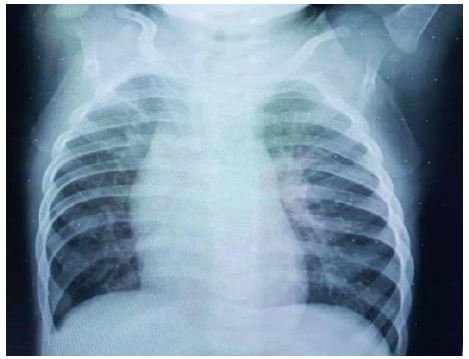
Hemoglobin: 17 g/dl Hematocrit: 0.54 Leukocytes: 15 x 109/l Segmented: 14% Lymphocytes: 84% Platelet count: 302 x 109/l Creatinine: 67 mmol/l Glycemia: 7.3 mmol/l, D-dimer positive, with slight metabolic and lactic acidosis 5.1 mmol/l. Chest radiograph with evidence of bilateral inflammatory-lookinglesions (Figure 1).

fig 1

Figure 1: AP chest X-ray. Bilateral inflammatory lesions are seen.

Positive COVID

During admission, invasive mechanical ventilation was not necessary, he underwent symptomatic treatment [15] for fever with dipyrone, administration of fraxiheparin (0.3 vial/12 h) for 5 days and required antibiotic therapy with Ceftriazone for a period of 10 days at doses of 150 mg/kg/day, as well as dexamethazone. Under the criteria of clinical and radiological improvement, as well as the COVID-19 infection ruled out through a virological study, the patient was discharged after 20 days, with subsequent follow-up. He was evaluated during three months after discharge by Cardiology at the William Soler Cardiocenter, serial evaluation of EKG and chest X-ray. The chest X-ray showed microatelectasis lesions and slight pulmonary edema.

Echocardiogram

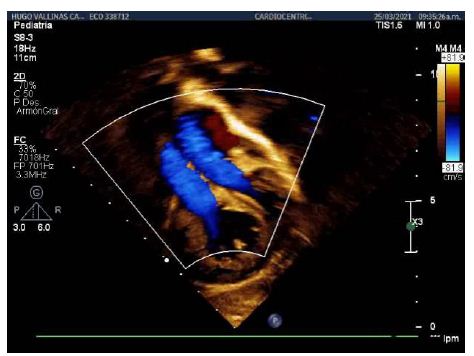
Transposition of the great vessels with closed ventricular septum, Boston type III, Aorta to the right and slightly anterior to the pulmonary. 15 mm balloon atrioseptostomy with left to right shunt. Moderate tricuspid regurgitation with TAPSE = 18 mm (Figure 2).

fig 2

Figure 2: Echocardiogram. Double barrel image.

After three months of convalescence and without evidence of sequelae from the viral infection, surgical intervention was decided. Mustard surgery was performed for definitive physiological correction, with extracorporeal circulation time of 113 minutes, aortic clamping time of 62 minutes at 23 degrees of temperature and modified hemofiltration once the extracorporeal circulation had concluded. Antimicrobial prophylaxis was used for 24 hours with Ceftriazone.

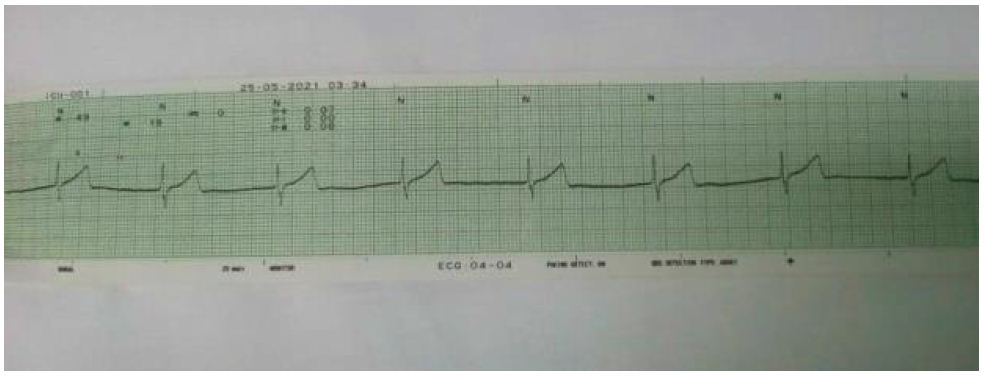
There were no complications during the surgical act and in the immediate postoperative period it evolved without major difficulties. Already in the PICU, he underwent treatment with captopril, aldactone and a diuretic pump. It was possible to separate from mechanical ventilation at 24 hours of It immediately evolved without major difficulties. Already in the PICU, he underwent treatment with captopril, aldactone and a diuretic pump. It was possible to separate from mechanical ventilation at 24 hours of operated with adequate tolerance and without risk of failure at weaning, with SO2>97%. On the third postoperative day, he presented a rhythm disorder (Figure 3) (bradycardia with complete atrioventricular block) that required placement of an external pacemaker, this complication is frequent in this type of surgery, secondary to atrial.

fig 3

Figure 3: EKG. Complete A-V lock.

After an 8-day stay in the PICU, he was transferred to the open ward where he was admitted under treatment and monitoring for another 15 days.

Hospital discharge at 23 days with treatment and monitoring by Cardiology and Cardiovascular Surgery, without complications or immediate sequelae.

Discussion

The current pandemic produced by COVID-19 also affects the Cuban population, until June 2021 more than one hundred and ninety thousand people have been infected, with more than a thousand deaths. Despite the fact that children were less affected at the beginning, the new strains have a higher incidence in children, with the development of severe forms that can trigger admissions to the PICU. Damage to the cardiovascular system is frequent, between. 8-20% [16]. The most reported cardiovascular manifestations are palpitations, orthostatic hypotension, hypertensive debut, myocarditis, pericarditis, rhythm disorders, and syncope.

The case study is an infant who suffered from the disease in the period when physiological correction surgery was planned for his underlying heart disease. Such surgery it requires adequate pulmonary functional capacity and pulmonary pressures within adequate parameters for tolerance [17]. The dysfunction can be asymptomatic, this justifies the need for close medical supervision. Stress tests in adults or adolescents may help prognosis, which is impossible in infants. When the dysfunction is advanced, the symptoms of heart failure appear, with respiratory distress, edema, fatigue, etc. n this phase the prognosis is at least reserved. It requires vigorous pharmacological treatment. This put the patient in a dangerous position and where studies and evaluation of respiratory function were required.

The patient in the current report was evaluated for three months after post-COVID discharge, with chest X-ray, EKG and echocardiogram awaiting possible sequelae reported in other patients. During this period, the patient remained with oxygen saturation according to the cyanosis caused by his heart disease, without worsening respiratory dynamics and stable hemodynamics. Once this time had elapsed, it was decided to carry out surgery. Physiological correction was carried out with satisfactory results. The patient did not develop sequelae that hindered the cardiovascular postoperative period or prolonged mechanical ventilation. It is likely that the preoperative strategy and the use of modified hemofiltration that improves the conditions of the cardiopulmonary block in the immediate postoperative period have contributed to the absence of sequelae and the promptness shown in the need for mechanical ventilation. Despite the absence of complications in this case, related to COVID-19 infection, working with the patient was a challenge; A multidisciplinary care team was in charge of the specialized care of this patient, anticipating in advance possible complications due to the unusual and novel association of the convalescent state of an infant due to COVID-19 and a complex cardiovascular surgery. No association studies have been published at the international level that favor a comparative point. Every day is a new challenge for health professionals and comprehensive medical care is sustained on the basis of experience. New research will open the horizons, making the treatments against this little-known disease more and more accurate. Strict compliance with prevention measures will help reduce the contagion of our pediatric patients and obtain a better evolution in those undergoing surgical treatment. The watchword is resilience, a commitment that each doctor has to grow in the face of adversity and create effective individualized strategies.

Conclusions

A period of no less than three months with monitoring of respiratory and cardiovascular sequelae could offer safety for congenital heart disease surgery with the use of extracorporeal circulation in infants who have suffered from COVID 19.

Conflict of Interests

The autors declare that does not exist an interest conflict.

Authors’ Contribution

Ilen Corrales Arredondo: she formulated the general objective of the article, looked for information and updated scientific evidence. Drafting of the document and its supervision.

Alfredo Mario Naranjo Ugalde: Led the planning of the report, as well as its mentoring and validation. Final revision of the manuscript.

Lais Angélica Ceruto Ortiz: She searched for updated scientific information and evidence. She performed the English translation and final revision of the manuscript. She narrowed the bibliographic references according to Vancouver standards. She performed the English translation and final revision of the manuscript. She narrowed the bibliographic references according to Vancouver standards. She wrote the document.

Yudith Escobar Bermúdez: she managed information data for the discussion of the case. She searched for up-to-date scientific evidence and information.

Pedro Rolando López Rodríguez: He searched for updated scientific information and evidence. Final revision of the manuscript.

References

  1. Xiong T, Redwood S, Chen M, Prendergast B, EurHeart J (2020) Coronavirus and the cardiovascular system: acute and long-term implications. 10:1-3 [crossref]
  2. Zheng YY, Ma YT, Zhang JY, Xie X (2020) COVID-19 and the cardiovascular system. Nat Rev Cardiol [crossref]
  3. Driggin E, Madhavan MV, Parikh SA (2020) Cardiovascular Considerations for Patients, Health Care Workers, and HealthSystemsduringthe COVID-19 Pandem. Irving Medical Center, Columbia University, Journal of the American Collage of Cardiology, 75 : 2352-2371.
  4. Figueroa TJF, Salas MDA, Cabrera SJS, Alvarado  CCC, Buitrago SAF. COVID-19 y enfermedad cardiovascular. Sociedad Colombiana de Cardiología y Cirugía Cardiovascular
  5. Kuba K, Imai Y, Rao S, Jiang C, Penninger JM (2006) Lessonsfrom SARS: Control of acute lung failure by the SARS receptor ACE J Mol Med , 84 :814-20. [crossref]
  6. Molina MM (2020) Secuelas y consecuencias de la COVID-19 13 : 71-77.
  7. Márquez AMP, Gutiérrez HA, Lizárraga LSL, Muñoz RCM, Ventura GST, etal. (2020) Espectro clínico de COVID-19, enfermedad en el paciente pediátrico. Acta Pediatr Méx, 41(Supl 1): S64-S71.
  8. Calvo C, Tagarro A, Otheo E, Cristina E (2020) Actualización de la situación epidemiológica de la infección por SARS-CoV-2 en España: Comentarios a las recomendaciones de manejo de la infección en pediatría. Cartas científicas, 92 :239-240.
  9. Sitio Web Oficial (2021) Ministerio de Salud Pública. Parte del cierre del día 5 de julio de.
  10. Cullum LM. Thesis MD (1967) The Natural History of Childrens with Transposition of the Great Vessels. Case Western Reserve University School of Medicine.
  11. Chih LC, Hernández DR, Jorge E (2020) Hospital Civil Fray Antonio Alcalde Cardiovascular and Metabolic Science. Cardiopatías congénitas , 31:Supp 4
  12. Armas PI (2019) Cuba con alta detección prenatal de Cardiopatías Congénitas.
  13. Albert HM (1955) Surgical correction of transposition of the great vessels. Surg Fórum, 5:74‐77. [crossref]
  14. Protocolo de Actuación Nacional para la covid-19. Cuba. (2021)
  15. DeCarvalho PCAP, Brunow-de CW, Johnston C, Souza RI, Figueredo DA(2020) COVID-19 Diagnostic and Management Protocol for Pediatric Patients. Clinics , 75: e1894. [crossref]
  16. Hu H, Ma F, Wei X, Fang Y (2020) Coronavirus fulminant miocarditis treated with glucocorticoid and human immunoglobulin. Eur Heart J, ehaa190. [crossref]
  17. Villagrá AS (2021) Transposición de grandes arterias operada con técnica de Mustard o Senning. Evolución a largo plazo. Unidad de Cardiopatías Congénitas (UCC)Clara del Rey 59, 1º E 28002 Madrid – España.
Featured Image2

The Anthropocene and Its Relationship to Planetary Health

DOI: 10.31038/JPPR.2022511


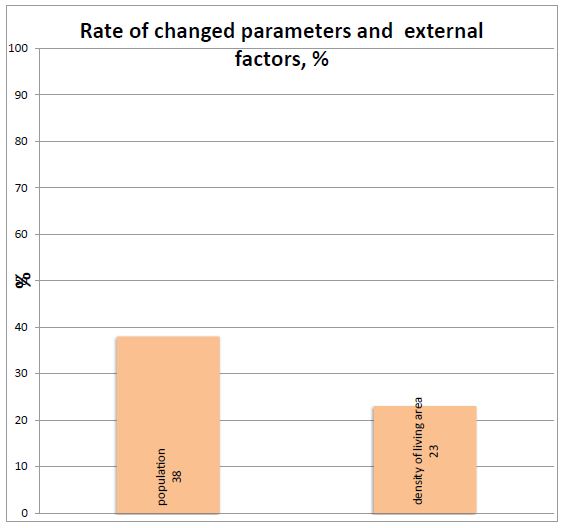
In recent decades, man has become a geological force, competing with natural forces in the impact and modification of the Earth system. The term Anthropocene was proposed by scientists Paul Crutzen and Eugene F. Stoemer, in 2000, to describe this new time and emphasize the preponderant role of man in geology and ecology. There is no doubt that man has unequivocally and in some cases irreversibly changed the Planet, and that Holocene concepts can no longer be used to describe trends in chemical and biological variables and the future of the Earth system as a whole. Tomorrow depends, to a great extent, on actions to optimize the relationship between man and the environment. This, then, is the moment we find ourselves in today: the Epoch of Humans. The one in which Homo sapiens finds that civilization has become a force of planetary reach and of geological duration and scope. We are billions of people in the world and we continue to multiply.

From a biological point of view, it is a growth equivalent to that of a colony of bacteria: na extremely explosive pace, in a very short period of time. We have become planetary: today there is not a single region that is not directly or indirectly affected by the whole of human activity. By releasing smoke from automobiles, chimneys and fires, humanity changed the composition of carbon in the atmosphere, causing a temperature increase of 1°C, glaciers melting and sea level rise by, so far, 20 centimeters. Not to mention how humanity physically altered the planet, with concrete and steel. A clear example is the rivers: in the last decades, we have transformed the river courses of all the hydrographic basins of the world by building 40 thousand dams. If the reservoirs of all these dams were placed side by side, we would have a flooded area equivalent to the State of Bahia.

In na article published in the bulletin of the International Geosphere-Biosphere Program, Crutzen defended his thesis by saying that the rate of urbanization has increased tenfold in the last century and that, in a few generations, humanity will extinguish the fossil fuels generated over the last hundreds of millions of years. The text had na almost immediate repercussion among geologists. Scientist Andrew Gale of the University of Portsmouth, a member of the Geological Society of London, told The Times newspaper that he agrees with the argument of the chemist and his fellow geologists. According to him, human activities have become the main force behind the great changes in topography and climate. According to him, you cannot have 6.5 billion people living on a planet the size of ours and exploit every possible resource without causing gigantic changes in the physical, chemical and biological environments, which will be dramatically reflected in our geological record.

Surgery and Gerontology

DOI: 10.31038/SRR.2021411

Abstract

Older people represent a very specific and vulnerable age group whose share is progressively increasing, which significantly affects the health, social, educational and economic structure of the entire population of any country in the world. Gerontology is a scientific discipline that studies aging in the broadest sense, ie its clinical, biological, economic, social and psychological aspects. This results in a comprehensive, holistic approach to health care for the elderly, which ensures the improvement of all forms of health care for the elderly. One of the branches of medicine that considers the protection of the health of the elderly is surgery.

Keywords

Surgery, Elderly, Comorbidities, Care

Introduction

In recent years, there has been a growing recognition of the role for geriatric medicine specialists in the care of older surgical patients [1]. This has been fueled in part by the increasing numbers of older people undergoing elective and emergency surgery and in part by the increasing medical complexity of older surgical patients. The increase in numbers is due to changing global demographics, resulting in an age-related increase in the prevalence of degenerative and neoplastic pathology, for which surgery is often the best treatment option, and to advances in surgical and anesthetic technique. Furthermore, patient expectations and health care professional attitudes and behaviors have evolved, with impetus provided by legislation against age discrimination. The overall impact is that rates of surgical procedures in older adults are now significantly higher than in any other age group.

Although rates of surgery in the older population have increased, they have not kept pace with the observed prevalence of conditions requiring surgery. It appears that surgery may still not be offered to older patients where it would be offered to younger patients, either for symptomatic or curative benefit. For example, the rates of hip arthroplasty decline steadily beyond the age of 70 years, as do resection rates for curable cancer across a range of tumor sites. This is despite the fact that older adults have much to gain from surgery for symptomatic control (as in joint replacement surgery) and improved survival (as in colorectal cancer). The apparently limited access to surgery seen in some older adults may occur for a number of different reasons, but a likely contributor is the complex analysis of risk or harm versus benefit of surgery in older adults. It requires an understanding of not only the surgical and anesthetic issues, but also of life expectancy with and without surgery, alternative treatment options, modifiable risk factors, and management of predictable and unpredictable postoperative complications. Such analysis needs to be presented in a manner appropriate to the patient to facilitate shared decision making.

The complexity of the older surgical population, which makes the assessment of the risk-to-benefit ratio difficult, relates to the association of aging with physiologic decline, multimorbidity, and frailty, all of which are independent predictors of adverse postoperative outcome. With such a profile, it is no surprise that in comparison to the younger population, older patients suffer from higher rates of postoperative morbidity and mortality when undergoing emergency and elective surgery across various surgical subspecialties. Furthermore, in older adults, a surgical procedure with associated hospitalization is more likely to result in impaired functional recovery, with a consequent need for rehabilitation, complicated hospital discharge, and increased home care or new institutionalization. This complexity in older surgical patients presents challenges throughout the surgical pathway, from the preoperative decision making phase to medical management in the postoperative period.

Geriatric citizens in the United States are the most rapidly growing segment due to the aging baby boomer generation [2]. This generation will live longer than the preceding and will have access to improved health care. Because these physically active elderly will remain living independently and longer, traumatic injuries can be expected to increase. In addition, there are numerous physiologic alterations that occur with aging, and special consideration should be given to the elderly patient from a medical and surgical standpoint. Multiple comorbidities may also be present in this population lending to higher complications, longer hospital stays, and a higher case fatality rate. Moreover, disposition barriers often exist and include the need for short- and long-term rehabilitation. Finally, traumatic injuries have the ability to change the patient’s independent living status and increase the need for admission to skilled nursing facilities. Complex end-of-life decisions and discussions are often also required in this population. Trauma and acute care surgeons should be knowledgeable about the specifi c needs of the geriatric critically ill patient.

Comorbidities

The presence of coexisting disease—in particular anemia, diabetes, and cardiac, respiratory, and renal disease—increases the risk of adverse postoperative outcome [1]. Although each individual condition increases this risk, a combination of more than three coexisting conditions (multimorbidity) is highly predictive of postoperative complications, poor functional outcome, and mortality. Because increasing age is associated with multimorbidity, with more than 40% of community-dwelling people older than 70 years living with multimorbidity, older adults presenting for surgery are a vulnerable population. Various scores are available to describe and measure comorbidities (e.g., the Charlson Comorbidity Index). These are useful for comparison between patient groups and stratification of risk and thus for coding and research, but their clinical utility in the surgical population is limited.

Furthermore, the severity of the coexisting condition and its related complications is more important in affecting outcome than merely its presence. For example, poorly controlled diabetes associated with untreated diastolic heart failure is of more significance than well-controlled diabetes and mild optimized chronic obstructive pulmonary disease (COPD), despite the fact that the comorbidity count would be the same. Recognition of the impact of comorbidity on postoperative outcome has led to the publication of resources to guide perioperative assessment and optimization of specific comorbidities. These resources include guidelines covering cardiac disease (e.g., coronary artery disease, valve disease, cardiac failure), anemia, and diabetes. Interestingly, although it is intuitive that optimization of such comorbidities should reduce the risk of poor outcome, there are little data to support such hypotheses (e.g., there are no reliable studies to date demonstrating that preoperatively reducing hemoglobin A1c [HbA1c] levels in patients with diabetes results in improved postoperative outcomes).

Risks

Patients with angina, recent myocardial infarction (MI), arrhythmias, congestive heart failure (CHF), and diabetes are at significantly increased risk for perioperative MI, heart failure, or arrhythmias [3]. An increased risk for cardiac complications is also present in elderly patients and those with abnormal electrocardiograms (ECGs), low functional capacity, history of stroke, and uncontrolled hypertension.

Surgeries may be classified as high-, intermediate-, or low-risk procedures. Those posing a high risk for cardiac complications (greater than 5% cardiac risk) include vascular surgeries, emergency surgeries, and surgeries associated with increased blood loss or large fluid shifts. Intermediate-risk surgeries (1% to 5% cardiac risk) include most intrathoracic, intraperitoneal, and orthopaedic procedures. Low-risk procedures (less than 1% cardiac risk) include cosmetic procedures, cataract operations, and endoscopies.

Patients at risk for pulmonary complications include those with lung disease—for example, asthma or chronic obstructive pulmonary disease (COPD)— obesity, a history of smoking, and undiagnosed cough or dyspnea. Procedures that increase the risk for pulmonary complications are primarily abdominal or thoracic surgeries, with the rule being that the closer the surgery is to the diaphragm, the higher the risk of complications.

Wound infections are the most common infectious complications following surgery, followed by pneumonia, urinary tract infections, and systemic sepsis. Diabetes and vascular disease are patient factors associated with an increased risk for wound infections. Surgeries with potential spillage of infectious material, such as abscess drainage or gastrointestinal surgery, pose a higher risk of postoperative infections. Instrumentation of the urinary tract, as occurs during bladder catheterization or genitourinary surgery, can lead to the development of urinary tract infections.

Complications

Caring for the older surgical patient presents unique problems: older individuals present with more advanced disease, have more comorbidities and suffer more complications than younger patients [4]. Appropriate patient selection and perioperative care is essential for optimizing surgical outcomes in this population. The benefits of the most commonly performed surgical procedures are well established. Colon resections increase colorectal cancer-free survival, and hip replacements significantly improve joint pain and functional ability. These benefits, however, must be weighed against the risk of mortality, morbidity, and decreased quality of life that sometimes follow these operations.

Nationally representative large cohort studies provide the most realistic information about surgical risk in older adults. In a national sample of patients undergoing highrisk cancer operations, patients older than age 80 years who were undergoing esophageal resections had an operative mortality of 20% with only 19% of patients experiencing long-term survival beyond 5 years. Morbidity after surgery in older adults is also high. Surgical complications, such as wound infections, bleeding, and need for reoperation, are not more frequent, but the occurrence of nonfatal postoperative complications is independently associated with decreased long-term survival.

Major operations may also result in a diminished quality of life by causing postoperative cognitive and functional decline. The risk of postoperative cognitive dysfunction following cardiac surgery is well studied, and there is now increasing evidence that postoperative cognitive dysfunction also occurs after noncardiac procedures. Up to 10% of patients older than age 60 years suffer from memory problems 3 months out from noncardiac surgery. It is unclear whether it is acute illness, anesthesia, or surgery that is the primary contributor to this condition. Functional changes following surgery can also be prolonged and irreversible. More than half of patients undergoing abdominal operations experience significant functional decline that persists for up to a year after surgery. A recent study assessing functional status following colectomy in nursing home residents found that the most active patients suffer the greatest decline as they have the most to lose. These findings emphasize the importance of addressing the risk of functional decline in all older patients, even the most active. For some patients, loss of independence weighs heavier than mortality when deciding whether to undergo a high-risk operation. Awareness of these risks is essential for appropriate patient selection. It also allows clinicians to offer a realistic expectation of outcomes, which, in turn, informs decision making by the older individual and their families.

Diabetes

During their lifetime, most patients with diabetes will require some form of surgery, and the likelihood increases as age advances [5]. Nowadays, a considerable amount of major surgery is undertaken in the elderly (e.g. coronary artery bypass grafts, peripheral vascular and aneurysm surgery, removal of malignancies), of whom more are proportionately likely to have diabetes than at the earlier stages of their lives. Even during the past few years in England, there has been a 16% increase in coronary artery bypass grafts and a similar increase in hip replacements in the elderly. Surgical practice is also changing in many countries, with an increasing number of day-case procedures and shorter postoperative hospital stays. Diabetes management in the elderly is also changing with the increasing use of insulin, and sometimes with more complicated multiple injection regimens and even occasionally the use of insulin pumps.

Although carefully planned and executed surgery is highly successful in the elderly, such patients with diabetes may tolerate metabolic and infective complications less well than younger subjects. Diabetes per se should never be a reason to decide not to operate on an elderly patient, but it is a reason for careful planning and management – whether preoperatively, perioperatively or postoperatively.

Tumors

Surgery is the most important modality of treatment for many of the common tumors in the elderly [6]. For instance, surgical resection is required for cure of early-stage colon cancer but is also frequently pursued for patients with metastatic disease, to prevent the likely complications of obstruction and bleeding. Studies in the surgical oncology literature demonstrate that advanced age does not preclude surgery; however, patients in these studies are usually selected carefully. Mortality from elective surgery increases only minimally, if at all, with advancing age.

However, if an older person requires emergency surgery, the operative risk can be at least twice as high. Mortality rates for elective colon cancer resection range from 4% to 21% but rise to over 50% if the procedure is for an emergency. This illustrates the geriatric principle of diminished functional reserve, in which aging is associated with a diminution of the functional capacity of multiple organ systems and the impact of a profound stress to the system is magnified compared to a younger person.

Nonetheless, surgery should be considered an important part of palliative treatment, even for older patients with poor prognosis. For example, patients with pancreatic cancer, of whom two-thirds are older than 65, have a 5-year survival of about 5%. Approximately 50% of these patients will require surgery for biliary or gastric obstruction, which are the common complications of this disease.

Performance status falls immediately after surgery for all patients, young and old. This status improves for younger patients, but older patients may not return to their functional baseline. Hence, surgical reports that describe short-term postoperative morbidity and mortality rates may be missing the outcomes that are most important for geriatric cancer patients: increasing dependence in activities of daily living, which leads to loss of autonomy. Some centers are exploring newer techniques, such as the role of laparoscopic surgery for colon resection in the elderly. This may lead to less postoperative pain, diminution of postoperative ileus, and a shorter hospital stay.

Health Care

As our population is aging, older patients are living longer with chronic illness [7]. Discussion on the goals of care should be initiated with the admission of geriatric patients. A multidisciplinary approach involving the patient and family with the discussion on the risk and benefits will allow the patients to make informed decision toward the end of life. Advance care planning can decrease the suffering, increase the quality of life, and improve the experience of family members and decrease healthcare costs. Establishing goals of care that correspond with the patient’s values and preferences; and communication between the patient and all those involved in their care should be part of the assessment of any geriatric patient for emergency general surgery. It is important for surgeons to identify high-risk patients and initiate the discussion of a definitive curative surgery vs. a temporizing procedure based on the goals of care.

Managing risks and predicting postoperative outcomes in elderly patients who undergo emergency general surgery is a complex process due to their acute presentation, which renders many preoperative preparations difficult to apply. However, there are certain preoperative and most often postoperative opportunities to improve outcomes. Therefore, focusing on preoperative and postoperative outcomes in such patients should be the target for both the surgeon and the hospital. In comparison to age alone, frailty is used as an objective tool to predict the postoperative outcomes in elderly and helps surgeons to formulate their decisions in managing this group of patients. Geriatric consultation is recommended in the hospital setting as it is associated with reduction in mortality rates, hospital length of stay, as well as lower costs of care.

The context of geriatric care encompasses multiple levels, stretching from primary care, through acute hospitalization, acute and subacute rehabilitation, nursing home care, and hopefully back to sufficient function to require additional primary care [8]. By the nature of their practices, anesthesiologists and geriatricians have different approaches to patient care and the time frame over which such care occurs. In communicating with patients and geriatricians, one should understand that expectations for recovery are frequently different than in younger patients, marked by issues of maintenance of function and independence. There is an evolving understanding that specific approaches taken in the perioperative period have an impact that remains apparent months to years following surgery. Integrating care across this continuum can be diffi cult but invariably improves patient outcomes.

Palliative Care

Many of the patients who come into contact with the community palliative care clinical nurse specialist will also have undergone surgery of some description, as part of their cancer treatment [9]. Radical surgery is probably the most effective treatment in cancer management. However, palliative surgery also plays a part in symptom relief; for example, internal fixation of a pathological fracture or to relieve an oesophageal or bowel obstruction. These procedures will have no impact on the course of the disease itself, but may bring about considerable symptom relief, therefore improving quality of life. As identified previously, patients require information about the surgery, what the operation will involve and the projected time scale for recovery. Many of the surgical procedures may be fairly minor in terms of surgical time involved, but risks versus benefits must be considered. Patients are understandably anxious about surgery and need reassurance and an opportunity to express their fears and concerns. In addition to providing information, the community palliative care clinical nurse specialist can also respond to the concerns of the patient, correcting misconceptions, and assist the patient to discuss his or her worries.

After treatment, whether it is radiotherapy, chemotherapy or surgery, etc., the patient will require ongoing support for weeks, months or in some cases years. The follow-up will usually be with the oncologist, but increasingly the general practitioner and the primary health care team are being relied upon to monitor the patient and refer back to the oncologist if required. It is likely that in the future the community palliative care clinical nurse specialist will play an increasing role in managing the follow-up of patients, in tandem with the general practitioner. This may be reassuring for patients, but visits to the doctor’s surgery or home visits by the primary health care team and even the community palliative care clinical nurse specialist may be seen as a constant reminder of the illness and an intrusion into the patient’s daily life. Patients may also become very anxious prior to medical/nursing appointments or visits, whether at the hospital, surgery or in their own homes, as discussions may reveal new symptoms that suggest progression of their disease. After treatment, fear of the cancer returning or progressing means that it is difficult for patients  to return to ‘normal’, and contact with their health care team may be frequent as the patient looks for reassurance and support. It is important for the professionals to achieve a balance, whereby patients feel well supported and know where to get help, but also are allowed to continue living with their cancer or other life-threatening illness and enjoy some semblance of ‘normality’ in their lives.

When treatment finishes, whether curative or palliative, patients may feel that their ‘security’ has ended. They may have a sense that nothing is actually happening at present to stop their cancer. This can be a difficult time for patients and they need support and reassurance that their symptoms and cancer are being monitored. Some patients may find it difficult to live with the uncertainty that comes with their disease and need the opportunity to discuss their concerns and fears. The community palliative care clinical nurse specialist can negotiate with patients appropriate contacts, whether by telephone or visiting, to support them with their ongoing complex emotional needs during this difficult time. The threat of physical deterioration is ever present and patients who experience a recurrence of their cancer report that the news can cause greater shock and devastation than the original diagnosis.

Procedure

All patients should be aware that there are risks attached to all forms of surgical intervention [10]. Usually, the risks are low and worth taking. Unfortunately, the risks rise with increasing age, but the benefits can still be enormous. Much skill and experience is needed from all those involved in the surgical care of elderly patients—their nurses, anaesthetists, surgeons and therapists.

The national confidential enquiry into peri-operative deaths ‘at the extremes of age’ has highlighted many problems relating to the increased mortality of very elderly patients within surgical departments. The report recommends that emergencies in old age should be dealt with promptly (within 24 hours), with the most experienced staff undertaking the work. It is often a very fine balance as to how much time can be devoted to improving the general condition of a very sick, elderly patient before embarking on an operation.

It should also be appreciated that, just because a procedure is possible, it is not always advisable or desirable. Mentally competent patients will be able to make this difficult decision for themselves once the situation has been explained to them. Some will have indicated in advance (by a living will or an advance directive) their wishes in these matters. In many other cases, the difficult choices will have to be made by others in the best interests of the patient. In these situations, experienced practitioners, assisted by the patient’s family and friends, are most likely to make the correct decision.

Conclusion

Most biological functions of man reach their peak before the age of 30, after which they decline linearly; this reduction can be critical in a state of stress, but it affects daily activities almost in no way. Therefore, diseases, not normal aging, are the main reasons for loss of function in old age. Often this decline with age is at least partly due to lifestyle, behavior, diet or environment, which can be influenced. Thus exercise can prevent or improve maximal load tolerance, muscle strength, and glucose tolerance in healthy but sedentary older individuals. The effects of uncontrollable aging are smaller than previously thought, allowing many to have a healthier and stronger age.

References

  1. Dhesi JK, Partridge J, Fillit HM, Rockwood K, Young J (2017) Surgery and Anesthesia in the Frail Older Patient. Brocklehurst’s Textbook of Geriatric Medicine and Gerontology, Eighth Edition, Elsevier, Philadelphia, USA, pp: 232-233.
  2. Gordy S, Trunkey D, Yelon JA, Luchette FA (eds). (2014) Changing Demographics of the American Population Geriatric Trauma and Critical Care, Springer Science, Business Media, New York, USA, pp: 3. [crossref]
  3. Lipsky MS, King MS (2011) Blueprints Family Medicine Third Edition, Wolters Kluwer, Philadelphia, USA, pp: 19.
  4. Oresanya L, Finlayson E, Williams BA, Chang A, Conant R, et al. (2014) Perioperative Care in Older Surgical Patients . Current Diagnosis and Treatment-Geriatrics, Second Edition, McGraw-Hill Education, New York, USA, pp:95.[crossref]
  5. Gill G, Benbow S, Sinclair AJ (ed) (2009) Managing Surgery in the Elderly Diabetic Patient Diabetes in Old Age, Third Edition, Wiley-Blackwell, John Wiley & Sons, Chichester, UK, pp: 349.
  6. Sacks NR, Abrahm JL, Morrison RS, Meier DE (eds) (2003) Cancer Geriatric Palliative Care, Oxford University Press, Inc., Oxford, UK, pp:130.
  7. Joseph B, Hamidi M, Brown CVR, Inaba K, Martin MJ, et al. (2019) Emergency General Surgery in the Elderly, Emergency General Surgery-A Practical Approach, Springer International Publishing AG, Cham, Switzerland, pp: 459-460. [crossref]
  8. Silverstein JH, Rooke GA, Reves JG, McLeskey CH (eds). (2008) The Practice of Geriatric Anesthesia Geriatric Anesthesiology, Second Edition, Springer Science, Business Media, LLC, New York, USA, pp: 3.
  9. Aitken AM, Chichester UK (2009) Community Palliative Care-The Role of the Clinical Nurse Specialist, Wiley-Blackwell, John Wiley & Sons Ltd, pp: 54-56.
  10. Rai GS, Webster S (2000) Elderly Care Medicine, Cavendish Publishing Limited, London, UK, pp: 95.
fig 4

Rate of Patient’s Recruitment and Recruitment Derivatives and External Factors – Population, Living Area and Density of Living Area

DOI: 10.31038/JCRM.2021432

Abstract

Absence of recruitment in clinical trials reached 80% which lead to failures of clinical trials and needed drug do not reach the patients. To find out the reasons of failures in recruitment the authors is considering many factors. A factors which are decreasing the recruitment is very diverse and there is no the classification of it. We suggested the simple classification and investigated the rate of recruitment in the light of some factors using parameters reflecting the recruitment progress on the site’s level.

Materials and methods: Data of four clinical trials II-III phases in oncology and hematology, conducted since 2007 to 2017 years has been used for retrospective analysis.

Study objectives: To investigate the study recruitment rate using different parameters and it’s changes along with acting of factors; to develop new parameters and values (derivatives) which could be sensitive for evaluation of factor’s action.

Statistical analysis: Data had been collected from feasibility questionnaires, open statistical sources.

Results: It was determined rate of recruitment and it’s derivatives where was acting internal factors.

Discussion: Recruitment been undergone the internal factors. The way of action is multidirectional and could boost the recruitment and in opposite to decrease one and knowing it is important in success of recruitment and clinical trial itself eventually.

Introduction

Chin Feman P. – [1] found that factors influencing to recruitment is quite diverse and difficult to estimate due to highly variable. It is found more than 30 factors influencing to recruitment and much of them can ruin the trials due to fail of recruitment (D. Fogel, 2018). The possibility to predict the recruitment based on the acting of factors is said by M. Rutger at al., (2017) and they also found more than 30 factors acting differently to recruitment. These authors used the feasibility questionnaire to collect the data. There is no universal classification of the factors and authors as a rule being limited by just the listing of the factors. To estimate the way of factors action’s the authors using figures of recruitment at least at the start of the study (M. Kabby, 2011) and at the end of the study. The comprehensively spread ratio is the ratio of parameters to evaluate the involvement of gender and some social groups and much known is enrollment fraction [2-6]  that is the number of enrollees divided by the number of potential subjects to determine age, sex and race of patients involved to studies.

Methods and Materials

We investigated data observed by 70 clinical centers participating in II – III phases trials in oncology and hematology in three countries – Russia, Ukraine and Belorussia for the period from July 01, 2008 to December 31, 2017 in order to determine the factors which is influencing to recruitment, to determine the parameters and values which is changing under influence of this factors. The collection of data was done out from questionnaires at the stage of searching for centers, from the results obtained at the end of the research, from open statistical sources.

We also took our classification of sites based on recruitment and speed of recruitment

– Silence sites – rate of recruitment – 0 patients per month;

– Low-recruiting – rate of recruitment by 0,01 to 0,19 patients per months;

– Middle-recruiting – by 0,20 to 0,89 per months;

– High-recruiting – by 0,90 to 3 patients per months.

The amount of involved cities, involved sites and protocol required patients are presented in Table 1.

Table 1: Etymology of studies, amount of cities where centers opened, amount of centers opened, number of patients to be involved according to protocol.

Nosology The number of cities in which centers were opened Number of clinical centers

Study power – required number of patients (N)

1 2

3

4

5

1 Lung cancer

25

27

450

2 Colorectal cancer

19

19

340

3 Idiopathic purpura

15

15

69

4 Head and neck cancer

9

9

982

Total

68

70

1841

We divided the factors associated to recruitmet according to attitude to participatnts human being (investigators and patients) and have got external and internal factors presented in Tables 2 and 3.

Table 2: Internal factors.

Internal factors

1 2
1. Disease (of protocol)
2. Experience of investigators
3. Planned (proposed) patients in stage of feasibility

Table 3: External Factors.

External factors

1 2
1. Country
2. City (infrastructure)
3. Population
4. Living area
5. Density of living area (one factor like for item 4)
6. Income
7. Morbidity (new cases per year)

Parameters we took to investigate the undergone of recruitment is following:

    1. Type of site (based on final recruitment)

. is high recruited site. Appointed range 4

. middle recruited sites. Appointed range 3

. law recruited sites. Appointed range 2

. non-recruited sites (silence sites). Appointed range 1.

    1. Time from first contact of site to first reply
    2. Duration of recruitment in days
    3. Speed of recruitment
    4. Target recruitment (proposed or planned by investigator in the beginning of the study)
    5. Target speed of recruitment
    6. Percentage of performance of target recruitment
    7. Expirience of investigator

RATIO of parameters like

  1. Target recruitment to study population (maximum figure of patients to be recruited by the protocol)
  2. Time of first reply to target recruitment
  3. 1 to time of reply
  4. 1 to target recruitment
  5. Ratio of 1 to time of reply to ratio 1 to target recruitment

Statistical Analysis

Following done:

  • Calcuation of mean and error, moda and mediana for choosen parameteres (more than 1960),
  • Dispersion analysis
  • Pirson and Sperman correlation
  • Calculation of Student t-criterium

Results

We studied studies that were conducted in cities with different populations. We have divided them into 3 categories – 1) less than 1 million residents; 2) from 1 million to 2 million and 3) more than 2 million residents. The distribution is shown in Table 4.

Table 4: Dependence of the efficiency of patient recruitment on the number of residents.

Number of city residents

Enrollment effectivity of sites involved in the study (in %)
Silent sites Low-recruiting sites Middle-recruiting sites High-recruiting sites

Total

1

2

3 4 5

6

< 1 мln

52

42 6 0

100

1-2 мln

11

44 33 12

100

>2 мln

40

22 14 24

100

It can be seen that in cities with a population of more than 1 million, the number of centers with a high enrollment of patients is twice as high, which is most likely due to the developed infrastructure and confirms the literature data [7,8]. Statistical values presented below in Table 5.

Table 5: Rate of recruitment presented depends of population presented.

Parameter, p-value Parameters according to population,

X ± m

1 – up to 1 mln 2 – 1 – 2 mln

3 – more than 2 mln

1 2

3

4

5

1. Type of site

1,78 ± 0,14

2,69 ± 0,28

2,12 ± 0,24

2.  Time from first contact till reply, days

P 1/2<0,01;

2/3<0,01;

24,16 ± 3,1

11 ± 1,48

31 ± 5,53

3. Speed of recruitment

P 1/2<0,05;

0,14 ± 0,05

0,57 ± 0,2

0,47 ± 0,16

4. Protocol planned recruitment rate per month

0,33 ± 0,02

0,31 ± 0,02

0,37 ± 0,02

5. Recruitment amount final per site

P 1/2<0,01

3,75 ± 1,24

15,08 ± 5,06

12,24 ± 4,15

6. Patients to be planned per site

12 ± 1,44

18,53 ± 3,24

20,48 ± 3,9

7. Percentage of performance

30,189 ± 9,56

111,7 ± 42,5

81,2 ± 25,02

8. Experiences of PI in clinical trial in years

5,8 ± 0,32

5,69 ± 0,59

5,52 ± 0,47

9. RATIO-Planned/maximum pats per protocol

5,37 ± 0,71

5,68 ± 1,1

5,58 ± 0,75

10. RATIO – time of first reply/planned patients

P 1/2<0,01;

2/3<0,01;

2,81 ± 0,45

0,7 ± 0,11

2,3 ± 0,47

11. 1/time to reply

0,08 ± 0,02

0,17 ± 0,07

0,13 ± 0,05

12. 1/planned patients

P 1/2<0,01;

1/3<0,01;

0,12 ± 0,02

0,07 ± 0,009

0,07 ± 0,006

13. ratio 1 ((1/time to reply)/(1/planned patients))

1,02 ± 0,26

2,46 ± 0,8

3,3 ± 1,69

Analysis of table showed following statistical differences:

  • Time of first contact has a statistcial differences in group 2 two more time lesst than ingroups 1 and 3, that is the optimal infrusctructue and population is 1 – 2 mln to have a quick reply.
  • Speed of recruitment also was statistically higher in area of 1-2 mln people as well as final recruitment.
  • RATIO time of first reply to planned pats and 1 divided by planned pats also has a statistial significance. Wich means that these ratios quite sensitive to this parameter.

The living area, density of living area where being investigating the medicinal product definitely has an influence to recruitment.

Parameters of recruitment presented on Table 6. From the analysis of the Table 6, it can be seen that the population density of up to 4000 people is enough for the enrollment of patients to be high enough, however, with a population density of more than 4000 people, the percentage of silent sites is minimal in relation to the percentage of highly recruited ones.

Table 6: Parameters of recruitment and Density of population.

Density of population

Efficacy of recruitment (% N=70 центров)
1 2 3 4 5

6

People on km2

Non-recruiting sites

Low-recruiting sites Middle-recruiting sites High-recruiting sites

Total

< 2000

4 (6%)

5 (7%) 0 0

9 (13%)

2001-4000

17 (24%)

14 (19%) 7 (10%) 5 (7%)

43 (60%)

>4000

5 (7%)

4 (6%) 4 (7%) 5 (7%)

18 (27%)

Density of population

Efficacy of recruitment (% N=70 центров)

1 2 3 4 5

6

People on km2

Non-recruiting sites

Low-recruiting sites Middle-recruiting sites High-recruiting sites

Total

< 2000

4 (6%)

5 (7%) 0 0

9 (13%)

2001-4000

17 (24%)

14 (19%) 7 (10%) 5 (7%)

43 (60%)

>4000

5 (7%)

4 (6%) 4 (7%) 5 (7%)

18 (27%)

Analysis of Table 7 revealed that:

Table 7: Parameters of recruitment depends of living area, density of living area.

Parameter, p-value Parameters according to density of living area,

X ± m

1 – up to 2000 2 – 2000-4000

3 – more than 4000

1

2 3 4

5

1. Type of site

1,56 ± 0,17

2 ± 0,15

2,5 ± 0,28

2. Time from first contact till reply, days

28,22 ± 6,84

21,47 ± 2,79

28,56 ± 6,52

3. Speed of recruitment

P 1/2<0,01;

1/3<0,01;

0,03 ± 0,01

0,31 ± 0,09

0,53 ± 0,17

4. protocol planned recruitment rate per month

0,3 ± 0,02

0,34 ± 0,01

0,35 ± 0,03

5. Recruitment amount final per site

P 1/2<0,01;

1/3<0,01;

0,89 ± 0,34

8,33 ± 2,38

14,22 ± 4,38

6. Patients to be planned per site

11,22 ± 2,08

16,7 ± 2,34

17,67 ± 3,35

7. Percentage of performance

P 1/2<0,01;

1/3<0,01;

7,56 ± 3,47

56,39 ± 14,84

108,65 ± 33,68

8. Experiences of PI in clinical trial in years

5,89 ± 0,3

5,6 ± 0,3

5,78 ± 0,61

9. RATIO-Planned/maximum pats per protocol

4,38 ± 1,23

5,91 ± 0,6

5,09 ± 0,89

10. RATIO – time of first reply/planned patients

3,66 ± 1,22

1,87 ± 0,28

2,42 ± 0,55

11. 1/time to reply

0,06 ± 0,01

0,13 ± 0,03

0,11 ± 0,05

12. 1/planned patients

0,13 ± 0,03

0,08 ± 0,01

0,1 ± 0,02

13. ratio 1 ((1/time to reply)/(1/planned patients))

0,64 ± 0,16

2,47 ± 0,92

2,01 ± 1,05

– Speed of recruitment mush less in first group

– Final recruitment also has a statistical differences

– Percentage of performance has a statistical differences

– RATIO planned pats to maximum pats per protocol also has a differences.

– RATIO- time first screening / TIME first reply has a statistical differences.

The density definitely has a clear evidence that the more density of people the more recruitment and speed of it being expected.

Cumulative figure of investigated of three parameters presented below in Figures 1-5.

fig 1

Figure 1: Rate of recruitment and external factors. Figure is show that obviously the less density and people in area of conductning the clincial trials the less rate of recruitment.

fig 2

Figure 2: Time of first feedback and external factors. Clearly is seeing that very fast reply is seeing in population 1-2 mln people.

fig 3

Figure 3: Performance of target recruitment and external factors (please refer to table above). Figure 3 show that performance if very low where low density of population.

fig 4

Figure 4: Rate of ratio of target recruitment to study power and external factors

fig 5

Figure 5: Rate of changed parameters and external factors. Figure shows that this ratio is not sensitive during acting of population and density. The percentage of changed parameter and ratio under influence of population and density of people presented in this figure.

Short Discussion

Authors [9] did not find the correspondence beetwen the rate of recruitment and the actual population and we found also that mostly of parameters do not changing, but we firstly showed a new ratios which sensitive to the investigated factors. We found like some authors [10-19] that sites in area with high amount of people has more expectation to perform the recruitment.

Therefore, the following investigation of different factors will support the clinical trial industry in moire efective clinical trials.

References

  1. Chin FP, Nguyen LT, Quilty MT, Kerr CE, Nam BH, et al. (2008) Effectiveness of recruitment in clinical trials: an analysis of methods used in a trial for irritable bowel syndrome patients. Clin. Trials 29: 241-251. [crossref]
  2. Fouad MN, Lee JY, Catalano PJ, Vogt TM, Zafar, et al. (2013) Enrollment of patients with lung and colorectal cancers onto clinical trials. Oncol. Pract. 9: 2 e40-47.[crossref]
  3. Murthy VH, Krumholz HM, Gross CP. (2004) Participation in cancer clinical trials: Race-, sex-, and age-based disparities. JAMA 291: 2720-2726 [crossref]
  4. Stewart JH, Bertoni AG, Staten JL, et al. (2007) Participation in surgical oncology clinical trials: Gender-, race/ethnicity-, and age-based disparities. Ann Surg Oncol 14: 3328-3334.[crossref]
  5. Du W, Gadgeel SM, Simon MS (2006) Predictors of enrollment in lung cancer clinical trials. Cancer 106: 420-425.[crossref]
  6. Nass SJ, Moses HL, Mendelsohjn J (eds). (2010) A National Cancer Clinical Trials System for the 21st Century. Washington, DC, National Academies Press. [crossref]
  7. Lovato LC, Hill K, Hertert S, Hunninghake DB, Probstfield JL (1997) Recruitment for controlled clinical trials: literature summary and annotated bibliography. Clin. Trials 18: 328-352.[crossref]
  8. McNeely EA, Clements SD (1994) Recruitment and retention of the older adult into research studies. Neurosurg. Nurs. 26: 57-61.[crossref]
  9. Hill NS, Preston IR, Roberts KE (2008) Patients with pulmonary arterial hypertension in clinical trials. Who are they? Am. Thorac. Soc. 5: 603-609
  10. van den Bor RM, Grobbee DE, Oosterman BJ, Vaessen PWJ, Roes KCB (2017) Predicting enrollment performance of investigational centers in phase III multicenter clinical trials. Contemp Clin Trials Comm 7: 208-216.[crossref]
  11. L´opez Jaimes. A, Zapotecas Mart´ınez S, Coello CoelloAn CA (2009) Introduction to Multiobjective Optimization Techniques. Nova Science Publishers, Inc., pg: 1-26.
  12. McDonald AM, Knight RC, Campbell MK, Entwistle VA, Grant AM, et al. (2006) What influences recruitment to randomised controlled trials? A review of trials funded by two UK funding agencies, Trials 7.
  13. Fletcher B, Gheorghe A, Moore D, Wilson S, Damery S (2012) Improving the recruitment activity of clinicians in randomized controlled trials: a systematic review. BMJ Open 2: e000496 [crossref]
  14. Joan FBB, Brescia (2007) Reinventing Patient Recruitment: Revolutionary Ideas for Clinical Trial Success. Gower Publishing, Surrey, UK.
  15. LovatoLC, Hill K, Hertert S, Hunninghake DB, Probstfield JL (1997) Recruitment for controlled clinical trials: literature summary and annotated bibliography. Control Trials 18: 328-357.
  16. Friedman LM, Furberg CD, DeMets DL (2010) Fundamentals of Clinical Trials, fourth , Springer.
  17. Myles PS, Williamson E, Oakley J, et al. (2014) Ethical and scientific considerations for patient enrollment into concurrent clinical trials. Trials 15: 470. [crossref]
  18. Robert S. Bienkowski and Norman M. Goldfarb. (2008) Screen Failures in Clinical Trials: Financial Roulette or the Cost of Doing Business? Journal of clinical research best practices Vol.4: 7.
  19. Rahman S, Majumder AA, Shaban SF, Rahman N, Ahmed M. (2011) Physician participation in clinical research and trials: issues and approaches, Med. Educ. Pract. 2: 85-93.[crossref]
fig 2

A Review on the Main Antibiotic Drugs Used in Fish Farming: Ecotoxicity, Characterization and Remediation

DOI: 10.31038/AFS.2021351

Abstract

Aquaculture is a growing industry with a high demand mainly due to its significant contribution to the food sector. One of the main challenges of aquaculture is the prevention and treatment of fish diseases through the extensive application of antibiotics. However, information on the various consequences of pharmaceuticals in fish farms remains limited to this day. Based on the existing scientific literature, this report aims to give an overview of the most commonly used antibiotics in aquaculture, which belong to the groups of quinolones, sulfonamides, tetracyclines, amphenicols and macrolides. This review paper summarizes the information available on the characterization, ecotoxicology and application of florfenicol, erythromycin, furazolidone, oxolinic acid, ciprofloxacin, ofloxacin, sulfadiazine, sulfadimethoxine, sulfamethoxazole, oxytetracycline and tetracycline.

Keywords

Veterinary drugs, Antibiotics, Characterization, Ecotoxicity, Treatment

Introduction

Aquaculture is the food production sector with the strongest growth, as farming, trading, and processing of marine products are of major social, economic, and environmental importance. Global fish production has reached 179 million tons in 2018, where aquaculture accounted for 46% of the total production. China is by far the major fish producer with 35% of the worldwide production [1]. The recent expansion of aquaculture raises concerns related to the destruction of natural habitat, the utilization of potentially harmful synthetic compounds, the effect of escapees on wild stocks, wasteful production of fishmeal and fish oil, and social and cultural effects on aquaculture laborers and communities. Fish farming requires extensive use of veterinary drugs, including antibiotics. Some of these pharmaceuticals are only partially metabolized, and then excreted, entering the aquatic environment in their native form or as metabolites and showing considerable persistence [2]. Quinolones, amphenicols, macrolides, tetracyclines, and sulfonamides are the most widely used groups of antibiotics [3-6]. The 10 drug molecules that are the most commonly used to prevent and treat fish diseases are: florfenicol, erythromycin, furazolidone, oxolinic acid, ciprofloxacin, ofloxacin, sulfadiazine, sulfadimethoxine, sulfamethoxazole, oxytetracycline and tetracycline [7]. Due to their variety and accumulation in the environment, aquatic organisms are exposed to various antibiotics that can be found as mixtures with potentially enhanced “cocktail effect”, which have not been studied in-depth to this day. The main concerns associated to the use of veterinary drugs are the development of antibiotic resistance, mutagenicity, and inhibition or acute toxicity of aquatic organisms [8]. In natural settings, prolonged exposure to low doses of antibiotics can lead to the selective proliferation of resistant bacteria, which can transfer their resistance genes to other bacterial species, including pathogenic bacteria [9]. Despite their low concentrations, the bioaccumulation and biomagnification of pharmaceuticals can have a significant impact on the aquatic ecosystem and even human health (Pan et al., 2019). Furthermore, additional sources of pharmaceuticals have to be considered for extensive environmental evaluation and implementation of possible control measures. These sources include pharmaceutical facilities, hospitals, and households, as a significant percentage of drugs is not fully eliminated by conventional water treatment technologies [10]. In fish farming, drugs are usually coated (mostly with fish oil, gelatin, or vegetable oil) and gradually added to the fish food. The coating agent helps to prevent the drug from entering the water in the fish farm [11], but effluents containing unconsumed food pellets with high levels of antibiotics are released into the aquatic environment without any treatment [12]. There is a limited knowledge about the fate and consequences of antibiotics once they reach the environment. This report aims at compiling information on available analytical methods to detect and identify low concentrations of antibiotics in the environment, summarize potential ecotoxicological risks, and ultimately to propose possible treatment technologies to effectively eliminate them.

This review paper is divided into four parts. The first one describes the most commonly employed molecules, their use and the associated drawbacks. The second part is devoted to their ecotoxicity. The third part reviews the current methods used for the analysis of these pharmaceuticals in various environmental matrices. The last part discusses the water treatment processes currently applied to remove and/or degrade these compounds.

Main Drugs Used in Fish Farming

This part reviews the six main families of drugs usually used in fish farming, their main properties and their mode of administration: cyclins, amphenicols, sulfonamides, quinolones, macrolides and nitrofurans.

Tetracycline

Tetracyclines were discovered in the 1940s and showed activity against a wide range of microorganisms. They are inexpensive and applied for the treatment of human and animal infections as well as in animal feed to promote growth. Tetracycline (TET) is one of the most common type of antibiotics used in medicine, agriculture, and animal husbandry; its chemical structure comprises a fused linear tetracyclic nucleus to which various functional groups are attached as shown in Figure 1 [13]. Due to its widespread application, a growing number of pathogens are developing resistance to tetracycline, therefore decreasing its efficiency. Oxytetracycline (OTC) is a broad-spectrum antibiotic used in veterinary medicine to treat, among others, diseases in fish [8]. It has a role as an antibacterial and anti-inflammatory drug, protein synthesis inhibitor, and antimicrobial agent (ChEBI 27701). OTC is active against gram-positive bacteria, gram-positive bacilli, and gram-negative organisms [14]. In the past decades, the use of OTC increased with the development of aquaculture and livestock production [15] and thanks to its low cost and its broad-spectrum efficacy in treating infections [14]. There are three main ways to administer OTC to farmed fish: through the feed, bath treatment, and injection. Among these options, the incorporation of the antibiotic in food for oral administration is the most common and the one with the least risk in terms of environmental pollution [8]. OTC is only minimally metabolized and is mainly excreted through urine.
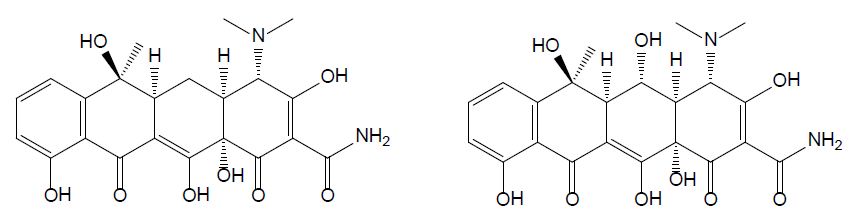
fig 1

Figure 1: Chemical structures of tetracycline (left) and oxytetracycline (right).

Amphenicols

Amphenicols are important veterinary antibiotics with wide-spectrum antimicrobial activity. Florfenicol (FF, see Figure 2) is an antimicrobial agent, which is extensively used in fish farming. Grave et al. investigated the use of antimicrobial drugs in Norwegian aquaculture from 2000 to 2005 by analyzing prescription data, in close relation with the national data of the sold antimicrobial drugs. FF has long been the most abundant drug prescribed for halibut farming in Norwegian aquaculture [16]. In 2013, 0.3 tons and 300 tons of FF were used in fish farming in Norway and Chile, respectively. In 2016, it was reported that over 1000 tons of FF were used in China. Temperature, exposure time, coating agent, and pellet size are the important factors that influence release of FF into the water [11]. According to the EU Council directive, the maximum residue limit value of the sum of FF and florfenicol amine in muscle and skin in natural proportions of healthy fish was given as 1,000 μg/kg (Commission Regulation EU No 37/2010). FF is bacteriostatic, which means it prevents the bacteria from protein synthesis [11]; it is usually used for respiratory and intestinal infections [17].
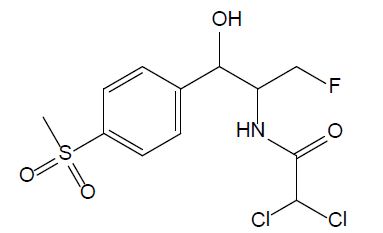
fig 2

Figure 2: Chemical structure of chloramphenicol.

Sulfonamides

Sulfonamides are used as chemotherapeutics to treat various bacterial infections in veterinary medicine [5]. Due to their broad-spectrum antimicrobial activity and low cost, they were among the most applied antibiotics and thus, commonly detected in aquaculture wastewater [18]. Currently, only a few drugs belonging to sulfonamides are used due to the developed resistance in previously susceptible microorganisms. Sulfadiazine (SDZ) and sulfadimethoxine (SDM) are the most used antibiotics in fish farming; their chemical structures are displayed Figure 3. When applied to animals, sulfadiazine, is excreted in its native form and its N4-acetyl metabolite [19]; it is often considered as a representative antibiotic of sulfonamides due to its wide presence in the environment with low hydrophobicity and high water solubility in [20]. Sulfadimethoxine (SMX – Figure 4) is a broad-spectrum antibiotic used in human therapy, aquaculture, livestock, and veterinary medicine. Although its use is decreasing in humans, its low cost secures its popularity in veterinary medicine [21].

fig 3

Figure 3: Chemical structures of sulfadiazine (left hand), sulfamethoxine (middle) and sulfamethoxazole (right hand).
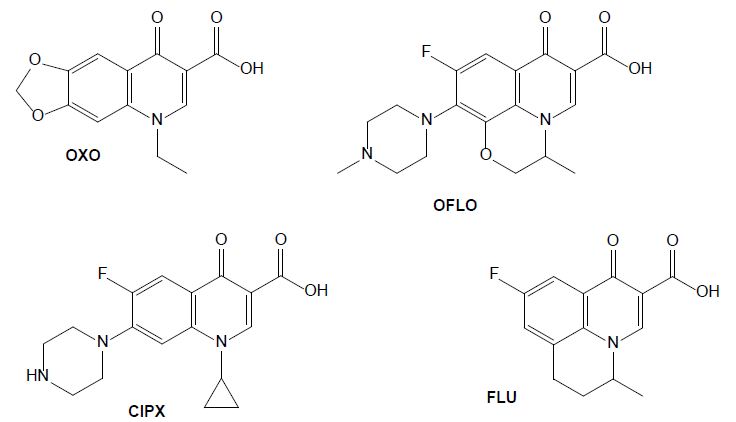
fig 4

Figure 4: Chemical structures of some quinolone drugs: oxolinic acid (OXO), ofloxacin (OFLO), ciprofloxacin (CIPX) and flumequine (FLU).

Quinolones

The antibiotics from the group of quinolones are widely used in human and veterinary medicines to treat infectious diseases and to promote livestock growth (Yang et al., 2020). They directly inhibit DNA replication by interacting with two enzymes. Oxolinic acid (OXA) is efficient against a gram-negative bacterium that causes diseases such as vibriosis, yersiniosis, and furunculosis. It has been administrated to farm fishes as a prophylactic and chemotherapeutic agent acting as anti-infective, antibacterial and enzyme inhibitor [22]. Its use in humans is now prohibited in several countries but is still frequently used in veterinary medicine to treat urinary infections, and it was detected in animal excreta [23]. Ofloxacin (OFLO) is a quinolone that was previously used for human health, for the therapy of mild to moderate bacterial infections, it has since been replaced by more potent and less toxic antibiotics, however it is still used in aquaculture. In the group of quinolones, ciprofloxacin (CIPX) is considered as a representative drug against gram-negative bacteria; it has been detected in marine environment, as well as in freshwater. In aquatic environments it affects the metabolism of some bacteria carbon sources and is toxic to fishes (Yang et al., 2020). Flumequine (FLU), as a first generation quinolone, is structurally related to nalidixic and oxolinic acid [24]. Oxidation experiments carried out on flumequine led to a total of 19 transformation products issued from hydroxylation, dehydrogenation, hydroxyl substitution, decarboxylation, demethylation, and ring opening transformation pathways [25].

Macrolides

The group of macrolides refers to macrocyclic lactone ring structures; they are used for their immunomodulatory and antibacterial functions (Yang et al., 2020). In addition to their antibacterial action, macrolides can have an anti-inflammatory effect by decreasing the activity of immune cells and altering bacterial cells. Erythromycin (ERY, see Figure 5) is efficient against gram-positive bacteria, as streptococcus species. However, most of the microorganisms that cause infection in fish are gram-negative, so this compound should only be utilized after fish culturing and sensitivity test results should affirm its viability. Additionally, erythromycin is not efficient in bath treatment and must be administered by injection or in the feed [26].
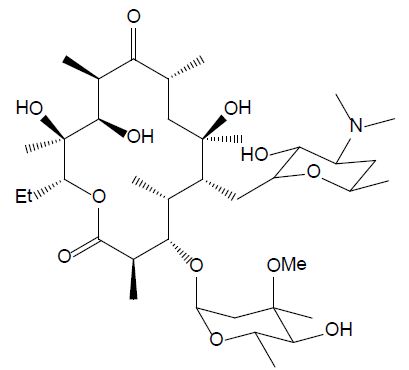
fig 5

Figure 5: Chemical structure of erythromycin.

Nitrofurans

Nitrofurans are antimicrobial agents which have been used for animal production. They have strong impact on gram-negative and gram-positive bacteria and act against protozoa as well. In 1993, their application has been banned by EU due to their potential mutagenic effect. Furazolidone (FUR, see Figure 6) is a nitrofuran antibiotic widely used in human and aquaculture medicine against protozoal and Helicobacter pylori infections. Its biodegradation leads to 3-amino-2-oxazolidone and β-hydroxyethylhydrazine [27]. It is still utilized in developing countries, although it is banned in developed countries.
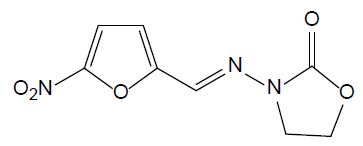
fig 6

Figure 6: Chemical structure of furazolidone.

Ecotoxicology of the Main Drugs Used for Fish Farming

Table 1 presents a summary of the ecotoxicological data available for veterinary drugs mainly used in fish farming. The data are discussed below, for each pharmaceutical family.

Table 1: Ecotoxicology data for the veterinary drugs mainly used in fish farming

Drug

Ecotoxic effect

Reference

Tetracycline & oxytetracycline, 24 h-EC50 for Stentor coeruleus and Stylonychia lemnae were 94.4 mg/L and 40.1 mg/L, respectively Magdaleno et al., 2017
Florfenicol Inhibiting growth rate of Corbicula fluminea at concentrations higher than 1.8 mg/L Guillermino et al., 2017
Sulfadiazine LC50 of 1.884 mg/L for Daphnia magna Duan et al., 2020
Sulfamethoxazole IC50 = 12.56 ± 4.48 mg/L for A. fischeri Drzymała & Kalka, 2020
Sulfadimethoxine EC50 of 248 mg/L for daphnia magna Tkaczyk et al., 2021
Oxolinic acid 4.6 mg/L EC50 for Daphnia magna Tkaczyk et al., 2021
Ofloxacin Chronic toxicity and drug resistant bacteria H. Guo et al., 2021
Ciprofloxacin Concentrations greater than or equal to 10 μg/L: ecotoxic for development, growth, detoxification and oxidative stress enzymes Białk-Bielińska et al., 2011
Flumequine Affecting growth rate of Daphnia magna at 23% across generation De Liguoro et al., 2019
Erythromycin EC50 values in the range of 10 -30 mg/L for Vibrio fischeri Liu et al., 2018
Furazolidone Very toxic to Alivibrio fischeri with an EC50 of 2.05 mg/L Lewkowski et al., (2019)

Tetracyclines

In aquaculture, oxytetracycline is one of the most used antibiotics that raises concerns due to its effects on human and animal health, and environmental pollution [8]. In the marine environment, oxytetracycline and quinolones are photochemically degraded and form divalent cationic complexes in the presence of Ca2+ and Mg2+ ions, causing a loss in antibacterial activity. In freshwater, the antimicrobial activity of tetracyclins is of bigger concern due to the development of antibiotic resistance [28]. OTC inhibits the growth of two species of algae: pseudokirchneriella subcapitata (the international standard species for evaluation of inhibition) and Ankistrodesmus fusiformis (native from Argentina). The former was the most sensitive with an EC50 of 0.92±0.30 mg/L [29]. OTC can also affect nitrification since the main bacteria responsible for biofilters – nitrosomonas that promote the conversion of ammonia to nitrite and Nitrobacter that convert nitrite to nitrate – are gram-negative. Li et al. investigated the toxic effect of tetracycline and tetracycline hydrochloride on two model ciliates: Stentor coeruleus and Stylonychia lemnae. The 24 h-EC50 of tetracycline for Stentor coeruleus and Stylonychia lemnae were 94.4 mg/L and 40.1 mg/L, respectively. For tetracycline hydrochloride, the EC50 for Stentor coeruleus and Stylonychia lemnae were 8.39 mg/L and 14.0 mg/L, respectively [15]. This shows that tetracycline hydrochloride is more toxic than tetracycline in these test organisms. Both compounds deteriorate the ultra-cell structure and inhibit the cell growth rate [29].

Amphenicols

Florfenicol (FF) restrains the bacterial protein synthesis efficiency by binding to 50S subunit and 70S ribosome, and it is listed as the top-priority monitoring compounds in veterinary drugs in South-Korea [30]. FF also inhibits the hematopoietic system [31] and deteriorates the mobility, regeneration, and population increase of the tropical Cladocera silvestrii [32]. It also decreases egg hatchability and hinders the development of the cardiovascular system [33]. Guilhermino et al. showed that a FF concentration in water greater than 1.8 mg/L can inhibit the growth of the mollusk Corbicula fluminea [34].

Sulfonamides

The chronic and acute toxicity of sulfadiazine on the crustacean Daphnia magna was investigated and the LC50 value was determined as 1.884 mg/L [35]. The exposition of zebrafish to some sulfonamides, including sulfadiazine, caused an increased heart rate and abnormal swimming. This investigation also proved that sulfadiazine was a typical inducer of metabolic enzymes and suggested a potential ecotoxicological risk [36]. It is important to consider that sulfadiazine can have an impact on biological water treatment processes. Li et al. studied the effects of this antibiotic on a sequencing batch biofilm reactor (SBBR). They found that a sulfadiazine concentration higher than 6 mg/L inhibits COD (Chemical Oxygen Demand) and ammoniacal nitrogen removal within the SBBR when treating aquaculture waste [37]. Sulfadiazine promotes the secretion of extracellular polymeric substances by the microorganisms and impacts the biofilm composition, it has a direct impact on nitrification and the removal of organic matter. Sulfamethoxazole has been studied in a microcosmos composed of water, sediment and zebrafishes. The drug concentration decreased gradually in water while increasing over time in sediment and zebrafish. Bioaccumulation in zebrafish was reduced by 13-28% in the presence of sediment particles in the water; it was further reduced (24-33%) when increasing the water salinity [38]. In the study conducted by [39], sulfadimethoxine was considered to be moderately toxic with an EC50 towards the green algae Chlorella vulgaris of 4.24 mg/L in fresh water, which was measured to be higher (11.2 mg/L) in salt water [39].

Quinolones

According to a study by Tkaczyk et al., oxolinic acid EC50 was 4.6 mg/L EC50 for Daphnia magna [40]. Sun et al. investigated the bioaccumulation of ofloxacin in crucian carp and showed that fluorine increases the bioaccumulation of the antibiotic; higher bioaccumulation potential appears at a low concentration of drug, mostly in the liver [41]. De Liguoro et al. evaluated the effect of continuous and alternate exposure of flumequine at 2 mg/L on Daphnia magna survival, growth, and reproduction. At this concentration, mortality was observed at a rate of 23  ± 14% across generation [42].

Macrolides

Erythromycin has shown medium risk for algae, but bacteria are the main target of antibiotics such as erythromycin. Erythromycin can cross the cell membrane of the bacteria and bind to 50S subunit ribosome [43]. It is also very persistent in the environment due to having aromatic rings, which makes it refractory [44].

Nitrofurans

Lewkowski et al. investigated the effect of furazolidone on growth of oat, radish Sativus, and Alivibrio fischeri bacteria. Their results indicated that furazolidone is very toxic to Alivibrio fischeri with an EC50 of 2.05 mg/L [45]. The accumulation of furazolidone metabolites have been reported in the literature [5]; its use is prohibited by the Food and Drug Administration due to being a nitrofuran compound and inhibiting monoamine oxidase [46].

Methods for Characterization of Drugs Used in Fish Farming

Table 2 presents a summary of the analytical approaches employed for the detection and quantification of veterinary drugs mainly used in fish farming; protocols and methods are discussed below.

Table 2: Analytical methods reported for the detection and quantification of the main antibiotic veterinary drugs used in fish farming

Drug type

Matrix Characterization methoda MS typeb Sample preparationc Analytical column LC Mobile phased

Reference

Tetracyclins including OTC Feeds HPLC-UVD/FLD LLE using acetonitrile and Na2EDTA-Mcllvaine buffer solution C18 Hypersil GoldTM (250 x 4.6 mm, 5 μm) Phase A: H2O + sodium acetate CaCl2 + EDTA

Phase B: ACN

Phase C: MeOH

Han et al., 2020
Antibiotic drugs

Including SMX, SDZ, SMZ, CIPX, OFLO, TET and ERY

Wastewater UPLC-MS/MS TQ SPE using an Oasis HLBTM cartridge) C18 BEHTM (50 x 2.1 mm, 1.7 µm) Phase A: H2O + FA

Phase B: ACN or MeOH

Li et al., 2009
Sulfonamides, fluoroquinolones, tetracyclines and other veterinary drugs Seafood samples UPLC-MS/MS TQ QuEChERS procedure C18 Hypersil GoldTM (100 × 2.1 mm, 1.9 μm) Phase A: H2O / MeOH + FA

Phase B: ACN + FA

Dinh et al., 2020
Metabolites of nitrofurans and FUR Shrimp body LC-MS/MS TQ Hydrolysis + double LLE using ethyl acetate C18 SymmetryTM (150 x 2.1 mm, 3.5 μm) Phase A: ACN

Phase B: H2O + FA

Douny et al., 2013
4 tetracyclines including TET, OTC; quinolones including FLU, CPIX and OXA Fish muscles LC-MS/MS TQ Liquid extraction with trichloroacetic acid C18 Zorbax Eclipse XDBTM (150 × 4.6 mm, 5.0 µm) Phase A: H2O + HFBA

Phase B: ACN

Guidi et al., 2018
OTC Sol interstitial water LC-MS/MS TQ Centrifugation, filtration C18 Xterra MSTM (100 x 21 mm, 3.5 µm) Phase A: MeOH + FA

Phase B: MeOH / H2O + FA

Halling-Sørensen et al., 2003
FF Water in recirculating aquaculture system HPLC-PDA SPE using an Oasis HLBTM cartridge Hypersil GOLDTM (250 x 4.6 mm, 5 μm) Phase A: ACN

Phase B: H2O

Zhang et al., 2020
FF and its residues Beef meat LC-MS/MS TQ SPE using an Oasis MCXTM cartridge C18 Inertsil ODS-4TM (150 × 2.1 mm, 3-μm) Phase A: H2O + acetic acid

Phase B: ACN

Saito-Shida et al., 2019
FF Fish feed LC-MS/MS TQ Centrifugation with ACN addition C18 SBTM (50 x 2.1 mm, 1.8 µm) Phase A: H2O + acetic acid

Phase B: ACN / MeOH

Barreto et al., 2018
14 sulfonamide antibiotic residues 309 marine products HPLC-PDA


UPLC-MS/MS

TQ Centrifugation with ACN addition C18 CapcellpakTM (250 x 4.6 mm, 5 ㎛) for HPLC-PDA


C18 Acquity UPLC BEHTM (100 x 2.1 mm, 1.7 µm) for UPLC-MS/MS

Phase A: H2O + KH2PO4

Phase B: MeOH

for HPLC-PDA


Phase A: H2O + FA

Phase B: ACN + FA

for UPLC-MS/MS

Won et al., 2011
20 antibiotics including FF, SDZ, SMX, CPIX, TET, OTC and ERY Surface waters UPLC-MS/MS TQ SPE using an Oasis HLBTM cartridge C18 HSS T3TM (100 x 2.1 mm, 1.8 µm) Phase A: H2O + FA

Phase B: ACN + FA

Yan et al., 2013
19 sulfonamides including SDZ, SDM and SMX Ebro river, WWTP samples LC-MS/MS QqLIT on-line SPE using Oasis HLBTM or Oasis MCXTM cartridges C18 AtlantisTM (150 × 2.1 mm, 3 µm Phase A: H2O + FA

Phase B: ACN + FA

García-Galán et al., 2011
73 pharmaceuticals including TET, OTC, SDZ, SMX, OFLO, FLU, CPIX and ERY River water, WWTP influent and effluent LC-MS/MS QqLIT on-line SPE using a Oasis HLBTM cartridge C18 Purospher Star RP-18TM endcapped column (125 × 2.0 mm, 5 μm) Phase A:

ACN / MeOH

Phase B: H2O

Gros et al., 2009
20 antibiotics including

CIPX, ERY, SMZ, SMX, TET and OTC

Raw influent, treated effluent, surface water LC-MS/MS TQ on-line SPE using a combination of SBTM and HR-XTM cartridges C18 Poroshell 120 ECTM (100 x 3.0 mm, 2.7 μm) Phase A: H2O + FA

Phase B: ACN + MeOH

Tran et al., 2016
SMX and its photoproducts Aquatic organisms LC-MS/MS TQ No sample preparation C18 Zorbax eclipse plusTM (50 x 2.1 mm, 1.8 µm) Isocratic mobile phase H2O / ACN Li et al., 2020
OTC, FF, OXA and FLU Marine sediments HPLC-PDA-FLD LLE (using oxalic acid in methanol) assisted by sonication Kromasil PhenylTM (250 x 4.6 mm, 5 µm) Phase A: H2O + TFA

Phase B: MeOH + TFA Phase C: ACN + TFA, with or without gradient

Norambuena et al., 2013
46 antimicrobial drug residues including sulfonamides, tetracyclines, quinolones, macrolides, nitrofurans and phenicols Aquatic matrices, pond water UPLC-HRMS OrbitrapTM SPE using an Oasis HLBTM cartridge C18 Hypersil GoldTM (100 × 2.1 mm, 1.9 μm) Phase A: H2O + TFA

Phase B: MeOH + TFA

Goessens et al., 2020
11 fluoroquinolones including OFLO and CIPX Wastewater and sludges UPLC-MS/MS Q-trap SPE using molecularly imprinted polymer cartridges C18 Proshell 120 SBTM (100 × 2.1 mm, 2.7 µm) Phase A: H2O + FA

Phase B: MeOH + FA

Yu et al., 2020
Fluoroquinolone residues Sewage samples LC-MS/MS TQ on-line SPE with micellar desorption C18 SymmetryTM (150 x 3.9 mm, 4 µm) Isocratic mobile phase consisting of H2O + MeOH Montesdeoca-Esponda et al., 2012
FLU and OXA Aquatic sediments and agricultural soils HPLC-FLD MAE C8 InertsilTM (250 × 4.6 mm, 5 µm) Isocratic mobile phase consisting of H2O + oxalic acid buffer + ACN Prat et al., 2006
FLU Ultrapure water, tap water, secondary clarifier effluent and river water HPLC-FLD


LC-MS/MS

Q-TOF Microfiltration C18 BDS HypersilTM (250 x 4,6 mm, 5 μm) Phase A: H2O + FA

Phase B: MeOH

Qui et al., 2019

a LC: liquid chromatography, HPLC: high performance liquid chromatography, UPLC: ultrahigh performance liquid chromatography, UVD: UV detector, FLD: fluorescence detector, PDA: Photodiode array detector, MS/MS: tandem mass spectrometry, HR-MS: high resolution mass spectrometry
b Q: quadrupole, TQ: triple quadrupole, q: collision cell, TRAP: ion trap, LIT: linear ion trap, TOF: time-of-flight
c LLE: liquid-liquid extraction, SPE: solid phase extraction, QuEChERS: sample preparation method (Quick, Easy, Cheap, Efficient, Rugged and Safe), MAE : microwave assisted extraction
d ACN: acetonitrile, MeOH: methanol, EDTA: ethylenediaminotetraacetic acid, FA: formic acid, TFA: trifluoro acetic acid

The first step of the analytical process consists in sample preparation, which includes extraction of analytes from the matrix, purification and concentration. When imposed by the analytical technique, a derivation step is added at the end of the process. Solid phase extraction (SPE) has been extensively reported as a tool for choice for the extraction of the pharmaceuticals mainly used in fish farming because (i) it is suitable for very complex matrices, (ii) it is highly selective, and (iii) it permits significant pre-concentration. Furthermore, SPE can be installed on-line with a chromatographic system and automated, which allows high throughput analysis; this is the case for some studies reported in Table 2 [47]. Oasis HLB™ are the most used cartridges in the reported studies, as they are suitable for the simultaneous extraction of compounds from various families: sulfonamides (SMX, SDZ, SMZ), tetracyclines (TET, OTC), quinolones (OFLO, FLU, CPIX), macrolides (ERY), nitrofurans and phenicols (FF) [15,23,47]. Apart from SPE-based approach, various sample preparation processes have been reported, including liquid-liquid extraction (LLE) with or without sonication or microwave assistance (Norambuena et al., 2013; Prat et al., 2006). In a general way, acetonitrile appears as the solvent of choice for the extraction of these molecules.

In most of the studies devoted to drugs used in fish farming, analytes are separated using liquid chromatography. High-performance liquid chromatography (HPLC) is the most widely applied technique to detect veterinary drugs with great accuracy and reliability [48]; it is nevertheless more and more replaced by UPLC (Ultrahigh Performance Liquid Chromatography), which uses a new generation of columns filled with small particles of hybrid material (diameter at the μm scale) and operates with a much higher column pressure (up to 15,000 psi) than HPLC. UPLC considerably reduces runtime and thus increases sample throughput; it performs also much better in terms of resolution, sensitivity, and separation efficiency; it is almost always coupled with a mass spectrometer (see below). Li et al. developed a rapid, sensitive, and reliable UPLC-MS/MS method for the determination of 21 antibiotics belonging to 7 classes in different wastewater matrixes (Li et al., 2009). Yu et al. reported a selective and sensitive method to measure 11 antibiotics in water by UPLC-MS/MS; it was successfully used to identify ofloxacin in wastewater and sludge samples [49]. Dinh et al. used UPLC-MS/MS to find different veterinary drugs including furazolidone, with a limit of detection of 1.5-3 μg/kg for the later [5]. Whatever the chromatographic system (HPLC or UPLC), most of the studies were conducted using reverse phase chromatography. Many brands and geometries were tested but at the end the retained columns are almost all C18-types. The mobile phase is almost always a very classical one in the following type of configuration: a binary gradient made of an aqueous phase (ultrapure water) and an organic one (ACN or MeOH), both acidified with a small organic acid (acid formic, acetic, trifluoroacetic…) generally at 0.1%. Among all the studies listed in Table 2, the only one that uses a non C18 stationary phase (phenylpropylsilane phase) is that by Norambuena et al., devoted to the analysis of oxytetracycline, florfenicol, flumequine and oxolinic acid in marine sediments (Norambuena et al., 2013). In this work, HPLC was equipped with a PDA (photodiode array detector). HPLC with PDA detection was also used for the detection of florfenicol in water by Zhang et al. and that of sulfonamide residues by Won et al. [50,51]. HPLC-PDA has been also reported for the detection of sulfadiazine in South-Korean marine products, although SDZ was only identified in 2 of the 10 samples analyzed [51]. Han et al. reported a combination of UVD (UV detector) and FLD (fluorescence detector) for the analysis of tetracyclines in feeds [48]. Studies reporting the detection of flumequine and oxolinic acid by HPLC-FLD in sediments, soils and various types of water have been also reported [25]. In a general way “classical” HPLC detectors tend to be gradually replaced by mass spectrometers, which are today recognized as the best detectors in terms of sensitivity, specificity and selectivity.

In almost all of the studies conducted using LC-MS coupling, the liquid chromatograph (HPLC or UPLC) is coupled with a triple quadrupole (TQ) operated in the MRM (multiple reaction monitoring) mode on two transitions. Tandem mass spectrometry (MS/MS) is preferred to simple MS as it strongly reduces the risk of false negatives when performing analysis of complex matrices (Bouchonnet, 2013). Hybrid mass spectrometers associating a quadrupole, a collision cell, and an ion trap have been also reported; their principle of operation is quite similar to that of TQs except that the ion trap permits ion accumulation before detection [47,49]. Among all the studies listed in Table 2, only that by Goessens et al. refers to a high-resolution mass spectrometer (Orbitrap™), which has been employed to analyze 46 antimicrobial drug residues including sulfonamides, tetracyclines, quinolones, macrolides, nitrofurans and phenicols in aquatic matrices [23]. Since it allows the differentiation of isobaric ions, high-resolution mass spectrometry (HRMS) constitutes a tool of choice for structural elucidation of metabolites and by-products; it also significantly reduces interferences during routine analysis of very complex matrices. The use of MS/MS and/or HRMS enables the development and validation of multi-residue methods able to detect and quantify many molecules in one unique run. Even if the number of analytes remains limited in comparison with methods reported for pesticide residue dosages (hundreds of analytes), some of the methods reported for the analysis of veterinary antibiotics allows the simultaneous detection of tens of drugs. For instance, Gros et al. developed a LC-MS/MS method for the one run detection of 73 pharmaceuticals including tetracycline, oxytetracycline, sulfadiazine, sulfamethoxazole, ofloxacin, flumequine, ciprofloxacin and erythromycin in river water and WWTP influent and effluent while a LC-HRMS was developed by Goessens et al. for the analysis of 46 antimicrobial drug residues including sulfonamides, tetracyclines, quinolones, macrolides, nitrofurans and phenicols in aquatic matrices [23].

A few analytical approaches were developed apart from traditional separative processes such as liquid chromatography. For example, an aptaprobe was used for the detection of sulfadimethoxine; it simply and conveniently detects SDM with accuracy in the range of 94.2-113% in seawater and 104-118% in fish [52]. A dichromatic label-free aptasensor detects SDM presence through fluorescent emission and color changes of gold nanoparticles. This aptasensor can be applied to the rapid detection in fish and water samples with accuracies between 99.2 and 102% for fish, 99.5 and 100.5% for water [53]. Almeida et al. also developed a new low-cost plastic membrane electrode that detects low concentrations of SDM in aquaculture waters. To test this device, sulfadimethoxine was added to aquaculture waters and the results showed a good agreement between added and measured drug amounts with recoveries ranging from 96.8% to 101%, with a relative error between -0.7% and 3.5%, which suggests that it constitutes a good method that could be extended to the determination of other pharmaceuticals in water [54].

Treatment Processes

Once they reach the environment, micropollutants are subjected to three main degradation processes: biodegradation, hydrolysis, and photolysis [8]. Due to their own antibacterial activity, antibiotics are poorly or not degraded by natural biotic processes. Chemical and physical processes – natural or industrial – can be considered as a better option to remove these refractory veterinary drugs. As we will see below, many treatments have been considered for their degradation and/or removal from aqueous media; they include membrane anodic Fenton, advanced oxidation processes, heterogeneous photocatalysis, and electrocoagulation [55]. Table 3 lists some treatments applied for the removal of veterinary pharmaceuticals considered individually.

Table 3: Various treatment methods for the removing of the veterinary drugs mainly used in fish farming from aqueous media

Treatment process

Drug

Reference

H2O2/Fe + UV treatment Tetracycline, oxytetracycline Zhao et al., 2020
CaO2/UV Florfenicole Zheng et al., 2019
Photodegradation with TiO2, Sulfadiazine He et al., 2016
Batch culture of c. vulgaris microalgae Sulfamethoxazole Y.-Y. Peng et al., 2020
Ozonation Sulfadimethoxine

Erythromycin

A.Y.-C. Lin et al., 2009
Heterogeneous photocatalysis with suspended TiO2 Oxolinic acid Giraldo et al., 2010
Ultraviolet / peroxydisulfate Ofloxacin Zhu et al., 2020
Reverse osmosis membrane Ciprofloxacin Alonso et al., 2018
Electrochemical cathode degradation, Magnetic biochar Furazolidone Kong et al., 2015; Gurav et al., 2020

Using a pilot drinking water treatment plant, Vieno et al. observed the elimination of some pharmaceuticals with a process consisting in ferric salt coagulation, rapid sand filtration, ozonation, and two-stage granular activated carbon filtration. Most pharmaceuticals ceased to be quantifiable at the end of ozonation; only ciprofloxacin passed all treatment steps almost unaffected [56]. No treatment appears as a universal solution at this day. For instance, classical wastewater treatments are known to be inefficient for the elimination of sulfonamides [47]. Tetracycline is hard to degrade using conventional wastewater treatments such as activated sludge, which might be due to tetracyclines’ strong hydrophilic properties related to their stable naphthalene ring structure (Zhao et al., 2020). The biological degradation of oxytetracycline is limited due to its broad-spectrum antimicrobial properties, which are considered responsible for the development of antibiotic resistance genes in the environment (Xie et al., 2016). OTC fails to be degraded into non-toxic transformation products by most abiotic processes; therefore sonocatalytic degradation has been proposed to form less toxic intermediates [57].

Most of the alternative approaches for the removal of the most resistant molecules are based on photocatalytic or electrochemical approaches. For instance, sulfamethoxazole is not efficiently removed in conventional wastewater treatment plants [47] but it is susceptible to photodegradation in aqueous solutions along several pathways [58]. UV-photolysis appears as a treatment of choice for many micropollutants, especially in the presence of a catalyst that increases both the kinetics and yields of the degradation reaction. UV-irradiation induces the formation of hydroxyl radicals from water and dissolved oxygen; these highly reactive radicals are responsible for the oxidation of micropollutants. The addition of hydrogen peroxide, alone or with a metal has been frequently reported. Zhao et al. evaluated the effect of H2O2/Fe addition to the UV treatment of tetracycline. They found out that optimum concentrations of H2O2 (0.5 mM) and Fe(II) (0.05 mM) promote the degradation of TET. Also, a higher pH level facilitated the UV-attenuation of TET (Zhao et al., 2020) while a lower pH helped its degradation under ozonation conditions. Ming Zheng et al. utilized CaO2/UV as an advanced oxidation process to remove FF and other active pharmaceutical compounds from wastewater. CaO2 is considered as the “solid form” of H2O2 with an advantage of being more stable than H2O2 in presence of base or catalyst. CaO2 can produce .OH And O2. radicals and oxidize complex chemical compounds. The highest removal of FF happened at 0.1 g.L-1 of CaO2. The addition of CaO2 also allows reducing the irradiation time and so decreasing the consumption of energy [31]. Titanium oxide appears as a widely used photocatalyst for the removal of pharmaceuticals. UV-irradiation with TiO2 removed 99% of sulfadiazine under the following conditions: initial concentrations of sulfadiazine at 5.0 mg/L and TiO2 at 0.08 g/L, pH = 7, radiation intensity of 1000 μw/cm2 and reaction time of 50 min [59]. SDZ can be also effectively degraded using gamma irradiation, the elimination efficiency being improved under acidic conditions [60]. Degradation of sulfamethoxazole under ultraviolet light with TiO2 reached 96%. TiO2 is the most suitable catalyst due to its stability, non-toxicity, and high catalytic activity [59]. Oxolinic acid was degraded using heterogeneous photocatalysis with titanium dioxide suspended on particles. After 30 min under optimal conditions both the substrate and the microbial activity were eliminated [61] and the residual byproducts did not show antibacterial activity [62]. Organic matter can both hinder and activate the photodegradation. For instance, oxolinic acid persistence is lower in ultrapure water than in environmental water, especially in the presence of high salinity values. The presence of organic matter can decrease the photodegradation rate in freshwater by acting as a light filter and hydroxyl radicals scavenger [63]. An ultraviolet/peroxydisulfate system was reported for the degradation of ofloxacin in synthetic seawater and in synthetic marine aquaculture water; the global toxicity (including toxicities of reagents and by-products) induced by such a process is lower than that induced with traditional approaches using NaClO [64]. Traditional removal processes only based on chemical reactions tend to be replaced by the so-called AOPs (advance oxidation processes) but some of them remains in use. For instance, [21] demonstrated that sulfadimethoxine can be removed by potassium permanganate in water. The degradation is affected by the pH of the solution and a higher temperature is also beneficial for the removal [21]. The use of zero-valent iron-activated persulfate has been developed to remediate antibiotic-contaminated wastewater since it removes 69% and 74% of SDM from filtered and unfiltered discharge water, respectively [65]. It has to be kept in mind that in a general way catalysis is hardly applied to complex matrices (water containing high levels of dissolved organic matter for instance) as it becomes quite inefficient in the presence of large amounts of organic and inorganic species. Furthermore, altering the pH when necessary can be very costly.

Electro-Fenton technology is also an advanced oxidation process that produces hydroxyl radicals to degrade refractory pollutants. However, this process may be inefficient due to the high dissociation energy of some chemical bonds, such as C-F in florfenicol. On the other hand, UV light has shown to be capable of cleaving such bonds, and the combination of Electro-Fenton with UV could be an efficient technology. Jiang et al. coupled the photoelectrochemical reaction in a sequential filtration system to degrade and mineralize FF. Their study revealed 78.1 ± 9.1% mineralization of FF at a low concentration of 14 µM [66]. Various technologies have been studied to remove furazolidone from wastewater samples; among them, Kong et al. used an electrochemical system to degrade FUR in a cathode compartment. Their study evaluated the effect of different cathode potentials, initial antibiotic concentration, and cathode buffer solution on FUR degradation. Different cathode potentials resulted in different degradation products, and different buffer solutions and initial concentrations of furazolidone had just an obvious effect on its removal efficiency [67].

Ozonation has also been reported as a powerful tool for micropollutants abatement. For example, it allowed the degradation of tetracycline at 99.5% with 40% of mineralization (C. Wang et al., 2020). Sulfadimethoxine showed to be completely removed from water by ozone bubbling within 20 minutes; this strong efficiency was partially explained by the presence of one or several aromatic rings on which the O3 molecule can fix itself before hydrolysis and/or ring opening [68]. Ozonation at an application rate of 0.17 g O3/min was able to remove some antibiotics in about 20 min, although the degradation of erythromycin was slower, and more effective at a high pH or with H2O2 addition [68].

As ciprofloxacin is particularly refractory to conventional wastewater treatments, special attention has been paid to its removal using alternative processes. Reverse osmosis was successfully tested for the removal (99.96% removal) of CPIX in seawater [69]. Additionally, ciprofloxacin removal by electrosorption has been successfully demonstrated using graphite felt electrodes [70].

Finally, and despite their microbial activity, some veterinary drugs were submitted to treatments involving biological processes. In two sewage treatment plants in Guangzhou, more than 85% of ofloxacin was removed in the effluents after activated sludge [71]. A novel microalgae biofilm membrane photobioreactor (MBMP) was developed for the cultivation of microalgae and the removal of sulfonamides from residual wastewater of aquaculture. The reduction of sulfadiazine in the MBMP during its stable operation was up to 61-79.2%. It can be considered that the performance of the MBMP is higher than the one achieved by traditional batch cultivation [18]. The removal of sulfamethoxazole by a batch culture of microalgae c. vulgaris was 34.07% after 12 days of concentration in marine aquaculture wastewater (against 3.33% without microalgae). Gurav et al. used a magnetic biochar to remove furazolidone from wastewater; they showed that the magnetic biochar had a higher surface area as compared to normal biochar, and possessed a much better removal efficiency [27].

Conclusion

Aquaculture is a booming industry, which by necessity uses drugs to prevent and treat diseases in fish farms. The current literature has been mainly focused on the possible adverse effects on human health due to the possible remnants of these drugs in fish. In recent years, the presence of drugs in environmental matrices has become more evident but the effects of aquaculture waste on the environment have been poorly documented. Thanks to the continuous improvement of analytical methods, it is now possible to successfully determine veterinary pharmaceuticals at trace amounts in complex matrices. The most common analytical processes rely on solid phase extraction and liquid chromatography – HPLC or UHPLC – coupled with mass spectrometry. Current efforts are aimed at developing multiresidue methods for the simultaneous analysis of various drugs from different families. In any case, the literature directed specifically to the water discarded by aquaculture is very scarce. Although most of the analytical methods are focused on separative processes, recent ventures successfully tested aptasensors and aptaprobes to quickly and efficiently measure low concentrations of antibiotics in water.

Waste from agriculture and aquaculture usually reaches the environment directly, without being previously treated. Currently, there is more knowledge about the toxic effects of pharmaceuticals in humans and animals than about their environmental impact. A good evaluation of their potential ecotoxicological impact should consider factors such as the presence of sediments, the stability of water and other substances with which the drugs can interact since all these parameters may affect the final result of the investigations [72]. It is known that contamination by antibiotics includes the development of resistance in the aquatic pathogens, direct toxicity to microflora and microfauna, and even possible risks to human health due to the consumption of non-target contaminated benthic fauna [73]. For this reason, ways to treat or eliminate these pollutants are still under investigation given that conventional wastewater treatment plants are not fully efficient – and sometimes quasi inefficient – for their removal. The antimicrobial activity of pharmaceuticals makes their treatment through biotic processes difficult and advanced oxidation processes appear as a tool of choice for their removal. Photocatalysis and electrochemistry are not really viable on a wide scale to this day but ozonation and UV/H2O2 oxidation are much more applicable. In a general way, it is of first importance to mitigate the ecotoxicological risks associated with aquaculture waste released into the sea, by (i) selecting the proper veterinary drugs, (ii) limiting the amount of waste release from fish farming and (iii) setting efficient solutions for the removal of pharmaceuticals once or before they reach the environment [74-77].

References

  1. FAO (2020) The State of World Fisheries and Aquaculture 2020. FAO.
  2. Castilla-Fernández D, Moreno-González D, Bouza M, Saez-Gómez A, Ballesteros E, et al. (2021) Assessment of a specific sample cleanup for the multiresidue determination of veterinary drugs and pesticides in salmon using liquid chromatography/tandem mass spectrometry. Food Control 130: 108311.
  3. Chokmangmeepisarn P, Thangsunan P, Kayansamruaj P, Rodkhum C (2021) Resistome characterization of Flavobacterium columnare isolated from freshwater cultured Asian sea bass (Lates calcarifer) revealed diversity of quinolone resistance associated genes. Aquaculture 544: 737149.
  4. Pastor-Belda M, Campillo N, Arroyo-Manzanares N, Hernández-Córdoba M, Viñas P (2020) Determination of amphenicol antibiotics and their glucuronide metabolites in urine samples using liquid chromatography with quadrupole time-of-flight mass spectrometry. Journal of Chromatography B 1146: 122122.
  5. Dinh QT, Munoz G, Vo Duy S, Tien Do D, Bayen S, et al. (2020) Analysis of sulfonamides, fluoroquinolones, tetracyclines, triphenylmethane dyes and other veterinary drug residues in cultured and wild seafood sold in Montreal, Canada. Journal of Food Composition and Analysis 94: 103630.
  6. Du J, Li X, Tian L, Li J, Wang C, et al. (2021) Determination of macrolides in animal tissues and egg by multi-walled carbon nanotube-based dispersive solid-phase extraction and ultra-high performance liquid chromatography–tandem mass spectrometry. Food Chemistry 365: 130502.
  7. Lulijwa R, Rupia EJ, Alfaro AC (2019) Antibiotic use in aquaculture, policies and regulation, health and environmental risks: A review of the top 15 major producers. Reviews in Aquaculture 12: 640-663.
  8. Leal JF, Santos EBH, Esteves VI (2018) Oxytetracycline in intensive aquaculture: Water quality during and after its administration, environmental fate, toxicity and bacterial resistance. Reviews in Aquaculture 11: 4.
  9. Archundia D, Duwig C, Lehembre F, Chiron S, Morel MC, et al. (2017). Antibiotic pollution in the Katari subcatchment of the Titicaca Lake: Major transformation products and occurrence of resistance genes. Science of The Total Environment 576: 671-682.
  10. Krzeminski P, Tomei MC, Karaolia P, Langenhoff A, Almeida CMR, et al. (2019) Performance of secondary wastewater treatment methods for the removal of contaminants of emerging concern implicated in crop uptake and antibiotic resistance spread: A review. Science of The Total Environment 648: 1052-1081. [crossref]
  11. Barreto FM, da Silva MR, Braga PAC, Bragotto APA, Hisano H, et al. (2018) Evaluation of the leaching of florfenicol from coated medicated fish feed into water. Environmental Pollution 242: 1245-1252. [crossref]
  12. Kim W, Lee Y, Kim SD (2017) Developing and applying a site-specific multimedia fate model to address ecological risk of oxytetracycline discharged with aquaculture effluent in coastal waters off Jangheung, Korea. Ecotoxicology and Environmental Safety 145: 221-226. [crossref]
  13. Chopra I, Roberts M (2001) Tetracycline Antibiotics: Mode of Action, Applications, Molecular Biology, and Epidemiology of Bacterial Resistance. Microbiology and Molecular Biology Reviews 65: 232-260. [crossref]
  14. Lee PT, Liao ZH, Huang HT, Chuang CY, Nan FH (2020) β-glucan alleviates the immunosuppressive effects of oxytetracycline on the non-specific immune responses and resistance against Vibrio alginolyticus infection in Epinephelus fuscoguttatus × Epinephelus lanceolatus hybrids. Fish & Shellfish Immunology 100: 467-475. [crossref]
  15. Li Z, Qi W, Feng Y, Liu Y, Ebrahim S, et al. (2019) Degradation mechanisms of oxytetracycline in the environment. Journal of Integrative Agriculture 18: 1953-1960.
  16. Grave K, Hansen MK, Kruse H, Bangen M, Kristoffersen AB (2008) Prescription of antimicrobial drugs in Norwegian aquaculture with an emphasis on “new” fish species. Preventive Veterinary Medicine 83: 156-169. [crossref]
  17. Wang Y, Li X, Fu Y, Chen Y, Wang Y, et al. (2020) Association of florfenicol residues with the abundance of oxazolidinone resistance genes in livestock manures. Journal of Hazardous Materials 399: 123059.
  18. Peng YY, Gao F, Yang HL, Wu HWJ, Li C, et al. (2020) Simultaneous removal of nutrient and sulfonamides from marine aquaculture wastewater by concentrated and attached cultivation of Chlorella vulgaris in an algal biofilm membrane photobioreactor (BF-MPBR). Science of The Total Environment 725: 138524. [crossref]
  19. Al-Ansari MM, Benabdelkamel H, Al-Humaid L (2021) Degradation of sulfadiazine and electricity generation from wastewater using Bacillus subtilis EL06 integrated with an open circuit system. Chemosphere 276: 130145. [crossref]
  20. Cheng L, Chen Y, Zheng YY, Zhan Y, Zhao H, et al. (2017) Bioaccumulation of sulfadiazine and subsequent enzymatic activities in Chinese mitten crab (Eriocheir sinensis). Marine Pollution Bulletin 121: 176-182. [crossref]
  21. Zhuang J, Wang S, Tan Y, Xiao R, Chen J, et al. (2019) Degradation of sulfadimethoxine by permanganate in aquatic environment: Influence factors, intermediate products and theoretical study. Science of the Total Environment 671: 705-713. [crossref]
  22. (2020) Oxolinic acid. National Center for Biotechnology Information.
  23. Goessens T, Huysman S, De Troyer N, Deknock A, Goethals P, et al. (2020) Multi-class analysis of 46 antimicrobial drug residues in pond water using UHPLC-Orbitrap-HRMS and application to freshwater ponds in Flanders, Belgium. Talanta 220: 121326.
  24. Barmpa A, Frousiou O, Kalogiannis S, Perdih F, Turel I, et al. (2018). Manganese (II) complexes of the quinolone family member flumequine: Structure, antimicrobial activity and affinity for albumins and calf-thymus DNA. Polyhedron 145: 166-175.
  25. Qi, Y, Qu R, Liu J, Chen J, Al-Basher G, et al. (2019) Oxidation of flumequine in aqueous solution by UV-activated peroxymonosulfate: Kinetics, water matrix effects, degradation products and reaction pathways. Chemosphere 237: 124484.
  26. Yanong RPE (2019) Use of Antibiotics in Ornamental Fish Aquaculture. Fisheries and Aquatic Sciences.
  27. Gurav R, Bhatia SK, Choi TR, Park YL, Park JY, et al. (2020) Treatment of furazolidone contaminated water using banana pseudostem biochar engineered with facile synthesized magnetic nanocomposites. Bioresource Technology 297: 122472. [crossref]
  28. Sreejith S, Shajahan S, Prathiush PR, Anjana VM, Viswanathan A, et al. (2020) Healthy broilers disseminate antibiotic resistance in response to tetracycline input in feed concentrates. Microbial Pathogenesis 149: 104562. [crossref]
  29. Magdaleno A, Carusso S, Moretton J (2017) Toxicity and Genotoxicity of Three Antimicrobials Commonly Used in Veterinary Medicine. Bulletin of Environmental Contamination and Toxicology 99: 315-320. [crossref]
  30. Zhang Y, Zhang X, Guo R, Zhang Q, Cao X, et al. (2020) Effects of florfenicol on growth, photosynthesis and antioxidant system of the non-target organism Isochrysis galbana. Comparative Biochemistry and Physiology Part C: Toxicology & Pharmacology 233: 108764. [crossref]
  31. Zheng M, Daniels KD, Park M, Nienhauser AB, Clevenger EC, et al. (2019) Attenuation of pharmaceutically active compounds in aqueous solution by UV/CaO2 process: Influencing factors, degradation mechanism and pathways. Water Research 164: 114922.
  32. Freitas EC, Rocha O, Espíndola ELG (2018) Effects of florfenicol and oxytetracycline on the tropical cladoceran Ceriodaphnia silvestrii: A mixture toxicity approach to predict the potential risks of antimicrobials for zooplankton. Ecotoxicology and Environmental Safety 162: 663-672.
  33. Hu D, Meng F, Cui Y, Yin M, Ning H, et al. (2020) Growth and cardiovascular development are repressed by florfenicol exposure in early chicken embryos. Poultry Science 99: 2736-2745. [crossref]
  34. Guilhermino L, Luís R Vieira, Diogo Ribeiro, Ana Sofia Tavares, Vera Cardoso (2017) Uptake and effects of the antimicrobial florfenicol, microplastics and their mixtures on freshwater exotic invasive bivalve Corbicula fluminea. The Science of the Total Environment 622-623: 1131-1142. [crossref]
  35. Duan Y, Deng L, Shi Z, Liu X, Zeng H, et al. (2020) Efficient sulfadiazine degradation via in-situ epitaxial grow of Graphitic Carbon Nitride (g-C3N4) on carbon dots heterostructures under visible light irradiation: Synthesis, mechanisms and toxicity evaluation. Journal of Colloid and Interface Science 561: 696-707.
  36. Lin T, Yu S, Chen Y, Chen W (2014) Integrated biomarker responses in zebrafish exposed to sulfonamides. Environmental Toxicology and Pharmacology 38: 444-452. [crossref]
  37. Li Z, Chang Q, Li S, Gao M, She Z, et al. (2017) Impact of sulfadiazine on performance and microbial community of a sequencing batch biofilm reactor treating synthetic mariculture wastewater. Bioresource Technology 235: 122-130.
  38. Chen Y, Zhou JL, Cheng L, Zheng YY, Xu J (2017) Sediment and salinity effects on the bioaccumulation of sulfamethoxazole in zebrafish (Danio rerio). Chemosphere 180: 467-475. [crossref]
  39. Borecka M, Białk-Bielińska A, Haliński ŁP, Pazdro K, Stepnowski P, et al. (2016) The influence of salinity on the toxicity of selected sulfonamides and trimethoprim towards the green algae Chlorella vulgaris. Journal of Hazardous Materials 308: 179-186. [crossref]
  40. Tkaczyk A, Bownik A, Dudka J, Kowal K, Ślaska B (2021) Daphnia magna model in the toxicity assessment of pharmaceuticals: A review. Science of The Total Environment 763: 143038. [crossref]
  41. Sun Y, Zhang L, Zhang X, Chen T, Dong D, et al. (2020) Enhanced bioaccumulation of fluorinated antibiotics in crucian carp (Carassius carassius): Influence of fluorine substituent. Science of The Total Environment, 748, 141567. [crossref]
  42. De Liguoro M, Maraj S, Merlanti R (2019) Transgenerational toxicity of flumequine over four generations of Daphnia magna. Ecotoxicology and Environmental Safety 169: 814-821. [crossref]
  43. Sendra M, Moreno-Garrido I, Blasco J, Araújo CVM (2018) Effect of erythromycin and modulating effect of CeO2 NPs on the toxicity exerted by the antibiotic on the microalgae Chlamydomonas reinhardtii and Phaeodactylum tricornutum. Environmental Pollution 242: 357-366.
  44. Hua T, Li S, Li F, Ondon BS, Liu Y, et al. (2019) Degradation performance and microbial community analysis of microbial electrolysis cells for erythromycin wastewater treatment. Biochemical Engineering Journal 146: 1-9.
  45. Lewkowski J, Rogacz D, Rychter P (2019) Hazardous ecotoxicological impact of two commonly used nitrofuran-derived antibacterial drugs: Furazolidone and nitrofurantoin. Chemosphere 222: 381-390. [crossref]
  46. Sun Y, Waterhouse GIN, Xu L, Qiao X, Xu Z (2020) Three-dimensional electrochemical sensor with covalent organic framework decorated carbon nanotubes signal amplification for the detection of furazolidone. Sensors and Actuators B: Chemical 321: 128501.
  47. García-Galán MJ, Díaz-Cruz MS, Barceló D (2011) Occurrence of sulfonamide residues along the Ebro river basin: Removal in wastewater treatment plants and environmental impact assessment. Environment International 37: 462-473. [crossref]
  48. Han J, Jiang D, Chen T, Jin W, Wu Z, et al. (2020) Simultaneous determination of olaquindox, oxytetracycline and chlorotetracycline in feeds by high performance liquid chromatography with ultraviolet and fluorescence detection adopting online synchronous derivation and separation. Journal of Chromatography B 1152: 122253. [crossref]
  49. Yu R, Chen L, Shen R, Li P, Shi N (2020) Quantification of ultratrace levels of fluoroquinolones in wastewater by molecularly imprinted solid phase extraction and liquid chromatography triple quadrupole mass. Environmental Technology & Innovation 19: 100919.
  50. Zhang Q, Guo R, Zhang Y, Zhang X, Mostafizur RMD, et al. (2020) Study on florfenicol-contained feeds delivery in Dicentrarchus labrax seawater recirculating and flowing aquaculture systems. Aquaculture 526: 735326.
  51. Won SY, Lee CH, Chang HS, Kim SO, Lee SH, et al. (2011) Monitoring of 14 sulfonamide antibiotic residues in marine products using HPLC-PDA and LC-MS/MS. Food Control 22: 1101-1107.
  52. Chen XX, Lin ZZ, Hong CY, Yao QH, Huang ZY (2020) A dichromatic label-free aptasensor for sulfadimethoxine detection in fish and water based on AuNPs color and fluorescent dyeing of double-stranded DNA with SYBR Green I. Food Chemistry 309: 125712. [crossref]
  53. Chen XX, Lin ZZ, Yao QH, Huang ZY (2020) A practical aptaprobe for sulfadimethoxine residue detection in water and fish based on the fluorescence quenching of CdTe QDs by poly(diallyldimethylammonium chloride). Journal of Food Composition and Analysis 91: 103526.
  54. Almeida SAA, Montenegro MCBSM, Sales MGF (2013) New and low cost plastic membrane electrode with low detection limits for sulfadimethoxine determination in aquaculture waters. Journal of Electroanalytical Chemistry 709: 39-45.
  55. Nariyan E, Aghababaei A, Sillanpää M (2017) Removal of pharmaceutical from water with an electrocoagulation process; effect of various parameters and studies of isotherm and kinetic. Separation and Purification Technology 188: 266-281.
  56. Vieno NM, Härkki H, Tuhkanen T, Kronberg L (2007) Occurrence of pharmaceuticals in river water and their elimination in a pilot-scale drinking water treatment plant. Environmental Science & Technology, 41: 5077-5084. [crossref]
  57. Kumar Subramani A, Rani P, Wang P.-H, Chen B.-Y, Mohan S et al. (2019) Performance assessment of the combined treatment for oxytetracycline antibiotics removal by sonocatalysis and degradation using Pseudomonas aeruginosa. Journal of Environmental Chemical Engineering 7: 103215.
  58. Moore DE (1998) Mechanisms of photosensitization by phototoxic drugs. Mutation Research/Fundamental and Molecular Mechanisms of Mutagenesis 422: 165-173.
  59. He Z, Cheng X, Kyzas GZ, Fu J (2016) Pharmaceuticals pollution of aquaculture and its management in China. Journal of Molecular Liquids 223: 781-789.
  60. Guo Z, Zhou F, Zhao Y, Zhang C, Liu F, et al. (2012) Gamma irradiation-induced sulfadiazine degradation and its removal mechanisms. Chemical Engineering Journal 191: 256-262.
  61. Giraldo AL, Peñuela GA, Torres-Palma RA, Pino NJ, Palominos RA, et al. (2010) Degradation of the antibiotic oxolinic acid by photocatalysis with TiO2 in suspension. Water Research 44: 5158-5167. [crossref]
  62. Pereira JHOS, Reis AC, Queirós D, Nunes OC, Borges MT, et al. (2013) Insights into solar TiO2-assisted photocatalytic oxidation of two antibiotics employed in aquatic animal production, oxolinic acid and oxytetracycline. Science of The Total Environment 463-464: 274-283. [crossref]
  63. dos Louros VL, Silva CP, Nadais H, Otero M, Esteves VI, et al. (2020) Oxolinic acid in aquaculture waters: Can natural attenuation through photodegradation decrease its concentration? Science of The Total Environment 749: 141661. [crossref]
  64. Zhu Y, Wei M, Pan Z, Li L, Liang J, et al. (2020) Ultraviolet/peroxydisulfate degradation of ofloxacin in seawater: Kinetics, mechanism and toxicity of products. Science of The Total Environment 705: 135960. [crossref]
  65. Chokejaroenrat C, Sakulthaew C, Angkaew A, Satapanajaru T, Poapolathep A, et al. (2019) Remediating sulfadimethoxine-contaminated aquaculture wastewater using ZVI-activated persulfate in a flow-through system. Aquacultural Engineering 84: 99-105.
  66. Wen-Li J, Yang-Cheng D, Muhammad Rizwan H, Han JL, Liang B, et al. (2019) A novel TiO2/graphite felt photoanode assisted electro-Fenton catalytic membrane process for sequential degradation of antibiotic florfenicol and elimination of its antibacterial activity. Chemical Engineering Journal 391: 123503.
  67. Kong D, Liang B, Yun H, Ma J, Li Z, et al. (2015) Electrochemical degradation of nitrofurans furazolidone by cathode: Characterization, pathway and antibacterial activity analysis. Chemical Engineering Journal 262: 1244-1251.
  68. Lin AYC, Lin CF, Chiou JM, Hong PKA (2009) O3 and O3/H2O2 treatment of sulfonamide and macrolide antibiotics in wastewater. Journal of Hazardous Materials 171: 452-458. [crossref]
  69. Alonso JJS, El Kori N, Melián-Martel N, Del Río-Gamero B (2018) Removal of ciprofloxacin from seawater by reverse osmosis. Journal of Environmental Management 217: 337-345. [crossref]
  70. Divyapriya G, Mohanalakshmi J, kumar KV, Nambi IM (2020) Electro-enhanced adsorptive removal of ciprofloxacin from aqueous solution on graphite felt. Journal of Environmental Chemical Engineering 8: 104299.
  71. Peng X, Wang Z, Kuang W, Tan J, Li K (2006) A preliminary study on the occurrence and behavior of sulfonamides, ofloxacin and chloramphenicol antimicrobials in wastewaters of two sewage treatment plants in Guangzhou, China. Science of The Total Environment 371: 314-322. [crossref]
  72. Isidori M, Lavorgna M, Nardelli A, Pascarella L, Parrella A (2005) Toxic and genotoxic evaluation of six antibiotics on non-target organisms. Science of The Total Environment 346: 87-98.
  73. Rigos G, Nengas I, Alexis M, Troisi GM (2004) Potential drug (oxytetracycline and oxolinic acid) pollution from Mediterranean sparid fish farms. Aquatic Toxicology 69: 281-288. [crossref]
  74. Barmpa A, Frousiou O, Kalogiannis S, Perdih F, Turel I, et al. (2018). Manganese (II) complexes of the quinolone family member flumequine: Structure, antimicrobial activity and affinity for albumins and calf-thymus DNA. Polyhedron 145: 166-175.
  75. Commission Regulation (EU) No 37/2010 of 22 December 2009 on pharmacologically active substances and their classification regarding maximum residue limits in foodstuffs of animal origin.
  76. Drzymała J, Kalka J (2020) Ecotoxic interactions between pharmaceuticals in mixtures: Diclofenac and sulfamethoxazole. Chemosphere 259: 127407. [crossref]
  77. Guo H, Li Z, Lin S, Li D, Jiang N, et al. (2021) Multi-catalysis induced by pulsed discharge plasma coupled with graphene-Fe3O4 nanocomposites for efficient removal of ofloxacin in water: Mechanism, degradation pathway and potential toxicity. Chemosphere 265: 129089.
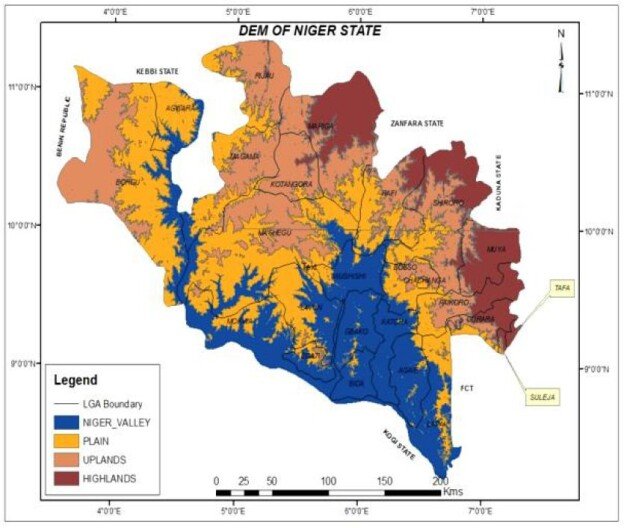
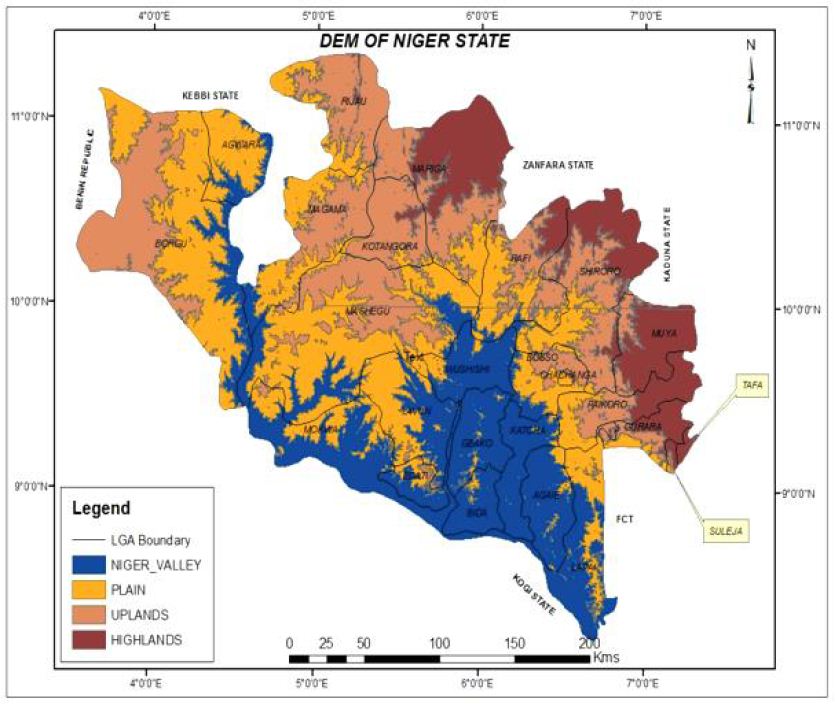
Inguinal Hernias Repair by Laparascopy (TEP)

DOI: 10.31038/IMROJ.2021653

Summary

Introduction: The hernia affection is one of the processes that has been studied into much detail and whose treatment pursues excellence, although many controversies are still yet to be resolved. Laparoscopy repair of inguinal hernia is a treatment method that improves the quality of management given to our patients.

Objective: To identify perioperative events, surgical complications and to evaluate the pain referred for the patients who have had inguinal hernia repair by the laparoscopic method (TEP).

Methods: A prospective and descriptive study was done on 80 patients who have had endoscopic (TEP) repair of inguinal hernias between January 2013 and December 2020.

Results: We performed 100 hernioplastias by laparocoscopy in 80 patients. The male sex predominated in a 5:1 ratio and the surgical time average was, 53.5 minutes for unilateral hernias and 71.3 minutes for the bilateral ones. The most frequent complication in the transoperatory stage was ¨minor bleeding¨. At 15 days after surgery, 86.3% of the operated did not complain of pain, but social and laboral reintegration was at a 34% of the total.

Conclusions: Laparoscopic inguinal hernioplasty is a good therapeutic option, mainly in patients with bilateral and reproduced inguinal hernias.

Keywords

Hernia recurrence, Inguinal hernia, Laparoscopic hernioplasty

Introduction

Since the concept of endoscopic inguinal hernia repair was first described by Ger in 1982, endoscopic techniques have been modified; It was a time when failures and complications – coupled with high cost – outweighed initial enthusiasm [1]. Laparoscopic hernioplasty (LH) has gained popularity in the last decade and numerous controlled studies appear in the literature comparing laparoscopic techniques with conventional ones. [2] In recent years, HL, despite being one of the most controversial laparoscopic procedures, has established itself as a therapeutic option to consider. The advantages of this method are demonstrated in bilateral, recurrent hernias and in the labor-active subject, who requires early return to work [3].

Method

Between January 2013 and December 2020, a prospective, descriptive, longitudinal-cut study was carried out in 80 patients operated on by endoscopy (PET) with the diagnosis of inguinal hernia, at the General Teaching Hospital “Enrique Cabrera”. All patients who agreed with the type of surgical intervention, the study and who gave their informed consent were included; patients older than 30 years classified ASA I-III, without anesthetic contraindications for laparoscopic intervention and patients classified as Nyhus III and IV. Patients with previous surgical wounds in the inguinal region, to operate, not dependent on reproduced inguinal hernias and patients with complicated, irreducible or slipped inguinal hernias; they were excluded. The surgical techniques were: totally extraperitoneal laparoscopic inguinal hernioplasty (TEP). The PET technique was performed with some variants such as: no use of the balloon trocar, the preperitoneal space was decolorized by means of the 0º laparoscope and the insufflation of CO2 at 13 mmHg. In patients with large hernial rings, a polypropylene cone was placed in the hernial defect and subsequently a 15 x 12 cm polypropylene prosthesis. There was no need to fasten the meshes with clips [4]. In the immediate postoperative period, the visual pain scale analog scale (VAS) was applied and a pain value was assigned by means of “little faces”, which starts from very happy (I value) to very sad (X value). Pain quantification was repeated in consultation 7 days, 15 days and one month after the operation.

Results

100 hernias were operated on in 80 patients (20 patients [25%] had bilateral hernias, 85 primary hernias, and 15 reproduced hernias). The average age was 55.6 years, the youngest patient was 30 years old and the oldest was 77 years old, but the majority (14 patients) belonged to the fifth decade of life. The male sex predominated in 84%, which represented a male/female ratio of 5: 1. 43% of the patients made great physical efforts on a regular basis.

Table 1 shows that 36 patients had the habit of smoking, which represents 45% of the total and 17 consumed alcohol for 21.2%.

Table 1: Toxic habits and personal pathological history (APP).

Toxic habits and (APP)

Frequency

%

Chronic Cough

6

7,5

COPD

4

5,0

Constipation

7

8,7

Heart disease

7

8,7

Diabetes Mellitus

7

8,7

Smoking

36

45,0

Alcohol consumption

17

21,2

N= 80 COPD: Chronic obstructive pulmonary disease.

Table 2 shows that right hernias were more frequent in 54.0% of the total; the indirect variety with great dilation of the annulus and destruction of the posterior wall (IIIb) was the most frequent (41 hernias). Nine femoral hernias and 15 recurrent hernias were operated on.

Table 2: Distributión according classificatión to the Nyhus [5].

Classifica-tión

Right Left Total
Frequency % Frequency

%

IIIa

19

33,1 16 34,7

35(35,0%)

IIIb

21

37,8 20 50,0

41(41,0%)

IIIc

6

14,1 3 10,8

9 (9,0%)

IV

8

14,8 7 13,0

15(15,0%)

Total

54

54,0 46 46,0

100(100%)

The total is 100 hernias operated on in 80 patients.

The 100 surgeries were performed by PET technique (100.0%). Two of the patients in whom a PET technique was started had to be converted to a conventional prosthetic technique due to accidental perforation of the peritoneum, passing CO2 into the peritoneal cavity, and consequently, the loss of the preperitoneal surgical space, and another was the conversion of a failed PET technique.

The mean surgical time for unilateral hernias was 53.5 min, with a minimum time of 25 min and a maximum of 120 min. In bilateral repairs, the average surgical time was 71.3 min, with a minimum of 40 min and a maximum of 110 minutes. The hospital stay was less than 24 hours in 70 patients (87.5%), in 5 patients it extended from 24 to 48 hours and in 5 patients it lasted more than 48 hours.

Table 3 shows minor bleeding as the most frequent complication in the intraoperative period, in 22 repairs (22.0%) that originated 13 hematomas (13.0%). No complications were observed after the second week, but two patients suffered recurrences (2.0%) more than two months after the operation.

Table 3: Complications.

Complications

Intraoperative complications

2 weeks

After 1 month

Minor bleeding

22 (22%)

Accidental opening of the peritoneum

9 (9,0%)

Hematomas

13 (13,0%)

Seromas

4 (4,0%)

Recurrences

2 (2,0%)

Table 4 shows the pain classification according to the VAS scale. In the immediate postoperative period, after the patient recovered from anesthesia, 75 individuals (93.7%) were classified as VAS I and 5 patients as VAS II. At 24 h after the operation, 19 patients (23.7%) were classified as VAS I, 50 (62.5%) as VAS II, 7 patients as VAS III, and 4 as VAS IV. In the first week postoperative consultation, 52 patients (65.0%) were classified as VAS I and 15 as VAS II, and two patients with moderate pain (VAS V) appeared in this period. At 15 days after surgery, 69 patients (86.3%) were VAS I and at one month 73 (91.3%) were. The incorporation to the usual activities, including work, was of 3 patients (3.7%) a week after the operation, after 15 days there were 23 patients (28.7%) and at month 54 patients, for 67, 5% of the total.

Table 4: Evaluatión of the Visual Analog Scale (VAS) [6].

VAS

Inmediate preoperative

First day First week 15 Days

First month

Vas I

75 (93,7%)

19 (23,7%) 52 (65,0%) 69 (86,3%)

73 (91,3%)

VAS II

54 (6,3%)

50 (62,5%) 15 (18,7%) 11 (13,7%)

VAS III

7 (8,7%) 5 (6,3%)

VAS IV

4 (5,1%) 4 (5,0%)

7 (8,7%)

VAS V

4(5,0%)

Discussion

Currently, with the improvement of laparoscopic techniques, inguinal hernia surgery is emerging as safe, feasible and as a good therapeutic option, regardless of the age of the patient; However, the preoperative evaluation of the individual must be correct and thorough, specifically the cardiorespiratory function, since with the TEP method a working space is created between the sheets of the transverse lamina, richly vascularized, so that the absorption and elimination of the CO2 is greater than that produced in the peritoneal cavity during pneumoperitoneum [5-7].

Although men predominated, there was a slight increase in women in the series with respect to other authors [8] In laparoscopic practice, the finding of hernial defects diagnosed during the intraoperative period is frequent, in men and women, the latter essentially with a history gynecological disorders.

Although the usefulness of hernia repairs in asymptomatic patients is questioned in some articles, the authors consider that it would be beneficial for the patient, if conditions permit, to repair the hernial defect by the TAPP method [9].

The relationship between hernial disease and physical exertion has been classic since Cooper’s time. In the series, 68% of the patients performed physical activities that involved great and medium efforts and also analyzing the multifactorial nature in the pathogenesis of hernia disease, it is striking that approximately half of the operated patients were smokers, a factor that influences in collagen metabolism, significantly linked to hernia recurrences [10].

Most of the repairs were by means of the TEP technique and we consider, like other authors, that although the TAPP technique brings us closer to the area from a perspective familiar to the surgeon (peritoneal cavity) and facilitates the so-called “learning curve”; Hernia disease – because it is considered a parietal defect- should be given a solution from this same plane, to avoid the probability of serious complications of the intra-abdominal organs and to leave the transperitoneal method as a tactical resource when the totally extraperitoneal method is unsuccessful [11].

Average surgical time was similar to other series [12]. It is known that this tends to decrease when the surgical team gains in experience. The longest operating time recorded was in a patient, who started with a PET technique, but due to technical difficulties, he was converted to a conventional posterior repair.

The main complications were related to minor intraoperative bleeding and postoperative hematomas. In 3 patients it was necessary to drain the hematoma due to the discomfort caused, however, in the rest of the patients with hematomas and seromas they were treated with conservative measures. In two patients, recurrence occurred 2 months after the operation, which was interpreted as a technical error [13,14].

Our results coincide with numerous studies that affirm less postoperative pain with the use of minimal access techniques, as well as a prompt socio-occupational reincorporation of patients [1,3,9,15] Despite the fact that 70% and 93.3% of the patients at 1 week and 15 days after surgery, respectively, had no pain or minimal discomfort; only 18 individuals (30%) started their usual activities before 15 days. These results contrast with other studies that report a return to work and social activities between 10-15 days postoperatively, although it is likely that some sociocultural factors are influencing these results [1,16].

In the series there were no major intraoperative or postoperative complications, only minor bleeding and bruising. In most of the patients, before 2 weeks postoperatively, the pain disappeared, however, the return to social work activities after 15 days was low.

Conclusions

Laparoscopic inguinal hernioplasty was an effective therapeutic option, especially for patients with bilateral and reproduced hernias. It provided benefits to patients and families, the former joining work and social activities early.

Conflicts of Interest

The authors do not declare any conflicts of interest.

References

  1. Ruiz-Funes Map, Farell Rj, Marmolejo Ca, Sosa Laj, Cruz Za (2020) Abordaje De Hernias Poco Frecuentes Por Cirugía De Mínimo Acceso: Serie De Casos. Rev Mex Cir Endoscop 21: 6-14.
  2. Magnus H, Anders B, Westerdahl J (2008) Laparoscopic Extraperitoneal Inguinal Hernia Repair Versus Open Mesh Repair: Long-Term Follow-Up Of A Randomized Controlled Trial. Surgery 143: 313-317. [crossref]
  3. Bittner R, Bain K, Bansal Vk, Berrevoet F, Bingener-Casey J, et al. (2019) Update Of Guidelines For Laparoscopic Treatment Of Ventral And Incisional Abdominal Wall Hernias (International Endo Hernia Society (Iehs))-Part A. Surg Endosc 33: 3069-3139. [crossref]
  4. Cruz Alonso Jr. La Endohernioplastia. Detalles Técnicos. Arch Cir Gen Dig [Serie En Internet]. 2007 [Citado 10 De Diciembre De 2010].
  5. Carbonell Tatay F (2001) Hernia Inguinocrural. Valencia: Ethicon, 141-142.
  6. Deloach Lj, Higgins Ms, Caplan Ab, Stiff Jl (1998) The Visual Analog Scale In The Immediate Postoperative Period: Intrasubject Variability And Correlation With A Numeric Scale. Anesth 86:102-106. [crossref]
  7. Halligan S, Parker Sg, Plumb Aa, Windsor Ac (2018) Imaging Complex Ventral Hernias, Their Surgical Repair, And Their Complications. Eur Radiol 28: 3560-3569. [crossref]
  8. Henriksen Na, Kaufmann R, Simons Mp Et Al (2020) Ehs and Ahs Guidelines For Treatment Of Primary Ventral Hernias In Rare Locations Or Special Circumstances. Bjs Open 4: 342-353. [crossref]
  9. León González Oc, López Rodríguez Pr, Danta Fundora Lm, Satorre Rocha Ja, García Castillo E, Ceruto Ortiz La (2019) Inguinal Hernia Repair By Laparascopy. Surg Cas Stud Op Acc J 3: 2.
  10. Bórquez Mp, Garrido Ol, Manterola Dc, Peña P, Schlageter C, Orellana J (2003) Estudio De Fibras Colágenas Y Elásticas Del Tejido Conjuntivo De Pacientes Con Y Sin Hernia Inguinal Primaria. Rev Méd Chile 131: 1273-1279.
  11. Díaz Martínez J, Ramírez Colin G (2017) Hernioplastia Inguinal Endoscópico Total Extraperitoneal (Tep). Experiencia De Nuestros Primeros 100 Casos En El Hospital De Segundo Nivel. Cir Endos 18: 125-134.
  12. Martin Gómez M (2018) Cirugía Laparoscópica De La Hernia Inguinal. Cir Andal 29: 174-177.
  13. Palmisano Em, Martínez Jd, García Mm, González Jd (2018) Maniobras Claves Y Trucos En Tep. Rev Hispanoamerican Hernia 6: 86-90.
  14. Hernia Surge Group (2018) International Guidelines For Groin Hernia Management. Hernia 22: 1-165. [crossref]
  15. Liu J, Zhu Y, Shen Y, Liu S, Wang M, Zhao X (2017) The Feasibility Of Laparoscopic Management Of Incarcerated Obturator Hernia. Surg Endosc 31: 656-660. [crossref]
  16. Morera Pérez M, Roque González R, González León T, Sánchez Piñero Ro, Olivé González Jb (2019) Cirugía Abdominal En El Adulto Mayor. Rev Cubana Cir 58.
Featured Image2

COVID-19 and Its Impact on Health of Children and Adolescents: A Review

DOI: 10.31038/IGOJ.2021443

Abstract

Actually, COVID-19 is a risk for all human populations (men, women, children and adolescents), with medical, economic and social importance. So, we have as objectives in this manuscript to contribute to knowledge of the impact of this viral disease on the children and adolescents’ health.

Keywords

Coronavirus, COVID-19, Pediatric infections, SARS Coronavirus 2, SARS-Co2

Introduction

COVID-19 is a viral disease whose causative agent was identified in Wuhan-China, as a novel coronavirus, severe acute respiratory syndrome coronavirus2 (SARS-CoV-2) [1]. After, 15 April 2020, COVID-19 has caused more than two million confirmed cases and more than 128,000 deaths globally, including 82,295 confirmed cases and 3,342 deaths in China [2].

The Chinese government has locked Wuhan city, since 23 January 2020, and implemented a series of social distancing measures such as: strict traffic restrictions; prohibition of social gatherings, and closure of residential communities [3].

In [4] the authors have indicated:

1) That “the purpose of the review is to summarize the most relevant evidence of COVID-19 in children highlighting similarities and differences with adults.

2) As results and conclusions:

Of the 266 articles considered as relevant in that research, the authors have retrieved the following information:

“(i) Children were mainly family clusters of cases and have relatively milder clinical presentation compared with adults, and they were reported to have better outcomes with a significantly lower mortality rate; (ii) Studies determining why the manifestations of SARS-CoV.2 infection are so variable may help to gain a better understanding of the disease and to accelerate the vaccines and therapies.”

In [5] the authors have referred that: (i) “at present, SARSCoV-2 is still rampant in the world; (ii) Zhengzhou City in Henan Province serves as an example, 102 people have been confirmed to be infected with SARSCoV-2 (at 24:00 on February 5th, 2020), including three children, the youngest is 4 years old.”

Conclusions

  1. We think that it was here demonstrated that COVID-19 has an impact on children and adolescents.
  2. We hope that with the attention that is being given to this viral disease it is possible, in a short/medium time, to obtain
  3. More knowledge, concerning the virus, the treatment and the
  4. Vaccines, so that with this knowledge is possible a control of all viral variants circulating in the world.
  5. To combat COVID-19, it is necessary:

i)   To have persons specialized for the different types of combat;

ii)  The collaboration between countries at world level;

iii) The collaboration of the person, in general, for the execution of the rules established by health services of their countries;

iv)  The collaboration between different governmental services;

v)  The collaboration between different community services that have responsibility, in the context of public health, such as town halls, health centers and hospitals.

vi)  Staff working in crèches, have to be attentive for occurrence of signals and symptoms of COVID-19 in the children under its protection.

References

  1. Archived: WHO Timeline – COVID-19, 27 April 2020- who.int World Health Organization. Novel coronavirus – China. Geneva, Switzerland: Word Health Organization httpps.//www.who.int/csr/don/12-january-2020-novelcoronavirus-china/en/. [2020-01-12]
  2. COVID-19 – Global Health, COVID-19: What you need to know about the coronavirus pandemic in 15 April. weform.org
  3. Wuham lockdown: a year of Chinas fight against the COVID pandemic – 22 January, Corona virus pandemic bbc.com
  4. Perikleous E, Tsalkidis A, Bush A, Paraskakis E (2020) Coronavirus global pandemic: An overview of current findings among pediatric patients. Pediatric Pulmonology 1-16. [crossref]
  5. Li Y, Guo F, Cao Y, Li L, Guo Y (2020) Insight into COVID-2019 for pediatricians. Pediatric Pulmonology 55: E1-E4. [crossref]

Alcohol and Health: Social Evolution, Production and Control

DOI: 10.31038/IMROJ.2021652

Abstract

Alcohol drinking has been intrinsic to human social evolution certainly from the period when change from hunter-gather to farmer took place, which in many societies dates from 10,000 or more years ago. Throughout much of that time the risk of water-borne diseases such as enteric fever was such that there were undoubted health benefits to consumption of alcoholic beverages, such as mead, beer, cider and wine, in preference to contaminated water. Further benefit may also be that fermented drinks provided a means of storing food energy when preservation methods such as freezing had yet to be developed. These benefits were no longer critical once efficient sanitation and safe water supplies and food storage technologies had been developed from the mid-19th century. The study of fermentation has contributed enormously to medicine providing drugs or their precursors as diverse as antibiotics and statins. During human cultural evolution alcohol has frequently been a key part of religious and fertility rites and of social activities, such as feasting. However, the introduction of cheap, distilled, alcoholic drinks, such as gin, in the late 17th century was damaging to society and in modern times evidence for any health advantages to drinking alcohol is lacking. The threshold consumption below which no harm can be observed is low or non-existent. Whereas prohibition can be effective in theocracies as demonstrated by transnational statistics on alcohol consumption, historically, attempts to enforce prohibition solely by legislation have generally been disastrous in non-sectarian societies. The scale of the industries producing alcohol is vast and many drinks, particularly wine are intimately ingrained into many cultures. Taxation is a traditional means of curbing excess consumption and there may be a case for banning certain types of alcoholic products and advertising, but draconian measures will lead to increased crime through illegal drinking and the misuse of other recreational drugs. It should not be assumed that lessons from the success in reducing smoking can be directly translated into limitation of alcohol use to improve health.

Introduction

Alcohol production and consumption has been a key element in human social evolution and acculturation, certainly since the late stone-age. Beliefs about whether this is beneficial or harmful to health both of individuals and societies have fluctuated throughout history. In adopting a rational policy towards alcohol use and abuse [1], it is essential to understand not just recently, but historically, how it has come to occupy such an important place in many civilisations and whether claims that it has some health-giving properties are likely to be true or is it simply an instrument of pleasure with the potential through over-indulgence to cause harm?

History

Stone-Age

There is a school of thought these days that we were healthier as hunter-gatherers. Most of human genetic evolution had occurred by the time we had reached that stage in our social evolution. The idea is thus that our metabolism is best suited to the diet and energy expenditure of a Stone Age man after which it has not changed much, if at all. Presumably the life of a hunter-gatherer involved collecting shellfish from the beach, catching the occasional animal and seasonally eating the odd nut, wild fruit or root [2]. Certainly this diet included no more than a trace of alcohol, but equally certainly it did not often include the five portions of ‘fruit and veg’ of the type we are now frequently advised to eat. The fruit and veg of the hunter-gatherer would have been the diminutive specimens, not the florid vegetables we eat today as the result of artificial selection (selective breeding). However, our hunter-gatherer ancestors, who it is claimed were so fit, lived in small, nomadic groups, which does have its advantages. They did not have to worry too much about sewage mixing with drinking water, if they were regularly on the move. Enteric fever became a major problem in the settled communities where farming developed from the end of the last ice age about 12,000 years ago. Successful farming depended on artificial selection to create cereal crops, vegetables, fruit and farm animals, leading eventually to the diet we have today, and to major changes in society, including the predilection for feasting. The major production of mead, wine and beer also probably began around 10,000 years ago with the development of apiaries and the cultivation of grapes and cereals. It would have been facilitated by the development of pottery vessels in the late Neolithic period (around 11000BC). Industrial alcohol production probably did not begin in Europe, but probably in Asia minor.

Impetus to Develop Production of Alcoholic Beverages

Usually it is assumed that the intoxicant property of alcohol was the major inducement for its production, but there were clear health benefits in former times. Beverages, such as wine, were a means of storing food energy and thus contributed to the avoidance of starvation during the winter months. Importantly too, fermented alcoholic drinks provided a safe water supply and thus prevented enteric fever [3]. Typhoid and other water-borne causes of enteric fever were the commonest cause of death, killing half of the population even as late as the mid-19th C. Perhaps it is not surprising, therefore, that wine or beer even at breakfast, were widely consumed in preference to water well into Victorian times. Interestingly the temperance movement made little headway until the mid-19th C when improvements in sanitation, as the result of advances in public health engineering and the allocation of civic funding for it, ensured a safe water supply [4]. Being teetotal was before that a risky business.

Mead

The discovery that fermentation could produce intoxication may have been made by early man after consuming rotting honey from bee colonies. Presumably, attempts to replicate its pleasing intoxicant effect led to deliberate fermentation of honey. Mead is probably therefore the earliest widely consumed alcoholic beverage [5]. Thus mead was the ambrosia of the ancient Greeks, but its production declined in the south of Europe and Asia Minor, when grapes were discovered as a more easily produced, more predictable source of sugar for alcohol production by fermentation. Bees are, however, ubiquitous. Thus, in the north, where vine fruits were less available, the popularity of mead continued. In Norse/Aryan mythology a draught of mead, delivered by beautiful, divine maidens, was the reward for warriors who reached Valhalla. Celtic mythology tells of a river of mead running through paradise, while Anglo-Saxon culture regaled mead as the bestower of immortality, poetry and knowledge. The word “honeymoon” comes from the ancient tradition of giving bridal couples a month’s worth of mead to ensure a fruitful union

Beer

Grain cultivation from a variety of plants developed in many locations from 11000BC and so also did beer-making. In some ways the history of beer is more interesting than wine, because it was developed in many different civilisations and cultures widely separated geographically [6]. In antiquity beer would travel less well than wine. Thus, exchange of knowledge concerning its manufacture, may have been largely responsible for its spread. However, beer-drinking might also have developed in some cultures at a time before they were likely to receive migrants or travellers from beer-producing regions. Therefore, it is tempting to speculate that the discovery of beer occurs at a particular stage of social evolution concurrently or shortly after the development of cereal crops. Babylonian clay tablets from c 4300 BC describe recipes for beer. Noah’s provisions for the Ark included beer. Beer was a vital part of the Babylonian, Assyrian, Egyptian, Hebrew, Chinese, and Inca cultures. Different grains were used in different cultures: Africa used millet, maize and cassava, North America used persimmon (although agave was used in Mexico), South America used corn (although sweet potatoes were used in Brazil), Japan used rice to make sake, China used wheat to make samshu, other Asian cultures used sorghum, Russians used rye to make quass or kvass and Egyptians used barley and may have cultivated it strictly for brewing as it made poor bread.

Cider

The origins of cider are obscure. Apples are known to have been cultivated in the Nile delta as early as 1300 BC, but they may have been grown much earlier in China [7]. Cider was, however, a novelty to the Romans on their first visit to Britain in 55BC. Its production by the Normans (of Viking descent) was undoubtedly on an industrial scale by the time of their conquest of Britain in 1066. The Viking diaspora of which Normandy was part extended at various times from the 8th to the 11th century AD not only to the Atlantic and Baltic coasts of Europe, but also the Mediterranean and Black Sea coastal regions of Europe, North Africa and Asia minor [8]. However, the spread of cider was more limited until modern times. Currently, the UK has the world’s highest per capita consumption, as well as its largest cider-producing companies. Cider is also popular in some other European countries including Ireland and some regions of Portugal, France, and Spain. Germany also has its own types of cider, a particularly tart version known as apfelwein.

Wine

As early as 6000BC there is evidence of wine production with the wild grapes (Vitis vinifera sylvestris) indigenous to the Transcaucasian region between the Black and Caspian Seas embodying parts of present day Turkey and Azerbajan (ancient Armenia), Georgia and Iran. The earliest cultivated grape seeds (Vitis vinifera vinifera) together with jars and other artefacts for bulk wine production dating to 4100BC were discovered in a cave in Armenia [9-11]. Trade in wine led to the spread of grape cultivars and wine-making knowledge and technology south to Mesopotamia (Iraq, Syria and Kuwait) and Phoenicia (coastal Syria and Lebanon) and west through Bulgaria and Macedonia to Greece. Sea-going Phoenician traders and the expansion of the Greek Empire extended the culture of wine more widely still. The cults of Bacchus and Dionysus incorporated wine into religious rites in the Greek world. Cleopatra (from the dynasty of Greek rulers of Egypt) is said by Pliny to have drunk a goblet of wine in which she had dissolved a priceless pearl to impress Mark Anthony by consuming the most extravagant tipple in history. The wine, itself, must not have travelled well: it must largely have deteriorated to vinegar to convert calcium carbonate to acetate [12]. Under Rome the transport of wine improved and viniculture spread throughout its empire as far as the south of England and Germany [13]. Improvements in ceramic and glass technology were crucial to this. With the collapse of Rome’s control of its former empire, European wine production would have been seriously threatened had it not been for the expansion of the Catholic Church. The belief that red wine is the blood of the Gods goes back to a pre-Christian tradition, but its consumption and production by monastic orders was way beyond its role in the eucharist. The Benedictines followed by the Cistercians were the greatest wine producers. Many persisting aspects of viniculture derive from this period. Dom Perignon (1638–1715), a Benedictine monk introduced many blending techniques and preservation methods, including secondary fermentation in which wine was preserved by carbon dioxide under pressure and thus fizzed when its cork was released. This provided an alternative to fortification with higher proof spirits, such as brandy (see distillation) to permit wine to travel well as, for example port and sherry. Thus champagne joined port and brandy in British society. Wine was taken to Central and South America by the Conquistadors and vines brought from Spain and Portugal were introduced and cultivated by their monasteries in Mexico and much of South America including California, Argentina and Chile. Jan van Riebeeck, a Dutch ship’s doctor who believed wine could cure scurvy introduced wine production to South Africa after taking vine cuttings to Cape Town. Vines for wine production were brought to Australia in the 1830’s and to New Zealand at about the same time or possibly a few years earlier from collections of French grapes in English hot houses.

The artificial selection of grape vine variants with desirable distinctive characteristics for wine production has been practised for several thousand years. Cross-fertilising these with other varieties to create good wine-producing hybrid vines is, however, a tedious business with only a small proportion being homozygotes for all of the desirable characteristics and several generations reaching maturity might be necessary to confirm this. Therefore the practice was to graft the new vines on to rootstock of wild-type vines, thus circumventing the need for sexual reproduction. However, in the 1860’s the wine industries of France were devastated by Phylloxera vastatrix, an aphid imported from North America [14]. In France this infestation caused withering and destruction of vine roots. The scarcity of wine in France led to an increase in the drinking of absinthe. Soon after the vine disease began the microbial cause was identified by Jules-Emile Planchon, using microscopy and influenced by Louis Pasteur’s work [15]. That the microbe was a stage in the metamorphosis of an aphid already known in North America, Daktulosphaira vitifoliae, and imported from there, was, however, not appreciated and his work was initially ignored. Although less devastating outside France, Phylloxera spread to Austro-Hungary, Germany, Spain, Italy, Portugal and Madeira. Eventually, Pasteur, himself, was put in charge of the investigation of the cause of vine disease (1885). His reputation had by then been built with his famous proof that fermentation was due to yeast microbes and his saving of the the French silk worm industry from the ravages of a microbial disease [16]. However, his attempts at a chemical (pesticide) approach to control the blight failed. Ironically North America proved to be both the cause and the remedy. The wild vines from there were relatively unaffected by Daktulosphaira vitifoliae. Thus grafting the old vines onto rootstock from American varieties in countries affected by Phylloxera provided the eventual solution . Pasteur, of course, went on to make many more contributions to organic chemistry, germ theory, antisepsis and immunisation.

The Discovery of Distillation and the Production of Spirits

The widespread abstinence current throughout the Arab Muslim world is a comparatively recent adoption. As Omar Kayyam (1048–1131) remarks to his lover, ‘A book of verses underneath the bough, a flask of wine, a loaf of bread and thou….’. The word ‘alcohol’ is derived from an Arabic word and it was Arab alchemists who separated it from wine. The most famous of these, Jābir ibn Hayyān (721-815), devised apparatus for distillation in the 8th century [17]. Distillation permitted the production of spirits with much higher alcohol content than was possible by fermentation alone and the use of inferior ingredients and techniques for the initial fermentation, which prior to distillation would produce an undrinkable liquid. Not only was production thus cheap, but the product was more easily transported than wine and beer. It could be issued to armies and navies and sold to the multitudinous poor. Huge quantities of gin (barley malt), rum (sugar cane), scotch whiskey (barley malt), bourbon whiskey (corn, rye, wheat, barley malt), brandy (grapes and other fruits) and vodka (potatoes, cereals) were produced commercially by the 18th century in Europe and countries with populations of European origin [18]. Drunkeness became rife: signs outside gin shops in the proletariat parts of London read, ‘Drunk for a penny; dead drunk for two pennies; clean straw for nothing’.

Temperance: Taxation, Legislation and Religion

In Britain, a series of parliamentary acts from 1729 onwards were required to ameliorate the gin craze. Historically, attempts to outlaw alcohol generally either for reasons of morality or to increase the industrial productivity of the nation’s workforce have generally failed dismally. Taxation (excise duty) on the other hand has proved highly successful for governments. Alcohol was first taxed in 1643 and by 1713 had overtaken land tax as the government’s main source of revenue [19]. Often the declared motivation for increases in excise duty was to pay for the armed forces. Issues of religion, improved health and providing a better society were not the main motivation, at least until the growth of the temperance movement. A policy of prohibition might not only make a political party unsuccessful electorally, but also cut off its major revenue source, should it achieve office. In Britain in 1914 a movement to prohibit alcohol supported by Lloyd George and King George 5th failed to gain popular support, although a ban persisted in the Royal Household until the war ended in 1918 and licensing hours were introduced on the grounds that they would increase productivity. Tsar Nicolas 2nd did succeed in banning alcohol in 1914 (ineffectively and with the loss of considerable revenue for his government) throughout his empire, a ban which persisted longer than he did, being cancelled by the Bolsheviks in 1925. In the USA prohibition was enacted as the 18th amendment to the constitution in 1920, but was rescinded in 1933, not least due to the uncontrolled rise in crime that resulted. Many other nations have briefly attempted to abolish alcohol consumption including Iceland, Norway, Finland Australia and New Zealand. Currently most of the nations where alcohol is illegal are Muslim. Examples are Yemen, Saudi Arabia, Maldives, Kuwait, Iran, Brunei and Afghanistan. The Koran is clear that intoxication is irreligious. Although specific mention of alcohol is not made, the current generally accepted belief is that ‘Whatever intoxicates in large quantities, a small quantity of it is forbidden’. Thus, the consumption of alcohol is frowned upon in Muslim societies, even in those that have stopped short of a state ban. With the loss of European influence in such societies dramatic changes have occurred with Algeria being the most extreme example. Until independence from France in 1962 it was the world’s largest exporter of wine, whereas today its production has dwindled to almost none [20]. Christian denominations vary greatly in the degree to which they denounce alcohol with the reformed churches, such as the Presbyterian, Quaker, Methodist and Baptist denominations at the forefront of abolition. The predominant religion undoubtedly influences national alcohol consumption (Table 1).

Table 1: Wine and alcohol consumed (litres of pure alcohol per person aged 15 or more years in 2016 or latest year for which figures were available) published by the World Health Organisation [1]. Data for selected countries are arranged in descending order of wine consumption. The difference between the sum of the wine and beer consumption is generally due to intake of spirits. Data from Spain may be influenced by its tourist industry.

Country

Alcohol consumption Alcohol consumed as wine

Alcohol consumed as beer

Portugal

12.3

7.5

3.2

France

12.6

7.4

2.4

Italy

7.5

4.9

1.9

Greece

10.4

4.7

3.3

Belgium

12.1

4.6

5.4

UK

11.4

4.1

4.1

Australia

10.6

3.9

4.2

Germany

13.4

3.8

7.1

Austria

 11.6

3.7

6.1

Ireland

13.0

3.6

6.1

New Zealand

10.7

3.5

4.0

Netherlands

8.7

 3.1

4.2

Norway

7.5

2.7

3.3

Canada

 8.9

2.2

4.0

USA

 9.8

1.8

4.6

Spain

10.0

1.8

5.4

Russia

 11.7

1.5

 4.6

China

 7.2

0.2

 2.2

 India

 5.7

 <0.1

 0.5

Egypt, Kuwait, Pakistan, Iran

 ≤1

 <0.02

 <0.5

Benefits Derived from Scientific and Technical Advances in Brewing

Fermentation due to yeasts or bacteria in the gut is vital for our digestive system. Fermentation is also widely used in the production and storage of foods as diverse as bread, cheese, pickles, yoghurt, vegetables (eg kimchi), fish (surströmming) and, of course, alcoholic beverages. This form of food preservation largely exploits the preservative effects of ethanol, lactic acid, acetic acid and carbon dioxide produced during fermentation, but other chemicals can be produced, depending on the micro-organism chosen. Despite its wide use for many thousand years it was not generally accepted until the latter part of the 19th century following the findings of Pasteur that fermentation is a metabolic process ( involving living microorganisms) that produces chemical changes in organic substrates through the action of enzymes [21]. As the range of organic compounds produced by fermentation was investigated, techniques employed in the brewing and wine-making industries were modified for the large scale production of organic compounds otherwise difficult to synthesise in quantity. This received considerable impetus when Chaim Weizmann (the father of industrial fermentation and first president of Israel) working in Manchester scaled up the knowledge that Clostridium acetobutylium yielded acetone from starch. Many tons of acetone necessary for cordite production were thus manufactured in the First World War. For this, sanctioned by Churchill and Lloyd George, six British distilleries were requisitioned.

The availability of industrial techniques for bulk culture of selected naturally occurring micro-organisms has subsequently led to the manufacture of a huge range of therapeutic drugs from antibiotics to statins [22]. More recently, the creation of genetically modified organisms has extended the array of therapeutic agents as diverse as recombinant proteins and monoclonal antibodies. Whatever the evils of alcohol, knowledge gained from its production continues to contribute hugely to advances in medicine. The benefits of alcohol consumption on the other hand are more questionable.

Units of Alcohol

Quantities of alcohol in medical reports can be confusing. Quite simply, 1 unit is equivalent to 10 ml of pure alcohol. With this knowledge it is easy to convert the alcohol content shown as vol/vol on the label of wine (and other alcoholic beverages) to units. For example 12% alcohol means 12 ml per 100 ml of wine. Thus, a 750 ml bottle contains 12 × 750 ÷ 100 = 90 ml or 9 units of alcohol.

Alcohol and Health in Contemporary Times

Epidemiology

Alcohol is currently largely viewed as a cause of ill health. The catalogue of woe resulting from heavy alcohol consumption is well known and includes loss of social inhibition beyond conviviality, accidents, recklessness, suicide, violence and other criminal behaviour, excessive sedation and inhalation of vomit, dependence, acute and chronic liver disease, acute and chronic pancreatitis, acute and chronic gastritis, carcinoma of the breast, liver, pancreas, oesophagus and intestine, encephalopathy, myopathy, neuropathy, gout, rhinophymoma, pseudo-Cushing’s syndrome, gonadal atrophy, hypertriglyceridaemia and teratogenicity. Heavy alcohol consumption is also a cause of excess cardiovascular mortality due to dysrhythmias, especially atrial fibrillation, but also ventricular dysrhythmias, cardiomyopathy and, often overlooked, it can be a major contributor to hypertension. So does alcohol have any health benefits nowadays? It could be argued, we should not ignore its role in simply making life more enjoyable as long as it adds to and does not detract from the quality of the life. As Dean Martin said, ‘I’d hate to be a teetotaller. Imagine getting up in the morning and knowing that’s as good as you’re going to feel all day’.

Moreover, there has been an ongoing debate since the 1980’s about whether moderate alcohol consumption is associated with lower rates of coronary heart disease than those in non-drinkers [23,24]. The relationship between alcohol consumption and mortality is J-shaped. This has been attributed by some to lower rates of coronary heart disease (CHD) in moderate drinkers than in abstainers [23] and by others to pre-existing disease prompting alcohol abstention [24]. Meta-analysis of prospective observational studies has revealed that the J-shaped relationship with CHD and all-cause mortality is a highly reproducible finding [25,26]. In the largest meta-analysis the effect of alcohol was associated with decreased likelihood of fatal and non-fatal myocardial infarction [26]. The risk of death from heart failure, stroke and non-cardiovascular disease increased with alcohol consumption so that overall the lowest mortality was associated with consumption of around 100 g per week (12.5 units) in both men and women. In a more recent study of over 80,000 Chinese industrial workers around 25 g per week (3.1 units) was associated with the lowest incidence of death [27]. Any benefit from alcohol thus seems to occur below currently recommended ‘safe’ limits (see later).

Mendelian Randomisation

Any association between moderate drinking and longer life expectancy could be because moderate drinkers are healthier than non-drinkers for reasons other than their alcohol consumption. This confounding might be because modest drinkers are, for example, likely to be restrained in other potentially unhealthy behaviours, perhaps smoking less, or they may be from a higher socioeconomic group, which is associated with better health. Statistical adjustment to allow for confounding is of limited validity.

Ideally, of course, cause and effect should be established by a randomised trial. This is what has been done to establish the clinical efficacy of drugs, such as a cholesterol- or blood pressure-lowering medication. Participants are randomly assigned to receive the active drug or to be controls often given placebo to blind the patient and the investigator as to whether treatment is active or not until the end of the trial. After a few years, the incidence of heart attacks and other clinical events in the active treatment and control groups is compared. This is impossible with alcohol. You can hardly expect drinkers to be assigned to the non-drinking control group and vice versa. The same dilemma faced investigators trying to persuade governments that smoking was unhealthy.

Mendelian randomisation is a development which has been hailed as in some cases providing a substitute for randomised clinical trials. If an element of the exposure to a risk factor is genetically determined and there are variants of that gene which have a predictable effect on its penetrance, then it is possible to test for causality by assessing whether the disease is associated with the gene variant(s) linked to the greatest exposure. The method relies on the assumption that the gene variant itself contributes causally to exposure and on the assumption that, during meiosis (gametogenesis), which one of each parent’s pair of genes coding for a particular characteristic a gamete receives is random (a matter of chance). In the case of alcohol exposure two genes have been the subject of particular interest in determining alcohol consumption. One codes for alcohol dehydrogenase, which converts ethanol to acetaldehyde. The second is acetaldehyde dehydrogenase which metabolises the acetaldehyde. Acetaldehyde causes flushing, headaches and many of the features of a hangover. It has been reported that lower activity polymorphisms of alcohol dehydrogenase slow down the rate of formation of acetaldehyde and that high activity polymorphic variants of aldehyde dehydrogenase limit the rise in its circulating levels. Inheritance of genes coding for low activity alcohol dehydrogenase and for high activity aldehyde dehydrogenase is associated with greater alcohol consumption and with increased rates of alcoholism and binge-drinking [28,29]. Alcohol dehydrogenase activity increases in heavy drinkers. So, acquired factors make it unsuitable for a Mendelian randomisation study. However, aldehyde dehydrogenase gene variants associated with increased alcohol consumption have been frequently been examined in relation to disease outcomes in Mendelian randomisation studies [29-31]. No benefit from any degree of alcohol consumption has been reported in these investigations. However, it has been questioned whether this type of genetic polymorphism influences consumption sufficiently to categorise participants reliably [32]. Claims that they exclude a role for low as opposed to low to moderate alcohol consumption in preventing CHD are likely to be unfounded, but on the other hand conventional epidemiology does not prove modest consumption causes such protection.

Causality and Plausibility

Alcohol in General

There is a plethora of mechanisms both for harm and benefit from alcohol. Alcohol exerts its acute effects directly and by, acetaldehyde to which it is rapidly converted. Some chronic effects such as degeneration of cerebral tissue and oesophageal cancer and gastritis may be due to repeated direct exposure to these. The likelihood of complications may be enhanced by nutritional factors, such as thiamine deficiency (wet beri beri) and by toxins contained in the particular beverage.

Thus certain alcoholic beverages may once have given rise to particular syndromes in specific groups of drinkers such as Marchiofava Bignami syndrome in chianti drinkers [33], oesophageal carcinoma in calvados drinkers [34] and cardiomyopathy when cadmium was used in beer production [35]. On the positive front, effects of alcohol on risk factors known to cause coronary heart disease has been a popular topic for research [36]. Experimental evidence undoubtedly confirms that alcohol increases high density lipoprotein (HDL), which in many epidemiological studies is inversely associated with the incidence of atherosclerotic cardiovascular disease. Experimentally alcohol also decreases fibrinogen, the major cause of thrombosis which occurring on atheromatous arteries is the usual cause of heart attacks. One should be cautious in the interpretation of the effect of the alcohol-induced increase in HDL on atherosclerosis risk following the failure of cholesteryl ester transfer inhibitor drugs, which raise HDL far more than alcohol, to ameliorate atherosclerotic cardiovascular disease incidence [37]. Furthermore excess alcohol also causes triglyceride levels to rise. Although it has also been suggested that moderate alcohol consumption is associated with a decreased likelihood of developing type 2 Diabetes mellitus, that these are causally related has been questioned in a recent meta-analysis [38].

Wine vs. Other Types of Alcoholic Beverage

Wine has come to occupy a place of veneration amongst alcoholic beverages, perhaps because of its southern European connections, significance in Christian culture, association with class, aestheticism, high-living and chique. ‘Wine is one of the most civilized things in the world and one of the most natural things of the world that has been brought to the greatest perfection, and it offers a greater range for enjoyment and appreciation than, possibly, any other purely sensory thing’ (Ernest Hemingway. Death in the Afternoon). It has also since ancient times been recommended by certain physicians to improve health. Can something enjoyable be healthy? Physicians rarely recommend anything pleasurable as part of a healthier lifestyle, but is there reason to be more optimistic about at least some types of alcoholic beverages?

The effect of alcohol on biomarkers, such as HDL cholesterol and fibrinogen, is similar whatever the alcoholic beverage and seems to depend on the alcohol itself. However, the notion that wine, particularly red wine, may have more health-giving properties than other alcoholic drinks has been around for some while. The usual reason for advancing this hypothesis is the so-called French paradox: some parts of Southern Europe have relative freedom from coronary disease, despite in the case of the South of France, enjoying a relatively fatty diet [39]. Typical alcohol consumption is similar in France and Ireland with its much higher CHD incidence (Table 1). In France, however, wine comprises a much higher proportion of the alcohol consumed. Studies of people resident in Toulouse and in Belfast reveal that HDL is higher in Toulouse [40], but there is no evidence that wine has a greater effect on HDL than any other source of alcohol [39]. Thus other aspects of the French diet, such as olive oil, and genetic differences may have contributed to the higher HDL in Toulouse and its relatively low CHD incidence. However, there is no denying that the contribution of wine to the alcohol consumed in France, Portugal and Italy is higher than in the UK, Ireland and North America (Table 1) where coronary rates are substantially greater. Red wine has been the subject of most interest as protecting against CHD, because it contains copious quantities of polyphenolic flavonoids, which are potent antioxidants [39] However, randomised trials of antioxidant vitamins have been unsuccessful in preventing heart disease [41]. It could, nevertheless, be argued that antioxidant vitamins used in these trials are not the antioxidants in red wine. It is possible too that some other mechanism could mediate the postulated protective effect of flavonoids in red wine against atherothrombosis [42]. However, it has also been questioned whether these substances are absorbed from the intestine in sufficient quantity [43].

J-Shaped Relationship with Mortality

Why does the CHD benefit of alcohol disappear with higher consumption? In large part because it can lead to obesity, particularly the more dangerous central obesity (brewers’ goitre) which is linked to high blood pressure, to deteriorating lipid levels and to diabetes [44]. Wiry alcoholics do not escape cardiovascular consequences, because excessive alcohol can directly damage the heart leading to dysrhythmias [45] and cardiomyopathy [46]. Furthermore, the fibrinogen-decreasing effect of alcohol may not be beneficial, if blood pressure also rises secondary to alcohol overindulgence, because it can cause strokes due to cerebral haemorrhage [47], Tom Sharpe’s Porterhouse Blue effect.

Mortality from non-cardiovascular disease increases directly with alcohol consumption particularly chronic liver disease, chronic and acute pancreatitis and neoplastic disease (particularly oropharynx, oesophagus, stomach and pancreas, but also tissues less directly exposed such as colorectum and breast) [48].

Safe Limits for Alcohol Consumption

There is a dichotomy of views about whether advice to the public about health and alcohol should be to consume the quantity associated with the lowest mortality or to recommend an upper limit above which mortality exceeds the average. There is thus considerable variation in what are considered safe limits in different nations [49]. Logically, if there is an upper limit, there should be a lower limit. However, there is no national guidance to drink small amounts of alcohol rather than abstain.

The general health recommendation in the UK, which attempted to balance the benefits of alcohol against its ill-effects, was for men not to exceed 21 or women 14 units weekly. This is no more than one third of a bottle a day for men and rather less for women. Women, although less likely than men to become alcohol-dependent, are more susceptible to alcohol-related disease [50]. This seems to make sense because they generally have a smaller surface area and liver than men, but on the other hand they are more likely to underestimate their consumption, creating the impression that their health has been damaged at lower levels of intake. Recently 14 units weekly for both men and women has become the NHS recommendation. This was influenced by the Mendelian randomisation studies. In practice, a medical history should ideally contain information about individual alcohol intake to detect drinking likely to damage health [51], but whereas it is easy to tell a patient who smokes any tobacco product to stop, it is lengthy and complicated to discuss precise quantities of alcohol and may distract from other parts of the history about which it is necessary for the patient to be frank if alcohol intake is not germane to the main purpose of the consultation. Rather than record ‘socialIy’ or some such euphemism (‘not enough’ one lady told me) it is better in general to ask whether any alcohol is consumed in a typical week and if so how much in terms of pints of beer, glasses of wine etc, bearing in mind that 14 units is around 5 pints of beer or 5 glasses of wine per week.

Prevention of Harmful Alcohol Consumption

  1. On present evidence it can be concluded beyond doubt that binge drinking is harmful. This is particularly worrying when it is encouraged by the supply of cheap alcohol to young people.
  2. That alcohol itself is the cause of decreased mortality in modest drinkers is unproven. On the other hand it cannot be said that it is harmful. Moderate consumption can contribute to the enjoyment of life.
  3. Obviously, the medical profession should advise against regular drinking when it occurs at a level which may be harmful to health. To decide at what level this is the case is difficult (see previous discussion).
  4. The most effective means of limiting alcohol intake is on religious grounds enforced by government and by social stigmatisation (including informants to religious and state authorities). In societies which can worship freely this is clearly impossible.
  5. Legally banning alcohol sales and manufacture has never proved successful and indeed may lead to serious crime.
  6. Taxation has proved to be the most effective means of preventing inappropriate drinking.
  7. Medical assistance such as provision for drying out, psychiatric support and Alcoholics Anonymous are clearly helpful in some individuals [52], but do not prevent excessive drinking in society as a whole to the detriment of health or the creation of addicts.
  8. The information in this review invites comparison with another social addiction, namely smoking, which has declined greatly in recent times [53]. Both alcohol and smoking are widespread social addictions, but alcohol has been available for thousands of years longer in which time it has become intimately linked with culture and tradition and has in the past had health benefits, whereas cigarette smoking, the most harmful form, was a phenomenon largely of the 20th century [54]. Alcohol is deeply ingrained into European culture and societies adopting European customs. The link between smoking even in moderation and carcinoma of the bronchus is strong, but on the other hand smoking does not cause disinhibition and inappropriate behaviour. Passive smoking and social stigmatisation has contributed greatly to the decline in smoking as has financial cost due to high taxation. The tobacco industry is huge and has responded by increasing its sales in Asia and by diversification. The alcohol industry is vast even compared to tobacco, but its opportunities to expand into markets in Asia are limited. Both industries have relied heavily on promotion including advertising and sponsorship. This has been limited much more in the case of smoking by legal restriction and by the adverse publicity which organisations accepting sponsorship might receive. Smoking has largely disappeared from films and television and tobacco sponsorship of sport or medical research is more likely to lead to disapprobation than promotional opportunity. Despite the opposition which would ensue from the public relations machine representing the alcohol industry, it might be possible to do more to prevent the promotion of drunkenness by bars, clubs and entertainment providers. Cheap alcoholic beverages are frequently used as loss leaders to entice shoppers: minimum pricing per unit of alcohol could prevent this practice.
  9. A coherent policy must be one of limiting excessive drinking. Historically, it has come to be regarded as normal to over-indulge on certain social occasions. Initiation of the young into over-consumption can be reduced by taxation, discouragement of provision of cheap alcohol and by educational and professional bodies not including it as part of their ritual.
  10. People can be persuaded to modify their habits when not only their own health, but that of others, is at risk. Potential harm from passive smoking undoubtedly was a major factor in banning smoking from public places. Young women are highly likely to give up both smoking and alcohol during preganancy. Driving and many types of work whilst under the influence of alcohol are banned by legal and contractual restraints. Protecting the NHS has been a main plank of persuading people to avoid behaviour likely to spread COVID infection. Perhaps it should be more widely publicised that in at least a fifth of acute hospital admissions over-indulgence in alcohol is largely responsible [55].
  11. To promote the message that all smoking is dangerous is probably easier than to promote moderation in alcohol. Advice to drink alcohol responsibly almost certainly requires more cooperation from the alcohol industry than banning smoking in public places did from the tobacco industry, but a clearer mutually acceptable definition of what is meant by responsible is required [56,57].

Conclusion

What we can learn from epidemiology is more limited than is often claimed. More should be done to curb excessive drinking, which is both unpleasant and unhealthy. Abstinence can be encouraged, indeed legislated for, in certain limited circumstances, but an outright ban for the whole population can do more harm than good. Our current knowledge about alcohol and health can best be summarised in the words of Marie Lloyd, ‘A little of what you fancy does you good’.

Acknowledgment

The authors acknowledge support from Lipid Disease Fund and The National Institute for Health Research/Welcome Trust Clinical Research Facility.

References

  1. Global status report on alcohol and health 2018. Geneva: World Health Organisation. Licence CC BY-NC-SA 3.0 IGO.
  2. Gibbons A. The evolution of diet. https://www.nationalgeographic.com/foodfeatures/evolution-of-diet/
  3. Basnyat B, Qamar FN, Rupali P, Ahmed T, Parry CM (2021) Enteric fever. BMJ 26: 372:n437. [crossref]
  4. Great stink. https://en.wikipedia.org/wiki/Great_Stink
  5. Heritage Daily. History of mead. https://www.heritagedaily.com/2020/03/history-of-mead/126299
  6. Smith G (1995) Beer: a history of suds and civilisation from Mesopotamia to microbreweries. London: Harper Collins.
  7. Juniper BE, Mabberley DJ (2019) The extraordinary story of the apple. London: Kew Publishing.
  8. Oliver N (2012) Vikings.London: Weidenfeld and Nicolson.
  9. Barnard H, Dooley AN, Arashian G, Gasparyan B, Faull KF (2011) Chemical evidence for wine production around 4000BC in the Late Chalolithic Near Eastern highlands. J Arch Sci 38: 977-984.
  10. This P, Lacombe T, Thomas MR (2006) Historical origins and genetic diversity of wine grapes. Trends in Genetics 22: S11-19. [crossref]
  11. McGovern PE et al. (1996) Neolithic resinated wine. Nature 381: 480-481.
  12. Bartowsky EJ, Henschke PA (2008) Acetic acid bacteria spoilage of bottled red wine — a review. Int J Food Microbiol 125: 60-70. [crossref]
  13. Lukacs P (2013) Inventing wine: a new history of one of the World’s most ancient pleasures. New York: WW Norton and Co.
  14. White K (2017) The Devastator: Phylloxera Vastatrix & The Remaking of the World of Wine 2017.
  15. Planchon JE (1875) Les vignes Americaines: Leur culture, leur resistance au Phylloxera et leur avenir en Europe. Montpelier: Academie des Sciences et Lettres.
  16. Casco J (2017) Heroes of wine: Louis Pasteur (1822-1895) 2017.
  17. Amir SS, Tbakhi A, Jabir ibn Hayyan (2007) Ann Saudi Med 27: 53-52.
  18. Forsyth M (2017) A short history of drunkenness. London: Viking.
  19. Yeomans, H orcid.org (2018) Taxation, State Formation and Governmentality: The Historical Development of Alcohol Excise Duties in England and Wales. Social Science History 42: 269-293.
  20. Meloni G, Swinnen J (2014) The Rise and Fall of the World’s Largest Wine Exporter-And Its Institutional Legacy. Journal of Wine Economics 9: 3-33.
  21. Schlenk F (1997) Early research on fermentation – a story of missed opportunities. In New Beer in an Old Bottle: Eduard Buchner and the Growth of Biochemical Knowledge, pp: 43-50, ed. A. Cornish-Bowden, Universitat de València, Spain.
  22. Demain AI, Sanchez S (2009) Microbial drug discovery: 80 years of progress. J Antibiot 62: 5-16. [crossref]
  23. Pham JV et al (2019) A review of the microbial production of bioactive natural products and biologics. Front Microbiol.
  24. Marmot MG, Rose G, Shipley MJ, Thomas BJ (1981) Alcohol and mortality: a U-shaped curve. Lancet 14: 580-583. [crossref]
  25. Shaper AG, Wannamethee G, Walker M (1998) Alcohol and mortality in British men: explaining the U-shaped curve. Lancet 2: 1267-1273. [crossref]
  26. Zhao J, Stockwell T, Roemer A, Naimi T, Chikritzhs T (2017) Alcohol Consumption and Mortality From Coronary Heart Disease: An Updated Meta-Analysis of Cohort Studies. J Stud Alcohol Drugs 78: 375-386. [crossref]
  27. Wood AM, et al. (2018) Risk thresholds for alcohol consumption: combined analysis of individual-participant data for 599 912 current drinkers in 83 prospective studies. Lancet 391: 1513-1523.
  28. Zhang X, Liu Y, Li S, Lichtenstein AH, Chen S, et al. (2021) Alcohol consumption and risk of cardiovascular disease, cancer and mortality: a prospective cohort study. Nutr J 20: 13.
  29. Quertemont E (2004) Genetic polymorphism in ethanol metabolism: acetaldehyde contribution to alcohol abuse and alcoholism. Molecular Psychiatry 9: 570-581. [crossref]
  30. Edenberg HJ, Xuei X, Chen HJ, Tian H, Wetherill LF, et al. (2006) Association of alcohol dehydrogenase genes with alcohol dependence: a comprehensive analysis. Hum Mol Genet 15: 1539-1549. [crossref]
  31. Chikritzhs TN, Naimi TS, Stockwell TR, Liang W (2015) Mendelian randomisation meta-analysis sheds doubt on protective associations between ‘moderate’ alcohol consumption and coronary heart disease. Evid Based Med 20: 38. [crossref]
  32. Holmes MV, Dale CE, Zuccolo L, et al. (2014) Association between alcohol and cardiovascular disease: Mendelian randomisation analysis based on individual participant data. BMJ 349: g4164. [crossref]
  33. Mukamal KJ, Stampfer MJ, Rimm EB (2020) Genetic instrumental variable analysis: time to call mendelian randomization what it is. The example of alcohol and cardiovascular disease. Eur J Epidemiol 35: 93-97. [crossref]
  34. Arbelaez A, Pajon A, Castillo M (2003) Acute Marchiafava-Bignami disease: MR findings in two patients. AJNR Am J Neuroradiol 24: 1955-1957. [crossref]
  35. Linderborg K, Joly JP, Visapää JP, Salaspuro M (2008) Potential mechanism for Calvados-related oesophageal cancer. Food Chem Toxicol 46: 476-479. [crossref]
  36. Morin Y, Daniel P (1967) Quebec beer-drinkers’ cardiomyopathy: etiological considerations. Can Med Assoc J 97: 926-928. [crossref]
  37. Brien SE, Ronksley PE, Turner BJ, Mukamal KJ, Ghali WA (2011) Effect of alcohol consumption on biological markers associated with risk of coronary heart disease: systematic review and meta-analysis of interventional studies. BMJ 342: d636.
  38. Rohatgi A, Westerterp M, von Eckardstein A, Remaley A, Rye KA (2021) HDL in the 21st Century: A Multifunctional Roadmap for Future HDL Research. Circulation 143: 2293-2309. [crossref]
  39. Knott CS, Britton A, Bell S (2018) Trajectories of alcohol consumption prior to the diagnosis of type 2 diabetes: a longitudinal case-cohort study. Int J Epidemiol 47: 953-965. [crossref]
  40. Goldberg IJ, Mosca L, Piano MR, Fisher EA (2001) Nutrition Committee, Council on Epidemiology and Prevention, and Council on Cardiovascular Nursing of the American Heart Association. AHA Science Advisory: Wine and your heart: a science advisory for healthcare professionals from the Nutrition Committee, Council on Epidemiology and Prevention, and Council on Cardiovascular Nursing of the American Heart Association. Circulation 103: 472-475. [crossref]
  41. Mackness B, Mackness MI, Durrington PN, Arrol S, Evans AE, et al. (2000) Paraoxonase activity in two healthy populations with differing rates of coronary heart disease. Eur J Clin Invest 30: 4-10. [crossref]
  42. Clarke R, Armitage J (2002) Antioxidant vitamins and risk of cardiovascular disease. Review of large-scale randomised trials. Cardiovasc Drugs Ther 16: 411-415. [crossref]
  43. Galinski CN, Zwicker JI, Kennedy DR (2016) Revisiting the mechanistic basis of the French Paradox: Red wine inhibits the activity of protein disulfide isomerase in vitro. Thromb Res 137: 169-173. [crossref]
  44. Goldberg DM, Yan J, Soleas GJ (2003) Absorption of three wine-related polyphenols in three different matrices by healthy subjects. Clin Biochem 36: 79-87. [crossref]
  45. Piano MR (2017) Alcohol’s Effects on the Cardiovascular System. Alcohol Res 38: 219-241. [crossref]
  46. Tonelo D, Providência R, Gonçalves L (2013) Holiday heart syndrome revisited after 34 years. Arq Bras Cardiol 101: 183-189. [crossref]
  47. Piano MR, Mazzuco A, Kang M, Phillips SA (2017) Cardiovascular Consequences of Binge Drinking: An Integrative Review with Implications for Advocacy, Policy, and Research. Alcohol Clin Exp Res 41: 487-496. [crossref]
  48. Roerecke M, Kaczorowski J, Tobe SW, Gmel G, Hasan OSM, et al. (2017) The effect of a reduction in alcohol consumption on blood pressure: a systematic review and meta-analysis. Lancet Public Health 2: e108-e120.
  49. Klein WMP, Jacobsen PB, Helzlsouer KJ (2020) Alcohol and Cancer Risk: Clinical and Research Implications. JAMA 323: 23-24. [crossref]
  50. Ceylan-Isik AF, McBride SM, Ren J (2010) Sex difference in alcoholism: who is at a greater risk for development of alcoholic complication? Life Sci 87: 133-138. [crossref]
  51. Jonas DE, Garbutt JC (2017) Screening and Counseling for Unhealthy Alcohol Use in Primary Care Settings. Med Clin North Am 101: 823-837. [crossref]
  52. Kelly JF, Abry A, Ferri M, Humphreys K (2020) Alcoholics Anonymous and 12-Step Facilitation Treatments for Alcohol Use Disorder: A Distillation of a 2020 Cochrane Review for Clinicians and Policy Makers. Alcohol Alcohol 55: 641-651.
  53. Alberg AJ, Shopland DR, Cummings KM (2014) The 2014 Surgeon General’s report: commemorating the 50th Anniversary of the 1964 Report of the Advisory Committee to the US Surgeon General and updating the evidence on the health consequences of cigarette smoking. Am J Epidemiol 179: 403-412. [crossref]
  54. Smoking and Health (1962) A report of the Royal College of Physicians. London: Pittman Medical Publishing Co.
  55. Vardy J, Keliher T, Fisher J, Ritchie F, Bell C, et al. (2016) Quantifying alcohol-related emergency admissions in a UK tertiary referral hospital: a cross-sectional study of chronic alcohol dependency and acute alcohol intoxication. BMJ Open 6: e010005. [crossref]
  56. Haider N (2013) Contesting Intoxication. Islamic Law and Society 20: 48-89.
  57. Ruling on beer with 0.5% alcohol. https://www.islamweb.net/en/fatwa/299059/ [crossref].