Author Archives: rajani

fig 2a

Deoxynivalenol and Deepoxy-Deoxynivalenol- Induced Alterations in Theca Cell Function as a Major Cause of Infertility in Dairy Cows

DOI: 10.31038/IJVB.2021543

Abstract

Background: Tricothecene mycotoxins such as Deoxynivalenol (DON) and its metabolite deepoxy-DON (DOM-1), can alter major intracellular signaling pathways within theca cells that can perturb normal folliculogenesis in the ovary resulting in infertility in dairy cows. They function through the activation of a specific tyrosine kinase receptor that transduces the signal by activating several intracellular signaling pathways.

Materials and Methods: In our experimental study, the bovine ovarian theca cells were collected from adult cows during the follicular phase of the estrous cycle and were cultured at a density of 500 000 viable cells for 5 days. The cells were treated on day 5 of the culture with 1 ng/mL DON and DOM-1 for 30 minutes and used mass spectrometry (MS) approach to identify changes in the proteome profile of the cells.

Results: We identified approximately 93 peptides were phosphorylated, and 254 peptides were dephosphorylated in response to DON and DOM-1 compared with non-treated control cells. Gene ontology (GO) analysis indicated that the abundance of proteins associated with cell proliferation such as MAPK3/1, MAPK14, GNGT1, EDN1 and YWHAB were up-regulated in the DON and DOM-1 compared to the control group.

Conclusion: This study reports for the first time that DON and DOM-1 at sub-toxic level can activate major mitogen-induced proliferative molecules within theca cells that can stimulate tumorigenesis in the ovary.

Keywords

Bovine ovary, Deepoxy-deoxynivalenol, Deoxynivalenol, Proteome, Theca cells

Introduction

Fertility in dairy cows has decreased worldwide over the last several decades [1]. Female reproductive function can be affected by numerous environmental factors, including toxins of plant or fungi-associated mycotoxins [2]. Mycotoxins are toxic metabolites produced by some mold species such as Fusarium, Aspergillus and Penicillium that can contaminate food at all stages of the feed chain [3]. Among mycotoxins, deoxynivalenol (DON) produced by Fusarium species, is commonly detected in cereal crops, including wheat, barley and maize and is the most abundant trichothecenes in animal food [4]. DON (vomitoxin) causes acute and chronic toxicity in different internal organs of humans and animals [5] and exerts its toxicity mainly through binding to the ribosome, inhibiting protein and nucleic acid synthesis that triggers ribotoxic stress response, activation of MAPKs and their downstream signaling pathways [6]. According to the studies on human and mice, bacteria are able to de-epoxidize or epimerize DON, to deepoxy-deoxynivalenol (DOM-1) or 3-epi-deoxynivalenol (3-epi-DON), respectively which are substantially less toxic than DON. They only form two hydrogen bonds and subsequently altered their interaction with the ribosome and do not activate MAPKs [7]. In ruminant species, ruminal microorganisms are able to detoxify DON by converting it to the DOM-1, however despite this biochemical degradation DON-associated subclinical health problems are still occurring in dairy cows [8]. Nevertheless, the impact of DON and DOM-1 on reproductive system has not been well explored. This study for the first time investigated the effect of mycotoxins on ovarian theca cell function. Although theca cells consist major part of the follicular structure, their role in follicular function has not well studied, however there is no doubt about their contribution in coordinating some signaling networks between pituitary gland, oocyte, granulosa cells and endothelial cells within the ovary. They have receptor for LH and produce androgens that can be converted to estrogens by granulosa cells, thus any alteration in the normal physiologic function of these cells can have significant impact on follicular development and ovulation process resulting in infertility [9]. Thus, the objective of the present study was to shed light on the mechanism of action of DON and DOM-1 in bovine theca cells by their effects in the phospho-proteome alterations. Therefore, we used mass spectrometry approach, to evaluate the intracellular pathways of bovine theca cells activated following exposure to the sub-toxic doses of mycotoxins-DON and DOM-1.

Materials and Methods

Cell Culture

Our study was experimental. All materials were obtained from Life Technologies Inc. (Thermo Fisher Scientific, Burlington, ON, Canada) unless otherwise stated. Bovine theca cells were cultured in serum-free conditions that maintain testosterone, progesterone secretion and responsiveness to LH [10]. Bovine ovaries were obtained at the slaughterhouse from adult cows, independently of the stage of the estrous cycle, and transported to the laboratory at 30 ºC in phosphate-buffered saline (PBS) containing penicillin (100 IU) and streptomycin (100 µg/mL) [11]. Follicles (4–6 mm diameter) were bisected within the ovarian stroma, gently scraped to remove granulosa cells, and the theca ‘shells’ were peeled from the ovarian stroma with forceps. Pooled theca layers were incubated with collagenase (type IV, 1 mg/mL; Sigma-Aldrich, Oakville, ON, Canada) and trypsin inhibitor (100 ng/mL; Sigma) in a water bath at 37 ºC for 45 min with agitation every 10 min. The resulting supernatant was filtered through a 150 mesh steel sieve (Sigma-Aldrich), centrifuged (800 g for 10 min) and the pellet resuspended in PBS before being subjected to an osmotic shock treatment to remove red blood cells [12]. After washing, cells were resuspended in culture medium McCoy’s 5A modified medium supplemented with 100 IU/mL penicillin, 100 µg/mL streptomycin, 1 µg/mL fungizone, 10 ng/mL bovine insulin, 2 mM L-glutamine, 10 mM HEPES, 5 µg/mL apotransferrin, 5 ng/mL sodium selenite, and 0.1 % BSA (all purchased from Sigma-Aldrich) and LH [13]. Cell viability was assessed by trypan blue dye exclusion, seeded into 24-well tissue plates (Sarstedt Inc., Newton, NC, USA) at a density of 500,000 viable cells in 1 mL, and cultured at 37 ºC in 5 % CO2, 95 % air for a total of 6 days with medium changes every 2 days.

Experimental Treatments In Vitro

Certified Biopure Standard grade DON and DOM-1 in acetonitrile were purchased from Romer Labs (Tullin, Austria), and were reconstituted in methanol for cell culture studies. To assess the effect of DON and of DOM-1 on intracellular pathway activation, cells were treated on day 5 of culture with 1 ng/mL DON and DOM-1 for 30 minutes, and cells were recovered in RIPA buffer to measure the phosphorylation status of key protein kinases. Control cell group was run into two separate groups including solvent (acetonitrile) and the other without solvent and DON or DOM-1. All experiments were run on three separate replicates composed of pools of theca cells obtained from the slaughterhouse in different occasion.

Phosphopeptide Extraction

Proteins (50 µg) were isolated of cells by precipitation with 50 µL of ethanol, centrifuged at 9,000 g for 10 min, and the protein pellet was dried for 20 min in a vacuum centrifuge set at 60 ˚C. The protein pellet was dissolved in 50 µL of 100 mM ammonium bicarbonate (pH 8.5) and the solution was sonicated for 30 min at maximum intensity to improve protein dissolution [14]. The proteins were denatured by heating at 120 ˚C for 10 min, cooled for 15 min at room temperature, and proteins were reduced with 20 mM DTT at 60 ˚C for 60 min. Then proteins were alkylated with 40 mM IAA (Iodoacetamide) at room temperature for 30 min. One µg of proteomic-grade trypsin (i.e. ratio 1:50) was added and the mixture incubated at 40 ˚C for 24 h. The protein digestion was quenched by adding 50 µL of a 1% TFA solution (trifluoroacetic acid), followed by centrifugation at 9,000 g for 10 min, and supernatants were transferred into injection vials for analysis [15]. Phosphopeptide enrichment was performed with the Titansphere ᵀᴹPhos-Tio Kit, which is based on titanium dioxide (TiO2) enrichment. After equilibration of the TiO2 matrix by sequencial washing with Buffer A (2% TFA in acetonitrile solution 1:4 vol:vol) and Buffer B (provided in the kit),then  peptide sample (15 µL) was diluted in 50 µL Buffer B and centrifuged through the TiO2 three times at 1000 g for 10 min to adsorb phosphopeptides to the matrix. Non-phosphorylated peptides were sequential washed off the matrix by Buffer B, Buffer A, and phosphopeptides which were eluted 5% ammonium hydroxide followed by 5% pyrrolidine solution [16].

Mass Spectrometry

A Thermo Scientific Q-Exactive Orbitrap Mass Spectrometer (San Jose, CA, USA) was interfaced with a Thermo Scientific UltiMate 3000 Rapid Separation UHPLC system using a pneumatic assisted heated electrospray ion source. The chromatography was achieved using a gradient mobile phase along with a C8 column (Thermo Biobasic 100 × 1 mm) with a particle size of 5 μm. The initial mobile phase condition consisted of acetonitrile and water (both fortified with 0.1% of formic acid) at a ratio of 5:95. From 0 to 1 min, the ratio was maintained at 5:95. From 2 to 62 min, a linear gradient was applied up to a ratio of 50:50 and maintained for 3 min. The mobile phase composition ratio was reverted at the initial conditions and the column was allowed to re-equilibrate for 15 minutes for a total run time of 80 minutes. The flow rate was fixed at 75 µL/min and 2 µL of samples were injected. MS detection was performed in positive ion mode and operating in scan mode at high-resolution, and accurate-mass (HRAM). The default scan range was set to m/z 400-1500. Data was acquired at a resolving power of 140,000 FWHM (or full width at half maximum) using automatic gain control target of 3.0×10⁶ and maximum ion injection time of 200 msec [17].

Bioinformatic Analyses

Database searching was performed on Proteome Discoverer software (version 1.4) with Uniprot bovine protein database (extracted FASTA file). Mass tolerance of precursor and fragment were set at 5 ppm and 10 ppm, respectively. Phosphorylation at Y and T amino acids was set as a variable post-translational modification. Quantification was based on MS1 ion intensity and peptide identification was based on precursor ion (MS1) and at least three characteristic (MS2). Data from all experimental groups were analyzed using SIEVE (Thermo Scientific, San Jose Ca), a label-free differential expression software that aligns the MS spectra over time from different data sets and then determines structures in the data (m/z and retention time pairs) that differ. The following parameters were set to align the retention time and generate the frames needed for abundance calculations. Alignment Parameters; Alignment Bypass = False, Correlation Bin Width = 1, RT Limits for Alignment = True, Tile size = 300, Max RT Shift = 0.2, m/z Min = 400, m/z Max = 1,500, Frame time Width (min) = 2.5 min, Frame m/z width = 10 ppm, Retention Time Start = 2.0 min, Retention Time Stop = 65 min, Peak Intensity threshold = 100,000.

Statistical Analysis

Significance was calculated within SIEVE using a student’s t test. A p-value of less than 0.05 was considered statistically significant. A fold change threshold (> 2 for up-regulation or < 2 for down-regulation) were used to assess differentially expressed peptides [18]. Identification of gene ontology (GO) annotation terms and analysis of networks between differentially phosphorylated proteins were performed based on the biological process [19] and molecular function by Reactome [20] and illustrated by STRING [21] protein interaction software.

Results

A total of 93 peptides were phosphorylated (Table S2), while 254 peptides were dephosphorylated (Table S3) in response to DON and DOM-1 compared with non-treated control cells. There was not different significantly between DON and DOM-1 group.

Differential Regulation of Proteins Expression in DON

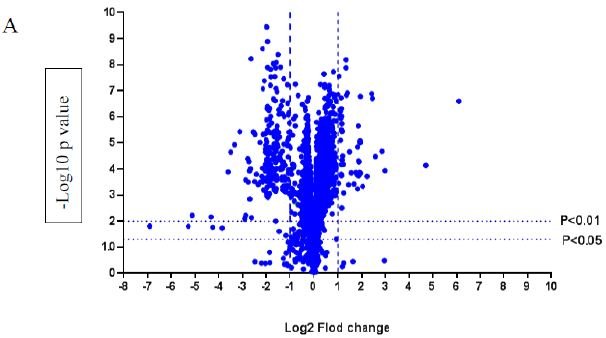
A volcano plot of phosphopeptides detected after treatment with DON is presented in Figure 1A. Identified proteins with significantly increased and decreased phosphorylation status are illustrated in Figure 1B. In this graph the values greater than +1 and lower than -1 represent more than 2-fold increase or decrease in phosphorylation, respectively (P < 0.05).
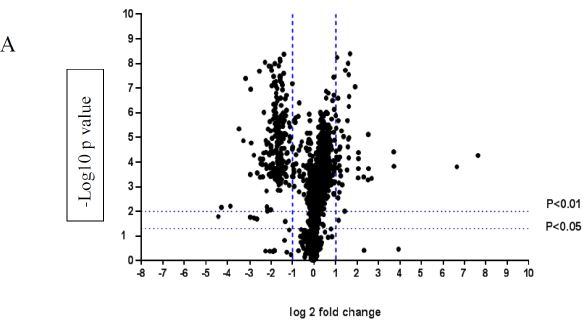
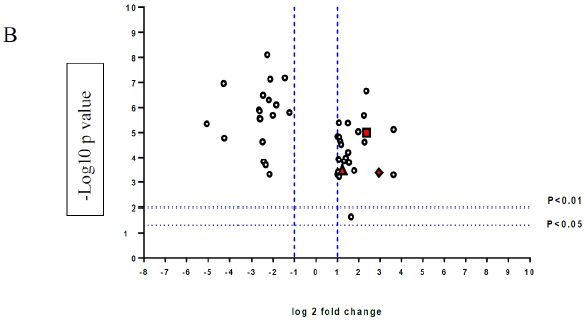
fig 1a

fig 1b

Figure 1: A volcano graph illustrating distribution of different upregulated and downregulated fragment peptides in bovine theca cells exposed to DON. Fold change threshold >2 (log2=1) for up-regulation or <2 for down-regulation) were used to assess differentially expressed proteins. The Y axes indicate significance levels. Graph A illustrates all the phosphorylated proteins inside the cells. Identified proteins with significantly increased and decreased phosphorylation status are illustrated in graph B. The core MAPKs 1, 13 and 14 are shown as red triangles, diamonds and squares, respectively.

Differential Regulation of the Phosphopeptides Expression in DOM-1

A volcano plot of phosphopeptides detected after treatment with DOM-1 is presented in Figure 2A. Identified proteins with significantly increased and decreased phosphorylation status are illustrated in Figure 2B. In this graph the values greater than +1 and lower than -1 represent more than 2-fold increase or decrease in phosphorylation, respectively (P < 0.05).
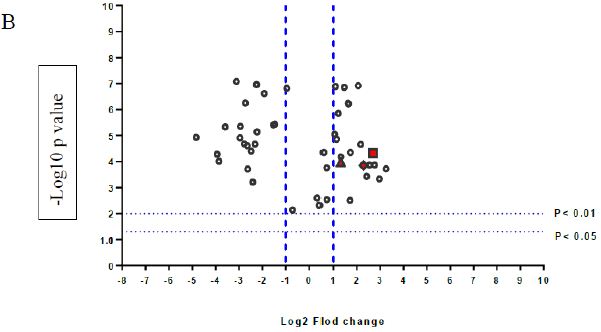
fig 2a

fig 2b

Figure 2: A volcano graph illustrating distribution of different upregulated and downregulated fragment peptides in bovine theca cells exposed to DOM-1. Fold change threshold >2 (log2=1) for up-regulation or <2 for down-regulation) were used to assess differentially expressed proteins. The Y axes indicate significance levels. Graph A illustrates all the phosphorylated proteins inside the cells. Identified proteins with significantly increased and decreased phosphorylation status are illustrated in graph B. The core MAPKs 1, 13 and 14 are shown as red triangles, diamonds and squares, respectively.

Biological Functions Associated with Mycotoxin Exposure

The most predominant biological functions associated with mycotoxin exposure were regulation of kinase activity and cellular response to growth factor stimuli. The most predominant molecular functions were receptor of signaling protein serine/threonine kinase activity and MAP kinase activity (Table 1). Table 1 showed that the most predominant molecular functions were receptor signaling protein serine/threonine kinase activity and MAP kinase activity. Identification of gene ontology (GO) annotation was performed by Reactome, and illustrated by STRING protein interaction software.

Table 1: Gene ontology annotation of major biological and molecular functions associated with proteins phosphorylated or dephosphorylated in theca cells by mycotoxin exposure.

Pathway description

Count in gene set

False discovery rate

Biological function:

Regulation of kinase activity


8

0.00178

Regulation of cellular response to heat

4

0.00253

Protein folding

5

0.00269

Cellular response to growth factor stimulus

7

0.00269

Regulation of protein kinase activity

7

0.00295

Molecular function:

Receptor signaling protein serine/threonine kinase activity


5

1.13e-05

MAP kinase activity

3

0.000311

Significance was calculated within SIEVE using a standard t-test. Statistical significance was set at a P value < 0.05.

Network analysis with STRING shows the active interactions between these signaling molecules in the form of nodes and edges (Figure 3). In this model, network nodes represent proteins and each node represents all the proteins produced by a single, protein-coding gene locus. Small nodes illustrate protein of unknown 3D structure and the large nodes illustrate proteins of known (or predicted) 3D structure. The green nodes represent the proteins whose phosphorylation was upregulated in response to DON and DOM-1 and the red nodes represent proteins whose phosphorylation was downregulated in response to these mycotoxins. The edges represent the protein-protein associations. The blue edges represent associated from curated database and is a characteristic of gene co-occurrence. The violet edges identify genes that are homologous and are co-expressed. This STRING network shows a clear cluster of known or predicted interactions between MAPK1, MAPK13, MAPK14, EDN1, GNGT1 and YWHAB, which were hyperphosphorylated in response to DON and DOM-1.
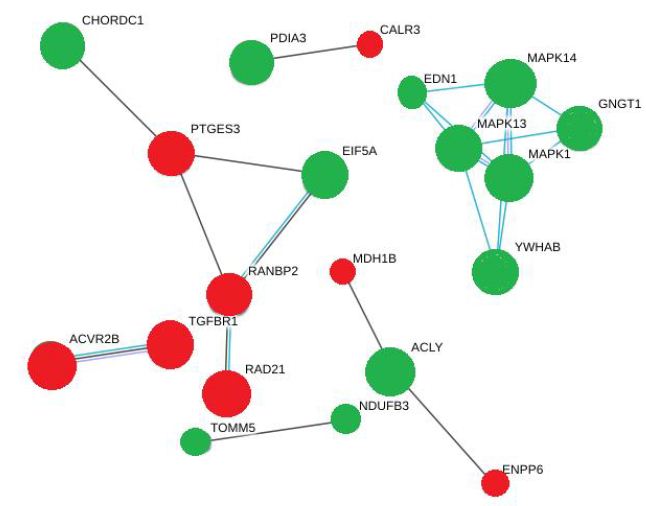
fig 3

Figure 3: A string model of different intracellular signaling pathways activated by DON and DOM-1. MAPKs are the core signaling molecules in this network green and red nodes indicate upregulated and downregulated molecules respectively. The edges are also representative of various interactions.

There was another cluster of interactions between PTGES3 and CHORDC1, EIF5A and RANBP2, involving hyperphosphorylation of CHORDC1 and EIF5A but hypophosphorylation of PTGES3 and RANBP2. Based on the statistical importance of these interactions, the proteins with increased phosphorylation and their functions are listed in Table 2. This Table showed that Both DON and DOM-1 induce simultaneous upregulation of ERK1/2, MAPK14 (p38alpha), MAPK13 (p38delta), GNGT1, EDN1 and YWHAB. They mostly regulate cell proliferation pathways and are involved in biosynthesis of lipid and carbohydrates (>2-fold; P<0.01). Table 3 demonstrated the differential proteomic analysis of hypophosphorylated proteins in response to DON and DOM-1 in bovine ovarian theca cells. Both DON and DOM-1 induce simultaneous downregulation of CALR3, PTGES3, RAD21, ACVR2B, and TGFBR1. They mainly activate or deactivate apoptotic processes and are involved in glucose and choline metabolism (>2-fold; P<0.01).

Table 2: Up-regulated phosphorylated Proteins of bovine ovarian theca cells in response to DON and DOM-1.

Protein name

Peptide Sequence Fold increase by DON Fold increase by DOM-1

Function

MYCBP TKLAQYEPPQEEKR

12

7

Stimulates activation of E-box-dependent transcription by MYC, a proto-oncogen protein
CALML4 YDEFIQKLTIPVRDY

12

9

Ca+2 ion binding protein, correlates with MYO5A, B and 1G, involves in cell malignancy
LAMTOR4 MTSALTQGLER

5

5

An amino acid sensing molecule and activator of TORC1 family members, which are carcinogens, promotes cell growth in response to growth factors
CXCL11 TEVIITLK

4

4

A chemotactic for interleukin-activated T-cells, involves in tumor angiogenesis
MAPK1 VADPDHDHTGFLTEYVATR

2.4

2.2

Main component of Ras/Raf/MEK/ERK cascade, mediates cell growth and survival, participates also in a signaling cascade initiated by activated KIT and KITLG/SCF.
MAPK14 HTDDEMTGYVATR

5.1

6.5

One of the four p38 MAPKs, cellular response to pro-inflammatory cytokines and physical stress
MAPK13 HTDVEMTGYVVTR


7.7


4.9


MAPK activity, one of the four p38 MAPKs, cellular response to pro-inflammatory cytokines and physical stress, activation of transcription factors such as ELK1 and ATF2
GNGT1 MPVINIEDLTEKDKLK

2.1

2.2

Signal-transducer activity, GTPase activity
EDN1 LKAQLYRDK


2.8

3.1

Positive regulation of mitotic nuclear division, protein kinase C-activating G-protein coupled receptor signaling pathway
YWHAB VFYLKMKGDYFR


4.7

5.8

Blocks the nuclear translocation of the phosphorylated form (by AKT1) of SRPK2 and antagonizes its stimulatory effect on cyclin D1
CHORDC1 SYVTMTATKIEITMRK

3.1

2.3

Involved in stress response, regulates centrosome duplication, acts as co-chaperone for HSP90
TOMM5 EDVISSIR


2.1

1.7

Mitochondrial outer membrane translocase complex, responsible for the degradation of active cytoplasmic enzyme and organelles during nutrient starvation
EIF5A IVEMSTSKTGK

2.2

2.3

mRNA-binding protein involves in translation elongation, regulates also TNF-alpha-mediated apoptosis
NDUFB3 DPWGRNEAWRYMGGFANNVSFVGALLK

2.5

2.9

Electron transform from NADH to the respiratory chain (ubiquitin), integral component of the membrane
ACLY SGASLKLTLLNPKGR


2.8

2.1

Acetyl-CoA biosynthetic process, citrate metabolic process, lipid biosynthetic process
PDIA3 GFPTIYFSPANKKQNPK


2.8

3.1

Catalyzes the rearrangement of -S-S- bonds in proteins, responds to endoplasmic reticulum stress

Significance was calculated within SIEVE using a standard t-test. Statistical significance was set at a P value < 0.05.

Table 3: Down-regulated phosphorylated Proteins of bovine ovarian theca cells in response to DON and DOM1.

Protein name

Peptide Sequence Fold decrease by DON Fold decrease by DOM-1

Function

THEM4 SIWALRGR

-33

-33

A thioestrase that involves in mitochondrial fatty acid metabolism
PDP1 LRPQDKFLVLATDGLWETMHR

-22

-22

Catalyzes the dephosphorylation of the α-subunit of the E1 component of the pyruvate dehydrogenase complex
ST6GAL2 GEDGERLYSSMSRALLR

-20

-20

Transfers sialic acid from the substrate CMP-sialic acid to galactose containing acceptor substrates from oligosaccharides
PPARG LNHPESSQLFAKLLQKMTDLR

-10

-16

Regulates β-oxidation of fatty acids, negative regulator of cholesterol storage
HNRNPA1 VVEPKRAVSR

-7

-7

Packaging of pre-mRNA into hnRNP particles, transports poly (A) mRNA from nucleous to the cytoplasm
CALR3 GKTLIIQYTVKHEQK

-7.1

-7.7

Ca+2 binding, cell differentiation
PTGES3 SILCCK

-5.6

-6.7

Cell proliferation, PGE synthase activity
MDH1B ELEKESLK

-5.6

-2.7

TCA cycle, malate dehydrogense activity
RAD21 KLIVDSVKELDSK

-5.0

-6.3

Apoptotic process, cell division, RNA polymerase II transcription regulatory, region sequence-specific binding
ENPP6 HSEIYNKVRR

-5.0

-5.3

Phosphodiesterase activity, choline metabolic process, lipid catabolic process
RANBP2 SGLKDFKTFLTNDQTK

-5.0

-5.3

Regulation of gluconeogenesis, involved in cellular glucose homeostasis, ligase activity
ACVR2B SVNGGTDCLVSLVTSVTNDLPK

-4.0

-6.7

ATP binding, metal ion binding, receptor signaling protein Ser/Thr kinase activity
TGFBR1 IELPTVGKPSSGLGPVLAVEEAGPVCFVCISLAMVAC

-2.4

-4.8

A receptor signaling protein with ser/thr kinase, activity, transforming growth factor beta binding, activation of MAPKK activity, pathway-restricted SMAD protein phosphorylation, positive regulator of apoptosis

Significance was calculated within SIEVE using a standard t-test. Statistical significance was set at a P value < 0.05.

Discussion

Analysis of biological processes and functions indicated that 30 min exposure to DON or DOM-1 activated MAPK activity and growth factor signaling pathways in the bovine theca cells. This is consistent with the known ability of DON to rapidly increase phosphorylation of MAPK3/1, and demonstrated in numerous cell type including granulosa cells [22].

According to an in vitro study, human and porcine lymphocytes responded differently when they were exposed to DON, in which exposure to low doses (30 nM) and high doses (100 nM) for 24h activated and suppressed mitogen induced proliferation of lymphocytes respectively [23]. In another study, the in vitro exposure of the porcine lymphocytes to low doses of DON (less than 10 ng/mL) stimulated immune system function by upregulation of cytokines, chemokines and inflammatory genes expression whereas at high doses (100 to 250 ng/mL ) DON suppressed immune system by activating apoptotic pathways [24].

Our result showed that three of the most significantly increased phosphoproteins were MAPK1, MAPK3 and, MAPK14. MAPK1 (also known as ERK2) is a Ser/Thr kinase which is phosphorylated by MAP2K1/MEK1 and MAP2K2/MEK2 on thr-185 and tyr-187 in response to external stimuli, and mediates many biological functions such as cell growth, survival, differentiation and apoptosis [25]. This protein is a critical component of the Ras-Raf-MEK-ERK signal transduction cascade. The ERK cascade is highly upregulated in human cancers, and is typically activated by growth factor stimulation of cell surface receptor tyrosine kinases (RTKs) and other signaling molecules with known oncogenic potential [26]. Reactome analysis suggested significant association of the MAPKs with endothelin 1 (EDN1) which is an endothelium-derived vasoconstrictor peptide. EDN1 has 2 receptors, EDNRA and EDNRB, that subsequently activate G proteins-coupled receptors [27] However, EDNRA also activates Ras-Raf-MEK-ERK signaling pathway and the upstream signaling molecules [28]. EDN1 receptors initiate intracellular signaling pathways leading to activation of MAPK3/1, MAPK14 and JNK1 [29]. In cattle the EDNR was identified in luteal, granulosa and thecal cells, and the luteal EDNRA and EDNRB mRNA levels were increased between day 1 and 10 of the estrous cycle. Moreover, the expression of EDNRA was greater in bovine theca cells than granulosa cells [30]. In contrast, follicular EDNRA and EDNRB mRNA decrease in super-ovulated cows treated with GnRH [31]. The phosphorylation of EDN1 by DON and DOM-1 treatment may account at least in part to the contribution of EDN1 in stimulating folliculogenesis. The YWHAB, also known as a 14-3-3 protein β, has a role in the Ras-signal transduction pathway and is a positive regulator of MAPK activity. It blocks the nuclear translocation of AKT1 and antagonizes the stimulatory effect of AKT on cyclin D1 expression, and eventually blocks apoptosis [32]. If indeed EDN1 and YWHAB are upstream of MAPK activity, these data suggest that DON and DOM-1 may act through these pathways. The increase in phosphorylation of these proteins in response to the DON and DOM-1, may be an initial protective response of the cells to these agents, however, there is no clear evidence for interactions between these molecules and DON. Some signaling molecules were dephosphorylated after addition of DON and DOM-1, including molecules such as transforming growth factor-β receptor type 1 (TGFBR1). This molecule is a potent inhibitor of epithelial and hematopoietic cell growth and proliferation [33]. The dephosphorylation of this protein is inconsistent with the simultaneous increase in MAPK phosphorylation observed after DON and DOM-1 treatment, although it is likely that the timing of changes of these proteins phosphorylation is not the same as the MAPKs [34]. Decreased phosphorylation of this molecule would be expected to favor proliferative pathways, which is inconsistent with the actions of DON and DOM-1 on theca cells in higher doses. A detailed time-course may also allow the determination of the sequence of intracellular pathway activation in response to DON and DOM-1.

The bottom-up mass spectrometry approach used in this study is however limited by the phosphor-enrichment strategy. The enrichment chemistry is not infallible, and it is likely that some phospho-peptides are not efficiently retained on the titanium solid phase. An alternative approach would be to separate proteins on SDS gel and perform in-gel tryptic digestion of narrow molecular mass bands containing proteins of interest. For example, MAPK1, MAPK3 and MAPK14 are between 38 and 44 kDa in size and could be easily isolated and examined without phospho-enrichment. The functional biology of the putative interactions of MAPK, EDN1, GNGT1 and YWHAB warrant exploration. Initial experiments would include the use of MAPK inhibitors to determine if MAPK activation is necessary for DON-induced changes in EDN1, GNGT1 and/or YWHAB phosphorylation.

Conclusion

This study has revealed that exposure of theca cells to low (sub-toxic) doses of DON and DOM-1 results in increased activation of several major MAPK signaling pathways similar to that of immune system cells. We concluded that both DON and DOM-1 have the potential to upregulate distinct MAPKs and downregulate specific signaling pathways that eventually stimulate bovine ovarian theca cell proliferation.

Acknowledgements

This research work was supported by NSERC Canada. We would like to thank Thermo Fisher Scientific for providing access to a Q-Exactive Quadrupole-Orbitrap Mass Spectrometer.

Supplementary Information Legends

Supplementary Table S1: The list of phosphorylated peptides in DON and DOM-1 vs. control group.

Supplementary Table S2: The list of dephosphorylated peptides in DON and DOM-1 vs. control group.

References

  1. Nani JP, Rezende FM, Peñagaricano FJ (2019) Predicting male fertility in dairy cattle using markers with large effect and functional annotation data. BMC Genomics 20: 258-259.
  2. Liu H, Liu Z, Meng L, et al. (2019) Toxic effects of 1-(N-methyl-N-nitrosamino)-1-(3-pyridinyl)-4-butanal on the reproduction of female mice. Ecotoxicology and Environmental Safety 181: 370-380. [crossref]
  3. Darwish AJMB (2019) Fungal mycotoxins and natural antioxidants: Two sides of the same coin and significance in food safety. Microbial Biosystems 4: 1-16.
  4. Kos J, Hajnal EJ, Šarić B, et al. (2017) The influence of climate conditions on the occurrence of deoxynivalenol in maize harvested in Serbia during. Food Control 73: 734-740. [crossref]
  5. Pestka JJ (2010) Deoxynivalenol: mechanisms of action, human exposure, and toxicological relevance. Archives of Toxicology 84: 663-679. [crossref]
  6. De Loubresse NG, Prokhorova I, Holtkamp W, et al. (2014) Structural basis for the inhibition of the eukaryotic ribosome. Nature 513: 517-522. [crossref]
  7. Pierron A, Mimoun S, Murate LS, et al. (2016) Microbial biotransformation of DON: molecular basis for reduced toxicity. Scientific Report 6:1-3. [crossref]
  8. Bertero A, Moretti A, Spicer LJ, et al. (2018) Fusarium molds and mycotoxins: Potential species-specific effects. Toxins 10: 244-245. [crossref]
  9. Young J, McNeilly AS (2010) Theca: the forgotten cell of the ovarian follicle. Reproduction 140: 489-490. [crossref]
  10. Spicer LJ, Aad PY, Allen DT, et al. (2008) Growth differentiation factor 9 (GDF9) stimulates proliferation and inhibits steroidogenesis by bovine theca cells: influence of follicle size on responses to GDF9. Biol Reprod 78: 243-253. [crossref]
  11. Kim H, Cho S, Choe C, et al. (2006) Effect of concentration and exposure duration of fetal bovine serum on parthenogenetic development of porcine follicular oocytes. Reproduction, Fertility and Development 19: 208-209.
  12. Allegrucci C, Hunter M, Webb R, et al. (2003) Interaction of bovine granulosa and theca cells in a novel serum-free co-culture system. Reproduction-Cambridge 126: 527-538. [crossref]
  13. ŞİMŞEK Ö, Mihm M (2014) Activity of 3\beta-hydroxysteroid dehydrogenase associated with progesterone production in bovine granulosa cells cultured under different concentrations of serum, insulin-like growth factor I, and gonadotropin. Turkish J Vet and Anim Scie 38: 358-362.
  14. You M, Matsumoto M, Pacold CM, et al. (2004) The role of AMP-activated protein kinase in the action of ethanol in the liver. Gastroenterology 127: 1798-1808.
  15. Ma J, Hart GW (2017) Analysis of Protein O-GlcNAcylation by Mass Spectrometry. Current Protocols in Protein Science 87: 24-10. [crossref]
  16. Tóth G, Bugyi F, Sugár S, et al. (2020) Selective TiO2 Phosphopeptide Enrichment of Complex Samples in the Nanogram Range. Separations 7: 74-75.
  17. Aminmarashi F, Torabi A, Beaudry F (2018) Effects of fibroblast growth factor 8 and 18 on ovine ovarian granulosa cell function. Int J Reprod Biomed 17: 435-442.
  18. Biau DJ, Kernéis S, Porcher R (2008) Statistics in brief: the importance of sample size in the planning and interpretation of medical research. Clin Orthop Relat Res 466: 2282-2288. [crossref]
  19. Ferreira D, Santarosa B, Monteiro-Toma C, et al. (2013) Anatomorphological, radiographic and tomographic studies of Schistosomus reflexus in Dorper breed sheep: case report. Arq Bras Med Vet Zootec 65: 1096-1102.
  20. Fabregat A, Sidiropoulos K, Garapati P, et al. (2015) The reactome pathway knowledgebase. Nucleic Acids Research 44: 481-487.
  21. Chang D, Nalls MA, Hallgrímsdóttir IB, et al. (2017) A meta-analysis of genome-wide association studies identifies 17 new Parkinson’s disease risk loci. Nature Genetics 49: 1511-1516. [crossref]
  22. Pestka JJ (2007) Deoxynivalenol: toxicity, mechanisms and animal health risks. Animal Feed Science and Technology 137: 283-298.
  23. Taranu I, Marin DE, Burlacu R, et al. (2010) Comparative aspects of in vitro proliferation of human and porcine lymphocytes exposed to mycotoxins. Arch Anim Nutr 64: 383-393. [crossref]
  24. Pestka JJ (2008) Mechanisms of deoxynivalenol-induced gene expression and apoptosis. Food Addit Contam 25: 1128-1140. [crossref]
  25. Kyriakis JM, Avruch JJ (2012) Mammalian MAPK signal transduction pathways activated by stress and inflammation: a 10-year update. Physiological Reviews 92: 689-737. [crossref]
  26. Pritchard AL, Hayward NKJCCR (2013) Molecular pathways: mitogen-activated protein kinase pathway mutations and drug resistance. Clinical Cancer Research 19: 2301-2309. [crossref]
  27. Minchenko DO, Tsymbal DO, Riabovol OO, et al. (2019) Hypoxic regulation of EDN1, EDNRA, EDNRB, and ECE1 gene expressions in ERN1 knockdown U87 glioma cells. Endocr Regul 53: 250-262. [crossref]
  28. Lee HJ, Wall B, Chen S (2008) G‐protein‐coupled receptors and melanoma. Pigment Cell & Melanoma Research 21: 415-428. [crossref]
  29. Stow LR, Jacobs ME, Wingo CS, et al. (2011) Endothelin-1 gene regulation. J FACEB 25: 16-28. [crossref]
  30. Ervin J, Schütz L, Spicer L (2017) Current status of the role of endothelins in regulating ovarian follicular function: a review. Anim Reprod Sci 186: 1-10. [crossref]
  31. Takagi M, Yamamoto D, Ogawa S, et al. (2008) Messenger RNA expression of angiotensin-converting enzyme, endothelin, cyclooxygenase-2 and prostaglandin synthases in bovine placentomes during gestation and the postpartum period. J Veterinary 177: 398-404. [crossref]
  32. Zheng P, Zhong Q, Xiong Q, et al (2012) QUICK identification and SPR validation of signal transducers and activators of transcription 3 (Stat3) interacting proteins. J Proteom 75: 1055-1066.
  33. Zhang J-Q, Gao B-W, Guo H-X, et al. (2020) miR-181a promotes porcine granulosa cell apoptosis by targeting TGFBR1 via the activin signaling pathway. Mol Cell Endocrinol 499: 110-115. [crossref]
  34. Shav-Tal Y, Lapter S, Parameswaran R, et al. (2001) Activin receptors: Cytokine Reference (Online book edition). Academic Press 283: 113-118.
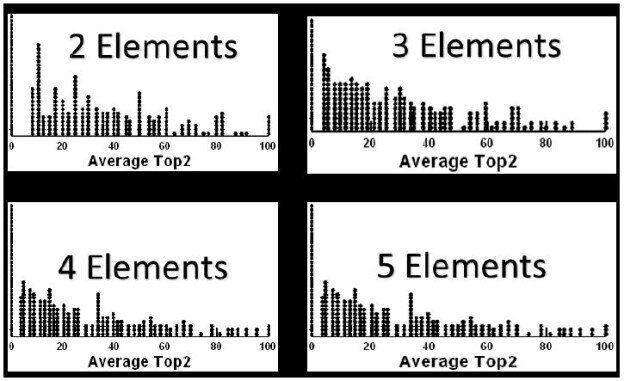
fig 3

The Shopper’s Desired Cosmetic-Counter Experience: A Mind Genomics Cartography of Emotions

DOI: 10.31038/AWHC.2021454

Abstract

The study explores the mind of the shopper from the inside out, focusing on motives and interests emerging from the respondent’s own perception of herself with respect to an ideal skincare shopping experience. A Mind Genomics cartography (experiment) investigated the phrases that a female cosmetic shopper would use to describe herself in terms of the ultimate skincare shopping experience. Respondents evaluated sixty-three unique vignettes, created from 35 different phases, vignettes created according to a permuted experimental design. The analysis focused on the discovery of ‘mind-sets’, groups of respondents who showed similar patterns in the element which they felt best escribed them. Three mind-sets emerged: Ebullient, Insecure, and Perfectionist, respectively. A second analysis (scenario analysis) looked at the way five different emotional outcomes (e.g., pleasurable, informative) interacted with the remaining elements. Four of the five emotional outcomes (pleasurable, informative, glamorizing, and therapeutic) interacted with other element, but only among two mind-sets (Ebullient, Perfectionists). There were no interactions for the third mind-set, Insecure, or interactions when the emotional outcome was stated as ‘transformative.’ The paper shows the potential of deep analysis when the data are collected in a systematized fashion, using permutable experimental designs, and individual-level modeling.

Introduction

If we were to go back 70 years ago, to the beginning of the 1950’s, visiting companies manufacturing and marketing cosmetics, we might find an interesting, albeit strange world. It would be a world where there were people whom today we call ‘giants,’ people whose names are on the door, and who are revered for their vision, their inventiveness, their marketing prowess, and for the fact that they are no longer around to prove the opposite. The 1950’s, and the war period just before, was the era of the great person. These early giants ‘knew’ at an intuitive level what the customer wanted, and how to approach the customer. The head of the company might not know how to formulate the product but knew what the customer would like One might do research on customers, perhaps to see who buys, but not for creative purposes. The research would be labelled as sales research, the recitation of ‘what happened,’ and perhaps ‘why’.

At the same time, the advertising industry was promoting the cult of expert as well, not in the creation of the vision for the product, and certainly not the product itself, but rather in the presentation of the product to the public. What to say about the product, what to show about the product, how to communicate the hard-to-communicate emotions and benefits of the cosmetic were left up to the brilliant advertisers of the 1950’s, so-called creative geniuses.

The foregoing is by way of introducing our study, something from the middle of the second decade of this 21st century, 60 years later, the span of two-three professional lifetimes, after many of the great cosmetic founds and the legendary advertising genius, built the business, and retired. The focus of this paper is not the past, but the knowledge of today’s cosmetic consumer, the ‘she’ who buys in these still early years of the 21st century.

Asking a Respondent about Herself

Consumer researcher have realized that people differ dramatically from each, not necessarily in who they are as defined by conventional demographics, but by what they do, and in a much deeper way by who they are. What people do in the world of shopping for cosmetics can be further broken down into where they shop, their self-described motives and shopping behavior, and what they end up buying. For many products, this knowledge suffices. Whether cosmetics enjoy their greatest success at the counter, and should be sold that way, is hard to answer. The success of selling high end cosmetics on the Internet may address the fact that one does not need a profoundly deep understanding of people’s mind.

There are papers addressing cosmetic sales at the store counter, and in some case contrasting the sales process with that occurring online. The issue is that the papers give a sense of general differences, but they do not give the specificity, or the insight needed to be translated into business [1,2]. For example, we know from the published literature that people define themselves by the products they buy, and in the case of cosmetics, the products that women purchase have symbolic meanings, with these meanings transferred to the purchaser when she uses the product. For example, a superior cosmetic product may enhance a woman’s self-esteem when she uses it [3]. Furthermore, as Wu & Lee (2016) wrote in their paper on impulse buying in cosmetics marketing “Cosmetics differ from other retail goods in so far as the ‘consumption situation’ must influence consumers’ ‘impulse buying behaviour’ through ‘experiential marketing’ [4]. “ In other words, for at least one group (female, unmarried, age 30-35, university degree), it is the experience at the cometic counter in a store which often leads to an impulse purchase.

The foregoing discoveries tell us that it is important to give the cosmetic customer the ‘right experience’ at the cosmetic counter. That information is helpful. It is in the form of a sociological report or anthropological report. We now know the behavior, observing from the outside in. We know what happens; we know that there is a regular pattern. What we do not know is the specifics, the words, the phrases which address the external behaviors, and perhaps even drive them.

It was towards the goal of a profound understood of the high-end shopper of cosmetics and fragrances that this study was addressed. The reality was that a great deal about how women shop for cosmetics and fragrances were already known, but the different activities, appearing to be similar to each in other when looked at against the vast array of behaviors, were actually radically different. The study was to answer the very practical question of what a high-end shopping experience should be like in the mind of the customer. The approach, Mind Genomics [5] had already been used to explore the ‘High End’ of semi-luxury items [6], as well as High End perfumes [7].

Mind Genomics

Mind Genomics is an emerging branch of science focusing on the experience of the everyday, a topic that has not been well explored, despite its ubiquity. The topics of everyday, such as the purchase of cosmetics, are often topics left to business (recording what people buy), to advertising (what persuades), to formulation (what works), and the trade (how to move the product into the hands of the customer). These different groups, business, advertising, and so forth, are not oriented towards developing systematic knowledge of an archival sort, shareable with others, simply because cosmetics are sold for the benefit of the company.

Mind Genomics moves on a different path. With part of its history traceable to experimental psychology, the goal of Mind Genomics is to relate aspects of a topic such as cosmetics to the way people respond. The research strategy is experimentation, where the independent variable is a description of the one’s experience with cosmetics, and the dependent variable is a rating [8,9]. In this project the focus is on the way the cosmetic experience is described, and the response of people as to whether the description applies to them.

Beyond the experimentation is the use of statistical methods to create ecologically valid test stimuli, viz. combinations, and vignettes. In the ordinary research world, the respondent would be presented with statements about the cosmetic experience, especially the purchasing experience. The statements would be presented one statement at a time The respondent would then rate each phase, each statement about the shopping experience, using a scale to show the degree to which the ‘statement applies to me’. The problem with the one-at-a-time stimulus is that it forces the respondent to intellectualize the evaluation. Each phrase or test stimulus must be evaluated on the same scale, although the phrases might be of different types (e.g., how I feel when i put on makeup vs what type of experience do i want to when i go shopping). Respondents have a very difficult time maintaining the same criterion for different types of elements. An easier way is to mix the different statements, create small combinations, vignettes, acquire the reactions to the vignettes and deconstruct the reactions to the contributions of the individual elements. This activity might seem convoluted, but it gets around the problem of forcing the respondent to maintain a constant evaluation criterion with radically different elements. The reason the vignette approach works is because the compound description defies simple classification. The respondent ends up using the same criterion for all vignettes, and generally stops trying to outwit the system [10].

Learning ‘Who I am as a Cosmetic Shopper’ within the Design and Analytic Framework of Mind Genomics

At the time of the research, qualitative studies with high end shoppers emerged with the obvious finding that shoppers go into stores with different objectives. The earlier work had focused on things under the store’s control, and under the manufacturer’s control. The focus was on what was being sold, and the messages communicated to different types of customers. The typing of customers was based on then standard psychographics thinking, viz., that there are a limited number of basic ‘minds or ‘mind-set’ who do the shopping. The objective was to identify these basic groups, and to assign each woman shopper to one of these basic groups. Bringing the topic forward, the objective of the study reported here is to understand how the respondent defines herself as a cosmetic shopper, but a shopper who goes to buy cosmetics for different reasons. So, we are interested in the combination WHO she is, and the emotional OUTCOME.

Given the foregoing issues, it appeared possible to apply the Mind Genomics approach with a slight change. The world view of Mind Genomics is the analysis of decisions made about the world of the everyday. The standard Mind Genomics process defines the topic, creates a set of questions which tell a story about the topic, and then generate sets of answers to each question. In most studies the Mind Genomics procedure creates short descriptions of a product or service by combining the answers or elements, doing according to an experimental design. The respondent reads the set of descriptions, the offerings, and responds by separately rating each vignette in the set. The evaluation is usually ‘good/bad’, ‘go/no go’, etc. The analysis of Mind Genomics deconstructs the evaluative rating into the part-worth contributions of the different answers, the different elements. The process is simple, all of the elements are of the same type, and there is no ambiguity.

When all of elements are ‘external’ there is no issue. The respondent would be presented with the different combinations messages about the cosmetic purchase situation and instructed to rate the degree to which the combination fits the respondent. The deconstruction of the ratings show how strongly element fits the respondent. The e research ‘twist’ in this paper involves the measurement of statements about the respondent’s predilections, the nature of the behavior at the cosmetic counter, and a phrase about one off five internalized states of feeling about what the purchase experience should create.

During the early phases of the project, it became increasingly clear that the same person could shop for different reasons at different times. The five different end uses emerged as a range of alternative ‘psychological states’ that on person might have, albeit at different times. Whether these five states of mind could be separately experienced by one shopper was not of interest. It was sufficient to find out what messages described a person who was in one of the five states. That information was new to the marketing team. The five states about the ultimate skincare shopping experience were pleasurable, informative, glamorizing, therapeutic, or transformative, respectively.

The additional requirement was that the research should not call direct attention to any overall feeling about the shopping experience. The overall feeling should be an element in the study, on par with the other elements. The concern was that in a standard approach using today’s tools of market research, the researcher might simply create a matrix, the columns corresponding to the five states of ultimate shopping experience (viz., pleasurable .. transformative), the rows corresponding to different statements about the experience, and then for each column (state of experience), instruct the respondent to check every element which applies, or rate the fit of each element to the each of the five ultimate states of shopping experience. That approach would provide data, it always does. The question was whether the data would be meaningful. Simply asking the respondent to do something, having the respondent fulfill the request, and analyzing the data does not necessarily make the results meaningful.

Research and Analytic Steps Applied by Mind Genomics

Step 1: Define the Raw Material, Specifically Topic, Questions, and Elements (Answers to the Questions)

Mind Genomics works by presenting combinations of messages to the respondent and getting the answer. The steps involve the topic, questions which ‘tell a story’, and a variety of stand-alone phrases which answer questions.

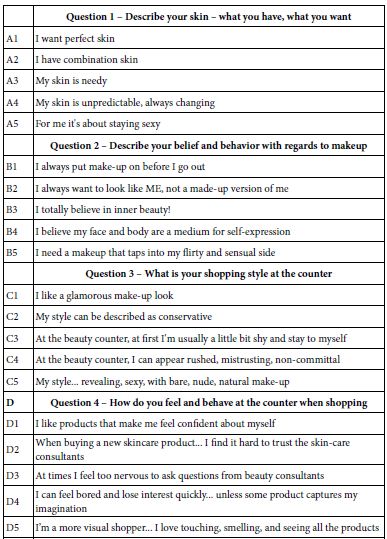
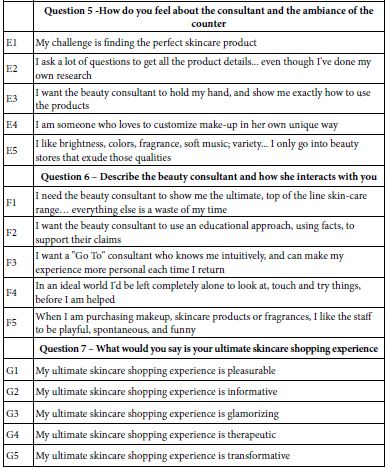
The topic is ‘What describes ME’. Table 1 shows the seven questions, and the five answers to each question. These questions attempt to tell a story. The requirement to ‘tell a story’ Is not an absolute requirement. Rather, the idea of telling a story is to provide a framework wherein information can be presented to the respondent in a meaningful and seemingly rational format.

Table 1: The raw material for the study, comprising seven questions and five elements (answers) for each question.

table 1(1)

table 1(2)

Mind Genomics is flexible. Occasionally, ‘stray elements’ with no home find themselves inserted into a question. Thus, Question 1 (Describe your skin – what you have, what you want), has four elements about the skin (A1-A4), and room for a fifth element. In that case, A5 was put in (A5: For me it’ about staying sexy).It makes no difference as long as the element does not clearly contradict elements from other questions. The structure of questions and answers is done for bookkeeping purposes, and as an aid to the underlying experimental design. The respondents never see the questions. They only see answers, or more accurately, they only see combinations of answers.

The seventh question is the key to the study because it presents five ways of thinking about the ideal experience. There are five such ways of thinking, which will play an important role in the analysis. However, at this time, at the start of the study, when the elements are being assembled, Question 7 (What would you say is your ultimate skincare shopping experience) is simply a question, and the answers are simply elements.

Step 2: Create 63 Vignettes or Combinations of Elements Using an Experimental Design

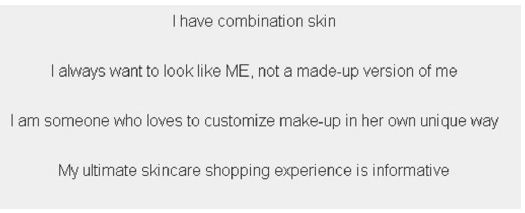
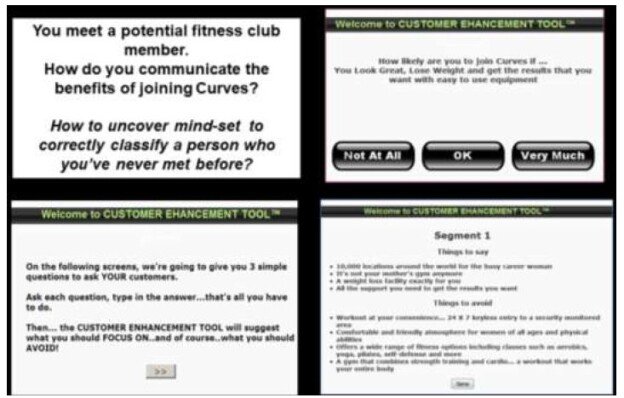
It is at this point that Mind Genomics departs from more conventional methods. It will be these small combinations of 2-5 elements each that will be evaluated by the respondent, rather than the single element. Figure 1 shows an example of a vignette.

fig 1

Figure 1: Example of a four-element vignette.

The experimental design ensures that each of the 63 vignettes comprises the appropriate number of elements and the specific combination of elements. The experimental design is nothing more than a prescription for what elements will be combined. The experimental design is created to allow the 63 ratings, one per vignette, from each respondent to be analyzed by OLS (ordinary least-squares) regression at the level of each individual respondent. At the level of the individual respondent all elements appear equally often, no vignette comprises fewer than two elements nor more than five elements, and each respondent evaluates different combinations, because the elements are permuted. That is, the permutation simply changes the code, so that A1 might become A3, A2 become A4, A5 becomes A2 etc. [11].

Figure 1 shows an example of a four-element vignette. The elements are put together without any connectives. The structure of the vignette itself is a set of texts put one below the other, all centered It is easy to graze across the text and assign a rating. The structure of the vignette prevents it from become a densely worded concept. The respondent has no trouble le ‘grazing’ through the vignette, assigning a rating, and then going on to the next vignette.

Step 3: Create a Rating Scale, and an Orientation Page

Figure 2 shows the orientation page, and the rating scale. The respondent does not need an introduction to the topic, other than knowing the name of the study, the rating scale (How well does this concept describe YOU?), and some additional house-keeping information. The vignette gives away a little as possible about the nature of the design.

fig 2

Figure 2: The orientation page with the rating scale.

Step 4: Invite Respondents to Participate

The respondents comprise individuals who sign up for so-called ‘online panels.’ The individuals provide information about which they are their interests, etc. and ‘opt in’ to participate. With the increasing number of online surveys, working with these panelists has become the preferred method for research. The respondents do the surveys for compensation, but the specific agreement remains a matter between the individual and the online panel company. As a cautionary note, it is usually easier to work with these online panel providers than to source panelists oneself.

Step 5: Acquire the Data and Transform the Data into a Form Usable for Subsequent Analyses

The actual interview lasts about 10 minutes, with the respondent reading the orientation, and rating the 63 vignettes, followed by a self-profiling questionnaire.

The respondents rated each of the vignettes on a 9-point scale. Managers who use the data from these types of studies often express difficulty understanding what the ratings mean. Indeed, such difficulties are more widespread than one would like to believe. It is easy to work with an anchored Likert Scale, such as our 1-9 scale, but what does a rating of 4 or 6 or 7 mean? The question is profound. S.S. Stevens, legendary psychophysicist at Harvard University in Experimental Psychology during the years 1938 to 1973, often stated as much, when he averred that one of the hardest problems in science is to convert a continuum to a yes/no (Stevens, 1968, personal communication to author) The issue of the ‘best’ conversation is deceptively simple until the researcher is faced with a practical issue such as communicating with managers.

The common practice by consumer researchers is to divide this anchored Likert or category scale into two parts, corresponding to NO and YES, respectively. The division point is a matter of personal preference. For this study, the focus was on a stringent definition of ‘fits me’. The stringent criterion led to this division: Ratings 1-7 transformed to 0, and Ratings 8-9 transformed to 100. Following the transformation, a vanishingly small random number was added to the transformed ratings. The magnitude of the number (<10-5) is such that it adds the requisite variation to the rating in case all ratings from a respondent would end up being 1-7 (all transformed to 0) or 8-9 (all transformed to 100). In that case the regression program would simply crash without the miniscule variation introduced by the random number.

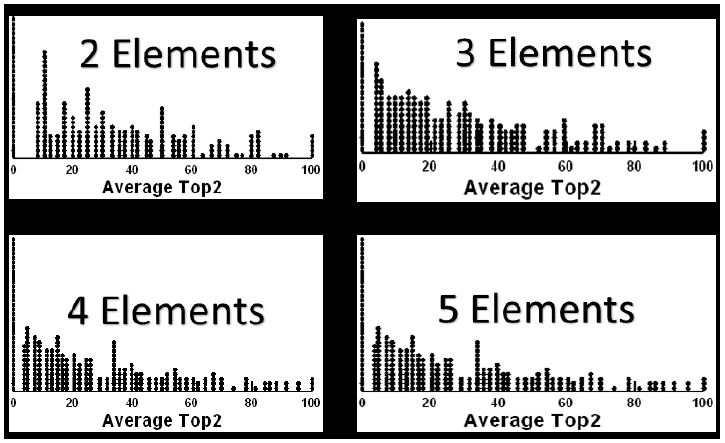
Figure 3 shows a preview of the data that will be used for rest of the analysis. A total of 251 women, cosmetic shoppers participated, each evaluated 63 different vignettes. Each respondent generates an average transformed value, which shows us the degree to which the respondent feels that the vignette describes her. The distribution of this average is shown by graph. The average ranges from 0 to 100, again with each circle corresponding to a respondent.

fig 3

Figure 3: Distribution of average Top2 ratings, by vignettes comprising 2, 3, 4 and 5 elements, respectively. Each point in the graph corresponds to one of the 251 respondents.

The figure is broken out into the averages of each of the 251 respondent for those vignettes comprising two elements, three elements, four elements, and five elements, respectively. As the number of elements in the vignette increases, there is a sense conveyed by the graph that a greater number of respondents feel on average that the vignette DOES NOT DESCRIBE THEM (viz., the distribution skews to the left, and the lower averages). As yet, however, we do not know anything about the ‘internals’ of the vignettes, viz., which elements drive a feeling of ‘describes me’.

Step 6: Create a Data Matrix Ready for OLS (Ordinary Least-squares) Regression Analysis

The data matrix comprises 63 rows for each respondent or 15,813 rows for the total panel of 251 respondents. Each row corresponds to a specific vignette, an a specific respone.t

The columns are set up as following:

Column 1 = Column order in the matrix. This is very important, when the researcher wishes to sort the data, and do analyses on certain parts of the matrix. Giving each row an order number allows the researcher to sort the data at the end of the analysis, so the matrix can be returned to its original form.

Column 2 = Respondent identification number (101-351). The respondent identification number is repeated 63 times, once for each vignette.

Column 3 = Order of testing for that panelist (1-63).

Column 4-38 = One column for each element (A1-G5). There are 35 columns for the elements. For each row, the cells in columns 4-38 either have the number ‘0’ when the element is missing from the vignette corresponding to the row, or the number ‘1’ when the element is present in the vignette corresponding to the row.

Column 39 -Rating assigned by the respondent on the 9-point scale

Column 40 – The transformed rating from column 39, being either 0 or 100 added to the vanishingly small random number. For ratings of 1-7 the transformed value is 0. For ratings of 8-9 the transformed value is 100.

Column 41 – Membership of the respondent in a two-mind-set solution, explained below

Column 42 – Membership of the respondent in a three-mind-set solution, explained below

Remaining columns – classification information about the respondent (age, products used, stores shopped, education, income, etc.).

Step 6: Create a Grand Model for the Full Set of Respondents

Recall that the variable TOP2 takes on the value 0 when the vignette was assigned the rating 1-7 and takes on the value of 100 when the vignette was assigned the rating 8-9. The model using all the data is expressed as: TOP2 = k1(A1) + k2(A2) … k35(G5).

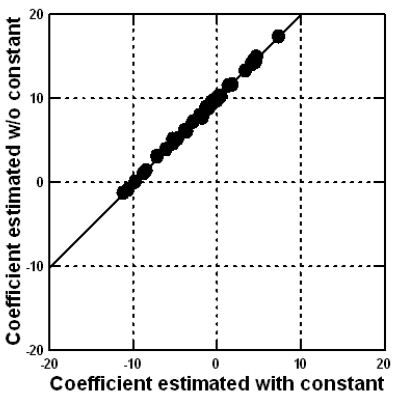
The foregoing equation comprises 35 terms, one term for each of the 35 elements. The coefficients are the weighting factors. The model does not use an additive constant, the reason being that the model will be used in several different ways, and the elements must have coefficients that are directly comparable to each other, without the contribution of an additive constant. In this way there is no other influence on the magnitude of the coefficients. It is important to note that the coefficients estimated with an additive constant show very similar patterns to the coefficients estimated without an additive constant, as Figure 4 shows.

fig 4

Figure 4: The 35 coefficients for the total panel estimated with an additive constant in the model (abscissa) versus without an additive constant (ordinate).

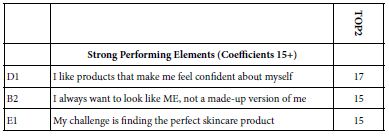
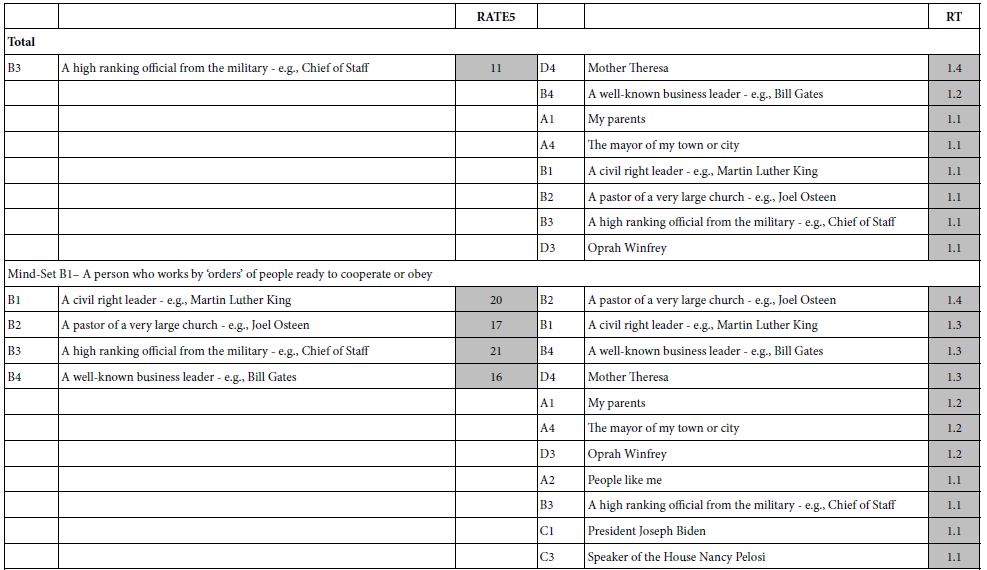
Table 2 shows the strong performing elements for the total panel. For these models or equations without the additive constant, coefficients of 15 or higher are ‘meaningful’ from previous observations. Surprisingly, out of 35 elements selected by professionals in the cosmetic business, only three elements emerge as strong performers, strong definers of oneself. This is a remarkable finding. One would have thought that there would be many more strong-performing elements. As the data will suggest, the paucity of strong performing elements may be the consequence of the existence of underlying mind-sets, with different points of view, which end up neutralizing each other in the data from the total panel.

Table 2: Strong performing elements for the total panel.

table 2

Step 6: Create 251 Individual-level Models, Cluster the Individuals Using the Models, Extract Two and then Three Clusters (Mind-Sets)

A hallmark of Mind Genomics is the use of the data to extract mind-sets, groups of individuals with similar patterns of coefficients. The coefficients, in turn, show how the respondent ‘weights’ each of the 35 elements to drive the rating of TOP2 (viz., the rating of 100 after the transformation).

A key benefit of the underlying experimental design is that each respondent from the 251 respondents evaluated the precise elements so that the researcher can apply OLS regression to the data from each respondent. This approach produces a matrix of 251 rows, one per respondent, and 35 columns, one per element.

The matrix becomes the basis for clustering, to identify basic groups. Before the clustering, however, the matrix was further subject to statistical analysis, using principal components factor analysis. The 35 variables, viz. the coefficients, were reduced to five independent factors. Each respondent was assigned by the factor analysis to a location in the new five-dimensional space. The locations are defined by the ‘factor scores’ which differ by respondent, and map to the original 35 coefficients.

The final step in the clustering was to apply k-means clustering to the newly created data matrix comprising 251 rows (one row per respondent) and five columns (one column for each newly created factor). The clustering computed a distance between each pair of the 251 respondents, and located the respondents first into two groups, and then into three groups [12]. The two groups (clusters, mind-sets) could not be easily interpreted because there were too many ‘stories’ intertwined. The three groups were far more easily to interpret.

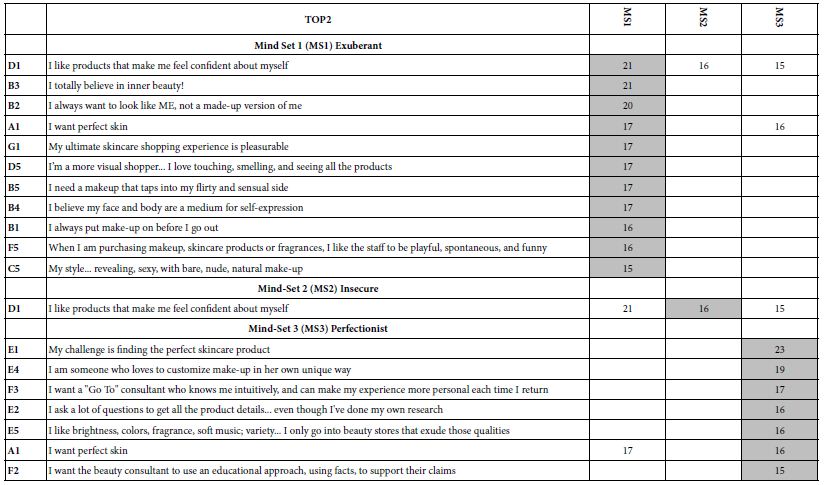
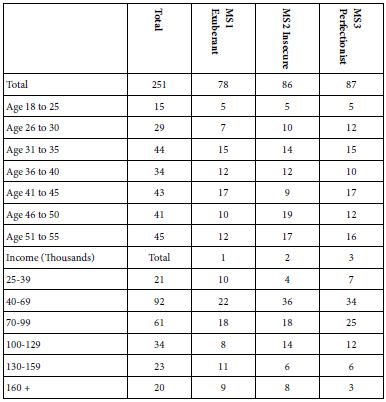
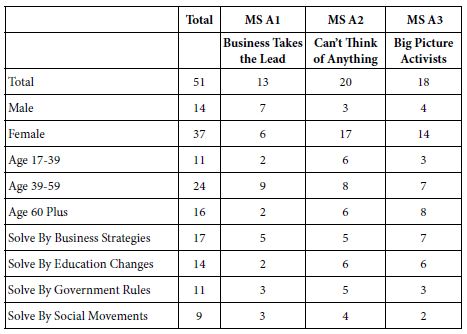
Table 3 suggests three different and easy to name mind-sets, each again showing fewer than 35 elements which perform strongly, viz., with a coefficient of 15 or higher. The three mind-sets are distributed across age and income (Table 4).

Table 3: Strong performing elements for three emergent mind-sets.

table 3

Table 4: Age and income of the total panel and the three mind-set.

table 4

MS 1 (Exuberant) – A sense of a woman who loves life, and wants to look it, and live it.

MS2 (Insecure) – A person who wants to feel secure. Surprisingly, this mind-set reacts strongly to only one element.

MS3 (Perfectionist) – A person who wants to know what she is doing, and ‘get it right’.

Interaction – How end uses acts as ‘directors’ of the performance of other elements

Ewald & Moskowitz (2007) introduced the of scenario analysis to understand the interactions among variables [13]. The idea is that elements may interact with each other, affecting the way that respondents respond to the vignette. For example, when the item can have one of several different brands, having one brand in the vignette can set an expectation, whereas having a different brand in the vignette will set a different expectation. The way to discern the effect of the brand on the performance of the elements is to separate the vignettes by brand, thus creating strata, and run the study for each stratum separately in that way it is possible to see how the coefficients of all of the non-brand elements change when the brand changes.

In our study on cosmetics, we have one group of elements, those in Question G, on one’s ideal skincare shopping experience. There are five different statements about ultimate experience, ranging from Pleasurable (G1) to Transformative (G5). Tables 2 and 3 suggest that these are not important elements in the mind of the respondent to describe oneself, a perfectly plausible result. The elements deal with the state of mind. Perhaps one does not feel that the ultimate skincare shopping experience is relevant as a descriptor of oneself.

In this final analysis of the data, we revisit the ultimate skincare shopping experience, not as an element which varies in competition with four other elements, but rather as a constant, present in all vignettes in a stratum. The process is straightforward. W first creates six strata of vignettes from the raw data. A stratum comprises all vignettes containing one specific elements from Question G on ideal experience This first step in the scenario analysis is means creating one stratum each for vignettes comprising G1, a second stratum for vignettes comprising G2, etc., and finally a sixth stratum for vignettes absent an element from G, by design.

We run the six regression equations, with only 30 elements (A1-F5). The elements G1-G5 are fixed in a stratum. We look at the strong performing elements, operationally defined as 30 or higher. When we do this analysis, we find the following:

  1. For each of the five described ultimate skin care shopping experiences, no element reaches 30 when we look at the total panel across the six experiences (G0 and G1-G5).
  2. When we look at mind-sets, one experience, ‘transformative’, fails to produce any element with coefficient of 30 above.
  3. When we look at the mind-sets, each mind-set shows specific strong-performing elements.
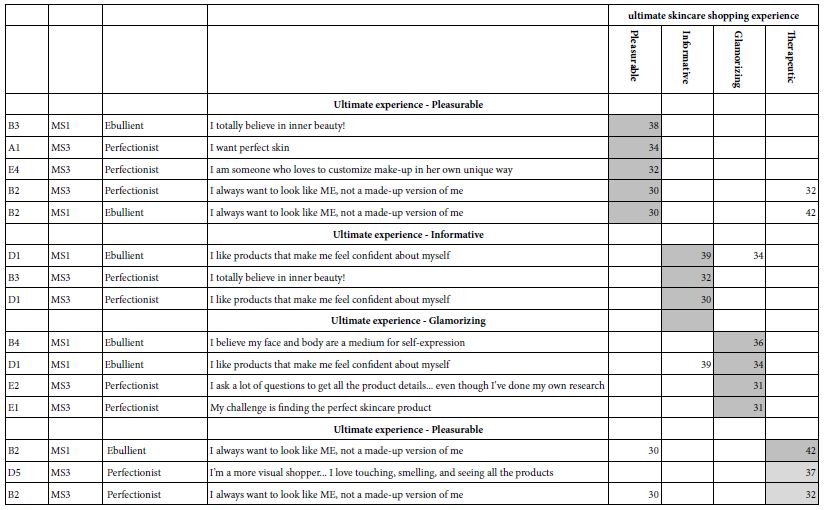
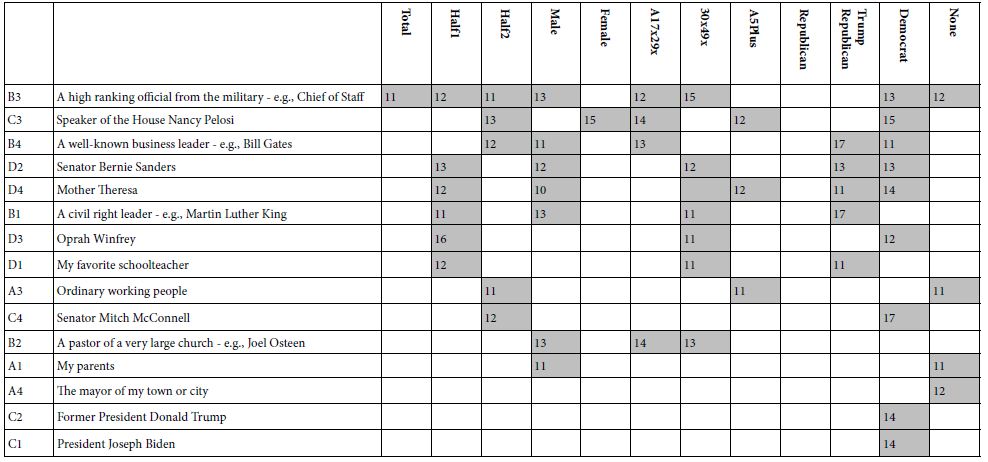
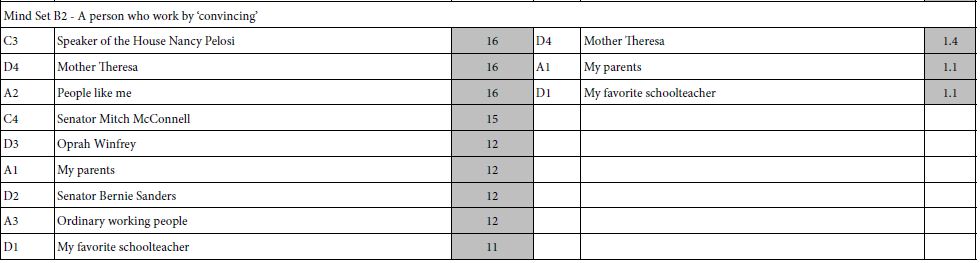
  4. We conclude that there is more to creating mind-sets about what elements drive strong responses. There is the distinct possibility that the focus must be on the combination of topic, mind-set and situation, as shown by Table 5, specifically by strong performing elements for a mind-set which change according to the stated ultimate skincare shopping experience.

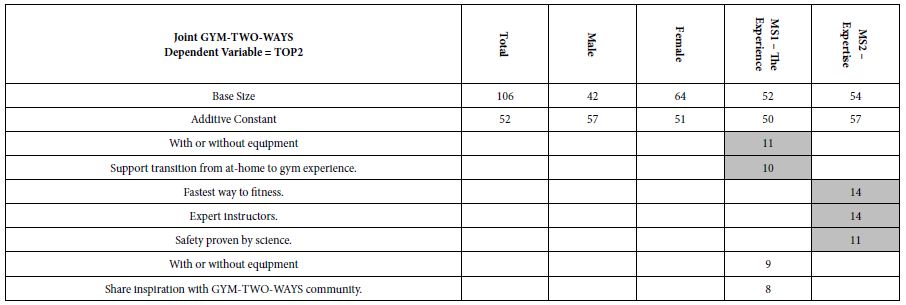
Table 5: Scenario analysis, showing how the ultimate skincare shopping experience, when directly stated in the vignette, can increase the likelihood of a respondent saying, ‘it describes me’.

table 5

Discussion and Conclusions

Mind Genomics cartographies were designed for rapid scans of a product or service category, at first to identify what ideas as messages work, but then as way to understand the topic of how a person makes a decision within a specific, granular aspect of life. The early studies, of which this is an example, having been run about ten years ago, in 2012, required the managers, marketers, researchers and sales individuals to structure their thinking, and forced a systematized approach onto what had previously been the domain of the artist marketer or creative advertising professional.

It became clear over time with this study and with others that the experts had a great more knowledge than they were even aware of. There were ideas about what words and phrases worked, and senses of how these strong words and phrases were appropriate or not appropriate for given situations. What became also increasingly obvious was that the knowledge about the desired cosmetic experience was unorganized in the minds of the experts The knowledge was there, as well as the realization that there were profound differences among women in the way they shopped. Knowledge of this profound knowledge emerged as anecdotal, for the simple reason that the world of cosmetics (and fragrances) operated at two levels. At the very concrete level, there were product tests, and attitude and usage questions about brands, and feelings. The product tests were done on an as-needed basis, with technical reporting needed for product design and development. At a higher level was the tracking studies, about products used, feelings toward products, towards the category, and so forth. The results of these high-level studies emerged as charts, with a lot of trends, but very little specific information that could be used ‘as needed’, in an off-the-shelf format.

The data tables in this paper suggest immediately that there is a fertile field to be planted and tilled. This field comprises the systematic analysis of messaging, not simply to show to the ‘client’ that one’s creative ‘works, but rather a database which can drive new and important insights. The time has now arrived for the business community to invest in the systematic data basing of communications, phrases, not at the level of 20,000 feet, couched in generalities and endless tables, but rather in simple-to-use data created at the level of granular experience. The contribution of Mind Genomics to that prospect is a simple system, template (see www.BimiLeap.com), with rapid turnaround (hours), and of low cost and low risk. The study on cosmetics is simply one more example of what can be accomplished in a short time, with little effort.

References

  1. Hong BS, Kwon YJ, Park SH, Paik IS (2008) The effects of relational benefits and commitment on word-of-mouth intention and repurchase intention for cosmetic purchaser in internet shopping mall. Journal of the Korean Society of Clothing and Textiles 32: 1202-1212.
  2. Tajuddin K, Nikdavoodi JN (2014) Cosmetic buying behavior: examining the effective factors. Journal of Global Scholars of Marketing Science 24: 395-410.
  3. Kalender GI (2021) The symbol of cosmetic products as social distinction and the false needs of shopping for cosmetics at department stores aroused by women’s magazines. Advances in Journalism and Communication 9: 1-11.
  4. Wu P, Lee CJ (2016) Impulse buying behaviour in cosmetics marketing activities, Total Quality Management & Business Excellence 27: 1091-1111.
  5. Moskowitz HR, Gofman A (2007) Selling Blue Elephants: How to Make Great Products that People Want Before They Even Know They Want Them. Pearson Education.
  6. Bevolo M, Gofman A, Moskowitz HR (2012) Premium by Design: How to Understand, Design and Market High End Products. Gower Publishing, Ltd.
  7. Horoszko N, Moskowitz D, Moskowitz H (2018) Discovering and pinpointing the brand DNA of five great perfume brands. In Understanding the Marketing Exceptionality of Prestige Perfumes (pp. 26-73). Routledge.
  8. Milutinovic V, Salom J (2016) Mind Genomics: A Guide to Data-Driven Marketing Strategy. Springer.
  9. Moskowitz HR, Gofman A, Beckley J, Ashman H (2006) Founding a new science: Mind genomics. Journal of Sensory Studies 21: 266-307.
  10. Porretta S, Gere A, Radványi D, Moskowitz H (2019) Mind Genomics (Conjoint Analysis): The new concept research in the analysis of consumer behaviour and choice. Trends in Food Science & Technology 84: 29-33.
  11. Gofman A, Moskowitz H (2010) Isomorphic permuted experimental designs and their application in conjoint analysis. Journal of Sensory Studies 25: 127-145.
  12. Likas A, Vlassis N, Verbeek JJ (2003) The global k-means clustering algorithm. Pattern Recognition 36: 451-461.
  13. Ewald J, Moskowitz HR (2007) Market forces: The push-pull of marketing and advertising in the new product business. Chapter 8 103-122.In: Accelerating New Food Product Design and Development (ed. J.H. Beckley, M.M. Foley, E.J. Topp, J.C. Huang & W. Prinyawiwatkul), Blackwell Publishing and the Institute of Food Technologists, Chicago.

Recent News in Medical Nutrition Therapy

DOI: 10.31038/NRFSJ.2021423

Abstract

Medical nutrition is essential part of the medical therapy. Undernourished patients predict worse outcome in various disease states and higher costs for the healthcare system. Research activity and presentation of best practices ensure the continuous development of this discipline. Here, some selected news are introduced from the last 4-6 years. The GLIM criteria serve as internationally accepted uniform tool for assessment of patients nutritional status instead of the several assessment tools applied before. In the field of parenteral nutrition huge development was the introduction of the GLP-2 agonist teduglutide that help short bowel patients to the gut adaptation. An other discovery was the indicator function of citrulline in the same patient group. Some new recognitions in the field of macronutrients amino acids and lipid emulsions are also discussen. Finally three preactical innovations of enteral nutrition are negotiated: the recommended use of supplemental parenteral nutrition for patients where planned macronutrient supply can not be reached via enteral nutrition, the bioavailability of amino acids administered orally or enterally which is wors than previously conceived and the use of citrulline in the oral and enteral nutrition is recommended due to its multiple benefits and good bioavailability.

Keywords

Medical nutrition, Parenteral nutrition, Enteral nutrition, GLIM criteria, Teduglutide, Amino acid, Fat emulsion, Citrulline

Introduction

Nutrition therapy is a dinamically developing specialty. One important part of it, the medical nutrition therapy obviously must be part of the therapeutic armamentarium because undernutrition definitively worsens patients outcome, elongate recovery time and increase treatment costs. Some of the recent findins influenced the strategy and/or daily practice of this discipline. Also, appearance of precision medicine influenced the doctors attitude in this aspect; therapeutic consideration became more accurate and carefull. Here we gethered highlights of the nutrition therapy of the last ca. 5 years and present in a condensed form focusing to the parenteral and enteral nutrition.

Assessment of Nutritional Status of Patients

During the past decades many assessment tools have been developed. Most used ones are the NSN2000, the NRS-2002, the SGA, the MUST, the MNA and mini-MNA, etc. Most of them are specifically good in certain patient population and bear weaknesses in other fields. Internationally, in 2016 started a discussion among leaders of various potent nutrition-oriented scientific societies about development of a new tool enabling global use with global consensus. By 2019 GLIM criteria was elaborated [1].

GLIM criteria (Global Leadership Initiative on Malnutrition) is a two-step evaluation of patients’ parameters having risk of undernutrition. First step is an assessment of patients’ parameters with one of the previously used screening methods. Those who are at risk for undernutition according to these assesments, should be subjects of the second assesment. In this 2nd phase three phenotypic and two ethiologic criteria are assessed. Just one criterion should be present from both group of criteria to declare diagnosis of undernutrition. Phenotypic criteria are either accidental and tendencious loss of weight or BMI under 18.5 or reduction of muscle mass. Ethiologic criteria are reduced food intake or inflammation or presence of devastating disease.

The usefulness of this tool has been tested in various patient and disease categories during the last 2 years and are running as well [2-4]. To date, the correspondence with empirical results and declaration of undernutrition according to the GLIM Criteria has been confirmed [5].

Parenteral Nutrition

Parenteral Nutrition (PN) is one of the most risky way of antificial nutrition even if this risk is less than that of several intravenous medications. Parenteral nutrition may provide a more risky nutritional form than Enteral Nutrition (EN), terefore EN is the preferred route of administration however, in certain situation this is unavoidable and certainly more efficient that EN. The very first example of this PN-dependent condition is the Small Bowel Syndrome (SBS). In this theme most recent development was the introduction of teduglutide.

Introduction of Teduglutide into the Daily Routine

Teduglutide is a synthetic analogue of glucagon like peptide-2 (GLP-2). Very similar to GLP-1 agonists, which are successfully used for ca. a decade in the diabetes therapy, as this incretine hormone is produced in the small intestine. The GLP-2 hormone is also produced in the enteroendocrine L-cells of the lower Gastrointestinal Tract (GIT), closer in the ileum and colon and its receptors are located in the same gut-segment. GLP-1 and GLP-2 are synergistically help the organism respond to nutrient availability but their main target differ. Teduglutide slows down proximal motility of the GIT, drives crypt cell proliferation by facilitation of the receptors and thus it increases the development of enterocytes, regenerates the intestinal musosa and helps enlarge the mucosal surface by rising villus height that shrink in absence of enteral feeding, on a whole it drive restoration of integrity of the gut wall [6].

Clinical results of use of teduglutide are fairly good: 20-24% of patients on exclusive Total Parenteral Nutrition (TPN) can get rid of it and more than half of the patients can decrease the dependence on daily TPN [7]. The success depends mostly on the remaining size of ileum and colon. Who has no one centimetre of these gut segments has no chance to improve gut adaptation with teduglutide therapy because the cells producing this hormone and its receptors are missing after the resection.

Nevertheless, beside the benefits due to the facilitation of the enterocytes accidental developments of polyps and increased tumorigenesis has been detected. Therefore a careful monitoring is required in SBS patients being on teduglutide therapy.

Selection of Parenteral Amino Acids

Amino Acids (AAs) are essential component of parenteral nutrition admixtures. As amino acids are crystalline and provision of combination of minimally 12-14 amino acids is needed to ensure building bricks for endogenous protein synthesis, industrially manufactured amino acid mixtures are used to make parenteral nutrition admixtures aseptically in the hospital pharmacy laboratory. After the 1980s, most of European hospital pharmacies had an aseptic „mixing unite” preparing individual parenteral nutrition mixtures. These laboratories, due to the introduction of industrial parenteral mixtures (2 and 3 chamber bags or „convenience systems”) have been closed, mostly based on uneconomical operation. Today, hospital based individual parenteral admixtures are present in the USA in a proportion of ca. 65-70%. In Europe, majority of Total Parenteral Nutrition (TPN) is provided in form of industrially manufactured multichamber bags, which would be suitable for ca. 82% of the patients. In case of the rest compromise is needed.

In the era of precision medicine, more attention is paid to the tailor-made therapeutic solutions. In this context personalized nutrition admixtures would be more and more required, especially in the intensive care and, in the neonatology. This tendency has recently been started [8]. The composition of amino acids has an impact víz. the effectiveness of a given TPN is linked to the proportion of essential amino acids, rather than to the total AA content [9]. Recently a tendency to open mixing laboratories is detectable in Europe as well. Moreover, lately many publications support the fact that amino acids are underdosed in a remarkable mass of patients. Inadequate protein provision results in protein deficiency with extensive negative impact [10]. This bad practice partly numerous reasons, among others it can be deducted from the erroneous judgement that protein need is equal to amino acid need of a patient. However, due to the water production during the peptid bond formation 100 g amino acid intake results in 83 g protein only. In case of enteral nutrition, where the peptide-component is usually whey proteine, the loss is higher because the enterally administered protein must be decomposed to amino acids before endogenous protein synthesis covers the needed of new proteins.

Selection of Fat Emulsions

Fat emulsions are needed to ensure essential fatty acids, to increase caloric density of the nutrition admixtures and, since today fish oil is mandatory component of the lipid emulsion mixtures, to improve n3/n6 ratio. Moreover, fish oil pure emulsion for parenteral use is available thus any TPN can be augmented with n3 Fatty Acids (FAs). The impact of n3 FAs in the prevention of inflammatory reaction mostly in the arachidonic cascade (competition of n6 and n3 fatty acids for the enzymes in their metabolic cascade) is well known. However, the importance of Eicosapentaenic Acid (EPA) and Docosapentaenic Acid (DHA) in the restoration of inflammatory process via resolvins and the partial prevention of release and action of inflammatory mediators by protectins and maresins are just recently recognized benefits. These discoveries are comparable benefits to those effected by the inhibition of proinflammatory reactions [11].

Citrulline as Indicator

In case of short bowel syndrome (status after removal of the majority of the gut) long term or life long parenteral nutrition (in form of home parenteral nutrition) is needed for majority of patients due to lack of absorbtive surface for food/nutrients. As certain adaptation of the remaining piece of gut exists: after a while many patients will be able to take up certain amounts of nutrients enterally thus partially can be feed again enterally or orally. The time frame and the extent of this adaptation is uncertain because the state of the gut could not be measured and clinicians regularly make challenge to see the patients reaction to enteral feeding. Some 10 years ago it has been discovered that the non-essential amino acid citrulline can be used as indicator of gut function [12]. Citrulline is produced almost exclusively by the duodenum and the upper intestinal (jejunal) enterocytes from glutamine and arginine. It has been documented that serum-citrulline (se-C) levels are in close correlation with the full amount of enterocytes thus with the function of the jejunum which is the main field of nutrient absorption. Randomized Clinical Studies (RCTs) and meta-analyses of RCTs demonstrated that the need of PN is inversely correlate with the se-C and so this can display the odds for the successfull enteral nutrition [13,14]. This discovery has multiple benefits because by this technique EN-challenges, that are uncomfortable for the patients, become causeless and the the PN-dependence of the patient decreases moreover the cost of EN is much lower than that of PN.

Enteral Nutrition

Enteral nutrition (tube feeding) was and still is the first choice administration route in the medical nutrition if patients are not able to drink/eat per mouth proper amounts of macro- and micronutrients. As even recent studies confirm that the measured and /or calculated amounts of nutrients are not taken up orally/enterally by significant number of partients, supplemental nutrition is required.

Supplemental PN to EN

In the last two-three decades enteral nutrition bacame declared as optimal route of feeding in patients not being able to feed orally. The old routin was that patients get either EN or, if EN was not enough or got impossible, PN. This line-up has fundamentally changed during the past 4-6 years [15]. It has been demonstrated, that most of the patients in the intensive care units don’t get the calculated (needed) amounts of nutrients. Reasons are restricted absorption, high residual volumen, poor motility, etc. In case patients can be insufficiently nourished enterally, Supplemental Parenteral Nutrition (SPN) is necessary. The only way of supplying further protein and sources of energy in such cases is administration of supplemental intravenous delivery of nutrients. By this way one can administer higher amounts of nutrients and pharmaconutrients as well [16]. As most patients on enteral nutrition have no central venous access, this type of medical nutrition can also be administered as peripheral parenteral nutrition. SPN is a safe and cost-effective way of supplying the missing energy and amino acids for patients having nutritional deficits after enteral nutrition [17]. Randomized clinical trials demonstrated that short term catabolism can be stopped in high proportions of severly malnourished (intensive care) patients by this hybrid way of nutrition with additional benefits in decrease of nosocomial infections as well [18]. SPN can and should be given to non-intensive care patients as well, if nutritional data indicate it. This type of additional nutrition usually indicated transitionally only.

Bioavailability of AA

In patients with undernutrition protein catabolism dominates and during their nutrition support they get artificial protein sources (EN-formulas) to ensure successful endogenous protein synthesis preferably by oral or enteral nutrition. Unfortunately, in many hospitals patients do not receive sufficient protein supplementation [19,20]. Among the many reasons misconception could play a role, too. In the past clinicians calculated with 100% bioavailability. The measured or calculated need of the patient had to be cover with identical protein-content of nutrition solutions. In this case declared protein-content of the nutrition solution was applied as basis for the calculation of necessary dose. Recent studies draw attention to the wastage in nutrients during the enteral nutrition. In 2002, van der Schoor and his team published the study to demonstrate the splanchnic first-pass effect affecting the bioavailability of the ingested protein but in the past 20 years clinicians and dieticians forgot about this loss [21]. Liebau and co-workers recently demonstrated the discrepancies between amounts of amino acids enterally administered and appeared in patients systemic circulation [22]. This loss may reach 15-20% as well. In this light the hyperalimentation concept of the sixties-seventies of the last century was not a big failure in the field of enteral and oral medical nutrition. Moreover, this is the time to rethink calculation technics of the daily routine in medical enteral nutrition and to use more frequently SPN.

Citrulline Fortification

Several efforts have been made to fortify enteral nutrition formulas with non-essential amino acids and conditionally essential amino acids in order to improve anabolic effect of feeding tube meals. One important example is arginin-enrichment. This type of pharmaconutrition is especially favorable in acceleration of wound healing [23,24]. Unfortunately, arginine has a high immediate metabolism in the liver (first pass effect) therefore the dose has been elevated in time. The successfull arginine-fortified formulas have in certain aspects some negative results because in high doses many patients presented adverse or toxic reactions. The change of arginine to citrulline could avoid these adverse effects, because it is direct precursor of arginine and the switch to citrulline resulted in much higher arginine blood levels than arginine administartion. Citrulline has exceptionally high bioavailability, too. Its urinary loss is minimal in comparison to arginine. Moreover, citrulline administration improved systemic amino acid availability, in genereal [25]. Further, clinical studies demonstrated its positive effects in sarcopenia and cardiovascular diseases, the latter is under investigations yet [26]. According tot he recent publications it seems citrullin will enter into the composition of EN formulas in the near future.

Discussion

Clinical nutrition is regarded as stepchild in the medical therapy, however its benefits are not to be queried. Its development is part of the global progress of medicine.

Identification of undernutrition is essential part of the patient hospital admisson. Here we displayed the novel globally accepted tool called GLIM criteria to diagnose undernutrition. This is an important advancement in the frame of international research activity because earlier the undernutrition determined on various assessment base could not ensure the comparability of the study results.

Parenteral nutrition is the most effective mode of artificial nutrition. Its unique benefit is that it can be used in patients with gastrointestinal failure. Typical example for dependence on parenteral nutrition is the increasing number of Short Bowel Syndrome (SBS). These patients often use PN life long (home parenteral nutrition), but some of them (who has more than 1,5-2m gut) are able to adapt their intestine to higher absorption rate within several months or years. This adaptation can be accelarated by the hormonal GLP-2 agonist teduglutide. Integration of this medicine into the treatment of SMS patients gives the chance of weaning off PN in a certain proportion of patients. Whether the induction of gut enteocytes successfull is, measurement of serum level of circulating citrulline became a good indicator. Both innovation basically influence home parenteral nutrition care and the quality of life of patients.

Macronutrients plays a pivotal role in medical nutrition therapy. Determination how much macronutrients (energy and protein sources) are needed to restore the patients’ anabolism after the disease-induced catabolism needs sophisticated measurements and calculations. Recent recognitions helped clinicians to refine computation of optimal amino acid supplementation. Some of the macronutrients also have pharmacological activity as well therefore this type of nutrition is called pharmaconurtition. In case of lipid emulsions new research results opened new vistas in fighting against inflammation. By this way optimal combination of various fat emulsions may improve effectiveness of medical nutrition intervention. But there are news in the field of the first choice medical nutritional mode, the EN as well. Some misbeliefs were elucidated recently. The accurate control of patients on EN revealed that there are several reasons why patients don’t get calculated amounts of EN on the wards. As adequate nutrition is prerequisit of proper healing, introduction of periperal parenteral nutrition for those who don’t tolerate higher amounts (>80% of calory and protein need) of EN, is strongly recommended. Moreover the calculation of daily dose of enteral formulas should be changed due to the hidden loss of ingested protein source. Finally the impact of introduction of novel nutrients should be stressed. Recent appearance of precision medicine force the professionals of medicine and medical nutrition to reevaluate details of daily routine and the used tools, inclusive the medicines and enteral tube feeds. One can find the way to individualized nutrition as well, especially if nutrition support teams are working in the healthcare settings. Multidisciplinaty thinking bring the new ideas and the solutions.

Summary

Lifelong learning is imperativus for healthcare professionals as well. New materials and technics may improve medical diagnosis and medical interventions. Here we displayed some of the recent news in the sphere of medical nutrition. Use of teduglutide and citrulline improve quality of life of the short bowel patients. Recent news on amino acids and fat emulsions may provide better optimalization of parenteral nutrition therapy. Novelties in the field of enteral nutrition also contribute to better service within the healthcare system. This selection of news based on a subjective decision but for those not living in this medium may demonstrate the progress of a segment of clinical nutrition.

References

  1. Jensen GL, Cederholm T, Correia MITD, Gonzalez MC, Fukushima R, et al. (2019) GLIM Criteria for the diagnosis of malnutrition: a consensus report from the global clinical nutrition community. Clin Nutr 39: 1-9. [crossref]
  2. Fiorindi C, Luceri C, Dragoni G, Piemonti G, Scaringi S, et al. (2020) GLIM Criteria for malnutrition in surgical IBD patients: a pilot study. Nutrients 12: 2222. [crossref]
  3. Allard JP, Keller H, Gramlich L, Jeejeebhoy KN, et al. (2020) GLIM Criteria has fair sensitivity and specificity for diagnosing malnutrition when using SGA as comparator. Clin Nutr 39: 2771. [crossref]
  4. Keller H, de van der Schueren MAE, GLIM Consortium, Cederholm T, Barazzoni R, et al. (2020) Global Liedership Initiative on Malnutrition (GLIM): Guidance on validation of the operational criteria for the diagnosis of protein-energy malnutrition in adults. JPEN 44: 992. [crossref]
  5. Zhang X, Tang M, Zhang Q, Zhang K-P, Guo ZQ, et al. (2021) The GLIM criteria as an effective tool for nutrition assessment and survival prediction in older adult cancer patients. Clin Nutr 40: 1224. [crossref]
  6. Kandjani OJ, Alizadeh AA, Moosavi-Movahedi AA, Kheradmand SS, et al. (2021) Expression, purification and molecular dynamics simulation of extracellular domain of glucagon-like peptide-2 receptor linked to teduglutide. Int J Biol Macromolecules 184: 812.
  7. Chen K, Joly F, Mu F, Kelkar SS, et al. (2021) Predictors and timing of response to teduglutide in patients with short bowel syndrome dependent on parenteral support. Clin Nutr 43: 420. [crossref]
  8. Ginguay A, De Brandt J-P, Cynober, L (2016) Indication and contraindications for infusing specific amino acids (leucine, glutamine, arginine, citrulline and taurine) in critically illness. Curr Opin Clin Nutr Metab Care 19: 161-169. [crossref]
  9. Iacone R, Scanzano C, Santarpia L, Cioffi I, Contaldo F, et al. (2020) Macronutrients in parenteral nutrition: amino acids. Nutrients 12: 772. [crossref]
  10. Hsu C-C, Sun C-Y, Tsai C-Y, Chen C-Y, Wang SY, et al. (2021) Metabolism of proteins and amino acids in critically illness: from physiological alterations to relevant clinical practice. J Multidiscipl Healthcare 14: 11071117. [crossref]
  11. Calder PC, Waitzberg DL, Klek S, Martindale RG (2020) Lipids in parenteral nutrition: biological aspects. JPEN 44: S21-27. [crossref]
  12. Cynober L, Moinard C, De Bandt J-P (2010) The 2009 ESPEN Sir David Cuthbertson. A new major signaling molecule or just another player in the pharmaconutrition game? Clin Nutr 29: 545-551. [crossref]
  13. Jeppesen PB, Gabe SM, Seidner DL, Lee H-M, Olivier C (2020) Citrulline correlations in short bowel syndrome – intestinal failure by patient stratification: analysis of 24 weeks of teduglutide treatment from a randomized controlled study. Clin Nutr 39: 2479-2486. [crossref]
  14. Proli F, Faragalli A, Talbotec C, Bucci A, et al. (2021) Variation of plasma citrulline as a predictive factor for weaning off long-term parenteral nutrition in children with neonatal short bowel syndrome. Clin Nutr 40: 4941-1947.
  15. Oshima T, Pichard C (2015) Parenteral nutrition: never say never. Crit Care 19: S5. [crossref]
  16. Singer P, Bendavid I, Mesilati-Stahy R, Green P, Rigler M, et al. (2021) Enteral and supplemental parenteral nutrition enriched with omega-3 polyunsaturated fatty acids in intensive care patients – a randomized controlled, double-blind clinical trial. Clin Nutr 40: 2544-2554. [crossref]
  17. Pradelli L, Graf S, Pichard C, Berger MM (2018) Supplemental parenteral nutrition in intensive care patients: a cost saving strategy. Clin Nutr 37: 573-579.
  18. Alsharif DJ, Alsharif FJ, Aljuraiban GS, Abulmeaty MMA (2020) Effect of supplemental parenteral nutrition versus enteral nutrition alone on clinical outcomes in critically ill adult patients: a systematic review and meta-analysis of randomized controlled trials. Nutrients 12: 2968. [crossref]

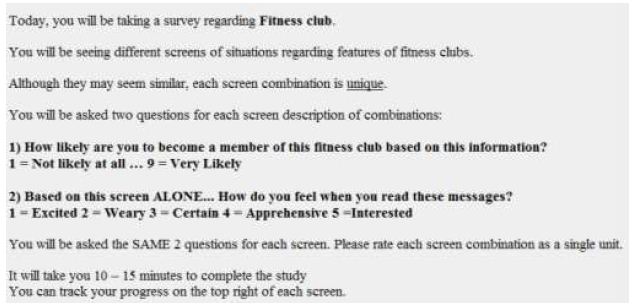
  19. Osooli F, Abbas S, Farsaei S, Adibi P (2019) Identifying critically ill patients at risk of malnutrition and underfeeding: a prospective study at an academic hospital. Adv Pharm Bull 9: 314. [crossref]
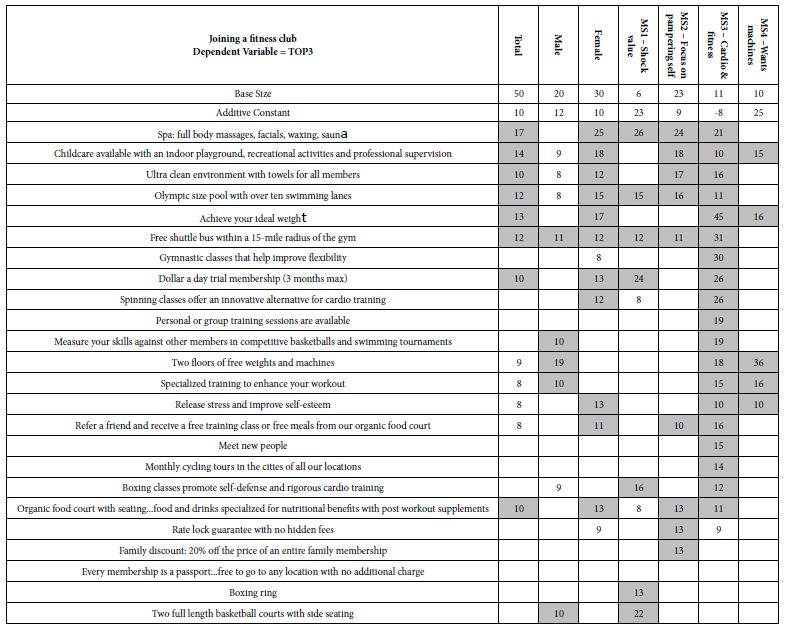
  20. Rougier L, Preiser JC, Fadeur M, Verbrugge AM, et al. (2021) Nutrition during critical care: an audit on actual energy and protein intakes. JPEN 45: P951.
  21. Van der Schoor SR, Reeds PJ, Stoll B, Henry JF, et al. (2002) The high metabolic cost of a functional gut. Gastroenterology 123: 1931-1940. [croosref]
  22. Liebau F, Király E, Olsson D, Werneman J, et al. (2021) Uptake of dietary amino acids into anterial blood during continuous enteral feeding in critically ill patients and healthy subjects. Clin Nutr 40: 912-918.
  23. Stechmiller JK, Childress B, Cowan L (2005) Arginine supplementation and wound healing. Nutr Clin Pract 20: 52-61.
  24. Liu P, Shen W-Q, Chen H-L (2017) Efficacy of arginine-enriched enteral formulas for the healing of pressure ulcers: a systematic review. J Wound Care 26: 319-326. [crossref]
  25. Bouillanne O, Mekchior J-C, Faure C, Paul M, Canouï-Poitrine F, et al. (2019) Impact of 3-week citrulline supplementation on postprandial protein metabolism in malnourished older patients: the Ciproage randomized controlled trial. Clin Nutr 38: 564-574. [crossref]
  26. Papadia C, Osowska S, Cynober L, Forbes A (2018) Citrulline in health and disease. Review on human studies. Clin Nutr 37: 1823-1828. [crossref]
Featured Image2

From Evolutionary Medicine to Precision Medicine in the Hypertension Treatment in Africa

DOI: 10.31038/IMROJ.2021651

Abstract

In ancient humans from Africa populations the hot, dry, and salt-scarce climate have almost certainly selected an efficient capacity to perspire and the development of mechanisms for the conservation of sodium in the kidneys. The more recent development of African cities following western lifestyles is revealing these selected compensatory mechanisms by means of hypertension. Africa expands from North to South (70° latitude), presenting an enormous diversity  of  climates  and  natural  environments  associated  with  different  selective  pressures.  In  order  to  improve  hypertension  treatment  in Africa it is needed to obtain new genomic data from the different African ethnic groups, as this is the only way we can put into practice precision  medicine based on evolutionary medicine.

Traditional medicine restricts itself to the study of causality inserted in a short period of time, most often dealing with the present symptomatology (acute symptoms), or sometimes also considering the natural history of the disease and the associated chronic symptomatology. Hereditary and genetically predisposed diseases further extend this time window, including the study of several generations of the patient’s family. However, when the approach to medicine is evolutionary, the time factor changes scale, as the search for causality invokes adaptive processes inherent to evolutionary mechanisms, such as natural selection.

After the emergence of the genus Homo in Africa, hominids occupied a wide variety of environments. It is now believed that Homo sapiens has originated in Africa about 500,000 to 300,000 years ago, according to a “Pan-African” model, in which gene exchange was possible through sporadic crossbreeding between geographically distinct populations of Homo sapiens or even other hominids [1-4]. Regions located near the equator have higher diversity of pathogens, and consequently have been the scene for outbreaks of meningitis, Ebola and malaria [5-7]. Some genetic variants that confer resistance to malaria are classic examples of the selection of alleles that, in homozygosity, predispose individuals to severe genetic diseases, such as sickle cell disease. Here, the existence of a large availability of food, delayed industrialization in Africa, once compared to the other cities of western culture. Africa’s later urban development has had a profound impact on health, especially in countries with the highest rates of development. For example, regarding high blood pressure, it occurs more frequently, earlier and more severely in African individuals or individuals of African descent [8]. Hypertension is a relevant public health problem, being a risk factor for cardiovascular disease and kidney failure. Hypertension affects about 25% of the adult population in the world and It is known to have a genetic [9,10].

From an evolutionary perspective, there is evidence that susceptibility to hypertension may be ancestral, and that part of the differences presented are explained by exposure to different selective pressures. The desire for salt and water and vascular reactivity, key components of susceptibility to hypertension, must have been adaptively acquired in the ancestral African environment characterized by a hot, dry and salt-scarce climate [11]. Heat dissipation is essential in hot environments and is achieved most efficiently through its   loss through evaporation, consequently humans have developed an enormous capacity to perspire. However, excessive transpiration can lead to significant losses of salt and water, which together with the low availability of salt in tropical climates, results on one hand in an increased demand for salt and on the other in the development of mechanisms for the conservation of sodium in the kidneys. In fact, it turns out that humans and non-human primates from tropical regions have a greater desire for salt and water [12-15]. Another consequence of excessive sweating is the loss of blood volume, with a subsequent increase in arterial tone and cardiac contraction in order to guarantee blood pressure and effective perfusion in the organs [16]. Thus, the genetic variation associated with these compensatory mechanisms related to the increase in arterial and cardiac contractility must certainly have constituted an advantage in the environmental context of human evolution in its most primordial phase.

Originating in Africa, our species ended up conquering new territories, expanding to other regions of the globe, at different latitudes, facing different environments. Then there was a need to adapt to new thermodynamic control mechanisms, in which the objective progressively stopped being the dissipation of heat, but rather its conservation. On the other hand, selection by demand for salt and water and cardiovascular reactivity decreased [17,18]. Thus, the greater susceptibility to hypertension  in  African  populations,  compared  to the non-African ones, results from physiological adaptations to different environments that were progressively imprinted in the genomes for about 30,000 years [19]. The most recent development of African metropolises, associated with a more stressful lifestyle, an increase in the consumption of fast-food products, with high levels of salt and promoters of overweight/obesity, highlighted the health problems that these populations face in the area of hypertension and cardiovascular diseases, revealing the synergistic effects of exposure to new lifestyles with the evolutionary processes encrypted in their genomes [19].

Currently, several genes with polymorphic variation that code for proteins involved in compensatory mechanisms of volume change and vascular reactivity, secondary to salt loss, have been identified [19]. For example, the haptoglobin gene, which has polymorphic variation only in humans, codes for  an  acute-phase  protein  that has been associated with high levels of sodium-sensitive blood pressure for more than 30 years. Population studies have shown similar allelic frequencies between two countries located at similar latitudes – Honduras (Central America) and Mozambique (Africa) [20]. In this case, it is interest to observe that the Native American population (Honduras), despite being more recent and coming from cold-adapted populations from North  Asia,  is  genetically  similar to the more ancestral one (Mozambique), reflecting a more recent adaptation that occurred in less than 20,000 years, demonstrating the strength of selection by latitude. Another gene traditionally associated with hypertension, the GNB3, has been shown to contribute to the disease in a latitude-dependent manner [19]. Evidence of selection by latitude was also found in mitochondrial genes linked to oxidative phosphorylation, and therefore also in the production of heat by cells, essential for adaptation to external temperatures [21].

The genetic variability between populations fixed by selective pressures is particularly relevant when it is intended to implement precision medicine, in which a  more  personalized  treatment,  which considers the individual’s genetic profile, allows for a more targeted therapeutic intervention. This approach is very relevant when dealing with multifactorial diseases (such as hypertension), in which several genes in partnership with the environment shape the individual’s phenotype. Precision medicine tends to use information obtained through new mass sequencing technologies. However, the few technological resources that exist in Africa, limit the collection of these data [22]. Only a small number of health and/or research institutions contribute with data, but often targeting only already known genes, thus limiting the discovery of variants in new genes [22]. In fact, an analysis of several genome-wide studies revealed that Africa is underrepresented, despite having a large number of associations between genetic variants and various diseases [23]. The relevance of these studies grows if we consider the great genetic diversity that exists within this continent. Africa expands from North to South (70° latitude), presenting an enormous diversity of climates and natural environments associated with different selective pressures. The African diaspora that happened about 70,000 years ago, occurred via a population bottleneck effect, as it is estimated that only about 1,000 individuals of East African descent have achieved this effect [24,25]. In this way, the African populations, more ancestral, end up presenting a greater genetic diversity compared to others. Then, there is an urgent need to obtain genomic data from the different African ethnic groups, as this is the only way we can put into practice precision medicine based on evolutionary medicine.

References

  1. Hublin J-J, Ben-Ncer A, Bailey SE, Freidline SE, Neubauer S, et (2017) New fossils from Jebel Irhoud, Morocco and the pan-African origin of Homo sapiens. Nature 546: 289-292.
  2. Scerri EML, Thomas MG, Manica A, Gunz P, Stock JT, et (2018) Did Our Species Evolve in Subdivided Populations across Africa, and Why Does It Matter? Trends in Ecology & Evolution 33: 582-594. [crossref]
  3. Schlebusch CM, Malmström H, Günther T, Sjödin P, Coutinho A, et al. (2017) Southern African ancient genomes estimate modern human divergence to 350,000 to 260,000 years Science 358: 652-655. [crossref]
  4. Stringer C (2016) The origin and evolution of homo sapiens. Philosophical Transactions of the Royal Society B: Biological Sciences 371.
  5. Alexander KA, Sanderson CE, Marathe M, Lewis BL, Rivers, CM, et (2015) What factors might have led to the emergence of Ebola in West Africa? PLoS Neglected Tropical Diseases 9: e0003652. [crossref]
  6. Cairns ME, Walker PGT, Okell LC, Griffin JT, Garske T, et al. (2015) Seasonality in malaria transmission: implications for case-management with long-acting artemisinin combination therapy in sub-Saharan Malaria Journal 14: 321.
  7. Zhao S, Lin Q, He D, Stone L (2018) Meningitis epidemics shift in sub-Saharan belt. International Journal of Infectious Diseases : IJID : Official Publication of the International Society for Infectious Diseases 68: 79-82.
  8. Burt VL, Whelton P, Roccella EJ, Brown C, Cutler JA, et al. (1995) Prevalence of hypertension in the US adult population: results from the Third National Health and Nutrition Examination Survey, 1988-1991. Hypertension 25: 305-313. [crossref]
  9. Kearney PM, Whelton M, Reynolds K, Muntner P, Whelton PK, et (2005) Global burden of hypertension: analysis of worldwide data. Lancet 365: 217-223. [crossref]
  10. Luft FC (2021) [Molecular genetics of human hypertension]. Der Internist 62: 223-235. [crossref]
  11. Bicho M (2018) Genetic predisposition for essential hypertension, based on studies of genetic polymorphisms in modern global human populations: The perspective of evolutionary Revista Portuguesa de Cardiologia 37: 509-510.
  12. Baker EH, Ireson NJ, Carney C, Markandu ND, MacGregor GA (2001) Transepithelial sodium absorption is increased in people of African origin. Hypertension 38: 76-80. [crossref]
  13. Brier ME, Luft FC (1994) Sodium kinetics in white and black normotensive subjects: possible relevance to salt-sensitive The American Journal of the Medical Sciences 307: S38-42. [crossref]
  14. Moskowitz DW (1996) Hypertension, thermotolerance, and the “African gene”: an hypothesis. Clinical and Experimental Hypertension 18: 1-19.
  15. Vollmer WM, Sacks FM, Ard J, Appel LJ, Bray GA, et (2001) Effects of diet and sodium intake on blood pressure: subgroup analysis of the DASH-sodium trial. Annals of Internal Medicine 135: 1019-1028. [crossref]
  16. Newman RW (1970) Why man is such a sweaty and thirsty naked animal: A speculative review. Human Biology 12-27. [crossref]
  17. Cardillo C, Kilcoyne CM, Cannon RO, Panza JA (1999) Attenuation of cyclic nucleotide-mediated smooth muscle relaxation in blacks as a cause of racial differences in vasodilator Circulation 99: 90-95. [crossref]
  18. Stein CM, Lang CC, Singh I, He HB, Wood AJ (2000) Increased vascular adrenergic vasoconstriction and decreased vasodilation in blacks Additive mechanisms leading to enhanced vascular Hypertension 36: 945-951. [crossref]
  19. Young JH, Chang Y-PC, Kim JD-O, Chretien J-P, Klag MJ, Levine MA, et al. (2005) Differential susceptibility to hypertension is due to selection during the out-of-Africa expansion. PLoS Genetics 1: e82. [crossref]
  20. Silva AP, Damasceno A, Ricchiuti V, Polónia J, Fisher N, Bicho (2012) Revista Portuguesa de Hipertensão e Risco cardiovascular 34.
  21. Starikovskaya EB, Sukernik RI, Derbeneva OA, Volodko NV, Ruiz-Pesini E, et al. (2005) Mitochondrial DNA diversity in indigenous populations of the southern extent of Siberia, and the origins of Native American Annals of Human Genetics 69: 67-89. [crossref]
  22. Pereira L, Mutesa L, Tindana P, Ramsay M (2021) African genetic diversity and adaptation inform a precision medicine Nature Reviews Genetics 22: 284-306. [crossref]
  23. Gurdasani D, Barroso I, Zeggini E, Sandhu MS (2019) Genomics of disease risk in globally diverse Nature Reviews Genetics 20: 520-535.
  24. Gravel S, Henn BM, Gutenkunst RN, Indap AR, Marth GT, et (2011) Demographic history and rare allele sharing among human populations. Proceedings of the National Academy of Sciences of the United States of America 108: 11983-11988.
  25. Macaulay V, Hill C, Achilli A, Rengo C, Clarke D, et (2005) Single, rapid coastal settlement of Asia revealed by analysis of complete mitochondrial genomes. Science 308: 1034-1036. [crossref]

Modified Dachaihu Decoction Regulates FOXO3a Acetylation Activated Autophagy and Relieving Insulin Resistance in Obesity

DOI: 10.31038/EDMJ.2021542

Abstract

Background: The previous studies of our research group indicate that the weakening of mitochondrial autophagy function is the key mechanism of obesity-induced insulin resistance, and Mitochondrial autophagy mediated by PINK1/Parkin pathway can reverse mitochondrial dysfunction. Recently, we found that FOXO3a, as an upstream regulator of PINK1, has been found to play a key role in regulating mitochondrial autophagy.However,FOXO3a is regulated by deacetylation.

Objective: To explore whether Modified Dachaihu Decoction can regulate liver mitochondrial autophagy mediated by the PINK1/Parkin signal pathway by regulating the expression of FOXO3a acetylation.

Methods: Establish cell models. They were divided into three groups (blank control group, model control group, and Modified Dachaihu Decoction group). The supernatant was extracted and determined by a biochemical method; The insulin sensitivity of each group was evaluated by a 3H-D-glucose incorporation test; MDA and TNFα、IL-6 in the supernatant were detected by ELISA level; The level of SOD was detected by spectrophotometry.The expression of mitochondrial autophagy-related proteins and the expression of FOXO3a and ace-FOXO3a were measured by Western blot.

Results: Compared with the model control group, the Modified Dachaihu Decoction group increased insulin sensitivity, and The levels of TNF- α、IL-6, and MDA decreased, while the activity of SOD increased (P < 0.05). Western blot showed that compared with the model control group, the expression of mitochondrial autophagy-related proteins and FOXO3a in the Modified Dachaihu Decoction group increased, and the expression of ace-FOXO3a decreased (P < 0.05).

Conclusions: we speculate that in this experiment, Modified Dachaihu Decoction may regulate mitochondrial autophagy mediated by PINK1/ Parkin signal pathway by downregulating the expression of FOXO3a acetylation, to reduce Hepatic Insulin Resistance in Obesity.

Keywords

FOXO3a Acetylation, Autophagy, Hepatic Insulin Resistance

fig 2

Attitudes towards Closing Economic Gaps: Mind-Sets and the Responses to Solutions and to Solvers

DOI: 10.31038/PSYJ.2021351

Abstract

The paper presents two studies dealing with attitude towards closing economic gaps, as defined by the poet Percy Bysshe Shelley’s aphorism ‘The rich get richer, and the poor get poorer.’ Both studies worked with sets of 16 different messages, elements that were combined into small vignettes comprising 2-4 elements, the combinations dictated by an underlying experimental design (Mind Genomics). In Study #1 the elements were actual solutions respondents rating the feasibility of the combination of solutions The results from 51 respondents suggest three different mind-sets about what will close the economic gaps ways of evaluating the elements, so-called mind-sets (MS- A1 Business takes lead to create solutions, MS-A2 Can’t think of solutions, MS-A3 Big picture activists). In Study #2 the elements were either specific people, or roles that people fill. The results from101 respondents suggest that there are only two mind-sets about who can close the economic gaps (MS-B1 those who work through power, orders and hierarchy, MS-B2 those who work by convincing others.) The two studies present a complementary pair of approaches to understand the mind of the citizen from the ‘inside out’ when the topic is a societally relevant problem.

Introduction

One need only read the news to get a sense that the economic situation of the middle and the lower classes is becoming increasing dire. Over the past decades, the disparity in income or really in purchasing capabilities have widened, until there is almost a sense of a shrinking middle class, and an increasing group of people who are living from check to check, simply because of the high prices. The awareness of the disparity is decades old [1-3]. The answer is the economy, of course, just like it was in 1992, when William Clinton was elected. The problems of today, 2021, are more severe, however, and the issues far deeper. Economic issues, especially the massive disparity between the rich/ultra-rich and everyone else is codified in the phrase ‘the 1%.’ Furthermore, at the time of this writing, inflation is rearing its ugly head, goods are becoming in short supply because of the ‘supply chain,’ lawless is breaking out across the United States, the country is emerging slowly from the ravages of COVID-19 pandemic, and the nation is divided into the red states and the blue states, the so-called Republican (party) States, and the so-called Democratic (party) states. In other words, the Fraying of America, a term coined by Arthur Kover in work begun a decade ago with Howard Moskowitz, awaiting publication [4].

The traditional answers to the general issue of economic disparity range from laissez-faire (as it is being one today, November 2021, by President Biden, in the United States), to more activist efforts such as government actions [5]. Beyond government action are community/social activities [6], education [7]. All the methods being tried are being stress4r when they move from the almost-hobby nature, serious national application [8].

In the beginning of 2021, Arthur Kover suggested that Mind Genomics be applied to the issue of America’s problems, first to see whether one could create a series of ‘solutions’ and see how they worked with 26 different societal problems, and second to look at the same set of 26 societal problems, but this time look at people (specific individuals or generic titles) to see how they might be perceived as able to solve the problems. This second approach was novel; to identify different individuals, really ‘icons’, combine these icons into small groups, and ask whether the small group would be able to cooperate and arrive at a solution [9]. The ideas for both experiments came in part from conversations about systems thinking and systematic approaches to problems [10].

Mind Genomics – What It Is, Where It Comes From, and How It Works?

The typical approach to social research comprises either observation or studies of large-scale systems, inspired by sociology, or in-depth observation of a small ‘world’ inspired by anthropology. These approaches tend to be observational, looking from the outside in. The observational approaches are complemented by research using surveys, where respondents are instructed to answer many questions about a topic, the questions then tabulated to give a profile of the topic. The observational approaches are also complemented by qualitative research, discussions with the respondent, whether alone (in-depth interview), in pairs (dyads) to allow for interactions, or focus groups with three or more respondents.

The traditional methods are valuable sources of data, but they are not experiments. They are data gathering methods of what exists. They do not show causation, although sometimes causation can be hinted at through so-called causal modeling, an advanced form of statistical regression analysis [11].

Rather than working from the ‘outside-in’ Mind Genomics focuses on the pattern of responses of people to test stimuli, these test stimuli approach for the topic. The researcher in Mind Genomics identifies the topics, identifies relevant ideas in the form of ‘messages’, combines these messages into small, easy to read ‘vignettes’, presents the vignettes to the respondent, obtains the rating of the vignette, and then deconstructs the rating into the contribution of the different messages.

The Mind Genomics approach relies on experiment, on observing the pattern of responses of people to messages dealing with everyday life. The respondent, in turn, is a simple responder, a subject present with this material. The research does not focus on what the respondent says she or he ‘feels’ or ‘thinks’, but simply how the respondent behaves when confronted with the test material.

The foregoing may seem overly subtle and controlled, because it seems so natural to ask questions and to get honest answers. The reality is quite different, however. Most people come with many biases, some to give the ‘right answer’, some to please the interviewer, some to avoid conflict, and so forth. Just as important is the reality that the topics spread across many dimensions, e.g., social, economic, personal, and so forth. The criteria differ from dimension to dimension, but the respondent may not even be aware of these differences.

Mind Genomics was designed to deal with the decision processes of everyday, taking into account the fact that the situations of every day are multi-faceted. Although one might think that a person could adjust the criterion of judgment to be appropriate to the topic, a questionnaire which intersperses different topics becomes hard to deal with, as the criteria demand vary from question to question. A simpler way might be to present the respondent with different stories, doing so rapidly, and request a rating of each story (or combination). One could then attempt to deconstruct the response to the combination, to the vignettes, and estimate the contribution of each component in the vignette, viz., each message or idea. The respondent would not be able to be politically correct. A rapid evaluation of different vignettes would lead to the respondent simply guessing, rather than trying to be correct. Guessing, not trying to give the perfect answer is more typical of everyday behavior.

Its original format, Mind Genomics was set up to look at what drives ‘YES’ for various offers of features, both in products and in services [12,13]. The effort was modeled after the pioneering effort by Wharton professors Paul Green and Yoram Wind [14]. The Mind Genomics process comprised a simple set of features, combined by an experimental design, which prescribed the precise combinations of the features. Each respondent evaluated a unique set of combinations each set a permuted variation of the basic design [15]. It was easy to run these experiments the experiments could be done on a wide variety of topics, and the output was easy to understand, inexpensive to run fast allowing for iteration, and databasing [16,17].

Mind Genomics evolved, from large studies to small, study, easy to set up, and to execute. The focus of the studies evolved from products to social issues. Mind Genomics provided a way to get into the mind of a person, not by the usual observation or questionnaire, but by a simple, hard-to-‘game’ experiment. The respondent would evaluate a set of vignettes (here 24), comprising prescribed combinations of elements, or statements about the topic. The respondent was instructed to read the entire vignette, and the rate the combination on an anchored scale. . Although it sounds difficult to do, and although the respondents attempt to ‘do it right’ and give the ‘correct answer,’ the reality is that only a perfect with perfect memory could even suspect that there was an experimental design controlling the combinations. To most people, the combinations were described as ‘random’, and responded to as such. Most exit interviews revealed that the respondents felt that they just ‘guessed’.

Complementing the elements and the experimental design, was the rating scale. At first the rating sale was a simple 9-point sale, with the assumption that 9 points would allow for more discrimination than a shorter scale of fewer points. Events soon made it clear that the users of the results had no idea what a 6 meant on a 9-point scale. As tractable and sensitive to fine differences the 9-point scale seemed to be, it was hard to understand. Managers would often ask questions which ended up being ‘what does the data mean – please explain). It was to this end that the scale was shorted to five points, and often labelled, usually at both end anchors, ]but now often labelled at each of the five points.

The Worldview of Mind and How It Drives the Design of the Two Experiments

As noted above, traditional research about problems works with the description of a problem, followed either by a discussion about the problems and solutions (qualitative research) or a set of questions dealing with aspects of the topic (survey). The survey questions may be open ended, following the approach of qualitative research, or the questions can be answer on rating scales. The analysis would then present a summary of the discussion or open-ended answers for qualitative research, or a tabulation of answers for the survey.

Mind Genomics follows a different path, combining aspects from three different disciplines, whose aspects it amalgamated into a nascent science with the aim of understanding the mind of the ‘everyday experience,’ and databasing that information.

Psychophysics

The study states the relation between physical stimuli and perceptions. The notions of psychophysics is that one can ‘measure’ private sensory experience The typical psychophysical study has systematically varied stimuli from a simple physical continuum (e.g.., sound pressure levels of noise, even statements of different amounts of money, or statements about different crimes), and instruct the respondents to assign numbers to represent some perceived aspect such as loudness of the noise, perceived ‘happiness’ or utility corresponding to the different amounts of money, or the seriousness of the crimes. In other words, psychophysics focuses on relating the physical level of the stimulus (e.g., stated amount) to a felt intensity of a response (e.g., degree of happiness, degree of the value of money, ability to buy things, etc.) There is inherent magnitude in both the independent variable, and in the response rating itself.

Experimental Design (Statistics)

Create test stimuli in such a way as to allow the research to gain information about the stimuli by comparing ratings to each other, and by creating a mathematical equation. Mind Genomics works on the response to defined mixtures of stimuli, as we will see below. The experimental design prescribes the specific experimental designs needed for Mind Genomics to create equations at the level of the individual respondent.

Consumer Research

Use consumer research to run surveys (actually experiments which look like surveys) with the results already in the form of a scalable, cross-referenceable database, the foundation of a new science, the mind of the everyday.

Two Studies -What Drives Three Strong Responses – Absolutely Yes, Absolutely No, Don’t Know?

Just to reiterate, our focus now is on the emerging issue of inequality, as summarized by ‘the rich get richer, the poor …’ the topics are HOW can that issue of economic inequality be solved, and WHO can solve it. We will look at the data from the point of what respondent feel will work, won’t work, and can’t even approach to be appropriate in the situation

Study 1: How Solutions Drive Perceived Feasibility

Our first study concerns a series of solutions of different types, taken in part from the summarizations of Baumann & Majeed (2020). Table 1 shows the different solutions, as well as the question ‘driving’ the solution. The important thing to keep in mind is that the solutions are generic. The solutions can work with anything.

Table 1: The four types of solutions, and the four specifics in each type of solution.

table 1

We begin with the self-profiling question, and the rating question and answers. The rating question introduces the problem. It is short, to the point. The objective is to have the 16 specifics provide the information that will be rated.

a. A set of self-profiling questions, including age, gender, and the third question below

What is the most effective approach to solve the problem of Economic gap – Rich people get richer, everyone else falls behind.

1=Education Changes 2=Social Movements 3=Business Strategies 4=Government Rules

b. Orientation to the topic and the 5-point anchored rating scale

What is the most effective approach to solve the problem of Economic gap – Rich people get richer, everyone else falls behind.

RATE1=Will encounter resistance … and… Probably won’t work

RATE2=Will not encounter resistance… but … Probably won’t work

RATE3=Can’t honestly decide

RATE4=Will encounter resistance… but … Probably will work

RATE5=Will not encounter resistance … and… Probably will work

The set-up for these Mind Genomics studies is templated, enabling the researcher to follow a simple series of steps to provide the necessary information. Figure 1 shows the set-up template. Figure 2 shows two screens in the set-up template, screens that show the self-profiling classification, and an example of a vignette.

fig 1

Figure 1: The set-up template for the first Mind Genomics study on the solutions to problems.

fig 2

Figure 2: Example of the set-up screen for the third self-classification (left) and an example of the set-up page showing a test vignette (right).

This first study was run with 50 respondents. Each respondent rated the set of 24, unique vignettes created by mixing the 16 elements into combinations comprising 2-4 elements. Each question contributed at most one element to a vignette, but for four vignettes contributed no elements to the vignette. Every element appeared five times in 24 vignettes and was absent 19 times. The experimental design was set up to allow for an individual-level regression relating the presence/absence of the 16 elements to the responses. For this project, the preliminary analysis created four dependent variables:

  1. RATE1=Will encounter resistance … and… Probably won’t work. When the rating was ‘1’ on the 5-point scale RATE1 took on the value 100. When the rating was not ‘1’ on the 5-point scale, RATE1 took on the value 0. RATE1 corresponds to a belief that the solution will not help solve economic inequity, the problem posed in the introduction.
  2. RATE5=Will not encounter resistance … and… Probably will work. When the rating was 5 on the 5-point scale RATE5 took on the value 100. When the rating was not 5, RATE5 took on the value 0. RATE5 corresponds to the belief that the solution will help solve the problem of economic inequality.
  3. RATE3=Can’t honestly decide. When the rating was 3 on the 5-point scale RATE3 took on the value 100. When the rating was not 3 on the 5-point scale, RATE3 took on the value 0.
  4. RT – The measured response time from the time the vignette was presented to the time the rating was assigned

To ensure that there would be at least minimal variation in the dependent variable, viz., the newly created binary scales (RATE1, RATE3, RATE5), a vanishingly small random number (<10-5) was added to each newly created binary variable for every case. The added variability does not affect the regression but ensures that there is the requisite variability so that the regression does not crash.

The regression model was run without an additive constant, to allow direct comparisons of the coefficients across groups. The regression equation, estimated using OLS (ordinary least-squares) methods, is expressed as: Dependent Variable=k1(A1) + k2(A2) … k16(D4)

The self-profiling classification allows us to assign each respondent to gender, to age group, and to the way that problems of this type might be solved. The definition of the subgroups generates 10 different groups. We show only those elements with coefficient of 11 or higher, coefficients that would be clearly significant. The elements and the strong performing coefficients appear in Table 2. The elements are sorted by the sum of the strong performing coefficients. Thus, the strongest performing element in this reduced set of elements is D2 (Provide government funding). The weakest, but still strong performing elements are C4, C1, and A2, all with one strong group, and coefficients of 11.

Table 2: Strong performing elements by element and key self-defined subgroup for RATE5 vs the 16 elements. Only coefficients of 11 or higher are shown.

table 2

It is important to note that there is no clear pattern, either by element or by self-classification. Furthermore, half the elements simply fail to drive a perceived ability to drive a strong solution (viz., RATE5). We might have more elements appearing if we create the model based on a combination of RATE4 and RATE5, both saying that the solution will probably be successful, but RATE4 saying it will encounter resistance, and RATE5 saying it will not encounter resistance.

The importance of this first result is that there are no simple solutions. Either the solutions are weak, or the groups are so variable in what the people of the group believe to work that the power of the idea of the solution is attenuated.

An ongoing theme of Mind Genomics is that there exists in everyday experience a different group of ideas which constitutes ‘mind-sets.’ A mind-set comprises a set of ideas which ‘travel together’ and which can be interpreted. That is, the mind-set makes intuitive sense, and tells a meaningful story.

The mind-set emerges from the pattern of responses to the different elements. Once we see which elements emerge together as strong, we may find that the pattern almost ‘jumps out at us.’ When we work with a set of elements for a specific topic, usually about 2-3 mind-sets emerge. There could be more, but the ideal is to work with mind-sets that are interpretable (tell a story), and which are relatively few in number for the topic. Fewer mind-sets are better than many, even though as we extract more and more mind-sets from the same data the story gets clearer, because we focus on narrower and narrower ranges of ideas.

The mind-sets emerge from a simple mathematical analysis, and not from preconceived notions of the researcher. The mind-sets emerge sing the mathematical methods called clustering which puts into separate groups the various objects (viz. respondents) based upon some quantitative criterion. For example, one may put together individuals who show very similar patterns of coefficients. The similarity in the pattern of coefficients from one person to another suggests that these people think in similar fashion.

Our data provides the ideal set up for k-means clustering [18]. Each respondent evaluated 24 vignettes arranged according to an experimental design. We can create an individual level equation for each respondent. The equation will be written as it was before: Dependent Variable=k1(A1) + k2(A2) … k16(D4)

The clustering program works with the 51 sets of 16 coefficients, one set for each of the 51 respondents, one coefficient for each of the 16 elements. The clustering program first computes the ‘distance’ between each pair of respondents, defined as (1-Pearson R). The Pearson R is a measure of the strength of a linear relation. If two respondents show a perfect correlated set of 16 coefficients, the correlation is +1 their distance is 0 . The distance is 1-1=0.

The clustering was done using RATE5 as the dependent variable. The first step in the clustering was to run the 50 regression models, each without the additive constant, as noted above. The second step was to apply the k-means clustering, and extract three mind-sets. Two mind-sets produced a more parsimonious set, but the stories were not clear, viz., interpretability was not sufficient.

Finally, the k-means clustering program assigned each of the 51 respondents to one of the three clusters or mind-sets, based upon a measure of cohesiveness of the cluster. After each respondent was assigned to one of the three non-overlapping clusters, it was a simple matter to run four equations for each cluster, using only those respondents assigned to the cluster. The four equations were RATE1, RATE5 (Table 3), and RATE3 and Response time (Table 4).

Table 3 presents the results for Total panel and for the three mind-sets. Based upon the strong performing elements, we can call the mind-sets as following:

Table 3: Strong performing elements for total and for each mind-set, based upon the model for RATE1 (encounter, resistance and won’t work), and based upon the model for RATE5 (encounter no resistance, will work).

table 3

Mind-Set A1=Based on Rate 5: Business Takes the Lead

The business has to be open to new ideas, receptive to solving the problem as part of the business flow and be open to innovation. Avoid activism. The only solution which is problematic is listening to the voice of young people. There are those in Mind-Set3 who think it will work, and those who think it won’t work, based upon the strong performance of element A2 (Promote the voice of young students) for both RATE1 and RATE5.

Mind-Set A2– Can’t Think of Anything

Mind-Set 4 is interesting simply because nothing seems to have a chance of working. On the other hand, when it comes to this mind-set thinking about what absolutely won’t work, viz., how they perform on RATE1 (resistance/won’t work) they ae negative to the ideas which seen perfectly reasonable to others.

Mind-Set A3 – Big Picture Activists

They want major change, which can be through business practice, major philanthropic donations from business, or even through riots. They don’t believe in slow activist movements.

Table 4 presents the strong performing elements for RATE3 (cannot decide), and for response time (RT). The models were once again the standard linear models, without an additive constant. The dependent variable for RATE3 was the binary transformed value for ratings that were either 3 (transformed to 100), or not 3 (transformed to 0). The dependent variable for response time, the number of seconds did not need any added very small random number because there was clear variation among the different response times.

Table 4: Strong performing elements for total and the three mind-set segments, for RATE3 (can’t decide) and RT (response time).

table 4

In contrast to the interpretations for RATE1 (NO) or RATE5 (YES), the elements driving RATE3 do not tell a coherent story. There are three strong performing elements for Total Panel, and four strong performing elements for each mind-set. In no mind-set do we see a story.

The elements driving long response times are not related to the mind-set itself, but tend to of two types, either starting a riot or protest, or create a self-help movement Both of these seem emotionally evocative, suggesting that the response time measure is not a measurement of good/bad, but rather of the startle-value of the idea, coupled with the ability of the idea to paint a suggestive word picture.

Table 5, showing the distribution of respondents in the three emergent mind-sets reveals no simple pattern. It often comes as a surprise that when we penetrate a topic, people faced with the same topic find radically different points of view when they evaluate specifics. These different points of view emerging from a ‘micro-topic’ often fail to emerge when the topics so large as to avoid specifics. Thus the 17 people who say that problems can be solved by business strategies do not fall into Mind-Set A1 (Business Takes the Lead). Only 5 of 17 respondents are assigned to the correct mind-set. Similarly, of the nine respondents who way that the problem can be answer by social movements, only two are assigned to Mind-Set A3 (Big Picture Activities).

Table 5: Distribution of the respondents across the three mind-sets for study 1 (Solutions).

table 5

Study 2 – How People as Icons or Emblems Drive Perceived Feasibility of Solutions

The second study moved from actual solutions, albeit general ones, to individuals who represent prospective problem solvers. The underlying thinking was that although people may not ‘know’ what solution to a problem ‘feels right’, they may have a feeling of WHO can solve their problem. Some of the thinking behind Study 2 comes from the notion that there might be ‘archetypes’ which emerge, based upon those who are perceived to be able to solve the problem [19,20].

Following the same Mind Genomics approach of a topic, four questions, and four answers to the questions, we did the same type of study. We begin with the self-profiling classification, the introduction to the topic, and the five-point anchored rating scale:

a. A set of self-profiling questions, including age, gender, and the third question below

Which political description fits YOU best?

 1=Old time Republican 2=Trump Republican 3=Democrat 4=None

b. The topic but the rating scale and the answers changed to fit the issue of solution providers, rather than solutions themselves:

What will happen when these people work together to solve this problem: Economic Gap: Rich people get richer, everyone else falls behind

RATE1=Cannot cooperate … and … No real solution will emerge

RATE2=Cannot cooperate … but … Real solution will emerge

RATE3=Honestly cannot tell

RATE4=Can cooperate … but … No real solution will emerge

RATE5=Can cooperate … and … Real solution will emerge

This time, however, we replace the questions and answers with those in Table 6.

The analysis for Study 2 on People as icons or emblems was done in precisely the same fashion as was done with Study 1 on problem solutions. Thus, the two studies can be compared, at least in their general morphologies, regarding the number and magnitude of coefficients emerging as strong drivers, the nature of the mind-sets.

Table 6: The four types of emblematic problem solvers, and four specific people or groups for each type.

table 6

In contrast to the relatively sparse number of very strong performing elements for actual, albeit general solutions (Table 2), putting people in as problem solvers, and building models for RATE5 versus elements (no additive constant) shows many more strong elements (Table 7) The stronger performers are the ‘usual suspects. What is remarkable is that at the time of this study, when President Biden was doing reasonably well at the polls, and there were no looming disasters, President Biden was seen as a problem solver only by those who called themselves Democrats. Surprisingly, so did former President Trump, and only among Democrats. He scored poorly everywhere else.

Table 7: Strong performing elements by element and key self-defined subgroup. Only coefficients of 11 or higher are shown.

table 7

The clustering of respondents on the basis of the pattern of coefficients for RATE5 (RATE5=Can cooperate … and … Real solution will emerge) produced some strong surprises. First, no elements scored strongly on RATE1 (Cannot cooperate … and … No real solution will emerge) nor on RATE3 (honestly cannot tell). The failure to score strongly on these two response points suggests that people ‘know’ who they believe and trust, but their critical thinking may stop there. The data suggest an asymmetry in thinking between positives (people who are respected and probably liked), and negatives (people who are disrespected and probably disliked). Furthermore, only two clusters or mind-sets were needed. A three-cluster solution revealed two quite similar mind-sets, differing only in one of two elements.

Table 8 shows the strong performing elements for RATE5, and for response time, by total panel, and by the two mind-sets emerging from study 2. The important thing to notice is the set of high coefficients for RATE5 meaning that the respondents feel strongly about their answers, AND the short response times. There is very little ‘shock value’ of people, except Mother Theresa, who would not be typically thought of as a problem solver.

Table 8: The strong performing elements for RATE5 and for Response Time (RT) for study 2, with the elements being people and the rating scale being ability to cooperate and solve the problem. RATE1 and RATE3 generated virtually no strong performing elements.

table 8(1)

table 8(2)

The group membership is more interesting for this second experiment (Table 9). The self-proclaimed Democrats appear equally in the two mind-sets, Mind Set B1 (working through orders) and Mind-Set B2 (working by convincing.) The self-proclaimed Republicans (both regular and Trump Republicans) appear far more frequently in Mind-Set B1 (working through orders).

Table 9: Distribution of the respondents across the three mind-sets for study 1 (Icons, Emblems).

table 9

Discussion and Conclusion

The original motivation for these studies was an interest how we think about solving social problems. The approaches to problem solving generally talk about strategies, about success stories. The strategies and success stories are so individuated that they either lack flavor entirely because they are generic (viz., strategies, such as points about solving issues), or they are so specific as to leave one wondering what to do. Furthermore, a glance at the literature about problem solving for social solutions did not bring up the role of the individual thinker, but rather the role of the situation, and the role of the expert.

The objective here was to approach the topi of problem solving of social issues from two angles, first specifics and then individuals. The specifics make sense; they are types of actions that can be taken to solve a problem. Which ones would work in the case of certain social issues, of which the economic inequality described here is one of them?

In a previous paper author Kover and Moskowitz introduced the idea of Projective Iconics, doing so within the realm of Mind Genomics [9]. The idea was to move beyond the rational to the emotion in the assessments of problems and solutions. The traditional methods for dealing with problems appeared to be all rational, left brain oriented with the utility of solving the problem (soft benefits), or harder, more economically measurable benefits. The test stimuli were always problems, the solutions were generally tangible, except for some feelings, and the evaluation was rational.

A different way had to be developed, one which would encompass something deeper than rational solutions, the act. We were taken with the adage than investors often say that they bet on the jockey, not on the horse. That is, it is the person leading the solution might be just as important as the solution itself. In that way, was born the version of Mind Genomics used here, labelled Projective Iconics. Rather than having solutions, we have combinations of problem solvers would that approach work?

Study 1 using the standard solutions suggests that people can evaluate good versus poor solutions. That is, across the set of respondents there are s number of solutions which clearly are not perceived to work, viz., RATE1, and another set of solutions which may or may not work, but people cannot decide. And, of course, quite a number of solutions which ae believed to work, especially when the total panel is broken out in subgroups. There are also a great number of solutions which are deemed not to work.

Study 2 upends the pattern, by suggesting that when we move from concrete solutions to icons on whom people can project their feelings, we are able to identify people or groups who can solve the problem but find it hard to assign people to groups who cannot solve the problem.

The conclusion here is that there is a profound difference in the way we think about the solution to problems, with far more concreteness when we talk about the actual solution, and far emotion when we talk about the problem solvers themselves.

References

  1. Durham Y, Hirshleifer J, Smith VL (1998) Do the rich get richer and the poor poorer? Experimental tests of a model of power. The American Economic Review 88: 970-983.
  2. Kotler PT, Lee NR (2009) Up and Out of Poverty: The Social Marketing Solution. Pearson Prentice Hall.
  3. Baumann S, Majeed H (2020) Framing economic inequality in the news in Canada and the United States. Palgrave Communications 6: 1-11.
  4. Kover A, Bejarano LER, Moskowitz H (2021) Social and business problems through the lens of projective iconics: Introducing a new systematics to understand and quantify perceptions of social issues. Psychology Journal Research Open 3: 1-9.
  5. Wright G (2018) The political implications of American concerns about economic inequality. Political Behavior 40: 321-343.
  6. Babu S, Pinstrup-Andersen P (2007) Social innovation and entrepreneurship: Developing capacity to reduce poverty and hunger. Twenty twenty (2020) focus brief on the world’s poor and hungry people/International Food Policy Research Institute (IFPRI).
  7. Knapp MS, Turnbull BJ, Shields PM (1990) New directions for educating the children of poverty. Educational Leadership 48: 4-8.
  8. Thorbecke E, Charumilind C (2002) Economic inequality and its socioeconomic impact. World development 30: 1477-1495.
  9. Kover A, Moskowitz HR, Pagajorgji P (2021) The Fraying of America, in Review.
  10. Stroh DP (2015) Systems thinking for social change: A Practical Guide to Solving Complex Problems, Avoiding Unintended Consequences, and Achieving Lasting Results. Chelsea Green Publishing.
  11. Cliff N (1983) Some cautions concerning the application of causal modeling methods. Multivariate Behavioral Research 18: 115-126.
  12. Moskowitz HR (2012) ‘Mind Genomics’: The experimental, inductive science of the ordinary, and its application to aspects of food and feeding. Physiology & Behavior 107: 606-613.
  13. Moskowitz HR, Gofman A (2007) Selling Blue Elephants: How to Make Great Products that People Want Before They Even Know They Want Them, Pearson Education.
  14. Green PE, Krieger AM, Wind Y (2001) Thirty years of conjoint analysis: Reflections and prospects. Interfaces 31: S56-S73.
  15. Gofman A, Moskowitz H (2010) Isomorphic permuted experimental designs and their application in conjoint analysis. Journal of Sensory Studies 25: 127-145.
  16. Milutinovic V, Salom J (2016) Mind Genomics: A Guide to Data-Driven Marketing Strategy. Springer.
  17. Salom J (2021) Mind Genomics with big data for digital marketing on the internet. Handbook of Research on Methodologies and Applications of Supercomputing, 282-289. IGI Global.
  18. Likas A, Vlassis N, Verbeek JJ (2003) The global k-means clustering algorithm. Pattern recognition 36: 451-461.
  19. Harootunian JA, Quinn RJ (2008) Identifying and describing tutor archetypes: The pragmatist, the architect, and the surveyor. The Clearing House: A Journal of Educational Strategies 82: 15-20.
  20. Bradshaw TK (2007) Theories of poverty and anti-poverty programs in community development. Community Development 38: 7-25.
Featured Image2

Preimplantation Genetic Testing (PGT) as Tool for Human Leukocyte Antigens (HLA) Compatible Stem Cell Transplantation

DOI: 10.31038/MGJ.2021431

Abstract

Preimplantation HLA typing (PGT-HLA) provides patients with an option not only to avoid an inherited risk, but also to establish a pregnancy with an exact HLA match to benefit the affected family member. So HLA typing is now an established PGT indication, to achieve stem cell transplantation treatment of affected siblings in need for compatible transplant. It is also applied as primary indication for cases not requiring preimplantation genetic testing for monogenic disorder (PGT-M), when no HLA-compatible donor is available. The most frequent applications of PGT-HLA were for families with hemoglobinopathy and congenital immunodeficiency siblings, both resulting in total cure when compatible donor was obtained through PGT-HLA. We present here the progress in the application of PGT-HLA tool, based on our practice of 485 PGT-HLA cycles, resulting in obtaining an 117 HLA matched births, providing stem cells for transplantation treatment in 35 different congenital and acquired disorders.

Keywords

Preimplantation HLA typing (PGT-HLA), Hemoglobinopathy, Immunodeficiency, Stem cell transplantation, Recombination, Outcome of transplantation treatment with HLA compatible stem cells obtained through PGT-HLA, Probability of obtaining of HLA matched progeny in PGT-HLA

Introduction

Preimplantation HLA typing (PGT-HLA) was first introduced over twenty years ago to perform bone marrow transplantation treatment of a child with Fanconi anemia (FA) [1,2]. As a totally matched bone marrow is required for transplantation treatment success in this condition, PGT-HLA was an exclusive option, to ensure the birth of an unaffected baby, also to pre-select only those FA free embryos that are also an exact HLA match to the affected child. This was the world’s first case of PGT-HLA with the objective of establishing an unaffected pregnancy to yield a potential donor progeny who could provide bone marrow for stem cell transplantation. Since then this approach has been applied for increasing number congenital disorders that require an HLA-compatible donor for bone marrow transplantation [3-8]. Further it was also applied as a primary indication for cases not requiring mutation testing, but awaiting an HLA-compatible donor [9]. In this paper we will review the progress of application of PGT-HLA both as primary indication, as well as together with PGT-M for increasing number of different congenital disorders.

Inherited Disorders for Which PGT-HLA was Performed Concomitantly with PGT-M

Our experience of PGT- HLA is presented in Table 1, summarizing the results of 485 PGT-HLA cycles performed for 239 patients. A total of 424 HLA matched embryos were identified for transfer (1.46 HLA matched embryos per transfer on the average) in 291 of 485 (68.6%) cycles, resulting in 125 (43.0%) clinical pregnancies and birth of 117 healthy HLA matched children, representing stem cell donors for their affected siblings [8]. Among conditions requiring HLA-compatible stem cell transplantation, hemoglobinopathies were one of the most prevalent [10-13], with a total of 188 cycles, allowing detecting and transferring unaffected HLA-matched embryos in 103 (54.8%) of them. A total of 159 (1.54 on the average) embryos predicted to be either unaffected carriers or normal and HLA-identical to the affected siblings, which is not significantly different from the expectation (Table 2). This resulted in 32 unaffected HLA-identical pregnancies and the birth of 32 healthy children, from whom umbilical cord blood or bone marrow was collected, with the bone marrow transplantation resulting in a successful hematopoietic reconstitution or pending [8].

Table 1: Preimplantation HLA TESTING (PGT-HLA) WITH AND WITHOUT PGT-M.

Disease

Gene #Patient #Cycle #Transfers #Embryos transferred Pregnancy

Birth

HLA genotyping 60 119 73 108 25

22

HLA + ADADENOSINE DEAMINASE  DEFICIENCY; ADA ADA

1

1 1 1 1

1

HLA +  ADRENOLEUKODYSTROPHY; ALD ABCD1

3

7 2 2 1

2

HLA +  CARDIOMYOPATHY, FAMILIAL HYPERTROPHIC, 4; CMH4 MYBPC3

1

1 1 1 1

1

HLA + GRANULOMATOUS DISEASE, CHRONIC, AUTOSOMAL RECESSIVE; CDG1 NCF1

1

3 2 2 1

1

HLA +

DIAMOND-BLACKFAN ANEMIA 1; DBA1

DIAMOND-BLACKFAN ANEMIA 2; DBA2

DIAMOND-BLACKFAN ANEMIA 3; DBA3

DIAMOND-BLACKFAN ANEMIA 5; DBA5

DIAMOND-BLACKFAN ANEMIA 9; DBA9

RPS19,

RPS20,

RPS24,

RPL35A,

RPS10

10

17 14 20 8

8

HLA +  GLANZMANN THROMBASTHENIA; GT  MUSCULAR DYSTROPHY, DUCHENNE TYPE; DMD ITGA2B,

DMD

1

2 2 4 1

0

HLA +  MYOTONIC DYSTROPHY 1; DM1 DMPK

1

2 1 2 1

1

HLA + ECTODERMAL DYSPLASIA AND IMMUNODEFICIENCY 1; EDAID1 IKBKG

3

10 8 10 3

4

HLA +  EPIDERMOLYSIS BULLOSA DYSTROPHICA, AUTOSOMAL DOMINANT; DDEB COL7A1

1

1 1 1 1

1

HLA +  FANCONI ANEMIA, COMPLEMENTATION GROUP A; FANCA FANCA

18

56 29 42 14

13

HLA +  FANCONI ANEMIA, COMPLEMENTATION GROUP C; FANCC FANCC

3

6 6 9 2

2

HLA +  FANCONI ANEMIA, COMPLEMENTATION GROUP D2; FANCD2 FANCD2

1

3 2 3 1

1

HLA +  FANCONI ANEMIA, COMPLEMENTATION GROUP F; FANCF FANCF

1

3 2 3 0

0

HLA +  FANCONI ANEMIA, COMPLEMENTATION GROUP G; FANCG FANCG

2

2 1 2 1

2

HLA +  FANCONI ANEMIA, COMPLEMENTATION GROUP I; FANCI FANCI

1

2 2 3 0

0

HLA +  FANCONI ANEMIA, COMPLEMENTATION GROUP J; FANCJ BRIP1

2

4 4 3 1

1

HLA +  GRANULOMATOUS DISEASE, CHRONIC, X-LINKED; CDGX CYBB

11

16 12 15 7

6

HLA + HBB SICKLE CELL ANEMIA; BETA-THALASSEMIA HBB

92

188 103 159 35

32

HLA +  IMMUNODEFICIENCY WITH HYPER-IgM, TYPE 1; HIGM1 CD40LG

11

16 10 15 9

8

HLA +  KRABBE DISEASE GALC

1

1 1 2 1

2

HLA +  MYELODYSPLASTIC SYNDROME; MDS GATA2

1

2 1 1 1

1

HLA +  NEUTROPENIA, SEVERE CONGENITAL, 1, AUTOSOMAL DOMINANT; SCN1 ELANE

3

5 4 4 4

3

HLA +  SHWACHMAN-DIAMOND SYNDROME; SDS SBDS

4

9 3 3 2

2

HLA +  THROMBOTIC THROMBOCYTOPENIC PURPURA, CONGENITAL; TTP ADAMTS13

1

2 2 4 1

1

HLA  + THROMBOCYTHEMIA 1; THCYT1 SH2B3

1

2 2 2 2

1

HLA +  WISKOTT-ALDRICH SYNDROME; WAS WAS

1

1 0 0 0

0

HLA + POLYCYSTIC KIDNEY DISEASE 1; PKD1

PKD1

1 1 1 2 1

1

HLA+  PYRUVATE KINASE DEFICIENCY OF RED CELLS PKLR

1

2 1 1 0

0

HLA + HYPER-IgE RECURRENT INFECTION SYNDROME, AUTOSOMAL RECESSIVE DOCK8

1

1 0 0 0

0

TOTAL

239

485 291 424 125

43%

117

Table 2: Chances for detection of disease-free and HLA-matched embryo in preimplantation HLA typing (PGT-HLA).

HLA MATCH only – ¼ (25%)
Autosomal-recessive or X-linked free + HLA MATCH – ¾ × ¼ = 3/16 (18.75%)
Autosomal-dominant free + HLA MATCH – ½ × ¼ = 1/8 (12.5%)

Similar experience was reported from other large series, including 626 PGT-HLA cycles performed for 312 couples (122 HLA only and 504 with PGT-M), resulting in 128 thalassemia-free children [14,15]. Stem cells of 66 of these children were used for cord blood or bone marrow transplantation, which resulted in successful bone marrow reconstitution in all but two of them (transplantation treatment of the remaining 57 siblings pending).

Severe congenital immunodeficiency (SCID) is another large group of conditions, for which PGT-HLA and stem cell transplantation is required [8,16]. Without compatible bone marrow transplantation affected neonates with SCID cannot survive, with the HLA-matched stem cell transplantation improving and completely replenishing the immune system. This group involved a variety of conditions leading to SCID, including incontinentia pigmenti (IP), hyper-IgM type 1 immunodeficiency (HIGM1),  chronic X-linked granulomatous disease (CGD), hypohidrotic ectodermal dysplasia with immune deficiency (HED-ID),  Wiscott-Aldrich syndrome (WAS), ataxia-telangiectasia (AT), Type 1 X-linked agammaglobulinemia, Omenn syndrome (OMS), X-linked immunodysregulation, polyendocrinopathy and enteropathy (IPEX), autosomal recessive severe combined immunodeficiency, X-linked severe combined immunodeficiency (SCIDX1), chronic granulomatous disease, and severe congenital neutropenia 1 (SCN1) (Table 1).

The other large group for which PGT-HLA was applied was FA, for which we performed the word’s first PGT-HLA mentioned [1,2]. This is an autosomal-recessive disorder causing bone marrow failure with increased predisposition to leukemia. Bone marrow transplantation is the only treatment, restoring hematopoiesis in FA patients. However, because any modification of the conditioning is too toxic for these patients, leading to a high rate of transplant-related mortality, the HLA-identical stem cell transplantation from a sibling is the only option to avoid late complications due to severe graft-versus-host disease (GVH).

Couples at risk for producing a progeny with FA included carriers of IVS 4+4A-T mutation in the FANCC gene, FANCD2, FANCF, FANCI, FAMCCJ, and FANCA. Overall, 65 unaffected HLA-matched embryos were transferred in 46 of 76 cycles, resulting in 19 unaffected pregnancies and 18 FA-free and HLA-matched neonates, representing potential donors for their older siblings (Table 1).

Of special interest is a case of PGT-HLA involving a consanguineous couple carrying the identical FANCG deletion mutation, who had an affected child with FANCG, requiring stem cell transplantation treatment. Following embryo testing by mutation and linked STR analysis, 2 HLA-matched and disease free (normal and carrier) embryos were transferred, resulting in a twin pregnancy. As couple did not accept confirmatory invasive prenatal diagnosis, a special non-invasive test was developed which allowed confirming unaffected status and HLA matched results for both twins at 15 weeks gestation, which is the world’s first case of non-invasive prenatal diagnosis for FA and HLA match [17]. Bone marrow obtained from the twins was transplanted to the affected sibling resulting in a total cure.

Another condition of special interest was a case of PGT-HLA performed for hyperimmunoglobulin M Syndrome (HIGM), which is a rare immunodeficiency characterized by normal or elevated serum IgM levels, with absence of IgG, IgA, and IgE, that results in an increased susceptibility to infections. No radical treatment is available, so PGT-HLA is the only choice for those who lack a suitable HLA match among their relatives. A total of 16 PGT-HLA cycles were performed for 11 couples with HIGM (Table 1), with transfer of 15 unaffected HLA matched embryos in 10 cycles, yielding 9 clinical pregnancies and birth of 8 unaffected HLA matched children, the ideal HLA matched donor for the affected siblings.

PGT-HLA assisted stem cell transplantation is also extremely useful for X-linked hypohidroticectodermal displasia with immune deficiency (HED-ID), which is caused by two dozen different mutations in the IKK-gamma gene (IKBKG, or NEMO). The disease is characterized by susceptibility to microbial and streptococcal infections, dys-gamma-globulinemia, poor polysaccharide-specific antibody responses, and depressed antigen-specific lymphocyte proliferation. To prevent mortality during the first year, bone marrow transplantation is required resulting in a radical treatment, as demonstrated in our experience of 10 PGT-HLA cycles performed for HED-ID patients.

Thus, PGT-HLA provides couples at risk with the option to avoid the affected pregnancy and have a progeny free of the condition and also with an access to the HLA-identical stem cell transplantation through selection and transfer of those unaffected embryos which are also HLA-matched to the sibling. Because the finding of the HLA-identical stem cell donor is the key for achieving the success in stem cell transplantation, a complete cure was achieved in stem cell transplantation in affected siblings.

Preimplantation HLA Typing Without PGT-M

Preimplantation HLAtyping without testing for a causative gene was first performed for a sporadic Diamond–Blackfan anemia (DBA), requiring bone marrow transplantation treatment [9]. The sole indication in this case was HLA typing, so only a haplotype analysis of the paternal and maternal partners, and affected child was performed in the family prior to PGT-HLA, using a set of polymorphic STR markers located throughout the HLA region. This allowed detecting and avoiding misdiagnosis due to preferential amplification and ADO, potential recombination within the HLA region (see below), and a possible aneuploidy or uniparental disomy of chromosome 6, which may affect the diagnostic accuracy of HLA typing of the embryo. Our experience includes a total of 119 clinical cycles for 60 couples, with pre-selection of 108 HLA-matched embryos for transfer (Table 1). The proportion of embryos predicted to be HLA-matched to the affected siblings was 21.5%, not significantly different from the expected 25% (Table 2). The transfer of 108 HLA-matched embryos transferred in 73 clinical cycles resulted in 25 singleton clinical pregnancies and 22 HLA-matched children born. These results suggest that testing of an available number of embryos per cycle allows preselecting a sufficient number of the HLA-matched embryos for transfer to achieve a clinical pregnancy and birth of an HLA-matched progeny.

Presented data demonstrate the utility and reliability of PGT-HLA for families having affected children with bone marrow disorders who may wish to have another child. As seen from our data, HLA-matched embryos were preselected and transferred in almost in all cases performed, resulting in clinical pregnancies and the birth of HLA-matched children in almost every second transferred cycle.

Limitations of PGT-HLA and Prospect for Wider Application

One of important limitations of PGT-HLA is a relatively high frequency of recombination in the HLA region, with a few possible hot spots. Naturally, this may affect the accuracy of PGT-HLA, and the outcome of the whole procedure. In our experience, recombination events were observed both of maternal (3%) and paternal (1.5%) origin [8]. Prevalence of recombination was as even higher (6.1%) when the recombination analysis included siblings requiring HLA-compatible bone marrow transplantation. Recombination detected in a sibling for whom transplantation treatment is required may make PGT-HLA of no use, as the chance of finding of the total HLA match for these siblings is totally unrealistic. Thus, haplotype analysis prior to initiation of the actual cycle is required, so the couples may be informed about their possible options, taking into consideration that only a relatively close match may be detected, warranting discussions with the pediatric hematologist on acceptable HLA profiles.

The other important limitation is a relatively advanced reproductive age of the majority of PGT-HLA patients, which is one of possible explanation that many patients still undergo two or more attempts before achieving an HLA-identical offspring. As concomitant PGT for aneuploidy (PGT-A) appeared useful for improving the reproductive outcome in PGT-HLA [8,18], PGT-A is currently offered as an integral part of PGT-HLA for the patients of advanced reproductive age. Our experience shows that reproductive outcome of PGT-HLA combined with PGT-A is significantly higher than those PGT-HLA cycles without PGT-A [18,19].

The usefulness of PGT-A is also obvious for the diagnostic accuracy, as an error in detecting the number of chromosomes 6, in which HLA genes are mapped, may lead to misdiagnosis of HLA profile. Thus, in addition to avoiding chromosomally abnormal embryos from transfer, testing for the copy number of chromosome 6 may become an important requirement for achieving the accuracy of PGT-HLA. Nonetheless, PGT-A will have less utility when only a few embryos are available for testing. To overcome this limitation, two or more cycles are initiated to collect a sufficient number of embryos for analysis. But meaningful batching may not always be possible because some older patients are unable to produce additional oocytes. The possible approach in such cases is to offer these couple the option of HLA testing for the women’s younger sister, so that the sister’s HLA matched donor oocytes could potentially be used for PGT-HLA cycle. The usefulness of this option was demonstrated in one of our PGT-HLA cases [8], which is the world’s first example in using donor eggs from relatives, resulting in obtaining unaffected HLA matched progeny for HLA matched stem cells transplantation, using the PGT-HLA cycle involving a sibling as an HLA matched egg donor.

Despite the above limitations, our overall experience of pre-selection and transfer of the HLA-matched unaffected embryos was possible in 13.7% of the embryos tested, which is a bit lower than may have been predicted (Table 2). Even with such a relatively moderate success rate, PGT-HLA appeared to be attractive for couples with children requiring HLA-matched bone marrow transplantation, with the number of PGT-HLA requests increasing overall, as the key factor in achieving an acceptable engraftment and survival in stem cell therapy requires is availability of an HLA-identical stem cell transplant [20,21]. In fact, due to a small number of children per family, less than one-third of patients has a chance to find an HLA-identical familial donor. The majority for whom no HLA-matched family member exists, the search is extended to haplotype-matched unrelated donors, despite resulting in severe complications.

In conclusion, presented experience demonstrates an increasing attractiveness of PGT-HLA for couples with affected children requiring HLA-compatible stem cell transplantation. Thus, couples at risk of having children with congenital bone marrow disorders could clearly benefit from presently available option of PGT-HLA, allowing not only avoiding the birth of an affected child but also selecting a suitable stem cell donor for their affected siblings.

References

  1. Verlinsky Y, Rechitsky S, Schoolcraft W, Strom C, Kuliev A (2000) Designer babies-are they reality yet? Case report: simultaneous preimplantation genetic diagnosis for Fanconi anemia and HLA typing for cord blood transplantation. Reprod Biomed Online 1: 31. [crossref]
  2. Verlinsky Y, Rechitsky S, Schoolcraft W, Strom C, Kuliev A (2001) Preimplantation diagnosis for Fanconi anemia combined with HLA matching. JAMA 285: 3130-3133. [crossref]
  3. Rechitsky S, Kuliev A, Tur-Kaspa I, Morris R, Verlinsky Y (2004) Preimplantation genetic diagnosis with HLA matching. Reprod Biomed Online 9: 210-221. [crossref]
  4. Van de Velde H, Georgiou I, De Rycke M, Schots R, Sermon K, et al. (2004) Novel universal approach for preimplantation genetic diagnosis of β-thalassemia in combination with HLA matching of embryos. Hum Reprod 19: 700-708. [crossref]
  5. Kahraman S, Karlilaya G, Sertyel S, Karadayi H, Findicli N, et al. (2004) Clinical aspects of preimplantation genetic diagnosis of single gene disorders combined with HLA typing. Reprod Biomed Online 9: 529-532. [crossref]
  6. Goussetis E, Konialis CP, Peristeri I, Kitra V, Dimopoulou M, et al. (2010) Successful hematopoietic stem cell transplantation in 2 children with X-linked chronic granulomatous disease from their unaffected HLA-identical siblings selected using preimplantation genetic diagnosis combined with HLA typing. Biol Blood Marrow Transplant 16: 344-349. [crossref]
  7. Georgia Kakourou (2018) PGD for HLA (ESHRE study). Reprod Biomed Online, 2018; 36: 4-5.
  8. Kuliev A, Rechirsky S, Simpson JL (2020) Practical preimplantation genetic Testing. Third Edition. Springer, Nature.
  9. Verlinsky Y, Rechitsky S, Sharapova T, Morris R, Tharanissi M, et al. (2004) Preimplantation HLA typing. JAMA 291: 2079-2085.
  10. Kuliev A, Rechitsky S, Verlinsky O, Tur-Kaspa I, Kalakoutis G, et al. (2005) Preimplantation diagnosis and HLA typing for hemoglobin disorders. Reprod Biomed Online 11: 362-370.
  11. Kuliev A, Packalchuk T, Verlinsky O, Rechitsky S (2011) Preimplantation diagnosis: efficient tool for human leukocyte antigen matched bone marrow transplantation for thalassemia. Thalassemia Rep 1: 1.
  12. Kuliev A, Rechitsky S, Verlinsky O (2014) Atlas of Preimplantation Genetic Diagnosis. 3rd Edition. CRS, 2014 Press, Taylor and Francis, London.
  13. Kuliev A, Rechitsky S (2016) Preimplnatation HLA typing for stem cell transplantation treatment of genetic and acquired bone marrow failures. Hemat Med Oncol 1: 46-49.
  14. Kahraman S (2013) PGD for HLA: Clinical Outcomes of HLA compatible transplantation following PGD. Reprod Biomed Online 26: 9-10.
  15. Umay KB, Gavaz M, Kumtepe ÇY, Yelke H, Pirkevi Çetinkaya C, et al. (2019) Successful hemapoietic stem cell transplantation in 62 children from healthy siblings conceived from preimplantation HLA Matching: a clinical experience of 327 cycles. Reprod Biomed Online 39: 13-14.
  16. Rechitsky S, Pakhalchuk T, Prokhorovich M, San Ramos G, Verlinsky O, et al. (2018) Preimplantation genetic testing for inherited immunodeficiency. Hematol Transfus Int J 6: 218-220.
  17. Rechitsky S, Kuliev A, Leigh D et al. (2020) Single molecule sequencing: a new approach for preimplantation testing and noninvasive prenatal diagnosis confirmation of fetalgenotype. The Journal of Molecular Diagnostics 22: 220-227.
  18. Rechitsky S, Kuliev A, Sharapova T, Laziuk K, Ozen S, et al. (2006) Preimplantation HLA typing with Aneuploidy Testing. Reprod BioMed Online 12: 89-100.
  19. Rechitsky S, Pakhalchuk T, Goodman A, San-Ramos J, Zlatopolsky Z, et al. (2015) First systematic experience of combined PGD for single gene disorders and/or preimplantation HLA typing with 24-chromosome aneuploidy testing. Fertility & Sterility 103: 503-512. [crossref]
  20. Lucarelli G, Andreani M, Angelucci E (2002) The cure of thalassemia by bone marrow transplantation. Blood 16: 81-85.
  21. Gaziev J, Lucarelli G (2005) Stem cell transplantation for thalassaemia. Reprod Biom Online 10: 111-115.
fig 5

Lactulose, but not Macrogol or Bisacodyl, Shows a Prebiotic Effect in a Computer-Controlled In Vitro Model of the Human Large Intestine

DOI: 10.31038/MIP.2021231

Abstract

Background: Patients with chronic constipation often suffer from dysbiosis and may benefit from prebiotic effects of laxatives.

Methods: Here we evaluate potential beneficial effects on the gut microbiome of the most commonly used laxatives Macrogol, Bisacodyl, and Lactulose in their usual daily dose for adults using the TIM-2 system, a computer-controlled model of the proximal large intestine with metabolically active, anaerobic microbiota of human origin.

Results: Only Lactulose increased the short-chain fatty acid levels and decreased the branched-chain fatty acid levels, pH, and ammonia. Five days of incubation with Lactulose increased the bacterial counts of Bifidobacterium and Lactobacillus which was not observed with Macrogol or Bisacodyl.

Conclusion: These data show that Lactulose, in contrast to Macrogol and Bisacodyl, exerts a prebiotic effect when compared in the same in vitro system.

Keywords

Lactulose, Microbial fermentation, Bifidobacteria, Lactobacilli, Laxative

Introduction

Dysbiosis in patients with constipation is not yet fully understood, but consists of increased counts of mucosal Bacteroides species and decreased fecal bifidobacteria and lactobacilli [1,2]. The reduced abundance of beneficial bacteria in constipated patients may be ameliorated by prebiotic laxatives. According to guidelines, Macrogol, Bisacodyl or its derivative sodium picosulfate are agents for first-line therapy of constipation [3], while Lactulose is frequently recommended for chronic constipation by pharmacies [4]. During pregnancy, Macrogol and Lactulose are recommended as first-line therapy [5] which is in line with general practice [6], whereas during lactation, Macrogol, Lactulose, Bisacodyl or sodium picosulfate may be used [5].

To date, Lactulose is clearly considered a prebiotic laxative [7-10]. However, only limited data are available regarding the prebiotic effects of Bisacodyl and Macrogol. Macrogol consists of polyethylene glycol (PEG). In general, PEG is known to affect the intestinal microbiota. Phylotype richness was reduced in PEG-induced diarrhea in human, while phylotype diversity and evenness were unaffected [11]. In rats [12], PEG treatment increased the number of Verrucomicrobia and decreased that of Firmicutes. In mice, Macrogol 3350/PEG decreased the microbial density [13] and relative abundance [14], while Lactulose increased it [13]. Bisacodyl increased the gut microbiota metabolites namely SCFA in rats [15]. Furthermore, a slight increase in bifidobacteria was observed after three months of constipation treatment in humans [1].

Data on direct comparison of the prebiotic effects of the three laxatives Lactulose, Macrogol and Bisacodyl are sparse. In patients with constipation, the efficacy of Lactulose was similar to that of PEG in relieving constipation in a 4 week treatment [16]. The levels of bifidobacteria, but not lactobacilli, were significantly increased in the patients receiving Lactulose, but not in the patients receiving PEG [16]. In contrary, the total amount of bacteria was rather decreased and the colonic fermentation inhibited by treatment with PEG [16]. To our knowledge, no further studies directly comparing at least two of the three laxatives are available, hindering the comparison of Lactulose, Bisacodyl and Macrogol regarding their prebiotic effect.

In our study, we investigated the prebiotic effect of Lactulose, Macrogol, and Bisacodyl in the TIM-2 model, an in vitro model of the proximal colon. The results of this study demonstrate that Lactulose contrary to Macrogol or Bisacodyl, increased the short-chain fatty acid production as well as the bifidobacterial and lactobacilli count, thereby showing a prebiotic effect.

Materials and Methods

Informed Consent

This is an in vitro study. It does not require IRB approval or informed consent.

Test Product

In this study Laevolac® (Fresenius Kabi Austria GmbH, Linz, Austria), an oral solution containing 670 mg/mL Lactulose, Macrogol 3350 (Norgine B.V., Amsterdam, The Netherlands) and Bisacodyl (Boehringer Ingelheim, Ingelheim, Germany) were used. Experiments without test products served as negative control.

Intestinal Conditions of the TIM-2 System

The TNO intestinal model TIM-2 is a dynamic in vitro model of the proximal colon [17,18]. In this system, essential parameters were maintained at standardized conditions: body temperature; pH in the lumen of the proximal colon (pH 5.8); delivery of a pre-digested substrate from the ‘ileum’ (SIEM); mixing and transport of the intestinal contents; dialysis-driven absorption of water and metabolic products. In addition, the system was strictly maintained anaerobic by flushing with nitrogen. Fermentation products, metabolites and other low molecular weight compounds were steadily removed from the lumen via dialysis using a semipermeable membrane system within the colon compartment.

SIEM (standardized ileum efflux medium) simulates the material passing the ileocecal valve in humans reaching the colon. SIEM was prepared as described previously [18-20] and contains the major non-digestible carbohydrates (pectin, xylan, arabinogalactan, amylopectin, starch) found in a normal western diet as well as protein (bactopepton, casein), some ox-bile, Tween 80, vitamins, and minerals. SIEM was added to the system at a speed of 2.5 ml/h. The speed of dialysis was 1.5 ml/min.

During the experiment, the intestinal contents were mixed continuously by the peristaltic movements of the TIM-2 system. The pH was maintained at pH 5.8 or above by automatic titration (minute by minute) with 2 M NaOH. The amount of administered NaOH was monitored, allowing to draw conclusions about the acid production induced by the different test compounds.

Before each experiment the secretion fluids and dialysis solutions were freshly prepared, the pH electrodes calibrated, and new membrane units were installed. The system was inoculated with a standardized microbiota of human origin, one day before the start of the test period. This standardized microbiota was prepared using fecal donations from a group of 4 healthy volunteers (1 male, 3 females (non-pregnant, non-lactating), age 38.8 ± 3.9 years; BMI 24.2 ± 1.5 kg/m2) as described [21]. After overnight adaptation the 120 h test period started.

Addition of the Test Product

The test products were added to the system at their indicated daily doses for adults, i.e. 10 g/day Lactulose, 13.125 g/day Macrogol 3350, or 5 mg/day Bisacodyl. Test products Lactulose and Macrogol were mixed ‘as is’ through the SIEM (described in more detail below) and added (semi-)continuously during the entire test period. Before its administration to TIM-2, Bisacodyl was incubated for 3 h in TIM-2 dialysate at pH 7.2 and subsequently overnight at pH 5.8. This measure allowed to soften the outer enteric coating of the formulation and to release Bisacodyl appropriately in TIM-2. Both the dialysate and the formulation were added as a daily bolus. The control runs were performed in quadruplicate, while the test products were studied in triplicates (Lactulose) or duplicates (Macrogol, Bisacodyl).

Sampling from TIM-2

Metabolites including the short-chain fatty acids (SCFA), branched-chain fatty acids (BCFA), ammonia and lactate produced in TIM-2 were continuously separated from the lumen using a semipermeable membrane unit. Dialysates were collected at the start of the test period and after 24, 48, 72, 96, and 120 h, respectively. Volumes were measured and samples were taken from the dialysates.

Luminal samples taken at the beginning and end of the experiment (t=0 h and t=120 h) allowed to investigate the composition of the microbiota. The samples were snap frozen in liquid nitrogen and stored at ≤−72 °C until analysis.

Sodium Hydroxide Usage (pH)

The pH was kept at pH 5.8 by automatic titration with 2 M NaOH.

Short-Chain Fatty Acids and Branched-Chain Fatty Acids

The dialysate and lumen fractions of TIM-2 were used to analyze SCFA (acetate, propionate and butyrate) and BCFA (iso-butyric acid and iso-valeric acid) with gas chromatography.

For SCFA/BCFA evaluation, samples were prepared and analyzed as described previously [22].

Lactate and Ammonia

Samples for lactate and ammonia analysis were centrifuged as described above. In the clear supernatant, both l- and d-lactate were determined enzymatically (based on Boehringer, UV-method, Cat. No. 1112821035, Roche Diagnostics, West Sussex, UK). Ammonia was determined based on the Berthelot reaction [23] in which ammonia reacts first ammonia with alkaline phenol and then with sodium hypochlorite to form indophenol blue. In the currently used method, due to its toxicity, phenol was replaced with salicylic acid.

16S rDNA Amplicon Sequencing

The bacterial population in the TIM-2 samples was analyzed using Next Generation sequencing. Total DNA from the collected TIM-2 lumen samples at the start (t=0 h) and at the end (t=120 h) of the experiments was isolated as described [24] with some minor adjustments: The samples were initially mixed with 250 μL lysis buffer (Agowa, Berlin, Germany), 250 μL zirconium beads (0.1 mm), and 200 μL phenol, before being introduced to a Bead Beater (BioSpec Products, Bartlesville, OK, USA) for twice 2 min. To determine the recovery of bacterial DNA from the samples, a quantitative polymerase chain reaction (qPCR) was used applying universal primers 16Suni-I-F, 5’-CGAAAGCGTGGGGAGCAAA-3’and 16Suni-I-R, 5’-GTTCGTACTCCCCAGGCGG-3’, and probe 16Suni-I probe, FAM-5’-ATTAGATACCCTGGTAGTCCA-3’-MGB specific for the bacterial 16S rRNA gene. Changes in the microbiota composition were analyzed by using mass V4 16S rDNA amplicon sequencing. For 16S rDNA amplicon sequencing of the V4 hypervariable region, 100 pg of DNA was amplified as described [25] using 30 amplification cycles, applying F533/R806 primers [26]. Primers included Illumina adapters and a unique 8-nt sample index sequence key [25]. Amplicon yield, integrity and size was analyzed on a Fragment Analyzer (Advanced Analytical Technologies, Inc., Heidelberg, Germany). The amplicon libraries were pooled in equimolar amounts and purified using agarose gel electrophoresis and subsequent the QIAquick Gel Extraction Kit (QIAGEN, Hilden, Germany). Paired-end sequencing of amplicons was conducted on the Illumina MiSeq platform (Illumina, Eindhoven, The Netherlands).

Processing of the sequencing data was performed using the Mothur pipeline. The differences between the two bacterial community profiles were identified by applying the LEfSe (Linear Discriminant Analysis Effect Size) analysis [27]. The method is based on categorical non-parametric hypothesis test and Linear Discriminant Analysis (LDA) which is a mathematical technique to characterize the difference between classes. This is a method for metagenomic biomarker discovery and therefore allows to find organisms that can help to identify significant differences between two microbial communities. For this a cut-off level of relative abundance of individual genera was included with 0.01% of total sequences. In the analysis, the different test items were each (as replicate) compared to the control experiments. This shows which genus became significantly more or less abundant as a consequence of a test product compared to the control.

Statistical Analysis

Mean values of the experiments were compared to mean values of the control experiments.

Results

Sodium Hydroxide Usage

During fermentation of carbohydrates the microbiota produces acidic metabolites like SCFA and lactate. The increased use of NaOH during the experiments for maintenance of pH at 5.8 indicates the activity of microbiota fermenting the SIEM plus the test product added to the TIM-2 system. Adding Lactulose in the test period (t=0 h to t=120 h) showed an increased use of NaOH during the TIM-2 experiments as compared to the control (Figure 1). Macrogol and Bisacodyl showed a similar total NaOH usage as in the control experiments at 116 ± 6 ml (control), 104 ± 7 ml (Macrogol) and 124 ± 3 ml (Bisacodyl) compared to 436 ± 2 ml (Lactulose).

fig 1

Figure 1: Sodium hydroxide consumption during TIM-2 runs (mean of n=3 (Lactulose), n=2 (Macrogol and Bisacodyl) or n=4 (control)). Values at the start of the test period are on average 20.76 mL due to NaOH consumption during the adaptation period. All data points shown at the proximity of the individual time points indicated at the X-axis belong to these specific time points.

Short-chain Fatty Acids and Branched-chain Fatty Acids

Figure 2a shows the cumulative total SCFA (acetate, propionate and butyrate) production during the 120 h test period in TIM-2. The results indicate that the amount of total SCFA increased with Lactulose (560 ± 20 mmol), while obtained values for control, Macrogol and Bisacodyl were comparable, with total SCFA amounts of 332 ± 34 mmol (control), 323 ± 22 mmol (Macrogol), 351 ± 17 mmol (Bisacodyl), respectively.

The total production of branched-chain fatty acids in 120 h (BCFA; iso-butyrate and iso-valerate) is shown in Figure 2b. During fermentation of proteins in the colon BCFA are produced next to H2, CO2, CH4, phenols and amines. The total amount of BCFA produced during the TIM-2 experiment was similar for Macrogol (6.7 ± 2.7 mmol) and Bisacodyl (9.0 ± 3.1 mmol) as compared to the control (8.4 ± 4.2 mmol), but was lower after addition of Lactulose (1.2 ± 0.2 mmol).

fig 2

Figure 2: Production of (A) total short chain fatty acids (SCFA, acetate, propionate, butyrate); (B) total branched-chain fatty acids (BCFA) (iso-butyrate and iso-valerate) in TIM-2 runs (mean of n=3 (Lactulose), n=2 (Macrogol and Bisacodyl) or n=4 (control)). Values at the start of the test period were set to zero. All data points shown at the proximity of the individual time points indicated at the X-axis belong to these specific time points.

Lactate

Lactate is an intermediate metabolite accumulating during fast fermentation processes. At the same time, bacteria use lactate as a substrate. The cumulative amount of lactate (Figure 3) produced in the experiment with Macrogol (1.2 ± 0.8 mmol) and Bisacodyl (4.3 ± 2.8 mmol) was low and similar to the control (5.8 ± 2.2 mmol). The results show that due to its fermentation much higher amounts of lactate (300.7 ± 10.4 mmol) are formed in the presence of Lactulose compared to the control as well as Macrogol and Bisacodyl.

fig 3

Figure 3: Cumulative lactate production over time during the 120 h test period in TIM-2 runs (mean of n=3 (Lactulose), n=2 (Macrogol and Bisacodyl) or n=4 (control)). All data points shown at the proximity of the individual time points at the X-axis belong to these specific time points.

Ammonia

Ammonia is a metabolite produced by microbial fermentation of proteins (nitrogen). The cumulative (total) amount of ammonia, measured as ammonium salt in the TIM-2 model, is shown in Figure 4. The basal amounts of ammonia (total cumulative production) during the control experiments gives an indication of the ammonia production without intervention. Ammonia production for the different test products was lowest for Lactulose (22.2 ± 2.5 mmol) compared to 87.0 ± 27.9 mmol (control), 65.6 ± 11.2 mmol (Macrogol), and 108.9 ± 16.8 mmol (Bisacodyl), respectively.

fig 4

Figure 4: Cumulative ammonia production over time during the 120 h test period in TIM-2 runs (mean of n=3 (Lactulose), n=2 (Macrogol and Bisacodyl) or n=4 (control)). All data points shown at the proximity of the individual time points indicated at the X-axis belong to these specific time points.

Microbiota Composition

Analysis with mass V4 16S rDNA amplicon sequencing resulted in an overview of bacterial genera present in the microbiota of the lumen samples collected from the TIM-2 experiments after 120 h exposure to the different test conditions. The distribution of the number of reads ranged from 24,750 to 204,719. The lowest count of reads observed was 24,750 reads in a t=0 sample supplemented with Lactulose. The lowest number of reads was used for normalization of all samples to this read level. Figure 5 shows the effect of Lactulose, Macrogol and Bisacodyl on the relative abundance of bacteria up to a cut-off range of 1.0% relative abundance compared to control. The heatmap depicts the most abundant bacteria. The most significantly increased bacterial genera, Bifidobacterium and Lactobacillus increased more than 10-fold or 50-fold, respectively, in the presence of Lactulose. At the same time, Prevotella, Blautia, Ruminococcus, Faecalibacterium and Bacteroides were decreased more than 10-fold in the presence of Lactulose compared to the control. For the Macrogol and Bisacodyl no significant changes were observed compared to the control.

fig 5

Figure 5: The heatmap indicates the normalized average relative number n of the different bacterial genera in the microbiota in the different treatments with Lactulose, Macrogol, and Bisacodyl when compared to control, after 120 h of exposure in TIM-2 as represented by the 16S rRNA amplicon sequencing reads.

Discussion

This study showed that Lactulose, in contrast to Macrogol or Bisacodyl, has an effect on the active gut microbiota present in an in vitro model of the proximal colon. This effect includes an increase in NaOH consumption to keep the pH at a fixed level, suggesting a pH decrease by the net production of acidic metabolic products. This was confirmed by the observed increased levels of SCFA and lactate, and decreased levels in BCFA and ammonia. Contrary to this observation, Bisacodyl even lead to higher cumulative BCFA and ammonia levels than the control.

Five days of exposure to Lactulose strongly increased the levels of bifidobacteria (more than 10-fold) and lactobacilli (more than 50-fold). A slight increase in Bifidobacterium was also observed with Macrogol treatment, while Bisacodyl exposure slightly decreased the amount of this bacterium. After Macrogol treatment, the levels of Lactobacillus were decreased, while Bisacodyl exposure had no substantial effect. In summary, exposure to Lactulose was superior to Macrogol and Bisacodyl by increasing the relative abundance of Bifidobacterium and Lactobacillus.

Apart from Bifidobacteria and Lactobacilli, bacterial counts of several other bacteria present in more than 1% relative abundance with a more than 10-fold changed were observed after Lactulose treatment. Prevotella spp. are reduced close to zero after 120 h Lactulose treatment, while Macrogol and Bisacodyl treatment slightly increased the counts. Prevotella is suspected to exacerbate chronic (intestinal) inflammation [28,29] and to increase the risk of autoimmune disorders like rheumatoid arthritis [30-34]. Intestinal Prevotellaceae were associated with rheumatoid arthritis in Northern America, Europe and Japan, but not in a Chinese study [35]. Larger metagenome-wide association studies are required before a final conclusion on the role of Prevotella spp in the pathogenesis of rheumatoid arthritis and the potential for amelioration by Lactulose can be drawn.

Blautia were also reduced nearly 200-fold by Lactulose, while with both, Macrogol and Bisacodyl, only slight reductions could be identified. An increase in Blautia counts is considered pro-inflammatory [36] and increased counts are detected in neurodegenerative diseases like Parkinson or Multiple Sclerosis [36,37] or systemic lupus erythematosus [38]. The role of increased Blautia counts in the pathogenesis of diabetes is also discussed, but a causative association has not yet been determined [39-41].

Lactulose treatment for 120 h also showed a decrease in Faecalibacterium, while these bacteria were increased with Macrogol and slightly decreased with Bisacodyl. Within the genus of faecalibacteria, especially Faecalibacterium prausnitzii has been reported as one of the main butyrate producers in the gut [42,43]. Due to its anti-inflammatory properties it reduced the severity of inflammation in several murine models [44,45]. The genus Faecalibacterium was also increased in the intestinal content of obese children [46] and patients with psoriasis [47]. The impact of laxatives on levels of this genus remain to be studied in the future.

Ruminococcus was also strongly decreased by Lactulose treatment, slightly decreased by Macrogol and slightly increased by Bisacodyl. While increased levels of these mucolytic bacteria in inflammatory bowel disease (IBD) seem to be associated with the high load of mucins to be cleaved [48,49], nothing is known about the effect of an increased abundance in disorders like autism [50], allergic diseases [48] or coronary artery disease [51].

Finally, Lactulose treatment reduced the levels of Bacteroides, as to a lower extent also did Macrogol and Bisacodyl. This is in contrast to a previous study, where levels of Bacteroides were increased in healthy adults after PEG 4000 induced osmotic diarrhea [11]. The reasons for this difference may be in the test item (PEG 4000 versus PEG 3350), the setup of the study, the dose and the duration of treatment and cannot be fully elucidated here. Bacteroides are normal commensals in the gut, but may also be responsible for infections of significant morbidity, mainly caused by Bacteroides fragilis, like appendicitis, intra-abdominal sepsis, endocarditis, and others [52].

A limitation of this study is the fact that treatment duration was 120 h, while in the clinical situation longer treatment duration may be applicable. A more extended experiment in TIM-2 is possible. Based on previous experience, however, treatment longer than 72-120 h may not reveal significantly different results. Although experiments were conducted only as n=2, results allowed an adequate discrimination between the observed prebiotic effect of Lactulose versus Macrogol and Bisacodyl and more replicates would not have changed this finding.

This study clearly demonstrated that Lactulose has a strong prebiotic effect on Bifidobacteria and Lactobacilli indicating a beneficial support for the gut microbiota of constipated patients in contrast to Macrogol and Bisacodyl. In addition, a more pronounced impact on other gut bacteria was observed with Lactulose compared to Macrogol and Bisacodyl. There are, however, new generations of laxatives also exerting beneficial effects on the gut microbiota or prebiotics with a laxative effect that remain to be compared to Lactulose [53-58]. For example combination products, such as Bisacodyl combined with probiotics [59], or Macrogol mixed with inulin, may result in fierce competition to Lactulose [60]. However, this will remain to be elucidated in future studies, while this study focused on the comparison of the most frequently used single substance laxatives.

Acknowledgments

We thank Mark Jelier and Eveline Lommen for their excellent technical assistance.

References

  1. Khalif IL, Quigley EM, Konovitch EA, Maximova ID (2005) Alterations in the colonic flora and intestinal permeability and evidence of immune activation in chronic constipation. Dig Liver Dis 37: 838-849. [crossref]
  2. Ohkusa T, Koido S, Nishikawa Y, Sato N (2019) Gut Microbiota and Chronic Constipation: A Review and Update. Front Med (Lausanne) 6: 19. [crossref]
  3. Deutsche Gesellschaft für Neurogastroenterologie und Motilität (DGNM) und die Deutsche Gesellschaft für Verdauungs- und Stoffwechselkrankheiten (DGVS) (2013) “Chronische Obstipation: Definition, Pathophysiologie, Diagnostik und Therapie”. AWMF-Registriernummer 021/019.
  4. Eberlin M, Landes S, Biber-Feiter D, Michel MC (2020) Impact of guideline awareness in public pharmacies on counseling of patients with acute or chronic constipation in a survey of pharmacy personnel. BMC Gastroenterol 20: 191.
  5. Gharehbaghi K, Gharehbaghi DR, Wierrani F, Sliutz G (2016) [Treatment of Chronic Functional Constipation during Pregnancy and Lactation]. Z Geburtshilfe Neonatol 220: 9-15. [crossref]
  6. Shafe AC, Lee S, Dalrymple JS, Whorwell PJ (2011) The LUCK study: Laxative Usage in patients with GP-diagnosed Constipation in the UK, within the general population and in pregnancy. An epidemiological study using the General Practice Research Database (GPRD). Therap Adv Gastroenterol 4: 343-363. [crossref]
  7. Panesar PS, Kumari S (2011) Lactulose: production, purification and potential applications. Biotechnol Adv 29: 940-948. [crossref]
  8. Sitanggang AB, Drews A, Kraume M (2016) Recent advances on prebiotic lactulose production. World J Microbiol Biotechnol 32: 154. [crossref]
  9. Prasad VG, Abraham P (2017) Management of chronic constipation in patients with diabetes mellitus. Indian J Gastroenterol 36: 11-22. [crossref]
  10. Ruszkowski J, Witkowski JM (2019) Lactulose: Patient- and dose-dependent prebiotic properties in humans. Anaerobe 59: 100-106. [crossref]
  11. Gorkiewicz G, Thallinger GG, Trajanoski S, et al. (2013) Alterations in the colonic microbiota in response to osmotic diarrhea. PLoS One 8: e55817.
  12. van der Wulp MY, Derrien M, Stellaard F, et al. (2013) Laxative treatment with polyethylene glycol decreases microbial primary bile salt dehydroxylation and lipid metabolism in the intestine of rats. Am J Physiol Gastrointest Liver Physiol 305: G474. [crossref]
  13. Eduardo J Contijoch, Graham J Britton, Chao Yang, Ilaria Mogno, Zhihua Li et al. (2019) Gut microbiota density influences host physiology and is shaped by host and microbial factors. eLife 8: e40553. [crossref]
  14. Tropini C, Moss EL, Merrill BD, et al. (2018) Transient Osmotic Perturbation Causes Long-Term Alteration to the Gut Microbiota. Cell 173: 1742-1754. [crossref]
  15. Bustos D, Ogawa K, Pons S, Soriano E, Bandi JC, Bustos Fernandez L (1991) Effect of loperamide and bisacodyl on intestinal transit time, fecal weight and short chain fatty acid excretion in the rat. Acta Gastroenterol Latinoam 21: 3-9. [crossref]
  16. Bouhnik Y, Neut C, Raskine L, et al. (2004) Prospective, randomized, parallel-group trial to evaluate the effects of lactulose and polyethylene glycol-4000 on colonic flora in chronic idiopathic constipation. Aliment Pharmacol Ther 19: 889-899. [crossref]
  17. Minekus M, Smeets-Peeters M, Bernalier A, et al. (1999) A computer-controlled system to simulate conditions of the large intestine with peristaltic mixing, water absorption and absorption of fermentation products. Appl Microbiol Biotechnol 53: 108-114. [crossref]
  18. Venema K, Van Nuenen HMC, Smeets-Peeters M, Minekus M, Havenaar R (2000) TNO’s in vitro large intestinal model: an excellent screening tool for functional food and pharmaceutical research. Ernährung/Nutrition 24: 558-564.
  19. Maathuis A, Hoffman A, Evans A, Sanders L, Venema K (2009) The effect of the undigested fraction of maize products on the activity and composition of the microbiota determined in a dynamic in vitro model of the human proximal large intestine. J Am Coll Nutr 28: 657-666. [crossref]
  20. Maathuis AJ, van den Heuvel EG, Schoterman MH, Venema K (2012) Galacto-oligosaccharides have prebiotic activity in a dynamic in vitro colon model using (13)C-labeling technique. J Nutr 142: 1205-1212. [crossref]
  21. Bothe MK, Maathuis AJH, Bellmann S, et al. (2017) Dose-Dependent Prebiotic Effect of Lactulose in a Computer-Controlled In Vitro Model of the Human Large Intestine. Nutrients 9: 767. [crossref]
  22. Van Nuenen M.H., Meyer P., Venema K (2003) The effect of various inulins and clostridium difficile on the metabolic activity of the human colonic microbiota in vitro. Microb Ecol Health Dis 15: 137-144.
  23. Sims G., Ellsworth T., Mulvaney R (1995) Microscale determination of inorganic nitrogen in water and soil extracts. Commun Soil Sci Plant Anal 26: 303-316.
  24. Ladirat SE, Schols HA, Nauta A, et al. (2013) High-throughput analysis of the impact of antibiotics on the human intestinal microbiota composition. J Microbiol Methods 92: 387-397. [crossref]
  25. Kozich JJ, Westcott SL, Baxter NT, Highlander SK, Schloss PD (2013) Development of a dual-index sequencing strategy and curation pipeline for analyzing amplicon sequence data on the MiSeq Illumina sequencing platform. Appl Environ Microbiol 79: 5112-5120. [crossref]
  26. Caporaso J.G., Lauber C.L., Walters W.A., et al. (2011) Global patterns of 16s rrna diversity at a depth of millions of sequences per sample. Proc Natl Acad Sci USA 18: 4516-4522.
  27. Segata N, Izard J, Waldron L, et al. (2011) Metagenomic biomarker discovery and explanation. Genome Biol 12:R60. [crossref]
  28. Iljazovic A, Roy U, Galvez EJC, et al. (2021) Perturbation of the gut microbiome by Prevotella spp. enhances host susceptibility to mucosal inflammation. Mucosal Immunol 14: 113-124.
  29. Larsen JM (2017) The immune response to Prevotella bacteria in chronic inflammatory disease. Immunology 151: 363-374. [crossref]
  30. Guerreiro CS, Calado A, Sousa J, Fonseca JE (2018) Diet, Microbiota, and Gut Permeability-The Unknown Triad in Rheumatoid Arthritis. Front Med (Lausanne) 5: 349. [crossref]
  31. Lorenzo D, GianVincenzo Z, Carlo Luca R, et al. (2019) Oral-Gut Microbiota and Arthritis: Is There an Evidence-Based Axis? J Clin Med 8. [crossref]
  32. Maeda Y, Takeda K (2017) Role of Gut Microbiota in Rheumatoid Arthritis. J Clin Med 6.
  33. Maeda Y, Takeda K (2019) Host-microbiota interactions in rheumatoid arthritis. Exp Mol Med 51: 1-6. [crossref]
  34. Wells PM, Williams FMK, Matey-Hernandez ML, Menni C, Steves CJ (2019) ‘RA and the microbiome: do host genetic factors provide the link? J Autoimmun 99: 104-115.
  35. Moller B, Kollert F, Sculean A, Villiger PM (2020) Infectious Triggers in Periodontitis and the Gut in Rheumatoid Arthritis (RA): A Complex Story About Association and Causality. Front Immunol 11: 1108. [crossref]
  36. Frahm C, Witte OW (2019) Mikrobiom und neurodegenerative Erkrankungen. Der Gastroenterologe 14: 166-171.
  37. Gerhardt S, Mohajeri MH (2018) Changes of Colonic Bacterial Composition in Parkinson’s Disease and Other Neurodegenerative Diseases. Nutrients 10: 708. [crossref]
  38. Silverman GJ (2017) Abstract 1786: Patients with SLE show over-representation of Blautia genus in microbiome. American College of Rheumatology Annual Meeting. San Diego.
  39. Egshatyan L, Kashtanova D, Popenko A, et al. (2016) Gut microbiota and diet in patients with different glucose tolerance. Endocr Connect 5: 1-9. [crossref]
  40. Gurung M, Li Z, You H, Richard Rodrigues, Donald B Jump et al. (2020) Role of gut microbiota in type 2 diabetes pathophysiology. EBioMedicine 51: 102590. [crossref]
  41. Jamshidi P, Hasanzadeh S, Tahvildari A, et al. (2019) Is there any association between gut microbiota and type 1 diabetes? A systematic review. Gut Pathog 11: 49. [crossref]
  42. Barcenilla A, Pryde SE, Martin JC, et al. (2000) Phylogenetic relationships of butyrate-producing bacteria from the human gut. Appl Environ Microbiol 66: 1654-1661. [crossref]
  43. Duncan SH, Hold GL, Harmsen HJM, Stewart CS, Flint HJ (2002) Growth requirements and fermentation products of Fusobacterium prausnitzii, and a proposal to reclassify it as Faecalibacterium prausnitzii gen. nov., comb. nov. Int J Syst Evol Microbiol 52: 2141-2146. [crossref]
  44. Lopez-Siles M, Duncan SH, Garcia-Gil LJ, Martinez-Medina M (2017) Faecalibacterium prausnitzii: from microbiology to diagnostics and prognostics. ISME J 11: 841-852. [crossref]
  45. Miquel S, Martin R, Rossi O, et al. (2013) Faecalibacterium prausnitzii and human intestinal health. Curr Opin Microbiol 16: 255-261. [crossref]
  46. Balamurugan R, George G, Kabeerdoss J, Hepsiba J, Chandragunasekaran AM, Ramakrishna BS (2010) Quantitative differences in intestinal Faecalibacterium prausnitzii in obese Indian children. Br J Nutr 103: 335-338. [crossref]
  47. Codoner FM, Ramirez-Bosca A, Climent E, et al. (2018) Gut microbial composition in patients with psoriasis. Sci Rep 8: 3812. [crossref]
  48. Chua HH, Chou HC, Tung YL, et al. (2018) Intestinal Dysbiosis Featuring Abundance of Ruminococcus gnavus Associates With Allergic Diseases in Infants. Gastroenterology 154: 154-167. [crossref]
  49. Png CW, Linden SK, Gilshenan KS, et al. (2010) Mucolytic bacteria with increased prevalence in IBD mucosa augment in vitro utilization of mucin by other bacteria. Am J Gastroenterol 105: 2420-2428. [crossref]
  50. Wang L, Christophersen CT, Sorich MJ, Gerber JP, Angley MT, Conlon MA (2013) Increased abundance of Sutterella spp. and Ruminococcus torques in feces of children with autism spectrum disorder. Mol Autism 4: 42. [crossref]
  51. Toya T, Corban MT, Marrietta E, et al. (2020) Coronary artery disease is associated with an altered gut microbiome composition. PLoS One 15: e0227147. [crossref]
  52. Wexler HM (2007) Bacteroides: the good, the bad, and the nitty-gritty. Clin Microbiol Rev 20: 593-621. [crossref]
  53. Aguirre M, Bussolo de Souza C, Venema K (2016) The Gut Microbiota from Lean and Obese Subjects Contribute Differently to the Fermentation of Arabinogalactan and Inulin. PLoS One 11: e0159236. [crossref]
  54. Buddington RK, Kapadia C, Neumer F, Theis S (2017) Oligofructose Provides Laxation for Irregularity Associated with Low Fiber Intake. Nutrients 9: 1372. [crossref]
  55. Macfarlane GT, Steed H, Macfarlane S (2008) Bacterial metabolism and health-related effects of galacto-oligosaccharides and other prebiotics. J Appl Microbiol 104: 305-344. [crossref]
  56. Martinez RC, Cardarelli HR, Borst W, Simone Albrecht, Henk Schols et al. (2013) Effect of galactooligosaccharides and Bifidobacterium animalis Bb-12 on growth of Lactobacillus amylovorus DSM 16698, microbial community structure, and metabolite production in an in vitro colonic model set up with human or pig microbiota. FEMS Microbiol Ecol 84: 110-123. [crossref]
  57. Takayama K, Takahara C, Tabuchi N, Okamura N (2019) Daiokanzoto (Da-Huang-Gan-Cao-Tang) is an effective laxative in gut microbiota associated with constipation. Sci Rep 9: 3833. [crossref]
  58. Van den Abbeele P, Venema K, Van de Wiele T, Verstraete W, Possemiers S (2013) Different human gut models reveal the distinct fermentation patterns of Arabinoxylan versus inulin. J Agric Food Chem 61: 9819-9827. [crossref]
  59. Choi YI, Lee JJ, Chung JW, Kyoung Oh Kim, Yoon Jae Kim et al. (2020) Efficacy and Patient Tolerability Profiles of Probiotic Solution with Bisacodyl Versus Conventional Cleansing Solution for Bowel Preparation: A Prospective, Randomized, Controlled Trial. J Clin Med 9: 3286. [crossref]
  60. Gruenwald J, Busch R, Bentley C (2009) Efficacy and tolerability of Laxatan Granulat in patients with chronic constipation. Clin Exp Gastroenterol 2: 95-100. [crossref]
fig 3

In Search of Beautiful Bodies: A Meta-analysis of Five Mind Genomics Cartographies – Equipment, Gyms, and Fitness Clubs

DOI: 10.31038/AWHC.2021453

Abstract

We present a meta-analysis of five Mind Genomics cartographies, done over a 20 year period, all dealing with exercise; purchasing exercise equipment (Buy It!, 2002), joining a branded, well know exercise spa franchised around the US (Curves, 2010), what to say to entice a person to join an exercise club or a gym (2012, student projects at Queens College), and, at the tail-end of a Covid-stricken 2019, how to lure customers back to using exercise equipment either at home and/or the same equipment in a gym (2020). We present the strong performing messages for each cartography, show the power of mind-set segmentation, the power of doing simple background research (student work in 2012), and introduce new foci as well, emotions linked with elements and engagement with messages revealed by response times. These five case histories, the paper shows how Mind Genomics was used by different people in the same ‘general space,’ over a 20-year period, and how Mind Genomics evolved to incorporate new measures alongside its basic measure.

Introduction

We live in a society focused on beauty, whether beauty of the face or of the body, occasionally of the spirit and even of the mind. Whereas among the ancients and their successors in the medieval and modern worlds the search for physical beauty was both artistic and philosophical, today it manifests itself in the world of cosmetics and the world of fitness. One can barely drive through a town, a city, even a rural area without seeing stores devoted to making people more beautiful.

Our focus in this paper is on the world of exercise, a world perhaps not as glamorous as the world of facial beauty and the world of fashion, but a world important, nonetheless. With increasing prosperity and with increasingly caloric intake, coupled with lessened demand on physical activity for work, there is the natural result of increased weight, of lessened body tone. Add that to the oft-feared factor of aging, and one has created a perfect storm for people to focus on what can turn back the clock of time.

The topic of gyms and fitness clubs has enjoyed a moderate amount of published research, and undoubtedly a great deal more one-off business studies deposited after use in the corporate files, presumably hidden away forever, or until the issue has been forgotten along with the research effort. The topics involved in gyms range from a focus on the trajectory of human development [1] to the emotions and motives for joining gyms [2], to health, both physical and psychological [3,4]. At the same time, there is the business aspect of clubs, the need to convince people that certain clubs are worth paying for [5-7].

During the past two decades, as Mind Genomics evolved into the science it is today, a variety of research efforts generated some interesting data on exercise, fitness, and related topics. We look at the salient results from five studies, one run 20 years ago, three run about 10 years ago, and one run a year ago. One study was run to understand how people wanted to shop for exercise equipment. The remaining four studies were run to understand what messages makes people want to join health spas and exercise gyms.

A Short Introduction to Mind Genomics

In 1964, mathematical psychologists R. Duncan Luce and John Tukey had been involved in creating a strong, new, axiom-based foundation for mathematical psychology, and particularly for powerful measurement without using numbers. The approach they developed was called conjoint measurement, the measurement of quantities by the measurement of combinations of such quantities. The approach sounds perfectly ordinary today; measurement mixtures of ideas and from the measurement of the mixtures deduce the measure of the components. The mathematics would appear in a daunting first paper in a new journal, the Journal of Mathematical Psychology, volume 1, number 1, first paper. IN other words, the premier new journal, and the lead article [8].

Conjoint measurement would have remained a stunning intellectual contribution, albeit an esoteric one, except for the efforts of Wharton business school professors Paul Green, Abba Krieger, and Yoram Wind, who would take it, make it practical, and apply it to various problems [9-11]. The literature using conjoint measurement would grow, until the approach would be used for products, for public policy, and so forth [12,13]. One needs only Google(r) the academic literature to get a sense of its applications.

Despite its popularity, most published papers, and indeed most likely research reports buried in corporate offices are one-off studies, executed to solve a particular problem. Conjoint measurement required knowledge of the variables, a painful creation of the combinations, a painful execution, and an analysis, not to mention an equal painful explanation of the method. In other words, the system was expensive, slow, and clunky, reserved for the most important (better read better-funded) project [14].

Mind Genomics emerged out of conjoint measurement, propelled by three key goals:

  1. Create a system which, like Conjoint Measurement, would be able to measure the strength of ideas by measuring combinations of ideas, so-called vignettes. There was recognition that responses to vignettes could not be easily ‘faked’ as well as the fact that compound messages were more typical in the everyday world than single messages comprising one idea.
  2. Make sure that each respondent evaluated a unique set of combinations of the same set of elements. This notion of different sets of the same elements emerged from the world of medicine, and the MRI, which takes pictures of the same tissue from different angles, and then recombines them in the analysis phase to come up with a single, 3-dimensional picture [15].
  3. Create a system which could generate information that would be databased, with the data comparable within a study, and across studies [16].

The studies reported here were run in the same way, following these steps:

    1. Raw Materials: Create a topic, create a set of questions which ‘tell a story’, and for each question provide a set of ‘answers’ which give different facts. The number of questions can vary but the number of answers for each question is always equal. The Mind Genomics method allows for a variety of such options, such as four questions with nine answers, six questions with six answers, four questions with four answers, etc. The most common study as of this writing (2021) is the design comprising four questions, each with four answers (16 elements).
    2. Test Combinations: Create a fixed set of combinations, specified as an experimental design The experimental design prescribes the precise set of combinations, doing so by specifying which elements are put together. The experimental design is set up so that the variables are statistically independent, allowing methods such as OLS (ordinary least-squares) regression to reveal how each element or message contributes to the rating assigned to the vignette, viz., to the combination. Respondents do not rate the components; they rate the vignettes, the combinations, which is more natural to them [17].
    3. Permute the Combination: There are a fixed set of combinations, but the combinations are permuted [15]. For example, one design comprised four questions, nine answers per question, 60 combinations, and many different variations of the underlying design with 60 combinations. This approach lets the ‘experiment’ cover much of the range. Thus, Mind Genomic trades off precision of measuring one small region of the possible combinations of messaging, and instead opts to measure a great deal of the region, albeit with less precision.
    4. Transform the Ratings in a Way Which Permits Managers to Understand the Results More Easily: In these five studies, four used a 1-9 scale anchored at each end; one used a 5-point scale. Managers who work with the data derived from scale often ask ‘what does a 6 mean’ or a ’4’ mean, etc. To make the data easier for managers to use, consumer researchers and political pollsters have learned transform a scale with many points to a binary scale, no/yes. Following this practice, the researcher transformed the ratings on the 9-point scale to a binary scale (1-6 transformed to 0, ratings of 7-9 transformed to 100). In the case of the 5-point scale, the conversion was 1-3 transformed to 0, 4-5 transformed to 100. In each case, a vanishingly small random number was added to every data point, whether transformed to 0 or to 100, respectively. The random number ensured that no dependent variable would ever be all 0’s or all 100’s for any single individual. This slight variation ensured that the OLS regression always worked for each individual respondent
    5. Create Equations Relating the Presence/Absence of the Elements to the Newly Created Binary Variables: The experimental design makes it possible to create the equation even with the data of one respondent. Whether the equation is created for a group of respondents, or even for a single individual, the equation is expressed in the same way:
    6. For those experiment designs using the 4×9 structure (four questions, nine answers for each question): Binary Variable (TOP3) = k0 + k1(A1) + k2(A2) … k36(D9)

      For those experimental; designs using the 6×6 structure (six questions, six answers for each question):

      Binary Variable (TOP3) = k0 + k1(A1) + k2(A2)… k36 (F6)

      For those experimental design using the 4×4 structure (four questions, four answers for each question): Binary Variable (Top2) = k0 + k1(A1) + k2(A2) … k16(D4)

    7. Uncover Mind-sets: We often divide people by factors that we can easily measure. The easiest of course are WHO a person is, and in today’s digital world, what a person DOES. One can also divide people by the patterns of their answers to sets of questions, the pattern of answers to these questions assigning a person to a group based on attitude. These groups are large, and not particularly actionable. That, knows what a person buys do not tell us what messages move the respondent to buy, and what messages are turnoffs. We don’t typically think like that – viz., having details information about how the world of people’s minds divide for a topic. Usually, the topic is too small, too irrelevant for a deep, detailed investigation.
    8. Mind Genomics create different groups of people, not based on who they are, but rather on the pattern of their reactions to limited types of information. That is, the division of people is not based on the way the person thinks about large (and important) problems, buts divides people on the pattern of responses to any topic, in ways which make sense. The method is called clustering [18]. Clustering is based upon mathematical criterion. However, the choice of the number of clusters to use is based upon two non-mathematical criteria. The first is parsimony – fewer clusters are better than more clusters. The second is interpretability – the clusters must tell a coherent story. Parsimony and interpretability are opposed; more clusters mean easier to tell a story, but only the truly relevant elements need be included in the cluster.

    9. Relate the Elements to the Transformed Rating Scale to Show the Impact of Each Element: The OLS (ordinary least-squares) regression analysis uses the data defined by the researcher Once members of the different groups have been identified (viz., respondents belonging to Total, to Males vs Females; to mind-sets 1 vs 2 vs 3), etc. The subgroups are defined either by how the respondent describes himself or herself (done in the context of the study, through self-profiling classification), or the mind-sets are created through clustering and the data from all respondents in a specific mind-set or cluster are combined to create one dataset, and the OLS regression run using all data from that dataset.

    Cartography 1 – Buying Exercise Equipment

    Study # 1 was done in 2002, just about 20 years ago. The study was part of a large group of studies which focused on the nature of messaging which represent one’s idea shopping experience [13]. Figure 1 shows the wall of studies. All studies were identical except for the name of the product, and certain features and stores. The respondent selected the study and was led to the introduction for that study shown in Figure 2.

    fig 1

    Figure 1: The wall of studies for Buy It! the respondent selected the study.

    fig 2

    Figure 2: Respondent instructions for the Buy It! Study. The introduction comes from the study dealing with exercise equipment.

    The different studies in the Buy It! project comprised four questions or silos, each with nine answers or elements. We will use the term element instead of answer. The 4×9 design (four questions, nine answers) generate 36 elements in total, combind according to an underlying experimental design into 60 vignettes. Each element appear an equal numbr of times across the 60 vignettes. Furthermore, the vignettes comprised 2-4 elements, so by design many of the vignettes were ‘incomplete,’ viz.,lacking an answer from one of the four questions. As noted above, each respondent evaluated a unique set of combinations, permutations of the original design.

    Table 1 shows only those elements which exhibit at least one strong performing element. The element had to have an estimated coefficient of +8 or higher when the dependent variable was defined as a binary scale (1-6 → 0; 7=9 → 100). Table 1 thus shows the highlights. We show the elements first in terms of total panel, then in terms of three mind-sets to emerge, and then in terms of gender.

    Table 1: Strong performing element for the 2002 Buy It! study on exercise equipment. (Table courtesy of It! Ventures).

    table 1

    1. The additive constant is a measure of the closeness of the vignette to one’s ideal shopping experience, in the absence of elements. The additive constant is purely theoretical, an estimated parameter. It does tell us, however, how positive the respondent is to the shopping experience. The additive constants are all low, between 26 and 34. It will be the elements which will make a difference.
    2. In most Mind Genomics studies we end up with a few elements which do well. The total panel shows two elements, C2 (Let’s you get your shopping done quickly), and B1 (The price is JUST RIGHT … ALL OF THE TIME). They score 9 and 8, weaker than we will see when we turn to the three mind-sets which emerged from clustering the respondents based upon the similarities among the set of 36 coefficients.
    3. It will be the mind-sets which show the big differences, differences which suggest three patterns:
    4. a. Mind-Set 1 responds to the stores

      b. Mind-Set 2 convenience

      c. Mind-Set 3 wants price and choice.

    5. It is mind-sets, not genders, which show the strong responses to the elements, a pattern which shows the power of Mind Genomics to uncover these basic groups in what would seem to be a population which is indifferent to the messages because the first data column. There is no indifference, but rather strong albeit different preference patterns.

    Cartography 2 – What Messages Drive Women to Say that They Will Join Curves

    Study # 2 was run in December 6-7, 2010, at the behest of Queens College, in collaboration with author HRM, and the mathematics department of Queens College. The study was part of the ‘vetting processes that Queens College used to create a mathematics course, Math 110, offered 2011-2013. Two of the owners of a local gymnasium were interested in signing up with Curves. They approached Queens College and funded the study, which was otherwise done on a pro bono basis with permission to publish the results of the study in two years.

    The ingoing brief for the study was the following:

    To prosper in the present economy Curves Owners must always be on the look-out for new ways to accommodate and engage their members. Curves owners need faster access to useful consumer insights in developing marketing messaging and programs, products and services. The Vision – Increase lasting memberships at Curves. The marketing and sales strategy to emerge from Mind Genomics was set forth at the set-up meeting:

    Attract prospects to come into your club by using optimum message appearing to the general marketplace through: Web coupons, Mailing Value Coupon packs, Web site landing page, E-mails, In person

    When the prospect comes in, lead the discussion with those Curves features that appeal most to each individual: Use a simple approach to tell you EXACTLY what to say to each individual

    Study # 2 was run on December 6-7, 2010, with a population of women of all ages across the US. The raw material for the study came from current (2010 basis) marketing and advertising messaging from Curves website as well as from websites of peer fitness clubs: Butterflylife, Contours express, Fitness club Forwomen, and Lady of America, respectively.

    Table 2 shows the strong performing elements for the study. There were 36 elements. Surprisingly, most of the elements fared quite poorly. That is, despite their use in the promotional literature, their actual performance was poor using the criterion of consumer reactions. This is often the finding of a Mind Genomics study, perhaps because the elements used have not been established ‘effective’, in a rigorous, unbiased manner. That is, most elements used in the study may well have been legacy elements, the origin and usefulness of lists lost if, in fact, they are really existed.

    Table 2: Strong performing elements for the ‘Curves’ study.

    table 2

    A key benefit of the Mind Genomics approach is the ability to assign new people to the appropriate mind-set. This is done with the PVI (Personal Viewpoint Identifier). The PVI uses statistical methods such as DFA (Discriminant Function Analysis), and Decision Trees to create a limited set of questions emerging from the elements or answers of the study. These are the elements which best differentiate the mind-sets from each other. Figure 3 shows an example of how the PVI appears in 2010, summarizing the process. The figure shows the objective, the respondent introduction (left column), and then one of the three questions and one of the three outputs (right column). The new respondent completes a short set of questions. The pattern of responses to the questions suffices to assign that respondent to one of the three mind-sets just uncovered. The process lasts about 30-45 seconds.

    fig 3

    Figure 3: The PVI (Personal Viewpoint Identifier), showing the introduction. one question (of three) from the PVI, and the feedback when the respondent is assigned to Mind-Set (Segment) 1. The figure shows the version of the PVI from 2010.

    Cartography 3 – Joining a Fitness Club

    Study #3 (as well as Study #4 on joining a gym) was done in 2012 at Queens College by a cadre of four students in the Math 110 course. The course was an experiment run for five semesters at Queens College of City University of New York. The idea was to teach the students a combination of critical/creative thinking with a dose of mathematics and mathematical thinking. The students were divided into groups of four individuals, instructed on the basics of Mind Genomics (at that time called Addressable Minds for business), and selected a topic. The two studies reported here, chosen by two separate groups of students, show the power of creative thinking, and the strong performance of the elements when the students were engaged in research, and challenged to do their best.

    Figure 4 shows the orientation page to the study and is similar to the orientation pages of previous studies. The student was interested both in what drives interest in joining a fit club (question #1), as well as the emotional reaction to after reaching each vignette (question #2). This presentation of data from Study # 4 focuses only on the data from Question #1 (joining) to demonstrate the richness of the results. Emotions will be shown in the next study on joining a gym (Cartography #4).

    fig 4

    Figure 4: The orientation page to the study on joining a fitness club.

    The actual design was a so-called 4×6 (four questions, six answers). Table 3 shows the strong performing elements by total panel, by gender, and by four emergent mind-sets. One mind-set, MS1, is very small, and should be discarded, but we leave it here for completeness. What emerges as remarkable in light of the previous two studies in the richness of the results, something that will be seen in the next study as well on joining a gym? The reason for the richness can be principally attributes to good up-front thinking by the four students who participated. The students took the project seriously, looked at the different messaging on the Internet, selected what seemed to be reasonable, and put that messaging into the study. The results, with 50 respondents, are no less than spectacular, with the number of very strong performing elements.

    Table 3: Performance of elements for joining a fitness club.

    table 3

    Mind-Set 1: Very modestly interested (additive constant 29), but attracted by the ‘shock’ value of services and prices

    Spa: full body massages, facials, waxing, sauna

    Dollar a day trial membership (3 months max))

    Mind-Set 2: Barely interested (additive constant 9) but attracted by some outstanding features

    Spa: full body massages, facials, waxing, sauna

    Child-care available with an indoor playground, recreational activities and professional supervision

    Ultra clean environment with towels for all members

    Olympic size pool with over ten swimming lanes.

    Mind-Set 3: Basically disinterested (additive constant -8) but exceptionally interested in cardio and fitness, as well as making it part of an easy daily schedule

    Achieve your ideal weight

    Free shuttle bus within a 15-mile radius of the gym

    Gymnastic classes that help improve flexibility

    Dollar a day trial membership (3 months max)

    Spinning classes offer an innovative alternative for cardio training.

    Mind-Set 4: Modestly interested (additive constant 25), and want machines for self-training

    Two floors of free weights and machines.

    The words of the four students are especially relevant here to summarize the results, and to show how new-to-the-approach students can learn to think more deeply about the topic.

    “Addressable Minds was able to help identify the immense importance the therapeutic effect can provide to its members in a fitness center. Mostly overlooked, due to cardio and weightlifting but equally important to fitness and health is the state of the mind and spirit. The high response rate for the “Spa” and “Organic Food Court” elements demonstrate members are seeking more than just a weight room. Eating the right food along with properly relaxing the mind and body allow members to perform better in the gym thus maximizing the results. Providing these added qualities are crucial to health inside and out but also allow members to get more out of it than a traditional fitness center. Furthermore “Child Care” allows the member to escape responsibilities for a time, to truly focus on strengthening the spirit and mind.”

    Cartography #4: Joining a Gym

    Study # 4 was done at the same time as Study # joining a health club, but by a different team of students in the same class, Math 110 in Queens College. The process was the same and the instructions were virtually the same except that the work ‘gym’ replaced the phrase ‘fitness club’.

    The data for this fourth cartography once again shows the power of doing one’s homework, of taking messages from competition. Table 4 shows low additive constant (-6) suggesting that it is the specifics of the gym which make a difference, not the basic interest in the gym. Table 4 also shows that the additive constant is higher for males (+24) and vanishing low for females (-16). For females, it will be the elements which must do the hard work to convince.

    Table 4: Performance of elements for joining a gym.

    table 4(1)

    table 4(2)

    The data becomes, more interesting when we look at the three mind-sets which emerge.

    Mind-Set 1 is basically uninterested in the gym but strongly differentiates among the messages, and actually loves most of the messages except for those dealing with children. The elements interesting Mind-Set 1 are:

    No enrollment fee

    Feeling some pain…come get a massage from our wonderful masseuses

    One on one time with private fitness trainer

    Take part in one of our 50 different classes (yoga, spinning, Zumba etc.)

    Not sure if you want to join…sign up for a week free membership

    Come workout with our brand new 200 + fitness equipment

    Diet plans to help and encourage your health and well- being.

    Mind-Set 2 likes the notion of joining a gym, although again it is what the gym offers (additive constant 20). The key elements interesting Mind-Set 2 are:

    Take part in one of our 50 different classes (yoga, spinning, Zumba etc.)

    Relax in the Sauna and hot tub after a tough workout.

    Mind-Set 3 has no predisposition to joining the gym (additive constant 8) but like a low price. Their response show that they are the opposite of Mind-Set 1, viz., interested in an activity with their children. The elements interesting Mind-Set 3 are:

    Low monthly cost just 30 dollars a month

    Full time student? …Show your school ID and only pay 25 dollars a month

    Fun summer camps to allow children to stay fit and meet friends

    Looking for competition…Weekly contests with prizes offered

    Free childcare while you work out

    Different types of sports available for all ages

    Mommy and me classes with a variety of times to suit working parents

    Keep your child active after school with enjoyable activities.

    Table 5 shows how the elements link with the choice of emotion. The analysis of the emotion responses was slightly different from the analysis of the ratings for joining. Recall that for the reactions about joining, the 9-point rating scale was converted to one binary variable, taking on the value ‘0 when the original rating was 1-6, and taking on the value ‘100’ when the original rating was 7-9.

    Table 5: Strong linkages (>=8) between elements and selected emotion for the cartography on selecting a gym.

    table 5(1)

    table 5(2)

    This type of transformation does not work for the emotion scale, known as a ‘nominal scale.’ The numbers are simply placeholders for different, not necessarily related emotions. The solution, simple and in the same spirit, was to create FIVE new binary variables, one binary variable for each of the five emotions. A selection of an emotion for a vignette would result in the value ‘100’ for the newly created binary variable corresponding to that emotion, and the value ‘0’ for the four new created binary variables corresponding to the emotions not selected. For example, when the respondent selected the emotion ‘5’ (Interested), the newly created binary variable ‘INTERESTED’ was assigned a value of ‘100’ and the remaining four binary variables (EXCITED, WEARY, CERTAIN, APPREHENSIVE) were all assigned a value of ‘0’. The vanishingly small random number (<10-5) was added to each newly assigned value, whether ‘0’ or ‘100’, respectively.

    The regression analysis relating the presence/absence of the elements to the selection of the emotion was run separately five times, once for each of the five newly created vignettes. The equation was the now familiar regression equation, but the equation was absent the additive constant. The rationale is that the additive constant would be the same for the five newly created binary variables and provides no additional information.

    The two emotions selected most often are confident and curious. Only the strong linkages are show, 8 or higher. The emotion confident links with elements giving the respondent control and choice:

    No hidden fees

    Don’t worry about not finding a spot with our free underground parking garage

    Come workout and feel better about yourself

    Take a dip in the clean and refreshing Olympic sized swimming pool

    Do a lap(s) on the indoor and outdoor running tracks

    Don’t wanna go to the gym alone… 4 free guest passes a month

    Take part in one of our 50 different classes (yoga, spinning, Zumba etc.)

    Different types of sports available for all ages

    Take a class with friends that are offered all day

    Top of the line staff to help you with any questions.

    The emotion curious links with diversion (movie), children, easy to access, and a personal trainer

    Spin away while watching a movie in our luxurious fitness theater

    Free childcare while you workout

    Keep your child active after school with enjoyable activities

    Easily accessible from public transportation

    One on one time with private fitness trainer.

    The new learning here is that by linking emotion with the elements, one begins to get a deeper sense of why the elements seem to do well. The respondent may not be able to articulate the reason for choice, but the nature of the linked emotion may provide that insight.

    Cartography 5: Gym-Two-Ways (2020)

    Study #5 was done in late 2020, during the waning period, after the height of the lockdown due to Covid-19. The objective was to see what type of basic messages would attract prospective customers, who had just been through the lockdown, and might be interested in return to a gymnasium, or having a home trainer work with them using the same equipment in their home.

    By 2020 Mind Genomics had transitioned to the much easier to use 4×4 design, comprising 16 elements (four answers each to four questions) The design generated 24 vignettes, which were permuted by the standard permutation approach, so that across the 106 respondents many of the possible vignettes were estimated. The rating scale was also reduced from 9 points to 5 points. The total time for the Mind Genomics exercise went from about 15 minutes to 3 minutes

    Table 6 shows a much-reduced set of strong performing elements. There are still themes emerging, but what is important is the reduced set of strong performers, and the much lower coefficients. The reason for this may be the emergence of a society whose ability to concentrate on messages and to become excited has diminished and continues to diminish. It may well be that over the period of a decade the prospective audience has been saturated, the so-called paradox of choice [19]. That paradox may reveal itself in what might be called a customer-based ennui, and a growing indifferent to messaging.

    Table 6: Performance of elements for GYM-TWO-WAYS.

    table 6

    Our final analysis concerns response time. The Mind Genomics program recorded the interval between the presentation of the vignette and the respondent’s rating. The interval is called the response-time, and presumably co-varies with internal psychological processes, including reading and decision-making [20,21]. We can look at the estimated response time of each element, with the estimation coming from the OLS (ordinary least-squares regression). Once again there is NO additive constant.

    Table 7 shows the longest and the shortest response times. Most response times are between 0.5 and up to, but not including one second. Only a few elements are processed very quickly or processed more slowly than the half-second range between 0.5 and 1.0 seconds.

    Table 7: Estimated response time for elements. Only the ‘short’ and the ‘long’ response times are shown.

    table 7

    Elements that are quickly (estimated response time <= 0.4 seconds)

    No preparation…just be willing (males)

    Choose intensity that intrigues you (male)

    Share inspiration with GYM-TWO-WAYS community. (MS2 – Expertise)

    Support transition from at-home to gym experience. (MS2 – Expertise)

    Coaches understand YOUR fitness journey. (MS2 – Expertise)

    Elements processed slowly (estimated response time >= 1.0 seconds).

    Expert instructors.(MS1 – Experience)

    Lifelong results through education and access to science. (MS1 – Experience)

    Learn at home. (MS2 – Expertise)

    Learn at your own pace. ( MS2 – Expertise).

    Discussion and Conclusion

    During the past six decades, since the early and middle 1960’s, researchers have focused on obtain increasing amounts of information from customers. Sixty years ago, it was sufficient to measure general attitudes towards products, desires for certain features, and perhaps the ‘gap’ between what was being offered and what was desired by consumers. This so-called ‘gap-analysis’ was satisfactory but over time the world of consumer goods and services would evolve to cut-throat competition. New methods were needed to understand the competitive frame.

    The heyday of consumer research saw the development of new ways to understand the mind of the consumer. In terms of goods and services, Professors Paul Green and Yoram Wind at Wharton pioneered the methods of experimental design to study the trade-offs that consumers would make when considering a service or a product. The notion of trade-off was not new, but the zeitgeist of the 1970’s was moving towards the study of mixtures as being the natural stimuli.

    It is in the spirit of this movement towards studying mixtures that Mind Genomics was born. The objectives were no longer to do single, difficult-to-execute studies, but rather to create a system that would be able to produce knowledge on demand for verticals such as buying products (Buy It!, source of the study on exercise equipment), or solutions to practical problems at the time, at low cost, with cycle times per iteration of a day or less (Curves, GYM-TWO-WAYS), or teaching tools, forcing first-year, non-quantitatively oriented college students to research the competitive frame, and to run a study which both taught them how to structure their inquiry, and how mathematics could provide important information.

    The studies here represent a collection of different issues, done by different researchers, at different times. The numbers are comparable. The coefficient is the percent of respondents saying ‘yes’. Thus, there is ongoing learning, revealed by the meta-analysis, the learning transcending the specific elements, and in addition showing how nature of the up-front research may provide information of higher value.

    References

    1. Biedenweg K, Meischke H, Bohl A, Hammerback K, Williams B, et al. (2014) Understanding older adults’ motivators and barriers to participating in organized programs supporting exercise behaviors. The Journal of Primary Prevention 35: 1-11. [crossref]
    2. Crossley N (2006) In the gym: Motives, meaning and moral careers. Body & Society 12: 23-50.
    3. Layden T (2004) Get out and play! Like the rest of Americans, school-age children are becoming overweight at an alarming rate. But innovative health experts and gym teachers are introducing kids to the benefits–and joys–of exercise through sports and games. Sports Illustrated 101: 19.
    4. Otto MW, Church TS, Craft LL, Greer TL, Smits JA, et al. (2007) Exercise for mood and anxiety disorders. Journal of Clinical Psychiatry 68: 669.
    5. Fogel J, Ustoyev S (2021) Social media advertisements with deposit contracts and fitness club/gym membership: are consumers persuaded? Journal of Consumer Marketing 38: 27-38.
    6. McKnight OT, Paugh R, McKnight J, Zuccaro L, Tornabene G (2014) Marketing athletic clubs, recreation centers and country clubs: Recruiting and retaining members using psychodemographics. American Journal of Management 14: 60-67.
    7. Whiteman-Sandland J, Hawkins J, Clayton D (2018) The role of social capital and community belongingness for exercise adherence: An exploratory study of the Cross Fit gym model. Journal of health Psychology 23: 1545-1556.
    8. Gustafsson A, Herrmann A, Huber F (2000) Conjoint analysis as an instrument of market research practice. In Conjoint measurement 5-45. Springer, Berlin, Heidelberg.
    9. Green PE, Wind Y, Carmone FJ (1972) Subjective evaluation models and conjoint measurement. Behavioral Science 17: 288-299.
    10. Green PE, Krieger AM, Wind Y (2001) Thirty years of conjoint analysis: Reflections and prospects. Interfaces 313: S56-S73.
    11. Krieger AM, Green PE, Wind Y (2004) Adventures in conjoint analysis: A practitioner’s guide to trade-off modeling and applications. Monograph, University of Pennsylvania.
    12. Milutinovic V, Salom J (2016) Mind Genomics: A Guide to Data-Driven Marketing Strategy. Springer.
    13. Moskowitz HR, Gofman A (2007) Selling Blue Elephants: How to Make Great Products That People Want Before They Know They Want Them, Pearson Education.
    14. Wind J, Green PE, Shifflet D, Scarbrough M (1989) Courtyard by Marriott: Designing a hotel facility with consumer-based marketing models. Interfaces 19: 25-47.
    15. Gofman A, Moskowitz H (2010) Isomorphic permuted experimental designs and their application in conjoint analysis. Journal of Sensory Studies 25: 127-145.
    16. Moskowitz HR, Gofman A, Beckley J, Ashman H (2006) Founding a new science: Mind genomics. Journal of Sensory Studies 21: 266-307.
    17. Moskowitz HR (2012) ‘Mind Genomics’: The experimental, inductive science of the ordinary, and its application to aspects of food and feeding. Physiology & Behavior 107: 606-613.
    18. Likas A, Vlassis N, Verbeek JJ (2003) The global k-means clustering algorithm. Pattern recognition 36: 451-461.
    19. Schwartz B (2004) January. The paradox of choice: Why more is less. New York: Ecco.
    20. Bergert FB, Nosofsky RM (2007) A response-time approach to comparing generalized rational and take-the-best models of decision making. Journal of Experimental Psychology: Learning, Memory, and Cognition 331: 107.
    21. Rubinstein A (2013) Response time & decision making: An experimental study. Judgment and Decision Making 8: 540-551.
fig 1

The Prevalence of ASTRAZENECA COVID Vaccine Side Effects among Nigist Elleni Mohamed Memorial Specialized Hospital Health Workers: Cross Sectional Survey

DOI: 10.31038/IJAS.2021222

Abstract

Background: The best way to eradicate COVID 19 viral infection is mass vaccination. Many studies demonstrate vaccination is associated with some local and systemic side effects. This study aimed to provide evidence on ASTRAZENECA COVID vaccine side effects.

Method: Institutional based cross-sectional survey was conducted among 254 health workers at Nigist Elleni Mohamed Memorial Specialized Hospital (NEMMSH) from July 01/2021 to August 30/2021. Data were collected consecutively through self-administered online survey created on Google Forms of platform which had been randomly delivered via (Facebook or telegram pages). Demographic data of participants, side effect after first and second dose of vaccine were covered.

Result: The prevalence of at least one side effect after first dose was 91.3% and after second dose was 67%. Injection site pain (63.8% vs. 50.4%), headache (48.8% vs. 33.5%), fever (38.8% vs. 20.9%), muscle pain (38.8% vs. 21.7%), fatigue (26% vs. 28.7%, tenderness at the site (27.6% vs. 21.7%), and joint pain (27.6% vs. 20.9%) were the most commonly reported side effects after first and second dose vaccine respectively. Most of participants reported that their symptoms emerged after 6 h of vaccination and only less than 5% of participant’s symptoms lasted more than 72 h of post vaccination. The younger age (≤29 year) were more susceptible to at least one side effect (χ2=4.2; p=0.04) after first dose.

Conclusion: The prevalence of side effect after first and second dose vaccine was higher. Most of the symptoms were short lived and mild. This result might help to solve an emerging public health challenge (vaccine hesitancy) nurtured by misinformation related to vaccines safety.

Keywords

ASTRAZENECA COVID vaccine, Side effect, Wachemo University, Cross sectional study

Introduction

Corona viruses are single stranded RNA viruses that cause upper respiratory tract infection [1]. A clinical specimen from a patient having severe acute respiratory syndrome identified a novel coronal virus and named severe acute respiratory syndrome (SARS-CoV-2) [2].

The principal way for transmission of SARS-COVID 19 virus the exposure of the host to respiratory fluid containing the virus primarily Inhalation of air carrying virus, Deposition of virus onto exposed mucous membranes and touching surface exposed to respiratory fluid containing the virus [3].

Pathogenesis of COVID 19 begins when glycoprotein spike on the surface of the virus binds with ACE receptor of host cell [4]. After binding the viral particle get access to host cell through endocytosis [5]. The fused viral genome carries out a series enzymatic process transported by Golgi vesicles to the cell membrane and released into the extracellular space through exocytosis [6].

Multiple genomic sequence of the virus has made the development of effective vaccine to be limited [7]. 259 vaccine trials are proceeding from November 11, 2020 and the lack of effective vaccine has cost many lives. Several vaccines are developed from numerous trials, from those vaccine one of the vaccine made by ASTRAZENECA COVID vaccine [8].

COVID-19 Vaccine AstraZeneca is indicated for active immunisation to prevent COVID-19 caused by SARS-CoV-2, in individual’s ≥18 years old. The Vaccine AstraZeneca is a monovalent vaccine composed of a single recombinant, replication-deficient chimpanzee adenovirus (ChAdOx1) vector encoding the S glycoprotein of SARS-CoV-2. Following administration, the S glycoprotein of SARS-CoV-2 is expressed locally stimulating neutralising antibody and cellular immune responses [9].

COVID-19 Vaccine AstraZeneca has been assessed based on an short-term analysis of pooled data from four on-going randomised, blinded, controlled trials: a Phase I/II Study, COV001, in healthy adults 18 to 55 years of age in the UK; a Phase II/III Study, COV002, in adults ≥18 years of age (including the elderly) in the UK; a Phase III Study, COV003, in adults ≥18 years of age (including the elderly) in Brazil; and a Phase I/II study, COV005, in adults aged 18 to 65 years of age in South Africa [9].

The vaccination course consists of two separate doses of 0.5 ml each. The second dose should be administered between 4 and 12 weeks after the first dose. Individuals who have taken the first dose of COVID-19 Vaccine AstraZeneca should receive the second dose of the same vaccine to complete the vaccination course. The most frequently reported adverse reactions were injection site tenderness injection site pain, headache, fatigue, myalgia, malaise [10].

Vaccine Hesitancy (VH) refers to the “delay in acceptance or refusal of vaccines despite availability of vaccine services”; it is an emerging public health challenge nourished by misinformation related to vaccines effectiveness and safety [11]. This finding was supported in the context of COVID-19 vaccines, because a fear of side effects was the most prominent reason to decrease the readiness of healthcare workers and students in Poland to accept the vaccination [12]. Published data to support adverse reaction of ASTRAZENECA COVID-19 vaccine are lacking which is a driver of vaccine hesitancy. The knowledge about what happens post vaccination in the actual world among the general population is still modest, thus, by describing what to expect after 1st and 2nd dose of vaccination will help in lowering the apprehension about this type vaccines, increased the public confidence in the vaccines, safety, and accelerates the vaccination process against COVID-19.

The results of this study will be reassuring to those who are fearful of the ASTRAZENECA COVID-19 vaccine. So, the goal of this study to provide evidence on ASTRAZENECA COVID vaccine side effects after receiving 1st and 2nd dose of it.

Method

An institutional based cross sectional survey was conducted at Nigist Elleni Mohamed specialized hospital (NEMMSH), from July 01/2021 to August 30/2021 at Nigist Elleni Mohamed Memorial specialized hospital found in Hossana town, the capital of Hadya zone, Ethiopia (Figure 1).

fig 1

Figure 1: The duration of side effects of among NEMMSH health workers after first dose of ASTRAZENECA COVID vaccine from July 01/ 2021 to August 30/2021.

The required data were collected after obtaining ethical clearance from Wachemo University College of medicine and health science institutional review committee. Written informed consent form that included statements about voluntary participation and anonymity was sought from all the respondents prior to data collection. This was accomplished by sending a standardized general invitation letter with the survey link to accept or decline participation to those who took both dose of ASTRAZENECA COVID vaccine.

The participant who declined consent was not permitted to open the survey and participate in the study, and participants could withdraw from the survey at any time. The members who clicked on the link were directed to the Google forms and to avoid the missing data, the participants will be requested to fill all the questions of the survey or else could not proceed to the next section. No incentives or compensations have been given to participants.

The study employs a self-administered online survey created on Google Forms of platform which had been randomly delivered to NEMMSH health workers via (Facebook or telegram pages). Potential participants are directed to a page that included brief introduction to the aim and purpose of the study. Data were collected from all who took both dose of the vaccine and sent response during data collection period.

The survey will include two sections, the first section included demographic questions such as (gender, age, profession) second section reviewed the presence of participant’s chronic conditions and ASTRAZENECA COVID-19 vaccine side effects (pain at the vaccination site, tenderness, redness, fever, headache, fatigue, nausea, diarrhoea, muscle pain, back pain). For pilot testing, a questionnaire was passed randomly to 15 participants recently vaccinated and filled the questionnaire after taking the two doses and have been excluded from the study.

The Statistical Package for the Social Sciences (SPSS) version 20.0 was used to carry out descriptive statistics for the demographic variable’s similarly, chi square test analysis were performed to assess the correlation between the presence of vaccine side effects and demographic variables. The results were presented by using text, tables, charts and graph.

Results

Demographic Characteristics of Participants

A total of 261 responses were received from respondents. From the total number of responses 7 participants data was incomplete and totally 254 participants were included in the final analysis. 98 (38.6%) were females, 156 (61.4%) were males and the mean age of the respondents was 29.9 ± 5.8 years old with the median age of 28.5. About 13 (5.1%), 68 (26.8%), 124 (48.8%), 37 (14.6%) and 12 (4.7%) were Anaesthetists, Medical doctors, Nurse/Midwife, Pharmacy professional/Lab technicians and Public health experts, respectively. From the total participated health workers, 149 (59%) have ≤5 year of work experience and the rest of participants work experience was >5 years (Tables 1 and 2).

Table 1: Demographic characteristic of participants who took ASTRAZENECA covid vaccine from July 01/ 2021 to August 30/2021 in NEMMSH.

Variables

Category

Frequency (%)

Sex Female

98 (38.6%)

Male

156 (61.4%)

Age ≤29 year old

145 (57%)

>29 year old

109 (43%)

Year of experience ≤5 year

149 (59%)

 >5 year

105 (41%)

Profession Anaesthetist

13 (5.1%)

Medical doctors

68 (26.8%)

Nurse/ Midwife

124 (48.8%),

Pharmacy professionals/ Lab technician

37 (14.6%)

Public health officer

12 (4.7%)

Table 2: The prevalence of side effects among NEMMSH health workers after first dose of ASTRAZENECA COVID vaccine from July 01/ 2021 to August 30/2021.

Side effects

 Category
Yes

No

Injection site pain

162 (63.8%)

92 (36.2%)

Tenderness at the site

70 (27.6%)

184 (72.4%)

Fever

98 (38.6%)

156 (61.4%)

Muscle pain

98 (38.6%)

156 (61.4%)

Fatigue

66 (26%)

188 (74%)

Back pain

52 (20.5%)

202 (79.5%)

Joint pain

70 (27.6%)

184 (72.4%)

Diarrhoea

14 (5.5%)

240 (94.5%)

Headache

124 (48.8%)

130 (51.2%)

Nausea

12 (4.7%)

242 (95.3%)

Prevalence of Side Effects after First Dose Vaccine

From the total number of respondents (254), 91.3% (232) participants have reported at least one side effect after first dose of vaccine. Over all, injection site pain was the most prevalent side effect followed by headache (48.8%), fever (38.8%) and muscle pain (38.8%). The prevalence of at least one side effect is slightly greater on males (93.5% vs. 87.7%). At least one side effect among the younger age group (≤29 year old) is nearly greater than participants whose age was >29 year old (94.4%vs 87.7%, respectively).

Onset and Duration of Side Effects after First Dose of Vaccine

From the total number of respondents who experienced Side effect, 52.5% of them felt the side effect after 6 h of vaccination and followed by 26.7% (after 1 to 2 h), 18% (3 to 5 h), and 3% (immediately).

Prevalence of Side Effects after Second Dose Vaccine

A total of 69.7% of participants reported to have at least one side effect after second dose of ASTRAZENECA COVID vaccine. From the rest of side effects, again injection site pain was the most reported symptom with the magnitude of 50.4% and followed by headache 33.5%, fatigue 28.7%, and tenderness at the site 21.7%, fever 20.9% and joint pain 20.9%. There was no difference on the prevalence of at least one side effect between participants whose age is ≤29 year old and >29 year old (69.7% vs. 69.7%). Regarding sex, there was also no much difference on prevalence of at least one side effect between the two group’s male and female (68.5% vs. 71%, respectively) (Tables 3 and 4).

Table 3: The prevalence of side effects among NEMMSH health workers after second dose of ASTRAZENECA COVID vaccine from July 01/ 2021 to August 30/2021.

Side effects

Category
Yes

No

Injection site pain

128 (50.4%)

126 (40.6%)

Tenderness at the site

55 (21.7%)

199 (78.3%)

Fever

53 (20.9%)

201 (79.1%)

Muscle pain

55 (21.7%)

199 (78.3%)

Fatigue

73 (28.7%)

181 (71.3%)

Back pain

52 (20.5%)

202 (79.5%)

Joint pain

53 (20.9%)

201 (79.1%)

Diarrhoea

14 (5.5%)

240 (94.5%)

Headache

85 (33.5%)

169 (66.5%)

Nausea

22 (8.7%)

232 (91.3%)

Table 4: The correlation of participant’s age and side effect after first and second dose of ASTRAZENECA covid vaccine.


 Frequency (%)

Chi-square
Age ≤29 (year) (n= 145) Age >29 (year) (n= 109)

 P value

Side effect after 1st dose

137 (94.4%)

95 (87.7%)

0.04

Side effect after 2nd dose

101 (69.7%)

76 (69.7%)

0.999

Chi-squared test were used with a significance level of <0.05.

Onset and Duration of Side Effects after Second Dose of Vaccine

From the total participants who has experienced at least one side effect, most of emerged after 6 h (39%) of vaccination and followed by 35% (within 1 to 2 h), 14.7% (within 3 to 5 h) and 11.3% of them immediately. 54.3% of participants who experience at least one side effect didn’t take any treatment measure for the symptoms and about 16.1% of respondents just took bed rest. 29.5% of participants took antipain to relieve the symptoms.

The Correlation between Side Effects and Participant’s Age

After first dose of vaccine, the study finding reveals there is significant difference (p=0.04) between those who were under the age of 29 years and suffering from COVID-19 vaccine side effects and those over the age of 29. There was no significant difference between the two groups (Age ≤29 vs. >29) on side effect reported after second dose of vaccine (Table 5).

Table 5: The correlation of participant’s sex and side effect after first and second dose of ASTRAZENECA covid vaccine.


 Frequency (%)

Chi-square
Male (n= 156) Female (n= 98)

P value

Side effect after 1st dose

146 (93.5%)

86 (87.7%)

0.108

Side effect after 2nd dose

107 (68.5%)

70 (71%)

0.63

Chi-squared test were used with a significance level of <0.05.

The Correlation between Side Effects and Participant’s Sex

The study result demonstrates there were no significant differences in the number of female participants who reported side effects compared to males after both first and second dose of vaccine.

Discussion

Most of the studies assessed the adverse reaction of Pfizer, Moderna and BioNTech vaccines. There were no sufficient published studies done on side effect of ASTRAZENECA COVID vaccine. The first shipment of the AstraZeneca vaccines produced by Serum Institute of India (SII) arrived in Ethiopia on 6 March 2021.

Over all the finding of this study demonstrates the side effects of this vaccine appear to be mild. According to this study more than 90% of respondents have experienced side effect during the first shot. The prevalence of side effect during the second shot of vaccine was lower than the first dose (69.7%), none of this symptoms are serious in nature and requires hospitalization. This result is in line with the cross-sectional survey-based study among German healthcare workers, the frequency of experiencing at least one side effect were 88.1% [13]. Another study conducted in India, 65.9 % of respondents reported at least one post-vaccination symptom [14] cross sectional survey conducted on residents of Poland shows, Among those vaccinated with the first dose of the AstraZeneca vaccine, 96.5% reported at least one post-vaccination reaction. 17.1% of respondents reported all the side effects listed in the survey [15,16]. The variation in prevalence might be related with unequal sample size or difference in demographic distribution.

According to our study finding, injection site pain was the most prevalent side effect during both first and second dose of vaccine (63.8% vs. 50.4%) and followed by headache (48.8% vs. 33.5%), fever (38.8% vs. 20.9%), muscle pain (38.8% vs. 21.7%), fatigue (26% vs. 28.7%, tenderness at the site (27.6% vs. 21.7%), and joint pain (27.6% vs. 20.9%). Injection of drug at contracted muscle leads to pain at the site. Injection site pain was reported by many studies to be the most frequent side effect of post vaccination. Cross sectional survey conducted in Czech Republic health workers demonstrates 89.8% of participants reported to have injection site pain and followed by fatigue (62.2%), headache (45.6%), muscle pain (37.1%), and chills (33.9%) [15]. Another study conducted on Saud Arabian inhabitant also reported the short term side effect after first and second dose of COVID vaccine. According to this study the most common symptoms were injection site pain, headaches, flu-like symptoms, fever, and tiredness. [17].

According to our study, most of respondent’s side effects emerged after 6 h of vaccination during both first and second dose of COVID vaccine (52.5% vs. 39%, respectively). Nearly quarter of respondents after first dose and 35% of respondents after second dose reported the onset of symptom was after 1 to 2 h of post vaccination. Regarding the duration of symptoms, most of participants responded their symptoms disappeared with in the first 24 to 48 h of vaccination on both first and second dose of vaccine (44% vs. 34%, respectively) (Figure 2). Only 3% of respondent’s symptoms after first dose and 5% of respondent’s symptoms after second dose have lasted more than 72 h of post vaccination. This finding is in line with many of studies undergone to assess the side effect of COVID vaccine [13,14,16,17].

fig 2

Figure 2: The duration of side effects of among NEMMSH health workers after second dose of ASTRAZENECA COVID vaccine from July 01/ 2021 to August 30/2021.

In our study the younger age (≤29 year) were more susceptible to at least one side effect (χ 2=4.2; p=0.04) after first dose of ASTRAZENECA COVID vaccine. This result is in line with a study done to assess the side effect of COVID vaccine among German health workers [13] and another Cross sectional survey undergone among individuals in UAE [18]. However difference in terms of side effect between male and female were not statistically significant after both first and second dose vaccine.

Strength and Limitation of the Study

The finding of this study should be interpreted cautiously regarding the external validity since sex and profession of participants are not equally distributed. The data was collected online through Google form so that only respondents who are motivated will fill and submit the questions which might result for selection bias. Data were collected from health workers who have good understanding about the nature of items, so the outcome were expected to be reported correctly. The data were self-reported which strengthen its objectivity. To the best of our knowledge, this is the first study conducted to assess the side effect of ASTRAZENECA COVID vaccine among health workers resource limited setting.

Conclusion

The prevalence of side effect after first and second dose vaccine was higher. Most of the symptoms were short lived, mild and doesn’t require hospitalization. This result might help to solve an emerging public health challenge (vaccine hesitancy) nurtured by misinformation related to vaccines safety.

Ethics Approval and Consent to Participate

The required data were collected after obtaining ethical clearance from Wachemo University College of medicine and health science institutional review committee. In addition permission from both health institutions and written consent from each participant was obtained.

Acknowledgements

This work is dedicated to thousands of fatalities and their families who have fallen victim to COVID-19 in Ethiopia. The authors would also like thank respondents who gave their time to fill and submit the questioner.

References

  1. El-Sahly HM, Atmar RL, Glezen WP, et al. (2000) Spectrum of clinical illness in hospitalized patients with “common cold” virus infections. Clinl Infect Dis 31: 96-100. [crossref]
  2. Kaur A, Bhalla V, Salahuddin M, Rahman SO, Pottoo FH (2021) COVID -19 infection: Epidemiology, Virology, Clinical Features, Diagnosis and Pharmacological Treatment. Curr Pharm Des.
  3. National Center for Immunization and Respiratory Diseases (NCIRD), Division of Viral Diseases. CDC COVID-19 Science Briefs [Internet]. Atlanta (GA): Centers for Disease Control and Prevention (US); 2020-. Scientific Brief: SARS-CoV-2 Transmission. [Updated 2021 May 7].
  4. Lu R, Zhao X, Li J, et al, (2020) Genomic characterisation and epidemiology of 2019 novel coronavirus: implications for virus origins and receptor binding. Lancet 395: 565-574.
  5. Rothan HA, Byrareddy SN (2020) The epidemiology and pathogenesis of coronavirus disease (COVID-19) outbreak. J Autoimmun 109: 102433. [crossref]
  6. Guo Y-R, Cao Q-D, Hong Z-S, Tan YY, Chen SD, et al. (2020) The origin, transmission and clinical therapies on coronavirus disease 2019 (COVID-19) outbreak – an update on the status. Mil Med Res 7: 11. [crossref]
  7. Coleman CM, Frieman MB (2014) Coronaviruses: important emerging human pathogens. J Virol 88: 5209-5212. [crossref]
  8. Haidere M, Ratan Z, Nowroz S, Zaman S, Jung Y, et al. (2021) COVID-19 Vaccine: Critical Questions with Complicated Answers. Biomolecules & Therapeutics 29: 1-10. [crossref]
  9. Medicine and health care regulatory agency, Regulation 174 Information for UK healthcare professionals, sept, 2021.
  10. Norweighan medicine agency, Reported suspected adverse reactions to coronavirus vaccine, 2021.
  11. Dror AA, Eisenbach N, Taiber S, Morozov NG, Mizrachi M, et al. (2020) Vaccine hesitancy: The next challenge in the fight against COVID-19. Eur J Epidemiol 35: 775-779.
  12. Szmyd B, Karuga FF, Bartoszek A, Staniecka K, Siwecka N, et al. (2021) Attitude and Behaviors towards SARS-CoV-2 Vaccination among Healthcare Workers: A Cross-Sectional Study from Poland. Vaccines 9: 218. [crossref]
  13. Klugar M, Riad A, Mekhemar M, Conrad J, Buchbender M, et al. (2021) Side Effects of mRNA-Based and Viral Vector-Based COVID-19 Vaccines among German Healthcare Workers. Biology (Basel) 10: 752. [crossref]
  14. Dr Rajeev Jayadevan, Dr Ramesh Shenoy, Ms. Anithadevi TS (2021) Survey of symptoms following COVID-19 vaccination in India, medRxiv.
  15. Riad A, Pokorná A, Attia S, Klugarová J, Košˇcík M, et al. (2021) Prevalence of COVID19 Vaccine Side Effects among Healthcare Workers in the Czech Republic. J Clin Med 10: 1428.
  16. Andrzejczak-Grządko S, Czudy Z, Donderska M (2021) Side effects after COVID-19 vaccinations among residents of Poland. Eur Rev Med Pharmacol Sci 25: 4418-4421. [crossref]
  17. l-Shitany NA, Harakeh S, Badr-Eldin SM, Bagher AM, et al. (2021) Minor to Moderate Side Effects of Pfizer-BioNTech COVID-19 Vaccine Among Saudi Residents: A Retrospective Cross-Sectional Study. Int J Gen Med 14: 1389-1401. [crossref]
  18. Saeed BQ, Al-Shahrabi R, Alhaj SS, Alkokhardi ZM, Adrees AO (2021) Side effects and perceptions following Sinopharm COVID-19 vaccination. Int J Infect Dis 111: 219-226. [crossref]