Author Archives: rajani

fig 5

Cancer Donation: Integrating Homo emotionalis with Homo economicus

DOI: 10.31038/CST.2021632

Abstract

Data from a Mind Genomics cartography for Stand Up to Cancer, executed in 2008, were analyzed 13 years later to demonstrate the power of systematized and data based studies of communication. The Mind Genomics effort, executed in a 72-hour period, retained the value for creating a base of insights for donation behavior, as well as a searchable database for suggestions 13 years later. The value of systematic exploration was confirmed by a published report in 2010, suggesting that the 2008 study led to the most successful of the Standard Up To Cancer Simulcasts. Moving beyond the analysis of 2008, the paper demonstrates new ways to extract value from Mind Genomics data, through databasing, and through deeper, more up-to-date analyses of the study results.

Introduction

The files of corporations and individual researcher are filled with studies, many of which will never see the light of day. All too often the effort expended to answer a question is so focused that without the question and the contemporaneity of the problem to be solved, the research is simply a set of numbers, interesting when the study was run, but then quickly losing its relevance. In the words of a colleague at Tropicana (Division of Pepsi) in 1996: “I have warehouses of data, but it’s all irrelevant now, after the issue has been tackled.”

To a great extent, industrial-based research about consumers comprises the concerted effort to answer a minor question, such as ‘this idea, concept’ crate enough interest in the prospective buyer to get the customer to buy? Most of these efforts, whether dealing with products or communication, end up answering the question, but providing little additional value. The data, the report, the actual effort is all treated respectfully, with corporate guidelines issued about how to ‘close out a project,’ the appropriate paperwork to complete, and how to document what the study was about, in case someone from the corporation will need to consult the data at a later date. The process, for example, at the General Foods Corporation (Now Mondelez), was so detailed that a person had to be hired specifically to monitor the close-out process.

At the same time, however, many of the studies in industry have retained their value, far beyond the early years. Conversations with Michael Supran at the Campbell Soup Company in the 1990’s revealed that data studying the systematic variations of Prego Pasta Sauce, developed in 1982, was still being used 16 years later in 1998 to guide product development (Supran, personal communication, 1998). The same was true for other efforts as well in the food industry, up to at least 2006 (Judy Zauenbrecher, Welches’s, personal communication, 2006).

What seemed to emerge from these and other conversations was the fact that research done in a systematic manner to uncover rules about behavior often maintained value of years, even decades. What was of little value was the study so tightly focused that it yielded only a factoid rather than these rules. The realization led to the recognition that industrial, or better applied research, would do well to incorporate the effort to find rules. Indeed, in their 2007 book, Selling Blue Elephants authors [1] entitled the effort ‘Rule Development Experimentation.’ It was clear by 2007 that these studies, some twenty and thirty years old, would still yield value information to guide thinking, communication efforts, and product developments, decades later. In some respects, these rule-developing experiments were creating a sort of ‘scientific literature’ of a topic, albeit from the point of view of a corporation, and a specific application.

The reason for this introduction is to lay the groundwork for the additional information which can emerge from these studies, information that may be presented in a cursory manner to managers tasked with the job of creating the event. Yet, Mind Genomics provides an opportunity to develop a database of deeper knowledge and insight, both to create better telethons in the future, but also to understand the topic in far greater depth, an understanding which can become systemic. It is the further exploration of data, now about 13 years old, an exploration into the principles and patterns, which Mind Genomics provides as the foundation for the future.

The Stand Up To Cancer (SU2C) Project of 2008

In 2008, Stand Up To Cancer (SU2C) was just in its infancy. The vision was to fund scientists, accepting support from the ordinary citizen and business, as well as the entertainment community. The goal was to drive the solution to cancer by funding novel cancer research and promising cancer researchers [2].

The 2008 plan, the first, was to host a ‘Simulcast,’ broadcast simultaneously on the main networks. The objective was to raise awareness and to solicit donations to the charity [3]. At the time, the management of SU2C approached author Onufrey, with a request that he consider donating his time and efforts to helping SU2C discover the most impactful language. The request was made because of a family relationship of the author Onufrey with one of the key people of SU2C, and the opportunity for SU2C to avail itself of known expertise for optimizing their messages [4].

Figure 1 shows the introductory page to the report. The actual project itself was done; start to finish, in a period of 72 hours. The speed of the project was made possible by the underlying discipline and formatted output of the technology, Mind Genomics (at that time, and for that project having a different name ‘Addressable Minds’) As a consequence of the accelerated timetable, the project results were communicated in depth, and the television simulcast went on as planned. This was the positive outcome of the project, which raised the planned amount of money. At the same time, however, it was becoming increasingly clear that the project itself created a wealth of new, useful and indeed valuable information on the ‘mind of the donor.’ As happens so often, the project was filed away in summer 2008, to be resuscitated in 2021, at the time of this writing. The new objective was to extract the learning, not so much about the particular target (Stand Up To Cancer), but a base of knowledge for giving to a cancer-related cause. The disciplined experiment, the nature of the design, and the analyses provide a wealth of information about how people respond to these requests for donations.
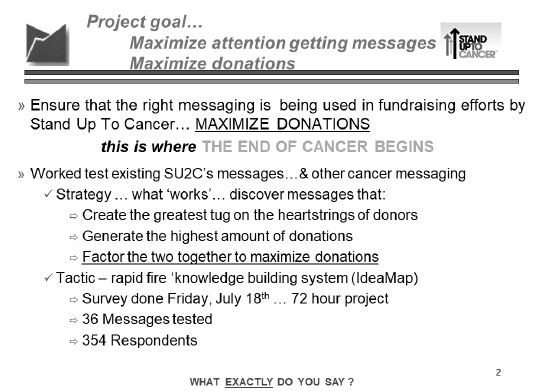
fig 1

Figure 1: The introductory page to the project summary, showing the goals of the project, the timetable, and the tactics.

The process as described here followed the specifications of the Mind Genomics process [5-7]

The study proceeded very quickly. Author Onufrey worked with the SU2C team to create a set of 36 different messages. These messages are shown in Table 1. The rapid pace of the project (front to back in three days maximum) forced the creation of messages, followed by some polishing and then insertion into a matrix. Usually the groups comprise coherent questions and the series of such questions ‘tell a simple story.’ The virtually breakneck speed of message creation allowed for some polishing of the elements, improving the quality of the messages before the actual research. The messages required about four hours to develop, and two hours to polish. The field portion, with respondents, lasted a day and a half, and the report was finished the last night.

Table 1: The 36 elements for the study.

Group 1
A1 Because someone close to you has cancer
A2 Invest for life-changing results
A3 Every day, 1,500 people in America die from cancer
A4 Support research into ALL forms of cancer
A5 Every sixty seconds someone in America dies of cancer
A6 Your help provides support and programs for caregivers of cancer patients
Group 2
B1 Track and report progress… all who donate can see how their participation creates real change
B2 One in three women will get cancer in her lifetime
B3 Donating time, money and effort makes a difference
B4 You can make a difference
B5 Ensure the quality of life for those suffering from cancer
B6 Collecting the top experts in cancer research to work collaboratively
Group 3
C1 Volunteer!
C2 Accelerate the development of life saving cancer prevention, detection and treatment
C3 Just when science is on the verge of the breakthroughs that can end cancer, the will and the funding are disappearing from the national agenda
C4 Put together the best and the brightest minds in cancer research — those on the edge of accomplishment
C5 Every year, 2,300 children in America die of cancer
C6 We are close to scientific breakthroughs in the prevention, detection, treatment and reversal of cancer
Group 4
D1 A new movement to stop cancer once and for all
D2 There are 10.8 million cancer survivors in America
D3 Because everyone knows good health is important
D4 We can now target the genes and pathways that turn normal cells into cancerous ones
D5 Other organizations have made good progress in cancer research and programs… this program brings all the strengths together to reach the ultimate goal
D6 To provide support for finding a cure
Group 5
E1 Because… cancer is a major health issue that affects everyone
E2 Support the organization by purchasing items it sells or needs
E3 We conquered Polio and Smallpox… we CAN conquer Cancer
E4 Government funding for cancer research is declining… this fills the void
E5 We have the science, the technology, the tools… all we need is YOU
E6 One in two men will get cancer in his lifetime
Group 6
F1 Make sure that a strong interest in Fighting Cancer remains a priority
F2 Because you want to honor a loved one
F3 Push scientific breakthroughs to the finish
F4 We now understand the biology that drives cancer… we are on the brink of scientific breakthroughs
F5 Cancer is a war we can actually win
F6 Act before cancer takes another life away

The conventional research approach would have been either to test these elements one-at-a-time (so-called promise testing), or to test a limited number of combinations created by the researcher or by a marketing specialist with a ‘sensibility of what the listener needs to hear to drive donation.’ These methods are hallowed in the research community because they introduce the ‘voice of the consumer.’

The reality of most research is that no one knows which elements will perform very well. It is fairly easy to spot losing elements, especially after the promise testing study is completed. These ‘losing’ elements may be adequate in and of themselves, but they don’t do well because they may be trite, or ‘off strategy.’ After the performance of each element, or the entire concept, is published for everyone to see, the opinions will emerge as to why the elements failed, alongside new and better elements.

The messages were combined by an underlying experimental design, creating 48 unique vignettes (combinations of messages), 36 comprising four elements (two questions not contributing), and the remaining 12 comprising 3 elements (three questions not contributing). The Mind Genomics experiment was set up so that the respondent was shown a vignette and had to assign two ratings, one for Question 1 dealing with probability of donating, and the second for Question 2, dealing with the amount to be donated.
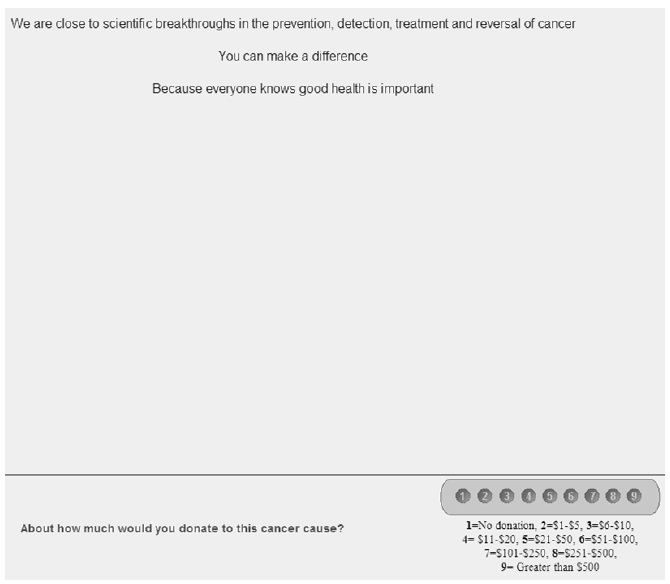
fig 2

Figure 2: Example of a 3-element vignette, and rating question #2 (amount that would be donated, based upon reading the vignette).

To the untrained eye, and in fact even to someone who knows how the vignettes were developed, the combinations seem to be combined in a way that one might call constrainedly haphazard [8] All vignettes had a limited number of elements, and each element ended up appearing an equal number of times. The vignettes were created by a specially constructed experimental design, which was rotated to create hundreds of isomorphic permutations—combinations which were identical in a mathematical sense, but whose combinations were different.

These custom created experimental designs are the workhorses of Mind Genomics. They ensure that the respondent is exposed to each element the same number of times (five) in 48 vignettes, absent the same number of times (43), and that the 36 elements are statistically independent of other. The underlying experimental design ensured that each respondent evaluated a unique combination of 48 vignettes [9], and that each set of 48 vignettes suffices to estimate the contribution of each of the 36 elements both to propensity to donate (question #1) and amount expected to donate (question #2)

  1. Probability of Donating – The first scale shows an anchored 1-9 scale, with the rating 1 anchored at ‘would not donate’ and the rating 9 anchored at ‘definitely would donate’. This is a Likert scale. It’s meaning is simple intuitively, but the scale must be anchored at both ends.
  2. Amount donated – The second scale comprises nine numbers, each number corresponding to an amount of money. This second scale is easy to use.

To make the analysis easier, we converted the first scale (probability) of donating to nine values, ranging from a probability of 0% (original rating of 1, definitely not donate) to a probability of 100% (original rating of 9, definitely will donate). The nine points were considered to be equally spaced, so that a rating of 5, for example, was considered to be a probability of 50%, a rating of 6 a probability of 62.5% etc.

The first analysis looks at the distribution of ratings. Even before we look at the linkage between the different messages and donations (probability, amount, respectively), we can ask a simpler question, namely what is the relation between the probability of donating and the amount donated?

Table 2 shows a two-way cross tabulation. The numbers in the body of the table are the percent of times that the specific pair appears in the data (specific probability of donating, and amount donated).

Table 2: Distribution of probability of donating and amount donated. The numbers in the body of the table are percentages of all the responses.
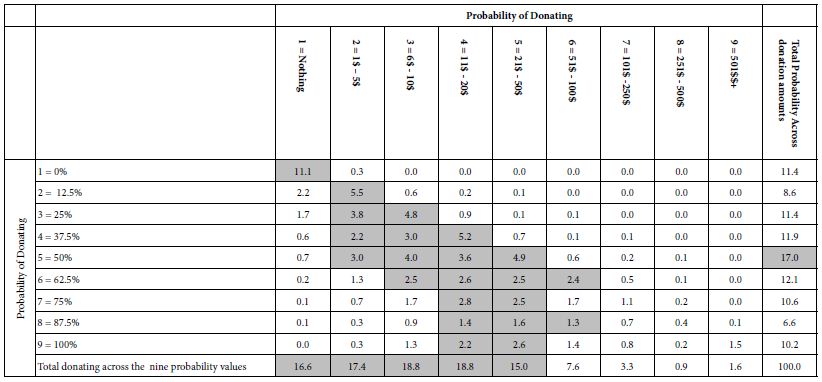
table 2

The far-right column in Table 2, labelled Total Probability, shows the distribution or probabilities of donating. Thus, 11.4% of the responses are ‘not donate,’ whether due to the respondents or to the messages. The source of the probability value is not clear. The most frequent response is ‘5’ (50% probability of donating), but that is only 17% of the responses. We can see that the percents not donating or donating (ratings 1-4) sum to 43% and the percents probably or definitely donating (ratings 6-9) total a bit over 40%,

The bottom row in Table 2, labelled Total Donating suggests, in contrast, that most donations are either 0 or less than 50$.

Is There a Discernible Relation between the Likelihood of Donating and Amount Donated?

Table 2 suggests that the relation between probability of donation and amount of donation exists, albeit in very rough and noisy form. Not surprisingly, there are more darkened cells towards the left side of the table, where the amount donated is lower, but there is not a correspondingly clearly shaded area when it comes to probability of donating.

We can create a less noisy data set by estimating the average donations and probability of donations for each of the 354 respondents. Figure 3 shows a plot of the averages, and suggests that with increasingly average likelihood of donating, there is a slight increase in the amount to be donated. The relation is noisy, however. It is clear, however, that when, on average the respondent is not interested in donating (low value of the abscissa), the respondent does not choose moderate to high amount of money to ‘not donate.’ This congruence of low donation probability and low/no donation amount, provides one indication of validity, in this case face validity. The pattern seems intuitively understandable.
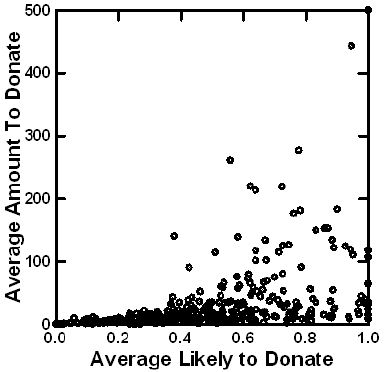
fig 3

Figure 3: Relation between average rating of likely to donate and average amount to be donated. Each point is an average from 48 observations. There are 354 averages, one for each respondent.

Do Respondents Change Their Ratings as They Continue Rating Vignettes?

In the research community, and especially among applied research in a business setting, there is the ongoing dispute about the change in the criteria of judgment a respondent uses when judging a concept (vignette) or a product several times. Of course the concept or the product should be changed, but one can measure the effect of putting the concept or the product in the first position, the middle positions, or the last position. There is no end to the disputes about biases proposed by the purists who feel that every applied test of this type should be evaluated purely by itself, so-called pure monadic. There are others who feel that only with repeated experience does the respondent become able to validly rate the product. If the researcher relies only on the pure monadic, there is a great deal of extraneous variability, due to the proclivities and biases of the individual respondents.

The Mind Genomics approach attracts interest because the typical respondent evaluates as many as 24-48 vignettes, in short period of time, and without much consideration. The point of view espoused by a number of researcher is one of questioning the consistency of the data with repeated evaluations [10-14].

One of the analyses presented here looks at the change of the rating assigned by a respondent as the evaluations proceed from the first to the 48th. Independent of the specific elements in a vignette, can we demonstrate a systematic bias, viz. that the average rating of the probability of donating will increase with repeated rating, or the amount given will increase with repeat rating?

Figure 4 shows an order ‘effect, both in terms of probability (likelihood) of donating (left panel), and amount of money to be donated (right panel). The two plots were created simply by averaging the rated likelihood to donate by ‘test order,’ and amount to be donated, also by ‘test order.’ For both likelihood and probability to donate, and for amount to donate, we see the upward pattern, suggesting that as the evaluations move on, respondents feel more generous. Respondents may not realize that they are being more generous, and the degree of generosity is not marked, but there is a noticeable increase.
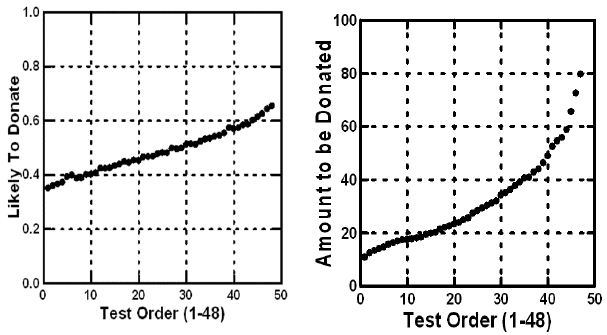
fig 4

Figure 4: Average probability of donating (question #1) and average amount to be donated (question #2) versus the test order. Later vignettes are uprated on both ratings.

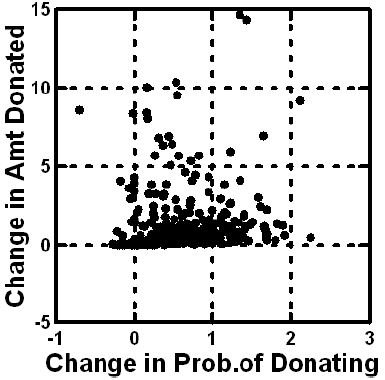
The foregoing analysis shown in Figure 3 suggests that on average, individuals become increasingly generous in terms of both likelihood and probability of donating, and amount to be donated. Does this pattern hold for the average individual? The slopes of the curves in Figure 3 provide us the answer. What does this slope look like on an individual basis? The answer appears in Figure 4. Each point corresponds to a respondent. The slopes were computed separately for the data of each respondent. Figure 5 shows the two slopes on a scatterplot. Slopes near zero mean no change. High positive slopes mean a strong positive increase in the rating with repeated evaluation. Negative slopes mean a decrease in the rating with repeated evaluation.

We conclude from Figure 4 that repeating the evaluation 48 times with new combinations ends up increasing the stated likelihood to donate, and the amount to be donated. The strength of the effect (slope) varies by respondent to respondent. There is only one respondent who strongly decreases the amount donated and the probability of donation, as the respondent progresses. Most respondents fall into the right half, and the top half, suggesting either a modest increase in probability of donating (to the right on the abscissa), or a modest increase in the amount to be donated (upwards on the ordinate). There is no clear pattern, however. As the person moves through the 48 vignettes, evaluating each, the person might increase the rated probability of donating, increase the rated amount to be donated, increase both, or increase neither.

Relating the Elements to the Ratings

Most research works with numbers to identify patterns. The preliminary, viz., surface analysis of the data, shown in Table 2 and Figures 3-5 tell us a lot about the respondent, in terms of likelihood to donate, response to repeated messages, etc. Yet, the deepest information is yet to be obtained, information which can only emerge when the stimuli are ‘cognitively rich.’
fig 5

Figure 5: Distribution of changes in likelihood of donating (abscissa) and amount to be donated (ordinate), as shown by the slopes (versus test order). Numbers above 0 mean an increase in the likelihood or donating or the amount to be donated. Each point corresponds to one of the respondents.

Table 1 shows the 36 elements, with the underlying experimental design combining these elements into vignettes which communicate information about the efforts of SU2C. Table 2 shows us that respondents differentiate among these different vignettes. Beyond the effects of order, the underlying experimental design allows us to uncover the linkage between the specific element and the rating, either of probability to donate or amount to be donated.

The tool to be used is OLS (ordinary least-squares) regression analysis. OLS works regression with the underlying experimental design, deconstructing the rating assigned to the combination into the part-worth contributions of the elements. The experimental design was applied separately create the set of 48 vignettes for each respondent, allowing OLS regression to estimate, at either the level of the respondent or the level of the group, the part-worth contribution of each element.

We express the relation between the dependent variable and the independent variable by the simple equation: Dependent Variable = k0 +k1(A1) + k2(A2) … k36(F6)

The foregoing equation is easy to interpret. The equation for the dependent variables begins with an additive constant, k0, which is the estimated value of the dependent variable when there are no elements in the vignettes. This situation is purely hypothetical because the underlying experiment ensured that EACH vignette created would have a precise set of either three elements or four elements, respectively. The additive constant, k0, can thus be considered to be a baseline, the estimated value of the dependent variable without any other information.

  1. Probability of donating – the baseline likelihood to donate to SU2C in the absence of any elements.
  2. Estimated amount donate – the baseline amount that would be donated to SU2C, in the absence of any elements.
  3. Expected value – the ‘adjusted’ amount that would be donated, defined as the amount to be donated, multiplied by the probability of the donation, again in the absence of any elements.

The OLS regression requires preparation of the data so that all of the data are in the proper format. The 36 independent variables, on for each elements, are coded as ‘1’ when the element is present in the vignette, and coded ‘0’ when the element is absent from the vignette. For statistical validity, the OLS regression approach requires more observations (viz., vignettes) than there are independent variables. Each respondent was presented with 36 independent variables, viz. our 36 elements, taking on the value 0 (absent) or 1 (present), and contributed 48 such cases or observations to the data set. Even at the level of the individual respondent, therefore, the OLS regression will run, delivering the coefficients.

As a side note, the study used three dependent variables. Each value was ‘adjusted’ by the additional of a very small random number (<10-5), ensuring that there would be some slight variation in the dependent variable, and thus prevent a crash if the respondent assigned the same rating to each of the 48 vignette. This done not happen very often, but it is always better to add a bit of random variation to the dependent variable and prevent crashes.

We now move to the actual data itself, with the equations estimated using the data from the entire panel. Despite the apparent blooming buzzing confusion, a phrase that one might use to describe the person’s reaction to the vignettes, the results emerge quite clearly, or if not clearly, at least tell a story.

Table 3 shows two sets of three models—parameters for the equations. The first set is computed using all 36 elements, and estimating the additive constant, and the value of the individual coefficients. We can liken this first set of equations (columns A, B, and C) to a statue comprising two parts, a base, and then the statue part. The additive constant is the base, and the 36 elements are the parts of the statue. The height of the statue is estimated by adding together the magnitude of the additive constant and the coefficients of the particular, limited number of elements to be incorporated into a new vignette.

Table 3: The part-worth contribution of each of the elements to donations. The table shows the contributions when the model is estimated with an additive constant (baseline), and when the model is estimated without an additive constant (no baseline).


Additive Constant

No Additive Constant
    A B C D E

F


Probability Donate

Amount Donated Expected Value Probability Donate Amount Donated

Expected Value

 Additive constant (all elements absent)

41

$23 $17 NA NA

NA

B2 One in three women will get cancer in her lifetime

3

$6 $6 14 $12

$10

A3 Every day, 1,500 people in America die from cancer

5

$7 $5 16 $13

$10

B4 You can make a difference

4

$6 $5 15 $12

$10

B5 Ensure the quality of life for those suffering from cancer

4

$6 $5 15 $12

$9

A6 Your help provides support and programs for caregivers of cancer patients

5

$5 $4 17 $11

$8

B3 Donating time, money and effort makes a difference

3

$4 $4 14 $10

$8

D5 Other organizations have made good progress in cancer research and programs… this program brings all the strengths together to reach the ultimate goal

2

$4 $4 13 $10

$8

A1 Because someone close to you has cancer

3

$4 $3 14 $10

$7

A5 Every sixty seconds someone in America dies of cancer

3

$4 $3 14 $10

$8

B6 Collecting the top experts in cancer research to work collaboratively

3

$4 $3 14 $10

$8

C1 Volunteer!

2

$3 $3 13 $9

$7

C2 Accelerate the development of life saving cancer prevention, detection and treatment

3

$3 $3 13 $9

$7

C3 Just when science is on the verge of the breakthroughs that can end cancer, the will and the funding are disappearing from the national agenda

3

$3 $3 14 $9

$7

D3 Because everyone knows good health is important

2

$4 $3 13 $10

$8

F2 Because you want to honor a loved one

3

$3 $3 14 $10

$7

A2 Invest for life-changing results

4

$3 $2 15 $9

$7

B1 Track and report progress… all who donate can see how their participation creates real change

1

$2 $2 12 $8

$6

C4 Put together the best and the brightest minds in cancer research — those on the edge of accomplishment

2

$2 $2 13 $8

$6

C5 Every year, 2,300 children in America die of cancer

2

$2 $2 13 $8

$6

C6 We are close to scientific breakthroughs in the prevention, detection, treatment and reversal of cancer

1

$2 $2 12 $8

$6

D1 A new movement to stop cancer once and for all

2

$2 $2 12 $8

$6

D2 There are 10.8 million cancer survivors in America

2

$2 $2 12 $8

$7

D4 We can now target the genes and pathways that turn normal cells into cancerous ones

1

$3 $2 12 $9

$7

E1 Because… cancer is a major health issue that affects everyone

1

$3 $2 12 $8

$6

E6 One in two men will get cancer in his lifetime

2

$2 $2 12 $8

$6

F1 Make sure that a strong interest in Fighting Cancer remains a priority

1

$2 $2 12 $8

$6

A4 Support research into ALL forms of cancer

2

$2 $1 13 $8

$6

D6 To provide support for finding a cure

2

$1 $1 13 $8

$5

E2 Support the organization by purchasing items it sells or needs

1

$0 $1 11 $6

$5

E4 Government funding for cancer research is declining… this fills the void

1

$2 $1 11 $8

$6

E5 We have the science, the technology, the tools… all we need is YOU

1

$2 $1 11 $7

$6

F3 Push scientific breakthroughs to the finish

2

$2 $1 14 $8

$6

F4 We now understand the biology that drives cancer… we are on the brink of scientific breakthroughs

-1

$1 $1 10 $7

$5

F6 Act before cancer takes another life away

0

$1 $1 11 $7

$5

E3 We conquered Polio and Smallpox… we CAN conquer Cancer

0

$1 $0 10 $7

$5

F5 Cancer is a war we can actually win

-1

-$2 -$1 10 $5

$3

In contrast to the estimates of the coefficients in a model with an additive constant, we can choose to leave out the additive constant. Columns D, E, and F show the corresponding (and much larger) coefficients. Figure 6 shows, however, that there is little loss of relative information. The corresponding pairs of coefficients (viz., A & D, for probability of donating) are very highly related to each other, as are the other two corresponding pairs. Figure 6 shows the strong correlation.
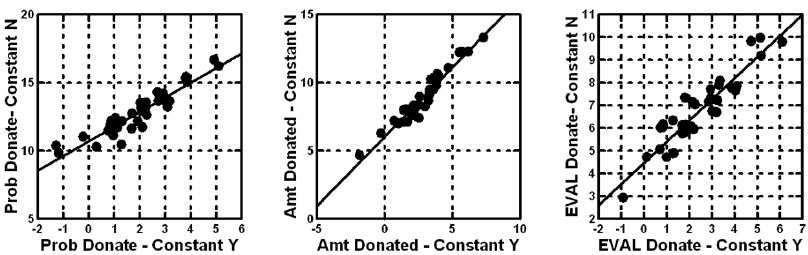
fig 6

Figure 6: Scatterplots for each of the three dependent variables, showing the strong correlation between the 36 coefficients estimated with an additive constant (abscissa), and the 36 coefficients estimated but without an additive constant (ordinate).

Equations with the additive constant are estimated for those cases when there is a sense of a baseline ‘feeling,’ in the absence of elements. The judgments made based on the coefficients will be the same, because they line up so strongly in the same way.

Table 4 makes it easy for managers to understand what is working. We need only sort the table to find those elements which generate high probabilities of donating, and/or high amounts of donated money, and/or high expected value.

Table 4 shows us that the additive constant for probability of donating is a base of 41%. The two elements which drive donation most strongly, here operationally defined as an addition 5%, are A3 and A6. In turn the additive constant for amount to be donated ins 23$ in the absence of elements. One can get an addition 6-7 dollars, however by the correct choice of elements. Finally, when we look at the expected value, combining probability and amount, we end up with an additive constant of 17$. Looking across Table 4, the manager of the campaign would be advised to choose combination of A3 and B2.

Table 4: Strong performing elements for the three dependent variables, and the recommended combination.
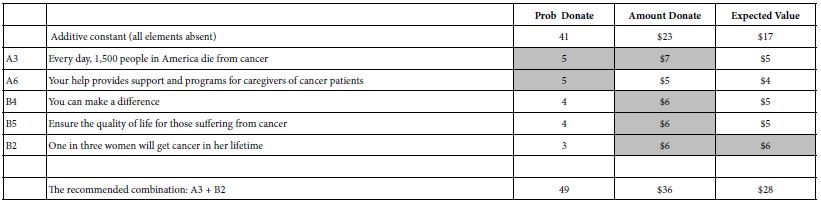
table 4

The Allure of Mind-Sets

A continuing theme in Mind Genomics is the discovery of underlying groups of respondents, distinguished not so much by WHO they are, but by how they think. Marketers call these psychographic segments. The segments are typically created on the basis of variables such as age, gender, geography. These geo-demographic variables are relative blunt measures, because people who resemble each other in their geo-demographics often think in radically different ways. One need only visit a neighborhood food store to see the array of different flavors of the same food, sold to people of similar geo-demographic profiles.

A better way is to discover how people think about a topic. There are various approaches for identifying groups of people, who are demonstrated to think differently on a set of related topics such as lifestyle. The problem with these methods of dividing the population is that the methods come from the top down, showing differences in the way people think about large topics. How does one translate membership in a big lifestyle segment to the exact words one needs to use for a targeted campaign, with limited focus, and even more limited budget?

Mind Genomics works from the bottom-up, creating mind-sets or groups of people, based exclusively on the patterns of their reactions to the important stimuli, namely the messages. The key benefit provided by Mind Genomics is the ability to create an equation or model for each respondent, based upon the responses to the 48 vignettes. One can then cluster the 354 respondents based upon the pattern of the coefficients. The actual clustering method is left to the researcher.

Mind Genomics follows a simple process to discover mind-sets.

    1. Run three parallel analyses, one for each dependent variable; probability of donating, amount donated, expected value. The clustering analysis was thus done three times, once for each dependent variable.
    2. Choose the dependent variable (e.g., Probability of Donating). For the chosen dependent variable create the 354 individual level models, using OLS regression. For this specific study on messaging, the models were estimated without an additive constant. As Figure 6 shows, the same pattern of coefficients appears whether the researcher incorporates or does not incorporate the additive constant.
    3. Cluster the 354 respondents based upon the respondents’ patterns of coefficients, created using k-means clustering (Likas et. al., 2003). Individuals with similar patterns of 36 coefficients were put into the same cluster. The cluster will become the ‘mind-set’.
    4. Extract three clusters of mind-sets and assign each of the 354 respondent to the appropriate mind-set.
    5. Note that when we do the foregoing exercise three times, once for each dependent variable, the composition of the three mind-sets will change. That is, the composition of the three mind-sets or clusters, differs by the dependent variable.
    6. The foregoing steps have now created three new groupings for every dependent variable. These groups are the mind-sets. For every dependent variable, every one of the 354 respondents is assigned to exactly one of the three mind-sets.

Now, consider one dependent variable, e.g., probability of donating. Each respondent fits into only one of the three mind-sets. We analyze the data on a mind-set basis.

  1. Compute the average rating (or expected value) for each mind-set across all the respondents in the mind-set and all the 48 vignettes for each respondent. This average gives a sense of how the mine-set feels about the topic.
  2. Once again, run the equation for the dependent variable selected (viz., Probability of Donating, dependent variable 1). This time, estimate the equation using the additive model. Run the OLS regression analysis three times, once incorporating all the data from the respondents assigned to the mind-set for that dependent variable.
  3. Lay out the result and select only the strong-performing elements for each mind-set. The definition of ‘strong performing’ is a coefficient above a certain cutoff. The cutoff is operationally specified by the researcher.
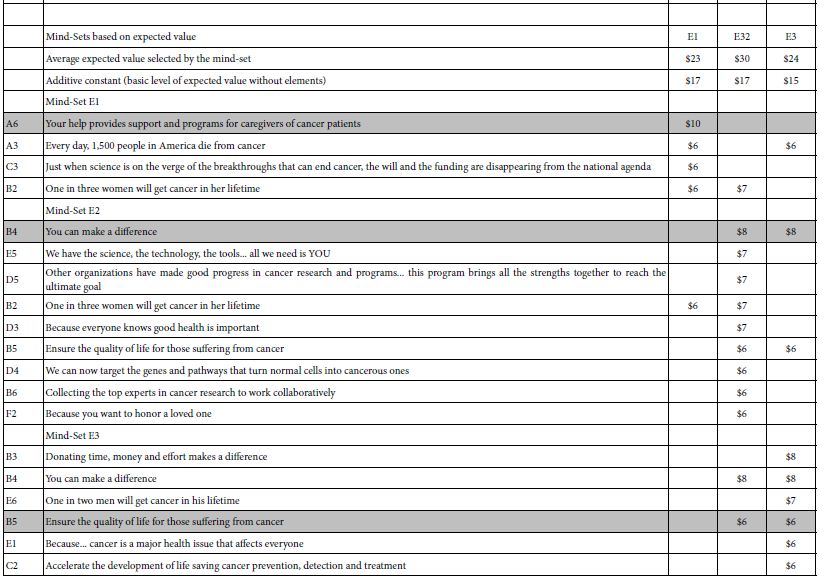
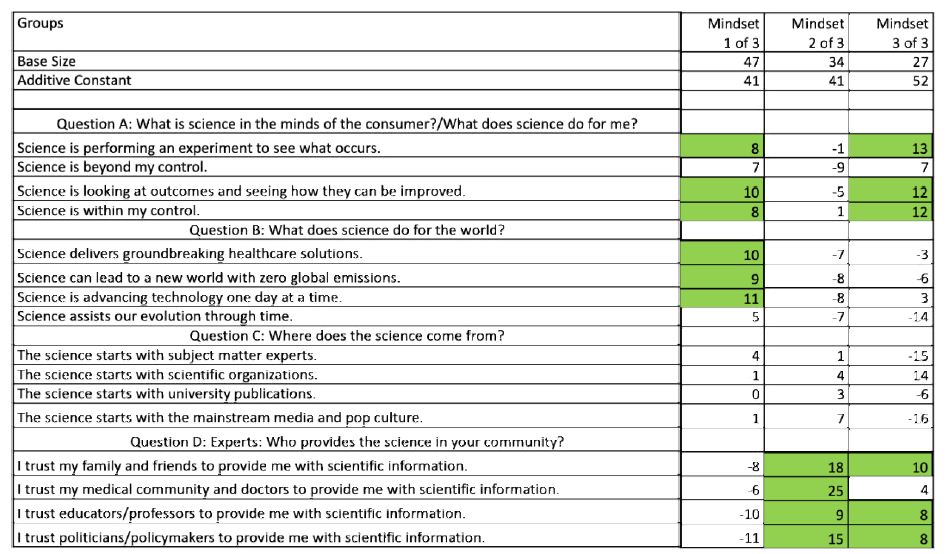
  4. If an element fails to perform strongly for all three mind-sets, then eliminate the element. This action will eliminate most of the elements, allowing only the most promising elements. These are elements which do well for at least one mind-set. Tables 5shows the strong performing elements for each of the three mind-sets for a dependent variable.
  5. For purposes of selecting the correct messages for the proposed SU2C, Table 5 presents the relevant information from which to craft messages.
  6. For systematized understanding and data-basing in a ‘wiki of the mind,’ the original motivation for this reanalysis of the data 13 years later, Table 5 present the necessary information to better understand the mind of the donor, and to create a Mind Genomics of donation.

Table 5: Summary results for three mind-sets emerging for each dependent variable, and the strong performing elements for each mind-set. The recommended messages to use are shown in shaded cells.
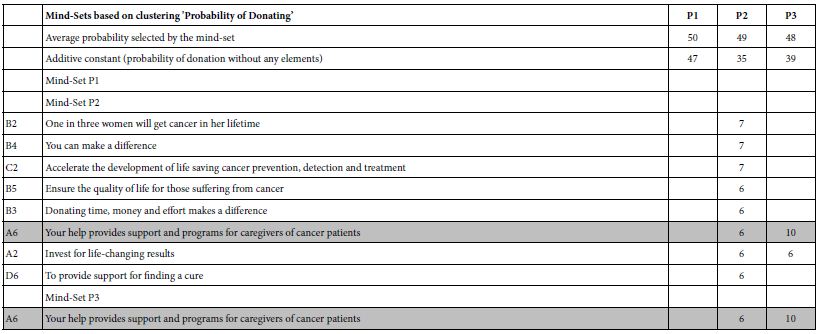
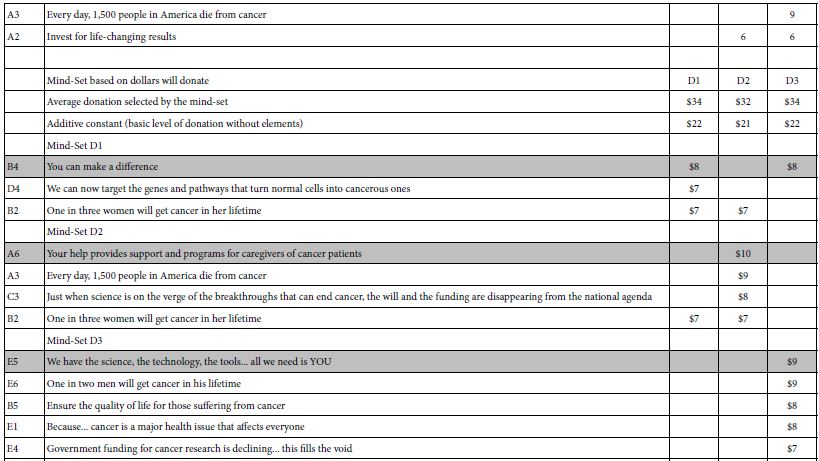
table 5(1)

table 5(2)

table 5(3)

Discussion and Conclusions

At the time of writing Selling Blue Elephants (2006 for the 2007 publication deadline), the realization emerged that one could do studies for companies and other groups, studies which would answer the question, but studies which would have great residual value. It was in this spirit that many studies were run, studies which created these so-called rules. The question then was asked: Can these studies be reopened a significant time later, when the issue had been long answered, and in turn, can these studies ‘teach.’ If so, the opportunity was emerging to create studies whose value would be immediate AND long term. It is to that issue that we addressed this paper, with a case history about what was done, and what was learned 13 years later of a general nature.

By their very nature, Mind Genomics study provides valuable information years, even decades after they have been executed. The reason for the retained value is two-fold. First, the raw material, the elements, is cognitively rich. A database of the type shown in Tables 4 and 5 but comprising all 36 elements rather than just ‘strong performers’, becomes a valuable. The database can be searched, and new facts and insights can be discovered. One can imagine a world where there are millions or even hundreds of millions of these databases created each year, and available for search to broaden our understanding. The result is a Wikipedia of the Mind, produced at the level of local issues, at the level of granularity.

There is a second use, as well. That is as a database from which one can extract meta-patterns, such as average ratings of subgroups, or change in response patterns over time. This second use pales, of course, when compared to the first application above, the Wikipedia of the Mind at the level of granular, everyday experience. Yet, when we emerge from the euphoria of what could be, we realize that it is this less-exciting second use which corresponds to today’s archival sciences. Information, but without the systematized, cognitive richness so readily available from Mind Genomics.

The final question is very simple. Was the study effective? Here is a direct quote from 2010. Although one might not attribute the massive success of SU2C, the fact that those running the simulcast in 2008 knew ‘what to say’ should be taken into account as a factor in the success of SU2C, in its effort to change the perception of cancer, and to highlight the efforts being made to treat it, control it, and cure it.

Stand Up to Cancer

LOS ANGELES—A look at some of the statistics culled from the Stand Up to Cancer (SU2C) Sept. 10 broadcast may seem to indicate that the fundraising and cancer awareness effort fell somewhat short of its original milestones two years before: The 2010 show announced that $80 million had been pledged, whereas in 2008 the number was approximately $100 million. ….

The first show was seen on only ABC, CBS, and NBC, which for this year’s show were joined by many more collaborative network and cable partners including Fox, Bio, Current TV, Discovery Health, E!, G4, HBO, HBO Latino, MLB Network, mun2, Showtime, Smithsonian Channel, the Style Network, TV One, and VH1…..(Source… [11]).

References

  1. Moskowitz HR, Gofman A (2007) Selling Blue Elephants: How to Make Great Products That People Want Before They Even Know They Want Them. Pearson Education.
  2. Christen SP, Levine AJ (2019) Facilitating cross-disciplinary interactions to stimulate innovation: Stand Up To Cancer’s matchmaking convergence ideas lab. In Strategies for Team Science Success. Springer.
  3. Charlesworth D (2016) Stand Up to Cancer 2012 and 2014: The medical telethon as UK public service broadcasting in a neo-liberal age. Critical Studies in Television 11: 217-229.
  4. Gabay G, Moskowitz H, Gere A (2019) Understanding the donating mind and optimizing messaging – public hospitals. In: 12th Annual Conference of the EuroMed Academy of Business.
  5. Gere A, Radvanyi D, Moskowitz H (2017) The Mind Genomics metaphor – from measuring the every-day to sequencing the mind. International Journal of Genomic Mining.
  6. Mehta-Shah N, Mehta S, Zemel R (2021) Mind Genomics (BimiLeap) to create new ideas. In Consumer-based New Product Development for the Food Industry. Royal Society of Chemistry 119-131.
  7. Moskowitz HR, Gofman A, Beckley J, Ashman H (2006) Founding a new science: Mind Genomics. Journal of Sensory Studies 21: 266-307.
  8. Ryan TP, Morgan JP (2007) Modern experimental design. Journal of Statistical Theory and Practice 1: 501-506.
  9. Gofman A, Moskowitz H (2010) Isomorphic permuted experimental designs and their application in conjoint analysis. Journal of sensory studies 25: 127-145.
  10. Schwarz N, Hippler HJ, Noelle-Neumann E (1992) A cognitive model of response-order effects in survey measurement.” In Context Effects in Social and Psychological Research. Springer 187-201.
  11. Rosenthal ET (2010) Stand Up to Cancer 2010: Qualitative Success Transcends Quantitative Numbers Oncology Times 32: 20-23.
  12. Fortunato J (2013) Sponsorship activation and social responsibility: How MasterCard and major league baseball partner to stand up to cancer. Journal of Brand Strategy 2: 300-311.
  13. Likas A, Vlassis N, Verbeek J (2003) The global k-means clustering algorithm. Pattern Recognition, Elsevier 36: 451-461.
  14. Milutinovic V, Salom J (2016) Mind Genomics: A Guide to Data-Driven Marketing Strategy. Springer.
Psychological Problems of COVID-19 Sufferers

DOI: 10.31038/PSYJ.2021332

Abstract

COVID-19 has increased all over the world. It has brought a significant change around the world. Although the COVID-19 infected patients are mainly suffering from infection but there are other areas to concern about. The burden of mental health problems of pre and post-COVID-19 has become a major concern to address. Lockdown, quarantine, social distancing have already raised questions regarding mental health problems. This review demonstrates the psychological impacts of all of these on a healthy individual.

Keywords

COVID-19, Healthcare management, Psychological problems

Introduction

The continuous increasing rate of COVID-19 around the world has isolated the people from their normal life. There is still no hope of changing the situation immediately. Various safety initiatives are taken by the government of several countries. These include the lockdown, quarantine of people, maintaining social distances, wearing masks, etc. These are actually found effective to prevent the spread of viruses. But these initiatives have also raised questions regarding the mental health. The psychological impacts of these initiatives on healthy individuals are found very much negative. This is exactly how COVID-19 has caused a public health danger and it has become a global health challenge. Now the mental health problems of people tend to be higher than the death of COVID-19 infected people. We have seen it in the past also. Whenever, a infectious disease becomes epidemic or pandemic, it gives rise various psychological diseases, mental stress, fear, illness, anxiety, boredom [1,2]. We have seen how people’s mental health was hampered during the period of Middle East respiratory syndrome (MERS) and severe acute respiratory syndrome (SARS). This review will provide necessary information on how the COVID-19 pandemic is causing a public health crisis inducing mental health problem [3].

The people who are getting infected by SARS-COV-2 are the biggest sufferers of COVID-19. The COVID-19 infected patient are not only undergoing physical damage in the body but also facing several mental problems in the post COVID-19 period. But this is actually not the end of the suffering scenario. The suffering is divided into pre and post-COVID-19 mental sufferings. This mental trauma is not only limited to the people infected by SARS-COV-2, it includes the healthcare professionals also. The people who are not yet infected by SARS-COV-2, also undergoing through a mental trauma. Staying in the house day after day during lockdown, making social distancing everywhere, using mask everywhere have distracted them from their normal life. Besides they are always in the fear of getting infected by SARS-COV-2 anytime. This is actually letting them down mentally. Because the fear largely accelerates the level of anxiety and stress that leads to the intensification of the symptoms of those with pre-existing psychiatric disorders [4-6]. The older people aged above 60 are in the highest risk position because of their more physically weak condition than any other age group [7]. They are undergoing through depression, anxiety, stress, emotional exhaustion very frequently. China recently conducted a study on the psychological/mental problems of COVID-19. The report stated that 53.8% of the participants among the general public were severely or moderately psychologically affected having depression, anxiety and stress [8]. The quarantine period is a very difficult period for the people to stay alone although it is effective to prevent the spread of viruses. But loneliness often takes place during this period. So the quarantine period has some bad psychological impacts on individuals which are confirmed by Lancet in a report. According to Lancet, long quarantine often induces post-traumatic stress symptoms, confusion, and anger. Stressors included longer quarantine duration, infection fears, frustration, boredom, inadequate supplies, inadequate information, financial loss, and stigma. This review was done using three electronic databases. Of 3166 papers found, 24 are included in this review [9]. The social distancing or social isolation is one of the hardest things to do for the people although it is effective to prevent the spread of virus. It often triggers loneliness that induces mental health problems due to arise of anxiety, depression, stress, fear, etc. [10]. Depression, anxiety, loneliness often induces the commitment of suicides [11,12]. Anxiety, insomnia, anger, boredom, loneliness of people are the results of the recent COVID-19 pandemic according to report of several studies [13]. A study, published in The Lancet Psychiatry journal, stated that one in 5 COVID-19 patients suffer from mental illness within 90 days after testing for COVID-19. This mental illness most likely includes anxiety, depression and insomnia. It also reported that having a pre-existing mental illness causes 65% more chance to be infected with COVID-19 than those without [14]. The healthcare professionals are not out of this COVID-19 induced mental problems. They are under tremendous mental pressure as the rate of COVID-19 patients is increasing day by day. They are unable to meet their family and friends for a long time. Several studies reported about the mental problems they are dealing with at the moment. The appearance psychiatric symptoms among the healthcare professionals are now clear according to the reports of some studies. A report in the Journal of Psychiatric Research stated that the healthcare professionals are in extreme working pressure that induces psychological distress. Anxiety, irritability, insomnia, fear and anguish are among them. The systemic review was made based on the PRISMA protocol [15]. Again, several studies confirmed the fact that the healthcare professionals are suffering from high rates of stress, anxiety as well as mental disorders [16,17].

Conclusion

The world is undergoing through a tough situation due to COVID-19 pandemic. Both physical and mental health of people are getting equally affected due to COVID-19. But the mental health issues are less focused. The COVID-19 pandemic has created this mental health challenge. This review Suggests the identification of the factors associated with COVID-19 induced mental health problems and making of specific and necessary guidelines to overcome this challenge.

References

  1. Reardon S (2015) Ebola’s mental-health wounds linger in Africa: Health-care workers struggle to help people who have been traumatized by the epidemic. Nature 519: 13-15. [crossref]
  2. Shin J, Park HY, Kim JL, Lee JJ, Lee H, et al. (2019) Psychiatric Morbidity of Survivors One Year after the Outbreak of Middle East Respiratory Syndrome in J Korean Neuropsychiatr Assoc 58: 245-251.
  3. Lee AM, Wong JG, McAlonan GM, Cheung V, Cheung C et al. (2007) Stress and Psychological Distress among SARS Survivors 1 Year after the Can J Psychiatry, 52: 233-240. [crossref]
  4. Garcia R (2017) Neurobiology of fear and specific phobias. Learn Mem 24: 462-471. [crossref]
  5. Shin LM, Liberzon I (2010) The neurocircuitry of fear, stress, and anxiety disorders. Neuropsychopharmacology 35: 169-191. [crossref]
  6. Shigemura J, Ursano RJ, Morganstein JC, Kurosawa M, Benedek DM (2020) Public responses to the novel 2019 coronavirus (2019-nCoV) in Japan: mental health consequences and target populations. Psychiatry Clin Neurosci 74: 281-282. [crossref]
  7. Kim, J (2020) Clinical Feature of Coronavirus Disease 2019 in Elderly. Korean J Clin Geri 21: 1-8.
  8. Wang C, Pan R, Wan X, Tan Y, Xu L (2020) Immediate Psychological Responses and Associated Factors during the Initial Stage of the 2019 Coronavirus Disease (COVID-19) Epidemic among the General Population in China. Int J Environ Res Public Health, 17.
  9. Brooks SK, Webster RK, Smith LE, Woodland L, Wessely S, et al. (2020) The psychological impact of quarantine and how to reduce it: rapid review of the evidence. Lancet. 395: 912-920. [crossref]
  10. Gerst-Emerson K, Jayawardhana J (2015) Loneliness as a Public Health Issue: The Impact of Loneliness on Health Care Utilization Among Older Adults. Am J Public Health 105: 1013-1019. [crossref]
  11. Xiang YT, Yang Y, Li W, Zhang L, Zhang Q, Cheung T et al. (2020) Timely mental health care for the 2019 novel coronavirus outbreak is urgently needed. Lancet Psychiatry 7: 228-229. [crossref]
  12. Maunder R, Hunter J, Vincent L, Bennett J, Peladeau N, Leszcz M et al. (2003) The immediate psychological and occupational impact of the 2003 SARS outbreak in a teaching hospital. CMAJ 168: 1245-1251. [crossref]
  13. Shigemura J, Ursano RJ, Morganstein JC, Kurosawa M, Benedek DM (2020) Public responses to the novel 2019 coronavirus (2019-nCoV) in Japan: mental health consequences and target populations. Psychiatry Clin Neurosci 74: 281-282. [crossref]
  14. One in 5 COVID-19 patients develop mental illness within 90 days – study. Reuters. 10 November 2020.
  15. Flaviane CristineTroglio da Silva, Caio ParenteBarbosa (2021) THE IMPACT OF THE COVID-19 PANDEMIC IN AN INTENSIVE CARE UNIT (ICU): PSYCHIATRIC SYMPTOMS IN HEALTHCARE PROFESSIONALS – A SYSTEMATIC REVIEW. Journal of Psychiatric Research. March 25.
  16. Huang JZ, Han MF, Luo TD, Ren AK, Zhou XP (2020) [Mental health survey of 230 medical staff in a tertiary infectious disease hospital for COVID-19]. Zhonghua Lao Dong Wei Sheng Zhi Ye Bing Za Zhi 38: 192-195. [crossref]
  17. Kang L, Li Y, Hu S, Chen M, Yang C, et al. (2020) The mental health of medical workers in Wuhan, China dealing with the 2019 novel coronavirus. Lancet Psychiatry [crossref]
fig 2

Huge Retroperitoneal Mass: Ginecologic-Type Leiomyoma

DOI: 10.31038/CST.2021631

Abstract

Uterine leiomyomas are the most common gynecological tumors in women of reproductive age. However, there are cases of atypical localization, which could represent a diagnosis and treatment challenge. We describe the case of a 54-year-old female patient, with the finding of a large intra-abdominal mass, compatible with gynecological-type leiomyoma, located at the upper retroperitoneum, successfully diagnosed and treated with laparoscopic surgery.

Keywords

Retroperitoneal tumors, Ginecologic-type leiomyoma, Surgery, Laparoscopic surgery

Introduction

Uterine leiomyomas (also called myomata or fibroids) are the most common pelvic neoplasms in women [1,2]. They arise from the smooth muscle cells of the myometrium and extrauterine locations are extremely rare. Although they are histologically benign, in the presence of an atypical presentation, they could mimic malignant tumors at imaging and may become a diagnostic and treatment challenge that will require a multidisciplinary approach [3,4].

The case of a 54-year-old female patient, diagnosed with a large intra-abdominal mass, compatible with gynecological-type leiomyoma, located at the upper retroperitoneum, is presented.

Case Presentation

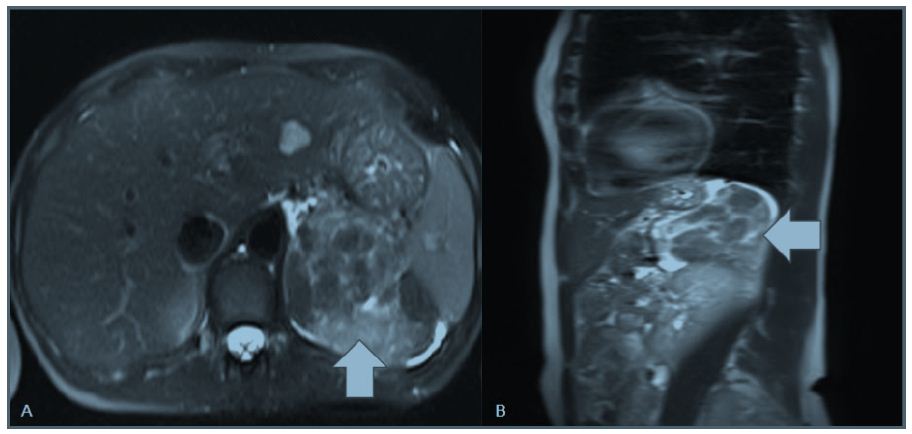
A 54-year-old female patient, with a history of hysterectomy for uterine fibroids, was diagnosed with an asymptomatic giant retroperitoneal mass, detected by ultrasound, as part of medical follow-up. In order to better assess this finding, a Magnetic Resonance Image (MRI) was carried out showing a left retroperitoneal lesion of 142 x 88 x 86 mm, of probable mesenchymal origin, causing displacement of the splenic vein, tail of the pancreas, kidney and spleen, with no clear dependence on any organ (Figure 1A and 1B).

fig 1

Figure 1: MRI (A: Axial and B: coronal views) showing an heterogeneous retroperitoneal mass of 142 x 88 x 86 mm.

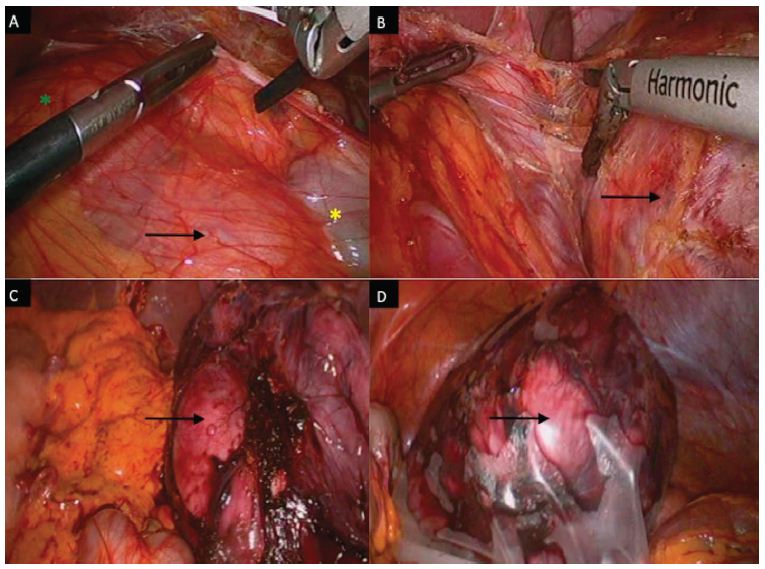
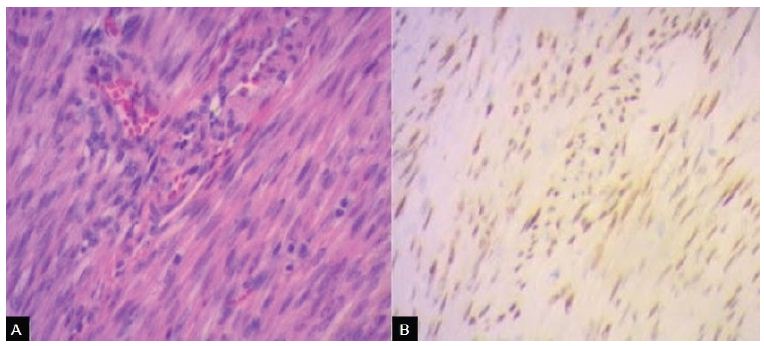
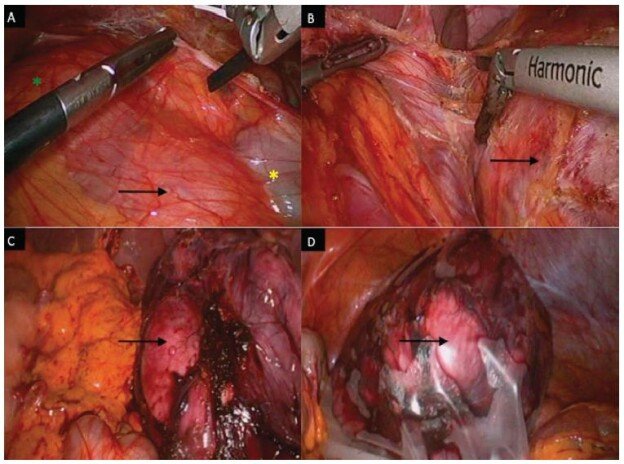
The case was discussed on a multidisciplinary committee and based on the size and unknown origin of the lesion, she was considered a candidate for resection. The patient was placed in a lateral decubitus position and a laparoscopic approach was performed. Retroperitoneum was accessed by previously dissecting the sigmoid colon in a lateral to medial fashion. After identification of the mass, a complete resection was performed emphasising not to open the tumor´s capsule (Figure 2). The postoperative course was uneventful and the patient was discharged on the third postoperative day. Pathological analysis of the resected specimen revealed a nodular lesion constituted by a proliferation of elongated, fusiform cells of typical  muscle appearance without marked mitotic activity (<1 mitosis in 50 HPF) (Figure 3A). Hormonal receptors (Estrogen and Progesterone) showed intense and diffuse positivity (Figure 3B). These findings are consistent with gynecologic type retroperitoneal leiomyoma.

fig 2

Figure 2: Laparoscopic image showing retroperitoneal mass (black arrow), sigmoid colon (yellow asterisk), left kidney (green asterisk) (A, B and C). After complete dissection, the extraction was performed in a protective bag through a pfannenstiel incision (D).

fig 3

Figure 3: A: Gynecologic-type leiomyoma of retroperitoneum. Hematoxylin-Eosin (H-E) staining sections show intersecting fascicles of slender tapered smooth muscle cells arranged in a whorled pattern separated by well vascularized connective tissue. B: Gynecologic-type leiomyoma of retroperitoneum. Estrogen receptor protein (ER) nuclear staining shows irregular packets and fascicles of spindle cells.

Discussion

Leiomyomas represent the most common gynecologic and uterine neoplasms, diagnosed in up to 70% of women during their lifetime [5]. They originate primarily from smooth muscle cell proliferation in the myometrium and extrauterine locations are extremely rare [6]. Although they are histologically benign, extrauterine leiomyomas may mimic malignant tumors at imaging and may become a diagnostic challenge [6,7].

Analyzing the differential diagnoses to be taken into account when facing a retroperitoneal mass, a wide range of tumors can be found, both benign and malignant. Generally, they are divided into solid or cystic, based on the different imaging modalities [8]. In turn, each subgroup is subdivided into neoplastic and non-neoplastic [9,10]. The real incidence of each of these pathologies is unknown [11]. However, it has been shown that 80% of primary retroperitoneal neoplasms are malignant [12]; in fact the retroperitoneal space is the second most frequent location, followed by the lower extremities, where malignant mesenchymal tumors arise. Approximately, one third of retroperitoneal tumors are sarcomas [13]. The most frequent sarcomas are liposarcoma, malignant fibrous histiocytoma, and leiomyosarcoma [14,15]. Given that treatment options vary, it is useful to be able to noninvasively distinguish these masses, this is why preoperative imaging including MRI must be performed [16]. Nevertheless, is a fact, that most of the times it will not be possible to define the tumor`s nature [17]. Due to the lack of diagnostic accuracy, using currently available radiologic modalities, prompt surgical intervention will usually be indicated; more if we take into account that these tumors are usually asymptomatic and they may become huge masses before diagnose.

A laparoscopic approach is technically feasible and safe, and should be considered for this cases, given the well described advantages of this approach such as less postoperative pain, rapid recovery, and better cosmetic results [10,18]. However, the size and location could potentially be factors to hinder laparoscopic feasibility. If adequate safety margins cannot be ensured, and risk of opening the tumor´s capsule is present, an open procedure should be performed [19].

Conclusion

The relevance of the present case lies in the unusual presentation of a gynecologic type leiomioma as a retroperitoneal mass. As mentioned before, it must be taken into account in the differential diagnosis of retroperitoneal masses, especially when the patient has a history of leiomyoma.

Acknowledgments

The authors would like to thank the pathology department of the Hospital Italiano de Buenos Aires, for their services.

Conflicts of Interest

The authors declare not having any conflicts of interest.

Ethical Disclosures

Protection of Human and Animal Subjects

The authors declare that no experiments were performed on humans or animals for this study.

Confidentiality of Data

The authors declare that they have followed the protocols of their work center on the publication of patient data.

Right to Privacy and Informed Consent

The authors have obtained the written informed consent of the patients or subjects mentioned in the article. The corresponding author is in possession of this document.

References

  1. Stewart EA, Cookson CL, Gandolfo RA, Schulze-Rath R (2017) Epidemiology of uterine fibroids: a systematic review. BJOG: An International Journal of Obstetrics & Gynaecology 124: 1501-1512. [crossref]
  2. Victory R, Romano W, Bennett J, Diamond MP (2015) Uterine leiomyomas: epidemiology, diagnosis, and management. Clinical Gynecology 223-252.
  3. Fasih N, Shanbhogue AKP, Macdonald DB, Fraser-Hill MA, Papadatos D, et al. (2008) Leiomyomas beyond the uterus: Unusual locations, rare manifestations. Radiographics 28: 1931-1948. [crossref]
  4. Poliquin V, Victory R, Vilos GA (2008) Epidemiology, Presentation, and Management of Retroperitoneal Leiomyomata: Systematic Literature Review and Case Report. Journal of Minimally Invasive Gynecology 15: 152-160. [crossref]
  5. Giuliani E, As-Sanie S, Marsh EE (2020) Epidemiology and management of uterine fibroids. J. Gynaecol. Obstet 149: 3-9. [crossref]
  6. Chin H, Ong XH, Yam PKL, Chern BSM (2014) Extrauterine fibroids: a diagnostic challenge and a long-term battle. BMJ Case Rep 2014: 2014204928. [crossref]
  7. Takeda T, Asaoka D, Fukumura Y, Watanabe S (2017) Asymptomatic giant retroperitoneal mass detected at a medical checkup. Clin Case Rep 5: 2148-2150. [crossref]
  8. Rajiah P, Sinha R, Carlos C, Dubinsky TJ, Bush WHJ, et al. (2011) Imaging of Uncommon Retroperitoneal Masses. RadioGraphics 31: 949-976. [crossref]
  9. Osman S, Lehnert BE, Elojeimy S, Cruite I, Mannelli L, et al. (2013) A Comprehensive Review of the Retroperitoneal Anatomy, Neoplasms, and Pattern of Disease Spread. Current Problems in Diagnostic Radiology 42: 191-208. [crossref]
  10. Wee-Stekly WW, Mueller MD (2014) Retroperitoneal Tumors in the Pelvis: A Diagnostic Challenge in Gynecology. Frontiers in Surgery 1: 49.
  11. Scali EP, Chandler TM, Heffernan EJ, Coyle J, Harris AC, et al. (2015) Primary retroperitoneal masses: what is the differential diagnosis? Abdom Imaging 40: 1887-1903. [crossref]
  12. Neville A, Herts B (2004) CT Characteristics of Primary Retroperitoneal Neoplasms. Critical Reviews in Computed Tomography 45: 247-270. [crossref]
  13. Clark MA, Fisher C, Judson I, Meirion Thomas J (2005) Soft-Tissue Sarcomas in Adults. New England Journal of Medicine 353: 701-711.
  14. Francis IR (2005) Retroperitoneal sarcomas. Cancer Imaging 5: 89-94.
  15. Gupta AK, Cohan RH, Francis IR, Sondak VK, Korobkin M (2000) CT of Recurrent Retroperitoneal Sarcomas. American Journal of Roentgenology 174: 1025-1030. [crossref]
  16. Shah JD, Kirshenbaum M, Shah KD (2008) CT Characteristics of Primary Retroperitoneal Tumors And the Importance of Differentiation From Secondary Retroperitoneal Tumors. Contemporary Diagnostic Radiology 31: 1-5.
  17. Fasih N, Shanbhogue AKP, Macdonald DB, Fraser-Hill MA, Papadatos D, et al. (2008) Leiomyomas beyond the Uterus: Unusual Locations, Rare Manifestations. RadioGraphics 28: 1931-1948. [crossref]
  18. Tsivian M, Ami Sidi A, Tsivian A (2009) Laparoscopic Management of Retroperitoneal Masses: Our Experience and Literature Review. World Journal of Laparoscopic Surgery with DVD 1-5.
  19. Cadeddu MO, Mamazza J, Schlachta CM, Seshadri PA, Poulin EC (2001) Laparoscopic Excision of Retroperitoneal Tumors. Surgical Laparoscopy, Endoscopy & Percutaneous Techniques 11: 144-147. [crossref]
fig 1

Analysis of the New Prescriptions Created in Our Organization during the First Twelve Months after the Declaration of the State of Alarm Due to SARS-CoV-2

DOI: 10.31038/JIPC.2021112

Commentary

One year after the declaration of the state of alarm due to SARS-CoV-2 in Spain (March 14, 2020) the authors wanted to know the impact that the changes implemented in the health system have had on the creation of new prescriptions in our organization (Integrated Health Organization (IHO) Bidasoa). Bidasoa IHO is a health organization belonging to Osakidetza, it serves more than 85,000 inhabitants and is composed of 3 health centers and a regional hospital.

This is the continuation of the analysis made of the first 3 months after the declaration of the state of alarm [1] and analyzes the new prescriptions made from March 14, 2020 to March 13, 2021 (one year since the declaration of the first state of alarm due to the pandemic in Spain) and compares them with those started between March 14, 2019 and March 13, 2020 (one year earlier). The prescriptions created by Primary Care physicians (family doctors, pediatricians, and doctors of Continuing Care Points and nursing homes), hospital outpatient clinics and outpatient consultations, and the hospital emergency services have been reviewed. All the data were obtained from the OAS (Oracle Analytics Server) tool, which records the electronic prescriptions [2].

In the Bidasoa IHO during this period 231,876 new prescriptions were created compared to 171,830 a year earlier, which represents a reduction of 25.9% (Table 1).

Table 1: Prescriptions initiated between March 14, 2020 and March 13, 2021 in Bidasoa IHO, compared to the same period of the previous year [2].

New prescriptions

2019/2020

2020/2021

Variation

Total

231.876

171.830

-25,9%

Acute

94.837

69.318

-26,9%

Chronic

137.039

102.512

-25,2%

On demand

168.076

117.909

-29,8%

Gender: Men

41.033

35.529

-13,4%

            Women

22.767

18.392

-19,2%

During the first twelve months after the declaration of the state of alarm, there have been substantial changes in the way of working in health care, including an increase in telephone consultations and a decrease in face-to-face consultations, or the successive automatic extensions of many of the chronic and on demand treatments. These facts are emerging as the most plausible reasons for the decrease in the new prescriptions initiated in this period.

The total number of medication containers dispensed in pharmacy offices between March 2020 and February 2021 compared to the same period of the previous year, has been reduced by 3% [3]. In other words that means that, in the same period in which there was a 25.9% reduction in the creation of new prescriptions, only 3% less medication was dispensed in pharmacies. This difference could be explained, among other reasons, by the successive automatic extensions of the treatments that have been carried out in the last year, which could mean that fewer treatment reviews have been carried out for chronic patients.

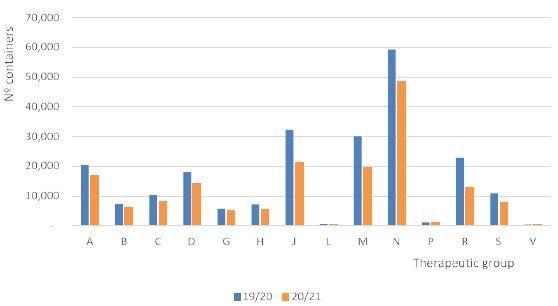
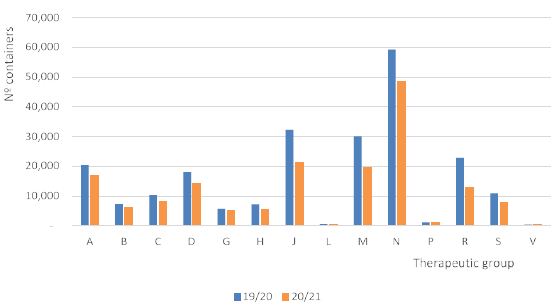
New prescriptions were analyzed by therapeutic groups and 3 groups stand out in terms of their reduction: in group R (respiratory) new prescriptions were reduced by 42.9%, in group M (musculoskeletal) by 35.4 % and in group J (anti-infectives for systemic use) by 34.6% (Figure 1).

fig 1

Figure 1: Start of prescriptions by therapeutic group March 14, 2020 to March 13, 2021 vs. same period of the previous year [2].

Likewise, some therapeutic subgroups have been reviewed and it is observed that in the vast majority of subgroups there is a reduction in the initiation of new prescriptions. The reduction is greater than 30% compared to the previous year in some subgroups such as: agents affecting bone structure and mineralization (M05) 41.9%, agents against obstructive airways conditions (R03) 39.4 %, systemic antibiotics (J01) 36.4%, opioids (N02A) 36.3%, NSAIDs (M01A) 35.9%, other analgesics and antipyretics (N02B) 31.6%, otologicals (S02) 31.1%, lipid modifiers (C10) 30.9% and calcium channel blockers (C08) 30%. On the contrary, an increase in the creation of new prescriptions was detected in the following subgroups: insulins (A10A) 52.9%, diuretics (C03) 1.4% and direct-acting anticoagulants (B01AE and B01AF) 10.5% (Table 2).

Table 2: Variation in the initiation of prescriptions in some therapeutic groups under the study period [2].

Therapeutic subgroup

2019

2020

Variation

A02. Antacids

8.664

6.931

-20,0%

A10A. Insulins

408

624

52,9%

A10B. Non-insulin antidiabetics

1.439

1.053

-26,8%

A11. Vitamins

2.105

1.611

-23,5%

B01. Antithrombotics

3.577

3.103

-13,2%

B01AE and B01AF. Direct-acting anticoagulants

218

241

10,5%

B03. Antianemics

3.370

2.752

-18,3%

C02. Antihypertensives

126

102

-19,0%

C03. Diuretics

1.776

1.801

1,4%

C07. Beta-blockers

885

799

-9,7%

C08. Calcium channel blockers

874

612

-30,0%

C09. Inhibitors of the renin-angiotensin system

3.490

2.573

-26,3%

C10. Lipid modifiers

1.631

1.127

-30,9%

J01. Systemic antibiotics

30.599

19.469

-36,4%

M01A. Nonsteroidal anti-inflammatory drugs

28.591

18.327

-35,9%

M05. Agents for bone structure and mineralization

363

211

-41,9%

N02A. Opioids

9.634

6.135

36,3%

N02B. Other analgesics and antipyretics

24.128

18.487

-23,4%

N02C. Anti-migraine

472

323

-31,6%

N03. Antiepileptics

2.547

2.329

-8,6%

N04. Antiparkinsonians

159

116

-27,0%

N05. Antipsychotics

13.840

13.319

-3,8%

N05B and N05C. Benzodiazepines

11.010

10.463

-5,0%

N06A. Antidepressants

4.879

4.529

-7,2%

R03. Agents for obstructive airway conditions respiratorias

7.600

4.595

-39,5%

R06A. Systemic antihistamines

6.380

4.535

-28,9%

S01. Ophthalmology

8.101

5.764

-28,8%

S02. Otologic

2.464

1.698

-31,1%

In some of the therapeutic subgroups, we found it interesting to go down to the level of active ingredients. In the NSAID group, there have been significant decreases in the initiation of new prescriptions in all the most prescribed active ingredients, highlighting ibuprofen (Table 3).

Table 3: Active ingredients of the group of NSAID with the highest number of starts of prescriptions in the study period[2].

Non-steroidal anti-inflammatory drugs

2019/20

2020/21

Variation

Celecoxib

632

538

-14,9%

Dexketoprofen

4.050

3.183

-21,4%

Diclofenac (including associations)

2.695

1.786

-33,7%

Etoricoxib

1.133

891

-21,4%

Ibuprofen (including ibuprofeno arginine)

15.102

8.341

-44,8%

Naproxen (including association with esomeprazole)

4.364

3.238

-25,8%

Systemic antibiotics have also suffered a significant decrease in the number of prescriptions created during the year that followed the declaration of the state of alarm, with several active ingredients with a reduction of around or more than 60% reduction compared to the previous year (amoxicillin, azithromycin, phenoxymethylpenicillin, levofloxacin or moxifloxacin). Cefuroxime and, to a lesser degree, fosfomycin, have increased the new prescriptions in this period (Table 4).

Table 4: Active ingredients of the group of systemic antibiotics with the highest number of prescription starts in the period under study [2].

Systemic antibiotics

2019/20

2020/21

Variation

Amoxicillin

7.905

3.154

-60,1%

Amoxicillin/clavulanate

7.558

5.074

-32,9%

Azithromycin

4.268

1.786

-58,1%

Cefuroxime

1.245

1.515

21,7%

Ciprofloxacin

1.519

1.392

-8,4%

Clarithromycin

355

221

-37,7%

Phenoxymethylpenicillin

165

56

-66,1%

Fosfomycin

3.831

3.873

1,1%

Levofloxacin

1.560

614

-60,6%

Moxifloxacin

235

88

-62,5%

The profile of new antibiotic prescriptions in pediatrics was also analyzed (Table 5). The reduction in new antibiotic prescriptions in pediatrics is even more pronounced than in the case of adults, and has remained so during these 12 months.

Table 5: Active ingredients of the group of systemic antibiotics with the highest number of prescription starts in the period under study [2].

Systemic antibiotics (pediatrics)

2019/20

2020/21

Variation

Amoxicillin

1.999

456

-77,2%

Amoxicillin/ clavulanate

714

431

-39,6%

Azithromycin

563

186

-67,0%

Total antibiotics

3.402

1.190

-65,0%

Finally, we wanted to check whether the significant decrease in new NSAID prescriptions could have shifted to other analgesics, such as paracetamol or metamizole. This was not the case in the periods analyzed previously and does not appear to be the case at present (Table 6).

Table 6: New prescriptions of non-NSAID analgesics in the study period [2].

N02B – Other analgesics and antipyretics

2019/20

2020/21

Variation

Metamizole

8.689

7.483

-13,9%

Paracetamol alone

15.388

10.983

-28,6%

Paracetamol with codeine

4.434

1.343

-69,7%

In summary, the creation of new prescriptions in the last year compared to the previous year has been reduced by 25.9%; however, the dispensing of drugs in pharmacy offices has only been reduced by 3%. This means that the medication consumed by the Bidasoa IHO population has been quantitatively similar to that of the previous year, probably due to the successive automatic extensions of medications that have been applied during this time.

References

  1. Mendizabal Olaizola A, Valverde Bilbao E (2020) Impacto de la pandemia SARS-CoV-2 en el inicio de las prescripciones. J Healthc Qual Res 402-403.
  2. Data obtained from Osakidetza’s OAS (Oracle Analytics Server) tool.
  3. Data obtained from Health Department’s OBIEE (Oracle Business Intelligence Enterprise Edition) tool.

How and Why Choirs May Promote Health and Wellbeing?

DOI: 10.31038/IJNM.2021223


Recent research confirm that longevity and a healthy life is strongly influenced by belonging to closely knit communities or groups, that can give you a sense of meaning and of mastering in collective activities like nature and culture experiences. Increasingly more emphasis has been put on nature and cultural activities for maintaining health and quality of life [1-3], and may be linked to the building of social capital in local communities [4]. Health promotion is carried out by and with people, which improves both the ability of individuals to take action, and the capacity of groups, organizations or communities to influence the determinants of health (WHO, 1997). “Settings for health” represent the organizational base of the infrastructure required for health promotion. New health challenges mean that new and diverse networks need to be created to achieve intersectoral collaboration. Such networks should provide mutual assistance within and between countries and facilitate exchange of information on which strategies are effective in which settings. Public health research and practice should focus not only on factors causing disease and injuries (pathogenesis), but also on factors promoting health (salutogenesis) in the perspective of health promotion and prevention in different settings. Creative arts initiatives can be an effective way of meeting the growing calls for a shift of emphasis in mental health services, enhancing the significance of relationships and social support in the context of the well-being agenda. An adequate grasp of mutuality and social relationships is also important in addressing recent policy initiatives around loneliness [5]. Choral singing contributes to people changing their self-perception or maintaining their identity despite life affecting challenges or changes in living conditions [6]. Choral singing practice can be seen from a salutogenetic perspective that is, as something which promotes health and strengthens the healthy aspects of an individual in states of ease or dis-ease [7]. Singing can also be beneficial for those in the wider community who are affected by non-communicable diseases such as cancer [8]. Vitality was improved in those with a cancer diagnosis, and anxiety was reduced in cares and the bereaved. To use resources and capacities in communities by strengthening empowerment of the individuals that suffer from mental disorders and diseases, mostly anxiety and depression would also underline the importance of giving priority to the topic Public Mental Health Promotion in the light of new epigenetic research [3].

Non-Pharmaceutical Interventions

Quite often people would rather be prescribed non-pharmaceutical interventions than medication The Lancet Commission on Culture and Health states that as it is increasingly recognized that wellbeing has both biological and social elements, health care providers can only improve outcomes if they accept the need to understand the sociocultural conditions that enable people to be healthy and make themselves healthier – that is, to feel well [9], and then possibly recommend non-pharmaceutical interventions. Seven years of research by the James Lind Alliance into the clinical research priorities of patients, carers, and clinicians indicated that 72% (103/126) of treatment priorities were non-pharmacological and that often people would rather be prescribed non-pharmaceutical interventions than medication [10]. Marmot has described social exclusion as “deprivation on stilts” [11] to accentuate how damaging it is for the individual and society. He advocates for any changes that could help tackle social exclusion, and it could be argued how choirs would be 2 fertile grounds for further research for a potential role in health promotion by facilitating a pathway to social inclusion. In response to this, ‘social prescribing’ is becoming more prevalent, whereby people presenting to primary care are linked with various sources of support within the local community, from gardening projects to table tennis clubs, and choirs can act as another potential non-pharmacological ‘tool’ [12]. Leisure time is increasingly important for emotional wellbeing, informal learning and identity formation among children and youth. Contemporary societies are characterized by increasing individualization, affecting identity formation, well-being and sense of coherence and belonging. The institutionalization of childhood and education/knowledge has increasingly compartmentalized children and young people into exclusive spheres set apart from the adult world, placing them in an age-segregated social order, at the cost of being included in an intergenerational social order [13]. Health benefits from musicking[1] [14] may reduce stress, anxiety, depression by building coping capabilities, resilience social inclusion and renewed strength [15].

Future Studies

Despite widespread anecdotal evidence that singing has a positive effect on health and wellbeing, and the burgeoning number of studies suggesting potential benefits in many diverse fields, recent systematic reviews have identified that the quality of evidence is sometimes poor. McNamara’s Cochrane review of the singing and COPD literature suggested that the quality of evidence is low to very low. This was thought to be due to the small size and the low number of randomized controlled trials [16]. Other methodological limitations have meant that outcome measures vary or there are no consistent changes in outcome measures. Randomised controlled trials of singing interventions suffered from attrition as people who wanted to sing were not allocated it, or the singing ‘intervention’ offered was too short, too finite, or simply not appealing. Clark and Harding’s [17] systematic review of the psychosocial outcomes of singing interventions concluded that more qualitative studies were needed. The results of the six studies that have been carried out since then are interesting, convergent, but (naturally) inconclusive. In order to explore such ecological functions of choral singing, participant observation is a good strategy in addition to the ethnographic interview. Through participant observation of the choral singing practice and events, we can investigate how choral singing is imbricated into their social networks and how it expands their social world.

[1] Musicking: To music is to take part, in any capacity, in a musical performance, whether by performing, by listening, by rehearsing or practicing, by providing material for performance (what is called composing) or by dancing. (Small, 1998:9). See also David Elliott’s definition of Musicing: all human action related to [music.]” [14].

Reference

  1. Hansen E, Sund E, Krokstad S (2015) Cultural activity participation and associations with self-perceived health, life-satisfaction and mental health: the Young HUNT Study, Norway. BMC Public Health
  2. Cuypers K, Krokstad S, Holmen TL, Margunn SK, Lars OB, et al. (2013) Patterns of receptive and creative cultural activities and their association with perceived health, anxiety, depression and satisfaction with life among adults: the HUNT study, Norway. J Epidemiol Community Health 66 : 698-703. [crossref]
  3. Tellnes G, Batt-Rawden KB, Christie WH (2018). Nature Culture Health Promotion as Community building. Journal “Herald of the International Academy of Science. #1. Russian Section” (HIAS.RS). Herald of the International Academy of Science. Russian Section”. vol. 1 (1).
  4. Campbell C, Gillies P (2001) Conceptualizing ‘social capital’ for health promotion in small local communities: a micro-qualitative study. Journal of Community & Applied Social Psychology. 11 : 329-346.
  5. Sturgeon S (2006) Promoting mental health as an essential aspect of health promotion. Health Promotion International 21 : 36-41. [crossref]
  6. Balsnes AH (2010) Choir research – a Norwegian perspective. In : Geisler U, Johansson K (eds.), Choir in Focus. Pg : 16 – 19, Bo Ejeby Publisher.
  7. Clift S, Jennifer N, Raisbeck M, Whitmore C, Morrison I (2010) Group singing, wellbeing and health: A systematic mapping of research evidence. UNESCO Observatory, Faculty of Architecture, Building and Planning, The Melbourne Refereed E-journal 2 .
  8. Batt-Rawden KB, Andersen S (2018) “Singing has empowered, enchanted and enthralled me” Choirs for Wellbeing?”. Health Promotion International 3.
  9. Napier D, et al (2011) Culture and Health Lancet Commission. The Lancet.
  10. Crowe S, Fenton M, Hall M, Cowan K, Chalmers I (2015) Patients’, clinicians’ and the research communities’ priorities for treatment research: there is an important mismatch. Research Involvement and Engagement 1.
  11. Marmot M (2015) The Health Gap: the Challenge of an Unequal World. Bloomsbury, London, UK.
  12. Ruud E (2013) Can music serve as a “cultural immunogen”? An explorative study. International journal of qualitative studies on health and well-being. 8 : 205-209. [crossref]
  13. Beynon C, Lang J (2018) The More We Get Together, The More We Learn: Focus on Intergenerational and Collaborative Learning Through Singing. Journal of Intergenerational Relationships 16 : 45-63.
  14. Small C (1998) Musicking. The Meanings of Performing and Listening. Weslyan Press. London.
  15. Batt-Rawden KB (2018) The fellowship of Health Musicking: A Model to Promote Health and Well-Being. Music and Public Health – A Nordic Perspective. Bonde LO, Theorell T (eds) Springer Verlag.
  16. Williams E, Dingle G, Clift S (2018) A systematic review of mental health and wellbeing outcomes of group singing for adults with a mental health condition. European Journal of Public Health 28 : 1035-1042. [crossref]
  17. Clark I, Harding K (2012) Psychosocial outcomes of active singing interventions for therapeutic purposes: A systematic review of the literature. Nordic Journal of Music Therapy 21 : 80-98.

Pediatric COVID-19

DOI: 10.31038/JPPR.2021423


Virus Description

Corona is a common viral disease that can be transmitted between humans and different types of animals, meaning it can be transmitted between different races and types of living organisms. It is characterized as having broad-spectrum disease symptoms that differ from one patient to another in their severity and type. In the last months of 2019, a storm of infection with the Corona virus appeared in the Chinese city of Wuhan, with symptoms that were almost different in severity and led to deaths in some infections. The virus was characterized by its rapid spread among people, which surprised researchers, doctors and people in that city and in China in general. Which challenged Chinese researchers and scientists to investigate the type and nature of the causative agent, so they were able to diagnose Corona virus (Cove 2).

Keywords

SARS cov2, Coronavirus, Children, COVID-19, Viral infection, Respiratory signs, Pfizer/BioNTech, Moderna and Johnson & Johnson vaccines

COVID 19 Susceptible Age of Children

In December 2019, a novel coronavirus (severe acute respiratory syndrome coronavirus 2 [SARS-CoV-2]) emerged in China and has spread globally, creating a pandemic. Information about the clinical characteristics of infected patients who require intensive care is limited. The 2019 novel coronavirus (SARS-CoV-2) has been responsible for more than 54000 000 infections and 1,200 000 deaths worldwide, but data regarding the epidemiologic characteristics and clinical features of infected children are limited [1,2]. The largest study so far, published in pediatrics J. included analysis of 2,143 children with COVID-19 documented from Jan. 16 to Feb. 8 in China. It found that symptoms of the disease were generally less severe in children and teens compared with adults. Specifically, 4.4 percent had no symptoms, 50.9 percent had mild disease and 38.8 percent had moderate symptoms. Of the children with symptoms, only 0.6 percent developed acute respiratory distress syndrome or multiple organ dysfunction. Of note, however, young children—particularly infants under one year of age—had a higher risk for significant illness. Ten percent of infants had severe disease, compared with 3 percent of teens over age 15.

How Likely are Children to Get Coronavirus Disease 2019 (COVID-19)?

Although all children can be infected with the virus that causes COVID-19, they are not as frequent as adults. Children rarely encounter serious illnesses from COVID-19. Although there have been many large-scale outbreaks around the world, few children have died. According to the US Centers for Disease Control and Prevention (CDC), between February 12 and April 2, of the nearly 150,000 COVID-19 cases in the United States, only 2500, or 1.7%, were children. This is similar to outbreaks in other countries such as China and Italy. The hospitalization rate of children is much lower than that of adults [3]. However, people of any age with certain underlying diseases (such as type 2 diabetes) have a higher risk of serious illnesses from COVID-19. In addition, children with congenital heart disease, genetic diseases, or diseases that affect the nervous system or metabolism are also at higher risk of serious illnesses from COVID-19. Discuss with them what happened and assure them that most situations are mild. Your child will get tips from you, so it’s also important to stay calm.

How Does COVID-19 have an Effect on Kids?

Children, together with very younger kids, can infected with COVID-19. Many of them don’t have any signs and symptoms. But those who do get the infection generally tend to show milder signs and symptoms which includes low to mild fever, exhaustion, and cough. Some kids have had marked fitness situations can be at expanded hazard for intense illness. A doubtlessly acute and perilous sequel can appear on kids. This case defined as multisystem inflammatory syndrome in children (MIS-C), it may result in life-threatening issues with the coronary heart and different organs with inside the frame. In this condition, exceptional frame parts, which includes the coronary heart, lungs, kidneys, brain, skin, eyes, or gastrointestinal organs, can end up inflamed.

Symptoms of MIS-C can Include

  • Fever lasting more than a couple of days
  • Rash
  • Bloodshot eyes (redness of the white part of the eye)
  • Stomach ache
  • Vomiting and/or diarrhea
  • A large, swollen lymph node in the neck
  • Neck pain
  • Red, cracked lips
  • A tongue that is redder than usual and looks like a strawberry
  • Swollen hands and/or feet
  • Irritability and/or unusual sleepiness or weakness.

Why do Children React Differently to COVID-19?

The answer is unclear. Some experts suggest that children may not be severely affected by COVID-19 because there are other coronaviruses that spread in the community and cause illness, such as the common cold. Since children often catch colds, they may have antibodies to protect them against COVID-19. Children’s immune systems may also interact differently with adults’ immune systems. Some adults get sick because their immune system seems to overreact to the virus, causing more damage to their bodies. This may be unlikely to occur in children. Although rare, children under 1 year old (infants) have a higher risk of serious illness from COVID-19. This may be due to their immature immune system and small respiratory tract, which makes them more susceptible to respiratory problems caused by respiratory viral infections. Between late December and early February, more than 2,100 children with suspected or confirmed COVID-19 in China were studied, and the results showed that less than 11% of infants had serious or severe illnesses. In contrast, the prevalence of severe or severe illness is about 7% for children aged 1 to 5 years, 4% for children 6 to 10 years old, 4% for children 11 to 15 years old, and 3% for children 16 years and older. New born babies may be infected with the virus that causes COVID-19 when they come into contact with sick caregivers during or after delivery. The American Academy of Pediatrics recommends special care for new-borns born to women who have confirmed or suspected COVID-19. This may include temporarily separating the mother from the new born to reduce the risk of infecting the baby, monitoring the baby for signs of infection, and, if available, testing the new born for COVID-19 [4,5].

Do Children and Adults have Different Symptoms of COVID-19?

When you see some mild symptoms on your son or daughter and feel or suspect that these symptoms are similar to those of COVID 19, you should take quick steps to isolate your child in a special room where all the comforts and conditions of health are available and prevent contact with him from the rest of the family and tell his or her doctor or health care providers and following the procedures recommended by the World Health Organization. COVID-19 symptoms in children and adults experience similar symptoms of COVID-19, while children’s symptoms tend to be mild and cold. Most children will recover within one to two weeks. Their symptoms may include: fever Runny nose cough fatigue Muscle pain Vomiting diarrhoea. When children and adolescents get COVID-19, their symptoms seem to be milder than adults. Among the American population under 19, almost no one is hospitalized. Studies have shown that more than 90% of sick children have mild to moderate cold-like symptoms, including: fever Runny nose cough Vomiting diarrhoea. Some children and adolescents have been admitted to the hospital due to childhood multiple system inflammatory syndrome (MIS-C) or pediatric multiple system inflammatory syndrome (PMIS).

Coronavirus in Sick Children if Some Children have Other Diseases

They may be at higher risk of more serious diseases: asthma diabetes Blood disease Heart or liver disease Kidney disease requiring dialysis Weakened immune system. Doctors are still learning about it, but they think it is related to the new coronavirus. Symptoms include fever, abdominal pain, vomiting, diarrhea, skin rash, headache, and confusion. They are similar to toxic shock syndrome or Kawasaki disease, which causes inflammation of blood vessels in children. Serious problems are rare. If your child has any of the following symptoms, seek medical help immediately. Difficulty breathing Can’t let the liquid flow down Changes in skin tone, including blue lips or face Confused or trouble waking up Serious problems are rare. If your child has any of the following symptoms, seek medical help immediately: Difficulty breathing Can’t let the liquid flow down Confused or trouble waking up Blue lips or face.

When Will Youngsters be Capable of Get the COVID-19 Vaccine?

Pfizer/BioNTech and Moderna are already carrying out age de-escalation researches, wherein the vaccines are examined in different categories of children of descending age. Johnson & Johnson plans to do the same. Currently, the Pfizer/BioNTech COVID-19 vaccine is permitted to be used in teenagers sixteen years and older, but the Moderna and Johnson & Johnson vaccines are given a permission for the young in 18 years and older. In March 2021, Pfizer/BioNTech introduced promising effects for a Phase three trial trying out its vaccine in youngsters a while 12 to 15. Experiments were conducted on 2,260 voluntaries teenagers, half of whom were given mRNA vaccine and the rest were given Normal Saline or Placebo. The antibody reaction within side the vaccinated adolescent categories turned into even more potent than that during vaccinated sixteen- to 25-year-olds enrolled in an in advance study. In addition, a complete of 18 symptomatic instances of COVID-19 have been said at some point of the trial, all within the placebo group. Vaccine-associated signs and symptoms have been slight and akin to older corporations enrolled in in advance study. The effects have been introduced in a press release, now no longer in a peer-reviewed, posted study. Pfizer/BioNTech has submitted their facts to the FDA with a request to make bigger emergency use authorization to youngsters a while 12 to 15. The enterprise has additionally commenced trying out the vaccine in children more youthful than 12 years. Moderna is carrying out vaccines study — one in adolescents a while 12 to 17, the alternative in children among a while of 6 months and 12 years. The age de-escalation research is achieved to verify that the vaccines are secure and powerful for every age category. They additionally pick out the most reliable dose, which ought to be powerful, however with tolerable facet effects. The adult trail is a greater than the age de-escalation study in the children; in addition of recruiting many thousands of contributors, they may recruit between 2,000-3000 participants in every age category. Look like the adult studies, a few children in every study gets a placebo. The FDA will evaluation facts from the de-escalation trials to determine whether or not to authorize the vaccines for every age category.

References

  1. World Health Organization. Coronavirus disease 2019 (COVID-19): situation report — 50.
  2. Guan W, Ni Z, Hu Y, Wen-hua Liang, Chun-quan OU, et al. (2020) Clinical characteristics of coronavirus disease 2019 in China. N Engl J Med 382: 1708-1720.
  3. Bialek S, Boundy E, Bowen V, et al. (2020) CDC COVID-19 Response Team. Severe outcomes among patients with coronavirus disease 2019 (COVID-19)—United States, February 12–March 16, 2020. MMWR Morb Mortal Wkly Rep 69: 343-346.
  4. Ng Y, Li Z, Chua YX, et al. (2020) Evaluation of the effectiveness of surveillance and containment measures for the first 100 patients with COVID-19 in Singapore—January 2–February 29, 2020. MMWR Morb Mortal Wkly Rep 69: 307-311.
  5. The Novel Coronavirus Emergency Response Epidemiology Team (2020) The epidemiological characteristics of an outbreak of 2019 novel coronavirus diseases (COVID-19)—China. China CDC Weekly 2: 113-122.

The Importance of a Community Health Network: An Ethnoanthropological Approach, the Experience of Teaching Demoethnoanthropology of the Degree Course in Nursing at the University of Parma

DOI: 10.31038/IJNM.2021222


Although Italy has a long history of migration behind it, it seems unable to convey the long experience accumulated over 150 years on its territory. There seems to be a lack of a network of contacts and relationships with communities of different cultures and social distress in the area of health, where there is a virtuous experiment, even well functional, but not really structured in a network. The COVID-19 Pandemic has shown that the inherent weaknesses in the sphere of migration and social hardship, which have worsened in the absence of a community health network; cultural, linguistic, social barriers, of knowledge of services and institutions, have been widened due to the impossibility of travel and the lack of individual institutional references that could provide indications, information and guidance. The creation of a network of contacts for the teaching of Demoethnoanthropology of the Nursing Studies course at the University of Parma has shown how a culturally competent and correct anthropological approach can provide communities with a channel of orientation and adherence through pre-built direct contact.  The network of contacts built by the demo-ethnoanthropology course was born in the year 2013, when a discussion of involvement of the communities of different cultures of the territory is initiated, in a part of the training course of the course. The idea was to exploit university indications regarding the “Third Mission” by involving the cultural diversity of the area in an interaction between the university, students and communities both in the representative offices of the communities and in the university classrooms. The initiative, much appreciated by the representatives and members of the communities, involved a large part of those present in the territory of the city of Parma and the province. The first meetings brought in the classrooms representatives with an important university education, but also young university students and more. In 2015 we created that series of events known as “Cultural coffee” of the nursing study course, unique cultural encounters in Italy for this type of course held within a hospital dining area, therefore in a context outside the classrooms and open to the public in fact we added an element that was required by the Emilia Romagna region that is, bringing events with multicultural characteristics into common places among ordinary people. Over the years, public meetings and going with students to the associative centers of the communities, including the Islamic culture center of Parma, the Gurdwara Singh Saba associative headquarters, the Zoe pentecostal mission of Parma have increased institutional knowledge of the course and created a vast network of relationships. In order to build community involvement with an intention that is also inclusive, an institutional relationship more dedicated to health has also been initiated, since the same communities, aware of our dual role as teachers and nurses, have begun to ask us questions and requests in this regard. to health, to the approach to care, exposing basic care needs, effectively communicating the lack of an interconnection between community and health institution and seeing in our professional figure a simpler channel of approach.

It has happened that in several cases, single individuals have been advised and guided towards the healthcare receptivity of the hospital structure in particular towards complex operating units (cardiac surgery, cardiology, orthopedics, neurosurgery and others), through simple indications, or help in understanding and solution bureaucratic elements that are more difficult to understand. We have provided indications and advice with a correct approach towards the cultural dimension, taking into account the social, cultural context, of habits and customs, views and interpretation of health with respect to the culture of origin. We well know that care and health can be interpreted and seen not according to a standard, on the other hand health is not a static car in its being, but can be interpreted and welcomed on the basis of very diversified social and cultural rules, but which go and should be always considered competently to be correct. Our undergraduate training in anthropology has been for an advantage, both in building trust and networking relationships, as well as in the help and support of care and health and what at first appeared to be a great openness and trust. Towards us, it has also proved very valuable during the COVID-19 Pandemic the measure of trust was also increased by some particular institutional events, such as the meetings for the creation of the room of worship and silence that saw us present on 3 different occasions together with the representatives of the communities and the general managers of the two health companies of the territory, where we became spokesman and link between the two realities and in this regard I want to remember that the city of Parma alone has the presence of 31,000 people of foreign origin on a housing reality of 200,000 inhabitants, with as many as one hundred and 137 different nationalities , and more than 40 associations of different cultures. It is also true that a relationship of trust of a personal nature has been created, but the fact remains that we have presented ourselves to the communities also as institutions, university and hospital together. Was there even a time when we had some doubts about this, was this personal approach also correct? Could it be an advantage or could it become a double-edged sword, with the risk of creating expectations and even disappointments?

The answers came from a meeting with the former prefect of Parma, Dr. Giuseppe Forlani who removed all doubts, he already Central Director of Civil Services for Immigration and Asylum within the Department for Civil Liberties and immigration from the Ministry of the Interior, thus coming from a training similar to ours but with a very vast and particular background of experience in the field, advised us to continue on the path taken and gave us answers and advice, with an important indication or that the institutions must go to the communities and therefore we were doing this, that the personal relationship that has been created is above all an institutional relationship because in this way we entered the communities a personal form is fine too but it is the input context that unconsciously dictated the rules of the relationship. According to his vision, the extraordinary nature of the relationship of trust could be of great help and importance in the future and we are talking about the summer of 2019. created a moment of important meeting between institutions, the municipality, the prefecture, health authorities and the community itself. There was also a similar request arrived a few weeks later by the Ahmadiyya Muslim Jama’at Italia Association which asked us to help them organize an event of presentation and comparison between the religious, community, philosophical and secular diversity of the territory for thus building a relationship of trust and having a link with hospitals through our people. The event scheduled for March 26,2020 has been postponed due to the COVID-19 Pandemic. But what may appear as a building of relationships of trust, as the prefect had foreseen, in the Pandemic moment demonstrated all the potential of the network, of how the correct anthropological approach, respectful and culturally competent and prepared, had in fact filled a void dictated by an inexperience of the institutions. The communities have contacted us on many occasions, asking us to help them for particular situations, including indications on prevention systems and methods, such as, on our advice, the closure of the Sikh temple in Parma, the first cult institution in Italy to close the ‘access to the faithful, a week before the government decree which imposed an absolute ban on access to places of worship. But there are still many requests for the recovery of the bodies or to understand the procedures for managing them and personal effects. But again the participation in the construction of the dedicated site www.oltreemergenze.com in which we provided part of the communications in a different language and we placed ourselves as referents for some procedures. These are just a few examples of the work done.

What does all this prove? First of all, that cultural diversities are in fact largely outside the information context of care and health, that the absence of a system of interconnection between institutions and communities has created a vacuum, which has become a major problem in receiving information and providing actions. at a time when it was in the most complete lockdown. This demonstrated the need for territorial community healthcare, which not only approaches cultural diversity but also social discomfort, as demonstrated by Emergency NGO. The reality of the NGO of which i’m also a volunteer on the project in Milano, shows that in order not to leave anyone behind, there is a need for an institution that enters into community realities, that knows the cultures, that is culturally formed and prepared, that has a solid basis to be able to relate correctly with these. The structure as it is today, demonstrates that at the base there is a void, holes in the institutional mesh that puts in difficulty the realities of different cultures and beyond, that the simple approach with the brochure or flyer in the language is not enough. The construction of a network of relationships with a strong anthropological and intercultural characteristic in the small of a reality like Parma, with only two individuals myself and my colleague Murekabiri with the help of the communities and the network of built relationships, has shown that an intercultural service on the territory, which embraces cultural diversity and social discomfort, can guarantee people not only the possibility of real and correct information but above all equality in care and assistance, remembering that it is from the territory, from the fabric of this that you can improve access to care, adherence to it and also create a valid system of social inclusion. In a small way, this experience has shown that the method used, which in fact is the Canadian one, can be functional, and is required of us, even before the pandemic by the WHO 2020/2030 agenda and is moreover in the directives of the UN. Therefore, concluding if the network built with an anthropological and intercultural approach system has given good results even if in the small of our experience in a medium-sized city, the same system increased through culturally competent elements, organized at an institutional and service level, can achieve important local, regional and national results.

Featured Image2

Identifying Possible Risk Factors of Poorly Understood Cancers – The Case for Using Health Information Technology

DOI: 10.31038/PEP.2021233

Introduction

Worldwide, cancer is the second leading cause of death, with one of every six deaths caused by cancer [1]. There were 17 million new cases and 9.6 million cancer deaths worldwide in 2018, including approximately 1.7 million new U.S. cases and 600,000 U.S. cancer deaths [3]. The total financial cost of cancer in 2010 was estimated at 1.16 trillion U.S. dollars [1].

There have been significant reductions in cancer mortality, thanks to improved screening, early detection, and better treatment [1]. However, the worldwide incidence of cancer is expected to increase to 27.5 million per year by 2040 [28], a 62% increase from 2018. The U.S. expects an increase to over 1.9 million new cases per year by 2020, largely due to an aging Caucasian population and a growing African American population [5].

The World Health Organization states that “30-50% of all cancer cases are preventable. Prevention offers the most cost-effective long-term strategy for the control of cancer” [26]. Cancer can be prevented by reducing exposure to environmental risk factors, modifying lifestyle factors that are linked to cancers, and protecting against the effects of risk-factor exposures [26].

Tobacco is one of the most widely known and most modifiable risk factors for cancer and the process in determining this illustrates the value of the systematic study of cancer causes [15]. Lung cancer is the most common cancer in the world after skin cancer and the most deadly [24]. Before smoking became widespread, lung cancer was rare; however, as cigarette production and smoking increased, lung cancer became much more common. Smoking tobacco was found to be associated with lung cancer around the mid-20th century when a study showed that smokers were more likely to have cancer than non-smokers [15]. This relationship was confirmed by epidemiological and prospective studies, experiments, pathological observations, and chemical analyses [15]. Smoking was also found to be a risk factor for many other types of cancers and diseases, and tobacco is now understood to be associated with 33% of cancers and 22% of cancer-related deaths worldwide [28]. Cigarette smoking is associated with 80%-90% of lung cancer deaths in the U.S. [25]. Deaths caused by smoking cigarettes have an average latency of about 25 years; lung cancer deaths are expected to reach about 2 million per year during the 2020s or the 2030s [15].

As a result of the overwhelming evidence that smoking is a causal factor for cancer, there have been many anti-smoking initiatives. These efforts include preventing smoking initiation, helping smokers quit the habit, and reducing exposure to second-hand smoke [11]. Smoking cessation reduces cancer risk and can improve outcomes for cancer patients. Smoking cessation can reduce lung cancer risk by as much as 85% after 16 years of cessation compared to non-cessation [13]. Due to tobacco control measures that were implemented in the U.S. in the mid-1950s, about 32% (795,851) of the lung cancer deaths that would have occurred during 1975-2000 were prevented; the benefits of these measures will continue [11]. These huge reductions in deaths, suffering, and costs were possible because good epidemiological evidence uncovered the link between smoking and cancer.

Other cancer-prevention strategies that have grown out of accumulating epidemiological studies include reducing alcohol consumption [10], vaccinating against certain viruses [17], and improving diet and exercise [4]. The International Agency for Research on Cancer (IARC) determined that alcohol was carcinogenic after reviewing studies that showed an association between alcohol consumption and certain cancers [8]. One study involving eight European countries estimated that for 2008, 3% of cases in women and 10% of cases in men were due to alcohol consumption [20]. A U.S. study determined that 3.2% – 3.7% (18,200 to 21,300) of all cancer deaths in 2009 were attributable to alcohol consumption [12].

Many viruses have been shown to cause or be associated with certain cancers [17]. Individuals and health care providers can take preventive steps such as vaccinations, follow-up treatment to minimize the risk of developing cancer, and screening to maximize chances of early detection of cancer [17]. And because obesity, diet, and sedentariness have proven to be risk factors that are related and modifiable, individuals can make lifestyle changes to reduce their cancer risk while gaining other health benefits [4].

There have been improvements in cancer survival rates due to improvements in cancer detection and treatment, but the progress made applies to relatively few cancers [16]. Also, this does not spare patients the ordeal, financial cost, and disability of cancer treatment. Screening guidelines are available for very few cancer types, so many cancers are detected at later stages and, therefore, have a lower survival rate [9]. In addition, incidence rates of some of these poorly understood cancer types are increasing. Cancer prevention is the least costly and most desirable approach to combat the expected increase in cancer incidence [26]. However, to achieve this we need epidemiological research that focuses on identifying risk factors for poorly understood cancer types.

A traditional epidemiological approach, such as the “Cancer Prevention Studies” (CPS), requires a large enough study group, long follow-up, and is costly [7]. Therefore, this approach is limiting, especially for poorly understood cancers, which tend to be rarer cancers. In addition, the research landscape has changed significantly. Information technology was one of the most significant technological developments of the twentieth century and has affected every aspect of our lives. It has made us very interconnected to people, activities, and the environment. Determining any effect of these connections is difficult due to the complexity and numerosity. Fortunately, these technological developments have also made significant advances that can be applied to health research. We have, are generating, and are capturing more data about many different aspects of our lives than ever before. We need to use current technology and data to overcome the limitations of the traditional epidemiological approach. We must develop reliable, efficient, and cost-effective research methods to identify possibly risk factors for poorly understood cancers.

Purpose

Our main objective in this study was to identify cancer types that represent a health burden, but for which environmental and lifestyle risk factors are poorly understood (i.e., without an established causal risk factor). We used a combination of inclusion and exclusion criteria to identify these cancers. The inclusion criteria were cancer types 1) without screening guidelines; 2) with low survival rates; and 3) with increasing incidence. Cancer screening aims to detect cancer before the individual becomes symptomatic, and early detection usually results in more successful treatment and greater survival [27]. Currently, only four types of cancer – breast, cervical, colorectal, and lung – have broadly accepted screening recommendations [16]. The cancers with low survival rates tend to be cancers that are more difficult to detect and to treat. An upward trending cancer indicates a growing concern that should be investigated to identify risk factors and reduce incidence. The primary exclusion criterion was cancer types with established causal risk factors. By default, cancer types with screening guidelines, without low survival rates, and/or without increasing incidence were excluded.

Secondarily, we propose a new methodological approach to study the etiology of these rare cancers that maximizes data utilization without the need for costly epidemiological studies, such as the “Cancer Prevention Studies”. This design allows exploration of the relationships of selected cancer with various potential risk factors without the financial and feasibility barriers of traditional epidemiological designs.

Methods

We used data from the National Cancer Institute’s (NCI’s) Surveillance, Epidemiology, and End Results (SEER) Program. The SEER Program collects cancer incidence and survival data for every cancer case reported from population-based cancer registries covering approximately 34 percent of the U.S. population spanning 19 geographic areas. The program started in 1975 with nine registries and now collects data from twenty-one registries. Based on the broad coverage area, the data collected by the SEER Program is representative of the U.S. population [21].

SEER data are coded to ICD-O-3 and are grouped by major cancer site/histology [22]. The data have 102 groups in a hierarchical format, ranging from all sites to miscellaneous. SEER incidence data have both the rate (per 100,000 and age-adjusted to the 2000 U.S. population) and count. Survival data provide observed, expected, and relative rates. Incidence trend data show overall percent change, annual percent change (APC), and the rate for each year. For this study, we used incidence data for 2011 through 2016 and survival data for the five-year period 2011 to 2015.

Starting with all 102 groups of cancers from the SEER database, we compiled data for incidence, survival rate, and trend. We added data on whether the cancers had recommended screening guidelines. Our selection criteria for cancer groups representing a health burden were groupings that do not have recommended screening guidelines, had a positive APC over the 6-year period (2011 to 2016), and had a 5-year relative survival rate of less than 70%. From the cancers meeting all three criteria, we removed groupings that were poorly defined, groupings containing “Other” or “Not Otherwise Specified”, and groupings that were too broadly defined (e.g., “Female Genital System”). We removed “Liver and Intrahepatic Bile Duct” since it includes the sub-category “Liver” that did not meet the criteria, but the sub-category “Intrahepatic Bile Duct” is in the final list (Table 1). We implemented the primary exclusion criterion by reviewing the websites of the American Cancer Society (ACS) (Cancer.org) and the National Cancer Institute (NCI) (Cancer.gov) to identify risk factors, causal and non-causal, for each of the cancers initially selected based on epidemiological measures. None of the cancers that met the inclusion criteria had established causal factors, so none were excluded (Table 2).

Table 1: Cancers meeting inclusion criteria

table 1

1Rate per 100,000 population, age-adjusted to the 2000 U.S. standard population.
Shaded groupings were removed for reasons stated above

Table 2: Application of exclusion criterion using information from the ACS website

table 2 (1)

footer 1

table 2 (2)

footer 2

table 2 (3)

footer 3

Results

The main epidemiological measures for the 12 groupings of poorly understood cancers are presented in Table 1. The grouping of “Oral Cavity and Pharynx” is a major grouping with sub-groupings “Tongue” and “Oropharynx”, and all three are in the final list. There are four groupings of the digestive system – “Small Intestine”, “Appendix”, “Intrahepatic Bile Duct”, and “Pancreas”. There are two leukemias – “Acute Lymphocytic Leukemia” and “Chronic Myeloid Leukemia”. The other groupings are “Soft Tissue including Heart”, “Penis”, and “Myeloma”.

The cancers included in the final list have varying statistics (Table 1). The age-adjusted incidence rates of poorly understood cancers in the final list range from 0.40 to 12.23 cases per year per 100,000 population. The incidence rates for all the 102 original groupings ranged from 0.00063 to 85.28 cases per year per 100,000 population. The final list of cancers has 5-year survival rates ranging from 7.67% for Pancreatic Cancer to 69.13% for Cancer of the Appendix. Cancer of the Appendix has the highest upward incidence trend (APC=16.46), followed by Intrahepatic Bile Duct (APC=8.70), Oropharynx (APC=2.62), and Tongue (APC=1.76). The other cancers have upward incidence trends of less than 1.00% APC. While there are some known risk factors for these cancers, there are no known causal risk factors.

Some of these cancers, such as soft tissue cancer including heart, have a more robust set of potential risk factors in the ACS classification of risk factors but a substantially larger number of potential risk factors classified by NCI. Others like “Acute Lymphocytic Leukemia” have a large number of potential risk factors in both ACS and NCI classifications. Tobacco, infections, radiation, and immunosuppressive medications were stated more as general risk factors for many of these poorly understood cancers. Some cancer-specific risk factors are viruses, diseases, syndromes, and poor nutrition, but the overall opinion is that very little is known about the causes of these cancers.

Discussion

Our study identified 12 cancers as poorly understood because a causal risk factor has not yet been identified. These 12 cancers, though not among the cancers with highest health burden in the United States and worldwide — a ranking mostly reserved for lung, colorectal, prostate, breast and cervical cancer — represent a moderate health burden if their count is taken in aggregate. Therefore, preventing these cancers and improving population health will be possible if we identify their causal risk factors (exposures).

Identifying associations between exposures and cancer can be done through cohort or case-control studies [18, 19]. A cohort study can provide strong evidence of causal associations. ACS’ Cancer Prevention Studies (CPS-I, CPS-II, CPS-3) are large scale, prospective, cohort studies [7]. These studies required large scale recruitment of subjects, survey completion by the subjects, and long follow-up periods. Initially, the aim was to determine the relationship between smoking and mortality from diseases. CPS-3 aims to determine the causes and protectants of cancer by looking at lifestyle, exposure, biology, and environment [7]. The results of CPS-I and II have identified significant factors that affect health and diseases progression. This information identified the areas to focus resources in order to combat diseases. These studies have provided valuable information that has helped to improve health; however, they require significant manpower and follow-up time. CPS-I had 68,000 volunteers in 25 states, a cohort of almost one million participants (men and women) and ran from 1959 through 1972. The CPS-II cohort was established in 1982 through recruitment of 1.2 million men and women in 50 states by 77,000 volunteers. CPS-3, with over 30,000 volunteers, enrolled over 304,000 participants from across the United States and Puerto Rico from 2006 through 2013. CPS-II and CPS-3 are still ongoing [7, 14].

Two common features of the poorly understood cancers identified in this study are they are rare and have low survival rates (< 70%). These features limit the choices of study designs; however, the low survival rates indicate their severity and justify the need for studying these cancers. A cohort study of these cancers would be challenging. The first challenge for studying these cancers is finding a large enough number of eligible, willing subjects to form a reliable study group. Second, based on the long follow-up required, the expected loss of study subjects might make any results obtained unreliable. Third, these challenges would increase the costs of studying these cancers. In addition, any study results obtained might not be useful due to low power. This justifies a case-control approach to investigating these cancers. A case-control approach selects subjects based on the outcome (e.g., presence/absence of one of these rare cancers) and measures the prior exposure event retrospectively. Compared to a cohort study, this approach would require fewer subjects, less time, and less funding.

We intend to use a case-control design and informatic-derived analytical techniques to identify potential risk factors for these poorly understood and somewhat rare cancers. Our aim is to combine various secondary datasets that traditionally have not been analyzed together for the purpose of performing exploratory data analyses and subsequent generation of hypotheses about unknown risk factors for these cancers. We believe this approach is novel due to the use of only secondary data and informatic-derived imputation methods and analyses. Using logistic regression to impute missing attributes in the dataset will produce a more complete dataset with sociodemographic, behavioral, and environmental attributes.  The application of geographic information system (GIS) analyses, association mining, cluster analyses, and contrast mining to this dataset could reveal valid relationships.

The term “poorly understood” is often used to describe many different aspects of diseases, ranging from etiology to outcomes. However, criteria for assigning the term to any aspect of disease have not been established. There is research on individual cancer types and sub-types that are termed “poorly understood”, but the publications do not provide objective justification for assigning the term. We believe this approach is also relatively novel due to the use of set measures for selecting poorly understood cancers.

We aim to include in the study multiple types of factors (environmental, behavioral, sociodemographic, clinical) against multiple types of poorly understood cancers as in the Environmental Public Health Tracking Network (EPHTN) of Wisconsin conducted by Hanrahan et al, 2004. The Wisconsin EPHTN was established to generate and test hypotheses for environmental causes of childhood cancers [6]. However, by using more types of factors, this proposed study can also examine interactions of the factors against cancer type(s) in all age groups.

Using data from the Missouri Cancer Registry, University of Missouri (MU) Healthcare, U.S. Census, Behavioral Risk Factor Surveillance System, and the Environmental Protection Agency, we will create datasets that have data on cancer incidence, health care records, demographics, behavioral risk factors, and environmental factors.

We will start by identifying the records of new cases of the cancers of interest in the Missouri Cancer Registry (i.e., incidence cancer cases). We will then identify if these patients also exist in the MU Healthcare electronic health records (EHR). For these matches, we will link and merge the records for the individuals, including cancer diagnosis and all available sociodemographic attributes, in both datasets as well as medications and procedure information from the MU healthcare system dataset. From the EHR dataset, we will also select un-matched patients (non-cancer patients or patients without a cancer of interest) that have similar demographic characteristics to the matched subjects. The selected patients will form control pools from which we will select our controls.

The data for the individual subjects and controls will lack values for many sociodemographic, behavioral, and environmental attributes of interest in this research but will have geographic identifiers that will be used to impute such values. Using demographic, behavioral, and environmental attributes from individuals in similar sociodemographic categories as the study cancer cases but from other datasets and the geographical identifiers available in both datasets, an imputation process will be used to ascribe values of these attributes to the study cancer cases. These geographic identifiers will be used to ascribe extrapolated and imputed values of demographic and environmental attributes to the cancer cases. We will use logistic regression for this imputation analysis. The resulting datasets will be significantly enriched for hypothesis generation analyses of the associations between cancer and potential risk factors that otherwise could not have been studied. This type of analytical approach is only hypothesis generating because of the many possible biases originating from the extrapolation and imputation processes.

We will also analyze the enriched dataset using geographic information system (GIS) analyses, association mining, cluster analyses, contrast mining, and statistical analyses. GIS analyses can determine the proximity to regulated environmental activities. Association mining will identify associations between cancer(s) and the attributes within the dataset. Cluster analysis will be used to group cancers based on similarities and might identify different cancers that have one or more common factors. Contrast mining will be used to identify differences among different cancers and cancer groups by comparing the factors associated with each. Statistical analyses will be used to model relationships within the dataset and determine the odds ratios and 95% confidence intervals for associations within the dataset.

The results of this design and analyses approach are expected to benefit prevention and control strategies for these rare cancers. Currently, the rarity of these cancers and the prohibitive costs of established epidemiological studies of cancer etiology make it infeasible for research-funding institutions to support studies of these cancers. The findings of this study and the accompanying big-data driven case-control study should help guide research agencies’ decisions to fund further investigation into specific cancers and risk factors relationships they postulate.

If progress is not made regarding cancer prevention and control, the medical cost of cancer in the U.S. could rise to $207 billion by 2020 [2]. The increasing burden of cancer will have an even greater impact on low- and middle-income countries. These countries already bear the burden of 70% of cancer deaths, are at a financial disadvantage due to the significant financial cost of cancer, and lack the resources to detect and adequately treat cancer [1, 23].

Conclusion

This study is a first step toward our overall research goal to identify possible causal risk factors for poorly understood cancers. This first step systematically identified the cancer types that are severe and trending up but for which the risk factors are poorly understood. A major limitation is the low incidence for these cancers. This low power makes it highly infeasible to study these specific cancers using cohort studies. We propose a novel approach to generate hypotheses for the associations of these poorly understood cancers with multiple risk factors. This approach circumvents historical limitations of cost and feasibility of implementation that culminated with these cancers being currently classified as poorly understood.

We propose to use current health information technology and data to develop methods to overcome the limitations of the traditional epidemiological approach and identify possible risk factors for these poorly understood cancers. A big-data driven approach to identifying risk factors maximizes the size of the study group, is more cost effective than the traditional approach, eliminates the problem of lost study subjects, and reduces the time to obtain results. We believe it is the least costly and most feasible approach to identify risk factors for poorly understood cancers.

References

  1. Cancer (2012, September 8) World Health Organization. https://www.who.int/news-room/fact-sheets/detail/cancer.
  2. Cancer costs projected to reach at least $158 billion in 2020 (2011, January 11) National Institutes of Health (NIH). https://www.nih.gov/news-events/news-releases/cancer-costs-projected-reach-least-158-billion-2020
  3. Cancer Facts & Figures 2018 | American Cancer Society. (2018) Cancer Facts & Figures 2018. https://www.cancer.org/research/cancer-facts-statistics/all-cancer-facts-figures/cancer-facts-figures-2018.html
  4. Cancer Prevention Overview (PDQ®)–Patient Version—National Cancer Institute (nciglobal,ncienterprise) (2009, June 22) [PdqCancerInfoSummary]. https://www.cancer.gov/about-cancer/causes-prevention/patient-prevention-overview-pdq
  5. CDC – Expected New Cancer Cases and Deaths in 2020 (2019, January 31). https://www.cdc.gov/cancer/dcpc/research/articles/cancer_2020.htm
  6. Hanrahan, L. P., Anderson, H. A., Busby, B., Bekkedal, M., Sieger, T., Stephenson, L., Knobeloch, L., Werner, M., Imm, P., & Olson, J (2004) Wisconsin’s Environmental Public Health Tracking Network: Information Systems Design for Childhood Cancer Surveillance. Environmental Health Perspectives 112(14), 1434–1439. https://doi.org/10.1289/ehp.7150 [crossref]
  7. History of the Cancer Prevention Studies. (n.d.). American Cancer Society. Retrieved October 7, 2019, from https://www.cancer.org/research/we-conduct-cancer-research/behavioral-and-epidemiology-research-group/history-cancer-prevention-study.html
  8. Humans, I. W. G. on the E. of C. R. to. (2010) Summary of Data Reported. In Alcohol Consumption and Ethyl Carbamate. International Agency for Research on Cancer. https://www.ncbi.nlm.nih.gov/books/NBK326555/ [crossref]
  9. Late-stage cancer detection in the USA is costing lives—The Lancet (2010, December 4). The Lancet. https://www.thelancet.com/journals/lancet/article/PIIS0140-6736(10)62195-2/fulltext
  10. Limit Alcohol Consumption. (n.d.). American Institute for Cancer Research. Retrieved October 7, 2019, from https://www.aicr.org/cancer-prevention/recommendations/limit-alcohol-consumption/
  11. Moolgavkar, S. H., Holford, T. R., Levy, D. T., Kong, C. Y., Foy, M., Clarke, L., Jeon, J., Hazelton, W. D., Meza, R., Schultz, F., McCarthy, W., Boer, R., Gorlova, O., Gazelle, G. S., Kimmel, M., McMahon, P. M., de Koning, H. J., & Feuer, E. J (2012) Impact of Reduced Tobacco Smoking on Lung Cancer Mortality in the United States During 1975–2000. JNCI Journal of the National Cancer Institute 104(7), 541–548. https://doi.org/10.1093/jnci/djs136
  12. Nelson, D. E., Jarman, D. W., Rehm, J., Greenfield, T. K., Rey, G., Kerr, W. C., Miller, P., Shield, K. D., Ye, Y., & Naimi, T. S (2013) Alcohol-Attributable Cancer Deaths and Years of Potential Life Lost in the United States. American Journal of Public Health 103(4), 641–648. https://doi.org/10.2105/AJPH.2012.301199 [crossref]
  13. Novello, A. C. (1990) Surgeon General’s report on the health benefits of smoking cessation. Public Health Reports 105(6), 545–548. [crossref]
  14. Patel, A. V., Jacobs, E. J., Dudas, D. M., Briggs, P. J., Lichtman, C. J., Bain, E. B., Stevens, V. L., McCullough, M. L., Teras, L. R., Campbell, P. T., Gaudet, M. M., Kirkland, E. G., Rittase, M. H., Joiner, N., Diver, W. R., Hildebrand, J. S., Yaw, N. C., & Gapstur, S. M (2017) The American Cancer Society’s Cancer Prevention Study 3 (CPS-3): Recruitment, study design, and baseline characteristics. Cancer 123(11), 2014–2024. https://doi.org/10.1002/cncr.30561. [crossref]
  15. Proctor, R. N (2012) The history of the discovery of the cigarette–lung cancer link: Evidentiary traditions, corporate denial, global toll. Tobacco Control 21(2), 87–91. https://doi.org/10.1136/tobaccocontrol-2011-050338.
  16. Recommendations (2017, September) U. S. Preventive Services Taskforce. https://www.uspreventiveservicestaskforce.org/uspstf/topic_search_results?topic_status=P&category%5B%5D=15&type%5B%5D=5&searchterm=cancer+screening
  17. Risk Factors: Infectious Agents – National Cancer Institute (nciglobal,ncienterprise) (2015, April 29) [CgvArticle]. https://www.cancer.gov/about-cancer/causes-prevention/risk/infectious-agents.
  18. Rothman, Kenneth J (1998a) Case-Control Studies / Kenneth J. Rothman, Sander Greenland. In Modern epidemiology / Kenneth J. Rothman, Sander Greenland ; with 15 contributors (2nd ed., pp. 93–114). Lippincott-Raven.
  19. Rothman, Kenneth J (1998b) Cohort Studies / Kenneth J. Rothman, Sander Greenland. In Modern epidemiology / Kenneth J. Rothman, Sander Greenland ; with 15 contributors (2nd ed., pp. 79–92). Lippincott-Raven.
  20. Schütze, M., Boeing, H., Pischon, T., Rehm, J., Kehoe, T., Gmel, G., Olsen, A., Tjønneland, A. M., Dahm, C. C., Overvad, K., Clavel-Chapelon, F., Boutron-Ruault, M.-C., Trichopoulou, A., Benetou, V., Zylis, D., Kaaks, R., Rohrmann, S., Palli, D., Berrino, F., … Bergmann, M. M (2011). Alcohol attributable burden of incidence of cancer in eight European countries based on results from prospective cohort study. BMJ 342. https://doi.org/10.1136/bmj.d1584.
  21. pdf. (n.d.). Retrieved June 7, 2020, from https://seer.cancer.gov/about/factsheets/SEER_Overview.pdf.
  22. Site Recode—SEER Recodes. (n.d.). Surveillance, Epidemiology, and End Results Program. Retrieved October 7, 2019, from https://seer.cancer.gov/siterecode/icdo3_dwhoheme/index.html.
  23. Torre, L. A., Siegel, R. L., Ward, E. M., & Jemal, A. (2016) Global Cancer Incidence and Mortality Rates and Trends—An Update. Cancer Epidemiology and Prevention Biomarkers 25(1), 16–27. https://doi.org/10.1158/1055-9965.EPI-15-0578 [crossref]
  24. Ultraviolet (UV) radiation and skin cancer (2017, October 16). https://www.who.int/news-room/q-a-detail/ultraviolet-(uv)-radiation-and-skin-cancer. [crossref]
  25. What Are the Risk Factors for Lung Cancer? | CDC (2019, November 18). https://www.cdc.gov/cancer/lung/basic_info/risk_factors.htm
  26. WHO | Cancer prevention (2019) WHO; World Health Organization. http://www.who.int/cancer/prevention/en/
  27. Why is early diagnosis important? (2015, April 2) Cancer Research UK. https://www.cancerresearchuk.org/about-cancer/cancer-symptoms/why-is-early-diagnosis-important
  28. Worldwide cancer statistics (2019). Cancer Research UK. https://www.cancerresearchuk.org/health-professional/cancer-statistics/worldwide-cancer
fig 6

Utilization of Co-evaporation Technique for Enhancement the Solubility and Dissolution Rate of Etodolac

DOI: 10.31038/JPPR.2021422

Abstract

Etodolac (ETD), a member of non-steroidal anti-inflammatory drugs (NSAIDs), has a poor aqueous solubility. Long term administration of ETD causes severe gastrointestinal disturbances such as peptic ulcer and bleeding. The enhancement of its solubility and dissolution profile is expected to improve its bioavailability and reduce its side effects. In the present study, we tried to enhance the aqueous solubility and dissolution rate of ETD by two co-evaporation techniques. The first one is the formation of solid dispersion with different hydrophilic carriers, including polyethelene glycol (PEG 4000), polyvinyl pyrrolidones (PVP K25 and PVP K90) and urea. The second method is the formation of solid adsorbates using inert carriers such as avecil PH 101, bentonite and aerosil 200 as adsorbents. Co-evaporates were prepared at (1:1 w/w), (1:3 w/w) and (1:5 w/w) ETD to carrier ratios and the corresponding physical mixtures were also prepared. The solubility and dissolution studies of all formulations were measured. Moreover, the physicochemical properties of the modified co-evaporates were characterized using different techniques including, differential scanning calorimetry (DSC), infrared spectroscopy and X-ray diffractometry (XRD) analysis. The results showed that the co-evaporates exhibited higher dissolution rate than the corresponding physical mixtures and both showed higher dissolution rate than the unmodified drug. Increase polymer concentration led to increase in the dissolution rate of drug. Plus, the dissolution rate was enhanced by increasing the temperature of the dissolution medium. Avecil PH 101 exhibited the highest dissolution rate over all other polymers. Infrared studies showed no interaction between the drug and the investigated carrier. The DSC and XRD studies indicated the conversion of ETD to an amorphous state. The enhancement of the drug solubility may be attributed to the increase of drug surface area, the wettability, formation of hydrogen bonds and the conversion to amorphous state.

Keywords

Etodolac, Co-evaporate, Solubility, Dissolution rate, Solid dispersion, Adsorbate, Hydrophilic carriers

Introduction

Rheumatoid arthritis is a chronic and systemic inflammatory disorder that primarily affects joints [1]. Such disease could be revealed by using one of the non-steroidal anti-inflammatory drugs (NSAIDs) which are considered as a classical treatment for such rheumatic disorders. Etodolac is a non-steroidal anti-inflammatory drug (NSAID) with anti-inflammatory, analgesic and antipyretic properties. The mechanism of action of such drug based on its ability to inhibit prostaglandin biosynthesis. It is indicated for the relief of signs and symptoms of rheumatoid arthritis and osteoarthritis [2]. Etodolac appears to be associated with a higher incidence of adverse effects, mainly irritation to the stomach, compared to other NSAIDs. Therefore, this issue limits its use for the treatment of patients for whom other NSAIDs have been ineffective [3]. According to the Biopharmaceutical Classification System (BCS), ETD belongs to class II drugs which are characterized by low solubility (69 mg/L) and high permeability. Therefore, there is an urgent need for the enhancement of ETD solubility and dissolution profile, which ultimately lead to a significant reduction of gastric residence time after oral administration. Consequently, this will be very useful for both the reduction of drug side effects to the stomach and improvement of its bioavailability [4,5]. There are several techniques utilized for improving the aqueous solubility and dissolution rate of poorly water soluble drugs such as inclusion complexation [6], micronization [7], recrystallization [8], co-melting [9], co-grinding [10], lyophilization [11] and co-evaporation techniques including solid dispersion [12] and surface adsorption [13]. Especially, the co-evaporation technique using different hydrophilic polymers (solid dispersion) or inert adsorbents (adsorbates) has attracted a considerable interest as an efficient mean for improving the dissolution rate and hence the bioavailability of wide range of poorly water soluble drugs without changing the parent drug. Once the solid co-evaporate was exposed to aqueous media, the drug was released as very fine colloidal particles [14]. The solubility enhancement of drug was related to different reasons, including the improvement of drug surface area, wettability and porosity as well as the reduction of its crystallinity [15,16]. Regarding solid dispersion, there are several types of hydrophilic carriers that could be used in the preparation of solid dispersion systems such as polyethylene glycols (PEGs) [17], polyvinyl pyrollidones (PVPs) [18], cellulose derivatives [19], urea [20], sugars (lactose, mannitol and sorbitol) [21] and organic acids such as citric acid [22-24]. Alternatively, several insoluble inert carriershave been used for drugs deposition (surface adsorption), including disintegerants [25], microcrystalline cellulose (Avicel) [26], colloidal silicon dioxide (Aerosil 200) [27], porous calcium silicates (Florite R) [28], magnesium aluminum silicate (kaolin) [29] and colloidal hydrated aluminum silicate (Bentonite) [30]. Solid co-evaporates of ETD with different excipients can be characterized by different physicochemical methods such as powder x-ray diffraction analysis (XRD), IR spectroscopy, ultraviolet spectrophotometry [15] and thermal analysis such as the differential scanning calorimetry (DSC), thermo mechanical analysis (TMA), hot stage microscopy (HSM) and thermogravimetry (TG). PEGs and PVPs are the most commonly used carriers due to their excellent water solubility and a wide range of molecular weights, ranging from 200 Da to 300,000 Da in case of PEGs and from 2,500 Da to 3,000,000 Da in case of PVPs [31]. The main purpose of the present work was to increase the aqueous solubility of ETD using solid co-evaporation technique. Two different methods were utilized or preparation of drug co-evaporates. The first one is solid dispersion method using PEG 4000, PVP k25, PVP k90 and urea as hydrophilic carriers. On the other hand, the second technique based on the preparation of ETD co-adsorbates with Avicel PH 101, Aerosil 200 and Bentonite as inert carriers. Also, the effect of drug/polymer ratio was studied by preparing different drug to polymer ratios. The enhancement of the dissolution rate was evaluated using in vitro dissolution studies. Moreover, the effects of these excipients on the physicochemical properties of drug were studied by different analytical methods such as IR, DSC and XRD patterns which used to investigate drug/carrier interactions and their effect on the dissolution rate of the drug.

Materials and Methods

Materials

Polyethylene glycol 4000 (PEG 4000) and polyvinyl pyrolidones (PVP K25 and PVP k90) were purchased from Fluka Bio Chemika (Switzerland). Urea was obtained from Chemajet Co. (Alexandria, Egypt). Microcrystalline cellulose (Avicel PH 101), Colloidal silicon dioxide (Aerosil 200) were obtained from Sigma Aldrich (Degussa Frankfurt, Germany). Bentonite was purchased from Nile Co. for Pharmaceutical and Chemical Industry (Cairo, Egypt). Etodolac was obtained by Pharco Pharmaceutical Co. (Alexandria, Egypt). Methanol and ethanol were purchased from El-Nasr Pharm. Chem. Co., (Cairo Egypt).

Phase Solubility Studies

The solubility of ETD was examined in distilled water, at different polymer concentrations (2.5-10% w/v)according to the method previously reported by Higuchi and Connors [32]. The selected hydrophilic polymers were PEG 4000, PVP K25, PVP K90 and urea. An excess amount of ETD (20 mg) was added to 20 ml stoppered glass tubes containing 10 ml of carrier solutions. The tubes were sonicated for 1 hr then transferred to a water bath previously adjusted at required temperatures 25°C and 37°C ± 1. Aliquots were withdrawn after 48 hours (equilibrium time), then filtered through a 0.45 µm membrane filter, and the filtrate was assayed spectrophotometrically at λ max 280 nm. The results are the mean values of three determinations ± standard deviation.

Preparation of Etodolac Co-evaporates

Co-evaporate of ETD with the selected hydrophilic carriers (PEG 4000, PVP K25, PVP K90 and urea) or solid inert carriers (Avicel PH 101, Aerosil 200 and Bentonite)were prepared at (1:1), (1:3) and (1:5) drug: carrier ratios using solvent evaporation technique. The calculated amount of each carrier was added to the ethanolic solution of ETD to give the desired drug/carrier ratios and the mixture was stirred for 30 minutes. The solvent was allowed to evaporate at room temperature and the residue was kept for 24 h in a desiccator containing anhydrous calcium chloride at room temperature. The resultant solid co-evaporate was scraped out, crushed and passed through sieve No. 60 (250 μm pore size) before packing in a tightly closed container [33]. The fraction of particle size range (125-250) µm was collected and used in the experimental studies.

Preparation of Physical Mixtures

Physical mixtures of ETD and the investigated carriers corresponding to co-evaporate were prepared by simple mixing using mortar and pestle.

Characterization of the Prepared Etodolac Co-evaporate Systems

Measurement of Drug Content. Known amounts of the prepared mixtures were dissolved in ethanol and then the drug concentration was evaluated spectrophotometrically at 280 nm. The drug content was calculated for each sample by using the following formula [34]:

% 𝒐𝒇 𝒅𝒓𝒖𝒈 𝒄𝒐𝒏𝒕𝒆𝒏𝒕 = 𝑨𝒄𝒕𝒖𝒂𝒍 𝒂𝒎𝒐𝒖𝒏𝒕 𝒐𝒇 𝒕𝒉𝒆 𝒅𝒓𝒖𝒈 𝒊𝒏 𝒕𝒉𝒆 𝒇𝒐𝒓𝒎𝒖𝒍𝒂/𝑻𝒉𝒆𝒓𝒐𝒕𝒊𝒄𝒂𝒍 𝒂𝒎𝒐𝒖𝒏𝒕 𝒐𝒇 𝒕𝒉𝒆 𝒅𝒓𝒖𝒈 𝒊𝒏 𝒕𝒉𝒆 𝒇𝒐𝒓𝒎𝒖𝒍𝒂 𝑿 𝟏𝟎𝟎

In vitro Dissolution Studies

Dissolution studies were carried out in triplicate using 6 paddles Hanson dissolution tester (Hanson Research Co., USA) for co-evaporates, physical mixtures and unmodified ETD. The dissolution test was performed at 37±0.5°C using the paddle method at 50 rpm. Experiments were run with certain USP modifications, whereby samples equivalent to 20 mg of ETD were placed in the dissolution medium (500 ml distilled water). The dissolution profiles were constructed from samples of 5 ml withdrawn after different time intervals and immediately followed by addition of an equal volume of fresh dissolution medium maintained at same temperature, to keep the volume of dissolution media constant [35]. The withdrawn samples were filtered through a membrane filter (0.45 µm), and the corresponding concentrations of ETD were analyzed spectrophotometrically at 280 nm. All results are the average of three measurements ± SD.

Differential Ultraviolet Absorption Study

This study was carried out in order to indicate the presence of any interference which may be raised from the investigated carriers on the maximum absorbance of the drug in the used dilution range [36]. So, A 1% solution of each polymer in distilled water was scanned in the presence and absence of the drug using distilled water as a blank.

Infrared Spectroscopy (IR)

The IR spectra of pure drug, carriers, physical mixtures and different prepared system with different carriers were measured using Shimadzu IR-476 spectrophotometer (Japan) at a range of 4000-400 cm-1 using KBr disk method. The samples were mixed with KBr and compressed into discs using IR compression machine [37].

Differential Scanning Calorimetry (DSC)

DSC analysis was performed using Shimadzu-Thermal analyzer DSC-T50 (Japan) calibrated with indium. The temperature range for the thermogram was 30 to 200°C, and the samples were heated at rate of 10°C/min [38]. Thermal analysis was carried out using TA 50 PC system with Shimadzu software program.

X-ray Diffraction (XRD) Studies

The powder X-Ray diffraction measurement was carried out using Philips PW1710 X-Ray diffractometer, USA. Typically, the investigated samples were irradiated by mono-chromatised Cu-Kα radiation with copper X-ray source (λ = 1.5406 Å) at 40 mA and 40 KV. Then, the obtained XRD patterns were collected over the 2θ range of 4-60° at a scan rate of 0.06°/sec [38].

Results and Discussion

Solubility Studies

With an aqueous solubility of 69 mg/L (at 25°C), ETD is clearly considered as a poor water soluble drug. The results showed that the apparent solubility of ETD increased with the increaseof either temperature or carrier concentration. At the highest concentration (10% w/v), PVP K25 exhibited the highest value of solubilized drug [397.4 mg/l (5.8-fold)]. While as, urea showed a 3-fold increase in the solubility among the other investigated carriers at 37°C. The increase in ETD solubility by the investigated carriers was ranked in the following descending order: PVP K25 > PVP K90 > PEG 4000 > Urea (Figure 1).

fig 1

Figure 1: Aqueous solubility of ETD in the presence of different concentrations of the selected hydrophilic carriers at 25°C and 37°C.

Characterization of the Prepared ETD Solid Co-evaporate Systems

Differential Ultraviolet Absorption Study. It was found that the carriers used in this study showed no absorbance at the specified λ max of the drug (280 nm). By other words, the scanning of the drug in the presence of different carriers revealed that there is no change in neither the peak positions nor absorbance values of the drug, indication that there is no interference in measurement upon using such polymers.

Drug Content Measurement

The drug content for all the prepared systems was estimated using the following equation [39]; Conc. = Abs. x P.C x d.f (Where P.C is the procedural constant and d.f is the dilution factor). The obtained results showed that all the formulations were found to have drug contents in the range of 95.1-104.8% which are considered for further experiments.

In vitro Dissolution Studies

Generally, the rate of dissolution of pure ETD is very low when compared with that of the prepared systems and the rate of dissolution of ETD varied with the nature of the carrier used. More specifically, the results, illustrated in Figure 2, showed that co-evaporate of ETD/polymer exhibited a higher dissolution rate than the corresponding physical mixture at the same drug polymer ratio. Collectively, it could be concluded that the dissolution rate of ETD from either its co-evaporates or physical mixtures was arranged in a descending order as follows: (PVP K90 < PEG 4000 < PVP K25 < urea). The observed increase in the dissolution of ETD from different solid co-evaporates, compared to unmodified drug, could be attributed to improved wettability, dispersability, local solubilization, drug particles size reduction or formation of high energy amorphous phase [40]. Similarly, the adsorbates showed higher dissolution rate than the corresponding physical mixtures and the unmodified drug as illustrated in Figure 3.

fig 2

Figure 2: Dissolution profiles of ETD co-evaporates and physical mixture with PEG 4000, PVP K25, PVP K90 and urea at (1:1) w/v drug/polymer ratio.

fig 3

Figure 3: Dissolution profiles of ETD adsorbate (co-evaporates) and physical mixture with Avecil PH101 and aerosil 200 and bentonite at (1:1) w/v drug/carrier ratio.

The effect of polymeric ratio on drug dissolution was studied and illustrated in figure. The results showed that the increase of polymer concentration led to an increase in the dissolution rate of drug since the effect is very clear in the case of co-evaporates compared to the physical mixtures. For example PVP K90 at (1:1), (1:3) and (1:5) w/w ratios exhibited faster dissolution of about 53.8%, 95.8% and 100%, respectively after 15 minutes as compared with 12.6% of pure drug (Figure 4). Regarding the adsorbate, illustrated in Figure 5, Avecil PH 101 showed dissolution rate of about 72.7, 78.5 and 100% after 15 min. corresponding to the ratios (1:1), (1:3) and (1:5) w/w ratios. In addition, the results, illustrated in Figure 6, showed that the dissolution rate of drug adsorbate with avecil PH 101 at (1:1) ratio was higher than that of drug PVP K90 solid dispersion at the same ratio.

fig 4

Figure 4: Dissolution profiles of ETD co-evaporates and physical mixture with PEG PVP K90 as a function of polymer concentration.

fig 5

Figure 5: Dissolution profiles of ETD adsorbate (co-evaporates) and physical mixture with Avecil 101 as a function of polymer concentration.

fig 6

Figure 6: Dissolution profiles of ETD co-evaporates with PVP k90 (solid dispersion) and Avecil 101 (adsorbate) at (1:1) w/v drug/carrier ratio.

Regarding the effect of temperature on the drug solubility, the results indicated that the increase of temperature led to increase of the drug solubility (Table 1). The obtained results may be attributed to that the increase of temperature led to decrease of the intermolecular forces.

Table 1: Solubility of etodolac in the presence of different concentrations of the selected hydrophilic carriers at 25°C and 37°C.


Carrier conc. (%w/v)

Solubility of etodolac (µg/ml)

PEG 4000

PVP K25 PVP K90

Urea

25°C 37°C 25°C 37°C 25°C 37°C 25°C

37°C

 0

68.97 ± 4.3 75.96 ± 2.5 68.97 ± 4.3 75.96 ± 2.5 68.97 ± 4.3 75.96 ± 2.5 68.97 ± 4.3 75.96 ± 2.5
2.5 123.58 ± 3.7 122.75 ± 3.4 151.52 ± 3.7 166.22 ± 5.5 135.79 ± 3.7 138.9 ± 3.9 103.29 ± 4.3 110.12 ± 2.6

 5

162.5 ± 4.6 166.64 ± 3.9 223.97 ± 3.8 238.46 ± 5.6 182.16 ± 4.5 203.27 ± 3.2 147.38 ± 5.4 153.8 ± 4.3
7.5 197.48 ± 6.3 199.13 ± 4.8 276.55 ± 4.1 308.02 ± 6.4 266.2 ± 4.7 280.28 ± 4.1 170.15 ± 3.9

191.27 ± 4.5

 10

218.18 ± 5.8 236.39 ± 4.9 373.01 ± 5.3 397.44 ± 7.4 340.31 ± 5.2 344.66 ± 4.8 195.82 ± 6.2

207 ± 4.9

IR Spectroscopy

The IR spectra were recorded to illustrate the possible interaction between the drug and the selected carriers in the solid state. The IR spectrum of the drug, illustrated in Figures 7 and 8, band A, showed characteristic bands at wave number 1746 cm-1 which is corresponding to (C=O) stretching vibration of the carboxylic group, 3344 cm-1 due to single -NH stretching vibration of amine group and 2971 cm-1 for C-H stretching. Moreover, ETD which is present as ether form showed other characteristic bands corresponding to the C–O stretching vibration at 1034 cm-1. These data are in a good accordance with those reported previously [41-43]. Especially the two bands of (C=O) and (-NH) stretching will be highlighted in the present study in order to determine the possibility of interaction of ETD with the selected carriers. Also, the results showed no significant difference in the positions of the absorption bands indicating no marked chemical interaction between ETD and the tested polymer in the solid co-evaporate at the selected drug to polymer ratios. However, the spectra of PVP K25 and PVP K90 solid co-evaporates showed marked shifting of C-H stretching band from 2971 cm–1 for plain drug to 2954 cm–1. Furthermore, an intensive broad band was observed at 3417 cm-1 and 3428 cm–1 for PVP K25 and PVP K90 solid co-evaporates, respectively, which may be attributed to the presence of moisture in the PVP molecule [44] (Figure 7, band B). The most important finding, regarding IR spectra of PVPs co-evaporate, is the complete disappearance of carbonyl group (C=O) absorption band. This result was attributed to the existence of higher polymer concentration (1:3 for PVP K25 and 1:5 for PVP K90) which leads to overlapping of a broad peak of the polymer on the carbonyl group of ETD which present at the same region (Figure 7, band D).

fig 7

Figure 7: The IR absorption spectra of ETD co-evaporate and physical mixture with different hydrophilic carriers where: (A) Plain drug, (B) Hydrophilic carrier, (C) Physical mixture and (D) Co-evaporate.

Similarly, the IR spectra of ETD adsorbate systems with different adsorbents were illustrated in Figure 8. The IR apectra of Avicel PH 101 showed major broad peak at 3409 cm−1, corresponding to (-OH) stretching (Figure 8, trace B). The spectra of physical mixtures should, ideally, be equivalent to the addition spectrum of drug and adsorbent (Figure 8, trace C). In the case of ETD/Avicel PH 101 adsorbate spectra, the bands corresponding to (C=O) stretching and (-NH) stretching of the drug are disappeared (Figure 8, trace D). This may be due to hydrogen bonding between these functional groups of drug and the hydroxyl groups of Avicel PH 101 [45]. This finding, also, indicates the adsorption of the drug molecules on the surface of Avicel PH 101 which has high adsorption capacity due to its large surface area. With respect to the IR absorption spectra of ETD/Aerosil 200 systems in (1:1) ratio, the presence of a broad prominent peak at 1107 cm-1 corresponding to strong (Si-O) linkage is characteristic to Aerosil 200. The characteristic peaks of the drug in both adsorbate and physical mixture are still present at the same position as plain drug but with an apparent reduction in the intensity, confirming the absence of any suspected interaction between the drug and Aerosil 200. Regarding the IR absorption spectrum of ETD/Bentonite system which is characterized by complete absence of infrared absorption bands of bentonite due to its inorganic nature (aluminum phyllosilicate), the drug bands are still present at the same position but with low intensity.

fig 8

Figure 8: The IR absorption spectra of ETD adsorbate and physical mixture with different adsorbents where: (A) Plain drug, (B) Hydrophilic carrier, (C) Physical mixture and (D) Co-evaporate.

Differential Scanning Calorimetry (DSC)

The DSC thermograms of the drug before and after modification were illustrated in Figure 9. Regarding the untreated drug (Figure 9, band A), the results showed an endothermic peak at 152.3°C, corresponding to the melting point of the drug. The observed sharp melting endotherm confirms the crystallinity of the drug [43]. Also, PEG 4000 showed a single endothermic peak at 58.2°C, corresponding to its melting point (Figure 9, band B). On the other hand, physical mixture (Figure 9, band C) and solid co-evaporate (Figure 9, band D) of ETD with PEG 4000, showed complete disappearance of endothermic peak of the drug and the appearance of new endothermic peaks at both 58.9°C and 61.3°C for solid co-evaporate and physical mixture, respectively. The disappearance of ETD peak in case of physical mixture could be explained on the basis that the drug was dissolved in the molten polymer [46]. However, the complete disappearance of the endothermic peak of the ETD in its solid co-evaporate with PEG 4000 may be, also, attributed to the formation of the amorphous form of the drug [47]. Regarding to DSC thermogram of ETD/PVPs system, it was clear that PVP band showed a shallow, broad endothermic peak ranging from 80 to 120°C due to the presence of residual moisture contents in PVP which is in agreement with the previously obtained results [48]. Physical mixture of ETD/PVPs showed a marked reduction of the drug which is accompanied with a partial shift to lower melting points, 125.9°C in the case of PVP K25 and 102.9°C in the case of PVP K90. This result indicated that the drug still present in crystalline form, however the lower melting point may indicate a formation of different crystalline polymorph at higher temperature. On the other hand, solid co-evaporate of ETD binary systems with both PVP K25 and PVP K90 showed the complete disappearance of drug characteristic endothermic peak and, only, the characteristic peak of the polymer still present. This finding indicated the conversion of the drug to amorphous state. The obtained results and interpretations were in a good accordance with those obtained previously [44,48,49]. Also, Figure 9 showed the DSC thermograms of ETD solid co-evaporate and physical mixture with urea. The characteristic peak of ETD is still present but shifted to a lower temperature, 131.7°C and 132.5°C for solid co-evaporate and physical mixture, respectively. This finding may be attributed to the existence of crystalline nature of urea and its higher melting point 134°C which is in agreement with the previously obtained finding [50]. Regarding the DSC thermograms of ETD adsorbate systems with different adsorbents, Figure 9 illustrated the thermograms of drug/Avicel PH 101 in (1:1) ratio adsorbate, physical mixture and the individual components. The DSC of Avicel PH 101 exhibited a shallow broad endothermic peak at about 85 ℃, which might correspond to the volatilization of adsorbed water [45]. In case of ETD/Avicel PH 101 adsorbate, the melting endothermic peak of the drug was completely disappeared indicating transformation of the drug to amorphous state. On the other hand, thermogram of the corresponding physical mixture revealed the crystallinity of the drug. Regarding to DSC of pure Aerosil 200, it did not show any peaks in the thermogram proving that this adsorbent was almost in an amorphous state. Also, it was clear that the endothermic peak of the drug still presents in both physical mixture and loaded adsorbate. These results indicate a weak or no interaction between drug and adsorbent. Finally, DSC thermograms of ETD/Bentonite (1:1) ratio prepared systems and individual components were illustrated, also, in Figure 10. The endothermic peak of the drug still present in both physical mixture and adsorbate with the apparent shifting to the lower melting temperature in the case of physical mixture.

fig 9

Figure 9: DSC thermograms of ETD co-evaporate with different hydrophilic carriers where: (A) Plain drug, (B) Hydrophilic carrier, (C) Physical mixture and (D) Co-evaporate.

fig 10

Figure 10: DSC thermograms of ETD adsorbate and physical mixture with different adsorbents where: (A) Plain drug, (B) Hydrophilic carrier, (C) Physical mixture and (D) Co-evaporate.

X-ray Diffraction Analysis (XRD)

In an attempt to get further evidence on the solid state changes, x-ray diffraction spectra were carried out on drug alone, carrier alone, ETD/carrier binary systems (co-evaporates and corresponding physical mixtures) which was illustrated in Figure 11. The results showed the presence of numerous distinct peaks in the x-ray diffraction spectrum of ETD at diffraction angles of 2θ at 9.16°, 13.6°, 14.38°, 18.58°, 22.9° and 27.28° with relative intensities of 44, 54, 100, 35, 65 and 30, respectively, indicating the crystalline nature of the drug (Figure 11, band A). In contrast, the X-ray diffraction spectrum of PVP K90 showed no diffraction peaks, indicating the existence of the polymer in an amorphous state. The XRD pattern of ETD/PVP K90 physical mixture showed the absence of some diffraction peaks of pure drug, indicating the partial crystallinity of ETD in physical mixture. This finding may be attributed to the dilution factor of high polymer ratio (Figure 11, and C). On the other hand, no diffraction peak was observed in the case of the corresponding solid co-evaporate indicating the complete conversion of ETD to amorphous form (Figure 11, and D). The obtained results and interpretations were in a good agreement with the previously reported data [44]. Similar results were obtained in the case of ETD Avicel-PH 101. The X-ray diffraction spectrum of Avicel showed no diffraction peaks, indicating the existence of the carrier in an amorphous state (band B). The characteristic peaks of ETD are clearly noticed in physical mixture of ETD and Avicel PH 101 indicating the crystallinity of the drug in the physical mixture (band C). The phase transformation of crystalline ETD to the amorphous form in the case of adsorbate system with Avicel PH 101 (band D) was explained by adsorption of the drug within the pores of the carrier matrix. Adsorption may take place via Vander Waals forces or through formation of hydrogen bonds between the (-NH) or (=CO) groups of the drug and (-OH) group of the carrier as confirmed by IR results [51].

fig 11

Figure 11: The x-ray powder diffraction patterns of ETD co-evaporate with PVP K90 and Avecil PH 101 where: (A) Plain drug, (B) Hydrophilic carrier, (C) Physical mixture and (D) Co-evaporate.

Conclusion

The solid dispersion and adsorbates of ETD were prepared by co-evaporation method and characterized by IR, DSC and X-ray. The solubility of ETD was enhanced markedly in the presence of different investigated polymers since PVPk90 and Avicel PH 101 exhibited the highest effect. Generally, all co-evaporates showed higher dissolution rate than the corresponding physical mixtures. However, both co-evaporate and physical mixtures exhibited higher dissolution rates than the unmodified ETD. The increase in polymer concentration led to an increase in the drug dissolution rate. The enhancement of drug solubility and dissolution rate was attributed to the reduction of the particle size, enhanced wettability and the conversion of drug from crystalline form to amorphous one as proved by XRD and DSC analysis.

Declaration of Interest

The authors report no conflicts of interest in this work.

References

  1. Guo Q, Qiang G, Yuxiang W, Dan Xu, Johannes N, Nathan J, et al., (2018) Rheumatoid arthritis: pathological mechanisms and modern pharmacologic therapies. Bone Research 6: 1-14.
  2. Pareek, A, Nitin Chandurkar,Tenpe SR, Yeole PG (2014) research article Evaluation of anti-inflammatory activity of etodolac and colchicine combination in experimental animals. International Journal of Clinical Pharmacology and Therapeutics.
  3. Harirforoosh S, W Asghar, F Jamali (2013) Adverse effects of nonsteroidal antiinflammatory drugs: an update of gastrointestinal, cardiovascular and renal complications. Journal of Pharmacy & Pharmaceutical Sciences 16: 821-847.
  4. Khaleel NY, et al., (2011) Solubility and dissolution improvement of Ketoprofen by solid dispersion in polymer and surfactant using solvent evaporation method. International Journal of Pharmacy and Pharmaceutical Sciences 3: 431-435.
  5. Buckley ST, Kerstin JF, Gert F, Martin B, et al., (2013) Biopharmaceutical classification of poorly soluble drugs with respect to “enabling formulations”. European Journal of Pharmaceutical Sciences 50: 8-16. [crossref]
  6. Chaudhary V, Patel J (2013) Cyclodextrin inclusion complex to enhance solubility of poorly water soluble drugs: A review. International Journal of Pharmaceutical Sciences and Research 4.
  7. Rasenack N, Müller BW (2002) Dissolution rate enhancement by in situ micronization of poorly water-soluble drugs. Pharmaceutical Research 19: 1894-1900. [crossref]
  8. Chiou WL, Chen SJ, Athanikar N (1976) Enhancement of dissolution rates of poorly water‐soluble drugs by crystallization in aqueous surfactant solutions I: Sulfathiazole, prednisone, and chloramphenicol. Journal of Pharmaceutical Sciences 65: 1702-1704. [crossref]
  9. Otsuka M, Ofusa T, Matsuda Y (1998) Dissolution improvement of water-insoluble glybuzole by co-grinding and co-melting with surfactants and their physicochemical properties. Colloids and Surfaces B: Biointerfaces. 10: 217-226.
  10. Rascioni R (2016) Effect of particle size reduction and crystalline form on dissolution behaviour of nimesulide. Journal of Thermal Analysis and Calorimetry 123: 2213-2223.
  11. Dhore PW, Vivek SD, Suprit DS, Yamini SB, Connor Mack, et al. (2017) Enhancement of the aqueous solubility and permeability of a poorly water soluble drug ritonavir via lyophilized milk-based solid dispersions. Pharmaceutical Development and Technology. 22: 90-102. [crossref]
  12. Chokshi RJ, Hossein Z, Harpreet KS, Navnit HS, Waseem AM et al., (2007) Improving the dissolution rate of poorly water soluble drug by solid dispersion and solid solution—pros and cons. Drug Delivery 14: 33-45. [crossref]
  13. Friedrich H, Bernd F, Karl K, Roland B et al., (2006) Dissolution rate improvement of poorly water-soluble drugs obtained by adsorbing solutions of drugs in hydrophilic solvents onto high surface area carriers. European Journal of Pharmaceutics and Biopharmaceutics 62: 171-177. [crossref]
  14. Sharma D (2016) Solubility enhancement strategies for poorly water-soluble drugs in solid dispersions: A review. Asian Journal of Pharmaceutics (AJP): Free full text articles from Asian J Pharm 1.
  15. Das SK, Abha Doshi, Bhagyashri Joshi, Vandana Wankhede, Jesal Doshi, et al., (2012) Solid dispersions: an approach to enhance the bioavailability of poorly water-soluble drugs. International Journal of Pharmacology and Pharmaceutical Technology. 1: 37-46.
  16. Zayed G (2014) Dissolution Rate Enhancement of Ketoprofen by Surface Solid Dispersion with Colloidal Silicon Dioxide. Unique J. Pharm. and Bio. Sci 1: 33-38.
  17. Biswal S, J Sahoo, PN Murthy, RP Giradkar, JG Avari (2008) Enhancement of dissolution rate of gliclazide using solid dispersions with polyethylene glycol 6000. AAPS PharmSciTech 9: 563-570. [crossref]
  18. Balata G, M Mahdi, Rania AB (2011) Bakera, Improvement of solubility and dissolution properties of clotrimazole by solid dispersions and inclusion complexes. Indian Journal of Pharmaceutical Sciences. 73. [crossref]
  19. Xie T, L.S. Taylor (2016) Improved release of celecoxib from high drug loading amorphous solid dispersions formulated with polyacrylic acid and cellulose derivatives. Molecular Pharmaceutics 13: 873-884.
  20. Kuharski RA, Rossky PJ (1984) Solvation of hydrophobic species in aqueous urea solution: a molecular dynamics study. Journal of the American Chemical Society. 106: 5794-5800.
  21. Saha R, et al., (2002) Solubility enhancement of nimesulide and ibuprofen by solid dispersion technique. Indian Journal of Pharmaceutical Sciences 64.
  22. Lima,ÁA, et al. (2011) The use of solid dispersion systems in hydrophilic carriers to increase benznidazole solubility. Journal of Pharmaceutical Sciences 100: 2443-2451.
  23. Thenmozhi K, Yoo YJ (2017) Enhanced solubility of piperine using hydrophilic carrier-based potent solid dispersion systems. Drug Development and Industrial Pharmacy 43: 1501-1509. [crossref]
  24. Waghmare A, Pore Y, Kuchekar B (2008), Development and characterization of zaleplon solid dispersion systems: a technical note. Aaps Pharmscitech 9: 536-543.
  25. Law S, Chiang C (1990) Improving Dissolution Rates of Griseofulivin by Deposition on Disintegrants. Drug Development and Industrial Pharmacy. 16: 137-147.
  26. Ismail A, K Saleh, S Khalaf (2004) Preparation and evaluation of naproxen adsorbate as an attempt to improve drug dissolution characteristics. Drugs 9.
  27. Chella N, N Shastri, RR Tadikonda (2012) Use of the liquisolid compact technique for improvement of the dissolution rate of valsartan. Acta Pharmaceutica Sinica B 2: 502-508.
  28. Qian KK, RH Bogner (2012) Application of mesoporous silicon dioxide and silicate in oral amorphous drug delivery systems. Journal of Pharmaceutical Sciences 101: 444-463.
  29. Srikanth M et al., (2013) Dissolution rate enhancement of bicalutamide by adsorption process. African Journal of Pharmacy and Pharmacology 7: 1357-1362.
  30. Putra, E.K., Ramon P, Jaka S, Nani I, Suryadi I et al., (2009) Performance of activated carbon and bentonite for adsorption of amoxicillin from wastewater: Mechanisms, isotherms and kinetics. Water Research 43: 2419-2430.
  31. Leuner C, Dressman J (2000) Improving drug solubility for oral delivery using solid dispersions. European Journal of Pharmaceutics and Biopharmaceutics 50: 47-60. [crossref]
  32. Higuchi T, Connors K (1965) Phase solubility diagram. Adv. Anal. Chem. Instrum,. 4: p. 117-212.
  33. S Singh , RS Baghel, L Yadav, (2011) A review on solid dispersion. International Journal of Pharmacy & Life Sciences 2.
  34. Sharma A, Jain C (2010) Preparation and characterization of solid dispersions of carvedilol with PVP K30. Research in Pharmaceutical Sciences 5.
  35. Kumar SGV, Mishra DN (2006) Preparation, characterization and in vitro dissolution studies of solid dispersion of Meloxicam with PEG 60001. Yakugaku Zasshi 126: 657-664.
  36. Everaerts M, Van den Mooter G (2019) Complex amorphous solid dispersions based on poly (2-hydroxyethyl methacrylate): Study of drug release from a hydrophilic insoluble polymeric carrier in the presence and absence of a porosity increasing agent. International Journal of Pharmaceutics 566: 77-88.
  37. Ibrahim M, et al., (2010) Formulation and evaluation of ketorolac tromethamine-Eudragit solid dispersions of potential sustained-release properties. STP Pharma Pratiques 20.
  38. Ismail , El-Mahdy M, Al-Kubati S (2009) Enhancement of solubility and dissolution of nimesulide using solubilization, solid dispersion and complexation techniques. Bulletin of Pharmaceutical Sciences. Assiut 32: 321-338.
  39. Swinehart D (1962) The beer-lambert law. Journal of Chemical Education 39.
  40. Bobe K, Cr Subrahmanya, Sarasija Suresh, Dinanath Gaikwad, et al., (2011) Formulation and evaluation of solid dispersion of Atorvatstatin with various carriers. Int J Comp Pharm 1: 1-6.
  41. Dwivedi A, Misra N (2010) Quantum chemical study of Etodolac (Lodine). Der Pharma Chemica,. 2: 58-65.
  42. Al-Shammary F, Mian N, Mian M (1992) Analytical Profiles of Drug Substances and Excipients. Ed. Brittain HG Academic Press Inc. USA,.
  43. Abdelbary A, et al., (2013) Influence of Various Polymers on the Improvement of Etodolac Solubility and Dissolution Rate via. Solid Dispersion Technique. Inventi Impact: Pharm Tech.
  44. Ismail S, El-Mahdy M, Al-Kubati S (2009) Enhancement of solubility and dissolution of nimesulide using solubilization, solid dispersion and complexation techniques. Pharm. Sci 32: 321-338.
  45. Ambike AA, Mahadik K, Paradkar A (2005) Spray-dried amorphous solid dispersions of simvastatin, a low T g drug: in vitro and in vivo evaluations. Pharmaceutical Research 22: 990-998.
  46. Moseson DE, Andrew SP, Christopher JG, Andrew AS, Stephen PB et al., (2019) Dissolution of indomethacin crystals into a polymer melt: Role of diffusion and fragmentation. Crystal Growth & Design 19: 3315-3328.
  47. Patil MP, Gaikwad NJ (2009) Preparation and characterization of gliclazide-polyethylene glycol 4000 solid dispersions. Acta Pharmaceutica 59: 57-65.
  48. Wu K, Jing L, Wayne W, Denita AW (2009) Formation and characterization of solid dispersions of piroxicam and polyvinylpyrrolidone using spray drying and precipitation with compressed antisolvent. Journal of Pharmaceutical Sciences 98: 2422-2431. [crossref]
  49. Yoshioka M, Hancock BC, Zografi G (1995) Inhibition of indomethacin crystallization in poly (vinylpyrrolidone) coprecipitates. Journal of Pharmaceutical Sciences 84: 983-986. [crossref]
  50. Chiou WL, Niazi S (1971) Phase diagram and dissolution‐rate studies on sulfathiazole‐urea solid dispersions. Journal of Pharmaceutical Sciences 60: 1333-1338. [crossref]
  51. Li Y, Huishi P, Zhefei G, Ling L, Yixuan D, et al., (2014) Interactions between drugs and polymers influencing hot melt extrusion. Journal of Pharmacy and Pharmacology 66: 148-166. [crossref]

Defining Science in the Minds of Generation Z

DOI: 10.31038/PSYJ.2021331

Introduction

An up-and-coming new group of young adults collectively referred to as Generation Z is beginning to enter the workforce and have the opportunity to pave the future of science evolution. This paper presents a study using the methodology of Mind Genomics to understand what science means to Generation Z, from both a personal and global perspective. This study was performed in the context of the American public being inundated with scientific content. Seeking to filter through the noise, we explored the mindsets of members of Generation Z regarding what science is, what science does, and what sources of science are trustworthy. Understanding how to best channel Generation Z perspectives on scientific information will enable anyone working with this cohort to be more informed about their views of science. Additionally, it can help Generation Z situate themselves in relation to scientific perspectives and put them in a position to be the catalyst for change.

The Mind Genomics Process

Mind Genomics is an empirical method for understanding the dimensions of ordinary, everyday experiences, by identifying mindsets into which people can be classified, based on their responses to information and messages. First, we create a survey on a given topic, in this case Science, which consists of 16 statements or elements pertaining to the topic. The 16 statements are categorized into one of four silos, each encompassing four statements. Each silo is in the form of a question designed to stimulate critical thinking for the researcher. The silos also prevent similar elements from being shown together in the same vignette. A vignette is a quickly digestible story consisting of two, three, or four elements. In total, the respondent will see twenty-four vignettes, or twenty-four unique groupings of these sixteen statements, which the respondent rates as if they are flashed on the screen. By design, there is very little thinking time, which makes it more of a gut-level response. The rating for each of the twenty-four responses can be captured using a five-point, seven-point, or nine-point Likert scale. For this particular study, the 5-point Likert scale chosen entails:

5 – Precisely what my idea of what science IS

4 – Sort of my idea of what science IS

3 – Can’t really tell

2 – Sort of my idea of what science is NOT

1 – Precisely my idea of what science is NOT

Following this rating, the Likert scale is converted into a binary scale where 1-3 becomes a 0, and 4 & 5 are converted into 100. In the event that the researcher is seeking insights related to disinterest, the Likert to binary scale is re-coded where 4 & 5 are converted to 0 and 1, 2, and 3 are converted to 100. After this respondent rating conversion, an ordinary least squares linear regression analysis is performed, where the independent variables are the 16 statements ranging from A1-D4 and the dependent variables are the binary scale ratings received from the respondent. This statistical calculation results in various regression coefficients, which inform the researcher of two to three unique mindsets amongst the respondents, in this case all coming from Generation Z, and which messages drive interest or disinterest. In order to classify new respondents into the identified mindsets, there is also an option of creating a new study called The Personal Viewpoint Identifier, comprising six survey questions (based on the top 2 elements in each mindset). In summary, the Mind Genomics process is an experimental approach integrating sociology, psychology, and statistics and enabling researchers to determine how to tailor messages most effectively (gathering information about what to say, how to say it, and to whom to say it).

Constructing the Current Study

In categorizing the 16 elements, the four silos include:

Silo A: What does science do for me?

Silo B: What does science do for the world? Silo C: Where does science come from?

Silo D: Who provides science in your community?

Results

The results of this Mind Genomics study have provided insightful data regarding three mindsets as show in Figure 1 below.

fig 1

Figure 1: Data of Mind Genomics study

Analysis of Figure 1

Mindset One: Global Change Seekers

The first mindset places the importance of science on a high pedestal from both a personal and global perspective. From a personal standpoint, there lies a near even balance between science being within or beyond one’s control. When science is perceived as falling within one’s control, an optimistic and resilient viewpoint of a brighter future awaits. Forming this future does not occur on the sideline. Rather, they may want to be involved in scientific discovery used to improve the world. To further such discovery, mindset one is determined to advance innovation in the fields of technology, healthcare, and the environment. In this respect, they are convinced that science improves the world, and they are seekers of change. In some cases, they may feel science falls outside their control. Science being out of one’s control can hold true regardless of valiant efforts. For example, COVID-19 has put us in a position of uncertainty where we can do our part and control the spread of COVID-19 by getting a vaccine, wearing a mask, and social distancing. However, we unfortunately cannot control the behaviors of others to do the same. In this respect, science can be out of our control. Mindset one is also less trusting of scientific information that is brought to them, regardless of the source. They seem conflicted about their own ability to engage in science, which probably has something to do with their distrust of other people as sources of scientific information. Overall, they seem to like science for what it can do for our world, but they feel separated from the process.

Mindset Two: The Followers of Science

Mindset two is less interested in what science is and what it can accomplish than in how scientific information is received. For these individuals, it is important to identify what mechanisms trigger trust and belief, and from which sources the science is being communicated. Similar to previously described silos, the science can come from a global perspective by following sources of origin such as subject matter experts, scientific organizations, university publications, and mainstream media/pop culture.

Alternatively, the science can come from a more personal and local perspective by listening to members within one’s community. This includes examples related to trusting family/friends, medical professionals, politicians, and educators. For this particular mindset, Generation Z are likely to be the most impacted by what they hear from people within their community rather than engaging on where scientific material is coming from. They tend to trust the medical community most but are generally trusting of personal connections, policymakers, and educators, as well. Understanding that trust forms on a local scale allows one to imagine that members of mindset two are believers in what science can do for the community. This thought process is an excellent segue into mindset three.

Mindset Three: Local Change Seekers and Followers

Mindset three shares the reliance on gathering information from trusted members within their community. While they do trust educators and policymakers, personal connections are most trusted. Alongside trusting people closest to them, they are also believers in what science can do for the community. However, rather than watching and believing the impact science will have on their community, they are engaging as change-seekers in ways similar to the description of mindset one. These change-seekers operate on a smaller scale in comparison to mindset one, focusing on a grassroot initiative of improving science within their community. Since this initiative is on a smaller scale, science is perceived as being more within their control and less beyond their control, in comparison to the global efforts portrayed in mindset one. Overall, this group feels connected to science as a process in which they can engage and through which they can discover how to make improvements. With engagement in believing and seeking scientific change, mindset three is a combination of mindset one and two.

What is Science to Generation Z

Despite each segment carrying a distinct perception towards Science, there is a key commonality in the additive constant amongst all mindsets. Referring to the metric scale below, the additive constant for each mindset falls within the range of 41-60. This indicates that in the absence of any elements the meaning of Science only has a typical base interest to Generation Z. Science can attract higher interests upon introducing elements that have a regression coefficient of 8 and above. These elements explain a story whereby science is the future in terms of how we listen to it and/or act upon it.

Norms for the additive constant:

0-20: Little Base Interest

21-40: Modest Base Interest

41-60: Typical Base Interest

61-80: High Base Interest

81+: Very High Base Interest