Author Archives: rajani

COVID-19 Severe Pneumonia in Mexico City – First Experience in a Mexican Hospital

DOI: 10.31038/IDT.2021213

Abstract

Mexico has been widely affected by COVID-19. There are no data describing the epidemiology and treatment of this disease in Mexican population. We conducted a retrospective cohort study of patients with severe or critical COVID-19 pneumonia hospitalized at a third-level care private hospital in Mexico City, from March 13th to April 13th, 2020. A total of 33 hospitalized patients were included, twenty-one patients with severe and 12 with critical COVID-19 pneumonia. The mean age was 60.6 years and 23 (70%) were males. Twenty-three patients (70%) were overweight or obese. All patients in the critical pneumonia group (12/33, 36%) required mechanical ventilation. The extubation rate was high (92%) and the mortality was low (3%). This is the first case series reported from a middle-income country where only one patient died despite the high prevalence of variables associated with worse prognosis such as obesity and/or chronic medical conditions.

Keywords

COVID-19; Coronavirus; Hospital epidemiology

Introduction

In December 2019, an outbreak of atypical pneumonia was reported in Wuhan, China. Soon after, a novel coronavirus was identified and named severe acute respiratory syndrome coronavirus 2 (SARS-CoV-2) while the disease itself has been worldwide recognised as coronavirus disease 2019 (COVID-19) [1]. As the pandemic evolves, having accurate local and international information has become remarkably important. In the first weeks after the description of cases, the flow of information arose mainly from China and Europe but it rapidly evolved to a World pandemic. While there is no available epidemiological information from Mexico, some characteristics of the Mexican population, such as the Hispanic background and the high rates of obesity, may provide additional valuable information. Both obesity and Hispanic race have been recognised as risk factors for COVID’s pneumonia bad outcome [2]. Herein, we described the first case series of hospitalised COVID-19 patients in Mexico City, with special focus on treatment and prognosis.

Methods

Setting and Study Population

We conducted a retrospective cohort study of hospitalised patients with severe or critical COVID-19 pneumonia admitted to the American British Cowdray (ABC) Medical Center in Mexico from 13 March to 13 April 2020.All patients were admitted to the Intensive Care Unit (ICU) or the high-dependency unit. The ABC Medical Center is a tertiary-level care private hospital in Mexico City with 124 beds, of which 40 correspond to the ICU and high dependency unit. From the beginning of the pandemic, our hospital has been devoted exclusively to the care of COVID-19 patients. The ABC Medical Center has two campuses in Mexico City, the authorities from our hospital decided to convert one campus to COVID-19 only and let one campus free of COVID-19. This decision was made in order to continue providing regular medical care to our patients in a COVID-19 free hospital. In our hospital, only severe and critical pneumonia COVID-19 patients were hospitalised. Critical cases were admitted to the ICU and severe cases to the high dependency unit. Adults were classified, depending on their clinical presentation, in severe or critical pneumonia [3]. We did not have any pregnant women or children admitted with COVID-19 pneumonia.

Data Sources

We obtained demographic, clinical, laboratory and radiologic data at admission and during the patients’ hospitalisation from the electronic health record. The laboratory data and information on the treatment given were collected for all patients up to the time of the data cut, which occurred on 19 April 2020. Data were anonymised before analysis. Informed consent was waived by the ethics committee because all the information in the present work is anonymized. The institutional ethics and research committee approved the protocol (ABC-20-12).

Study Definitions

A confirmed case of COVID-19 was defined by a positive result on a reverse transcriptase–polymerase chain reaction (RT-PCR) assay of a specimen collected on a nasopharyngeal swab or a patient presenting with clinical and radiological signs compatible with COVID-19 despite at least two consecutive negative SARS-CoV-2 RT-PCR determinations. Overweight and obesity were defined by the body mass index (BMI), according to World Health Organization, where overweight is considered a BMI greater than or equal to 25 and Obesity a BMI greater than or equal to 30. We divided patients into two groups according to the Chinese Clinical Guidance for COVID-19 Pneumonia Diagnosis and Treatment [3]:

  1. Severe disease was defined as patients presenting with dyspnoea, a respiratory rate of more than 30/min, peripheral capillary oxygen saturation (SpO2) of 90% breathing ambient air and/or a PaO2/Fio2 ratio less than 231 (in agreement with the Mexico City altitude);
  2. Critical disease was defined as severe pneumonia with respiratory failure requiring invasive mechanical ventilation, shock and/or other organ dysfunctions requiring admission to the intensive care unit (ICU). Patients with critical COVID-19 pneumonia had acute respiratory distress syndrome [4].

Specimen Collection and Testing

Clinical specimens for SARS-CoV-2 diagnostic testing were obtained in accordance with the Center for Disease Control and Prevention guidelines. Different kits targeted the SARS-CoV-2 E-gene and the RdRP gene, including the RN easy Mini Kit (Qiagen), and the Light Cycler II Z480 (Roche®) with Light Mix Modular detection system (TIB Molbiol, Roche) targeted the CoV E-gene, the CoV N-gene and the CoV RdRP gene were employed [5]. Upon hospital admission, routine laboratory tests were performed: complete blood count, and chemistry including electrolytes, liver function tests, C-reactive protein, procalcitonin as well as cardiac enzymes, D-Dimer, ferritin and IL-6 levels. Other tests performed at initial evaluation included: Influenza a virus detection by PCR and respiratory pathogen panel by multiplex PCR. If the patient had a productive cough a sputum sample was sent for bacterial and fungal culture. Regarding imaging studies, a chest CT scan was performed in all but one patient. We could not take a CT scan of this particular patient because it was unsafe to transfer due to hemodynamic instability. Laboratory blood analyses were repeated daily or at physician’s discretion. Chest X ray and EKG were done on a daily basis. All patients who required invasive mechanical ventilation had at least one bronchial aspirate for microbiological analysis, including bacterial and fungal culture as well as galactomannan.

Antiviral, Anti-inflammatory and Antibiotic Treatment

Treatment was chosen at the attending physician’s discretion. Antiviral drugs included one or more of the following options: Lopinavir/ritonavir, hydroxychloroquine, interferon beta-1b and azithromycin. Afterwards, and only for analysis purposes, the patients were classified according to the medications received into the following groups:

  1. Lopinavir/ritonavir (LPV/r) 400 mg/100 mg twice daily (BID) for 7 days + Interferon beta-1b (IFNb-1b) 0.25 mg every 48 h for 3 to 7 doses + Azithromycin (AZI) 500 mg initial dose and 250 mg daily for 5 days.
  2. LPV/r 400 mg/100 mg (BID) for 7 days + IFNb-1b 0.25 mg every 48 h for 3 to 7 doses + AZI 500 mg initial dose and then 250 mg daily for 5 days + Hydroxychloroquine (HCQ) loading dose of 400 mg BID and then 200 mg BID for 5 to 10 days.
  3. LPV/r 400 mg/100 mg BID for 7 days + AZI 500 mg initial dose and then 250 mg daily for 5 days + HCQ loading dose of 400 mg BID and then 200 mg BID for 5 to 10 days.
  4. AZI 500 mg initial dose and then 250 mg daily for 5 days + HCQ loading dose of 400 mg BID and then 200 mg 3 times a day (TID) for 5 to 10 days.

Before starting antiviral treatment, an EKG was routinely performed and repeated on a daily basis or more often if the patient was under treatment with a drug known to prolong the QT interval. Tocilizumab was used as an anti-inflammatory agent in those patients who fulfilled the following criteria: Patient with severe pneumonia and high interleukin-6 (IL-6) level (defined as a that greater of 40 pg/ml) as well as radiologic progression of pulmonary infiltrates or progressive respiratory failure or persistent elevation of C-reactive protein, D-Dimer or ferritin levels. Tocilizumab could be added to the antiviral treatment and the dose consisted of an IV dose of 400 mg in patients weighted below 75 kg or 600 mg if weight was above 75 kg) above. A second and final dose could be given according to clinical response (fever), oxygen needs and C-reactive protein level. Before the tocilizumab infusion was administered, patients had a complete assessment to discard active non-viral infection with serum procalcitonin, as well as, blood, respiratory and urine cultures. Also, several blood analyses were performed, such as HIV test, viral hepatitis panel and QuantiFERON-TB Gold. Patients could also receive antibiotics at their physician’s discretion, this was most commonly ceftriaxone. All the patients or patients’ relatives gave their informed consent for the compassionate use of antiviral drugs and tocilizumab.

Anticoagulation and Thromboprophylaxis

All patients were treated with enoxaparin as thromboprophylaxis at a 1 mg/kg once a day. If the patient had radiological evidence of pulmonary embolism or a D-dimer level above 3000 ng/ml, enoxaparin was given at a 1 mg/kg twice daily. This guideline was made by a consensus of our group as many other centers recommend therapeutic-intensity anticoagulation in critically ill COVID-19 patients.

Mechanical Ventilation

We adhered to the Berlin definitions regarding the severity of respiratory failure, and if clinical situation required it, alternatives modalities were implemented, including the prone position [6].

Statistical Analysis

We used descriptive statistics expressed as numbers (percentages) for categorical variables. Continuous variables were expressed as mean and standard deviation (SD) or median with interquartile range (IQR) values in accordance with their distribution. The Student’s t-test or the Mann-Whitney tests were performed to compare the differences between the continuous variables according to their distribution. The Kolmogorov–Smirnov test was used as evidence of normality. Significant differences between categorical variables were evaluated using the Chi-square test. The ANOVA test was used to evaluate the differences between different treatment schemes and the length of stay. A p-value less than 0.05 was considered statistically significant. All statistical analyses were performed using SPSS version 22.0 (IBM Corp., Armonk, NY, USA).

Results

Patient Characteristics

We included all patients that were admitted to the COVID ward in the month following the first admission, which was on March 12th, 2020. All of them had severe or critical pneumonia. The clinical characteristics upon hospital arrival are depicted in Table 1. A total of 21 patients were classified in the severe pneumonia group (SPG) and 12 met criteria for the critical pneumonia group (CPG) during their hospitalisation. Most (87.9%) of the patients had at least one positive nasopharyngeal RT-PCR for SARS-CoV2, whereas 4 patients had a negative RT-PCR though they had classical radiological and clinical characteristics for COVID-19 pneumonia.

Table 1: Clinical characteristics of the patients at admission and treatment given.


Severe Pneumonia

n = 21

Critical Pneumonia

n = 12

p

Mean age

57.6 ± 13.2

65.8 ± 9.2

NS

Sex – n (%)

Male

Female


14 (66.7)

7 (33.3)


9 (75)

3 (25)


NS

Mean body mass index

26.3 ± 3.4

30.1 ± 6.1

< 0.05

SARS-CoV2 positive RT-PCR

n (%)


18 (85.7)


11 (91.7)


NS

Symptoms – n (%)

Fever

Cough

Diarrhoea

Headache

Malaise


16 (76.2)

13 (61.9)

5 (23.8)

8 (38.1)

18 (85.7)


9 (75)

8 (66.7)

3 (25)

6 (50)

10 (83.3)


NS

NS

NS

NS

NS

Median respiratory rate (IQR)

22 (20–23)

22 (20–27)

NS

Mean PaO2/FiO2 ratio

207 ± 25.1

137 ± 76.5

NS

Comorbidities – n (%)

Any

Overweight or Obesity

Smoking

Hypertension

ACE or ARB treatment

Diabetes mellitus

Cardiopathy

COPD

Immunosuppression


12 (57.1)

11 (52.4)

7 (33.3)

5 (23.8)

3 (14.3)

4 (19)

2 (9.5)

3 (14.3)

1 (4.7)


11 (91.7)

11 (91.7)

6 (50)

7 (58.3)

6 (50)

4 (33.3)

1 (8.3)

2 (16.7)

1 (50)


< 0.05

< 0.05

NS

< 0.05

< 0.05

NS

NS

NS

NS

Mean duration of symptoms before admission – days (SD)

7.6 ± (4.3)

6.3 ± (1.9)

NS

Treatment* – n (%)

LPV/r + IFNb-1b + AZI

LPV/r + IFNb-1b +HCQ + AZI

LPV/r + HCQ + AZI

HCQ + AZI

Tocilizumab in addition to previous treatment


2 (9.5)

6 (28.6)

4 (19)

9 (42.9)

7 (33.3)


2 (16.7)

3 (25)

5 (41.7)

2 (16.7)

10 (83.3)


NS

NS

NS

NS

< 0.05

IQR: interquartile range, NS: not statistically significant, PaO2/FiO2:, RT-PCR: reverse transcriptase–polymerase chain reaction.
*LPV/r: Lopinavir/ritonavir, IFNb 1b: Interferon beta-1b, HCQ: Hydroxychloroquine, AZi: Azithromycin.

Overall, the patients’ mean age was 60.6 years (SD 12.68 years), and 23 (70%) were males. The median duration of symptoms before admission was 7 (IQR 5–8) days. The most common symptoms were general malaise, (84.8%) followed by fever (75.8%) cough, (63.6%) headache (42.4%) and (24.2%) diarrhoea. In a sub-group analysis for those who were RT-PCR negative, we found that diarrhoea was more common in this group compared to those with a positive RT-PCR (75% vs. 17.2%, p<0.01). One patient presented with rhabdomyolysis that was managed with aggressive fluid resuscitation. Twenty-three (70%) patients had at least one comorbidity. Thirteen (39.3%) patients were current smokers. Twenty-three (70%) patients were overweight or obese. Twelve (35.3%) patients had hypertension, and only 9 (27%) were being treated with ACE or ARB drugs.

We found a higher BMI in the CPG compared to the SPG (26.3 ± 3.4 vs. 30.1 ± 6.1, p<0.05). Also, a greater proportion of patients in the CPG had comorbidities compared to those in the SPG (91.7% vs. 57.1%, p<0.05). Interestingly, hypertension and ACE or ARB treatment were also more common in the CPG. At admission, patients in the SPG had a higher PaO2/FiO2 ratio (207 ± 25.12 vs. 137 ± 76.45) compared to those in the CPG, though this difference was not significant. Of the 33 patients, thirty-one were also tested for influenza A/B by PCR or had a multiplex PCR panel for respiratory pathogens. Two patients were co-infected with influenza A and one with rhinovirus. All patients were started on antiviral treatment within the first 24 hours after admission once the diagnosis of COVID-19 pneumonia was confirmed. There were multiple combinations of antiviral therapy that are summarized as follows: four patients were treated with lopinavir/ritonavir and interferon beta-1b, and nine patients received this combination plus hydroxychloroquine. Another nine patients were prescribed lopinavir/r and hydroxychloroquine, and eleven patients were treated with hydroxychloroquine monotherapy. All the patients were on azithromycin. There was no difference between the treatment options and the length of stay.

Tocilizumab was given to 17 (51.5%) patients: 10 (83.3%) patients in the CPG and 7 (33.3%) in the SPG. On average, patients received tocilizumab 3.3 ± 2.2 days after admission. All patients did not have chronic viral hepatitis or HIV. All patients received enoxaparin for thromboprophylaxis.

Laboratory and Radiologic Findings

Laboratory and radiologic findings upon patients’ arrival to the hospital are shown on Table 2. Troponin I and procalcitonin were significantly higher in CPG than in the SPG. Also, ferritin, lactic dehydrogenase and IL-6 levels were more elevated in CPG, however these differences were not statistically significant. All the patients had bilateral infiltrates in the computed tomography scan (CT-scan). Eleven (52.4%) patients with severe pneumonia had bilateral ground-glass infiltrates, while 9 (75%) patients with critical pneumonia had bilateral mixed infiltrates (alveolar occupation and ground-glass infiltrates).

Table 2: Laboratory data at hospital admission and radiology findings.


Severe Pneumonia Patients n = 21

Critical Pneumonia Patients n = 12

p

White blood cell per mm3

Median (IQR)


4.8 (4–8.1)


6.7 (4.5-12.6)


NS

Lymphocyte count per mm3

Mean (SD)


0.99 (0.49)


1.17 (0.62)


NS

Creatinine mg/dL
Median (SD)
 

0.98 (0.39)


1.21 (0.46)


NS

Ferritin mg/dL
Median (IQR)
 

930 (407-1528)


1341 (398-2692)


NS

Lactic dehydrogenase mg/dL Mean (SD)  

260.7 (96.4)


340.9 (122.2)


NS

D-Dimer mg/dL
Mean (SD)
 

802.4 (451.2)


939.9 (407.2)


NS

Troponin I mg/dL
Median (IQR)
 

5 (3.5-9.1)


17.3 (7-29.3)


< 0.05

IL-6 mg/dL
Median (IQR)
 

47.4 (21.6-92.3)


173 (46-231)


NS

C-reactive protein mg/dL Mean (SD)

8.38 (7.82)

13.34 (9.53)

NS

Procalcitonin mg/dL

Mean (SD)


0.08 (0.04-0.15)


0.2 (0.1-1.91)


< 0.05

CT findings – n (%)

Bilateral ground-glass opacification

Bilateral alveolar infiltrates

Bilateral mixed infiltrates (ground-glass and alveolar)


11 (52.4)

1 (4.8)

9 (42.9)


1 (8.3)

2 (16.7)

9 (75)


< 0.05


CT: computed tomography, IL6: interleukin-6, IQR: interquartile range, NS: not statistically significant, SD: standard deviation.

Critical Pneumonia Group

Twelve patients had critical pneumonia, 8/12 (66.6%) patients had critical pneumonia or developed it in the first 48 hours after admission and4/12 (33.3%) 48 hours after admission. All the critical patients required mechanical invasive ventilation. All the patients had at least one session of 16 hours of prone position in order to improve their PaO2/FiO2.The median duration of the mechanical ventilation was 12 ± 2.6 days. All the patients were extubated except one who required a tracheostomy. The patient who could not be extubated had previous chronic obstructive pulmonary disease (COPD). Among the 12 patients who had critical pneumonia, 10 (83.3%) received tocilizumab.

Complications

We only documented two drug-related adverse reactions. One patient in the CPG stopped lopinavir/ritonavir on the fifth day because of a considerable increase in bilirubin (total bilirubin 6.6 mg/dl, direct bilirubin 4.5 mg/dl) with normal alkaline phosphatase. After discontinuation, the bilirubin went back to normal within 3 days. Another patient in the CPG stopped azithromycin because of atrial fibrillation and a prolonged QT interval (468 mseg). Three patients developed ventilator-associated pneumonia with extended spectrum beta-lactamase Escherichia coli, non MDR Pseudomonas aeruginosa and Stenotrophomonas maltophilia. The deceased patient had Stenotrophomonas maltophilia infection. One patient developed invasive pulmonary aspergillosis, diagnosed by a positive galactomannan in bronchoalveolar lavage (BAL). This last patient with pulmonary aspergillosis, had a positive tuberculosis culture on BAL reported four weeks after being discharged. All the patients with bacterial or fungal positive cultures had received tocilizumab. Two patients developed subsegmental pulmonary emboli despite low-molecular-weight heparin thromboprophylaxis. One of them in each group. Two patients required re-intubation, one because of life-threatening abdominal bleeding that required vascular surgery and the other one because of complete right lung atelectasis. Both patients were extubated in the next 72 hours after the bleeding and atelectasis resolved.

Outcomes

Table 3 depicts the major outcomes of our cases. All patients were followed up until hospital discharge or death. The median length of stay was 7 days (4.5-8.5) for the SPG and 25 days (22-33) for the CPG. All the patients in the SPG and 11 (91.6%) patients in the CPG were discharged. Among the 12 patients who required invasive mechanical ventilation, only one died (8.3%). The deceased patient was in his seventies, and suffered from hypertension, diabetes mellitus and moderate COPD. This patient required mechanical ventilation 48 hours after admission and was admitted after five days of illness. We were unable to progress mechanical ventilation, so he required a tracheostomy. The patient died 54 days after admission due to acute myocardial infarction and sepsis, in his late days he had ventilator-associated pneumonia due to Stenotrophomonas maltophilia.

Table 3: Outcomes

Characteristics

Severe Pneumonia Patients n = 21

Critical Pneumonia Patients n = 12

p

Patients that progressed to critical pneumonia after 48 hours of admission n (%)

4 (33.3)

Maximum oxygen support during the hospital stay n (%)

Low-flow oxygen by nasal cannula and/or face tent

High-flow nasal cannula

Non-invasive positive pressure ventilation

Invasive mechanical ventilation


19 (90.5)

2 (9.5)

0 (0)

0 (0)


12 (100)


Median length of stay – days (IQR)

7 (4.5-8.5)

25 (22-33)

< 0.05

Vasopressor support (norepinephrine and/or vasopressin) – n (%)

0 (0)

10 (83)

< 0.05

Duration of mechanical ventilation in patients who were extubated Mean (IQR) – days

12 (9-15)

NS

Extubated – n/total number (%)

11/12 (91.6)

NS

Discharged from hospital – n (%)

25 (100)

7 (91.6)

NS

Died in hospital – n (%)

0 (0)

 1 (8.3)

NS

IQR: interquartile range, NS: not statistically significant, SD: standard deviation.

Discussion

This single-centre experience describes the epidemiology, treatment and outcome of 33 patients with severe or critical COVID-19 pneumonia admitted to the ICU and the high dependency unit during the first month at the beginning of the COVID-19 epidemics in Mexico. We found that most of our patients were overweight or obese males and had at least one comorbidity, similar to other reports [1,7]. Patients who required invasive mechanical ventilation had a high extubation rate despite a prolonged time of mechanical ventilation. Unexpectedly, we found a lower mortality rate (3%) compared to other series of patients with severe and critical COVID-19 pneumonia. In our cohort, four patients (12%) were RT-PCR negative for SARS-CoV-2, this finding is in agreement with previous reports that have shown that false-negative rate of oropharyngeal RT-PCR range from 10-40%. RT-PCR sensitivity depends on several factors as days since the symptoms started, site of specimen collection and viral load [8]. We did not take any sample from BAL to perform RT-PCR because of the aerosolization risk and because initially those patients were not under mechanical ventilation. So, we could not compare the positivity from upper and lower respiratory tract samples.

The critical group had a higher prevalence of hypertension compared to the severe group, also a higher proportion of patients were under ACE or ARB treatment. This finding has previously been proposed as a risk factor to develop COVID-19 pneumonia, though there is little evidence to support this hypothesis [9,10]. Obesity and metabolic syndrome are chronic inflammatory diseases that make patients more prone to infectious complications and are known increase the mortality of COVID-19 [11]. In our case series, all but one of the patients in the critical group had overweight or were obese, and those in the critical group had a higher BMI compared to those in the severe group. The mean BMI in both groups was higher than those reported previously by Liu et al. [12]. This is an expected finding, since the prevalence of overweight and obesity in Mexico is one of the highest in the World, with 75.2% of the adult population living with a BMI above 25 [13]. The pathophysiology underlying the more severe clinical picture of COVID-19 in obese patients is linked to a chronic inflammatory and prothrombotic state, higher ACE2 concentrations in the alveolar epithelium plus a compromised pulmonary physiology [14]. Moreover, adipose tissue has been known to be a reservoir for some viruses, such as HIV and CMV, but its role as a tissue reservoir of SARS-CoV-2 remains to be studied [15]. Fever and cough were the most common presenting symptoms with a mean duration of 7 days before hospital admission, as previously reported in other series [16]. Patients in the critical group had a lower PaO2/FiO2 ratio at admission, but this difference was not statistically significant because some patients in the critical group had higher PaO2/FiO2 ratio at admission and later progressed to the critical phase. This is a well-known marker of serious respiratory illness [17].

We found that ferritin and lactic dehydrogenase levels tend to be higher at baseline in patients with critical pneumonia at admission. As described in Chinese and Italian reports, higher ferritin and lactic dehydrogenase levels at admission were also significantly associated with critical pneumonia [18,19]. Moreover, we found a higher IL-6 concentration in patients with critical pneumonia. This finding has previously been reported by Chen X et al. [20]. Also, Interleukin-6 has recently been proposed as an early predictor of respiratory failure in COVID-19 patients [21]. It is important to mention that the CPG had a significantly higher troponin I (cTnI) level at admission compared to the SPG. This finding has been described more commonly in sicker patients with an intense inflammatory response and it has been recognized as a biomarker to identify possible myocardial damage [22]. All of our patients were treated with different drug regimens with potential antiviral activity against SARS-CoV2. The medication was started within 24 hours of admission and around one week of symptom onset. Remarkably, tocilizumab was given to a half of our patient. The rationale for such a decision was based on observational data implicating the overwhelming systemic inflammatory cascade as a culprit in the physiopathology of this new and poorly understood disease and the plausible role for immunomodulation in these populations [23,24]. Regrettably, we did not find any effect of the administration of tocilizumab in the length of hospitalization and other outcome variables (data not shown). A recent report from Wadud N et al. described lower mortality in patients who received tocilizumab, and also a longer hospital stay compared to those who did not receive anti IL-6 therapy [25]. This, like in our experience, can probably be explained by the fact that critical patients who required mechanical ventilation are sicker and take longer time to recover. Currently, there are several ongoing clinical trials that will hopefully give us more answers regarding the role of tocilizumab in severe COVID-19. Nowadays, only a cohort study has reported the possible positive effect of this therapy [26].

All patients with critical COVID-19 pneumonia required mechanical ventilation with a mean duration of 12 days, similar to the report of critically ill patients in Seattle, where the duration of mechanical ventilation was 10 days, or in the New York City series, where the duration was 18 days [27,28]. Noteworthy is that our extubation rate was higher (91.6%) than in other series. However, this is only our first month experience, patients arrived early and had access to a full intensive care support as at that point the hospital was not overwhelmed. Moreover, we had a fatality rate of (8.3%) within patients who required invasive mechanical ventilation. This particular finding contrast with other series that have reported higher mortality, as the series from Cummings et al. in New York City with a fatality ratio of 39% or the Seattle series in which 50% of patients died [27,28].

Regarding infectious complications, there were 3 cases of ventilator-associated pneumonia and only one with a multidrug resistant bacteria, an extended spectrum beta-lactamase E. coli. Secondary bacterial infection has been related to longer hospital stays and worse outcomes [18]. Only one patient was diagnosed with probable invasive pulmonary aspergillosis, a fungal coinfection described in another reports [29]. Finally, with respect to viral coinfections, most of our patients were tested for other respiratory pathogens by molecular analysis, yet we only found only two patients with influenza and one with a rhinovirus coinfection. In contrast with other series that describe up to 20% of respiratory virus coinfection [30].

Pulmonary embolism was observed in two patients, despite receiving low molecular weight heparin thromboprophylaxis. Severe COVID-19 pneumonia can be complicated with prothrombotic coagulopathy, causing both major thromboembolic events and microthrombi in end-organ capillary beds. Therefore, it is currently recommended that all patients (unless contraindicated) should receive thromboprophylaxis, and those with elevated coagulation markers (specifically D-dimer) should receive full dose anticoagulation, as it appears to be associated with lower mortality. Our patients were managed following these recommendations, that have been associated with lower mortality [31,32]. Our study has several limitations: it is a small descriptive case series report, and there may be confounders in the analysis of the results, in concordance with most described data in the current literature. Another disadvantage is the lack of generalisability because out data in from a well-resourced hospital in Mexico City. However, the strength of this work is the fact that all patients were followed-up until discharge or death, so the current results on in-hospital mortality, extubation rate and outcome are not underestimated. Also, this to our best knowledge is the first series of well-characterised patients in a Mexican hospital. Our findings bring valuable information about the local epidemiology of severe and critical COVID-19 patients in lower-middle income countries.

Acknowledgement

The authors thank Aurora de la Peña and Carlos Cervera for important discussion and insights. Also, to all the residents and nurses from the ABC Medical Center.

Funding

The authors received no specific funding for the present work.

References

  1. Guan WJ, Ni ZY, Hu Y, Liang WH, Ou CQ, et al. (2020) Clinical Characteristics of Coronavirus Disease 2019 in China. N Engl J Med 382: 1708-20.
  2. Severe Outcomes Among Patients with Coronavirus Disease 2019 (COVID-19) – United States, February 12-March 16, 2020. MMWR Morb Mortal Wkly Rep 69: 343-6. [crossref]
  3. National Health Commission of the Peoples Republic of China (2020). The diagnosis and treatment guide of COVID-19 pneumonia caused by new coronavirus infection. http://www.nhc.gov.cn/xcs/zhengcwj/202003/46c9294a7dfe4cef80dc7f5912eb1989.shtml
  4. World Health Organization (2020). Clinical management of severe acute respiratory infection when novel coronavirus (nCoV) infection is suspected: interim guidance. https://www.who.int/publications/i/item/clinical-management-of-severe-acute-respiratory-infection-when-novel-coronavirus-(ncov)-infection-is-suspected
  5. Corman VM, Landt O, Kaiser M, Molenkamp R, Meijer A, et al. (2020) Detection of 2019 novel coronavirus (2019-nCoV) by real-time RT-PCR. Euro Surveill 25: 2000045. [crossref]
  6. González MFJ, Salame KL, Olvera GCI, Valente AB, Aguirre SJ, et al. (2020) Posición prono en pacientes con síndrome de insuficiencia respiratoria progresiva aguda por COVID-19. Med Crítica 34: 73-77.
  7. Wu C, Chen X, Cai Y, Xia J, Zhou X, et al. (2020) Risk Factors Associated With Acute Respiratory Distress Syndrome and Death in Patients With Coronavirus Disease 2019 Pneumonia in Wuhan, China. JAMA Intern Med 180: 934-943.
  8. Weissleder R, Lee H, Ko J, Pittet MJ (2020). COVID-19 diagnostics in context. Sci Transl Med 12: eabc1931.
  9. Fang L, Karakiulakis G, Roth M (2020) Are patients with hypertension and diabetes mellitus at increased risk for COVID-19 infection? Lancet Respir Med 8: e21. [crossref]
  10. Rico-Mesa JS, White A, Anderson AS (2020) Outcomes in Patients with COVID-19 Infection Taking ACEI/ARB. Curr Cardiol Rep 22: 31.
  11. Peng YD, Meng K, Guan HQ, Leng L, Zhu RR, et al. (2020) [Clinical characteristics and outcomes of 112 cardiovascular disease patients infected by 2019-nCoV]. Zhonghua Xin Xue Guan Bing Za Zhi 48: 450-455. [crossref]
  12. Liu M, He P, Liu HG, Wang XJ, Li FJ, et al. (2020) [Clinical characteristics of 30 medical workers infected with new coronavirus pneumonia]. Zhonghua jie he he hu xi za zhi 43: E016. [crossref]
  13. Encuesta Nacional de Salud y Nutrición 2018 Ensanut. Available from: https://ensanut.insp.mx/encuestas/ensanut2018/doctos/informes/ensanut_2018_presentacion_resultados.pdf
  14. Zhou P, Yang XL, Wang XG, Hu B, Zhang L, et al. (2020) A pneumonia outbreak associated with a new coronavirus of probable bat origin. Nature 579: 270-3. [crossref]
  15. Bourgeois C, Gorwood J, Barrail-Tran A, Lagathu C, Capeau J, et al. (2019) Specific Biological Features of Adipose Tissue, and Their Impact on HIV Persistence. Front Microbiol 10: 2837. [crossref]
  16. Wang D, Hu B, Hu C, Zhu F, Liu X, et al. (2020) Clinical Characteristics of 138 Hospitalized Patients With 2019 Novel Coronavirus-Infected Pneumonia in Wuhan, China. JAMA 323: 1061- 1069. [crossref]
  17. Hudson LD, Milberg JA, Anardi D, Maunder RJ (1995) Clinical risks for development of the acute respiratory distress syndrome. Am J Respir Crit Care Med 151: 293-301. [crossref]
  18. Zhou F, Yu T, Du R, Fan G, Liu Y, et al. (2020) Clinical course and risk factors for mortality of adult inpatients with COVID-19 in Wuhan, China: a retrospective cohort study. Lancet 395: 1054-62. [crossref]
  19. Henry BM, de Oliveira MHS, Benoit S, Plebani M, Lippi G (2020) Hematologic, biochemical and immune biomarker abnormalities associated with severe illness and mortality in coronavirus disease 2019 (COVID-19): a meta-analysis. Clin Chem Lab Med 58: 1021-1028. [crossref]
  20. Chen X, Zhao B, Qu Y, Chen Y, Xiong J, et al. (2020) Detectable serum SARS-CoV-2 viral load (RNAaemia) is closely correlated with drastically elevated interleukin 6 (IL-6) level in critically ill COVID-19 patients. Clin Infect Dis. https://doi.org/10.1093/cid/ciaa449
  21. Herold T, Jurinovic V, Arnreich C, Hellmuth JC, von Bergwelt-Baildon M, et al. (2020) Level of IL-6 predicts respiratory failure in hospitalized symptomatic COVID-19 patients. medRxiv. Available from: http://medrxiv.org/content/early/2020/04/10/2020.04.01.20047381.abstract
  22. Lippi G, Lavie CJ, Sanchis-Gomar F (2020) Cardiac troponin I in patients with coronavirus disease 2019 (COVID-19): Evidence from a meta-analysis. Prog Cardiovasc Dis 63: 390-391. [crossref]
  23. Mehta P, McAuley DF, Brown M, Sanchez E, Tattersall RS, et al. (2020) COVID-19: consider cytokine storm syndromes and immunosuppression. Lancet 395: 1033-1034.
  24. Xu Z, Shi L, Wang Y, Zhang J, Huang L, et al. (2020) Pathological findings of COVID-19 associated with acute respiratory distress syndrome. Lancet Respir Med 8: 420-422. [crossref]
  25. Wadud N, Ahmed N, Shergil M, Khan M, Krishna M, et al. (2020) Improved survival outcome in SARs-CoV-2 (COVID-19) Acute Respiratory Distress Syndrome patients with Tocilizumab administration. medRxiv. https://www.medrxiv.org/content/10.1101/2020.05.13.20100081v1.full.pdf
  26. Xu X, Han M, Li T, Sun W, Wang D, et al. (2020) Effective treatment of severe COVID-19 patients with tocilizumab. Proc Natl Acad Sci 117: 10970-10975. [crossref]
  27. Bhatraju PK, Ghassemieh BJ, Nichols M, Kim R, Jerome KR, et al. (2020) Covid-19 in Critically Ill Patients in the Seattle Region — Case Series. N Engl J Med 382: 2012-2022. [crossref]
  28. Cummings MJ, Baldwin MR, Abrams D, Jacobson SD, Meyer BJ, et al. (2020) Epidemiology, clinical course, and outcomes of critically ill adults with COVID-19 in New York City: a prospective cohort study. Lancet 395: 1763-1770. [crossref]
  29. Alanio A, Dellière S, Fodil S, Bretagne S, Megarbane B (2020) High prevalence of putative invasive pulmonary aspergillosis in critically ill COVID-19 patients. SSRN. Available from: https://ssrn.com/abstract=3575581
  30. Kim D, Quinn J, Pinsky B, Shah NH, Brown I (2020) Rates of Co-infection Between SARS-CoV-2 and Other Respiratory Pathogens. JAMA 323: 2085-2086.
  31. Kollias A, Kyriakoulis KG, Dimakakos E, Poulakou G, Stergiou GS, et al. (2020) Thromboembolic risk and anticoagulant therapy in COVID-19 patients: Emerging evidence and call for action. Br J Haematol 189: 846-847. Available from: http://doi.wiley.com/10.1111/bjh.16727
  32. Barrett CD, Moore HB, Yaffe MB, Moore EE (2020) ISTH interim guidance on recognition and management of coagulopathy in COVID‐19: A comment. J Thromb Haemost 18: 2060-2063 [crossref]
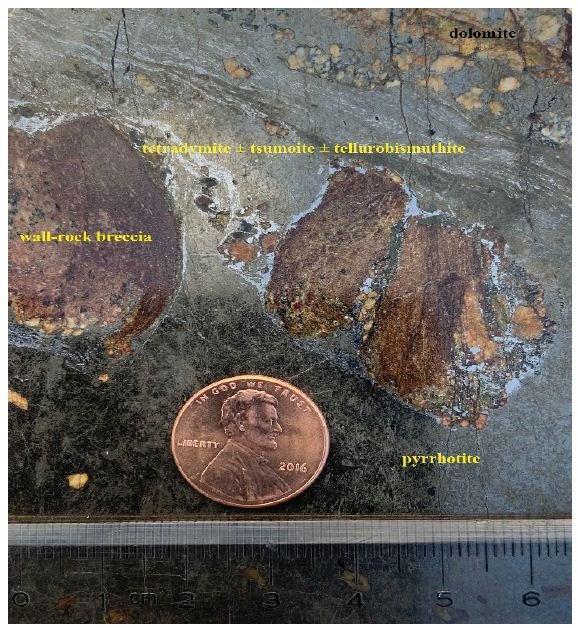
fig 6

Fluid Inclusions and Metallogenic Conditions of the Dashuigou Tellurium Deposit, Tibet Plateau, Southwest China

DOI: 10.31038/GEMS.2021331

Abstract

By thoroughly researching the microscopic characteristics and compositions of fluid inclusions in various minerals of the Dashuigou independent tellurium deposit in Southwest China, the authors of this paper uncover metallogenic conditions of the only independent tellurium deposit in the world. The principal compositions of the metallogenic hydrothermal fluids are Na+, K+, Ca2+, Mg2+, SO42-, Cl, F, H2O, CO2, CH4, H2, N2, CO and C2H6. The salinity of fluid inclusions within the metallogenic epochs varies between 13.8%-36.2%, which falls into a medium-high salinity range. The salinity of quartz samples associated with tellurides formed during the tellurium epoch is 14.9%-18.7%, which is within the medium salinity range. Metallogenic pressure is calculated at 0.647-1.020 Kbar, and the corresponding mineralization depth is 4.08-2.16 km. Mineralization temperatures of the deposit’s early and late metallogenic epochs are respectively 336.0-406.0 and 216.9-229.0°C. The metallogenic hydrothermal solutions are SO42- – Ca2+ type, or SO42- – Na+ – K+ – Ca2+ type, especially during the early Pyritic Epoch, and Na+-K+-Cl-SO42- type during the late metallogenic epoch. The metallogenic hydrothermal solutions of the deposit are of moderate salinity, mesothermal and mesogenetic.

Keywords

Metallogenic condition; Fluid inclusion; Homogenization temperature; Decrepitation temperature; Metallogenic epoch; The Dashuigou tellurium deposit; Tibet Plateau

Introduction

Tellurium (Te) is usually categorized as a scattered or dispersed element (abbreviated as SM). SM are those metals, semimetals and/or nonmetals that have similar geochemical characteristics with Clark values too low to enrich into independent deposits, but that play very important roles in modern science, industry, national defense and at the frontiers of technology. It is thought in the traditional theory of mineral deposits and geochemistry that Te could not form independent deposits, but only exist as associated components in other metallic deposits. The abundance of Te in the Earth’s Crust is very low. According to Li [1], the average content of Te in the Earth’s crust is 2.0 x 10⁻⁸ in China, and only 1.34 x 10⁻⁹ worldwide. At present, the world’s supply of refined tellurium is mainly recovered from Te-bearing minerals including pyrite, sphalerite, chalcopyrite, galena, pyrrhotite, volcanogenetic sulfur, bismuthinite, arsenopyrite, and cassiterite, etc. Generally speaking, only sulfide ores containing more than 0.002% Te can be used. As a result, the amount of refined tellurium that can be recovered is very limited. Most of the recoverable Te in the world is from copper deposits, and it is estimated that only 0.065 kg of Te can be produced in the refining process of one ton of copper [2,3]. The Dashuigou tellurium deposit is the only independent tellurium deposit in the world. Since its discovery in 1992, it has aroused widespread concern from domestic geologists. Chen [4] believed that tellurium mineralization is related to Yanshanian alkaline intrusive rocks, while Luo [5,6] believed that the mineralization is related to Yanshanian granitic magma activity. Yin [3,7,8] proposed that scattered elements including tellurium and bismuth originated from gas blown off from the deep Earth and enriched through nano-effect. Wang [9] summarized the metallogenic process of the Dashuigou tellurium deposit as follows: a volcanic eruption deposit was formed on the ancient seafloor with magmatic eruption in the late Proterozoic. Then, the deposit was strongly superimposed and reconstructed by the Mesozoic multistage regional metamorphic hydrothermal activities.

Regional Geology

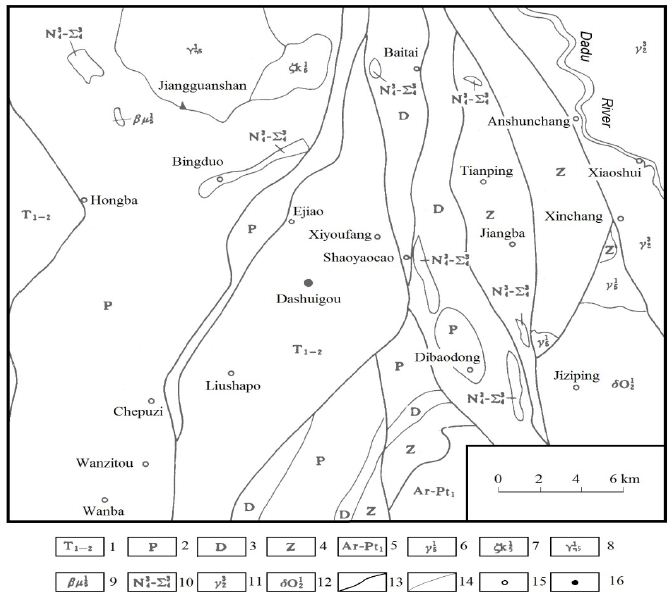
The Dashuigou tellurium deposit is located in the transitional belt between the Yangtze Platform and Songpan-Ganzi folded belt, as part of the Tibetan Plateau (Figure 1). The deposit is nestled in the convergence between the Indian, Eurasian and Pacific Plates. The crust-mantle structures and properties in the region are the result of tectogenesis through various geological times. It implies the turning boundary of the Earth’s crust’s thickness. It is also a gravity gradient zone which controls not only the production and development of earthquakes and tectonomagmatic events, but also the distribution of a series of mineral deposits. Geophysical data indicates that the upper mantle below the region uplifts obviously. As a result, the area possesses high heat flow geophysical characteristics [3,5,6,10,11].

fig 1

Figure 1: Regional geology (after Yin, 1996).

1. The lower and middle Triassic metamorphic rocks; 2. The Permian metamorphic rocks; 3. The Devonian metamorphic rocks; 4. Metamorphic rocks of the Sinian system; 5. Metamorphic base complex of the Archean Kangding group; 6. Plutonic granite of the Indosinian orogeny; 7. Plutonic alkaline syenite of the Indosinian orogeny; 8. Plutonic monzonitic granite of the Indosinian orogeny; 9. Hypabyssal sillite of the Indosinian orogeny; 10. The late Hercynian basic-ultrabasic rocks; 11. The late Proterozoic plutonic granite; 12. The early Proterozoic-Archean plutonic quartz diorite; 13. The deep and large fault; 14. The geological boundary; 15. Village and/or town; 16. The tellurium deposit. There is also a low-velocity, low resistivity zone in the middle crust that is interpreted as a decollement. The abnormal mantle exists under the crust in the region. It has properties of both geosyncline and platform, as well as its own special characteristics. The belt is a geo-tectonically active zone with very complicated igneous rock structures. According to the regional geophysical data, the region’s characteristics exhibit high velocity, high density, high resistance, high geothermal flow, high magnetism as well as well-developed earthquakes and mantle’s uplift. In summary, this region is both geologically very active and a very important south-north trending tectonomagmatic-mineral belt [3-6]. The strata, igneous rocks and structures trend south-northward. The strata are low-grade metamorphic rocks of the Silurian, Devonian, Permian systems and middle-lower Triassic series. A large amount of Archaean metamorphic rocks of the Kangding Group emerge to the southeast of the deposit. The well-developed igneous rocks in the region include ultrabasic, basic, neutral, acid and alkaline, produced in different geological times. Different types of mineral resources in the region are very rich; many of these are well known, including Ti, V, Cu, Pb, Zn, SM, REE, coal, asbestos and the Panzhihua Vanadium Titano-magnetite deposit [3-6].

Mine Geology

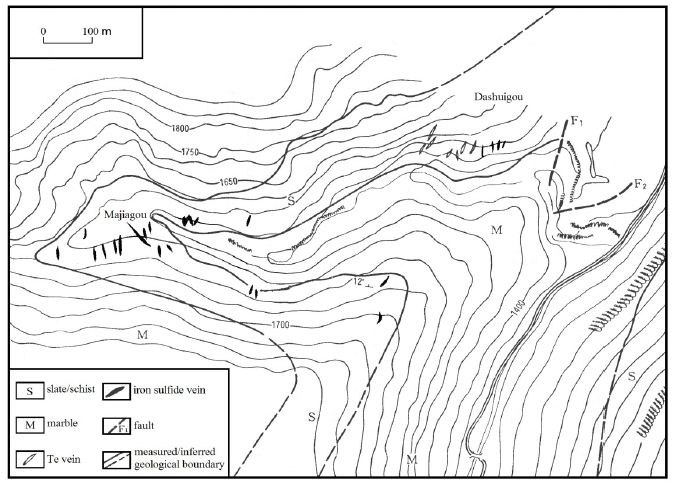
The strata of the area are low-grade metamorphic rocks of the lower-middle Triassic age, including marble, slate and schist. The main wall-rocks of the ore bodies are schist and slate. All of the Triassic strata make up a NNE-trending dome. The geological and geochemical characteristics in the area indicate that the protolith of the tellurium ore veins’ direct wall-rocks is poorly differentiated mantle-derived basalt (Figure 2).

fig 2

Figure 2: Mine geology (after Yin, 1996).

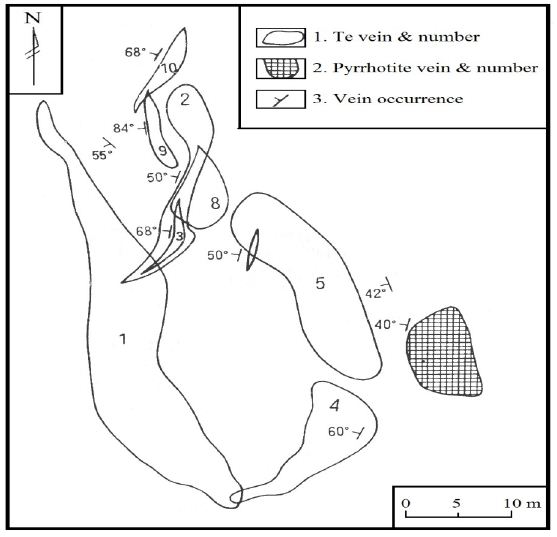
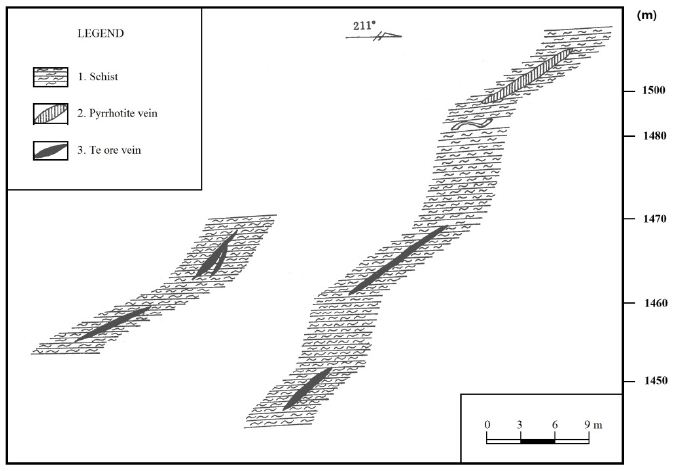
Both faults and folds are well-developed in the area. The annular and linear structures together make up special “Ø” pattern structures, which control the formation of different types of endogenetic mineral deposits, including the Dashuigou tellurium deposit. No intrusive rocks emerge within a 5 km radius around the deposit. Only two small Permian ultrabasic-basic rock bodies emerge within a 10 km range of the deposit. Large neutral, acid and alkaline intrusive bodies exist beyond 10 km, which are unrelated to the deposit (Figure 1). Quantitative chemical analyses of Te, Bi, Se, As, Au, Ag, Cu, Pb and Zn were conducted on different rock samples including granites, metamorphic rocks, altered rocks, and carbonate veins of different geological times. The main findings are summarized below [3,12-15]. The Te content in the granites is under 1 x 10⁻⁷, which is similar to its Clark value in the Earth’s crust. Te in the metamorphic rocks is slightly higher than in the granites and varies slightly between metamorphic rocks of different geological times, while being relatively higher in the Triassic metamorphic rocks. Of the metamorphic rocks in the same geological time, the Te content in the slate and schist is higher than in the marble. Te content in rocks of the same stratohorizon of the same geological time also varies; namely, it is higher in rocks within the mining area than in those beyond the mining area. Te content is closely related to the intensity of alterations; that is, the ore-forming elements are not derived from the country rocks, but instead from the mantle. The deposit is located at the northeastern end of the Triassic metamorphic dome. The ore bodies are controlled by and fill a group of shear fractures. Ten tellurium ore veins have been discovered, which strike from 350 to 10 degrees and dip at 55 to 70 degrees westward. Widths of the ore bodies vary between 25 and 30 cm. The narrow ore bodies are in the shape of lenticular veins and have sharp contact with the wall rocks (Figures 3 and 4).

fig 3

Figure 3: Horizontal projection of the telluride veins of the Dashuigou deposit (after Yin, 1996).

fig 4

Figure 4: Longitudinal section the telluride and pyrrhotite veins of the Dashuigou deposit (after Yin, 1996).

The altered rocks occur in narrow bands ranging between several centimeters and one meter in thickness. Altered zones beside the massive ore veins are narrower, at only several centimeters wide. The dominant alterations include dolomitization, silicification, biotitization, muscovitizaion, tourmalinization, sericitizaion, greisenization, and chloritization [3,7,14-20]. Approximately thirty minerals are identified in the ore, which include tetradymite, pyrrhotite, pyrite, dolomite, quartz, chalcopyrite, tsumoite (BiTe), tellurobismuthite (Bi2Te3), galena, magnetite, gold, silver, electrum, ilmenite, calcite, calaverite, siderite, mannesite, rutile, muscovite, biotite, sericite, hornblende, chlorite, plagioclase, K-feldspar, tourmaline, hematite, garnet, apatite, and epidote. The first five minerals are the most important and comprise 85% of the ore, though generally tetradymite is so rare that many monographs on mineralogy do not have any related data on it [3,10,19-22]. Replacement, remnant, reaction border, and granular are the dominating textures of the ore. Massive, vein/veinlet, stockwork veins are the dominating structures of the deposit (Figures 5 and 6).

fig 5

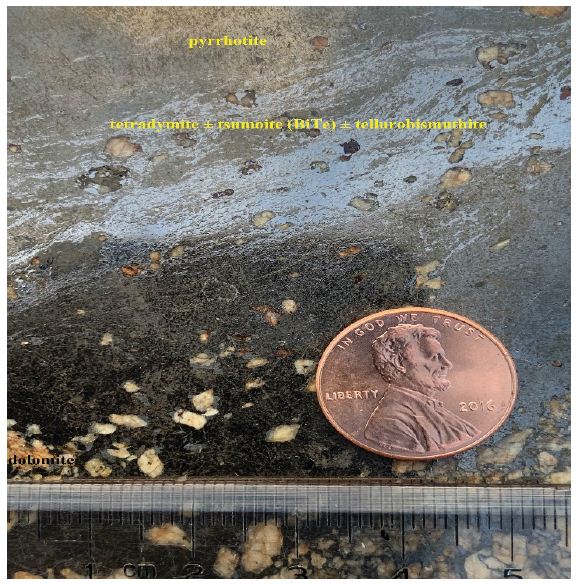
Figure 5: Lead grey-silvery colored tetradymite ± tsumoite (BiTe) ± tellurobismuthite (Bi2Te3) fine veinlets in massive pyrrhotite (dark colored background) + dolomite (brownish white) from the deposit (sample #: SD40, Ore body #I-1 in Drift 3).

fig 6

Figure 6: Lead grey-silvery colored tetradymite ± tsumoite (BiTe) ± tellurobismuthite (Bi2Te3) fine veinlets in massive pyrrhotite (dark colored) + dolomite (brownish white) + wall rock (dark brown) from the deposit (sample #: SD34, Ore body #I-1 in Drift 3).

The most important ores are massive and the secondary ores are disseminated. The Te content in the ore varies between 0.01% and 34.58%.

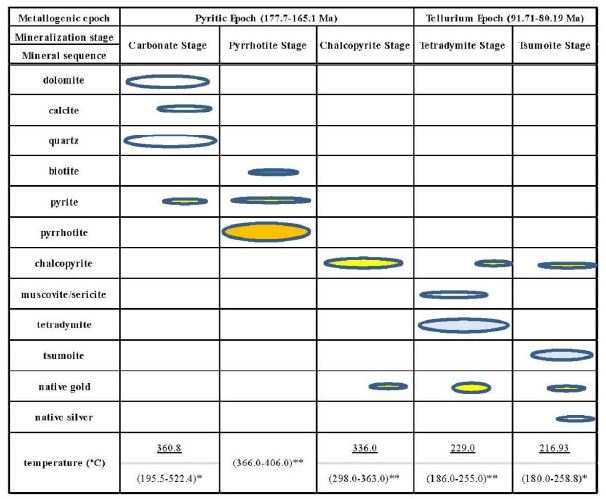
Two mineralization epochs and five stages exist in the deposit [3,8,23]:

  • Pyrrhotite epoch (177.7~165.1 Ma): including three mineralization stages: carbonate stage (I) → pyrrhotite stage (II) → chalcopyrite stage (III) (from early to late).
  • Tellurium epoch (91.71~80.19 Ma): including two mineralization stages, namely: tetradymite stage (I) → tsumoite (BiTe0.97) stage (II).

Mineralization Epoch and Mineral Sequence

Based on the mutually crosscutting relationships of various veins/veinlets in the deposit, including those of pyrrhotite, chalcopyrite, tetradymite, tsumoite, dolomite and quartz, in addition to the features of microscopic texture and structure between gangue and ore minerals, the mineralization epochs and stages as well as mineral sequence are summarized in Figure 7 [3,8,23].

fig 7

Figure 7: Mineralization epochs & stages and mineral sequence of the deposit.
Note: * – mineral inclusion homogenization temperature (dolomite for carbonate stage, quartz for tsumoite stage), please refer to Tables 1 and 2 for more detailed information; ** – mineral inclusion decrepitation temperatures of the corresponding stages (that of the pyrrhotite stage is the average of decrepitation temperatures of both the pyrite and pyrrhotite of the pyrrhotite stage.

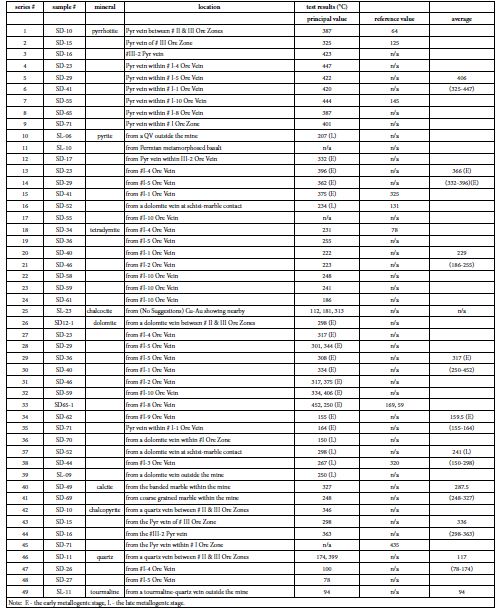
Table 1: Decrepitation temperatures of fluid inclusion in the minerals from the deposit.

table 1

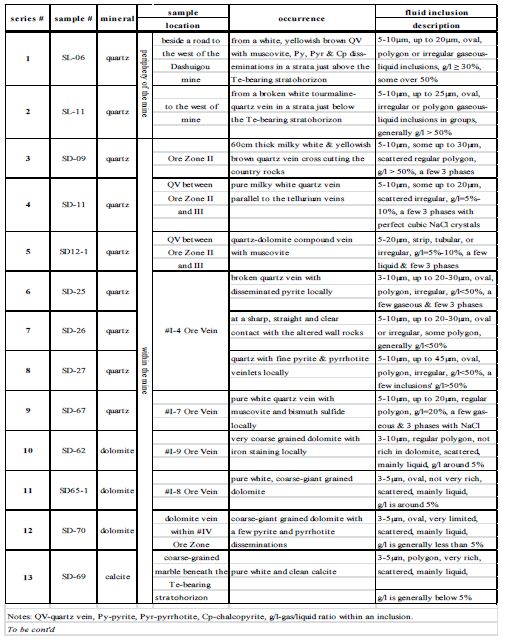
Table 2a: Characteristics of fluid inclusions in the minerals from the deposit.

table 2a

Table 2b: Characteristics of fluid inclusions in the minerals from the deposit (cont’d).

table 2b

Carbonate Stage

A large quantity of iron-dolomite, quartz and lesser calcite veins/veinlets occurred within this stage, which are brown and/or yellowish brown broken coarse-grained due to iron staining (Figures 5 and 6). Decrepitation temperatures of the fluid inclusions in the dolomite, one of the dominant minerals of this stage, are listed in the corresponding table of this paper.

Pyrrhotite Stage

The largest quantity of pyrrhotite formed during this stage. Some coarse- to very coarse-grained pentagonal pyrite can be seen in the anhedral crystals of pyrrhotite. Decrepitation temperatures of the fluid inclusions in both the pyrrhotite, one of the dominant minerals, and pyrite of this stage are listed in the corresponding table of this paper.

Chalcopyrite Stage

Many chalcopyrite veins/veinlets formed within this stage, filling in fractures of pyrrhotite and/or crosscutting pyrrhotite. Part of the chalcopyrite is within telluride minerals in the vermicular form. Decrepitation temperatures of the fluid inclusions in the chalcopyrite, the dominant mineral of this stage, are listed in the corresponding table of this paper.

The three prior mineralization stages consist of the early metallogenic epoch of the deposit, the pyritic epoch (177.7-165.1 Ma) of the early Yanshan orogeny. The following two mineralization stages consist of the tellurium metallogenic epoch (91.71-80.19 Ma) of the late Yanshan orogeny [3,24].

Telluride Stage

Large quantities of massive/semi-massive telluride veins formed during this stage, associated with clean, milky-white quartz, dolomite, calcite, muscovite/sericite and native gold. Decrepitation temperatures of the fluid inclusions in the tetradymite, the dominant mineral, and part of the associated dolomite of this stage are listed in the corresponding table of this paper.

Tsumoite Stage

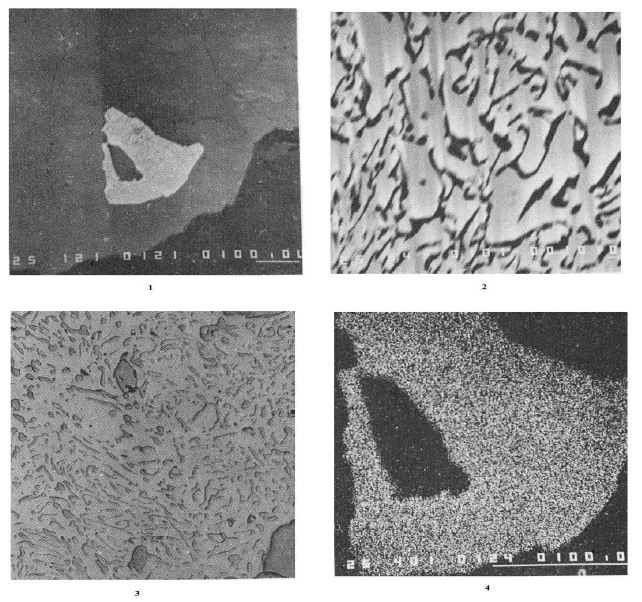
Tsumoite and chalcopyrite together consist of emulsion droplets and/or vermicular immixing of solid solution texture at the contacts between tetradymite and pyrrhotite (Figures 5, 6 and 8).

fig 8

Figure 8: 1~3: Reflection color and their mutual relationships between tsumoite (bright white), tetradymite (white), and pyrrhotite (grey) in the back scattered electron (composition) image from the deposit (thin section (-) (Note: 1 (×120), 2 (×540), & 3 (×200)). 4: Te Kα X ray image indicating chemical composition distributions of telluride including tetradymite and tsumoite (white): the denser the white spots, the higher the Te content; the black colored background is pyrrhotite from the deposit (×400).

The mineralization temperatures of this stage shown in Figure 7 are based on the homogenization temperatures of the fluid inclusions in the quartz associated with tsumoite. Please refer to the corresponding table of this paper for more detailed information.

Sampling and Analytical Methodology

Field Sampling

Samples were collected from proper locations of the deposit’s typical ore bodies and wall rocks in the study area. They were described in detail on site, then properly labeled or numbered and wrapped with waxed paper to avoid cross contamination with other samples in the same sample box, and finally packed and shipped to the work laboratory.

Lab Sampling and Preliminary Processing

In the lab, all samples were sorted, air-dried, stage crushed to 6-Tyler mesh, well homogenized, and then rotary split into 1 kg assay aliquots. One assay aliquot was wet screened into different sized fractions, and the -10 mesh+65 mesh fraction was used for this study. After being crushed and screened through different sizes of mesh, the corresponding minerals in fraction from 10 to 65 mesh to be used for further analyses were then manually separated and picked up under binocular microscope, and their crystal forms and other physical mineralogical characteristics were observed and described in detail. Next, the selected mineral samples were pulverized to 90% passing 75 μm for further research and testing, in order to help reveal the mineralization mechanism of the corresponding deposit.

Analytical Methodology

The gaseous components of the fluid inclusions in quartz were analyzed via both the Raman spectroscopy and gas chromatographic methods. The Raman spectroscopy technique has a wide field of applications, ranging from qualitative detection of solid, liquid and gaseous components to identification of polyatomic ions in solution. It is also a versatile non-destructive technique for fluid inclusion analysis and is commonly used to calculate the density of CO2 fluids, the chemistry of aqueous fluids, and the molar proportions of gaseous mixtures present as inclusions… The main advantages of this technique are the minimal sample preparation required and its high versatility. The particle size of the 99.9% purity mineral samples was controlled to 0.5-1.0 mm to avoid damaging the fluid inclusions. According to their respective burst temperatures, the primary inclusions in the minerals were opened by thermal explosion, and the fluid components obtained by heat-blast-leaching. The released gas-phase components such as H2O, CO2, CO, H2, N2, and CH4 were measured by gas chromatography. Decrepitated mineral was added with deionized water, and ultrasonic extraction was then conducted. The extract liquor was measured by atomic absorption spectrometer for K+, Na+, Ca2+, Mg2+ and other cationic components in the solution, while anion components such as F, Cl, SO42-, etc. were determined through ion chromatography or spectrophotometry. In addition, Fe, Cu, Pb, Zn, Sb, Hg, Au, Ag and other related ore-forming metal elements can be determined by the atomic absorption flameless method as required. Then, the gas and liquid phase components in the mineral inclusions were converted into the mass concentration of each component contained in the mineral inclusion aqueous solution. Conversion of liquid components: At room temperature, 1 ml of water weighs about 1 gram. First, the mass of water in the analysis result is converted into the volume VH2O, and the mass concentration ρB of each ion in the inclusion water is calculated via the following formula [25,26]:

The volume of inclusion water VH2O = ωH2O/1000. Mass concentration of ions in liter of water ρB = ωB/VH2O.

For the measurement data of vapor phase components H2O, CO2, CO, H2, and CH4, a relevant diagram [27] was applied to estimate the temperature, pressure, oxygen fugacity, carbon dioxide fugacity, reduction coefficient, and other geochemical parameters such as pH and Eh of the equilibrium among the components in the mineral inclusions.

Characteristics of the Fluid Inclusions

General Characteristics

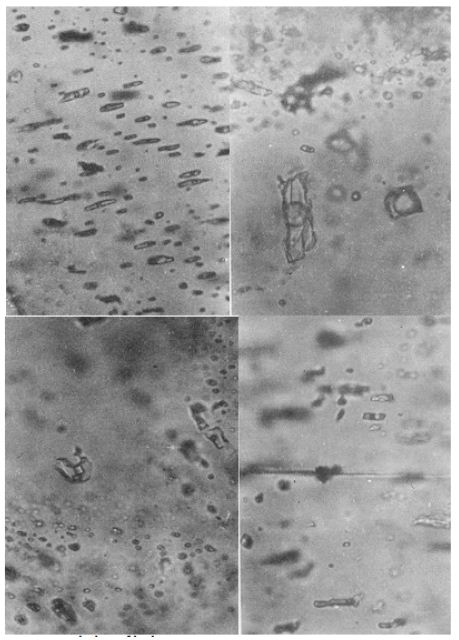
The fluid inclusion characteristics of part of the deposit’s gangue and ore minerals are summarized in Tables 2 and 3 and discussed as follows. Fluid inclusions are well developed in most of the deposit’s minerals, but their characteristics differ from each other within different host minerals. Dolomite usually has less liquid inclusions than both calcite and quartz. The sizes of fluid inclusions in dolomite and calcite are usually between 3-5 µm, which is smaller than those in quartz, which is usually 5-10 µm (Table 2). Fluid inclusions in both dolomite and calcite are mainly liquid and usually scattered without any orientation in mineral distribution, with a gas-liquid ratio of less than 5%. Those in quartz, which are mainly gaseous-liquid inclusions within the deposit, are more complicated than those in both dolomite and quartz; either scattered without any orientation in distribution, or in zonal distribution in certain orientations (Figure 6). Fluid inclusions in the tourmaline-quartz vein collected from the periphery of the deposit are mainly gaseous-liquid inclusions and differ from those of quartz within the deposit; a few 3 phase inclusions could be seen in the quartz vein collected around the deposit.

Fluid inclusions in both dolomite and calcite are usually oval and/or polygon in shape, while those in quartz are either oval, polygon, irregular, strip and/or tubular. A few perfect cubic NaCl crystals could be seen in several of the fluid inclusions in quartz (Figure 9).

fig 9

Figure 9: Fluid inclusions in quartz and calcite of the deposit. A: gaseous-liquid inclusions in quartz from #I-4 Ore Body (X 400), B: gaseous inclusions in quartz from #I-4 Ore Body (X 400), C: cubic NaCl crystal in gaseous-liquid inclusions in quartz from #I-7 Ore Body (X 400), D: gaseous-liquid inclusions in calcite from coarse grained marble of the lower Triassic strata of the deposit (X 400).

Chemical Compositions

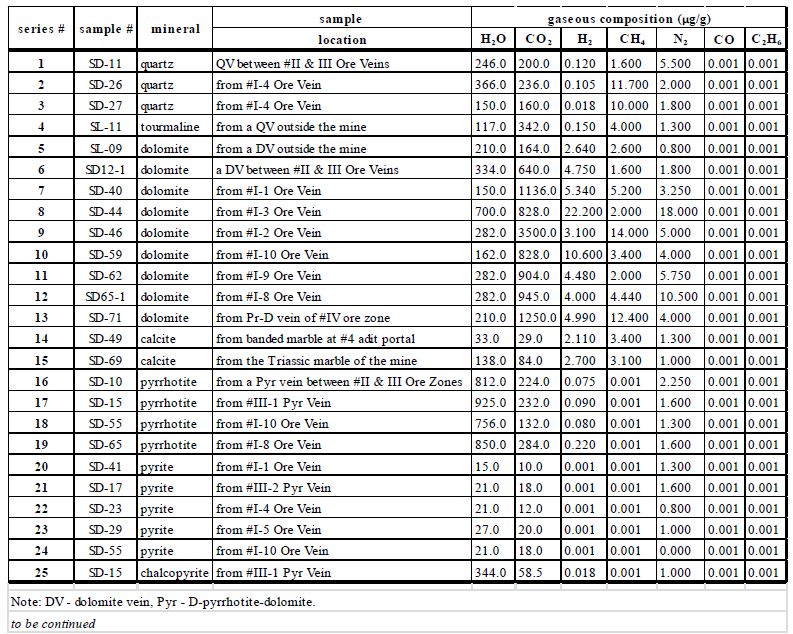
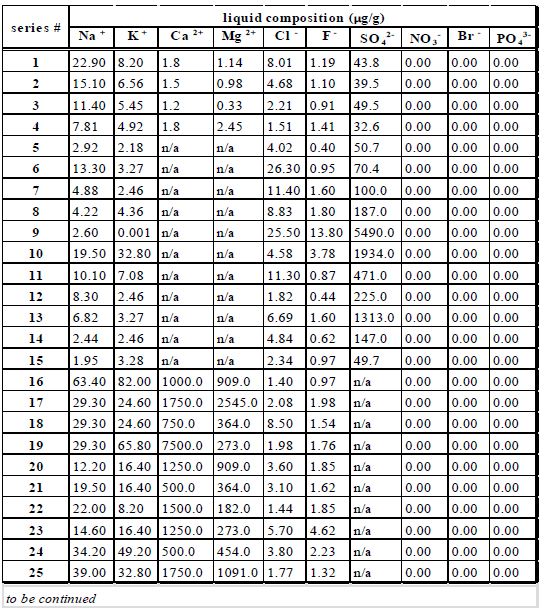
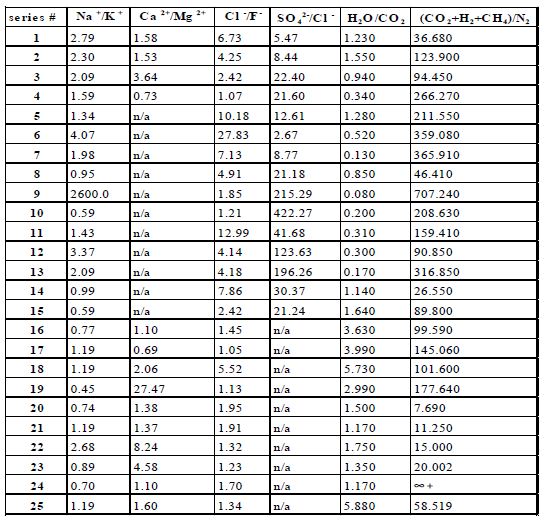
Chemical compositions of the fluid inclusions of part of the gangue and ore minerals are listed in Table 3. It can be seen from the table that cations in the fluid inclusions include Na+, K+, Ca2+ and Mg2+, while anions include SO42-, Cl and F, and the major gaseous compositions include H2O and CO2, with smaller CH4, H2, N2, CO and C2H6. Na+/K+ ratios of the fluid inclusions of the region’s minerals are either above or below 1.0, meaning that compositions of the hydrothermal solutions are not homogeneous. Ca2+/ Mg2+ ratios of the fluid inclusions are all above 1.0, meaning that the metallogenic solutions are rich in Ca2+ but poor in Mg2+. Both SO42-/Cl and Cl/F ratios are over 1.0, meaning that the metallogenic solutions are richest in SO42-, moderate in Cl, but poor in F. Most of the samples had H2O/ CO2 ratios of over 1.0, meaning the solutions are richer in H2O than in CO2. (CO2 + H2 + CH4)/N2 values of all samples are over 1.0, showing that the hydrothermal solutions are rich in CO2, H2 and CH4.

Table 3a: Chemical compositions of the gaseous-liquid fluid inclusions in the minerals.

table 3a

Table 3b: Chemical compositions of the fluid inclusions in the minerals (cont’d).

table 3b

Table 3c: Chemical compositions of the fluid inclusions in the minerals (cont’d).

table 3c

Discussion

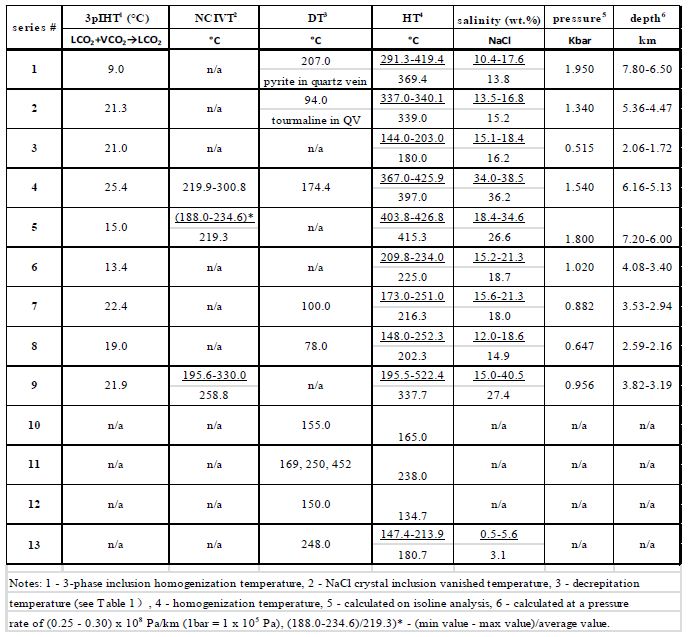
Previous research on the ore-forming fluid of the Dashuigou tellurium deposit is roughly divided into the magma hydrothermal theory [4-6,10,11,26,28,29], the metamorphic hydrothermal theory [30,31], and the mixed hydrothermal theory [5,9,30] obtained the study of gas-liquid inclusions and found that the ore-forming temperature of the Dashuigou tellurium deposit varied between 350 and 120°C. The salinity is 7.2 wt% ~ 35 wt% NaCl, of which the salinity value in the early and late quartz veins can be as high as 20 wt% to 35 wt% NaCl, the oxygen fugacity is fO2 = -42.26 ~ -45.49, and the ore-forming hydrothermal fluid is weakly acidic and neutral (pH = 6.32 ~ 6.29). The CO2/H2O ratio in the quartz is 0.137 ~ 0.208, and the CH4 content is 12.61 ~ 24.85 ml/100 g. Based on uniform temprature measurement of the gas-liquid inclusions in the deposit’s dolomite and quartz, Li [29] and Cao [10-11] concluded that the uniform temperature of each mineralization stage is roughly similar: 221 ~ 259°C, average 239°C for Stage I; 215 ~ 256°C, average 235°C for Stage II; 192 ~ 243°C, average 224°C for Stage III. The corresponding metallogenic pressure is 823.684 × 10⁵ Pa ~ 965.409 × 10⁵ Pa, with an average of 884.156 × 10⁵ Pa. Both CO2 and H2O-CO2 inclusions are abundant, reflecting that mineralization occurs under relatively closed conditions. The metallogenic depth estimated by the static rock pressure model is 3,339 m, which is equivalent to the thickness of the measured overlying strata (3650 m). Since the characteristics of inclusion types in each mineralization stage are not substantially different, they are considered to have similar metallogenic depths. According to the ore-forming pressure and salinity, the temperature correction value was found to be about 80°C, so the metallogenic temperatures of stages I, II, and III were 319°C, 315°C, and 304°C, respectively. The salinity of ores from this deposit varies widely, with NaCl content ranging from 7.17% to 33.27%. Among them, the rock salt gas-liquid water inclusions have the highest salinity, while the gas-liquid water inclusions and liquid-liquid H2O-CO2 inclusions have lower salinity and are basically the same. The salinity of fluids in each mineralization stage is roughly similar, where the NaCl content in stage I is 16.5% ~ 30.83%, with an average of 21.21%; stage II is 17.66% ~ 33.27%, with an average of 25.77%; stage III is 7.17% ~ 32.34%, with an average of 17.55%. The gas phase composition is mainly H2O, followed by CO2, and containing a small amount of H2, CO and CH4. According to observation under a microscope, the fluid inclusions in the minerals from this deposit are mainly H2O-CO2 and CO2. The fO2 of the mineralization fluid is: stage Ⅰ 10.0 × 10⁵ ~ 34. 0 × 105 Pa, stage Ⅱ10.0 × 10⁵ ~ 34.8 × 10⁵ Pa, stage Ⅲ10.0 × 10⁵ ~ 35.6 × 10 5Pa. The pH value of the hydrothermal solution during the tellurium mineralization stage is 5.91 ~ 5.87. Through study of gas-liquid inclusions from the same deposit, Chen [28] concluded that the inclusions are rich in CO2, CO2-H2O (low salinity fluid), and CO2-H2O-NaCl (high salinity fluid); namely, three systems of fluid inclusions exist in the deposit, of which tellurium mineralization is related to the first two systems. Most of the inclusions leak and/or burst before being homogenized. The metallogenic temperature of the pyrrhotite stage is around 500°C and that of the telluride stage is 400°C. The fluid density changes between 1.04 ~ 0.76 g/cm3, and the metallogenic pressures are respectively 450 ~ 500 MPa and 240 ~ 300 MPa. Mineralization occurs under high temperature and high pressure. The results of this paper are as follows: fluid inclusion homogenization temperatures vary greatly (Table 2): those of quartz formed in pre-tellurium mineralization and collected outside the deposit are between 339.0 and 369.4°C. These samples include series #1, 2, 4 and 5 in Table 2. Other quartz samples in Table 2 are associated with telluride veins and their fluid inclusion homogenization temperatures should be at typical values when tellurium ore bodies emplaced, or between 180.0-250.0°C. This range includes part of the decrepitation temperatures of those minerals formed during the tellurium epoch mentioned earlier in this paper. The salinity of fluid inclusions within the whole metallogenic epochs varies between 13.8%-36.2%, which falls into a medium-high salinity range. That of minerals formed during the tellurium epoch, for instance three quartz samples associated with tellurides and collected from #I-4 Ore Vein in Table 2, is between 14.9%-18.7%, well within the medium salinity range. The formation pressures of mineral fluid inclusions correlate positively with homogenization temperatures (Table 2). Pressures of the series #6 through #9 samples in the table, acquired from minerals formed during tellurium mineralization, vary between 0.647-1.02 Kbar. This should be the pressure at which point telluride veins emplaced in the deposit. The corresponding mineralization depth is 4.08-2.16 km, while mineralization temperatures of the early and late metallogenic epochs of the deposit are respectively 336.0-406.0 and 216.9-229.0°C. Fluid inclusion compositions in both pyrrhotite and pyrite that formed in the same mineralization stage of the metallogenic epoch are similar to each other. Those of fluid inclusions in quartz samples collected from the deposit are also alike. Compositions of fluid inclusions of dolomite and calcite have both similarities and differences, especially those of dolomite and calcite collected from outside the deposit compared to those collected within the deposit. Differences also exist between dolomite from wall-rock marble and from dolomite veins. This may mean that compositions of fluid inclusions vary from one host mineral to another, and minerals formed in different environments or across different geological events have different fluid inclusion compositions. The metallogenic hydrothermal solutions, which are not homogeneous, are richest in SO42-, richer in H2O than in CO2, rich in Ca2+, CO2, H2, and CH4, moderate in Cl, but poor in Mg2+ and F.

Conclusion

Based on the discussions above, preliminary conclusions of the Dashuigou independent tellurium mine’s metallogenic conditions are summarized as follows: The metallogenic hydrothermal solutions are SO42- – Ca2+ type, or SO42- – Na+ – K+ – Ca2+ type, especially during the early metallogenic Pyritic Epoch, and Na+ – K+ – ClSO42- type during the late metallogenic epoch. The hydrothermal solutions of the deposit are mesothermal and of moderate salinity, as well as mesogenetic. Principal compositions of the metallogenic hydrothermal fluids are Na+, K+, – Ca2+, Mg2+, SO42-, Cl, F H2O, CO2, CH4, H2, N2, CO and C2H6; Salinity of the fluid inclusions within the metallogenic epochs varies between 13.8%-36.2%, which falls into the medium-high salinity range; that of minerals formed during tellurium epoch, for instance, three quartz samples associated with tellurides and collected from #I-4 Ore Vein in Table 2, is 14.9%-18.7%, which is within the medium salinity range. Metallogenic pressure is between 0.647-1.020 Kbar and the corresponding mineralization depth is 4.08-2.16 km. Mineralization temperatures of the early and late metallogenic epochs of the deposit are respectively 336.0-406.0 and 216.9-229.0°C.

Acknowledgement

Support for this study was received from the China National Postdoctoral Foundation, Orient Resources Ltd., and Bureau Veritas Commodities Canada Ltd. Additional support was provided respectively by Prof. R. Pei of the Chinese Academy of Geological Sciences, also an Academician of the Chinese Academy of Engineering, Prof. Y. Zhai of China University of Geosciences in Beijing, also an Academician of the Chinese Academy of Sciences, Prof. J. Zhou of the Chinese Academy of Geological Sciences, and Prof. Y. Zhang of the College of Earth Sciences, Jilin University in Changchun of China, all of whom provided insightful discussions and critical reviews of this manuscript. All measurements and chemical analyses, including the back scattered electron (composition) and Te Kα X ray images of the thin section from the deposit, included in this article were carried out in the labs of the Chinese Academy of Geological Sciences in Beijing. The authors very much appreciate the time invested respectively by D. S. Yin and S. Daly, for their review and editorial work on this contribution.

Data Availability

The data that support the findings of this study is available from the authors upon reasonable request; see authors’ contributions for specific data sets below.

Contributions

The whole research included in the paper was proposed and done by the first author J. Yin. The chemical compositions of fluid inclusions were sorted and researched by the second author Hongyun Shi of this paper. Both authors prepared and reviewed the manuscript and approved the final version of the manuscript. Author Contributions. Conceptualization, JIANZHAO YIN; Investigation, JIANZHAO YIN and Hongyun Shi; Project administration, JIANZHAO YIN; Writing – original draft, JIANZHAO YIN.

Competing Interests

The authors declare no competing interests.

References

  1. Li T (1976) Abundance of chemical elements in the Earth. Geochemistry 3: 167-174.
  2. Yin, JZ, Chen, YC, Zhou, JX (1995) Introduction of tellurium resources in the world. Journal of Hebei College of Geology 18: 348-354.
  3. Yin, JZ (1996) On the metallogenic model and mineralizing mechanism of the Dashuigou independent tellurium deposit in Shimian County, Sichuan Province, China-the first and only independent tellurium deposit in the world. Chongqing: Chongqing Publishing House, 190pp.
  4. Chen YC, Mao JW, Luo YN, Wei JX, Cao, ZM. (1996) Geology and Geochemistry of the Dashuigou tellurium (gold) deposit in Western Sichuan, China. Beijing: Atomic Energy Press 146pp
  5. Luo, YN, Fu DM, Zhou, SD (1994) Genesis of the Dashuigou tellurium deposit in Sichuan Province of China. Bulletin of Sichuan Geology 14: 101-110.
  6. Luo YN, Cao ZM, Wen, CQ (1996) Geology of the Dashuigou independent tellurium deposit. Chengdu: Southwest Communication University Publishing House 30-45.
  7. Yin JZ (1996) The metallogenic model and mineralizing mechanism of the Dashuigou independent tellurium deposit in Shimian County, Sichuan – the first and only independent tellurium deposit in the world. Acta Geoscientia Sinica special issue 93-97.
  8. Yin JZ, Shi HY (2019) Nano effect mineralization of rare elements–taking the Dashuigou tellurium deposit, Tibet Plateau, Southwest China as the example. Academia Journal of Scientific Research 7: 635-642.
  9. Wang RC, Lu, JJ, Chen XM (2000) Genesis of the Dashuigou tellurium deposit in Sichuan Province, China. Bulletin of Mineralogy, Petrology and Geochemistry 4: 348~349.
  10. Cao ZM, Luo YN (1994) Mineral sequence and ore genesis of the Sichuan telluride lode deposit in China. In: New Research Progresses of the Mineralogy, Petrology and Geochemistry in China. Lanzhou: Lanzhou University Publishing House pg: 476-478.
  11. Cao ZM, Wen CQ, Li BH (1995) Genesis of the Dashuigou tellurium deposit in Sichuan Province of China. Science China (B) 25: 647-654.
  12. Yin, JZ, Zhou JX, Yang BC (1994) Geological characteristics of the Dashuigou tellurium deposit in Sichuan Province, China. Earth Science Frontiers 1: 241-243.
  13. Yin, JZ, Chen, YC and Zhou, JX (1995) Original rock of the host rock of the Dashuigou independent tellurium deposit in Sichuan Province, China. Bulletin of Mineralogy, Petrology and Geochemistry 2: 114-115.
  14. Yin JZ, Chen YC, Zhou JX (1996) Geology and geochemistry of host rocks of the Dashuigou independent tellurium deposit in Sichuan Province, China. Journal of Changchun University of Earth Sciences 26: 322-326.
  15. Yin JZ, Chen YC, Zhou JX (1996) Geology and geochemistry of altered rocks of the Dashuigou independent tellurium deposit in Sichuan Province, China. Journal of Xi’an College of Geology, 18: 19-25.
  16. Chen YC, Yin JZ, Zhou JX (1994) The first and only independent tellurium ore deposit in Dashuigou, Shimian County, Sichuan Province, China. Geol. Sinica 3: 109-113.
  17. Chen YC, Yin JZ, Zhou, JX (1994) Geology of the Dashuigou independent tellurium deposit of Sichuan Province. Acta Geoscientia Sinica 29: 165-167.
  18. Yin JZ, Zhou JX, Yang BC (1994) Rock-forming minerals and ore-forming minerals of the Dashuigou tellurium ore deposit unique in the world – A preliminary study. Geol. Sinica 3: 197-210.
  19. Yin, JZ, Chen YC, Zhou JX (1994k) Mineralogical research of the Dashuigou independent tellurium deposit in Sichuan Province, China. Bulletin of Mineralogy, Petrology and Geochemistry 3: 153-155.
  20. Yin JZ (1996) New mineralogical data of telluride. Bulletin of Mineralogy, Petrology and Geochemistry 15: 246-248.
  21. Liu AP, Zhong ZC, Tang JW (1996) Geochemical characteristics of the Dashuigou tellurium deposit in Sichuan Province of China. Geochemistry 25: 365~371.
  22. Shi HY, Chen YC,Yin JZ, Zhou JX (1996) X-ray diffraction data of telluride. Journal of Mineralogy and Petrology 16: 31-33.
  23. Yin JZ, Shi HY (2020) Mineralogy and stable isotopes of tetradymite from the Dashuigou tellurium deposit, Tibet Plateau, southwest China. Scientific Reports 10.
  24. Yin JZ, Chen YC, Zhou JX (1995) K-Ar isotope evidence for age of the first and only independent tellurium deposit. Chinese Science Bulletin 40: 1933-1934.
  25. Li BH, Cao ZM, Wen CQ (2000) Fluid inclusion type and geological characteristics of the Dashuigou tellurium deposit in Sichuan Province, China. Bulletin of Mineralogy, Petrology and Geochemistry 4: 346-347.
  26. Li TY, Liu JQ (2000) Discussion of analytical methods of grouped fluid inclusion compositions. Geology and Mineral Resources of South China 4: 64-67.
  27. Li BL (1986) Physical chemistry diagram of gas components of fluid inclusions in minerals. Geochemistry 2: 126-137.
  28. Chen PR, Lu JJ, Wang RC (1998) Study on the fluid inclusions of the Dashuigou independent tellurium deposit in Shimian County, Sichuan Province, China. Mineral Deposit 17: 1011-1014.
  29. Li BH, Cao ZM, Jin JF, Wen CQ (1999) Physicochemical conditions of the tellurium deposit in Dashuigou, China. Scientia Geologica Sinica 34: 463-472.
  30. Wang RC, Shen WZ, Xu XJ, Lu JJ, Chen XM, et al. (1995) Isotopic Geology of the Dashuigou tellurium deposit in Sichuan Province, China. Journal of Nanjing University (Natural Sciences) 31: 617-624.
  31. Shen WZ, Xu XJ, Wang RC (1997) Origin of the fluid inclusions of the Dashuigou tellurium deposit in Sichuan Province, China – hydrogen and oxygen isotope evidence. Journal of Nanjing University (Natural Sciences) 33: 77-83.

Studying End of Life Conversations: Challenges and Strategies

DOI: 10.31038/IJNM.2021221


End-of-life (EOL) conversations continue to be challenging for patients, families, and healthcare providers (HCPs) [1-3]. Although these dialogues can be emotionally charged, they are critical to ensure that care is aligned with patient preferences. Interventions directed at improving communication about EOL care have been shown to improve patient outcomes. Nurses are in a unique position to assist patients and families with advocating for EOL conversations [4,5]. Advance care planning studies are prominent in EOL literature with the intent of clarifying life sustaining treatment preferences of patients. Unfortunately, most EOL decisions are still made without direct input from patients but rather loved ones are burdened with deciding whether or not to continue life sustaining interventions. In addition, family members report that they were unaware of their loved ones wishes and values with all of the treatment options [6]. More research is needed to develop practical approaches and strategies to enhance EOL conversations to properly align patients’ priorities of care. But conducting these studies remains challenging.

Challenges: First, recruitment can be extremely problematic if the study is targeting patients with specified prognosis. Most HCPs are uncomfortable and lack the knowledge to prognosticate accurately. They are uncomfortable with approaching eligible patients. Additionally, due to variability in patient conditions, availability of patients due to treatments and tests, it is often difficult to schedule interviews. Loved ones are often unavailable during the regular daytime hours. Nurse and HCPs are frequently busy caring for patients. The interviewers are often faculty university members with busy teaching and/or clinical schedules. Other challenges of clinician and stakeholder engagement include the struggle to find convenient, uninterrupted interview times for patients, loved ones and nurses. Furthermore, even if the above challenges are overcome, the interviewers may have discomfort in initiating EOL discussions with both patients and loved ones. Strategies: With the proper study inclusion criteria education and support from more confident, experienced colleagues, nurses can be coached to identify appropriate participants for EOL research. Providing a script to begin the conversations has been shown to be valuable. EOL investigators should expect participant recruitment challenges and plan for ongoing education and support of referral staff. Researchers should plan regularly scheduled debriefing sessions with interviewers to provide emotional support and encouragement to minimize distress. Allocating resources to infuse research into the workplace should involve flexible staffing for participant referral identification and time allocation for interviews of patients and nurses. Providing a scripted approach such as the Patient Preferences About Serious Illness (PASI) [7-9] to introduce the topic may ease HCPs discomfort and allows patients the opportunity to have open, honest dialogues. Ultimately, ongoing discussions between the patient, loved ones and HCPs are the goal throughout the course of the serious illness. More research is needed to improve the process of eliciting EOL discussions between patients and their HCPs and in designing tools such as the PASI. By acknowledging and anticipating the difficulties of having honest EOL dialogues, researchers can tailor strategies to minimize the barriers while promoting opportunities to engage patients, loved ones and HCPs.

References

  1. Trachsel M, Irwin SA, Biller-Andorno N, Hoff P, Riese F (2016) Palliative psychiatry for severe persistent mental illness as a new approach to psychiatry? Definition, scope, benefits, and risks. BMC Psychiatry 16: 1-7.
  2. Scott J, Owen-Smith A, Tonkin-Crine S, Hugh Rayner, Paul Roderick, et al. (2018) Decision-making for people with dementia and advanced kidney disease: A secondary qualitative analysis of interviews from the Conservative Kidney Management Assessment of Practice Patterns Study. BMJ Open [crossref]

  3. Abdul-Razzak A, Heyland DK, Simon J, Ghosh S, Day AG, You JJ (2019) Patient-family agreement on values and preferences for life-sustaining treatment: results of a multicentre observational study. BMJ Support Palliat Care [crossref]
  4. Torke AM, Hickman SE, Hammes B, Steven R Counsell, Lev Inger, et al. (2019) POLST Facilitation in Complex Care Management: A Feasibility Study. Am J Hosp Palliat Med. 36: 5-12. [crossref]
  5. Shaw M, Shaw J, Simon J (2020) Listening to Patients’ Own Goals: A Key to Goals of Care Decisions in Cardiac Care. Can J Cardiol. 36: 1135-1138. [crossref]
  6. Foglia MB, Lowery J, Sharpe VA, Tompkins P, Fox E (2019) A Comprehensive Approach to Eliciting, Documenting, and Honoring Patient Wishes for Care Near the End of Life: The Veterans Health Administration’s Life-Sustaining Treatment Decisions Initiative. Jt Comm J Qual Patient Saf 45: 47-56. [crossref]
  7. Whitehead PB, Clark RC (2016) Addressing the challenges of conducting research with end-of-life populations in the acute care setting. Appl Nurs Res. 30: 12-15. [crossref]
  8. Whitehead PB, Carter KF (2017) A model for meaningful conversation in serious illness and the patient preferences about serious illness instrument. J Hosp Palliat Nurs.
  9. Whitehead PB, Ramalingam N, Carter KF, Katz K, Harden S (2016) Nurse practitioners’ perspectives on the patient preferences about serious illness instrument. J Hosp Palliat Nurs.
fig 3

Squamous Cell Carcinoma in a Dog (Canis familiaris) Treated by the Viscum album Therapy – Case Report

DOI: 10.31038/IJVB.2021533

Abstract

Squamous Cell Carcinoma is defined as a common malignant neoplasm in the clinical routine of small animals. The treatment of choice includes surgical removal, chemotherapy, radiotherapy, cryosurgery, most of which result in mutilation, deformation, side effects, metastases, and recurrences. Therapy failure is reported by several authors and depends on the disease stage and the patient’s age and health condition. The need for developing new therapies for cancer treatment is well-known, aiming the prophylaxis, treatment, and, when possible, cure of the disease. Under this scope, the Viscum album therapy has been used for more than 100 years by human medicine with reported success in several types and stages of cancer. Therefore, this work describes the administration of ultra-diluted Viscum album in a dog diagnosed with oral SCC. The disease was successfully cured, which was later confirmed by histopathology analysis.

Keywords

Cancer, Viscum album, Dog, Therapy

Introduction

Squamous Cell Carcinoma (SCC) is defined as a relatively common malignant neoplasm, accounting for 5% of all skin tumors. It is considered the second most common oral cancer type (31%) in dogs and cats [1], behind oral melanoma (44%) and prior to oral fibrosarcoma (25%) [2]. However, SCC can arise in various locations in the body [1,3]. In humans, it accounts for 20% of all skin cancers, resulting in 1 million cases in the United States each year. Most cutaneous SCCs are treated locally. However, there is a high incidence of recurrences, metastases, followed by death [3].

The SCC resulting from the oral mucosa epithelium is locally invasive, being considered a severe disease and directly dependent on the stage of the disease’s evolution. It is considered a deforming pathology due to the rapid infiltration of neoplastic cells in the tissues, orofacial destruction, and possible metastases [4].

The SCC etiology is probably multifactorial. Several risk factors are involved, including the use of flea collars and history of industrialized feeding in cats [1,5].

The treatment of choice for oral SCC is surgical, which is considered the best option. However, most of the time, patients are mutilated [5]. Early SCC diagnosis and treatment are essential since initial stage tumors are the most amenable to treatment and with the best prognosis [1]. Surgery, radiotherapy, chemotherapy, and their combinations are also possible options for this treatment. Nevertheless, they have already been tested and rarely presented a satisfactory response. An integrative treatment approach appears to be a better option for successful therapy in these cases [5]. In addition, one must consider animals in advanced stages of the disease and those in palliative care. These patients can benefit from such therapies with regard to improving their quality of life until their death, providing them dignity. In situations like those mentioned above, an approach within integrative therapies would probably offer a better chance of success due to the limitations of the treated patients [5].

Within this context, Valle and Carvalho [6] refer to administering the Viscum album therapy for prophylaxis, treatment and/or cure of cancer patients in its various stages, including animals in palliative care. Viscum album is an excellent treatment option for cancer patients as it has a bidirectional action stimulating the immune system of patients and selectively exerting cytotoxicity against tumor cells [7]. Besides that, it does not have side effects on the body. For this reason, the Viscum album therapy has been used for more than 100 years by human medicine with reported success in several types and stages of cancer [8]. This study aimed to report the case of a 16-year-old female dog with a diagnosis of oral SCC, treated using an ultra-diluted Viscum album.

Case Report

A 16-year-old female Maltese dog weighing 3.9 kg, fed with commercial food, was seen at NaturalPet Clinic in Brasilia, DF, Brazil. The patient was diagnosed with a well-differentiated SCC (60%; Figure 1) four weeks before the veterinary appointment at NaturalPet. The biopsy report carried out by the Histopato Laboratory (Brasilia, DF, Brazil) details that approximately 60% of the analyzed fragment was affected by neoplastic, hypercellular, homogeneous, infiltrated, not well-demarcated, and non-encapsulated lesion. The neoplastic cells were arranged in cohesive blocks bordering concentric and cohesive keratin sheets (keratin pearl). The cells were polygonal with moderate and eosinophilic cytoplasm, rounded nucleus, dispersed chromatin, single and evident nucleolus. Vessels and margins were affected by neoplastic cells.

fig 1

Figure 1: Photomicrograph A. Arrow: Keratin pearl. B. Arrow: Vascular involvement by neoplasm (Photo: Laboratory of Pathology – Histopato, Brasilia-Brazil).

On physical examination, the patient showed aggressive behavior and, at the slightest attempt to touch, she already reacted in a very hostile way. Therefore, the examination was performed very carefully. The animal had normal-colored mucous membranes, CPT 2″, cardiac and respiratory auscultation within the expected range for age and species, hydration conditions within the normal range, moderate sialorrhea accompanied by halitosis. An ulcerated lesion was observed, and the fur was stained with blood around it. The lesion was located below the upper lip, exacerbating gingival mass (Figure 2). The impossibility of manipulating the patient made the examination difficult, but the tutor helped with the procedure. A protocol was instituted using the Viscum album therapy, and it consisted of the first application of Viscum album D3 (1 X 10⁻³), intravenously, every seven days, for four weeks, associated with the administration of Viscum album D3, subcutaneously, one ampoule (1.1 mL), once a day, on alternate days, initially for 30 days. The subcutaneous applications were performed by the tutor. In addition, it was recommended to replace the commercial diet with a natural diet consisting of a low-carbohydrate recipe (15%). Blood was also collected for laboratory tests of complete blood count and biochemical measurements of alanine aminotransferase (ALT), alkaline phosphatase (AP), urea, and creatinine.

fig 2

Figure 2: Appearance of the initial lesion. Blue arrow: increased volume of the upper lip with edema. Yellow arrow: mass adhered between upper lip and gum, diagnosed by biopsy and histopathology as squamous cell carcinoma.

Results

The results of the blood tests showed – Red blood cells: 7,200,000/uL; Hemoglobin: 15.9 g/dL; Hematocrit: 45%; MCV: 62.5 fL; MCHC: 35.33 g/dL; Leukocytes: 27.400/uL; Platelets: 308.000/uL; ALT – 58 U/L; AP: 61 U/L; Creatinine: 0.61 mg/dL; Urea: 32 mg/dL.

The patient returned to the clinic for the second Viscum album intravenous application, and the mass had surprisingly reduced about 90% of its total size, compared to the initial lesion, remaining only a slight edema on the upper lip (Figure 3). The tutor reported improvement in the animal’s overall condition, improved appetite, sleep quality, and mood. The animal also returned to show interest in playing as she previously used to do. After 30 days of treatment, the affected site was completely restored (Figure 4).

fig 3

Figure 3: Appearance of the lesion after seven days of treatment with Viscum album subcutaneous applications on alternate days. Blue arrow: residual edema in the upper lip.

fig 4

Figure 4: Appearance of the region previously diagnosed with SCC. Result of the treatment 30 days after Viscum album applications. Both images demonstrate the disappearance of the tissue between the upper lip and gum, previously seen, and the edema reduction in the superior lip.

Eight months after the complete reestablishment, the animal returned to the clinic for dental prophylaxis. On this occasion, a new fragment was collected of the region previously affected and diagnosed as SCC. The sample was sent for histopathology analysis to the VetPat Laboratory in Campinas, SP, Brazil. The result showed the presence of fibroconjunctive tissue with the prevalence of scar tissue. Thus, the medication (Viscum album D3) was maintained, but only once a day, three times a week, subcutaneously. However, the animal died (acute renal disease) six months after the dental prophylaxis procedure, at 17 years.

Discussion

Cancer is the primary cause of death or euthanasia in veterinary patients. The oral cavity is in fourth place with the highest incidence, being behind only the mammary gland, genitals, and skin. In general, oral tumors are only noticed when the disease is already in an advanced clinical stage [9,10].

Among oral neoplasms, SCC has been considered a malignant and ulcerative epidermal tumor with a poor prognosis, depending on the stage of the disease evolution [11]. SCC is considered the second most common oral malignant neoplasm in dogs [2] and one of the most commonly diagnosed tumors in humans [12]. It has already been described in the lips, gums, tonsils, oral mucosa, and tongue [13,14]. In many cases, metastasis occurs by lymphatic vessels, mainly to the mandibular region and/or retropharyngeal lymph nodes and lungs [14]. However, in the case here reported, no sign of metastasis was observed in the physical evaluations performed while the animal was monitored until the day of its death. This fact could probably be due to the well-differentiated characteristic of the tumor since metastasis seems to be related to the differentiation degree of neoplastic cells, the most likely occurrence in tumors with little differentiation [15].

The treatment for cancer patients aims primarily at the eradication of the affected tissue, prioritizing the preservation of the functional structure of the affected area, and when possible, its aesthetic appearance [10]. Several options are available for treating this disease in small animals, such as surgical excision, systemic and/or intralesional chemotherapy, radiotherapy, cryosurgery, and immunotherapy [16]. According to Wiggs and Lobprise [17] and Gioso [18], surgery therapy is the most efficient among these options.

However, most conventional treatments do not contemplate the total cure of the disease, nor do they excel in the patient’s life quality, causing, several times, various side effects and the occurrence of metastases. In contrast to the therapies of choice or conventional therapies, this report affirms the effectiveness of treatment here used for treating SCC, which did not have side effects on the patient and resulted in the total cure of the disease, improving the patient’s quality of life, as stated by the tutor.

According to Gioso [18], a favorable prognosis with no or reduced tumor recurrences would demand surgical resection with a wide safety margin. Such procedures may cause significant deformations, mutilations, altering the functional structure of the organ affected. There are also complications associated with the postoperative period of maxillary or mandibular resection, which may include anorexia, tongue projection, difficulty in grasping food, palatal ulcer due to malocclusion, dehiscence of the surgical wound, infection, oronasal fistula, epistaxis, disorders in the salivary gland ducts, and excessive salivation [19]. Contrasting these authors, the prognosis of the present case indicated that depending on the tumor stage the Viscum album therapy should be considered a real option for treating cancer patients, either as a palliative treatment or even aiming at the patient’s cure.

The findings here reported corroborate with Valle and Carvalho [6], who referred to the healing of ulcerated lesions caused by SCC in the breast in a patient in palliative care. However, this study not only showed the resolution of an ulcerated lesion but also demonstrated the complete cure of the process, which was confirmed by an incisional biopsy performed ten months after the initial SCC diagnosis and by the absence of metastasis recurrence.

Conclusion

These data meet the need for new treatment options for cancer patients at different disease stages. The ultra-diluted Viscum album has been shown to be an excellent treatment option for these patients, whether in search of a cure for cancer or just in search of palliative care. Further studies are still needed to confirm the effectiveness of such effects in patients in the various stages of the disease.

Conflict of Interest

The authors declare that there is no conflict of interest in this case report.

References

  1. Webb JL, Burns RE, Brown HM, LeRoy BE, Kosarek CE (2009) Squamous cell carcinoma. Compend Contin Educ Vet 31: 133-142.
  2. Gardner DG (1996) Spontaneous squamous cell carcinomas of the oral region in domestic animals: a review and consideration of their relevance to human research. Oral Dis 2: 148-154. [crossref]
  3. Waldman A, Schmults C (2019) Cutaneous Squamous Cell Carcinoma. Hematol Oncol Clin North Am 33: 1.
  4. Thomson PJ (2018) Perspectives on oral squamous cell carcinoma prevention-proliferation, position, progression and prediction. J Oral Pathol Med 47: 803-807. [crossref]

  5. Bilgic O, Duda L, Sánchez MD, Lewis JR (2015) Feline Oral Squamous Cell Carcinoma: Clinical Manifestations and Literature Review. J Vet Dent 32: 30-40. [crossref]
  6. Valle ACV, Carvalho AC (2021) Homeopathic Viscum Album on the Treatment of Scamous Cell Carcinoma Lesion in a Dog (Canis familiaris) – Case Report. Integr J Vet Biosc 5: 1-3.
  7. Valle ACV, Carvalho AC, Andrade RV (2021) Viscum Album – Literature Review. Int J Sci Res 10: 63-71.
  8. Valle ACV (2020) In vitro and in vivo evaluation of the ultra-diluted Viscum album efficacy and safety. Doctorate dissertation. Catholic University of Brasilia – UCB, Brasilia-DF, Brazil, 78.
  9. Cotran RS, Kumar V, Collins T (2000) Neoplasia. In: Structural and functional pathology. 6th ed. Rio de Janeiro: Guanabara Koogan 233-241.
  10. Howard PE (2002) Maxillary and mandibular neoplasms. In Bichard SJ, Sherding RG (Eds) Saunders Manual – Small animal clinic. 2nd ed. Roca: São Paulo 1181-1189.
  11. Rodaski S, Werner J (2008) Skin neoplasms. In Daleck CR, De Nardi AB, Rodaski S (Eds) Oncology in dogs and cats. Roca: São Paulo 253-279.
  12. Uma RS, Naresh KN, D ́Cruz AK, Mulherkar R, Borges AM (2007) Metastasis of squamous cell carcinoma of the oral tongue is associated with down-regulation of epidermal fatty acid binding protein (E-FABP). Oral Oncol 43: 27-32. [crossref]
  13. Dhaliwal RS, Kitchell BE, Maretta SM (1998) Oral tumors in dogs and cats. Part I. Diagnosis and clinical signs. Compend Continuing Educ Vet 20: 1011-1021.
  14. Meuten DJ (2002) Tumors of the alimentary tract. Tumors of domestic animals. 4th ed. Iowa: Iowa State Press 509-546.
  15. Denis MM, Ehrhart N, Duncan CG, Barnes AB, Ehrhart EJ (2006) Frequency and risk factors associated with lingual lesions in dogs: 1,196 cases (1995-2004). J Am Vet Med Assoc 228: 1533-1537. [crossref]

  16. Mayer MN, Anthony JM (2007) Radiation therapy for oral tumors: Canine acanthomatous ameloblastoma. Can Vet J 48: 99-101. [crossref]
  17. Wiggs RB, Lobprise HB (1997) Veterinary Dentistry, Principles and Practice. Philadelphia: Lippncott-Raven 748.
  18. Gioso MA (2007) Neoplasia da cavidade oral. In: Veterinary odontology for the small animal clinician. 2nd ed. Sao Paulo: Manole 91-100.
  19. Kessler M (2006) Mandibulectomy and maxillectomy as a treatment for bone invasive oral neoplasia in the dog – a retrospective analysis of 31 patients. Europ J Comp Anim Pract 16: 73-82.

COVID Face Masks and the Wuhan Lab Escape Theory: An Update

DOI: 10.31038/JNNC.2021422

Developments Concerning the Wuhan Lab Leak Theory

Only a few months ago, a commentary, with supporting evidence, and a supporting quotation from the former head of the CDC, that the Wuhan lab leak theory for the origin of the COVID-19 epidemic “is a rational, reasonable, and scientifically grounded theory” could have been characterized as a conspiracy theory [1]. Now, a few months later, the Wuhan lab leak theory is being acknowledged widely in the mainstream media as just that – rational, reasonable, and scientifically grounded [2,3]. The fact that Chinese military experiments have been conducted at the Wuhan Institute of Virology has recently been confirmed by Mike Pompeo, a former US Secretary of State and former Director of the CIA [3], and is stated on a US Government website [4]: “Despite the WIV presenting itself as a civilian institution, the United States has determined that the WIV has collaborated on publications and secret projects with China’s military. The WIV has engaged in classified research, including laboratory animal experiments, on behalf of the Chinese military since at least 2017.” https://ge.usembassy.gov/fact-sheet-activity-at-the-wuhan-institute-of-virology/

A few months ago, such a statement would have been dismissed as a conspiracy theory. The mainstream media is now pointing out that gain of function research on coronaviruses at the Wuhan Institute of Virology was funded by the NIH and NIAID [2,3]. In 2015, researchers from the United States and the Wuhan Institute of Virology published a paper in a medical journal stating that gain of function research at the Wuhan Institute of Virology was funded by the NIH and NIAID [5]. Several quotations from this paper confirm this fact: “In addition to offering preparation against future emerging viruses, this approach must be considered in the context of the US government–mandated pause on gain-of-function (GOF) studies. (p. 1512) On the basis of these findings, scientific review panels may deem similar studies building chimeric viruses based on circulating strains too risky to pursue, as increased pathogenicity in mammalian models cannot be excluded. (p 1512) In developing policies moving forward, it is important to consider the value of the data generated by these studies and whether these types of chimeric virus studies warrant further investigation versus the inherent risks involved. (p. 1513)”

The paper describes the contributions to this gain of function research by coauthor Xing-Ye Ge at the Wuhan Institute of Virology. Despite this paper being published in 2015, until recently anyone claiming that the NIH and NIAID funded gain of function research on coronaviruses at the Wuhan Institute of Virology would have been dismissed as a conspiracy nut, and likely as a racist xenophobe. In a February, 2021 article [6], Dr Peter Ben Embarek, speaking as a member of the WHO investigation team on the origins of the COVID-19 pandemic, was quoted as dismissing the Wuhan lab leak theory. Dr. Embarek is the President of Eco Health Alliance which acted as a conduit for the NIH and NIAID funding of coronavirus gain of function research at the Wuhan Institute of Virology [2]. Funding of this research by Eco Health Alliance is acknowledged by the authors of the 2015 paper reporting that research [7].

Former US Secretary of State and Director of the CIA, Mike Pompeo was quoted as saying in a May 25, 2021 [8] article that: “It was outrageous to see scientists, even government, U.S. government scientists who were denying this when they surely must have seen the same information that I had seen,” Pompeo said. “That includes certainly Dr. Fauci as well.” https://www.foxnews.com/politics/pompeo-outrageous-fauci-lab-leak-theory. Dr. Fauci has been denying that NIAID funded gain of function research at the Wuhan Institute of Virology. He and Dr. Francis Collins, Director of the NIH both denied this in recent testimony to the US House Appropriations Committee. A video of Dr. Fauci making this denial is available along with a May 25, 2021 article on the topic [5]. There are only two possible explanations for Dr. Fauci’s denial of NIH and NIAID funding of coronavirus gain of function research as the Wuhan Institute of Virology: 1) he is not telling the truth, or 2) he has no idea what is going on at NIAID. Gain of function research means modifying viruses to make them more infectious and more deadly. Need we ask why the Chinese military has been funding research at the same lab in the same time period? The United States government has funded such research at the Wuhan Institute of Virology, so the US should not be pointing a finger at China.

It is an important question whether the COVID-19 pandemic originated due to the virus jumping from bats to humans in the wild or from a leak at the Wuhan Institute of Virology. However, it is more important to investigate the disinformation originating from medical leadership in the United States and the discrediting of anyone who questions government public health policies concerning COVID-19 – the discrediting is done with charges of being anti-scientific, a conspiracy nut, a racist, and a xenophobe. Curiously, but not surprisingly, the charge of anti-science is often brought against ‘conspiracy nuts’ by people who themselves are anti-scientific.

Things are changing, however. A May 28, 2021 article [9] discusses a paper in press at Quarterly Reviews of Biophysics Discovery [10] that provides compelling evidence that the COVID-19 virus was engineered at the Wuhan Institute of Virology as part of gain of function research conducted there. According to the author of the May 28 article, this research by Sorensen, Susrud and Dalgleish, who have previously published in the same journal [11], was rejected by a number of journals before finally being published. The May 28 article states that: [Sorensen, Susrud and Dalgleish] said they tried to publish their findings but were rejected by major scientific journals which were at the time resolute that the virus jumped naturally from bats or other animals to humans.

Even when former MI6 chief Sir Richard Dearlove spoke out publicly saying the scientists’ theory should be investigated, the idea was dismissed as ‘fake news.’ Over a year later, leading academics, politicians and the media finally flipped, and have begun to contemplate the possibility that COVID-19 escaped from the Wuhan Institute of Virology in China – a lab where experiments included manipulating viruses to increase their infectiousness in order to study their potential effects on humans. Soon, hopefully, physicians and researchers will no longer be blackballed for taking the Wuhan lab leak theory seriously.

Licensing Body Sanctions against Physicians Who Question Public Health Policies about Face Masks

We are now moving into a phase of the COVID-19 pandemic in which centralized government and regulatory bodies are threatening physicians with sanctions if they question public health policies concerning face masks for COVID-19 protection. The College of Physicians and Surgeons of Ontario recently issued a Statement concerning COVID-19 [12]: The College is aware and concerned about the increase of misinformation circulating on social media and other platforms regarding physicians who are publicly contradicting public health orders and recommendations. Physicians hold a unique position of trust with the public and have a professional responsibility to not communicate anti-vaccine, anti-masking, anti-distancing and anti-lockdown statements and/or promoting unsupported, unproven treatments for COVID-19. Physicians must not make comments or provide advice that encourages the public to act contrary to public health orders and recommendations. Physicians who put the public at risk may face an investigation by the CPSO and disciplinary action, when warranted. When offering opinions, physicians must be guided by the law, regulatory standards, and the code of ethics and professional conduct. The information shared must not be misleading or deceptive and must be supported by available evidence and science.”

It is a scientifically proven fact that face masks have no effect on the transmission of viruses in public and no effect on rates of disease [13-16]. This fact is based on multiple randomized controlled trials and meta-analyses. Any Ontario physician who tells patients this scientific fact is now in danger of being censored and sanctioned by the Ontario College of Physicians and Surgeons of Ontario. Perhaps, in another year, leading physicians will be stating that mandating of face masks was a well-intentioned social control tactic but is not supported by science. Perhaps medical authorities will be citing non-existent ‘newly emerging data’ as a justification for no longer requiring face masks in public, even for unvaccinated persons. Or perhaps not. Perhaps we will be stuck with a pandemic of iatrogenic anxiety based on fears about no longer wearing face masks.

A concluding question: what is the difference between a conspiracy theory and the truth? Answer: 6-12 months.

References

  1. Ross CA (2021) Misinformation concerning face masks and the Wuhan lab leak. Journal of Neurology Neurocritical Care 4: 1-3.
  2. Knapton A (2021) Why the Covid Wuhan lab escape theory, dead and buried months ago, has risen again. https://www.yahoo.com/news/why-covid-wuhan-lab-escape-152301731.html.
  3. Shaw A (2021) Pompeo says Wuhan lab was engages in military activity alongside civilian research. https://www.yahoo.com/news/pompeo-says-wuhan-lab-engaged-154413535.html.
  4. https://ge.usembassy.gov/fact-sheet-activity-at-the-wuhan-institute-of-virology/
  5. Chamberlain S (2021) Fauci admits ‘modest’ NIH funding of Wuhan lab but denies ‘gain of function’. https://nypost.com/2021/05/25/fauci-admits-nih-funding-of-wuhan-lab-denies-gain-of-function/.
  6. Newey S (2021) Expert from WHO origins investigation warns against relying -too much on US intel’ on COVID-19. https://www.telegraph.co.uk/global-health/science-and-disease/expert-origins-investigation-warns-against-relying-much-us-intel/
  7. Menachery VD, Yount BL Jr, Debbink K, Agnihothram S, Gralinski LE, et al. (2015) A SARS-like cluster of circulating bat coronaviruses shows potential for human emergence. Nature Medicine 21: 1508-1513. [crossref]
  8. Olson T (2021) Pompeo says it’s ‘outrageous’ US officials, including Fauci, dismissed lab leak theory. https://www.foxnews.com/politics/pompeo-outrageous-fauci-lab-leak-theory.
  9. Boswell J (2021) Covid-19 ‘has NO credible natural ancestor’ and WAS created by Chinese scientists who then tried to cover their tracks with ‘retro-engineering’ to make it seem like it naturally arose from bats, explosive new study claims. https://www.dailymail.co.uk/news/article-9629563/Chinese-scientists-created-COVID-19-lab-tried-cover-tracks-new-study-claims.html.
  10. Sorensen B, Susrud A, Dalgleish AG (in press) A reconstructed aetiology of the SARS-Coronavirus-2 spike. Quarterly Reviews of Biophysics Discovery.
  11. Sorensen B, Susrud A, Dalgleish AG (2020) Biovacc-19: A candidate vaccine for Covid-19 (SARS-CoV-2) developed from analysis of its general method of action for infectivity. Quarterly Reviews of Biophysics Discovery. doi: 10.1017/qrd.2020.8.
  12. College of Physicians and Surgeons of Ontario. https://www.cpso.on.ca/News/Key-Updates/Key-Updates/COVID-misinformation.
  13. Ross CA (2020) Differences in evaluation of hydroxychloroquine and face masks for SARS-CoV-2. Journal of Neurology and Neurocritical Care 3: 1-3.
  14. Ross CA (2020) Thoughts on COVID-19. Journal of Neurology and Neurocritical Care 3: 1-3.
  15. Ross CA (2020) Facemasks are not effective for preventing transmission of the coronavirus. Journal of Neurology and Neurocritical Care 3: 1-2.
  16. Ross CA (2020) How misinformation that facemasks are effective for reducing COVID-19 is transmitted. Journal of Neurology Neurocritical Care 3: 1-2.
fig 4

Treatment of Fibropapillomatosis in a Green Sea Turtle (Chelonia mydas) Using Ultra-Diluted: Case Report

DOI: 10.31038/IJVB.2021532

Abstract

Fibropapillomatosis (FP) is an infectious, neoplastic disease, frequently found in sea turtles, whose prevalence may be associated with environmental factors and predisposition, generally associated to herpesviruses presence, compromising, their locomotor, ocular and food apprehension performance. In the present report, the presentation of fibropapillomas occurred in the ocular region. The diagnosis is based on physical examination, histological and PCR, while conventional treatment involves surgical removal of tumors, cryosurgery and electrochemotherapy, accompanied by recurrences. However, at present, we chose homeopathic treatment with Thuya occidentalis 30 cH, in which it was effective and less harmful to the patient, since there were no recurrent conditions.

Keywords

Fibropapiloma, Homeopathy, HPV, Thuya

Introduction

Fibropapillomatosis (FP) is a neoplastic infectious debilitating disease, commonly found in sea turtles, presenting multiple, large and ulcerated skin masses, characterizing the presence of fibropapilloma and internal fibroma that compromise locomotion and food apprehension [1]. The origin can be developed as a result of environmental factors and genetic predisposition, usually caused by a herpesvirus [2,3] with latency capacity in the host organism [4]. Thus, being the prevalence of the disease associated with unfavorable environmental conditions, it is possible through it, monitor the state of ecosystems [5].

FP is also considered a panzootic and emerging disease, threatening the conservation of the species, in addition to causing serious locomotor damage, in vision, in the food apprehension and increasing the predisposition to secondary diseases [2,6,7]. Conventional treatment for FP involves surgical removal of tumors, cryosurgery and electrochemotherapy, subject to complications [8,9], while the cure of homeopathic treatment promoted by the administration of Thuya occidentalis, is lasting effectiveness and also less harmful [10].

Case Report

One green turtle (Chelonia mydas), juvenile, female, with free life, found on the Itaipuaçú beach, in Maricá in Rio de Janeiro State (Figure 1A), presenting fibropapillomatosis in several areas of it body and in the right cornea, being submitted to 4 surgical procedures to remove the fibropapillomas, because its always presented recurrence and evolution in the size of the fibropapilloma of the right eye region.

fig 1

Figure 1A: 04/28/2018

Considering the enucleation of the left eye of the sea turtle and impaired vision of the right eye, it was not possible to reintroduce it into nature, being forwarded to Sabina – Escola Parque do Conhecimento, located in Santo André/SP (Figure 1B).

fig 2

Figure 1B: 01/23/2019

Given the above, we opted for homeopathic treatment with Thuya occidentalis 30 cH on 01/23/2019, whose treatment evolution was monitored weekly through biometrics and photographic record of fibropapilloma.

In March 2019, it was observed that fibropapilloma remained stable, but without size evolution, as observed in the previous conventional treatment. The administration of HPV Biotherapic 30 cH was added to the protocol, which after 15 days, there was regression of the size of the fibropapilloma (Figure 2). In the month of July 2019 it was entitled to increase the potency of the HPV biotherapic to 200 cH and decrease its frequency once a week until March 2020, attesting to complete regression without recurrence (Figure 3).

fig 3

Figure 2: 03/27/2019

fig 4

Figure 3: 04/17/2020

Discussion

The origin of fibropapillomatosis is infectious as a result of environmental factors, such as climate change, environmental degradation and especially the human disturbances in marine environments [11] and genetic predisposition, that the transmission is caused by a herpesvirus, as evidenced in research carried out by Tamar Project with FMVZ – USP [2]. The study confirmed the presence of Chelonid Alphaherpesvirus 5 (ChHV5) associated with fibropapillomatosis in three types of tissue: skin, tumor and blood sample [12]. Research shows that in Florida and Caribbean, this disease is expanding, but in the other hand, decreasing in Hawaii [13]. This fact can be associated with the divergence of nucleotides between populations [14]. The most memorable feature of the virus is it latency capacity in the host organism, remaining in the infected animal’s organism for long periods, entering the active phase of the infection, in moments of homeostatic discontinuity [4,15].

Tumors are more frequently located in the soft tissue of the turtles’ skin, at the base of the tail, close to the eyes and in the oral, cervical, inguinal, axillary and hull regions, causing impairment in the functioning of the purposes, vision and increased susceptibility diseases of associated eye structures, food apprehension, breathing and efficiency in the escape of predators [2,6]. In the present report, the presentation of fibropapillomas occurred in several areas of the body, including the ocular region. The frequency in the cranial region, including the ocular region, was only 1.01% of the cases, while the most frequent area is the fins region (47.05%) [7]. Corroborating, a study only 4 of the 787 animals (0.5%) were found with corneal fibropapillomas with varieties sizes, similar thickness and microscopic characteristics, different as reported in others studies (United States and Hawaii) [6].

That it may have a relationship of environmental change, showing that the prevalence of the disease is associated with water quality, pollution of coastal areas, areas with high human density, large contribution of agricultural, domestic, industrial and marine biotoxins, in such a way that the etiology of fibropapillomatosis can also serve to monitor the health of ecosystems [10,5,16]. A study with organic pollutant, polycyclic aromatic hydrocarbons, showed that turtles with FP had higher concentrations of this pollutant in the liver, than those that did not have FP [16]. Affected animals may also present impaired status, fluctuation disorders, cachexia, hypoproteinemia, uremia and elevation of liver enzymes, while in hematological indices, non-regenerative anemia, progressive decrease in lymphocyte count, basophils and eosinophils and progressive increase in heterophiles and monocytes [2].

Comparatively, the patient presented anemia in the first exam, which it obtained normalization in the new exam after 1 year, as well as an improvement in leukopenia from 8 thousand/mm³ to 11.6 thousand/mm³; normalized lymphopenia from 9% to 20%; and ALT that wes increased by 35 U/L, decreasing to 25 U/L.Macroscopically the tumor lesions varying from smooth to verruciform with small pointed projections, pigmented of white, pink, red, grayish, purple or black color, also varying in size and conditions of ulceration and necrosis [1,2]. In the case of the present report, the lesions were whitish with a rough appearance.

Conventional treatment recommends surgical removal of tumors with a common scalpel blade, electric scalpel, cryosurgery or carbon dioxide laser [2,17]. However, one study found that 38.5% of post-operative green turtles patients, has the tumors returned after 36 days [3] as well as the sea turtle in this study. The complications of surgical removal include difficulty in surgical closure of large areas of tissue, risk of secondary infection or anemia, anesthetic risk and a high rate of recurrence [9]. Even because of the slow metabolism of the species, the healing time of sea turtles can be extremely long, representing open surgical wounds, potential portals of entry for secondary infections, which can lead to the animal’s death [8].

The electrochemotherapy has been used for the treatment of epithelial neoplasms in several animal species in an efficient and safe way to treat fibropapillomas in turtles, being free from adverse effects or without tumor recurrence, however the investment of this treatment is high [8]. In this case, homeopathic treatment was chosen in order to promote an efficient and less harmful treatment based on the Law of Similarity was adopted, aiming at the balance of the vital force of the patient, which the individual’s own organism fights the aggressor agent [18].

Therefore, the protocol adopted was with Thuya occidentalis 30 cH, due to its proven action in reducing inflammatory responses in animals, involving reduction of edema, inhibiting the migration of neutrophils at the site of inflammation, reducing vascular permeability and pro-inflammatory cytokines, oxidative stress, in addition to an immunomodulatory effect [10]. In order to increase the speed of remission of fibropapillomas, the patient received HPV Biotherapic 30 cH as a association, maintaining the homeostasis of the organism, in an ideal process where the cure occurs through the reestablishment lasting health. In a study made with Magellanic penguins, pododermatitis was treatedquicklu and effectively with homeopathy [18]. Due to the slow metabolism of the reptiles, the treatment occurred for a longer period to observe the remission of the condition [3], exactly the opposite of birds that respond more quickly to homeopathy due to their faster metabolism [18,19].

Conclusion

Ultra-diluted drugs have shown their effectiveness on the total reduction of fibropapiloma without causing recurrence, commonly observed in conventional treatment. So the animal’s greater well-being is valued, without subjecting it to surgical and anesthetic procedures.

Acknowlegments

We thank all members of Sabina – Escola Parque do Conhecimento.

Conflicts of Interest

The authors declare that they have no conflicts of interest.

References

  1. Rossi S, Sanchez-Sarmiento Am, Vanstreels Ret, Dos Santos Rg, Prioste Fes, et al. (2016) Challenges in evaluating the severity of fibropapillomatosis: a proposal for objective index and score system for green sea turtles (Chelonia mydas) in Brazil. PLoS ONE 11: 1-11. [crossref]
  2. Matushima ER, Longatto Filho A, Di Loretto C, Kanamura CT, Sinhorini IL, et al. (2001) Cutaneous papillomas of green turtles: a morphological, ultra-structural and immunohistochemical study in Brazilian specimens. Braz J Vet Res Anim Sci 38: 51-54.
  3. Page-Karjian A, Serrano ME, Cartzendafner J, Morgan A, Ritchie BW, et al. (2020) Molecular assessment of chelonid alphaherpesvirus 5 infection in tumor-free green (Chelonia mydas) and loggerhead (Caretta caretta) sea turtles in North Carolina, USA, 2015-2019. Animals 10: 1964. [crossref]
  4. Marschang RE (2011) Viruses Infecting Reptiles. Viruses 3: 2087-2126. [crossref]
  5. Jones K, Ariel E, Burgess G, Read M (2016) A review of fibropapillomatosis in Green turtles (Chelonia mydas). Vet J 212: 48-57. [crossref]
  6. Flint M, Limpus CJ, Patterson-kane JC, Murray, PJ, et al. (2010) Corneal fibropapillomatosis in green sea turtles (Chelonia mydas) in Australia. J Comp Path 142: 341-346. [crossref]
  7. Silva Junior ED (2016) Incidência de fibropapilomatose em tartarugas marinhas na bacia Potiguar RN/CE, Pós Graduação em Biologia Estrutural e Funcional para titulo de mestre Universidade Federal do Rio Grande do Norte – UFRN. 2016.
  8. Brunner CHM, Dutra G, Silva CB, Silveira LMG, Martins MFM (2014) Electrochemotherapy for the treatment of fibropapillomas in Chelonia mydas. J Zoo Wildl Med 45: 213-218. [crossref]
  9. Donnelly KA, Papich MG, Zirkelbach B, Norton T, Szivek A, et al. (2019) Plasma bleomycin concentrations during electrochemotherapeutic treatment of fibropapillomas in green turtles Chelonia mydas. J Aquat Anim Health 31: 186-192. [crossref]
  10. Remya VK, Kuttan G (2014) Homeopathy remedies with antineoplastic properties have immunomodulatory effects in experimental animals. Homeopathy 1-9. [crossref]
  11. Yetsko K, Farrell JA, Blackburn NB, Whitmore L, Stammnitz MR, et al. (2021) Molecular characterization of a marine turtle tumor epizootic, profiling external, internal and postsurgical regrowth tumors. Commun Biol 4: 1-16. [crossref]
  12. Lawrance MF, Mansfield KL, Sutton E, SAVAGE AE (2018) Molecular evolution of fibropapilloma-associated herpesviruses infecting juvenile green and loggerhead sea turtles. Virology 521: 190-197.
  13. Work TM, Dagenais J, Willimann A, Balazs G, Mansfield K (2020) Differences in antibody responses against Chelonid Alphaherpesvirus 5 (ChVH5) suggest differences in virus biology in ChHV5-Seropositive green turtles from Hawaii and ChHV5-Seropostive green turtles from Florida. J Virol 94: 1-15. [crossref]
  14. Morrison CL, Iwanowicz L, Work TM, Fahsbender E, Breitbart M, et al. (2018) Genomic evolution, recombination, and inter-strain diversity of chelonid alphaherpesvirus 5 from Florida and Hawaii green sea turtles with fibropapillomatosis. Peer J 2: 1-33. [crossref]
  15. Cárdenas DM, Cucalón RV, Medina-Magües LG, Jones K, Alemán RA, et al. (2019) Fibropapillomatosis in a Green Sea Turtle (Chelonia mydas) from the Southeastern Pacific. J Wildl Dis 55: 169-173. [crossref]
  16. Vilca FZ, Rossi S, De Olinda RA, Sánchez-Sarmiento AM, Prioste FES, et al. (2018) Concentrations of polycyclic aromatic hydrocarbons in liver samples of juvenile green sea turtles from Brazil: Can these compounds play a role in the development of fibropapillomatosis? Mar Poll Bull 130: 215-222. [crossref]
  17. Mader DR, Wyneken J, Weber ES, Merigo C (2006) Medical Care of Sea Turtles: Medicine and Surgery. In: Reptile Medicine and Surgery 76: 977-1000.
  18. Narita FB, Scardoeli B, Gallo Neto H, Coelho CP (2020) Homeopathic treatment of pododermatitis in magellanic penguins (Spheniscus magellanicus). Homeopathy. [crossref]
  19. Coelho C, Von Ancken ACB (2019) Uso da homeopatia na medicina clínica e preventiva de animais selvagens. Boletim técnico ABRAVAS Brasil.
{[6-methoxy

Review on Divalent Atom and Group in Bioisosterism

DOI: 10.31038/JPPR.2021421

Abstract

Bioisosterism in rational drug design approach specifically the divalent atom and group in their modification and optimization to improve the pharmacokinetic and pharmacodynamics properties of compound have been studied.

Keywords

Bioisosterism, Divalent

Introduction

Bioisosterism is a strategy of Medicinal Chemistry for the rational design of new drugs, applied with a lead compound (LC) as a special process of molecular modification [1]. The LC should be of a completely well-known chemical structure and possess an equally well-known mechanism of action, if possible at the level of topographic interaction with the receptor, including knowledge of all of its pharmacophoric group. Furthermore, the pathways of metabolic inactivation [2], as well as the main determining structural factors of the physicochemical properties which regulate the bioavailability, and its side effects, whether directly or not, should be known so as to allow for a broad prediction.

There are two kinds of divalent isosteres. They are:

One that involves the swapping of an atom that is involved in the double bond such as C=C, C=N, C=O, and C=S.

The other types are those when substituting atoms of different kinds result in the alteration of a single bond. such as seen here:

C-C-C, C-NH-C, C-O-C and C-S-C.

In the structural activity relationship study of many different active pharmacological agents, both types of isosteres substitution have been used widely.

Divalent Replacement Involving Double Bonds

As mention above this group involves such replacements as C=C, C=N, C=O, and C=S. tautomerization of these groups is facilitated by the presence of a heterocyclic system in the lead compounds while studying therapeutic agents and the absence of moving proton migrating in the ring system. Replacing C=S with C=O in the aldose reductase inhibitor Tolerstat, which is being studied for its activity in diabetic neuropathy had produced oxo-Tolerstat which have both in- Vivo and in-vitro [3].

{[6-methoxy

{[6-methoxy 5(trifluoromethyl) naphthalene-1-carbothioyl] (methyl) amino} acetic acid.

Aldose reductase inhibitory activity of Tolrestat and Oxo- Tolrestat.

inhibition table

Inhibition of enzyme activity in partially purified bovine lens preparation. 2, Inhibition of galactitol accumulation in the sciatic nerves of rats fed 20% galactose for 4 days. This class of divalent isosteres can also be used with purine nucleoside analogs that are tested for in- Vivo antiviral activity against the Semliki Forest virus [4]. The percentage of mice surviving for 3 weeks for different bioisosteric analogs compared to the absence of control group mice survivors. A weakly active compound has resulted when a sulfur replacement at C-8 is done with oxygen or selenium.
3rd

2-amino-9-[3,4-dihydroxy-5-(hydroxymethyl) oxolan-2-yl]-1,9-dihydro-6H-purin-6-one (Table 1).

Table 1: Guanosine bioisosteric analogues activity against semliki Forest Virus.

S.no

C-8 %Total survivor
1 C=S

83 (10/12)

2

C=O 67 (8/12)
3 C=Se

58 (7/12)

Divalent Replacement Involving Single Bonds

These Bioisosterism are a group of an atom which are attached to different substituent attachment of two different substituents to the Bioisosterism the polar and chemical difference is less noticeable. The biological activity of these divalent bioisosteres hold could be linked to the bond angle. In the example below the relationship between the anti-allergic activity and bond angle of different divalent bioisosteres is shown [5].
Aminophylline

Aminophylline orally at 100 mg/kg was used as a positive control and assigned a biological response of (++); (-) not significantly different from negative control group at p<0.05 as determined by the Dunnett’s t test; (+) activity between positive and negative groups; (++) activity equivalent to positive control group; (+++) activity greater than positive control group. Passive foot anaphylaxis is an IgE mediated model used to detect compounds that have anti-allergic action. . Using oxygen as a bioisosteric linker shows a smaller bond angle and greater electronegativity proving an improved potency. Another good study on inhibitors of nuclear factors of activated T-cell (NFAT) – mediated transcription of β- galactosidase. T-cells are the main component of the immune system that gets activated on the contact with foreign matter induction interleukin-2 (IL-2) gene which are necessary autocrine growth factor for T-cells. Activated T-cell release many different bioactive molecules to initiate a series of events that leads to immune /inflammatory response [6]. The region 257- 286 base pairs upstream of the IL-2 structural gene binds to a protein, the nuclear factor of activated T cells-1 (NFAT-1), preceding to IL-2 gene transcription. NFAT-1 is conveyed in relatively few cells besides T cells and is markedly upregulated upon stimulation of the T cell receptor. This makes it an extremely specific target within activated T cells. When the cell is activated, the NFAT-1 protein binds to the DNA at its recognition site and induces the transcription of â-galactosidase. This study evaluated some of the bioisosteric analogs of quinazolinediones as an immunosuppressant agent since they can inhibit β- galactosidase (Tables 2 and 3).
last

Table 2: Oral anti-allergic activity in the passive foot anaphylaxis’s Assay of analogous containing varied heteroatom.

S.no

x Electronegativity Bond angle Passive foot anaphylaxis’s (10 mg/kg)
1 -O- 3.15 108.0

+++

2

-S- 2.32 112.0 +
3 -CH2- 2.27 111.5

+

4

-NH- 2.61 111.0

+

Table 3: Regulation of NFAT-1- regulated β-galactosidase activity by Quinazolinediones is shown below.

S.no

X IC50 (µM)
1 -NH-

4.47

2

-CH2 4.03
3 -O-

2.5

Conclusion

Bioisosteres control biological activity by virtue of restrained differences in their physicochemical properties. Systematic correlation of physicochemical parameters with observed biological activity has been very effective in highlighting subtle differences within bioisosteric groups which frequently increase activity. Of significance is the ability of these bioisosteric groups to describe some of the essential requirements of the pharmacophore. This is especially important when the synthesis of a large number of drug nominees for assessment is not economically achievable. A number of less known replacements have not been reviewed because of their inability to demonstrate bioisosterism in more than a single class of agents. In this review, an attempt has been made to explain the rationale behind the use of bioisosteric replacements using examples in divalent atom and group from current literature. It is hoped that this systematic approach will facilitate the use of bioisosteric replacements in future structure activity studies.

Author Contribution

The manuscript was written through contributions by the author Hawi Matewos Daka.

Acknowledgment

Finally, I would like to thank my parents Matewos Daka and Bayush Temesgen for the emotional and financial support they have given me to write the article.

References

  1. Burger AA (1983) Guide to the Chemical Basis of Drug Design. NY, EUA Wiley.
  2. Stenlake JB (1979) Fondations of Molecular Pharmacology, Vol 2. The Chemical Basis of Drug Action, Londres, Inglaterra, Athlone Press pp: 213-290.
  3. Wrobel J, Millen J, Sredy J, Dietrich A, Kelly JM, et al. (1989) Orally Active Aldolase Reductase Inhibitors Derived from Bioisosteric Substitutions on Tolrestat. J Med Chem 32: 2493-2500. [crossref]
  4. Bonnet PA, Robins RK (1993) Modulation of Leukocyte Genetic Expression by Novel Purine Nucleoside Analogues. A New Approach to Antitumor and Antiviral Agents. J Med Chem 36: 635-653. [crossref]
  5. Walsh DA, Franzyshen SK, Yanni JM (1989) Synthesis and Antiallergy Activity of 4-(Diarylhydroxymethyl)-1-[3-(aryloxy)propyl] piperidines and Structurally Related Compounds. J Med Chem 32: 105-118. [crossref]
  6. Michne WF, Schroeder, JD, Guiles JW, Treasurywala AM, Weigelt CA, et al. (1995) Novel Inhibitors of the Nuclear Factor of Activated T Cells (NFAT)-Mediated Transcription of â-Galactosidase: Potential Immunosuppressive and Antiinflammatory Agents. J Med Chem 38: 2557-2569. [crossref]
Featured Image2

Field Study on Abortion Storm in Dromedary Camel Farm in Saudi Arabia with Emphasis to Chlamydiosis

DOI: 10.31038/IJVB.2021531

Abstract

In a semi – intensive farm system for Camelus Dromedarius, native Saudi camel breeds were kept for milk purpose in north area of KSA. Mijaheem subspecies was dominant in number due to the believe that they are the highest in milk production. In December 2018 sudden continuous abortions were encountered without any apparent causes. Abortions were in the last trimester and were very high compared to previous years’ records. Samples were collected and sent to laboratories locally and aboard, ELISA and PCR real – time were conducted accordingly and farm field measures were implemented intensively. The study summarizes the whole investigation been conducted and the results been stated with clear evidence of Chlamydia abortus as a cause of the abortion storm.

Keywords

Chlamydia, PCR real time, north of Saudi Arabia, Camelus dromedarius, Abortion

Introduction

Abortion refers to pregnancies that terminate with the expulsion of fetus with recognizable size prior to the period of viability, which is arbitrarily defined as 260 days for cow and 290 days for mare. Also fetal death is not an essential prelude to abortion. Abortion may be spontaneous or induced, infectious or noninfectious [1]. As for Camelus dromedaries Saeed Basmael found that 389 days are the maximum number of days that camel fetus can stay viable inside the uterus of his dam [2]. The authors have applied this information to declare abortion in camelus dromedarius is the expulsion of fetus of recognizable size prior to 389 days of gestation.

Chlamydia has a worldwide distribution causing a wide range of disease in human hosts, livestock, companion animals and even wild and exotic species. Chlamydiosis in animals can range from asymptotic infection to severe disease with life-threatening illness [3] Chlamydial taxonomy lately settled to describe order Chlamydiales consisting of nine families, first famous family is Chamydiaceae. This family Chlamydiaceae consist of one single genus Chlamydia which include 11 (Eleven) species: these species are C. abortus; C. caviae; C. felis; C. muridarum; C. suis; C. pecorum; C. avium; C. psittaci; C. pneumonia; C. trachomatis; C. gallinacea [4]. Virtually chlamydial species might easily cross all body host barriers. Members of chlamydiales order are obligate intracellar Gram negative bacteria which are transmitted as metabolically inactive and must differentiate, replicate and re-differentiate within the host cell to carry out their life cycle. It is obvious that due to science development Chamydiales order life cycle is being greatly understood [5].

In Saudi Arabia the first record of serological evidence of camel chlamydiosis was reported by Mansour F. Hussein, ELISA test was performed by Chlamydophila abortus enzyme immunoassay kits (IDEXX LAB. USA). 19.4% of the tested camel were positive for anti-chlamydial antibodies which was more prevalent in females than males and also higher in adult than young camels [6]. Abdelmalik Kalafalla was the first to use PCR real-time technique for detection of chlamydiosis in indigenous camels of Saudi Arabia using uterine swabs and reported 10.3% positive for chlamydiosis [7]. Also I Al Khalifa reported chlamydiosis in 10.05% samples from 378 Mijaheem camels been tested using indirect enzyme-linked immunosorbent assays [8]. These above 03 chlamydiosis prevalence reports in Saudi Arabia camels are great evidence for scientists to continue research in this field especially with the high rate of abortions encountered in Saudi Arabia now. There are also reports of camel chlamydiosis in nearby countries such as in UAE [9]; Egypt [10]; Tunisia [11]; Libya by [12] and in Algeria by [13]. Moreover, scientists declared that ticks can carry viable chlamydophila and can transmit it to other animals [14,15]. Zoonotic infections due to chlamydia abortus and chlamydia psittaci are reported and well known and more prevalent than other Chlamydia species [3]. Vertical transmission, which promotes the persistence of infection in ruminant herds, also occurs in birds, venereal transmission of C. abortus is possible since the bacteria are found in the semen of bulls, rams and goats [16].

Materials and Methods

Farm Management System

The location case farm is highly organized and have a very large space area which reach 30000 Hecter, in far north of Saudi Arabia. There is a well-built management system with ear tags electronic identification (SHEARWELL Co.) and the camel have been kept in an isolated area of more than 6000 Hecter which give them good area to practice natural grazing and also as natural barrier against contacts with other camel herds around, so eliminating different diseases contacts possibilities. The farm has a simple model of camel milking parlor and also a milk processing plant is located 15 KGM from camel zone serving camel and goat milk. The rearing management system is mainly divided into two major units:

a. Unit one: Mating, grazing and calving

b. Unit two: Milking

Unit One: Mating, Grazing and Calving

After mating, primitive tail rising method of pregnancy diagnosis is practiced and positive ones ate separated into specific and been fed an according to the farm policy waiting for a second pregnancy check. Mating and tail checking is going on during the winter season which is between October up to April of next year and also the separation process of positive pregnant and rechecking are continuing on. In the end of the winter season all the group of she camels are drove out to the grazing unit (mainly to decrease the feed cost). Negatives are kept alone for more investigations. In the camel area of the project also there are many central water pivots which belong to the company agricultural dept. and are always grown barley, Alfa-Alfa, corn or industrial tomato so a good chance of grazing in these pivots after harvesting are well utilized and of high benefit. A daily check of animal health and feeding are done perfectly and all necessary programmed and interventions are practiced. The well clear pregnant ones are drove back to calving pens on approaching the coming season and calving and calf management is done, then they transferred to milking unit and the cycle is repeated.

Unit 2: Milking

On receive of dams with their calves after spending 15 days in calving pens and been naturally direct udder feeding been practiced, all dams with their calves will start a training programmed of machine milking procedures. After some time, the dam will be trained and will come alone to the parlor without her calf. Usually dams are milked twice a day and kept for one milking season, but sometimes it will continue milking for up to 18 months. Animal health and feeding depts. are available according to the procedures.

Case Report

In 2018 and while the calving season was going smoothly as previous seasons (season usually between Oct. and April of next year), calving attendants report a series of abortions in the last trimester stage of pregnancy without any reason or prior symptoms, they only had found aborted foeti and may found some links to a certain dam due to drooled placenta or some fluids and blood on the outer dam gentilia. More procedures were implemented and night supervisors appointed with instruction to call veterinarian to attend all deliveries or abortions any time night or noon. Three management approaches were implemented which are:

a. Effective quarantine of the calving area was done, closing of the camel area also implemented and separate labors for the calving area was strictly observed and controlled. We build a new calving area for new comers from grazing area to deliver calves.

b. Disinfections were applied to pens, feeders, drinkers and the camels in daily basis. Vitamins and minerals mixers were applied to camels feed and water as recommended by manufacturers. Mass antibiotic water soluble treatment was practiced for all adult females whether aborted or not with Doxycycline-200 W.S. powder at a dose of 05 Grams per 200KG body weight for 05 consecutive days in drinking water. The treatment programmed continued monthly for 03 days with the same drug and dose till end of parturition season.

c. Importantly samples from recent aborted attended cases were collected, preserved and been sent to local and aboard laboratory. We had taken from 20 aborted she camels blood for serum for ELISA testing in ARASCO Co. in KSA (Table 1). From other 08 aborted she camels, we had collected amniotic fluids, blood for serum, part of placenta tissue and a preputial wash from one male camel and been sent to aboard laboratory (Table 1).

Table 1: Samples details

Samples and specimen

Quantity

Laboratory and intended test
1. Blood for serum

20

KSA ARSCO Co. for ELISA test
2. Amniotic fluid, blood for serum, placenta tissue and preputial wash

08

Aboard laboratory for PCR

Results

Closely we trace the abortion rate of the concerned location from the records of year 2014 up to year 2018 season in which sudden sharp rising abortion incidents were noted and recorded. Also we have the data of 2019-year season which the abortion rate come back to normal like rates of previous years before the abortion storm of year 2018. In Table 2 below we can check easily the rates of the abortion in the location from year2014 up to end of year 2019 calving season.

From Table 2 it clearly indicated how it was serious and difficult situation to encountered suddenly a continuous silent abortion in year 2018 which finally reached 33.80% of the total pregnant she camels. But lucky enough in year 2019 the abortions came back normal after a tremendous effort were excreted to deal with the storm outbreak of abortions.

Table 2: Abortions % from year 2014 to year 2019

Year

Total pregnant she

Total calves alive Total aborted calves

Abortion rate

2014

204

199 05

02.45%

2015

246

244 02

00.81%

2016

132

132 00

00.00%

2017

142

142 00

00.00%

2018

210

139 71

33.80%

2019

152

146 06

03.95%

ELISA Results

20 frozen serum samples were prepared and been sent to ARASCO Co. which usually do testing (customer services) in King Saud University at faculty of animal and food science (Table 3).

Table 3: ELISA results

Disease Antibodies tested

Total samples

Positive samples

Toxoplasma

20

20

Q – Fever

20

16

Chlamydia

20

04

Brucella spp

20

08

Johne’s disease

20

14

The ELISA technique was performed according to manufacturer’s procedure using CHEKIT enzyme immunoassay kits from IDEXX Laboratories Inc., USA.

PCR – Real Time Results

The following samples have been collected from 07 attended aborted she camels, which were blood sera, amniotic fluids and placenta tissue. One male preputial wash also was collected and all samples been frozen and sent aboard to a known laboratory and the following results were being received from them (Table 4).

Table 4: PCR – real time results

Disease tested

Total samples

Positive samples

Toxoplasma gondii

08

00

Coxiella burnetti

08

00

Chlamydia abortus

08

06 (05 female+01 male*)

Brucella spp

08

00

Mycobacterium ovium

08

00

*The male revealed positive in PCR and was removed from the herd permanently.

The samples for PCR real-time were prepared in cooled ice box and immediately been sent via road to Jordan University of Science and Technology, veterinary laboratory in faculty of veterinary science, (Jordan is only about 170 KMs from the farm). Results were posted via Email to the farm management in Dec 19,2018. As in Table 4, 6 samples were positive for C. abortus and all samples were negative to T. gondi, Cox burnetti, Br. Abortus and M. ovium.

Discussion

Low reproduction performance in camels is mainly ascribed to old age at first calf. Long calving intervals and limited breeding season [17]. Camels birthing rates rarely exceed 40% in nomadic herds and 70% in semi or intensive herds and neonatal mortality is huge and may reach epizootic proportions [18]. Tibary also stated that abortions in Camelus dromedarius due to infectious diseases vary from 10% to 70% and Brucellosis and Trypanosomiasis represent the major causes of infectious abortions in the Middle East and Africa (Tibary 2016). In Saudi Arabia the first record of serological evidence of camel chlamydiosis was reported by Mansour F. Hussein [6].

In this study an unexpected storm of abortions in pregnant female camels in the third trimester period of gestation occurred without any previous signs of illness neither before abortion, nor after it. As it is clear from the Table 2 it was the first time to report an outbreak of abortions (33.80%) of the total pregnant females that year aborted. The location is an intensive farming system of dromedary camels designed for milk production and have a commercial automatic milking parlor and a dairy plant. From farm records abortion rates were never exceeded 02.45% for the last five years (2014-2018). PCR – real time have detected positive cases of females and one male infected with Chlamydia abortus. ELISA results of the incident indicate presence of antibodies for five infectious diseases namely Toxoplasma, Q. Fever, Brucella spp., Johne’s disease and Chlamydia which agree with Abdelmalik study who was the first to use PCR real-time assays for detection of uterine infections indigenous camels of Saudi Arabia. Chlamydiosis, toxoplasmosis and Brucellosis were detected in this study and Abdelmalik [7].

More investigations are needed especially when there is a clear abnormal rate of abortions or reproductive failures. This study should direct the attention of owners, farm veterinarians and research centers to the importance of Chlamydia as one of serious emerging causes of abortions in Camelus dromedarius. The Elisa results indicate the presence of antibodies against Toxoplasma, Q-fever, Brucella and Johne’s disease so more care should be alert for more investigations and further studies. The intensive management care and treatments been practiced in the farm had led to stop abortions at a rate of 33.80%. In second reproduction season (2019-2020) the abortion rate was only 3.95%. From the field attendance, abortion nature, data collected and laboratory results the authors have great confidence it is a Chlamydiosis outbreak incidence and should be a corner stone in any future investigations of Camelus dromedarius abortion cases.

Conclusion

Chlamydiosis should be considered as a major emerging cause of abortions in Camelus dromedarius in Saudi Arabia, Middle East and Africa due to increased studies done recently and have proved its importance as a cause of abortions and reproductive failures in camel production. Prevention of infectious causes of reproductive losses and abortions in camelids should be based on sound biosecurity measures designed to prevent the introduction and spread of disease in population, herd or group of camelid in specific area. These measures can simplify in vaccination programs of specific diseases, pre-breeding reproductive examinations like uterine culture and cytology, males also must be tested physically and microbiologically, quarantine of recently introduced camels, breeding hygiene should be strictly observed, pre-parturient monitoring and personnel attending parturient females should be practiced to recognize any abnormalities.

References

  1. HAFEZ ESE (1980) Reproduction in Farm Animal. Fourth Edition.
  2. Saeed Basmael (1996) Modern Breeding of camel Dairy population (In Arabic) Publication of agriculture extension centre Riyadh/Saudi Arabia.
  3. Nicole Borel, Adam Polkinghorne, AndreasnPospischil (2018) A review on Chlamydial Disease in Animals: Still a challenge for pathologists. Veterinary Pathology 55: 374-390. [crossref]
  4. Sachse K, Bavoil PM, Kaltenbocck B, Stephens RS, Kuo CC, et al. (2015) Emendation of the family Chlamyiaceae: proposal of a single genus, Clamydiato include all currently recognized species. Syst Appl Microbiol 38: 99-103. [crossref]
  5. Yasser M, Abdel Rahman, Robert J Belland (2005) The chlamydial development cycle. FEMS Microbiology Reviews 29: 949-959.
  6. Mansour F, Hussein M. ALShaikh MO, Gad El EL-Rab, ALjumaah RS, et al. (2008) Journal of Aninaml and Veterinary Advances 7: 685-688.
  7. Abdelmalik I Kalafalla, Marzook M Al Eknah, Mahmoud Abdelaziz, Ibrahim M Ghoneim (2017) A study on some reproductive disorders in dromedary camel herds in Saudi Arabia with special references to uterine infections and abortion. Trop Anim Health Prod 49: 967-974. [crossref]
  8. Khalifa IAL, ALshaikh MA, ALjumaah RS, Jarelnabi A, Mansour F Hussein (2018) Journal of Animal Research 8: 335-343.
  9. Wernery U, Wernery R (1990) Seroepidemiology studies of the detection of antibodies to Brucella, Chlamydia, Leptospira, BVD/ MD virus, IBR LIBV virus and enzootic bovine leucosis virus (EBL) in dromedary mares (camelus dromdarius). Deutsche Tierarztliche Wochenschrift 97: 134-135. [crossref]
  10. Schmatz HD, Kraus H, Viertel P, Ismail, Hussein A (1978) Acta Tropica 35:101-111.
  11. Burgmeister R, Leyk W, Gossler R (1975) Cited by Hussein et al., 2008.
  12. Elzlitne R, Elhafi G (2016) Seroprevalence of Chlamydia abortus in camel in the western region of Libya. J Adv Vet Animal Res 3: 178-183.
  13. Mohamed Hocine Benaissa, Nora Mimoune, Curtis R Youngs, Rachid Kaidi, Bernard Faye (2020) First report of Chlamydophila abortus infection in dromedary camel (Camelus dromedaries) population in eastern Algeria. Comparative Immunology, Microbiology and Infectious Diseases 73:101557.
  14. Croxatto A, Rieille N, Kernif T, Bitam I, Abeby S, et al. (2014) Presence of Chlamydiales DNA in ticks and fleas suggests that ticks are carrier of Chlamydiae. Ticks Ticks Dis 5: 359-365. [crossref]
  15. Burnard D, Weaver H, Gillett A, Loader J, Flanagan C, et al. (2017) Novel Chlamydiales genotypes identified in ticks from Australian wildlife. Parasit Vectors 10: 46.
  16. Rodolakis A, Mohamad KY (2010) Zoonotic potential of Chlamydophila. Vet Microbiol 140: 382-391.
  17. Eiwishy AB (1987) Reproduction in the female dromedary (Camelus dromedaries): A review. Animal Reproduction Science 15: 273-297.
  18. Tibary A, Fite C, Anouassi A, Sghiri A (2006) Infectious causes of reproductive loss in camelids. Theriogenology 66: 633-647. [crossref]
fig 1

Social and Business Problems through the Lens of Projective Iconics: Introducing a New Systematics to Understand and Quantify Perceptions of Social Issues

DOI: 10.31038/PSYJ.2021323

Abstract

We introduce a new approach to understanding the mind of people regarding the solution of social issues, an approach we title Projective Iconics. The objective is to understand the ‘mind’ of the respondent regarding the solution of a problem, using a projective technique incorporating Mind Genomics. Respondents were presented with a social problem: securing affordable access to medical help. The objective was to understand how they responded to the problem, based upon their reactions to test vignettes, combinations of names of 16 individuals. The names represented different positions of authority, personality, and behaviors. The vignettes were constructed by combining names to create a group of individuals tasked with the job of solving the issue. Each respondent rated 24 unique vignettes. Experiment 1 instructed the respondent to evaluate the likelihood that the group of individuals in a test combination could cooperate to discover a solution. The experimental design enabled the discovery between success and each of the 16 individuals, suggesting three clear mind-sets of respondents, respectively; those who believed that everyday individuals would solve the problem, those who believed that people in power would solve the problem, and those who believed that celebrity personages would solve the problem. When the dependent variable in Experiment 1 was ‘cooperate’, the segmentation into mind-sets was not as clear. Respondents in Experiment 2 estimated the likely total taxes needed to solve the problem, again select the expected taxes that the group in the vignette would levy. Three clusters emerged for responses using taxes as the dependent variables, but the clusters or mind-sets again were not as clear.

Introduction

The study of social problems is often done by what might be called ‘outside in.’ That is, the researcher wants to understand how the person undergoing the problem or situation feels, and constructs a questionnaire, or some other tool to observe behavior. The questionnaire poses a blockade between the researcher and the respondent. The researcher attempts to communicate the nature of the problem, whereas the respondent attempts both to understand the question, and to answer in the appropriate manner. The appropriate answer may be either a truly honest answer in the opinion of the respondent, or perhaps all too often an answer that is that which the researcher might wish to hear. These are so-called respondent or interview biases, better known colloquially as being ‘pc’, viz., politically correct [1-4].

The biases in such interviews are well known, causing the glibly offered remark that ‘one cannot believe what respondent say for many topics where emotion enters.’ In our increasingly polarized political and social environment biases have emerged in polling, so much so that there are difficulties in accurately stating issues without perhaps irritating some respondents. A world of emerging biases and problems might well imperil the development of social science and knowledge about the everyday, simply because people are becoming increasingly sensitized, due to the Internet in general, and social media in particular. A further factor is the ubiquitous survey, whether that be a long market research survey taking 20 minutes, or the irritating pop-up service for customer satisfaction about the transaction just completed. It seems that virtually every transaction seems to be followed by a request for information, and a subtle desire to be uprated.

With the advent of computer technology it is becoming increasingly easier to track a person’s behavior, especially on the Internet, but also where the person happens to be in terms of geography. Our cell phone has ‘location’ transponder, allowing both the offeror of services to know where we are for transactions, but also to know and to record where we are for further study, such geographical mapping of people who frequent certain stores. Such improvement in the science of measuring ‘behavior’ has also led to a different thinking. Rather than asking the respondent to give us opinions, measuring and summarizing the respondent’s behavior. It is no wonder that once we purchase something, we receive an unending set of advertisements on our cell phone to buy the same product, at specific store, located very close to where the person happens to be.

One major problem with both questionnaires and with behavioral tracking can be traced to the reality that the information is obtained by an outsider, who can be perceived to be invading a person’s private domain. When the issue is questionnaire or personal interaction, the respondent, may put up conscious or unconscious defenses, perhaps providing incorrect information. When the issue is behavior tracking, what a person does gives little information to what the person thinks in general about the topic, and certainly gives even less information about nuances of thought and feeling.

The Emerging Science of Mind Genomics May Address the Bias Problem

Mind Genomics refers to an emerging psychological science, founded on previous contributions in experimental psychology [5], mathematical psychology [6], personality psychology, specifically projective techniques such as the Rorschach Test [7], and finally using the metaphor of the MRI used in medicine [8].

The goal of Mind Genomics is to measure the values of internal ideas, internal thoughts, in a rigorous way, appropriate to the topic. The foundation of Mind Genomics comes from psychophysics the study of the relation between physical stimuli and subjective percepts. S.S. Stevens, the founding father of modern-day psychophysics suggested having the respondent act as a measuring instrument, to scale the perceived or subjective magnitude of a stimulus. These scaling methods reveal repeatable patterns describing the relation between the stimulus magnitude measured by instruments, and the subjective intensity measured by the person. Such information, generating what is called ‘Outer Psychophysics.’ In the same spirit, albeit with slightly different tools, Mind Genomics attempts to establish the parallel information, the relation between the inner idea and a subjective magnitude. This goal, called ‘Inner Psychophysics’, can be considered to the be the ‘UR story’, the foundation story for Mind Genomics. Psychophysics forms the foundation of measurement, but the story does not stop there.

The typical approach in science, psychophysics included, focus on isolating one factor or variable, occasionally two or three, and even sometimes four variables, changing the variable in a systematic way, measuring the response, and then describing the pattern. The pattern may be a change in the nature of the type of response (qualitative), or the magnitude of the response (quantitative) or both. In psychology, especially in the study of thinking and how we process the information of the everyday, the isolation of a single variable and measuring the response to systematically changed levels of that single variable is popular, but becomes problematic in the study of everyday life, i.e., in the study of the typical situations in which people find themselves. The everyday decisions, those of the ordinary life, involve the interaction of several variables. Studying one variable at time may be fine for artificial laboratory situations but is not fine for the study of common decision-making, for example voting for a political candidate, or buying a product, respectively. The research to study everyday must involve the study of combinations of variables, such combinations created according to an underlying set of procedures called an ‘experimental design’ [9]. In mathematical psychology and in subsequent applications by marketers the focus on one variable at a time has evolved to the focus on several variables simultaneously interacting [6,10]. The approach is called conjoint measurement. It is conjoint measurement which constitutes the second leg of the emerging science of Mind Genomics.

The third ‘leg’ of the Mind Genomics science can be found in the world of projective techniques [11]. The experimental design used by Mind Genomics allows the researcher to present many combinations of independent variables to the respondent, who is instructed to treat the combination as a single idea, a single proposition, and rate that entire proposition on a scale. For the study reported here, one group of respondents evaluated combinations of messages, specifically names of individuals or groups, on the likelihood that the whole group described in the test stimulus could solve a particular social problem, defined as ‘access to medical care.’ The other group were shown the same combinations of messages but instructed to rate the incremental or decremental amount of TAXES that the group would impose on the population to solve the problem.

The final, fourth leg of the research was the creation of a general picture of the mind of the consumer, done by putting together all the combinations, and creating a single equation or model showing how each of the elements drives either the likelihood of solving the problem ((Experiment #1) or how much of an increase in taxes each element would incur to solve the problem (Experiment #2I). The metaphor for this fourth leg is the MRI, magnetic resonance imaging, which takes many pictures of the underlying stimulus, pictures from different angles, and then recombines them afterwards, using a computer program to assemble them into one three-dimensional image [8].

The Two Mind Genomics Studies – Problem/Solution and Taxes

The studies reported here were occasioned by the discussions among the authors on different occasions about the need to systematize social science research, and if possible, bring to it the rigors of experimentation such as those found in experimental psychology, and especially in psychophysics. The notion was to create an integrated database, with the researcher empowered to investigate a range of ‘topics’, here ‘social issues,’ with the same tools, in a manner that might be called ‘industrial-scale research.’ Most of the research to which the authors had been introduced to, and had practiced, required meticulous attention to detail, and were studies which were complete in and of themselves, with very tenuous connections to other data collected by researchers on the same topic. The authors were aware of review papers, which attempted to pull together the diverse and divergent research efforts over many years, and by so doing create a structure by which to better understand the area. These are called review papers or the meta-analyses.

Mind Genomics provides an entirely different approach to the problem, an approach which lends itself to scalability in terms of application to many different problems, generating common data, and inspiring the research to create a ‘data warehouse.’ The governing vision in this study was to apply the Mind Genomics paradigm, explained below, to understand aspects of access to medical care, from the mind of the citizen consumer. As will be explained below, the same approach could be, and indeed was, applied to investigated 26 other social and economic problems. The current paper is just the first of a set of 27 integrated pairs of studies. of the same type.

The Mind Genomics Paradigm Explicated Using the Data Front the Two Studies

Mind Genomics studies follow a simple paradigm, making the research almost programmatic, so-called ‘cookie-cutter’ by those who feel that the acquisition of knowledge in research cannot or should be done in an industrial fashion, viz., scaled-up, rapid, efficient, and inexpensive. Although there are many researchers who frown upon ‘cookie-cutter’ research, feeling that each study must be unique as well as elegant, the value of a standardized, templated, quickly executed method should not be underestimated. The steps below, applied and executed less than 24 hours, from start to finish, provides the researcher with a rare opportunity to create a useful database which addresses many existing questions, opening new vistas by revealing hitherto unexpected patterns in the way people can be shown to ‘think’ about a topic.

Step 1 – Identify the Topic

This step identifies the problem. The actual task is harder than it may sound. We are not accustomed to thinking in terms of tight, limited scopes. The topic here is improving access to medical care at an affordable price.

The study reported here comes from a set of 27 studies on problems, all run in the same way. Table 1 shows the list of the problems, and the language used for each. The structure of analysis for this study shows what can be learned from virtually a superficial plunge into the data analysis, viz., the results which lie at the surface.

Table 1: The topics or problems originally comprising the set of issues to be investigated using this one study.

table 1

Step 2: Create Four Questions Which Tell a Story, and Four Answers to Each Question

The study here on access to medical care does not lend itself easily to the question-and-answer format. Rather, the strategy is to identify four groups of authorities, these authorities being of different kinds. Each authority takes the place of a question. Each of the four specific individuals or groups takes the place of an answer. Table 2 shows the four general groups of authorities, and the four specifics for each authority.

Table 2: The raw material, comprising the four types of authorities, and the four specifics within each type.

table 2

The use of common symbols, viz., people, was done to explore the potential of moving beyond the typical research approach which often use factual descriptive phrases as elements or answers to the questions. Instead, the objective here was to use ‘cognitively-rich’ stimuli, without explanation, allowing the respondent to link these stimuli with the question. The approach here took as its origin the work relating color to feeling, and to the psychophysical method of ‘cross-modality matching,’ where the respondents adjust the perceived intensity of one continuum (e.g., the loudness of sounds) to match the perceived intensity of another continuum (e.g., the brightness of lights). That breakthrough in psychophysics, first reported in the early 1950’s, almost 70 years ago, stimulated the conjecture that perhaps one could match problems to people in a similar way [5].

Step 3: Create a Set of Combinations Using the Principles of Experimental Design

Step 3 creates combinations of the four types of elements (A1-A4, B1-B4, C1-C4, D1-D4). Experimental design was used to create 200 different sets of test vignettes. Each set of test vignettes conformed to the same experimental design, but the elements in the design were permuted, keeping the basic structure of the design, albeit with different combinations [9,12].

Each vignette comprised a specific combination of 2-4 answers or elements, with at most one answer element from a question, but often with no answers. The vignettes were thus not all complete, although the 24 systematically varied combinations comprised a complete experimental design. Each element of the 16 appeared exactly five times in the 24 combinations and was absent 19 times in the 24 combinations. The combinations were set up so that the 16 elements were statistically independent of each other.

These set-up efforts permit the researcher to analyze the data from one respondent as easily as analyze the data from 100 respondents, since at the most granular level each respondent’s data matrix can be analyzed by itself, using standard methods, such as OLS (ordinary least-squares) regression. It will be that property of each respondent’s data following its own complete experimental design which will allow the researcher to create individual-level models, and cluster or group the respondents based upon the pattern of their coefficients. The computer requires the format shown in Table 3 to apply the method of OLS (ordinary least squares) to deconstruct the ratings (or the transformed ratings, see below) into the contributions of each element.

Table 3: Example of three vignettes, combinations of elements, and their recoding into 16 independent variables. For the recoding 1=present, 0 = absent.

Combination A1 A2 A3 A4 B1 B2 B3 B4 C1 C2 C3 C4 D1 D2 D3 D3 D4
1 A1  B4 C4 D4 1 0 0 0 0 0 0 1 1 0 0 0 0 0 0 0 1
2 A1 B3 D1 1 0 0 0 0 0 1 0 0 0 0 0 1 0 0 0 0
3 A4 B4 C1 D4 0 0 0 1 0 0 0 1 1 0 0 0 0 0 0 0 1

Table 3 shows an example of three of the 24 combinations that a respondent will evaluate. The respondent sees actual combinations rather than the combinations. It is at this point that the Mind Genomics paradigm diverges from the more conventional approaches, by assigning each respondent to a different design. This approach differs dramatically from the typical methods in science, which focus on averaging out variability by evaluating the same limited set of stimuli with many respondents, until the mean becomes stable. The Mind Genomics worldview is more like that of the MRI, magnetic resonance imagery. Each experimental design becomes a snapshot. At the end of the study, the modeling combines these snapshots to produce a coherent whole incorporating all the different ‘views’ of the same underlying object being investigated. In our study that ‘object’ is the way people react.

Step 4: Create a Short Introduction to the Topic and Provide a Rating Scale

The introduction should present as little information as possible. Instead of formulating the entire situation in the introduction, the researcher should let the elements themselves, the different groups and individuals to provide the necessary information on which the respondent will assign a judgment. Table 4 shows the orientations for the two experiments, the first study dealing with the ability to cooperate and solve the problem, the second with the expected taxes. Table 4 also shows the rating scale for each study. The rating scale is how the respondent communicates her or his feelings about what has been read. The first experiment allows for five possible responses. These will be subsequent deconstructed to yield four scales, only one of which will be of interest here, the ability to solve the problem. The second experiment, focusing on taxes, uses a more traditional scale, dealing with the expected increase in taxes. There are five options here as well. The options are not in simple order, but rather presented in irregular order, forcing the respondents to give some thought to the issue. Respondents are prevented from simply using the scale as one of magnitude, where the five points are equally spaced, and in order.

Table 4: The two questions and the rating scales.

What will happen when these people work together to solve this problem: Improving access of everyone to good medical care without paying an unaffordable price
1=Cannot cooperate … and … No real solution will emerge
2=Cannot cooperate … but … Real solution will emerge
3=Honestly cannot tell
4=Can cooperate … but … No real solution will emerge
5=Can cooperate … and … Real solution will emerge
What will happen to our FEDERAL TAXES when these people work together to solve this problem: Improving access of everyone to good medical care without paying an unaffordable price
1= 19% increase in Federal Tax
2= 0% increase in Federal Tax
3= 27% increase in Federal Tax
4= 7% increase in Federal Tax
5=11% increase in Federal Tax

Step 5: Follow the Templated Process

Create combinations of vignettes according to an underlying experimental design, present these combinations to the respondents, and obtain both a rating on the appropriate scale, and record response time. Response time is the time between the appearance of the vignette and the assignment of the response by the respondent on the 1-5 scale. The template makes it possible for the researcher to set up a study with 20-30 minutes, launch the study, and have the data back with 30-60 minutes, with the results analyzed.

The important things to keep in mind while doing the experiment revolve around the shift in thinking from confirming one’s hypotheses (the hypothetico-deductive approach) to creating what might be best called a ‘cartography of the mind.’ There need not be any formal hypothesis One is simply measuring responses to variations of stimuli, to identify which variations, which features, drive the responses.

Step 6: Transform the Data

The two rating scales provide information, but the ratings must first be transformed to allow for subsequent analysis by modeling and clustering.

Scale #1, for attitude (cooperate and solve the problem) can be transformed in at least two ways. One way is to create a binary scale for solving the problem. In that case, ratings 1, 2 and 3 are converted to 0 to denote that the problem cannot be solved, whereas ratings 4 and 5 are converted to 0 to denote that the problem can be solved. A second way is to create a binary scale for cooperation. In that case the ratings are converted in a different fashion. Ratings 2 and 5 are converted to 100 to denote that the groups in the vignette can cooperate, whereas ratings 1, 3 and 4 are converted to 0 to denote that the groups in the vignette cannot cooperate to solve the problem.

Our focus in this analysis is on the ability to solve the problem, so that the first transformation is followed, with ratings 1, 2 and 3 transformed to 0, and ratings 4 and 5, in turn, transformed to 100. A small random number, < 10-4, is added to each rating, after transformation. The small random number does not affect the analysis but ensures necessary variation in the dependent variable in the situation where a respondent assigns all vignettes ratings which all end up either 0 or 100, respectively.

Rating scale #2, for tax, is transformed to the relative tax values, in percent. Thus no increase in tax would be transformed to 100, to denote 100% of current taxes. A 27% increase in tax would be transformed to 127, to denote 127% of current taxes.

The transformations provide two types of information. The first is a no (0) or a yes (100), appropriate for the ratings of the first of the two experiments. There is no sense of magnitude, just of no/yes. The second is a magnitude of the effect.

We can get a sense of the basic interest in the data by comparing averages across respondents. Figure 1 (top) shows the distribution of beliefs across the different vignettes that the access problem can be solved. Each filled circle corresponds to one of the 102 respondents. The figure is not particularly interesting. What will be more interesting will be the linkage of the solution to the individuals. In contrast, Figure 1 (bottom), far more interesting, gives a sense of the average impact on the tax expected across a variety of different individuals who would get involved in the effort to provide access. Figures of the type shown here are of basic interest because they deal with a simple quantity, taxes.

fig 1

Figure 1: Distributions of average transformed ratings. The top panel shows the averages across 102 respondents for the belief that the group can solve the problem of affordable access to medical care. The bottom panel shows the average taxes (vs current) to achieve the goal of affordable access to medical care.

Step 7: Build Equations Using OLS (Ordinary Least Squares Regression), without an Additive Constant

At both a group level, and at a respondent level, relate the presence/absence of the 16 elements to the transformed rating of able to solve the problem (study #1), or expected increase in taxes (study #2). For these studies, a single form of the OLS regression was used, one without an additive constant. The rationale for using the equation in without the additive constant is from the desire to compare coefficients across studies (solve the problem vs taxes), and to compare coefficients across transformations (solve the problem versus cooperate).

It is important to note that the pattern of coefficients is similar (high correlation) when one estimates the coefficients using an equation which has the additive constant, versus an equation which is absent the additive constant. The same patterns emerge but the magnitudes of the coefficients differ, being large for the equations lacking the additive constant.

Experiment #1 – Cooperate/Solve (ratings 4 & 5 transformed to 100): Binary Rating = k1A1 + k2A2 + k3A3…K16D4

Each coefficient shows the incremental (or decremental) proportion of responses driving the binary rating. Thus, a coefficient of +15 means that when the element is included in the vignette, 15% more of the responses are 4 or 5. High coefficients suggest strong drivers of the solution; low coefficients suggest weak drivers of the solution.

Experiment #2 – Taxes: Percent of Current Taxes = k1A1 + k2A2 + k3A3 …. K16D4

Each coefficient shows the incremental (or decremental) percent of taxes to be expected when the specific element (individual) is included in the group.

When the analysis is done at the group level, all respondents incorporated into the model, the coefficients are relatively low. For models or equations computed without the additive constant, coefficients around 16 or higher are considered ‘statistically significant’. Comparable elements in models estimated with an additive constant require a value of +8, or higher, just about half.

Table 5 suggests ranges coefficients, but few reaching statistical significance. More important, there are no clear patterns. The patterns will emerge from segmenting the respondents. For response time, only one element generates a long inspection time, A4, the mayor of my city. It is also clear that, at least for the total panel, response time does not covary with the coefficients of the elements.

Table 5: Coefficients from the experiments. The columns correspond to the dependent variables.

table 5

Table 5 also shows response times, based upon using the above models to relate the presence/absence of the 16 elements to the response time. The response time was measured along with the respondent’s rating, allowing OLS regression (without the additive constant) to relate the presence/absence of the elements to the response time. Table 5 no clear relation between coefficients for either cooperate or solve, and coefficients for response time in seconds, although the response time for older respondents was longer than the response time for younger respondents, confirming previous findings for response time versus age [13,14].

Step 8: Cluster the Respondents into a Limited Set of Groups Whose Patterns of Coefficients within a Group are Like Each Other

Clustering is a well-accepted procedure in statistics. Our 16 coefficients for each respondent give us a sense of how the respondent feels about either the ability of the individual/group to solve the problem (experiment #1), or the expected change versus current in the taxes one will incur to solve the problem (experiment #2).

The clustering method used here is called k-means clustering [15]. Clustering puts objects into a limited set of groups based upon the statistical criteria set up at the start of the study. The criteria here was to minimize the ‘distances’ within a cluster, and to maximize the distances between the centroids of the clusters, these being the centroids or average coefficient values of the 16 elements. The measure of distance, D, is defined as the quantity (1-Pearson Correlation Coefficient). The quantity D has the lowest value of 0 when the correlation coefficient is 1 (1-1 = 0), and the highest value of 2 when the correlation coefficient is -1, viz. the two patterns are exactly opposite (1- – 1 = 0).

The clustering was done three times:

a. Cluster the respondents on the basis of pattern of the 16 coefficients estimated for “solve the problem” (Experiment #1).

b. Cluster the respondents using the pattern of the 16 coefficients estimated for “cooperate together” (Experiment #1).

c. Cluster the respondents using the pattern of expected taxes for the 16 individuals (Experiment #2).

Step 9: For each Clustering, Extract Three Mind-sets Based on the Pattern of Coefficients

Tables 6 and 7 show the sorted coefficients from Experiment 1, attitudes. Only positive coefficients are shown, with strong performers shown in green. The cut-point for a strong performing element is a coefficient of 16 or higher, corresponding to the coefficient of +8 or higher for those models or equations estimated with an additive coefficient.

Table 6: Coefficients of the 16 elements, based upon clustering ‘who will solve the problem’ (ratings 2 and 5 transformed to 100).

table 6

Table 7: Coefficients of the 16 elements, based upon clustering ‘who will be able to collaborate to solve the problem’ (ratings 4 and 5 transformed to 100).

table 7

The clustering reveals three clearly different mind-sets emerging from clustering based on the perceived ability to solve a problem. In contrast, the three mind-sets created from the estimated ability to cooperate. The clarity of mind-sets for solving problems contrasts with the rather noisy mind-sets emerging from cooperation.

Table 8 (top) shows the expected percent of taxes attributed to each of the elements, sorted by the highest to the lowest increases. Table 8 (bottom) shows the same data, the same data, this time sorted from bottom up. The mind-sets moderately clear, but not as well defined as the mind-sets emerging from clustering ability to solve problems, but far clearer than the mind-sets emerging from clustering cooperation.

Table 8: Expected percent of taxes to be levied by each of the individuals, responding to the need to provide affordable medical care to the population

table 8

The preparation of the tables was done with the taxes themselves, assigned to each vignette, with the tax replacing the rating number. This means that one can add up the coefficients for the taxes to estimate the relative tax to be levied to solve the problem. As an example, consider mind-set C1. These respondents feel that three groups involved, C3 (Nancy Pelosi), B3 (Working with a high-ranking official from the military – e.g., Chief of Staff), and with A pastor of a very large church – e.g., Joel Osteen, would incur a relative tax of 41% +41% + 39% or 121% of current taxes.

Consider now the response of mind-set C2 to these same three individuals. The relative taxes would be 36 + 30 + 28 or 94%, viz., 94% of current taxes, a 6% tax reduction!

Finally, consider now the respondent of mind-set C3 to these same three individuals. The relative taxes would be 22% + 30% + 34% viz, 86% of current taxes, a 14% tax reduction!

Discussion

The typical approach to social problems involves questionnaires, which allow the respondent to think about the issue in a rational way. To a great degree these suffer from biases of expectation, and political correctness, where the respondent provides an answer consistent with a predetermined from of reference, or an answer that feels intuitively ‘acceptable’. People are sensitive to interviewers, and often want to know the ‘right answer’ even when the interview or survey is conducted on the web, in total privacy. The desire to get the right answer, to outguess and perhaps outfox the researcher, muddies the waters. The respondent may not be able to state at a conscious level that she or he was trying to ‘outguess’ the interwar, but such behavior is far more common than one thinks. In such cases strict controls in design and execution must be taken.

To address the issue of expectations, the development of Mind Genomics began with the presentation to the respondent what the words of Harvard’s noted psychologist, Wm James, might call a ‘blooming, buzzing confusion.’ The combinations seem to be haphazard, but they are not. Furthermore, in study after study the data appears to be meaningful and consistent, making a great deal of sense, and in the words of the research community, ‘telling a coherent story.’ The approach of using these combinations of messages.

This paper moves one step beyond the traditional Mind Genomics studies. Rather than providing simple statements of fact, the study uses names of people. The names themselves carry rich meanings to the individuals. The respondents are not asked to decide based upon intellectual factors. Rather, the respondents are asked to give their ‘gut feel’ based upon the feeling of a set of names with complex meaning. The consequence of the approach is a new way of looking at people and thinking. The objective is to move beyond conscious, purpose-driven evaluations of single ideas, and instead move towards the complexities of everyday life, where decisions are made. Only time will tell whether this incorporation of psychophysics, experimental design, personality psychology, and consumer research methods can live up to the potential of becoming a new way to measure the minds of people for topics that can be considered important parts of ordinary life.

References

  1. Alvesson M (2010) Interpreting Interviews. Sage.
  2. Berinsky AJ (2018) Telling the truth about believing the lies? Evidence for the limited prevalence of expressive survey responding. The Journal of Politics 80: 211-224.
  3. Eckman S, Koch A (2019) Interviewer involvement in sample selection shapes the relationship between response rates and d&and Lucchina, L.A., 2016. The color of emotion: A metric for implicit color associations. Food Quality and Preference 52: 203-210. [crossref]
  4. Western S (2016) Political correctness and political incorrectness: A psychoanalytic study of new authoritarians. Organisational and Social Dynamics 16: 68-84.
  5. Stevens SS (1975) Psychophysics: Introduction to its Perceptual, Neural and Social prospects. John Wiley & Sons.
  6. Luce RD, Tukey JW (1964) Simultaneous conjoint measurement: A new type of fundamental measurement. Journal of Mathematical Psychology 1: 1-27.
  7. De Vos GA, Boyer LB, Borders O (1989) Symbolic Analysis Cross-Culturally: The Rorschach Test. Univ of California Press.
  8. Chalah MA, Kauv P, Lefaucheur JP, Hodel J, Créange A, et al. (2017) Theory of mind in multiple sclerosis: a neuropsychological and MRI study. Neuroscience Letters 658: 108-113. [crossref]
  9. Box GE, Hunter WH, Hunter S (1978) Statistics for Experimenters, New York: John Wiley and Sons 664.
  10. Green PE, Krieger AM, Wind Y (2001) Thirty years of conjoint analysis: Reflections and prospects. Interfaces 31: S56-S73.
  11. Goertz G, Mahoney J (2013) Methodological Rorschach tests: Contrasting interpretations in qualitative and quantitative research. Comparative Political Studies 46: 236-251.
  12. Gofman A, Moskowitz H (2010) Isomorphic permuted experimental designs and their application in conjoint analysis. Journal of Sensory Studies 25: 127-145.
  13. Hultsch DF, MacDonald SW, Dixon RA (2002) Variability in reaction time performance of younger and older adults. The Journals of Gerontology Series B: Psychological Sciences and Social Sciences 57: 101-115. [crossref]
  14. Wason PC (1959) The processing of positive and negative information. Quarterly Journal of Experimental Psychology 11: 92-107.
  15. Dubes R, Jain AK (1979) Validity studies in clustering methodologies. Pattern Recognition 11: 235-254.

COVID-19 and its Impact for Pregnant Women: A Review

DOI: 10.31038/IGOJ.2021422

Abstract

Considering the medical, economic and social importance of the COVID-19 disease in the world, where it is present as indigenous or imported, we have as objectives in this manuscript to contribute to the knowledge of the impact on this viral disease on pregnant women.

Keywords

Coronavirus, COVID-19, SARS Coronavirus 2, SARS-Co2, Pregnancy, Obstetrics, Gynecology

Introduction

COVID-19 is a viral disease whose causative agent was identified in Wuhan-China, as a novel coronavirus, Severe Acute Respiratory Syndrome Coronavirus2 (SARS-CoV-2) [1]. After, 15 April 2020, COVID-19 has caused more than two million confirmed cases and more than 128,000 deaths globally, including 82,295 confirmed cases and 3,342 deaths in China [2]. The Chinese government has locked Wuhan city, since 23 January 2020, and implemented a series of social distancing measures such as: strict traffic restrictions, prohibition of social gatherings; and closure of residential communities [3]. In [4] the authors have referred to “the epidemiological data in China that have shown that most cases had mild symptoms, with an overall case fatality rate of 2,3%. Although, SARS-CoV-2 appears to be less virulent than 2 previous zoonotic coronavirus, SARS-CoV and Middle East Respiratory Syndrome Coronavirus (MERS-CoV), it is far more efficient in transmitting between people in close contact”.

In pregnant women, this novel coronavirus has caused severe complications and both SARS-CoV and MERS-CoV have been found in pregnant women [5,6].

Vertical transmission of this virus has been suspected by several scientists [7], referred to three documented cases of vertical SARS-Co-V2 infection, that were accompanied by a strong inflammatory response. Together, this data supports the hypothesis that in utero SARS-Co-V2 vertical transmission while low is possible.

In [8], we have, in our opinion, a good description of the principal symptoms of Coronavirus-19 in humans, and very accessible for scientist and public in general. In that publication, we found the following information: People with COVID-19 have had a wide range of symptoms reported, ranging from mild symptoms to severe illness. Symptoms may appear 2-14 days after exposure to the virus. People with the following symptoms may have COVID-19:

Fever or chills; Cough; Shortness of breath or difficult breathing; Fatigue; Muscle or body aches; Headache; New loss of taste or small; Sore throat; Congestion or runny nose; Nausea or vomiting and Diarrhoea.

In this publication is observed that “the list does not include all possible symptoms. CDC will continue to update this list as we learn more about COVID-19.”

Concerning risk for COVID-19 disease, are mentioned: old persons; with chronic diseases: heart diseases, pulmonary, neoplasia or arterial hypertension, Other people cited are with the immunological system compromised undergoing chemotherapy, for auto-immunes diseases (rheumatoid arthritis, lupus, multiple sclerosis, or some inflammatory intestinal diseases), human immunodeficiency virus syndrome, or patients with transplants.

Concerning transmission, the authors in [8], have informed that: the data sources were “eligible studies published until May 28, 2020, were retrieved from PubMed, EMBASE, medRxiv, and bioRxiv”. These authors have concluded: “vertical transmission of severe acute respiratory syndrome corona virus 2 is possible and seems to occur in a minority of cases of maternal corona virus disease 2019 infection in the third trimester. The rates of infection are similar to those of other pathogens that cause congenital infections. However, given the paucity of early trimester data, the assessment has yet been made regarding the rates of vertical transmission in early pregnancy and potential risk for consequent fetal morbidity and mortality”.

In [9] the authors have presented “An Analysis of 38 Pregnant Women with COVID-19. Their Newborn Infants, and Maternal- Fetal Transmission of SARS-CoV-2: Maternal Coronavirus Infections and Pregnancy Outcomes 4”. In their manuscript, they have reviewed the effects of two previous coronavirus infections – Severe Acute Respiratory Syndrome (SARS) caused by SARS-CoV and Middle East Respiratory Syndrome (MERS) caused by MERS-CoV – on pregnancy outcomes. On the other hand “analyses were made of the literature describing 38 pregnant women with COVID-19 and their newborns in China to assess the effects of SARS-CoV-2 on the mothers and infants including clinical, laboratory and virological data, and the transmissibility of the virus from mother to fetus. This analysis reveals that unlike coronavirus infections of pregnant women caused by SARS and MERS, in these 38 pregnant women COVID-19 did not lead to maternal deaths. Importantly, and similar to pregnancies with SARS and MERS, there were no confirmed cases of intrauterine transmission of SARS-CoV-2 from mothers with COVID-19 to their fetuses. All neonatal specimens tested, including in some cases placentas, were negative by rt-PCR for SARS-CoV-2. At this point in the global pandemic of COVID-19 infection there is no evidence that SARS [1] CoV-2 undergoes intrauterine or transplacental transmission from infected pregnant women to their fetuses. Analysis of additional cases is necessary to determine if this remains true.”

In [10] The authors have referred: (i) that the disease caused by SARS-CoV-2 was named COVID-19 by WHO and has so far killed more people than SARS and MERS; (ii) in January 2020, the World Health Organization declared COVID-19 a pandemic disease, considering, the widespread global outbreak of COVID-19, with more than 132,758 confirmed cases and 4,955 deaths worldwide; (iii) “Research on both SARS-CoV and MERS-CoV, which are pathologically similar to SARS-CoV-2, has shown that being infected with these viruses during pregnancy increases the risk of maternal death, stillbirth, intrauterine growth retardation and, preterm delivery”; (iv) ”With the exponential increase in cases of COVID-19 throughout the world, there is a need to understand the effects of SARS-CoV-2 on the health of pregnant women, through extrapolation of earlier studies that have been conducted on pregnant women infected with SARS-CoV, and MERS-CoV. There is an urgent need to understand the chance of vertical transmission of SARS-CoV-2 from mother to fetus and the possibility of the virus crossing the placental barrier.”

In [11] the authors have referred to the fact that it was their intention “to review published studies related to the association of severe acute respiratory syndrome coronavirus 2 (SARS-Co.2) infections with pregnancy, fetal, and neonatal outcomes during coronavirus disease 2019 (COVID-19) pandemic in a systematic manner.” In the methods the authors have indicated that “A comprehensive electronic search was done through PubMed, Scopus, Medline, Cochrane database, and Google Scholar from December 01, 2019, to May 22, 2020, along with the reference list of all included studies. All cohort studies that reported on outcomes of COVID-19 during pregnancy were included. Qualitative assessment of included studies was performed using the Newcastle-Ottawa scale” [12].

The authors have screened 513 titles, and included 22 studies, which identified 156 pregnant women with COVID-19 and 108 neonatal outcomes, and they have concluded that “COVID-19 infection in pregnancy leads to increased risk in pregnancy complications such as preterm birth, PPROM, and may possibly lead to maternal death in rare cases.”

Conclusion

  1. We think that it was here demonstrated that COVID-19, has an impact on the health of pregnant women.
  2. We hope that with the attention that is being given to this viral disease is possible, in a short/medium time, to obtain more knowledge, concerning the virus, the treatment and the vaccines, so that with this knowledge is possible a control of all viral variants circulating in the world.
  3. To combat COVID-19, it is necessary:
  • to have persons specialized for the different types of combat;
  • the collaboration between countries at world level;
  • the collaboration of the person, in general, for the execution of the rules stablished by health services of their countries;
  • the collaboration between different governmental services;
  • the collaboration between different community services such as town halls and, hospitals.

References

  1. Archived: WHO Timeline – COVID-19, 27 April 2020 – who.int
  2. World Health Organization. Novel coronavirus – China. Geneva, Switzerland: Word Health Organization httpps.//www.who.int/csr/don/12-january-2020-novel-coronavirus-china/en/. [2020-01-12]
  3. COVID-19 – Global Health, COVID-19: What you need to know about the coronavirus pandemic in 15 April. weform.org
  4. Wuham lockdown: a year of Chinas fight against the COVID pandemic – 22 January, Corona virus pandemic bbc.com
  5. World Health Organization. The epidemiological characteristics of an outbreak of 2019 novel coronavirus disease (COVID-19)- China 2020.
  6. Y Liu, H Chen, K Tang, Y Guo (2020) Clinical manifestations and outcome of SARS-CoV-2 infection during pregnancy. The journal of Infection. [crossref]
  7. Tseng J-Y (2020) Potential implications of SARS-CoV-2 on pregnancy. Taiwan J Obstet Gynecol 59: 464-465. [crossref]
  8. Feuzina C, Biasin M, Catin I, Vergani P, Milet D, Spinilio A, Gismondo M, et al. Analysis of SARS-CoV-2 vertical transmission during pregnancy. Nature Communications 11: 5128. [crossref]
  9. Kotlyar A, Grechukona O, Chen A, Shota P, Grimshaw A, et al. (2021) Vertical transmission of corona virus disease 2019: a systematic review and meta-analysis. Am J Obstet Gynecol 224: 35-53.e3. [crossref]
  10. Schwartz DA (2020) An Analysis of 38 Pregnant Women with COVID-19, Their Newborn Infants, and Maternal-Fetal Transmission of SARS-CoV-2: Maternal Coronavirus Infections and Pregnancy Outcomes. Arch Pathol Lab Med 144: 799-805. [crossref]
  11. Fathi M, Vakili K, Deravi N, Yaghoobpoor S, Ahsan E, et al. (2020) Coronavirus diseases and pregnancy: COVID-19, SARS, and MERS. Przegl Epidemiol 74: 276-289. [crossref]
  12. Hubba Akhtar, Chandni Patel, Eyad Abuelgasim, Amer Harky (2020) COVID-19 (SARS-CoV-2) Infection in Pregnancy: A Systematic Review. Gynecol Obstet Invest 85: 295-306. [crossref]