Author Archives: rajani

Sources of Information and Health Care Experiences Related to COVID-19 among Women Involved in Criminal Legal System in Three U.S. Cities

DOI: 10.31038/AWHC.2020351

Abstract

Women in the United States criminal legal (CL) system are at the nexus of several drivers of the COVID-19 pandemic, including incarceration, poverty, chronic illness and racism. There are 1.25 million women incarcerated or on community supervision (probation or parole) in the U.S. We present findings regarding the impact of COVID-19 on women in the CL system (N=344) during the early days of the pandemic. Participants were drawn from community settings in an ongoing study of cervical cancer risk in three U.S. cities: Birmingham, Alabama, Oakland, California and Kansas City, which straddles the states of Kansas and Missouri. Regional differences were found in COVID-19 testing and perceived susceptibility to the virus, but not in COVID-related disruptions to health care. We found differences by race/ethnicity in trusted sources of information about COVID. Black women had higher odds of choosing TV as their most trusted source of information, while White women were more likely to cite government or social service agencies as their most trusted source. Notably, 15% of women said they did not trust any source of information regarding COVID-19. COVID-19 disproportionately impacts populations with high levels of mistrust towards medical and government institutions, a result of the twin legacies of medical mistreatment and structural racism. Our findings underscore the need for innovative strategies to reach these groups with accurate and timely information.

Keywords

Health communication, COVID-19, Criminal justice, Racial disparities, Trust, Women

Introduction

As of 2017, there were 1.25 million women under control of the criminal legal (CL) system in the United States, including over 225,000 women in jails or prisons [1,2] and over a million women under community supervision (probation or parole) [3]. Women involved in the CL system live at the nexus of several drivers of the U.S. COVID-19 pandemic, including incarceration, poverty, chronic illness and racism [4]. They are predominantly low-income and disproportionately women of color [5]. They have markedly higher rates of underlying chronic health conditions, associated with poor COVID-19 outcomes, than women in the general population [6,7]. In addition, hundreds of thousands of women transition between community and carceral settings each year [8], and prisons and jails continue to be revealed as hotbeds of COVID-19 transmission [9]. Thus, COVID-19 is very much a pertinent risk for women who are involved in the CL system in the U.S [10].

In the U.S., the story of COVID-19 is one of distinct and marked racial/ethnic disparities, with Black and Hispanic/Latinx people afflicted by disproportionately high rates of infection [11-13] and death [14,15], In addition, the socioeconomic consequences of COVID-19, such as loss of employment and eviction from housing, disproportionately affect people of color [16,17] People of color are also overrepresented among those employed in jobs with high risk of exposure, such as home health aides, cashiers and meat packing workers [18]. Another central theme of the pandemic in the U.S. is the lack of a coordinated national response, leading to different policies and public health mandates in different regions of the country. The lack of a single authoritative source of guidance contributes to confusion and people relying on widely divergent sources of information about the virus. With this backdrop, we sought to understand how women with CL involvement were affected by COVID-19 early in the pandemic. Specifically, we examined how COVID-19 had affected their health care and what sources of information about the virus they relied on. The purpose was to determine whether there were regional or racial/ethnic differences in these outcomes, to help inform health care and communication efforts.

Materials and Methods

Research participants were enrolled in an ongoing, three-city study of cervical cancer risk among women involved in the CL system, funded by the National Cancer Institute (R01CA226838). Data are collected annually with a cohort of women in community settings in three U.S. cities: Kansas City (Midwest), Birmingham (South) and Oakland (West). In response to anecdotal evidence about challenges and disruptions created by the pandemic in the study population, we conducted a brief supplemental survey (5-10 mins) over eight weeks from mid-April to mid-June 2020. Interviews were conducted by telephone rather than in person due to shelter-in-place orders. Participants received a $20 incentive for responding to the survey. Regular check-ins with participants was a routine part of the research protocol and was approved in accordance with the National Institutes of Health single institutional review board policy for multisite research.

Measures

The primary independent variables were race/ethnicity and study site (city). Participants were asked “How do you identify in terms of your race or ethnicity (select all that apply)?” and read a list of several different racial/ethnic groups. We used responses to create a three-level nominal categorical variable race variable. A majority of participants endorsed one race, predominantly Black or White. Small numbers of women reported more than one race (n=10), Latinx only (n=17), American Indian or Alaska Native (n=1), or Asian or Pacific Islander (n=4). We combined these women into a single category as “Other People of Color (POC).” While useful for analytic purposes, we do not draw conclusions about this group in our findings, as we would be generalizing from numerous racial/ethnic backgrounds. Site was determined by the city in which interviews were conducted. To assess health care utilization, participants were asked “Has a health care provider canceled or postponed any regular appointments due coronavirus?” and “Have any of your health care appointments been conducted by phone or video (Telemedicine) instead of in person, due to the coronavirus?” which were both coded yes vs. no. Perceived susceptibility to COVID-19 was assessed with an item which asked, “On a scale of 1-10, how likely do you think you are to get the coronavirus, with 1 being not at all likely and 10 being certain to get it?” Dependent variables related to sources of information about COVID-19. Participants were asked, “What are your sources of information about COVID-19? (select all that apply)” and read a list of potential sources. Each source was dichotomized yes vs. no. To determine most trusted source of information, participants were asked a follow-up question, “Which single source do you trust the most?” Rather than use a multi-level variable, we dichotomized these responses (most trusted y/n) for a more precise examination of associations.

Data Analysis

Descriptive statistics were conducted for all study variables. Logistic regressions were used to determine the unadjusted odds ratios (ORs) and 95% confidence intervals (CIs) for the associations between outcomes and race. Adjusted ORs and 95% CIs for the associations between outcomes and race were examined controlling for study site, age, and other relevant factors (depending on the model). Analyses were run in STATA Version 16.1 (Stata Corp., College Station, TX, USA).

Results

We successfully reached 73% of the study cohort by telephone during the data collection period, for a sample of 344 women (Table 1). Race/ethnicity varied by site, with more White women in Kansas City and Birmingham. Mean age also varied by site, with a mean of 39 years in Kansas City, 40 in Birmingham and 46 in Oakland. All women had histories of criminal legal involvement, most having experienced both incarceration and community supervision (probation or parole). Women in Oakland were more likely to have health insurance, a result of California expanding Medicaid coverage under the Affordable Care Act in 2014. Despite this, three-quarters of all women had attended at least one health care visit by appointment in the past year. In addition, over half had sought care at a hospital Emergency Department (Table 1).

Table 1: Participant characteristics and health care by racial group.

All Black White Other POC p.
(N=344) (n=205) (n=98) (n=41)
n (%) n (%) n (%) n (%)
Oakland 181 (52.8) 146 (71.2) 16 (16.3) 19 (47.5) 0.001
Birmingham 93 (27.1) 35 (17.1) 53 (54.1) 5 (12.5)
Kansas City 69 (20.1) 24 (11.7) 29 (29.6) 16 (40.0)
Ever incarcerated 332 (96.5) 197 (97.0) 94 (96.9) 41 (100.0) 0.530
Ever probation or parole 315 (91.6) 183 (90.2) 92 (93.9) 40 (97.6) 0.205
Has health insurance 251 (73.0) 177 (86.8) 42 (43.3) 32 (78.1) 0.001
Health care by appointment past year 263 (76.5) 173 (84.4) 59 (60.2) 31 (75.6) 0.001
Medical appointment cancelled or postponed due to COVID-19 146 (42.4) 104 (50.7) 30 (30.6) 12 (29.3) 0.001
Medical care by tele-medicine due to COVID-19 152 (44.2) 108 (52.7) 30 (30.6) 14 (34.2) 0.001
Tested for COVID-19 66 (19.2) 44 (21) 12 (12) 4 (10) 0.054

Health Care Since COVID-19

Nearly half of women reported having medical appointments postponed or cancelled due to the COVID outbreak. However, many women also reported receiving health care by telemedicine (Table 2). The odd of having an appointment cancelled or postponed was significantly higher among Black women, after controlling for location, age and health insurance (Table 3). However, Black women also had higher odds of having a telemedicine appointment as a consequence of the outbreak. We found no differences by geographical region in COVID-related impacts on scheduled health care, once we controlled for race, age and health insurance (data not shown). Sixty (17%) of the women had been tested for COVID over the data collection period (April-June 2020), a timeframe in which testing resources were scarce. Two women reported a positive result. Testing was more common in Oakland, where 23% of women were tested, compared to 13% in Kansas City and 11% in Birmingham (p=0.027). Perceived susceptibility to COVID-19 was low overall: on a scale of 1 (not at all likely) to 10 (extremely likely), the mean score was 3.7 [SD 2.8]. Women in Oakland rated their susceptibility slighter higher (4.1) than women in Kansas City (3.2) or Birmingham (3.6) (p=0.041). There were no significant racial/ethnic differences in perceived susceptibility (data not shown).

Table 2: Most trusted source of information about COVID-19 by racial/ethnic group.

All Black White Other POC p.
(N=344) (n=205) (n=98) (n=41)
n (%) n (%) n (%) n (%)
Television news 147 (42.7) 104 (50.7) 31 (31.6) 12 (29.3) 0.001
Social media or websites 35 (10.2) 17 (8.3) 10 (10.2) 8 (19.5) 0.095
Friends/family 18 (5.2) 8 (3.9) 7 (7.1) 3 (7.3) 0.404
Government/social service agency 30 (8.7) 8 (3.9) 17 (17.4) 5 (12.2) 0.001
Medical provider 44 (12.8) 21 (10.2) 16 (16.3) 7 (17.1) 0.227
Other 17 (4.9) 10 (4.9) 5 (5.1) 2 (4.9) 0.996
Don’t trust any source 52 (15.1) 36 (17.6) 12 (2.2) 4 (9.8) 0.286

Table 3: Logistic regression of COVID-19 related health care experiences by race/ethnicity.

Model 1 Model 2 Model 3
Care cancelled/postponed Telemedicine visit Tested for COVID-19
AOR* (95% CI) p. AOR* (95% CI) p. AOR** (95% CI) p.
Race/ethnicity
African American Referent Ref Ref
White 0.53 (0.29-0.98) 0.045 0.50 (0.27-0.92) 0.027 0.85 (0.37-1.94) 0.698
Other POC 0.43 (0.20, 0.93) 0.033 0.56 (0.27-1.19) 0.131 0.54 (0.18-1.66) 0.181

*Adjusted for study site, insurance status and had 1> medical appointment past year.

**Adjusted for study site, age and insurance status.

Sources of Information about COVID-19

Most women reported multiple sources of information about COVID-19, with a mean of 2.4 [SD 1.1]. Television news was the most frequently cited source of information regarding COVID-19 (83%), followed by social media/websites (61%) and friends/family (43%). Other sources of information included government or social service agencies (21%), medical providers (19%) and radio (6%). When asked to identify their single most trusted source of information, over half of women chose television news (Table 2). While many women endorsed friends and family as a source of information, very few (5%) cited them as their most trusted source. Similarly, a relatively small proportion of women (13%) said medical providers were their most trusted source of information about COVID-19. Black women had higher odds of choosing TV as the most trusted source than the other groups of women, after controlling for age and study site (Table 4). White women had higher odds of citing government or social service agencies as their most trusted source of information (Table 4). It is noteworthy that fifteen percent of women said they did not trust any source of information about COVID-19. This was higher among Black women but did not reach statistical significance in regression controlling for age and site. We found no significant regional differences in information sources or most trusted sources once controlling for race and age in regression analysis (data not shown).

Table 4: Logistic regression models of most trusted source of COVID-19 information by race/ethnicity.

Model 1 Model 2 Model 3
Television News Web/social media Gov’t/social service
AOR* (95% CI) p. AOR* (95% CI) p. AOR* (95% CI) p.
Race/ethnicity
African American Referent Ref Ref
White 0.33 (0.18,0.59) 0.001 1.61 (0.62,4.21) 0.328 7.48 (2.61, 21.38) 0.001
Other POC 0.39 (0.18,0.85) 0.018 2.91 (1.10,7.69) 0.031 2.90 (0.79,10.64) 0.108

*Adjusted for study site and age.

Discussion

Our examination of health care-related effects of COVID-19 among women with CL involvement found mixed results. While over 40% of women reported having health care appointments cancelled or postponed due to COVID-19, a roughly equal proportion received care by telemedicine, and there were no differences by region. This is consistent with a rapid uptick in telehealth visits for publicly insured people in urban areas throughout the U.S. in April-June 2020 [19]. The higher prevalence of COVID-19 testing in Oakland is likely a reflection of the more aggressive stance California took towards controlling infection, compared to the Midwest (Kansas/Missouri) and Southern (Alabama) states. Given this higher level of activity to address the pandemic, it is not surprising that the mean level of perceived susceptibility to COVID-19 was also higher among women Oakland, CA. Our findings regarding trusted sources of COVID-19 information did not vary by region; however, they revealed some interesting variations by race/ethnicity. Black women were significantly less likely than White women to choose government institutions or social services agencies as their most trusted source of information about the virus. In addition, very few Black women identified health care providers as their most trusted source. The long history of racism in government and criminal justice policies in the United States likely contributes to this mistrust [20,21], as does the legacy of unequal treatment and abuse in U.S. medicine [20,22] Restorative work with communities of color is needed to address medical mistrust [23,24], particularly if a future vaccine is to be widely accepted among vulnerable groups [25]. Finally, it is striking that a notable proportion of women (15%) said they didn’t trust ANY source of information regarding COVID-19. This suggests an urgent need to investigate and implement innovative, non-traditional avenues for delivering public health information.

There are several substantial limitations to this study. While data were collected from women in different regions of the United States, the sample is not nationally representative of women involved in the CL system. Due to the exigencies of conducting data collection rapidly in the context of shelter-in-place orders, we were only able to reach three-quarters of women in the parent study. It is possible those we were unable to reach were having different experiences; for example, it is possible that some were hospitalized with the virus. The potential of socially desirable response choices is always present with self-report data, although our questions didn’t focus on typically stigmatized behaviors.

The COVID-19 pandemic has brought into sharp relief the underlying social drivers of poor health in the U.S., including racism, poverty and incarceration. In addition to affecting their health, these conditions affect the level of trust individuals put in social, medical and public health institutions. A U.S. national poll conducted in August 2020 found that, if a COVID-19 vaccine were made available, 45% of Black and 44% of Hispanic/Latinx people would not choose to be vaccinated, compared to 30% of Whites [26]. The need for accurate, trusted health communication to address this public health crisis is clear. It is incumbent on public health professionals to identify new, innovative avenues for public health messaging to vulnerable groups, and to improve the perceived trustworthiness of more traditional sources of information.

Acknowledgements

This research was supported by the U.S. National Cancer Institute (grant #R01CA226838) and the U.S. National Institute of Minority Health and Health Disparities (grant #R01MD010439). The authors thank the women who shared their experiences for the study, despite the disruption and uncertainty created by the COVID-19 pandemic.

References

    1. Bronson J, Carson E (2019) Prisoners in 2017, Bureau of Justice Statistics, (eds.). Office of Justice Programs: Washington DC.
    2. Zeng Z (2019) Jail Inmates in 2017 Bureau of Justice Statistics (eds.) Office of Justice Programs: Washington, DC.
    3. Kaebele D, Alper M (2020) Probation and Parole in the United States, 2017-2018, Bureau of Justice Statistics (eds.) Office of Justice Programs: Washington DC.
    4. Krieger N (2020) ENOUGH: COVID-19, Structural Racism, Police Brutality, Plutocracy, Climate Change—and Time for Health Justice, Democratic Governance, and an Equitable, Sustainable Future. American Journal of Public Health e1-e4. [crossref]
    5. The Sentencing Project (2020) Fact Sheet: Incarcerated Women and Gils. Available from: https://www.sentencingproject.org/publications/incarcerated-women-and-girls/.
    6. Binswanger IA, Krueger PM, Steiner JF (2009) Prevalence of chronic medical conditions among jail and prison inmates in the USA compared with the general population. J Epidemiol Community Health 63: 912-919.
    7. Hawks L, Emily A Wang, Benjamin Howell, Steffie Woolhandler, David U Himmelstein, et al. (2020) Health Status and Health Care Utilization of US Adults Under Probation: 2015-2018. Am J Public Health 110: 1411-1417. [crossref]
    8. Office of the Assistant Secretary for Planning and Evaluation (2020) Incarceration and Reentry. Available from: https://aspe.hhs.gov/incarceration-reentry.
    9. Akiyama MJ, Spaulding AC, Rich JD (2020) Flattening the Curve for Incarcerated Populations – Covid-19 in Jails and Prisons. N Engl J Med 382: 2075-2077. [crossref]
    10. Ramaswamy M, Jordana Hemberg, Alexandra Faust, Joi Wickliffe, Megan Comfort, et al. (2020) Criminal Justice-Involved Women Navigate COVID-19: Notes From the Field. Health Educ Behav 47: 544-548. [crossref]
    11. Rozenfeld Y, et al. (2020) A model of disparities: risk factors associated with COVID-19 infection. Int J Equity Health 19: 126.
    12. Millett GA, Austin T Jones, David Benkeser, Stefan Baral, Laina Mercer, et al. (2020) Assessing differential impacts of COVID-19 on black communities. Ann Epidemiol 47: 37-44. [crossref]
    13. Poteat T, Gregorio A Millett, LaRon E Nelson, Chris Beyrer (2020) Understanding COVID-19 risks and vulnerabilities among black communities in America: the lethal force of syndemics. Ann Epidemiol 47: 1-3. [crossref]
    14. Wadhera RK, Priya Wadhera, Prakriti Gaba, Jose F Figueroa, Karen E Joynt Maddox, et al. (2020) Variation in COVID-19 Hospitalizations and Deaths Across New York City Boroughs. JAMA 323: 2192-2195. [crossref]
    15. Rodriguez-Diaz CE, Vincent Guilamo-Ramos, Leandro Mena, Eric Hall, Brian Honermann, et al. (2020) Risk for COVID-19 infection and death among Latinos in the United States: Examining heterogeneity in transmission dynamics. Ann Epidemiol. [crossref]
    16. United States Bureau of Labor Statistics, Supplemental data measuring the effects of the coronavirus (COVID-19) pandemic on the labor market. 2020, United States Department of Labor: Washington DC.
    17. Institute TA (2020) The COVID-19 Eviction Crisis: an Estimated 30-40 Million People in America Are at Risk. Available from: https://www.aspeninstitute.org/blog-posts/the-covid-19-eviction-crisis-an-estimated-30-40-million-people-in-america-are-at-risk/
    18. Centers for Disease Control and Prevention (2020) Coronavirus disease: Health equity considerations and racial and ethnic minority groups. Available from: https://www.cdc.gov/coronavirus/2019-ncov/community/health
    19. ASPE (2020) Medicare beneficiary use of telehealth visits: Early data from the start of the COVID-19 pandemic, A.S.f.P.a. Evaluation, Editor. United States Department of Health and Human Services: Washington DC.
    20. Spigner C (2007) Medical Apartheid: The dark history of medical experimentation on Black Americans from colonial times to the present. Journal of the National Medical Association 99: 1074. [crossref]
    21. Binswanger IA, Nicole Redmond, John F Steiner, Leroi S Hicks (2012) Health disparities and the criminal justice system: an agenda for further research and action. J Urban Health 89: 98-107. [crossref]
    22. Arnett MJ, Thorpe RJ, Gaskin DJ, Bowie JV, LaVeist TA (2016) Race, Medical Mistrust, and Segregation in Primary Care as Usual Source of Care: Findings from the Exploring Health Disparities in Integrated Communities Study. Journal of Urban Health: Bulletin of the New York Academy of Medicine 93: 456-467. [crossref]
    23. Parsons S (2020) Addressing Racial Biases in Medicine: A Review of the Literature, Critique, and Recommendations. Int J Health Serv Pg no: 20731420940961. [crossref]
    24. Sullivan LS (2020) Trust, Risk, and Race in American Medicine. Hastings Cent Rep 50: 18-26. [crossref]
    25. Jamison AM, Quinn SC, Freimuth VS (2019) “You don’t trust a government vaccine”: Narratives of institutional trust and influenza vaccination among African American and white adults. Soc Sci Med 221: 87-94. [crossref]
    26. Marist Institute for Public Opinion (2020) NPR/PBS NewsHour/Marist Poll Results: Election 2020, Trump, & the Issues. Available from: http://maristpoll.marist.edu/npr-pbs-newshour-marist-poll-results-election-2020-trump-the-issues/#sthash.fm1RIlI9.dpbs.

How Really Secure is TOR and the Privacy it Offers?

DOI: 10.31038/NAMS.2020322

Review Article

TOR is a very popular Project, a global anonymity network loved by millions of internet users, used by people who want to express their opinion online, take malicious actions, transfer files from one location to another without these files are compromised, their location is not detected, etc. All the above actions are performed so as not to be detected by ISPs or to log their online data from the websites they want to visit, thus significantly reducing the risk to be detected, although the ISP knows when a user is connecting to the TOR network but without being able to see the contents of the packets. TOR started for another purpose and ended up being used for another purpose. Designed by the U.S Navy for the exchange of confidential data and ended up an open source project, this in itself is questionable and needs a lot of skepticism, how an anonymity project that was designed to be used for the secrecy of communications was left free to users making life difficult for the secret services worldwide to detect dangerous online transactions and prevent malicious actions, isn’t that true after all? Did the government create an anonymity project to make its life more difficult? is this whole endeavor a delusion? Is this whole project deliberately in the interest of governments?

Most internet anonymity users prefer TOR over a VPN, thinking that the VPN service provider could keep log files that could easily be passed on to governments or other stakeholders, depending on international agreements. As well as by the country of operation of the VPN service provider and the privacy and confidential communications policies it implements in accordance with its legislation. According to research I have done, below I point out some points which are a red flag for the integrity of the data circulating in the TOR network and which in some of the following ways individually or as a whole could be intercepted.

      • Fake Relays (Middle or Exit Nodes).
      • Malicious Code injected in target web sites.
      • Back doors in encryption algorithms.
      • Malicious software installed in target computer systems.
      • Fake HTTPS.

Let’s analyze the above 5 points one by one:

Fake Relays (Middle or Exit Nodes)

To understand this section there must be a substantive knowledge of the operation of the TOR. A user of the TOR network every time he/she browse the internet goes through different Relays as this means when the data reaches the TOR exit Node its IP address changes as it appears to be browsing the internet from a different location. Here comes on mind the following question, most IP detection and IP analysis systems are able to know if an IP address is a not a TOR IP address (regular IP address) or TOR exit Node. I think you know why. I return to my above analysis, think for a moment about the project 5 eyes, 9 eyes, 14 eyes and the participating countries, then ponder if fake middle relays or exit TOR nodes are installed in these countries, how easily could the packages be intercepted? The packages could have been copied without the user realizing the slightest thing, while continuing the communication of the user uninterruptedly so the user would not perceive the slightest thing [1-5].

Malicious Code Injected in Target Web Sites

Intelligence services can easily create fake web pages that are tailored to the target user’s interest, which direct the target user to other methods to visit them, or these web pages are hosted on Onion Servers that will pique the target user’s interest. The target user will then visit the fake website for lack of special monitoring software or with other words Back door which is able to monitor the activities of the target user.

Back Doors in Encryption Algorithms

Do governments and intelligence services possess master keys that can decrypt any content that has been encrypted by any encryption method? is a question that needs deeper research, but I find it unlikely that governments will not have a back door to recognized encryption algorithms and encryption methods. I do not believe that a government should allow the creation of an encryption algorithm or a method of data encryption without the existence of a security backdoor.

Malicious Software Installed in Target Computer Systems

This method works either by physically accessing a computer system or by accessing the system remotely after locating a security hole that allows remote control and installation of monitoring software such as a custom keylogger. This method does not require the interception of data from the TOR network as the data is stolen before entering it.

Fake HTTPS

The philosophy is often stated that if the user visits a website that uses encryption (https) then it is impossible to locate the real visitor behind TOR, while if a website is visited that does not support encryption method (http) it is possible to reveal the real visitor behind TOR. The above reasoning applies only to the theory, the reasons I mention this are that 1) there are many fake websites that use fake https, 2) SSL can be violated and while it seems that a website shows a secure and provide valid connection something that applies, then the transferred data is copied without the user realizing the slightest thing. The average user may not realize the difference, intelligence services that have ways to spy on data from websites that use SSL know the difference.

In conclusion, we can say that the TOR network is a secure anonymous web browsing network that offers a degree of anonymity to users who use it, but anonymity that is visible to ordinary users and not to governments and intelligence services. Who know the ways and have the methods to penetrate into it. The TOR network is a completely secure network in the eyes of ordinary users. In a world where important information is expensive, the creation and free use of an anonymity project that important people would not be able to access would never be allowed.

References

    1. Christos Beretas (2020) The role of IoT in Smart Cities: Security and Privacy in Smart World. Chronicle Journal of Engineering Science.
    2. Christos Beretas (2020) Smart Cities and Smart Devices: The Back Door to Privacy and Data Breaches. Biomedical Journal of Scientific & Technical Research.
    3. Christos Beretas (2019) Governments Failure on Global Digital Geopolitical Strategy. International Journal of Innovative Research in Electronics and Communications
    4. Christos Beretas (2018) Security and Privacy in Data Networks. Research in Medical & Engineering Sciences.
    5. Christos Beretas (2018) Internet of Things, Internet Service Providers and Unsuspecting Users. International Journal of Modern Communication Technologies & Research.
fig 1

Initial Experience with the SCHWIND ATOS and SmartSight Lenticule Extraction

DOI: 10.31038/JCRM.2020343


Ten years ago, small incision lenticule extraction (SMILE) was launched on the VisuMAX [1]. Since then, over 2 million SMILE procedures have been performed, and more than 100 peer-reviewed articles have been published (and counting).

SCHWIND eye-tech-solutions has been working on a femtosecond laser to extend its portfolio, with the aim of providing a valid and versatile system for performing corneal cuts for very different indications [2-6].

Among those, lenticule extraction was targeted from the beginning, and SmartSight has been recently introduced as alternative to an already great procedure (offered mainly by CZM VisuMAX [7,8] and more recently under the name CLEAR by Ziemer Z8) [9].

In these years, lenticule extraction has established itself as a mainstream option in laser vision correction, directly competing with alternatives, the like of LASIK and PRK. What has SmartSight (the new kid on the block) to offer as treatment of choice for refractive indications?

These are the current Clinical Guidelines specific for SmartSight with the SCHWIND ATOS as developed in the experience of the authors.

In our routine (preoperative and postoperative) examinations we include (among others):

      • Uncorrected Distance Visual Acuity (UDVA)
      • Manifest refraction (MRx)
      • Corrected Distance Visual Acuity (CDVA)
      • Corneal topography (MS-39)
      • Slit lamp examination
      • Optical Coherence Tomography (MS-39).

Initial Experiences

Small incision lenticule extraction is a commonly used technique for correction of refractive error. It involves making a small incision in the peripheral cornea and cutting a lenticule in the stroma. Both the incision and lenticule are cut with a femtosecond laser. Since its introduction, Small Incision Lenticule Extraction has received both CE and FDA approval. There are many studies, which demonstrate the clinical safety and efficacy of Small Incision Lenticule Extraction. Further, Small Incision Lenticule Extraction may be associated with less dryness, pain and faster wound healing compared to LASIK (laser assisted in situ keratomileusis) and PRK (photorefractive keratectomy).

Dr. Pradhan is an experienced corneal and refractive surgeon. He has performed over 10000 Small Incision Lenticule Extraction procedures. Once the ATOS device was available, he decided to adopt the new device able to perform SmartSight procedures.

The main technical aspects of the ATOS include:

Semi-automated centering of patient eye, including static cyclotorsion compensation imported from SCHWIND SIRIUS.

An eye-tracker for the docking procedure includes pupil recognition, enabling an objective treatment offset (from the diagnostic device), as well as cyclotorsion correction during and after docking procedure.

Other remarkable technical aspects are a high Repetition Rate (in the MHz range, providing a High Speed system), high Numerical Aperture (enabling excellent resolution), or low Pulse Energy (i.e. low dose). Finally, the optical system provides the same cutting across the whole cornea (both laterally as well as in depth).

The lenticule itself does not use any side cut, thus it does not add any minimum lenticule thickness. Further to that, the lenticule tapers towards the periphery following a refractive progressive true TZ (considering the curvature gradient), in an attempt to reduce epithelial remodeling, and inducing less regression.

Lenticules are differently shaped compared to VisuMax, thus require a modification of the techniques and a learning curve, in order to find both cutting layers quickly. The lenticule edge design of the ATOS is to make a progressive refractive transition as smooth as possible. That is elegant, but different from what other systems provide.

An important aspect is that the upper cut (cap/flap) is not parallel to PI/corneal surface but steeper (slightly bent inwards, providing some 80-100 µm extra tolerance for potential decentrations of the cap/flap) and that all surface cuts run outbounds (lower cut, cap, and flap).

As usual, the initial aims were gaining confidence with the system and developing nomograms for the subsequent experiences (this is a continuous process).

We followed typical inclusion criteria for laser vision correction, including (among others): Subjects 18 years of age or older, able to comprehend and sign an ICF, stable refraction, discontinuation of the CLs.

When we started using the system for refractive corrections, we were applying only spherical lenticules (without cylindrical component). Even if the patients showed a low-to-moderate astigmatism (typically below 0.75 D cylindrical error), the plan was based on the SEQ as spherical treatment. Further to that, to facilitate the lenticule extraction, we started with lenticule thicknesses above 100 µm (i.e. with spherical powers above -7 D of myopia). The first treated case is depicted in Figure 1.

fig 1

Figure 1: Example treatment of a high myopic treatment, including settings and POD1 topography.

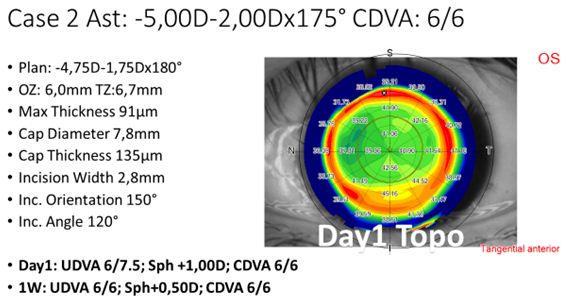
Since the initial experiences were quickly encouraging, rather soon it was decided to incorporate astigmatism to the treatment spectrum (typically below 3 D cylindrical error), and reduce the lenticule thickness to 85 µm or more (maximum myopic meridian of -6 D or more). With those indications, the laser settings and the technique have been refined. An example case for a moderate compound myopic astigmatism refractive correction is shown in Figure 2.

fig 2

Figure 2: Example treatment of a moderate compound myopic astigmatism treatment, including settings and POD1 topography.

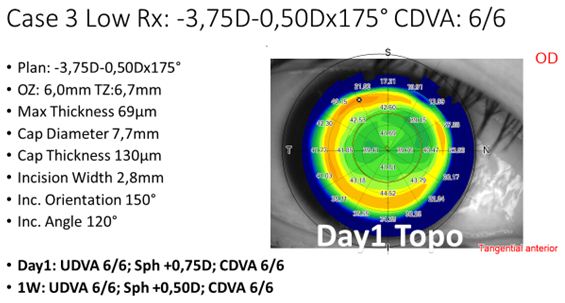
For the last 100+ treatments, we have been using the same laser settings and refined technique, and continuously decreased the attempted lenticule thickness. An example case for a low-to-moderate refractive correction is shown in Figure 3.

fig 3

Figure 3: Example treatment of a low-to-moderate myopic treatment, including settings and POD1 topography.

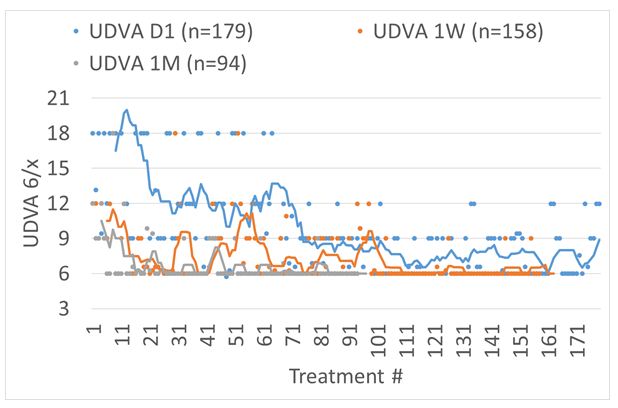
The outcomes in terms of UDVA can be seen in Figure 4. The first 16 treatments were performed without astigmatism correction, the next 52 treatments served for finding optimum laser settings and refinements in the technique, whereas the last 100+ treatments have been performed with the same settings and technique.

fig 4

Figure 4: UDVA for consecutive treatments reported for POD1, 1-week, and 1-month follow-up. The first 16 treatments were performed without astigmatism correction, the next 52 treatments served for finding optimum laser settings and refinements in the technique, whereas the last 100+ treatments have been performed with the same settings and technique.

As for the settings we are using now, they include:

Spot/Track distance: 4.0 µm

Pulse Energy: 120 nJ

Treatment time: 33 s for SmartSight, 26 s for flaps

Total energy: 650 mJ for SmartSight, 350 mJ for flaps

Avg. Dose: 0.65 J/cm2

Avg. Laser Power: 68 mW.

In this short term, we have successfully completed 185 SmartSight, 174 flaps with the ATOS device, along with further 267 SmartSurf procedures with the SCHWIND AMARIS.

Clinical Guidelines

In the gained experience, we have found that oversizing the cap by ~0.7 mm wider than the TZ provides sufficient room for surgical manouvers and reduces the cap diameter (7.8 mm to 8.5 mm).

High Corrections

In order to preserve RST we recommend moderate OZs (6.0-6.5 mm seem OK in our experience for corrections above -7 D) combined with thin caps (<120 µm). So that for high corrections a safer RST level can be respected after the extraction.

Thin Corneas

For the same reason, thin caps (<120 µm) are preferred for thin corneas.

Low Myopic Corrections

For low corrections (below -4 D) large OZ diameters (>7.0 mm diameter) can be used to provide better quality of vision.

Cyclotorsion

Since the cyclotorsion is acquired upon docking, the epithelium is intact, cyclotorsional/eye registration is actually improved as there is no corneal manipulation prior to treatment.

We present here the outcomes of the SmartSight procedures at POD1, 1 W, and 1 M follow-ups.

UDVA

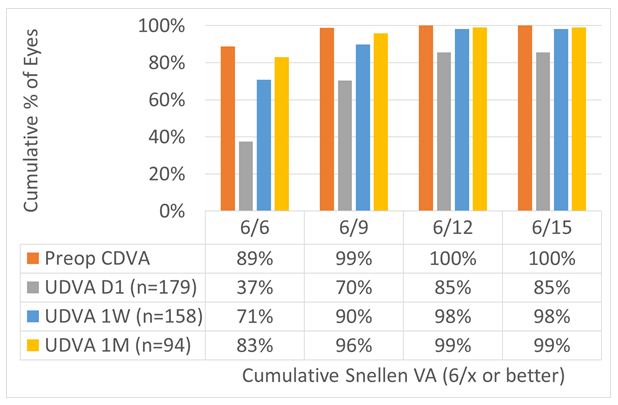
For the overall cohort, UDVA at Day1 was 6/6 in 37% of the cases, improving to 71% and 83% at 1 W and 1 M, respectively. At 1 M 96% and 99% achieved 6/9 and 6/12 UDVA, respectively. This can be seen in Figure 5.

fig 5

Figure 5: For the overall cohort, UDVA at Day 1 was 6/6 in 37% of the cases, improving to 71% and 83% at 1 W and 1 M, respectively. At 1 M, 96% and 99% achieved 6/9 and 6/12 UDVA, respectively.

UDVA Postop vs. CDVA Preop

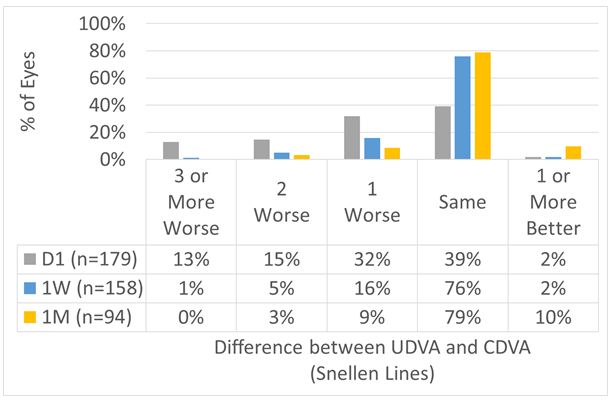
For the overall cohort, UDVA at Day 1 was within 1 line of preop CDVA in 72% of the cases, improving to 84% and 97% at 1 W and 1 M, respectively (Figures 6 and 7).

fig 6

Figure 6: For the overall cohort, UDVA at Day 1 was within 1 line of preop CDVA in 72% of the cases, improving to 84% and 97% at 1 W and 1 M, respectively.

fig 7

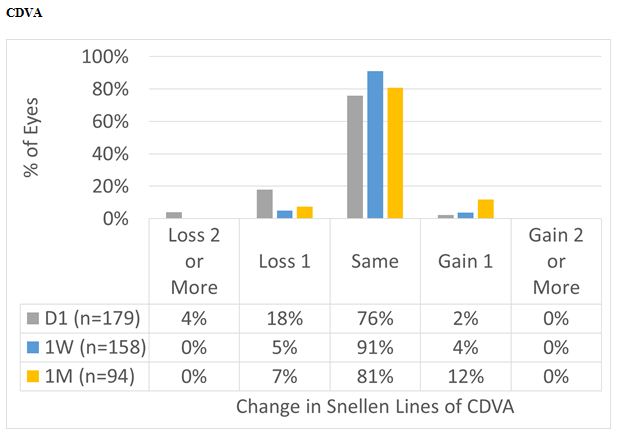
Figure 7: For the overall cohort, CDVA at Day 1 was the same or better than preop in 78% of the cases, improving to 95% and 93% at 1 W and 1 M, respectively.

Scattergram

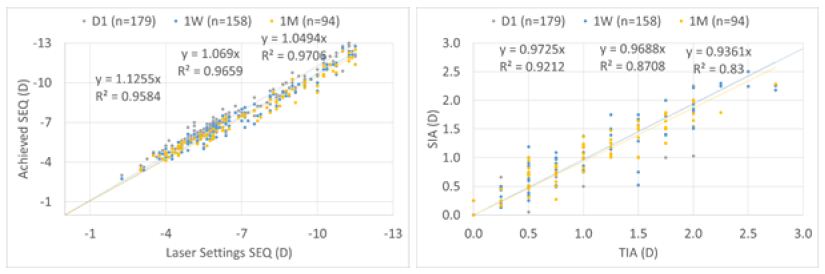
For the overall cohort, achieved SEQ at Day 1 was overcorrected by 13%, improving to 7% and 5% at 1 W and 1 M, respectively. Whereas astigmatism was under corrected by 3% at Day 1 and 1 W, and by 6% at 1 M, respectively (Figure 8).

fig 8

Figure 8: For the overall cohort, achieved SEQ at Day 1 was overcorrected by 13%, improving to 7% and 5% at 1 W and 1 M, respectively. Whereas astigmatism was undercorrected by 3% at Day 1 and 1 W, and by 6% at 1 M, respectively.

Some Details about the Workflow

No events of suction loss (despite using a single size large diameter PI) were recorded. The dissection was always easy (even in the presence of OBLs), and the appearance of the cut really smooth. The optical zones seem larger than planned.

Surgeries went smoother and faster day by day. The final technique uses the incision half way for the upper layer, and half way for the lower layer. Followed by a dissection technique, and wiping the lenticule out through the incision.

Docking and Centration Procedure: Positive Impact and Effect on the Technique

The Eye-Tracker guided centration and docking shall provide a robust, accurate, and precise alignment of the eye to the system and of the lenticule to the eye. This is reflected in the postop topographies, showing an excellent centration of the correction from Day 1 postop [10].

Do We Need Transition Zones for SmartSight?

30 years ago TZs were deemed not necessary for ablation procedures, and yet TZs represented a huge improvement in the outcomes. TZs may be important for SmartSight since TZs improve the corneal curvature gradient postop (thus also the HOAs), improving the short term stability. TZs together with no minimum lenticule thickness may lead to less epithelial remodeling and less undercorrection/regression.

Overall Summary

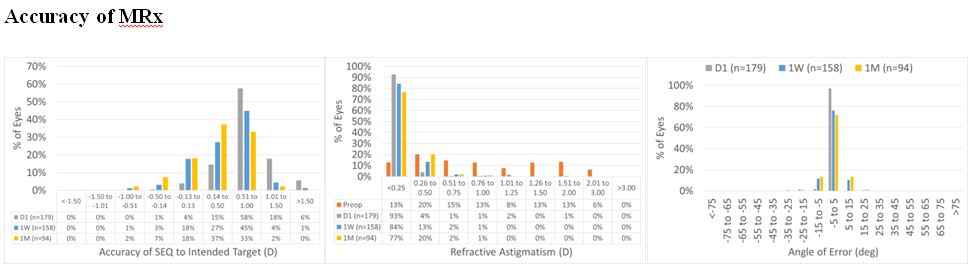
Day 1 outcomes are a good metric for refraction. From 1 W Rx remained stable. UDVA was good at Day 1 with 70% in 6/9, decimal 0.6; improving to >70% in 6/6, decimal 1.0 at 1 W (only 89% preop). UDVA respect to preop CDVA was good >90% within 1 line of preop CDVA from 1 W. CDVA change is also fine, no loss of 2 lines from 1 W. System slightly overcorrects. The overcorrection reaches ~5% or ~0.4 D. Cylinder is properly corrected. Already at Day 1 >90% have a cylinder of 0.5 D or less, this remains at 1 W and 1 M (Figure 9).

fig 9

Figure 9: For the overall cohort, SEQ at Day 1 was within 0.50 D in 19% of the cases, improving to 48% and 63% at 1 W and 1 M, respectively. At 1 M, 98% of the treatments were within 1 D. Whereas astigmatism was within 0.50 D in 97% of the cases at Day 1, 1 W and 1 M. At 1 W and 1 M, all the treatments were within 1 D. As for the angle of error, it was within 15 deg in 99% of the cases at Day 1, 1 W and 1 M.

System Slightly Overcorrects?

Overcorrection shall not be overstressed. Epithelial remodel may continue until 3 M or so. This may induce some epithelial regression. The used personal clinical aim targets a low postoperative plus refraction. The patient population was mainly young, and can easily accommodate +0.75 D. Overall patients are happier with a bit of plus Rx than with insufficient correction.

Final Thoughts and Conclusion

Surprisingly ATOS can overcorrect, while cylinder is only slightly undercorrected. Rx and topos essentially do not change from Day 1 to 1 M postop. Wide Ozs and excellent centration was obtained [11].

I still lack experience in high cylinder (above 3 D) or very thin lenticules (below 45 µm). The minimum lenticule extracted so far was -1.25 D-2.00 Dx60. I have performed 359 treatments (including 174 flaps and 185 SmartSight) without major problems.

ATOS/SmartSight is here to stay and holds a lot of promise. ATOS/SmartSight has capabilities to unfold full potential and will be a strong contender in the corneal work.

I am excited to get involved in the further ATOS development and I will be part of it!

Epilogue

The SmartSight treatment offers the right candidate great features. We do anticipate a long-life and a brilliant future for SmartSight. We are aware that SCHWIND eye-tech-solutions continues to push this technique forward with further refinements, evolutions, and innovations, which would continue to strengthen its position.

References

    1. Sekundo W, Kunert KS, Blum M. Br (2011) Small incision corneal refractive surgery using the small incision lenticule extraction (SMILE) procedure for the correction of myopia and myopic astigmatism: results of a 6 month prospective study. J Ophthalmol 95(3): 335-339. [crossref]
    2. Pradhan KR, Reinstein DZ, Carp GI, Archer TJ, Gobbe M, et al. (2013) Femtosecond laser-assisted keyhole endokeratophakia: correction of hyperopia by implantation of an allogeneic lenticule obtained by SMILE from a myopic donor. J Refract Surg 29(11): 777-778. [crossref]
    3. Studer HP, Pradhan KR, Reinstein DZ, Businaro E, Archer TJ, et al. (2015) Biomechanical Modeling of Femtosecond Laser Keyhole endokeratophakia Surgery. J Refract Surg 31(7): 480-486. [crossref]
    4. Pradhan KR, Reinstein DZ, Vida RS, Archer TJ, Dhungel S, et al. (2019) Femtosecond Laser-Assisted Small Incision Sutureless Intrastromal Lamellar Keratoplasty (SILK) for Corneal Transplantation in Keratoconus. J Refract Surg 35(10): 663-671. [crossref]
    5. Reinstein DZ, Pradhan KR, Carp GI, Archer TJ, Day AC, et al. (2019) Small Incision Lenticule Extraction for Hyperopia: 3-Month Refractive and Visual Outcomes. J Refract Surg 35(1): 24-30. [crossref]
    6. Pradhan KR, Reinstein DZ, Carp GI, Archer TJ, Dhungana P (2019) Small Incision Lenticule Extraction (SMILE) for Hyperopia: 12-Month Refractive and Visual Outcomes. J Refract Surg 35(7): 442-450. [crossref]
    7. Pradhan KR, Reinstein DZ, Carp GI, Archer TJ, Gobbe M, et al. (2016) Quality control outcomes analysis of small-incision lenticule extraction for myopia by a novice surgeon at the first refractive surgery unit in Nepal during the first 2 years of operation. J Cataract Refract Surg 42(2): 267-277. [crossref]
    8. Reinstein DZ, Carp GI, Pradhan KR, Engelfried C, Archer TJ, et al. (2018) Role of laser refractive surgery in cross-subsidization of nonprofit humanitarian eyecare and the burden of uncorrected refractive error in Nepal: Pilot project. J Cataract Refract Surg 44(8): 1012-1017. [crossref]
    9. Izquierdo L Jr, Sossa D, Ben-Shaul O, Henriquez MA (2020) Corneal lenticule extraction assisted by a low-energy femtosecond laser. J Cataract Refract Surg 46(9): 1217-1221. [crossref]
    10. Reinstein DZ, Pradhan KR, Carp GI, Archer TJ, Gobbe M, et al. (2017) Small Incision Lenticule Extraction (SMILE) for Hyperopia: Optical Zone Centration. J Refract Surg 33(3): 150-156. [crossref]
    11. Reinstein DZ, Pradhan KR, Carp GI, Archer TJ, Gobbe M, et al. (2017) Small Incision Lenticule Extraction (SMILE) for Hyperopia: Optical Zone Diameter and Spherical Aberration Induction. J Refract Surg 33(6): 370-376. [crossref]
Abstract fig

Cytotoxic Meroterpenes: A Review

DOI: 10.31038/JPPR.2020324

Abstract

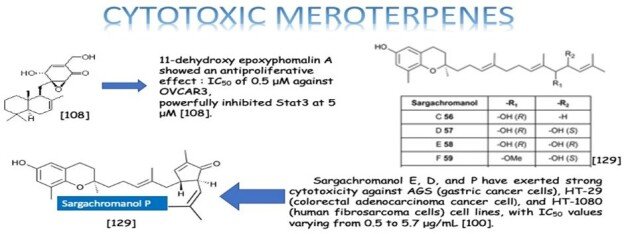
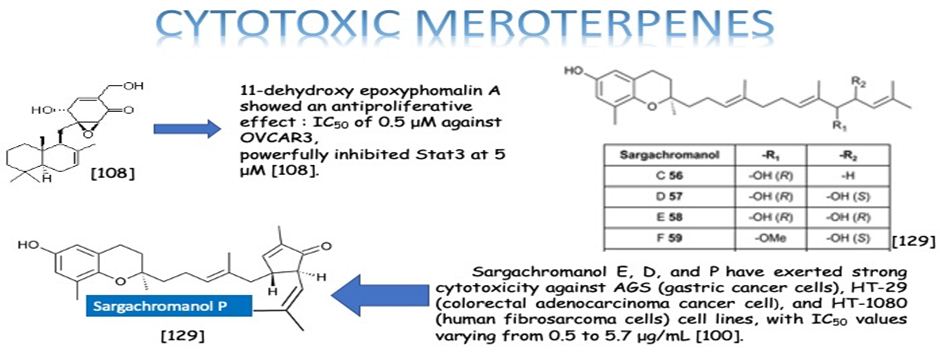
Meroterpenes are mixed natural products. They consist of one terpene and one polyketide skeletons. Due to their structural varieties, meroterpenoids display diverse bioactivities, like anticancer, anti-inflammatory, anti-biotic, and antifibrotic activities. Our aim is to highlight the importance of the meroterpenes which have been the most studied on and reported among the bioactive natural products last years. According to our literature survey, the three most effective meroterpene groups have been determined. One group is the meroterpenes isolated from the brown alga Sargassum siliquastrum: Sargachromanol E, D, and P have exerted strong cytotoxicity against AGS (gastric cancer cells), HT-29 (colorectal adenocarcinoma cancer cell), and HT-1080 (human fibrosarcoma cells) cell lines, with IC50 values varying from 0.5 to 5.7 μg/mL [100]. The other most effective meroterpene is Eucalypglobulusal F, which is isolated from E. globulus fruit, has shown cytotoxicity against the human acute lymphoblastic cell line (CCRF-CEM) with an IC50 value of 3.3 μM [89]. Also, the last one is 11-dehydroxy epoxyphomalin A (4), from the endophytic fungus Peyronellaea coffeae-arabicae FT238, which was obtained from the native Hawaiian plant Pritchardia lowreyana showed a strong antiproliferative effect with an IC50 of 0.5 μM against OVCAR3 (Ovarian carsinoma cells) [102]. Conclusively, meroterpenes have potential nominees as an anticancer drug. Moreover, the structure of naturally isolated meroterpenes has a moderate anticancer activity that can easliy be modified by semi-synthetic ways due to their simple structures comparing to other natural compounds such as triterpenes or phenolic compounds.
Abstract fig

Introduction

Natural products are extensively known to be a major resource of biologically active compounds that hold manifold and unusual platforms [1]. Terpenoids are structurally differing secondary metabolites with more than 40,000 reported structural diversity bearing valuable bioactive characters [2,3] Their structures are chiefly sourced from plants and microbes, which are mainly biosynthesized by the 2-C- methylerythritol 4-phosphate pathway or the mevalonate pathway [4,5]. Terpenoids were known to have potential pharmacological properties against fatal diseases, such as malaria [6], cardiovascular disease [7], and cancer [3,8]. Meroterpenoids are hybrid secondary metabolites that moderately obtain from the terpenoid pathways [9,10]. Especially, meroterpenoids derived from polyketide and terpenoid precursors have sp3-rich terpenoid scaffolds and sp2-rich polyketide scaffolds, which argue different pharmacological activities [11]. Their carbon skeletons come from intra- and intermolecular cyclizations and/or rearrangements of terpene chains to give unique polycyclic or macrocyclic structures often possessing varied functional groups [12,13]. Naturally exist meroterpenoids have been obtained from a variety of origins containing animals, plants, bacteria, and fungi [14], and are demonstrated by ubiquinone-10 (coenzyme Q10) [15], α-tocopherol (vitamin E) [16], vinblastine [17], merochlorin A [18,19], and teleocidin B-4 [10,20]. Meroterpenoids are usually isolated from fungi and marine organisms. Otherwise, plants can produce minimal groups of meroterpenoids, such as cannabinoids and polyprenylated phloroglucinols [9], despite plants are rich sources of various types of terpenoids [11]. Stemming from their structural variety, meroterpenoids show various bioactivities, like anticancer [21], anti-inflammatory [22], anti-biotic [23], and antifibrotic [24] activities. In current years, the alluring chemical structures and impressive biological activities of these compounds have appealed to considerable interest from the synthetic and pharmacological societies [14,25-27]. Considering meroterpenes which have been commonly isolated in fungi from Penicillium and Aspergillus genera [28]: Austin (Figure 1) is a good characteristic of this class, having been isolated for the first time in 1976 by Chexal et al. from a culture of Aspergillus ustus [29]. Afterward, in 1994, it was isolated, besides five other meroterpenes, from Penicillium sp. [30]. Assorted Austin-like compounds have been published from an endophyte species of Penicillium cultivated in rice: preaustinoid A and B (Figure 2) [31], 7-b-acetoxydehydroaustin, neoaustin (Figure 3), dehydro-austin (Figure 1), austinoneol (Figure 4) [32], preaustinoid A1, A2 (Figure 5) and B1 [33]. Several derivatives exhibit activity against Escherichia coli, Bacillus sp., and Pseudomonas aureginosa [33,34]. Further examples contain applanatumin A (Figure 6), a novel meroterpenoid dimer with potent antifibrotic activity from Ganoderma applanatum [24], albatrelins A–C (Figure 7), three novel dimers with cytotoxicity from Albatrelleus ovinus [35], and yaminterritrems A and B (Figure 8) with a novel skeleton and inhibition of cyclooxygenase-2 expression from Aspergillus terreus. As it has been understood from all the examples fungi are recognized as producers of meroterpenoids with novel structures and various bioactivities [36,37].
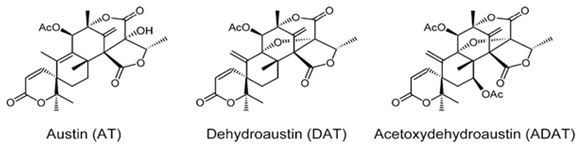
fig 1

Figure 1: The molecular structure of Austin, dehydroaustin and acetoxydehydroaustin [38].
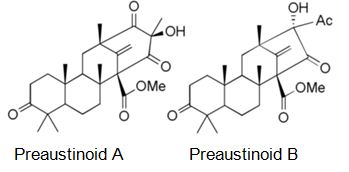
fig 2

Figure 2: The molecular structure of Preaustinoid A and B [39].
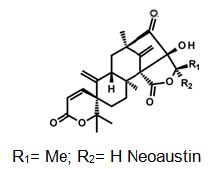
fig 3

Figure 3: The molecular structure of Neoaustin [40].
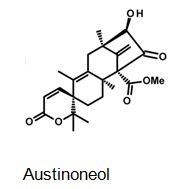
fig 4

Figure 4: The molecular structure of Austinoneol [40].
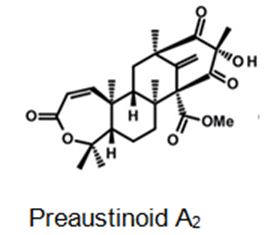
fig 5

Figure 5: The molecular structure of Preaustinoid A2 [40].
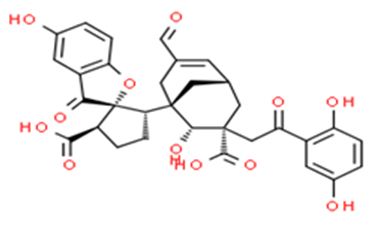
fig 6

Figure 6: The molecular structure of Applanatumin A [41].
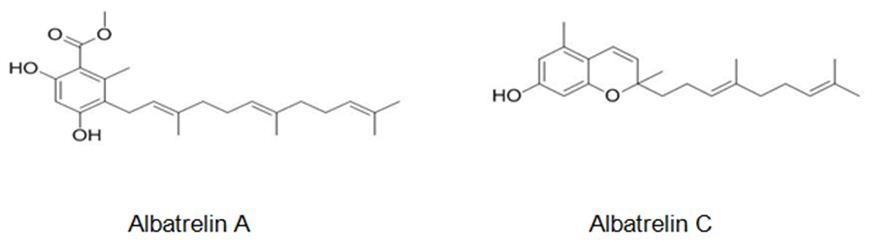
fig 7

Figure 7: The molecular structure of Albatrelin A [42] and C [43].
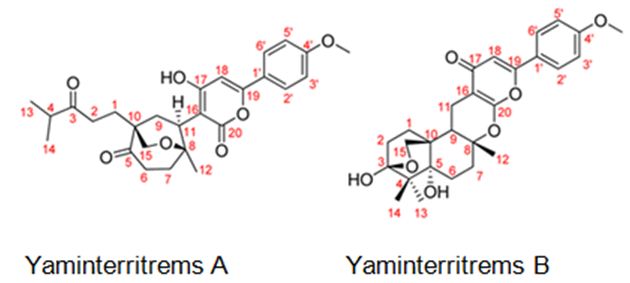
fig 8

Figure 8: The molecular structure of Yaminterritrems A and B [36].

Biosynthetically, the composite structures of fungal meroterpenoids are largely originated from plain precursors alike a linear isoprenoid or the C-2 carbon unit acetyl-CoA, via a series of chemical transformations catalyzed by two enzyme groups, terpene cyclases and polyketide synthases (PKSs) [44,45]. Also the huge structural diversity, fungal meroterpenoids have drawn wide interest from the scientific society because of their wide spectrum of pharmacological activities [10,46-49]. The meroterpenoids from endophytic fungi were classified into two major groups: polyketide–terpenoids and non-polyketide– terpenoids [9,50]. α-pyrone meroterpenoids including triketide terpenoid moieties were identified from the fungi with acetylcholinesterase inhibitors [51]. Thus these α-pyrone meroterpenoids have been appealing to chemists and pharmacologists’ appreciable attention [52]. The α-pyrone meroterpenoids form an important subset of this class and have a familiar C3-oxidized drimane unit that is connected to numerous polyketide- based pyrone fragments at C11 [51]. Members of this group show a wide range of bioactivity differing from anti-cholinesterase activity to acyl-CoA/cholesterol acyltransferase inhibition. While not, as usual, meroterpenoids having a diterpene unit have also been discovered in nature [53]. Members of this subset naturally share a typical C3-oxidized ent-isocopalane fragment that takes place in mixture with various aromatics and has been known to show anti-mycobacterial, insecticidal and cytotoxic characteristics [54]. Pyripyropenes and phenylpyropenes are subclasses of meroterpenes actual in the filamentous fungi genus Aspergillus and Penicillium. These compounds are biogenetically originated from a hybrid of polyketide and terpenoid. Their structures were contained in three parts: a pyridine/phenyl ring, an α-pyrone, and a sesquiterpene motif. Subsequently, they were first isolated in 1994, 19 pyripyropenes were exhibit to be effective as acyl-CoA/cholesterol acyltransferase (ACAT) inhibitors and are thought to be beneficial in the avoidance and treatment of hypercholesterolemia and atherosclerosis [55-60]. In the marine environment, meroterpenes are compounds of assorted biosynthesis, essentially quinone or hydroquinones bonded with a terpenoid portion differing from one to nine isoprene units. These secondary metabolites are obtained principally from brown algae such as Cystoseira [61], marine microorganisms [28], soft corals [62], or marine invertebrates, such as sponges or ascidians [63,64]. Several prenylated hydroquinones inhibit the proliferation of a panel of cancer cells [65-67]. Furthermore, three new sesqui- and diterpene hydroquinone MK2 or PI3 kinase inhibitors have been reported from demosponges [68-70]. The fungal meroterpenoids as the interesting hybrid natural products are broadly scattered in marine environments with various molecular architectures, that are brought terpene moieties together other precursors such as polyketide unit by diverse biosynthetic pathways [48,71-73]. Among the fungus-originated meroterpenoids, a polyketide-terpenoid biosynthetic pathway that has a C-alkylation of 3,5-dimethylorsellinic acid (DMOA) with farnesyl pyrophosphate (FPP) produced more than 100 secondary metabolites alongside several unique scaffolds [9,14]. The biogenetic pathways of these usual natural products have been largely investigated, disclosing a set of synthetic gene clusters and functional enzymes [74-76]. The structural diversity of the DMOA-based meroterpenoids was ascribed to sequential cyclization, complex oxidative ring rearrangement, and recyclization. Stand on the carbocyclic frameworks, the DMOA-FPP derived meroterpenoids can be grouped into seven subtypes. Andrastins having a 6,6,6,5-tetra-carbocyclic skeleton (Figure 9) are the potent inhibitors of RAS proteins, which are important for regulating cell division and the progressing of cancer [77]. Terretonin-type (Figure 10) congeners bearing a δ-lactone in ring D are derived from terrenoid (andrastin- type) by D-ring expansion and bizarre rearrangement of the methoxy group [78]. Berkeleyone- type (or protoaustinoid-type) (Figure 11) derivatives being the caspase- 1 inhibitor is the meroterpenoids defining a set of unique and functionalized chemical scaffolds, which are identified by the existence bicyclo [3.3,1]nonane or its rearranged bicyclo[3,2,1]octane unit in rings C and D [79], and are originated by the same intermediate as for andrastins with miscellaneous rearrangement. Austinol (Figure 12) and its analogs displayed a pentacyclic scaffold with a spiro-δ-lactone in ring A and a γ-lactone in ring E, that was originated from protoaustinoid through oxidation and ring rearrangement [80]. Chrysogenolides are a class of DMOA- based compounds with a rare seven-numbered ring B, which shows the inhibition of nitric oxide production [73], while anditomin analogs highlighted the presence of an uncommon and highly oxygenated bridged-ring system [81-88]. Fumigatonin and novofumigatonin (Figure 13) are an extra subtype consisting of highly oxidized and complexed condensed ring systems [82,83]. These meroterpenoids have been stated to own a range of biological activities [83-85].
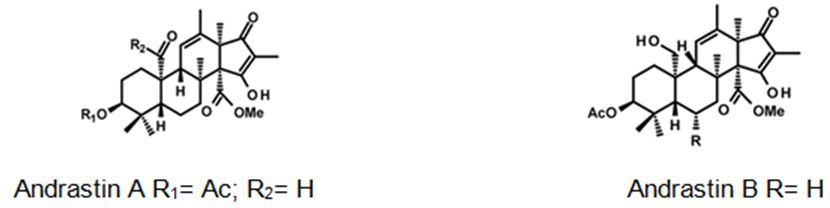
fig 9

Figure 9: The molecular structure of Andrastin A and B [40].
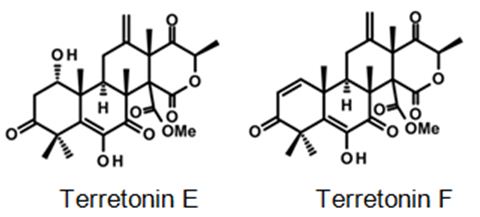
fig 10

Figure 10: Some examples for Terretonin type-meroterpenes: isolated from the culture extract of the marine derived-fungus Aspergillus insuetus [40].
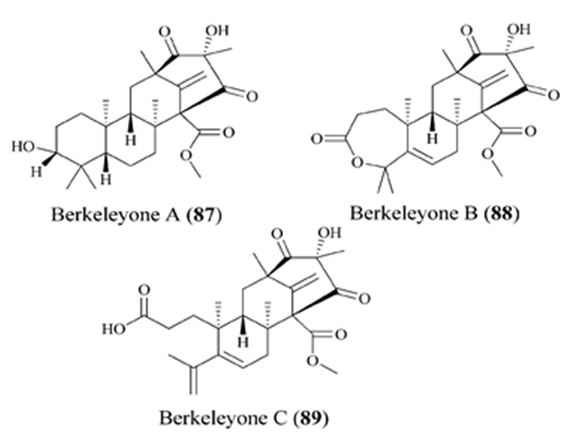
fig 11

Figure 11: The molecular structure of Berkeleyone A-C [86].
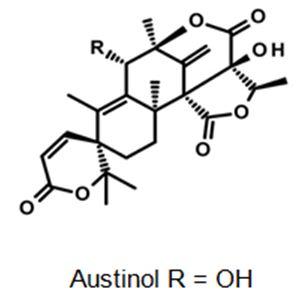
fig 12

Figure 12: The molecular structure of Austinol [40].
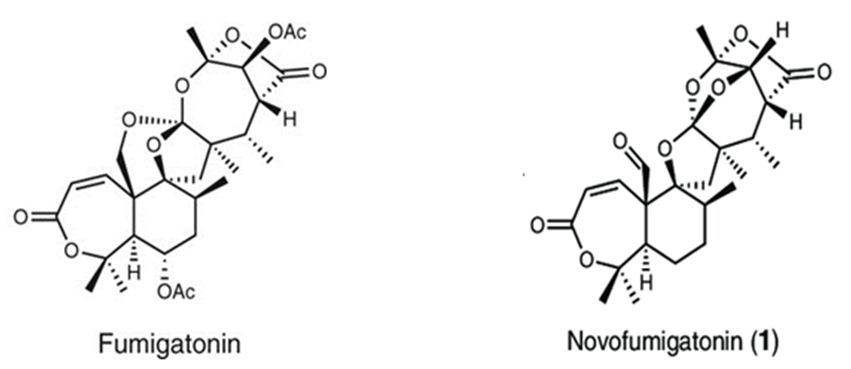
fig 13

Figure 13: The molecular structure of Fumigatonin and Novofumigatonin [87].

Anticancer, Cytotoxic, and Antitumor Activity

We have mentioned two studies about Psoralea sp.: One belongs to Wu et all. They have obtained two novel dimeric meroterpenoids, bisbakuchiols A (1) and B (2), along with (S)-bakuchiol (3) from the seeds of Psoralea corylifolia L. (Fabaceae) (Figure 14). Bisbakuchiols A and B consist of an extraordinary dimeric meroterpenoid skeleton in which two meroterpenes are connected through a dioxane bridge. All compounds have been examined for their potential to inhibit hypoxia-inducible factor-1 (HIF-1) activation induced by hypoxia in a HIF-1-mediated reporter gene assay in AGS human gastric cancer cells. (S)-Bakuchiol inhibited hypoxic activation of HIF-1 with an IC50 value of 6.1 μM [88].
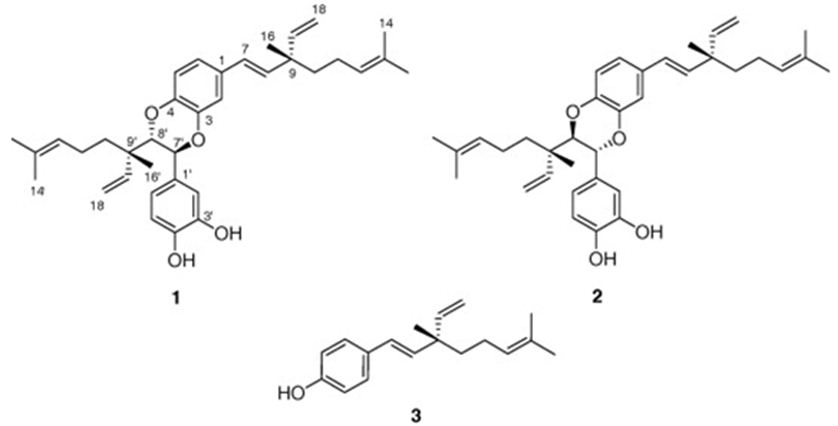
fig 14

Figure 14: The molecular structure of bisbakuchiols A (1) and B (2), and (S)-bakuchiol (3) [88].

The other is made by Madrid and his research group. They have investigated the biological activity of the resinous exudate of aerial parts from Psoralea glandulosa, and its active components (bakuchiol (1), 3-hydroxy-bakuchiol (2) and 12-hydroxy-iso-bakuchiol (3)) (Figure 15) against melanoma cells (A2058). Also, the effect in cancer cells of bakuchiol acetate (4) (Figure 15), a semi-synthetic derivative of bakuchiol, have been examined. The results achieved show that the resinous exudate inhibited the growth of cancer cells with an IC50 value of 10.5 μg/mL after 48 h of treatment, while, for pure compounds, the most active was the semi-synthetic compound 4. Their data also proved that resin can induce apoptotic cell death, which could be associated with a complete action of the meroterpenes existing [89].
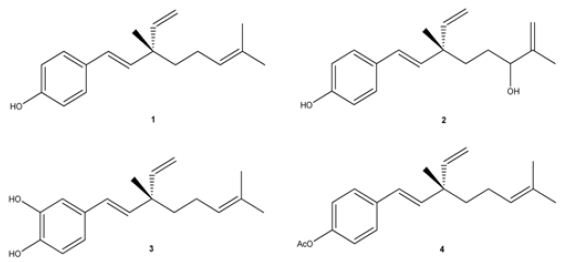
fig15

Figure 15: The molecular structure of Bakuchiol (1), 3-hydroxy-bakuchiol (2), 12-hydroxy-iso-bakuchiol (3), and semi-synthetic derivative of bakuchiol: bakuchiol acetate (4) [89].

The second most studied plant example is Psidium guajava L. (guava). Rizzo et. all have searched in vitro, in vivo and in silico anticancer and estrogen-like activity of Psidium guajava L. (guava) extracts and enriched mixture including the meroterpenes guajadial, psidial A and psiguadial A and B (Figure 16). All samples were assessed in vitro for anticancer activity against nine human cancer lines: K562 (leukemia), MCF7 (breast), NCI/ADR-RES (resistant ovarian cancer), NCI-H460 (lung), UACC-62 (melanoma), PC-3 (prostate), HT-29 (colon), OVCAR-3 (ovarian) and 786-0 (kidney). Psidium guajava‘s active compounds shown similar physicochemical characteristics to estradiol and tamoxifen, as in silico mol. docking studies displayed that they fit into the estrogen receptors (ERs). The meroterpene-enriched fraction was also appraised in vivo in a Solid Ehrlich murine breast adenocarcinoma model and exhibited to be highly active in preventing tumor growth, also showing uterus increase in comparison to negative controls. The capability of guajadial, psidial A and psiguadials A and B to decrease tumor growth and arouse uterus proliferation, they are in silico docking similarity to tamoxifen too, indicate that these compounds may act as Selective Estrogen Receptors Modulators (SERMs), hence holding important potential for anticancer treatment [90].
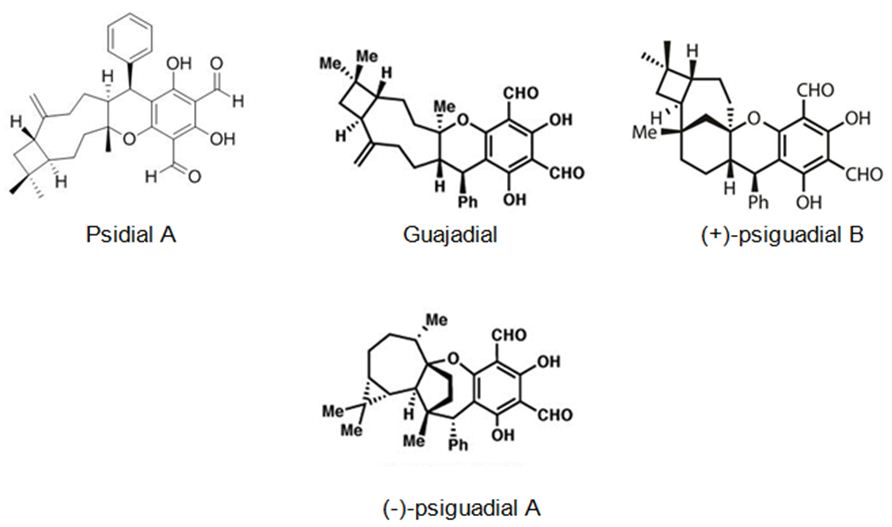
fig 16

Figure 16: The molecular structure of guajadial, psiguadial A-B [91] and psidial A [92].

Qin et al. also have studied Psidium guajava L fruits, it has resulted in the identification of two new meroterpenoids, psiguajavadials A (I) and B (II), along with 14 earlier defined meroterpenoids. All of the meroterpenoids have exhibited cytotoxicities against five human cancer cell lines, with guajadial B (12) being the most powerful having an IC50 value of 150 nM toward A549 cells. Additionally, biochemical topoisomerase I (Top1) assay has disclosed that psiguajavadial A, psiguajavadial B, guajadial B, guajadial C, and guajadial F (Figure 17) served as Top1 catalytic inhibitors and deferred Top1 poison-mediated DNA damage. The flow cytometric analysis has pointed out that the new meroterpenoids psiguajavadials A and B could induce apoptosis of HCT116 cells. These data indicate that meroterpenoids from guava fruit could be used for the progress of antitumor agents [93].
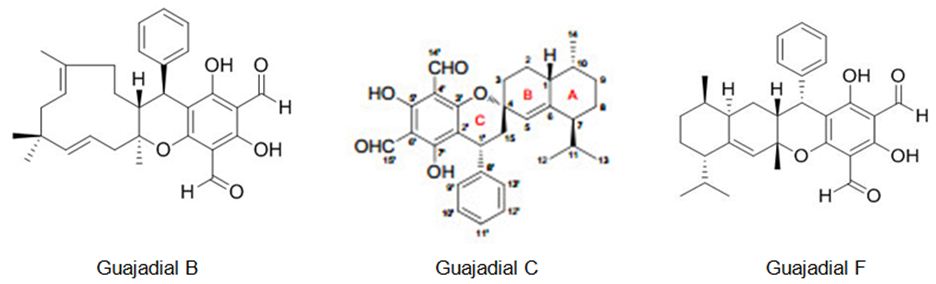
fig 17

Figure 17: The molecular structure of guajadial B [94], guajadial C [95] and guajadial F [96].

JNU-144 (Figure 18): a new meroterpenoid has been isolated, from Lithospermum erythrorhizon, and investigated its’ antitumor activity on all hepatoma cell lines, JNU-144 shown potent anti-tumor effects. Particularly, in SMMC-7721 cells, JNU-144 induced apoptosis by activating the intrinsic apoptosis pathway. The researchers have also discovered that JNU-144 inhibited EMT in both SMMC-7721 and HepG2 cells by reprogramming the gene expression profile. Moreover, JNU- 144 suppressed tumor growth in vivo. These results prove the potential for JNU-144 as a novel therapeutic drug for liver cancer [97].
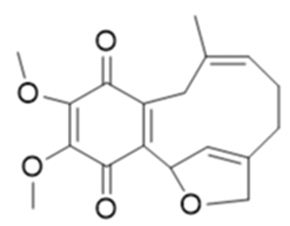
fig 18

Figure 18: The molecular structure of JNU-144 [97].

Zhang et al. have obtained Fischernolides A-D (1-4) (Figure 19), four meroterpenoids based on diterpene and acylphloroglucinol, having an unprecedented 28-carbon skeleton with a novel scaffold, from the roots of Euphorbia fischeriana. Compound 2 exerted significant cytotoxicity and can induce the apoptosis of MCF-​7 and Bel-7402 cell lines by caspase activation [98].
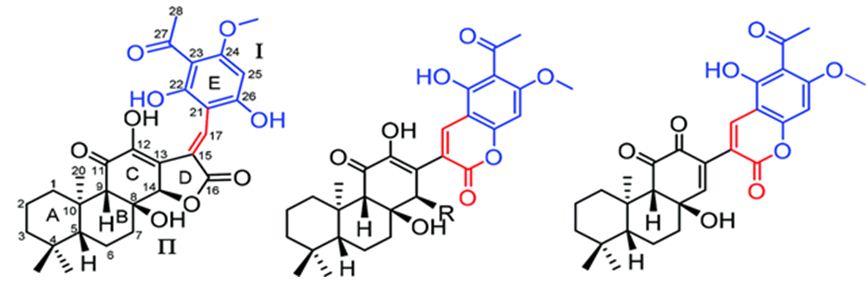
fig 19

Figure 19: The molecular structure of Fischernolides A-D (1-4) [98].

The six new pairs of bibenzyl-based meroterpenoid enantiomers, (±)-rasumatranin A-D (1-4) and (±)-radulanin M and N (5 and 6), and six known compounds have been isolated from the adnascent Chinese liverwort: Radula sumatrana. Cytotoxicity tests of the obtained compounds have exhibited that 6-hydroxy-3-methyl-8-phenylethylbenzo[b]oxepin-5-one (8) showed effect against the human cancer cell lines MCF-7, PC-3, and SMMC-7721, with IC50 values of 3.86, 6.60, and 3.58 μM, in order, and induced MCF-7 cell death through a mitochondria-mediated apoptosis pathway [99]. Lee et. al. have investigated the cytotoxicity of the brown alga Sargassum siliquastrum on human cancer cells (AGS, HT-29, HT-1080, and MCF-7). Bioassay-guided fractionation of the crude extracts has demonstrated that the 85% aqueous methanol (MeOH) fraction was the most toxic. Seven known meroterpenoids (1-7) have been obtained from this cytotoxic fraction. Each compound has been tested for its cytotoxic effect on human cancer cells. Compounds 1, 2, and 4 have shown vigorous cytotoxicity against AGS, HT-29, and HT-1080 cell lines, with IC50 values varying from 0.5 to 5.7 μg/mL [100]. The six new meroterpenoids, diplomeroterpenoids A-F, two new chalcone-lignoids, diplochalcolins A and B, and 13 well-known compounds have been isolated from the root extract of Mimosa diplotricha. diplomeroterpenoids A has exerted antiproliferative activity against human hepatoblastoma HepG2 cells with a GI50 value of approximately 8.6 μM [101]. The last-mentioned research example from plant source belongs to Jin et. al. They have isolated ten new formyl-phloroglucinol-terpene meroterpenoids, eucalypglobulusals A-J (1-10), and 10 known analogs were isolated from E. globulus fruit Eucalypglobulusal F has shown cytotoxicity against the human acute lymphoblastic cell line (CCRF-CEM) with an IC50 value of 3.3 μM, while eucalypglobulusal A, eucarobustol C, macrocarpal A, macrocarpal B, and macrocarpal D (Figure 20) have exerted DNA topoisomerase I (Top1) inhibition. The compounds: eucalypglobulusal A and macrocarpal A, acted as Top1 catalytic inhibitors and delayed Top1 poison-mediated DNA double-strand damage [102].
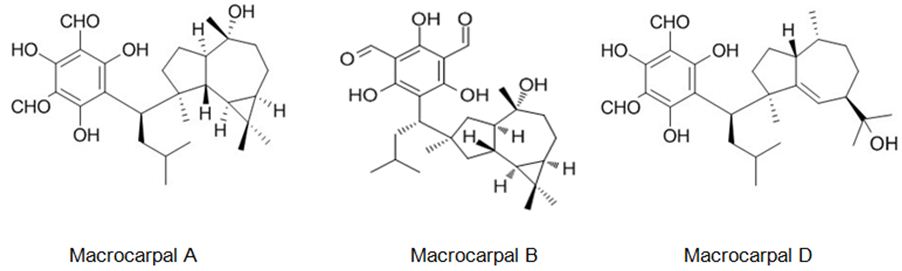
fig 20

Figure 20: The molecular structure of Macrocarpal A [103], B [104], D [105].

The next three examples will be on the meroterpenes obtained from plant-related fungi. Liang et al. have studied on the secondary metabolites of the endophytic fungus Guignardia mangiferae from Smilax glabra and their antitumor effects. Twelve compounds have been isolated from the extract of 100 L liquid fermented broth and ten of them were elucidated as 15-hydroxyl tricycloalternarene 5b (1), guignardiaene D (2), guignardiaene C (3), guignardone A (4), guignardone B (5), 3-(4-methyl phenoxy) propanoic acid (6), nonane-2,4-diol (7), ergosterol (8), tyrosol (9), and p-hydroxybenzaldehyde (10). The inhibitory activity of compounds 1-7 on SF-268, MCF-7, and NCI-H460 cell lines was examined in vitro by SRB. The meroterpenes 1-5 exerted inhibitory effects on SF-268, while compounds. 6 and 7 showed inhibitory effects on MCF-7 selectively [106]. Long et. al. have obtained eleven new meroterpenoids, bipolahydroquinones A-C, cochlioquinones I-N, isocochlioquinones F, and G, along with 6 familiar ones from an endophytic fungus Bipolaris sp. L1-2 from Lycium barbarum. Bipolahydroquinone C, cochlioquinone I and cochlioquinones K-M have exhibited cytotoxicity against NCI-H226 and(or) MDA-MB-231 with IC50values ranging 5.5-9.5 μM [107].

Li et. al. have isolated three uncommon polyketide-sesquiterpene metabolites peyronellins A-C (1-3) (Figure 21), together with the new epoxyphomalin analog 11-dehydroxy epoxyphomalin A (4), from the endophytic fungus Peyronellaea coffeae-arabicae FT238, which was obtained from the native Hawaiian plant Pritchardia lowreyana. Compound 4 showed an antiproliferative effect with an IC50 of 0.5 μM against OVCAR3, and it also powerfully inhibited Stat3 at 5 μM [108].
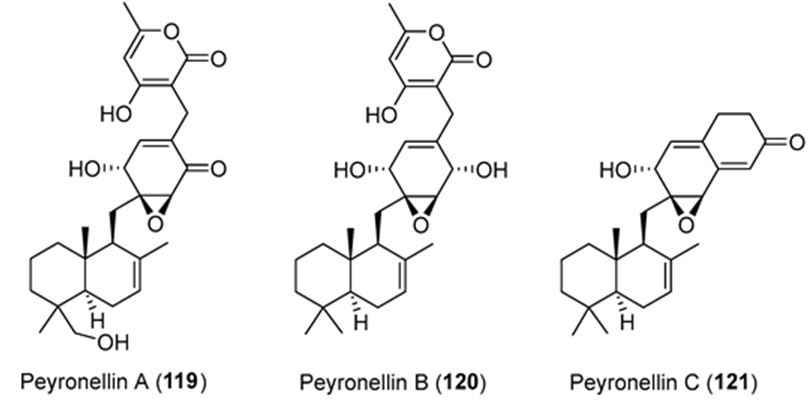
fig 21

Figure 21: The molecular structure of peyronellins A-C [109].

The meroterpenes isolated from marine sources are another subject that must be pointed out. In the first example study, Imperatore et. al. have reported the synthesis of two quinones: 2-methoxy-3-(3-methylbut-2-en-1-yl)cyclohexa-2,5-diene-1,4-dione and (E)-2-(3,7-dimethylocta-2,6-dien-1-yl)-3-methoxycyclohexa-2,5-diene-1,4-dione and of their corresponding dioxothiazine fused quinones: 6-methoxy-7-(3-methylbut-2-en-1-yl)-3,4-dihydro-2H-benzo[b][1,4]thiazine-5,8- dione-1,1-dioxide and (E)-7-(3,7-dimethylocta-2,6-dien-1-yl)-6-methoxy-3,4-dihydro-2H-benzo[b][1,4]thiazine-5,8-dione-1,1-dioxide inspired to the marine natural product aplidinone A (1), a geranylquinone displaying the 1,1-dioxo-1,4-thiazine ring isolated from the ascidian Aplidium conicum. The potential effects on viability and proliferation in three diverse human cancer cell lines, breast adenocarcinoma (MCF-7), pancreas adenocarcinoma (Bx-PC3) and, bone osteosarcoma (MG-63), have been searched. The methoxylated geranylquinone exhibited the highest antiproliferative effect showing akin toxicity in all three cell lines analyzed. In an interesting way, deeper research has highlighted a cytostatic effect of quinone 5 traceable to a G0/G1 cell-cycle arrest in BxPC-3 cells after 24 h treatment. (Figure 22) [110].
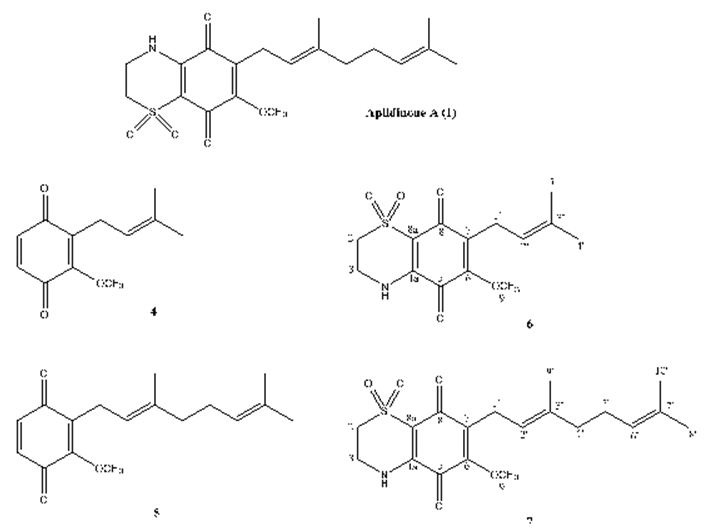
fig 22

Figure 22: The molecular structure of aplidinone A and of synthetic analogs [110].

The previous A. Conicum study belonged to the same research group is on totally natural product isolation of A. Conicum. Menna et. al. have searched this marine source, and resulted in the isolation of two new meroterpenes, the conithiaquinones A (1) and B (2), in addition to two previously published chromenols (3 and 4) and conicaquinones (5 and 6) (Figure 23). Both conithiaquinones A and B exhibited significant activities on the growth and viability of cells, with 1 showing fascinating cytotoxicity against human breast cancer cells [111].
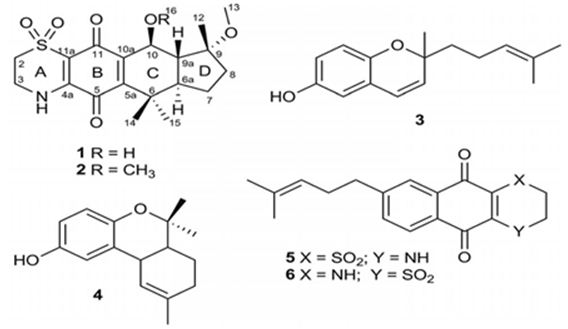
fig 23

Figure 23: The molecular structure of conithiaquinones A (1) and B (2), two previously published chromenols (3 and 4) and conicaquinones (5 and 6) [111].

Additionally, marine meroterpenes from sponges have anticancer activity. Li et. al. have isolated five new sesquiterpene hydroquinones, dactylospongins A-D (1-4) and 19-O-methylpelorol (10), four new sesquiterpene quinones too: melemeleones C-E (6-8) and dysidaminone N (9) from the marine sponge Dactylospongia sp. collected from the South China Sea, along with five known analogs, ent-melemeleone B (5), pelorol (11), 17-O-acetylavarol (12), 20-O-acetylavarol (13), and 20-O-acetylneoavarol (14). 19-O-methylpelorol (10) showed cytotoxicity against lung cancer PC-9 cell lines with an IC50 value of 9.2 μM [112]. Three new meroterpenoids, hyrtiolacton A (I), nakijinol F, and nakijinol G, along with 3 known ones, nakijinol B, nakijinol E, and dactyloquinone A, have been isolated and elucidated from a Hyrtios sp. marine sponge picked up from the South China Sea. These compounds have been tested for their protein tyrosine phosphatase (PTP1B) inhibitory and cytotoxic effects. Nakijinol G exerted PTP1B inhibitory activity with an IC50 value of 4.8 μM but no cytotoxicity against 4 human cancer cell lines [113] (Figure 24).
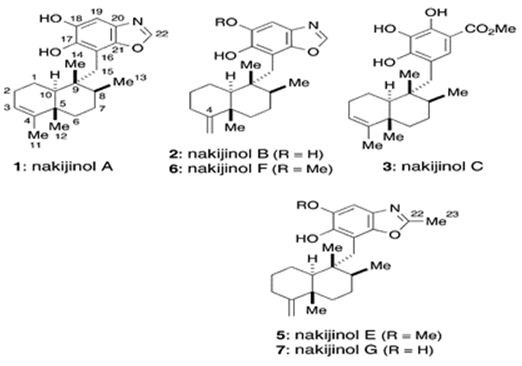
fig 24

Figure 24: The molecular structure of nakijinols [114].

The next two research study is about the meroterpenes from marine-related fungi. Three phenylspirodrimane-based meroterpenoids with novel scaffolds, namely chartarolides A(I)-C, have been isolated from a sponge (Niphates recondite) related fungus Stachybotrys chartarum WGC-25C-6. Chartarolides A-C (Figure 25) have shown considerable cytotoxic effects against a panel of human tumor cell lines and exhibited strong inhibitory activities against the human tumor- associated protein kinases of FGFR3, IGF1R, PDGFRb, and TrKB [115].

Farnaes et. al. have made microbial production, isolation, and structure elucidation of four new napyradiomycin congeners (I-IV) from marine-originated actinomycete. Utilizing fluorescence-activated cell sorting (FACS) analysis, napyradiomycins 1-4 (Figure 26) have detected to induce apoptosis in the colon adenocarcinoma cell line HCT-116, displaying the feasibility of a specific biochemical target for this group of cytotoxins [116].
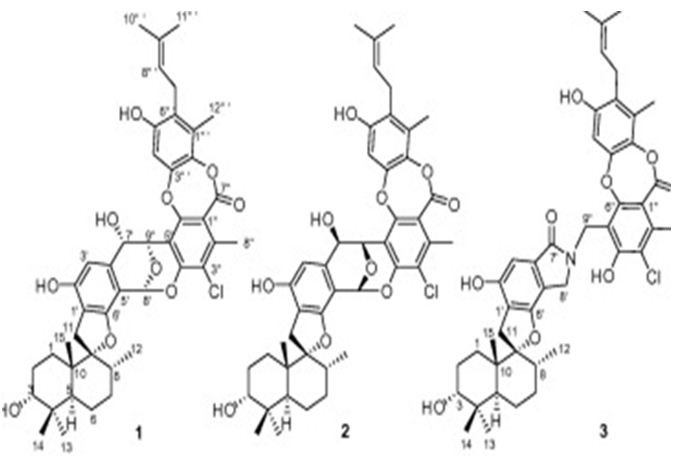
fig 25

Figure 25: The molecular structure of Chartarolides A-C (1-3) [115].
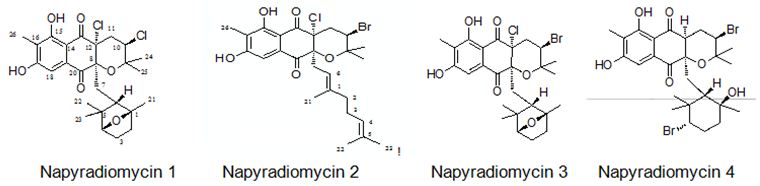
fig 26

Figure 26: The molecular structure of napyradiomycins 1-4 [116].

The study of Sandargo et. al. is to the mushroom: Rhodotus palmatus. They have isolated Rhodatin (1) (Figure 27), a meroterpenoid having a unique pentacyclic scaffold with both spiro and spiroketal centers, and five unprecedented acorane-type sesquiterpenoids, named rhodocoranes A-E (2-6, respectively), are the first natural products isolated from the basidiomycete Rhodotus palmatus. Rhodatin powerfully has prevented the hepatitis C virus, while 4 has shown cytotoxicity and selective antifungal activity [117].
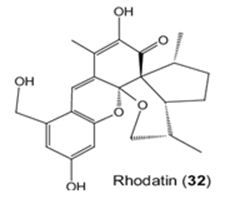
fig 27

Figure 27: The molecular structure of Rhodatin [118].

The last chapter is dealing with the microorganism sourced-meroterpenes. In the review written by Liu et al. It has been mentioned that terpene-quinone and -hydroquinone is the major bioactive members since they produce reactive oxygen species (ROS) [119]. Three quinone- and hydroquinone-type meroterpenes produce reactive oxygen species (ROS) [120]. Three quinone- and hydroquinone-type meroterpenes (122-124) (Figure 28) were obtained from a marine-derived Penicillium sp. Compounds 122 and 123 exerted considerable cytotoxicity against five cancer cell lines (A549, SKOV-3 (human ovary adenocarcinoma), SKMEL-2 (human skin cancer), XF498 (human CNS cancer), and HCT15 (human colon cancer)) with IC50 values in the range of 3-10 μg/mL, whereas compound 124 had IC50 values varying from 20 to 40 μg/mL (doxorubicin was used as a positive control with IC50 values of 0.02~0.8 μg/mL). These results prove that the quinone form prone to be less cytotoxic [121]. Penicillone A (125) (Figure 28), isolated from marine-derived Penicillium sp. F11. contains a carboxylic acid group in the place of the isoprenyl tail, which brought on mild cytotoxicity against fibrosarcoma (HT1080) and human nasopharyngeal carcinoma (Cne2) cell lines (IC50 = 45.8 and 46.2 μM, respectively) [121,122].
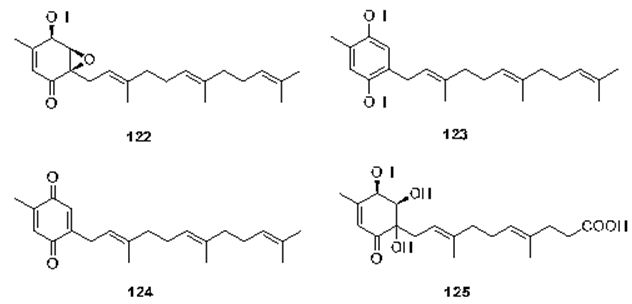
fig 28

Figure 28: The molecular structure of compounds 122-125 [122].

The Wnt-β-catenin signaling pathway plays a significant role in the regulation, differentiation, proliferation, and cellular death processes; therefore, modifications in this pathway are caused to numerous abnormalities of development, growth, and homeostasis in animal organisms. Wnt proteins contain a various family of secretion glycoproteins which join to Frizzled receptors and Low-Density Lipoprotein receptor-related Protein, to stabilize the crucial β-catenin protein, and to commence a complex signaling cascade, which is associated to multiple nucleocytoplasmatic systems. Modifications in the canonical Wnt-β-catenin signaling pathway have been related to variations in many proteins taking part in this route, or with activation/ inactivation of oncogenes and tumor suppressor genes, which clarify different processes of tumorigenesis, in addition to several malformations and human diseases. There are relations between the Wnt-β-catenin signaling pathway with various neoplastic processes, and its application can be used in the diagnosis and prognosis of cancer [123]. Tang et al. have isolated isopenicins A-C (1-3) (Figure 29), three novel meroterpenoids bearing two types of uncommon terpenoid-polyketide hybrid skeletons, from the cultures of Penicillium sp. sh18. The inhibitory effects of these compounds on the Wnt/β-catenin signaling pathway have been examined, and 1 has been determined as a potent inhibitor of the Wnt signaling pathway [124].
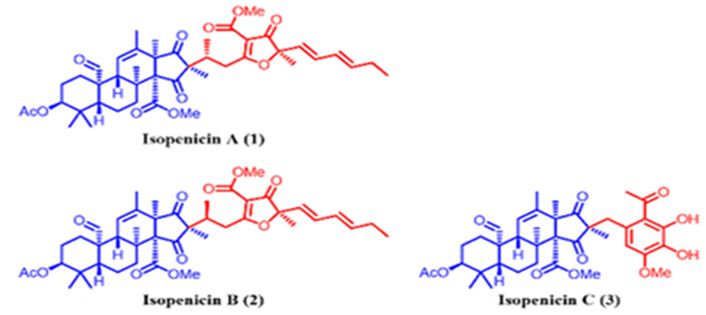
fig 29

Figure 29: The molecular structure of isopenicins A-C [124].

The latter two studies are referring to the meroterpenes obtained form two different fungus species of Neosartorya sp. Rajachan et. al. have isolated four meroterpenoids, 1-hydroxychevalone C, 1-acetoxychevalone C, 1,11-dihydroxychevalone C, and 11-hydroxychevalone C and 2 ester epimers, 2S,4S-spinosate and 2S,4R-spinosate, along with 7 known compounds, chevalones B, C (Figure 30), and E, tryptoquivaline, nortryptoquivaline, tryptoquivaline L, and quinadoline A from the fungus Neosartorya spinosa. 1-hydroxychevalone C, 1-acetoxychevalone C, 1,11-dihydroxychevalone C, and quinadoline A exhibited cytotoxicity against KB and NCI-H187 cancer cell lines with IC50 values in the range of 32.7-103.3 μM [125].
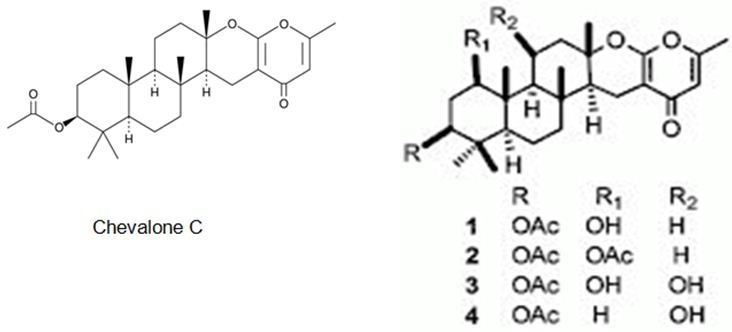
fig 30

Figure 30: The molecular structure of Chevalone C [126] and analogs [125].

A new meroterpenoid, named tatenoic acid (I) (Figure 31) from have been isolated the fungus Neosartorya tatenoi KKU-2NK23, together with five common compounds, aszonapyrones A (Figure 31) and B (2 and 3), aszonalenin (4), ergosterol (5) and D-mannitol (6). Aszonapyrone A (Figure 31), a known meroterpene, has exerted cytotoxicity against two cancer cell lines, NCI-H187 and KB [127-129].
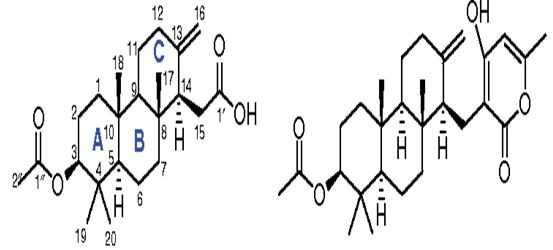
fig 31

Figure 31: The molecular structure of Tatenoic acid and Aszonapyrone A [127].

Conclusion

Meroterpenes are pharmacologically important compounds because of providing a wide structure variability and depending on it having a huge bioactivity spectrum. This review has been focused on their anticancer activities and presented 23 anticancer activity studies of meroterpenes obtained from different sources. The anticancer activity is the power of natural and synthetic or biological and chemical agents to reverse, withhold, or block carcinogenic progression [128]. According to our literature survey, the three most effective meroterpene studies have been determined. One is about the meroterpenes isolated from the brown alga Sargassum siliquastrum: Sargachromanol E, D, and P have exerted strong cytotoxicity against AGS (gastric cancer cells), HT-29 (colorectal adenocarcinoma cancer cell), and HT-1080 (human fibrosarcoma cells) cell lines, with IC50 values varying from 0.5 to 5.7 μg/mL [100]. The other most effective meroterpene is Eucalypglobulusal F, which is one of the new formyl-phloroglucinol-terpene meroterpenoid isolated from E. globulus fruit, has shown cytotoxicity against the human acute lymphoblastic cell line (CCRF-CEM) with an IC50 value of 3.3 μM [89]. Besides, the last one is the new epoxyphomalin analog 11-dehydroxy epoxyphomalin A (4), from the endophytic fungus Peyronellaea coffeae-arabicae FT238, which was obtained from the native Hawaiian plant Pritchardia lowreyana showed a strong antiproliferative effect with an IC50 of 0.5 μM against OVCAR3 (Ovarian carsinoma cells) [102]. As a result, meroterpenes have potential candidates as an anticancer drug. Also, the structure of naturally isolated meroterpenes has a moderate anticancer activity that can easliy be modified by semi-synthetic ways due to their simple structures comparing to other natural compounds such as triterpenes or phenolic compounds.

Conflict of Interest Disclosure

The authors declare no competing financial interest.

References

    1. Wu R, Le Z, Wang Z, Tian S, Xue Y, Hyperjaponol H, et al. (2018) A New Bioactive Filicinic Acid-Based Meroterpenoid from Hypericum japonicum Thunb. ex Murray. Molecules [crossref]
    2. Gershenzon J, Dudareva N (2007) The function of terpene natural products in the natural World. Chem. Biol 3: 408-414. [crossref]
    3. Makkar F, Chakraborty K (2018) Antioxidant and anti-inflammatory oxygenated meroterpenoids from the thalli of red seaweed Kappaphycus alvarezii. Chem. Res 27: 2016-2026.
    4. Kuzuyama T, Biosynthetic studies on terpenoids produced by Streptomyces. (2017) J Antibiot 70: 811-818. [crossref]
    5. Luo XW, Chen CM, Li KL, Lin XP, Gao CH, et al. (2019) Sesquiterpenoids and meroterpenoids from a mangrove derived fungus Diaporthe sp. SCSIO 41011. Prod. Res 8: 1-7. [crossref]
    6. Parshikov IA, Netrusov AI, Sutherland JB (2012) Microbial trans- formation of antimalarial terpenoids. Biotechnol Adv 30: 1516-1523.
    7. Liebgott T, Miollan M, Berchadsky Y, Drieu K, Culcasi M, et al. (2000) Complementary cardioprotective effects of flavonoid metabolites and terpenoid constituents of Ginkgo biloba extract (EGb 761) during ischemia and reperfusion. Res. Cardiol 95: 368-377.
    8. Ebada SS, Lin WH, Proksch P (2010) Bioactive sesterterpenes and triterpenes from marine sponges: occurrence and pharmacological significance. Mar Drugs 8: 313-346. [crossref]
    9. Geris R, Simpson TJ (2009) Meroterpenoids produced by fungi. Prod. Rep 26: 1063-1094. [crossref]
    10. Li H, Sun W, Deng MC, Qi C, Chen H, et al. (2018) Asperversins A and B, Two Novel Meroterpenoids with an Unusual 5/6/6/6 Ring from the Marine-Derived Fungus Aspergillus versicolor. Drugs 16. [crossref]
    11. Kikuchi H, Kawai K, Nakashiro Y, Yonezawa T, Kawaji K, et al. (2019) Construction of a Meroterpenoid-Like Compounds Library Based on Diversity-Enhanced Extracts. Eur. J 25: 1106-1112.
    12. Zubìa E, MJ Ortega, Salvà J (2005) Natural products chemistry in marine ascidians of the genus Aplidium. Mini-Rev. Org. Chem 2: 389-399.
    13. Menna M, Aiello A, FD’Aniello, Imperatore C, Luciano P, et al. (2013) Conithiaquinones A and B, Tetracyclic Cytotoxic Meroterpenes from the Mediterranean Ascidian Aplidium conicum. J. Org. Chem 2013: 3241-3246.
    14. Matsuda Y, Abe I (2016) Biosynthesis of fungal meroterpenoids. Prod. Rep 33: 26-53.
    15. Morton RA (1958) Nature 182: 1764-1767.
    16. Fernholz E (1938) On the constitution of α-tocopherol. Am. Chem. Soc 60: 700-705.
    17. Moncrief JW, Lipscomb WN (1965) Structures of leurocristine (vincristine) and vincaleukoblastine. X-ray analysis of leurocristine methiodide. Am. Chem. Soc 87: 4963-4964. [crossref]
    18. Kaysser L, Bernhardt P, Nam SJ, Loesgen S, Ruby JG, et al. (2012) Merochlorins A–D, Cyclic Meroterpenoid Antibiotics Biosynthesized in Divergent Pathways with Vanadium-Dependent Chloroperoxidases. Am. Chem. Soc 134: 11988-11991. [crossref]
    19. Kaysser L, Bernhardt P, Nam SJ, Loesgen S, Ruby JG, et al. (2014) Correction to “Merochlorins A–D, Cyclic Meroterpenoid Antibiotics Biosynthesized in Divergent Pathways with Vanadium-Dependent Chloroperoxidases”. Am. Chem. Soc 136.
    20. Awakawa T, Zhang LH, Wakimoto T, Hoshino S, Mori T (2014) A Methyltransferase Initiates Terpene Cyclization in Teleocidin B Biosynthesis. Am. Chem. Soc 136: 9910-9913.
    21. Yin X, Yin X, Feng T, Z-H. Li Z-J. Dong Y. Li J. K. Liu (2013) Highly oxygenated meroterpenoids from fruiting bodies of the mushroom Tricholoma terreum. Nat. Prod 76:1365–1368.
    22. De los Reyes, Zbakh H, Motilva V, Zubίa E (2013) Antioxidant and anti-inflammatory meroterpenoids from the brown alga Cystoseira usneoides. Nat. Prod 76: 621-629. [crossref]
    23. Mamemura T, Tanaka N, Shibazaki A, Gonoi T, Kobayashi J (2011) Yojironibs A–D, meroterpenoids and prenylated acylphloroglucinols from Hypericum yojiroanum. Tetrahedron Lett 52: 3575-3578.
    24. Luo Q, Di L, Dai WF, Lu Q, Yan YM, et al. (2015) Applanatumin A, a new dimeric meroterpenoid from Ganoderma applanatum that displays antifibrotic activity. Lett 17: 1110-1113.
    25. Choi H, Hwang H, Chin J, Kim E, Lee J, et al. (2011) Tuberatolides, potent FXR antagonists from the Korean marine tunicate Botryllus tuberatus. Nat. Prod 74: 90-94.
    26. Tran DN, Cramer N (2014) Biomimetic synthesis of (+)-ledene, (+)-viridiflorol, (–)-palustrol, (+)-spathulenol, and psiguadial A, C, and D via the platform terpene (+)-bicyclogermacrene. Eur. J 20: 10654-10660. [crossref]
    27. Qin XJ, Yan H, Ni W, Yu MY, Khan A, et al. (2016) Cytotoxic Meroterpenoids with Rare Skeletons from Psidium guajava Cultivated in Temperate Zone. Rep 6.
    28. Cueto M, Macmillan JB, Jensen PR, Fenical W (2006) Tropolactones A-D, four meroterpenoids from a marine-derived fungus of the genus Phytochem 67.
    29. Chexal KK, Springer JP, Clardy J, RJCole, JW. Kirksey, et al. (1976) Austin a novel polyisoprenoid mycotoxin from Aspergillus ustus. Am. Chem. Soc 98.
    30. Hayashi H, Mukaihara M, Murao S, Arai M, Lee AY, Clardy J (1994) Acetoxydehydroaustin, a new bioactive compound, and related compound neoaustin from Penicillium sp. MG-11. Biotechnol. Biochem 58: 334-338.
    31. Santos RMG, Rodrigues E Filho (2002) Meroterpenes from Penicillium sp found in association with Melia azedarach. Phytochem
    32. Santos RMG, Rodrigues E Filho (2003) Structures of Meroterpenes Produced by Penicillium sp, an Endophytic Fungus Found Associated with Melia azedarach. Braz. Chem. Soc 14.
    33. Santos RMG, Rodrigues E Filho (2003) Further meroterpenes produced by Penicillium sp., an endophyte obtained from Melia azedarach. Naturforsch 58.
    34. Schü BTM rmann, Sallum WST, Takahashi JA (2010) Austin, dehydroaustin and other metabolites from Penicillium brasilianum. Nova 33: 1044-1046.
    35. Liu LY, Li ZH, Ding ZH, Dong ZJ, Li GT, et al. (2013) Meroterpenoid pigments from the basdiomycete Albatrellus ovinus. Nat. Prod 76.
    36. Liaw CC, Yang YL, Lin CK, Lee JC, Liao WY, et al. (2015) New Meroterpenoids from Aspergillus terreus with Inhibition of Cyclooxygenase-2 Expression. Lett 17 2330-2333.
    37. Wang B, Zhang Z, Guo L, Liu L (2016) New Cytotoxic Meroterpenoids from the Plant Endophytic Fungus Pestalotiopsis fici. Chim. Acta 99: 151-156.
    38. Kataoka S,Furutani S,Hirata K,Hayashi H,MatsudaK (2011) Three austin family compounds from Penicillium brasilianum exhibit selective blocking action on cockroach nicotinic acetylcholine receptors. Neurotoxicology 32: 123-129.
    39. Masi M, Nocera P, Reveglia P, Cimmino A, Evidente A (2018) Fungal Metabolites Antagonists towards Plant Pests and Human Pathogens: Structure-Activity Relationship Studies. Molecules
    40. El-Demerdash A, Kumla D, Kijjoa A (2020) Chemical Diversity and Biological Activities of Meroterpenoids from Marine Derived-Fungi: A Comprehensive Update. Drugs 18.
    41. http://www.chemspider.com/Chemical-Structure.34947476.html
    42. http://www.chemfaces.com/natural/Albatrelin-A-CFN89347.html
    43. http://www.chemfaces.com/natural/Albatrelin-C-CFN89310.html
    44. Fischbach MA, Walsh CT (2006) Assembly-line enzymology for polyketide and nonribosomal peptide antibiotics: Logic, machinery, and mechanisms. Rev 106: 3468-3496.
    45. Itoh T, Tokunaga K, Matsuda Y, Fujii I, Abe I, et al. (2010) Reconstitution of a fungal meroterpenoid biosynthesis reveals the involvement of a novel family of terpene cyclases. Chem 2: 858-864.
    46. Macias FA, Varela RM, Simonet AM, Cutler HG, Cutler SJ, et al. (2000) Novel bioactive breviane spiroditerpenoids from Penicillium brevicompactum Dierckx. Org. Chem 65: 9039-9046.
    47. Zhang YC, Li C, Swenson DC, Gloer JB, Wicklow DT, Dowd PF (2003) Novel antiinsectan oxalicine alkaloids from two undescribed fungicolous Penicillium spp. Lett 5: 773-776. [crossref]
    48. Guo CJ, Knox BP, Chiang YM, Lo HC, Sanchez JF, et al. (2012) Molecular Genetic Characterization of a Cluster in A. terreus for Biosynthesis of the Meroterpenoid Terretonin. Lett 14: 5684-5687. [crossref]
    49. Nakamura H, Matsuda Y, Abe I (2018) Unique chemistry of non-heme iron enzymes in fungal biosynthetic pathways. Prod. Rep 35: 633-645.
    50. Birch AJ (1967) Biosynthesis of polyketides and related compounds. Science 156: 202-206. [crossref]
    51. Sunazuka T, Ōmura S (2005) Total synthesis of α-pyrone meroterpenoids, novel bioactive microbial metabolites. Chem Rev 105: 4559-4580. [crossref]
    52. Ding BZ, Wang X, Huang Y, Liu W, Chen She Z (2016) Bioactive α-pyrone meroterpenoids from mangrove endophytic fungus Penicillium sp. Prod. Res 30: 2805-2812. [crossref]
    53. Macías FA, Carrera C, JCG Galindo (2014) Brevianes revisited. Rev 114: 2717-2732. [crossref]
    54. Li J, Li F, King Smith E (2020) Renata Merging chemoenzymatic and radical-based retrosynthetic logic for rapid and modular synthesis of oxidized meroterpenoids. Chem 12: 173-179.
    55. Tomoda H, Kim YK, Nishida H, Masuma R, Omura S (1994) Pyripyropenes, noval inhibitors of Acyl-CoA: cholesterol acyltransferase produced by Aspergillus fumigatus. I. Production, isolation and biological properties. Antibiot 47: 148-153. [crossref]
    56. Kim YK, Tomoda H, Nishida H, Sunazuka T, Obata R, et al. (1994) Pyripyropenes, noval inhibitors of Acyl-CoA: cholesterol acyltransferase produced by Aspergillus fumigatus. II. Structure elucidation of pyripyropenes A, B, C and D. J. Antibiot 47: 154-162. [crossref]
    57. Tomoda H, Tabata N, Yang DJ, Takayanagi H, Nishida H, et al. (1995) Pyripyropenes, noval ACAT inhibitors produced by Aspergillus fumigatus. III. Structure elucidation of pyripyropenes E to L. Antibiot 48: 495–503.
    58. Tomoda H, Tabata N, Yang DJ, Namatame I, Tanaka H, et al. (1996) Pyripyropenes, noval ACAT inhibitors produced by Aspergillus fumigatus. IV. Structure elucidation of pyripyropenes M to R. J. Antibiot 49: 292-298. [crossref]
    59. Prompanya C, Dethoup T, Bessa LJ, MMM Pinto, Gales L, et al. (2014) New isocoumarin derivatives and meroterpenoids from the marine sponge-associated fungus Aspergillus similanensis sp. nov. KUFA 0013. Drugs 12: 5160-5173. [crossref]
    60. Ding Z, Zhang L, Fu J, Che Q, Li D, et al. (2015) Phenylpyropenes E and F: new meroterpenes from the marine-derived fungus Penicillium concentricum ZLQ-69. Antibiot 68: 748-751.
    61. Fadli M, Aracil JM, Jeanty G, Banaigs B, Francisco C (1991) Novel meroterpenoids from Cystoseira mediterranea: Use of the crown-gall bioassay as a primary screen for lipophilic antineoplastic agents. Nat. Prod 54: 261-264. [crossref]
    62. Sheu JH, Su JH, Sung PJ, Wang GH, Dai CF (2004) Novel meroditerpenoid-related metabolites from the formosan soft coral Nephthea chabrolii. Nat. Prod 67: 2048-2052. [crossref]
    63. Mitome H, Nagasawa T, Miyaoka H, Yamada Y, RWM Van Soest (2002) Dactyloquinones C, D and E novel sesquiterpenoid quinones, from the Okinawan marine sponge, Dactylospongia elegans. Tetrahedron Lett 58: 1693-1996.
    64. Garrido L, Zubia E, Ortega MJ, Salva J (2002) New meroterpenoids from the ascidian Aplidium conicum. Nat. Prod 65: 1328-1331. [crossref]
    65. Shen YC, Chen CY, Kuo YH (2001) New sesquiterpene hydroquinones from a taiwanese marine sponge, Hippospongia metachromia. Nat. Prod 64: 801-803. [crossref]
    66. Aiello A, Fattorusso E, Luciano P, Menna M, Esposito G, et al. (2003) Conicaquinones A and B, two novel cytotoxic terpene quinones from the Mediterranean ascidian Aplidium conicum. J. Org. Chem 5: 898-900.
    67. De Menezes JE, FEA Machado, TLG Lemos, Silveira ER, Braz R Filho, et al. (2004) Sesquiterpenes and a Phenylpropanoid from Cordia trichotoma. Natur 59: 19-22.
    68. Marion F, Williams DE, Patrick BO, Hollander I, Mallon R, et al. (2006) Liphagal, a selective inhibitor of PI3 kinase α isolated from the sponge Aka coralliphaga: Structure elucidation and biomimetic synthesis. Org. Lett 8: 321-324.
    69. Williams DE, Telliez JB, Liu J, Tahir A, van R Soest, et al. (2004) Meroterpenoid MAPKAP (MK2) inhibitors isolated from the Indonesian marine sponge Acanthodendrilla sp. Nat. Prod 67: 2127-2129.
    70. Simon A Levert, Menniti C, Soulère L, Genevière AM, Barthomeuf C, et al. (2010) Marine Natural Meroterpenes: Synthesis and Antiproliferative Activity. Drugs 8: 347-358. [crossref]
    71. Iida M, Ooi T, Kito K, Yoshida S, Kanoh K, et al. (2008) Three new polyketide-terpenoid hybrids from Penicillium sp. Lett 10: 845-848. [crossref]
    72. Silva DE, Williams DE, Jayanetti DR, Centko RM, Patrick BO, et al. (2011) Dhilirolides A-D, meroterpenoids produced in culture by the fruit-infecting fungus Penicillium purpurogenum collected in Sri Lanka. Lett 13: 1174-1177.
    73. Qi B, Liu X, Mo T, Zhu Z, Li J, et al. (2017) 3,5-Dimethylorsellinic acid derived meroterpenoids from Penicillium chrysogenum MT-12, an endophytic fungus isolated from Huperzia serrata. Nat. Prod 80: 2699-2707.
    74. Lo HC, Entwistle R, Guo CJ, Ahuja M, Szewczyk E, et al. (2012) Two separate gene clusters encode the biosynthetic pathway for the meroterpenoids austinol and dehydroaustinol in Aspergillus nidulans. Am. Chem. Soc 134: 4709-4720.
    75. Matsuda Y, Iwabuchi T, Fujimoto T, Awakawa T, Nakashima Y, et al. (2016) Discovery of key dioxygenases that diverged the paraherquonin and acetoxydehydroaustin pathways in Penicillium brasilianum. Am. Chem. Soc 138: 12671-12677. [crossref]
    76. Mori T, T. Iwabuchi, S. Hoshino, H. Wang, Y. Matsuda, et al. (2017) Molecular basis for the unusual ring reconstruction in fungal meroterpenoid biogenesis. Chem. Biol 13: 1066-1073. [crossref]
    77. Nielsen KF, Dalsgaard PW, Smedsgaard J, Larsen TO, Andrastins AD (2005) Penicillium roqueforti metabolites consistently produced in blue-mold-ripened cheese. Agric. Food Chem 53: 2908-2913. [crossref]
    78. Matsuda Y, Iwabuchi T, Wakimoto T, Awakawa T, Abe I (2015) Uncovering the unusual D-ring construction in terretonin biosynthesis by collaboration of a multifunctional cytochrome P450 and a unique isomerase. Am. Chem. Soc 137: 3393-3401.
    79. Stierle DB, Stierle AA, Patacini B, McIntyre K, Girtsman T, et al. (2011) Berkeleyones and related meroterpenes from a deep water acid mine waste fungus that inhibit the production of interleukin 1-β from induced inflammasomes. Nat. Prod 74: 2273-2277. [crossref]
    80. Matsuda Y, Awakawa T, Wakimoto T, Abe I (2013) Spiro-ring formation is catalyzed by a multifunctional dioxygenase in austinol biosynthesis. Am. Chem. Soc 135: 10962-10965.
    81. Matsuda Y, Wakimoto W, Mori T, Awakawa T, Abe I (2014) Complete biosynthetic pathway of anditomin: nature’s sophisticated synthetic route to a complex fungal meroterpenoid. Am. Chem. Soc 136: 15326-15336.
    82. Okuyama E, Yamazaki M, Katsube Y (2008) Funigatonin, a new meroterpenoid from Aspergillus fumigatus. Tetrahedron Lett 25: 3233-3234.
    83. Rank C, Phipps RK, Harris P, Fristrup P, Larsen TO, et al. (2008) Novofumigatonin, a new orthoester meroterpenoid from Aspergillus novofumigatus. Lett 10: 401-404.
    84. Zhang Y, Li X, Shang Z, Li C, Ji N, et al. (2012) Meroterpenoid and diphenyl ether derivatives from Penicillium sp. MA-37, a fungus isolated from marine mangrove rhizospheric soil. Nat. Prod 75: 1888-1895. [crossref]
    85. Zhang J, Yuan B, Liu D, Gao S, Proksch P, et al. (2018) Brasilianoids A–F, New Meroterpenoids From the Sponge-Associated Fungus Penicillium brasilianum. Chem 6. [crossref]
    86. Skropeta D, Wei L (2014) Recent advances in deep-sea natural products. Prod. Rep 31: 999-1025. [crossref]
    87. Matsuda Y, Bai T, CBW Phippen, Nødvig CS, Kjærbølling I, et al. (2018) Novofumigatonin biosynthesis involves a non-heme iron-dependent endoperoxide isomerase for orthoester formation. Comm 9.
    88. Wu CZ, Cai XF, Dat NT, Hong SS, Han AR, et al. (2007) Bisbakuchiols A and B, novel dimeric meroterpenoids from Psoralea corylifolia. Tetrahedron Lett 48: 8861-8864.
    89. Madrid A, Cardile V, Gonzalez C, Montenegro I, Villena J, et al. (2015) Psoralea glandulosa as a potential source of anticancer agents for melanoma treatment. Int. J Mol. Sci 16: 7944-7959. [crossref]
    1. Rizzo LY, Longato GB, ALTG Ruiz, Tinti SV, Possenti A, et al. (2014) In Vitro, In Vivo and In Silico Analysis of the Anticancer and Estrogen-like Activity of Guava Leaf Extracts. Med. Chem 21: 2322-2330. [crossref]
    2. Chapman LM, Beck JC, Lacker CR, LWu, Reisman SE (2018) Evolution of a Strategy for the Enantioselective Total Synthesis of (+)-Psiguadial B. J. Org. Chem 83: 6066-6085.
    3. http://www.chemfaces.com/natural/Psidial-A-CFN99321.html
    4. Qin XJ, Yu Q, Yan H, Khan A, Feng MY, et al. (2017) Meroterpenoids with Antitumor Activities from Guava (Psidium guajava). J Agric. Food Chem 65: 4993-4999. [crossref]
    5. http://www.chemfaces.com/natural/Guajadial-B-CFN96065.html
    6. Gao Y, Lı GT, Lı Y, Haı P, Wang F, et al. (2013) Guajadials C-F, four unusual meroterpenoids from Psidium guajava. Nat. Prod. Bioprospect 3: 14-19.
    7. http://www.chemfaces.com/natural/Guajadial-F-CFN89478.html
    8. Wan H, Li J, Zhang K, Zou X, Ge L, et al. (2018) A new meroterpenoid functions as an anti-​tumor agent in hepatoma cells by downregulating mTOR activation and inhibiting EMT. Sci. Rep 8: 1-11.
    1. Zhang J, He J, Cheng YC, Zhang PC, Yan Y, et al. (2019) Fischernolides A–D, four novel diterpene-based meroterpenoid scaffolds with antitumor activities from Euphorbia fischeriana. Chem. Front 6: 2312-318.
    2. Wang X, Li L, Zhu R, Zhang J, Zhou J, et al. (2017) Bibenzyl-Based Meroterpenoid Enantiomers from the Chinese Liverwort Radula sumatrana. J Nat Prod 80: 3143-3150.
    3. Lee JI, Kwak MK, Park HY, Seo Y (2013) Cytotoxicity of mero- terpenoids from Sargassum siliquastrum against human cancer cells. Prod. Comm 8: 431-432. [crossref]
    4. Chiou CT, Shen CC, Tsai TH, Chen YJ, Lin LC (2016) Meroterpenoids and Chalcone-Lignoids from the Roots of Mimosa diplotricha. J Nat. Prod 79: 2439-2445.
    5. Jin XJ, Yin LY, Yu Q, Liu H, Khan A, et al. (2018) Eucalypglobulusals A–J, Formyl-Phloroglucinol–Terpene Meroterpenoids from Eucalyptus globulus J. Nat. Prod 81: 2638-2646.
    6. http://www.chemfaces.com/natural/Macrocarpal-A-CFN99413.html
    7. https://vevostars.com/blog/cas-142698-60-0-macrocarpal-b/
    8. http://www.chemfaces.com/natural/Macrocarpal-D-CFN99471.html
    9. Liang F, Li D, Chen Y, Tao M, Zhang W, et al. (2012) Secondary metabolites of endophytic Guignardia mangiferae from Smilax glabra and their antitumor activities. Zhongcaoyao 43: 856-860.
    10. Long Y, Tang T, Wang LY, He B, Gao K (2019) Absolute Configuration and Biological Activities of Meroterpenoids from an Endophytic Fungus of Lycium barbarum. J. Nat. Prod 82: 2229-2237.
    11. Li CS, Ren G, B-J. Yang, G. Miklossy, J. Turkson, et al. (2016) Meroterpenoids with Antiproliferative Activity from a Hawaiian-Plant Associated Fungus Peyronellaea coffeae-arabicae Org. Lett 18: 2335-2338.
    12. Gao H, Li G, Lou HX (2018) Structural Diversity and Biological Activities of Novel Secondary Metabolites from Endophytes. Molecules
    13. Imperatore C, Casertano M, Luciano P, Aiello A, Menna M, et al. (2019) In Vitro Antiproliferative Evaluation of Synthetic Meroterpenes Inspired by Marine Natural Products. Drugs 17. [crossref]
    14. Menna M, Aiello A, D’Aniello F, Imperatore C, Luciano P, et al. (2013) Conithiaquinones A and B, Tetracyclic Cytotoxic Meroterpenes from the Mediterranean Ascidian Aplidium conicum. J. Org. Chem 16: 3241-3246.
    15. Li J, Yang F, Wang Z, Wu W, Liu L, et al. (2018) Unusual anti-inflammatory meroterpenoids from the marine sponge Dactylospongia sp. Org. Biomol. Chem 16: 6773-6782.
    16. Wang J, Mu FR, Jiao WH, Huang J, Hong LL, et al. (2017) Meroterpenoids with Protein Tyrosine Phosphatase 1B Inhibitory Activity from a Hyrtios sp. Marine Sponge. J Nat Prod 80: 2509-2514. [crossref]
    17. Takeda Y, Nakai K, Narita K, Katoh T (2018) A novel approach to sesquiterpenoid benzoxazole synthesis from marine sponges: nakijinols A, B and E–G. Org. Biomol. Chem 16: 3639-3647. [crossref]
    18. Liu D, Li Y, Li X, Cheng Z, Huang J, et al. (2017) Chartarolides A-​C, novel meroterpenoids with antitumor activities. Tetrahedron Lett 58: 1826-1829.
    19. Farnaes L, Coufal NG, Kauffman CA, Rheingold AL, AGDi Pasquale (2014) Napyradiomycin derivatives, produced by a marine-derived actinomycete, illustrate cytotoxicity by induction of apoptosis. J. Nat. Prod 77: 15-21.
    20. Sandargo B, Michehl M, Praditya D, Steinmann E, Stadler M, et al. (2019) Antiviral Meroterpenoid Rhodatin and Sesquiterpenoids Rhodocoranes A–E from the Wrinkled Peach Mushroom, Rhodotus palmatus. Lett 21: 3286-3289.
    21. Hyde KD, JXu, Rapior S, Jeewon R, Lumyong S (2019) The amazing potential of fungi: 50 ways we can exploit fungi industrially. Fungal Diversity 97: 1-136.
    22. Menna M, Imperatore C, FD’Aniello, Aiello A (2013) Meroterpenes from Marine Invertebrates: Structures, Occurrence, and Ecological Implications. Drugs 11: 1602–1643.
    23. Li X, Choi HD, Kang JS, Lee CO, Son BW (2003) New polyoxygenated farnesylcyclohexenones, deacetoxyyanuthone A and its hydro derivative from the marine-derived fungus Penicillium sp. Nat. Prod 66: 1499-1500.
    24. Zhuang P, Tang XX, Yi ZW, Qiu YK, Wu ZJ (2012) Two new compounds from marine-derived fungus Penicillium sp. F11. Asian Nat. Prod. Res 14: 197-203.
    25. Liu S, Su M, Song SJ, Jung JH (2017) Marine-Derived Penicillium Species as Producers of Cytotoxic Metabolites. Drugs 15. [crossref]
    26. Ochoa-Hernández, Juárez-Vázquez CI, Rosales-Reynoso MA, Barros P-Núñez (2012) WNT-β-catenin signaling pathway and its relationship with cancer. Cır. Cır 80: 389-98. [crossref]
    27. Tang JW, Kong LM, Zu WY, Hu K, Li XN, et al. (2019) Isopenicins A-C: Two Types of Antitumor Meroterpenoids from the Plant Endophytic Fungus Penicillium sp. sh18. Org. Lett 21: 771-775. [crossref]
    28. Rajachan OA, Kanokmedhakul K, Sanmanoch W, Boonlue S, Hannongbua S, et al. (2016) Chevalone C analogues and globoscinic acid derivatives from the fungus Neosartorya spinosa KKU-1NK1. Phytochem 132: 68-75.
    29. https://www.caymanchem.com/product/25084
    30. Yim T, Kanokmedhakul K, Kanokmedhakul S, Sanmanoch W, Boonlue S (2014) A new meroterpenoid tatenoic acid from the fungus Neosartorya tatenoi KKU-2NK23. Prod. Res 28: 1847-1852. [crossref]
    31. Chanda S, Nagani KJ (2013) In vitro and in vivo Methods for Anticancer Activity Evaluation and Some Indian Medicinal Plants Possessing Anticancer Properties: An Overview. Phytochem 2: 140-152.
    32. Birringer M, Siems K, Maxones A, Frank J, Lorkowski S (2018) Natural 6-hydroxy chromanols and -chromenols: structural diversity, biosynthetic pathways and health implications. RSC Adv 8: 4803-4841.
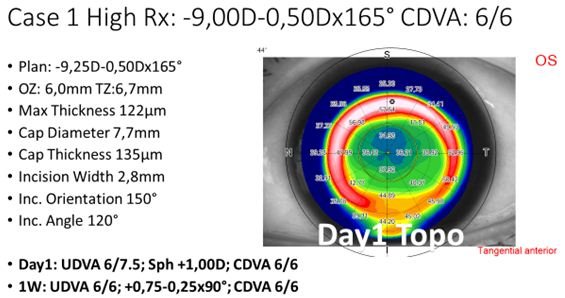
Considerations in the Diagnosis and Treatment of Morton’s Entrapment: A Review

DOI: 10.31038/IJOT.2020331

Introduction

Intermetatarsal neuromas, known by their eponym as Morton’s neuromas, are a common painful forefoot pathology seen in the foot and ankle clinic. The nomenclature of this condition is misleading. The term “neuroma” refers to a non-degenerative nerve injury. The condition clinicians most often describe in a “Morton’s neuroma” is more accurately described as a perineural fibrosis of the plantar interdigital nerve leading to entrapment of this nerve [1]. Surgical treatment varies from entrapment release to full neurectomy [2]. Post-operative pathology review of neurectomized tissue rarely demonstrates axonal degeneration and collagen proliferation [3]. Those changes are the pathophysiological markers associated with nerve injury that lead to true neuroma formation. The authors, therefore, recommend changing the common name of the condition from “intermetatarsal neuroma” to interdigital nerve entrapment to better define the disease. The aim of this review is to present treatment schemes seen in “Morton’s” diagnosis, and to suggest an algorithm which may improve patient outcome.

Anatomy and Biomechanics

Intermetatarsal nerve entrapment is classically found in the third intermetatarsal space, but this condition can affect any of the four intermetatarsal nerves in the foot [4]. The rate of occurrence in the third metatarsal space is higher due to the anatomy of the foot [5]. First, the innervation of the foot begins with the tibial and common fibular (peroneal) nerves [6]. As the tibial nerve courses distally past the knee joint, its motor fibers to the posterior compartment of the leg and enters the tarsal tunnel at the level of the medial malleolus [7]. The tibial nerve then typically bifurcates just distal to the laciniate ligament at the tarsal tunnel to form both the medial and lateral plantar nerves [8]. Those two nerves work in tandem to provide sensation to the plantar aspect of the foot form their proper digital branches distally. At the most common area between the medial and lateral plantar nerves, there is a medial communicating branch between them at the level of the third intermetatarsal space. This is the actual nerve which becomes entrapped and that causes the clinical signs and symptoms for this condition [9].

There are certain foot types which are more likely to become entrapped. The medial longitudinal arch height typically defines whether a foot is in pes planus or pes cavus, clinically [10]. As the medial longitudinal arch is depressed, this is usually in compensation for a rearfoot valgus [11]. There is increased congruity of the three facets of the subtalar joint with rearfoot valgus positioning. This in turn increases the flexibility of all joints about the midfoot. The increase in flexibility is an evolutionary advantage for the foot so it may adapt against uneven terrain. There is an unfortunate consequence for this adaptability. There is increased motion in-between the medial and lateral columns of the foot.

The medial column of the foot is defined as the combination of the medial, intermediate and lateral cuneiform bones and their associated first, second and third rays of the forefoot. The lateral column of the foot is defined as the cuboid bone and its articulation with the fourth and fifth rays of the forefoot. In flexible pes planus conditions, there is an increase in motion in-between the third and fourth metatarsals [12]. This motion becomes pathological when the medial communicating branch between the medial and lateral plantar nerves becomes entrapped. The entrapment results in perineural fibrosis as compensation to prevent axonal damage [13]. Due to the nature of the pathological mechanics and the common occurrence of pes planus, it is more common to see third intermetatarsal nerve incarceration versus the surrounding intermetatarsal spaces.

Physical Examination of Intermetatarsal Nerve Entrapment

Third intermetatarsal space nerve entrapment is known to be found in 50-87 out 100,000 people, and women are more commonly affected versus men [14]. Typical symptoms the patient may present in cases of Morton’s intermetatarsal/ interdigital nerve entrapment are often described by the patient as a burning, shooting pain or numbness/ paresthesia between the third and fourth metatarsal heads that may radiate distally toward the corresponding toes in up to 60% of cases and may also radiate proximally [15]. The patient may also be described as one feeling as though they are stepping on a pebble or have the sensation of a “rolled up sock” in the proximal forefoot area.

As with diagnosis of other nerve entrapments, Morton’s intermetatarsal nerve entrapment is largely clinically based. The high variability of presentation between patients encourages a clinical diagnosis based on symptoms and physical examination findings, rather than staunch guidelines. Symptoms may include focal tenderness and tinel’s sign. The presence of Mulder’s sign clicking (compression of forefoot while plantar interspace is palpated) and pain with interspace compression while performing this test are often positive findings [16]. A Lachman’s test is often used for evaluation of the differential diagnoses of capsulitis and plantar plate rupture versus intermetatarsal nerve entrapment [17].

A thorough biomechanical evaluation and physical examination are warranted with presence of Morton entrapment symptoms to help identify biomechanical influences as well as elucidate other pathologies that may be unrecognized yet contributing to symptoms, such as tarsal tunnel syndrome. As with any pathology, complete diagnosis and treatment of underlying conditions will help to prevent unnecessary recurrence. Radiographic evaluation with particular emphasis of weightbearing views of the foot should be utilized to further rule out other pathologies contributing towards metatarsalgia, such as an abnormal elongated metatarsal parabola or possible contribution of cavus foot and equinus deformity. Varying options have been noted on the effectiveness of MRI findings in symptomatic patients. Ultrasound is highly recommended and may be optimal for diagnosis of neuromas smaller than 5mm [18], however it is noted that this imaging technique is operator dependent. A recent meta-analysis has concluded that ultrasonography has been found equivalent to MRI for diagnostic value in Morton’s intermetatarsal entrapments [19]. Although these visual modalities have been advocated, one study comparing preoperative imaging with surgical findings noted approximately half of the neuromas were missed by ultrasound and MRI.

Differentials to consider may include degenerative changes to the metatarsal phalangeal joint, plantar pad, Metatarsal stress fracture, Freiberg’s infarction, other foot nerve pathologies, such as lateral or medial plantar nerve lesions and tarsal tunnel syndrome as well as presence of soft tissue masses, tumors and cystic changes.

Conservative Treatment for Morton’s Entrapment

Conservative (non-surgical) interventions for treatment of Morton’s entrapment include orthoses and shoe gear modification, corticosteroid and alcohol injection, extracorporeal shockwave therapy, radiofrequency ablation, cryoablation, capsaicin injection, botulinum toxin, and laser therapy [20]. A systematic review for treatment of Morton’s neuroma reveals conservative treatment can be effective. Use of orthoses leads to improvement in nearly 50% of patients. Radiofrequency ablation was found to be more effective as well as associated with less frequent complications compared to injections including alcohol and corticosteroids. This review concluded however, that most successful treatments included operative treatment [21].

Injection efforts are often utilized when the patient presents with high levels of pain and symptoms and may help relieve symptoms temporarily and are quite effective in the short term. The most common utilized agents include alcohol and corticosteroids. Injectables have been described as particularly useful while concomitantly addressing biomechanical contributions, which includes shoe gear modification and use of custom orthoses. The use of corticosteroids is associated with plantar plate rupture as well as deterioration of the joint capsule and is typically recommended to have a limitation of three treatments per year. Ethanol injection has poor success rates reported and has even been determined as not an effective treatment for interdigital neuroma but has the noted advantage of available repetition of procedure when compared to corticosteroid [22].

Morton’s intermetatarsal nerve entrapment has been likened to carpal tunnel syndrome in the upper extremity, a similar nerve entrapment condition of the median nerve. Conservative efforts for treatment of carpal tunnel syndrome with wrist splinting and steroid injections are effective in the short term and recommended if symptom duration is less than 3 months with absence of sensory impairment, but only 10% remain asymptomatic within one year [23]. Additionally, a retrospective study has demonstrated that increased utilization of corticosteroid application has led to worse long-term outcome in surgical carpal tunnel release [24,25]. Controversy remains in direct to surgery vs local corticosteroid injection with multiple elements to consider [26].

Surgical Approaches and Considerations for Morton’s Entrapment

Surgical treatment for intermetatarsal nerve entrapment should be considered when painful symptoms have not been adequately relieved by conservative methods. The underlying pathologic etiology contributing to developed condition must be considered for optimal outcome. Of particular note, the forefoot loading effects of equinus as well as the influence of the metatarsal parabola potential for increased plantar pressures should be evaluated for potential effects leading to chronic repetitive microtrauma to the forefoot. Bauer has been previously advocated for adjunctive metatarsal osteotomies to be performed with release of deep transverse intermetatarsal ligament, however this should only be performed as necessary and in some cases peak plantar forefoot pressures and contact time remain unaffected and are not elevated [27].

Surgical external neurolysis of the common plantar interdigital nerve (decompression of nerve) should be considered following correction of biomechanics. This procedure has a noted high success and low complication rate. This has been described in both open and endoscopic release techniques. The endoscopic approach results with 86% of patients having excellent or good results and allows for the advantage of minimal tissue disruption and possible earlier return to activity as demonstrated by Barrett and Walsh [28]. The approach to an open external neurolysis of the intermetatarsal nerve will be discussed further. Plantar and dorsal incisions have been described, with the dorsal linear approach providing the advantage of decreased painful scar formation as well as early ambulation of the patient. The plantar approach can be performed in a transverse or longitudinal incision. The plantar transverse may be performed on the non-weightbearing aspect of the foot, allowing for ideal visualization for nerve identification, exposure for adjacent intermetatarsal nerve procedures, and allows for immediate weightbearing.

This procedure should be performed under loupe magnification to allow for optimal visualization of nerve tissue. The patient is placed on the operative room table in a supine position with placement of a well-padded ankle tourniquet. Utilizing aseptic technique, the lower extremity is scrubbed, prepared and draped. Next, topographic anatomic landmarks are drawn including the heads of the third and fourth metatarsals at the metatarsal phalangeal joint and their respective metatarsal shafts. The surgical incisional site should be planned midline between these structures, extended distally to the corresponding webspace. Utilizing a #15 blade, the longitudinal incision is performed to the level of dermis, and next tenotomy scissors with blunted tips are utilized with careful dissection utilizing atraumatic technique is performed with care to avoid injury to superficial nerve branches and vascular structures. Bipolar electrocautery is utilized as necessary to assist with hemostasis to help reduce hematoma formation, as well as provides a more controlled and limited destruction of tissue with cauterization. Retraction to obtain optimal surgical field visualization should be performed by an assistant or with an atraumatic Weitlander or lamina spreader placed deep to the metatarsal heads. The dorsal fascia is then incised, and deeper dissection is performed until the transverse intermetatarsal ligament is identified. This structure is then isolated and elevated with assistance of placing a curved hemostat or Senn retractor deep to this structure, which is then incised along its entire length, in an effort to protect deeper structures. The intermetatarsal nerve lies deep to the transverse intermetatarsal ligament. Other constricting structures should be evaluated visually as well as palpated digitally, and the nerve should be freed from adhesions both distally as well as proximally to the bifurcation with careful blunt dissection efforts. This is continued throughout the entire surgical field to maximally reduce contributing factors of nerve entrapment. The surgical site is re-evaluated to ensure all constricting elements have been removed, and then irrigated with normal sterile saline. If biological adjunctive products, such as amniotic membrane, are utilized they should be placed along the released structure. Minimal subcutaneous tissue closure with an absorbable suture should be performed and primary skin closure is then performed with nonabsorbable suture and dry sterile dressing is then applied. Of note, in the event of suboptimal patient satisfaction with use of neurolysis (decompression) as a first line of surgical treatment, excisional neurectomy should be considered in subsequent treatment of the surgical algorithm.

Excisional neurectomy (denervation) proximal to the deep transverse intermetatarsal ligament has been well described and it is the authors’ opinion that this procedure should be considered following the decompression efforts. Wolfort and Dellon have advocated for treatment with nerve resection in combination with the implantation of the proximal end of the intermetatarsal nerve into muscle belly, reporting 80% excellent relief of symptoms29. This is most often performed with the dorsal longitudinal incisional approach. A lazy S type incision may be considered for cases with adjacent identified nerve entrapment, in an effort to increase exposure of surgical sites with a single incision. Layered anatomic dissection should be performed in a similar manner as described for neurolysis. Upon freeing the nerve, attention is directed to the proximal portion of the operative site. Mild tension is placed distally and at this point is excised just proximal to the metatarsal head utilizing a sterile tongue depressor cut in a transverse/perpendicular manner with a new blade to ensure sharp and clean transection of nerve with the goal of limiting axonal growth. Next, the freed proximal portion of the intermetatarsal nerve is then transposed proximally and placed into adjacent intrinsic muscle belly with minimal tension. The nerve is then loosely affixed via a windowing technique into the muscle created with hemostats and secured via an epineurial stitch. Excision may lead to formation of a true “stump neuroma”. Nerve excision has varying success reported up to 85%, however good or excellent long term results have been noted in only 50% of patients in a large retrospective cohort study by Womack, and 40% of patients obtaining poor results [29,30].

Revisional Surgical Approaches

Revisional surgeries often have less than optimal results; consideration of contributing factors to symptoms should be considered. These symptoms can take up to one year following surgical excision. There is a high prevalence of tarsal tunnel syndrome in conjunction with painful recurrent interdigital neuromas [29], and through physical examination is warranted when addressing recurrent neuromas.

Due to the increased likelihood of suboptimal results in cases of recurrence, in cases of poor surgical candidates, a less invasive approach to consider may be use of radiofrequency ablation. This destructive process includes use of radiofrequency energy which provides thermic electrocoagulation to the tissue surrounding the tip of the probe. Three cycles of treatment is advocated to increase efficacy when compared to two [30].

Surgical intervention, which may be selected often, includes the plantar approach surgical neurectomy of the intermetatarsal nerve. In this procedure, care should be taken to ensure eversion of incisional closure to minimize painful scarring with delayed weight bearing to avoid dehiscence. The use advanced techniques and modalities include nerve capping with the goal to reduced size and number of axons sprouting from transection of nerve, nerve transposition and implantation into muscle, nerve grafting, peripheral nerve stimulator with possible use of amniotic products.

Conclusion

Interdigital/intermetatarsal nerve entrapment or Morton’s neuromas are common forefoot pathologies that are most often attributed to an underlying entrapment condition of the nerve. This can be described as interdigital /intermetatarsal nerve neuralgia secondary to perineural fibrosis. Persisting symptoms warrant through physical examination, with emphasis on biomechanical contribution. Imaging may be helpful in diagnosis, particularly the use of radiographs and ultrasonography. Both conservative and surgical means of treatment have been recommended for the treatment of intermetatarsal/ interdigital entrapment, which remains somewhat controversial. Multiple studies have been conducted to ascertain the effectiveness of non-surgical versus surgical treatment of this condition [1,3,7]. Many studies have demonstrated improvement in symptoms over 80% with surgical intervention. Non-surgical efforts should be attempted prior to any surgical intervention to avoid possible complications, with surgery to be attempted upon failure of non-surgical intervention.

Excision remains the most common surgical management in treatment of Morton’s intermetatarsal nerve entrapment [31]. Due to the true nature of this condition having an underlying compression syndrome, neurolysis efforts are warranted and should strongly be considered in the first line of surgical procedures to address this issue. Similar outcomes have been established with both neurolysis and excisional efforts.

References

    1. Matthews BG, Hurn SE, Harding MP, Henry RA, Ware RS (2019) The effectiveness of non-surgical interventions for common plantar digital compressive neuropathy (Morton’s neuroma): A systematic review and meta-analysis. J Foot Ankle Res 12: 12. [crossref]
    2. Kasparek M, Schneider W (2016) Transection of the deep metatarsal transverse ligament in Morton’s neuroma surgery does not increase risk of splayfoot development. International Orthopaedics (SICOT) 40: 953-957. [crossref]
    3. Bhatia M, Thomson L (2020) Morton’s neuroma-Current concepts review. Journal of Clinical Orthopaedics and Trauma 11: 406-409. [crossref]
    4. Levitsky KA, Alman BA, Jevsevar DS, Morehead J (1993) Digital nerves of the foot: Anatomic variations and implications regarding the pathogenesis of interdigital neuroma. Foot & Ankle 14: 208-214. [crossref]
    5. Matsumoto T, Chang SH, Izawa N, Ohshiro Y, Tanaka S (2016) Interdigital neuroma in the second intermetatarsal space associated with metatarsophalangeal joint instability. Case Reports in Orthopedics 2016: 1-6. [crossref]
    6. Andreasen Struijk LNS, Birn H, Teglbjærg PS, Haase J, Struijk JJ (2010) Size and separability of the calcaneal and the medial and lateral plantar nerves in the distal tibial nerve. Anat Sci Int 85: 13-22.
    7. Meares C, Dusseldorp J (2020) Review of the efficacy of tibial nerve decompression in the management of diabetic feet. Clinical Neurophysiology 131: 1-2.
    8. Iborra A, Villanueva M, Sanz-Ruiz P (2020) Results of ultrasound-guided release of tarsal tunnel syndrome: A review of 81 cases with a minimum follow-up of 18 months. J Orthop Surg Res 15: 30. [crossref]
    9. Govsa F, Bilge O, Ozer MA (2005) Anatomical study of the communicating branches between the medial and lateral plantar nerves. Surg Radiol Anat 27: 377-381. [crossref]
    10. Lee JH, Cynn HS, Yoon TL, Choi SA, Kang TW (2016) Differences in the angle of the medial longitudinal arch and muscle activity of the abductor hallucis and tibialis anterior during sitting short-foot exercises between subjects with pes planus and subjects with neutral foot. BMR 29: 809-815. [crossref]
    11. Tang SFT, Chen CH, Wu CK, Hong WH, Chen KJ, et al., (2015) The effects of total contact insole with forefoot medial posting on rearfoot movement and foot pressure distributions in patients with flexible flatfoot. Clinical Neurology and Neurosurgery. 129: 8-11. [crossref]
    12. Gougoulias N, Lampridis V, Sakellariou A (2019) Morton’s interdigital neuroma: Instructional review. EFORT Open Reviews 4: 14-24. [crossref]
    13. Wang ML, Rivlin M, Graham JG, Beredjiklian PK (2019) Peripheral nerve injury, scarring, and recovery. Connective Tissue Research 60: 3-9. [crossref]
    14. DeHeer PA, Nanrhe AP, Michael SR, Standish SN, Bhinder CD, et al., (2020) Gender correlation to the prevalence of pedal neuromas in various interspaces-a retrospective study. Journal of the American Podiatric Medical Association. [crossref]
    15. Owens R, Gougoulias N, Guthrie H, Sakellariou A (2011) Morton’s neuroma: Clinical testing and imaging in 76 feet, compared to a control group. Foot and Ankle Surgery 17: 197-200. [crossref]
    16. Cloke DJ, Greiss ME (2006) The digital nerve stretch test: A sensitive indicator of Morton’s neuroma and neuritis. Foot and Ankle Surgery 12: 201-203.
    17. Bergeron MC, Ferland J, Malay DS, Lewis SE, Burkmar JA, et al., (2019) Use of metatarsophalangeal joint dorsal subluxation in the diagnosis of plantar plate rupture. The Journal of Foot and Ankle Surgery 58: 27-33.
    18. Fazal MA, Khan I, Thomas C (2012) Ultrasonography and magnetic resonance imaging in the diagnosis of morton’s neuroma. Journal of the American Podiatric Medical Association 102: 184-186.
    19. Bignotti B, Signori A, Sormani MP, Molfetta L, Martinoli C, et al., (2015) Ultrasound versus magnetic resonance imaging for Morton neuroma: Systematic review and meta-analysis. Eur Radiol 25: 2254-2262. [crossref]
    20. Thomson L, Aujla RS, Divall P, Bhatia M (2020) Non-surgical treatments for Morton’s neuroma: A systematic review. Foot and Ankle Surgery 26: 736-743. [crossref]
    21. Valisena S, Petri GJ, Ferrero A (2018) Treatment of Morton’s neuroma: A systematic review. Foot and Ankle Surgery 24: 271-281. [crossref]
    22. Espinosa N, Seybold JD, Jankauskas L, Erschbamer M (2011) Alcohol sclerosing therapy is not an effective treatment for interdigital neuroma. Foot Ankle Int 32:  576-580 [crossref]
    23. Graham RG, Hudson DA, Solomons M, Singer M (2004) A prospective study to assess the outcome of steroid injections and wrist splinting for the treatment of carpal tunnel syndrome. Plastic and Reconstructive Surgery 113: 550-556. [crossref]
    24. Vahi PS, Kals M, Kõiv L, Braschinsky M (2014) Preoperative corticosteroid injections are associated with worse long-term outcome of surgical carpal tunnel release: A retrospective study of 174 hands with a mean follow-up of 5.5 years. Acta Orthopaedica 85: 102-106. [crossref]
    25. Bland JDP, Ashworth NL (2016) Does prior local corticosteroid injection prejudice the outcome of subsequent carpal tunnel decompression? J Hand Surg Eur Vol 41: 130-136. [crossref]
    26. Naraghi R, Slack-Smith L, Bryant A (2018) Plantar pressure measurements and geometric analysis of patients with and without morton’s neuroma. Foot Ankle Int 39: 829-835. [crossref]
    27. Barrett SL, Walsh AS (2006) Endoscopic decompression of intermetatarsal nerve entrapment. Journal of the American Podiatric Medical Association 96: 19-23.
    28. Womack JW, Richardson DR, Murphy GA, Richardson EG, Ishikawa SN (2008) Long-Term evaluation of interdigital neuroma treated by surgical excision. Foot Ankle Int 29: 574-577. [crossref]
    29. Wolfort SF, Lee Dellon A (2001) Treatment of recurrent neuroma of the interdigital nerve by implantation of the proximal nerve into muscle in the arch of the foot. The Journal of Foot and Ankle Surgery 40: 404-410. [crossref]
    30. Brooks D, Parr A, Bryceson W (2018) Three cycles of radiofrequency ablation are more efficacious than two in the management of morton’s neuroma. Foot & Ankle Specialist 11: 107-111. [crossref]
    31. Villas C, Florez B, Alfonso M (2008) Neurectomy versus Neurolysis for Morton’s Neuroma. Foot Ankle Int 29: 578-580. [crossref]
fig 2

Narrative Communication Messaging in Raising Public Awareness of Type 2 Diabetes Risk – A Multi-Perspective Cartography

DOI: 10.31038/EDMJ.2020441

Abstract

Objectives: Type 2 diabetes is the seventh leading cause of death and disability worldwide. Estimates suggest that by 2035, 642 million people worldwide will suffer from diabetes. Higher awareness of risks of type 2 diabetes is a prerequisite to prevent or delay the onset of diabetes but, little attention has been paid to identifying effective communication messages to raise public awareness of risks of this disease and this is the focus of this study.

Methods: A conjoint based procedure facilitated an experimental design testing the power of narrative persuasion messages as driving awareness of risks of type 2 diabetes based on stability of utilities. The sample comprised 50 Americans recruited by Luc.id, Inc.

Results: Similarity in response patterns to messages uncovered three mindsets, each responsive to different messages. We identified effective messages for each mindset and developed a prediction tool assigning a person/group in the population to a sample mindset.

Discussion: Members of Mindset1 respond to empowering messages depicting members as having control, as able to modify their behaviors. Members of Mindset2 respond to messages presenting doctors as enhancing the health literacy of members and informing them of ways to prevent diabetes. Members of Mindset3 respond to messages presenting patients as a resource for learning, information, and support. Messages used in campaigns emerged as ineffective across mindsets

Conclusion: The prediction tool assigning people to mindsets may enable professionals to detect the psychological mind-set of an individual and drive health behavior changes using effective messaging.

Keywords

Awareness, Communication, Diabetes, Narrative-Messaging, Public, Mindsets

Type 2 diabetes is a major cause of increasing mortality incurring vast expenditures. Direct costs of type 2 diabetes account for $1.31 trillion and additional indirect costs account for 35% of the total burden [1]. Type 2 diabetes is one of five leading causes of premature death in high-income countries [2]. In 2017, around 415 million adults suffered from Type 2 diabetes [2]. Estimates suggest that over the next decade, 642 million adults will suffer from type 2 diabetes [2]. Moreover, type 2 diabetes, thus far diagnosed among adults, is now expanding to adolescents and children, making it THE epidemic of the 21st century [3]. So far, all interventions to maintain Glycemic control achieved sub-optimal outcomes [3-7]. Lack of Glycemic control leads to progress of type 2 diabetes resulting in a range of health complications, morbidity and disability [2].

Tremendous efforts to halt the expansion of type 2 diabetes involved: behavior-modification programs, pharmacological interventions and educational interventions. Whereas policy makers viewed these efforts as promising means to affect modifiable determinants of type 2 diabetes (i.e., obesity, sedentary lifestyles, smoking, stress), research evidence remains inconsistent [6-8]. Moreover, most interventions failed as program-compliance challenged patients and due to the global shortage in clinicians which limited program accessibility [9-14]. Research on pharmacological interventions suggests that lifestyle modifications, are, in fact, more efficacious [15]. No findings of other specific pharmacological interventions were published in papers. Last, research on educational interventions demonstrated contradictory results exposing provision barriers which inhibited intervention deployment [16,17]. In sum, to date, hypotheses of evaluation studies for interventions for control, prevention, and delay of the onset of type 2 diabetes, have not been corroborated. The prevalence of diabetes and the per capita expenditures of diabetes (direct and indirect costs) are rising and while they may be grounds for diabetes prevention, the awareness level among prediabetes and the rate of preventing interventions are low and of great concern [18].

Two recent studies that tested awareness among high risk British adults and among Americans, reported that half of participants demonstrated gaps in awareness of risks, symptoms and related behaviors [19,20]. Researchers recently acknowledged that individual-level prevention approaches are inadequate and thus unable to reverse epidemic trends, costly, and not scalable for targeting the healthy population [21]. Since lack of public information is a major barrier to risk awareness, researchers suggest the importance of increasing vigilance in reducing risks of type 2 diabetes by addressing gaps in public awareness [2,3,15,19,22,23].

Numerous institutions, including the World Health Organization, have recommended mass communication messaging to improve public awareness [22]. Studies in medicine, public health, and health communication, however, targeted patients rather than the healthy population [20-22]. Creating public awareness of the healthy population was thus far seen as less important than improving practices of patients [22]. The few studies that tested communication messaging for public awareness regarding general health issues, featured linkages among awareness behavior and health outcomes [23,24]. While research on communication messaging in general health topics is growing, the topic of communication messaging to the healthy population in type 2 diabetes, is unexplored [21,23-25].

One study presented a successful communication messaging campaign on determinants of type 2 diabetes but its reach was limited as it only engaged youth [21]. Another study on communication messaging in type 2 diabetes revealed that awareness of risks increased in the one Indian city where it was conducted [26]. Whereas studies on communication messaging in type 2 diabetes are scarce, findings of these two studies suggest that public campaigns may effectively raise awareness among many different segments of the healthy population and may reverse current concerning paths of behavioral trends in modifiable drivers of type 2 diabetes [21]. Since all groups in the population suffer from the burden of type 2 diabetes, this epidemic should be addressed, as other healthy issues, by effective communication messaging. An alternative as yet unexplored way to respond to previous calls to reduce risks of type 2 diabetes is to test and optimize messaging among healthy people. A systematic examination of effective campaigns indicates that in health disparities narrative messages have a persuasive impact on attitude change and behavioral modifications [27,28]. Also, facets that draw on the narrative persuasion theory, have been reported to bring individuals in the population to accept greater responsibility for their health [28]. In this study we draw on the theory of narrative persuasion in the daily life experiences of healthy people touching on risk awareness of Type 2 diabetes.

The Theoretical Framework and Hypotheses Development

A narrative comprises cohesive and coherent statements that may make up a story with an identifiable beginning, middle, and end and provide information about a daily phenomenon [29]. Narratives entail an integration of attention, imagery, and feelings [30]. Narrative communication messages either convey a point to another party or receive information from another party [31]. Narratives are a scientific way of relying on empirical and experimental methods to discover, describe, or elucidate some domain of interest through which we develop our understanding of the world and the distinctive ways of constructing reality [29,32]. One’s engagement with a narrative may result in one’s endorsement of modified attitudes and behaviors [33]. Engagement is affected by the attentional focus and one’s identification with the narrative [34]. Prior studies that tested the effect of narrative persuasion, however, did not focus on health [35,36]. Narrative messages may be effective in the health-behavior context, as they are the basic mode of human interaction that we use in our day-to-day lives to influence others [32].

Narrative messages in health communication entail anecdotes, testimonials, and stories [33]. In health communication several moderators were found to shape the narrative’s extent of persuasion: the health behavior, the delivery channel, the research design and the sample characteristics [35]. Previous studies tested the effect of narratives on health-related attitudes and intentions which were strongly associated with health behaviors [37-42].

Previous studies relied on behavioral modeling of exemplars with whom the audience identified [43,44]. Identification with an exemplar was key in the persuasion effect the narrative yielded [38,40,45-47]. Narratives of an exemplar delivered via audio and video which aimed at prevention, had a greater persuasion effect than did print-based narratives aiming at cessation [35]. Crafting engaging narratives, however, requires lengthy stories which are hard to apply in public health communication [43]. Some brief print-based narrative messages regarding risks of type 2 diabetes may have a stronger effect than will others.

Hypothesis 1

Different narrative communication messaging will have a different effect on perceived risks of Type 2 diabetes. Since the narrative persuasion theory is interpretive, it explores the impact of each message asking: for whom; under what circumstances; how; and when does each message achieve optimum effects [48,49]. The extent to which narrative messages regarding risks of type 2 diabetes will influence individuals may, therefore, differ among them. Narrative messages that are employed specifically for type 2 diabetes, could be more effective than general health related messaging because they touch on well-known determinants of type 2 diabetes. We hypothesize that the ability of narrative messages to raise awareness of type 2 diabetes risks, may depend, in part, on the extent to which people “identify” with the different narrative messages [31]. Narrative messaging, therefore, may carry a different appeal to homogeneous groups of people who are defined by similarity in their pattern of responses to narrative persuasion messages (i.e. mindset-segments) regarding risks in type 2 diabetes.

Hypothesis 2

Different narrative communication messages regarding risk of type 2 diabetes will carry a different appeal for different people by mindset segments. Narrative messages may also impact beliefs of healthy individuals about who is responsible for addressing and engaging in health behaviors, thereby, shaping their perceptions about their risks of type 2 diabetes [50].

Hypothesis 3

Different narrative communication messages will have a greater impact on perceived responsibility for health behaviors to avoid risks of type 2 diabetes.

The Current Study

Studies that tested the effect of specific print-based narrative messaging on identification and on attitudes towards the messaging by mindset-segmentation regarding urgent health problems are scant [35]. This study is in response to previous calls to explore under what condition a print-based narrative messaging may influence attitudes [35]. This study attempts to explore the effect of various elements of narrative messaging on the identification with the message and on risk awareness. While previous studies mostly included lab experiments or field experiments, this study employs an experimental research design [35]. This study is an important step in beginning to close the literature gap by testing specific brief narrative messaging for awareness of type 2 diabetes risk among healthy people. The aim of this study was to fill the above theoretical, methodological and practical gaps in the state of the art. Theoretically, to best of our knowledge, studies that tested specific narrative messaging for healthy populations regarding risks of type 2 diabetes are scant [29]. Also, the application of the narrative persuasion theory in the context of diabetes prevention while measuring one’s identification with elements of the message is an underutilized and underexplored research area [43]. Methodologically, we test unexplored communication messages among healthy individuals through a multi-disciplinary view, examining narrative messaging from different perspectives. In terms of practice, this research project assesses the impact of a variety of narrative messages as drivers of perceived risk of type 2 diabetes and proses to apply the knowledge by a classification tool developed based on the impact of the narrative communication messages.

Research Design and Methods

Conjoint measurement refers to a class of research procedures in which the respondent is provided with a set of systematically varied combinations of features (questions and answers) and rates the combination, providing an estimate for the part-worth utility of each answer [51]. Since our objective is to develop a model of messaging for each respondent, the question of sample size devolves into a question of the number of respondents needed before the average model across respondents becomes stable [52]. Whereas sociologists study behaviors of large groups of people and deal with the percent of people who achieve a given score, experimental psychologists deal with individual behavior focusing on the magnitude of a response and looking at means, and the stability of the mean as a predictor of the performance of the dependent variable. Thus, in Mind-Genomics, since results are based upon the average rating assigned to a narrative statement, the size of the sample is not a question of the stability of the average rating, but rather the stability of the model averaged across the different respondents. Data on utilities from several conjoint measurement samples confirm previous observations on base size studies and indicates that much of the information can be obtained with lower bases than the typical base size and the same conclusions can be made with base sizes around 50 [53]. Therefore, the sample comprised 50 respondents, healthy American adults with 25 females and 25 males, ages 31-44 (n=12); 45-55 (n=18) and 56+ (n=18). Respondents were selected by Luc.id, Inc., a panel provider of on-line samples. Respondents represent a cross-section of the typical respondent.

We structured messages that tell a story and attend to coherent statements with a clear beginning, middle, and end [54,55]. We designed the narrative messages and shaped the rating question to influence cognitive attention, thereby, mediating between the content and the intention. Since narrative communication messaging that relates to only one perspective, may carry bias, reducing the complexity in our world and inhibiting effective awareness for different target audiences, this study combines among narrative persuasion messages from several perspectives: the psychological perspective (individual’s behavior), the sociological perspective (perceived contextual factors), the economics perspective (social structural elements and costs) and the health management perspective (health services). We structure messages by an experimental design guided by Mind-Genomics®, a new conjoint based scientific approach, best described a ‘cartography of the mind.’ Mind-Genomics® examines responses of people to different stimuli in daily life [56]. Mind-Genomics maps an experience by identifying its different facets, determining to what facets the person attends, and how important each facet is for each person. Mind-Genomics® reveals how people react to the specifics of the messaging, looking at the nuances, whereas accounting for the richness of the experience. Mind-Genomics® segments different groups of people by their different viewpoints, so-called mindsets.

Outcome and Independent Variables

The dependent variable is perceived risks of type 2 diabetes, measured by the extent of importance each respondent attributes to each driver of risk on a 1-9 rating scale. Four categories of narrative statements: determinants of type 2 diabetes, healthcare needs, expectations and support and responsibility. Each category comprised four narrative messages about type 2 diabetes, each from different disciplines. Each respondent evaluated a unique set of 24 combinations of narrative messages that are each independent of all other messages by experimental design, with each category comprising a minimum of two statements, or a maximum of four statements. By virtue of the Mind-Genomics® experimental design, the 16 messages are statistically independent of each other. The structure of the 24 combinations remained the same, ensuring statistical independence of the predictor variables for subsequent regression. Effective messages regarding risks of type 2 diabetes need not only proper framing, but also avoiding the activation of negative attitudes and resistance to the message itself [57]. The specific combinations changed, however, due to a permutation scheme allowing the experiment to cover many more of the possible combinations of messages using today’s standard experimental designs [57,58].

With 50 respondents, the researcher covers 1200 messages (50×24), rather than repeating the same 24 messages 50 times. Table 1 presents categories and messages per category. Respondents rated the importance of each message in shaping their perceived risk of type 2 diabetes on a 1-9 rating scale. Response biases were overcome by presenting the respondent with combinations of messages assembled by an experimental design, which mixes and matches different types of ideas to test combinations of messages by categories that drive the perceived risk of type 2 diabetes [20,31]. To test the instrument, reliability was established by the split-half method. The entire data set was divided into two equal groups, with each respondent contributing data equal to both groups. Each group is used to estimate the coefficient of the messages. Three sets of coefficients were created: from the total panel, and from each half-set. The two half sets of data were highly correlated with data for the total panel (0.90 for group 1; 0.87 for group 2).

Table 1: The Four Categories and the Four Narrative Messages in Each Category.

Question A: type 2 diabetes determinants
A1 By living longer there is a greater chance of suffering from type 2 Diabetes
A2 Type 2 diabetes is dangerous without treatment
A3 Diet and exercise are key to type 2 Diabetes prevention
A4 Type 2 Diabetes is the most profound disease of this century
Question B: Healthcare Needs
B1 It’s OK to self-manage type 2 diabetes
B2 People with type 2 diabetes use a lot of health services
B3 Frequent doctor promote medication-adherence
B4 Type 2 diabetes requires a lot of medications
Question C: Expectations
C1 It’s a doctor’s role to educate patients about type 2 diabetes
C2 The internet is all you need to learn about type 2 diabetes
C3 A doctor should refer people to reliable educational materials about type 2 diabetes
C4 People should know all the possible treatments of type 2 diabetes
Question D: Support
D1 Family support is important to manage diabetes
D2 Learning how others cope with challenges is beneficial
D3 Participation in workshops helps prevent type 2 diabetes
D4 Belonging to a community helps maintain health behaviors that prevent type 2 diabetes

Statistical Analysis

The experimental design ensures that an individual-level regression model can be run on the data. The original 9-point rating scale, anchored at both ends, was transformed to a binary scale (i.e., Ratings of 1-6 were considered ‘not important,’ and transformed to 0. Ratings of 7-9 were transformed to 100), to denote that these were important. The data were then subject to Ordinary Least-Squares regression (OLS). The regression equation was run for total panel and for each key subgroup (total, gender, age), incorporating all relevant data into one regression model for the group. Whereas the regression model suggests that a standard error around 4.0 or so characterizes the different coefficients, as a rule of thumb in conjoint coefficients of 8 or higher tend to be statistically significant and to co-vary with measurable external behavior which might serve as a validation.

In conjoint analysis, regression coefficients reveal the impact (degree of agreement) of communications of messages. The pattern of strong performing (positive) coefficients across different subgroups, suggest the nature of what is important for the respondents who are assigned to a mindset which is created by clustering the coefficients across all of the messages. There is no need for Beta values for the coefficient because in the modeling the messages are represented as either 0 (absent from the combination) or 1 (present in the combination) [57].

Results

The rated importance of the information presented by the narrative message on type 2 diabetes varied across groups. Respondents in the youngest group rated information as unimportant. Members of the other age groups rated the information as moderately important and very important. Males had a higher additive constant indicating that they will require less specific information to reach risk awareness than will females. The differences in response patterns of different groups showed that there are three distinct mind-sets. Table 2 presents the coefficients for the total panel and for the three mind-set segments reflecting different patterns of responses to the importance of each narrative statement contributing to the perceived risk as emerged from Mathematical K-clustering analysis. Figure 1 presents sample distribution by mind-set segments and Figure 2 presents sample distribution into mindset-segments by age group.

Table 2: Coefficients for total panel and the three emergent mindsets based upon the patterns of coefficients of narrative messages.

Total Mindset 1 Mindset 2 Mindset 3
Base 50 18 13 19
Additive constant 59 62 43 67
Mind-Set 1 – The patient is in control, and must take responsibility (psychology)
A3 Diet and exercise are key to type 2 Diabetes prevention 8 17 4 3
A2 TYPE 2 DIABETES is dangerous without treatment 7 14 8 -1
Mind-Set 2 – The doctor is very important (sociology)
C3 A doctor should refer patients to educational materials about type 2 Diabetes -3 -13 20 -11
C1 It’s a doctor’s role to educate patients about type 2 Diabetes -4 -13 16 -9
C4 A patient should know all the possible treatments of Type 2 Diabetes 0 -3 12 -7
Mind-Set 3 – Help from others is important (Social structure & Services)
D3 Participation in workshops for patients helps manage Type 2 Diabetes 2 -12 -2 19
D1 Family support is important to manage type 2 Diabetes 5 0 0 16
D4 Belonging to a community of patients helps support others with type 2 Diabetes 1 -10 -3 15
B3 Frequent doctor visits help adherence to type 2 Diabetes treatment 4 4 -8 11
D2 Learning how others cope with type 2 Diabetes is beneficial 3 -5 4 8
Elements which are not key to any mind-set (Cost & Health services)
B2 People with type 2 Diabetes use a lot of health services -3 -4 -13 2
B4 Type 2 Diabetes requires a lot of medications -5 5 -22 -4
A4 Type 2 Diabetes is the most profound disease of this century -3 4 0 -10
B1 It’s OK to self-manage the type 2 Diabetes -17 -14 -27 -13
A1 By living longer there is a greater chance of suffering from Type 2 Diabetes -9 1 -5 -20
C2 The internet is all you need to learn about diabetes -26 -24 -4 -42

fig 1

Figure 1: Risk Awareness of Type 2 Diabetes in Healthy Individuals.

fig 2

Figure 2: Distribution into Mindsets by Age.

Applying Narrative Communication Messaging for Raising Awareness to Type 2 Diabetes

To identify which communication messaging should be used in practice, we applied the personal viewpoint identifier (PVI) which is created a new for each study and in this case revealed the mind-set of an individual through a simple, 30-second interaction. The respondent completed a short, 6-question evaluation, with the pattern of the responses linked to membership in one of the three mind-sets. The six most discriminating narrative messages were chosen to create the PVI which then created a binary scale on which new participants may rapidly indicate their answers. Based on these answers, the Mind-Genomics system instantly presents the sample mind-set membership for the individual in the population, who can then be given the most effective messaging for the mind-set to which the individual appears to belong. The PVI is available at: http://162.243.165.37:3838/TT37

Discussion

This study tested narrative persuasion messages as drivers of public awareness of risks of type 2 diabetes. This study makes theoretically, methodologically and practical contribution. Theoretically, this study extended the narrative persuasion theory testing narrative communication messaging in the health context, focusing on risk awareness in type 2 diabetes among healthy people. Methodologically, this study explored narrative communication messaging through a multi-disciplinary view, from different perspectives applying an innovative conjoint-analysis procedure. Practically, findings direct professionals on a local level and on a national health policy level to use narrative communication messaging that impact the risk perception of healthy people, by mind-set segments, regarding type 2 diabetes. Findings show that all study hypotheses were corroborated and also suggest that just as narrative messaging was effective in public campaigns on general health issues, it can be effective for public campaigns targeting awareness of risks in type 2 diabetes for the healthy population [21].

As for hypothesis 1, stating that different narrative communication messaging will have a different effect on perceived risks of type 2 diabetes, findings suggest that a number of narrative messages, that may be used on local level by professionals appear to be ineffective, and may create antagonism and anxiety, rather than raise public awareness of risks of type 2 diabetes and navigate individuals towards the adoption of healthy behaviors. Such messages are: People with type 2 diabetes use a lot of health services; Type 2 diabetes requires lots of medications; Type 2 diabetes is the most profound disease of this century and; living longer raises the risk of suffering from Type 2 diabetes. This finding may be attributed to the underlying communication orientation in these narrative messages. Ineffective messages fall under the category of content-oriented messaging which focuses on ‘what the public should know about type 2 diabetes’. Whereas content-oriented messaging is popular, it does not promote behavioral change, particularly compared to change-process oriented communication which was found to be a ‘make or break’ factor in behavioral modifications, including in type 2 diabetes [56,57].

As for hypothesis 2 stating that different narrative communication messages regarding risk of type 2 diabetes will carry a different appeal for different people by mindset segments, data show that response patterns to narrative messages differed among groups of people, differentiating them by mindset segments. People who are members of mind-set1 will react to messages depicting individuals as having control and able to take responsibility for their health stressing the psychology view (e.g., Diet and exercise are key to type 2 diabetes prevention; Type 2 diabetes is dangerous without treatment). This finding supports previous findings on the role of communication in promoting perceived control in behavioral modifications [56,57]. Outreach to people belonging to mindset l should entail information on: steps in the behavioral change process; what may assist them throughout the change process; what internal and external resources they may use; and how they may overcome barriers [58].

Messaging is to be inspirational and hopeful enhancing self-efficacy [57,58]. People who belong to Mindset2, the smallest mindset segment, will positively react to narrative messages depicting the doctor as a resource stressing the sociological view (e.g., A doctor should refer patients to educational materials about type 2 diabetes; It’s the doctor’s role to educate patients about type 2 diabetes; A patient should know all the possible treatments of type 2 diabetes). This finding supports previous studies on the sociological role of trust in physicians and the public expectation from physician to inspire them in adopting healthy behaviors [57,59].

People who are members of Mindset 3, will positively react to narrative messages depicting help from others stressing the economics and health management view (e.g., Participation in workshops helps prevent type 2 diabetes; Belonging to a community helps maintain healthy behaviors to prevent type 2 diabetes; learning how others cope with challenges is beneficial), focusing on community and available supporting health services. These findings support previous studies that claimed that communication messaging in national public campaigns may improve awareness of type 2 diabetes risks in healthy populations and among different segments of the population [23,29]. Study findings echo previous findings on the strong impact that narrative messaging may have on attitude change and behavioral modifications [29,31]. As for hypothesis 3, stating that different narrative communication messages will have a greater impact on perceived responsibility of individuals to modify their health behaviors and avoid risks of type 2 diabetes, the membership of people to mindset-segments entailed differences in their perceived responsibility. Perceived responsibility for reducing risks of type 2 diabetes ranged from self- responsibility (segment 1) to doctor’s responsibility (segment 2) and to community as having a role in helping its healthy members prevent risks of type 2 diabetes. Findings support previous studies stating that narrative messaging may play an important role in health communication campaigns to influence attitudes, intentions, and health behaviors [35].

Practice Implications

The knowledge derived from this research enables policy makers to accord the most effective narrative communication messaging to each person and group in the population, by the mind-set segmentation, in the sample. The segmentation by mindset suggests that a public communication campaign with the same messages for all, will be futile. When designing campaigns to raise public awareness of risks of type 2 diabetes, content-oriented messages should be omitted. Figures 1 and 2 indicate that segments of mindsets1 and 3 are about the same size but as age increases, on one hand the perceived importance of this information increases but perceived individual’s responsibility to modify risk behaviors decreases. People in the oldest group (56+) who are under the highest risk of type 2 diabetes, attribute the highest authority to doctors compared to people in other age groups and expect support of doctors, the community and health services (i.e. workshops) in behavior modification to prevent type 2 diabetes. These data suggest that in campaigns targeting people who are older than 45 years old, messaging is to be based on the change-process orientation rather than content-oriented. Last, three campaigns are to be designed, each targeting people in a different mindset segments and each focusing on a different perspective. One campaign entailing messages of perceived control over health (psychology), another campaign entailing messages of advice from trusted professionals (sociology) and the third campaign offering health-services (i.e., workshops and mentorship of supporting individuals) (health management) for maintaining healthy behaviors.

Future Studies

Future studies may continue to test unique features of brief printed-based narrative messaging and their effect on health attitudes and intentions. Future studies may also broaden our knowledge as to the effect of culturally tailored messaging on risk awareness in urgent health problems.

Conclusion

To sum, this study closed a knowledge gap in the state of the art examining multi-perspective narrative persuasive messaging as means to raise awareness of type 2 diabetes in healthy populations. This study presents a new approach to raise public awareness of risks of type 2 diabetes through narrative messaging by mindset segmentation. To enhance effectiveness in raising awareness of type 2 diabetes risks and to wisely allocate budgets, health professionals, policy makers and public campaign designers, are urgently called upon to use the VPI, ask the right few questions to identify the belonging of each individual in the healthy population to a mindset segment in the sample and use the appropriate narrative communication messaging per segment in raising awareness. The theoretical, methodological and practical knowledge derived from this study will enable policy makers and professionals to accord the most effective narrative communication messaging to each person and group in the population, by the mindset segmentation, in a cost-effective manner.

References

    1. Bommer C, Heesemann E, Sagalova V, Manne-Goehler J, Atun R, et al. (2017) The global economic burden of diabetes in adults aged 20-79 years: a cost-of-illness study. The Lancet Diabetes & Endocrinology 5: 423-430.
    2. Gregg EW (2017) The changing tides of the type 2 diabetes epidemic-smooth sailing or troubled waters ahead? Kelly West Award Lecture 2016. Diabetes Care 40: 1289-1297. [crossref]
    3. Rubin RR, Peyrot M, Siminerio LM (2006) Health care and patient-reported outcomes: results of the cross-national Diabetes Attitudes, Wishes and Needs (DAWN) study. Diabetes Care 29: 1249-1255. [crossref]
    4. Tiv M, Viel JF, Mauny F, Eschwege E, Weill A, et al. (2012) Medication adherence in type 2 diabetes: the ENTRED study 2007, a French population-based study. PLoS One 7: e32412.
    5. Carratalá‐Munuera FMC, Gil‐Guillen VF, Orozco‐Beltran D, Navarro‐Pérez J, Caballero‐Martínez F, et al. (2013) Barriers associated with poor control in S panish diabetic patients. A consensus study. International Journal of Clinical Practice 67: 888-894.
    6. Shadi F, Mohammad AS, Amir HZ, Amini M (2011) Effect of pharmacist-led patient education on glycemic control of type 2 diabetics: a randomized controlled trial. Journal of Research in Medical Sciences 16: 43-49. [crossref]
    7. Walker EA, Shmukler C, Ullman R, Blanco E, Scollan-Koliopoulus M, et al. (2011) Results of a successful telephonic intervention to improve diabetes control in urban adults: a randomized trial. Diabetes Care 34: 2-7. [crossref]
    8. American Diabetes Association (2013) Standards of medical care in diabetes. Diabetes Care 36: S11-S66.
    9. Atlas, Diabetes (2015) International diabetes federation. IDF diabetes atlas. Brussels: International Diabetes Federation.
    10. Guangwei L, Zhang P, Wang J, Gregg EW, Yang W, et al. (2008) The long-term effect of lifestyle interventions to prevent diabetes in the China Da Qing Diabetes Prevention Study: a 20-year follow-up study. The Lancet 371: 1783-1789.
    11. Diabetes Prevention Program Research Group (2009) 10-year follow-up of diabetes incidence and weight loss in the Diabetes Prevention Program Outcomes Study. The Lancet 374: 1677-1686.
    12. Diabetes Prevention Program (DPP) Research Group (2002) The Diabetes Prevention Program (DPP): description of lifestyle intervention. Diabetes Care 25: 2165-2171.
    13. Sepah S, Cameron LJ, Peters AL (2015) Long-term outcomes of a Web-based diabetes prevention program: 2-year results of a single-arm longitudinal study. Journal of Medical Internet Research 17: e92. [crossref]
    14. Subramanian K, Inuka M, Chellapilla V (2017) Overcoming the challenges in implementing type 2 diabetes mellitus prevention programs can decrease the burden on healthcare costs in the United States. Journal of Diabetes Research. [crossref]
    15. Diabetes Prevention Program Research Group (2013) The 10-year cost-effectiveness of lifestyle intervention or metformin for diabetes prevention: an intent-to-treat analysis of the DPP/DPPOS. Diabetes Care 36: 4172-4175. [crossref]
    16. Butcher MK, Karl K, Vanderwood TO, Hall D, Helgerson GSD, et al. (2011) Capacity of diabetes education programs to provide both diabetes self-management education and to implement diabetes prevention services. Journal of Public Health Management and Practice 17: 242-247. [crossref]
    17. Bloomfield HE, Greer N, Kane R, Wilt JT (2017) Effects on health outcomes of a Mediterranean diet with no restriction on fat intake. Annals of Internal Medicine 166: 378-379.
    18. Riddle MC, Herman WH (2018) The cost of diabetes care-an elephant in the room. Diabetes Care 41: 929-932. [crossref]
    19. Reem K, Slater N, Sahi A, Mepani D, Lalji K, et al. (2019) Type 2 Diabetes: how informed are the general public? A cross-sectional study investigating disease awareness and barriers to communicating knowledge in high-risk populations in London. BMC Public Health 19: 138. [crossref]
    20. Okosun IS, Davis-Smith M, Seale JP (2012) Awareness of diabetes risks is associated with healthy lifestyle behavior in diabetes free American adults: evidence from a nationally representative sample. Primary Care Diabetes 6: 87-94. [crossref]
    21. Rogers EA, Fine S, Handley MA, Davis H, Kass J, et al. (2014) Development and early implementation of the bigger picture, a youth-targeted public health literacy campaign to prevent type 2 diabetes. Journal of Health Communication 19: 144-160. [crossref]
    22. Niederdeppe JQ, Bu L, Porismita B, Kindig DA, Robert SA (2008) Message design strategies to raise public awareness of social determinants of health and population health disparities. The Milbank Quarterly 86: 481-513. [crossref]
    23. Randolph KA, Whitaker P, Arellano A (2012) The unique effects of environmental strategies in health promotion campaigns: a review. Evaluation and Program Planning 35: 344-353.
    24. Robert SA, Booske BC (2011) US opinions on health determinants and social policy as health policy. American Journal of Public Health 101: 1655-1663. [crossref]
    25. Clarke CE, Niederdeppe J, Lundell HC (2012) Narratives and images used by public communication campaigns addressing social determinants of health and health disparities. International Journal of Environmental Research and Public Health 9: 4254-4277. [crossref]
    26. Siegel K, Venkat Narayan (2008) The Unite for Diabetes campaign: overcoming constraints to find a global policy solution. Globalization and Health 4: 1-8. [crossref]
    27. Somannavar S, Lanthorn H, Deepa MR, Pradeepa MR, Mohan V (2008) Increased awareness about diabetes and its complications in a whole city: Effectiveness of the “prevention, awareness, counselling and evaluation [PACE] Diabetes Project [PACE-6]. Journal of the Association of Physicians of India 56: 495-502. [crossref]
    28. Lundell HC, Niederdeppe J, Clarke CE (2013) Exploring interpretation of complexity and typicality in narratives and statistical images about the social determinants of health. Health Communication 28: 486-498. [crossref]
    29. Hinyard LJ, Kreuter MW (2007) Using narrative communication as a tool for health behavior change: a conceptual, theoretical, and empirical overview. Health Education and Behavior 34: 777-792. [crossref]
    30. Moyer-Gusé E (2008) Toward a theory of entertainment persuasion: Explaining the persuasive effects of entertainment-education messages. Communication Theory 18: 407-425.
    31. Schank R, Berman T (2002) The pervasive role of stories in knowledge and action.
    32. Gabay G (2019) Patient self-worth and communication barriers to trust of Israeli patients in acute-care physicians at public general hospitals. Qualitative Health Research 29: 1954-1966. [crossref]
    33. Bilandzic H, Busselle RW (2011) Enjoyment of films as a function of narrative experience, perceived realism and transportability. Communications 36: 29-50.
    34. Busselle R, Bilandzic H (2009) Measuring narrative engagement. Media Psychology 12: 321-347.
    35. Shen F, Sheer VC, Li R (2015) Impact of narratives on persuasion in health communication: A meta-analysis. Journal of Advertising 44: 105-113.
    36. Van Laer T, De Ruyter K, Visconti LM, Wetzels M (2014) The extended transportation-imagery model: A meta-analysis of the antecedents and consequences of consumers’ narrative transportation. Journal of Consumer Research 40: 797-817.
    37. Morgan SE, Movius L, Cody MJ (2009) The power of narratives: The effect of entertainment television organ donation storylines on the attitudes, knowledge, and behaviors of donors and non-donors. Journal of Communication 59: 135-151.
    38. Moyer-Gusé E, Chung AH, Jain P (2011) Identification with characters and discussion of taboo topics after exposure to an entertainment narrative about sexual health. Journal of Communication 61: 387-406.
    39. Moyer-Gusé E, Nabi RL (2010) Explaining the effects of narrative in an entertainment television program: Overcoming resistance to persuasion. Human Communication Research 36: 26-52.
    40. Murphy ST, Frank LB, Chatterjee JS, Baezconde-Garbanati L (2013) Narrative versus non-narrative: The role of identification, transportation, and emotion in reducing health disparities. Journal of Communication 63: 116-137. [crossref]
    41. Van Leeuwen L, Renes RJ, Leeuwis C (2013) Televised entertainment-education to prevent adolescent alcohol use: Perceived realism, enjoyment, and impact. Health Education & Behavior 40: 193-205. [crossref]
    42. Fishbein M, Ajzen I (2010) Prediction and change of behavior: The reasoned action approach. Taylor and Francis Publishing, New York.
    43. Kim HS, Bigman CA, Leader AE, Lerman C, Cappella JN (2012) Narrative health communication and behavior change: The influence of exemplars in the news on intention to quit smoking. Journal of Communication 62: 473-492. [crossref]
    44. Tal-Or N, Cohen J (2010) Understanding audience involvement: Conceptualizing and manipulating identification and transportation. Poetics 38: 402-418.
    45. Graaf DA, Hoeken H, Sanders J, Beentjes JW (2012) Identification as a mechanism of narrative persuasion. Communication Research 39: 802-823.
    46. Slater MD, Rouner D (2012) Entertainment-education and elaboration likelihood: Understanding the processing of narrative persuasion. Communication Theory 12: 173-191.
    47. Banerjee SC, Greene K (2012) Role of transportation in the persuasion process: Cognitive and affective responses to antidrug narratives. Journal of Health Communication 17: 564-581. [crossref]
    48. Gollust SE, Lantz PM, Ubel PA (2009) The polarizing effect of news media messages about the social determinants of health. American Journal of Public Health 99: 2160-2167. [crossref]
    49. Schank RC, Berman T (2006) Living stories: Designing story-based educational experiences. Narrative Inquiry 16: 220-228.
    50. Gabay G (2020) From the crisis in acute care to post-discharge resilience-The communication experience of Geriatric patients: A qualitative study. Scandinavian Journal of Caring Sciences.
    51. Green PJ, Douglas C, Goldberg SA (1981) General approach to product design optimization via conjoint analysis. Journal of Marketing 45: 17-37.
    52. Gofman A, Moskowitz HR (2010) Isomorphic permuted experimental designs and their application in conjoint analysis. Journal of Sensory Studies 25: 127-145.
    53. Moskowitz HR (1997) Base size in product testing: A psychophysical viewpoint and analysis. Food Quality and Preference 8: 247-255.
    54. Gabay G, Gere A, Stanley J, Habsburg-Lothringen C, Moskowitz HR (2019) Health threats awareness–responses to warning messages about Cancer and smartphone usage. Cancer Studies Therapeutics Journal 1-10.
    55. Orme B (2010) Getting started with conjoint analysis: strategies for product design and pricing research second edition. Madison: Research Publishers LLC.
    56. Ratanawongsa N, Karter AJ, Parker M, Heisler LM, Moffet HH, et al. (2013) Communication and medication refill adherence: the diabetes study of northern California. JAMA Internal Medicine 173: 210-218. [crossref]
    57. Gabay G (2015) Perceived control over health, communication and patient–physician trust. Patient Education and Counseling 98: 1550-1557. [crossref]
    58. Gabay G (2016) Exploring perceived control and self-rated health in re-admissions among younger adults: A retrospective study. Patient Education and Counseling 99: 800-806. [crossref]
    59. Gabay G, Moskowitz HR (2012) The algebra of health concerns: implications of consumer perception of health loss, illness and the breakdown of the health system on anxiety. International Journal of Consumer Studies 36: 635-646.
fig 1

To What Extent do Fracture Clinic Patients use Smart Mobile Technology and What are Their Specific Educational and Rehabilitee Needs that can be Addressed

DOI: 10.31038/IJOT.2020324

Abstract

Introduction: The fracture burden of the UK utilises a vast proportion of National Health Service (NHS) resources. Subsequent complications in healing result in poor patient outcomes (indirect costs) and increased demand on healthcare services (direct costs). Inadequate education regarding risk factors for poor outcomes provides a target for intervention. The increasing proportion of smartphone users makes smartphone applications (apps) a viable platform from which to distribute educational resources and conduct research.

Methods: A questionnaire was distributed randomly to 100 patients attending fracture clinic at the Queen Elizabeth Hospital in Birmingham over a twelve-week period. The mean age was 46 years (range 19 to 78), 52% female and a third were aged over 60 years. Primary questions determined the proportion of smartphone users, specifically those willing to utilise apps as an educational resource. Secondary information collected included patients’ concerns, smoking status, interest in smoking cessation and awareness of the risk factors affecting fracture healing.

Results: Almost 72% of responders used a smartphone, 71% would use an app for education and 74% would allow their data to be utilised for research. Some 60% of smokers would engage with cessation therapy through an app. The two greatest concerns identified were healing time (46%) and the long-term consequences of a fracture (46%). NSAID use was reported in 30%, however only 20% identified these as risk factor.

Conclusion: he majority of fracture clinic patients use smartphones and are were willing to utilise apps for both healthcare education and research. This could provide a cost-effective solution to an existing void in patient awareness. Developing an out-patient data collection tool offers new opportunities to epidemiological researchers.

Keywords

Fracture, Smartphone, Non-union, Education; Virtual clinic

Introduction

The incidence rate of fractures in the United Kingdom is approximated at 3.6 per 100 people per year [1]. According to recent statistics from Public Health England, the number of people aged 65 and over will increase by 40% over the next 17 years. In any year, 35% of these individuals will have a fall, and 5% of these falls will result in a fracture [2]. Fractures however, are not unique to the elderly; evidence suggests that almost one third of children will experience at least one fracture before the age of 17 [3]. This rising burden presents an immense challenge to existing NHS services striving to deliver urgent, definitive and complete follow-up care [4].

The impact on healthcare services is further increased by complications of fracture treatment, which require extended periods of follow-up and in some cases, readmission (direct costs). These complications affect up to 10% of patients within the two years of the initial injury [5]. Patients affected by complications have reported a reduction in their quality of life and a failure to return to their premorbid activity levels (indirect costs) [5,6]. Increased risk of delayed union and non-union has been associated with multiple risk factors. Whilst some, such as age, ethnicity and gender are non-modifiable, others, including prolonged NSAID use, smoking and poorly regulated diabetes management are potentially modifiable. These modifiable factors provide therapeutic targets for intervention [7-9].

Increasingly busy fracture clinics impede clinician’s ability to deliver information on fracture rehabilitation and meaningful dialogue on modifiable risk factors. This setting hinders the clinician’s ability to address patient concerns, such as answering individualised questions on healing times and functional impairment. As fracture clinics evolve, we see reduced face to face encounters with patients, the introduction of physician assistants and virtual clinics. Improved self-management following a fracture has the potential to improve patient outcomes and reduce the strain on healthcare services. Whilst there is extensive evidence for the relationship between modifiable risk factors and fracture healing, there is limited evidence surrounding public awareness of these. Without first establishing and improving public awareness, it follows that limited progress will be made in reducing the number of poor outcomes following acute fractures.

Over recent years, the number of individuals with access to a smartphones has risen exponentially [10]. A recent systematic review investigated the use of healthcare related smartphone applications by both medical professionals and patients. Findings suggested that these applications had a vital role to play in patient education, disease management and the remote monitoring of patients [11]. Considering the incidence of fractures within the UK population and the ability to therapeutically target modifiable risk factors, it is therefore surprising that to date, no smartphone application exists to educate the public on these risk factors and to give advice about fracture management. As a result, we hypothesise that current patient education regarding risk factors may be improved via education delivered through a smartphone application.

This study therefore aims to quantify the possession of smartphones in patients attending fracture clinic, and secondarily, report awareness of risk factors for fracture healing and attitudes towards the use of smartphone applications in acute fracture management.

Method

Over a twelve-week period, from June to August 2017, 144 patients attending fracture clinic at the Queen Elizabeth Hospital in Birmingham were asked to complete a questionnaire regarding their acute fracture in the waiting room. Of those approached, 100 voluntarily returned the completed forms. All patients seen in the fracture clinic for a first or follow-up appointment following both surgical and conservative management were included. The host hospital is a major trauma centre treating skeletally mature patients and comprises a limb reconstruction service. Patients not admitted via the emergency department are seen within 24 to 48 hours of their injury in fracture clinic. Skeletally immature patients were excluded as they are assessed at the regional Children’s’ Hospital.

The questionnaire was designed with an ethos of simplicity to encourage compliance and precise questions to reduce data collection bias [12]. Prior to distribution, the questionnaire was peer reviewed by senior orthopaedic clinicians and amendments made. A pilot study was also conducted on a smaller number of patients, to assess feasibility of circulation and the willingness of patients to participate. An adverse event pathway developed in case of any incidents. The final questionnaire comprised of closed and open questions to provide quantitative and qualitative information. The questionnaire included questions relating to patients’ concerns about their fracture, smoking status, interest in smoking cessation and understating of the risk factors affecting bone healing. It also recorded their level of smartphone use and willingness to engage with smartphone application in relation to their healthcare (Appendix I).

Data was collated using Microsoft Excel (Office 2016) and statistical analysis was performed using IBM SPSS Statistics 23. The trusts ethical review board deemed the study to be a service evaluation. No funding was received for this study.

Results

A total of 100 fracture clinic patients competed the questionnaire over a six-week period. The mean age of participants was 46 years (SD 16.7, range 19 to 78 years). Of the patients who completed the questionnaire 29% were over 60 years of age and of the responders 52% were female.

Smartphone Use

Of the patients who completed the questionnaire, 72% used a smartphone, of which 52% owned Apple iPhones© with IOS Software. Non-smartphone users were predominantly female (n=26, 92%) and older (mean age 62, range 45 to 76). With regards to the role of smartphone application in patient education, 71% of participants would use an application to educate themselves and support their healing journey, 15 would not and 14 patients did not respond to the question. Similarly, 74% of participants would be happy for their information to contribute towards research.

Patient Concerns

The two greatest concerns affecting patients were the time taken for the fracture to heal (46%) and the long-term consequences of an acute fracture (46%). Other concerns included functional aspects of the injury such as returning to work, driving and sport. Several patients also commented in free text box worries about the possibility of a recurrent fracture. Figure 1 below details patient concerns following an acute fracture.

fig 1

Figure 1: Patient concerns following an acute fracture.

Smoking

Of the 25 (25%) patients who admitted to smoking at the time of being interviewed 60% stated that they would engage with smoking cessation therapy via a smartphone application. Five respondents would not use smartphone applications to stop smoking and the remainder did not answer (n=5).

Analgesia

Of the patients who completed the questionnaire, 30% admitted to regular use of NSAIDs such as ibuprofen for analgesia. The most commonly used analgesic was paracetamol. Figure 2 shows the analgesia use following acute fracture.

fig 2

Figure 2: Patient analgesia use following acute fracture.

Perceived Risk Factors to Fracture Healing

There was a wide variety of responses regarding the risk factors associated with poor outcomes following a fracture. There was an increased tendency for the patients to highlight lifestyle factors such as alcohol consumption, smoking, poor diet and obesity, all of which are modifiable. The most commonly recognised risk factor was age (74%). Other factors such as ibuprofen use (20%) and diabetes (39%), were less frequently identified, despite their recognised detrimental effects on fracture healing amongst medical professionals. Interestingly, a select number of participants attributed the use of paracetamol, vegetarian diet and hypertension as risk factors, despite the lack of evidence to substantiate these. Figure 3 below represents the commonly identified risk factors to fracture healing.

fig 3

Figure 3: Perceived risk factors to fracture healing.

Discussion

This study highlights the wide demographics of patients attending fracture clinic who could benefit from personalised management via smartphone applications, with over three quarters of those questioned having access to such devices. This provides a valuable platform from which to target a large population and opens the door to health interventions delivered via mobile application and web-based tools. Smartphone use was lower in older patients, particularly females, but we anticipate this to increase over the next decade. Correspondingly, 72% of participants were happy for their anonymised data to be used in research, which could facilitate the development of large, multi-centre databases via mobile applications to be used in epidemiological research. Investment by technology industries to create clinician and patient faced applications has increased. There are already devices to help patients regulate blood glucose levels, aid smoking caseation (QuitMedGuide, University of Texas, America) and help treat dementia. Primary care is being delivered remotely via face-to-face mobile platforms (GPatHand, Babylon, London) and clinicians are increasing using smartphones to transfer images, communicate and monitor patient care.

Despite follow-up in fracture clinic, where patient education should be incorporated into the consultation, it is concerning that patient’s still lack knowledge of less publicised risk factors such as the prolonged use of NSAIDs and optimising management of chronic diseases. The disparity of the results reinforces our hypothesis that patients lack understanding and need further education to encourage favourable behaviour and promote healing. We have not investigated the causality of poor information delivery but suggest it is sequelae of limited contact time with patients in fracture clinic as clinic sizes increase and resources decrease.

The proportion of smokers within the sample size is representative of the national average of 19%. The latter percentage decreased dramatically from an all-time high of 46% in 1974 [13]. Despite this relative decrease, smoking remains a considerable factor in non-union [9,14,15]. As of 2012, Abroms et al. identified 252 smoking cessation smartphone applications for iPhone and android devices [16]. They suggested that adherence with the applications was poor overall, despite a high download rate. Similar experiences have been reported when modifying other additive behaviours, such as alcoholism, where significant decreases in risky drinking behaviour in alcoholic patients were observed following the use of an application compared to controls [17]. We hypothesise that an acute fracture may provide an opportune moment for successful lifestyle modifications.

Interestingly, patient recognition of risk factors affecting fracture healing demonstrated a trend to identify modifiable lifestyle risk factors such as smoking, obesity and alcohol consumption. These risk factors are in general well publicised by prominent public health campaigns. Established In 2012, the ‘Stoptober’ campaign has been very successful in raising awareness of the association between smoking and lung cancer [18]. Smoking was identified as a risk factor for poor fracture healing by 53% of the population questioned, however evidence suggests that smoking is more commonly identified by the population as a risk factor for cancer [19]. These findings highlight the power of patient education and the ability to target vast numbers of people with the aim of improving their self-care. On the other hand, the discrepancy between the public awareness of the effects of smoking on cancer compared to fracture healing suggests that further information must be provided to fracture patients in order for them to make adequate lifestyle modifications.

Introduced in 2009, the NHS campaign ‘Change4Life’ was targeted specifically at dietary modification to reduce childhood obesity and subsequently promote a healthier nation. A year after its launch, over 400,000 families were participating with an awareness rate of 87% amongst parents with children in the target age range [20]. Since its development, the campaign has both expanded to incorporate adult health and modernised to utilise a smartphone application providing information on food groups, exercise and recipes. The success of these public health campaigns highlights the scalability of mobile devices and reinforces the importance of patient education as the key to reducing the burden of modifiable risk factors and their consequences on NHS services.

In addition to patient identified risk factors, primary patient concerns included the time taken for the fracture to heal, as well as long term consequences of a fracture. As these figures will vary according between individuals, providing tailored information to patients about appointments, long term follow up and recovery milestones would be of benefit. Utilising the smartphone platform to engage patients would enable them to record their past and upcoming appointments whilst gaining access to information regarding cast care, return to driving and physiotherapy exercises designed to promote rapid return of function. Access to all the necessary resources in one application would act as both a source of information and a method of alleviating patient concerns.

Limitations

Although a small study, the data collected from this population is consistent with national statistics. However, it is more challenging to compare subjective measures such as level of education and understanding. The sample tested did not include children with skeletally immature fractures. The rate of non-union in children is low and many do not have behaviours that require modification [21]. Considering the lower reading age of children and diminished understanding, they were excluded from the study and the application was tailored towards adults.

Those who failed to return a completed questionnaire were not included in the study, this may constitute an element of selection bias. Conversely, it may be that patients who were more technologically aware were more inclined to complete questionnaire. It would not be able to eliminate this source of bias this unless completion was mandatory. Factors such as reporting and recall bias are also valid considerations. Although the proportion of smokers identified was in keeping with the expected level, some patients may not have reported their smoking habits truthfully.

Conclusion

Overall, this preliminary research has demonstrated the widespread use of smartphones within the patient population attending fracture and the willingness of patients to engage with healthcare information using this platform. It has also confirmed that the majority of patients would accept having their anonymised data utilised for research purposes, which could facilitate the development of large, multi-centre databases via mobile applications.

A large proportion of patients were unaware of behaviours that impaired fracture healing and focused their concerns on finite endpoints, time to healing, ability to drive and long-term morbidity. Reinforcing the need for a more targeted approach to patient management following a fracture, to address these specific agendas. This study provides evidence to support the development of software that will improve overall treatment satisfaction, educate patients and modify behaviour that may in term improve fracture care outcomes. For example, mobile devices can play a vital role in appointment planning, information on cast care, basic physiotherapy exercises and fracture healing.

References

    1. Donaldson LJ, Reckless IP, Scholes S, Mindell JS, Shelton NJ (2208) The epidemiology of fractures in England. Journal of Epidemiology and Community Health 62: 174. [crossref]
    2. England PH. Falls and fracture consensus satement: Supporting commissioning for prevention. 2017.
    3. Cooper C, Dennison EM, Leufkens HG, Bishop N, van Staa TP (2004) Epidemiology of childhood fractures in Britain: a study using the general practice research database. Journal of Bone and Mineral Research 19: 1976-1981. [crossref]
    4. (NHFD) NHFD (2016) National Hip Fracture Database (NHFD).
    5. Ekegren CL, Gabbe BJ, Edwards ER, Steiger Rd, Page R (2016) 791 Incidence, costs and outcomes of non-union, delayed union and mal-union following long bone fracture. Injury Prevention.
    6. Court-Brown CM, McQueen MM (2008) Nonunions of the proximal humerus: their prevalence and functional outcome. The Journal of Trauma 64: 1517-1521. [crossref]
    7. Hernandez RK, Do TP, Critchlow CW, Dent RE, Jick SS (2012) Patient-related risk factors for fracture-healing complications in the United Kingdom general practice research database. Acta Orthopaedica 83: 653-660. [crossref]
    8. Jiao H, Xiao E, Graves DT (2015) Diabetes and its effect on bone and fracture healing. Current Osteoporosis Reports 13: 327-335. [crossref]
    9. Patel RA, Wilson RF, Patel PA, Palmer RM (2013) The effect of smoking on bone healing: A systematic review. Bone & Joint Research 2: 102-111. [crossref]
    10. The UK is now a smartphone society The communications market report 2015: Ofcom; 2015
    11. Mosa ASM, Yoo I, Sheets L (2012) A Systematic review of healthcare applications for smartphones. BMC Medical Informatics and Decision Making 12: 67. [crossref]
    12. Edwards P (2010) Questionnaires in clinical trials: Guidelines for optimal design and administration. Trials 11: 2. [crossref]
    13. (HSCIC) HaSCIC (2016) Statistics on Smoking, Englang.
    14. Sloan A, Hussain I, Maqsood M, Eremin O, El-Sheemy M (2010) The effects of smoking on fracture healing. The surgeon: Journal of the Royal Colleges of Surgeons of Edinburgh and Ireland 8: 111-116. [crossref]
    15. Castillo RC, Bosse MJ, MacKenzie EJ, Patterson BM (2005) Impact of smoking on fracture healing and risk of complications in limb-threatening open tibia fractures. Journal of Orthopaedic Trauma 19: 151-157. [crossref]
    16. Abroms LC, Westmaas JL, Bontemps-Jones J, Ramani R, Mellerson J (2013) A content analysis of popular smartphone apps for smoking cessation. American Journal of Preventive Medicine [crossref]
    17. Gustafson DH, McTavish FM, Chih MY, Atwood AK, Johnson RA, et al. (2014) A smartphone application to support recovery from alcoholism: A randomized clinical trial. JAMA Psychiatry 71: 566-572. [crossref]
    18. Stoptober Public Health England 2012.
    19. Sanderson SC, Waller J, Jarvis MJ, Humphries SE, Wardle J (2009) Awareness of lifestyle risk factors for cancer and heart disease among adults in the UK. Patient Education and Counselling 74: 221-227. [crossref]
    20. (BHFNC) TBHFNCfPAaH. Change4Life one year on. 2010.
    21. Mills LA, Simpson AH (2013) The risk of non-union per fracture in children. Journal of Children’s Orthopaedics 7: 317-322. [crossref]

Appendix I – Unify Questionnaire

The University of Birmingham and Queen Elizabeth Hospital are designing a smartphone app for people with fractures. This app will be called MyFracture and will be tailored to each specific patient and their injury. Please could you help us by answering a few questions? Thank you.

Appendix fig 1

Appendix fig 2

Appendix fig 3

Capture

Neuroinvasive Action of SARS-CoV-2 in Coronavirus Disease (COVID-19): A Review

DOI: 10.31038/JNNC.2020324

Abstract

Background: SARS-CoV-2 can affect different organ systems, causing a range of symptoms that include fever, cough, myalgia, fatigue, headache, diarrhea and dyspnoea; in more severe cases acute respiratory distress, acute cardiac injury and secondary infection can develop and result in death. Skin lesions, ophthalmic changes and anosmia may also occur, which may be related to the effects of the virus on the central nervous system. Because it is an emerging virus, it is not yet known precisely how the virus can affect the human brain. The aim of the present study is therefore to investigate the causal relationship between SARS-CoV-2 infection and neurological manifestations, through scientific evidence.

Methods: A systematic search was carried out in the databases SciELO, Web of Science, Science Direct, PubMed, Embase and Scopus. Initially, 912 articles were identified; at the end of the selection process and after applying the inclusion and exclusion criteria, 18 articles were selected for this review.

Results: Of the selected articles, two did not associate the neurological symptoms with the new coronavirus; despite this, both did not exclude the possibility that COVID-19 actually has neuroinvasive potential. The remaining articles attributed the neurological changes evaluated to COVID-19.

Discussion: It was reported that COVID-19 manifests itself neurologically in different ways, including stroke, Guillan-Barré syndrome, encephalopathy, convulsion, dizziness and altered consciousness.

Conclusion: Neurological symptoms that compromise the central nervous system should not be ruled out in the diagnosis of the new coronavirus. It is important to investigate neurological changes, with or without the presence of respiratory changes, as these changes may appear as the initial symptoms of COVID-19.

Keywords

COVID-19, Neuroinvasive action, Neurological changes, SARS-CoV-2

Introduction

In recent decades, a number of coronaviruses with different characteristics have appeared. Due to their capacity for mutation, recombination and infection, there is a possibility that new coronavirus variations will continue to appear [1]. Recently, a new coronavirus called SARS-CoV-2, which causes the disease COVID-19, appeared. It started in Wuhan, China, in December 2019, but quickly reached the level of a pandemic disease [2,3]. The initial reports of the infection characterized the condition as pneumonia of unknown origin; however, it has been observed that COVID-19 can affect different organ systems, causing a range of symptoms that include fever, cough, myalgia, fatigue, headache, diarrhea and dyspnoea. In more severe cases, acute respiratory distress, acute cardiac injury and secondary infection can develop which may result in death [4]. Some studies describe other clinical pictures that seem to be associated with the new disease, with symptoms such as skin lesions, ophthalmic changes and anosmia – manifestations that may be associated with the Central Nervous System (CNS) [5-7]. Since SARS-CoV-2 is an emerging virus, it is not yet known to what extent the virus can affect the human brain; therefore, the present study aims to investigate the causal relationship between SARS-CoV-2 infection and neurological manifestations, through scientific evidence.

Methods

This article is a systematic review based on the following guiding question: “Is there a causal relationship between COVID-19 and neurological manifestations?”

Search Strategy for the Identification of Studies

A search of the literature was undertaken in six databases: ScIELO, Web of Science, Science Direct, PubMed, Embase and Scopus; the descriptors (“COVID-19” OR “CORONAVIRUS” OR “SarS-CoV-2” OR “Coronavirus infections”) AND (“Neurological” OR “Nerve” OR “Brain” OR “Convulsion” OR “Nervous system”) were used. Two reviewers independently participated in each review phase (screening, eligibility and inclusion) and a third independent reviewer was invited to resolve any conflicts in the selection process.

Inclusion and Exclusion Criteria

As an inclusion criterion, articles were selected that were available in full and free of charge in the databases, written in English, Portuguese or Spanish, and published in the period between 2019 and May 2020. The exclusion criterion were: systematic reviews, meta-analyses, letters to the editor, brief communications, perspective, editorials, studies addressing psychological problems, and articles that, after reading the title and abstract, could not identified as being relevant to the proposed theme. The first search of the databases identified 10,412 articles. After applying the inclusion criteria, 912 articles were selected, of which 317 were excluded because they were duplicate texts, leaving 595 articles to be analyzed from reading the title and abstract; after this reading, 556 articles that did not fit the study criteria were eliminated and the remaining 39 articles were selected for reading in full. After reading the full texts, 21 were excluded because they did not meet the criteria previously established, leaving 18 articles to be included in the review. Figure 1 shows the systematic search strategy used to select articles for this review.

Capture

Figure 1: Flowchart of search and selection of articles.

Results

The data were organized according to the title, authorship, country, correlation between the new coronavirus and neurological changes and which neurological changes were mentioned in the articles. Table 1 shows the general characteristics of the articles identified by our systematic review.

Table 1: Details of articles included in the review.

Title Author

Year

(Country)

Correlation Neurological manifestations
SARS-CoV-2 can induce brain and spine demyelinating lesions (Zanin et al., 2020) 2020

(Italy)

Yes ·         Anosmia

·         Ageusia

·         Convulsion

Neurological Complications of Coronavirus Disease (COVID-19): Encephalopathy, MRI Brain and Cerebrospinal Fluid Findings: Case 2 (Espinosa et al., 2020) 2020

(USA)

No ·         Encephalopathy

·         Altered mental state

Basal Ganglia Involvement and Altered Mental Status: A Unique Neurological Manifestation of Coronavirus Disease 2019 (Haddadi, Ghasemian and Shafizad, 2020) 2020

(Iran)

Yes ·         Encephalopathy


2019 novel coronavirus pneumonia with onset of dizziness: a case report (Kong et al., 2020) 2020

(China)

Yes ·         Dizziness
Neurological Complications of Coronavirus Disease (COVID-19): Encephalopathy (Filatov et al., 2020) 2020

(USA)

No ·         Encephalopathy

·         Severe change in                      mental status

COVID-19 and anosmia in Tehran, Iran (Gilani, Roditi and Naraghi, 2020) 2020

(Iran)

Yes ·         Hyposmia

·         Anosmia

·         Ageusia

Lessons of the month 1: A case of rhombencephalitis as a rare complication of acute COVID-19 infection (Wong et al., 2020) 2020

(England)

Yes ·         Encephalopathy

·         Rhomboencephalitis

A first case of meningitis/encephalitis associated with SARS-Coronavirus-2 (Moriguchiet al., 2020) 2020

(Yamanashi)

Yes ·         Encephalitis

·         Meningitis

·         Convulsion

·         Epileptic crisis

COVID-19 Presenting with Seizures (Sohal and Mansur, 2020) 2020

(USA)

Yes ·         Convulsion

·         Altered mental state

Early Guillain-Barré syndrome in coronavirus disease 2019 (COVID-19): a case report from an Italian COVID-hospital (Ottaviani et al., 2020) 2020

(Italy)

Yes ·         Guillain Barré Syndrome

·         Flaccid paralysis

·         Unilateral facial                        neuropathy

COVID-19 presenting as stroke (Avula et al., 2020) 2020

(USA)

Yes ·         Stroke
Facial diplegia, a possible atypical variant of Guillain-Barré Syndrome as a rare neurological complication of SARS-CoV-2 (Juliao Caamaño and Alonso Beato, 2020) 2020

(Spain)

Yes ·         Guillain Barré Syndrome

·         Facial nerve palsy

Guillain-Barré syndrome related to COVID-19 infection (Alberti et al., 2020) 2020

(Italy)

Yes ·         Guillain Barré Syndrome

·         Paresthesia

·         Severe flaccid                          tetraparesis

Two patients with acute meningo-encephalitis concomitant to SARS-CoV-2 infection (Bernard-Valnet et al., 2020) 2020

(Switzerland)

Yes ·         Non-convulsive                        epileptic focal status

·         Viral                                        meningoencephalitis

·         Tonic-clonic convulsion

·         Aseptic encephalitis

Plasmapheresis treatment in COVID-19-related autoimmune meningoencephalitis: Case series (Dogan et al., 2020) 2020

(Turkey)

Yes ·         Autoimmune                            meningoencephalitis
A Case of Coronavirus Disease 2019 With Concomitant Acute Cerebral Infarction and Deep Vein Thrombosis (Zhou, B. et al., 2020) 2020

(China)

Yes ·         Acute Cerebral Infarction
Coexistence of COVID-19 and acute ischemic stroke report of four cases (TUNÇ et al., 2020) 2020

(Turkey)

Yes ·         Acute ischemic stroke


Neurologic Manifestations of Hospitalized Patients with Coronavirus Disease 2019 in Wuhan, China


(Mao, Jin, et al., 2020)


2020

(China)


Yes

·         Ischemic stroke

·         Acute                                      cerebrovascular                        disease

·         Convulsion

·         Change in sense of taste

·         Change insenseofsmell

·         Dizziness

·         Change in the level of              consciousness

·         Muscle alteration

Cerebrovascular Accident (CVA)

It is believed that COVID-19, in addition to invading the respiratory system, also causes negative effects on the nervous systems of people who are affected by this disease. Four of the studies identified in the review presented evidence of a relationship between COVID-19 infection and the development of cerebrovascular accident (CVA). A study carried out in Turkey discussed the clinical status of four patients aged between 45 and 77 years diagnosed with COVID-19 and who had acute ischemic CVA. Three of the four patients had high levels of D-dimer, and two of them had high levels of C-reactive protein (CRP); these increases may have played a considerable role in the formation of ischemia. From these findings, the authors suggested that there may be a relationship between COVID-19 and the development of ischemic cerebrovascular diseases, independently of the critical disease process [8].

Similar evidence was found in a study in the USA, in which four patients, still in the early stages of COVID-19 infection, were also diagnosed simultaneously with acute ischemic CVA. The four patients were over 70 years old and had altered mental status, weakness on either side of the body, as well as difficulty in finding words. The authors suggested that the CVA may have occurred due to hypercoagulability, which is a pathophysiology directly related to the COVID-19 infection [9]. Another study reported a case in which a 75-year-old patient, who was being treated for COVID-19, suddenly had neurological symptoms, with changes in muscle strength. Computed tomography findings of the head showed that the patient had suffered cerebral infarction and had high levels of D-dimer, suggesting hypercoagulability [10]. Corroborating the findings from the aforementioned studies, a larger study conducted with 214 patients in China reported that there were strong indications that SARS-CoV-2 can infect the nervous system and skeletal muscle, in addition to the respiratory system. Clinical data showed that just over 35% of the study patients had neurological manifestations due to the infection. In people with severe infection, neurological involvement is greater, which includes ischemic or hemorrhagic CVA, acute cerebrovascular diseases, impaired consciousness and skeletal muscle damage [6].

Guillain-Barré Syndrome

Studies show that the development of Guillan Barré Syndrome (GBS) is associated with COVID-19. A study [11] reported on a 71-year-old patient who had an acute and severe peripheral nervous system disorder, manifested by the subacute onset of paresthesia in the extremities of the limbs, followed by distal weakness that quickly evolved into severe flaccid tetraparesis. In general, these clinical findings were interpreted as a severe form of acute polyradiculoneuritis with prominent demyelinating characteristics, thus diagnosing GBS associated with COVID-19 [11]. Another case occurred in Spain, where a 61-year-old patient infected with COVID-19 was diagnosed with paralysis of the right peripheral facial nerve with an eye reflex that did not respond to the stimulus, but without other neurological symptoms. Due to facial diplegia, the authors believe that this neurological disorder is a rare variant of GBS directly related to COVID-19 infection [12]. Similarly, in Italy, a 66-year-old patient diagnosed with COVID-19 infection presented a clinical picture consistent with GBS, which started with progressive difficulty in walking and acute fatigue, initial distal weakness in the upper limbs, diffuse areflexia, but without any clear sensory deficits. The patient progressively developed proximal weakness in all limbs, dysesthesias and unilateral facial paralysis, with increasing flaccid weakness of the limbs [13].

Encephalopathy

There were two cases of encephalopathy and COVID-19 in the same center, in very close periods. In the first case, a 72-year-old man hospitalized due to COVID-19 infection, did not show neurological improvement after sedation, did not respond to verbal commands, and did not show any reaction to noxious painful stimuli. For diagnostic clarification, an electroencephalogram (EEG) was performed after the patient had been sedated for 72 hours and showed only bilateral deceleration consistent with encephalopathy; however, when a puncture was performed with analysis of cerebrospinal fluid, no evidence was found to suggest meningitis or encephalitis. Thus, the authors concluded that the virus does not appear to cross the blood-brain barrier, even if patients with COVID-19 develop encephalopathy. In this case, the authors believe that the cause of encephalopathy was multifactorial, but stressed that the virus may have contributed to the encephalopathy [14]. In the second case at the same center [15] reported on a 74-year-old patient who presented encephalopathy with severe mental status changes, without verbal communication and unable to follow any command, but without motor changes. The study reported that patients with COVID-19 may have encephalopathy; however, the authors did not attribute the neurological complications to COVID-19, and did not consider encephalopathy to be a symptom or complication of COVID-19 in this case.

In a similar study in Iran, the authors reported that a 54-year-old patient diagnosed with COVID-19 presented disorders related to encephalopathy, manifesting severe changes in mental status, without verbal communication and unable to follow any order; however, he did not present any motor alteration, being able to move all of his extremities. Therefore, the authors emphasized the importance of considering neurological manifestations as a consequence of COVID-19, and stressed that it is necessary to understand the pathways of viral neuroinvasion in order to improve the fight against the new coronavirus [16]. Unlike the previously mentioned cases, in a study from the United Kingdom the authors attributed neurological changes to COVID-19 infection, in a case report in which a 40-year-old man developed acute brain stem dysfunction after being infected with COVID-19. Magnetic resonance imaging of the brain and cervical spine showed inflammation of the brain stem and upper cervical cord, leading to a diagnosis of inflammatory rhombencephalitis/myelitis, with the authors concluding that rhombencephalitis is a complication of COVID-19 infection [17].

A case of encephalitis as a result of COVID-19 was described by a study [18] in which a 24-year-old patient, hospitalized with a diagnosis of COVID-19, underwent an MRI scan that demonstrated abnormal findings in the temporal lobe, including in the hippocampus, suggesting encephalitis. The authors emphasized the importance of paying attention to the symptoms of encephalitis or cerebropathy, as these, in addition to respiratory symptoms, may be the first indication of SARS-CoV-2. A study [19] reported the case of two patients who developed autoimmune meningoencephalitis a few days after a diagnosis of mild COVID-19 infection. The patients developed severe neuropsychological symptoms suddenly and after specific exams, the hypothesis was that meningoencephalitis was derived from COVID-19; thus, the authors made the temporal association between acute SARS-CoV-2 infection and aseptic encephalitis with focal neurological symptoms and signs [19]. Finally, the study [20] reported on a series of cases in which the involvement of COVID-19 in the CNS was diagnosed in 6 of 29 intubated patients. A neurological investigation was carried out by means of specific tests, as some patients were unable to regain consciousness or developed agitated delirium during the weaning period, and found evidence that was compatible with autoimmune meningoencephalitis. The authors hypothesized that the neurological changes in the CNS were associated with COVID-19 [20].

Convulsions

In a case report, a 64-year-old patient with a positive result for COVID-19 infection presented with tonic-clonic seizure after being hospitalized with acute psychotic symptoms; he also had disorientation, strong attention deficit and psychotic symptoms. A routine electroencephalogram revealed non-convulsive epileptic focal status, which contributed to the association between acute COVID-19 infection and the neurological symptom [19]. In another study, a 54-year-old patient was admitted to hospital after being found unconscious at home; after a brief neurological examination the patient did not present any focal sensorimotor deficits. However, she presented disturbances of consciousness and convulsions, these symptoms being consistent with neurological involvement resulting from infection by SARS-CoV-2. The authors pointed out that sudden neurological impairment with convulsions in COVID-19 patients may occur due to CNS involvement and demyelinating lesions [21]. In agreement with the previous cases, another study reported a case of convulsion associated with COVID-19, in which a 24-year-old patient was transported to hospital following a convulsion and unconsciousness. In the ambulance, the patient had a transient generalized convulsion that lasted for about a minute. After arriving at hospital, the patient needed mechanical ventilation due to multiple epileptic convulsions. The differential diagnosis was post-convulsive encephalopathy [18].

A study in China reported the case of a patient who had a seizure characterized by the sudden onset of limb spasms, foaming at the mouth and loss of consciousness, which lasted for three minutes. The authors concluded that SARS-CoV-2 may infect the nervous system and cause several neurological changes [6]. Similarly, a case was presented in which a 72-year-old patient, with no previous history of convulsion, developed several convulsive episodes after being transferred to the intensive treatment unit due to complications derived from COVID-19. The causal relationship between COVID-19 and neurological manifestations, such as the appearance of convulsion, was highlighted [22].

Dizziness

A study carried out in China highlighted the presence of dizziness as an initial symptom of COVID-19 infection. A 53-year-old patient complained of sudden dizziness for three days, with no apparent cause. He did not show any other neurological symptoms, and had a normal MRI result. However, he presented the characteristic symptoms of the infection and tested positive for COVID-19. From these findings, the authors concluded that COVID-19 can manifest itself in the nervous system, and suggest that greater attention should be paid to complaints of dizziness by patients, as it may be an early symptom of COVID-19 [23]. In a series of retrospective and observational cases that included 214 hospitalized patients with a confirmed diagnosis in the laboratory of infection with the new coronavirus, in patients who manifested changes in the central nervous system, dizziness was the most common symptom, being reported by 36 of the patients. The authors concluded that the more severe the patient’s clinical condition, the worse the neurological manifestation associated with COVID-19 infection can be [6].

Other Neurological Manifestations

Studies cite other neurological changes, but not all discussed in detail how the changes occurred and how they were associated with COVID-19. Table 2 describes other manifestations mentioned in the studies selected by this review.

Table 2: Other manifestations described in the articles.

Neurological Alteration

References

Change in Taste/Ageusia (GILANI, RODITI AND NARAGHI, 2020; MAO et al., 2020a)
Smell Change/Anosmia/Hypogeusia (GILANI, RODITI AND NARAGHI, 2020; MAO et al., 2020a; ZANIN et al., 2020)
Change in mental status (ESPINOSA et al., 2020; FILATOV et al., 2020; Mao et al., 2020a; SOHAL E MANSUR, 2020)
Muscle alteration (ALBERTI et al., 2020; MAO et al., 2020a)

Most of the selected articles were case reports and some of them discussed more than one neurological disorder, not being restricted to just one symptom, as can be seen in Figure 2.

fig 2

Figure 2: Symptoms cited in articles.

Discussion

COVID-19 is a relatively new disease, and it is not yet known how it behaves neurologically. Of the articles in this review, only two of the studies did not associate the neurological symptoms described with the new coronavirus, although neither excluded the possibility that COVID-19 has neuroinvasive potential. The number of studies that aim to explore the virus’s action in the brain is growing, and there are several that have already shown neurological changes due to SARS-CoV-2 infection [24-28]. Current evidence, therefore, suggests that there is a risk of developing neurological diseases as a result of COVID-19, but it is not yet known what the possible long-term neurological sequelae might be [29]. In respect of this emerging evidence suggesting that SARS-CoV-2 is associated with neurological changes in patients with COVID-19, particularly in those with severe clinical manifestations, there are three feasible scenarios: the first is that the impact of SARS-CoV-2 on the CNS could lead to neurological changes directly; the second is that it could aggravate pre-existing neurological conditions; and the third is that it could increase susceptibility to the infection, or aggravate the damage it causes [30,31]. It is believed that, together with the host’s immunological mechanisms, SARS-CoV-2 can cause infections to result in neurological diseases [28].

A recent study highlighted the possibility that SARS-CoV-2 reaches the central nervous system through the olfactory bulb and infects the olfactory nerve; from there, it would spread to various parts of the brain via trans-synaptic transmission and infect the PreBotzinger complex (PBC) in the brain stem, the brain’s respiratory center that controls the lungs, shutting off breathing and potentially causing death [30]. Olfactory and gustatory disorders have been found as prevalent symptoms among infected patients, and studies have stressed the importance of recognizing anosmia and ageusia as relevant symptoms in the diagnosis of COVID-19 [32,33]. Hyposmia and hypogeusia, together with dizziness, headaches and stroke have all been widely reported in patients with COVID-19, and could all be associated with neurological changes that affect the central nervous system [31]. Among the various neurological changes described in the articles in this review, the most prevalent was encephalopathy and similar changes, also with the presence of seizures, data that corroborates other studies which discuss the presence of encephalopathy associated with the new coronavirus [34,35]. The presence of necrotizing encephalitis associated with COVID-19 was also seen, but without evidence of viral isolation from cerebrospinal fluid. This neurological change can lead to brain dysfunction caused by the virus, which results in seizures and mental disorientation after infection [36]. The presence of seizures in the clinical picture calls attention to the possible involvement of SARS-CoV-2 in the neurological system. They can occur as a result of infection, an acute systemic disease, a primary neurological disease, or the adverse effect of medication on critically ill patients, and can present a variety of symptoms, ranging from seizure activity, subtle spasms and even lethargy [36,37]. In a number of studies identified in the review, Guillain-Barré syndrome was considered by the authors to be a possible important neurological complication of COVID-19 infection. It is imperative that medical teams pay attention to the presence of this syndrome, as it can lead to admission to the intensive care unit (ICU) and needs to be differentiated from a possible weakness acquired in the ICU after treatment [38-40].

Studies carried out recently have observed that patients with COVID-19 have an increased risk of cerebrovascular disease the incidence is similar to other critical illnesses. This has been widely reported as causing cytokine storm syndromes that may be one of the factors that leads to stroke [37,41]. Ischemic stroke associated with COVID-19 infection can occur in the context of a highly prothrombotic systemic state, and it is necessary to pay extra attention to the signs, as there is a strong association between SARS-CoV-2 and the development of systemic thromboembolisms due to a hypercoagulable state. This possibility, regardless of the patient’s age, makes it necessary to increase the awareness of the health team about severe forms of ischemia and systemic stroke in patients with signs of COVID infection, in order to provide all patients with the best possible care [42-44]. In view of the severity of the neurological changes that can occur in infected patients, early assessments of neurological symptoms are necessary. The assessment should investigate headaches, disturbances in consciousness, paresthesia, ageusia, paralysis, among other factors. Timely cerebrospinal fluid analysis, and awareness and management of infection-related neurological complications are critical to improving the prognosis of critically ill patients [28].

Conclusion

The new coronavirus manifests itself neurologically in different ways, including headache, paraesthesia, encephalopathy, altered consciousness, Guillain-Barré syndrome, dizziness, seizure, stroke, among other conditions. These different neurological symptoms that affect patients and compromise the central nervous system should not be ruled out in the differential diagnosis of the new coronavirus. The health professional needs to be aware of these symptoms and request an evaluation from a neurologist to confirm the clinical suspicions; close attention should be paid to possible neurological conditions in patients who are suspected of having COVID-19 infection. The respiratory changes caused by COVID-19 infection are well documented, but it is important that attention is also focused on neurological changes, as they can cause serious damage to patients affected by the infection. This is particularly the case with patients who have comorbidities or are part of the risk group with previous diseases, as they are more susceptible to developing complications.

It is not yet known with certainty whether the neurological damage is temporary or permanent after the patient has recovered from COVID-19. Studies that aim to verify the presence of neurological damage in patients previously affected by the new coronavirus are necessary, so that the extent of any damage can be scientifically assessed. As the disease only emerged relatively recently, there is still a lack of knowledge in the scientific community regarding the subjects addressed here. Finally, the importance of investigating neurological changes is emphasized, with or without the presence of respiratory changes, as these changes may appear as the initial symptoms of COVID-19, thus being able to help in a faster and more accurate diagnosis, in order to provide better treatment for the patient.

Acknowledgments

The authors dedicate this article to all health professionals who are facing COVID-19. We are eternally grateful to them, and hope that our article can contribute to reducing the number of deaths.

Author contributions: All authors have read and agreed to the published version of the manuscript.

Funding: This research was not funded. The authors themselves financed it.

Conflicts of interest: The authors have declared that there is no conflict of interest.

References

    1. Fehr AR, Perlman S (2015) Coronaviruses: An Overview of Their Replication and Pathogenesis. Coronaviruses: Methods and Protocols 1282: 1-282. [crossref]
    2. Zhu N, Zhang D, Wang W, Li X, Yang B, et al. (2020) A Novel Coronavirus from Patients with Pneumonia in China, 2019. New England Journal of Medicine 382: 727-733. [crossref]
    3. World Health Organization (2020) Coronavirus disease (COVID-19) pandemic. Geneva: WHO. URL: htps://www.who.int/emergencies/diseases/novel-coronavirus-2019.
    4. HUANG C, WANG Y, LI X, REN L, ZHAO J, et al. (2020) Clinical features of patients infected with 2019 novel coronavirus in Wuhan, China. The Lancet 395: 497-506. [crossref]
    5. GALVÁN CC, CATALÀ A, CARRETERO HG, RODRÍGUEZ JP, FERNÁNDEZ ND, et al. (2020) Classification of the cutaneous manifestations of COVID-19: a rapid prospective nationwide consensus study in Spain with 375 cases. British Journal of Dermatology 183: 71-77. [crossref]
    6. MAO L, JIN H, WANG M, HU Y, CHEN S, et al. (2020) Neurologic Manifestations of Hospitalized Patients With Coronavirus Disease 2019 in Wuhan, China. Jama Neurology 77: 683-690. [crossref]
    7. ZHOU B, SHE J, WANG Y, MA X (2020) A Case of Coronavirus Disease 2019 with Concomitant Acute Cerebral Infarction and Deep Vein Thrombosis. Frontiers in Neurology 11: 2-5. [crossref]
    8. TUNÇ A, ÜNLÜBAŞ Y, ALEMDAR M, AKYÜZ E (2020) Coexistence of COVID-19 and acute ischemic stroke report of four cases. Journal of Clinical Neuroscience 77: 227-229. [crossref]
    9. AVULA A, NALLEBALLE K, NARULA N, SAPOZHNIKOV S, DANDU V, et al. (2020) COVID-19 presenting as stroke. Brain, Behavior, and Immunity 87: 115-119. [crossref]
    10. ZHOU Y, LI W, WANG D, MAO L, JIN H, et al. (2020) Clinical time course of COVID-19, its neurological manifestation and some thoughts on its management. Stroke and Vascular Neurology 5: 177-179. [crossref]
    11. ALBERTI P, BERETTA S, PIATTI M, KARANTZOULIS A, PIATTI ML, et al. (2020) Guillain-Barré syndrome related to COVID-19 infection. Neurology: Neuroimmunology and NeuroInflammation 7: 1-4. [crossref]
    12. CAAMAÑO DSJ, BEATO RA (2020) Facial diplegia, a possible atypical variant of Guillain-Barré Syndrome as a rare neurological complication of SARS-CoV-2. Journal of Clinical Neuroscience 77: 230-232. [crossref]
    13. OTTAVIANI D, BOSO F, TRANQUILLINI E, GAPENI I, PEDROTTI G, et al. (2020) Early Guillain-Barré syndrome in coronavirus disease 2019 (COVID-19): a case report from an Italian COVID-hospital. Neurological Sciences 41: 1351-1354.
    14. ESPINOSA PS, RIZVI Z, SHARMA P, HINDI F, FILATOV A (2020) Neurological Complications of Coronavirus Disease (COVID-19): Encephalopathy, MRI Brain and Cerebrospinal Fluid Findings: Case 2. Cureus [crossref]
    15. FILATOV A, SHARMA P, HINDI F, ESPINOSA PS (2020) Neurological Complications of Coronavirus Disease (COVID-19): Encephalopathy. Cureus [crossref]
    16. HADDADI K, GHASEMIAN R, SHAFIZAD M (2020) Basal Ganglia Involvement and Altered Mental Status: A Unique Neurological Manifestation of Coronavirus Disease 2019. Cureus [crossref]
    17. WONG PF, CRAIK S, NEWMAN P, MAKAN A, SRINIVASAN K, et al. (2020) Lessons of the month 1: a case of rhombencephalitis as a rare complication of acute covid-19 infection. Clinical Medicine 20: 293-294. [crossref]
    18. MORIGUCHI T, HARII N, GOTO J, HARADA D, SUGAWARA H, et al. (2020) A first case of meningitis/encephalitis associated with SARS-Coronavirus-2. International Journal of Infectious Diseases 94: 55-58. [crossref]
    19. BERNARD-VALNET R, PIZZAROTTI B, ANICHINI A, DEMARS Y, RUSSO E, et al. (2020) Two patients with acute meningo-encephalitis concomitant to SARS-CoV-2 infection. European Journal of Neurology, 2020. doi:10.1111/ene.14298
    20. DOGAN L, KAYA D, SARIKAYA T, ZENGIN R, DINCER A, et al. (2020) Plasmapheresis treatment in COVID-19-related autoimmune meningoencephalitis: Case series. Brain, Behavior, and Immunity 155-158. [crossref]
    21. ZANIN L, SARACENO G, PANCIANI PP, RENISI G, SIGNORINI L, et al. (2020) SARS-CoV-2 can induce brain and spine demyelinating lesions. Acta Neurochirurgica 162: 1491-1494. [crossref]
    22. SOHAL S, MANSUR M (2020) COVID-19 Presenting with Seizures. ID Cases 20: e00782. [crossref]
    23. KONG Z, WANG J, LI T, ZHANG Z, JIAN J (2020) 2019 Novel Coronavirus Pneumonia With Onset of Dizziness: a Case Report. Annals of Translational Medicine 8: 506-506. [crossref]
    24. GILANI S, RODITI R, NARAGHI M (2020) COVID-19 and anosmia in Tehran, Iran. Medical Hypotheses 141: 109757. [crossref]
    25. AZIM D, NASIM S, KUMAR S, HUSSAIN A, PATEL S (2020) Neurological Consequences of 2019-nCoV Infection : A Comprehensive Literature Review. Cureus
    26. SANTOS MF, DEVALLE S, ARAN V, CAPRA D, ROQUE NR, et al. (2020)Neuromechanisms of SARS-CoV-2: A Review. Frontiers in Neuroanatomy 14: 1-12. [crossref]
    27. MUNHOZ RP, PEDROSO JL, NASCIMENTO FA, ALMEIDA SM DE, BARSOTTINI OGP, et al. (2020) Neurological complications in patients with SARS-CoV-2 infection: a systematic review. Arquivos de neuro-psiquiatria 78: 290-300. [crossref]
    28. WU Y, XU X, CHEN Z, DUAN J, HASHIMOTO K, et al. (2020) Nervous system involvement after infection with COVID-19 and other coronaviruses. Brain, Behavior and Immunity 87: 18-22. [crossref]
    29. HENEKA MT, GOLENBOCK D, LATZ E, MORGAN D, BROWN R (2020) Immediate and long-term consequences of COVID-19 infections for the development of neurological disease. Alzheimer’s research & therapy 12: 69.
    30. FELICE FG, TOVAR-MOLL F, MOLL J, MUNOZ DP, FERREIRA ST (2020) Severe Acute Respiratory Syndrome Coronavirus 2 (SARS-CoV-2) and the Central Nervous System. Trends in Neurosciences 43: 355-357. [crossref]
    31. MAO L, WANG M, CHEN S, HE Q, CHANG J, et al. (2020) Neurological Manifestations of Hospitalized Patients with COVID-19 in Wuhan, China: a retrospective case series study. Med Rxiv 77:683-690. [crossref]
    32. GIACOMELLI A, PEZZATI L, CONTI F, BERNACCHIA D, SIANO M, et al. (2020) Self-reported olfactory and taste disorders in SARS-CoV-2 patients: a cross-sectional study. Clinical infectious diseases: an official publication of the Infectious Diseases Society of America 2-3. [crossref]
    33. LECHIEN JR, ESTOMBA CMC, SIATI DR, HOROI M, BON SDL, et al. (2020) Olfactory and gustatory dysfunctions as a clinical presentation of mild-to-moderate forms of the coronavirus disease (COVID-19): a multicenter European study. European Archives of Oto-Rhino-Laryngology 277: 2251-2261. [crossref]
    34. ASADI-POOYA AA (2020) Seizures associated with coronavirus infections. Seizure: European Journal of Epilepsy 79: 49-52. [crossref]
    35. YE M, REN Y, LV T (2020) Encephalitis as a clinical manifestation of COVID-19. Brain, Behavior, and Immunity 88: 945-946. [crossref]
    36. POYIADJI N, SHAHIN G, NOUJAIM D, STONE M, PATEL S, et al. (2020) COVID-19–associated Acute Hemorrhagic Necrotizing Encephalopathy: imaging features. Radiology 296: 119-120. [crossref]
    37. LI YC, BAI WZ, HASHIKAWA T (2020) Theneuroinvasive potential of SARS-CoV2 may play a role in the respiratory failure of COVID-19 patients. Journal of Medical Virology 92: 552-555. [crossref]
    38. CAMDESSANCHE JP, MOREL J, POZZETTO B, PAUL S, THOLANCE Y, et al. (2020) COVID-19 may induce Guillain–Barré syndrome. Revue Neurologique 176: 516-518. [crossref]
    39. SEDAGHAT Z, KARIMI N (2020) GuillainBarresyndrome associated with COVID-19 infection: A case report. Journal of Clinical Neuroscience 76: 233-235. [crossref]
    40. ZHAO H, SHEN D, ZHOU H, LIU J, CHEN S (2020) Guillain-Barré syndrome associated with SARS-CoV-2 infection: causality or coincidence? The Lancet Neurology 19: 383-384. [crossref]
    41. MEHTA P, MCAULEY DF, BROWN M, SANCHEZ E, TATTERSALL RS, et al. (2020) COVID-19: consider cytokine storm syndromes and immunosuppression. The Lancet 395: 1033-1034. [crossref]
    42. BEYROUTI R, ADAMS ME, BENJAMIN L, COHEN H, FARMER SF, et al. (2020) Characteristics of ischaemic stroke associated with COVID-19. Journal of Neurology, Neurosurgery and Psychiatry 8-11. [crossref]
    43. GONZÁLEZ-PINTO T, LUNA-RODRÍGUEZ A, MORENO-ESTÉBANEZ A, AGIRRE-BEITIA G, RODRÍGUEZ-ANTIGÜEDAD A, et al. (2020) Emergency Room Neurology in times of COVID-19: Malignant Ischemic Stroke and SARS-COV2. Infection. European Journal of Neurology 1: 1-2. [crossref]
    44. SAIEGH FA, GHOSH R, LEIBOLD A, AVERY MB, SCHMIDT RF, et al. (2020) Status of SARS-CoV-2 in cerebrospinal fluid of patients with COVID-19 and stroke. Journal of Neurology, Neurosurgery & Psychiatry 91: 846-848. [crossref]

Effects of Intermittent Exercise during Initial Rainbow Trout Oncorhynchus mykiss Rearing in Tanks Containing Vertically-Suspended Environmental Enrichment

DOI: 10.31038/AFS.2020222

Abstract

This study evaluated the effect of an exercise routine on the hatchery rearing performance of juvenile rainbow trout (Oncorhynchus mykiss) reared in circular tanks containing vertically-suspended environmental enrichment. This experiment occurred in two sequential trials, with fish remaining in the same treatment group in each trial. The first trial began upon initial feeding and lasted for 47 days with velocities in the exercised tanks alternated bi-weekly between 5 cm s-1 and 8 cm s-1. The second trial began the day after the first trial ended and lasted for 98 days, with velocities in the exercised tanks alternating between 5 cm s-1 and 11 cm s-1. Velocities in the unexercised tanks stayed constant at 5 cm s-1 throughout the study. No significant differences in final tank weight, gain, percent gain, individual weight, individual length, feed conversion ratio, specific growth rate, or condition factor were found between the two treatments in either trial. These results indicate that an intermittent exercise regime does not improve the hatchery rearing performance of juvenile rainbow trout grown in circular tanks with vertically-suspended enrichment.

Keywords

Exercise, Structure, Enrichment, Rainbow trout, Oncorhynchus mykiss

Introduction

Modifications to fish rearing units to encourage natural behaviors or mimic natural habitats have been studied with many different fish species [1-4]. Different forms of environmental enrichment have been shown to increase growth and post-stocking survival of fish raised in hatcheries [5]. Environmental enrichment research has particularly focused on salmonids during hatchery rearing [6-10].

Occupational enrichment is a category of environmental enrichment including exercise [5]. Fish are typically forced to exercise by increasing water velocities [9-11], which has generally been associated with increased fish growth. However, when fish are over-exercised, fatigue and reduced rearing performance can occur [12,13]. Most exercise studies start with relatively larger and older salmonids [2,3,9,14-16]. Beginning an exercise routine at initial feeding has not occurred.

Physical structure has been added to fish rearing tanks as a form of environmental enrichment [17-24]. Vertically-suspended structures were developed to add enrichment but still maintain circular tank hydraulic self-cleaning. Kientz and Barnes [25] and Kientz et al. [26] reported an increase in rainbow trout (Oncorhynchus mykiss) growth using suspended aluminum rods and suspended strings of plastic spheres. Positive results using a variety of vertically-suspended structures with a variety of salmonid species have been reported [27-33].

Voorhees et al. [16] evaluated the combination of vertically-suspended structure and an exercise routine during juvenile rainbow trout rearing and found no significant interaction between structure and exercise. Given the lack of paucity of information on exercise in conjunction with vertically-suspended structure, and exercise in general with small salmonids, the objective of this study was to evaluate the effects of an exercise routine, beginning at initial feeding, on the rearing performance of rainbow trout reared in circular tanks containing vertically-suspended environmental enrichment.

Methods

This experiment was conducted at McNenny State Fish Hatchery, rural Spearfish, South Dakota, USA, using degassed and aerated well-water (constant temperature 11°C; total hardness as CaCO3, 360 mg L-1; alkalinity as CaCO3, 210 mg L-1; pH, 7.6; total dissolved solids, 390 mg L-1) using 2,000-L circular tanks (1.8 m diameter x 0.6 m deep; 0.4 m water depth). This experiment used Arlee strain rainbow trout in two sequential trials.

All tanks contained vertically-suspended environmental enrichment, which consisted of an array of four suspended aluminum angles (2.5-cm wide on each angle side x 57.15-cm long) [27] suspended from a corrugated plastic cover [34]. The angles were placed so the peak of the angle faced into the water current.

Fish were fed every 15 minutes during daylight hours using automatic feeders. Feeding rates were determined by the hatchery constant method [35], with an expected feed conversion ratio of 1.1. Total feed fed was 116.7 kg per tank throughout the entire experiment.

The experimental design for each trial was similar, with treatments being either unexercised (control) or exercise. Velocities in the control tanks were maintained at 5 cm s-1, the minimum velocity required for hydraulic self-cleaning. Exercise occurred by changing the angle of the incoming water (spray bar) to increase in-tank water velocities; incoming water flows were not changed. The exercise regime was alternating every 84 hours (3.5 days) between velocities of 5 cm s-1 and higher velocities of 8 to 11 cm s-1 depending on the trial. The exercise regime started after one week of acclimation to the lower velocity of 5 cm s-1. Velocities were measured using a flowmeter (JDC Electronics Flowatch Flowmeter, JDC, Yverdon-les-Bains, Switzerland), with all readings taken directly across from the incoming water spray bar approximately 20 cm deep (halfway from water surface).

The first trial began on January 14, 2020 and lasted until March 2, 2020, for a total of 47 days. Each of eight tanks received 1.2 kg (approximately 6,600 fish) of trout (individual mean ± SE, weight = 0.2 ± 0.0 g, total length 26.8 ± 0.4 mm, n = 30). Feeding rates were projected at 0.08 cm day-1, a rate at or slightly above satiation. Fish were fed #1 granules (Fry, Skretting USA, Tooele, Utah, USA) until February 4, when feed was switched to #2 granules (Fry, Skretting USA, Tooele, Utah, USA). Four tanks received the control velocity and four tanks received the exercise regime (n = 4). The higher velocity used in the exercise regime was 8 cm s-1. At the end of the trial, total tank weight was obtained by weighing all fish in each tank to the nearest 0.1 kg. In addition, ten individual fish from each tank were weighed to the nearest 0.1 g and total length measured to the nearest 1.0 mm.

The second trial used the fish from the first trial and began on March 3, 2020, immediately after cessation of the first trial. The second trial lasted for 98 days until June 9, 2020, with the trout from the first trial subjected to the same treatment (control or exercised). Fish in the control treatment for the first trial were pooled (combined into one tank) and split into seven tanks, with each tank receiving 9.1 kg (approximately 3,600 fish). Initial mean ± SE weights and total lengths were 2.5 ± 0.1 g and 61 ± 1 mm (n = 40) respectively. The exercised fish from the first trial were also pooled and split into seven tanks, with each tank receiving 9.3 kg (mean ± SE, weight = 2.7 ± 0.1 g, total length 61 ± 1 mm, n = 40). Feeding rates were based on a projected growth of 0.075 cm day-1. Fish were fed #2 granules (Fry, Skretting USA, Tooele, Utah, USA) until March 26, when the fish received 1.5 mm extruded floating pellets (Protec Trout, Skretting USA, Tooele, Utah, USA). The higher velocity used in the exercise regime was 11 cm s-1. At the end of the trial, total tank and individual fish data was recorded as in the first trial.

The following formulas were used:

formula final

Data were analyzed using SPSS (24.0) statistical program (IBM Corporation, Armonk, New York, USA). T-tests were used with significance was predetermined at p < 0.05. This experiment was carried out within the American Fisheries Society “Guidelines for the Use of Fishes in Research” [36] and within the guidelines of the Aquatics Section Research Ethics Committee of the South Dakota Department of Game, Fish and Parks, USA.

Results

In both trials, no significant differences were found in final tank weight, gain, percent gain, feed conversion ratio, or percent mortality (Table 1). In the first trial, mean feed conversion ratios were relatively low at 0.75 in the control and 0.77 in those tanks of fish that were exercised. Feed conversion ratios were higher in the second trial and nearly identical between the groups at 1.12 in the control and 1.11 in the exercised treatment. Overall feed conversion for both trials combined was identical between the control and exercised groups. Mortality was relatively low and did not exceed 1.2% in either trial.

Table 1: Mean (± SE) final tank weight, gain, percent gain, feed conversion ratio (FCRa), and percent mortality of rainbow trout reared with or without exercise.

Unexercised Exercised
Trial 1 n 4 4
Initial weight (kg) 1.2 1.2
Final weight (kg) 16.0 ± 0.8 16.3 ± 0.3
Gain (kg) 14.7 ± 0.8 15.0 ± 0.3
Gain (%) 1,207 ± 64 1,232 ± 22
FCR 0.75 ± 0.04 0.77 ± 0.01
Mortality (%) 1.2 ± 0.3 1.0 ± 0.1
Trial 2 n 7 7
Initial weight (kg) 9.1 9.3
Final weight (kg) 118.3 ± 2.6 116.7 ± 1.9
Gain (kg) 109.2 ± 2.6 107.6 ± 1.9
Gain (%) 1,200 ± 28 1,183 ± 21
FCR 1.12 ± 0.03 1.11 ± 0.02
Mortality (%) 0.8 ± 0.1 0.6 ± 0.1
Overall FCR 0.94 0.94

a FCR = Food fed/gain.

Individual total length, weight, specific growth rate, and condition factor were also not significantly different between the two groups in either trial (Table 2). Specific growth rate decreased from 5.59 and 5.73 in the control and exercised groups in the first trial respectively, to 2.81 and 2.70 in the second trial.

Table 2: Individual fish mean (±SE) total length, weight, specific growth rate (SGRa), and condition factor (Kb) of rainbow trout reared with or without exercise.

Unexercised Exercised
Trial 1 Length (mm) 60 ± 2 61 ± 1
Weight (g) 2.5 ± 0.2 2.7 ± 0.2
SGR 5.59 ± 0.19 5.73 ± 0.16
K 1.14 ± 0.05 1.16 ± 0.01
Trial 2 Length (mm) 146 ± 2 143 ± 2
Weight (g) 38.5 ± 1.6 37.2 ± 2.1
SGR 2.81 ± 0.04 2.70 ± 0.05
K 1.24 ± 0.01 1.26 ± 0.02

aSGR = 100 * (ln (end weight) – ln (start weight))/(number of days).
bK = 105 * [(fish weight)/(fish length)3].

Discussion

The results of this study indicate that exercise beginning with initial feeding does not improve the growth of rainbow trout during hatchery rearing. This study is unique because it used small rainbow trout, which were only 27 mm long at the start of the experiment. Most research using exercise in juvenile salmonids begins when the fish are larger. For example, Parker and Barnes [37] found positive effects of exercise in a trial using 72 mm long rainbow trout. Voorhees et al. [16] conducted an exercise study with 69 mm rainbow trout and Reiser et al. [11] used rainbow trout that were 409 mm long. Exercise studies using other salmonid species have also used larger fish, such as the 130 mm Arctic charr (Salvelinus alpinus) used by Christiansen and Jobling [12].

The lack of difference in growth between the control and exercise regime tanks in this study support the observations of Voorhees et al. [16] that a combination of both physical and occupational enrichment was not necessary to improve the hatchery rearing performance of rainbow trout. Voorhees et al. [16] reported that either exercise or vertically-suspended structures increased trout growth, but that no further improvements were realized when both forms of environmental enrichment were combined. The lack of any improvement in growth observed using exercise in this study was likely due to the presence of vertically-suspended structures in both the exercise and non-exercise tanks.

The water velocities used for exercise in this experiment may have affected the results. At the start of the first trial, the exercise velocities were 5 cm s-1, which based on fish size was approximately 3.1 body lengths per second. By the end of the second trial, relative velocities in the exercised fish had decreased to approximately 0.9 body lengths per second. The preferred relative velocity for optimal exercise in salmonids has been reported to be between 1.5 and 2.0 body lengths per second [6,37,38]. The relatively high velocities used for exercise at the start of the trial may have been particularly deleterious. Exercising Chinook salmon (Oncorhynchus tshawytscha) at 3.0 body lengths per second resulted in poorer feed conversion ratios compared to those exercised at 1.5 body lengths per second [37].

The feed conversion ratios obtained in this study are consistent with the observations of Huysman et al. [29] and Voorhees et al. [16]. They are also similar to studies using similarly sized rainbow trout in environmental enrichment studies [15,25,27]. The decreased feed conversion ratio in the first trial compared to the second trial was likely due to the smaller size of the fish [39].

It is possible that the high rearing densities encountered at the end of the second trial may have influenced trout growth [40-42]. It is possible, as suggested by Huysman et al. [29], that the trout in the exercised tanks initially grew more rapidly, with growth slowing as they achieved relatively high densities faster than the unexercised tanks. In other words, the fish in the control tanks may have grown more slowly throughout the course of the second trial and only achieved the high final densities because of the long duration of the experiment. Interestingly, the final tank densities observed in this study were higher than those reported by Huysman et al. [29].

The specific growth rates of this study are consistent with those of similarly-sized rainbow trout reared using vertically-suspended enrichment [15,16,29]. However, Gregory and Wood [7] reported a much lower specific growth rate for juvenile rainbow trout of similar size who were exercised intermittently than was observed in this experiment. The difference may be because of the inclusion of vertically-suspended enrichment, which has been shown to improve specific growth rate [25,27]. It may also be due to differences in fish size, water temperature, water chemistry, diet, or the genetic strain used, though the results are similar to other non-enriched salmonid exercise studies [7,15,43].

In conclusion, the results of this study indicate no significant improvement in the rearing performance of rainbow trout when exercised in the presence of vertically-suspended environmental enrichment. Further research should examine the interaction of exercise routines and vertically-suspended enrichment, including evaluating exercise routines designed to minimize the risk of exercise fatigue.

Acknowledgements

We thank Lynn Slama, Joshua Caasi, and Michael Robidoux for their assistance with this study.

References

    1. Li XM, Yu LJ, Wang C, Zeng LQ, Cao ZD, et al. (2013) The effect of aerobic exercise training on growth performance, digestive enzyme activities and postprandial metabolic response in juvenile qingbo (Spinibarbus sinensis). Comparative Biochemistry and Physiology Part A: Molecular & Integrative Physiology 166: 8-16. [crossref]
    2. Liu G, Wu Y, Qin X, Shi X, Wang X (2018) The effect of aerobic exercise training on growth performance, innate immune response and disease resistance in juvenile Schizothorax prenanti. Aquaculture 486: 18-25.
    3. Martin-Perez M, Fernandez-Borras J, Ibarz A, Millan-Cubillo A, Felip O, et al. (2012) New insights into fish swimming: a proteomic and isotopic approach in gilthead sea bream. Journal of Proteome Research 11: 3533-3547.
    4. Shrivastava J, Rašković B, Blust R, De Boeck G (2018) Exercise improves growth, alters physiological performance and gene expression in common carp (Cyprinus carpio). Comparative Biochemistry and Physiology Part A: Molecular & Integrative Physiology 226: 38-48. [crossref]
    5. Gerber B, Stamer A, Stadtlander T (2015) Environmental enrichment and its effects on welfare in fish. Review. Research Institute of Organic Agriculture (FiBL) CH-Frick.
    6. Christiansen JS, Ringø E, Jobling M (1989) Effects of sustained exercise on growth and body composition of first-feeding fry of Arctic charr, Salvelinus alpinus (L.). Aquaculture 79: 329-335.
    7. Gregory TR, Wood CM (1998) Individual variation and interrelationships between swimming performance, growth rate, and feeding in juvenile rainbow trout (Oncorhynchus mykiss). Canadian Journal of Fisheries and Aquatic Sciences 55: 1583-1590.
    8. Houlihan DF, Laurent P (1987) Effects of exercise training on the performance, growth, and protein turnover of rainbow trout (Salmo gairdneri). Canadian Journal of Fisheries and Aquatic Sciences 44: 1614-1621.
    9. Lagasse JP, Leith DA, Romey DB, Dahrens OF (1980) Stamina and survival of Coho salmon reared in rectangular circulating ponds and conventional raceways. The Progressive Fish-Culturist 42: 153-156.
    10. Voorhees JM, Barnes ME, Chipps SR, Brown ML (2018) Rearing performance of juvenile brown trout (Salmo trutta) subjected to exercise and dietary bioprocessed soybean meal. Open Journal of Animal Sciences 8: 303-328.
    11. Reiser S, Sähn N, Pohlmann DM, Willenberg M, Focken U (2019) Rearing juvenile brown Salmo trutta (L.), and rainbow trout Oncorhynchus mykiss (Walbaum), in earthen ponds with and without an induced current. Journal of Applied Aquaculture 31: 1-21.
    12. Christiansen JS, Jobling M (1990) The behaviour and the relationship between food intake and growth of juvenile Arctic charr, Salvelinus alpinus L., subjected to sustained exercise. Canadian Journal of Zoology 68: 2185-2191.
    13. Davison W, Goldspink G (1977) The effect of prolonged exercise on the lateral musculature of the brown trout (Salmo trutta). Journal of Experimental Biology 70: 1-12.
    14. Brown EJ, Bruce M, Pether S, Herbert NA (2011) Do swimming fish always grow fast? Investigating the magnitude and physiological basis of exercise-induced growth in juvenile New Zealand yellowtail kingfish, Seriola lalandi. Fish Physiology and Biochemistry 37: 327-336. [crossref]
    15. Voorhees JM, Barnes ME, Chipps SR, Brown ML (2019) Effects of Exercise and Bioprocessed Soybean Meal Diets during Rainbow Trout Rearing. The Open Biology Journal 7: 1-13.
    16. Voorhees JM, Huysman N, Krebs E, Barnes ME (2020) Use of Exercise and Structure during Rainbow Trout Rearing. Open Journal of Applied Sciences 10: 258-269.
    17. Bosakowski T, Wagner EJ (1995) Experimental use of cobble substrates in concrete raceways for improving fin condition of cutthroat (Oncorhynchus clarki) and rainbow trout (O. mykiss). Aquaculture 130: 159-165.
    18. Berejikian BA, Tezak EP, Flagg TA, LaRae AL, Kummerow E, et al. (2000) Social dominance, growth, and habitat use of age-0 steelhead (Oncorhynchus mykiss) grown in enriched and conventional hatchery rearing environments. Canadian Journal of Fisheries and Aquatic Sciences 57: 628-636.
    19. Berejikian BA (2005) Rearing in enriched hatchery tanks improves dorsal fin quality of juvenile steelhead. North American Journal of Aquaculture 67: 289-293.
    20. Näslund J, Rosengren M, Del Villar D, Gansel L, Norrgard JR, et al. (2013) Hatchery tank enrichment affects cortisol levels and shelter-seeking in Atlantic salmon (Salmo salar). Canadian Journal of Fisheries and Aquatic Sciences 70: 585-590.
    21. Salvanes AGV, Moberg O, Ebberson LOE, Nilsen TO, Jensen KH et al. (2013) Environmental enrichment promotes neural plasticity and cognitive ability in fish. Proceedings of the Royal Society B 280.
    22. Roberts LJ, Taylor J, Gough PJ, Forman DW, Leaniz CG (2014) Silver spoon in the rough: can environmental enrichment improve survival of hatchery Atlantic salmon Salmo salar in the wild? Journal of Fish Biology 85: 1972-1991.
    23. Bergendahl IA, Salvanes AGV, Braithwaite VA (2016) Determining the effects of duration and recency of exposure to environmental enrichment. Applied Animal Behaviour Science 176: 163-169.
    24. Cogliati KM, Herron CL, Noakes DLG, Schreck CB (2019) Reduced stress response in juvenile Chinook salmon reared with structure. Aquaculture 504: 96-101.
    25. Kientz JL, Barnes ME (2016) Structural complexity improves the rearing performance of rainbow trout in circular tanks. North American Journal of Aquaculture 78: 203-207.
    26. Kientz JL, Crank KM, Barnes ME (2018) Enrichment of circular tanks with vertically suspended strings of colored balls improves rainbow trout rearing performance. North American Journal of Aquaculture 80: 162-167.
    27. Krebs E, Huysman N, Voorhees JM, Barnes ME (2018) Suspended arrays improve rainbow trout growth during hatchery rearing in circular tanks. International Journal of Aquaculture and Fishery Sciences 4: 27-30.
    28. Crank KM, Kientz JL, Barnes ME (2019) An evaluation of vertically suspended environmental enrichment structures during rainbow trout rearing. North American Journal of Aquaculture 81: 94-100.
    29. Huysman N, Krebs E, Voorhees JM, Barnes ME (2019) Use of large vertically-suspended rod array in circular tanks during juvenile rainbow trout rearing. International Journal of Marine Biology and Research 4: 1-5.
    30. Huysman N, Krebs E, Voorhees JM, Barnes ME (2019) Use of two vertically-suspended environmental enrichment arrays during rainbow trout rearing in circular tanks. International Journal of Innovative Studies in Aquatic Biology and Fisheries 5: 25-30.
    31. Rosburg AJ, Fletcher BL, Barnes ME, Treft CE, Bursell BR (2019) Vertically-suspended environmental enrichment structures improve the growth of juvenile landlocked fall Chinook salmon. International Journal of Innovative Studies in Aquatic Biology and Fisheries 5: 17-24.
    32. White SC, Krebs E, Huysman N, Voorhees JM, Barnes ME (2019) Use of suspended plastic conduit arrays during brown trout and rainbow trout rearing in circulars. North American Journal of Aquaculture 81: 101-106.
    33. Jones MD, Krebs E, Huysman N, Voorhees JM, Barnes ME (2019) Rearing performance of Atlantic salmon grown in circular tanks with vertically-suspended environmental enrichment. Open Journal of Animal Science 9: 249-257.
    34. Walker LM, Parker TM, Barnes ME (2016) Full and partial overhead tank cover improves rainbow trout rearing performance. North American Journal of Aquaculture 78: 20-24.
    35. Buterbaugh GL, Willoughby H (1967) A feeding guide for brook, brown, and rainbow trout. The Progressive Fish-Culturist 29: 210-215.
    36. American Fisheries Society (AFS) (2014) Guidelines for the Use of Fishes in Research. Bethesda, MD: American Fisheries Society.
    37. Parker TM, Barnes ME (2014) Rearing velocity impacts on landlocked fall Chinook salmon (Oncorhynchus tshawytscha) growth, condition, and survival. Open Journal of Animal Sciences 4: 244-252.
    38. Parker TM, Barnes ME (2015) Effects of different water velocities on the hatchery rearing performance and recovery from transportation of rainbow trout fed two different rations. Transactions of the American Fisheries Society 144: 882-890.
    39. Handeland SO, Imsland AK, Stefansson SO (2008) The effect of temperature and fish size on growth, feed intake, food conversion efficiency and stomach evacuation rate of Atlantic salmon post-smolts. Aquaculture 283: 36-42.
    40. Holm JC, Refstie T, Bø S (1990) The effect of fish density and feeding regimes on individual growth rate and mortality in rainbow trout (Oncorhynchus mykiss). Aquaculture 89: 225-232.
    41. Procarione LS, Barry TP, Malison JA (1999) Effects of high rearing densities and loading rates on the growth and stress responses of juvenile rainbow trout. North American Jounral of Aquaculture 61: 91-96.
    42. Ellis T, North B, Scott AP, Bromage NR, Porter M, et al. (2002) The relationships between stocking density and welfare in farmed rainbow trout. Journal of Fish Biology 61: 493-531.
    43. Jørgensen EH, Jobling M (1993) The effects of exercise on growth, food utilisation and osmoregulatory capacity of juvenile Atlantic salmon, Salmo salar. Aquaculture 116: 233-246.
fig 2A

Inverse Association between Serotonin 2A Receptor Antagonist Medication Use and Mortality in Severe COVID-19 Infection

DOI: 10.31038/EDMJ.2020443

Abstract

Advanced age and medical co-morbidity are strong predictors of mortality in COVID-19 infection. Yet few studies (to date) have specifically addressed risk factors associated with COVID-19 mortality in a high-risk subgroup of older US adults having one or more chronic diseases. Our hypothesis is that medications having ‘off-target’ anti-inflammatory effects may play a role in modulating the immune response in COVID-19 infection. We analyzed baseline risk factors associated with respiratory failure or death in 55 older adult US military veterans hospitalized for COVID-19 infection during (March-June 2020) the peak of the pandemic in New Jersey. Fifty-three percent (29/55) of patients experienced respiratory failure and thirty-one percent (17/55) died. In adjusted logistic regression analysis, baseline neutrophil to lymphocyte ratio (NLR) (P=0.0035) and body mass index (P=0.03) were significant predictors of the risk for respiratory failure. Age (P=0.05) and non-use (vs. use) of psychotropic medications having serotonin 2A receptor antagonist properties (odds ratio 5.06; 95% confidence intervals 1.18-21.7; P= 0.029) was each a significant predictor of an increased risk of death. There was a significant interaction effect of age and non-use (vs.. use) of psychotropic serotonin 2A receptor antagonist medications on the odds ratio (OR) for death (P=0.011). In selected, ventilator-dependent COVID-19 pneumonia patients treated with psychotropic serotonin 2A receptor antagonist medications to control agitation and ICU delirium, there was an apparent positive association between medication use and significant rise in the absolute lymphocyte count and decrease in the neutrophil: lymphocyte ratio. Taken together, these data are the first to suggest that certain psychotropic medications used in the treatment of chronic psychiatric illness and/or for acute delirium are inversely associated with mortality in severe COVID-19 infection by unknown mechanism which may involve (in part) immunomodulatory effects.

Introduction

According to the Centers for Disease Control [1], medical co-morbidity was associated with a substantially increased risk of admissions to the ICU due to severe COVID-19 infection. Hypertension, diabetes and advanced age were among the risk factors associated with increased mortality due to severe COVID-19 infection in a recent large study from metropolitan New York [2]. Older adult U.S. military veterans carry a substantial burden of medical co-morbidities including type 2 diabetes mellitus and hypertension [3]. Yet few studies to date have examined risk factors predictive of severe COVID-19 infection in patients having one or more chronic illnesses. The aim of the present study was to evaluate risk factors associated with poor outcome in COVID-19 infection requiring hospitalization in older adult US military veterans. The SARS-Cov-2 virus mediates hyper-inflammation and dysregulated immunity leading to ‘cytokine storm’ [4]. Inflammation predisposes to hypercoagulability and platelet-derived serotonin (5-HT) promotes neutrophil infiltration at sites of injury, each process is recognized as a ‘bad actor’ in severe COVID-19 infection [5]. The 5-hydroxytryptamine 2A receptor is expressed on platelets, innate and adaptive immune cells [6,7] and it was reported to ‘drive’ chronic inflammation in animal models of autoimmune diseases [8,9]. A secondary aim of the present study was to test whether psychotropic medications belonging (in part) to the class of 5-hydroxytryptamine 2A receptor antagonists (in current use as anti-depressant or atypical antipsychotic medications) may modify the risk of death in severe COVID-19 infection.

Patients and Methods

The retrospective study was reviewed and approved by the local Veterans Affairs New Jersey Healthcare System Institutional Review Board. Patients were consecutively selected from among those inpatients admitted to an acute medical ward or intensive care unit (ICU) at the Veterans Affairs New Jersey Healthcare System (VANJHCS), East Orange campus between late March 2020 and early June 2020, i.e. during the peak of the pandemic in New Jersey. Nearly all patients tested COVID-positive (n=53) by polymerase chain reaction of an oropharyngeal or nasopharyngeal swab. Two patients had a clinical picture consistent with COVID-19 pneumonia, but a negative COVID-19 PCR test and were included in the analysis. Ninety-six percent of patients were men. Forty-one of 55 patients (75%) had respiratory symptoms on admission. Thirty-four percent of patients were 74 years or older, nearly all patients had at least one co-morbidity, including forty percent of patients who had a baseline history of cardiovascular disease (Table 1).

Table 1: Baseline clinical characteristics in the study patients.

Risk Factor

Mean (SD)

Age (years)

70.6 (11.5)

BMI (kg/m2)

29.0 (7.5)

Race AA/NHW/H (%)

47/35/11

Co-morbidities

(%)

Hypertension (%)

71

Diabetes (%)

58

Cardiac disease (%).

40

COPD/Asthma (%)

20

ESRD (%)

17

Psychiatric illness (%)

20

Medications/Treatments

(%)

Psychotropic having Serotonin 2A receptor Antagonist activity (%)

45

ACEi/ARB (%)

44

Glucocorticoids (%)

33

Insulin (%)

25

Remdesivir (%)

5

Convalescent plasma (%)

2

N=55 patients; BMI: Body Mass Index; ACEi: Angiotensin Converting Enzyme Inhibitor; ARB: Angiotensin Receptor Blocker Medication; AA: African-American, NHW: Non-Hispanic White, H: Hispanic; COPD: Chronic Obstructive Pulmonary Disease; ESRD: End Stage Renal Disease.

Endpoint(s)

Twenty-nine of fifty-five patients (52.7%) experienced respiratory failure and there were 17 deaths which generally occurred within 2-3 months of the acute COVID-19 hospitalization. Unless a patient was readmitted to the same institution (VANJHCS), or had subsequent entries in the VANJHCS medical record, he or she was presumed to have survived acute episode of COVID-19 infection following his or her successful discharge home or to a lower-intensity, rehabilitative-type care facility.

Respiratory failure is defined as requiring intubation and mechanical ventilation or high-flow, concentrated oxygen, e.g. 50% oxygen via nasal cannula at 15 liters/min or > 50% oxygen via a non-rebreather mask.

Diabetic microvascular complications – retinopathy – macular edema, or proliferative retinopathy, nephropathy – >300 mg/g creatinine albuminuria; painful neuropathy – evidenced by treatment with gabapentin and clinical diagnosis determined by trained neurology staff. Neutrophil/Lymphocyte ratio (NLR) – is the average on two consecutive days of the absolute neutrophil count/absolute lymphocyte count which occurred at the nadir of the absolute lymphocyte count.

Clinical and other laboratory data was extracted from retrospective chart reviews. Body weight index (BMI), glycosylated hemoglobin value was based on prior results closest to the date of inpatient admission. Baseline insulin use or the use of angiotensin converting enzyme inhibitor or angiotensin receptor blocker medications was determined from baseline outpatient medication lists.

Patients Treated with Antipsychotic or Antidepressant Medications

Treatment with an atypical, second-generation antipsychotic medication (SGA) or an antidepressant medication that has antagonist activity at the 5-hydroxytryptamine (serotonin)2A receptor was evaluated as a possible risk factor for the outcome of death vs. survival after acute COVID-19 infection. Both atypical antipsychotics and certain anti-depressants (tricyclic antidepressants, trazadone, mirtazapine) share high-affinity antagonism on the 5-hydroxytryptamine 2A receptor. Total twenty patients were treated with a SAG antipsychotic medication (risperidone, olanzapine, quetiapine, aripiprazole) and five were treated with one of the 5-HT2AR antagonist antidepressant medications (trazadone, mirtazapine) either for an underlying mental health disorder (schizophrenia, schizoaffective disorder, major depressive disorder) or to manage acute agitation/delirium.

Statistics

Logistic regression analysis was used to model possible baseline risks factors associated with the occurrence of respiratory failure or death. Age and body mass index were included as covariates in the model when testing for an effect of other risk variables. In univariate regression analysis, other risk variables [NLR, diabetes mellitus, baseline use of various medication classes, baseline cardiac disease] were tested for association with the endpoint, and were included in the model if it reached 0.05 of significance level. Two way-interactions were checked among significant risk variables. Logistic regression was conducted using SAS 9.4 (SAS Institute Inc, Cary, NC).

Results

The baseline clinical characteristics in the study patients are shown in Table 1. The mean age was 70.6 ± 11.5 years old. More than half of the patients had diabetes mellitus (nearly all type 2 DM) and one in four patients were treated with insulin. Mean glycosylated hemoglobin was 7.7 ± 2.0% among diabetic patients and one-third had at least one microvascular complication (not shown in Table 1).

Lymphopenia is a characteristic laboratory feature in severe COVID-19 disease. The neutrophil to lymphocyte ratio (NLR) was reported to be a prognostic marker in COVID-19 infection: a threshold NLR value >5.0 vs. ≤5.0 demonstrated high sensitivity and specificity for differentiating between severe and mild COVID-19 infection [10]. In univariate regression analysis, the neutrophil: lymphocyte ratio (Odds ratio: 1.232; 95% confidence intervals 1.079-1.406; P=0.002) was a significant predictor of the risk for respiratory failure (Table 2A).

In multivariate logistic regression that adjusted for age and body mass index, baseline NLR (OR 1.2554; 95% CI: 1.0776-1.4624; P=0.0035) and BMI (OR 1.1429; 95% CI: 1.0131-1.12893; P=0.030) was each a significant predictor of the risk of respiratory failure in COVID-19 infection (Table 2B).

Table 2: Univariate (A) and multivariate (B) logistic regression of risk factors associated with Covid-19 respiratory failure.

Variable Odds Ratio 95% CI P-value
NLR 1.232 1.079-1.406 0.002
Age (years) 1.039 0.355-3.038 0.944
BMI (kg/m2) 1.081 0.991-1.179 0.231
Diabetes (yes/no) 1.031 0.983-1.081 0.212
Insulin (yes/no) 1.890 0.540-6.617 0.319
ACEi/ARB (yes/no) 1.108 0.381-3.224 0.851

N=55; NLR: Neutrophil to Lymphocyte Ratio; CI: Confidence Interval.

Variable

Odds Ratio

95% CI

P-value

NLR

1.255

1.078-1.462

0.0035

BMI (kg/m2)

1.143

1.013-1.129

0.030

Age (years)

1.052

0.993-1.134

0.079

N=55; NLR: Neutrophil to Lymphocyte Ratio; CI: Confidence Interval.

We next evaluated risk predictors of COVID-19 mortality. In univariate logistic regression analysis, the use of an antipsychotic or antidepressant medication having 5-HT2A receptor antagonist properties (OR 0.198; 95% CI:0.038-0.634; P=0.0094) was a significant predictor of a decreased risk of death (Table 3). Age (OR 1.076; 95% CI 1.015-1.141; P=0.0139) was a significant predictor of an increased risk of death (Table 3). Baseline cardiac disease (OR 3.095; 95% CI 0.948-10.109; P=0.0613) was a nearly significantly predictive of an increased risk of death (Table 3).

Table 3: Univariate logistic regression analysis of risk factors associated with Covid-19 death.

Variable

Odds Ratio

95% CI

P-value

Serotonin 2A R

Blocker med* (yes/no).


0.156


0.038-0.634


0.0094

Age (years)

1.076

1.015-1.141

0.014

Cardiac disease (yes/no)

3.095

0.948-10.109

0.061

NLR

1.031

0.992-1.072

0.125

African-Am vs. other race or

ethnicity


0.700


0.220-2.225


0.546

Diabetes (yes/no)

0.734

0.232-2.350

0.599

Glucocorticoids (yes/no)

2.489

0.753-8.223

0.135

Acei/ARB (yes/no)

0.606

0.186-1.975

0.406

Insulin (yes/no)

0.289

0.057-1.469

0.101

BMI (kg/m2)

0.994

0.921-1.072

0.876

BMI: Body Mass Index; dz: Disease; *Second generation atypical antipsychotics, tricyclic antidepressants, trazadone or mirtazapine; CI: Confidence Interval, N=55 patients.

In multi-variate logistic regression analysis, non-use of antipsychotic or antidepressant medications having 5-HT2AR antagonist properties (OR 5.058; 95% CI: 1.180-21.689; P=0.029) and age (OR 1.062; 95% CI: 1.000-1.128; P=0.050) was each a significant predictor of an increased risk of death in COVID-19 infection (Table 4A).

There was a significant interaction effect of age and 5-HT2A receptor-blocking classes of medication on the risk of death in COVID-19 infection (P=0.0112) (not shown in Table 4). Use of 5-HT2A receptor blocking medications was associated with low mortality rate (0/18) in younger patients (≤72 years old) and the overall mortality rate (3/8) increased among patients aged 73-95 years old treated with a 5-HT2A receptor blocking class of medication (not shown in Table 4).

Table 4: Multivariate logistic regression analysis of risk factors associated with Covid-19 death.

Variable

Odds Ratio

95% CI

P-value

Serotonin 2A R

Blocker med* (no/yes)


5.058


1.180-21.689

0.029

Age (years)

1.062

1.000-1.128

0.050

N=55 patients; *Second generation atypical antipsychotics, tricyclic antidepressants, trazadone or mirtazapine; CI: Confidence Interval.

In representative patients having hypoxemic respiratory failure, treatment with psychotropic medications having 5-HT2A receptor blocking activity (to control agitation and/or delirium on the ventilator in the ICU) was associated with an abrupt increase in the absolute lymphocyte count and a decrease in the NLR.

Case 1

A 59-year old female with systemic lupus erythematosus developed hypoxemic respiratory failure. She manifested a high level of systemic inflammation, an initial C-reactive protein level > 320 mg/L, normal (1-10) and 2 weeks later it was still 189 mg/L. She was treated for 3 weeks with a nightly dose of an oral SGA to manage agitation/delirium on the ventilator in the ICU. Her absolute lymphocyte count increased from 0.9 to 3.7 K/cm2 in association with SGA treatment (solid line, Figure 1). She was discharged to a rehabilitation center in stable condition.

fig 1.

Figure 1: A 59-year old woman with systemic lupus erythematosus who developed hypoxemic respiratory failure. Solid line indicates nightly treatment with an oral second-generation anti-psychotic medication. The absolute lymphocyte count increased from 0.9 to 3.7 K/cmm in association with SGA treatment. The patient was discharged to a rehabilitation center in stable condition.

Case 2

A 55-year old man with T2DM experienced hypoxemic respiratory failure. The initiation of nightly atypical antipsychotic medication was associated with an abrupt rise in absolute lymphocyte count (solid bar, Figure 2A). The absolute lymphocyte count was significantly higher (Figure 2B) and the NLR was significantly lower (Figure 2C) during 7 days on SGA treatment compared to corresponding mean level 4 days before initiation of SGA treatment.

fig 2A

fig 2B, 2C

Figure 2: A 55-year old man with type 2 diabetes mellitus (T2DM) who developed hypoxemic respiratory failure. A) The initiation of treatment with nightly atypical, second-generation antipsychotic medication was associated with an abrupt rise in absolute lymphocyte count (solid bar). B) The absolute lymphocyte count was significantly higher and C) the NLR was significantly lower during 7 days on SGA treatment (Medication) compared to corresponding mean level on 4 consecutive days before initiation of SGA treatment (Medication).

Case 3

A 76-year old man with T2DM and polyneuropathy developed hypoxemic respiratory failure and was intubated. During the initial 15 days he was treated with a combination of D2 receptor blockers (Haldol) and benzodiazepines to control agitation/delirium in the ICU on the ventilator (dashed line, Figure 3A). Three days after successful extubation (arrow, Figure 3A) the drug regimen was changed and he received an 18-day course of an oral SGA medication nightly to control agitation/delirium (solid line, Figure 3A). He was later discharged (in stable condition) from the hospital. The mean absolute lymphocyte count was significantly higher during a 16-day period on daily treatment with an SGA compared to the mean level during a comparable, preceding 16-day period on intermittent D2 receptor antagonist and/or benzodiazepine medications (Figure 3B).

The mean neutrophil/lymphocyte ratio (NLR) was significantly lower (6.6 vs. 18.0; P < 0.001) during the period on treatment with an SGA (atypical antipsychotic medication) compared to the corresponding preceding period on D2R antagonist and/or benzodiazepine medications to control agitation and delirium (Figure 3C).

fig 3A

figure 3B, 3C

Figure 3: A 76-year old man with T2DM who developed hypoxemic respiratory failure and was intubated. A) During initial 15 days he was treated with a combination of D2 receptor blockers (Haldol) and benzodiazepines to control agitation/delirium in the ICU on the ventilator (dashed line). Following extubation (arrow) the drug regimen was changed to a nightly dose (for 18 consecutive days) of an oral SGA medication to control agitation/delirium (solid line). He was later discharged (in stable condition) from the hospital. B) The mean absolute lymphocyte count was significantly higher during a 16-day period on daily treatment with an SGA compared to the mean level during a comparable, preceding 16-day period on intermittent D2 receptor antagonist and/or benzodiazepine medications. C) The mean neutrophil/lymphocyte ratio (NLR) was significantly lower (6.6 vs. 18.0; P < 0.001) during the period on treatment with an SGA (atypical antipsychotic medication) compared to the corresponding preceding period on D2R antagonist and/or benzodiazepine medications to control agitation and delirium.

Discussion

Biomarkers that predict an increased risk of severe COVID-19 infection can help guide therapy in selected patients. The present finding that the baseline neutrophil to lymphocyte ratio was a significant predictor of the risk for respiratory failure in older adult hospitalized patients suffering with COVID-19 pneumonia is consistent with other reports of the prognostic value of the NLR [10]. Yet, to our knowledge, this is the first report that treatment with certain psychotropic medications having 5-HT2A receptor blocking properties was associated with substantially lower mortality in severe COVID-19 infection. The apparent association between the use of these classes of medications (to control delirium and agitation in the ICU) and higher absolute lymphocyte count and lower NLR suggests a possible immunomodulatory role for 5-HT2AR antagonists. In a mouse model of autoimmune hepatitis, treatment with the 5-HT2AR blocking anti-depressant medication mirtazapine substantially lowered hepatic inflammation [8]. Other evidence derived from in vitro and animal studies [6,7,9] suggests that 5-hydroxytryptamine 2A receptor antagonism may mediate an anti-inflammatory effect in part by interfering with the elaboration of pro-inflammatory cytokines from innate immune cells, e.g. macrophages. Despite unexplained lymphopenia, T-cell activation is another characteristic immunologic feature in severe COVID-19 infection [4]. The 5-hydroxytryptamine 2A receptor is widely expressed on peripheral immune cells (B cells, T cells) and vascular cells and among the diverse reported effects of 5-HT and/or the 5-HT2A receptor are: T-cell activation [11] and increases in pro-inflammatory cytokines IL-6, interferon-gamma, and interleukin-2 [7,8].

Second-generation, atypical antipsychotic medications, tricyclic antidepressants and other antidepressant medications useful in treatment-resistant depression (trazadone, mirtazapine) all share high affinity for the 5-HT2A receptor. Several of the SGA medications also target the D2 dopamine receptor, the H1 histamine receptor, the alpha-1 adrenergic receptor, and the muscarinic acetylcholine receptor-making it difficult to ascribe a putative beneficial effect solely to actions at the 5-HT2A receptor. Yet (in our study) even administration of low doses of the antidepressant trazadone (relatively selective for 5-HT2AR antagonist activity) appeared to significantly upregulate lymphocyte count and downregulate the NLR within a time period (7-8 hours) consistent with the half-life of the medication.

Many of the patients in the present study having co-morbid psychiatric illness were treated (before and during COVID-19 infection) with an SGA or anti-depressant medication having serotonin 2A receptor antagonist properties. These patients tended to experience a less severe form of illness in which the baseline NLR was generally < 10. Mean baseline NLR did not differ significantly between patients who were treated or not treated with psychotropic medication having serotonin 2A receptor antagonist properties. In our multi-variate logistic regression model that included adjustment for baseline NLR, 5-HT2AR antagonist medication use (vs.. non-use) was still a significant predictor of a lower risk of mortality. Taken together, there did not appear to be a selection bias toward use of 5-HT2AR antagonist medications in patients with less severe form of COVID-19 infection.

The present retrospective study was not designed to test for a possible causal relationship between the use of 5-HT2AR antagonist-like medications and mortality in severe COVID-19 infection. There are caveats important in the interpretation of the present findings: first, patients having co-morbid schizophrenia or major depression were generally younger compared to the overall patient cohort and second, certain genetic and/or environmental factors (including unknown immune factors) previously associated with an increased risk of psychiatric disorders may have independently affected mortality risk in COVID-19 pneumonia.

The study has several limitations. It was small and the results may only apply to the experience of older adult men having a number of different co-morbidities (diabetes, advanced age, hypertension, cardiovascular disease) previously associated with a higher risk of death in COVID-19 infection. More study in a larger group of patients (including women and patients having fewer co-morbidities) is needed to determine the generalizability of the findings.

In summary, advanced age and the non-use of certain antipsychotic and anti-depressant medications having shared antagonist activity on the 5-HT2A receptor was each a significant predictor of an increased risk of death in a small cohort of hospitalized, older adults who experienced COVID-19 infection requiring hospitalization. A future randomized trial may help determine whether an apparent association between the use of these classes of ‘anti-inflammatory’ medications and improved immunological parameters may translate into lower COVID-19 mortality in a subset of severely-affected patients.

Acknowledgements

We thank the dedicated and caring nurses, physicians, hospital workers and administrators at the Veterans Affairs New Jersey Healthcare System for their tireless and compassionate efforts on the part of the veterans and other patients affected by the COVID-19 pandemic. The views expressed here are solely those of the authors and do not represent the official position of the U.S. Department of Veterans Affairs or the US Government.

References

      1. CDC, National Diabetes Fact Sheet (2011) Centers for Disease Control and Prevention [crossref].
      2. Richardson S, Hirsch JS, Narasimhan M, et al. (2020) Presenting Characteristics, Comorbidities, and Outcomes Among 5700 Patients Hospitalized With COVID-19 in the New York City Area. JAMA. [crossref]
      3. Selim A, Fincke G, Ren X, et al. (2004) Comorbidity Assessments Based on Patient Report: Results From the Veterans Health Study, Journal of Ambulatory Care Management 27(3): 281-295. [crossref]
      4. Buszko, M, Park, J, Verthelyi, D. et al. (2020) The dynamic changes in cytokine responses in COVID-19: a snapshot of the current state of knowledge. Nat Immunol.
      5. Duerschmied D, Suidan GL, Demers M, et al. (2013) Platelet serotonin promotes the recruitment of neutrophils to sites of acute inflammation in mice. Blood 121(6): 1008-15. [crossref]
      6. Herr N, Bode C, Duerschmied D, et al. (2017) The effects of Serotonin in immune Cells. Front Cardiovas Med [crossref]
      7. Ding WM, Wang L, Han D, Gao J Pujun (2020) Serotonin: A Potent Immune Cell Modulator in Autoimmune Diseases. Frontiers in Immunology. [crossref]
      8. Almishri W, Shaheen AA, Sharkey KA, Swain MG, et al. (2019) The antidepressant mirtazapine inhibits hepatic innate immune networks to attenuate immune-mediated liver injury in mice Front Immunol 10: 803. [crossref]
      9. Xiao J, Shao L, Shen J, Jiang W, Feng Y, Zheng P, Liu F, et al. (2016) Effects of ketanserin on experimental colitis in mice and macrophage function Int J Mol Med 37(3): 659-668. [crossref]
      10. Liu J, Li S, Liu J, et al. (2020) Longitudinal characteristics of lymphocyte responses and cytokine profiles in the peripheral blood of SARS-CoV-2 infected patients EBioMedicine 55: 102763. [crossref]
      11. Inoue M, Okazaki T, Kitazono T, Mizushima M, Omata M, Ozaki S. et al. (2011) Regulation of antigen-specific CTL and Th1 cell activation through 5-Hydroxytryptamine 2A receptor. Int Immunopharmacol 11(1): 67-73. [crossref]