Author Archives: rajani

The Fight against COVID-19: The Role of Drugs and Food Supplements

Abstract

SARS-CoV-2 diffuses quite easily among humans, causing a variety of symptoms from a mild flu to a fatal illness mostly involving the lungs and sometimes the kidneys or the heart, organs that express high concentration of the ACE2 viral receptor. No vaccine is available, although several are under scrutiny. From the therapeutic side, many different products are being tested, from antiviral to anti inflammatory drugs taken from the repertoire of other diseases, however with variable success. In fact, the death toll of this viral infection remains quite high. Containment of the infection is based on mechanical devices (goggles and masks) that shield the entrance doors of the virus (eyes, nose, mouth), and on tight social restrictions to limit the possibility of contact among people living in a community. Nonetheless, the virus apparently survives for hours on different surfaces and in droplets suspended in the air and dispersed by the micro particulate that is so abundant in industrialized towns, thus reaching further away from the originator, and tricking human defenses. In this situation, a possible complementary – however unspecific – approach to limit the infectivity of the virus could be based on a range of natural compounds which may interfere with the diffusion of the virus within the body, and increase the efficacy of the immune defenses of the organism. This is meant to be a non-toxic, preventive or adjuvant treatment so that in case of infection, the symptoms might not develop to full scale, giving the organism more time and strength to fight it.

Keywords

Covid-19, Computational chemistry, Drugs, Epidemiology, Food supplements, Probiotics, Therapy.

Introduction

The virus SARS-CoV-2 is the cause of the most recent pandemic of flu-like disease COVID-19. Italy has been among the European country most severely hit by the pandemy, with an amount of infected and dead patients even higher than the originator China. The facility of viral diffusion in Italy (but the rest of the world does not seem to behave much differently) and the relative inefficiency of containment measures and of the available drugs to treat Covid-19, has prompted us to figure out alternative and complementary possibilities to approach the diffusion of this viral pandemy, which might apply also to future epidemies. The treatment suggestions that follow are the result of such effort. The mechanism of infection by the SARS-CoV class of viruses apparently occurs via specific interactions between the SARS-CoV spike protein (S) and the host receptor angiotensin-converting enzyme 2 (ACE2), which regulates both cross-species and human-to-human transmission of SARS-CoV [1]. Once the virus has gained entry into the human body, it starts spreading, usually through the respiratory tract, causing sympotms that can be mild, if it stays in the upper respiratory tract, or more severe such to be fatal to the host, if it reaches the lungs and the deep alveoli network [2]. In order to progress into the respiratory tract, the virus has to move against the inverse flow of the mucus, which is continuosly produced by the epithelial cells lining the airways and pushed by their cilia towards the larinx [3]. In this way inhaled pathogens and particulate matter trapped by the airway mucus can be removed by swallowing or coughing. This process is an important self-defense mechanism of the respiratory system and its failure may lead to chronic infections and impaired lung function [4].Furthermore, the virus has to survive to the immune surveillance of the host. Natural and adaptive immunity are alerted, and will start mounting an immune response to the invasive guest. A struggle develops between the speed of virus replication and diffusion, and the inflammatory response trying to contain it. Sometimes the inflammatory response gets out of control, and a cytokine storm may happen, adding further damage to the viral infection, causing acute lung injury and leading the patient to death [5, 6].

The infective process

The SARS-CoV-2 and its interactions

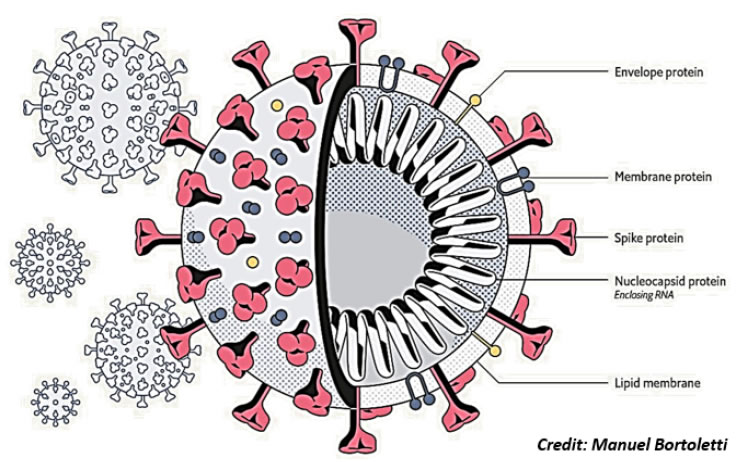
CoVs have a complex organization (Figure 1) containing four or five structural proteins mixed with some minor components that include nonstructural and host cell-derived proteins [7]. All viral particles display on their surface Spike (S), Envelope (E) and Membrane (M) structural proteins [8] (Insert Fig 1).
JPPR-3-1-310-g001

Figure 1. Virus structure. Schematic structure of a Corona Virus, with the surface proteins spike (S), membrane (M) and envelope (E). The nucleocapsid (N) protein stabilizing the single strand RNA molecule is shown inside.

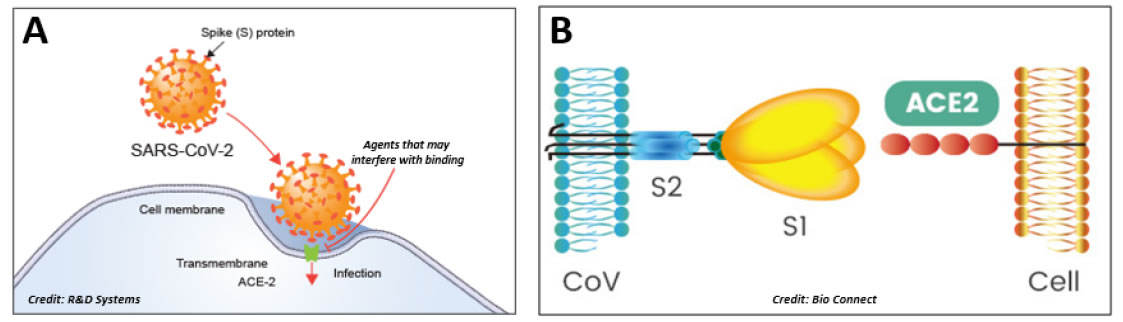
These surface proteins interact with host cell membranes at the beginning of infection, and the S protein is responsible for the fusion process between viral and host membranes [9], thus defining tissue tropism and host range (Figure 2A). The S protein contains two subunits (Figure 2B): the S1 at the N-terminus has the receptor binding function and the S2 at the C-terminus confers the fusion activity [9]. Host cell proteases cleave the subunits from the S protein. Once the S1 has bound the host cell receptor followed by the uptake into a vesicle, then S2 works to bring in close proximity viral and cellular membranes so that fusion may occur [10] (Insert Fig 2 A & 2B).
JPPR-3-1-310-g002

Figure 2. Infection mechanism. A: The infective process of SARS-CoV-2. ACE-2 appears to be the host cell receptor responsible for mediating the Covid-19 infective process. B: The spike protein S contains two moieties, S1 and S2. The trimeric S1 moiety contains the receptor binding domain (RBD) responsible of the specific interaction with the ACE2 host cell receptor.

Entrance doors of the virus: an eye on the ocular tissue

While researchers are certain that Corona viruses (CoVs) spread through mucus and droplets expelled by coughing or sneezing, it is likely that the virus can also diffuse via other body fluids, such as tears. Since early 2000, CoVs infection was known to be associated with conjunctivitis and in 2004, CoV RNA has been detected for the first time in tears of SARS-CoV patients, suggesting the possibility of virus transmission through ocular tissues and tears [11]. How CoV eventually gets to the eye from infected droplets (directly, or through the nasolacrimal duct, or the lacrimal gland, etc) remains an unsolved problem. Infact, the end of SARS-CoV epidemic turned off the interest on possible involvement of the ocular tissue in virus infection. The recent SARS-CoV-2 epidemic and the similarity in the receptor that binds both SARS-CoV-2 and SARS-CoV renewed much attention on research into ocular infection as a possible route of SARS-CoV-2 transmission [11,12]. Further investigations concluded that COVID-19 could be indeed transmitted through the ocular route, as suggested by SARS-CoV-2 isolation in the tears of a patient at Rome’s infectious-disease Spallanzani Hospital. The study recently published indicates that the eyes are not only an entrance door for the virus but also “a potential source of contagion” [13]. The additional finding that SARS-CoV-2 is present in conjunctival specimens [14, 15] and that ACE2 has been detected in different eye compartments [16-17] is indicative of the possibility that ocular tissues might represent a source of spread, particularly when higher viral loads are present at the acute stage of ocular complications.

Inflammation: a double edged sword

Once the virus has reached the airways, the first line of defense is the respiratory epithelium [18]. The human respiratory epithelial layer is made of ciliated cells intermingled by some secretory and basal cells. Secretory cells produce mucins and anti-microbial molecules. Ciliated cells generate a mucin flow helping the removal of foreign particles (micro-organisms included) and debris, sweeping mucus and trapped particles upwards and helping to expel them from the respiratory tract. Different immune cell types are resident in the epithelium, including T lymphocytes and dendritic cell populations acting as sentinel cells. Other immune cell populations including innate lymphoid cells and natural killer cells (NK) are found lining the epithelium. Alveolar macrophages are resident in the alveolar space. Recognition of invading SARS-CoV by intracellular sensors induces rapid production of antiviral interferons and other proinflammatory cytokines. In particular, when leukocytes recognize virus-infected cells or tissues damaged by the virus, these sentinels rapidly initiate an innate immune response that involves cellular activation, signaling cascades and the release of cytokines to guide leukocytes to mount an effective response. Among immune responses against SARS-CoV infection, activation of inflammation and host cell death are crucial in limiting viral infections, replication, and associated pathological damage. On the other hand, inflammatory cascade triggered by viral infection can exacerbate the pathological damage or contribute to viral clearance depending on the context of the infection [5]. There are multiple aspects of inflammation associated with viral infections. In particular, mechanisms underlying the excessive cytokine response deserve further investigations in order to develop strategies to minimize detrimental tissue damage associated with strong inflammation, while maximizing their beneficial anti-viral features.

Respiratory disease due to alveoli failure

When the infection reaches the respiratory tract, then the lining of the respiratory tree becomes injured thus causing an inflammatory state that may spread to the air sac – the gas exchange unit – which becomes unable to get enough oxygen from the blood stream and to efficiently release carbon dioxide. The first organism reaction is to activate the immune system, triggering an inflammatory response able to destroy the virus and limit its replication, however with the risk that an excessive inflammation (either in terms of intensity or duration) may exacerbate the pathological damage. Such mechanisms are very active and ready to respond in young and healthy individuals, but can be impaired in elderly people in which additional pathologies and a weakened immune system, often due to vitamin D deficiency, make it harder to fight the disease, thus accounting for the high number of deaths in elderlies [19]. Although comparably infected, pneumonia-induced death rate in men is higher than in women. This is in line with disproportional affection during additional epidemics caused by CoV. There are several factors that may confer more protection to women: stronger immune system, which, on the other hand, renders women more susceptible to autoimmune diseases, sex hormone estrogen, which appears to play a role in immunity, less prevalent strong smoking habits, less incidence of hypertension and diabetes to mention just a few differences between women and men [20]. In addition to the sex difference revealing that infection in males is more aggressive than in females, another question concerns children, which in fact contract the virus as often as adults, however developing much milder symptoms. Conversely, an inverse relationship has been noted with age, and the younger the child, the higher chance they have of winding up in severe or critical condition. (A. Balbarini, personal communication). Why COVID-19 affects children differently remains unknown although some hypotheses have been proposed. Children may have a more efficient and responsive immune system, and a better protection of the airways by an active production of mucins, rapidly flowing towards the larynx for secretion, all of which could be contributing to a milder disease. The fact that children are susceptible to SARS-CoV-2 infection, but frequently do not develop a symptomatic disease, raises the possibility that children could be facilitators of viral transmission [21]. This whole, though synthetic, picture of the infection pathway indicates nonetheless the possible target mechanisms that should be tackled by drug molecules or by natural products to prevent or at least limit viral infections, including the one by the SARS-CoV-2: i. receptor binding; ii. virus diffusion; iii. inefficient or deranged immune reaction. We will describe now some of these approaches, with a major emphasis on non-pharmacologic ones, explaining their rationale in this context.

Pharmacological approach

Much effort is presently given to the characterization of some therapeutic compounds that could be potentially active against the currently emerging novel coronavirus SARS-CoV-2. New treatments are being added day by day and their list includes, among others, repurposed flu treatments, malaria treatments, failed ebola drugs, anti-HIV drug combination, immune suppressants and anti-hypertensive drugs. This paragraph is aimed to provide a summary of therapeutic compounds that show potential in fighting the SARS-CoV-2 infection.

Antiviral products

Scientists around the world are racing with time to find a cure for the COVID-19 pandemic. Characterization of the viral structure and physiology is critical to develop effective antiviral drugs. Presently, the virus capsid S and M proteins, the serine protease TMPRSS2 used for S protein maturation, the RNA-dependent RNA polymerase (RdRp) necessary for virus replication and the cell receptor ACE2 are the primary targets. Among the antiviral drugs, Favipiravir or Avigan was developed in Japan as an anti-viral agent that inhibits the RdRp of RNA viruses. Its effects appear to improve the lung condition by preventing virus replication, thus shortening the time of virus infection. This drug has been approved as an experimental treatment for mild COVID-19 infections and has been tested with success in 340 individuals from Wuhan and Shenzhen. However a comprehensive picture about the mechanisms underlying its efficacy is still lacking [22]. Chloroquine (CQ) and hydroxychloroquine (HCQ) are drugs approved for the treatment of malaria, and inflammatory autoimmune diseases like lupus an rheumatoid arthritis. CQ is a weak base that becomes entrapped in membrane-enclosed low pH organelles thus leading to an increase of lysosomal pH. SARS-CoV-2 entry into the cell requires a correct endocytic trafficking whose impairment, as after CQ administration, would interfere with viral infection [23]. Both CQ and its derivative HCQ are being used against COVID-19 and clinical trials are being organized both in U.S. and China. However, some attention against potential side effects including cardiac arrhythmias has been recently turned on [24]. Due to the severe side effects that can be caused by CQ, HCQ might be preferred, since it shows an antiviral effect comparable to that of CQ, and appears to be able to blunt the severe progression of COVID-19, by decreasing T cell activation, thus inhibiting the dangerous cytokine storm. Beside a safer clinical profile it is also suitable for pregnant patients [25]. Much attention has been recently raised about the efficacy of remdesivir, a drug formerly used against Ebola and now repurposed to conteract COVID-19 infection [26]. Remdesivir belongs to the class of nucleotide analogs known to display some antiviral activity against single stranded RNA viruses. Although used against some cases of the African Ebola epidemic, laboratory experiments with blood sample analysis have failed to demonstrate a correlation between drug assumption and drop in the concentration of viral particles. In addition, serious side effects restrict drug prescription only to severely affected CoVID-19 patients. The antiviral drug kaletra, a combination of lopinavir (LPV) and ritonavir (RTV), is used for the treatment and prevention of HIV/AIDS. Both compounds are protease inhibitors. In particular, RTV acts by slowing down the breakdown of LPV, but both components have been shown to interact with other medications against important diseases as for instance cardiovascular diseases. The antiviral activity of this drug combination has generated early excitement for its use in COVID-19 patients [27], although recent data from chinese patients failed to detect major benefits. In addition, the rather important side effects of this drug combination seems to complicate the possibility of its use although some studies are still ongoing to evaluate drug efficacy. Recently, combination of LPV/RTV with types I and II interferons (IFNbs) has been suggested to efficiently counteract both virus replication and host inflammatory responses [28]. 
In this respect, clinical trials have been launched to determine whether the combination of LPV/RTV and IFNbs could improve clinical outcomes in MERS-CoV infections (MIRACLE Trial in South Arabia) and in SARS-CoV-2 infections (ChiCTR2000029308 in China).

Anti inflammatory and immune-regulatory products

An interesting therapeutic alternative is to target the cellular components involved in the host inflammatory response to the infection that may trigger the cytokine outburst resulting in acute lung injury which can damage COVID-19 patients even more than the infection itself. Blocking the cellular toll-like receptor 4 (TLR4) with specific antibodies that prevent the activation of NF-κB intracellular signaling is a possibility. The TL4 pathway leads to the production of inflammatory cytokines which activate the innate immune system. In this respect, sarilumab and tocilizumab used to treat rheumatoid arthritis are used to quiet the cytokine storm. They are IL-6 inhibitors, and work by blocking the inflammatory cell response to IL-6, thus preventing the inflammatory cascade triggered by its over-abundant release by inflammatory cells [28]. Another immune-active interesting drug, not yet in clinical trials for Covid-19, is Pidotimod. It is a peptide drug active on the stimulation and regulation of the cellular immune response [29]. Pidotimod has shown the ability to decrease the need for antibiotics during respiratory tract infections, increasing the production of immunoglobulins (IgA, IgM, IgG) and T-lymphocytes (CD3+, CD4+) endowed with immunomodulatory activity and involving both innate and adaptive immunity. In vitro studies have shown that Pidotimod triggers in immune cells higher expression of TLR2 and HLA-DR receptor molecules, stimulates dendritic cell maturation and T lymphocyte proliferation and differentiation, thus increasing their release of pro-inflammatory cytokines, as well as an increase of phagocytosis. All these activities are potentially useful for recurrent respiratory tract infections [30]. Its clinical efficacy in children with or without asthma, and in elderlies in terms of reduced reinfection rates and a lesser need for antibiotics has been reported [31, 32]. The overdrive of the immune system following virus infection can damage COVID-19 patients even more than the infection itself. In this respect, immunosuppresants (sarilumab and tocilizumab) used to treat rheumatoid arthritis are used to quiet the cytokine storm. They are IL-6 inhibitors, and work by blocking inflammatory cell response to IL-6, thus preventing the inflammatory cascade triggered by its over-abundant release by inflammatory cells [5, 33, 34].

Anti-hypertensive products

The fact that SARS-CoV-2 binds ACE2 receptor and that ACE2 receptor plays a critical role in regulating blood pressure has raised the possibility to use anti-hypertensive drugs such as losartan to protect target cells from virus infection. Losartan is an agiotensin II receptor antagonist and acts by reducing the response to angiotensin II, ultimately decreasing blood pressure by lowering vessel peripheral resistance and cardiac venous return. Blocking ACE2 receptors might possibly prevent the virus from infecting cells by locking the doorway to virus entrance. There are, however, conflicting opinions on the use of anti-hypertensive drugs against virus infection. Complicating things are the recent findings that losartan and other angiotensin II receptor blockers may actually stimulate ACE2 production, thus increasing the possibility of the virus to enter the cells [35]. Therefore, on the one hand ACE2 antagonists could compete with the binding of the virus spike protein, but on the other hand the increase of ACE2 expression stimulated by the antagonist drug could increase susceptibility to virus infection and spreding [36]. In this respect, hypertension has been considered a risk factor for SARS-CoV-2 infection and mortality [37, 38] and a Chinese study on cardiopatic patients affected by Covid-19 found a higher mortality risk among this cohort [39], and an Italian study on 355 patients dead for COVID-19 found that most of them had hypertension, thus associating their anti-hypertensive medication with their increased susceptibility (A. Balbarini, personal communication). All of the above medications were first developed years ago for different diseases. New drugs and vaccines are strongly and urgently needed. Their development strictly depends on basic research aimed to clearly identify and exploit the receptor binding domain (RBD) within the spike protein, that allows the fusion of viral and host membranes. Similarly to SARS-CoV, also the S spike coat protein of SARS-CoV-2 recognizes ACE2 as its host receptor. Therefore, univocal molecular modeling of the RBD in SARS-CoV-2 spike protein is a critical step for the development of new inhibitors of virus attachment and entry, either neutralizing antibodies or vaccines [40].

Tailored drug design by computational chemistry

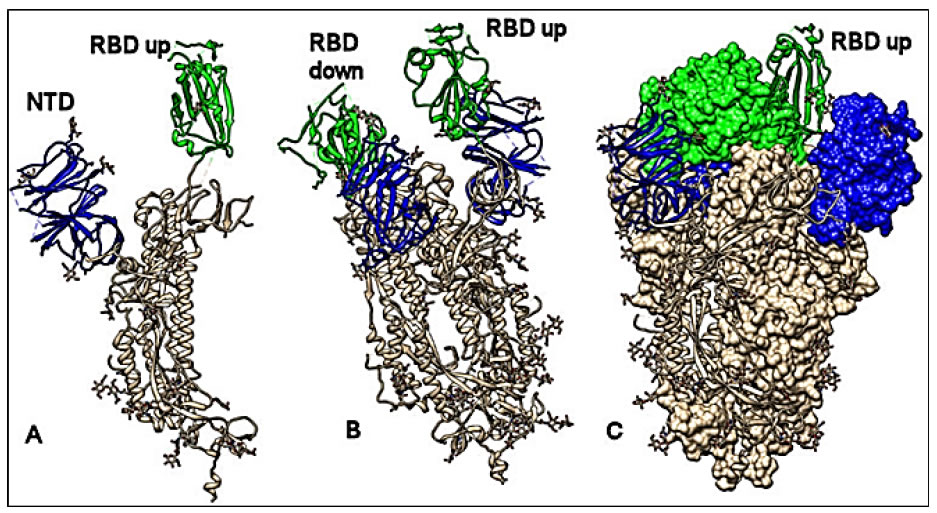
A much better and more detailed view of the structure of the S protein and its possible interactions with the host receptor is given by the emerging techniques of Computational Chemistry and Molecular Modeling. These techniques have raised exponentially during the last decades and showed their power in accelarating the discovery of new drugs with target specificity. In fact, they are widely used for rational drug design and discovery processes, where the molecular interaction mechanism must be deeply understood and the structural factors related with the bioactivity of each inhibitor must be clearly defined. Therefore, in order to design specific targeting drugs using these in silico techniques, the full knowledge of the three-dimensional (3D) structure of the macromolecular targets is the first step. This necessary information determines the success or failure of the further computational study. Luckily, the structure-solving of even the highest complex molecular targets can take advantage of the dramatic progress of spectroscopic techniques such as high resolution X-ray crystallography and Cryo-Electron Microscopy (Cryo-EM). This latter technique allows to easily solve huge and complex macromolecular structures such as membrane receptors and other supramolecular associations. Indeed, it also strongly contributed to the elucidation of the structural molecular features of the SARS-CoV-2 spike (S) protein, which is presently the elective target for the development of monoclonal therapeutic antibodies, inhibitors of virus entry into cells and vaccines. The S protein is densely glycosylated and can be classified as a trimeric class I fusion protein that exists in a metastable prefusion conformation, able to change its spatial disposition to promote the fusion of the viral membrane with the host cell membrane [41, 42].The S1 protein domain (Figure 2B) 3D structure has been resolved by Cryo-EM and deposited in the RCS protein data bank in February 2020 [43] (http://www.rcsb.org/pdb/:pdb code 6VSB) (Figure 3). Moreover, also the Receptor Binding Domain (RBD) of the SARS-CoV-2 S protein has been elucidated, showing that it binds tightly to either the human or bat ACE2 receptors [44], with a binding affinity significantly higher than the one determined for the SARS-CoV RBD [45, 46]. The kinetics of this interaction has been quantified by surface plasmon resonance showing that ACE2 binds to the SARS-CoV-2 S ectodomain with ~15 nM affinity, which is ~10 to 20 fold higher than ACE2 binding to the SARS-CoV S protein [43, 47]. The 3D structure of the complex of ACE2 bound to the SARS-CoV-2 RBD (pdb code 6M17) has been elucidated by high resolution Cryo-EM and resembles the complex formed between SARS-CoV S and ACE2 (pdb code 2AJF) [48]. In order to engage the host cell receptor, the RBD of the S1 moiety of the spike protein (Figure 2B) undergoes hinge-like conformational movements that transiently hide or expose the determinants of receptor binding. These two states are referred to as the “down” conformation and the “up” conformation, where down corresponds to the receptor-inaccessible state and up corresponds to the receptor accessible state, which is thought to be less stable (Figure 3: images obtained by the CHIMERA software [49]) (Insert Fig 3).
JPPR-3-1-310-g003

Figure 3. Conformational analysis. Structure of the spike S protein of the SARS-CoV-2 in the prefusion conformation. A: protomer with the RBD up (green); N terminal domain in blue. B: protomer with the RDB up and down (green); N terminal domain in blue. C: Spike trimer complex; two protomers with RBD down (shown by molecular surface) and one with RBD up (shown by ribbons); N terminal domain in blue. All structures are referred to 6VSB pdb code. The CHIMERA software has been used for molecular visualization and analysis [49].

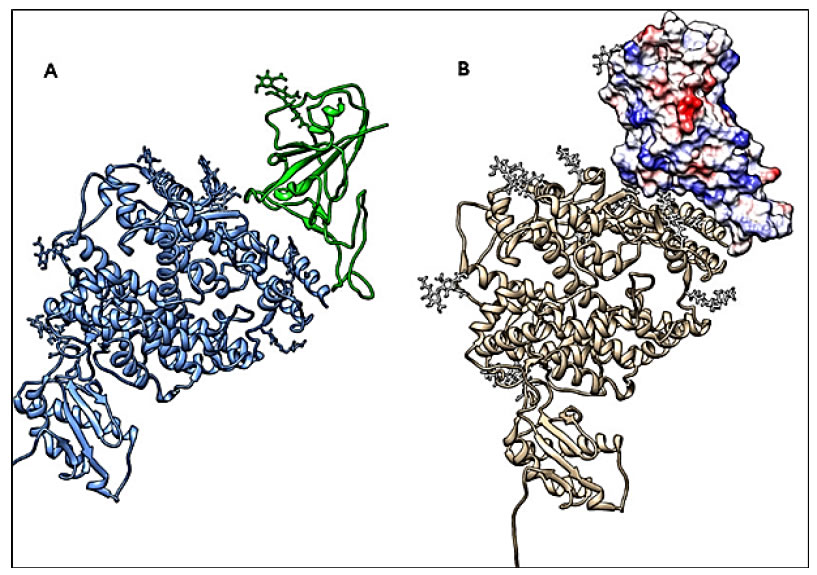
The overall structure of SARS-CoV-2 S and SARS-CoV S proteins (pdb code 5WRG) [50] is quite similar, with a root mean square deviation (RMSD) of 3.8 Å over 959 Ca atoms [43]. A minor difference between these two structures is the position of the RBDs in their respective down conformations. Despite this, the alignment of the individual structural domains of the SARS-CoV-2 S and the corresponding one from SARS-CoV S, show a high degree of structural homology, with the exception of some aminoacidic changes located on the subdomain that binds to the ACE2-receptor, thus justifying the observed differences in the binding affinities (Figure 4) [43] (Insert Fig 4).
JPPR-3-1-310-g004

Figure 4. Conformational analysis. The RBD of the spike S1 moiety is shown in a complex with its receptor ACE2. A: Ribbons, S-protein RBD in green and ACE2 in blue. B: RBD by molecular surface showing charge distribution (blue positive, red negative), and ACE2 by grey ribbons. All structures are referred to 6M17 pdb code. The CHIMERA software has been used for molecular visualization and analysis [49].

Because of the indispensable function of the S protein in the infection process, it represents a target for antibody-mediated neutralization (Figure 2A), and characterization of the prefusion S structure would provide atomic-level information to guide both vaccine design and drug design development. Starting from these structural considerations, we have begun to study in silico a strategy to “capture” the S-protein RBD domain in its up conformation using natural-derived molecules; this involves the design of conformational restricted compounds that can “trap” the binding domain in an antibody-antigen fashion. Another strategy involves the search for ligands able to tightly bind and cross-link the RBD and the flexible part of the protein that controls the changes between its “up” and “down” spatial orientations; this should lead the RBD conformation to a permanent inactive state, unable to bind to its “natural” host cell receptor ACE2. However, the binding of the spike S protein to its ACE2 target is not optimal and it appears to be even less efficient than the binding ability shown by the SARS-Cov S protein [51]. Most recent evidence suggests that sialic acids (abundantly present in the respiratory tract) are also necessary for SARS-CoV-2 binding and infection [52]. Therefore, other computationally-driven strategies are being developed considering another CoV surface protein named M-protein (pdb code 6lu7) [53], as a possible drug-target. High Throughput Virtual Screening (HTVS) from libraries of natural compounds or other databases including FDA approved drugs, aim to identify lead-compounds with inhibitory activity and low toxicity. A specific project has already started with funds by the European Commission within the H2020 framework. Within this project, it is worth mentioning the Exscalate (EXaSCale smArt pLatform Against paThogEns). Exscalate (exscalate.eu) has the power to screen a “chemical library” of 500 billion molecules, thanks to a processing capacity of more than 3 million molecules per second and using the proprietary software LiGen.

The role of food supplements

While research is working hard to find and produce specifically tailored pharmaceutical solutions (natural or synthetic vaccines and drugs) to fight this new pest, an easily approachable and already marketed possibility is given by food supplements. Food supplements do not pretend to cure the disease, but they can boost the organism to give it the necessary strength to mount an efficient and sometimes resolutive response to the infection, either preventing it from becoming a serious illness, or collaborating with pharmaceutical treatments to help the organism to finally get rid of the infective agents. Here follows the description of some natural products that have been chosen among many possible ones, based on the available literature and our own familiarity with the field. It is not and it cannot be an exhaustive list, but it gives an idea of what natural food supplements may contribute to our wellbeing also in the fighting against this pandemic infection.

Probiotics

Beside working on the outside, interfering with viral infectivity, it is also possible to work on the inside, for instance by strengthening the immune system. Epidemiological data show that the majority of Covid-19 infected people (likely more than 80%), especially the young, develop only very mild disease (ECDC, Corona virus disease 2019 in the EU/EEA and the UK; ninth update, 23 April 2020), most likely because their immunity can efficiently control the infection. We know that both genetic and environmental factors- mostly influenced by the lifestyle- may affect the function of the immune system, and the microbiota is a prominent one among these factors. Recent research has shown that the gut microbiota plays an essential role in the body’s immune response to infection and in maintaining overall health [54]. Normal development of the immune system and maturation of immune cells are dependent on signals coming from the microbiota [55]. For instance, in mucosal immunity the secretory IgA response involved in virus inactivation is stimulated by the microbiota [56]. Moreover, the microbiota releases signaling molecules actively shaping the host systemic immune response by regulating haematopoesis, hence potentiating the response to infection [57]. As well as mounting a response to infectious pathogens like coronavirus, a healthy gut microbiome also helps to avoid potentially dangerous immune over-reactions that might damage the lungs and other vital organs. Such deranged immune responses can cause respiratory failure and death. Therefore, it is important to use strategies that “support” rather than “boost” the immune system, because an overactive immune response can be as deleterious as an underactive one. The molecular mechanism governing the interactions between the gut microbiota and the immune system are only partially understood. For instance, it is known that the gut microbiota can metabolize hormones, and thus it may contribute to the regulation of cortisol levels in blood [58], which is tightly linked to the functioning of the immune system, since too much cortisol decreases the immunity. Moreover, a link between diet, microbiota and inflammation is evident [59]. In order to nourish an heterogeneous and thus efficient microbiota, the best way is eating a wide range of fiber-rich plant-based foods, avoiding refined, ultra-processed foods. The Mediterranean diet (based on the eating of plenty of fruit, vegetables, nuts, seeds and whole grains; healthy fats like high-quality extra virgin olive oil; and lean meat or fish) is known to improve the gut microbiota diversity and reduce inflammation. Such diet-modulated microbiota was associated with an increase in short/branch chained fatty acid (SCFA) production [60], and many studies have indicated that SCFAs possess immune regulatory functions in different tissues and organs, and may thus influence the outcome of micro-organism infections [61]. However, the relationship between the intestinal microbiota and the lungs is not yet fully understood. The respiratory tract has its own microbiota, but patients with respiratory infections generally have gut dysfunction or secondary gut dysfunction complications, which are related to a more severe clinical course of the disease, thus indicating gut–lung crosstalk [62, 63]. This occurrence has also been reported in COVID-19 patients [64]. It has been shown that modulating the gut microbiota can reduce enteritis and ventilator-associated pneumonia, because the gut microbiota may increase IFNα/β receptor expression in lung epithelia thus making the lung environment refractory to influenza virus replication [65]. A direct effect of probiotics administration on viral infection has been reported in several instances. Probiotics containing Lactobacillus plantarum (Lp) and Leuconostoc mesenteroides (Lm) showed efficacy in infected mice against the seasonal and avian influenza viruses H1N1 and H7N9. The plaque size reduction in treated mice was evidence of significantly restrained viral replication in lungs, with the effect of increasing the mean days and rates of survival of infected mice [66]. Oral administration of lyophilized Lactobacillus rhamnosus GG (LGG) and Lactobacillus gasseri TMC0356 (TMC0356) to BALB/c mice 15 days before and 4 days after intranasal infection with the flu virus H1N1 resulted in a significant improvement of clinical symptom scores and reduction of pulmonary virus titres compared to those of control mice [67]. Lactobacillus plantarum Probio-38 and Lactobacillus salivarius Probio-37 isolated from the porcine gastrointestinal tract were found to inhibit replication in vitro of the transmissible gastroenteritis (TGE) coronavirus without any cytopathic effect [68]. The potential antiviral activity of lactic acid bacteria (LAB) was tested in vitro on human and animal intestinal and macrophage cell line models challenged with rotavirus (RV) and transmissible gastroenteritis virus (TGEV). Results indicated that the best protection was obtained with Lactobacillus rhamnosus GG and Lactobacillus casei Shirota against both virus types. A less specific, but still detectable antiviral activity was also found with Enterococcus faecium, Lactobacillus fermentum, Lactobacillus pentosus and Lactobacillus plantarum [69]. Finally, a probiotic with Lactobacillus plantarum DK119 [70] showed protective antiviral effects on influenza virus infected mice. Intranasal or oral administration of this strain resulted indose-dependent protection against further lethal infection with influenza A viruses, lowering the lung viral load. Bronchoalveolar lavage fluids of virally infected mice previously treated with DK119 showed high levels of cytokines IL-12 and IFN-γ and a low degree of inflammatory elements. The protective effect of DK119 apparently depended on modulation of dendritic and macrophage cells belonging to the host innate immunity. In fact, depletion of these elements in lungs and bronchoalveolar lavages completely abrogated cytokine production and the protection elicited by DK119 administration [70]. Although no clinical trials have been reported concerning the use and the effects of probiotics on the Covid-19 infection, clinically significant results on Covid-19 infected patients have been obtained by an integrated, multidisciplinary, personalized approach coupling pharmacological therapy and traditional chinese medicine, also including nutritional support and application of prebiotics and probiotics [71]. Therefore, even though the antiviral effect cannot be guaranteed, it is possible to support the intestinal microbiota by regularly eating natural yoghurt and artisan cheeses, which contain live microbes. Another source of natural probiotics are bacteria and yeast-rich drinks like kefir (fermented milk) or kombucha (fermented tea). Fermented vegetable-based foods, such as Korean kimchi (and German sauerkraut) are other good options. Alternatively, many different brands of probiotics containing a wide collection of bacteria that have been shown to produce beneficial effects on the organism, also on the antiviral side, are available on the market. Some of these commercial products also contain prebiotics (facilitating their engraftment in the intestines), or group B vitamins, that contribute to the reinforcing of the organism resistance to infections (see below).

Fatty acids

No specific probiotic indications exist as yet to improve the immune system performance to fight the Covid-19 infectious disease. However, food supplements containing a patented mixture of poly-unsaturated-fatty-acids (PUFAs), referred as Fatty Acid Group (FAG®), have been used to blunt the chronic inflammatory response generated by the immune system in animal models of macular degeneration [72] and optic nerve neuropathy [73]. The acronym FAG indicates diverse different mixtures produced by a calibrated mixing of long and short chain FAs given to sustain the metabolism of macrophages involved in the inflammatory reaction with the aim of facilitating its resolution and the shift of macrophages to the non-pro-inflammatory phase [74]. These products are commercially available in Italy under the trade name of Macular-FAG and Neuro-FAG. Given their ability to control inflammatory cytokine production and the activation state of macrophages, it is likely that they might also beneficially influence and control the inflammatory state due to the over-reactive immune response in the lungs of Covid-19 patients.

Colostrum

Colostrum is the first nutrient secretion spilling from the mammary glands during the first hours after delivery of the newborn [75]. Since the newborn does not have efficient immune defenses, colostrum delivers the major components of the innate immune system, such as lactoferrin, lysozyme, lactoperoxidase and complement [76]. Several cytokines can also be found in colostrum, such as interleukins and tumor necrosis factor [77, 78]. Lactoferrin and lactoperoxidase contained in colostrum used as functional food are very promising, naturally occurring antimicrobials. Moreover, colostrum contains lipids (which generate during the digestion process degradation products with anti-infective capacity) and antimicrobial peptides present in casein molecules [79]. Colostrum also contains a collection of immunoglobulins (IgA, IgG and IgM) among which neutralizing antiviral IgA against the poliovirus and the reovirus have been described [80]. Mice fed for 14 days with bovine colostrum and subsequently infected with the human respiratory syncytial virus (hRSV) developed a milder disease with a lower lung titer of the virus with respect to saline fed mice. Such response correlated with a higher CD8 T lymphocyte titer in colostrum fed mice [81].Therefore, bovine colostrum, which is commercially available, could be used through different ways of administration (usually orally for systemic effects, but formulations would be possible also for eye or nose administration, to catch the virus at its entrance doors).

Micronutrients and vitamins

Many nutrients are involved in the normal functioning of the immune system and a healthy balanced diet should be enough to support the immune function. Micronutrients such as vitamins A, group B, C, D, E, zinc, iron, selenium, copper and magnesium are necessary for a correct and efficient immune response [82, 83, 84]. However, if there is a serious or even marginal deficiency of these micronutrients, this can negatively affect the immune function and decrease the resistance against infections [84]. Oxidative stress largely occurs during the inflammatory reaction to pathogen invasion and immune system activation, and represents a mechanism by which the organism gets rid of the undesired guests, however inflicting some damage to its own structures as well. Antioxidants enzymes are necessary to keep the phenomenon under control, and avoid excessive damage to the organism itself. All antioxidant enzymes have metal ions at their catalytic site (Mn++, Cu++, Zn++, Fe++ and Se++). All vitamins are essential for the correct development of innate and adaptive immunity in the body. Moreover, vitamins A, C, and E are required to maintain the skin epithelium barrier function [85]. Vitamin A sustains mucin production in the respiratory tract contributing to its barrier function versus pathogen infections [86]. Vitamin A is also important in the process of antibodies manufacturing. It plays an important role in the correct migration of T lymphocytes to the site of inflammation or infection, allowing a correct immune response of IgA producing cells localized in the mucous membranes [87]. Recently, it has been shown that retinoic acid (a derivative of vitamin A) can blunt the attack of hepatitis C virus (HCV) to the liver, and it does so by cooperating with interferons in the activation of immune defense genes [88, 89]. Vitamins C and E are antioxidants, and mop up the free radicals generated by the inflammatory process; free radicals and lipid peroxidation are immune-suppressive, hence these vitamins act to maintain or even to enhance – when necessary – the immune response. Vitamin C stimulates human immunity against viral infections by increasing phagocytosis, lymphocyte proliferation and neutrophil chemotaxis. Its high concentration within leukocytes falls rapidly due to its utilization during infections, and restores back to normal after healing, thus proving its involvement in taking care of infective agents during the response against exogenous pathogens [90, 91]. Vitamin E also plays a relevant role in enhancing immune reactions by inactivation and inhibition of free radicals [85]. Vitamin E oral supplementation improves T cell response and macrophage activity against infective agents [92, 93], and decreases the risk of upper respiratory tract infections in the elderly [94].

Members of B group vitamins are: thiamine (B1), riboflavin (B2), niacin (B3), pantothenic acid (B5), pyridoxine (B6), biotin (B7), folic acid (B9) and cobalamins (B12). The vitamins B6, B9 and B12 have a key role in enhancing the reactivity of the immune system, and influence the production and activity of natural killer (NK) cells [95]. Vitamin B6 contributes to the correct functioning of the immune response and antibodies production, by improving the communication between immune cells, cytokines and chemokines, and the gut microbiota [96]. Vitamin B6 deficiency impairs lymphocyte growth and proliferation, T-cell activity and antibody formation [97], and a clinical trial on 51 critically ill patients hospitalized in the intensive care unit has shown that vitamin B6 supplementation may help to increase their immune reactivity[98]. Vitamin B9 is relevant for the maintenance of immunologic homeostasis. Vitamin B9 is a survival factor for regulatory T cells (Treg), which express high levels of vitamin B9 receptor [96]. Treg cells have a critical role in the prevention of excessive immune response [99]. Therefore, a deficiency of vitamin B9 may result in an insufficient Treg cell population, thus increasing the organism susceptibility to paroxystic inflammation [100], as it appears to happen during the fatal illness of Covid-19 patients. Vitamin B12 cannot be naturally synthesized by human cells, but is produced by the gut microbiota. In terms of host immunity, in case of dietary vitamin B12 deficiency, the amount of cytotoxic T cells is decreased, so as NK cell activity; such condition can be improved with vitamin B12 dietary supplementation [101], thus indicating that this vitamin sustains the immune response via cytotoxic T cells and NK cells. A prominent role among vitamins is played by vitamin D (25 hydroxy vitamin D). Indeed, several lines of evidence support the role of vitamin D(normal circulating values between 20 and 40 ng/ml) in helping the organism to fight infections. Low values of vitamin D increase the risk of osteoporosis in the elderly, and are associated with a series of pathological conditions (tumors, cardiovascular, neurological and auto-immune diseases, diabetes, hypertension, chronic respiratory diseases) [102, 103] that make the individual less resistant to infections, and the organism unable to fight properly the infective state, thus increasing the morbidity of the infection and its mortality, as it happens in the case of Covid-19 disease. Epidemiological and clinical studies indicate that a deficit of vitamin D increases the risk of influenza and respiratory tract infection and the susceptibility to HIV infection. Individuals with low vitamin D status have been reported to have a higher risk of respiratory tract viral infections [104]. In vitro experiments with receptive cells suggest that vitamin D has direct anti-viral effects predominantly against enveloped viruses. Such effect might be linked to the ability of vitamin D to trigger macrophages to synthesize the anti-microbial peptides LL-37 and human beta defensin 2, and to stimulate macrophages and polymorphonuclear (PMN) leukocytes to produce cathelicidins, a family of lysosomal polypeptides functioning in innate immune defense, and contributing to the suppression of several pathogens infection, including URIs. The increased winter incidence of common cold and pneumonia has been related, at least partially, to decreased synthesis of vitamin D because of decreased exposure to sunlight [105]. An interesting study recently published, has linked Vitamin D, URIs and bowel disease. In patients affected by inflammatory bowel disease and with vitamin D below 20 ng/ml, the oral supplementation of 500 U/day of vitamin D while not decreasing the incidence of influenza, significantly decreased the incidence of URIs [106]. More evidence derives from an epidemiological study showing that vitamin D values higher than 38 ng/ml correlate with a two-fold decrease of the risk of getting acute respiratory tract infections, and with a shorter duration of the disease in those infected [107]. A meta analysis of 25 randomized, controlled clinical trials evaluating more than 10,000 subjects, concluded that oral supplementation of vitamin D to individuals with values lower than 26 ng/ml may decrease by 2/3 the incidence of acute respiratory infections [108]. A very recent, still unpublished paper [109] debates the three possible ways by which vitamin D might work in the prevention and treatment of viral infectious disease, including the Covid-19: i. Maintenance of epithelial tight junctions and the pulmonary barrier [110]; ii. Killing of enveloped viruses through the induction of cathelicidin and defensins [111, 112]; iii. Decreased production by the innate immune system of proinflammatory cytokines [113, 114], thus reducing the risk of the cytokine storm that may lead to severe pneumonia, insufficient blood oxygenation and death, such as it happens in Covid-19 disease [2].

Food supplements with antiviral effects

1 Echinacea

Three species are commonly used medicinally: Echinacea purpurea, E. angustifolia and E. pallida. Preparations of the root and of the aerial parts of the 3 Echinacea species are all used as immune stimulants. It has been suggested that Echinacea preparations may be useful in the treatment of URIs: (e.g. colds and flu). In healthy individuals, natural immunity appears to be potentiated, due to a significant (21%) increase in complement properdin [115]. However, more than for prevention, E. purpurea extracts are most often used to relieve colds and other URIs symptoms. Numerous randomized controlled clinical trials have examined the role of Echinacea preparations in the treatment of acute URIs after the onset of symptoms. Several of these studies have shown a significant reduction of the duration and/or severity of URIs following Echinacea treatment [116]. A systematic review of clinical studies with Echinacea extracts including both treatment and prevention designs corroborated the efficacy of treatments, although the lack of their standardization represented a serious bias to the conclusion [117]. A more recent meta analysis evaluating the effect of Echinacea on the incidence and duration of the common cold in randomised placebo-controlled studies confirmed Echinacea’s benefit in decreasing the incidence and duration of the common cold [118]. Echinacea extracts are best known as immune stimulant, increasing both innate and specific immunity [116]. The molecular characterization has shown that E. purpurea polysaccharide enriched extracts trigger phenotypic and functional maturation of dendritic cells by modulation of p38 MAPK, NF-kB and JNK pathways [119, 120] and the modulation of the latter can favour M1 macrophage polarization [121]. Moreover, also direct anti-inflammatory and anti-viral activities of Echinacea extracts have been reported [122, 123, 124]. Finally, a recent review has analyzed 82 clinical reports on the efficacy of micronutrients and Echinacea during common cold disease, extrapolating the useful doses, and reaching the conclusion that current evidence of efficacy for zinc, vitamins D and C, and Echinacea is so appealing that patients may be encouraged to use them in the treatment or prevention of their viral disease [124]. Apart from allergic reactions, in a recent large clinical trial Echinacea treatment has been shown to be safe, with a favorable risk to benefit ratio [125].

Ginseng

Panax ginseng is the most prominent and best-studied among the 3 known ginseng species. It has shown immunomodulatory properties in preclinical studies. Ginseng activated macrophages in vitro to produce cytotoxic reactive nitrogen species [126] and in vivoto defend mice from Candida albicans infection [127]; it also enhanced basal immunity, by stimulating NK cells activity in immune suppressed mice [128, 129]. In a clinical study, ginseng extracts improved the phagocytic activity and chemotaxis of peripheral blood mononuclear cells [130]. Although different immune functions may be activated by ginseng [131], it looks that the immunologic effects are mainly mediated by NK cell activity [129, 132]. For instance, the efficacy of a flu vaccine was significantly improved if an oral ginseng extract was co-administered, and the effect on the reduction of URIs was apparently to be ascribed to an increased amount of NK cell activity [133]. Very low level of adverse reactions are known for ginseng. It is not advised in case of hypertension and use of warfarin because of drug interaction [134, 135]. Because of its anti-fatigue effects it might interfere with sleeping when taken in the evening [136].

Astragalus

Astragalus is a widely used plant in Traditional Chinese Medicine. In recent years, particularly some species of the Astragalus family have been exploited in folk medicine for their pharmacological properties such as anti-inflammatory, immunostimulant, antioxidative, anti-cancer, antidiabetic, cardioprotective, hepatoprotective, and antiviral. The active constituents for the above-mentioned effects were proved to be polysaccharides, saponins, and flavonoids [137]. Astragalus polysaccharides have been shown to exhibit antiviral activities against the avian coronavirus and it has been suggested that they may represent a potential therapeutic agent for inhibiting its replication and to treat the avian infectious bronchitis [138].

Curcumin

Curcumin is the major component and the main bioactive substance of the rhizome of the plant Turmeric (Curcuma longa, belonging to the family of ginger: Zingiberaceae). It is present in the Indian and Chinese Traditional Medicine, where the curcuma longa rhizome has been used as antimicrobial agent as well as an insect repellant. Several studies have reported the broad-spectrum antimicrobial activity for curcumin including antibacterial, antiviral, antifungal, and antimalarial activities [139,140]. More specifically, antiviral activity was observed against several different viruses including parainfluenza virus type 3 (PIV-3), feline infectious peritonitis virus (FIPV), vesicular stomatitis virus (VSV), herpes simplex virus (HSV), flock house virus (FHV), and respiratory syncytial virus (RSV), hepatitis viruses, influenza viruses and emerging arboviruses like the Zika virus (ZIKV) or chikungunya virus (CHIKV). Interestingly, it has also been reported that the molecule inhibits the sexually transmitted human immunodeficiency virus (HIV), herpes simplex virus 2 (HSV-2) and human papillomavirus (HPV). A molecular target for this potent antiviral activity appears to be the inosine monophosphate dehydrogenase (IMPDH), which is a rate-limiting enzyme in the de novo synthesis of guanine nucleotides [141]. Most interestingly, curcumin is also an inhibitor of the 3CL protease activity (necessary for virus replication) of the SARS-CoV [142], and therefore shows inhibitory effects on this type of viruses, tightly related to the present pandemic infection by the SARS-CoV-2. Moreover, curcumin also possesses potent anti-oxidative and anti-inflammatory properties [143], which may turn useful in controlling the strong inflammatory reaction happening in the lungs of patients infected with corona viruses. Curcumin oral supplementation has very low toxicity, and phase I clinical studies have indicated that curcumin doses up to 3.6-8.0 g/day for 4 months did not result in discernible toxicities except occasional mild nausea and diarrhea [144].

Ginger

Zingiber officinale belongs to the same family of Zingiberaceae that includes Curcuma longa. Like curcumin, it is also endowed with properties that might be useful to fight the Covid-19 infection. It contains diverse chemical components, such as phenolic derivatives, terpenes, lipids, polysaccharides, organic acids, and raw fibers. It is mainly the amount of phenolic compounds (gingerols and shogaols) that promotes the health benefits of ginger[145, 146]. Several studies have revealed the multiple biological activities of ginger root extract. These include immune modulation of lymphocytic (T and B) and macrophage response [147], antioxidant and anti-inflammatory [148], antimicrobial [149], cardiovascular [150] and respiratory [151] protective effects, all specifically relevant to the Covid-19 infection process. The antiviral efficacy of ginger has been further shown by in vitro experiments with the human respiratory syncytial virus (HRSV). Viral attachment and internalization of the virus into receptive cells was inhibited in a dose-dependent fashion by fresh ginger extracts, which could also stimulate interferon-beta secretion by mucosal cells, thus giving a further contribute to counteract viral infection. Therefore, HRSV-induced plaque formation on airway epithelium might be blocked by fresh, but not dried ginger extracts [152].

Elderberry

The most common elderberries are Samubucus nigra. A standardized elderberry liquid extract showed antimicrobial activity against both Gram-positive bacteria of Streptococcus pyogenes and group C and G Streptococci, and the Gram-negative bacterium Branhamella catarrhalis in liquid cultures. The liquid extract also displayed inhibitory effects on the propagation of human pathogenic influenza viruses [153]. Elderberry’s antiviral activity may be due to its high concentration of flavonoids, specifically the anthocyanins cyanidin 3-glucoside (C3G) and cyanidin 3-sambubioside, which have been shown to regulate the immune function and exhibit anti-viral effects [154]. A study recently published [155] addressed the efficacy of elderberry and its prevalent anthocyanin compound, C3G, on influenza virus infectivity. Study results showed that the whole elderberry extract, but not C3G alone, had inhibitory effects at all stages of influenza infection, though significantly stronger effects were most evident at late rather than at early stage of infection. Furthermore, the antiviral activity of elderberry was strongest when used during the whole course of the infection, rather than when used solely during the acute phase. The study confirmed that elderberry exerts its antiviral activity on influenza through several mechanisms of action, including suppressing the entry of the virus into cell (interfering with cell receptor binding), modulating the inflammatory post-infectious phase, and preventing viral diffusion to neighbouring cells. Elder berry also upregulated IL-6, IL-8 and TNF alpha, thus suggesting an effect on the immune response. Black elderberry extract has been shown to inhibit human influenza A (H1N1) infection in vitro by binding to H1N1 virions, thereby blocking the ability of the viruses to infect host cells. Ten more strains of influenza virus were also similarly inhibited [156]. Clinical evidence of the effects of elderberry supplementation on acute URIs derives from a meta-analysis study of 4 randomized controlled trials evaluating a total of 180 participants considering both the vaccination status of participants and the cause of their upper respiratory symptoms. Results showed that supplementation with elderberry significantly reduced upper respiratory symptoms [157].

Licorice

Glycyrrhiza glabra and Glycyrrhiza uralensis (licorice) are members of the pea family (Leguminosae). Licorice has well-documented immune-stimulant and antiviral, antibacterial and antifungal properties [158]. In Traditional Chinese Medicine it is used for a multitude of conditions, such as alleviating pain, tonifying spleen and stomach, eliminating phlegm, and relieving cough [159]. Among the 20 triterpenoids and almost 300 flavonoids contained in licorice, the triterpenoids glycyrrhizin (GL) and glycyrrhizic acid (GA) are those mainly active against viral infections [158]. Recent studies have shown that GL may inhibit hepatitis C virus (HCV) infection by interfering with its propagation. GL appears to be endowed with a membrane-stabilizing effect thus reducing cell membrane fluidity. Since HCV needs to use the host cell membrane in its lifecycle, it could be speculated that this could be the mechanism by which licorice stops the diffusion of the virus [160]. When GL was given by chronic intravenous injection to treat hepatitis C in Japan, few side effects and a marked reduction of the progression toward cirrhosis and hepatocarcinoma was reported [161]. GL and GA are known to have other useful pharmacological effects, including anti-inflammatory, anti-tumor and anti-allergic. Mechanisms of the GL-induced anti-inflammatory effect appear to result from inhibition of thrombin-induced platelet aggregation, inhibition of prostaglandin E2 production and inhibition of phospholipase A2 (PLA2) [162]. Such anti-inflammatory properties become evident with the efficacy of GL in alleviating allergic asthma in the experimental mouse model, by increasing IL-4 and IL-5 levels, whilst decreasing eosinophil counts and IgE levels, finally upregulating total IgG2a in serum. GL administration resulted in decreased hyper-reactivity of the immune system and pulmonary inflammation, hence in relief of airway constriction [163]. Flavonoids extracted from licorice root quenched pulmonary inflammation by inhibiting the recruitment of neutrophils, macrophages, and lymphocytes, and by suppressing the mRNA expression of TNF-α [164]. Moreover, lung inflammation and mucus production also resulted attenuated by GL [165]. Finally, the isolated licorice root flavonoid, isoliquiritigenin, was shown to relax the tracheal smooth muscle of guinea pigs both in vitro and in vivo[166]. Among the other viruses shown to be responsive to licorice treatment are: herpes simplex type 1 (HSV-1), varicella-zoster virus (VZV), hepatitis A virus (HAV), hepatitis B virus (HBV), human immunodeficiency virus (HIV), severe acute respiratory syndrome (SARS) coronavirus, Epstein–Barr virus (EBV), human cytomegalovirus (CMV) and influenza virus [158]. As a final caveat, it has to be noted that licorice is a potent inhibitor of the metabolic pathway breaking down cortisol in liver cells, thus increasing its level in circulation, and chronic licorice ingestion is associated with an increase in blood pressure and a drop in plasma potassium, even at modest doses [167]. This is of particular relevance for individuals with hypertension and cardiovascular disease, who should definitely limit their consumption of licorice.

Mullein flower

Verbascum thapsus L. is the most important species of its genus [168]. Anti-inflammatory, antioxidant, anticancer, antimicrobial, antiviral, antihepatotoxic and anti-hyperlipidemic activity have been ascribed to this plant. In traditional medicine, it is used to treat tuberculosis, ear-ache and bronchitis. In the ancient Rome and Ireland it was called “lungwort” because it was used to treat lung disease in humans and farm animals [169, 170]. Different pharmaceutical forms prepared from the extract of V. thapsus, such as capsules, tablets, or infusions have been used for the treatment of lung conditions or other age-related degenerative conditions because of their antioxidant activities [171, 172]. The in vitro antiviral activity against Herpes simplex virus type 1 (HSV-1) and influenza virus A have been reported [173, 174].

Conclusion

By the end of April 2020, the WHO global report of the SARS-CoV-2 pandemic registers almost 3,000,000 positive people worldwide, with a mortality rate of approximately 7% (https://www.worldometers.info/coronavirus/ ), which we know is mostly due to individuals with pre-existing health problems. Women – though equally affected – appear to be less susceptible to develop a serious or fatal disease. During the worst days in Italy the death toll of the Covid-19 infection has almost touched 1,000 individuals per day, over a positive infected population of 100,000. A recent epidemiological study [175] has calculated that the rate of asymptomatic individuals (healthy carriers of the SARS-CoV-2) is around 50%, though it is suspected that they might be even higher than 80% [176]. These numbers prompt some thoughts. The existing drug therapies show very little effect on previously unhealthy patients infected with the SARS-CoV-2, thus resulting in the observed high death rate. Young and/or healthy individuals have much better chances of either being asymptomatic, or to develop only mild, treatable symptoms. Healing from the infection is finally due to the immune system wiping out all the infective agents (drugs may facilitate this task).Therefore, considering all the evidence illustrated in this paper, we might speculate that those people, either young, or – if aged – living a healthy life, eating a healthy diet providing at the right time and the right age all the nutrients necessary to maintain an excellent homeostasis of their organism, possess an immune system and defense mechanisms able to control and fight properly most of the infections, developing mild symptoms, or none at all. However, since the present lifestyle in the majority of world countries (though for different, sometimes opposite reasons) is often far from healthy standards, there is an increased risk of getting serious infections hardly treatable by existing drugs. Moreover, it is highly probable that the present Covid-19 disease will indeed recede in few months, however it will not disappear for long, with periodic recurrent epidemic peaks, like the seasonal flu. Therefore, although no direct clinical data with the Covid-19 yet exist to support the hypothesis, we want to suggest a possible preventive strategy in order to enable those people who cannot run a perfectly healthy lifestyle, to reduce their risk of developing a serious or fatal illness due to either this SARS-CoV-2 pandemic, but also to different viruses or ailments that might arise in the future. In fact, nurturing a healthy organism is a general, unspecific defense against different kind of pathologies, which may weaken our immune system and our ability to respond to various infective diseases. Such strategy is based on the cultivation of a proper and various gut microbiota, using, when needed, the adequate pre- and probiotics, and searching for advise, when required, by diet specialists. Integration of even a normal and varied diet with food supplements providing extra doses of micronutrients, and/or with a varied mix of the natural products listed above, might give additional protection, either direct or indirect, to prevent or limit the diffusion of infective micro-organisms.

Final note

The COVID-19 emergency is prompting a huge research effort all over the world, tackling the many different aspects linked to a viral epidemy. In order to stay up-to-date on the different related topics, it is possible to freely access online the growing reference book by Bernd Sebastian Kamps and Christian Hoffmanneng “COVID reference” on the web site: www.CovidReference.com.

References

  1. Wan Y, Shang J, Graham R, Baric RS, Li F (2020) Receptor recognition by the novel coronavirus from Wuhan: an analysis based on decade-long structural studies of SARS coronavirus. J Virol.
  2. Huang C, Wang Y, Li X, Ren L, Zhao J, et al. (2020) Clinical features of patients infected with 2019 novel coronavirus in Wuhan, China. Lancet 395: 497-506. [crossref]
  3. Matsui H, Randell SH, Peretti SW, Davis CW, Boucher RC (1998) Coordinated clearance of periciliary liquid and mucus from airway surfaces. J Clin Invest 102: 1125-1131. [crossref]
  4. Houtmeyers E, Gosselink R, Gayan-Ramirez G, Decramer M (1999) Regulation of mucociliary clearance in health and disease. Eur Respir J 13 :1177-1188. [crossref]
  5. Mehta P, McAuley DF, Brown M, Sanchez E, Tattersall RS, et al. (2020) HLH Across Speciality Collaboration, UK. COVID-19: consider cytokine storm syndromes and immunosuppression. Lancet.
  6. Fu Y, Cheng Y, Wu Y (2020) Understanding SARS-CoV-2-Mediated Inflammatory Responses: From Mechanisms to Potential Therapeutic Tools. Virol Sin. [crossref]
  7. Dent SD, Xia D, Wastling JM, Neuman BW, Britton P, et al. (2015) The proteome of the infectious bronchitis virus Beau-R virion. J Gen Virol 96: 3499-3506. [crossref]
  8. Masters PS (2006) The molecular biology of coronaviruses. Adv Virus Res 66: 193-292. [crossref]
  9. Belouzard S, Millet JK, Licitra BN, Whittaker GR (2012) Mechanisms of coronavirus cell entry mediated by the viral spike protein. Viruses 4: 1011-1033 [crossref]
  10. J Alsaadi EA, Jones IM (2019) Membrane binding proteins of coronaviruses. Future Virol 14: 275-286. [crossref]
  11. Seah I, Agrawal R (2020) Can the Coronavirus Disease 2019 (COVID-19) Affect the Eyes? A Review of Coronaviruses and Ocular Implications in Humans and Animals. Ocul Immunol Inflamm. [crossref]
  12. Reviglio VE, Osaba M, Reviglio V, ChiaradiaP, Kuo IC, et al. (2020) 2019-nCoV and Ophthalmology: A New Chapter in an Old Story. Med Hypothesis Discov Innov Ophthalmol 9: 71-73.
  13. Colavita F, Lapa D, Carletti F, Lalle E, Bordi L, et al. (2020) SARS-CoV-2 Isolation From Ocular Secretions of a Patient With COVID-19 in Italy With Prolonged Viral RNA Detection. Ann Intern Med. [crossref]
  14. Xia J, Tong J, Liu M, Shen Y, Guo D (2020) Evaluation of coronavirus in tears and conjunctival secretions of patients with SARS-CoV-2 infection. J Med Virol. [Crossref]
  15. Wu P, Duan F, Luo C, Liu Q, Qu X, et al. (2020) Characteristics of Ocular Findings of Patients With Coronavirus Disease 2019 (COVID-19) in Hubei Province, China. JAMA Ophthalmol. [crossref]
  16. Senanayake Pd, Drazba J, Shadrach K, Milsted A, Rungger-Brandle E , et al. (2007) Angiotensin II and its receptor subtypes in the human retina. Invest Ophthalmol Vis Sci 48: 3301-3311. [crossref]
  17. Sun Y, Liu L, Pan X, Jing M (2006) Mechanism of the action between the SARS-CoV S240 protein and the ACE2 receptor in eyes. International Journal of Ophthalmology 6: 783-786.
  18. Denney L, Ho LP (2018) The role of respiratory epithelium in host defence against influenza virus infection. Biomed J 41: 218-233. [crossref]
  19. Mendes MM, Charlton K, Thakur S, Ribeiro H, Lanham-New SA (2020) Future perspectives in addressing the global issue of vitamin D deficiency. Proc Nutr Soc [crossref]
  20. Cai H (2020) Sex difference and smoking predisposition in patients with COVID-19. Lancet Respir Med.
  21. Brodin P (2020) Why is COVID-19 so mild in children?.  Acta Paediatr.
  22. Dong L, Hu S, Gao J (2020) Discovering drugs to treat coronavirus disease 2019 (COVID-19). Drug Discov Ther 14:58–60. [crossref]
  23. Hu TY, Frieman M, Wolfram J (2020) Insights from nanomedicine into chloroquine efficacy against COVID-19. Nat Nanotechnol.
  24. Gawałko M, Balsam P, Lodziński P, Grabowski M, Krzowski B, et al. (2020) Cardiac Arrhythmias in Autoimmune Diseases. Circ J. [crossref]
  25. Zhou D, Dai SM, Tong Q (2020) COVID-19: a recommendation to examine the effect of hydroxychloroquine in preventing infection and progression. J Antimicrob Chemother.
  26. Al-Tawfiq JA, Al-Homoud AH, Memish ZA (2020) Remdesivir as a possible therapeutic option for the COVID-19. Travel Med Infect Dis. [crossref]
  27. Callaway E, Cyranoski D (2020) China coronavirus: Six questions scientists are asking. Nature 577:605–607. [crossref]
  28. Martinez MA (2020) Compounds with Therapeutic Potential against Novel Respiratory 2019 Coronavirus. Antimicrob Agents Chemother. [crossref]
  29. Ferrario BE, Garuti S, Braido F, Canonica GW (2015) Pidotimod: the state of art. Clin Mol Allergy [crossref]
  30. Puggioni F, Alves-Correia M, Mohamed MF, Stomeo N, Mager R et al. (2019) Immunostimulants in respiratory diseases: focus on Pidotimod. Multidiscip Respir Med. [crossref]
  31. Mahashur A, Thomas PK, Mehta P, Nivangune K, Muchhala S, et al. (2019) Pidotimod: In-depth review of current evidence. Lung India 36: 422-433. [crossref]
  32. Zhao N, Liu C, Zhu C, Dong X, Liu X (2019) Pidotimod: a review of its pharmacological features and clinical effectiveness in respiratory tract infections. Expert Rev Anti Infect Ther 17: 803-818. [crossref]
  33. Conti P, Ronconi G, Caraffa A, Gallenga CE, Ross R, et al. (2020) Induction of pro-inflammatory cytokines (IL-1 and IL-6) and lung inflammation by Coronavirus-19 (COVI-19 or SARS-CoV-2): anti-inflammatory strategies. J Biol Regul Homeost Agents. [crossref]
  34. Favalli EG, Ingegnoli F, De Lucia O, Cincinelli G, Cimaz R, et al. (2020) COVID-19 infection and rheumatoid arthritis: Faraway, so close!. Autoimmun Rev.
  35. Li XC, Zhang J, Zhuo JL (2017) The vasoprotective axes of the renin-angiotensin system: Physiological relevance and therapeutic implications in cardiovascular, hypertensive and kidney diseases. Pharmacol Res. 125: 21-38. [crossref]
  36. Wan Y, Shang J, Graham R, Baric RS, Li F (2020) Receptor Recognition by the Novel Coronavirus from Wuhan: an Analysis Based on Decade-Long Structural Studies of SARS Coronavirus. J Virol.
  37. Hanff TC, Harhay MO, Brown TS, Cohen JB, Mohareb AM (2020) Is There an Association Between COVID-19 Mortality and the Renin-Angiotensin System-a Call for Epidemiologic Investigations. Clin Infect Dis.
  38. Fang L, Karakiulakis G, Roth M (2020) Are patients with hypertension and diabetes mellitus at increased risk for COVID-19 infection?. Lancet Respir Med. [crossref]
  39. Shi S, Qin M, Shen B, Cai Y, Liu T et al. (2020) Association of Cardiac Injury With Mortality in Hospitalized Patients With COVID-19 in Wuhan, China. JAMA Cardiol. [crossref]
  40. Tai W, He L, Zhang X, Pu J, Voronin D, et al. (2020) Characterization of the receptor-binding domain (RBD) of 2019 novel coronavirus: implication for development of RBD protein as a viral attachment inhibitor and vaccine. Cell Mol Immunol. [crossref]
  41. Li F (2016) Structure, Function, and Evolution of Coronavirus Spike Proteins. Annu. Rev. Virol 3: 237-261. [crossref]
  42. Bosch B. J., van der Zee R., de Haan C. A., Rottier P. J. (2003) The Coronavirus Spike Protein Is a Class I Virus Fusion Protein: Structural and Functional Characterization of the Fusion Core Complex. J Virol 77: 8801-8811. [crossref]
  43. Wrapp D, Wang N, Corbett KS, Goldsmith JA, Hsieh CL, et al. (2020) Cryo-EM structure of the 2019-nCoV spike in the prefusion conformation. Science 367: 1260-1263. [crossref]
  44. Tai W., He L., Zhang X, Pu J, Voronin D, et al. 2020. Characterization of the receptor-binding domain (RBD) of 2019 novel coronavirus: implication for development of RBD protein as a viral attachment inhibitor and vaccine. Cell Mol Immunol.
  45. Hoffmann M, Kleine-Weber H, Krüger N, Müller M, Drosten C, et al. (2020) Pöhlmann S. The novel coronavirus 2019 (2019-nCoV) uses the SARS-coronavirus receptor ACE2 and the cellular protease TMPRSS2 for entry into target cells. BioRxiv.
  46. Wan J, Shang R, Graham R S, Baric F, Li J (2020) Receptor Recognition by the Novel Coronavirus from Wuhan: an Analysis Based on Decade-Long Structural Studies of SARS Coronavirus. Virol J .
  47. Kirchdoerfer RN, Wang N, Pallesen J, Wrapp D, Turner HL et al. (2018) Stabilized coronavirus spikes are resistant to conformational changes induced by receptor recognition or proteolysis. Sci Rep. [crossref]
  48. Song W, Gui M, Wang X, Xiang Y (2018) Cryo-EM structure of the SARS coronavirus spike glycoprotein in complex with its host cell receptor ACE2. PLOS Pathog. [crossref]
  49. Pettersen EF, Goddard TD, Huang CC, Couch GS, Greenblatt DM (2004) UCSF Chimera–a visualization system for exploratory research and analysis. J Comput Chem 25: 1605-1612. [crossref]
  50. Gui M, Song W, Zhou H, Xu J, Chen S, et al. (2017) Cryo-electron microscopy structures of the SARS-CoV spike glycoprotein reveal a prerequisite conformational state for receptor binding. Cell Res.
  51. Andersen KG, Rambaut A, Lipkin WI, Holmes EC, Garry RF (2020) The proximal origin of SARS-CoV-2. Nat Med. [crossref]
  52. Milanetti E, Miotto M, Rienzo L, Monti M, Gosti G, et al. (2020) In-Silico evidence for two receptors based strategy of SARS-CoV-2. bioRxiv.
  53. Jin Z, Du X, Xu Y, Yongqiang Deng, Meiqin Liu, et al. 2020. Structure of Mpro from COVID-19 virus and discovery of its inhibitors. bioRxiv.
  54. Lazar V, Ditu LM, Pircalabioru GG, Gheorghe I, Curutiu C,et al. (2018) Aspects of Gut Microbiota and Immune System Interactions in Infectious Diseases, Immunopathology, and Cancer. Front Immunol.
  55. Kosiewicz MM, Zirnheld AL, Alard P (2011) Gut microbiota, immunity, and disease: a complex relationship. Front Microbiol. [crossref]
  56. Rolhion N, Chassaing B (2016) When pathogenic bacteria meet the intestinal microbiota. Philos Trans R Soc Lond B Biol Sci. [crossref]
  57. Van Den Elsen LWJ, Poyntz HC, Weyrich LS, Young W, Forbes-Blom EE (2017) Embracing the gut microbiota: the new frontier for inflammatory and infectious diseases. Clin Transl Immunology. [crossref]
  58. Farzi A, Fröhlich EE, Holzer P (2018) Gut Microbiota and the Neuroendocrine System. Neurotherapeutics. 15: 5-22. [crossref]
  59. Telle-Hansen VH, Holven KB, Ulven SM (2018) Impact of a Healthy Dietary Pattern on Gut Microbiota and Systemic Inflammation in Humans. Nutrients. [crossref]
  60. Ghosh TS, Rampelli S, Jeffery IB, Santoro A, Neto M, et al. (2020) Mediterranean diet intervention alters the gut microbiome in older people reducing frailty and improving health status: the NU-AGE 1-year dietary intervention across five European countries. Gut. [crossref].
  61. Ohira H, Tsutsui W, Fujioka Y (2017) Are Short Chain Fatty Acids in Gut Microbiota Defensive Players for Inflammation and Atherosclerosis?. J Atheroscler Thromb. 24:  660-672. [crossref]
  62. Budden KF, Gellatly SL, Wood DL, Cooper MA, Morrison M, et al. (2017) Emerging pathogenic links between microbiota and the gut-lung axis. Nat Rev Microbiol. 15: 55-63. [crossref]
  63. Dumas A, Bernard L, Poquet Y, Lugo-Villarino G, Neyrolles O (2018) The role of the lung microbiota and the gut-lung axis in respiratory infectious diseases. Cell Microbiol. [crossref]
  64. Gao QY, Chen YX, Fang JY (2020) 2019 Novel coronavirus infection and gastrointestinal tract . J Dig Dis [crossref]
  65. Bradley KC, Finsterbusch K, Schnepf D, Crotta S, Llorian M, et al. (2019) Microbiota-Driven Tonic Interferon Signals in Lung Stromal Cells Protect from Influenza Virus Infection. Cell Rep 28: 245-256. [crossref]
  66. Bae JY, Kim JI, Park S, Yoo K, Kim IH, et al. (2018) Effects of Lactobacillus plantarum and Leuconostoc mesenteroides Probiotics on Human Seasonal and Avian Influenza Viruses. J Microbiol Biotechnol 28: 893-901. [crossref]
  67. Kawase M, He F, Kubota A, Harata G, Hiramatsu M (2010) Oral administration of lactobacilli from human intestinal tract protects mice against influenza virus infection. Lett Appl Microbiol 51: 6-10. [crossref]
  68. Kumar R, Seo BJ, Mun MR, Kim CJ, Lee I, et al. (2010) Putative probiotic Lactobacillus spp. from porcine gastrointestinal tract inhibit transmissible gastroenteritis coronavirus and enteric bacterial pathogens. Trop Anim Health Prod 42: 1855-1860. [crossref]
  69. Maragkoudakis PA, Chingwaru W, Gradisnik L, Tsakalidou E, Cencic A (2010) Lactic acid bacteria efficiently protect human and animal intestinal epithelial and immune cells from enteric virus infection. Int J Food Microbiol. [crossref]
  70. Park MK, Ngo V, Kwon YM, Lee YT, Yoo S, et al. (2013) Lactobacillus plantarum DK119 as a probiotic confers protection against influenza virus by modulating innate immunity. PLoS One. [crossref]
  71. Xu K, Cai H, Shen Y, Ni Q, Chen Y, et al. (2020) [Management of corona virus disease-19 (COVID-19): the Zhejiang experience]. Zhejiang Da Xue Xue Bao Yi Xue Ban. [crossref]
  72. Cammalleri M, Dal Monte M, Locri F, Lardner E, Kvanta A, et al. (2017) Efficacy of a Fatty Acids Dietary Supplement in a Polyethylene Glycol-Induced Mouse Model of Retinal Degeneration. Nutrients. [crossref]
  73. Dal Monte M, Cammalleri M, Locri F, Amato R, Marsili S, et al. (2018) Fatty Acids Dietary Supplements Exert Anti-Inflammatory Action and Limit Ganglion Cell Degeneration in the Retina of the EAE Mouse Model of Multiple Sclerosis. Nutrients. [crossref]
  74. Locri F, Cammalleri M, Pini A, Dal Monte M, Rusciano D, et al. (2018) Further Evidence on Efficacy of Diet Supplementation with Fatty Acids in Ocular Pathologies: Insights from the EAE Model of Optic Neuritis. Nutrients. [crossref]
  75. Ballard O, Morrow AL (2013) Human milk composition: nutrients and bioactive factors. Pediatr Clin North Am 60: 49-74. [crossref]
  76. Palmeira P, Carneiro-Sampaio M (2016) Immunology of breast milk. Rev Assoc Med Bras. 62: 584-593. [crossref]
  77. Hagiwara K, Kataoka S, Yamanaka H, Kirisawa R, Iwai H (2000) Detection of cytokines in bovine colostrum. Vet Immunol Immunopathol 76: 183-190. [crossref]
  78. Rudloff HE, Schmalstieg FC Jr, Mushtaha AA, Palkowetz KH, Liu SK, et al. (1992) Tumor necrosis factor-alpha in human milk. Pediatr Res 31: 29-33. [crossref]
  79. van Hooijdonk AC, Kussendrager KD, Steijns JM (2000) In vivo antimicrobial and antiviral activity of components in bovine milk and colostrum involved in non-specific defence. Br J Nutr. [crossref]
  80. Palmer EL, Gary GW Jr, Black R, Martin ML (1980) Antiviral activity of colostrum and serum immunoglobulins A and G. J Med Virol 5: 123-129. [crossref]
  81. Xu ML, Kim HJ, Wi GR, Kim HJ (2015) The effect of dietary bovine colostrum on respiratory syncytial virus infection and immune responses following the infection in the mouse. J Microbiol 53: 661-666. [crossref]
  82. Chandra RK (1997) Nutrition and the immune system: an introduction. Am J Clin Nutr 66: 460S–463S. [crossref]
  83. Calder PC (2013) Feeding the immune system. Proc Nutr Soc 72: 299-309. [crossref]
  84. Smith AD, Panickar KS, Urban JF Jr, Dawson HD (2018) Impact of Micronutrients on the Immune Response of Animals. Annu Rev Anim Biosci 6: 227-254. [crossref]
  85. Maggini S, Wintergerst ES, Beveridge S, Hornig DH ( 2007) Selected vitamins and trace elements support immune function by strengthening epithelial barriers and cellular and humoral immune responses. Br J Nutr [crossref]
  86. Fan X, Liu S, Liu G, Zhao J, Jiao H, et al. (2015) Vitamin A Deficiency Impairs Mucin Expression and Suppresses the Mucosal Immune Function of the Respiratory Tract in Chicks. PLoS One. [crossref]
  87. Mora JR, von Andrian UH (2006) T-cell homing specificity and plasticity: new concepts and future challenges. Trends Immunol. 27: 235-243. [crossref]
  88. Schoggins JW, Rice CM (2011) Interferon-stimulated genes and their antiviral effector functions. Curr Opin Virol. 1: 519-525. [crossref]
  89. Saito T, Owen DM, Jiang F, Marcotrigiano J, Gale M Jr (2008) Innate immunity induced by composition-dependent RIG-I recognition of hepatitis C virus RNA. Nature 454: 523-527. [crossref]
  90. Carr AC, Maggini S (2017) Vitamin C and Immune Function. Nutrients. [crossref]
  91. Hume R, Weyers E (1973) Changes in leucocyte ascorbic acid during the common cold. Scott Med J 18: 3-7. [crossref]
  92. Meydani SN, Han SN, Wu D (2005) Vitamin E and immune response in the aged: molecular mechanisms and clinical implications. Immunol Rev 205: 269-284. [crossref]
  93. Pae M, Meydani SN, Wu D (2012) The role of nutrition in enhancing immunity in aging. Aging Dis 3: 91-129. [crossref]
  94. Meydani SN, Leka LS, Fine BC, Dallal GE, Keusch GT, et al. (2004) Vitamin E and respiratory tract infections in elderly nursing home residents: a randomized controlled trial. JAMA. 292: 828-836. [crossref]
  95. Salio M, Gasser O, Gonzalez-Lopez C, Martens A, Veerapen N, et al. (2017) Activation of Human Mucosal-Associated Invariant T Cells Induces CD40L-Dependent Maturation of Monocyte-Derived and Primary Dendritic Cells. J Immunol 199:  2631-2638. [crossref]
  96. Kunisawa J, Kiyono H (2013) Vitamin-mediated regulation of intestinal immunity. Front Immunol. [crossref]
  97. Rall LC, Meydani SN (1993) Vitamin B6 and immune competence. Nutr Rev 51: 217-225 [crossref]
  98. Cheng CH, Chang SJ, Lee BJ, Lin KL, Huang YC (2006) Vitamin B6 supplementation increases immune responses in critically ill patients. Eur J Clin Nutr 60: 1207-1213. [crossref]
  99. Sakaguchi S, Wing K, Onishi Y, Prieto-Martin P, Yamaguchi T (2009) Regulatory T cells: how do they suppress immune responses?. Int Immunol 21: 1105-1111. [crossref]
  100. Kinoshita M, Kayama H, Kusu T, Yamaguchi T, Kunisawa J, et al. (2012) Dietary folic acid promotes survival of Foxp3+ regulatory T cells in the colon. J Immunol 189: 2869-2878. [crossref]
  101. Tamura J, Kubota K, Murakami H, Sawamura M, Matsushima T, et al. (1999) Immunomodulation by vitamin B12: augmentation of CD8+ T lymphocytes and natural killer (NK) cell activity in vitamin B12-deficient patients by methyl-B12 treatment. Clin Exp Immunol 116: 28-32. [crossref]
  102. Bischoff-Ferrari HA, Orav EJ, Abderhalden L, Dawson-Hughes B, Willett WC (2019) Vitamin D supplementation and musculoskeletal health. Lancet Diabetes Endocrinol. [crossref]
  103. Manson JE, Cook NR, Lee IM, Christen W, Bassuk SS, et al. (2019) Vitamin D Supplements and Prevention of Cancer and Cardiovascular Disease. N Engl J Med 380: 33-44. [crossref]
  104. Beard JA, Bearden A, Striker R (2011) Vitamin D and the anti-viral state. J Clin Virol 50: 194-200. [crossref]
  105. Borella E, Nesher G, Israeli E, Shoenfeld Y (2014) Vitamin D: a new anti-infective agent?. Ann N Y Acad Sci 1317:  76-83. [crossref]
  106. Arihiro S, Nakashima A, Matsuoka M, Suto S, Uchiyama K, et al. (2019) Randomized Trial of Vitamin D Supplementation to Prevent Seasonal Influenza and Upper Respiratory Infection in Patients With Inflammatory Bowel Disease. Inflamm Bowel Dis. 25: 1088-1095. [crossref]
  107. Sabetta JR, DePetrillo P, Cipriani RJ, Smardin J, Burns LA, et al. (2010) Serum 25-hydroxyvitamin d and the incidence of acute viral respiratory tract infections in healthy adults. PLoS One. [crossref]
  108. Martineau AR, Jolliffe DA, Hooper RL, Greenberg L, Aloia JF, et al. (2017) Vitamin D supplementation to prevent acute respiratory tract infections: systematic review and meta-analysis of individual participant data. BMJ.
  109. Grant WB, Lahore H, McDonnell SL, Baggerly CA, French CB, et al. (2020) Vitamin D Supplementation Could Prevent and Treat Influenza, Coronavirus, and Pneumonia Infections. Preprints.
  110. Chen H, Lu R, Zhang YG, Sun J (2018) Vitamin D Receptor Deletion Leads to the Destruction of Tight and Adherens Junctions in Lungs. Tissue Barriers 6: 1-13. [crossref]
  111. Liu PT, Stenger S, Li H, Wenzel L, Tan BH, Krutzik SR, et al. (2006) Toll-like receptor triggering of a vitamin D-mediated human antimicrobial response. Science 311: 1770-1773. [crossref]
  112. Wang TT, Nestel FP, Bourdeau V, Nagai Y, Wang Q, et al. (2004) Cutting edge: 1,25-dihydroxyvitamin D3 is a direct inducer of antimicrobial peptide gene expression. J Immunol 173: 2909-2912. [crossref]
  113. Tripathi S, Wang G, White M, Qi L, Taubenberger J, et al. (2015) AntiviralActivity of the Human Cathelicidin, LL-37, and Derived Peptides on Seasonal and Pandemic Influenza A Viruses. PLoS One. [crossref]
  114. Park MS, Kim JI, Lee I, Park S, Bae JY, et al. (2018) Towards the Application of Human Defensins as Antivirals. Biomol Ther (Seoul) 26: 242-254. [crossref]
  115. Kim LS,Waters RF, Burkholder PM (2002) Immunological activity of larch arabinogalactan and Echinacea:a preliminary, randomized, double-blind, placebo-controlled trial. Altern Med Rev 7: 138-149. [crossref]
  116. Block KI, Mead MN (2003) Immune system effects of Echinacea, ginseng, and astragalus: a review. Integr Cancer Ther 2: 247-267. [crossref]
  117. Giles JT, PalatCT3rd, Chien SH, Chang ZG, KennedyDT (2000) Evaluation of Echinacea for treatment of the common cold. Pharmacotherapy 20: 690-697. [crossref]
  118. Shah SA, Sander S, White CM, Rinaldi M, Coleman CI (2007) Evaluation of Echinacea for the prevention and treatment of the common cold: a meta-analysis. Lancet Infect Dis 7: 473-480. [crossref]
  119. Li Y, Wang Y, Wu Y, Wang B, Chen X, et al. (2017) Echinacea pupurea extracts promote murine dendritic cell maturation by activation of JNK, p38 MAPK and NF-κB pathways. Dev Comp Immunol 73: 21-26. [crossref]
  120. Wang CY, Chiao MT, Yen PJ, Huang WC, Hou CC, et al. (2006) Modulatory effects of Echinacea purpurea extracts on human dendritic cells: a cell- and gene-based study. Genomics 88: 801-808. [crossref]
  121. Fu A, Wang Y, Wu Y, Chen H, Zheng S, et al. (2017) Echinacea purpurea Extract Polarizes M1 Macrophages in Murine Bone Marrow-Derived Macrophages Through the Activation of JNK. J Cell Biochem 118: 2664-2671. [crossref]
  122. Percival SS (2000) Use of Echinacea in medicine. Biochem Pharmacol 60: 155-158. [crossref]
  123. Sultan M, Buttxs MS, Qayyum MMN, Suleria HAR (2014) Immunity: Plants as effective mediators. Crit. Rev. Food Sci. Nutr. 54: 1298-1308. [crossref]
  124. Rondanelli M, Miccono A, Lamburghini S, Avanzato I, Riva A, et al. (2018) Self-care for common colds: The pivotal role of vitamin D, vitamin C, zinc and Echinacea in three main immune interactive clusters (physical barriers, innate and adaptive immunity) involved during an episode of common colds—Practical advice on dosages and on the time to take these nutrients/botanicals in order to prevent or treat common colds. Evid Based Complement Alternat Med. [crossref]
  125. Ross SM (2016) Echinacea purpurea: A Proprietary Extract of Echinacea purpurea Is Shown to be Safe and Effective in the Prevention of the Common Cold. Holist Nurs Pract 30: 54-57. [crossref]
  126. Lee YS, Chung IS, Lee IR, Kim KH, Hong WS, et al. (1997) Activation of multiple effector pathways of immune system by the antineoplastic immunostimulator acidic polysaccharide ginsan isolated from Panax ginseng. Anticancer Res 17: 323-331. [crossref]
  127. Akagawa G, Abe S, Tansho S, Uchida K, Yamaguchi H (1996) Protection of C3H/HE J mice from development of Candida albicans infection by oral administration of Juzen-taiho-to and its component, Ginseng radix: possible roles of macrophages in the host defense mechanisms. Immunopharmacol Immunotoxicol 18: 73-89. [crossref]
  128. Kim JY, Germolec DR, Luster MI (1990) Panax ginseng as a potential immunomodulator: studies in mice. Immunopharmacol Immunotoxicol 12: 257-276. [crossref]
  129. Jie YH, Cammisuli S, Baggiolini M (1984) Immunomodulatory effects of Panax Ginseng C.A. Meyer in the mouse. Agents Actions 15: 386-391. [crossref]
  130. Scaglione F, Ferrara F, Dugnani S, Falchi M, Santoro G, et al. (1990) Immunomodulatory effects of two extracts of Panax ginseng C.A. Meyer. Drugs Exp Clin Res 16: 537-542. [crossref]
  131. Anonymous (1995) Herbal roulette. Consumer Reports 60: 698-705.
  132. Yun YS, Moon HS, Oh YR, Jo SK, Kim YJ, et al. (1987) Effect of red ginseng on natural killer cell activity in mice with lung adenoma induced by urethan and benzo(a)pyrene. Cancer Detect Prev Suppl. [crossref]
  133. Scaglione F, Cattaneo G, Alessandria M, Cogo R (1996) Efficacy and safety of the standardised Ginseng extract G115 for potentiating vaccination against the influenza syndrome and protection against the common cold. Drugs Exp Clin Res 22: 65-72. [crossref]
  134. Chang YS, Seo EK, Gyllenhaal C, Block KI (2003) Panax ginseng: a role in cancer therapy?. Integr Cancer Ther 2: 13-33. [crossref]
  135. Mancuso C, Santangelo R (2017) Panax ginseng and Panax quinquefolius: From pharmacology to toxicology. Food Chem Toxicol 107: 362-372. [crossref]
  136. Arring NM, Millstine D, Marks LA, Nail LM (2018) Ginseng as a Treatment for Fatigue: A Systematic Review. J Altern Complement Med 24: 624-633. [crossref]
  137. Li X, Qu L, Dong Y, Han L, Liu E, et al. (2014) A review of recent research progress on the astragalus genus. Molecules 19: 18850-18880. [crossref]
  138. Zhang P, Liu X, Liu H, Wang W, Liu X, et al. (2018) Astragalus polysaccharides inhibit avian infectious bronchitis virus infection by regulating viral replication. Microb Pathog 114: 124-128.
  139. Moghadamtousi SZ, Kadir HA, Hassandarvish P, Tajik H, Abubakar S, et al. (2014) A review on antibacterial, antiviral, and antifungal activity of curcumin. Biomed Res Int.
  140. Praditya D, Kirchhoff L, Brüning J, Rachmawati H, Steinmann J, (2019) Anti-infective Properties of the Golden Spice Curcumin. Front Microbiol. [crossref]
  141. Dairaku I, Han Y, Yanaka N, Kato N (2010) Inhibitory effect of curcumin on IMP dehydrogenase, the target for anticancer and antiviral chemotherapy agents. Biosci Biotechnol Biochem 74: 185-187. [crossref]
  142. Wen CC, Kuo YH, Jan JT, Liang PH, Wang SY, et al. (2007) Specific plant terpenoids and lignoids possess potent antiviral activities against severe acute respiratory syndrome coronavirus. J Med Chem 50: 4087-4095. [crossref]
  143. He Y, Yue Y, Zheng X, Zhang K, Chen S, et al. (2015) Curcumin, inflammation, and chronic diseases: how are they linked?. Molecules. 20: 9183-9213. [crossref]
  144. Hsu CH, Cheng AL (2007) Clinical studies with curcumin. Adv Exp Med Biol 595: 471-480. [crossref]
  145. Semwal RB, Semwal DK, Combrinck S, Viljoen AM (2015) Gingerols and shogaols: Important nutraceutical principles from ginger. Phytochemistry 117: 554-568. [crossref]
  146. Mao QQ, Xu XY, Cao SY, Gan RY, Corke H,et al. (2019) Bioactive Compounds and Bioactivities of Ginger (Zingiber officinale Roscoe). Foods. [crossref]
  147. Jafarzadeh A, Nemati M (2018) Therapeutic potentials of ginger for treatment of Multiple sclerosis: A review with emphasis on its immunomodulatory, anti-inflammatory and anti-oxidative properties. J Neuroimmunol 324: 54-75. [crossref]
  148. Nile SH, Park SW (2015) Chromatographic analysis, antioxidant, anti-inflammatory, and xanthine oxidase inhibitory activities of ginger extracts and its reference compounds. Ind. Crop. Prod. 70: 238-244.
  149. Kumar NV, Murthy PS, Manjunatha JR, Bettadaiah BK (2014) Synthesis and quorum sensing inhibitory activity of key phenolic compounds of ginger and their derivatives. Food Chem.159: 451-457. [crossref]
  150. Akinyemi AJ, Thome GR, Morsch VM, Stefanello N, Goularte JF, et al. (2015) Effect of dietary supplementation of ginger and turmeric rhizomes on angiotensin-1 converting enzyme (ACE) and arginase activities in L-NAME induced hypertensive rats. J. Funct. Foods 17: 792-801.
  151. Townsend EA, Siviski ME, Zhang Y, Xu C, Hoonjan B, et al. (2013) Effects of ginger and its constituents on airway smooth muscle relaxation and calcium regulation. Am J Respir Cell Mol Biol. 48: 157-163. [crossref]
  152. Chang JS, Wang KC, Yeh CF, Shieh DE, Chiang LC (2013) Fresh ginger (Zingiber officinale) has anti-viral activity against human respiratory syncytial virus in human respiratory tract cell lines. J Ethnopharmacol 145: 146-151. [crossref]
  153. Krawitz C, Mraheil MA, Stein M, Imirzalioglu C, Domann E, et al. (2011) Inhibitory activity of a standardized elderberry liquid extract against clinically-relevant human respiratory bacterial pathogens and influenza A and B viruses. BMC Complement Altern Med. [crossref]
  154. Knudsen BF, Kaack KV (2015) A review of human health and disease claims for elderberry (Sambucus nigra) Fruit. Acta Horticulturae 1061: 121-131.
  155. Torabian G, Valtchev P, Adil Q, Dehghani F (2019) Anti-influenza activity of elderberry (Sambucus nigra). Journal of Functional Foods 54: 353-360.
  156. Roschek B Jr, Fink RC, McMichael MD, Li D, Alberte RS (2009) Elderberry flavonoids bind to and prevent H1N1 infection in vitro. Phytochemistry. 70: 1255-1261. [crossref]
  157. Hawkins J, Baker C, Cherry L, Dunne E (2019) Black elderberry (Sambucus nigra) supplementation effectively treats upper respiratory symptoms: A meta-analysis of randomized, controlled clinical trials. Complement Ther Med 42: 361-365. [crossref]
  158. Wang L, Yang R, Yuan B, Liu Y, Liu C (2015) The antiviral and antimicrobial activities of licorice, a widely-used Chinese herb. Acta Pharm Sin B 5: 310-315. [crossref]
  159. Zeng L, Li SH, Lou ZC (1988) Morphological and histological studies of Chinese licorice. Acta Pharm Sin 23: 200-208.
  160. Matsumoto Y, Matsuura T, Aoyagi H, Matsuda M, Hmwe SS, et al. (2013) Antiviral activity of glycyrrhizin against hepatitis C virus in vitro. PLoS One. [crossref]
  161. van Rossum TG, Vulto AG, de Man RA, Brouwer JT, Schalm SW (1998) Review article: glycyrrhizin as a potential treatment for chronic hepatitis C. Aliment Pharmacol Ther 12: 199-205. [crossref]
  162. Xie C, Li X, Wu J, Liang Z, Deng F, et al. (2015) Anti-inflammatory Activity of Magnesium Isoglycyrrhizinate Through Inhibition of Phospholipase A2/Arachidonic Acid Pathway. Inflammation. 38: 1639-1648. [crossref]
  163. Ram A, Mabalirajan U, Das M, Bhattacharya I, Dinda AK, et al. (2006) Glycyrrhizin alleviates experimental allergic asthma in mice. Int Immunopharmacol 6: 1468-1477.
  164. Xie YC, Dong XW, Wu XM, Yan XF, Xie QM. (2009) Inhibitory effects of flavonoids extracted from licorice on lipopolysaccharide-induced acute pulmonary inflammation in mice. Int Immunopharmacol 9: 194-200. [crossref]
  165. Menegazzi M, Di Paola R, Mazzon E, Genovese T, Crisafulli C, et al. (2008) Glycyrrhizin attenuates the development of carrageenan-induced lung injury in mice. Pharmacol Res. 58: 22-31. [crossref]
  166. Liu B, Yang J, Wen Q, Li Y (2008) Isoliquiritigenin, a flavonoid from licorice, relaxes guinea-pig tracheal smooth muscle in vitro and in vivo: role of cGMP/PKG pathway. Eur J Pharmacol 587: 257-266. [crossref]
  167. Penninkilampi R, Eslick EM, Eslick GD (2017) The association between consistent licorice ingestion, hypertension and hypokalaemia: a systematic review and meta-analysis. J Hum Hypertens 31: 699-707. [crossref]
  168. Turker Arzu, Ekrem Gurel (2005) Common mullein (Verbascum thapsus L.): recent advances in research. Phytotherapy research 19: 733-739.
  169. Muenscher (1935) Weeds WC. Macmillan Publishing Company, Inc., New York, USA.
  170. Debray L (1978) The wild garden. Mayflower Books, Inc., New York, USA.
  171. Intelisano, J. Food supplement/herbal composition for health enhancement. 2002. U.S. US Patent 6,440,448 Cl. 424-439 A61K47/00.
  172. Kogje KK, Jagdale VK, Dudhe SS, Phanikumar G, Badere RS (2010) Antioxidant property and phenolic compounds of few important plants from trans-himalayan regions of north India. J. Herb. Med. Toxicol. 4: 145-151.
  173. Mccutcheon AR, Roberts TE, Gibbons E, Ellis SM, Babiuk LA, et al. (1995) Antiviral screening of British Columbian medicinal plants. J. Ethnopharmacol. 49: 101-110. [crossref]
  174. Rajbhandari ., Mentel R., JHA PK, Chaudhary RP, et al. (2009) Antiviral activity of some plants used in Nepalese traditional medicine. Evid-Based. Compl. Alt. 6: 517-522. [crossref]
  175. Nishiura H, Kobayashi T, Suzuki A, Jung S-Mok, Hayashi K, et al. (2020) Estimation of theasymptomatic ratio of novel coronavirus infections (COVID-19). International Journal of Infectious Diseases.
  176. Day M (2020) Covid-19: four fifths of cases are asymptomatic, China figures indicate. BMJ.
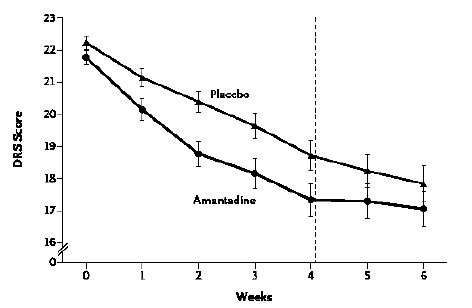
Amantadine for the Treatment of Traumatic Brain Injury and its Associated Cognitive and Neurobehavioral Complications

Abstract

Modifications of pro-inflammatory processes and neurotransmitter changes underpin the cognitive and neuro-behavioural consequences of traumatic brain injury (TBI). Amantadine has the potential to promote dopaminergic activity via multiple mechanisms involving facilitation of synaptic dopamine (DA) release, blockade of presynaptic DA re-uptake and increased DA synthesis via stimulation of Dopa Decarboxylase. Amantadine is also a non-competitive antagonist of glutamatergic (NMDA) receptors. Evidence from randomized controlled trials (RCTs) together with systematic reviews suggest that treatment with amantadine [100-300mg/d] is effective for improvements in level of consciousness and cognitive function in both acute and chronic care phases for up to 6 months post-TBI resulting, for example, in functional recovery in patients with TBI-related MCS or VS/UWS over 4 weeks of treatment. The majority of good-quality RCT’s also provide evidence for efficacy of amantadine in the treatment of the major neuro-behavioural sequelae of TBI such as agitation, irritability and aggression. These findings have resulted in updates of clinical practice guidelines for disorders of consciousness including those of the American Academy of Neurology which recommends that amantadine (100-200mg bid) be prescribed for adults with traumatic VS/UWS or MCS [4-16 weeks post-injury] to hasten recovery and reduce disability early in recovery [Level B].

Keywords

Amantadine, Disorders of consciousness, Neuro-behavioural outcomes, Practice guidelines, Traumatic brain injury

Background

Traumatic brain injury (TBI) has wide-ranging consequences for survivors’ quality of life. Disabilities include decreased level of consciousness (LoC) as well as cognitive, neuropsychiatric (anxiety, depression) and neurobehavioral sequelae the latter often taking the form of irritability, hyperexcitability, disinhibition, poor impulse control, agitation and aggression. Amantadine has the potential to increase the concentrations of dopamine (DA) in the brain and the agent is one of the most commonly prescribed medications for the management and treatment of patients with disorders of consciousness undergoing neurorehabilitation following TBI. The current review was initiated in order to (A) clarify current opinion relating to the mechanism of action of amantadine as an agent for the treatment of TBI and its associated CNS disorders and (B) to critically review the evidence in support of the efficacy of amantadine for the treatment of TBI and its associated cognitive and neuro-behavioural complications. Findings from individual published randomized controlled trials (RCTs) as well as related systematic reviews and meta-analyses are compiled and compared and some implications of the findings for the updating of practice guidelines are reviewed.

Mechanisms of action of amantadine in TBI

TBI and its attending alterations of central functional and chemical imbalances lead to region-selective modifications of pro-inflammatory processes and neurotransmitter changes that underpin the cognitive and neuro-behavioural consequences of the injury. The acute phase of recovery from severe TBI is characterized by a brief period of hyperexcitability followed by a longer period of hypo-excitability resulting from the depletion of multiple neurotransmitters one of which is dopamine (DA). [1] Amantadine has the capacity to promote dopaminergic activity via multiple mechanisms including the facilitation of the synaptic release of DA together with the blockade of DA re-uptake. Furthermore, amantadine has the capacity to stimulate the enzyme L-Dopa decarboxylase (DDC) resulting in increased DA synthesis, a process that is functionally-related to the antagonism of NMDA receptors. Stimulation of DDC activity secondary to NMDA receptor antagonism has been demonstrated in humans by the technique of Positron Emission Tomography (PET). [2] Moreover, PET studies in TBI patients lend credence to the notion that amantadine has the potential to improve CNS function via actions on the dopaminergic system that include significant improvements in prefrontal energy metabolism and function indicated by increased F18-deoxyglucose-PET with concomitant increases in dopamine-D2 receptor availability [3].

Evidence-based review of the efficacy of amantadine for the treatment of TBI and its associated loss of consciousness and cognitive dysfunction

Evidence from systematic reviews and meta-analyses

Amantadine continues to find widespread use in TBI as a means of increasing the speed and efficacy of cognitive recovery and rehabilitation. Results of systematic reviews of clinical trials have helped to fuel the debate on the comparative efficacy and safety of amantadine. Such reports include the following:

A report published in 2009 described the results of a review of the impact of pharmacological agents on cognitive outcomes in early stages post-TBI based upon reports published between January 1980 and May 2008 following searches of PubMed and PsycINFO databases using appropriate keywords and inclusion criteria. Amantadine treatment produced marked benefits by assessment of Glasgow Coma Scale (GCS); drug dosage and choice of outcome measures appeared to influence the probability of treatment benefit [4].

A study from The University of Toronto reviewed evidence of efficacy of pharmacological interventions for TBI based upon available published literature. Multiple studies found that amantadine (100-300mg/d) was effective in both the acute and chronic care phase post-TBI particularly for cognitivedifficulties and for improvement in level of consciousness as measured by GCS [5].

A focussed report described the results of a systematic review of the efficacy of medications for cognitive disorders post-TBI. Articles were searched via the Medline database from 1990 to 2012 along PRISMA guidelines. 89 references were analysed for a total of 1306 cases of TBI, 295 of which were treated with amantadine (50-400mg/d) leading to improvements in the level of vigilance, orientation, attention, processing speed and motor learning. Results of the review resulted in recommendations for good practise under the auspices of The French High Authority for Health [HAS] in collaboration with The French Society for Physical and Rehabilitation Medicine [SOFMER] [6].

In a review aimed at determining the efficacy of amantadine for improvement of cognitive function post-TBI, PubMed and CINAH databases were searched for articles published in the 1994-2004 period included a Cochrane review, a meta-analysis and several RCTs. Key points and recommendations included the effective use of amantadine leading to increased arousal and cognition compared to placebo leading to the conclusion that amantadine therapy(100mg/d) may be beneficial from 3 days to 6 months post-TBI [7].

A comprehensive review of the literature relating to the diagnosis, natural history, prognosis and treatment of disorders of consciousness (DoC) lasting more than 28 days was conducted with a view to updating American Academy of Neurology (AAN) practice guidelines [8]. The natural history of recovery from prolonged vegetative state/unresponsive wakefulness syndrome (VS/UWS) was found to be better in traumatic compared to non-traumatic cases and prognosis followed a similar pattern. Amantadine hastened functional recovery in patients with minimally conscious state (MCS) or VS/UWS secondary to severe TBI over 4 weeks of treatment. These findings led to an update of the practice guidelines for the treatment of patients with prolonged DoCs. It is recommended that clinicians prescribe amantadine (100-200mg bid) for adults with traumatic VS/UWS or MCS (4-16 weeks post-injury) to hasten functional recovery and reduce disability early in recovery (level B evidence) [9].

Evidence from the individual RCTs

An international RCT was undertaken in 184 patients who were in a VS or MCS 4 to 16 weeks following severe TBI. Patients received amantadine or placebo for 4 weeks followed by a 2-week washout period post treatment. The rate of functional recovery was assessed using the Disability Rating Scale (DRS). During the 4-week treatment period, recovery was significantly faster in the amantadine group compared to placebo. Post-hoc analysis of the distribution of DRS scores by outcome category revealed that more patients in the amantadine group had favourable outcomes on DRS compared to placebo with fewer remaining in a VS and a greater percentage manifesting recovery of key behavioural indices on the Coma Recovery Scale-Revised (CRS-R) at the end of the 4-week treatment period. It was concluded that amantadine is effective in accelerating the pace of recovery during acute rehabilitation in patients with prolonged post-TBI DoC [10], (Figures 1 A, B).

JPPR-3-1-305-g001a

Figure 1a. Rate of functional recovery (DRS score) as a function of duration of treatment with amantadine compared to placebo in patients with severe TBI. DRS scores were improved significantly more rapidly following amantadine during the 4-week treatment period compared to placebo. On weeks 5 and 6 (washout interval), recovery rate in the amantadine group were significantly slower. Error bars indicate mean values ± SE.

JPPR-3-1-305-g001b

Figure 1b. Effects of amantadine treatment compared to placebo on the distribution of scores on DRS as a function of the category of functional disability (DRS score). After 4 weeks of treatment, the proportion of patients in a vegetative-to-extreme vegetative state was significantly lower in the amantadine group by post-hoc analysis.

In order to evaluate the efficacy of amantadine sulphate for improvement of outcome, 90 patients with moderate to severe TBI were randomly assigned to one of two groups (n=45each). Group A received standard ICU protocol; Group B received additionally amantadine sulphate infusions (200mg/12h for 14 days). LoC was assessed by GCS 1, 2 and 4weeks post-injury with patient outcome assessed after 4 weeks by Glasgow Outcome Scale (GOS) Patients in Group A (amantadine) showed better improvement in GCS compared to group B (p<0.005) together with better outcome at the end of week 4 by GOS [11].

To evaluate the effects of amantadine on cognition in individuals with a history of TBI, a multi-site, parallel-group RCT of amantadine (100mg/d, twice daily for 60d) was made in 119 individuals with chronic TBI (> 6months post-injury). Cognitive function was measured on treatment days 0, 28 and 60 using a battery of psychological tests. Composite indices were generated for General Cognitive, Learning Memory and Attention/Processing Speed Indices. Repeated measures ANOVA revealed statistically-significant between-group differences favouring placebo for General Cognitive (p<0.002) and Learning Memory (p<0.001) Indices at day 28. Consequently, in contrast to the general consensus of opinion expressed in the studies described above, the use of amantadine for enhancement of cognitive function in chronic TBI was not supported by the findings of this trial [12].

Evidence-based review of the efficacy of amantadine for the treatment of TBI and associated neurobehavioral disorders

Systematic Reviews

A Canadian study reviewed evidence of efficacy of pharmacological interventions for TBI based upon published literature. Multiple studies found that amantadine (100-300mg/d) was effective in both the acute and chronic care phase post-TBI for the treatment of neuro-behavioural sequelae (agitation, anxiety) [5].

A Systematic review of RCTs aimed at determining the efficacy of dopaminergic agents on apathy, psychomotor retardation and behavioural management post-brain injury made use of searches of Medline, EMBASE, PsychInfo and Cochrane Clinical Trials databases. Six trials and 150 patients met inclusion criteria. Results suggested benefit for treatment ofagitation and aggression, but trial quality was compromised by faulty design, small numbers and heterogeneous outcome measures. One good quality trial demonstrated efficacy of amantadine for behavioural management [13].

A focussed report described the results of a systematic review of medications for behavioural disorders after TBI. Articles were searched via the Medline database from 1990 to 2012 along PRISMA guidelines. Eighty-nine references were analysed for a total of 1306 cases of TBI, 295 of which were treated with amantadine (50-400mg/d) leading to improvements in the level of vigilance, orientation, attention, processing speed and motor learning but insufficient evidence for the treatment of agitation, aggressiveness or anxiety. A note added in proof subsequently withdrew this latter statement. Results of this systematic review resulting in recommendations for good practise under the auspices of The French High Authority for Health [HAS] in collaboration with The French Society for Physical and Rehabilitation Medicine [SOFMER] [6].

The aim of a subsequent systematic review to critically evaluate evidence on the efficacy of pharmacological interventions for the treatment of aggression (primary outcome) following TBI in adults making use of databases from Medline, PubMed, CINSHL, EMBASE, PsychInfo and Central with use of the Cochrane Risk of Bias Tool. Ten studies were included, 5 of which were RCTs 2 of which reported evidence of efficacy of amantadine for the treatment of irritability with a further two positives for treatment of aggression [14].

Individual RCTs

An international RCT was undertaken in 184 patients who were in a VS or MCS 4 to 16 weeks after severe TBI.Patients received amantadine or placebo for 4 weeks followed by a 2-week washout period post treatment. The rate of functional recovery was assessed using the Disability Rating Scale (DRS). Clinically-relevant behavioural benchmarks were assessed by CRS-R. During the 4-week treatment period, recovery was significantly faster in the amantadine group compared to placebo in terms of key behavioural benchmarks including consistent command following, intelligible verbalization, reliable yes/no communication and other related tasks [10].

To evaluate a priori the hypothesis that amantadine reduces irritability and aggression in individuals more than 6 months post-TBI, 76 subjects were enrolled in a parallel group RCT of amantadine (100mg twice daily, n=38) versus placebo (n=38). Symptoms of irritability and aggression were assessed using NPI-I and NPI-A respectively as well as NPI-Distress domains. Amantadine resulted in 3-point improvements on NPI-I compared to placebo (p<0.0016) [15].

To further test the hypothesis that amantadine reduces irritability in TBI of greater than 6 months duration, 168 patients were enrolled in a multi-site RCT of amantadine versus placebo. Participants received amantadine hydrochloride (100mg bid) versus placebo for 28 and 60 days. Symptoms of irritability were measured before and after treatment using the Neuropsychiatric Inventory Irritability (NPI-1) domain as well as the NPI-Distress. In the amantadine group, significant improvements were observed compared to placebo on NP-1 (p<0.04) and NP-1 Distress (p<0.04). Results were not significantly different following correction for multiple comparisons. CGI scale demonstrated greater improvements for amantadine compared to placebo (p<0.04). It was concluded that amantadine 100mg every morning and noon to reduce irritability was not positive from the observer perspective although there were indications of benefit at day 60 from the perspective of patients with TBI and their clinicians that may warrant further study [16].

A subsequent report from the same group of investigators described un # 3.2.3 (above) described findings related to the potential benefits of amantadine 100mg twice daily on anger and aggression in 168 patients with chronic TBI. Measurements of anger and aggression were made using State-Trait Anger Inventory Expression-2 (STAXI-2) and NPI-A Most Problematic and Distress scores. Amantadine 100mg bid appeared to be beneficial in decreasing aggression from the patient with TBI standpoint but had no impact on anger [17].

Implications for the updating of national practice guidelines for disorders of consciousness

The results of two high quality systematic reviews summarized under sections 3.1 and 3.3 of the current review provide the basis for the updating of clinical practice guidelines relating to disorders of consciousness. The first one from France resulted in recommendations for good practice (RGP) under the auspices of The French High Authority for Health (HAS) in collaboration of the SOFMER Scientific Society of Physical and Rehabilitation Medicine. The second one from the United States appeared in the form of a report of the Guideline Development, Dissemination and Implementation Subcommittee of The American Academy of Neurology (AAN), the American Congress of Rehabilitation Medicine (ACRM) and the National Institute on Disability, Independent Living and Rehabilitation Research (NIDLRR).

The specific recommendations based on the findings of these reviews are as follows:

United States (American Academy of Neurology) 2018 [8]

A. Patients with traumatic VS/UWS or MCS who are from 4-16 weeks post-injury should be prescribed amantadine 100-200mg bid to hasten functional recovery and reduce degree of disability in the early stages of recovery providing there are no medical contraindications or other case-specific risks for use [level B].

B. Amantadine (100-200mg bid) when administered over a period of 4 weeks in patients aged 16-65 yr with traumatic DoC between 4-16 weeks post-injury probably hastens functional recovery in the early stages. Faster recovery reduces the burden of disability, lessens health care costs and minimizes psychosocial stressors in both patients and caregivers.

C. No identified therapeutic studies have enrolled paediatric populations so far. The only therapeutic intervention shown to have efficacy in adults (16-65 yr) is amantadine. A retrospective case-controlled study of amantadine use in patients with TBI reported that 9% of children taking this treatment had side effects but methodological concerns limit therapeutic conclusions in this study.

France (French Society of Physical and Rehabilitation Medicine SOFMER) 2016 [6]

A. There is insufficient evidence of the efficacy of amantadine in the treatment of agitation, aggressiveness and anxiety after TBI. Improvement of apathy, the decision-making process or motivational disorders was reported in case studies with amantadine (300mg/d). Amantadine has no marketing authorization (MA) to treat apathy. The prescription of this drug should be evaluated for each individual case according to the criteria associated with treatments prescribed outside the MA on top of the precautions of use [Expert consensus (EC)].

B. In a note added after 2012, the end of the time-line of their systematic review, the authors added the following note: Two articles published in 2014 and 2015 contradict recommendation (A) above. The work of Hammond et al., 2014 [15] tends to demonstrate with a high level of evidence [grade A] the efficacy of amantadine (200mg/d) for treatment of irritability and aggressiveness associated with chronic TBI. Thus, the frequency and severity of these symptoms are decreased. It was a single centre study and extension to a multicentre level [16] did not validate the result. A strong placebo effect (observation bias) was underlined in both studies. No different adverse events were reported compared to placebo.

C. Amantadine was well tolerated.

Health Canada indications of use: Recommendations on the pharmacological management of TBI-related impairments [18]

A. Consider amantadine to improve attention in individuals with TBI who are out of post-traumatic amnesia and who have not responded to other medications. Recommendation # J 3.3, level: B

B. May be considered to enhance arousal and consciousness and accelerate the pace of functional recovery in individuals in negative or minimally-responsive state following TBI.Recommendation Priority # J 3.4, level: A

C. The use of amantadine 100mg can be considered for individuals with TBI when impaired arousal and attention are suspected as a factor in agitation. Recommendation Priority # R 10.5 (New), level: B.

Brasil 2018 (Tratamento farmacológico do traumatismo cranioencefálico: recomendações)[19]

Making use of the methodological strategies advocated by the Appraisal of Guidelines for Research & Evaluation [AGREE II] and evidence strengths from A to D it was determined that:

A. Amantadine was safe and effective in reducing frequency and severity of irritability (p<0.0085) and aggression (p<0.046) post-TBI.

B. In patients in a persistent VS of MCS 4-16 weeks post-TBI, amantadine accelerated the rate of functional recovery during the 1st 4 weeks of treatment compared to placebo (0<007).

C. Consequently, the overall conclusion was that amantadine was recommended to improve functionality between 4 and 16 weeks post-TBI with a degree of recommendation and strength of evidence: level A .

Conclusion

The present review serves to identify multiple studies in both acute and chronic care phases of TBI in which significant benefit of amantadine (100-300mg/d) are recorded and it has been suggested that the agent is particularly useful for cases of diffuse, frontal or right-sided brain injury. Improvements in arousal and level of consciousness as determined by GCS were accompanied by improvements in the level of vigilance, orientation, attention and cognition that were beneficial from 3 days to 6 months post-TBI in many cases. Moreover, amantadine treatment was found to hasten functional recovery from prolonged VS/UWS particularly in traumatic cases. In contrast to the general consensus in most studies, one study failed to find benefit of amantadine for the enhancement of cognitive function in chronic TBI. Surprisingly, as of March 2020, there have been no meta-analyses conducted on the results of RCTs cited in the present review and elsewhere relating specifically to the efficacy of amantadine for the treatment of TBI or its associated disorders of consciousness.

In contrast to the consensus of opinion on the efficacy of amantadine for the treatment of levels of consciousness and cognitive function post-TBI, studies of the effects of the agent for the treatment of neuro-behavioural complications such as irritability, agitation and aggression gave inconsistent results. This was apparent from the results of both the RCTs themselves and in systematic reviews assessing these trials. Possible sources of variance raised in discussions of the findings of these trials include design issues and heterogeneity of outcome measures as well as statistical procedures. Further studies are clearly warranted in order to resolve these issues.

References

  1. Giacino JT, Whyte J, Bagiella E,Kathleen Kalmar, Nancy Childs, et al. (2012) Placebo-controlled trial of amantadine for severe traumatic brain injury. N Engl J Med 366: 819-826.
  2. Deep P, Dagher A, Sadikot A, Gjedde A, Cumming P (1999)Stimulation of dopa decarboxylase activity in striatum of healthy human brain secondary to NMDA receptor antagonism with a low dose of amantadine. Synapse 34: 313-318. (Crossref)
  3. Kraus MF, Smith GS, Butters M, Donnell AJDixon E et al. (2005) Effects of the dopaminergic agent and NMDA receptor antagonist amantadine on cognitive function, cerebral glucose metabolism and D2 receptor availability in chronic traumatic brain injury: a study using positron emission tomography (PET). Brain Inj 19: 471-479. (Crossref)
  4. Wheaton P, Mathias JL, Vink R (2009) Impact of early pharmacological treatment on cognitive and behavioral outcome after traumatic brain injury in adults: a meta-analysis. J ClinPsychopharmacol29: 468-477. (Crossref)
  5. Talsky A, Pacione LR, Shaw T, Wasserman L, Lenny AM, Verma A et al. (2011) Pharmacological interventions for traumatic brain injury. BC Medical Journal 53: 26-31.
  6. Plantier D, Luauté J. SOFMER group (2016)Drugs for behavior disorders after traumatic brain injury: Systematic review and expert consensus leading to French recommendations for good practice. Ann PhysRehabilMed 59: 42-57. (Crossref)
  7. Stelmaschuk S, Will MC, Meyers T (2015) .J Trauma Nurs 22: 194-203. (Crossref)
  8. Giacino JT, Katz DI, Schiff ND,Ashman EJAshwal S et al. (2018) Practice guideline update recommendations summary: Disorders of consciousness: Report of the Guideline Development, Dissemination, and Implementation Subcommittee of the American Academy of Neurology; the American Congress of Rehabilitation Medicine; and the National Institute on Disability, Independent Living, and Rehabilitation Research. Neurology 91:450–460. (Crossref)
  9. Giacino JT, Katz DI, Schiff ND,Whyte JAshman EJ et al. (2018) Comprehensive systematic review update summary: Disorders of consciousness: Report of the Guideline Development, Dissemination, and Implementation Subcommittee of the American Academy of Neurology; the American Congress of Rehabilitation Medicine; and the National Institute on Disability, Independent Living, and Rehabilitation Research. Neurology. 91: 461-470. (Crossref)
  10. Giacino JT, Whyte J, Bagiella E,Kathleen Kalmar, Nancy Childs, et al. (2012) Placebo-controlled trial of amantadine for severe traumatic brain injury. N Engl J Med. 366: 819-826.
  11. Gafaar T, SaadElDin S, Salem H, οkasha F (2016) Amantadine sulfate effects on the outcome of patients with moderate and severe traumatic brain injury. Zagazig University Medical Journal  22: 1-8.
  12. Hammond FM, Sherer M, Malec JF,Zafonte RDDikmen S et al. (2018) Amantadine Did Not Positively Impact Cognition in Chronic Traumatic Brain Injury: A Multi-Site, Randomized, Controlled Trial.J Neurotrauma35: 2298-2305. (Crossref)
  13. Sami MB, Faruqui R (2015)The effectiveness of dopamine agonists for treatment of neuropsychiatric symptoms post brain injury and stroke. ActaNeuropsychiatr27: 317-326. (Crossref)
  14. Hicks AJ, Clay FJ, Hopwood M, James ACJayaram M et al.  (2019)The Efficacy and Harms of Pharmacological Interventions for Aggression After Traumatic Brain Injury-Systematic Review. Front Neurol. (Crossref)
  15. Hammond FM, Bickett AK, Norton JH, Pershad R (2014) Effectiveness of amantadine hydrochloride in the reduction of chronic traumatic brain injury irritability and aggression. J Head Trauma Rehabil 29: 391-399. (Crossref)
  16. Hammond FM, Sherer M, Malec JF, Zafonte RDWhitney M,  et al. (2015) Amantadine Effect on Perceptions of Irritability after Traumatic Brain Injury: Results of the Amantadine Irritability Multisite Study. J Neurotrauma32: 1230-1238. (Crossref)
  17. Hammond FM, Malec JF, Zafonte RD,Sherer MBogner J, et al. (2017) Potential Impact of Amantadine on Aggression in Chronic Traumatic Brain Injury. J Head Trauma Rehabil. 32: 308-318. (Crossref)
  18. Ontario Neurotrauma Foundation. Clinical Practice Guideline for the rehabilitation of adults with moderatetosevereTBI2017.
  19. Anghinah R, Amorim RLO, Paiva WS, Schmidt MT, Ianof JN (2018)Traumatic brain injury pharmacological treatment: recommendations. ArqNeuropsiquiatr 76: 100-103.

Listening to our Environments: Soundscape Analysis in Geographic Research

DOI: 10.31038/GEMS.2020212

Keywords

Acoustic ecology, Biogeography, Geography, Marine habitats, Soundscapes, sound ecology, soundscape analysis

Introduction

The study of sound and the soundscape is a burgeoning arena that is taking hold in the fields of earth science research. The sensory experiences of our studies often disregard the sonic elements of our environments. The visual is privileged over the other senses, which means that we miss an important aspect of our surroundings that can participate in our research [1].I argue that we need to incorporate more of our sensory experiences. I will discuss the history of the field of sound/soundscape research in geography, focusing on the introduction of sound studies into cultural geography. I will explore the development of sound studies into various branches of geography and the new methods that are being utilized for studying ecosystems, specifically marine ecosystems. I will conclude with some thoughts on the use of soundscapes to benefit our research and its usefulness in our future endeavors.

Soundscapes in Geography

The work of sound studies and acoustic ecology began with R. Murray Schafer’s [2], establishment of soundscape studies at Simon Fraser University. In the geographic literature that examines sound, scholars have established a foundation from the landscape tradition [3, 4]. The word landscape is often used in reference to landscape painting, but is geographically a portion of the earth’s surface, which includes all the natural and human entities that fall within that landscape. The artistic creation is simultaneously a depiction of the already known as well as a place to reimagine the landscape [3, 5]. Landscape as a cultural production is important to the depiction of place and the intricate detail that is provided in the painting of a place. The method to landscape in geography, through its many different approaches, opened the way for geographers of sound to explore the role of sound and the soundscape as a way of hearing a portion of the natural and cultural environment. Soundscapes are ephemeral and are ever changing; they are not as permanent as the visual of the landscapes and can provide insight into the reconstruction of place and the environment. The ephemerality of the soundscapes is often overlooked. Sound can bring attention of the ephemeral to the experience of the landscape where the visual of the landscape is more material and formal.The soundscape tradition in geography draws from the works of landscape geographers and incorporates the scholarship of sound studies, beginning with the soundscape [6-8]. According to Schafer [2], the soundscape is a merger of the word landscape and sound that focuses on the sounded aspect of an environment beyond just traditional ideas of music and musical performance. The soundscape is the total sound environment that can be perceived in any given moment in any place and includes three types of sounds: (1) geophony, natural sounds such as the wind, water, and earth, (2) biophony, sounds of animals such as birds, whales, and insects, and (3) anthrophony, humanly produced sounds [2, 9-10]. His book, The Soundscape: Our Sonic Environment and the Tuning of the World, provides a starting place to discuss how individuals identify soundmarks, or sounds from a place that signify a particular environment, within a soundscape and use them to evoke place. Schafer discusses the importance of hearing as a special sense that is often overlooked, but one that provides important information that can tell us about society and the environment.Recently, sound artists have discussed the importance of the sonic landscape and the role of environmental sounds in forming our sense of place and understanding our environments [11]. According to the sound artists interviewed by Bianchi and Manzo[11], developing a “counterpoint to visual thinking” we sharpen our other senses and increase our ability to think with our ears. The ways in which individuals hear places and locate their sense of place is directly affected by the sounds of the places they inhabit (Bianchi and Manzo, 2016)-11. Dr. Ximena Alarcon, a sound artist specializing in migratory spaces that are in between the departures and destinations of a traveler, argues that as individuals move their “memory and senses look for references that help [them] to accept and understand a new place” [11]. Individuals listen for acoustical markers of places as a way of describing new places as compared to their old environments. Sound is now recognized as an important means to comprehend the world. As such, further study of sound and their connections to a place is a timely pursuit. Building upon soundscape studies provides a link between geography and music.The sense of hearing and the information it provides offers building blocks for examining the environment [12]. Lily Kong has argued that geographers should be exploring at sound to study society and the environment because“…just as [music] is a medium for conveying myriad experiences, music is also the outcome of environmental experience. Musicians write their music as a consequence of their experiences. Music can thus be said to possess a dual structure: as both the medium and the outcome of experience, it serves to produce and reproduce social systems” [12-14] contend that sound contributes to human interactions with the environment. Sound had been studied for its ability to change one’s perception of the natural world and an individual’s imagined creation of places through feelings, emotions, and atmospheres [2]. Soundscapes were also an early concern of geographers, including George Revill [15] and Lily Kong [12], who studied sound within the landscape to explain what was considered pleasant in place and what counted as noise or being out of place or disruptive to an environment. The concept of soundscape provided geographers a way to study human environments as places [13]. Researchers can use this sonic knowledge of place to consider how individuals and communities reflect and inhabit their places and interact with their environments.Another way to study sound is to focus on listening. “Listening points to a theorization of place and people as intertwined as sound passes through and into the body” [16]. Scholars need to reconsider the human-environment relationship, there are many sounds in place and many interpretations of that place. Everyone experiences sound differently and they listen differently, therefore individuals’ perceptions of sound can be read differently into a collected whole articulating meaning in place and the stability and health of an environment [16].

Soundscape and Ecosystem Analysis

The recording of the soundscape to examine the sounds of an environment can add to our studies of the environment beyond the study of place or our traditional studies of ecosystems measurement and biodiversity. According to Jachowski, soundscape analysis not only supports a qualitative analysis of place but offers researchers a way to examine ecosystem health through sound. In the past, traditional ecological assessment such as soil analysis, worm density surveys, and vegetation surveys, have been key in examining ecosystem health. Present studies have taken from the cultural geography of sound the importance of incorporating sound into our research. Soundscape ecology, as part of the development in sonic geography, provides a way to examine environmental sounds toassess ecosystem health. One method in the measurement of ecosystem health is taking recordings that are comprised of biophonic, anthrophonic, and geophonic sounds. This process incorporates all elements of a site, offering a more holistic view of a study area [10]. The biophonic data that is collected from a study area can be an indicator of ecosystem health, just as soil analysis, tagging, or vegetation can be used to examine that systems health. As Krause [10] examines, soundscape recordings can reveal changes in the environment. Recordings taken over multiple years of the same site offer a way to study alterations in the environment. Collecting the sound data of a place can help researchers explore developments such as the decline in some species or the movement of different species to or from other areas. The anthrophonic sounds are also useful when collected as part of the soundscapes. These sounds in the collective soundscape established the role that ambient anthrophonic sounds have on the non-human natural environment [17,18]. The workings of the soundscape extend beyond the terrestrial world for the study of ecosystem health and habitat restoration. Soundscape ecology offers new avenues for the study of underwater habitats and the effects of anthropogenic sounds on marine life. Soundscapes have been used for some time to analyze the inhabitants of a marine ecosystem [17, 19]. Soundscape recording has been a more efficient way to explore biodiversity, ecosystem health, and environmental degradation because sound contains a plethora of data. Sound recording helps with the issues of data collecting in a marine environment. For example, who studying the population of mussels, fish, and other invertebrates that traditional methods of catch and release, tagging, and observation can be time consuming, costly, and difficult. Sound recording requires a few recording devices, microphones, and if equipment is available remote monitors. Once the data is recorded and either sent via wireless connections or collected from memory cards in the field, that data can then be displayed in a spectrogram. Depending on the memory sources, data can be collected for days and months constantly, providing researchers a vast amount of data for an ecosystem; data can also be easily collected over periods of years and compared. The use of soundscape recordings in the fields of biogeography, marine biology, soundscape ecology, and other earth sciences can provide new methods of examining ecosystem health and habitation as well as biodiversity through listening to the places we are studying.The availability and accessibility of recording equipment has helped scientists and citizen scientists with the collection of vast amounts of data. With the increase in the availability of tools for data collection, a push for more analysis tools have come to the fore as the listener and the visual and auditory analysis of a spectrogram is not enough for the mass amounts of data we have from the field. The tools for the analysis of soundscapes and acoustic habitats have grown steadily. In the statistical software, R, there now exists packages designed for the purpose of soundscape ecology [20]. These soundscape packages are helpful in analyzing spectrograms for the acoustic complexity, diversity, and evenness of a habitat. The packages also assist in differentiating between signals such as different species of birds and marine life, which assists in the analysis of the number of species in a location.

Conclusion

The future of research in geography, ecosystem health, and marine habitats will continue to benefit from the use of soundscape analysis. As I have discussed above, soundscapes provide another dimension to our traditional research that not only deepens our knowledge of our study sites, but it can also provide a more holistic view of our research areas. Using field recordings, researcherscan evaluate the impacts of humans and human sounds on fish habitats and various fish species. The soundscapes of underwater habitats contain much more information than can often be collected by traditional means. Examining the sounds of an underwater system exposes the impacts of human generated sound on the environment. It can also display the biodiversity of a site that often cannot be visually examined [18]. The sounds that are produced in or around a marine ecosystem can cause changes in that system. The study of the sound recordings can help researchers better understand the role of sound on species development such as the productivity and growth of mussels, the health of sponge habitats, and the sounds of tropical habitats based on acoustic signals [17, 21]. In the future as scholars and researchers we need to look toward using soundscapes for analysis of ecosystems, habitats, and human-environment relationships. We can also use soundscapes as a method to involve our communities and collect more data from citizen scientists, by getting more people involved and aware of their environments. The new recording methods and analysis of soundscapes will shed new light on our research of ecosystems health and assist in the preservations of those environments. As researchers, we might take these methods to answer questions such as: what causes change in an ecosystem from year to year? Does sound affect marine life, and can it cause the degradation of a marine habitat? Do anthropogenic sounds influence or change a marine environment and influence biological life development? Can we track the changes in a habitat to see the influence of severe weather on an ecosystem and will these new methods provide accurate results beyond our traditional methods? Finally, will soundscape data and analysis help scholars and citizens create awareness, preservation and restoration of marine habitats?.

References

  1. Atkinson R (2007) Ecology of Sound: The Sonic Order of Urban Space. Urban Studies 44: 1905-1917.
  2. Schafer RM (1993). The Soundscape: Our Sonic Environment and the Tuning of the World. Rochester: Destiny Books.
  3. Cosgrove D (1985) Prospect, Perspective and the Evolution of the Landscape Idea. Transactions of the Institute of British Geographers 1: 45-62.
  4. Feld S, Basso KH (1996). Senses of place. Santa Fe: School of American Research Press.
  5. Duncan J (1995) Landscape geography, 1993-94. Progress in Human Geography 19: 414-422.
  6. Hilmes M (2008) Foregrounding sound: new (and old) directions in sound studies. Cinema Journal 48: 115-117.
  7. Pinch T, Bijsterveld K (2012) The Oxford handbook of sound studies. New York: Oxford University Press.
  8. Polli A (2012). Soundscape, sonification, and sound activism. AI & SOCIETY 27: 257-268.
  9. Truax B (1992). Composing with Time-Shifted Environmental Sound. Leonardo Music Journal 2: 37-40.
  10. Krause B (2016). Wild Soundscapes. New Haven: Yale University Press.
  11. Bianchi FW, Manzo VJ (2016) Environmental sound artists: In their own words. New York: Oxford University Press.
  12. Kong L (2006) Music and moral geographies: Constructions of “nation” and identity in Singapore. GeoJournal, 65: 103-111.
  13. Leyshon A, Matless D, Revill G (1995) The Place of Music. Transactions of the Institute of British Geographers 20: 423-433.
  14. Matless D (2005) Sonic geography in a nature region. Social & Cultural Geography 6: 745-766.
  15. Revill G (2000). Music and the Politics of Sound: Nationalism, Citizenship, and Auditory Space. Environment and Planning D: Society and Space 18: 597-613.
  16. Duffy M, Waitt G (2011) A Method for Listening to Place, 18.
  17. Butler J, Stanley JA, Butler MJ (2016). Underwater soundscapes in near-shore tropical habitats and the effects of environmental degradation and habitat restoration. Journal of Experimental Marine Biology and Ecology, 479: 89-96.
  18. Coquereau L, Lossent J, Grall J, Chauvaud L (2017). Marine soundscape shaped by fishing activity. Royal Society Open Science.
  19. Harris SA, Radford CA (2014) Marine soundscape ecology. INTER-NOISE and NOISE-CON Congress and Conference Proceedings. Institute of Noise Control Engineering pp. 5003-5011.
  20. Villanueva Rivera LJ, Pijanowski BC (2018). Soundscape Ecology. CRAN.
  21. Vazzana M, Celi M, Maricchiolo G, Genovese L, Corrias v, et al. (2016). Are mussels able to distinguish underwater sounds? Assessment of the reactions of Mytilus galloprovincialisafter exposure to lab-generated acoustic signals. Comparative Biochemistry and Physiology 201: 61-70. [crossref]

Menstrual Restrictions and Its Impact on Learning and Education: A Case from Jumla, Nepal

DOI: 10.31038/AWHC.2020324

Abstract

The study entitled `menstrual restrictions and its impact on education’ has done in the accessible village of Chandanath municipality in Jumla where employed qualitative approach, post positivist world view by using multiple methods; history talking/timeline, participatory observation and In-Depth Interview. Participants followed the restrictions during menstruation no matter whether the participants male or female, educated or uneducated or any characteristics. The restrictions grouped in three categories: touch, eat and mobility/participation. All kinds of restrictions have direct and indirect negative impacts on learning and education in many ways: embarrassing learning condition at school, home and huts, constraints of time, facilities at school, home and hut, fear of leaking, deprived from studying, poor performance and school dropped out. The menstrual restrictions and its impact on education has overlapped with the empowerment. Thus, it has significance value to improve the policy on education specially for girls. This study has done for the academic purpose and completed with limited resources.

Introduction

Globally, having menstruation considered some forms of an impure, dirty, contaminated, bad and matter of silence, stigma, taboo. Thus, the girls miss the classes at school for few days during menstruation because they have to travel in school as well as they cannot focus on class [1]. Because the girls were teased or harassed by the boys, boys somehow know about that she is menstruating (Lawrick, n.d.). Increase in a year of secondary education helped not only increase the annual per capita income but also improve the maternal and children health by marrying later and eventually improve the decision making process [2]. Many researches revealed that the menstrual practices heavily impacted on acquiring quality education. Mugambi & Georgas, (n.d.) found that the adolescent girls discourage to go school, dropped from school and lose 3.5. Million learning days per month due to poor management in school for menstruation in Kenya. In rural Malawi, one third school girls remined absent at least one day during menstruation it is associated with school infrastructure specially toilet [3].

In Afghanistan, Bangaladesh, Bhutan, Sri-Lanka, girls are missing classes at least one to two days during menstruation [4].

In Nepal, parents denied to continue their study during menstruation by assuming that the school is holy places and menstruation is sin, found in focus group discussion (FGD) and eventually they do not only failing in class but also dropped out from school due to stigma and lack of menstrual friendly school environment [4]. Pandey further added that the girls couldn’t pay adequate attention in preparation of exams due to their menstruation. In the same vein, among 5609 participants, 12.1 percentages reported school absenteeism due to menstrual stigma and 33.6% reduced their regular work including education. Among the In-School and Out- School Adolescents girls, the menstrual restriction is recognized as an important barrier for development of self-efficacy and collective efficacy [5].

Nepali communities, regardless of class, caste, religion, region, the restrictions during menstruation is common. It has immediate and long-term negative impacts on the life of girls and women including education. During menstruation, girls deprived from going to schools though the number of days vary from place to place. Despite having lots of women’s movement raised up in Nepal, such as equal citizenship rights, stop rape etc. but the most feminists, activists and organizations remained silent around the menstruation which resonates the women’s oppression as well as menstruation as matter of taboo.

In this connection, this study took place to provide an evidence to all relevant actors specially for educators on how does menstrual restriction impacted on education by addressing following questions;

i) what are restrictions practised during menstruation, and

ii) to what extent, the education affects by restrictions during menstruation?

Methodology

This study aligned with qualitative study, post positivist world’s view where the feminist ethnography employed in order to explore the answers of restrictions during menstruation and its impact on education [6]. The cautions took place for consideration of reflexivity through explained the purposes, process and outcomes with gate keepers and participants throughout the field work. Because of the knowledge of having practice of restrictions during menstruation and accessibility with transport, Kartikswami village of Chandanath Municipality, Jumla selected for this study [7]. The ethical procedures undertook before, during and after the collection of the data: approval took from National Health Research Council, August 2017, took verbal and written consents and maintained safety and security of the data.

By considering the principles of Elana D. Buch & Karen M. Staller [4] this research employed following methods for data collection;

Life history/Timeline: The four menstrual participants identified through consultation meeting with gate keepers then snow ball, who represented the age between 28-40 years. All participants married, Hindus and mixed caste (two were from higher caste and the remaining belonged with Dalit and Chhetri respectively). Regards to education, none of them been to school.

Participatory Observation (non- participant to participatory): The total six participants identified for participatory observation for three days. They, all were married and four been to school. The checklist prepared for observation and enquired in between the observation. Specially, the observation had done around the menstrual women such as their place of living, their clothing, their physical gesture and sitting/sleeping, their interactions (family and social), their physical appearance, their personal behaviours/emotions/feelings, their key influencers, their food/liquid intake, their restrictions (private, public), their mobility, their used and management of sanitary materials, and their cleanliness observed [8]. The observation checklist prepared for the observation.

Mass observation: Researcher observed two mass activities; Teej celebration (Annual festival specific for women called red colour festival as well) and Temple observation where enquired with the women who were observed from distance.

In-Depth Interview with Key Informants: The total 17 participants: female 8, male 9, identified for In-Depth Interview, age ranged 14 to 80. Both female and male have experienced of restrictions during menstruation though they represented teacher, health workers, traditional healers, media workers and housewife. Except three females, all were married. Regards to education, except one participant, all were educated. In terms of caste, only two participants were belonged with Dalit. The interview guide prepared for administration of In-Depth Interview.

In order to triangulate the data, the varieties of methods used, probed the questions and followed up the visits to get deeper level of discussions. Further, the field diary, logbook, footage of videos, photos used. In this study, the data analysis is ongoing process started from data collection. The recorded data transcribed, coded, developed patterns and generated themes. The multiple attempts of peer review, consultation with supervisor had done for ensuring the accuracy, grounded of data, logical inferences, appropriate themes, justified decisions and methods, credibility and biasness.

Results

Three types of restrictions during menstruation and its impact on education discussed in upcoming paragraphs.

Restrictions on dring Menstruation:

The place, person and things are restricted during menstruation due to consideration of menstrual blood as an impure. The place comprised of: foundation of house, house, kitchen, temple, toilet, person comprised of: male member, faith healers, seniors, priest, things comprised of tap, river, intercourse, book, cattle, clothes, and plants of vegetables and fruits. Likewise, girls and women not allow eating rice, vegetables, fruits, milk products, prasad, meat products, beans, sour foods during menstruation. They also are prohibited in mobility, cannot work inside the house, same road or place as seniors walk/work, around the temple, meetings and cultural celebrations.

Impact on Learning and Education

Menstrual Taboo:

The elder participants had not had the opportunity to go school during their days. After marriage to date, they cannot join any formal and informal gatherings at home and community during menstruation by thinking of something would go wrong due to contamination with `impure’ blood.

Often, informal gatherings took place either at the roof or yard of the house. The house owner scared and made announcement for not joining the meeting to those who have menstruation because their god was so strict or something would go wrong at family.

Sometimes, the gatherings lead or participated by the men or faith or religious leaders or seniors who would sick if any menstruating women touch or contaminated them and place. Sometimes, few women do announce that they do not prefer to contaminate with menstrual girls and women in meetings/gathering. During the field work, a meeting was organized at the yard of house and the other menstruating women denied to join. Menstruating women said that this house owner could blame her if something would go wrong on her health and family in future therefore, they did not like to join in meetings.

Sometimes, menstruating women do not like to go there by thinking any possible sickness on their body and family due to contaminations with others.

The participants who went to school, they remained absent in school 3-5 days (will discuss later in details). The participants who are in school and college are also do have taboo on menstruation as well as have to follow the restrictions as other participants are practicing. Because of this restriction, the `fear’, `inferior’ complexity and participants started to remain far, tried to avoid the direct interaction with them.

Shyness and Embarrassment against Menstruation:

All female participants experienced shyness/embarrassment while they started to know the state of `purity’ and `impurity’ due to menstruation. Without having menstruation, they started to experience the feeling of shyness and embarrassment if someone or specially boy and men member talked about menstruation. Usually, these kinds of discussion started if someone absent at their surroundings or work. They learned such culture of shyness and embarrassment from seniors, mothers, sisters at home and community. However, they felt more shyness and embarrassment right after the first menstruation. Despite knowing little bit about menstruation, they had feeling of extreme form of shyness, embarrassment and losing something in the family and community. It is very deep and vague feeling that hard to explain. Suddenly, they do not like appear in front of the any men members such as grandfather, father, elder brother etc. at home and other at neighbourhood. They also do not like to mix up with their contemporary boys or class mates.

In other hand, the men members at home and community keep asking about their age, education and linked the discussion with maturity or marriage. The boys from their class, often from senior class also started to tease while meeting. They often make jokes if they see something wet on the back of butt or bench. They also asked haphazardly if they feel bulky bags too.

Gradually, they become familiar and started to cope with all sorts of teasing, comments and difficulties though some sorts of shyness and embracement is existing within themselves. Therefore, they are trying to hide such discomfort on their body as well as on face. In this scenario, they are more focus on menstruation instead of their overall learning and study.

`I have observed leaking. We shared with close friends only. Even we do not like to share all girlfriends. Four of us know about her leaking. Therefore, we four stay in class room in between the classes or break. We are trying to engage in gossip or something related with study as we pretending that we are there because of reason. At the end of the day, we let go all friends first. If others asked to go together, we just try to persuade them that we have work. When all go out, we simply use the shawl or sweater to wrap on her lumber to hide the blood. Meantime, few friends bring the water in noodle’s cover to wash the bench’.

IDI_Adolescent Girl_17

Because of shyness and embarrassment, menstruating girls and women do limit themselves to participate in other activities such as playing with siblings even with girls. They feel discomfort in playing or going anywhere so just living in single place where no one come without let them know.

Parent Discourage Menstruating Girls Read Books at Home

During the first menstruation, parents asked not to touch any reading materials absolutely due to fear from god of wisdom. It is a form of deprivation and violation of human right (right to education) from education or learning which is violation of human right for education.

A young girl, she disobeyed the norms imposed by her mother and from neighborhood and continued her education during her first menstruation. She persuaded her siblings and friends to bring the essential reading materials and continue her study.

Children are deprived from Study at Home

Because of menstrual restrictions followed by menstruating mothers and sisters at home, the young children’s study is compromised in many ways. No matter whether the children are male or female, they have to cook the food as instructed by their mothers.

` (short smile…) sister, during menstruation, we, menstruating women could not enter in to house. The seniors or men members usually do not like to cook food. Thus, we need to ask for our children. If they are grown up well, they cook whatever they know. If not, we keep instruct them to cook from outside of the house during regular menstruation. Nowadays, the young children do not like to cook, they get angry, they cry and keep denying to cook because of not able to enough time to do homework or reading. My daughter simply cooked the rice to me as well. She always created dispute if I asked to cook handmade bread instead of rice. Rice supposed not to eat during menstruation as our culture.’

Lifehistory/Timeline_Housework_Bramin_1

Besides of cooking, they also need to engage for supplying the essential materials to their mothers, sisters, and aunts. Sometimes, they have to serve the foods, sometimes bring the soap, cloths, or any others materials as they asked. Sometimes, they also have to go here and there as asked by menstrual mothers, sisters and aunts where their concentration for study is not enough. Sometime, they have to go at field to serve food, water and sometimes have to go up to their mothers and sisters to consult with them on what to cook, how do cook or what should do or what should not.

`I was shocked when I knew that my sister could not fetch the water even after entering in to house. She had no more blood in her body but she still considers impure and dirty. I got so irritated when she kept asking like for water, cloth, food etc. because I was distracted so much from my own task.’

IDI_Healthworker_Female_11

In few families, because of menstruation, women and young women who could do significant work inside and outside of the house, other family members such as grandparents, men members projected their anger and frustration with young children. Sometimes, they scared and unbale to concentrate regards to their work and study. Young children experienced so challenging and feeling so long for five days due to constant pressure from their family members.

Those who do not follow the restrictions, they have more confidence to deal every day and learn anything. In many cases, even outsiders do not notice whether the girl or women have menstruation or not.

`……..(big smile) ……you know didi (sister), this is big hotel in Jumla. In our hotel, we do not follow the any kinds of restrictions except Puja. Our customers are minister, billionaire, dalit, Hindu, Muslim etc. I am and serving food during menstruation too’. I never feel scared in front of them. I am feeling that I have confidence to do anything’.

Informal Meeting_Feamle_Lama

Limited Time for Study due to the Restrictions on Water, Toilet, Bath, and Washing clothes

Almost all participants, who were in school, did not go to the school during first menstruation therefore there was no worry about the homework. They were not allowed to touch any kinds of reading materials too.

Only one young participant went to school during her first menstruation. However, her learning and study also compromised at home because she has to ask her essential materials for reading either from mother or siblings due to unable to enter in to house. She shared that she had to please her siblings either giving some gifts or money to get the materials as her need and interest. They kept denying and arguing so many things including letting her mother about her asking to get such restricted materials.

In regular menstruation, the learning and study is compromised in two ways. First, they have to engage in heavy works outside of the house which is planned for the time of bleeding so they have limited time to focus on their personal learning and study. Secondly, they are busy to manage the water, bath, toileting because of not allow to touch and use the water source, toilet, place for washing and drying the cloths.

During the course of field, participants are approaching towards the stream first. The stream was disturbed with rain (flooded), they changed their plan and went to the irrigational canal. For defecation, they have to wake up early in the morning to get bath, wash the clothes including cloth pad and prepare for the day. These all activities are not only distracted from concentration for reading but also waste the time that allocated for study. Participants shared that they often were late in school due to preparing for management of blood at menstrual hut during menstrual days.

` ………..silence………..I am mad with rain? I went to stream early in the morning to finish my fourth day’s purification. Because I was planning to go school from today. I wanted to go to my friend’s house to enquire about the progress of study as well as homework. But I could not take bath there due to flooded. I was so confused what to do? Two aunts were already gone to the irrigational canal.

Participant’s Observation_Bramin_1

Additionally, sometimes, they also need to wait and becoming late while walking for school if there were any faith healers, seniors or any men member walking through same road.

Those participants who never been to school, or adult female participants, they also missed the opportunity to interact and learn from common place for fetching water and other activities.

Fear of Leaking Blood

Elder women participants smiled with me when I asked the questions of participation in formal and informal interactions during menstruation. They even could not imagine to participate though they missed a lot of opportunities of meeting friends, relatives and other activities such as singing, dancing, eating etc.

Female participants who are working in formal jobs, they are used to and managed the pad including extra though they keep thinking about leaking while they are working. They are more conscious and more worried if they are working along with men and strangers. In addition to, they keep going to the toilet to check their leaking as well as asking with their female friends whether they have signs of leaking or not. During the menstrual days specially first three days, they lose the confidence to concentrate to their work due to menstruation and stigma around menstruation.

`….sister, indeed, I do not like to go school while I have period. When taking

class, often, I think about the leaking. I managed to go backside of the class and look at the back side of mine. The story of leaking noticing by students swimming over my mind and keep reminding myself to check. Sometimes, when I was responsible for extracurricular activities, I must sit in chair for a while. Then I had feeling of suffocation due to fear of leaking.

IDI_Teacher_Female_11

Among all female participants, young girls are in more stressed during menstruation. Menstruation considered as bothersome assignment from the god, shared by the school/college going participants. During menstruation, they keep awake up at night, due to intense thinking about leaking. Sometimes, they dreamed of leaking and sometimes they just feel cold or wet so they just distracted from the idea of leaking.

As like at night, they are worried about leaking in classroom. They keep thinking about leaking. Menstrual days determined the place in classroom. They prefer to sit in back and wall side so they can hide from letting their friends about menstruation in case of leaking. They also asked to close friends to monitoring their leaking as well. They keep changing their sitting positions. They also denied to participate in extracurricular activities including sports during menstrual days due to fear of leaking. I also do the same during my school and college days. I did not care about lecture of teacher; I just concentrate on my butt and blood. At school, my cloth pad fell off in to the toilet then I terribly nervous about my leaking.

The young participants also do not like to join any social cultural gatherings due to fear of leaking during menstruation as well as consideration of `impurity’ for menstrual blood.

Lack of Girls friendly Sanitation Facilities

All female participants, limit to drink water in order to avoid the using the toilet during menstruation. They all had experienced of holding for a long to urinate and changing the cloths and pad in past during the menstruation due to not having appropriate sanitation facilities at home, school and community.

During the earlier days, when the professional worker female participants were in school, there was no toilet in school at all for girls. There was only a toilet which was occupied by boys. Girls usually had to go the bush and forest always. During menstruation, they have to go further bush and forest because of stigma as well as have to follow the stream to clean it. Thus, they discourage to go to the school during menstruation. Most of the participants either remained absent for few days or left the class after the school break or later due to no toilet for girls, no soap, no water, no facility of the emergency menstruation and leaking of the blood.

Among young participants, they have separate toilet in school but no soap, water supply, no dust bin. They discourage to stay for a whole day in class due to lack of facilities while they like to change the cloth/ market pad.

Lack of Facilities for Managing Health Problems

During menstruation, all female participants experienced varieties of health problems especially abdominal and back pain. Most of them, because of stigma, neither they like to share nor get any support. But they missed or left the activities whatever they are doing such as class or other interaction. The young participants asked their friends to manage stripes for binding as well as asking for massage where both were missing the class or any activities they involved. The class or activity is not matter to anyone in the family therefore, they allow to leave the class or any activity including the cultural activities once they noticed that they have pain and blood.

Not Possible to Read and Write in Small Hut/Cowshed during Menstruation

During the first menstruation (menarche), all participants were in menstrual hut/cowshed not allowing to touch any reading materials.

Participants who went to school, they had not brought the books by themselves due to concept of contamination. There books were carrying by their friends except in class. There learning and overall study so much distracted, they shared.

In regular menstruation, most of the participants continue to stay in same or similar menstrual hut/cowshed or separate room. These locations are not suitable for study at all because of not enough space (floor) to spread the books and her body, no light. Usually in menstrual hut/cowshed, I saw the small candle or Jharo (inner piece of pine firewood). They had not had enough reading materials in hut. They also struggled with bad smell from cowshed, attacking by insects. Sometimes, they also lose concentration because of not having food and water when they are hungry while living in shed.

During field work, a young participant was found in the cowshed where there was very little space to sleep for two adult menstruating women and her. Two adult women were smoking and talking about their families till mid night. Therefore, the young participant also just follows their gossip and sidelined the study. She shared that she had to continue her education but there was no enabling environment at all.

In other menstrual hut, menstruating women brought two young children who are already joined school. There learning and study also compromised because of the practice of restriction.

Likewise, another young participant was lying on floor. She also remained absent in class and I did not see any materials related any reading. She simply rounded by few pieces of rags clothes, utensils, broken gallon for water, pine firewood with traditional (use three stone for making oven) oven for firing during night for making warm and wipe away the mosquitoes.

More importantly, the emotional and physical environment for learning is further deteriorating due to living in separation where no adequate lights for reading at night and even during day. There is no smooth, enough and clean space to spread the reading materials Additionally, they keep distracting from focusing on study or work because of receiving strange noises from insects, dogs and scared by thinking anything wrong like stranger man or wild animal or anything bad.

Poor Performance and School Dropouts

Because of consideration of menstrual blood is impure, dirty, contaminated and matter of shyness, low status, stigma, taboo, educated participants except one remained absent during first menstruation.

In addition, there are restrictions for eating, touching and mobility/ participation that also deprived from learning and education directly and indirectly. For example, not eating and drinking adequate food and water accelerate the depression, dizziness during menstruation whereas restrictions for touching and mobility further wreck the enabling environment for learning.

All educated participants recalled their childhood where they remained absent during regular menstruation from two to four hours to one to three days in school. It depends the nature of menstruation. Participants who were in school, they could not go school for at least seven days which showed immediate impact on education so started to get lower marks. Few participants are missing classes during regular menstruation. Few participants who continue the class but failed to pay attention in class due to thinking about the leaking of blood in class and assuming the situation of embarrassing in front of friends, teachers and others. In addition, they further scared from potential shyness because of not having infrastructure (separate toilet, water, soap, waste management, and washing, drying) for leaking, unexpected menstruation. Therefore, few of them, did not like to go school and few of them left the school at the middle of the day.

Later, they started to failing in subjects. In year or two, they failed to school and did not like to go school due to dismissal of their dream for life as well as interested to do voluntary marriage. In other hand, the parents also broke their hearts due to failing their daughters and started to think to arrange marriage. Thus, the restriction for not touching books and reading materials pushed girls for forced or voluntary child marriage at the immediate level but huge loss in future due to losing the economic opportunities.

Few participants did not go school for three to five days every month because they had not had confidence to go school. Personally, they felt with low energy to go school because of dirty, lazy and also have deep fear with friends specially with boys. They might tease and harassed if the menstrual blood leaked out.

“Remained absent in school for three to five days in months due to work and menstruation. I do not like to go school by many reasons: feeling lazy, dirty, fear with girls and boys for teasing, no concentration for study. I failed in subject in math, science that I cannot cover from self -study as well as from friends’’.

IDI_Adolescent Girl_Dalit_17

Almost all female participants whether they go to school or not, they lost their confidence and scared from teasing from seniors, boys, friends at home, school and community. Because of suddenly absence in school or work, others knew about their menstruation that hinders to participate in school or work as like before. Most of girls found themselves strange by themselves and limited from many opportunities, they added.

“I did not go school for five days during my first menstruation. The male teachers also understand without telling directly because this is our culture. I felt so humiliation since then’’.

IDI_Healthworker_Female_5

Male participants who worked as teacher in school, also noticed about the same situation since childhood. Teenagers girls kept saying that they were sick or they had urgent work at home, their parents were sick etc. then remained absent in school in regular interval.

“None of the girls tell that she has menstruation in school. Teachers also do not talk or discuss about it. I do not know about leaking yet. I do not know notice complaint at office not know at classroom. One female teacher is also Dhami. She doesn’t tell her menstruation but keep staying far from us while eating snacks. Girl students are remaining absent in school because of sick and work at home but not say that because of menstruation. I felt sad and sorrow that girls do not have any interest to study when they enter in to puberty in my 11 years’ experience of teaching. They attracted with opposite sex and do the marriage. Just recently, a five graded, 12 years girl got marriage. Girls can’t tell their health problems directly. Usually, girls made binding with shawl at their back. They replied that they use due to abdominal or back pain with shy mixing smile then we guess that they have menstruation. Menstruation is not issue of discussion in school. When I was in school, we teased girls if they remained absent in school for 5 days and girls came school without holding the books. They don’t touch books by themselves’’.

Then, in regular menstruation few remained absent for three days as well as drop of the class after having menstruation or scared of leaking or menstrual pain.

`I just feel lazy and discomfort to go the school during my menstruation. I tried couple of times before but found so exhaustive and suffocative and did not understand almost anything. Thus, nowadays, I remained absent for three days at least. I am worried about my study though for me managing menstruation is important than study. More importantly, too many things have to ask from inside the house with family members which needed for study, that made me more bored and frustrated.‘

Participant’s Observation_Dalit_6

As belief towards menstrual blood, girls and women are excluded from at all. It has direct and indirect impact for quality education for school/college going girls and impacted for the learning to others. First, all participants remained absent in school during menarche.

The feeling of enthusiasm was distracted because of confusion on idea of whether touching reading materials or not. The seniors and faith healers are not allowed to touch the reading materials as considering the goddess of wisdom (god of Sarswoti) for books.

Limiting Themselves from Every day’s learning

Like across the country, due to patriarchal mindset and culture, men possess the superiority in family and community. Because of access and decision-making authority, they have more knowledge and skills at home, school and everywhere. Inaccessible with men also fuels to deprive from the information and knowledge. The participants who were going school/college and work, they limited themselves for avoiding touching and interacting with men. The male participants especially elder also limit to have interaction with menstrual girls and women due to concept of impurity. Few female participants did not like to go school/college or work due to scare of touching with their family men members who were working there too.

Discussion

Because of deprivation from the formal and informal interactions, gatherings, learning and classes at family, school and community, menstruating girls are unable to build analytical skills, missing the opportunities, decrease the sense of control, confidence and eventually failed in learning. In line with this, the empowerment theory defined as process of learning through participation in different activities including schools and other activities [9].

Menstrual understanding and practices impacted in learning and education directly and indirectly. Directly, girls and women are deprived from interaction and discussion takes place at kitchen or dining table. The deprivation not only confined in kitchen but also apply all activities take place at home. They also equally deprived from the interaction and participation in all kinds of socio-cultural gatherings, celebrations and meetings take place outside of the family or community. These formal and informal interactions provide the exposure as well as build confidence of girls and women. In opposition to, girls and women feel anger, stress, frustrated, isolated, lower, inferior, powerlessness within themselves and it is a form of violation of human right.

These above-mentioned feelings, experiences and beliefs is stronger as they grown up and started to limit themselves at home, school and community. In school, they started to miss classes to days, from one to three days then failing in classes. Eventually, they failed in class. They further demoralize to continue their education and attracted with field work and marriage. Indirectly, once, they do not have proper education, their employment also will affect in future and the entire vicious circle of poverty and illness start. Those girls and women who are not in school, they do not like to discuss or appear in front of the men and seniors and they would confine within house, field and forest.

First and foremost, menstruation associated practices constructed the power at an individual level of boy and girl and at institutional. Both girls and boys started to learn the menstruation since young childhood. Without knowing any logic, girls see themselves as like mother who have to work hard, dominated by the men members, powerless due to the state of impurity of menstrual blood. It has similarity with the believe of Rappaport (1987) where the empowerment as process of gaining mastery by people, organizations and Communities, happening at multiple levels [10]. Since childhood menstruating girls and women kept actively engage with their community and an understanding the socio-political dimension around them instead of having observations or self-perceptions regards to menstruation. In this vein, [10] emphasized that that psychological empowerment is more than self-perceptions.

The socialization process of power construction is dominating where girls and women limit themselves from the opportunities of learning. In alignment with this, the close tie was revealed between restrictions during menstruation and gender based violence including rape [11]. The state of powerlessness is constructed and learned by menstruating girls and women through the observation, past experience, ongoing practices, behaviour and thinking patterns before, and during the menstruation. Feminist believed that the powerlessness or oppression or deprivation is the outcome of both socio-economic and psychological factors [12]. Further, this study emphasised for understanding the material reality of oppression. In contrary this, powerlessness considered as more than lacking power including inability to cope with emotions, skills, knowledge, lack of self-esteem including lack of external supports [13].

In this vein, the Garg et al., [14] Johnston-Robledo & Chrisler, [15] agreed that the segregation due to impurity and restriction regarding touch, the girls considered themselves inferior, negative feelings towards their body. As Rembeck et al., [16] believed the girls and boys self-esteemed and self-agency built since childhood where the family played a vital role for that and influenced by and from menstrual practice. In this vein, Johnston-Robledo & Chrisler, [15] argued that the lower status of women was determined by menstrual stigma and taboo in the family and community.

Menstruating girls and women lose their sense of and motivation to control, skills for decision making and problem solving and critical awareness on socio-political environment as impact of psychological disempowerment. In this vein [10] described as constructs; interpersonal, interactional and behavioural component under the nomological framework of psychological empowerment. Additionally, limiting or exclusion due to menstruation also affects women legal rights and freedom of women in public sphere.

The impact of education and health are overlapping here (Figures 1 and 2). Girls and women have low self-esteem, feeling of inferior, humiliation, hopelessness, powerlessness because of compromising the needs and rights related with food, water, shelter, environment, education, health and eventually dignity. Dignity is such a right which includes all rights and offers right to all aspects of life of girl, womenv and any individual. Poor education, poor health is the status of poor human right and status of disempowerment.

AWHC-3-2-311-g001

Figure 1. Menstrual restriction and its impact on Education

AWHC-3-2-311-g002

Figure 2. Menstrual restriction and its impact on Education

Conclusion

Restrictions during menstruation, is one of the factors for poor learning and education among girls and women. In order to expediate their learning and education, the dialogue on menstruation for unpacking the varieties restrictions, rumours around menstruation. In addition, the public spaces specially schools and college to play crucial role for educating on dignity during menstruation in curriculum and menstrual girl friendly facilities including awareness raising activities.

Limitation

This study has done for the purpose of academic fulfilment with limited resources.

Fund

There was no funding support from anywhere and no any conflict of interest too.

References

  1. Deepanjali Behera, Shalini Bharat and Nilesh Chandrakant Gawde (2015) Induced Abortion Practices in an Urban Indian Slum: Exploring Reasons, Pathways and Experiences, J Family Reprod Health 9: 129–135.
  2. Education About Menstruation Changes Everything (2017) Newsletter.
  3. Grant et al., ( 2013) Women’s Gynecologic Health.
  4. Elana D Buch, Karen M Staller (2007) The Feminist Practice of Ethnography. Sage.
  5. McLeod S (2013) Maslow’s Hierarchy of Needs. Highgate Counselling Centre.
  6. Reinharz S (1992) Feminist Methods in Sociology. Oxford University Press.
  7. Action Works Nepal (2013) Chhaupadi among Adolecent Girls in Jumla and Kalikot
  8. Kathy C (2012) Constructing Grounded Theory
  9. Zimmerman MA (2012) Psychological, organizational and community level Analysis. University of Michigan
  10. Zimmerman MA (1995) Psychological Empowerment: Issues and Illustrations. American Journal of Community Psychology.
  11. Paudel R, Adhikari M, Wenzel T and Maria KP (2019) The Construction of Power in Nepal: Menstrual Restriction and Rape. ARCH Women Health Care 2: 1–7.
  12. Carr ES (2003) Rethinking Empowerment Theory Using a Feminist Lens: The Importance of Process. Affilia 18: 8–20.
  13. Paudel D and Paudel L (2014). Perceived behaviour and practices of adolescents on sexual and reproductive health and associated factors in Kathmandu, Nepal. Muller Journal of Medical Sciences and Research.
  14. Lukes S (2004) Power: A radical view (2nd ed). Houndmills, Basingstoke, Hampshire: New York: Palgrave Macmillan.
  15. Joan C. Chrisler (2013) Teaching Taboo Topics: Menstruation, Menopause, and the Psychology of Women. Psychology of Women Quarterly 37 [1].
  16. Rembeck, Gun Möller, Margareta Gunnarsson, Ronny (2006) Attitudes and feelings towards menstruation and womanhood in girls at menarche. Acta paediatrica 95. 707-14.

Menstrual Restrictions and Its Impact on Empowerment: A Case from Jumla, Nepal

DOI: 10.31038/AWHC.2020323

Abstract

The menstrual blood considered impure, dirty and contaminated in Jumla, a place of research for menstrual restriction and its impact on empowerment where the qualitative method, feminist ethnography employed, through three different methods: history/timeline, participant’s observation and In- Depth Interviews. The restriction during menstruation is very complex, vary from person to person, contradictory position between practice to practice within same person or family. The participant followed 29 types of restrictions related with food, touch and mobility during their menstruation. Because of these restrictions, girls and women deprived from access to food, water, shelter, mobility, hygiene, health, education. As a result, they felt isolated, inferior, disempower, deprivation from participation in school, social activities/celebrations and losing dignity. These situations contributed for compromising rights assured by the constitution of Nepal and considered as violation of human rights. Here, the restrictions during menstruation played a role to construct and shaped the power among girls and boys. As a result, the all aspects of the girls and women’s life affected and eventually they deprived from the empowerment.

Keywords

Menstruation, practice, restriction, women’s dignity, empowerment

Introduction

Globally, depending upon the areas of residence, school’s norms, parental guidance, media etc. few girls and women aware about the menstruation [1] where as many rural, tribal and even educated girls and women do not aware about the menstruation [2]. This kind of experience is very common in Nepali society even school going adolescent girls [3]. Nepalese community considered the menstrual blood as impure, dirty and contaminated that established by religious books, schools and informal institutions. As a result, girls and women are following multiple levels of restrictions during menstruation as common practice in Nepal. Among the development work, media in Nepal and beyond the word Chhaupadi is popular since MDGs (Millennium Development Goals) which as restriction during menstruation. The restriction during menstruation outlawed in Nepal since 2005 and there is law against any forms of discrimination, exploitation, violence during menstruation since 2018 (“Nepal Law Commission – NLC,” n.d.). There are schools of thought regarding the cause of practicing restrictions during menstruation. It has been in practice due to illiteracy, superstition and gender inequality revealed that the concept of impurity and poor menstrual hygiene impacted for Millennium Development Goal (MDG)-two on universal education and MDG -three on gender equality and women empowerment. Likewise, menstruation has multiplier effect for achieving the Sustainable Developmental Goals especially to goal five for gender equality.

Since the 2014, there are few studies started to take place in Nepal and globally that were most focused on hygiene. In Nepal, such studied conducted for the academic purpose as well as NGO’s intervention. Thus, the studies that encompass on consequences due to following the restrictions during menstruation is not available except some opinions in media and activism for instance for 2017, Jyoti Sanghera, a pioneer activist stated that the stigma during menstruation is violation of dignity including violation of several human rights [5]. The menstruation played a crucial role to bring equal position in holding power, participation in decision making at family and workplace [6].

In this connection, this study took place to provide the critical view on impacts of menstruation on empowerment of girls and women with following research questions:

i) What are restrictions practiced during menstruation?

ii) To what extent, the education affects by the menstrual practice?, and

iii) What are the impacts of menstrual restrictions on empowerment?

Methodology

This study employed the qualitative approach where applied postpositivist world view with feminist ethnography for the change at the life of women and society by questioning the policies and demands for social transformation [7]. Chandanath Municipality, Jumla district is the site for data collection due to accessible by bus, cost, time compare to others areas. More importantly, this community has been practicing restrictions during menstruation [8]. In order to avoid the reflexivity, the purpose and process explained with gate keepers. The participants for data collection identified as guided by the gate keepers till the saturation of data. The ethics maintained by securing the approval from National Health Research Council (August 2017) and obtained verbal and written consent. As suggested by the Elana D. Buch & Karen M. Staller, [9] primarily, the three types of methods: history taking/timeline, participants observation and In- Depth Interview employed in order to get rich data around menstrual practices. The interview guide, observational check list used for collection of data. The participants identified through gate keepers as well as snow ball methods specially to find the menstrual girls and women.

Life history/Timeline

The total four menstruating participants between 28-40 years identified. They all represented married and followed Hindu religion. Regards to caste two were from higher caste and the remaining belonged with Dalit and Chhetri respectively. Except one, all participants never ever been to school and three worked at home.

Participatory Observation (non- participant to participatory)

The six menstruating, married participants considered for participatory observation for three days. Out of six, two were never ever been to school, two were belonging with Dalit and rest of them belong with higher caste. And, three were working as health workers, two worked as house wife and one was student.

The place or location, clothing (during menstruation and after), physical gesture and sitting/sleeping, interactions (family and social), physical appearance, personal behaviours/emotions/feelings, key influencers, food/liquid intake, restrictions (private, public), mobility, used and management of sanitary materials, cleanliness observed [10].

Mass observation

Two mass activities; Teej celebration (Annual festival specific for women called red colour festival as well) and Temple observation observed.

In-Depth Interview with Key Informants

The total number of participants was 17 (Female -8, Male-9). All the female ranges from 14 to 80 years of age and have experienced of restrictions during menstruation. Regards to occupation, they belonged with teaching, health service provider, faith healers, journalist and housewife. Except three females, all were married. Regards to education, except one participant, all were educated. In terms of caste, only two participants were belonged with Dalit.

The data and informational triangulation through multimethod approach, probing questions as well as follow up visits during field visits. The field notes, videos, photos used to verify the information. The data started to analysis since the data collection. It was iterative process of collection of data and analysis. The data transcribed, coding, and generate themes. For ensuring the accuracy, the data corroboration with various sources of data. In order to ensure the grounded of data, logical inferences, appropriate themes, justified decisions and methods, credibility and biasness, the research process and analysis reviewed by peers and supervisors time and again as a form of eternal audit.

Results

Restrictions on Touch during Menstruation

Since menarche, participants were avoiding to touch various things by considering the menstrual blood impure. During menstruation, girls and women not eligible to touch places (foundation of house, house, kitchen, temple, toilet), person (male member, faith healers, seniors, priest,), things (tap, river, intercourse, book, cattle, clothes), and plants of vegetables and fruits.

Restrictions to Eat during Menstruation

Menstruators prohibited eating rice, vegetables, fruits, milk products, prasad, meat products, beans, sour foods during menstruation.

Restriction to Work/Mobility/Participation during menstruation

Menstruators restricted in mobility, cannot work inside the house, same road or place as seniors walk/work, around the temple, meetings and cultural celebrations.

Impact on Empowerment

The perceptions, practices and understanding around menstruation have been reflecting the impact on empowerment at individual, organizational and community level and overlapped each other [11]. The feminists considered the empowerment as mutually strengthening and intersecting the sub process where the problems identifying and deconstructing for action and critical reflection 12].

Due to restrictions, there is impact of education and health that overlapping each other and impacted to the lives of girls and women throughout the life. Girls and women do consider the menstruation as matter of shy, stigma, and taboo instead of biological process and pride. Simultaneously, their knowledge, attitudes, and practices pulled down the confidence of girls and women to see them as equal human being as boys or men.

Control of Body of Girls and Women during Menstruation

The imposed restrictions connote the lower status than boys. Those kinds of understanding started to build since age of fivenine years from their mothers, sisters, friends, other relatives and neighbourhood. This brings the `powerfulness’ for boys whereas the `powerlessness’ to the girls. Menstruation appeared as tool to construct the power since childhood. The boys possess the Power Over Decisions and girls resembles the Power over non-decisions according to the power theory [13] McCabe, n.d.).

Before menstruation, girls started to see themselves as humiliation and inferior than boys whereas boys are socializing the opposite direction. In addition, girls lost their dignity and peace of mind since childhood.

The isolation and exclusion from the home and regular activities, for five to seven days in a month has served the status of girls and women due to menstruation. Further, the living status gives the idea of menstrual girls and women are lesser than domestic animals.

Boys, teachers and girls know that the girls have menstruation from her absence of school during menstruation and drop off the class in between. Because menstruation considered as matter of shyness/ stigma/taboo. Such situation further amplifies the state of impurity for menstrual blood. Because of such understanding, girls cannot concentrate on class if they joining during menstruation. They lose their self-esteem, confidence within themselves and lose their dignity in the public. Participants shared that they felt like they are doing any act like crimes thus they felt so guilt while having menstruation and more shame and guilty if anyone knew without letting them directly.

“During my first menstruation, I missed the class for five days. I felt so embarrassed and powerlessness while joining the class next week. I was so flushed to see the faces of teachers and boys in class due to shame and feeling that I committed crime. Because they know automatically if any girl missed the class like this’’.

IDI_Healthworker_Female_5

Due to restrictions, menstruation considered as women’s private business thus girls and women feel humiliated and disempowered. Men never menstruate but they keep learning since about four to nine years old from their sisters, mothers, aunts, relatives and neighbourhood. Almost all of them agreed that they discussed about the menstruation among themselves (secretly). Boys gained the power that they never been menstruating means pure, higher, privileged than the girls. They started to see not only girls are inferior, low status but also started to learn to govern their ideas and body like do this and do not this since childhood to their sisters, friends and others.

As men grow by, their parents, faith healers, seniors are asked to follow the restrictions by limiting themselves because of state of impurity of women. There is a long list of` Do’ this and `Do not’ this regarding to menstruation. As a result, they strongly believed that menstruation is impure state, made by god and men should not contaminate with menstruating girls and women at all. Because men have posses’ superior position by god, men have outstanding power than women. Thus, men see themselves as governor, power holder wherever they are.

Feeling of Inferior

Regardless of caste, class, education and occupation, all female participants felt deeper level of humiliation, inferiority since they menstruate. One of the participants shared her first feeling from menarche was losing myself (aba ma sakiye -IDI_adolesent girl_17). The dehumanization and inferior complexity are deeper and stronger due to compromises the biological needs and social needs such as food, drink, shelter, sleep, security, mobility and isolation from the friends, family, affection, relationship. Participants verified themselves that the menstrual blood and menstruating women is really `impure’, `dirty’. Few close friends were visiting at shelter and often accompanied though they all confirmed that they are real `powerless’ creature in this world because their esteem needs such as self-esteem, achievement, mastery, independence, prestige etc. were heavily scrutinized. Meantime, they also so much confused with the imposed list of restrictions during menarche which were incompatible with learnings what they learned from formal education regards to purification process including cleansing with cow’s dung and urine, spray of golden water. They were depressed with lots of imposition including putting loads of responsibility to women followed by menarche.

Since the first day of menarche, participants experienced surprised, shocked, sad due to ignorance about menstruation, management of blood, the norms or lists of `Do’ and `Do not’ associated with menstruation. Continuously, they felt humiliation, disempower and lower than men. Due to inaccessibility with food, shelter, water, mobility, participation, they equally experienced humiliated, inferior and disempower. The purification process is mandatory and important even during the season of snowing and state of sick. However, all participants thought that the purification process also changed already.

“In the past, we used ash to wash for purity. Now we use soap, surf to wash cloths in river by slapping in stone. I, myself, use the shampoo for washing my hair, use tika on forehead. There are so many instructions for do and do not that make me sad, inferior and frustrated’’.

Timeline/History Talking_Female_3

All participants know that the menstrual girls and women are even not allowed to touch foundation of the house since childhood and often feel inferior to boys and men. Such feeling rises even more after their menarche. They feel themselves less recognized compared to male at family and community. They do not feel that they have any power or authority over the property of the family though they work so hard than boys and men. Participants shared that they often considered themselves as persons with less value. The restriction for not allowing to touch foundation of the house caused them disassociated with their own family and confirmed the feeling of inferior human being in this universe due to impure menstrual blood.

As like the restrictions, not allowing touching the foundation of the house, the restriction for entering into the house resembles the feeling of sad, sorrow, feeling of insecure, low confidence, low status than man. Because of the heavily compromised the biological needs such as food, air, shelter, hygiene, love affection, family etc. which are important for girls and women during menstruation.

Almost all participants including elders shared that they were so frustrated due to not allowing entering into the kitchen. They said that they have to be deprived from the getting food and water when they got hungry and thirsty. They tired up and losing their dignity while requesting and pleasing siblings/children/in laws. Most of the participants simply gave up them to please means they just waited whenever they gave. Few participants just went to bed without having food.

Because of the restriction to avoid touch with men members, girls and women lose their self -esteem, confidence and dignity as well as considered themselves as inferior and low status than men. In addition, participants also deprived from participation in activities related with learning, entertainment, social cohesion and development. Because the men are everywhere at home, school cultural gatherings and meetings at village council.

Due to the supremacy attitude and practice of seniors, the participants had `scared’ `irritating’ feeling towards seniors. They felt embarrassed, humiliation, inferior and often dehumanization’s from the comments passed by the senior. This culture is one of the pushing factors at family and community to engage in voluntary child marriage.

Feeling Isolated

The both deep ignorance and silence and emotional stress including sad, hopelessness, dying soon, crying, feeling isolated pushed participants towards disempowerment during menstruation and rest of the months.

Deprivation from Participation

The joining in a meeting is a form of participation of political process at community. The deprivation as well as the emotional and physical abuses both were double the reverse impact on empowerment. Once, they failed to exercise their rights here, they would fail to claim in municipality political process.

Losing the Dignity

The restriction for not touching the plants of vegetables and fruits promote the condition of deprivation of seasonal nutritious foods which is violation of right to food, right to dignity, right to mobility. Further, these situations created the emotional unwillingness which leads deep psychological trauma. The restriction for not touching the cattle leads disempowerment for girls. Few of them, expressed their anger and frustration against such restriction because they were responsible even during menstruation to cut grass, and graze them but not allow having it. They felt humiliation by considering the low status than the animals.

Restriction to touch toilet during menstruation negatively impacted to learning and health issues e.g. attacked by the wild animals, experienced sexual abuse including rape.

Touch has directly connection with right to dignity and right to participation or mobility or touch of the girls and women during menstruation that is assured by the constitution of Nepal (“Nepal Law Commission – NLC,” n.d.). They also deprived from safety, security, confidentiality, enough water to clean clothes and body etc.

Due to no access with clothes, adequate and nice clothes. These circumstances established the feeling of low status and humiliation among participants.

“I wanted to participate the festival at market with hiding my menstrual blood but I could not participate because my mother scolding that I should not use such new clothes during menstruation. If I were using these clothes during menstruation, I could not use these clothes in any programs for future due to concept of contamination with impure menstruation. The more I remember; I still feel more humiliation and anger though I am against of these naughty cultures’’.

IDI_Health Worker_Female_11

In the beginning, the female participants were spontaneously expressed their believes and practices regarding the reason of restrictions to have milk and milk products. Later, when they discussed deeply about their first feelings and impact, they appeared sad and unhappy. They said that this practice is visible form of discrimination towards girls and women and key reason of being weak. In earlier days of menstruation, they cried, they felt regret as being born girl, they fought with their parents and seniors and even they thought to end their life.

The restriction of not allowing to walk around temple also accelerating the disempowerment among female participants. Because of such practice, girls and women feel underprivileged and disadvantages than men. They feel humiliation, discrimination and anger towards the society, family then themselves due to unable to join in the public activities such as sports, group meetings, celebrations etc.

They had experienced of double victimization due to menstruation and also scolded by the neighbours while they were watching the celebration and meetings from distance. Often the religious or other activities were cancelled due to menstruation where menstrual women got blaming of all lost and reschedule.

“The status of menstruation is the foremost enemy and hateful thing for women. “Sometimes, I pushed myself and tried to join the cultural program but I had to stay and observe things from very distance. Sometimes, the women shouted even observing from distance. They became sad and angry if the menstrual woman is in front them. They believed that they were attacked by god and shaken (Paturne). People even do not allow to plant and gardening in the field at the beginning. The non- menstruating women start and then they allow menstrual women to enter in to field in farm. We are supposed to postpone the religious and cultural activities such as worships, weddings if the women menstruate at the house of hosting’’.

Life History//Timeline_Dalit Women _2

“I do not like to go anywhere because I often feel so weak and lazy and like to lie down.

At bed throughout the period. I often lose my appetite because of discomfort. My culture does not permit me to participate to any marriage ceremony and even religious activities. I am only allowed to go to field for work. Many times, I had to cancel my visits to religious activities with other family members after menstruation’’.

Almost all participants including men said that the menstrual women have rare chances of interactions with older and religious people. They can only interact with limited people such as daughters and female friends. The impact of menstrual restrictions, stigma has hit all aspects of life of girls and women in many ways. Because of restriction, they started to missed out the classes or poor attention on learning and education. Then they started to failing in subjects and eventually stop to go school. Some of them just trapped with early or child marriage because of dismissal of their dream on education and life. It is really complex to understand.

“I am 14 years old now studying at grade ten. It is only 5 minutes walking distance. I do not like to go school for 3-5 days during menstruation. I did marriage just six months before forcefully. My new role as married woman got much workload in the family and caused fail in English. Now, I am bit confused to continue my study or not’’.

Participants Observation__ Adolescent Girl_Dalit _6

Working in the field and collecting firewood or fodder is not a problem at all. But the problem is they have to work in pressure. They have to finish the work within bleeding days otherwise they cannot concentrate these works due to the work at inside the house. This is form of discrimination, violation of human right especially right to dignity, right to freedom, right to choose, right to food etc which is guaranteed by the constitution of Nepal.

Disempowerment due to Deprivation from Learning

Deprivation from learning and quality education, is a serious form of disempowerment. The level of chronic emotional unwillingness, deprivation from quality educational opportunities and trapped early or forced or voluntary marriage of girls, pushed further form of disempowerment.

“The situation was different in the past. In my case, I even, did not send my daughter to school after menstruation. She got marriage and sent to her husband’s house. The same situation applies to some of my relatives as well where daughters have to leave school after menstruation even at present. Now, situation seems changing gradually. Now, I myself prefer to send them to schools though few restrictions still exit in the society.”

IDI_Elder Women_12

The deprivation from touching the source of water supply means deprivation access to water supply. They disempowered from the perspective of health and dignity. The water for drinking and hygiene or clean both the basic need for humans. Participants expressed their frustration from this practice which is unavoidable at all.

‘`I have bitter experience when I got first menstruation in my life. I was not allowed to touch water for 15 days, though I got permission to stay inside my house and eat food without touching other members in the families. I was treated as beggar that made me so frustrated and angry. Even for bathing, I had to go to irrigation canal’’.

IDI_Healthworker_Female_11

Those girls and women who do not follow such restrictions, they have confidence to behave in front of all. Among the participants who represented dalit and Tibetan group, and were working at local hotel said that they never experienced discrimination and nobody asked them to follow restrictions during menstruation. They said they were serving food items to all people including even priests. They said that;

“We belong to dalit and Bhote caste people and work at this hotel for years. We do not make our menstruation period to public and do not follow any restriction as upper caste women follow. We do everything here from cooking food, serving to costumers, cleaning at kitchen, rooms and everywhere’’.

Informal Meeting_Feamle_Lama

During menstruation cycle, women are not allowed to work inside the house due to state of `impurity’ and `dirty’. This is very powerful instruction to dominate the status of girls and women since childhood even before having the menstruation. In Jumla, the kitchen is the primary level of parliamentary where the family members review their daily activities, share the common issues from neighbourhood and plan for next day and future but women in menstruation period have to miss the opportunity to participate among family members. The participants however, were found themselves as victims of social discrimination.

The youth participants said that during their menarche, even the girls from the educated families, were not allowed to go schools due to scare of contaminations. It even applied to those who were not at school. Such restriction not only hampered to their education but to their participation at household activities. The incidence of child marriage connected to menstruation however, was not perceived well. Regarding this, a female local politician said:

`I do not know why the practice of child marriage is rampant in my community. Though the Municipality is organizing various awareness raising activities, there is no impact yet’.

IDI_PoliticalLeader_Female

Discussion

Among 29 different restrictions, few are overlapped and interlinked with each other. These restrictions hit all aspects of the life of girls and women in many ways. As like restrictions, the impact also overlapped and interlinked each other.

There are various ways of defining empowerment, primarily focused on gaining power and used as key concept in almost all discipline [14]. Menstruation has significance role on life of girls and women from womb to tomb and all aspects of the life where they may or may not gain power.

First and foremost, menstruation associated practices constructed the power at an individual level of boy and girl and at institutional. Both girls and boys started to learn the menstruation since young childhood. Without knowing any logic, girls see themselves as like mother who have to work hard, dominated by the men members, powerless due to the state of impurity of menstrual blood. It has similarity with the believe of Rappaport (1987) where the empowerment as process of gaining mastery by people, organizations and Communities, happening at multiple levels [15]. Since childhood menstruating girls and women kept actively engage with their community and an understanding the socio-political dimension around them instead of having observations or self-perceptions regards to menstruation. In this vein, [11] emphasized that that psychological empowerment is more than self-perceptions.

As time passed by, girls started to cope with all consequences brings by menstruation. They do without any questioning, challenging even they do belief in such a deep way where they see logic against restrictions. They see these restrictions as part of culture, order from the god, who make and put everything in order. Consequently, they started to realize that the sexual abuse, domestic violence, rape, intimate partner violence, deprivation from opportunities etc. are all happening because of discrimination against girls and women due to their state of impurity. These are the form of violence but they do not have courage to speak due to deep feeling of powerlessness and hopelessness. Eventually, girls and women converted as victim. In alignment with this, the close tie was revealed between restrictions during menstruation and gender based violence including rape [16]. The state of powerlessness is constructed and learned by menstruating girls and women through the observation, past experience, ongoing practices, behaviour and thinking patterns before, and during the menstruation. Feminist believed that the powerlessness or oppression or deprivation is the outcome of both socio-economic and psychological factors [17]. Further, this study emphasised for understanding the material reality of oppression. In contrary this, powerlessness considered as more than lacking power including inability to cope with emotions, skills, knowledge, lack of self-esteem including lack of external supports [18].

Meantime, boys considered themselves more powerful, superior, privileged at home and community due to the state of purity or no menstruation throughout the life since god’s time. As time passed by, boys started to provoke with all consequences brings by menstruation. They denial to do, arguing even they do belief in such a deep way where they see logic against restrictions. They described these restrictions as part of culture, order from the god, who make and put everything in order. Consequently, they started to realize that the sexual abuse, domestic violence, rape, intimate partner violence, deprivation from opportunities etc. are all happening because of discrimination against girls and women. These are the form of violence but they do remained silence due to deep feeling of powerfulness and state of privileged. Eventually, boys converted as perpetrator.

In this vein, the Garg et al., [19] Johnston-Robledo & Chrisler [20] agreed that the segregation due to impurity and restriction regarding touch, the girls considered themselves inferior, negative feelings towards their body. As Rembeck et al., [21] believed the girls and boys self-esteemed and self-agency built since childhood where the family played a vital role for that and influenced by and from menstrual practice. In this vein, Johnston-Robledo & Chrisler, [20] argued that the lower status of women was determined by menstrual stigma and taboo in the family and community.

AWHC-3-2-310-g001

Figure 1. Menstrual Restrictions construct the power

AWHC-3-2-310-g002

Figure 2. Menstrual Restrictions and its Impact on Empowerment

AWHC-3-2-310-g003

Figure 3. Menstrual Restriction and its impact on empowerment

Menstruating girls and women lose their sense of and motivation to control, skills for decision making and problem solving and critical awareness on socio-political environment as impact of psychological disempowerment. In this vein [11] described as constructs; interpersonal, interactional and behavioural component under the homological framework of psychological empowerment. Additionally, limiting or exclusion due to menstruation also affects women legal rights and freedom of women in public sphere.

The impact of education and health are overlapping here. Girls and women have low self-esteem, feeling of inferior, humiliation, hopelessness, powerlessness because of compromising the needs and rights related with food, water, shelter, environment, education, health and eventually dignity [22]. Dignity is such a right which includes all rights and offers right to all aspects of life of girl, women and any individual. Poor education, poor health is the status of poor human right and status of disempowerment.

Conclusion

Girls and women lose the confidence for living as a dignified human kind due to imposing of varieties of restrictions during menstruation. They used to with this too. In this connection, stakeholders need to carryout the holistic approach to get rid off from the negative impact on the lives of girls and women due to restrictions due to menstruation. Because the above-mentioned figures showed that the impact is not in a single line (liner way). It has multiple connections and overlapping each other’s. The dignity and empowerment during menstruation could bring through combined efforts of different elements such as health, education, water, sanitation.

Limitations

This study confined with qualitative approach and employed in Chandanath Municipality, Jumla.

Conflict of Interest

No any conflict of interest. This has done for the sake of fulfilment of academic requirement as building block of my activism around menstruation.

Funding

There is no any funding for supporting of this study.

References

  1. Kamaljit (2019) Empowerment and Contemporary Social Normativity. British Journal of Social Work 45: 1855–1870.
  2. UNICEF (2015). Wins for Girls. Retrieved from UNICEF. [Crossref]
  3. Khanna A, Goyal RS, Bhawsar R (2005) Menstrual Practices and Reproductive Problems: A Study of Adolescent Girls in Rajasthan. Journal of Health Management.
  4. Kadariya S, Aro AR (2015) Chhaupadi practice in Nepal – analysis of ethical aspects. Unit for Health Promotion Research, University of Southern Denmark, Esbjerg, Denmark.
  5. Thakre SB, Thakre SS, Reddy M, Rathi N, Pathak K and Ughade S (2011) Menstrual Hygiene: Knowledge and Practice among Adolescent School Girls of Saoner, Nagpur District. Journal of Clinical and Diagnostic Research
  6. Bora A (2017) Stigmatized Menstruation and Gst: A Critical Appraisal. School of Law, Christ University, Bangalore.
  7. Walton S (2013) Does Menstruation Hinder Women’s Empowerment? Working Toward Social
  8. Reinharz S (1992) Feminist Methods in Sociology. Oxford University Press.
  9. Action Works Nepal (2013) Chhaupadi among Adolecent Girls in Jumla and Kalikot.
  10. Elana D Buch and Karen M. Staller (2007) The Feminist Practice of Ethnography. Sage.
  11. Kathy C (2012) Constructing Grounded Theory
  12. Zimmerman MA (2012) Psychological, organizational and community level Analysis. University of Michigan.
  13. Carr ES (2003) Rethinking Empowerment Theory Using a Feminist Lens: The Importance of Process. Affilia 18: 8–20.
  14. Lukes S (2004) Power: A radical view (2nd ed). Hound mills, Basingstoke, Hampshire : New York: Palgrave Macmillan.
  15. Cattaneo LB, Chapman AR (2010) The process of empowerment: A model for use in research and practice. American Psychologist 65: 646–659.
  16. Zimmerman MA (1995) Psychological Empowerment: Issues and Illustrations 1. American Journal of Community Psychology 23(5).
  17. Paudel R., Adhikari M, Wenzel T and Maria KP (2019) The Construction of Power in Nepal: Menstrual Restriction and Rape. ARCH Women Health Care Volume 2: 1–7.
  18. Carr E S (2003) Rethinking Empowerment Theory Using a Feminist Lens: The Importance of Process. Affilia 18: 8–20.
  19. Solomon BB (1976) Black Empowerment: Social Work in Oppress ed Communities.
  20. Garg S, Sharma N and Sahay R (2001) Socio-cultural aspects of menstruation in an urban slum in Delhi, India. Taylor &Francis Group.
  21. Johnston-Robledo I and Chrisler JC (2013) The Menstrual Mark: Menstruation as Social Stigma. Sex Roles 68: 9–18.
  22. Rembeck G, Möller M and Gunnarsson R (2006) Attitudes and feelings towards menstruation and womanhood in girls at menarche. Acta Paediatrica 95: 707– 714.

Missing the Menstruation amidst COVID-19

DOI: 10.31038/AWHC.2020322

Background

The entire world was celebrating the New Year eve (December 31, 2019) but China officially informed to World Health Organization (WHO) about the unknown illness that later known as Corona Virus or COVID-19. The novel Corona virus labelled as pandemic by WHO in March 11, 2020 [1]. The impact of pandemic different to men and women and even more deeply and widely affected in the areas where countries are under conflict or post conflict or traditional [2]. In this response the variety of professional are working so hard around the clock where the 70% workforce (among 104 countries) represented by the women workers as a doctors, nurses, social workers, kitchen workers, security personnel and so on [3]. Each crisis situation intensifies the gender inequality and the COVID-19 further intensifies the affect against girls, women and menstruations [4]. This is supported by the idea of women are missing [5].

Roughly, half of this planet is occupied by the women no matter where they are. She could be anywhere but only visible as doctors, nurses or security personnel. Women are everywhere either at COVID-19 laboratory or kitchen of hospital or home or refugee camp or migrant workforce or conflict or anywhere. Indeed, women are everywhere but she is nowhere. The COVID-19 does not cease the menstruation of women regardless of women working in laboratory or patient at ICU or women under lockdown. Globally, the first time in a history that the demand of menstrual products as part of Personal Protection Equipment [6].

More importantly, the stigma, taboo and restrictions during menstruation is practicing across globe with variation on forms and severity. And globally, the menstruation as ignored and side silenced issue in development and human right till now. Furthermore, the dignity during menstruation or dignified menstruation is further unrecognized by the global community [7] . Paudel described the dignified menstruation as `as virtue of human being, each girl, women or menstruators deserved the dignity during menstruation. It is a state of free from any forms of abuse, discrimination, violence associated with menstruation no matter where the menstruator lives. In other words, there should not be difference between 25 and 5 days in a month, throughout the clock of 365 days because of menstruation’ [7].

Objective

The main objective is to assess the space for women amid COVID 19, Pandemic from the perspective of menstruation. The specific objectives are:

Objectives:

I. To understand the impacts of menstruation amidst COVID 19, Pandemic.

II. To examine the global policies and actions towards menstruation around the amid COVID 19 Pandemic, response.

Rational

The Secretary General Antonio Guterres constantly emphasised that the fighting the virus for all of humanity, with the most affected people: women, older person youth, low wages workers, small and medium enterprises, the informal sector and vulnerable groups. In a way, there is no visible need of menstruation and the other way round there is menstruation across all kinds of people.

Once the WHO confirmed the Pandemic for COVID-19, the global community starting from the UNs, governments, NGO and individuals are relentlessly are working for combating with amidst COVID-19 which is happening about a century after. In course of century development and human right discourse, world has been accomplished so many concerns related with women including for menstruation. The varieties of concepts around menstruation were emerged: in 2012, the UNICEF and WHO (Menstrual Health Management), in 2014, the UNSECO and Human Right Council, Water and Sanitation (Menstrual Hygiene Management) and in 2017 Nepal government (Dignified Menstruation). Additionally, the menstrual stigma, taboo, restrictions also discussed as factor for the construction and shape the power starting from childhood and it is a serious cause for provoking the gender-based violence [7].

Methodology

This quick review is under the qualitative, post-positivist world’s view. The data primarily secondary through the internet. The news, policy papers, statements etc. released by the various organizations and available in google during state of lockdown globally. Regards to timeline, it limits between the announcement as pandemic for Corona virus and till April 24, 2020 (total 44 days). However, the primary data also included through various webinar special focuses on menstrual health and hygiene and some observations of live press meets. In a way, the global perspectives assessed as provided by context.

Findings

1. Impacts of menstruation during response amidst COVID 19, Pandemic

Wuhan, an epicenter of The novel Corona virus of China and first city globally, where the front lines female workers were under physical and psychosocial pressure due to stigma and the government did not considered the menstrual products as essential supplies during COVID-19 response [8]. Likewise, the female front-line workers were talking birth controls for avoiding menstruation due to stigma and not supply of menstrual products [9] Jiajia, further shared the impact of menstrual taboo on urinary tract infections that associated with the discussion and supply of menstrual products.

In the same vein, the leading the way organization, WHO, to defeat against novel Corona virus in many ways but missing to acknowledge the needs and urgency of menstruation. It released a document in 18 March 2020 on mental and psychosocial consideration where it displayed message for general population, health workers, team leaders of health facilities, elder adults and people in isolation where the impacts of menstruation (before puberty, puberty, reproductive age, menopause) missed at all [10]. The WHO is also shown inconsistence on what it believes on menstruation (2012) and health’s definition since 1948.

2. Examine the global policies and actions towards menstruation around the amid COVID 19 Pandemic, response

Followed by the WHO’s confirmation of pandemic for novel Corona virus, the global organizations, networks, governments, NGOs, individuals who are working around women’s menstruation, peace, right, empowerment etc. are releasing the petitions, statements through online. This study attempted to examine to what extend these policies or documents reflects the needs and importance of holistic approach of dignified menstruation.

WHO is the leading organization for the COVID-19 responses globally, keeps releasing the resource materials for prevention of novel Corona virus, management of Corona positive patients, promotion of human right through various aspects etc. However, the WHO remained silent at all to response the direct and indirect needs arise from menstruation. Before the COVID-19, WHO recommended for gender transformative policies to address participation, inequalities, gender-based discrimination on pay, employment but not speak how menstruation plays in enabling work spaces [3].

For instance the seven points forwarded by the NGOWG to the security council with the demand for women’s right must be centre for response to COVID-19 [11] . This document is just reiteration of the documents, policies because these points do not visualize the specific actions directly what, where or how? The points number two (Require rights-based and age-, gender-, and disability-sensitive pandemic responses) and the point three (Prevent and respond to gender-based violence) are just coming through decades but not represent the need of menstruation and the role of menstruation in heighten the violence against girls, women and menstruators.

“Point 2: Require rights-based and age-, gender-, and disability sensitive pandemic responses: COVID-19 responses must be grounded in data disaggregated by gender, age, and disability and intersectional analysis that recognizes the gendered impact of the crisis. Point 3: Prevent and respond to gender-based violence: Take necessary measures to prevent, address, and document all forms of gender-based violence, particularly intimate partner violence and other forms of domestic violence’’.

The gender analysis is very common jargon but it does not provide a single clue to intervene the needs associated with menstruation e.g. status of menstruation or choice of menstrual products. Likewise, during COVID-19 response, the girls, women and menstruators are working as frontline workers or at refugee camps or migrant workers or disable or transgender to anyone under the lockdown characterized by quarantines at home or shelter, isolation, travel restrictions, social distancing, and curfews. In this condition, maintaining the stigma, taboo or restrictions is merely impossible thus the chances of increasing violence are high but not recognize at all. In addition, the menstruators are double victimization from the existing the stigma, taboo, restrictions during menstruation and the laws imposed by the governments for COVID-19, Pandemic response.

The almost all organizations and networks included UNs, Asia and Pacific Region; INGOs are primarily recommended for SRHR (Sexual and Reproductive Health Right). SRHR primarily focused on family planning, safe abortion, maternal and child health, adolescent health [12].

The dedicated organizations on menstruation are responding COVID-19 through producing the masks, hand sanitizers. Their surveys were floating over internet and listserv for assessing the supply chain and needs or menstrual products. Few are busy in infographic on importance of hygiene related info and only very few organizations working for promotion of dignified menstruation.

Discussion

The organizations which supposed to stand for dignity, equality, respect have already been working for many decades such as 72 years for Human Right Declaration and WHO (1948), 41 years for Convention on the Elimination of all Forms of Discrimination against Women (1979), 25 years for Beijing Declaration and Platform for Action (1995), 20 years of Security Council Resolution 1325 (2000) but the accounting of women as human being is always missing specially the menstruation. The veil of silence around menstruation play as vicious cycle for sexism and gender equality and 80% of participants of 2015 survey experienced disadvantaged position in society due to menstrual stigma [9].

Focus not for the biological need; menstruation

The entire focus of COVID-19 response fully directed as requirement of men’s protection like Personal Protection Equipment (PPE) and other essentials. It is observed that almost all global or national authorities showed the men members while conducting the press meets and highlighted their needs, demands, and challenges. They seemed so serious for the death and infections from novel Corona virus and focused on medical supplies, equipment and explorations for it. The official relief package also comprised the items except menstrual products. For instance, Government of Nepal relief package for wage labor included 30 Kgs rice, 3 Kgs pulse, 2 Kgs salt, 2 Liters cooking oil, 4 packed soap and 2 Kgs sugar [13]. It is clearly shown that both either ignorance or silence or taboos embedded within the minds of authorities. The menstrual products are not considered as either important logistics or relief packages among authorities or except small or focused organizations. Authorities even ignore to listen the demand of menstrual products and compelled to talking birth control pills [8]. The psychological trauma and hormonal impact on her body is inhuman condition indeed. The oral contraceptives could create the other impacts on her body such as increasing rates of amenorrhea over time, irregular and unscheduled bleeding [14].

Menstruation is nowhere and everywhere under SRHR

The history of sexual and reproductive health is already more than 25 years, fourth international conference on Population and Development in 1994 [15]. Despite having huge scope, it merely talks about the menstruation and its complexity and multifaceted nature on the life of girls, women and society as a whole [12]. The SRHR intervention package clearly showed the ignorance and silence around the need of menstruation (comprehensive sexuality education, counselling on modern contraceptives, Safe motherhood and neonatal health, safe abortion, HIV/STIs, SGBV, Reproductive cancers, infertility and sexual health and well-being). It is concluded that menstruation is very everywhere and menstruation is nowhere. The entire elements of comprehensive SRHR package have indiscernible relationship with menstruation but it is vague to understand the position of menstruation or no observable discussion at all. It is assumed that the ignorance and silence among SRHR actors including WHO even today.

Menstrual Hygiene and products are not demystifying the stigma, rumours and restrictions around menstruation

The menstrual hygiene and products are essential elements of the dignified menstruation which get more attention since 2014. However, the hygiene and products do not guarantee of the dignity of girl, women and menstruators at all. As like China, due to stigma, taboos and restrictions around menstruation, either the demands of menstrual hygiene and products heard or incorporate in to the essential logistics of COVID-19 response or distribute properly to the needy people. For sustained supply of menstrual hygiene and products, incorporate in to the policies and plans, the breaking silence, bursts the myths, rumours and restrictions, is urgent.

The female frontline workers do not represent the women who are vulnerable amid COVID-19

The half of the earth’s population scattered as poor, rural, refugee, migrant worker, women in informal sector, disability, sexual minority, women at isolation, quarantine, conflict and so on. They are living with travel restrictions, limited spacious rooms or tents or quarantine or camps or abusive partners or strange people. The resources for living such as food, toilets, water, soap, hand sanitizers, menstrual products are limited or could be unfilled. It is concluded that the almost all discussion do not account the women who are living except as front liners. They also menstruate about 3000 days in life and about seven years of reproductive life. They also have so many issues with before puberty, puberty and menopause.

Conclusion

Since 2014, menstruation gets more space in both development and non-development sector globally but the dedicated funds or programs yet to planned for achieve the 2030 agenda, `Leave no one behind’. The holistic approach of dignified menstruation could be the tool to address all issues related with menstruation including SRHR, human right and empowerment. Because of talking about dignity during menstruation allow to discuss about the stigmas, taboo, restrictions during menstruation that is supported by the Jiajia Li [9].

Globally the gender-based violence is increasing; 30 in France, 25% Argentina, 35% in Singapore [16]. The menstrual stigma, taboo and restrictions have significant role for the power construction thus the silence of the menstruation is a key underlying cause for increasing gender-based violence.

Recommendation

This COVID-19 is not only the challenge but also the opportunity to understand the complexity and multifaceted nature of menstruation before, during and after the crisis. In the twenty first century, the world has to learn and ready to shift for not only COVID-19 management but also shifting around peace, human right, and empowerment. The global community encourages leaving the blaming and naming around menstruation and having to move forward for the sake of planet as whole.

In specific manner, the following things need to consider in coming days:

• The disaggregated data has to have the menstruation and choice of products.

• The dignified menstruation and gender analysis policies and plan instead of gender analysis in silo. That guarantees the revision of logistic plan or essential supplies for crisis.

• The SRHR elements also need to revise to include the dignified menstruation

• The activities have to plan and implement by endorsing the indicators of dignified menstruations or beyond the infrastructure, hygiene or products.

• Without robust feeling of confidence and dignity, hard to report or fight back against gender-based violence. Thus, mainstreaming of dignified menstruation in to empowerment and human right would be the catalyst tool to prevent and response of the gender-based violence.

Delimitation of the study

This study delimited within 44 days of the emergency of COVID- 19, internet-based desk analysis.

Funding

This is no any funding or any assurance for the study.

References

  1. Coronavirus confirmed as pandemic by World Health Organization [2020] BBC. [Crossref]
  2. Kinyanjui N (2020) COVID-19: A double burden for women in conflict areas, on the frontline. Africa Renewl [Crossref]
  3. Boniol M, McIsaac M, Xu L, Wuliji T, Diallo K and Campbell J (2019) Gender equity in the health workforce :Analysis of 104 countries (Working Paper 1). World Health organization [Crossref]
  4. Sitepu A and Saminarsih D [2020] COVID-19: Gender lens needed to fight pandemic. The Jakarta Post. [Crossref]
  5. MISSING WOMEN: How to Ensure Beijing+25 Really Leaves No One Behind. (2020) International Rescue Committee. [Crossref]
  6. United Nations. (n.d.). Gender equality in the time of COVID-19. THE DEPARTMENT OF GLOBAL COMMUNICATIONS [Crossref]
  7. Paudel R (2020) Dignified Menstruation in a Global Discourse*An Unseen Topic in Human Rights? – 2020—COVID-19. [Crossref]
  8. Zhou V (2020) Needs of Female Medical Workers Overlooked in Corona Virus Fight, advocate say. [Crossref]
  9. Jiajia Li A (2020) How China’s coronavirus health care workers exposed the taboo on menstruation. South China Morning Post. How China’s coronavirus health care workers exposed the taboo on menstruation.
  10. Mental health and psychosocial considerations during the COVID-19 outbreak (2020) World Health organization. [Crossref]
  11. NGOWG (2020) Why Women’s Rights must be Central to the UN Security Council’s Response to COVID-19. [Crossref]
  12. The COVID-19 Outbreak and Gender: Key Advocacy Points from Asia and the Pacific. (2020) Gender at Humanitarian Action Asia and Pacific Region. [Crossref]
  13. Shrestha PM [2020] Rice, pulses, salt, oil, soap and sugar to be distributed to informal sector workers and destitute. [Crossref]
  14. Hillard PA (2014) menstrual suppression: Current perspectives. Int J Womens Health. 6: 631–637. [Crossref]
  15. Glasier A, Gülmezoglu AM, Schmid GP, Look and PFV (2006) Sexual and reproductive health: A matter of life and death. The Lancet Journal. [Crossref]
  16. Silva I [2020] Coronavirus and gender: Women on frontline need to be included in pandemic response. [Crossref]

From Crisis to a New Routine

DOI: 10.31038/IDT.2020113

Opinion article

Looking back, the days have passed quickly—fifty-five days in the shadow of a threatening and contagious virus, thirty-five days in quarantine, in accordance with the regulations and in case of  infection When a person is asked to stop his/her routine – daily activities — and change habits,  opposition understandably rears its head. While the media repeatedly discusses exit strategies from the COVID-19crisis, the number of victims increases and we have not yet totally succeeded in flattening the curve, I find that for me, it is best to stop, spend time in self-reckoning and in gaining insight. I am primarily motivated by self-accountability in my attempt to understand what is happening and how these scenarios impact my present and my future — as much as is in my control. I hope this article is helpful to others, witnesses to and partners in the same ongoing global crisis. The content that I am presenting was formulated in the spirit of humanistic psychology, inspired by American psychologist and sociologist Abraham Maslow. Maslow presents a hierarchy of needs. In his approach, one can only move from a basic and broad level, to a higher, secondary, and more focused level, when the previous level has been achieved. The reality of  life, as well as the theory’s opponents, show  that the stages may work parallel to the life axis.

According to Maslow’s principles, we have to provide the primary, broad, schematic and conceptual needs, and maintain balance, before we can fulfill the high-level needs of self-actualization. When primary needs are sufficiently fulfilled and the person is not concerned with obtaining food (or money to purchase food), he is free to act in “growth mode” (in contrast with “deficiency mode”). That is to say, simply, if I were hungry and indigent, I probably would not be able to write this text, which I see as a work that supplies second or third order needs. The need for art, beauty and creativity — concepts underlying the principles of humanistic psychology –is not a fundamental need for homeostasis, but rather is driven by an upset equilibrium and creative tension. A person who is full will not continue to eat once he is full (unless he suffers from an eating disorder); however a person who travels the world and enjoys new vistas will continue to explore foreign and interesting places, and will experience tolerable mild tension. I will now focus on two interim levels on the pyramid of needs, level three and four. The third level focuses on belonging, identity and love based on friendship, family, and sexual intimacy. The fourth level focuses on respect and esteem, self-esteem and accomplishment. In my opinion, all of mankind strives to reach the top of the pyramid but attaining the fourth level is crucial for achieving mental health. In order to experience respect and esteem, it is necessary to establish a sense of belonging to the family, the social community and the community of professional colleagues.

The ongoing viral crisis’s profound harmful economic impact has been described and continues to be described in the media, centered around the Passover holiday, 2020. There are holiday expenses which are also felt without crises but heightened and additionally difficult when there is a temporary or ongoing loss of sources of income. The higher socio-economic sectors of the population may not experience real threat nor feel the imbalance of physiological needs. They will not suffer starvation or uncomfortable environmental temperature, for example, but nonetheless will experience a professional threat, in light of the ongoing crisis that meets them in a mature developmental phase, in which professional definitions are a critical part of their self-identity. I have chosen to address this level of vulnerability, as well as offer ways of coping in the given situation. Our day-to-day life with its routine balances our physical and mental needs. The constancy and stability of our schedule make daily lifeand encourages food consumption at set times. Similarly, routine also targets the quantitative balance of household tasks and professional tasks. There are defined times for professional commitments, family, leisure and community. A breach in the routine may upset the balance and manifest in increased consumption of food, compulsive exercise, uncontrolled and addictive television viewing. After a break in the routine, and in striving for homeostasis, we may build a new routine, characterized by variety and optimal balance – if we act as rational adults who can accept a new reality.

Assuming our basic physiological needs are properly addressed, the new challenges during the corona virus outbreak are security in our physical requirements, job security, and a sense of family and community belonging. Respect and appreciation are expressed for example in our being essential workers. If we are absent from the workplace because we are not essential workers or if God forbid, ill with corona, and if our children are mature and independent, and manage distant learning diligently on their own, we may wonder as to our standing and in dispensability. We may feel non-essential. These feelings can be overwhelming in the face of boredom and inactivity, wasted time and an altered sense of time (“I did nothing and it is already noon,” or “How often can one see Orange is the New Black ? ). This becomes even more cumber some and intense if we add self-flagellation, low self-esteem, and guilt feelings. Workers in the same organization may be jealous and frustrated by seemingly arbitrary decisions about their compulsory unpaid vacation or job layoff. They may feel angry, despairing, and helpless in the face of a system perceived as no less destructive than the virus. This may easily lead to feelings of loneliness and depression. We cannot significantly control the situation, but we can take responsibility for our mood and our moral obligation to ourselves and our surroundings to best utilize this unwelcome situation. Here we touch upon the individual’s outlook and stance on life as to the question of “how” as well as his characteristic coping and troubleshooting patterns.

First, good to let the body and mind be in states of exaggeration and overdose and to let go of self-flagellation and self-blame, despite the tendency to do so. Best to skip the feelings of worthlessness and self-abnegation, and allow ourselves to dive into a new world, until we internalize the new, compulsory routine–perhaps we will even succeed to derive pleasure and satisfaction from it. The balance is likely to arrive at some stage if we do not get stuck in a pattern of stern self-judgment. Second, we have a golden opportunity to choose and decide what is worth while to practice during this time and what we wish to strengthen. In being responsible for our morale, we are free to choose strengthening self-care strategies and drop what weakens us. It will be better for us and our surroundings if we choose to be happy and write up a daily gratitude list, than if we list grudges and anger towards a friend who has disappointed us. Instead of being angry, we can make peace. We have an empty space of time that it is worth filling with value-oriented matters.

Third, I will relate to the  opportunity, despite the virus and the quarantine, to partnership and togetherness in the given situation  If we zoom in on our equality, regardless of social status or professional occupation, in the  face of the virus, we can share together the gratitude of all those who remain alive. We can see the obligation of social distancing as a national obligation with an equal burden and moral responsibility—to consecrate life. We can choose to focus on the virus’s lack of discrimination on the basis of gender, religion, or sector, and unite together against a common enemy. Fourth, we should remember and remind our surroundings that we are in an ongoing, but transient situation. The feelings accompanying the situation we have not chosen are also temporary and transient. Feelings are not facts and they, as we have said, are up to us. It will be easier for us to focus on the transience of life despite the overwhelming experiences of challenges and changes that accompany the plague. We can change our thinking if we imagine each day as the last day in quarantine, while simultaneously imagining our return tomorrow to our workplace from which we have physically distanced ourselves, as though it were the last day of the vacation, which necessitated an immediate return, without a gradual adjustment.

Fifth, the coping strategies in the given crisis encourage us as productive and creative human beings. The given days invite action and creativity, originating in human curiosity and the use of our unique skills (cooking, acting, writing). Spontaneous creativity in the spirit of the time aims to cope and solve problems created in an unexpected crisis, fill the paramount need for a pyramid of needs and relate to the individual’s aspirations to express and realize himself/herself. The routine accompanied by cumulative life experience teaches us how to respond to our diverse needs, from our basic physiological needs to our unique human needs of self-actualization. A crisis may upset the balance; however that balance can be restored if we accept the situation without resisting and without self-blame, and if we commit to strengthening our constructive qualities and emotions, utilize the experience of our shared fate and remember that the COVID-19 crisis is transient and will pass. Spontaneous creativity, positive, spirited, flexible action, and our aspiration to adapt and adjust, can turn a crisis into a new routine, along with the new challenges. We will know how to address these challenges and the price they exact in the years to come, based on surveys, case studies and future research.

Social Health Surveillance: A Systematic Review

DOI: 10.31038/PEP.2020112

Abstract

Context: Health service providers increasingly screen for health-related social risks and refer patients to social care resources. However, a national, individual-level social health surveillance system that supports this linkage between medical and social care does not yet exist. Public health surveillance provides the model for a national, individual-level social health surveillance system specifically designed to support the integration of social and medical care in order to address upstream contributors of illness.

Objective: To systematically review the literature describing existing social health surveillance systems in the United States that screen, address, collect, store, analyze, and disseminate social needs or risk factors for the purposes of developing activities that impact population health.

Design: Articles from PubMed, MEDLINE, and Social Intervention Research and Evaluation Network (SIREN) Evidence Library between January 1, 2008 and December 31, 2018 were searched using the Preferred Reporting Items for Systematic Review and Meta-analysis Protocols (PRISMA-P).

Eligibility Criteria: Epidemiological surveillance was used as a model to identify social health surveillance systems, defined as the ongoing collection, storage, analysis, and classification of social determinants of health data essential to the planning, implementation, and evaluation of interventions intended to improve health outcomes.

Study Selection: Thirteen articles met the inclusion and exclusion criteria, representing 9 different social health surveillance systems serving mostly low-income populations in 20 states.

Main Outcome Measures: The social health surveillance systems integrate social and medical care to improve health outcomes.

Results: All 9 social health surveillance systems continuously collected individual-level social determinants of health data from at least 2 of the 17 domains recommended by the Institute of Medicine. A wide variation existed in the social health surveillance systems capabilities.

Discussion: To build a 21st century social health surveillance system, public health leaders should expand epidemiological surveillance in collaboration with the medical and social care systems to include individual level social determinants of health.

Keywords

social determinants of health, social care, social health surveillance

Introduction

The upstream social factors that contribute to illness can overwhelm clinicians practicing in an ill-equipped healthcare system [1, 2]. Innovations increasingly link social care needs, such as food, housing support, and financial assistance, to the healthcare system, [3] which includes physical, mental, dental, and pharmaceutical care. However, a national, individual-level social health surveillance system that supports medical and social care integration does not yet exist. Borrowed from the public health domain, a social health surveillance system can be defined as the ongoing collection, storage, analysis, and classification of social determinants of health (SDH) data essential to the planning, implementation, and evaluation of social care need interventions that are designed to improve health outcomes.

A consensus committee report of the National Academies of Sciences, Engineering, and Medicine (NASEM Committee) appealed for increased attention to individuals’ social context by the United States (U.S.) health service delivery system [1]. The Committee recommended utilizing validated screening instruments, standardizing social risk terms, and facilitating interoperable data systems that enable advanced analytic approaches to population health. However, no best practice exists for social health surveillance systems [4, 5].

In contrast, U.S. epidemiological surveillance systems are sophisticated, robust, and long-standing [6].Public health surveillance is the continuous collection of health information for the evaluation, analysis, and translation of data into knowledge about the health of communities that can enable action [7]. Surveillance of risk factors for non-communicable diseases, such as cancer, heart disease, stroke, diabetes, asthma, and poisonings, has informed public health interventions for over 30 years [1, 6, 8].Public health surveillance systems may be the model for the development of national social health surveillance system. However, existing social health surveillance systems have not yet been described.

A social health surveillance system should consist of three key components: 1) the ability to continuously and systematically collect, store, analyze, address, and classify patient-level social needs and social risk data, 2) the capacity to plan, implement, and evaluate programs or activities that are 3) specifically designed for the purposes to integrate social and medical care to improve health outcomes. That is, effective social health surveillance systems have the capability to link SDH information to health outcomes in order to address upstream contributors of illness–the “causes of the causes” of poor health [9].

Various systematic reviews analyzed other elements of social and medical care integration efforts, including the many different screening instruments available to assess SDH, [10, 11] social care intervention activities in the health care sector, [12-17] types of SDH collected, [18] and the adequacy of electronic health records systems to support social health data collection [19-21]. The purpose of the present study is to gather and synthesize the best available published evidence on current social health surveillance systems.

Methods

This systematic review was guided by the Preferred Reporting Items for Systematic Review and Meta-analysis Protocols (PRISMA-P) guidelines [22]. The research team conducted a search for articles from the following databases: PubMed, MEDLINE, and Social Intervention Research and Evaluation Network (SIREN) Evidence Library. SIREN Evidence Library is an archive of literature run by Center for Health and Community at University of California, San Francisco. PubMed Medical Subject Headings (MeSH) search headings included social determinants of health, mass screening, and population surveillance. Keywords in MEDLINE included “social prescribing,” “social and medical care integration,” “social care needs surveillance,” “social determinants of health surveillance,” “social determinants of health screening,” “socioeconomic status surveillance,” “socioeconomic status screening,” “population surveillance,” “social needs surveillance,” “mass screening,” “social needs screening,” “screening and referral” and combinations of surveillance, screening, and social determinants. In the SIREN Evidence Library, the authors identified articles categorized as “screening research.” The authors also searched citations of articles that met the inclusion criteria.

Table 1. Keywords for database search

MEDLINE Keywords

Social prescribing

Social and medical care integration

Social care needs surveillance

Social determinants of health surveillance

Social determinants of health screening

Socioeconomic status surveillance

Socioeconomic status screening

Population surveillance

Social needs surveillance

Mass screening

Social needs screening

Screening and referral

The search strategy was limited to articles regarding social health surveillance programs based in the U.S. The title and abstract of each article were evaluated for inclusion according to the definition of a social health surveillance system: the ongoing collection, storage, analysis, and classification of SDH data essential to planning, implementation, and evaluation of interventions designed to integrate social and medical care for improve population health.

Two authors (Zachary Pruitt and Ibrahim Akorede) independently reviewed each article included to determine if the study met all inclusion criteria. Search results were imported into EndNote Online. In cases where there was disagreement between authors about study inclusion, consensus was achieved by review of a third researcher (NnadozieEmechebe).

The search yielded 17,598 unique records published in English between January 1, 2008 and December 31, 2018. Of these titles and abstracts, 76 full articles reviewed for eligibility criteria. A final list of 76 studies were selected for inclusion criteria (Table 2). The full review according to the eligibility text review eliminated 63 articles that lacked the required information regarding social health surveillance systems. The final sample contained 13 unique studies that met all inclusion criteria. Articles were excluded for a variety of reasons, as noted in Figure 1 that depicts the PRISMA-P diagram for this study.

PEP-1-1-103-g001

Figure 1. Flowchart of studies included in the Social Health Surveillance Systematic Review

Table 2. Social Health Surveillance Systems.

PEP-1-1-103-t002

Results

Thirteen articles were included in this review, representing 9 different social health surveillance systems. Among articles reviewed in detail, 63 were excluded. Excluded articles only discussed general concepts related to addressing SDH in medical care (24), did not collect SDH data continuously (12), related to systematic reviews of other social and medical care integration topics (6), introduced other studies (5), addressed only the SDH screening mechanisms, (5) included no description of SDH integration with medical care (3), did not address SDH (1), did not discuss how SDH data was stored (1), or other reasons (5).

Existing Social Health Surveillance Systems

The 9 identified social health surveillance systems mostly served low-income populations in 20 states. Each used different screening instruments with collection at varying levels of volume and intensity. A variety of approaches for integrating social care and medical care were present.

Michigan Primary Care Association

The 240 primary care community health clinics (CHCs) of Michigan Primary Care Association conducted SDH screenings.5 SDH data were collected by clinical staff, such as medical assistants, social workers, physicians, front desk staff, and registered nurses. Data were entered into electronic medical record system (EMR) either directly by the health care provider as reported by the patient or through a paper screening instrument that was then scanned into the EMR. The SDH data were used to support state-wide social health intervention programs, such as Michigan’s State Innovation Model (SIM) [23] and Michigan Pathways to Better Health, [24] that were coordinated by community-based “hubs” to facilitate clinical and community resource linkages.

The 2-1-1 System

The 2-1-1 system is a collection of call centers that connects individuals with basic social care needs to social services organizations in their communities [25]. While over 200 programs are administered by different entities across the U.S., only two separate 2-1-1 organizations met the inclusion criteria for social health surveillance systems: Missouri [26-28] and San Diego County [29]. These 2-1-1 systems adapted existing social care referral programs to create linkages between social care organizations and health care systems.

In Missouri, after 2-1-1 call center representatives provided social care referrals, individuals were asked to complete cancer screening. Based on answers to these questions, a computer program identified needs for cancer control services and generated referrals to local cancer prevention services, such as mammography and smoking cessation programs. The Missouri 2-1-1cancer prevention program then followed-up with patients to assess cancer service utilization rates.

The San Diego 2-1-1 system leveraged their already high-functioning social care referral call center to create healthcare navigation programs to help individuals identify social care needs, make and keep needed medical appointments, and removed the barriers to address health-related needs in the community [29].  Another department helped callers obtain access to health-related public assistance programs.

OCHIN

OCHIN centrally manages an Epic-based EMR system used by more than 440 primary care community health centers (CHCs) [30]. Three CHCs in Washington and Oregon were used as pilot sites to collect, review, and integrate social needs with medical care through referrals. SDH data were collected through three different approaches: (1) SDH modules in the EHR available to front desk staff, clinicians, and community health workers, (2) paper surveys entered by patient then coded into EMR system by staff, and (3) a patient portal questionnaire completed by patient before the visit. Based on identified social care needs, community health workers provided social service referrals. The EMR also enabled social care referral summaries to be accessed during subsequent clinical encounters to support follow-up by the care team [30]. In June 2016, the social health surveillance tools were made available to all OCHIN member clinics (97 sites in 18 states), where preliminary evaluations show variation in screening adoption and data collection and medical care integration workflows [31].

Health Leads

Health Leads staffed help desks with college students at urban medical clinics across the U.S [20, 32]. In the Health Leads model, patients’ parents completed a SDH screening survey, providers reviewed screening results and referred patients to Health Leads help desks, and the student “Advocates” utilized the Health Leads database to refer patients and their families to community-based social services. The social needs were captured within the EMR systems and Health Leads’s database, which enabled evaluation of social care interventions on individual or population health.

WellCare’s Social Service Referral Service

Similar to the 2-1-1 system, the non-clinical call center staff of WellCare Health Plan’s social service hotline identified social care needs and referred their Medicare and Medicaid members to social care organizations [33]. The screening results shared with WellCare’s case managers who provided direct assistance to individuals with social and medical care needs [34].

WellRx

Three family medicine clinics in Albuquerque, New Mexico piloted a program in collaboration with University of New Mexico and Medicaid managed care plans to collect SDH data through a paper-based survey instrument [35]. For over 3,000 patients over a 3-month period (later expanded to all patients at 9 primary care locations [31]), clinics stored SDH data in the EMR for access by community health workers who sought to improved patient engagement and create better informed primary care clinicians and staff. The program was also utilized for diabetes control quality improvement project.

The Online Advocate (now HelpSteps.com)

For adolescents and young adults seeking medical care from an urban hospital-based clinic at Children’s Hospital Boston, the Online Advocate (now HelpSteps.com) conducted a web-based screening survey for social risk, such as food insecurity, healthcare access, and interpersonal violence. Based upon identified social care needs, the system—termed “social epidemiology” by the authors—provided referrals to local social service agency to address the identified social risks [36]. The online assessment system acted as a complement to clinical visits in order to improve attention to patients’ social needs [37].

Johns Hopkins Community Health Partnership (J-CHiP)

In 8 primary care outpatient clinics in East Baltimore, Maryland, the Johns Hopkins Community Health Partnership (J-CHiP) community health workers collected SDH data that were combined with care management assessment, demographic, clinical, health history, and other related data to be reviewed during the clinical encounter [38]. J-CHiP interventions sought to reduce provider visit no shows, cost of care, and other utilization indices, such as hospitalizations and emergency department visits.

Social Health Surveillance Attributes

All 9 social health surveillance systems included in this systematic review collected individual-level SDH data continuously. Each of the social health surveillance systems screened for at least 2 of 17 SDH domains recommended by the Institute of Medicine (IOM), but none screened for all IOM-recommended SDH domains.18 None of the 9 identified social health system utilized the same data collection approach, except the 2-1-1 systems in Missouri and San Diego. OCHIN utilized the Protocol for Responding to and Assessing Patients’ Assets, Risks, and Experiences (PRAPARE) assessment tool developed by the National Association of Community Health Centers that integrates with EMR systems, although each pilot site implemented screenings differently [39].

The intensity of public health surveillance systems can be classified as active or passive [40].Correspondingly, active social health surveillance utilizes screening tools to directly identify patient social needs at medical care facilities. A passive social health surveillance system relies on social needs identified and reported by individuals or their caregivers. Among the 9 social health surveillance systems identified in this review, 6 were active (Michigan Primary Care Association, OCHIN, Health Leads, WellRx, The Online Advocate, and J-CHiP) and 3 were passive (WellCare, Missouri 2-1-1, and San Diego 2-1-1).

The passive social health surveillance systems (WellCare and the 2-1-1 Systems) use custom technology platforms to track social services referrals and to store SDH data. The Michigan Primary Care Association, OCHIN, and WellRx stored SDH data in their respective EMR systems. Health Leads in Baltimore stored SDH data both in a database of social service referrals and in the EMR social history. J-CHiP SDH data are stored in a customized care management system. The Online Advocate (HelpSteps.com) survey and referral system stored the SDH data for analysis.

A fundamental component of social health surveillance systems is the ability to analyze these data. Although all 9 social health surveillance systems screened for social care needs for the purposes of integrating social care with medical care practices, our review shows a wide variation in capabilities to plan, implement, evaluate interventions designed to integrate social and medical care. For example, at the Michigan Primary Care Association, the lack of standard screening practices across de-centralized referral “hubs” limited the ability to plan, implement, and evaluate interventions to those SDH domains reliably collected, such as homelessness [5].

Two social health surveillance systems effectively analyzed the relationship between social care interventions and health outcomes and published those results in peer-reviewed literature. The Missouri 2-1-1 System cancer control program successfully planned, implemented, and evaluated their cancer control referral uptake rates [27].The WellCare program published detailed evaluation of the social and medical care integration efforts, including the association of social risk factors to inpatient readmissions41 and the relationship of social care utilization to overall health care spending [33].

For other social health surveillance systems, although capacity for evaluation exists, the results of the influence of social health interventions on medical care outcomes are less clear. For example, Health Leads papers stated that the program could evaluate how resource interventions can impact “individual or population health over time” [20] and “promote greater health equity,” [32] but these results were not yet published. OCHIN [30] and J-CHiP [38] also described capabilities to evaluate the impact of social care interventions on health outcomes, but the results were not published. Other social health surveillance systems relied on health measures collected as a part of the social health surveillance system, such as patients’ perceived ability to manage health needs (San Diego 2-1-1 [29]), diabetes control (WellRx [35]) and self-rated health (The Online Advocate/ HelpSteps.com [37, 42]).

Discussion

Public health surveillance provides the model for a national, individual-level social health surveillance system specifically designed to support the integration of social and medical care.  The public health system obtains large quantities of data from widely-recognized data sources, such as reportable diseases, vital statistics, registries, surveys, and from administrative sources, such ashospital and emergency department discharges data, insurance billing claims, laboratory test results, and poison control hotline data [8, 43]. Critically important, public health transforms this data into actionable information on the health needs and risks of the community served in order to create interventions designed to improve public health [44].The public health system currently conducts national surveys that include SDH, such as Behavioral Risk Factor Surveillance System (BRFSS), to develop community-level representations of social health risk, but community-level data may not enough detail to develop effective interventions seeking to integrate medical and social care systems [45]. When it comes to creating an effective social health surveillance, the tenets of epidemiological surveillance should be upheld but require adaptation.

The NASEM Committee recommended 5 complementary activities needed to strengthen social care integration: awareness, assistance, adjustment, alignment, and advocacy [1]. The 9 existing social health surveillance systems described in this systematic review support these activities directly. First, all 9 social health surveillance systems conduct awareness activities by identifying the social risks. However, the variability in how these SDH data are collected present a challenge to developing a fully-realized national surveillance system. A more effective social health surveillance system would incorporate national data standards for EMRs and other data systems and utilize and interoperable technology infrastructure for sharing between and among organizations [1,18,21].

According to the NASEM Committee, assistance entails connecting individuals to community-based social service assets. Without assistance, the effort to “medicalize” social care needs into medical care rather than investing in upstream community interventions may add to the costs with negligible impacts on health outcomes [46]. Such “collection without connection” negates the benefits of screening for social risk factors and may cause unintended consequences, such as undue burden on providers or distress to patients [47]. All 9 social health surveillance systems provided assistance activities through similar processes – identify a social care need, make social care referral, and follow-up to assess the health-related outcomes. Some organizations assist individuals through a “concierge-based approach” where “navigators” (San Diego 2-1-1 [29]) or “advocates” (Health Leads [20, 32]) assist members with social care needs throughout a defined process.

All social health systems identified in this review altered their clinical approaches to accommodate social health issues, described as adjustment activities by the NASEM Committee [1]. For example, WellCare Health Plans utilized SDH data in their health plan case management processes, [33] the Missouri 2-1-1 System asked additional cancer prevention questions, [26-28] and health care providers at clinics with Health Leads help desks refer patients to students advocates for detailed social service guidance [20, 32].

Finally, according to the NASEM Committee, alignment and advocacy relate to investments and support of the social care services by health systems in their communities, and this systematic review found evidence of alignment and advocacy activities [1].For example, evidence from the WellCare Health Plans SDH data showed that utilization of social services was associated with greater reduction in healthcare costs reinforcing the organization’s commitment to align social care with medical care by issuing microgrants to community-based organizations to support the exchange of additional social care utilization data [33, 48]. Advocacy was demonstrated by the collaboration between the New Mexico Medicaid agency, health plans, and federally qualified health centers to expand the scope of the effort of the WellRx pilot program to address SDH [35].

In public health, active surveillance involves the health department directly conducting research or reaching out to providers and laboratories for data collection, and passive surveillance relies on reporting by clinicians. These public health surveillance components contain social health surveillance analogs. Active social health surveillance utilizes screening tools to directly identify patient social needs at medical care facilities. A passive social health surveillance relies on social needs identified and reported by individuals or their caregivers.

Six of the identified social health surveillance systems use an active approach, which has the advantage of proximate integration of between identification of patients’ priority social care needs and relevant medical issues.4 However, there are drawbacks to active social health surveillance, including the costs to clinicians who may lack the time to address social health risks [1, 49]. In addition, active surveillance may identify social risks but lack the time to obtain social care services. Finally, patients may not be receptive to social needs screening or have general privacy and stigma concerns related to non-clinical social health surveillance systems [50, 52].

A vast majority of public health surveillance systems are passive [53]. Only 3 social health surveillance systems were passive [34, 54]. Social service referral experts free-up clinical resources to conduct their specialized roles [37]. However, privacy and security concerns may be associated with non-clinical sites collecting SDH which may require an increased capacity to comply with privacy and security standards related to the sharing of protected health information [1].

Limitations

Though the search was exhaustive, some social health surveillance systems may not be included. The review includes published studies only so there may be other qualified social health surveillance systems. For example, Kaiser Permanente in California launched Thrive Local by partnering with social care referral system platform called Unite Us to connect social and medical care for patients, but peer-reviewed literature on the program was not yet available [55]. Finally, some social health surveillance systems may have been excluded because some defining aspect, such as identification of health outcomes, may be present in the system but not fully explained the published literature.

In conclusion, the social health surveillance system of the 21st century will utilize a steady stream of SDH data to permit benchmarking, goal setting, coordinated interventions, and description of results of integrating social care and medical care [43]. The 9 social health surveillance systems described in this systematic review fulfill this vision, but further work is needed.

Public Health 3.0 seeks to build on extraordinary public health successes of the 19th and 20th centuries to work across sectors to address SDH to improve population health [56]. Using this new perspective, public health leaders should expand epidemiological surveillance systems into a robust, nation-wide social health surveillance system through a multi-disciplinary collaboration with medicine, public health, social work, and others. To build a 21st century social health surveillance system beyond the programs identified in this review, policymakers should marshal the necessary resources [1, 8]. Without a social health surveillance system that supports the development of effective interventions that address SDH, the downstream clinical encounter will continue to be overwhelmed [1, 9].

Implications for Policy and Practice

  • A social health surveillance system can be defined as the ongoing collection, storage, analysis, and classification of social determinants of health data essential to the planning, implementation, and evaluation of social care need interventions.
  • Each of 9 identified social health surveillance systems implemented different approaches to continuous SDH data collection, but all used the information to integrate social and medical care.
  • The social health surveillance systems were specifically designed for the purposes of addressing social care needs in order to improve health outcomes, such as reducing inpatient readmissions or emergency department visits.

Public health leaders should expand the epidemiological surveillance systems into a robust, nation-wide social health surveillance system through a multi-disciplinary collaboration with medicine, public health, social work, and others.

References

  1. National Academies of Sciences, Engineering, and Medicine. (2019) Integrating Social care needs into the Delivery of Health Care: Moving Upstream to Improve the Nation’s Health. Washington, D.C. The National Academies Press.
  2. Bradley EH, Taylor LA (2013) The American health care paradox: why spending more is getting us less. New York, NY: Public Affairs.
  3. Institute of Medicine. Primary Care and Public Health: Exploring Integration to Improve Population Health. Washington, D.C.2012.
  4. Gottlieb LM, Francis DE, Beck AF (2018) Uses and misuses of patient-and neighborhood-level social determinants of health data. The Permanente journal 22: 18-78. [crossref]
  5. Byhoff E, Cohen AJ, Hamati MC, Tatko J, Davis MM, et al. (2017) Screening for Social Determinants of Health in Michigan Health Centers. Journal of the American Board of Family Medicine 30: 418-427.[crossref]
  6. Thacker SB, Berkelman RL (1988) Public Health Surveillance in the United States. Epidemiologic Reviews 10: 164-190.[crossref]
  7. Thacker SB, Berkelman RL (1988) PUBLIC-HEALTH SURVEILLANCE IN THE UNITED-STATES. Epidemiologic Reviews10:164-190.[crossref]
  8. Smith PF, Hadler JL, Stanbury M, Rolfs RT, Hopkins RS, (2013) Grp CSS. “Blueprint Version 2.0”: Updating Public Health Surveillance for the 21st Century. Journal of Public Health Management and Practice 19:231-239.[crossref]
  9. Campostrini S (2013) Surveillance for NCDs and health promotion:  an issue of theory and method. In: McQueen DV, ed. Global handbook on noncommunicable diseases and health promotion. New York, NY: Springer51-70.
  10. Berman RS, Patel MR, Belamarich PF, Gross RS (2018) Screening for Poverty and Poverty-Related Social Determinants of Health. Pediatrics in Review 39:235-246.[crossref]
  11. Morone J (2017)An Integrative Review of Social Determinants of Health Assessment and Screening Tools Used in Pediatrics. Journal of Pediatric Nursing-Nursing Care of Children & Families37:22-28.[crossref]
  12. Cartier Y, Pantell M, De Marchis E, Gottlieb L (2019) National surveys gauging the  prevalence of social care-related activities in the health care sector.
  13. Lundeen EA, Siegel KR, Calhoun H,Kim SA, Garcia SP, et al. (2017) Clinical-Community Partnerships to Identify Patients With Food Insecurity and Address Food Needs. Preventing Chronic Disease 14: 113.
  14. Cartier Y, Pantell M, De Marchis E, Gottlieb L (2019)  National surveys gauging the prevalence of social care-related activities in the health care sector.
  15. Gottlieb LM, Wing H, Adler NE (2017) A Systematic Review of Interventions on Patients’ Social and Economic Needs. American journal of preventive medicine 53: 719-729. [crossref]
  16. Alderwick HAJ, Gottlieb LM, Fichtenberg CM, Adler NE (2018) Social Prescribing in the U.S. and England: Emerging Interventions to Address Patients’ Social Needs. American journal of preventive medicine 54: 715-718. [crossref]
  17. Gottlieb LM, Garcia K, Wing H, Manchanda R (2016) Clinical Interventions Addressing Nonmedical Health Determinants in Medicaid Managed Care. American Journal of Managed Care 22: 370-376.[crossref]
  18. Institute of Medicine (2014) Capturing Social and Behavioral Domains and Measures in Electronic Health Records: Phase 2. In: Washington, DC: The National Academies Press.
  19. Navathe AS, Zhong F, Lei VJ,Chang FY, Sordo M, et al. (2017) Hospital Readmission and Social Risk Factors Identified from Physician Notes. Health services research 53: 1110-1136. [crossref]
  20. Gottlieb LM, Tirozzi KJ, Manchanda R, Burns AR, Sandel MT (2015) Moving Electronic Medical Records Upstream Incorporating Social Determinants of Health. American Journal of Preventive Medicine 48:215-218.[crossref]
  21. Cantor MN, Thorpe L (2018) Integrating Data On Social Determinants Of Health Into Electronic Health Records. Health Affairs 37:585-590.[crossref]
  22. Shamseer L (2015) Preferred reporting items for systematic review and meta-analysis protocols (PRISMA-P) 2015: elaboration and explanation. Bmj-British Medical Journal350.7647.
  23. Michigan Department of Health and Human Services. State Innovation Model. Published 2019. Accessed.
  24. Moving Healthcare Upstream. Michigan Pathways to Better Health. Published 2019. Accessed November 20, 2019.
  25. Hall KL, Stipelman BA, Eddens KS,Kreuter MW, Bame SI et al. (2012) Advancing Collaborative Research with 2-1-1 to Reduce Health Disparities Challenges, Opportunities, and Recommendations. American Journal of Preventive Medicine 43: 518-528.[crossref]
  26. Alcaraz KI, Arnold LD, Eddens KS, Lai C, Rath S et al. (2012) Exploring 2-1-1 Service Requests As Potential Markers for Cancer Control Needs. American Journal of Preventive Medicine 43: 469-474.[crossref]
  27. Eddens KS, Kreuter MW, Archer K (2011) Proactive Screening for Health Needs in United Way’s 2-1-1 Information and Referral Service. Journal of Social Service Research 37:113-123.
  28. Thompson T, Kreuter MW, Boyum S (2016) Promoting health by addressing basic needs: effect of problem resolution on contacting health referrals. Health Education & Behavior 43:201-207.[crossref]
  29. Rodgers JT, Purnell JQ (2012) Healthcare Navigation Service in 2-1-1 San Diego Guiding Individuals to the Care They Need. American Journal of Preventive Medicine 43: 450-456.[crossref]
  30. Gold R, Cottrell E, Bunce A,Middendorf M, Hollombe C et al. (2017) Developing Electronic Health Record (EHR) Strategies Related to Health Center Patients’ Social Determinants of Health. Journal of the American Board of Family Medicine 30:428-447. [crossref]
  31. LaForge K, Gold R, Cottrell E,Bunce AE, Proser M et al. (2018) How 6 Organizations Developed Tools and Processes for Social Determinants of Health Screening in Primary Care An Overview. Journal of Ambulatory Care Management 41:2-14.[crossref]
  32. Garg A, Marino M, Vikani AR, Solomon BS. (2012) Addressing Families’ Unmet Social Needs Within Pediatric Primary Care: The Health Leads Model. Clinical Pediatrics 51:1191-1193.[crossref]
  33. Pruitt Z, Emechebe N, Quast T, Taylor P, Bryant KB (2018) Expenditure Reductions Associated with a Social Service Referral Program. Population health management 21: 469-476. [crossref]
  34. Pruitt Z, Taylor PL, Bryant KM (2018)A managed care organization’s call center-based social support role. American journal of accountable care 5: 16-22.
  35. Page-Reeves J, Kaufman W, Bleecker M,Norris J, McCalmont K et al. (2016) Addressing Social Determinants of Health in a Clinic Setting: The WellRx Pilot in Albuquerque, New Mexico. Journal of the American Board of Family Medicine 29:414-418.[crossref]
  36. Hassan A, Scherer EA, Pikcilingis A,Krull E, McNickles L, et al. (2015) Improving Social Determinants of Health Effectiveness of a Web-Based Intervention. American Journal of Preventive Medicine 49:822-831.[crossref]
  37. Kreatsoulas C, Hassan A, Subramanian SV, Fleegler EW (2015) Social disparities among youth and the impact on their health. Adolescent Health Medicine and Therapeutics6:37-45.[crossref]
  38. Berkowitz SA, Brown P, Brotman DJ,Deutschendorf A, Dunbar Let al. (2016) Case Study: Johns Hopkins Community Health Partnership: A model for transformation. Healthcare (Amsterdam, Netherlands) 4:264-270.[crossref]
  39. National Association of Community Health Centers. PRAPARE Implementation and Action Toolkit. Published 2019. Accessed Deccember 30, 2019.
  40. Lee LM, Teutsch SM, Thacker SB, St. Louis ME (2010) Principles and Practice of Public Health Surveillance. 3rd ed: Oxford University Press.
  41. Emechebe N, Lyons PT, Amoda O, Pruitt Z (2019) Passive social health surveillance and inpatient readmissions. The American journal of managed care 25: 388-395. [crossref]
  42. Hassan A, Blood EA, Pikcilingis A, Krull EG, McNickles L et al. (2013) Youths’ Health-Related Social Problems: Concerns Often Overlooked During the Medical Visit. Journal of Adolescent Health 53: 265-271. [crossref]
  43. Campostrini S, McQueen VD, Abel T (2011) Social determinants and surveillance in the new Millennium. International Journal of Public Health 56: 357-358. [crossref]
  44. Institute of Medicine. Primary Care and Public Health: Exploring I ntegration to Improve Population Health. Washington, D.C.2012. [crossref]
  45. Kasthurirathne SN, Vest JR, Menachemi N, Halverson PK, Grannis SJ (2018) Assessing the capacity of social determinants of health data to augment predictive models identifying patients in need of wraparound social services. Journal of the American Medical Informatics Association 25: 47-53. [crossref]
  46. Health Affairs Blog. When Talking About Social Determinants, Precision Matters.. Published 2019. Accessed October 29, 2019.
  47. Garg A, Boynton-Jarrett R, Dworkin PH (2016) Avoiding the Unintended Consequences of Screening for Social Determinants of Health. Jama-Journal of the American Medical Association 316: 813-814. [crossref]
  48. The Commonwealth Fund. WellCare’sCommUnity Impact Model. Published 2018. Accessed May 1, 2019.
  49. Tong ST, Liaw WR, Kashiri PL, Pecsok J, Rozman J et al. (2018) Clinician Experiences with Screening for Social Needs in Primary Care. Journal of  the American Board of Family Medicine 31: 351-363. [crossref]
  50. Jaganath D, Johnson K, Tschudy MM, Topel K, Stackhouse B et al. (2018) Desirability of Clinic-Based Financial Services in Urban Pediatric Primary Care. Journal of Pediatrics 202: 285-290. [crossref]
  51. Adams E, Hargunani D, Hoffmann L, Blaschke G, Helm J, et al. (2017) Screening for Food Insecurity in Pediatric Primary Care: A Clinic’s Positive Implementation Experiences. Journal of Health Care for the Poor and Underserved 28: 24-29. [crossref]
  52. Knowles M, Khan S, Palakshappa D,Cahill R, Kruger E et al. (2018) Successes, Challenges, and Considerations for Integrating Referral into Food Insecurity Screening in Pediatric Settings. Journal of Health Care for the Poor and Underserved 29: 181-191. [crossref]
  53. Institute of (2011) Medicine Committee on a National Surveillance System for Cardiovascular and Select Chronic Diseases Existing Surveillance Data Sources and Systems. In: A Nationwide Framework for Surveillance of Cardiovascular and Chronic Lung Diseases. Washington, DC: National Academies Press.
  54. Thompson T, Roux AM, Kohl PL, Boyum S, Kreuter MW (2018) What would help low-income families?: Results from a North American survey of 2-1-1 helpline professionals. Journal of child health care. [crossref]
  55. Kaiser Permanente. Social health network to address needs on a broad scale. Published 2019. Accessed May 31, 2019.
  56. DeSalvo KB, Wang YC, Harris A, Auerbach J, Koo D, et al. (2017) Public Health 3.0: A Call to Action for Public Health to Meet the Challenges of the 21st Century. Preventing Chronic Disease 14.

Thermal Inactivation of Feline Calicivirus and Herpes Simplex Virus Type 1: Side-by-Side Suspension and Carrier Studies

DOI: 10.31038/IJVB.2020411

Abstract

The efficacy of thermal inactivation for viruses may be studied in solutions (liquid or suspension inactivation) or surfaces (carrier inactivation). Thermal inactivation on surfaces is studied using prototype surfaces (carriers, such as glass or steel). The time kinetics of inactivation and the efficacy of inactivation at different temperatures may differ between surface and suspension heating, although side-by-side studies of suspension vs. carrier inactivation have rarely been performed. Thermal inactivation efficacy depends upon a number of factors, including the matrix in which the virus is suspended or dried on a surface, the specific liquid or surface in which the virus is to be inactivated, the type of virus, the temperature, and the time at temperature. In the present paper, we have evaluated the suspension and carrier inactivation of feline calicivirus (family Caliciviridae) and herpes simplex type 1 (family Herpesviridae). The side-by-side testing design allowed direct comparison of inactivation on carriers (glass and steel) versus inactivation in suspensions (culture medium and newborn calf serum). For both viruses, the time required to inactivate 1 log10 of virus (i.e., the D value) at 65°C was similar (4-7 min) in both carrier and suspension inactivation studies. At lower temperatures (46 and 56°C), the calculated D values were greater for suspension inactivation than for carrier inactivation, and for feline calicivirus than for herpes simplex type 1.

Keywords

Carrier inactivation, D value,Feline calicivirus,Herpes simplex virus type 1, liquid inactivation, Thermal inactivation

Introduction

Thermal (heat) inactivation is an important physical inactivation approach applied for pathogen reduction and has been used for viral inactivation in suspensions and, to a lesser extent, on contaminated surfaces. Pasteurization is an example of thermal inactivation applied to suspensions [1], as is high-temperature, short-time treatment [2]. Steam-in-place and hot water cleaning are examples of thermal inactivation of surfaces [3,4]. Is thermal inactivation in suspension more effective and does it have faster kinetics compared to inactivation on surfaces? Are lipid enveloped viruses such as herpes simplex virus type 1 (HSV-1) more susceptible to thermal inactivation than non-enveloped viruses such as feline calicivirus (FeCV)? For years the prevailing opinions on both of these questions have been in the affirmative. Very few systematic studies have been performed to answer these questions. The question of suspension vs. carrier inactivation by heat has not been addressed in enough side-by-side studies to allow conclusions to be made. While it is generally accepted that the animal parvoviruses (e.g., bovine parvovirus, canine parvovirus) are the most heat-resistant of the viruses [5], the assumption that non-enveloped viruses as a class are more resistant to thermal inactivation than enveloped virus has not been demonstrated unequivocally. The data collected for suspension heat inactivation [5] would seem to argue against this assumption.Thermal inactivation in suspensions is typically a first-order process, meaning that a plot of log10 inactivation is linear with respect to time at temperature [6,7]. Deviations from linearity may occur as a result of experimental error or inactivation of available remaining infectious virus [8]. For a first-order process, a decimal reduction factor (D) can be calculated. The D value is the amount of time required at any given temperature to inactivate 1 log10 of virus. If D values are obtained for at least three different temperatures, a plot of D value vs. temperature may be created [7]. The benefit of such a plot, which has the form of a power curve, is that estimates can be made of D values at non tested temperatures. For thermal inactivation of surfaces, the time kinetics can display non-linearity in plots of inactivation vs. time for the same reasons mentioned above for suspension heating. In addition, it may be more difficult to quench the heat inactivation on surfaces relative to suspensions. In any case, estimates of D values for either suspension or carrier thermal inactivation kinetics can be subject to experimental error. Conclusions regarding kinetics and efficacy should be made keeping this in mind, and the totality of the data should be considered when making conclusions and when estimating extent of inactivation at multiples of D and at non-empirically tested temperatures.

In the present paper, we have evaluated the suspension and carrier thermal inactivation of two model viruses. Feline calicivirus is a surrogate for human norovirus and has therefore received considerable attention in disinfectant efficacy [reviewed in 9] and thermal inactivation efficacy studies [reviewed in 5]. This is a non-enveloped virus in the Caliciviridae family. The second model virus is HSV-1, a member of the Herpesviridae family and an enveloped virus. This is used as surrogate for important animal herpesviruses such as pseudorabies virus and equine herpesvirus [10].

Methods

Viruses

Feline calicivirus (FeCV), strain F9, was propagated in CRFK cells (American Type Culture Collection CCL-94). The virus was diluted in Roswell Park Memorial Institute (RPMI) medium supplemented with 5% newborn calf serum (NCS, source: ThermoFisher Scientific, Waltham, MA) and added to T-75 flasks of the CRFK cells. The flasks were incubated at 36±2°C with 5±1% CO2 for 90 minutes to allow for viral adsorption, after which they were refed with growth medium. Incubation was continued at 36±2°C with 5±1% CO2 until all of the cells exhibited viral cytopathic effect (CPE). The flasks were frozen at -80°C and then thawed at room temperature. The medium from the flasks was collected and clarified by centrifugation at 2,000 rpm for 15 minutes, and the resulting supernatant was aliquoted and stored at -80°C until use. The certified titer of the stock FeCV was determined to be 7.05 log10 tissue culture infective dose50 per mL (TCID 50/mL) in CRFK cells. Herpes simplex type 1 (HSV-1), strain HF, was propagated in Vero cells (American Type Culture Collection CCL-81). The virus was diluted in Roswell Park Memorial Institute (RPMI) supplemented with 5% NCS and added to T-75 flasks of the Vero cells. The flasks were incubated at 36±2°C with 5±1% CO2 for 90 minutes to allow for viral adsorption, after which they were refed the growth medium. Incubation was continued at 36±2°C with 5±1% CO2 until ~80% of the cells exhibited viral CPE. The flasks were frozen at -80°C and then thawed at room temperature. The medium from the flasks was collected and clarified by centrifugation at 2,000 rpm for 15 minutes, and the resulting supernatant was aliquoted and stored at -80°C until use. The certified titer of the stock HSV-1 virus stock was determined to be 7.27 log10 TCID 50/mL in CRFK cells.

Carriers and liquid matrices

Glass carriers consisted of 4-in2 area of a sterile glass Petri dish. Steel carriers consisted of brushed stainless steel discs 1 cm in diameter. The Serum matrix consisted of undiluted NCS,while the Medium matrix consisted of RPMI medium containing 2% NCS for FeCV and HSV-1.

Evaluation of heat inactivation (duplicate replicates)

Virus was spread (Figure 1) onto the glass carriers (0.4 mL virus suspension) or steel carriers (0.05 mL virus suspension) and allowed to dry at room temperature (20–21°C) per ASTM International (ASTM) standard E1053 [11]. For liquid inactivation, 0.2 mL of virus suspension was added to 1.8 mL of NCS or RPMI in glass tubes per ASTM standard E1052 [12]. Carriers containing virus were placed into a hot-air oven (Isotemp™ General Purpose, Fisher Scientific Catalog No. 151030509) set at one of three test temperatures (46°C, 56°C, and 65°C) for 5, 20, or 60 minutes. The relative humidity of the oven was not measured. Glass tubes containing virus/RPMI or virus/NCS solutions prepared as described above were placed into a hot air oven set at one of the test temperatures (46°C, 56°C and 65°C) for 5, 20, or 60, 120, or 180 minutes. The relative humidity of the oven was not measured. Following the heating times, 4 mL of neutralizer (NCS) were added to the virus film on the glass or steel carriers and used to remove the film from the surface with cell scrapers. The liquid heat inactivation conditions were neutralized following heating by addition of 2 mL of cold neutralizer.Post-neutralization samples were serially diluted, and selected dilutions were inoculated onto the proper host cells for each virus (8-wells per dilution in 96-well plates). A virus recovery control (VRC) was included to determine the relative loss in virus infectivity as a result of drying and neutralization. Virus was applied to the carriers (Glass or Steel) or added to liquids (NCS or RPMI) and held at room temperature (20±1°C) for the longest contact time evaluated (60 or 180 minutes). The various 96-well plates were incubated at 36±2°C with 5±1% CO2 for 7–8 days (FeCV and HSV-1). Following incubation, the plates were scored for CPE. The 50% tissue culture infective dose per mL (TCID 50/mL) was calculated using the Spearman-Kärber formula [13]. The titers for the VRC were then compared to titers for the corresponding heat-treated carrier/matrix type to calculate the reduction in infectivity caused by heat treatment [Figure 1].

IJVB-4-1-401-g001

Figure 1. Schematic representation of surface and suspension inactivation methodology (from reference [8]).

Calculation of D and z values and power function analysis

Decimal reduction (D) values were estimated from the most linear portions of the inactivation vs. time curves for the various set temperatures (not shown). The plots included both replicate values for any given temperature and time point, therefore represent an analysis of the pooled replicate data, with a single D value being generated. Rapid deviation from linearity in these plots was noted as complete inactivation of virus occurred rapidly at the higher temperatures. We acknowledge that a certain degree of error is associated with the D value estimation process. Such errors do not detract from the validity of the comparisons to be made between carrier and liquid inactivation results, since comparison of the raw inactivation vs. time results obtained leads to similar conclusions.The z value (°C per log10 change in D) for a given data set was obtained from plots of log10D vs. temperature (not shown), evaluated using the linear regression function of Excel. The z value is obtained as 1/slope (m) from the linear fit equation (Eq. 1):

IJVB-4-1-401-e001

where y = log10D, x = temperature, m = slope, and b = y-axis intercept.

Plots of D vs. temperature were evaluated using the power function of Excel to obtain the line fit equation (Eq. 2): IJVB-4-1-401-e002 (Eq. 2) where y = D, x = temperature, and a and b are constants unique to each line fit equation. This equation allows one to extrapolate the D value at any given inactivation temperature, and can also be rearranged to solve for temperature at any given D value, as shown in (Eq. 3): IJVB-4-1-401-e003 (Eq. 3) allowing one to estimate the inactivation temperature required to achieve a desired D value [7].

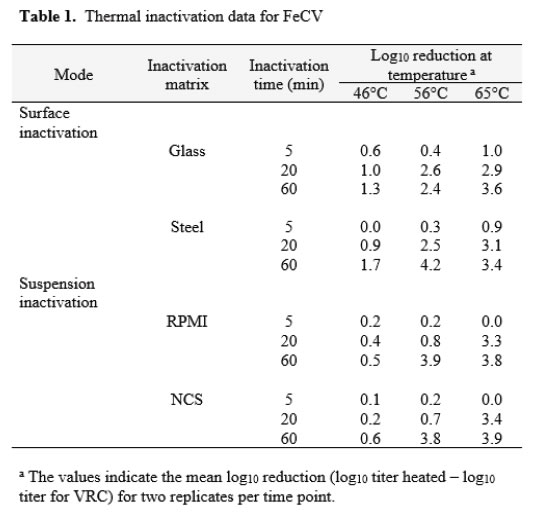
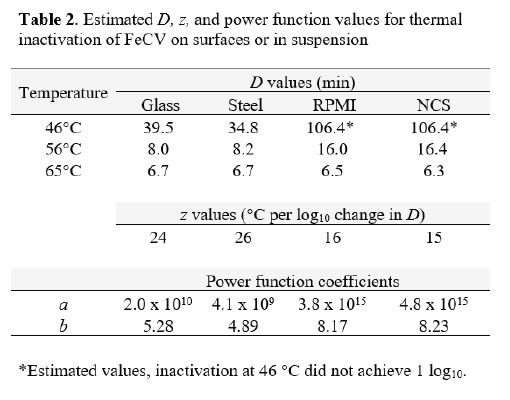
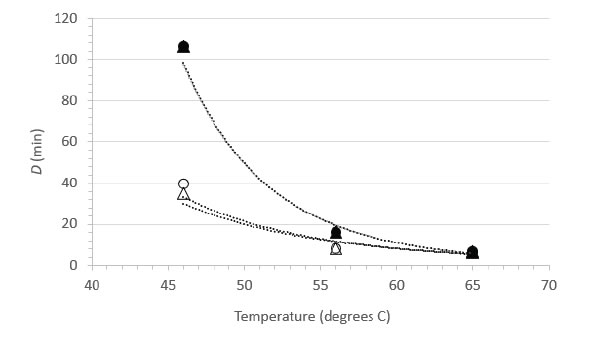
Results

Feline calicivirus

The thermal inactivation of FeCV was studied in carrier studies (Glass and Steel), and in suspension studies (RPMI and NCS). This virus is a small, non-enveloped virus that is considered to display medium resistance to physicochemical inactivation [14]. Temperatures of 46, 56, and 65°C were evaluated in two replicate trials each. The mean values from the replicates are displayed in Table 1. The extent of inactivation on carriers was minimal at up to 60 minutes heating time at 46°C. At this temperature, the inactivation achieved in suspension failed to reach even 1 log10. At 56°C, significant (>2 log10) inactivation occurred on carriers by 20 min, but not in suspension heating. In that case, 60 min heating was required. At 65°C, the time kinetics and extent of inactivation at the various times were similar for carrier and suspension inactivation [Table 1].

IJVB-4-1-401-t001

Decimal reduction (D) values were estimated from the initial linear portions of the inactivation vs. time curves at each temperature (Table 2). In the case of the 46°C trials for suspension heating, the D values had to be estimated on the basis of the first-order inactivation vs. time curves for these trials (plots not shown). While not ideal, these estimates allowed comparison between the carrier data and the suspension data, and enabled us to plot the relationship between temperature and D (Figure 2) [Table 2]. The plots in Figure 2 can be interpreted as follows: the resulting power function fit lines may be viewed as surfaces along which any temperature and D value pair is associated with 1 log10 inactivation of the virus [7]. The extrapolation of D to non-empirical temperatures, which may also be done by means of the calculated z values (Table 2), is quite easy and straightforward using the power function coefficients and Eq. 2 (Methods section). Also apparent from examination of Figure 2 is that at lower temperatures (especially 46°C), much longer heating times are required to cause 1 log10 inactivation in suspension, while at 65°C, inactivation is very rapid in both suspension and carrier heating [Figure 2].

IJVB-4-1-401-t002

IJVB-4-1-401-g002

Figure 2. Relationship between D and temperature for FeCV inactivation in suspension (●, NCS; ▲, RPMI) or on surfaces (○, Glass; Δ, Steel).

As FeCV has often been used as a surrogate for human norovirus, a calicivirus of considerable food safety interest, there have been several reports of inactivation of FeCV by suspension heating [15-20]. As these reports included sufficient detail and an experimental design allowing for calculations of D values from at least three different temperatures, it was possible to calculate power function coefficients from each study and therefore to create a plot comparing directly the D vs. temperature relationships (Figure 3). Note that the plot in Figure 3 does not display the temperatures actually tested empirically in the literature studies, rather it displays the D values at 46, 56, and 65°C calculated from the power function coefficients and Eq. 2. The greatest experimental error, and therefore the highest level of variability, is associated with the D values calculated for the lower temperature (46°C). Nevertheless, the plots are qualitatively similar in appearance and each study demonstrates rapid inactivation of FeCV at 65°C [Figure 3].

IJVB-4-1-401-g003

Figure 3. Relationship between D and temperature for FeCV inactivation in suspension. Data from the current study (●, RPMI; ▲, NCS) are compared with FeCV suspension inactivation data from the literature (○, Duizer, et al. [15]; ◊, Buckow, et al. [17]; ×, Bozkurt, et al. [20]; Δ, Bozkurt, et al. [19]; □, Cannon, et al. [16]; ■, Gibson and Schwab [18]). The line in red color represents the overlapping power fit lines for our studies in NCS and RPMI.

Herpes simplex virus type 1

The thermal inactivation of HSV-1 was studied in carrier studies (Glass and Steel) and in suspension studies (RPMI and NCS). This virus is a large enveloped virus that is considered to display medium resistance to physicochemical inactivation [14]. Temperatures of 46, 56, and 65°C were evaluated in two replicate trials each. The mean values from the replicates are displayed in Table 3. Extended time points were used in the study of inactivation in suspension at 46°C to enable estimation of D values at that temperature, as no evidence of first-order kinetics were observed at times less than 60 minutes.The extent of inactivation on surfaces was approximately first-order through 60 min of heating time on carriers at 46°C. At this temperature, the inactivation achieved in suspension failed to reach even 1 log10, and as mentioned above, gave no evidence of linearity of inactivationvs. time though 60 min. At 56°C, significant (>2 log10) inactivation occurred on carriers by 20 min, but inactivation did not occur at this time and temperature in suspension heating. In the case of suspension heating, 60 min was required. At 65°C, the time kinetics and extent of inactivation at the various times were similar for carrier and suspension inactivation [Table 3].

IJVB-4-1-401-t003

Decimal reduction (D) values were estimated from the linear portions of the inactivation vs. time curves at each temperature (Table 4). The D estimates allowed comparison between the carrier data and the suspension data, and enabled us to plot the relationship between temperature and D (Figure 4). As observed with FeCV, the data in Table 4 and the plots in Figure 4 show that at lower temperatures (especially 46°C), much longer heating times are required to cause 1 log10 inactivation in suspension, while at 65°C, inactivation is very rapid in both suspension and carrier heating [Table 4 & Figure 4].

IJVB-4-1-401-t004

IJVB-4-1-401-g004

Figure 4. Relationship between D and temperature for HSV-1 inactivation in suspension (▲, NCS; ●, RPMI) or on surfaces (○, Glass; Δ, Steel).

Herpes simplex virus type 1 is available in most virology laboratories and is often used as surrogate for other herpesviruses. We were able to locate a previous study by Plummer and Lewis [21] that examined the suspension heat inactivation of HSV-1 and another human herpesvirus, cytomegalovirus. As this report included sufficient detail and an experimental design allowing for calculations of D values from at least three different temperatures, it was possible to calculate power function coefficients from each study and therefore to create a plot comparing directly the D vs. temperature relationships (Figure 5). Note that the plot in Figure 5 does not display the temperatures actually tested empirically in Plummer and Lewis [15], rather it displays the D values at 46, 56, and 65°C calculated from the power function coefficients and Eq. 2. The greatest experimental error, and therefore the highest level of variability, is associated with the D values calculated for the lower temperature (46°C). The plots are qualitatively similar in appearance and each study demonstrates rapid inactivation of the herpesviruses at 65°C [Figure 5].

IJVB-4-1-401-g005

Figure 5. Relationship between D and temperature for herpesvirus inactivation in suspension. Data from the current study for HSV-1 (●, RPMI; ▲, NCS) are compared with suspension inactivation data from the literature (×, HSV-1 data from Plummer and Lewis [21]; □, cytomegalovirus data from Plummer and Lewis [21]).

Discussion

Prevailing opinion is that viruses are less susceptible to heating when dried on surfaces than when suspended in solutions, and that dry heat efficacy is related to residual moisture or relative humidity [22-26]. As mentioned previously, there are only relatively few studies [8, 25] that have actually evaluated thermal inactivation on surfaces and in suspension in a side-by-side study design. There are a number of factors that can determine thermal inactivation efficacy, such as presence of an organic load, the specific virus tested, the specific times and temperatures evaluated, and the methodology used for quenching the heating and recovering the infectious virus. A side-by-side study design is useful for eliminating as many confounding factors as possible, thereby enabling a more accurate comparison of inactivation ion surfaces vs. in suspension.Bräuniger et al. [25] examined the inactivation of bovine parvovirus in suspension vs. in the lyophilized state (the authors referred to this as dry heating). Thermal inactivation of a powder of varying moisture content is not exactly the same as the thermal inactivation of virus dried upon a hard surface. The authors reported that the parvovirus was more readily inactivated in suspension than in the lyophilized state with higher residual moisture (2%), while longer heating times were required for inactivation of the virus in lyophilized materials with lower moisture content (1%). In our own studies [8] with poliovirus type 1 and adenovirus type 5, the D values measured at 46°C displayed the greatest difference between the surface and suspension inactivation approaches, with values ranging from 14.0-15.2 minutes (surface) and from 47.4 -64.1 minutes (suspension) for poliovirus. The corresponding values for adenovirus 5 were 18.2-29.2 minutes (surface) and 20.8-38.3 minutes (suspension). At 65°C, the decimal reduction values were more similar (4 to 6 minutes) for the two inactivation approaches. The results with poliovirus and adenovirus [8] suggest that the specific virus under test is a determinant of the steepness of the D vs. temperature curve. This is supported by the results in our present study, where FeCV displayed markedly longer D values at 46°C in suspension inactivation vs. surface inactivation. The differences between D values at 46°C for HSV-1 inactivated on surfaces vs. in suspension were not as striking.

What exactly determines the shape of the D vs. temperature curve? It is apparent from studying the thermal inactivation data for a broad variety of viruses reported by a variety of investigators (reviewed in [5]) that in all cases, the plot of D vs. temperature has the appearance shown in Figures 2-5. Specifically, the data points typically are fit very closely using the power function displayed in Eq. 2). The D vs. temperature relationship is merely a transformation of the log10D vs. temperature relationship which has been used historically in calculating the z value (°C per log10 change in D). It is not surprising, therefore, that deviations from linearity for log10D vs. temperature plotsfrom a given study are associated with poorer power function fits for the D vs. temperature curves generated from the same inactivation results. In either case, it is the experimental error associated with the inactivation (log reduction) measurements and the subsequent error associated with the calculated D values which causes the deviations from expected line fit. The steep portion of the D vs. temperature curve that is observed at the lower temperatures evaluated for a virus is associated with the greatest degree of experimental variability, as shown in Figures 3 and 5. A flattening out of the curve is typically observed at higher temperatures. From a mechanism of inactivation point of view, we have proposed previously [8] that the steep portion of the curve may represent reaching a threshold temperature required for capsid opening. Once this threshold temperature has been reached, relatively small incremental increases in temperature result in dramatic decreases in the time required for 1 log10 inactivation. Differences between surface and suspension heat inactivation of viruses observed at the lower end of the D vs. temperature plot might then correspond to differences in extent or kinetics of heat exchange between the two inactivation approaches.

Conclusion

In the case of thermal inactivation of viruses, the results of suspension inactivation studies should be extrapolated to inactivation of viruses on surfaces with caution. It is not clear which approach represents the worst-case condition, and the more that we study surface vs. suspension heat inactivation in side-by-side studies, the more apparent it is becoming that generalities should not be made. Differences in the specific virus tested, in the presentation of the virus to the heat, in organic matrices which may or may not offer protection to the viruses, and in diffusion of the thermal energy through the liquid or virus film may impact the results. Such differences may favor inactivation in one or the other of the suspension or carrier formats.

References

  1. Pirtle EC, Beran GW (1991) Virus survival in the environment. Rev Sci Tech Off Int Epiz 10: 733-748.(Crossref)
  2. Tomasula PM, Kozemple MF, Konstance RP, Gregg D, Boettcher S, et al. (2007) Thermal inactivation of foot-and-mouth disease virus in milk using high-temperature, short-time pasteurization. J Dairy Sci90: 3202-3211.(Crossref)
  3. Thomas PR, Karriker LA, Ramirez A, Zhang JQ, Ellingson JS, et al. (2015) Evaluation of time and temperature sufficient to inactivate porcine epidemic diarrhea virus in swine feces on metal surfaces. J Swine Health Prod 23: 84-90.
  4. Zentkovich MM, Nelson SW, Stull JW, Nolting JM, Bowman AS (2016) Inactivation of porcine epidemic diarrhea virus using heated water. Vet Anim Sci1-2: 1-3.
  5. Nims RW, Plavsic M (2013) Intra-family and inter-family comparisons for viral susceptibility to heat inactivation. J Microb Biochem Technol5: 136-141.
  6. Quist-Rybachuk GV, Nauwynck HJ, Kalmar ID (2015) Sensitivity of porcine epidemic diarrhea virus (PEDV) to pH and heat treatment in the presence or absence of porcine plasma. Vet Microbiol181: 283-288.(Crossref)
  7. Nims R, Plavsic M (2013) A proposed modeling approach for comparing the heat inactivation susceptibility of viruses. Bioprocess J 12: 25-35.
  8. Zhou SS, Wilde C, Chen Z, Kapes T, Purgill J, et al. (2018) Carrier and liquid heat inactivation of poliovirus and adenovirus. Disinfection. InTech. doi:10.5772/ intechopen.76340
  9. Nims R, Plavsic M (2013) Inactivation of caliciviruses. Pharmaceuticals6: 358-392.(Crossref)
  10. Woźniakowski G, Samorek-Salamonowicz E (2015) Animal herpesviruses and their zoonotic potential for cross-species infection. Ann Agric Environ Med 22: 191-194.(Crossref)
  11. ASTM E1053. Test method to assess virucidal activity of chemicals intended for disinfection of inanimate, nonporous environmental surfaces.
  12. ASTM E1052. Standard test method to assess the activity of microbicides against viruses in suspension.
  13. Finney DJ (1964) Statistical Methods in Biological Assay. (2ndedn), London: Griffen.
  14. United States Pharmacopeia (2016)<1050.1>Design, Evaluation, and Characterization of Viral Clearance Procedures.
  15. Duizer E, Bijkerk P, Rockx B, de Groot A, Twisk F, et al. (2004) Inactivation of caliciviruses. Appl Environ Microbiol 70: 4538-4543.(Crossref)
  16. Cannon JL, Papafragkou E, Park GW, Osborne J, Jaykus L-A, et al. (2006) Surrogates for the study of norovirus stability and inactivation in the environment: A comparison of murine norovirus and feline calicivirus. J Food Prot69: 2761-2765.(Crossref)
  17. Buckow R, Isbarn S, Knorr D, Heinz V, Lehmacher A (2008) Predictive model for inactivation of feline calicivirus, a norovirus surrogate, by heat and high hydrostatic pressure. Appl Environ Microbiol 74: 1030-1038.(Crossref)
  18. Gibson KE, Schwab KJ (2011) Thermal inactivation of human norovirus surrogates. Food Environ Virol3 : 74-77.
  19. Bozkurt H, D’Souza D, Davidson PM (2013) Determination of the thermal inactivation kinetics of the human norovirus surrogates, murine norovirus and feline calicivirus. J Food Prot76: 79-84.(Crossref)
  20. Bozkurt H, D’Souza DH, Davidson PM (2014) A comparison of the thermal inactivation kinetics of human norovirus surrogates and hepatitis A virus in buffered cell culture medium. Food Microbiol4: 212-217.(Crossref)
  21. Plummer G, Lewis B (1965) Thermoinactivation of herpes simplex virus and cytomegalovirus. J Bacteriol 89: 671-674.(Crossref)
  22. McDevitt J, Rudnick S, First M, Spengler J (2010) Role of absolute humidity in the inactivation of influenza viruses on stainless steel surfaces at elevated temperatures. Appl Environ Microbiol76: 3943-3947.(Crossref)
  23. Sauerbrei A, Wutzler P (2009) Testing thermal resistance of viruses. Arch Virol154: 115-119.(Crossref)
  24. Dekker A (1998) Inactivation of foot-and-mouth disease virus by heat, formaldehyde, ethylene oxide and ϒ-irradiation. Vet Rec 143: 168-169. (Crossref)
  25. Bräuniger S, Peters S, Borchers U, Kao M (2000) Further studies on thermal resistance of bovine parvovirus against moist and dry heat. Int J Hyg Environ Health 203: 71-75. (Crossref)
  26. von Rheinbaben F, Wolff MH (2002)Virus Disinfection Manual. (Pg: 1-499) Springer Berlin Heidelberg,Heidelberg, Germany.
  27. Boschetti N, Wyss K, Mischler A, Hostettler T, Kemph C (2003) Stability of minute virus of mice against temperature and sodium hydroxide. Biologicals31: 181-185.(Crossref)

Novel Case of Emergency Room to Operation Theatre for Management of Blunt Chest Wall Injury

DOI: 10.31038/IJOT.2020313


We hereby present a novel case of Emergency Room to Operation Theatre for management of Blunt Chest Wall Injury. This is the first case to our knowledge in Australasian literature highlighting the importance of transfer from the Emergency Room to Operative room for early correction of respiratory physiology. A 74-year -old patient was air lifted into our level I trauma centre from a peripheral hospital.This was followingfall from 3-meter height whilst on a ladder. On clinical examination the patientwas able to communicate and maintaining their own airway with oxygen requirement of 15 litres via a non- breather mask to achieve oxygen saturation of 92%.

On examination, there was extensive subcutaneous emphysema and limited movement of the left chest wall on both inspiration and expiration. Prior to being airlifted, a left sided intercostal catheter placed by the peripheral hospital which was swinging with minimal amount of hemoserous drainage. The hemodynamics suggested a pulse rate was 115- sinus rhythm and non -supported blood pressure of 122/80 mm of Hg. Venous blood gas results were as follows- pH 7.16, p CO2 – 70, p O2- 28 and base excess of -5.2.A trauma series scan at the peripheral hospital was suggestive of isolated chest wall injury with anterolateral bi cortical displaced rib fractures and moderate amountof hemopneumothorax (Figure 1A).

IJOT-3-1-304-g001

Figure 1. (A) Computed Tomography of the chest with extensive subcutaneous emphysema and bi cortical displaced rib fractures.
(B): X-Ray chest on presentation.

We organised a repeat chest x-ray (Figure 1B). The x-ray confirmed multi-level rib fractures with associated pneumothorax.Patient was in respiratory failure with a blood carbon dioxide level of 70 and oxygen of 28, thus we decided to procced with surgical stabilisation of rib fractures directly from the emergency department. General anaesthesia was administered via a single lumen tube. Right lateral position with an incision parallel to the lateral border of scapula was undertaken.  Open reduction and internal fixation of rib numbers 3,4,5,6,7 was achieved using Rib Loc (8055 NE Jacobson St., Suite 700 Hillsboro, OR 97124). Ongoing arterial blood gases whilst on theatre table as the stabilisation progressed suggested a fall in CO2 levels to 35. Figure 2 depicts the post- operative x-ray. Patient was extubated the following day and was discharged home on day 5.

IJOT-3-1-304-g002

Figure 2. Post-Operative X-ray chest.

Discussion

This is the first case to our knowledge in Australasian literature highlighting the importance of transfer from the Emergency Room to Operative room for early correction of respiratory physiology. Elderly patients who sustain blunt chest trauma with rib fractures have twice the mortality and thoracic morbidity of younger patients with similar injuries. For each additional rib fracture in the elderly, mortality increases by 19% and the risk of pneumonia by 27% [1]. Literature review suggests in adult patients with flail chest, surgical stabilisation of rib fractures decrease mortality; shorten duration of mechanical ventilation, hospital length of stay, and Intensive Care Unit length of stay; and decrease incidence of pneumonia and need for tracheostomy [2].

The goal at our Level I trauma centre is to attempt stabilisation of the chest wall as soon as hemodynamic stability is established. This case highlights the importance of early surgery to avoid potential morbidity and mortality for adult patients with blunt chest wall injury.

References

  1. Bulger EM,Arneson MA, Charles N. Gregory MJ, Jurkovich (2000) Rib fractures in the elderly. The Journal of Trauma: Injury, Infection, and Critical Care 48: 1040-1047.
  2. Kasotakis, Hasenboehler EA, Streib EW, Patel N,  Patel MB, et al., (2017) Operative fixation of rib fractures after blunt trauma: A practice management guideline from the Eastern Association for the Surgery of Trauma. Journal of Trauma and Acute Care Surgery82: 618-626.