Archives

Fracture Liaison Service and the Prospect of Fragility Refracture in Osteoporotic Patients

DOI: 10.31038/IJOT.2019222


Osteoporosis is a silent disease, but one who’s impact is not silent. Over 9 million Americans have been diagnosed with osteoporosis, and more than 2 million osteoporotic fractures occur per year. This means that one in every two women aged 50 and above will have an osteoporotic fracture in her lifetime. Osteoporosis is characterized by decreased bone strength, reduced bone quantity and a decrease in the bone quality. These three factors lead to an increased susceptibility to fractures.

Postmenopausal women incur a high incidence of osteoporosis and subsequently fragility fractures A (defined as a fracture with minimal or no trauma, that occurs to the spine, ribs, pelvis or extremity bones), with a 50% refracture rate within two years. Men are not immune from this as 30% of men over 50 will have it on average. The burden on society and cost are high (around 21 million dollars in 2006) and will only grow as the aging population increases worldwide. Measures to prevent and reduce refracture rates and thus readmission have been worked out.

One of these ideas is a Fracture Liaison Service (FLS). The FLS program was established by the National Osteoporosis Foundation in 1996. It is a coordinated preventative care model that is operated under the supervision of a bone health specialist, who also collaborates with the patient’s primary care physician.

The Fracture Liaison Service project follows patients after a fragility fracture occurs. These patients are examined in a clinic, undergoing multiple tests including serum calcium, vitamin D levels as well as a dual-energy X-ray absorptiometry (DEXA scan). Their fracture risk is assessed following multiple visits at regular intervals to evaluate any progression of disease and to determine the refracture rate.

At our hospital, we established a Fragility Liaison Service program which remains solely the responsibility of the treating surgeon. The clinic since its inception in 2015 has seen around 300 patients and significantly reduced refracture rates. We focused primarily on patients with fractures of the spine and were able to reduce refracture rates by 1/3 in all patients with refractures (56% without FLS vs 37% post FLS, p=0.01).

However, our clinic can only see a certain number of patients with vertebral fractures, thus the remaining patients with rib fractures, pelvic fractures and extremity fractures need to be addressed. This can only happen when third-party payers pay attention to the FLS program as it has proven beneficial.

A Literature Review of the Treatment of Black Triangles

DOI: 10.31038/JDMR.2019215

Abstract

Black triangles are a result of periodontal disease and can also be a response to treatment and return of health. They can also be a result of orthodontic treatment and tooth and root shape and position. They are perceived as unaesthetic and there is an increase in the demand for treatment. This paper will look at some of the treatment options that are available to treat black triangles. The treatment is often multidisciplinary and can involve orthodontics, surgery and restorative. As aim of this thesis is to aid the prediction of black triangles, as a solution to them needs to be sought. This paper explores the treatment of black triangles to help the clinician give the patients the options if it is predicted a black triangle may be present.

Method: An OVID MEDLINE search was undertaken using the term Black triangle AND treatment. This yielded 32 papers and of these 14 were related to dental black triangles. These 14 papers were the hand searched for their cited references and this yielded an additional 17 papers.

Conclusion: The treatment for black triangles can be difficult and in the case of surgical management very unpredictable. More research into simple predictable management needs to take place.

Key words

Black Triangles, Embrasure Space, Gingival Veneers, Periodontal Surgery

Introduction

Black triangles are both unaesthetic and can be an area where food can get trapped, which can lead to a worsening of gingival health and speech problems 1, 2]. The balance between the gingiva and the teeth should be as natural as possible to improve the aesthetics [3, 4]. Before any treatment, such as periodontal and orthodontics, the possibility of black triangles should be discussed [5]. If the black triangle is to be treated then it is important to know the aetiology of it. A black triangle is present if the interdental papilla is not filling the space cervical to the interdental contact point.

Black triangles are associated with periodontal disease both treated and untreated, orthodontics and orthognathic surgery. They therefore become more common as patients get older and are more prevalent in adults [5, 6]. It has been shown that patients older than 20 are more likely to have a black triangle than patients who are younger than 20 years old [7]. Patients who suffer from osteoporosis are also at an increased risk of developing gingival recession [8]. The tooth and the root morphology play a role in the presence of a black triangle. If the crown of the tooth is of a triangular shape then the patient is more likely to have a black triangle as the embrasure space will be larger. The embrasure space also plays a role in the aetiology of the black triangle [7]. The major aetiological factor for the presence of a black triangle is the contact point to the crest of bone distance. In periodontal disease there is loss of the interdental bone and this will therefore increase this distance between the contact point and the crest of the bone. Tarnow described the presence of a black triangle to be related to this distance and suggested that should a distance of 5mm or less exist between the contact point and the crestal bone then a black triangle can be avoided. If the distance is greater than 6mm then a 44% chance of a black triangle exists and if this is 7mm or greater then in 73% of cases a triangle will be formed [9].

The more posterior area in the mouth, the larger the embrasure space is, and the smallest space is that between the central incisors [10, 11]. The contact point is in fact a contact area and in the central incisor it is approximately 2mm x 2mm [11]. There is a classification of loss of papilla height developed by Nordland and Tarnow [12]. They used three landmarks to classify the papilla loss: the contact point interdentally, the labial apical position of the Cemento-Enamel Junction (CEJ), and the interproximal coronal position of the cemento-enamel junction.

The classes were divided in to four groups (Figure 9.1).

  • Normal – The papilla fills the space to the contact point.
  • Class I – The papilla lies between the contact point and the most coronal position of the CEJ interproximally (the interproximal CEJ not visible).
  • Class II – The papilla tip lies at or below the interproximal CEJ but coronal to the labial CEJ.
  • Class III – The papilla tip lies at or above the labial CEJ.

JDMR-19-116-Ali Rizvi_UK_F1

Figure 9.1. Classification of papilla loss.

Black triangles are perceived as unattractive by both patients and professionals. The evidence that patients do not like black triangles comes from a study by Cunliffe and Pretty where patients were asked to rank black triangles against other dental problems and they found that patients ranked black triangles after caries and missing teeth [13]. Kokich demonstrated orthodontists identified a black triangle of 2mm was unattractive whereas, general dental practitioners as well as the general public were unable to detect an open embrasure unless it was 3mm in length [14]. Patients are more aware of dental aesthetics with the increase in media coverage and the rise of celebrity culture [15]. In the UK’s 2009 Dental Health Survey 16% of dentate adults had difficulty in smiling or showing their teeth [16].

Treatment for black triangles

The aetiology of black triangles is multifactorial; therefore it is best that each patient is assessed thoroughly in order to formulate the treatment which will best suit them [17]. The treatment may be a single modality but more often it is a multidisciplinary with orthodontic, surgical and restorative management.

Orthodontic management

Teeth of triangular morphology are liable to black triangle disease and can be treated with Inter-Proximal Reduction (IRP) and space closure. The IRP and space closure changes the contact to a more broad area therefore reducing the contact point distance resulting in a reduced embrasure space. IRP is performed with diamond strips or fine burs to remove the interproximal enamel and change the mesial contour of the teeth. Usually, only 0.5mm-0.75mm of enamel is removed to achieve the desired result [18]. Another factor to considerer is the root divergence as this increases the likelihood of black triangles. The normal angle between the roots of patients with normal inter-dental papilla was 3.65° and if this increases by 1° then there is an increase in the probability of a black triangle from 14%-21% [1]. Orthodontists must take care with the placement of brackets to reduce the risk of divergent roots. Therefore in adults with attrition, the brackets need to be placed perpendicular to the long axis of the tooth and not parallel to the incisal edge. In addition it is also useful to know the angulation of the roots before treatment and a periapical radiograph is advised [19]. As the roots become more parallel the contact point becomes more apical and lengthens. The result is the crowns become closer and the trans-septal fibres fill the space and relax, therefore reducing or eliminating the open space [18].

The amount of crowding that the anterior teeth have has little influence on black triangles after orthodontic treatment. In patients with less than 4mm crowding and 4mm to 8mm crowding there was similar number of patients who had black triangles post treatment [5]. When the crowding was over 8mm, the percentage of black triangles went up by 7%. As patients get older there is a decrease in the width/length ratio as the crown of the tooth wears and becomes shorter. This changes the position and proportion of the contact point [20]. When a patient with previously treated periodontal disease is treated with orthodontics, care must be taken to explain that there may be marked interproximal recession that may need restorative management post orthodontics [21]. The other orthodontic management procedure is to take advantage of the fact that as a tooth is extruded the gingiva comes with it, and this may restore the interdental papilla with assistance of surgery [22].

Periodontal condition

It is important to make sure that the periodontal tissues are healthy and stable. If they are not there will be continued bone loss, which means that the tissues will further recede. The loss of the bone leads to an increase in the distance between the contact point to the crest of bone and an increased risk of a black triangle. It has been shown in several studies that when the distance between the contact point to the crest of the bone increases over 5mm, the percentage chance of having a black triangle increases [9, 19, 23]. Other periodontal considerations such as gingival inflammation, interproximal cleaning and gingival biotype need to be taken into account when assessing the risk of black triangles [13].

Tooth brushing trauma can also lead to black triangles and this includes overzealous use of interdental products. If this is suspected then interproximal cleaning should be stopped to see if the papilla recovers [24]. Patients who have thin gingival biotypes have a restricted blood supply at the papilla which results in altered healing [6]. Thin tissue is susceptible to trauma therefore it is best to educate the patient on atraumatic interdental cleaning [25].

Surgical procedures

The tissue interproximally is very fragile and the blood supply to this area is poor. Surgery works best on patients with thick tissue type, but it is patients with thin tissue who are more susceptible to recession. The thick tissue type has a better blood supply and rebound than the thin, whereas the thin tissue type tends to have permanent recession. This is why it is less predictable to use surgical procedures to correct interdental black triangles. There is also limited space to perform the procedures and it is difficult to place grafts due to limited access. If the papilla is damaged surgically then there is a risk the situation could be made worse. There was a study in 1965 when two papilla of 16 dental students were surgically removed and 69% failed to return to their original dimensions [26]. There have been micro surgical procedures undertaken to generate interdental soft tissue. They are very technique sensitive and their success will depend very much on the clinician’s skill and experience. There have been some promising case studies that have shown some success [27, 28]. Recently there has been a pilot study on the use of micronised acellular dermal matrix allograft technique which found it promising as there was significant increase in the papilla index [29]. This study was undertaken on 12 patients with 38 papilla defects and involved the use of powdered dermal matrix mixed with saline. It was then injected into a pouch that was formed by releasing the gingival papillary complex to move it coronally.

In implant treatment it is harder to produce a papilla as there is no interdental crest between two implants. It has a flat plate of bone that does not support the papilla as well. Tarnow looked at the presence of the papilla from the crest of the bone to contact point distance and found that only an average of 3.4mm of gingival height could be achieved between two adjacent implants [30]. This group suggested that if two teeth need to be replaced in the aesthetic zone then it is better to place one and cantilever the other tooth from the implant. The edentulous area can be surgically enhanced with a connective tissue graft and an ovate pontic to develop an appearance of a papilla. When the area is enhanced with more soft tissue in the form of connective tissue grafts the amount of soft tissue above the bone can increase up to 9mm [31]. The ovate pontic was developed in the 1980s [32] and it has a convex surface. This design allowed the illusion of an emergence profile. There is a larger area of contact between the pontic and the soft tissue and there is a degree of light pressure [33]. To use an ovate pontic there needs to enough width of the ridge. In the case of a thin narrow ridge, if an ovate pontic is to be used, then there will need to be surgical ridge augmentation.

The classification for ridge defects was developed by Seibert [34].

  1. Class I – Loss of width of the ridge but the height remains the same.
  2. Class II – Loss of the height but the width remains the same.
  3. Class III – Loss of the width and the height.

The techniques to augment the ridge are:

  • Socket preservation. Bone graft material is placed in the fresh extraction socket to reduce the collapse of the socket [35].
  • A full thickness soft tissue graft. Free gingival graft is used as an onlay to correct the defect [34].
  • Pouch flap. Involves the use of connective tissue being placed in a pouch to increase the width of the ridge. It was described by Garber and Rosenberg where the connective tissue was taken from the tuberosity [33]. This was a development from a previously described technique [36].
  • Hydroxyapatite implant where hydroxtapatite particles or a block is placed sub gingival [37, 38].
  • Connective tissue graft and partial thickness flap — These grafts are placed under the mucosa to increase the thickness of the tissue [39].
  • Provisional restoration. The temporary restoration is fitted after the extraction of a tooth and goes into the socket slightly to prevent the collapse of the socket [40].

The modified ovate pontic moves the apex from the centre to a more labial aspect (Figure 9.2)

JDMR-19-116-Ali Rizvi_UK_F2

Figure 9.2. Pontic designs.

1a. Ridgelap, 1b. Modified ridgelap, 1c. Ovate pontic, 1d. Modified ovate pontic.

The modified ovate pontic is easier to clean and needs less width which therefore reduces the need to augment the edentulous ridge. The height of the apex is 1mm-1.5mm apical to the tissue height and from the labial surface. There have been reports of inflammation and swelling with the use of these ovate pontics [41–43]. If oral hygiene is maintained, however, it was found that in the premolar and molar regions ovate pontics were not associated with clinically obvious inflammation. When the tissue was looked at histologically the keratin layer was thinner and there was a change in the subepithelial connective tissue [44]. Other studies have also found that if oral hygiene is good, and the pontic is cleaned with floss or superfloss, the tissue will be clinically healthy [45,46]. When the ovate pontic exerted pressure on the tissue there is a thinning of the tissue but no histological changes [47].

Another suggestion to aid the papilla adjacent to implants is to place a temporary restoration on the implant after the second stage surgery which can be used to guide the tissues before the definitive restoration is made [48]. The subgingival tissue in the interproximal area of the temporary restoration will guide the tissue to the desired position [49]. The position of the implant in the bucco-lingual is also important to the aesthetics. If a line is drawn from the facial aspects of the adjacent teeth the centre of the implant should be at least 4mm from this imaginary line [50]. This position reduces the risk of labial bone being lost which could lead to recession. The space that is needed mesio-distal is also important as there needs to be a minimum of 1.5mm from the edge of the implant to the adjacent tooth. This will allow oral hygiene and the development of a papilla. So with a 4mm implant there needs to be a 7mm space to place it [48]. Some authors have developed flaps to create papilla at the exposure stage, one of which was a palatal flap rotated and split into two parts: one for the mesial and one for the distal [51]. There have also been techniques described to make it appear there is a papilla [52, 53].

Restorative management

Restorative management can be the sole treatment for the management of black triangles or it may be used in combination with orthodontics. There is the interproximal striping as described above to change the shape of a triangular tooth in order to change the length and position of the contact point. There has also been the use of indirect crowns and/or veneers [54] to increase the length of the contact point to mask the interproximal space. The problem with these treatments is that they need temporisation which can have a detrimental effect on the health of the gingiva. In addition, if the definitive restoration impinges on the gingiva, it may have a detrimental effect on the gingival health [55, 56]. These have been also used with the pink porcelain where there is also labial recession but the problem with that is getting an exact colour match with the gingiva.

Over the years there have been improvements in bonding to enamel and dentine. There has also been much development in the aesthetics of composite resins and their wear and staining resistance. There has been an increase in the use of direct composite restoration to mask the embrasure space. This method is economically viable, quick and non-invasive. Bichacho suggested that there is no logical reason for macro mechanical preparation to close black spaces and achieve the desired contour [57]. It has also been shown to produce predictable results [58, 59]. The composite is placed slightly into the gingival sulcus which helps guide the shape of the interdental papilla [57, 60]. This technique using composite in the sulcus is described by Clark [61] who uses a matrix interproximally with an aggressive cervical contour and staged wedging.

For this technique to be successful the patient needs excellent oral hygiene otherwise the control over the gingiva will be lost, as the tissues will become inflamed due to the presence of plaque [47]. If the area that contacts the gingival is polished and smooth there will be no adverse effects if the patient has good oral hygiene [62]. These direct restorations to fill in the interdental space relies on the cervical contour [62] and the contact point position [9]. To allow the formation of the interdental papilla there needs to be 3mm-5mm of soft tissue present [63]. With this minimal thickness the tissue can compress and reshape.

Hyaluronic acid

The hyaluronic acid is derived from a streptococcus species of bacteria of a high degree of purity [64], and then cross linked up to 1% [65, 66] This product has been used to correct facial creases and bulk tissue in the face [67]. The commercial product used in the UK is RestylaneTM* and this is registered with the Medicines and Healthcare Products Regulatory Agency (MHRA) for adverse effects reporting. An adverse effects form has been made to record any reactions to the product (Appendix 5).

The product was first evaluated in Sweden and Italy [66, 68]. Both these studies showed good and sustained results at 6–8 months later. The adverse effects of the treatment were evaluated and it was found that in 1999 only one in every 650 (0.15%) of patients treated with Restylane had redness, local granulomatous reaction, swelling, acneiform or bacterial infection [69]. Since then the product has been purified even more and by 2000 this dropped to 0.06% [69]. As the purification process has improved and hypersensitivity reactions are as low as 0.02%, no skin testing is needed [70]. Hyaluronic acid is very hydrophilic, and can form a gel at low concentrations and has a large volume to mass [71]. This property makes it ideal to produce volume in the tissue. Becker et al carried out a self-funded study where 14 black spaces were treated with Hyaluronic acid (4 teeth and 10 implants). Each site was evaluated for the percentage change between the initial and final applications. 3 sites had 100% improvements whereas 8 sites had 88 to 97% improvement. All the patients thought the treatment was painless and 6 thought there was significant improvement [72].

Conclusion

Black triangles come about as a result of tooth shape, root angulation, orthodontic treatment and most often bone loss due to periodontal disease. The treatment can be multidisciplinary but before it is undertaken the aetiology of the recession needs to be explored because it may have a bearing on the treatment that is being done. Therefore treatment planning to reduce the formation of black triangles during treatment and careful work up is needed. Before any restorative treatment is undertaken it is important to do a diagnostic wax up the see the width/height ratio of the teeth after the restorations. It is advisable to not exceed the width of an anterior tooth by more than 80% of its length [73]. There may also be an imbalance in the proportions such as the ‘golden proportions’ [74]. As the treatment of black triangle can be unpredictable more research is needed to find simple, less invasive and more predictable methods.

References

  1. Kurth JR, Kokich VG (2001). Open gingival embrasures after orthodontic treatment in adults: prevalence and etiology. Am J Orthod Dentofacial Orthop 120:116–123. [crossref]
  2. Takei HH (1980) The interdental space. Dent Clin North Am 24: 169–176. [crossref]
  3. Moskowitz ME, Nayyar A (1995) Determinants of dental esthetics: a rational for smile analysis and treatment. Compend Contin Educ Dent 16: 1164. [crossref]
  4. Singh VP, Uppoor AS, Nayak DG, Shah D (2013) Black triangle dilemma and its management in esthetic dentistry. Dental research journal 10: 296–301. [crossref]
  5. Ko-Kimura N, Kimura-Hayashi M, Yamaguchi M, Ikeda T, Meguro D, et al. (2003) Some factors associated with open gingival embrasures following orthodontic treatment. Australian Orthodontic Journal 19: 19–24. [crossref]
  6. Chow YC, Eber RM, TsaoY, Shotwell JL, Wang H (2010) Factors associated with the appearance of gingival papillae. Journal of Clinical Periodontology 37: 719–727. [crossref]
  7. Chang L (2007) The association between the embrasure morphology and and central papilla recession: a noninvasive method of assessment. Chang Gung Med J 30: 445–452. [crossref]
  8. Shum I, Leung P, Kwok A, Corbet EF, Orwoll ES, et al. (2010) Periodontal Conditions in Elderly Men With and Without Osteoporosis or Osteopenia. Journal of Periodontology 81: 1396–1402. [crossref]
  9. Tarnow DP, Magner AW, Fletcher P (1992) The effect of the distance from the contact point to the crest of bone on the presence or absence of the interproximal dental papilla. J Periodontol 63: 995–996. [crossref]
  10. Blitz N (1997) Criteria for success in creating beautiful smiles. Oral Health 87: 38–42. [crossref]
  11. Morley J, Eubank J (2001) Macroesthetic elements of smile design. J Am Dent Assoc 132: 39–45. [crossref]
  12. Nordland WP, Tarnow DP (1998) A classification system for loss of papillary height. J Periodontol 69: 1124–1126. [crossref]
  13. Cunliffe J, Pretty I (2009) Patients’ ranking of interdental “black triangles” against other common aesthetic problems. European Journal of Prosthodontics & Restorative Dentistry 17: 177–181. [crossref]
  14. Kokich VO Jr, Kinzer GA (2005) Managing congenitally missing lateral incisors. Part I: Canine substitution. J Esthet Restor Dent 17: 5–10. [crossref]
  15. Ahmad I (2010) Risk management in clinical practice. Part 5. Ethical considerations for dental enhancement procedures. British Dental Journal 209: 207–214.
  16. Steele S, O’ Sullivan I (2011) Adult Dental Health Survey 2009 N. statistics, The Health and Social Care Information Centre.
  17. AlAhmari F (2018) Reconstruction of Lost Interdental Papilla: A Review of Nonsurgical Approaches. Journal of Dental and Medical Sciences 17: 59–65.
  18. Kokich VG (1996) Esthetics: the orthodontic-periodontic restorative connection. Semin Orthod 2: 21–30. [crossref]
  19. Wu YJ, Tu YK, Huang S, Chan C (2003) The influence of the distance from the contact point to the crest of bone on the presence of the interproximal dental papilla. Chang Gung Med J 26: 822–828. [crossref]
  20. Kokich VG, Spear FM (1997) Guidelines for managing the orthodontic-restorative patient. Semin Orthod 3: 3–20. [crossref]
  21. Zachrisson B (2005) Orthodontics and periodontics. Clinicail periodontology and Implant dentistry – Jan Lindhe.
  22. Carnio J (2004) Surgical reconstruction of interdental papilla using an interposed subepithelial connective tissue graft: a case report. Int J Periodontics Restorative Dent 24: 31–37. [crossref]
  23. Chang LC (2008) Assessment of parameters affecting the presence of the central papilla using a non-invasive radiographic method. J Periodontol 79: 603–609. [crossref]
  24. Tanaka OM, Furquim BD, Pascotto RC, Ribeiro GL, Bósio JA, et al. (2008) The dilemma of the open gingival embrasure between maxillary central incisors. J Contemp Dent Pract 9: 92–98. [crossref]
  25. Kandasamy S, Goonewardene M, Tennant M (2007) Changes in interdental papillae heights following alignment of anterior teeth. Aust Orthod J 23: 16–23. [crossref]
  26. Holmes CH (1965) Morphology of the interdental papillae. J Periodontol 36: 455–460. [crossref]
  27. Nemcovsky CE (2001) Interproximal papilla augmentation procedure: a novel surgical approach and clinical evaluation of 10 consecutive procedures. Int J Periodontics Restorative Dent 21: 553–559. [crossref]
  28. Checchi L, Montevecchi M, Checchi V, Bonetti GA (2009) A modified papilla preservation technique, 22 years later. Quintessence Int 40: 303–311. [crossref]
  29. Geurs NC, Romanos AH, Vassilopoulos PJ, Reddy MS (2012) Efficacy of micronized acellular dermal graft for use in interproximal papillae regeneration. International Journal of Periodontics & Restorative Dentistry 32: 49–58. [crossref]
  30. Tarnow D, Elian N, Fletcher P, Froum S, Magner A, et al. (2003) Vertical distance from the crest of bone to the height of the interproximal papilla between adjacent implants. Journal of Periodontology 74: 1785–1788. [crossref]
  31. Elian N, Jalbout ZN, Cho SC, Froum S, Tarnow DP (2003) Realities and limitations in the management of the interdental papilla between implants: three case reports. Pract Proced Aesthet Dent 15: 737–744. [crossref]
  32. Abrams L (1980) Augmentation of the deformed residual edentulous ridge for fixed prosthesis. Compend Contin Educ Gen Dent 1: 205–213. [crossref]
  33. Garber DA, Rosenberg ES (1981) The edentulous ridge in fixed prosthodontics. Compend Contin Educ Dent 2: 212–223. [crossref]
  34. Seibert JS (1983) Reconstruction of deformed, partially edentulous ridges, using full thickness onlay grafts. Part I. Technique and wound healing. Compend Contin Educ Dent 4: 437–453. [crossref]
  35. Greenstein G, Jaffin RA, Hilsen KL, Berman CL (1985) Repair of anterior gingival deformity with durapatite. A case report. J Periodontol 56: 200–203. [crossref]
  36. Langer B, Calagna L (1980) The subepithelial connective tissue graft. Journal of Prosthetic Dentistry 44: 363–367. [crossref]
  37. Kaldahl WB, Tussing GJ, Wentz FM, Walker JA (1982) Achieving an esthetic appearance with a fixed prosthesis by submucosal grafts. J Am Dent Assoc 104: 449–452. [crossref]
  38. Allen EP, Gainza CS, Farthing GG, Newbold DA (1985) Improved technique for localized ridge augmentation. A report of 21 cases. J Periodontol 56: 195–199. [crossref]
  39. Langer B, Calagna LJ (1982) The subepithelial connective tissue graft. A new approach to the enhancement of anterior cosmetics. Int J Periodontics Restorative Dent 2: 22–33. [crossref]
  40. Spear FM (1999) Maintenance of the interdental papilla following anterior tooth removal. Pract Periodontics Aesthet Dent 11: 21–28. [crossref]
  41. Henry PJ, Johnston JF, Mitchell DF (1966) Tissue changes beneath fixed partial dentures. Journal of Prosthetic Dentistry 16: 937–947. [crossref]
  42. Cavazos EJr (1968) Tissue response to fixed partial denture pontics. Journal of Prosthetic Dentistry 20: 143–153. [crossref]
  43. Schield HW (1968) The influence of bridge pontics on oral health. J Mich State Dent Assoc 50: 143–147. [crossref]
  44. Zitzmann NU, Marinello CP, Berglundh T (2002) The ovate pontic design: a histologic observation in humans. Journal of Prosthetic Dentistry 88: 375–380. [crossref]
  45. Silness J, Gustavsen F, Mangersnes K (1982) The relationship between pontic hygiene and mucosal inflammation in fixed bridge recipients. J Periodontal Res 17: 434–439. [crossref]
  46. Tolboe H, Isidor F, Budtz-Jörgensen E, Kaaber S (1987) Influence of oral hygiene on the mucosal conditions beneath bridge pontics. Scand J Dent Res 95: 475–482. [crossref]
  47. Tripodakis AP, Constandtinides A (1990) Tissue response under hyperpressure from Convex pontics. Int J Periodontics Restorative Dent 10: 408–414. [crossref]
  48. Zuccati G (1993) Implant therapy in cases of agenesis. J Clin Orthod 27: 369–373. [crossref]
  49. Senty EL (1976) The maxillary cuspid and missing lateral incisors: esthetics and occlusion. Angle Orthod 46: 365–371. [crossref]
  50. Adell R, Eriksson B, Lekholm U, Brånemark PI, Jemt T (1990) Long-term follow-up study of osseointegrated implants in the treatment of totally edentulous jaws. Int J Oral Maxillofac Implants 5: 347–359. [crossref]
  51. Nemcovsky CE, Artzi Z, Moses O (2000) Rotated palatal flap in immediate implant procedures. Clinical evaluation of 26 consecutive cases. Clin Oral Implants Res 11: 83–90. [crossref]
  52. Becker W, Becker BE (1996) Flap designs for minimization of recession adjacent to maxillary anterior implant sites: a clinical study. Int J Oral Maxillofac Implants 11: 46–54. [crossref]
  53. Palacci P, Nowzari H (2008) Soft tissue enhancement around dental implants. Periodontol 2000 47: 113–132. [crossref]
  54. de Araujo, E. M., Jr., L. N. Baratieri, et al. (2003) Direct adhesive restoration of anterior teeth: Part 2. Clinical protocol. Pract Proced Aesthet Dent 15: 351–357. [crossref]
  55. Sorensen SE, Larsen IB, Jörgensen KD (1986) Gingival and alveolar bone reaction to marginal fit of subgingival crown margins. Scand J Dent Res 94: 109–114. [crossref]
  56. Sorensen JA (1989) A rationale for comparison of plaque-retaining properties of crown systems. J Prosthet Dent 62: 264–269. [crossref]
  57. Bichacho N (1998) Papilla regeneration by noninvasive prosthodontic treatment: segmental proximal restorations. Pract Periodontics Aesthet Dent 10: 75, 77–78. [crossref]
  58. Portalier L (1996) Diagnostic use of composite in anterior aesthetics. Pract Periodontics Aesthet Dent 8: 643–652. [crossref]
  59. De Araujo EM Jr, Fortkamp S, Baratieri LN (2009) Closure of Diastema and Gingival Recontouring Using Direct Adhesive Restorations: A Case Report. J Esthet Restor Dent 21: 229–241. [crossref]
  60. Bichacho N, Landsberg CJ (1997) Single implant restorations: prosthetically induced soft tissue topography. Pract Periodontics Aesthet Dent 9: 745–752. [crossref]
  61. Clark D (2008) “Restoratively driven papilla regeneration: correcting the dreaded ‘black triangle”. Tex Dent J 125: 1112–1115. [crossref]
  62. Bichacho N (1996) Cervical contouring concepts: enhancing the dentogingival complex. Pract Periodontics Aesthet Dent 8: 241–254. [crossref]
  63. Jacques LB, Coelho AB, Hollweg H, Conti PC (1999) Tissue sculpturing: an alternative method for improving esthetics of anterior fixed prosthodontics. Journal of Prosthetic Dentistry 81: 630–633. [crossref]
  64. Baumann L (2004) Replacing dermal constituents lost through aging with dermal fillers. Seminars in cutaneous medicine and surgery 23: 160–166. [crossref]
  65. Malson T, Lindqvist BL (1987) Gel of crosslinked hyaluronic acid for use as a vitreous humor substitute, Google Patents.
  66. Duranti F, Salti G, Bovani B, Calandra M, Rosati ML (1998) Injectable hyaluronic acid gel for soft tissue augmentation. Dermatologic surgery 24: 1317–1325. [crossref]
  67. Rohrich RJ, Ghavami A, Crosby MA (2007) The role of hyaluronic acid fillers (Restylane) in facial cosmetic surgery: review and technical considerations. Plast Reconstr Surg 120: 41–54. [crossref]
  68. Olenius M (1998) The first clinical study using a new biodegradable implant for the treatment of lips, wrinkles, and folds. Aesthetic plastic surgery 22: 97–101. [crossref]
  69. Friedman PM, Mafong EA, Kauvar AN, Geronemus RG (2002) Safety data of injectable nonanimal stabilized hyaluronic acid gel for soft tissue augmentation. Dermatologic surgery 28: 491–494. [crossref]
  70. Medicis Aesthetics, I. Restylane injectable gel (nonanimal stabalized hyaluronic acid; NASHA) package insert, Scottsdale Ariz.: Medicis Aesthetics.
  71. Alberts B, Johnson A, Lewis J, Raff M, Roberts K, et al. (2002) The molecular Biology of the Cell. New York, Garland Science 45.
  72. Becker W, Gabitov I, Stepanov M, Kois J, Smidt A, et al. (2010) Minimally invasive treatment for papillae deficiencies in the aesthetic zone: a pilot study. Clin Implant Dent Relat Res 12: 1–8. [crossref]
  73. de Araujo EM Jr, B. L., Monteiro S. Jr, et al. (2003) Direct adhesive restoration of anterior teeth: part 3: procedural considerations. Pract Proced Aesthet Dent 15: 433–437. [crossref]
  74. Magne P, Belser U (2003) Bonded porcelain restorations in the anterior dentition: a biomimetic approach. Chicago (IL), Quintessence Books.

Long-Term Effect of a Short Sucrose/Xylitol Exposure on Survival of Permanent Teeth: A Practice-Based Study

DOI: 10.31038/JCRM.2019221

SUMMARY

Background: In the original trial preschool children were randomly divided into two groups: 8,4g xylitol or sucrose chewing gum for two months, to investigate xylitol’s effect on acute titis media (AOM). Salivary mutans streptococci (sm) levels were taken before and after trial. Sm levels ≥105 CFU/1ml were considered high and those <105 CFU/1ml low. Eighteen months after the exposure, oral health of the participants was investigated from patient records of the City of Oulu, Finland. If not available, the individuals were invited for check-up. Two months sucrose exposure caused a significant caries risk in primary dentition in high sm group.

Aim: Aim of this study was to examine the effect of sucrose/xylitol intervention of preschool children on their caries experience in following 10 years. Design Oral health data of the participants in AOM-trial were collected for analyses covering the period 2003–2008/2009 from the City of Oulu, Finland patient records with their permission. Kaplan-Meyer survival curves were drawn for each tooth. Statistical significance of difference in survival between groups was analysed by Wilcoxon test.

Results: There was no statistifically significant difference between xylitol and sucrose groups in the survival of any permanent teeth caries free. Low sm levels seemed to be a protective factor against caries. Caries history in pre-school age was the best predictor of caries experience in teenage.

Conclusions: Short sucrose exposure at preschool age does not increase the risk for permanent tooth decaying. Two months regular exposure to xylitol is too short for preventing caries in long run.

INTRODUCTION

The evidence of the role of sucrose in the manifestation and progression of dental caries is inevitable [1,2]. Widely used as a substitute for sucrose, xylitol has been reported to reduce caries incidence and have even anticariogenic potential [3]. Caries reduction based on xylitol’s ability to decrease the number of mutans streptococci in saliva and to inhibit plaque formation [4]. is reported to be at greatest during the first year of the eruption of teeth [5]. Additionally to numerous caries prevention research, the impact of xylitol on prevention of acute otitis media (AOM) has been investigated [6,7].

The present study is based on a randomized clinical trial conducted in 1995 [8], which investigated the impact of two-month regular use of xylitol chewing gum on prevention of AOM among children in a Finnish municipal day care center. Children in the intervention group got xylitol chewing gum whereas the control group got sucrose-sweetened chewing gum. Additionally, the growth inhibiting effect of xylitol against Streptococcus pneumoniae in pharynx of the children was examined. As an outcome, the two-month frequent xylitol exposure had a preventive effect against AOM but the carriage rate of S. pneumoniae between the xylitol and sucrose groups was not discovered. The use of sucrose chewing gum among the control group raised a question about the ethics of the study [9]. The rationale for the permission given by Finnish ethics committee for this AOM study was that the participants had regular dental check-ups in the Finnish municipal dental health care system [10]. Teeth of the children were not investigated prior or after the study, but salivary mutans streptococci levels before and after the trial were recorded [11]. All children were also customers of the municipal oral health care of the City of Oulu. At that time all children were examined at regular basis.

Findings of a study on the short-term effects of the original AOM trial did not indicate an increased risk of dental caries in the sucrose group of the original study population per se [11]. However, two months’ regular sucrose exposure for preschool aged children with high mutans streptococci levels at baseline caused a significant caries risk in primary dentition [11]. Analyses were carried out about two years after the original AOM trial.

The aim of the present study was to examine if a two-month daily sucrose/xylitol exposure had effects on caries prevalence 10 years later considering mutans streptococci levels at baseline. The hypothesis was that short sucrose/xylitol exposure at preschool age does not indicate permanent tooth decay 10 years later regardless of salivary mutans streptococci levels at baseline.

MATERIAL AND METHODS

Subjects

Original double-blinded, randomized, clinical intervention trial (AOM trial) was conducted in April-May 1995 in the city of Oulu, Finland [8]. Altogether 306 children in 11 day care centers were recruited and were randomly divided to those getting either sucrose or xylitol chewing gum for two months. The intervention group (n=157, mean age 5.0 ±1.4) received 8.4g xylitol a day (two pieces of chewing gum five times a day). Similar amount and number of pieces of sucrose gum were distributed for the sucrose group (n=149, mean age 4.9 ±1.5). Children in both groups attended municipal dental health care according to the normal schedule and individual need, including dental examinations, and necessary non-invasive and invasive treatments. No extra examinations nor preventive dental care were planned for the participants the trial. For the short-term analyses [11], data on oral health of 286 children was available for collection in the patient files of the municipal health care centre of the city of Oulu. Those with no data in the records after 1995, were clinically examined 18 months after the baseline trial [11].The xylitol group comprised 70 girls and 76 boys and, when the respective numbers in sucrose group were 76 and  64 (Table 1).

Table 1. Frequencies and distributions according to gender, intervention group and mutans streptococci (ms) level at baseline, ms level values of 19 children are missing.

Group

Gender n (%)

Boy

Girl

Total

Sucrose

64 (45.7)

76 (54.3)

140

Xylitol

76 (52.1)

70 (47.9)

146

140 (49.0)

146 (51.0)

286

ms +

42 (58.3)

30 (41.7)

72

ms –

89 (45.6)

106 (54.4)

195

131(49.1)

136 (50.9)

267*

*19 missing

Data

In 2008–2009, oral health data during the period 2003–2008 of participants in AOM trial, were collected from the electronic patient files for analyses of the present study (Figure 1). A gap of 6 years (1997–2003) was caused by the fact that electronic system was not yet in use in Oulu. From patient files number of dental visits and examinations, caries lesions and restorations in permanent teeth were recorded by one author (IH). Observations on caries lesion were considered dentine caries or deeper, demanding restorative or endodontic treatment or extraction.

JCRM 2019-106 - Anttonen Finland_F1

Figure 1. Flow chart of the study protocol.

Salivary mutans streptocci samples of the participants were taken before (baseline, n=257) and after the AOM trial in 1995 (n=245) from the oral mucosa with a swab by an oral hygienists of the municipal health center of the city of Oulu. The samples were cultivated following the manufacturer’s protocol (Dentocult SM®, Orion Diagnostica: Espoo, Finland). The participants were divided into two groups according to their mutans streptococci levels at baseline: ≥105 mutans streptococci CFU in one ml saliva was considered high level (ms+), and <105 low level (ms-)2.

Statistical analyses

Frequencies and distributions according to gender, intervention group and ms level at baseline and after the intervention were calculated using cross-tabulation. Statistical significance was studied by chi-squared test. Mean DMF values according to age and original mutans streptococci levels (ms+/ms-) were calculated for the years 2005–2008 when the participants were 13–20 years old. The number/proportion of participants with healthy dentitions (dmf + DMF = 0) were determined in 1997 and 2007. For studying the change in mutans streptococci levels after sucrose/xylitol intervention cross-tabulation and a 2-sample test for equality of proportions were used.

The time from the birth of the child to the onset of dental caries lesion needing a restoration was recorded during the follow-up period separately for each permanent tooth. Non-parametric Kaplan-Meyer survival curves were drawn for each tooth to examine the survival of all permanent teeth caries free during the follow-up period. In the analysis, right censoring was used if there was no caries leading to restoration placed during the follow-up period. Wilcoxon test was used to investigate the statistical significance of difference of survival in sucrose and xylitol groups and also dividing the participants into sub groups according to their ms levels. To avoid pseudo replication, each tooth on one side of both jaws (maxilla and mandible) was chosen for the statistical analyses; for the pictures, however, data from both contralateral teeth were combined.

The association of caries status at baseline with the caries status 13 years after the intervention  was analysed using a linear regression model; dmf+DMF at baseline as independent variable and DMF 13 years after intervention representing the outcome measure. An equation of the association was achieved.

The data were analyzed using SPSS (version 20.0, SPSS, Inc., Chicago, Il, USA), and R (version 2.11.1 Patched): a language and environment for statistical computing (R Foundation for Statistical Computing, Vienna, Austria, URL http://www.R-project.org), and SAS (version 9.2, SAS Institute Inc., Cary, NC, USA) software. Statistically significant difference between the groups was determined with p-values < 0.05.

Ethics

Ethical Committee of the City of Oulu had approved the original AOM trial and approval for this study was not necessary. Approval for collecting data from the dental records was received from the Chief of the Municipal Health Services of the City of Oulu. All participants were included in the study if their parents gave approval for it. Data in analyses did not include any personal identifications.

RESULTS

In 2008–2009, more than 10 years after the original sucrose/xylitol intervention trial, patient records of 239 participants were available for analyses, drop-out rate from the original AOM study8 being 22% and from the short-term dental health study in 1997 [11] 16%, respectively (Figure 1). On average 5.2 dental examinations per individual were performed during the entire follow-up period; 5.0 dental examinations in the sucrose group and 5.4 in the xylitol group (n.s.). Combinig both groups, the mean interval between dental examinations was 442 days before 1997 and 722 days during the period 2003–2008.

Mean DMF values between 2005 and 2008 varied between 0.25–9.25, with higher variation in ms+ than ms- group (Table 2). 1n 1997 the proportion of those with dmf/DMF=0 in the sm+ group was lower than in the sm- group (51% vs. 77%). Ten years later the proportions were lower but the difference remained (17% vs. 35%) n.s. (Table 3).

Table 2. Mean DMF during the years 2005–2008 according to the age and mutans streptococci (ms) levels.

Mean DMF

ms –

            ms +

Year

Age

n

DMF

n

DMF

2005

13

9

2.89

4

0.25

16

10

1.80

5

3.00

17

11

4.09

4

9.25

2006

14

8

2.88

1

1.00

17

11

3.91

1

1.00

18

11

3.55

5

7.80

2007

15

5

2.40

3

1.00

18

4

2.25

4

3.00

19

1

2.00

4

5.75

2008

16

8

5.75

2

1.00

19

2

4.00

0

20

2

1.50

0

Total

92

33

Table 3. Number of healthy dentitions (dmf / DMF = 0) after two months’ sucrose/xylitol intervention (1997) and ten years later (2007) according to age and mutans streptococci (ms) levels.

dmf / DMF = 0

Year 1997

Year 2007

sm –

sm +

sm –

sm +

Age

n

%

N

%

Age

n

%

n

%

4

6

67

1

100

14

1

0

0

5

21

86

7

43

15

5

20

3

67

6

26

85

8

38

16

11

36

2

0

7

37

78

15

53

17

4

25

4

0

8

19

79

8

38

18

4

25

4

0

9

21

62

9

0

19

1

0

4

0

10

0

1

9

Mutans streptococci levels were recorded at baseline and after the trial for 122 children in sucrose group and 123 children in xylitol group. Levels remained either unchanged or changed only slightly among majority of the children during the trial despite the intervention group. In the xylitol group, ms levels decreased more and increased less than in the sucrose group, but the differences between the groups were not statistically significant (Table 4).

Table 4. Distribution of individuals in sucrose (A) and xylitol (B) groups according to salivary mutans streptococci (ms) levels at baseline and after two months’ sucrose/xylitol intervention. A group missing values for 10 individuals and B group missing values for 19 individuals.

A

After the trial

Sucrose group

ms 0

ms 1

ms 2

ms 3

Total n (%)

At baseline

ms 0

82.7 %

7.7 %

7.7 %

1.9 %

52 (42.6)

ms 1

63.9 %

19.4 %

0 %

16.7 %

36 (29.5)

ms 2

38.9 %

33.3 %

11.1 %

16.7 %

18 (14.8)

ms 3

25.0 %

12.5 %

6.3 %

56.3 %

16 (13.1)

Total n (%)

77 (63.1)

19 (15.6)

7 (5.7)

19 (15.6)

122 (100.0)

B

After the trial

Xylitol group

ms 0

ms 1

ms 2

ms 3

Total n (%)

At baseline

ms 0

85.7 %

8.9 %

3.6 %

1.8 %

56 (45.5)

ms 1

80.0 %

14.3 %

5.7 %

0 %

35 (28.5)

ms 2

87.5 %

0 %

12.5 %

0 %

16 (13.0)

ms 3

37.5 %

6.3 %

0 %

56.3 %

16 (13.0)

Total n (%)

96 (78.1)

11 (8.9)

6 (4.9)

10 (8.1)

123 (100.0)

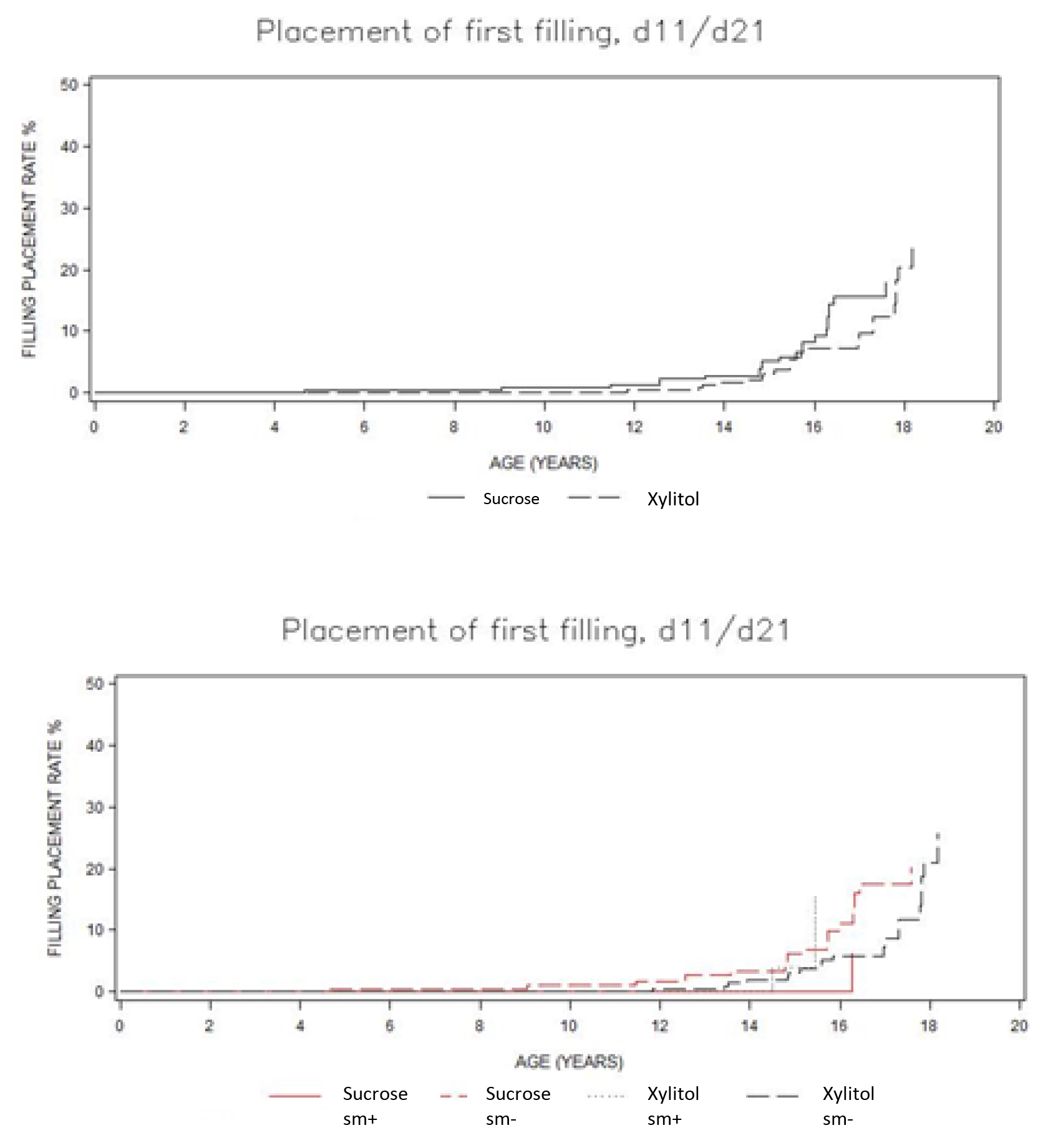
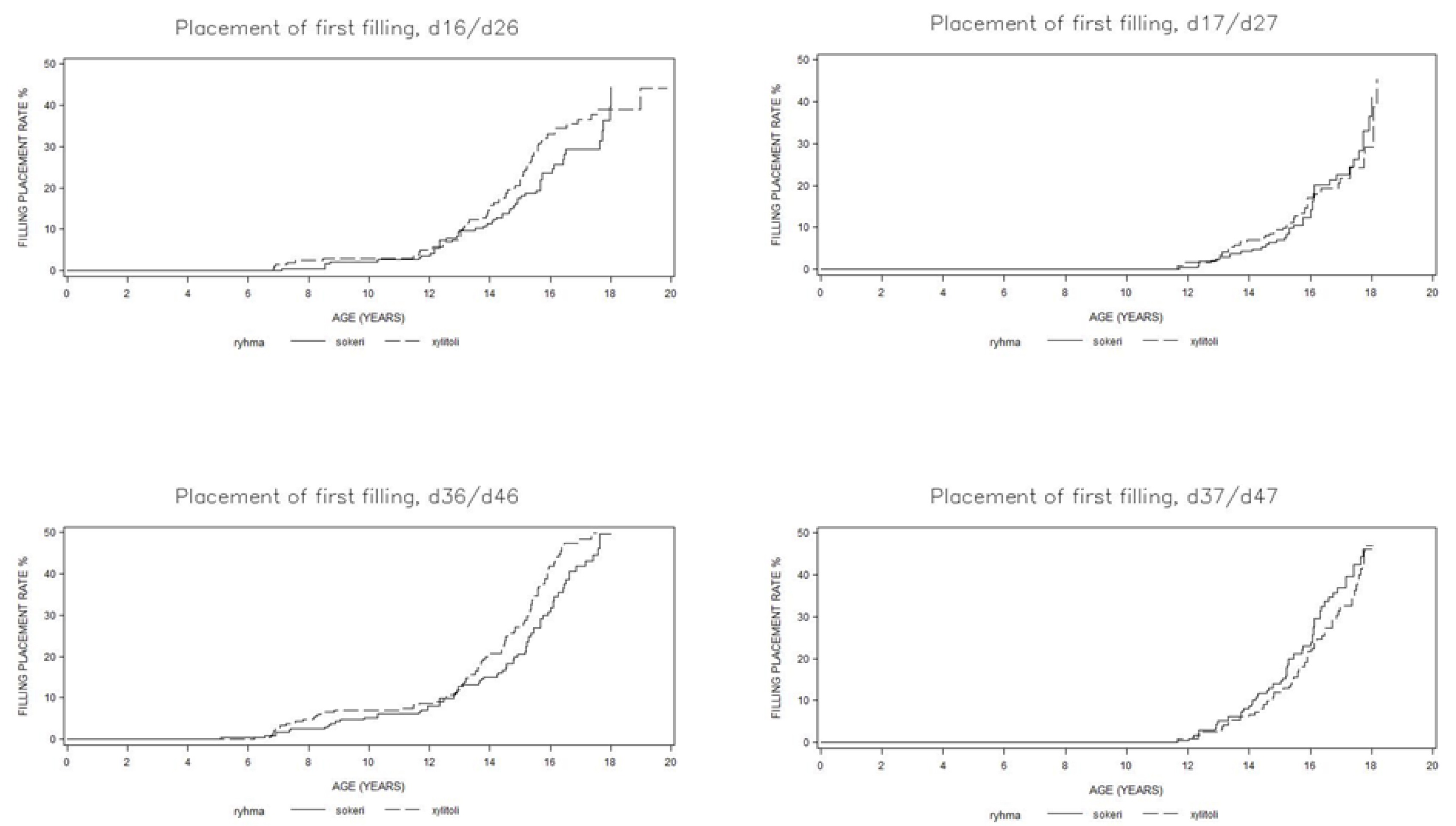
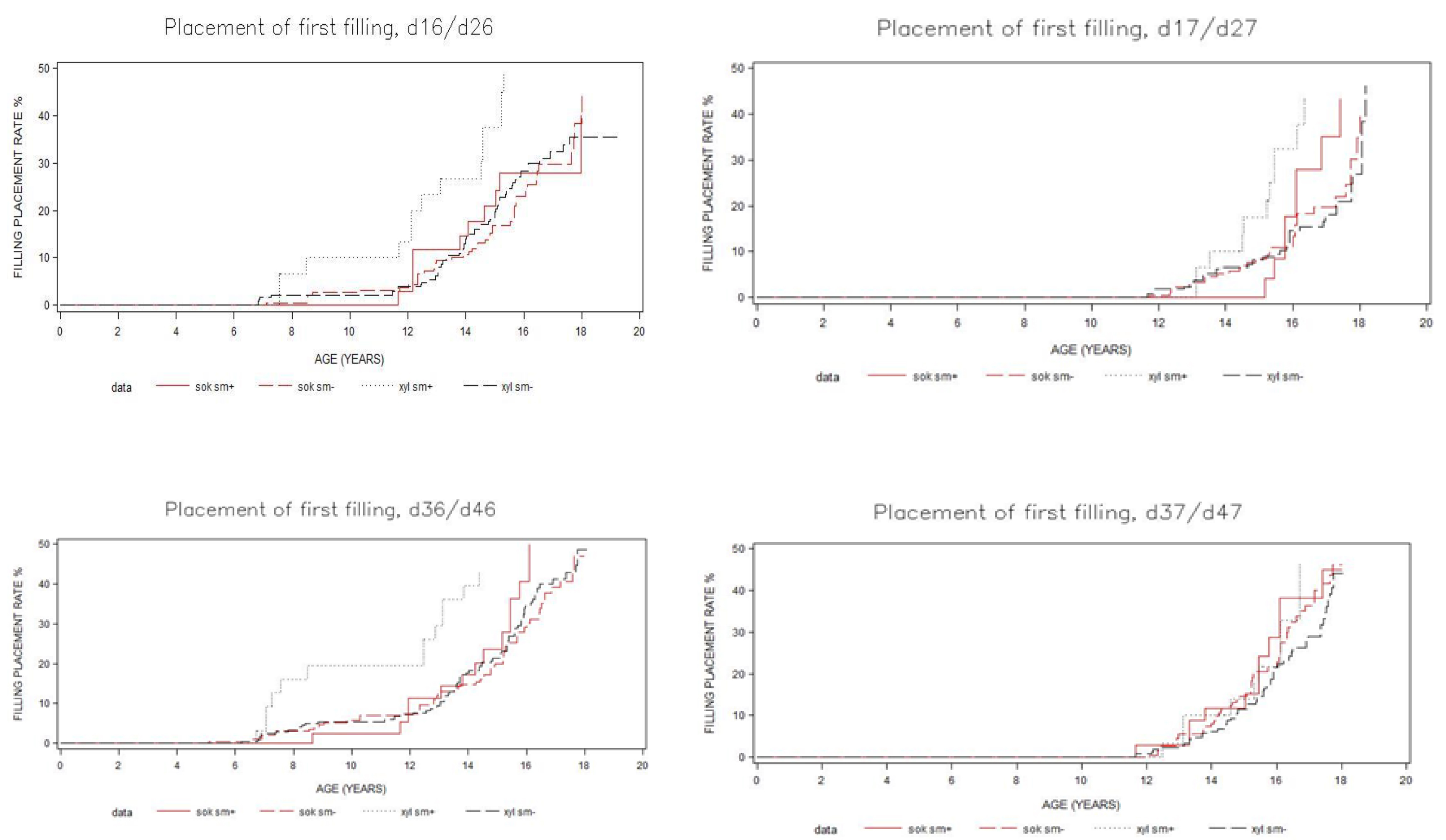
No significant difference between the intervention group was found in survival of any permanent tooth caries free. As an example, Kaplan-Meier curves of maxillary incisors and first and second permanent molars were drawn (Figures 2 and 3). There was a tendency that the first molars became decayed sooner in the sucrose than in the xylitol group but not for them nor for any other molars the differences between the groups were statistically significant (Figure 3). During the 10-year-follow-up period, survival time of permanent teeth of individuals with high ms levels and having been in sucrose group was not significantly different from those in other subgroups. However, participants with high ms levels at baseline tended to have more caries lesions in the first molars than those with low ms levels. This was seen more undoubtedly in the first than in the second molars (Figure  4).

PowerPoint Presentation

Figure 2. Kaplan-Meier survival functions of permanent maxillary incisors. In the upper figure according to sucrose/xylitol group and in the lower figure according to sucrose/xylitol group and mutans streptococci levels (ms+/ms-).

PowerPoint Presentation

Figure 3. Kaplan-Meier survival functions of maxillary (upper) and mandibular (lower) first and second permanent molars according to xylitol and sucrose groups.

PowerPoint Presentation

Figure 4. Kaplan-Meier survival functions of first and second permanent molars in maxilla (upper) and mandible (lower) according to sucrose/xylitol groups and salivary mutans streptococci levels (ms+/ms-).

Median age for the placement of the first restoration in the first permanent molars was lower for individuals with ms+ in the xylitol group than in other subgroups; the difference between the groups was statistically significant for the first left lower molar, d. 36 (p =0.017), but not for any other teeth (Figures 3 and 4). To describe the influence of caries status in childhood to that in the teenage a regression equation DMFT = 2.55 + 0.65 * (dmf + DMF) was achieved with 95% CI regression coefficient for (dmf + DMFT) being (0.42, 0.88).

DISCUSSION

Findings of the present study are in concordance with our hypothesis that a short sucrose/xylitol exposure at preschool age does not indicate decaying of permanent dentition during a10 year-follow-up period regardless of the ms level at baseline. However, high ms level in preschool age does have some impact, it is somewhat associated with future decay in the first molars. The exposure was – luckily – too short for long-term effects of sucrose on permanent teeth even if there was a tendency that the first molars became decayed sooner in the sucrose than xylitol group. Same exposure for primary teeth was long enough to induce dental caries for children in the sucrose group when mutans streptococci levels were high [11].

Sucrose has been shown to be associated with dental caries prevalence since Vipeholm studies in 1954[12]. Regularly used polyol-based chewing gum, on the other hand, has been shown to prevent decaying among children and adolescents. In a 40-month double-blinded cohort study in Belize, South America, xylitol chewing gum was the most effective factor in reducing caries incidence compared with no-gum, sucrose gum, xylitol-sorbitol gum and sorbitol gum. In the Belize study sucrose gum use somewhat increased caries incidence. In the same study it was discussed, if simultaneous increased salivary secretion due to activation of masticatory system caused the positive outcome by xylitol [13].  In the previous short-term study [11], two months’ sucrose exposure was sufficient to cause decaying among those with high ms levels, but positive effect of xylitol in preventing caries was not seen. However, during the exposure there was a tendency that mutans streptococci levels of the participants changed towards better more often in the xylitol than in the sucrose group. In a recent study 5 weeks’ exposure to xylitol reduced ms counts, but had no affect on oral microbiome [14]. After 6 months regular xylitol use (11.6 g a day) salivary ms consertration has been shown to be lower in a xylitol group than in a control (non-sucrose) group among school-children [15]. If the sucrose exposure had continued longer in the present study, the effect could have been detectable even in permanent teeth due to changes in the microbiota towards acidogenic and aciduric. Most likely the participants did not keep up sufficient xylitol consumption after the intervention. Indeed, during the follow-up time 17% of Finnish boys in secondary school reported never using xylitol chewing gum [16].

Participants were randomly divided into the sucrose and xylitol groups. Children with poor oral hygiene and high ms consentration could fall into either group. Unfortunately, there is no information about oral health-related habits and preventive dental care during the follow-up period. However, the original AOM research was justified by the fact that at that time all children were quaranteed regular check-ups [10].

During the 13 year follow-up period after the intervention, children with high ms levels at baseline had lower dental attendance rates than their ms negative counterparts. Irregular dental care of any risk patient may increase caries risk. One or more missed dental appointments has been shown to cause a significant risk dental caries [17]. It can be speculated that a peak in caries prevalence and consequently dental treatments among those in the sucrose group with high ms levels during the intervention may have caused dental fear and avoidance of dental visits. This was seen as higher prevalence of caries lesions in the first molars.

Most likely the participants continued normal lifestyle after the exposure and for example use of sugar among sucrose group participants returned to the normal level. Long-term harmful effects of a short-term exposure to any one risk factor like sucrose cannot cause the disease. Also long-term effects of sugar exposure can be modulated by regular daily fluoride [18]. This may be true for those, who are hospitalized for some time and good oral hygiene cannot be practiced. Never the less, everything must be done to keep good standard oral health care even during hospitalization.

Kaplan Meier curves and Wilcoxon test were used to describe and analyze the survival time of permanent teeth. This method offers a demonstrative instrument to monitore teeth surviving caries free and restorations not needing replacement in cohorts as a function of time [19–21]. There were no differences between maxillary or mandibular and first or second permanent molars when considering only xylitol and sucrose groups. Our findings concerning the association of ms colonization and dental decay are in line with previous long-term study [22]. When considering also ms level, the difference between molars are seen here even 13 years after the intervention. First molars in the xylitol ms+ groups deacyed sooner than second molars. The lower first permanent molars are the first ones to erupt, which may have influenced the outcome here. It seems that the only thing affecting the difference between the teeth is the ms level.

Linear regression model showed a statistically significant, linear association with the caries status in pre-school and in teenage. Thus, this retrospective study supports earlierfindings of caries history prediciting future caries experience [23].

Even though the research group was not monitored by the research team after primary sucrose/xylitol trial, Finnish health care system allows achieving valid data from patient records. As all children until 18 years of age are entitled to free dental care, practically all those at that age group are treated in public, municipaly organized oral health care. This is a huge benefit for a practice-based follow-up study like this.

It can be concluded that the short sucrose exposure in childhood did not increase the risk for dental decay in permanent teeth. In the long run the only factor that seemed to effect survival of permanent teeth caries free were low mutans streptococci levels. However, the effect was significant only for one lower first molar.

CONFLICT OF INTEREST: The authors declare no conflict of interes

AUTHOR CONTRIBUTIONS: VA and IH conceived the ideas and designed the study; IH collected the data; JP, VA and HH analysed the data; HH and IH drafted the manuscript; VA and M-LL finalized the writing of the manuscript.

REFERENCES

  1. Li Y. (2011) Controlling sugar consumption still has a role to play in the prevention of dental caries. J Evid Based Dent Pract. 11: 24–26. [Crossref]
  2. Moynihan PJ, Kelly SA. (2014) Effect on caries of restricting sugars intake: systematic review to inform WHO guidelines. J Dent Res. 93: 8–18. [Crossref]
  3. Tanzer JM. (1995) Xylitol chewing gum and dental caries. Int Dent J. 45(1 Suppl 1): 65–76. [Crossref]
  4. Trahan L. (1995) Xylitol: a review of its action on mutans streptococci and dental plaque–its clinical significance. Int Dent J. 45(1 Suppl 1): 77–92. [Crossref]
  5. Isokangas P, Tiekso J, Alanen P et al. (1989) Long-term effect of xylitol chewing gum on dental caries. Community Dent Oral Epidemiol. 17: 200–203. [Crossref]
  6. Azarpazhooh A, Lawrence HP, Shah PS. (2016) Xylitol for preventing acute otitis media in children up to 12 years of age. Cochrane Database Syst Rev. 8: CD007095. doi: 10.1002/14651858.CD007095.pub3. [Crossref]
  7. Uhari M, Kontiokari T, Niemelä M. (1998) A novel use of xylitol sugar in preventing acute otitis media. Pediatrics. 102 :879–84. [Crossref]
  8. Uhari M, Kontiokari T, Koskela M et al. (1996) Xylitol chewing gum in prevention of acute otitis media: double blind randomised trial. BMJ. 313: 1180–1184. [Crossref]
  9. White G. (1996) Commentary: what about the ethics? Comment on: BMJ 313: 1180–1184. [Crossref]
  10. Anttonen V, Larmas M, Raitio M. (1999) Children were guaranteed regular check ups in dental study. BMJ. 319: 432.
  11. Anttonen V, Halunen I, Päkkilä J et al. (2012) A practise-based study on the effect of a short sucrose/xylitol exposure on survival of primary teeth caries free. International Journal of Paediatric Dentistry. 22: 356–362. [Crossref]
  12. Gustafsson BE, Quensel CE, Lanke LS et al. (1954) The Vipeholm dental caries study; the effect of different levels of carbohydrate intake on caries activity in 436 individuals observed for five years. Acta Odontol Scand. 11: 232–264. [Crossref]
  13. Mäkinen KK, Bennett CA, Hujoel PP et al. (1995) Xylitol chewing gums and caries rates: a 40-month cohort study. J Dent Res. 74: 1904–1913. [Crossref]
  14. Söderling E, El Salhy M, Honkala E, Fontana M, Flannagan S, Eckert G, Kokaras A, Paster B, Tolvanen M, Honkala S. Effects of short-term xylitol gum chewing on the oral microbiome. Clin Oral Investig. 2015; 19: 237–44.
  15. Campus G, Cagetti MG, Sacco G et al. (2009) Six months of daily high-dose xylitol in high risk schoolchildren: a randomized clinical trial on plaque pH and salivary mutans streptococci. Caries Res. 43: 455–461. [Crossref]
  16. Lukkari E, Myöhänen J, Anttonen V et al. (2008) Dietary and oral hygiene habits: Room for improvement among schoolchildren. Finn Dent J 15:22–27. (Finnish, English abstract)
  17. Wigen TI, Skaret E, Wang NJ. (2009) Dental avoidance behaviour in parent and child as risk indicators for caries in 5-year-old children. Int J Paediatr Dent.19: 431–437. [Crossref]
  18. Bernabe E, Vehkalahti M, Sheiham A, Lundquist A, suominen AL. (2016) The shape of the dose response relationship between sugars and caries in adults. J Dent Res. 95(2): 167–72.
  19. Laitala ML, Alanen P, Isokangas P et al. (2013) Long-term effects of maternal prevention on children’s dental decay and need for restorative treatment. Community Dent Oral Epidemiol. 41: 534–540. [Crossref]
  20. Käkilehto T, Siiskonen J, Vähänikkilä H et al. (2013) Caries experience in primary teeth of four birth cohorts – a practice-based study. Eur Arch Paediatr Dent. 14: 59–64. [Crossref]
  21. Vähänikkilä H, Käkilehto T, Pihlaja J et al. (2014) A data-based study on survival of permanent molar restorations in adolescents. Acta Odontol Scand. 72: 380–385. [Crossref]
  22. Laitala M, Alanen P, Isokangas P et al. (2012) A cohort study on the association of early mutans streptococci colonisation and dental decay. Caries Res. 46: 228–233. [Crossref]
  23. Kassawara AB, Tagliaferro EP, Cortelazzi KL et al. (2010) Epidemiological assessment of predictors of caries increment in 7–10-year-olds: a 2-year cohort study. J Appl Oral Sci. 18(2): 116–20 [Crossref]

Risk of Foot Ulcer Development in Diabetic Patients – Relation to Isokinetic Muscle Strength, Sensory Function, and Clinical Findings

DOI: 10.31038/EDMJ.2019333

Abstract

Aim: To investigate whether reduced muscle strength in the lower extremities in diabetic patients is associated to the development of Diabetic Foot Ulcer (DFU).

Methods: We conducted a retrospective cohort study on 95 diabetic patients who participated in studies on Diabetic Polyneuropathy (DPN) and motor function 12–16 years earlier. Isokinetic muscle strength at the ankle and knee, Neurological Impairment Scores (NIS), vibration perception thresholds (VPT), and demographic data were obtained from the initial studies. Patient files were systematically reviewed, and information on DFU occurrence and Macrovascular Disease (MVD) acquired.

Results: Twenty-six patients developed DFU. A temporal relationship was found for development of DFU among patients with reduced strength at both the ankle and knee (all P<0.05). Univariate analyses showed a relationship between DFU and reduced strength for ankle dorsal flexion (P<0.001), ankle plantar flexion (P<0.005), knee extension (P<0.001), and knee flexion (P<0.005). DFU was related to NIS (P<0.001) and MVD (P<0.05) in both univariate and multivariate regression analyses. After adjustment for MVD, all strength measures were related to DFU. When adjusting for NIS, a trend was only found for ankle dorsal flexion (P=0.08).

Conclusions: In DPN, muscle weakness at the ankle and knee contributes to development of foot ulcers.

Keywords

Type 1 diabetes mellitus, type 2 diabetes mellitus, polyneuropathy, muscle strength, foot ulcer, follow-up.

Introduction

Diabetic Foot Ulcers (DFU) lead to reduced quality of life in affected patients and impose considerable health care costs 1,2]. Several risk factors have been linked to the occurrence of ulceration in both type 1 and type 2 diabetic patients, including impaired glycaemic control, peripheral arterial disease, and Diabetic Polyneuropathy (DPN) [3–6]. Reduced sensation due to DPN allows minor trauma to evolve undetected, thereby contributing to the initial stages of foot ulceration [7]. In recent years also motor dysfunction as a result of DPN, has been implicated in the pathology underlying DFU. DPN leads to muscle atrophy and loss of muscle strength in the foot and in more advanced cases also in the lower legs [8–11]. In addition, patients with DPN develop foot deformities such as bony prominences and metatarsophalangeal joint deformities, which contribute to abnormalities of pressure distribution and ulcer formation [5, 12–14].  Exposure of pathologically altered bony structures due to atrophy of overlying tissue, concomitant with increased forefoot slap during gait cycle deceleration as a result of reduced muscle strength for ankle dorsal flexion, is believed to cause increased plantar pressure during gait, which is associated to foot ulceration [15–17]. Weakness of dorsal flexion at the ankle and great toe combined with reflex testing, have been identified as risk factors for development of DFU [18]. However, as muscle strength was assessed by manual testing, the degree of muscle weakness was likely underestimated which may have weakened the association to DFU development [19]. Isokinetic dynamometry provides a more accurate quantification of muscle strength in neuropathic patients which could strengthen the proposed relationship between loss of muscle strength in the lower extremities due to DPN and foot ulcer formation [20].

In the present retrospective study, we have evaluated the temporal relationship between reduced muscle strength at both the knee and ankle determined by isokinetic dynamometry and the occurrence of DFU. We included diabetic patients evaluated using isokinetic dynamometry 12–16 years previously. The patients were followed up by obtaining data collected from patient files with focus on the occurrence of DFU.

Materials and Methods

Study design

We conducted a retrospective cohort-study on 95 diabetic patients (65 type 1 and 30 type 2) who were recruited for cross-sectional studies on diabetic polyneuropathy and muscle strength at our laboratory 12–16 years prior to the present study [9,21]. Baseline data on isokinetic muscle strength at the ankle and knee, age, height, weight, Neuropathy Impairment Score (NIS), and Vibratory Perception Threshold (VPT) were acquired from the initial study protocol. Patient hospital files were then systematically reviewed for the period since participation in the initial studies until 31st of December 2009, and information on foot ulcer occurrence and Macrovascular Disease (MVD) (defined as claudication, acute myocardial infarction, transient ischemic attack, or stroke) were recorded. A DFU was defined as an ulcer that required specialized treatment at the Diabetic Foot Centre located at the Department of Endocrinology, Aarhus University Hospital.

The study was approved by the Danish Data Protection Agency (Journal No. 2010-41-4811).

Measurements performed in initial cross-sectional studies

In the initial studies by Andersen et al. isokinetic dynamometry (Lido Active Multijoint; Loredan Biomedical, West Sacramento, CA) was applied to measure maximal muscle strength for extension and flexion of the knee and dorsal and plantar flexion of the ankle [9,21]. Maximal strength was measured as peak torque at slow movement velocities with subjects in a sitting position. Straps were applied proximally and distally to the respective joints. For ankle measurements, the foot was secured to a footplate. Standardized verbal feedback was given during the procedures.

NIS is a score obtained by performing a standardized clinical evaluation of muscle strength, activity of tendon reflexes, and sensation at the great toe and index finger. In the present study, all points due to muscle weakness have been omitted to avoid correlation bias.

VPT was evaluated at the dominant index finger pulp and non-dominant dorsum of the great toe, as described by Dyck et al [21].

Study population

Baseline data were obtained for 115 patients. Twenty patients were excluded as eleven patient files could not be located from the outpatient clinic archives, two patients had moved out of the geographical area, and five patients were lost to follow-up as they did not attend scheduled appointments at the outpatient clinic. Finally, foot ulceration following penetrating trauma complicated by infection occurred in one patient, and one patient had received chemotherapy for non-Hodgkin lymphoma known to cause polyneuropathy as a possible side effect. Thus, 95 patients were included in the present follow-up study.

In the initial studies, inclusion criteria for type 1 diabetic patients were duration of diabetes ≥ 20 years and age < 65 years, and for type 2 diabetic patients diabetes duration ≥ 5 years and age < 70 years. In short the exclusion criteria applied, secured that no participant had reduced levels of activity due to cardiac or lung disease, musculoskeletal disorders, suffered any neurological disorder or other endocrine disorder than diabetes mellitus, or was subject to symptomatic macroangiopathy. The criteria are stated in detail in the initial studies by Andersen et al [9,21].

Statistical analysis

Absolute values for muscle strength were converted to percentage of expected strength based on calculations adjusting for age, body mass, height, and gender as described earlier [21].

The two-sample t-test and Pearson’s Chi2 test were applied to compare demographic data in the group of patients that developed DFU with the group without DFU.

Logistic regression analysis was applied to evaluate the relationship between ulcer occurrence and degree of muscle weakness. Multiple logistic regression analysis was applied when adjusting for MVD and NIS, and to evaluate the influence of the strength measurements combined. As a minimum of ten outcome events are needed per predictor variable when performing multivariate analysis, only two variables were included in each multivariate analysis model [23].

For each strength measurement, patients were divided in groups according to percent of expected muscle strength; group 1: 0–74%, group 2: 75–99% and group 3: ≥100%. The groups were then compared using the log-rank test in order to evaluate the temporal relationship between muscle strength and DFU.

Results

The follow-up period was 13.9 (0.2–15.9) [median (range)] years, during which 26 patients developed DFU. No difference was found for diabetes type (65% type 1 vs. 70% type 1), age [54 [(26–69) years vs. 47 (26–69) years], duration of diabetes [26 (8–48) years vs. 23 (1–41) years], BMI [25 (19–37) vs. 25 (17–40)], or gender composition (19% female vs. 36% female) between patients who developed DFU and those without DFU, respectively (all P > 0.05). More patients with DFU were diagnosed with MVD during follow-up, as compared to patients that did not develop DFU (54% vs. 19%, P < 0.005).

Muscle strength, expressed as percent of expected strength, was lower at baseline for patients that developed DFU during follow-up than for patients that did not develop DFU for both ankle dorsal [68 (25–104)% vs. 92 (49–126)%, P < 0.0001] and plantar [73 (40–100)% vs. 85 (42–145)%, P < 0.01] flexion, as well as knee flexion [76 (50–103)% vs. 90 (56–129)%, P < 0.01] and extension [74 (55–106)% vs. 89 (59–133)%, P < 0.0001]. Further, NIS [24 (3–38) vs. 6 (0–31), P <0.0001] and VPT [99 (11–99) vs. 95 (32–99), P <0.01] scores were higher for patients who developed DFU.

Univariate analysis established a correlation between reduced muscle strength for both dorsal and plantar flexion at the ankle and flexion and extension at the knee, and the occurrence of DFU (Table 1). The odds ratios express the risk of developing DFU if muscle strength is reduced by one percent. Also, a high NIS and the occurrence of MVD were associated to foot ulceration. VPT, however, showed no relationship to DFU development.

Results of the multivariate regression analyses are shown in table 2. Reduced muscle strength for ankle dorsal flexion, ankle plantar flexion, knee extension, and knee flexion were all related to DFU occurrence when adjusting for MVD as shown in model 1, a-d. In model 2, muscle strength for flexion and extension at the ankle and knee were combined with NIS. All analyses found NIS to be an independent risk factor for DFU development, whereas a tendency was found for dorsal flexion, only. For movements at the ankle and knee, only ankle dorsal flexion and knee extension were related to DFU development (model 3, a+b). When combining ankle dorsal flexion and knee extension, only ankle dorsal flexion showed a relationship to DFU formation (model 3, c). NIS and the occurrence of MVD are included in model 4, and both were independently correlated to foot ulceration.

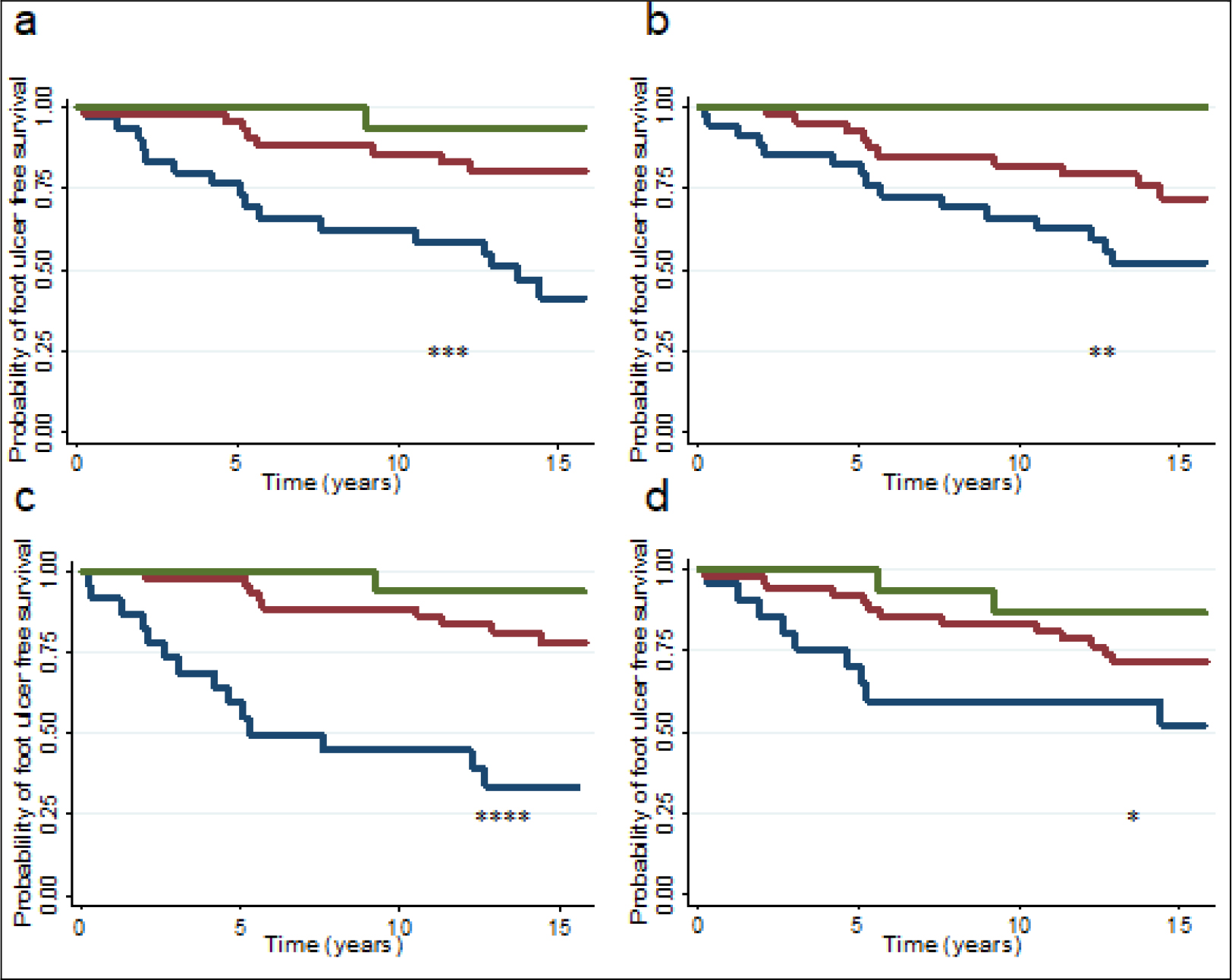
Figure 1, a-d, illustrates the association between lower extremity muscle strength and DFU development for patients grouped according to percentage of expected muscle strength at inclusion. For all movements measured, patients with expected strength of less than 75 % had higher probabilities of developing DFU during follow-up. Patient groups did not differ with regard to distribution of diabetes type.

EDMJ 2019-114 - Christer Zøylner Swan Denmark_F1

Figure 1. Kaplan Meier plot illustrating the probability of not developing foot ulcer in diabetic patients (65 type 1 and 30 type 2) according to percentage of expected strength for dorsal (a) and plantar (b) flexion at the ankle, and extension (c) and flexion (d) at the knee. Green line; patients with >/= 100% of expected strength for movement, red line; patients with 75–99 % of expected strength for movement, and blue line; patients with ≤ 74 % of expected strength for movement. *P < 0.05, **P < 0.005, ***P < 0.0005, and ****P < 0.0001.

Discussion

In this retrospective cohort study, we investigated the relationship between muscle strength in the lower extremities and the risk of developing DFU in 95 diabetic patients. We found that reduced muscle strength in the lower extremities is a risk factor for ulceration of the foot in diabetes. Reduced strength for ankle dorsiflexion and knee extension proved to be the strongest risk factors for the development of DFU. The odds ratios calculated for the models shown in tables 1 and 2, express the risk of developing a foot ulcer during a 14-year period if muscle strength is reduced by 1 %. When applied on the results presented in Table 1, the finding is exemplified by the 10 fold increased risk of developing a foot ulcer found for a patient with an expected muscle strength for ankle dorsal flexion of 60 % compared to that of a patient with normal muscle strength for this movement (60% vs 100% ; 1.0640 = 10.3).

Table 1. Odds ratios (OR) for univariate analysis expressing the risk of developing diabetic foot ulcers (DFU) in diabetic patients (65 type 1 and 30 type 2) in relation to muscle strength for movements at the ankle and knee, Neuropathy Impairment Score (NIS), and Vibratory Perception Threshold (VPT) at baseline, and macrovascular disease (MVD) developed during 13.9 (0.2–15.9) [median (range)] years follow-up. ORs for ankle and knee movements express the increased risk of developing DFU following a 1% reduction in muscle strength. All data are shown as OR and 95% confidence intervals (95% CI). NS = non-significant.

OR (95% CI)

P

Baseline

Ankle dorsal flexion

1.06 (1.02–1.09)

< 0.001

Ankle plantar flexion

1.04 (1.01–1.07)

< 0.005

Knee extension

1.09 (1.04–1.14)

< 0.001

Knee flexion

1.05 (1.02–1.09)

< 0.005

NIS

1.15 (1.09–1.22)

< 0.001

VPT

1.03 (0.98–1.08)

NS

Consecutively recorded data

MVD

5.03 (1.89–13.4)

< 0.005

Table 2. Multivariate analyses in which two predictor variables are applied in each analysis in relation to diabetic foot ulcer occurrence during 13.9 (0.2–15.9) [median (range)] years follow-up. In model 1, muscle strength for flexion and extension at the ankle and knee and macro vascular disease (MVD) are included. In model 2, muscle strength for flexion and extension at the ankle and knee and Neuropathy Impairment Score (NIS) are included. In model 3, muscle strength measurements at the ankle and knee are combined. In model 4, NIS and MVD are combined. All data are shown as odds ratios (OR) and 95% confidence intervals (CI 95%).

OR (95% CI)

P

Model 1

a) Ankle dorsal flexion
MVD

1.06 (1.02–1.09)
4.15(1.40–12.27)

< 0.005
< 0.05

b) Ankle plantar flexion
MVD

1.04 (1.01–1.07)
4.96 (1.74–14.18)

< 0.05
< 0.05

c) Knee extension
MVD

1.09 (1.03–1.15)
5.21 (1.61–16.91)

< 0.001
< 0.05

d) Knee flexion
MVD

1.06 (1.02–1.10)
8.03 (2.43–26.55)

< 0.005
< 0.005

Model 2

a) Ankle dorsal flexion
NIS

1.03 (0.99–1.07)
1.12 (1.05–1.19)

0.08
< 0.001

b) Ankle plantar flexion
NIS

1.02 (0.98–1.05)
1.13 (1.07–1.21)

0.4
< 0.001

c) Knee extension
NIS

1.04 (0.98–1.09)
1.12 (1.05–1.20)

0.18
< 0.005

d) Knee flexion
NIS

1.03 (0.99–1.07)
1.14 (1.07–1.21)

0.17
< 0.001

Model 3

a) Ankle dorsal flexion
Ankle plantar flexion

1.05 (1.02–1.08)
1.02 (0.99–1.06)

< 0.005
0.13

b) Knee extension
Knee flexion

1.08 (1.02–1.15)
1.02 (0.96–1.05)

< 0.05
0.77

c) Ankle dorsal flexion
Knee extension

1.06 (1.02–1.1)
1.05 (1.0–1.11

< 0.01
0.06

Model 4

NIS
MVD

1.14 (1.08–1.21)
3.47 (1.07–11.30)

< 0.001
< 0.05

Further, we have illustrated the effect of muscle weakness on DFU development over time, strengthening the hypothesis of an association between alterations in gait due to loss of muscle strength and foot ulcer formation, possibly as a result of increased plantar pressure.

An association to DFU development was also found for MVD and NIS in both uni- and multivariate analysis, lending support to the multifactorial pathology presumed to underlie the development of foot ulcers in diabetes.

Several studies have described gait alterations in diabetic patients with DPN. Late firing of the anterior tibial muscle has been found to result in forefoot slap and, resultantly, increased plantar pressure, which contributes to development of DFU [15, 24]. In our study, reduced muscle strength for dorsal flexion at the ankle showed a close correlation to foot ulceration, thus our results support these findings as the anterior tibial muscle contributes to ankle dorsiflexion. A correlation between DFU and muscle strength for ankle dorsal flexion, toe extension, and finger abduction has been reported, however, muscle strength was evaluated manually [18]. As our muscle strength measurements were acquired using a standardized quantitative technique with a low coefficient of variation, and included ankle extension and muscle strength at the knee in addition to ankle dorsal flexion, the results bring substantial support to the association between muscle weakness in DPN and DFU occurrence. Patients with DPN experience atrophy of foot muscles, and a relationship between prior DFU and weakness of intrinsic as well as extrinsic foot muscles calculated by a semi quantitative scoring system has been reported [25]. As DPN is distributed in a length-dependent manner, an evaluation of the relationship between foot muscle weakness and DFU would have added valuable information, however these data were not obtained in the initial studies as dynamometric strength measurements of small foot muscles are not easily performed. Due to the retrospective nature of our study, important risk factors for foot ulceration associated to increased plantar pressure such as foot deformities and callus formation could not be adequately acquired.

The severity of DPN is a well-known risk factor for diabetic foot ulceration, a finding also supported in our study. When adjusting for the severity of DPN, expressed as NIS, in the multivariate analysis, strength of the ankle dorsal flexors no longer showed an association to foot ulceration. However, a trend towards a relationship between the variable and DFU development remained. This observation is not surprising since reduced muscle strength is caused by motor neuropathy, which occurs concomitantly with sensory neuropathy in DPN [26].

MVD was strongly associated to foot ulceration, a finding supported by other groups [3,5,27]. However, the influence of the association found in our study is most probably overestimated, as data on MVD were recorded consecutively throughout the follow-up period, and are therefore, unlike all strength measurements, NIS, and VPT, not baseline data.

VPT showed no relationship to DFU development when applying univariate analysis, although sensory neuropathy is a well-known risk factor for the development of DFU and increased thresholds for vibration occur in early stages of DPN [18]. In our analyses many patients presented with VPT exceeding the arbitrary unit 25 JND (Just Noticeable Difference), thus the lack of correlation may be due to a ceiling effect.

Increased physical activity has been suggested to play a role in DFU development due to repetitive mechanical stress of the plantar region of the foot. However, no increase in foot ulcer occurrence was observed among neuropathic diabetic patients enrolled in a twelve-month muscle-strengthening program, and further, another study suggested an overall lower activity in diabetic patients who developed DFU compared to those without this complication [28,29]. Thus, there are no convincing data to suggest that physical activity increases the risk of foot ulcer formation. It has been reported that specific training of the lower extremities in diabetic patients diagnosed with sensory neuropathy improve gait speed, balance, muscle strength and joint mobility [30]. As reduced muscle strength seems to be implicated in foot ulceration in diabetes, strengthening of lower extremity muscles may contribute to preservation of normal gait, and thereby reduce the risk of developing foot ulcers. Also, a randomized controlled trial evaluating the effect of leg muscle strengthening and gait exercises in neuropathic diabetic patients, reported a more expedient distribution of plantar pressure and gait execution [31]. However, as intention-to-treat analyses showed improvement and the intervention only administered for twelve weeks, exercises directed at enhancing lower extremity function may still play a role in DFU prevention. Based on the aforementioned study and our findings, a study evaluating the effect of strengthening of lower extremity muscles on DFU formation is highly relevant, however both the intervention and follow-up period must be of sufficient length as the mechanisms leading to DFU exert their detrimental impact over years.

In conclusion, we found a temporal relationship between reduced muscle strength at the knee and ankle and diabetic foot ulcer development. Notably reduced muscle strength for dorsal flexion at the ankle seemed to have a close relationship to foot ulceration, lending support to previous findings evaluating gait biomechanics in DPN and the proposed relationship between increased plantar pressure and DFU development. As motor dysfunction in DPN is a contributing factor in the multifactorial pathway involved in foot ulceration, it would be relevant to include quantitative strength measurements and gait analyses in large scaled prospective studies investigating the aetiology behind this feared complication to diabetes mellitus.

Authorship: A.B.P wrote the manuscript, took part in designing the study, and collected and analysed data. L.H. contributed to study design, data collection and analyses, and reviewed the manuscript. H.A. contributed to study conception and design, analyses, and reviewed/edited the manuscript. N.E. contributed to design, data collection, discussion, and reviewed the manuscript. C.S.A. contributed to study conception and design, researched data, conducted statistical analyses, and reviewed and edited the manuscript. All authors approved the final version of the manuscript. A.B.P. is guarantor of this work.

Acknowledgment

Results of the study were presented in a shortened form at the 21st Annual Meeting of the Diabetic Neuropathy Study Group of the EASD, held in Porto, Portugal, 8–11 September 2011.

References

  1. American Diabetes Association (2008) Economic costs of diabetes in the U.S. In 2007. Diabetes Care 31: 596–615. [crossref]
  2. Vileikyte L (2001) Diabetic foot ulcers: a quality of life issue. Diabetes/metabolism research and reviews 17: 246–249.
  3. Abbott CA, Carrington AL, Ashe H, Bath S, Every LC, et al. (2002) The North-West Diabetes Foot Care Study: incidence of, and risk factors for, new diabetic foot ulceration in a community-based patient cohort. Diabetic medicine : a journal of the British Diabetic Association 19: 377–84.
  4. Adler AI, Boyko EJ, Ahroni JH, Stensel V, Forsberg RC, et al. (1997) Risk factors for diabetic peripheral sensory neuropathy. Results of the Seattle Prospective Diabetic Foot Study. Diabetes care 20: 1162–1167.
  5. Boyko EJ, Ahroni JH, Stensel V, Forsberg RC, Davignon DR, et al. (1999) A prospective study of risk factors for diabetic foot ulcer. The Seattle Diabetic Foot Study. Diabetes Care 22: 1036–1042. [crossref]
  6. McNeely MJ, Boyko EJ, Ahroni JH, Stensel VL, Reiber GE, et al. (1995) The independent contributions of diabetic neuropathy and vasculopathy in foot ulceration. How great are the risks? Diabetes Care 18: 216–219. [crossref]
  7. Shun CT, Chang YC, Wu HP, Hsieh SC, Lin WM, et al. (2004) Skin denervation in type 2 diabetes: correlations with diabetic duration and functional impairments. Brain 127: 1593–1605.
  8. Andersen H, Gjerstad MD, Jakobsen J (2004) Atrophy of foot muscles: a measure of diabetic neuropathy. Diabetes Care 27: 2382–2385. [crossref]
  9. Andersen H, Nielsen S, Mogensen CE, Jakobsen J (2004) Muscle strength in type 2 diabetes. Diabetes 53: 1543–1548. [crossref]
  10. Andreassen CS, Jakobsen J, Andersen H (2006) Muscle weakness: a progressive late complication in diabetic distal symmetric polyneuropathy. Diabetes 55: 806–812. [crossref]
  11. Andreassen CS, Jakobsen J, Ringgaard S, Ejskjaer N, Andersen H (2009) Accelerated atrophy of lower leg and foot muscles–a follow-up study of long-term diabetic polyneuropathy using magnetic resonance imaging (MRI). Diabetologia 52: 1182–1191. [crossref]
  12. Cheuy VA, Hastings MK, Commean PK, Ward SR, Mueller MJ (2013) Intrinsic foot muscle deterioration is associated with metatarsophalangeal joint angle in people with diabetes and neuropathy. Clinical biomechanics (Bristol, Avon) 28: 1055–1060.
  13. Raspovic A (2013) Gait characteristics of people with diabetes-related peripheral neuropathy, with and without a history of ulceration. Gait & posture 38: 723–728.
  14. van Schie CH (2005) A review of the biomechanics of the diabetic foot. Int J Low Extrem Wounds 4: 160–170. [crossref]
  15. Abboud RJ, Rowley DI, Newton RW (2000) Lower limb muscle dysfunction may contribute to foot ulceration in diabetic patients. Clinical biomechanics (Bristol, Avon) 15: 37–45.
  16. Frykberg RG, Lavery LA, Pham H, Harvey C, Harkless L, et al. (1998) Role of neuropathy and high foot pressures in diabetic foot ulceration. Diabetes Care 21: 1714–1719. [crossref]
  17. Stess RM, Jensen SR, Mirmiran R (1997) The role of dynamic plantar pressures in diabetic foot ulcers. Diabetes Care 20: 855–858. [crossref]
  18. Abbott CA, Vileikyte L, Williamson S, Carrington AL, Boulton AJ (1998) Multicenter study of the incidence of and predictive risk factors for diabetic neuropathic foot ulceration. Diabetes care 21: 1071–1075.
  19. Andersen H, Jakobsen J (1997) A comparative study of isokinetic dynamometry and manual muscle testing of ankle dorsal and plantar flexors and knee extensors and flexors. European neurology 37: 239–242.
  20. Andersen H (1996) Reliability of isokinetic measurements of ankle dorsal and plantar flexors in normal subjects and in patients with peripheral neuropathy. Arch Phys Med Rehabil 77: 265–268. [crossref]
  21. Andersen H, Poulsen PL, Mogensen CE, Jakobsen J (1996) Isokinetic muscle strength in long-term IDDM patients in relation to diabetic complications. Diabetes 45: 440–445.
  22. Dyck PJ, O’Brien PC, Kosanke JL, Gillen DA, Karnes JL (1993) A 4, 2, and 1 stepping algorithm for quick and accurate estimation of cutaneous sensation threshold. Neurology 43: 1508–1512. [crossref]
  23. Peduzzi P, Concato J, Kemper E, Holford TR, Feinstein AR (1996) A simulation study of the number of events per variable in logistic regression analysis. J Clin Epidemiol 49: 1373–1379. [crossref]
  24. Shaw JE, van Schie CH, Carrington AL, Abbott CA, Boulton AJ (1998) An analysis of dynamic forces transmitted through the foot in diabetic neuropathy. Diabetes care 21: 1955–1959.
  25. van Schie CH, Vermigli C, Carrington AL, Boulton A (2004) Muscle weakness and foot deformities in diabetes: relationship to neuropathy and foot ulceration in caucasian diabetic men. Diabetes care 27: 1668–1673.
  26. Dyck PJ, Albers JW, Andersen H, Arezzo JC, Biessels GJ, et al. (2011) Diabetic polyneuropathies: update on research definition, diagnostic criteria and estimation of severity. Diabetes/metabolism research and reviews. 27: 620–628.
  27. Monteiro-Soares M, Dinis-Ribeiro M (2010) External validation and optimisation of a model for predicting foot ulcers in patients with diabetes. Diabetologia 53: 1525–1533. [crossref]
  28. Lemaster JW, Mueller MJ, Reiber GE, Mehr DR, Madsen RW, et al. (2008) Effect of weight-bearing activity on foot ulcer incidence in people with diabetic peripheral neuropathy: feet first randomized controlled trial. Physical Therapy 88: 1385–1398.
  29. Armstrong DG, Lavery LA, Holtz-Neiderer K, Mohler MJ, Wendel CS, et al. (2004) Variability in activity may precede diabetic foot ulceration. Diabetes Care 27: 1980–1984. [crossref]
  30. Allet L, Armand S, de Bie RA, Golay A, Monnin D, et al. (2010) The gait and balance of patients with diabetes can be improved: a randomised controlled trial. Diabetologia 53: 458–466. [crossref]
  31. Sartor CD, Hasue RH, Cacciari LP, Butugan MK, Watari R, et al. (2014) Effects of strengthening, stretching and functional training on foot function in patients with diabetic neuropathy: results of a randomized controlled trial. BMC musculoskeletal disorders 15: 137-2474-15-137.

Understanding and Messaging A New Technology for Skin Health: A Mind Genomics Exploration

DOI: 10.31038/JDST.2019111

Abstract

We present the application of the emerging science of Mind Genomics to understand what messages resonate with consumers regarding a skin cosmetic. Experimental design combines sixteen different messages, from four different ‘questions’ about the product, generating 24 unique vignettes for each of 50 respondents. The deconstruction of the responses reveals what messages best persuade, how messages ‘engage’ the respondent’s attention, how messages synergize or suppress each other when presented together, and then how to extract meaningful mind-sets effectively from a small, affordable, rapid, and easily executable study. Mind Genomics as presented here provides a way to understand the dimensions of everyday life in a scientifically rigorous and meaningful way, generating the potential of a science of behavior from the world previously dominated by one-off commercial efforts.

Introduction

For many years the notion of scientific research to identify the messaging for cosmetics was grudgingly accepted by the ‘beauty-business’ for the simple reason that many talented entrepreneurs ruled the business. To these individuals, cosmetics were ‘hope in a bottle,’ a phrased that may have been coined decades ago by Estee Lauder, typifying the attitude that cosmetics, and its sister world, perfumes, were the domain of art and intuition, the substance of magic and wizardry. Perfumery suffered from the ‘golden nose’ more than did cosmetics. Cosmetics had both aesthetic and functional properties, having to do with our skin. The topics were both beauty and functionality, a dual concern which would lead to the professionalization of the field, and the formation of the Society of Cosmetic Chemists. With the foregoing in mind, we are now three quarters of a century later, in 2019, as of this writing. The creation of cosmetics is now a science involving a great deal of chemistry as well as innovations in materials science, coupled with the realization and acceptance that the cosmetic product to be sold may be either for beauty or for functionality (skin) or both. Most of the literature in cosmetic science involve the deep study of the product, or better the ingredients of the product, and their combination. The source is biology and toxicology, as well as applied chemistry. There may be some general psychological or sociological studies, but little in the way of specifics relevant to solving a problem. That is, the chemistry of cosmetics, the formulation, and the possible toxicological aspects are part of the science of cosmetics, but the mind of the cosmetic customer is not. Of course there are general studies, but really very few of a specific nature to which a marketer can go to understand that customer mind [1–4] How does one communicate science and beauty in a simple way, especially when the science involves new technology (e.g. fullerenes with nano-properties appropriate for and valuable to cosmetic products; [5, 6]. What are the words which spark the interest of buyers, perhaps of both sexes? Is there a way to merge science of cosmetics with advertising, more in the manner of an ongoing process than as a fortuitous outcome of years of experimentation with consumers? What might be the happy consequence of a systematic, simple, affordable, scientifically rigorous of knowing how the consumer mind responds to information of both commercial and health importance.

Mind Genomics as the bridge between sales and science

The analysis of Mind Genomics has evolved from a bespoke, customized approach to one which can be ‘templated’ both in conception and now in action. The notion of discovering how components of a mixture contribute to the mixture was limited to the harder sciences, biology, chemistry, physics. Most work in applied psychological involved either self-reports or results from surveys. These approaches did not reveal how components drove ideas alone or mixed together to drives together. It would remain a matter of easy computation, and the recognition of creating solutions quickly, inexpensively, and ‘scalable’ that would led to the Mind Genomics approach. The objective of the analysis is to metricize the ideas in paragraph of ideas (test vignette), or the inverse, to use the metricization of ideas in a paragraph of ideas to understand how each idea operates. That is, we use mixtures of ideas, the normal way people see ideas, to understand the performance of single ideas. The approach, when first explained to a non-scientist, non-statistician, appears to fly in the face of the typical canon of science, whose principle rests on the ability to understand something by isolating it, varying it, and then thoroughly understand the idea after it has been put through a microscope.

The foregoing approximation, knowledge of components from measuring systematically varied mixtures, applies perfectly to the topics of Mind Genomics, these topics being the daily situations which confront us, and the decisions that we make in those situations. We cannot easily quantify daily life, although we might ask people to do so, hypothetically, in their mind, separating different ideas. An easier way to do the study and makes the measurements comes from the world of storytelling, and poetry. We can take a set of variables, mix them in different combinations, and instruct respondents to the combinations. The combinations, vignettes really, constitute very short stories. They are easy to rate.

The process of Mind Genomics – from customized science to a templatable operation

During the past three decades, since 1990, author Moskowitz has developed approaches to understand the mind of consumers using the experimental design of ideas [7] Experimental design involves the systematic combination of variables, and the measurement and analysis of these mixtures to determine how the variables interact to drive the response. Experimental design is not new to product development, whether done informally or formally. Most product developers know that the process of mixing to create different prototypes is the path to developing a better product. The same logic holds when we mix ideas [8, 9]. The original studies using experimental design of ideas were custom studies without a template. During the past 20 years the effort has moved from custom studies to template studies which generate knowledge more simply and readily [10] The efforts have moved from making the statistics the focus of the research (methodology) to making the application virtually off-the-shelf, so-called DIY (Do-it-yourself.)

The process follows these steps:

  1. Define the problem or the topic. This step may seem irrelevant, but it is not. It is quite important to define just WHAT is the focus. For this study, the topic is ‘communicating a new cosmetic product, formulated with a novel ingredient (fullerene), responsible for a variety of benefits.
  2. Define four questions? The Mind Genomics approach is going to work with combinations of ideas, or elements. The questions allow the researcher to create the sequence of a story through four questions and motivate the answers. The respondents will never see the questions, but they are the key to a successful experiment. The reality continues to emerge that formulating the correct or relevant four questions is the hardest part of the Mind Genomics experiment because it forces the researcher to really think deeply about the topic. (Table 1) presents the four questions (A-D.) In other version of Mind Genomics there may be more or fewer questions.

    Table 1. The four questions and the four answers to each question.

    Question A: My worries about my skin?

    A1

    Skin is filled with spots

    A2

    Skin looks old

    A3

    Skin is dry

    A4

    Skin bruises

    Question B: What does this product do?

    B1

    Protects with fullerene

    B2

    Filters out and transforms harmful light

    B3

    Stimulates lasting production of collagen for three months

    B4

    Betters skin health, e.g. acne & wound heeling

    Question C: How do I use this product?

    C1

    Even when your healthy it has beneficial effects

    C2

    When you’re older it makes your skin younger

    C3

    Use daily as healthy cosmetics

    C4

    When you’re young makes your skin healthy

    Question D: What do I observe on my skin?

    D1

    See the results in 30 days

    D2

    See what your partner says to you

    D3

    Look at a mirror, what does it say

    D4

    Share with your friends so they all as good as you

  3. For each question, provide four answers. One of the ‘traps’ of conventional research is that it relies in many cases on puffery and emotion, but without adequate ‘concrete’ specifics. That is, the conventional wisdom in much of advertising is to claim benefits, but one does not know the specific benefit, or has not tested the specific benefit. Instead, the common practice is to put in a general benefit. Mind Genomics works at a more concrete level, painting a ‘word picture’ for each answer. The word picture forces the researcher to think in concrete terms, to describe something to which one can point. In this spirit, the four answers to each of the four questions in Table 1 paint word pictures.
  4. Combine the answers (but not the questions) into small vignettes, each vignette comprising a minimum of two answers, and a maximum of four answers. A vignette can incorporate at most one answer from a question, but often the vignette incorporates no answers from a question. (Table 2) shows eight vignettes for respondent #14, as well as the rating assigned by the respondent, the binary expansion of the rating, and the response time in seconds.

    Table 2. The data from eight vignettes evaluated by one respondent, showing the combination of answers, the binary expansion, the rating, the binary-transformed rating and the response time.

    Respondent #14, a woman age 50+, slightly interested in her skin condition

    Vignette

    1

    7

    9

    13

    19

    20

    23

    24

    Question A

    3

    1

    Absent

    1

    4

    Absent

    4

    2

    Question B

    3

    2

    3

    1

    Absent

    4

    3

    3

    Question C

    2

    2

    3

    2

    2

    1

    4

    1

    Question D

    3

    Absent

    2

    Absent

    Absent

    4

    3

    4

    Binary Transformed Design

    A1

    0

    1

    0

    1

    0

    0

    0

    0

    A2

    0

    0

    0

    0

    0

    0

    0

    1

    A3

    1

    0

    0

    0

    0

    0

    0

    0

    A4

    0

    0

    0

    0

    1

    0

    1

    0

    B1

    0

    0

    0

    1

    0

    0

    0

    0

    B2

    0

    1

    0

    0

    0

    0

    0

    0

    B3

    1

    0

    1

    0

    0

    0

    1

    1

    B4

    0

    0

    0

    0

    0

    1

    0

    0

    C1

    0

    0

    0

    0

    0

    1

    0

    1

    C2

    1

    1

    0

    1

    1

    0

    0

    0

    C3

    0

    0

    1

    0

    0

    0

    0

    0

    C4

    0

    0

    0

    0

    0

    0

    1

    0

    D1

    0

    0

    0

    0

    0

    0

    0

    0

    D2

    0

    0

    1

    0

    0

    0

    0

    0

    D3

    1

    0

    0

    0

    0

    0

    1

    0

    D4

    0

    0

    0

    0

    0

    1

    0

    1

    Rating

    9-Point Rating

    6

    7

    9

    5

    7

    9

    4

    6

    Binary-Transformed Rating

    0

    100

    100

    0

    100

    100

    0

    0

    Response Time (Seconds)

    9.01

    5

    7

    4

    3

    4

    4

    4

  5. Create the vignettes according to the experimental design, run the study, and acquire the data [11] Figure 1 shows an example of one of the vignettes. The respondents are invited to participated by a company (Luc.id, Inc.), a strategic partner of Mind Genomics Associates, Inc. Luc.id maintains access of 20+million respondents. For this study the requirements were simply a balance of males and females, and approximate balance of ages. The study is run entirely on the Internet, with the respondents being members of the Luc.id panel, ensuring cost effective and rapid completion of the experiment. (Figure 1) shows an example of a vignette.

    Mind Genomics-017 - JDST Journal_F1

    Figure 1. Example of a vignette as a respondent would see it on a smartphone. The vignette is configured slightly differently for tablets and computers.

  6. ‘Flag all response times of 9.1 or higher. (Figure 2) shows the distribution of response times for the total panel. All response times of 8.999 seconds or higher were brought to the value 9.0. The distribution suggests an unusually large number of response times beyond 9 seconds. These vignettes were considered to have been evaluated done while the respondents were doing something else. There was no way to check the truth of the assumption, but it seems reasonable in the light of the distribution.

    Mind Genomics-017 - JDST Journal_F2

    Figure 2. Distribution of response times. Response times over 8.99 seconds were transformed to 9 seconds.

  7. Transform the 9-point rating to a binary scale, in preparation for the modeling. The traditional use of scales has been to measure subjective magnitude, as it is done here. Quite often, however, managers have a difficult time understanding the meaning of the scale points. It is far easier to deal with binary responses, no/yes. The history of consumer research and polling suggests that the data can be more easily accepted by managers and by those having to use the data for technical purposes (e.g., guidance for next steps) when the data are presented in the form of ‘no/yes’, and the information is presented in terms of percentage saying no versus percentage saying yes. In this spirit we change the response to a binary response, with ratings of 1–6 converted to 0, and ratings of 7–9 converted to 100, respectively. We add a small random number (<10–5) to the ratings to ensure that there is variability in the ratings for a single respondent, even when that respondent assigns all 24 vignettes ratings of 1–6 (converted to 0), or ratings of 7–9 (converted to 100.) The stratagem of adding a small random number ensures that the OLS (ordinarily least-squares regression) will always work.
  8. Create the data set for modeling. The objective of Mind Genomics is to understand the part-worth contribution of the answers by deconstructing the response to the ratings, after the responses have been converted to binary (ratings of 1–6 converted to 0; rating of 7–9 converted to 100.) We can combine the data from the 50 respondents into large data set, keeping mind that we have extracted the first vignette from each respondent because we assume that to be a learning effort,’ and we further extracted all vignettes with response times above 9.02 seconds under the assumption that the respondent was otherwise engaged when reading that particular vignette. We may be eliminating some valid cases, but based upon the distribution of response times, response times of 9 seconds or longer seem to be out of keeping with the rest of the data (see Figure 2).
  9. Apply OLS (ordinary least-squares) regression to the data to estimate the part-worth contribution of each of the 16 answers to interest. Previous experience suggests that the responses assigned to the first vignette of the 24 may be aberrant, primarily for response time. We eliminate that first vignette from each respondent, as well as eliminating all vignettes flagged as having a response time of 9 seconds or longer. After eliminating the first vignette and the flagged vignettes we are left with 1089 observations or cases, instead of 1200, with 50 observations eliminated as being the first vignette, and 61 observations as registering a suspiciously long response time.
  10. We estimate the parameters of the model expressed by the equation: Interest (Binary Transform) = k0 + k1(A1) + k2(A2) … k16(D4)

Results – Total Panel – Interest

(Table 3) shows the coefficients, t-statistic and p-value for the key parameters of the model relating the presence/absence of the 16 elements to the binary-transformed rating. The model is created on the basis of the 1089 cases, namely without those vignettes in the first position, and without those vignettes with response times of 9 seconds or longer. The additive constant tells us the expected percent of respondents who say that they would be interested in the cosmetic product, but without knowing anything more about the product. The additive constant is a purely estimated parameter, since all vignettes by design comprised 2–4 elements. The additive constant, 36.45, tells us that only about 1/3 of the responses will be strongly positive. It will have to be the elements which do the work. The t-statistic is a measure of signal to noise, with values of 1.65 or being what we would call ‘significant,’ i.e., we can be pretty sure that the additive constant (or other parameter) does not come from a distribution which has a real value of 0. The important thing to note here is not the t-statistic or the p-value, but rather the magnitude of the coefficient. A rule of thumb is that a coefficient is ‘relevant’ when it is about 7–8 or higher. Based upon that rule of thumb, the only element which really can be considered ‘relevant’ is C3; Use daily as healthy cosmetics. For whatever reason, the other elements are simply unable to generate interest when they are presented in these vignettes, whereas C3 generates interest.

Table 3. Performance of the elements for the total panel, without the first vignette, and without any vignettes showing a response time of 9 seconds or longer.


Coefficient

t-statistic

p-Value

Additive constant

36.45

4.64

0.00

C3

Use daily as healthy cosmetics

7.36

1.53

0.13

C2

When you’re older it makes your skin younger

4.96

1.04

0.30

C1

Even when your healthy it has beneficial effects

3.54

0.74

0.46

C4

When you’re young makes your skin healthy

3.39

0.71

0.48

D1

See the results in 30 days

1.95

0.41

0.68

B1

Protects with fullerene

–0.18

–0.04

0.97

D3

Look at a mirror, what does it say

–1.76

–0.37

0.71

A3

Skin is dry

–1.83

–0.38

0.70

B3

Stimulates lasting production of collagen for three months

–1.97

–0.40

0.69

A2

Skin looks old

–2.58

–0.54

0.59

B4

Betters skin health, e.g. acne & wound heeling

–2.68

–0.55

0.58

B2

Filters out and transforms harmful light

–2.91

–0.60

0.55

A1

Skin is filled with spots

–3.75

–0.78

0.44

D2

See what your partner says to you

–4.25

–0.90

0.37

D4

Share with your friends so they all as good as you

–5.12

–1.07

0.29

A4

Skin bruises

–5.49

–1.13

0.26

Performance of elements – Key subgroups – WHO THE RESPONDENTS ARE

We expect that respondents of different genders and different ages will differ in the pattern of what they find interesting, especially in a skin product. Does that different manifest itself for this new product? The easiest way to answer that question is to do the modeling separately for each key group, beginning with gender (two parallel analyses), and then by age (three parallel analyses.) (Table 4) shows the results.

Table 4. Performance of the elements for the total panel, the two genders, and three age groups, estimated without the first vignette, and without any vignettes showing a response time of 9 seconds or longer.

Total

Male

Female

A15–29

A30–49

A50+

CONSTANT

36

30

43

32

18

74

C3

Use daily as healthy cosmetics

7

11

3

13

12

–1

C2

When you’re older it makes your skin younger

5

4

6

3

10

9

C1

Even when your healthy it has beneficial effects

4

4

3

8

7

–2

C4

When you’re young makes your skin healthy

3

7

0

6

11

–2

D1

See the results in 30 days

2

4

–1

–4

3

3

B1

Protects with fullerene

0

1

–1

2

–3

–3

A3

Skin is dry

–2

–3

–1

–7

11

–11

B3

Stimulates lasting production of collagen for three months

–2

–8

5

–6

9

–13

D3

Look at a mirror, what does it say

–2

1

–4

1

–6

4

A2

Skin looks old

–3

–5

–1

–6

3

–6

B2

Filters out and transforms harmful light

–3

–4

–1

–5

–2

–2

B4

Betters skin health, e.g. acne & wound heeling

–3

2

–7

–2

–2

–2

A1

Skin is filled with spots

–4

–8

0

–4

–1

–6

D2

See what your partner says to you

–4

–3

–6

–2

–9

2

A4

Skin bruises

–5

0

–12

–4

–1

–13

D4

Share with your friends so they all as good as you

–5

–1

–9

–4

–7

–7

In terms of gender, women are more interested in the topic than are men. This difference in interest emerges from the additive constant, which is 43 for females, and 30 for males, respectively.

In terms of strong performing elements, however, we have only one strong performer for either gender, C3, Use daily as healthy cosmetics.

We see greater differences among groups when we divide respondents by age. The additive constant for the oldest respondents, age 50+, is a remarkable 74. They begin interested, but some elements reduce their interest.

The middle group in terms of age are those respondents ages 39–49, with the lowest additive constant, but with the most impactful elements.

The youngest age group, 15–29, are interested, especially when the emphasis is on health (C3, C1).

We see no response to specific ingredients, e.g. fullerene.

Performance of elements – Key subgroups – HOW THE RESPONDENTS THINK

The division of respondents into self-defined skin concern (none/low versus moderate/high) shows a higher additive for those who define themselves as moderately to very concerned about their skin, and a lower additive constant for those who define themselves as not concerned or only slightly concerned with their skin (46 vs 31.) No elements, however, break through as driving interest. When we move to mind-sets, obtained by the method of clustering patterns of coefficients, we find that two mind-sets emerge. The clustering method puts the 50 respondents into two groups, based upon how ‘distance’ the respondents are from each other, in a mathematical sense. Distance between two people is based upon the simple number (1-Pearson Correlation.) The Pearson Correlation, R, measures the strength of a linear relation between two groups of data, with comparable measures. Our respondents generate 16 coefficients. When two respondents generate coefficients perfectly linearly related to each other (R=1), we assume that their distance is 0, namely 1–1 = 0. When two respondents generate coefficients perfect inversely related to each other (R=–1), we assume their distance to be 2, namely 1- –1 = 2. The clustering program (K-Means) assigns respondents to two and then three complementary groups, clusters, based upon mathematical considerations only, namely the distance between the respondents within a cluster is small, and the distance between the centroids of the clusters is large. Based upon this analysis, we find that two clusters suffice, as shown in (Table 5) (last two data columns.) We have sorted Table 5 by the strongest elements in the two mind-sets. Both mind-sets have virtually identical additive constants (38 vs 37.) The mind-sets will differ in the nature of the elements which score highest. From those elements we will name the mind-sets.

Table 5. Performance of the elements for the total panel, self-rated concern with skin, and mind-sets, estimated without the first vignette, and without any vignettes showing a response time of 9 seconds or longer.

Total

Lesserr Skin Concern

Greater Skin Concern

Mind-Set 1 (Fast Results)

Mind-Set 2 (Skin Health)

CONSTANT

36

31

46

38

37

C1

Even when your healthy it has beneficial effects

4

3

6

–6

12

C3

Use daily as healthy cosmetics

7

6

9

2

11

C2

When you’re older it makes your skin younger

5

7

3

0

8

C4

When you’re young makes your skin healthy

3

5

1

–2

8

D1

See the results in 30 days

2

3

0

8

–5

D3

Look at a mirror, what does it say

–2

–4

1

4

–8

B1

Protects with fullerene

0

–3

5

2

–2

B4

Betters skin health, e.g. acne & wound heeling

–3

–6

2

2

–8

D4

Share with your friends so they all as good as you

–5

–10

0

–1

–10

B2

Filters out and transforms harmful light

–3

–1

–5

–2

–5

D2

See what your partner says to you

–4

–3

–7

–3

–6

A1

Skin is filled with spots

–4

–5

–2

–4

–4

A3

Skin is dry

–2

–2

–1

–6

1

B3

Stimulates lasting production of collagen for three months

–2

0

–5

–6

1

A4

Skin bruises

–5

–5

–6

–7

–3

A2

Skin looks old

–3

–5

1

–8

2

Mind-Set 1 = Speed of action

Mind-Set 2 = Skin health

Finding the respondents in the population

Respondents can be easily classified according to WHO they are, but not easily classified into the WAY THEY THINK, especially when the way they think pertains to specifics, of a particular situation such as a new product. Researchers have classified respondents into very large groups, psychographic mind-sets differing along many general aspects of a topic, such as those who are eco-conscious versus those who are not. These large-scale psychographic studies are expensive to run, require many respondents, take a long time to analyze, and work only for ‘general’ topics. The opportunity in this study focuses on specific mind-set segmentation, for a limited topic, relatively small scale. For most of one’s life, especially experiences of the every-day, the mind-set segmentation is small-scale, specific, and does not warrant the large expenditures. In view of this need to increase the speed and decrease the cost to deploy the results, we have developed a simple system, the PVI or personal viewpoint identifier.

  1. The strategy for the PVI follows these steps for a two-segment (cluster) solution in terms of mind-sets:
  2. Begin with the 2 vectors containing the 16 coefficients of the elements.
  3. Subtract the two vectors (element by element) and compute their absolute value (e.g. abs(x-y))
  4. Look for the five highest values e.g. look for the elements which are the farthest from each other.
  5. Open a new worksheet in excel and list the five elements under each other.
  6. Each chosen element receives one vote (all the chosen ones from step 2).
  7. Begin again with Step 1, but now add a standard random noise to our two vectors (random numbers around the mean of the original values) – this step is called Monte Carlo simulation
  8. Repeat 2,3 and 5 on the new data just created and sum up the votes
  9. Repeat steps 5 and 6 1000 times – this is called bootstrapping8) at the and we look at the table created in step 4 and chose those 5 elements which were chosen as most discriminating the most times.

In the case of 3 segments we do the same but in the first step we create 3 additional variables (S1-S2, S1-S3 and S2-S3) instead of one variable (S1-S2) and choose 6 elements not five. The actual implementation of the PVI for this cosmetic study appears in (Figure 3), showing the questionnaire, and the two feedback screens, each screen for the mind-set to which the new respondent is assigned. The questionnaire and the screen can be used in person in stores, on the web for e-commerce to direct the shopper to the more appropriate website for the shopper’s newly uncovered mind-set, and of course for research into covariates with mind-sets. As of this writing (April, 2019) the PVI for the cosmetic product study can be found at this location http://162.243.165.37:3838/TT22/

Mind Genomics-017 - JDST Journal_F3

Figure 3. The PVI for the cosmetic product.

Discovering which messages engage, capturing attention

Today’s world has often been characterized as one with the scarcest commodity being the attention of people, who are bombarded daily with a myriad of messages, and who, all too often, ‘tune out.’ Can the experimental design so useful to discover what ‘influences,’ also be used to discover what’ engages?’ One way to answer this question measures the response time for each vignette, and then deconstructs the response time into the component response times of the elements. Those elements with long response times (e.g., 1.0 seconds or longer, an operational definition for convenience in this study) may be assumed to be those which capture attention.

Parenthetical note: Increasing experience with the deconstruction of response time in these Mind Genomics studies suggests that studies with commercial products and ‘fun’ experiences generate short response times for the different elements, often response times ranging from 0.3 seconds to 0.7 seconds. In contrast, studies of more serious topics, of psychological or sociological relevance, conducted with the same type of respondent population reveal long response times of 1.0 or longer the various elements.

(Tables 6A and 6B) show the response times for the 16 elements, in decreasing order. Table 6A shows the response times for the genders and three age groups. Table 6B shows the response times for what people feel about their skin and their mind-sets, based upon their interest ratings. The key differences in response time emerge in Table 6A, showing WHO the person is, and NOT in Table 6B, showing how the person THINKS.

Table 6A. Response times for key subgroups, based upon WHO THE RESPONDENT IS.

Total

Male

Female

A15–29

A30–49

A50+

B1

Protects with fullerene

0.9

0.7

1.1

0.6

1.1

1.3

B2

Filters out and transforms harmful light

0.9

0.8

1.0

0.4

1.0

1.5

B4

Betters skin health, e.g. acne & wound heeling

0.9

0.7

1.1

0.5

1.3

1.1

A4

Skin bruises

0.7

0.7

0.7

0.5

0.5

1.1

B3

Stimulates lasting production of collagen for three months

0.7

0.6

0.8

0.6

0.9

0.7

C2

When you’re older it makes your skin younger

0.7

0.7

0.7

0.2

1.1

1.0

A1

Skin is filled with spots

0.6

0.6

0.5

0.5

0.5

0.8

A2

Skin looks old

0.6

0.6

0.6

0.2

0.6

1.1

C3

Use daily as healthy cosmetics

0.6

0.6

0.5

0.3

1.1

0.4

D4

Share with your friends so they all as good as you

0.6

0.3

0.8

0.6

0.3

1.0

A3

Skin is dry

0.5

0.4

0.5

0.3

0.4

0.7

C4

When you’re young makes your skin healthy

0.5

0.5

0.5

0.2

1.1

0.0

D2

See what your partner says to you

0.5

0.4

0.6

0.8

0.1

1.0

D3

Look at a mirror, what does it say

0.5

0.2

0.7

0.5

0.1

1.2

C1

Even when your healthy it has beneficial effects

0.4

0.3

0.6

0.1

0.9

0.2

D1

See the results in 30 days

0.3

0.0

0.7

0.3

0.2

0.7

Table 6B. Response times for key subgroups, based upon WHAT THE RESPONDENT THINKS.

Total

None/Low Concern

Medium / High Concern

Mind-Set 1 – Fast Results

Mind-Set 2 – Skin Health

B1

Protects with fullerene

0.9

1.1

0.7

0.9

0.9

B2

Filters out and transforms harmful light

0.9

0.9

0.8

0.9

0.8

B4

Betters skin health, e.g. acne & wound heeling

0.9

0.9

0.8

0.8

1.0

A4

Skin bruises

0.7

0.6

0.8

0.6

0.8

B3

Stimulates lasting production of collagen for three months

0.7

0.8

0.5

0.7

0.7

C2

When you’re older it makes your skin younger

0.7

0.8

0.5

0.6

0.8

A1

Skin is filled with spots

0.6

0.6

0.4

0.5

0.6

A2

Skin looks old

0.6

0.6

0.5

0.5

0.6

C3

Use daily as healthy cosmetics

0.6

0.6

0.5

0.5

0.7

D4

Share with your friends so they all as good as you

0.6

0.6

0.5

0.7

0.4

A3

Skin is dry

0.5

0.5

0.4

0.4

0.5

C4

When you’re young makes your skin healthy

0.5

0.6

0.4

0.5

0.6

D2

See what your partner says to you

0.5

0.5

0.5

0.7

0.3

D3

Look at a mirror, what does it say

0.5

0.6

0.3

0.6

0.3

C1

Even when your healthy it has beneficial effects

0.4

0.5

0.2

0.2

0.6

D1

See the results in 30 days

0.3

0.4

0.4

0.6

0.1

Total – No engaging elements

Males – No engaging elements, shorter response times than those for females

Females – Most engaging elements come from Question B, ‘what does the product do?’

Age 15–29 – Nothing engages

Age 30–49 – Health and protection, but skip over feedback as if it were consciously ignored

Age 50+ – Health and protection, with feedback from others, i.e., have accepted the situation

No/Low skin concern – engaged by the term fullerene

Med/High concern – nothing engages them

Mind-Sets 1 and 2 – nothing engages them

Scenario Analysis – Deeper ‘mental processing’ revealed by the pairwise interaction of elements

One of the premises of Mind Genomics is that the deconstruction of the vignettes into elements can reveal the way the mind processes information. Up to now, we have operated under the assumption that the elements we selected, our 16 answers to the questions, are statistically independent of each other. We ensured that statistical independence by permutable experimental designs [11] The structure of the permutations ensures that each respondent evaluated combinations in which the elements were statistical independent of each other. What happens, however, if the mind somehow deals with the combinations in a way which takes into account the logical coherence or lack of coherence of the elements? Said differently, when we look at vignettes with one type of stated condition (e.g., A1: skin is filled with spots) versus vignettes with another type of stated condition, A3: skin is dry), do we see any effect on the performance of the other elements (B1-B4, C1-C4, D1-D4, respectively)? This question, the nature of pairwise interactions between elements, can never be answered in conventional work with experimental design or conjoint measurement, simply because the combinations can never be tested both for single elements and for combinations of elements.

One way to look at these interactions separated the se of 1240 vignettes from the total panel into five strata, depending upon the element from Question A (skin condition) appearing in the vignette. The structure of the design allows us to separate these strata, then to create a model relating the presence/absence of the other 12 elements to interest and response time. Rather than one model, we end up with five parallel models. Question A or Silo A, skin condition, does not appear. When we look at the different scenarios, we see dramatic differences both in the additive constant and in the values of the coefficients. (Table 7) shows the coefficients for the scenario analysis, with the key stratification variable being Question or Silo A, skin condition.

Table 7. Scenario analysis, showing how each specific statement about Skin Condition (Question 1) interacts with the remaining elements, based upon the rating of the vignette.

A0 No condition

A1 Skin is filled with spots

A2 Skin looks old

A3 Skin is dry

A4 Skin bruises

Additive constant

22

44

28

23

40

B4

Betters skin health, e.g. acne & wound heeling

17

–16

–3

7

–15

C4

When you’re young makes your skin healthy

11

2

1

2

2

B1

Protects with fullerene

8

–4

2

–3

1

B2

Filters out and transforms harmful light

8

–14

7

0

–6

C3

Use daily as healthy cosmetics

5

18

–7

5

15

D2

See what your partner says to you

–7

–8

9

8

–16

D1

See the results in 30 days

5

–4

8

17

–15

C2

When you’re older it makes your skin younger

4

4

–4

13

7

C1

Even when your healthy it has beneficial effects

6

3

3

–1

7

B3

Stimulates lasting production of collagen for three months

7

–16

4

2

0

D3

Look at a mirror, what does it say

–2

1

4

3

–9

D4

Share with your friends so they all as good as you

4

–21

4

5

–15

The additive is the estimated value of the vignette when only the column element appears (e.g., A1, Skin is filled with spots), but no other elements appear. Thus, when we have absolutely no elements, the additive constant is 22 because the value is 22 for A0. When we go from absolutely no elements to different skin conditions, we find two very strong elements, A2 (skin is filled with spots) and A4 (skin bruises). The additive constants are very moderate (44 for spots, 40 for bruises). When we move from repair to appearance, we drop down to 28 (skin looks old) and 23 (skin is dry), respectively. Thus , we learn a great deal about the deep structure of decision making. We now move to interactions, after having factored out basic interest and specific issues, the basic interest from the additive constant A0 (22) and the specific issues provided by the additive constants for A0 – A4. Depending upon the particular issues with the skin, the same element may perform strongly or weakly. An example of this dependence of one element on another is the performance of two elements: D2 (See what your partner says to you) and D1 (See the results in 30 days). Both perform well in the present of A1 (skin looks old) and A3 (skin is dry) but poorly in the presence of A1 (skin is filled with spots) and A4 (skin bruises).

The benefit of the permuted designs for Mind Genomics become more apparent when we realize that the scenario analysis to discover hitherto unexpected interactions, positive synergisms and negative suppressions, could not have been possible with the permutations. The conventional research using conjoint analysis and one set of test stimuli could never have explored the proper combinations, and even were these combinations to have been tested, one would not have the design nor the analytical tools to uncover them.

Scenario Analysis – Deeper ‘understanding of engagement’ revealed by interaction of elements

We conclude the analysis with a parallel question about pairwise interactions, this time looking at response times. Whereas the ratings assigned to the vignettes were conscious, or at least the respondent was cognitive aware, the response times represent more automatic responses. We might expect that the response times for the same element would be unchanged in the presence of different messages about skin condition. That is, we expected it should take the same time to respond to an element, no matter what other elements are present with the element in question.

(Table 8) shows dramatic differences in response time to the same element as a function of the basic skin condition in the vignette. A good example of the interactions is three elements: Protects with fullerene; Filters out and transforms harmful light; and Stimulates lasting production of collagen for three months. These three elements are glossed over when the vignette is about dry skin. Yet, when the skin looks old, they engage the respondent, who pays attention.

Table 8. Scenario analysis, showing how each specific statement about Skin Condition (Question 1) interacts with the remaining elements, based upon the response time to the vignette.

A0: No Condition

A1: Skin is filled with spots

A2: Skin looks old

A3: Skin is dry

A4: Skin bruises

B1

Protects with fullerene

1.9

1.5

1.2

0.6

0.6

B2

Filters out and transforms harmful light

1.9

0.5

1.3

0.9

0.8

B3

Stimulates lasting production of collagen for three months

1.6

0.5

1.0

0.2

1.2

B4

Betters skin health, e.g. acne & wound heeling

1.1

0.9

1.6

1.0

1.3

C3

Use daily as healthy cosmetics

–0.1

1.2

0.8

0.3

0.9

D2

See what your partner says to you

0.5

1.0

0.3

1.0

0.7

C2

When you’re older it makes your skin younger

0.0

0.8

1.4

0.9

1.0

D4

Share with your friends so they all as good as you

0.6

0.7

0.0

1.1

1.1

C4

When you’re young makes your skin healthy

0.4

0.3

0.3

0.9

1.1

C1

Even when your healthy it has beneficial effects

0.0

0.7

0.7

0.7

0.5

D1

See the results in 30 days

0.5

0.8

0.4

0.7

0.2

D3

Look at a mirror, what does it say

0.6

0.9

0.2

0.5

0.9

Discussion and Conclusion

When people think about research into cosmetics, the typical research either focuses on the performance of the products in ‘objective tests,’ or the economics of product sales and distribution. There are occasional reports incorporating information the key mind-sets in the world of cosmetics, but the reality is that these reports do not really focus on the psychology of cosmetics, except insofar as cosmetics is considered from the point of a person’s culture or daily routine. The topic of ‘how to communicate’ is left to the individual market research study, commissioned by a client in a company, presented, and more often than not left to molder in the stack of old, no-longer-useful reports.

Mind Genomics presents the opportunity to take topics of everyday life, like a new cosmetic, and convert a commercial report into a scientific effort. The opportunity to create science out of the everyday experience is not as recognized nor appreciated as it should be. The typical study today uses either cognitively meaningless stimuli such as non-sense syllables strung together in certain ways and presented quickly or slowly, or perhaps general stimuli in an area but none commercially meaningful. The goal is to learn about the way the mind works using the test stimuli. Perhaps an equally important goal is to learn about the performance of ‘relevant’ stimuli, using the mind as a measuring instrument. That is, create the science of the material studied, not the science of the mind. As demonstrated here, Mind Genomics does just that, using meaningful, ‘cognitively-rich’ stimuli, so both the mind doing the evaluation and the stimuli being evaluated are of interest.

Acknowledgment

Attila Gere thanks the support of the Premium Postdoctoral Researcher Program of the Hungarian Academy of Sciences.

References

  1. Dimitriadis S, Papista E (2010) Integrating relationship quality & consumer-brand identification in building brand relationships: proposition of a conceptual model. The Marketing Review 10: 385–401.
  2. Liao SH, Chen YJ, Hsieh HH (2011) Mining customer knowledge for direct selling & marketing. Expert Systems with Applications 38: 6059–6069.
  3. Papista E, Dimitriadis S (2012) Exploring consumer-brand relationship quality and identification: qualitative evidence from cosmetics brands. Qualitative Market Research: An International Journal 15: 33–56.
  4. Tuncay-Zayer L, Neier S (2011) An exploration of men’s brand relationships. Qualitative Market Research: An International Journal 14: 83–104.
  5. Lens M (2011) Recent progresses in application of fullerenes in cosmetics. Recent Pat Biotechnol 5: 67–73. [crossref]
  6. Mu L, Sprando RL (2010) Application of nanotechnology in cosmetics. Pharm Res 27: 1746–1749. [crossref]
  7. Moskowitz HR, Gofman A, Beckley J, Ashman H (2006) Founding a new science: Mind genomics. Journal of sensory studies 21: 266–307.
  8. Anderson NH (1981) Foundations of information integration theory. New York, Academic Press.
  9. Green, PE, Srinivasan V (1990) Conjoint Analysis in Marketing: New Developments with Implications for Research and Practice. Journal of Marketing 54, 3–19.
  10. Moskowitz H, Gofman A (eds.) (2012) Rule Developing Experimentation: A Systematic Approach to Understanding and Engineering the Consumer Mind. Bentham Science Publishing.
  11. Gofman A, Moskowitz H (2010) Isomorphic permuted experimental designs and their application in conjoint analysis. Journal of Sensory Studies 25: 127–145.

The Perceived Likelihood of Spousal Violence: A Mind Genomics Exploration

DOI: 10.31038/ASMHS.2019323

Abstract

We present a new way to understand how people perceive situations involving other people, situations that could be considered part of the everyday. The approach is Mind Genomics, which assesses the response of people to short, systematically varied vignettes about situations and other people. The responses to these vignettes are deconstructed into the part-worth contribution of the component elements that the vignette comprises, showing the ‘algebra of the mind.’ The deconstruction also is done on response time to the vignettes, showing the ability of the elements to engage attention when the respondent makes a judgment. When Mind Genomics is applied to descriptions of family life under stress, the data suggest that some elements are linked with predicted violence, others are not. Women appear to be more sensitive than men to the individual elements. Three different mind-sets emerged with different perceived ‘triggers’ to predicted family violence, with each mind-set encompassing both men and women: Mind-Set 1 – no specific warning; Mind-Set 2 – Sensitive to the economy; Mind-Set 3 – Family has problems. We present the PVI (personal viewpoint identifier) as a technique to assign new people to these mind-sets.

Introduction

Violence against the other sex, especially in marriage, is not new. Stories of murder and abuse fill the newspapers, the magazines, and the Internet news of today (2019.) Before today’s overwhelming plethora of news, violence by males against females, especially spouses and other family members, occupied a great deal of attention, from those in the news, but of course even more telling, from writers and poets. One cannot read the famous poem, My Last Duchess, by the 19th Century British poet, Robert Browning without a shudder when one realizes how easy it was to kill one’s spouse. And of course, the popular 1965 Rock n Roll song by Herman’s Hermits, hints at England’s royal lady-killer, King Henry VIII, transformed to a 1960’s idiom of a man with a broken heart. What is popular in literature only reflects what is the common situation in everyday life. The literature in sociology and psychology is replete with studies about violence and anger. Violence against one’s spouse is dealt with in many publications, with the aspects dissected, studied, statistically analyzed and reports issued. Violence seems to be endemic to the relations, starting even in courtship [1]. The spousal violence continues, even into the 60’s [2] Violence emerges when the woman ends up supporting the man [3]. Of course, alcoholism plays a role [4], but so does religion [5] Violence comes from many quarters, but many studies have focused on gender and marriage [6–8].

The foregoing represents just a bit of the available material on violence in the home. These studies focus on both surveys and discussions with individuals. What is lacking is a sense of the richness of the family life through discussion, an absence promoted by the rigidity of the scientific method, but the absence filled by clinicians and social workers. The key issue is to make this topic come alive by merging the rigor of science with the immediacy of storytelling. Violence in the home is especially relevant because it is common, and riveting to those involved. Although there seems to be very little academically-oriented literature recounting the actual ‘story’ of the abuse, the Internet provides a repository of such personal studies in a number of websites, such as:

  1. https://www.getdomesticviolencehelp.com/domestic-violence-stories
  2. www.hiddenhurt.co.uk/domestic_violence_stories.html
  3. https://www.domesticshelters.org/articles/true-survivor-stories

It may be that websites are more conducive to people ‘telling their story’ in their own language. In contrast, the scientific community has made its information almost unobtainable, except to those schooled in the scholastic tradition and able to cut through the jargon and statistics to understand what exactly is happening.

Exploratory Studies through Mind Genomics

This study explores the mind of ‘people’ by having them evaluate different vignettes about violence, vignettes that have been systematically varied, with the components of the vignette, the element, having a richness that is missing from surveys. A review of the scientific literature suggests that many of the studies involving human judgment are done in a manner which is slow, expensive, requiring teams of researchers, and extensive, rigorous statistical analysis. The statistical analysis is often of the type known as ‘inferential, ’ with the objective to confirm or to falsify an ingoing hypothesis, with the hypothesis developed from theory.

Mind Genomics presents to the world of science a different approach, not grounded in theory and confirming or falsifying hypotheses [9]. Rather, Mind Genomics can be liked to an exploration of decisions, using cognitively meaningful stimuli, and dealing with issues of the every day. Mind Genomics can be likened to a new cartographical exercise of a land. Mind Genomics works by presenting vignettes to the respondents, with these vignettes comprising combinations of elements or messages to which a respondent can relate. The respondent reads the vignette and responds to the combination. The research approach is analogous to the MRI, which takes multiple pictures of tissue from different vantage points, and then combines these into a picture of the tissue. The research in this study embodies the Mind Genomics paradigm, dealing with the very important issue of family violence. The objective is to understand a third-party’s estimate of either violence or peace at home occurring when a specific situation is presented, and then to assess the likelihood that each specific element is correlated either with violence or with a peaceful home, respectively, two opposite sides of the scale.

Mind Genomics combines the person with emotion and meaningful description of behavior, i.e., cognitively rich test stimuli. Mind Genomics obtains ratings from the response of people to vignettes about a situation, similar that presented in literature, story-telling, or song. The vignette paints a picture of a situation. The respondent is then asked to judge some aspect of the situation, such as projected violence or projected happiness, based upon what is read. Through this approach it now becomes possible to understand the mind of the person, either the one who is undergoing the experience, or the one who is hearing/reading about the experience. Both points of view differ dramatically from the almost lifeless array of statistics describing a situation. Mind Genomics combines the vividness of experience with numbers, probing the inner mind of the person exposed to the situation, first-hand or second-hand.

The Mind Genomics Approach

The Mind Genomics approach is designed to be exploratory, affordable, iterative, and scalable. This set of objectives in the design means that there are certain simple aspects of the study:

Exploratory: As suggested above, Mind Genomics does not work by confirming or disconfirming a hypothesis extant in the scientific literature. Rather, the exploration means taking new ideas from every-day experience and exploring them to find out the degree to which people respond positively or negatively to them.

Affordable: Mind Genomics is set up to be a so-called DIY, Do it yourself system. The researcher needs access to an APP on the proper machine (Android or Kindle), the ideas (for the researcher), and a convenient source of respondents.

Iterative: Mind Genomics is set up to return the data in easy-to-read formats (PowerPoint® for presentation, Excel® for data analysis. The data return in a matter of a few hours. A new study can be launched a few hours later, after the results from the first study are digested. Furthermore, the results are easy to understand, and set up to promote further exploration with the same tool. With the iterative approach the researcher can do as many as 4–6 studies in a 24-hour period, each study building upon the previous study.

Scalable: Almost anyone can use Mind Genomics to explore problems. The system is scalable across people, but also across different aspects of a topic, by the same researcher. Within a matter of a week or two, the enterprising researcher can conduct 10–20 studies, exploring the different facets of a topic.

Raw Materials

The origin of this study was the focus by author Peer on the causes of violence against women, the fact that so much is known, yet so little. When random people were asked by author Moskowitz about the topic ‘What do you think causes spousal violence, ’ very few people could provide an answer quickly. There was no sense of a well-recognized phenomenon, violence, connected with the daily life of people, other than general statistical compilations, available in the literature. The benefit of a Mind Genomics study is the degree to which it takes any topic and reduces that topic to a set of common aspects, experienced in the everyday. Thus, the elements shown in Table 1 represent the way a person might conceive of the nature of spousal violence. A Mind Genomics is not meant to be exhaustive, but rather introductory, approachable, and in some ways the aforementioned preliminary cartography of the mind, turned to focus on a specific topic. When this notion of ‘cartography’ is recognized and accepted, the position of Mind Genomics advances to a useful, early-stage way of understanding a topic from the mind of people.

Table 1. The raw materials for the study, comprising four questions about the conditions of a family, and the four answers to each question.

Question A: What is the current situation of the person

A1

The local economy is stressed and in recession

A2

The local economy is growing

A3

The children are having problems

A4

The couple are having long term problems

Question B: What is the local situation

B1

Companies are firing employees

B2

Companies are hiring but people working long hours

B3

It’s in middle of winter … Christmas

B4

It’s summer time

Question C: What does the woman do

C1

The lady starts searching for a job to help out

C2

The lady is having problems with finances

C3

The husband is having job troubles

C4

The husband is sad and depressed

Question D: What happens afterward

D1

The family time is shorter together

D2

The family all eat at different times

D3

The wife wants to talk but the husband does not

D4

The husband wants to talk but the wife does not

The reader will see the approach in (Table 1), showing the four questions (which tell a story), and the four answers to each question. As we read the answers or elements, we should keep in mind that the answers are concrete and simple. When exploring a topic, we can learn a great deal from four simple questions which tell a story, and from the pattern of responses to the 16 answers. The results in this study should reveal a variety of new-to-the-world patterns about domestic violence, based simply on the different ways that people respond to these unambiguous stimuli.

With the inputs shown in Table 1, Mind Genomics creates combinations of answers, so-called vignettes. An example of a vignette appears in (Figure 1).

Mind Genomics-016 - ASMHS Journal_F1

Figure 1. Example of a vignette as presented to the respondent.

Each respondent evaluated 24 vignettes. The vignettes were constructed according to an experimental design, with the property that a vignette comprised at most one answer from each question, but often had no answers from either one or two of the questions. Thus, the vignettes comprised either two, three, or four answers, the so-called elements. Furthermore, each respondent evaluated a unique set of combinations. The underlying structure of the combinations was maintained, but the specific combinations differed from one respondent to another. To the respondent, the combinations might seem to be random, but the reality is the exact opposite. The experimental design prescribes the combinations. The objective is to present combinations of elements or answers (without the questions), obtain ratings from the respondents who evaluate these combinations, and then deconstruct the ratings into the separate contribution from each element. In this way the respondent is unable to ‘game’ the system by providing politically correct answers. It is virtually impossible to detect the underlying pattern. As a result, the respondent simply relaxes, and gives responses which are more intuitive, and fundamentally less ‘edited.’ In the words of experimental psychologist Daniel Kahneman, the Mind Genomics approach calls into play ‘System 1’ thinking, the fast, almost automatic thinking that we use daily in our lives, when we don’t have to make rational calculations [10].

A sense of the underlying experimental design can be gotten from looking at the schematic in (Table 2), which presents the structure of the first eight vignettes for Respondent #1. The respondent does not, of course, see the underlying structure, but rather the actual combinations, presented on the computer as in Figure 1, or restructured to fit on the screen of a smartphone.

Table 2. Structure of the first eight vignettes for Respondent #1, the conversion to binary for statistical analysis, and the deconstruction of the ratings and response time.

Vignette

Vig1

Vig2

Vig3

Vig4

Vig5

Vig6

Vig7

Vig8

Design


A

4

4

2

2

0

1

1

0

B

4

3

2

1

1

3

4

4

C

2

2

4

1

3

0

1

4

D

1

2

2

2

4

1

2

1

Binary

A1

0

0

0

0

0

1

1

0

A2

0

0

1

1

0

0

0

0

A3

0

0

0

0

0

0

0

0

A4

1

1

0

0

0

0

0

0

B1

0

0

0

1

1

0

0

0

B2

0

0

1

0

0

0

0

0

B3

0

1

0

0

0

1

0

0

B4

1

0

0

0

0

0

1

1

C1

0

0

0

1

0

0

1

0

C2

1

1

0

0

0

0

0

0

C3

0

0

0

0

1

0

0

0

C4

0

0

1

0

0

0

0

1

D1

1

0

0

0

0

1

0

1

D2

0

1

1

1

0

0

1

0

D3

0

0

0

0

0

0

0

0

D4

0

0

0

0

1

0

0

0

Rating

9-Point Rating

1

5

7

9

7

5

3

7

Binary – Violence

1

0

101

100

100

0

0

100

Binary – Happy

100

0

0

0

0

0

100

0

Response time

9.0

3.3

3.3

2.3

2.8

3.0

2.4

2.3

Executing The Study

Each respondent receives the invitation to participate, and is instructed to read the vignette, and to rate it on the 9-point scale.

Here is a set of snapshots of families. Please read the full snapshot and tell us what will happen within the foreseeable future. Read the whole snapshot. Is it going to be peaceful or do you sense some family violence brewing?

What will happen in the foreseeable future with this family?

1 = peace and love … 9 = some violence

The respondent then read each of 24 unique vignettes. The respondent rated vignette on the above 9-point scale. The respondent was then instructed to fill out an open-ended question about violence (results not presented here.) The entire process took approximately 4–5 minutes.

Basic Data Transformation

The experimental design itself must be transformed to a binary no/yes, as shown in Table 2. Only with a binary scale (absent/present) is it feasible to understand the part-worth contribution of every element. In turn, the 9-point scale can be used as a dependent variable, but experience has shown that most people, researchers included, have a difficult time understanding what the scale points mean. Sometimes this difficulty in understand is addressed by labelling each of the nine scale points, a task which itself is fraught with difficulties. An easier way, taken from the world of consumer research, converts the nine-point scale to a binary scale, 0 or 100. Managers find it easy to understand the binary scale and know what to do with a ‘no’ or a ‘yes’ answer. The conventional way to divide the scale creates three regions for the scale; 1–3, 4–6, and 7–9, respectively. Then the following conventions is invoked:

Ratings of 7–9 are assumed to represent ‘violence, ’ and ratings 1–6 are assumed to reflect the lack of violence. For this new variable, ‘violence’, we convert ratings of 1–6 to 0, and ratings of 7–9 to 100. We then add a small random number (<10–5.) The small random number ensures that that the regression analysis will ‘run’ on the binary-transformed data, even when the respondent confines all of the ratings either to the lower portion of the scale (1–6, transformed to 0), or confines all of the ratings to the upper portion of the scale (7–9 transformed to 100, 1–6 transformed to 0.) The small random number provides just enough variability in the dependent to ensure that the OLS (ordinary least = squares) regression ‘does not crash, ’

Analysis – what drives violence versus happiness – total panel?

The basic analysis in Mind Genomics is OLS (ordinary least-squares) regression, made possible by the ingoing structure of the vignettes for each individual respondent. Every respondent evaluated 24 carefully constructed vignettes, ensuring that at the individual level all 16 elements or answers to the questions, are statistically independent of each other. Most of the vignettes are different from each other, so that the combination of all the vignettes covers a great deal of the ‘design space.’ We combine all the data from the 50 respondents, creating a database of 1200 vignettes (50 x 24 = 1200.) We run two OLS regressions. The first relates the presence/absence of all 16 variables to the binary value of ‘violence’, corresponding to the ratings 7–9 on the original 9-point scale, but now becoming the value 100 on the binary scale for violence. The second OLS regression relates the presence/absence of all 16 variables to the violence of ‘happiness’ corresponding to the ratings of 1–3 on the original 9-point scale.

(Table 3) shows the coefficients for the two equations. The equation is expressed as (Binary Rating) = k0 + k1(A1) + k2(A2) + … k16(D4).

Table 3. Parameters of the model for the Total Panel relating the presence / absence of the 16 elements to predicted violence (Ratings of 7–9 converted to 100), and to predicted happiness (Ratings of 1–3 converted to 100.)


Violence

Happiness

Additive constant

27

12

C4

The husband is sad and depressed

6

–3

B1

Companies are firing employees

5

4

A1

The local economy is stressed and in recession

4

–2

D3

The wife wants to talk but the husband does not

3

–4

B3

It’s in middle of winter .. Christmas

3

9

A4

The couple are having long term problems

1

0

C3

The husband is having job troubles

1

–3

A3

The children are having problems

1

1

D1

The family time is shorter together

–1

–2

D2

The family all eat at different times

–1

–2

D4

The husband wants to talk but the wife does not

–1

–2

B2

Companies are hiring but people working long hours

–1

5

C2

The lady is having problems with finances

–2

2

B4

It’s summer time

–4

10

A2

The local economy is growing

–5

6

C1

The lady starts searching for a job to help out

–11

4

The additive constant, k0, is the estimated value of the binary response in the absence of elements. All vignettes comprised a minimum of two and a maximum of four elements. Consequently, the additive constant is an estimated parameter. Nonetheless, the additive constant has value in because it gives a sense of baseline interest or baseline feeling, in the absence of elements. As noted above, the experimental designs ensure that all 16 elements or answers are statistically independent of each other, allowing the absolute coefficients to be estimated. That is, the values of the coefficients are all relative to 0. A coefficient of 10 is twice as high as a coefficient of 5. Furthermore, the transformation of the scale to binary strengthens the mathematic property. The coefficient of 10 means that in the absence of elements, 10% of the responses will be suggest ‘violence’ (7–9). The coefficient of 5 means that in the absence of elements, 5% of the responses, half the number as before, will suggest ‘violence.’ The absolute value of the coefficient means that the coefficients can be compared from study to study, with different topics and different respondents. The ratio scale properties generated by the binary transformation means that one can relate ratio changes in the coefficients (or properly coefficient + additive constant) to external behaviors. The negative coefficient means that when the element is added to the vignette, the percent of response suggesting ‘violence’ will be removed. Thus, when the coefficient is –10, then adding the element to a vignette will decrease the percent suggesting ‘violence’ by 10%. The coefficients are additive and subtractive.

From thousands of such experiments, a set of rules of thumb have emerged about the value of the coefficients, based upon observations of the data, and knowledge about what happens in the external world. The table below provides these guidelines, which are qualitative in nature. There are no fixed values, but rather a shading of importance, so that the higher the positive number the more important the element.

1.

Coefficient of 15 or higher

Extremely important, major signal

2.

Coefficient 8–15

Important to very important

3.

Coefficient of 0–8

From irrelevant to almost important

4.

Coefficient 0 to –6

From irrelevant to almost important

5.

Coefficient from –6 to lower

Important

We interpret the parameters of the model for violence (ratings of 7–9 converted to 100.)

  1. The Additive constant is 27, meaning that there is a low likelihood of predicting violence in the absence of elements. We can compare this to say the purchase intent for pizza on the same type of 9-point scale, albeit with different anchors (definitely not buy … definitely buy). The additive constant for pizza is around 60.
  2. The elements for predicted violence are low. There is only one which even approaches potential meaningfulness, C4 (The husband is sad and depressed).
  3. We move now to the parameters of the model for happiness (ratings of 1–3 converted to 100.)
  4. The additive constant is 12, meaning that there is very little in the way of predicted happiness in the absence of elements.
  5. Two elements emerge as strong drivers of predicted happiness, both related to season:
    1. B4 (It’s summer time)
    2. B3 (It’s the middle of winter … Christmas)

Genders react differently when predicting violence, but similarly when predicting happiness

Respondents profiled themselves in term of gender. When we divide the data sets by gender and estimate the two models by gender (predicted violence versus predicted happiness), we find dramatic differences in the models for predicted violence, but similar models for predicted happiness (Table 4).

Table 4. Parameters of the model for males versus females relating the presence / absence of the 16 elements to predicted violence (Ratings of 7–9 converted to 100), and to predicted happiness (Ratings of 1–3 converted to 100.).

Female

Male

Female

Male

Violence

Happiness

Additive constant

16

39

11

13

C4

The husband is sad and depressed

15

–4

–3

–2

B1

Companies are firing employees

13

–3

2

6

B3

It’s in middle of winter … Christmas

10

–5

8

11

A1

The local economy is stressed and in recession

4

4

–4

0

D3

The wife wants to talk but the husband does not

6

0

–3

–5

A3

The children are having problems

2

0

0

2

A4

The couple are having long term problems

3

–1

2

–2

C3

The husband is having job troubles

3

–2

0

–6

D4

The husband wants to talk but the wife does not

1

–2

–1

–2

D2

The family all eat at different times

0

–2

–4

–1

A2

The local economy is growing

–8

–3

9

2

D1

The family time is shorter together

4

–5

–3

–1

C2

The lady is having problems with finances

1

–6

2

2

B2

Companies are hiring but people working long hours

4

–7

2

9

B4

It’s summer time

1

–8

9

11

C1

The lady starts searching for a job to help out

–10

–12

3

4

Predicted violence

  1. Additive constant – lower for females, higher for males (16 vs 39.) The difference suggests that the prediction of violence by female respondent occurs for specific situations. In contrast, for males the additive constant is much higher, suggesting that they predict violence without needing to have specifics.
  2. Women predict that the violence will occur in different situations, the most surprising of which is the expectation of violence during Christmas time.

    The husband is sad and depressed

    Companies are firing employees

    It’s in middle of winter … Christmas

Predicted happiness

  1. Additive constant is very low, 11 for females, 13 for 13
  2. Surprisingly, women are divided on winter and Christmas, with females reacting to

    It’s in the middle of winter … Christmas

    The local economy is growing

    It’s summer time

  3. Males are happy as well, with both season and a growing economy

    It’s in the middle of winter … Christmas

    Companies are hiring but people are working long hours

    It’s summer time

When we move from gender to age, we see some dramatic differences as a person goes from older (age 50+) to younger (age 30 to 49, and then age 19 – 29.)

Predicted Violence

  1. The additive constants, prediction of violence without other information, are low, with the additive constant lowest for age 50+ (value = 22), and the additive constant modestly higher for age 19 to 29 (value = 31)
  2. There are age differences in what drives predicted violence.
  3. The oldest respondents, age 50+ predict that violence will occur with the husband sad and depressed, and the companies firing employees.
  4. The middle group age predict that violence will occur when the local economy is stressed and in recession
  5. The young respondents don’t predict violence will occur in these bad economic times but predict violence will occur when the wife wants to talk but the husband does not.
  6. We conclude from this pattern that the older respondents, age 50+, see violence as externally driven, whereas the young respondents, age 19–29 see violence as interaction driven.

Predicted happiness

  1. The additive constants, base expectations without elements, vary dramatically across ages. The older respondents (age 50+ and age 30 to 49) see no basic happiness. It’s all a matter of the specifics. The younger respondents, age 19 to 29, in contrast, feel that happiness is all around.
  2. The oldest respondents feel that happiness is a function of the time, whether Christmas or the summer.
  3. The middle group, age 30 to 39, show some answers which make sense (e.g., companies are honoring, summer time, winter time), but also some answers which don’t make sense (companies are firing employees’ the local economy is stressed and in recession). It could be that this age group feels that the hard times will bring the couple together, rather than eventuate in violence.
  4. The youngest group age 19 to 39 feel that happiness will emerge with the Christmas season, but not with the summer season (Table 5)

Table 5. Parameters of the model for the three age groups relating the presence / absence of the 16 elements to predicted violence (Ratings of 7–9 converted to 100), and to predicted happiness (Ratings of 1–3 converted to 100.).

Age 50+

Age 30–49

A 19–29

Age 50+

Age 30–49

A 19–29

Violence

Happiness

Additive constant

22

27

31

2

3

37

C4

The husband is sad and depressed

13

7

–5

0

–9

–6

B1

Companies are firing employees

11

5

–1

3

8

–4

A1

The local economy is stressed and in recession

1

8

3

–3

8

–12

D3

The wife wants to talk but the husband does not

4

2

8

2

–10

–9

B2

Companies are hiring but people working long hours

–3

–1

5

3

12

1

B3

It’s in middle of winter …Christmas

1

6

4

9

13

8

D1

The family time is shorter together

3

–7

3

4

–6

–6

D2

The family all eat at different times

2

0

–2

2

–6

–6

B4

It’s summer time

–5

–1

–2

8

19

3

A4

The couple are having long term problems

4

3

–6

–1

2

–1

A2

The local economy is growing

–7

–1

–6

8

6

3

A3

The children are having problems

1

6

–6

0

5

–2

D4

The husband wants to talk but the wife does not

2

3

–8

2

–3

–5

C3

The husband is having job troubles

6

6

–15

–2

–6

2

C2

The lady is having problems with finances

7

1

–18

3

2

1

C1

The lady starts searching for a job to help out

–7

–8

–23

7

–1

6

Response time and engagement with the elements in the vignette

For more than a century, researchers have searched for ‘objective’ correlates of psychological processes. The notion that the information provided by people was not acceptable to many researchers, who believed, whether correctly or not, that only ‘objective’ physical measures could tell the truth about what a person perceives or thinks. The history of these approaches traces back to the original research on reaction time in the Leipzig laboratory of Wilhelm Wundt [11], and moves on to physiological measures of human reactions, whether GSR (galvanic skin response, electrical conductance of the skin), electromyography (muscle currents), then EEG (electroencephalographs and brain waves), culminating in such methods as fMRI [12, 13] There are other more recently introduced methods, such as the implicit association test [14].

Response time, the earliest measure and perhaps the most frequently used measure, may shed additional light on the nature of the way people respond to the elements or answers embedded in the vignettes. Mind Genomics has the distinct benefit that the test stimuli, the elements, are themselves cognitively meaningful. It’s not a case of having to infer ‘what about the stimulus’ makes the respondent process it more quickly or more slowly. One can simply look at the response times to the different elements, using deconstruction method below, and ask whether there is something common about those elements taking longer to process, versus those elements processed more quickly. The Mind Genomics computer program measured the response time to the different vignettes. It then eliminated all vignettes requiring more than 9 seconds to rate, under the assumption that in these Mind Genomics studies, rarely does a respondent stop to consider a vignette for longer than a few seconds. The Mind Genomics program also eliminates all vignettes tested in the first position, with the rationale that at the start of the experiment respondents don’t know what to do.

(Figure 2) shows the distribution of response times, with the abscissa spaced logarithmically. The important thing is the relatively large number of vignettes requiring more than four seconds to process. In many comparable studies, albeit with mundane topics like food, we do not see such long response times. There may be a difference in the way people read serious vignettes, such as the vignettes here, versus ‘fun vignettes’ of other topics.
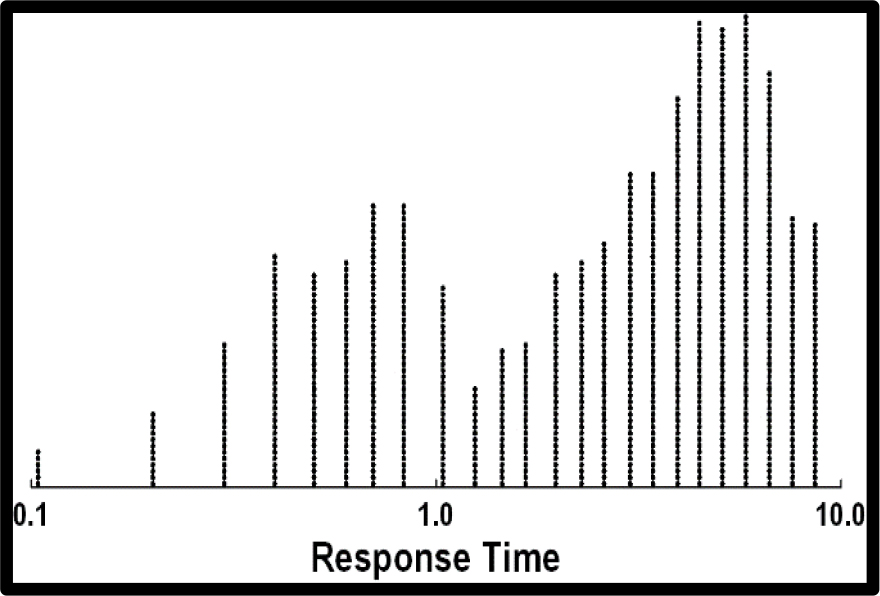
Mind Genomics-016 - ASMHS Journal_F2

Figure 2. Distribution of response times for the study on predicted family violence. The distribution has been trimmed to eliminate the responses from the vignette evaluated in the first position, and vignettes registering 9 seconds or longer to evaluate.

The analysis of response times follows the standard approach, involving OLS (ordinary least-squares) regression. The equation is written without the additive constant, based upon the ingoing assumption that in the absence of a vignette with elements, there is no response. All vignettes, however, except those tested first, are included in the OLS regression, with all vignettes of response times 9 or more seconds truncated to 9.

The equation is expressed as: Response Time = k1(A1) + k2(A2) … k16(D4)

The analysis was performed in the precisely the same way as the regression analyses for the ratings. That is, the relevant group was identified, and all the appropriate vignettes from everyone in the relevant group was put into a single data file, accessed by the OLS regression package. The coefficients represent the number of tenths of seconds that can be ascribed to each element. The OLS regression deconstructs the response time, estimating the number of tenths of seconds for each element. In the analyses we will look at those response times for individual elements of 1.5 seconds or more. The cut-off of 1.5 seconds is arbitrary, allowing us to get a sense of those elements which strongly engaged the respondents. It is important to keep in mind that these socially-relevant topics appear to be generating longer response times than the more typical business and marketing topics run in the same fashion, with the same type of respondents. It may be that respondents pay more attention to socially relevant topics

The response times for the 16 elements as shown in (Table 6) suggest a continuum with response times of 1.0–1.5 seconds. Keep in mind that all response times over 9 seconds or longer were eliminated as suggesting that the respondent might be doing other things. The data do not suggest a pattern. The most engaging elements, those with the longest response times, talk about the couple, about the economy, and about the woman having problems

Table 6. Response times for the 16 elements, estimated from the data of the Total Panel.


Response time for the total panel

Total

A4

The couple are having long term problems

1.5

B2

Companies are hiring but people working long hours

1.5

C2

The lady is having problems with finances

1.5

D4

The husband wants to talk but the wife does not

1.5

A1

The local economy is stressed and in recession

1.3

B3

It’s in middle of winter … Christmas

1.3

D3

The wife wants to talk but the husband does not

1.3

A2

The local economy is growing

1.2

B1

Companies are firing employees

1.2

C1

The lady starts searching for a job to help out

1.2

D2

The family all eat at different times

1.2

C4

The husband is sad and depressed

1.1

D1

The family time is shorter together

1.1

A3

The children are having problems

1.0

B4

It’s summer time

1.0

C3

The husband is having job troubles

1.0

By gender

When we divide the respondents by gender, we see radical differences. The most important result is that men do not find the elements engaging, at least when we operationally define the term ‘engaging’ as a response time of 1.5 seconds (Table 7a).

Table 7a. Response times for the 16 elements, estimated from the data broken out by gender.

Response time in seconds – by gender

Male

Female

D4

The husband wants to talk but the wife does not

1.0

2.0

A4

The couple are having long term problems

1.3

1.7

B2

Companies are hiring but people working long hours

1.3

1.7

C2

The lady is having problems with finances

1.4

1.6

A1

The local economy is stressed and in recession

1.0

1.6

D3

The wife wants to talk but the husband does not

0.9

1.6

B3

It’s in middle of winter … Christmas

1.1

1.5

B1

Companies are firing employees

0.9

1.5

D2

The family all eat at different times

1.1

1.4

C1

The lady starts searching for a job to help out

1.0

1.4

D1

The family time is shorter together

0.8

1.4

A2

The local economy is growing

1.2

1.2

C4

The husband is sad and depressed

1.2

1.1

B4

It’s summer time

0.9

1.1

C3

The husband is having job troubles

0.8

1.1

A3

The children are having problems

1.1

1.0

Males

The most engaging element is

            The lady is having problems with finances.

The least engaging elements are

            The wife wants to talk but the husband does not

            Companies are firing employees

            It’s summer time

            The family time is shorter together

            The husband is having job troubles

Females

There are many engaging elements. The fact that 8 of the 16 elements are engaging to women suggest that women are simply more attentive than men to the topic of violence versus happiness.

            The husband wants to talk but the wife does not

            The couple are having long term problems

            Companies are hiring but people working long hours

            The lady is having problems with finances

            The local economy is stressed and in recession

            The wife wants to talk but the husband does not

            It’s in middle of winter … Christmas

            Companies are firing employees

Age group

Respondents age 59+

The oldest respondents focus primarily about the issues between the members of the couple, but also react to the economy (companies are hiring but people working long hours.) That element might be a signal for problems that emerge between the husband and wife.

            Companies are hiring but people working long hours

            The husband wants to talk but the wife does not

            The couple are having long term problems

            The wife wants to talk but the husband does not

            The lady is having problems with finances

            It’s in middle of winter … Christmas

            Companies are firing employees

            The lady starts searching for a job to help out

Respondents age 30–49

The most engaging element is the practical issue of finances. The elements are more practical.

            The lady is having problems with finances

            The family all eat at different times

            The local economy is growing

Respondents age –29

None of the elements engaged them. They appear to be disinterested in the topic, or at least don’t pay much attention (Table 7b).

Table 7b. Response times for the 16 elements, estimated from the data broken out by age group.


Response time in seconds – by age

Age 50+

Age 30–49

Age 19–29

B2

Companies are hiring but people working long hours

2.0

1.4

0.8

D4

The husband wants to talk but the wife does not

1.9

1.4

1.2

A4

The couple are having long term problems

1.9

1.4

0.7

D3

The wife wants to talk but the husband does not

1.9

1.2

0.7

C2

The lady is having problems with finances

1.8

2.1

0.7

B3

It’s in middle of winter … Christmas

1.6

1.2

0.9

C1

The lady starts searching for a job to help out

1.6

1.2

0.7

B1

Companies are firing employees

1.6

1.1

0.8

D1

The family time is shorter together

1.5

1.3

0.6

A1

The local economy is stressed and in recession

1.5

1.0

1.2

D2

The family all eat at different times

1.4

1.5

0.9

C4

The husband is sad and depressed

1.2

1.4

0.8

A3

The children are having problems

1.2

1.1

0.5

A2

The local economy is growing

1.1

1.5

1.0

C3

The husband is having job troubles

0.9

1.3

0.7

B4

It’s summer time

1.1

0.5

1.3

Mind Sets

One of the key tenets of Mind Genomics is that in any topic area involving judgment and decision-making, there are different groups, mind-sets, showing divergent patterns of what is important. The ideal situation, but one quite rare, is that these mind-sets are congruent with some easy-to-define and measure characteristic or set of characteristics of the respondent. Most of psychological and sociological research discovering groups with different points of view, e.g., voting for political parties, attempt to understand these differences within the framework of the standard ways to divide people. Thus, it is not unusual to see voting patterns broken out by age, gender, market, income, education, work, and so forth. Indeed, the world of analytics attempts to predict these mind-set-driven behaviors from some predictive model using easy to measure variables. In the world of Mind Genomics, the discovery of these basic groups is straightforward, requiring simply one or several studies of the type performed here, and statistical methods to cluster together individuals with similar patterns of coefficients [15] Individuals with similar patterns are assumed to belong to the same ‘mind genome’ for the topic. The creation of the mind genome is a simple statistical analysis, once the relevant experiment has been run. In this respect Mind Genomics holds the advantage of generating easy to interpret ‘mind genomes’ from simple experiments. The reason for the simplicity is that the experiment deals with the topic itself, and the test stimuli are all relevant. One need not array an analytic armory to discover the ‘mind genomes, ’ which emerge readily from these focused experiments.

The procedure for uncovering mind genomes follows these eight steps.

  1. Array the vector of all 16 elements for a given respondent as a one line in a data base.
  2. Create all the data base, which in our case comprises 16 columns of data (one column per element), and 50 rows (one per respondent).
  3. The coefficients tell us the degree to which the respondent would rate that element a 7–9 if the vignette comprised only that element.
  4. Apply the method of clustering to divide the set of respondents into two groups, and then again into three groups.
  5. Build a model for each of the two groups, and then build a model for each of the three groups.
  6. Choose the more parsimonious solution, which is at the same time interpretable.
  7. Interpretable means that the strongest positive elements ‘tell a coherent story’.
  8. Parsimonious means that the fewer the number of clusters or mind-sets, the better, as long as the mind-sets tell a story which makes sense.

The results from the clustering suggest three mind-sets, as shown in (Table 8). The clustering was done on the coefficients after the ratings were converted to the ‘predicted violence scale’ (ratings of 7–9 converted to 100, ratings of 1–6 converted to 0.) The mind-sets are named according to the elements which generate the highest coefficients for the mind-set.

Table 8. Parameters of the model for the mind-sets relating the presence / absence of the 16 elements to predicted violence (Ratings of 7–9 converted to 100), and to predicted happiness (Ratings of 1–3 converted to 100.) The mind-sets were generated based upon the predicted violence scale.

Mind-Set: 1 No Specific Warning

Mind-Set: 2 Sensitive to the Economy

Mind-Set: 3 Family has Problems

Mind-Set: 1 No Specific Warning

Mind-Set: 2 Sensitive to the Economy

Mind-Set: 3 Family has Problems


Violence

Happiness

Additive constant

47

20

16

20

2

14

C4

The husband is sad and depressed

–4

4

16

–10

3

–2

C2

The lady is having problems with finances

–16

–6

13

3

5

–2

C3

The husband is having job troubles

–15

2

13

–6

5

–7

B1

Companies are firing employees

–14

21

7

7

0

3

B3

It’s in middle of winter … Christmas

–6

21

–7

18

–3

12

B2

Companies are hiring but people working long hours

–13

17

–8

9

2

5

A1

The local economy is stressed and in recession

–11

13

10

–5

5

–7

B4

It’s summer time

–11

11

–11

16

7

8

D2

The family all eat at different times

7

1

–9

–6

3

–5

D3

The wife wants to talk but the husband does not

6

7

–3

–7

0

–5

D4

The husband wants to talk but the wife does not

2

–6

1

–3

7

–7

D1

The family time is shorter together

1

0

–1

–5

3

–4

A3

The children are having problems

–9

4

7

–2

6

0

A2

The local economy is growing

–10

–2

–3

1

5

9

A4

The couple are having long term problems

–11

5

9

–10

7

2

C1

The lady starts searching for a job to help out

–21

–16

1

4

6

1

When we look at response times for the three mind-sets (Table 9) we see dramatic differences in the pattern of elements which ‘engage, ’ i.e., operationally defined as generating a response time of 1.5 seconds or longer. The elements which drive the segmentation also appear to strongly engage only respondents in Mind-Set 3 (family has problems),

Table 9. Response times for the 16 elements, estimated from the separate models, one for each of the three mind-sets.


Mind-Set: 1

No Specific Warning

Mind-Set: 2 Sensitive to the Economy

Mind-Set: 3 Family has Problems

B2

Companies are hiring but people working long hours

1.2

1.1

2.1

A4

The couple are having long term problems

1.0

1.6

1.8

C2

The lady is having problems with finances

1.4

1.4

1.7

D4

The husband wants to talk but the wife does not

1.3

1.5

1.6

B1

Companies are firing employees

1.0

1.2

1.5

B3

It’s in middle of winter … Christmas

1.2

1.2

1.5

D3

The wife wants to talk but the husband does not

1.0

1.7

1.1

D2

The family all eat at different times

1.2

1.7

0.9

A1

The local economy is stressed and in recession

1.0

1.6

1.4

A2

The local economy is growing

1.2

1.5

1.0

C4

The husband is sad and depressed

1.4

1.1

1.0

C3

The husband is having job troubles

1.4

0.8

0.6

D1

The family time is shorter together

1.0

1.1

1.4

C1

The lady starts searching for a job to help out

1.0

1.0

1.4

B4

It’s summer time

1.0

0.5

1.3

A3

The children are having problems

0.4

1.3

1.3

Mind-Set 3 (Family has problems)

            Companies are hiring but people working long hours

            The couple are having long term problems

            The lady is having problems with finances

            The husband wants to talk but the wife does not

            Companies are firing employees

            It’s in middle of winter are Christmas

Mind-Set 2 (Sensitive to the economy)

            The wife wants to talk but the husband does not

            The family all eat at different times

            The couple are having long term problems

            The local economy is stressed and in recession

            The husband wants to talk but the wife does not

            The local economy is growing

Mind-Set 1 (No specific warning)

            No element engages

The nature of people – optimistic versus pessimistic

The original focus of this paper was the pattern of responses of people to vignettes describing a couple who are in a stressful situation. The pattern of responses of our 50 respondents can also show us whether the respondents themselves are typically optimistic, pessimistic, or neither. The analysis is straightforward. We have 24 samples of the respondent’s evaluations of vignettes, with all elements (answers) appearing an equal number of times, and the basic experimental design structure maintained.

In our preparation for modeling we created binary two scales, each 0/100. Each respondent generates an average on each binary scale. When we look at predicted violence, for example, an average of 100 means that 100% of the time, i.e., for all 24 vignettes, the respondent predicts violence will occur. In contrast, if the average if 50, then the respondent predicts that violence will occur on in half the vignettes.

With this way of plotting the data we can look at the respondents, either one at a time or for key subgroups, to determine where the respondent lies on the scatterplot, and what that implies about the respondent. (Figure 3) shows the scatterplots for total panel, gender, age, and mind-set, respectively.
Mind Genomics-016 - ASMHS Journal_F3

Figure 3. Scatterplot of binary transformed ratings. Each point is the average binary rating for a respondent. The abscissa is the average for the respondent for ‘predicted violence’ (rating 7–9 converted to 100.) The ordinate is the average for the respondent for ‘predicted happiness’ (rating of 1–3 converted to 100.)

The key things to note are:

  1. The 45-degree line means that that the respondent is neither pessimistic nor optimistic but predicts violence and predicts happiness an equal number of times.
  2. The further out on the abscissa and the ordinate the respondent falls, the more the respondent is judgmental. There respondent either rates the vignette as describing a situation ending in violence, or describing a situation ending in happiness.
  3. The closer the respondent falls to 0, 0 the less frequently the respondent is judgmental.
  4. Respondents falling to the right of the line and high on the abscissa (far right) tend to predict violence
  5. Respondents falling above the line, and high on the abscissa (far up) tend to predict happiness.
  6. Figure 3 immediately shows the greater negativity of females versus males, Age 50+ versus younger respondents, and Mind-Set 2 versus the other two mind-sets, respectively.

Finding the mind-sets in the population (Attila)

The conventional way to discover different groups in the population is through surveys. When one ‘knows’ the subgroup to which a person belongs, e.g., our mind-sets, it is only nature to believe that there are correlates of membership in the population. If only we could discover those correlates, goes the standard plaint. The ingoing assumption is that people who ‘think similarly’ (our mind-sets) should BE similar on the factors used to measure them. An example is age, another is gender, both of which, of course, are surrogates for various life situations and experiences.

(Table 10) suggests that if we are to look to age and to gender as co-variates of segment membership, we are likely to be disappointed. Certainly, as our data suggest, these subgroups exhibit their own general patterns, different from each other, but not suggesting profound differences. In contrast, mind-set segmentation of the type performed with Mind-Genomics data divides people by how they respond, and thus think, in a particular situation.

Table 10. Distribution of the respondents by both the mind-sets (columns) and the more traditional divisions (gender, age, respectively).

Mind-Set: 1

No Specific Warning

Mind-Set: 2 Sensitive to the Economy

Mind-Set: 3 Family has Problems

Total

Total

15

17

18

50

Gender

Male

9

7

8

24

Female

6

10

10

26

Age

19–29

6

4

2

12

30–49

6

7

2

15

50+

3

6

13

22

No Answer

1

1

The specificity of the mind-set segments to the test stimuli means that we need a way to assign NEW people to one of the three mind-sets. The system must respect the fact that the mind-sets emerged from the elements specific to this topic and this study. Thus, we end up assigning new people to mind-sets based upon a system which is specific to the study. To this end, author Gere has created a PVI, personal viewpoint identifier which uses the pattern of coefficients from the averages for the three segments. The PVI is created by adding ‘noise’ to the basic summary data for the three mind-sets, and then using them to predict mind-set membership. The six strongest predictors in the ‘face of natural noise in data’ are selected as the cohort to be used to assign new people to one of the three mind-sets. (Figure 4) shows the PVI for this study, and the three feedback pages which emerge, depending upon the mind-set to which the respondent is assigned. The feedback pages can be used for further scientific study, for clinical purposes, and even for digital and personal marketing. As of this writing (March, 2019), the PVI is available this website:

Prediction of Violence: Violence: http://162.243.165.37:3838/TT20/

Prediction of Happiness: http://162.243.165.37:3838/TT21/

Mind Genomics-016 - ASMHS Journal_F4

Figure 4. The PVI (personal viewpoint identifier) for the spousal violence study, by which new people can be assigned to one of the three mind-sets uncovered in the research.

Discussion and Conclusions

This paper presents the emerging science of Mind Genomics as a way to bridge the gap between the impersonal, quantitative dimension of social science and the qualitative, story-telling, emotion-filled and narrative-rich material provided by qualitative methods, story-telling, and literature.

The scientific literature dealing with marital violence provides us with a sense of the many different contributors to the violence in the home, mainly between spouses and but directed to other members of the family. There is a body of sociological and psychological data looking for correlates of family violence. The range of these correlated variables is extensive, as can be sensed from the small sample the literature cited here.

The problem with studying violence and other factors of the ‘human condition’ is the virtual impossibility of doing experiments. The ethics of science and the moral responsibility of people to act ethically precludes doing experiments. We are left with observations and reports. Mind Genomics steps in with an attempt to go one step further, using the ordinary individual as an observer of a reported situation (the experiment), and reacting in terms of a prediction of the outcome (violence, nothing, happiness, respectively.) In this respect we might consider Mind Genomics in these situations to be analogous to the behavioral economics tool of ‘predictive markets, ’ or better ‘information markets’ which uses subjective perceptions embedded in a stock market-like game to drive deep insights into the reasons behind choice [16].

The future holds the promise of learning such as we obtained here, not only for violence in the home, but literally for the many dozens, if not hundreds of life situations that do not permit of an experiment, but may yield some of their secrets to Mind Genomics, which combines the rigor of quantitative science with the richness of cognitively meaningful stimuli actually descriptive of normally lived lives.

Acknowledgment

Attila Gere thanks the support of Premium Postdoctoral Research Program of the Hungarian Academy of Sciences.

The authors wish to thank Dr. Gillie Gabay for her help in formulating the problem and placing it into its academic perspective.

References

  1. Makepeace JM (1981) Courtship violence among college students. Family relations 97–102.
  2. Poole C, Rietschlin J (2012) Intimate partner victimization among adults aged 60 and older: an analysis of the 1999 and 2004 General Social Survey. Journal of Elder Abuse & Neglect 24: 120–137.
  3. Macmillan R, Gartner R (1999) When she brings home the bacon: Labor-force participation and the risk of spousal violence against women. Journal of Marriage and the Family 947–958.
  4. Miller BA, Downs WR, Gondoli DM (1989) Spousal violence among alcoholic women as compared to a random household sample of women. Journal of Studies on Alcohol 50: 533–540.
  5. Brinkerhoff MB, Grandin E, Lupri E (1992) Religious involvement and spousal violence: The Canadian case. Journal for the Scientific Study of Religion 15–31.
  6. Dobash RP, Dobash RE, Wilson M, Daly M (1992) The myth of sexual symmetry in marital violence. Social problems 39: 71–91.
  7. Fyfe JJ, Klinger DA, Flavin JM (1997) Differential police treatment of male-on-female spousal violence. Criminology 35: 455–473.
  8. Stith SM, Farley SC (1993) A predictive model of male spousal violence. Journal of family violence 8: 183–201.
  9. Moskowitz HR (2012) Mind genomics’: The experimental, inductive science of the ordinary, and its application to aspects of food and feeding’. Physiology & behavior 107: 606–613.
  10. Kahneman D, Egan P (2011) Thinking, fast and slow. New York: Farrar, Straus and Giroux.
  11. Blumenthal AL, Danziger K (2001) Wilhelm Wundt in history: The making of a scientific psychology. Springer Science & Business Media.
  12. Nichols KA, Champness BG (1971) Eye gaze and the GSR. Journal of Experimental Social Psychology 7: 623–626.
  13. Stipp H (2015) The Evolution of Neuromarketing Research: From Novelty to Mainstream: How Neuro Research Tools Improve Our Knowledge about Advertising. Journal of Advertising Research 55: 120–122.
  14. Nosek BA, Greenwald AG, Banaji MR (2005) Understanding and using the Implicit Association Test: II. Method variables and construct validity. Personality and Social Psychology Bulletin 31: 166–180.
  15. de Hoon MJ, Imoto S, Nolan J, Miyano S (2004) Open source clustering software. Bioinformatics 20: 1453–1454. [crossref]
  16. Abramowicz M (2004) Information markets, administration decisionmaking, and predictive cost-benefit analysis. The university of Chicago Law Review 71: 933–1020.
  17. Box GEP, Hunter WP, Hunter JS (1978) Statistics for experimenters, New York, John Wiley.
  18. Gofman A, Moskowitz H (2010) Isomorphic permuted experimental designs and their application in conjoint analysis. Journal of Sensory Studies 25: 127–145.
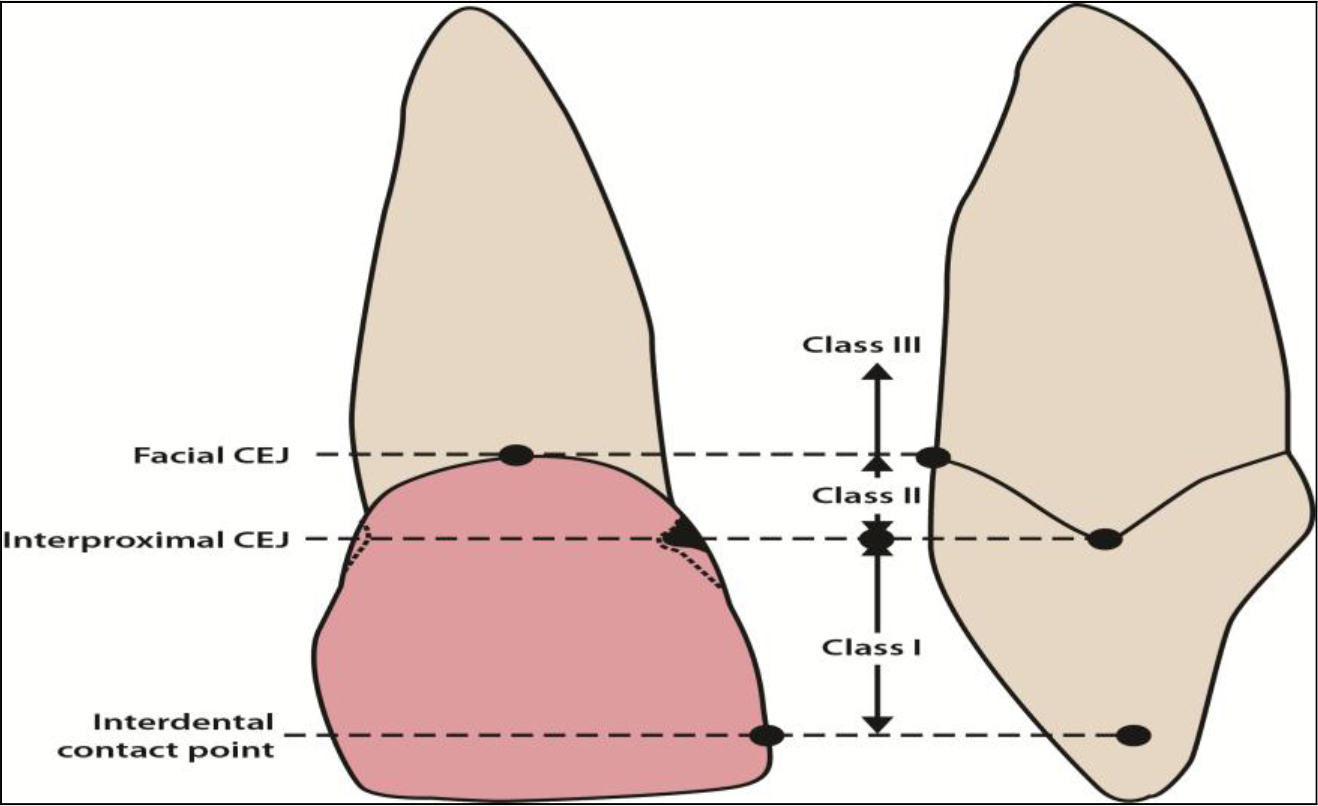
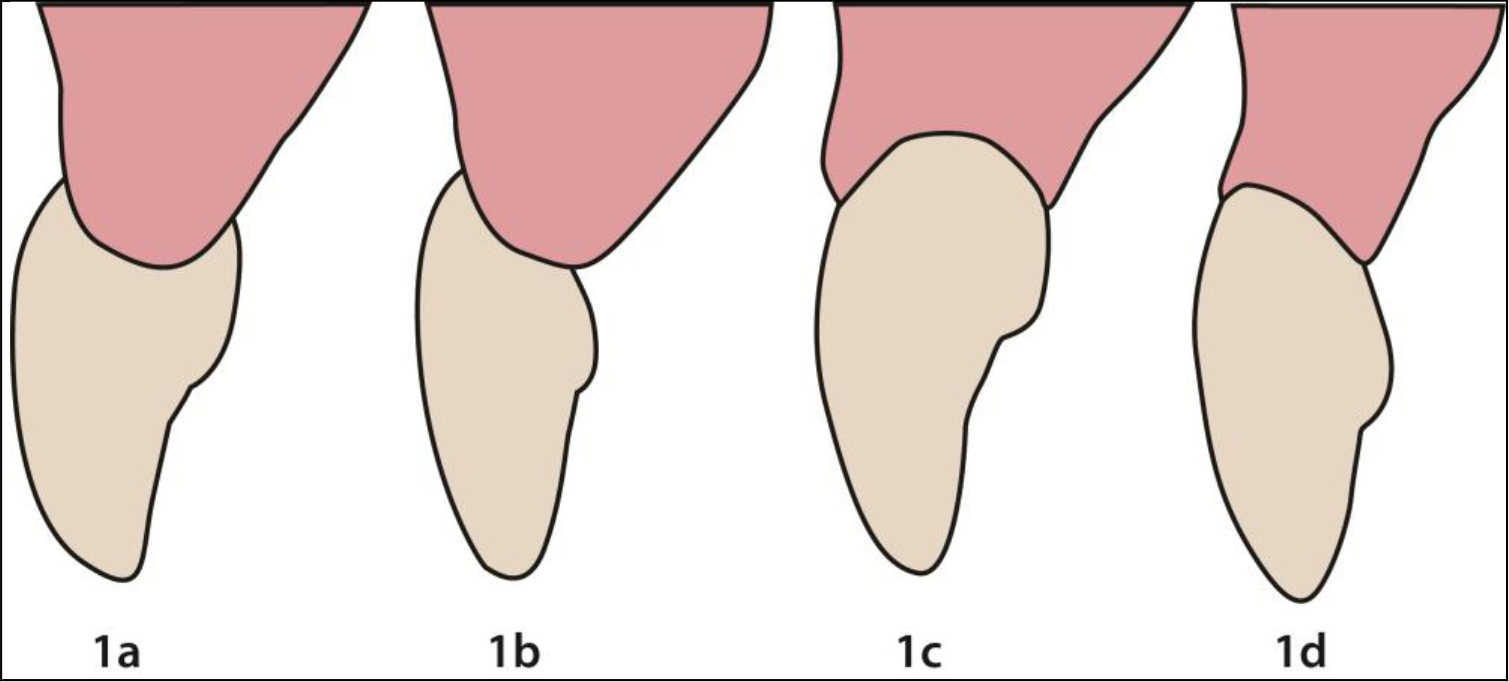
Estimating the Feelings of Prisoners Regarding Hope vs Despair: A Mind Genomics Exploration

DOI: 10.31038/ASMHS.2019322

Abstract

Prisoners are often thought to harbor thoughts about suicide, with sensationalized stories about the despair in prisons touching the hearts of listeners and readers. We explore the degree to which ordinary people, non-prisoners, feel that there is despair versus hope among prisoners. Through experimentally designed vignettes, we describe who the prisoner IS, what the prisoner FACES, what the OTHER PRISONERS are like, and what preparatory efforts are in place regarding RELEASE. Each respondent read a unique set of 24 vignettes, comprising different elements, and for each vignette rated the degree to which the prisoner would be likely to think of committing suicide versus be hopeful. The analysis reveals the specific contribution of each element in the vignette as a driver of projected suicide versus hopes, and the numbers of tenths of second required to ‘process’ the element before making the decision. The study suggests two mind-sets, one focusing on the prisoner, the other focusing on the surrounding, each as a driver of despair, as represented by the phrase ‘contemplates suicide.’

Introduction

The increasing cost of imprisonment, the increasing number of those imprisoned, and the alternative ways of imprisoning people, have created an entire industry of concern about what to do with the prisoner, how to rehabilitate the prisoner, and how to avoid post-release recidivism, or despair-driven suicide. Certainly, the prisoner, upon release, can be considered as a person with one or many ‘black marks, ’ responses by others to his or his misdeeds and punishments. The prospect of a life after prison or a life in prison, one marked with rejection and condemnation by society often leads to severe psychological and social problems. One of these is the possibility of contemplating suicide and then successfully suiciding. The recent literature, both popular and academic, deals with the emotions involved in prison.

The experience of imprisonment is difficult, with detrimental effects on prisoners and their families [1]. The nature of life in prison is particularly noticeable among women whose socialization left them with a lack of voice in the public domain. Female prisoners often referred to their feeling of helpless during their prison experience [2]

Accounts of prison life for males consistently describe a culture of mutual mistrust, fear, aggression and barely submerged violence [3]. Often too, prisoners adapt to this environment by putting on emotional ‘masks’ of masculine bravado hiding their vulnerabilities and deterring the aggression of their peers. Johnson [4] claimed that prisoners’ self-presentations of cool, hard manliness’ often reflect a ‘chronically defensive’ attitude rooted in feelings of moral self-doubt, social rejection and psychic vulnerability. This is a posture against the hurt that imprisonment threatens to expose [5]. Prisoners have a psychological need to re-establish their sense of masculine self-esteem and the need to develop personas to save them from exploitation [3]. De Viggiani [7] emphasized the ‘survival’ functions of prisoners whereas Jewkes [8] emphasized their jostling for positions of power in their depriving environments.

 Interviews with prisoners pointed to the protective functions of emotional self-control to hide fear or hurt which may be interpreted as signs of weakness exposing prisoners to ridicule and exploitation [3]. Prisoners expressed anger, fear, sadness and disgust through facial expressions [9] Emotional control is an internal defense as means of coping. Many prisoners stressed the need to control their emotions in order not avoid ‘cracking’ especially due to events outside the prison over which they had almost no control [3].

Occasional displays of emotion were deemed acceptable if they were the outcome of bereavements or if they related to children (e.g. serious illnesses, custody issues). Yet to unload one’s emotions on a continuing basis was reported to be unwelcome. In the visiting room, prisoners showed warmth and tenderness that were taboo on the landings, closed to visitors. Visits offered the only opportunity to display authentic feelings and to show warmth. Some were visibly upset as their visitors left, or sat in silent contemplation, their stolidity contrasting with the animated tone of a few minutes earlier.

Although there are many studies about the statistics of prisoners and imprisonment, along with interview accounts with prisoners, there is relatively little in the literature about metric studies on the ‘mind’ of the prisoner from the point of view of those who are not prisoners, i.e., studies of one’s empathic feeling toward prisoners. This study examines the perception of the public regarding emotions of prisoners and the extent of empathy understanding, with empathy being the ability to ‘sense the feeling of the other. This paper introduces a new approach to thinking about a topic, namely the study of empathy of normal people towards people who find themselves in a particularly stressful situation. The worlds of literature and song, stories, novels, poems, ballads, are is filled with descriptions of how one person feels about another or a group of others. Science is not, however, at least with descriptions having depth and tonality. This study begins that new course of research effort.

Method

Mind Genomics is an emerging science of the ‘everyday, ’ studying how people make decisions when confront by descriptions of ordinary experience, or at least experiences which could happen to people, experiences with which people are familiar [10, 11] Mind Genomics moves away from the traditional scientific approach of isolating one variable at a time and studying that variables. Rather, the premise of Mind Genomics is that we are continually confronted by compound situations, comprising many aspects. We, ordinary people, seem to have no trouble coping with these compound situations, making a series of decisions, and moving forward. Often, we are not able to articulate the reason WHY we do what we do. Yet, our behavior is rapid, automatic, appearing considered rather than random.

In its world-view and execution, Mind Genomics differs from most conventional research, which pay a great attention to the test stimuli, and may test a very few stimuli, but offer a variety of conclusions and implications from one study. With Mind Genomics, we look at simple, broad brush strokes of different aspects of prison, and do fast, simple research. Our metaphor is to cover ground, to explore, much like a cartographer explores and maps out an area, without paying very close attention to the minutiae of the area being mapped. The goal is to understand the key points of the topic, what ideas drive strong responses, what ideas drive strong engagements. The responses are measured using rating scales, converted later to a binary scale. The engagements are measured by response time, deconstructed into the number of tenths of second a statement ‘holds the respondent’s attention’ while being processed.

The test stimuli comprise four questions dealing with the person who is in prison, what the person does basis, the nature of other people in the prison, and the preparations, if any, for re-entry. The four questions are used as prompts to drive the researcher to provide four answers to each question. Table 1 show the four questions and the four answers to each question.

Table 1. The four questions, and the four answers to each question.

Question A: What kind of person is this?

A1

Young inner-city black woman

A2

White middle-age for theft

A3

21-year-old second conviction for drugs

A4

54-year old woman convicted for drugs

Question B: What does the person do on a daily basis?

B1

Boring stay, little to do

B2

Machine shop license plates

B3

4-hours of forced library

B4

Rehabilitation and reeducation

Question C: What other kind of people are in the prison?

C1

Lower and upper middle class (in the prison)

C2

Comradely (in the prison)

C3

Drug addicts (in the prison)

C4

Invisible status (in the prison)

Question D: What kind of links are there for a future after prison?

D1

Optional courses to prepare for jobs

D2

Out you go

D3

No support

D4

Re-enter prison

Test stimuli created by experimental design

The typical way to understand what people feel about a topic is to ask them questions about the topic, either in discussion (interviews), or through a survey on pencil and paper. An emerging way to understand people is the belief that observing their recorded behavior, e.g., what the person buys or does, gives a sense of who the person is, and what the person believes. This latter approach, is called ‘Big Data.’ The reality is that each of the approaches provides some information about the person, but does not provide the specific information for the topic. Our topic is the empathy of normal people towards their ideas of prisoners, and specifically prisoner despair. There is no way that Big Data can provide this information. Rarely can we find a survey which focuses on this topic because the topic is so specific, and so different from the more mainstream, conventional topics in the world of sociological or psychological research,

Mind Genomics approaches the issue of empathy about prisoner despair by running a simple experiment. The respondent or subject is provided with test combination of the 16 answers, and instructed to rate the combination, the vignette, on an anchored 9-point scale, with the scale focusing on an assessment of estimated feelings. Figure 1 shows the test stimulus.

Mind Genomics-015 - ASMHS Journal_F1

Figure 1. Example of a 3-element vignette about a prisoner, and the instruction to the respondent to rate.

The underlying experimental design comprises a ‘recipe’ or systematic layout of 24 combinations, vignettes, each vignette comprising 2–4 elements or answers, selected from Table 1. Each respondent evaluated 24 different vignettes, comprising 2–4 elements per vignette, at most one element or answer from one question. The experimental design presents the combinations without concern as to whether the combination ‘makes sense’ [12] The objective is to present the respondent with a set of test stimuli and force a judgment, that judgment being a rating of the entire vignette. The respondent cannot assign a ‘politically correct rating’ because there is no underlying pattern that the respondent can discern. The respondent may begin by trying to be politically correct and do the task ‘properly’ by paying attention, but soon gets frustrated, and reacts at an almost automatic, intuitive, ‘gut level.’ This is the desired state for the respondent. The intuitive response means that the response will be relatively uncontaminated by what the respondent feels to be that which the research ‘wants.’

The experiment with 42 respondents generated a data set, comprising 1208 vignettes. Most of the vignettes differed from one another. This structure of testing different combinations by each respondent is known as a permutable experimental design [13] The structure allows the researcher to ‘cover the space’ of possible test combinations, an approach analogous to the MRI (taking different pictures of the tissue), rather than the way typical scientific research works (repeating the pictures many times to reduce the error of measurement.)

Analysis

The ratings from the respondents were transformed to a binary scale, following the approach used by author HRM for 35 years, since the mid 1980’s, and based upon a combination of experience and common industry practice. Experience suggests that most users of scales do not know what the scales mean. Often the user of the data, the ultimate ‘client’ of the results, asks for an interpretation, such as ‘is a 6 a lot or a little better than a 5, or a little or a lot worse than a 7?’ These questions continue to reaffirm the fact that the user of the data does not really understand what to do with the data, other than to make conclusions about ‘better or worse.’ A more productive approach, used for decades by market researchers bifurcates the scale, so that there is a top of the scale (e.g., 7–9), and a bottom of the scale (e.g., 1–6). In our case, we would interpret the top of the scale, the ratings of 7–9, as indicating that the prisoner is believed to be thinking of suicide. A rating of 1–6 indicates that the prison is not likely to commit suicide, or to think about committing suicide. We can also look at the scale from the opposite end, hopefulness with a rating of 1–3 indicating that the prisoner is believed to be hopeful,

The underlying experimental design enables us to combine the data from our 42 respondents into a database comprising the 1008 observation. Each observation comes from one respondent, one vignette. The experimental design ensures that the 16 predictor variables, the elements, are statistically independent of each other. The dependent is augmented by the addition of a very small random number, approximately 10–5

Table 2 shows the results from the first OLS (ordinary least-squares) regression, focusing on the data from the transformation to the binary scale (1–6 = not thinking about suicide; 7–9 = thinking about suicide.) The regression procedure, colloquially known as curve fitting, deconstructs the 0/100 binary rating into the basic contribution of the 16 elements, the 16 coefficients, and an estimated basic level, the additive constant.

Table 2. Coefficients for ‘thinking about suicide’ (ratings 7–9 converted to binary). Data from the total panel.

Thinking about suicide (Scale points 7–9)

Coefficient

T Statistic

P Value

Additive constant

24.46

3.48

0.00

D3

No support

11.16

2.62

0.01

C3

Drug addicts

10.98

2.54

0.01

A3

21-year-old second conviction for drugs

7.08

1.65

0.10

B1

Boring stay, little to do

4.10

0.94

0.35

D2

Out you go

1.10

0.26

0.80

A2

White middle age for theft

-0.02

-0.01

1.00

A4

54-year-old woman convicted for drugs

-0.68

-0.16

0.88

C4

Invisible status (in the prison)

-1.17

-0.27

0.79

B4

Rehabilitation and reeducation

-2.34

-0.54

0.59

C2

Camaraderie (in the prison)

-3.40

-0.80

0.43

B3

4-hours of forced library

-3.81

-0.88

0.38

C1

Lower and upper middle class (in the prison)

-4.13

-0.96

0.34

D4

Re-enter prison

-4.22

-0.99

0.32

B2

Machine shop license plates

-5.25

-1.23

0.22

D1

Optional courses to prepare for jobs

-8.31

-1.94

0.05

A1

Young inner-city black woman

-8.52

-1.98

0.05

The interpretation of the results is straightforward:

  1. The additive constant is the estimated probability of a respondent saying that the person described in the vignette will attempt suicide (rating 7–9 on the scale.) The additive constant is 24.46, which we interpret to mean that in the absence of elements, the expected proportion of responses 7–9 (thinking of suicide) is 24.46, about 25%.
  2. Table 2 shows the 16 elements sorted from highest (believed most likely to think of suicide), to lowest (believed least likely think of suicide.)
  3. The coefficients have ratio-scale values, so that a value of 10 means believed twice as likely to thinking of suicide than a value of 5.
  4. The coefficients can be added to the additive constant to create a sum which provides the estimated probability of a prisoner thinking about suicide. Thus, one needs only the additive constant, and the elements, as well as their coefficients, to estimate the likelihood that one believes that thoughts of suicide will plague prisoner described by the vignette.
  5. The coefficients in Table 2 suggest that the two elements co-varying most strongly with likelihood of suicide are C3 (drug addicts, as fellow prisoners), and D3 (the recognition of no support.) These two elements talk about two aspects, one who the fellow prisoners happen to be, and second the emotional support in the prison.
  6. The coefficients suggest that two descriptions are least likely to covary with the thought of suicide. One is the young inner-city black woman, the other is optional courses to prepare for jobs. These are radically different. The first suggests the appreciation who the prisoner happens to be. The second is the fact that someone is taking care of the prisoner, or at least thinking of the prison to prepare for a job.
  7. The T statistics tells us the ratio of the coefficient to the standard error of the coefficient. The higher the T statistic, the more likely it is that the coefficient or the additive constant comes from a distribution whose true value is not 0. The P value, in turn, is the probability that the T statistic comes from a distribution whose true value is 0.

Reversing the perspective – what drives the rating of ‘hopeful’ (1–3 on the 9-point scale)

Our respondents could assign rights on either side of the scale, 1 representing hopeful, 9 representing contemplating suicide at some point. What happens when we focus on the positive aspects, looking at the elements driving the ratings of 1–3. We now convert the ratings on the low end of the scale, 1–3, corresponding to hopeful, so that they become. In turn, the value 100. The remaining six scale points, 4–9, become 0, to denote not hopeful. We perform the same analysis on the data from the total panel, looking at the additive constant, and the coefficient for each element.

  1. The additive constant is 43.79, almost 44, meaning that in the absence of elements, almost half of the responses will be between 1 and 3, hopeful. We interpret this to mean that it is basic information (a person is in prison) which conveys some hope. Being in prison does not automatically drive one’s feeling that the imprisoned person will contemplate suicide. Being is prison does, however, drive a sense that the prisoner will be modestly hopeful.
  2. Estimated hopefulness is driven by reading about preparations for release, such as ‘optional courses to prepare for job’, and ‘4-hours of forced library.’.
  3. Lack of hopefulness is driven by who a person is, and the situation in the prison. These are the elements with the lowest coefficients for hopefulness.

    21-year-old second conviction for drugs

    54-year-old woman convicted for drugs

    drug addicts (in prison)

    white middle age for theft

    no support

Individuals – are they optimistic or pessimistic, based upon their coefficients

Can we classify an individual as optimistic (perceiving the situations in the vignette as ‘hopeful’) or pessimistic (contemplating suicide), both or neither? One way to answer this question computes the average coefficient across 16 elements for each individual, when we look at the equation for ratings of 7–9. Recall that the coefficient shows the believed likelihood that the prisoner being described is likely to commit suicide. Each respondent generates 16 coefficients. The average coefficient for a respondent tells us the proclivity of the respondent to see the described prisoner’s feelings as leading to thoughts of suicide. The second part of the answer is to compute the average for the same respondents for the 16 coefficients dealing with hopeful. The average coefficient for a respondent tells us the proclivity of the respondent to see the described prisoner vignette as leading to hopefulness.

We begin with the scattergram for the total panel, in Figure 2. Each filled point represents one respondent. The abscissa corresponds to the average of the respondent’s 16 coefficients on the top part of the scale, tendency to suicide, i.e., the coefficients of the individual-level regression model run for the respondents when the ratings of 1–6 were converted to 0, and the ratings of 7–9 were converted to 100. The ordinate corresponds to the average of the respondent’s 16 coefficients on the bottom of the scale, hopeful, when the ratings of 1–3 were converted to 100, and the ratings of 4–9 were converted to 0.

Mind Genomics-015 - ASMHS Journal_F2

Figure 2. Distribution of average coefficients for despair/suicide (Ratings 7–9 converted to binary) and average coefficients for happiness/hopefulness (Ratings 1–3 converted to binary). Each filled circle corresponds to a respondent.

When the respondent cluster at 0, 0, we conclude that the respondent does not sense either prisoner despair or prisoner hopefulness in the vignettes. The averages for the latter two scales are both near 0, and thus the respondent falls at the bottom left. The further out to the right on the abscissa lies the respondent’s average, the more the respondent feels that the prisoner will contemplate suicide. The further up the ordinate lies respondent’s average more the respondent feels that the prisoner will feel hopeful. Figure 2 suggests more respondents feel that the prisoner will be hopeful, and fewer respondents will feel that the prisoner will contemplate suicide. Looking more closely at the distribution, we see about five respondents who feel primarily despair in the vignettes, and about five respondents who feel primarily hopefulness in the vignettes.

As a side note, this format of presenting data suggests a new way to understand the basic mind-set of a person on two opposing dimensions of a feeling. The location of the points gives a sense of how different people think and empathize. Most of the respondents in the large area between 0, 0 and 0.3, 0.3. The location 0, 0 corresponds to a person who is neither pessimistic nor optimistic in the estimation of how the prisoner would feel. The location 0.5, 0.5 corresponds to the location where the person is absolutely decisive, rating the vignettes as either hopeful or despairing (contemplate suicide.) For the person located at 0.5, 0.5, there is no middle ground. For the person located at 0, 0 there is virtually only middle ground.

Subgroups – Gender, Age, Mind-Set – What is expected to drive the prisoner’s though to suicide?

One of the key benefits of the Mind Genomics approach is the use of different combinations of vignettes for each respondent, but at the same time ensure that each respondent evaluates the appropriate set of vignettes in order to create an experimental design. One can do the analysis on key subgroups, both self-defined (gender, age), and defined through analysis (mind-set.) The small group of 42 respondents provides sufficient depth into the mind of the respondent to reveal the responses of subgroups, perhaps a bit noisily, but nonetheless powerfully.

Table 4 shows the set of key subgroups. For this study we divided the respondents by gender and by age, respectively, and then created mind-set segments as described in the following section.

Table 3. Coefficients for ‘hopeful’ (ratings 1–3 converted to binary). Data from the total panel.

Coeff

T Statistic

P Value

Additive constant

43.79

5.55

0.00

D1

Optional courses to prepare for job

13.24

2.76

0.01

B3

4-hours of forced library

8.52

1.76

0.08

C1

Lower and upper middle class (in the prison)

6.38

1.32

0.19

B4

Rehabilitation and reeducation

5.04

1.04

0.30

B1

Boring stay, little to do

1.38

0.28

0.78

B2

Machine shop license plates

1.15

0.24

0.81

A1

Young inner-city black woman

-1.44

-0.30

0.77

D2

Out you go

-2.10

-0.44

0.66

C4

Invisible status (in the prison)

-4.53

-0.94

0.35

C2

Camaraderie (in the prison)

-5.45

-1.14

0.26

D4

Re-enter prison

-8.72

-1.82

0.07

A3

21-year-old of second conviction for drugs

-11.23

-2.33

0.02

A4

54-year-old woman convicted for drugs

-11.86

-2.46

0.01

C3

Drug addicts

-11.89

-2.45

0.01

A2

White middle age for theft

-12.48

-2.59

0.01

D3

No support

-16.69

-3.49

0.00

Table 4. Strongest performing elements by key subgroup of the models relating the presence/absence of elements to the estimate of the prisoner’s contemplation of suicide.

Contemplate Suicide (Top 3 scale points, 7–9)

Total

Males

Females

Age <30

Age 31+

Mind-Set 1
(want preparation)

Mind-Set 2
(sensitive to surroundings)

Base size

42

19

23

14

26

19

23

Additive constant

24

25

22

22

27

26

24

D3

No support

11

5

18

10

12

32

-6

C3

Drug addicts

11

11

12

16

10

5

13

A3

21-year-old of second conviction for drugs

7

3

11

7

8

5

9

B1

Boring stay, little to do

4

14

-4

5

4

-5

12

D2

Out you go

1

5

0

-2

2

20

-15

  1. Additive constant – all subgroups are approximately the same, showing an additive constant of 22 – 27.
  2. Males feel that simply ‘being bored, having nothing to do’ is a cause for contemplating suicide. Females do not.
  3. There is no difference in projected potential of contemplating suicide by younger versus older respondent.
  4. We created two mind-sets by clustering the array of 16 coefficients, and extracting two different groups, which are maximally different from each other (De Hoon et. al., 2004.) Clustering is a purely statistical technique. We extract the fewest number of clusters (parsimony) which tell coherent stories (interpretability.)
  5. Mind-Set 1 feels that the prisoner will think of suicide if there is no emotional support in the prison, and if the prisoner is simply discharged, released, without any preparation. To Mind-Set 1, it is the sense of aloneness in the prisoner which is distressing. Mind-Set 1 can be called ‘want preparation.’
  6. Mind-Set 2 feels that the prisoner will contemplate suicide if there is a sense of nothing to do, and if the prisoner is either a serious drug addict (second conviction) or surround by drug addicts. Mind-Set 2 can be called sensitive to surroundings.

Subgroups – Gender, Age, Mind-Set – What is expected to drive the prisoner’s thoughts to happy

We can follow the same logic, this time looking at gender, age, and newly constructed mind-sets for the low part of the scale, ‘hopeful.’

  1. Males show a much higher imputed basic hopefulness for prisoners than do females (54 versus 36.) Without any additional information, males believe that that the prisoner will be neither hopeful or not hopeful (additive constant 54), whereas females believe that it’s more likely that the prisoner will not be hopeful (additive constant 36).
  2. For males, hopeful is perceived as a matter of preparing for a job and being surrounded by prisoners who are middle class.
  3. For females, hopefulness is perceived when the message is about preparing for a job, library, rehabilitation, and surprisingly, with the prisoner has little to do. Males, in contrast feel when the prisoner in bored, and has little to do, the despair is higher, with a greater thought of suicide.
  4. Younger respondents (under 30) feel that hopefulness will come from job preparation and from the hours in the library.
  5. Older people feel the same way, and also feel that hopefulness will come from being surrounded by middle class prisoners.
  6. The previously created Mind Set 1 feels that hopefulness is a matter of the requirement of four forced hours in library, as well as being surround by middle-class prisoners.
  7. The previously created Mind-Set 2 feels that hopefulness will come with the preparatory course for jobs, and the requirement of library.

Subgroups – are they optimistic or pessimistic, based upon their coefficients

The previous analysis for the total panel presented a novel way to gauge whether the respondents are optimistic or pessimistic, by plotting the average coefficient from the two models, doing so for each respondent. The coefficient shows the average conditional probability that the respondent would assign the element a rating of 7–9 (top 3, contemplating suicide), versus that the same respondent would assign the element of 1–3 (bottom 3, happy). The two averages come from the coefficients of 16 elements.

When we plot each respondent on a two-dimensional graph, we can sense the respondent’s mind. To review:

  1. Each filled circle corresponds to one respondent
  2. The location 0, 0 corresponds to a person who is ‘all middle ground, ’ sensing neither despair leading to contemplation of suicide, nor sensing hopefulness. All the ratings for the vignettes lie between 4 and 6.
  3. The location 0.5, 0.5 corresponds to a person for whom there is ‘no middle ground’ but not basically optimistic nor basically pessimistic in the estimation of how a prisoner would feel.
  4. Plots to the right on the abscissa suggest a person who is more pessimistic, and sees despair leading to the contemplation of suicide.
  5. Plots upwards on the ordinate suggest a person who is more optimistic, and sees ‘hopefulness’

Figure 3 shows the plots for key subgroups. Each panel (top,
middle, bottom) compares two complementary subgroups. The
statements below are purely from visual observation and impression,
not from a statistical analysis.

Mind Genomics-015 - ASMHS Journal_F3

Figure 3. Distribution of average coefficients for despair/suicide (Ratings 7–9 converted to binary) and average coefficients for happiness/hopefulness (Ratings 1–3 converted to binary). Each filled circle corresponds to a respondent. The three panels show the results for complementary subgroups.

  1. Females show more respondents closer to the 45-degree line, and further out than men on that line. Qualitatively, females seem to be more judgmental than men, but neither overly optimistic nor pessimistic.
  2. Younger respondents aged 30 and younger show more respondents lying close to the non-judgmental region of 0, 0. Older respondents age 31 and older show more respondents as lying further out towards 0.5, 0.5, with a tendency to be more optimistic, and feeling that the prisoner is more hopeful.
  3. Mind-Set 1 (want preparation) appears to be less judgmental, and if judgmental then optimistic in terms of rating what the prisoner would feel. Mind-Set 2 (sensitive to surroundings) is more judgmental, with fewer ratings in the 4–6 region of the scale. Mind-Set 2 appears to be slightly more pessimistic.

Response Time

The previous sections dealt with the analysis of the ratings, specifically what elements are perceived, in one’s opinion to correlate with thinking that would contemplate suicide, at least in the opinion of a non-prisoner respondent reading a vignette about the prisoner. The analysis deals with the conscious assignment of ratings to the test stimuli, even if the decisions tend to be automatic.

Researchers have been interested in the past few years in possibly deeper mechanisms of decision-making, many of which they put in the grab-bag called neuromarketing, or more correctly non-conscious, physiological correlates of decision-making. Fugate [15], Lee et. al. [16] and Stipp [17] summarize this new area of neuromarketing, or really physiological correlates of messaging. Genco et. al. [18] have popularized in a book ‘Neuromarketing for Dummies.’ We now proceed to the analysis of one of one of these measures, response time. The ingoing assumption is that longer response times signal that the respondent is somehow ‘engaged’ in reading and thinking about the particular element in the vignette.

Some of the vignettes constructed were responded to slowly, others were responded to quickly. After removing the first vignette evaluated by each respondent because the respondent was just ‘learning what to do in the experiment, ’ and after removing all vignettes responded to after 9 seconds because it was likely the respondent was doing something else, we emerge with a distribution of response times as shown in Figure 4. The time scale, abscissa, is logarithmically spaced, emphasizing the many vignettes responded to faster than 2 seconds. The computer program picked up the response times in tenths of seconds.

Mind Genomics-015 - ASMHS Journal_F4

Figure 4. Distribution of the response times for the vignettes, after removal of the first vignette and after removal of all response times of 9 seconds or longer.

As stated above, we assume response time to be a correlate of engagement. We operationally define the term as ‘time spent attributed to the element when the vignette is being evaluated.’ We cannot, of course, ask the respondent to tell us how engaging each element seems to be, although occasionally the novice researcher might ask that question. The reading and response occur so rapidly, so automatically, that the respondents are not aware of what holds their attention unless there is something so powerfully strong that it ‘stops’ the respondent.

The experimental design enables us to estimate the likely number of seconds in the response time that can be attributed to each element. It is important to note that this assignment is an estimate, only, based upon the application of OLS regression to the response times. Some interesting patterns emerge from Table 5.

The elements are presented in descending order of response time based upon the results from the total panel. These ratings are from 40 respondents, each evaluating at most 23 vignettes, but a number of vignettes have been removed because they were recorded as being unusually long.

We have highlighted and bolded those response times of 1.4 seconds or longer, which can be assumed to be ‘engaging.’ The choice of 1.4 seconds is simply to represent a time that can be thought of as possibly conscious attention.

The longest response time for any group is 1.7 seconds (female respondents with the element ‘lower and upper middle class’).

The shortest response time for any group is virtually 0 time, ‘optional courses to prepare for jobs’ (0.2 seconds, for Mind-Set 2, who are sensitive to their surroundings, and would be expected not to care about courses for the future.)

Total panel: The longest response times, i.e., the most engaging, are descriptions of the person, requiring multiple words. The shortest times, i.e., the least engaging, are descriptions of occupation training in prison. It’s all about the people, who they are.

Assigning new individuals to one of the two mind-sets

Conventional research is grounded on the belief that there is an indivisible link between who the person IS and what the person THINKS. This belief motivates the use of large, representative samples of respondents, believing that it is important to measure the correct group of people in order to understand the way the mind works. Thus, good practice in business and political polling is often accompanied by large base sizes and a measure of ‘error, ’ or underlying variability.

Table 5. Strongest performing elements by key subgroup of the models relating the presence/absence of elements to the estimate of the prisoner’s hopefulness.

Total

Male

Female

LT30

GT31

Mind-Set 1
(want preparation)

Mind-Set 2
(sensitive to surroundings)

Base size

42

19

23

14

26

19

23

Additive constant

44

54

36

35

48

46

42

D1

Optional courses to prepare for jobs

13

8

17

14

13

7

18

B3

4-hours of forced library

9

6

11

9

8

9

8

C1

Lower and upper middle class

6

8

5

6

8

8

5

B4

Rehabilitation and reeducation

5

-1

10

-1

7

4

6

B1

Boring stay, little to do

1

-12

11

3

-1

5

-1

Table 6. Coefficients for response times, by total panel and key subgroups. Coefficients of 1.4 or higher are shown in shaded cells, with bold numbers.

Total

Male

Female

Age 30 or less

Age 31+

Mind-Set 1 (want preparation)

Mind Set 2 (sensitive to surroundings)

C1

Lower and upper middle class (in the prison)

1.4

1.2

1.7

1.2

1.4

1.2

1.5

A1

Young inner-city black woman

1.4

1.4

1.3

1.2

1.6

1.6

1.3

A3

21-year-old-old, second conviction for drugs

1.4

1.6

1.1

1.0

1.6

1.6

1.3

A4

54-year-old woman convicted for drugs

1.4

1.5

1.1

1.0

1.5

1.3

1.5

C4

Invisible status (in the prison)

1.3

1.6

1.2

1.4

1.4

1.5

1.1

C3

Drug addicts (in the prison)

1.3

1.3

1.4

1.2

1.5

1.7

0.9

A2

White middle age for theft

1.2

1.8

0.7

0.4

1.7

1.4

1.2

B1

Boring stay, little to do

1.0

0.8

1.2

0.6

1.2

1.1

1.0

B2

Machine shop license plates

1.0

1.3

0.8

0.6

1.3

0.9

1.1

D4

Re-enter

1.0

0.5

1.4

0.6

1.2

1.1

0.7

C2

Camaraderie (in the prison)

0.9

1.0

0.9

0.4

1.3

0.7

1.2

B3

4-hours of forced library

0.8

0.6

1.1

0.8

0.8

0.8

0.9

B4

Rehabilitation and reeducation

0.7

0.4

1.0

0.3

1.0

0.7

0.8

D1

Optional courses to prepare for jobs

0.6

0.3

0.8

0.7

0.6

1.0

0.2

D3

No support

0.5

0.1

0.7

0.4

0.7

0.7

0.3

D2

Out you go

0.3

0.0

0.5

0.5

0.2

0.6

-0.1

One of the premises of Mind Genomics is that in virtually any topic area where human judgment comes into play one can discover different points of view, different criteria for judgment. These are called Mind-Sets. Their reality emerges from the analysis of how individuals respond to the different elements or ‘answers’ in the particular study. That is, these mind-sets exist, but are really groups of individuals who behave similarly in a specific situation, as revealed by their patterns of responses, or perhaps as the next paragraph suggests, mind-sets are really combinations of ideas.

Underlying the research in Mind Genomics is the belief that some ideas ‘flow together.’ It is the combination of such ideas which flow together that comprises the focus of interest of Mind Genomics. Individuals, the respondents who participate, are ‘protoplasm’ which in some way embody these basic mind-sets, but the individuals are NOT the mind-sets. The mind-sets are primaries, like the colors red, yellow and blue. Each person comprises a set of mind-sets, with the methods of Mind Genomics both identifying the nature of the mind-sets from clustering, and establishing who in a study embodies each mind-set. Whether these mind-sets represent true primaries like color primaries, red, blue and yellow, is not important. What is important is that they show remarkably different, and interpretable patterns of responses, patterns which make sense, can be interpreted and labelled. These primaries may co-vary with external behaviors, and perhaps even with physiological patterns of responses. What is important is that they represent a new way of looking at individual differences.

With the foregoing accepted, the question is whether there is a natural affinity for the mind-sets established in an experiment to distribute in the way to which we have been accustomed. That is, for our study we have established two mind-sets, those who want preparation, and those who are sensitive to their surroundings, etc.

Table 7 shows that there is no clear relation between mind-set membership and either gender or age. This is typically the case. Mind-sets emerge quite clearly in Mind Genomics studies, but these mind-sets do not distribute in ways that are easy to discern, despite the radical differences in content between or among the mind-sets.

Table 7. Distribution of the two mind-sets by gender and age, respectively.

Want preparation

Sensitive to surroundings

Total

Male

9

10

19

Female

10

13

23

Total

19

23

42

Mind-Set

Mind-Set 2

Total

30 and under

8

6

14

31 and Older

10

16

26

No age given

NA

NA

2

Total

18

22

42

Given the clear similarity in the patterns of WHO are in the two mind-sets, at least in terms of gender and age, how then do we assign a new person to a mind-set? This is an important question, both for science, and for commerce. For science, we can begin to study the relation between membership in a mind-set for one topic, and both membership in other mind-sets for other topics, and/or external behaviors, and even biological/genetic covariates of membership in different mind-sets.

Our approach uses the average coefficients from each mind-set. We create 1, 000 different variations of the average profile by adding ‘noise’ to the coefficients. We then identify the six questions which, in the presence of “noise” can be used to correctly assign the respondents to the correct mind-set. Figure 5 shows an example of the PVI (personal viewpoint identifier), presenting the six strongest questions which, in concert, help us assign a person to the correct mind-set. We also show the feedback page, which can go to the person being typed, or be used to drive the respondent to the right e-commerce website, or perhaps incorporated into the person’s profile for future use. As of this writing (March, 2019), the PVI is located at this location: http://162.243.165.37:3838/TT19/

Mind Genomics-015 - ASMHS Journal_F5

Figure 5. The PVI (personal viewpoint identifier) and the two feedback pages, one for each mind-set segment uncovered in the original study.

Discussion and Conclusion

The sociology and psychology literatures are replete with studies presenting statistics about the backgrounds of prisoners, their environment, and clinical analyses of personalities. There is no end to the fascination with other people, especially those who commit crime. What is lacking, however, is a sense of how the ‘other’ reacts to prisoners. We are aware of the prisoner, but what do we think of prisoners in terms of specifics? The answer may be found in novels, in news clippings, in common discussion, but not particularly in the scientific literature.

Mind Genomics provides a way of understanding how people perceive the ‘other, ’ not so much in a clinical sense, but the ‘other’ when represented in a story, that story provided by the vignette. Mind Genomics opens new vistas, probing into the mind, and how the mind reacts to others, the ‘others’ presented in meaningful but manageable descriptions. Simple experiments, of the type presented here, generate the foundations of new knowledge that that hitherto could only be obtained in unstructured form by talking with people, or by reading personal accounts, news commentary, or literature.

Acknowledgement

Attila Gere thanks the support of Premium Postdoctoral Research Program of the Hungarian Academy of Sciences.

The authors wish to thank Dr. Gillie Gabay for her help in formulating the problem and placing it into its academic perspective.

References

  1. Liebling, A, Maruna, S (2005) The Effects of Imprisonment, Devon: Willan.
  2. Chamberlen, A (2016) Embodying prison pain: Women’s experiences of self-injury in prison and the emotions of punishment. Theoretical Criminology 20: 205–219.
  3. Crewe B, Warr J, Bennett P, Smith A (2014) The emotional geography of prison life. Theoretical Criminology 18: 56–74.
  4. Cole Johnson R (1987) Hard Time: Understanding and Reforming the Prison. Pacific Grove, CA, Brooks
  5. Newton C (1994) Gender theory and prison sociology: Using theories of masculinities to interpret the sociology of prisons for men. The Howard Journal of Criminal Justice 33: 193–202.
  6. De Viggiani N (2012) Trying to be something you are not: Masculine Performances within a prison setting.    Men and Masculinities 15: 271–291
  7. Jewkes Y (2012) Autoethnography and emotion as intellectual resources: doing prison research differently, Qualitative Inquiry, 18: 63–75.
  8. Robinson L, Spencer MD, Thomson LD, Sprengelmeyer R, Owens DG, et al (2012) Facial emotion recognition in Scottish prisoners. International journal of law and psychiatry 35: 57–61.
  9. Moskowitz HR (2012) ‘Mind genomics’: The experimental, inductive science of the ordinary, and its application to aspects of food and feeding. Physiology & behavior 107: 606–613.
  10. Moskowitz HR, Gofman A, Beckley J and Ashman H (2006) Founding a new science: Mind genomics. Journal of sensory studies 21: 266–307.
  11. Box GEP, Hunter WP, and Hunter JS (1978)  Statistics for experimenters, New York, John Wiley.
  12. Gofman A, Moskowitz H (2010) Isomorphic permuted experimental designs and their application in conjoint analysis. Journal of Sensory Studies 25: 127–145.
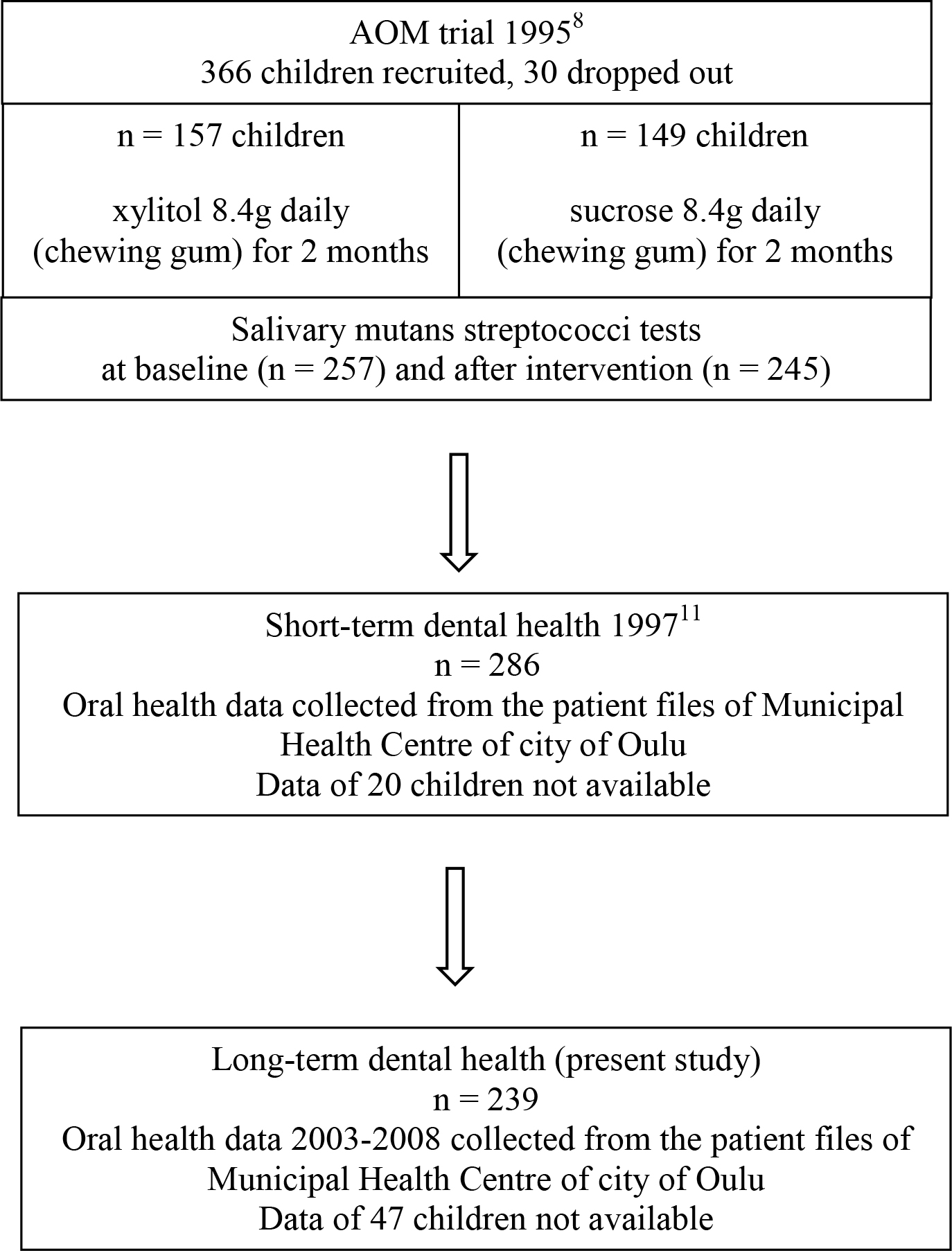
  13. De Hoon MJ, Imoto S, Nolan J, Miyano S (2004) Open source clustering software. Bioinformatics 20: 1453–1454.
  14. Fugate  DL (2007)  Neuromarketing: a layman’s look at neuroscience and its potential application to marketing practice. Journal of Consumer Marketing 24: 385–394.
  15. Lee N, Broderick AJ, Chamberlain L (2007) What is ‘neuromarketing’? A discussion and agenda for future research. International journal of psychophysiology 63: 199–204.
  16. Stipp H (2015) The Evolution of Neuromarketing Research: From Novelty to Mainstream: How Neuro Research Tools Improve Our Knowledge about Advertising. Journal of Advertising Research 55: 120–122.
  17. Genco SJ, Pohlmann AP, Steidl P (2013) Neuromarketing for dummies. John Wiley & Sons.

Enterobacteria Producing Extended Spectrum Beta- Lactamases : 74 Cases in a General Hospital in France

DOI: 10.31038/IMROJ.2019413

Abstract

Antibiotics used to treat zoonoses, such as campylobacteriosis and salmonellosis become less effective, new data from the European center for Disease Prevention and Control (ECDC) confirm this observation. Enterobacteria are the most common causes of community or nosocomial infections. Some of them produce beta-lactamases extended spectrum (ESBL) frequently associated with resistance to antibiotics. We conduct a retrospective study from positive levies of enterobacteria ESBL identified in adult patients hospitalized at the Quimper hospital, during the year 2016. 74 patients (48women) median age 80 years were included. 30% lifed in an institution, 21% had an history of infection of EBLSE, 62% had urinary tract infection, 12% intraabdominal infection, 9% respiratory infections. Distribution of Enterobacteriaceae was: E. coli (73%), E.cloacae complex (16%), K.pneumoniae (5.4%), Citrobacter freundii (2.7%), Citrobacter koseri(1.4%), Salmonella enterica (1.4%). Sensitivity profiles of antibiotics strains are presented. The strategies of antibiotic therapy are detailed and discussed. The most used molecule was ceftriaxone for probalistic treatment then fluoroquinolone, carbapenems and amoxicillin- clavulanate for second line. The evolution was favorable for 64 patients, 8 deaths, 6 serious complications were notified.

Keywords

Enterobacteria beta-lactamases extended spectrum, ESBL, nosocomial infection, antibiotic resistance

Introduction

Enterobacteria are the most common causes of community or nosocomial infections. They are usually treated with beta – lactams, such as penicillins, broad-spectrum cephalosporins and carbapenems, or fluoroquinolones. For several decades, there has been a significant increase in the resistance of Enterobacteriaceae to these antibiotics, in particular Escherichia coli (E. Coli) and Klebsiella pneumoniae (K. pneumoniae), It is related to their large-scale use appropriately or excessively in humans but also in animals [1, 2].

The β- lactamases extended spectrum (ESBL) are a large heterogeneous family of bacterial enzymes, mainly found in the Enterobacteriaceae family (secretory Enterobacteriaceae ESBL (EBLSE)). They are induced either by the acquisition of genetic material in the form of a plasmid most frequently, or by a chromosomal mutation. Both mechanisms give the affected bacteria the ability to hydrolyze a wide variety of beta – lactams. These enzymes do not hydrolyse cephamycins nor carbapenems, and are inhibited, to varying degrees, by β- lactamase inhibitors (Annex 1). The presence of ESBL is frequently associated with resistance to fluoroquinolones and carbapenems often remain the first choice molecules to treat these infections with the risk of emerging resistances to this class and the spread of carbapenemase- producing enterobacteria (CPL) [ 3].

EBLSE can cause hospital and community infections [4] with the consequent high risk of clinical failure in probabilistic treatments with cephalosporins or quinolones. The eur broadcast is now a major concern of health institutions in the fight against multi-resistant bacteria (BMR).

Epidemiological data

Discovered in the 80s in Europe, the first ESBL were of TEM (TEMoneira) and SHV (SulHydryl Variable) [5, 6] (see Ambler Classification, Annex 2). The majority were K. pneumoniae and were mainly responsible for nosocomial infections. Since now for several years, there is a worldwide spread of ESBL, in particular CT XM subtype (CefoTaXimase – Munich) on the pandemic mode with a predominance of E. coli as a host bacterium, which is largely implicated in urinary tract infections [7, 8]. In France, the incidence of EBLSE is increasing and has overtaken that of girls Staphylococcus aureus resistant to methicillin (MRSA) in hospitals ( Figures 1 and 2;
Annex 3 and 4).

IMROJ 2019-103 - Geier France_F1

Figure 1. BMR-Raisin 2015 – Overall EBLSE Impacts per 1, 000 Hospital Days (JH) (all Health Facilities, n = 1, 427) by region.

IMROJ 2019-103 - Geier France_F2

Figure 2. BMR-Raisin 2015 – Densities of MRSA and different EBLSE bacteremia incidence per 1, 000 JH (annual overall incidence density born) between 2012 and 2015 (n = 698)

Europe is characterized by a north-south and west-east distribution gradient [10, 11] (Figures 3 and 4).

IMROJ 2019-103 - Geier France_F3

Figure 3. E. Coli. Percentage (%) of invasive isolates with resistance to third- generation cephalosporins, by country, EU/EEA countries, European Centre for Disease Prevention and Control, Antimicrobial resistance surveillance in Europe, 2015

IMROJ 2019-103 - Geier France_F4

Figure 4. K. pneumoniae. Percentage (%) of invasive isolates with resistance to third-generation cephalosporins, by country, EU/EEA countries, European Centre for Disease Prevention and Control, Antimicrobial resistance surveillance in Europe, 2015

Objectives of the study

We conducted a retrospective study from positive levies of enterobacteriaceae producer extended-spectrum β-lactamase, identified in adult patients hospitalized at the Quimper hospital, during the year 2016. The main objective of this study was to evaluate in current practice the therapies administered and their efficacy in case of infection documented at EBLSE, and in particular to study alternative molecules to carbapenems. The secondary objectives were to identify the risk factors presented by these patients and to study the management of the infectious episode.

Method

This is a retrospective observational monocentric study, conducted at the Hospital Center of Quimper, France (population 100000 inhabitants)

  1. Study population and definitions

    The study population is for adults over 15 years old hospitalized during 2016.

    •  Inclusion criteria:

    Included are EBLSE strains isolated from diagnostic specimens made during the survey period in hospitalized patients complete “(Short or long stay), but also outpatients consulting at the hospital or hospitalized for a total period of less than 24 hours. For the definition of EBLSE, the reference is the annual bulletin of the Committee of the antibiogram of the French Society of Microbiology (CA-SFM).

    •  Exclusion criteria:

    Have been excluded (a) strains of EBLSE isolated from ecological samples (eg nose, stool…), that is to say in which we exclusively look for multiresistant bacteria (for example by using selective media containing antibiotics), (b) duplicates defined as strains isolated in a patient for which a strain of the same species and the same antibiotype (same antibiotype = no major difference in terms of clinical categories [S> R or R> S] for antibiotics on the standard list defined by the CA-SFM) has already been taken into account during the survey period, regardless of the diagnostic sampling from which it was isolated.

    Infection was associated with care if it occurred during or after management (diagnostic, therapeutic, palliative, preventive or educational) and was not present or incubated at the beginning of the medical care [12]. This definition was extended to patients residing in long-term care facilities, such as nursing homes for the elderly (EHPAD).

  2. ESBL risk factors

    Certain risk factors recognized as promoting the risk of developing EBLSE infection were sought in all patients. Among these factors, were retained :

    •  Older age

    •  Institutionalization

    •  A history of infection and / or colonization at EBLSE

    •  Long-term hospitalization

    •  Hospitalization in the year preceding admission

    •  A trip abroad during the past year

    •  Medical device in place

  3. The infectious episode

    Were notified: the type of infection and the presence of bacteremia;
    the different types of samples and EBLSE strains isolated for diagnostic purposes, characterized by family, genus, species and subspecies by the microbiologist; the context of care or community; complicated forms (septic shock, abscess…)

  4. Therapeutic

    The first antibiotic treatment administered was retained, with for each patient the type of drug or combination of drugs used and the duration of treatment. Antibiotic therapy was then said to be probabilistic when it was initiated before the nature and / or sensitivity of the microorganism (s) responsible for the infection were known. In case of modification of the therapeutics after reception of the antibiogram, this one was notified. Antibiotic therapy was then said to be documented when it was initiated after knowledge of the nature and / or sensitivity of the microorganism (s) responsible for the infection.

    The use of carbapenems in probabilistic and a possible association with an aminoglycoside and the notion of an opinion taken with an infectious diseases specialist of the hospital center (HC) were also noted.

  5. Become patients

    The evolution was noted as favorable if the patient was considered cured at one month of the end of the treatment. An infectious complication was sought before, during or after antibiotic therapy. In the event of death, it was notified.

  6. Data collection

    The data was collected by the principal investigator from a computer database. They were then retranscribed on a standardized Microsoft Excel ® file

RESULTS

  1. Population

    In total, 74 patients were included. 84 positive samples were identified, with the presence of 10 duplicates that were removed.

    •  Among these patients, the female sex was predominant with 48 women for 26 men

    •  The median age was 80 years [ 18–100].

    •  The distribution of patients between a service under a medical care and a surgical service is shown in Figure 5

    •  The median duration of hospitalization was 10 days, with a minimum duration of less than 24 hours during outpatient care, and a maximum duration of 100 days. The average duration of hospitalization was 18 days.

    •  The average time between admission to hospital and the occurrence of infection was 5.5 days. The median was 1 day [0–33].

    It should be noted that the residence data of patients residing in the EHPAD who were not hospitalized at the HC of Quimper were not selected.

    IMROJ 2019-103 - Geier France_F5

    Figure 5. Patients sectorization

  2. ESBL risk factors

    Risk factors for EBLSE infection are shown in Table 1.

    Table 1. Risk Factors for EBLSE Infection of Patients.

    Risk factors

    patients : n; %

    Advanced age ≥ 80 years

    38; 51.4%

    EHPAD (life in an institution)

    22; 29.7%

    History of infection and / or carriage of EBLSE

    16; 21.6%

    Long-term hospitalization ≥ 14 days

    30; 40.5%

    Hospitalization in the year preceding admission

    38; 51.4%

    Travel abroad during the year

    4; 5.4% *

    Medical device in place

    7; 9.5%

    * 30 missing data

    Urinary colonization prior to EBLSE was known in 6 patients (5 patients had colonization with E. Coli, 1 with Citrobacter freundii); 2 patients had an E. coli digestive portage.

    Eight patients had a known history of infection with ESBL E (4 urinary infection and one bile liquid infection with E. coli, one urinary infection with Citrobacter freundii, one urinary tract infection with Enterobacter cloacae complex (E. cloacae complex), one peritonitis Citrobacter freundii).

    Regarding the presence of foreign material, 2 patients had a Percutaneous Implantable Chamber (PIC), a patient with an orthopedic prosthesis, 2 patients with endovascular material such as aortic stents and a dialysis catheter, 2 patients with invasive urological material. cysto- catheter type and JJ probe. It should be noted that the presence of an indwelling urinary catheter has not been noted. In total, 7 patients (9.5%) had a medical device in place.

  3. The infectious episode

    The different types of infections that have occurred are shown in Figure 6.

    IMROJ 2019-103 - Geier France_F6

    Figure 6. Nature of infectious episodes

    46 patients (62.2%) had clinical signs of urinary tract infection. 9 patients (12.3%) had an intra-abdominal infection, 7 patients (9.4%) had signs of low respiratory infections

    The different types of sampling that showed an EBLSE are shown in Figure 7.

    IMROJ 2019-103 - Geier France_F7

    Figure 7. Collection types

    The allocation of enterobacteriaceae species is shown in Table 2.

    Table 2. Distribution of Enterobacteriaceae

    species

    n; %

    urine

    Blood cultures

    E. coli

    54 (72.9%)

    41

    9

    E. cloacae complex

    12 (16.2%)

    8

    4

    K. pneumoniae

    4 (5.4%)

    2

    1

    Citrobacter freundii

    2 (2.7%)

    2

    Citrobacter koseri

    1 (1.4%)

    1

    Salmonella enterica

    1 (1.4%)

    E. coli was the most common uropathogen. It was present in 54 cases (41 ECBU, 9 blood cultures, other samples not detailed). The second specie most frequently isolated was E. cloacae complex present in 12 cases (8 ECBU, 4 blood cultures, other samples not detailed). There were 4 cases of K. pneumoniae infection.

    Bacteremia was present in 14 cases (19.0%).

    The susceptibility profiles of the different molecules tested are represented Figure 8. Only one strain had a carbapenem resistance profile (E. cloacae complex). The sensitivity profile of the 3 most common bacteria is described in Figure 9.

    IMROJ 2019-103 - Geier France_F8

    Figure 8. Sensitivity profile of antibiotic strains

    IMROJ 2019-103 - Geier France_F9

    Figure 9. Sensitivity profile of the 3 most frequently isolated bacteria

    It is estimated that the infection was associated with care in at least 29 cases:

    Patients infected with EBLSE n = 74

    •  ESBL possibly acquired (delay> 48 hours) n = 29

    •  Carriage of Imported ESBL (time ≤ 48 hours) n = 36

    Missing data n = 9

  4. Treatment

    A total of 47 patients (63.5%) received antibiotic therapy. 15 patients did not receive anti-infectious treatment. Data was missing for 12 patients.

    •  Probabilistic antibiotic therapy

    The strategies for choosing initial antibiotic therapy are detailed in Table 3.

    Table 3. Probabilistic antibiotic therapy.

    antibiotics

    All infections, n; %

    amoxicillin

    2; 3.2%

    Amoxicillin-clavulanate

    3; 4.8%

    ceftriaxone

    12; 19.5%

    Ceftriaxone + metronidazole

    5; 8.1%

    Piperacillin-tazobactam

    3; 4.8%

    Piperacillin Tazo + aminoglycoside

    1; 1.6%

    Piperacillin Tazo + glycopeptide

    1; 1.6%

    Aztreonam-linezolid

    1; 1.6%

    cefepime

    1; 1.6%

    carbapenems

    7; 11.3%

    Carbapenem + aminoglycoside

    2; 3.2%

    fluoroquinolones

    3; 4.8%

    pristinamycin

    1; 1.6%

    Fosfomycine trometamol

    2; 3.2%

    cotrimoxazole

    2; 3.2%

    furans

    1; 1.6%

    No treatment

    15; 24.3%

    Total

    62

    The most used molecule was ceftriaxone. Of the patients who received the piperacillin-tazobactam combination, none had a known history of EBLSE carriage but their period of hospitalization was> 48 hours. Among patients who received imipenem, one patient had a history of urinary infection with E. coli ESBL and another with Citrobacter freundii ESBL, a patient had a history of peritonis with Citrobacter freundii; the other patients had been hospitalized for more than 48 hours.

    Probabilistic antibiotic therapy was considered active in 21 cases out of 47 treated patients, ie 44.7% of cases.

    •  Documented antibiotic therapy

    After reassessment, antibiotic therapy was modified in 19 cases. The choice of antibiotherapy after microbiological documentation and knowledge of the antibiogram are detailed Table 4.

    Table 4. Antibiotic for second line

    antibiotics

    n = 19; %

    Amoxicillin- clavulanate

    4; 21.1%

    Ceftazidime-ofloxacin

    1; 5.3%

    Piperacillin Tazo + aminoglycoside

    1; 5.3%

    Fluoroquinolone alone

    5; 26.2%

    cotrimoxazole

    1; 5.3%

    carbapenems

    5; 26.2%

    furans

    1; 5.3%

    temocillin

    1; 5.3%

    Of the 19 patients who received a therapeutic modification, only one died.

    A third generation cephalosporin (C3G), ceftriaxone, was used in probabilistic for 17 patients. Among them, a therapeutic modification took place for 12 patients. It should be noted that of the 17 patients treated with C3G, 2 died (one left on unsuitable probabilistic antibiotic therapy), 2 had deep abscesses, one patient had severe sepsis. Inadequate initial treatment seemed effective for 4 patients.

    •  Provision of the opinion of an infectious disease specialist

    In 28 cases only, treatments were advised by an infectious diseases specialist, leading to the prescription of a carbapenem in 9 cases, a β- lactamin – β- lactamases inhibitors (BL-IBL) in 8 cases (3 times amoxicillin-clavulanic acid and 5 times piperacillin-tazobactam), one fluoroquinolone in 3 cases, cotrimoxazole in 1 case.

    De-escalation strategies were more frequent when infectious advice was given.

    It should be noted that 5 of 28 patients carried a medical device. Of these 28 patients, 3 died as a result of EBLSE infection.

    •  Processing times

    It was difficult to evaluate treatment times because of their heterogeneity due to the various pathologies and the many missing data because they were not found in patients’ files. However, the median duration of treatment at 10 days can be evaluated with a minimum duration of one day and a maximum duration of approximately 90 days (especially in the osteoarticulatory infections), for an average duration of 12.9 days, all infections combined.

  5. Evolution

    The evolution was favorable for 64 patients (2 patients lost to follow-up). Among the complications found : 8 deaths, 2 septic shock favorable, unspecified epilepsy with imipenem, two patients presented deep abscesses, a patient presented with clostridium difficile colitis.

    4 patients died while initial antibiotic therapy was considered active.

Discussion

In general, the choice of antimicrobial therapy taking into account microbiological data is essential : mortality is higher if effective treatment initiation is delayed or inactive on EBLSE. Carbapenem treatments are associated with the lowest mortality. But the use of this class of antibiotics in the presence of ESBL also promotes the emergence of other enzymes, the metallo- beta-lactamases that hydrolyze carbapenems (CPE) and render them ineffective. In order to limit this risk, the use of antibiotic molecules that are alternative to carbapenems and frequently active in vitro on EBLSE has been encouraged. Some β- lactams (such as cephamycins, temocillin, aztreonam (AZT), the mecillinam, the BL-IBL associations or C3G) retain in vitro activity on certain ESBLE [13]. Since 2009, CA-SFM has modified the critical levels of C3G and AZT for Enterobacteriaceae based on proposals made by the European Committee on Antimicrobial susceptibility Testing (EUCAST) [14]. Thus, a strain is, since 2009, categorized Sensitive (S) when the MIC of C3G and AZT is ≤ 1 mg / L whereas it was previously when CMI was ≤ 4 mg / L. To encourage these carbapenem saving practices, the CASFM issued a press release in 2011 recommending no longer interpretative reading for the codification of Enterobacteriaceae strains having acquired mechanisms of resistance to C3G and AZT, but while continuing to detect the ESBL to monitor their evolution. But the clinical efficacy of these molecules compared to carbapenems is debated [15].

The main objective of this study was to evaluate in current practice the therapies administered and their efficacy in the case of EBLSE – documented infection, and in particular to study alternative molecule to carbapenem. The secondary objectives were to identify the risk factors presented by these patients and to study the management of the infectious episode.

This work is original insofar as it is concerned with the current practice of a resistant germ infection in a secondary HC. It is heterogeneous because it covers several sites of infection and several bacterial species.

In this study, the risk factors for EBLSE infection are generally those described in the literature, but with several limitations.

Patient comorbidities and history of immunosuppression have not been identified, nor the concept of recurrent urinary tract infections. Regarding the medical device in place, the presence of a current bladder catheter or in the previous 3 months was not sought. Hospitalization in the year preceding admission was sought but was not mentioned prior treatment with the β- ctamines and / or fluoroquinolones. [16] There were few patients who traveled to areas known to be at risk of colonization and / or EBLSE infection. In addition, the search for an earlier colonization resistant germ was made only on the Quimper hospital and therefore remains very limited. The children have not been included. More than half of the patients had an advanced age ≥ 80 years and almost a third lived in EHPAD. The predominance of women and urinary tract infections at EBLSE are consistent with the literature. Regarding the community or nosocomial origin, the data are also in agreement with the literature, confirming that the EBLSE are far from being present only in the hospital [17].

During the year 2016, 108 adult patients had a positive diagnostic specimen at EBLSE. Only 74 patients were included in this study. In 2015, we find a number of patients equivalent with a positive diagnostic sample at EBLSE. Between 2015 and 2016, hospital of Quimper has seen its consumption of antibiotics increase, especially that of C3G and monobactams (cf. report ConsoRes 2016, evaluating antibiotic consumption and resistance monitoring s in Quimper HC, compared to institutions same size, Annex 5). Amoxicillin- clavulanate remains the most widely used antibiotic. On the other hand, there is less consumption of fluoroquinolones and carbapenems.

If we look at the 3 main enterobacteria found in this study, we note that the percentage of resistance of E. coli and K. pneumoniae to cefotaxime is decreasing between 2015 and 2016. On the other hand, it is increasing for Enterobacter cloacae. Resistance to fluoroquinolones also appears to be increasing for E. coli and E. cloacae. Carbapenem resistance is dissociated with a decrease in overall resistance to imipenem but an increase in resistance to ertapenem.

The question of antibiotic therapy of choice in EBLSE infections remains debated. In this work, the most used probabilistic antibiotic therapy was a C3G, often prescribed as soon as the patient was admitted to the hospital and most of the time via the Emergency Reception Service, followed by a carbapenem. AZT has hardly been used. C3G such as ceftriaxone and cefotaxime remain molecules often used in probabilistic. Here, ceftriaxone appeared to be effective in only 4 cases. Each time, it was an urinary tract infection with E. coli, no infectious advice was taken, and the antibiogram showed “ not rendered “ in 2 cases and “ R “ in the other 2 cases. AZT was used once, in the case of an osteoarticulatory infection with E. cloacae complex with favorable evolution. After microbiological documentation, only one patient received C3G (ceftazidime), in combination with a fluoroquinolone, as part of an E. coli PIC infection and after consultation with an infectious disease specialist. Successful treatment of EBLSE with C3G has been reported in clinical cases or retrospective studies [18, 19]. It is nevertheless a small number of patients and mixed success. Their use seems possible in the case of mild and low inoculum EBLSE infections due to strains with low minimum inhibitory concentration (MIC). Some literature data suggest that when probabilistic C3G therapy is compared to probabilistic carbapenem or BL-IBL treatment, the mortality rate is higher with C3G therapy [20].

In this study, BL-IBLs such as amoxicillin- clavulanate and piperacillin-tazobactam were frequently used and mostly effective in urinary tract infections, in two cases of low respiratory tract infections, one with E. Coli and the other with K. pneumoniae, and in one case of intra-abdominal E. coli infection, whether in probabilistic or microbiological documentation. In re-evaluating the crude results of antibiograms for BL-IBL, EUCAST has also facilitated their potential therapeutic use for susceptible categorized strains, but only in cases of urinary tract infection and / or bacteremia with a urinary origin [14].

The carbapenems were prescribed as empiric antibiotic therapy in patients when ESBL colonization was known, in appropriate antibiotic therapy in case of failure or resistance to initial treatment. These attitudes are consistent with the recommendations for the proper use of carbapenems. In the litterature, some studies found a carbapenem superiority compared to BL-IBL [21] while others conclude noninferiority of BL-IBL on carbapenems [22, 23]. These results are encouraging to limit the emergence of carbapenemases. Nevertheless, one should be wary of the inoculum effect observed with piperacillin-tazobactam and which could lead to clinical failures whereas the MIC in vitro was low with a labeled antibiotic [24]. Current evidence suggests that the use of BL-IBL for the treatment of EBLSE infections would be effective, if certain conditions are met such as a low MIC, a low inoculum and a sufficient antibiotic dose with extended infusion.

No molecule of the cephamycin class was used. Cefoxitin has in vitro efficacy against ESBL but its use still seems limited because its clinical and microbiological efficacy has not been evaluated. A study is in progress (COLIFOX Trial) evaluating the non-inferiority of cefoxitin versus imipenem in the treatment of urinary tract infections and ESBL-sensitive E. coli bacteremia in vitro.

Other antibiotics do not belong to the family of the β- lactamine were also used : cotrimoxazole, fluoroquinolones, furans and fosfomycin. These last two molecules can be the treatment of choice for urinary infections such as cystitis [25]. However, antibiograms were poorly reported for fosfomycin and furans in our study. Cotrimoxazole has low sensitivity rate for Enterobacteriaceae in general and especially for ESBLE. Its sensitivity rate here is less than 30% for all strains. However, they may be of great interest in the future, given the emergence of resistance. Fluoroquinolones have rarely been used as first, but turn out as frequent as carbapenems in second line. However, the use of carbapenems is sometimes necessary and the only recourse, when one focuses on resistance profiles to the class of fluoroquinolones.

The opinion of an infectious disease specialist is very often necessary because of the complexity of the clinical and microbiological care. Strategies for climbing or de-escalating must be argued all the more in the presence of resistant germs. In order to limit the emergence of resistance, it seems essential to justify broad-spectrum antibiotic prescriptions in complex and serious cases as well as in simple cases.

The analysis of the treatment durations finds very heterogeneous results in connection with various pathologies ranging from urinary infection to osteoarticular infection. Whenever a carbapenem was prescribed, an infectious advice had been taken beforehand, limiting the inappropriate duration of treatment.

Eight patients died during the course of EBLSE infection, ie 10.8%. This figure appears to be lower than the death rate described in the literature (between 20% and 60%) [26, 27], probably due to the fact that this cohort is only part of the population that has had EBLSE infection during the year 2016 in a hospital center. In addition, the literature often reports serious infections; here, community infections have also been reported.

Although this study is limited by the fact of its retrospective, monocentric character, with sometimes inaccurate data and without a control group, it does however highlight quite different therapeutic possibilities in case of EBLSE infection. The carbapenems are far from the only effective molecules and their need is not evident in the literature. Prospective studies are expected to try to close the debate. Progress can still be made, particularly on the management of infectious episodes, by improving the communication between emergency-specialists-infectiologists-organ specialists and microbiologists, by being vigilant with fragile patients who have undergone several prior antibiotics and potentially carriers of germs (s) resistant, so that hygiene measures are put in place upon admission to hospital, which is rarely the case.

Conclusion

ESBL enterobacterial infections represent a major therapeutic challenge. Some molecules seem to position themselves as therapeutic alternatives to carbapenems, including BL-IBL, or even other classes after microbiological documentation, if we follow the recommendations of EUCAST and CA-SFM.

In view of the evolution of bacterial resistance and the lack of innovation in antibiotic therapy, the safeguarding of antibiotics requires a reasoned use of the molecules conventionally used, a new exploitation of previously neglected molecules, an innovation in terms of association and improvement in preventing the transmission of multidrug-resistant bacteria (28).

ABREVIATIONS LIST

AZT : aztreonam

BL-IBL: β- lactam – β- lactamases inhibitors

ESBL : extended spectrum β- lactamase

BMR: multi-resistant bacterium

C3G : C éphalosporines 3rd generation

CA-SFM : Committee of the antibiogram of the French Society of Microbiology

CCLIN: Coordination Center for the Fight against Nosocomial Infections

CIP : Percutaneous Implantable Chamber

CPE : carbapenemase-producing Enterobacteriaceae

CTX-M: cefotaxime

EBLSE: Enterobacteria producing ESBL

ECBU: Cyto-bacteriological examination of urine

E. cloacae : Enterobacter cloacae

E. Coli : Escherichia coli

EHPAD: Accommodation facility for dependent elderly people

EPC : Enterobacteria producing carbapenemases

EUCAST : European Committee on Antimicrobial Susceptibility Testing

HC : hospital center

“I : Intermediate

JH : Day of Hospitalization

K. pneumoniae : Klebsiella pneumoniae

MIC : minimum inhibitory concentration

MRSA : Staphylococcus Aureus Meticillin Resistant

RAISIN: Network of Alert, Investigation and Surveillance of Nosocomial Infections

“R” : Resistant

“S” : Sensible

MRSA: Staphylococcus Aureus Meticillin Resistant

References

  1. Pitout JD, Laupland KB (2008) Extended-spectrum betalactamase -producing Enterobacteriaceae : An emerging public-health concern. Lancet Infect Dis 8: 159–66.
  2. Arias CA, Murray BE (2009) Antibiotic-resistant bugs in the 21st century- A clinical super-challenge. N Engl J Med 360: 439–43.
  3. European Center for Disease Prevention and Control. Carbapenemase -producing bacteria in Europe: Interim results from the European Survey on carbapenemase producing Enterobacteriaceae (EuSCAPE) project. Stockholm: ECDC; 2013.
  4. Vora, R. Auckenthaler (2009) What does mean “ broad spectrum beta- lactamases “ in practice ? Rev Med Switzerland 5 : 1991–4.
  5. Knothe H, Shah P, Krcmery V, Antal M, Mitsuhashi S (1983) Transferable resistance to cefotaxime, cefoxitin, cefamandole and cefuroxime in clinical isolates of Klebsiella pneumoniae and Serratia marcescens . Infection 11: 315–317.
  6. Sirot D, Sirot J, Labia R, Morand A, Courvalin P, Darfeuille- Michaud A, et al. (1987) Transferable resistance to third-generation cephalosporins in clinical isolates of Klebsiella pneumoniae: identification of CTX-1, a novel beta-lactamase. J Antimicrob Chemother 20: 323–334.
  7. Hull TM, Baquero F, Canton R (2008) Increasing prevalence of ESBL-producing Enterobacteriaceae in Europe. Euro Surveill Bull Eur On Mal Transm Eur Commun Dis Bull 2008 : 13.
  8. Zahar JR, Ball E, Schnell D, Lantern F, Mechai F, Mass V, et al. (2009) [Extension of beta-lactamases producing bacteria is a worldwide concern]. MS Sci Medicine 25: 939–944.
  9. Network of alert, investigation and surveillance of nosocomial infections, RAISIN 2015.
  10. Paterson DL, Bonomo RA (2005) Extended-spectrum beta-lactamases: a clinical update. Clin Microbiol Rev 18: 657–686.
  11. Proportion of invasive E. coli strains resistant to 3rd generation cephalosporins, Europe, 2015 . European Antimicrobial Resistance Surveillance Network (EARS-Net) .
  12. Definition of Care Associated Infections – Technical Committee for Nosocomial Infections and Care-Related Infections. Ministry of Health, Youth and Sports (2007).
  13. Fournier D, Chirouze C, Leroy J, Cholley P, Talon D, Plesiat P, et al. (2013) Alternatives to carbapenems in ESBL- producing Escherichia coli infections. Medicine and infectious diseases 43: 62–6.
  14. Leclercq R, Canton R, Brown DF, Giske CG, Heisig P, MacGowan AP, et al. (2013) EUCAST expert rules in antimicrobial susceptibility testing. Clinical Microbiology and Infection: The official publication of the European Society of Clinical Microbiology and Infectious Diseases 19: 141–60.
  15. Harris PN, Tambyah PA, Paterson DL (2015) beta-lactam and beta-lactamase inhibitor compounds in the treatment of extended-spectrum beta-lactamase producing Enterobacteriaceae : time for a reappraisal in the era of few antibiotic options? Tea Lancet Infectious diseases 15: 475–85.
  16. Rodríguez-Baño J, Alcalá JC, Cisneros JM, Grill F, Oliver A, Horcajada JP, et al. (2008) Community infections caused by extended-spectrum beta-lactamase-producing Escherichia coli. Arch Intern Med 168: 1897–1902 .
  17. Saltoglu N, Karali R, Yemisen M, Ozaras R, Balkan, II, Mete B, et al. (2015) [Escherichia coli and antimicrobial activities]. International journal of clinical practice. 2015.
  18. Paterson DL, Ko WC, Von Gottberg A, Casellas JM, Mulazimoglu L, Klugman KP, et al. (2001) Outcome of cephalosporin treatment for serious infections due to apparently susceptible producing extended-spectrum beta-lactamases: implications for 69 the clinical microbiology laboratory. Journal of clinical microbiology 39: 2206–12.
  19. Rodriguez- Bano J, Picon E, Navarro MD, Lopez- Cerero L, Pascual A (2012) Impact of changes in CLSI and EUCAST breakpoints for susceptibility in bloodstream infections due to extended-spectrum beta-lactamase-producing Escherichia coli. Clinical Microbiology and Infection: The official publication of the European Society of Clinical Microbiology and Infectious Diseases. 18: 894–900.
  20. Rodriguez- Bano J, Picon E, Gijon P, Hernandez J, Ruiz M, Pena C, et al. (2010) Community onset bacteremia due to extended-spectrum beta- lactamase-producing Escherichia coli: risk factors and prognosis. Clinical Infectious Diseases: an official publication of the Infectious Diseases Society of America. 2010; 50: 40–8.
  21. Ofer- Friedman H, Shefler C, Sharma S, Tirosh A, Tal-Jasper R, Kandipalli D, et al (2015) Carbapenems Versus Piperacillin- Tazobactam for Bloodstream Infections of Nonurinary Source Caused by Extended-Spectrum Beta-Lactamase-Producing Enterobacteriaceae . Infect Control Hosp Epidemiol 2015: 1–5.
  22. Harris PN, Yin M, Jureen R, Chew J, Ali J, Paynter S, et al. (2015) Comparable outcomes for beta-lactam / beta-lactamase inhibitor combinations and carbapenems in definitive treatment of bloodstream infections caused by cefotaxime-resistant Escherichia coli or Klebsiella pneumoniae. Antimicrobial resistance and infection control 4: 14.
  23. Vardakas KZ, Tansarli GS, Rafailidis PI, Falagas ME (2012) Carbapenems versus alternative antibiotics for the treatment of bacteraemia due to Enterobacteriaceae producing extended-spectrum beta-lactamases: a systematic review and meta-analysis. J Antimicrob Chemother 67: 2793–803.
  24. Thomson K, Moland E (2001) Cefepime, piperacillin- tazobactam, and the inoculum effect in tests with extended-spectrum beta-lactamase-producing Enterobacteriaceae . Antimicrobial agents and chemotherapy 45: 3548–54.
  25. Sultan A, Rizvi M, F Khan, Sami H, Shukla I, Khan HM (2015) Increasing antimicrobial resistance among uropathogens : Is fosfomycin the answer? Urology annals 7 (1): 26–30.
  26. Lew KY, Ng TM, Tan M, SH Tan, Lew EL, Ling LM, et al. (2015) Safety and clinical outcomes of carbapenem de-escalation as part of an antimicrobial stewardship program in an ESBL-endemic setting. J Antimicrob Chemother 70: 1219–1225.
  27. Peralta G, Lamelo M, Alvarez-Garcia P, Velasco M, Delgado A, Horcajada J, et al. (2012) Impact of empirical treatment in extended-spectrum beta-lactamase-producing Escherichia coli and Klebsiella spp. bacteremia. A multicentric cohort study . BMC infectious diseases 12: 245.
  28. European Food Safety Authority and European Center for Disease Prevention and Control (2019) The European Union summary report on microbial resistance in zoonotic and indicator bacteria for humans, animals and food in 2017. EFSA Journal 17: 5598

Annexure

Annex 1: Phenotypes of resistance of enterobacteria to β- lactams

  • Natural resistances of enterobacteria to β- lactams:

Enterobacteria are naturally resistant to penicillins G and M, depending on additional resistance to other β lactam antibiotics, they are classified into four groups:

 Group of β- lactamines

 Group 1

 Group 2

 Group 3

 Group 4

Main types of enterobacteria encountered in hospitals

E. coli
Proteus mirabilis Salmonella Shigella

Klebsiella Citrobacter koseri

 Enterobacter
Serratia
Morganella
Providencia Citrobacter freundii

Yersinia

 aminopenicillins

S

R

R

R

 Carboxypénicillines

S

R

S

R

 ureidopenicillins

S

I / R

S

I / R

 C1G

S

S

R

R

 C3G

S

S

S

S

 carbapenems

S

S

S

S

 Mechanisms of resistance

Absence of β lactamase

Penicillinase at low level

Cephalosporinase at low level

Penicillinase + cephalosporinase

  • Resistances acquired from β- lactam enterobacteria :

Presentation of resistance phenotypes of enterobacteria to β – lactams :

Antibiotic markers

Low level penicillinase

Penicillinase high level

Penicillinase resistant to I β L

Cephalosporinase low level

Cephalosporinase high level

ESBL ¹

amoxicillin
AMX aminopenicillin

R

R

R

R

R

R

amoxicillin +
Ac.clavulanique

AMC aminopenicillin + I β L

S

I / R

R

ticarcillin
TIC carboxypenicillin

R

R

R

S

R

R

mecillinam
MEC aminidopenicillin

S

R

R

S

S

R

cephalothin
CF (C1G)

S

R

S

R

R

R

ceftazidime
CTX (C3G)

S

S

S

S

R

 R or synergist – gy4

1 : ESBL: β – lactamase with extended spectrum. | 2 : I β L: β – lactamase inhibitors do not inhibit cephalosporinase s (cephalosporinases are nevertheless β – lactamases) | 3 : Resistant strain sometimes intermediate, in all cases the inhibition diameter for the AMC is greater than that of the AMX. | 4 : some ESBLs can give an intermediate or sensitive profile with a C3G. The demonstration of synergy between clavulanic acid (AMC disk) and C3G not allow to conclude that the presence of an ESBL.

Annex 2: Classification of s β – lactamases according to amble:

  •  Serines transferases :

 – Class A : (TEM, SHV, MEN, PES, PER, VEB, CTX-M …)

 Penicillinases, ESBL ; p lasmidic or chromosomal

 – Class C : (CMY, DHA, FOX, MOX …)

 cephalosporinases ; c hromosomiques or plasmid

 – Class D : (OXA, PSE)

 Oxacillinases p lasmidiques

  •  Metallo-enzymes: Class B (IMP, VIM, NDM-1)

 carbapenemases

IMROJ 2019-103 - Geier France_F10

Annex 3. BMR-Raisin 2015- MRSA and EBLSE Incidence Densities per 1, 000 JH (overall incidence density per year) between 2002 and 2015 in France

IMROJ 2019-103 - Geier France_F11

Annex 4. Evolution of the methicillin resistance in S. aureus, and 3rd generation cephalosporins in K. pneumoniae and E. Coli, France, 2004-2014, EARS-Net France-InVS data

IMROJ 2019-103 - Geier France_F12

Annex 5. ConsoRes report 2016, Quimper HQ
Effect of Propolis Nanoparticles on Early-Stage Wound Healing in a Diabetic Noncontractile Wound Model

DOI: 10.31038/NAMS.2019212

Abstract

Propolis is commonly used to treat dermal inflammatory disorders and has shown great potential in experimental wound healing. However, propolis usually requires organic solvents for solubilization, which hampers its use in dermal wound healing. In this regard, nanotechnology arises as an important tool towards the development of aqueous systems with application in wound healing. In this context, the present study aimed to develop propolis nanoparticles and to evaluate, in vitro and in vivo, their potential in early-stage wound healing. Propolis Nanoparticles (PN) were characterized regarding their physical-chemical properties and chemical profile. In vitro, their effect on murine fibroblast cells was evaluated. In vivo, PN was administered in diabetic mice with impaired wound healing, using a noncontractile wound healing model. PN presented good encapsulation, stability, and phenolic content. They also stimulated growth of NIH/3T3 fibroblast cells, leading to an increase in 50% of cell viability. Mice treated with PN showed superior wound closure percentage (54.5%) when compared to untreated animals (20.7%). Taken together, our results showed that PN is promising for application in cutaneous tissue regeneration.

Graphical Abstract

NAMS 2019-101 - Thaís Alberti Brazil_F8

Keywords

Brazilian Propolis, Nanoparticles, Wound healing, Tissue Regeneration, Diabetes mellitus.

Introduction

Over the last few decades, we have seen a worldwide increase in the use of natural products. Plants produce a great number of different metabolites which can target different molecular mechanisms simultaneously, generating synergistic therapeutic effects, even in low concentration. Phytotherapeutics also represent lower risks of toxicity and undesirable side effects compared to many synthetic molecules [1].

Propolis, also known as bee glue, is a featured natural product owing to its various biological activities and well-documented traditional use [2]. Its main pharmacological activities are antimicrobial, antitumor, antioxidant, anti-inflammatory, immunomodulatory, hypocholesterolemic, hypotensive, anesthetic, and wound healing. These activities can be linked to its chemical composition, and since the resinous mixture produced by Apis mellifera bees varies according to their surrounding botanical variety, the biological activity of propolis also varies [3]. Brazilian green propolis has worldwide prominence based on its abundant chemical compounds, such as prenylated phenylpropanoids, especially cinnamic acid derivatives. Among them, Artepillin C ((E)-3-[4-hydroxy-3, 5-bis(3-methylbut-2-enyl)phenyl]prop-2-enoic acid) has the most added value based on its antimicrobial and antitumor activities [4]. Furthermore, phenolic acids, flavonoids, mono- and sesquiterpenes have often been detected in Brazilian propolis, contributing to its chemical profile and biological activities [5]. Studies have shown that these compounds have greater antioxidant effect than commonly used antioxidants, such as vitamin C and E. By diminishing intracellular peroxides, antioxidants can also have antitumor, anti-inflammatory, and immunomodulatory activity [6]. The anti-inflammatory effect of propolis is widely documented and several studies have shown its potential in experimental wound healing.

Propolis chemical composition varies between polar and nonpolar compounds; hence, hydroalcoholic solutions have been described as the best extraction method [7]. As a result of the lipophilic characteristic of its compounds, propolis has low solubility in water, and commercial propolis formulations are often ethanol-based, which may cause adverse topical reactions. In this context, nanotechnology arises as an interesting tool that both allows the transport of lipophilic compounds in aqueous solutions and improves their stability. Nanostructured biomaterials of variable composition and with different roles in the wound healing process have been developed. These biomaterials have been extensively described as a promising alternative for the treatment of skin diseases, especially since modern wound dressing aims to create an ideal environment to provide good oxygenation, diminish bacterial colonization, and improve tissue repair [8]. In particular, nanoparticles provide properties of interest such as being nontoxic or dermal-irritating, having good physical stability, greater contact surface area, and better drug absorption [9]. Furthermore, the encapsulation of propolis into a nanoparticle system avoids the use of organic solvents which are often toxic and can harm the chemical structure of bioactive compounds. Moreover, nanoparticles may also boost the release of bioactive compounds, especially in topical use, owing to the morphology and size of the particles and their interaction with the epidermal surface.

Diabetic ulcer is one of the most worrisome conditions in the context of wound healing impairment. It is a common and serious complication of Diabetes Mellitus (DM), being one of the major causes of organ amputation which affects 15% of all diabetics. Currently, about 194 million patients living with diabetes, and WHO estimates that this number will double by 2025. The severity of wounds leads to amputation in 25% of subjects with diabetic ulcers [10]. Many studies have demonstrated that the elevation of blood glucose levels hampers resolution of the inflammatory phase and reduces angiogenesis and fibroblast proliferation, impairing the wound healing process. DM can also hinder the wound healing process by interfering with cell signaling and decreasing cell response, leading, in turn, to a reduction in peripheral blood flow and local tissue regeneration [11].

In this scenario, the present study aimed to develop Propolis Nanoparticles (PN) specific to wound healing and investigate their wound healing properties, both in vitro an in vivo. To accomplish this, a non-contractile diabetic wound healing model was previously adopted to evaluate the potential of the new formulation in individuals with compromised wound healing [12]. Aware of the limitation of using rodents, which have contractile wound healing, as opposed to human noncontractile wound healing, we adopted a model that limits wound contraction by applying silicon discs around it. This method prevents wound healing by epithelial contraction; therefore, the effect observed is by re-epithelialization and granulation, processes similar to those that occur in human tissue regeneration.

Materials and Methods

Preparation of propolis extract

A propolis sample was collected in the fall of 2015 in southern Brazil (Santa Catarina State, Sao Joaquim County, 28° 17′ 38″ S, 49° 55′ 54″ W, altitude 1353 m). Its chemical traits and low toxicity were previously determined by our research group [13]. The extraction was made using ethanol 70% (v/v) at the ratio of 0.2 mg of dried propolis per mL of solvent. The mixture was left to extract overnight at room temperature, followed by vacuum filtration to recover the hydroalcoholic extract that was further dried (1h) using a Savant™ SpeedVac™ microcentrifuge to obtain dried propolis extract.

Preparation and characterization of propolis nanoparticles

Propolis Nanoparticles (PN) were prepared using a spontaneous emulsification method with 0.4% of poloxamer (Kolliphor P188) in the aqueous phase and 2.5 mg/mL of soy lecithin in the organic phase composed of acetone and ethanol at a ratio of 60:40 (v/v). The hydroalcoholic extract was solubilized in the organic phase, reaching a final concentration in nanoparticles of 17 mg/mL after removing the organic phase in a rotary evaporator. Particle size and zeta potential were measured at 25°C by photon correlation spectroscopy, and laser Doppler anemometry, respectively, using a Zetasizer® Nano-ZS 90 (Malvern Instruments, Worcestershire, UK).

Morphology – TEM

Morphology was determined by Transmission Electronic Microscopy – TEM (CM200 Philips; FEI Company, Hillsboro, OR, USA). Droplets of nanoparticles suspension were deposited on carbon grids and fixated with uranyl acetate 2% (w/v) following visualization.

Analysis of phenolic composition by HPLC-UV-vis

The propolis dried extract (1mg) was dissolved in ethanol and centrifuged (10 min, 4000rpm). The supernatant (0.5 mL) was collected, filtered (0.22 μm), and used for chromatographic analysis. An aliquot (60 μL, n = 3) was injected into a liquid chromatograph (Shimadzu LC-10A) equipped with a C18 reverse phase column (Shim-Pack CLC-ODS, 250 mm × 4.6 mm, ∅ 5μm, 40°C), fitted with a C18 reversed phase guard column (Shim-Pack CLC-ODS, 4.6 mm, ∅ 5μm) and a UV-vis detector. Elution consisted of H2O: AcOH: η-BuOH (350: 1: 10, v/v/v) with a flow rate at 0.8 mL/min. Identification of phenolic acids was performed using the retention times and co-chromatography of standard compounds (gallic acid, syringic acid, p-coumaric acid, sinapic acid, quercetin, and artepillin C – Sigma-Aldrich, MO – USA). For purposes of concentration calculations, an external standard curve was built for artepillin C under the same experimental conditions, using the integral values of the peaks’ area of interest.

Encapsulation efficiency and phenolic content

Total phenolic content (μg/mL) of propolis nanoparticles was determined by the Folin-Ciocalteau spectrophotometric method [14], using a UV-vis spectrophotometer (BEL LGS 53, Monza, Italy). Analysis was carried out in triplicate, and total phenolic content was quantified using a standard curve of gallic acid (y = 0.3344x, r2 = 0.937) in the same solvents (7.8 – 125 µg.mL). Results were expressed as mg gallic acid equivalents per g of oil (mean values ± SD).

Encapsulation efficiency (%) was calculated using the formula described below, considering the difference between the values of total phenolic content in the PN and the nonencapsulated phenoliccontent, using an ultrafiltration filter device (Amicon, Ultracel-100 filter membrane, 100 kDa, Millipore Corp., USA).

Encapsulation efficiency (%) = (phenolic content of PN suspension – phenolic content of non-encapsulated fraction) × 100/phenolic content of PN suspension.

Stability studies

To evaluate the stability of PN, samples were stored at room temperature (25 ± 2°C). Particle size, Polydispersity Index (PDI), zeta potential, and pH were measured after 24h and at 7, 15, 30, 60, and 90 days after preparation.

Cell Culture Studies

Murine NIH/3T3 fibroblast cells were cultivated in DMEM medium (Dulbecco’s Modified Eagle’s Medium) supplemented with fetal bovine serum 10% (FBS), 10 mM HEPES, 2mM L-glutamine, 100 units/mL penicillin, and 100 g/mL streptomycin. Medium was changed every 48h, and cells were maintained in culture at 37°C, humid atmosphere at 5% CO2. When cells were confluent, they were treated with a 0.25% (w/v) trypsin in 1mM EDTA solution and counted using a Neubauer chamber.

Cell viability essay

Toxicity of nanoparticles was determined by the neutral red uptake (NRU) assay as previously described [15]. To perform this assay, 104 cells/well were inoculated, and after 24h incubation at 37°C, they were treated with different concentrations of PN, blank nanoparticles, i.e., the same concentrations of nanoparticles, but without propolis, and sodium dodecyl sulfate (positive control).

After 48h incubation, the plate was washed with 100μl PBS, stained with 100 μL of NR dye (25 μg/mL) in DMEM and incubated for another 3h. The medium containing NR was removed and washed with 100μL PBS and 100μL desorption solution (H2O: EtOH: glacial acetic acid, 49: 50: 1, v/v/v). Absorbance was read in a Gold Spectrumlab 53 UV-vis Spectrophotometer (BEL Photonics, Brazil) at a wavelength of 540nm.

Wound Healing In Vivo Assay

Male Swiss mice (8 to 12 weeks of age) were obtained from the Central Biotery of the Federal University of Santa Catarina (Florianópolis, SC, Brazil) and housed in communal cages at 21 ± 2°C under a 12-h light/dark cycle (lights on at 07:00 h) with free access to food and tap water. All experimental procedures were previously approved by the Committee on the Ethical Use of Animals and performed in accordance with Brazilian regulations on animal welfare (CEUA/UFSC 23080.030926/2010-62).

Induction of experimental diabetes

Induction of experimental diabetes was performed with minor modifications of [16]. Mice were intraperitoneally injected with a single dose of streptozotocin (150mg/kg) dissolved in citrate buffer (1mM, pH 4.5). After 7 days, their blood glucose was measured with a glucometer, and mice with plasma glucose higher than 250mg/dL were considered diabetic.

Surgical procedure

Mice were anaesthetized with isoflurane and shaved; then a full-thickness round wound was made in the dorsum of the animal (∅ = 0.8 cm) using sterile scissors. In order to diminish contraction, a noncontractile wound healing model was applied as previously described by Wang et al. [26]. A strip of Tegaderm™, a transparent polyurethane dressing, was used to cover the wound.

Then, a 2mm-thick, round-auto adhesive Tegaderm™ was fixed with 4 counter lateral stitches with 5.0 nylon thread such that the wound remained at the center of the disc. The animals were randomly separated and equally distributed into four groups (n = 6). Mice were treated each 48h with a 100 μL treatment solution, i.e., PN, blank nanoparticles or allantoin (2.5mg/mL, positive control). The olution was injected under the Tegaderm™ and over the wound. For the negative control group, no treatment was applied. On day 7 post-surgery, animals were euthanized with an isoflurane overdose, the wounds were measured, and the wound tissues were collected for histological examination.

Histopathological analyses

Tissues were fixed in buffered formaldehyde solution (10%, v/v – pH 7.2), embedded in paraffin sections (6 μm thickness), and stained with Mallory›s trichrome stain (Leica autostainer XL). Samples were scanned (Axio scan) and analyzed morphologically using the Zen software (Carl Zeiss AG, GE).

Statistical Analysis

In order to evaluate the effect of the treatments, statistical analysis was applied to the dataset, using one-way analysis of variance (ANOVA). Statistical analyses were performed using the GraphPad Prism 6 Software (GraphPad Software Inc., San Diego, CA, USA), and p-values less than 0.05 were considered significant. Data are presented as mean ± SEM of independent experiments.

Results

Characterization of PN

TEM micrographs of PN produced using 0.4% poloxamer displayed a spherical shape (Figure 1). The uranyl acetate of the negative staining deposited more intensively around the nanoparticles, its higher affinity for the lecithin hydrophilic shell. The formulations showed a mean particle size similar to that obtained through photon correlation spectroscopy analysis.

NAMS 2019-101 - Thaís Alberti Brazil_F1

Figure 1. Transmission electron micrograph of propolis nanoparticles with 0.4% poloxamer and 2.5mg/mL of soy lecithin coating, stained with uranyl acetate at 2% (w/v). Scale bar corresponds to 0.5 μm.

Stability

Different parameters may be used for evaluating the stability of a nanoparticles-based system. Macroscopically, stability can be examined by the absence of phase separation and maintenance of the original visual characteristics. Also, the stability of physicochemical characteristics, such as size, PDI, and pH, should be evaluated [9]. Figure 2 shows the results of the average nanoparticle size at 122.1 nm. The formulation showed a unimodal distribution with a PDI of 0.126. As PDI decreases, the homogeneity of particle size increases. This value is determined by the proportion between the standard deviation and average particle size. Another important parameter is zeta potential, which measures the particle’s surface electrical charge.

NAMS 2019-101 - Thaís Alberti Brazil_F2

Figure 2. Correlation between mean particle size (a) and zeta potential (b) according to decay time distribution (0, 1, 2, 3, and 4 weeks).

As this value increases, either positive or negative, generally above 30mV, electrochemical repulsion increases and, hence, stability. The negative charge of PN results from the presence of soy lecithin in the formulation, which is preferably located at the nanoparticle surface and confers a negative charge. Zeta potential remained the same throughout the evaluated time. However, after the first 7 days, a wider distribution in particle size was noted, and it remained constant until the end of the experiment, increasing PDI to a maximum of 0.253, which is within unimodal distribution. Thus, the nanoparticles presented good stability, as demonstrated by particle size and surface charge throughout the evaluated time.

Characterization of phenolic composition and encapsulation efficiency of PN

The Folin–Ciocalteau Reagent (FCR) method was used to determine the total phenolic compounds of PN (total and nonencapsulated fractions). The nonencapsulated fraction includes all compounds that were not encapsulated in the nanoparticle and that remained solubilized in aqueous phase. This fraction was separated from the intact PN, using an ultrafiltration device that retains the PN, but not the free compounds, i.e., those solubilized in aqueous phase. Encapsulation efficiency (%) represents the percentage of compounds successfully encapsulated inside the nanoparticles. The total phenolic content and encapsulation efficiency of PN are displayed in Table 1.

Table 1. Total phenolic content (μg/mL) and encapsulation efficiency (%) of PN

Total phenolic content (pg/mL)

Encapsulation efficiency (%)

Propolis NPs (total fraction)

Propolls NPs
(non-encapsulated fraction)

Day 0

75.31 ±1.05

44.77 ±0.75

40.55 ±1.34

Day 30

67.72 ± 0.68

40.63 ±0.1

40.01 ±0.46

The average total phenolic content of PN was 75.31 μg/mL. Since the concentration of propolis extract in the nanoparticle suspension was 17 mg/mL, the average proportional concentration of phenolic compounds was 4.43 μg/mg propolis. In turn, the concentration of nonencapsulated phenolic compounds at 44.77 μg/mL represents about 60% of total phenolic compounds, or encapsulation efficiency of 40.55%. The encapsulation efficiency remained constant throughout the experiment.

To assess how multiple compounds from the complex matrix of propolis were distributed in the PN suspension, HPLC-UV-vis analyses of propolis extract, total fraction, and nonencapsulated fraction were performed. Representative chromatograms of propolis extract, total propolis of nanoparticles, and nonencapsulated propolis are shown in Figure 3.

NAMS 2019-101 - Thaís Alberti Brazil_F3

Figure 3. HPLC-UV-vis chromatograms of propolis extract (A), total content of PN (B), and free content of PN (C).  Peak number 1 (gallic acid), (2) syringic acid, (3) p-coumaric acid, (4) sinapic acid, (5) quercetin, and (6) artepillin C. 1  propolis concentration at 1 mg/mL.

The chromatographic profile of PN is similar to that of propolis extract, evidencing the presence of the six phenolic compounds identified and quantified in the extract (Table 1). Among the non-encapsulated fraction, the major compound found was gallic acid with a similar amount relative to the total PN suspension (13.7 μg/mL). On the other hand, artepillin C was detected in high concentrations in the total PN suspension (41.9 μg/mL), but in low amounts in the nonencapsulated fraction (2.5 μg/mL). In general, a decrease in encapsulation efficiency was observed for compounds with lower retention times, i.e., more polar, such as gallic acid. This result evidences the selective encapsulation of compounds from the propolis matrix, in which polar compounds showed a lower efficiency of encapsulation, owing to their higher affinity to the water phase, so that as compound polarity decreased, the encapsulation efficiency increased.

Overall encapsulation efficiency, as shown by HPLC analysis, was 42.9%, similar to the value found by the total phenolic content assay, i.e., 40%. Moreover, total phenolic contents in PN were estimated to be 71.9 μg/mL and 75.31 μg/mL by chromatographic and spectrophotometric analysis, respectively. When encapsulating a single compound, the highest possible encapsulation efficiency is desired. The nanoencapsulation of a complex mixture requires a deeper analysis accordingly to its chemical profile. HPLC analysis demonstrated that gallic acid remained in the aqueous phase. This is consistent with its chemical structure, in which 4 out of its 5 radicals are hydroxyl groups and, therefore, highly hydrophilic with high affinity for the aqueous phase. The carboxyl group of syringic acid is also highly polar; however, the ether groups make it slightly less soluble as a result of the increasing hydrophobic nature of the alkyl chain. That explains why we could observe increasing encapsulation efficiency, but decreasing affinity, with the aqueous phase. In its turn, p-coumaric acid has a carboxyl group, but also an aromatic ring, making it more nonpolar than syringic acid. Sinapic acid has a chemical structure similar to that of p-coumaric acid, but with two more methyl ether radicals, favoring its nonpolar character. Quercetin has 3 aromatic rings, but equally as many hydroxyls, giving it almost the same affinity to aqueous partition as that of the nonpolar fraction, explaining its 54% encapsulation efficiency. Artepillin C is a phenol constructed of single ring with two prenyl groups. Since the molecule becomes more nonpolar and therefore less soluble in water as the carbon chain becomes longer, its low molecular weight and chemical structure increase its affinity for incorporation into the phospholipidic bilayer membrane of the nanoparticle, substantiating its encapsulation efficiency by 93.9%.

Cell Viability Essay

The effect of PN on 3T3 fibroblasts was assessed through in vitro acute oral toxicity assay by measuring the neutral red uptake (NRU – Figure 4). Cells were treated with logarithmic concentrations of PN, and from the lowest concentration, i.e., 0.001 mg/mL, an increase of 50% in cell viability was observed, compared to negative control. The increase in cell viability was statistically relevant up to 0.1mg/mL, which was also the highest dosage before inhibitory concentration (IC50) has been detected, showing a values of 1.30 mg/mL. The lethal dose (DL50) was 1523.9 mg/kg, which corroborates previous findings described on the propolis toxicity [17].

NAMS 2019-101 - Thaís Alberti Brazil_F4

Figure 4. Cell viability (%) obtained through NRU cytotoxicity assay using 3T3 cells with logarithmic concentrations of PN (mg/mL). Each column represents the mean + SD of 6 wells/group. *p<0.001 vs. control group (one-way ANOVA with Dunnett’s post-hoc test).

Wound Healing Assay in vivo

Since rodents have a contractile wound healing pattern, the discs used in our noncontractile model prevented wound healing by epithelial contraction. Thus, the cicatrization effect is through re-epithelialization and granulation, processes similar to those that occur in human tissue regeneration [12]. Additionally, DM type 2 was induced to further evaluate the wound healing potential in subjects with impaired cicatrization. Mice were administered a 100 μL treatment solution every 48h after surgical lesion. Thus, 1.7mg PN were delivered to the lesion site each treatment. Likewise, positive control (allantoin 2.5mg/mL) received 0.25mg per treatment. Figure 5 compares the percentage of wound closure area after 7 days of lesion.

NAMS 2019-101 - Thaís Alberti Brazil_F5

Figure 5. Wound closure area (%) after 7 days according to the treatments: NC – negative control, NV – blank nanoparticle (vehicle), PN – propolis nanoparticles, and PC – positive control. Each column represents the mean ± SD. *p<0.0001 vs. control group (one-way ANOVA with the Dunnett’s post-hoc test).

All treated groups showed statistically significant wound closure percentage compared to untreated animals, which presented only 20.7% of wound closure after 7 days. PN treatment resulted in the highest percentage of wound closure (54.5%), a result quite similar to positive control (54.3%). Because of the chemical nature of PN formulation without propolis, it could be theorized that the moisture and physicochemical properties of the emulsifier present in blank nanoparticles were sufficient to positively influence the wound healing process (38.5%). Soy lecithin used as emulsifier is a phospholipid that forms phospholipid bilayers in the process of homogeneous emulsification, similar to those present in cell membranes. Nonetheless, the presence of propolis in the nanoparticles accelerated the wound healing process by 16.0% and 33.8% in comparison to blank nanoparticles and the nontreated group, respectively.

Macroscopically, it was possible to observe changes in the aspect of the wound, as shown in Figure 6. Untreated control exhibited wound aspect of raw exposed skin, whereas blank nanoparticles (NV) seemed to have a thin layer of protective mucus. The allantoin group (PC) and PN displayed the formation of a crust typical of later stages of the wound healing process. Even though it was not the aim of our study, the results revealed an unexpected effect of PN in that some component of PN, present in both blank NV and PN, stimulated hair follicle growth. In order to perform the surgical lesion, all the animals were shaved, and all photos were taken on the same day after lesion. We were not able to observe any hair growth in untreated animals or in positive control (allantoin), only a few with random patches of fur. Interestingly, a previous study reported that propolis stimulates hair growth by inducing keratinocyte proliferation [18].

NAMS 2019-101 - Thaís Alberti Brazil_F6

Figure 6. Photographs on day 7 post-wounding of macroscopic appearance of wounds treated with a – negative control (untreated), b – nanoparticles vehicle, c – allantoin (positive control), and d – PN. Scale bar corresponds to 1 cm and applies throughout.

NAMS 2019-101 - Thaís Alberti Brazil_F7

Figure 7. Representative microscopic images of the lesion region at day 7th post-wounding obtained through Mallory’s staining of histological cuts. A – untreated (negative control), B – allantoin (positive control) C – nanoparticles vehicle,  D – E – G propolis nanoparticles. (A-F) 10x; (G) 40x. Scale bar corresponds to 50μm and applies throughout. Abbreviations: (gt) granulation tissue; (epi) epidermis; (sc) stratum corneum; (coll) collagen; (hf) hair follicle; and capillary vases (cv and arrows).

Histological evaluation of the wound sites was performed at day 7th post-wounding, and some preliminary findings were found. On day 7 post-wounding all groups displayed formation of new epidermis, granulation tissue (high density of fibroblasts), and immature regenerated tissue (with newly synthesized unarranged collagen fibers, as detected by blue light). These data corroborate the results obtained in the macroscopic analysis of the lesions in which a similar closure was observed in the same groups. Moreover, PN showed two distinctive characteristics not found in the other groups: remodeling and angiogenesis. With the reestablishment of the functional structure of the tissue, it was possible to observe skin appendages (hair follicles), arrangement of collagen fibers resembling normal skin tissue (stained in darker blue), and numerous mature blood vessels. In the other groups, numerous red blood cells were found, but they were dispersed randomly with inflammatory infiltrates and not organized into well-defined blood vessels.

Discussion

In order to allow solubilization of nonpolar compounds in aqueous medium, propolis extract was encapsulated into a nanoparticle-based system. This system presents many advantages, such as increase in stability and compound permeation through the skin, owing to size, morphology, and physicochemical properties of the nanoparticles and their association with the skin surface constituents. The lipophilicity of nanoparticles and the use of surfactants also increase the process of compound permeation. Nevertheless, as shown by the chemical composition analysis, propolis is a mixture of polar and nonpolar compounds with different affinities for the aqueous phase and the phospholipid bilayer of the nanoparticle. The compounds that presented medium encapsulation efficiency and, therefore, affinity with both phases may be responsible for the change in the particle size distribution noted in the first week of storage. As mentioned before, stability depends on the amount of repulsion forces between the particles, guaranteeing that they will not be attracted to each other and, thus, forming a bigger particle through coalescence. This phenomenon is known as Ostwald ripening. The zeta potential remained constant during the analyzed time. Thus, particle charge and repulsion forces were not responsible for the coalescence effect observed, which, instead, could be attributed to the polarity grade of the phenolic compounds encapsulated, such as syringic acid, p-coumaric acid, and sinapic acid.

The detection of a typical chemical profile associated with propolis from a specific production region or season may be used to obtain a specific pharmacological activity. The chemical fingerprint of the propolis in the present work is consistent with the same specific harvest season and region of production as other studies determined through NMR-based metabolomics, chemometrics, machine learning algorithms [13], and UV-Vis profiles [19]. Furthermore, chromatographic profiles of the propolis herein investigated and the source of Artepillin C, the plant species Baccharis dracunculifolia, were similar [20]. The chromatogram highlights phenolic acids derived from benzoic acid (gallic and syringic acids) and derived from the cinamic acid (p-coumaric acid, sinapic acid, and ArtC), in addition to the major flavonol, quercetin. Quercetin is a flavonoid commonly found in European propolis [3] that has potent antioxidant activity and also boosts wound healing in collagen matrices [21]. Gallic acid is a potential antioxidant that directly upregulates the expression of antioxidant genes. In addition, that secondary metabolite accelerates cell migration of keratinocytes and fibroblasts in both normal and hyperglucidic conditions [23]. Syringic acid possesses both antioxidant and anti-inflammatory properties shown to protect against chemically induced inflammation [23]. Sinapic acid and its derivatives possess high radical scavenging potential which can be applied to multiple pharmacological uses [24]. In addition to antioxidant and chemoprotective properties, p-coumaric acid also acts as a precursor for phenylpropanoids, among them ArtC [25], the major nanoencapsulated component detected in the present study. Previous reports have shown that ArtC prevents oxidative damage in a dose-dependent manner and that it suppresses lipid peroxidation [26]. Furthermore, both Art-C and Brazilian propolis significantly inhibited alloreactive CD4 T cell proliferation and activation, as well as suppressed the expressions of IL-2, IFN-gamma, and IL-17 [27]. ArtC has also been associated with propolis treatment with local and systemic anti-inflammatory activity in acute and chronic inflammation models [28].

In the present study, PN (from 0.001 mg/mL to 0.1mg/mL) presented a proliferative effect on fibroblasts, in vitro, increasing by 50% the cell viability. This could be associated with the accelerated wound healing effect found in vivo, since the proliferative phase (7 days) seems to be in a more advanced stage in comparison to the other groups such as allantoin, which macroscopically showed a similar percentage of wound closure, but did not display microscopically collagen deposition (more associated with remodeling phase), formation of skin appendages, or angiogenesis, as noted for PN. It has been shown that propolis can stimulate angiogenesis by increasing the expression of fibroblast growth factor-2 (FGF-2), a transcription factor involved in revascularization and hematopoiesis. This result was observed concomitant with fibroblast stimulation with topical application of propolis extract in the healing process of traumatic ulcer in diabetic rats [29]. FGF-2 has been found to be mediated through protein kinase (MEK/ERK) and phosphoinositide-3 kinase (PI3K/Akt) signaling pathways [30], eventually indicating a possible mechanism through which PN mediates wound healing in diabetic mice by proliferating fibroblasts, increasing collagen deposition, and forming blood capillaries and skin appendages.

Conclusion

To the best of our knowledge, this is the first report on the use of PN for wound healing. The chemical fingerprint of PN is rich in Art C and, hence, comparable to that of green propolis, usually produced in southeastern Brazil and with claimed antitumor activity. PN stimulated fibroblast proliferation in vitro and induced a higher rate of wound closure in vivo. Likewise, our data suggest that PN induces acceleration of the proliferative phase, collagen deposition, angiogenesis, and skin appendage formation. Collectively, therefore, these results suggest that polyphenolic-rich PN has the potential to serve as a novel topical wound healing therapy in chronic wounds, including settings of impaired wound healing caused by DM.

List of Abreviation

Art C, artepillin C; PN, propolis nanoparticles; DM,diabetes mellitus; TEM, transmission electron microscopy; DMEM, dulbecco’s modified eagle’s medium; NRU, neutral red uptake; PDI, polydispersion index; HPLC, high performance liquid cromatography; NV, nanovehicle/blank nanoparticles; PC, positive control/allantoin group; NMR, nuclear magnetic ressonace, CD4 T, T helper cells; IL-2, interleukin-2; IFN-gamma, interferon gamma; IL-17, interleukin-17; FGF-2, fibroblast growth factor-2; MEK/ERK, protein kinase; PI3K/Akt, phosphoinositide-3 kinase.

Funding Information

This work was supported by CNPq, CAPES, FAPESC and PRONEX, Brazil [grant numbers 17420/2011/3, 454572/2014-0 and 401517/2012-8].

Authorship

Authors Thaís Alberti, Daniela Coelho, Ana Voytena, Roniele Iacovski, Leticia Mazzarino, Marcelo Maraschin and Beatriz Veleirinho all approved the final version of the article. The first two and last three authors contributed to the conception and design of the study. The first four authors contributed in data collection, interpretation, or analysis. The first and last two authors contributed in writing of the article and revision.

References

  1. Yunes RA, Pedrosa RC, Cechinel Filho V (2001) Fármacos e fitoterápicos: a necessidade do desenvolvimento da indústria de fitoterápicos e fitofármacos no Brasil. Química nova 24: 147–152.
  2. Ghisalberti E, Jefferies P, Lanteri R, Matisons J (1978) Constituents of propolis. Cellular and Molecular Life Sciences. 34:157–158.
  3. Marcucci MC (1995) Propolis: chemical composition, biological properties and therapeutic activity. Apidologie. 26: 83–99.
  4. Aga H, Shibuya T, Sugimoto T, Kurimoto M, Nakajima S (1994) Isolation and identification of antimicrobial compounds in Brazilian propolis. Bioscience, biotechnology, and biochemistry 58: 945–946.
  5. Salatino A, Teixeira, Weinstein r, Negri G, Message D (2005) Origin and Chemical Variation of Brazilian Propolis. Evidence-Based Complementary and Alternative Medicine 2: 33–38.
  6. Banskota AH, Tezuka Y, Kadota S (2001) Recent progress in pharmacological research of propolis. Phytotherapy Research 15: 561–571.
  7. Park YK, Ikegaki M, Abreu JdS, Alcici NMF (1998) Estudo da preparação dos extratos de própolis e suas aplicações. Ciência e Tecnologia de Alimentos 18: 313–318.
  8. Alberti T, S Coelho D, Voytena A, Pitz H, de Pra M, et al. (2017) Nanotechnology: A Promising Tool Towards Wound Healing. Current pharmaceutical design. 23: 3515–3528.
  9. Tadros T, Izquierdo P, Esquena J, Solans C (2004) Formation and stability of nano-emulsions. Adv Colloid Interface Sci 108–109: 303–318. [crossref]
  10. Gordois A, Scuffham P, Shearer A, Oglesby A, Tobian JA (2003) The health care costs of diabetic peripheral neuropathy in the US. Diabetes Care 26: 1790–1795. [crossref]
  11. Hehenberger K, Hansson A (1997) High glucose-induced growth factor resistance in human fibroblasts can be reversed by antioxidants and protein kinase C-inhibitors. Cell Biochem Funct 15: 197–201. [crossref]
  12. Wang X, Ge J, Tredget EE, Wu Y (2013) The mouse excisional wound splinting model, including applications for stem cell transplantation. Nat Protocols 8: 302–309.
  13. Maraschin M, Somensi-Zeggio Al, Oliveira SK, Kuhnen S, Tomazzoli MM, et al. (2015) Metabolic profiling and classification of propolis samples from southern brazil: an NMR-based platform coupled with machine learning. Journal of natural products 79: 13–23.
  14. Popova M, Bankova V, Butovska D, Petkov V, Nikolova-Damyanova B, et al. (2004) Validated methods for the quanti?cation of biologically active constituents of poplar-type propolis. Phytochemical analysis 15: 235–240.
  15. OECD E (2010) Guidance document on using cytotoxicity tests to estimate starting doses for acute oral systemic toxicity tests. OECD Ser Test Assess 20: 1–54.
  16. Jain SK, Rains JL, Croad JL (2007) Effect of chromium niacinate and chromium picolinate supplementation on lipid peroxidation, TNF-a, IL-6, CRP, glycated hemoglobin, triglycerides, and cholesterol levels in blood of streptozotocin-treated diabetic rats. Free Radical Biology and Medicine 43: 1124–1131.
  17. Park E-H, Kim S-H, Park S-S (1996) Anti-inflammatory activity of propolis. Archives of pharmacal research 19: 337–341.
  18. Miyata S, Oda Y, Matsuo C, Kumura H, Kobayashi K (2014) Stimulatory Effect of Brazilian Propolis on Hair Growth through Proliferation of Keratinocytes in Mice. Journal of Agricultural and Food Chemistry 62: 11854–11861.
  19. Tomazzoli MM, Neto RDP, Moresco R, Westphal L, Zeggio ARS, et al. (2015) Discrimination of Brazilian propolis according to the seasoning using chemometrics and machine learning based on UV-Vis scanning data. Journal of integrative bioinformatics 12:15–26.
  20. Park YK, Paredes-Guzman JF, Aguiar CL, Alencar SM, Fujiwara FY (2004) Chemical constituents in Baccharis dracunculifolia as the main botanical origin of southeastern Brazilian propolis. J Agric Food Chem 52: 1100–1103. [crossref]
  21. Gomathi K, Gopinath D, Rafiuddin Ahmed M, Jayakumar R (2003) Quercetin incorporated collagen matrices for dermal wound healing processes in rat. Biomaterials 24: 2767–2772.
  22. Yang DJ, Moh SH, Son DH, You S, Kinyua AW, et al. (2016) Gallic acid promotes wound healing in normal and hyperglucidic conditions. Molecules 21: 899.
  23. Wei X, Chen D, Yi Y, Qi H, Gao X, et al. (2012) Syringic Acid Extracted from Herba dendrobii Prevents Diabetic Cataract Pathogenesis by Inhibiting Aldose Reductase Activity. Evidence-based Complementary and Alternative Medicine : eCAM 2012: 426537.
  24. Chen C (2016) Sinapic Acid and Its Derivatives as Medicine in Oxidative Stress-Induced Diseases and Aging. Oxidative Medicine and Cellular Longevity 2016: 10.
  25. Marcucci MC, Ferreres F, García-Viguera C, Bankova VS, De Castro SL, et al. (2001) Phenolic compounds from Brazilian propolis with pharmacological activities. J Ethnopharmacol 74: 105–112. [crossref]
  26. Shimizu K, Ashida H, Matsuura Y, Kanazawa K (2004) Antioxidative bioavailability of artepillin C in Brazilian propolis. Arch Biochem Biophys 424: 181–188. [crossref]
  27. Cheung K-W, Sze DM-Y, Chan WK, Deng R-X, Tu W, et al. (2011) Brazilian green propolis and its constituent, Artepillin C inhibits allogeneic activated human CD4 T cells expansion and activation. Journal of ethnopharmacology 138: 463–471.
  28. Machado JL, Assunçao AKM, da Silva MCP, Reis ASd, Costa GC, et al. (2012) Brazilian green propolis: anti-inflammatory property by an immunomodulatory activity. Evidence-Based Complementary and Alternative Medicine 2012.
  29. Puspasari A, Harijanti K, Soebadi B, Hendarti HT, Radithia D, et al. (2018) Effects of topical application of propolis extract on fibroblast growth factor-2 and fibroblast expression in the traumatic ulcers of diabetic Rattus norvegicus. Journal of Oral and Maxillofacial Pathology 22: 54.
  30. Ornitz DM, Itoh N (2015) The fibroblast growth factor signaling pathway. Wiley Interdisciplinary Reviews: Developmental Biology 4: 215–266.

Printing Clear Annular Patterns by Mass Separated Ion Using Rotating Electric Fields

DOI: 10.31038/NAMS.2019211

Abstract

We have printed clear annular patterns by mass separated ion using rotating electric fields. We have been developing the new type mass analyzer using two rotating electric fields (REFs). The REF-MS are capable of simultaneous mass separation with limited elements. In our previous studies, the origins of the ions and the annular ring patterns were identified by theoretical calculations and time of flight type secondary ion mass spectrometry (TOF-SIMS) imaging. In this paper, we have printed clear annular patterns on the Si wafer within short time and discuss the origin of finger prints.

Keywords

FIB, Imaging mass spectrogram, REF-MS

Introduction

We have been developing the new type mass analyzer using two rotating electric fields (REFs). The origin of REF type mass analyzer can be traced back to a simple TOF principle within a single REF geometry [1, 2]. Table 1 indicates the comparison with conventional mass analyzers and REF-MS. The REF-MS is highly developed to separate different ions continuously in a two-dimensional plane. In principle, dimension of detection on sector-MS, TOF-MS and Q-MS are almost restricted to spots. The sector-MS and the REF-MS are capable of simultaneous detection with limited elements. Each REF consists of eight small electrodes and AC voltage with a phase contrast of 45 degrees is applied to the each electrode. This REF-MS locates double REFs aligned on the same axis. Then, we optimized the phase contrast between the upstream REF and downstream REF to make the phases opposite for the selected ion. First, ions travel into the upstream REF. The flight time of the selected ion is controlled to be just one cycle of the REF. Between the two REFs, ions travel mirror trajectories on their mass. The selected ion draws a cycloid trajectory. The downstream REF is drawn opposite phase with the upstream REF. In the downstream REF, typical ions are converged to center axis and other ions travel different trajectory [3, 4]. The relationship with the mass electric charge ratio of the selected ion and the frequency of REFs can be described by following equation (1), where f is the frequency of the REF, L is the length of the REF, Vacc is the accelerating voltage of the selected ion, m/Z is the mass weight of the single charged ion for measurement, and e is the quantum of electricity [5].

NAMS 2019-102 - Masashi Japan_F3

Table 1. Comparison with conventional mass analyzers and REF-MS.

Sector-MS

TOF-MS

Q-MS

REF-MS

Ion beam

Continuous

Pulse

Continuous

Continuous

Dimension of Detection

Spot (line)

Spot

Spot

2D plane

Simultaneous

Detection

(Dependence)

Multi elements (Magnetic field)

One elements (Time)

One elements (Frequency)

Multi elements (Rotating electric field)

Experiments

Our original instruments are precisely described in our previous papers [3–5]. In this study, we selected AuGe alloy as a FIB source. It is reported that many kinds of Au, Ge isotopes or compounds are emitted from AuGe alloy liquid metal ion source [6, 7]. The accelerating voltage of the AuGe-FIB was 10 kV. The alternative potential of each sinusoidal wave was ±210 V maximum (peak to peak). First, we optimized the phase contrast between each channel and optimized the alternative potential for the specific mass from AuGe alloy. Then, we set the movable aperture unit and kept the ion-beam current to about 5.2 nA. Second, we obtained the annular patterns of AuGe alloy by sweeping the frequencies of REFs. In our previous studies, the origins of the ions and the annular ring patterns were identified by theoretical calculations (SIMIONTM). The certainty of these results was confirmed by time of flight type secondary ion mass spectrometry (TOF-SIMS) imaging of printed AuGe annular ring patterns on Si wafer [8]. In this paper, we have printed clear annular patterns on the Si wafer within short time and discuss the origin of finger prints.

Results & Discussion

Using the equation (1), we calculated the proper frequencies when 197Au2+, 197Au+ and 197Au2+ ions are converged to the center. Figure 1 indicates the projection patterns of AuGe alloy obtained by using REF-MS on the fluorescent screen. On fig.1-(A), 197Au2+ mass was converged to the center and other masses formed concentric annular rings with different diameters from the center. There are also the annular rings outside of center, however the origins of annular rings cannot be identified. On the other hand of fig.1-(B), 197Au+ ion was converged to the center and 197Au2+ ion was disappeared from the screen. There are non-annular patterns were also confirmed near the edge of the screen. It is thought that the ions were reflected within the wall of electrode and formed fringed patterns. Because, the fringed patterns draw the opposite movement from the annular patterns when the optical axis is shifted. On fig.1-(C), 197Au2+ ion was converged to the center and 197Au+ ion have moved from the center to the outside. There are also Ge isotopes ions forming annular rings in concentric order around 197Au2+ ion.

We converted target from the fluorescent screen to the Si wafer and printed clear annular patterns on the wafer. Figure 2 indicates the results of the prints of annular rings patterns. Samples were prepared by irradiating AuGe-FIB mass-separating by REFs at an acceleration voltage of 12.9 kV for 3 hours. At each frequency, we succeeded in printing the clear annular patterns. In fig.2-(A), we can see two central points. It is thought that the axis of the beam shifted during the irradiation of AuGe-FIB. In fig.2-(B), the fringed patterns of ions could not be printed. From these results, it is considered that the patterns printed to the Si wafer were formed by ions colliding directly to the Si wafer. All of the clear printed Si wafers were elementally analyzed by TOF-SIMS and the surface was measured by surface roughness meter. The results indicate AuGe-FIB has left no fingerprints on Si wafers. It can be concluded that the clear patterns can be originated to amorphous phase generated within the first 3 hours. Ion implantations were majorly processed, after the amorphous phase has formed completely.

NAMS 2019-102 - Masashi Japan_F1

Figure 1. Annular patterns of AuGe alloy by mass separation of REF-MS on the fluorescent screen (A) f = 479 kHz, (B) f = 680 kHz (c) f = 956 kHz (Each frequency was assigned by
equation(1))

NAMS 2019-102 - Masashi Japan_F2

Figure 2. The results of the prints of annular ring patterns on Si wafers (A) f = 479 kHz, (B) f = 678 kHz, (C) f =956 kHz.

Authorship

This work was spatially supported by Mr. Tokio Norikawa and Naoya Kishimoto of Tokyo University of Science.

Contributors

The authors are particularly indebted to Mr. Takashi Kusanagi of Ampere Inc., Dr. Satoshi Kurumi and Prof. Kaoru Suzuki of Nihon University, Prof. Kosuke Moritani of University of Hyogo This unique technique was originally invented by Mr. Masanao Hotta and Dr. Tatsuya Adachi. I wish to express great respects for them.

Funding information

This work was partially supported by academic incentive system of the Toshiba Electric Devices & Storage Corporation and SHIMADZU SCIENCE FOUNDATION.

References

  1. Clemmons JH, Herrero FA (1998) Mass spectroscopy using a rotating electric field. Rev Sci Instrum 69: 2285–2291.
  2. Katayama A, Kameo Y, Nakashima M (2008) Time-of-Flight Mass Spectrometer Using an Imaging Detector and a Rotating Electric Field. J Mass Spectrom Soc Jpn 56: 229–234.
  3. Nojima M, Anai Y, Hotta M, Suzuki K, Kurumi S, et al. (2016)  Development of a mass spectrometer using two rotating electric fields. J Vac Sci Technol B 34: 03H132-1-03H132-4.
  4. Nojima M  (2017) Imaging Mass Spectrogram using Rotating Electric Fields Mass Spectrometer. Global Journal of Nanomedicine 2: GJO.MS.ID555596.
  5. Anai Y, Nojima M, Hotta M, Suzuki K, Kurumi S, et al. (2016) Development of Mass Spectrometer Using Two Rotating Electric Fields for Separation of High-Mass Ions. J Surf Sci Nanotech 14: 161–164.
  6. Machalett F, Muhle R, Stiebritz I, Gotz G (1989) Mass Spectra of Au-Ge Alloy Liquid Metal Ion Sources. Nuclear Instruments and Methods in Physics Research B37/38: 180–183.
  7. Davies N, Weibel DE, Blenkinsopp P, Lockyer N, Hill R, et al. (2003) Development and experimental application of a gold liquid metal ion source. Applied Surface Science 203–204, 223–227.
  8. Nojima M, Norikawa T, Kishimoto N (2018) Mass Separation of AuGe-LMIS Using a New Principle: Rotating Electric Fields. Mass Spectrom Purif Tech 4: 128.