Archives

Comparison of Various Selection Strategies Used for Isolation of Human Monoclonal scFv Antibody Specific to GPCRs Heteromers

DOI: 10.31038/JPPR.2019224

Abstract

Currently, novel drug design focused on the searching pharmacological compounds acting via influence on GPCRs heteromers. The strategy allows obtaining highly selective effects since these heteromers appear only on specific cells and tissues. Therefore, human monoclonal scFv antibodies able to recognizing GPCRs heteromers may constitute a valuable tool in modern therapies. Antibody phage display technique together with high throughput screening play a key role in the development of clinically useful immunomolecules. Therefore in the present work we focused on the comparison of various strategies used for biopanning process during phage display procedure, dedicated to isolation scFv antibodies specifically recognizing GPCRs heteromers. Experiments were conducted in two different cell lines (CHO-K1 and HEK 293) and six various selection procedures were described. Elimination of nonspecific bindings constitutes a key point during the process. Results obtained duing selection conducted in the conditions promoting internalization process were the most satisfactory.

Keywords

Phage Display, scFv antibody, GPCRs, Hetromer, Biopanning

1. Introduction

Recently heteromers (receptor heterodimers) formed by human G-Protein Coupled Receptors (GPCRs) constitute extremely important targets in the design of modern treatment strategies [1]. Alteration of pharmacological properties of the receptors included in the heterocomplex have been proven and widely described in the literature [1–3]. Research focused on finding therapeutic compounds able to selective recognition of GPCRs heteromers are currently very popular. Such strategy allows to obtain a tissue-specific acting, since the interaction between receptors engaged in the complex formation can only take place when the receptors are simultaneously expressed on the same cell. Recent data indicate the existence of clinically relevant GPCRs heteromers, important in the treatment of, among others, pain, asthma or Parkinson’s disease [3–7].

Creation of the human monoclonal antibodies with specificity towards membrane GPCRs heteromers still remains sizable challenge. To fulfil its role, the kind of antibody must recognize the structural epitope formed within the GPCRs heteromeric structure and, at the same time, not show specificity for monomeric or homomeric forms of the receptors. The phage display technology provided the best conditions for the isolation of human monoclonal antibody specifically recognizing the spatial epitope formed by GPCRs heteromers.

Currently phage display technology attracts most attention since the methods is a powerful tool, among others, in drug discovery, nanotechnology, immunology, agriculture, diagnostics, neurobiology, molecular imaging etc [8–12]. The technology developed by George P. Smith in 1985 [13] constitutes a very useful tool for the study of protein–protein, protein–peptide, and protein–DNA interactions [14]. The methodology is based on the fact that phage phenotype and genotype are physically linked [14]. A gene encoding a protein of interest inserted into a gene of bacteriophage coat protein is expressed and presented on the phage surface. The concept is simple: a population of phage is engineered to express random-sequence peptides, proteins or antibodies on their surface [8]. From this population, a selection is made of those phage that bind the desired target [8]. Hereby, large proteins libraries can be screened and unique molecules which bind to their targets with high affinity and specificity can be isolated [15]. The advantage of the method is the possibility of the production of monoclonal antibodies recognizing antigens that cannot be used to immunize an animal due to their toxicity, non-immunogenicity or presence in complexes on the surface of cell membranes [16].

ScFvs (Single Chain Variable  Fragment) are small monoclonal antibody fragments composed of immunoglobulin-heavy (VH) and light chain-variable (VL) regions with a flexible peptide linker designed to connect the two chains such that the antigen binding site is retained in a single co-linear molecule [17]. The kind of antibodies can be derived from phage display libraries [18,19]. ScFvs are very useful in pharmacology and diagnostic fields as well as in drug delivery issues since they can function as targeting ligands. Functionalization of the surface of drug carriers by scFvs enable controlled transport of pharmacological compounds directly to the desired place of action [20].  ScFvs, in comparison to the much larger Fab, F(ab)2, and IgG forms, are characterized by better tissue penetration, lower retention times in non-target tissues, faster blood clearance and, above all, reduced immunogenicity. These features cause that they are very useful for therapeutic applications [21].

The main purpose of presented work was the description of different strategies which may be used during phage display procedure for the isolation of scFvs antibodies specifically recognizing human GPCRs heteromers. To separate the phages that effectively bind defined heteromer it is extremely important to carry out the selection rounds in conditions most similar to those in which desirable receptors occur naturally in the cells, which allowed to preserve the native spatial conformation of the heteromer. Elimination of nonspecific binding without losing rare specific ones seems a serious challenge. Therefore, in the work several various types of selection were presented. The experiments were independently conducted for two GPCRs pair: dopamine D2 (D2R) and serotonin 5-HT1A (5-HT1AR) receptors as well as  dopamine Dand serotonin 5-HT2A receptors. Similar results were obtained for both cases. For simplicity in the work the outcomes for D2–5-HT1A were presented.

2. Materials and Methods

2.1 Cell culture and Transfection

CHO-K1 cells (ATCC) were grown in RPMI (Sigma) medium; HEK 293 cells (ATCC) were grown in minimal essential medium (MEM) (Sigma) with 1% L-glutamine. Both medium were supplemented with 10% heat-inactivated fetal bovine serum (FBS) (Sigma). All cells were cultured at 37 °C inside a humidified incubator in an atmosphere of 5% CO2. Transient and stable transfections were made by using the TurboFect reagent (Thermo Sci.) according to the manufacturer’s protocol. Early passages of CHO-K1 as well as HEK 293 cells were stably transfected (1.5 µg DNA) with the plasmid pcDNA3.1(+) encoding the human 5-HT1AR or the human D2R (UMR cDNA Resource Centre) separately or cotransfected with both vectors. Stable cell lines expressing D2R and/or 5-HT1AR were obtained after the addition of the selection antibiotic, G418 (Sigma), at a final concentration of 0.75 mg/ml. Cells resistant to the antibiotic and stably expressing investigated receptors were analysed by RT-PCR (data not shown). Forty-eight hours before the selection experiment, stable cell lines were, additionally, transiently transfected with 0.5 µg DNA (per 10 mm plate area) encoding the desired receptors.

2.2 Screening of phage-displayed scFv libraries

The human antibody scFv phagemid library Tomlinson I+J (Geneservice) was used. The library J was amplified and titrated (used the library size was 1.9×10¹² cfu) according to the manufacturer’s protocols using E. coli TG1 cells [18]. Biopanning was performed on positive (+) and negative (-) cells expressing desired receptors. CHO-K1 as well as HEK 293 cell lines were used. CHO+ and HEK+ cells constituted cells expressing D2–5–HT1A heteromers whilst CHO- and HEK- cells expressed separately D2R or 5–HT1AR and were mixed before experiment in a 1:1 ratio. Four – six positive rounds of selection followed by prenegative selection and one final negative selection were performed independently on both mentioned above cell lines. Briefly, during preselection amplified phages were blocked for 2 hr at room temperature (RT) in 3% MPBS (with stirring from time to time) and then were added to the negative cells (growing on 150 mm plates (15x) 95% confluence) or to the cells suspension – 108 cells) for 2 hr at RT (with stirring from time to time). Next, the cells were collected and centrifuged (10 min at 1000 rpm). Supernatant containing unbound phages was used to positive selection. The final negative selection were performed similarly to preselection.

2.2.1 Positive selection – type A and B

Phages derived from preselection were added to the culture medium of positive cells growing on 150 mm plates (10x, 95% confluence) and were incubated with shaking for 2 hr at 37 °C (type A) or at RT (type B). After that time, unbound phages were washed away with PBS buffer. The number of washes after each round of selection has been shown in Table 1. In the next step, the cells were collected, centrifuged and resuspended in PBS containing 1 mg/ml trypsin. The suspension was incubated on the rotator for 10 min at RT and then centrifuged (10 min, 1000rpm, 4 °C). The supernatant containing the desired phages after titration and amplification was used for another round of biopanning.

Table 1. Number of washing steps performer after each round of selection during phage display procedure.

NUMBER OF WASHING STEPS

Selection case

I

II

III

IV

V

VI

A

5

10

20

30

30

30

B

5

10

20

30

30

30

C

3

6

12

24

30

30

D

4

6

8

10

12

15

E

4

6

8

10

12

15

F

4

6

8

10

12

15

2.2.2 Positive selection – type C

Positive cells growing on 150 mm plates (10x, 95% confluence) were used. Phages after preselection were added to the cell medium for 2 hr (at 0 °C). Then, the medium was removed and cells were washed 3 times with cold PBS. Between washings, RPMI medium was added, and the cells were incubated on ice for 10 min. Then, the temperature of incubation was changed to 37 °C for 20 min. In the next step, the cells were washed 4 times using elution buffer (100 mM glycine, 150 mM NaCl, pH 2.8). The number of washes increased (twice each time) with subsequent rounds of selection. Finally, cells were harvested from the plates and resuspended in PBS containing trypsin (1 mg/ml) for approximately 15 min (until cell lysis). Then, the obtained suspension was centrifuged (10 min, 4000 rpm, 4 °C), and the supernatant containing the desired phages after titration and amplification was used for another round of biopanning.

2.2.3 Positive selection – type D

The experiment was performed in the cells suspension expressing both desired receptors (positive cells). The number of used cells (in the first round was 2 × 10⁷) increased twice with subsequent rounds of selection. Phages were incubated with the cells for 2 hr with shaking at RT. Then unbounded phages were eliminated by washing (PBS) and centrifugation (10 min, 1000 rpm, RT) (Table 1). In the next step cell pellet was resuspended in PBS containing trypsin (1 mg/ml) for approximately 5 min. Then the suspension was centrifuged (10 min, 4000 rpm, RT), the supernatant was collected and after titration and amplification was used for another round of biopanning.

2.2.4 Positive selection – type E and F

In case E and F experiments were performed similarly to type D. Differences appeared at the stage of acquiring bounded phages. In type E, after washing steps cell pellet was incubated with H2O (caused cell lysis) for 10 min with shaking at RT. Then trypsin (1 mg/ml) in PBS was added to the suspension for 10 min incubation at RT. Finally, the desired phages were obtained from the supernatant after centrifugation (10 min, 4000 rpm, RT).

In case F, after washing steps the cell pellet was incubated for 15 min at RT with clozapine (10–9 M). Then, after centrifugation (10 min, 1000 rpm, RT) the supernatant was collected and the trypsin (1 mg/ml) in PBS was added. Obtained phages after titration and amplification were used for another round of biopanning.

2.3 Polyclonal phage ELISA

The quality of the biopanning process was monitored using polyclonal phage ELISA. Amplificated phages (50 µl) obtained after selection rounds were incubated with 50 µl of 4% MPBS for 2 hr at 37 °C. Then, 1.5 × 10⁵ cells (resuspended in 50 µl of medium with 5% FBS) were mixed with previously blocked phages. Both the positive (CHO+ or HEK+ cells expressing D2–5-HT1A heteromers) and the negative (CHO- or HEK- cells  expressing a single type of receptor mixed at the 1:1 ratio) probes were used. After 1 hr ice incubation, the washing step was conducted 3 times at 4 °C using 200 µl cold PBS. Each washing round ended with centrifuging (1000 rpm x g, 10 min, 4 °C), and the supernatant rejection. Detection of bound phages were determined by horseradish peroxidase (HRP)-conjugated anti-M13 monoclonal antibodies (GE Healthcare). Briefly, after washing, the probes were incubated with the antibody resuspended in a 1:5000 ratio in 3% MPBS for 30 min on ice and then washed 4 times as described above. Finally, 100 µl of TMB substrate (GE Healthcare) and 100 µl of 1 M HCl (per well) were used to induce the reaction. The absorbance was measured at 450 nm. Experiments were performed in triplicate.

2.4 Monoclonal phage ELISA

Based on the results of polyclonal phage ELISA, phage clones from rounds characterized by the highest affinity against positive cells (CHO+ or HEK+) cells were randomly selected for monoclonal phage ELISA experiments. Individual bacterial colonies were inoculated into 96-well plates containing 100 µl 2xTYAG (2xTY (Bioshop) with 100 μg/ml ampicillin (Sigma) and 1% glucose (Bioshop)) medium per well and cultured overnight at 37 °C (250 rpm shaking). Then, 5 µl of the culture (from each well) was added to fresh 200 µl 2xTYAG medium and cultured with shaking (250 rpm) at 37 °C for 2 hr. Next, 109 helper phages were added to the each well and incubated for 1 hr and at 37 °C with shaking at 250 rpm. After centrifugation (1800 x g, 10 min), the supernatants were removed, and bacterial pellets were resuspended in 200 µl 2xTYAKG (2xTY containing 100 μg/ml ampicillin, 50 µg/ml kanamycin (Sigma) and 1% glucose) medium and incubated overnight at 30 °C (250 rpm). Finally, after plates centrifugation (1800 x g, 10 min), the 50 µl of supernatants (containing monoclonal phages) were used in the phage ELISA as described above (2.3).

3. Results and Discussion

The phage display technology has provided the ability to create antibody libraries that contain a great number of phage particles, from which each one encodes and displays different molecules (106–1011 different ligands in a population of > 1012 phage molecules) [14]. Finding the most suitable molecule that reflects desired properties depends largely on proper conduction of biopanning experiments. It is extremely important especially in case of isolation of monoclonal scFv antibodies directed towards GPCRs heteromers.  Because the kind of antibody must recognize spatial epitope that naturally occurs within heteromer structure, the key issue constitute such choice of experimental conditions which would ensure a natural environment in which heteromers may be formed. Generally the biopanning method is based on repeated cycles of incubation, washing, amplification and reselection of bound phage [14]. The target molecule may be immobilized on solid support as microtiter plate wells, PVDF membrane column matrix or immunotubes magnetic beads and even on whole cells [14]. In our case target antigen (defined heteromer) was presented on the surface of living cells. This kind of biopanning process is more complicated than in case when purified antigen is immobilized on the plate surface. A large number of variables can affect the behaviour of cells, which can translate into the quality of expressed heteromers and the key parameter here is the presentation of the ideal heteromer structure for the selection.

Several parameters affect biopanning efficiency, including antigen concentration, temperature, washing stringency (washing number and composition of wash buffer) as well as blocking and elution buffer composition [22]. Therefore, in the present work six various strategies (types A-F) of selection were described. Experiments were performed depending on the temperature (0 oC, RT, 37 oC), in the conditions that promote internalization process (type C), in the conditions where heteromer-bounded phages were isolated from interior of the cells after water lysis (type E), in the conditions where heteromer-bounded phages were displaced by clozapine (type F). Moreover during experiments washing stringency was maintained (Table 1). Additionally, two different cell line (CHO-K1 and HEK 293) were adopted to the procedure. Experiments were performed for attached cells as well as in the cells suspension. CHO-K1 cells are well attached to the surface than HEK 293 cells which makes them better for experiments conducted on plates where rigours washing steps are made. Comparison both used cell lines indicate that results obtained for such experiments using HEK 293 cells were definitely worse (Table 2 A,B). Probably most phages were lost during washing steps which was related to the easy detachment of cells from the plate.

Table 2. Titre of phages after each selection round (I-VI positive selection followed by negative preselection, VII – negative selection). Procedure performed on A) CHO-K1 cells, B) on HEK 293 cells.

A) CHO-K1 cell line

Selection type

I

II

III

IV

V

VI

VII

A

1,4 ×10⁵

2,3 ×10⁷

2,8 ×10⁸

4,4 ×10⁸

6,1 ×10⁹

B

2,6 ×10⁵

1,2 ×10⁷

3,1 ×10⁸

2,4 ×10⁸

6,7 ×10⁹

C

4,0 ×10³

2,1 ×10⁶

1,9 ×10⁶

3,2 ×10⁸

6,4 ×10⁹

D

2,9 ×10⁴

2,6 ×10⁶

1,5 ×10⁷

3.2 ×10⁷

4,7 ×10⁸

E

1,9 ×10³

0,5 ×10⁶

0,9 ×10⁶

1,2 ×10⁷

2,1 ×10⁷

F

6,8 ×10⁴

4,7 ×10⁶

2,8 ×10⁷

4,8 ×10⁷

5,2 ×10⁸

B) HEK 293 cell line

Selection

type

I

II

III

IV

V

VI

VII

A

0,9 ×10⁴

5,3 ×10⁵

1,8 ×10⁶

1,2 ×10⁶

2,3 ×10⁶

1,7 ×10⁶

6,8 ×10⁶

B

7,6 ×10³

1,6 ×10⁵

3,9 ×10⁵

2,7 ×10⁶

2,9 ×10⁶

1,9 ×10⁶

3,7 ×10⁶

C

3,0 ×10³

2,7 ×10⁴

1,9 ×10⁵

2,3 ×10⁵

2,7 ×10⁶

1,9 ×10⁶

5,4 ×10⁶

D

2,1 ×10³

4,2 ×10⁴

5,4 ×10⁶

1,4 ×10⁷

4,1 ×10⁸

3,8 ×10⁸

1,8 ×10⁹

E

0,9 ×10³

2,1 ×10³

4,5 ×10⁴

6,7 ×10⁴

9,5 ×10³

1,2 ×10⁵

4,8 ×10⁵

F

2,9 ×10³

5,1 ×10⁵

7,1 ×10⁶

8,3 ×10⁷

9,7 ×10⁷

4,3 ×10⁷

1,9 ×10⁸

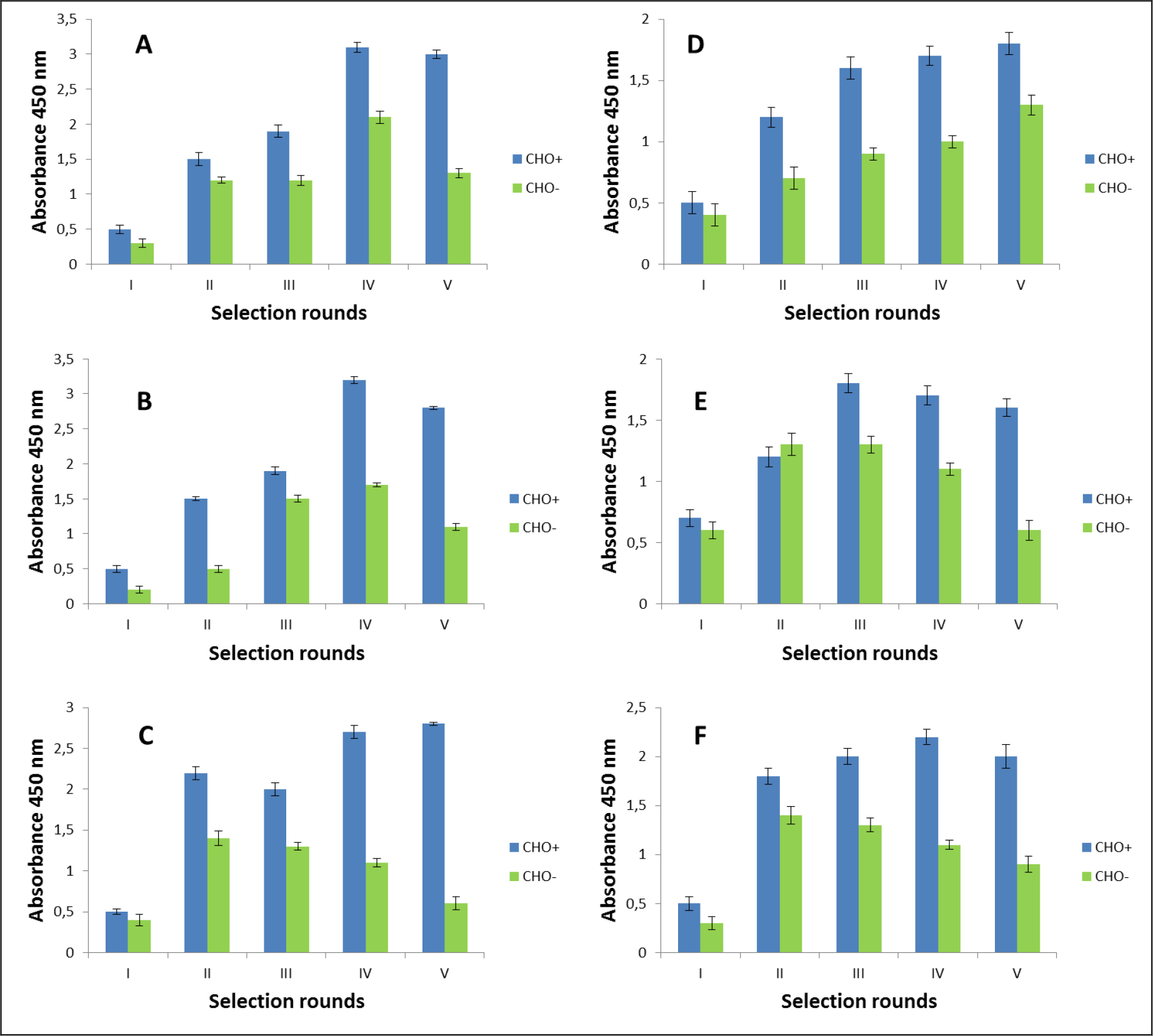
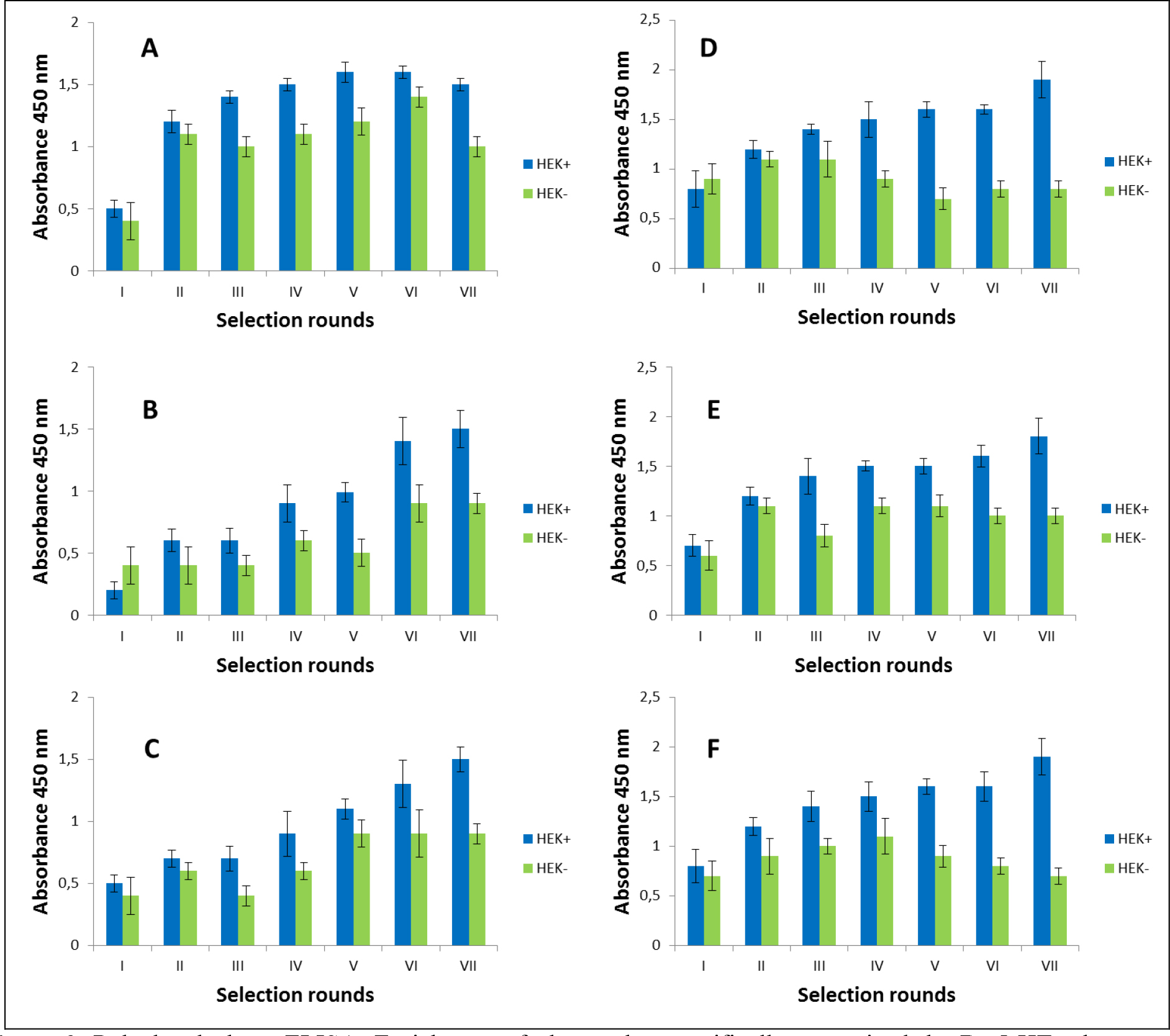
The selection process was assessed by monitoring the enrichment ratio and polyclonal phage ELISA. The increasing titre of phages as well as polyclonal phages ELISA results indicates the correctness of the biopanning process and corresponds with the enrichment of phages that specifically recognized the defined heteromer. Preselection conducted on negative cells provided initial elimination of phages exhibited binding affinity towards monomeric forms of receptors included into D2–5-HT1A heteromers as well as towards other molecules presented on the cell surface. It was very important and critical move because it enrich the amount of phages acquiring potentially, desired binding properties before the actual positive selection. Results obtaining during experiments performed without negative preselection was not as satisfying as expected (data not shown). The biopanning rounds were repeated until the obtained results (phages titre and polyclonal ELISA) related to positive (specific to defined heteromer) phages reached a plateau or started to decline (Figure 1,2, Table 2A,B). In case of experiments performed on CHO-K1 cells the plateau was achieved faster (after 4 round of selection) (Table 2A). For both cell lines. the level of polyclonal phages binding to positive cells increase with the number of selection. Moreover, in the initial rounds the difference between “phages” binding affinity to positive vs. negative cells was much smaller than in case of further rounds. Similarly to preselection, the last, only negative selection plays also an important role in the elimination of nonspecific bounded phages. As we can see the phages titre as well as binding specificity significantly increased after the last negative selection. Conducting further, only negative selection did not caused further increase of phages titre and binding affinity (data nor shown).
JPPR 19 - 114 Sylwia Łukasiewicz_F1

Figure 1. Polyclonal phage ELISA. Enrichment of phages that specifically recognized the D2–5-HT1A heteromer. Experiments performed in CHO-K1 cell line. A-F various selection types.
JPPR 19 - 114 Sylwia Łukasiewicz_F2

Figure 2. Polyclonal phage ELISA. Enrichment of phages that specifically recognized the D2–5-HT1A heteromer. Experiments performed in HEK 293 cell line. A-F various selection types.

After the selection process, the specific binding of individual monoclonal phages to cells presenting defined heteromers was determined by monoclonal phage ELISA techniques. Such tests were conducted on various cell lines (CHO-K1, HEK293) expressing desired receptors in pairs or individually. The kind of experiment enable real identification of monoclonal phages displaying desired scFv molecules on the surface. About 1000 phages obtained after each type of selection were tested. Table 3 presents the results obtained for the three best phages for a given type of selection. The most satisfactory results (the highest heteromer specificity) were obtained in case of selection in conditions conducive to internalisation (type C) as well as in case of selection F where phages were displaced by clozapine. Clozapine is a pharmacological compounds which well-known affinity towards both D2R and 5-HT1AR [23–25]. Moreover its influence on various GPCRs heteromer formation has been documented [26–27]. As we can see here (Fig 1,2, Table 2), the titre of phages after final selection round (type F) was not as higher as in C case, however, the quality of isolated scFvs were very promising (Table 3).

Table 3. Binding level of various monoclonal phages specific to D2–5HT1A heteromer (results for 3 the best phages) presented on positive cells (CHO+ or HEK+ cells) in relation to: CHO-K1, CHO- cells – or HEK 293, HEK- , determined by ELISA technique. [R] –ratio of positive (absorbance 450nm positive cells) vs negative signal (absorbance 450nm negative cells).

Phage code

CHO-K1
[R]

CHO-
[R]

Phage
code

HEK 293
[R]

HEK-
[R]

Selection A

5E/5r1

4.44

4.67

experiments were not carried out due to the poor results of polyclonal ELISA

1F/5r4

3,54

3,21

1G/5r3

5,26

4,31

Selection B

1E/5r1

5,01

5,76

experiments were not carried out due to the poor results of polyclonal ELISA

10F/5r1

4,87

4,56

2G/5r2

6,89

7,02

Selection C

10G/5r1

38.81

36.82

experiments were not carried out due to the poor results of polyclonal ELISA

6H/5r2

16.87

16.32

2D/5r4

22.57

23.86

Selection D

2C/5r2

6,77

7,32

1G/7r4

10,54

11,23

1E/5r3

3,73

4,77

1H/7r3

4,67

3,32

1G/5r3

5,21

4,88

1G/7r3

5,32

4,54

Selection E

6D/5r1

2,32

2,76

10G/7r1

2,13

2,44

1C/5r3

3,91

2,98

1D/5r2

2,67

1,87

6F/5r2

3,76

1,76

4E/7r3

2,31

1,76

Selection F

2H/5r4

16,21

14,32

4G/7r3

14,36

14,21

6D/5r4

15,44

13,21

5B/7r2

9,37

7,32

3C/5r1

10,17

10,09

7G/6r2

7,67

6,88

Comparison of the results obtained for both used cell lines indicates that in case of experiments performed on HEK 293 cells, effects were not as promising as in case of CHO-K1 cells. The visible differences appeared only at the monoclonal phages analysis stage. Phages, isolated based on selection on HEK 293 cells were less specific to desired heteromer (Table 3). The phenomenon, beyond the quality of the experiment itself, may be correlated with endogenous expression of D2R on the HEK 293 cell surface.

4. Conclusion

In conclusion presented results indicate the phage display technique as a valuable tool for isolation of human monoclonal scFv antibodies towards GPCRs heteromers. At the same time, they point to the key role of appropriate conditions during biopanning process. Based on our experience the best binding parameters were obtained for phages isolated after selection in the conditions promoting internalization process. A very important is also a proper choice of cell line dedicated to such procedure.  Elimination of nonspecific bindings by negative preselection as well as the last round of the only negative selection constitutes a key point during the biopanning process.

5. Acknowledgment

The Faculty of Biochemistry, Biophysics and Biotechnology is partner with the Leading National Research Centre (KNOW) supported by the Ministry of Science and Higher Education. The work was also co-financed from European Union within Regional Development Fund – Grants for innovation – PARENT/BRIDGE Programme – POMOST/2011–4/5 and N N401 009640 project.

References

  1. Gomes I, Ayoub MA, Fujita W (2016) G Protein-Coupled Receptor Heteromers. Annu Rev Pharmacol Toxicol 56: 403–425. [crossref]
  2. Rozenfeld R, Devi LA (2011) Exploring a role for heteromerization in GPCR signalling specificity. Biochem J 433: 11–18. [crossref]
  3. Albizu L, Moreno JL, González-Maeso J, Sealfon SC (2010) Heteromerization of G protein-coupled receptors: relevance to neurological disorders and neurotherapeutics. CNS Neurol Disord Drug Targets 9: 636–650.
  4. Fujita W, Gomes I, Devi LA (2014) Revolution in GPCR signalling: opioid receptor heteromers as novel therapeutic targets: IUPHAR review 10. Br J Pharmacol 171: 4155–4176.
  5. Derouiche L, Massotte D (2018) G protein-coupled receptor heteromers are key players in substance use disorder. Neurosci Biobehav Rev 29: 0149–7634.
  6. Kamal M, Jockers R (2011) Biological Significance of GPCR Heteromerization in the Neuro-Endocrine System. Front Endocrinol (Lausanne) 1 2: 2.
  7. Carriba P, Ortiz O, Patkar K (2007) Striatal adenosine A2A and cannabinoid CB1 receptors form functional heteromeric complexes that mediate the motor effects of cannabinoids. Neuropsychopharmacology 32: 2249–2259.
  8. Hamzeh-Mivehroud M, Alizadeh AA, Morris MB, Church WB, Dastmalchi S (2013) Phage display as a technology delivering on the promise of peptide drug discovery. Drug Discov Today 18: 1144–1157.
  9. Kushwaha R, Payne CM, Downie AB (2013) Uses of phage display in agriculture: a review of food-related protein-protein interactions discovered by biopanning over diverse baits. Comput Math Methods Med 2013: 653759.
  10. Hairul Bahara NH, Tye GJ, Choong YS, Ong EB, et al. (2013) Phage display antibodies for diagnostic applications. Biologicals 41: 209–216.
  11. Bradbury AR (2010) The use of phage display in neurobiology. Curr Protoc Neurosci Apr;Chapter 5:Unit 5.12.
  12. Cochran R, Cochran F (2010) Phage display and molecular imaging: expanding fields of vision in living subjects. Biotechnol Genet Eng Rev 27: 57–94.
  13. Smith GP (1985) Filamentous fusion phage: novel expression vectors that display cloned antigens on the virion surface, Science 228: 1315–1317.
  14. Bazan J, Calkosinski I, Gamian A (2012) Phage display-a powerful technique for immunotherapy: 1. Introduction and potential of therapeutic applications. Hum Vaccin Immunother 8: 1817–1828.
  15. Tan Y, Tian T, Liu W, Zhu Z, J Yang C (2016) Advance in phage display technology for bioanalysis. Biotechnol J 11: 732–745. [crossref]
  16. Pansri P, Jaruseranee N, Rangnoi K, Kristensen P, Yamabhai M (2009) A compact phage display human scFv library for selection of antibodies to a wide variety of antigens. BMC Biotechnol 9: 6. [crossref]
  17. Bird RE, Hardman KD, Jacobson JW, Johnson S, Kaufman BM, et al. (1988) Single- chain antigen-binding proteins, Science 242: 423–426.
  18. Barbas CF (2001) Phage display: a laboratory manual. Cold Spring Harbor, NY: Cold Spring Harbor Laboratory Press.
  19. Lee CM, Iorno N, Sierro F, Christ D (2007) Selection of human antibody fragments by phage display. Nat Protoc 2: 3001–3008. [crossref]
  20. Lockman PR, Mumper RJ, Khan MA, Allen DD (2002) Nanoparticle technology for drug delivery across the blood-brain barrier. Drug Dev Ind Pharm 28: 1–13. [crossref]
  21. Frenzel A, Hust M, Schirrmann T (2013) Expression of recombinant antibodies. Front Immunol 4: 217. [crossref]
  22. Rahbarnia LL, Farajnia S, Babaei H, Majidi J, Veisi K, et al. (2016) Invert biopanning: A novel method for efficient and rapid isolation of scFvs by phage display technology, Biologicals 44:567–573.
  23. Newman-Tancredi A, Kleven MS (2011) Comparative pharmacology of antipsychotics possessing combined dopamine D2 and serotonin 5-HT1A receptor properties. Psychopharmacology 216: 451–473.
  24. Lukasiewicz S, Blasiak E, Szafran-Pilch K, Dziedzicka-Wasylewska M (2016) Dopamine D2 and serotonin 5-HT1A receptor interaction in the context of the effects of antipsychotics – in vitro studies. J Neurochem 137: 549–560.
  25. Meltzer HY, Huang M (2008) In vivo actions of atypical antipsychotic drug on serotonergic and dopaminergic systems. Prog Brain Res 172: 177–197. [crossref]
  26. Lukasiewicz S, Faron-Górecka A, Kedracka-Krok S, Dziedzicka-Wasylewska M (2011) Effect of clozapine on the dimerization of serotonin 5-HT(2A) receptor and its genetic variant 5-HT(2A)H425Y with dopamine D(2) receptor. Eur J Pharmacol 659: 114–123.
  27. Lukasiewicz S, Polit A, Kedracka-Krok S, Wedzony K, Mackowiak M, Dziedzicka-Wasylewska M. Hetero-dimerization of serotonin 5-HT(2A) and dopamine D(2) receptors. Biochim Biophys Acta. (2010) 1803:1347–1358.
Can One-Stage In Vitro Dissolution Using Water As Medium Represent Guaifenesin Release From Extended- Release Bilayer Tablets?

DOI: 10.31038/JPPR.2019223

Abstract

Guaifenesin is used as an expectorant. One of its available over-the-counter tablets is immediate- and extended-release bilayer in design. The purposes of this project were [1] to compare the in vitro release profiles between one-stage dissolution (using water as medium) and two-stage dissolution (using 0.1 N HCl and phosphate buffer pH 6.8), and [2] to explore the polymeric release mechanism from the tablet. We also proposed a less acidic liquid chromatographic mobile phase, 50% methanol (which stability indication method was validated), to compare with the mobile phase described in the Guaifenesin Tablets monograph (methanol/water/glacial acetic acid, 40:60:1.5 v/v/v). With the dissolution duration, temperature, paddle stir rate, and sampling schedule being kept the same, the release profiles using Monograph mobile phase to quantify the samples collected from both dissolution methods were found similar (n = 4). When the same set of two-stage dissolution samples were subject to two different mobile phases, the profiles in the acid stage were similarly. But 50% methanol quantified the Buffer Stage samples less than Monograph mobile phase since hour 3, when 250 mL of 0.2 N tribasic sodium phosphate was added and the medium adjusted with 2 N NaOH to pH 6.8. The differences were 12.7% ± 1.4% at hour 4, and 20.9% ± 1.6% at hour 12 (n = 4, p < 0.001). As to the polymeric control, the computed exponent (n value) in the Peppas power law approximation was in the range of 0.7, which suggested release mechanism is anomalous transport. The cross-section of the retrieved tablets at end of the dissolution studies supported the inference.

Keywords

Extended-Release Bilayer Tablets, Liquid Chromatography, One-Stage Vs. Two-Stage In Vitro Dissolution, Peppas Power Law Approximation, Polymeric Control.

Introduction

Guaifenesin, an expectorant, is available over-the-counter in two strengths, 600 mg and 1200 mg [1, 2]. One brand is ER bilayer tablets containing white Immediate Release (IR) and blue ER layers (Figure 1). The Guaifenesin Tablets monograph in USP-NF 2018 (3) describes its dissolution procedure as medium: water; 900 mL; apparatus 2: 50 rpm; time: 45 min and procedure: determine the amount dissolved using UV absorbance at 274 nm, the tolerance was not less than 75% (Q) of the labeled amount dissolved in 45 min [3]. Judging from the dissolution time of 45 min, it is for IR. There are no guidelines specifically written for Guaifenesin ER Tablets in the monograph.

JPPR 19 - 113 Monica Chuong_F1

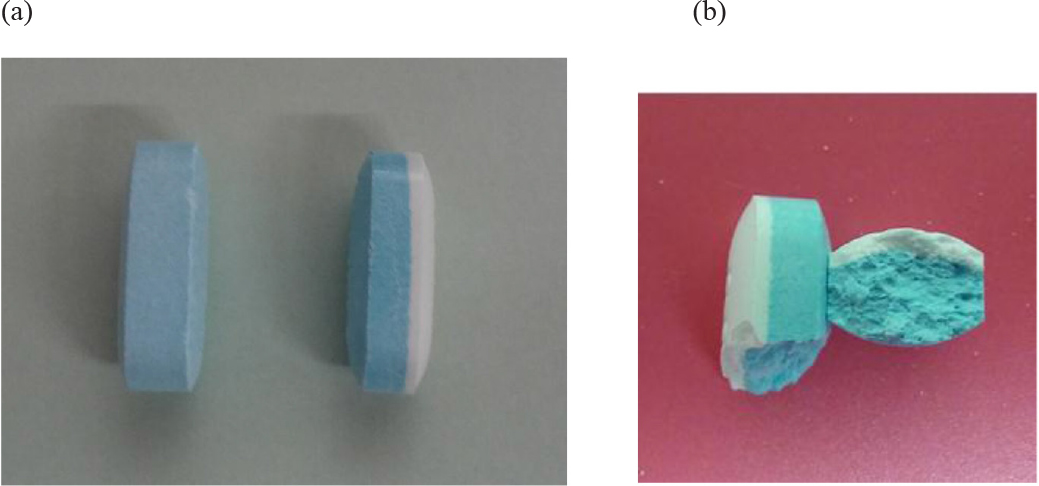
Figure 1. Guaifenesin 1200-mg bilayer ER tablets. (a) Dissecting an intact tablet illustrated no coating was applied to the core tablet, (b) a tablet retrieved from a dissolution vessel at the end of the 12-h study.

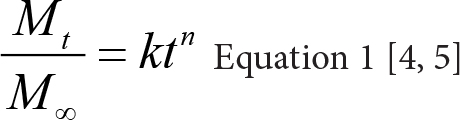
Nicholas Peppas introduced a power law approximation to describe drug release from a dosage form. Both the exponent n and the prefactor k of the equation depend on the dosage form geometry, the relative importance of relaxation and diffusion in the pure polymer swelling controlled drug delivery system [4, 5]. Therefore, the first objective of this project was to search within the General Chapters of USP-NF [3] for an in vitro dissolution method, which might be used to study Guaifenesin ER Tablets. Second, a less acidic Liquid Chromatographic (LC) mobile phase (50% methanol, apparent pH 7.0). Both the Monograph mobile phase (methanol/water/glacial acetic acid, 40:60:1.5, apparent pH 3.08) and the proposed mobile phase (50% methanol) were used to establish standard curves of guaifenesin dissolved in the media used for dissolution study, and quantify the dissolution samples to determine the cumulative drug release from the tablet. Third, it aimed at the comparison of the in vitro release profiles between a one-stage dissolution method × 12 h (using water as medium) and two-stage method (composed of Acid Stage × 3 h, and then Buffer Stage × 9 h). Furthermore, the in vitro release data were plotted according to power law approximation to differentiate the drug release mechanism among Fickian diffusion, anomalous transport and polymer chain relaxation (polymer swelling).

Materilas and Methods

Materials

Over-the-counter 1200 mg Guaifenesin ER Bi-layer Tablets containing a white IR layer, and a blue ER layer for 12 h release (Lot BY646, distributed by Reckitt Benckiser, NJ) were purchased from a local pharmacy. Guaifenesin (Spectrum Chemical, Lot 2EC0288), methanol, glacial acetic acid, 10 mL syringes, 0.22 micron 25 mm Nylon syringe filters were obtained from VWR International (Bridgeport, NJ).

Methods

Examination of Tablet Formulation Development

Four tablets randomly taken from the original container were weighed. The tablets were cut vertically to inspect any coat being applied to the tablet core. The inactive ingredients and their pharmaceutical functions were conducted through literature search [3, 6].

Standard Preparations

Guaifenesin powder was dissolved in three different matrices to address the aims of this study. They were deionized water, 0.1 N HCl and phosphate buffer pH 6.8. In deionized water it was made into 2 mg/mL as the stock solution. It was further diluted with a diluent (made of one part of water and four parts of 45% methanol) into different concentrations of standard preparations, 0.0002, 0.002, 0.08, 0.2, 0.4, 1, 1.2, 2 and 10 mg/mL. For constructing the standard curves with 0.1 N HCl and phosphate buffer 6.8, the standard stock solution was prepared into 10 mg/mL. It was further diluted with a diluent: water – 45% methanol (1:4, v/v) to ensure the work ranges were covered.

UV Spectroscopy

The Scan mode of a Cary 50 UV-Vis Spectrophotometer from Agilent Technologies determined the optimal wavelength of guaifenesin, and Sample Read mode recorded the absorbance of standard solutions.

Liquid Chromatographic Conditions

Agilent Series 1100 (Hewlett Packard) contained Vacuum Degasser, Binary Pump, Auto Sampler, Column Thermostated Compartment, and Variable Wavelength Detector. Two different mobile phases quantifying the standard solutions and in vitro dissolution samples were the mobile phases which may be found in Guaifenesin Tablet Monograph (methanol/water/glacial acetic acid, 40:60:1.5, v/v/v [3], apparent pH was 3.08), and our proposed mobile phase (50% methanol, apparent pH was 7.0). The flow rate was set at 1.0 mL/min and run time 7 min/cycle. The selected column was Luna C18 (USP L1, 4.6 × 150 mm, 5 µm) and the injection volume was 20 microliters.

Potency tests determine the drug content in a sample using HPLC, titration or microbial assay. Stability test, shelf-life and beyond-use date are interchangeable.

Methods of determining potency may or may not be stability indicating, but a stability-indication method can determine both potency and stability [7]. Because we proposed using 50% methanol as the mobile phase, which was considered as a new LC method, the stability-indication method must be validated. A know amount of guaifenesin was dissolved in water (one-stage dissolution medium) and in two-stage dissolution media (0.1 N HCl, and phosphate buffer at pH 6.8 respectively). The samples were subject to the following conditions: (a) 50 oC Heat for 1 h, then cooled to room temperature quickly, (b) 0.1 N HCl (acid) for 1 h prior to neutralized by 0.1 N NaOH, (c) 0.1 N NaOH (base) for 1 h and neutralized with 0.1 N HCl, and (d) 3% hydrogen peroxide solution for 5 min (8). The samples were then quantified using our proposed mobile phase (50% methanol) to ensure the degradant peaks generated by the experimental conditions were separated from analyte (guaifenesin) peak by the resolution (Rs) ≥ 2 [8].

In Vitro Dissolution Methods

Within the USP-NF 2018 two different dissolution methods are stated. One method is in the section of Extended-release Dosage Forms of General Chapters: <711> Dissolution. It describes as “Procedures and medium are as directed for Immediate-Release Dosage Forms in the monographs. But the test-time points generally are three and are expressed in hours.” The dissolution procedures and medium were searched within Guaifenesin Tablets monographs as directed in General Chapters: <711>. The description was medium: 900 mL water; Apparatus 2: 50 rpm; and time: 45 min. This method will refer as one-stage method in the remaining text. The second method is a two-stage acid-buffer method. It is present in General Chapters: <711> Dissolution, but in the section of Delayed-release Dosage Forms, Method A and Method B. This project followed Method a procedure to avoid contamination, loss of tablets, or breakage of a dissolution vessel. The dissolutions and assays are briefly described in the below.

One-stage Dissolution

The one-stage 12-h dissolution study followed the guidelines in Guaifenesin Tablets monograph (medium: 900 mL water; apparatus 2: 50 rpm), except the time was extended to 12 h to study the drug release mechanism. The sampling schedule was at 0.25, 0.75, 1, 3, 4, 6, 8, 10 and 12 h. One part of each dissolution sample was diluted with four parts of 45% methanol prior to subject to LC assay using mobile phases, 50% methanol as well as methanol/water/glacial acetic acid, 40:60:1.5, respectively. The LC AUC of each time point was converted into the cumulated amount of drug release using the established standard curve which medium in the one-stage dissolution was water (n = 3).

Two-stage Dissolution

For the two-stage 12-h dissolution study, an ER bilayer tablet (Figure 1a) was placed in a vessel of USP Dissolution Apparatus 2 containing 750 mL of 0.1 N HCl at 37.0 ± 0.5 oC and stirred at 50 rpm for 3 h. Then 250 mL of 0.2 M tribasic sodium phosphate was added, pH was adjusted to 6.8 with 2 N NaOH. The study continued for another 9 h at 50 rpm while the vessel medium maintained at 37.0 ± 0.5°C. Sampling schedule was selected the same for both one-stage and two-stage dissolution groups, 0.25, 0.75, 1, 3 h (Acid Stage), and 4, 6, 8, 10, and 12 h (Buffer Stage). One part of a dissolution sample was diluted with four parts of 45% methanol (diluent) prior to LC assay. Both mobile phases stated in Section 2.2.4 were applied in the LC system, respectively. The LC AUC of each time-point dissolution sample was converted into the cumulated amount and cumulative percent of drug release using the established standard curves which media were 0.1 N HCl and phosphate buffer pH 6.8.

Data Management for Peppas Power Approximation

After the amount of drug release at a sampling time was known (Mt), it was divided by the infinite amount of release (M), which equaled the tablet label strength (1200 mg). This ratio was then plotted against time (in h) to form a power equation (Equation 1) using the power trend line option in the scatter chart of an Excel worksheet. The power exponent (n) and prefactor (k) in the Peppas equation [6] were thus known from the trend line. The obtained values of release exponent from power trend line was further matched the n value in Table 1 [4, 5] to determine the drug release mechanism.

JPPR 19 - 113 Monica Chuong_SF14

Table 1. The release exponent n of the Peppas power equation and drug release mechanism from polymer-controlled delivery systems in cylinder geometry (4, 5)

Exponent (n)

Drug Release Mechanism

0.45

Fickian diffusion

0.45 < n < 0.89

Anomalous transport

0.89

Polymer swelling

Results

Examination of Tablet Rational Development Approach

The ER bilayer tablets taken from its original container were weighed as 1.454 ± 0.011 g (n = 4, relative standard deviation of the tablet weight was 0.76%). Judging from the dissection the tablet cores were not coated (Figure 1a). The inactive ingredients are FD&C blue #1 aluminum lake (coloring agent), hypromellose (controlled-release agent), magnesium stearate (lubricant), microcrystalline cellulose (tablet diluent and disintegrant), and sodium starch glycolate (tablet disintegrant).

Ultraviolet Spectrophotometric and HPLC Linearity

Guaifenesin dissolved in water to prepared into two different concentrations, 0.008 and 0.2 m/mL, then they were scanned from 190 to 790 nm using Cary 50 spectrophotometer (Agilent). In addition to 274 and 276 nm described in the Guaifenesin and Guaifenesin Tablets monographs [3], 270 nm can also be used as the wavelength to quantify guaifenesin. Thererfore, 270 nm was used in the remaining project including assaying dissolution samples. The standard linearity built using water as solvent and quantified using UV spectrophotometer was 0.001 mg/mL to 0.2 mg/mL (100 fold), while that quantified using LC was 0.001 mg/mL to 1.2 mg/mL (1200 fold). The R2 (coefficiency of determination) when LC AUC (y-axis) in correlation with UV absorbance (x-axis) ranged from 0.001 to 0.2 mg/mL was 0.9999.

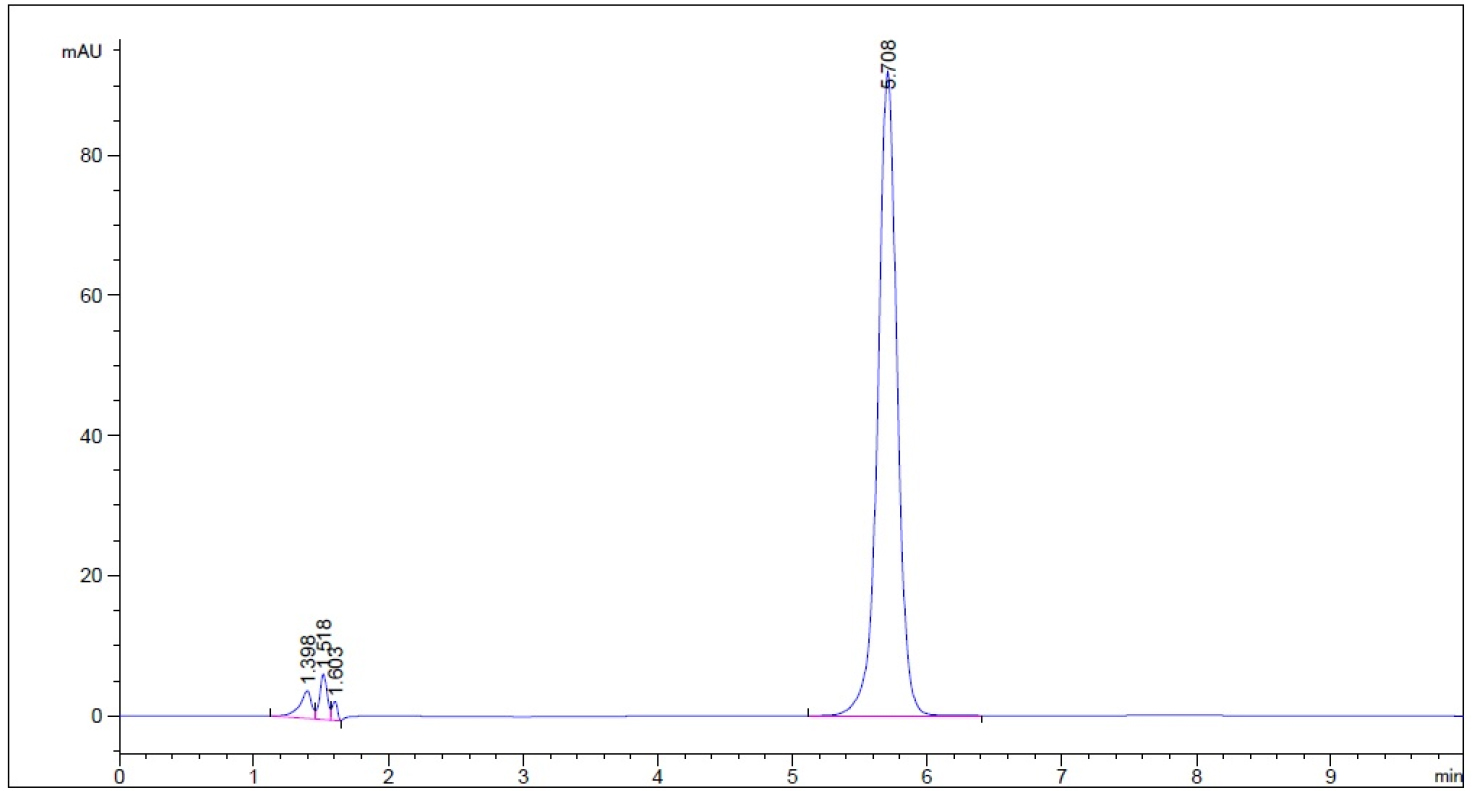
The chromatograms of stability indication method showed the degradant peaks generated by subjecting to 0.1 N HCl (acid), 0.1 N NaOH (base), 50 oC (heat) and 3% hydrogen peroxide solution under the exposure time periods described in Section 2.24 either did not produce degradant peak or separated well from analyte (guaifenesin) peak. All the resolution (Rs) were greater than 2 (Please refer to supplemental file).

One-stage In Vitro Dissolution Study Using Water as Medium

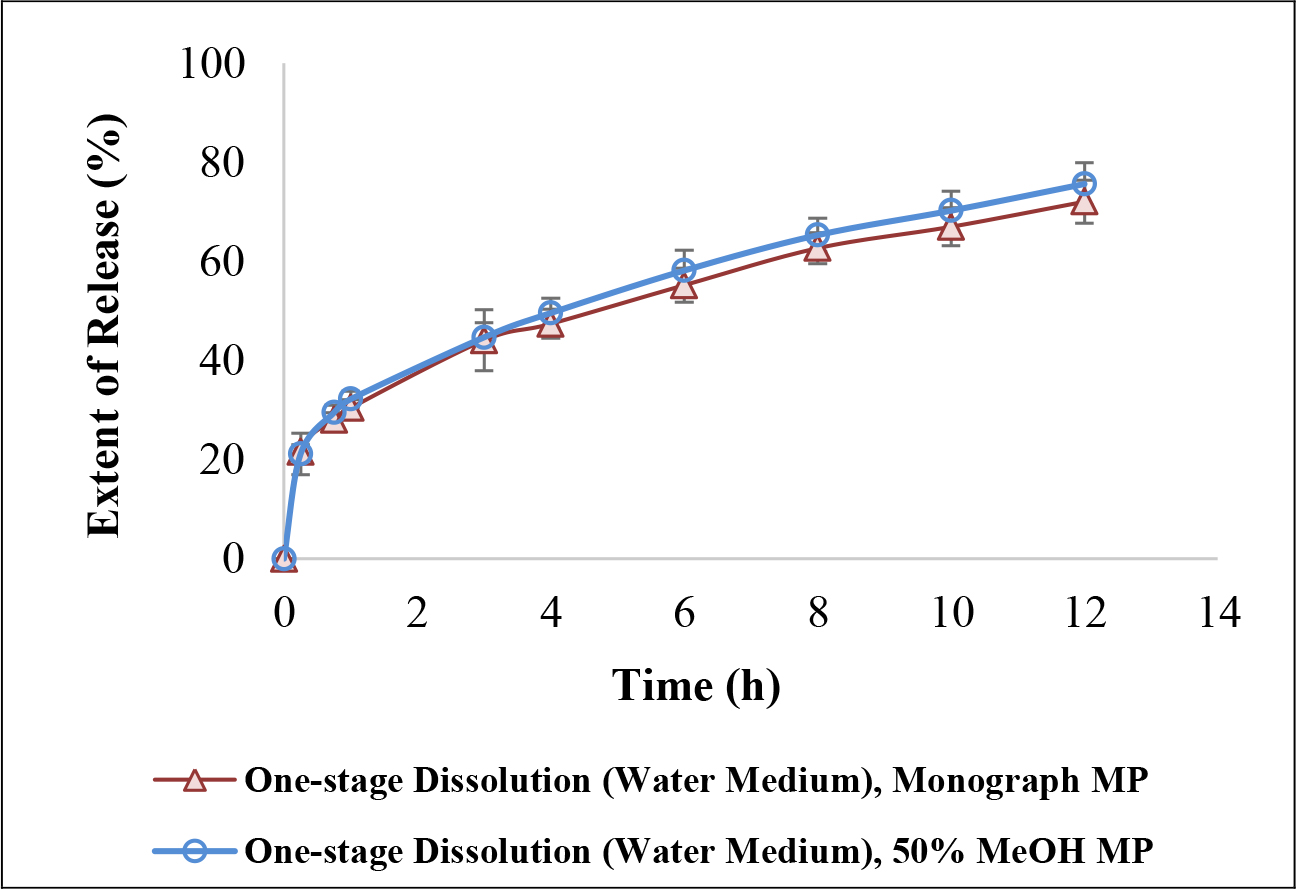
The dissolution duration and temperature, paddle stir rate, and sampling schedule were chosen as 12 h, 37.0 ± 0.5 oC, 50 rpm and 0.25, 0.75, 1, 3, 4, 6, 8, 01 and 12 h. When the dissolution samples were quantified using Monograph mobile phase, the bilayer ER tablets released 28.0 ± 1.4 % guaifenesin into water at 45 min, 30.4 ± 1.7 % at 1 h, 44.1 ± 6.0 % at 3 h, and 72.1 ± 4.4 % at 12 h (n = 4, Table 2a). When the same samples were assayed using 50% methanol as the mobile phase, the drug releases were: 29.5 ± 1.5 % at 45 min, 32.2 ± 1.6 % at 1 h, 44.7 ± 3.0 % at 3 h, and 75.7 ± 4.3 % at 12 h (n = 4, Table 2a). The dissolution profiles were almost identical and displayed as bi-phasic release when either mobile phase was used to quantify the same set of dissolution samples (n = 4, Figure 2).

JPPR 19 - 113 Monica Chuong_F2

Figure 2. Similarity of one-stage 12-h in vitro dissolution profiles between the Monograph mobile phase (methanol/water/glacial acetic acid, 40:60:1.5, v/v/v) and the proposed mobile phase (50% MeOH) when water was the chosen dissolution medium.

Table 2. Cumulative percent of guaifenesin release from bi-layer tablets at key sampling points

(a) One-stage dissolution with different mobile phases

Sampling Time (h)

Monograph MP

50% MeOH
as MP

P Value*
Paired-t test
(Independent-t test)

0.75

28.0 ± 1.4

29.5 ± 1.5

< 0.001 (< 0.05)

1

30.4 ± 1.7

32.2 ± 1.6

< 0.001 (> 0.05)

3

44.1 ± 6.2

44.7 ± 3.0

< 0.001 (> 0.05)

4

47.4 ± 2.9

49.6 ± 3.0

< 0.001 (> 0.05)

12

72.1 ± 4.4

75.7 ± 4.3

< 0.01 (> 0.05)

*Two-tailed distribution

(b) Different dissolution methods, but same mobile phase (monograph MP) to assay

Sampling
Time (h)

Cumulative Release (%) in One-stage Method (Water)

Cumulative Release (%) inTwo-stage Method
(0.1 N HCl 3 h, Buffer 9 h)

P Value*
Independent-
t test

0.75

28.0 ± 1.4

31.7 ± 4.1

> 0.05

1

30.4 ± 1.7

36.3 ± 4.0

< 0.05ξ

3

44.1 ± 6.2

56.4 ± 4.4

< 0.01ξ

4

47.4 ± 2.9

55.2 ± 2.1

< 0.01ξ

12

72.1 ± 4.4

79.4 ± 1.9

< 0.05ξ

*Two-tailed distribution
ξ Statistically significant

(c) Same two-stage (0.1 N HCl 3 h, then Buffer 9 h) dissolution method with different mobile phases

Dissolution

Sampling

Time (h)

Cumulative Release (%) Using

Monograph MP

Cumulative Release (%) Using 50% MeOH as MP

P Value*

Paired-t test

(Independent

t-test)

0.1 N HCl

0.75

31.7 ± 4.1

32.2 ± 2.8

> 0.05 (> 0.05)

1

36.3 ± 4.0

36.0 ± 3.0

> 0.05 (> 0.05)

3

56.4 ± 4.4

55.0 ± 5.6

> 0.05 (> 0.05)

Phosphate Buffer

4

55.2 ± 2.1

45.8 ± 0.9

< 0.001
(< 0.001)¥

pH 6.8

12

79.4 ± 1.9

62.3 ± 0.7

< 0.001
(< 0.001)¥ 

*Two-tailed distribution
¥ Statistically significant in both paired and independent t-tests.

One-stage versus Two-stage In Vitro Dissolution Study Using Monograph Mobile Phase

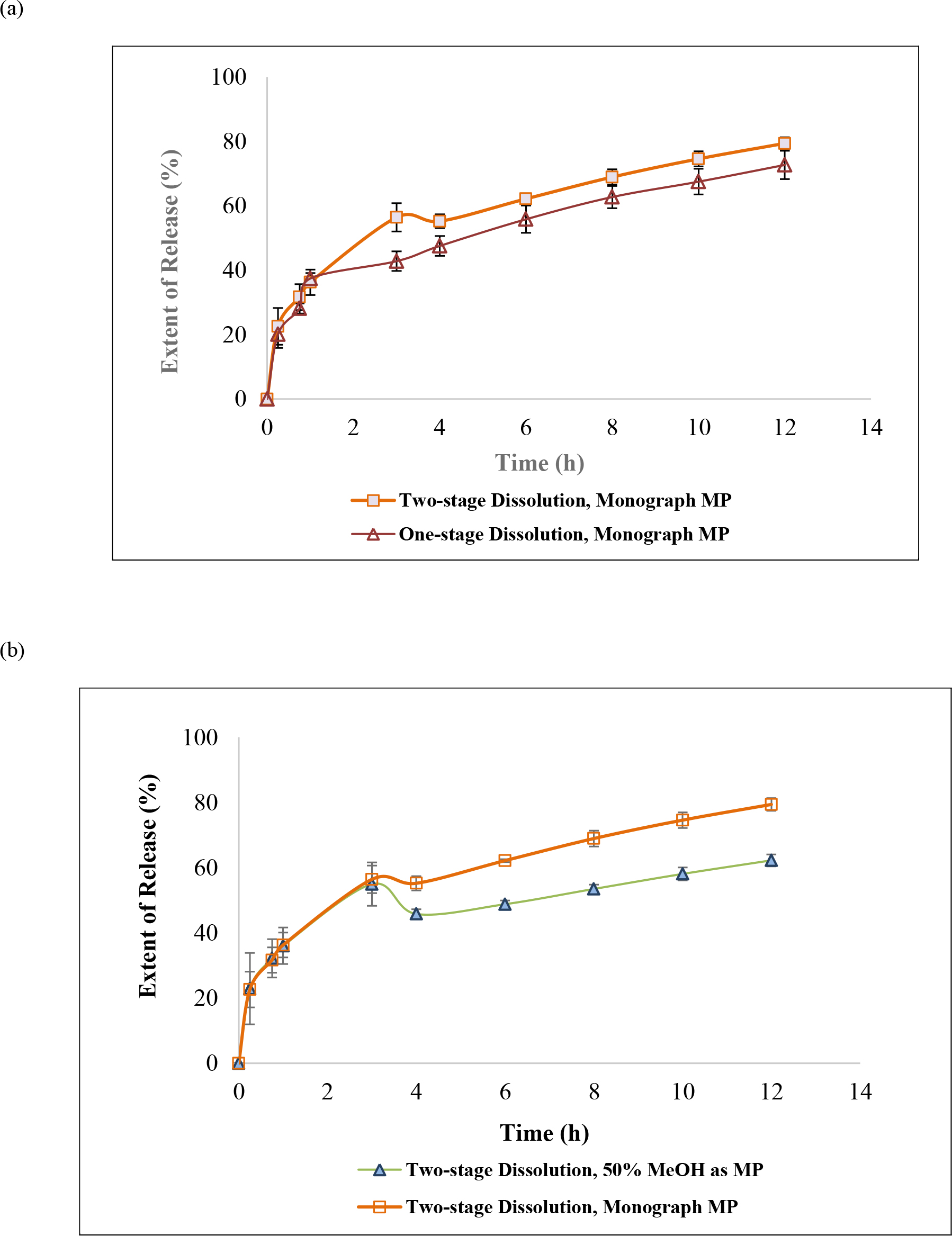
The dissolution duration and temperature, paddle stir rate, and sampling schedule were kept the same as Section 3.4, but only the Monograph mobile phase (methanol/water/glacial acetic acid, 40:60:1.5, v/v/v [3], apparent pH was 3.08) was used. The drug release between one-stage and two-stage methods were 28.0 ± 1.4 % vs. 31.7 ± 4.1 % at 45 min, 30.4 ± 1.7 % vs. 36.3 ± 4.0 % at 1 h, 44.1 ± 6.2 % vs. 56.4 ± 4.4 % at 3 h, and 72.1 ± 4.4 % vs. 79.4 ± 1.9 % at 12 h (n = 4, Table 2b). These releases in these sampling points were different statistically after 45 min dissolution study (Table 2b, Figure 3a).

JPPR 19 - 113 Monica Chuong_F3

Figure 3. Dissolution method and mobile phase as factors impacting guaifenesin release profiles: (a) design of dissolution method: one-stage in water versus two-stage (acid and buffer stages) when USP Guaifenesin Tablets monograph mobile phase, and (b) selection of mobile phase: 50% MeOH versus USP Guaifenesin Tablets monograph mobile phase. A depression of 12.7% ± 1.4% (n = 4) present 1 h after the medium pH was adjusted to 6.8 (that is the end of 4 dissolution hours). This depression continued until dissolution ended (see text).

Two-stage In Vitro Dissolution Study Using 50% Methanol versus Monograph Mobile Phase

The dissolution method was a tablet was placed in 750 mL of 0.1 N HCl for 3 h, and then 250 mL of 0.2 M tribasic sodium phosphate was added into the apparatus vessel with the pH being adjusted to 6.8. The dissolution duration and temperature, paddle stir rate, and sampling schedule were kept the same as Section 3.4, but both monograph mobile phase (methanol/water/glacial acetic acid, 40:60:1.5, v/v/v [3], apparent pH was 3.08) and the proposed mobile phase (50% methanol) were used respectively. The resultant AUC were converted into cumulative % of release and compared. The release profiles in Acid stage (time 0 to 3 h) quantified by both mobile phases were almost identical (Figure 3b). The cumulative percent of releases in Acid stage using Monograph mobile phase and 50% methanol as mobile phase were 31.7 ± 4.1 % vs. 32.2 ± 2.8 % at 45 min, 36.3 ± 4.0 % vs. 36.0 ± 3.0 % at 1 h, 56.4.1 ± 4.4 % vs. 55.0 ± 5.6 % at 3 h (Table 2c). Never the less, the profiles were statistically different in the Buffer stage (3 to 12 h, Figure 3b, and Table 2c). The cumulative percent of releases in Buffer stage using Monograph mobile phase and 50% methanol as mobile phase were 55.2 ± 2.1 % vs. 45.8 ± 0.9 % at 4 h (which means one hour after the pH had been adjusted to 6.8), 79.4 ± 1.9 % vs. 62.3 ± 0.7 % at 12 h (Table 2c).

Power Law Approximation

On order to fit Power Law Approximation equation, the data had to be taken from extended release region. Since the studied tablet was designed as IR/ER bilayer, we subtracted the cumulative amount of release from the dissolution study at a particular sampling point from the cumulative amount of drug release in the first hour (immediate layer) as Mt iin Equation 1, and further divided Mt by M. M was the label amount (1200 mg) minus cumulative amount in 1 hour. The fraction was then plotted against the time of drug released from the ER layer (the total dissolution time minus 1 hour in immediate release layer). Power equations in different dissolution methods and mobile phases were obtained using Excel scatter plot trendline options. The value of the power exponent (n) was 0.767 for both mobile phases, while the prefactor (k) was 0.1007 for Monograph mobile phase and 0.1068 for the proposed mobile phase (50% methanol). The reason of choosing data from hour 2 to hour 12 to fit Peppas power law was based on General Chapter <1088> In Vitro and In Vivo Evaluation of Dosage Forms describes that “For immediate-release dosage forms the in vitro dissolution process typically requires no more than 60 min…” [3]. According to Table 1, the obtained power exponent illustrate that the ER layer of this bi-layer tablet follows Fickian diffusion (Table 3). The Peppas power law was also applied to two-stage dissolution from hour 2 to hour 12 as well as hour 4 to hour 12 using both mobile phases. But the data from hour 2 to hour 12 in the two-stage dissolution method using either mobile phase to quantify are not reported here due to the transition of Acid stage into Buffer stage at the end of hour 3 (Table 3) to avoid misguiding.

Table 3. The release exponent n of the Peppas power equation and drug release mechanism using the ER layer dissolution data from hour 2 to hour 12, and hour 4 to hour 12

Dissolution Method

Dissoultion

Period

LC

Mobile Phase

Exponent (n)

Drug Release Mechanism

One-stage

h 2 to h 12

Monograph

0.767

Anomalous transport

One-stage

h 4 to h 12

Monograph

0.692

Anomalous transport

One-stage

h 2 to h 12

50% methanol

0.767

Anomalous transport

One-stage

h 4 to h 12

50% methanol

0.703

Anomalous transport

Two-stage

h 2 to h 12

Monograph

Not reported*

Two-stage

h 4 to h 12

Monograph

0.639

Anomalous transport

Two-stage

h 2 to h 12

50% methanol

Not reported*

Two-stage

h 4 to h 12

50% methanol

0.775

Anomalous transport

*Due to the transition between acid stage and buffer stages at hour 3 (see text).

Discussion

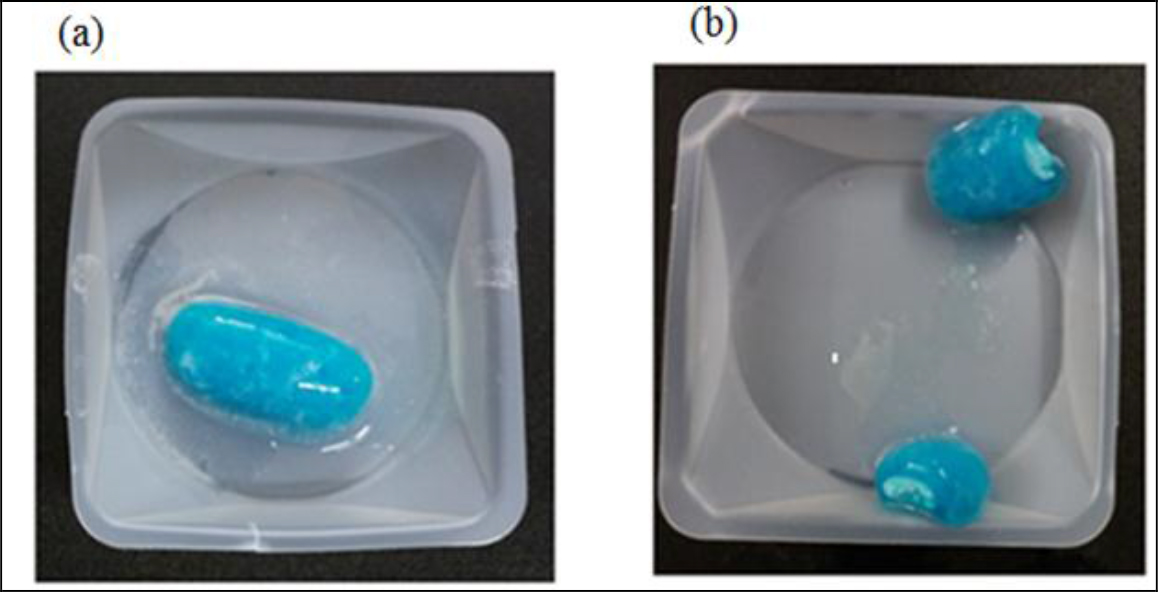
Hydrogels are polymer networks that contain a substantial amount of water. Dry polymer networks can absorb tens, hundreds, or even thousands of times their weight in water without or with dissolving. They have the properties to those of soft biological tissues and of great utility in pharmacy due to a low interfacial tension and less irritation [9]. The polymer network was able to sustain its own structural integrity through cross-linkage [10]. According to General Chapters: <1088> In Vitro and In Vivo Evaluation of Dosage Forms describes that “For immediate-release dosage forms the in vitro dissolution process typically requires no more than 60 min…”. Using this definition, the drug load in an ER bilayer tablet was determined as approximate ≤ 30% in IR white layer, and the remaining in ER blue layer. The residual tablets were retrieved at the end of the 12-h dissolution study showed white layer of the ER bilayer tablet disappeared, but the blue layer swelled but the integrity was still kept (Figure 4). When the bilayer tablet was cut vertically, the polymers in the core were still densely packed reflecting that dissolution medium had penetrated into the tablet core, but the polymer had not yet fully swelled or disintegrated, which resulted in the tolerance for only about 70% to 75% (Q) of the labeled amount. In addition, the leaching of the colorant and erosion of polymer were evidenced by the dissolution medium changed from clear into light blue and the medium became more viscous and slightly sticky in the 12-h release study.

JPPR 19 - 113 Monica Chuong_F4

Figure 4. A studied tablet was retrieved from a dissolution vessel: (a) at the end of the 12-h study, and (b) the cross-section shows the core was still densely packed. No significant difference was noticed whether the tablet was retrieved from water or phosphate butter pH 6.8.

The in vitro release data of the ER bilayer tablets from 2 h to 12 h (as the extended release region based on General Chapter < 1088 >) was able to format into a power equation with the power exponent (n) in the range of 0.7 (n = 4, Table 3). Matching the exponent (n value) with those cylindrical geometry in Table 1, its release mechanism was anomalous transport (between Fickian diffusion and polyer swelling), but was closer to polymer swelling mechanism. Peppas and coworkers [4, 5, 6] studied theophylline release from poly(HEMA-co-NVP) [poly(2-hydroxyethylmethacrylate-co-N-vinylpyrrolidone)] disks into distilled water. The tablet geometry of this project was a caplet shape (Figure 1). Siepmann J and Siepmann F also mentioned that the thicker the samples a slightly slowing down of release with time is displayed [6]. This was probably due to drug diffusion becoming increasing more rate limiting. Diffusion is slower at greater distances. When plotting the cumulative amount of drug release versus time, geometry, drug solubility and inhomogeneous initial drug distribution [4, 5, 6] may also impact the value of n (power exponent).

The six inactive ingredients of the ER bilayer tablets and their pharmaceutical functions were stated in Section 3.1. They were composed of coloring agent, controlled-release agent, lubricant, tablet diluent, tablet disintegrant, and gelling agent. Therefore, photos taken after a tablet retrieved from the vessel at the end of a dissolution study were dissected to support the release mechanism of anomalous transport determined from Peppas power law power exponent (n). As seen in Figure 4, there is a clearly defined font between the swollen polymer layer and damped tablet core suggesting that polymer relaxation is required for guaifenesin to be released into either water or phosphate buffer pH 6.8.

Conclusion

In vitro dissolution study may be applied to approximate the drug loaded in IR layer and ER layers of an oral tablet. The current study also supports the use of water as the dissolution medium for extended release dosage forms, because time efficacy and green laboratory practice bring affordable products to our patients. Never the less the selection of a proper mobile phase is of essential. The project suggests that for sake of accuracy and precision, one-stage and two-stage dissolution profiles be compared with the same selected mobile phase. If they are similar, the one-stage study using water as dissolution medium may then be preceded. From Peppa power law as well as the dissection examination of retrieved tablets, the ER layer of the bilayer tablet most likely used anomalous transport mechanism to release guaifenesin.

References

  1. https://medical-dictionary.thefreedictionary.com/guaifenesin
  2. http://www.mucinex.com/media/854/drug-facts-maximum-strength-mucinex-se.pdf
  3. U.S. Pharmacopeial Convention (2018) USP Monographs: Guaifenesin, Guaifenesin Tablets, NF Monographs: Sodium Starch Glycolate, General Chapters: <711> Dissolution. In: USP42-NF37. Rockville MD: U.S. Pharmacopeia; 2018: 2121, 2124, 5962, and 6870.
  4. Peppas NA (1985) Analysis of Fickian and non-Fickian drug release from polymers. Pharmaceutica Acta Helvetiae 60: 110–111.
  5. Siepmann J, Peppas NA (2001) Modeling of drug release from delivery systems based on hydroxypropyl methycellulose (HPMC). Adv Drug Deliv Rev 48: 139–157.
  6. Siepmann J, Siepmann F (2012) Swelling Controlled Drug Delivery Systems. In: Siepmann J, Siegel RA, Rathbone MJ (eds.), Fundamentals and Applications of Controlled Release Drug Delivery. Springer Pg No: 154–162.
  7. Rowe RC, Sheskey  PJ, Quinn ME (2009) Handbook of Pharmaceutical Excipients, 6thedn: Pharmaceutical Press: London, UK.
  8. Kupiec T, Skinner R, Lanier L (2008) Stability Versus Potency Testing: The Madness is in the Method. Int J Pharmaceutical Compounding, 12: 50–55.
  9. L.R, Kirkland JJ, Glajch JL (1997) Completing the Method: Validation and Transfer. In: L.R., Kirkland J.J., Glajch J.L. (Eds.), Practical HPLC Method Development. Snyder John Wiley & Sons Pg No: 709
  10. Siegel RA, Alvarez-Lorenzo C (2017) Hydrogels. In: Hillery A, Park K (eds.), Drug Delivery: Fundamentals and Applications CRC Press Pg No: 333.
  11. Hydrogel Materials (2014) Drug Delivery: Materials Design and Clinical Perspective. In: Holowka EP, Bhatia SK (eds.), Springer Pg No: 225.

Supplemental Material

Validation of HPLC Method to Assay Guaifenesin in Acid Stage, Buffer Stage Media and Water Using Proposed Mobile Phase (50% Methanol)

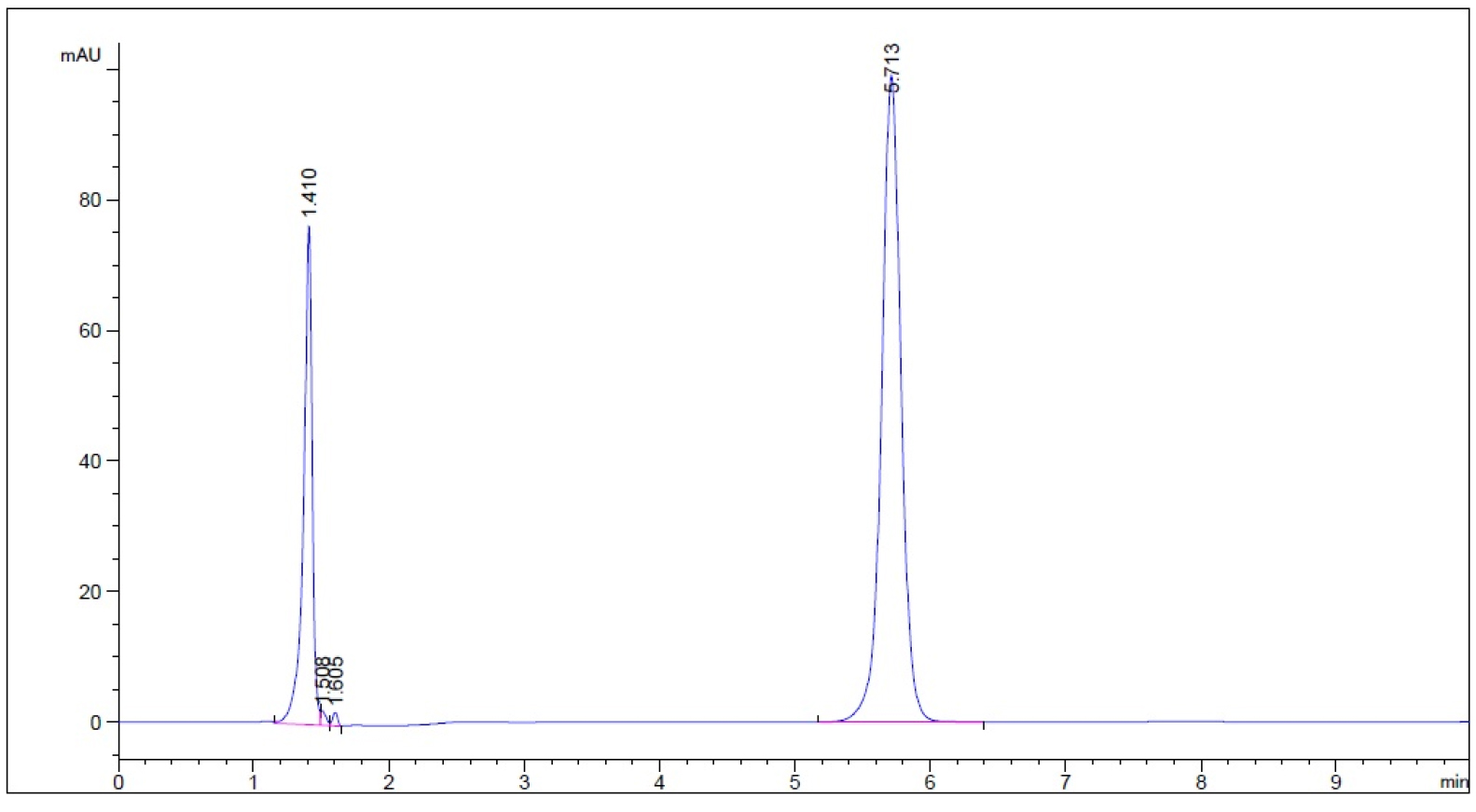
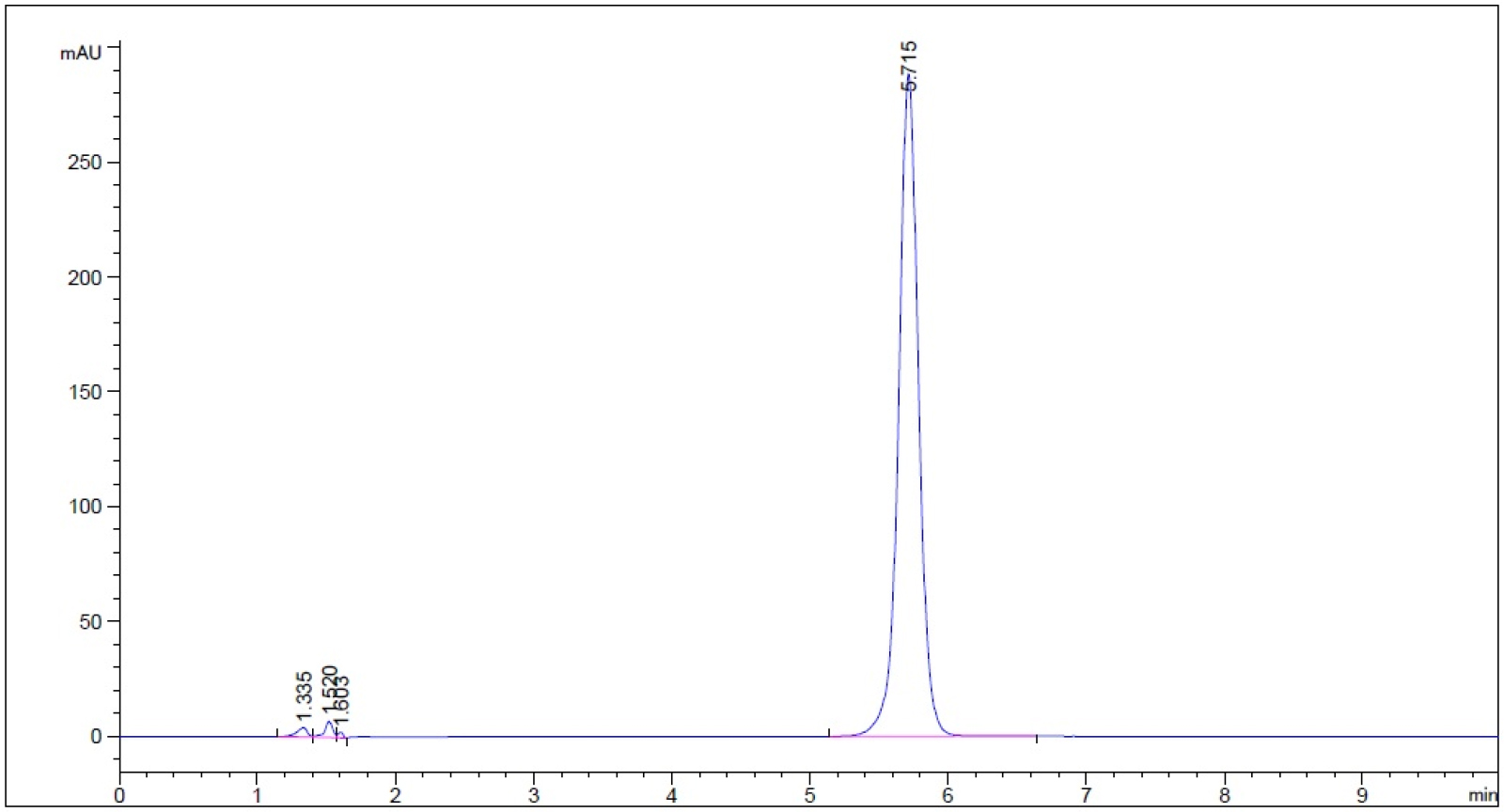
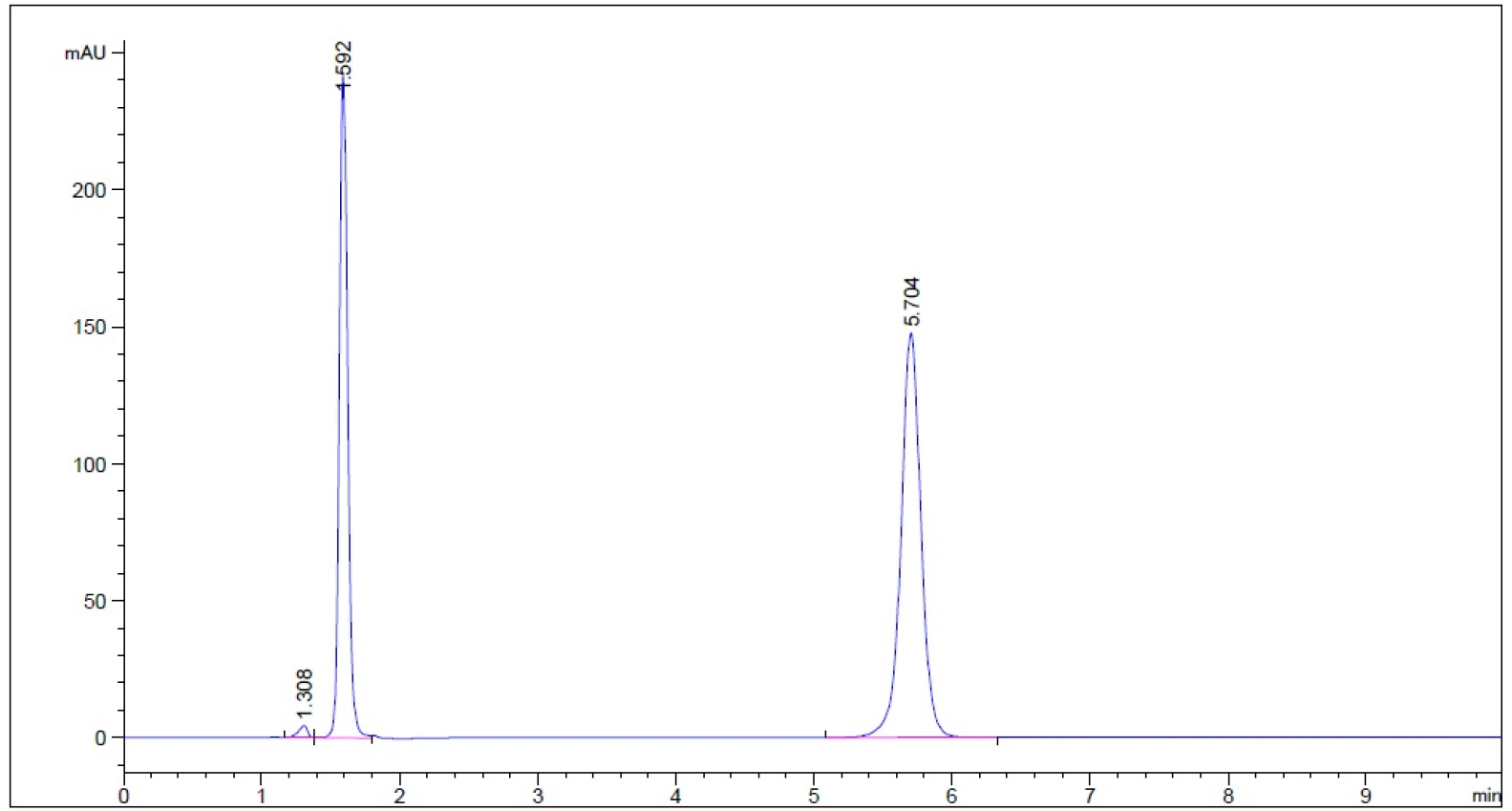
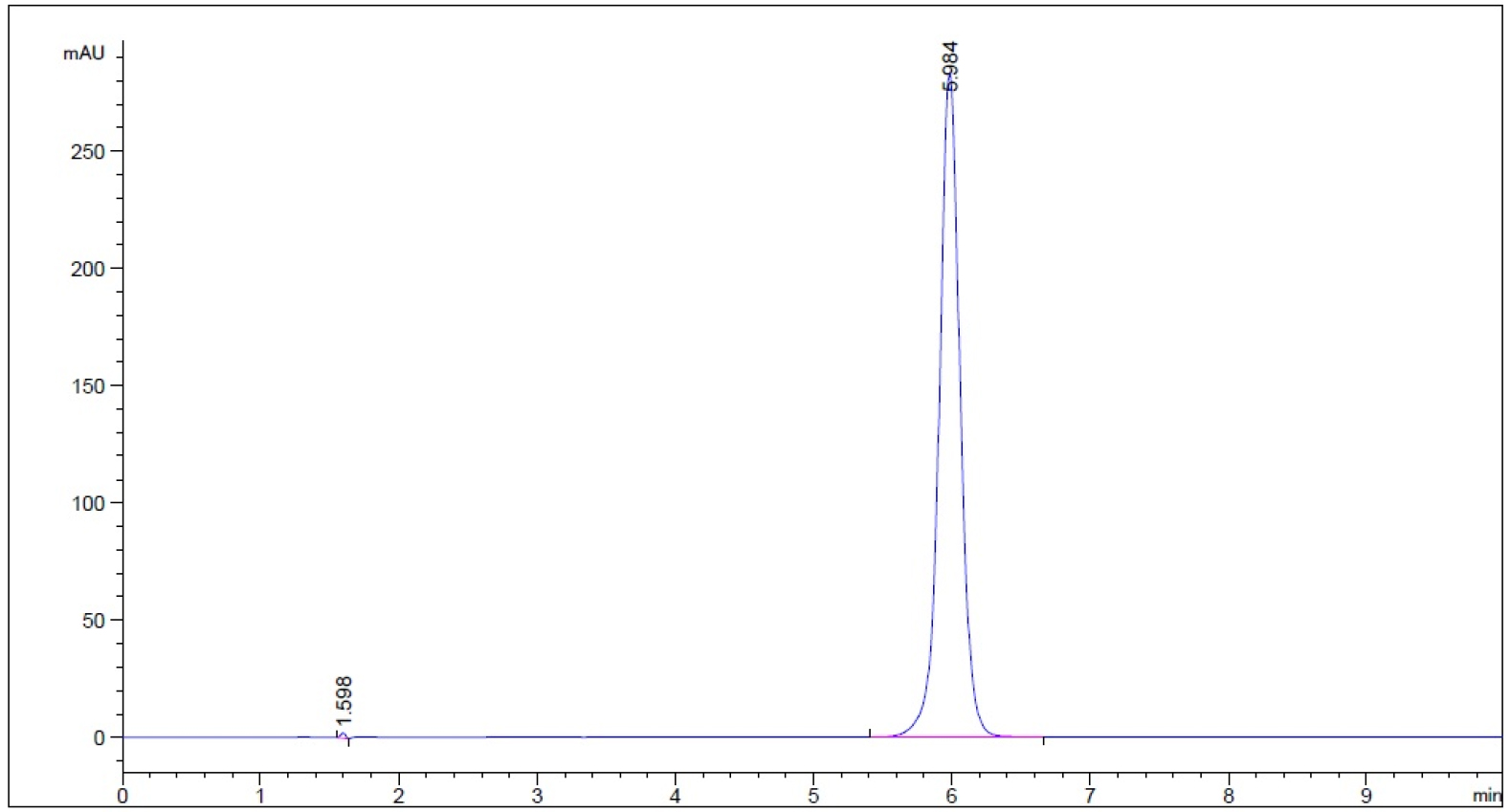
Stability Indication Method of Guaifenesin in Acid Stage, Buffer Stage Media and Water using HPLC with the proposed mobile phase (50% Methanol): in acid-stage medium and subjected to 0.1 N HCl for 1 h; (b) in acid-stage medium and subjected to 0.1 N NaOH for 1 h; (c) in acid stage medium and subjected to 50oC for 1 h; (d) acid-stage medium and subjected to 3% hydrogen peroxide for 5 min; (e) in buffer stage medium and subjected to 0.1 N HCl for 1 h; (f) in buffer stage medium and subjected to 0.1 N NaOH for 1 h; (g) in buffer stage medium and subjected to 50 oC for 1 h; (h) in buffer stage medium and subjected to 3% hydrogen peroxide for 5 min; (i) in purified water and subjected to 50 oC for 1 h; (j) in purified water and subjected to 0.1 N HCl for 1 h; (k) in purified water and subjected to 0.1 N NaOH for 1 h; (l) in purified water and subjected to 3% hydrogen peroxide for 5 min; and (m) in purified water without guaifenesin and subjected to 3% hydrogen peroxide for 5 min as control.

  1. Guaifenesin in acid stage medium (0.1 N HCl) – subject to 0.1 N HCl for 1 hour prior to being neutralized with 0.1 N NaOH to neutral pH (n = 3, please refer to pdf version of chromatograms.)

    JPPR 19 - 113 Monica Chuong_SF1

  2. Guaifenesin in acid stage medium (0.1 N HCl) – subject to 0.1 N NaOH for 1 hour prior to being neutralized with 0.1 N HCl to neutral pH (n = 3, please refer to pdf version of chromatograms.)

    JPPR 19 - 113 Monica Chuong_SF2

  3. Guaifenesin in acid stage medium (0.1 N HCl) – subject to 50 oC for 1 hour prior to cooling to room temperature (n = 3, please refer to pdf version of chromatograms)

    JPPR 19 - 113 Monica Chuong_SF3

  4. Guaifenesin in acid stage medium (0.1 N HCl) – subject to 3% hydrogen peroxide for 5 min prior to decomposing hydrogen peroxide into water and oxygen and allowing the excess oxygen to escape (n = 3, please refer to pdf version of chromatograms.)

    JPPR 19 - 113 Monica Chuong_SF4

  5. Guaifenesin in buffer stage medium (phosphate buffer, pH 6.8) – subject to 0.1 N HCl for 1 hour prior to being neutralized with 0.1 N NaOH to neutral pH (n = 3, please refer to pdf version of chromatograms.)

    JPPR 19 - 113 Monica Chuong_SF5

  6. Guaifenesin in buffer stage medium (phosphate buffer, pH 6.8) – subject to 0.1 N NaOH for 1 hour prior to being neutralized with 0.1 N HCl to neutral pH (n = 3, please refer to pdf version of chromatograms.)

    JPPR 19 - 113 Monica Chuong_SF6

  7. Guaifenesin in buffer stage medium (phosphate buffer, pH 6.8)– Subject to 50 oC for 1 hour prior to cooling to room temperature (n = 3, please refer to pdf version of chromatograms)

    JPPR 19 - 113 Monica Chuong_SF7

  8. Guaifenesin in buffer stage medium (phosphate buffer, pH 6.8) – subject to 3% hydrogen peroxide for 5 min prior to decomposing hydrogen peroxide into water and oxygen and allowing the excess oxygen to escape (n = 3, please refer to pdf version of chromatograms.)

    JPPR 19 - 113 Monica Chuong_SF8

  9. Guaifenesin in purified water – subject to 50 oC for 1 hour prior to cooling to room temperature (n = 3, please refer to pdf version of chromatograms)

    JPPR 19 - 113 Monica Chuong_SF9

  10. Guaifenesin in purified water – subject to 0.1 N HCl for 1 hour prior to being neutralized with 0.1 N NaOH to neutral pH (n = 3, please refer to pdf version of chromatograms.)

    JPPR 19 - 113 Monica Chuong_SF10

  11. Guaifenesin in purified water – subject to 0.1 N NaOH for 1 hour prior to being neutralized with 0.1 N HCl to neutral pH (n = 3, please refer to pdf version of chromatograms.)

    JPPR 19 - 113 Monica Chuong_SF11

  12. Guaifenesin in purified water – subject to 3% hydrogen peroxide for 5 min prior to decomposing hydrogen peroxide into water and oxygen and allowing the excess oxygen to escape (n = 3, please refer to pdf version of chromatograms.)

    JPPR 19 - 113 Monica Chuong_SF12

  13. Purified water without guaifenesin – subject to 3% hydrogen peroxide for 5 min prior to decomposing hydrogen peroxide into water and oxygen and allowing the excess oxygen to escape (as a control group)

    JPPR 19 - 113 Monica Chuong_SF13

Action of an Indolinone Derivative on Plasma Hemostasis

DOI: 10.31038/JPPR.2019222

Abstract

The action of a new pharmaceutical substance of indolinone series, an sGC inducer with antiplatelet activity, on rat blood plasma hemostasis was studied. It was shown that the antiplatelet substance after single oral administration to rats considerably increases thrombin time after 3 hours (24.5 versus 17.3 in control, р < 0.05). Other plasma hemostasis parameters were unchanged.

Key words

antiplatelet, indolinone derivative, plasma hemostasis.

Introduction

Thrombosis plays a key role in the development of acute coronary syndrome, making antiplatelet therapy an important part of prevention and treatment of cardiovascular diseases [1]. One of the main risk factory of cardiovascular disease relapse is insufficiency of existing therapy in people resistant to aspirin and clopidogrel [2,3]. This problem can be solved by using antiplatelet drugs with a novel mechanism of action. Also, increased blood clotting plays a role in cardiovascular complications [4,5]. There were no earlier studies of the action of the indolinone derivative on blood plasma hemostasis.

Study goal – Assess the action of a new antiplatelet compound on rat blood plasma hemostasis after oral administration.

Materials and Methods

Test article – pharmaceutical substance 2-[2-[(5RS)-5-(hydroxymethyl)-3-methyl-1,3-oxazolidine-2-yliden]-2-cyanoethylidene]-1H-indol-3(2H)-one.

Outbred Wistar rats (n=10) were used as test system. Rat handling was performed in accordance with the European Convention and other regulating documents [6].

Intact blood was sampled from common carotid artery of anesthetized rats. The blood was stabilized with 3.8% solution of sodium citrate in 9:1 (v:v) ratio, blood plasma was produced by centrifuging at 2000 g for 20 min.

Plasma hemostasis was assessed by fibrinogen content, activated Partial Thromboplastin Time (aPTT), Prothrombin Time (PT) and Thrombin Time (TT). These parameters were assessed by KG-4 coagulometer (Cormay, Poland). Fibrinogen content was assessed using Claus method.

The antiplatelet drugs were administered to rats once orally in 10 mg/kg dose. At the end of experiment the animals were sacrificed by СО2.

Statistical analysis was performed by «R» software. The data is presented as mean values and mean standard deviation (M ± m). Significance of difference (р<0.05) between the tests was assessed using Mann–Whitney U test.

Result and Discussion

No significant changes of main parameters of plasma hemostasis: fibrinogen, aPTT and PT, were found 3 hours after single oral administration of the antiplatelet drug in 10 mg/kg dose. TT was increased by 42% compared to the control group (Table 1).

Table 1. Effects of the new antiplatelet drug (10 mg/kg) on rat blood plasma hemostasis.

Group

Fibrinogen

aPTT

PT

TT

Control (n=5)

2.0 ± 0.1

14.8 ± 0.7

20.4 ± 0.6

17.3 ± 2.3

Antiplatelet drug (n=5)

1.8 ± 0.1

15.2 ± 0.6

20.1 ± 0.3

24.5 ± 1.0*

Note: * –р < 0.05 compared to control.

The new antiplatelet drug doesn’t affect blood plasma fibrinogen content, activated partial thromboplastin time and prothrombin time, but considerably increases the thrombin time, 3 hours after single oral administration in 10 mg/kg dose [7]. The reduction of platelet aggregation by the new drug leads to reduced exit of active components of the coagulation system from the platelets, which may account for the lengthening of thrombin time. There may also be other explanations for this. Additional studies are required for confirmation or discovery of another mechanism, including, possibly, direct inhibition of thrombin.

References

  1. Popova LV, Axenova MB, Khlevchuk TB (2016) Antiplatelet activity in cardiology. Clinical medicine 10: 729–36.
  2. Shantsila E, Lip GY (2009) Variability of response to antiplatelet therapy: what should we do next? Fundam Clin Pharmacol 23: 19–22. [crossref]
  3. Lee PY, Chen WH, Ng W, Cheng X, Kwok JY, et al. (2005) Low-dose aspirin increases aspirin resistance in patients with coronary artery disease. Am J Med 118: 723–727. [crossref]
  4. Frere C, Cuisset T, Quilici J, Camoin L, Carvajal J, et al. (2007) ADP-induced platelet aggregation and platelet reactivity index VASP are good predictive markers for clinical outcomes in non-ST elevation acute coronary syndrome. Thromb Haemost 98: 838–843. [crossref]
  5. Patrono C (2003) Aspirin resistance: definition, mechanisms and clinical read-outs. J Thromb Haemost 1: 1710–1713. [crossref]
  6. Carkishenko NN, Grachev SV (2003) Guidelines on laboratory animals and alternative models in biomedical technology. Profile: Moscow.
  7. Triplett DA (2000) Coagulation and bleeding disorders: review and update. Clin Chem 46: 1260–1269. [crossref]

Manual Therapy Techniques and their Effectiveness on Improving Posture in Adults: A Narrative Review of the Literature

DOI: 10.31038/IJOT.2019216

Abstract

Objective: To review the literature regarding the use of manual therapy techniques and their effectiveness on improving posture in adults.

Background: Hyperkyphosis of the upper spine is a condition that increases with age and leads to decreased pulmonary function, balance, and muscle strength. Numerous reviews have looked at the effect of therapeutic exercise, but few have examined the effects of manual therapy techniques on hyperkyphotic posture.

Methods: Three electronic databases were searched. All of the studies published in English that have considered the effects of manual therapy (including soft tissue mobilization and joint mobilizations) on posture were included in this review (7 randomized controlled trials, 4 case studies, and 1 preliminary trial).

Results: Of the 7 randomized controlled trials, 2 studies utilized soft tissue mobilizations, 3 used joint mobilizations of the cervical and/or thoracic spine, and 2 used both techniques. 3 of the studies also combined the manual therapy treatment with other techniques, including stretching, taping, and therapeutic exercise. Outcome measures varied and included thoracic index, inclinometer or kyphometer readings, and goniometric measurements. All but one of the randomized studies found manual therapy to be an effective intervention for improving posture. Of the 4 case reports, each used a different manual therapy approach, but all were either joint mobilizations of the spine or shoulder girdle or myofascial release. 3 of the reports combined the manual therapy with other types of treatment, including proprioceptive neuromuscular facilitation (PNF) and therapeutic exercise. Postural alignment was found to improve in all of the cases, though this was measured subjectively via photo or visual analysis by 3 of the studies, while 1 study used goniometric measurements.

The final study included was a non-randomized preliminary study using an ATM2 machine to assist with joint mobilizations using Mulligan’s mobilization-with-movement concept. This study found mobilizations to be effective for improving posture as assessed by photographic analysis.

Conclusion: Of the 12 studies reviewed, 11 demonstrated an improvement in posture after treatment with manual therapy techniques. This indicates that manual therapy is a promising treatment for a condition that affects a large proportion of individuals as they age.

Introduction

As people age, their thoracic spine tends to undergo an increase in angle of kyphosis, or forward rounding of the back, which can affect both the cervical and lumbar spine [1, 2]. While the normal values for angle of thoracic kyphosis in adults aged 20–39 are 27.66° for males and 27.62° for women, these values increase more in women after age 40 [3]. The mean value for women aged 60–69 is 44.86°, compared with 34.67° for males [3].

Hyperkyphosis is defined as a value greater than 40° and such a condition leads to decreased pulmonary function, balance, and muscle strength [4, 5]. Because of these potentially harmful consequences, an intervention must be sought for treatment to prevent or correct hyperkyphosis in older adults.

The etiology behind this increase in kyphosis with age is multi-factorial, and many of the underlying causes are linked to one another. It has long been assumed that vertebral fractures related to osteoporosis play the most important role in determining whether or not someone develops hyperkyphosis. While having multiple vertebral fractures (especially thoracic anterior wedge fractures) may increase the risk of hyperkyphosis, it is far from the only cause. Other factors commonly associated with aging include degenerative disc disease, loss of proprioception, muscle weakness or atrophy, and ligamentous degeneration. Muscle weakness, especially in the spinal extensors, often leads to habitually poor posture, which increases spinal kyphosis [1, 4].

Treatments that have been studied to prevent and treat hyperkyphosis include exercise, bracing, taping, and manual therapy [4]. Therapeutic exercise is the most commonly studied intervention for poor posture and hyperkyphosis, and it has shown promising results as a conservative treatment [1, 4]. Manual Therapy (MT) is a technique used to treat various musculoskeletal conditions including but not limited to adhesive capsulitis [6], subacromial impingement syndrome [7], and osteoarthritis [8]. Treatment using manual therapy techniques has not been studied as extensively as the other therapeutic modalities, and therefore a literature review on the topic was conducted to determine if it is a viable treatment for kyphotic posture.

Methods

Selection Criteria

Studies included randomized controlled trials, nonrandomized trials, and case studies and the search was restricted to papers published in English. Because of the fact that poor posture is often linked to other conditions and the limited number of studies conducted on the topic, studies including patients with various orthopedic conditions such as osteoporosis, ankylosing spondylosis, cystic fibrosis, neck pain, and scoliosis were included in the search. Studies focusing on neurological disorders were not included in the search.

Studies where at least one application of manual therapy (including joint mobilization, soft tissue techniques, or massage) was administered were included. Body parts receiving the therapy included one or more of the following areas: shoulder girdle, pectoral muscles, cervical spine, or lumbar spine. Studies that combined MT with other forms of therapy were also included if the MT technique was an independent variable. Age of study participants was limited to adults (over 18) because both the causes and the prognosis of hyperkyphosis may differ in children, whose bodies are still developing. Only studies that compared the posture of patients before and after treatment were included in the search.

Search Strategy

A search was conducted for published articles that answer the question: do manual therapy techniques improve posture in adults? An electronic search of databases including Ovid, PubMed, and Web of Science was conducted through August 2016. Search terms included a variety of phrases related to posture and MT. The summary of search terms can be seen in table 1, and common strings included “posture”, “manual therapy”, “musculoskeletal manipulations”, “spinal mobilization”, “soft tissue mobilization”, and “kyphosis”. The first search was limited to ages 65 and older, but subsequent searches were expanded because there was found to be limited research in this age group. Supplementary searches were conducted by screening reference lists of relevant articles for additional studies.

Table 1. Search Strings

Database

Date

Search Terms

Hits

Articles Used

Ovid

9/21/2016

“posture” AND “musculoskeletal manipulations” (limited to “all aged 65 and over” OR “aged 80 and over”)

76

1

Ovid

9/21/2016

“posture” and “musculoskeletal manipulations” and “physical therapy modalities”

371

4

PubMed

9/26/2016

“physical therapy modalities” AND “musculoskeletal manipulations” OR “manual therapy” OR “spinal manipulation” OR “manipulation, osteopathic” AND “posture”

1152

4

Web of Science

9/26/2016

“posture” and “manual therapy” OR “spinal mobilization” OR  “soft tissue mobilization” AND “kyphosis”

298

2

Reference list review

9/29/2016

“posture” AND “physical therapy” OR “manual therapy”

3

3

Data Synthesis

7 RCTs (n = 236) from 1897 hits on database searches and reference list screenings were included. 4 case reports and 1 nonrandomized intervention were also included and will be analyzed separately.

Manual therapy interventions included soft tissue mobilization [5, 6, 10], myofascial release [11], thoracic spine mobilizations [5, 11–13], cervical joint mobilizations [13, 14], and rib mobilizations [11]. MT was used in isolation [10, 13, 14], or in combination with stretching [9], exercise [5, 11, 12], taping [5, 12], or postural reeducation [11]. Controls included no Physical Therapy (PT) [5, 1012], PT without mobilizations [11], passive light manual placebo touch and pectoralis major stretching [9], or cervical mobilization only [13, 14].

Treatment length varied with one study assessing the outcomes after a single MT session (Wong et al), one with 6 sessions over 6 weeks [11], one with 10 sessions over 10 weeks [5], two with 12 sessions over 4 weeks [13, 14], one with 16 sessions over 2 weeks [10], and one study with 18 sessions over 12 weeks [12].

Outcome measures used to assess changes in posture also varied considerably between studies, with each one using differing techniques. One study measured the distance from the acromion to the table, a process that has been used in several previous studies to measure rounded shoulder posture [9]. Three studies measured thoracic kyphosis, two using inclinometers [5, 12], and the other finding thoracic index by using a flexible ruler to determine the thoracic curve in the sagittal plane [11]. One study measured both cervical kyphosis using a pair of compasses and a ruler as well as thoracic and lumbar kyphosis using a kyphometer [10]. Two studies measured cervical lordosis using the absolute rotation angle [14], or cranial vertical angle and cranial rotation angle [13].

6 of the 7 randomized trials found an improvement in posture with MT techniques versus control. The one study that showed no difference between groups compared MT to no PT treatment, with 10 sessions over 10 weeks and used thoracic kyphosis as the primary outcome measure [5]. The patient population in this study was one of the two RCTs with a mean age above 60 years, focusing on osteoporotic patients with vertebral fracture. This study utilized passive accessory central posterior-anterior mobilization of the thoracic spine with 5 movements at each level and 2 reps, applying a grade II or III mobilization and MT was used in combination with exercise and taping techniques [5].

For the case studies and nonrandomized trial, approaches to MT that were used included cervical [15], scapular [15], lumbar [16], and lumbosacral mobilizations [17], myofascial release [18], and the use of an ATM2 machine to assist with thoracic and lumbar mobilizations-with-movement [19].

Two of the studies did not combine MT with other forms of treatment [18, 19]. The other 4 studies combined MT with therapeutic exercise [17], breathing and therapeutic exercise [15], or Proprioceptive Neuromuscular Facilitation (PNF) [16]. The PNF technique used was described as dynamic reversal of antagonist technique of the shoulder [16].

Treatment was also wide-ranging in both duration and frequency of the treatment. The shortest treatment duration was 4 weeks, with 3 studies choosing this time frame but varying the number of sessions with either 8 [19], 11 [15], or 12 [16]. One study chose a 6-week time frame with 12 sessions [18]. The final study chose a 16-week duration, with 9 sessions [17].

Outcome measures to demonstrate changes in posture that were used included visual assessment [15, 18, 19], video assessment [17], and angle of spinal curvature using a spinal mouse [16]. An additional case study did not specifically look at posture as an outcome measure, but rather function (assessed with the Oswestry), quality of life (assessed with the QUALEFFO), and pain (McGill Pain Scale) [20]. This study was not included as part of the review but is mentioned here because it was looking for adverse effects of manual therapy on a patient with osteoporosis, which is an important group to consider for the assessment of older adults with kyphosis.

All 4 of the case reports measuring posture as an outcome measure showed improvement after treatment with MT, and the case report that measured quality of life, pain, and function also showed no adverse effects with MT treatment. The nonrandomized trial likewise showed similar improvements in posture after spinal mobilization treatments [20].

Discussion

The MT approaches varied between studies in the RCT group. The one study that utilized Soft Tissue Mobilization (STM) performed 3 minutes of strumming perpendicular to the pectoralis minor muscle belly [9]. Of the studies utilizing joint mobilizations of the spine, only one described using a grade II or III mobilization [5]. One study described the number of repetitions as 10–15 free passive angular movements of thoracic spine with end-range positions held for 5 seconds or as tolerated [12]. The next study gave a limited description of active angular and passive mobility exercises in 4 directions (flexion, extension, lateral flexion, and rotation) [10]. In the study by Gong et al, passive motion analysis was done on the cervical spine and then mobilization was applied by checking mobility in the joint of interest while preventing motion in surrounding joints [14]. The study by Lee et al applied passive extension mobilizations at end range for the cervical spine joints and for the thoracic spine “the therapist pushed hard at the end range to increase mobility” [13]. The final study did not include details on how the manual therapy was applied [11].

For the case study group, one case described using grade III mobilizations of the lumbar spine [16], while the other three studies utilizing mobilizations described only the joints at which the techniques were applied [15, 17], or the number of sets and repetitions [19]. The final study in this group used myofascial release techniques applied for 90–120 seconds at each muscle group [18].

The wide ranging descriptions of the manual therapy techniques used in each of these studies points to the need for more precise documentation in future studies. The details provided in the text of a study should allow another researcher to replicate the treatment protocol, which means that manual mobilizations should not only be described in detail, but the grade(s) of pressure used should also be noted.

While all of the RCTs utilized physical therapists to administer MT intervention, two studies specifically used certified Orthopedic Clinical Specialist physical therapists [9, 13]. Only one other RCT mentioned training the therapists involved in the study to perform interventions in a specified manner [5]. The case study authors were less descriptive of the physical therapists administering treatment, but in the studies where the PT credentials were not explicitly mentioned, therapy was conducted by the study author. One study utilized MFR treatment by a licensed massage and bodywork therapist [18], while another used a PT that had completed a Kaltenborn-Evjenth Orthopedic Manual Therapy (KEOMT) spine advanced course [16].

The number of physical therapy sessions and study length for both the RCT group and the case study group was about equal, with an average of 10.7 and 10.4 manual therapy sessions. The number of weeks over which the sessions occurred was also very similar, with an average of 7.2 weeks for the RCT group and 7.3 weeks for the case study group. There was greater variance between studies, however, with most studies either lasting one month or about 3 months. The shorter, one month time frame is more likely to be clinically realistic. As far as number of sessions goes, a Dutch study of 41 PT practices found that there was an average of 9.9 treatment sessions among patients with a diagnosis of low back pain [21]. Therefore, having an average of 10.5 treatment sessions for the studies listed here is not unrealistic, but this number could vary depending on the laws in the particular country of treatment.

In an assessment of the outcome measures used to measure the postural improvements, each of the randomized trials utilized highly reliable measurement tools. The distance from the posterior border of the acromion to the table used by Wong et al was shown to have a reliability of 0.88–0.94, and this measurement is also easy to learn and replicate [22]. The spinal mouse used by Bautmanns et al and the Debrunner kyphometer used by Widberg et al were both shown to have a both a very high inter-rater and intra-rater reliability [23]. The rotation angle to measure cervical posture used by Gong et al and Lee et al was also shown to have a high Interclass Correlation Coefficient (ICC) [24]. And finally, the thoracic index (measured using a flexible ruler) used by Sandsund et al had an ICC of 0.94. The validity of the measurement tools used in these studies further increases the evidence that posture can be improved by manual therapy techniques.

Table 2. RCT: Study Characteristics

Author, Year

MT Approach

Other Treatment

Patient Population

Mean age

Study Size

Treatment Length

Outcome Measures

Results

Wong et al, 2009

Pectoralis minor STM and self-stretching

Yes – stretching

Healthy patients with rounded shoulder posture (RSP);40% female

25.5

n = 56; 31 experimental, 25 control

1 session with 2 week follow-up

RSP measuring distance from acromion to exam table

One session of pec minor STM and self-stretching significantly reduced RSP for up to 2 weeks

Bautmans et al, 2010

Thoracic spine manual mobilizations

Yes – taping, exercise

Elderly postmenopausal patients with osteoporosis; 100% female

76

n = 38; 21 experimental, 16 control

18 sessions over 12 weeks

Thoracic kyphosis using Spinal Mouse (hand-held inclinometer)

Thoracic kyphosis improved significantly

Widberg et al, 2008

Self and manual soft tissue mobilizations

No

Patients with ankylosing spondylosis; 100% male

35.8

n = 32; 16 experimental, 16 control

8 weeks; 1 hr 2x/week + HEP

Pair of compasses and a ruler (cervical); Debrunner’s kyphometer (thoracic & lumbar)

Improved sagittal plane posture in c-spine; improved posture in neutral position at t-spine

Gong et al, 2015

Passive motion analysis vs. regular cervical joint mobilization

No

University students with postural deficits

22.4

n = 40; 20 experimental, 20 control

3x/week for 4 weeks

Absolute rotation angle – cervical lordosis

Decreased forward head posture and improved cervical lordosis and ROM

Sandsund et al, 2011

Mobilizations of rib cage and t-spine; myofascial release

Yes – Alexander technique, regular PT

Patients with CF; 50% female

27

n = 20; 10 experimental, 10 control

12 weeks; 6 weekly visits

Thoracic index – thoracic curve in sagittal plane using flexible ruler

Thoracic index decreased, showing improvement

Lee et al, 2012

Cervical and thoracic mobilization vs cervical mobilization only (control)

No

Patients with neck pain and forward head posture

Adults

n = 30; 15 experimental, 15 control

15 min 3x/week for 4 weeks

Cranial vertical angle (CVA) and cranial rotation angle (CRA)

CVA increased and CRA decreased. Cervical + thoracic mobilizations are more effective than cervical alone.

Bennell et al, 2010

Soft tissue massage, thoracic mobilizations

Yes – taping, exercise

Patients with osteoporotic vertebral fracture; 85% female

66.2

n = 20; 11 experimental, 9 control

10 weeks; 1x/week + HEP

Thoracic kyphosis using Dualer Electric Inclinometer

No difference between groups

Table 3. Case Study: Study Characteristics

Author

MT Approach

Other Treatment

Patient Characteristics

Treatment Length

Outcome Measures

Results

Roehrig, 2006

Neurodevelopmental treatment-cervical and scapular mobilization

Yes – breathing, exercise

78 year old female with kyphosis and osteoporosis

11 visits over 4 weeks; mobilizations began at visit 4

Visual assessment; goniometric measure

Posture improved

LeBauer et al, 2008

Myofascial release

No

18 year old female with idiopathic scoliosis

6 weeks; 1 hr 2x/week

Visual assessment via grid photography

Posture improved

Staes et al, 2011

Lumbosacral manual therapy

Yes – exercise

26 year old female

9 30 min. sessions over 4 months

Forward head posture and shoulder position via video screening

Postural alignment improved

Park et al, 2014

Kaltenborn-Evjenth orthopedic manual therapy (lumbar)

Yes – PNF

29 year old female with chronic LBP and lumbar transitional vertebra

4 weeks 40 min. 3x/week

Angle of spinal curvature

Spinal curvature and ROM  increased

*Lewis et al, 2014

ATM2 using Mulligan’s mobilization-with-movement (thoracic and lumbar)

No

43 patients aged 14–63 with mild-to-moderate scoliosis; 86% female; mean age 43.5

 4 week intervention 2x/week + HEP

Visual assessment via photography

Posture improved

*Not a case study but a preliminary trial

In the RCT by Bennell et al, while no change was shown in posture, other outcome measures such as pain, physical function, and back and shoulder muscle endurance showed significant positive changes [5]. This finding leads to the hypothesis that other outcome measures can be used to measure change in studies involving MT techniques. Of the 7 RCTs presented here, 4 used some subjective measure of quality of life or function [5, 10–12]. These outcome measures are important because they measure changes that the patient cares more about. Two of the studies also measured lung expansion, which can be an indicator of whether or not a patient is able to breathe easily [10, 11].

Future studies are needed to demonstrate the effectiveness of MT techniques for improvement of posture specifically in older adults (over age 60). Only 2 of the randomized controlled trials had a mean age over 60 [5, 12], and one of these did not find a significant change in posture after intervention. Just one out of 4 of the case studies were performed on an older adult. Therefore, it is not clear if the positive effects of manual therapy on posture are equally as significant in older populations, where the change in kyphosis is more pronounced.

Conclusion

This review found promising evidence for the use of manual therapy as a means to improve posture in adults. 11 of the 12 studies measuring postural improvement as an outcome measure showed a significant positive change in patients receiving manual therapy. The one RCT that did not find an improvement in posture over the control group did show significant changes in other outcome measures, including decreases in pain, improvement in physical function, and improvement in quality of life in the experimental group [5]. Outcome measures that may also be appropriate to show change include subjective measures of quality of life and physical functioning as well as lung function tests. These results demonstrate that even when postural gains are not made due to the use of manual therapy, other positive outcomes can still be seen that warrant the therapy. For the clinician seeking to help a patient improve their posture, manual therapy techniques can be an effective intervention that may also help improve their quality of life and physical functioning.

References

  1. Kado DM (2009) The rehabilitation of hyperkyphotic posture in the elderly. European Journal of Physical and Rehabilitation Medicine 45: 583–593.
  2. Staff MC Kyphosis. 2014 5 June 2014 20 September 2015]; Available from: http://www.mayoclinic.org/diseases-conditions/kyphosis/basics/definition/con-20026732.
  3. Fon GT, Pitt MJ, Cole Thies JA (1980) Thoracic kyphosis: range in normal subjects. American Journal of Radiology 134: 979–963.
  4. Wendy B, Katzman P, DPTSc (2010) Age-related hyperkyphosis: its causes, consequences, and management. Journal of Orthopedic Sports Physical Therapy 40: 352–360.
  5. Bennell KL (2010) Effects of an exercise and manual therapy program on physical impairments, function and quality-of-life in people with osteoporotic vertebral fracture: a randomised, single-blind controlled pilot trial. BMC Muscluoskeletal Disorders 11: 36.
  6. Page MJ, Green S, Kramer S, Johnston RV, McBain B, et al. (2014) Manual therapy and exercise for adhesive capsulitis (frozen shoulder) (Review). Cochrane Database of Systematic Reviews (8): CD011275.
  7. Gebremariam L (2014) Subacromial impingement syndrome_effectiveness of physiotherapy and manual therapy. British Journal of Sports Medicine 48: 1202–1208.
  8. French HP, Brennan A, White B, Cusack T (2011) Manual therapy for osteoarthritis of the hip or knee – a systematic review. Man Ther 16: 109–117. [crossref]
  9. Christopher Kevin Wong P, OCS (2010) The effects of manual treatment on rounded-shoulder posture, and associated muscle strength. Journal of Bodywork & Movement Therapies 14: 326–333.
  10. Widberg K, Karimi H, Hafstrom I (2009) Self-and manual mobilization improves spine mobility in men with ankylosing spondylitis – a randomized study. Clinical Rehabilitation 23:  599–608.
  11. Sandsund CA (2011) Musculoskeletal techniques for clinically stable adults with cystic fibrosis: a preliminary randomized controlled trial. Physiotherapy 97: 209–217.
  12. Ivan Bautmans P (2010) Rehabilitation using manual mobilization for thoracic kyphosis in elderly posmenopausal patients with osteoporosis. Journal of Rehabilitation Medicine 42: 129–135.
  13. Jaehong Lee P (2013) The Effects of Cervical Mobilization Combined with Thoracic Mobilization on Forward Head Posture of Neck Pain Patients. Journal of Physical Therapy Science 25: 7–9.
  14. Wontae Gong P (2015) The effects of cervical joint manipulation, based on passive motion analysis, on cervical lordosis, forward head posture, and cervical ROM in university students with abnormal posture of the cervical spine. Journal of Physical Therapy Science 27: 1609–1611.
  15. Susan M, Roehrig P (2006) Use of neurodevelopmental treatment techniques in a client with kyphosis: A case report. Physiotherapy Theory and Practice 22: 337–343.
  16. Si-Eun Park P, Joong-San Wang P (2015) Effect of joint mobilization using KEOMT and PNF on a patient with CLBP and a lumbar transitional vertebra: a case study. Journal of Physical Therapy Science 27: 1629–1632.
  17. Staes FF (2009) Physical therapy as a means to optimize posture and voice parameters in student classical singers: A case report. Journal of Voice 23: 91–101.
  18. Aaron LeBauer L, SDPT, Robert Brtalik S, Katherine Stowe S (2008) The effect of myofascial release (MFR) on an adult with idiopathic scoliosis. Journal of Bodywork & Movement Therapies 12: 356–363.
  19. Clare Lewis D, PsyD (2014) A preliminary study to evaluate postural improvement in subjects with scoliosis: active therapeutic movement version 2 device and home exercises using the Mulligan’s mobilization-with-movement concept. Journal of Manipulative Physiol Ther 27: 502–509.
  20. Sran MM, K.M. Khan (2006) Is spinal mobilization safe in severe secondary osteoporosis? – a case report. Manual Thearpy 11: 344–351.
  21. Swinkels IC (2005) What factors explain the number of physical therapy treatment sessions in patients referred with low back pain; a multilevel analysis. BMC Health Services Research 5.
  22. Struyf F, Nijs J, Mottram S, Roussel NA, Cools AM, et al. (2014) Clinical assessment of the scapula: a review of the literature. Br J Sports Med 48: 883–890. [crossref]
  23. Barrett E, McCreesh K, J Lewis (2013) Intrarater and interrater reliability of the flexicurve index, flexicurve angle, and manual inclinometer for the measurement of thoracic kyphosis. Rehabilitation Research and Practice 2013: 7.
  24. Harrison DE, Harrison DD, Cailliet R, Troyanovich SJ, Janik TJ, et al (2000) Cobb method or Harrison posterior tangent method: which to choose for lateral cervical radiographic analysis. SPINE 25: 2072–2078.

The Mind Assesses Aggression – Russia vs the Ukraine: A Mind Genomics Exploration

DOI: 10.31038/ASMHS.2019315

Abstract

We introduce a system to rapidly explore a topic, focusing both on the direct conscious judgment of information (cognition), and on the time it takes the mind to process the same information (neuroprocessing.) The system begins with the experimental design of easily constructed mixtures of messages. With human respondents, the system measures the cognitive response to these mixtures (ratings), and at the same time, the processing rate of these same mixtures (response-time to assign a rating.) The system is affordable and scalable, working with as few as 10 respondents to as many as several thousand. The outcome data reveal what messages are important, and the response-time to process these same messages. The analysis is virtually automatic, providing a simple, readily used new tool to study decision making. All the tools are standard, easily used by professionals and novices alike, with the results immediately presented in the format of data tables and a PowerPoint® report ready for distribution.

Introduction – the conflict between ‘objective’ and ‘subjective’ in experimental psychology

During the past seventy years, since the auspicious days of the 1950’s shortly after World War II, the field of experimental psychology has been deeply involved in the measurement of subjective experience. During the previous generations it was thought that people could not be accurate instruments to assess the magnitude of external stimuli, although they could react in ways which had desired effects on their life and on their environment. Many professionals believed that people could not act as valid measuring instruments, despite the fact that people could engineer their environment to exacting tolerances. Rather than focusing on the cognitive reactions to stimuli, many experimental psychologists felt that the more appropriate measures were non-cognitive, but rather autonomic nervous system reactions. These were assumed to be more ‘truthful.’ At the very simplest level were measures such as GSR (galvanic skin response), pupil dilation, and heart rate. The feeling was that these measures were more ‘objective indicators’ of one’s reactions to external stimuli, perhaps even better than attitudinal measures. Over time, however, researchers began to recognize that they needed people to respond to the world, using scales, in order to measure the private subjective experience that could otherwise not be measured. During the period, beginning in the 1920’s but accelerating dramatically after World War II, researchers created many different standardized scales in order to measure innate feelings and proclivities. These scales range from political conservatism to fear of new foods, just to give a sense of the range.

The nature of the ‘test stimulus’ – cognitively poor vs cognitively rich

One of the ongoing issues of these experiments is the artificial nature of the stimulus, and the limits of what can be learned. In most studied focusing on what can be learned by ‘objective measures.’ The respondents are presented with test stimuli, either of a meaningless nature in terms of cognition (e.g., lights), or of a modestly meaningful nature in terms of cognitions (e.g., pictures without a context.) It is vital to do so because the typical approach of the scientific method in virtually all fields requires that the researcher isolate the variable to as pure as possible and compare the response of the organism when the variable is present versus when the variable is absent. In this manner, the difference is ascribed to the variable being studied. In such manner one begins to understand the dynamics of the so-called objective measure.

In sum, then, the reactions of the subjects in task involving those cognitively poor stimuli are analyzed to uncover patterns, which help understand how people process information. It must be emphasized here that the knowledge gleaned is from the patterns, the regularities in the response, and not from the response to the individual test stimuli, which, in the real-world, are without any real meaning. It is the opinion of the authors that a new science of the Mind is needed, one which combines the rigor of scientific interventions with test stimuli having meaning. As we will see in the study reported here, quite a bit can be learned about the way people process meaningful information, using direct judgments to understand the process of conscious judging, and using measures of response-time to understand some of the underlying neurophysiological processes.

Mind Genomics – Learning from the reactions to cognitively rich test stimuli

Author HRM was educated as a sensory psychophysicist in the middle 1960’s, with experiments involving the sense of taste. The test stimuli were aqueous mixtures of water with a taste stimulus (e.g., sugar solutions of different concentration), or aqueous mixtures of water with two taste stimuli (e.g. sugar and salt, both dissolved in the same solution.) Sensory psychophysics showed the scientific community that one could learn a great about subjective sensory perceptions. In some extensions of the sensory work, Eugene Galanter pioneered the work in scaling the utility of money [1], and Stevens himself, father of modern psychophysics inspired the use of psychophysical scaling to measure the seriousness of crimes [2].

More relevant insights into the way we think emerged when the researchers began studying responses to combinations of ideas. The combinations of ideas, i.e., mixtures of message, constitute ideal stimuli, simple and inexpensive to create and to test with people. The mixture, in the words of psychologist William James, present a ‘blooming, buzzing confusion.’ The respondent must extract the relevant information quickly from the mixture, and assign a rating to that mixture. The underlying experimental design allows the researcher to estimate the contribution of each element in the mixture. These early studies suggested responses to combinations of messages, created by experimental design, could teach us a great deal about decision-making [3].

Once researchers recognized that they could learn about the respondent’s mind from deconstructing responses to compound mixtures, it was almost a natural step to create a science of decision-making. The science of Mind Genomics was born. Mind Genomics uses the analysis of responses to mixtures of ideas in order to understand the mind of consumers to all sorts of ideas, ranging from the law to religion, to products, and so forth [4, 5] When we combine cognitive measures such as conscious judgments about these mixtures of ideas with measures that reflect neurophysiological processing of information, an easy one being response-time (RT), we may well be able to glean new insights about the way we think. When the stimuli are cognitively rich, e.g., dealing with a meaningful and possibly interesting topic, and when the measures are both conscious ratings and so-called objective physical measures, there is the greater opportunity for patterns to emerge, patterns which would never appear when the stimuli are simplistic, boring, and relatively meaningless. The world of neurophysiological studies for consumer research is beginning to grow dramatically. This paper is part of that trend [6, 7].

Comparing judgments with the time needed to make those judgments

This paper compares the content of judgments with the time needed to make the judgments. The approach uses Mind Genomics, measuring both the response to the test combinations (vignettes), and the time needed to assign the response. The experiment goes deeper, in two ways. First, the analysis separately deconstructs the response (rating), and then the response-time, into the part-worth contribution of the elements, to determine how each element or messages ‘drives’ the responses. Second, the analysis creates two Mind-Sets for the respondents based on how the elements drive the ratings (clustering on cognitive judgments), and then a separate set of two Mind-Sets for the same respondents, this time based on how the elements drive the response-time (clustering on neurophysiological data.)

We present our approach, using a small, web-based experiment with 25 respondents, set up, executed, automatically analyzed, and automatically reported in a matter of 45 minutes. We deliberately keep the study small to see how much information and insight can be extracted from a simple, cost-effective effort. Our long-term objective is to lay the foundation to easy-to-do studies, combining cognitively meaningful stimuli, judged with relevant scales by ordinary people, with the co-variate of response-time measured at the same time. We attempt to demonstrate that Mind Genomics can make researchers out of almost anyone (scalability of use), can do so inexpensively, and can investigate almost any topic where the ‘mind is king.’

The steps for the process appear in Table 1, along with the rationale for each step

Table 1. The research process combining Mind Genomics and measures of response-time.

Step

Action

Explication

1

The three goals

Relevance: The topic is relevant to people. The topic is the 2018 conflict between the Russians and the Ukrainians. The study does not look for patterns using essentially meaningless test stimuli.

Cognitively Meaningful: The topic is structured so that the individual test stimuli, the elements, are meaningful in and of themselves. The messages are stand-alone ideas.

Controls: There is one ‘ringer,’ a stimulus message which reads like an element, but has no cognitive meaning. This element is A1: Russia declares Aaron the Ukraine

2

Choose the topic

The Russian – Ukrainian conflict of 2018. This is an interesting topic, involving the potential of a strong emotion from the anticipation of a possible war

3

Choose the silos (questions)

The silos or questions should ‘tell a story.’ The silos will not be presented to the respondents, but rather used to elicit different answers, the elements. It will be the elements that will be presented in the experiment.

4

Choose the elements (answers)

Select elements which make sense, but which need not have happened, but could have happened in the past, or could happen in the future. Couch every element as a ‘fact’ using a simple declarative statement.

5

Specify the combinations (vignettes)

The elements are combined by an experimental design. The design ensures that the 16 elements are represented equally, that they are statistically independent, and that each vignette comprises at most one element or answer from each silo.

Each respondent evaluates a unique set of 24 vignettes, different from the 24 vignettes evaluated by other respondent. The uniqueness of each experimental design is guaranteed by a permutation strategy, which maintains the underlying mathematical structure, but changes the actual combinations.

6

Choose an orientation page

The orientation page tells the respondents relatively little. It presents the topic in one sentence, tells the respondents they will evaluate a set of vignettes, and instructs them to consider all the elements in a vignette as part of one idea.

7

Choose the rating scale

The rating scale is typically bipolar, comprising nine points, with the lowest and highest scale points anchored with descriptor terms.

8

Invite the respondents

Use a small, affordable base of respondents, obtained from a commercial company (e.g., Luc.id, Inc.), specializing in so-called e-panels. Use a sufficient number to obtain meaningful results, but a small enough number to afford many studies. The study here involves 25 respondents, sufficient to reveal patterns, both in direct judgment of what is read, and in response-time to make the judgment.

9

Orient the respondents

Respondents do not know what to do. The orientation page presents the name of the project, and instructions to read the entire vignette or combination as a single idea.

10

Present 24 vignettes in a form easy to read

The layout of the vignette is such that no effort is made to connect the different ideas.

The design enables the respondent to ‘graze’ comfortably, rather than be encumbered by a set of connectives to be disentangled during the course of reading and comprehending.

We are interested in presenting the respondent with a set of ideas which must battle among themselves to drive the respondent’s rating. We are not interested in adding an additional complexity to the already compound stimulus.

11

Acquire ratings, measure response-time

Rating scale:    1=Tension goes away … 9= War likely to break out

12

Convert the ratings to binary

Managers don’t understand the Likert rating scale. They respond to binary (no/yes). The scale is bifurcated. Ratings of 1–6 are converted to 0 to denote ‘no war likely’. Rates of 7–9 are converted to 100 to denote ‘war likely.’

A small random number (<10–5) is added to every binary value to ensure that the regression model can be estimated, even when a respondent confines the ratings, respectively, either to 1–6 (all transformed to 0), or to 7–9 (all transformed to 100.)

13

Truncate the RT

All response-times greater than 30 are brought to 30.  These represent response-times which signal that the respondent interrupted the experiment to do something else.

14

Build models (equations) using regression analysis

Use OLS (ordinary least squares) regression to relate the presence/absence of the 16 elements to either the binary transformed ratings, or to the response-time, respectively.

15

Segment respondents into two groups, Mind-Sets, doing so twice.

On an individual-by-individual basis, relate the presence/absence of the elements to the binary transformed ratings or response-time, respectively. The modeling creates 16 coefficients for the binary transformed ratings, and another 16 coefficients for the   response-time, respectively.

Then, either for the binary transformed models or for the response-time models, cluster the respondents into two, complementary, non-overlapping groups, or mind-sets.

The foregoing represents two clustering efforts, based first on the coefficients for the ratings, then based second on the coefficients for response-time.

16

Assess the Mind-Sets

Do the Mind-Sets ‘make sense’

17

Plot response-time versus rating

Using the 16 coefficients, plot the coefficient for response-time (ordinate) against the coefficient for rating (binary, on the abscissa). Look for a relation between ‘meaning’ and response-time

The study

The Russian- Ukrainian conflict of 2018, began some years back [8, 9]. The topic, a geo-political conflict, is meaningful in terms of everyday life, but not widely understood. Even when the respondents are not familiar with the topic, the test stimulus (vignette) presents sufficient information for the respondent to make judgments based upon what is presented, and based upon their own understanding of current events, whether deep or only superficial. Thus, the messages can talk about peace and war, as realistic, but rather ‘remote’ topics. Our comparison of cognitive measures (ratings) and neurophysiological measures, will make sense in terms of dealing with ‘real world’ issues.

Table 2 shows the set of four questions, and the four answers to each question. (Table 2) also shows the number of ‘key words’ (information) in each element.

Table 2. The four questions and the four answers to each question. The topic is the Russian Ukrainian conflict in 2018.

Questions and Answers

Question A: What does Russia do?

A1

Russia declares Aaron the Ukraine

A2

Russia block the strait between Crimea and rest of Ukraine

A3

Russia imposes economic sanctions on Ukraine

A4

Russia show muscle in surrounding areas

Question B: What do the Ukraine do?

B1

Ukraine seeks help from NATO

B2

Ukraine seeks help from the United States

B3

Ukraine confiscates Russian property

B4

Ukraine seeks military help from NATO

Question C: What does the US do?

C1

United States provides military help to Ukraine

C2

United States block access of Russia to money

C3

United States militarizes countries surrounding Russia

C4

United States through President Trump makes its displeasure public

Question D: What does NATO do?

D1

NATO provides military forces

D2

United Nations provides military force

D3

United Nations brings Russia to the international court

D4

NATO grants membership to countries surrounding Russia

One of the key features of Mind Genomics is that it enables the researcher to use relatively few respondents for exploratory studies, such as the one reported here, or many respondents to define a topic area with a large, representative sample of respondents. The power of Mind Genomics, and its ability to work with few respondents, comes from the use of ‘permutable’ experimental designs, with each respondent presented with a full experimental design, different in combinations from the experimental design of the same material presented to another respondent [10] Thus, even with as few as 25 respondents, one can cover a wide space of 600 alternative combinations of messages, far more than most conjoint studies ever attempt to explore [11].

The respondent’s experience

The respondent reads each of the 24 vignettes, rating each vignette as a totality. The Mind Genomics APP (BimiLeap) records the rating and the response-time. (Figure 1) shows an example of the layout of the study on smartphone. The respondent can also participate with a personal computer or a tablet. There are biases in surveys. One of these biases is the desire of the respondent to please the researcher or the interviewer, by giving politically appropriate, non-confrontational answers to questions. This tendency to please the interviewer is promoted both by a personal interview, and by having questions on the interview which allow a person to slant her or his answers in the appropriate way. In contrast to the foregoing, Mind Genomics experiments are virtually impossible to ‘game.’ Mind Genomics experiments are done in the privacy of one’s home, on a computer, away from other people, so there is no interviewer bias. More importantly, however, Mind Genomics studies are impervious to the desire to be ‘politically correct.’ Test stimuli continually change, with ever-changing combinations appearing one after another.

Mind Genomics-013 - ASMHS Journal_F1

Figure 1. Example of the respondent experience. The figure shows the presentation of a vignette on a respondent’s smartphone. The Mind Genomics study can be done using any device which can show websites, such as smartphones, personal computers, and tablets, respectively.

Results

A very simple first analysis computes the average rating, and the average response-time, respectively, for each of the 24 positions. Every respondent evaluated 24 unique vignettes. It is not the vignette itself which interests us, but rather whether there is a position effect. Figures 2A-2C show that there is no clear position effect for the average 9-point rating by position (Figure 2, left panel), nor for the average binary-transformed value by position (Figure 2, middle panel.) There is a clear position effect for the response-time, RT. The first position shows a higher average response-time, perhaps because the respondent is discovering what to do (Figure 2, right panel.) The strong position effect means that it will be more judicious to consider, where appropriate, the data without taking into account the first test vignette, i.e., the vignette in position #1.

Mind Genomics-013 - ASMHS Journal_F2

Figure 2. The covariation with response order of ratings of the 9-point scale (left panel), the binary transformed scale (middle panel), and the response-time (right panel.)

The deconstruction of the responses is done by OLS, ordinary least-squares. The independent variables are the presence/absence of the 16 elements or answers to the four questions. They take on the value ‘1’ when present in a vignette, or ‘0’ when absent. The dependent variables are either the binary values (0/100) after transformation of the original 9-point ratings, or the response-time in seconds, from the time the vignette appeared to the time that the respondent assigned a rating.

Clustering respondents on the basis of ratings of the elements

Clustering is a well-accepted method in statistics to divide objects by their patterns. The software is readily available [12]. The r clustering method is a matter of choice. The clustering used here computes a measure of ‘distance’ between each pair of respondents based upon the Pearson correlation between their corresponding 16 coefficients, one per element. The distance is expressed as (1-Pearson R.) When two respondents show a perfect linear relation, the Pearson R is +1 and the distance is 0. When two respondents show a perfect inverse relation, the Pearson R is -1 and the distance is 2.

Table 3 shows the results for the deconstruction of the binary values, for the total panel and for three mind-set segments emerging from clustering the respondents based on the set of 16 coefficients generated from the individual models. The dependent variable was always the respondent’s rating, either 0/100.

Table 3. Parameters of models relating the presence/absence of the 16 elements in vignettes to both the binary-transformed ratings (also called Top3), and to the response-time (RT). The table shows the results from the total panel and from two Mind-Sets (segments) emerging from clustering. The clustering was done based upon the coefficients for the ratings (binary transformed, Top3) of the 16 elements, from the 25 respondents.


Segment by Cognitive Response

(Binary Transformed =Top3 Rating for ‘War’)


From Grand Model w/o Test Order #1

Top 3 – Total

Top 3 – MS1

Top 3 – MS2

RT – Total

RT – MS1

RT – MS2


 Additive Constant

25

27

21

Top3Mind-Set 1:

 War if direct military action

C2

United States blocks access of Russia to money

9

19

0

1.2

1.8

0.7

B1

Ukraine seeks help from NATO

8

17

2

1.4

1.0

1.8

A4

Russia show muscle in surrounding areas

3

11

-5

1.5

1.3

1.5

B3

Ukraine confiscates Russian property

-2

9

-11

2.1

1.1

3.0

A2

Russia block the strait between Crimea and rest of Ukraine

2

9

-5

2.2

1.8

2.6

Top3 Mind-Set 2:

War if military build-up

C3

United States militarizes countries surround Russia

8

1

15

1.1

1.8

0.6

C1

United States provides military help to Ukraine

8

3

14

0.9

1.4

0.5

D1

NATO provides military forces

8

4

13

1.1

1.1

1.0

D4

NATO grants membership to countries surrounding Russia

7

3

13

1.3

1.0

1.5

D2

United Nations provides military force

7

0

12

2.0

2.0

2.1

C4

United States through President Trump makes its displeasure public

3

0

9

1.0

2.1

0.2

No clear perception of potential war

D3

United Nations brings Russia to the international court

5

5

5

1.4

1.5

1.3

B2

Ukraine seeks help from the United States

3

6

-1

2.3

1.7

2.7

A3

Russia imposes economic sanctions on Ukraine

-1

-1

-1

1.8

1.6

1.8

A1

Russia declares Aaron the Ukraine

-3

-4

-1

2.7

1.4

3.6

B4

Ukraine seeks military help from NATO

2

8

-2

1.8

1.0

2.5

After clustering to reveal the two pairs of Mind-Sets, each respondent was assigned to the appropriate Mind-Set for the binary rating, and the appropriate Mind-Set for Response Time. For all models, the data from the first vignette (Response Order 1) was discarded. Then, the first vignette tested by each respondent was eliminated from the data set, and OLS regression was run on all the data from all the respondents in the particular Mind-Set. This is the so-called Grand Model. The analysis thus generated four Grand Models.

Table 3 shows the parameters of the Grand Models created from the group data (Total Panel, Respondents in MS1, and Respondents in MS2). The first three columns of data show the coefficients from the binary models (called Top3). The second three columns of data show the coefficients from the response-time (RT) models for the same respondents, segmented using their ratings of the vignettes.

It is clear that there are two Mind-Sets, based on clustering respondents according to their ratings of perceived likelihood of war. Mind-Set 1 feels that war will break out if there is direct military action. Mind-Set 2 feels that war will break out if there is an arms build-up.

Associated with each of these elements is also a response-time measure. Those response times of two seconds or longer are shown in bold and shaded. These are elements which ‘stop’ the respondent, engaging the respondent. We do not know whether the respondent could verbalize that these particular elements are engaging, but the regression analysis deconstructs the response time into the contribution of these elements (Table 3).

The response-time data become more interesting when the response-time coefficient is plotted against the binary-transformed or Top3 coefficient, either for the total panel, or for the Mind-Sets. (Figure 3) shows a clear pattern for total panel, as well as for the two Mind-Sets. As the perception of ‘likelihood of war’ increases (abscissa) the response-time of the element diminishes. For this cognitively relevant task, evaluation of the likelihood of war, we see a definite pattern relating a neurophysiological-based measure, response-time, to a judgment criterion, likelihood of war. The more likely the sense of ‘war’ breaking out, the faster the response time, when the plot is at the level of the 16 individual elements. In other experiments by author HRM, dealing not with critical events but with ordinary products, like yogurt, this straightforward pattern does not emerge (see appendix to this paper).

Mind Genomics-013 - ASMHS Journal_F3

Figure 3. The relation between the coefficient for response-time (RT) for the element (ordinate) and the coefficient of the same element from the model for ‘likelihood of war’ (abscissa.) The Mind-Set segments, MS1 and MS2 were obtained by segmenting the 25 respondents based upon the coefficient for Top3, the binary-transformed response of the rating scale.

Does segmentation on the basis of response-time produce meaningful patterns?

Just as one may cluster the respondents based on their judgments of what they perceived to drive the likelihood of war, so one may cluster the same respondents on the pattern of what drives response-times. The mechanics of clustering remain the same. The only differences are the nature of the models, and the interpretation of the meaning of the segmentation.

The clustering process begins by building a model for each respondent, using all 24 vignettes, despite the bias encountered with the first vignette. There is no other option. Each respondent generates a pattern of 16 coefficients, which can be divided into two (or more) clusters. Table 4 shows the parameters of the models for the 16 elements, for models using as the dependent measure response-time (first three data columns), and the binary transformed rating (Top 3, second three data columns.)

Table 4. Parameters of models relating the presence/absence of the 16 elements in vignettes to both the binary-transformed ratings (also called Top3), and to the response-time (RT). The table shows the results from the total panel and from two Mind-Sets (segments) emerging from clustering. The clustering was done based upon the coefficients for response-time of the 16 elements, from the 25 respondents.

Segmented by Response-time


From Grand Model w/o Vignettes in Test Order #1

RT Total

RT MS1

RT MS1

Top3 Total

Top3 MS1

Top3 MS2


Additive constant –

NA

NA

NA

25

35

15

RT Mind Set 1 – Engaged the image of third forces coming into the fray

D2

United Nations provides military force

4.1

7.7

1.2

7

0

13

A1

Russia declares Aaron the Ukraine

5.0

6.9

2.6

-3

-16

8

B2

Ukraine seeks help from the United States

4.6

6.3

3.3

3

-8

14

RT Mind Set 2 – Engaged by reading about description of actions

A2

Russia block the strait between Crimea and rest of Ukraine

3.0

2.2

3.5

2

-14

14

B3

Ukraine confiscates Russian property

2.3

2.0

2.6

-2

-14

9

C2

United States block access of Russia to money

-0.7

-4.4

2.6

9

14

6

C4

United States through President Trump makes its displeasure public

-0.9

-4.9

2.5

3

-3

5

C3

United States militarizes countries surround Russia

-0.6

-3.8

2.4

8

3

11

B4

Ukraine seeks military help from NATO

1.9

1.5

2.2

2

-7

10

A4

Russia show muscle in surrounding areas

1.9

1.7

2.0

3

-11

15

Not strongly engaging

A3

Russia imposes economic sanctions on Ukraine

2.2

2.3

1.9

-1

-11

10

B1

Ukraine seeks help from NATO

1.5

1.1

1.5

8

1

15

D4

NATO grants membership to countries surrounding Russia

1.4

1.8

1.4

7

2

14

D1

NATO provides military forces

1.4

1.7

1.3

8

5

12

D3

United Nations brings Russia to the international court

1.5

1.4

1.2

5

-5

12

C1

United States provides military help to Ukraine

-1.1

-3.7

1.2

8

14

1

In order to assess the ‘meaningfulness’ of the segmentation based on response-time, it is necessary to look at the nature of the clusters in terms of what is responded to most rapidly. It appears that the words ‘United States’ drive the fastest response for Mind-Set1, and the words’ United Nations’ and ‘NATO;’ drive the fastest response for Mind-Set2.

It might well be that the segmentation and clustering on the basis of cognitive responses identify group differences due to ‘ideas’, whereas segmentation and clustering on the basis of response-time identify group differences due to specific ‘words.’ Finally, Figure 4 shows the relation between the coefficient for response-time for the element (ordinate) and the coefficient from the model for ‘likelihood of war.’ This time the Mind-Set segments MS1 and MS2 come from the segmentation by response-time. Mind-Set 1 in (Figure 4), focusing on the search for words, shows a clear relation between response-time and belief that war will break out. Mind-Set 2 in Figure 2 shows no such relation (Table 4).

Mind Genomics-013 - ASMHS Journal_F4

Figure 4. The relation between the coefficient for response-time (RT) for the element (ordinate) and the coefficient of the same element from the model for ‘likelihood of war’ (ordinate.) The Mind-Set segments, MS1 and MS2 were obtained by segmenting the 25 respondents based upon the coefficients for Response-Time.

Applying the approach – assigning a new person to a mind-set

Our small study here identified a potential pair of mind-sets in the population, those who believe that the path to war occurs by direct action (Mind-Set 1) versus occurs by military build-up (Mind-Set 2.) We used only 25 respondents, but we were able to uncover two mind-sets when we clustered on the basis the coefficients derived from the ratings. The analogy here is the discovery of basic colors, the red, yellow and blue, with a small set of test stimuli. Mind Genomics allows us to identify these basic mind-sets even with a small group of respondents.

The next level of effort is to use this discovery of two mind-sets to understand the world. Examples of such understanding and fundamental problems to be addressed in light of our small discovery are:

How do these two mind-sets distribute around the world, by age, by gender, by government, by personal history?

Over time, does a person remain in the same mind-set? Are these two mind-sets fixed, or can a person first be a member of one mind-set, but through life experience change into the other mind-set?

Is there a relation between membership in a mind-set and education?

If one can do many of these studies on the political world, then can one extract other mind-sets for other topics, such as negotiation, and study the membership pattern of a single individual across many mind-sets?

Does membership in the mind-set co-vary with any exogenous, measured behavior, such as political activism?

And perhaps, most controversial, is there a relation between the genetics of an individual (e.g., revealed by chromosomal mapping) and membership in a mind-set?

One approach to predicting mind-set membership looks at the pattern of coefficients for the mind-sets (Table 3), and selects elements showing the greatest differentiating power, i.e., the biggest difference for the average panelist. Each selected element is then edited to become a question, to be answered NO or YES, or some other appropriate pair of responses for the same type of binary decision. The questions are incorporated into a short questionnaire (Figure 5, left panel.) The pattern of responses shows which mind-set is the likely mind-set of the respondent (Figure 5, right panel.) The approach is simple, quick, and works on summary data. The important thing to keep in mind is that the objective is to have the respondent rate single elements that are most discriminating between two mind-sets or among three mind-sets. It will be the pattern of ratings which will end up being most appropriate for a person in a specific mind-set. The algorithm will then assign the new person to the mind-set segment most likely to generate the pattern just obtained from the new respondent, the person waiting to be assigned.

Mind Genomics-013 - ASMHS Journal_F5

Figure 5. The PVI, the personal viewpoint identifier, showing the questions and simple answers, used to assign a new person to one of the two mind-sets. The platform independent, online-based personal viewpoint identifier of the study is currently available directly through the following link: http://162.243.165.37:3838/TT03/.

Discussion and conclusions

During the past decades scientific inquiries have grown more expensive, longer, often harder to implement, and with results limited to a specific topic, almost ‘filling a hole in the literature.’ Mind Genomics, as we have presented it here, is evolving in an independent direction. Mind Genomics takes a ‘snapshot of reality’ in terms of the reactions of people to cognitively meaningful messages or ideas about a single topic of experience, relevant to the person’s life. The ideas in this paper are issues which are best put into the world of ‘current events’ but the ideas can range from moral issues to economic issues, education, and so forth.

The positive news from the study is that is appears quite possible to use small, inexpensive, easy-to-run studies to quantify how people respond to the world around them, and at the same time prevent the system from being ‘gamed.’ The further positive news is that, even with the low base size, it is often quite easy and affordable to uncover emergent mind-sets, putting the potential of discovery in the hands of experimenters without the concomitant cost. Thus, Mind Genomics in the current format, the BimiLeap APP, democratizes research, putting research and discovery into the hands of everyone. The negative news is that Mind Genomics cannot uncover a general clear relation between response-time, a physiological measure, and the response to elements, a cognitive measure. The two mind-sets created according to response-times emerge, as they must from clustering, but they make only modest intuitive sense. Although we can easily see differences in response pattern to elements after segmenting the pattern of coefficients for ratings, we see no correspondingly clear differences between two mind-sets emerging from the pattern of coefficients for response-times. Our first effort, using the physiological measure of response-time to understand mental processing, must be considered only modestly successful. We emphasize here that the only difference in the two clustering efforts, the first based on coefficients for ratings, the second based on coefficients for response-time, is the nature of the measure, cognitive versus so-called neuro or physiological. It may be that response-time in this form has to be further analyzed, incorporating other variables besides the element itself. The predictor variables might be the element and some morphological features of the elements as well. That effort is left to future research [13–15].

References

  1. Galanter E, Pliner, P (1974) Cross-modality matching of money against other continua. In Sensation and measurement, Reidel Pg No: 65–76.
  2. Stevens SS (1975) Psychophysics: Introduction to its perceptual, neural and social prospects. New York, John Wiley.
  3. Box GEP, Hunter WP, Hunter JS (1978) Statistics for experimenters, New York, John Wiley.
  4. Moskowitz HR (2012) ‘Mind genomics’: The experimental, inductive science of the ordinary, and its application to aspects of food and feeding. Physiology & behavior 107: 606–613.
  5. Moskowitz HR, Gofman A, Beckley J, Ashman H (2006) Founding a new science: Mind genomics. Journal of sensory studies 21: 266–307.
  6. Fugate DL (2007) Neuromarketing: a layman’s look at neuroscience and its potential application to marketing practice. Journal of Consumer Marketing 24: 385–394.
  7. Genco SJ, Pohlmann AP, Steidl P (2013) Neuromarketing for dummies. John Wiley & Sons.
  8. Charap S, Colton TJ (2018) Everyone loses: The Ukraine crisis and the ruinous contest for post-Soviet Eurasia. Routledge.
  9. Russell W (2018) Russian Relations with the “Near Abroad”. In Russian Foreign Policy Since 1990 (pp. 53–70). Routledge.
  10. Gofman A, Moskowitz H (2010) Isomorphic permuted experimental designs and their application in conjoint analysis. Journal of Sensory Studies 25: 127–145.
  11. Moskowitz HR, Silcher M (2006) The applications of conjoint analysis and their possible uses in Sensometrics. Food quality and preference 17: 45–165.
  12. De Hoon MJ, Imoto S, Nolan J, Miyano S (2004) Open source clustering software. Bioinformatics 20: 1453–1454. [crossref]
  13. Bercík, Jakub, Elena Horská, Wang WY, Ying-Chun Chen (2015) How can food retailing benefit from neuromarketing research: a case of various parameters of store illumination and consumer response. In 143rd Joint EAAE/AAEA Seminar, March 25–27, 2015, Naples, Italy, no. 202714. European Association of Agricultural Economists.
  14. Lee N, Broderick AJ, Chamberlain L (2007) What is ‘neuromarketing’? A discussion and agenda for future research. International journal of psychophysiology 63: 199–204.
  15. Stipp H (2015) The Evolution of Neuromarketing Research: From Novelty to Mainstream: How Neuro Research Tools Improve Our Knowledge about Advertising. Journal of Advertising Research 55: 120–122.

Appendix

Nine recent studies with base sizes of 25-50 respondents, conducted in the same way as the current study. The graphs show the relation for the total panel, between the coefficient of response-time (ordinate) and the coefficient for interest (binary transformed, abscissa). The models were created from the ‘total panel data’ after the data in the first position was eliminated from the data set, leaving only 23 vignettes evaluated by each respondent.

Mind Genomics-013 - ASMHS Journal_F6

Going into Your Own Franchise Business: A Mind Genomics Exploration

DOI: 10.31038/PSYJ.2019111

Abstract

Some years back, the authors were introduced to the International Franchise Association (IFA). The issue was raised as to how the emerging science of Mind Genomics might help the IFA to better understand the mind of the person contemplating involvement with a franchise. In response, we did a study to investigate the drawing power to franchises of elements. Our target population comprised people who were not currently franchisees, but who might be with the right messages. Mind Genomics deconstructed the current messages of franchises, and then recombined these by experimental design, tested among these non-franchisee prospects, only to reveal that many of the commercially uses messages do not motivate. Mind Genomics revealed that the appeal of franchise ideas could not be optimized for the total population as a single cohort, but only for the different mind-set segments ready to accept certain types of messages. The first mind-set could be characterized as You won’t have to go it alone respond to messages with this theme. The second mind-set segment could be characterized as You’ll be secure responds most strongly to one message that promises that. The third mind-set segment t responds to messages with the theme: You can run your business better. This group comprises a quarter of the respondents and constitutes the target group for franchising.

Introduction

Have you ever been at a franchise like Dunkin Donuts, a Mavis Tires or the Tru Value Hardware store? Chances are that you have, and either eaten there or bought something or had something repaired. The likelihood is that one of these stores is just like any another, but that the proprietor, if you were lucky enough to meet him, was a proud owner of this commercial enterprise which looked like hundreds, perhaps thousands of its fellow stores.

A franchise is a business which uses a parent company’s name to sell a product while maintaining a degree of independence from the parent. The parent company is called the franchisor, and the person opening one of these satellite firms is the franchisee. They latter buys the franchise, the right to use the name, the right to sell the products offered to the franchisees as long as they fulfill certain requirements, like buying their raw materials or decorate the store in a specific way, and so forth [1].

The ultimate decision whether to franchise a product or service concept rests with the franchisor. Resarch into the motivation underlying the creation of a franchise relationship has focused almost entirely on the franchisor. An impressive amount of theoretical and empirical economic research has been conducted to explain why firms choose to distribute their products or service offerings through franchise channels [2].

The reasons why individuals join franchise systems and the characteristics that predict which individuals are likely to be interested in becoming franchisees have received little attention [2–4]. In the economic literature, the decision of the franchisee to purchase a franchise has been assumed to be a rational response to an attractive investment opportunity [2].

Researchers have sought the most important perceived advantage(s) of franchising among various groups. For example, in one study British franchisees identified national affiliation (affiliation with a nationally known trademark) as the most important [5]. Knight [6] found known trade name to be most important to a group of Canadian franchisees. We all know that franchisors spend freely on national advertising and marketing for their product line. The purpose of this advertising is to promote sales for the entire franchise chain, and the franchisee benefits from this publicity. Withane [7] found proven business format to be the most important feature to another sample of Canadian franchisees. In a study of U.S. franchisees, Peterson & Dant [3] found that people with no self-employment history ranked training as very important. Franchisors offer technical assistance to franchisees. This type of assistance includes the training of a franchisee in effective management techniques, linking the franchisee with suppliers of materials or resources that are needed in production, and so on. Another important factor was greater independence [3]. Many prospective franchisees are driven by frustration in jobs where they didn’t have enough control to influence results in the way they wanted. Maybe they had a micro-managing boss, a parent corporation that wouldn’t listen, or something similar. Whatever the details, they’re drawn to the idea of being their own boss, having the last say in business decisions and knowing – for better or worse – that they’re responsible.

A key business benefit is that franchises are fairly easy to organize. Like other businesses, the franchisee must abide by local zoning rules. The franchisee’s creditworthiness typically gets a boost from being associated with a major franchise chain such as McDonald’s, Radio Shack, or H&R Block. The franchisor may even help finance the start-up costs for your business. This is important because the range of start-up costs runs from thousands of dollars to hundreds of thousands of dollars [8].

To summarize, franchising is a popular way to start an entrepreneurial business. Franchising is a wonderful way to run a business, offering the freedom and control running one’s own establishment, while at the same time capitalizing on demand created because the business has been in existence many years, and has a loyal following.

Origin of the Mind Genomics Study on the Mind of a Person Thinking about Franchising

The authors were introduced to the International Franchise Association (IFA), headquartered in a meeting in Washington, D.C. Through discussions the issue was raised as to how might Mind Genomics help the IFA better understand the mind of the person thinking about franchising. One could go to the website to learn about franchising, but it wasn’t clear what elements were ‘hot buttons’ to prospects. And so, this study was run, as part of the outcome of that discussion.

Exploring the full world of franchising in one study is an impossible task. There are thousands of franchises of different types just in the United States alone. We decided to study factors that would interest people who aren’t necessarily franchisees at the moment but might be interested. We had no idea about what the ‘hot buttons’ would be.

We began the study by developing the elements. Some of the elements appear in Table 1. The task of developing elements in a new topic area can be made very easy by ‘research.’ Research in this case consists of going to different websites that deal with franchising and specific franchises, downloading the text, and abstracting key phrases [9].

Table 1. Some of the elements from the franchise study.

Silo A – Support to the franchisee

Up to date operations manuals are provided to all franchisees

Silo B – Problems (business, social, individual) that the franchise helps to solve

80% of independent businesses fail over 5 yrs – only 5% of franchisees fail over same period

Silo C: Financial benefits of owning a franchise

Delivers consistent brand promise and customer service

Silo D: Managing the different financial aspects of the operation

Effective system to deal with brand management

Silo E: The type of business

A great idea if you want to open a product-based business

Silo F: Positives about franchise employees

Franchise employees tend to manage costs better than company employees

Silo G: Additional benefits from franchising

Franchisees help drive the major innovations – not always from HQ

The research effort was productive. In fact, going through more than a dozen websites we ended up with 128 different elements or simple phrases. The real question then is how to deal with this richness. We discovered different topics, some topics more diffuse and going in many directions, others quite focused with elements that could be easily substituted for each other.

For the franchise study, we sorted the elements into silos. There are no standard rules which dictate what the silos should be. That decision is left to the investigator. The only requirement is that the structure of the element follows one of the pre-designed templates. The template ensures that each silo comprises a limited number of elements, and that each silo comprises the same number of elements. In this study we developed seven silos with five elements each.

How the Mind Genomics Experiment Proceeds on the Internet

The research ‘protocol’ or steps in the experiment is straightforward when one does Mind Genomics experiments on the Internet. Only the venue changes, from an interview on a computer in a central location to a computer in the privacy of one’s home, used when it is convenient. The respondent receives an e-mail invitation. The respondent ‘clicks’ on the embedded link in the invitation and is taken to the Mind Genomics interview.

We see the introductory screen in Figure 1. There is nothing special about this screen. It simply tells the respondents what the study is about (i.e., franchise programs), a bit about the topic, and then the rating question. Very little is said about the topic, other than a general introduction. The objective is to set the scene, with the elements themselves driving the response.

Mind Genomics-012 PSYJ Journal_F1

Figure 1. The orientation page.

The interview continues with the different test vignettes, an example of which appears in Figure 2. The Mind Genomics experiment is straightforward. It mixes and matches the elements to create small, easy to read combinations of elements, the franchise vignettes. Mind Genomics creates different vignettes for each respondent. Each respondent rates 63 unique combinations. Elements in the combinations appeared independently of each other, as free agents, directed by an underlying experimental design. The design ensured that each element appeared equally often, and that only one element or no elements from a silo appeared in the test vignette. The size of the vignettes varied from 2–4 elements, so that no vignette could be considered complete. In the language of research design the vignette is a so-called ‘partial profile.’

Mind Genomics-012 PSYJ Journal_F2

Figure 2. The PVI, personal viewpoint identifier and three feedback screens, one for each mind set to which a person might be assigned.

These types of vignettes are easy to read. The elements are placed one atop the other, in centered format, without any connectives. The respondents can quickly examine the vignette and react. Such formats for Mind Genomics allow the respondent to evaluate many dozens of vignettes without becoming fatigued. There is no need to ‘search through’ the vignette to find the relevant information.

Each respondent evaluated a unique set of 63 vignettes. The underlying experimental design was maintained throughout, but the specific combinations varied from respondent to respondent [10]. It was strategically more effectively to sample more combinations with less precision than just a few combinations with greater precision. The latter, fewer stimuli but greater precision, typifies the current thinking about research, but has the implicit requirement that these few combinations truly represent the underlying space of alternatives. In contrast, Mind Genomics assumes no knowledge, and covers a wide spectrum of different combinations, in what might be metaphorically called an ‘MRI of one’s thoughts about a topic.’

Converting the Ratings from a 9-Point Scale to a Binary Scale

Consumer researchers are the ‘intellectual children’ of sociologists. They’re not the real children of course, but the thinking of a consumer researcher comes from sociology. Sociology focuses on people in groups, not on the microcosm of a person’s head. So, when a sociologist or consumer researcher looks at the 9-point scale, the real question is whether a person is interested or not interested. That is, to what group does the respondent belong? The notion of ‘belonging’ does not have to apply to the respondent as a person, but rather can apply to the particular response to a question. Continuing along that line of thought, when a respondent rates a vignette 1–6, we say that the respondent belongs to the group who is not interested that vignette. When the respondent rates a vignette 7–9, we say that the respondent belongs to the group who is interested that vignette. We also add a very small random number (<10–5) to the transformed number, the 0 or 100, respectively. The small random number ensures that there is at least a little bit of variation in the binary transformed number, even when the respondent confines his or her ratings either to the low end of the scale (1–6) or to the high end of the scale (7–9). With the addition of the small random there is guaranteed variation in dependent variable, and the analysis will run, without problems.

Now that we have moved to a binary system, ratings of 1–6 are to be considered as ‘not interested,’ and so we will re-code as 0 and ratings of 7–9 are to be considered as ‘interested,’ and we will re-coded as 100, we can do our analysis, using OLS (Ordinary Least-Squares) regression. The independent variables are the 35 elements for franchising. They take on the value 0 when they are absent from a vignette, and the value 1 when they are present in a vignette.

Creating the Models Relating the Franchising Elements to the Responses

Experimental designs are important in Mind Genomics. Because of the systematic arrangement we can develop a descriptive model. The model, an equation, shows how many rating points is contributed by each element, in the opinion of each respondent. We deduce the contribution of each element by looking at the pattern of responses, and how that pattern co-varies with the different elements in the shown vignettes. It can be readily analyzed by the statistical method of ordinary least squares [11]. OLS is one of a class of methods called curve-fitting. OLS finds the relation between the ‘independent variables’ – the appearance of an element within a vignette – and the dependent variable, the 9-point rating.

OLS uses statistical procedures to create an equation of the form:

Concept Rating = k0 + k1(Element A1) + k2(Element A2) … k35(Element G5)

The foregoing equation summarizes the relation between the variables, A1 – G5, and the rating. Each element either appears in a vignette, in which case the element is coded ‘1’, or the element does not appear in a vignette, in which the element is coded ‘0’. This is called ‘dummy coding.’ The term is based upon the fact that the independent variable is either absent (0) or present (1). The rating is the 9-point rating, assigned by the respondent.

Each respondent generates 35 coefficients, one for each tested element as well as an additive constant. The additive constant is defined as the expected score in the absence of any elements. Obviously, no one simply rated franchising without something to rate. However, when we do curve fitting, as OLS does, we use a linear equation of the form Y = mx + B. Our additive constant is B. The additive constant is a purely estimated parameter.

Let’s now look at the results of the modeling. We create the model for each one of our 102 respondents. Recall that each respondent evaluated a totally unique set of combinations, albeit created with the same 35 elements. When we run the OLS regression to create the model, we do this regression 102 times. Modern statistical programs can estimate the additive constant and the 35 coefficients in a matter of seconds. The average additive constant and coefficients for the 35 elements appear in Table 3. We created the 102 Interest Models, and simply averaged the corresponding parameters across the 102 respondents.

We begin with the additive constant. The additive constant tells us the conditional probability (in %) of respondents who would have rated the vignette 7–9 in the absence of any elements. The constant is 22. By design, all vignettes comprised 3–4 elements, so the additive constant is an estimated parameter. Yet the additive constant has informational value. It is a baseline, telling us the basic interest or predilection to be interested in franchising. It’s not high, only one person in five. That means, the elements must do most of the work to convince, at least for the total panel. We’ll see other results in a moment that are more promising, but just starting with total panel tells us we have to get the right messaging, or we have what’s colloquially called a ‘non-starter.’

We sorted the elements from highest to lowest. That stratagem allows us to discover the range of coefficient values, and in turn whether or not we have any coefficient values which really stand out. Statistical analysis as well as observations from many thousands of these Mind Genomics studies suggest that we’re likely to see significant and meaningful effects when the coefficient value for an element is +10 or higher or -5 or lower.

The most important thing to strike our note in Table 2 is the very narrow range of coefficient values. The highest coefficients are +4, and are quite discouraging. Nothing seems to excite respondents. The elements come from different silos, and do not show any consistent patterns. The lowest coefficients are -3

Table 2. Coefficients for the 35 elements from the franchise study. The numbers come from the total panel, and from the Interest Model. The elements are sorted from highest coefficient to lowest coefficient.

Mind Genomics study on responses to franchise definitions and benefits

Total Sample

Base size

102

Additive constant

22

A1

Up to date operations manuals are provided to all franchisees

4

A3

Franchises receive store design courses to create the optimal settings

4

A4

Continuing systems support -available at all times

4

C3

A franchise creates successful distributions systems with benefits to business and customers

4

C5

Allows people to open more locations quickly with less capital

4

E4

A great idea if you want to open a home-based business

4

G4

You can operate with smaller corporate and field organizations than traditional business

4

G5

When you are a franchisee you are backed by a stabilizing force

4

A2

You will receive helpful site selection support to maximize visibility

3

A5

Franchises are automatically part of a network of other franchisees… share tips to succeed

3

B1

80% of independent businesses fail over 5 yrs – only 5% of franchisees fail over same period

3

B2

Franchisors help franchisees minimize mistakes based on their development and learning of that franchise

3

B3

A franchise has enforceable standards to protect franchise system and brand

3

C1

Delivers consistent brand promise and customer service

3

C2

You will get high returns on your invested capital

3

G2

You can experience rapid market penetration

3

B4

A franchise helps transfer business technology to emerging markets

2

C4

A franchise gives you the ability to replicate your franchise in other locations inexpensively

2

E1

A great idea if you want to open a product-based business

2

E2

A great idea if you want to open a service driven business

2

F1

Franchise employees tend to manage costs better than company employees

2

D2

Effective system to manage pricing

1

E5

A great idea if you want to open a mail-based business

1

G1

Franchisees help drive the major innovations – not always from HQ

1

D3

Effective system to manage national accounts

0

D5

Effective system to manage IT systems, such as point of sale innovations, accounting, centralized billing and collections

0

F2

Franchise employees tend to reduce spoilage and shrinkage

0

F4

Franchise employees are usually better focused when making hiring decisions

0

F5

Franchise employees are usually better at controlling wages and benefits

0

G3

Franchises allow the pooling the capabilities, know-how and expertise of franchisors with capital and motivated efforts of franchisee

0

E3

A great idea if you want to open a hi-tech business

-1

F3

Franchise employees tend to manage labor costs better

-1

B5

Can be used to solve critical issues like malaria, clean water etc.

-2

D1

Effective system to deal with brand management

-2

D4

Effective system to manage inventory purchasing

-3

Table 3. Coefficient values for strongest and weakest elements from the franchise study. The numbers from the three mind-set segments

Mind-Set

1

2

3

Base size

55

22

25

Additive constant

21

26

22

Mind-Set 1 – You won’t have to go it alone

Up to date operations manuals are provided to all franchisees

8

-4

4

Allows people to open more locations quickly with less capital

7

-5

5

Franchises receive store design courses to create the optimal settings

7

-4

3

Continuing systems support -available at all times

7

0

3

Can be used to solve critical issues like malaria, clean water etc.

-6

6

1

Mind-Set2 – You’ll be secure

80% of independent businesses fail over 5 yrs – only 5% of franchisees fail over same period

-4

13

11

Delivers consistent brand promise and customer service

6

-7

5

Franchise employees tend to manage costs better than company employees

3

-7

7

Mind-Set 3 – You can run your business better

You can operate with smaller corporate and field organizations than traditional business

-2

4

15

Effective system to manage pricing

-4

-4

14

When you are a franchisee you are backed by a stabilizing force

0

3

12

80% of independent businesses fail over 5 yrs – only 5% of franchisees fail over same period

-4

13

11

Franchises allow the pooling the capabilities, know how and expertise of franchisors with capital and motivated efforts of franchisee

-4

-3

10

You can experience rapid market penetration

1

2

9

A franchise helps transfer business technology to emerging markets

-1

-1

9

Franchisors help franchisees minimize mistakes based on their development and learning of that franchise

-1

6

8

A franchise creates successful distributions systems with benefits to business and customers

6

-4

8

A great idea if you want to open a hi-tech business

1

-2

-4

What do we conclude from these coefficients? They certainly are low, both in basic interest and in the drawing power of the individual elements. On reflecting about the results, we should not be particularly surprised. We are talking here to a general population, not to individuals who are ready to buy into a franchise. Perhaps, then, the answer lies in subgroups, which it does, as we will see in the next section.

Three Mind-Sets Regarding Franchising

Mind-set segmentation has proven to be a very strong outcome in the world of Mind Genomics, and continues to do so, as we will see from these data. We cluster the 102 respondents on the basis of their individual coefficients [12]. Through our experiments using Mind Genomics we find that segmentation reveals groups of related elements which score strongly among a specific group of people.

Whereas most segmentation divides people and then hopes to find ideas moving in tandem with that division, we are doing the exact opposite. We identify the ideas, find the different basic groups of ideas, and then assign a respond to a group based on his behavior specific to the topic.

Although we went into the franchise study not knowing much except what was presented at the website, the respondents appear to know more than we might believe. We say this because our initial foray into the results suggested that nothing worked, nothing ‘popped,’ and that the entire exercise could be classified as simply one big yawn. And we would be correct. We could ascribe it to the fact that we didn’t have the correct elements, or that we didn’t poll the correct respondents, or that we didn’t ask the correct questions.

Now let’s look at what happens when we have an almost self-organizing system, without our conscious intervention, and without any knowledge ahead of time. Our inputs comprise the stimuli, the raw material from the websites on franchising, and respondents, the minds of regular, ordinary, run-of-the-mill respondents who may or may not be interested in franchising. What happens when we cluster these people, dividing them into groups with similar patterns of coefficients?

We end up with three segments. The clustering is a simple, almost mechanical procedure, searching for patterns in data. The patterns must be statistically valid, which is ensured by the clustering algorithm (k-means.) The clustering must be conceptually valid, meaning that the clusters or mind-sets emerging from the clustering effort must make sense in two ways:

  1. The clusters must be parsimonious. Fewer clusters or mind-sets are better than many clusters.
  2. The clusters must ‘tell a story’. The strongest performing elements in each cluster must combine in a way to send a harmonious message, rather than ‘fighting with each other and going in different directions.’ This coherence is subjective, left to the researcher.

Table 3 shows the highlights from the clustering, which emerged with three segments or mind-sets about franchising. All three mind-sets segments begin with low additive constants, meaning that the respondents in the mind-set are not fundamentally interested in franchising. It will be the elements which do the work to convince. The mind-sets suggest to us that there will be three patterns of elements which convince, and that a person will be more likely to be convinced by one of the three patterns, and less likely to be convinced by the other two patterns.

  1. Mind-Set 1: People from this segment respond to messages with the theme You won’t have to go it alone. However, despite their homogeneity, the truth of the matter is that this general group isn’t particularly responsive to the elements.
  2. Mind-Set 2: This segment responds most strongly to one message that tells them You’ll be secure.
  3. Mind-Set 3: Although they begin with a low additive constant (22), they respond quite strongly to many of the messages. The key messages are those with the theme: You can run your business better. This group comprises a quarter of the respondents and constitutes the target group for franchising.

It is clear, therefore, that the big opportunity for franchising is both identifying the key messaging, and then sending those messages to the correct person. By segmenting the respondents according to the type of message to which they respond, we see that we can take what might otherwise be a bland set of messages from a website, and both discover ‘what works, and with whom.’

We are missing only one thing; how do we find these segments in the population. And strategies for finding them will be our next and last section in this chapter.

Finding the Segments in the Population

When we look at the segmentation results from Table 3, we should be struck by the fact that there is really only one group of respondents who comprise our target. These individuals are the respondents in Mind-Set 3. Ordinarily we might look for individuals who fall into this mind-set. That makes a great deal of sense. Mind-Sets 1 and 2 do not comprise people who respond particularly strongly to ideas about franchising. Indeed, the truth of the matter is that the basic idea of franchising is not appealing, with a low additive constant (25 or less). It’s the elements which must do the ‘heavy lifting’ to convince, and the elements only work among Segment 3.

In order to type a person, we apply an approach used by today’s doctors. Rather than relying on family history, still a valuable source of information, we can use short interventions. Physicians do this all the time. The beginning of most medical exams comprises a blood test, or an electrocardiogram, and so forth. These are interventions, small tests that interact with the respondent, measure a response, and then compare that response to a set of norms and diagnostics.

Recently, author Gere has developed an algorithm to assign a new person to one of the mind-sets. The approach has been used to assign new people to a mind set in a variety of different applications, ranging from medicine to food. The approach has been made deliberately simple to make it applicable with data collected in previous studies.

The sequence below describes the process, first for two mind sets, and then noting how to extend the approach to three minds.

  1. First, we subtract the two vectors (element by element) and compute their absolute difference (e.g. abs(x-y))
  2. Then look for the five highest differences e.g. we look for the elements that are the farther from each other in terms of the response of the two mind sets.
  3. Open up a new worksheet, and list all the elements and their absolute difference
  4. Each chosen element (the five in step 2) receives one vote.
  5. Add random noise to the two vectors of elements and repeat steps 1–4.
  6. Repeat steps 1–4 a total of 1,000 times. This is called a Monte Carlo simulation with bootstrapping
  7. At the we look at the table created in step 4 and chose those five elements which were chosen as most discriminating the most times.
  8. In the case of three segments we do the same but in the first step we create three additional variables (S1-S2, S1-S3 and S2-S3) instead of one variable (S1-S2) and choose 6 elements not five.
  9. Steps 1–8 produce the necessary information to create a basic PVI, personal viewpoint identifier, which uses the five or six elements, in the form of questions, and assigns a new person to one of the two (or three) mind sets.
  10. Create an interface which accepts the input data from a new person, and returns with the assignment, as well as storing other information about the respondent. For this project, the PVI is, of this writing (March, 2019), located at: http://162.243.165.37:3838/TT17/

Figure 2 shows an example of the PVI for this study, and the three feedback screens which emerge after a new person is assigned to one of the three mind-sets. The screens can be adjusted to accord with he the requirements of the project, may be sent to the candidate doing the typing, or to an interviewer who is ‘vetting’ the candidate for a franchise, or even attached to a person’s data record for further use by other parties interested in working with the candidate.

Summing Up

Franchising is growing our economy because it provides certain benefits of a big company, while at the same time letting a person be his own ‘boss.’ Yet, as our Mind Genomics exercise shows, the messages that are offered on commercial franchise websites are not particularly motivating.

Our exercise suggested that a great deal motivation might emerge from segmenting the respondents in terms of their mindsets. The Mind Genomics exercise suggests at least three mind-set segments, although there might be more. Two mind-set segments did not suffice. The problem, however, is to identify the mind-set segment to which a person belongs.

We introduced the notion of an intervention by mind-typing. The respondent rates a set of elements, namely those coming from the original Mind Genomics exercise, and then using the ratings, assign the person to the appropriate mind-set segment. The results of the exercise are likely to provide better fits of people and franchises, as well as providing a new avenue for the application of Mind Genomics to the issues dealt with in applied psychology.

Acknowledgement

Attila Gere thanks the support of the Premium Postdoctoral Research Program of the Hungarian Academy of Sciences.

Reference

  1. Lafontaine F, Kaufmann PJ (1994) The evolution of ownership patterns in franchise systems, Journal of Retailing 70: 97–113.
  2. Kaufmann PJ, Stanworth J (2002) The decision to purchase a franchise: A study of prospective franchisees. Journal of Small Business Management 33: 22.
  3. Peterson A, Dant R (1990) Perceived advantages of the franchise option from the franchisee perspective: Empirical insights from a service franchise, Journal of Small Business Management 28: 46–61.
  4. Stanworth J, Purdy D (1994) The Blenheim / University of Westminster Franchise Survey No. 1. London, England: International Franchise Research Centre, University of Westminster.
  5. Stanworth J (1977) A Study of Franchising in Britain. London, England: University of Westminster.
  6. Knight RM (1986) Franchising from the franchisor and franchisee points of view, Journal of Small Business Management 25: 8–15.
  7. Withane S (1991) Franchising and Franchisee Behavior: An Examination of Opinions, Personal Characteristics, and Motives of Canadian Franchisee Entrepreneurs, Journal of Small Business Management 29: 22–29.
  8. O’Connor DE, Faile C (2000) Basic Economic Principles: A Guide for Students. Publisher: Greenwood Press, Westport, CT.
  9. Moskowitz HR, Gofman A (2007) Selling Blue Elephants: How to Make Great Products that People Want Before They Even Know They Want Them. Pearson, New York.
  10. Box GE, Hunter JS, Hunter WG (2005) Statistics for experimenters: design, innovation, and discovery (Vol. 2). New York: Wiley-Interscience.
  11. Cohen GJ, Cohen P (1983) Applied Multiple Regression/Correlation Analysis for the Behavioral Sciences Lawrence Erlbaum Associates, Publishers. Hillsdale, New Jersey London.
  12. Keren C, Lewis G ED (1993) A Handbook for Data Analysis In The Behavioral Sciences: LAWRENCE ERLBAUM ASSOCIATES, Lawrence Erlbaum Associates, Publishers. Hillsdale, New Jersey London.

Discovering Features of a Beverage to Increase Product Use: Pakistan, Mind Genomics, and Mango Nectar

DOI: 10.31038/NRFSJ.2019212

Abstract

We present the results of a case history experiment for the introduction of a traditional product, mango nectar, to Pakistan, which has several juice and beverage brands. The objective was to determine whether one could discover the convincing messages for this new product, the brand, and the correct product price, and in turn the product that the mango nectar would replace. The data revealed a clear hierarchy of messages, which were primarily brand and price as the strongest motivators of interest in the mango nectar, and only far below did product features emerge, and below those features emerged other brands and higher prices as the least motivating. A more coherent picture emerged from expected substitution of the nectar for other beverages, with three mind-sets emerging. In order of size these were substitution for juice, for carbonated soft drink, and for lassi, respectively. The segmentation by substitution also revealed that for each substitution mind-set different product features emerged driving interest in the mango nectar.

Introduction

Marketers entering a crowded category often attempt to sell their product by better messaging, once the product is developed.  Often, the process of entering the category is a mix of reasoned economic analysis about the local and market and product, and a guess about just what to say to entice consumers to try the product.  Even the most experienced marketers who are familiar with product marketing are ‘stumped’ when it comes to the question of ‘just exactly what do we say to sell THIS particular product?’

The problem of what to create in a product, and what in turn, to present to the public in advertising and promotion, remains one of the most vexing problems. An entire industry of consumer research has grown up with metrics measuring the response of consumers to features that the product has or delivers (promise testing, concept design), and well as the response of consumers to the specific messages designed to communicate (message testing, concept evaluation.)

During the past 35 years, author Moskowitz and collaborators have worked on the problem of ‘how to discover the mind of the consumer’ by methods which are rapid, inexpensive, scientifically validated, and knowledge-creating, respectively. Rather than achieving the former by evaluating a limited number of test stimuli with many consumers, hoping thus to be precise, the approach used by Moskowitz works in a different direction. The strategy is to test many different aspects of a product or service, these aspects incorporated into many different ‘vignettes,’ or ‘test concepts,’ these vignettes in turn created by experimental design. The analogy is the MRI, which takes many snapshots of tissue, and puts the snapshots together by computer to create a three-dimensional model of the tissue. With the strategy adapted for concepts, and labelled ‘Mind Genomics,’ the approach produces a model of the idea, looking at the response to many different aspects of the idea.

We apply this approach in Pakistan to a well-known product in search of greater distribution. The product is mango nectar.  This study presents the results of the marketing study, looking for the appropriate words to use which interest prospective consumers in this beverage. There is a great deal published on mangoes, some on mango nectar, but most of the publications appear to focus on the technical aspects of mangoes and mango nectar, not on the marketing of, and communication about mangoes. The reason for the focus on the technical rather than on the marketing is simply one of evolution. Marketing studies focus on bigger problems than the study of how to promote one specific product, although there is some literature dealing with the marketing of mango pulp [1,2]. In contrast, technical studies focus on the product itself, because the technical issues can produce a ‘neat and tidy’ scientific experiment. Good examples of the sensory and consumer work about mangoes can be found in a variety of representative publications [3–5].

Rather than the conventional focus group which tests ‘complete’ concepts, or even a quantitative study to evaluate the response to a concept among hundreds of respondents, we used experimental design of ideas, conjoint measurement, applied to a well-known product, mango nectar, but in a new population, Pakistani consumers.  The study was part of an effort to introduce the new science of Mind Genomics to the Pakistani business world, using as a proof point the results with a well-known type of product.

Method

We used the emerging science of Mind Genomics [6,7], based on conjoint measurement [8]. Briefly, Mind Genomics is founded on the key point of view that the most appropriate way to understand people’s responses to specific products and situations is from the ‘bottom-up,’ in a style that can be best described by the analogy to the artistic painting style known as pointillism.

Pointillism is a way of painting in which small separate dots of pure color are used to form images. The artist paints the picture with hundreds of tiny dots, mainly of red, yellow, blue and green, with white. The eye and mind of the viewer mix the colours to make different shades of these colours, as well as orange, purple, pink, and brown depending on the way the dots of colour are arranged. (https://simple.wikipedia.org/wiki/Pointillism)

Mind Genomics builds up an understanding of the world by doing many small studies on specific topics. When the topics are related, and the researcher stands back and looks at the main findings across these small studies with specific topics, an emergent picture of the world comes into view. Unlike pointillism in art, however, each dot, or each small experiment, provides valuable information, in and of itself.

The study here represents one of those dots, a study on the response to the idea of mango nectar, among Pakistani respondents, who are accustomed to the product.

Mind Genomics follows a series of well-choreographed steps, which, when combined, constitute a cartographic study of a particular topic. In other words, the Mind Genomics study ‘maps out’ the response to different aspects of the topic. For our study on mango nectar, these different aspects.

  1. Select the raw materials, namely questions and answers (silos and elements.) Mind Genomics begins by asking a series of questions (silos), which tell a story, and then requiring six different answers to each question (elements.)  This first step is usually the hardest, requiring the researcher to think in a new, more disciplined fashion.  Most researchers have trouble formulating the questions to tell a story. Once, however, the questions are formulated, it is quite easy to come up with six answers. The issue is usually one of reducing the number of answers. Table 1 shows the six questions, and the six answers per questions. The important thing to note is that each answer is presented as a short declarative statement, easy to read.
  2. Test vignettes comprising mixtures of these answers, constructed by an underlying experimental design. The typical approach by researchers asks the respondent to evaluate each answer (element), one answer at a time. This is the so-called questionnaire approach, which requires the respondent to introspect about the element. With such an approach, one can get a rating of each of the 36 elements. The problem with questionnaire data is that the stimulus is one-dimensional, allowing the respondent to answer in a way that is presumed to be most appropriate, and presumably reflects the way in which the respondent would like to be seen. This ‘mental editor’ leading to possibly biased answers can be eliminated by presenting the respondent with a combination of different elements, i.e., a vignette, and then by instructing the respondent to evaluate the entire vignette as one entity. This latter approach is an experiment, because we deduce the response to the single element by deconstructing the response to the vignette into the component contributions of the different elements.
  3. Select the Experimental Design: For each respondent, create a set of 48 vignettes, each vignette comprising either three elements (12 of the 48 vignettes), or four elements (36 of the 48.) Each of the 36 elements appears exactly five times across the 48 vignettes, and absent 43 times. Furthermore, the vignette comprises at most one element (answer) from each silo (question.) Thus, the vignettes are incomplete, which does not hinder the respondent from assigning an answer. Finally, each respondent evaluates a unique set of 48 vignettes, covering a large proportion of the possible vignettes [9].
  4. Dynamically Create Vignettes and Present them to Respondents: Each respondent rated the individualized set of 48 vignettes on two rating scales (shown in Table 2).  Figure 1 shows an example of a single vignette with the two rating questions. The strategy to make the experiment less onerous is to present the 3–4 elements as simple phrases, one atop the other, in double spacing. The spacing and the structure of single phrases presented without any connectives make it easy for the respondent to ‘graze’ for the relevant information.  The first rating question is an example of a category or Likert scale, showing different levels of interest. The second rating question is an example of a nominal scale, in which the scale points do not have numerical value, but rather are placeholders for different or alternative phrases. The respondent’s task when answering this second question is to select the ONE end use.   At the top of both figures is a pair if numbers, 2/67 denoting the second ‘logical’ screen out of a total of 67 such screens. The sequence number (2/67) does not change when the vignette is the same but the rating question changes from purchase intent to selection of a product that the mango nectar will ‘replace.’  The experiment lasts approximately 15 minutes and moves along quickly. Every effort is made to keep the task simple, and to promote rapid evaluations, rather than considered, effortful evaluations. The former has become popularly called ‘System 1 thinking,’ an intuitive, so-called ‘gut reaction,’ typical of how people react to the stimuli of their daily lives [10].
  5. Run the Experiment: The study was run in Pakistan, using a local panel provider. The study was in English, and thus was limited to respondents who could read and write English. The respondents were member of the panel, accustomed to participating in studies run on the Internet. The respondent received an email invitation. To participate, the respondent was instructed to click on an embedded link. The respondent was led to the research site.
  6. Orient the Respondents: The experiment began with the orientation page shown at the bottom of Figure 1. Note that the orientation page presented the experiment as a survey, rather than as an experiment, primarily because the word ‘experiment’ may frighten the respondent. The word ‘survey’ is far less frightening. The orientation page does not tell the respondent much about the study at all, other than the study concerns a mango nectar. The remainder of the information about the mango nectar was left to the influence of the 36 elements shown in Table 1.

Table 1. The six questions, each with six answers for the mango nectar product.

Question A – What is the benefit to the person who drinks the mango nectar?

A1

Enjoy a unique taste of mango juice…sweet with minimal sour taste

A2

A delicious nectar that will pick you up when you are tired

A3

Tingles your taste buds as you swallow… and for a moment you’ll think you’re out of this world!

A4

A perfect balance…sweetness of honey and tanginess of an orange

A5

Sweet & heavenly blend of mango pulp sensuously melting in your mouth

A6

Smooth and thick…leaves a wonderfully lingering aftertaste

Question B – What are the sensory perceptions of   and emotional responses to the mango nectar?

B1

Energizing, delightful aroma…as if you just entered the gardens of heaven

B2

A delicious and fruity mango aroma…pleasant enough to remind you of a cool summer breeze…strong enough to have you asking for more

B3

Sweet fruity aroma that is simply irresistible

B4

An intense tropical aroma as if you’re holding a real mango

B5

It smells like a fresh tropical fruit exciting your taste-buds

B6

You can never mix-up this distinctive rich, sweet smell with anything else

Question C – What does the mango nectar look like?

C1

Bright, yellow color of this drink is so mouthwatering

C2

Orangish-yellow color is very energizing

C3

Light yellow soft & soothing color

C4

Deep golden colors of the king of fruits

C5

Dark golden color of sun-kissed mangoes

C6

Made from ripe mangoes, which makes its color intensely tempting

Question D – What are some product ingredients and health-promoting ingredients?

D1

Contains natural mango pulp

D2

Delicious mango nectar from concentrate, enriched with vitamins A, B, C

D3

Mango Nectar: 30% juice, no saturated fat, trans fat or cholesterol

D4

All natural, not from concentrate, no artificial sweetness

D5

Vitamin C, mango pulp, no sugar added

D6

Rich in Nutrients, Vitamin A, Vitamins B (B1, B2 and B3), Vitamin C, Calcium, Iron, Phosphorus and Potassium

Question E – What is the price?

E1

Rs. 145 Per Liter

E2

Rs. 130 Per Liter

E3

Rs. 115 Per Liter

E4

Rs. 100 Per Liter

E5

Rs. 85 Per Liter

E6

Rs. 70 Per Liter

Question F – What is the brand name?

F1

Nestle

F2

Olfrute

F3

All Pure

F4

Nurpur

F5

Shezan

F6

Benz

Table 2. The two rating questions

1. How interested are you in buying this mango nectar based on this information?

1 = Not at all interested…9 = Very interested

2. Select which ONE drink will this mango nectar replace FOR YOU

1 = Mineral water   2 = Carbonated soft drink 3 = Milk  4 = Lassi  5 = Other flavor of juice

Table 2. Model and statistics for the relation between interest after binary transformation (dependent variable) and the presence/absence of each of the 36 elements (independent variable.)


Coeff

t Stat

p Value

Additive constant

40.29

5.11

0.00

E6

Rs. 70 Per Liter

19.31

8.33

0.00

F1

Nestle

17.36

7.29

0.00

E5

Rs. 85 Per Liter

13.29

5.77

0.00

D6

Rich in Nutrients, Vitamin A, Vitamins B (B1, B2 and B3), Vitamin C, Calcium, Iron, Phosphorus and Potassium

5.91

2.50

0.01

A2

A delicious nectar that will pick you up when you are tired

5.35

2.25

0.03

A1

Enjoy a unique taste of mango juice…sweet with minimal sour taste

4.07

1.69

0.09

B5

It smells like a fresh tropical fruit exciting your taste-buds

3.97

1.66

0.10

D2

Delicious mango nectar from concentrate, enriched with vitamins A, B, C

3.90

1.65

0.10

D4

All natural, not from concentrate, no artificial sweetness

3.76

1.60

0.11

E4

Rs. 100 Per Liter

3.68

1.57

0.12

C1

Bright, yellow color of this drink is so mouthwatering

3.33

1.41

0.16

D1

Contains natural mango pulp

2.84

1.21

0.23

C2

Orangish-yellow color is very energizing

2.73

1.16

0.25

A6

Smooth and thick…leaves a wonderfully lingering aftertaste

2.46

1.04

0.30

C6

Made from ripe mangoes, which makes its color intensely tempting

2.10

0.89

0.37

B2

A delicious and fruity mango aroma…pleasant enough to remind you of a cool summer breeze…strong enough to have you asking for more

1.81

0.76

0.45

A3

Tingles your taste buds as you swallow… and for a moment you’ll think you’re out of this world!

1.74

0.72

0.47

F2

Olfrute

1.49

0.62

0.54

A5

Sweet & heavenly blend of mango pulp sensuously melting in your mouth

1.46

0.61

0.55

D3

Mango Nectar: 30% juice, no saturated fat, trans fat or cholesterol

1.26

0.53

0.59

B3

Sweet fruity aroma that is simply irresistible

1.21

0.51

0.61

B4

An intense tropical aroma as if you’re holding a real mango

1.04

0.44

0.66

C3

Light yellow soft & soothing color

0.62

0.26

0.80

D5

Vitamin C, mango pulp, no sugar added

0.18

0.08

0.94

F3

All Pure

0.13

0.06

0.96

B1

Energizing, delightful aroma…as if you just entered the gardens of heaven

0.11

0.05

0.96

B6

You can never mix-up this distinctive rich, sweet smell with anything else

-0.04

-0.02

0.99

A4

A perfect balance…sweetness of honey and tanginess of an orange

-0.05

-0.02

0.98

C5

Dark golden color of sun-kissed mangoes

-0.90

-0.38

0.70

C4

Deep golden colors of the king of fruits

-2.80

-1.20

0.23

F5

Shezan

-6.12

-2.56

0.01

E2

Rs. 130 Per Liter

-6.97

-2.99

0.00

E3

Rs. 115 Per Liter

-7.35

-3.19

0.00

F6

Benz

-7.91

-3.33

0.00

F4

Nurpur

-9.49

-3.94

0.00

E1

Rs. 145 Per Liter

-12.05

-5.20

0.00

Mind Genomics-014 NRFSJ Journal_F1

Figure 1. The orientation page.

The role of the orientation page is to tell the respondent about what they will see, and what they are to do. The orientation page also tells the respondent information about how long the survey will last (about 12 minutes), and that the vignettes (called combinations) are all unique, i.e., all different from each other. The reason for this seeming ‘additional information’ is that previous studies often received comments from respondents that they were evaluating the ‘same’ vignettes several times. To the respondent it might seem as though the vignettes are repeated because the elements repeat, but the underlying experimental design driving the combination of elements ensures that every vignette is different.

Analysis

The analysis of Mind Genomics data follows a specified sequence, comprising data transformation, modeling by OLS (ordinary least-squares) regression, creating individual-level and group models relating the independent variables to both the rated and substitution, and finally using cluster analysis to identify similar respondents, ‘similar’ defined by the pattern of responses, and not by WHO the respondents are.

Preparing the Responses for Modeling

The two ratings scales, for interest and for the selection of substitution, require different preparations of the data. We begin with the first rating scale, the nine-point scale for interest, our category or Likert scale. The data are already in a form that can be analyzed by OLS (ordinary least-squares) regression, either at the level of the individual respondent or at the group level, pooling together the data from all the respondents.  Previous experience with Mind Genomics studies using rating scales continued to reveal that most users of the data did not understand how to interpret the rating scale. Most asked ‘what does a 4 or a 7 mean?’  A better approach divides the 9-point scale into two regions, the low region corresponding to ‘not interested’ (ratings 1–6), and the high region corresponding to ‘interested’ (ratings 7–9.) The division of the scale between ratings of 6 and 7 has been thus done for 30 years before analyzing the results.  A rating of 1–6 is replaced by the value ‘0’ plus a small random number (<10–5), whereas a rating of 7–9 is replaced by the value ‘100’, again plus a small random number. This stratagem ensures that the data can be analyzed by OLS regression, whether at the individual respondent level or at the group level, respectively.

Modeling the interest rating to discover what drives interest (Question 1)

The first model relates the presence/absence of the 36 elements to the binary rating, 0 or 100. Recall from the previous section that the first rating question was a category or Likert scale, whose scale values could be transformed. The transformation loses some of the granular information but allows the researcher to interpret the results. The model emerging from the first rating scale is calculated at the level of the individual respondent, and can be represented by the simple linear equation:

Binary Rating = k0 + k1(A1) + k2(A2) … k36(F6)

The underlying experimental design allows us to estimate the 36 coefficients and the additive constant for each respondent, or to combine all the data from the full set of respondents into a single model, called the grand model. For this study, we focused on the parameters emerging from the grand model.

We begin with the additive constant k0, is the estimate value of the binary rating in the absence of elements. Each of the 48 vignettes comprised either three or four elements from the set of 36, so the additive constant is a purely calculated parameter. Nonetheless, it provides a good estimate of the likely interest in purchasing the mango nectar in the absence of other information. In other words, the additive constant plays the role of a baseline. The additive constant shown in the results (Table 2) comes from the grand model estimated from the pooled set of 48 ratings from each respondent.

To estimate the percent of respondents who would rate a vignette 7–9, we begin with the additive constant, our ‘baseline,’ and add to the values of the coefficients, whether positive or negative. Looking at the column labelled Q1 (question, interest, after binary transformation), we see that the additive constant is 40.29, or 40 for the purposes of discussion. We interpret that to mean that in the absence of any elements, the basic interest in mango nectar is 40, or that 40% the respondents would rate the beverage as 7–9.  It is the elements which must do the work.

Each of the elements has associated with it a coefficient, again with the 36 coefficients shown in Table 2, again estimated from the grand model We interpret the coefficient to be the additive conditional probability of a person saying ‘I’m interested in the mango nectar’ when the element appears in the vignette. Thus, an additive constant of +8 means that when the element is insert into the vignette an additional 8% of the respondents are likely to rate the vignette 7–9. Respondents are not asked to estimate the coefficient. Rather, the coefficient emerges from the pattern of the response.

We present the elements in Table 2 in descending order, without the silos or questions from which the elements arose. The OLS regression does not know about the bookkeeping strategy, but rather treats all 36 elements as statistically independent predictors, which in fact they are.

The two highest scoring elements have nothing to do with the product at all. They are the lowest price (Rs 70 per liter, with a coefficient of 19.31 or 19, and brand Nestle (coefficient = 17). In fact, the two lowest prices, 70, and 95 Rs per liter are among the four highest scoring elements. Furthermore, the remaining elements score low, or even negative, with the lowest scoring elements being higher prices and other brands.

When we look at the results of the regression, we not only want to see the magnitude of the coefficient, but for scientific ‘due diligence,’ we want to ensure that the results we see do not represent an aberration that might readily occur when we deal with small numbers of cases. We compute the t statistic, which can be likened to a measure of signal to noise. High t statistics, and low p values (probabilities of observing this t statistic by chance when the coefficient is really 0) suggest that we are observing a real phenomenon with a coefficient whose value is certainly greater than 0.

Does everyone think about mango nectar in the same way?

One of the premises of the emerging science of Mind Genomics is that for every topic area, there exists a group of different ways of looking at the topic. Thus, for our specific study on mango nectar, we may discover that there are different minds of people, minds which focus on completely or partly different aspects of the same product as the product is communicated through the vignette.  These mind-sets are not really different types of people as much as they are different ways of looking at a topic. Each person is likely to fall into one of these mind-sets.

The mind-sets can be discovered by running the study as we have done, with a reasonable number of people. We are interested in ideas which ‘move together,’ with the people in the study comprising the ‘protoplasm which contains the brain which does the thinking.’ The latter is another way of saying that we are not so much interested in people as in sets of ideas, which people hold.

To uncover mind-sets we do cluster analysis on the ratings, after the ratings have been transformed to the binary scale, so that ratings of 1–6 transform to 0, and ratings of 7–9 transform to 100. The cluster analysis, so-called k-means clustering, considers the pattern of 36 coefficients from each of the respondents. The analysis computes the following ‘distance’ between each pair of respondents, based upon their 36 coefficients:  Distance = (1-Pearson R). The Pearson R, the correlation coefficient, shows how linearly related are two sets of numbers, which we translate to how similar is the pattern of coefficients from every pair of respondents. The distance starts from a low of 0 when the Pearson R or correlation is 1.0, which means that the two patterns are perfectly related. The distance starts from a high of 2 when the Pearson R is -1, which means that the two patterns are perfect inversely related.

Clustering programs are sets of mathematical routines which divide the people based upon the pattern of their coefficients (without the additive constant.) The clustering method does not ‘understand’ the meaning of the clusters, nor even whether the clustering seems natural or whether the cluster comprises elements seemingly thrown together randomly.

Clustering properly done requires the intervention of a human being for interpretation. The ideal for a cluster solution is that there should be as few clusters as possible. One cluster, of course, is best. The second criterion is that the cluster makes intuitive sense. Such intuitive sense is gauged by the degree to which the clusters tell a story. That is, when we look at the strongest performing elements in a cluster, do these elements seem to tell a story which ‘hangs together,’ or does the clustering produce clusters seemingly irrational and in correct.

For our mango nectar data, forcing the respondents into the two-cluster solution did not make intuitive sense. There were too many disparate, almost conflicting elements in the cluster, as if the solution, being fixed at two segments tried to do the best possible. The solution is, in fact, the ‘best’ in a mathematical sense, but it makes no intuitive sense. The three-cluster solution, shown in Table 3, makes intuitive sense.

Table 3. Strong performing elements for the three mind-set clusters.

Mind-Set

3A

3B

3C

Additive constant

32

35

52

Elements which appeal to all mind-sets

,

F1

Nestle

20

14

17

E6

Rs. 70 Per Liter

15

34

11

E5

Rs. 85 Per Liter

11

25

6

Mind-Set 3A – Likes the product in many ways

A3

Tingles your taste buds as you swallow… and for a moment you’ll think you’re out of this world!

10

-3

-2

D4

All natural, not from concentrate, no artificial sweetness

10

-1

1

B3

Sweet fruity aroma that is simply irresistible

10

-1

-4

A2

A delicious nectar that will pick you up when you are tired

10

-1

6

B5

It smells like a fresh tropical fruit exciting your taste-buds

10

5

-2

B2

A delicious and fruity mango aroma…pleasant enough to remind you of a cool summer breeze…strong enough to have you asking for more

9

-3

-1

A1

Enjoy a unique taste of mango juice…sweet with minimal sour taste

9

-1

6

B4

An intense tropical aroma as if you’re holding a real mango

9

-4

-2

C1

Bright, yellow color of this drink is so mouthwatering

8

-1

3

D2

Delicious mango nectar from concentrate, enriched with vitamins A, B, C

8

1

3

D6

Rich in Nutrients, Vitamin A, Vitamins B (B1, B2 and B3), Vitamin C, Calcium, Iron, Phosphorus and Potassium

8

10

1

B1

Energizing, delightful aroma…as if you just entered the gardens of heaven

8

-3

-2

A5

Sweet & heavenly blend of mango pulp sensuously melting in your mouth

8

-4

1

Mind-Set 3B – Strong emphasis on nutrition, and likes natural pulp

D6

Rich in Nutrients, Vitamin A, Vitamins B (B1, B2 and B3), Vitamin C, Calcium, Iron, Phosphorus and Potassium

8

10

1

D1

Contains natural mango pulp

7

8

-6

Mind-Set 3C – Nothing

Based upon the highest scoring elements in Table 3, we can label the mind-sets as follows:

All three mind-sets like the lowest price of Rs 70 per liter, and like the brand name Nestle. These two elements are not relevant for mind-set segmentation.  We can also include the second lowest price, Rs 85 per liter.  We begin the analysis of the mind-sets after excluding those three strong performing elements.

Mind-Set 3A and Mind-Set 3B begin with a low additive constant, in the low to mid 30’s. The low additive constant suggests that the acceptance must be driven by the description of the product. As we shall see, only Mind-Set 3A is our potential target.

Mind-Set 3A – Likes the product in many ways. This mind-set strongly responds to the different sensory aspects of mango nectar.  Although Mind-Set 3A starts off with a low additive constant of 32, many elements appeal to them, with the potential of converting them to a customer interested in mango nectar.

Mind-Set 3B – Only likes strong nutrition and the mention of natural mango pulp. This group may be folded into Mind-Set 3A, although they are indifferent to the sensory properties

Mind-Set 3C – Although they like the product, they really don’t care very much

The mind-set segmentation suggests that we might fold together Mind-Sets 3A and 3B into one mind-set. The mind-sets might be labelled

3A – Interested in the sensory and health properties of the mango nectar,

3BC – Not the target.

Finding these mind sets in the population

Our first question is of a strategic nature.  Which mind sets should be the target for any future efforts? Certainly, we want to find individuals in Mind-Set 3A. They strongly respond to the product features and descriptions. We don’t really care about individuals in Mind-Set 3C, because they are only interested in a low price. Finally, we probably don’t care about individuals in Mind-Set 3B, because the only thing which appeals to them is mango pulp. Interesting, author Moskowitz was involved with just such a mind-set segment in the 1990’s, but one responding to the pulp of oranges in orange juice [11]. That product effort eventuated in Tropicana brand Grovestand Orange Juice®.

An alternative way develops a PVI, a personal viewpoint identifier (Gere, reference.)  The PVI identifies the elements which most simply differentiate among the mind sets, in our case Mind-Set 3A and the combination of Mind-Sets 3B and 3C, respectively. We end up with two mind sets, and the PVI shown in Figure 2.

Mind Genomics-014 NRFSJ Journal_F2

Figure 2. The PVI, personal viewpoint identifier and three feedback screens, one for each mind set to which a person might be assigned.

Modeling the linkage between the elements and the substitutions

The second rating question is not really what we would call a scale with numerical values, but a so-called nominal scale. The five numbers have nothing to do with intensity or order of magnitude but are simply placeholders. When answering the second answer, the respondent simply chose which of the five beverages would be replaced by the mango nectar described in the vignette. Marketers often use this question to see where the new product may possible ‘source its usage.’ That is, marketers often below that the new product will grow in part by ‘stealing away’ the users of other products. Mind Genomics provides the marketer with an opportunity determine the pattern of such ‘stealing’ (or product switching, in more nuanced marketing parlance.)

If we simply look at the frequency of times that a respondent feels that the vignette will replace one of five drinks, we get a sense from Table 4 that the new mango nectar is thought to substitute for both carbonated soft drinks and for other juices (besides mango.) On the other hand, we do not know the linkage between the specific elements of mango nectar that can be used to ‘attack’ the so-called franchise of a target, such as the users of carbonated soft drinks, versus the uses of lassi. We will use regression analysis to uncover that linkage.

Table 4. Frequency table showing the frequency of times the mango nectar will substitute for each of five beverages.

Substitute

Frequency of selection across all respondents and vignettes

Percent

Carbonated soft drink

2243

32%

Juice – other than mango

2667

38%

Mineral water

731

11%

Lassi

679

10%

Milk

640

9%

Total

6960

100%

Linking the elements to the substitutions

In order to link the elements to the selection of a substitution, we must prepare the data to be analyzed by OLS regression, just as we did for the first rating question, interest.  That, is, the five scale points by themselves do not mean anything for the substitution. Each scale point is simply a placeholder.

To prepare the data, we create five new dependent variables, one dependent variable for each substitution. That is, fruit juice becomes a variable; carbonated SD becomes a variable, and so forth. With five substitutions we create five new independent variables.

At the outset, each of the five newly-created dependent variables is assigned the value of 0 and a small random number, around 10–5. This is the same strategy that we did before. Then, for each vignette, we identify the substitution that is selected, and for the corresponding dependent variable we recode the 0 as 100, and the remaining four, unselected substitutions remain with the recoded ‘0.’

Our data are now ready for analysis by OLS regression. We run five regression analyses, one for each dependent variable. We do not estimate the additive constant, the rationale being that in the absence of elements one does not know the beverage to be replaced by the mango nectar.

The results of the five regressions appear in Table 5. The order of the five beverages to be replaced by mango nectar has changed, with the most popular beverage in line for replacement, fruit juice, first, and the least popular beverage in line for replacement, mineral water, last. We divide the table into two main sections. The first section shows those elements strongly linked with a replacement of fruit juice. The second section shows elements strongly linked with a replacement of carbonated SD. There is one element at the bottom linking with the replacement of milk.

Mind-sets based on the product for which mango nectar would substitute

Each respondent was given 48 opportunities to select a beverage that would be substituted by mango nectar. We can compute the percent of times a each of the five beverages would be substituted. That pattern suggests that mango nectar would substitute most frequently for fruit juice, and for carbonated SD (carbonated soft drink).

Individuals differ, however, and it may well be that the design of the mango nectar product, and its price (as well as brand) might be a function of that beverage that the individual respondent would most likely choose as the one being substituted.  To identify these mind-sets, i.e., people choosing different patterns of substitution, we created a single vector of five numbers for each respondent, showing the number of times out of 48, that that respondent would substitute mango nectar for fruit juice, carbonated so, milk, lassi and mineral water, respectively.  We then clustered our 145 respondents into three groups, showing clearly different substitution patterns.

Our results from the clustering appear in Table 6 for the three mind—sets, defined by the key beverage to be replaced by mango nectar. The only elements which appear in each table are those which show a linkage with the substituted beverage of +15 or higher (strong likelihood of replacing the beverage), and an interest value of +5 or higher (drives interest in mango nectar.)

Table 6 shows clearly the differences by mind-set among the candidate descriptive elements of mango nectar. Thus, for purposes of marketing, the opportunity is not only defined by the product, but also by the nature of the product for which mango nectar will substitute.  This approach of looking at the product features, defined by the respondent mind-set, comprises the key scientific and business advantage of Mind Genomics to understand both the product and the person, at a deeper level. For example, we see that when we deal with those who feel that they would replace lassi, we deal with people who focus much more on the product features, whereas when we deal with those who would replace fruit juice or carbonated soft drinks, we have people who do not focus very much on the product features.

Table 5. Linkage between each attribute and the beverage that is likely to replace. Look for strong linkages of 10 or more, and slightly weaker linkages of 8–10. Linkages below 8 are irrelevant, at least based upon the results from the total panel

Fruit Juice

Carb SD

Lassi

Milk

Min Wat

Elements driving replacement of fruit juice

F1

Nestle

17

4

1

2

2

B5

It smells like a fresh tropical fruit exciting your taste-buds

13

8

2

2

3

E1

Rs. 145 Per Liter

13

7

2

2

2

F5

Shezan

13

7

2

3

3

A1

Enjoy a unique taste of mango juice…sweet with minimal sour taste

12

7

4

2

4

A5

Sweet & heavenly blend of mango pulp sensuously melting in your mouth

12

5

5

2

4

B3

Sweet fruity aroma that is simply irresistible

12

7

3

3

2

B6

You can never mix-up this distinctive rich, sweet smell with anything else

12

7

2

2

4

C6

Made from ripe mangoes, which makes its color intensely tempting

12

6

4

1

3

F2

Olfrute

12

8

2

4

2

F3

All Pure

12

9

2

2

3

A3

Tingles your taste buds as you swallow… and for a moment you’ll think you’re out of this world!

11

8

4

3

3

A4

A perfect balance…sweetness of honey and tanginess of an orange

11

8

3

2

4

E2

Rs. 130 Per Liter

11

11

1

2

0

F6

Benz

11

8

3

2

3

A6

Smooth and thick…leaves a wonderfully lingering aftertaste

10

8

1

4

3

D4

All natural, not from concentrate, no artificial sweetness

10

9

4

1

2

E3

Rs. 115 Per Liter

10

9

2

0

2

E4

Rs. 100 Per Liter

10

10

1

3

1

Elements driving replacement of carbonated SD

E6

Rs. 70 Per Liter

8

13

2

0

2

D1

Contains natural mango pulp

9

11

3

0

2

F4

Nurpur

6

11

4

3

3

C3

Light yellow soft & soothing color

9

10

3

2

3

C4

Deep golden colors of the king of fruits

9

10

2

1

4

E5

Rs. 85 Per Liter

9

10

1

2

2

C2

Orangish-yellow color is very energizing

8

10

3

3

2

D3

Mango Nectar: 30% juice, no saturated fat, trans fat or cholesterol

8

10

3

1

3

D5

Vitamin C, mango pulp, no sugar added

6

10

5

3

3

A2

A delicious nectar that will pick you up when you are tired

9

9

3

2

4

B2

A delicious and fruity mango aroma…pleasant enough to remind you of a cool summer breeze…strong enough to have you asking for more

9

9

2

3

4

D2

Delicious mango nectar from concentrate, enriched with vitamins A, B, C

7

9

2

5

2

B1

Energizing, delightful aroma…as if you just entered the gardens of heaven

9

8

3

3

3

B4

An intense tropical aroma as if you’re holding a real mango

9

8

4

2

3

C1

Bright, yellow color of this drink is so mouthwatering

8

8

3

4

4

C5

Dark golden color of sun-kissed mangoes

8

8

4

3

3

Elements driving replacement of milk

D6

Rich in Nutrients, Vitamin A, Vitamins B (B1, B2 and B3), Vitamin C, Calcium, Iron, Phosphorus and Potassium

8

5

1

8

3

Table 6. Candidate elements which drive replacement of a target beverage, and the interest in the elements. The table divides into three parts, based upon the three mind-set segments, defined by the pattern of the beverages they feel mango nectar would replace.

Mind-Set 1- Replaces fruit juice (n=73)

Int

Fruit Juice

Carb SD

Milk

Lassi

Min Wat

Additive constant for interest

49

NA

NA

NA

NA

NA

E6

Rs. 70 Per Liter

22

12

11

0

1

0

F1

Nestle

20

26

1

1

1

-1

E5

Rs. 85 Per Liter

14

15

6

2

1

0

E4

Rs. 100 Per Liter

8

16

7

2

1

-1

A2

A delicious nectar that will pick you up when you are tired

4

17

6

0

2

4

F2

Olfrute

3

21

4

1

2

0

C1

Bright, yellow color of this drink is so mouthwatering

3

13

5

4

2

3

B5

It smells like a fresh tropical fruit exciting your taste-buds

2

20

3

3

0

1

A1

Enjoy a unique taste of mango juice…sweet with minimal sour taste

2

19

5

1

2

2

Mind-Set 2: Replaces Carbonated SD (N = 57)

Carb SD

Min Wat

Fruit Juice

Milk

Lassi

Additive constant for interest

30

E6

Rs. 70 Per Liter

21

18

5

5

-3

-1

E5

Rs. 85 Per Liter

16

17

5

3

-1

0

D4

All natural, not from concentrate, no artificial sweetness

7

18

5

2

0

2

D1

Contains natural mango pulp

7

17

4

1

0

2

A6

Smooth and thick…leaves a wonderfully lingering aftertaste

5

16

5

3

3

-1

Mind-Set: 3 Replaces Lassi  (N15)

Lassi

Milk

Carb SD

Fruit Juice

Min Wat

Additive constant for interest

40

D2

Delicious mango nectar from concentrate, enriched with vitamins A, B, C

16

18

5

1

1

3

D6

Rich in Nutrients, Vitamin A, Vitamins B (B1, B2 and B3), Vitamin C, Calcium, Iron, Phosphorus and Potassium

14

17

8

4

1

-1

D1

Contains natural mango pulp

11

21

-2

3

4

4

D5

Vitamin C, mango pulp, no sugar added

10

27

-1

4

-4

1

D4

All natural, not from concentrate, no artificial sweetness

6

21

4

-2

5

-1

A2

A delicious nectar that will pick you up when you are tired

6

16

11

3

-4

1

C2

Orangish-yellow color is very energizing

5

18

4

-5

2

4

Replace fruit juice:

A delicious nectar that will pick you up when you are tired  (note – not really a product feature)

Bright, yellow color of this drink is so mouthwatering

Replace carbonated soft drink:

All natural, not from concentrate, no artificial sweetness

Contains natural mango pulp

Smooth and thick…leaves a wonderfully lingering aftertaste

Replace lassi:

Delicious mango nectar from concentrate, enriched with vitamins A, B, C

Rich in Nutrients, Vitamin A, Vitamins B (B1, B2 and B3), Vitamin C, Calcium, Iron, Phosphorus and Potassium

Contains natural mango pulp

Vitamin C, mango pulp, no sugar added

All natural, not from concentrate, no artificial sweetness

A delicious nectar that will pick you up when you are tired (note – not really a product feature)

Orangish-yellow color is very energizing

Discussion and conclusions

Understanding what to say about a beverage is important both in science and in commerce. The scientific understanding about communication gives the researcher a sense of how people in a given country respond to different ‘ideas’ about a beverage. There may be dramatically different groups of people, some responding to the sensory properties of the product, another group responding to the messages about nutrition, and a third group responding to brand and/or price.   This finding suggests that the consumer is responsive to the different product features. Our study of mind-sets involving mango nectar suggest that the difference is much simpler. All mind-sets like low price and brand Nestle. Only one mind-set of the three responds to messages about the product, however.  The reason for differences among products in terms of the nature of the messages to which one responds represents an entirely new area of investigation of the human mind, and human cultural differences.

From the point of view of business, knowing what to feature in a product guides the product developer in terms of what to create as a beverage (e.g., a product with pulp), as well as what to communicate in advertising. Furthermore, the sensitivity of respondents to price, or in our case the apparent lack of dramatic sensitivity, gives the marketer guidance about how the respondent is expected to respond to price information about the product.

Acknowledgment

Attila Gere thanks the support of the Premium Postdoctoral Researcher Program of the Hungarian Academy of Sciences

References

  1. Muralidhar, G, Radhika, P. &  Bhave, M.H.V., 2012. Efficiency of Marketing Channels for Mango in Mahabubnagar District of Andhra Pradesh. IUP Journal of Management Research, 11(2).
  2. Shukla, R., Chaudhari, B., Joshi, G., Leua, A.K. & Thakkar, R.G., 2014. An analysis of marketing mix of various mango pulp brands in South Gujarat. Asian J. Dairy & Food Res, 33, 209–214.
  3. Avena, R.J. & Luh, B.S., 1983. Sweetened mango purees preserved by canning and freezing. Journal of food Science, 48,406–410.
  4. Kalra, S.K. and Tandon, D.K., 1995. Mango. In Handbook of Fruit Science and Technology, 139–186). CRC Press.
  5. Maneenpun, S. & Yunchalad, M., 2002, Developing processed mango products for international markets. In VII International Mango Symposium, 93–105.
  6. Moskowitz, H.R., Gofman, A., Beckley, J. & Ashman, H., 2006. Founding a new science: Mind genomics. Journal of sensory studies, 21, 266–307.
  7. Moskowitz, H.R. & Gofman, A., 2007. Selling blue elephants: How to make great products that people want before they even know they want them. Pearson Education.
  8. Green, P.E., Krieger, A.M. & Wind, Y., 2001. Thirty years of conjoint analysis: Reflections and prospects. Interfaces, 31(3_supplement), S56-S73.
  9. Gofman, A. and Moskowitz, H., 2010. Isomorphic permuted experimental designs and their application in conjoint analysis. Journal of Sensory Studies, 25, 127–145.
  10. Kahneman, D. & Egan, P., 2011. Thinking, fast and slow. New York: Farrar, Straus and Giroux.
  11. Moskowitz, H. & Kieger, B., 1998. International product optimization: a case history. Food Quality and Preference, 9, 443–454.
  12. Cadena, R.S. & Bolini, H.M.A., 2012. Ideal and relative sweetness of high intensity sweeteners in mango nectar. International Journal of Food Science & Technology, 47, 991–996.

Optimizing Consumer Involvement in Cosmetics at Point of Purchase: A Mind Genomics Exploration

DOI: 10.31038/AWHC.2019223

Abstract

We present a novel approach to understand what women want when they go to a high-end store to buy beauty products. We embed a survey into an experiment, presenting systematically varied vignettes about shopping for beauty products. Different messages are combined in a systematic way, with the respondent required to assign a rating to the entire combination. A deconstruction of the responses to the contribution of elements reveals different points of view held by those who respond. These four segments are Focus on self-confidence; Focus on the product/expert; Focus on the experience; and Focus on nothing specific. These four mind-sets can be identified by a short interaction with the salesperson, or with a computer tablet, smartphone, and appropriate, sales-driving message given to the shopper.

Introduction

During the past two or three decades a swell of interest in the shopping experienced has swept over the world of consumer package goods. Whereas in the 1960’s to 1980’s it sufficed to know what consumers liked and wanted to hear, and what packages would appeal to them, attention in the late 1980’s and onwards has turned to the experience of shopping. By experience we do not mean just the perception of packages on the shelf, but rather on the experience, such as the interaction of the shopper with the store, and with the people who work there.

Our focus here is the experience of the department store, and specifically the make-up counter found in high end department stores where specialists, individuals paid by the cosmetics manufacturers, sell their expensive make-up products to women shoppers. One need simply visit any high-end department store around the world to see these make up professionals competing for the shopper’s attention, often gifts, expertise, or just an easy way to purchase.

The question motivating this research was quite simple. It was ‘just what does it take to make a shopper interested in purchasing from a specific vendor, with a stand at the store?’  In more concrete terms, what does the shopper want, and what specifically must one say to the shopper to drive purchase at the vendor’s stand.

The approach is this study is motivated by the emerging science of Mind Genomics, focusing on the relation between messaging given to consumers/customers, and choice. The objective of Mind Genomics is to uncover the persona of an individual for a given experience, such as shopping for cosmetics. Often the unspoken hope is that somehow by minding terabytes of purchase data, one might figure out exactly what to say to a specific individual about a specific product.  The result is an explosion of methods using pattern recognition and artificial but rarely the simple prescription of what exactly to say to a specific person who presents herself at the cosmetic counter and will only 30 seconds of her time before moving on.

By uncovering the mind-set of a shopper at the time of shopping in the store, the salesperson or company representative can use the proper language to drive interest and a sale. In a sense, Mind Genomics identifies the mind-set of a shopper for a topic, and prescribes what to say, following the way an experienced salesperson ‘sizes up’ a customer and knows what are the word which might sway the customer.

Mind Genomics is based upon the approach in mathematical known as Conjoint Measurement [1,2] and Information Integration Theory [3]. Many of the traditional uses have been methodological in nature, showing the power and application of new variations of the technique.  It is only in the past three decades that conjoint measurement, in the form of Mind Genomics has been used to create banks of knowledge, rather than one-off exercises in method. Mind Genomics has been used for more than three decades in the consumer products world [4–6], as well as finding use in the world of health to communicate the right messages with patients [7], along with efforts in car sales and insurance sales (unpublished data from author HRM.)  The application of Mind Genomics is thus appropriate.

The objective of this study is to determine whether a woman accustomed to shopping in a high-end store for cosmetics could be understood in terms of the messages to which she respondents, and whether, in fact, is there more than just one mind-set for shoppers. Discovering a shopper’s mind-set in almost an instantaneous way (15–30 seconds) might well help to increase the sales. Furthermore, the interaction would go a long way towards removing the fear of being ‘followed’ on the web through cookies, and having intrusive advertising pushed as one traverses the internet, either for shopping or for information.

In today’s world, where information is overflowing, there is no dearth of information about a person. There is, however, a massive lack of actionable data for specific situations encountered every day. Moreover, there is an absence of methods which quickly ‘understand’ the mind of a consumer in virtually any area, methods based on experimentation.  Mind Genomics provides one way to generate that data. The ingoing premise of Mind Genomics is that for virtually any situation that can be dimensionalized, one can uncover the relevant personas or mind-sets which co-exist in a population of consumers, mind-sets. One needs to do small experiments to uncover these mind-sets. These mind-sets cannot easily, readily, quickly and inexpensively be uncovered simply by KNOWING WHO A PERSON IS.  That is, KNOWING WHAT A PERSON THINKS is different, and often elusive, not easily captured by today’s technologies such as Big Data.  The research, in spirit, is based in part on the breakthrough ideas of Nobelist Daniel Kahneman, who talked about the two modes of thinking, the rational thought, System 2, and the more typical mode in shopping, System 1, where impulse leads [8].

Method

Mind Genomics begins by identifying the topic, then asking a set of questions, and for each question providing a set of six answers. For this case of Mind Genomics, we proceed with the creation of six questions, each of which is given six answers. The questions and answers are shown in Table 1. There are no fixed questions and answer, but there is the stipulation that the questions should ‘tell a story,’ in the same way that a reporter uses the ‘what, how, where, why, and who’ to tell a story. The questions are never shown to the respondents, but only used to develop answers. It is the answers or really the systematic combination of answers that are shown to the respondent.

Table 1. The questions (silos) and answers (elements) for the cosmetic shopper study.

Question A: Why do you shop for cosmetics?

A1

I want perfect skin

A2

I have combination skin

A3

My skin is needy

A4

My skin is unpredictable, always changing

A5

For me it’s about staying sexy

Question B: What do you do, or want to achieve, when you put on cosmetics?

B1

I always put make-up on before I go out

B2

I always want to look like ME, not a made-up version of me

B3

I totally believe in inner beauty!

B4

I believe my face and body are a medium for self-expression

B5

I need a make-up that taps into my flirty and sensual side

Question C: How do you want to look, or feel when you put on makeup?

C1

I like a glamorous make-up look

C2

My style can be described as conservative

C3

At the beauty counter, at first, I’m usually a little bit shy and stay to myself

C4

At the beauty counter, I can appear rushed, mistrusting, non-committal

C5

My style… revealing, sexy, with bare, nude, natural make-up

Question D: How do feel about new products that you see in the store?

D1

I like products that make me feel confident about myself

D2

When buying a new skincare product… I find it hard to trust the skin-care consultants

D3

At times I feel too nervous to ask questions from beauty consultants

D4

I can feel bored and lose interest quickly… unless some product captures my imagination

D5

I’m a more visual shopper… I love touching, smelling and seeing all the products

Question E: How do you feel when you shop and have a  beauty consultant at the store?

E1

My challenge is finding the perfect skincare product

E2

I ask a lot of questions to get all the product details… even though I’ve done my own research

E3

I want the beauty consultant to hold my hand, and show me exactly how to use the products

E4

I am someone who loves to customize make-up in her own unique way

E5

I like brightness, colors, fragrance, soft music; variety… I only go into beauty stores that exude those qualities

Question F:  What would you like beauty consultant to know about you  so that she can help?

F1

I need the beauty consultant to show me the ultimate, top of the line skin-care range… everything else is a waste of my time

F2

I want the beauty consultant to use an educational approach, using facts, to support their claims

F3

I want a “Go To” consultant who knows me intuitively, and can make my experience more personal each time I return

F4

In an ideal world I’d be left completely alone to look at, touch and try things, before I am helped

F5

When I am purchasing makeup, skincare products or fragrances, I like the staff to be playful, spontaneous and funny

Question G: Describe your ultimate skincare shopping experience in one word

G1

My ultimate skincare shopping experience is pleasurable

G2

My ultimate skincare shopping experience is informative

G3

My ultimate skincare shopping experience is glamorizing

G4

My ultimate skincare shopping experience is therapeutic

G5

My ultimate skincare shopping experience is transformative

As Table 1 shows, the questions and answers do not rigidly fit into a framework. The real reason for the format is ‘bookkeeping.’ When two answers or elements are put into the same silo or answer the same question, they never will appear together in a vignette. The bookkeeping system is totally transparent to the analysis, which ends up looking at the 35 answers or elements as completely independent ideas.

Mind Genomics combines the answers in Table 1 into short, easy-to-read vignettes, using an experimental design [9,10]. The experimental design stipulates the specific combinations to be tested. Each respondent evaluated 63 unique combinations, the vignettes. The design is structured as follows:

  1. Each question contributes an answer from its five answers 30 times in the 63 vignettes, and absent from 33 vignettes.
  2. Each answer appears 6 times in the 63 vignettes, and absent from 57 vignettes.
  3. The vignettes are of unequal sizes. The underlying experimental design calls for 31 vignettes comprising four answers, 22 vignettes three answers, and 10 vignettes comprising two answers.
  4. Each respondent evaluated a unique set of combinations. That is, the experimental design was fixed mathematically, ensuring that all 35 answers or elements were statistically independent of each other. However, each of the 251 respondents evaluated a unique set of 63 vignettes, enabling the experimental design to cover a great deal of the so-called design space of possible combinations.

Running the Study

The 251 respondents who participated were selected to be beauty product shoppers. The study used a commercial e-panel provider, specializing in these types of on-line studies. The respondents had already signed up to participate in various studies and were incentivized by the panel company. No one from the researcher group ‘knew’ the identity of the panelists, who could only be identified by their answers, and by an extensive, self-profiling questionnaire administered AFTER the evaluation of the 63 test vignettes.

Figure 1 shows the orientation page. The page provides very little data about the purpose of the study, and the nature of the test stimuli. The reason for the paucity of information is that we want the respondent to be free of any expectations, so that the answers reflect her attitudes alone.  The only information of any relevance beyond the topic is the fact that the orientation page reinforces the fact that all vignettes differed from each other. Although this might seem a bit excessive, the reality of the Mind Genomics studies is that the same elements repeat in different vignettes. Some respondents are upset, feeling that they have ‘already evaluated that vignette.’ The orientation page dispels that worry.

Figure 2 presents an example of a four-element vignette. No effort is made to connect the rows of text. The objective is not to present a densely worded paragraph containing all the information, but rather to throw the different ideas at the respondent, and let the respondent evaluate the combination. The respondent often does so in an intuitive manner, rather than in a considered, intellectual manner, precisely in the manner desired. The objective of Mind Genomics is to pierce the intellectual veneer and move to the emotionally-driven aspects.

Quite often respondents complain that they feel they are doing this task in a random fashion, and that they are not able to give their full attention to the task. They feel that somehow their answers are random.

In order to test the robustness of our data, we divided the data set into two halves, the data from the first 31 vignettes, and the data from the second 32 vignettes. We ran the regression analyses twice, one for each data set.  Figure 3 shows that the pattern of coefficients (scores, see below for expectation), obtained by analysis of responses to the first 31 vignettes is virtually identical to the pattern of responses to the second 32 vignettes. Furthermore, the coefficients for the 35 elements or answers differ from each other. In other words, the respondents differentiate among the different answers or elements, doing so in a repeatable manner.  Thus, the complaint that ‘it’s impossible to keep track’ may be valid for the respondent who wants to be intellectually consistent in assigning the ratings, but it seems to make little difference. Respondents accurately differentiated among the elements, doing so in a reliable fashion, despite what they ‘say’ or ‘complain.’

Mind Genomics-011-AWHC Journal_F1

Figure 1. The orientation page for the beauty shopper experiment.

Mind Genomics-011-AWHC Journal_F2

Figure 2. An example of a four-element vignette.

Mind Genomics-011-AWHC Journal_F3

Figure 3. Scattergram showing the 35 coefficients estimates from the ratings of vignettes 01 to 31, and from vignettes 32 to 63. The two sets of coefficients are very strongly related to each other, suggesting discrimination across coefficients, and reliability across the first and second halves of the experiment.

What Describes the Cosmetic Shopper?

With 251 respondents participating, each seeing a set of 63 different vignettes, we create a single equation showing how each of the 35 elements, the answers to the questions, ‘drives’ the response.  The analysis proceeds first by transforming the ratings, so that ratings of 1–6 are recoded to 0, and ratings of 7–9 are recoded to 100. To each recoded value we add a small random number (<10–5.) The rationale is that, when we deal with individual respondent data in segmentation and clustering, we want to ensure that across the set of 63 ratings for a given respondent there is a minimal level of variation in the response. Otherwise, for situations where the respondent rates all vignettes between 1 and 6, or rates all vignettes between 7 and 9, respectively, the transformed ratings would be all 0 or 100, respectively, causing the regression analysis to fail.

We use the method of OLS (Ordinary Least-Squares) regression, to relate the presence/absence of the 35 elements or answers to the binary, transformed rating. OLS regression deconstructs the rating into the contribution of each component (answer, element) as well as estimates the likely response for the zero condition, i.e., a vignette with no elements.

Table 2 shows the deconstruction of the vignettes into the contributions of the individual elements.  The deconstruction is made on the full set of 251 (respondents) x 63 (vignettes per respondent), or 15,813 observations.

Table 2. Performance of the 35 elements for the beauty shopping experience. The dependent variable is ‘fits me,’ with 0 = does not fit me, or fits modestly, 100 = fits me)

Beauty Shopper – Total Panel – ‘Describes ME’

Coeff

t

p-Value

Additive Constant

48

26.48

0.00

D1

I like products that make me feel confident about myself

10

7.13

0.00

B2

I always want to look like ME, not a made-up version of me

8

5.54

0.00

A1

I want perfect skin

7

5.18

0.00

D5

I’m a more visual shopper… I love touching, smelling and seeing all the products

7

4.95

0.00

B3

I totally believe in inner beauty!

6

4.36

0.00

E1

My challenge is finding the perfect skincare product

5

3.45

0.00

G1

My ultimate skincare shopping experience is pleasurable

5

3.69

0.00

B4

I believe my face and body are a medium for self-expression

4

3.13

0.00

B1

I always put make-up on before I go out

3

2.30

0.02

B5

I need a make-up that taps into my flirty and sensual side

3

1.98

0.05

E2

I ask a lot of questions to get all the product details… even though I’ve done my own research

3

1.86

0.06

E4

I am someone who loves to customize make-up in her own unique way

3

1.85

0.06

F2

I want the beauty consultant to use an educational approach, using facts, to support their claims

3

2.34

0.02

G2

My ultimate skincare shopping experience is informative

2

1.36

0.17

A2

I have combination skin

1

0.36

0.72

C5

My style… revealing, sexy, with bare, nude, natural make-up

1

0.58

0.57

F3

I want a “Go To” consultant who knows me intuitively, and can make my experience more personal each time I return

1

0.88

0.38

F5

When I am purchasing makeup, skincare products or fragrances, I like the staff to be playful, spontaneous and funny

1

0.74

0.46

E5

I like brightness, colors, fragrance, soft music; variety… I only go into beauty stores that exude those qualities

0

0.11

0.92

G4

My ultimate skincare shopping experience is therapeutic

0

0.13

0.90

F4

In an ideal world I’d be left completely alone to look at, touch and try things, before I am helped

-1

-0.44

0.66

G5

My ultimate skincare shopping experience is transformative

-1

-0.98

0.33

E3

I want the beauty consultant to hold my hand, and show me exactly how to use the products

-2

-1.62

0.11

A5

For me it’s about staying sexy

-3

-1.87

0.06

G3

My ultimate skincare shopping experience is glamorizing

-4

-2.65

0.01

C1

I like a glamorous make-up look

-5

-3.54

0.00

C3

At the beauty counter, at first I’m usually a little bit shy and stay to myself

-5

-3.57

0.00

A3

My skin is needy

-7

-5.05

0.00

A4

My skin is unpredictable, always changing

-7

-4.89

0.00

C2

My style can be described as conservative

-7

-4.81

0.00

D4

I can feel bored and lose interest quickly… unless some product captures my imagination

-7

-4.89

0.00

D2

When buying a new skincare product… I find it hard to trust the skin-care consultants

-9

-6.39

0.00

D3

At times I feel too nervous to ask questions from beauty consultants

-10

-6.83

0.00

C4

At the beauty counter, I can appear rushed, mistrusting, non-committal

-12

-8.31

0.00

F1

I need the beauty consultant to show me the ultimate, top of the line skin-care range… everything else is a waste of my time

-12

-8.22

0.00

  1. The additive constant tells us the proportion or conditional probability of a woman saying that the vignette describes her, even without vignette having any elements. Of course, all vignettes had elements, as prescribed by the underlying experimental design. The additive constant should thus be considered as a baseline. Our additive constant in 48, meaning that we begin with half of the respondent say ‘it describes me;’
  2. We look for high scoring elements. Previous studies suggest that elements with coefficients above 7–8 are meaningful. By meaningful we do not mean statistically significant in the sense of inferential statistics. Rather, by meaningful we mean that the message covaries with relevant external behaviors.
  3. The four strong performing elements appear to tap a variety of wants and descriptions, ranging from confidence (I like products that make me feel confident about myself), to performance (I want perfect skin) to experience (I’m a more visual shopper … I love touching, smelling, and seeing all the products.’)
  4. Surprisingly, the respondents do not feel any warmth towards the beauty consultants, and indeed even feel nervous. These are the elements with high negatives, suggesting that they do not describe the respondent. They suggest warning flags for the beauty counter, and company employing such beauty consultants.

    When buying a new skincare product… I find it hard to trust the skin-care consultants

    At times I feel too nervous to ask questions from beauty consultants

    At the beauty counter, I can appear rushed, mistrusting, non-committal

    I need the beauty consultant to show me the ultimate, top of the line skin-care range… everything else is a waste of my time

  5. The t statistic and the probability values suggest that coefficients beyond +/- 3 are ‘statistically significant.’ They are significant because of the large base size. As noted above, we should focus on elements with a coefficient of +7 or higher as meaningful.

Comparing the strongest elements which drive ‘similar to me’ and which drive ‘different from me’

We can turn our scale around, focusing on the votes of respondents who rated the vignette as being ‘different from me.’  That is, we can recode the scale as 1–3 (most different) as ‘100’, and 4–9 (less different) as ‘0’.   The analytic exercise may seem tautologous, but we want to make sure that we are not dealing with a few positive elements, with the remaining elements settling somewhere in the middle. We may or may not be looking at two types of elements. Table 3 suggests, however, that at least for the total panel, the scale is truly unipolar. Furthermore, and most important from a substantive point of view is the feeling that the interaction with a beauty consultant simply does not describe them.

Table 3. Comparison of elements which are strongest when the scale is looked at from the top down ‘similar to me’ versus when the scale is looked from the bottom up, ‘different from me.’  The results suggest that for the total panel, the scale describes a single continuum, similar to different.


Similar Top 3

Different Bottom 3

Additive constant

48

19

Elements which drive ‘similar to me’

D1

I like products that make me feel confident about myself

10

-6

B2

I always want to look like ME, not a made-up version of me

8

-5

A1

I want perfect skin

7

-4

D5

I’m a more visual shopper… I love touching, smelling and seeing all the products

7

-5

B3

I totally believe in inner beauty!

6

-5

G1

My ultimate skincare shopping experience is pleasurable

5

-4

E1

My challenge is finding the perfect skincare product

5

-3

Element which drive ‘different from me’

D2

When buying a new skincare product… I find it hard to trust the skin-care consultants

-9

5

D3

At times I feel too nervous to ask questions from beauty consultants

-10

8

F1

I need the beauty consultant to show me the ultimate, top of the line skin-care range… everything else is a waste of my time

-12

9

C4

At the beauty counter, I can appear rushed, mistrusting, non-committal

-12

8

What do you say to support a reason for beauty shopping?

When we talk about a reason for shopping, say ‘information,’ are there any elements or answers which become extremely important? We have control over the messaging and decide to look at those messages which synergize with the message ‘My ultimate skincare shopping experience is informative.’  Conversely, when we talk about shopping for pleasure, ‘My ultimate skincare shopping experience is pleasurable’ are the same elements important as we saw when we talked about shopping for information?  In other words, are there synergisms between elements, so that we can produce more powerful communications to attract the shopper?

We can answer this question by sorting our data into seven strata. Each stratum is defined by holding constant one of the reasons in the stratum. That is, we can sort our data into all those vignettes which have ‘I shop for pleasure.’ Every other silo and element, question and answer, varies except the reason, which is ‘My ultimate skincare shopping experience is pleasurable.’  All the vignettes analyzed have this one reason, one element, in common.

When we do this sorting, and then run our OLS regression on all elements as predictors, EXCEPT elements for question G, the reason, which is constant in the vignette, we find some remarkable synergisms.

  1. Some elements perform spectacularly when paired with one description of the ultimate shopping experience yet perform poorly when paired with another description. Consider these two elements, which synergize dramatically with the element ‘My ultimate skin care shopping experience is therapeutic.’ They have coefficients of 22 and 20, respectively, for the total panel.

    I always want to look like ME, not a made-up version of me

    I like products that make me feel confident about myself

    These elements may either score moderately well, or be irrelevant, when paired with another description. They certainly do not score the 22 and 20 that they do when paired with the ultimate experience being therapeutic.

  2. The foregoing approach is called scenario analysis. The data are sorted into strata, based upon the different elements in one silo or question.
  3. We see the strongest performing synergisms in Table 4.  An element or answer can perform moderately, unless paired with an element with which it synergizes.

Table 4. Strongest performing elements for the total panel when the description of the ultimate skincare shopping experience is defined in different ways.

.

Pleasure: My ultimate skincare shopping experience is pleasurable
(Additive Constant = 58)

B3

I totally believe in inner beauty!

7

E4

I am someone who loves to customize make-up in her own unique way

7

Informational: My ultimate skincare shopping experience is informative
 (Additive Constant = 53)

B4

I believe my face and body are a medium for self-expression

14

D1

I like products that make me feel confident about myself

12

B2

I always want to look like ME, not a made-up version of me

11

None
 (Additive Constant = 50)

D1

I like products that make me feel confident about myself

10

Therapeutic: My ultimate skincare shopping experience is therapeutic
 (Additive Constant = 42)

B2

I always want to look like ME, not a made-up version of me

22

D1

I like products that make me feel confident about myself

20

F5

When I am purchasing makeup, skincare products or fragrances, I like the staff to be playful, spontaneous and funny

12

B3

I totally believe in inner beauty!

11

B4

I believe my face and body are a medium for self-expression

10

F2

I want the beauty consultant to use an educational approach, using facts, to support their claims

10

A1

I want perfect skin

8

Transformative: My ultimate skincare shopping experience is transformative
Additive Constant = 40

B3

I totally believe in inner beauty!

15

A1

I want perfect skin

15

D5

I’m a more visual shopper… I love touching, smelling and seeing all the products

11

B5

I need a make-up that taps into my flirty and sensual side

10

Glamorize: My ultimate skincare shopping experience is glamorizing
Additive Constant = 36

E2

I ask a lot of questions to get all the product details… even though I’ve done my own research

13

F5

When I am purchasing makeup, skincare products or fragrances, I like the staff to be playful, spontaneous and funny

12

D1

I like products that make me feel confident about myself

11

B2

I always want to look like ME, not a made-up version of me

11

E4

I am someone who loves to customize make-up in her own unique way

10

The Four Mind-Sets for Beauty Shopping

A key tenet of Mind Genomics is that for any specific, describable experience or topics of thought that can be dimensionalized into aspects, people differ from each other in terms of which of the aspects are important.  These differences are not in the people, but rather differences in sets of ideas which ‘travel together.’  A good analogy of this is basic colors.  Although there are many colors, underneath the myriad of colors that we perceive are three primary colors, red, yellow, and blue respectively. A similar metaphor applies to the many different aspects of a specific topic, such as the shopping experience. Beneath the many different descriptions of a specific type of shopping experience, such as shopping for beauty items, there exist a limited number of basic groups, so-called ‘mind-sets’ in the language of Mind Genomics.

The metaphor of primaries is meant as just that, a metaphor. Nonetheless, by clustering together people based upon the patterns of what they deem to be important (or here, what describes them), we can identify a limited set of different groups of respondents, differing dramatically in what they feel to be important. We are not interested in fine differences, only in large, dramatic differences.

We identify these clusters, called mind-sets, through a simple statistical procedure, clustering. Each of our 251 respondents generates 35 coefficients about importance, showing the degree to which each of the 35 elements drives the binary response emerging from the scale ‘describes me.’ We want to identify two, three, or at most four or so groups differing dramatically from each other in the patterns of elements which describe them.

Our clustering defines the distance between each pair of respondents, using a simple statistic (1-R), where R is the Pearson correlation coefficient. The Pearson R is a measure of the degree to which two sets of measures, our coefficients, co-vary. When R = 1, then the covariation is perfect. Changes in one person’s coefficients exactly track changes in another person’s coefficient. Their distance is 0 (1-R, 1–1 = 0.) They are identical patterns and belong to the same mind set. In contrast, when R=-1, the covariation is opposite. Increases in the value of one person’s coefficient are matches by the same, albeit opposite change, i.e., decrease in the value of the other person’s coefficient. The distance is 2 (1-R, 1- -1 = 2.). They belong in different mind-sets.

Following the foregoing approach, we cluster our 251 respondents, extracting as few clusters or mind-sets as possible (parsimony), while at the same time ensuring that the clusters or mind-sets are interpretable, i.e., ‘tell a story.’

Table 5 shows the four mind-sets for beauty shopping, emerging from the clustering. When we look at the four emergent mind sets from this study we are struck by several findings:

Table 5. Strongest performing elements for four mind-sets for the shopping experience.

Mind Set

A

D

C

B

Base Size

79

72

51

49

Additive Constant

83

67

37

-20

Mind Set A – About self confidence

I like products that make me feel confident about myself

9

0

14

22

Mind Set D – Focused on the product and the expert

I want perfect skin

-12

14

20

15

I want a “Go To” consultant who knows me intuitively, and can make my experience more personal each time I return

-8

12

-8

16

I ask a lot of questions to get all the product details… even though I’ve done my own research

-13

11

-20

28

Mind Set D – No really interested in shopping at all , but wants to be sexy

I have combination skin

-24

-2

22

10

I want perfect skin

-12

14

20

15

My skin is needy

-31

-8

20

-5

My skin is unpredictable, always changing

-34

-4

17

-1

For me it’s about staying sexy

-25

1

17

2

My style… revealing, sexy, with bare, nude, natural make-up

-1

-15

14

14

I like products that make me feel confident about myself

9

0

14

22

Mind Set B – It’s all about the different aspects of the experience, and not basic interest .. can be very excited with the right message

I want the beauty consultant to use an educational approach, using facts, to support their claims

-2

3

-1

29

My ultimate skincare shopping experience is pleasurable

-2

-1

-7

29

I ask a lot of questions to get all the product details… even though I’ve done my own research

-13

11

-20

28

I am someone who loves to customize make-up in her own unique way

-15

9

-7

28

My challenge is finding the perfect skincare product

-12

8

-8

28

I totally believe in inner beauty!

6

1

8

25

I always want to look like ME, not a made-up version of me

7

0

11

25

My ultimate skincare shopping experience is therapeutic

-5

-7

-17

25

My ultimate skincare shopping experience is informative

-4

-6

-15

24

My ultimate skincare shopping experience is transformative

-6

-10

-18

24

I need a make up that taps into my flirty and sensual side

-4

-3

1

24

I like products that make me feel confident about myself

9

0

14

22

I’m a more visual shopper… I love touching, smelling and seeing all the products

3

3

8

21

I believe my face and body are a medium for self-expression

4

-2

4

20

I always put make-up on before I go out

1

1

2

20

I want the beauty consultant to hold my hand, and show me exactly how to use the products

-20

7

-21

20

I like brightness, colors, fragrance, soft music; variety… I only go into beauty stores that exude those qualities

-18

6

-17

19

At the beauty counter, at first I’m usually a little bit shy and stay to myself

-8

-23

8

19

When I am purchasing makeup, skincare products or fragrances, I like the staff to be playful, spontaneous and funny

-5

3

-9

19

  1. The mind sets are significantly but not equally sized. There are no two large and two tiny mind-sets, but rather four substantially-sized mind-sets.
  2. The larger mind-sets (A, D) show high additive constants, meaning that they are basically interested in shopping. The elements add a moderate amount. There are only a few of these elements, of a more focused nature.
  3. The smaller mind-sets (C, B) show much lower constants, meaning that the respondents in these mind-sets are only moderately or not interested in shopping, unless there are specific elements which describe the experience. Fortunately, there are a fair number of important elements for Mind Set C, and many stronger performing elements for Mind Set B.
  4. We can give names to the mind-sets, based upon the strongest performing elements, but these mind-sets tend not to be unidimensional, except perhaps Mind Set A.
  5. The clustering generating fewer numbers of mind-sets (two and three) mind-sets are almost impossible to understand. By the time we get to four mind-sets, the data start to tell to tell a clearer story. That is, the strongest performing elements come from a variety of different topics and questions.
  6. We could create an even deeper segmentation, with many more segments, but then we are violating the spirit of segmentation by sacrificing parsimony to interpretability and simplicity

Finding these Mind-Sets in the Population

When we began this study, we assumed that the recruitment of women who regularly shop for cosmetics in high-end department stores would generate a reasonably homogeneous group of women in terms of their attitudes towards cosmetics, although varying in age, income, residence, education, and so forth. What emerged as most surprising is the radical differences among the respondents in terms of the kinds of messages to which they responded. There was no simple co-variation between WHO THE RESPONDENTS ARE and TO WHAT THE RESPONDENT REACTS POSITIVELY. That is, the conventional methods of segmentation would say that these respondents would be more similar in their mind-sets than the experiment revealed them to be. Most of the reported literature talked about behavior, but not about specific words [11].

The nature of the mind-sets revealed in this and other Mind Genomics experiments suggest that it will be impossible to assign new people to mind-sets based upon general behavior.  The assignment can only be very approximate because each situation comprises aspects unique to it, aspects that could never be captured by any sort of detailed knowledge other than detailed knowledge of the topic alone.  In other words, one of the emerging findings of Mind Genomics is that there exist these mind-sets, but the mind-sets are intimately related to the nature of the experience itself, and the language used to describe it, as well, of course, the proclivities of the respondent.

Another way to find these mind-sets in the population works with the very elements, the very language used to establish the mind-sets in the first place. The approach uses the data from the mind-sets, looking for the elements or phrases which best differentiate between two mind-sets, or among three mind-sets.

Figure 4, left panel, shows the six question ‘PVI,’ the personal-viewpoint identifier. The patterns of responses to the six questions drive the assignment of the respondent to one of the three mind-sets. In turn, the right panel of Figure 4 shows the of feedback screens emerging when the respondent completes the ratings to the six questions. Each respondent or each salesperson receives the appropriate information. For the respondent the feedback is ‘fun,’ because it’s ‘ABOUT ME.’ For the salesperson the feedback is important because in a very short time the salesperson gets a sense of what to say to this person to improve the likelihood of a positive and productive interaction. In the evolving world of digital commerce, the customer presented with this type of questionnaire, either at the point or earlier, can be ‘tagged’ so that when the customer appears as a shopper, the customer can be sent to the correct website, one particularized to the mind-set.  This individualization is NOT based upon the increasingly frowned-upon method of tracking a respondent, but rather asking the respondent to participate in helping the sales process.

Mind Genomics-011-AWHC Journal_F4

Figure 4. The PVI, personal viewpoint identifier, constructed for this particular project. The link to the website as of this writing (2019) is: http://162.243.165.37:3838/TT16/

Discussion and Conclusion

The academic literature in marketing has presented the business community with a variety of methods by which to increase sales. It is now well recognized that the traditional ways of dividing people, by WHO THEY ARE, are insufficient. Methods used to assign respondents to like-minded groups may work better. These groups are so-called psychographic segments. The weakness is that these segments are too general, created from large-scale studies, combined when necessary, with behavioral observation.

There are problems with the traditional methods, problems which are insuperable given the myriad of products and services that one can offer. One insuperable problem is that the psychographic analysis is simply too general, talking about general lifestyles. Even Claritas’ segmentation into more than five dozen segments is not granular enough, as well as defying application in ‘real time’ [12]. The second insuperable problem is that observation is only on behavior, not on thinking. Finally, the most insuperable problem of all, the most important, is that even with successful segmentation through attitudes, lifestyles and behavior, one rarely knows the PRECISE WORDS which appeal to a given individual for a given issue at a given moment.  Mind Genomics, whether applied to things or experiences, or even ideas such as ‘justice’ and ‘ethics’ holds the promise of providing that actionable, database insight which can also become the raw material for a new science of the mind [13,14].

Acknowledgment

Attila Gere thanks the support of the Premium Postdoctoral Researcher Program of the Hungarian Academy of Sciences.

References

  1. Green PE, Rao VR (1971) Conjoint measurement for quantifying judgmental data. Journal of marketing research 8: 355–363.
  2. Green PE, Srinivasan V (1990) Conjoint analysis in marketing: new developments with implications for research and practice. The journal of marketing 54: 3–19.
  3. Anderson NH (1981) Information integration theory. Academic Press.
  4. Gere A, Shelke K, Batalvi B, Zemel R, Sciacca A, et al. (2019) Messaging Food and Inner Beauty Together… an Experiment in Cognitive Economics 2: 1–14.
  5. Gere A, Zemel R, Papajorgji P, Sciacca A, Kaminskaia J, et al. (2018) Customer Requirements for Natural Food Stores – The Mind of the Shopper. Nutrition Research and Food Science Journal 1: 1–12.
  6. Zemel R, Gere A, Papajorgji P, Zemel G, Moskowitz HR (2018) Uncovering Consumer Mindsets Regarding Raw Beverages, Food and Nutrition Sciences Pub. Date: March 30, 2018.
  7. Gabay G, Zemel G, Gere A, Zemel R, Papajorgji P, et al. (2018) On the Threshold: What Concerns Healthy People about the Prospect of Cancer? Cancer Studies and Therapeutics Journal 3: 1–10.
  8. Kahneman D, Egan P (2011) Thinking, fast and slow. New York: Farrar, Straus and Giroux.
  9. Leardi R (2009) Experimental design in chemistry: A tutorial. Anal Chim Acta 652: 161–172. [crossref]
  10. Moskowitz H, Gofman A (2003) I novation Inc, 2003. System and method for content optimization. U.S. Patent 6,662,215.
  11. Yousaf U, Zulfiqar R, Aslam M, Altaf M (2012) Studying brand loyalty in the cosmetics fforum. http:STUDYING BRAND LOYALTY IN THE COSMETICS INDUSTRY. LogForum, 8(4).
  12. Weinstein A, Cahill DJ (2014) Lifestyle market segmentation. Routledge.
  13. Moskowitz HR, Gofman A (2007) Selling blue elephants: How to make great products that people want before they even know they want them. Pearson Education.
  14. Moskowitz HR, Gofman A, Beckley J, Ashman H (2006) Founding a new science: Mind genomics. Journal of sensory studies 21: 266–307.

Learning to Remember: Early Stage Exploration of user Requirements in an Education APP

DOI: 10.31038/ASMHS.2019314

Abstract

We present a new approach, Mind Genomics, to understanding the needs of prospective users with respect to a teaching APP designed to promote improved memorization of important texts. Using small-scale experiments, using the systematically varied messages in the form of stories or vignettes, Mind Genomics uncovers the customer-requirements of the APP. These vignettes are combinations of ideas about the product, its use, and the benefits to be obtained. The pattern of reactions to these vignettes reveals which specific features and benefits ‘drive interest.’ Mind Genomics does not require the respondent to intellectualize the need, an intellectualization which introduces response biases, and perhaps demand an answer that the respondent may not know. Rather, the deconstruction of the pattern of the immediate responses assigned almost automatically and without deep thinking, clearly reveals the underlying needs. The results from this small-scale study suggest three radically different mind-set segments. Mind Genomics, finds application where the respondent’s job is to make decisions, and where one would like to reduce the biases due to what the respondent expects the appropriate answer to be. We show how Mind Genomics can become an early-stage, rapid, affordable, and scalable system for deep understanding of human judgments.

Introduction

The Psychology of Memory and its Position in the 21st Century Information World

Studies of memory lie at the historical foundation of experimental psychology. Among the earliest reported publications is Hermann Ebbinghaus’ book on Uber die Gedachtnisse, Memory, reporting in detail his extensive work with memory drums and rote learning [1]. Memory and its association with learning has not lost its allure for researchers, and has become increasingly important once again, almost two centuries after Ebbinghaus excited a waiting world with his experiments. This new excitement does not deal with the academic studies of memory and the myriad effects of the stimulus and the person as influences. Rather, this new excitement about memory revolves around the realization that in this new world of instant information, critical thinking, not rote memory, is important

As technology continues to improve, educators focus increasingly on technological aids to education, called in some circles ‘Ed-Tech.’ Computers promise to accelerate the development of thinking. For some areas such as information retrieval, computers have now, at least in the minds of some people, supplanted human memory as a key for one’s learning. As if to say: One need not ‘remember’ anything. Google®, Google Scholar® and other technologies can store and recall more in a moment than a person could remember in a lifetime. Indeed, as this 21st century progresses, we see education in a maelstrom, as the new technologies conflict with old ways of learning.

One of the victims of this accelerated change in the way education is practiced comes from the loss of memorized information which comprised a person’s basic storehouse of knowledge. We no longer read very much, and our attention span is coming under suspicion as weakening. We are not disciplined in what we read, what we learn, since it is clear that computer-savvy young person, even as young as 8–10 years old, can extract enough information from web-sources that she or he can write a paper based on that “research”. Of course, their thinking won’t be as good as someone who has processed the information by thinking about it, but nonetheless the information will be there. Despite the plethora of information easily available, there is still the need for knowledge, memorized, processed, and incorporated into one’s mind, readily available for use in coping with the everyday [2, 3].

The foregoing is the negative part of today’s evolution, the loss of one’s store-house of information. Joshua Foer, who was the 2006 Memory Champion of the USA [4], co-founded a site, “Sefaria”, a storehouse of Jewish classic texts, searchable and clearly presented to any learner. When asked: “Why does anyone need to memorize nowadays, we have Google and Sefaria!”, Foer is said to have replied “Our memory is not like a passive bank account, in which the more you put into your account, the more you have to withdraw. Rather, our memory is like a lens, through which we see the world. What we remember actively guides our thinking, deepening our understanding. The more we remember – the better we think.” [5]

There is a positive part to the computer revolution as well. With the aid of machines, we can learn faster. Machines which provide feedback can become coaches, indeed tireless ones. A properly programmed machine can become a valuable ‘coach, when it can take the stimulus input, present it, acquires feedback on the subject’s reactions, and continue to do so, tireless, efficiently, hour after hour after hour.’

Psychology of Performance versus Psychology of Communication

Experimental psychologists are accustomed to studying processes, such as how we learn, the variables which drive the rate of learning and forgetting, and so forth. The focus of experimental psychology is on the person as a ‘machine, ’ with the goal to understand how this machine operates. The scientific literature of experimental psychology thus deals with well-contrived experiments, constructed to isolate, understand, and quantify aspects of behavior, such as learning and memory.

Less attention is given to what people ‘want’ in their lives. When we talk about a learning aid, we talk about what it does. The design of the machine, the so-called ‘customer requirements’ are left either to studies of human factors or studies of marketing, whether basic or applied. The discipline of Human factors studies the changes in behavior at the nexus of man-and-machine. Marketing studies what people want, with the goal of applying that knowledge to solve a specific, practical problem.

The study presented here incorporates aspects of experimental psychology, human factors, and marketing. The study here is an experiment, to explore how statements about features of a machine drive consumer’s responses. The experiment here was done in the spirit of human factors, to understand the aspects of the man-machine interaction. Additionally, the experiment was done in the spirit of marketing, to understand the types of mind-sets which may want different things, and the nature of the communications appealing to each mind-set.

Solving the Problem Using Experimental Design of Ideas (Mind Genomics)

Traditional methods to understand consumer requirements use a variety of different methods, ranging from an observation of what is being currently to (field observation), to focus groups which discuss needs, to questionnaires which require the respondent to identify what is important from a list of alternatives, and down to so-called A/B tests where the respondents experience alternative instantiations of a product, and the researcher observes which instantiation performs better, makes the changes, and commissions another A/B test.

Although a great deal of consumer research assumes that people ‘know’ what they want, the reality is that they do not. Kahneman & Egan [6] suggest that we operate with at least two systems of decision-making, the ‘Fast’ and the ‘Slow’, respectively, called ‘System 1’ and ‘System 2.’ In our regular lives we are presented with compound situations containing many different cues, situations to which we must respond quickly. We have no time to weigh alternatives in a considered fashion. The rate at which these compound situations come at us can be numbing when we stop to count them. Consider, for example, driving quickly, and the many decisions that must be made, especially when maneuvering in traffic.

The complexity of decision making, the involvement of Systems 1 and 2, respectively, in this emotionally tinged topic of learning to remember makes it imperative that we move away from simplistic methods of ‘asking people what they want, ’ and, instead, do an experiment in which what people want emerges from the pattern of responses, without any intellectualization on the part of the individual.

Mind Genomics eliminates the problems encountered with many of the approaches which require the respondent to intellectualize what may be impossible to intellectualize, much less to communicate. The objective of Mind Genomics is to identify the importance of alternative features of an offering by presenting many descriptions of the offering, instructing respondents to consider each description as a possible product, and then to rate the description. The respondent is not instructed to reveal the reasons for accepting or reject each specific alternative, but rather, almost in a non-analytical way, rapidly evaluate the offering quickly, almost automatically, as one does with small purchases. The pattern of reactions to the different offerings reveals what features of the offering are important, and what features are irrelevant, or even off-putting.

The Contribution of Experimental Design

The experiments in Mind Genomics are patterned after the way nature presents its complexity to us, but in a more structured format. Mind Genomics studies combine individual pieces of information, ‘messages’ or ‘ideas, ’ doing so by experimental design [7]. The combinations, vignettes, are presented to the respondent who is encouraged to make a decision, doing so rapidly, e.g., rate the vignette on an attribute. The experiment comprises the presentation of a set of these vignettes, here 24 in total, to each respondent, who reacts to the vignette, rates, and moves automatically to the next vignette, repeating the process. The experimental design, in turn, enables the researcher to deconstruct the rating into the contribution of the individual elements, the messages. To the respondent, the array of alternative vignettes evaluated in the space of five minutes or so might seem to be a numbing set of randomly combined ideas, but nothing can be further from the truth.

As will emerge from the analysis of responses to a description of a new APP, Shanen-Li, designed to help memory, consumer demands emerge quite clearly from the descriptions. Consumers are asked simply to be participants to evaluate ideas. They are not asked to be experts, nor even to proffer their opinion, but simply to give their immediate, so-called ‘gut’ reaction to each vignette or test combination.

The Mind Genomics Process – Setup

The first step in Mind Genomics asks four questions, and for each question, requires four simple answers, or a total of 16 questions. The questions are never presented to the respondent. Only the answers are presented in combinations, as we will see below. The questions provide a structure to generate the answers. It is the answers which provide the necessary information about the Shanen-Li APP.

A parenthetical note is appropriate here. When one begins the process of creating a Mind Genomics experiment, the notion of question and answer is easy to comprehend. The questions which, in sequence, tell a story, are themselves difficult to create, at least for the first two or three studies. The answers themselves are easy to create once the questions are formulated. Over time, and with repeated experience, the novice begins to think in this more orderly fashion of telling stories through questions and providing the substance of those stories through the answers. In a sense, the Mind Genomics process may somehow ‘train’ the user to think in a new, structured way, one which forces a discipline where there may not previously have been discipline.

One of the key features of Mind Genomics is that one need not know the ‘right answers’ at the start of the process, a requirement which is often the case for more conventional studies. Rather, Mind Genomics system is designed to be iterative, inexpensive, and rapid. That is, one can do a study in a matter of a few hours, identify the important messages or elements, discard the rest, and, in turn, incorporate new elements to the next iteration. Within the space of a day it is possible to do 3–4 iterations, and by the end of the four iterations one should have come upon the strongest messages. In this paper we present the first iteration in order to demonstrate the nature of the process and the type of learning which emerges.

Assembling the Raw Materials to Tell ‘Stories’

The first step in a Mind Genomics study consists of asking a set of questions which ‘tell a story.’ As noted above, this first step may seem easy, but it is not as simple as one might think. The objective is to summarize the nature of the stimulus through questions. Table 1 shows the four questions for the first study. These questions give a sense of a story. The rationale for these questions beyond ‘telling the story’ is to evoke answers, or elements, the messages containing the actual information which will appear in the test vignettes. The questions never appear in the study. They are only an aid to structure the vignette, and to stimulate the researcher to provide the meaningful elements which convey information, in this case information about the APP.

Table 1. The four questions and the four answers to each question.

Question A: What are the key pain factors with reading and recitation?

A1

It is so frustrating and tedious to memorize texts

A2

It is a pain to supervise someone memorizing texts

A3

It is expensive to hire tutors to supervise students memorize texts

A4

There is no way to plan and track progress

Question B: What are the benefits of overcoming the pain?

B1

Using an APP reduces the costs of educating a student

B2

Students feels accomplished

B3

The student experiences a sense of success, that turbocharges motivation

B4

Self-directed learning, at student’s own pace increases motivation

Question C: What are the key descriptions of how it works?

C1

Use the APP to listen to any text at will

C2

Recite the text and the APP checks for accuracy

C3

The level of accuracy is reported, and the student is prompted to self-correct

C4

The APP tracks progress and sends reports to parents and teachers

Question D: What are the wow factors?

D1

Students become masters faster than they can imagine

D2

Students can’t put it down ‘til they get it right

D3

Now there is a plan to succeed

D4

The student can see their accomplishments and are motivated to keep going

Each question, in turn, requires four answers to the question. As Table 1 shows, the questions are simple, and the answers are equally simple. Every effort is made to avoid conditional statements, and statements which require a great deal of thinking. Furthermore, the answers are phrased in every-day language, in words that a person might use to describe the APP or the experience of memorization.

When doing these types of studies, one often feels ‘lost’ at the start of the process. Our educational system is not set up to promote critical thinking of a Socratic nature, the type of thinking required by Mind Genomics. The notion of telling a story through questions is strange, as if the notion of providing alternative answers which may be ‘what is, ’ and ‘what could be.’ Nonetheless, with practice the exercise soon becomes easier, although it is not quite clear at this writing (2019) whether this Socratic approach can replace the traditional thinking, or whether the approach can be practiced more easily with repeated efforts.

Creating Stories by Experimental Design (Systematic Combinations)

People often respond based upon what they think the right answer either ‘IS’, or what they believe the appropriate answer to be. Questionnaire-based research is especially prone to mental editing, response biases, based on belief, or based on the covert, often un-sensed desire to please the interviewer. Computer-administered questionnaires may compensate for the latter, because there is no interviewer, but rather a machine. It may be difficult for the respondent even to respond to machines when the topic is emotionally tinged.

Mind Genomics moves in a different direction, using experiments to understand the mind of the respondent. In a Mind Genomics experiment, the respondent is presented with combinations of messages, one message atop the other, such as that shown in Figure 1. The respondent’s job is simply to rate the combination on a scale, without having to explain WHY the rating was assigned. It is hard at first for a respondent to evaluate this type of mix of messages because people have been taught to deconstruct compound stimuli, and then to evaluate each part of the compound stimulus. The notion of rating an artificially combined set of messages moving in different directions is at first strange, but then becomes very easy by the time the respondent rates the second or third vignette.

Mind Genomics-010-ASMHS Journal_F1

Figure 1. Example of a vignette and a rating scale for the APP.

Although the vignette in Figure 1 appears to have been designed by randomly throwing together different combinations, the truth is the opposite. The 24 vignettes for a respondent are carefully crafted so that the 16 elements, the independent variables, are statistical independent of each other, and that each element appears an equal number of times.

Table 2 shows schematics for the first eight vignettes for respondent #1. The vignettes are first presented in the original design format (top section), and then shown in a binary expansion (middle section). The regression program cannot work with the original design, expressed in terms of the questions and answers in each vignette. It is necessary to recode the design so that there are 16 independent variables, which, for any vignette, take on the value 0 when absent from the vignette, and take on the value 1 when present in the vignette.

Table 2. Part of the actual experimental design..  The table shows the first eight vignettes of 24 for the first respondent.

Test Order

Vig1

Vig2

Vig3

Vig4

Vig5

Vig6

Vig7

Vig8

Question

A

3

4

3

2

2

1

0

1

B

3

3

1

3

4

2

1

0

C

3

0

2

2

4

1

2

2

D

2

4

1

0

1

0

2

2

Binary Transformation

A1

0

0

0

0

0

1

0

1

A2

0

0

0

1

1

0

0

0

A3

1

0

1

0

0

0

0

0

A4

0

1

0

0

0

0

0

0

B1

0

0

1

0

0

0

1

0

B2

0

0

0

0

0

1

0

0

B3

1

1

0

1

0

0

0

0

B4

0

0

0

0

1

0

0

0

C1

0

0

0

0

0

1

0

0

C2

0

0

1

1

0

0

1

1

C3

1

0

0

0

0

0

0

0

C4

0

0

0

0

1

0

0

0

D1

0

0

1

0

1

0

0

0

D2

1

0

0

0

0

0

1

1

D3

0

0

0

0

0

0

0

0

D4

0

1

0

0

0

0

0

0

Rating

1

9

1

9

1

9

1

9

Binary Transformation

0

100

0

100

1

100

1

100

Response Time

5

8

5

1

0

0

1

1

The bottom of Table 2 shows the two ratings and the response time. The first rating is the number on the anchored 9-point scale. The second number is the transformed rating. The transformation is done so that ratings of 1–6 are transformed to 0 and ratings of 7–9 are transformed to 100. Afterwards, a very small random number (<10–5) is added to the binary transformed ratings to ensure that the OLS (ordinary least-squares) regression will work, no matter whether the respondent uses the entire 9-point scale, or limits the ratings to the low part of the range (1–6), or limits the ratings to the high part of the range (7–9), respectively The transformation makes it easy for researchers and managers to understand the meaning of the numbers. Researchers and managers want to learn whether a specific variable, in our case a message, drives the answer ‘no’ (not interested) or yes (interested).

Each of the respondents is assigned a different experimental design, created by permuting the elements [8] the same mathematical structure and robustness of design is maintained, but the specific combinations change. This strategy differs from the typical research approach which ‘replicates’ the same test stimuli across many respondents in order to obtain a ‘tighter’ estimate of the central tendency. With more respondents, the standard error drops, and the researcher can be more certain of the repeatability of the result. This statistical strength is achieved by repeating the experiment with a limited number of test stimuli, chosen to represent the wide range of alternative combinations. Mind Genomics works in a totally different way, covering a lot more of the space, albeit with fewer estimates of any single combination of elements, i.e., fewer replicates of the same vignette. Often there is only one estimate of the vignette. The rationale is that it is better to cover a wide range of alternative stimuli with ‘error’ than a narrow and perhaps unrepresentative range of stimulus with ‘precision.’

Individual Differences: Average Liking of the Vignette versus Average Response

Do individuals who like the ideas about the Shanen-Li APP respond any faster (or slower) than individuals who don’t like the ideas? In other words, is there a discernible pattern at the level of the individual respondent, so that those who like an idea (on average) respond faster or slower than those who don’t like an idea?

Figure 2 shows a plot of the average rating of liking (average binary response) versus the average number of seconds (average response time). Each filled circle corresponds to one of the 50 respondents. It is clear from Figure 2 that, at the level of the individual respondent, there is no clear relation between how much a person ‘likes’ an idea presented by the vignette and how rapidly the person responds to the vignette. Those who, on average, don’t like the idea of the APP respond quickly or respond slowly as those who, on average like the idea.

Mind Genomics-010-ASMHS Journal_F2

Figure 2. Relation between response time (ordinate) and liking of the idea (abscissa). Each filled circle corresponds to one respondent, whose ratings and response times, respectively, were averaged across the 24 vignettes.

Modeling

A deeper understanding of the dynamics of decision making emerges when we deconstruct the ratings (here the binary transformation) into the contribution of the individual elements. The experimental design ensures that the 16 elements are statistically independent of each other at the level of the individual respondent. Combining the data from the 50 experimental designs into one grand data set comprising 1200 observations, 24 for each of 50 respondents, allows us to run one grand analysis using OLS (ordinary least-squares) regression. OLS will deconstruct the data into the part-worth contribution of each of the 16 elements,

Table 3 shows the results of the first analysis, wherein the dependent variable is the binary transformed data (ratings of 1–6=0; ratings of 7–9=0), and wherein the independent variables are the 16 elements. The elements take on the value 1 when present in a vignette, and the value 0 when absent from a vignette.

Table 3. Coefficients of the model relating the presence/absence of the 16 elements to the binary transformed model for ‘like using this APP.’


Coeff

T Stat

P-Val

Additive constant

44.41

5.75

0.00

B3

The student experiences a sense of success, that turbocharges motivation

1.66

0.35

0.73

C2

Recite the text and the APP checks for accuracy

1.63

0.35

0.73

C4

The APP tracks progress and sends reports to parents and teachers

1.61

0.34

0.73

A1

It is so frustrating and tedious to memorize texts

1.50

0.32

0.75

A2

It is a pain to supervise someone memorizing texts

-0.65

-0.14

0.89

B4

Self-directed learning, at my own pace increases motivation

-1.34

-0.28

0.78

C3

The level of accuracy is reported, and the student is promoted to self-correct

-1.88

-0.40

0.69

D4

The student can see their accomplishments and are motivated to keep going

-1.88

-0.40

0.69

C1

Use the APP to listen to any text at will

-2.07

-0.44

0.66

B2

Students feels accomplished

-2.29

-0.48

0.63

B1

Using an APP reduces the costs of educating a student

-2.71

-0.57

0.57

D2

Students can’t put it down til they get it right

-3.42

-0.73

0.47

A3

It is expensive to hire tutors to supervise students memorize texts

-3.47

-0.74

0.46

A4

No way to plan and track progress

-3.51

-0.75

0.46

D3

Now there is a plan to succeed

-5.21

-1.12

0.26

D1

Students become masters faster than they can imagine

-5.60

-1.19

0.24

The equation estimated by OLS regression is expressed as: Binary Rating = k0 + k1(A1) + k2(A2) … k16(D4)

The additive constant is the expected percent of times that the binary value will be 100, in the absence of elements. All vignettes comprised at least two and at most four elements, so the additive constant is a purely estimated parameter. Nonetheless, the additive constant can be thought of as a ‘baseline’ value, namely the likelihood of a positive response towards the APP in general.

The additive constant is 44.41, meaning that in the absence of specific information; we are likely to see almost half the responses being strongly positive. The value 44.41 is a bit shy of 50. The T-statistics tells us the ratio of the additive constant to the standard error of the additive constant. The T-statistic can be thought of as a measure of signal to noise, of the value of the additive constant to the variability of the additive constant. The ratio is 5.71, quite high, with the probability of seeing such a high ratio being virtually 0 if the ‘true’ additive constant were really 0.

When we look at the individual elements for the total panel, we find that the coefficients are quite low, with the highest coefficient being 1.66. The coefficient tells us the expect increase or decrease in the percent of respondents who say that they would be interested in the APP if the element were to be included in the vignette. We begin with the additive constant (44.41) and add the individual coefficients of the elements.

What is remarkable is the low value of the coefficients for the total panel. The highest performing element is B3, ‘The student experiences a sense of success, that turbocharges motivation.’ The coefficient is only 1.66, i.e., about 2. The T statistic is 0.35, meaning that it’s quite likely that the real coefficient is 0.

There are some elements which, in fact, are negative, pushing respondents away.

Now there is a plan to succeed
Students become masters faster than they can imagine

Looking at Key Subgroups

We now move to an analysis of subgroups, specifically gender, age, and then mind-set segments. The respondent gender and age are obtained directly from the experiment. Respondents are instructed to give their gender (only male versus female), and to select the year of their birth.

For mind-set segments, we use the well-accepted method of cluster analysis [9] to discover complementary groups of respondents which respondent differently and meaningfully to the 16 elements. The experimental design allowed us to create an individual-level model relating the presence/absence of the elements to the binary-transformed ratings. Each respondent generates a unique pattern of 16 coefficients. We combine respondents into complementary groups with the property that the patterns of coefficients in a group (mind-set segment) are similar to each other, and differ from the average patterns for the other groups. The actual segmentation uses a measure of distance between respondents defined as (1-Pearson Correlation). When two patterns perfectly correlate (Pearson Correlation = 1), the distance is 0. When two patterns perfectly inversely correlate (Pearson Correlation = -1), the distance is 2.0.

Table 4 shows the additive constants and the strong performing elements for each defined subgroup. What should become immediately apparent is that:

Table 4. Strong performing elements by subgroups.

Total

Males

Females

Age71–20

Age21–25

Age26+

Mind-Set C1

Mind-Set C2

Mind-Set C3

Base size

50

23

27

25

19

6

12

22

16


Additive constant

44

48

41

49

27

80

41

39

48


Gender


Males


Females

A1

It is so frustrating and tedious to memorize texts

2

-5

7

1

5

-12

-6

15

-10


Age


Age17–20


Age21–25

C4

The APP tracks progress and sends reports to parents and teachers

2

3

0

-5

9

14

19

-1

-6

A4

No way to plan and track progress

-4

-12

4

-7

8

-29

2

4

-14


Age26+

C4

The APP tracks progress and sends reports to parents and teachers

2

3

0

-5

9

14

19

-1

-6


Mind-Set Segments


Mind-Set C1 -A tracking system with feedback

C4

The APP tracks progress and sends reports to parents and teachers

2

3

0

-5

9

14

19

-1

-6

C2

Recite the text and the APP checks for accuracy

2

5

1

-2

6

3

12

-3

0


Mind-Set C2 – makes the memorization task easier for everyone concerned

A1

It is so frustrating and tedious to memorize texts

2

-5

7

1

5

-12

-6

15

-10

B2

Students feels accomplished

-2

-8

3

3

-5

-13

-20

13

-9

B1

Using an APP reduces the costs of educating a student

-3

-3

-2

5

-6

-23

-21

10

-6

A2

It is a pain to supervise someone memorizing texts

-1

-2

0

3

2

-25

-4

9

-9


Mind-Set 3C – motivates the student through specific actions and results


D2

Students can’t put it down til they get it right

-3

-8

0

-4

0

-16

0

-14

13

D1

Students become masters faster than they can imagine

-6

-9

-4

-5

-2

-17

-20

-11

12

D3

Now there is a plan to succeed

-5

-9

-3

-7

1

-13

-5

-18

11

B3

The student experiences a sense of success, that turbocharges motivation

2

6

-2

2

2

-2

-25

12

7

  1. The additive constant is modest, except for the respondents who are age 26+ (a small group). The respondents accept the ideas of a tutoring APP of this sort, but it will be the elements which must do the hard work.
  2. The strong-performing elements really occur among the mind-sets. That is, the opportunities do not lie among the respondents based on gender or age, but based on mind-sets.
  3. We do not know the mind-sets ahead of time. The mind-sets must be extracted through analysis of patterns, only after the experiment has been run.
  4. The key to success for this product is the array of mind-sets emerging from the segmentation. Even with the mind-sets, only a few elements drive interest, but when they do, they do strongly
  5. At the end of the paper, we present an approach to discover these mind-sets in the population.

The Speed of Comprehension and Decision Making

Before the respondent rates a vignette, we assume that the respondent has read and comprehended the material in the vignette. Although the responses occur very rapidly, suggesting very quickly reading and decision making, we can still uncover the relation, if any, between the element and the speed at which that element is comprehended. Figure 3 shows that many of the vignettes are responded to within a second or two.

Mind Genomics-010-ASMHS Journal_F3

Figure 3. Distribution of response times for the 1200 vignettes. Response times of faster than 8 seconds were truncated to be 8 seconds, under the assumption that the respondent was otherwise engaged when participating in the experiment, at least when reading the vignette.

The response time it does not tell us much. We do not understand the dynamics of response time, specifically in this experiment, why some vignettes took longer times, some took shorter times. One way to discover the answer deconstructs the vignette into the contribution of the different elements to response time, in the same way that we deconstructed the contributions of the elements to the binary transform. The only difference is that we write the equation without an additive constant. The equation, written below, expresses the ingoing assumption that without elements in a vignette, the response time is essentially 0.

Table 5 presents the same type of table as presented by Table 3, namely a full statistical analysis of the elements, showing their coefficient, the t statistics (a measure of signal to noise), and the p value for the coefficient. The difference between Tables 3 and 5 is that for the binary rating, the model contains an additive constant because the ingoing assumption is that there is a predisposition towards the topic of a memory-training APP, but there is no predisposition in the case of response

Table 5. Coefficients of the model relating the presence/absence of the 16 elements to the binary transformed model for ‘response time.’ All response times of 8 seconds or more for vignette were transformed to 8 seconds.


Coefficient

T Stat

p-Value

Elements responded to most slowly, i.e., ‘maintain attention’

A4

No way to plan and track progress

1.08

4.77

0.00

C3

The level of accuracy is reported, and the student is promoted to self-correct

0.53

2.37

0.02

C4

The APP tracks progress and sends reports to parents and teachers

0.53

2.35

0.02

C1

Use the APP to listen to any text at will

0.61

2.72

0.01

D1

Students become masters faster than they can imagine

0.61

2.70

0.01

A1

It is so frustrating and tedious to memorize texts

0.65

2.89

0.00

C2

Recite the text and the APP checks for accuracy

0.65

2.87

0.00

B4

Self-directed learning, at my own pace increases motivation

0.70

3.14

0.00

A3

It is expensive to hire tutors to supervise students memorize texts

0.74

3.25

0.00

B1

Using an APP reduces the costs of educating a student

0.75

3.44

0.00

B2

Students feels accomplished

0.75

3.41

0.00

D4

The student can see their accomplishments and are motivated to keep going

0.80

3.54

0.00

A2

It is a pain to supervise someone memorizing texts

0.81

3.59

0.00

B3

The student experiences a sense of success, that turbocharges motivation

0.82

3.69

0.00

D2

Students can’t put it down til they get it right

0.82

3.58

0.00

D3

Now there is a plan to succeed

0.87

3.79

0.00

Elements responded to most quickly

It is clear from Table 5 that most of the elements are reacted to quickly, as suggested by the coefficient, which is a measure of the number of seconds. The fastest elements are those which paint a word picture of an activity, and which may be visualized. The slowest elements are those which talk about less concrete topics, such as motivation and feelings.

Subgroups – Do They Respond at Different Speeds to the Elements

When looking at the deconstructed response times in Table 4 we see that virtually all response times range between one-half second and one second, respectively. There is no sense of any large differences between elements. A one-half second difference is still quite rapid. The story is quite different, however, when we look at subgroups defined by gender, by age, and then by mind-set segment. Table 6 shows those elements which catch the respondent’s attention, operationally defined as taking more than 1.15 seconds for the element to be ‘processed. Combining a high scoring element for interest with a high scoring element for response times means bringing together an interesting element which maintains the respondent’s attention during the stage of ‘grazing for information.’

Table 6. Elements showing slow response times, suggesting that they ‘catch’ the respondent’s attention.

Total

Males

Females

Age17–20

Age21–25

Age26+

SegB1

SegB2

SegC1

SegC2

SegC3

A2

It is a pain to supervise someone memorizing texts

0.8

1.0

0.6

0.8

0.9

0.4

0.7

0.9

-0.1

1.0

1.2

A3

It is expensive to hire tutors to supervise students memorize texts

0.7

0.7

0.7

0.7

0.6

1.4

0.8

0.7

0.3

0.8

1.0

A4

No way to plan and track progress

1.1

1.2

1.0

0.9

1.3

1.5

1.1

1.0

1.0

1.1

1.2

B1

Using an APP reduces the costs of educating a student

0.8

0.6

0.9

0.6

1.2

-0.1

1.1

0.4

0.4

0.5

1.4

B3

The student experiences a sense of success, that turbo charges motivation

0.8

0.8

0.9

0.4

1.3

0.9

0.9

0.7

0.8

0.8

0.9

B4

Self-directed learning, at my own pace increases motivation

0.7

0.6

0.8

0.7

1.0

-0.1

1.0

0.5

0.7

0.4

1.2

Discovering the Mindsets in the Population

Mind-sets distribute through the population. The traditional approach to produce development and marketing often believed that ‘you will need or believe based upon WHO YOU ARE.’ The notion of ‘WHO YOU ARE’ may be a result of the person’s socio-economic situation or may be a result of a person’s general psychographic profile [10]. The premise of Mind Genomics is that people fall into different groups, Mind-Sets, not necessarily based on who they are, nor on what general things they believe. Table 7 shows that even for this small base of respondents, the three Mind-Sets distribute in almost similar ways across interests, gender, and age. A different method is needed to identify Mind-Sets emerging from these focused studies. It is unlikely that the Mind-Sets for this new-to-the-world division into Mind-Sets for this APP can be found in the analysis of so-called Big Data. A different method is need, the PVI, Personal Viewpoint Identifier, described below.

Table 7. Distribution of the 50 respondents in the three Mind-Sets, by interest for memorizing, by gender, and by age

 Mind Set C1

Mind Set C2 

Mind Set C3 

 Total

Total

12

22

16

50

Why are interested in memorizing

Songs

6

12

12

30

History

3

4

0

7

NA

0

4

1

5

Quotes

2

0

3

5

Lines

1

2

0

3

Gender


Male

6

10

7

23

Female

6

12

9

27

Age Group


A17t25x

4

12

9

25

A21to25x

6

8

5

19

A26+

2

2

2

6

Conventional data mining is simply unlikely to identify Mind-Sets relevant to this specific topic of what appeals to a prospective buyer of this particular APP. The possibility, of course, is that through some ‘fluke’ there may be correlations between the nature of what people want in this APP and some information that is available about the person. The likelihood of the latter happening is virtually zero. Furthermore, even if the researcher finds an effective ‘predictor’ of mind-sets for this particular topic is no guarantee that the next particular topic will be as fortunate, leaving in its wake a variety of correlations. What is need is a system to assess, with some reduced error, the likely membership of an individual in a Mind-Set.

One way to create the system for assigning people to mind-sets consists of looking at the elements or answers which most strongly differentiate among the mind-sets. These elements can be structured as questions. The important thing is that they come from precisely the same source, at the same time, and with the same people which and who, in turn, defined the particular array of mind-sets. There is no need to match or balance samples. The pattern of responses points to the likely membership of a person in one of the three mind-sets.

Figure 4 presents the PVI, the personal viewpoint identifier, created specifically for this study. The left panel shows the questions. The right panel shows the three answer panels, which can go to the person, to the nurse, to the doctor, or become part of the person’s electronic health records, so that in the future the medical professional can know how to work with the patient to deal with the patient’s pain. The website as of this writing to ‘try’ this PVI is: http://162.243.165.37:3838/TT14/

Mind Genomics-010-ASMHS Journal_F4

Figure 4. The PVI (personal viewpoint identifier) to assign a new person to one of the three mind-sets for the memorization APP.

Discussion and Conclusion

In the modern-day quest to introduce students to the new world of critical thinking, there is an increasing danger that we are going to eliminate the need for disciplined memorization. The notion that all the information one needs is ‘always available’ through a Google® or like system which is, in turn, ‘Always On’ produces the potential false sense that we need live only in the here and now as processors that which is immediate. There is no realization that we must create within ourselves a repository of knowledge, not just of unstructured experiences to which we respond, willy-nilly, as the spirit strikes.

The data from this exploratory study suggest that people are not aware of the need to memorize. When asked why they would want to memorize, 30 out of the 50 said ‘songs.’ It is clear that in today’s world, there may be a substantial loss of the value of remembering, even perhaps remembering history and literature, the essence of a cultured person. Our data suggest a severe problem developing in its early stages. We are becoming a culture of ‘just don’t know.’

Structured memorization and the increase in the human potential by combining this memorization to build a foundation of knowledge with the readily accessed corpus of knowledge which is ‘Always On’ may become the best of both worlds. Helping the student learn gives the student confidence. Helping the student think critically gives the student a capability. Helping the student create a bank of knowledge makes the student into a fully rounded individual who can reflect on what he or she knows, has learned. A person cannot be ‘cultured’ or ‘educated’ with knowing. Knowing means learning and retaining, memorizing. It is in that spirit that the Shanen-Li APP has been developed.

Acknowledgment

Attila Gere thanks the support of the Premium Postdoctoral Researcher Program of the Hungarian Academy of Sciences.

References

  1. Herrmann D, Chaffin R (2012) (eds.) Memory in historical perspective: The literature before Ebbinghaus. Springer Science & Business Media, 2012.
  2. Knowles MS, Holton E, Swanson R (1998) The adult learner: The definitive classic in adult education and human resource development (5th). Houston, TX: Gulf Publishing Company.
  3. Renshaw CE, Taylor HA (2000) The educational effectiveness of computer-based instruction. Computers & Geosciences 26: 677–682.
  4. Foer J (2019) https://en.wikipedia.org/wiki/Joshua_Foer .
  5. Foer J (2018) Personal communication with Rabbi E. Dordek, January 2018.
  6. Kahneman D, Egan P (2011) Thinking, fast and slow. New York: Farrar, Straus and Giroux.
  7. Leardi R (2009) Experimental design in chemistry: A tutorial. Anal Chim Acta 652: 161–172. [crossref]
  8. Gofman A, Moskowitz H (2010) Isomorphic permuted experimental designs and their application in conjoint analysis. Journal of Sensory Studies 25: 127–145.
  9. Steinley D (2006) K-means clustering: a half-century synthesis. British Journal of Mathematical and Statistical Psychology 59: 1–34.
  10. Wells WD (1975) Psychographics: A critical review. Journal of marketing research 12: 196–213.

Health Threats Awareness – Responses to Warning Messages about Cancer and Smartphone Usage

DOI: 10.31038/CST.2019415

Abstract

The dramatic worldwide increase in use of smartphones has prompted concerns regarding potential carcinogenic effects of exposure to RFM-EF (Radiofrequency-Modulated Electromagnetic Fields). Previous studies indicated epidemiologic evidence for many risks arising from exposure to smartphones. Despite this growing evidence, the exposure to smartphones is rising across age groups. This study identified communication messaging which increases awareness of risks, and convinces the respondent of the seriousness of these risks. We revealed two mind-set segments (Focus on Work; Focus on Safety) illustrated how to use our viewpoint identifier tool to assign the belonging of a people in the population into mind-set segments.

Introduction-what we know about health risks and smartphones?

The evolving capabilities of cell phones have extended beyond their initial purpose turning them into vital and indispensable communication tool with increasing features mimicking other technologies [1]. The dramatic worldwide increase in use of cellular telephones has prompted concerns regarding potential harmful effects of exposure to radiofrequency-modulated electromagnetic fields, particularly a concern about potential carcinogenic effects from the RF-EMF emissions of cell phones [2].

Certain electromagnetic fields at low frequency have been recognized as possibly carcinogenic by the International Agency for Research on Cancer [3]. Since 1992, our world has become suffused with cellphones facilitating social interactions. Use of cell-phones for communication seems to rule our daily lives, at school [4], while driving [1,5], at work, and around the dinner table. This widespread use is growing into a common point of discussion generating concerns about potential risk hazards.

Cancer has been suggested as an outcome of exposure to mobile telephones by some scientific reports leading the WHO to address key issues [6]. A study that evaluated the link between the use of smartphones and the development of types of cancer tumors on the head (gliomas, meningiomas and neuromas of cranial nerves) in 13 countries suggested a general tendency for an increased risk of glioma among the heaviest users: long-term users, heavy users, users with the largest numbers of telephones [3]. Text messaging using smartphones after one year among 7092 people ages 20–24 was reported to increase symptoms in neck and upper extremities [7]. In healthy participants and compared with no exposure, 50-minute cell phone exposure was associated with increased brain glucose metabolism in the region closest to the antenna [8].

Another study that compared among areas of exposure to cell-phone transmitter stations indicated a significant increase in incidents of cancer for those living in proximity to the stations [9]. Moreover, a report based on an international research and public policy aimed at an overview of what is known regarding biological effects of low-intensity electromagnetic exposure shows that this exposure is associated with a wide array of problems. Following is a list of some of the more common problems: childhood leukemia, brain tumors, genotoxic effects, neurological effects and neurodegenerative diseases, immune system deregulation, allergic and inflammatory responses, breast cancer, miscarriage and some cardiovascular effects concluding that a prolonged exposure carries a reasonable risk [10].

Smartphone usage has also been associated with psychological health effects. Heavy use was associated with high anxiety and insomnia [11]. Among young adults prolonged use of smartphones has been reported to increase stress, sleep disturbances, and symptoms of depression [12]. Also, in a study testing the effect of smartphone use on adolescents’ well-being a pattern of heavy use was reported to negatively affect mental health (i.e., aggressive behavior, biased gender roles, disturbances in body image, obesity, and even substance use) [13].

As the debate regarding health risks of low-intensity electromagnetic radiation from smartphones, has been reignited, a meta-analysis reviewed the existence of an epidemiologic evidence for the association between long-term usage of smartphones and the risk of developing a brain tumor [14]. Their results indicated that there is adequate epidemiologic evidence. Usage of a smartphone for ≥10 years approximately doubles the risk of being diagnosed with a brain tumor on the same side of the head as the side preferred for smartphone use.

Another heath risk is related to the smartphone surface as contaminated. A study that tested smartphone as a source for bacterial contamination on the smartphones of physicians at hospitals and found that 83% of surgeons had a high rate of pathogenic bacteria and organic material contamination [15].

The focus of this paper is the identification of communication messaging regarding dangers in extensive use of smart phones. What messaging communicates the dangers involved in the user behavior of smartphones? Launching this research project and reading the literature, led to the realization that there are two dimensions, quite different from each other. The first dimension is BELIEVABLE. Is the message one that can be believed, or is it disregarded? The second dimension is BAD. Does the information convey a fact which is perceived to be associated with damage, specifically damage to health?

The answer our question regarding the representative messaging to communicate the danger might seem simple, but as we will see, it is not. A respondent might either feel that the message is not as bad as one thinks, or worse, that the message talks about something bad, but the message is simply not true [16].

Method

We used the emerging science of Mind Genomics to quantify the perceived believability and the perceived ‘badness’ of messages about cellphone use and what it does to people. We began with a series of six questions shown in Table 1. For each of the six questions, we created six fact-based answers, culled from various sources. Whether the facts culled from the sources could themselves be demonstrated to be real or simply exaggeration was not of interest. We focus here on aspects of argumentation, on what is perceived to be believable, and what is perceived to be ‘bad,’ rather than establishing the validity of statements in a nation-wide validation of the messages.

Table 1. The six questions, and the six answers to each question about cell phones

Question 1: What are the uses of cellphones?

A1

Cell phones let you stay in touch with your loved ones at all times

A2

Cell phones let you stay connected to work

A3

Cell phones keep you in touch with your email wherever you go

A4

Cell phones let you text each other whenever you want

A5

Cell phones let you stay in touch with your child(ren) at all times

A6

Cell phones give you a personal sense of security

Question 2: How do cellphones help you with your family?

B1

Cell phones let you to know where your kids are at all times

B2

Cell phones give your family ability to reach you at any time

B3

Cell phones give your kids the ability to reach you whenever they need you

B4

Cell phones make it easier to pick up your kids from school and school events

B5

Cell phones make travel easier

B6

Cell phones make it easy to pick up people at the airport

Question 3: How do cell phones let you work anywhere, and be anywhere?

C1

Cell phones let you reach anyone anytime you want

C2

Cell phones make it easy to work at home

C3

Cell phones make it easy to work outside the office

C4

Cell phones give you the ability to reach anyone in an emergency

C5

Cell phones allow you to be reached by friends or family in an emergency

C6

Cell phones are so versatile that they have become indispensable

Question 4: What negative health effects come from using cellphones?

D1

Cell phones emit radiation whenever they’re turned on

D2

Cell phones can be dangerous when driving

D3

Cell phones are so light and portable so you can take them anywhere

D4

Cell phone radiation is a suspected cause in neurological impairments in children including autism

D5

People with higher peak exposures to cell phone radiation have an 80 percent increase in the risk of miscarriage

D6

Brain cancer is directly linked to the exponential increases in cell phone use and other wireless devices

Question 5: How has cellphone use changed over the years?

E1

The manual for every cell phone and smartphone sold in the world instructs users to NOT allow their phones to actually touch their ears!

E2

All cell phone manuals instruct users to NOT allow their phones to touch their heads!

E3

The tests showing cell phones to be safe are based on how people used cell phones 35 years ago–not the way you use them today!

E4

Believe it or not–cell phones have never been safety tested among children and teens

E5

Today you use your cell phones far more frequently than you did in the 1980’s when they were safety tested

E6

People using cell phones for 2000 hours have 240% greater risk for malignant brain tumors

Question 6: What are other diseases and negative effects of cellphones?

F1

Cell phone radiation has been shown to cause short term memory loss as well as Alzheimer’s

F2

A comprehensive study in Sweden indicates that children and teens are 5 times more likely to get brain cancer if they use cell phones

F3

Cell phone radiation has been linked to sterility in males who keep their phones in their front pants pockets

F4

Cell phone radiation has been linked to breast cancer in women who carry their phones in their brassieres

F5

People have twice the risk of developing the cancer known as “Glioma”, if they use their cell phones for half an hour a day for more than a decade

F6

Over the past two years there’s been a 4-fold increase in malignant tumors of the parotid gland on the same side of the face that cell phone users hold their phone

The strategy of asking questions and providing several answers to each question comes from the world of rhetoric and argumentation [17]. The rationale for the approach is that the questions tell a story, creating a framework by which on can provide different answers which can be substituted for each other.

The answers or answers within a single question may or may not contradict each other. The answers to different questions (i.e., the elements in different silos) may contradict each other in reality, but do not contradict each other logically. In some cases, an element is put into a category which might seem to be inappropriate (e.g., D3 Cell phones are so light and portable so you can take them anywhere), made into an answer for Question 4: What negative health effects come from using cellphones?) The rationale is that the element was important, but there was no place in the most proper silo, and so the element was placed in another, some-related silo.

It is important to recognize that the questions and answers, silos and elements, are simply a device for bookkeeping. When it comes to modeling, there is no recognition of silos at all. All 36 elements are independent predictor variables. It makes no difference to the modeling about the question or silo with which the answer or element is associated

The premise of Mind Genomics is that we learn a great deal about the responses to the elements by presenting combinations of the elements (answers) in short, easy-to-read test concepts called vignettes. In this study, we used six questions, six answers per question, calling for 48 vignettes. Each vignette is incomplete, comprising either four answers (one answer from each of four questions), and comprising three questions (one answer from each of three vignettes.).

The combinations are not created in a random fashion, although to many respondents evaluating the set of 48 combinations it must seem that the combinations are simply created by throwing the elements together. Nothing can be further from the truth. The experimental design underlying the combinations is created so that each respondent evaluates exactly 48 unique combinations, and that the 36 elements are statistically independent of each other. The specific combinations of vignettes vary from respondent to respondent by a simple permutation system which maintains the underlying structure but changes the composition of each vignette [18] This systematic permutation enables the researcher to test many different combinations of the full set of possible combinations. Without a systematic permutation, the researcher would be left with one set of 48 combinations to represent the many thousands of possible combinations. The limited choice would probably generate far more errors because one would have to be quite knowledgeable to know what combinations to test before the experiment begins, were one limited to a single set of predetermined combination. In effect, the traditional approach of testing mixtures requires that the answer be somewhat ‘known’ before the experiment, in order to select the ‘right combinations.’ In contrast, Mind Genomics needs no such knowledge, because across the set of respondents and with 48 vignettes per respondent, the experiment tests many of the possible combinations, at least once.

The rating scale

The vignettes present the information, but they do not focus the respondent’s mind on specifically what should be the judgment criterion. The rating scales, presented at the bottom page of each vignette, focus the respondent’s mind. The first scale instructs the respondent to rate ‘believability.’ The second scale instructs the respondent to rate ‘badness.’ We see the scales laid out in Table 2. The scales are so-called Likert scale, anchored at the lowest, e and highest scale points for ‘believable’, and at the lowest, middle, and highest scale point for ‘bad.’

Table 2. The two ratings scales

How much do you believe what you read here?

1 = do not believe at all…..9 = totally believe

Overall how much good to bad do you see in this combination?

1 = all good…… 5 = about half good/half bad…… 9 = all bad

Running the study

The study was run through a company specializing in on-line recruiting of respondents. During the past two decades running studies on-line has become the preferred, cost-effective way of acquiring data of the type acquired here. The study can be considered as an on-line experiment, with respondents invited to participate. The respondents are incentivized by a point system, with the points given for participation.

The respondents were invited to participate. The respondent who agreed simply clicked on a link embedded in the email which solicited participation. The respondent was presented with an orientation page, shown in Table 3. The respondent read the orientation page, which described the topic, and presented the scales. The respondent then evaluated a unique set of 48 vignettes, rating each vignette first on ‘believability’ and then second on ‘good to bad’. The respondent finished by completing a short, self-profiling questionnaire, dealing with gender, age, education, income, the nature of how the respondent uses cell phones, and how often. The first part of the study, the evaluation of the 48 vignettes, comprises the ‘experiment.’ The second part of the study, the self-profiling classification, comprises the more traditional questionnaire used in consumer research.

Table 3. The orientation page

Cell phones have been around for 40 years. The cell phone provides many conveniences in our life. Up to 2013 cell phones were considered safe. During the past two years a number of studies have shown links to various issues worldwide associated with cell phones. We want to how YOU feel about some of these benefits and these issues. You will be reading short ‚press releases,‘ comprising several elements. Think of this press release as a totality, as one complete message that you might read somewhere. For each ‚press release‘ please rate the combination on two aspects:

How much do you believe what you read here?

1 = not at all…..9 = totally believe

Overall how much good or bad do you see in this combination?

1 = all good….. 5 = about half good/half bad…..9 = all bad

Table 3. How the 36 elements drive believability (Q#1) & perception of ‘bad for you’ (Q#2)

 Total Panel (n=304 respondents)

Believe

Bad

Additive constant

59

56

Elements that are believed

D2

Cell phones can be dangerous when driving

12

-2

C2

Cell phones let you reach anyone anytime you want

11

-16

D3

Cell phones are so light and portable so you can take them anywhere

9

-11

C6

Cell phones allow you to be reached by friends or family in an emergency

8

-17

Elements that are perceived to be bad for you

E6

People using cell phones for 2000 hours have 240% greater risk for malignant brain tumors

-13

8

D6

Brain cancer is directly linked to the exponential increases in cell phone use and other wireless devices

-14

7

F2

A comprehensive study in Sweden indicates that children and teens are 5 times more likely to get brain cancer if they use cell phones

-25

7

Neither believed nor bad

D5

People with higher peak exposures to cell phone radiation have an 80 percent increase in the risk of miscarriage

-19

6

F5

People have twice the risk of developing the cancer known as “Glioma”, if they use their cell phones for half an hour a day for more than a decade

-24

6

F1

Cell phone radiation has been shown to cause short term memory loss as well as Alzheimer’s

-25

6

D4

Cell phone radiation is a suspected cause in neurological impairments in children including autism

-14

3

F4

Cell phone radiation has been linked to breast cancer in women who carry their phones in their brassieres

-23

3

F6

Over the past two years there’s been a 4-fold increase in malignant tumors of the parotid gland on the same side of the face that cell phone users hold their phone

-24

2

D1

Cell phones emit radiation whenever they’re turned on

-5

1

E1

The manual for every cell phone and smartphone sold in the world instructs users to NOT allow their phones to actually touch their ears!

-13

1

F3

Cell phone radiation has been linked to sterility in males who keep their phones in their front pants pockets

-21

1

E2

All cell phone manuals instruct users to NOT allow their phones to touch their heads!

-11

0

E4

Believe it or not–cell phones have never been safety tested among children and teens

-6

-1

E3

The tests showing cell phones to be safe are based on how people used cell phones 35 years ago–not the way you use them today!

-3

-2

E5

Today you use your cell phones far more frequently than you did in the 1980’s when they were safety tested

5

-4

C5

Cell phones give you the ability to reach anyone in an emergency

2

-10

C7

Cell phones are so versatile that they have become indispensable

6

-12

C3

Cell phones make it easy to work at home

0

-13

B3

Cell phones give your family ability to reach you at any time

-1

-15

C4

Cell phones make it easy to work outside the office

3

-16

A3

Cell phones keep you in touch with your email wherever you go

6

-17

A5

Cell phones let you stay in touch with your child(ren) at all times

2

-18

A2

Cell phones let you stay connected to work

4

-19

B1

Cell phones give you a personal sense of security

4

-19

A4

Cell phones let you text each other whenever you want

3

-19

A1

Cell phones let you stay in touch with your loved ones at all times

2

-19

B5

Cell phones make it easier to pick up your kids from school and school events

1

-19

B2

Cell phones let you to know where your kids are at all times

-1

-19

B4

Cell phones give your kids the ability to reach you whenever they need you

-1

-19

B6

Cell phones make travel easier

-1

-19

C1

Cell phones make it easy to pick up people at the airport

-5

-21

The ratings for each respondent were transformed to a binary scale, with ratings of 1–6 transformed to 0 to denote either not believable, or not bad, and ratings of 7–9 transformed to 100, to denote believable or bad. The transformations are based upon author HRM’s experience with the interpretation of the data. Users of the data, whether scientists, researchers, or managers, report no problem understand NO/YES data, but often experience and report problems with understanding exactly what does the scale ‘mean.’ SS Stevens, Professor of Psychophysics at Harvard University, often stated that ‘understanding the mean of the scales was often difficult …. the most important thing was to divide the scale so that the numbers could be understood without too much explanation’ [19] (Stevens, personal communication to HR Moskowitz, 1968.)

For each respondent, we run an OLS (ordinary least-squares) regression relating the presence/absence of the 36 elements (coded 0/1) to the binary responses (coded 0/100). Before the regression analysis was run, we added a very small random number to each binary response, whether coded 0 or 100, respectively. The small number was less than 10–5. The stratagem of adding a small positive random number ensures that the OLS regression would run, without any problem, but the size of the random number means that it had no virtually no effect on the results.

The OLS regression emerged with an additive constant, k0, and 36 coefficients, one coefficient corresponding to each element for each respondent. The experimental design enables the creation of individual-level models.

The additive constant shows the expected proportion of respondents who, in the absence of any elements in the vignette, would rate the vignette as ‘believable’ (question 1, rating 7–9) or ‘bad’ (question 2, rating 7–9.) The additive constant is a purely estimated parameter, estimated from the pattern of the ratings, but of course a parameter that could never be directly measured. The reason for the appellation of ‘theoretical’ or ‘purely estimated’ is that all vignettes comprised three-four elements, by virtue of the underlying experimental design.

Results

Mind Genomics generates a mass of data, interesting both in terms of the general patterns emerging, but also interesting by virtue of incorporating 36 messages, each of which conveys relevant information. We create an exceptionally large data set in these studies. We look at the mass of data, 36 messages, two response scales (believability, badness), and 304 respondents who can be placed into different subgroups, depending upon how they profile themselves. The analysis considers the highlights of these results.

Total Panel

We begin the analysis by looking at the summary data from out 304 respondents in Table 3. We average the corresponding coefficients from all respondents. The additive constant both for Question #1 (believe) and Question #2 (bad for you) are high, 59 for believable and 56 for bad. Thus, even before we add elements or answers to the vignette, our respondents are telling us that the base level is high for both believe and bad. The issue is whether any of the elements increase believability or increase the perception of bad.

The strongest elements increasing believability are those which are obvious, talking about either fact, or in the case of driving, the outcome of coordinated advertising over a decade or so. The elements increasing the perception of ‘bad’ are those which talk about issues, buttressed by numbers, presented either in numerical form (E6 -2000 hours; F2 – 5 times), or in text form but still numerical (D6 – exponential.)

What is remarkable about these results is the massive range of coefficients for believability, primarily in the negative direction.

The MOST BELIEVABLE elements are obvious, and part of the culture of ‘talking about cellphone.’ They do not talk about the medical issues involved.

  1. Cell phones let you reach anyone anytime you want
  2. Cell phones can be dangerous when driving

The LEAST BELIEVABLE elements talk about what is presented as scientific fact, some with numbers to quantify the assertion.

  1. A comprehensive study in Sweden indicates that children and teens are 5 times more likely to get brain cancer if they use cell phones
  2. Cell phone radiation has been shown to cause short term memory loss as well as Alzheimer’s
  3. People have twice the risk of developing the cancer known as “Glioma”, if they use their cell phones for half an hour a day for more than a decade
  4. Over the past two years there’s been a 4-fold increase in malignant tumors of the parotid gland on the same side of the face that cell phone users hold their phone
  5. Cell phone radiation has been linked to breast cancer in women who carry their phones in their brassieres
  6. Cell phone radiation has been linked to sterility in males who keep their phones in their front pants pockets

The LEAST BAD elements were the obvious ones, namely statements about the cell phone helps daily living.

The MOST BAD elements were those about the implication of the cell phone in causing disease, elements that at the same time were considered least believable. A comprehensive study in Sweden indicates that children and teens are 5 times more likely to get brain cancer if they use cell phones

  1. Brain cancer is directly linked to the exponential increases in cell phone use and other wireless devices
  2. People using cell phones for 2000 hours have 240% greater risk for malignant brain tumors

Respondents clearly differentiate between believability and the badness of the effect.

Gender differences

There are differences between males and females. Table 4 compares the coefficients for the genders.

Table 4. Gender. How the strongest performing elements drive believability (Q#1) and bad (Q#2)

Male

Fem

Base size

159

145

Additive constant – Believable

58

59

D3

Cell phones are so light and portable so you can take them anywhere

12

6

D2

Cell phones can be dangerous when driving

10

14

C6

Cell phones allow you to be reached by friends or family in an emergency

10

5

C2

Cell phones let you reach anyone anytime you want

9

12

A2

Cell phones let you stay connected to work

1

8

Additive constant – Bad

57

55

E6

People using cell phones for 2000 hours have 240% greater risk for malignant brain tumors

11

4

D6

Brain cancer is directly linked to the exponential increases in cell phone use and other wireless devices

10

5

F1

Cell phone radiation has been shown to cause short term memory loss as well as Alzheimer’s

8

3

F2

A comprehensive study in Sweden indicates that children and teens are 5 times more likely to get brain cancer if they use cell phones

5

8

D5

People with higher peak exposures to cell phone radiation have an 80 percent increase in the risk of miscarriage

5

8

Table 5. Age. How the strongest performing elements drive believability (Q#1) and bad (Q#2)

Age 25–34

Age 45–54

Base Size

142

33

Additive Constant – Believable

50

77

D3

Cell phones are so light and portable so you can take them anywhere

12

-2

C6

Cell phones allow you to be reached by friends or family in an emergency

11

7

D2

Cell phones can be dangerous when driving

11

5

C2

Cell phones let you reach anyone anytime you want

10

15

A3

Cell phones keep you in touch with your email wherever you go

10

8

A2

Cell phones let you stay connected to work

3

9

B1

Cell phones give you a personal sense of security

5

8

Additive Constant – Bad

54

49

D6

Brain cancer is directly linked to the exponential increases in cell phone use and other wireless devices

10

17

E6

People using cell phones for 2000 hours have 240% greater risk for malignant brain tumors

9

3

F1

Cell phone radiation has been shown to cause short term memory loss as well as Alzheimer’s

4

15

Table 6. Use Pattern. How the strongest performing elements drive believability (Q#1) and bad (Q#2)

Believe – Call versus Play for 1–2 hours

Call

Play

Base

43

64

Additive

68

45

A2

Cell phones let you stay connected to work

8

11

B5

Cell phones make it easier to pick up your kids from school and school events

8

1

C2

Cell phones let you reach anyone anytime you want

4

16

D2

Cell phones can be dangerous when driving

7

13

E5

Today you use your cell phones far more frequently than you did in the 1980’s when they were safety tested

7

13

D3

Cell phones are so light and portable so you can take them anywhere

1

12

C6

Cell phones allow you to be reached by friends or family in an emergency

1

11

A4

Cell phones let you text each other whenever you want

1

10

A3

Cell phones keep you in touch with your email wherever you go

5

9

A1

Cell phones let you stay in touch with your loved ones at all times

1

8

Believe – Call versus Play for 1–2 hours

Call

Play

Base

43

64

Additive constant

46

24

F1

Cell phone radiation has been shown to cause short term memory loss as well as Alzheimer’s

12

16

D2

Cell phones can be dangerous when driving

11

9

D4

Cell phone radiation is a suspected cause in neurological impairments in children including autism

10

15

F2

A comprehensive study in Sweden indicates that children and teens are 5 times more likely to get brain cancer if they use cell phones

9

21

E6

People using cell phones for 2000 hours have 240% greater risk for malignant brain tumors

9

24

D6

Brain cancer is directly linked to the exponential increases in cell phone use and other wireless devices

6

17

F6

Over the past two years there’s been a 4-fold increase in malignant tumors of the parotid gland on the same side of the face that cell phone users hold their phone

6

16

F3

Cell phone radiation has been linked to sterility in males who keep their phones in their front pants pockets

-1

13

D5

People with higher peak exposures to cell phone radiation have an 80 percent increase in the risk of miscarriage

6

13

E1

The manual for every cell phone and smartphone sold in the world instructs users to NOT allow their phones to actually touch their ears!

1

10

D1

Cell phones emit radiation whenever they’re turned on

0

9

F5

People have twice the risk of developing the cancer known as “Glioma”, if they use their cell phones for half an hour a day for more than a decade

7

9

F4

Cell phone radiation has been linked to breast cancer in women who carry their phones in their brassieres

2

9

E3

The tests showing cell phones to be safe are based on how people used cell phones 35 years ago–not the way you use them today!

1

8

E4

Believe it or not–cell phones have never been safety tested among children and teens

7

8

Regarding BELIEVE

  1. Both show virtually the same additive constant for believable (58–59)
  2. Both believe the message about cell phones being dangerous while driving
  3. Males believe messages which communicate the functionality of the phone
  4. Females believe messages communicating about staying in touch
  5. However, the groups do not differ dramatically in what they perceived to be very believable. It’s a matter of degree

Regarding BAD

  1. Males respond more strongly in terms of ‘BAD’ for messages about the link between cell phones and brain cancer.
  2. Females respond more strongly in terms of ‘BAD’ for messages about miscarriages, and problems that children and teens may encounter.

Age Differences

We compare two different age groups, the larger younger group (ages 25–34) and the smaller older group (age 45–54). Neither of these groups is near retirement.

Regarding BELIEVE

  1. There are radical differences between the ages. The younger respondents are fundamentally more skeptical than the older respondents. The additive constant for the younger respondents is 50, the additive constant for the older respondents is 77. This is not due to base size, but rather to fundamental differences in the way that the groups respond to information.
  2. The younger respondents show greater differentiation in what they believe. We see this from the wide spread of the coefficients, wider for the younger respondents, narrower for the older respondents.
  3. Younger respondents believe strongly in statements about the general portability and usefulness of phones.
  4. Older respondents feel that the phone lets them ‘stay in touch’ with work

Regarding BAD

  1. The additive constants are approximately equal for the younger and the older respondents.
  2. Younger respondents feel that the messages about brain tumors are especially bad
  3. Older respondents feel that memory loss is bad, a more reasonable fear as a person gets older, because memory loss is common among older people.

Patterns of use – calling versus playing, 1–2 hours / week

Regarding BELIEVE

  1. Those who identify themselves as calling for 1–2 hours/week show a higher additive constant than those who identify themselves as playing for 1–2 hours/week. These are not mutually exclusive groups. We might conclude that those who use the cell phone for playing tend to ‘deny’ more, i.e., ‘believe’ less
  2. Those who use the cell phone for calling respond most strongly as the way to keep in contact.
  3. Those who use the cell phone for calling do not believe, quite as much, that cell phones can be dangerous when driving.
  4. Those who use the cell phone for play believe strongly in the phone letting them stay connected to work, and believe far more strongly that the cell phone simply lets them stay in touch.

Regarding BAD

  1. Those who use the cell phone for calling feel more strongly, at a base level, that the cell phone has bad aspects (additive constant = 46 for those who call, versus additive constant = 24 for those who play.)
  2. Both groups respond strongly to these five elements which are BAD

    Cell phone radiation has been shown to cause short term memory loss as well as Alzheimer’s

    Cell phones can be dangerous when driving

    Cell phone radiation is a suspected cause in neurological impairments in children including autism

    A comprehensive study in Sweden indicates that children and teens are 5 times more likely to get brain cancer if they use cell phones

    People using cell phones for 2000 hours have 240% greater risk for malignant brain tumors

The two mind-sets based upon the coefficients for ‘believe’

One of the major underlying premises of this emerging science of Mind Genomics is that within any topic involving subjective judgment, people will differ from each other. We see such differences in the previous data tables, which clearly revealed that there are substantial differences in the messages that people believe, and the messages that they think are ‘bad.’ Inter-individuals appear to be random, however. There are some patterns, but often we have to ‘strain’ to discern the reason for the differences between mutually exhaustive, complementary groups, such as genders, the pattern of responses of males versus the pattern of responses versus females.

For Mind Genomics, the objective is to create a set of complementary, exhaustive groups, which show different patterns, these patterns in turn telling clearly different ‘stories.’ These groups are called Mind-Sets, or mental genomes. They are created through the class of statistical methods know as cluster analysis.

In simple terms, we follow these straightforward steps, to uncover the underlying Mind-Sets. The objective is to uncover a small number of such clusters or Mind-Sets, with the property that the pattern the coefficients ‘tell a story.’ The ideal is to end up with one mind-set, meaning everyone thinks alike, but that is almost unknown, except for one instance, an unpublished study by author HRM and colleagues on the response to ‘murder’ as a crime. The typical result is two or three mind-sets, few enough to be considered parsimonious. These mind-sets respond in ways that are clearly different, and which do seem to tell a simple story.

The steps to uncover the Mind-Sets follow this sequence:

  1. Create an individual model for each respondent relating the presence/absence of the 36 elements to the responses. In our case, the response is the binary transformation of Question #1, Believable, with ratings of 1–6 transformed to 0, and ratings of 7–9 transformed to 100. The underlying experimental design, used to create the 48 vignettes for each respondent, allow us to create the individual-level model, especially since we ensure that the OLS regression works by adding a very small random number to each transposed value, 0 or 100, respectively.
  2. Cluster the respondents using the pattern of their 36 coefficients for the first question, ‘BELIEVE.’ We could have just as easily clustered using the coefficients for the second question, ‘BAD.’ Clustering is a well-accepted statistical procedure, comprises a suite of different methods, all of which are really ‘heuristics,’ to uncover new patterns in the data. No one clustering method is ‘better’ than another in a mathematical sense. For this study, we used the method of k-means clustering.
  3. We extracted two clusters, really mind-sets, comprising two patterns. The patterns ‘make intuitive sense.’

Table 7 shows the strongest performing elements for the two Mind-Set segments, based on BELIEVE.

Table 7. Mind-Sets. How the strongest performing elements drive believability (Q#1)

Segmentation based upon responses to Question #1: Believe

Mind-Set 1

Mind-Set 2

Base

119

185

Additive constant

68

53

Both mind-sets – believe that cell phones make like easier

C2

Cell phones let you reach anyone anytime you want

12

10

Mind-Set 1 – Focus on work

C4

Cell phones make it easy to work outside the office

8

0

Mind-Set 2 – Focus on security and safety

D2

Cell phones can be dangerous when driving

4

17

E5

Today you use your cell phones far more frequently than you did in the 1980’s when they were safety tested

-9

14

D3

Cell phones are so light and portable so you can take them anywhere

5

12

B1

Cell phones give you a personal sense of security

-5

10

A3

Cell phones keep you in touch with your email wherever you go

1

10

C6

Cell phones allow you to be reached by friends or family in an emergency

7

8

  1. The two mind-sets differ both in the additive constant and in the patterns of the strong performing elements.
  2. Both Mind-Sets believe strongly on one very obviously element, C2, Cell phones let you reach anyone anytime you want
  3. Mind-Set 1 focuses on work. Mind-Set 1 has a higher additive coefficient, 68, meaning that it responds to one element most strongly, C4, Cell phones make it easy to work outside the office.
  4. Mind-Set 2 focuses on security and safety. Mind-Set 2 begins with a slightly lower additive constant, 53, but responds strongly to six elements, the strongest being D2, Cell phones can be dangerous when driving. Surprisingly, for Mind-Set 1, this element, so well-drilled into people’s minds by the traffic authorities, is not particularly believable, with an additive constant of 4. The reason might be because Mind-Set 1 already believes a lot, with an additive constant of 68, so this is just another element on top of a basically high proclivity to believe.
  5. The strongest messaging to create awareness of risk among people in the Mind-Set 1 is that smartphones usage is directly linked to brain tumors. The strongest messaging to create awareness among people in Mind-Set 2 is that the use of smartphones increases the risk for brain tumors in children and teens by five times, that 2000 hours of exposure to smartphones increases the risk for malignant brain tumors by 240% , and the risk for miscarriage by 80 percent.

Discovering these Mind-Sets in the population

In the world of advertising, most advertisers buy advertising on the basis of WHO THE CUSTOMER IS. Marketers have come to the realization that it is not a question of WHO, but rather a question of WHAT the customer thinks. Unfortunately, for most research there is no easy, affordable, scalable allowing advertisers to know exactly the message which will resonate with the members of the audience.

In the world of commerce the failure to know the ‘hot buttons’ or persuasive messages resonating with an individual consumer is simply an endemic, well-accepted cost of doing business. Knowing that a person may or may note resonate to a particular message about a car, a toothbrush, a candy is simply a ‘given’, and not something which worries economists and those tasked with the welfare of a nation. On the other hand, when the issue comes to matters of health, and especially with widespread products such as smartphones, this lack of knowledge is problematic.

The answer to knowing the mind of a person can be operationally redefined as assigning a ‘new person’ as a member of a mind-set segment. This ability to assign a new person to a mind-set allows the health authorities and others with feelings of social responsibility to send the ‘right message to the right person.’ Sadly, however, membership in the mind-set is not a simple function of WHO A PERSON IS.

An alternative is the PVI, the personal viewpoint identifier. The experiment presented in this study provides the necessary messages to differentiate the two mind-sets. What is necessary is a set of questions, emerging from the study, which best differentiate people in the mind-sets. That is, the ideal is to provide a person with a set of, say, six questions, as shown in Figure 1. These are the questions which best differentiate between the segments. The pattern of responses to the six questions on the 2-point scale assigns the new person to one of the two mind-sets. Figure 1 shows the actual questionnaire, and an example of the feedback. The respondent completes the PVI, provides an email, and the information returns, either to the respondent who is being typed, and/or to the group doing the messaging. The PVI is set up to request additional information, so one can use the PVI to understand the distribution of the mind-sets in the populations.

Mind Genomics-009 CST Journal_f1

Figure 1. The PVI (personal viewpoint identifier) to assign a new person to one of the two specific mind-sets uncovered in this study. The web link as of this writing (2019) is http: //162.243.165.37: 3838/TT15/

Discussion and Conclusion

In this study we identified communication messaging aimed at creating awareness to health risks in usage of smartphones. We revealed two mind-set segments and illustrated how to use our viewpoint identifier tool to easily learn the belonging of a person in the population to one of the mind-set segments.

All respondents believed the use of smartphones is essential for communication. People belonging to the first mind-set segment believe smartphones should serve only for work purposes. The strongest message regarding risk was that smartphones usage is directly linked to brain tumors. People belonging to the second mind-set segment perceive smartphones as dangerous when driving but increase one’s sense of security outside of driving. Strong messages regarding risks of smartphone usage are that it holds a five times greater risk of brain cancer for children and teens; it exposed the user to a 240 percent higher risk for malignant brain tumors upon usage of 2000 hours; and for females higher peak exposures to smartphone radiation, will increase the risk of miscarriage by 80 percent.

The epidemic of cancer and rising expenditures of healthcare by governments and individuals calls for the use of insights of our study, and to extend this study to other aspects involved in the wide-use of smartphones. Messages on risks of smartphone usage may be adopted by social movements which promote a “no cellphone day” campaigns, encouraging people to detach from their smartphones for a certain time period. Health prevention programs may also integrate this messaging with their additional efforts. The Mind Genomics efforts are quick, iterative, knowledge-producing, and scalable, as well as providing follow-on application using the PVI.

Acknowledgement

Attila Gere thanks the support of the Premium Postdoctoral Research Program of the Hungarian Academy of Sciences.

References

  1. Ali AI, Papakie MR, McDevitt T (2012) Dealing with the distractions of cell phone misuse/use in the classroom-a case example. In Competition Forum. American Society for Competitiveness 1: 220.
  2. Dubey RB, Hanmandlu M, Gupta SK (2010) Risk of brain tumors from wireless phone use. J Comput Assist Tomogr 34: 799–807. [crossref]
  3. Hours M, Bernard M, Montestrucq L, Arslan M, Bergeret A, et al. (2007) Smartphones and Risk of brain and acoustic nerve tumours: the French INTERPHONE case-control study. Revue d’Epidemiologie et de Sante Publique 55: 321–332.
  4. Obringer SJ, Coffey K (2007) Cell phones in American high schools: A national survey. Journal of Technology Studies 33: 41–47.
  5. Horrey WJ, Wickens CD (2006) Examining the impact of cell phone conversations on driving using meta-analytic techniques. Human Factors 48: 196–205.
  6. Repacholi MH (2001) Health risks from the use of mobile phones. Toxicol Lett 120: 323–331. [crossref]
  7. Gustafsson E, Thomée S, Grimby-Ekman A, Hagberg M (2017) Texting on mobile phones and musculoskeletal disorders in young adults: a five-year cohort study. Applied Ergonomics 58: 208–214.
  8. Volkow ND, Tomasi D, Wang GJ, Vaska, P, Fowler JS, et al. (2011) Effects of smartphone radiofrequency signal exposure on brain glucose metabolism. Journal of the American Medical Association 305: 808–813.
  9. Wolf R, Wolf D (2004) Increased incidence of cancer near a cell-phone transmitter station. International Journal of Cancer 1: 123–128.
  10. Hardell L, Sage C (2008) Biological effects from electromagnetic field exposure and public exposure standards. Biomedicine & Pharmacotherapy 62: 104–109.
  11. Jenaro C, Flores N, Gómez-Vela M, González-Gil F, Caballo C (2007) Problematic internet and cell-phone use: Psychological, behavioral, and health correlates. Addiction Research & Theory 15: 309–320.
  12. Thomée S, Härenstam A, Hagberg M (2011) Mobile phone use and stress, sleep disturbances, and symptoms of depression among young adults-a prospective cohort study. BMC Public Health 11: 66.
  13. Brown JD, Bobkowski PS (2011) Older and newer media: Patterns of use and effects on adolescents’ health and well-being. Journal of Research on Adolescence 21: 95–113.
  14. Khurana VG, Teo C, Kundi M, Hardell L, Carlberg M (2009) Cell phones and brain tumors: a review including the long-term epidemiologic data. Surg Neurol 72: 205–214. [crossref]
  15. Shakir IA, Patel NH, Chamberland RR, Kaar SG (2015) Investigation of smartphones as a potential source of bacterial contamination in the operating room. Journal of Bone and Joint Surgery 97: 225–231.
  16. Grazioli S, Carrell R (2002) Exploding phones and dangerous bananas: perceived precision and believability of deceptive messages found on the internet. AMCIS 2002 Proceedings, 271.
  17. Zarefsky D, Bizzarri N, Rodriguez S (2005) Argumentation: The study of effective reasoning. Teaching Company.
  18. Gofman A, Moskowitz H (2010) Isomorphic permuted experimental designs and their application in conjoint analysis. Journal of Sensory Studies 25: 127–145.
  19. Stevens TH, Barrett C, Willis CE (1997) Conjoint analysis of groundwater protection programs. Agricultural and Resource Economics Review 26: 229–236.