Archives

Proficiency Monitoring of Allergen Specific IgE macELISA–2018

DOI: 10.31038/IJVB.2018234

Abstract

The purpose of this study was to evaluate the reproducibility of results yielded using a macELISA for detection of allergen specific IgE in dogs and cats when run by nine different individuals in seven separate affiliated laboratories. Samples of 21 different sera were independently evaluated in each laboratory by differing operators in a single blinded fashion. For evaluations completed by multiple operators, the average inter-operator variance was calculated to be 5.2% (range = 2.0%-9.4%). The average intra-assay variance among reactive assay calibrators in all laboratories was 4.4% (range = 1.5–9.4%). The overall inter-assay inter-laboratory variance evident with reactive calibrators was consistent among laboratories and averaged 6.9% (range 4.9 – 8.8%). All laboratories yielded similar profiles and magnitudes of responses for replicate unknown samples; dose response profiles observed in each of the laboratories were indistinguishable. Correlation of EAU observed for individual allergens between and among all laboratories was strong (r > 0.90, p < 0.001). Collectively, the results demonstrated that ELISA for measuring allergen specific IgE is reproducible, and documents that consistency of results can be achieved not only in an individual laboratory, but among different operators and between laboratories using the same ELISA.

Keywords

IgE, ELISA, Proficiency, Atopy, Allergy, Immunotherapy,

Introduction

Stallergenes Greer maintains a proficiency monitoring program for laboratories that routinely run a monoclonal antibody cocktail based Enzyme-Linked Immunosorbent Assay (macELISA) for evaluation of allergen specific IgE in serum samples [1–4]. The foundation for this program is based in the desire for inter-laboratory standardization and quality control measures that ensure the uniformity, consistency, and reproducibility of results among laboratories that perform the assays. This program is designed to periodically evaluate the proficiency of laboratories and ensures that individual operators yield consistent and reproducible results. The inaugural proficiency evaluations, initiated in 2009 and repeated in 2010, in six different laboratories documents that inter-laboratory standardization and quality control measures in the veterinary arena are on the immediate forefront and that uniformity, consistency, and reproducibility of results between laboratories is achievable [2]. Similarly, reproducibility of results among ten different laboratories was documented in the subsequent proficiency evaluations completed in 2013 and 2016 [3,4]. The results presented herein summarize the comparative results observed in the affiliate laboratories for the most recent proficiency evaluations that were completed in August 2018.

Materials and Methods

All serum samples, buffers, coated wells, calibrator solutions, and other assay components were aliquants of the respective lots of materials manufactured at Stallergenes Greer’s production facilities (located in Lenoir, NC, USA) and supplied as complete kits to the participating laboratories along with the exact instructions for completing the evaluations.

Participating Laboratories

Seven independent Veterinary Reference Laboratories (VRLs) participated in the 2018 proficiency evaluation of macELISA. Participating laboratories included three separate IDEXX laboratories located in Memphis, Tennessee, Ludwigsburg, Germany, and Markham, Ontario Canada. Other affiliated European laboratories that participated in this evaluation included Agrolabo (Scarmagno, Italy), Laboratorios LETI (Barcelona, Spain), and Ceva Biovac (Beaucouzé, France). Stallergenes Greer Laboratories (Lenoir, NC) served as the prototype for evaluation of macELISA; the 2018 evaluations included results reported by three separate and independent operators. Because the performance characteristics of macELISA in Stallergenes Greer’s VRL have been well documented for use over an extended period [1–4], all results observed in the other participating laboratories were compared directly with the results observed in Stallergenes Greer’s reference laboratory.

Serum Samples

Separate pollen and mite reactive serum pools or non-reactive sera pools were prepared from cat and dog serum samples that previously had been evaluated using the macELISA for detection of allergen specific IgE in dogs and cats. The allergen specific reactivity of each sera pool ranged from nonreactive to multiple pollen or mite reactivity’s. These sera pools and admixtures of the pools were used to construct a specific group of samples that exhibited varying reactivity to the allergens included in the evaluation panel. Eighteen samples were included in the blinded evaluation conducted by each laboratory. Two known pollen reactive control samples and one non-reactive control sample were also included; replicates of these identical samples were included as unknown blinded samples. Also included in the array of samples was a five tube three-fold serial dilution of a highly pollen-reactive pool, diluted into non-reactive sera, which served to document the dose response evident within the assay. The sera samples used for the current evaluation were identical to those evaluated during the 2016 proficiency testing [4]; all samples were stored at -20 °C for the interim between testing.

Calibrators

Grass pollen reactive calibrator solutions of predetermined reactivity in the macELISA were prepared as three-fold serial dilutions of a sera pool highly reactive to most pollen allergens. Replicates of each were evaluated in each assay run and served as a standard response curve for normalizing results observed with the various samples. All results were expressed as ELISA Absorbance Units (EAU) which is background-corrected observed responses expressed as milli absorbance.

Buffers

The buffers used throughout have been previously described [1–4], and included: a) well coating buffer: 0.05 M sodium carbonate bicarbonate buffer, pH 9.6; b) wash buffer: Phosphate Buffered Saline (PBS), pH 7.4, containing 0.05% Tween 20, and 0.05% sodium azide; c) serum and reagent diluent buffer: PBS, pH 7.4, containing 1% fish gelatin, 0.05% Tween 20 and 0.05% sodium azide.

Allergen Panel

The allergen panel was a 24 allergen composite derived from the array of allergens that are included in the specific panels routinely evaluated in the various laboratories; the composite allergen panel consisted of 4 grasses, 6 weeds, 6 trees, 5 mites, and 3 fungi. The protocol for coating and storage of wells has been previously described [1–4].

Sample Evaluations – macELISA

The operational characteristics and procedures for the macELISAs have been previously described [1–4]. Following incubation of allergen coated wells with an appropriately diluted serum sample, allergen specific IgE is detected using a secondary antibody mixture of biotinylated monoclonal anti-IgE antibodies, streptavidin alkaline phosphatase as the enzyme conjugate, and p-nitrophenylphosphate (pNPP) as substrate reagent. Specific IgE reactivity to the allergens is then estimated by determining the absorbance of each well measured at 405 nM using an automated plate reader. All results are expressed as ELISA Absorbance Units (EAU) which are background-corrected observed responses expressed as milli absorbance [1].

Statistics

A coefficient of variation was calculated as the ratio of standard deviation and means of the responses observed for the calibrator solutions within different runs in multiple laboratories. Pearson’s correlation statistic was used for inter-laboratory comparison among individual allergens.

Results

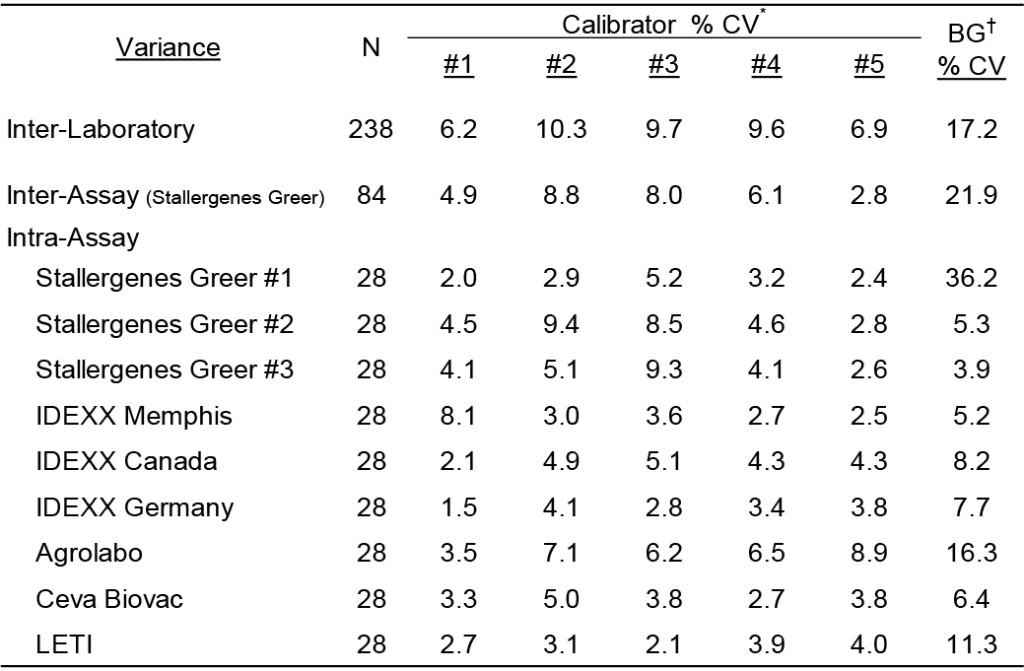
The assay variance (% CV) observed with the calibrator solutions in the different laboratories are presented in Table 1 and are representative of the assay reproducibility in the various laboratories. The average intra-assay % CV among positive calibrators (#1–4) was 4.4% (range = 1.5–9.4%); differences among laboratories or between assays and within assay runs were not detected. No substantial differences in results among various operators were revealed. The average inter-operator variance documented for Stallergenes Greer technicians was calculated to be 5.2% (range = 2.0%-9.4%). The average inter-assay variance (% CV) observed in Stallergenes Greer’s laboratory with the positive calibrators from multiple runs over a one year period has been documented at 8.9% (range 7.1%–9.7%), and the inter-laboratory % CV among reactive calibrators also remained relatively constant (average 12.1%; range 11.2 – 13.4%)[1–3]. The results of the current evaluation (Table 1) are consistent with these published findings; the inter-assay variance among positive calibrators for all laboratories included in this evaluation was calculated to be 6.9% (range = 4.9–8.8%). Similar to these previously published studies, the intra-assay variability was higher with negative calibrator #5 (average 3.9%; range 2.4 – 8.9%), and a similar increased intra-assay variability was evident with the background ODs (average 11.2%; range 3.9–36.2%).

To evaluate the strength of association with the magnitude of EAU results observed for each allergen among the different laboratories a Pearson’s correlation coefficient was determined (Microsoft Excel 2016) for each laboratory pair. Because the macELISA is designed to yield comparable responses in dog and cat samples, comparison of results among affiliate laboratories included both cat and dog sample as a single population of sera samples. These results
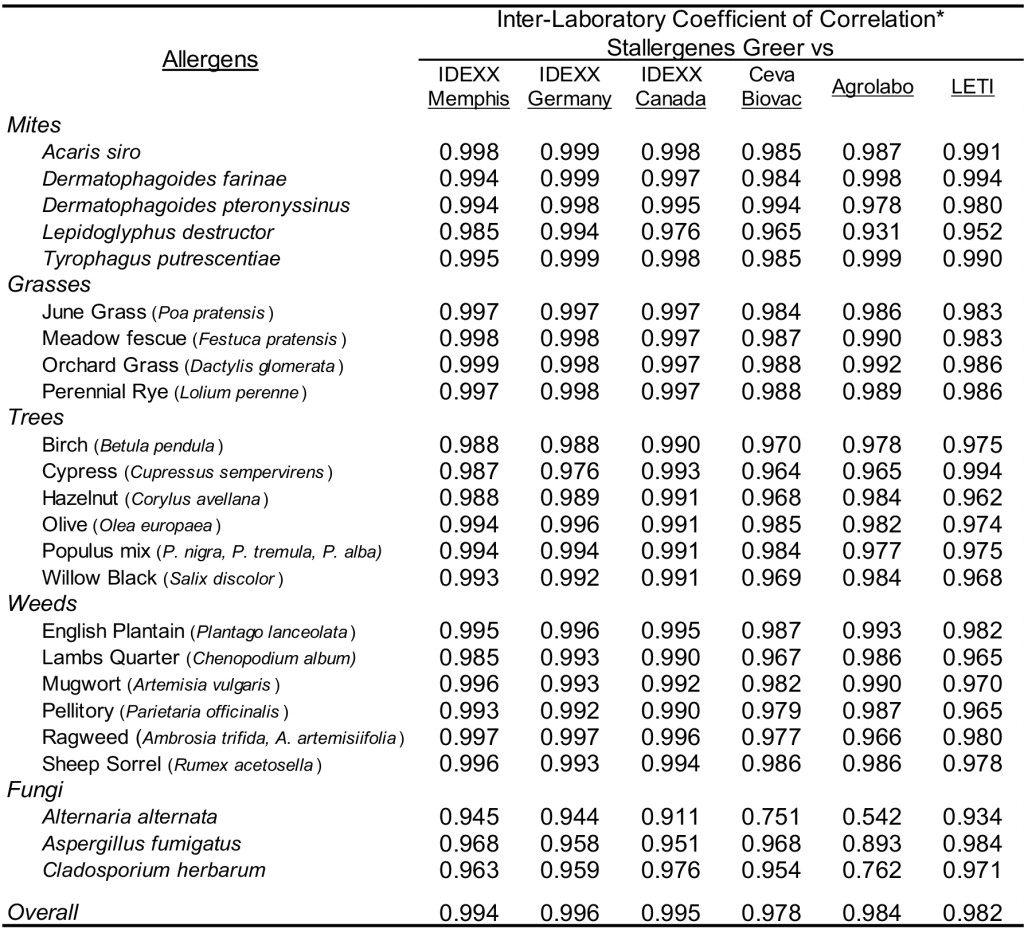
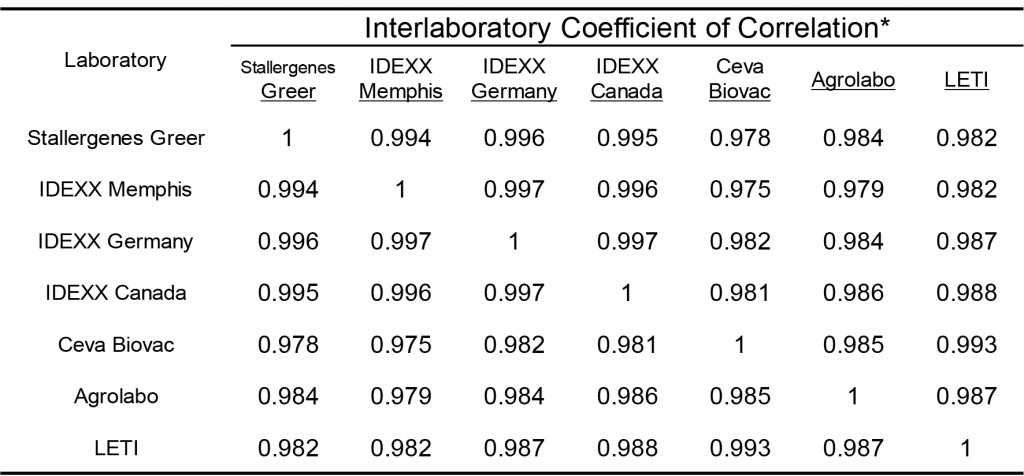
(Table 2) demonstrate that very high inter-laboratory correlation (r > 0.90; p < 0.001) is evident between the results observed in Stallergenes Greer’s laboratory and those observed in six affiliate laboratories for all mites and pollen allergens. The correlation (Pearson’s) of results observed with the fungal allergens within or between any of the testing laboratories was also substantial. However, the majority of results for the fungal allergens fell within the lower range of reactivity or within the negative range of the response curve ( < 150 EAU). Consequently, the correlation of results among laboratories for the fungal allergens was somewhat less than the correlation evident with the mite and pollen allergens. The overall correlation of results observed in the various laboratories is summarized in Table 3; a very strong correlation was demonstrated between and among the results of the participating laboratories.

Table 1. Calculated variance of macELISA calibrator solutions observed with different laboratory runs by multiple operators during the 2018 Proficiency evaluation.

IJVB 2018-109 - Kenlee USA_F1

*Calibrator #1 is prepared as a dilution of a sera pool which is highly reactive to grass pollen allergens;
Calibrator #5 is a dilution of a negative sera pool.
Calibrators #2 – #4 are prepared as a serial 3-fold dilution of calibrator #1.
Background responses observed with diluent in place of serum sample.

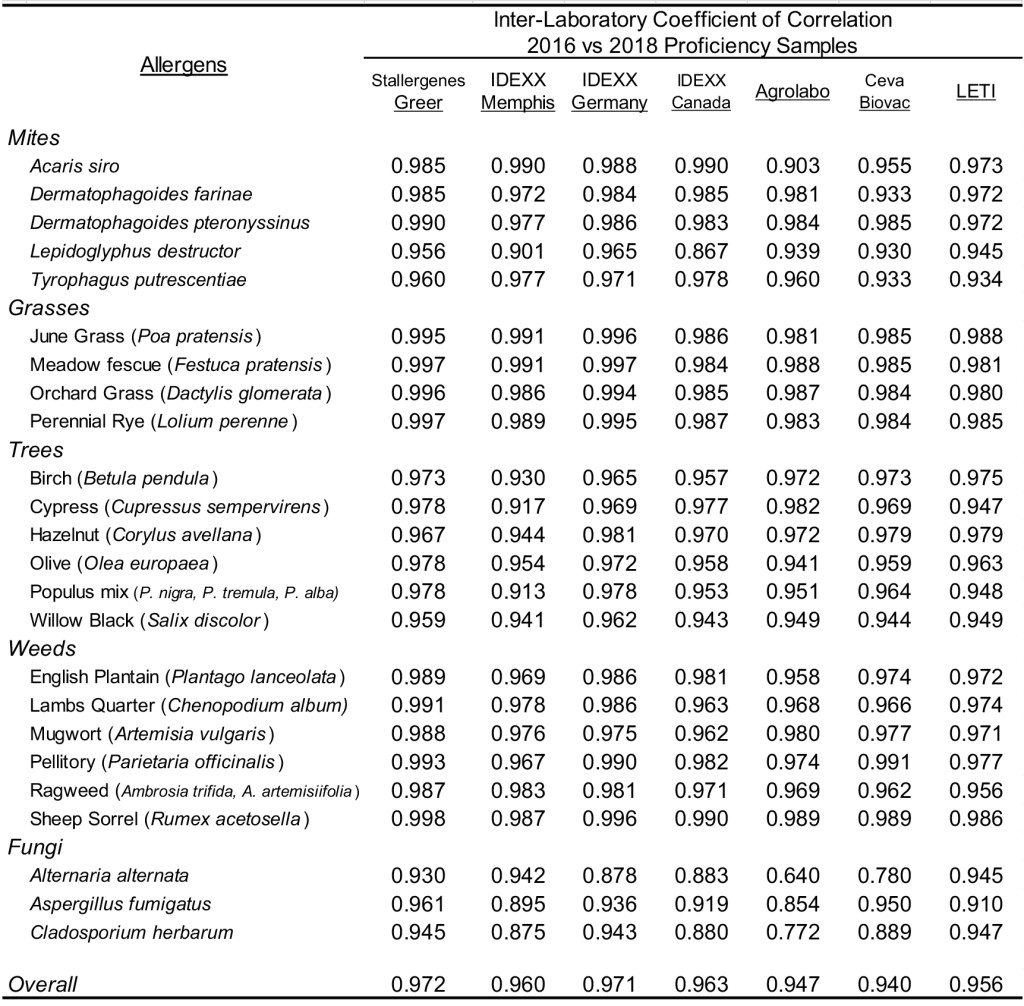
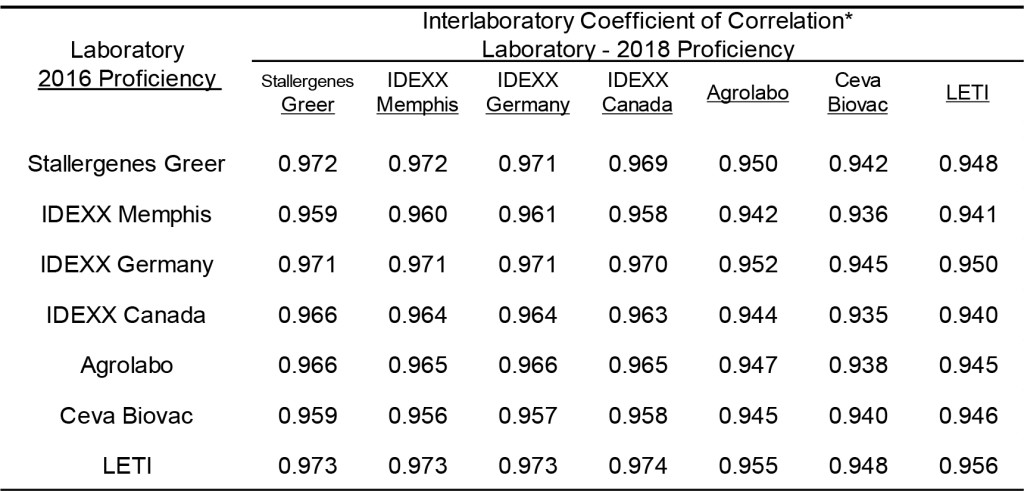
Because the sera samples included in the 2016 proficiency evaluation were identical to the samples included in the current proficiency evaluation (2018), the results observed for the 2016 proficiency evaluation in all laboratories were compared to the results observed within the 2018 proficiency evaluation. The results presented in Table 4 demonstrate strong intra-laboratory correlation among mite and pollen allergens. Consistent with the correlation of fungi responses within each of the proficiency evaluations, the correlation of the two proficiency evaluation comparison of fungi responses was somewhat reduced. Overall, a strong inter-laboratory correlation of results ( > 0.90) is also evident among the participating laboratories (Table 5) that completed the two proficiency evaluations.

There is no compelling evidence that the level of allergen specific IgE correlates with severity of clinical disease [5–8]. However, an evaluation that purports to measure allergen specific IgE should have a reduction in signal that is directly proportional to the dilution factor of the test ligand [9]. For an evaluation of the dose response in this ELISA, a five tube three-fold serial dilution of a highly pollen-reactive dog sera pool was included as unknown independent samples. To be expected, the magnitude of responses observed in each laboratory was reduced in direct proportion to dilution and the profile of response for each allergen was indistinguishable from the results presented for the previous proficiency evaluation completed in 2016 [4] (data not shown). Results from the final tube in the dilution scheme yielded results that were indistinguishable from negative responses, indicating a dilution extinction of detectable response.

Discussion

The results of the present study demonstrate that the variability between and among the affiliate laboratories and technicians are indistinguishable from the results evident within and between runs completed in the laboratory of Stallergenes Greer. The intra-assay variance observed with the positive calibrators evident among the various runs within each of the laboratories remains relatively low and indistinguishable among the various laboratories. Likewise, the inter-assay variance within each laboratory remained relatively constant and the results from all laboratories were demonstrably similar and the CV of the positive responses was relatively constant across the entire range of reactivity tested. Thus, we conclude that any and all laboratories and technicians are equally proficient in providing consistent results for all allergens tested and the results are well within the acceptable variance limits (± 20%) established for this assay [1].

Comparison of results from the current proficiency evaluation (2018) with the results from the previous evaluation (2016), which evaluated identical samples, demonstrates multiple performance characteristic of the assay. The intra-assay comparison of the results for the two assays runs (Table 4) documents that comparable responses are yielded for mites and pollens in the two separate runs in each of the participating laboratories. The correlation of the two proficiency evaluation comparison of fungi responses was somewhat reduced. This less than stellar correlation is probably a result of the majority of the fungal responses falling within the negative range ( < 150 EAU). The overall correlation of results within the inter-laboratory comparison (Table 5) demonstrates the likelihood that the reported results for a specific sample between any two or among any and all laboratories will be indistinguishable. Further, similar results will be yielded with any specific sample that has been stored (- 20 °C) for a period in excess of three years, indicating that the allergen specific IgE present in serum remains stable for at least this time period. The sera samples are the only component within the two assays runs that were from the identical manufacture lot; the coated wells and assay reagents used in the 2016 proficiency evaluation were from separate manufacture lots of the respective components used in the 2018 evaluations. Consequently, the results presented herein not only demonstrate stability of sera samples stored over an extended period ( > 3 years), but that consistent results can be attained when differing lots of the interchangeable assay components are used. Indirectly, these results also substantiate that an adequate quality assurance/quality control program has been established for the manufacture of the components and reagents included in this ELISA.

The lack of a regulatory mandated quality assurance program for serum allergen-specific IgE testing in companion animals, that independently monitors performance of all laboratories and assay formats, prompts Stallergenes Greer to accept the responsibility for continued evaluation of laboratories that routinely use the company’s assays. Information presented herein documents the continued commitment of Stallergenes Greer and its affiliate laboratories to providing a stream of information relating these results to the veterinary community.

Table 2. Inter-laboratory correlation of macELISA results observed with individual allergens in Stallergenes Greer Laboratory and the results observed in the individual affiliate laboratories.

IJVB 2018-109 - Kenlee USA_F2

*Pearson Correlation Coefficient (r); Good Correlation (r > 0.8, p < 0.001)

Table 3. Inter-laboratory correlation of macELISA results observed among individual affiliate laboratories.

IJVB 2018-109 - Kenlee USA_F3

*Pearson Correlation Coefficient (r); Good Correlation (r > 0.8, p < 0.001)

Table 4. Intra-laboratory correlation of macELISA results observed among individual laboratories for evaluations completed in 2016 and 2018.

IJVB 2018-109 - Kenlee USA_F4

*Pearson Correlation Coefficient (r); Good Correlation (r > 0.9, p < 0.001)

Table 5. Inter-laboratory correlation of macELISA results observed among individual laboratories for evaluations completed in 2016 and 2018.

IJVB 2018-109 - Kenlee USA_F5

*Pearson Correlation Coefficient (r); Good Correlation (r > 0.9, p < 0.001)

Authors Contributions

Kenneth Lee contributed to the conception and design of the study; contributed to the acquisition, analysis, and interpretation of data; and drafted the manuscript. Karen Blankenship and Brennan McKinney manufactured all components used throughout the evaluation and contributed to acquisition of the data. Gerhard Kern, Elizabeth Roth, Janice Greenwood, Santiago Cerrato, Laurent Drouet, and Cecilia Tambone contributed to acquisition of the data. All authors gave final approval and agree to be accountable for all aspects of the work in ensuring that questions relating to the accuracy or integrity of any part of the work are appropriately investigated and resolved.

Declaration of conflicting interests

All authors from Stallergenes Greer are employees at Stallergenes Greer; other authors are employees of the affiliate laboratories.

Funding

Funding for this study was provided by Stallergenes Greer.

References

  1. Lee KW, Blankenship KD, McCurry ZM, et al. (2009) Performance characteristics of a monoclonal antibody cocktail-based ELISA for detection of allergen-specific IgE in dogs and comparison with a high affinity IgE receptor-based ELISA. Vet Dermatol 20: 157–64. [crossref]
  2. Lee KW, Blankenship KD, McCurry ZM, et al. 2012, Reproducibility of a Monoclonal Antibody Cocktail Based ELISA for Detection of Allergen Specific IgE in Dogs: Proficiency Monitoring of macELISA in Six US and European Laboratories. Vet. Immunol Immunopathol 148: 267–275.
  3. Lee KW, Blankenship K, McKinney B, Kern G, Buch J, et al. (2015) Proficiency monitoring of monoclonal antibody cocktail–based enzyme-linked immunosorbent assay for detection of allergen-specific immunoglobulin E in dogs. Journal of Veterinary Diagnostic Investigation 27: 461–469.
  4. Lee K, Blankenship K, McKinney B, Kern G, Roth E, et al. (2017) Continued Proficiency Monitoring Of Monoclonal Antibody Cocktail-Based Enzyme-Linked Immunosorbent Assay for Detection of Allergen Specific Immunoglobulin E in Dogs – 2016. Integr J Vet Biosci 1: 1–10.
  5. DeBoer DJ, Hillier A (2001) The ACVD task force on canine atopic dermatitis (XVI): laboratory evaluation of dogs with atopic dermatitis with serum-based “allergy” tests. Vet Immunol Immunopathol 81: 277–87.
  6. Gorman NT, Halliwell REW (1989) Atopic Diseases. In: Halliwell REW, Gorman NT (eds.). Veterinary Clinical Immunology. WB Saunders, Philadelphia, USA Pg No: 232–52.
  7. Griffin CE, DeBoer DJ (2001) The ACVD task force on canine atopic
    dermatitis (XIV): clinical manifestation of canine atopic dermatitis. Vet Immunol Immunopathology 81: 255–69.
  8. Griffin CE, Hillier A. (2001) The ACVD task force on canine atopic dermatitis (XXIV): allergen-specific immunotherapy. Vet Immunol Immunopathol 81: 363–83.
  9. Tijssen P (1993) Processing of data and reporting of results of enzyme immunoassays. In: Burdon, RH, van Knippenberg PH (eds.). Practice and Theory of Enzyme Immunoassays. Elsevier, Amsterdam, Netherlands Pg No: 385–421.

The Challenge of Measuring Caries Disease in Populations

DOI: 10.31038/JDMR.2018115

Abstract

Introduction: There are so many methods for measuring caries disease in populations that it is a great challenge for researchers and epidemiologists to choose which one is most appropriate for their research or surveys.

Objective: to make a discussion about the difficulties in measuring caries disease in populations using scientific articles that contributed to the reflection on the subject.

Conclusion: Due to the importance of the issue a careful analysis of the literature is necessary to decide which method should be used to measure caries disease in the populations.

Keywords

DMF index, caries dental; health surveys.

Caries is a chronic disease worldwide and, according to the World Health Organization (WHO), affects 60–90% of school-age children and 100% of adults in various regions [1], with considerable variations between countries. In 2010, untreated caries lesions on permanent teeth were the most prevalent condition worldwide, affecting 2.4 billion people, with potential impact on the global economy [2]. Despite the importance of this disease, there is no consensus as to the most appropriate method for the detection of caries in populations, so there are numerous methods described in the literature [3–10]. Due to many options that currently exist researchers and epidemiologists need to be aware of several aspects when choosing a method to detect caries in populations. Before choosing a method, it is recommended that the researcher analyze several questions to determine which method is most appropriate to the objectives of his research or his epidemiological survey. These questions will be addressed here, while a comparison will be made between three methods that stood out in the literature, being validated and used internationally [11–13]: The Caries Assessment Spectrum and Treatment (CAST) [14], the International Caries Detection and Assessment System (ICDAS) [8] and the DMF (Decayed, Missing and Filled)[15].

The first question is:- What diagnostic threshold will be used to detect caries lesions? This threshold can vary from enamel lesions visualized after we dried the enamel until extensive dentin lesions have reached the pulp and caused an odontogenic infection. DMF has traditionally measured caries from dentin lesions (D3), leaving lesions in enamel (D1) sub registered. The CAST measures from non-cavitary enamel lesions that do not need to be dried to be detected, not using compressed air. The ICDAS measures from the first clinical sign of caries that are non-cavitated enamel lesions that need to be dried for 5 seconds to be seen [16]. The CAST and the ICDAS decrease the underestimation of caries when diagnosing these diseases from enamel lesions.

The second question is:- Which unit of measurement we will use? Can the individual unit be chosen when we detect how many individuals are sick in a community, for example, in 100 individuals who have lesions of caries? When we use teeth unit in a group of 100 people how many of its 3200 teeth have been affected? We can use the surface unit and, if so, how many of the 1,4800 surfaces examined have been affected by caries? In each one, caries can reach different levels of severity, from a reversible enamel lesion to total surface/tooth destruction.

A third important question relates to the choice of unit of measure we will include in calculating the prevalence of caries disease. The number of people with caries lesions? Alternatively, the number of teeth or surfaces affected by caries? [15]

With DMF and ICDAS the tooth or surface unit has been used. However, this makes it difficult to communicate with other areas of health and with planners and decision-makers, since generally the prevalence is calculated using the individual unit of measure. The prevalence of a disease is the proportion of a population that has a disease at a specific level at a point in time [17]. In epidemiology, a patient has one or more diseases, while the rest of the population is healthy. The sick individuals correspond to the number of cases [18].

In Dentistry, however, this principle is generally not followed, and therefore there is a specific approach to the tooth. It means that will be checked whether each tooth is diseased or not, by adding the tooth that has the disease at the time of examination (caries lesions) with the teeth that have been affected by it in the past and have been extracted or restored. However, it may be misleading to consider the teeth restored and absent as experience of caries because the teeth may have been restored or extracted for other reasons [18].

The CAST uses the individual unit to calculate the prevalence of caries without considering the extracted or restored teeth [19], which is more in agreement with the classical concept of prevalence because it detects the disease present at the moment of the examination per individual, thus identifying the individuals who need dental treatment at the time of the examination. When individuals receive this treatment, they are excluded from the disease prevalence this allows communicating more quickly to health planners the results of interventions in a given community.

A fourth and final question is: – We will evaluate the activity of the lesion? That is, once the lesion is detected, we must consider as active or inactive through its appearance?

The usefulness of measuring caries activity is questionable because when some authors [20, 21] used this indicator no significant change was identified. These authors argue that treating all non-cavitated lesions, as if they were all with active caries, instead of evaluating the caries activity, would be better cost-effective in the long term. CAST and DMF do not include caries activity. However, ICDAS has been proposed to be used in conjunction with methods that evaluate this activity (Nyvad System [6], Lesion Activity Assessment – LAA [22], and LA from the International Caries Classification and Management System – ICCMS [23] ).

According to Frencken [24], for an epidemiological index, it is not advantageous to include assessment of caries activity, as this would only make the index more complicated. However, for Nyvad [6], the evaluation of the lesion activity is essential for the determination of the need for treatment, since the active lesions require intervention (operative or non-operative), while inactive lesions require only the daily use of fluoride toothpaste.

The registry of non-cavitated enamel lesions aims to provide a more comprehensive epidemiological picture of the distribution of the disease in the population; however, to include these lesions, it is necessary that the teeth be dry, requiring more calibration time for examiners and a more detailed examination [1]. The choice of a particular method should take into account the purpose of the study, the human resources, and the materials available. Epidemiological surveys conducted in underdeveloped or developing countries have scarce resources, and therefore epidemiologists have chosen DMF because it is a quick and inexpensive index.

Limits and deficiencies of DMF have been reported in the literature, some authors point out the need to use new methods that measure caries disease in populations in a way that is more in agreement with new concepts of cariology and epidemiology, including non-cavitated enamel lesions and using an individual unit of measure [18, 25]. Given the importance of measuring caries in populations, studies are needed to assist researchers in the choices among the various methods. Castro et al. [26] compared to CAST, ICDAS, and DMF. After this study the authors arrived at the following conclusions:

Advantages and disadvantages of DMF

The DMF uses the unit of measure tooth or surface and offers as advantages: ease of use; speed of application; simplicity of analysis; does not require the use of compressed air; is recommended by WHO and MS; is comparable with international data collected since the 1940s. As for disadvantages of DMF, the authors cite: the use of the DMF mean that considers very different clinical conditions, implying the need to decompose the index in the lost and restored caries components, to verify how much each one is present in the population; traditionally, does not include lesions on enamel. The DMF includes decayed, restored and lost teeth, so it is an irreversible index; the prevalence calculated through it will never decrease in the same group over time; therefore, measures the prevalence of the disease cumulatively. That is, individuals who are no longer with the disease at the time of the examination can be included in the prevalence of the disease; also, some teeth may have been extracted or restored for reasons other than caries, overestimating the presence of the disease.

Advantages and disadvantages of ICDAS

As advantages of the ICDAS, it includes the caries lesions from its most initial clinical stage, when  it is only possible to visualize the lesion through surface drying. This system is used in association with other methods that evaluate caries activity (Nyvad System, LAA, LA) [6, 22, 23].

It is a validated method used in several countries; its data are capable of being transformed into an average DMF; is an appropriate system for clinical use and for monitoring the evolution of individual caries lesions. The disadvantages of the ICDAS are based on the fact that for this method to record enamel lesions, it is necessary to use compressed air to dry each surface for 5 seconds, but in many places, it is not possible to use this equipment. By using many codes and two digits, the analysis becomes complex and overly detailed to be used at the collective level [27].

Advantages and disadvantages of CAST

The CAST can use the individual, tooth or surface unit measure, has the benefits of detecting enamel lesions that can be visualized without the use of a compressed air syringe, to lesions that caused fistula and abscess. Don´t need compressed air; it is a simple, fast method; was validated and used internationally; its criteria are arranged hierarchically, easy to apply and analyze; data can be transformed into an average DMF [14, 26].

The cited disadvantages of CAST were: it was not tested for clinic use [28]; does not measure enamel lesions that can only be seen after tooth drying. Not including this type of lesion is part of the characteristics that make this method more suitable for use in epidemiological surveys. The lack of knowledge about new methods to measure caries in the populations influences the decision on which index to use, as shown in  the study by CASTRO et al. [29] most of the people interviewed said they were dissatisfied with DMF, but they did not use new methods because they could not compare the data later. However, both the CAST and the ICDAS had their data converted to the DMF mean in several studies, with results very similar to those found with the last index [26]. Therefore, the perception that there would be a loss of comparability of results, using other methods, is questionable, since data obtained through the ICDAS and CAST can be converted and compared to data previously registered with the DMF [26].

Conclusions

Due to the importance of the subject and the number of methods proposed, a careful analysis of the literature is necessary to decide which method should be used to measure caries disease in the populations because all of them have advantages and disadvantages. More studies should be done on the subject until a consensus is established.

Authors’ contributions

ALSC drafted the manuscript; ALSC, CMCM, and MIPV reviewed the original draft as well as read and approved the final manuscript.

References

  1. Antunes JLF, Peres MA, Crivello Júnior O (2006) Epidemiology of oral health. In: Fundamentals of Dentistry. Guanabara Koogan pg: 441–442.
  2. Kassebaum NJ, Bernabé E, Dahiya M, Bhandari B, Murray CJ, et al. (2015) Global burden of untreated caries: a systematic review and metaregression. J Dent Res 94: 650–658. [crossref]
  3. Mount GJ, Hume WR (1997) A revised classification of carious lesions by site and size. Quintessence Int 28: 301–303. [crossref]
  4. Fisher J, Glick M, Committee FWDFS (2012) A new model for caries classification and management: the FDI World Dental Federation caries matrix. Elsevier pg: 546–551.
  5. de Souza AL, Leal SC, Bronkhorst EM, Frencken JE (2014) Assessing caries status according to the CAST instrument and WHO criterion in epidemiological studies. BMC Oral Health 14: 119. [crossref]
  6. Nyvad B (2004) Diagnosis versus detection of caries. Caries Res 38: 192–198. [crossref]
  7. Castro ALS, Vianna MIP, Reis SR de A (1999) A new index for measuring dental caries: a reversible index of dental caries-IRCD. Rev Fac Odontol Univ Fed Bahia 19: 35–40.
  8. Ismail AI, Sohn W, Tellez M, Amaya A, Sen A, et al. (2007) The International Caries Detection and Assessment System (ICDAS): an integrated system for measuring dental caries. Community Dent Oral Epidemiol 35: 170–178.
  9. Sheiham A, Maizels J, Maizels A (1987) New composite indicators of dental health. Community Dent Health 4: 407–414. [crossref]
  10. Monse B, Heinrich-Weltzien R, Benzian H, Holmgren C, van Palenstein Helderman W (2010) PUFA–An index of clinical consequences of untreated dental caries. Community Dent Oral Epidemiol 38: 77–82.
  11. de Souza AL, Bronkhorst EM, Creugers NH, Leal SC, Frencken JE (2014) The caries assessment spectrum and treatment (CAST) instrument: its reproducibility in clinical studies. Int Dent J 64: 187–194. [crossref]
  12. Frencken JE1, de Souza AL, van der Sanden WJ, Bronkhorst EM, Leal SC (2013) The Caries Assessment and Treatment (CAST) instrument. Community Dent Oral Epidemiol 41: 71–77. [crossref]
  13. Braun A, Guiraud LMJC, Frankenberger R (2017) Histological validation of ICDAS II and radiological assessment of occlusal carious lesions in permanent teeth. Odontology 105: 46–53.
  14. Frencken JE, de Amorim RG, Faber J, Leal SC (2011) The Caries Assessment Spectrum and Treatment (CAST) index: rational and development. Int Dent J 61: 117–123. [crossref]
  15. Klein H, Palmer CE (1938) Dental caries in American Indian children. US Govern. Print Off.
  16. Frencken JE (2016) Dental Caries and Caries Epidemiology. In: Evidence-Based Caries Prevention. Springer pg: 1–11.
  17. Rothman KJ (1998) Precision and validity in epidemiologic studies. Mod Epidemiol.
  18. Larmas M, Mäkinen KK (2014) Insufficiency of currently used dental indices in epidemiology. Br J Med Med Res 4: 2058.
  19. Ribeiro APD, Maciel IP, de Souza Hilgert AL, Bronkhorst EM, et al. (2018) Caries assessment spectrum treatment: the severity score. Int Dent J 68: 84–90. [crossref]
  20. Brown JP, Amaechi BT, Bader JD, Shugars D, Vollmer WM, et al. (2015) The dynamic behavior of the early dental caries lesion in caries-active adults and implications. Community Dent Oral Epidemiol 43: 208–216.
  21. Piovesan C, Ardenghi TM, Guedes RS, Ekstrand KR, Braga MM, et al. (2013) Activity assessment has little impact on caries parameters reduction in epidemiological surveys with preschool children. Community Dent Oral Epidemiol 41: 204–211.
  22. Ekstrand KR, Martignon S, Ricketts DJN, Qvist V (2007) Detection and activity assessment of primary coronal caries lesions: a methodologic study. Oper Dent 32: 225–235.
  23. Pitts NB, Ekstrand KR (2013) International Caries Detection and Assessment System (ICDAS) and its International Caries Classification and Management System (ICCMS)–methods for staging of the caries process and enabling dentists to manage caries. Community Dent Oral Epidemiol 41: 41–52.
  24. Frencken JE, de Souza AL, van der Sanden WJ, Bronkhorst EM, Leal SC (2013) The Caries Assessment and Treatment (CAST) instrument. Community Dent Oral Epidemiol 41: e71–77. [crossref]
  25. Ismail A1 (2004) Diagnostic levels in dental public health planning. Caries Res 38: 199–203. [crossref]
  26. Castro ALS, Vianna MIP, Mendes CMC (2018) Comparison of caries lesion detection methods in epidemiological surveys: CAST, ICDAS and DMF. BMC Oral Health 18: 122.
  27. de Amorim RG, Figueiredo MJ, Leal SC, Mulder J, Frencken JE (2012) Caries experience in a child population in a deprived area of Brazil, using ICDAS II. Clin Oral Investig 16: 513–520. [crossref]
  28. Leal SC, Ribeiro APD, Frencken JE (2017) Caries Assessment Spectrum and Treatment (CAST): A Novel Epidemiological Instrument. Caries Res 51: 500–506.
  29. Castro ALS, Vianna MIP, Mendes CMC (2018) The knowledge and use of population-based methods for caries detection. BMC Oral Health 18: 153. [crossref]

Dental Age Estimation: A Review

DOI: 10.31038/JDMR.2018114

Abstract

Age is one of the essential factors in establishing the identity of the person. It plays an important role in forensic medicine, clinical dentistry and archaeology. Age estimation is crucial in medico legal cases and importance in forensic medicine, not only for identifying deceased victims but also in connection with crimes and accidents. Age estimation of unknown human bodies is very important in the setting of a crime investigation as well as mass disaster. The age for the individual can be assessed as skeletal, morphological, secondary sex character and dental age.This paper reviews various dental age estimation methods that have been used by the scientist in order to help the identification of remains.

Keywords

Age Estimation, Identification, Forensic Dentistry

Introduction

Age is one of the important biological profiles in the individuals. Thus far many anthropologists have studied the age systems, where age is often a major organizing principle. Age systems include formal age classes of individuals of similar numerical age, age grades or developmental stages based on social and biological development, and relative ages of individuals [1].

In many cases, chronological age and biological age may not be the same, due to the developmental variations. Hence, different parameters such as dental age, bone age, mental age, and other factors such as menarche, voice change, height, and weight are considered as the proxy indicator for biological age and body development [2]. Dental development is more reliable as an indicator of biological maturity in children. Dental maturity is more relevant as it is less affected by nutritional and endocrine status [2].

Over the past 100 years, forensic dentistry has become a part of forensic sciences that utilizes dental or orofacial findings in the legalistic system. The fundamental role of forensic dentistry in identification of human remains has been proved by many researchers in their studies [3]. There has been strong relationship between the growth rate of bone and teeth, which can be utilized for age identification of an individual. Tooth formation is used often to assess maturity and predict age. Within clinical dentistry, this information aids in diagnosis and treatment planning [4].

Various factors are considered for determination of age, out of which teeth are the most durable structures in the human body which are better preserved even in the acidic soil. Human teeth are the hardest substances in the human body and depending upon ambient conditions, characteristics associated with the teeth may provide an important and effective method to identify a person. Dental tissues are among the most durable tissues of the human body resistant to different external influence, as well as to mechanical, thermal and chemical irritations [5]. Thus, this reviewed paper was performed to determine various dental age estimation methods that have been used by the scientist in order to help the identification of individuals.

Methods of Age Determination

Many literatures describe various methods or techniques that address dental age estimation in human. The methods can be classified as follows:

1. Based on Tooth Development

Age estimation using tooth can be classified into two periods of time in human life. The first period is when the teeth are developing in the jaws up to 20 years of age. The second period when all teeth are fully formed [6].

1.1. Age estimation of individuals below 20 years of age

Most scientific studies have been developed developmental tables for the different stages of tooth formation [6]. These methods based upon developmental stages, are more accurate than age estimation based on the stages of eruption of teeth [6]. In these age periods, in many cases the statistical scientific tables have been used due to its stronger evidence and more accurate technique than visual age assessment [6].

However, the dental development may be decelerated by severe and long lasting diseases such as congenital syndromes and also nutritional deficiencies. On the other hand, only rare hormonal hyper secretion may accelerate the development [6]. Severe dental diseases and tooth extraction may also influence the dental development [6]. For a most accurate assessment of the age it is necessary to assess these factors and take them into consideration.

For an example, study had done by Solheim and Vonen, they used at least two different age estimation techniques in cases of age estimation in individual below 20 years of age. Generally they use tables from Finland of Haavikko [7] and from Canada by Anderson et al [8].

1.2. Age estimation of individuals above 20 years of age

For this group, age estimation relies upon regressive age changes such as attrition, loss of periodontal attachment and secondary dentin formation. In this case the visual assessment may be almost as accurate as the calculated age according to a specific technique. A visual assessment may thus be an important supplement to scientific methods [6].

The pioneer scientist who had been created the technique for age estimation was Gustafson [9]. In this method, longitudinal sections of teeth cut through the central area was examined. The age-related biological changes such as attrition, periodontal ligament retraction, cementum apposition, secondary dentin formation, root resorption and transparency of the root were scored from 0 to 3. The scores were added and a regression analysiswas performed. The formulae based upon regression analysis e.g multiple regressions with age as dependent variable and the different age related changes as independent variables [9]. However, this method was modified due to ethics involvement extract teeth in living person. Thus other techniques such as Radiographic methods is one can be used. It is based on the size of the pulp in the relation to the whole tooth and gives a measure of the secondary dentin formation [10].

The other morphologic technique in living person is methods by Solheim. This technique is based only upon attrition, colour and recession of the periodontal attachment. All these variables can be assessed in a living person [11].

2. Based on Dentition

2.1. Pre natal, neonatal and post natal

Age estimation in this group of individuals can be very accurate. Histological methods are used to assess the stage of tooth development during the pre-mineralization period. Mineralization of deciduous dentition commences from two or four months in-utero [12]. Some of the histological methods can detect early mineralization 12 weeks before being detectable in the radiographs. Before the mineralization of tooth germs starts, the tooth germs may be visible as radiolucent areas on the radiograph; the subsequent radiographs of the mandible will depict the deciduous teeth in various stages of mineralization as per the pre-natal age of the fetus [12].

2.2. Children and adolescents

In this stage, the age estimation is based on the time of emergence of the tooth in the oral cavity and the tooth calcification. The radiographic analysis of developing dentition, especially when there is no clinical evidence available (2.5–6 years) as well as the clinical tooth emergence in various phases will help in age determination. Schour and Massler’s chart was the first attempt to study dental age estimation [12]. This chart permits direct comparisons with radiographs. Demirjian et al developed an age estimation method that made use of a scoring system. In this method, seven mandibular teeth on the left side were divided into 8 stages and maturity score was evaluated [13]. Age estimation also can be measured using mandibular third molars in which formed part of root were digitized but the precision of the age estimation was slightly inferior compared with the standard method [14].

2.3. Adults

Most of the methods used in adults use various regressive changes of hard and soft tissues of the teeth [3,5,9–11]. Gustafson (1950) studied the changes occurring in individual teeth and succeeded in estimating the age with some accuracy. He used 6 dental changes connected with aging namely, attrition, apical migration of periodontal ligament, deposition of secondary dentin, cemental opposition, root resorption and transparency of the root dentin. Age was estimated using the formula. It was found that an increase in the total score corresponds to an increase in age [9].

3. Based on The Methods

3.1. Morphological methods

Morphological methods are based on assessment of teeth (ex-vivo). Hence, these methods require extracted teeth for microscopic preparation [9]. However, these methods may not be acceptable due to ethical, religious, cultural, or scientific reasons. Gustafson (1950), Dalitz (1962), Bang and Ramm (1970), Johanson (1971), Maples (1978), Solheim (1993) are few scientist that use morphological methods [15].

3.2. Biochemical

The biochemical methods are based on the racemization of amino acids. The racemization of amino acids is a reversible first-order reaction and is relatively rapid in living tissues in which metabolism are slow. Aspartic acid has been reported to have the highest racemization rate of all amino acids and to be stored during aging. In particular, L-aspartic acids are converted to D-aspartic acids and thus the levels of D-aspartic acid in human enamel, dentine, and cementum increase with age. Assessment of age using this method was first described by Helfman and Bada in 1975 [15].

3.3. Radiographic

Radiographic plays an important role in the human age determination. Radiographic images are utilized in the process of age estimation, which is one of the essential tools in identification in forensic science [3,10–12,16]. The assessment of age with this method is simple, non-invasive procedure and reproducible that can be employed both, on living and unknown dead. [10,12,16].

Various radiographic techniques that can be used in age identification are intraoral periapical radiographs, lateral oblique radiographs, cephalometric radiographs, panoramic radiographs, digital imaging and advanced imaging technologies [10,12,16].

Conclusion

Age estimation in human provides a comprehensive issue. Consequently, needs considerable experience in recognizing significant changes and allowing for their variability within any particular population. Human teeth are particularly helpful in age estimation because can display a number of observable ages related variables. Teeth also tend to remain intact under circumstances compare other parts in the human body which might alter or obliterate the rest of the skeleton.

References

  1. Smith T, Brownless L (2011) Age assessment Practices: A Literature Review & Annotated Bibiliography. New York: United Nations Children’s Fund (UNICEF).
  2. McKenna CJ, James H, Taylor JA, Townsend GC (2002) Tooth development standards for South Australia. Aust Dent J 47: 223–227. [crossref]
  3. Limdiwala PG, Shah JS (2013) Age estimation by using dental radiographs. J Forensic Dent Sci 5: 118–122. [crossref]
  4. Briffa K, Dougall NB, Galea J, Mifsud D, Camilleri S (2005) Chronologic and Dental Ages of Maltese Schoolchildren – A pilot Study. Malta Medical Journal 17: 31–35.
  5. Gupta P, Kaur H, Shankari G S M, Jawanda MK, Sahi N (2014) Human age estimation from tooth cementum and dentin. J Clin Diagn Res 8: ZC07-10. [crossref]
  6. Solheim T, Vonen A (2006) Dental Age Estimation – Quality Assurance and Age Estimation of Asylum Seekers in Norway. Forensic Science International 4747: 56–60.
  7. Haavikko K (1970) The formation and the alveolar and clinical eruption of the permanent teeth. An orthopantomographic study. Suom Hammaslaak Toim 66: 103–170. [crossref]
  8. Anderson DL, Thompson GW, Popovich F (1976) Age of attainment of mineralization stages of the permanent dentition. J Forensic Sci 21: 191–200. [crossref]
  9. GUSTAFSON G (1950) Age determination on teeth. J Am Dent Assoc 41: 45–54. [crossref]
  10. Kvaal SI, Kolltveit KM, Thomsen IO, Solheim T (1995) Age estimation of adults from dental radiographs. Forensic Sci Int 74: 175–185. [crossref]
  11. Solheim T (1993) A new method for dental age estimation in adults. Forensic Sci Int 59: 137–147. [crossref]
  12. Panchbhai AS (2011) Dental Radiographic Indicators, A Key to Age Estimation. DentoMaxillofacial Radiology 40: 199–212.
  13. Willems G, Van Olmen A, Spiessens B, Carels C (2001) Dental age estimation in Belgian children: Demirjian’s technique revisited. J Forensic Sci 46: 893–895. [crossref]
  14. Wedl JS, Friedrich RE (2005) [Measuring the distance of the wisdom teeth from the occlusal plane as forensic-odontological method for chronological age determination]. Arch Kriminol 215: 77–84. [crossref]
  15. Priyadarshini C, Puranik MP, Uma SR (2015) Dental age Estimation Methods: A Review International Journal of Advanced Health Sciences 1(12).
  16. Karaarslan B, Karaarslan ES, Ozsevik AO, Ertas E (2010) Age estimation for Dental Patients Using Orthopantomographs. European Journal of Dentistry 4: 389–394.

Violence Against Women: A Case Report of Violence Perpetrated By a Couple on a Single Lady

DOI: 10.31038/AWHC.2018113

Abstract

Introduction: Violence against women (VAW) is a menace that is increasing all over the world. It is one of the most widespread human rights abuses and a public health problem. Most victims of violence against women know their perpetrators.

Case Presentation: A 28 year old single lady had a quarrel with her female neigbour. The neigbour’s husband held the single lady’s hands behind her and ordered his wife tit beat up the single lady. The female neigbour then bit the left upper eye lid of the single lady resulting in haemorrhage and pain. The injury was sutured.

Conclusion: Men are not the only perpetrators of such violence. Single women are at risk of being victims of violence. To end violence against women, everyone is involved because in some societies such issues are never discussed in public.

Key Words

Violence, Single Lady, Human Bite, Eye

Introduction

Violence against women is a menace that is increasing worldwide. It takes the form of sexual abuse and rape, physical injury comprising of cuts, bruises, human bite and burns and sexual harassment at the workplace. The perpetrators are usually male partners or colleagues. Violence against women is wide spread around the world [1]. It is a term used to collectively refer to violent acts that are primarily or exclusively committed against women and physical abuse is one of the commonest forms of abuse [2]. It is a form of gender based violence which can be described as any harm that is perpetrated against a person as a result of inequalities that are based on gender roles [3]. The united nations declaration on the elimination of violence against women in 1993 defines violence against women as any act of gender based violence that results in or is likely to result in physical, sexual or psychological harm of suffering of women including threats of such acts, coercion or arbitrary deprivation of liberty whether occurring in private or public life [4]. Violence against women is a major public health and human rights concern [5]. For this reason the United Nations has designated November 25 as the international day for the elimination of violence against women 2. Violence against women is a burning issue of human rights often swept under the carpet as if it does not matter especially in Africa and particularly in Nigeria [1]. Worldwide governments and various organizations are actively working to combat this menace through a variety of programmes [2]. Women are crucial to the growth and development of any nation2 therefore violence against women is a major threat to social and economic development [1].

Case Presentation

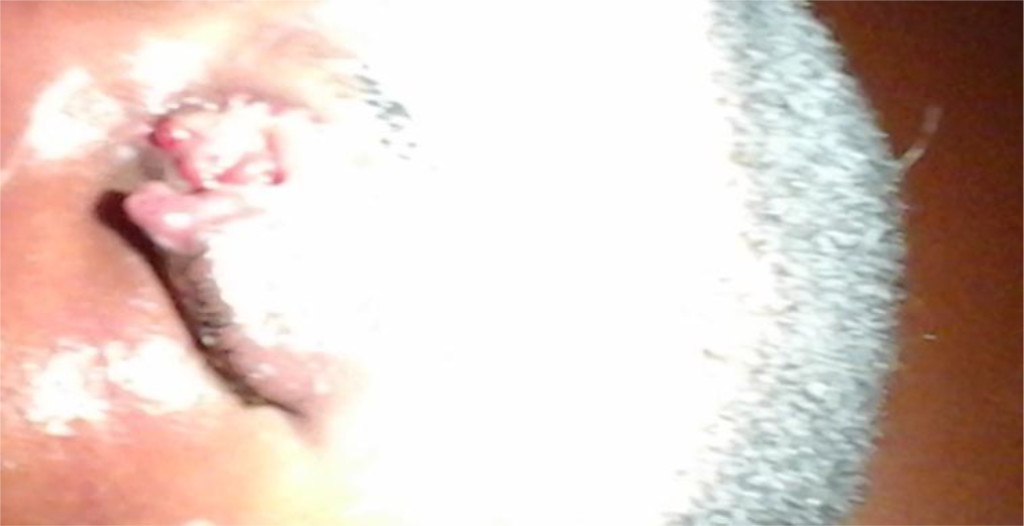
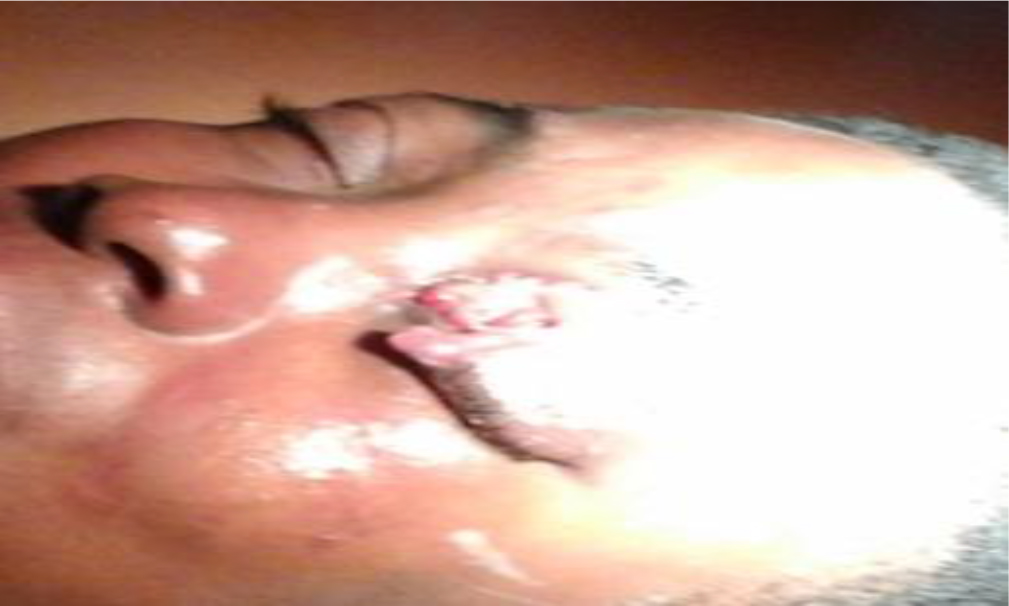
A twenty eight year old single Nigerian lady had a quarrel with her female neigbour. The neigbour’s husband overpowered the single lady by holding the single lady’s hands behind her and commanded his wife to beat up the single lady. The single lady was bitten on the left upper eye lid by her neigbour. There was haemorrhage and pain.

On examination, there was a 4cm laceration on the upper left eye lid with rough edges bleeding palpebral conjunctiva and eyeball were intact. Visual acuity could not be properly assessed because the patient was uncooperative because the left eye was very tender. Irrigation was done. The patient was to pay out of pocket, so she refused treatment and presented three days later by which time there was profuse foul smelling pussy discharge from the injury. Irrigation was done and the discharge sent for microbiological studies. Analgesics and antibiotics were administered. The laceration was sutured when the eye discharge had subsided.

AWHC-18-104-DabotaYvonneBuowari-Nigeria_F1

AWHC-18-104-DabotaYvonneBuowari-Nigeria_F2

Discussion

Violence against women is a serious issue and can render a woman disabled in extreme as in this case if there was no prompt treatment, the single lady may have lost one eye. It is not only men that physically abuse women as in this case the violence was perpetrated by a couple. There is a stigma of being single in some societies as the woman is seen as being unable to defend herself because she has no body to speak for her. Sometimes single ladies are even abused and violated by their own relatives’ and friends. In this case the victim’s neigbour overpowered her physically and authorized his wife to beat her up because the victim had no male partner at that time to fight for her. Not being able to assess health insurance led to a delay in the management as the victim had to pay out of pocket and she did not have the money at the time the injury occurred. Further delay in the management may have led to blindness or poor vision in the affected eye. The discomfort from the injury led to some loss of work days. There some non-governmental organizations in Nigeria that helps to fight violence against women. Single women which include women that have never married, those divorce and widows are usually the victims of violence and discrimination in the society.

Conclusion

Men are not the only perpetrators of violence against women. Single women that include the never married, divorced and widowed are at risk of being violated physically, socially and financially (that is economically). Health insurance is important in the management of injuries resulting from violence against women. Ending violence against women involves everyone.

References

  1. Haaga PT, Elechi FA, Okoye AC (2015) Violence against Women and Its Implications for Peace and Security in Nigeria. International Journal of Peace and Conflict Studies 2: 27–40.
  2. Alokan FB (2013) Domestic Violence against Women: A Family Menace, 1st Annual International Interdisciplinary Conference, AIIC, Book of Proceedings, 100–107.
  3. Ashimolowo OR, Otufale GA (2012) Assessment of domestic violence among women in Ogun State, Nigeria. Greener Journal of Social Sciences 2: 102–114.
  4. General Assembly Resolution 48/08 of 28 December 1993.
  5. Mbadugha EI (2016) Intimate Partner Violence and Sexual Violence against Women: Any End in Sight. International Journal of Medicine and Biomedical Research 5: 9–18.

Aqueduct-100, A New Device and Method for Controllable Cervical Dilation

DOI: 10.31038/JCRM.2018134

Abstract

Objective

The aim of this investigation was to evaluate the effectiveness of the Aqueduct-100 for cervical dilation to a predetermined diameter in patients meeting eligibility criteria.

Materials and Methods

This modified cervical dilator (Aqueduct-100) is a triple balloon catheter with a diameter of 2.3 mm enabling a one-time insertion of the device into the cervical canal. After insertion through the vagina and into the endometrial cavity, the device was fixed in place and inflated. The dilating balloons remained inflated inside the cervix for one minute until dilation reliably reached the desired 5.0–5.5mm diameter. This study was conducted at the Obstetrics and Gynecology department at the principle investigator’s surgical suite and Baptist Medical Arts Surgical Center, Miami, FL, USA from November 2016 through July 2017. The study included 30 patients ages 18 or older who were undergoing a diagnostic or operative hysteroscopy that required dilation.

Results

There were no reported problems operating the Aqueduct-100 mechanical dilator during the 29 reported procedures. In addition, the final diameter of the cervix after dilation was sufficient to perform the desired diagnostic/operative procedure without the need for further dilation by another method. Finally, the device was found to be user-friendly and adjustable to a patient’s cervical anatomy through a gentle, radial force.

Conclusion

The results of the study suggest that Aqueduct-100 device can be used as an alternative for mechanical dilators to prevent uterine and cervical injuries during cervical dilation prior to diagnostic or operative hysteroscopy procedures.

Keywords

cervical incompetency; hysteroscopy; mechanical dilators; uterine perforation

Introduction

Cervical dilation allows sufficient access to the endometrial cavity when surgical instruments are required during an intrauterine procedure. Current dilation methods include hygroscopic or mechanical dilators, sometimes preceded by a pharmacological agent to ripen the cervix for dilation.[1,2] These methods can be slow to work or involve multiple visits with the physician.[3] Moreover, if multiple insertions of the mechanical instruments are necessary during a single procedure, patients may require anesthesia for pain management, in addition to having an increased risk of infection, cervical or uterine lacerations, and intraperitoneal hemorrhages.[3, 4,5] Studies demonstrate the most frequently reported complications occurring during the dilation of the cervix prior to hysteroscopy are perforation and cervical trauma, with uterine perforation rates of approximately 0.7–0.8%.[6] Risk factors associated with uterine perforation include cervical stenosis, severe uterine anteflexion or retroflexion, infection, myomas of lower uterine segments, and synechiae.[7] Furthermore, reports associate cervical trauma as a contributing factor for cervical insufficiency.[8]

Limitations associated with the methodology of current dilators include the inability to tailor the device to a patient’s cervical anatomy or the unique requirements of each intrauterine procedure.[9] The functional inflexibility of current dilators may also exacerbate patient discomfort and increase the potential for injury endangering cervical integrity for future pregnancies, ie cervical incompetence.[4,5] To facilitate the mechanical methods for cervical dilation, we propose a cervical dilator based on a single act of insertion through the cervix, providing gradual and uniform dilation to a predetermined diameter within one minute, thereby reducing the risk of potential complications.

Material and Methods

Device Characteristics and Study Organization

The modified cervical dilator (Aqueduct-100) used in this study is a triple-balloon catheter that dilates the cervix during a single act of insertion. The dimensions of the two dilating balloons (diameter and length) were selected to enable efficient dilation to all cervices ranging between 1 to 7cm. The outer diameter of the semi-rigid catheter is 7 French (2.3mm), enabling easy insertion and manipulation of the catheter along the cervical canal. The consistency and endurance of the dilating balloons were tested previously to determine the breaching point for the Aqueduct-100. In vitro studies of the device revealed there was no detection of risk or breakage at a pressure of 14 bars. The reliability of these results was corroborated by an in vivo and ex vivo study reporting the ex-vivo mechanical response of the uterine cervix tissue did not differ considerably from what was observed in vivo.9 The study was conducted at the Obstetrics and Gynecology department at the principle investigator’s surgical suite and Baptist Medical Arts Surgical Center, Miami, FL, USA from November 2016 through July 2017. The data were collected by the study coordinators in the operating room. An independent data and safety monitoring board monitored the study and reviewed the protocol compliance and outcome data. The protocol was approved by the institutional review board of Baptist Hospital, Miami, FL

Study Patients

Thirty patients were enrolled using the following inclusion criteria: (1) subjects were age 18 or older and (2) undergoing a diagnostic or operative hysteroscopy that required dilation. All patients enrolled signed an informed consent form. Each procedure was performed by the principle investigator and began with measurements of the cervix, uterine cavity, and diameter of the internal ostium (os). All patients underwent operative hysteroscopy under local anesthesia with conscious sedation. In all the patients where the cervix could be cannulated, the dilating balloons were inflated for exactly one minute.

Procedure

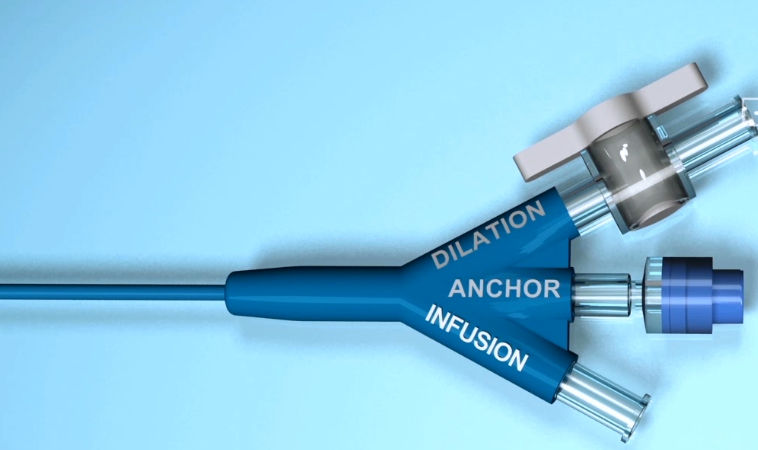
The initial diameter of the cervix was measured prior to the dilation procedure with the use of Hegar’s rods. The catheter, with its balloons deflated (Fig. 1), was inserted through the vagina and the cervix into the endometrial cavity under sterile conditions. An anchoring balloon was inflated through the “Anchor channel”
(Fig. 2) using a 2.5ml syringe with 1.5ml of bacteriostatic saline solution to fix the catheter in place. Two elongated dilating balloons were then inflated simultaneously at each end of the cervical canal (internal ostium and external ostium) by performing 3 consecutive injections of 2.5ml bacteriostatic saline solution through the “Dilation channel” (total volume of 7.5ml reaching an internal balloon pressure of 6 bars) (Fig. 2–3). The surgeon controlled the inflation rate, dilating the cervix gradually according to the resistance created by the cervix. The inflation of the dilating balloon required approximately 10 seconds, and the inflated balloons remained in the cervical canal for 1 minute. After the balloons were completely dilated, a bacteriostatic saline solution was injected into the cervical canal between the 2 dilating balloons through the “Infusion channel” to wash and lubricate the cervix. For catheter removal, all 3 balloons were deflated, and the catheter was removed in preparation for the intrauterine procedure. A final cervical diameter assessment was determined by measuring the dilation of the cervix prior to the intrauterine procedure. This measurement was confirmed by Hegar’s rods.

JCRM 2018-117-LarrySpiegelmanUSA_F1

JCRM 2018-117-LarrySpiegelmanUSA_F2

JCRM 2018-117-LarrySpiegelmanUSA_F3

Results

The age of the 30 patients ranged from 29 to 59, mean (SD) = 44.97 ± 8.08. In one patient, the dilation could not be performed due to severe cervical stenosis after a previous LEEP cone biopsy. Although not excluded from the study, it was impossible to safely proceed with the procedure to any dilation without surgical intervention. For the remaining 29 patients, the initial diameter of the internal os was measured prior to each cervical dilation, and the final diameter of the internal os was measured at the end of the dilation procedure and prior to the intrauterine procedure as described in the methods (Table 1). In all patients, the final diameter of the cervix after dilation met the necessary diameter required to perform the diagnostic/operative procedure without the need for further dilation by another method.

Table 1. Initial and final diameter (mm) of the cervices

Number of Patients (N)

Mean Diameter (mm)

Standard Deviation (SD)

Initial Measurement

29

2.98

0.76

Final Measurement

29

5.60

0.51

The overall satisfaction of the physician was evaluated based on three categories: a) general ease of use, b) ease of insertion of the catheter along the cervix, and c) confidence with the procedure. The physician who carried out the dilation procedure recorded a score ranging between 1 to 4 for each category – 1 = Unacceptable, 2 = Difficult, 3 = Acceptable, and 4 = Good. In all the 29 procedures performed, the doctor did not encounter problems operating the device and assigned the maximum score of 4 in all categories.

Discussion

Based on our results, the Aqueduct-100 may be a replacement for traditional mechanical cervical dilators when considering the prevention of uterine and/or cervical injury. Advantages of this cervical dilator include: a demonstrated single act of insertion of the device through the cervix and adjustability of the device to fit the needs of the surgeon during a variety of diagnostic or operative hysteroscopies requiring dilation. The advantages of Aqueduct-100 compared to traditional mechanical dilators are summarized in Table 2.

Understanding cervical resistance is central to ensuring patient safety when dilating a cervix through mechanical instruments. Excessive force can lead to cervical or uterine injury, including bleeding, lacerations, and perforations.[3,4,5] According to a recent study, Arsenijevic et al. reported cervical resistance was depressed after 23 seconds with a pressure of 3.8 bars when using a continuous controllable balloon dilator.[2] In comparison, the two dilating balloons of the Aqueduct-100 generated a pressure of 6 bars during 10 seconds of dilation to overcome the resistance of the cervix. By inflating the dilating balloons through three consecutive injections of 2.5 ml of saline, the cervix was dilated radially and gradually. The inflated balloons remained inside the cervix for one minute, to allow the cervical walls time to adjust to the radial forces. Moreover, during the dilation period saline was injected between the dilating balloons to wash and lubricate the cervical canal. Injecting saline between the dilating balloons washes and cleans the cervix from bloody mucus thus providing a clean cervix prior to insertion of the hysteroscope and reducing the risk of infection.

Table 2. Comparison of Aqueduct-100 to mechanical dilators

Feature

Mechanical dilators1–5

Aqueduct-100

Duration of dilation procedure

Approximately one minute

One minute

Number of insertions required

Multiple

One

Forcefulness of dilation procedure

High direct force

Gentle radial force

Ability to adapt to unique cervical anatomies

Highly dependent on the skill of the physician

Adaptation to cervical anatomies built into the product design (semi-rigid shaft)

Risk of injury due to false route, perforation

Highly dependent on the skill of the physician

Very low

Risk of cervical incompetence

Present

Very low

1. Gupta JK, Johnson N. Should we use prostaglandins, tents or progesterone antagonists for cervical ripening before first trimester abortion? Contraception. 1992; 46(5): 489–497.
2. Biron-Shental T, Fishman A, Fejgin MD. Medical and mechanical methods for cervical ripening. Int J Gynaecol Obstet. 2004; 85(2): 159–160.
3. Lichtenberg ES, Paul M, Jones H. First trimester surgical abortion practices: a survey of national abortion federation members. Contraception. 2001; 64(5): 385–392.
4. Gelber S, Sciscione A: Mechanical methods of cervical ripening and labor induction. Clin Obstet Gynecol 2006, 49: 642–657.
5. Iams J D. Philadelphia, PA: Elsevier Inc; 2009. Cervical insufficiency; p. 586.

A previous study with the Aqueduct-100 cervical dilator was conducted in the department of Gynecology, Hospital General Santa María del Puerto, Cádiz, Spain.[10] Fifty patients were divided into 2 groups. Group A (n = 38) underwent cervical dilation while the dilating balloons remained inflated inside the cervix for five minutes and Group B (n = 12) underwent cervical dilation while the dilating balloons remained inflated inside the cervix for 3 minutes. The average initial diameter of the cervix of Group A was 3.0 ± 1.0mm and in Group B, 2.2 ± 0.6mm (P = 0.0220). The final diameter was 8.1 ± 1.1mm and 6.4 ± 0.8mm respectively (P < 0.0001). The results demonstrated the correlation between the duration of the dilation process and the final diameter of the dilated cervix, ie the ability to dilate the cervix to a pre-determined diameter by controlling the duration of the process. This finding has practical significance. The 3-minute dilation process can be implemented in procedures that require a cervical diameter approximately 6.5mm and the 5-minute dilation process can be implemented in procedures that require approximately an 8–9mm cervical dilation, such as in hysteroscopic myomectomy and dilation and evacuation (D&E) procedures.

Conclusion

In our present study, the dilating balloons remained inflated inside the cervix for 1 minute to dilate the cervix to the desired 5.0–5.5mm in diameter required to successfully perform each of the hysteroscopy procedures. In all cases that the cervix could be cannulated, the cervix was successfully dilated to the minimal diameter required to at least perform the hysteroscopic procedures using a 5mm operative hysteroscope. Moreover, there was no difficulty reported upon inserting a 6mm operative device for a bipolar ablation procedure.

Current dilators do not have the ability to adjust to meet the needs of the unique cervical anatomy/physiology and procedural requirements of each patient. Because of this, patient discomfort and the risk of injury is increased, endangering cervical integrity for future pregnancies. Considering our findings, the Aqueduct-100 device may be used as an alternative to mechanical dilators with decreased risk of uterine and cervical injuries during cervical dilations. It is important to emphasize that due to the limited number of participants enrolled in this study, a further prospective study may be required to achieve the power to validate the effectiveness of Aqueduct-100 cervical dilator.

Acknowledgements

The authors would like to thank Andrew O. Idowu, MD, MBA for his assistance with analgesia during the surgical procedures.

Disclosure Statements

Larry Spiegelman declares no conflict of interest.

Ramon Sanchez-Rauder declares no conflict of interest.

Cristina Travieso declares no conflict of interest.

References

  1. Allen RH, Goldberg AB (2016) Cervical dilation before first-trimester surgical abortion (< 14 weeks’ gestation). Contraception. 93(4): 277–291. [Crossref]
  2. Arsenijevic S, Vukcevic-Globarevic G, Volarevic V, Macuzic I, Todorovic P, Tanaskovic I, et al. (2012) Continuous controllable balloon dilation: a novel approach for cervix dilation. Trials. 13: 196. [Crossref]
  3. Gupta JK, Johnson N (1992) Should we use prostaglandins, tents or progesterone antagonists for cervical ripening before first trimester abortion? Contraception. 46(5): 489–497. [Crossref]
  4. Gelber S (2006) Sciscione A: Mechanical methods of cervical ripening and labor induction. Clin Obstet Gynecol. 49: 642–657. [Crossref]
  5. Jansen FW, Vredevoogd CB, van Ulzen K, Hermans J, Trimbos JB, Trimbos-Kemper TC. (2006) Complications of hysteroscopy: a prospective, multicenter study. Obstet Gynecol. 49: 642–657. [Crossref]
  6. Loffer FD (1995) Contraindications and complications of hysteroscopy. Obstet Gynecol Clin North Am. 22(3): 445–455. [Crossref]
  7. Iams J D (2009) Philadelphia, PA: Elsevier Inc; Cervical insufficiency; p. 586.
  8. Leppert PC (1995) Anatomy and physiology of cervical ripening. Clin Obstet Gynecol. 38(2): 267–279. [Crossref]
  9. Mazza E, Nava A, Bauer M, Winter R, Bajka M, Holzapfel GA (2006) Mechanical properties of the human uterine cervix: an in vivo study. Med Image Anal. 10(2): 125–36. [Crossref]
  10. Vico de Miguel FJ, Pantoja-Garrido M, Frias-Sanchez Z, Pantoja-Rosso FJ, Martins E, Weichselbaum A (2017) Experience with a device for controlled cervical dilation. Ginecol Obstet Mex. 85(3): 125–133.

Observational Study to Assess the Safety and Clinical Effectiveness of the Hospital Universitario de Canarias Massive Transfusion Protocol

DOI: 10.31038/JCRM.2018133

Abstract

Introduction: Massive haemorrhage (MH) is a frequent entity and leads to high mortality rates.The early administration of blood products with high ratios following massive haemorrhage protocols (MHP) has proven to reduce mortality and transfusion of blood components.

Objectives: evaluate the safety and effectiveness of newly implemented MHP for surgical patients with MH and study mortality at 30 day of the haemorrhagic process.

Methods: a new massive haemorrhage protocol was developed and it was based on the early administration of blood products with a 3: 3: 1 ratio (red-blood cells, fresh frozen plasma, platelet). It was a prospective study in which 34 patients with massive haemorrhage were included. The patients were divided in two groups (implementation or non-implementation of the new protocol).

Results: the application of the protocol has not led to a decrease in the mortality rate or in the administration of red blood products and hemostatic drugs. Though there was an increase in the administration of procoagulant factors, but it was not associated with a higher incidence of adverse effects and complications related to mass transfusion.

Key words

massive haemorrhage, transfusion, protocol

Introduction

Massive transfusion refers to the infusion of a large volume of blood products over a relatively short period of time, in response to a clinical situation of massive haemorrhage (MH). Massive bleeding leads to high mortality rates, partly as a result of the “lethal triad” (hypothermia, acidosis and coagulopathy) [1–2].

MH can occur from a variety of causes, both traumatic and non-traumatic (rupture of an aortic aneurysm, perioperative complications of several surgeries, gastrointestinal bleeding, uterine atony, etc.) [3].

The implementation of massive haemorrhage protocols (MHPs) has proven to reduce mortality and transfusion of blood components. The administration of high plasma and platelet proportions in relation to red blood cell concentrates, together with the rapid onset of transfusion, enables coagulopathy to be prevented or treated early [4–5]. The HEMOMAS consensus document suggests that transfusion protocols in MH should work with an alarm system established in the haemotherapy commissions of each hospital, as a multidisciplinary consensual protocol, regularly analyzing its efficacy and safety [6].

 The MHPs were designed to focus primarily on the polytraumatized patient, without considering another type of cause of MH [7–8]. It is not yet clear whether the same protocol can be used in patients with HM regardless of the cause.

In an effort to standardise the care of patients with perioperative haemorrhage, in our hospital we have developed the “Massive haemorrhage protocol of the Hospital Universitario Canarias” which was approved by the Hospital Transfusions Committee. This is based above all on the recommendations of the HEMOMAS document and the European Guide for the management of severe haemorrhages and coagulopathy in trauma patients.

This protocol is based on the early administration of blood products with a 3: 3: 1 ratio (red-blood cells, fresh frozen plasma, and platelet), damage control, restrictive fluid resuscitation and coagulation monitoring [9]. Its objectives are to reduce variability in clinical practice, try to prevent and treat coagulopathy associated with massive bleeding and ensure a safe supply of blood products.

Methods

Study Population

Patients were recruited between January 2015 and January 2017.

A prospective observational descriptive study was conducted to evaluate the safety and effectiveness of the implementation of an MHP in a third level, hospital. This protocol was approved by the Ethics and Clinical Research Committee of the Hospital Universitario de Canarias.

 The study was conducted following the standards of good clinical practice for trials with medical products in the European Community and the Declaration of Helsinki on medical research involving human subjects. Registration was completed at ClinicalTrials.gov (NCT03074890).

All MH patients undergoing any elective or emergency surgical procedure were included, 34 in total. Exclusion criteria were patients under 18 years of age, patients with congenital or acquired coagulation factor deficiencies and congenital platelet aggregation disorders. All patients received information from the study and gave their written consent.

Patients were intervened and treated by the specialist physicians in charge at the time of the MH. The study population was divided into 2 groups based on whether or not the MHP was implemented. MHP group: patients on whom the protocol was activated. Non-MHP group: patients who were transfused with no protocol guidance.

Massive haemorrhage protocol

Massive haemorrhage was identified with one or more of the following criteria: (1) replacement of whole blood volume in a 24-h period (7% of ideal body weight in adults); (2) replacement of 50% of blood volume in a 3-h period or (3) blood loss ≥ 150 mL/min for 10 consecutive minutes.

HP is summarized in Figure 1.

JCRM 2018-115 - Venesa Gonzalez Spain_F1

The activation of MHP was the responsibility of the anaesthesiologist or the emergency team.

Once the protocol was activated, 3 packed red-blood cells (RBC), 3 packed fresh frozen plasma (FFP) and one packed unit of platelet (PLT) were administered. At the same time, factors related to lethal triad (hypothermia and acidosis), hydroelectrolytic alterations were corrected and the cause of bleeding was treated while the appropriate complementary tests were performed. In addition, 2 g of tranexamic acid was administered to stabilise the clot, and 2 g of fibrinogen was added to give it quality. Prothrombin complexes were administered to generate thrombin. Laboratory results were not awaited to begin transfusion. If after all this the bleeding continued, more RBC, FFP and other packed PLT were transfused and an ampoule of calcium plus cryoprecipitates was added. If the bleeding persisted, activated Factor VII was administered at a dose of 60–90 mcg/kg.

In our hospital we do not have viscolastic tests (thromboelastometry/thromboelastography) for clinical decision making within MHP.

The implementation of MHP required the multidisciplinary cooperation of several Hospital Services (Anaesthesiology, Haematology and Intensive Care).

Doppler echocardiography of supra-aortic trunks and central venous accesses was performed to assess thrombotic phenomena in patients who received a massive transfusion in the first 48–72 hours.

Study end points

The primary objective of the study was to evaluate the safety and effectiveness of newly implemented MHP for surgical patients with traumatic and non-traumatic MH.

Secondary objectives included determining mortality at 30 days, comparing outcomes between patients who received transfusion of blood products according to MHP and those who did not, and assessing the incidence of adverse reactions with high rates of blood products.

Statistical Analyses

A descriptive statistic was performed for all variables included in the data collection notebook.

Qualitative variables were expressed with absolute frequencies and percentages and quantitative and ordinal variables with means and standard deviations. Proportion comparisons were made with Fisher’s chi-square or exact tests, as appropriate. Comparisons of two groups in quantitative and ordinal variables were made with Mann-Whitney tests; comparisons of groups controlling for confounding variables were made with ANOVA, as appropriate. Probability values below 0.05 were considered significant. Analyses were performed with the SPSS statistical package version 17.0 (IBM SPSS, Chicago, IL, USA).

Data were expressed in frequencies and percentages for categorical variables, and in means with their 95% confidence intervals for numerical variables.

Demographic data (age, sex, weight, height, and ASA) were compared among the target groups to confirm their homogeneity.

Results

Patient characteristics

We recruited a total of 34 patients with MH who underwent surgical procedures. 20 of them (59%) received blood products according to the MHP and the remaining 14 (41%) according to the criteria of the anestheologist in charge.

The mean age of the MHP group was 55 ± 19 years, while in the non-MHP group 57 ± 18 years. No statistically significant differences were observed in the demographic and clinical data, nor in the laboratory results carried out prior to the intervention, being both groups homogeneous and comparable to each other.

Table 1 describes the basic characteristics of the patients.

Table 1. Baseline characteristics of patients with massive hemorrhage. (n = 34).

Variable

MHP Group
(n = 20)

Non-MHP Group
(n = 14)

P

Age (years)

55 ± 19

57 ± 18

0,83

Sex (males)— n (%)

12(60)

9(64)

1,0

BMI (kg/m2)

26 ± 4

28 ± 5

0,57

ASA— n (%)

3,0 ± 1

2,67 ± 1

0,42

APACHE II

13 ± 6

13 ± 7

0,93

Antiplatelet Agents— n (%)

4(20)

4(26,7)

0,43

OAC— n (%)

5(25)

1(6,7)

0,2

Hepatopathology — n (%)

2(10)

0(0)

0,5

Haemoglobin (g/dL)

12,3 ± 2,2

10,8 ± 2,6

0,09

Platelet 103/mm3

120 ± 52

266 ± 163

0,98

pH

7,33 ± 0,12

7,37 ± 0,12

0,42

Lactic acid (mmol/L)

2,87 ± 4,6

1,42 ± 0,79

0,47

Base deficit (mmol/L)

-3,46 ± 4,74

-1,3 ± 3

0,4

PT (%)

87,8 ± 21,11

91 ± 13

0,9

INR

1,12 ± 0,32

1 ± 0,15

0,78

aPTT (seg)

35,74 ± 7,28

37,8 ± 3

0,72

Fibrinogen (mg/dL)

474 ± 162

515,8 ± 219

0,73

Variable values are denoted as mean ± standard deviation. aPTT = activated partial thromboplastin time: ASA: American Society of Anesthesiologists; BMI: body mass index; INR = international normalized ratio; OAC: oral anticoagulants; PT = prothrombin time.

Ninety-four percent of patients had non-traumatic MH and only 6% of patients had MH secondary to trauma (Table 2).

Cardiovascular surgery was the main cause of HM (35 and 13.3%), followed by abdominal surgery (20%).

Massive bleeding occurred during emergency surgery in 60% of subjects in the MHP group and 40% in the non-MHP group.

The estimated intraoperative bleeding was similar in both groups. In the MHP group there was an estimated mean bleeding of 2640 ± 1467 mL, and in the non-MHP group of 2090 ± 866 mL.

Table 2. Intraoperative period variables

MHP Group
(n = 20)

Non-MHP Group
 (n = 14)

 P

Patient type— n (%)

0,1

Trauma surgery

0(0)

2(13,3)

Orthopedics surgery

1(5)

1(6,7)

Abdominal surgery

4(20)

3(20)

Vascular surgery

4(20)

0(0)

Cardiovascular surgery

7(35)

2(13,3)

Other surgeries

4(20)

7(46,7)

Type of intervention — n (%)

0,24

 Elective surgery

8(40)

9(60)

 Urgent surgery

12(60)

6(40)

Intraoperative estimated bleeding (mL)

2640 ± 1467

2090 ± 866

0,24

pRBC (units)

4 ± 2

3 ± 1

0,18

pFPP (units)

3 ± 2

1 ± 1

0,1

pPLT (units)

0,7 ± 0,6

0,3 ± 0,6

0,18

Fibrinogen (g)

1,5 ± 0,9

0,9 ± 1,2

0,07

TXA (g)

2,5 ± 1

1,6 ± 1

0,03

PCC (UI)

900 ± 911

333 ± 523

0,07

Cryoprecipitate (UI)

0

0

1,0

rFVII (µg)

0

0

1,0

pH

7,25 ± 0,13

7,32 ± 0,04

0,07

Lactic acid (mmol/L)

5,24 ± 6

4,27 ± 8,62

0,25

Variable values are denoted as mean ± standard deviation. pRBC: packed red-blood cells; pFFP: packed fresh frozen plasma; pPLT: packed platelets; rFVII: recom- binant factor VII; PCC: prothrombin complex concentrate; Lactic acid (mmol/L); TXA: tranexamic acid.

The ratio of RBC: FPP transfused was higher in the MHP group than in the non-MHP group with a ratio of approximately 3: 3. vs. 3: 1 respectively.

Compared to the non-MHP group, the MHP group received more RBC (4 vs. 3 units, p = 0.18) more FPP (3 vs. 1 units, p = 0.1) and more platelets (0.7 ± 0.6 vs. 0.3 ± 0.6, p = 0.18). However, the differences in the 3 parameters were not statistically significant.

The MHP group received more TXA (2.5 ± 1 vs 1.6 ± 1 grams, p = 0.03), more fibrinogen (1.45 ± 0.88 vs 0.87 ± 1.2 p = 0.07) and more PCC (900 ± 911 vs 333 ± 523, p = 0.07), being statistically significant with TXA. Cryoprecipitates and activated factor VII were not administered in any of the groups.

Lactic acid increased to similar numbers in the intraoperative period in both groups (5.2 ± 6 vs 4.2 ± 8, p = 0.25).

During the immediate postoperative period, bleeding stopped in 85% of patients in the MHP group and in 86% in the non-MHP group. Bleeding measured in the first 24 hours was higher in the MHP group than in the non-MHP group, almost doubling in the latter group.

In terms of the amount of blood products and haemostatic drugs administered in the 48 post-operative hours, more tranexamic, fibrinogen and CCP were administered in the MHP group with statistical significance (p<0.05). More FPP, cryoprecipitate, rFVII and blood retrieval processes were also administered, but without reaching statistical significance. The number of RBC and PLT units was similar in both groups. This data is shown in table 3.

Three patients had to be re-operated in the postoperative period, all of them belonging to the MHP group. But only one of them was caused by bleeding, specifically pericardial tamponade. The other reasons for reintervention were a compartment syndrome and a left

Table 3. Haemoderivatives and hemostatic drugs administered postoperatively at 48 h.

MHP Group

(n = 20)

Non-MHP Group

(n = 14)

 P

pRBC (units)

5,5 ± 4,3

5,7 ± 2,2

0,29

pFPP (units)

4,6 ± 4,3

2,4 ± 2,9

0,1

PLT (units)

1,0 ± 1,0

0,9 ± 1,8

0,25

TXA (g)

2,7 ± 1,0

0,9 ± 1,2

0,007

Fibrinogen (g)

2,0 ± 0,5

0,9 ± 1,3

0,006

PCC (UI)

2,6 ± 1,9

0,7 ± 1,0

0,004

Cryoprecipitate (UI)

1,0 ± 3,2

0

0,6

rFVII (µg)

526 ± 1611

0

0,6

Stop bleeding — n (%)

17(85)

12 (86)

0,36

Blood recuperator for autotransfusion (ml)

3,3 ± 6,4

0

0,2

Estimated bleeding
24 h (mL)

541 ± 550

286 ± 181

0,18

Need for reintervention due to bleeding — n (%)

1(5,3)

0(0)

1,0

Variable values are denoted as mean ± standard deviation. pRBC: packed red-blood cells; pFFP: packed fresh frozen plasma; pPLT: packed platelets; TXA: tranexamic acid; PCC: prothrombin complex concéntrate; rFVII: recombinant factor VII.

Postoperative analytical variables at 24 and 48 hours are shown in table 4. Haemoglobin in the 24-hour postoperative was quite similar in both groups (9.5 ± 2 g/dL in the MPH group, and 10 ± 1 g/dL in the non-MHP group), as well as haematocrit (28% ± 5 for the first and 30% ± 4 for the second) and platelets (132 ± 114 103/mm3 and 162 ± 76 103/mm3 respectively). The same happened with some variables that measured coagulation (PT, INR, aPTT), while fibrinogen was lower in the MHP group (296 ± 170 mg/dL in relation to 401 ± 214 mg/dL) and the highest D-dimer (10316 ± 22311 ng/dL in relation to 7760 ± 11368ng/dL). The pH value was similar in both groups (MHP: 7.29 ± 0.11; non-MPH: 7.28 ± 0.07).

In the post-operative period at 48 hours, the numbers of platelets, fibrinogen, PT, INR and aPTT were quite similar in terms of mean and standard deviation.

Haemoglobin at 48 hours in the MHP group was significantly higher than in the non-MHP group, with an average of 9.61 and 8.46 g/dL respectively (p = 0.04). Hematocrit figures were also higher in the MHP group (28.85 vs 25.47%, p = 0.03).

However, the lactic acid figures were higher in the MHP group, with a mean of 4 ± 4 being approximately 3 ± 2 in the non-MHP group; and the base deficit was lower in the MHP group (–6 ± 4) compared to the non-MHP group (–5 ± 4). However, these figures were not statistically significant either.

Table 4. Postoperative analyzes at 24 and 48 hours.

24 h

48 h

MHP Group

(n = 20)

Non-MHP Group

(n = 14)

P

MHP Group

(n = 20)

Non-MHP Group

(n = 14)

P

Haemoglobin (g/dL)

9,5 ± 2,0

10 ± 1,5

0,2

9,6 ± 1,4

8,5 ± 0,8

0,04

Hematocrit (%)

28,3 ± 5,6

30,5 ± 4,6

0,18

28,8 ± 4,4

25,5 ± 2,7

0,03

PLT (103/mm3)

132 ± 114

162 ± 76

0,1

128 ± 56

142 ± 76

0,7

PT (%)

77 ± 20

84 ± 13

0,36

83 ± 24

93 ± 11

0,3

INR

1,25 ± 0,4

1,1 ± 1,6

0,36

1,22 ± 0,5

1,0 ± 1,3

0,2

aPTT (secs)

44,2 ± 22,5

33,8 ± 9,1

0,14

32,4 ± 4,8

31,0 ± 4,8

0,3

Fibrinogen (mg/dL)

296 ± 170

400 ± 214

0,08

603 ± 178

663 ± 183

0,5

D dimer (ng/dL)

10316 ± 22311

7759 ± 11368

1,0

1741 ± 1589

3088 ± 3836

0,9

pH

7,29 ± 0,11

7,28 ± 0,07

0,61

7,37 ± 0,06

7,35 ± 0,08

0,7

Lactic acid (mmol/L)

4,4 ± 3,9

2,7 ± 1,8

0,11

2,3 ± 2,2

2,3 ± 4,1

0,2

Base Deficit (mmol/L)

-5,2 ± 3,9

-6 ± 3,9

0,4

-1,65 ± 3,66

-3,4 ± 3,33

0,1

CPK-NAC (U/L)

359 ± 361

645 ± 468

0,09

3233 ± 7554

1944 ± 2183

0,7

Variable values are denoted as mean ± standard deviation. aPTT = activated partial thromboplastin time; CPK-NAC = creatine kinase INR = international normalized ratiol; PLT: Platelets; PT = prothrombin time.

Once the protocol was implemented only 15% of patients reached phase 2, 75% reached phase 3 , and 10% reached phase 5 (Graph 1).

JCRM 2018-115 - Venesa Gonzalez Spain_F2

Figure 1. Adherence to MHP

Table 5 describes minor and major bleeding events (decrease in Hb > 2 g/dL or requiring reintervention for bleeding). Major (26% vs 7%; p = 0.2) and minor (32% vs 13%, p = 0.2) bleeding events were more frequent in the MHP group without statistical significance.

The presence of thrombotic episodes was assessed by clinical and doppler ultrasound. Doppler ultrasound was only possible for 11 patients (55%) in the MPH group and 9 (64%) in the non-MHP group. In the MPH group, none of the patients showed thrombosis, while in the non-MHP group, 5 (35%) showed thrombotic symptoms (supra-aortic trunk thrombosis in one patient, and central venous access thrombosis in 3). However, despite these percentage differences, there were no significant differences.

Table 6 describes adverse effects and complications that may be related to mass transfusion (Table 6).

Non-immunological reactions occurred in 100% of patients in the non-MHP group and in 95% of patients in the MHP group. Among these the most frequent were thrombocytopenia (80% in the MHP group versus 47% in the non-MHP group; p = <0.04), hypocalcemia (85% and 93% respectively), and acidosis (65% and 73%).

Infectious complications occurred in 2 patients in the MHP group (pneumonia) and in a single patient in the non-MHP group (tracheobronchitis after 10 days).

Immunological reactions occurred in 10% of patients in the MHP group and in 20% of patients in the non-MHP group. And in all cases the reaction was lung injury, specifically transfusion-related acute lung injury or TRALI.

Table 5. Haemorrhage and thrombotic events

MHP Group
(n = 20)

Non-MHP Group
(n = 14)

P

Minor hemorrhagic — n (%)

6(32)

2(13)

0,2

Major hemorrhagic — n (%)

5(26)

1(7)

0,2

Doppler echocardiography— n (%)

11(55)

9(60)

0,76

Thrombosis SAT— n (%)

0(0)

2(14)

0,2

Central venous access thrombosis — n (%)

0(0)

3(21)

0,74

TVP— n (%)

0(0)

0(0)

Pulmonary embolism — n (%)

0(0)

0(0)

TIA— n (%)

0(0)

0(0)

AMI— n (%)

0(0)

0(0)

Variable values are denoted as mean ± standard deviation. AMI = acute myocardial infarction; SAT = supraaortic trunk thrombosis ; TIA: transient ischemic attak; TVP = Deep venous thrombosis.

Table 6. Complications and adverse effects of the patients with massive haemorrhage

MHP Group

(n = 20)

Non-MHP Group

(n = 20)

 P

Non-immunological reactions — n (%)

19(95)

14(100)

1,0

Hypothermia — n (%)

6 (30)

5(33)

1,0

Coagulopathy— n (%)

7(35)

1(6,7)

0,1

Thrombocytopenia — n (%)

16(80)

7(47)

0,04

Acidosis— n (%)

13(65)

11(73)

0,72

Hypocalcemia— n (%)

17(85)

14(93)

0,62

Hyperkalemia— n (%)

2(10)

0(0)

0,5

TACO— n (%)

10(50)

5(33)

0,32

Infections— n (%)

2(10)

1(6,7)

1,0

Immunological reactions— n (%)

2(10)

3(20)

0,63

Hemolytic reactions— n (%)

0(0)

0(0)

1

Allergic reactions— n (%)

0(0)

0(0)

1

Pulmonary injury— n (%)

2(10)

3(20)

0,63

TRALI— n (%)

2(10)

3(20)

0,63

TACO: Transfusion Associated Circulatory Overload; TRALI: Transfusion Related Acute Lung Injury).

Table 7 shows mortality at 30 days and its etiology in both groups. In the MHP group there were more deaths, 40% (n = 8) of patients, while in the non-MHP group 21% (n = 3) of patients died (p = 0.3). Only 10% (n = 2) of patients in the MHP group died from haemorrhagic causes, compared to 7% (n = 1) in the non-MHP group. The main cause of mortality in the MHP group was multiorgan failure in 20% (n = 4) of patients, and septic shock of abdominal origin secondary to dehiscence of anastomosis in 10% (n = 2). While in the non-MHP group the causes of non-hemorrhagic mortality (14%) were heart failure and massive cerebral infarction.

Table 7. Overall mortality at 30 days of patients with massive haemorrhage

Variable

MHP Group
(n = 20)

Non-MHP Group
(n = 14)

P

Mortality at 30 days — n (%)

8 (40)

3 (21)

0,3

Cause of death — n (%)

0,6

 Haemorrhage

2(10)

1(7)

 Organ failure

4(20)

0 (0)

 Other

2(10)

2(14)

Hospital lenght of stay (days)

16 ± 16

22 ± 22

0,3

Variable values are denoted as mean ± standard deviation.

Discussion

The implementation of MHP in our hospital did not imply a consumption decrease of blood products. Moreover, there was a non-significant increase in the use of FFP in the MPH patients (3 units vs 1 units); there was no difference in the number of units administered of pRBC (4 units vs 3 units) and pPLT (0.7 units vs 0.3 units) between the two groups.

The average number of pRBC transfusions administered during the 48 post-operative hours was similar in both groups (5.5 units vs. 5.7 units), as was the amount of pPLT (1 units vs. 0.9 units); while the number of FFP was higher in the MHP group (4.6 units vs. 2.9 units).

An increase in haemostatic drug administration was observed in the MHP group. The amount of TXA administered was significantly higher in the MPH group (2.5 grams vs 1.6 grams), as well as the administration of fibrinogen (1.5 grams vs 0.9 grams) and PCC (2.6 IU vs 0.7).

Regarding the use of activated FVII, there was an increase in its use in the postoperative period with the implementation of the protocol, but it was only administered to 2 patients in the MHP group.

The application of the protocol was not associated with a higher incidence of adverse effects or complications related to massive transfusion, or even the eventual appearance of thrombotic phenomena associated with the increased administration of haemostatic drugs in the MHP group. However, and contrary to expectations, our results show an increase in the appearance of these phenomena in patients in the non-MHP group.

There was no decrease in postoperative bleeding after implementation of MHP. There was also no decrease in haemorrhagic events, both minor (32% vs 13%) and major (26% vs 7%).

There was no higher incidence of immunological reactions in the MHP group, but lower. There was also no increase in non-immunological reactions, which occurred as well in a lower percentage in the MHP group.

We did not find a decrease in mortality in MHP patients (40% vs. 21%). The publications on this subject are very variable, but there is agreement with other authors [10–13].

Adherence to the MHP as a whole was poor, largely due to difficulties in modifying “traditional” empirical therapeutic strategies. There was greater compliance in the initial phases of the protocol (including haemoderivatives, fibrinogen and prothrombinic complex) than in the final phases (cryoprecipitate and FVIIa). However, there were no significant differences in the cessation of bleeding in the first 24 hours between the groups.

In this study we observed a non-significant decrease in hospital stay in patients who followed MHP (16 days vs. 22 days), which has also been seen in other studies [14–15].

The main limitations of this study include the relatively small sample size, and the relatively low protocol adherence rate. In addition, the study was not randomised, so there is a possibility that the MHP tended to be activated for more severe patients.

Given the limitation of sample size and heterogeneity in the etiology and development of bleeding, we cannot conclude that there are significant differences in mortality between the two groups

Conclusions

Although the application of the protocol has not led to a decrease in the mortality rate, this does not differ from that reported in the literature and given the limitation of sample size and heterogeneity in the etiology and development of bleeding, we cannot conclude that there are significant differences in mortality between the two groups.

We could also consider it safe even though there was an increase in the administration of procoagulant factors since it was not associated with a higher incidence of adverse effects and complications related to mass transfusion.

The absence of viscoelastic tests could have influenced this increased consumption of procoagulant factor.

References

  1. Hardy JF, de Moerloose P, Samama CM (2005) The coagulopathy of massive transfusion. Vox Sang. 89: 123–7 [Crossref]
  2. Ferrara A, MacArthur JD, Wright HK, Modlin IM, McMillen MA (1990) Hypothermia and acidosis worsen coagulopathy in the patient requiring massive transfusion. Am J Surg. 160: 515–8. [Crossref]
  3. Fernández-Hinojosa, F. Murillo-Cabezas, A. Puppo-Moreno, S.R. Leal-Noval (2012) “Treatment alternatives in massive hemorrhage”, Med Intensiva 36: 496–503. [Crossref]
  4. Borgman MA, Spinella PC, Perkins JG, Grathwohl KW, Repine T, Beekley AC, Sebesta J, Jenkins D, Wade CE, Holcomb JB (2007) “The ratio of blood products transfused affects mortality in patients receiving massive transfusions at a combat support hospital”. J Trauma 63: 805–813. [Crossref]
  5. Holcomb JB, Jenkins D, Rhee P, et al. (2007) “Damage control resuscitation: directly addressing the early coagulopathy of trauma”. J Trauma. 62: 307–310. [Crossref]
  6. Llau JV, Acosta FJ, Escolar G, Fernández-Mondéjar E, Guasch E, Marco P et al. (2015)  Multidisciplinary consensus document on the management of massive haemorrhage (HEMOMAS document). Med Intensiva 39: 483–504. [Crossref]
  7. National Blood Authority (NBA). (2011) “Patient Blood Management Guidelines: Module 1”. Critical Bleeding /Massive Transfusion. Canberra, Australia: NBA;
  8. Goodnough LT, Levy JH, Murphy MF (2013) Concepts of blood transfusion in adults. Lancet. 381 (9880): 1845–1854. [Crossref]
  9. Holcomb JB, Fox EE, Zhang X, et al. (2013) PROMMTT Study Group. “Cryoprecipitate use in the PROMMTT study”. J Trauma Acute Care Surg 75(Suppl 1): S31- [Crossref]
  10. Greer SE, Rhynhart KK, Gupta R, Corwin HL (2010) “New developments in massive transfusion in trauma”. Current opinion in anaesthesiology 23: 2 246–50. [Crossref]
  11. O’Keeffe T, Refaai M, Tchorz K, Forestner JE, Sarode R (2008) “A massive transfusion protocol to decrease blood component use and costs”. Arch Surg. 143: 686–90, discussion: 90–1. [Crossref]
  12. Snyder CW, Weinberg JA, McGwin G, et al. (2009) “The relationship of blood product ratio to mortality: Survival benefit or survival bias?” J Trauma. 66: 358–362. [Crossref]
  13. Magnotti LJ, Zarzaur BL, Fischer PE, Williams RF, Myers AL, Bradburn EH, Fabian TC, Croce MA (2011) “Improved survival after hemostatic resuscitation: does the emperor have no clothes?”. J Trauma 70: 97–102. [Crossref]
  14. Sirat Khan, Shubha Allard, Anne Weaver, Colin Barber, Ross Davenport, Karim Brohi (2013) “A major haemorrhage protocol improves the delivery of blood component therapy and reduces waste in trauma massive transfusion”. Mayo vol 44, Issue 5,pages 587–592. [Crossref]
  15. Cotton BA, Au BK, Nunez TC, et al. (2009) “Predefined massive transfusion protocols are associated with a reduction in organ failure and postinjury complications”. J Trauma 66: 41–9. [Crossref]

Does flooring-type change the gait characteristics of the older adult? Analysis of balance and temporal-spatial gait parameters and ground reaction force

DOI: 10.31038/ASMHS.2018234

Abstract

Introduction: Slips, trips and loss of balance were the major causes of fall in older adult. The study aimed to compare the balance, temporal-spatial gait parameters and ground reaction forces of compliant, rubber and standard flooring.

Materials and Methods: Sixty-four healthy, elderly people were assessed between July 2016 and December 2017. Eight optoelectronic cameras were used to measure the centers of mass (COM) of the body during gait: the velocity, the lowest position, and medio-lateral and vertical COM displacements. We also compared the temporal-spatial gait parameters, vertical ground reaction force (GRF), and anterior-posterior GRF of the three flooring types.

Results: The step widths of the gait on the compliant and rubber floorings were significantly narrower than that of the standard flooring (p = 0.005 and 0.032, respectively). The COM velocity of the compliant flooring was higher than that of the rubber flooring (p = 0.03). There were no differences in the lowest COM positions, or in the medio-lateral and vertical COM displacements. There were significant increases in the peak posterior and anterior GRFs for the standard flooring with comparison to the compliant and rubber floorings (p < 0.001).

Conclusion: Compared with the rubber and standard flooring, the compliant flooring displayed no differences in balance and stability for older adult people in both the vertical and antero-posterior planes. For both legs, there was less vertical GRF at the toe-off phase and less anterior-posterior GRF with the compliant flooring. The selected compliant flooring may be a safe instrument that can be used to adjust the environmental factor in order to prevent falls.

Trial registration number TCTR2018–0211001, approved for registration at TCTR since 2018-02-06; and retrospectively registered.

Keywords

Flooring type, gait characteristics, balance, temporal-spatial gait parameters, ground reaction force, elderly

Introduction

A fall is an unintentional loss of balance, causing unprepared contact with the ground or the floor. Approximately 28%–35% of people aged 65 or over fall each year [1–3], with the figure increasing to 32%–42% for those over 70 [4–6]. The frequency of falls increases with age and frailty level. Assantachai et al. found that the overall prevalence of falls among elderly Thais in urban areas was 19.8% over a six-month period [7]. Falls and their consequential injuries are major public health problems that often require medical attention. The fall fatality rate varies, depending on the country or the culture of the population.

Many factors are considered to increase the risk of falls. Environmental factors are one of the four major risks of falls (biological, behavioral, socioeconomic, and environmental) identified in a WHO global report [8]. Compliant flooring was introduced with the aim of reducing the risk of falls among the older adult. A recent scoping review protocol suggested that compliant flooring would reduce the incidence of fallrelated injuries [9, 10]. Although some studies have demonstrated that compliant flooring may increase the risk of falls by older adults [11], other studies did not find evidence in support of that finding [12, 13]. From biomechanical efficacy records, compliant flooring may reduce the fallrelated impact forces with a minimal effect on standing and walking balance [10]. However, the safety and balance effects when walking on compliant flooring compared with on rubber or standard flooring have not yet been documented. For this reason, it was decided to study the dynamics of balance, temporalspatial gait parameters, and ground reaction forces of specific compliant flooring compared with rubber and standard flooring for healthy, older adult people.

Materials and methods

Study design

An experimental design was conducted with the approval of the Institutional Review Board of our hospital. It was approved for registration at the Thai Clinical Trials Registry (http://www.clinicaltrials.in.th; registration number TCTR20180211001). This experimental design followed the TIDieR checklist (Additional file 1) [14].

Participants

Sixty-four older adult people were recruited for this study. Prior to its commencement, all participants read an information sheet and signed an informed consent form that had been approved by the Human Research Protection Unit of our hospital. Patients who refused to participate or who had any discomfort during the study were able to withdraw. The inclusion criteria were participants aged 60 years or older between July 2016 and December 2017. The study included healthy, the older adult people who had not had any falls in the year preceding the study, and who did not have any walking problems. Excluded were patients who had bone disease, muscular disease, pain anywhere on their body that exceeded a score of 4 on a 10-point VAS (visual analogue scale) pain scale and affected their walking pattern, or a history of lower extremity surgery in the 6 months prior to the study. The results of this study will be released to the healthcare community. Datasets or statistical codes will not be made public. The results of the study will be disseminated to study participants by means of lectures given by the investigators.

Intervention

Compliant flooring

This study used a multilayered flooring (10 m long, 2 m wide, and 0.003 m deep), with a stiffness of 19.17 kN/m. After studying the test methods used to measure the shock absorption properties of indoor-sports flooring materials, we designed our own protocol (the “ball bounce method”) to compare the relative shock absorption of the tested materials. With that method, a solid metal ball (stainless steel; 5 cm diameter) weighing 258 g is dropped from a height of 200 cm onto a 20 cm × 20 cm piece of tested material that has been securely installed on a concrete floor. The rebound height is simultaneously recorded using a video camera (10 MP, 60 fps), and 3 repetitions are averaged.

The selected compliant flooring (Figure 1), the Unix Ultimate Oak (SCG Cement-Building Materials, BK, THA), http://www.sjsourcing.com/products?id=4, can absorb a force of around 30% with a coefficient of restitution (COR) of 0.83 [15, 16]. The comparison flooring in this study was rubber flooring (Figure 1) with a COR of 0.92 and standard flooring (a rigid force plate) (Figure 2).

ASMHS 2018-105 - Phob Ganokroj Thailand_F6

Figure 1. (A) Front view of the 29 reflective markers that were applied on the body. Patients was standing on the compliant flooring. (B) Back view of the patients with the reflective markers. Patients was standing on the rubber flooring.

ASMHS 2018-105 - Phob Ganokroj Thailand_F7

Figure 2. The rigid force plate and the standard flooring type

Protocol

Eight optoelectronic cameras (Motion Analysis Corp., Santa Rosa, CA, USA) were used to record three-dimensional kinematic data at a sampling rate of 200 Hz. Twenty-nine reflective markers were placed bilaterally on anatomical landmarks, as illustrated at Figure 1. This enabled the construction of 12 segments to fully estimate the body center of mass (COM) [17]. Two force platforms (ATMI, Watertown, MA, USA), used to measure the ground reaction force at a sampling rate of 1600 Hz, were synchronized with the motion analysis cameras. Data relating to the participants walking on the three types of flooring were collected. All participants were conducted at our motion analysis laboratory facility.

Participants walked on a 10-meter walkway of each flooring at a self-comfortable speed; the walk was repeated 5 times for each flooring type. A successful trial was defined as one in which all parts of the foot contacted the force platform surface during each step, and in which no marker fell off during data collection. The study measurement was conducted by PG who was the sports medicine orthopedics doctor and PK who was specialized in motion gait analysis.

Data analysis

Kinematic data were filtered using a Butterworth low-pass filter with a cut-off frequency of 6 Hz [18]. Orthotrak software, version 6.6 (Motion Analysis Corp., Santa Rosa, CA, USA) was used to analyze the temporal-spatial gait parameters of gait velocity, step width, and step length. The gait velocity was defined as the speed of the center of mass in a forward direction. Step width was determined by the distance between the ankles’ joint centers in a medio-lateral line. Step length was defined as the heel-marker distance between one foot as it contacted the ground, and the other foot as it touched the ground at the same instant of time.

Cortex software, version 3.1 (Motion Analysis Corp., Santa Rosa, CA, USA) was used to analyze the dynamic balance while walking, as indicated by the displacement of the COM in the vertical and medio-lateral directions. The vertical COM displacement was represented by the difference between the maximum COM position and the minimum, or lowest, COM position in the vertical direction. The mediolateral COM displacement was the maximum COM position minus the minimum COM position in the medio-lateral direction [19].

The ground reaction forces (GRF) in the vertical and antero-posterior directions were analyzed using the Orthotrak software. The characteristics of the following gait events were examined: 1) when the foot contacted the ground in the loading response phase (vertical GRF exceeded 30 N); 2) when the vertical GRF was at its first peak in the loading response phase; 3) when the vertical GRF was at its second peak in the terminal stance phase; and 4) at the toe-off phase. Leg dominance was determined using this self-reported question: “If you kicked a ball at a target, which leg would you use to kick the ball?” [20].

Sample size estimation

G* Power, version 3.1, [21] was used to determine the adequate sample size. The estimated sample size was calculated based on the primary outcome, the COM displacement, using a one-way repeated measures ANOVA. It was decided to arbitrarily select a moderate treatment effect. To detect the effect size (Cohen f = 0.175) with an 0.7 correlation among 3 repeated measures, 90% power of test and a 5% type I error, a minimum of 42 participants were needed for this study.

Statistical analysis

All Statistical analysis were performed using SPSS Statistics for Windows, version 18.0 (SPSS Inc., Chicago, IL, USA). Firstly, data were evaluated for normality using Shapiro–Wilk’s test and a histogram plot with a normal curve. Descriptive statistics were used to summarize the demographic data and motion analysis measurements, including the temporal-spatial gait parameters. The mean and standard deviation (mean ± SD) were calculated for the quantitative variables, while absolute frequency and percentage were determined for the categorical variables. One-way repeated measures ANOVA was used to establish the differences in the gait characteristics and GRFs of the three flooring conditions. Bonferroni’s test was employed for a post-hoc analysis. The dominant and non-dominant legs were analyzed separately to avoid producing a bimodal distribution influencing normality. The statistically significant level was set at 0.05.

Results

There were 64 elderly people (38 females and 26 males), with a mean age of 67.2 ± 4.4 years, a mean weight of 56.0 ± 9.6 kg, and a mean height of 158.0 ± 8.0 cm.

Temporal-spatial parameters

The temporal-spatial parameters during walking on the three flooring types are in Table 1. The step width of the compliant and rubber flooring were significantly narrower than that of the standard flooring (p = 0.005 and 0.032, respectively; Figure 3A). The step length (non-dominant leg) while walking on the rubber flooring was significantly shorter than that for the compliant and standard flooring (p < 0.001 and 0.035, respectively; Figure. 3B). The gait velocity and step length of the dominant leg were not significantly different for the three flooring types.

ASMHS 2018-105 - Phob Ganokroj Thailand_F1

Figure 3. Comparison between flooring types of step width and length (non-dominant leg):
Comparison between flooring types using Bonferroni’s test. (A) for step width and (B) for step length of the non-dominant leg (error bar = 95% CI for mean). (cm) The blue bar is for compliant flooring, the red bar for rubber flooring and the green bar for standard flooring. The statistically significant level was set at 0.05.

Table 1. Temporalspatial parameters of walking on the compliant, rubber and standard flooring.

Variable

Compliant flooring
(Mean ± SD)

Rubber flooring
(Mean ± SD)

Standard flooring
(Mean ± SD)

P-value

Step width (cm)

9.65 ± 3.09#1

9.89 ± 2.98#2

10.22 ± 3.09#1,#2

0.002

Velocity of dominant leg (cm/s)

108.74 ± 11.78

107.18 ± 12.72

108.68 ± 14.31

0.207

Velocity of non-dominant leg (cm/s)

108.63 ± 11.61

106.93 ± 12.61

108.51 ± 14.38

0.145

Step length of dominant leg (cm)

57.82 ± 4.96

57.16 ± 5.12

56.99 ± 5.29

0.100

Step length of non-dominant leg (cm)

58.54 ± 5.14#3

57.47 ± 5.41#2

58.32 ± 5.65#2, #3

<0.001

#1 Standard flooring VS Compliant flooring
#2 Standard flooring VS Rubber flooring
#3 Compliant flooring VS Rubber flooring

Center of mass movement

The center of mass movement defined the dynamic balance of the patients. The movement of the COM variables during walking on the three flooring types are in Table 2. Although the COM velocity of the compliant flooring was significantly higher than that for the rubber flooring, with 108.64 and 106.74 cm/s, respectively (p = 0.03;
Figure 4), it was not significantly different to that for the standard flooring. There were no differences in the minimum positions of the COM, the medio-lateral displacements, and the COM vertical displacements of the three flooring types.

Table 2. Movement of the center of mass variables.

Variable

Compliant flooring
(Mean ± SD)

Rubber flooring
(Mean ± SD)

Standard flooring
(Mean ± SD)

P-value

COM velocity (cm/s)

108.64 ± 11.65 #3

106.74 ± 12.65 #3

108.36 ± 14.33

0.040

COM minimum position (cm)

79.76 ± 11.30

79.97 ± 11.14

74.74 ± 22.34

0.066

COM medio–lateral displacement (cm)

3.38 ± 1.30

3.43 ± 1.23

3.18 ± 1.68

0.132

COM vertical displacement (cm)

2.45 ± 0.59

2.37 ± 0.57

2.34 ± 0.89

0.212

COM = center of mass
#1 Standard flooring VS Compliant flooring
#2 Standard flooring VS Rubber flooring
#3 Compliant flooring VS Rubber flooring

ASMHS 2018-105 - Phob Ganokroj Thailand_F2

Figure 4. Comparison between flooring types of COM velocity.
Comparison between flooring types using Bonferroni’s test for center of mass (COM) velocity (error bar = 95% CI for mean). (cm/s) The blue bar is for compliant flooring, the red bar for rubber flooring and the green bar for standard flooring. The statistically significant level was set at 0.05.

Vertical ground reaction force

The vertical ground reaction force (VGRF) of both the dominant and non-dominant legs walking on the three flooring types are in Table 3. There was a reduction in the VGRF at the toe-off phase to the compliant and rubber flooring compared to the standard flooring for both the dominant and non-dominant legs (p = 0.005 and < 0.001, respectively; Figure 5). There were no differences in the VGRFs at the initial contact, loading response (first peak) and the second peak VGRF while walking on the three flooring types (Figure 6).

ASMHS 2018-105 - Phob Ganokroj Thailand_F3

Figure 5.
Comparison between flooring types of VGRF (toe-off phase).
Comparison between flooring types using Bonferroni’s test for vertical ground reaction force (GRF) at toe-off phase (error bar = 95% CI for mean). (N/kg) The blue bar is for compliant flooring, the red bar for rubber flooring and the green bar for standard flooring. The statistically significant level was set at 0.05.

ASMHS 2018-105 - Phob Ganokroj Thailand_F5

Figure 6. VGRF of the three flooring types:
Vertical ground reaction force (GRF) of the gait cycle for the three flooring types for the non-dominant leg (A) and the dominant leg (B). (N/kg) The blue line is for compliant flooring, the red line for rubber flooring and the green line for standard flooring.

Anterior-posterior ground reaction force

The anterior-posterior ground reaction force (APGRF) of both legs while walking on the three flooring types are in Table 4. There was a significant increase in the peak posterior GRF for the standard flooring compared with the compliant and the rubber flooring, with p < 0.001 for both the dominant and non-dominant legs. As for the peak anterior GRF, there was also a significant increase for the standard flooring compared with that for the rubber and compliant flooring (Figure 7).

ASMHS 2018-105 - Phob Ganokroj Thailand_F4

Figure 7. Anterior and posterior GRFs of the three flooring types:
Anterior and posterior ground reaction forces (GRFs) of the gait cycle for the three flooring types for the non-dominant leg (A) and the dominant leg (B). (N/kg) The blue line is for compliant flooring, the red line for rubber flooring and the green line for standard flooring.

Table 3. Vertical ground reaction force of both legs.

Leg side

Event

Compliant flooring
(Mean ± SD)

Rubber flooring
(Mean ± SD)

Standard flooring
(Mean ± SD)

P-value

Nondominant leg

Initial contact (N/kg)

0.033 ± 0.008

0.034 ± 0.008

0.033 ± 0.009

0.339

Loading response (N/kg)

(First peak VGRF)

1.079 ± 0.075

1.070 ± 0.075

1.077 ± 0.081

0.091

Terminal stance (N/kg)

(Second peak VGRF)

1.100 ± 0.062

1.098 ± 0.067

1.103 ± 0.066

0.546

Toe off (N/kg)

0.083 ± 0.036 #1

0.080 ± 0.039

0.114 ± 0.059 #1

<0.001

Dominant leg

Initial contact (N/kg)

0.033 ± 0.008

0.034 ± 0.008

0.034 ± 0.008

0.802

Loading response (N/kg)

(First peak VGRF)

1.064 ± 0.066

1.058 ± 0.066

1.065 ± 0.067

0.237

Terminal stance (N/kg)

(Second peak VGRF)

1.102 ± 0.058

1.101 ± 0.062

1.102 ± 0.062

0.774

Toe off (N/kg)

0.085 ± 0.047 #1

0.092 ± 0.051 #1

0.108 ± 0.055 #1,#2

0.005

VGRF = vertical ground reaction force
#1 Standard flooring VS Compliant flooring
#2 Standard flooring VS Rubber flooring
#3 Compliant flooring VS Rubber flooring

Table 4. Anteriorposterior ground reaction force of both legs.

Leg side

Event

Compliant flooring
(Mean ± SD)

Rubber flooring
(Mean ± SD)

Standard flooring
(Mean ± SD)

P-value

Nondominant leg

Peak posterior (N/kg)
(Loading response)

-0.13 ± 0.02 #1,#3

-0.12 ± 0.02 #2,#3

-0.15 ± 0.03 #1,#2,#3

<0.001

Peak anterior (N/kg)
(Terminal stance)

0.17 ± 0.02 #1

0.16 ± 0.02 #2

0.17 ± 0.02 #1,#2

<0.001

Dominant leg

Peak posterior (N/kg)
(Loading response)

-0.13 ± 0.02 #1

-0.12 ± 0.02 #2

-0.16 ± 0.03 #1,#2

<0.001

Peak anterior (N/kg) (Terminal stance)

0.16 ± 0.02 #3

0.16 ± 0.02 #2,#3

0.17 ± 0.03 #2

<0.001

#1 Standard flooring VS Compliant flooring
#2 Standard flooring VS Rubber flooring
#3 Compliant flooring VS Rubber flooring

Discussion

Dynamic stability can be threatened by various travel surface changes, especially in the case of compliant surfaces. Adapting locomotor movements to the different types of surface encountered in daily life is essential. Many elderly people experience balance impairment, which is one of the major risks of falls [22–24]. With advancing age, there is a generalized reduction in visual function, which has been associated with impaired postural stability and an increased risk of falls.

Lord and Menz demonstrated that walking on a compliant surface increases the risk of falls by the elderly [25]. The vertical COM is decreased when stepping onto a compliant surface [26]. This adaptation of lowering the vertical COM peak provides a more stable posture. The lowering of the COM can also be seen in response to locomotion on a slippery surface in order to prevent a threat to instability [27]. However, the medio-lateral COM does not change when walking on a compliant surface [28]. The dynamic stability margin in the anterior–posterior direction demonstrates a constant overcompensation and subsequent correction of COM control. A scoping review of biomechanical efficacy found that the overall participants were able to maintain static and dynamic balance on carpet and on purpose-designed, novel compliant flooring (NCF) [10]. The present study also showed no statistically significant differences in the COM minimum positions, COM medio-lateral displacements, and COM vertical displacements of the three flooring types (p > 0.05). This may suggest good active regulation of the COM in both the frontal and sagittal plane while walking on both the compliant and the rubber flooring. Thus, the selected compliant flooring may not influence the balance and stability of elderly people in the vertical and horizontal planes.

There are 4 categories of compliant flooring: 1) thick vinyl; 2) carpet with no underlay; 3) NCF with no underlay or overlay; and 4) combination flooring [10]. In our study, the selected compliant flooring was categorized as a combination flooring with some shock-absorption properties. The rubber flooring was categorized as an NCF with no underlay or overlay. Consequently, the authors chose a rigid force for the standard flooring as the control group and aimed to compare it with different compliant flooring categories (categories 3 and 4). The authors found that there was more COM velocity with the compliant flooring than with the rubber flooring, but those velocities were not significantly different to that of the standard flooring. The results of this study indicate that there were no differences in the COM medio-lateral and vertical displacements of the three flooring types.

With increasing age, adults typically take shorter and wider steps [29]. Older people usually have more difficulty than younger adults maintaining balance while walking on irregular or uneven surfaces. Older people tend to adopt a more conservative walking pattern, characterized by a slower walking velocity and shorter steps to ensure trunk stability and maintain a stable gaze [30–32]. MacLellan and Patla found that step width and length increased on a medium-density foam surface [28]. These adaptations increase the base of support and provide better control of the COM. The results of the present study demonstrated that the step widths on the compliant and rubber flooring were significantly narrower than that on the standard flooring. However, there were no statistically significant differences in the step lengths of the dominant leg on the three flooring types. The step length of the non-dominant leg on the rubber flooring was shorter than that on the selected compliant flooring and the standard flooring. The gait velocity and the COM velocity of the compliant flooring were also not significantly different to those of the standard flooring. It can therefore be concluded that no conservative walking pattern was demonstrated on the rubber flooring and the compliant flooring.

Walking on an uneven terrain is more energetically costly than walking on smooth ground. Voloshina et al. found an increase in the hip- and knee-joint muscle activities and work performance on an uneven surface relative to a smooth surface [33]. MacLellan and Patla also found an increase in gastrocnemius and soleus activity during push-off, accounting for the increases in step length seen on the compliant surface in the current study [28]. The present study found that the vertical GRFs for the three flooring types were not statistically different for both legs for the three events of initial contact, loading response and terminal stance. However, in the toe off phase, there were lower vertical GRFs on the compliant flooring and rubber flooring than on the standard flooring, which may be the result of their superior shock-absorption properties. The horizontal force had a negative phase during the first half of the stance, indicating the presence of a backward, horizontal, frictional force acting between the ground and the foot. This force may prevent an individual from slipping while walking on a slippery floor [34]. In addition, this study found that there were higher peak posterior and anterior GRFs on the standard flooring than on the compliant and rubber flooring for both legs. The lower the posterior GRF, the more slippery an event may be. However, the differences in the values were very small (0.01–0.04 N/kg), which would not have a significant clinical impact.

The major strength of this study is that it included a large number of participants to detect statistically significant levels of difference. The authors studied the selected compliant flooring and compared the results with those of the rubber and the standard flooring (the rigid force plate, which represented the common residential flooring type).

However, the study also had several limitations. Firstly, the gait speed was not controlled as we considered that doing so might influence gait parameters such as step width, step length, or velocity. However, with a self-comfortable speed, patients could walk with a more natural pattern without needing to be concerned about their pace. Secondly, all participants were healthy, older people who did not have any walking problems. Therefore, we do not know the effect of the compliant or the rubber flooring on the balance and other gait parameters of younger people or on patients who have some walking difficulties. There was some gender difference of the data (38 females and 26 males). A gender population controlled should be considered in our future study. Thirdly, there was a limitation in the arrangement of the force plate during the walking tests. Having a number of force plates placed consecutively over the full length of the walking route instead of having only 2 plates placed centrally would have allowed us to collect force data during consecutive steps and therefore to analyze simultaneous work. Finally, we selected one popular compliant flooring, however, it may not represent all other compliant floorings.

Conclusion

In conclusion, the compliant flooring demonstrated no differences from the rubber and standard flooring in terms of balance and stability for elderly people in both the vertical and anteroposterior axes. For both legs, there were lower vertical GRFs at the toe-off phase and lower anterior-posterior GRFs for the compliant and rubber flooring than for the standard flooring. The selected compliant flooring may be a safe flooring that can be used to adjust the environmental factor in order to reduce the risk of falls by the elderly.

Acknowledgements

This work was supported by SCG Cement-Building Materials Co., Ltd. The authors gratefully acknowledge Miss Suchitphon Chanchoo for data collection and statistical analysis, Miss Waraporn Chalermsuk for manuscript preparation, and Mr. David Park for thoroughly proofreading the manuscript.

References

  1. Blake AJ, Morgan K, Bendall MJ, Dallosso H, Ebrahim SB, et al. (1988) Falls by elderly people at home: prevalence and associated factors. Age Ageing 17: 365–372. [crossref]
  2. Campbell AJ, Reinken J, Allan BC, Martinez GS (1981) Falls in old age: a study of frequency and related clinical factors. Age Ageing 10: 264–270. [crossref]
  3. Prudham D, Evans JG (1981) Factors associated with falls in the elderly: a community study. Age Ageing 10: 141–146. [crossref]
  4. Downton JH, Andrews K (1991) Prevalence, characteristics and factors associated with falls among the elderly living at home. Aging (Milan, Italy) 3: 219–228. [crossref]
  5. Stalenhoef PA, Diederiks JP, Knottnerus JA, Kester AD, Crebolder HF (2002) A risk model for the prediction of recurrent falls in community-dwelling elderly: a prospective cohort study. J Clin Epidemiol 55: 1088–1094. [crossref]
  6. Tinetti ME, Speechley M, Ginter SF (1988) Risk factors for falls among elderly persons living in the community. N Engl J Med 319: 1701–1707. [crossref]
  7. Assantachai P, Praditsuwan R, Chatthanawaree W, Pisalsarakij D, Thamlikitkul V (2003) Risk factors for falls in the Thai elderly in an urban community. J Med Assoc Thai 86: 124–130. [crossref]
  8. Organization WH (2007) WHO global report on falls prevention in older age. World Health Organization. 2015: 1–7.
  9. Lachance CC, Jurkowski MP, Dymarz AC, Mackey DC (2016) Compliant flooring to prevent fall-related injuries: a scoping review protocol. BMJ Open 6: e011757. [crossref]
  10. Lachance CC, Jurkowski MP, Dymarz AC, Robinovitch SN, Feldman F, et al. (2017) Compliant flooring to prevent fall-related injuries in older adults: A scoping review of biomechanical efficacy, clinical effectiveness, cost-effectiveness, and workplace safety. PloS one 12: e0171652. [crossref]
  11. Simpson AH, Lamb S, Roberts PJ, Gardner TN, Evans JG (2004) Does the type of flooring affect the risk of hip fracture? Age Ageing 33: 242–246. [crossref]
  12. Drahota AK, Ward D, Udell JE, Soilemezi D, Ogollah R, Higgins B, et al. (2013) Pilot cluster randomised controlled trial of flooring to reduce injuries from falls in wards for older people. Age and ageing 42: 633–640. [crossref]
  13. Warren CJ, Hanger HC (2013) Fall and fracture rates following a change from carpet to vinyl floor coverings in a geriatric rehabilitation hospital. A longitudinal, observational study. Clin Rehabil 27: 258–263. [crossref]
  14. Hoffmann TC, Glasziou PP, Boutron I, Milne R, Perera R, et al. (2014) Better reporting of interventions: template for intervention description and replication (TIDieR) checklist and guide. BMJ 348: g1687. [[crossref]
  15. Adli H, Ismail KA (2012) Coefficient of restitution of sports balls: A normal drop test. IOP Conference Series: Materials Science and Engineering 36: 012038.
  16. Cross R (2000) The coefficient of restitution for collisions of happy balls, unhappy balls, and tennis balls. Am J Phys 68: 1025–1031. crossref]
  17. Kadaba MP, Ramakrishnan HK, Wootten ME (1990) Measurement of lower extremity kinematics during level walking. J Orthop Res 8: 383–392. [crossref]
  18. Oates AR, Frank JS, Patla AE (2010) Control of dynamic stability during adaptation to gait termination on a slippery surface. Exp Brain Res 201: 47–57. [crossref]
  19. Winter DA (2009) Biomechanics and motor control of human movement (4th edn). Hoboken: Wiley pp: 370.
  20. van Melick N, Meddeler BM, Hoogeboom TJ, Nijhuis-van der Sanden MWG, et al. (2017) How to determine leg dominance: The agreement between self-reported and observed performance in healthy adults. PLoS One 12: e0189876. [crossref]
  21. Faul F, Erdfelder E, Buchner A, Lang AG (2009) Statistical power analyses using G*Power 3.1: tests for correlation and regression analyses. Behav Res Methods 41: 1149–1160. [crossref]
  22. Reinsch S, MacRae P, Lachenbruch PA, Tobis JS (1992) Attempts to prevent falls and injury: a prospective community study. Gerontologist 32: 450–456. [crossref]
  23. Swift CG, Iliffe S (2014) Assessment and prevention of falls in older people–concise guidance. Clin Med (Lond) 14: 658–662. [crossref]
  24. Thiamwong L, Thamarpirat J, Maneesriwongul W, Jitapunkul S (2008) Thai falls risk assessment test (Thai-FRAT) developed for community-dwelling Thai elderly. J Med Assoc Thai 91: 1823–1831. [crossref]
  25. Lord SR, Menz HB (2000) Visual contributions to postural stability in older adults. Gerontology 46: 306–310. [crossref]
  26. Marigold DS, Patla AE (2005) Adapting locomotion to different surface compliances: neuromuscular responses and changes in movement dynamics. J Neurophysiol 94: 1733–1750. [crossref]
  27. Marigold DS, Patla AE (2002) Strategies for dynamic stability during locomotion on a slippery surface: effects of prior experience and knowledge. J Neurophysiol 88: 339–353. [crossref]
  28. MacLellan MJ, Patla AE (2006) Adaptations of walking pattern on a compliant surface to regulate dynamic stability. Exp Brain Res 173: 521–530. [crossref]
  29. Murray MP, Kory RC, Clarkson BH (1969) Walking patterns in healthy old men. J Gerontol 24: 169–178. [crossref]
  30. Marigold DS, Patla AE (2008) Age-related changes in gait for multi-surface terrain. Gait Posture 27: 689–696. [crossref]
  31. Menant JC, Perry SD, Steele JR, Menz HB, Munro BJ, et al. (2008) Effects of shoe characteristics on dynamic stability when walking on even and uneven surfaces in young and older people. Arch Phys Med Rehabil 89: 1970–1976. [crossref]
  32. Menz HB, Lord SR, Fitzpatrick RC (2003) Acceleration patterns of the head and pelvis when walking on level and irregular surfaces. Gait Posture 18: 35–46. [crossref]
  33. Voloshina AS, Kuo AD, Daley MA, Ferris DP (2013) Biomechanics and energetics of walking on uneven terrain. J Exp Biol 216: 3963–3970. [crossref]
  34. Marasovi TEA, Ceci M, Zanchi V (2009) Analysis and Interpretation of Ground Reaction Forces in Normal Gait. WSEAS TRANSACTIONS on SYSTEMS 8. 1105–1114.

Serum 25-hydroxyvitamin D and Osteocalcin Levels and Insulin Sensitivity in Young Women

DOI: 10.31038/EDMJ.2018241

Abstract

Introduction

Vitamin D and osteocalcin have been reported to affect insulin secretion and sensitivity in the elderly. This study aimed to investigate whether the levels of 25-hydroxyvitamin D [25(OH)D] and osteocalcin were associated with insulin sensitivity in young Korean women.

Methods

One hundred and twenty-eight healthy women (16–38 yrs) were recruited and divided into obese (BMI ≥ 25 kg/m2) and non-obese (BMI < 25 kg/m2) groups according to their body mass index (BMI). The serum 25(OH)D level was measured by radioimmunoassay, total osteocalcin was measured by electrochemiluminescence immunoassay, and carboxylated osteocalcin was measured by enzyme immunoassay. The standard 75-g oral glucose tolerance test was performed, and the metabolic clearance rate was calculated as an index of insulin sensitivity: [MCR = 18.8 – (0.271 × BMI) – (0.0052 × Insulin120) – (0.27 × Glucose90)].

Results

The median levels of 25(OH)D were below 20 ng/ml in both obese and non-obese subjects. Obese women had higher serum 25(OH)D (P < 0.01) levels, but the total and carboxylated osteocalcin levels did not differ between the two groups (P > 0.05). Multiple linear regression analysis showed that 25(OH)D was significantly negatively associated with the MCR after adjustment for age, total osteocalcin, and carboxylated osteocalcin (β = -0.333, P < 0.01).

Conclusion

Most of the participants had vitamin D deficiency. A low vitamin D level interferes with conclusions regarding the relationship between osteocalcin and metabolic parameters. Further prospective studies will be needed to confirm the different effects of vitamin D/osteocalcin on insulin sensitivity according to age.

Keywords

25-hydroxyvitamin D; Osteocalcin; Insulin sensitivity

Introduction

Most Koreans have low levels of 25-hydroxyvitamin D [25(OH)D] and a high prevalence of vitamin D insufficiency. The prevalence of vitamin D insufficiency is higher in young adults than in elderly people [1]. Additionally, the prevalence of type 2 diabetes mellitus is rapidly rising. Low insulin sensitivity is associated with type 2 diabetes mellitus [2]. Vitamin D and osteocalcin have been reported to affect insulin secretion and insulin sensitivity [3,4]. Vitamin D deficiency has been associated with impaired insulin secretion in humans and in animal models [5]. The concentration of 25(OH)D was lower in patients with type 2 diabetes mellitus than in nondiabetic controls [6].

Total osteocalcin is synthesized by osteoblasts and undergoes a posttranslational vitamin K-dependent modification in which 3 glutamic acid residues are carboxylated. Total osteocalcin and carboxylated osteocalcin synthesis are directly regulated by 1, 25-dihydroxyvitamin D and parathyroid hormone [7]. In animal models, osteocalcin-deficient mice have obesity, hyperglycemia, glucose intolerance, and insulin sensitivity [4,8]. In humans, serum total osteocalcin is inversely associated with measures of insulin sensitivity and fat mass [3]. In a cross-sectional study of nondiabetic older adults, elevated carboxylated osteocalcin is associated with lower insulin sensitivity [7].

However, increasing numbers of studies have suggested that there is ambiguity and inconsistency between the rodent studies and results in humans. Few studies have confirmed a link between energy metabolism of the adipose tissue and skeleton. There have been multiple studies in young and normoglycemic populations, even in Asians reporting the lack of a relationship or ambiguity between vitamin D/osteocalcin and insulin sensitivity [9–13]. Furthermore, the interaction between vitamin D and insulin sensitivity in the general population has not been adequately determined. Many previous studies on the association of vitamin D/osteocalcin and insulin sensitivity were performed in older adults [6,7]. Therefore, we aimed to evaluate whether a low vitamin D status was associated with insulin sensitivity in young Korean women.

Methods

We performed a survey to identify genetic markers for polycystic ovary syndrome in the Korean population [14]. Subjects were excluded if they had been on medication which had effect on calcium metabolism and vitamin D levels, such as calcium, vitamin D, and anticonvulsant drugs or if they had a condition causing malabsorption of nutrients such as inflammatory bowel disease. Subjects who had been diagnosed with type 2 diabetes mellitus or who had any missing data due to the inadequate sample volume were excluded. Finally, of 2000 women under 40 years of age who voluntarily participated in the survey between 2008 and 2010, we enrolled 128 healthy young women. Throughout the year, we invited volunteers to visit our hospital on the morning after an overnight fast of at least 8 h. Based on their Body Mass Index (BMI), subjects were divided into two groups. The BMI was categorized as < 25 kg/m2 or ≥ 25 kg/m2, which was suggested as the cut-off point for obesity in Asian populations [15]. Written informed consent was obtained from all participants or their parents if the participants were younger than 18 years of age. The institutional review board of Ewha Womans University Mokdong Hospital approved this study.

Height, weight, and waist circumference were measured. The waist circumference was measured on bare skin at the narrowest indentation between the 10th rib and iliac crest at midrespiration. BMI, defined as body weight in kilograms divided by the square of height in meters (kg/m2), was used as an index of obesity. The blood pressure was calculated as the mean of two manual sphygmomanometer readings with the patient in the seated position.

We stored the frozen serum samples, which were drawn after overnight fasting, at −80°C until analysis and instantly kept the frozen serum sample at -20°C for measurement. The serum 25(OH)D was measured by radioimmunoassay (Parkard, CA, USA), and the mean inter- and intraassay coefficients of variation (CV) were 7.3% and 8.1%, respectively. Total osteocalcin was measured using an electrochemiluminescence immunoassay (Roche, MA, USA), and the mean inter- and intraassay CVs were 1.5% and 0.7%, respectively. Carboxylated osteocalcin was measured by enzyme immunoassay (Takara Bio, Shiga, Japan), and the mean inter- and intraassay CVs were 1.4% and 3.7%, respectively. The 75-g oral glucose tolerance test (OGTT) was performed in the morning after an 8-hr overnight fast. Blood for measuring the insulin and glucose levels was collected at 0, 30, 60, 90, 120 minutes. Glucose levels were measured by the glucose oxidase method (Beckman Model Glucose Analyzer 2, CA, USA), and insulin levels were measured by radioimmunoassay (BioSource, Nivelles, Belgium). The homeostasis model assessment-estimated insulin resistance (HOMA-IR) index was calculated as the product of the fasting insulin level (mIU/L) and fasting glucose level (mg/dL) divided by 405. The metabolic clearance rate (MCR) was calculated as an index of insulin sensitivity by the Stumvoll Method: [MCR (mL/kg·min) = 18.8 – (0.271 × BMI) – (0.0052 × Insulin120) – (0.27 × Glucose90)] [16].

The statistical analyses were performed using SPSS 18.0 software package for Windows (IBM Corporation, Chicago, IL, USA). Because 25(OH)D, total osteocalcin, carboxylated osteocalcin, and MCR had a markedly skewed distribution, logarithmic transformation of these values was performed before regression analysis. Quantitative variables were reported as the means ± standard deviations. Variables with a skewed deviation were reported with medians and interquartile ranges. Two groups with different parameters were compared using Student’s t test or Mann-Whitney U test, depending on the data distribution. To investigate the association of the serum 25(OH)D, total osteocalcin, and carboxylated osteocalcin with insulin sensitivity, multiple linear regression analyses were performed. The considered covariates were age, total osteocalcin, and carboxylated osteocalcin. Statistical significance was defined as P < 0.05.

Results

Table 1 shows the clinical characteristics of the subjects. Age was comparable between obese and non-obese women. The mean BMI (P < 0.01), waist circumference (P < 0.01), systolic blood pressure (P < 0.01), diastolic blood pressure (P < 0.01), and 2-hour post-load glucose (P < 0.01) were higher in obese women than in non-obese women. The MCR was significantly lower, and fasting plasma insulin and HOMA-IR were higher in obese women than in non-obese women (Ps < 0.01, Table 1).

Table 2 shows the bone metabolism parameters of subjects according to BMI. Obese women had higher serum 25(OH)D (P < 0.01) levels; however, the total and carboxylated osteocalcin levels did not differ between the two groups (P > 0.05). The median 25(OH)D levels were below 20 ng/ml in both obese and non-obese subjects (Table 2).

Multiple linear regression analysis showed that 25(OH)D was negatively associated with MCR (β = -0.333, P < 0.01) and positively associated with the 2-hour post-load glucose (β = 0.254, P < 0.01) after adjusting for age, total osteocalcin, and carboxylated osteocalcin (Table 3).

Discussion

In this study, the 25(OH)D levels were low in both obese and non-obese subjects. Most of the participants had vitamin D deficiency. Obese women had higher serum 25(OH)D levels. The total and carboxylated osteocalcin levels did not differ between the two groups. Additionally, a higher 25(OH)D level was negatively associated with insulin sensitivity.

Vitamin D is acquired through diet and cutaneous synthesis in sunlight. It is called vitamin D3 (cholecalciferol) after its formation in the skin and vitamin D2 or D3 when obtained from dietary sources that undergo hydroxylation in the liver, resulting in formation of 25(OH)D, the chief circulating form of vitamin D [17].

In contrast to previous reports [6,18], a higher 25(OH)D level was negatively associated with insulin sensitivity in this study. Hypovitaminosis D has long been suspected as a risk factor for glucose intolerance [19]. Vitamin D status has been inversely associated with diabetes mellitus in epidemiological studies [5,20]. Several clinical intervention studies support that vitamin D supplementation may affect glucose homeostasis or insulin sensitivity [21,22]. Significant improvements in the FPG, insulin, and homeostasis model assessment-insulin sensitivity after treatment with vitamin D were reported in a study of 100 patients with type 2 diabetes mellitus who were between 30 to 70 years old [22]. A potential explanation for the association between a low 25(OH)D level and impaired glucose tolerance has focused on the direct effects of vitamin D on pancreatic ß-cell insulin secretion. Vitamin-D receptors and vitamin D-binding proteins are known to exist in pancreatic tissues. In in vitro studies, 1, 25-dihydroxyvitamin D3, the active form of vitamin D, induced increased transcription and protein expression of insulin receptors [23].

Table 1. Clinical characteristics of the subjects

Total subjects
(n = 128)

Non-obese
(n = 74)

Obese
(n = 54)

P value

Age (years)

25 ± 4

25 ± 3

25 ± 5

0.620

BMI (kg/m2)

22.6 ± 4.3

19.2 ± 0.7

27.3 ± 2.3

<0.001

Waist circumference (cm)

76.4 ± 11.2

68.3 ± 4.7

87.4 ± 7.4

<0.001

Systolic BP (mmHg)

109 ± 11

104 ± 9

115 ± 11

<0.001

Diastolic BP (mmHg)

71 ± 9

68 ± 8

75 ± 9

<0.001

FPG (mg/dl)

84 ± 8

84 ± 9

85 ± 7

0.240

2-h PPG (mg/dl)

102 ± 23

96 ± 22

111 ± 21

<0.001

FPI (U/ml)

7.6 (5.8, 10.2)

7.3 (6.0, 9.0)

9.6 (5.4, 15.3)

0.005a

2-h PPI (U/ml)

36.6 (19.5, 68.1)

35.8 (22.3, 66.7)

38.0 (13.4, 92.4)

0.948a

MCR (mL/kg∙min)

9.6 (8.3, 10.7)

10.6 (9.6, 11.3)

8.3 (5.4, 9.2)

<0.001a

HOMA-IR

1.5 (1.2, 2.2)

1.4 (1.2, 1.8)

2.1 (1.1, 3.2)

0.004a

Plus-minus values indicate the means ± SD.
Values before parentheses are medians, and values in parentheses are interquartile ranges.
P values were calculated with the Mann-Whitney U test.
P values, non-obese subjects vs obese subjects.
Non-obese: BMI < 25 kg/m2
Obese: BMI ≧ 25 kg/m2
BMI: Body Mass Index
BP: Blood Pressure
FPG: Fasting Plasma Glucose;
2-h PPG: 2-hour Post-Load Glucose
FPI: Fasting Plasma Insulin
2-h PPI: 2-hour Post-Load Insulin
MCR: Metabolic Clearance Rate
HOMA-IR: Homeostasis Model Assessment-Estimated Insulin Resistance

Table 2. Bone metabolism parameters of the subjects

Total subjects

(n = 128)

Non-obese

(n = 74)

Obese

(n = 54)

P value

25(OH)D (ng/ml)

16.1 (13.6, 19.0)

15.5 (12.4, 18.0)

17.0 (14.9, 22.6)

0.002

Carboxylated osteocalcin (ng/ml)

6.4 (3.7, 9.3)

5.9 (3.3, 8.5)

6.9 (4.2, 9.9)

0.186

Total osteocalcin (ng/ml)

15.9 (13.4, 18.9)

16.3 (14.0, 19.7)

15.2 (12.5, 18.5)

0.189

Values before parentheses are medians, and values in parentheses are interquartile ranges.
P values were calculated with the Mann-Whitney U test
P values, non-obese subjects vs obese subjects
Non-obese: BMI < 25 kg/m2
Obese: BMI ≧ 25 kg/m2
25(OH)D: 25-hydroxyvitamin D

Table 3. Association of bone metabolism parameters and insulin sensitivity indices

FPG

2-h PPG

HOMA-IR

MCR

Standardized coefficients

(beta)

P value

Standardized coefficients

(beta)

P value

Standardized coefficients

(beta)

P value

Standardized coefficients

(beta)

P value

Age

0.160

0.097

0.160

0.086

-0.038

0.697

0.247

0.007

25(OH)D

-0.046

0.607

0.254

0.004

-0.005

0.952

-0.333

<0.001

Total osteocalcin

-0.081

0.410

-0.002

0.987

-0.096

0.331

-0.043

0.640

Carboxylated osteocalcin

0.020

0.847

0.165

0.101

0.131

0.212

0.061

0.533

FPG: Fasting Plasma Glucose
2-h PPG: 2-hour post-load glucose
HOMA-IR: The Homeostasis Model Assessment-Estimated Insulin Resistance
MCR: Metabolic Clearance Rate
25(OH)D: 25-hydroxyvitamin D

The MCR, 25(OH)D, total osteocalcin, and carboxylated osteocalcin were analyzed after log transformation.

In this study, obese women had higher levels of serum 25(OH)D. This is not consistent with the associations reported in previous studies. In the Korea Third National Health and Nutrition Examination Survey of 8,421 men and women, an inverse association between the 25(OH)D level and metabolic syndrome risk, particularly for abdominal obesity, was reported [24]. Obese individuals have low concentrations of 25(OH)D [25]. In a large cohort of 302 healthy adults in the USA, the serum 25(OH)D level was negatively correlated with the BMI and body fat mass [26]. Sequestration of vitamin D in body-fat stores and its consequent reduced bioavailability have been suggested as an explanation for this association [27].

Risk factors for hypovitaminosis D include older age, female sex, lower latitude, winter season, and darker skin pigmentation as well as factors that determine sunlight exposure, such as clothing, cultural practices, and dietary habits. In Canada, young women of Asian and African descent had lower levels of vitamin D than white Canadian women. Additionally, in Australia, Middle Eastern and Asian immigrants had lower vitamin D levels than white Australian and European women [28]. These studies indicate that ethnic differences play a role in the circulating level of serum vitamin D. The sunlight exposure time is different according to the time of year. When we adjusted the sampling time of year because the subjects in our study had a low vitamin D status, there was no effect of the difference of the sampling time on the results. Therefore, the difference in the sampling time may not affect the vitamin D levels in our study.

In general, older age has been suggested as a risk factor for vitamin D insufficiency because cutaneous synthesis of vitamin D3 declines with age [29]. However, in Korea and Canada, vitamin D insufficiency is more prevalent among young adults than in the older population [1]. In the Korea National Health and Nutrition Examination Survey from 2008, the serum 25(OH)D level increased with age in those between 20–29 and 60–69 years of age in both sexes, and vitamin D insufficiency was most prevalent in the 20–29 age group. These observations may be due to behavioral factors, including an indoor lifestyle, sunscreen use, outdoor activity, and dietary habits [29]. It is unclear why the associations between 25(OH)D and insulin sensitivity and between 25(OH)D and obesity in this study were different from the results of previous reports. Ethnic differences and low vitamin D status in our subjects may provide an explanation for the different relationship of 25(OH)D.

Contrary to the associations seen in previous studies, the total osteocalcin levels did not differ between the obese and non-obese women in this study. As previously described in detail [30], total osteocalcin is the most abundant noncollagenous protein of the bone matrix, and it has been used as a marker of bone formation. Carboxylated Gla residues are related to calcium and hydroxyapatite binding, allowing for deposition of total osteocalcin in mineralized bone matrix. Uncarboxylated osteocalcin is more easily released into the circulation; however, both the carboxylated and uncarboxylated forms can be detected in blood.

A study in elderly Swedish men showed that the plasma total osteocalcin was a strong negative predictor of fat mass and plasma glucose [31]. Additionally, in the investigation of postmenopausal women, the serum total osteocalcin levels were shown to have a statistically significant negative- correlation with BMI [32]. Total osteocalcin was particularly inversely related to visceral obesity in Korean obese and overweight men [33]. Additionally, the relationship between vitamin D/osteocalcin and insulin sensitivity was weak in young adults [9–12].

The serum total osteocalcin level was significantly negatively correlated with FPG and Hemoglobin A1c in both men and postmenopausal women with type 2 diabetes mellitus [34,35]. Additionally, hyperglycemia influences the response of osteoblasts to parathyroid hormone and 1, 25-dihydroxyvitamin D [36]. In animal models, chronic hyperglycemia decreased total osteocalcin [37]. Circulating levels of total osteocalcin were lower in animals on a high-fat diet, with a larger reduction in those that were under-expressing the insulin receptor [38]. In some studies, the serum total osteocalcin level had no correlation with insulin sensitivity [39,40]. Of note, the total or carboxylated osteocalcin levels were not associated with insulin sensitivity indices in our study.

In nondiabetic older adults, an elevated carboxylated osteocalcin level was associated with lower insulin sensitivity [7]. However, in the present study, carboxylated osteocalcin did not differ between the obese and non-obese groups. Levels of carboxylated and uncarboxylated osteocalcin are influenced by the vitamin K status, while the total circulating concentration of osteocalcin is independent of vitamin K [30]. Factors influencing the levels of carboxylated osteocalcin, such as the vitamin K status, should be considered in explaining the relationship of carboxylated osteocalcin with obesity and insulin sensitivity. In this study, the vitamin K status was not measured. The proportion of carboxylated osteocalcin was lower than in previous studies. The difference of the standardization of methods for measuring osteocalcin, sample stability or handling, and the biological variability may affect the levels of carboxylated osteocalcin. We used an enzyme immunoassay to measure carboxylated osteocalcin; however, a two-sited immunofluorometric assay was used in a previous study [12].

With this study population being limited to young Korean women, confounding factors affecting bone metabolism according to ethnicity and age could be controlled. However, there are some limitations in this study. First, due to the small sample size, generalization of the results is difficult. Therefore, additional research is necessary to determine the patterns in other age and ethnic groups. Second, measurements of physical activity were not made in this study. Comparison of this information between the obese and non-obese groups would be helpful to further understand the mechanism behind the differences in 25(OH)D status between the two young age groups. Finally, most subjects in this study had vitamin D deficiency [defined as 25(OH)D of less than 20 ng/ml, n = 102 (80%)] or insufficiency [25(OH)D from 20 to less than 30 ng/ml, n = 21 (16%)]. Considering that the obese group had only 9% (n = 5) with a sufficient 25(OH)D level, it was difficult to analyze the relationship between 25(OH)D and obesity. Additionally, other bone turnover markers and vitamin K statuses should be considered to confirm the status of bone turnover in these vitamin D-deficient subjects. The results may reflect overall bone formation because we did not measure other bone formation markers, especially the bone resorption markers.

Conclusion

In conclusion, the levels of 25(OH)D were low in our subjects. Unlike in previous reports, a higher 25(OH)D level was negatively associated with insulin sensitivity in young Korean women, suggesting that the low vitamin D levels interfere with conclusions on the relationship between osteocalcin and metabolic parameters. Further studies on subjects of different ages and a prospective study in young women of the same age will be needed to confirm the different effects of vitamin D/osteocalcin on insulin sensitivity according to age.

Acknowledgement

We appreciate Yoon Jeong Lee R.N. for her help in recruitment and testing of the subjects.

References

  1. Choi HS (2013) Vitamin d status in Korea. Endocrinol Metab (Seoul) 28: 12–16. [crossref]
  2. Abdul-Ghani MA, Williams K, DeFronzo R, Stern M (2006) Risk of progression to type 2 diabetes based on relationship between postload plasma glucose and fasting plasma glucose. Diabetes Care 29: 1613–1618.
  3. Pittas AG, Harris SS, Eliades M, Stark P, Dawson-Hughes B (2009) Association between serum osteocalcin and markers of metabolic phenotype. J Clin Endocrinol Metab 94: 827–832.
  4. Lee NK, Sowa H, Hinoi E, Ferron M, Ahn JD, et al. (2007) Endocrine regulation of energy metabolism by the skeleton. Cell 130: 456–469. [crossref]
  5. Teegarden D, Donkin SS (2009) Vitamin D: emerging new roles in insulin sensitivity. Nutr Res Rev 22: 82–92. [crossref]
  6. Pittas AG, Lau J, Hu FB, Dawson-Hughes B (2007) The role of vitamin D and calcium in type 2 diabetes. A systematic review and meta-analysis. J Clin Endocrinol Metab 92: 2017–2029. [crossref]
  7. Shea MK, Gundberg CM, Meigs JB, Dallal GE, Saltzman E, et al. (2009) Gamma-carboxylation of osteocalcin and insulin resistance in older men and women. Am J Clin Nutr 90: 1230–1235. [crossref]
  8. Ferron M, Hinoi E, Karsenty G, Ducy P (2008) Osteocalcin differentially regulates ß cell and adipocyte gene expression and affects the development of metabolic diseases in wild-type mice. Proc Natl Acad Sci U S A 105: 5266–5270.
  9. Viljakainen H, Ivaska KK, Paldánius P, Lipsanen-Nyman M, Saukkonen T, et al. (2014) Suppressed bone turnover in obesity: a link to energy metabolism? A case-control study. J Clin Endocrinol Metab 99: 2155–2163. [crossref]
  10. Paldanius P, Ivaska K, Hovi P, Andersson S, Väänänen H, et al. (2012) The effect of oral glucose tolerance test on serum osteocalcin and bone turnover markers in young adults. Calcif Tissue Int 90: 90–95.
  11. Paldánius PM, Ivaska KK, Hovi P, Andersson S, Eriksson JG, et al. (2013) Total and carboxylated osteocalcin associate with insulin levels in young adults born with normal or very low birth weight. PLoS One 8: 63036. [crossref]
  12. Knapen MH, Schurgers LJ, Shearer MJ, Newman P, Theuwissen E, et al. (2012) Association of vitamin K status with adiponectin and body composition in healthy subjects: uncarboxylated osteocalcin is not associated with fat mass and body weight. Br J Nutr 108: 1017–1024. [crossref]
  13. Zhou M, Ma X, Li H, Pan X, Tang J, et al. (2009) Serum osteocalcin concentrations in relation to glucose and lipid metabolism in Chinese individuals. Eur J Endocrinol 161: 723–729.
  14. Lee H, Oh J-Y, Sung Y-A, Chung H, Kim H-L, et al. (2015) Genome-wide association study identified new susceptibility loci for polycystic ovary syndrome. Hum Reprod 30: 723–731.
  15. Organization WH (2000) The Asia-Pacific perspective: redefining obesity and its treatment. Sydney: Health Communications Australia.
  16. Stumvoll M, Mitrakou A, Pimenta W, Jenssen T, Yki-Järvinen H, et al. (2000) Use of the oral glucose tolerance test to assess insulin release and insulin sensitivity. Diabetes care 23: 295–301.
  17. Holick MF (2007) Vitamin D deficiency. N Engl J Med 357: 266–281. [crossref]
  18. Mattila C, Knekt P, Männistö S, Rissanen H, Laaksonen MA, et al. (2007) Serum 25-hydroxyvitamin D concentration and subsequent risk of type 2 diabetes. Diabetes Care 30: 2569–2570. [crossref]
  19. Chiu KC, Chu A, Go VL, Saad MF (2004) Hypovitaminosis D is associated with insulin resistance and beta cell dysfunction. Am J Clin Nutr 79: 820–825. [crossref]
  20. Scragg R, Sowers M, Bell C (2004) Serum 25-hydroxyvitamin D, diabetes, and ethnicity in the Third National Health and Nutrition Examination Survey. Diabetes care 27: 2813–2818.
  21. Pittas AG, Harris SS, Stark PC, Dawson-Hughes B (2007) The effects of calcium and vitamin D supplementation on blood glucose and markers of inflammation in nondiabetic adults. Diabetes care 30: 980–986.
  22. Talaei A, Mohamadi M, Adgi Z (2013) The effect of vitamin D on insulin resistance in patients with type 2 diabetes. Diabetol Metab Syndr 5: 8. [crossref]
  23. Maestro B, Campión J, Dávila N, Calle C (2000) Stimulation by 1,25-dihydroxyvitamin D3 of insulin receptor expression and insulin responsiveness for glucose transport in U-937 human promonocytic cells. Endocr J 47: 383–391.
  24. Ford ES, Ajani UA, McGuire LC, Liu S (2005) Concentrations of serum vitamin D and the metabolic syndrome among U.S. adults. Diabetes Care 28: 1228–1230. [crossref]
  25. Konradsen S, Ag H, Lindberg F, Hexeberg S, Jorde R (2008) Serum 1,25-dihydroxy vitamin D is inversely associated with body mass index. Eur J Nutr 47: 87–91. [crossref]
  26. Parikh SJ, Edelman M, Uwaifo GI, Freedman RJ, Semega-Janneh M, et al. (2004) The relationship between obesity and serum 1, 25-dihydroxy vitamin D concentrations in healthy adults. J Clin Endocrinol Metab 89: 1196–1199.
  27. Rajakumar K, de las Heras J, Chen TC, Lee S, Holick MF, et al. (2011) Vitamin D status, adiposity, and lipids in black American and Caucasian children. J Clin Endocrinol Metab 96: 1560–1567. [crossref]
  28. Mithal A, Wahl DA, Bonjour JP, Burckhardt P, Dawson-Hughes B, et al. (2009) Global vitamin D status and determinants of hypovitaminosis D. Osteoporos Int 20: 1807–1820. [crossref]
  29. Choi HS, Oh HJ, Choi H, Choi WH, Kim JG, et al. (2011) Vitamin D insufficiency in Korea-a greater threat to younger generation: the Korea National Health and Nutrition Examination Survey (KNHANES) 2008. J Clin Endocrinol Metab 96: 643–651.
  30. Patti A, Gennari L, Merlotti D, Dotta F, Nuti R (2013) Endocrine actions of osteocalcin. Int J Endocrinol 2013: 846480. [crossref]
  31. Kindblom JM1, Ohlsson C, Ljunggren O, Karlsson MK, Tivesten A, et al. (2009) Plasma osteocalcin is inversely related to fat mass and plasma glucose in elderly Swedish men. J Bone Miner Res 24: 785–791. [crossref]
  32. Im JA, Yu BP, Jeon JY, Kim SH (2008) Relationship between osteocalcin and glucose metabolism in postmenopausal women. Clin Chim Acta 396: 66–69. [crossref]
  33. Kim SH, Lee JW, Im JA, Hwang HJ (2010) Serum osteocalcin is related to abdominal obesity in Korean obese and overweight men. Clin Chim Acta 411: 2054–2057. [crossref]
  34. Fernández-Real JM, Izquierdo M, Ortega F, Gorostiaga E, Gomez-Ambrosi J, et al. (2009) The relationship of serum osteocalcin concentration to insulin secretion, sensitivity, and disposal with hypocaloric diet and resistance training. J Clin Endocrinol Metab 94: 237–245.
  35. Kanazawa I, Yamaguchi T, Yamamoto M, Yamauchi M, Kurioka S, et al. (2009) Serum osteocalcin level is associated with glucose metabolism and atherosclerosis parameters in type 2 diabetes mellitus. J Clin Endocrinol Metab 94: 45–49.
  36. Horiuchi T, Kazama H, Araki A, Inoue J, Hosoi T, et al. (2004) Impaired gamma carboxylation of osteocalcin in elderly women with type II diabetes mellitus: relationship between increase in undercarboxylated osteocalcin levels and low bone mineral density. J Bone Miner Metab 22: 236–240.
  37. Botolin S, McCabe LR (2006) Chronic hyperglycemia modulates osteoblast gene expression through osmotic and non-osmotic pathways. J Cell Biochem 99: 411–424.
  38. Wei J, Ferron M, Clarke CJ, Hannun YA, Jiang H, et al. (2014) Bone-specific insulin resistance disrupts whole-body glucose homeostasis via decreased osteocalcin activation. J Clin Invest 124: 1–13.
  39. Lu C, Ivaska KK, Alen M, Wang Q, Törmäkangas T, et al. (2012) Serum osteocalcin is not associated with glucose but is inversely associated with leptin across generations of nondiabetic women. J Clin Endocrinol Metab 97: 4106–4114.
  40. Gower BA, Pollock NK, Casazza K, Clemens TL, Goree LL, et al. (2013) Associations of total and undercarboxylated osteocalcin with peripheral and hepatic insulin sensitivity and ß-cell function in overweight adults. J Clin Endocrinol Metab 98: 1173–1180.

Career Outcomes for STEM, Social and Behavioral Sciences and Education Doctoral Alumni

DOI: 10.31038/ASMHS.2018233

Abstract

Traditionally doctoral students are trained to pursue tenure-track positions in research-intensive institutions. However, a survey of 914 PhD alumni at a public research university in a diverse array of disciplines finds that students move across employment sectors over a 15-year period. This study used a three-tier taxonomy to classify both short- and long-term employment outcomes based on employment sector, career type and job sector for Science, Technology, Engineering and Mathematics (STEM) and Social and Behavioral Sciences and Education (SBSE) doctoral alumni. The study is unique in that demographic information such as race, gender and citizenship status and academic performance measures were examined to gain a deeper understanding of career trajectories. The findings indicate differing career paths based on demographic characteristics, but also finds there is no correlation between academic performance metrics such as GPA and GRE scores and job placements in academia or outside of academia. This has significant implications for doctoral training and suggests that graduate programs must prepare students for both academic and alternative careers, particularly as tenure-track positions and U.S. federal research dollars continue to shrink. This study also adds to a growing body of literature on the need for rigorous data collection, and transparency to help students make informed choices about PhD training and career pathways.

Keywords

Career outcomes, doctoral training, STEM, Social and Behavioral Sciences and Education

Introduction

Graduate study is a high-stress pursuit [1]. Some of this stress results from uncertainty about career outcomes. Academic institutions have traditionally trained and prepared doctoral students for a single career pathway: tenure-track faculty positions. However, today’s knowledge-based economy offers doctoral students rich and varied career options, and doctorate holders have the potential to contribute to a broad spectrum of the US workforce. In this paper, we use data from a 15-year survey of Ph.D. alumni from a comprehensive research university to document the diversity of career pathways pursued by PhD students in Science, Technology, Engineering and Mathematics (STEM) fields and in the Social and Behavioral Sciences and Education (SBSE). We separate our examination of STEM and SBSE alumni, as we suspect that the career paths of alumni in these broad disciplinary areas may differ. We also analyze how career outcomes change for different cohorts by age, and how they correlate with demographics and academic performance indicators. This study provides a better understanding of the career trajectories of doctoral alumni, which has significant implications for appropriate training and advising of Ph.D. students. This in turn may lead to higher rates of career satisfaction and well-being for individuals over the course of their careers. Institutional transparency about career outcomes can also encourage students to explore all available career tracks and mitigate some of the stress inherent in the pursuit of a doctoral degree.

New research shows that Ph.D. holders are increasingly migrating to non-academic sectors despite a persistent culture in academia that emphasizes the singular path to success as the professoriate at a research-intensive university. National data sources and the research literature underscore the shift away from academic careers in specific disciplines. For example, only 17.7% of PhDs (in science, engineering and heath disciplines) in 2015 had secured tenure-track positions within five years of receiving their degree. This compares to a 25.9% tenure track placement in 2006 and a 27% placement in 1993 [2]. Similarly, the National Science Foundation’s Survey of Earned Doctorates (SED) found that 50% of science, engineering and health discipline PhDs are engaged in careers outside of academia within 14 years of graduation [3]. Almost 75% of all biomedical doctoral alumni engage in careers beyond academia, including for-profit, government and non-profit sectors [4,5]. The shift is present, though perhaps less stark, in the Social and Behavioral Sciences. A study of 3000 Social Science graduates who earned their degrees in the United States between 1995 and 1999 found that 77% hoped to obtain tenure-track positions, but only 40% found such positions within a year of earning their degree [6].

The steady exodus away from careers in academia can be attributed in part to a declining number of faculty jobs [7]. It also reflects some students’ loss of interest in a lifetime career in academia as they progress through doctoral programs [8–11]. Students may reassess their opportunities for success in hyper-competitive environments, which place a premium on publications and grants. When students observe the life-work imbalances of their faculty advisers, long postdoctoral training periods, and meager salaries for academics at early stages of their careers, these factors may also contribute to student interest in alternative paths [8]. For these reasons, and because students move between employment sectors in the course of a career, it becomes incumbent upon graduate institutions to inform current and former students about a wide-range of career options [7, 10, 12–14].

The move towards transparency about PhD career outcomes has gained momentum in recent years [13, 15–17], yet, the use of divergent taxonomies prevented aggregation and identification of national trends [18–22]. A unified and replicable taxonomy for the biomedical sciences was developed in 2017 by several groups, including the National Institutes of Health Broadening Experiences in Scientific Training (NIH-BEST) grantee consortium, the Association of American Medical Colleges’ Graduate Research Education and Training (AAMC GREAT) group, and Rescuing Biomedical Research (RBR). The consortium proposed a common three-tier taxonomy to standardize PhD career outcomes classifications: Tier 1 includes five employment sectors; Tier 2 comprises five career types; and Tier 3 includes 26 job functions [23], as shown in S1 Appendix. This taxonomy is flexible enough to adapt to disciplines beyond biomedical sciences and was used to categorize the 914 alumni in this study.

In addition to improved data collection and transparency about Ph.D. career outcomes, new training models and professional development offerings are crucial to helping students make the transition to work environments and cultures outside academia [10, 12, 24, 25]. The research literature indicates that employers look for transferrable skills such as the ability to work in collaborative teams, strong communication and presentation skills, and project management experience. The literature calls on faculty mentors and the graduate training community to strongly encourage mentees to fully explore myriad career options during their graduate studies [26]. Some also suggest the use of professional nonacademic mentors and successful alumni to provide students with guidance throughout a graduate program [24].

Wayne State University (WSU) is a comprehensive research institution with an enrollment that includes 1,500 doctoral students in 75 doctoral programs. Our PhD alumni work as professors, lead research labs, own consulting firms, teach undergraduates and work in executive management in industry and government. Like other academic institutions, our training models have long been based on the assumption that students would pursue tenure-track faculty positions. To gain a granular understanding of career trajectories, the Graduate School launched the 2015 Alumni Census project to collect employment information of doctoral alumni who graduated over a 15-year window from 1999 to 2014 [18]. Analyzing longitudinal data provided us with a deeper understanding of how our alumnus navigate through the early and middle stages of their careers.

In addition to looking at career changes over time, our study also collected demographic information on doctoral alumni so that we could better understand how race, gender and citizenship status interact with career outcomes. We also examined key metrics associated with academic performance such as GRE scores, cumulative GPA and time-to-PhD degree completion. Traditionally, strong performance in these metrics was believed to be correlated with securing a tenure-track position at a research institution, while lower performers on these types of measures were perceived as accepting positions outside academia at a higher rate; jobs which have been traditionally viewed as less prestigious.

To provide a short- and long-term snapshot, we used the career of the alumnus at the time of the data collection and “binned” these data in aggregate for alumni based on number of years from graduation (0–5 years; 6–10 years; and 10–15 years post-graduation). These aggregated career outcomes data were then classified according to the unified three-tier taxonomy, and used to ask the following questions: (a) in which employment sectors, career types, and job functions are WSU’s alumni engaged; (b) is there a distinction between the types of careers pursued based on gender, race and U.S. citizenship status of alumni; and (c) is there a correlation of career outcomes with academic characteristics such as GRE scores, doctoral GPA, and time-to-PhD degree completion?

To our knowledge, this report is unique. It is the first published research to examine doctoral career paths along with the demographics and academic preparedness of alumni in STEM and SBSE. There exists an abundance of literature on STEM career outcomes; however there is less robust information on SBSE career trajectories. This study attempts to close some of those information gaps and shed light on what we anticipate are divergent pathways. Specifically, we assume that STEM alumni, particularly those in engineering, would pursue jobs in business and industry, while SBSE PhDs would follow more traditional paths securing teaching and research positions in academic settings.

Methods & Materials

Alumni Census Project

 In 2015 WSU’s Graduate School launched an Alumni Census Project in which the current employment information of 496 STEM and 418 SBSE doctoral alumni who graduated from 1999–2014 were collected, as previously described [18]. The departments included in this study and the numbers of alumni surveyed in each are described in Table 1. The information gathered included a direct survey of alumni to indicate their current job placement, as well as information gathered directly from graduate programs and graduate faculty. Alumni were also asked to answer a series of questions about their career trajectories, including information on their first placement, the length of time they have been with their current employer as well as their various job titles over time to provide a rich view of their career progression. The complete survey is in S2 Appendix. Self-reported employment data were validated using alumni institutional websites, federal funding agency and publication records, Google, LinkedIn, and other professional social media sites.

Table 1a. STEM Majors

Departments

College of Engineering

College of Liberal Arts & Sciences

Grand Total

Chemical Engineer & Materials Science

58

58

Civil & Environmental Engineering

24

24

Computer Science

4

74

78

Electrical & Computer Engineering

70

70

Engineering Dean

36

36

Industrial & Manufacturing Engineering

53

53

Mathematics

50

50

Mechanical Engineering

65

65

Physics & Astronomy

1

61

62

Grand Total

311

185

496

Table 1b. SBSE Majors

Departments

College of Education

College of Liberal Arts & Sciences

School of Business

School of Social Work

Grand Total

Administrative & Organizational Studies

54

54

Anthropology

12

12

Business Administration

5

5

Economics

38

38

Political Science

22

22

Psychology

197

197

Social Work

3

3

Sociology

34

34

Teacher Education

4

4

Theoretical & Behavioral Foundations

49

49

Grand Total

107

303

5

3

418

Ethical Approval

This project was conducted with approval from Wayne State University’s Institutional Review Board on the Use of Human Subjects, IRB#094013B3E.

Data Reporting and Visualization

All data are reported in aggregate or with identifiable information removed. Data in which a group is below 4% are not reported in order to maintain confidentiality and anonymity of the individual(s).

Demographic characteristics used in the study include gender (men and women); race (Asian, Black, White); and citizenship status (U.S. citizen/permanent resident or non-U.S. citizen). The 496 STEM alumni include 106 women (21.4%) and 390 men (78.6%); 291 Asian (58.7%), 188 White (37.9%) and 17 Black (3.4%) alumni; 119 U.S. citizens/permanent residents (24%) and 377 non-U.S. citizens (76%), as shown in Table 2a. The 418 SBSE alumni include 266 women (63.6%), 152 men (36.4%); 307 White (74.5%), 56 Black (13.6%), 49 Asian (11.9%); 353 U.S. citizens/permanent residents (84.4%), and 65 non-U.S. citizens (15.6%), as shown in Table 2b. Note that we report race data in only three categories because the number of alumni in other race categories falls below our 4% reporting threshold. This reduces the number of SBSE alumni included in analyses that consider race from 418 to 412.

Academic characteristics assessed were (a) GRE-Quantitative and GRE-Verbal scores submitted at the time of graduate admission; (b) cumulative GPA at doctoral graduation; and (c) time to doctoral degree completion. For our analysis, GRE Quantitative scores (GRE-Q) are shown in blocks of scores of 137–145, 146–155, 156–166. GRE-Verbal scores (GRE-V) are shown in blocks of scores of 130–145, 146–155, 156–170. Note that the GRE is not a requirement for admission to all programs at WSU, therefore the numbers in these analyses do not total 496 (for STEM) or 418 (for SBSE). Data are expressed as percent of alumni in each score/year range.

Cumulative GPA at time of doctoral graduation is grouped as blocks of 3.0–3.5 GPA, 3.51–3.75 GPA, 3.76–4.0 GPA; and Time-to-Degree completion (TTD) in blocks of 3.5–5.0, 5.1–6.0, 6.1–7, 7+ years. At WSU, average Time-to-Degree for STEM doctoral students is 6.1 years and 6.9 years for SBSE students.

As we examined our data, we realized that the distributions of alumni in each of the three tiers: Employment Sectors, Career Types and Job Functions, change over time. Since most of these changes were seen in 5 year windows, we have depicted all data in three 5 year windows to visualize employment shifts; i.e., Window 1 (0–5 years); Window 2 (6–10 years); and Window 3 (11–15 years) immediately following graduation. Note that in this manuscript, the trajectory of each alumnus over a 15-year time period is not reported. Rather, the overall alumni aggregate employment data are shown in each time window from years following graduation within each of the three tiers at the specific time of the survey.

Outcome analyses were performed using SPSS version 25 (IBM 2018). Chi-Squared (Χ2) analyses with follow-up z tests employing a Bonferroni correction were used to test for significantly different proportions of alumni in different Employment Sectors, Career Types, and Job Functions over time. Since time windows contained different sets of participants, between-subjects analyses were conducted. Multinomial logistic regression analyses were then conducted to test for significant interactions between time windows and demographic characteristics. Singularities in the Hessian matrix due to small sample sizes in some cells prevented valid multinomial analysis. Because of the Hessian matrix violations, Chi-Squared (Χ2) analyses were used to test for significantly different proportions of demographic groups within each tier. As with time windows, post hoc z tests with Bonferroni corrections were used to test for significant effects if the omnibus Chi-square test was significant. Differences among comparison groups were considered to be statistically significant at p < .05.

Table 2a. Gender, race, and citizenship status of 15-year STEM doctoral alumni (n = 496)

Women

Men

Asian

Black

White

US citizen or Permanent Resident

Non-US Citizen

Total (496)

106

390

291

17

188

119

377

Asian (291)

51

240

291

21

270

Black (17)

6

11

17

12

5

White (188)

49

139

188

86

102

US Citizen or Permanent Resident (119)

36

83

21

12

86

119

Non-US Citizen (377)

70

307

270

5

102

377

Table 2b. Gender, race, and citizenship status of 15-year SBSE doctoral alumni (n =418)

Women

Men

Asian

Black

White

US Citizen or Permanent Resident

Non-US Citizen

Total (418)*

266

152

49

56

307

353

152

Asian (49)

31

18

49

18

31

Black (56)

35

21

56

48

8

White (307)

195

112

307

281

26

US Citizen or Permanent Resident (353)

231

122

18

48

281

353

Non-US Citizen (65)

35

30

31

8

26

65

* Note that we report race data in only three categories because the number of alumni in other race categories fall below our 4% reporting threshold. This reduces the number of SBSE alumni included in analyses that consider race to 412 from 418.

In addition, we conducted multinomial logistic regression analyses to test for significant interactions between combinations of demographic characteristics (e.g., gender, race, and citizenship). However, singularities in the Hessian matrix due to small sample sizes in some cells prevented valid multinomial analysis. Chi-Squared (Χ2) analyses were also attempted to examine patterns of career outcomes in isolated subsets of alumni; however, small and n = 0 cell sizes for some categories resulted in uninterpretable results. Because the patterns of findings appear to be similar for these small groups, we decided to present analyses on each demographic variable (rather than combinations of variables) to yield robust results that could be used as a basis for future investigations. Thus, the analyses presented here focus on patterns of career outcomes within each demographic group for the entire 15-year window. Logistic regression analyses were used to test whether academic characteristics were associated with Employment Sector outcomes. Significance was determined with a p value < .05.

Results

15-year career outcomes of WSU’s STEM doctoral alumni

Figure 1 shows overall 15-year STEM doctoral alumni career outcomes. Data are presented by tier in three time windows that build from the center of the circle as follows: 0–5 years; 6–10 years; and 11–15 years. In our overall STEM alumni outcomes, not all employment sectors, career types and job functions were equally represented.

For employment sector (Tier 1), overall across the three time periods we found that STEM alumni were almost evenly split between careers in academia (47.2%) and the for profit sector (48.2%). Only a small percentage go on to work in government (4.2%) or nonprofit (.4%) sectors (Figure 1a).

Tier 2 (Career Type) shows that alumni engage in careers that are discipline related (46.2%), primarily research (23.8%), and primarily teaching (23.4%), with a small percent engaged in further training or education (4.2%) and others in careers not related to discipline (2.4%) (Figure 1b).
CST2018-117-MaryE.WoodUSA_Figure1

Figure 1. STEM Doctoral Alumni Career Outcomes by Tier

For Tier 3 we find that seven primary job functions describe the work of 87.3% of Wayne State’s STEM PhD alumni: faculty (tenured/tenure track) (31.9%), research group leader (16.9%), technical support/product development (13.3%), research staff or technical director (9.7%), and data science, analytics, and software engineering (7.3%), post-doctoral research (4.2%) business development, consulting and strategic alliances (4%) (Figure 1c). The remaining 12.7% of STEM alumni are engaged in other job functions which have fewer than 4% alumni in each.

STEM Demographic Characteristics and Employment Sector (Tier 1)

We analyzed the Tier 1-Employment Sector data as three windows of 5-years each to see if there were significant career shifts over time, or significant differences in career outcome by gender, race or U.S. citizenship status. We find that the pattern of employment sector for STEM alumni did not significantly change over time, Χ2 (6, N = 496) = 7.35, p = .29. However, there was a significant difference between men and women in terms of their sector of employment, Χ2 (3, N = 496) = 8.97, p = .03, with women more likely to hold academic jobs and men more likely to be employed in the for-profit sector, p < .05 (Figure 2).
CST2018-117-MaryE.WoodUSA_Figure2

Figure 2. Gender and Employment Sector of STEM Doctoral Alumni

There was also a significant effect of race on employment sector Χ2 (6, N = 496) = 19.91, p = .003. A higher proportion of Asians entered the for-profit sector as compared to Whites (p < .05). (Figure 3). There were no significant differences between U.S. citizen and non-U.S. citizen alumni in the STEM fields, Χ2 (3, N = 496) = 1.86, p = .60.
CST2018-117-MaryE.WoodUSA_Figure3

Figure 3.Race and Employment Sector of STEM Doctoral Alumni

STEM Demographic Characteristics and Career Type
(Tier 2)

We further analyzed the Tier 2- Career Type data as three windows of 5-years each for total alumni as well as by gender, race, and U.S. citizenship status. As with Tier 1, we find that for STEM alumni, the distribution of career types did not significantly change over time, Χ2 (, N = 496) = 12.15, p = .15. However, men and women differed in their career types, Χ2 (4, N = 496) = 11.64, p = .02. Significantly more women were in primarily teaching careers (p < .05), and more men in science-related careers (p < .05). (Figure 4). Racial group distributions were similar across Career Types, Χ2 (8, N = 496) = 6.96, p = .54. Career type was not associated with citizenship status, Χ2 (4, N = 496) = 2.3, p = .68.
CST2018-117-MaryE.WoodUSA_Figure4

Figure 4. Gender and Career Type of STEM Doctoral Alumni

STEM Demographics and Job Function (Tier 3)

We also analyzed the Tier 3- Job Function data in the same manner as described for employment sector and career type. For this Tier, we found significant changes in the proportions of alumni in different job functions across the different five-year time windows, Χ2 (8, N = 392) = 37.38, p = .0001. Specifically, the proportion of alumni in faculty jobs increased significantly from window 1 (0–5 years) to 2 (5–10 years) (p < .05). We believe this shift may reflect a transition where alumni shift from postdoctoral positions or other additional training to faculty positions. Similarly, the number of alumni in group leader (research) jobs increased significantly from window 1 (0–5 years) to 3 (10–15 years) (p < .05), whereas the proportion of STEM alumni in data science/technical support and product development jobs declined from window block 1 to 3 (p < .05). There was also a significant decrease in alumni in research staff or technical director jobs from Window 1 to 2 (p < .05) (Figure 1c). Again, these shifts can be viewed as part of the expected course of career advancement of Ph.D. holders.

A significant difference was also found between women and men with regard to job function (Figure 5). The significant Chi-square for gender, Χ2 (4, N = 392) = 17.58, p = .001 was accounted for by the fact that women were more likely to hold tenured/tenure track faculty jobs and men were more highly represented in group leader jobs (p < .05). (Figure 5). There were no significant racial group differences, Χ2 (8, N = 392) = 8.47, p = .39, or citizenship group differences Χ2 (4, N = 392) = 6.29, p = .18 in job functions.
CST2018-117-MaryE.WoodUSA_Figure5

Figure 5. Job Function of STEM Doctoral Alumni by Gender

STEM Academic performance indicators and employment sector

We also examined the association of academic characteristics with the two largest STEM employment sectors: “Academia” and “For-profit.” Participation in other sectors is too small to allow for meaningful comparisons.

There are no statistically significant differences in most of the academic performance indicators examined between alumni who end up in careers in academia as versus the for-profit sector. There is an equivalent spread of GRE-Quantitative scores, GRE-Verbal scores and cumulative GPA of alumni between these sectors (Figure 6). However, STEM alumni who took longer to complete their degrees were more likely to enter the for-profit sector, B = .165, SE = .049, Wald (df = 1) = 11.37, p = .001. A follow-up t-test showed that alumni in the academic sector completed their degrees, on average, in 5.68 years (SD = 1.68) whereas alumni in the for-profit sector completed their degrees, on average, in 6.33 years (SD = 2.30), t (471) = 14.88, p = .001.
CST2018-117-MaryE.WoodUSA_Figure6

Figure 6. STEM Doctoral Alumni Academic Performance Indicators and Employment Sector

15-year career outcomes of WSU’s SBSE doctoral alumni

SBSE alumni outcomes show not all employment sectors, career types, and job functions are equally represented. SBSE alumni data in Tiers 1, 2 and 3 across the three time windows (0–5 years; 6–10 years; and 11–15 years) is summarized (Figure 7).

In Tier 1, we found the majority of SBSE alumni are employed in academia (64.6%) and the for-profit sector (27.5%). The remaining 8.1% work in government (5.0%) and nonprofit (2.9%) sectors (Figure 7a). This is different from STEM alumni, for whom similar percentages worked in academia and the for-profit sector. Still, over a third of SBSE alumni move on to careers outside of academia. Tier-2 (Career Type) shows that alumni engage in careers that are discipline-related (39.2%) and primarily teaching (38.3%). Approximately 18.9% engage in careers that are primarily research and a small percentage in careers not related to their Ph.D. discipline (3.6%) (Figure 7b).

For Tier-3 (Job Functions), we find that seven primary job functions describe the work of 86.1% of WSU’s SBSE’s alumni: faculty tenure/tenure track (35.9%), healthcare provider (15.1%),  administration (11.2%), business development, consulting, and strategic alliances (6.7%), research staff or technical director (6.2%), full-time teaching staff/instructor (6.0%), part-time teaching staff/adjunct (5.0%) (Figure 7c). The remaining 13.9% of SBSE alumni are engaged in job functions that have fewer than 4% alumni in each.

Demographics Characteristics and Employment Sector (Tier 1)

Approximately 92.1% of SBSE alumni are engaged in either academia or for-profit sectors. For the SBSE alumni, unlike STEM graduates, the pattern of employment sector did not significantly change over time, Χ2 (6, N = 418) = 3.96, p = .68. The percentage of SBSE alumni in academic and for-profit careers appears relatively stable across the three time windows. Note that as discussed earlier, the trajectory of each alumnus over a 15-year time period is not reported. Rather, we show aggregate alumni employment data in each time window grouped by years following graduation. For example, a student who graduated in 2006 would be represented in the 6–10 year block only.

In addition, for SBSE alumni we do not see the same gender and race differences we find for STEM alumni. In SBSE fields, men and women did not significantly differ in employment sector, Χ2 (3, N = 418) = 2.11 p = .55. Racial group distributions were similar across employment sector, Χ2 (6, N = 412) = 10.85, p = .09. Also, as with STEM alumni, employment sector was not associated with citizenship status, Χ2 (3, N = 418) = 5.59, p = .13.

Demographics Characteristics and Career Type (Tier 2)

For SBSE alumni, the majority are split between careers that primarily involve teaching and other discipline-related career types. As in the case of SBSE Tier 1 employment sector, the distribution of career types did not significantly change over time, Χ2 (6, N = 418) = 5.30, p = .51. There were no significant gender differences in career types, Χ2 (3, N = 418) = 5.82, p = .12. Racial group distributions were similar across career types, Χ2 (6, N = 412) = 8.27, p = .22. Nor was career type associated with citizenship status, Χ2 (3, N = 418) = 4.62, p = .20. To summarize, career types – whether primarily teaching, primarily research, discipline-related or not related to discipline of study– did not vary for SBSE doctoral alumni with respect to gender, race, or citizenship status.
CST2018-117-MaryE.WoodUSA_Figure7

Figure 7. SBSE Doctoral Alumni Career Outcomes by Tier

Demographics Characteristics and Job Function (Tier 3)

For job function, as with employment and career type, we find no statistically significant changes in the proportions of alumni in different job functions over our three time windows, Χ2 (12, N = 360) = 13.08 p = .36. However, there was a significant Chi-square for gender, Χ2 (6, N = 360) = 13.65, p = .03 in the job function category of healthcare provider. Specifically, our data show that women are more likely to work as health care providers than men. (Figure 8).
CST2018-117-MaryE.WoodUSA_Figure8

Figure 8. SBSE Doctoral Alumni Job Function by Gender

There were also some significant racial group differences in job functions, Χ2 (12, N = 354) = 31.1, p = .002 (Figure 9). White alumni were more likely than Asian alumni to work as healthcare providers. White alumni were also more likely to hold full-time teaching staff/instructor position than Black alumni. Note that Figure 9 depicts the overall percentage of alumni within the seven top job functions with respect to racial demographics. Although White alumni held 50% of the positions reported for full-time teaching staff/instructor job functions, only 4% of White alumni were represented in this category overall.  However, 17% of black alumni are represented in these job functions. There were no significant citizenship group differences in job functions, Χ2 (6, N = 360) = 8.35, p =.21
CST2018-117-MaryE.WoodUSA_Figure9

Figure 9. SBSE Doctoral Alumni Job Function by Race

SBSE Academic Performance Indicators and Employment Sector

We examined the association of academic characteristics with career outcomes in only the two largest employment sectors of “Academia” and “For-profit”, since participation in other sectors is too small to allow for meaningful comparisons.

Interestingly, we found no statistically significant differences in any of the academic characteristics examined between alumni in academia and for-profit sectors. An equivalent spread of GRE-Quantitative scores, GRE-Verbal scores, cumulative GPA, and Time-to-Degree completion of alumni between these sectors is shown (Figure 10). Thus, we can conclude that these traditional performance metrics tell us little about what career path our alumni are likely to take.
CST2018-117-MaryE.WoodUSA_Figure10

Figure 10. SBSE Doctoral Alumni Academic Performance Indicators and Employment Sector

Discussion

In this paper, we have investigated the 15-year career trajectories of STEM and SBSE doctoral alumni of Wayne State University, a comprehensive research university in Detroit, Michigan. The findings of our study have implications for how higher education institutions approach training and advising for Ph.D. students.

First, our findings confirm exiting studies that show that today’s doctoral students pursue diverse career trajectories – not just tenured positions in the academy. This indicates that we should be advising doctoral students in STEM and SBSE fields about diverse career pathways they might pursue after the Ph.D. Universities should take steps to prepare doctoral students for success not just in academia, but in other areas, particularly the for-profit sector.

As suspected, a common theme throughout the data for STEM alumni was the different career paths for men and women. Our findings show that for employment sector and career type, women were more likely to work in academia in primarily teaching roles, while men were more likely to work in the for-profit sector and in science-related positions. This is further reflected in the job function outcomes in which women worked as faculty whereas men pursued positions such as group leader.

The finding that women in STEM fields were more likely to pursue careers in academia is interesting and encouraging.   Research has consistently shown that women and minorities are underrepresented in STEM [26]. This trend is reflected in our 15-year Ph.D. alumni data: in STEM fields, the sample included 76% men compared to 24% women (Table 2). The need to increase diversity in STEM fields is an issue that has been identified at both the national level and at Wayne State [27]. Recognizing these disparities, WSU has actively sought to increase the representation of women and minorities in STEM fields through programs such as the NIH BUILD (Building Infrastructure Leading to Diversity) program, Wayne Med Direct and the Postdoctoral to Faculty Transition (PFT) fellowship. WSU provides support and training to current students and early career scholars to produce a pipeline of underrepresented students for doctoral training and faculty positions in a range of disciplines [28].

As expected, the data does suggest that a majority of SBSE alumni follow more traditional pathways with alumni securing academic positions at greater levels than those in STEM disciplines.  Overwhelmingly, SBSE alumni are working in academia, in both tenured/ tenure-track positions and non-tenured roles (adjuncts or full-time instructors).  We found that White alumni are more likely to hold non-tenure track positions than Asians and Black alumni. The percentage of SBSE alumni in non-tenured roles can be viewed from a number of different perspectives. On one hand, part-time and adjunct teaching offer less job security and upward mobility than tenured/tenure-track positions. However, some PhDs, such as those embarking on a second career or preferring a part-time position, may view non-tenured positions as offering more flexibility.

In conclusion, both STEM and SBSE students will clearly benefit from early advising about diverse career pathways.  There are some statistically significant gender differences and a few differences by race, but, in general, our research demonstrates that Ph.D. students of diverse backgrounds seek a wide array of career pathways.  Citizens and non-citizens are equally likely to pursue a variety of career tracks and job functions.

Furthermore, any preconceived notions that graduate schools, graduate program or faculty advisors might hold about who might and might not succeed in the “traditional” tenure/tenure-track academic career based on academic performance metrics should be discarded. Students with higher and lower scores on traditional academic metrics used to evaluate applicants and evaluate student progress to degree show practically no difference in terms of the likelihood that alumni will pursue different types of careers.

For graduate schools, data on the career trajectories of doctorate holders should shape training and advising. For doctoral students and Ph.D. holders, transparency about diverse career pathways can help them to envision and explore career paths that best fit their interests and needs. We hope that attention to these matters will alleviate some of the stress inherent in the pursuit of a Ph.D. and contribute to higher rates of career satisfaction and well-being for doctoral alumni over the course of their careers.

Contributors: N/A

Acknowledgements: The authors wish to thank Drs. Mark Byrd, Christine Chow, Andrew Feig and Song Yan for their assistance in data collection; and Prassanna Viswanathan for data validation and visualization.

Units of Measurement: N/A

Abbreviations & Symbols: N/A

Competing interests: The authors declare that they have no competing interests.

Funding information: This work was supported by the National Institutes of Health; Grant number: DP7 0D01842; URL: nih.gov; and Wayne State University to AM. The funders had no role in study design, data collection and analysis, decision to publish, or preparation of the manuscript.

References

  1. Evans TM, Bira L, Gastelum JB, Weiss LT, Vanderford NL, et al. (2018) Evidence for a mental health crisis in graduate education. Nat Biotechnol 36: 282–284. [crossref]
  2. National Science Board Science and Engineering Indicators 2018: Table 3-16 Employed SEH doctorate recipients holding tenured and tenure-track appointments at academic institutions, by field of and years since degree: Selected years, 1993–2015.
  3. National Science Board (2018) SEH doctorates in the workforce: 1993–2013.
  4. Tilghman S, Rockey S, Degen S, Forese L, et al. (2012) Biomedical research workforce working group report.
  5. Alberts B, Kirschner MW, Tilghman S, Varmus H (2014) Rescuing US biomedical research from its systemic flaws. Proc Natl Acad Sci U S A 111: 5773–5777. [crossref]
  6. Morrison E, Rudd E, Merad M (2011) Early careers of recent US Social Science PhDs. Learning and Teaching 4: 6–29.
  7. Cyranoski D, Gilbert N, Ledford H, Nayar A, Yahia M (2011) Education: The PhD factory. Nature 472: 276–279. [crossref]
  8. Roach M, Sauermann H2,3 (2017) The declining interest in an academic career. PLoS One 12: e0184130. [crossref]
  9. Sauermann H, Roach M (2012) Science PhD career preferences: levels, changes, and advisor encouragement. PLoS One 7: e36307. [crossref]
  10. Fuhrmann CN, Halme DG, O’Sullivan PS, Lindstaedt B (2011) Improving Graduate Education to Support a Branching Career Pipeline: Recommendations Based on a Survey of Doctoral Students in the Basic Biomedical Sciences. CBE Life Sciences Education 10: 239–249.
  11. Gibbs KD, Griffin KA (2013) What do I want to be with my PhD? The roles of personal values and structural dynamics in shaping the career interests of recent biomedical science PhD graduates. CBE Life Sciences Education 12: 711–723.
  12. Council of Graduate Schools, Educational Testing Service. Pathways Through Graduate School and Into Careers.
  13. Denecke D, Kent J, McCarthy MT (2017) Articulating learning outcomes in doctoral education.
  14. Mathur A, Cano A, Kohl M, Muthunayake NS, et al. (2018) Visualization of gender, race, citizenship and academic performance in association with career outcomes of 15-year biomedical doctoral alumni at a public research university. PLoS One 13: e0197473.
  15. Blank R, Daniels RJ, Gilliland G, Gutmann A, Hawgood S, et al. (2017) A new data effort to inform career choices in biomedicine. Science 358: 1388–1389. [crossref]
  16. Xu H, Gilliam RST, Peddada SD, Buchold GM, et al. (2018) Visualizing detailed postdoctoral employment trends using a new career outcome taxonomy. Nat Biotechnol 36: 197–202.
  17. Ortega ST, Kent JD. What is a PhD? Reverse-Engineering Our Degree Programs in the Age of Evidence-Based Change. Change: The Magazine of Higher Learning 50: 30–36.
  18. Feig AL, Robinson L, Yan S, Byrd M, et al. (2016) Using Longitudinal Data on Career Outcomes to Promote Improvements and Diversity in Graduate Education. Change: The Magazine of Higher Learning 48: 42–49.
  19. Silva EA, Des Jarlais C, Lindstaedt B, Rotman E, et al. (2016) Tracking Career Outcomes for Postdoctoral Scholars: A Call to Action. PLOS Biology 14: e1002458.
  20. The Stanford University PhD Alumni Employment Project (2018) Stanford University.
  21. Vanderbilt University School of Medicine. IGP and QCB Admissions and Outcomes Data. University of North Carolina. Alumni Career Outcomes.
  22. Alumni Career Outcomes (2017) University of North Carolina.
  23. Mathur A, Brandt P, Chalkley R, Daniel L, et al. (2018) Evolution of a Functional Taxonomy of Career Pathways for Biomedical Trainees. Journal of Clinical and Translational Science 2: 63–65.
  24. McCarthy MT (2017) Promising practices in humanities PhD professional development: Lessons learned from the 2016–2017 Next Generation Humanities PhD Consortium.
  25. Mathur A, Chow CS, Feig AL, Kenaga H, et al. (2018) Exposure to multiple career pathways by biomedical doctoral students at a public research university. PLOS ONE 13: e0199720.
  26. Leshner A, Scherer L editors (2018) Graduate STEM Education for the 21st Century. Washington DC: The National Academies Press
  27. National Science Board (2018) Science and Engineering Indicators.
  28. Wayne State University (2018) Scientific Training, Workforce Development and Diversity – Key Initiatives.

Appendix S1: Three Tier Taxonomy

Tier 1: Employment Sectors

Tier 2: Career Types

Tier 3: Job Functions

Academia

Primarily Research

Administration

Government

Primarily Teaching

Business Development, Consulting, and Strategic Alliances

For-Profit

Science-related

Clinical Research Management

Nonprofit

Not-related to science

Clinical Services

Other

Further training or education

Data Science, Analytics, and Software Engineering

Entrepreneurship

Faculty: non-tenure track

Faculty: tenured/tenure track

Faculty: track unclear or not applicable

Full-time Teaching Staff/Instructor

Group Leader (research)

Healthcare Provider

Intellectual Property and Law

Part-time Teaching Staff/Adjunct

Postdoctoral Research

Regulatory Affairs

Research Staff or Technical Director

Sales and Marketing

Science Education and Outreach

Science Policy and Government Affairs

Science Writing and Communication

Technical Support and Product Development

Completing further education or training

Other

Deceased/retired

Appendix S2
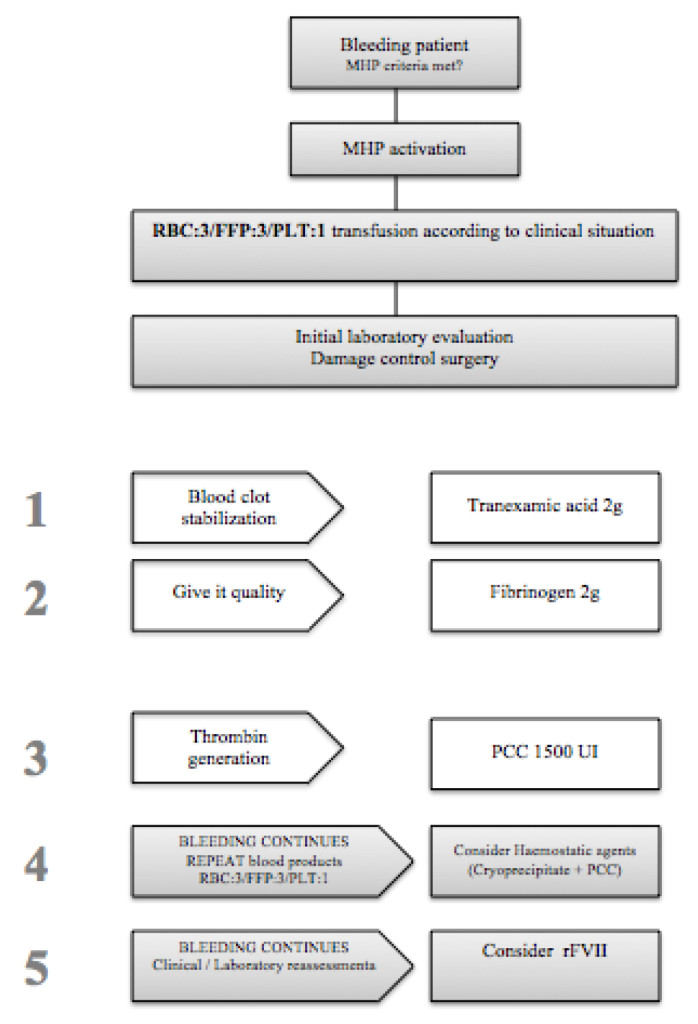
CST2018-117-MaryE.WoodUSA_Figure11

CST2018-117-MaryE.WoodUSA_Figure12

CST2018-117-MaryE.WoodUSA_Figure13

CST2018-117-MaryE.WoodUSA_Figure14

CST2018-117-MaryE.WoodUSA_Figure15

CST2018-117-MaryE.WoodUSA_Figure16

CST2018-117-MaryE.WoodUSA_Figure17

CST2018-117-MaryE.WoodUSA_Figure18

CST2018-117-MaryE.WoodUSA_Figure19

CST2018-117-MaryE.WoodUSA_Figure20

CST2018-117-MaryE.WoodUSA_Figure21

CST2018-117-MaryE.WoodUSA_Figure23

CST2018-117-MaryE.WoodUSA_Figure22

CST2018-117-MaryE.WoodUSA_Figure24

CST2018-117-MaryE.WoodUSA_Figure25

CST2018-117-MaryE.WoodUSA_Figure26

CST2018-117-MaryE.WoodUSA_Figure27

Single versus Double Chest Tube Drainage after Thoracotomy for Cancer

DOI: 10.31038/CST.2018342

Abstract

Background

After pulmonary lobectomy, two chest tubes are traditionally placed: an apical tube for air evacuation and a diaphragmatic tube for fluid drainage. This study investigates whether one apical chest tube is as effective as two chest tubes after lobectomy.

Methods

Between July 2008 and November 2009, 40 consecutive patients with lung cancer underwent thoracotomy and lobectomy. The initial 20 patients had two chest tubes placed while the latter 20 patients had a single chest tube. All 40 patients had epidural catheters placed.

Results

The groups were similar in demographics, comorbidities, lobe resected, and lung pathology. Length of stay, chest tube days, and chest tube drainage were less in the single tube group; however, they did not achieve statistical significance. Similarly, post-operative airleak and residual pneumothorax after tube removal were not significantly different but were less in the single tube group. While the post-operative day to oral pain control was similar in the single and double chest tube groups, postoperative pain as assessed by the VAS pain scale was lower in the single tube group each of the first four PODs with the difference achieving significance on postoperative days 3 (3.6 ± 0.5 versus 5.9 ± 0.5) and 4 (3.2 ± 0.6 versus 5.4 ± 0.6).

Conclusion

Single apical chest tube drainage after thoracotomy for lobectomy is as effective as apical and diaphragmatic double tube drainage. Single tube drainage improves patient’s postoperative comfort and may result in less chest tube drainage, fewer chest tube days, and a shorter hospital stay.

Introduction

The classic mantra in thoracic surgery has always included the use of two chest tubes after pulmonary lobectomy. One chest tube is placed in the apex of the chest for air drainage while the other is placed along the diaphragm for fluid drainage [1]. Recently there have been reports, are randomized, substituting the double chest tube approach for a single chest tube after surgery [2–5].

The theoretical advantage of a single chest tube would be less drainage and subsequently earlier chest tube removal as well as decreased pain. Reducing post-operative pain can allow patients to ambulate earlier, which can avoid complications such as pneumonia and deep vein thrombosis. It also encourages the use of incentive spirometry and pulmonary toilet [6]. All of these advantages can lead to shorter hospital stay and decreased cost. Of course, there are potential disadvantages to using a single tube. Due to inadequate drainage of either air or fluid, there is the potential for having a residual pneumothorax or a loculated fluid collection after tube removal.

This study includes patients undergoing thoracotomy for lobectomy with mediastinal lymph node dissection who have a diagnosis of cancer. The aim of the study is to identify if single chest tube placement will result in less chest tube drainage, decreased overall pain, and subsequently shorter hospital stays.

Methods

Setting

Karmanos Cancer Institute/Detroit Medical Center is a large academic, tertiary care center affiliated with Wayne State University School of Medicine. It is located in Detroit, Michigan and has a wide referral base from southeastern Michigan.

Patients

We obtained IRB approval: HIC#035410MP4E, protocol #1003008149. In a retrospective fashion, we identified 40 consecutive patients from July 1, 2008 through November 30, 2009 who had a diagnosis of lung cancer and subsequently underwent a standard posteriolateral thoracotomy and lobectomy with mediastinal lymph node dissection by a single surgeon after IRB approval. None of these patients had preoperative chemotherapy or radiation treatment. The first 20 patients had a straight #32 French chest tube (Covidien, Mansfield, MA) as well as a curved #28 French chest tube placed after lobectomy. The second 20 patients had a single straight apical #32 French tube placed. All patients were adults. Preoperatively, all 40 patients had epidural catheters placed for post-operative pain control. These catheters remained in place for 72 hours along with a Foley catheter which was placed after the induction of anesthesia. Preoperative antibiotics were also given approximately one hour prior to skin incision.

Data Collection

Medical records including inpatient charts, electronic medical records, operative reports, laboratory data, and radiographic data and images were reviewed for all 40 patients in a retrospective manner. Data was collected on demographics, associated comorbidities, stage of lung cancer, side of tumor and pre-operative Pulmonary Function Tests (PFTs). We also collected outcome data including total chest tube output, total chest tube days, days of chest tube airleak, total hospital stay, and complications. Post-operative pain information gathered included days to oral pain control and patient reported pain based on the Visual Analogue Scale (VAS) pain scale from 1–10 as collected from a similar pool of nurses. Scores were collected every six hours prior to any bolus pain medication.

Definitions

Comorbidities were defined based on previous diagnosis by primary care physicians. Complications were defined as follows. Smoking was defined as greater than 15 pack-years with the average in our patients being 30 pack-years and the maximum 75. Prolonged airleaks were defined as airleaks lasting longer than 7 days. Residual pneumothorax was defined as a pneumothorax seen on upright chest X-ray after chest tube removal. Pneumonia was defined as either positive sputum cultures or changes on X-ray with appropriate patient symptoms and elevated WBC count. Arrhythmias were recorded when they required treatment. Chest tube management was similar in all patients. Patients were on suction until there was no evidence of airleak with cough or Valsalva. Removal was based on output of less than 200cc per day (currently we use less than 400cc per day).

Data Analysis

Data was entered into a Microsoft Excel spreadsheet for analysis. Categorical variables were compared using chi-square or Fisher’s exact test where appropriate while continuous variables were compared using the Student t-test with Bonferroni correction when using multiple comparisons. All statistical tests were 2-tailed and a p value of <0.05 was considered statistically significant.

Results

Patient demographics were identified in our 40 patients and are shown in table 1. There was a predominance of female patients (82%) and white patients (75%), though they were similar in both the single and double chest tube groups. The average age was approximately 65 in both groups with the single chest tube groups having slightly more patients greater than 70 years of age (7 vs 4). Comorbid conditions such as hypertension, diabetes mellitus, Chronic Obstructive Pulmonary Disease (COPD), Coronary Artery Disease (CAD), and a previous diagnosis of cancer were also similar in both groups. While there were slightly more smokers in the double chest tube group (16 vs 19), this was not statistically significant.

Table 1. Preoperative Characteristics.

Single tube

Double tube

p value

Age

65.4 ± 9.8

65.0 ± 10.0

NS

Sex (M:F)

3:17

3:17

NS

Resection

Upper

10

10

NS

Middle

1

1

NS

Lower

8

8

NS

Bilobe

1

1

NS

Tumor Side

NS

Right

13

14

NS

Left

7

6

NS

Associated disease (#)

COPD

3

5

NS

CAD

7

7

NS

Smoker

16

19

NS

PFT (%)

FEV1

81.7 ± 18.0

80.3 ± 16.9

NS

FVC

87.4 ± 22.1

88.4 ± 10.5

NS

DLCO

65.6 ± 12.2

68.3 ± 19.0

NS

The pre-operative stage of the cancer showed that all patients were either stage I or II while the post-operative stage was similar except that one patient in the single group and two patients in the double group were identified as stage III due to positive mediastinal nodes that were not identified on preoperative scanning. Our lymph node dissections typically yield around 10 lymph nodes. The tumors were predominantly right-sided (65% single chest tube and 70% double chest tube) and mostly in the upper followed by lower lobes. All patients had pre-operative pulmonary function test including a FEV-1, FVC, and DLCO which were similar in both groups.

Outcomes measured are shown in Table 2. Days of chest tube airleak (2.2 ± 0.7 vs. 2.9 ± 0.7), total chest tube drainage (1971 ± 170 mL vs. 2201 ± 231 mL), and total chest tube days (5.9 ± 0.5 vs. 6.9 ± 0.6) were all less in the single chest tube group versus the double chest tube group. Still, statistical significance was not achieved. Overall patient length of stay was similar (7.8 ± 0.8 vs. 7.9 ± 0.7). In terms of complications, arrhythmias, chyle leaks, and pneumonias were similar. Though prolonged airleak and residual pneumothorax after tube removal were not significantly different, they occurred less in the single versus the double tube group (1 vs. 3 and 0 vs. 2 patients, respectively).

Table 2. Comparison of postoperative characteristics, complications, and pain scores.

Variable

Single tube

Double tube

p value

Days of airleak

2.2 ± 0.7

2.9 ± 0.7

0.450

Chest tube days

5.9 ± 0.5

6.9 ± 0.6

0.238

Total chest tube drainage (mL)

1971 ± 170

2202 ± 231

0.418

Length of stay (days)

7.8 ± 0.8

7.9 ± 0.7

0.920

Prolonged airleak

1

3

0.343

Arrythmia

4

2

0.410

Chyle leak

1

0

1.000

Pneumonia

2

3

0.663

Residual airspace

0

2

0.487

Days to oral pain control

3.9 ± 0.3

4.4 ± 0.2

0.164

VAS score

POD 1

6.2 ± 0.6

7.0 ± 0.6

0.400

POD 2

5.4 ± 0.7

6.7 ± 0.4

0.112

POD 3

3.6 ± 0.5

5.9 ± 0.5

0.009

POD 4

3.2 ± 0.6

5.4 ± 0.6

0.013

Total days to oral pain control again showed a similar pattern with fewer days in the single group (3.9 ± 0.3 vs. 4.4 ± 0.2) but again, statistical significance was not achieved. We then assessed postoperative pain using the VAS pain scale. This analysis showed that on Post-Operative Day (POD) 1 and 2 there was less pain in the single group (6.2 vs. 7.0 and 5.4 vs. 6.7) that was not significant. However, on POD 3 and 4 this pattern achieved significance with the single tube group reporting less pain than the double group (3.6 vs. 5.9 and 3.2 vs. 5.4, p<0.02 for each).

Discussion

Double chest tube placement has been the standard in thoracic surgery with one tube placed anterior and apical while the other is placed posterior and basal for fluid drainage. The timing of removing these tubes has more recently been challenged. For example, an output as high has 450 mL/day has been shown to be safe for removal of chest tubes after pulmonary resections [7]. Thus, total chest tube output may not be a useful outcome measure in light of this study. Still, it would be expected that two chest tubes would have more drainage than a single chest tube. Given the high absorptive capacity of the pleura and the lack of complications after early tube removal it is likely that a single tube will suffice in this regard. In fact, continued drainage may simply add to fluid loss that may not be beneficial.

Air leak is another factor that may keep chest tubes in longer than anticipated. We used underwater suction for the first day post-operatively and then as needed based on the presence of an airleak. Suction has the theoretical advantage of promoting lung expansion. Suction via a single tube has been shown to deliver equivalent intrapleural pressure as suction through dual chest tubes [8]. However, suction or waterseal has been shown to be equivalent in terms of post-operative airleak after thoracotomy [9]. Certainly being attached to wall suction limits your ability to ambulate.

Further study has been done looking specifically at the type of tube used. In our study, we used the standard rigid 32 French chest tubes. Others have shown that using more flexible Blake (Ethicon, Somerville, NJ) tubes are equivalent in terms of patient outcome [10] and using these tubes may further increase patient comfort. Further, small tubes such as 24 or 28 French are often used. However, 32 French tubes were used in both groups so no bias was introduced.

Alex et al. first used single chest tubes and found no difference in post-operative outcomes but reported overall less pain in the single tube group [4]. It is not clear in this study if all patients underwent mediastinal lymph node dissection. Another European group showed no difference in outcomes and reported less analgesia use in the single group 2 though this group included patients with sleeve resections and chest wall resections in addition to lobectomy. Two years later it was shown that a single chest tube reduces hospital costs due to a shorter hospital stay as compared to using two chest tubes [5]. Most recently, Okur et al. compared single and double chest tubes in terms of pain scale though their group was not limited to cancer pathologies [3]. Further, this study excluded patients if the surgeon expected increased postoperative output.

Interestingly, these studies all reported their total chest tube drainage to be less than typically seen at our institution leading us to investigate our patient population. This difference could be the result of stapling devices used or a particular sealant used in the operating room. To the author’s knowledge, this is the first North American-based study that compares single versus double chest tube placement in patient undergoing thoracotomy for lobectomy and mediastinal lymph node dissection for a diagnosis of cancer. The inclusion of a lymph node dissection has the possibility of resulting in more post-operative drainage. Further, limiting our study to patients with cancer pathologies avoids the variables patients with infectious or traumatic pathologies add.

Pain has been reported as a major issue among patients with chest tubes after surgery [11]. In fact, reduced pain is one of the advantages cited by those who advocate thoracoscopic lung resection [12]. Respiratory rehabilitation with incentive spirometry and ambulation is important in any postoperative patient including those with chest surgery [6]. This can help control sputum secretion and potentially avoid respiratory complications in the early post-operative period [13]. Therefore, keeping patients comfortable is an important part to their post-thoracotomy recovery [14]. We used epidural catheters placed prior to surgery and removed early on post-operative day three. This plus the use of a single chest tube allowed patients to experience much less pain which should lead to fewer complications.

The VAS pain scale was used in this study to assess the degree of pain experienced by each patient. Of course, pain is a very subjective finding though its importance cannot be overstated. This method is one of the most common ways to assess pain in a hospital setting [15,16]. This scale ranges from 1 (no pain) to a 10 (worst pain) and patients are asked to report a number as they see fit. This is not a perfect method to assess pain since it is subjective and does not take into account the quality of the pain 7. Still, using this method we were able to show that after epidural catheter removal, pain was reported to be less in patients with one chest tube than with two after similar operations.

Single chest tube placement after pulmonary lobectomy for cancer is as effective as double tube placement in terms of chest tube days, total chest tube output, complications after surgery, and total hospital stay. Pain, however, is reported to be less intense if a single chest tube is used which could potentially result in earlier ambulation and fewer complications. While this study only incorporates twenty patients treated similarly in each arm, a larger study may show single chest tube use to be superior. Still, perceived pain is clearly less with a single chest tube. Given these data we recommend single chest tube use on all thoracotomies for cancer unless specific circumstances dictate otherwise.

Acknowledgement

Christopher Gayer did the chart review and analyzed the data.

Frank Baciewicz was the senior author and oversaw the project.

Abbreviations

CAD: Coronary Artery Disease -Disease of coronary arteries to heart resulting from arthrosclerosis

COPD: Chronic Obstructive Pulmonary Disease – Chronic disease of lungs leading to decreased function

PFT: Pulmonary Function Test – Tests done to assess pulmonary function pre-operatively

POD: Post-Operative Day – Days after operation

VAS: Visual Analogue Scale – A patient-reported pain scale from 1–10

References

  1. Khan IH, Vaughan R (1999) A national survey of thoracic surgical practice in the UK Int J Clin Pract 53: 252–256. [crossref]
  2. Gomez-Caro A, Roca MJ, Torres J (2006) Successful use of a single chest drain postlobectomy instead of two classical drains: a randomized study. Eur J Cardiothorac Surg 29: 562–566.
  3. Okur E, Baysungur V, Tezel C, Sevilgen G, Ergene G, et al. (2009) Comparison of the single or double chest tube applications after pulmonary lobectomies. Eur J Cardiothorac Surg 35: 32–35. [crossref]
  4. Alex J, Ansari J, Bahalkar P (2003) Comparison of the immediate postoperative outcome of using the conventional two drains versus a single drain after lobectomy. Ann Thorac Surg 76: 1046–1049.
  5. Pawelczyk K, Marciniak M, Kacprzak G (2007) One or two drains after lobectomy? A comparison of both methods in the immediate postoperative period. Thorac Cardiovasc Surg 55: 313–316.
  6. Ochroch EA1, Gottschalk A (2005) Impact of acute pain and its management for thoracic surgical patients. Thorac Surg Clin 15: 105–121. [crossref]
  7. Cerfolio RJ, Bryant AS (2008) Results of a prospective algorithm to remove chest tubes after pulmonary resection with high output. J Thorac Cardiovasc Surg 135: 269–273.
  8. Brunelli A, Cassivi SD, Fibla J, et al. Pleural pressure immediately after pulmonary lobectomy: single versus double chest tubes for suction. J Thorac Cardiovasc Surg; 140: 52–53.
  9. Alphonso N, Tan C, Utley M (2005) A prospective randomized controlled trial of suction versus non-suction to the under-water seal drains following lung resection. Eur J Cardiothorac Surg 27: 391–394.
  10. Icard P, Chautard J, Zhang X, Juanico M, Bichi S, et al. (2006) A single 24F Blake drain after wedge resection or lobectomy: a study on 100 consecutive cases Eur J Cardiothorac Surg 30: 649–651. [crossref]
  11. Shalli S, Saeed D, Fukamachi K, Gillinov AM, Cohn WE, et al. (2009) Chest tube selection in cardiac and thoracic surgery: a survey of chest tube-related complications and their management. J Card Surg 24: 503–509. [crossref]
  12. Nicastri DG, Wisnivesky JP, Litle VR, et al. (2008) Thoracoscopic lobectomy: report on safety, discharge independence, pain, and chemotherapy tolerance. J Thorac Cardiovasc Surg 135: 642–647.
  13. Bonde P, McManus K, McAnespie M, McGuigan J (2002) Lung surgery: identifying the subgroup at risk for sputum retention. Eur J Cardiothorac Surg 22: 18–22. [crossref]
  14. Savage C, McQuitty C, Wang D, Zwischenberger JB (2002) Postthoracotomy pain management. Chest Surg Clin N Am 12: 251–263. [crossref]
  15. Scott J, Huskisson EC (1976) Graphic representation of pain. Pain 2: 175–184. [crossref]
  16. DeLoach LJ, Higgins MS, Caplan AB, et al. (1998) The visual analog scale in the immediate postoperative period: intrasubject variability and correlation with a numeric scale. Anesth Analg 86: 102–106.