Archives

fig 1

Ordinary People Thinking about What Emotional Issues Obesity Might Trigger: A Mind Genomics Cartography

DOI: 10.31038/EDMJ.2022613

Abstract

107 respondents each evaluated 60 unique vignettes (combinations of two, three or four messages), dealing with descriptions of how a person with obesity might feel. The respondent rated each vignette on degree to which the vignette would provoke a feeling of ‘cannot deal with it’ (viz., strong anxiety). Deconstruction of the responses to the full set of 36 messages on a respondent-respondent basis revealed that two specific messages provoked the highest degree of anxiety; you believe that the food industry will work to help you find the right foods to eat and you just can’t control the eating. Substantial differences emerged for age, and for the location where anxiety might be experienced (e.g., while listening to music.). Clustering the 107 respondents into mind-sets, groups with different points of view, revealed three radically different group, based on the elements which drive anxiety: MS1 – Anxiety about acceptance by others; MS 2 – Anxiety when thinking about professional help; MS3 – Anxiety about helplessness and being out of control.

Introduction

As the technology of agriculture and food production has become increasingly sophisticated, and the retailing of food has become embedded in our society, people have gained weight. Today, 2022, obesity) is considered a major health problem, both in developed and developing countries. We eat more than we need. The medical literature on obesity is rivaled by the popular literature, both dealing with the need to lose weight, the former for health reasons, the latter for social reasons.

Although obesity is moving into the realm of ‘disease’, rather than something about which one should feel shame, being overweight, fat, and so forth calls into play the confluence of emotions and health. Those who are fat feel inadequate because they fail to live up to society’s norms, even though increasing number of people can be classified as obese, many morbidly so.

The ‘literature’ about obesity divides into at least two areas, obesity in terms of medical issues, and obesity in terms of the personal/emotional/behavioral issues. Furthermore, the literature of obesity encompasses scholarly work of a scientific nature and an almost uncountable amount of information coming from the popular press. People are interested in how they look, how they feel, and often subscribe to various diets, fad and otherwise, to lose weight.

Most of the published studies about the mind of the obese person work with obese individuals, using directed interviews and group discussions on how they feel, looking at how these individuals respond on standardized scales of emotion all with the goal to understand the difference between the emotional responses of obese individuals and those of normal-weight individuals. For example, working with seven very obese women [1] used a ‘religious-history’ questionnaire. The questionnaire was content-analyzed, revealing feelings of helplessness and powerless, strong guilt feelings, and craving for love.

In a more directed study, but still one requiring the respondents to find language for their emotions [2] instructed adolescents to imagine eating each of 30 different foods, and to report their feelings. In this study the respondents used their own terms the focus, however, was not so much on the emotions themselves as it was on the differences between the normal weight and obese respondents in their emotions.

As one focuses in on emotions as a critical factor, it is easy to recognize the link between emotions and eating, especially when one deals with obesity. The key is to formalize that link, to understand it. A study [3] emphasized the variable nature of the emotion, recognizing that individual differences both in the food and in the emotions precipitating eating should be studied.

Our focus in this paper is on the ‘mind’ of the ordinary person when they think of obesity. If a person were obese, or were to think about being obese, how would the person feel about the ordinary aspects of daily life? What would bother them if they were obese, or at least what do they think would bother them? The approach taken in this paper comes from the world of consumer research, with the goal of understanding the mind of the consumer. If the person were to look at a description of a situation, that situation involving an obese person, how would the person, respondent, react? Would the respondent be indifferent? Or would the respondent feel a sense of anxiety, and panic?

Perhaps the paper which comes most close to the Mind Genomics efforts is [4]. In a qualitative study dealing with how people experience their own obesity, they described the impact of obesity on their self-identity using language such as “ugly”, “freak”, “hate”, “blob”, and “disgust” which reflected the pervasively negative impact of their weight…. Participants described the multitude of ways being obese impacted upon their self-identity and their lives in general. In particular they described how it had influenced their mood, their self-perception, a feeling of dissociation, and their health.”

As will be shown in the results section, the approach, Mind Genomics, applied to the emotions surrounding presumed obesity shows dramatic ways of thinking which pertain to everyday life. The ability to segment individuals into mind-sets, a hallmark feature of Mind Genomics, further provides a new approach to how people think about the obese individual, more from the vantage of everyday life than from the usual clinical perspective.

The Mind Genomics Approach

Mind Genomics evolved from a mixing of experimental psychology, statistics, and consumer research. The author has discussed the origins of Mind Genomics in a retrospective on more than a half a century of psychology research [5]. The three fields reflect different, complementary efforts to understand the world.

Psychophysics

Experimental psychology, and more specifically psychophysics, lies at the base of Mind Genomics. Rather than understanding the phenomena from the point of view of individual discussion, as the clinician might do, experimental psychology seeks to understand by varying antecedent conditions in a controlled fashion, measuring the response, determining the pattern of co-variation, and indeed at some level the pattern of causation. The key word is ‘experimentation,’ viz., the systematic alteration of conditions, measuring the reactions, and defining the underlying pattern. The contribution of psychophysics, the branch of experimental psychology best associated with Mind Genomics, is the desire to create a descriptive equation that can be used, respectively, to describe and to predict.

Statistics (Experimental Design, Regression Modeling and Clustering)

The actual stimuli in Mind Genomics studies are phrases which paint a word picture, these phrases combined in a systematic way, according to an underlying structure. Experimental design defines this systematic way. Experimental design is a branch of statistics which specifies certain combinations to be tested, with the design ensuring that the contribution of each component in the design can be individually estimated. Beyond the experimental design is the use of regression modeling to discover the linkage between the rating assign to the vignette (response) and the independent variable, viz., the stimuli tested (the individual elements that were combined in the vignettes in the vignettes).

Consumer Research

Consumer researchers generally work with meaningful test stimuli, rather than with stimuli artificial simplified and modified. Consumer researchers do not generally work with test situations isolating every variable but one, and modifying that variable. Such an approach is left to researchers who are working on theory, to validate or to disprove a theory. Consequently, the test stimuli used by Mind Genomics are words (or pictures), couched in ordinary consumer language, generally independent of theory. The goal for consumer researchers is often to understand how the consumer responds to stimuli which are meaningful in everyday life. Following that approach, the studies in Mind Genomics use phrases which paint word pictures that a normal person can understand without much effort.

Illustrating the Process with the Study on Obesity

Twenty years ago, around the beginning this 21st century, the author and colleagues implemented a long-discussed vision, viz., to create a database of the human mind, in terms of the way people make decisions. The goal was to move away from the artificial environment created by psychology experiments, these experiments design to confirm or disconfirm the theory (so-called hypothetico-deductive system). Rather than doing experiments within the confines of a theory, the idea was to study the way people reacted to information about a topic, doing so in a way which would create a database of the mind. The approach, Mind Genomics, emerged not from experimentation with people in a situation, but rather from studying the response of people to sets of messages [6,7].

The It! Studies were motivated by the development of an off-the-shelf version of Mind Genomics, then called ‘IdeaMap®’. The initial studies with IdeaMap® dealt with one-off issues, generally related to consumer goods. It was the recognition that one could generate a ‘signature’ of a product, in the language of consumers, which motivated the extension of IdeaMap®, first into the experience of buying products in stores, and then into the experience of anxiety provoked by common, realistic issues facing people. These studies have continued, and during the last twenty years the number of studies has increased dramatically. Topics ranged from the composition of products [8] to shopping for these products in the midst of the Covid-19 epidemic [9].

Moving beyond single studies to creating a database of the mind constituted the next step in the evolution of Mind Genomics. Rather than doing ‘one-off’ studies in different areas, the vision was to do a set of related studies, with the studies having the same underlying structure. The first set of related studies, funded by the McCormick & Company researcher department, was Crave It! The goal was to understand what aspects of food make us ‘crave’ the food. Shortly after there were sets of parallel studies on beverages (Drink If!), good for you foods (Healthy You), and the shopping experience for different household- products (Buy It!).

In 2003 the notion of expanding The It! studies to issues of anxiety emerged out of discussion among a group of researchers, viz., the author and colleagues [10,11]. The colleagues, Jacquelyn Beckley and Hollis Ashman of the Understanding and Insight Group in New Jersey drafted the first study, with its structure shown in Table 1 for obesity. Once the study had been constructed, it was straightforward to expand the topics to 14 other topics dealing with anxiety-provoking situations. Figure 1 shows the 15 studies, all ‘launched’ at the same time. The structure of the studies was maintained as much as possible, although as noted below, some of the elements had to be modified to accord with the study topic.

The remainder of this paper presents the study on obesity, was part of a set of 15 parallel studies called ‘Deal With It!’. We begin with the steps followed to set up the study, and move into a deep analysis of the results.

Table 1: The elements for the obesity ‘Deal With It!! Study. The left side shows the rationale for the element, the right side shows the specific language for the obesity study
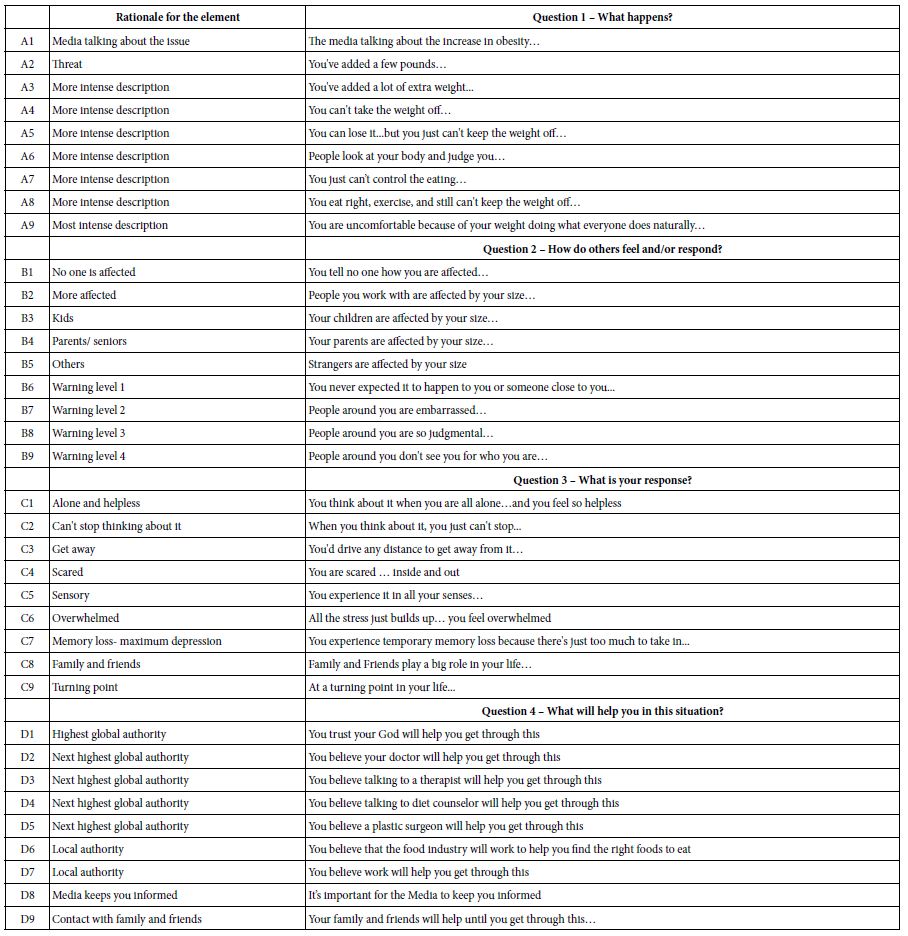

table 1


fig 1

Figure 1: The 15 Deal with It! studies on a wall. The respondent chose the study she/he found interesting, and participated in that study

Step 1: Create the Elements to Describe One’s Personal Experience

The four sets of questions and nature of the answers were set up ahead of time. The structure on the left side of Table 1 was maintained for all 15 Deal With It! studies. The elements A1-A9, B1-B9, and some of the elements in Question 4 were different across the studies, to accord with the topic. The spirit of the answers were the same, but the specifics had to be modified to make sense. For the nine elements in Question C, the elements were far more similar to each other across studies, because there was no need to particularize the element to the topic.

The rationale for the elements was to make the language ‘vernacular,’ viz., informal. The motivation was to move away from a formal, possibly off-putting clinical presentation, and instead make the language informal, almost ‘folksy.’

Step 2: Create Vignettes – Mix Together Elements According to an Experimental Design

Mind Genomics differs profoundly in the way it measures the response to ideas, the messages shown in Table 1. Mind Genomics combines these messages in a systematized way to create vignettes, small, easy to read combinations of the messages. To the ordinary eye the combinations seen ‘haphazard,’ with the term ‘randomly put together’ often used to describe the 60 different combinations that would be evaluated by a single respondent. To that respondent, the combinations do seem random, but nothing could be further from the truth. The combinations are set up so that each combination or ‘’vignette’ comprises a minimum of two elements, a maximum of four elements, with all elements appearing an equal number of times across the 60 vignettes. Furthermore the 36 elements are statistically independent of each other, allowing the researcher to use programs like OLS (ordinary least-squares) regression to estimate how each element drives the ‘rating’ that the respondent is instructed to assign, after reading the vignette.

A further feature of the experimental design is that each respondent evaluates a unique set of 60 vignettes or combinations, so only in rare occasions do two respondents ever evaluate the same vignette. This novel approach, the so-called ‘permuted design’, acts metaphorically like the MRI, magnetic resonance imaging. With the MRI, the camera takes many X ray pictures of the underlying tissue, doing so from different angles, and afterwards combines them by computer to extract a 3-dimensional picture from a set of two-dimensional x-rays. Metaphorically, each respondent represents a different ‘angle’. The result is a deeper, more detailed view of the topic, because across the 107 respondents whose data are analyzed here, each respondent evaluating 60 different vignettes, we end up with 6420 different vignettes evaluated by the respondent. There is no need to ‘know the best combinations’ at the start of the study because the experimental design ensures that the researcher will sample a great deal of the underlying set of combinations [12].

It is important to emphasize that it is impossible to ‘game’ the Mind Genomics system. With a set of 60 vignettes, even the most dedicated effort will fail to uncover the pattern. As a consequence, the respondents stop trying to outwit the system, stop trying to give the ‘right answer’. Rather, they settle into an almost bored state, where they see something and they respond, pressing a key on the 9-point scale. As soon as the respondent pressed the rating scale the vignette disappeared, to be replaced by the next vignette. The rating scale, however, remained.

The instructions to the respondent were presented at the start of the study, the study executed on the computer. Figure 2 shows the standardized instructions, used for all 15 studies. The only thing which changed was the name of the study.

fig 2

Figure 2: The orientation page, showing the topic (black rectangle), the rating scale, the expected length of time, and the reassurance that all vignettes are different

The actual vignettes were presented one at a time. As soon as the respondent assigned a rating the next vignette appeared. The 9-point rating scaling was always present on the screen, or at least appeared so as the on-line ‘experiment’ proceeded. In actuality, each vignette was totally new. The vignette comprised the elements at the top (in centered format, but without connectives). At the bottom of the screen was the refreshed rating scale.

By 2003, the year of the study, people were already accustomed to doing surveys on the Internet. The interview was described as a ‘survey’ rather than the more correct description, ‘experiment.’ The rationale was that the term ‘experiment’ might be off-putting and frightening.

The actual vignettes are described as situation screens, to which the respondents are asked to judge how she or he would react. No effort was made to measure the degree to which the respondent felt that the screen actually described them. That is, the respondent was treated as a disinterested judge, evaluating a situation or a scenario. In this way the appearance of an objective evaluation was maintained, even though the only criteria used by the respondent were her or his own point of view.

Finally, it is important to note that the introduction for each of the 15 studies was exactly the same, except for the topic. Thus, the top of the page welcomes the respondent, and gives the name of the study), where the black rectangle appears. For the obesity study the word was ‘obesity.’ The respondents are further told how long to expect the ‘survey’ to take (15-20 minutes), and that all the vignettes (screens) are different. This reassurance that ‘no screen is exactly repeated’ comes from the experience of respondents saying that they were sure they saw repeat screens, which of course they could not by virtue of the underlying experimental design.

Analysis

The Mind Genomics ‘process’ begins by transforming the ratings, bifurcating the original 9-Point Likert Scale into two regions. The rationale for this is that most users of the data end up asking ‘what does a certain value mean?’ This question can be asked of the original scale values (e.g., what does a rating of 8 mean on the scale), or it can be asked of the average rating across groups. Most peoples, including professionals, really do not understand the meanings of the different scale points. As a consequence of the widespread failure to understand what scale values really mean in everyday life, consumer researchers as well as public opinion pollsters have moved away from using Likert value data in reporting to using percentages, making their presentations easier to understand.

Following the aforementioned issues eventuated in Mind Genomics dividing the 9-point scale, almost arbitrarily, into ratings 1-6, coded 0, and ratings 7-9 coded 100. A vanishingly small random number is added to each of the transformed numbers, so that the binary ratings exhibit some random variation. That random variation will be necessary to avoid statistical issues when we deal with the individual-level modeling (viz., fitting equations to the data). The random variation will be so small, however, that there will be no effect on the data, other than avoiding the problem of having no variation in the ratings (viz., when a respondent assigns all vignettes either ratings 1-6, or ratings 7-9, which end up producing all 0’s or all 100’s as transformed values). The subsequent regression analysis cannot then be ‘run,’ and the analysis ‘crashes.’

The second step in Mind Genomics analysis creates an individual-level equation relating the presence/absence of the 36 elements to the binary response, 0/100, respectively. The aforementioned addition of the random variation to the transformed variable ensures that the regression analysis will always deal with data for which the dependent variable has ‘variation. The regression analysis is estimated using OLS (ordinary least squares) regression, a standard statistical analysis procedure. The regression generates the following equation: Binary Response = k0 + k1 (A1) + k2 (A2)… k36 (D9).

The data from all respondents generate a database. A total of 120 respondents participated. The data from 13 respondents were eliminated because their responses showed no variation at all. That is, all their ratings from 60 vignettes lay either between 1 and 6 (transformed to 0), or 7-9 (transformed to 100). Little can be learned from their reaction. This left 107 respondents who clearly discriminated among the elements, in terms of some elements driving anxiety, and the other elements not driving anxiety.

Summarizing the Data in an Easier Format

The aforementioned binary response equation generates a set of coefficients which show the likelihood that the specific element would drive a positive anxiety response, manifested by the rating 7-9 (‘cannot deal with it’, in the vernacular language of the rating scale). Negative coefficients mean that the element does not drive anxiety. Negative coefficients do not mean, however, that the element reduces anxiety. Quite the contrary. Negative coefficients simply mean that the element does not drive anxiety. The element may do absolutely nothing, or may reduce anxiety. We do not know. Our focus will be solely on the positive coefficients.

In the light of the meaning of the coefficient, our final transform is done on the coefficients themselves. All estimated coefficients for the 36 elements for each respondent, viz., k1-k36, were themselves rescaled. Coefficients of 8 or higher, corresponding to ‘cannot deal with it’ were transformed to 100. Coefficients of 7. 99 or lower, including 0 and negative coefficients, corresponding to elements which do not drive strong anxiety, were transformed to 0. The choice of ‘8’ as the cutoff comes from analyses of the regression modeling, which suggests that coefficients of 8 or higher are ‘statistically significant’, viz., the t statistic approaches 2.0. Furthermore, with coefficients of 8 (or more typically 10) or higher, one begins to see external behavior which confirms that the element or message is relevant for behavior.

Table 2 shows an example of the 36 elements, (columns 1, 2), the coefficient emerging from the regression model (column 3), and the transformed coefficient (column 4). When we look at the data from total panel and key subgroups, this rescaling of coefficients will provide us with easy-to-understand averages, showing which elements drive anxiety and which do not.

Table 2: Example of the 36 estimated coefficients for two respondents (A, B, columns 3 and 4), their transformed value (columns 5 and 6). Coefficients of +8 or higher were transformed to 100. Coefficients lower than +8, whether positive, zero, or negative, were transformed to 0
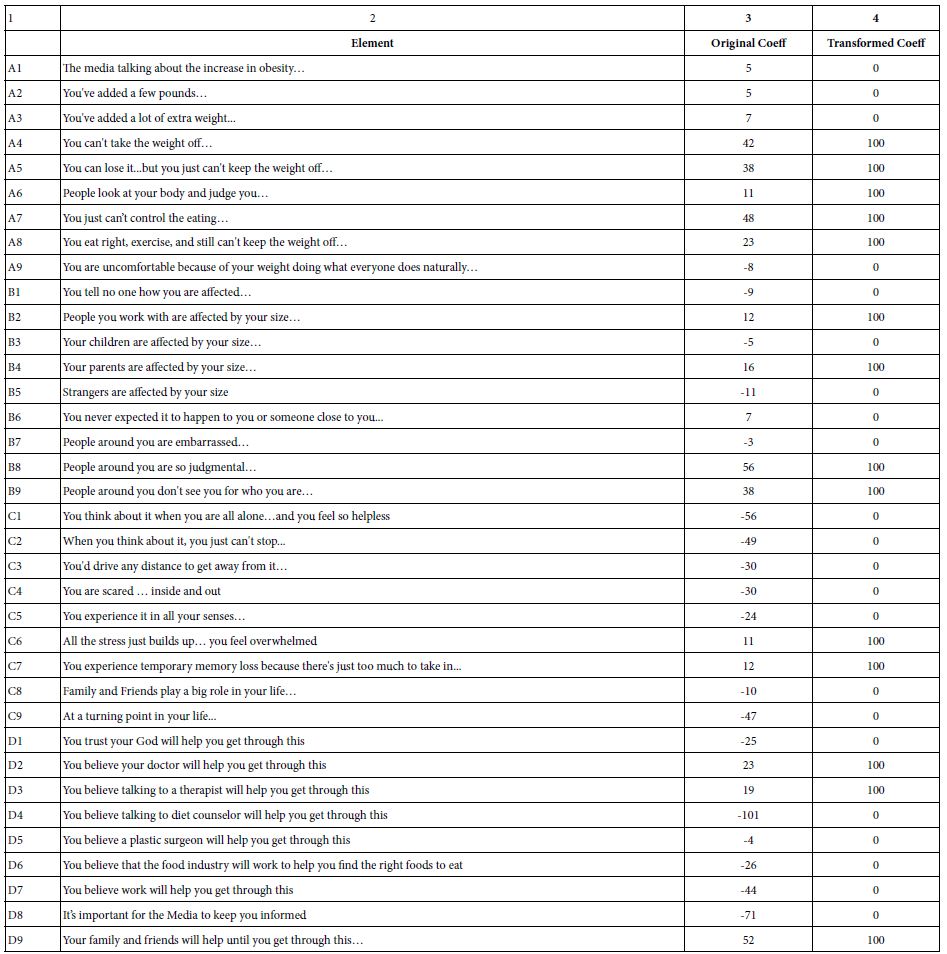
table 2

What Drives Anxiety When Reading Vignettes about Obesity – Total Panel

Our first analysis (Table 3) presents the summary results for the total panel. The elements appear in column 1, with the element prefaced by an ‘X’ to remind us that the coefficients are transformed at the individual respondent level. Recall that a coefficient less than 8 is transformed to 0 at the level of the individual respondent, whereas a coefficient 8 or higher is transformed to 100.

Table 3: Average ‘transformed’ coefficients for the 36 elements. The transform replaced coefficients +8 or higher by 100, and coefficients less than +8 by 0. Note that the re-coded elements are prefaced by the letter X to signal the recoding the numbers represent the proportion of respondents who felt that they ‘could not deal’ with this situation described by the element, the proportion obtained by averaging the transformed coefficients
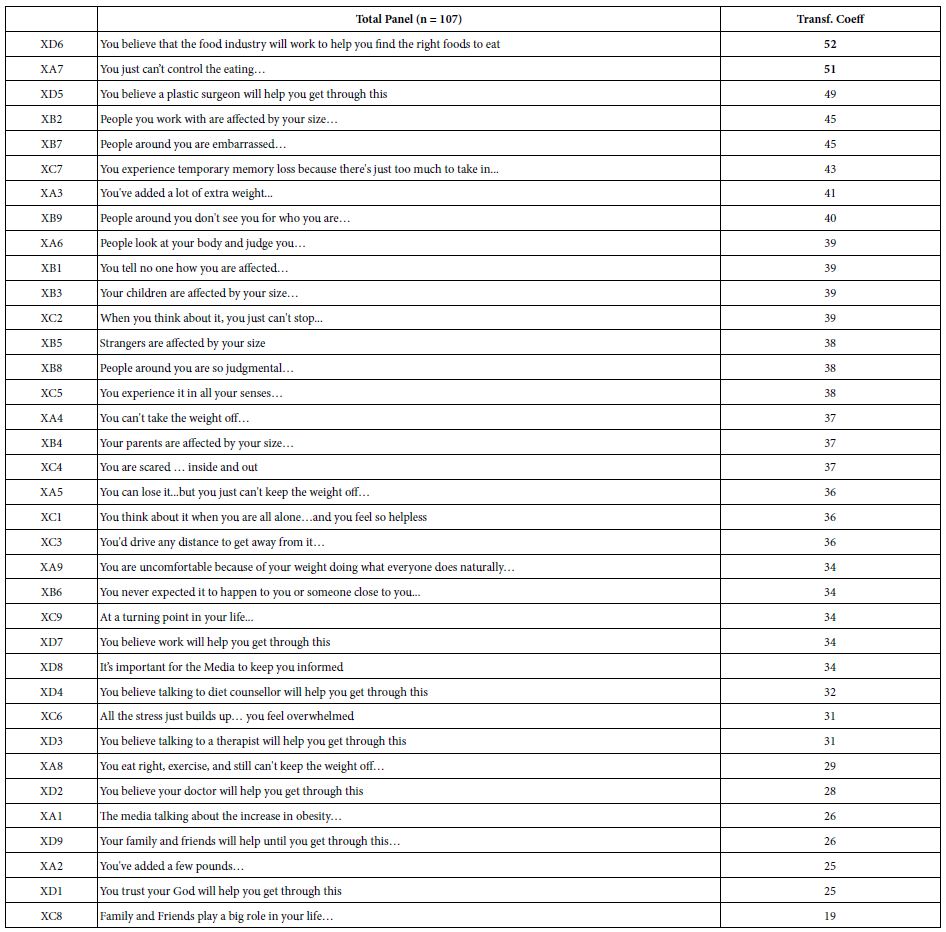
table 3

When we sort the 36 elements by the transformed coefficients, we see that 52% of the respondents will respond ‘I can’t deal with this’ when they are confronted with the statement that ‘You believe that the food industry will work to help you find the right foods to eat.’ Even though the phrase is stated in the positive, viz., that the food industry will help, the reality is that this statement is a negative. Slightly more than half of the respondents generate coefficients of +8 or higher.

Right below the panicked response to the stated ‘positive behavior of the food industry’ (!) are the statements ‘You just can’t control the eating…’ and ‘You believe a plastic surgeon will get you through this.’

It is important to reiterate that in a Mind Genomics study it is virtually impossible to ‘game’ the system. The elements are presented in different combinations, and each respondent evaluates what turns out to be most different combinations from everyone. Furthermore, the call on memory is so great that in these studies the respondents simply stop trying to be consistent, stop trying to outguess the researcher, and simply answer in a way that they feel is random, even though it is far from random. Thus the reactions we see in Table 3 represent the true feelings of the respondents, at least in 2003.

Delving Inside the Mind

After the respondent had completed the evaluation of the 60 vignettes, the respondent completed an extensive questionnaire about who the respondent was (gender, age, where live, income), the daily frequency that the respondent thought about ‘obesity’ (without any further explanation), how the respondent felt (select an emotion), where the respondent thought about the topic of obesity, and how the respondent was coping with the thought of obesity.

The next tables present partial, illustrative data, for several of these classification questions. Only data from subgroups of 10 or more respondents are shown, in the interest of both stability and cogency of analysis. The reality of a Mind Genomics study is the production of potentially hundred, sometimes thousands of data points. We present only strong coefficients, averages of 50 or higher. These are the elements to which at least 50% of the respondents react as driving an anxiety reaction (viz., rating of 7-9, cannot deal with it).

Time of Day When the Respondent Participated

The first classification question required the respondent to select the time of day that the respondent participated. The answers were presented as two-hour slots. The respondent selected the appropriate two-hour slot. The times were recoded to one of four periods during the day. The results are shown in Table 4.

Each cell in Table 4 tells us whether the element (row) covaries with anxiety (column), for at least 50% of the respondents. Empty cells in Table 4 correspond to elements and times wherein the average ‘transformed coefficient’ is less than 50.

Furthermore, in light of the 36 possible elements (rows), and the four times of day (columns), it is instructive to able to look at the elements from strongest to weakest as a driver of anxiety, and, in turn, look at the time of day as a driver of anxiety. Thus was born the strategy to sum up all the transformed coefficients (really sums of averages of transformed coefficients). Table 4 shows a row called ‘row sum’, and a column called ‘column sum’. These sums tell us which elements are the strongest across times of day (row sum), and which time of day is strongest across elements (column sum). We sort the table by row sum and column sum, presenting the data in descending order for both element (row sum), and for time of day (column sum).

Table 4: Average ‘transformed’ coefficients for the 36 elements, showing only strong performing elements for respondents based on the time of day in which they participated
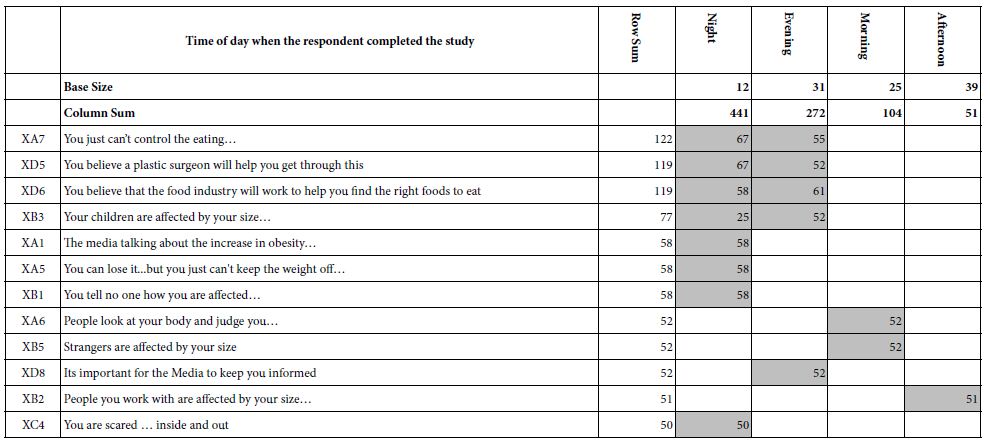
table 4

The sorting reveals that night, with a column sum of 441, is the most frequently selected period for an anxiety attack. The row sums suggest two elements are most anxiety producing across time of day: You just can’t control the eating; you believe a plastic surgeon will help you get through this; you believe that the food industry will work to help you find the right foods to eat.

Presenting the data in this transformed fashion (coefficients transformed to 0/100 and average), and creating/sorting by ‘sum’ produces a simple, clear picture of the relation between obesity (the topic), time of day, and type of message which creates anxiety. We create almost a 3-dimensional sense of the mind with respect to the topic, with the elements providing a rich, evocative language which provokes the reaction. Respondents simply need to participate in the study.

Frequency of Thinking about Obesity

Table 5 shows the strong performing elements for those who think frequently about obesity (5x or more per day), versus those who report that they think less frequently about obesity (0-4x per day). Keep in mind that these the numbers in Table 5 are average coefficients, and that only elements with coefficients of 50 or higher are shown.

Table 5: Average ‘transformed’ coefficients for the 36 elements, showing only strong performing elements for respondents based on the daily frequency of thinking about obesity

table 5

Those who think frequently about obesity respond most strong to the messages of plastic surgery (average transformed coefficient of 59, viz, 59% of the 49 respondents are responsive to this element). The other elements are the food industry, and the inability to control one’s eating. For those who think less frequently about obesity, the anxiety drivers are the food industry, and the lack of control.

Who the Respondent is – Age

Moving the analysis to age (Table 6, again only for samples of 10+ respondents suggests that control is again a factor, but only for those age 41-60. For the younger respondents, ages 31-40, there are no elements which drive anxiety. For the older respondents, ages 41-60, control is again important. The two older age groups differ. Those age 41-50 respond to control. Those aged 51-60 respond to the mention of the plastic surgeon and the food industry, respectively. Furthermore, those aged 51-60 appear to be more attuned to themselves, and their behavior, acknowledging the fear.

Table 6: Average ‘transformed’ coefficients for the 36 elements, showing only strong performing elements for respondents based on 10-year age groups. Only respondent groups with at least 10 respondents in the group are shown
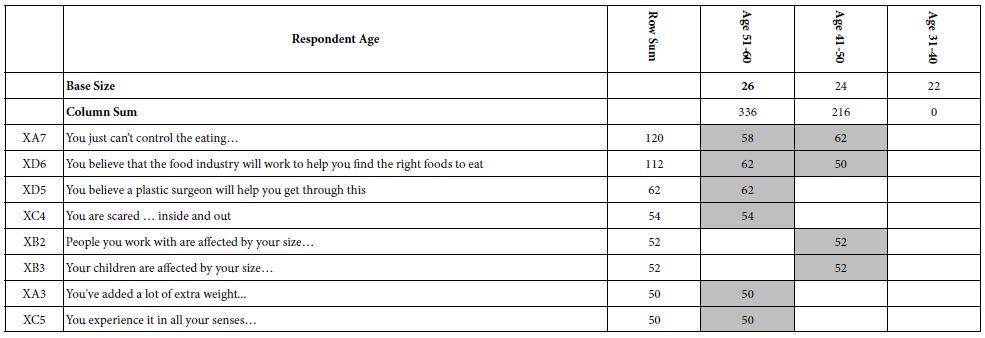
table 6

Who the Respondent is – Neighborhood

Researchers often think about issues of ‘geo-location’ as a key aspect to understand a person. Many studies ask the respondent to identify the city and state, or in some cases even ‘country’.’ The It! studies looked at location, but more in terms of the ‘neighborhood’ where the respondent lives, rather than the actual location.

When we perform this new analysis, with transformed coefficients we find that those respondents who say they live in ‘large suburban neighborhoods within city limits’ are the ones with the greatest anxiety, manifesting itself in the strong reaction to the elements. Table 7 shows the strong performing elements, this time cutting off the elements at 53 to make the table easier to read. There were a number of elements around 50, but the pattern did not ‘tell a story,’ and so they are omitted from the table.

Table 7: Average ‘transformed’ coefficients, showing only strong performing elements for respondents based on the type of neighborhood where the respondent lives
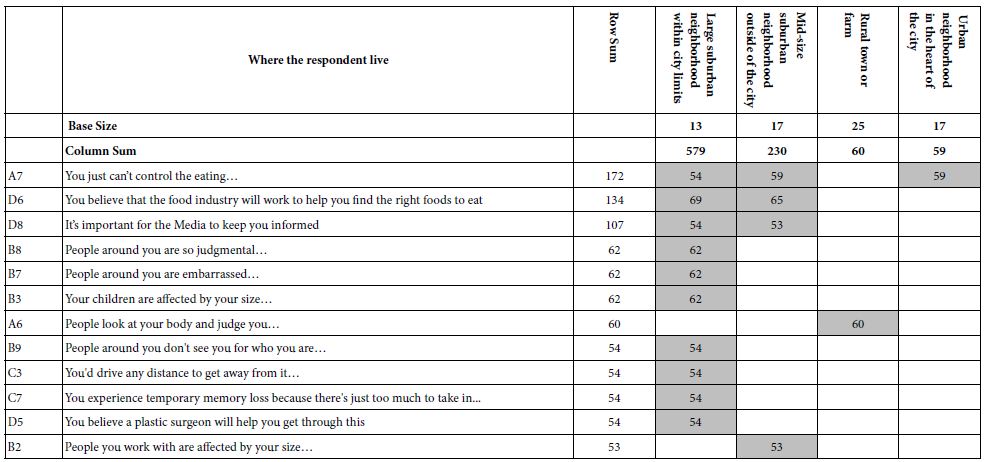
table 7

Emotion Experienced at the End of the Evaluation

As part of the classification, the respondent was instructed to select up to three emotions experienced at the end of the evaluation. These were not emotions necessarily linked with the vignettes, but simply the selection of overall emotions after the evaluation of the 60 vignettes. Again, only emotions selected by 10 or more respondent were analyzed.

Table 8 shows the seven most frequently selected emotions, some positive, some negative. A surprising pattern emerges. The strong emotions (top left) emerge when the respondent selects the term ‘optimistic’ (sum = 463) and when the respondent selects the term ‘relaxed’ (sum = 452). The lowest sum of transformed elements occurs when the respondent selects the term ‘depressed’ (sum = 62).

Table 8: Average ‘transformed’ coefficients for the 36 elements, showing only strong performing elements for respondents based on the emotion selected by the respondent to how she or he felt at the end of the evaluation. The elements are sort by sums of strong performing elements
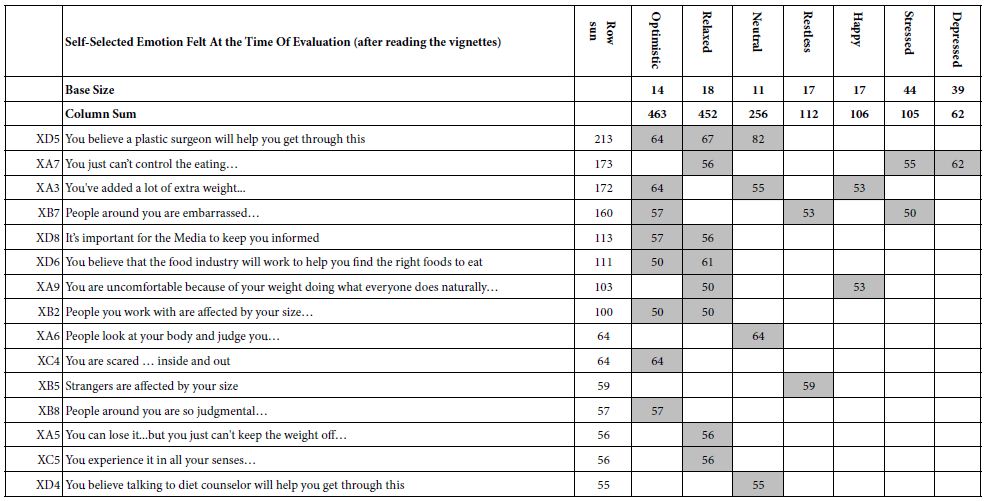
table 8

The strongest performing elements are those found on top. These are

You believe a plastic surgeon will help you get through this

You just can’t control the eating.

You’ve added a lot of extra weight.

People around you are embarrassed.

The only new element to appear is B7 (people around you are embarrassed). This element drives anxiety for three different types of respondents; optimistic, restless, and stressed, respectively. This element may be anomalous.

Location Where Anxiety is Experienced

The respondent was given a set of venues and instructed to identify up to three venues where the anxiety was experienced. Table 9 shows the most frequently selected with ‘at home’ being far and away the most frequent. Yet, in terms of the degree of anxiety, shown by the transformed coefficients, it was the more relaxed situations which covered with the greatest level of anxiety, such as listening to music, or talking with friend.

Table 9: Average ‘transformed’ coefficients for the 36 elements, showing only strong performing elements for respondents based on the self-profiling classification question dealing with the venue where anxiety was experienced. The elements are sorted by the sum of the strong performing elements
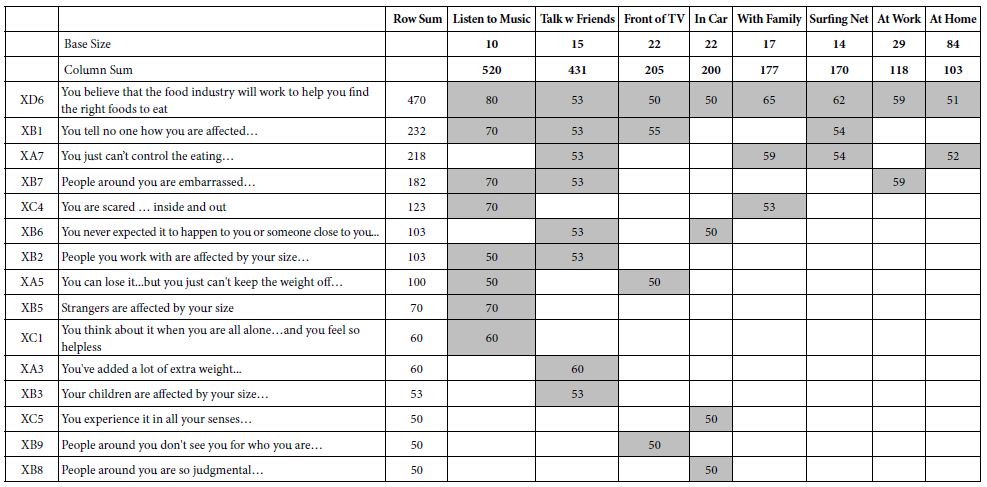
table 9

Finally, two other results deserve a short mention;

Those who said that they experienced the anxiety at home were most responsive to controlling their eating.

The pattern of strong performing elements once again shows the unexpectedly strong anxiety with regard to the food industry.

How Respondent Say They Cope with Their Anxiety

The final ‘major’ question on the self-classification portion, after the evaluation, was the presentation of different ways that a person could cope with anxiety. Each method of coping was separately rated on a 4-point scale, from 4=frequent to 1=never. For each method of coping, the analysis looked only at the respondents who rated that coping ‘4’ or ‘3’. Some method of coping (e.g., drinking alcohol) had very few respondents who said they hoped that way.

Table 10 shows the most frequent methods of coping, once again arranged in order of the sums of the coefficients of 50 or higher. The most surprising result is the ability of thinking about the food industry and obesity to cause a strong anxiety reaction.

Table 10: Average ‘transformed’ coefficients for the 36 elements, showing only strong performing elements for respondents based on the way the respondent states she or he copes with anxiety
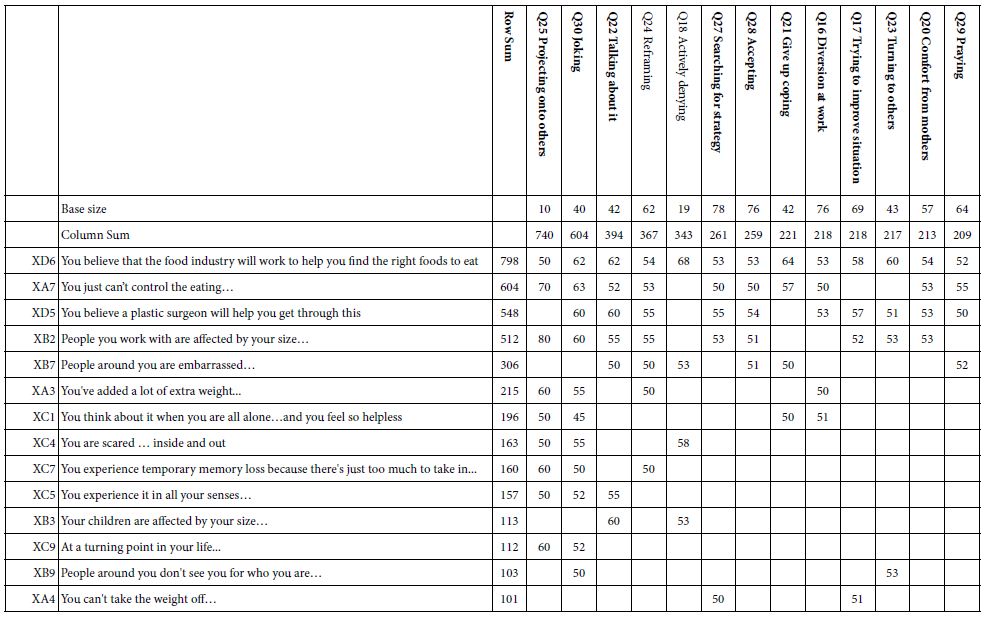
table 10

Uncovering Mind-sets

A hallmark of Mind Genomics is the ability to uncover different mind-sets in the population, these mind-sets defined by how they respond to the test stimuli. Rather than dividing people by who they say they are, or what they say they do, or even dividing them by what they do, Mind Genomics divides them by the patterns of how they think about specific topics, such as obesity.

Each of the 107 respondents generated an individual vector of 36 coefficients. The pattern of coefficients in a sense tells us how the respondent ‘thinks’ about the topic, obesity, or at least how the respondent reacts after reading these vignettes, and what specific elements drive anxiety (viz., cannot deal with it).

Statisticians use cluster analysis to divide groups of objects into mutually exclusive and exhaustive sets, based upon the pattern of these objects. We have 107 respondents, our ‘objects.’ The patterns emerge from the vectors of 36 elements. The method of k-means cluster analysis places objects, viz our 107 respondents, into a limited set of non-overlapping groups Individuals with different looking patterns are put into different groups. There are many different ways to cluster respondents the method used here is called k-means [13]. With k-means clustering, respondents with similar patterns of 36 coefficients sre put into the same cluster (or mind-set, in the language of Mind Genomics).

K-Means uses a measure of distance between pairs of people, based upon the 36 coefficients. That measure is the value (1-Pearson Correlation). The Pearson Correlation tells us the strength of the linear relation between two objects, based upon two sets of corresponding measures, one for each object. When the relation between the two sets of 36 (non-transformed) coefficient is perfectly the Pearson correlation if +1 and the distance is 0 (1-1 = 0). When the relation is inverse, the Pearson correlation is -1, and the distance is 2 (1 – – 1 = 2).

When we apply the clustering approach to the coefficients, extracting either two mind-sets or three mind-sets the results become startling. Table 11 shows the strong performing elements. This time, however, it becomes far easier to label the mind=sets. Keep in mind that the clustering is done with the goal of extracting as few mind-sets as possible (parsimony), and the mind-sets telling a coherent story (interpretability).

Table 11: Average ‘transformed’ coefficients for the 36 elements, showing only strong performing elements for respondents. The respondents are assigned to one of two clusters (mind-sets, MS21, MS22) or separately one of three clusters (mind-sets, MS31, MS32, and MS33) based on k-means clustering
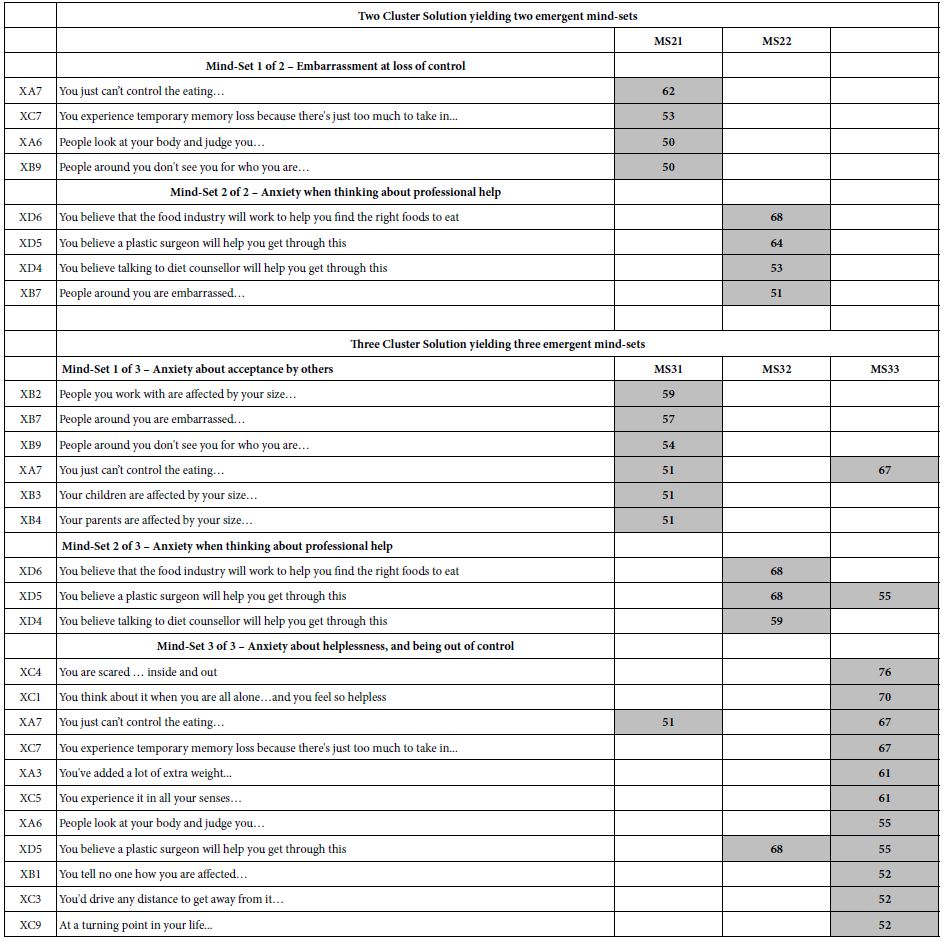
table 11

Conclusion

The focus of this paper has been on the response of people instructed to think about their responses if they found themselves to be obese. That is, the spirit of the paper is to understand how people think an obese person might react to different messages. Like the other 14 studies in the Deal It! series, the Obesity project was done with the general population, who were instructed to think about their responses if they suddenly found themselves in the situation of being obese.

The project was done with the general population. A minimum of information was obtained about the respondent, information relevant to who the respondent IS (geo-demos), and how the respondent might react in terms of the nature of the anxiety. No effort was made to measure the actual degree of obesity. The measurement of one’s BMI, had it been taken, could have been used as another way to classify the respondent, with the analyses then looking at low vs normal vs high BMI.

It is important to note that the structure of investigation in this paper follows the approach that consumer researchers use to evaluate the response to product ideas or product concepts. The idea or concept is explained to the respondent, either alone in a paragraph, or with a picture. The respondent, having read the idea and taking from the description a ‘sense’ of the product (or service), is then questioned about the reactions to the product, the expected benefits, expected problems, usage patterns, and even economic aspects such as the expected dollar value of the product.

Mind Genomics studies typically show differences among groups, these groups being defined by who the respondent is, and so forth. The largest differences, and indeed the most important ones, emerge out of the clustering of respondents into different groups, mind-sets, based upon the pattern of their responses to the test stimuli. The data presented here confirms the continuing finding that it is mind-sets, differences in the way people respondent to the same information, which produce the most meaningful results. Although there are some striking differences between groups in terms of the elements which drive strong anxiety reactions (viz., can’t deal with it, ratings of 7-9), the strongest and clearest differences emerge when we create heretofore unexpected groups of respondents using clustering procedures. The groups are remarkably different and easy to describe.

The important outcome of this first effort is a new ability to get a sense of how people feel, not so much from what they say as from the pattern of reactions to messages. By presenting the respondents with the vignettes, by estimating the individual-level coefficients, and then by transforming these coefficients into a binary form, we are afforded a quick way to understand what the sensitivity points are. The keys are the unexpected but anxiety-driving force of mentioning the food industry and the issue of self-control. These may have been obvious, but the Mind Genomics approach provides a degree of quantification, and the ability to put elements into the proper perspective based upon their performance in different groups

As a methodological advancement in understanding the way people respond to external stimuli (messages), Mind Genomics may provide a new direction. Hitherto, much of the work was based on clinical analyses, and tests of differences between obese and non-obese. Mind Genomics may well help create a new focus, namely how obese vs. non-obese react to the vernacular world, the world of everyday language and easy to understand ideas. In turn, this focus may energize new ways to teach the science of being healthy [14].

References

  1. Hockley RE (1979) Toward an understanding of the obese person. J Relig Health 18:120-131. [crossref]
  2. Barthomeuf L, Droit-Volet S and Rousset S (2009) Obesity and emotions: differentiation in emotions felt towards food between obese, overweight, and normal-weight adolescents. Food Qual Prefer 20: 62-68. [crossref]
  3. Ganley RM (1989) Emotion and eating in obesity: A review of the literature. Int J Eat Disord 8: 343-361. [crossref]
  4. Ogden J and Clementi C (2010) “The experience of being obese and the many consequences of stigma”. J Obes. [crossref]
  5. Moskowitz HR (2022) The perfect is simply not good enough: Fifty years of innovating in the world of traditional foods. Food Control 138:109626. [crossref]
  6. Moskowitz HR (2012) ‘Mind genomics’: The experimental, inductive science of the ordinary, and its application to aspects of food and feeding. Physiol Behav 107: 606-613. [crossref]
  7. Moskowitz HR, Gofman A, Beckley J and Ashman H (2006(a)). Founding a new science: Mind Genomics. J Sens Stud 21: 266-307. [crossref]
  8. Porretta S (2021) The changed paradigm of consumer science: from focus group to mind genomics. In Consumer-based New Product Development for the Food Industry. R Soc Chem. Pp: 21-39. [crossref]
  9. Harizi A, Trebicka B, Tartaraj A and Moskowitz H (2020) A mind genomics cartography of shopping behavior for food products during the COVID-19 pandemic. Eur J Med Nat Sci 4: 25-33. [crossref]
  10. Moskowitz MR, Ashman H, Minkus-McKenna D, Rabino S & Beckley JH (2006(b)) Databasing the shopper’s mind: approaches to a ‘mind genomics’. J Database Mark Cust Strategy Manag 13: 144-155.
  11. Rabino S, Moskowitz H, Katz R, Maier A, Paulus K, Aarts P, Beckley J, Ashman H (2007). Creating databases from cross‐national comparisons of food mind‐ J Sens Stud 22: 550-586. [crossref]
  12. Gofman A and Moskowitz H (2010) Isomorphic permuted experimental designs and their application in conjoint analysis. J Sens Stud 25: 127-145. [crossref]
  13. Likas A, Vlassis N and Verbeek JJ (2003) The global k-means clustering algorithm. Pattern Recognit 36: 451-461. [crossref]
  14. Losavio J and Gollub E (2022) Application of mindsets to health education and behavior change Programs. Health 14: 407-417. [crossref]
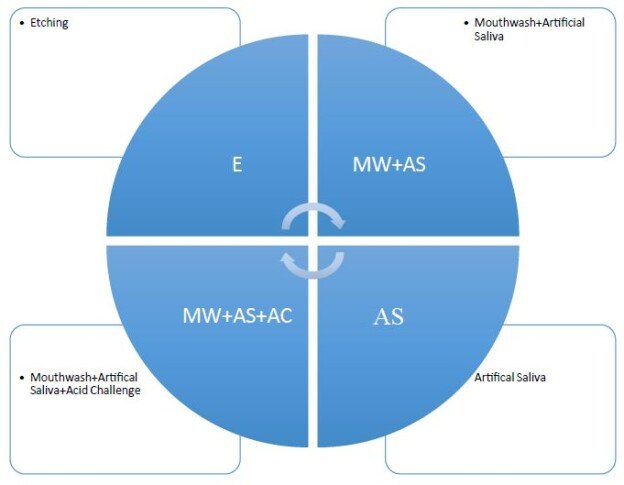
fig 3

The In vitro Effectiveness of Oxalate Based Desensitizing Products on Tubular Occlusion

DOI: 10.31038/JDMR.2022522

Abstract

Introduction: Dentine hypersensitivity (DH) is one of the most common clinically encountered conditions globally, affecting up to 74%. It has been described as a short, sharp pain resulting from changes in the fluid flow of exposed dentinal tubules, in response to physical and chemical stimuli.

Objective: To compare the effectiveness of oxalate containing desensitizing products in reducing both dentine permeability and tubular occlusion vs. a control product using a recognized in vitro model.

Methods: Three oxalate containing products were tested (Listerine® Advanced Defence Sensitive [LADS] mouth rinse, a 3% oxalate solution and an oxalate containing herbal toothpaste), vs. an artificial saliva control. The permeability of the acid-etched dentine discs was measured by hydraulic conductance (Lp). Dentine discs were examined using scanning electron microscopy and energy dispersive X-ray spectroscopy. After establishing the baseline permeability of the acid-etched dentine discs, discs (n=4) were randomly treated with the desensitizing products together with the addition of artificial saliva for 2 mins, followed by rinsing with distilled water (60 s). Permeability was measured at 30 s intervals for a total of 150 s. The occluded discs were acid challenged to assess tubular occlusion stability following the application of both the test and control products.

Results: The oxalate containing desensitizing products in combination with artificial saliva significantly occluded the dentinal tubules by up to 65%, in comparison to the artificial saliva control that occluded ≤21% of the dentinal tubules. The occlusion associated with the oxalate containing desensitizing agents was substantially more stable in resisting an acid challenge compared to the control as determined by hydraulic conductance. Furthermore, the SEM images of the oxalate containing desensitising agents and control were consistent with the hydraulic conductance data. Of interest was that the oxalate containing herbal toothpaste deposited more precipitation on the surface than inside the tubules. The EDX analysis confirmed the presence of oxalates, calcium, and other ingredients of toothpaste. The results from the present study are in broad agreement with those of a previous study in that an oxalate containing mouth rinse provided a more stable tubular occlusion which was more resistant to an acid challenge compared to the other test products.

Conclusion: Oxalate containing desensitizing agents were significantly more effective in occluding the dentinal tubules vs. an artificial saliva control. These results are of clinical significance as they demonstrate that oxalate containing desensitizing agents provide both significant and stable tubular occlusion of the open dentinal tubules following an acidic challenge.

Keywords

Oxalate based desensitizing products, Dentine hypersensitivity, Tubular occlusion, Hydraulic conductance

Introduction

Oxalate is a dianion with several derivatives including salts of oxalic acid, calcium oxalate, sodium oxalate and potassium oxalate and occurs naturally in plants, rhubarb, parsley, spinach, and cocoa. 2-3% potassium oxalate in the form of professionally applied products gels, sealants and whitening strips have become a widely accepted form of treatment for Dentine Hypersensitivity (DH) by practitioners in the USA [1-3]. The incorporation of oxalate products into dental products was based on in vitro studies that reported the dentine discs treated with oxalates showed significantly reduced hydraulic conductance [4- 7]. Other studies have been conducted both in vitro [8-12] and in vivo [13-17] using various oxalate products, with mixed results. However, most of the in vitro studies reported that oxalate products interacted with the exposed dentine tubules to form precipitates of calcium and phosphate, which in turn reduced hydraulic conductance through tubule occlusion. A systematic review comparing data achieved from studies on humans with DH, evaluating oxalate interventions vs. a placebo, concluded that a 3 monohydrogen-monopotassium oxalate treatment was effective against DH [18]. However, it was evident from this review that several studies did not provide a direct comparison between oxalate containing products and a suitable placebo. The mechanism of action of oxalates is not conclusive although, there is some evidence that promotes the theory of oxalate reacting with free calcium ions of saliva or dentine to form calcium oxalate crystals inside and on the surface of dentine tubules [19]. This reaction provides a sealing effect, occluding the tubules to reduce fluid flow within the dentinal tubules, and thus reducing DH. However, it has been shown that the effects of oxalate crystals diminish over time due to the removal of calcium oxalate by brushing or dietary acids [14,15]. Conversely, studies have shown that this can be improved by initially acid etching the dentine, to enhance the penetration of calcium oxalate crystals further within the tubules [20].

Recently, a novel desensitising mouthwash containing 1.4% potassium oxalate (Listerine Advanced Defence Sensitive) was produced as an improved form of delivery for desensitising products [21]. A randomised clinical trial evaluated the efficacy of this product compared to a positive control  (Sensodyne  Original  containing  5% potassium nitrate) and a negative control (Crest toothpaste containing sodium fluoride) over a 4-week period [22]. These investigators reported that the positive control significantly reduced DH compared to the negative control and in turn, the potassium oxalate containing mouthwash significantly reduced DH compared with the negative control. Sharma et al. [23] also demonstrated that multiple in vitro applications of potassium oxalate containing mouth rinses sequentially reduced hydraulic conductance of dentine. The question whether using oxalates in the form of mouth rinses, gels etc., as a long-term solution for treating DH, however, lacks supporting evidence since very few well controlled studies have been conducted. The present study aims to 1) evaluate the effectiveness of selected oxalate based desensitising products, in reducing fluid flow through dentine by tubular occlusion and 2) determine whether oxalates are more effective as a mouthwash or a toothpaste when immersed in artificial saliva.

Aim

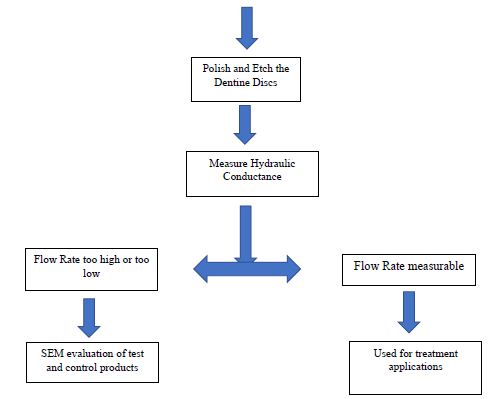
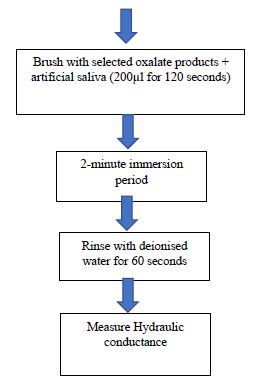
The aim of the present study therefore, was to evaluate the ability of oxalate based desensitising products to occlude dentinal tubules and reduce dentine hypersensitivity (DH) by 1) measuring hydraulic conductance and fluid flow within the dentinal tubules using dentine discs following different treatments, 2) demonstrating occlusion of the dentinal tubules openings on the dentine disc sections using Scanning Electron Microscopy and 3) comparing the selected oxalate based desensitising products with other controlled or placebo products (Figures 1 and 2).

fig 1

Figure 1: Flow criteria for the selection of dentine discs

fig 2

Figure 2: Flow chart steps used to measure hydraulic conductance following treatment with different oxalate based desensitising products and artificial saliva

Material and Methods

Materials

Oxalate Base Desensitising Products

Three commonly used oxalate based desensitising products and one controlled product tested in this study are as follow

  1. Listerine advanced defence sensitive mouthwash
  2. Herbal toothpaste containing oxalates
  3. 3 % oxalic acid solution
  4. Artificial saliva as control

Methods

Preparation of Dentine Discs

  1. Cutting of dentine discs. Dentine discs were prepared from 29 extracted human molars and premolars teeth obtained from Royal London Dental Hospital, London after approval from the local Ethics Board/IRB (QMREC2011/99). The teeth were stored in sodium hypochlorite solution. A Struers Accutom-5 diamond cutting  was  used to cut the dentine discs. The teeth were moulded with impression compound (Kerr’s impression compound) and  placed  in  the  holder of the machine to make sure they were stable in the holder and in a direction perpendicular to the cutting  diamond  blade.  The  teeth were cut in mesio-distal directions to obtain dentine discs of 900 µm thickness. Discs from the mid coronal section of the crown with no visible defects were selected and stored in a 3 % ethanol solution.
  2. Sanding and Polishing of Discs. The selected discs were sand blasted on both sides with silicon carbide paper (Buehler-Met) of P1000 and P 2500 grit The discs were then polished using a polishing machine (Kemet 300L lapping Machine) to reduce the thickness of the discs and remove the smear layer. A micrometre gauge was used to measure the final thickness of the discs which were stored in ethanol for future use.

Preparation of Artificial saliva

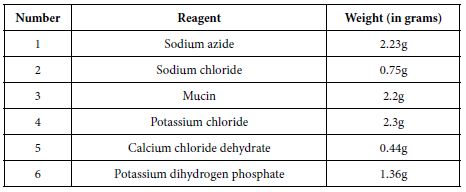
All reagents were weighed in quantities as shown above (Table 1) on a digital weighing machine and were dissolved separately in small amount of deionised water (approximately 20 ml water per reagent) in clean beakers. 400 ml deionised water was boiled in a clean kettle, 400 ml room temperature deionised water was added into it to reduce the temperature, and overall, 800 ml mixed deionised water was placed on magnetic stirrer (Stuart SB 162-3 Hot plate stirrer). Reagents were dissolved separately and added one by one in small quantities until they mixed completely. Deionised water was added to make a 1 L solution and the pH of the artificial saliva was measured to be 5.5 using a pH meter (Oakten 11 series PH meter), the pH was adjusted to a pH of 6.5 by adding 0.5 M potassium hydroxide drop by drop and stored in a fridge at temperature of 2°C.

During the cutting of the dentine discs, a smear layer was created. To remove this smear layer and open the tubules, the discs were etched with a 6% citric acid solution for 180 seconds and then rinsed with deionised water for 60 seconds.

Table 1: Reagents used in the preparation of artificial saliva

table 1

Hydraulic Conductance

To obtain initial baseline values each disc was acid etched as indicated above and placed in a Pashley chamber sequentially and the flow rate of each disc was recorded using a modified hydraulic conductance machine (based on the original device by Pashley and co-workers) [4,6]. 27 discs were prepared from 29 human molar   and premolar teeth and 25 were  subsequently  deemed  suitable  after measuring the baseline fluid flow rates. Initially the hydraulic conductance system was examined to ensure that it was bubble free before introducing an air bubble via a syringe and the movement of the air bubble was measured at a 30 second interval for a period of 150 seconds (2.5 minutes).

The following criterion was used to select the dentine discs for SEM evaluation and Hydraulic conductance.

After measuring the baseline flow rates, 20 discs were suitable for treatment with the selected desensitising agents and five discs were also selected for SEM to assess the tubular occlusion following application of the products.

The following criteria were used to measure hydraulic conductance:

  • Twenty discs were used (with four discs per treatment group [n=5]) to determine the flow rate in dentinal tubules.
  • The discs remained in a Pashley cell during the measurements to ensure that the disc orientation was the same to prevent any changes in the fluid flow rate. An electric toothbrush (Oral B toothbrush) was used to brush the discs with the selected treatments.
  • The discs were then placed in 6% citric acid for 90 seconds to simulate an acid challenge, then rinsed with deionised water for 30 seconds prior to remeasuring the fluid flow rate to determine the impact of an acid challenge.

SEM Evaluation of the Dentine Discs

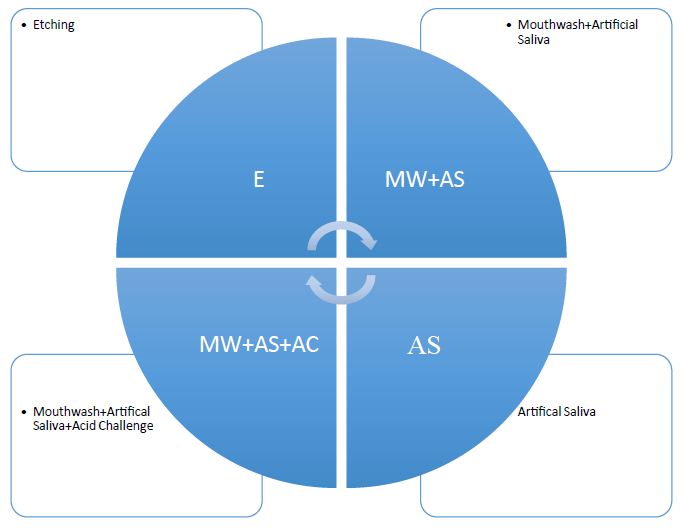
Initially, four discs were prepared for Scanning Electron microscopy to evaluate the occlusion of dentinal tubules due to the oxalate based desensitising products and control. The discs were sectioned into four parts using orthodontic pliers and the test and control treatments were applied as indicated (Figure 3).

fig 3

Figure 3: Sectioned dentine discs with the test and control products

EDX was also performed to analyse the elemental composition following the oxalate-based test and control treatments.

Statistical Analysis

The following formula and statistical tests were used to analyse the hydraulic conductance measurements.

Average Percentage Permeability Reduction for each Desensitising Agent

The average permeability reduction for each disc for a particular desensitising agent and control was measured and calculated using the formula below:

formula

Results

Hydraulic Conductance Results

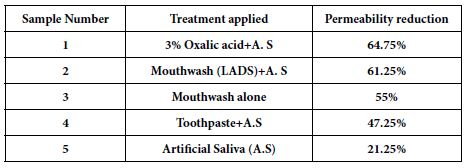
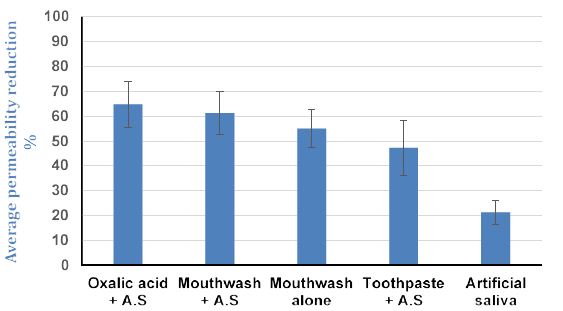
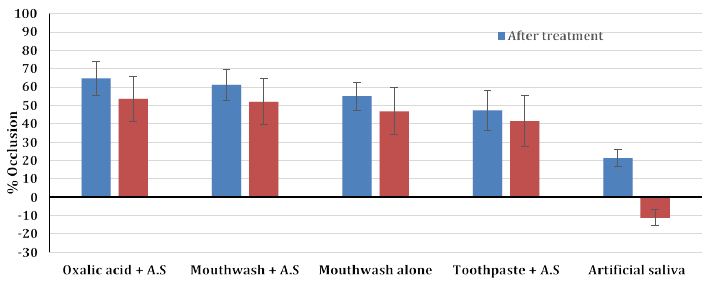
The average value of permeability reduction for four discs per treatment is shown in Table 2 and a graphical representation of the data with standard deviations is shown in Figure 4 with the degree of resistance (remaining tubular occlusion) provided by both the test and control treatments (Figure 5).

Table 2: Average percentage reduction in permeability following treatment

table 2

A paired T test was also applied to the HC data following treatment and exposing the discs to an acid challenge, to compare pairs of desensitising agents to determine statistical significance. Values obtained are shown in Tables 3 and 4.

Table 3: P-values from a students T test on comparison of pairs of desensitising agents following treatment

table 3

Table 4: P-values from a students T-test on comparison of pairs of desensitising agents following an acid challenge

table 4

Paired student  T tests  were  also applied  to evaluate  the HC data  to statistically explore the relation between both the treated discs and immersing discs in 6% citric acid solution for each individual desensitising agent and the control. P-values obtained are shown in Table 5.

Table 5: p-values obtained on applying a paired students T-test on the treated discs before and after exposure to an acid challenge for each desensitising agent

table 5

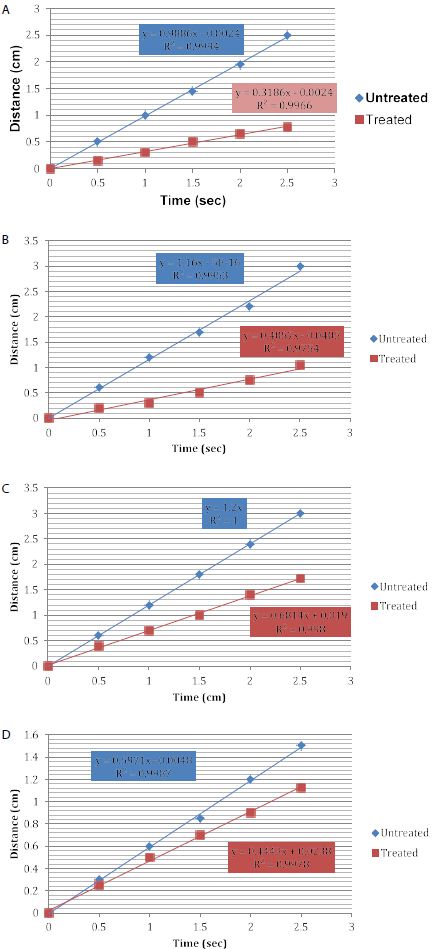
Figures 6a-6d represent the hydraulic conductance data for one of the discs selected from the four discs tested. They compare the flow rates before treatment and after applying treatments.

SEM Imaging

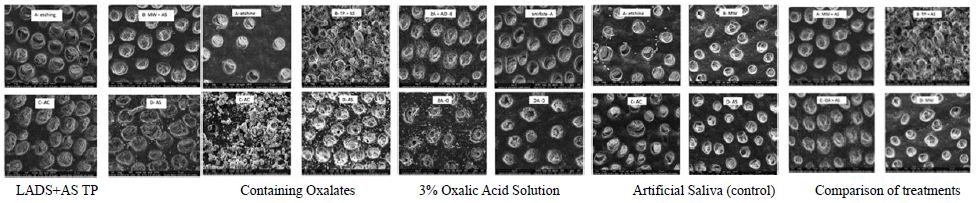
Figures 7a-7e shows the images obtained after treating with different oxalate-based reagents and a control using SEM.

Energy Dispersive X-ray Analysis – EDX

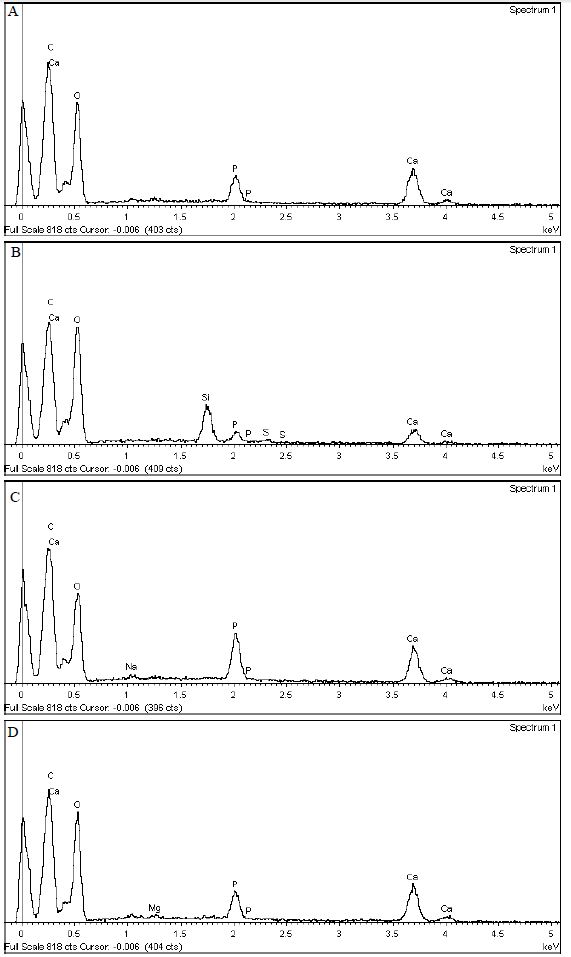
The results of the EDX analysis of the oxalate-containing desensitising agents and the artificial saliva control are shown in Figures 8a-8d below. The high peaks of calcium carbon and oxygen were observed in almost all the desensitising agents, confirming the presence of oxalate(s) and that calcium was most likely originating from the addition of the artificial saliva as well as the available calcium already present within the dentinal tubules. EDX analysis of the discs treated with the herbal toothpaste showed small peaks of silicon phosphorous and silica, which confirmed that these were ingredients of the toothpaste. A small sodium peak was observed in the artificial saliva treated disc because of the addition of sodium chloride salt in the preparation stages of the artificial saliva.

Discussion

The hydrodynamic theory as proposed by Brännström [24,25] promotes two basic approaches for treating hypersensitive dentine, namely 1) occluding the patent (open) tubules and thereby reducing any stimulus-evoked fluid movements across dentine and 2) reduce the intradental nerve excitability, to prevent the nerves from responding to the stimulus-evoked fluid movements. Underpinning this mechanism is the importance of the presence of the open tubules and the size of their radius which is according to the Hagen-Poiseuille formula indicates is a direct function of fluid flow.  In other words,  if the radius of the dentinal orifice (opening) is reduced by tubular occlusion (following application of a desensitising agent) then the minute fluid flow movements within the tubules will be dramatically reduced to the power of r4 and a subsequent reduction in dentine hypersensitivity (DH) would be expected. Numerous desensitising products have  been  proposed  and  utilised  in  clinical  practice  and most of these products result in tubular occlusion except for potassium-based products where reduction of the response is by nerve desensitisation. Potassium oxalate may have a dual function of both tubular occlusion and nerve desensitisation although evidence for this is not forthcoming. There has however been some concern regarding the use of high concentrations of oxalates in the daily food intake as this can result in kidney stones [26]. It should be noted however those high concentrations of oxalates are often consumed as ingredients of food products as well as seeds and leafy plants such as spinach and rhubarb. For example, the concentration of oxalates in spinach is 794 mg/100 g and in chocolate, it is 60.4 mg/g [27]. The concentration of oxalate in the LADS mouthwash used by Sharma et al. [22,23] was 1.4%, which is, considerably less as compared to the concentration of oxalates found in spinach. One of the main aims of the present study was to determine the reduction in the rate of fluid flow using   a hydraulic conductance device following the application of several oxalate containing desensitising products onto an exposed dentine disc compared to a control. In the Sharma et al, [23] the investigators used a Listerine Advanced Defence Sensitive (LADS) mouthwash without the addition of artificial saliva, however in the present study the LADS mouthwash was used with and without the addition of artificial saliva. The rationale for this methodological change was that potassium oxalate would require a source of calcium to form the calcium oxalate precipitate. Since the dentine disc was treated with citric acid and washed in distilled water it can be postulated that most of the available of calcium rich fluid would have been removed from the disc surface. Consequently, the only calcium available to react with the oxalate was the calcium present within the dentine tubules which may explain the observation that tubule occlusion is often not seen at the surface with oxalates [5,8] The inclusion of immersing the dentine disks in AS, however provides a copious supply of Ca to react with the oxalate.

The results from the present study demonstrated than the application of the selected oxalate products resulted in a significant reduction in fluid flow rate for all the desensitising agents compared to a control as shown in Figures 4, 5 and Table 2. A 3% oxalate solution resulted in the highest average permeability reduction of 64.75%. These values of  permeability  reduction  were  calculated as an average of fluid flow rates for four treated discs against their flow rates calculated when the discs were only etched. One of the problems encountered with measuring fluid flow through dentine was the variation in the tubular orientation and density within each disc as can be observed with the standard deviations (Figures 4 and 5) which may impact on the results particularly in a relatively small sample size. An interesting observation from the results was the improvement in the flow rates when the samples were immersed in artificial saliva. For example, the LADS mouthwash with the addition of artificial saliva resulted in a greater average reduction in dentine permeability as compared to LADS mouthwash alone, 61.25% vs. 55% respectively Overall, the oxalate containing desensitising products 3% Oxalic Acid,, LADS mouthwash with or without AS and the Herbal toothpaste in combination with artificial saliva significantly occluded the dentinal tubules by up to 65%, in comparison to the artificial saliva control that occluded less than 21% of the dentinal tubules (Figures 4, 5, Table 2). The stability of tubule occlusion following an acid challenge demonstrated that while the flow rates increased for the oxalate containing products, indicating that there was some loss of the oxalate precipitate with a slight increase in the tubular radius, nevertheless the values were still favourable compared to the artificial saliva control (Figures 5 and 6a-6d).

fig 4

Figure 4: Average percentage reduction in permeability (fluid flow rate) following treatment

fig 5

Figure 5: The stability of tubule occlusion after an acid challenge for the selected oxalate containing desensitising agents and control (% occlusion and standard deviations)

fig 6

Figure 6a: Reduction in Hydraulic conductance following the application of a 3% oxalic acid solution

Figure 6b: Reduction in Hydraulic conductance after the application of LADS mouthwash and artificial saliva

Figure 6c: Reduction in Hydraulic conductance after application of the Herbal toothpaste and artificial saliva

Figure 6d: Reduction in Hydraulic conductance after application of the artificial saliva (control disc)

Statistically, there was a significant difference between all the oxalate containing desensitising agents and the artificial saliva control, in terms of the reduction in permeability (flow rate) following application of the oxalate containing desensitising agents and the acid challenge (Table 3 and 4; see also Figures 6a-6d). Significant differences were also observed the herbal toothpaste vs. the 3 % oxalic acid solution and the LADS mouthwash with artificial saliva where the p value was 0.03 and 0.01 respectively.

The application of oxalate containing desensitising agents with the addition of artificial saliva, therefore resulted in the enhanced formation of calcium oxalate precipitates which occluded the dentine tubules and surface and reduced the fluid flow rates. The calcium oxalate crystals formed by the oxalate containing desensitising agents were very stable to an acidic challenge and retained most of their occlusion compared to the control where all the crystals formed by the artificial saliva were completely washed away. The SEM images of the oxalate containing desensitising agents and control were consistent with the hydraulic conductance data (Figures 7a-7e). Of interest was the oxalate containing herbal toothpaste where more precipitation was evident on the surface rather than inside the tubules. EDX analysis confirmed the presence of oxalates, calcium, and other ingredients  of this toothpaste formulation. The results from the present study  are also in broad agreement with those of Sharma et al. [23] in that an oxalate containing mouth rinse provided a more stable tubular occlusion which was more resistant to an acid challenge compared to the other test products. However, it should be noted that the Sharma et al. study used multiple applications of the oxalate mouthwash to obtain a reduction in hydraulic conductance, whereas in the present study this effect was achieved using only one application of oxalate.

fig 7

Figure 7a: SEM images of a quartered dentine disc treated with Listerine Advanced Defence Sensitive mouthwash +Artificial Saliva: A) Etching-showing opening of dentine tubules. B) Treated with LADS+AS showing significant occlusion of tubules by calcium oxalate crystals. C) Acid Challenge: showing that the oxalate crystals are very stable to acid challenge due to their sustained tubular occluding properties D) The control: disc treated with Artificial Saliva showing relatively low levels tubular of occlusion and almost fully opened tubules.

Figure 7b: SEM images of a quartered dentine disc treated with toothpaste (TP) +Artificial Saliva. A) Etching showing the opening of dentine tubules. B) Treated with TP+AS showing significant numbers of oxalate crystals on the surface with partially occluded tubules. C) Acid Challenge showing that the oxalate crystals are very stable to an acid challenge due to their sustained tubular occluding properties D) The control disc treated with Artificial Saliva showing relatively low levels of tubular occlusion and almost fully opened tubules.

Figure 7c: SEM images of a quartered dentine disc treated with Oxalic Acid (OA) +Artificial Saliva. A) Etching: showing the opening of dentine tubules. B) Treatment with OA+AS showing significant occlusion of tubules by calcium oxalate crystals. C) Acid Challenge: showing oxalate crystals are very stable to acid challenge due to their sustained tubular occluding properties D) The control: disc treated with Artificial Saliva showing relatively low levels of tubular occlusion and almost fully open tubules.

Figure 7d: SEM images of a quartered dentine disc treated with LADS mouthwash alone (LADSMW). A) Etching: showing the opening of dentine tubules. B) Treatment with LADSMW showing significant occlusion of the tubules by calcium oxalate crystals. C) Acid Challenge after Artificial Saliva treatment: showing that immersion in artificial saliva does not improve the stability of the oxalate crystals against an acid challenge. The openings of the dentine tubules remained opened. D) The control: disc treated with Artificial Saliva showing relatively low levels of tubular occlusion and almost fully opened tubules.

Figure 7e: SEM images of the quartered dentine discs illustrating a comparison between the different treatments based on the occlusion of dentine tubules. A) Treatment with Mouthwash+ Artificial Saliva showed reasonable occlusion of the tubules. B) Treatment with Toothpaste +Artificial Saliva showed moderate occlusion of tubules with numerous crystals formed on the surface. C) Treatment with Oxalic Acid + Artificial Saliva showed significant occlusion of dentine tubules with relatively few crystals deposited on the surface. D) Treatment with Mouthwash alone showing only partial occlusion of the tubules.

fig 8

Figure 8a: EDX analysis of the LADS Mouthwash + Artificial Saliva treated disc

Figure 8b: EDX analysis of the Herbal Toothpaste + Artificial Saliva treated disc

Figure 8c: EDX analysis of the Artificial Saliva treated disc

Figure 8d: EDX analysis of the 3% Oxalic acid solution +Artificial Saliva treated disc

Conclusion

Within the limitations of the present in vitro study, it was observed that oxalate containing desensitizing agents were significantly more effective in occluding the dentinal tubules vs. an artificial saliva control. These results are of clinical significance as they demonstrate that oxalate containing desensitizing agents provide both significant and stable tubular occlusion of the open dentinal tubules following an acidic challenge.

References

  1. Cunha-Cruz J, Wataha J, Zhou L, et al. (2010) Dentin hypersensitivity: choice of treatments by dentists of the Northwest PRECEDENT network. J Am Dent Assoc 141: 1097-1105.
  2. Anderson CJ, Gerlach RW, Kugel G, et (2016) Use of Oxalate Strips in Dentistry: Overall Response and Case Studies with Recent and Longstanding Sensitivity. Compend Contin Educ Dent 37(1): e32-e37.
  3. Pejmon A, Melanie M, Paul Sage, et al. (2016) Comparative Effects of 1.5% Oxalate Strips Versus 5% Potassium Nitrate Dentifrice on Dentin Hypersensitivity. Compend Contin Educ Dent 37(1).
  4. Greenhill J and Pashley D (1981) The Effects of Desensitizing Agents on the Hydraulic Conductance of Human Dentin in vitro. J Dent Res 60(3): 686-698.
  5. Pashley D and Galloway S (1985) The effects of oxalate treatment on the smear layer of ground surfaces of human Arch Oral Biol 30(10): pp.731-737.
  6. Pashley D, Livingston MJ, Reeder OW et al. (1978) Effects of the degree of tubule occlusion on the permeability of human dentine in vitro. Arch Oral Biol 23(12): 1127- 1133.
  7. Pashley DH, Andringa HJ, Eicnmiller F (1991) Effects of ferric and aluminium oxalates on dentine J Am Dent Assoc 4(3): 123-126.
  8. Ling T, Gillam D, Barber P, et al. (1997) An investigation of potential desensitizing agents in the dentine disc model: a scanning electron microscopy J Oral Rehabil 24(3): pp.191-203.
  9. Zhang Y, Agee K, Pashley D et al. (1998) The effects of Pain-FreeR desensitizer on dentine permeability and tubule occlusion overtime, in vitro. J Clin Periodontol 25(11): 884-891.
  10. Pillon F, Romani I and Schmidt E (2004) Effect of a 3% Potassium Oxalate Topical Application on Dentinal Hypersensitivity after Subgingival Scaling and Root Planning. J Periodontol 75(11): 1461-1464.
  11. Sauro S, Gandolfi M, Prati C et al. (2006) Oxalate-containing phytocomplexes as dentine desensitisers: An in vitro Arch Oral Biol 51(8): pp.655-664.
  12. Pereira J, Segala A and Gillam D (2005) Effect of desensitizing agents on the hydraulic conductance of human dentin subjected to different surface pre-treatments-an in vitro Dent Mater 21(2): pp.129-138.
  13. Muzzin K and Johnson R (1989) Effects of Potassium Oxalate on Dentin Hypersensitivity in J Periodontol 60(3): pp.151-158.
  14. Kerns DG, Scheidt MJ, Pashley DH, Horner JA, Strong SL, Van Dyke TE. Dentinal tubule occlusion and root J Periodontol 1991 Jul;62(7): 421-8.
  15. Gillam D, Coventry J, Manning R, et (1997) Comparison of two desensitizing agents for the treatment of cervical dentine sensitivity. Dent Traumatol 13(1): pp.36-39.
  16. Morris MF, Davis RD, Richardson BW (1999) Clinical efficacy of two dentin desensitizing agents. Am J Dent 12(2): 72-6.
  17. Santiago S, Pereira J and Martineli A (2006) Effect of commercially available and experimental potassium oxalate-based dentin desensitizing agents in dentin sensitivity. Dent Traumatol 13(1): 36-39.
  18. Cunha-Cruz J, Stout J, Heaton L et al. (2010) Dentin Hypersensitivity and J Dent Res 90(3): pp.304-310.
  19. Orchardson R and Gillam D (2006) Managing dentin hypersensitivity. J Am Dent Assoc 137(7): 990-998.
  20. Hongpakmanoon W, Vongsavan N, Soo-Ampon M (1999) Topical application of warm oxalate to exposed human dentine in J Dent Res 78: 300.
  21. Mantzourani M and Sharma D (2013) Dentine sensitivity: Past, present, and J Dent 41: pp. S3-S17.
  22. Sharma D, McGuire J, Gallob et al. (2013) Randomised clinical efficacy trial of potassium oxalate mouth rinse in relieving dentinal sensitivity. J Dent 41: pp. S40-S48.
  23. Sharma D, Hong C and Heipp P (2013) A novel potassium oxalate-containing tooth- desensitising mouth rinse: A comparative in vitro J Dent 41: pp. S18-S27.
  24. Brannstrom M, Astrom A (1972) The hydrodynamics of the dentine; its possible relationship to dentinal Int Dent J 22: 219-227.
  25. Brannstrom M, Linden L and Astrom, A (1967) The Hydrodynamics of the Dental Tubule and of Pulp Caries Res 1(4): pp.310-317.
  26. Mitchell T, Kumar P, Reddy T, et (2019) Dietary oxalate and kidney stone formation. Am J Physiol Renal Physiol 316(3): F409-F413.
  27. Holmes RP, Kennedy M (2000) Estimation of the oxalate content of foods and daily oxalate intake. Kidney Int 57: 1662-1667.
fig 6

Earliest BIF and Life Produced via Submarine Volcanism in Carbonated Seawater

DOI: 10.31038/GEMS.2022424

Abstract

The Isua Banded Iron Formation (BIF) formed just after Late Heavy Bombardment (3.8 Ga) and the first life produced through abiotic means appeared in a solution of essential elements on the early Earth. The volcanic layer in the Isua BIF contained no carbon, and the carbon present in the sedimentary layer contained more 12C than 13C. Iron-bearing lava was emitted intermittently into the primitive sea through volcanic eruptions. Bubbles were produced then Fe mixed with carbonated water, which may form through multiple chemical pathways. Hydrocarbon (CnH2n+2) was simultaneously produced via collisions between H+ from solar wind and early atmospheric CO2. Since long-chained molecule of CnH2n+2 is hydrophobic, they would have floated with membrane of Fe(HCO3)2 on the surface of the seawater. The carbonated water was neutralized by dissolved ions of Fe+2 and a floating solution of Fe(HCO3)2 developed in the presence of the BIF. Thus, the floating materials were gathered on the surface of the water. The intermolecular bonds in there floating materials exchanged neighboring atoms as the structure deformed, such that 12C was preferentially uptaken from carbon derived from the dissolution of CO2 molecules into the primitive sea at ~3.8 Ga. Given that Fe acts as a deoxidation agent, primitive photosynthesis was achieved in the CnH2n+2 and Fe(HCO3)2 via the chemical reaction of Fe(HCO3)2 in which the hydrophobic CnH2n+2 molecule was used as a scaffold for replication. Thus, the first life on Earth arose from abiotic processes due to metabolic intermolecular interactions.

Keywords

Isua Banded Iron Formation, Carbonated seawater, Origin of life, Iron(Ⅱ) hydrogen carbon, Metabolic intermolecular interaction, Primitive photosynthesis, Cyanobacteria

Introduction

In the 1970s, the world’s oldest stratum was explored via radiation dating. Although the oldest rock found on Earth to date is from the Acasta Gneiss Complex of northwest Canada [1], the oldest intact rock from the Isua sediment was of interest to many researchers as it showed signature of life. The Isua Banded Iron Formation (BIF) is classified as Algoma type that was formed 3.7~3.8 billion years ago, while BIF of Superior type first appeared around 3 billion years ago. A fundamental question remains about the oldest BIF that iron in BIF was oxidated by the oxygen that was absent throughout the early sea [2]. However, those previous studies focused on the ratio of 12C to 13C to verify the possibility that striped iron deposits were generated via photosynthesis by early organisms. Even though little is known about the earliest cyanobacteria, existing studies provide evidence that, unless some unknown abiotic process exists, which is able both to create such isotopically 12C rich and then selectively incorporate it into the grains, life on Earth emerged at least 3,8 billion years ago [3-5]. However, the isotope variations in nature cannot be uniquely ascribed to biology until nonbiological isotope effects are better understood [6]. A bubble has adaptability for external variation due to metabolic intermolecular interactions. Since the first life was produced abiotically, the definition of first life should be different from that used for today’s living creature. The strata in the Isua BIF included layers of lava and sediment layers that had piled up between the multiple lava layers [3]. Lava released from submarine volcanoes produced floating materials and dissolved Fe2+. The floating materials gather on the surface of water, and the energy from Sun’s irradiation triggers inorganic chemical reactions which produce iron dioxide from the floating materials. These materials ultimately form the Algoma-type striped iron deposit. Karasawa reported that mixing of iron powder with carbonated water creates bubbles and produces complex floating materials [7]. Metabolic intermolecular interactions within such bubbles gave rise to the earliest life. Thus, the environment in the early sea provided the conditions for abiotic process of the formation of the earliest BIF and that first life.

Material Formation Process Revealed by the Environment

Origin of Water on Earth

It is generally accepted that the Earth was formed by meteorite collisions. However, meteorites will be broken in pieces by a collision that cannot bind into one solid substance without external forces. Moreover, meteorites are produced by large celestial bodies. The Sun accounts for 99.87% of the total mass of the solar system, and the planets and other celestial objects accounts for the remaining 0.13%. The Sun as the center of gravity holds most of materials in the solar system except for the material orbiting the Sun. According to Kepler’s third law, the relationship between the orbit and the period of a celestial body orbiting the Sun does not depend on the mass of the orbiting material, i.e., the orbiting speed of every celestial material in the orbit with the same radius of orbit is the same. Thus, materials on the orbit stays around the Sun for a long period. Although the gravitational force of cosmic dust is very weak, their van der Waals force have a glue-like effect that hold together all the material in the celestial body. The celestial bodies aggregated by adsorbing fine cosmic dust particles. Although the traditional formation theory of the solar system explains that the formation of planets occurred after the nuclear fusion of the Sun [8], it is challenging for a small celestial body to grow under the environment of the solar wind. The Earth formed due to accumulation of celestial materials containing with ice (H2O) and dry ice (CO2). For example, about 80% of the comet’s core contains ice (H2O), and the remaining 20% contains dry ice (CO2) and dust like SiO2 grains. The surface of the Earth did not feature a high temperature during the growing period in the cold accretion phase and it is considered that the initial stage of planet is like to that of the Sun. Measurements using radioactive isotopes have shown that most of the meteorites were formed by 4.6~4.5 billion years ago. The phenomenon that able to emit meteorites cannot be considered except nuclear fusion. There are a lot of meteorites in asteroid belt. There is a possibility that asteroid belt had formed at the period of Late Heavy Bombardment (3.8 Ga) by a nuclear fusion of once existed a planet. (cf. https://www.youtube.com/watch?v=QY8C7XK6k7I). A considered that a part of the material collected in the Sun was released as the form of meteorites when nuclear fusion began in the Sun. The emitted material was collected again in the Sun and the process was repeated. Some of the materials released from the Sun reached to Earth’s gravitational sphere and fell to the Earth’s ground. Those materials increase the mass of the primitive Earth. The energy released during the collision transformed to thermal energy, which heated up the surface of the Earth. Due to the increase of temperature of the ground, a magma ocean formed on surface of the Earth at the end stage of the growing period. Thus, H2O and CO2 were degassed from inside of the Earth at the end stage of the growing. As the meteorite impacts subsided, the Earth’s surface gradually cooled down. Consequently, the degassed CO2 and H2O formed the primitive atmosphere. When the surface of the Earth cooled, H2O present in the form of water vapor in the atmosphere condensed and the rain fall on the surface of the Earth; thus, the early sea was formed.

Formation of Heat Source at the Center of the Earth

When the primitive Earth was growing by accumulation of powder-like materials, the planet was rather homogeneous. The pressure on the central area of celestial body increased with its size. Energy state is lowered by condensed state due to the high pressure. The change of state releases energy to surroundings. Additionally, radioactive elements emit heat radiation contributing to the temperature increase. As increasing the temperature of inner Earth, heavy metal such as iron were accumulated at the center of the Earth, and oxides such as SiO2 formed the outer layer of the Earth. The energy due to the gravity can be considered as the main factor driving the rise of temperatures at the Earth’s core, to level of 3,500 to 5,000°C. Half of the gravitational potential is converted into kinetic energy according to the Virial theorem (it is utilized as the equilibrium condition in the field of mechanics, statistical mechanics, astronomy, and atomic physics). Gravitational energy (W) stored in spherical uniformly dense objects with universal gravitational constants G, mass M, and radius R can be calculated using Eq.(1) [9] and the value obtained for Earth is shown using Eq.(2).

W= (3/5) (GM2/R)                (1)

(1/2) W=2.68 x 1031 [cal] = Δ4,500°C (cp =1, for Earth)               (2)

Assuming the specific heat of the Earth is Cp =1, the amount of heat is evaluated as increase of temperature Δ4,500℃. The heat source contributed to formation of the Isua BIF in carbonated sea water.

Characteristics of Sea Water under Atmosphere of CO2

When the surface of the Earth featured an ocean of magma heat convection became active at the surface layer of the Earth. Thus, there were mantle convections of upper layer and lower layers. Even though the heat released during meteorite collisions was large, temperature on the surface of Earth decreased as time progressed. However, mantle viscosity increases with a decrease in temperature, and consequently, the convection velocity slowed down. Thus, a layered structure comprising thin crust, thick silicate mantle, and iron core developed through prolonged convection. As discussed previously, water vapor fell to the surface of the Earth as rain when atmosphere cools down, However, when the surface of the Earth was still hot, the liquid water evaporate into the atmosphere. This repeated process and the thermal convections of water vapor contributed to the cooling down of the surface of the Earth. Gradually, an ocean was formed by the liquid water on the surface of the Earth, which comprised a SiO2 crust. However, the CO2 remained in the atmosphere until the temperature of the seawater cooled down to approximately 300℃; this is because CO2 does not dissolve in seawater at high temperatures. The CO2 in the sea water does not react with SiO2 on the seabed. The amount of the hydrogen ions in natural water can be determined by the reaction shown in Equation (3). Most of dissolved CO2 in the water stays as a molecule, while H+(aq) is produced as per the reactions outline in Equation (3) and (4).

CO2(aq) + H2O ⇔ H2CO3(aq) ; pKCO2 = 10-1.47 (3)

H2CO3(aq) ⇔ HCO3(aq)+ H+(aq) ; pKa1 = 10-6.35  (4)

HCO3(aq) ⇔ CO32-(aq) + H+(aq) ; pKa2 = 10-10.33 (5)

The equilibrium constants for the carbonate system are for fresh water at 25oC [10] p.221.

Floating Materials Formed by Intermolecular Bond of Fe(HCO3)2

Lava, released due to volcanic activity, supplied iron ions that neutralized carbonated water and produced HCO3- ions. The pH of water exposed to 100% CO2 atmosphere, soon decreases as pH< 7 [7]. However, when finely powdered iron is introduced to this carbonated water, the pH value slowly increases as pH>7. The speed with the pH changes depends on the surface state of iron powder [7] (Figure 1).

fig 1

Figure 1: Variation of density of carbonate species as a function of pH

The proposed model suggests that the Isua BIF was formed due to the accumulation of materials released during volcanic eruptions that broke through silicate crust at the seabed. The iron ions released during the volcanic eruption mixed in carbonated water, which neutralized the water and released HCO3 ions.

As shown in Figure 2, the arrangement of Fe2+ surrounded by hydrogen-bonded HCO3 is the same as that of 2-dimensional planes of [Fe(OH)2+2CO2]. Since a flexible plane of Fe(HCO3)2 is yielded by possibility of plural electronic states on the same atomic arrangement, it forms robust membranes and bubble [7] (Figure 2).

fig 2

Figure 2: Floating plane formed by resonating structure of intermolecular bonds of Fe(HCO3)2 = Fe(OH)2+2CO2 [6]

Figure 2 shows resonating structure of intermolecular bonds of Fe(HCO3)2=Fe(OH)2+2CO2. The resonating structure of intermolecular bonds of Fe(HCO3)2 leads to a plane structure of floating materials. Those floating materials gather on the surface of the water. The structure also forms the membrane of a bubble. The floating materials are gradually deposited on the seabed as chemical compounds through inorganic process including irradiated by ultraviolet rays of the Sun.

Observations

Bubbles formed in Carbonated Water by Mixing of Iron Powder

Mixing of powdered iron in carbonated water forms bubbles and complex floating materials as shown in Figure 3.

fig 3

Figure 3: Bubbled and floating materials generated after a mixture of powdered iron and carbonated water left undisturbed for several hours

The inorganic bubble responds to external changes due to internal metabolic intermolecular interactions. The bubble is always renewing and have adaptability for external changes. Even if a part of the bubble is cracked, it is repaired immediately through the formation process. (A video on inorganic bubble responds to external changes by a metabolism:

http://www.youtube.com/watch?v=7mLPULp-il8)

Deoxidation of Carbon Dioxide by Oxidation of Iron Atoms

The floating materials were oxidized taking many years of long time after mixing of powdered iron in carbonated water as shown in Figure 4.

fig 4

Figure 4: Floating materials were oxidized at a) floating state, and b) precipitate state

The Pauling electronegativity values of Fe, H, and C are 1.80, 2.30, and 2.54, respectively; thus, it is considered that the carbon particles in sediment of Isua BIF were generated through deoxidation of CO2 as shown in Eq. (6).

4Fe(HCO3)2→2Fe2O3 + 4H2O + C +7CO2                                   (6)

The oxidation of ultrafine iron powder exposed to solid state of carbon dioxide has been demonstrated previously (A Video on Oxidation of ultra-fine iron particles by solid state of carbon dioxide, https://www.youtube.com/watch?v=eyq3qbxFahw).

Electronic Configurations of Fe2+ and Fe3+

The electronic configurations of Fe2+ and Fe3+ are shown in Figure 5. When one electron of the 3d orbit in Fe2+ is emitted, the 3d orbit becomes a semi-closed shell and stabilizes. Although Fe3+ exists as a relatively stable ion, oxidation of Fe2+ to Fe3+ takes a long time. The flexibility of Fe3+ compound on structure decreases compared with that on Fe2+ compounds.

fig 5

Figure 5: Electronic configuration of Fe2+ and Fe3+

Early Photosynthesis via Metabolic Intermolecular Interactions in Floating Material

The ultrafine powder of iron acts as a reducing agent for CO2. Hence, it is considered that the earliest instance of photosynthesis will be carried out via oxidation of iron atom, as described in Equation (7),

As for anoxygenic photosynthesis at acidity of pH<6.3

3mCO2 + 3nH2O +4mFe → 3Cm (H2O)n +2mFe2O3↓                   (7)

In order to keep floating materials, there is a possible reaction as described Equation (8) occurred in the metabolic intermolecular interactions of Fe(HCO3)2 membrane with the hydrophobic CnH2n+2 molecule.

As for photosynthesis with producing oxygen in 6.3<pH<10.3,

Cn-1H2n + 4Fe(HCO3)2 → 2Fe2O3↓+ CnH2n+2 + 3H2O +7CO2 [O]                   (8)

Although the fossil evidence of photosynthesis can be tracked back to 3.5 billion years ago [11], It is estimated that the earliest life was produced soon after the development of oldest BIF.

Non-biological Origin of Organic Materials on Primitive Earth

Volcanic Origin of Carbon on Primitive Earth

The carbon particles of the Isua BIF are present as size of 2~5μm in thick layers that are sandwiched between thin layers formed by submarine volcanoes, and the biological origin carbon, of which 13C is about 2% less than non-biological origin, is included in these carbon particles. These carbon particles are included the max of 0.5% the clay layers, each of clay layers is several centimeters, the clay layers are sandwiched between thin volcanic layers of approximately several millimeters. The volcanic layers do not contain carbon [12] pp.123. In case of the pH value around volcanic rocks is much higher than 7, it I considered as FeCO3 precipitate without free carbons. Thus, the thin layers of iron oxide can be attributed to volcanic explosions, and it can be considered that carbon contained in the clay layer once floating materials and gradually deposited on the seabed with clay.

Atmospheric Origin of the Organic Carbon at Early Earth

Solar winds containing H+ influence the atmosphere on the Earth [13] (Figure 6).

H+ at approximately 500 km/s impacts atmospheric CO2. Hydrocarbons were synthesized in the collisions. Thus, floating materials contain atmospheric organic carbon of non-biological origin as shown in Figure 6.

fig 6

Figure 6: Proposed model to demonstrate the generation of atmospheric organic carbon of non-biological origin

Small hydrocarbon molecules such as CH4 and those involved in repetitive chemical reactions remained as gas molecules in the upper sky. However, the remaining carbon atoms bounded with hydrogen atoms to form long chain hydrocarbons without branches.

These hydrocarbon molecules formed floating materials that gathered on the surface of the early ocean.

Table 1 shows the melting and boiling points of various hydrophobic long chain hydrocarbons. In particular, the fatty acids possessing 16 or 18 pieces of carbon are of great importance as they are the main components of cell membranes.

Table 1: Temperature characteristics of hydrophobic long chain hydrocarbon molecules

Molecule

Melting point [] Boiling point []

Specific gravity [20]

Tetradecane; C14H30

4~6

253~257

0.76

Hexadecane; C16H34

18

287

0.773~0.776

Octadecane; C18H38

28~30

317

0.777

Eicosane; C20H42

36~38

343

0.7886

Individual Chickens are Formed from Individual Egg

These molecules shown in Table 1 remained in a liquid state for a prolonged period, which was made possible evolution of the molecules due to intermolecular bond. However, the same membrane must be reproduced without the mold, because the membrane that is adhered to peptide-bounded amino acids cannot be replicated using mirror symmetrical mold. Because the mold of the left-hand protein molecule cannot be copied from the right-hand protein molecule. The mechanism that able to reproduce protein cannot be considered except mechanism of the reproduction. Thus, the self-replication of primitive life is achieved by the memorization of the order of self-production. It will be possible via photosynthesis in the floating substance of hydrocarbon molecules containing metabolic intermolecular interactions of Fe(HCO3)2. Although it is reported that oldest fossils evidencing life were formed at 3.5 billion years ago, the developed floating materials may have initiated the processes necessary for early life to develop, shortly after the formation of the sea water on the surface of the Earth. However, many steps of evolutions are necessary for the development of a systematic cell system of replication such as use of RNA.

Conclusion

This paper describes the processes involved in the formation of the oldest BIF and earliest life on Earth based on evidence. The concept of the first life is different from that considered at the standard for today’s living creature, because the first life was produced abiotic process. The BIF in the Isua region was formed through abiogenic processes including intermittent volcanic explosions in a sea of carbonated water. Volcanic activity led to the formation of membranes or bubbles at the surface of the sea water; these membranes or bubbles are attributed to the 2-dimensional structure of Fe(HCO3)2, where Fe2+ is surrounded by four HCO3 ions linked to each other by hydrogen bonds. Such inorganic bubble responds to external changes via metabolic intermolecular interactions. The floating materials gather on the surface of water, following which, the neighboring atoms or ions in the materials were able to interchange positions via thermal motions. During this stage, the material became isotopically enriched in 12C. Since Fe atom acts as a reducing agent for CO2, the floating material that had participated in the reduction reaction dropped down to the seabed where it mixed with SiO2. Thus, the intermittent volcanic explosions and abiotic processes contributed to the layered structure of Isua BIF and the earliest life from an abiogenic perspective. The earliest instance of photosynthesis may have occurred in the membrane of Fe(HCO3)2 using hydrophobic CnH2n+2 molecule in floating materials as the catalyst and irradiation of the Sun as the energy. However, the development of the systematic cell replication system observed in living creature today require several steps of evolution and elucidating the metabolic intermolecular interactions of the floating materials is of great significance in improving our understanding of the life on the early Earth.

Acknowledgement

I would like to thank Editage (www.editage.com) for English language editing

References

  1. Bowring SA, Williams IS, Compston W (1989) 3.96 Ga gneisses from the Slave province, Northwest Territories, Canada. Geology 17: 971-975.
  2. Demoulin CF, Yannick JL, Luc C, Camille F, Denis B, et al. (2019) Cyanobacteria evolution: Insight from the fossil record. Free Radic Biol Med. 140: 206-223.
  3. Rosing MT (1999) 13C-Depleted Carbon Microparticles in >3700-Ma Sea-Floor Sedimentary Rocks from West Greenland. Science 283: 674-676. [crossref]
  4. Schidlowski M, Peter WUA, Rudolf E, Christian EJ, et al. (1979) Carbon isotope geochemistry of the 3.7×10⁹-yr-old Isua sediments, West Greenland: implications for the Archaean carbon and oxygen cycles. Geochimica et Cosmochimica Acta 43: 189-199.
  5. Mojzsis SJ, Arrhenius G, McKeegan KD, Harrison TM, Nutman AP, et al. (1996) Evidence for life on Earth before 3,800 million years ago. Nature 384: 55-59.
  6. Roe JE, Anbar AD, Barling J (2003) Nonbiological fractionation of Fe isotopes: Evidence of an equilibrium isotope effect. Chemical Geology 195: 69-85.
  7. Karasawa S (2014) Prebiotic reactions in the bubble that was formed in carbonated water by iron atoms. Viva Origino 42: 12-17.
  8. Hayashi C, Nakazawa K, Nakagawa Y (1985) Formation of the solar system, Protostars & planets Ⅱ, Arizona Press pg: 1100-1153.
  9. Maeder A (2009) Physics, Formation and Evolution of Rotating Stars, (Astronomy and Astrophysics Library) S1.2, The Potential Energy, Springer.
  10. White WM (2013) Geochemistry Chap 6, pg: 217-267, John Wiley & Sons, Ltd.
  11. Schopf JW (2011) The palaeobiological record of photosynthesis. Photosynth Res. 107: 87-101. [crossref]
  12. Rosing MT (2004) Search of the Earth’s oldest life, NHK special-Global Evolution-1, pg: 123, (written in Japanese).
  13. Karasawa S (2022) Effects of Solar Wind on Earth’s Climate. Geol Earth Mar Sci 4: 1-5.

Pattern of Head and Neck Cancer Presentation and Management in a Tertiary Hospital in Owerri, South- East Nigeria

DOI: 10.31038/SRR.2022511

Abstract

Background: Head and neck cancers are increasingly becoming a prominent part of oncological practice in Nigeria due to increasing awareness and advances in this area of practice. Tumours of the head and neck region make up about 5-30% of all tumours in the body and often constitute a burden that impacts their sufferers physically, socially, financially and psychologically. In addition, there has been enormous challenges in the management of these conditions in a developing setting such as ours. The study aimed at assessing the pattern of presentation and management of head and neck cancers cases that presented at Federal Medical Centre, Owerri, Nigeria.

Materials and methods: The study is a 5-year retrospective analysis of all head and neck cancer cases that presented to the ENT Department of Federal Medical Centre, Owerri, Nigeria between January 2015 and December 2019. Data was extracted from patients’ case files, sorted and analyzed with SPSS version 25.0.

Results: A total of sixty-eight (68) head and neck cancer cases were seen over the period, however fifteen (15) cases had incomplete records therefore only fifty-three (53) cases were analyzed. A M:F ratio of 1.3:1 was recorded with the mean age of the patients being 53.5±14.0 years. The mean duration of presenting complaints was 12.2±9.2months. The commonest site of cancer among the patients was the larynx (26.3%) while the commonest histological diagnosis was Squamous cell carcinoma (54.5%). Majority of patients (94.3%) presented with advanced disease (stages III and IV). \The commonest modalities of treatment were surgery alone (35.9%) and chemoradiation therapy (33.9%). Outcome of treatment at 3 months was satisfactory in 43.4%. About 15.1% of the patients did not attend follow up clinics after treatment while 3 patients (5.7%) died within 3 months of treatment.

Conclusion: The pattern of presentation and principles of management of head and neck cancers in Federal Medical Centre, Owerri over recent years are similar to those of contemporary facilities around the region and country. The challenges facing the management of these cases include late presentation, financial paucity, poor social support system and poor follow up culture.

Introduction

Head and neck cancers are increasingly becoming prominent in oncological practice in Nigeria owing to the attention given and the advances made in this area of clinical practice. Tumours of the head and neck make up 5-8% of all tumours in the human body in Europe and America. [1] In India, this figure can be as high as 30%. [2] The prevalence of head and neck cancers in Nigeria vary widely from 6.2% in southern Nigeria [3] to 30% in Northern Nigeria. [4] Worthy of note is that these figures were essentially derived from hospital-based studies and as such may represent only a tip of the iceberg of the real burden of disease. This observation notwithstanding, up to half a million cases of head and neck tumours are diagnosed yearly worldwide and a significant proportion of these are in developing countries. [5] The management of head and neck tumours in Africa and Nigeria in particular is still faced with many challenges due to relative paucity of treatment facilities and widespread ignorance of the nature of the disease among the population leading to late hospital presentation. The aim of this study was to assess the pattern of presentation and management of head and neck cancers that presented to a tertiary health centre, Federal Medical Centre, Owerri, Nigeria over a 5-year period (between January 2015 to December 2019).

Materials and Methods

The study was a retrospective analysis of all head and neck tumour cases that presented to the Ear, Nose and Throat/Head and Neck Department of Federal Medical Centre, Owerri in South-Eastern Nigeria between January 2015 and December 2019. A total of sixty-eight (68) head and neck cancer cases were seen over the period, however fifteen (15) cases had incomplete records and were excluded, therefore only fifty-three (53) cases were analyzed. The case files of all the patients were retrieved from the hospital records and data extracted and analyzed with SPSS software version 25.0. The data analyzed include the socio-demographic characteristics, presenting complaints, clinical and histological diagnoses, treatment and general outcome. The results are represented in tables and charts. Statistical significance was set at p < 0.05 (Tables 1-7).

Table 1: Sociodemographic characteristics of the patients


Male Female Total (%)

p-value

Age of patients (years)

<10

1 0 1 (1.9)

 p = 0.353

11-20

1 1 2 (3.8)
21-30 5 4

9 (16.9)

31-40

4 3 7 (13.2)
41-50 6 5 11 (20.8)

51-60

5 3 8 (15.1)
61-70 4 3

7 (13.2)

71-80

3 3 6 (11.3)

>80

1 1

2 (3.8)

  Total 30 23 53 (100.0)
Level of education

Primary

6 4 10 (18.9)

P = 0.671.

Secondary

12 6

18 (33.9)

Tertiary

10 11 21 (39.6)
None 2 2

4 (7.6)

Total

30 23

53 (100.0)

Occupation

Student

2 3 5 (9.4)

 p = 0.127

Unemployed

3 5 8 (15.1)
Business 19 7

26 (49.1)

Civil servant

6 8 14 (26.4)
Total 30 23

53 (100.0)

Table 2: Duration of complaints prior to presentation


Male

Female Total (%)

p-value

< 2 months

3

1 4 (7.6)

0.202

2-6 months

9

13

22 (41.4)

7-12 months

12

6

18 (33.9)

13-24 months

4

0

4 (7.6)

25-48 months

1

2

3 (5.7)

> 48 months

1

1

2 (3.8)

Total

30

23

53 (100.0)


The mean duration of presenting complaints prior to presentation was 12.2+/-9.2 months

Table 3: Primary sites of tumours among the patients


Male

Female Total (%)

p-value

Larynx

12

2 14 (26.3)

0.001

Sinonasal

6

5

11 (20.7)

Nasopharynx

7

1

8 (15.1)

Parotid gland

1

4

5 (9.4)

Hypopharynx

0

4

4 (7.6)

Oesophagus

2

1

3 (5.7)

Submandibular gland

2

2

4 (7.6)

Thyroid gland

0

2

2 (3.8)

Parapharynx

0

2

2 (3.8)

Total

30

23

53 (100.0)

Table 4: Histological diagnosis of the tumours


Male

Female Total (%)

p-value

Squamous cell carcinoma

24

5 29 (54.5)

0.001

Adenocarcinoma

0

5

5 (9.4)

Lymphoma

1

3

4 (7.6)

Sarcoma

1

1

2 (3.8)

Mucoepidermoid carcinoma

2

1

3 (5.7)

Adenoid cystic carcinoma

0

3

3 (5.7)

Acinic cell carcinoma

1

0

1 (1.9)

Verrucous carcinoma

0

3

3 (5.7)

Others

1

2

3 (5.7)

Total

30

23

53 (100.0)


Table 5: Stages of tumours among the patients


Male

Female

Total (%)

Stage I

0

0

0 (0.0)

Stage II

1

2

3 (5.7)

Stage III

11

7

18 (33.9)

Stage IV

14

18

32 (60.4)

Total

26

27

53 (100.0)

Table 6: Treatment modalities offered to the patients


Male

Female Total (%)

p-value

Surgery alone

12

7 19 (35.9)

0.210

Surgery & Radiotherapy

2

6

8 (15.1)

Chemotherapy and Radiotherapy

11

7

18 (33.9)

Surgery, Chemotherapy and Radiotherapy

5

3

8 (15.1)

Total

30

23

53 (100.0)


Table 7: Outcome of treatment 6 weeks after treatment


Male

Female Total (%)

p-value

Satisfactory

13

10 23 (43.4)

0.594

Persistent disease

3

2

5 (9.4)

Death

2

1

3 (5.7)

Lost to follow

9

5

14 (26.4)

No follow up

3

5

8 (15.1)

Total

30

23

53 (100.0)


Results

A total of 53 head and neck cancer cases were analyzed over the period (excluding ophthalmological, neurosurgical and oral tumours). This comprised 30 males and 23 females with a male to female ratio of 1.3:1. The ages of the patients studied ranged from 9 to 85 years with a mean age of 53.5±14.0 years. The largest proportion of the patients (39.6%) had tertiary level of education while 34.0% and 18.9% had secondary and primary levels of education respectively.

Discussion

Socio-demographic Characteristics

The study noted slight male predominance with a male to female ratio of 1.3:1. This difference was not statistically significant (p = 0.095). Similar pattern was recorded in similar studies notably by Forae et al, [6] Akinshipo et al [7] and Kanu et al. [8] A systematic review by da Lilly-Tariah et al also found M:F ratio ranging from 1.1:1 to 2.3:1 after reviewing 27 publications on the subject. [9] The reason for this pattern is not known however, it may partly be due to the overwhelming preponderance of the male gender in laryngeal cancers which have widely been reported to be among the commonest head and neck cancers in this part of the world. The mean age of patients in this study (53.5±14.0 years) was slightly higher than those found by other workers; Erinoso et al found 39.6±21.1 years, [10] Adeyemi et al found 43.8±19.6 years, [11] Fomete et al found 48.4±16.2 years [12] and Kodiya et al found 35.5±20.1 years. [13] This suggests that head and neck cancers is prevalent in the middle ages in our environment where life expectancy is not as high as in the developed world. Notably, some other similar studies recorded peak prevalence amongst patients between the 4th and 5th decades of life [14,15].

Presenting Features

The commonest presenting symptoms include hoarseness (34.0%), nasal obstruction (30.8%), epistaxis (28.3%), dysphagia (15.1%) and neck swelling (9.4%). This pattern is in keeping with patterns found by similar work where sinonasal and laryngeal malignancies were most predominant. [14,15] The mean duration between the onset of symptoms and presentation was 12.2±9.2 months with majority of the patients (33.9%) presenting after 7-12 months of having the symptoms. This relatively late pattern of presentation is not uncommon in our environment where self-medication with over-the-counter medication is often the first form of care. Only 17 (32.1%) of the patients had formal prior consultations by general practitioners before being referred for specialist attention. In majority of the cases, persistent and worsening symptoms prompted their eventual presentation, albeit in advanced stages. This delayed pattern of presentation was also reported in studies by Okwor et al and in the systematic review by da Lilly-Tariah et al. [9]

Tumour Sites/Clinical Diagnosis

Majority of the tumours were in the larynx (26.3%), Sinonasal region (20.7%) and the nasopharynx (15.1%) while the thyroid and the parapharyngeal area had the lowest proportions at 3.8% each. A systematic review of 27 similar studies found the nasopharynx to be the commonest site followed by the sinonasal region and the larynx.9 Identical pattern was recorded by Nwawolo et al, [14] in Lagos, south-west Nigeria however, about 300km northwards, Ologe et al in Ilorin, Nigeria found relatively low prevalence for the larynx (ranking 4th with 4.5%). [15] The reason for this discrepancy is not clear, however variation in social behaviours such as smoking and alcohol intake between these regions are thought to play a role. [16,17] Our study reveals significant male predominance among laryngeal cancer sufferers (M:F ratio of 6:1) with similar pattern widely reported in this part of the world and attributed largely to such social practices as smoking and alcohol intake which are commoner among men. [3,8,9,12] Similar trend applies for nasopharyngeal carcinoma with a M:F of 7:1 in this study.

Tumour Type/Histological Diagnosis

By far, the predominant cancer in this study was squamous cell carcinoma accounting for 54.5%. Less common types include adenocarcinoma (9.4%), lymphomas (7.6%), adenoid cystic carcinoma (5.7%), sarcomas (3.8%) and acinic cell carcinoma (1.9%). An overwhelming majority (82.9%) of head and neck cancers in this study are of epithelial origin which largely mirrors the pattern in several similar studies in Nigeria such as those by Nwawolo et al (carcinomas 91.0% and sarcomas 6.6%), [14] Forae et al (carcinomas 83.4%, lymphomas 7.7% and sarcomas 3.5%), [6] Akinshipo et al (carcinomas 70.0%, sarcomas 15.0% and sarcomas 15.0%) [7] and Ologe et al (carcinomas 70.8%, lymphomas 20.2% and blastomas 9.0%). [15] The predominance of epithelial cancers is understandable considering that majority of the surfaces of the upper aerodigestive tract where tumourigenesis generally occurs are lined by squamous cell and columnar epithelium. Furthermore, a Nigerian meta-analysis of head and neck cancers lends credence to the pattern. [9]

Tumour Stage

The cases were graded using the TNM group staging (UICC/AJCC) models. Stage III and IV tumours accounted for 33.9% and 60.4% of the tumours respectively and when combined, the two stages accounted for 94.3% of all cases. Similar results were obtained Okwor et al in Ibadan, southwest Nigeria (stages III and IV cancers accounted for 87.5% of all head and neck cancers) [16] and a systematic review of 27 studies by da Lilly-Tariah et al. [9] This underscores the rampant delayed presentation often experienced in the more deprived regions of sub-saharan/tropical Africa and brings to fore the challenges faced by clinicians managing head and neck cancers in this region of the world. Inadequate health knowledge and lack of efficient primary health care centres may be factors responsible for late presentation of head and neck cancers in Nigeria. More elaborate studies aimed at ascertaining these factors are desirable.

Treatment/Management

The modality of treatment adopted for each case was decided based on the nature/stage of the tumour and the available resources for treatment. Because of the lack of radiotherapy facility at the centre of study, patients who required radiation therapy were referred to centres where such facilities were available however, they were seen on follow up schedules at our centre, where feasible. Majority of the patients (35.9%) were treated with surgery alone while 33.9% had combined chemoradiation without surgery. Because majority of the patient presented with advanced disease, there was limited chance for complete surgical removal of the tumour in many patients who were then referred for chemoradiation therapy. This pattern of intervention described here have been reported by authors of similar works. [14,16] A systemic review by da Lilly-Tariah et al revealed that majority of all head and neck cancers in Nigeria presented late and only had palliative chemoradiation therapy. [9] The challenges precipitating this has been highlighted above.

Outcome

The outcome of head and neck cancers depend on a number of factors which include nature and stage of the disease as well as quality of intervention given. Beyond these factors are the peculiar considerations of financial paucity and poor social support systems among many patients such that even when appropriate treatment modalities are available, they are often unaffordable to many patients in our setting. The outcome of our treatment after 3 months was assessed in this study by comparing the symptoms and functionality of the patients pre- and post-management.

Eight patients (15.1%) did not show up for any follow up visits at the clinics in the initial 3 months after treatment while 26.4% were lost to follow up within 3 months (this group had only one follow up visit and defaulted on the next). Among these groups, the outcome of management could not be assessed. Of the patients seen on follow up, 9.4% were found to have features of persistent disease after treatment whereas 43.4% were deemed to have satisfactory outcome. Mortality was recorded in 3 patients (5.7%) within 3 months of follow up; all 3 had advanced cancer with metastasis. Accurate reports on outcome of head and neck cancers in Nigeria are few and far between as highlighted by da Lilly-Tariah et al in their systemic review. [9] A study by Okwor et al assessing the survivorship of head and neck cancer patients in University College Hospital, Ibadan, Nigeria found that the median survival duration after treatment was 7.8 years for stage 1 cancers and 1.9 years for stage 4 diseases. [16] In the same study, combined treatment modalities were found to increase survival rates significantly compared with single treatment modalities. [16] The dearth of advanced modalities for treatment of cancers in our region may account for relatively poorer outcomes when compared with figures from resource-rich climes even though our study did not follow up the patients for more than 3 months.

Follow up of head and neck cancers pose a big challenge to clinicians partly due to low socioeconomic status and poor enlightenment among the patients and their care givers in this part of the world. Many patients do not understand the impact of being seen at scheduled intervals following definitive treatment. Following the initial relief from symptoms it is not unusual for such patients to default check-ups thereby denying researchers the golden opportunity of measuring treatment outcome more accurately. Further researches, preferably prospective and multi-centre based are desirable to assess the survival and outcome of patients treated for head and neck cancers in our region.

Conclusion

To conclude, head and neck cancer patients have presented in significant numbers to Federal Medical Centre, Owerri in recent times and the case profiles mirror those of similar tertiary institutions. Although many of the patients presented with late diseases, concerted efforts were made at diagnosing, staging and treating the diseases. The challenges facing the management of these cases include late presentation, financial paucity, poor social support system and poor follow up culture.

References

  1. Tobias JS (1994) Cancers of the Head and Neck. BMJ 308: 961-966. [crossref]
  2. Sanghvi LD, Rao DN, Joshi S (1989) Epidemiology of Head and Neck Cancer. Semin Surg Oncol 5: 305-309.
  3. Lilly Tariah da OB, Nwana EJC, Okeowo PA (2000) Cancers of the Ear, Nose and Throat. Nig J Surg Sci 10: 52-56.
  4. Bhatia PL (1990) Head and Neck cancers in Plateau State, Nigeria. West Afr J Med 9: 304-310. [crossref]
  5. Goldenberg D, Lee J, Koch WM, et al. (2004) Habitual risk factors for Head and Neck cancers. Otolaryngol Head Neck Surg 131: 986-993. [crossref]
  6. Forae GD and Nwafor CC (2017) Pattern of occurrence of primary head and neck cancers presenting in Benin-City, Southern Nigeria. Saudi J Health Sci 6(1): 52-56. [crossref]
  7. Akinshipo AO, Taiwo AO, Abdullahi K, et al. (2017) Head and neck cancers: A histopathologic review of cases seen in three tertiary hospitals in Northwestern Nigeria. J Clin Sci 14(3): 113-118. [crossref]
  8. Kanu OO, Nnoli MA, Asoegwu CA (2015) Prevalence of head and neck tumours in Calabar, Southeastern Nigeria. Asian J Med Sci 7(1): 142-146. [crossref]
  9. Lilly Tariah da OB, Somefun OO, Adeyemo WL (2009) Current evidence on the burden of head and neck cancer in Nigeria. Head Neck Oncol 1: 14-17. [crossref]
  10. Erinoso OA, Okoturo E, Gbotolorun OM, et al. (2016) Emerging trends in the epidemiological pattern of Head and Neck Cancers in Lagos, Nigeria. Ann Med Health Sci Res 6(5): 301-307. [crossref]
  11. Adeyemi BF and Lawoyin JO (2008) Head and neck cancer – A clinicopathological study in a tertiary care centre. J Nat Med Assoc 100(6): 690-697. [crossref]
  12. Fomete B, Adeola DS (2017) An epidemiological study of 270 cases of carcinomas of head and neck region in Nigeria tertiary healthcare facility. Egypt J Ear Nose Throat Allied Sci 18(3): 251-255. [crossref]
  13. Kodiya AM, Adamu AI, Nggada HA, et al. (2016) Epidemiology of head and neck cancers in Maiduguri-Northeastern Nigeria. British J Med Med Res 11(5): 1-7. [crossref]
  14. Nwawolo CC, Ajekigbe AT, Oyeneyin JO, et al. (2001) Pattern of head and neck cancers among Nigerians in Lagos. West Afr Med 20(2): 111-116. [crossref]
  15. Ologe FE, Adeniji KA, Segun-Busari S (2005) Clinicopathological study of Head and Neck cancers in Ilorin, Nigeria. Trop Doct. 35(1): 2-4. [crossref]
  16. Okwor VC, Fagbamigbe AF, Fawole OI (2017) Survivorship of patients with head and neck cancer receiving care in a tertiary health facility in Nigeria. Cancer Man Res. 9(1): 331-338. [crossref]
  17. Adeloye D, Auta A, Fawibe A (2019) Current pattern of tobacco smoking in Nigeria: a systematic review and meta-analysis. BMC Pub Health. 19: 1719-1721. [crossref]

Older People Living with HIV and Antiretroviral Therapy: The Prevalence of Dysglycemia and Risk Factors

DOI: 10.31038/EDMJ.2022612

Abstract

Objective: To assess the prevalence and factors associated with dysglycemia (diabetes and prediabetes) in older people living with HIV infection.

Method: This was a cross-sectional, analytical study with 59 older people living with HIV and using antiretroviral therapy, recruited by convenience sampling in two HIV referral hospitals in Recife (PE), between May/2018 and February/2020. The prevalence and factors associated with dysglycemia were analyzed by Chi-square, Fisher Exact, Kruskal-Wallis and Mann-Whitney tests.

Results: The mean age of the 59 older people 64.3 years and 66.1% were male. The prevalence of diabetes and prediabetes was 20.3% and 35.6%, respectively, and the significant risk factors were physical activity, coronary disease, risk of cardiovascular disease in ten years, HDL cholesterol levels and glycemia.

Conclusion: A high prevalence of diabetes and prediabetes was observed in older people living with HIV. Interventions aimed at older people with HIV and the risk of diabetes and prediabetes are necessary, especially those with a sedentary life style, with a relevant cardiovascular risk and biochemical changes that participate in metabolic syndrome.

Keywords

Older people with HIV, Diabetes, Prediabetes, Cardiovascular disease, Physical activity, Premature Aging

Introduction

The control of human immunodeficiency virus (HIV) infection has enabled an increase in life expectancy and has progressively incorporated chronic non-communicable diseases (NCDs), especially dysglycemia (prediabetes (PD) and type 2 diabetes (T2DM) and their complications [1,2].

Dysglycemia represents a major worldwide concern, especially when it affects older people living with the human immunodeficiency virus (OPLHIV), for whom there are specific risks such as the duration of infection, the degree of immunosuppression, cumulative exposure to antiretroviral therapy (ART) and co-infection with hepatitis C [3,4]. On the other hand, conventional risk factors have increased their participation in the impaired glucose tolerance process in this group, such as senescence, obesity, sedentary lifestyle and family history [5].

Associations have been reported between HIV infection and T2DM, particularly with the use of ART, with variation over time, mirroring an unequal repercussion among the many antiretroviral drugs that have emerged. Thus, the careful choice of ART regimens in those individuals facing a higher risk of developing T2DM and the selection and monitoring of antidiabetic medications in older people living with HIV targeted in drug interactions and possible comorbidities are challenges that should be part of the practice of those who deal with OPLHIV [6].

Chronic non-communicable diseases are more prevalent in older people, and HIV infection is on the increase in this population resulting from both new cases and a higher survival rate due to ART [7]. The process of senescence in older people shares pathways in the aging process promoted by HIV [8]. This reality faces prejudice, stereotypes and particularly invisibility among health professionals and society. The complexity of this research is to work on two public health problems in people aged 60 years or older, who, in developing countries, are considered to be old.

Therefore, the diagnosis and management of dysglycemia require a thorough understanding and approach, although the true prevalence of this disorder in older people remains uncertain [9]. More sensitive diagnostic tools are essential for the prevention of T2DM complications, since these are people submitted to conditions that promote aging through many mechanisms, thereby emphasizing their vulnerability and hindering a successful aging process [10].

Methods

This was a cross-sectional, analytical study that assessed the prevalence and factors associated with dysglycemia (PD and T2DM) in older people living with HIV and being treated with ART, attended at two of the three main referral services in Recife (PE) for patients with HIV and AIDS infection, recruited by convenience sampling, from May/2018 to February/2020.

The inclusion criteria applied were: aged 60 years or over, attended at specialized outpatient clinics at the selected tertiary hospitals, with a confirmed diagnosis of HIV infection. Exclusion criteria were: impaired cognition and/or communication (the Mini Mental State Examination applied by the researcher), untreated syphilis and neurological sequelae (data obtained from medical records). Each participant was personally interviewed by the researcher to complete the research instrument and additional information was collected from a review of their medical records.

Variables investigated for the sociodemographic profile: a) personal: gender, chronological age, self-reported skin color, fixed partner, schooling, monthly income of the participant; b) life habits: physical activity [11], classifying the participant as sedentary (no) or active (yes), alcohol consumption [12], considering abstention (no) or drinker (yes), current smoking [13] (yes or no) and current cannabis user (yes or no). Health of the older people: a) comorbidities (hypertension, coronary artery disease and hepatitis C categorized as “yes” if participants had a documented diagnosis of these conditions or were taking medications or self-reporting); b) geriatric dimension (urinary and fecal incontinence, visual and auditory deficits, sleep, fall, polypharmacy. For the evaluation of functionality, the Barthel Index for basic activities of daily living (ADL) was used, composed of ten functions (feeding, bathing, grooming, dressing, bowel control, bladder control, toileting, chair transfer, ambulation, stair climbing), with a score ranging from zero to 100, whereby a total score equal to 100 was considered independent [14]. For the cognition analysis, the Mini Mental State Examination (MSE) was used, with 19 items distributed in the following domains: orientation (time and place), memory, attention and calculation, recall and language. Because it is influenced by schooling, different cutoff points were proposed to minimize this problem: 18 points for illiterate people, 21 points for individuals with 1 to 3 years of schooling, 24 points for those with 4 to 7 years of schooling and 26 for participants with more than 7 years of schooling [15]. The nutritional status was analyzed through the Mini Nutritional Assessment (MAN), the only instrument validated in Brazil for the older population. It is divided into 2 modules: the first focuses on questions A to F, and may be considered as screening, with 14 being the maximum score. At the end of this first module, if the score is equal to or greater than 12 points, it is not necessary to proceed, since the participant is considered nourished. If it is less than or equal to 11 points, the assessment moves on to the second module, which is composed of 12 questions (G to R), with 16 being the maximum score. If ≥ 24 points- normal; 17 to 23.5 points – risk of malnutrition; < 17 points: malnourished [16].

The estimate of biological age (BA) was calculated by the researcher by applying an artificial intelligence algorithm [17] that includes 19 laboratory tests taken from the patient’s medical records (albumin, glucose, urea, total cholesterol, total protein, sodium, creatinine, hemoglobin, total bilirubin, triglycerides, HDL, LDL, calcium, potassium, hematocrit, CHCM, VCM, platelets and erithrocytes), weight, height and smoking information. The BA is the result obtained from the following mathematical subtraction operation: chronological age (CA) minus the age predicted by artificial intelligence. If the result is negative (CA lower than expected), there is premature biological aging. On the other hand, if the result is positive (chronological age greater than expected), there is no premature biological aging. To assess adherence to ART, the Morisky scale of four questions was applied by the researcher [18].

Medical records were used in order to collect data on diagnosis (HIV-positive serology), the use of statins [19] (Silva16) and results of complementary tests (viral load: the current and highest load; CD4+ T lymphocyte count: current and nadir; the most recent biochemical and hematological dosages in relation to the interview), details on ART (start date, number and types of regimens used) and HIV/AIDS-related diseases (toxoplasmosis, syphilis, tuberculosis).

A cardiovascular risk at 10 years was estimated using the Framingham online risk calculator based on age, sex, total cholesterol, HDL cholesterol, LDL cholesterol, smoking, diabetes mellitus and blood pressure. Individuals at low risk present 10% or less risk of cardiovascular disease (CVD) in 10 years, with an intermediate risk of 10-20% and a high risk of 20% or more [20] (Latufo17).

Glucose homeostasis disorders were defined by the ADA 2020 [21] criteria as PD (fasting plasma glucose level of 100-125 mg/dl) and T2DM (fasting plasma glucose level of at least 126 mg/dl) [22].

The research is in accordance with Resolution No. 466/2012 and Resolution No. 510/2016. The research was approved by the Research Ethics Committee of the Center for Health Sciences at the Universidade Federal de Pernambuco, under Report Number: 2.545.05. All participants signed an informed consent form.

For data analysis, a spreadsheet database was produced and exported to a database validation program. To characterize patients with regard to their profile: personal, socioeconomic, life habits, metabolic condition, ART use, disease time and disease inventory, frequency distributions were constructed. To assess which of these factors were associated with the classification of blood glucose level, the contingency table was constructed and the Chi-square test for independence was applied. In cases where the assumptions of the Chi-square test were not satisfied, the Fisher Exact test was applied. In assessing the influence of the blood glucose classification on the clinical dimension, health indicators, viral load and medication use, the contingency table was constructed and the Chi-square test was applied for homogeneity. For laboratory measurements, normality was assessed and, in cases where normality was not indicated, the distribution of the measure between the groups was made by the Kruskal-Wallis test, for comparison between the three blood glucose classification groups. In the comparison of measurements between the blood glucose classification groups, two to two, the Mann-Whitney test was applied. All conclusions were drawn considering a significance level of 5%.

Results

This study included 59 older people aged between 60 and 77 years, of whom 39 (66.1%) were male. All participants were on ART and 26 (44.1%) received 3 or more regimens. Most had an undetectable viral load (91.5%) and a CD4 T lymphocyte count above 350 cells/mm3 (71.2%). Hepatitis C virus co-infection was present in 6 of the 59 participants (10.2%) and the adherence rate to ART was 62.7%. Around 10.2% of the older people had received no formal education and 67.8% had no partner. Most had a monthly income ≤1 minimum wage (76.8%) and a normal nutritional status (91.5%). With regard to the ART groups used throughout the follow-up, nucleoside analogue reverse transcriptase inhibitors (NRTI) were dispensed for 98.3% of the older people, non-nucleoside reverse transcriptase inhibitors (NNRTI) for 61% and protease inhibitors (PI) for 57.6%. A total of 39% of the participants presented with more than 10 years of infection.

Table 1 demonstartes that chronological and biological ages did not present significant results regarding the prevalence of dysglycemia, but we observed that chronological age behaved with a higher prevalence of T2DM for participants aged between 66 and 70 years. With regard to biological age, in the groups with premature aging (BA>CA) the dysglycemic state of PD predominated and in the group without premature aging there was a higher prevalence of T2DM. Physical activity presented a difference (p=0.01), with the same prevalence of T2DM and PD (25.6% for both) in the sedentary group, while in those physically active, PD prevailed (62.5%). The independence test was not significant for the other factors assessed: sex, skin color, having a steady partner, schooling, and monthly income of the participant, alcohol consumption, smoking and cannabis use.

Table 1: Distribution of blood glucose classification according to the sociodemographic profile and life habits of participants

table 1

¹Qui-square test p-value for independence. ²p-value of fisher’s exact test

Table 2 presents a higher prevalence of dysglycemia in the three groups of the calendar year of initiating ART, the sum of PD and T2DM (50.0%, 57.1% and 57.1%), in relation to normal, although the homogeneity test was not significant (p-value = 0.975). For the group of patients currently using statins, there was a higher prevalence of T2DM (60%). Despite the differences in blood glucose classification for the groups of participants with certain characteristics, the independence test was not significant.

Table 2: Distribution of blood glucose classification according to disease time, ART, adect and statin

table 2

Nota: Median (Interquartile Amplitude) .¹p-value of chi-square test for independence.²p-value of fisher’s exact test. Kruskal-Wallis test ³p-value

Table 3 presents the distribution of the blood glucose classification according to the disease inventory, viral load and CD4 T lymphocyte count of the participants. The majority had normal blood glucose levels except for those with coronary heart disease, where the prevalence of diabetes was 100.0%. In the group with a history of hepatitis C, PD was more prevalent (66.6%), but was not significant. The independence test was significant only for the coronary disease factor (p-value = 0.039).

Table 3: Distribution of glycemia classification, according to the inventory of diseases of the assessed patients, viral load and CD4 T lymphocyte count

table 3

¹p-value of the chi-square test for independence. ²p-value of Fisher’s exact test

Table 4 presents the scales and geriatric clinical dimension, the Framingham score and laboratory tests of the participants according to the blood glucose classification. The Framinghan score demonstrated a higher prevalence of high-risk CVD in the T2DM (91.7%) and PD (52.4%) groups of patients. For the normal group, the highest prevalence was intermediate risk (42.3%). The homogeneity test was significant for the classification of the Framingham score (p-value = 0.020), indicating that the risk of cardiovascular events differs between the glycemic groups, being higher for those with diabetes. For the metabolic measurements, there was a difference for HDL cholesterol (p-value = 0.038) and for the last blood glucose value (p-value < 0.001). When comparing the HDL cholesterol levels between the groups, two by two, there was a significant difference only in the comparison between the group with T2DM and the normal group (p-value = 0.038). When comparing the blood glucose distribution between the classification groups, two by two, there was a significant difference between all comparisons: diabetic x pre-diabetic, diabetic x normal and pre-diabetic x normal (all comparisons with p-value < 0.001).

Table 4: Geriatric scales, geriatric clinical dimension, Framingham score and laboratory tests of participants according to blood glucose classification

table 4

Note: Median (Interquartile Range) ¹p-value of Fisher’s exact test. ²p-value of the Kruskal-Wallis test. 3p-value of the chi-square test for homogeneity

Table 5 presents the distribution of the current ART regimen according to blood glucose classification. It appears that the most commonly used drugs by patients with diabetes are Efavirenz (NNRTI), Lavimudine (NRTI) and Zidovudine (NRTI). For the pre-diabetic groups of and normal participants, the most commonly used drugs were Lamivudine (NRTI), Ritonavir (IP) and Tenofovir (NRTI).

Table 5: Distribution of current ART regimen according to blood glucose classification

table 5

Table 6 presents the mean and standard deviation of the time (in months) of using ART according to the classification of glycemia. It was verified that in the group of participants with T2DM, the drugs that had been used for the longest mean period of time were Zidovudine (NRTI), Lamivudine (NRTI) and Ritonavir (PI). For the PD group, the drugs that had been used for the longest mean period of time were Saquinavir (PI), Ritonavir (PI) and Lamivudine (NRTI). In the normal group, the drugs that had been used for the longest mean period of time were Saquinavir (PI), Zidovudine (NRTI) and Indinavir (PI).

Table 6: Mean and standard deviation of time (in months) of using ART according to blood glucose classification

table 6

Note: Media ± standard deviation

Discussion

In this study, we evidenced a high prevalence of dysglycemia and a high risk of cardiovascular disease estimated by the Framingham score among older people living with HIV and receiving antiretroviral therapy. We observed an association between a sedentary lifestyle, coronary heart disease, HDL cholesterol levels and high current blood glucose in the T2DM and PD groups.

The prevalence of dysglycemia in older people living with HIV was 55.9%, 20.3% and 35.6% for T2DM and PD, respectively. Among adults with HIV in the US, a prevalence of diabetes was observed of 10.3%, with a higher incidence of younger individuals and no obesity [22]. Duncan, Golf et al. [23] recruited a group of ethnically diverse adults with HIV who were twice treated as outpatients in London in a cohort separated by ten years. T2DM prevalence in the initial cohort was 6.8% and 15.1% in the final cohort, with a higher risk of dysglycemia associated with time of infection, ART toxicity, increasing age and body mass index. In Africa, few studies have been conducted on the subject, with prevalences of 3.5 to 26.5% for T2DM and 20.2 to 43.5% for PD, among adults with HIV on ART [24]. In Sub-Saharan Africa, data on T2DM are scarce and the high prevalence of anemia compromises the usefulness of glycated hemoglobin in the diagnosis of dysglycemia [25]. The prevalence of T2DM and PD in our study was higher than that observed in the literature, probably because it is a sample with a CA equal to or greater than 60 years in which most presented premature aging [26]. (Pathai23).

Additionally, persistent inflammation in PLHIV (inflammaids) and senescence (inflammaging) also contribute to multiple diseases such as diabetes, CVD, kidney disease and others. Although the specific mechanisms of each process – HIV, aging, comorbidities – may be unique or shared, biomarkers of immune activation and inflammation (IL-6, CD14, CD163, D-dimer, Tumor Necrosis Factor) are known to be associated with the development and progression of pathologies in PLHIV. Inflammation is also linked to comorbidities in older people with no HIV [8,27]. A cohort assessed twice in a period separated by a peirod of 10 years, identified that the longer duration of HIV status and exposure to ART were determinants for dysglycemia [23]. In our research, the participants in the group with less biological aging and a greater frequency of T2DM had a longer period of time of a diagnosis of HIV infection and exposure to ART.

A sedentary lifestyle is a risk factor for the development of dysglycemia. In the sedentary participants of this study there was an equal prevalence of DT2 and PD, while in those physically active, the state of PD prevailed. Physical activity is linked to a reduction in the risk of diabetes in the general population, therefore, it is of express relevance for OPLHIV in view of the reduced practice of exercises observed in this population [19,23]. Segatto, Freitas et al. [28] demonstrated the protective effect of physical activity in the context of HIV, by verifying a lower incidence of lipodystrophy and an inverse relationship between physical activity and the concentration of central adiposity, which represent risk factors for the development of dysglycemia. Additionally, research conducted by Mutimura, Stewart et al. [29] reported that physically active individuals had higher CD4 levels. As in our study, Hoffmann et al. [30] assessing a cohort, concluded that there was a robust prevalence of coronary atherosclerosis in HIV patients and that glycemic levels were higher among those with atherosclerotic plaques and in the population with adequately controlled HIV, markers of immune activation were evidenced innate and arterial inflammation related to coronary artery disease (CAD). Endothelial dysfunction is the fundamental element of atherogenesis and represents the confluence of different processes. The endothelium is injured by the immunological, pharmacological release of particles secondary to the destruction of CD4+ T lymphocytes and an increased expression of adhesion molecules. Thus, an inflammatory cascade damages the vessel and promotes premature atherosclerosis. However, there are intricate specific viral mechanisms that promote sustained immunodeficiency, immune dysregulation/activation, and inflammation despite ART. Within this scenario, ART promotes a reduction of endothelial damage by controlling HIV infection, but harms this same endothelium through its involvement in glucose and lipid metabolism. Unquestionable conclusions on the role of ART in cardiovascular risk do not yet exist, since the regimens used make use of different class associations [31]. Currently, the recommendation for minimizing cardiovascular risk relies on the early initiation of ART and controlling traditional risk factors such as smoking, obesity, sedentary lifestyle, inadequate diet, among others [32].

The Framingham Risk Score is a widely used tool to estimate the absolute risk of developing cardiovascular disease over a 10-year period [33]. In this study, 91.7% of patients with T2DM and 52.4% of PD presented a high risk of CVD, according to the Framingham score, while most normal patients (42.3%) presented an intermediate risk. This finding is justified because it is a chronologically older population and with a prevalence of premature aging in 68.7% of the participants. While this score is easy to use, it may not be ideal for people with HIV because it does not include antiretroviral drugs, a fact that might generate a different risk. The duration of treatment and the large number of possible drug combinations make it difficult to assess the individual effects [34].

With regard to the metabolic measures, there was a difference for HDL cholesterol and blood glucose. Metabolic syndrome is an element of considerable importance in PLHIV, although estimates vary, partly due to the use of different diagnostic criteria and also due to the duration of the prescribed antiretroviral regimen and the differences between the populations studied. We observed a result with significance for two important components of the metabolic syndrome, with lower HDL and higher blood glucose in patients with T2DM followed by PD. Bezerra and Burgos [35], analyzing the lipid profile in PLHIV with coronary atherosclerosis, identified the protective role of HDL and its importance in preventing unfavorable early CAD outcomes, including death.

There are limitations to be observed in this study. The cross-sectional design is able to appreciate associations but frustrates the assessment of causality. The limited sample size associated with geographic restriction and male predominance generate results that cannot be extended to all OPLHIV. However, it provides a significant contribution because it is a chronologically older population, which is growing worldwide, bringing together people who are aging with HIV and those who are acquiring HIV infection from the age of 60. Another relevant point is the use of biological age estimated with the use of artificial intelligence, which confirms previous studies on premature aging in HIV carriers. Moreover, since the study was conducted at two university hospitals with a specialized HIV service, we observed a greater commitment of the participants to their treatment associated with the multiprofessional follow-up, which probably did not distort the sample and corroborated the functional and cognitive preservation of the group. In Brazil, there are few studies with national representation that indicate the prevalence of dysglycemia in older people with HIV. Thus, this work may generate perspectives on the issue.

Responding to the objectives of the study, we evidenced a high prevalence of dysglycemia among older people living with HIV infection and receiving antiretroviral therapy and the high risk of cardiovascular disease in 10 years estimated by the Framingham score. We also found differences in the variables of physical activity, coronary heart disease and levels of HDL cholesterol and blood glucose. Prospective studies are needed in order to clarify any associations, and assess the relevance of pharmacological actions and lifestyle changes to prevent the development of PD and its progression to T2DM. Faced with the great challenge of human aging, screening and preventive measures need to be created and applied to older people. Health professionals need to pay attention to the possibility of HIV in this age group, thus avoiding late diagnosis. Physicians should minimize drug interactions by understanding aspects of the geriatric prescription and the possible weaknesses of this age group.

References

  1. Guaraldi G, Orlando G, Zona S, et al. (2011) Premature Age-Related Comorbidities Among HIV-Infected Persons Compared With the General Clin Infect Dis. 53(11):1120-1126. [crossref]
  2. Kalra S, Kalra B, Agrawal N, et al. (2011) Understanding diabetes in patients with HIV/AIDS. Diabetol Metab Syndr. 3(1): 2. [crossref]
  3. Monroe AK, Glesby MJ and Brown TT (2015) Diagnosing and Managing Diabetes in HIV-Infected Patients: Current Concepts. Clin Infect Dis. 60(3):453-462. [crossref]
  4. Hulgan T (2018) Factors Associated with Insulin Resistance in Adults with HIV receiving Contemporary Antiretroviral Therapy: A Brief Update. Curr HIV/AIDS Rep. 15(3):223-232. [crossref]
  5. Samad F, Harris M, Puskas CM, et al. (2017) Incidence of diabetes mellitus and factors associated with its development in HIV-positive patients over the age of 50. BMJ Open Diabetes Res Care. 5(1): e000457. [crossref]
  6. Noubissi EC, Katte JC, Sobngwi E (2018) Diabetes and HIV. Curr Diab Rep. 18(11):1-8.
  7. Lopez-Otín C, Blasco MA, Partridge L, et al. (2013) The hallmarks of aging. Cell. 53(6):1194-1217. [crossref]
  8. Dalzini A, Petrara MR, Ballin G, et al. (2020). Biological Aging and Immune Senescence in Children with Perinatally Acquired HIV. J Immunol Res. 2020: 8041616. [crossref]
  9. Cunha GH, Franco KB, Galvão MTG, et al. (2020) Diabetes mellitus in people living with HIV/AIDS: prevalence and associated risk factors. AIDS Care. 32(5):600-607. [crossref]
  10. Coelho AR, Moreira FA, Santos AC, et al. (2018) Diabetes mellitus in HIV-infected patients: fasting glucose, A1c, or oral glucose tolerance test – which method to choose for the diagnosis?. BMC Infect Dis. 18(1):309. [crossref]
  11. Matsudo S, Araujo T, Matsudo V, et al. (2001) Questionario Internacional De Atividade Fisica (Ipaq): Estudo De Validade E Reprodutibilidade No Brasil. Rev Bras Atividade Física Saúde. 6(2): 5-18. [crossref]
  12. Defined DL. National Institute on Alcohol Abuse and Alcoholism (NIAAA). [crossref]
  13. Ariyothai N, Podhipak A, Akarasewi P, et al. (2004) Cigarette smoking and its relation to pulmonary tuberculosis in Southeast Asian J Trop Med Public Health. 35(1):219-227. [crossref]
  14. Mahoney FI and Barthel DW (1965) Functional evaluation: the barthel Md State Med J. 14: 61-65. [crossref]
  15. Folstein MF, Folstein SE and McHugh PR (1975) “Mini-mental state”: A practical method for grading the cognitive state of patients for the J Psychiatr Res. 12(3):189-198. [crossref]
  16. Vellas B, Guigoz Y, Garry PJ, et al. (1999) The Mini Nutritional Assessment (MNA) and its use in grading the nutritional state of elderly patients. Nutr Burbank Los Angel Cty Calif. 15(2):116-122. [crossref]
  17. Mamoshina P, Kochetov K, Putin E, et al. (2018) Population Specific Biomarkers of Human Aging: A Big Data Study Using South Korean, Canadian, and Eastern European Patient Populations. J Gerontol A Biol Sci Med Sci. 73(11):1482-1490. [crossref]
  18. Morisky DE, Green LW and Levine DM (1986) Concurrent and predictive validity of a self-reported measure of medication adherence. Med Care. 24(1):67-74. [crossref]
  19. Silva SP and Monteiro N (2016) Uso de estatinas e o risco de Diabetes Mellitus tipo 2: Revisão Baseada na Evidência. Rev Bras Med Fam Comunidade. 11(38): 1-8. [crossref]
  20. Lotufo PA (2008) O escore de risco de Framingham para doenças Rev Med. 87:232-237. [crossref]
  21. Association (2020) Standards of Medical Care in Diabetes-2020 Abridged for Primary Care Providers. Clin Diabetes. 38(1):10-38. [crossref]
  22. Hernandez-Romieu AC, Garg S, Rosenberg ES, et al. (2017) Is diabetes prevalence higher among HIV-infected individuals compared with the general population? Evidence from MMP and NHANES 2009-2010. BMJ Open Diabetes Res Care. 5(1):e000304. [crossref]
  23. Duncan AD, Goff LM, Peters BS (2018) Type 2 diabetes prevalence and its risk factors in HIV: A cross-sectional study. PloS One. 13(3):e0194199. [crossref]
  24. Rhee JY, Bahtila TD, Palmer D, et al. (2016) Prediabetes and diabetes among HIV‐infected adults in Cameroon. Diabetes Metab Res Rev. 32(6):544-549. [crossref]
  25. Hodel NC, Hamad A, Reither K, et al. (2020) Assessment of diabetes and prediabetes prevalence and predictors by HbA1c in a population from sub-Saharan Africa with a high proportion of anemia: a prospective cross-sectional BMJ Open Diabetes Res Care. 8(1): e000939. [crossref]
  26. Pathai S, Lawn SD, Gilbert CE, et al. (2013) Accelerated biological ageing in HIV-infected individuals in South Africa: a case-control AIDS Lond Engl. 27(15):2375-2384. [crossref]
  27. Rinaldi S, Pallikkuth S, George VK, et al. (2017) Paradoxical aging in HIV: immune senescence of B Cells is most prominent in young age. Aging. 9(4):1307-1325. [crossref]
  28. Segatto AFM, Freitas Junior IF, Santos VR dos, et al. (2011) Lipodystrophy in HIV/AIDS patients with different levels of physical activity while on antiretroviral Rev Soc Bras Med Trop. 44(4): 420-424. [crossref]
  29. Mutimura E, Stewart A, Crowther NJ, et al. (2008) The Effects of Exercise Training on Quality of Life in HAART-Treated HIV-Positive Rwandan Subjects with Body Fat Redistribution. Qual Life Res. 17(3):377-385. [crossref]
  30. Hoffmann U, Lu MT, Foldyna B, et al. (2021) Assessment of Coronary Artery Disease With Computed Tomography Angiography and Inflammatory and Immune Activation Biomarkers Among Adults With HIV Eligible for Primary Cardiovascular JAMA Netw Open. 4(6):e2114923. [crossref]
  31. Carvalho A, Valente R, Almeida-Morais L, et al. (2017) VIH e doença coronária – quando a prevenção secundária é insuficiente. Rev Port Cardiol. 36: 569. [crossref]
  32. Kumar S and Samaras K (2018) The Impact of Weight Gain During HIV Treatment on Risk of Pre-diabetes, Diabetes Mellitus, Cardiovascular Disease, and Mortality. Front Endocrinol. 9:705. [crossref]
  33. Cesarino CB, Borges PP, Ribeiro R de CHM, et al. (2013) Avaliação do risco cardiovascular de pacientes renais crônicos segundo critérios de Framingham. Acta Paul Enferm. 26(1):101-107. [crossref]
  34. Friis-Møller N, Thiebaut R, Reiss P, et al. (2010) Predicting the risk of cardiovascular disease in HIV-infected patients: the data collection on adverse effects of anti-HIV drugs Eur J Cardiovasc Prev Rehabil. 17(5):491-501. [crossref]
  35. Bezerra LA and Burgos UMMC (2021) Analise do perfil lipídico de pacientes HIV- positivo com aterosclerose coronariana/ Analysis of the lipid profile in HIV- positive patients with coronary atherosclerosis. Braz J Health Rev. 4(2):9094-9102. [crossref]

A Living System

DOI: 10.31038/JCRM.2022541

Introduction

A living system is a structure that arises in order to solve the dissatisfaction of its elements – also living systems. It cannot arise over “inanimate” elements, only thanks to their properties it itself becomes a living structure.

In the course of modeling work on economic series, some properties were found that could be understood as properties of a living system. They were therefore verified on systems that were reasonably assumed to be live systems. It was about structural knowledge from the field of animal physiology (primarily human) and similar, albeit smaller, in the field of plant physiology. Using the “per analogiam” method, a common, systemic solution – the structure and principle of functioning of a living system – was found with a certain degree of objectivity.

For whom?

The basic question of every organizing system is – for whom it is built, who or what benefits from it. As detective lovers say – qui bono?

For man, it is completely conceivable and logical that, for example, society, as a living system, is created for man, to fulfill his interests. But for whom is a living system built an order lower, namely man himself? Who or what is its element?

The answer was usually the saying that for no one, that in short, evolutionarily asserted itself as the most successful. But for control theory this is not a sufficient answer. So what is its element?

Model works and the approach via analogies offer only one solution. The element of the so-called multicellular living systems is water! This is apparently not such a world-shattering statement, but it has its fundamental and world-shattering 😉 consequences.

The needs of water, its interests and dissatisfactions are therefore solved through it. And just as human society develops under the pressure of its elements, i.e. under the social pressure of man’s ideas and interests, other analogous living systems must also develop.

Dissatisfaction

The system evaluates the dissatisfaction of its elements for a simple reason – its existence rests on the elements, and if they become too dissatisfied, they will leave the system with all the resulting consequences. The system must be able to identify the dissatisfaction of the elements and must be able to respond to it adequately. The degree of satisfaction of all elements of a living system is the degree of its existence.

Elements

The whole scheme of a living system is based on the reason for which it arises. It is a solution to the dissatisfaction of the elements to an extent that is unattainable for the element itself.

The higher-level solution given by the new situation is given by the specialization ability of the elements. Specialized elements are involved in specialized production units. And these are divided from the point of view of the system into two basic groups: the production of food and the creation of suitable conditions for production and consumption.

Production units made of specialized elements – but extended by a more or less complex production structure (technique 😉) created in other production units – are companies in the case of human society and cells in the case of multicellular organisms. A cell is therefore not a living object, but only a productive, specialized unit.

The task of a living system simultaneously defines its two parts. Part of the regenerating, satisfying, not involved in the activity of the system of elements, and the part that creates the conditions for this regeneration, generally the solution of dissatisfaction. These two parts are in a constant process of overflowing. Each element “works” for some time, creates assumptions, but at the same time it is exhausted, its dissatisfaction changes and then it goes to the part for regeneration, where it consumes these created assumptions. The living system then has to ensure that the drawdown of the element during regeneration corresponds to the degree of its involvement and merit in the creation of assumptions.

In the text, the terms dissatisfaction and satisfaction will be used randomly, their meaning is identical – except for the sign.

Regeneration and Dark Matter

An element of a living system, having created common products within the framework of its specialization and received the corresponding remuneration (in society it is money), temporarily leaves these production units and relationships. It enters the “dark part, matter” – that is, a state where it cannot be seen from the living system. Only his activity aimed at solving his own dissatisfaction is observable. It restores its exhausted production possibilities and, as part of this regeneration, prepares to rejoin the system.

For regeneration, for some reason, it is necessary for the element to leave the system, to leave its specialized production relations, e.g. in a company or a cell. This part of the regeneration partly does not correspond to the terminology, it is not a restoration of a previously existing state. It is about the emergence of a new quality, especially in the area of finding new strategies for solving dissatisfaction. The element evaluates past experience and adjusts its past strategies to match possibly changing conditions. This specific part of regeneration – one could perhaps say sleep and its dream – is a completely irreplaceable part of regeneration.

In society, it is a person in the work process and a person in non-working time. In animals, it is the water that is active in the cells and the water that is in the cerebrospinal fluid and the lymphatic system, generally in the intercellular space. Similarly, in plants, it is water, when it is in living cells in an active process, regeneration occurs mainly in the vessels of plants (xylem).

In the case of the least studied – that is, astronomical systems – the essence of this division seems to be normal and dark matter.

In the following text, the term regeneration will be used in this broad, innovative sense. Like restoring elements not necessarily at the previous level.

Evaluation of the Element

In order for the element to subsequently and completely regenerate, it goes out of production. It is therefore necessary to somehow ensure in the system that it “takes away” indisputable information about its involvement in the creation of regeneration assumptions – some evaluation. For a person in a company it is money, for water in cells it is apparently some property in the distribution and dynamics of the charge of its package.

Production units generally operate independently. They have their own control mechanisms, evaluate the involvement of elements in production, solve their evaluation, etc. However, they are also under the influence of a system that moves their activity in the desired directions. In the case of the living system best known to us – human society – it is fiscal, monetary or economic policy.

fig 2

Raman Enhancement Factor (EF) Calculations for Hot Spots at Two Metallic Spheres

DOI: 10.31038/NAMS.2022514

Abstract

The interaction between two metallic spheres with radius R with external electromagnetic (EM) field polarized in the symmetric  direction is described Solutions of Laplace equation with bi-spherical coordinates are developed Hot spots are obtained under the condition that the shortest distance between the two spheres surfaces is very small relative to their radius. Boundary conditions are applied which assume very large real negative value for the dielectric constant of the metallic spheres. Under these conditions the EM field is amplified by many orders of magnitudes relative to the incident EM field. Analytical results for maximal Raman enhancement factor (EF) are obtained as function of various parameters. The present study can be applied to surface-enhanced Raman spectroscopy (SERS) and two-photon induced illumination (TPI-PL) in which the amplification is proportional to the fourth power of the incident EM field.

Introduction

An electromagnetic (EM) mechanism for surface enhanced Raman spectroscopy (SERS) involves the localization and amplification of incident light fields by a surface plasmon resonance. Motivated by the need to quantify the EM enhancement within such structures, computational studies using the finite element method (FEM), the finite-difference time domain (FDTD) method, discrete dipole approximation, and the generalized multipole Mie (GMM) analysis appeared as ideal complement to experimental studies [1,2]. The ability of SERS to obtain single-molecule sensitivity relies on the formation of regions with ultra-highly enhancement called hot spots. These highly enhancement sites occur at the junction between two and more plasmonic structures separated by a very small gap. In the limit of very small particles, the EM interaction between different parts of the metal is instantaneous. Then Maxwell equations are leading to the condition that the electric and magnetic fields are longitudinal (1). The magnetic response of the particles is negligible at optical frequencies for very small particles so that the electric field is the gradient of the scalar electric potential, 2   [3]. In the present work analytical results are developed for maximal SERS enhancement factor ( EF ) under such conditions for two nearby metallic spheres. It is of much importance to find the conditions under which the EF is maximal so that spectroscopic effects on one molecule level can be observed. Although we treat a very special system one can learn from this case about the general conditions for getting maximal EF.

We consider two metallic spheres of equal radius R described in Figure 1. We choose the vertical z-axis along the line passing through the centers of the spheres. The perpendicular x, y  plane contains the midpoint between the two spheres. We assume that the distance from the center of one sphere with radius, R (the upper one) to the center of the coordinate system along the Z  coordinate is +D and that for the other sphere with the same radius R (the lower one) is -D.

We define

we define                    (1)

The shortest distance between the two spheres surfaces is given by: 2δ. For simplicity we treat mainly the case where the incoming EM field is homogenous and the electric field 2δ is along the Z axis. Assuming certain values for the dielectric constants [4,5] (for the two spheres ε(ω) which are function of the frequency ω and for the surrounding medium ε1) we present the solutions of the Laplace equation for the limiting case for which δ<1. The two focuses F1and F2  are located at a distance α from the center of the coordinate system along the symmetric  axis, in upper and lower directions, respectively.

Laplace equations solutions for the upper and lower spheres are given by Ψ+ and Ψ , respectively, and Laplace equation solution for the surrounding medium is given by Ψ1. The present system has a cylindrical symmetry under rotation around the Z axis. Thus, the two focuses are not changed by this rotation. It was shown [6-9] that Raman signals are strongly amplified when the molecules are inserted in the interstitial gaps between nanoparticles due to the very strong EM fields induced in these gaps (“hot spots”). Special studies were made on Raman signals enhancement in dimers (two nanoparticles) [10,11]. It was found that the Raman signals of spherical dimers are strongly enhanced when the incident polarization is parallel to the inter particle axis of the dimer (parallel polarization) [12]. In this case the opposite charges of polarization are facing each other at the small gap and by their interaction generate a huge EM field. On the other hand, when the incident EM field is polarized in direction perpendicular to the inter particle axis (perpendicular polarization) the induced charges are in directions different from that of the gap. In this case, individual local surface plasmons (LSP) in the dimer do not interact strongly with each other. As a result, EM field interaction is approximately compared in this case with that of isolated particles. It was found that the signal in SERS is proportional to the fourth power of the amplified EM field for parallel polarization. Similar results are obtained by two-photons-induced luminescence (TPI-PL) [13]. Raman scattering and TPI-PL phenomena are increased by many orders of magnitude relative to that of the ordinary ones, for molecules inserted in these hot spots.

In the present work we study the solutions of Laplace equation solutions for dimers with bi-spherical coordinates [14,15] which are developed under the condition 2δ<1. Hot spots are produced in the system of two metallic spheres interacting with external homogeneous EM field. While important results (mainly for the potential) for the present system were developed by solving Laplace equation with the use of bi-spherical coordinates the analysis for the hot spots remained problematic due to convergence problems. By using boundary conditions various authors [16] obtained after some tedious algebra set of recursion relations (or equivalently infinite set of linear equations) for the Laplace equation superposition solutions. Such system was truncated by taking finite set of linear equations and was solved on computers. Special care was taken to make sure its convergence i e , that the number of recursion relations is not too small (especially for nearby spheres where very high number of recursion relations is needed). We give here an alternative for deriving the EM fields at the hot spots by using bi-spherical coordinates with certain approximations. We develop in the present work a relatively simpler model for analyzing the properties of the EM fields by using approximations which are suitable for treating the hot spots with the use of bi-spherical coordinates. Analytical results for maximal enhancement factor (EF) are developed. The bi-spherical coordinates are a special three-dimensional orthogonal coordinates system defined by coordinates η, α, Φ.

for 2

The two poles with η = ±∞ are located on the axis at z = ±a and denoted in Figure 1 by F1 and F2. Surfaces of constant η are given by spheres (described in Figure 2).

fig 1

Figure 1: Two spheres with metallic dielectric constant ε(ω) with radius R and the surrounding medium with dielectric constant ε1, under homogenous external EM field propagating in the direction and polarized in the direction where E= E0. Various parameters are described in the present x, z coordinates system.

In the present system the electrostatic potential has cylindrical symmetry about the axis. It is therefore independent of the angle Φ and only the term m=0  is retained. In Figure 2 we describe the coordinates η for certain values of η as function of the x, z  coordinates. The large circles represented by small values of η are truncated in this figure. The surfaces of the spheres in the present system are given by bi-spherical coordinates ±η0  given by:

for 3

fig 2

Figure 2: Bi-spherical coordinates in the x, z plane showing circles of constant bi-spherical radial coordinate η where curves of constant polar angular α with α =π ,π / 2,π / 3,π / 6 are perpendicular to these curves [3]. EM field polarized in the Z direction propagates in the x direction. The curve for α =π is along the axis.

This equation for η = ηη = – η) represents in Figure 1 the upper (lower) sphere with radius R  where its center is moved from the center of the coordinate system by a distance D in the positive (negative) direction. In Figure 2 η0 should be chosen for a special value of η which is related by Eq (3) to the parameters of Eq (1). The distance between the surfaces of the two spheres along the Z axis becomes very small relative to their radius for small values of η ( η = η< 1). The two poles Fand F2 are obtained at Ψ+ , Ψ .

Laplace-Equation Solutions for Two Metallic Spheres with Incident EM Field Parallel to the Symmetric Z Coordinate

We define Ψ+ , Ψ  and Ψ1, respectively, as the potentials (with the condition m=0 ) inside the upper sphere, the lower sphere, and the surrounding medium, respectively. The potential due to the external field v0  is assumed to be given by v0e0 . In the present article the external field is written in short notation as E0. It is antisymmetric with respect to reflections through the xy plane: → – Z or η → – η.

The potential  Ψoutside the spheres is given with the same symmetry as that of the external field potential:

for 4

where Pn are Legendre polynomials and An  are certain constants. Using the relation [16-20]:

for 5

where the upper (lower) sign holds for positive (negative) Z, Eq (8) is transformed to:

for 6

For ηη0 , and positive Z, Eq (6) is transformed to:

for 7

From the fact that  Ψand Ψ have to be finite at the points: x = y = 0; z = ±a, where: η = ±∞, we obtain [16-20].

for 8, 9

One should notice that the function 8, 9 after  is antisymmetric with respect to reflections through the xy  plane i.e. Z → – or η → – η in agreement with the symmetry of the external electric field. The general solutions for the potentials in the surrounding medium, and in the upper sphere are given by Eqs (6) and (8), respectively. But the coefficients  An  and Bn  should be obtained from the boundary conditions.

Using Eqs (6-9) we get the EM potentials as function of the bi-spherical coordinates. Transformation of these equations to be functions of the  x, y, z coordinates can be made by using Eqs (2). The coefficients  An  and Bn are calculated as follows:

We use the first boundary condition given as:

for 10

By using the equality (10) and comparing the corresponding expressions (7) and (8) for η ηwe obtain:

for 11

A second boundary condition can be used as [16-20]:

for 12

Using Eq (6) we get:

for 13, 14

The derivatives 13, 14 after  include the local plasmons charges induced on the surfaces of the spheres. In the present work we follow the idea, that for treating the limits of large field enhancement in hot spots we can use the following approximation which will simplify very much the analysis:

a) Derivatives in Eqs (13) and (14) include derivatives according to η of (cosh η – cos α )½ in addition to the derivatives of the terms in the summations of these equations. Under the condition that δ is much smaller than R there are many Band An terms including exponential terms with derivatives proportional to the integer n which are very large relative to the derivatives of (cosh η – cos α )½ so that the latter derivatives can be neglected for hot spots. The terms with larger value of for just represent more rapid decay of the local surface plasmons.

b) In the present analysis for hot spots we assume that An and Bn are very large numbers so that for the purpose of using the boundary condition (12) the small term b can be neglected.

By substituting Eqs (13) and (14) into Eq (12) and using the above approximations we get for the relation between An and Bn:

for 15

Here the common factors: (cosh η – cos α )½P( cos α ) , after 15 and the term of order proportional to Ewere neglected Eq (15) shows that for larger values of −ε (ω) the term Bbecomes smaller. One should notice that while Eq (15) represents an approximate relation for hot spots, Eq (11) is exact one. One might notice that the above approximation b) was not included in [3]. We find now that although the derivative of  (cosh η – cos α )½  is small relative to the derivatives of exponential terms its contribution might be not small relative to the term with external field. So only by using both approximations the new relation (15) between Bn and An is approximately valid at hot spots.

By substituting Eq (15) for Bn before 16 into Eq (11) we get:

for 16

By rearranging the terms in Eq (16) we get:

for 17

One might notice that the expression for An derived in [3] included the same denominator as in Eq (17) but the numerator becomes now different due to the use of the approximate relation of Eq (15). In the following analysis we develop new analytical results for EF which were not obtained in previous works as they ended there only with numerical calculations.

By transforming the hyperbolic functions of Eq (17) to exponential terms we get:

for 18

We divide both numerator and denominator of this equation by after 18 . Then we get

for 19

We note that the calculation of the coefficients Aby the use of Eq (19) becomes quite simple as it can be derived in a straight forward way by the use of the parameter ε (ω ) and the experimental parameters: ε (ω), and ε1. The use of the present approach is limited, however, by the validity of Eq, (15) appropriate to hot spots. For more accurate calculations we should add the contribution of the derivatives of (cosh η – cos α )½ but this will complicate very much the analysis so that new results for EF were not obtained [17-20].

For getting maximal  EF one uses metals of the type of  Au or  Ag which at certain frequencies ε(ω)  is very large real negative value (taken as experimental parameter) with negligible imaginary value. In the following Section we will develop the equations with bi-spherical coordinates for the electric field at the hot spots. We will develop further our equations by bi-spherical coordinates in Section 4 for the limit of enhancement factor (EF) under the above conditions and approximations. The requirement of having large negative real value for the metals dielectric constant will be found to be a crucial parameter for large EF [21-30].

The EM Field in Bi-Spherical Coordinates at the Hot Spots

The normal component of the EM field  e arrow for which m=0 [16] is related in the space outside of the two spheres to the gradient in bi-spherical coordinates given as:

for 20

where an, a alpha,  are unit vectors in the a alpha directions, respectively, i e in the bi-spherical radial direction a n  and in direction perpendicular to  a n.

Since the potential Ψ1 in bi-spherical coordinates is given in Eq (10) by sum of n terms, the gradient in the normal η direction is given by:

for 21

In the derivation for gradient of the potential for the normal component (in the radial direction) only derivatives relative to η are taken into account while η0 and α remain certain constants. By operating with Eq, (21) on Ψ( ηα ) of Eq (10) we take into account only the derivatives of the terms proportional to An representing the amplified potential which is very large relative to the external potential terms -EZThen we get:

for 22

Since the derivative of (cosh η – cos α )½ relative to η is very small relative to the derivatives of the sinh functions (for δ <1 where the number of coefficients Ais very large) we neglect this derivative and get

for 23

Eq (23) gives the general solution for the radial EM field in bi-spherical coordinates for hot spots for which δ <1 and for which the coefficient An are given by Eq (19).

Following Figure 2 and previous analysis we find that the hot spot is produced in a region for which the bi-spherical coordinate α satisfy approximately the relation α =π →c osα = −1. One should notice that the curve α = π coincides with the z axis, connecting the two poles with η = ±∞ and it is perpendicular to all η curves. It leads to special values of the Legendre polynomials on the symmetric  Z axis given by [3]:

for 24

By substituting the value cos α = −1  and Eq (24) into Eq (23) we obtain the result for the EM field in bi-spherical coordinates on the symmetric coordinate  including the hot spot:

for 25

We are interested in calculations of the total EM field intensity at the hot spot given by Espot. We notice that in the calculation of Espot2 we have non-diagonal products EnE(n ≠ n`’ ) with alternating signs so that their total contribution approximately vanishes. We consider therefore only the diagonal incoherent elements. Then for the electric field amplified factor Espot2 and for the SERS measurements which are proportional to Espot4 we get:

for 26

We should take into account that Espot2 gives the electric field squared at the hot spot where products of En with E, ( n ≠ n`’ ) vanish due to the approximation made after Eq (24). We should consider also that SERS measurements depend on Espot4 so it is obtained by the square of the sums of Eq (26) (as demonstrated later in Section 4). We inserted in Eqs (26) the maximal value nmax which guarantees summation convergence but in the analytical calculations we allow this value to tend to ∞. Transformations of the η coordinate to be a function of the coordinate were developed in previous work but here we develop the explicit results for EF at the center of the hot spot for which η = 0. Then Eq (26) is transformed to simpler form as:

for 27

The η coordinates for the hot spots are in the range 0 ≤ ηη0 so that we expect that for larger values of η we will get larger values of en corresponding to larger values of the  functions. While such effect might be important, for cases for which η< 1 such effect will be relatively small so that Eq (27) still gives an approximate order of magnitude to Eq (26).

Analytical Results for Maximal Field-Enhancement (EF) at the Center of the Hot Spot

The electric field en at the center of the hot spot is obtained by inserting Eq (19) into Eq (27) with summation over η. Then we get:

for 28

We define the light intensity as after 28 . Then the amplification of the light intensity at the center of the hot spots is given by:

for 29

One might notice that the parameter G(ω) in the present analysis is based on the new equation (15)

Eq (29) can be converted approximately to the following integral:

for 30

Eq (30) was transformed by using the definitions:

for 31

and given approximately as

for 32

By assuming a very large real negative value of ε (ω) we get from Eq (29) the approximation G(ω) → −1, Then by using this approximation in Eq (32) we get:

for 33

The integral in Eq (33) is obtained by using the corresponding integral from Gradshtein and Ryzhik book [31] where Γ(n) is the Gamma Function and ς (n) is the Riemann Zeta Function with the values.

for 34

Inserting these values in Eq (33) we get:

for 35

As the amplified field in SERS measurements is proportional to the fourth power its field enhancement factor (EF) is given by the square of Eq (35) i e ,

for 36

Eqs (35-36) represent very fundamental results by which the maximal enhanced light amplification factor for symmetric metallic dimers is proportional to η0-5 and the EF for SERS measurements is proportional to η0-10 . These analytical results are valid under the conditions 2δ <1, and G (ω) = [ε1 −ε (ω)] / [ε1 +ε (ω ) ] ) → −1  For cases in which G (ω) = | [ε1 −ε (ω)] / [ε1 +ε (ω ) ] )| >1 the integral in Eq. (32) is changed reducing much its value. It is verified by our calculations by which:

for 37

For example, for  G (ω) = [ε1 −ε (ω)] / [ε1 +ε (ω ) ] ) = −1.1, -1.2, -1.3 we get, respectively, F(ω) = 0.707,0.232,0.159  so that the integral in Eq (32) becomes smaller and the light intensity of Eq (35) is decreased by the function F(ω). The EF of Eq (36) is decreased by this function squared (The changes in the coefficient ε (ω) / ( ε1 + ε (ω ) ) are relatively smaller). An important conclusion from the present analysis is that for getting maximal EF we need to use metals which have large real negative value for ε (ω) i.e. using metals like Au or Ag at certain frequencies. For hot spots for which we have the condition 2δ <1 we can use the approximations:

for 38

We find that the critical parameter η0 for the symmetric spherical dimers is after 38  where d = 2δ is the shortest distance between the two spheres. We estimate that in more general nano particles gaps the critical parameter will be the ratio between the length of the gap and the metallic curvature around it.

Conclusion

In the present work we treated the mechanism by which “hot spots” are produced in the system of two metallic spheres with the same radius R interacting with incident homogeneous EM field polarized in the symmetric  direction. Hot spots with huge EM field are produced by local plasmons at a small gap with nanoscale dimensions. Such hot spots are measured by surface enhanced Raman spectroscopy (SERS) and two-photon induced luminescence (TPI-PL). These effects depend on the fourth power of the EM field at the hot spot where the measured molecules are inserted. The present analysis is based on theoretical solution of Laplace equations using bi-spherical coordinates with certain values for the dielectric constants of noble metals. In the present system the fourth power of the EM fields at the hot spot turns to have extremely large values when the shortest distance between the spheres surfaces 2δ is very small i e , when 2δ <1. We developed in the present article certain approximations suitable for hot spots. In the present system in which the external EM is in the symmetric  Z axis the potential has cylindrical symmetry about the Z axis. Therefore the potential Ψ1 (η,α)  at the hot spot developed in Eq (10) is function of the bi-spherical coordinates η, α , where  represents the distance from the bi-spherical coordinates center and η,α represents an angle from this reference direction. The coordinates η,α can therefore be described as bi-spherical polar coordinates in the x, z plane of Figure 1, and these coordinates are not changed by rotation around the z axis. The potential Ψ1 (η,α) is proportional to summation of Legendre polynomials Pn (α)  with proportionality coefficients An and sinh function. The last term on the right side of Eq, (10) represents the external potential Vext = – EZ where Z is defined in bi-spherical coordinates in Eq (2), and E0 denotes, in short notation, the external EM field. By using the boundary conditions, we obtained after some calculations and certain approximations a general equation for the coefficients An in Eq (19). General solution for the EM field in the bi-spherical radial direction η is derived in Eq (23). Amplified EM field is found to be proportional to sum of products of the coefficients An with Legendre polynomial Pn (cos α) and with cosh function. As the hot spots in dimers are produced on (or near) the symmetric Z axis, for which x=y=0 we simplified the calculations by using this condition and used the relation: cos α = -1 simplifying the expression for Legendre polynomials. The use of bi-spherical coordinates is demonstrated in Figure 2. In Section 4 we developed analytical results for the field enhancement factor (EF) at the center of the hot spot. Although the electric field has a complicated dependence on the coordinate for simplicity of calculation we used Eq (27) for the hot spot center. The final results are given in Eq (35) in which the maximal light amplification factor is proportional to η05 and in Eq (36) in which the maximal EF for SERS measurements is proportional to η0-10 where after 38 and  d = 2δ is the shortest distance between the two spheres. The present article is based on classical model but when the gap length is of an atomic scale quantum effects become important [32].

References

  1. Kleinman SL, Frontiera RR, Henry A-I, Dieringer JA, Van Duyne RP (2013)Creating, characterizing, and controlling chemistry with SERS hot spots. Phys ChemChem Phys 15: 21-36. [crossref]
  2. Sonntag MD, Klingsborn JS, Zrimsek AB, Sharma B, Ruvuna LK et al. (2014) Molecular plasmonics for nanoscale spectroscopy. Chem Soc Rev 43: 1230 [crossref]
  3. Ben-Aryeh. (2021)Hot spots in two metallic spheres system related to Laplace equation solutions with bi- spherical coordinates. Applied Physics B 127: 157. [crossref]
  4. Johnson PB, Christy R W (1972) Optical constants of the noble metals. Phys Rev B 6: 4370-4379.
  5. Joh Johnson PB, Christy RW (1974) Optical constants of transition metals: Ti, V, Mn, Fe, Co, Ni, and Pd. Phys Rev B 9: 5056-5070.
  6. Le Ru EC, Etchegoin PG (2009) Phenomenological local field enhancement factor distributions around electromagnetic hot spots. J Chem Phys 130: 181101. [crossref]
  7. Ding SY, You E M, Tian ZQ, Moskovits M (2017) Electromagnetic theories of surface-enhanced Raman spectroscopy. Chem Soc Rev 46: 4042-4076. [crossref]
  8. Inoue M, Ohtaka K (1983) Surface enhanced Raman scattering by metal spheres. I. cluster effect. J Phys Soc Japan 52: 3853-3864.
  9. Jiang J, Bosnick K, Maillard M, Brus L (2003) Singe molecule Raman spectroscopy at the junctions of large Ag nanocrystals. J Phys Chem B 107: 9964-9972.
  10. Nikoobakht B, El-Sayed MA (2003) Surface-enhanced Raman scattering studies on aggregated gold nanorods. J Phys Chem A 107: 3372-3378. [crossref]
  11. Lee HM, Lee JH, Jin SM, Suh YD, Nam JM (2013) Single-molecule and single-particle-based correlation studies between localized surface plasmons of dimeric nanostructures with 1 nm gap and surface-enhanced Raman scattering. Nano Letters 13: 6113-6121. [crossref]
  12. Li W, Camargo PHC, Lu X, Xia Y (2009) Dimers of silver nanospheres: Facile synthesis and their use as hot spots for surface-enhanced Raman scattering. Nano Lett 9: 485-490.
  13. Imura K, Okamoto H, Hossain MK, Kitajima M (2006) Visualization of localized intense optical fields in single Gold nanoparticle assemblies and ultrasensitive Raman active sites. Nano Letters 6: 2173-2176. [crossref]
  14. Aravind PK, Nitzan A, Metiu H (1981) The interaction between electromagnetic resonances and its role in spectroscopic studies of molecular adsorbed on colloidal particles or on metal surfaces. Surface Science 110: 189-204.
  15. Morse PM, Feshbach H (1953) Methods of Theoretical Physics.
  16. Stoy RD (1989) Solution procedure for the Laplace equation in bi-spherical coordinates for two spheres in a uniform external field: Parallel orientation. J Appl Phys 65: 2611-2615.
  17. Stoy RD (1989) Solution procedure for the Laplace equation in bi-spherical coordinates for two spheres in a uniform external field: Perpendicular orientation. J ApplPhys 66: 5093-5095.
  18. Ruppin R (1978) Surface modes of two spheres. Phys Rev B 26: 3440-3444.
  19. Goyette A, Navon A (1978) Two dielectric spheres in an electric field. Phys Rev B 13: 4320-4327.
  20. Levine HB, McQuarrie DA (1968) Dielectric Constants of simple gas. J ChemPhys 47, 4181-4187.
  21. Yan BX, Zhu YY, Wei Y, Pei H (2021) Study on surface enhanced Ramanscattering of and sphericl dimers based on 3D finite element method. Scientific Reports 11: 8391. [crossref]
  22. D DePrince AE, Hinde RJ (2010) Accurate computation of electric field enhancement factors for metallic nanoparticles using the discrete dipole approximation. Nanoscale Res Lett 5: 592-596. [crossref]
  23. Drai Draine BT, Flatau PJ (1994) Discrete-dipole approximation for scattering calculations. J Opt Soc Am A 11: 1491-1499.
  24. Camargo PHC, Au L, Rycenga M, Li W, Xia Y (2010) Measuring the SERS enhancement factors of dimers with different structures constructed from silver nano-cubes. Chem Phys Lett 484: 304- 308.
  25. Le Ru EC, Blackie E, Meyer M, Etchegoin PG (2007) Surface enhanced Raman scattering enhancement factors: A comprehensive study. J Phys Chem C 111: 13794.
  26. Stiles PL, Dieringer JA, Shah NC, Van Duyne RP (2008) Surface enhanced Raman spectroscopy. Annu Rev Anal Chem 1: 601-626.
  27. Etchegoin PC, Le EC (2011) Basic electromagnetic theory. In Surface -Enhanced Raman -Spectroscopy. Wiley
  28. Yu H, Peng Y, Yang Y, Li ZY (2019) Plasmon-enhanced light-matter interactions and application. Computational Materials 5: 45.
  29. Jensen T, Kelly L, Lazarides A, Schatz GC (1999) Electrodynamics of noble nanoparticles and dimers. J Cluster Science 10: 295-317.
  30. McMahon JM, Li S, Ausman LK, Schatz GC (2012) Modelling the Effects of small gaps in surface-enhanced Raman Spectroscopy. J Phys Chem C 116: 1627-1637. [crossref]
  31. Gradshtein IS, Ryzhik IM (1980) Table of Integral, Series and Products New York, Academic Press p: 330.
  32. Zhu W, Esteban R, Borisov AG, Baumberg JJ, Nordlander P, et al. (2016) Quantum mechanical effects in plasmonic structures with sub-nanometer gaps. Nature Communications 17: 11495. [crossref]

An In Vitro Method to Study Male Reproductive Toxicology: A Review on the Bio-AlteR® Technology Allowing a “Physio-Toxicology” Approach

DOI: 10.31038/JPPR.2022514

Introduction

Increasingly, toxicology studies are using toxicogenomics on lines of cultured cells to identify genes whose expression is altered by toxics. However, this approach is not feasible in testicular toxicity, because there is no line of germ cells to respond to this request because the differentiation of germ cells is dependent on interactions with the somatic cells of the testis [1,2]. During the golden age of French research, we have developed and validated two culture systems of germ cells together with Sertoli cells, in bicameral chambers, in a defined culture medium, which maintain the blood testis barrier [3-5] and enable studying the mitotic phase of spermatogenesis, the entire meiotic phase, and the first steps of spermiogenesis over a 4-week culture period in the 20 days old rat [5-7]. These in vitro systems should be a major methodological breakthrough in assessing toxicological potency of chemical compounds on a relatively long time period and enabling the study of many aspects of their mechanism of action while reducing greatly the number of animals needed. It must be noted that our systems of culture in bicameral chamber allow studying the effects of a toxic substance added to the basal compartment of the culture chamber, and thus mimics what could happen in vivo in the testis. Indeed, the cellular junctions, between sertoli cells and between germ cells and Sertoli cells, which are essential for spermatogenesis, are maintained or rebuilt in our systems of culture [3]. Therefore, before reaching the germ cells, in our system, the toxic substance must cross the barrier of Sertoli cells (the main component the blood-testis barrier). By contrast, in “conventional” cultures wells, a compound may be toxic to differentiated germ cells because it is placed directly in contact with these cells, whereas in vivo, it may not have access to the compartment of the seminiferous tubules where this population of germ cells is located.

In addition, the possibility of rather long term cultures of the cells will allow, most often, testing for the reversibility of the observed effects. Our cultures can be analyzed by cell physiology, cytology, biochemical and molecular biological approaches allowing the determination of the mechanisms responsible for the gonadal toxicity or carcinogenic effect of organic or mineral compounds and of nanoparticles.

In these models it is indeed possible to analyze:

  1. The alterations of the blood-testis barrier.
  2. Survival/death of somatic and/or germ cells, proliferation of Sertoli cells and spermatogonia (stem cells of spermatogenesis).
  3. The course of meiotic division (key stage of spermatogenesis during which genetic recombinations occur).
  4. Cytogenetic abnormalities of germ cells.
  5. The expression of specific genes in the germ cells or Sertoli cells (transcriptome).
  6. The peptide profiling of the culture supernatant/cultured cells (proteome).

Our co-cultures can also serve as an original tool for rapid screening test molecules for therapeutic purposes in order to improve a failing male fertility.

The use of a cell population exposed (treated) or not (control group) to the substance allows to get rid of much of the variability between animals that are encountered in testing in vivo and to optimize the power of the tests.

Scientific Validation of these Systems (Physiology)

Two important aspects of the results obtained using in vitro models are their reproducibility (see Figure 7 in Staub et al.) [5], and their relevance to the in vivo (physiological) situation (see below).

The germ cell-Sertoli cell coculture systems that we settled [8-10]; have been carefully validated from the physiological point of view, on many aspects, over the last decades. To our knowledge, there is no other system of culture of male germ cells and Sertoli cells which has been so carefully and extensively validated. Hence, the availability of a physiologically relevant in vitro systems allowing screening the mechanism of action of a large number of potentially toxic/active molecules, at low concentrations on a relatively long period of time, is of an outmost interest. We were the first [5] to show that the whole meiotic process could occur in vitro in a mammal (the rat). This was proven by cytological and cytometrical methods and by germ cell specific gene expression; subsequently we showed that the development of the meiotic step, in vitro, in the testis of pubertal rats was close to what happens in vivo when considering the changes in the cell populations of different ploidy, the gene expression of germ cells, the kinetics of differentiation of BrdU-labeled early or middle pachytene spermatocytes and the levels of apoptosis in the different cell populations, even if the rate of in vitro differentiation of BrdU-labeled spermatocytes slowed down when reaching the stage of middle pachytene spermatocytes [11]. Then, we also showed, there was no significant difference between the percentages of leptotene, zygotene, pachytene, and diplotene stages in 42-day-old rats and on day 16 of culture of seminiferous tubules from 23 day-old rats, indicating a similar development in vivo and in vitro [12].

We showed that FSH and testosterone have positive and somewhat overlapping effects on the meiotic divisions and the post-meiotic expression of a germ cell-specific gene, effects which cannot be related solely to their ability to reduce germinal cell apoptosis [13]. These results have been confirmed by others using KO mouse models [14-16]. We have shown that βNGF and its two receptors are similarly expressed in vivo and under our culture conditions and that both βNGF and TGFβ are able to regulate the second meiotic division of rat spermatocytes by blocking secondary spermatocytes in metaphase (metaphase II) [17,18]. In vertebrates, mature oocytes are arrested at metaphase II until fertilization, because of the presence of a cytostatic factor (CSF) in their cytoplasm. We have shown that Mos, Emi2, cyclin E and Cdk2, the four proteins of CSF are present in male rat meiotic cells. In co-cultures of pachytene spermatocytes with Sertoli cells, β-NGF increases the number of metaphases II, while enhancing Mos and Emi2 levels in middle to late pachytene spermatocytes, pachytene spermatocytes in division and secondary spermatocytes; these results suggest strongly that CSF is not restricted to the oocyte [6,7]. In addition, they reinforce the view that, βNGF by enhancing Mos in late spermatocytes, is one of the intra-testicular factors which adjusts the number of round spermatids that can be supported by Sertoli cells. Actually, the yield of meiosis in vivo is not four round spermatids from one pachytene spermatocyte, but only two round spermatids from one pachytene spermatocyte [19]. Thereafter, we have demonstrated that βNGF and TGFβ1 have a totally redundant effect on this step [6,7]. These results may offer an explanation to the study of Ingman and Robertson who did not observe any effect on male meiosis of the absence of TGFβ1 in SCID null mutant mice [20]. Indeed, male gametes synthesize TGFβ1 with greatest abundance detected in spermatocytes and early round spermatids i.e., precisely, the same germ cell types which synthesize β-NGF [18]. Therefore, it is more tempting to speculate that the absence of effects of TGFβ1 knock out reported by these authors was due to the redundant effect of β-NGF on that step. We have shown that meiotic progression of rat spermatocytes requires mitogen-activated protein kinases of Sertoli cells and close contacts between the germ cells and the Sertoli cells [21,22]. Now, connexin 43 is detected between spermatocytes and Sertoli cells in our cultures [21]. These results fit with a study [23] showing that replacement of connexin 43 by connexin 26 in transgenic mice impairs spermatogenesis leading to the absence of germ cells beyond primary spermatocytes.

Furthermore, we have shown that both meiotic divisions are blocked by pharmacological inhibitors of MPF [24], as could be expected [25]. On the mitotic step of spermatogenesis, we have got results consistent with a role of GDNF in inhibiting the S-phase entrance of a large subset of differentiated type A spermatogonia, together with an enhancing effect of the factor on a small population of undifferentiated (stem cells) spermatogonia [26]. Actually these studies fit quite well with the results of the in vivo studies [27-30]. Further, we have shown that Cx43 gap junctions between Sertoli cells participate in the control of Sertoli cell proliferation and that Cx43 gap junctions between Sertoli cells and spermatogonia are indirectly involved in germ cell number increase by controlling germ cell survival rather than germ cell proliferation [4]. Similarly, by using Sertoli cell conditional Cx43 knock-out mice recent findings have reported that Cx43 is essential for control of Sertoli cell proliferation and differentiation [22,31]. Recently, we showed that our seminiferous tubule culture model, in bicameral chambers, allowed the settlement of the blood-testis barrier (BTB) in 8-day-old male rat cultures and the differentiation of spermatogonia into round spermatids [32]. Taken together, such data support the view that our co-culture systems enable to highlight mechanisms pertinent to the physiological processes. Hence toxicological studies on toxicants, and/or their identified “active” metabolites, performed with these models are most relevant.

Scientific Validation of these Systems (Toxicology)

We compared cultures of normal, and irradiated by gamma rays germ cells. In spermatocytes for non-irradiated cultures, the comet assay revealed the presence of breaks of DNA, whose number decreased during the culture, resulting from the involvement of mechanisms of DNA repair associated with meiotic recombination. In irradiated cells, the development of DNA strand breaks was heavily modified. Thus, our model is able to detect genotoxic lesions and/or abnormal DNA repairing [33,34]. Numerous studies have shown the toxicity of heavy metals to spermatogenic cells. A growing body of studies is available regarding the reproductive effects of chromium (VI) in men and animals [35-37], but a detailed analysis of spermatogenesis is not available. Kawanishi et al. have demonstrated that chromium (VI) produce noxious ROS including superoxide anion, singlet oxygen, and hydroxyl radicals through the formation of chromium (V) intermediates [38]. In male mice exposed to chromium (V), the major finding reported was the alteration of permeability of the blood-testis barrier [37]. A significant reduction in semen quality is also observed in male welders occupationally exposed to chromium: decrease in sperm count, mobility and vitality, large number of morphologically abnormal spermatozoa, and these semen changes are dose dependent [36]. Low concentrations of Cadmium are found in food and water [39]. Cadmium loading of the environment is a result of human activities such as fossil fuel combustion, agriculture, and the manufacturing of Nickel-Cadmium batteries. High concentrations of Cadmium in male smokers’ seminal fluid and blood are associated with high oxidative stress and damage. The testis is extremely vulnerable to Cadmium as shown by in vivo and in vitro studies in several mammalian species [40-42]. Cadmium induces poor semen quality and carcinogenicity [43,44]. Although numerous studies describe the testicular damages induced by Cadmium, the mechanisms underlying its toxicity remain not completely understood. Chung and Cheng and Siu et al showed that the blood-testis barrier is particularly vulnerable to Cadmium which inhibits, dose-dependently, the assembly of Sertoli cells tight junction-permeability barrier [42,45]. It was hypothesized that activation of c-JNK signal transduction pathway by Cadmium could lead to general cellular apoptosis in the seminiferous epithelium [46]. Additionally hypothesized was the fact that Cadmium mimics the effects of androgens [47] and has potent estrogen-like activity [48].

We have studied, in our culture systems, the effects of concentrations of chromium or Cadmium similar to those which can be observed in the blood (“physio-toxicology”) on the spermatogenic process. [3,12,49]. The numbers of late spermatocytes and of round spermatids were decreased by chromium(VI) even at the lower concentration (1 µg/L). The percentage of synaptonemal complex abnormalities increased slightly with the time of culture and dramatically with chromium (VI) concentrations. This study shows that chromium (VI) is toxic for meiotic cells even at low concentrations, and its toxicity increases in a dose-dependent manner. The number of Sertoli cells did not appear to be affected by Cadmium. By contrast, spermatogonia and meiotic cells were decreased by 1 and 10 μg/L Cadmium in a time and dose dependent manner. Cadmium caused a time-and-dose-dependent increase of total abnormalities, of fragmented Synaptonemal Complexes and of asynapsis from concentration of 0.1 μg/L. Additionally, we observed a new Synaptonemal Complexe abnormality, the “motheaten” Synaptonemal Complexes. This abnormality is frequently associated with asynapsis and Synaptonemal Complexes widening which increased with both the Cadmium concentration and the duration of exposure. This abnormality suggests that Cadmium disrupts the structure and function of proteins involved in pairing and/or meiotic recombination. These resultsshow that Cadmium induces dose-and-time-dependent alterations of the meiotic process of spermatogenesis exvivo, and that the lowest metal concentration, which induces an adverse effect, may vary with the cell parameter studied. Our systems have been used to study the effects of low doses of Bisphenol A which is a plasticizer commonly found in many consumer and industrial products. Bisphenol A is an endocrine disruptor due to its structural similarity to estrogen and suspected to be harmful to spermatogenesis despite some controversy [50-53]. Our work has shown the deleterious effects of BPA (1 nM and 10 nM) by combining transcriptomic analysis and analysis of synaptonemal complexes by immunocytochemistry. BPA interferes with the course of meiosis by altering the synaptonemal complexes of spermatocytes. The transcriptomic analysis carried out on 120 genes involved in the first prophase of meiosis confirms the immunocytochemical observations because the transcription of 60 of these genes is modified [54].

Lilly Research Laboratories financed a pilot study to evaluate in our model the toxicity of 4 molecules known for their testicular toxicity in in vivo studies: 1,3-dinitrobenzene (at 6 µM or 60 µM), methoxyacetic acid (at 0.5 mM or 2.5 mM), Bisphenol A (at 5 µM or 50 µM) and lindane (at 5 µM or 30 µM). DNB is a nitroaromatic compound used in the production of polymers, pesticides and dyes. In vivo studies have shown that DNB induces severe effects including Sertoli cell vacuolation, spermatocyte depletion and multinucleated and misshapen spermatids [55,56]. MAA is the toxic metabolite of 2-methoxyethanol, a solvent used in printing inks, varnishes, and as a de-icing additive. The toxic effect of MAA on pachytene spermatocytes, has been described in vivo [57,58]. Although Leydig cells are a target of BPA [59], in vitro studies using primary Sertoli cells demonstrated direct targeting through disruption of cell-cell signaling [56-61]. Lindane is a pesticide used in both agriculture and parasiticidal treatment for lice. Lindane induces apoptosis in Sertoli cells as well as in spermatogonia and spermatocytes [62]. Bio-Alter®has made it possible to find the same effects as those described in vivo for these 4 compounds: Sertolian toxicity and disruption of spermatogenesis. In addition, we were able to hypothesize different mechanisms of action explaining their toxicity and also overcome the shortcomings of the European ReProTect project for 1,3-dinitrobenzene and methoxyacetic acid. It should be noted that this project (www.reprotect.eu) included a battery of 14 tests responsible for predicting the disruption of female and male fertility and embryonic development, but that the tests used were unable to predict the toxicity of 1,3-dinitrobenzene and of methoxyacetic acid on spermatogenesis [63]. The results show very close similarities between the results of the published in-vivo studies and the results obtained using the Bio-AlteR® technology. Our model can also respond to the need of some eco-toxycology studies. A large number of environmental factors can pollute air, water and food and may potentiate each other when present as a mixture [32,64,65]. Numerous studies suggest a decline in semen quality in some parts of the world [49,66-73]. This might occur in response to adverse environmental factors [74].

We then Tested Pesticides Selected on the Basis of Their Persistence in Water and Food

Carbendazim is a broad-spectrum benzimidazole fungicide used to prevent and eliminate fungal plant diseases [75]. Carbendazim has been reported to induce, in vivo, a number of testicular alterations such as atrophic seminiferous tubules [76,77], decreased germ cell numbers, sloughing of the seminiferous epithelium [77-80] and abnormal development of the acrosome [81]. Carbendazim has been also reported to induce dysfunction of the somatic Sertoli cells cell by inhibiting microtubule assembly in a colchicine-like manner [75,82-84]. However, the mechanism of action of carbendazim was not fully elucidated, especially at low doses, even if its status of endocrine disruptor has been raised [85,86]. We tested 3 low concentrations of carbendazim: 50 nM, 500 nM and 5 μM. It should be emphasized that 5 μM (IC50 for the colchicine-like effect) is 60 times lower than the serum concentration of rats treated with 25 mg of CBZ/kg weight/day for 48 days [87]. We have shown that Carbendazim induces an alteration of the blood-testicular barrier (decrease in Connexin 43 and its functionality) and proves to be an endocrine disruptor (androgen-like effect) at a concentration of 50 nM by regulating on the one hand the estrogen receptor messenger RNAs (Erα and ERß) and secondly by increasing the messenger RNAs of TP1 and TP2, two androgen-dependent genes specific to round spermatids [88]. An additional advantage of our culture systems is that they make it possible to test the effect of combinations of molecules at low concentrations for a period of several weeks.

As an example, we studied the cocktail (carbendazim 50 nM- iprodione 50 nM) because unlike carbendazim, iprodione, a dicarboximide fungicide, is known to have anti-androgenic effects by lowering circulating testosterone levels, inhibiting testicular testosterone production and delaying pubertal development in male rats [89]. Moreover, these two pesticides are present together in the environment following their use alone or in cocktails in marketed products. We have shown by transcriptomic and proteomic studies, in rat seminiferous tubule cultures, that the cocktail triggers effects greater than the sum of the cumulative effects of 50 nM CBZ and 50 nM IPR tested separately [90]. We also compared the effects of the cocktail (carbendazim 50 nM- iprodione 50 nM) and of each of these 2 fungicides at 50 nM in cultures of rat seminiferous tubules, on physiological parameters. Our results show that (i) the presence of iprodione with carbendazim (cocktail) cancels the effect of carbendazim on the increase in androgen-dependent TP1 and TP2 mRNAs and on the decrease in Erα and ERß mRNAs. Nevertheless, carbendazim alone or iprodione alone or the cocktail induces toxicity on spermatogenesis by decreasing the number of round spermatids (the direct precursors of spermatozoa). These results strongly suggest that at the concentrations used, the effects of iprodione and carbendazim do not solely depend on their respective anti-androgen and androgen-like effects but should involve several mechanisms of action [65].

A cocktail of two micropollutants (benzo[a]pyrene and atrazine at 1 µg/L each) was also tested. Atrazine has been one of the widely used agricultural pesticides all over the world. Atrazine concentrations varied from 0.2 to 14.7 μg/L in soil-water samples from La Côte Saint André (Isère, France) [91]. Studied reservoirs in Brazil showed the presence of atrazine at mean levels from 7.0 to 15.0 μg/L [92]. Although its use has been banned in France from 2003, and by the European Union from 2007, atrazine can be persistent in the soil and rivers. Atrazine is now recognized to display endocrine disrupting effects on the male reproductive system of mammals [93-95]. In rodents, in vivo studies have shown that exposure to atrazine delays puberty (Stoker et al., 2000)-[94], decreases testosterone and increases estradiol levels [95], alters meiosis [96], and reduces sperm counts [95,97]. Benzo[a]pyrene can be formed as a result of incomplete combustion from industrial processes, smoking tobacco, charring of grilled foods, and exhaust from diesel and gasoline engines. Inhalation and oral ingestion are two major routes of Benzo[a]pyrene exposure [98]. Values for oral exposure to Benzo[a]pyrene through drinking water range from 0.007 to 0.7 μg/L [99]. In vivo, Benzo[a]pyrene can affect the hormonal balance and gonadal tissue growth and development, induces apoptosis in male germ cells leading to decreased spermatozoa quality and quantity [100-104]. Inhibition of meiotic divisions of rat spermatocytes by Benzo[a]pyrene has been shown in an early in vitro study [104]. The effect of the mixture (benzo[a]pyrene and atrazine at 1 µg/L each) was investigated in our validated BioAlter® model, either during or after the establishment of the blood-testis barrier by using 8- or 20-22-day-old rats. Cultures were performed over a 3-week period. Our results showed that the mixture reduced the number of round spermatids by targeting the middle to late pachytene spermatocytes. These effects were observed in 8- and in 20-22-day-old rat seminiferous tubule cultures. However, the decrease of the number of round spermatids was faster and more marked in the 8-day- than in the 20-22-day-old rat seminiferous tubule cultures. Hence, our study emphasizes the possible influence of the age of an individual on the effect of (a) toxicant(s) on spermatogenesis [32].

We then tested the effects of Glyphosate alone, the most used herbicide in the world today [33]. Indeed, Glyphosate has been mixed with other chemicals to constitute glyphosate-based herbicides such as Roundup® which has been used in agricultural fields and home gardens [105]. Formulated glphosate and its degradation products accumulate in the environment [106]. Glyphosate has been detected in various waters: (i) from 2 to 430 μg/L (11.8 nM to 2.5 μM) in river water and stream water in the USA [107-110] (ii) from 0.1 to 2.5 μg/L i.e. 0.6 nM to 14.8 nM [111,112] in various waters in Europe. Higher levels (up to 165 μg/L i.e. 976 nM) were found in France [113] and Denmark [114]. Human beings may be exposed to glyphosate through food and drinking water [115]. Controversial in vivo studies exist on the effect of glyphosate alone on male reproductive system. Two studies have shown that glyphosate affects spermatogenesis (i) in mice by decreasing the number of spermatozoa and the plasma levels of testosterone [116], (ii) in rabbits resulting in a decline in ejaculate volume and sperm concentration [117]. By contrast, two groups have shown that glyphosate does not affect male reproduction in rat [118,119]. There are only very few in vitro studies on the effect of glyphosate alone on primary cultures of testicular cells. Seralini’s team showed that within 24-48 h glyphosate was essentially toxic to Sertoli cells [120]. The group of Meroni showed that glyphosate could alter the blood-testis barrier at a high concentration (100 μg/mL (588 μM) [121]. Toxic effects on sperm progressive motility but not on sperm DNA integrity were induced in human by glyphosate alone at 360 μg/L (2.1 μM), a concentration that greatly exceed environmental exposures in Europe [122]. We tested the effects of low concentrations of Glyphosate (50 nM, 500 nM, 5 µM or 50 µM) in our model. The observed decrease of Clusterin mRNAs by glyphosate at 50 nM or 500 nM suggested that glyphosate would target the integrity of Sertoli cells. Glyphosate targeted also young spermatocytes and middle to late pachytene spermatocytes resulting in a decrease of the numbers of round spermatids. This study underlines that the effect of a toxicant should be also studied at low doses and during the establishment of the blood-testis barrier [123]. More recently, we evaluated the effects of waters of different origins, hospital effluent waters and/or different drinking waters) on several parameters of the seminiferous epithelium. Concentrated culture medium was diluted with the waters to be tested (final concentrations of the tested waters were between 8 and 80%). The integrity of the blood-testis barrier was assessed by the trans-epithelial electric resistance (TEER). The levels of mRNAs specific of Sertoli cells, of cellular junctions, of each population of germ cells, of androgen receptor, of estrogen receptor α and of aromatase were also studied. We showed that some waters may have an impact on some parameters involved in the process and/or regulation of spermatogenesis, directly at the level of the seminiferous epithelium, including some endpoints related to possible endocrine disrupting effects [124]. Although our model allows reducing the number of rats by 20 to 30 as compared to in vivo studies; in agreement with the 3R rule (Reduction, Refinement and Replacement), it does not provide an answer to the cosmetics industry, which must no longer kill animals for toxicology studies.

In order to replace the use of animals in toxicology studies, we settled the culture of pre-pubertal domestic cat seminiferous tubules (veterinary wastes) in our model. We carried out a comparative study on the effects of 3 testicular toxicants, 1,3-dinitrobenzene at 60 µM, 2-methoxyacetic acid at 2.5 mM and carbendazim at 50 nM or 500 nM in cat or rat seminiferous tubule cultures for a period of 3 weeks. Sertoli cell or each germ cell populations as well as the levels of Sertoli cell or germ cell specific mRNAs were studied. The harmful effects of the 3 toxicants on pre-meiotic, meiotic and post-meiotic cell numbers and on Sertoli or germ cell specific mRNAs were clearly observed in the two species, even if there might be some small differences in the intensity of the effects on some of the studied parameters. Hence, the culture of prepubertal domestic cat seminiferous tubules in our validated BioAlter® model might be a solution to the requirements of the EU cosmetics directive and REACH legislation for male reproductive toxicology studies [125].

Conclusions

It should be underlined that most of the growth factors, cytokines, neurotrophins and steroid hormones produced within the testis, and necessary for spermatogenesis, are widely expressed in the organism and/or necessary for the regulation of other vital functions. For instance, (i) the glial cell-derived neurotrophic factor (GDNF) has been observed in the central nervous system [126] and peripheral organs including the kidneys, lungs, blood, and testes [127-129]; (ii) the receptor tyrosine kinase c-Kit and its ligand Stem Cell Factor (SCF) are involved in haemopoiesis, melanogenesis and spermatogenesis [130,131]. In this line, it has been reported that men with impaired semen parameters have an increased mortality rate suggesting semen quality may provide a fundamental biomarker of overall male health [132,133]. Taken together, these features suggest the possibility of using this in vitro bioassay as a “warning system”.

Acknowledgment

We wish to thank all our colleagues who participated in the realization of our presented studies

References

  1. Chen X, An H, Ao L, Sun L, Liu W, et al. (2011) The combined toxicity of dibutyl phthalate and benzo(a)pyrene on the reproductive system of male Sprague Dawley rats in vivo. Journal of Hazardous Materials 186: 835-841. [crossref]
  2. Archibong AE, Ramesh A, Niaz MS, Brooks CM, Roberson SI, et al. (2008) Effects of benzo(a)pyrene on intra-testicular function in F-344 rats. International Journal of Environmental Research and Public Health 5: 32-40. [crossref]
  3. Moffat I, Chepelev NL, Labib S, Bourdon-Lacombe J, Kuo B, et al. (2015) Comparison of toxicogenomics and traditional approaches to inform mode of action and points of departure in human health risk assessment of benzo[a]pyrene in drinking water. Critical Reviews in Toxicology 45: 1-43. [crossref]
  4. Boström CE, Gerde P, Hanberg A, Jernström B, Johansson C, et al. (2002) Cancer risk assessment, indicators, and guidelines for polycyclic aromatic hydrocarbons in the ambient air. Environmental Health Perspectives 110: 451-488. [crossref]
  5. Abarikwu SO, Adesiyan AC, Oyeloja TO, Oyeyemi MO, Farombi EO (2010) Changes in sperm characteristics and induction of oxidative stress in the testis and epididymis of experimental rats by a herbicide, atrazine. Archives of Environmental Contamination and Toxicology 58: 874-882. [crossref]
  6. Gely-Pernot A, Hao C, Becker E, Stuparevic I, Kervarrec C, et al. (2015) The epigenetic processes of meiosis in male mice are broadly affected by the widely used herbicide atrazine. BMC Genomics 16, 885. of Andrology 14: 584-590. [crossref]
  7. Victor-Costa AB, Bandeira SMC, Oliveira AG, Mahecha GAB, Oliveira CA (2010) Changes in testicular morphology and steroidogenesis in adult rats exposed to Atrazine. Reproductive Toxicology 29: 323-331. [crossref]
  8. Stoker TE, Laws SC, Guidici DL, Cooper RL (2000) The effect of atrazine on puberty in male wistar rats: an evaluation in the protocol for the assessment of pubertal development and thyroid function. Toxicological sciences : an official journal of the Society of Toxicology 58: 50-59. [crossref]
  9. Jin Y, Wang L, Fu Z (2013) Oral exposure to atrazine modulates hormone synthesis and the transcription of steroidogenic genes in male peripubertal mice. General and Comparative Endocrinology 184: 120-127. [crossref]
  10. Sousa, A.S., Duaví, W.C., Cavalcante, R.M., Milhome, M.A.L., Do Nascimento, R.F., 2016. Estimated Levels of Environmental Contamination and Health Risk Assessment for Herbicides and Insecticides in Surface Water of Ceará, Brazil. Bulletin of Environmental Contamination and Toxicology 96: 90-95. [crossref]
  11. Tasli S, Patty L, Boetti H, Ravanel P, Vachaud G (1996) Persistence and leaching of atrazine in corn culture in the Experimental Site of La Côte Saint André (Isère, France). Archives of Environmental Contamination and Toxicology 30: 203-212.
  12. Pisani C, Voisin S, Arafah K, Durand P, Perrard MH, et al. (2016) Ex vivo assessment of testicular toxicity induced by carbendazim and iprodione, alone or in a mixture. Altex 33: 393-413. [crossref]
  13. Blystone CR, Lambright CS, Furr J, Wilson VS, Gray LE (2007) Iprodione delays male rat pubertal development, reduces serum testosterone levels, and decreases ex vivo testicular testosterone production. Toxicology Letters 174: 74-81. [crossref]
  14. Carette D, Blondet A, Martin G, Montillet G, Janczarski S (2015) Endocrine Disrupting Effects of Noncytotoxic Doses of Carbendazim on the Pubertal Rat Seminiferous Epithelium: An Ex Vivo Study. Applied In Vitro Toxicology 1: 289-301.
  15. Rajeswary S, Mathew N, Akbarsha MA, Kalyanasundram M, Kumaran B (2007) Protective effect of vitamin E against carbendazim-induced testicular toxicity-histopathological evidences and reduced residue levels in testis and serum. Archives of Toxicology 81: 813-821. [crossref]
  16. Lu SY, JW L, Kuo M (2004) Endocrine-disrupting activity in carbendazim-induced reproductive and developmental toxicity in rats. J Toxicol Environ Health 67: 1501-1515. [crossref]
  17. Hsu YH, Chang CW, Chen MC, Yuan CY, Chen JH, et al. (2011) Carbendazim-induced androgen receptor expression antagonized by flutamide in male rats. Journal of Food and Drug Analysis 19: 418-428.
  18. Winder BS, Strandgaard CS, Miller MG (2001) The role of GTP binding and microtubule-associated proteins in the inhibition of microtubule assembly by carbendazim. Toxicological Sciences 59: 138-146. [crossref]
  19. NAKAI M, HESS RA, NETSU J, NASU T (1995) Deformation of the Rat Sertoli Cell by Oral Administration of Carbendazim (Methyl 2‐Benzimidazole Carbamate). Journal of Andrology 16: 410-416. [crossref]
  20. Correa LM, Miller MG (2001) Microtubule depolymerization in rat seminiferous epithelium is associated with diminished tyrosination of alpha-tubulin. Biology of reproduction 64: 1644-1652. [crossref]
  21. Nakai M, Toshimori K, Yoshinaga K, Nasu T, Hess RA (1998) Carbendazim-induced abnormal development of the acrosome during early phases of spermiogenesis in the rat testis. Cell and Tissue Research 294: 145-152[crossref]
  22. Yu G, Guo Q, Xie L, Liu Y, Wang X (2009) Effects of subchronic exposure to carbendazim on spermatogenesis and fertility in male rats. Toxicology and Industrial Health 25: 41-47. [crossref]
  23. Moffit JS, Bryant BH, Hall SJ, Boekelheide K (2007) Dose-dependent effects of sertoli cell toxicants 2,5-hexanedione, carbendazim, and mono-(2-ethylhexyl) phthalate in adult rat testis. Toxicologic pathology 35: 719-727. [crossref]
  24. Hess RA, Moore B, Forrer J, Linder RE, Abuel-Atta A (1991) The fungicide benomyl (methyl 1-(butylcarbamoyl)-2-benzimidazolecarbamate) causes testicular dysfunction by inducing the sloughing of germ cells and occlusion of efferent ductules. Fundamental and Applied Toxicology 17: 733-745. [crossref]
  25. Yu GC, Xie L, Liu Y, zhong, Wang X. fen (2009) Carbendazim affects testicular development and spermatogenic function in rats. Zhonghua nan ke xue = National journal of andrology 15: 505-510. [crossref]
  26. Carter SD, Hess RA, Laskey JW (1987) The fungicide methyl 2-benzimidazole carbamate causes infertility in male Sprague-Dawley rats. Biology of Reproduction 37: 709-717. [crossref]
  27. Lim J, Miller MG (1997) The role of the benomyl metabolite carbendazim in benomyl-induced testicular toxicity. Toxicology and Applied Pharmacology 142: 401-410. [crossref]
  28. Gabrielsen JS, Tanrikut C (2016) Chronic exposures and male fertility: the impacts of environment, diet, and drug use on spermatogenesis. Andrology 4: 648-661. [crossref]
  29. Van Waeleghe, K, De Clercq N, Vermeulen L, Schoonjans F, Comhaire F (1996) Deterioration of sperm quality in young healthy Belgian men. Human Reproduction 11: 325-329. [crossref]
  30. Sripada S, Fonseca S, Lee A, Harrild K, Giannaris D, et al. (2007) Trends in semen parameters in the northeast of Scotland. Journal of Andrology 28: 313-319. [crossref]
  31. Shine R, Peek J, Birdsall M (2008) Declining sperm quality in New Zealand over 20 years. New Zealand Medical Journal 121: 50-56. [crossref]
  32. Mukhopadhyay D, Varghese AC, Pal M, Banerjee SK, Bhattacharyya AK, et al. (2010) Semen quality and age-specific changes: A study between two decades on 3,729 male partners of couples with normal sperm count and attending an andrology laboratory for infertility-related problems in an Indian city. Fertility and Sterility 93: 2247-2254. [crossref]
  33. Lackner J, Schatzl G, Waldhör T, Resch K, Kratzik C, et al. (2005) Constant decline in sperm concentration in infertile males in an urban population: Experience over 18 years. Fertility and Sterility 84: 1657-1661. [crossref]
  34. Carlsen E, Giwercman A, Keiding N, Skakkebaek NE (1992) Evidence for decreasing quality of semen during past 50 years. BMJ (Clinical research ed) 305: 609-613. [crossref]
  35. Auger J, Kunstmann JM, Czyglik FC., Jouannet, P. (1995) Decline in semen quality among fertile men in paris during the past 20 years. New England Journal of Medicine 332: 281-285. [crossref]
  36. Adamopoulos DA, Pappa A, Nicopoulou S, Andreou E, Karamertzanis M, et al. (1996) Seminal volume and total sperm number trends in men attending subfertility clinics in the Greater Athens area during the period 1977-1993. Human Reproduction 11: 1936-1941. [crossref]
  37. Durand P, Martin G, Blondet A, Gilleron J, Carette D, et al. (2017) Effects of low doses of carbendazim or iprodione either separately or in mixture on the pubertal rat seminiferous epithelium: An ex vivo study. Toxicology in Vitro 45: 366-373. [crossref]
  38. Cotton J, Leroux F, Broudin S, Poirel M, Corman B, et al. (2016) Development and validation of a multiresidue method for the analysis of more than 500 pesticides and drugs in water based on on-line and liquid chromatography coupled to high resolution mass spectrometry. Water Research 104: 20-27. [crossref]
  39. Goldstein KM, Seyler DE, Durand P, Perrard MH, Baker TK (2016) Use of a rat ex-vivo testis culture method to assess toxicity of select known male reproductive toxicants. Reproductive Toxicology 60: 92-103. [crossref]
  40. Saradha B, Vaithinathan S, Mathur PP (2009) Lindane induces testicular apoptosis in adult Wistar rats through the involvement of Fas-FasL and mitochondria-dependent pathways. Toxicology 255: 131-139. [crossref]
  41. Li YJ, Song TB, Cai YY, Zhou JS, Song, et al. (2009) Bisphenol A exposure induces apoptosis and upregulation of fas/fasl and caspase-3 expression in the testes of mice. Toxicological Sciences 108: 427-436. [crossref]
  42. Li MWM, Mruk DD, Lee WM, Cheng CY (2010) Connexin 43 is critical to maintain the homeostasis of the blood-testis barrier via its effects on tight junction reassembly. Proceedings of the National Academy of Sciences of the United States of America 107: 17998-18003.
  43. Akingbemi BT, Sottas CM, Koulova AI, Klinefelter GR, Hardy MP (2004) Inhibition of Testicular Steroidogenesis by the Xenoestrogen Bisphenol a Is Associated with Reduced Pituitary Luteinizing Hormone Secretion and Decreased Steroidogenic Enzyme Gene Expression in Rat Leydig Cells. Endocrinology 145: 592-603. [crossref]
  44. Wade MG, Kawata A, Williams A, Yauk C (2008) Methoxyacetic acid-induced spermatocyte death is associated with histone hyperacetylation in rats. Biology of Reproduction 78: 822-831. [crossref]
  45. Chapin RE, Dutton SL, Ross MD, Sumrell BM, Lamb JC (1984) The Effects of Ethylene Glycol Monomethyl Ether on Testicular Histology in F344 Rats. Journal of Andrology 5: 369-380. [crossref]
  46. Hess RA, Linder RE, Strader LF, Perreault SD (1988) Acute Effects and Long‐Term Sequelae of 1,3‐Dinitrobenzene on Male Reproduction in the Rat II. Quantitative and Qualitative Histopathology of the Testis. Journal of Andrology 9: 327-342. [crossref]
  47. Elkin ND, Piner JA, Sharpe RM (2010) Toxicant-induced leakage of germ cell-specific proteins from seminiferous tubules in the rat: Relationship to blood-testis barrier integrity and prospects for biomonitoring. Toxicological Sciences 117: 439-448. [crossref]
  48. Ali S, Steinmetz G, Montillet G, Perrard MH, Loundou A, et al. (2014) Exposure to low-dose bisphenol a impairs meiosis in the rat seminiferous tubule culture model: A physiotoxicogenomic approach. PLoS ONE 9. [crossref]
  49. Tyl RW, Myers CB, Marr MC, Thomas BF, Keimowitz AR, et al. (2002) Three-generation reproductive toxicity study of dietary bisphenol A in CD Sprague-Dawley rats. Toxicological Sciences 68: 121-146. [crossref]
  50. Tohei A, Suda S, Taya K, Hashimoto T, Kogo H (2001) Bisphenol a inhibits testicular functions and increases luteinizing hormone secretion in adult male rats. Experimental Biology and Medicine 226: 216-221. [crossref]
  51. Meeker JD, Ehrlich S, Toth TL, Wright DL, Calafat AM, et al. (2010) Semen quality and sperm DNA damage in relation to urinary bisphenol A among men from an infertility clinic. Reproductive Toxicology 30: 532-539. [crossref]
  52. Cariati F, D’Uonno N, Borrillo F, Iervolino S, Galdiero G, et al. (2019) bisphenol a: An emerging threat to male fertility. Reproductive Biology and Endocrinology. [crossref]
  53. Geoffroy-Siraudin C, Perrard MH, Ghalamoun-Slaimi R, Ali S, Chaspoul F, et al. (2012) Ex-vivo assessment of chronic toxicity of low levels of cadmium on testicular meiotic cells. Toxicol Appl Pharmacol 262: 238-246. [crossref]
  54. Stoica A, Katzenellenbogen BS, Martin MB (2000) Activation of estrogen receptor-α by the heavy metal cadmium. Molecular Endocrinology 14: 545-553. [crossref]
  55. Martin MB, James Voeller H, Gelmann EP, Jianming L, Stoica EG (2002) Role of cadmium in the regulation of AR gene expression and activity. Endocrinology 143: 263-275. [crossref]
  56. Yu X, Hong S, Faustman EM (2008) Cadmium-induced activation of stress signaling pathways, disruption of ubiquitin-dependent protein degradation and apoptosis in primary rat sertoli cell-gonocyte cocultures. Toxicological Sciences 104: 385-396. [crossref]
  57. Chung NPY, Cheng CY (2001) Is cadmium chloride-induced inter-Sertoli tight junction permeability barrier disruption a suitable in vitro model to study the events of junction disassembly during spermatogenesis in the rat testis?. Endocrinology 142: 1878-1888. [crossref]
  58. Goyer RA, Liu J, Waalkes MP (2004) Cadmium and cancer of prostate and testis. Ln: BioMetals. Pg: 555-558.
  59. Benoff S, Hauser R, Marmar JL, Hurley IR, Napolitano B, et al. (2009) Cadmium concentrations in blood and seminal plasma: Correlations with sperm number and motility in three male populations (infertility patients, artificial insemination donors, and unselected volunteers). Molecular Medicine 15, 248-262. [crossref]
  60. Siu ER, Mruk DD, Porto CS, Cheng CY (2009) Cadmium-induced testicular injury. Toxicology and Applied Pharmacology. [crossref]
  61. Chia SE, Xu B, Ong CN, Tsakok FMH, Lee ST (1994) Effect of cadmium and cigarette smoking on human semen quality. International Journal of Fertility and Menopausal Studies 39: 292-298. [crossref]
  62. Benoff S, Auborn K, Marmar JL, Hurley IR (2008) Link between low-dose environmentally relevant cadmium exposures and asthenozoospermia in a rat model. Fertility and Sterility. [crossref]
  63. Järup L, Åkesson A (2009) Current status of cadmium as an environmental health problem. Toxicology and Applied Pharmacology. [crossref]
  64. Kawanishi S, Inoue S, Sano S (1986) Mechanism of DNA cleavage induced by sodium chromate (VI) in the presence of hydrogen peroxide. Journal of Biological Chemistry 261: 5952-5958. [crossref]
  65. De Lourdes Pereira M, Santos TM, Garcia E Costa F, Pedrosa De Jesus J (2004) Functional changes of mice Sertoli cells induced by Cr(V). Cell Biology and Toxicology 20: 285-291. [crossref]
  66. Danadevi K, Rozati R, Reddy PP, Grover P (2003) Semen quality of Indian welders occupationally exposed to nickel and chromium. Reproductive Toxicology 17: 451-456. [crossref]
  67. Aruldhas MM, Subramanian S, Sekar P, Vengatesh G, Chandrahasan G, et al. (2005) Chronic chromium exposure-induced changes in testicular histoarchitecture are associated with oxidative stress: Study in a non-human primate (Macaca radiata Geoffroy). Human Reproduction 20: 2801-2813. [crossref]
  68. Perrin J, Lussato D, De Méo M, Durand P, Grillo JM (2007) Evolution of DNA strand-breaks in cultured spermatocytes: The Comet Assay reveals differences in normal and γ-irradiated germ cells. Toxicology in Vitro 21: 81-89. [crossref]
  69. Benbrook CM (2016) Trends in glyphosate herbicide use in the United States and globally. Environmental Sciences Europe 28: 1-15. [crossref]
  70. Durand P, Blondet A, Martin G, Carette D, Pointis G, et al. (2020) Effects of a mixture of low doses of atrazine and benzo[a]pyrene on the rat seminiferous epithelium either during or after the establishment of the blood-testis barrier in the rat seminiferous tubule culture model. Toxicology In Vitro 62.
  71. Sridharan S, Simon L, Meling DD, Cyr DG, Gutstein DE (2007) Proliferation of Adult Sertoli Cells Following Conditional Knockout of the Gap Junctional Protein GJA1 (Connexin 43) in Mice1. Biology of Reproduction 76: 804-812. [crossref]
  72. Yomogida K, Yagura Y, Tadokoro Y, Nishimune Y (2003) Dramatic expansion of germinal stem cells by ectopically expressed human glial cell line-derived neurotrophic factor in mouse sertoli cells. Biology of Reproduction 69: 1303-1307.
  73. Tadokoro Y, Yomogida K, Ohta H, Tohda A, Nishimune Y (2002) Homeostatic regulation of germinal stem cell proliferation by the GDNF/FSH pathway. Mechanisms of Development 113: 29-39. [crossref]
  74. Meng X, Lindahl M, Hyvönen ME, Parvinen M, De Rooij DG, et al. (2000) Regulation of cell fate decision of undifferentiated spermatogonia by GDNF. Science 287: 1489-1493. [crossref]
  75. Creemers LB, Meng X, Den Ouden K, Van Pelt AMM, Izadyar F, et al. (2002) Transplantation of germ cells from glial cell line-derived neurotrophic factor-overexpressing mice to host testes depleted of endogenous spermatogenesis by fractionated irradiation. Biology of Reproduction 66: 1579-1584.
  76. Fouchécourt S, Godet M, Sabido O, Durand P (2006) Glial cell-line-derived neurotropic factor and its receptors are expressed by germinal and somatic cells of the rat testis. Journal of Endocrinology 190: 59-71. [crossref]
  77. Ortega S, Prieto I, Odajima J, Martín A, Dubus P, et al. (2003) Cyclin-dependent kinase 2 is essential for meiosis but not for mitotic cell division in mice. Nature Genetics 35: 25-31. [crossref]
  78. Godet M, Dametoy A, Mouradian S, Rudkin BB, Durand P (2004) Key Role for Cyclin-Dependent Kinases in the First and Second Meiotic Divisions of Rat Spermatocytes. Biology of Reproduction 70: 1147-1152. [crossref]
  79. Winterhager E, Pielensticker N, Freyer J, Ghanem A, Schrickel JW, et al. (2007) Replacement of connexin43 by connexin26 in transgenic mice leads to dysfunctional reproductive organs and slowed ventricular conduction in the heart. BMC Developmental Biology 7. [crossref]
  80. Brehm R, Zeiler M, Rüttinger C, Herde K, Kibschull M, et al. (2007) A sertoli cell-specific knockout of connexin43 prevents initiation of spermatogenesis. American Journal of Pathology 171: 19-31.
  81. Godet M, Sabido O, Gilleron J, Durand P (2008) Meiotic progression of rat spermatocytes requires mitogen-activated protein kinases of Sertoli cells and close contacts between the germ cells and the Sertoli cells. Developmental Biology 315: 173-188. [crossref]
  82. Ingman WV, Robertson SA (2007) Transforming growth factor-β1 null mutation causes infertility in male mice associated with testosterone deficiency and sexual dysfunction. Endocrinology 148: 4032-4043. [crossref]
  83. Yang Z, Wreford NG, De Kretser DM (1990) A quantitative study of spermatogenesis in the developing rat testis. Biology of Reproduction 43: 629-635. [crossref]
  84. Perrard MH, Vigier M, Damestoy A, Chapat C, Silandre D, et al. (2007) β-nerve growth factor participates in an auto/paracrine pathway of regulation of the meiotic differentiation of rat spermatocytes. Journal of Cellular Physiology 210: 51-62. [crossref]
  85. Damestoy, A., Perrard, M.H., Vigier, M., Sabido, O., Durand, P., 2005. Transforming growth factor beta-1 decreases the yield of the second meiotic division of rat pachytene spermatocytes in vitro. Reproductive Biology and Endocrinology 3. [crossref]
  86. Holdcraft RW, Braun RE (2004) Androgen receptor function is required in Sertoli cells for the terminal differentiation of haploid spermatids. Development 131: 459-467. [crossref]
  87. De Gendt K, Swinnen JV, Saunders PTK, Schoonjans L, Dewerchin M, et al. (2004) A Sertoli cell-selective knockout of the androgen receptor causes spermatogenic arrest in meiosis. Proceedings of the National Academy of Sciences of the United States of America 101: 1327-1332. [crossref]
  88. Abel M, Wootton A, Wilkins V, Huhtaniemi I, Knight P, et al. (2000) The Effect of a Null Mutation in the Follicle-Stimulating Hormone Receptor Gene on Mouse Reproduction. Endocrinology 141: 1795-1803. [crossref]
  89. Vigier M, Weiss M, Perrard MH, Godet M, Durand P (2004) The effects of FSH and of testosterone on the completion of meiosis and the very early steps of spermiogenesis of the rat: An in vitro study. Journal of Molecular Endocrinology 33: 729-742. [crossref]
  90. Geoffroy-Siraudin C, Perrard MH, Chaspoul F, Lanteaume A, Gallice P, et al. (2010) Validation of a rat seminiferous tubule culture model as a suitable system for studying toxicant impact on meiosis effect of hexavalent chromium. Toxicological Sciences 116: 286-296. [crossref]
  91. Perrard MH, Hue D, Staub C, Le Vern Y, Kerboeuf D, et al. (2003) Development of the meiotic step in testes of pubertal rats: Comparison between the in vivo situation and under in vitro conditions. Molecular Reproduction and Development 65: 86-95. [crossref]
  92. Weiss M, Vigier M, Hue D, Perrard-Sapori MH, Marret C, et al. (1997) Pre- and postmeiotic expression of male germ cell-specific genes throughout 2-week cocultures of rat germinal and Sertoli cells. Biology of Reproduction 57: 68-76. [crossref]
  93. Marret C, Durand P (2000) Culture of porcine spermatogonia: Effects of purification of the germ cells, extracellular matrix and fetal calf serum on their survival and multiplication. Reproduction Nutrition Development 40: 305-319.
  94. Hue D, Staub C, Perrard-Sapori MH, Weiss M, Nicolle JC, et al. (1998) Meiotic differentiation of germinal cells in three-week cultures of whole cell population from rat seminiferous tubules. Biology of reproduction 59: 379-387. [crossref]
  95. Perrard MH, Durand P (2009) Redundancy of the effect of TGFβ1 and β-NGF on the second meiotic division of rat spermatocytes. Microscopy Research and Technique 72: 596-602. [crossref]
  96. Perrard MH, Chassaing E, Montillet G, Sabido O, Durand P (2009) Cytostatic factor proteins are present in male meiotic cells and β-nerve growth factor increases Mos levels in rat late spermatocytes. PLoS ONE 4. [crossref]
  97. Staub C, Hue D, Nicolle JC, Perrard-Sapori MH, Segretain D (2000) The whole meiotic process can occur in vitro in untransformed rat spermatogenic cells. Experimental Cell Research 260, 85-95. [crossref]
  98. Gilleron J, Carette D, Durand P, Pointis G, Segretain D (2009) Connexin 43 a potential regulator of cell proliferation and apoptosis within the seminiferous epithelium. International Journal of Biochemistry and Cell Biology 41: 1381-1390. [crossref]
  99. Carette D, Perrard MH, Prisant N, Gilleron J, Pointis G, et al. (2013) Hexavalent chromium at low concentration alters Sertoli cell barrier and connexin 43 gap junction but not claudin-11 and N-cadherin in the rat seminiferous tubule culture model. Toxicology and Applied Pharmacology 268: 27-36. [crossref]
  100. Parvinen M (1982) Regulation of the seminiferous epithelium. Endocrine Reviews 3: 404-417. [crossref]
  101. Kierszenbaum AL (1994) Mammalian spermatogenesis in vivo and in vitro: A partnership of spermatogenic and somatic cell lineages. Endocrine Reviews 15: 116-134. [crossref]
  102. Jeng HA, Bocca SM (2013) Influence of Exposure to Benzo[a]pyrene on Mice Testicular Germ Cells during Spermatogenesis. Journal of Toxicology 2013: 1-9. [crossref]
  103. Ramesh A, Inyang F, Lunstra DD, Niaz MS, Kopsombut P (2008) Alteration of fertility endpoints in adult male F-344 rats by subchronic exposure to inhaled benzo(a)pyrene. Experimental and Toxicologic Pathology 60, 269-280. [crossref]
  104. Georgellis A, Toppari J, Veromaa T, Rydström J, Parvinen M (1990) Inhibition of meiotic divisions of rat spermatocytes in vitro by polycyclic aromatic hydrocarbons. Mutation Research – Fundamental and Molecular Mechanisms of Mutagenesis 231: 125-135. [crossref]
  105. Gillezeau C, Gerwen M van, Shaffer RM, Rana I, Zhang L, et al. (2019) The evidence of human exposure to glyphosate: a review | Environmental Health | Full Text. Environ health 18.
  106. Battaglin WA, Meyer MT, Kuivila KM, Dietze JE (2014) Glyphosate and its degradation product AMPA occur frequently and widely in U.S. soils, surface water, groundwater, and precipitation. Journal of the American Water Resources Association 50: 275-290.
  107. Battaglin WA, Rice KC, Focazio MJ, Salmons S, Barry RX (2009) The occurrence of glyphosate, atrazine, and other pesticides in vernal pools and adjacent streams in Washington, DC, Maryland, Iowa, and Wyoming, 2005-2006. Environmental Monitoring and Assessment 155: 281-307. [crossref]
  108. Battaglin WA, Kolpin DW, Scribner EA, Kuivila KM, Sandstrom MW (2005) Glyphosate, other herbicides, and transformation products in Midwestern streams, 2002. Journal of the American Water Resources Association 41: 323-332.
  109. Coupe RH, Kalkhoff SJ, Capel PD, Gregoire C (2012) Fate and transport of glyphosate and aminomethylphosphonic acid in surface waters of agricultural basins. Pest Management Science 68: 16-30. [crossref]
  110. Mahler BJ, Van Metre PC, Burley TE, Loftin KA, Meyer MT, et al. (2017) Similarities and differences in occurrence and temporal fluctuations in glyphosate and atrazine in small Midwestern streams (USA) during the 2013 growing season – News – Elsevier. Sci Total of Environ 579: 149-158. [crossref]
  111. Poiger T, Buerge IJ, Bächli A, Müller MD, Balmer ME (2017) Occurrence of the herbicide glyphosate and its metabolite AMPA in surface waters in Switzerland determined with on-line solid phase extraction LC-MS/MS. Environmental Science and Pollution Research 24: 1588-1596. [crossref]
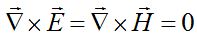
  112. Skark C, Zullei-Seibert N, Schöttler U, Schlett C (1998) The occurrence of glyphosate in surface water. International Journal of Environmental Analytical Chemistry 70: 93-104.
  113. Villeneuve A, Larroud S, Humbert JF (2011) Herbicide Contamination of Freshwater Ecosystems: Impact on Microbial Communities. Pesticides – Formulations, Effects, Fate.
  114. Rosenbom AE, Olsen P, Plauborg F, Grant R, Juhler RK, et al. (2015) Pesticide leaching through sandy and loamy fields – Long-term lessons learnt from the Danish pesticide leaching assessment programme. Environmental Pollution 201: 75-90. [crossref]
  115. Bai SH, Ogbourne SM (2016) Glyphosate: environmental contamination, toxicity and potential risks to human health via food contamination. Environmental Science and Pollution Research 23: 18988-19001. [crossref]
  116. Pham TH, Derian L, Kervarrec C, Kernanec PY, Jegou B, et al. (2019) Perinatal exposure to glyphosate and a glyphosate-based herbicide affect spermatogenesis in mice. Toxicological Sciences 169: 260-271. [crossref]
  117. Yousef MI, Ibrahim HZ, Helmi S, Salem MH, Seehy MA, et al. (1995) Toxic effects of carbofuran and glyphosate on semen characteristics in rabbits. Journal of Environmental Science and Health Part B 30: 513-534. [crossref]
  118. Dai P, Hu P, Tang J, Li Y, Li C (2016) Effect of glyphosate on reproductive organs in male rat. Acta Histochemica 118: 519-526. [crossref]
  119. Johansson HKL, Schwartz CL, Nielsen LN, Boberg J, Vinggaard AM, et al. (2018) Exposure to a glyphosate-based herbicide formulation, but not glyphosate alone, has only minor effects on adult rat testis. Reproductive Toxicology 82: 25-31. [crossref]
  120. Clair É, Mesnage R, Travert C, Séralini GÉ (2012) A glyphosate-based herbicide induces necrosis and apoptosis in mature rat testicular cells in vitro, and testosterone decrease at lower levels. Toxicology in Vitro 26: 269-279. [crossref]
  121. Gorga A, Rindone GM, Centola CL, Sobarzo C, Pellizzari EH, et al. (2020) In vitro effects of glyphosate and Roundup on Sertoli cell physiology. Toxicology in Vitro 62. [crossref]
  122. Anifandis G, Katsanaki K, Lagodonti G, Messini C, Simopoulou, M., et al. (2018) The effect of glyphosate on human sperm motility and sperm DNA fragmentation. International Journal of Environmental Research and Public Health 15. [crossref]
  123. Blondet A, Martin G, Durand P, Perrrard MH (2022b) Low concentrations of glyphosate alone affect the pubertal male rat meiotic step: An in vitro study. Toxicology in Vitro 79. [crossref]
  124. Blondet A, Martin G, Paulic L, Perrard MH, Durand P (2021) An in vitro bioassay to assess the potential global toxicity of waters on spermatogenesis: a pilot study. Environmental Science and Pollution Research 28: 26606-26616. [crossref]
  125. Blondet A, Martin G, Durand P, Perrard MH (2022a) A comparative study of the effects of 3 testicular toxicants in cultures of seminiferous tubules of rats or of domestic cats (veterinary waste): an alternative method for reprotoxicology. Toxicology in Vitro. In press.
  126. Du Y, Dreyfus CF (2002) Oligodendrocytes as providers of growth factors. Journal of Neuroscience Research 68: 647-654. [crossref]
  127. Suter-Crazzolara C, Unsicker K (1994) GDNF is expressed in two forms in many tissues outside the CNS. NeuroReport 5: 2486-2488. [crossref]
  128. Suvanto P, Hiltunen JO, Arumäe U, Moshnyakov M, Sariola H, et al. (1996) Localization of glial cell line-derived neurotrophic factor (GDNF) mRNA in embryonic rat by in situ hybridization. European Journal of Neuroscience 8: 816-822. [crossref]
  129. Trupp M, Rydén M, Jörnvall H, Funakoshi H, Timmusk T, et al. (1995) Peripheral expression and biological activities of GDNF, a new neurotrophic factor for avian and mammalian peripheral neurons. Journal of Cell Biology 130: 137-148. [crossref]
  130. Ashman LK (1999) The biology of stem cell factor and its receptor C-kit. International Journal of Biochemistry and Cell Biology 31: 1037-1051. [crossref]
  131. Rossi P, Sette C, Dolci S, Geremia R (2000) Role of c-kit in mammalian spermatogenesis. Journal of Endocrinological Investigation 23: 609-615. [crossref]
  132. Eisenberg ML, Li S, Behr B, Cullen MR, Galusha D, et al. (2014) Semen quality, infertility and mortality in the USA. Human Reproduction 29: 1567-1574. [crossref]
  133. Jensen TK, Jacobsen R, Christensen K, Nielsen NC, Bostofte E (2009) Good semen quality and life expectancy: A cohort study of 43,277 men. American Journal of Epidemiology 170: 559-565. [crossref]
fig 3

Recurrent Frozen Shoulder – An autobiographical Case Report

DOI: 10.31038/IJOT.2022514

Abstract

Frozen shoulder (FS) remains one of the most debated and ill-understood conditions causing painful shoulder. It is an extremely painful condition that can be treated in primary care facilities with a lengthy natural history resulting in resolution over 12-18 months. Codman, who coined the word “frozen shoulder” in 1934 had defined it as a painful condition of slow onset in the shoulder coupled with stiffness and sleeping discomfort on the affected side. He had described a pronounced decrease in forward elevation and outward rotation which are the disease’s hallmarks even today. The prevalence of frozen shoulder is estimated to affect 2-5% of the general population, from 10.8 to 30% of diabetic patients and much higher prevalence (27.2%) and incidence (10.9%) of hypothyroidism patients. FS has higher prevalence among men (70:30) than women. It usually affects the non-dominant shoulder although it can occur in either shoulder. Bilateral frozen shoulder occurs in around 14% of patients. Though the single most effective treatment is uncertain, response to a combination of conservative treatment results in gradual resolution of symptoms in 12-18 months.

Frozen shoulder once fully resolved rarely recurs among healthy population but not rare among the diabetes and Thyroid patients. Recurrence is known to occur usually in 5-7 years after the first episode. It’s unusual for frozen shoulder to recur on the affected side earlier. I present here an autobiographic case of rare recurrence of frozen shoulder. It is a rare case because it affected the non-dominant and same side (left shoulder) and after nearly 24 years in contradiction to recurrence in about 5-7 years known in the literature. Though the second and current episode is milder than the first with roughly one third pain and half restriction of range of movement and is being managed conservatively by physiotherapy without analgesics. Resistant cases that do not respond to conservative treatment for 6-9 months are offered surgical treatments called as 1) an arthroscopic capsular release (ACR) or 2) a manipulation under anaesthesia (MUA), both being equally effective. Manipulation process could result in unwarranted complications like fractures of humerus or rotator cuff tear, there for less preferred. Surgical procedures are out of the scope of present case report.

Keywords

Frozen shoulder, Adhesive capsulitis, Conservative treatment, Manipulation, Arthroscopic capsular release, AIIMS, Rehabilitation exercises

Introduction

Adhesive Capsulitis of the Shoulder (ACOS) commonly known as Frozen shoulder (FS) is a condition of uncertain aetiology characterized by significant restriction of both active and passive shoulder movements that occur in the absence of a known intrinsic shoulder disorder [1]. It was first described by Duplay in 1872 as ‘periarthritis’ scapulohumeral, later described as Frozen shoulder by Codman in 1934 [2], Adhesive capsulitis (Naviaser 1945) and Fibrotic capsulitis (Hsu 2011). International Society of Arthroscopy, Knee Surgery & Orthopaedic Sports Medicine (ISAKOS) prefers the term _ ‘frozen shoulder’_ and discourages adhesive capsulitis as there are no adhesions in the shoulder joint [3]. The ISAKOS Upper Limb Committee has classified a stiff shoulder into1. primary idiopathic stiff shoulder (frozen shoulder) and secondary stiff shoulder. Primary idiopathic stiff shoulder develops without any specific trauma or any underlying disease process, however a patient can have a condition that is known to have a link to stiffness (diabetes, thyroid disorders) but not necessarily known to cause stiffness. Secondary FS is shoulder stiffness following an underlying cause such as trauma, infection, or inflammatory disorder. The prevalence of frozen shoulder is estimated to affect 2-5% of the population, and affects men more than women. The peak incidence is observed between 40 and 60 years 20% of patients develop similar symptoms in the opposite shoulder in later years. Bilateral simultaneous involvement is reported in 14% of the patients.

Two conditions namely diabetes mellitus (DM) and thyroid dysfunction are associated with FS. The incidence of frozen shoulder in diabetic patients could vary from 10.8 to 30% [4,5] with a tendency of more severe symptoms and resistance to treatment. The prevalence of DM is ten folds in patients with frozen shoulder, and higher HbA1C and poorly controlled diabetes is associated with the development of FS [6]. Several studies have confirmed higher prevalence (27.2%) and incidence (10.9%) of hypothyroidism in patients with FS [7,8]. Other associated conditions with FS are smoking, cardiac disease, Parkinson’s disease, stroke, neck and cardiac surgery, hyperlipidaemia and Dupuytren’s contracture.

The diagnosis is most often by clinical examination and sometime supported by Xray, MRI or Scanning. Treatment options address reduction in pain, improved function, with high level of patient satisfaction. Minimum of 6 months of supervised conservative treatment should be attempted before surgical treatments are considered. Standard conservative therapy include i) Self-limited disease course: “supervised neglect” with analgesia ii) Non-steroidal anti-inflammatory medications (NSAIDS for 2-3 weeks, iii) Modalities – like Heat/Ice application iv) Oral corticosteroids to reduce night pain v) One or two Corticosteroid injections for pain relief – Glenohumeral/Intra-articular either Landmark-guided or Image-guided, Hydro dilatation and Suprascapular nerve blockade. The surgical procedures like Manipulation under anaesthesia (MUA) and b) Arthroscopic capsular release (ACR) are beyond the scope of this article. The modern evidence of frozen shoulder pathogenesis involves fibrosis and/or contracture of the tendons, joint capsule, and other soft tissues surrounding the glenohumeral joint specifically the rotator cuff interval. In severe cases, the RC interval is “obliterated,” and the coracohumeral ligament is “transformed into a tough contracted band,” like arthritis of soft tissues.

My Case Report

I started to have insidious onset of pain and stiffness in my left shoulder without any preceding traumatic, infective, or inflammatory event in mid May 2022. Pain is around the shoulder over deltoid muscle. Sleeping on my left side was a bit troublesome in the night. My left shoulder examination revealed restriction of both active and passive range of movements (ROM). The loss of external rotation with arm by the side of the chest and folding my left hand behind my back and raising hands overhead were the key symptoms. The range of movement is more than 100° in forward flexion, less than 30° in external rotation, and more than L5 vertebral level in internal rotation. The strength of the rotator cuff is relatively unaffected.

History of Significance

I am a known diabetic since August 1991, managing well on oral anti-diabetics, diet, and regular exercises. I had Left sided Frozen shoulder in 1998 (in the 8th year after diabetes diagnosis). I was treated conservatively at All India Institute of Medical Sciences (AIIMS) New Delhi. The treatment then included NSAIDS, Physiotherapy and Extracorporeal shock wave therapy. After about 3 months of intensive therapy and follow-up of another 12 months I had fully recovered with less than 5% restriction of the movements. I had some complications of Diabetes like Coronary artery disease undergoing By-pass surgery (CABG) in August 2005, Bilateral early cataract surgeries in 2010 and 2014, and Benign enlargement of the prostate. I am under annual check-ups for Diabetic retinopathy,Kidney function tests. My diabetes was fairly well managed until 2018. Since 2018 following relocation to Bengaluru, I am on Carbohydrates restricted diet, walking and muscle strengthening exercises for about 90 minutes per day for 6 days week and oral anti-diabetes drugs. This led to reduction of oral diabetes drugs requirements by one third of what I used to take in early 2018 and Hb1Ac has been around 6.5-7. The FS was almost forgotten.

Two events 1) A head injury due to a fall in the bathroom in August 2021 (Brain scan was normal) 2) the precautionary dose of Covid 19 vaccination on 25 January 2022 had disrupted my diet and exercise routine.

Current Clinical presentation

The current Frozen shoulder pain started insidiously around 15th of May 202 and in a week’s time range of movements of the shoulder got restricted. The pain this time in much less, not needing analgesics but with the restriction of movements (50% of what it was in the first episode). The first sign observed was of painful usual exercise of joining both hands behind the back around L5 level. I had to do this for left shoulder with passive pulling from right hand. Over last 4 weeks it is improved, but the first few attempts of all shoulder exercises in the morning are painful. The worst effected movement is folding (90°) at elbow keeping the shoulders and arms parallel to the ground and extending the left upper limb to touch the ground in supine position or stretching above head standing with my back to wall. Fortunately, there is no disturbance in the sleep. I intensified my shoulder exercises and in 4 weeks I see 25% improvement of ROM.

Physical Examination

Current examination findings include Painful and restricted active and passive ROM, especially of Elevation – forward flexion/abduction, Rotation – external/internal rotation. Difficult active and passive internal and external rotation with shoulder abducted 90° and tenderness of anterior and posterior capsule is felt. Has not affected my sleep.

Basic investigations on 26 May 2022, indicated a Fasting BS= 159 mg/Dl, Hb1Ac level of 7.0, Hb% of 12.2 g/Dl, B12= 150 mg/ml which were a matter of concern. Other biochemical parameters like serum calcium, creatinine, Iron, Vitamin D (25 Hydroxy) = 50 ng/ml and serum Cholesterol = 106 mg/Dl were well within acceptable limits. No Imaging is done this time.

My Management Approach in Current Episode

I am a 76 years aged male, diabetic for 32 years, FS diagnosis based on previous experience. The clinical stages are indistinguishable, ROM and pain are limited. Have been doing all activities as much as tolerated. I have not used either heat, or analgesic medications. I have been cautiously doing physiotherapy, including shoulder exercises as recommended in the first episode,listed later with illustrations, that were interrupted for about 3 months including stretching, strengthening and Pendulum stretch with weights, inwards and outwards rotations, and other Yoga asanas.

Prognosis

I intensified my shoulder exercises and in over last 4weeks ROM has improved,but the first few attampts of all shoulder exercises in the morning are painful.

Discussions

Two Episodes of My FS Episodes in Comparison with National Recommendations

Pathogenesis

A major role of inflammatory mediators (interleukins, cytokines, B- and T-lymphocytes, growth factors, matrix metalloproteinases, tumour necrosis factors and fibroblast activation markers) is postulated in FS characterized by intense inflammatory changes in capsule indicating a role of and disturbance in local collagen translation, which result in global fibroplasia. The capsule of the FS appears thick, congested, and inflamed, particularly around the rotator interval and anteroinferior capsule along with thickened coracohumeral ligament (CHL) and superior-middle-inferior glenohumeral ligaments to the naked eyes during surgery. This results in loss of flexion, abduction, and rotations. Microscopic tissue samples reveal dense collagen matrix and high population of fibroblasts and contractile myofibroblasts, a process like Dupuytren’s contracture, with the fibrotic process predominantly limited to anterior capsule.

Epidemiology

Exact cause is not known. Evolution of synovial inflammation to capsular fibrosis and a Combination/progression of inflammation and fibrosis like Dupuytren’s chronic inflammatory response with immunomodulated fibroblastic proliferation (Hand, JBJS, 2007). Contracture of the rotator interval, coracohumeral ligament, and anterior /inferior capsule is observed.

Literature review indicates that mostly men (60-70 %) are affected and Med Sport data indicated 67% (Housner, 2017). Majority (70-75%) of the affected are between 40-60 years old (peak age 50). My first episode was at the age of 46 year and the current at 76 years. While the first episode was well within expected age frame the second episode is well beyond known upper age limit.

Risk of recurrent in contralateral shoulder 15-20% usually within 5 years (range of 6 months to 7 years (Bridgman 1972, Reeves 1975, Shaffer 1992, Hand 2008) and Risk of recurrence in same shoulder essentially 0% (Codman 1934, Lippman 1944, Hsu 2011). My case is very rare as both these conditions are contradicted as the recurrence has occurred after 24 years and has affected same shoulder.

Natural History

Total duration may be 12 to 40 months; recovery is always sure and can be confidently expected but there is a Controversy over residual pain and/or loss of motion of 50% patients at 7 years with no functional limitation. My first episode had similar experience as I had recovered within 15 months fully, with a functional loss of less than 5% and absolutely no pain. The second episode now is insidious and much less painful and ROM. The different stages described below were evident and distinct in the first episode but not now.

Stage 1 (Painful or “Freezing”). Usually lasts up to 9 months from onset of symptoms, pain precedes the restriction in motion. Sharp pain at end range of motion and gradual loss of motion. The earliest to get affected and latest to return finding is usually loss of external rotation. May affect sleep if there is aggressive synovitis or angiogenesis. In my case in the first episode, my sleep was disturbed for nearly 2 months but not affected at all now.

Stage 2 (“Frozen”). 6 to 15 months from onset leading to loss of motion in all planes and throbbing pain worse with motion and usually disturbs sleep. MRI shows Capsuloligamentous fibrosis. My first episode had bothered me for about 6 months in this stage. The image inferences were like the ones described in the literature. In the current episode I have not gone for any imaging as the condition is evident and mild. I need to observe the long-term resolution.

Stage 3 (“thawing”). Lasts for 12 to 24 months from onset. It is gradual spontaneous improvement of shoulder mobility and function. Pain starts decreasing, range of motion improves, mild mobility deficits and pain may persist. Most patients report minimal to no disability. Pathologically Synovial involvement recedes. Poor function of reaching overhead (getting dressed, putting on deodorant), reaching behind back (putting on shirt/coat) and reaching out to the side (getting mail, using ATM). Patient finds it difficult to explain onset of pain to attributes to a trivial injury. My first episode had taken about 6 months in this stage. Pain had receded slowly over 6 months and after a total of about 15 months neither there was a residual pain or no was there any residual restriction of movements. In the current episode I need to observe this stage. Looking at the current progress in first 4 weeks, I strongly feel that the entire course of returning to normalcy may take around 6 months.

Treatment

By and large, conservative treatment of frozen shoulder is successful in up to 90% patients. Latest recommendation of the treatment is ‘use it or lose it’ by movement therapy [Jun 2022-11]. The age old conservative treatment incudes:

NSAIDs and Other Analgesics

NSAIDs remain one of the most common medical interventions, a short course of NSAIDs for 2-3 weeks minimises the intense pain of in treating frozen. In my first episode this was adopted for about 3 weeks. The current episode pain is tolerable and hence have not taken any analgesics.

Corticosteroids

Both oral steroid and local steroid injections are widely used. They are beneficial only in early stages to control inflammation and ensuing pain and may not be useful in late stages with established fibrosis without much inflammation. Oral steroids for improving pain, ROM and function when prescribed for ‘short term’ of up to 6 weeks in early stage is helpful. Systematic reviews and metanalysis have confirmed usefulness of steroid injections in improving pain and ROM in the short term, and moderate evidence in the midterm. Fortunately, neither in the first nor the current episodes this intervention was either advised or tried.

Hydro-dilatation (HD)

A single HD of the glenohumeral joint using saline, steroid, local anaesthetic agent is supposed to distend the capsule by breaking the ‘early intracapsular fibrosis’ helping in improving ROM In early/late frozen stage. However, more than one repeated HD after 2 weeks have no added effect over FS. There was no need of such an intervention in my case.

Calcitonin

Calcitonin is supposed to decrease the systemic inflammatory response and stimulate the release of endorphins, improving mRNA expression of fibrosis-related mole, but further research is required in this area to validate.

Extracorporeal Shock Wave Therapy (ECSWT)

ECSWT significantly improves the functional outcome and ROM without any adverse events. ECSWT was used for about 4 weeks twice a week in the first episode and was instrumental in remission of pain in 6 months as against expected time frame of 9-12 month, that was considered needed then.

Acupuncture

A few studies have reported reasonable relief in pain and improved forward flexion by using acupuncture in the treatment of FS.

Nerve Block

A single or multiple injections to block Suprascapular nerve in the treatment of FS have shown improved pain score and ROM Operative Management of Frozen Shoulder involves a) Manipulation under anaesthesia (MUA) and b) Arthroscopic capsular release (ACR). Both are equally effective, but ACR is ‘preferred’ surgical option for the treatment of refractory FS as it allows controlled and precise release of fibrosed capsule-ligament complex under vision, avoiding complications of MUA like as Humerus shaft fracture, rotator cuff tear, shoulder dislocation, labral tear, and nerve injury.

Rehabilitation

A Shoulder Range of Motions (Flexion, abduction, internal rotation, and external rotation) as detailed below was advised and done with the help of a physiotherapist of AIIMS for two weeks along with ECSWT and continued at home for another 4 months without ECSWT in my first episode of FS in 1998.

Pendulum Stretch

I was to relax my shoulders, stand and lean over slightly, allowing the affected arm to hang down. Swing the arm in a small circle, about a foot in diameter. Perform 11 revolutions in each direction, once a day. As my symptoms improved, increased the diameter of my swing, without forcing it. Slowly I increased the stretch by holding a light weight (1-5 kg) in the swinging arm even now [9] (Figure 1).

fig 1

Figure 1: Stretch by holding a light weight (1-5 kg) in the swinging arm

Towel/Rubber Band Stretch

I hold one end of a three-foot-long towel (of late a rubber stretch band) behind my back and grab the opposite end with your other hand. Held the towel in a horizontal position and used my good (right) arm to pull the affected arm upward to stretch it. I held the bottom of the towel with the affected arm and pull it toward the lower back with the unaffected arm for 11 times a day (Figure 2).

fig 2

Figure 2: Held the bottom of the towel with the affected arm and pull it toward the lower back with the unaffected arm for 11 times a day

Finger Walk

I faced a wall three-quarters of an arm’s length away. Reach out and touch the wall at waist level with the fingertips of the affected arm. With my elbow slightly bent, slowly walk my fingers up the wall, spider-like, until I had raised my arm as far as I was comfortable. Only my fingers worked and not my shoulder muscles. Slowly lower the arm (with the help of the good arm, if necessary) and repeat. Perform this exercise 11 times a day.

Cross-body Reach

While standing, I used my good arm to lift my affected arm at the elbow, and bring it up and across my body, exerting gentle pressure to stretch the shoulder and hold the stretch for 15 to 20 seconds. Repeating these 11 times per day.

Outward Rotation

Holding a rubber exercise band between my hands with my elbows at a 90-degree angle close to my sides, rotated the lower part of the affected arm outward two or three inches and hold for five seconds. Repeated these movements for 11 times, once a day (Figure 3).

fig 3

Figure 3: Repeated these movements for 11 times, once a day

Inward Rotation

Standing next to a closed door, hooked one end of a rubber exercise band around the doorknob. Holding the other end with the hand of the affected arm, and my elbow at a 90-degree angle, I pulled the band toward my body two or three inches and held for five seconds. Repeated this exercise for 11 times, daily at least 5 days a week. I had continued doing most of these exercises at least 3-4 days week since then. After relocating to Bengaluru in 2018 my apartment complex Gymnasium had equipment that provided for the above exercises – internal and external rotation exercises, that I did. In 2020 the gym was closed, and I continued to the similar exercising using the elastic stretch bands (Figure 4).

fig 4

Figure 4: Similar exercising using the elastic stretch bands

The international recommendations are for 10-15/20 movements each time. Keeping in Indian tradition of the odd number sanctity I advocate for 11 or 21 movements for each shoulder.

These exercises are field tested under the name of Pune Shoulder Rehabilitation Program (PSRP) in 2013. PSRP an exercise program involving exercises with low resistance, high repetition performed in sub impingement region for strengthening of scapular and rotator cuff muscles to normalize scapular muscle strength, normalize scapula humeral rhythm, pain relief, rotator cuff muscle strengthening, restoration of range of motion (ROM), restoration of function, and maintaining posture and core. The Pune study findings showed that over the 6th-week protocol, statistically significant improvements were found in pain reduction and shoulder range of motion, concluding that such exercise protocol is effective in increasing the range of motion and decreasing the pain in the shoulder caused by frozen shoulder [10].

Prevention: A few easy steps to help prevent FS are:

  • Stretching your shoulder and back muscles daily.
  • Stretching your tendons (by rotating hands and palms to stretch different tendons).
  • Practicing good ergonomics while sitting at a desk and using a computer.
  • Maintaining a healthy immune system.

Conclusion

These days, adhesive capsulitis is the precise descriptive jargon for the condition, but no better than “periarthritis. Frozen shoulder (FS) continues to be an extremely painful condition since it was first identified in 1934, that can be treated in primary care. It has a lengthy natural history resulting in resolution over 12-18 months. The shoulder is the only joint that often “freezes” like this and is a common biological puzzle. It’s hard to define precisely, diagnose accurately, or treat effectively. In fact, frozen shoulder treatment is one of the best examples of how musculoskeletal medicine is surprisingly primitive still. Of late there is a hypothesis that FS is more of Functional freezing than adhesive freezing. Three main ways that a functional limitation of shoulder ROM would probably work, are put forth as a) The brain can “shut down” a joint with neurological inhibition, b) because it has become sensitized or c) The muscles may have gotten rotten with trigger points.

Frozen shoulder once fully resolved does recur, though in small proportion among the diabetes and Hypothyroid patients. Usually, recurrence occurs in 5-7 years after the first episode and affects contralateral side. It’s extremely rare for frozen shoulder to recur on the same side affected earlier. Second episode is much milder, hardly disturbs sleep and can be managed with exercises only [11-13].

References

  1. Duplay S (1892) Archives Générales de Médecine.
  2. Codman E (1984) The Shoulder Rupture of the Supraspinatus Tendon and Other Lesions in or about the Subacromial Bursa. Medicine.
  3. Vivek Pandey et al. (2021) Clinical Guidelines in the Management of Frozen Shoulder. Journal List Indian J Orthop. 55: 2. [crossref]
  4. Jeffrey A, Housner. Adhesive Capsulitis of the Shoulder. Departments of Family Medicine, and Orthopaedic Surgery, University of Michigan.
  5. Future Sci OA (2020) Frozen shoulder: Overview of clinical presentation and review of the current evidence base for management strategies[crossref]
  6. J Zreik NH et al. (2016) Adhesive capsulitis of the shoulder and diabetes: A meta-analysis of prevalence. Muscles Ligaments Tendons. 6: 26-34. [crossref]
  7. Bridgman JF (1972) Periarthritis of the shoulder and diabetes mellitus, Annals of the Rheumatic Diseases. 31: 69-71. [crossref]
  8. Chan JH et al. (2017) The relationship between the incidence of adhesive capsulitis and haemoglobin A(1c). Journal of Shoulder and Elbow Surgery. 26: 1834-1837. [crossref]
  9. Schiefer M et al. (2017) Prevalence of hypothyroidism in patients with frozen shoulder, Journal of Shoulder and Elbow Surgery. 26: 49-55. [crossref]
  10. Cakir M et al. (2003) Musculoskeletal manifestations in patients with thyroid disease. Clinical Endocrinology – Oxford. 59: 162-167. [crossref]
  11. Shoulders stretching exercises for frozen shoulder.
  12. Seema Saini et al. (2022) Effectiveness of Pune shoulder rehab protocol on patients with frozen shoulder.
  13. Complete Guide to Frozen Shoulder.
fig 1

A Prospective, Randomized, Three Arm, Open Label, Parallel Group, Multicentric Study to Evaluate the Effectiveness of Supplementing MG-HT® in Reduction of Blood Pressure in Subjects with Stage 1 – Stage 2 Hypertension on any Antihypertensive Therapy

DOI: 10.31038/JCRM.2022534

Abstract

Background: Worldwide, Hypertension (HTN) has emerged as the most highly prevalent modifiable risk factor for cardiovascular disease related morbidity and mortality, in terms of strongest evidence of causation and high prevalence for exposure. A preventive approach to control blood pressure (BP) may reduce these risks. Oral Magnesium (Mg) intake is inversely related with risk of HTN. Nutritional Magnesium has both direct and indirect impacts on regulation of BP through sodium (Na)-potassium (K) and intracellular Calcium (Ca) mediated Mg-driven Na-K and Ca pumps, impairment of which leads to vasoconstriction and HTN. Additionally, it increases endothelial nitric oxide, improves endothelial dysfunction, apart from inducing direct and indirect vasodilation. The efficacy of Mg, Beta-sitosterol, Pyridoxine, Niacinamide and L-carnitine, as individual ingredients in supporting alleviation of BP or associated conditions has been documented in literatures; however, no study has been done on the effectiveness of combination of these ingredients in HTN, specifically in Indian population. Despite improvement in primary therapeutics for HTN, there are reports of resistant hypertension in patients who are on more than three antihypertensives of different classes, and in many cases, achieving the goal BP becomes difficult in clinical practice. It has been suggested that addition of nutritional management for high blood pressure to the primary regimens can be a safe, sustainable, and cost-effective intervention, but their benefits are yet to be shown through appropriately designed studies. This study is aimed to evaluate the impact of MG-HT® in reduction of blood pressure when administered in conjunction with any antihypertensive therapy, such as, Calcium channel blocker, Angiotensin-converting enzyme (ACE) inhibitors, Thiazide diuretic, or Angiotensin II receptor blockers (ARB), in most cases, a combination of two drugs.

Objective: To evaluate the benefits of supplementation with MG-HT® administered twice daily with ongoing antihypertensive regimen versus MG-HT® administered once daily with ongoing antihypertensive drugs versus standard of care on the reduction of systolic blood pressure (SBP) and diastolic blood pressure (DBP) from baseline to study end at 90 days, in subjects with Stage 1 – Stage 2 Hypertension on any antihypertensive therapy, such as, Calcium channel blocker, ACE inhibitor, Thiazide diuretic, or ARB, in all cases a combination of two drugs.

Design, setting and participants: This is a Prospective, Randomized, Three-Arm, Open-Label, Parallel-Group, Multicentric Study involving 80 patients at 4 sites across India, who have Stage 1 – Stage 2 HTN and are on any existing antihypertensive therapy.

Intervention: Participants were randomized to existing antihypertensive therapy and MG-HT® once daily (Study arm 1), existing antihypertensive therapy and MG-HT® twice daily (Study arm 2), and existing antihypertensive therapy (Study arm 3) alone for 90 days, while all continued on the same dietary and activity advice.

Main outcomes and measures: The primary objective was to evaluate the benefits of additional supplementation with MG-HT® administered once daily with the existing antihypertensive therapy versus MG-HT® administered twice daily with the existing antihypertensive therapy versus standard of care with existing antihypertensive therapy alone in reduction of SBP and DBP from baseline to study end at 90 days from the beginning of the study. The secondary objectives were to evaluate the additional health benefits of MG-HT® in the study groups of subjects in terms of lipid profile from baseline to end of the study period at 90 days while they continued on existing dietary and activity advice and to analyze the relationship between the rise in serum magnesium levels to reduction in BP during the same period. Additionally, safety of MG-HT® in all the two study arms throughout the study period of 90 days was evaluated including the prevalence of subclinical magnesium deficiency at baseline in all enrolled subjects. The relationship between variations of serum magnesium levels (independent variable) and BP (dependent variable) was assessed by calculating the Odds Ratio (OR), using multivariate logistic regression analysis.

Results: The change in the Systolic Blood Pressure (SBP) in MG-HT® once daily arm from baseline to end of study was a reduction of 13.63 mmHg; in MG-HT® twice daily arm, there was a reduction of 7.87 mmHg, and in the comparator arm, and there was a reduction of 10.06 mmHg. The reduction in systolic blood pressure was higher in the arm receiving MG-HT® once daily as compared to twice daily and standard of care, respectively. The change in the Diastolic Blood Pressure (DBP) in MG-HT® once daily arm from baseline to end of study at 90 days was a reduction of 9.81 mmHg; in MG-HT® twice daily arm, there was a reduction of 6.16 mmHg and in the comparator arm, there was a reduction of 7.59 mmHg. The reduction in DBP was higher in the arm receiving MG-HT® once daily as compared to twice daily and the standard of care. However, the differences in SBP and DBP were not statistically significant (p-value >0.05). Subjects receiving MG-HT® once daily reported a greater reduction of BP in terms of returning to pre-hypertensive levels at the end of study when compared to MG-HT® twice daily and to subjects receiving standard of care. This difference was statistically significant (p-value >0.001).

The mean change of Mg levels from baseline to study end at 90 days was not statistically significant between study arms (p-value >0.05). The mean change of laboratory parameters from baseline to study end was not statistically significant between study arms (p-value >0.05).

The subjects who had lower magnesium levels at the baseline achieved normal serum mg levels at study end with an average value of 1.8 mg/dL. Subjects receiving MG-HT® once daily reported a greater reduction in SBP levels at study end with a reduction of 10 mmHg compared to 7 mmHg and 6 mmHg of MG-HT® twice daily arm and standard of care arm respectively. No change in DBP was seen. The SBP and DBP changes were not statistically significant between arms.

Conclusions: In this study, it was found that once-daily oral MG-HT® therapy added to standard antihypertensive regimens for 90 days reduced blood pressure in patients with stage 1 and 2 hypertension, improving clinical outcomes.

Keywords

Calcium channel blocker, Endothelial dysfunction, Hypertension, L-carnitine, Magnesium, MG-HT®, Niacinamide, Pyridoxine, Sterols

Introduction

Hypertension (HTN) has emerged as the most important risk factor for morbidity and mortality, worldwide [1]. It is the single largest contributor to the avoidable deaths and diseases in India [2]. It is also one of the major risk factors for noncommunicable diseases such as cardiovascular diseases, stroke, and renal diseases [3]. As per WHO currently, 35% of the world population is affected by HTN, and it might cross 50% by 2025 [4]. The prevalence of HTN in India is around 29.8%, with a higher prevalence seen in urban areas (33.8%), compared to rural areas (27.6%) [5].

In a latest Indian study, it is reported, that 25% of adults are hypertensive, with a substantial prevalence of 12% observed among the young adults aged between 18 to 25 years [6]. WHO ranks HTN as one of the prime causes of premature deaths globally. In India, 57% of all stroke deaths and 24% of all CHD are directly linked to HTN [7].

Despite availability of several comprehensive medical therapies, HTN remains a challenging clinical problem [8]. Majority of patients fail to achieve an optimal blood pressure control even with combination therapy with two or more drugs including a diuretic [9-13]. In India, a multidisciplinary consensus statement highlights that despite treatment, only about 9-20% of patients achieves goal target BP [10]. Another Indian study has reported that uncontrolled HTN may double the risks of cardiovascular events and stroke [11]. Number of drugs used to control uncontrolled hypertension matters, and any patient with uncontrolled hypertension may develop resistant hypertension, the prevalence of which is 20-30%, which would need addition of further medications for blood pressure control as an adjunct to conventional standard of care therapies [12].

Numerous studies have demonstrated that Mg supplementation may lower BP [14]. Mg may play a crucial role in BP regulation, by directly stimulating nitric oxide and prostacyclin formation, modulating endothelium-dependent and endothelium-independent vasodilation, reducing vascular tone and reactivity, and preventing vascular injury via its anti-inflammatory and antioxidant functions [14,15]. Mg also improves vascular smooth muscle tone and contractility by blocking the calcium channels and by inhibiting norepinephrine release [16,17]. An earlier study published in Japanese explored the relationship between Mg and HTN, demonstrating its relaxant effect on vascular smooth muscle cells through cationic regulation of intracellular Sodium (Na): Potassium (K) ratio and Calcium (Ca). This study also showed the benefits of Mg in hypertensive patients on antihypertensive medications, which required a lower dose in comparison to patients who were not on any antihypertensive medications [13].

Studies have shown that magnesium deficiency states may negatively influence functional and structural vascular changes in HTN. It is involved in the pathogenesis of HTN, endothelial dysfunction, dyslipidemia, and inflammation, contributing to arterial stiffness [14].

Pathophysiologically, several experimental models and cross-sectional and longitudinal population studies have reported an inverse correlation between Mg deficiency states and HTN [11-15]. On the other hand, several trials have reported inconsistent results with Mg supplementation on BP lowering effects with some showing a positive impact, while others showing none [15]. Various meta-analyses of Cohort studies and RCTs have confirmed the protective effects of Mg, establishing the association between dietary and supplemental Mg with HTN [16].

A systematic review by Rosanoff et al. (2021) of 49 clinical trials reported that oral Mg safely lowered BP in uncontrolled hypertensive patients on antihypertensive medications. However, patients with controlled hypertension or with normal blood pressure on oral Mg therapy did not show any BP lowering effect [21]. An interventional study by Banjamin et al. (2018) showed significant reduction in SBP and DBP by 8.9 mmHg and 5.8 mmHg respectively. Mg further significantly improved two hemodynamic parameters, reduced systemic vascular resistance index and left cardiac work index [18]. Several other studies have established that Mg increased the effectiveness of all antihypertensive drug classes due to its calcium channel blocker mimetic effect and circulating Na+K+ATPase suppressor activities that can reduce vascular tone [19-23].

Studies by Askarpou et al. (2019) and Craig et al. (2007) demonstrated that L-carnitine supplementation decreased SBP and DBP. It also increased brachial artery diameter by 2.3% [24,25].

Phytosterols (Beta-sitosterol) are the analogues of cholesterol, decrease the circulating cholesterol levels by competing with cholesterol for intestinal absorption. They decrease Low-Density Lipoprotein Cholesterol (LDL-c) by up to 10% and Triglycerides (TG), modulate the expression of lipid regulatory genes and de novo lipogenesis. They increase hepatic β-Hydroxy β-methylglutaryl-CoA (HMG-CoA) Reductase mRNA expression. Studies have shown that Beta-sitosterols lower risk of cardiovascular diseases [26,27]. Experimental studies with Beta-sitosterol showed that it improved nitric oxide levels and, hence, vascular function [28] that may support vasorelaxing effect of Mg.

Study by Zhang et al. (2021) demonstrated niacin-induced primary prevention of hypertension [29]. Bays et al. (2009) in a review reported significant BP lowering effects of Niacin in clinical trials involving hypertensive patients [30]. The role of niacin as an adjuvant therapy for reducing atherogenic lipoprotein levels in dyslipidemic patients has also been reported [31] including its efficacy in controlling high TG, supporting maintenance of High-Density Lipoprotein cholesterol (HDL-c) levels, and thus supporting management of lipid abnormalities associated with metabolic syndrome [32], which, in turn, is commonly associated with HTN.

Pyridoxal 5-phosphate regulates cellular calcium transport and thereby can be useful in controlling HTN (33). Aybak et al. (1995) concluded that pyridoxine administration significantly reduced SBP and DBP in hypertensive patients within 4 weeks [33, 34].

Since the current literature on the effectiveness of Mg, Beta-sitosterol, Pyridoxine, Niacinamide and L-carnitine in reduction of BP is predominantly from the western world and no combination study had been done even there, this study is envisaged to evaluate the benefits of proprietary nutraceutical formulation MG-HT® in reduction of BP when administered concomitantly with antihypertensive as a standard therapy in Indian population. Therefore, this study is the first study of its kind in India, which may contribute to better management of hypertensive patients, as a nutritional adjunct to the standard antihypertensive therapy, optimizing clinical outcomes. This could be more so useful in patients with uncontrolled HTN already on standard antihypertensive therapy, contributing to enhanced risks and resistance to treatment.

Materials and Methods

Study Design

This prospective, randomized, three arm, open label, parallel group, multicentric study investigated the clinical effectiveness of supplementing MG-HT® (Magnesium Bisglycinate 500 mg providing elemental Magnesium 70 mg, L-Carnitine L-Tartrate 500 mg, Niacinamide 8 mg, Pyridoxine Hydrochloride 1 mg, Beta-Sitosterol 20 mg, a proprietary nutraceutical formulation available in Indian market) in supporting reduction of BP in uncontrolled hypertensive patients, on standard antihypertensive therapy.

Site of the Study and Ethics

This is a multi-center, interventional study conducted at the 4 sites geographically distributed across India at Suraksha Polyclinic-Kolkata; Sanjeevani Hospital and Polyclinic-Mumbai; Diabetes Specialty Centre, Dwarka-New Delhi; and SRM Institute of Medical Sciences-Chennai. The study was approved by the Independent Ethics Committee (IEC) of each study center. It was performed in compliance with the ICH guidelines for Good Clinical Practice, ICMR guidelines, and declaration of Helsinki. Written informed consent for participation in the study was obtained from all participants. This study was registered in the Clinical Trials Registry of India (CTRI/2020/01/022864).

Study Population

80 Subjects of both sexes in age bracket 35-65 years with Stage 1 – Stage 2 hypertension as defined by the latest JNC 8 hypertension guidelines (Stage 1 HTN: SBP 140-159 mmHg, DBP 90-99 mmHg and Stage 2 HTN: SBP ≥160 mmHg, DBP ≥100 mmHg) and on any antihypertensive therapy for at least a month who have not shown any improvement in BP control or have mild elevation in BP but continue to fall under the same stage as at the time of diagnosis.

Inclusion Criteria

Subjects

  1. Able to provide signed informed consent
  2. Willing to adhere to protocol and study requirements during the entire study duration

Exclusion Criteria

Subjects

  1. With uncontrolled diabetes mellitus in the opinion of the investigator
  2. With history of myocardial infarction within the past 3 months of the start of the study, cardiac failure of class III and IV, Atrioventricular block II or III on ECG
  3. With chronic kidney disease or liver disorder
  4. With chronic terminal diseases, such as, malignancies, anemias and presence of serum electrolyte disturbances (Na, K, Cl), that might indicate an underlying secondary HTN
  5. On Mg supplements equal to or above the study dose of 70 mg, in which case a wash-out period of 7 days will be followed prior to enrolment
  6. With any other condition, which in the opinion of the investigator renders the patient unfit to participate
  7. Females, who are lactating, pregnant, or planning to conceive during the study period

Randomization

Computer generated random numbers were used to assign participants to the MG-HT® once daily with standard antihypertensive therapy or MG-HT® twice daily with standard antihypertensive therapy or standard of care groups in 1:1:1 allocation ratio.

Outcome Measures

The primary endpoint was the proportion of subjects with a reduction in SBP and DBP from baseline to study end after 90 days, mean change in SBP from baseline to study end after 90 days, and mean change in DBP from baseline to study end after 90 days.

The secondary endpoints were the mean change in lipid profile from baseline to study end after 90 days and mean change in serum Mg levels from baseline to study end after 90 days.

The safety endpoints were the solicited and unsolicited adverse events (AEs) in all the three arms and changes from baseline in the laboratory parameters of renal function tests and liver function tests.

The exploratory end point was the proportion of subjects with subclinical Mg deficiency at baseline.

BP Measurement Procedure: Seated BP of each enrolled subjects was measured using Diamond brand mercurial type BP instrument with standard U-tube manometer at each study visit after a rest period of 10 minutes. Subjects were made to sit comfortably with legs resting on the ground not crossed and with arm supported at the heart level. Each subject was advised to empty the bladder prior to BP recording. Cuff bladder was applied, encircling two-thirds of the subject’s arm circumference. The recordings were made on the right arm. The subject and the person taking the measurements were not allowed to speak during the procedure. The cuff was inflated to at least 30 mmHg above the point at which the radial pulse disappeared. The cuff was then deflated at a rate of 2 to 3 mmHg per second (or per pulse when the heart rate is slow). Deflation rates greater than 2 mmHg per second can cause the systolic pressure to appear lower and the diastolic pressure to appear higher. The first and last audible sounds were recorded as systolic and diastolic pressures, respectively. Measurements were given to the nearest 2 mmHg. An average of two readings was recorded. The BP was recorded by the investigator or a trained delegated study personnel. A calibrated sphygmomanometer was used at all sites. The same delegated personnel for each site recorded the BP at all visits. This maintained consistency and eliminated any interobserver bias.

Procedure to analyze MG-HT® batches allocated to each Intervention Group: The batch number and other details of MG-HT® product were recorded in the form of a list. Each batch allocated in the study had an assay undertaken at the manufacturing unit, and the Certificate of Analysis was available for record and corroboration. It was ascertained that the elemental Mg level in each batch was at least 70 mg.

Study Arms

  1. Study arm 1: Antihypertensive therapy and MG-HT® once daily (morning).
  2. Study arm 2: Antihypertensive therapy and MG-HT® twice daily.
  3. Comparator arm: Standard of care with antihypertensive therapy.
  4. Study product was supplied by Pharmed Limited, Bangalore, India.

Methodology

80 enrolled subjects ranging 35-65 years of age, diagnosed with Stage 1 – Stage 2 HTN and on any antihypertensive therapy for at least a month that have not shown any improvement in BP control or have mild elevation in BP but continue to fall under the same stage at the time of diagnosis were enrolled into the study. All enrolled subjects were screened according to the pre-defined inclusion and exclusion criteria, and subjects were randomized to either of the three study arms. Subjects randomized to study arm 1 received antihypertensive therapy and MG-HT® once daily (morning), subjects randomized to study arm 2 received antihypertensive therapy and MG-HT® twice daily, and subjects randomized to comparator arm received the investigator prescribed standard of care of antihypertensive therapy. There were three physical visits (V1-Screening, V3 and V6-Study end on Day 1, 30 and 90 respectively) and three telephonic follow-up visits (V2, V4 and V5 on Day 15, 45 and 60 respectively). All the subjects in each group were asked to continue with salt-restricted diet and usual activities, such as, daily walking as a part of standard of care before the screening.

After obtaining written informed consent from the participants in the prescribed format, detailed clinical history, and stage of HTN were recorded along with their relevant medical history and drugs used as antihypertensives or otherwise. Seated BP of all enrolled subjects were measured and recorded as an average of two readings. A fasting blood sample was collected from each subject for baseline laboratory investigations of HbA1c, Lipid Profile, Serum Mg, Renal Function Tests, Liver Function Tests, and an ECG was recorded at baseline on each subject.

Subjects were contacted telephonically at Day 15, Day 45 and Day 60 and enquired about their general well-being and compliance to study product consumption. Subjects were instructed to report to the study sites for the physical follow-up visits on Day 30 and Day 90. At all follow-up visits, a general examination was performed including BP recording, and subjects were enquired about any solicited or unsolicited AEs. Concomitant and rescue medications were reviewed as applicable in each case. Investigational Product (IP) accountability was also performed. At study end visit, a fasting blood sample was collected from each of the subjects for laboratory investigations, and an ECG was also recorded.

Statistical Analysis

To evaluate the overall effects of MG-HT® supplementation on BP, the mean changes of systolic and diastolic BP between treatment groups after treatment was compared by calculating mean differences and 95% confidence intervals (CIs). For comparison of normally distributed variables, One-Way ANOVA Test (or Kruskal-Wallis test for skewed data) to establish the differences between the groups was performed. The relationships between variations of serum Mg levels (independent variable) and BP (dependent variable) were assessed by calculating the Odds Ratio (OR) using multivariate logistic regression analysis. A 95% confidence interval (CI 95%) was considered, and p-value <0.05 defined the level of statistical significance. A sub-group analysis was performed to analyze the correlation between effects of MG-HT® and reduction in BP in various classes of antihypertensives prescribed. Associations between continuous variables were captured using Pearson’s Correlation Coefficient if the data followed normal distribution or Spearman’s Rank Correlation Coefficient if the data did not follow normal distribution. Safety analysis was performed on all enrolled subjects who have received at least one dose of the study product.

Results

A total number of 80 subjects satisfying inclusion and exclusion criteria were enrolled into the study and randomized to study arm 1, 2 and 3 or comparator arm. 28 subjects were enrolled in both the treatment arms of MG-HT® once daily and twice daily and 24 subjects were enrolled in the comparator arm. The lost to followup rate was considerably higher in the study owing to the unprecedented SARS-CoV-2 pandemic; a total of 28 subjects were lost to followup at visit 6, of which 12 were in MG-HT® once daily arm, 9 were in MG-HT® twice daily arm, and 7 were in the comparator arm. However, at each visit subjects were followed up telephonically, and the following is the subject disposition of all subjects who reported physically at site and followed up telephonically. The baseline characteristics of the study patients are shown in Table 1.

Table 1: Baseline characteristics of 80 subjects, the values representing the mean ± standard deviation (SD)

Parameters

Arm-1 (n=28) Arm-2 (n=28)

Arm-3 (n=24)

Age (Y)

52.79 ± 8.359

52.39 ± 8.5

48.08 ± 10.325

Height (cm)

162 ± 7.779

163.87 ± 8.18

164.32 ± 8.706

Weight (Kg)

69.75 ± 10.429

71.02 ± 11.262

72.63 ± 15.863

BMI (kg/m2)

26.62 ± 3.812

26.43 ± 3.61

26.83 ± 5.252

History of duration of hypertension (months)

49.54 ± 68.692

59.83 ± 61.198

37.71 ± 60.68

Blood Pressure (mmHg)

SBP:149.64 ± 7.395

DBP:90.39 ± 4.228

SBP:147.55 ± 6.735

DBP:91.61 ± 3.9

SBP:148.56 ± 6.589

DBP:91.13 ± 4.785

Hypertension stage wise distribution (n)

Stage 1: 22

Stage 2: 6

Stage 1: 24

Stage 2: 4

Stage 1: 20

Stage 2: 4

HbA1c (%)

6.46 ± 1.181

6.83 ± 1.521

7.16 ± 1.807

Cholesterol Total (mg/dL)

168.22 ± 51.147

178.96 ± 40.963

190.68 ± 42.956

HDL (mg/dL)

44.94 ± 9.427

44.62 ± 10.993

44.31 ± 12.119

LDL (mg/dL)

96.78 ± 41.116

106.07 ± 34.422

116 ± 35.68

VLDL (mg/dL)

27.05 ± 12.296

27.34 ± 10.869

30.85 ± 12.887

Triglyceride (mg/dL)

145.96 ± 83.259

150.94 ± 80.182

162.42 ± 90.644

Bilirubin Total (mg/dL)

0.64 ± 0.375

0.61 ± 0.287

0.61 ± 0.502

Bilirubin Direct (mg/dL)

0.23 ± 0.12

0.25 ± 0.136

0.21 ± 0.097

Bilirubin Indirect (mg/dL)

0.42 ± 0.3

0.37 ± 0.189

0.4 ± 0.426

SGPT(ALT) (U/L)

27.16 ± 11.252

25.91 ± 16.611

35.63 ± 25.901

SGOT (AST) (U/L)

28.2 ± 13.319

23.94 ± 10.598

25.92 ± 11.204

Albumin (g/dL)

4.63 ± 0.506

4.64 ± 0.462

4.55 ± 0.384

Alkaline Phosphatase (U/L)

92.64 ± 46.993

85.59 ± 17.885

96.25 ± 26.122

Blood Urea Nitrogen (mg/dL)

11.42 ± 3.38

10.43 ± 4.024

9.95 ± 2.703

Urea Serum (mg/dL)

23.93 ± 6.459

22.61 ± 8.649

21.28 ± 5.785

Creatinine (mg/dL)

0.86 ± 0.228

0.83 ± 0.293

0.78 ± 0.173

Magnesium (mg/dL)

2.02 ± 0.135

1.9 ± 0.238

2.01 ± 0.226

Baseline values represent the mean ± standard deviation. BMI: Body mass index, HbA1c: Hemoglobin A1c, HDL: High-density lipoprotein, LDL: Low-density lipoprotein, VLDL: Very low-density lipoprotein, SGPT: Serum glutamic pyruvic transaminase, ALT: Alanine transaminase, SGOT: Serum glutamic oxaloacetic transaminase, AST: Aspartate transaminase

Blood Pressure Data

Systolic Blood Pressure

Under Intention-to-treat (ITT) analysis, the change in the SBP in study arm-1 from baseline to end of study was a reduction of 13.63 mmHg; in study arm-2, there was a reduction of 7.87 mmHg, and in the comparator arm, there was a reduction of 10.06 mmHg. The reduction in SBP was higher in the arm receiving MG-HT® once daily as compared to twice daily and standard of care. However, this difference was not statistically significant (p-value >0.05). The mean changes in SBP are shown in Table 2. It is also to be recognized at this point that there is high standard deviation noted in the data set, which is commensurate with other studies involving HTN.

Table 2: Mean changes in SBP & DBP at baseline, 1 month & 3 months, the values representing the mean ± standard deviation (SD)

Parameter (mmHg)

Treatment Arms
Study Arm-1 Study Arm-2

Comparator Arm

Baseline SBP

149.64 ± 7.395

147.55 ± 6.735

148.56 ± 6.589

End of 1-month SBP

135.5 ± 9.509

137.73 ± 8.189

140.36 ± 6.801

End of 3 months SBP

133.75 ± 11.527

138.68 ± 8.479

137.24 ± 8.864

Difference SBP

-13.63 ± 9.157

-7.87 ± 7.341

-10.06 ± 9.666

Baseline DBP

90.39 ± 4.228

91.61 ± 3.9

91.13 ± 4.785

End of 1-month DBP

81.79 ± 5.989

84.93 ± 5.637

88.91 ± 8.549

End of 3 months DBP

80.75 ± 7.179

84.89 ± 6.402

83 ± 6.275

Difference DBP

-9.81 ± 7.884

-6.16 ± 8.14

-7.59 ± 6.472

Values represent the mean ± standard deviation

Diastolic Blood Pressure

The change in the DBP in study arm-1 from baseline to end of study was a reduction of 9.81 mmHg; in study arm-2, there was a reduction of 6.16 mmHg, and in the comparator arm, there was a reduction of 7.59 mmHg. The reduction in DBP was higher in the arm receiving MG-HT® once daily as compared to twice daily and standard of care. However, this difference was not statistically significant (p-value >0.05). The mean changes in DBP are shown in Table 2; although there was a high standard deviation, this compares well with the comparator arm.

Hypertension Stage Wise Distribution: Change from Baseline between Groups

In MG-HT® once daily arm, there were 22 subjects in stage 1 which reduced to 5 at study end. Similarly, there were 6 subjects in stage 2, and none at study end. Ten subjects became prehypertensive and 1 subject, normotensive; 12 subjects lost to follow-up before the end of the study. In MG-HT® twice daily arm, there were 24 subjects in stage 1 which reduced to 11 at study end. Similarly, there were 4 subjects in stage 2 and none at study end. Eight subjects became prehypertensive and none was normotensive; 9 subjects lost to follow-up before the end of the study. In standard of care arm, there were 20 subjects in stage 1 which reduced to 11 at study end. Similarly, there were 4 subjects in stage 2 and none at study end; 6 subjects became prehypertensive but none were normotensive; 7 subjects lost to follow-up before end of study. Subjects receiving MG-HT® once daily reported a greater reduction of BP in terms of returning to pre hypertensive levels at end of study when compared to MG-HT® twice daily and those receiving standard of care. This difference was statistically significant (p-value >0.001) despite a large standard deviation in the captured data set. The change in hypertension stage wise distribution is shown in Table 3.

Table 3: Hypertension stage wise distribution change from baseline between groups

Study Arm

Stage Baseline

Visit 6

Antihypertensive therapy and MG-HT® once daily Stage 1

22

5

Stage 2

6

0

Pre-Hypertensive

0

10

Normal

0

1

Lost to follow-up

0

12

Total

28

28

Antihypertensive therapy and MG-HT® twice daily Stage 1

24

11

Stage 2

4

0

Pre-Hypertensive

0

8

Normal

0

0

Lost to follow-up

0

9

Total

28

28

Standard of Care Stage 1

20

11

Stage 2

4

0

Pre-Hypertensive

0

6

Normal

0

0

Lost to follow-up

0

7

Total

24

24

Change in Magnesium (Mg) Levels from Baseline to Study End

The mean changes of Mg levels from baseline to study end were not statistically significant between study arms (p-value >0.05). The mean change in Mg levels are shown in Table 4.

Table 4: Mean changes in magnesium levels from baseline to study end, values represent the mean ± standard deviation

Antihypertensive therapy and MG-HT® once daily

Magnesium (mg/dL) Visit 1

(baseline)

Visit 6

(study end)

Difference in Mg levels (Visit 6 – Visit 1)
2.02 ± 0.135 2.05 ± 0.172 0.04 ± 0.159

Antihypertensive therapy and MG-HT® twice daily

Magnesium (mg/dL) Visit 1

(baseline)

Visit 6

(study end)

Difference in Mg levels (Visit 6 – Visit 1)
1.9 ± 0.238 2.07 ± 0.212 0.11 ± 0.125

Standard of Care with Antihypertensive therapy

Magnesium (mg/dL) Visit 1

(baseline)

Visit 6

(study end)

Difference in Mg levels (Visit 6 – Visit 1)
2.0 ± 0.226 2.06 ± 0.166 0.03 ± 0.179

Values represent the mean ± standard deviation

Change in Laboratory Parameters from Baseline to End of Study between Groups

The mean changes of laboratory parameters from baseline to study end were not statistically significant between study arms (p-value >0.05). The mean changes in laboratory parameters are shown in Table 5.

Table 5: Mean changes in laboratory parameters from baseline to study end, values represent the mean ± standard deviation

Parameter

HbA1c (%) Visit 1

HbA1c (%) Visit 6

Arm-1

6.46 ± 1.181

6.42 ± 0.848

Arm-2

6.83 ± 1.521

6.35 ± 0.714

Arm-3

7.16 ± 1.807

6.61 ± 1.561

Parameter

Cholesterol Total (mg/dL) Visit 1

Cholesterol Total (mg/dL) Visit 6

Arm-1

168.22 ± 51.147

168.46 ± 41.559

Arm-2

178.96 ± 40.963

178.81 ± 37.641

Arm-3

190.68 ± 42.956

179.45 ± 56.949

Parameter

HDL (mg/dL) Visit 1

HDL (mg/dL) Visit 6

Arm-1

44.94 ± 9.427

42.73 ± 8.492

Arm-2

44.62 ± 10.993

45.97 ± 15.665

Arm-3

44.31 ± 12.119

43.33 ± 11.732

Parameter

LDL (mg/dL) Visit 1

LDL (mg/dL) Visit 6

Arm-1

96.78 ± 41.116

94.69 ± 34.452

Arm-2

106.07 ± 34.422

100.28 ± 29.648

Arm-3

116 ± 35.68

99.88 ± 46.098

Parameter

VLDL (mg/dL) Visit 1

VLDL (mg/dL) Visit 6

Arm-1

27.05 ± 12.296

31.04 ± 17.201

Arm-2

27.34 ± 10.869

29.16 ± 10.564

Arm-3

30.85 ± 12.887

35.74 ± 16.172

Parameter

Triglyceride (mg/dL) Visit 1

Triglyceride (mg/dL) Visit 6

Arm-1

145.96 ± 83.259

161.33 ± 105.337

Arm-2

150.94 ± 80.182

178.27 ± 91.067

Arm-3

162.42 ± 90.644

196.94 ± 107.201

Parameter

Bilirubin Total (mg/dL) Visit 1

Bilirubin Total (mg/dL) Visit 6

Arm-1

0.64 ± 0.375

0.77 ± 0.467

Arm-2

0.61 ± 0.287

0.65 ± 0.299

Arm-3

0.61 ± 0.502

0.62 ± 0.468

Parameter

Bilirubin Direct (mg/dL) Visit 1

Bilirubin Direct (mg/dL) Visit 6

Arm-1

0.23 ± 0.12

0.29 ± 0.154

Arm-2

0.25 ± 0.136

0.26 ± 0.157

Arm-3

0.21 ± 0.097

0.21 ± 0.087

Parameter

Bilirubin Indirect (mg/dL) Visit 1

Bilirubin Indirect (mg/dL) Visit 6

Arm-1

0.42 ± 0.3

0.48 ± 0.362

Arm-2

0.37 ± 0.189

0.38 ± 0.232

Arm-3

0.4 ± 0.426

0.4 ± 0.397

Parameter

SGPT (ALT) (U/L)

 Visit 1

SGPT (ALT) (U/L)

Visit 6

Arm-1

27.16 ± 11.252

34.04 ± 19.129

Arm-2

25.91 ± 16.611

24.87 ± 12.862

Arm-3

35.63 ± 25.901

41.29 ± 32.789

Parameter

SGOT (AST) (U/L)

 Visit 1

SGOT (AST) (U/L)

Visit 6

Arm-1

28.2 ± 13.319

34.89 ± 17.32

Arm-2

23.94 ± 10.598

25.94 ± 11.662

Arm-3

25.92 ± 11.204

29.19 ± 11.514

Parameter

Albumin (g/dL) Visit 1

Albumin (g/dL) Visit 6

Arm-1

4.63 ± 0.506

4.37 ± 0.253

Arm-2

4.64 ± 0.462

4.67 ± 0.241

Arm-3

4.55 ± 0.384

4.47 ± 0.379

Parameter

Alkaline Phosphatase (U/L) Visit 1

Alkaline Phosphatase (U/L) Visit 6

Arm-1

92.64 ± 46.993

102.19 ± 53.392

Arm-2

85.59 ± 17.885

82.74 ± 19.706

Arm-3

96.25 ± 26.122

88.71 ± 31.612

Parameter

Blood Urea Nitrogen (mg/dL) Visit 1

Blood Urea Nitrogen (mg/dL) Visit 6

Arm-1

11.42 ± 3.38

11.44 ± 3.738

Arm-2

10.43 ± 4.024

10.47 ± 2.552

Arm-3

9.95 ± 2.703

10.82 ± 2.076

Parameter

Serum Urea (mg/dL) Visit 1

Serum Urea (mg/dL) Visit 6

Arm-1

23.93 ± 6.459

25.11 ± 7.854

Arm-2

22.61 ± 8.649

21.9 ± 4.892

Arm-3

21.28 ± 5.785

23.15 ± 4.443

Parameter

Creatinine (mg/dL) Visit 1

Creatinine (mg/dL) Visit 6

Arm-1

0.86 ± 0.228

0.89 ± 0.342

Arm-2

0.83 ± 0.293

0.83 ± 0.221

Arm-3

0.78 ± 0.173

0.82 ± 0.207

Values represent the mean ± standard deviation

Changes in Magnesium Levels in Magnesium Deficient Subjects from Baseline to End of 3 Months

There was a total of 9 subjects who had hypomagnesaemia at baseline with serum Mg levels below 1.7 mg/dL. Of these, 1 was in MG-HT® once daily arm, 6 were in MG-HT® twice daily arm out of which 2 subjects completed the visit 6 and remaining 4 were lost to follow-up before visit 6 and 2 were in the standard of care arm out of which, 1 subject completed the visit 6 and remaining 1 was lost to follow-up before visit 6. All subjects achieved normal serum Mg levels at study end with an average of 1.8 mg/dL. The mean change in Mg levels in hypomagnesaemic subjects are shown in Table 6, values representing the mean ± standard deviation.

Table 6: Mean changes in magnesium levels in subjects with Magnesium Deficiency from baseline to study end, values represent the mean ± standard deviation

Antihypertensive therapy and MG-HT® once daily

Visit 1

Visit 6

N

1

1

Magnesium (mg/dl)

1.7

1.8

Antihypertensive therapy and MG-HT® twice daily

Visit 1

Visit 6

N

6

2

Magnesium (mg/dl)

1.54 ± 0.15

1.8

Standard of Care with Antihypertensive therapy

Visit 1

Visit 6

N

2

1

Magnesium (mg/dl)

1.67 ± 0.042

1.8

Values represent the mean ± standard deviation

Change in SBP in Subjects with Hypomagnesaemia from Baseline to End of 3 Months

The changes in SBP in the 9 (1 subject in MG-HT® once daily arm, 6 subjects in MG-HT® twice daily arm and 2 subjects in Standard of Care arm) subjects who had hypomagnesaemia at baseline were not statistically significant between arms; out of these 9 subjects 4 in MG-HT® twice daily arm and 1 in Standard of Care arm lost to follow-up before study end visit. However, subjects receiving MG-HT® once daily reported a greater reduction in BP levels at study end with a reduction 10 mmHg compared to 7 mmHg and 6 mmHg of MG-HT® twice daily arm and standard of care arm respectively. The mean change in SBP in subjects with hypomagnesaemia is shown in Table 7.

Table 7: Mean changes in SBP in subjects with hypomagnesaemia from baseline to end of visit at 3 months, values represent the mean ± standard deviation

Antihypertensive therapy and MG-HT® once daily

Visit 1

Visit 6

N

1

1

SBP (mmHg)

150

140

Antihypertensive therapy and MG-HT® twice daily

Visit 1

Visit 6

N

6

2

SBP (mmHg)

144.5 ± 7.791

137.5 ± 3.536

Standard of Care with Antihypertensive therapy

Visit 1

Visit 6

N

2

1

SBP (mmHg)

146 ± 2.828

140

Values represent the mean ± standard deviation

Change in DBP in Subjects with Hypomagnesaemia from Baseline to End of 3 Months

The changes in DBP in the 9 subjects who had hypomagnesaemia at baseline were not statistically significant between arms. The mean changes in DBP in subjects with hypomagnesaemia are shown in Table 8.

Table 8: Mean changes in DBP in subjects with hypomagnesaemia from baseline to end of 3 months, values represent the mean ± standard deviation

Antihypertensive therapy and MG-HT® once daily

Visit 1

Visit 6

N

1

1

DBP (mmHg)

90

90

Antihypertensive therapy and MG-HT® twice daily

DBP (mmHg)

Visit 1

Visit 6

N

6

2

DBP (mmHg)

88.17 ± 4.491

90

Standard of Care with Antihypertensive therapy

DBP (mmHg)

Visit 1

Visit 6

N

2

1

DBP (mmHg)

94

90

Values represent the mean ± standard deviation

Relationship between Magnesium Levels and SBP and DBP between Arms (N=9)

As depicted in Figure 3, the correlation between changes in serum Mg levels and change in SBP was more marked in subjects receiving MG-HT® once daily compared to the other two arms. No correlation was seen between change in serum Mg levels and change in DBP in the treatment arms (Figure 3).

fig 1

Figure 1: Mean SBP change from baseline to study end

fig 2

Figure 2: Mean SBP change from baseline to study end

fig 3

Figure 3: Change in SBP, DBP and levels of magnesium in subjects with combined treatment arms vs. standard of care arm from baseline to end of 3 months

Change in SBP, DBP and Levels of Magnesium in Subjects with Combined Treatment Arms vs. Standard of Care Arm from Baseline to End of 3 Months

The pooled analysis of changes in SBP and DBP between control vs treatment (MGHT® once daily and twice daily combined) was not statistically significant. Mean changes are shown in Table 9.

Table 9: Mean change in SBP, DBP and levels of magnesium in subjects with combined treatment arms vs. standard of care arm from baseline to end of 3 months

SBP (mmHg) Visit 1

SBP (mmHg) Visit 6

N

Mean ± SD N Mean ± SD

p-value

Treatment

56

148.6 ± 7.087 35

136.43 ± 10.144

0.83

Standard of Care

24

148.56 ± 6.589 17

137.24 ± 8.864


DBP (mmHg) Visit 1

DBP (mmHg) Visit 6


N

Mean ± SD N Mean(SD)

p-value

Treatment

56

91 ± 4.077 35

83 ± 6.987

0.982

Standard of Care

24

91.13 ± 4.785 17

83 ± 6.275


Magnesium (mg/dL) Visit 1

Magnesium (mg/dL) Visit 6


N

Mean ± SD N Mean ± SD

p-value

Treatment

55

1.96 ± 0.199 35

2.06 ± 0.192

0.419

Standard of Care

24

2.01 ± 0.226 17

2.06 ± 0.166

Change in Lab Parameters in Combined Treatment Arms vs. Standard of Care Arm from Baseline to End of 3 Months

The pooled analysis of change in laboratory parameters between control vs. treatment arms (MG-HT® once daily and twice daily combined) was not statistically significant. Mean changes are shown in Table 10.

Table 10: Mean change in lab parameters in combined treatment arms vs. standard of care arm from baseline to end of 3 months


HbA1c (%) Visit 1

HbA1c (%) Visit 6

p-value

Treatment N

55

35

0.986

Mean ± SD

6.64 ± 1.359

6.38 ± 0.767

Standard of Care N

24

17

Mean ± SD

7.16 ± 1.807

6.61 ± 1.561


Cholesterol Total (mg/dl) Visit 1

Cholesterol Total (mg/dl) Visit 6

p-value

Treatment N

55

35

0.391

Mean ± SD

173.49 ± 46.318

174.08 ± 39.236

Standard of Care N

24

17

Mean ± SD

190.68 ± 42.956

179.45 ± 56.949


HDL (mg/dl) Visit 1

HDL (mg/dl) Visit 6

p-value

Treatment N

55

35

0.297

Mean ± SD

44.78 ± 10.132

44.49 ± 12.822

Standard of Care N

24

17

Mean ± SD

44.31 ± 12.119

43.33 ± 11.732


LDL (mg/dl) Visit 1

LDL (mg/dl) Visit 6

p-value

Treatment N

55

35

0.606

Mean ± SD

101.34 ± 37.918

97.72 ± 31.575

Standard of Care N

24

17

Mean ± SD

116 ± 35.68

99.88 ± 46.098


VLDL (mg/dl) Visit 1

VLDL (mg/dl) Visit 6

p-value

Treatment N

54

32

0.551

Mean ± SD

27.19 ± 11.523

30.1 ± 14.074

Standard of Care N

24

16

Mean ± SD

30.85 ± 12.887

35.74 ± 16.172


Triglyceride (mg/dl) Visit 1

Triglyceride (mg/dl) Visit 6

p-value

Treatment N

55

35

0.888

Mean ± SD

148.41 ± 81.042

170.53 ± 96.742

Standard of Care N

24

17

Mean ± SD

162.42 ± 90.644

196.94 ± 107.201


Bilirubin Total (mg/dL) Visit 1

Bilirubin Total (mg/dL) Visit 6

p-value

Treatment N

55

35

0.294

Mean ± SD

0.63 ± 0.332

0.7 ± 0.384

Standard of Care N

24

17

Mean ± SD

0.61 ± 0.502

0.62 ± 0.468


Bilirubin Direct (mg/dL) Visit 1

Bilirubin Direct (mg/dL) Visit 6

p-value

Treatment N

55

35

0.256

Mean ± SD

0.24 ± 0.127

0.27 ± 0.154

Standard of Care N

24

17

Mean ± SD

0.21 ± 0.097

0.21 ± 0.087


Bilirubin Indirect (mg/dL) Visit 1

Bilirubin Indirect (mg/dL) Visit 6

p-value

Treatment N

55

35

0.593

Mean ± SD

0.39 ± 0.251

0.43 ± 0.298

Standard of Care N

24

17

Mean ± SD

0.4 ± 0.426

0.4 ± 0.397


SGPT(ALT) (U/L) Visit 1

SGPT (ALT) (U/L) Visit 6

p-value

Treatment N

55

35

0.661

Mean ± SD

26.55 ± 14.02

29.07 ± 16.447

Standard of Care N

24

17

Mean ± SD

35.63 ± 25.901

41.29 ± 32.789


SGOT (AST) (U/L) Visit 1

SGOT (AST) (U/L) Visit 6

p-value

Treatment N

55

35

0.552

Mean ± SD

26.11 ± 12.14

30.03 ± 14.994

Standard of Care N

24

17

Mean ± SD

25.92 ± 11.204

29.19 ± 11.514


Albumin (g/dL) Visit 1

Albumin (g/dL) Visit 6

p-value

Treatment N

55

35

0.509

Mean ± SD

4.63 ± 0.481

4.54 ± 0.286

Standard of Care N

24

17

Mean ± SD

4.55 ± 0.384

4.47 ± 0.379


Alkaline Phosphatase (U/L) Visit 1

Alkaline Phosphatase (U/L) Visit 6

p-value

Treatment N

55

35

0.143

Mean ± SD

89.18 ± 35.649

91.63 ± 39.495

Standard of Care N

24

17

Mean ± SD

96.25 ± 26.122

88.71 ± 31.612


Blood Urea Nitrogen (mg/dL) Visit 1

Blood Urea Nitrogen (mg/dL) Visit 6

p-value

Treatment N

55

35

0.795

Mean ± SD

10.93 ± 3.709

10.91 ± 3.138

Standard of Care N

24

17

Mean ± SD

9.95 ± 2.703

10.82 ± 2.076


Urea Serum (mg/dL) Visit 1

Urea Serum (mg/dL) Visit 6

p-value

Treatment N

52

32

0.706

Mean ± SD

23.27 ± 7.587

23.41 ± 6.546

Standard of Care N

24

17

Mean ± SD

21.28 ± 5.785

23.15 ± 4.443


Creatinine (mg/dL) Visit 1

Creatinine (mg/dL) Visit 6

p-value

Treatment N

55

35

0.931

Mean ± SD

0.84 ± 0.26

0.86 ± 0.28

Standard of Care N

24

17

Mean ± SD

0.78 ± 0.173

0.82 ± 0.207

Adverse Events

There were 8 adverse events in the study. The list of adverse events with the study arm distribution has been presented below. The causality assessment of all AEs reported were assessed to be unrelated to the study products. This means although sinus bradycardia and first-degree heart block had been reported to be associated with Mg administration, the incidence of such events are very low. None of the patients in study groups once or twice daily MG-HT® ever demonstrated any event of hypermagnesemia or critical hypomagnesemia, and thus it can be safely concluded that these adverse events did not result from any episode of hyper or hypomagnesemia, related to MG-HT® intervention. Additionally, the subjects had these problems even before the study. Therefore, these events were considered negligible, and all the adverse events were considered unrelated to the intervention.

The following AEs were reported, sinus bradycardia, first-degree heart block, insomnia, COVID-19, herpes zoster, weakness of leg and arm suspected due to Vitamin D deficiency, dyspepsia and constipation.

Discussion

The results of the present study show that MG-HT® once daily with continued antihypertensive regimen, MG-HT® twice daily with continued antihypertensive therapy and standard of care reduced BP in patients with stage 1 and 2 HTN. The mean change in SBP from baseline to end of study at 90 days was a reduction of 13.63 mmHg, 7.87 mmHg and 10.06 mmHg in MG-HT® once daily, MG-HT® twice daily and standard of care arm respectively. MG-HT® once daily arm showed higher SBP reduction as compared to MG-HT® twice daily arm and standard of care arm. However, this difference was not statistically significant (p-value > 0.05).

The mean change in DBP from baseline to end of study at 90 days was a reduction of 9.81 mmHg, 6.16 mmHg and 7.59 mmHg in MG-HT® once daily, MG-HT® twice daily and standard of care arm respectively. The reduction in DBP was higher in the arm receiving MG-HT® once daily as compared to MG-HT® twice daily and standard of care. However, this difference was not statistically significant (p-value > 0.05).

The pooled analysis of changes in SBP and DBP from baseline to end of 90 days between control vs. treatment (MG-HT® once daily and twice daily combined) was not statistically significant (p-value > 0.05).

These data showed wide variations in recorded BP, which could be due to two reasons, (1) wide variations in BP recordings in various other studies involving BP as a variable (2) a larger percentage of patients who were lost to follow-up due to prevalent COVID-19 situation in India. This wide variation led to a large standard deviation which might have contributed to lack of statistical significance of the findings in different data sets. The result also showed statistically non-significant improvement of lipid profile and serum Mg from baseline to study end between study arms (p-value > 0.05). Nine subjects who had hypomagnesaemia at baseline, achieved normal serum Mg levels at study end with an average value of 1.8 mg/dL. The mean change in SBP and DBP from baseline to end of study at 90 days in these 9 subjects with hypomagnesaemia was not statistically significant between study arms; however, subjects receiving MG-HT® once daily reported a greater reduction in SBP levels at the end of study with a reduction 10 mmHg compared to 7 mmHg and 6 mmHg for MG-HT® twice daily arm and standard of care arm respectively.

The change from baseline to study end in the stage wise distribution of number of subjects was statistically significant (p-value <0.001). There were 66 subjects (82.5%) in stage 1 which reduced to 27 subjects (33.8%) at study end. Similarly, there were 14 subjects (17.5%) in stage 2 and none at study end. A statistically significant high proportion of subjects, i.e., 24 subjects (30%) moved to prehypertensive levels with 15 subjects (18.8%) reporting prehypertensive levels of BP as early as, a month after treatment. One subject reported normal levels of BP at one month of treatment and maintained the same levels at the end of study.

In our study the causality assessment of all AEs reported were assessed to be unrelated to the study products. There were no serious adverse events reported in the present study.

Several studies have shown that inadequate intake of Mg may cause essential hypertension. Mg supplementation has been documented to decrease BP acting as Calcium antagonist on smooth muscle tone, leading to vasorelaxation, which appears to be the desired end result of all antihypertensive treatments and could be the final common physiological pathway for blood pressure regulation. This suggests an inverse correlation between dietary Mg and BP. Some studies have shown that Mg supplementation has been shown to decrease BP in normotensives; despite that, even now the clinical practice does not routinely recommend Mg as an active treatment for HTN. However, reduction of BP, albeit low, has been shown to be clinically significant in hypertensive patients, in that this can reduce the incidence of coronary heart disease, heart failure, and stroke or other complications, particularly in high-risk individuals. Thus, the reduction of BP as a result of Mg over and above that effected by standard of care can be of great and significant importance in management of HTN, more so when the clinical outcomes with standard of care are suboptimal or hypo-responsive, in addition to reduction of complications [35-38].

Some studies have established that Mg deficiency caused by lack of dietary or supplemental Mg intake leads to HTN. Due to the correlation between Mg and HTN, it has been suggested that supranutritional Mg intake may act as a mild antihypertensive agent. Although this antihypertensive effect of Mg is existent, it is also to be noted that these studies failed to demonstrate any significant association between serum Mg concentration and the risk of HTN. On the other hand, although most studies on Mg supplementation showed a reduction of 3-4 mmHg of SBP and 2-3 mmHg of DBP, one study reported significantly higher reduction of BP to the tune of 18.7 mmHg in SBP and 10.9 mmHg in DBP when the SBP was higher than 155 mmHg. This finding is significant and comparable to our study findings [21].

A landmark categorized systematic review of 49 clinical trials was published in 2021. In this, Rosanoff et al. categorized studies involving 4 categories; our study may belong to the second category which involved uncontrolled hypertensives, who were subjects using antihypertensive medications during and prior to the study but were still hypertensive at baseline. This study has demonstrated conclusively that uncontrolled hypertensive subjects respond to oral Mg therapy consistently and significantly lowered both SBP and DBP. This is in consonance with the findings in our study where once daily dose of Mg containing nutraceutical formulation added to the standard of care antihypertensive therapy leads to reduction of both SBP and DBP, which was resistant to treatment with standard of care therapy [21].

In our study, once daily MG-HT® added to standard antihypertensive regimen led to clinically significant BP reduction, in comparison to twice daily MG-HT®, contrary to general expectation that twice daily regimen will offer more Mg and thus will be more potent in terms of BP reduction. This can be explained from the findings of the categorized systematic review by Rosanoff et al. (2022) which showed that although all Mg doses ranging from 240-607 mg/day showed decreased BP in all uncontrolled hypertensives, it failed to reduce BP in controlled hypertensives or normotensive subjects. The Mg-replete patients showed no change in BP even at high Mg dose [21]. Another meta-analysis by Zhang et al. (2016) has demonstrated that the relationship between rise in Mg level and drop in BP is nonlinear and although there is a tendency of reduction of DBP by 2.26 mmHg for every 0.1 mmol/L increase in serum Mg level, depending on baseline Mg status. This relationship ceased to exist when the subjects were Mg replete, following which the BP response to Mg was invisible [15]. In another review by Houston, it has been stated that with Mg, patients with highest BP levels at entry had the largest reduction in BP. Additionally, in this review, the author quotes the findings of a randomized controlled study which shows that although Mg and potassium combination reduced BP to a significant extent, further addition of Mg failed to reduce BP further [23]. From these data, it is clear that just numerical enhancement of Mg dosage would not linearly reduce the BP, and there are several physiological factors that control the impact of Mg on BP, and Mg repletion annuls the impact of additional dose of Mg for further reduction of BP. This may explain why in our study a dose of 70 mg of Mg was effective in reducing BP, but a twice daily dose of Mg could not further enhance the BP reduction.

In our study intake of MG-HT® could reduce the nominal values of different laboratory parameters, but these lacked significances due mainly to the contracted sample size issue, and this is an important finding in that many of these parameters can reduce the CV risks, particularly in patients with HTN. Several studies have shown that oral Mg therapy could improve several cardiovascular health parameters, such as, serum and plasma Mg, endothelial function, fasting glucose and insulin resistance, triglycerides, and total cholesterol as well as high-density lipoproteins. Although adequately structured studies are needed to establish these parameters, it can be clearly stated that in uncontrolled hypertensives, addition of Mg in the management regimen would not only reduce the BP, would also reduce the hypertensive risks.

It has been shown that all forms of Mg, inorganic or organic are effective in reducing BP in uncontrolled hypertensive subjects. Additionally, some authors also have demonstrated that patients who are Mg replete respond poorly to Mg therapy in comparison to Mg deplete individuals. Several studies have also shown that many patients with baseline HTN, be it untreated or uncontrolled, respond to oral Mg therapy to demonstrate a BP lowering effect. Obviously, in relation to this, another prudent question may arise, particularly in case of hypertensive patients who are on standard of care therapy, like those who were randomized as subjects in this study, whether routine use of Mg should be considered in addition to antihypertensive therapy. Mg has vasorelaxant effect, leading to lowering down of both SBP and DBP. Therefore, patients who are already on antihypertensive therapy as standard of care at baseline may have additive effect on reduction of BP due to individual and independent action of both. This may lead to a clinical situation of hypotension with administration of Mg just in case the patient is normotensive at baseline with the standard of care therapy. One study by Hattori et al. (1998) has conclusively demonstrated that oral Mg does not demonstrate BP lowering effect on normotensive subjects, which is only demonstrable in hypertensive subjects [38]. Another systematic review in 2021 had also shown that a range of doses of Mg could not effect any change in normotensive subjects consistently [23].

Several studies including reviews and meta-analyses demonstrated minor adverse effects only among the participants, which were transient. Additionally, these adverse effects were reported in both experimental and control groups. This finding is identical to that in our study and therefore, it can be commented that the treatment offered by MG-HT® is also devoid of any considerable adverse effects. The effective dose in our study was 70 mg of elemental Mg from 500 mg of organic Mg salt. It has been stated in literature that the tolerable upper limit of Mg intake from non-food sources is 350 mg/day, and ICMR states, in Indian population, the RDA ranges from 370 to 440 mg (440 mg for males and pregnant women; 370 mg for nonpregnant females). Many studies reported mild gastrointestinal symptoms in this dosage range. It is also important to note that many studies which have supplemented substantially more than this range did not demonstrate any such adverse effects. It is well known from other literature that very high Mg intake can be dangerous to people despite not having renal or intestinal disease, but such concentrations are in the range of more than 5000 mg, about 70 times more than the strength used in our study product. This makes this product safe beyond any doubts or concerns, which has been demonstrated in the findings of this study, and this is presumably due to combination with other ingredients which have innate capability to reduce BP, in conjunction with oral Mg.

The evidence for a positive effect of Mg on high BP risk accentuates the importance of largely encouraging the intake of foods, such as, vegetables, nuts, whole cereals and legumes, restricting processed foods, which are deprived in Mg and lack other fundamental nutrients as well, in order to prevent high BP. In some cases when diet is not adequate to sustain a sufficient Mg status, Mg supplementation may be of advantage and has been shown to be well tolerated [35], particularly when the standard of care therapy fails to produce desired or optimum results in terms of BP in a hypertensive patient. This bears further importance in terms of risk reduction in vulnerable patient groups or in hypertensive patients who pose risk of complications related to uncontrolled HTN.

A pooled analysis of 7 RCTs showed that Mg supplementation significantly reduced SBP and DBP in type 2 diabetes mellitus patients [36]. A meta-analysis, based on evidence from 34 randomized, double-blind, placebo-controlled trials, showed a significant antihypertensive effect of Mg supplementation on both systolic and diastolic BP among normotensive or hypertensive adults. Findings from this meta-analysis suggested that oral Mg supplements can be recommended for the prevention of high BP or as adjunct to antihypertensive therapy [37] in patients where there are considerable risks of HTN or hypertensive complications. Our study also shows similar findings, and this is the first study of this kind in Indian population. Therefore, in the Indian population, the findings of this study can be translated into management practices in that all patients with Stage 1 and 2 uncontrolled HTN on any antihypertensive regimen can have clinically beneficial outcomes when a Mg containing supplement, MG-HT® is added to the regimen.

However, this study has limitations hindering the generalization of the findings. Due to COVID-19, the number of patients lost to followup in each arm was large, totalling 28, which has contributed to large variation in data and has compromised the statistical significance. However even then, it could yield a very important finding of clinically significant numerical reduction of BP numbers with the study product. A large multicentric study in the same design may improve the different outcome parameters to a level of statistical significance which may impact the clinical management of HTN in future.

Conclusion

The findings of the present prospective, randomized, three-arm, open label, parallel group, multicentric study showed that adding oral MG-HT® to the existing antihypertensive regimens reduced BP in patients with stage 1 and 2 HTN. MG-HT® therapy holds potential as a way of safely achieving lower BP without increasing antihypertensive medications, specifically in persons where standard of care therapy fails to provide optimum BP control increasing risks of complications. Our findings suggested that oral MG-HT® supplement can be recommended for the prevention of HTN or as an adjuvant to antihypertensive therapy in patients with inadequate control, specifically in India. However, future large-scale, well-designed studies are warranted to provide more consistent evidence of MG-HT® supplementation benefits on BP among these patients.

Acknowledgments

The authors thank Dr. DB Anantha Narayana, Research Scholar, Bangalore, and Prof Roop Krishen Khar, Professor and Director, B.S. Anangpuria Institute of Pharmacy- Faridabad for their support in review and comments prior to publication.

Source of Funding

This study was funded by Pharmed Limited, Bangalore.

Availability of Data and Material

The data that support the findings of this study are available from the corresponding author upon reasonable request.

References

  1. Rajeev Gupta, Kiran Gaur, C Venkata S Ram (2019) Emerging trends in hypertension epidemiology in India. J Hum Hypertens 33: 575-587.
  2. Soumitra Ghosh, Manish Kumar (2019) Prevalence and associated risk factors of hypertension among persons aged 15-49 in India: a cross-sectional study. BMJ Open 9: e029714.
  3. Majid Jalalyazdi, Javad Ramezani, Azadeh Izadi-Moud, Fereshteh Madani-Sani, Shokufeh Shahlaei, et al. (2019) Effect of hibiscus sabdariffa on blood pressure in patients with stage 1 hypertension. J Adv Pharm Technol Res 10: 107-111.
  4. Hui-Fang Chiu, Kamesh Venkatakrishnan, Oksana Golovinskaia, Chin-Kun Wang (2021) Impact of Micronutrients on Hypertension: Evidence from Clinical Trials with a Special Focus on Meta-Analysis. Nutrients 13: 588.
  5. Senkadhirdasan Dakshinamurthy, Vartika Saxena, Ranjeeta Kumari, Anissa Atif Mirza, Minakshi Dhar (2020) Prevalence of hypertension and associated cardiometabolic risk factors in urban Rishikesh, Uttarakhand. J Family Med Prim Care 9: 2931-2939.
  6. Jonas Prenissl, Jennifer Manne-Goehler, Lindsay M Jaacks, Dorairaj Prabhakaran, Ashish Awasthi, et al. (2019) Hypertension screening, awareness, treatment, and control in India: A nationally representative cross-sectional study among individuals aged 15 to 49 years. PLoS Med 16: e1002801.
  7. Raghupathy Anchala, Nanda K Kannuri, Hira Pant, Hassan Khan, Oscar H Franco, et al. (2014) Hypertension in India: a systematic review and meta-analysis of prevalence, awareness, and control of hypertension. J Hypertens 32: 1170-1177.
  8. Carolina Guerrero-García, Alberto Francisco Rubio-Guerra (2018) Combination therapy in the treatment of hypertension. Drugs Context 7: 212531.
  9. Julian P Yaxley, Sam V Thambar (2015) Resistant hypertension: an approach to management in primary care. J Family Med Prim Care 4: 193-199.
  10. R Padmanabhan, Rana Gopal Singh, Govindan Unni, Bhupen Desai, Sanjeev Kumar Hiremath, et al. (2020) Multidisciplinary Consensus Document on the Management of Uncontrolled Hypertension in India. High Blood Pressure & Cardiovascular Prevention.
  11. Mayank Kapoor, Minakshi Dhar, Anissa Mirza, Vartika Saxena, Monika Pathania (2021) Factors responsible for Uncontrolled Hypertension in the Adults over 50 years of age: A pilot study from Northern India. Indian Heart Journal 73: 644-646.
  12. Rajkumar Bharatia, Manoj Chitale, Ganesh Narain Saxena, Raman Ganesh Kumar, Chikkalingaiah, et al. (2016) Management Practices in Indian Patients with Uncontrolled Hypertension 64: 14-21.
  13. Andrea Rosanoff (2005) Magnesium and hypertension. Clin Calcium 15: 255-260.
  14. Omid Asbaghi, Reza Hosseini, Behnoosh Boozari, Ehsan Ghaedi, Sara Kashkooli, et al. (2021) The Effects of Magnesium Supplementation on Blood Pressure and Obesity Measure among Type 2 Diabetes Patient: A Systematic Review and Meta-analysis of Randomized Controlled Trials. Biol Trace Elem Res 199: 413-424.
  15. Xi Zhang, Yufeng Li, Liana C Del Gobbo, Andrea Rosanoff, Jiawei Wang, et al. (2016) Effects of Magnesium Supplementation on Blood Pressure: A Meta-Analysis of Randomized Double-Blind Placebo-Controlled Trials. Hypertension 68: 324-333.
  16. Nikolina Banjanin, Goran Belojevic (2018) Changes of Blood Pressure and Hemodynamic Parameters after Oral Magnesium Supplementation in Patients with Essential Hypertension-An Intervention Study. Nutrients 10: 581.
  17. Ana Rosa Cunha, Jenifer D’El-Rei, Fernanda Medeiros, Bianca Umbelino, Wille Oigman, et al. (2017) Oral magnesium supplementation improves endothelial function and attenuates subclinical atherosclerosis in thiazide-treated hypertensive women. J Hypertens 35: 89-97.
  18. F Guerrero-Romero, M Rodríguez-Morán (2009) The effect of lowering blood pressure by magnesium supplementation in diabetic hypertensive adults with low serum magnesium levels: a randomized, double-blind, placebo-controlled clinical trial. J Hum Hypertens 23: 245-251.
  19. Ligia J Dominguez, Nicola Veronese, Mario Barbagallo (2021) Magnesium and Hypertension in Old Age. Nutrients 13: 139.
  20. Andrea Rosanoff, Rebecca B Costello, Guy H Johnson (2021) Effectively Prescribing Oral Magnesium Therapy for Hypertension: A Categorized Systematic Review of 49 Clinical Trials. Nutrients 13: 195.
  21. Nikolina Banjanin, Goran Belojevic (2018) Changes of Blood Pressure and Hemodynamic Parameters after Oral Magnesium Supplementation in Patients with Essential Hypertension-An Intervention Study. Nutrients 10: 581.
  22. Mark Houston (2011) The role of magnesium in hypertension and cardiovascular disease. J Clin Hypertens (Greenwich) 13: 843-847.
  23. Moein Askarpour, Amir Hadi, Azadeh Dehghani Kari Bozorg, Omid Sadeghi, Ali Sheikhi, et al. (2019) Effects of L-carnitine supplementation on blood pressure: a systematic review and meta-analysis of randomized controlled trials. J Hum Hypertens 33: 725-734.
  24. Craig J McMackin, Michael E Widlansky, Naomi M Hamburg, Alex L Huang, Susan Weller, et al. (2007) Effect of combined treatment with alpha-Lipoic acid and acetyl-L-carnitine on vascular function and blood pressure in patients with coronary artery disease. J Clin Hypertens (Greenwich) 9: 249-255.
  25. Chuanxun Yuan, Xueru Zhang, Xue Long, Jing Jin, Risheng Jin (2019) Effect of β-sitosterol self-microemulsion and β-sitosterol ester with linoleic acid on lipid-lowering in hyperlipidemic mice. Lipids Health Dis18: 157.
  26. Simin Feng, Zhuqing Dai, Anna B Liu, Jinbao Huang, Nihal Narsipur, et al. (2018) Intake of stigmasterol and β-sitosterol alters lipid metabolism and alleviates NAFLD in mice fed a high-fat western-style diet. Biochim Biophys Acta Mol Cell Biol Lipids 1863: 1274-1284.
  27. M K Radika, P Viswanathan, C V Anuradha (2013) Nitric oxide mediates the insulin sensitizing effects of β-sitosterol in high fat diet-fed rats. Nitric Oxide 32: 43-53.
  28. Zhuxian Zhang, Mengyi Liu, Chun Zhou, Panpan He, Yuanyuan Zhang, et al. (2021) Evaluation of Dietary Niacin and New-Onset Hypertension Among Chinese Adults. JAMA Netw Open 4: e2031669.
  29. H E Bays, D J Rader (2009) Does nicotinic acid (niacin) lower blood pressure? Int J Clin Pract 63: 151-159.
  30. William E Boden, Mandeep S Sidhu, Peter P Toth (2014) The therapeutic role of niacin in dyslipidemia management. J Cardiovasc Pharmacol Ther 19: 141-158.
  31. James McKenney (2003) Niacin for dyslipidemia: considerations in product selection. Am J Health Syst Pharm 60: 995-1005.
  32. Shyamala Dakshinamurti, Krishnamurti Dakshinamurti (2015) Antihypertensive and neuroprotective actions of pyridoxine and its derivatives. Can J Physiol Pharmacol 93: 1083-1090.
  33. M Aybak, A Sermet, M O Ayyildiz, A Z Karakilçik (1995) Effect of oral pyridoxine hydrochloride supplementation on arterial blood pressure in patients with essential hypertension. Arzneimittelforschung 45: 1271-1273.
  34. Ligia Dominguez, Nicola Veronese, Mario Barbagallo (2020) Magnesium and Hypertension in Old Age. Nutrients 13: 139.
  35. Omid Asbaghi, Reza Hosseini, Behnoosh Boozari, Ehsan Ghaedi, Sara Kashkooli, et al. (2021) The Effects of Magnesium Supplementation on Blood Pressure and Obesity Measure Among Type 2 Diabetes Patient: A Systematic Review and Meta-analysis of Randomized Controlled Trials. Biol Trace Elem Res 199: 413-424.
  36. Xi Zhang, Yufeng Li, Liana C Del Gobbo, Andrea Rosanoff, Jiawei Wang, et al. (2016) Effects of Magnesium Supplementation on Blood Pressure: A Meta-Analysis of Randomized Double-Blind Placebo-Controlled Trials. Hypertension 68: 324-333.
  37. L Kass, J Weekes, L Carpenter (2012) Effect of magnesium supplementation on blood pressure: a meta-analysis. Eur J Clin Nutr 66: 411-418.
  38. K Hattori 1, K Saito, H Sano, H Fukuzaki (1988) Intracellular magnesium deficiency and effect of oral magnesium on blood pressure and red cell sodium transport in diuretic-treated hypertensive patients. Jpn Circ J 52: 1249-1256.