Archives

Clarification of Research Study: ADHD Does Not Provide Special Conditions for Entrepreneurship

DOI: 10.31038/ASMHS.2021518


Is it the case that our hopes and wishful thinking about the state of affairs lead us to lose our analytical gaze and shortcomings in analysis?

In the article on ADHD and entrepreneurship that was published in The Journal of Applied Psychiatry, [1] the authors Frummerin and Lindström [2] emphasized that ADHD would not offer any special conditions for entrepreneurship and were critical of some article authors who emphasized that ADHD would provide favorable conditions for entrepreneurship.

To avoid a discussion characterized by seeing things in black and white, the article tried to describe the limitations that ADHD entails in a nuanced way with an insight that in exceptional cases there are designated ADHDs that could function entrepreneurially if there was support for them in other ways.

I.e., the article brought up:

“ADHD linked to restlessness and difficulty paying attention.”

“ADHD. Difficulties in concentration and not being able to focus on performing tasks for a long period of time”

“A person with ADHD is often exposed to a significant challenge in enduring and reaching all the way until the task is completed”.

It is interesting to note that some of those who read the article appreciated it because they perceived it as that ADHD can be an asset in entrepreneurial work. We the authors become self-critical and thoughtful about how we have expressed ourselves and how the readers have drawn conclusions from the article. In what way can we interpret these, albeit minority, reactions that for us are not in line with the message we hoped to convey?

There are certainly a variety of reasons why several readers of the article have not embraced the article’s message about the limitations associated with ADHD.

To note is that is that several entrepreneurs or self-employed people with their own ADHD diagnoses who have claimed that they have read it, mention they perceived the article directly positive and ADHD as an asset, this which in itself is interesting due to the examples above mentioned, as well mentioned in the article about mental health and challenges in functioning in everyday life.

We cannot interpret this in any other way than that some debaters and trendsetters for several years have tried to convey that ADHD would provide conditions for entrepreneurial action without drawing attention to the limitations and problems that ADHD can bring to individuals in terms of mental health and challenges in functioning in everyday life.

In Sweden there has been a strong effort to find opportunities for everyone, and this is an extremely positive desire. Every individual should be able to have the opportunity to realize their full potential. But when it comes to giving ADHD diagnosed individuals extra ordinary hope to act as entrepreneurs, it may approach the unrealistic and possibly raise more hopes than realistic possibilities.

In the quest to find new types and varieties of management, and looking for new ways to lead where creativity and focus could add new qualities and energy for entrepreneurship. Which is fully understandable but also possibly contains more visionary approaches than being realistic. Entrepreneurship if it is to have a long-term viability often includes more trivial components such as stability and organizational ability.

It is interesting to note that the message we tried to convey did not reach everyone and because of that we feel compelled to supplement our argumentation. We have some comments.

Is it the case that the discussion that has taken place, not only in Sweden, has not taken into account that ADHD often affects and limits an individual’s opportunities to function in an optimal way. In some articles, ADHD has been highlighted in such a way that one gets the impression that ADHD would provide special conditions to be an entrepreneur. What is the background to this?

Is it about wishful thinking and perceptual defense mechanisms?

That one has a picture and wishful thinking that it relates in a certain way. Or one does not have the patience and composure to read a text and analyse and draw conclusions.

Another factor that may possibly explain why one so reluctantly claims ADHD as a positive factor in this context is the image one makes of the entrepreneur. It is an image of an entrepreneur who leads an uncomplicated and clear business.

Certainly, ADHD characterized have often been able to lead activities of this nature.

Having that said, it can be easily confused or even mixed together what is entrepreneurship, and what is entrepreneurship. Or what is self-employed and running its own business versus- what is entrepreneurship? [1] [5].

A 2020 survey shows, [3] among other things, that the traditional image of the entrepreneur is no longer really adequate. Often one has had a simpler picture of entrepreneurs.

We can therefore not avoid stating that there has been and still is a general picture of the entrepreneur that can lead to mistakes with quick conclusions within the area.

We would like to emphasize that it is extremely commendable that we jointly try to create as favourable conditions as possible for individuals with ADHD behaviours. A variety of measures are needed at different levels that can make it easier for individuals with ADHD to develop their potential.

In the current debate no higher attention has been paid to the facts that say that ADHD often limits an individual’s opportunities to function in an optimal way.

This can lead to the creation of a notion that ADHD would provide conditions that are not fulfilled in reality. As a consequence, this could mean that individuals with ADHD are expected to perform commitments that they do not in fact have the conditions to perform. The consequence could be that people with ADHD would end up in professional roles in which they feel great frustration or that they simply fail.

As we judge it based on the response to the article, [1] the opportunity thinking about ADHD that has developed over time has led to a wishful thinking that overlooks realities regarding professional roles and interactions in the workplace [4].

This requires a more analytical approach without wishful thinking and defense mechanisms. It benefits those with diagnosed ADHD the best.

References

  1. Do Typical ADHD Traits Offer Advantages to Entrepreneurs? (sciaeon.org).
  2. About us – Entrepreneur profile test.
  3. New research about the entrepreneur in Sweden/Ny bild av den svenske entreprenören, (researchgate.net).
  4. Do Typical ADHD Traits Offer Advantages to Entrepreneurs? (researchgate.net).
  5. About the test – Entrepreneur profile test.
fig 8a,b

Some Deformed Specimens of Tor tor (Ham.-Buch.) and Tor putitora (Ham.-Buch.) from the Torrential River Chenab, An Important Himalayan River, Draining Union Territory of the Jammu and Kashmir, India

DOI: 10.31038/AFS.2021313

Abstract

Anomalous specimens of Tor tor and Tor putitora were noticed among fish collections made by fishermen from the river Chenab in Pargwal Wetland area, Akhnoor, over a period of three years, and are reported. Morphologically these deformed fishes were truncated and showed displacement of fins. Radiological analysis exhibited truncated vertebral column and compressed vertebrae with reduced vertebral thickness and intervertebral spaces. A possible cause of these aberrations is fast currents in various Himalayan tributaries of the torrential river Chenab in which Tor generally breeds.

Keywords

Deformed; Tor tor; Tor putitora; Truncated; The river Chenab; Currents

Introduction

Tor tor and Tor putitora, the important food and game fishes, are widely distributed in Himalayan lotic waters in India. In Jammu region of the Union territory of J&K, these fish species inhabit the river Chenab and its tributaries in Kishtwar, Doda, Banihal, Reasi, Udhampur, Rajouri and Jammu; the river Ravi and its tributaries in Kathua and Samba and Poonch river and its tributaries, including Mendhar nullah. Tor spp. migrate from plains, including Pakistan, for breeding in freshwater streams of Jammu region during monsoon and are netted in good number. Due to good water quality in streams and rivers of Jammu region, there are few reports of anomalous fishes in natural waters [1-10]. During hydrobiological studies of the river Chenab deformed specimens of Tor tor and Tor putitora were noticed along with normal fishes and have been described. The objective of the study is to find out the types and causes of various anomalies, though rare, in the Himalayan lotic water bodies.

Material and Methods

Deformed specimens of Tor spp. were purchased from fishermen collecting fishes from the river Chenab, in Pargwal wetland area, Akhnoor, and studied for morphological aberrations, parasitic infections and photographed. For detailed skeletal analysis these anomalous and normal fish specimens were radiographed with digital x-ray machine (Ray’s India).

For water quality characteristics, water samples were collected in plastic containers and analysed following standard methods [11].

Observations

During fish survey of the River Chenab six deformed specimens of Tor tor and five of Tor putitora were observed along with normal specimens and have been described as below.

Tor tor (Ham.-Buch.)

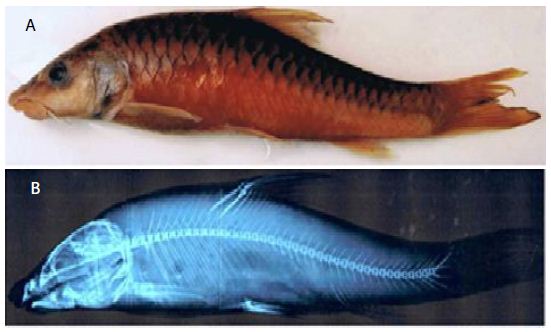
Head length is equal to body depth in a normal streamlined Tor tor Dorsal fin installation is midway between snout tip and caudal fin base and its longest fin ray is quite anterior to anal aperture. There is a wide space between longest pectoral fin ray and pelvic fin origin, pelvic fin ray and anal fin origin and anal fin ray and caudal fin base (Figure 1a).

Vertebral column is streamlined with normal uniform vertebral thickness and inter-vertebral spaces (Figure 1b).

fig 1A,B

Figure 1a: Photograph of a Normal Specimen of Tor tor (Ham.-Buch.).

Figure 1b: X-ray Photograph of a normal specimen of Tor tor (Ham.-Buch.).

Morphological and vertebral deformities observed in six specimens of Tor tor collected from the river Chenab in Pargwal wetland area are shown in Table 1.

Table 1: Morphological and vertebral characteristics of abnormal Tor tor (Ham.-Buch.) collected from the river Chenab in Pargwal wetland, Akhnoor, Jammu

S.No.

Size(Length cm/Wt. g) Morphological characteristics Fins placement

Vertebral deformities


1


23.5 cm/200 g


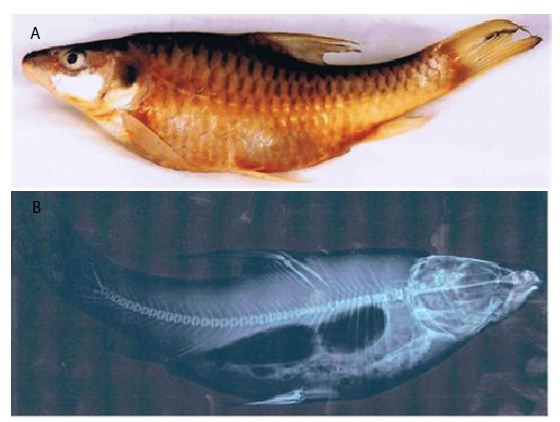
Highly truncated body, abnormal height more than head length and curved caudal peduncle;

(Figure 2a).


Dorsal fin placement is towards caudal fin base and its longest dorsal fin ray extends beyond anal fin base.


1st to 17th vertebrae irregularly compressed with reduced vertebral thickness and inter-vertebral spaces (Figure 2b).

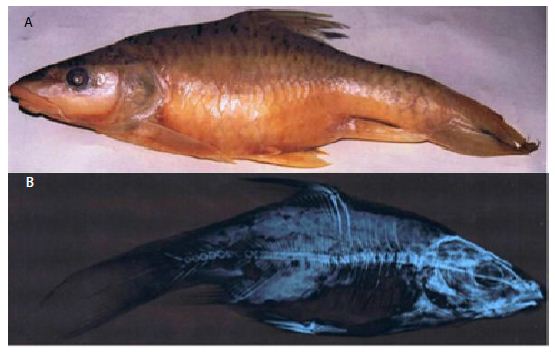
2 29 cm/500 g Highly truncated globular body,

abnormal height more than head length and displacement of fins (Figure 3a).

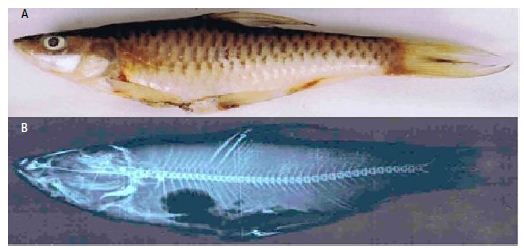
Dorsal fin installation is towards caudal fin base and its longest fin ray is short. Longest pectoral fin ray extends pelvic fin base, longest pelvic fin ray extends anal fin base and latter the caudal fin base. 5th to 30nd vertebrae irregularly compressed and fused with variable vertebral thickness and intervertebral spaces. (Figure 3b).
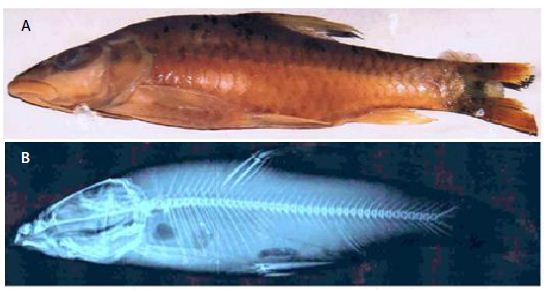
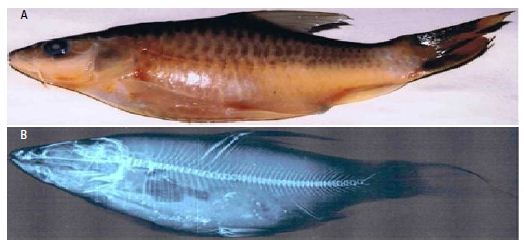
3 21 cm/155 g Minor truncated body and displacement of fins (Figure 4a). Dorsal fin placement is towards caudal fin base and its longest fin ray extend anal fin base. Longest pectoral fin ray extends pelvic fin base, pelvic fin ray anal fin base and anal fin ray caudal fin base. 11th to 30th vertebrae, with variable vertebral thickness and inter-vertebral spaces, irregularly compressed. Compression is more marked between 11th to 16th vertebrae (Figure 4b).
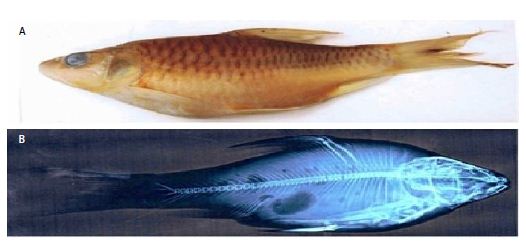
4 25 cm/185 g Truncated body, displacement of fins, short caudal peduncle (Figure 5a). Dorsal fin placement is towards caudal fin base and its longest fin ray extends beyond anal fin base. Space between longest pectoral fin ray and pelvic fin base, pelvic fin ray and anal fin base and anal fin ray and caudal fin base is short. 10thto 29th vertebrae irregularly compressed with reduced vertebral thickness and inter- vertebral spaces (Figure 5b).
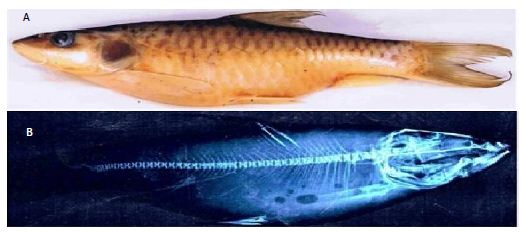
5 22 cm/165 g Dorsal dome (Figure 6a). All fins like normal fish. Vertebral column is dorsally curved in thoracic region (Figure 6b).
6 20 cm/150 g Highly truncated caudal peduncle and displacement of anal fin (Figure 7a). Dorsal fin placement is towards caudal fin base and longest anal fin ray extends caudal fin base. X-ray is not available.

fig 2a,b

Figure 2a: Photograph of Tor tor (Ham.-Buch) showing highly truncated body, abnormal height and curved caudal peduncle.

Figure 2b: X-ray Photograph of Tor tor (Ham.-Buch) showing highly truncated body, abnormal height and curved caudal peduncle.

fig 3a,b

Figure 3a: Photograph of Tor tor (Ham.-Buch) showing highly truncated globular body, abnormal height and displacement of fins.

Figure 3b: X-ray Photograph of Tor tor (Ham.-Buch) with highly truncated globular body, abnormal height and displacement of fins.

fig 4a,b

Figure 4a: Photograph of Tor tor (Ham.-Buch) showing minor truncated body and extension of the longest dorsal fin ray beyond the anal fin origin.

Figure 4b: X-ray Photograph of minor truncated Tor tor (Ham.-Buch) with extension of the longest dorsal fin ray beyond the anal fin origin.

fig 5a,b

Figure 5a: Photograph of Tor tor (Ham.-Buch) showing truncated body, displacement of fins, short caudal peduncle and overlapping scales.

Figure 5b: X-ray Photograph of Tor tor (Ham.-Buch) with truncated body, displacement of fins, short caudal peduncle and overlapping scales.

fig 6a,b

Figure 6a: Photograph of Tor tor (Ham.-Buch) showing a dorsal dome.

Figure 6b: X-ray Photograph of Tor tor (Ham.-Buch) with a dorsal dome.

fig 7a

Figure 7a: Photograph of Tor tor (Ham.-Buch) showing highly truncated caudal peduncle and extension of longest anal fin ray to the caudal fin base.

Tor putitora (Ham.-Buch.)

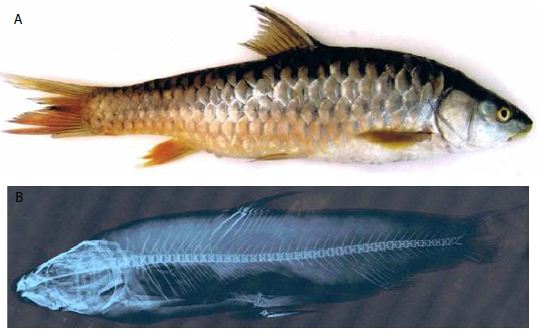
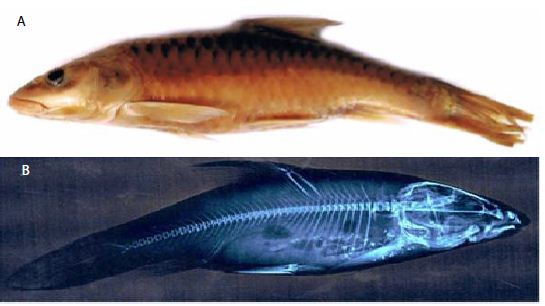
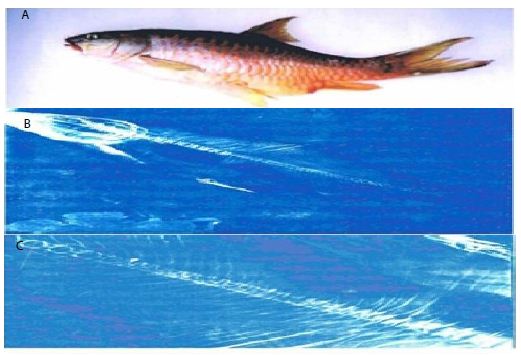
In a normal streamlined Tor putitora head length is greater than body depth. Dorsal fin insertion is midway between snout tip and caudal fin base. There is a wide space between longest dorsal fin ray and anal fin base, pectoral fin ray and pelvic fin base, pelvic fin ray and anal fin base and anal fin ray and caudal fin base (Figure 8a). Vertebral column is streamlined with normal vertebral thickness, inter-vertebral spaces, urostyle and caudal fin bones (Figure 8b).

fig 8a,b

Figure 8a: Photograph of a normal specimen of Tor putitora (Ham.-Buch).

Figure 8b: X-ray Photograph of a normal specimen of Tor putitora (Ham.-Buch).

Various morphological and vertebral deformities observed in five specimens of Tor putitora are given in the Table 2.

Table 2: Morphological and vertebral column characteristics of abnormal Tor putitora (Ham.-Buch.) collected from the river Chenab in Pragwal wetland, Akhnoor, Jammu.

S.No.

Size(Length cm/Wt. g) Morphological characteristics Fins placement

Vertebral deformities


1


25.4 cm/192 g


Truncated body, short caudal peduncle and displacement of dorsal and anal fin.

(Figure 9a).


Dorsal fin placement is towards the caudal fin base and its longest fin ray reaches anal aperture. Longest anal fin ray extends caudal fin base.


3rd – 9th and 17th – 23rd vertebrae are irregularly compressed and fused with variable vertebral thickness and inter vertebral spaces. 38th to 40th vertebrae highly compressed and fused (Figure 9b).

2 55 cm/200 g Mid truncated body, abnormal height and fins disposition.

(Figure 10a).

Dorsal fin insertion is towards caudal fin base. Space between longest pectoral fin ray and pelvic fin base, pelvic fin ray and anal fin base and anal fin ray and caudal fin base reduced. Vertebral column between 7th to 32nd vertebrae truncated and vertebrae irregularly compressed. 7th to 12th vertebrae are highly compressed and attenuated. Vertebral thickness and inter vertebral spaces reduced.

(Figure 10b and 10c).

3 17.8cm/150 g Mild truncated body and minor displacement of fins (Figure 11a). Dorsal fin placement is towards caudal fin base and its longest fin ray extends opposite to the tip of longest anal fin ray. 15th to 23th vertebrae compressed with irregular reduced vertebral thickness and inter vertebral spaces (Figure 11b).
4 18.2 cm/96 g Abnormal height more than head length, highly truncated caudal peduncle, fins displacement (Figure 12a). Dorsal fin is located towards caudal fin base and its longest fin ray extends middle of anal fin. Longest pelvic fin ray reaches anal aperture and longest anal fin ray extends caudal fin base. Vertebral column between 15th to 35th vertebrae truncated, vertebrae irregularly compressed with reduced vertebral thickness and inter-vertebral spaces (Figure 12b).
5 23 cm/150 g Highly truncated body, abnormal height more than head length, displacement of fins, short caudal peduncle (Figure 13a). Dorsal fin insertion is towards caudal fin base and its longest fin ray extends beyond anal fin origin. Longest pelvic fin ray reaches anal aperture and anal fin ray extends caudal fin base. First twenty nine vertebrae differently compressed and fused with variable vertebral thickness and inter-vertebral spaces (Figure 13b).

fig 9a,b

Figure 9a: Photograph of Tor putitora (Ham.-Buch) showing truncated body, short caudal peduncle and extension of the longest anal fin ray to the caudal fin base.

Figure 9b: X-ray Photograph of Tor putitora (Ham.-Buch) with truncated body, short caudal peduncle and extension of the longest anal fin ray to the caudal fin base.

fig 10a,b,c

Figure 10a: Photograph of Tor putitora (Ham.-Buch) showing mid truncated body, abnormal height and disposition of fins.

Figure 10b: X-ray Photograph of deformed specimens of Tor putitora (Ham.-Buch) with mid truncated body, abnormal height and disposition of fins.

Figure 10c: Enlarged x-ray photograph of vertebral column of deformed Tor putitora (Ham.-Buch)

fig 11a,b

Figure 11a: Photograph of Tor putitora (Ham.-Buch) showing mild truncated body and minor displacement of fins.

Figure 11b: X-ray Photograph of Tor putitora (Ham.-Buch) with mild truncated body and minor displacement of fins.

fig 12a,b

Figure 12a: Photograph of Tor putitora (Ham.-Buch) showing abnormal height, highly truncated caudal peduncle, displacement of fins and overlapping scales.

Figure 12b: X-ray Photograph of Tor putitora (Ham.-Buch) with abnormal height, highly truncated caudal peduncle, displacement of fins and overlapping scales.

fig 13a,b

Figure 13a: Photograph of Tor putitora (Ham.-Buch) showing highly truncated body displacement of fins, short caudal peduncle and overlapping scales.

Figure 13b: X-ray Photograph of Tor putitora (Ham.-Buch) with highly truncated body displacement of fins, short caudal peduncle and overlapping scales.

Discussion

Records of only eleven adult deformed fishes, over a period of three years, in the river Chenab suggest their low percentage. This may be due to good water quality, inability of such fishes to resist against fast current or they easily fall prey to predators. Presence of these adult deformed fishes suggests that these aberrations are non fatal, feeding is normal and they are able to avoid predators.

Morphological aberrations observed among Tor species netted from the river Chenab are truncated body, abnormal height and displacement of various fins. Vertebral column deformities commonly reported among fishes include ankylosis, lordosis, kyphosis, scoliosis, irregular shape showing coiling and vertebral fusion and compression. Vertebral deformities noticed during the present study include truncated vertebral column, vertebrae compression and fusion, reduction in inter-vertebral spaces and vertebral thickness. Truncated body and displacement of fins observed in abnormal specimens of Tor is due to vertebral compressions and fusion. Vertebral fusion is known to alter the shape and length of the fish depending on the severity and number of structures affected [12].

Fish anomalies have been attributed to abiotic factors like temperature, light, low pH, salinity and low dissolved oxygen [13-23].

Water analysis in the river Chenab has revealed optimum range of water temperature (8-16°C), pH (8.23-8.46), conductivity (140.05-308.47 µs/cm-1), total dissolved solids (63.90-140.88 mg/l), salinity (0.2 ppt), DO (6.24-13.08 mg/l), BOD (1.07-5.56 mg/l), free CO2 (nil), carbonate (1.16-3.97 mg/l), bicarbonate (54.27-116.25 mg/l), chloride (2.33-9.28 mg/l), calcium (14.79-32.49 mg/l), magnesium (3.87-10.13 mg/l), total hardness (58.32-119.56 mg/l), sodium (1.11-1.69 mg/l), potassium (1.23-2.54 mg/l), phosphate (0.040-0.075 mg/l), nitrate (0.145-0.323 mg/l), silicate (4.08-9.33 mg/l) and sulphate (11.35-19.30 mg/l). Moreover, heavy metal analysis of lead, copper, nickel, zinc and iron is below detectable limits of instrument. This clearly suggests that abnormalities in Tor species, under discussion, are not due to fluctuations in abiotic characteristics of water. These optimum levels of water quality also suggest absence of any type of water pollution in the river Chenab. Therefore, fish aberrations caused by water quality degradation resulting from pollutants and suggested by earlier workers [24-27] are ruled out in the present case.

Among biological factors, fish aberrations have been attributed to parasitic infestations [3,27-32]. Absence of any parasite and sign of disease among the presently collected deformed specimens of Tor species from the river Chenab suggests that these aberrations are not due to this biological factor.

Aberrations in Tor tor and Tor putitora netted from the river Chenab are most probably induced by fast currents faced by larvae and young fishes in various tributaries (fish breeding grounds) of the river Chenab. Young fishes migrating from the Himalayan streams (breeding grounds) into the river Chenab are also exposed to torrential waters inducing various aberrations. Fish anomalies due to currents are well documented [2,5,33-36].

A detailed study on fish larvae and young fishes in their breeding grounds in various Himalayan streams and young fishes in the river Chenab is suggested to understand the role of currents in inducing various fish aberrations in torrential lotic waters.

Acknowledgements

This paper is a part of the project supported by the UGC, New Delhi and is gratefully acknowledged. HOD, Environmental sciences, University of Jammu, Jammu, is acknowledged for providing necessary facilities in the department.

References

  1. Dutta SPS (1989-90) Vertebral-spinal deformity in Barilius vargra (Ham.-Buch.) from Jammu. Matsya 15-16: 166-168.
  2. Dutta SPS (2016) Record of an abnormal Schizothoraichthys esocinus (Heckel) from the Himalayan River Chenab draining Jammu region of the J&K State, India. Journal of Aquaculture Research & Development 7: 1-3.
  3. Dutta SPS (2016) Some deformed specimens of Mystus bleekeri (Day) and Labeo bata (Ham.-Buch.) from the river Chenab in Pargwal wetland, Akhnoor, Jammu. Journal of Applied and Natural Science, 8: 481-484.
  4. Dutta SPS, Kour H (1994) Pelvic fin deformity in Schizothorax richardsonii (Gray and Hard) inhabiting Rajouri river, (J&K). J Freshwater Biol 6: 195-196.
  5. Dutta SPS, Sheikh A (2017) Skeletal deformities in Bagarius bagarius (Ham.-Buch.) and Crossocheilus latius diplocheilus (Ham.-Buch.) from river Tawi, a Himalayan stream, in Udhampur area, Jammu region, J&K, India. International Journal of Fisheries and Aquatic Studies 5: 247-251.
  6. Dutta SPS, Sharma J, Koul V (1993) A truncated specimen of Garra lamta (Ham.). J Nature Conservators 5: 115-116.
  7. Dutta SPS, Kour H, Sharma J (1996) On the occurrence of malformed specimen of Labeo bata (Ham.-Buch.) in river Tawi, Jammu. J Nature Conservators 8: 147-149.
  8. Gupta SC, Dutta SPS, Verma M (1998) A report on abnormal specimen of Puntius sarana (Ham.-Buch.) from river Basantar, Samba, Jammu (J&K). J Freshwater Biol 10: 137-140.
  9. Kour H, Kaul V, Dutta SPS (1997) Deformities in some freshwater fishes of Jammu. J Freshwater Biol 8: 213-216.
  10. Shekhar C, Dutta SPS (1993) An abnormal specimen of Shizothorax richadsonii (Gary and Hard) with vertebral deformities. Him J Env Zool 7: 101-102.
  11. APHA (1998) Standard methods for the examination of water and waste water.20th American Public Health Association, New York.
  12. Gavia PJ, Dinis MT, Cancela ML (2002) Osteological development and abnormalities of the vertebral column and caudal skeleton in larval and juvenile stages of hatchery reared Senegal sole (Solea senegalensis) Aquaculture 211: 305-323.
  13. Alderdice DF, Wickett WP, Brett JR (1958) Some effects of temporary exposure to low dissolved oxygen levels in Pacific salmon eggs. J Fish Res Bd Canada 15: 229-249.
  14. Al–Hassan LAJ (1982) Vertebral deformities in fishes from Iraq and United Arab Emirates, Arabian Gulf. Iraqi Jour Mar Sci 1: 13-23.
  15. Beamish RJ (1972) Lethal pH for the white sucker (Catostomus commersonii) (Scapede).Trans. American Fish Society 101: 355-358.
  16. Bolla S, HolmefJord I (1988) Effect of temperature and light on development of Atlantic halibut (Hippoglossus hippoglossus) larvae Aquaculture 74: 355-358.
  17. Hubbs C (1959) High incidence of vertebral deformity in two natural populations of fishes inhabiting warm springs. Ecology 40: 154-155.
  18. Jawad LA, Oktener A (2007) Incidence of lordosis in the freshwater mullet, Liza abu (Heckel, 1843) collected from Ataturk Dam Lake, Turkey Anales de Biologia 29: 105-113.
  19. Lee CS, Williams WD (1970) Abnormality in fishes due to salinity fluctuations. J Fish Biol 2: 55.
  20. Lee CS, Menu B (1981) Effects of salinity on egg development and hatching in grey mullet, Mugil cephalus J Fish Biol 19: 179-188.
  21. Steingraeber MT, Gingerich WH (1991) Hatching, growth, ion accumulation and ossification of brook trout (Salvelinus alpinus) alevins in acidic soft waters. Can J Zool 69: 2266-2276.
  22. Wang LH, Tsai CL (2000) Effects of temperature on the deformity and sex differentiation of Tilapia, Oreochromis mossambicus. J Expt Zool 286: 534-537.
  23. Antunes M & Lopes Da-Cunha P (2002) Skeltal anomalies in Gobius niger (Gobiidae) from Saddo estuary, Portugal. Cybium 26: 179-184.
  24. Dulcic J (2004) Incidence of spinal deformities in natural populations of grass-goby, Zosterisessor ophiocephalus, from the Karin Sea, Eastern middle Adriatic. Cybium 28: 7-11.
  25. Subba BR (2004) Anomalies in bighead carp Aristichthys nobilis and African catfish Clarias gariepinus in Birat nagar, Nepal. Our Nature 2: 41-44.
  26. Sloof W (1982) Skeletal anomalies in fish from polluted surface waters. Aquat Toxicol 5: 157-173.
  27. Sun PL, Hawkins WE Overstreet, RM, Brown-Peterson NJ (2009) Morphological deformities as biomarkers in fish from contaminated rivers in Taiwan. J. Environ. Res. Public Hlth 6: 2307-2331.
  28. Kent ML, Watral VG, Whipps CM, Cunningham ME, Criscione CD et al., (2004) A digenean metacercaria (Apophallus sp.) and a Myxozoan (Myxobolus sp.) associated with vertebral deformities in cyprinid fishes from the Willamette River, Oregon. Journal of Aquatic Animal Health 16: 116-129.
  29. Schwartz FJ (1973) Spinal and cranail deformities in the elasmobranchs Carcharhinus leucas, Squalus acanthias and Carcharhinus milberti. J. Elisha Mitchell Sci. Soc 89: 74-77.
  30. Taylor LH, Hall BK, Miyake T, Cone DK (1994) Ectopic ossicles associated with metacercariae of Apophalluus brevis (Trematoda) in yellow perch, Perca flavescens (Teleostei) development and identification of bone and chondroid bone. Embryol (Berl.) 190: 29-46.
  31. Villeneuve DL, Curtis LR, Jenkins JJ, Warner KE, Tilton et al., (2005) Environmental stresses and skeletal deformities in fish from the Willamette River, Oregen. Environmental Scienece and Technology 39: 3495-3506.
  32. Yokoyama H, Freeman MA, Itoh N, Fukuda Y (2005) Spinal curvature of cultured Japanese mackerel, Scomber japanicus associated with brain myxosporean, Myxobolus acanthogobii. Dis. Aquat. Org 66: 1-7.
  33. Backiel T, Kokurewicz B, Ogorzalek A (1984) High incidence of skeletal anomalies in carp, Cyprinus carpio, reared in cages in flowing water. Aquaculture 43: 369-380.
  34. Chatain B (1994) Abnormal swimbladder development and lordosis in sea bass (Dicentrarchus labrax) and sea bream (Sparus auratus). Aquaculture 119: 371-379.
  35. Divanach P, Papandroulakis N, Anastasiadis P, Koumoundouros G, Kentouri M (1997) Effect of water currents on the development of skeletal deformities in sea bass (Dicentrarchus labrax L.) with functional swimbladder during postlarval and nursery phase. Aquaculture 156: 145-155.
  36. KitaJima C, Watanabe T, Tsukashima Y, Fujita S (1994) Lordotic deformition and abnormal development of swim bladders in some hatchery-bred marine physoclistous fish in Japan. World Aquaculture Soc 25: 64-77.

Fish Fauna of the River Ravi and Its Some Tributaries with a New Record of Ailia puncata and Clupisoma naziri for Punjab State and Union Territory of Jammu and Kashmir, India

DOI: 10.31038/AFS.2021312

Abstract

Fish fauna of the river Ravi and its some tributaries in Chamba district (H.P.) and from Shahpur (H.P.) to Gogga Mahal, Amritsar (Punjab) reported earlier and present survey from Ranjit Sagar dam to Kathour, Pathankot, Punjab, including Kathua district, has revealed the presence of 97 fish species belonging to 8 orders, 18 families and 53 genera. Among various orders, there is dominance of Cypriniformes (54 spp.) followed by Siluriformes (26 species), Percformes (9 species), Synbranchiformes (3 species), Osteoglossiformes (2 species) and Clupeiformes, Salmoniformes and Beloniformes (1 species, each). The list also includes a new record of Ailia punctata and Clupisoma naziri (reported earlier from Pakistan) for Punjab state and Union territory of Jammu and Kashmir. Salmo trutta fario noticed in Sewa River is also included in the present list. Like other Indian states, fish fauna is rapidly declining due to overfishing, fishing during monsoon breeding and illegal fishing methods (Dynamiting, electric shocking, poisoning etc.). Conservation status based on IUCN observations has also been discussed.

Keywords

Fish fauna, The River Ravi, New record of Ailia punctata and Clupisoma naziri

Introduction

Our knowledge of fish fauna of the river Ravi is by [1] from Chamba area of Himachal Pradesh; Kumar and Dua [2] from Punjab, [3] from Shahpur (H.P.) to Gogga Mahal, Amritsar, Punjab and [4] from Madhopur to Kathour (Pathankot). Earlier [5-12] surveyed fish fauna of some tributaries of the river Ravi in Kathua and Samba districts of Jammu. During the survey of river Ravi for the last ten years from Ranjit Sagar Dam to Kathour, Pathankot, some new records of fish have been observed and enlisted along with the earlier reports [1-4]. This work shall be helpful for the fishery biologists and fishery departments of Jammu, Punjab and Himachal Pradesh to undertake various fishery developmental programmes for the perennial river Ravi and its various tributaries.

Topography of the Area and Methods

The perennial Ravi River originates in the Himalayas in the Multhan tehsil of Kangra district, H.P., India. It is the smallest of the five Punjab Rivers that rises from glacier fields at an elevation of 14000 feet on the southern side of the Mid Himalayas. It flows through Bara Bhanghal, Bara Bansu and Chamba districts, H.P. It is joined by the Budhil River that rises in Lahul range of hills and is sourced from Manimahesh Kailash Peak and Manimahas Lake, at an elevation of 4080 meters above sea level. The second important tributary is the Nai or Dhona that rises at Kali Debi pass and flows 48 km before joining the river Ravi. Another major tributary that joins the Ravi River just below Bharmour, the old capital of Chamba, is the Seoul River. One more major tributary that joins the river Ravi near Bassohli, Kathua is Sewa River. The main river Ravi flows through the base of Dalhousie hill. Downstream it enters the Punjab plain near Madhopur and Pathankot. On its right bank, is the town of Lakhanpur and Kathua of Jammu Region. In Kathua district, the river Ravi is joined by Kathua Khad, Wajoo nullah, Tarna nullah, Jhandi nullah etc. Ujh River is another major tributary of the river Ravi in Kathua district. Its source is in the Kailash Mountains at an elevation of 14100 feet, close to the Bhaderwah Mountains in Doda district. It joins the river Ravi at Nainkot in Pakistan. Below Pathankot the river Ravi flows along the Indo Pak border for 80 kms before entering Pakistan and joining the river Chenab. Basantar River, draining Samba district of Jammu region, joins the river Ravi in Pakistan.

Fishes collected by fishermen by using various methods were purchased, studied for colour patterns, photographed and fixed in 10% formaldehyde. For identification works of [13-21] have been consulted. For the systematic arrangement of the reported fish species, classification referred by [21] has been followed.

Observations and Discussion

Fish fauna of the river Ravi including earlier reports [1-4] is represented by 97 fish species belonging to 8 orders, 18 families and 52 genera (Table 1). Ailia punctata reported earlier [22] from Pakistan segment of the river Ravi and Clupisoma naziri distributed in the rivers of Pakistan are the new records for Punjab and Jammu and Kashmir. Fish analysis in the Indian segment of the river Ravi has shown the dominance of Cypriniformes (54 spp.) followed by Siluriformes (26 species), Percformes (9 species), Synbranchiformes (3 species), Osteoglossiformes (2 species) and Clupeiformes, Salmoniformes and Beloniformes (1 species, each). In the river Ravi from the Ranjit Sagar dam to Kathour (Pathankot), including Kathua area, is more diversified (Table 1) in comparison to 16 fish species viz. Barilius bendelisis, B. vagra, Puntius conchonius, Labeo dero, Cyprinus carpio specularis, C. communis, Garra gotyla, Schizothorax richardsonii, Crossocheilus latius punjabensis, Noemacheilus corica, N. montanus, Lepidocephalus guntea, Glyptosternum reticulatum, Glytothorax conirostres, G. pectinopterus and G. stoliczkae belonging to 2 orders, 3 families and 11 genera reported by [1] from Chamba area, H.P., drained by the river Ravi.

Table 1: Fish fauna of the river Ravi including the earlier reports by Sehgal (1974), Kumar and Dua (2012) and Moza (2014).

Conservation Status

IUCN (2020)

Superclass: Gnathostomata
Class: Actinopterygii
Subclass: Neopterygii
Division: Teleostei
Subdivision: Osteoglossomorpha
Order: Osteoglossiformes
Suborder: Notopteroidei
Family: Notopteridae
Genus: Notopterus lacepede
1. N. notopterus (Pallas)

LC

Genus: Chitala Fowler

NT

2. C. chitala (Ham.-Buch.)
Sub division: Clupeomorpha
Order: Clupeiformes
Family: Clupeidae
Subfamily: Aliosinae
Genus: Gudusia Fowler
3. G. chapra (Ham.-Buch.)

LC

Subdivision: Euteleosostei
Superorder: Ostariophysi
Order: Cypriniformes
Family: Cyprinidae
Subfamily: Danioninae (= Rasborinae)
Genus: Salmophasia Swainson
4. S. bacaiIa (Ham.-Buch.)

LC

5. S. phulo (Ham.-Buch.)

LC

6. S. punjabensis (Day)

NE

Genus Securicula Gunther
7. S. gora (Ham.-Buch.)

LC

Genus: Asidoparia Heckel
8. A morar (Ham.-Buch.)

LC

Genus: Barilius Ham.-Buch.
9. B. vagra vagra (Ham.-Buch.)

LC

10. B. barila (Ham.-Buch.)

LC

11. B. modestus Day

NE

12. B. radiolatus Gunther

DD

13. B. bendelisis (Ham.-Buch.)

LC

Genus: Raiamas Jordan
14. R. bola (Ham.-Buch.)

LC

Genus: Chela (Ham.-Buch.)
15. Chela cachius (Ham.-Buch.)

LC

16. Chela laubuca (Ham.-Buch.)

LC

Genus: Esomus Swainson
17. Esomus danricus (Ham.-Buch.)

LC

Genus: Danio (Ham. Buch.)
18. D. devario (Ham.-Buch.)

LC

Genus: Rasbora Bleeker
19. R. daniconius (Ham.-Buch.)

LC

Genus: Amblypharyngodon Bleeker
20. A. mola (Ham.-Buch.)

LC

Subfamily: Cyprininae
Genus: Cyprinus Linnaeus
21. C. carpio communis Linn.

NE

22. C. carpio specularis Lacepede

NE

Genus: Tor Gray
23. T. tor (Ham.-Buch.)

DD

24. T. putitora (Ham.-Buch.)

ENDN

Genus: Osteobrama Heckel
25. O. cotio cotio (Ham.-Buch.)

LC

Genus: Puntius Ham.-Buch.
26. P. sarana sarana (Ham.-Buch.)

LC

27. P. conchonius (Ham.-Buch.)

LC

28. P. terio (Ham.-Buch.)

LC

29. P. ticto (Ham.-Buch.)

LC

30. P. chola (Ham.-Buch.)

LC

31. P. sophore (Ham.-Buch.)

LC

Genus: Cirrhinus Cuvier
32. C. mirgala (Ham.-Buch.)

LC

33. C. reba (Ham.-Buch.)

LC

Genus: Catla Valenciennes
34. C. catla (Ham.-Buch.)

LC

Genus: Labeo Cuvier
35. L. bata (Ham.-Buch.)

LC

36. L. boga (Ham.-Buch.)

LC

37. L. calbasu (Ham.-Buch.)

LC

38. L. dero (Ham.-Buch.)

LC

39. L. dyocheilus (McClelland )

LC

40. L. gonius (Ham.-Buch.)

LC

41. L. pangusia (Ham.-Buch.)

NT

42. L. rohita (Ham.-Buch.)

LC

43. L. lippus*** Fowler

DD

Subfamily: Oreininae (=Schizothoracinae)
Genus: Schizothorax Heckel
44. S. richardsonii (Gray)

VULN

Sub-family: Garrinae
Genus: Crossocheilus Kuhl and van Hasselt
45. C. latius diplocheilus (Heckel)

NE

46. C. latius punjabensis*

NE

Genus: Garra Hamilton – Buchanan
47. G. gotyla gotyla (Gray)

LC

48. G. lamta (Ham.-Buch.)

LC

Family: Balitoridae
Subfamily: Nemacheilinae
Genus: Nemacheilus Bleeker
49. N. corica (Ham.-Buch.)*

LC

Genus: Acanthocobitis Peters
50. A. botia (Ham.-Buch.)

LC

Genus: Schistura McClelland
51. S. prashadi (Hora)

VULN

52. S. montanus (Mc Clelland.)*

NE

53. S. punjabensis (Hora)

NE

Family: Cobitidiae
Subfamily: Botinae
Genus: Botia Gray
54. Botia almorhae Gray

LC

55. Botia birdi Chaudhuri

NE

56. Botia lohachata Chaudhuri

NE

Subfamily: Cobitinae
Genus: Lepidocephalus Bleeker
57. L. guntea (Ham.-Buch.)

LC

Order: Siluriformes
Family: Bagridae
Subfamily: Ritinae
Genus: Rita Bleeker
58. R. rita (Ham. Buch.)

LC

Subfamily: Bagrinae: Genus: Mystus Scopoli
59. M. bleekeri (Day)

LC

60. M. cavasius (Ham.-Buch.)

LC

61. M. vittatus (Bloch.)

LC

62. M. tengara (Ham.-Buch.)

LC

Genus: Aorichthys Wu
63. A. seenghala (Sykes)

LC

64. A. aor (Ham.-Buch.)**

LC

Family: Siluridae
Genus: Ompok Lacepede
65. O. pabda (Ham.-Buch.)

NT

Genus: Wallago Bleeker
66. W. attu (Bloch. & Schn.)

VULN

Family: Schilbidae
Subfamily: Ailinae
Genus: Ailia Gray
67. A punctata (Day)

DD

Sub family: Schilbinae
Genus: Neotropius Kulkarni
68. N. atherinoides (Bloch.)

LC

Genus: Clupisoma Swainson
69. C. garua (Ham.-Buch.)

LC

70. C. nazri Mirza and Awan

NE

Genus: Eutropiichthys Bleeker
71. E. murius (Ham.-Buch.)

LC

72. E. vacha (Ham.-Buch.)

LC

Family: Amblycipitidae
Genus: Amblyceps Blyth
73. A mangois (Ham.-Buch.)

LC

Family: Sisoridae
Genus: Bagarius Bleeker
74. B. bagarius (Ham.-Buch.)

NT

Genus: Gagata Bleeker
75. G. cenia (Ham.-Buch.)

LC

Genus: Glyptosternum McClelland
76. G. reticulatum McClelland*

NE

Genus: Glyptothorax Blyth
77. G. cavia (Ham.-Buch.)

LC

78. G. conirostre conirostre( Steindachner)*

DD

79. G. pectinopterus (McClelland)*

LC

80. G. stoliczkae (Steindachner)

LC

81. G. telchitta (Ham.-Buch.)

LC

Family: Clariidae
Sub-Family: Heteropneustinae
Genus: Heteropneustes Muller
82. H. fossilis (Bloch.)

LC

Sub-Family: Clariinae
Genus: Clarius Scopoli
83. C. batrachus (Linneaus)

LC

Superorder: Protacanthopterygii
Order: Salmoniformes
Family: Salmonidae
Genus: Salmo Linnaeus
84. S. trutta fario Linn.

NE

Superorder: Acanthopterygii
Order: Beloniformes
Suborder: Belonoidei (=Exocoetoidei)
Family: Belonidae Genus: Xenentodon Regan
85. X. cancila (Ham.-Buch.)

LC

Order: Synbranchiformes
Suborder: Mastacembeloidei
Family: Mastacembelidae
Subfamily: Mastacembelinae
Genus: Macroganthus Lacepede
86. M. aral (Bloch and Schn.)

LC

87. M. pancalus (Ham.-Buch.)

LC

Genus: Mastacembelus Scopoli
88. M. armatus (Lac.)

LC

Order: Perciformes
Suborder: Percoidei
Family: Chandidae (Ambassidae)
Genus: Chanda (Ham.-Buch.)
89. C. nama Ham.-Buch.

LC

Genus: Parambassis Bleeker
90. P. baculis (Ham.-Buch)

LC

91. P. ranga (Ham.-Buch.)

LC

Family: Nandidae
Subfamily: Nandinae
Genus: Nandus Valenciennes
92. N. nandus (Ham.-Buch.)

LC

Sub order: Gobioidei
Family: Gobiidae
Genus: Glossogobius Gill
93. G. giuris (Ham.-Buch.)

LC

Suborder: Channoidei
Family: Channidae
Genus: Channa Scopoli
94. C. marulius (Ham.-Buch.)

LC

95. C. orientalis Bloch&Schneider

LC

96. C. punctatus (Bloch.)

LC

97. C. striatus (Bloch.)

LC

*Reported by Sehgal (1974) and not seen during present study
**Reported by Moza (2014) and not seen during present study
***Reported by Kumar and Dua (2012) and not seen during present study
LC = Least Concern
ENDN = Endangered
NT = Near Threatened
DD = Data Deficient
NE = Not Evaluated
VULN = Vulnerable

[2] enlisted 38 fish species viz. Notopterus notopterus, Catla catla, Cirrhinus mrigala, Cirrhinus reba, Cyprinus carpio communis, Labeo bata, L. calbasu, L. dero, L. lippus, L. rohita, Osteobrama cotio cotio, Puntius sarana sarana, P. terio, Salmostoma bacaila, Parluciosoma daniconius, Schizothorax richardsonii, Tor tor, Lepidocephalus guntea, Aorichthys aor, A. seenghala, Mystus bleekeri, M. cavasius, M. vittatus, Rita rita, Wallago attu, Clupisoma garua, Eutropiichthys murius, E. vacha, Bagarius bagarius, Clarias batrachus, Xenentodon cancila, Colisa fasciatus, Channa marulius, C. punctatus, C. striatus, Macrognathus aral, M. pancalus and Mastacembelus armatus belonging to 5 orders, 12 families and 25 genera from the Indian segment of the river Ravi in Punjab.

Present record of fish diversity in the river Ravi is higher than the earlier reports of 31 fish species viz. Notopterus notopterus, N. chitala, Chela bacaila, Tor putitora, Puntius sarana, Catla catla, Cirrhinus mrigala, C. reba, Labeo dyocheilus, L. gonius, L. rohita, L. calbasu, L. dero, L. bata, Cyprinus carpio specularis, Schizothorax richardsonii, Mystus aor, M. seenghala, M. tengara, Rita rita, Bagarius bagarius, Wallago attu, Eutropiichthys vacha, Clupisoma garua, Heteropneustes fossilis, Clarias batrachus, Xenentodon cancila, Mastacembelus armatus, M. pancalus, Channa marulius and Channa punctaus belonging to 5 orders, 9 families and 20 genera enlisted by Moza [3] in the river Ravi from Shahpur (H.P) to Goga Mahal, Amritsar, Punjab.

Fish diversity in the Indian segment of river Ravi is even higher in comparison to the earlier reports of 75 fish species (Notopterus notopterus, N. chitala, Gudusia chapra, Aspidoparia morar, Amblypharyngodon mola, Barilius bendelisis, B. modestus, B. vagra, Cirrhinus mrigala, C. reba, Cyprinus carpio, Carasius auratus, Crossocheilus diplocheilus, Chela cachius, Chela labuca, Esomus danricus, Gibleon catla, Garra gotyla, L. dyocheilus pakistanicus, Labeo rohita, L. gonius, L. calbasu, L. dero, Osteobrama cotio, Puntius punjabensis, P. sophore, P. ticto, P. chola, P. conchonius, Rasbora daniconius, Salmophasia punjabensis, S. bacaila, Securicula gora, Systomus sarana, Tor macrolepis, Nemacheilus sp., Botia lohachita, Ailia punctatus, Ailia coilia, Clupisoma garua, Eutropiichthys vacha, Gagata cenia, Heteropneustes fossilis, Mystus bleekeri, M. cavasius, M. vitatus, M. tengra, Ompok bimaculatus, Pseudoeutropis atherinoides, Wallago attu, Rita rita, Sisor pakistanicus, Sperata sarwari (Mystus seenghala and M. aor), Glyptothorax stocki, G. punjabensis, Xenetodon cancila, Macrognathus aculeatus, Macrognathus pancalus, Mastacembelus armatus, Monopterus cuchia, Colissa fasciata, Colissa latia, Chanda nama, Parambassius baculis, P. ranga, Glossogobius giuris, Nandus nandus, Oreochromis aureus, O. mosambicus, O. niloticus, Channa marulius, C. punctatus, Channa striatus, C. gachua and Sicamugal cascasia) enlisted from Pakistan segment of the river Ravi by Ahmad* (1943, 49 fish species), Mirza* (1970, 65 fish species), Zahoor and Mirza* (2002, 49 fish species) and [22] (2018, 38 fish species). Recent study of the river Ravi in Pakistan segment by [22] has revealed the presence of 38 fish species (Aspidoparia morar, Barilius bendelisis, B. modestus, B. vagra, Cirrhinus mrigala, C. reba, Cyprinus carpio, Carasius auratus, Gibleon catla, Labeo rohita, L. gonius, L. calbasu, L. dyocheilus pakistanicus, Puntius punjabensis, P. sophore, P. ticto, Salmophasia punjabensis, Securicula gora, Clupisoma garua, Eutropiichthys vacha, Heteropneustes fossilis, Wallago attu, Sperata sarwari, Chanda nama, Colissa fasciata, Colissa latia Channa marulius, C. punctatus, Channa striatus, C. gachua, Oreochromis aureaus, O. mosambicus, O. niloticus, Parambassius baculis, P. ranga Mastacembelus armatus, Notopterus chitala and N. notopterus) belonging to 22 genera, 10 families and 8 orders. This fish decline during last few decades has been attributed to degrading water quality caused by increased anthropogenic activities and many fold decline in water flow in the rivers after Indus water Basin treaty with India.

*Cited from [22].

Rich diversity in the river Ravi downstream Ranjit Sagar Dam to Kathour is due to reduced water flow, shallowness and penetration of light upto the bottom, presence of pools supporting a rich diversity and density of fish food organisms viz. macrophytes, algae, benthos, zooplankton, fish, etc. and absence of any pollution. Moreover, there is an upstream fish migration, even from Pakistan, during summer and monsoon. During monsoon, there is downstream fish drift from upper catchment along with floods. It is during summer and monsoon when a rich diversity and density of fish in the river Ravi has been noticed. Moreover, a large number of tributaries join the river Ravi at various places and add to rich fish diversity.

Study of fish fauna of various tributaries of the river Ravi in Kathua district started with a survey by [5] who enlisted 12 fish species belonging to 4 orders, 6 families and 11 genera from Kathua Khad and 3 fish species viz. Barilus vagra, Tor putitora and Channa punctatus from Ujh River. [8] noticed 27 fish species belonging to 4 orders, 8 families and 20 genera from Ujh River; 16 fish species belonging to 2 orders, 4 families and 12 genera from Tarnah nullah and total absence of fish from seasonal Kathua Khad, Rathore and [11] noticed 42 fish species belonging to 5 orders, 10 families and 27 genera from river Ujh. [12] reported 64 fish species belonging to 7 orders, 17 families and 42 genera from Wajoo nullah and its tributaries. Dutta and Gupta (unpublished) noticed 8 fish species viz. Schizothorax richardsonii, Barilius vagra vagra, B. bendelisis, Crossocheilus latius diplocheilus, Tor putitora, Cirrhinus reba, Salmo trutta fario and Glyptothorax stoliczkae from Sewa river, an important tributary of the river Ravi in Bassohli, Kathua.

[7] surveyed fish fauna of river Basantar, an important tributary of the river Ravi, in Samba district of Jammu, and enlisted 59 fish species belonging to 6 orders, 15 families and 41 genera. Sharma and Dutta≠π documented 35 fish species belonging to 5 orders, 10 families and 25 genera, with maximum diversity and density during monsoon floods, in river Basantar.

The [23] redlist showed that, among 97 fish species in the river Ravi, only Tor putitora is endangered, Chitala chitala, Labeo pangusia, Ompok pabda and Bagarius bagarius are near threatened; Schizothorax richardsonii, Schistura prashadi and Wallago attu are vulnerable; Tor tor, Barilius radiolatus, Labeo lippus, Ailia punctata and Glyptothorax conirostrae conirostrae are data deficient; Barilius modestus, Schistura punjabensis, Schistura mountanous, Salmophasia punjabensis, Crossocheilus latius punjabensis, Crossocheilus latius diplocheilus, Cyprinus carpio communis, Cyprinus carpio specularis, Botia birdi, Botia lohachata, Salmo trutta fario, Clupisoma naziri and Glyptosternum reticulatum are not evaluated and remaining fishes are in the least concern category.

An overall study has revealed a decline in fish diversity and density in the river Ravi and its tributaries. This needs immediate attention by the fishery departments of Himachal Pradesh and Punjab states and Jammu & Kashmir union territory. Illegal destructive methods of fishing like dynamiting, poisoning and diversion of water for catching fish should be checked. Total ban on fishing during summer and monsoon spawning migration should be implemented. In the tributaries, Juveniles need protection when the water level goes low in summer months. To protect them from poaching certain artificial pools need to be created. Some areas along the river Ravi and its tributaries should be declared as protected and reserved waters. Cultural possibilities of native and other fish species need exploration in different segments of the river Ravi and its tributaries.

Acknowledgements

This paper is a part of the Emeritus Fellowship Project sanctioned by UGC, New Delhi, and is gratefully acknowledged. Thanks are due to HOD, Environmental Sciences, University of Jammu, Jammu, for providing necessary laboratory facilities in the department.

References

  1. Sehgal KL (1974) Fisheries survey of Himachal Pradesh and some adjacent areas with special reference to trout, mahseer and allied species. J Bombay Nat Hist Soc 70: 458-474.
  2. Kumar A, Dua A (2012) Fish diversity of River Ravi in Indian region. Eco Env and Cons 18: 861-864.
  3. Moza U (2014) River Ravi: Ecology and Fishery. Directorate of knowledge management in agriculture. Indian Council of Agricultural Research, New Delhi 110012: 101.
  4. Dutta SPS (2015) Fish fauna of the river Ravi with a new record of (Day) for Jammu and Kashmir and Punjab states and Gudusia Chapra (Ham.-Buch.) for Jammu and Kashmir state. 26 All India Congress of Zoology and International Seminar on Innovation in Animal Science for Food security, Health security and Livelihood. Organised by Baba Saheb Bhimrao Ambedkar Central University, Lucknow. 29th-31st October, 2015.
  5. Joshi CS, Sehgal KL, Sunder S (1978) Observations on the fishery resources of hill streams of Jammu province with special reference to mahseer and other commercially important species. Indian J Fish 25: 197-206.
  6. Guglani HK (2000) Survey and systematic analysis of fish fauna of Jammu region. PhD. Thesis. University of Jammu, Jammu.
  7. Dutta SPS, Kour H, Bali JPS, Sharma LD (2001) Hydrobiological studies on river Basantar, Samba, Jammu, jammu and Kashmir. Aquatic Biol 16: 41-44.
  8. Dutta SPS, Gupta SC, Rathore V, Sharma A (2006) Fish fauna of some tributaries of the river Ravi; District Kathua, J&K state, In: Trends in Biodiversity and Aquaculture. Edited by Wanganeo, A. and Langer, R.K. Daya Publishing House, New Delhi: 443-452.
  9. Dutta SPS, Kour H (2005) Fish fauna of Kathua District, Jammu region. In Proceedings National Seminar: New trends in Fishery Development in India, Punjab University, Chandigarh Feb 16-18: 233-240.
  10. Sharma A, Dutta SPS (2012) Present and past status of fish fauna of river Basantar, an important tributary of the river Ravi in Samba district, Jammu (J&K). J Applied and Natural Resources 4: 123-126.
  11. Rathore V, Dutta SPS (2015) Fish fauna of river Ujh, an important tributary of the river Ravi, District Kathua, Jammu. Environment Conservation J 16: 81-86.
  12. Dutta SPS (2016) Fish fauna of Wajoo nullah, an important tributary of river Ravi in Kathua district, Jammu region, Jammu and Kashmir state, India. JANS 8: 1087-1089.
  13. Hamilton BF (1822) An account of the fishes found in the river Ganga and its tributaries. Edinburg and London.
  14. Misra KS (1962) An aid to the identification of the common commercial fishes of India and Pakistan. Rec Indian Mus 57: 1-320.
  15. Malhotra YR, Jyoti MK (1971) An identification of fishes found in Jammu. J Assam Sci Soc 14: 184-192.
  16. Dutta SPS, Malhotra YR (1984) An upto date checklist and a key to the identification of fishes of Jammu. Jammu University Review (Sciences) J 2: 65-92.
  17. Johal MS, Tandon KK (1979) Monograph on the fishes of re-organised Punjab. Pb Fish Bull 3: 1-44.
  18. Johal MS, Tandon KK (1980) Monograph on the fishes of re-organised Punjab. Pb Fish Bull 4: 39-51.
  19. Talwar PK, Jhingram AG (1991) Inland fishes of India and adjacent countries, Oxford and IBH publishing Co. Pvt. Ltd., New Delhi, Vols. I and II.
  20. Day F (1994) The fishes of India, being a natural history of the fishes known to inhabit seas and freshwaters of India, Burma and Ceylon, Fourth India Reprint Vol I and II, Jagmandir Book Agency, New Delhi.
  21. Jayaram KC (2013) The freshwater fishes of the Indian region, Narendra Publishing House, Delhi.
  22. Pervaiz K, Mirza ZS, Siddiqui S, Waheed KN, Hayat S, et al. (2018) Studies on the fish biodiversity of river Ravi in Punjab, Pakistan. J Entomology and Zoology Studies 6: 1442-1448.
  23. IUCN (2020) The IUCN Redlist of threatened species. Version 2020-2. www.iucnredlist.org.

A Comment on Nuclear Safety and Radiation Protection from a Historian of Science

DOI: 10.31038/CST.2021614


In 1985 Hans Blix, the then IAEA Director General, called for the creation of an advisory committee in the area of nuclear safety. As a result, IAEA’s International Nuclear Safety Advisory Group (INSAG) was formed with the main objective to offer advice on matters of nuclear safety, produce safety standards, and identify nuclear safety issues of international significance [1]. Only a year later the newly created Advisory Group was faced with one of the most terrifying nuclear accidents in history: Chernobyl. The concept of ‘safety culture’ was first introduced in the report that the Advisory Group issued a few months after the accident. Product of a crisis in the nuclear industry, the concept of safety culture was defined and analyzed as “assembly of characteristics and attitudes in organizations and individuals, which establishes that, as an overriding priority, nuclear plant safety issues receive the attention warranted by their significance.” Obviously, the emphasis was on organizational policies and managerial actions while individuals were seen as having “personal attitudes and habits of thought” linked to safety [2]. The aim was to strengthen the safety of nuclear power plants and avoid Chernobyl-type accidents in the future. Nevertheless, in a IAEA 2007 updated definition of culture, “nuclear power plant safety issues” (1986 definition) has been simply replaced by “protection and safety issues” [3] to mark a wider concern about safety culture in other “safety conscious industries” [4]. Evidently, since 1986 nuclear safety culture has been closely and primarily connected to organizational and technical issues within nuclear industrial settings leaving the medical sector largely unaffected. In this sense, culture is identified with learned behavior, a whole body of attitudes, habits, and practices passed on from one generation of nuclear operators to the next and related to the style of organizations and their culture. This understanding of safety culture is linked to earlier conceptualizations of culture—as static, shared, and uniform—that have prevailed in anthropology in the early part of the 20th century. The culture concept in use comes actually to mean the cultivation of people—in this case nuclear operators—through special technical education. Based on this perspective, individuals have been seen as complacent or in a position that is opposed to and thus outside culture [5-7].

Given the significant disengagement that exists between humanities and nuclear sciences and engineering, regulatory agencies’ recent attempts to reconceptualize safety culture have not been adequately informed by disciplinary developments in the humanities and social sciences. In contemporary anthropology and social history, culture is not considered any more as a package of knowledge shared by bounded individuals. A number of scholars have argued that anthropological and sociological analyses would be more productive if culture were to be broken into elements understood on their own terms rather than as unified corpus [5,7,8]. In addition, given that culture is closely intertwined with power, scholars of safety science in general, have only recently touched on issues of power and conflict in order to give an account of the dynamics of organizational life [9]. The time is ripe to rework the concept of nuclear safety culture based on insights from the social sciences and humanities while the world is becoming increasingly aware that human activities ranging from nuclear power production to the use of radiation in medicine could be very harmful and that protective actions should be taken.

Usually, the overall perception is that if workers are trained, operators are certified, and programs accredited then safety will ensue. But despite all this, incidents in both nuclear industrial and medical sectors continue to arise. Cited causes emphasize failures in techno-scientific issues, insufficient training, poor organizational and managerial structures, and inadequate safety culture. They neglect, however, to focus on the human and social aspects of the stakeholders involved, especially when dealing with liabilities that could spread beyond the originally conceived, or in accounting for human responsiveness and responses to safeguards and post-disaster mitigation [10]. In addition, although there is an international consensus on what safety culture means and consists of—a term widely used by regulators and corporate professionals in nuclear industry—its social dimensions are inadequately understood. Moreover, communities at the receiving end of nuclear are concerned with technological lockout, the fact that nuclear technology recipients are barred from accessing certain technologies due to lack of established frameworks within their societies for dealing with the safety hazards of such technologies. As recent as February 2016 the IAEA organized an international conference on the “Human and Organizational Aspects of Assuring Nuclear Safety” targeting mainly the nuclear power plants (NPPs). It was the first time that the Agency placed such an emphasis on the human and organizational factors affecting the safety culture of the nuclear industry and called for a reconceptualization of the term. In his introductory remarks, the then Director General (DG) Yukiya Amano, urged participants to reflect upon the lessons we learnt over the last 30 years since the Chernobyl disaster. The 2015 IAEA DG’s Report on the Fukushima Accident left no doubts that human and organizational factors played a big role in the management of the nuclear disaster following the earthquake and the subsequent tsunami in Japan [11].

Besides the IAEA, other regulatory agencies and stakeholders have noticed that safety is not an issue that should be left to nuclear scientists and engineers alone. In 2012 the International Radiation Protection Association (IRPA) organized its annual meeting in Glasgow under the overarching theme “Living with Radiation-Engaging with Society” http://www.irpa.net/page.asp?id=54516 In his report on the Fukushima accident, William Magwood, Director General of the Nuclear Energy Agency, a specialized agency within the Organization for Economic Co-operation and Development (OECD), argued that “we must address the human aspects of safety, such as ensuring effective safety cultures for both operators and regulators and continuing to learn from safety research, including through the NEA’s international joint research projects.” http://www.oecdnea.org/news/2016/2016-01.html

In the sector of nuclear medicine the “Bonn Call for Action,” a joint position statement published by the IAEA and the World Health Organization in 2012, argued for a holistic approach to the problem of radiation protection including among others the civil society as well. One of the major proposed actions is to improve radiation safety culture in health care.
https://rpop.iaea.org/RPOP/RPoP/Content/AdditionalResources/Bonn_Call_for_Action_Platform/index.htm

Nuclear safety and radiation protection continue to be major challenges and the next frontier in nuclear science and technology. The two terms are closely intertwined. Since safety is primarily concerned with control over radioactive sources it contributes towards protection. But how could the humanities and social sciences contribute to the effort of a) managing the risk for patients to be overexposed to radiation during radiotherapy or intervention and of b) improving nuclear safety and radiation protection in industrial settings? The suggested way is to generate a cross-disciplinary, trans-geographical, and trans-national network involving scholars from social sciences, the humanities, the nuclear sciences and engineering, medical physics and practitioners in both the nuclear industry and medical sector in order to establish a common knowledge base on how to deal with safety and risk in use of radiation a) in medicine and b) in nuclear industrial installations. Also achieving analytical clarity of the key notions of radiation risk and safety culture based on the historical, socio-political, economic, and cross-national context in which these concepts have been embedded is key in this effort. The overall aim is to educate a new generation of what I call “nuclear safety mediators,” that is all those individuals who could act as intermediaries among different social groups—i.e. workers in nuclear industry, CIOs in nuclear industry, nuclear engineers, patients, medical practitioners, radiotherapists and the public, to mention just a few—with direct interests to maintain nuclear safety and enforce radiation protection. Safety mediators should be trained in a way that will allow them to integrate perspectives of social sciences in nuclear settings. To do so we need to develop major interdisciplinary resources such as a) a common data framework on the history of radiological and nuclear incidents making it readily available in the public domain, b) a research agenda to allow greater articulation to the relation between humans and the complex technological systems in both the industrial and the medical sectors, c) an understanding of the role that the standardization of human skills has historically played in the fields of radiation protection and nuclear safety and d) a framework of understanding the human and social aspects of safety culture in the workplace using as a methodological tool ethnographic studies in nuclear industrial and medical settings. No focused institutional study and no national group of researchers can capture the dispersal needs of radiation protection and nuclear safety. Given the diverse interests involved and the expertise that is required in order to bring a step change in achieving both radiation protection and nuclear safety, inter- and trans-disciplinary networking seems to be a viable solution.

Funding

This publication is part of the “Living with Radiation: The Role of the International Atomic Energy Agency in the History of Radiation Protection” (HRP-IAEA) project that has received funding from the European Research Council (ERC) under the European Union’s Horizon 2020 research and innovation programme (Grant agreement No770548), https://iaeahistory.weebly.com.

Reference

  1. Meserve, Richard and Brockman Kenneth (2004) Safety for All, the New INSAG. IAEA Bulletin 46: 51-52.
  2. IAEA Safety Series No.75-INSAG-4 (1991) Safety Culture: A Report by the International Nuclear safety Advisory Group, IAEA, Vienna.
  3. IAEA Safety Glossary (2007) Terminology Used in Nuclear Safety and Radiation Protection, IAEA, Vienna
  4. IAEA Safety Report Series, no. 74 (2012) Safety Culture in Pre-Operational Phases of Nuclear Power Plant Projects. IAEA, Vienna.
  5. Beldo Les (2010) Concept of Culture. In: James Birx (ed) 21st Century Anthropology 1: 144-152. Thousand Oaks, CA: Sage.
  6. Sewell, William (1999) The Concept(s) of Culture, in Victoria Bonnell and Lynn Hunt, (eds.). Beyond the Cultural Turn pg: 35-61, California: University of California Press.
  7. Moore, Jerry D (2012) Visions of Culture: An Introduction to Anthropological Theories and Theorists. 4th Ed. Lanham, MD: Alta Mira Press.
  8. Kuper, Adam (1999). Culture: The Anthropologists’ Account. Harvard University Press.
  9. Antonsen Stian, Kari Skarholt, Arne Jarl Ringstad (2012) “The Role of Standardization in Safety Management” Safety Science 50: 2001-2009.
  10. Kyrtsis, Alexandros and Rentetzi, Maria (2021) From Lobbyists to Backstage Diplomats: How Insurers in the Field of Third Party Liability Shaped Nuclear Diplomacy. History and Technology
  11. IAEA Report by the Director General to the Board of Governors (2015) The Fukushima Daiichi Accident. IAEA, Vienna.

The Impact of Culture and Beliefs in Cancer Care: Turkish Experience

DOI: 10.31038/IMROJ.2021616

Abstract

The perception and the coping mechanism of cancer is directly affected by the cultures, values and belief systems. Turkish culture in this regard is unique, bridging conservative Islamic beliefs with contemporary Western way of thinking. In this study, the changing attitudes towards cancer and the factors pertaining to it in this process has been discussed within the cultural, social and spiritual framework. There used to be a widespread sense of fatalism and silence surrounding cancer. With increasing modernization, migration to cities, educational levels and prosperity, and the growth of Westernization and participatory society, perceptions and responses changed. Cancer is now a disease that is openly discussed. The sense of fatalism is getting less prevalent. Medical and scientific attitudes play a great role in treatment. The family institution also has a clear supportive function. Family, as well as religious attitudes and beliefs, go a long way in preserving hope.

Length of life is perceived as more important than quality of life. In treating the disease, curing it comes before aesthetic concerns. The importance of science in the perception of disease has become more prevalent. Fatalistic or religious attitudes do not play much of a role in undermining treatment. Cancer has resulted in a view and understanding that resynthesizes belief, science and human values in Turkish culture.

Keywords

Attitudes, Beliefs, Culture, Faith, Psychooncology, Participatory society, Perception, Traditional, Modernity, Turkish culture

Cancer is a chronic, life-threatening disease that greatly impacts all spheres of life. Cancer patients develop various and differing emotional, mental, and behavioural reactions regarding their illness during diagnosis, treatment, and the palliative period [1]. The experience of cancer cannot be understood independent from the specific culture [2]. Beliefs and values of a society influence perceptions about the meaning of an illness, the types of treatment or remedies that are useful, and the likely outcome. Cross-cultural differences may lead to ethical dilemmas regarding communication, decision-making, treatment choices and end-of-life decisions.

What is Culture?

Culture is the sum total of the way of living; includes values, beliefs, standards, language, thinking patterns, behavioural norms, communications styles, etc….

Culture influences many different aspects of daily life – including perceptions, emotions, belief systems, and behaviours. It has an important influence on religion, family structure, gender relationships, and social organisation – as well as on diet, dress, body image and perceptions of illness and medical treatment.

The most important issues that dominate cultural variations in symptom presentation, health care seeking behaviour and illness perception are:

  • Variations in family systems and structures (e.g. patriarchal families)
  • Variations in age and gender role
  • Educational factors
  • Socio-economic factors
  • Environmental factors (rural or urban)
  • The meaning and perceived cause of illness [3].

A culture specific understanding and approach is necessary in delivering the optimum psychiatric and physical care [4].

Turkish Culture

The history of Turks goes back to 20,000 years prior to the advent of Islam. Turkish culture begins in pre-Islamic Central Asia. The Turks, beginning there, spread over an extensive geographical area, to the Caucasus, Anatolia, the Middle East, the Balkans and Central Europe, and established various states and empires. With their acceptance of Islam, a new age began. Modern Turkey is the focal point of this culture. The modernization and Westernization movement that began in the last 150 years of the Ottoman Empire and was institutionalized by Atatürk, the founder of the republic, formed the basis for a new synthesis and prospects for this culture.

Turkish culture is a synthesis having historical depth and geographic expanse. Perhaps, too, it is a new model for the Central Asian Turkic republics, the Caucasus and the Middle East, and some Balcanic countries which share a common culture and civilizational past with the Turks.

Atatürk said that the basis of the Turkish republic is culture.

“Turkish culture” should be understood to mean the interaction and synthesis of pre-Central Asian Turkish culture with Islam, and the cultures of Anatolia, the Balkans, the Middle East, and the Caucasus, into which they spread, as well as other areas that were part of the Seljuk and Ottoman Empires, and the modern reformism of Atatürk, the founder of modern Turkey. It is a synthesis of conservative, traditional and religious values with modern Western culture. The Sufi movement is a traditional medieval Turkish approach that teaches spirituality through near-mysticism, using song, dance to induce an altered state and closer connection to God. This new attitude towards the mind, freeing mental illness from implications of wrongdoing, paved the way for a more scientific examination of the causes and symptoms of mental illness.

Turkish cultural traditions had developed a humanistic orientation that is concerned with treating the “whole person”, thus emphasizing on the integrity of the individual –his mind and body-. Through the centuries, all the “Houses of Healing” established in Turkish world integrated mental and physical health (Gevher Nesibe built in 1200’s is the first hospital serving both physically and mentally ill patients [5].

Illness Perception: IPQ-R: Turkish Version

Turkish version of the illness perception Questionnaire – R was adapted by [6] and is a reliable and valid tool in using for research studies in cultural aspects of cancer patients.

After the translation and language consistency of the Turkish version, the scale was applied to 203 cancer patients at Istanbul University, Oncology Institute. The study revealed that patients who lack of knowledge and information regarding cancer resulted in fatalistic and passive causal. The IPQ cause scale showed cancer patients to endorse most strongly “stress” or “chance/bad luck” as causes for their Illness, with “accident – injury” being the least favoured attribution. Majority of the participants proposed that “destiny” is the cause of illness in the section of the questionnaire where the perceived cause, is asked. The less educated patients in Turkey attribute their illness more to faith [7].

Erbil et al (I996)’s findings suggest that psychosocial distress is expressed differently in Belgium and Turkey. Turkish patients express their anxiety more with somatic complaints [8]. According to the authors, illness perception, a culture-dependent factor, appears to influence psychological adjustment very differently, a correct perception of illness leading to more anxiety in the Belgian patients compared to the Turkish patients [8]. Similarly [9], analyzed the perceptions, causal attributions, and attitudes toward help of a group of 33 Jewish Israeli cancer patients and found two distinct response patterns-that of the ‘Western’ patients (science-oriented, active) and that of the ‘Oriental’ ones (fatalistic, passive).

Special Issues in Communication: Telling the Truth

Revealing the diagnosis to a patient with terminal cancer is not currently fully accepted in some countries without an Anglo-Saxon cultural background such as Turkey, where there is a family hierarchy and the family of the patient makes the decisions about treatment, physicians discuss the cancer diagnosis with the family before discussing it with the patient and commonly comply with the family members’ requests. Similar paternalistic approach is also relevant for Arab and Islamic cultures. There is a tendency to disclose the truth more often than in the past, but full openness is still not a common practice.

Different practices and regulations: due to the current disclosure regulations and patient rights to participate in decision making in Western countries. Western medicine is taught and practised using a model of full disclosure which is considered important for patients to be able to make decisions about their treatment d to be informed fully prior to giving consent to treatment. At the opposite end of the spectrum is the non-maleficence model, whereby the patient is not told of a poor prognosis in the belief that this will protect him or her against unnecessary physical and emotional harm. Some cultures view discussion of serious illness and death as impolite and provoking unnecessary anxiety, depression, and a sense of helplessness, thereby eliminating all hope.

Somewhere in the middle of the spectrum is the model of beneficence, where family members actively participate in the communication, share the burden of a poor prognosis with the patient, and encourage hope. This is the general attitude in Turkey. In the last two decades, changes in Turkish society has been rapid, complex, and irregular. These changes include growth in population, urbanization, education; which altogether brought a participatory model. The stigma regarding cancer is more prevalent in patients from rural areas and in those who lack necessary knowledge concerning their disease. Studies generally revealed that lack of knowledge and information regarding cancer resulted in fatalistic and passive causal attributions [4]. A study done by [10] revealed that the degree of information and knowledge about one’s illness is related with positive problem solving strategies. A silent attitude was the general norm in Turkey. These appear to charge in accordance with changes in the society and culture.

There exist a polar attitude concerning perceptions, causal attributions and attitudes toward cancer: Western style (Science oriented, participating) and eastern style (fatalistic, passive). Our clinical experience and research findings obtained through our liaison psychiatry practice carried out with the breast surgery unit show that in breast cancer patients who had undergone mastectomy, the main basis for distress was the cancer itself, esthetical concerns and effects of cancer to the quality of life was secondary [11,12]. Feeling under threat and fear of death and the associated anxiety is prominent, rather than loss reaction associated with breast [4]. Fertility and motherhood are still important for the status of women in rural and more traditional parts of the society. A study by Kulakaç implied that “mother” role of women was considered more basic than female role [13].

Most adult and elderly patients state that their main concern is not facing death but becoming a burden on the family and dying in unbearable pain. Adjustment to cancer is better in a family environment characterized by obsessiveness, open expression of feelings, and absence of family conflict. The most challenging and difficult management issues arise with the loss of child in the family.

Regarding the effect of cancer on the perception of life [14], reported optimistic findings. In the study, 80 % of the cases reported that cancer had a great impact on their lives, and 48 % evaluated the impact as a positive, life-enhancing experience. Patients reported that experiencing cancer has been a power forcing them to see their lives more positively, giving them a chance to restructure their lives and to change their perspective toward people and the world. The authors reviewed 24 studies on breast cancer published from 1990 to 2010 which revealed a relatively small percentage of women experienced posttraumatic stress disorder, whereas the majority reported posttraumatic growth. Age, education, economic status, subjective appraisal of the threat of the disease, treatment, support from significant others, and positive coping strategies were among the most frequently reported factors associated with these phenomena.

The thesis of [15] was conducted at our department and was titled “Post traumatic growth in cancer patients and related factors.” The results revealed a relationship between posttraumatic growth and confrontive coping, self-controlling, accepting responsibility, escape-avoidance, intentional problem solving, positive reappraisal, and seeking social support. The ways of coping and perceptions of illness were important variables affecting posttraumatic growth. Parry and Chesler stated that coping processes and creating meaning and spiritual-moral development are especially associated with long-term psychosocial well-being [16]. The way pain is perceived, manifested and treated by patients and families is another area affected by culture. Cancer patients who are confident in coping and controlling cancer define less pain. In our practice, we see an association between the severity of pain and depression [17-20].

Taking into consideration and integrating our experience at the Department of Psychooncology, Institute of Oncology, University of Istanbul (main pioneering department in the country), the results of nearly 50 master thesis conducted at our department, and the general psychooncology researchers and experiences shared in major scientific meetings in the country, I would like to summarize my thoughts based on the above as follows:

  • In the past 40-50 years, prosperity, democratization and participatory culture has expanded in Turkey.
  • Urban migration and westernization has contributed to social consciousness.
  • Up until the 1970s and 1980s, cancer was perceived as equivalent to death and was referred to as a “cruel illness” and silent attitude most prevalent.
  • Cancer has become less of a taboo subject in Turkish society; there has been increasing awareness regarding cancer in society.
  • The discussion of cancer in academia and the media has become increasingly multifaceted.
  • The perception of cancer as a catastrophe has declined in society. More emphasis is placed on the importance of psychological and social support.
  • Psychooncology practice helped decreasing the prejudice such as only insane people receive treatment from psychiatrists or psychologists. The necessity of psychological support to cancer patients has been readily accepted by the culture.
  • The fear of recurrence is still the most prevalent source of anxiety in cancer patients.
  • The old-fashioned way of thinking was strongly influenced by religion and arose from within a traditional, feudal social structure. The Westernization occurring and an increasingly institutionalized process of modernization, has given rise to a brand-new structure and way of thinking.
  • Religious or spiritual approaches towards illnesses and cancer, with respect to both cause and treatment, have gradually diminished.
  • However, the impact of religion on the reactions to cancer can still be seen. A fatalistic approach can be anxiety relieving for some. For others, it can impede treatment. Nevertheless, a fairly widespread and functional way of perceiving and style of coping is characterized by “first do what you can, then leave it to God.”
  • The approach “if it’s cancer, take the entire organ” is common.
  • Society and the family still prioritizes longevity over quality of life.
  • We see the widespread impact of belief systems pertaining to death and the acceptance of death issues basically.
  • In Turkey, when it comes to cancer, religion, strongly tied to a belief in Islam, is associated with a reduction in loss of hope, suicidal thinking and dying in the hospital.
  • We see that in the terminal phase, turning toward religion and resorting to prayer increases more.
  • Religious thought and rituals are prevalent in the processes of saying goodbye.
  • There are conflicting reports on the effects of religion on (better) health.
  • In Turkish patients with cancer, it is commonly observed that a diagnosis of cancer makes people more faithful; while they may not practice more.
  • There is an increase in perceptions of meaningfulness in life and hope. The perception of “There is always hope with God.”
  • The association between religion and spirituality and cancer has not been systematically studied in Turkey. We do not know the impact of religion and spirituality on the outcome of cancer.
  • With regard to grief, concerns about death and the afterlife, I see that patients and families turn more to religion for guidance, without sacrificing scientific treatments.
  • In Turkish culture, the cancer care is more family oriented than individualistic. In cases that are perceived as catastrophic such as earthquakes, cancer, all the family members get together and face this situation all together. This is generally supportive for the patient. Sometimes it may act as a protective factor.
  • In case of grief and bereavement, the experience is lived collectively and more religiously. The grief process is not lived through individualistically and silently as in some Western countries. Wailing and crying outs are more common.
  • Religious assessment of cancer patients is not routinely done in clinics in Turkey.
  • Religious concerns and needs of patients are not routinely addressed.
  • On the other hand, the practice of psychotherapy does not routinely integrate spirituality, unless actively requested by the patient. This area is mostly covered by families.

The integration of traditional values of Turkish culture and modern western values, the impact and continued functionality of the family, a sense of social solidarity, religious beliefs, and a humanistic understanding rooted in culture has given rise to a synthesis of two views: “health is more important than anything else” and “with God there is hope.” Our culture has a positive impact on treatment by seeing the patient and his cancer within the framework of a mind-body holism.

References

  1. Ozkan M (2016) Psychosocial Adaptation During and After Breast Cancer. In: A Aydıner, A İğci, A Soran (eds.), Breast Disease: Management and Therapies, Istanbul: Springer International Publishing Switzerland, pp: 821-852.
  2. Brown R, Bylund C, Kissane D (2010) Principles of Communication Skills Training in Cancer Care. In: WBJ Holland (eds.,), Psycho-Oncology, New York: Oxford University Press, pp: 597-604.
  3. Anuk D, Özkan M, Kizir A, Özkan S (2019) The Characteristics and Risk Factors for Common Psychiatric Disorders in Patients with Cancer Seeking Help for Mental Health. BMC Psychiatry pp: 1-11.
  4. Özkan S, Özkan M, Armay Z (2011) Cultural Meaning of Cancer Suffering. Pediatr Hematol Oncol pp: 102-104.
  5. Özkan S (2007) The Historical Development of Mental Health in Turkish Culture. Gevher Nesibe Hospital and Medical Academy pp: 77-83.
  6. Kocaman N, Özkan M, Armay Z, Özkan S (2007) The Reliability and the Validity Study of Turkish Adaptation of the Revised Illness Perception Questionnaire. Anadolu Psikiyatri Dergisi pp: 271-280.
  7. Armay Z, Özkan M, Kocaman N, Özkan S (2007) Hastalık Algısı Ölçeği’nin Kanser Hastalarında Türkçe Geçerlilik ve Güvenilirlik Çalışması. Klinik Psikiyatri pp: 192-200.
  8. Erbil P, Razavi D, Farvacques C (1996) Cancer patients psychological adjustment and perception of illness: Cultural differences between Belgium and Turkey. Support Care Cancer pp: 455-461.
  9. Baider L, Sarell M (1983) Perceptions and causal attributions of Israeli women with breast cancer concerning their illness: the effect of ethnicity and religiosity. Psychother Psychosom pp: 136-143.
  10. Şener Ş, Günel N, Akçalı Z (1999) Meme Kanserinin Ruhsal ve Sosyal Etkileri Üzerine Bir Çalışma. Klinik Psikiyatri Dergisi 2: 254-260.
  11. Özkan S, Turgay M (1992) Masektomi Olgularında Psikiyatrik Morbidite Psikososyal Uyum ve Kanser – Organ Kaybı – Psikopatoloji İlişkisi. Nöropsikiyatri Arşivi, pp: 207-215.
  12. Isıkhan V, Güner P, Kömürcü S (2001) The Relationship Between Disease Features and Quality of Life in Patients With Cancer. Cancer Nursing, pp: 490-495.
  13. Kulakaç O, Buldukoglu K, Yılmaz M (2006) An Analysis of the Motherhood Concept in Employed Women in South Turkey. Social Behavior Personality, pp: 837-852.
  14. Öner H, İmamoğlu O (1994) Meme kanseri olan Türk kadınlarının hastalıklarına ve uyumlarına ilişkin yargılar. Kriz Derg 2: 261-268.
  15. Bayraktar S (2008) Kanser hastalarinda travma sonrasi gelisim olgusunun ve etkileyen faktörlerin incelenmesi. İstanbul Üniversitesi Saglık Bilimleri Enstitüsü, Yüksek lisans tezi.
  16. Parry C, Chesler M (2005) Thematic Evidence of Psycho-social Thriving in Childhood Cancer Survivors. Qual Health Res, pp: 1055-1073.
  17. Özkan S (2010) Psychiatric Aspects of Pain in Cancer Patients. Asian Pacific Journal of Cancer Prevention, pp: 113-116.
  18. Fitchett G, Canada A (2010) The Role of Religion / Spirituality in Coping with Cancer: Evidence, Assessment, and Intervention. In: J Holland, W Breitbart, P Jacobsen, M Lederberg, M Loscalzo, R McCorkle (eds.,), Psycho-Oncology, New York: Oxford University Press, pp: 440-446.
  19. Lepore S (2001) A Social Cognitive Processing Model of Emotional Adjustment to Cancer. American Psychological Association, pp: 99-116.
  20. Uzun Ö, Aslan F, Selimen D (2004) Quality of Life in Women With Breast Cancer in Turkey. Nursing Scholarship, pp: 207-214.

The Organization of the Dental Service in the Voronezh Region


In the article, on the territory of a large subject of the Russian Federation, the features of the organization of dental care for adults and children are considered. During the meetings in the autonomous health care institution, in accordance with the action plan of the Department of Health of the Voronezh Region, the issues of primary prevention of dental diseases among the population of the Voronezh Region within the framework of the state program of the Russian Federation “Development of Health Care”are highlighted. When considering the current state of scientific medicine and the practical direction of preserving the health of the population, the relevance of dental research remains unchanged. The analysis of literature sources and reporting materials showed the importance of dynamic observation of medical and social indicators, conditions and lifestyle, the level and structure of dental morbidity, and the demographic situation. The author of the work is well aware of the importance of the background of dental measures aimed at prevention (first of all) and treatment (if necessary). Speaking about the indicators of morbidity in dentistry, the author emphasizes the need to study it to assess the public health of the entire population. The data of the social and hygienic monitoring of the Voronezh Region for 2017-2019 were used.

Keywords

Curatorship, Dental service, Perspective directions of development

In recent decades, the broadest powers to provide medical care to the population have been transferred to the level of the constituent entities of the Russian Federation, including the dental service. The broad capabilities of specialized medical organizations operating in legally permitted forms of ownership are provided by a significant number of personnel, high external and internal resources, and constant updating of prescriptive directives on professional activities in relation to all personnel with explanations on the implementation of effective and high-quality provision of medical care. The dental service in the health care system of the Voronezh Region is currently characterized by the availability and quality of care to the population, the introduction of modern dental technologies into practice, and constantly improving the professional level of specialists [1].

Materials and Methods

In order to analyze and evaluate the results of preventive and curative work to reduce the incidence of diseases among the population in the dental profile, it is extremely important to consider the shortcomings available in the official accounting documents. Therefore, every year the results of the work are summed up through the preparation of an analytical review of the activities of the dental service of the Voronezh Region. It is such a study that creates the possibility of forming a strategy for organizing work on the part of a dentist working in outpatient clinics (APU) and managing the health care vertical at the regional level. At the beginning of 2020 in the Voronezh region, the number of initially applying for dental care fell by 3.9%, while initially seeking children at 6.5%. There is no doubt about the information that crisis situations in various spheres of society aggravate social and hygienic factors that affect the dental morbidity in the direction of deterioration. This constantly directs the theoretical and practical parts of the work carried out to re-evaluate the forces of these factors, as well as to find ways to optimize the ongoing preventive work.

We have studied and used the data of the reports, conducted a comparative analysis concerning the personnel potential of the dental service of the Voronezh region in 2017-2019. (report forms No. 17, 30, 47), the availability of resources, as well as the opinion that the health of the population is directly related to medical and demographic indicators against the background of the results of preventive work included in the main indicators of the dental service. This work, carried out in the Voronezh Region, is fully comparable with the existing world experience in planning preventive programs to reduce the dental morbidity of the population, for the strategic unity of science and practice.

Results of the Study

At the beginning of 2020, the dental service of the Voronezh Region, as a subject of the Russian Federation, has 13 dental clinics, including one for children, 19 dental departments, 10 dental offices at district hospitals (RB), 293-at other medical organizations of the Voronezh region, including dispensaries, sanatoriums, general education institutions, enterprises. The structural composition of dental specialists has remained virtually unchanged over the past years. In 2019, 1156 doctors of the dental profile (in state medical organizations) and 607 doctors of the non-state dental profile provided outpatient dental care in the region. The share of dentists in the structure of the region’s dental specialists working in the public sector was 8.8% in the reporting year (9.1% in 2018).

In recent years, the stability of the personnel potential of public sector dental doctors has been noted. In state medical organizations in the region as a whole, in 2019, 1308.5 full – time positions of dental doctors were allocated (in 2018 – 1319), employed – 1151 (in 2018 – 1164.25), individuals – 1156 (in 2018-1156). The percentage of staffing for occupied positions was 88% (in 2018 – 88.3%), for individuals-88.3% (in 2018-87). The percentage of dental doctors in 2019 by position (public sector) is shown in Figure 1.

fig 1

Figure 1: Percentage of dental doctors in 2019 in the Voronezh Region.

Of course, the focus is on the work of the therapeutic APUs of the region, both in the adult and in the child population, the figures show the indicators of the availability of dentists-therapists for 2017 – 2019 (Figure 2 and 3, respectively). The priority remains to work with the younger generation on the basis of the principle “prevention is better than treatment” [2]. But with the staff at pediatric dentistry of the medical organizations of the districts in a difficult situation: a low security child population by dentists for children (1.7 while the recommended ratio of 5.0) due to insufficient staffing and lack of them in a few areas (in 2019 is not entered into the appointment with a dentist in BUZ VO “Nizhnedevitskiy RB”) (Figures 2 and 3).

fig 2

Figure 2: The provision of dentists-therapists per 10 thousand adults in the region in 2017-2019.

fig 3

Figure 3: Provision of dentists-therapists for 10 thousand children in the region in 2017-2019.

Children’s dentists actively participated in the medical examination of the children’s population of the region [3]. The school preventive program is carried out in all general education institutions of Voronezh and the districts of the region. The activities of the dental service of the Voronezh Region are carried out in accordance with the Procedures for Providing Medical Care to Adults and Children with dental diseases, as well as in accordance with the Clinical Recommendations (treatment protocols) of major dental diseases. The proportion of sanitized patients from primary referrals in the region in 2019 was 59.85% (in 2018 – 60.1%), in the regions of the region decreased from 60.5% in 2018 to 57.62% in 2019, in Voronezh increased from 63.1% in 2018 to 63.4% in 2019. The indicator of those examined for preventive purposes from the number of primary applicants in the region decreased from 50.1% in 2018 to 47.36% in 2019, in Voronezh also decreased from 46.2% in 2018 to 45.16% in 2019, in the regions of the region there was also a decrease – from 52.4% in 2018 to 50.04% in 2019.

In all schools, gymnasiums and lyceums of Voronezh, hygiene lessons are held in primary school classes on the rules of oral care, and health schools are open. Despite this, the number of people with a healthy oral cavity per 1000 children under the age of 14 years, 11 months and 29 days in the whole region decreased and amounted to 548.73 (in 2018 – 575.42), in the districts of the region the indicator increased slightly – from 477.04 in 2018 to 477.66 in 2019, and in Voronezh it decreased – from 695.28 in 2018 to 627.13 in 2019 [4].

Discussion

The implementation of the financial plan for 1 dentist-orthopedist for 2019 was 98.5% in the region (in 2018 – 99.4%), including 98.5% in the regions of the region (in 2018 – 104%), 100.8% in Voronezh (in 2018 – 97.6%). Kantemirovskaya RB (92%), Repyevskaya RB (93.7%), Rossoshanskaya RB (91.2%), Ternovskaya RB (95.97%), Ertilskaya RB (86%), VOKB No. 2 (34.3%), VSP No. 2 (86.7%), VSMU Dental Polyclinic did not meet this indicator.. N. N. Burdenko (92.6%), BUZ VO “VSP No. 5” (99.1%). ganizations of the dental profile of the Voronezh region actively participate in the actions held within the framework of the regional interdepartmental project “Live long!”, with the support of the Department of Health – the program “Kaleidoscope of Health”, with the support of the Dental Association of Russia in the person of the VROO “Dental Association” from 01.03.2019 to 31.03.2019, the campaign “A dazzling smile for life” was held for schoolchildren of the Voronezh region. And on May 23, 2019, the departure of 3 specialists of the AUZ VO “VOKSP” was carried out in the city of Liski for participation in the review-competition within the framework of the specified project. This event was attended by representatives of all dental clinics in Voronezh. In 2019, the specialists of the regional clinical dental polyclinic (AUZ VO “VOKSP”) carried out 17 visits to medical organizations in the region (in 2018 – 17).

Supervision is in AUZ IN “WAXP” a huge breakthrough in the provision of organizational and methodological assistance to the heads of the dental service areas. In 2019, 1710,438 visits were made to the doctors of the dental profile of the region, which is 2.8% less than in 2018 (1759,157 visits). In order to improve dental knowledge in the field and in accordance with the work plan of the dental service of the region, together with the specialized departments of the Burdenko State Medical University, 6 events were held in 2019 (7 in 2018): inter – regional events – 3, regional workshop – 2, city event – 1. Annually, the staff of the regional clinical dental clinic publishes information and methodological materials for dentists of the region. The program of state guarantees for dentistry for 2019, according to preliminary data, was implemented in the region by 101.3% in the UET, in Voronezh-by 100.9%, in the regions of the region-by 100.5%. Below the control values, the PGG was performed by the dental services of the Bogucharskaya RB, Petropavlovsk RB, Podgorenskaya RB, and Ternovskaya RB dental hospitals.

The development and implementation of the main directions of development of stoma-tragicheskoi services, and coordination of dental medical organizations of all forms of ownership in the field provides organizational and methodical study of the regional clinical dental clinic.

The priority areas of organizational and methodological work are defined as:

  • providing organizational, methodological and advisory assistance to the heads of dental services
  • field forms of operational control over the activities of dental units
  • systematic analysis of the activities of the dental service of the region, the implementation of analytical work on the assessment of the state and dynamics of the development of its individual structures
  • development of current and long-term plans for the activities of the dental service of the region, strategic planning
  • organization of activities in priority areas of development of the dental service of the region, their implementation, monitoring and evaluation of the effectiveness of implementation
  • conducting permanent training of specialists of the dental service of the region of the middle and senior level (conferences, seminars)
  • information support (issue of methodological recommendations and information letters).

Insufficient provision and understaffing of staff in the districts of the region, especially secondary medical personnel, weak material and technical base of a number of facilities for providing dental care to the population of the districts of the region remain problematic [5]. The best performance has reached the dental service of BUZ VO “Anna RB”, BUZ VO “Bobrovskaya RB”, BUZ VO “Kalacheevskogo RB”, BUZ VO “Liskinsky RB”, BUZ VO “Pavlovskaya RB”, BUZ VO “Ramon RB”, BUZ VO “Buturlinovskiy RB”, BUZ VO “Novousmanskiy RB”. Last rank place in the rating table of the medical organizations of the districts is a dental service BUZ VO “Bogucharskaya RB”, BUZ VO “Vorob RB”, BUZ VO “Ternovskaya RB”, BUZ VO “Kantemirovskaya RB”, BUZ VO “Novokhoperskiy RB”.

Among the dental clinics in Voronezh, the best indicators were achieved by the VSP No. 6 and VKSP No. 4 dental clinics [5].

Conclusion

The priority directions of the development of the dental service of the Voronezh region can be considered:

  • strict implementation of the Program of state guarantees to the population of the region for the provision of dental care
  • equipping dental departments and offices in accordance with the standards of equipping Procedures for providing medical care to adults and children with dental diseases
  • improving the availability, safety and quality of dental care to the population
  • priority of prevention in the field of health protection, including in the organization of the work of the school dental service of the districts of the region
  • entry into the continuing medical education program.

References

  1. Antonenkov Yu E, Chaikina NN, Saurina OS (2020) About the dental service of the Voronezh region. Problems of social hygiene, health care and the history of medicine 28: 239-242.
  2. Korolenkova MV, Khachatryan AG, Harutyunyan LK (2020) Perinatal risk factors for caries of temporary teeth 99: 47-51.
  3. Pervushina OA, Antonenkov Yu E, Chaikina NN (2014) On the issues of optimizing the work of secondary medical personnel with the adult population in the dentistry of the Voronezh region. Current Issues of Education and Science 1: 99-100.
  4. Chubirko MI, JM Chubirko, Yu e He (2019) Internal quality control of medical care in scientific publications and normativnyh legal acts of the Russian Federation (review). Saratov Journal of Medical Scientific 15: 928-930.
  5. Golikova LO, Yu E Antonenkov, Yu Yu Bortnikova (2020) Formation of a health-saving environment in youth educational organizations as a basis for the prevention of morbidity, Based on the materials of the international scientific and practical conference. Modern Society, Education and Science 64: 76-80.

Reaching the Roof of the World: Assessing the SRHR Beliefs of Communities Residing in the Highest Mountain Ranges in the World for Integration of Lifeskills Based Education in School Curricula

DOI: 10.31038/AWHC.2021424

Abstract

The Gilgit-Baltistan (GB) region of Pakistan is home to the highest mountains in the world, and the communities residing here are largely disconnected from development efforts dedicated to Sexual and Reproductive Health and Rights (SRHR) in Pakistan. In Gilgit-Baltistan, the unique topography and isolated nature of communities residing at high altitudes makes it challenging for SRHR programmers to firstly access these communities and, secondly, understand their prevalent beliefs and practices. Aahung is a Karachi-based NGO which is planning to pilot a curriculum for Life-Skills Based Education (LSBE) in schools in GB; however, with limited information available, we conducted formative research to inform curriculum design. The aim of this study is to understand the prevalent SRHR beliefs and practices with adolescence and gender as the crosscutting themes. 25 Focus Group Discussions (FGDs) were conducted with 148 total participants in different districts of GB to assess the SRHR-related needs of adolescents in the region. Approximately 34 teachers, 36 parents, and 78 students between grades 6-10 participated in the study. All FGDs were separated by gender and the students were further divided into 2 groups: Grades 6-8 and Grades 9-10. FGD guides and consent forms were developed in English and translated into Urdu. Data were transcribed and thematically analyzed by researchers to identify the SRHR and health-related needs of adolescents in the studied region. Apart from the general prevalence of poor SRHR information among young people, findings showed a significant gender difference in SRHR knowledge and practices. Boys stated several sources of SRHR information, madrasah being the key one, whereas, girls shared that although they could receive some guidance regarding puberty from madrasah, friends and female family members, even their mothers were reluctant in discussing SRHR with them in greater detail. Findings from the study will be used to inform the design of a Life-Skills Based Education (LSBE) curriculum which will be piloted with schools in GB.

Keywords

LSBE, SRHR, Education, Gilgit-Baltistan, Adolescent, Gender

Introduction

Adolescence is a complex phase for any individual; it is the time for crucial development and change [1]. Perceptions drawn and normative behaviours adopted during this phase need to be more informed than at any other stage of life. As puberty onsets, the beginning of new biological and psychological processes drives many vital changes during this transitional phase [2]. At this stage, occurrences such as menstruation in girls, nocturnal emission in boys, and emotional adjustments in both can create difficulty in their lives, resulting in feelings of confusion and isolation [3]. These changes combined with various other experiences around the time of adolescence can impact an individual’s susceptibility to mental health problems [4]. To be able to effectively deal with this transition, adolescents do not only require information and clarity regarding their bodily, emotional, and social changes, but also need to be protected from adverse experiences such as violence, lack of familial support, and enforcement of myths around adolescence [4]. Accurate information and promotion of their psychological well-being at this time can save them from physical discomfort, mental health issues, guilt, confusion, and ambiguity, because any such grief can ultimately affect their social roles [5].

In Pakistan, adolescents are generally poorly informed about their sexual and reproductive health and rights (SRHR) issues including puberty, gender, marriage, family planning, and sexual concerns and sexuality [6]. Especially in the rural areas, owing to the cultural rigidity as well as the sensitive nature of this topic, young people are kept deprived of information around SRHR- related issues from their elders, including their parents and teachers [7,8]. A study conducted with school-going children from the ages of 13 to 19 in Gilgit-Baltistan (GB), a largely rural region (rural population in GB=83%), found that only 62% of the young respondents had some knowledge of puberty, whereas 91% were in need of proper guidelines on the topic [8,9]. The same study showed that due to lack of education on the subject, almost all respondents (96%) expressed the desire to learn about reproductive health. The study placed immense blame on low literacy and lack of communication between the growing children and elders; it was found that 85% of adolescence exclusively discussed academics with parents and refrained from engaging in conversations around bodily changes and about other personal matters [8].

This lack of communication is compounded by the poor state of education, which can manifest as negative SRHR behaviours among adolescents [7,10]. In GB, only 35% children of secondary school-going age are attending secondary school [9]. Past researches have also shed light upon the gender-biased education system in GB, wherein, girls suffer more at the hands of illiteracy in comparison to boys [9,11,12]. According to the 2017 report of Pakistan Education Statistics, the Gross Enrolment Ratio (GER) in Pre-Primary Education in GB is 42% and it drops to 38% for Secondary Education [12]. Another UNICEF survey in 2017 found that the girls-to-boys ratio for Education Gender Parity Index (GPI) across various households, divisions, and districts of GB stands at 0.78 [9]. The out-of-school gender parity in GB speaks volumes about the prevalence of gender discrimination in GB: at primary level, more than half of the out-of-school is that of girls; and in case of secondary level the number rises to a distressing 77% [9]. The landscape of GB is characterized by harsh physical and mountainous environment where travelling and communication are generally difficult [11]. The situation, therefore, automatically becomes worse for girls, whose parents are less likely to allow them to continue their education in circumstances when security and safety is compromised or where there are transportation problems [13]. Girls’ autonomy is further restricted by religious sensitivities and traditions that contribute to their early marriages resulting in discontinuation of education [14]. Low knowledge around SRHR among youth and the obvious gender disparity in the region strongly advocates the need for Comprehensive Sexuality Education (CSE) in schools. Evidence indicates that when provided with CSE, adolescents are better able to tackle SRHR-related challenges in a healthier and more informed way, leading to a positive long-term impact on their lives [15].

This paper illustrates the prevalent perceptions, knowledge, and behaviours around adolescent SRHR in Gilgit-Baltistan along with the needs of young people regarding the same. The findings will be used to design a Life-Skills Based Education [LSBE] programme which will contain CSE modules as well.

Methods

This study used an exploratory qualitative design and collected data through Focus-Group Discussions (FGDs). Based on saturation of information and minimum representation from all geographical areas, 28 FGDs were conducted with 148 total participants in districts Skardu, Hunza, and Nagar of the Gilgit-Baltistan region. Aahung, a Karachi-based NGO, in partnership with a school network in Gilgit-Baltistan, will develop a module for LSBE and will pilot it in selected schools in the study districts. Participants for the FGDs were recruited through the partner school network’s management. All key stakeholders for the LSBE pilot, children studying in the schools, parents of the children, and teachers in the partner schools, participated in the study. Data were collected from approximately 34 teachers, 36 parents, and 78 students between Grades 6-10 participated in the study. The distribution of study participants is presented in the table below.

Table 1: Number of FGDs by district and by type of participant.

Mothers

Fathers Male Teachers Female Teachers Grade 6-8

Boys

Grade 9-10

Boys

Grade 6-8

Girls

Grade 9-10

Girls

Total

Skardu

2

2 2 2 1 1 1 1

12

Hunza

1

1 1 1 1 1 1 1

8

Nagar

1

1 1 1 1 1 1 1

8

Total

4

4 4 4 3 3 3 3

28

Semi-structured discussion guides were developed for each type of study participant. Besides sociodemographic information from study participants, key thematic areas included perceptions around human rights, gender, health, puberty, substance use, mental health, violence, marriage, familial relationships, and LSBE in general. The discussion guides were developed in English and translated into Urdu. The discussion guides were shared with the school management for review and their feedback was incorporated into the guides. This was done by the researchers to ensure that the tools were culturally appropriate and the language was easily understood by participants. FGDs were conducted in September 2019 by the research team. FGDs were conducted in classrooms in partner schools and each FGD lasted 60-120 minutes.

All of the audio-recorded discussion guides were transcribed verbatim and translated into English. A team of four qualitative researchers conducted the analysis. Data analysis was conducted manually using the framework analysis approach [16,17]. Data analysis was conducted by the research team, based on three types of coding: sub themes, themes, and categories. The identified codes, themes, and patterns were reviewed alternately by each researcher to minimize bias and to ensure reliability. The identified themes and subthemes are organized in the table below.

Table 2: Identified Themes and Sub-themes.

#

Themes

Sub-themes

1 Perceptions around Human Rights Equal treatment


Necessities of life

2 Perceptions around Gender Meaning of Gender Perceptions around Boys

Perceptions around Girls

3 Perceptions around Puberty Sociocultural Practices and Restrictions


Perceptions around Menstruation and Menstrual Hygiene

4 Perceptions around Marriage Marriage norms


Problems Associated with Early Marriage

5 Perceptions around Mental Health Common Mental Health Issues Sources of Mental Distress Linkages with Substance Use

Perceptions around Violence

Informed consent was obtained from all participants. Since data were collected from children, special measures were taken to protect their interests by obtaining parental consent for all participating children beforehand.

Results

Perceptions around Human Rights

Participants conceptualized rights to be granted by a higher power; however, they indicated that these rights or the provision of these rights is muddled through corrupt states. Fulfillment of societal obligations, physiological and safety needs, love and belonging needs, freedom of choice, and equal respect were identified as an individual’s rights. Furthermore, participants believed that boys and girls should have equal rights, and should be respected equally.

“There are two types of rights. God’s rights and human being’s rights. Prayer, fasting, and Zakat1 are God’s rights. Human being’s rights are duties to one other such as neighbour’s rights, parents’ rights, and teachers’ rights.”

Young boy, Grade 6-8, Skardu, Gilgit-Baltistan

Participants shared that their certain fundamental human rights were affected by tourism and locals alike whereby the sensitive biodiversity of the area was being damaged resulting in high water and land pollution as well as hunting of animal species native to the region. Participants specifically mentioned behaviours such as littering in streams of drinking water and valleys and noise pollution from tourist vehicles.

Perceptions around Gender

Gender was mainly described as the difference between male and female whereas some identified it as the difference in social functioning. Social functions commonly associated with boys were out-of-home chores, bread winning, and physical labour, acting as the first line of defence in war, and supporting parents in old age.

“Boys go to the market. Boys can ride a bike but girls cannot. They don’t go to the market.

Boys can go anywhere but girls can’t go to most places”.

Young boy, Grade 6-8, Hunza, Gilgit-Baltistan

Participants said that girls are not given cell phones and bicycles, neither are they allowed to stay outside the house past sunset, which indicates that the girls’ physical as well digital mobility is restricted. Girls are expected only to wear loose-fitting clothes or remain concealed in pardah2 and it is considered inappropriate for girls to laugh in front of boys and usually only talk to boys when it is work-related. Most girls, however, are not given the opportunity to pursue higher studies and those who do pursue higher education are restricted to teaching and medical jobs.

“In our society, girls don’t get jobs and stay at home”.

Male parent, Nagar, Gilgit-Baltistan

Girls in GB are also not given their due right in inheritance and this contributes to their inability to attain socio-economic independence. Participants also agreed that there are more limitations and accountability in case of girls, whereas, boys are usually absolved of blame.

“Boys are given more information about society and if a boy is guilty of something, the blame is passed on to the girl.”

Female teacher, Hunza, Gilgit-Baltistan

Zakat1 is an annual alms tax that each Muslim is expected to pay as a religious duty and that is used for charitable purposes [18].

Pardah2 (“veil” or “curtain”) is a religious practice that involves the seclusion of women from public observation by means of concealing clothing [19].

Perceptions around Puberty

Participants associated puberty with becoming an adult, which is signified by the end of years of playfulness and the time to get married. Sharing their views on puberty, some participants said that this is when adolescents become disobedient, emotionally low, and are likely to engage in substance use and other ‘sins’.

Girls associated puberty with periods and associated it with sadness. Female participants listed activities exclusive to the days of menstruation: changing of bed sheets/covers, changing the pad/cloth twice to thrice a day, hiding from males, skipping school, washing and ironing the period cloth, and following remedies for period pain. Common remedies included eating boiled eggs with peanuts, drinking milk, remaining seated to limit physical activity, and taking medicine as a last resort. Participants shared that in order to not appear unwell; they had to pretend to work during menstruation.

“We work in the house every day and even if we have painful cramps, we keep working so that the males don’t find out.”

Young girl, Grade 9-10, Skardu, Gilgit-Baltistan

Sharing their sources of information on puberty and adolescence, participants listed parents, siblings, cousins, friends, older girls/boys, teachers, school principals, and the internet. A major source cited by both boys and girls, was madrasah where they are given lessons on puberty by the moulvi3 using the textbook: “Tauzeeh-ul-Masail4”.

Perceptions around Marriage

Participants shared that the normative age for marriage for a girl in GB is 15 to 20 years, or when the girl is in her first or second year of college. Normative age for marriage for boys, in GB, was shared to be within the range of 18 to 25 years. The participants, however, believed the ideal age should range from after puberty to 30 years. Commenting on the problems that stem from early marriages, participants relayed that they can result in early-age pregnancies and large families.

Perceptions around Mental Health

One participant described mental health as ‘feeling fresh’ while others automatically assumed a negative line and related it to stress, tension, pressure, frustration, depression, low self-esteem, inferiority complex, psychological problems, obsessions, and not finding peace. Discussing the GB community’s perceptions around mental health and mental illness, participants said that “pagal” (crazy) was usually considered synonymous with mentally ill.

“People are generally scared of the “powerful” ones and do not annoy them, where as the “weaker” ones are made fun of and teased. The powerful ones damage people’s property and should be locked in a room”.

Male parent, Nagar, Gilgit Baltistan

Moulvi3 is a learned teacher or doctor of Islamic law [20].

Tauzeeh ul Masail4 is a book of Islamic laws compiled by a Shi’a Muslim scholar [21].

On the subject of suicides, participants believed that only boys or men commit suicide, and never women, because men are more distressed. Moreover, on the matter of substance use, participants relayed that people residing outside of their localities, such as in Punjab or Karachi, are associated more with using substances. Substance use was associated with bad upbringing and the most commonly stated reasons for substance abuse were distress/depression, peer pressure, and influence of elders. Some believed that it is a way of celebrating new-found freedom amongst growing boys, and mainly associated it with recreation.

Discussion

Results of this analysis will be used to modify the LSBE program to be implemented into participating schools in 2020. The revised module will acknowledge the existing knowledge base that the children of GB have, from going through the madrasah system, rather than contradicting it. The programme will be tailored to the community’s beliefs and practices, and will integrate the teachings of the madrasah into the curriculum to prevent epistemological and pedagogical conflict. The content of the curriculum will be shared with parents, teachers, and school management before its implementation with children.

During the discussions, participants were reluctant to share information that they believed would reflect negatively on their community. Therefore, a shared form of communal protection was demonstrated with participants explicitly telling each other not attribute “blame” for problems such as substance use to the community itself. This could also be a function of courtesy bias whereby participants provided positively-framed answers to please the interviewers [22]. The study found that all participants had limited pubertal knowledge and shared that SRHR is considered to be a very taboo subject in these communities. Findings showed that parents do not talk to their children about puberty, and mothers specifically do not talk to their daughters about menstruation. These findings contrast starkly from the prevalent beliefs and practices in the rest of the country where mothers serve as the primary source of SRHR knowledge for girls while boys generally gain their knowledge through other sources [23]. All participants cited the madrasah as their source for all pubertal and SRH knowledge. Children, when they “hit puberty”, are sent to the madrasah whereby they’re provided Islamic religious texts on the subject. Participants had little knowledge on the biological and mental changes caused by puberty, and also conceptualized puberty as a singular point rather than a liminal process. Moreover, despite the community’s progressive insistence towards girls’ education, patriarchal and heteronormative beliefs prevail which hinders’ girls and women from claiming bodily autonomy and rights to inheritance, to work, to choose time of marriage, to choose to divorce, and to choose to procreate [24].

Modules focusing on career and educational choices should be developed as well with a gendered nuance to provide children with knowledge about avenues and resources that exist. Modules should also be developed as well on social responsibility towards the culture and the environment. Moreover, the madrasah system with the textbook appears to be a structural system for disseminating pubertal information among adolescents. The book should be reviewed prior to module development to ensure a “parallel” system is not created which could spark negative reaction from the community.

Conclusion

This was one of the first studies which specifically explored the SRHR beliefs and perceptions of communities residing in Gilgit-Baltistan. Apart from prevalence of low knowledge and misconceptions around puberty, marriage, and mental health, gender inequality was discovered as a strong theme lacing most of their SRHR beliefs and social behaviours. Greater emphasis needs to be placed on eliminating and/or transforming beliefs and attitudes that lower women’s position within a household and in society. The findings of this study will be used to inform the design of a LSBE module as well as a research trial to test the efficacy of the module. Future studies should also focus on 1) understanding the madrasah system better and the impact it has on shaping the community’s SRHR beliefs, and 2) exploring parental and community inclusion in interventional designs for improving adolescents’ SRHR.

References

  1. Özdemir A, Utkualp N, Palloş A (2016) Physical and Psychosocial Effects of the Changes in Adolescence Period. Int J Caring Sci 9: 717-723.
  2. McNeely C (2011) The teen years explained: a guide to healthy adolescent development. U.S.: Johns Hopkins Bloomberg.
  3. Najam N, Hussain S (2015) Gender and mental health in Gilgit-Baltistan, Pakistan. J Pioneer Med Sci
  4. World Health Organization. Adolescent mental health [Internet]. www.who.int. 2019.
  5. Morris JL, Rushwan H (2015) Adolescent Sexual and Reproductive Health: The Global challenges. Int J Gynecol Obstet 131: S40-42. [crossref]
  6. Population Council, UKAid, UNFPA (2019) Situation Analysis of Reproductive Health of Adolescents and Youth in Pakistan. Islamabad, Pakistan.
  7. Khan A (2003) Adolescent Reproductive Health in Pakistan: Status, Policies, Programs and Issues.
  8. Mamdani KF, Hussain A (2015) An evaluation of communication patterns between parents and children regarding puberty: a case study of Skardu, Gilgit-Baltistan. New Horiz 9: 47-65.
  9. Planning & Development Department, Government of the Gilgit-Baltistan, UNICEF Pakistan. GB Multiple Indicator Cluster Survey, 2016-17. Gilgit, Pakistan: P&D Department, Government of the Gilgit-Baltistan and UNICEF Pakistan. 2017.
  10. Andalón M, Williams J, Grossman M (2014) Empowering Women: The Effect of Schooling on Young Women’s Knowledge and Use of Contraception [Internet]. Cambridge, MA: National Bureau of Economic Research. p. w19961. Report No.: w19961.
  11. Murtaza KF (2012) Women Empowerment through Higher Education in Gilgit-Baltistan. Int J Acad Res Bus Soc Sci 2: 343-367.
  12. Shah Dr D, Amin N, Kakli MB, Piracha ZF, Muhammad Adeel Zia (2018) Pakistan Education Statistics 2016-2017. 25th ed. Islamabad: National Education Management Information System (NEMIS), Academy of Educational Planning and Management (AEPAM) with technical and financial support from United Nations Children’s Fund (UNICEF), Pakistan.
  13. Ali SW, Akhunzada T (2015) Unheard voices: engaging youth of Gilgit-Baltistan. Conciliation Resources, UK and Centre for Peace, Development and Reforms, Pakistan.
  14. Baig S, Ullah A (2017) Outcome and Roots of Early Marriages in Gilgit-Baltistan: A Quantitative Descriptive Study. J Mt Area Res 3: 1-7.
  15. Bashir Q, Usman A, Amjad A, Amjad U (2017) ‘The Taboo that Silences’: Awareness about Sexual and Reproductive Health Issues among Adolescent Females during Pubertal Transition. Isra Med J 9: 381-385.
  16. Gale NK, Heath G, Cameron E, Rashid S, Redwood S (2013) Using the framework method for the analysis of qualitative data in multi-disciplinary health research. BMC Med Res Methodol 13: 117. [crossref]
  17. Jane R, Liz S. Qualitative Data Analysis for Applied Policy Research. In: The Qualitative Researcher’s Companion [Internet]. 2455 Teller Road, Thousand
  18. Oaks California 91320 United States of America: SAGE Publications, Inc 305-329.
  19. Merriam-Webster. Zakat. In: Merriam-Webster.com [Internet]. 2020 [cited 2020 Apr 23].
  20. In: Encyclopaedia Britannica [Internet]. Encyclopædia Britannica, inc.; 2008 [cited 2020 Apr 23].
  21. Merriam-Webster. maulvi. In: Merriam-Webster.com [Internet]. 2020 [cited 2020 Apr 23].
  22. As-Sayyid Ali Al-Husseini As-Seestani. Islamic Laws: English Version of Tawdheehil Masaa’el [Internet]. Imam Ali Foundation; 2016.
  23. Hameed W, Ishaque M, Gul X, Siddiqui J-R, Hussain S, et al. (2018) Does courtesy bias affect how clients report on objective and subjective measures of family planning service quality? A comparison between facility- and home-based interviews. Open Access J Contracept 9: 33-43. [crossref]
  24. Ali TS, Rizvi SN (2010) Menstrual knowledge and practices of female adolescents in urban Karachi, Pakistan. J Adolesc 33: 531-541. [crossref]
fig 1

Process Mapping

DOI: 10.31038/JPPR.2021413


Process mapping can be described as an “entire approach that leads to a holistic understanding of the process under review” [1] Although it has its roots outside lean thinking, process mapping has become part and parcel of the lean “toolkit”, and is used with lean practice given its strengths in data collection and process re-design by identifying value add and non-value add processes [2-4]. It involves documenting activities of a process in a detailed graphical format. Process mapping has long been an important technique in service assessment and improvement [5]. It has the advantage of communicating roles and responsibilities to team members, providing a useful “what-if” tool and improving all round efficiency [1]. In recent years, it has become a key component of popular techniques such as Six Sigma and lean thinking [6,7]. Figure 1 is an example of a process map from a project examining discharge of high risk patients [8].

fig 1

Figure 1: Swim lane diagram outlining steps within the discharge process.

Process Mapping in Healthcare

Process mapping has recently been used to examine and improve healthcare processes. It may also allow health policy decision makers to view the management of a medical condition in the form of sequential events, and by doing so gaining an insight into both the patient and staff experience [9]. Process Mapping has demonstrated clinical benefit in improving efficiency and reducing unnecessary or ineffective care [10].

A recent review of the literature by Antonacci et al. examined the findings of eight quality improvement projects from different healthcare settings within the NHS [11]. Inductive analysis on interviews of partcipants experience of using process mapping was carried out. There were eight key benefits related to process mapping reported by the participants;

(i) Gathering a shared understanding of the reality.

(ii) Identifying improvement opportunities.

(iii) Engaging stakeholders in the project.

(iv) Defining the project’s objectives.

(v) Monitoring project progress.

(vi) Learning

(vii) Increased empathy.

(viii) The simplicity of the exercise.

Five factors related to a successful process mapping exercise were identified;

(i) Simple and appropriate visual representation.

(ii) Information gathered from multiple stakeholders.

(iii) Facilitator’s experience and soft skills.

(iv) Basic training.

(v) Iterative use of process mapping throughout the project.

There are limitations to process mapping. It can be a costly and lengthy exercise. Manual process mapping takes resources in the form of money and time. There is a team directly responsible for producing the map, as well as the employees who are brought away from their work to be contribute their knowledge to the project [12], Process mapping often relies on the memory of the person describing the process, and any gap in that recollection can lead to a gap or error in the process map [12]. One way of remedying this is the “walk the journey” method of data collection, where the entire process is observed by the mapping team. This technique has been recommended for use in process mapping exercises in healthcare, with the added advantage of experiencing the patient journey and improving patient empathy [13].

Time Driven Activity Based Costing

Another use of Process Mapping is that of a costing approach, where the sequential events derived from process mapping can be used in time-driven activity-based costing (TDABC). TDABC uses two parameters [14];

(i) The unit cost supplying capacity and

(ii) The time required to perform the activity.

In 2011, Kaplan and Porter set out a seven step approach to TDABC in healthcare settings [15], presented in Table 1 below. TDABC model has been shown to be successful in process assessment and costing activities across a variety of disciplines, including emergency medicine, paediatrics, neurology and oncology [16-19]. In the systematic review of TDABC studies in the literature, Keel et al. found TDABC to be used in both operational improvement and also to inform reimbursement policy [20]. TDABC was found to be a simple procedure, yet more accurate than traditional activity-based costing. They noted that other than defining the medical condition and care delivery value chain, all other steps set out by Kaplan and Porter are mandatory for a proper TDABC analysis. The emerging theme was that TDABC is a growing discipline and should be slowly incorporated into existing systems to provide the best cost assessments possible [20].

Table 1: Seven steps of TDABC in healthcare.

Step

Process

Step 1

Select the medical condition.

Step 2

Define the care delivery value chain.

Step 3

Develop process maps of each activity in patient care delivery.

Step 4

Obtain time estimates for each process.

Step 5

Estimate the cost of supplying patient care resources.

Step 6

Estimate the capacity of each resource, and calculate the capacity cost rate.

Step 7

Calculate the total cost of patient care.

Footnote: Steps 2 and 3 of this model are delivered by the use of Process Mapping. In order for a precise costing model to be achieved, each event in the process must be detailed and a cost allocated.

Conclusion

Process mapping has long been a valuable tool in industrial engineering. It is beginning to find its way into healthcare settings and this should be welcomed, both for service improvement and of more general service evaluation, with a notable example being time-driven activity based costing. This methodology provides an easy-to-follow and accurate cost evaluation of healthcare services where staff time is the main driver of cost.

References

  1. Jacka JM, Keller P.J (2009) Business Process Mapping: Improving Customer Satisfaction.
  2. Rahani AR, AL-Ashraf M (2012) Production flow analysis through value stream mapping: a lean manufacturing process case study. Procedia Engineering 41: 1727-1734.
  3. Klotz L, Horman M, BI HH, Bechtel J (2008) The impact of process mapping on transparency. International Journal of Productivity and Performance Management 57: 623-636.
  4. King DL, Ben‐tovim DI, Bassham J (2006) Redesigning emergency department patient flows: application of lean thinking to health care. Emergency Medicine Australasia 18: 391-397. [crossref]
  5. Hunt VD (1996) Process mapping: how to reengineer your business processes, John Wiley & Sons.
  6. Schroeder RG, Linderman K, Liedtke C, Choo AS (2008) Six Sigma: Definition and underlying theory. Journal of Operations Management 26: 536-554.
  7. Womack JP, Jones, DT (1997) Lean thinking—banish waste and create wealth in your corporation. Journal of the Operational Research Society 48: 1148-1148.
  8. Das P, Benneyan J, Powers L, Carmody M, Kerwin J, Singer S (2018) Engineering safer care coordination from hospital to home: lessons from the USA. Future Healthcare Journal 5: 164-170. [crossref]
  9. Kim CS, Spahlinger DA, Kin JM, Billi JE (2006) Lean health care: what can hospitals learn from a world‐class automaker?. Journal of Hospital Medicine: an official publication of the Society of Hospital Medicine 1: 191-199. [crossref]
  10. Susan Oliver, Ailsa Bosworth, Mara Airoldi, Helen Bunyan, Audrey Callum (2008) Exploring the healthcare journey of patients with rheumatoid arthritis: a mapping project–implications for practice. Musculoskeletal Care 6: 247-266. [crossref]
  11. Antonacci G, Reed JE, Lennox L, Barlow J (2018) The use of process mapping in healthcare quality improvement projects. Health services management research 31: 74-84. [crossref]
  12. BIAZZO S (2002) Process mapping techniques and organisational analysis. Business Process Management Journal.
  13. Trebble TM, Hansi N, Hydes T, Smith MA, BAKER M (2010) Process mapping the patient journey: an introduction. BMJ.
  14. KAPLAN RS, Anderson SR (2003) Time-driven activity-based costing. Available at SSRN 485443.
  15. Kaplan RS, Porter ME (2011) How to solve the cost crisis in health care. Harv Bus Rev 89: 46-52. [crossref]
  16. MClaughlin N, Burke MA, Setlur NP, Niedzwiecki DR, Kaplan AL, et al. (2014) Time-driven activity-based costing: a driver for provider engagement in costing activities and redesign initiatives. Neurosurgical Focus
  17. Yun BJ, Prabhakar AM, Warsh J, Kaplan R, Brennan J, et al. (2016) Time-driven activity-based costing in emergency medicine. Annals of Emergency Medicine 67: 765-772. [crossref]
  18. Yangyang RY, Abbas PI, Smith CM, Carberry KE., Ren H, et al. (2016) Time-driven activity-based costing to identify opportunities for cost reduction in pediatric appendectomy. Journal of Pediatric Surgery 51: 1962-1966. [crossref]
  19. Laviana AA, Ilg AM, Veruttipong D, Tan HJ, Burke MA, et al. (2016) Utilizing time‐driven activity‐based costing to understand the short‐and long‐term costs of treating localized, low‐risk prostate cancer. Cancer 122: 447-455. [crossref]
  20. Keel G, Savage C, Rafiq M, Mazzocato P (2017) Time-driven activity-based costing in health care: a systematic review of the literature. Health Policy 121: 755-763. [crossref]
fig 25

The Author’s Contributions to Electrocardiography Literature

DOI: 10.31038/JCCP.2021414

Abstract

The author has undertaken multiple electrocardiographic studies during his academic career; most of these were published in peer-reviewed journals. These studies include, normal Frank and McFee vector-cardiograms in the adolescent, diagnosis by intra-cavitary electrocardiography of Ebstein’s anomaly of the left atrio-ventricular valve in congenital corrected transposition of the great arteries, differentiation of right ventricular hypertrophy from posterobasal left ventricular hypertrophy, electrocardiographic features of tricuspid atresia, mechanism of abnormal superior vector (left axis deviation) in tricuspid atresia, mechanism of alternating failure of mechanical to electrical depolarization (AFORMED) phenomenon, racial variations in electrocardiograms and vectorcardiograms between black and white children, congestive cardiomyopathy due to chronic tachycardia: resolution with medications, electrocardiographic changes following balloon valvuloplasty for pulmonary stenosis, the role of the electrocardiogram in delineating atrial and ventricular situs in patients with dextrocardia and heterotaxy syndromes, and a review of arrhythmias.

Keywords

AFORMED phenomenon, Arrhythmias, Balloon pulmonary valvuloplasty, Congestive cardiomyopathy, Corrected transposition, Dextrocardia, Ebstein’s anomaly, Electrocardiogram, Vector-cardiogram, Ebstein’s anomaly, Intra-cavitary electrogram, Left axis deviation, Pulmonary stenosis, Racial variations, Right ventricular hypertrophy, Tricuspid atresia

Introduction

My fellowship training under the tutelage of Dr. Jerome Liebman, an outstanding electro-cardiographer of the 1970s, at the Babies’ and Children’s Hospital of Cleveland/Case-Western Reserve University, Cleveland, Ohio, resulted in my exposure to clinical electrocardiography and research on electro-vector-cardiography. This training was useful in conducting research studies involving electrocardiography. In this review, I will enumerate my contributions in the field of electrocardiography literature.

Normal Frank and McFee Vectorcardiograms in the Adolescent

I actively participated in the study of normal vectorcardiograms (VCGs) in adolescents [1]. Frank and McFee VCGs of 166 normal adolescents were analyzed. Normal values in adolescents were published in 24 tables [1]. The QRS and T magnitudes were higher in the male than in the female subjects; this difference was larger in 11- to 15-year-olds than in 16- to 19-year-old adolescents. This was attributed to females reaching puberty earlier than males. In addition, the male subjects achieved the maximal posterior QRS orientation much sooner than the females. The study also noted significant differences between the Frank and McFee VCG lead systems [1].

Diagnosis by Intra-cavitary Electrocardiography of Ebstein’s Anomaly of the Left Atrio-ventricular Valve in Congenital Corrected Transposition of the Great Arteries (CCTGA)

The diagnosis of Ebstein’s anomaly of the tricuspid valve by the simultaneous recording of intra-cavitary electrocardiograms and pressures across the tricuspid valve was a well-established technique as of the mid-1970s. However, such a method has not been used to diagnose Ebstein’s anomaly of the left atrioventricular valve in patients with CCTGA. We made simultaneous intra-cavitary electrocardiographic and pressure recordings across the left atrioventricular valve simultaneously (Figure 1) in a 13-month-old infant with angiographically confirmed CCTGA and left atrioventricular valve insufficiency (Figure 2) [2]. These recordings were similar to those obtained in classic cases of Ebstein’s anomaly of the tricuspid valve.
fig 1

Figure 1: Simultaneous recording of intra-cardiac electrocardiogram (ECG) and pressures as the electrode/pressure recording catheter is slowly withdrawn from the left atrium (LA) to the left-sided, morphology-right ventricle (LSV). The left panel shows the atrial pressure curve with an atrial electrogram. The middle panel shows the atrial pressure curve with a ventricular electrogram when the tip of the catheter is in the atrialized ventricular chamber. The right panel shows the ventricular pressure curve with a ventricular electrogram when the tip of the catheter is in the ventricular chamber. Pressure is marked in mmHg. The pressure in LSV is damped because of the small diameter of the catheter. Reproduced from Rogers JH, Jr, Rao PS. (1977) Chest 72: 253-256 [2].
fig 2

Figure 2: a. Selected frame of right-sided ventricular (RSV) cineangiogram demonstrating smooth-walled morphologic left ventricle on the right side with opacification of the pulmonary artery (PA). b. Selected frame of left-sided ventricular (LSV) cineangiogram demonstrating coarsely trabeculated morphologic right ventricle on the left side with opacification of the aorta (Ao). Note the significant left-sided atrioventricular valve insufficiency, resulting in the opacification of the left atrium (LA). The PA is also opacified because of a left-to-right shunt via a ventricular septal defect (not marked). Reproduced from Rogers JH, Jr, Rao PS. (1977) Chest 72: 253-256 [2].

In the discussion section, we reviewed the historical aspects of CCTGA, described the anatomy and typical angiographic findings of the condition, and pointed out the frequent association of Ebstein’s type of malformation of the left-sided, morphologic tricuspid valve in CCTGA, and the usefulness of recognizing this abnormality in the management of CCTGA [2]. The characteristic features of Ebstein’s are 1. atrial pressure with atrial electrogram, 2. atrial pressure with ventricular electrogram, and 3. ventricular pressure with ventricular electrogram, in that order, as the electrode catheter is slowly withdrawn from the left atrium to the left-sided, morphology-right ventricle (Figure 1) [2]. Based on a thorough literature review, we determined that this was the first reported case of intra-cavitary electrocardiogram in a patient with CCTGA with Ebstein’s malformation of the left-sided, morphologic right atrioventricular valve. We emphasized the usefulness of the simultaneous recording of the intra-cavitary electrograms and pressures in the diagnosis of Ebstein’s anomaly of the left atrioventricular valve in patients with CCTGA [2].

Right Ventricular Hypertrophy Vs. Posterobasal Left Ventricular Hypertrophy

Both right ventricular hypertrophy (RVH) and posterobasal left ventricular hypertrophy (PBLVH) manifest by S waves greater than the 95th percentile in leads V5 and V6. At the time of our paper in 1981 [3], there were no published criteria to differentiate these two entities. To address this issue, we examined the ECGs of 5,240 patients; of these, 445 (8.5%) patients had S waves in lead V5 deeper than 95th percentile for age [3]. From these, the ECGs of 46 patients with cardiac lesions known to cause “isolated” RVH and 38 patients with lesions known to produce PBLVH were selected for further analysis. Criteria other than increased S waves in V5 & V6 were evident in 26 patients in the RVH group and 15 in the PBLVH group. The ECGs of the remaining 21 in the RVH group and 23 in the PBLVH group, which did not have other criteria to diagnose either RVH or PBLVH, were examined in detail. The results were presented in multiple tables and figures in the said paper [3]. There was considerable overlap of the frontal plane mean QRS vector (axis) of both groups (Figure 3).
fig 3

Figure 3: The frontal plane mean QRS vectors in degrees, calculated from the scalar ECG, are shown for each of the right ventricular hypertrophy (RVH) (in closed circles) and posterobasal left ventricular hypertrophy (PBLVH) (in open circles) cases. There is considerable overlap of the mean vectors of both the groups. Consequently, the frontal plane mean QRS vector is not useful in distinguishing RVH from PBLVH. Reproduced from Rao PS, Monarrez CN. (1981) J Electrocardiol 14: 25-30 [3].

Terminal rightward forces (S waves in leads V5 and V6 and R waves in AVR), leftward forces (R waves in leads V5 and V6), other voltages (R waves in leads I, II, III, AVR, AVL and AVF and S waves in AVL and AVF) and ratio of RV5/SV5 were similar (p > 0.05 to 0.1) for both groups. However, anterior forces (R waves in leads V1 and V2), S wave in lead I and ratio of RV2/SV2 were higher (p < 0.05 to 0.01) in the RVH than in the PBLVH group. Similarly, posterior forces (S waves in leads V1 and V2) were higher (p < 0.001) in the PBLVH than in the RVH group. Despite these statistically significant differences, there was considerable overlap between these values, as shown in Figure 4, and consequently, these differences are not helpful in differentiating RVH from PBLVH.
fig 4

Figure 4: S waves in lead I and R waves in lead V2 in mm (1/10 mV) are depicted in the left and right panels, respectively. The right ventricular hypertrophy (RVH) cases are shown in closed circles and the posterobasal left ventricular hypertrophy (LVH) cases are illustrated in open circles. The mean and standard deviation are marked as horizontal lines. While there are statistically significant differences (p < 0.001) between groups, there is considerable overlap of the voltage magnitudes. Therefore, these voltages are not useful in differentiating RVH from LVH. Reproduced from Rao PS, Monarrez CN. (1981) J Electrocardiol 14: 25-30 [3].

Therefore, the data were subjected to discriminant analysis. The results of this analysis indicated cases of RVH if the S wave in lead I was greater than 5 mm, the R wave in lead V2 was greater than 10 mm and the ratio of the R wave in V2/S wave in V2 was greater than 0.65; and of PBLVH if the S wave in lead I was less than 5 mm, the R wave in V2 was less than 10 mm and the ratio of the R wave in V2/S wave in V2 was less than 0.65. In addition, the mean horizontal plane QRS vector was between +60 degrees to +200 degrees in the RVH cases, while the mean horizontal plane QRS vector was between -10 degrees to -130 degrees in the PBLVH group (Figure 5). In addition, the horizontal plane QRS vector loops had a clockwise or figure of 8 rotation in the RVH group, while they had a counterclockwise loop in the PBLVH group (Table 1).
fig 5

Figure 5: The horizontal plane mean QRS vectors in degrees, calculated from the scalar ECG, are shown for each of the right ventricular hypertrophy (RVH) (in closed circles) and posterobasal left ventricular hypertrophy (LVH) (in open circles) cases. The mean horizontal plane QRS vector is between +60 degrees to +200 degrees in the RVH cases while the mean horizontal plane QRS vector is between -10 degrees to -130 degrees in the LVH cases. Unlike the frontal plane mean QRS vectors, there is no significant overlap of mean vectors between the groups. Consequently, the horizontal plane mean QRS vector is helpful in distinguishing RVH from LVH. Reproduced from Rao PS, Monarrez CN. (1981) J Electrocardiol 14: 25-30 [3].

Table 1: Rotation of QRS Vector Loop in the Differentiation of RVH from PBLVH.

Plane

RVH Group

PBLVH Group

Frontal Plane CW – 20

CCW – 1

CW – 21

CCW – 2

Horizontal Plane CW – 16

Figure of 8 – 5

CCW – 23

CW, clockwise; CCW, counterclockwise; PBLVH, posterobasal left ventricular hypertrophy; RVH, right ventricular hypertrophy.
Modified from Rao PS, Monarrez CN. (1981) J Electrocardiol,14: 25-30 [3].

In summary, the right ventricular outflow tract, posterobasal portion of the left ventricle and superior portion of the interventricular septum are the last portions of the heart to be depolarized both in normal and ventricular hypertrophy patients. Because of this reason, terminal rightward forces (S waves in V5 and V6) above the 95th percentile for age can be seen both in RVH and PBLVH. With regard to the differentiation of these entities, should there be other voltage criteria for the respective ventricular hypertrophy, the diagnosis of RVH or PBLVH may be made accordingly. In the absence of such voltage criteria, RVH may be diagnosed if the RV2 is greater than 10 mm, SI is greater than 5 mm and the mean horizontal plane QRS vector is between +60 degrees to +200 degrees with a clockwise or figure of 8 loop. A diagnosis of PBLVH may be made if the RV2 is less than 10 mm, SI is less than 5 mm and mean horizontal plane QRS vector is between -10 degrees to -130 degrees with a counterclockwise loop. It was concluded that these criteria are helpful in making appropriate diagnosis of RVH vs. PBLVH [3].

Electrocardiographic Features of Tricuspid Atresia

We have reviewed ECG data on 308 tricuspid atresia patients, including our own 37 cases seen at the Medical College of Georgia [4,5]. The ECG features of tricuspid atresia include right atrial enlargement (RAE), abnormal superior QRS vector (popularly called left axis deviation), left ventricular hypertrophy (LVH) and diminished right ventricular (RV) electrical forces. The ECG features of the most common muscular type of tricuspid atresia will be reviewed first, followed by the other types of tricuspid atresia. The vectorcardiographic data will not be reviewed since that modality is no longer used.

Right Atrial Enlargement and PR Interval

RAE is manifested by peaked P waves, in excess of 2.5 mm in amplitude (most usually in leads II and V1), is seen in nearly 75% of patients. P waves with double peaks, sometimes referred to as “P tricuspidale” may occasionally be seen; the terminal component is usually explained to be related to left atrial depolarization, but may be due to increased high to low right atrial conduction time. This prolonged high to low atrial conduction time may also produce a prolonged PR interval.

QRS Complex. Major QRS Vector

A frontal plane QRS vector displaced to the left and superiorly between 0° and -90°– formerly called left axis deviation, but more correctly termed abnormal superior vector – was present in 71% of all tricuspid atresia cases and in 83% of Type I tricuspid atresia patients.

Changing Frontal Plane QRS Vector

Some investigators [6] observed a change in the frontal plane QRS vector from +120° on the first day of life to -15° by two weeks of age, and suggested that this may be related to hemodynamic changes in the postnatal period. Documentation in a larger series of patients is needed to confirm these findings.

Ventricular Hypertrophy

Irrespective of the mean frontal plane vector, voltage criteria for LVH are seen in most cases of tricuspid atresia. The LVH is related to multiple factors: 1. Anatomic nature of the lesion, 2. Hemodynamic changes secondary to the defect, and 3. Unopposed RV electrical forces due to RV hypoplasia. The RV voltages (R waves in leads V4R, V1 and V2 and S waves in V5 and V6) are usually decreased and this finding is likely to be related to a small RV.

ST-T Waves

Abnormalities in ST-T waves suggestive of left ventricular (LV) strain are seen in 50% of tricuspid atresia patients; this pattern is more frequent in patients with high LV voltages.

ECG Features Other Types of Tricuspid Atresia

The ECG findings in different types of tricuspid atresia do differ. The frontal plane QRS vectors in 308 patients that we have examined are shown in Figure 6 [4,5]. While 83% of Type I (normally related great arteries) patients have an abnormally superior vector, only 46% of Type II (transposition of the great arteries) patients have such a vector. In Type III, they are even more diverse (Figure 6). While LVH is typical for Type I patients, biventricular hypertrophy on the ECG is likely to be seen in Type II patients. The reported ECG findings in rare forms of tricuspid atresia were reviewed in detail and tabulated in Tables II and III of the second edition of our book on tricuspid atresia [5] and the interested reader is referred to this publication.
fig 6

Figure 6: QRS vectors in the frontal plane in 308 tricuspid atresia patients are shown separately for Types, I, II and III. The majority of patients with Type I have an abnormally superior vector while only one half of patients with Type II have such a vector. Also, note that most patients with Type III (subtype A) have an inferiorly oriented frontal plane mean vector. Reproduced from Reference [4].

Mechanism of Abnormal Superior Vector (Left Axis Deviation)

A number of hypotheses to explain the abnormal superior vector in tricuspid atresia have been proposed and include large left ventricle, small right ventricle, fibrosis or interruption of the left anterior bundle branch, early origin of the left bundle along with elongated course of the right bundle, and others as reviewed elsewhere [4,5]. In an attempt to define the mechanism of the abnormal superior vector in tricuspid atresia, my colleagues at the Medical College of Georgia and I undertook epicardial mapping and intramural activation studies in three children with tricuspid atresia [4,5,7]. These studies were conducted following approval by the local Institutional Review Board (IRB) and informed consent from the parents. The epicardial ventricular activation sequence from a patient with a normal QRS vector (Figure 7) and that of a patient with tricuspid atresia with an abnormal superior vector (Figure 8) are shown.
fig 7

Figure 7: Sequence of ventricular activation in a child with a normal QRS complex. Anterior, left lateral and inferior views are demonstrated. The location of the coronary arteries is superimposed on ventricular activation maps. The isochrones are set 10 msec apart and related to the lead II (L2) of the electrocardiogram. The earliest epicardial breakthrough occurs on the right ventricle at 27 msec and the last epicardial activation occurs at the inferior surface of base of the heart. LA, left atrium; PA, pulmonary artery; RA, right atrium. Reproduced from Reference [5].
fig 8

Figure 8: Sequence of ventricular activation in a child with tricuspid atresia with an abnormal superior vector. The format is similar to that shown in figure 7, but anterior, inferior, left lateral and right anterior oblique views are shown. The earliest breakthrough occurs in the anterior right ventricle at 18 msec and is similar to normal, but the RV activation is completed within 65 msec – much earlier than normal. The latest epicardial activation area is located on the anteriolateral aspect of left ventricle at the base. Ao, aorta; LI, lead I; LA, left atrium; PA, pulmonary artery; RA, right atrium. Reproduced from Reference [5].

The data are similar in all three children with tricuspid atresia and appear to suggest that the QRS abnormalities of tricuspid atresia are related to: a. right-to-left phase asynchrony of the ventricular activation with early onset and completion of RV activation along with delayed left LV activation, b. early onset of epicardial breakthrough of the inferior LV, c. delayed activation of the superior aspect of the basal portion of the LV, presumably secondary to the asymmetric enlargement of the LV (tower effect), and d. a lack of apposition of the LV wave fronts (delayed activation of the thickened LV) by the early and small RV activation wave fronts [4,5,7]. The geometric and volume conductor effects of a hypoplastic RV and enlarged LV with a more horizontal base to apex orientation of the cardiac axis may also contribute to the expression of an abnormal superior vector. For additional details and discussion, the reader is referred to these publications [4,5,7]. In summary, the ventricular activation data from our studies [4,5,7] suggested that this distinctive abnormal superior vector of the QRS complex in tricuspid atresia is produced by the interaction of multiple factors, the most important of which appear to be right-to-left ventricular disproportion and an asymmetric distribution of the left ventricular mass favoring the superior wall.

Alternating Failure of Mechanical to Electrical Depolarization (AFORMED) Phenomenon

The AFORMED phenomenon was first described in the late 1960s. However, its cause has not been elucidated as of 1983. While studying the mechanism of hypoxic pulmonary hypertension, we observed the AFORMED phenomenon (Figure 9A) in three experimental open-chest dogs [8]. The AFORMED occurred during the tachycardia phase following recovery from cardiac arrest. Administration of intravenous calcium gluconate promptly abolished the AFORMED, but it recurred 10 to 15 minutes later. Administration of lanoctoside-C abolished the AFORMED in 30 minutes with no further recurrence during 2 to 3 hours of observation. However, when rapid acting digitalis preparation (G. strophanthin) was given intravenously, the AFORMED reverted to normal immediately (Figure 9B). We surmised that the lack of availability of calcium to the myofilament may be the cause of the AFORMED because the phenomenon could be abolished by increasing the calcium concentration or by augmenting its influx by cardiac glycosides. We recommended detailed studies of ionic fluxes to further clarify the role of calcium in causing the AFORMED phenomenon [8].
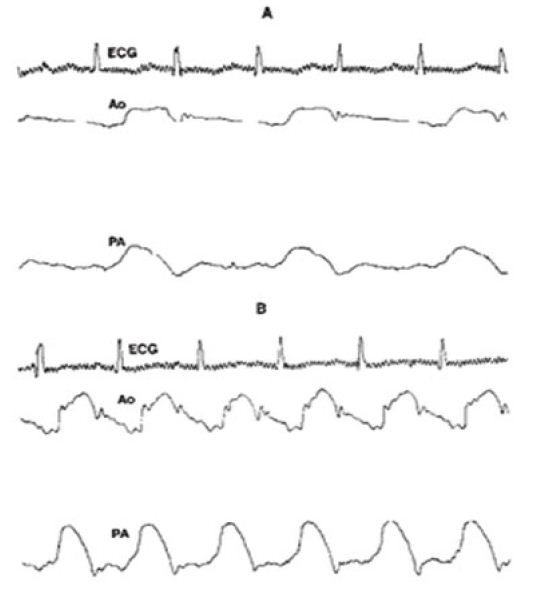
fig 9

Figure 9: A. Recording of the electrocardiogram (ECG), aortic (Ao) and pulmonary artery (PA) pressures showing that every other ECG complex is not followed by the PA and Ao pulse pressure during the AFORMED phenomenon. B. After administering G. strophanthin all ECG complexes are followed by the Ao and PA pulse traces. Reproduced from Rao PS, Thapar MK. (1983) Am J Cardiol 52: 655 [8].

Racial Variations in Electrocardiograms and Vectorcardiograms between Black and White Children

While it is generally thought that the ECGs of black and white children differ from each other, none of the normal standards in children have taken race into consideration in establishing the norms as of the mid-1980s. Therefore, we examined large groups of black and white children to see if any such differences exist, and if so, to investigate the reason for such differences [9,10]. A total of 244 normal children were studied; 124 were black and 120 were white. 125 were male and 119 were female. 144 measured parameters and 57 computed variables from these subjects were examined. In these studies, the children were divided into age groups of 3-5, 6-10, 11-14, and 15-17 years old. The number of teenagers between 15-17 was small (N=20) and therefore, their data were not analyzed in the initial study [9]. Subsequently, additional teenagers (N = 39) were added; this gave a total of 59 teenagers (28 black and 31 white adolescents between 15 and 19 years old) and were studied [10] in a manner similar to the first study [9]. These data were presented in multiple tables and figures [9,10].

No sex-related or race-related (Figure 10) differences (p > 0.1) in the ECGs/VCGs were detected in the 3- to 5-year-old children. Similarly, no race-related differences (p > 0.1) were seen in the 11- to14-year-old girls (Figure 11).
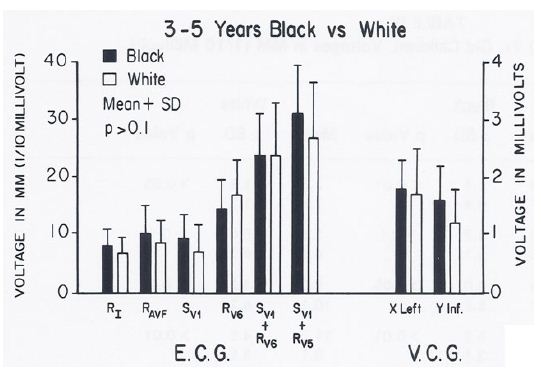
fig 10

Figure 10: Bar diagram illustrating the comparison of selected voltage amplitudes of the QRS complex of the electrocardiograms (E.C.G.) and vectorcardiograms (V.C.G.) between 3- to 5-year-old black and white children; filled bars represent black children and unfilled bars represent white children. Note that there were no statistically significant differences (p > 0.1) between the groups. Reproduced from Rao PS, et al. (1984) J Electrocardiol 17: 239-252 [9].
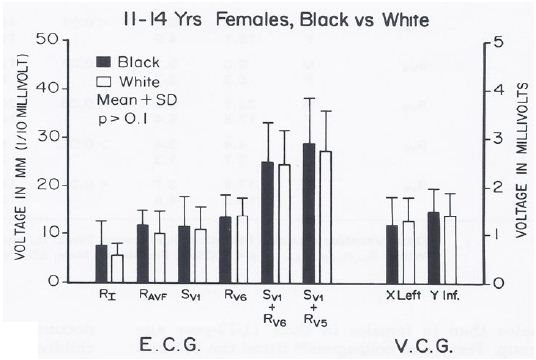
fig 11

Figure 11: Bar diagram illustrating the comparison of selected voltage amplitudes of the QRS complex of the electrocardiograms (E.C.G.) and vectorcardiograms (V.C.G.) between 11- to 14-year-old black and white females; filled bars represent black girls and unfilled bars represent white girls. Note that there were no statistically significant differences (p > 0.1) between the groups. Reproduced from Rao PS, et al. (1984) J Electrocardiol 17: 239-252 [9].

However, higher voltages (p < 0.05 to < 0.01) to the left, posterior and inferior were detected in the ECGs and VCGs of blacks than those of whites in the group of 6- to10-year-old children (Figure 12) and in the 11- to 14-year-old boys (Figure 13). In the 15- to 19-year-old adolescents, the male teenagers had higher (p < 0.05 to 0.001) leftward, inferior and/or posterior voltages than the females; this was true for both black and white adolescents (see Table I of Reference 10 for actual values) [10].
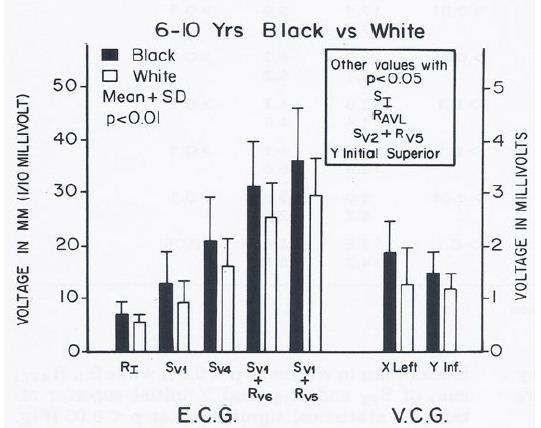
fig 12

Figure 12: Bar diagram illustrating the comparison of selected voltage amplitudes of the QRS complex of the electrocardiograms (E.C.G.) and vectorcardiograms (V.C.G.) between 6- to 10-year-old black and white children; filled bars represent black children and unfilled bars represent white children. Note that there were statistically significant differences (p < 0.01) between the groups. Other parameters with p values < 0.05 are shown in the insert. Reproduced from Rao PS, et al. (1984) J Electrocardiol 17: 239-252 [9].
fig 13

Figure 13: Bar diagram illustrating the comparison of selected voltage amplitudes of the QRS complex of the electrocardiograms (E.C.G.) and vectorcardiograms (V.C.G.) between 11- to 14-year-old black and white males; filled bars represent black boys and unfilled bars represent white boys. Note that there were statistically significant differences (p < 0.01) between the groups. Other parameters with p values < 0.05 are shown in the insert. Reproduced from Rao PS, et al. (1984) J Electrocardiol 17: 239-252 [9].

When a racial comparison was made in black 15- to 19-year-olds, the males had higher (p < 0.05 to 0.01) leftward, posterior, inferior voltages than white adolescents (Figure 14) while no such differences (p > 0.05 to > 0.1) were observed in the female subjects (Figure 15).
fig 14

Figure 14: Bar diagram illustrating a comparison of selected voltage amplitudes of the QRS complex of the electrocardiograms (E.C.G.) and vectorcardiograms (V.C.G.) between 15- to 19-year-old black and white males; filled bars represent black boys and unfilled bars represent white boys. Note that there were statistically significant differences (p < 0.05 to 0.01) between the groups. Reproduced from Rao PS. (1985) J Electrocardiol 18: 309-313 [10].
fig 15

Figure 15: Bar diagram illustrating a comparison of selected voltage amplitudes of the QRS complex of the electrocardiograms (E.C.G.) and vectorcardiograms (V.C.G.) between 15- to 19-year-old black and white females; filled bars represent black girls and unfilled bars represent white girls. Note that there were no statistically significant differences (p > 0.05 to 0.1) between the groups. Reproduced from Rao PS. (1985) J Electrocardiol 18: 309-313 [10].

The body surface area, height, weight, AP diameter and circumference of the chest, and systolic and diastolic blood pressures were similar (p > 0.1) in black and white children for all age groups. The hemoglobin and hematocrit values were lower (p < 0.05) in black than in white children. Yet, this difference was seen in all age-sex subgroups, indicating that hemoglobin/hematocrit levels are unlikely to explain the ECG-VCG differences. The left ventricular end-diastolic dimensions were similar (p > 0.1). But, on echocardiographic measurement, the left ventricular posterior wall in diastole was thicker (p < 0.05 to < 0.01) and the distance between the anterior chest wall to mid-left ventricle was shorter (p < 0.05 to < 0.01) in black than in white children in the age-sex subgroups in which the ECG-VCG differences were noted (Figures 16 through 18) while these differences were not seen in the groups in which the ECG differences were not observed (Figures 19 through 21).
fig 16

Figure 16: Bar diagram comparing the left ventricular internal dimension in diastole (LVIDd), anterior chest wall (ACW) to mid-left ventricular (MLV) distance and left ventricular posterior wall thickness in diastole (PWTd) in 6- to 10-year-old black and white children; filled bars represent black children and unfilled bars represent white children. Note that the LVIDd is similar (p> 0.1) while the ACW to MLV distance is shorter (p < 0.01) and PWTd thicker (p < 0.01) in black than in white children. Reproduced from Rao PS, et al. (1984) J Electrocardiol 17: 239-252 [9].
fig 17

Figure 17: Bar diagram comparing the left ventricular internal dimension in diastole (LVIDd), anterior chest wall (ACW) to mid-left ventricular (MLV) distance and left ventricular posterior wall thickness in diastole (PWTd) in 11- to 14-year-old black and white male children; filled bars represent black children and unfilled bars represent white children. Note that the LVIDd is similar (p> 0.1) while the ACW to MLV distance is shorter (p < 0.05) and PWTd thicker (p < 0.05) in black than in white children. Reproduced from Rao PS, et al. (1984) J Electrocardiol 17: 239-252 [9].
fig 18

Figure 18: Bar diagram comparing the left ventricular internal dimension in diastole (LVIDd), anterior chest wall (ACW) to mid-left ventricular (MLV) distance and left ventricular posterior wall thickness in diastole (PWTd) in 15- to 19-year-old black and white male teenagers; filled bars represent black teenagers and unfilled bars represent white teenagers. Note that the LVIDd is similar (p> 0.1) while the ACW to MLV distance is shorter (p < 0.05) and PWTd thicker (p < 0.05) in black than in white teenagers. Rao PS. (1985) J Electrocardiol 18: 309-313 [10].
fig 19

Figure 19: Bar diagram comparing the left ventricular internal dimension in diastole (LVIDd), anterior chest wall (ACW) to mid-left ventricular (MLV) distance and left ventricular posterior wall thickness in diastole (PWTd) in 3- to 5-year-old black and white children; filled bars represent black children and unfilled bars represent white children. Note that the LVIDd, ACW to MLV distance and PWTd are similar (p > 0.1) in both groups. Reproduced from Rao PS, et al. (1984) J Electrocardiol 17: 239-252 [9].
fig 20

Figure 20: Bar diagram comparing the left ventricular internal dimension in diastole (LVIDd), anterior chest wall (ACW) to mid-left ventricular (MLV) distance and left ventricular posterior wall thickness in diastole (PWTd) in 11- to 14-year-old black and white female children; filled bars represent black children and unfilled bars represent white children. Note that the LVIDd, ACW to MLV distance and PWTd are similar (p > 0.05 to > 0.1) in both groups. Reproduced from Rao PS, et al. (1984) J Electrocardiol 17: 239-252 [9].
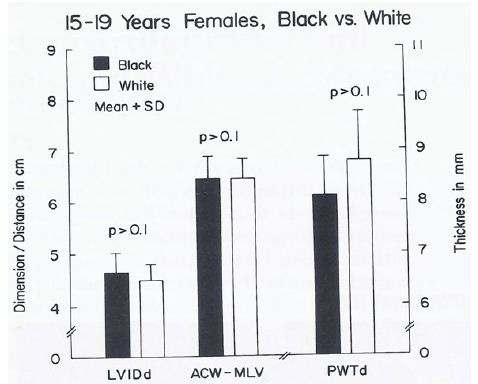
fig 21

Figure 21: Bar diagram comparing the left ventricular internal dimension in diastole (LVIDd), anterior chest wall (ACW) to mid-left ventricular (MLV) distance and left ventricular posterior wall thickness in diastole (PWTd) in 15- to 19-year-old black and white female teenagers; filled bars represent black teenagers and unfilled bars represent white teenagers. Note that the LVIDd, ACW to MLV distance and PWTd are similar (p > 0.1) in both groups. Reproduced from Rao PS. (1985) J Electrocardiol 18: 309-313 [10].

In the discussion following the presentation of the results, a review of the sexual and racial differences in the ECGs was presented. The sex-based differences (higher precordial voltages in males than females in children above 11 years of age) that we found in our study were similar to those observed by other workers as reviewed in our papers [9,10]. With regard to racial differences, higher leftward, posterior and inferior voltages were found in black children than in white children; these began to appear in 6- to 10-year-olds and became more pronounced during adolescence. These differences during adolescence were largely confined to the male subjects. Some earlier studies were in line with our observations, while other studies could not document such differences as reviewed in our papers [9,10].

In summary, the causes for the racial differences had not been adequately investigated prior to our study. Our thorough review indicated no differences in the specialized ventricular conduction system, ventricular activation patterns, duration of QRS complex or size of the left ventricle. Similarly, the body surface area, height, weight, AP diameter and circumference of the chest, and the systolic and diastolic blood pressures did not seem to vary in such a way that might explain the differences. The lower hemoglobin levels that we found in black children may, to some degree, explain the racial difference, but this difference was small, and more importantly, the lower hemoglobin levels were found in all age groups, including those groups in whom no ECG/VCG differences were observed, making hemoglobin an unlikely causative factor. In black children in the groups in which ECG-VCG differences were seen, a thicker left ventricular posterior wall and shorter anterior chest wall to mid-LV distance were observed than in white children in the same groups, and these factors are likely to be responsible for this difference. Based on these observations, we recommended that separate normal standards are needed for males and females beyond 11 years of age and for black and white children beyond six years of age [9,10].

Congestive Cardiomyopathy Due to Chronic Tachycardia (Resolution with Medications)

As of the mid-1980s, the importance of treatment of tachycardia by surgical or catheter-based ablation was emphasized to prevent arrhythmia-induced cardiomyopathy. We hypothesized that the reduction of the ventricular rate to normal by drug therapy would result in the regression of arrhythmia-induced cardiomyopathy. To support this hypothesis, we presented the case of a three-year-old child who developed arrhythmia-induced cardiomyopathy (Figure 22A) and who improved (Figure 22B) with drug therapy [11]. Treatment with medications (Digoxin and Verapamil) resulted in the immediate relief of symptoms, and was followed by a gradual improvement in cardiac size and function (Table 2) with a subsequent return of normal cardiac size and function (Figure 22).

Table 2: Cardiac Rate, Size and Function Prior to and Following Drug Treatment.

At initial presentation

After conversion One-year follow-up Two-year follow-up

Last follow-up (5.5 years)

Ventricular rate, ECG

200

67 85 96

69

CT ratio, X-ray

0.6

0.58 0.51 0.45

0.43

LVEDD, mm, echo

48

50 41 40

41

LVEDD/m2, mm, echo

87

91 65 53

54

LV shortening fraction

13

24 24 32

29

PEP /LVET ratio

0.74

0.51 0.39 0.24

0.24

LA/Ao ratio

1.5

1.4 1.3 1.0

1.1

Ao, aorta; CT, cardiothoracic; echo, echocardiogram; ECG, electrocardiogram; LA, left atrium; LV, left ventricle; LVEDD, left ventricular end-diastolic dimension; LVET, left ventricular ejection time; PEP, pre-ejection period.
Reproduced from Rao PS, Najjar HN. (1987) International J Cardiol 17: 216-220 [11].
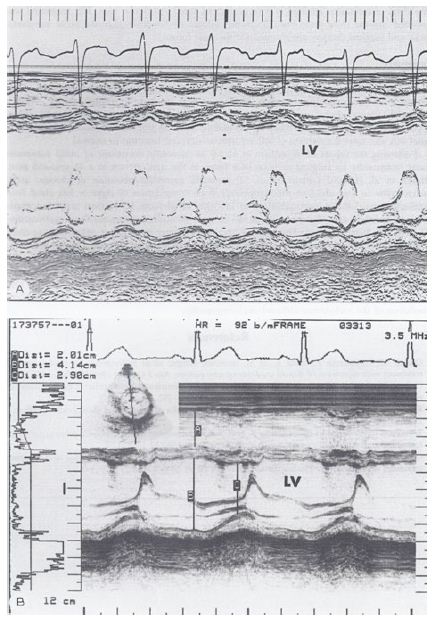
fig 22

Figure 22: A. M-mode echocardiogram of a 3-year-old child who developed arrhythmia-induced cardiomyopathy; note the markedly dilated left ventricle (LV) with poor function (calculated shortening fraction was 13%). B. M-mode echocardiogram of the same patient following successful drug therapy (5.5 years later); note the normal-sized LV with normal function (calculated shortening fraction was 29%). Reproduced from Rao PS, Najjar HN. (1987) International J Cardiol 17: 216-220 [11].

This case demonstrated that reducing the ventricular rate by medication may result in resolving arrhythmia-induced cardiomyopathy and that the surgical excision or catheter ablation of the atrial automatic focus is not necessary in all cases, at least as of the late 1980s. However, it should be noted that enormous advances in pediatric electrophysiology and catheter-based ablation techniques have taken place since the time of our publication [11], and catheter-based ablation of the inciting focus may be an excellent choice at the present time, once the acute symptoms have been controlled by drug therapy.

Electrocardiographic Changes Following Balloon Valvuloplasty for Pulmonary Stenosis

While the evaluation of the follow-up results of balloon pulmonary valvuloplasty by echo-Doppler have been found useful, there was sparse data on the utility of the ECG in the assessment of the results of balloon pulmonary valvuloplasty as of the mid-1980s. Therefore, we sought to examine ECG changes subsequent to balloon pulmonary valvuloplasty for pulmonary valve stenosis and to scrutinize whether ECG changes reflect an improvement in the pressure gradient across the pulmonary valve at follow-up [12].

Of the 41 patients – aged seven days to 20 years – who had balloon pulmonary valvuloplasty, 35 patients had ECGs available for review and comparison both prior to and at three to 34 months (mean 11 months) follow-up. On the basis of cardiac catheterization and echo-Doppler systolic pressure gradients across the pulmonary valve at follow-up, the study subjects were divided into two groups: group I, with good results (N = 30) and group II, with poor results (N = 5). There was no difference (p > 0.1) in any ECG parameters (Figures 23 and 24) between the groups prior to balloon valvuloplasty [12].
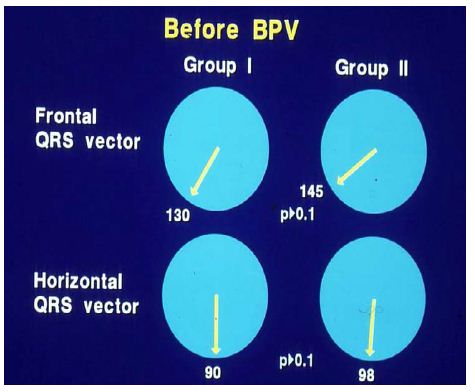
fig 23

Figure 23: Plots of mean QRS vectors (axis) in the frontal (top) and horizontal (bottom) planes in group I (with good results) (left circles) and group II (with poor results) (right circles) prior to balloon pulmonary valvuloplasty (BPV) are shown. Note that no significant (p > 0.1) difference was seen between groups I and II. Reproduced from reference [13].
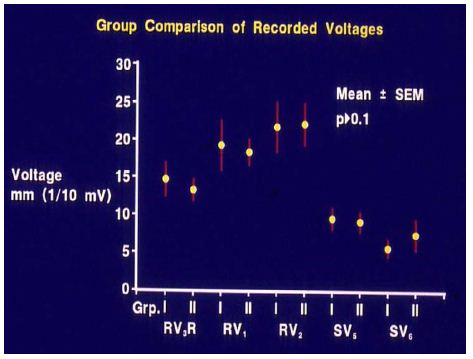
fig 24

Figure 24: Anterior (R waves in leads V3R, V1 and V2) and terminal rightward (S waves in leads V5 and V6) voltages in the electrocardiograms prior to balloon pulmonary valvuloplasty are compared between group I (with good results) and group II (with poor results). Mean and standard error of mean (SEM) are shown. Note that no significant (p > 0.1) difference is shown between groups I and II. Reproduced from reference [13].

In group I (with good results), the frontal plane mean QRS vector moved toward the left from 127 ± 25° to 81 ± 47°, as did the horizontal plane mean QRS vector, which moved from 88 ± 36° to 57 ± 31° (Figure 25) at follow-up; this change is statistically significant (< 0.05). The anterior (R waves in leads V3R, V1 and V2) and terminal rightward (S waves in lead V5 and V6) electrical forces decreased (Figures 26, left panel). However, there was no change (p > 0.1) in the frontal (145 ± 27° vs. 145 ± 27°) and horizontal (98 ± 19° vs. 112 ± 29°) vectors and in precordial voltages (Figures 26, right panel) in group II (with poor results).
fig 25

Figure 25: Plots of mean QRS vectors (axis) in the frontal (top) and horizontal (bottom) planes in group I (with good results) prior to balloon pulmonary valvuloplasty (BPV) (left circles) and at follow-up (right circles) are shown. Note the significant (p < 0.05) improvement at follow-up. Reproduced from reference [13].
fig 26

Figure 26: Precordial ECG voltages (R waves in leads V3R and V1 and S waves in V6) prior to and at follow-up after balloon pulmonary valvuloplasty (BPV) in group I (with good results) (left panel) and group II (with poor results) (right panel) are depicted. The mean and standard deviation (SD) are shown. Note the significant (p < 0.05 to 0.01) decrease in the voltages in group I while there was no significant (p > 0.1) change in group II. Reproduced from reference [13].

When the time courses of the ECG voltage changes in group I were examined, a gradual improvement was noted; at three-month follow-up, there was no statistically significant decrease (p > 0.05), but at six and 12 months, a significant (p< 0.05 to 0.001) decrease in the voltages was observed (Figures 27 and 28).
fig 27

Figure 27: Precordial ECG voltages (R waves in leads V3R [circles] and V1 [squares]) prior to and at three, six, and 12 months following balloon pulmonary valvuloplasty (BPV) in group I patients (with good results). Note that a gradual improvement was shown; at three month follow-up, there was no statistically significant decrease (p > 0.05), but at six and 12 months, a significant (p< 0.05 to 0.001) decrease was observed. The mean and standard error of mean (SEM) are shown. Reproduced from Rao PS, Solymar L. (1988) J Interventional Cardiol 1: 189-197 [12].
fig 28

Figure 28: Precordial ECG voltages (S waves in leads V5 [circles] and V6 [squares]) prior to and at three, six, and 12 months following balloon pulmonary valvuloplasty (BPV) in group I patients (with good results). Note that a gradual improvement was shown; at three month follow-up, there was no statistically significant decrease (p > 0.05), but at six and 12 months, a significant (p< 0.05 to 0.001) decrease was observed. The mean and standard error of mean (SEM) are shown. Reproduced from Rao PS, Solymar L. (1988) J Interventional Cardiol 1: 189-197 [12].

After concluding that the ECG gets better after successful balloon pulmonary valvuloplasty, we sought to determine whether the post valvuloplasty ECG reflects a residual valve gradient at follow-up. We analyzed thirty pairs of ECGs and trans-pulmonary valve systolic pressure gradients acquired within 24 hours of each other. The ECGs were interpreted as normal or right ventricular hypertrophy on the basis of standard criteria [12]. In fifteen patients with normal ECGs, the pulmonary valve peak systolic pressure gradients were 18.3 ± 8.2 mmHg (with a range of 4 to 30 mmHg) (Figures 29): these simultaneous ECGs/pulmonary valve gradients were secured seven to 28 months (12.0 ± 5.5 mo) after the balloon procedure. Five ECGs obtained within 6 months of balloon valvuloplasty, though improved, still showed RVH even though the gradients were low (15.2 ± 9.4; range 5 to 25 mmHg). The final 10 ECGs showed RVH and had high (55.8 ± 26.4; range 32 to 118 mmHg) residual gradients (Figures 29) at follow-up after 10 ± 5 months. These data suggest that 1. A normal ECG implies a minimal residual pulmonary valve gradient, 2. RVH indicates a significant residual gradient, and 3. Patients whose ECGs are recorded earlier than six months after balloon valvuloplasty may not have had time for the complete resolution of RVH, despite reduced gradients.
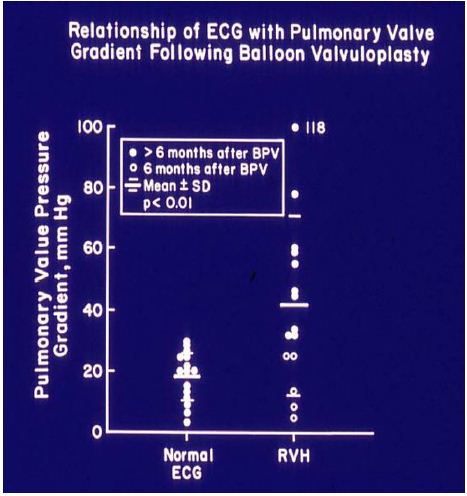
fig 29

Figure 29: The relationship of residual pulmonary valve gradients at follow-up after balloon pulmonary valvuloplasty (BPV) and electrocardiogram (ECG) is plotted. Note that a normal ECG is found in patients with minimal residual pulmonary valve gradients (left panel) while RVH indicates a significant residual gradient, or that the ECGs were recorded earlier than six months after BPV. The mean and standard deviation (SD) are shown. Filled circles – ECGs recorded six months after BPV. Open circles – ECGs recorded prior to six months after BPV. ECGs recorded prior to six months after BPV exhibited RVH, despite reduced gradients; this may in part be related to not yet having had a chance for the complete resolution of RVH. Reproduced from reference [13].

On the basis of these data, we concluded that the ECG is a good indicator of the improvement in gradients following balloon pulmonary valvuloplasty, but reduced valve gradients may not be reflected by the ECG until six months after balloon pulmonary valvuloplasty [12,13].

The Role of the ECG in Delineating Atrial and Ventricular Situs in Patients with Dextrocardia and Heterotaxy Syndromes

Early on we utilized the ECG to delineate atrial and ventricular situs in patients with asplenia/polysplenia syndromes and dextrocardia [14,15]. Atrial and ventricular situs determination was appraised.

Atrial Situs

There are multiple ways in which the atrial situs may be determined, and the ECG is one of the least invasive and easy methods to make such a determination [14-18]. Because the sinoatrial node is normally located at the superior vena cava (SVC)-right atrial (RA) junction, the atrial depolarization traverses leftward and inferiorly and produces “P” waves with a vector (axis) of +45° in the frontal plane (Figure 30). This results in upright P waves in leads I and AVF (Figure 31). With atrial inversion (situs inversus) the P vector is around +135° (Figure 30) with an inverted P wave in lead I and an upright P wave in lead AVF (Figure 32). If the P vector is -45° with upright P waves in lead I and inverted P waves in lead AVF (Figures 30 and 33), it may be called coronary sinus rhythm (or low atrial rhythm), and such a P vector is not helpful in determining atrial situs. However, coronary sinus rhythm is frequently associated with systemic venous anomalies (persistent left superior vena cava and infrahepatic interruption of the inferior vena cava) which are frequently seen with asplenia/polysplenia syndromes.
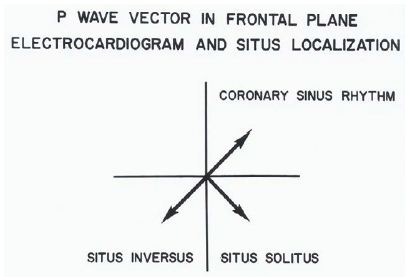
fig 30

Figure 30: The location of the P vector (axis) in the frontal plane is shown for situs solitus (+450) and situs inversus (+1350). A P vector between 00 and -900 is called coronary sinus rhythm and is not helpful in atrial situs assignment. Reproduced from Rao PS, Leonard T. (1976) Cardiology Digest 11(3): 14-22 [14].
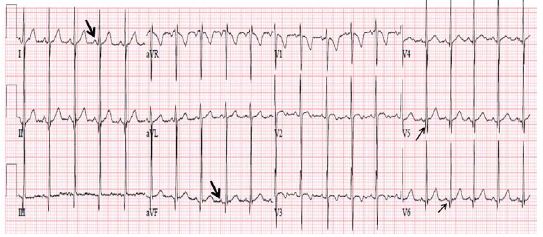
fig 31

Figure 31: ECG demonstrating a normal P vector (+450) with positive P waves in leads I and AVF (arrows in leads I and AVF) suggesting atrial situs solitus. Also, note that there are no Q waves in leads V1 and V2 and Q waves are present in leads V5 and V6 (arrows in V5 and V6), indicating a normal left-to-right ventricular relationship. Reproduced from Reference [17].
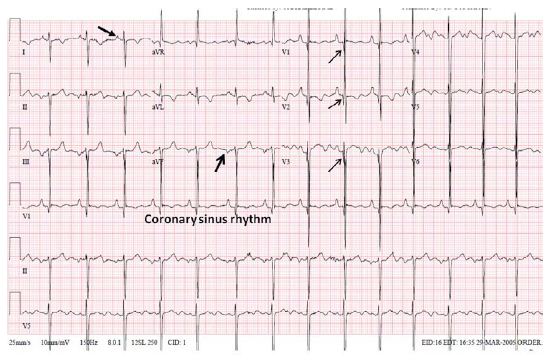
fig 32

Figure 32: ECG demonstrating an abnormal P vector (+1350) with a negative P wave in lead I and a positive P wave in lead AVF (arrows in leads I and AVF) suggesting atrial situs inversus. Reproduced from Reference [17].
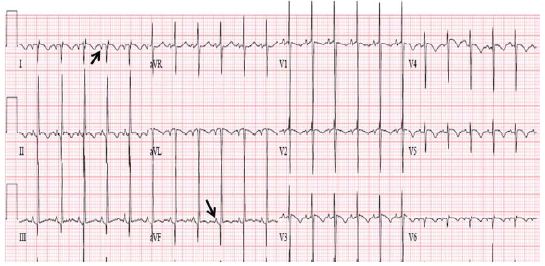
fig 33

Figure 33: ECG demonstrating an abnormal P vector (-450) with positive P waves in lead I and negative P waves in lead AVF (arrows in leads I and AVF) suggesting coronary sinus rhythm; this pattern is not useful in assigning atrial situs. Also note the Q waves in leads V1, V2 and V3 (arrows in V1 V2 and V3), and that there are no Q waves in leads V5 and V6, indicating ventricular inversion. Modified from Reference [17].

Ventricular Situs

The ECG may also be helpful in determining the ventricular situs. While it is generally thought that the qRs pattern of the QRS complex is seen over the left ventricle and the rS pattern over the right ventricle, this concept is not necessarily correct because most dextrocardia and heterotaxy syndrome patients have complex congenital heart disease causing right ventricular hypertrophy (RVH), or they may have a single ventricle. Therefore, it is frequently difficult to distinguish RV (rS pattern) from LV (qRs pattern) of QRS complexes. However, an initial QRS vector may be more helpful. The depolarization of the ventricular septum takes place from both the right and left sides of the septum, with slightly earlier depolarization on the left than on the right side. The sum total initial ventricular forces are directed to the right, anterior and slightly superiorly, resulting in Q waves in leads V5 and V6, no Q waves in leads V1 and V2 , and a small Q wave in lead AVF (Figure 31). In patients with ventricular inversion, the conduction system is also inverted and the initial QRS vector is directed to the left and posteriorly. Consequently, there will be Q waves in leads V1 and V2, no Q waves in leads V5 and V6 (Figure 33), and may have deep Q waves in leads II, III and AVF. These principles are equally applicable, irrespective of the heart’s position in the chest (levocardia, mesocardia or dextrocardia). While this type of analysis appears simple and logical, sometimes it may not be reliable because of variable degrees of rotation and hypertrophy of the ventricles.

The concepts, detailed in our early publications [13-15], appear to have stood the test of time, and we were thus able to reaffirm them in our recent publications [16-19].

Review of Arrhythmias

In Conn’s Current Therapy [20,21], we presented a detailed review of the identification and management of arrhythmias in the pediatric patient in the 1980s. The presentation included descriptions of normal rhythms (sinus arrhythmia, wandering atrial pacemaker, sinus tachycardia, sinus bradycardia), premature contractions (premature atrial beats, premature junctional contractions, premature ventricular beats), supraventricular (paroxysmal supraventricular tachycardia [SVT], atrial flutter, atrial fibrillation, junctional tachycardia, automatic atrial tachycardia) and ventricular (ventricular tachycardia, ventricular fibrillation and “torsade de point”) tachycardias, sick sinus syndrome, and heart blocks (first-degree heart block, second-degree heart block [Wenchebach (Mobitz Type I) and fixed (Mobitz Type II)] and third-degree heart block [complete heart block]), and their diagnosis and management. An alphabetical list of drugs commonly used in the management of pediatric patients with heart disease, with particular attention to the drugs used in the management of arrhythmias in infants and children, was included in these publications [20,21]. The material was presented to many groups of pediatric cardiology fellows, pediatric residents and pediatricians. In addition, examples of the arrhythmia ECG tracings were published in our book, Pediatric Cardiology, Medical Examination Review [22], in questions 1115 through 1167 and 1197 to 1200; the interested reader may review these.

Summary and Conclusions

A number of studies were conducted investigating the utility of ECGs in the assessment of clinical issues in children. Study of Frank and McFee vector-cardiograms in the adolescent established normal vectorcardiographic values in adolescents. Recording intra-cavitary electrocardiograms along with pressures in a patient with Ebstein’s anomaly of the left atrio-ventricular valve in CCTGA helped establish the diagnosis in a manner similar to Ebstein’s anomaly in children with normally related ventricles and great arteries. Investigation to differentiate right ventricular hypertrophy from posterobasal left ventricular hypertrophy resulted in developing criteria (RVH – RV2 greater than 10 mm, SI greater than 5 mm, and the mean horizontal plane QRS vector between +60 degrees to +200 degrees with a clockwise or figure of 8 loop; PBLVH – RV2 less than 10 mm, SI less than 5 mm and mean horizontal plane QRS vector between -10 degrees to -130 degrees with a counterclockwise loop) to distinguish them from each other. A detailed description of electrocardiographic features of tricuspid atresia was presented. The mechanism of abnormal superior vector (left axis deviation) in tricuspid atresia was studied with the resulting conclusion that distinctive abnormal superior vector of the QRS complex is produced by the interaction of multiple factors, the most important of which appear to be right-to-left ventricular disproportion and an asymmetric distribution of the left ventricular mass favoring the superior wall. The mechanism of AFORMED phenomenon was studied in experimental animal model with the conclusion that the lack of availability of calcium to the myofilament may be the cause of the AFORMED phenomenon. We have investigated racial variations in ECGs and VCGs between black and white children and these studies demonstrated: 1. Gender-based differences with higher precordial voltages in males than females in children above 11 years of age, 2. Racial differences with higher leftward, posterior and inferior voltages in black children than in white children; these began to appear in 6- to 10-year-olds and became more pronounced during adolescence. However, such differences were largely confined to the male subjects, and 3. In the groups in which ECG-VCG differences were seen, the black children had a thicker left ventricular posterior wall and shorter anterior chest wall to mid-LV distance than in white children, signifying that these factors are likely to be responsible for this difference. On the basis of these observations, we concluded that separate normal standards are needed for males and females beyond 11 years of age and for black and white children older than six years of age. Resolution of arrhythmia-induced congestive cardiomyopathy with medications in a child indicated that all such patients may not need surgical or transcatheter ablation of arrhythmogenic focus, given the state of the art in mid 1980s; however, currently available ablation techniques are likely to be more favorable. Electrocardiographic changes following balloon valvuloplasty for pulmonary stenosis were described which pointed out that the RVH in the ECG gets better during follow-up and the ECG is a good indicator of the improvement in pulmonary valve gradients following balloon pulmonary valvuloplasty, but reduced valve gradients may not be reflected by the ECG until six months after balloon pulmonary valvuloplasty. The role of the ECG in delineating atrial and ventricular situs in patients with dextrocardia and heterotaxy syndromes was reviewed; these concepts initially proposed the late 1970s and early 1980s remain true in the current era. Reviews of arrhythmias and their management in children, advocated in the 1980s, still remain true although new array of drug and transcatheter therapy by specially trained pediatric electro-physiologists have emerged in recent times.

References

  1. Liebman J, Lee MH, Rao PS, Mackay W (1973) Quantitation of the normal Frank and McFee Parungao orthogonal electrocardiogram in the adolescent. Circulation 48: 735-752. [crossref]
  2. Rogers JH, Rao PS (1977) Ebstein’s Anomaly of the left atrioventricular valve with congenital corrected transposition of the great arteries: Diagnosis by intracavitary electrocardiography. Chest 72: 253-256. [crossref]
  3. Rao PS, Monarrez CN (1981) Electrocardiographic differentiation of posterobasal left ventricular hypertrophy from right ventricular hypertrophy. J Electrocardiol 14: 25-30. [crossref]
  4. Kulangara RJ, Boineau JP, Rao PS (1982) Electrovectorcardiographic features of tricuspid atresia. In: Rao PS (ed). Tricuspid Atresia. Futura Publishing Co., Mount Kisco, New York, Chapter 9.
  5. Rao PS, Kulangara RJ, Boineau JP, Moore HV (1992) Electrovectorcardiographic features of tricuspid atresia. In: Rao PS (ed). Tricuspid Atresia, 2nd Edition, Futura Publishing Co, Mt. Kisco, NY, Chapter 9.
  6. Fuster Siebert M, García-Bengochea JB, Rubio J, et al. (1982) [Tricuspid atresia and interatrial communication of the ostium primum type: changes in the QRS electrical axis. Physiopathologic implications]. Rev Esp Cardio l35: 377-381.
  7. Kulangara RJ, Boineau JP, Moore HV, Rao PS (1981) Ventricular activation and genesis of QRS in tricuspid atresia. Circulation 64: VI-225.
  8. Rao PS, Thapar MK (1983) The AFORMED phenomenon: A proposed etiology. Am J Cardiol 52: 655. [crossref]
  9. Rao PS, Thapar MK, Harp RJ (1984) Racial variations in electrocardiograms and vectorcardiograms between black and white children and their genesis. J Electrocardiol 17: 239-252. [crossref]
  10. Rao PS (1985) Racial differences in electrocardiograms and vectorcardiograms between black and white adolescents. J Electrocardiol 18: 309-313. [crossref]
  11. Rao PS, Najjar HN (1987) Congestive cardiomyopathy due to chronic tachycardia: resolution of cardiomyopathy with antiarrhythmic drugs. International J Cardiol 17: 216-220. [crossref]
  12. Rao PS, Solymar L (1988) Electrocardiographic changes following balloon dilatation of valvar pulmonic stenosis. J Interventional Cardiol 1: 189-197.
  13. Rao PS (2015) Balloon valvuloplasty for pulmonary stenosis. In: Vijayalakshmi IB, , Cardiac Catheterization and Imaging (From Pediatrics to Geriatrics), Jaypee Publications, New Delhi, India, 2015:149-174.
  14. Rao PS, Leonard T (1976) Polysplenia syndrome. Cardiology Digest 11: 14-22.
  15. Rao PS (1981) Dextrocardia: Systematic approach to differential diagnosis. Amer Heart J 102: 389-403. [crossref]
  16. Rao PS (2015) Cardiac malpositions including heterotaxy syndromes. In: Rao PS, Vidyasagar D. (editors), Perinatal Cardiology: A Multidisciplinary Approach, Minneapolis, MN, Cardiotext Publishing, Chapter 36.
  17. Rao PS (2015) Cardiac malposition. In: Gupta P, Menon PSN, Ramji S, Lodha R (eds). PG Textbook of Pediatrics. Jaypee Brothers Medical Publishers (P) Ltd., New Delhi, India, 2015:1807-16.
  18. Rao PS (2018) Cardiac malposition. In: Gupta P, Menon PSN, Ramji S, Lodha R (eds). PG Textbook of Pediatrics. Second Edition, Jaypee Brothers Medical Publishers (P) Ltd., New Delhi, India.
  19. Rao PS (2021) Cardiac malpositions including heterotaxy syndromes. In: Rao PS, Vidyasagar D. (editors), A Multidisciplinary Approach to Perinatal Cardiology, Volume 2, Cambridge Scholars Publishing, New Castle Upon Tyne, UK, 2021: 433-466.
  20. Rao PS and Strong WB (1981) Congenital heart disease. In: Current Therapy 1981. Conn HF (Ed), W.B. Saunders, Philadelphia, PA. 1981: 185-209.
  21. Rao PS (1989) Congenital heart disease. In: Conn’s Current Therapy, 1989 Rakel RE (Ed), W.B. Saunders, Philadelphia, PA, 1989: 201-13.
  22. Rao PS, Miller MD (1980) Medical Examination Review, Pediatric Cardiology, Medical Examination Publishing Co., Inc., Garden City, New York, U.S.A., 1980.
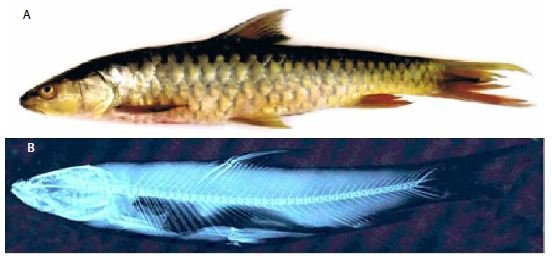
fig 2

Delayed Presentation of Ventricular Septal Rupture After Untreated Inferior Myocardial Infarction

DOI: 10.31038/JCCP.2021413

Abstract

Ventricular septal rupture is one of the most devastating complications of post myocardial infarction. The mortality rate of post myocardial infarction ventricular septal rupture increases significantly for each week when left untreated. We describe a case of a 62-year-old male who presented with progressively worsening shortness of breath and lower extremity edema three months after a myocardial infarction. The patient was subsequently found to have an anterior apical ventricular septal rupture with left to right shunting. Requiring surgical repair.

Keywords

Myocardial infarction, Ventricular septal rupture

Introduction

The most devastating complication of post myocardial infarction (MI) involves tearing or rupture of infarcted myocardial tissue. The clinical course differs depending on the site of the complication, which may involve the septum, free wall, or papillary muscles. Before the age of reperfusion therapy, post-MI ventricular septal rupture (VSR) occurred in 1% to 3% of patients with STEMI. With fibrinolytic intervention, the occurrence of VSR is approximately 0.2% to 0.34%. Among those who have received reperfusion therapy, it occurs more commonly in those who received fibrinolytic therapy rather than percutaneous coronary intervention. In current times, patients not undergoing reperfusion therapy for an acute MI is a rare entity. For these patients, the first day after post-MI VSR is survived by approximately 75% of patients, the first week approximately 50%, two weeks 30%, and only 4-15% of patients survive the first month. Current guidelines recommend immediate operative intervention in patients with septal rupture, regardless of their clinical status. We present a case of an older gentleman who arrived approximately two months after initial MI whose chief complaint was progressively worsening dyspnea associated with lower extremity edema, and orthopnea. An EKG was obtained which illustrated Q waves in leads II, III, and aVF. Ultimately, he was found to have an anterior apical ventricular septal rupture with left-to-right shunt. The patient underwent repair with a bovine patch as well as coronary artery bypass grafting with the aorta to the posterior descending artery via reverse saphenous vein graft. Today’s literature demonstrates that patients with a post infarct VSR have a significantly high mortality rate that is typically described over a one-month time frame. Our case illustrates a patient who presented two months after an inferior MI with a post infarct VSR who underwent surgical intervention and had resolution of his presenting symptoms.

Case Presentation

A 62-year-old male with a past medical history of hypertension and dyslipidemia presented with the complaint of progressive worsening shortness of breath for over a month. Patient admitted to worsening shortness of breath with movement as well as lying flat and improving with sitting up. Also, the patient noted to have lower extremity edema for over a month. Of note, the patient stated that three months prior, while working, he began sweating profusely and had to stop working to sit down. He had a friend that worked in the fire department who performed an EKG supposedly showing no acute abnormalities. The patient ultimately went home after the EKG. His symptoms of shortness of breath and edema progressively worsened since this point in time. At presentation to the ER, the physical exam was consistent with volume overload and a holosystolic murmur was heard best at the left sternal border. EKG was performed showing sinus tachycardia, old inferior infarct with small Q-waves in leads III and aVF, left atrial enlargement, right axis deviation, and mild T-wave inversions. Additionally, there was poor R-wave progression from V1 through V5 suggestive of possible old anterior infarct. Labs revealed a BNP of 1255 and negative troponin. Echocardiogram showed an ejection fraction of 30%, moderate septal, posterior, and lateral wall hypokinesis, and submitral left ventricular aneurysm with a 0.5 cm ventricular septal defect with left to right shunting. He underwent an elective cardiac catheterization revealing a ventricular septal defect, aneurysmal left ventricle, and occluded left circumflex artery (Figure 1).

fig 1

Figure 1: Left heart catheterization demonstrating an occluded left circumflex artery.

Right heart catheterization pressures showed right ventricular systolic pressure of 62 mmHg with end diastolic pressure of 24 mmHg, pulmonary artery pressure 62/25 mmHg with mean of 41 mmHg, and right ventricle oxygen saturation of 69.1%. A transesophageal echocardiogram was completed due to concern for the ventricular septal defect being near the mitral valve, which would require replacement of the mitral valve during surgery. However, on TEE the ventricular septal defect was found to be apical with evidence of left to right shunting (Figures 2-4).

fig 2

Figure 2: Short axis epigastric 3D TEE demonstrating ventricular septal rupture with left to right shunt.

fig 3 and 4

Figure 3 and 4: Figure on left illustrates a view of the right ventricle, left ventricle, and left ventricular outflow tract. Figure on the right illustrates a short axis epigastric view. These figures demonstrate a ventricular septal rupture with left to right shunting.

Ultimately, the patient underwent repair of the post infarct anterior apical ventricular septal defect with bovine patch pericardium, as well as a coronary artery bypass grafting from aorta to posterior descending artery with reverse saphenous vein graft. Patient did well in the postoperative period and was discharged in good condition. He followed up in the Cardiology clinic 1 month after discharge and denied complaints of chest pain, shortness of breath, and lower extremity edema.

Discussion

VSR is a rare, but devastating complication usually occurring within the first week of post-myocardial infarction. Only 0.17-0.31% of patients experience VSR due to modern reperfusion modalities, such as thrombolysis and primary percutaneous interventions [1]. Anterior infarction, advanced age, female sex, and no smoking history are factors most associated with VSR complicating acute myocardial infarction [2]. In addition, cardiogenic shock at the time of surgery as well as incomplete revascularization were found to be independent, strong predictors of poor 30-day, and long-term survival [3].

The blood flow to the septum is derived from branches of the left anterior descending artery and the posterior descending artery. Nearly two-thirds of VSR occur in the anterior septal wall, and about one-third in the inferior or posterior wall. Three mechanisms of rupture have been proposed by Becker. Type I is sudden in onset, within 24hrs of a myocardial infarction and is typically due to a dissecting intramural hematoma. These have been described in small inferior MI’s that involve tissue associated with the distribution of the posterior descending artery. The primary mechanism for rupture is physical shear stressors, especially at the junction of the infarct area and normal healthy tissue receives blood supply from the left anterior descending artery [4]. Type II rupture involves the pathological finding of an infarcted septum and subsequent coagulation necrosis, which is a dry denaturation of proteins due to a lack of oxygen. Coagulation necrosis will progress to thinning and weakening of the septum, which takes approximately three to five days after an acute myocardial infarction, thus the presentation is typically subacute. Type III ruptures are more frequently encountered in patients that do not receive reperfusion therapy and occur due to perforation of a thinned, aneurysmal myocardial septum during the late post MI period [5].

The clinical presentation of VSR varies from asymptomatic murmur to advanced cardiogenic shock; however, a holosystolic murmur is heard in virtually all cases. Regarding diagnostic studies, echocardiography will likely demonstrate right ventricular dilatation and pulmonary hypertension due to the shunting of blood. When views are difficult or limited via a transthoracic echocardiogram, a transesophageal echocardiogram can be obtained. Cardiac catheterization in hemodynamically stable patients can illustrate a step up of oxygen between the right atrium and right ventricle and can help differential ventricular septal rupture from mitral regurgitation.

Acute treatment involves vasodilators to reduce afterload and potentially decrease the left to right shunting. However, in patients with low cardiac output, an intra-aortic balloon pump is vital for temporary hemodynamic support. Achieving hemodynamic stability prior to surgical treatment is beneficial; nevertheless, stabilization should not take priority over surgical repair, as this has been shown to have poor outcomes [6]. Medical therapy alone has a 90% mortality rate, and the current guidelines of the American College of Cardiology and American Heart Association recommend immediate surgical intervention regardless of the patient’s hemodynamic status [7].

Our patient exhibited a post-myocardial infarction VSR with presentation 3 months after symptom onset. He had resolution of his symptoms and was hemodynamically stable after surgical intervention. Not only are post-infarct VSRs rare in today’s era of reperfusion therapy, his survival, in a time frame with such high mortality rates, is what makes this case extremely unique. This case demonstrated that physicians should still carry a high suspicion for VSR as swift surgical intervention is crucial to increase survival of the deadliest complications of an MI.

References

  1. Moreyra AE, Huang MS, Wilson AC, Deng Y, Cosgrove NM, et al. (2010) Trends in incidence and mortality rates of ventricular septal rupture during acute myocardial infarction. Am J Cardiol 106: 1095-1100. [crossref]
  2. Crenshaw BS, Granger CB, Birnbaum Y, Pieper KS, Morris DC, et al. (2000) Risk factors, angiographic patterns, and outcomes in patients with ventricular septal defect complicating acute myocardial infarction. GUSTO-I (Global Utilization of Streptokinase and TPA for Occluded Coronary Arteries) Trial Investigators. Circulation 101: 27-32. [crossref]
  3. Lundblad R, Abdelnoor M, Geiran OR, Svennevig JL (2009) Surgical repair of postinfarction ventricular septal rupture: risk factors of early and late death. J Thorac Cardiovasc Surg 137: 862-868. [crossref]
  4. Mubarik A, Iqbal AM (2021) Ventricular Septal Rupture In: StatPearls [Internet]. Treasure Island (FL): StatPearls Publishing; 2021 Jan-. Available from: https://www.ncbi.nlm.nih.gov/books/nbk534857/
  5. Goyal A, Menon V (2018) Contemporary Management of Post-MI Ventricular Septal Rupture. American College of Cardiology.
  6. Heitmiller R, Jacobs ML, Daggett WM (1986) Surgical management of postinfarction ventricular septal rupture. Ann Thorac Surg 41: 683-691. [crossref]
  7. Cannon CP, Brindis RG, Chaitman BR, et al. (2013) ACCF/AHA key data elements and definitions for measuring the clinical management and outcomes of patients with acute coronary syndromes and coronary artery disease: a report of the American College of Cardiology Foundation/American Heart Association Task Force on clinical data standards. J Am Coll Cardiol 61: 992-1025. [crossref]