Archives

A Case of Severe Exercise Associated Hyponatremia after Running Marathon

DOI: 10.31038/IJNUS.2020213

Abstract

Exercise associated hyponatremia (EAH) can cause serious neurological manifestations. We report a case of EAH presented with convulsion and drowsiness after running marathon. The patient’s plasma sodium level on presentation was 119 mmol/L. He was given intravenous hypertonic saline infusion for 2 times. His conscious level improved after hypertonic saline and plasma sodium level corrected. He regained full consciousness 3 days after admission and was discharged in good condition. In this report, we reviewed the underlying pathophysiology, clinical features, risk factors, prevention measures, and treatment options of this disease entity. Early recognition of this disease entity and timely treatment with hypertonic saline is life saving.

Background

Exercise associated hyponatremia (EAH) is not uncommon and can cause serious neurological manifestations and even death. Early recognition of the diagnosis and timely treatment can be life saving. We here report a case of EAH and review the management for this disease entity.

Case Report

A 39-year-old gentleman with good past health was admitted to Princess Margaret Hospital after developing an episode of tonic clonic seizure. On the day of admission, he had been participating in a marathon run from 8:30 am till 4:30 pm. He did not have any fever, headache, neck pain, photophobia, weakness or numbness beforehand. He took an over-the-counter “Japanese medication” before the race, which was suspected to be a non-steroidal anti-inflammatory drug (NSAID). Otherwise he did not have any history of drug abuse or herbal medication consumption. He had no family or personal history of epilepsy.

On arrival at the emergency department, the patient was drowsy with Glasgow Coma Scale (GCS) of E2V1M4. His seizure had aborted spontaneously. He was normothermic with stable hemodynamics. Blood pressure was 135/75 mmHg and pulse 65/min. His spot glucose was 8.6 mmol/L. On physical examination, he was well hydrated. His pupils were equal and reactive to light and there were no focal neurological deficits or meningism. ECG and CXR were unremarkable. CT brain showed mild cerebral edema. Blood tests revealed a plasma sodium (Na) level of 119 mmol/L. His plasma potassium, urea, creatinine, and creatinine kinase were 3.4 mmol/L, 7.2 mmol/L, 85 µmol/L, and 2732 U/L respectively. Urine myoglobin was negative. White cell count was 17 x 109/L, otherwise the complete blood count and liver function tests were normal. Further workup for hyponatremia were performed. Paired plasma osmolality, urine osmolality, and spot urine sodium checked 5 hours later were 244 mmol/Kg, 580 mmol/Kg, and 46 mmol/L respectively. There were no adrenal insufficiency or hypothyroidism.

Hypertonic saline (HTS) 20 ml 5.85% sodium chloride (NaCl) in 100 ml normal saline infused intravenously over 2 hours was given for 2 times. The patient’s conscious level improved as the plasma sodium level was corrected and his plasma sodium level normalized to 137 mmol/L. He regained full consciousness 3 days after admission and was subsequently discharged home on the third day.

Discussion

Incidence

Exercise associated hyponatremia is defined as hyponatremia that occurs during or up to 24 hours after physical activities, especially after endurance events [1]. It has been reported in marathons, military training, long distance hiking, and even yoga [1]. It is unheard of until 1981, as historically, runners are advised to restrict fluid intake during races [2]. After 1981, runners were advised to consume as much fluid as possible, so asymptomatic EAH is common with an incidence of 12-15% [3,4], and up to 50% among ultramarathon runners [5,6]. Symptomatic EAH is less common with incidence range from 0.1-1% [6,7], but can be as high as 38% in longer distance events [8]. Deaths are rare though, with only 14 reported in literature [7,9].

Pathophysiology

The mechanism leading to hyponatremia during exercise is mainly by dilution [7]. During exercise, fluid ingestion is driven by thirst and conditioned behavior. The abundant fluid supply during the race and the recommendation to drink in order to avoid dehydration can result in excessive fluid ingestion relative to fluid loss. The hypotonic replacement fluid results in an increase in total body water (TBW) relative to total body exchangeable sodium. Metabolism of glycogen store and triglyceride also produce free water. As a result, hyponatremia occurs due to dilution. Overhydration alone, however cannot fully explain the pathophysiology of EAH as hyponatremia can still occur in athletes who drink less than the maximum water excretion capacity [7]. This suggests that a defect in renal water excretion through an increase in antidiuretic hormone (ADH) also play a role in the development of EAH. ADH during exercise is not just stimulated by volume depletion, but also by other nonspecific stresses like physical exercise, pain, emotion, and cytokine release during muscle injury [10]. Therefore the ADH level can be inappropriately elevated during marathon running even when volume depletion is not present, resulting in hyponatremia [3]. Catecholamine and angiotensin II release during exercise may also impair the dilution capacity of the kidneys. This explained why the urine osmolality of our patient was inappropriately high.

Exchangable sodium stores also play a role in EAH. Although overhydration is a feature of EAH, 70% athletes with increased TBW did not develop hyponatremia in a study done by Noakes et al [7]. The author suggested that some people can mobilize osmotically inactive sodium from bone and cartilages so as to maintain normonatremia. EAH may develop if the body is unable to mobilize osmotically inactive sodium [7].

Overhydration is the number one risk factor for developing EAH as evident by a fall in the incidence after revising the upper limit of fluid consumption to 1-1.5 L/hour [11]. Intra-race weight gain is suggestive of overhydration. Participants with smaller body weight are also at risk as they tend to ingest more fluids relative to TBW [12]. Exercise duration of longer than 4 hours or in slow runners correlate with increased water consumption and increased sodium loss [13]. All these risk factors contribute to the development of hyponatremia in EAH. NSAID is also found to be associated with EAH in some studies by theoretically potentiating the effect of ADH [14-16]. Our patient ran for 8 hours and was suspected to have taken NSAID. He also had significant muscle injury as evident by the elevated creatinine kinase level, which might have further stimulated ADH release [10]. All these predisposed him to develop EAH.

Clinical Features

Most patients with EAH are asymptomatic or have non-specific symptoms like dizziness, nausea, and headache only. Symptoms are more likely to occur if Na <126 mmol/L, but the rate and extend of the drop in extracellular tonicity are more important determinants [1]. Severe symptoms including confusion, seizure, and altered mental state are caused by cerebral edema secondary to hyponatremia. Respiratory distress due to non-cardiogenic pulmonary edema may also occur.

Treatment

Vigilance of the diagnosis is most important. Ideally, medical facilities at endurance events should be equipped to measure serum Na. In the absence of Na level, empirical treatment should be initiated if clinically suspicious [9].

For asymptomatic patients, fluid restriction till urination is enough. If the serum Na <130 mmol/L, oral HTS with 3% NaCl 100 ml or 4 broth cubes dissolved in ½ cup water may be administered to reduce risk of progression to symptomatic EAH [9,17]. Mildly symptomatic patients should be given oral HTS [9,17,18]. Hydration with normal saline may cause further decrease in Na level if ADH level remain elevated and therefore should not be given until diuresis occur [17].

For severe symptomatic patients, HTS 3% saline 100 ml administered every 10 minutes until clinical improvement is recommended [17]. In patients with significant antidiuresis, higher dose of HTS 3-4 ml/kg/hr with administration of loop diuretics may be necessary [1]. In Hong Kong, we use 5.85% (1 mmol/ml) HTS. Since EAH develops acutely, rapid correction of hyponatremia is safe and no cases of osmotic demyelination syndrome have been reported [17].

For the prevention of EAH, recommendation by the Statement of the Third International EAH Consensus Development Conference 2015 is to drink according to thirst [9]. Using the innate thirst mechanism to guide fluid consumption should limit drinking in excess and developing hyponatremia while providing sufficient fluid to prevent excessive dehydration [9]. Measuring serial body weights during training can guide the amount of fluid replacement. Sports drinks are hypotonic fluids and will not prevent EAH in runners who overdrink, as all sports drinks have a significant lower Na level (10-38 mmol/L) than serum (~140 mmol/L) [9]. Education is the cornerstone for preventing EAH.

Timely administration of HTS is paramount in treatment of severe EAH. For those runners presenting with symptoms of severe EAH, emergent treatment with intravenous HTS is necessary and should not be delayed pending laboratory measurement of serum Na level [9]. Medical practitioners, especially medics who work at the field during endurance events should be well aware of this disease and be familiar with its treatment.

References

  1. Rosner MH, Kirven J (2007) Exercise-associated hyponatremia. Clin J Am Soc Nephrol 2: 151-161.
  2. Noakes TD (2003) Overconsumption of fluids by athletes. BMJ 327: 113-114.
  3. Hew-Butler T, Dugas JP, Noakes TD, Verbalis JG (2010) Changes in plasma arginine vasopressin concentrations in cyclists participating in a 109-km cycle race. Br J Sports Med 44: 594-597. [crossref]
  4. Speedy DB, Noakes TD, Rogers IR, Thompson JM, Campbell RG et al. (1999) Hyponatremia in ultradistance triathletes. Med Sci Sports Exerc 31: 809-815. [crossref]
  5. Lebus DK, Casazza GA, Hoffman MD, Van Loan MD (2010) Can changes in body mass and total body water accurately predict hyponatremia after a 161-km running race? Clin J Sport Med 20: 193-199. [crossref]
  6. Hoffman MD, Hew-Butler T, Stuempfle KJ (2013) Exercise-associated hyponatremia and hydration status in 161-km ultramarathoners. Med Sci Sports Exerc 45: 784-791. [crossref]
  7. Noakes TD, Sharwood K, Speedy D, Hew T, Reid S, et al. (2005) Three independent biological mechanisms cause exercise-associated hyponatremia: evidence from 2,135 weighed competitive athletic performances. Proc Natl Acad Sci U S A 102: 18550-18555. [crossref]
  8. Lee JK, Nio AQ, Ang WH, Johnson C, Aziz AR, et al. (2011) First reported cases of exercise-associated hyponatremia in Asia. Int J Sports Med 32: 297-302. [crossref]
  9. Hew-Butler T, Rosner MH, Fowkes-Godek S, Dugas JP, Hoffman MD et al. (2015) Statement of the 3rd International Exercise-Associated Hyponatremia Consensus Development Conference, Carlsbad, California, 2015. Br J Sports Med 49: 1432-1446. [crossref]
  10. Robertson GL (2006) Regulation of arginine vasopressin in the syndrome of inappropriate antidiuresis. Am J Med 119 (suppl 1): S36-42. [crossref]
  11. Noakes TD, Speedy DB (2006) Case proven: exercise associated hyponatraemia is due to overdrinking. So why did it take 20 years before the original evidence was accepted? Br J Sports Med 40: 567-572. [crossref]
  12. Almond CS, Shin AY, Fortescue EB, Maniix RC, Wypij D, et al. (2005) Hyponatremia among runners in the Boston Marathon. N Engl J Med 352: 1550-1556. [crossref]
  13. Hew TD, Chorley JN, Cianca JC, Divine JG (2003) The incidence, risk factors, and clinical manifestations of hyponatremia in marathon runners. Clin J Sport Med 13: 41-47. [crossref]
  14. Wharam PC, Speedy DB, Noakes TD, Thompson JM, Reid SA, et al. (2006) NSAID use increases the risk of developing hyponatremia during an Ironman triathlon. Med Sci Sports Exerc 38: 618-622. [crossref]
  15. Ayus JC, Varon J, Arieff AI (2000) Hyponatremia, cerebral edema, and noncardiogenic pulmonary edema in marathon runners. Ann Intern Med 132: 711-714. [crossref]
  16. Whatmough S, Mears S, Kipps C (2018) Serum sodium changes in marathon participants who use NSAIDs. BMJ Open Sport Exerc Med 4: e000364.
  17. Hew-Butler T, Loi V, Pani A, Rosner MH (2017) Exercise-Associated Hyponatremia: 2017 Update. Front Med (Lausanne) 4: 21. [crossref]
  18. Bridges E, Altherwi T, Correa JA, Hew-Butler T (2020) Oral Hypertonic Saline Is Effective in Reversing Acute Mild-to-Moderate Symptomatic Exercise-Associated Hyponatremia. Clin J Sport Med 30: 8-13.

Identity Style and Academic Burnout with Internet Addiction in Students

DOI: 10.31038/ASMHS.2020414

Abstract

Introduction: In a world becoming more complex, the necessity of using the internet for human especially students is more than ever, because the internet can play a major role in gaining mastery. Students as those who can have an important role in current situation and especially the future of a country in order to be favorable conditions for using cyberspace are undoubtedly more vulnerable to the dangers of cyberspace. Therefore, this research intends to determine whether identity styles and academic burnout are effective on internet addiction in students?

Method: To investigate this, we used the correlation research method and the Pearson and regression statistical method. And among all students of the Islamic Azad University of Sari, three sample groups were selected 155 people equally as examples and were used to collect data required from the ISI Browinsky identity questionnaire and for educational assessment of the questionnaire and to measure the Internet addiction assay from the Kimberly Young questionnaire.

Conclusion: There is a relation between identity styles and Internet addiction in students, it is found that the link between the style of identity and normative information identity with Internet addiction is negative. It may be because the use of the internet is slowly addicted to the negative attractiveness of the internet, creating the impression that it can provide psychological and emotional needs. It is also found that there is a correlation between academic exhaustion with Internet addiction and increasing the Internet addiction، Perhaps the reason for this is that the Internet addiction has the ability to recruit an individual as it tries to pay attention to the educational tasks

Introduction

Computer and internet as essential tools of life are responsible for facilitating the lives of people who have created new dangers that one of these risks is the creation of neglect or academic burnout in students [1]. In a world becoming more complex, the necessity of using the internet for human especially students is more than ever, because the internet can play a major role in gaining mastery [2]. On the other hand, anonymity appears on the internet and virtual communities to give people a chance to play with their identity or build a new identity so that they can have different personalities and affect the lifestyle of people and their types of emotions, and studies have shown that technology addiction affects the actual purposes of technology users. This is primarily due to the maladaptive understanding that is thus shaped as a result of technology addiction [3]. Also the results of research have shown that social networks lead to changes in the lifestyle of youth in the fields such as leisure time, attention and tendency to the body to how to cover, style of speech, creating conditions for communication with opposite sex and gaining ability of the day in attitude toward the world. People with low-risk seeking experience enjoy a healthier lifestyle [4]. Student as those who can play an important role in the current situation and especially the future of a country, the students are more likely to be exposed to the dangers of cyberspace to be conducive to the use of cyberspace. As the main pillar of the educational system of the country in achieving the goals of the educational system, they have a special role and status, so paying attention to this huge and young people of society, fertility and prosperity have the most educational system in society. The main objective of any educational system is to create suitable ground for learning and actualization of potential human potential. On the other hand, gaining success and learning needs to have a healthy and lively spirit and all the efforts done in the process of education tend to develop healthy personality of students [5]. Considering the negative role of internet addiction in the desire to educate [6] and also the role of internet addiction in reducing academic performance [7], this research intends to determine whether the style of identity and academic burnout with internet addiction is effective in students? In this regard, by reviewing the literature and literature, some basic hypotheses have been formed and that there is a relationship between identity styles and internet addiction. Also there is relation between identity styles and academic burnout in students. And some other research hypotheses…

Method and Result

To examine this issue, correlation research method and the Pearson and regression statistical method was used. Of all students of the Islamic Azad University of Sari, three sample groups were selected 155 people equally as examples. To collect data required from the ISI Brownsky identity style questionnaires and for educational assessment academic burnout questionnaire, and the extent to which Internet addiction Kimberly Young questionnaire has been used, and finally to investigate the first process of research using Pearson correlation test, the following techniques were extracted.


Styles Number Coefficient of correlation Research coefficient Probability value
Information identity style 155 -0.454 0.206 0.000
Normative identity style 155 -0.426 0.181 0.000
Confused identity style 155 -0.464 0.215 0.000


On the basis of these data, the relationship between identity styles and internet addiction is confirmed and also for the study of the second process, the relationship between academic burnout and internet addiction has been used and the following data were extracted.


Variable Number Coefficient of correlation Probability value
Academic burnout 155 0.461 0.000


Accordingly, the relationship between academic burnout and internet addiction is confirmed.

To investigate the relationship between identity styles and academic burnout, Pearson correlation statistical method was used.


Styles Number Coefficient of correlation Determination coefficient Probability value
Information identity style 155 -0.460 0.184 0.000
Normative identity style 155 -0.420 0.176 0.000
Confused identity style 155 -0.467 0.218 0.000


According to the above data, the relationship between identity styles with academic burnout is also confirmed.

It is also used to examine the fourth hypothesis, each of the identity styles in the prediction of Internet addiction in different students from a step- by- step analysis method between identity styles and Internet addiction. And the result has shown that each of the identity styles is different in explaining Internet addiction.

Conclusion

The main purpose of this study was to investigate the relationship between identity styles and academic burnout with internet addiction in Azad university students. According to the proposed hypotheses, we discuss each of these hypotheses. The first hypothesis is that there is a relationship between identity styles and internet addiction among students, it was found that the relationship between informational and normative identity style with internet addiction is negative, This finding is inconsistent with Jamshidei and Sarvqad’s [8] findings, and its direction is positive in relation to the confused identity with the Internet addiction that aligns with findings of Jamshidei and Sarvqad [8] and Piri [9] and Kamali et al. [10]. The reason for this can be explained by Dastjerdi’s [11] research under the title An Investigation of the role of Cyber Networks in Cultural Identity of Students at the University of Isfahan, based on the false attractiveness of the internet, which creates the impression that it can provide psychological and emotional needs.

Therefore, replacing social networks on the internet instead of presence and interaction with people in the real world will cause users social and emotional relationships to be disrupted.

In the study of the second hypothesis that academic exhaustion with Internet addiction has been found on students, there is a relationship between them. The results of this study are based on the results of Ganji [6] and Pourmirzai [7] based on the negative role of addiction to internet and performance and education; in explaining this, it can be concluded Jin et al. [12] and Shahbaziyan [1] researches; that there is a positive and significant relationship between procrastination in preparing academic term papers with dependence on internet and a negative and significant relationship with academic self- efficacy. Procrastination in preparing for the exam is not correlated with Internet dependence and academic efficiency, but between Internet dependence and academic self-efficacy plays a major role in predicting the degree of Internet dependence, and in the second step, procrastination in homework could play a significant role. Based on the findings, male students reported more Internet dependence than female students, which is in line with the process presented in this section. In examining the third hypothesis; Based on that; there is a relationship between identity styles and academic burnout in students, according to the results, it was found that there is a negative relationship between informational and normative identity style and academic burnout. In the context of this finding based on Bruce [13] results, it can be said that stress and avoidance of academic burnout that several factors such as social support failure, stress over size and personality traits can be the cause of academic burnout. The fourth hypothesis is that the contribution of each identity style to internet addiction is different in students. In examining the fourth hypothesis that the contribution of each identity style in predicting Internet addiction in students is different. The data show that identity styles are simultaneously effective in the occurrence of Internet addiction and the share of each identity style among Internet addiction is different, which can be concluded based on the results of Sadeghi and et al. [14] and Thomas [15] explained. According to this study, identity style has a significant negative relationship with information identity with Internet addiction and confused identity style has a positive relationship with Internet addiction, and therefore the relationship between normative identity style and Internet addiction is not significant.

References

  1. Shabaziyan A (2017) Distinguish between students with academic procrastination and ordinary students based on Internet addiction. Daneshvar Medicine 131: 1-10.
  2. Sindermann C, Peterka J, Sha P, Zho M, Montag C (2019) The relationship between internet use disorder, depression and burnout among Chinese and German college students. Addictive Behaviors 89: 188-99.
  3. Chen L, Nath R (2016) Understanding the underlying factors of Internet addiction across culture. ‏Electronic Commerce Research and Applications 17: 38-48.
  4. Muchacka A, Tomaszek K (2020) Examinating the relationship between student school burnout and problematic internet use. Education Sciences 20: 16-31.
  5. Bahadori J, Hashemi T (2012) Internet attachment styles, coping strategies and mental health with Internet addiction. Iranian Developmental Psychology 8: 177-188.
  6. Ganji B, Asadi S, Babak F (2016) Investigating the relationship between Internet addiction and students’ academic motivation. Journal of Educational Strategies in Medical Sciences 9:150-155.
  7. Pourmirzai H, Asgari G (2017) Predicting Internet Addiction as a Factor Affecting Academic Performance Based on D-Personality Type and Humorous Styles in Medical Students. Iranian Journal of Medical Education 17: 1-10.
  8. Jamshidi M, Sarvqad S (2015) The mediating role of identity styles in relationship between differentiation of self and internet addiction. Journal of psychological methods and models 6: 37-54.
  9. Piri Z, Amiri M (2019) The mediating role of coping strategies in the relationship between emotion difficulty and Internet addiction. Ofogh Danesh Scientific Research Journal 26: 38-53.
  10. Kamali N, Houseini F (2020) A study of the relationship between neuroticism and Internet addiction among young people. Study of Borazjan Azad University students. Bushehr Disciplinary Science Quarterly 10: 69-75.
  11. Dastjerdi N (2014) An investigation of the role of Cyber network in cultural identity of students at the university of Isfahan. Applied Sociology 25: 159-70.
  12. Liu S, Jin C (2018) The relationship between college students mobile phone addiction and learning burnout: personality as a moderator. Chinese Journal of Special Education 2: 86-91.
  13. Bruce S (2016) Recognizing stress and avoiding Burnout. Currents in Pharmacy Teaching and Learning 1: 57-64.
  14. Doostani P, Sadeghi A (2019) Predicting career goal discrepancy based on career- related stress, career goal feedback, and field of study in students. Journal of Counseling Research 17: 22-43.
  15. Thomas D (2016) Cellphone addiction and academic stress among university students in Thailand. International Forum 19: 80-96.

Mapping Contextual Drivers of HIV Vulnerability: A Qualitative Study of African, Caribbean, Black Youth in Windsor, Canada

DOI: 10.31038/AWHC.2020353

Abstract

Background: Based on POWER study: Promoting and owning empowerment and resilience among African, Caribbean, and Black Canadian (ACB) youth, this paper explored the contextual factors that expose ACB youth to HIV infection.

Method: We conducted six focused community-mapping sessions with 43 purposively drawn ACB youth living in Windsor, Canada. Based on socio-environmental approach, we investigated a number of issues including, where to find ACB people, places afraid to go, places to find casual partners, where they spend leisure time, healthy and unhealthy places.

Results: The findings showed that ACB population mainly resides in poor areas, with close proximity to bars, strip shops, recreational/sports places. And, multifaceted factors, such as economic deprivation, marginalization, discrimination, and substance use provided an enabling environment for ACB youth exposure to HIV/AIDS. Conclusion: Future HIV/AIDS prevention must be locality specific and culturally sensitive, by taking into account individual, structural, environmental and socio-cultural factors in future HIV prevention strategies.

Keywords

HIV/AIDS, ACB youth, Community mapping, Contextual factors

Introduction

According to 2018 HIV surveillance report in Canada, Ontario accounted for the highest population of HIV cases (39.2%), with the second highest reported cases among 20-29 at 22.5% Gay, bisexual and men who have sex with men (gbMSM) continue to account for the highest exposure to HIV 58.1%, while heterosexual transmission accounts for 32.3%, of which 15.4% are from HIV endemic countries [1]. Similarly in 2017, Ontario accounted for the highest population of new HIV cases (38.9%), and ACB people infected with HIV through heterosexual contact account for 20% of the estimated total of all HIV-positive people, and youth aged 15 to 29 accounted for 23% of HIV cases, and between 2016 to 2017 a 17% increase in 15 to 19 and 4% decrease among 20 to 29 [2]. More so, the Black population, which makes up 3.9% of the population accounts for 22.5% of persons living with HIV in the province [3]. It also has been estimated that in Ontario, Windsor diagnosis of HIV new cases of 5.7 was fifth, with Toronto having the highest diagnosis rate of 15.7 [4].

Community-based and participatory action research programs on HIV/AIDS risk behaviors have reported that mapping of locations with high concentrations of bars, shops, strip clubs, trucking places, sex workers and other geographical places is crucial in identifying at-risk places, groups, as well as, in designing and implementing effective and sustainable HIV prevention interventions [5]. Community mapping has been used to address development and health issues across multidisciplinary sectors, particularly health issues like infectious diseases [6-8] and HIV/AIDS [9,10]. Other focus of community mapping includes HIV prevention intervention [11,12], and health promotion [13], sex and HIV education [14].

However, mapping as a social research approach has become a growing basis for many interventions in developing countries/contexts, on development interventions to promote HIV prevention [15-17]. Community mapping is a mixed method approach that involves brainstorming and geographical mapping to visually present ACB youth ideas and perceptions of their vulnerability and resilience to HIV/AIDS. Participants actively participated in ensuring that the maps are explicit, representing and providing adequate knowledge that represents the diverse views of participants.

The present paper explores the factors that expose young ACB youth to HIV infection in a border city, Windsor, Ontario Canada. It focuses on individual, interpersonal, societal and environmental factors (e.g. access to resources, oppression, discrimination, poverty, and racism) that are often beyond the control of individuals [18-21].

Theoretical Perspectives

Based on socio-environmental approach, this paper recognizes that individual and collective health are intertwined, such that health disparities are the outcomes of intersecting social determinants including neighborhoods, access to economic and social resources, everyday encounters of discrimination and racism, and social exclusion [22]. Integral to this paper are the concepts of masculinity and vulnerabilities. According to UNAIDS [23], people’s vulnerability to HIV depends on their personal circumstances, societal factors such as disempowering cultural practices and laws, and the extent to which they have access to appropriate services and supports. However, the UNAIDS definition of HIV vulnerability neglects the role of structural determinants, such as various forms of social oppression, deprivation, and poverty [24]. This paper measures vulnerability in terms of individual attributes such as self-esteem, personal competence, optimism, and related attributes. The focus on individual factors makes invisible those situational and socio-environmental factors (e.g. cultural safety, access to resources, social capital, intergenerational trauma) that are often beyond the control of individuals [21].

Methodology

Study Community

Windsor, located in southwestern region of Ontario, and has also been identified as has one the highest rates of immigrants proportional to its population, having the sixth largest concentration of people who have ancestral ties to Africa [25]. According to Statistics Canada (2011) [26], Windsor has the highest proportion (33.3%) of low-income population living in very low-income neighborhoods. Windsor with the fifth highest HIV diagnosis rate (5.7) among new cases is also a border town with Detroit, Michigan, USA, which has 603 positive sero-status persons per 100,000 people [27]. In addition, its low legal age for alcohol and tobacco consumption, attracts young Americans to visit Windsor bars regularly on weekends and has opened more avenues for social and sexual networking [28]. This networking is likely to create unique local issues. Therefore, it becomes crucial to conduct a study that focuses on Windsor because issues such as youth’s and parents’ socioeconomic status, inter-country migration or mobility, social hubs, and diversity may nurture cross-border politics and relations.

This study is based on the community mapping of a larger CIHR (2009-2012) funded project on “Promoting and owning empowerment and resilience among African, Caribbean and Black youth in Windsor (POWER)”. Engagement process began by organizing a public forum for ACB youth and community based organizations and stakeholders. At the public forum, we developed a list of volunteers to serve in the Youth Advisory Committee (YAC). YAC became a bridge that links the project to the study communities, target population (youth) and promoted participatory involvement of youth at all levels of the research process. We provided a brief overview of the project and particularly the community-based approach that focus on partnering with the communities and target group as significant actors in the project implementation.

Data Collection

Two investigators and three staff undertook six focused community mapping group sessions between May and November 2015 with 18-24 years ACB youth living in Windsor. The six group sessions comprised of Youth Advisory Committee (YAC) of university of Windsor students (7), St Claire College (7), Caribbean non-students (7), Black non-students (8) and African non-student (7). Purposive sampling was used to recruit a total of 43 participants. Each group session comprised of homogenous participants in terms of racial/ethnic groups and student status. Two project staff facilitated after being trained over one-week training on community mapping. Each focused group session included seven to eight participants of the same ethno-racial group organizations and student status. Two staff and one investigator facilitated the focused sessions. To begin each session, facilitators introduced the community mapping methodology, including a de-briefing on what the project purpose and goals. Facilitators used a focused semi-structured guide containing prompt questions to lead the discussions, exploring commonalities and differences across the conversation. After each session, the project team debriefed with facilitators, providing additional coaching on issues or ideas that arose during the session. Going around the table, each participant was giving the opportunity to contribute to the discussions. Participants were provided with sticky notes to put down their response if too shy to speak out. Participants had ample uninterrupted time to respond promptly. Participants as a group placed some of their answers on the map of Windsor. Each session lasted between 90 and 120 minutes. The language of communication was English. We took notes and audio taped the discussions. We served snacks and paid participants stipend of $25, which included $5 for transportation.

Data Analysis

The staff transcribed the audio recordings verbatim. Two investigators verified the transcripts for accuracy. Project coordinator created the codebook used for coding the transcripts. We used pattern coding by Miles and Huberman (1991) to summarize each transcript. Codes were compiled to record the experiences and perceptions of barriers that tend to expose ACB youth to HIV/AIDS. Staff and two investigators re-examined the coded transcripts for accuracy. And, N6 qualitative software, online coding and data management was used to organize and code the transcripts. The coding process resulted in the identification of the data supporting the emergent themes and the corresponding quotations buttressing the arguments. We made a table of emergent themes, sub-themes and corresponding quotations, which was further reviewed by staff and one investigator for validation. The team overseeing the community mapping read and re-read the themes against the quotations to identify the pattern of arguments.

Results and Discussion

Background of Participants

Table 1 shows that participants of African heritage make up the majority (51.2 percent), those of Black heritage were 23.3%, while Caribbean were 20.9% and only 4.6% classified themselves as of mixed heritage. Additionally, in terms of gender, males were 55.8% and females were 19%. All the sessions were held in a place of close proximity to the participants. For example for university of Windsor and St. Claire College, the sessions were held in the two campuses, while others tended to be held at downtown Windsor.

Table 1: Participants’ Background Characteristics.

Characteristics

Frequency

Percent

Race/Ethnicity (N= 43)

No.


African

22

51.2

Black

10

23.3

Caribbean

9

20.9

Mixed

2

4.6

Gender (N=43)
Female

19

44.2

Male

24

55.8

Places to Find ACB People

The study probed for the places where ACB people commonly lived. The participants reported that ACB people commonly resided in places where there were affordable housing, with close proximity to social institutions and amenities such as schools, recreations centers. Government provided most of affordable housing tailored to income of tenants. Public maintenance of these housings was timely and at no extra cost to the tenant. More importantly, it was a common practice for newcomers to seek and identify residential places populated by ACB people. Participants identified the west, around sandwich, central and downtown areas as the places to find most ACB people, while they are sparsely located in South Wood Lake area, where the wealthy and affluent ACB families reside. More ACB people are congregated in the west end/Sandwich, central and downtown, which are crime and poverty-ridden areas. They also noted that a high population of ACB youth, as students, wage earners and those not gainfully employed resided in these areas, either alone or with parents/guardians. Participants also reported a number of social vices such as availability and accessibility to drugs like marijuana, partying, and sex work, which are common around affordable housing places. These social vices expose ACB youth to risk behavior and HIV infection.

In terms of their opinion on living in these places, there were varied ideas. In the Black Canadian mapping session, participants described these areas as: Dirty, lot of prostitutes, Rough area that used to be more violent back in (10), it’s a bad area, prostitution, people get robbed beat up all the time (13), it’s so retched, ghetto, lots of poverty, No money or jobs are here, A lot of drugs and violence.

The YAC Group Noted That

There are a lot of young people; a lot of influence, peer pressure, drugs, sports, unprotected sex, good or poor academics, some of the neighborhoods are associated with public housing, immigrant settlement, Glengarry has a waterpark, STAG, community centers, where people can go, ———————, black people are excluded from networking (union)

In the University Students’ Session, a Participant Noted

Relatively impoverished; roads and everything is poorly cared; not much of the city funds go there; a little dangerous; its more affordable; but there is always some type of altercation on my lawn or across the street; I just assumed I would find something more affordable in West Windsor; familiar; they might also feel they can find someone they can relate to (Female Caribbean).

While in the Non-student Group Session, a Participant Added

Black people are spread out in little areas; West Windsor; bad; but I think it is inclusive, culturally sensitive a good place; unkempt; drugs, boarded houses; not true; there is Windsor housing for immigrants.

Discrimination and Contact with the Police

Despite the importance of social networking with friends and peers, participants reported that the presence of ACB youth in predominantly white residential neighborhoods at out-skirts of Windsor, high-end stores, and electronic sections/units of departmental stores, grocery stores and around police stations raises suspicion. Other places identified where teen health center and blood clinic (cited by University group), and prisons (African non-students). The common reasons provided for avoiding these areas are to avoid confrontations with the police, and confrontations involving wrong identity. Participant noted that “If a conflict/confrontation occurs- automatically the Black person(s) will be confronted even though the fight was from another race” (African female session). Other youth reported that “violence and crime” are high at downtown Windsor, and ACB youth are often the first suspects.

Participants also reiterated their experiences with the police in a number of places such as residential areas around downtown, west end, university areas; clubs – Boom Boom, house parties; highways and other places such as the mall and stores. Often such encounters with peers and relatives end up as mistaken identity, or it involves highway offense and road checks. A youth noted that with police in Windsor, “they think all Blacks look alike” (African Female, AF). A participant reported that there was a time when a “girl’s house was robbed; a dozen police car were present, the last one had a gun pulled out, stopped us for an hour, asked foolish questions, and said you fit the description”.

A participant also noted an incident downtown, where ACB boys were hanging out at “McDonalds with white girls, cops harassed us, told us to go home or be arrested for loitering, and promised to call the girl’s parents.” Police officers would stop an ACB youth and say, “Are you up to something? Are you from Somalia?” (African Male) A student participant also noted: “walking home from university, 20 minutes-walk from home, 2am I was questioned about seeing someone in the area” (AM).

Where do Youth Spend their Free Time?

In response to the question, “where do youth spend their free time?” participants highlighted a number of places in west of Windsor, such as Sandwich and downtown areas where ACB youth most frequently spend their free time. These places included bars, clubs, strip shops, parks, and sport centers like St. Denis center at the University of Windsor and YMCA, house parties, malls, University library – Leddy and at the theaters. These were common meeting places where they engage in social and sexual networking with each other. Data also showed gender differences as males frequented more places for sports and clubbing, while females tended to patronize places that are less costly, for dancing and were often in company with older siblings and friends. During the walking tours of these areas, the research team and staff were informed that other ACB youth residing in other places in Windsor tended to visit and congregate in these areas to be in company of other peers and friends. We also probed for healthy and unhealthy places in Windsor. The participants reported diverse settings. The healthy places ranged from sport places like gyms at YMCA and St. Denis of the University of Windsor; leisure places like STAG, water front located at downtown Windsor; faith-based institutions-churches and mosques, NGO offices like Windsor Women Working With Immigrant Women, Women Entrepreneur Skills Training, New Canadian Center for Excellence, AIDS Committee of Windsor, Youth Connection Association, Salvation Army, and community centers like STAG, Caribbean center. For these youth, these places provided low cost services and were safe and fun places. However, they noted that unhealthy places included parks; downtown area, street allies, and places where many sex workers line the streets, and house parties. The reasons provided ranges from availability of drugs, sexual networking, and exposure to unhealthy behaviors such as sexual activities, drugs and despicable behaviors such as sexing in public places like parks. A participant in identifying what makes these places unhealthy said: Downtown; drugs and alcohol; white women approach Black men; border city; girls from Cincinnati, Pittsburgh, Detroit; 1 in 4 Americans have an STI; Black women give stink eye because it’s not healthy (sexually networking with men who have exposed themselves to “risky” White women); strip clubs; studio 4; Teasers; human and drug trafficking; leopards owns 2 houses; keep green cards in safe; European girls; you don’t know what they have; police department; racial profiling; west end (street level crime); university of Windsor; break ins and misdemeanours (Caribbean Black Male).

Where to Find Casual Sex Partners

Participants identified downtown area and facilities -bars, strip clubs, house parties, Studio 4, casino, riverside after hour, massage parlors, parking lots, university library and residences, High school, St Clair, workplaces – factories, street corners – next to Bistro, shops – sex shops (Maxine, Dougall), residential Areas – condos downtown, restaurants – McDonalds (Escorts) as places to find casual sex partners. These places have close proximity to places where ACB people reside provided easy access to “alcohol and casual sexual activity” (African Female, AF). A participant in the University community mapping session said:

You will be surprised at what goes on at this campus. A friend finds a message at Leddy “for a good time call this number” (African Male, AM).

Another participant added, “campus for variety and safety” (African Female, AF)

A participant from the university also said:

AM: bars, strip clubs; university (you would be surprised at what goes on at this campus); speaks about friend who finds a message at Leddy; “for a good time call this number; meet at a house;” (African Male, AM)

Silvers on Seminole, Casino (Caribbean Female, CF).

Secret Places for Secret Things

To the probe on the secret places where ACB visit and/or congregate to do secret things, not to be heard or known by their parents/guardians, the participants reported bars/s clubs, located in the Sandwich and downtown areas, and specifically university and college campuses where a variety of activities occurred including “alcohol and casual sexual activity” (AF), and youth solicitation for sexual activity. Other activities included drugs, illicit sex, unsafe sex, and prostitution, which are unhealthy and expose persons to STIs including HIV/AIDS. The common reason given for engaging in these activities at these places is that they are “away from home and parents and no need to keep good name”.

P4 AF: residence; houses near campus; sell drugs; Askin street near the university; friends of friends; word of mouth

P1 BM: university; residence; college life involves it; alcohol and weed; houses right by campus

P6 CF: apartments on Peter Street; people come in and out at odd hours

P5 ACF: parks; accessible for sex and drugs

P7 AM; coronation school pike park; when house party ends, can go there to be loud or drink

CBM: Riverfront (car sex); hotels on Huron church (strippers from Ottawa, nova scotia); downtown Windsor condos by police station (drugs); Wyandotte and Windermere (S and M club); massage parlours downtown; houses in west end (coke spots); south Windsor (behind Devonshire mall area; cocaine); Banwell (ecstasy).

Discussion

Community mapping sessions and walking tours provided the researchers and staff a journey into the lived experiences and observations of ACB youth in Windsor, Ontario. The common thread in these accounts and activities was the social inequality, which was more along racial lines that tended to create social exclusion, perpetuating feelings of discrimination and overt racism, which have been reported to have serious impact on ACB communities particularly youth [18,19,29,30] and their attitude to the police [31]. Although these experiences results in lack of entitlement and privilege, thus threatening the social existential survival of ACB population, particularly youth, the community mapping strategies, gave back to these youth some elements of power not just as research participants but also as researchers in the front drive of data collection, informing and making contributions to all stages in the project.

The findings that neighborhoods’ context and organization promote ACB youth vulnerability to HIV infection has been buttressed by similar findings from existing studies from the United States and Canada depicting the influence of neighborhood environment and social disorder [19,20,32] neighborhood economic disadvantage [33-35] on HIV exposure.

The study also reported that the proliferation of some neighborhoods densely populated by ACB populations with bars, street allies, abandoned houses, availability and accessibility to drugs and alcohol, perpetuate risky behaviors like drug and alcohol use, accessibility and availability of female sex workers. Of significance is the report by participants that there have been rape cases of male and female victims in such neighborhoods due to bad people hiding in abandoned properties, and coercing or luring young persons and children into such places. Similarly, a few studies [36-38] suggest that physical environment influences sexual risk and HIV vulnerability. For instance [36], study notes that characteristics of the urban environment influence a wide variety of health behaviors and disease outcomes. They contend that the physical, social and cultural characteristics of urban environment have tolerant social policies through which behaviors and identities may be enacted with less fear. Also noted that inadequately housed individuals tend to be socially isolated or involved in networks that support risky behaviors such as drug use, unstable intimate relationships, multiple sex partners, casual sex exchange and low rates of marriage [39].

The present study also found that a majority of ACB population resides in affordable housing for low to medium very income people families. According to Statistics Canada (2011) [26], Windsor as a town has the highest proportion of low-income populations living in very low-income neighborhoods. Research evidence also shows that people living in very low-income neighborhoods appear to have higher HIV risk profile than those living in higher income areas [18]. Similarly, studies from North America also bear credence to the findings by its association of poverty from social and economic deprivation with HIV risk behaviors [39,40].

Of great importance are past evidence that local bars in Windsor, which attracts youth across the border due to its lower age for alcohol consumption increases the scope of social and sexual networking among Canadian and American youth [28]. Noting that the HIV prevalence rate is very high across Windsor’s border city of Detroit (35 new cases per 100,000 residents), and coupled with the early initiation of sex in youth and the poor attitude to and low use of condoms [27,41] the networking between the two cities is likely to increase the exposure of youth to HIV infection. In addition, participants reported going to hidden places away from parents and homes to use drugs, party and indulge in sexual activity. These findings have been documented in other empirical studies showing that young boys and girls use drugs like marijuana and alcohol, which may affect their decision-making [42], and invariable lead to risky behaviors including anal sex [43-46], violence [47-51], unprotected sex [52], and having casual and/or opportunistic sex [53-58].

Finally, low parent-child communication on sex also matters. It has been well documented that there is lack of sex talks in families and particularly between parents and children [59-61]. This gap exposes younger ACB youth to risky sexual behaviors such as low condom use and ability to negotiate sex, which has been reported to have serious sexual and reproductive heath consequences like exposure to sexually transmitted infections including HIV/AIDS. However, existing studies on Caribbean population have shown parents willingness to talk about sex and related issues with children [62]. And, it has been reported that parents talk about sex with children leads to abstinence, postponement of sexual initiation, positive attitude to safe sex practices including condom use, and engagement in monogamous relationships [63-68]. Invariably, parent-child communication about sex better prepares children when faced with the decision to have or not to have sex [69]. On the contrary, other studies however reported that some parents feel talking about sex matters with their children and adolescents will introduce them into sexual activities and therefore, they avoid such conversations [64,70]. Although studies remain inconclusive on the outcomes of parent-child talk about sex matters, parental efficacy to improve effective parent-child communication about sex matters remains important [71-85].

Conclusion

For decades, many HIV prevention research focused on determining, planning and implementing interventions to address individual-level risk behaviors that expose individuals to HIV infection. This present study indicates the importance in examining the environment, social and cultural impediments influencing risky behaviors. African, Caribbean and Black youth in Windsor, specifically young men face pressure from parents and families on children to conform to the social and cultural gendered expectations that makes you a woman (practicing abstinence) and a real man, like being the provider, economically stable, having multiple sex partners, and engaging in unprotected sex, which invariably are likely to increase exposure to HIV infection. This gives credence to this study that engaged AB youth as both research participants and as researchers, through membership in the Youth Advisory Committee, and actively engaged in recruiting and participating in community mapping and walking tours. More future research need to adopt a mixed method approach, which includes community and/or concept mapping, and other qualitative methods like focus groups, in-depth interviews, photovoice, and questionnaire to study specific subgroups of ACB population like self-identified heterosexual ACB youth, men and women, on a broader scale, provincially or regionally. So doing, we will then be able to establish the differences and similarities across space, neighborhood, race/ethnic subgroups, religion, class and gender in the general population.

The mapping and construction of factors in the environment, neighborhoods, social and cultural contexts among ACB boys, men, girls and women would gain immensely from further investigations. Such interests may provide broader-based data on perceptions of HIV vulnerability, environment and neighborhood factors, with issues of masculinity, specifically perceptions of black masculinity and sexuality that affect sexual scripts, what having sex means, condom use decision making, opportunistic sex, and perceptions of HIV testing.

Furthermore, the findings from this study can begin to inform HIV prevention strategies among ACB youth on how best to increase HIV prevention services. Such programs will focus efforts on addressing multi-level factors by adopting multidimensional, effective and sustainable interventions, which address individual, social, cultural and environmental risky behaviors, like unsafe sexual practices (having multiple sex partners, lack of effective condom use), while also addressing and implementing policies and interventions to improve the environment, neighborhoods, and socio-cultural factors like perceptions of a real black man that hamper the delivery of HIV services aimed at buttressing the sexual and reproductive health of ACB population, specifically youth.

Acknowledgements

Canadian Institutes of Health Research (CIHR) provided the funding. The ACBY team includes Kenny Gbadebo, Youth Connection Association; Eleanor Maticka-Tyndale, University of Windsor; Valerie Pierre-Pierre, African Caribbean Council of HIV in Ontario; Robb Travers, Wilfrid Laurier University; Jelani Kerr, University of Louisville, Louisville, KY. Thanks to the study participants for their contribution. The content is solely the responsibility of the author.

References

  1. Haddad N, Robert A, Weeks A, Popovic N, Siu W, et al. (2019) HIV in Canada-Surveillance Report, 2018. Canadian Communicable Respiratory Diseases 45: 304-312. [crossref]
  2. Haddad N, Li JS, Totten S, McGuire M (2018) HIV in Canada-surveillance report, 2017. Centre for Communicable Diseases Research (CCDR) 44: 348-356. [crossref]
  3. Wilton J, Liu J, Sullivan A, Sider D, Kroch A (2017) New HIV diagnoses in Ontario: Preliminary Update, 2016. Ontario HIV Epidemiology and Surveillance Initiative, Toronto, Ontario, October 2017.
  4. OHESI Ontario HIV Epidemiology and Surveillance Initiative 2018. HIV in Ontario by public health unit: Testing, new diagnoses and care cascade. November 2018. Toronto, Canada.
  5. Campbell C, Foulis C, Maimane S, Sibiya Z (2005) I have an evil child in my house: Stigma and HIV/AIDS management in a South African Community. American Journal of Public Health 95: 808-815. [crossref]
  6. Pigott DM, Golding N, Mylne A, Huang Z, Henry AJ, Weiss DJ, et al. (2015a) Mapping the zoonotic niche of Ebola virus disease in Africa. Transactions of the Royal Society of Tropical Medicine and Hygiene 109: 486-492. [crossref]
  7. Pigott DM, Golding N, Mylne A, Huang Z, Weiss DJ, et al (2015b). Mapping the zoonotic niche of Marburg virus disease in Africa. Transactions of the Royal Society of Tropical Medicine and Hygiene 109: 366-378. [crossref]
  8. Gagnon M, Guta A (2012) Mapping HIV community viral load: Space, power and the government of bodies. Critical Public Health 22: 471-483. [crossref]
  9. Dubois-Arber F, Jeannin A, Spencer B, Gervasoni J, Graz B, et al. (2010) Mapping HIV/STI behavioural surveillance in Europe. BMC Infectious Diseases 10: 290.
  10. Manda S, Masenyetse L, Cai B, Meyer R (2015) Mapping HIV prevalence using population and antenatal sentinel-based HIV surveys: a multi-stage approach. Population Health Metrics 13: 1-15.
  11. Lorway R, Khan S (2014) Reassembling epidemiology: Mapping, monitoring and making-up people in the context of HIV prevention in India. Social Science & Medicine 112: 51-62. [crossref]
  12. Corbie-Smith G, Akers A, Blumenthal C, Council B, M. Wynn, et al. (2010) Intervention mapping as a participatory approach to developing an HIV prevention intervention in rural African American communities. AIDS Education Prevention 22: 184-202. [crossref]
  13. Kruger DJ, Lewis Y, Schlemmer E (2010) Mapping a message for faith leaders: encouraging … Health Promotion Practice 11: 837-844. [crossref]
  14. Mpofu E, Mutepfa M, Hallfors D (2012) Mapping structural influences on sex and HIV education in church and secular schools. Evaluation and the Health Professions 35: 346-359. [crossref]
  15. Abdul-Quader AS, Collins C (2011) Identification of structural interventions for HIV/AIDS prevention: The concept mapping exercisePublic Health Reports 126: 777-788. [crossref]
  16. Ridings JW, Powell DM, Johnson JE, Pullie CJ, Jones CM, et al. (2008) Using concept mapping to promote community building:The African American initiative at RoselandJournal of Community Practice 16: 39-63.
  17. Ridings JW, Piedra LM, Capeles JC, Rodríguez R, Freire F (2010) Building a Latino youth program: Using concept mapping to identify community-based strategies for successJournal of Social Service Research 37: 34-49.
  18. Baidoobonso S, Bauer GR, Speechley KN, Lawson E (2013) HIV risk perception and distribution of HIV risk among African, Caribbean and Other Black people in a Canadian City: Mixed methods results from the BLACCH study. BMC Public Health 13: 184. [crossref]
  19. Kerr J, Maticka E -Tyndale, Bynum S, Mihan R (2017) Sexual networking and partner characteristics among single, African, Caribbean, and black youth in Windsor, Ontario. Archives of Sexual Behaviour 46: 1891-1899. [crossref]
  20. Kerr J, Northington T, Sockdjou T, Maticka-Tyndale E (2018) Perceived neighborhood quality and HIV-related stigma among African diasporic youth: Results from African,            Caribbean, and Black youth (ACBY) study. Journal of Health Care for the Poor and Underserved 29: 651-653. [crossref]
  21. Prince-Embury S, Courville T (2008) Comparison of one-, two-, and three-factor models of personal resiliency using the resiliency scales for children and adolescents. Canadian Journal of School Psychology 23: 11-25.
  22. Marmot M, Friel S, Bell R, TAJ Houweling, Taylor S (2008) Closing the gap in a generation: Health equity through action on the social determinants of health. Public Health 372: 1661-1669.
  23. Szekeres G (2008) The next 5 years of global HIV/AIDS policy: Critical gaps and strategies for effective responsesAIDS 22: S9-S17. [crossref]
  24. Doyal L, Anderson J, Paparini S (2009) ‘You are not yourself’: Exploring masculinities among heterosexual African men living with HIV in London. Social Science & Medicine S8: 1901-1907. [crossref]
  25. Maticka-Tyndale E, Kerr J, Mihan R, the ACBY Team (2016) A profile of the sexual experiences of African, Caribbean and Black Canadian youth in the context of Canadian youth sexuality. The Canadian Journal of Human Sexuality 25: 41-52.
  26. Statistics Canada 2011. Immigration and ethnocultural diversity in Canada: 2011 National household surveyCatalogue number 99-010-X2011001. Accessed June 3 2015.
  27. Michigan State Government (2015) Annual HIV Surveillance Report, Michigan. 2015. Lansing, MI: Michigan Department of Health and Human Services.
  28. Omorodion F, Gbadebo K, Ishak P (2007) HIV vulnerability and sexual risk among African youth in Windsor, Canada. Culture, Health & Sexuality 9: 429-437. [crossref]
  29. Bowleg L, Neilands TB, Tabb LP, Burkholder GJ, Malebranche DJ, et al. (2014) Neighborhood context and Black heterosexual men’s sexual HIV risk behaviors. AIDS Behaviour 18: 2207-2218. [crossref]
  30. Husbands W, Oakes W, Mbulaheni T, Ongoïba F, Pierre-Pierre V, et al. (2017) Resourceful masculinities: Exploring heterosexual Black men’s vulnerability to HIV in Ontario, Canada. Ethnicity & Health 25: 1-17. [crossref]
  31. Peirone A, Maticka E -Tyndale, Gbadebo K, Kerr J (2017) The social environment of daily life and perceptions of police and/or court discrimination among African, Caribbean, and Black Youth. Canadian Journal of Criminology and Criminal Justice 59: 346-372.
  32. Bowen A, Agboatwalla M, Luby S, Tobery T, Ayers T, et al. (2012) Improvements in child development following a cluster-randomized, controlled trial of intensive hand washing promotion in Karachi, Pakistan. Archives of Pediatrics and Adolescent Medicine 166: 1037-1044.
  33. Hyndman J, Holman J (2001) Accessibility and spatial distribution of general practice services in an Australian city by level of social disadvantage. Social Science and Medicine 53: 1599-1609. [crossref]
  34. Hendryx M, Ahern M, Lovrich N, McCurdy A (2002) Access to healthcare and community social capital. Health Services Research 37: 87-103.
  35. Kaukinen C, Fulcher C (2006) Mapping the social demography and location of HIV services across Toronto neighbourhoodsHealth and Social Care in the Community 14: 37-48. [crossref]
  36. Frye V, et al. (2006) The urban environment and sexual risk behavior among men who have sex with men. Journal of Urban Health 83: 308-324. [crossref]
  37. Marshall BDL (2008) The contextual determinants of sexually transmissible infections among street‐involved youth in North America. Culture, Health & Sexuality 10: 787-799. [crossref]
  38. Sanders T, Campbell R (2007) Designing out vulnerability, building in respect: violence, safety and sex work policy. British Journal of Sociology 58: 1-19. [crossref]
  39. Aidala AA, Lee G, Abramson DM, Messeri P, Siegler A (2007) Housing need, housing assistance and connection to HIV medical care. AIDS and Behaviour 11: S101-S115. [crossref]
  40. Adimora AA, Schoenbach VJ (2002) Contextual factors and the Black-White disparity in heterosexual HIV transmission. Epidemiology 13: 707-712. [crossref]
  41. Vincent W, Gordon DM, Campbell C, Ward NL, Albritton T, et al (2016) Adherence to traditionally masculine norms and condom-related beliefs: Emphasis on African American and Hispanic men. Psychology of Men & Masculinity 17: 42-53. [crossref]
  42. Wells BE, Kelly BC, Rendina HJ, Parsons JT (2016) Prescription drug misuse and sexual behavior among young adults. Journal of Sex Research 52: 659-668. [crossref]
  43. Jenness SM, Begier EM, Neaigus A, Murrill CS, Wendel T, et al. (2010) Unprotected anal intercourse and sexually transmitted diseases in high-risk heterosexual women. American Journal of Public Health 101: 745-750. [crossref]
  44. McBride KR, Fortenberry JD (2010) Heterosexual anal sexuality and anal sexual behaviours: A review. Journal of Sex Research 47: 123-136. [crossref]
  45. Baggaley RK, Dimitrov D, Owen BN, Pickles M, Butler AR, et al. (2014) Heterosexual anal intercourse: A neglected risk factor for HIV? American Journal of Reproductive Immunology 69: 95-105. [crossref]
  46. Marston C, Lewis R (2014) Anal heterosex among young people and implications for health promotion: A qualitative study in the UK. British Medical Journal 4: 1-7.
  47. Callands TA, Sipsma HL, Betancourt TS, Hansen NB (2013) Experiences and acceptance of intimate partner violence: Associations with sexually transmitted infection symptoms and ability to negotiate sexual safety among young Liberian women. Culture, Health & Sexuality 15: 680-694. [crossref]
  48. Casey EA, Quema K, Masters NT, Beadnell B, et al. (2016) Patterns of IPV and sexual behaviour among young heterosexually active men. Journal of Sex Research 53: 239-250. [crossref]
  49. Levesque S, Rodrique C, Beaulieu-Prevost D, Blais M, Boislard M, et al. (2016) Intimate partner violence, sexual assault, and reproductive health among university women. The Canadian Journal of Human Sexuality 25: 9-20.
  50. Moya EM, Chavez-Baray S, Martinez O (2014) Intimate partner violence and sexual health: Voices and images of Latina immigrant survivors in South-western United States. Health Promotion Practice 15: 881-893. [crossref]
  51. Stockman JK, Lucea MB, Draughon JE, Sabri B, Andersen JC, et al. (2013) Intimate partner violence and HIV risk factors among African-American and African-Caribbean women in clinic-based settings. AIDS Care 25: 472-480. [crossref]
  52. Roye CF, Krauss BJ, Silverman PL (2010) Prevalence and correlates of heterosexual anal intercourse among Black and Latina female adolescents Journal of the Association of Nurses in AIDS Care 21: 291-301. [crossref]
  53. Barnett JP, Maticka E -Tyndale, HP4RY (2011) The gift of agency: Sexual exchange scripts among Nigerian youth. Journal of Sex Research 48: 349-359. [crossref]
  54. Devries KM, Free C (2010) ‘I told him not to use condoms’: masculinities, femininities and sexual health of Aboriginal Canadian young people. Sociology of Health & Illness 32: 827-842. [crossref]
  55. Homma Y, Saewyc EM, Wong ST, Zumbo BD (2013) Sexual health and risk behaviour among East Asian adolescents in British Columbia. The Canadian Journal of Human Sexuality 22: 13-24. [crossref]
  56. Lavee E (2016) Exchanging sex for material resources: Reinforcement of gender and oppressive survival strategy. Women’s Studies International Forum 56: 83-91.
  57. Norbelius A, Kalina B, Pool B, Whitworth J, Chesters J, et al. (2010) ‘‘You still need to give her a token of appreciation’’: The meaning of the exchange of money in the sexual relationships of out-of-school adolescents in rural southwest Uganda. Journal of Sex Research 47: 490-503. [crossref]
  58. Poon C, Smith A, Saewyc E, McCreary Centre Society (2015) Sexual health of youth in BC. Vancouver, BC: McCreary Centre Society.
  59. Davis AN, Gahagan JC, George C (2013) Everyone just keeps their eyes closed and their fingers crossed: Sexual health communication among black parents and children in Nova Scotia, Canada. International Journal for Equity in Health 12: 55. [crossref]
  60. Izugbara CO, Undie C (2008) Masculinity scripts and the sexual vulnerability of male youth in Malawi. International Journal of Sexual Health 20: 281-294.
  61. Kuvalanka KA, Weiner JL, Mahan D (2014) Child, family, and community transformations: Findings from interviews with mothers of transgender girls. Journal of GLBT Family Studies 10: 354-379.
  62. Wang B, Stanton B, Deveaux L, X Li, Koci V, et al. (2014) The impact of parent involvement in an effective adolescent risk reduction intervention on sexual risk communication and adolescent outcomes. AIDS Education Prevention 26: 500-520.
  63. Blake SM, Simkin L, Ledsky R, Perkins C, Calabrese JM (2001) Effects of a parent-child communications intervention on young adolescents’ risk for early onset of sexual intercourse. Family Planning Perspectives 33: 52-61. [crossref]
  64. DiIorio C, Kelley M, Hockenberry-Eaton M (1999) Communication about sexual issues: Mothers, fathers, and friends. Journal of Adolescent Health 24: 181-189. [crossref]
  65. Ford CA, Pence BW, Miller WC, Resnick MD, Bearinger LH, et al. (2005) Predicting adolescents’ longitudinal risk for sexually transmitted infection: Results from the National Longitudinal Study of Adolescent Health. Archives of Pediatric Adolescent Medicine 159: 657-664. [crossref]
  66. McNeely C, Shew ML, Beuhring T, Sieving R, Miller BC, RVM Blum (2002) Mothers’ influence on the timing of first sex among 14- and 15-year-olds. Journal of Adolescent Health 31: 256-265. [crossref]
  67. O’Donnell L, Wilson-Simmons R, Dash K, Jeanbaptiste V, Myint UA, et al. (2007) Saving Sex for Later: developing a parent-child communication intervention to delay sexual initiation among young adolescents. Sex Education 7: 107-125.
  68. Zhang L, Li X, Shah IH, Baldwin W, Stanton B (2007) Parent-adolescent sex communication in China. The European Journal of Contraception & Reproductive Health Care: The Official Journal of the European Society of Contraception 12: 138-147. [crossref]
  69. Haffner DW, Tartaglione AH (2008) Beyond the big talk: Every parent’s guide to raising sexually healthy teens-from middle school to high school and beyond. New York, NY: Newmarket Press.
  70. Marcell AV, Ford CA, Pleck JH, Sonenstein FL (2007) Masculine beliefs, parental communication, and male adolescents’ health care use. Pediatrics 119: e966-e975. [crossref]
  71. Wyckoff SC, Miller KS, Forehand R, Bau JJ, Fastula A, et al. (2008) Patterns of sexuality communication between preadolescents and their mothers and fathers. Journal of Child & Family Studies 17: 649-662. [crossref]
  72. African and Caribbean Council on HIV/AIDS in Ontario (2013) Ontario HIV/AIDS strategy for African, Caribbean and Black communities 2013-2018. Toronto: African and Caribbean Council on HIV/AIDS in Ontario.
  73. Adimora AA, Schoenbach VJ, FEA Martinson, Coyne-Beasley T, Doherty I, et al. (2006) Heterosexually transmitted HIV infection among African Americans in North Carolina. Journal of Acquired Immune Deficiency Syndrome 41: 616-623. [crossref]
  74. Challacombe L (2016) The epidemiology of HIV in females. Accessed June 29.
  75. DiClemente RJ, Wingood GM, Crosby R, Cobb BK, Harrington K, et al. (2001) Parent- adolescent communication and sexual risk behaviours among African-American adolescent females. Journal of Pediatrics 139: 407-412. [crossref]
  76. Ford K, Wirawan DN, Muliawan P (2002) Social influence, AIDS/STD knowledge, and condom use among male clients of female sex workers in Bali. AIDS Education Prevention 14: 496-504. [crossref]
  77. Frisch M (2016) Higher frequency of unprotected insertive anal sex among young Black MSM who are circumcised. AIDS Behavior 20: 2543-2544. [crossref]
  78. Hess KL, DiNenno E, Sionean C, Ivy W, Paz-Bailey G (2016) Prevalence and correlates of heterosexual anal intercourse among men and women, 20 U.S. cities. AIDS Behavior 20: 2966-2975. [crossref]
  79. Hutchinson MK (2002) The influence of sexual risk communication between parents and daughters on sexual risk behaviour. Family Relations 51: 238-247.
  80. Hutchinson MK, Jemmott JB, Jemmott LS, Braverman P, Fong GT (2003) The role of mother-daughter sexual risk communication in reducing sexual risk behaviors among urban adolescent females: A prospective study. Journal of Adolescent Health 33: 98e107. [crossref]
  81. Kaul R, Cohen CR, Chege D, Yi TJ, Tharao W, McKinnon LR, et al. 2011. Biological factors that may contribute to regional and racial disparities in HIV prevalence. American Journal Reproductive Immunology 5: 317-324. [crossref]
  82. Miles M, Huberman A (1994) An expanded source book: Qualitative data analysis.(2nd ed). London: Sage.
  83. Remis R, Swantee C, Liu J (2012) Report on HIV/AIDS in Ontario 2009. Ontario HIV Epidemiologic Monitoring Unit.
  84. Tuckett A (2005) Part II: Rigour in qualitative research- complexities and solutions. Nurse Researcher 13: 29-42. [crossref]
  85. Vingilis E, McLeod AI, Seeley J, Mann R, Voas R, et al. (2006) The Impact of Ontario’s extended drinking hours on cross-border cities of Windsor and Detroit. Accident Analysis & Prevention 38: 63-70. [crossref]

Application of Drainage Position Ventilation and Real- Time Bedside Monitoring in Mechanical Ventilation of Patients Infected with nCov-19

DOI: 10.31038/IMROJ.2020543

Abstract

At present, the new coronavirus has spread to more than 200 countries and regions around the world. Up to now, no specific antiviral drugs are proved effective in defeating the new coronavirus, some measures, such as postural drainage ventilation, real-time bedside pulmonary ultrasound and chest electrical impedance monitoring may provide some new ideas for mechanical ventilation patients infected with new coronavirus.

Keywords

New coronavirus, ARDS, Mechanical ventilation, Bioelectrical impedance tomography, Pulmonary ultrasound

Etiology and Pathogenesis

The novel coronavirus (2019-nCoV) belongs to the beta genus of coronavirus, the S protein of the new coronavirus binds to the angiotensin-converting enzyme 2 (ACE2) receptor of human alveolar type II epithelial cells, and then enters into the cell to replicate and spread through respiratory droplets and contact [1].

Clinical Manifestation

Fever, dry cough and fatigue are the main symptoms of the people infected with novel coronavirus. Critically ill patients usually have dyspnea and (or) hypoxemia one week after the onset of the disease. Some patients can rapidly progress to acute respiratory distress syndrome, septic shock, uncorrectable metabolic acidosis, coagulation dysfunction and multiple organ failure [1].

Chest Imaging

Chest radiographs showed multiple small patch shadows and interstitial changes in the lungs, especially in the lateral pulmonary zone in the early stage of the patients infected with new coronavirus. Then it developed into multiple ground glass shadows and infiltration shadows in both lungs, and in severe cases, lung consolidation could occur [1-3].

Pulmonary Pathophysiology

Lung pathology showed focal hemorrhage and necrosis, marked proliferation of the type II alveolar epithelial cells in the lung tissue. Serous, fibrin exudates, and hyaline membrane formation were seen in the alveolar cavity; it could also be observed that the alveolar septal vascular congestion and edema, and some alveolar exudates organization and pulmonary interstitial fibrosis. Part of the bronchial mucosa epithelium was shed; mucus and mucus emboli could be seen in the bronchial lumen. A small number of alveoli were over-inflated, the alveolar septum was broken or the cysts were formed [4].

Thus, critically ill patients infected with new coronavirus may present abnormal pathophysiological changes such as obstructive ventilation disorder, lung gas exchange disorder, imbalanced ventilation blood flow ratio, and increased shunt.

Antiviral Therapy

During the emergency clinical trial of antiviral drugs, a number of randomized, double-blind, antiviral-placebo controlled studies have been carried out, but no antiviral drugs proved effective in treating the new coronavirus infection.

Mechanical Ventilation

Early and appropriate invasive mechanical ventilation is an important treatment for critically ill patients. In general, when PaO2/FiO2 is less than 150 mmHg, the effect of high flow oxygen therapy or noninvasive ventilation is not good, endotracheal intubation should be considered in time for invasive mechanical ventilation in severe and critical ill cases [2]. The strategies of lung protective mechanical ventilation and lung recruitment are implemented. If there is no contraindication, it is suggested to implement prone position ventilation at the same time. Prone position ventilation can improve oxygenation in patients with ARDS by increasing functional residual volume, improving ventilation/blood flow ratio (V/Q), reducing shunt (Qs/Qt), improving diaphragmatic movement and promoting secretion excretion. In the airway management, posture drainage and sputum suction by bronchoscope should be adopted to promote the sputum drainage and lung rehabilitation [2].

Lung Protective Mechanical Ventilation Strategy

The individualized strategy of mechanical ventilation is to adopt the most suitable methods or parameters in ventilation mode, lung recruitment, tidal volume, PEEP and mechanical ventilation posture for patients according to their different pathophysiological conditions, so as to achieve the best treatment effect. At present, low tidal volume, high PEEP, lung recruitment and prone position ventilation are widely used in patients infected with new coronavirus [2]. The characteristics of severe new coronavirus cases, such as inflammatory serous and fibrin exudate, exudate organization, pulmonary fibrosis, alveolar septum destruction, atelectasis and pulmonary bullae, coexist in the patients’ lung [4]. Large tidal volume is not suitable for patients infected with new coronavirus due to the potential mechanical ventilation lung injury [2]. The selection of PEEP should be guided by the best pulmonary mechanics, the reduction of pulmonary shunt, the improvement of oxygenation and the function of stable circulation, while the effect of pulmonary recruitment should be examined by CT, MRI, bioelectrical impedance tomography (EIT) and ultrasound imaging. In the process of lung recruitment, there is the possibility of lung over inflation and the original pulmonary injury aggravation, and the effect on the hemodynamics should be concerned at the same time. The optimal method, opportunity and parameters of lung recruitment have not been determined, but it is necessary to judge the potential of pulmonary reinflation under real-time bedside EIT and ultrasound pulmonary monitoring.

The Advantage of Real Time Bedside Monitoring of EIT and Ultrasound

The goal-oriented mechanical ventilation is to adjust the mechanical ventilation strategy in time with the aim of imaging, respiratory and oxygen dynamics monitoring, blood gas examination, the function of circulatory system and the condition of other organs [2]. Blood oxygen saturation, blood gas, hemodynamics and respiratory mechanics are still routine and convenient monitoring methods of mechanical ventilation. Traditional lung images, such as X-ray, CT, MRI, certainly have the characteristics of clear images and easy analysis and diagnosis, but they are complicated to operate under the special circumstances of isolation and transportation of patients infected with new coronavirus. The chest electrical impedance tomography cannot provide clear image, but it is convenient to operate and can be continuously imaged [5]. Ultrasound lung images also have unique advantages in the diagnosis of pneumonia and the effect of ventilation [6]. These two methods can be real-time bedside monitoring, which are simple and practical to guide lung recruitment, to diagnose pneumonia, and to evaluate the mechanical ventilation effectiveness. In addition, while monitoring respiratory mechanics and oxygenation parameters during mechanical ventilation, we should pay close attention to the corresponding changes in the circulatory system and make timely adjustments.

Electrical Impedance Tomography

Electrical Impedance Tomography (EIT) is to use the impedance changes of living organisms or biological tissues, biological organs, and biological cells under the action of a safe current below the excitability threshold to obtain the organism internal resistance rate of distribution and changing images through image reconstruction [5,7]. The resistivity of different tissues or the same tissue under different physiological and pathological conditions is different. The periodic changes of air and blood flow in the lungs together determine the changes in the electrical impedance of the chest. The advantage of EIT lies in the use of the rich physiological and pathological information carried by bio-impedance to obtain damage-free functional imaging and medical image monitoring. Chest X-rays and CT are widely used in the diagnosis of lung infections. But they cannot monitor lung lesions in real time, cannot measure lung ventilation status, and most importantly cannot be used in patients with severe pneumonia and respiratory failure who cannot easily access these examination, so their application are limited. Lung EIT, as a brand new medical imaging technology, which is different from traditional imaging technology and conventional lung function monitoring, has outstanding features such as injury-free, portable, low-cost, functional imaging, and image monitoring. EIT can real-time dynamic monitor the pulmonary ventilation and blood flow distribution, evaluate the effectiveness of clinical treatment methods such as mechanical ventilation by measuring electrical resistance under different ventilation conditions [5,7].

At present, the commonly used methods to monitor the effectiveness of lung recruitment strategy and the suitability of PEEP include arterial blood gas analysis, peripheral oxygen saturation, pulmonary and chest maximum compliance, static pressure volume curve and so on, but these methods cannot meet the requirements of dynamic monitoring of regional lung perfusion. A number of studies have showed that in mechanical ventilation patients with ARDS, EIT has been used to accurately measure the whole lung and regional lung ventilation distribution, to show the influence of PEEP changes on alveolar expansion and collapse by gradually increasing and decreasing PEEP level, and in the end to obtain the optimal value of PEEP, which improves the ratio of ventilation and blood flow (V/Q), and plays an important role in individulized lung protective ventilation strategy [5,7].

Pulmonary Ultrasound

Bedside lung ultrasound can be used for the diagnosis and differential diagnosis of various lung diseases by using a low-frequency convex probe of 3 to 5 MHz and a high-frequency linear probe of 8 to 12 MHz [8]. Normal lung ultrasound images include bat sign, lung sliding sign, and A-line. Pathological images mainly include abnormal pleural lines, pulmonary consolidation, interstitial syndrome, fragmentation sign, dynamic bronchial signs, pleural effusion and so on [9].

With the development of ultrasound technology, pulmonary ultrasound is gradually found to be of great value in diagnosing acute respiratory distress syndrome, pulmonary edema, pneumonia, pneumothorax, pulmonary embolism and so on [6,10,11]. It can be used to monitor the changes in lung ventilation, to guide clinical fluid management and evaluate prognosis, especially in patients with severe diseases. Since chest X-rays and CT examinations are unsuitable for rapid diagnosis of critical diseases due to the shortages of inconvenient carrying, radiation exposition, poor reproducibility, position limitations, and high costs, and compared with chest CT, bedside lung ultrasound has advantages of non-invasive, dynamic and repeatable observation of patients with lung disease.

The Advantage of Drainage Position Ventilation

At present, prone position mechanical ventilation is widely used in patients infected with new coronavirus, which may be helpful to the drainage of pulmonary inflammation and the reduction of pulmonary shunt volume [2]. So far, no effective antiviral drugs have been found in defeating new coronavirus, so drainage becomes an important treatment for pulmonary inflammatory lesions. Because of inflammatory lesions in different parts of the lung, prone position ventilation is not suitable for all patients, and it may be more beneficial to adopt drainage position mechanical ventilation combined with tracheal suction with the infected side of lung lesions upper side. For example, the lateral and head-down position mechanical ventilation with the inflammatory lung upper side according to the characteristics of pulmonary imaging of some patients infected with new coronavirus. The lateral prone position can be tried to improve the inflammatory side lung ventilation, reduce pulmonary shunt, increase blood reflux and improve hemodynamics. However, it is important to avoid excessive head down, which increases abdominal pressure on the chest cavity.

In summary, based on the autopsy, clinical manifestations, lung pathological characteristics and present treatment of the patients infected with the new coronavirus, this article describes some possible improvement measures for the mechanical ventilation strategy. We believe that postural drainage ventilation, real-time bedside pulmonary ultrasound and chest electrical impedance monitoring will improve the clinical treatment of critical patients based on the previous guidelines for ARDS treatment. These methods provide some new ideas for clinical treatment and need to be used and verified in future clinical work.

References

  1. Guan WJ, Ni ZY, Hu Y, Liang WH, Ou CQ, et al. (2020) Clinical characteristics of coronavirus disease 2019 in China. N Engl J Med.
  2. Lingzhong Meng, Haibo Qiu, Li Wan, Yuhang Ai, Zhanggang Xue, et al. (2020) Intubation and Ventilation amid the COVID-19 Outbreak: Wuhan’s Experience. Anesthesiology 132: 1317-1332. [crossref]
  3. Huang C, Wang Y, Li X, Ren L, Zhao J, et al. (2020) Clinical features of patients infected with 2019 novel coronavirus in Wuhan, China. Lancet 395: 497-506.
  4. Qin Liu, Rongshuai wang, Guoqiang Qu, Yunyun wang, Pan Liu, et al. (2020) Gross Observation Report on the Autopsy of a nCov-2019 Pneumonia Death. Journal of Forensic Medicine (Chinese) 36: 21-23. [crossref]
  5. Hsu CF, Cheng JS, Lin WC, Cheng KS, Lin SH, et al. (2016) Electrical impedance tomography monitoring in acute respiratory distress syndrome patients with mechanical ventilation during prolonged positive end-expiratory pressure adjustments [J]. J Formos Med Assoc 115: 195-202. [crossref]
  6. Staub LJ, Mazzali Biscaro RR, Kaszubowski E, Maurici R (2019) Lung ultrasound for the emergency diagnosis of pneumonia, acute heart failure, and exacerbations of chronic obstructive pulmonary disease / asthma in adults: a systematic review and meta-analysis. J Emerg Med 56: 53-69. [crossref]
  7. Heines SJH, Strauch U, Van de Poll MCG, Paul MHJR, Dennis CJJB (2018) Clinical implementation of electric impedance tomography in the treatment of ARDS: a single centre experience [J]. J Clin Monit Comput. [crossref]
  8. Rouby JJ, Arbelot C, Gao YZ, Zhang M, Lv J, et al. (2018) APECHO Study Group. Training for lung ultrasound score measurement in critically ill patients. Am J Respir Crit Care Med 198: 398-401. [crossref]
  9. Lichtenstein DA (2015) BLUE-protocol and FALLS-protocol: two applications of lung ultrasound in the critically ill. Chest 147: 1659-1670.
  10. Chavez MA, Shams N, Ellington LE, Naithani N, Gilman RH, et al. (2014) Lung ultrasound for the diagnosis of pneumonia in adults: a systematic review and meta-analysis. Respir Res 15: 50. [crossref]
  11. Long L, Zhao HT, Zhang ZY, Wang GY, Zhao HL (2017) Lung ultrasound for the diagnosis of pneumonia in adults: a meta-analysis. Medicine (Baltimore) 96: e5713. [crossref]

Differences in Evaluation of Hydroxychloroquine and Face Masks for SARS-CoV-2

DOI: 10.31038/JNNC.2020342

Abstract

Current medical opinion, based on randomized controlled trials (RCTs), is that hydroxychloroquine is ineffective for treatment of SARS-CoV-2. Previous anecdotal and uncontrolled evidence that the drug might be helpful is now outweighed by RCTs. However, leading medical authorities and public health organizations such as the CDC, the Surgeon General and NIAID are strongly recommending wearing of face masks in public to reduce coronavirus transmission. Many governments and businesses are mandating face masks. These recommendations are based on weak, anecdotal, uncontrolled evidence and there are multiple meta-analyses of RCTs in the literature, not one of which found a single RCT in which face masks reduced viral transmission in public. The RCTs are ignored and not referenced on the CDC website. Organized medicine is taking the risk of serious blowback when and if the public learns that face masks are ineffective in viral pandemics. This blowback could undermine public confidence in vaccines and many other interventions and treatments for many different medical problems.

Criteria Applied to Hydroxychloroquine for SARS-CoV-2

In a recent opinion piece in JAMA, Saag [1] defined the criteria for evaluating scientific medical evidence, and specifically for evaluating potential interventions for treatment and prevention of coronavirus infections. His comments included the statement that: “First, a single report based on a small, nonrandomized study must be considered preliminary and hypothesis generating, not clinically actionable. Likewise, anecdotal case reports and case series that include several cases likewise must be considered anecdotal and preliminary.” (p. 2162) These criteria are undisputed in medicine. They should be applied to all public health, pharmacological, vaccine and other preventive and treatment interventions for SARS-CoV-2. Saag applied these criteria in evaluating the effectiveness of hydroxychloroquine for the treatment of SARS-CoV-2 and concluded that: 1) based on the highest level of evidence, randomized controlled trials (RCTs), hydroxychloroquine is ineffective and should not be used, and 2) enthusiasm for hydroxychloroquine was not based on science or data, but instead was due to the politization of the pandemic: “However, the politicization of the treatment was a more important factor in promoting interest in use of this drug. On April 4, the US president, “speaking on gut instinct,” promoted the drug as a potential treatment and authorized the US government to purchase and stockpile 29 million pills of hydroxychloroquine for use by patients with COVID-19. Of note, no health official in the US government endorsed use of hydroxychloroquine owing to the absence of robust data and concern about adverse effects.” (p. 2162).

“The clear, unambiguous, and compelling lesson from the hydroxychloroquine story for the medical community and the public is that science and politics do not mix. Science, by definition, requires diligence and an honest assessment of findings; politics not so much. The number of articles in the peer-reviewed literature over the last several months that have consistently and convincingly demonstrated the lack of efficacy of a highly hyped “cure” for COVID-19 represent the consequence of the irresponsible infusion of politics into the world of scientific evidence and discourse. For other potential therapies or interventions for COVID-19 (or any other diseases), this should not happen again” (p. 2162). The present author is in agreement with these statements by Saag concerning hydroxychloroquine for treatment of SARS-CoV-2, and evaluation of any intervention for prevention or treatment of coronavirus infections. Presumably, the large majority of physicians are in agreement with Saag on these points. Initial hopefulness about hydroxychloroquine early in the pandemic was understandable, but it is now time to abandon that drug for that indication. Public health authorities such as the CDC, the NIAID and the U.S. Surgeon General are all in agreement on that point.

Criteria Applied to Face Masks for SARS-CoV-2

When we turn to the use of face masks for reducing coronavirus transmission in the community, a very different picture emerges. Now we see the CDC, NIAID and the Surgeon General strongly recommending the wearing of face masks in public, and we see governments and businesses mandating the wearing of face masks. This is said to be based on science and data. However, the evidence cited for the effectiveness of facemasks is anecdotal and uncontrolled. At the same time that face masks are being strongly recommended or mandated, five meta-analyses of RCTs for the use of face masks for reducing the transmission of viruses in public have not found a single RCT that showed any effect of face masks. This is why, in their December 1, 2020 Interim Guidance on mask use in the context of COVID-19, the World Health Organization [2] stated that: “At present there is only limited and inconsistent scientific evidence to support the effectiveness of masking of healthy people in the community to prevent infection with respiratory viruses, including SARS-CoV-2” (p. 8) In support of this conclusion, the World Health Organization referenced two recent papers published in the Annals of Internal Medicine, one of which was a randomized controlled trial of facemasks in Denmark with 4862 participants [3] that found no evidence of a protective effect of face masks. The second reference was to a review paper [4] of seven randomized controlled trials in the community and two in health care settings that found no protective effects of facemasks. Additional meta-analyses of RCTs for wearing of face masks in public include reviews of three RCTs [5], nine RCTs [6], four RCTs [7], ten RCTs [8] and most recently eleven RCTs [9]. The meta-analysis of eleven RCTs by Pezzolo et al. [9] involved a total of 7469 participants and found the relative risk for becoming corona virus-positive in people who wore face masks compared to people who did not to be 0.92. They stated that this difference is not significant. Prior to April, 2020, the WHO, CDC, NIAID and Surgeon General were stating that there is no need to wear face masks in public to reduce transmission of any type of virus, and they had been saying so for years. Within a few months, in the United States but not in the WHO, a complete about face took place. This was justified as being based on newly emerging evidence, but in fact the new evidence was small, uncontrolled and anecdotal. As of December, 2020, the list of references on the CDC website used to justify public wearing of face masks for the COVID-19 pandemic is entirely anecdotal. Not one of the RCTs is referenced. Rather than the CDC basing its recommendation on RCTs, the RCTs are ignored.

An example of an anecdotal observational study referenced by the Director of the CDC [10], in a paper on which he is a coauthor, is a study of two coronavirus-positive salon workers who wore facemasks at work, as did 102 of their 104 exposed clients. None of the clients became ill, but none of them were tested for coronavirus so the number of asymptomatic carriers in the client group is unknown, therefore we can’t reach any conclusion about the effectiveness of the face masks. In their paper, published in JAMA on July 14, 2020, the authors stated that, “At this critical juncture when COVID-19 is resurging, broad adoption of cloth face covering is a civic duty.”

In the present climate, anyone questioning the effectiveness of face masks for preventing transmission of the coronavirus in public takes the risk of being attacked as a conspiracy theorist, a right-wing extremist, a racist, a white supremacist, a narcissist, or even as being brain damaged [11]. Writing in JAMA, Miller [11] offered possible explanations for science denial in the context of the SARS-CoV-2 pandemic, specifically denial that face masks are effective for reducing coronavirus transmission in public. He stated that, “The relationship between anti-science viewpoints and low science literacy underscores new findings regarding the brain mechanisms that form and maintain false beliefs.” (p. 2255) Miller then went on to discuss how conspiracy theories that face masks do not work could be due to a variety of forms of neurological impairment including several different forms of dementia: “Conspiracy theories may bring security and calm, as with the patient with frontotemporal dementia who is content to believe they are rich.” (p. 2256) Organized medicine has maintained a stance of being based on science and data, and it has stated that the wearing of face masks in public is proven by science, when in fact the opposite is true. There are more RCTs confirming that face masks do not work than there are RCTs confirming that hydroxychloroquine does not work.

The Pore Size of Surgical Masks

It is not physically possible for surgical masks to reduce transmission of the coronavirus by asymptomatic carriers. The size of the coronavirus is about 0.1 microns, and the size of respiratory aerosols is about 2-3 microns. The pore size of surgical masks is 50-100 microns. Wearing a mask to prevent catching or transmitting the coronavirus is like putting a stake in the ground every 40 feet to prevent mice from coming onto your property [12-14]. Uninfected people and asymptomatic carriers are not coughing and sneezing in public, so they are not emitting any significant number of larger respiratory droplets. People who are symptomatic should stay at home. Isolation and quarantining should be the public health interventions for them. Face masks were never recommended for the flu because they don’t work. Face masks for coronavirus are not based on science. They may be a symbol of solidarity, a social control mechanism, an anti-hysteria strategy, or a well-intentioned effort to help people feel safe. Whatever the motives of face mask advocates, face masks are not science or data-based and are not effective for reducing coronavirus transmission in public. The medical profession is taking the risk of future blowback and loss of confidence in all its public health recommendations, including vaccines, by insisting that doctor knows best concerning face masks.

Conclusions

Organized medicine and public health authorities have been stating for more than six months that face masks are effective for reducing coronavirus transmission in public. This is not scientifically true. If the criteria that are applied when evaluating hydroxychloroquine for COVID-19 were applied to face masks, the CDC, the Surgeon General and NIAID would be stating, as they did up till early 2020, that there is no need to wear face masks in public.

References

  1. Saag MS (2020) Misguided use of hydroxychloroquine for COVID-19: The Infusion of Politics Into Science. JAMA. [crossref]
  2. World Health Organization (2020) Mask use in the context of COVID-19. Interim guidance, December 1, 2020.
  3. Bundgaard H, Bundgaard JS, Raaschou-Pedersen DET, Buchwald CV, Todsen T, et al. (2020) Effectiveness of adding a mask recommendation to other public health measures to prevent SARS-CoV-2 infection in Danish mask wearers: A randomized controlled trial. Annals of Internal Medicine. [crossref]
  4. Chou R, Dana T, Jungbauer R, Weeks C, McDonagh MS (2020) Masks for prevention of respiratory virus infections, Including SARS-CoV-2, in health care and community settings: A living rapid review. Annals of Internal Medicine 173: 542-555. [crossref]
  5. Brainard J, Jones N, Lake I, Hooper L, Hunter PR (2020) Face masks and similar barriers to prevent respiratory illness such as COVID-19: A rapid systematic review. Medrxiv.
  6. Aggarwhal N, Dwarakananthan V, Gautham N, Ray A (2020) Facemasks for prevention of viral respiratory infections in community settings: A systematic review and meta-analysis. Indian Journal of Public Health 64: 192-200. [crossref]
  7. Cowling BJ, Zhou Y, Ip DK, Leung GM, Aiello AE, et al. (2010) Face masks to prevent transmission of influenza virus: a systematic review. Epidemiology of Infection 138: 449-56. [crossref]
  8. Xiao J, Shiv EYC, Gao H, Wong JY, Fong MW, et al. (2020) Nonpharmaceutical measures for pandemic influenza in nonhealthcare settings – personal protective and environmental measures. Emerging Infectious Diseases 26: 967-975.
  9. Pezzolo E, Cazzaniga S, Gallus S, et al. (2020) Evidence from randomized controlled trials on the surgical masks’ effect on the spread of respiratory infections in the community. Annals of Internal Medicine 26 November.
  10. Brooks JT, Butler JC, Redfield RR (2020) Universal masking to prevent SAR-CoV-2 transmission – the time is now. JAMA. [crossref]
  11. Miller BL. Science denial and COVID conspiracy theories (2020) Potential neurological mechanisms and possible responses. JAMA 324:2255-2256. [crossref]
  12. Ross CA (2020) Thoughts on COVID-19. Journal of Neurology and Neurocritical Care 3: 1-3.
  13. Ross CA (2020) Facemasks are not effective for preventing transmission of the coronavirus. Journal of Neurology and Neurocritical Care 3: 1-2.
  14. Ross CA (2020) How misinformation that facemasks are effective for reducing is transmitted. Journal of Neurology Neurocritical Care 3: 1-2.
fig 6

Perception and Understanding of Greek Dentists on Periodontal Regenerative Procedures: A Questionnaire Based Study

DOI: 10.31038/JDMR.2020345

Abstract

Objectives: The aim of this cross-sectional questionnaire study was to evaluate the perception and preferences of Greek dentists who either specialised in or had an interest in periodontal regenerative procedures and to compare the results with corresponding findings from two previous studies from different countries.

Materials and methods: The questionnaire was divided in two main sections and included multiple choice and/or open/closed questions. The first section consisted of six questions and was designed to collect demographic data of the sample and the second section, consisting of 15 questions, included general questions regarding periodontal regeneration procedures and questions based on specific clinical cases. 200 questionnaires were distributed at selected venues in Greece by the investigators. The participants were given one month to complete and return the questionnaires to the School of Dentistry in Thessaloniki.

Statistical analysis: Data management and analysis was performed using both Microsoft Excel 2007® (Microsoft Corporation, Reading, UK) and SPSS® version 22.0 software (IBM United Kingdom Ltd, Portsmouth, UK). Frequencies and associations between the demographic profiles of the participants were evaluated and presented in the form of frequency tables, charts, and figures.

Results: 104 questionnaires (67 males, 37 females: mean age 43.2 years [±9.8]) (52% response rate) were received. Of those who responded 56.7% (n=59) specialized in Periodontics and 43.3% (n=45) specialized in a variety of other dental disciplines (General Dentistry, Oral Surgery and Implantology). Guided tissue regeneration procedures and the use of enamel matrix derivative were recommended for the reconstruction of bony defects and both subepithelial connective tissue graft and coronally advanced flap with or without enamel matrix derivative were the most popular choices for root coverage. Smoking was considered a contraindication by most of the participants and conflicting responses were given regarding the use of antibiotics as part of the post-operative care following regenerative procedures.

Conclusions: The participants incorporated both traditional and “novel” techniques and products in reconstructive procedures and appeared to be up to date with the evidence from the dental literature. However, it was evident that there was confusion regarding the role of antibiotics in regenerative procedures.

Introduction

Reconstructive periodontal surgery has been one of the most dynamic and innovative therapeutic procedures in periodontology over the last 30-40 years. However, the goal of regeneration of the periodontal supporting tissues remains both unpredictable and challenging to the clinician [1,2]. Previously published cross-sectional surveys have reported on the management of regenerative procedures and techniques such as the regeneration of intrabony defects and the coverage of exposed root surfaces [1-4] and several investigators have indicated that there are numerous factors that need to be accounted for and modified before undertaking any surgical procedure of this manner [2-6]. Several reviews have previously established the use of Guided Tissue Regeneration (GTR) procedures for the reconstruction of intrabony and interradicular defects [5-10]. More recently with the advent of tissue engineering in Dentistry and the development of novel biomaterials such as enamel matrix derivatives (EMD) in combination with surgical procedures such as GTR have been utilised in general and specialized dental practices [1-2,5-8]. The type of surgical procedure including the flap design and the choice of whether to include regenerative materials or not, is important to achieve complete resolution of both the osseous and soft tissue defect [1]. There have been a number of regenerative materials and surgical techniques such as the Coronally Advanced Flap (CAF) with or without use of Sub-Epithelial Connective Tissue Graft (SCTG), enamel matrix derivatives (EMD), as well as the Free Gingival Graft (FGG) procedure which have also been recommended for root coverage [11-15]. Several studies have previously sought to evaluate whether the outcomes from clinical research in specialized and hospital-based practices has been translated into mainstream dental practices and whether the clinicians were conversant with the current recommendations and familiar with utilising the new regeneration techniques. The purpose of the present questionnaire-based study was to evaluate the knowledge and preferences of a selected group of Greek dentists in the treatment of a variety of common periodontal defects such as gingival recession, intrabony and furcation defects and to compare the results with corresponding findings from two previous studies using a similar questionnaire in two different countries.

Materials and Methods

The questionnaire was used in previous studies [1,2] and translated into Greek by native speaking Greek Dentists (DC, DS) and retranslated back into English to check for clarification of the text. The design of this study was previously assessed by the Queen Mary University of London Research Ethics Committee, London, UK (Reference: QMREC1343b) Two hundred questionnaires were prepared and distributed by two of the authors (AV, GAM) at several venues as follows: 1) the School of Dentistry of Aristotle University Thessaloniki, Greece, 2) private clinics in Thessaloniki and 3) a national periodontology conference. The participants were given one month to complete and return to the questionnaires to the Dental School in Thessaloniki.

The questionnaire consisted of 21 open and closed questions, divided in two main sections. The questions’ format was multiple-choice or open-ended or dichotomous in nature. The first section consisted of six questions and was designed to collect demographic data of the sample such as age, gender, specialty (periodontics, general dentistry, implantology, or other) as well as their year of graduation. To estimate the interest in periodontal regenerative procedures of the participants, they were asked to mark a line on a numerical scale from 1 (no interest) to 10 (high interest) based on the number of subscriptions to periodontal journals as well as the estimated number of periodontal regenerative procedures performed annually. The second section of the questionnaire, consisting of 15 questions, included general questions regarding periodontal regeneration, the site-specific factors that should be considered during the pre- and post-surgical assessment and the type of regenerative materials used in the procedure (Q. 5-6). The second section also included a set of questions about the management of four selected clinical case scenarios with labial marginal tissue recession of different stages (Miller class I–IV) [16] together with the relevant clinical photographs in colour and simplified line diagrams depicting the clinical situation. The participants were asked to choose between the following clinical options (Q. 7) and procedures (Q. 8-12): (1) CAF with or without EMD, (2) SCTG, (3) FGG, (4) laterally positioned flap (LPF), (5) double papilla flap (DPF), (6) GTR, and/or (7) other treatment. Following this section four further clinical photographs in colour with accompanying simplified diagrams of three-, two-, one-wall intrabony defects and class II furcation defects required from the participants to provide a response about the potential management of the specific clinical scenario. (Q. 13-16). Several treatment choices were provided for each of the clinical scenarios such as: (1) open flap debridement alone (OFD), (2) resective surgery, (3) GTR, (4) bone graft with or without barrier membrane, (5) EMD with or without bone fillers, and/or (6) other options A final set of questions asked about the frequency of EMD use per month and whether the participants used any special flap designs during periodontal regeneration procedures such as a papilla preservation or a coronally advanced flap procedure [CAF] (Q 17-18). Last but not least, questions relating to the exclusion of smokers from regenerative procedures and whether systemic antimicrobials should be prescribed as part of the postoperative care as well as an estimation of patients’ acceptance of using animal derived regenerative materials in regenerative procedures were also included (Q. 19-21].

Results

104 questionnaires (67 Male; 37 female participants; mean age 43.2 ± 9.8 years) were returned (52% response rate) to the School of Dentistry in Thessaloniki. The mean years after graduation from University was 19.3 ± 10.2 for the participants (range 1-41 years). Of those who responded 56.7% (n=59) specialized in Periodontics and the rest of the participants (43.3%; n=45) specialized in a variety of other dental disciplines (General Dentistry, Oral Surgery and Implantology). Data management and analysis of the returned responses was performed using both Microsoft Excel 2007® (Microsoft Corporation, Reading, UK) and SPSS® version 22.0 software (IBM United Kingdom Ltd, Portsmouth, UK) and presented in the form of frequency tables, charts, and figures. 71.2% (n=74) of the participants responded that they have a subscription in at least one periodontal journal whereas 28.8% (n=30) reported not having any. 94.5% (n=69) of those who subscribed to periodontal journals answered that they had up to four subscriptions, whereas (29.8% of the participants declined to give an answer). When asked to express their interest in periodontal regeneration procedures 76% (n=79) recorded a Visual Analogue Scale score of 7 and above, 19.2% (n=20) a score of 4-6 and 4.8% (n=5) indicated a VAS score between 1-3 (Q. 5). When asked to estimate the number of regenerative procedures (%) that they had performed in one year (Q.6) 87.5% (n=91) estimated that up to 30% of the surgeries performed in their clinical practice annually were regenerative in nature (mean percentage 20.5% ± 17.1%).

The main clinical parameters that were evaluated prior to and following a regenerative procedure are shown in Figure 1.

fig 1

Figure 1: Parameters considered prior to and following a regenerative procedure (Q.7).

In response to the techniques and materials commonly used in regenerative procedures (Q.8) the most popular choices were 1) EMD (74%; n=77), 2) GTR with a resorbable barrier membrane (57.7%; n=60), 3) Allogenic graft (with or without a barrier membrane) (57.7%; n=60) and 4) Xenogenic graft (with or without a barrier membrane) (51%: n=53) (Figure 2).

fig 2

Figure 2: Techniques and materials used in regenerative procedures.

Q. 9-12 required the participants to indicate their preferences for treatment of four clinical scenarios corresponding to each of the four categories of the Miller Classification for marginal recession defects.

The responses for treating a Miller Class I defect were as follow: 1) CTG (69.2%; n=72), 2) CRF (42.3%; n=44), 3) CRF with EMD (28.8%; n=30) and 4) LSF (13.5%; n=14) (Figure 3a). Of the participants who chose “other” as a response, the double papilla flap (11.5%; n=12) and free gingival graft (7.7%: n=8) were more frequently suggested. The responses for the treatment of a Miller Class II marginal defect were: 1) Connective Tissue Graft (68.3%; n=71), 2) CRF (19.2%; n=20), 3) CRF with EMD (19.2%; n=20), 4) FGG (15.4%; n=16) and 5) LSF (14.4%; n=15) (Figure 3b). Of the other responses a CRP/CTG combination (30%; n=3) and a mucogingival graft ((20%; n=2) were suggested as alternative options. The responses for the treatment of a Miller Class III marginal defect were: 1) Free Gingival Graft (26.8%; n=28), 2) GTR (17.3%; n=18), 3) CTG (5.8%; n=6) and 4) ‘Other’ (51.9%; n=54) Figure 3c). Of the 19 ‘Other’ responses, 36.8% (n=7) of the participants administered no treatment, 15.8% (n=3) suggested a mucogingival graft and 10.5% (n=2) suggested a subepithelial graft with a tunnelling technique. The responses for the treatment of a Miller Class IV marginal defect were as follows: 1) Free Gingival Graft (26.8%; n=28), 2) GTR (17.3%; n=18), 3) CTG (5.8%; n=6) and 4) ‘Other’ (51.9%; n=54) (Figure 3d). Of the ‘Other’ responses, 53.7% (n=29) of the participants offered no treatment, 7.4% (n=4) suggested extraction, 5.6% (n=3) offered non specified conservative treatment and 4) 5.6% (n=3) suggested a mucogingival graft.

fig 3a

fig 3b

fig 3c & 3d

Figure 3a-3d: The preferences of the participants regarding the various treatment options available for the different Miller Classification marginal recession defects (a) Miller Class I; (b) Miller Class II; (c) Miller Class III; and (d) Miller Class IV.

The preferences of the participants regarding various surgical options available for the treatment of intrabony defects namely: (a) 3-wall defect; (b) 2-wall defect; and (c) 1-wall defect were addressed in Q. 13-15. The main preferences for treating a 3-wall defect were: 1) use of a bone filler (45.2%: n=47), 2) EMD (43.5%: n=45), 3) GTR with a resorbable membrane (40.4%: n=42) and 4) EMD with a bone filler (29.8%: n=31) (Figure 4a)

The main preferences for treating a 2-wall defect were: 1) use of a bone filler (51.9%: n=54), 2) EMD with a bone filler (34.6%: n=36), 3) Open flap debridement only (27.9%: n=29) and 4) GTR with a resorbable membrane (25%: n=24) (Figure 4b).

The main preferences for treating a 1-wall defect were: 1) Open flap debridement alone (39.4%: n=41), 2) using a bone filler (35.6%: n=37), 3) Resective procedure (28.8%: n=30) and 4) EMD with a bone filler (19.2%: n=20) (Figure 4c).

fig 4a & 4b

fig 4c

Figure 4a-4c: The preferences of the participants in relation to the various surgical options available for the treatment of intrabony defects namely: (a) 3-wall defect; (b) 2-wall defect; and (c) 1-wall defect.

The main preferences for treating a Class II furcation defect (Q. 16) were as follows: 1) GTR with a barrier membrane (39.4%; n=41), 2) Open flap debridement alone (34.6%: n=36), 3) use of a bone filler (29.8%: n=31) and 4) EMD (26.9%: n=28) (Figure 5).

fig 5

Figure 5: The main preferences for treating a Class II furcation defect.

92.3% (n=96) of the participants indicated that they used EMD in regenerative procedures (Q. 17). When asked how often was EMD used in regenerative procedures within a month, 58.3% (n=60) of the participants indicated that they applied the product 1-3 times per month. Of the other responses 14.6% (n=14) applied EMD 4-6 times within a month, a 6.8% (n=7) 7-9 times a month. and a 5% (n=5) of the participants indicated that they never applied EMD during regenerative procedures (Figure 6).

fig 6

Figure 6: Estimated monthly application of EMD in regenerative procedures.

The most popular flap design incorporating a minimally invasive surgical approach (Q. 18) included 1) a papilla preservation technique (38.5%; n=40) and 2) MIST (30.8%: n=32) (Figure 7).

fig 7

Figure 7: Choice of a specific flap design incorporating a minimally invasive surgical approach.

70.2% (n=73) of the participants responded that they usually exclude smokers from regenerative procedures whereas 29.8% (n=31) indicated that they would attempt a periodontal regeneration surgery to smokers (Q. 19). The main reasons for the exclusion of smokers were compromised host response, impaired wound healing, risk of membrane exposure and a low success rate.

88.2% (n=90) of the participants stated that they would prescribe antibiotics (e.g., Amoxicillin and Metronidazole) after a regenerative procedure, but 11.8% (n=12) indicated that they would not (Q. 20). Of those participants who would prescribe antibiotics 46.1% (n=47) indicated that they would do so for at least 9 out of 10 of their patients (Figure 8).

fig 8

Figure 8: Estimated percentage of patients receiving antibiotics after regeneration procedures.

The main antibiotics prescribed after a regenerative procedure (Q. 20) were: 1) Amoxicillin (54.8%; n=57), 2) Amoxicillin and Clavulanic acid (35.6%: n=37), 3) Metronidazole (16.3%: n=17) and 4) Clindamycin (15.4%: n=16).

When asked whether any of their patients had refused to have an animal derived product placed in situ as part of a regenerative procedure, 84.6% (n=88) of the participants gave a negative answer (Q. 21), whereas of those participants who indicated that their patients may refuse to receive one of these products, (8.7%; n=9), although, ≤ 5% of the patients would actually refuse an animal derived product as part of a regenerative procedure.

A comparison of the results from the present study together with the previous outcomes from the UK and Kuwaiti studies are shown in Table 1.

Table 1: Comparison of studies in the UK, Kuwait and Greece.

Question Siaili et al. (UK) Abdulwahab et al. (Kuwait) Violesti et al. (Greece)
Q. 1-2 Demographics (Age: Gender) 141 participants (M:84: F: 51 mean: 44 ± 1.05 years) Response rate: 38.5% 129 participants (M 90: F 39; mean age: 35.7 ± 7.2 years). Response rate 86%. 104 participants (M 67: F 37; mean age 43.2 ± 9.8 years). Response rate 52%.
Q. 3 Professional Status 65.5% (n=91) specialized in Periodontics and 35.5% (n=50) were General Dental Practitioners with a special interest in Periodontics. 55.8% (n=72) were General Dental Practitioners, 26% (n=34) specialised in Periodontics. Other disciplines included Oral Surgery, Orthodontics Implantology and Prosthodontics. 56.7% (n=59) specialized in Periodontics, 43.3% (n=45) specialized in a variety of dental disciplines including Periodontics, General Dentistry, Oral Surgery and Implantology)
Q. 4 Years from Graduation 20 ± 1.04 years (range 2–50 years) 9.8 ± 7.0 years (range 0-33 years) 19.3 ± 10.2 years (range 1-41 years)
Q. 5a-b Journal Subscription 68.1% (n=96) subscribed to one or more journals 30% (n=39) subscribed to one or more journals 71.2% (n=74) subscribed to one or more journals
Q. 5c Interest in Periodontal Regenerative procedures Mean VAS 7.57 ± 0.2 (High) Mean VAS 6.5 ± 2.3 (Moderate) Mean VAS 7.79 ± 2.2 (High)
Q. 6 Estimation of the number of Regenerative procedures Mean percentage 14% ± 1.96% Mean percentage 27.5% ± 25.5%. Mean percentage 20.5% ± 17.1%.
Q. 7 Parameters to be considered prior to and following a regenerative procedure Oral hygiene, pocket depth measurement, radiographic presentation and, CAL Oral hygiene, tooth mobility, probing depth measurements and radiographic presentation Oral hygiene, pocket depth measurement, radiographic presentation and, CAL
Q. 8 Techniques and materials used in regenerative procedures 1) EMD, 2) GTR with a resorbable (absorbable) membrane 1) GTR, 2) allogenic graft (with or without a barrier membrane), 3) alloplastic grafts (with or without a barrier membrane) and 4) EMD 1) EMD, 2) GTR with a resorbable barrier membrane), 3) Allogenic graft (with or without a barrier membrane) and 4) Xenogenic graft (with or without a barrier membrane)
Q.9 The preferences of the participants regarding the various treatment options available of a Miller Class I marginal defect 1) SCTG, 2) CAF, 3) FGG and 4) CAF with EMD 1) CRF, 2) CTG, 3) FGG and 4) CRF with EMD 1) CTG, 2) CRF 3) CRF with EMD and 4) LSF
Q.10 The preferences of the participants regarding the various treatment options available of a Miller Class II marginal defect 1) SCTG, 2) FGG, 3) CAF with EMD and 4) CAF 1) CTG, 2) CRF, 3) GTR and 4) CRF with EMD 1) CTG 2) CRF, 3) CRF with EMD and 4) FGG
Q.11 The preferences of the participants regarding the various treatment options available of a Miller Class III marginal defect 1) SCTG, 2) FGG and 3) ”Other” (e.g., non-surgical treatment) 1) GTR with a resorbable barrier membrane 2) FGG, 3) CTG and 4) LSF 1) FGG, 2) GTR, 3) CTG and 4) ‘Other’ (no treatment, a mucogingival graft and a subepithelial graft with tunnelling)
Q.12 The preferences of the participants regarding the various treatment options available of a Miller Class IV marginal defect 1) FGG and 2) GTR procedures were indicated although 3) other treatment options such as ‘nonsurgical treatment’ and extraction were preferable GTR with a resorbable barrier membrane and CTG were recommended although ‘Extraction’ was the preferred option 1) FGG, 2) GTR, 3) CTG 4) other options preferred such as no treatment, extraction, and non-specified conservative treatment or a mucogingival graft.
Q. 13 The preferences of the participants in relation to the various surgical options available for the treatment of a 3-wall infrabony defect 1) EMD without and with bone grafts (filler) and 2) using bone grafts (filler) with or without the use of barrier membranes 1) GTR with a resorbable barrier membrane, 2) bone grafts (filler), 3) OFD and 4) EMD combined with bone grafts 1) using a bone filler, 2) EMD, 3) GTR with a resorbable membrane, and 4) EMD with a bone filler
Q. 14 The preferences of the participants in relation to the various surgical options available for the treatment of a 2-wall infrabony defect 1) EMD combined with bone grafts, 2) bone grafts (filler) with or without barrier membranes, 3) GTR with resorbable membranes and (4) EMD 1) GTR with a resorbable barrier membrane, 2) bone grafts (filler), 3) combined with bone grafts and 4) OFD 1) using a bone filler, 2) EMD with a bone filler, 3) OFD and 4) GTR with a resorbable membrane
Q. 15 The preferences of the participants in relation to the various surgical options available for the treatment of a 1-wall infrabony defect 1) Resective surgery and 2) OFD 1) Resective surgery, 2) OFD, 3) Bone graft and 4) GTR with the use of a resorbable barrier 1) OFD 2) using a bone filler, 3) Resective procedure and 4) EMD with a bone filler
Q. 16 The main preferences for treating a Class II furcation defect 1) EMD, 2) GTR with the use of resorbable barrier membranes 3) OFD 4) EMD and bone grafts 5) resective surgery And 6) bone grafts with or without barrier membranes 1) GTR with a resorbable barrier, 2) OFD and bone graft. EMD was the least preferred option for the management of a Class II furcation defect 1) GTR with a barrier membrane 2) Open flap debridement only, 3) using a bone filler, and 4) EMD
Q. 17 Estimated monthly application of EMD in regenerative procedures The main response was one to three times per month The main response was one to three times per month The main response was one to three times per month
Q. 18 Choice of a specific flap design incorporating a minimally invasive surgical approach 1) The papilla preservation flap and 2) coronally advanced flap 1) Papilla preservation 2) coronally displaced (advanced) flap 1) a papilla preservation technique and 2) MIST procedures
Q. 19 Would Smokers be excluded from regenerative procedures Smoking was considered a contraindication for regenerative procedures by most of the participants. Vasoconstriction, impaired postoperative healing, and compromised outcomes were reasons why Smokers should be excluded from these procedures. Smoking was not considered a contraindication for regenerative procedures by most of the participants of those participants who would exclude Smokers factors such as impaired healing, poor prognosis, vasoconstriction and, treatment results in failure (low success rate) Smoking was considered a contraindication for regenerative procedures by most of the participants. The main reasons for exclusion included a compromised host response, wound healing, risk of membrane exposed and a low success rate.
Q. 20 Prescription of antibiotics following regenerative procedures Most of the participants reported that they would prescribe antibiotics for their patients with 35% indicating that they would not prescribe antibiotics Most of the participants reported that they would prescribe antibiotics for their patients with 9.6% indicating that they would not prescribe antibiotics Most of the participants reported that they would prescribe antibiotics for their patients with 11.8% indicating that they would not prescribe antibiotics
Q. 20 Choice of Antibiotic prescribed to patients 1) Amoxicillin, 2) Combination of Amoxicillin and 3) Metronidazole and 4) Doxycycline Metronidazole, 1) Combination of Amoxicillin and Metronidazole, 2) Augmentin, 3) Amoxicillin and 4) Clindamycin 1) Amoxicillin, 2) Amoxicillin and Clavulanic acid), 3) Metronidazole and 4) Clindamycin
Q. 21 What % of your patients undergoing a regenerative procedure would reject an animal derived material Variable response with at least one-third of the participants indicating that their patients would not reject an animal derived material. Of those participants who indicated that their patients may refuse to have one of these products <5% of their patients would do so Most of the participants reported that

their patients would reject an animal-derived material. According to the participants’ responses, at least 30% of their patients would reject the product.

Most of the participants indicated that none of their patients would reject an animal derived material. Of those participants who indicated that their patients may refuse to have one of these products <5% of their patients would do so.

Key: M: Male; CAF: Coronally Advanced Flap; F: Female; FGG: Free Gingival Graft; VAS: Visual Analogue Scale; CRF: Coronally Repositioned Flap; EMD: Enamel Matrix Derivative; LSF: Laterally Sliding Flap; GTR: Guided Tissue Regeneration; OFD: Open Flap Debridement; SCTG: Subepithelial Connective Tissue Graft.

Discussion

The aim of the present study was to assess the awareness and preferences of a selected group of Greek clinicians and to compare the outcomes with two previous cross-sectional questionnaire studies in the UK and Kuwait [1,2]. The response rates from the three studies were at variance with each other (38.5% to 86%) differing also from the response rate of the present study, which was 52%. When comparing the age and experience of the participating dentists with the two previous studies [1,2], the age and experience of the Greek dentists were comparable with the UK study [1] although the dentists in the Kuwait study [2] were on average younger with less clinical experience. The professional status of both the UK based clinicians and those in the present study was similar with >50% of the participants being specialized in Periodontics as compared to the Kuwaiti sample where only 26% was specialized in Periodontology. This was evident when comparing the interest in performing regenerative procedures. The result of the present study was comparable to the UK based study with both groups expressing a high degree of interest in performing regenerative procedures (Mean VAS 7.79 ± 2.2 [Greek]: 7.57 ± 0.2 [UK]) whereas the corresponding result from Kuwait was moderate (mean VAS 6.5 ± 2.3). The mean percentage of periodontal regenerative procedures recorded in the present study (20.5%) was comparable to the Kuwaiti based group (27.5%) and remarkably higher comparatively to the one recorded in the UK study (14%). When considering the clinical parameters taken into account prior to and following a periodontal regeneration procedure, the overall responses from the three studies (oral hygiene, pocket depth measurements, radiographic presentation and CAL) from Greece and the UK were similar although in the Kuwaiti study the assessment of CAL seemed to be underestimated. The assessment of CAL is perhaps one of the most important factors in periodontal regeneration [9] and the apparent underestimation of this factor may be the result of the lack of experience of the younger participants in Kuwait. When considering the type of technique(s) and materials used in regenerative procedures both the UK and Greek group indicated that they prefer 1) EMD and 2) GTR with a resorbable membrane. On the other hand, the Kuwaiti group indicated that although they widely choose a GTR procedure as well, they prefer to combine this technique with either allogenic or alloplastic grafts (with or without the use of a membrane). Notably, at the time of conducting the study in Kuwait the use EMD was not as popular as in the UK and Greece.

Comparison of the preferred treatment modalities for the four selected clinical situations based on the Miller Classification [16] (Q. 9-12) evaluated the participants’ responses to root coverage procedures in terms of the ‘the most predictable’ outcome for the clinical cases (Miller Class I & II defects) as well as the ‘least predictable’ outcomes based on Miller Class III & IV recession defects. The most popular technique to treat Miller Class I defects was a CTG procedure in agreement with [1] but not with [2] where the principal choice was a CRF/CAF procedure (Table 1). For the treatment of a Miller Class II defect a CTG procedure was the most popular choice in all three studies in agreement with evidence from the published literature, indicating the superiority of CAF with or without EMD and/or CTG in root coverage procedures [15]. The responses for treating a Miller Class III defect were at variance with the other two studies in that the main choice in the present study was for a FGG procedure which was not the first choice in the other two studies [1,2] although it was popular (Table 1). The treatment preferences for managing a Miller Class IV defect were in general agreement with the studies from the UK [1] and Kuwait [2] Although the Kuwaiti study’s first preference was a GTR procedure, other options including non-surgical treatment and extractions which was also suggested in all three studies (Table 1).

Responses to Q. 13-15 related to the materials and techniques used in the management of 1, 2 or 3-walled intrabony defects indicated that in the management of both the 3- and 2- walled defects there was overall agreement between the three studies with EMD (with/without a bone filler) being favoured in the present study and the UK study [1]. On the contrary, GTR procedures were favoured in the Kuwaiti study [2] (Table 1). For the treatment of a 1-walled infrabony defect OFD was the first choice in the present study, whereas resective surgery was the preferred choice in the UK and Kuwaiti studies [1,2]. The differences in the use of EMD between the present study and the Kuwaiti study may either have been related to religious issues or the availability of the specified biomaterial. Furthermore, it should be recognised that some of the minimally invasive procedures employed in Specialist and Hospital based practices may not be undertaken in the general practice environment.

The main preferences for treating a Class II furcation defect (Q. 16) in the present study were 1) GTR with a barrier membrane (39.4%; n=41), 2) Open flap debridement alone (34.6%: n=36), 3) use of a bone filler (29.8%: n=31) and 4) EMD (26.9%: n=28) (Figure 6) in agreement with Abdulwahab et al. [2]. The main difference between the UK study and the other two was the preference for EMD [1,2] (Table 1). In response to Q. 17 there was general agreement as far as the estimated monthly EMD application was concerned (Table 1). The main choice of a specific flap design incorporating a minimally invasive surgical approach was the papilla preservation flap (Q. 18) (Table 1). Flap design is of critical importance in regenerative procedures as it facilitates both full surgical site coverage and wound stability during the healing process [11].

When asked whether smoking was a contraindication for regenerative procedures (Q. 19), most of the participants in the present study concurred with those in the UK study [1] that smokers should be excluded. This was in contradistinction to the Kuwaiti study [2] where smokers would not be excluded (Table 1). Evidence from previous studies would suggest that smokers appear to have impaired healing response as well as lower frequencies of complete root coverage compared to non-smokers [13,16].

Most of the participants in all three studies would prescribe antibiotics after a regenerative procedure (Q. 20). The number of dentists who would prescribe antibiotics was higher for both the present and the Kuwaiti study [2] as compared to the results from the UK [1] indicating that a larger number of respondents in the UK study would not prescribe antibiotics after a periodontal regeneration surgery (Table 1). According to Abdulwahab et al. [2] this response from UK dentists may be due to a greater awareness of the current problems with antibiotic resistance due to over-prescription. The choice of a specific antibiotic (Q. 20) in the present study was in general agreement with previous studies [1,2] (Table 1).

The acceptance or rejection of an animal-derived regenerative material as part of the regenerative procedure by the patients (Q. 21) may depend on the cultural or religious beliefs of the patients. For example, most of the participants in the present study would accept this kind of material in agreement with studies [1,3] but in contradiction with [2] where most of the participants would reject this material based on their patients’ preferences (Table 1).

The results from the present study appear to validate the questionnaire previously used [1,2] and there was general agreement from the three studies on how practitioners would treat the various clinical scenarios however it was evident that several points of disagreement arose from the results of the two previous studies [1,2] such as whether to exclude smokers prior to a regenerative procedure, post-operative administration of antibiotics following regenerative procedures [2] or the acceptance of animal derived products during these procedures. The results from the present study generally concur with previous European studies, particularly regarding the use of animal derived biomaterials [1,3]. The techniques and regenerative materials have changed over the last decade and this may be reflected in the responses acquired by the three studies. This may also suggest that there is a lag period regarding the transfer of information from evidence-based clinical practice to the general practice as well a lack of opportunity or availability to develop clinical skills from hands on clinical training in regenerative procedures.

Conclusion

The results of the present pilot study would suggest that dentists need to be more informed regarding recent innovations in regenerative procedures and techniques when treating a range of periodontal defects.

Acknowledgements

The investigators would like to thank all the participants who helped with this study.

References

  1. Siaili M, Chatzopoulou D, Gillam DG (2014) Preferences of UK-Based Dentists When Undertaking Root Coverage and Regenerative Procedures: A Pilot Questionnaire Study. Int J Dent 2014: 548519. [crossref]
  2. Abdulwahab A, Chatzopoulou D and Gillam DG (2018) A Survey of the Professional Opinions of Dentists in Kuwait in the Use of Periodontal Regenerative Surgical Procedures for the Treatment of Infra Bony and Localized Gingival Defects. J Dent & Oral Disord 4: 1104.
  3. Schroen O, Sahrmann P, Roos M, Attin T, Schmidlin PR (2011) A survey on regenerative surgery performed by Swiss specialists in periodontology with special emphasis on the application of enamel matrix derivatives in infrabony defects. Schweiz Monatsschr Zahnmed 121: 136-142. [crossref]
  4. Zaher CA, Hachem J, Puhan MA, Mombelli A (2005) Interest in periodontology and preferences for treatment of localized gingival recessions: a survey among Swiss dentists. Journal of Clinical Periodontology 32: 375-382. [crossref]
  5. Needleman I Tucker, R Giedrys-Leeper E, Worthington H (2005) Guided tissue regeneration for periodontal intrabony defects-a Cochrane systematic review. Periodontol 2000 37: 106-123. [crossref]
  6. Cortellini P, Tonetti MS (2009) Improved wound stability with a modified minimally invasive surgical technique in the regenerative treatment of isolated interdental intrabony defects. Journal of Clinical Periodontology 36: 157-163. [crossref]
  7. Esposito M, Grusovin MG, Papanikolaou N, Coulthard P, Worthington HV (2009) Enamel matrix derivative (Emdogain) for periodontal tissue regeneration in intrabony defects. Eur J Oral Implantol 2: 247-266. [crossref]
  8. Trombelli L, Farina R (2008) Clinical outcomes with bioactive agents alone or in combination with grafting or guided tissue regeneration. J Clin Periodontol 35: 117-135. [crossref]
  9. Caton JG, Greenstein G (1993) Factors related to periodontal regeneration. Periodontol 2000 1: 9-15. [crossref]
  10. Cortellini P, Tonetti MS (2005) Clinical performance of a regenerative strategy for intrabony defects: scientific evidence and clinical experience. Journal of Periodontology 76: 341-350. [crossref]
  11. Chambrone L, Chambrone D, Pustiglioni FE, Chambrone LA, Lima LA (2008) Can subepithelial connective tissue grafts be considered the gold standard procedure in the treatment of Miller Class I and II recession-type defects? J Dent 36: 659-671. [crossref]
  12. Chambrone L, Pannuti CM, Tu Y-K, Chambrone LA (2012) Evidence-based periodontal plastic surgery. II. An individual data meta-analysis for evaluating factors in achieving complete root coverage. J Periodontol 83: 477- 490. [crossref]
  13. Cheng YF, Chen JW, Lin SJ, Lu HK (2007) Is coronally positioned flap procedure adjunct with enamel matrix derivative or root conditioning a relevant predictor for achieving root coverage? A systemic review. J Periodontal Res 42: 474-485. [crossref]
  14. Cairo F, Pagliaro U, Nieri M (2008) Treatment of gingival recession with coronally advanced flap procedures: a systematic review. J Clin Perio 35: 136-162. [crossref]
  15. Miller Jr PD (1985) A classification of marginal tissue recession. The International Journal of Periodontics & Restorative Dentistry 5: 8-13. [crossref]
  16. Trombelli L, Scabbia A (1997) Healing response of gingival recession defects following guided tissue regeneration procedures in smokers and non-smokers. J Clin Periodontol 24: 529-533. [crossref]
fig 6

A Mind Genomics Cartography of Craft Beer: Homo Emotionalis vs. Homo Economicus in the Understanding of Effective Messaging

DOI: 10.31038/NRFSJ.2020312

Abstract

This mind cartography of craft beers explores what interest’s prospective consumers in a craft beer, and how much they will pay. Each respondent tested unique sets of 48 vignettes, comprising 2-4 elements selected from a set of 36 elements. The permutation strategy enables an individual-level model to be constructed relating the presence/absence of 16 elements (messages) to both rated interest in the beer, and price willing to pay. Clustering the models by individuals revealed two different patterns of mind-sets. The first triple of mind-sets emerges from the interest rating (Homo Emotionalis: Appearance & Beer Story, Flavor & Romance, and Quirky). The second triple of mind-sets emerges from the price selection (Homo Economicus: Quality Package & Flavor; Flavor & Experience; Sensory Decadence). The paper introduces the PVI, personal viewpoint identifier, expanding the findings by assigning new people to a mind-set based upon the response pattern to six question emerging from the segmentation on Question 1 The paper finishes with scenario analysis, an approach to discover how pairs of elements interact in ways that could not have been known at the start of the experiment. The scenario analysis is applied to the interaction of origin to the other elements, both for Homo Emotionalis (ratings of interest, question #1) and for Homo Economicus (selection of price, question #2).

Introduction

Craft beer, a recent development in the word of brewing, has been summarized by Wikipedia as follows:

A craft beer or microbrewery is a brewery which produces small amounts of beer…and is often independently owned. Such are brewers are generally perceived and marketed as having an emphasis on enthusiasm, new flavours and varied brewing techniques. The microbrewing movement began both in the United States and United Kingdom in the 1970’s…

In an age of automation and conformation to production and product specifications in the interest of business, the growth and flowering of the craft beer industry may be symptomatic of a deep of people, viz. to express themselves and their creativity in crafts. In a world where standardization continues relentlessly, and the economics of scale demand conformity, there is a desire for people to express themselves. This expression can be the quotidian act of preparing one’s own food in a creative way, cooking, creating one’s own mixtures of ingredients in smoothies, or creating one’s own beverage by traditional processes, viz., home brewing and the effort of craft brewing. In the world of brewing the appellation of a craft beer may become a strong marketing positive, either because of direct or because of the romanticization of the traditional, the small, and the so-called ‘authentic’ [1-6].

The food and beverage world has welcomed studies about food for more than a century. Food and beverage are important, but of greatest important is the realization that we eat and drink for many reasons, ranging from basic survival to sensory preferences to socially motivated issues like companionship. Furthermore, foods and small, inexpensive items, are purchased not in a strategic way by business specialists, but rather by the ordinary person. Understanding the features of products is important in such a world where freedom of choice is feasible, and indeed a major component with which marketers must contend.

Most of the popular literature, e.g., newspapers, bogs, videos, and so forth, talk about the interesting parts of craft beer, such as the history of the product, the emotions felt in making the product, the emotions of the trade and buyer, and so forth. The stories are ‘happy,’ topical, and of general interest. The science of beer making, and the issues faced by beer makers who are brewing their own craft beers are less interesting, but nonetheless important.

The motivation for this study was the interest in marketing messages about craft beer. The language of craft beer is a romantic one, as one which connotes a rebellion of sorts, and a focus on the ‘arts and crafts’ of brewing. Beers with connections to countries traditional perceived as brewers, e.g., England, Germany, Belgium, etc., are often romanticized as being tasty, and special. Despite the large literature on craft beer from the worlds of marketing, sociology and sensory research, there does not seem to be a systematic analysis readily available of the responses to messages about the nature of craft beer. In the spirit of Mind Genomics, thus study provides a preliminary cartography, focusing on what messages about craft beer drive interest, and what messages drive willingness to pay.

The topic of craft beer, especially the combination of economics and communications, is part of an ongoing project by the authors, focusing on a new approach to understanding of how people make decisions. The general study is Mind Genomics, described below, and the specific focus is an emerging subdiscipline of Mind Genomics, cognitive economics, which fits into the world of behavioral economics. When applied to the topic of ‘what is important’ in craft beer, and what do people say they ‘value economically,’ Mind Genomics provides a contribution both to behavioral economics, and the world of beer.

The Emerging science of Mind Genomics

Mind Genomics is an emerging behavioral science with the objective of studying the decision making of everyday life through simple experimentation. Mind Genomics can be thought as a combination of experimental psychology studying how we make decisions, anthropology to look deeply into behavior, sociology to look at that behavior in the context of life, with influences from the methods consumer research and statistics, respectively. Mind Genomics focuses on a world often overlooked, the world of the everyday, specifically how we make decisions [7-10].

A study on craft beer using Mind Genomics might easily focus on the act of ordering and drinking beer, looking at what is important in the daily acts of choosing to consume, ordering a product, and relaxing with the product. This specific study in Mind Genomics moves beyond that ‘experience-focus’ to a focus on the product per se, to understand how people react to the nature of the craft beer as it is described to them in a small, easy-to read vignettes.

The strategy of Mind Genomics follows a set group of steps, outlined below. To summarize these steps, the objective of Mind Genomics is to understand the nature of the product or experience, doing so by study responses to short, easy to read vignette. The pattern of responses to these vignettes reveals the way the respondent ‘thinks’ about the topic.

The vignettes created by Mind Genomics comprise short descriptions of a product or a service, or even a state-of-mind. The description comprises a series of short phrases, stacked one atop the other in an easy-to-search set of messages. The respondent is instructed to treat this set of disparate messages as one single idea, and to rate this composite as one single idea. The task starts out to be daunting when the first vignette is presented, simply because the vignette seems to be composed in a fashion which seems random, something which disturbs many people. The opposite, however, is true. An underlying ‘experimental design’, viz., a recipe book of specific combinations, guides the composition of each vignette.

When faced with this seeming ‘blooming, buzzing confusion’ in the words of psychologist Wm James, one might think that the respondent would just give up and leave. Most respondents do not, and rather sink down, pay less attention, and respondent to the elements and their combination in a matter that might be construed as guessing. It will be this return to an almost automatic, gut-feel response, which allows Mind Genomics to understand the mind of the consumer, defeating the attempt by people to respond in a way that they believe the researcher wants them to do, defeating the attempt to be ‘politically correct’.

The Process of Mind Genomics

Mind Genomics follows a series of steps to generate the necessary insights and understanding. The steps are straightforward, put together in a way to make research easy to do by being ‘templated’, inexpensive to execute, with deeply analyzed data and reports emerging immediately. The vision is a science which creates a ‘wiki of the mind’ for the ordinary aspects of human behavior, a science which generates databases showing the different aspects of daily life analyzed into its components, and augment with knowledge about what is important to people. We present these steps as a description of responses to craft beer, a topic of increasing interest in markets all around the world.

Step 1: Select a Topic

The topic forces the researcher to think about the issues. Our topic is craft beer. Mind Genomics allows the topic to be broad or narrow. It will not be the topic itself, however, which is important, but rather the specifics as we see in the full set of steps, which, when followed, generate that ‘wiki of the mind’.

Step 2: Select Six Questions which Tell the Story

It is at this step that Mind Genomics departs from many other approaches such as surveys. Mind Genomics begins with a set of questions which allow the research to approach the topic in a granular, ‘micro’ fashion. Rather than focusing on answering ‘big questions’ with the ‘experimentum crucis,’ just the right experiment to answer a question about mechanisms, Mind Genomics uses the questions in the manner of a cartographer, to ‘map out’ a location. The six questions force the researcher to think about what type of information will be relevant about the topic. The questions will be ones answered with a phrase, not with a yes/no or a single word. The researcher ought to think like the proverbial reporter who must focus on information which tells a story. The proper set of questions in the proper order should help that. The reader should note that the two most popular forms of Mind Genomics are the 4×4 (four questions, four answers to each question) and the 6×6 (six questions, six answers to each question, the version used in this study)

Step 3: Formulate Six Separate Answers to Each Question

It is in the selection of answers that Mind Genomics will make its greatest contribution. The iteration towards the most important answers will be the iteration towards deeper understanding of the topic, from the point of view of how people respond to the questions, and thus for our study how people think of craft beer study. At the same time, it is important to stress the simplicity and affordability of iteration, so that Mind Genomics provides a powerful tool to explore, and to learn inductively from patterns, rather than simply a tool to accept or falsify a hypothesis, in the manner of the scientific project as described by philosopher Karl Popper [11].

Table 1 presents the six questions and the six answers for each question. Note that the process is inexpensive, fast, and thus designed to be iterative, to help learning, rather than simply to answer a problem, to ‘plug a hole in the literature,’ in the common parlance of why studies are done.

Table 1: The six questions and the six answers for each question.

  Question 1 – What does the beer TASTE like?
A1 Earthy … hay-like, grassy, and woody
A2 Crisp … light and clean tasting
A3 Spicy … Orange, citrus and coriander aromas
A4 Hoppy … with a high level of bitterness
A5 Dark … bittersweet chocolate and coffee flavors
A6 Sour taste with a fruitiness … dark cherry, plum, currants
Question B: What does the beer LOOK like?
B1 A little hazy or cloudy
B2 Pale, clear and light bodied
B3 Amber colored and medium bodied
B4 Dark and full bodied
B5 Dense, long-lasting head … stays until your last sip
B6 Not too fizzy … just the right amount of carbonation
Question C: What is the drinking experience ?
C1 Long lingering finish keeps delivering pleasure
C2 Short finish prepares you for your next sip
C3 Smooth, creamy mouthfeel
C4 A mouthfeel that leaves you a little dry and puckering
C5 So good … should be appreciated without food
C6 Pairing this beer with your meal … brings out the best in both
Question D: Where is the beer brewed?
D1I From a local craft brewer … with a great story
D2 Brewed in the USA
D3 From Mexico
D4 Imported from Belgium
D5 From the UK
D6 From Germany
Question E: What is the benefit?
E1 Refreshing and thirst quenching …Hits the spot on a hot summer’s day
E2 Helps you unwind after a busy day
E3 A beer for bonding and relaxing with friends
E4 Savor and enjoy slowly
E5 Brewed from the heart … authentic, hand-crafted
E6 A great beer to include in your beer appreciation journey
  Question F: Where do you get it (venue), how do you drink it?
F1 Best enjoyed with the right type of glass … served at the right temperature
F2 Drink it straight from the can or bottle
F3 Fun, irreverent label
F4 Limited availability … buy from a beer specialty store
F5 Packaged in a brown glass bottle … to stay fresher longer
F6 Buy it anywhere beer is sold

Step 4: Create a Simple Orientation Page to Tell the Respondents about the Study

Figure 1 shows the orientation, and the scale. Note that for this version of Mind Genomics there are two scales and 36 elements, the practice appropriate during the years 2010-2016, when the consumers were not over-sampled, and when it was feasible to do studies lasting 15-17 minutes. Those ‘early days’ are now gone, and most studies must be kept to less than five minutes because of the reduced attention time characteristic of today’s over stimulating environment.
fig 1

Figure 1: The orientation page.

Note in Figure 1 that the interest scale goes from a low of 1 to a high of 9, but the price scale is in irregular order of prices. This irregular order is a precaution to ensure that the price scale does not turn into another interest scale. When assigning prices, the respondent must ‘think’ because the prices are in irregular order. It is also noteworthy that the respondent is given as little information as possible. The paucity of information is relevant when the respondent is familiar with the topic. In other situations, such as studies in the law or in medicine, the orientation page may be a good deal longer, more filled with relevant detail.

Step 5: Combine the Answers into Small, Easy to Read Combinations, So-called Vignettes

Figure 2 shows the way the vignette appears to the respondent, with the text centered, one answer or ‘element’ atop the other in centered format, with no effort to connect the answers. It is the respondent’s job to read through the information and make a judgment. The effort to connect the elements is counter-productive because the focus is on the individual elements and not on a connected paragraph.
fig 2

Figure 2: Example of a vignette (left) comprising three elements (left) and the rating scale (right).

The vignettes are created according to an experimental design, which dictates combinations comprising 3-4 elements for the 6×6 design, at most one element or answer from each question. Each respondent evaluates 48 unique vignettes. Each element appears five times, one time in each of five vignettes, and is absent from the remaining 43 vignettes. The experimental design creates combinations ensuring that each respondent will see a full design, but the specific combinations will differ across respondents thus covering a lot of the ‘design’ space. The experimental design is set up so that the 36 elements are statistically independent of each other, allowing for OLS (ordinary leas-squares) regression to relate the presence/absence of the elements to the respondent (interest, price paid).

Each respondent sees a unique set of 48 vignettes, an experimental design for that respondent. This means that the data from each respondent can be analyzed either separately as preparation for mind-set segmentation (see below), or using group data to generate a model (e.g., for all respondents in the study, viz., the total, or for all respondents in a specific mind-set).

The questions themselves do not appear in the vignette. Rather, only the answers appear; it is the answers which convey the specific information. The questions act as guides, to drive the ‘right’ type of answer. The specific information in the answer is left to the researcher, who may use a variety of sources to create the answer. The answer is usually presented as a stand-alone phrase, one emerging from competitive analysis, from published information, or even from one’s imagination in a creativity session.

Finally, the experimental design is set up so that there is absolutely no collinearity possible, and that there are ‘true zeros.’ True zeros, where a question (or so-called variable) is entirely absent from a vignette ensures that the coefficients have absolute values, comparable from study to study.

Executing the Mind Genomics Experiment and Preparing the Data for Analysis

Step 6: Invite Respondents to Participate

With the advent of the Internet, a great deal of research has migrated to online venues, wherein the respondent is invited by an email or pop-up link. At the time of this research (2016) the studies with the 6×6 design took approximately 15-18 minutes to complete, comprising 48 vignettes, each rated on two scales, along with an extensive classification. Six years before, by the year 2010 or so, respondents were tiring of the ever-increasing number of requests to participate, and it was becoming harder to get volunteers. At that point, companies began to enter the business, and provide respondents from their so-called ‘on-line’ panels; groups of individuals who agreed to participate, and were recompensed by the company. The result was an easier-to-execute study, albeit not with paid respondents. For Mind Genomics studies, looking for patterns rather than for single ratings of no/yes, the paid panel was appropriate. The panelists for this study were recruited by Luc.id, Inc.

Step 7: Execute the Study on the Respondent’s Computer, Tablet, or Smartphone

The respondent received the invitation from Luc.id, opened the study (an experiment), read the introduction, evaluated 48 vignettes unique to the respondent (ensured by the strategy of permuted experimental design), and then completed an extensive self-profiling classification.

Step 8 – Acquire the Ratings and Transform the Data

The ratings for interest were converted to two binary scales:

Top3, focusing on what interested the respondent. Ratings of 1-6 were converted to 0, to show little or no interest. Ratings of 7-9 were converted to 100, to show active interest. A random number(< 10-5) was added to each transformed rating to ensure variation in the dependent variable in case the respondent selected ratings all lying between 1 and 6 or all lying between 7 and 9.

Bot3, focusing on what actively disinterested the respondent (viz., anti-interest). Ratings of 1-3 were converted to 100, to show active disinterest. Ratings of 4-9 were converted to show little or no disinterest. Again, the small random number was added for the same prophylactic reason, viz., to ensure variation in the dependent variable.

The prices were converted to dollar values. The Mind Genomics program measured the Response Time (RT), defined as the number of seconds to the nearest tenth of seconds elapsing between the appearance of the vignette on the respondent’s screen and the first response (question #1, interest)

Step 9: External Analyses – Distribution of Ratings

Mind Genomics studies generate a great deal of data, providing a rich bed of results for analysis. The basic data, without knowledge of the composition of the stimulus vignette, are the ratings and the response times, along with external information, such as the position of the vignette in the set of 48, the respondent who assigned the rating, etc.

The analysis of these data is called ‘external analysis’, so-called because we do not know anything about the nature of the stimulus, other than the number and source of elements. There is not yet any linkage between the responses and the meaning of the elements. This is the type of data with which most researchers work, looking for patterns, but forced to work with data which themselves have no intrinsic meaning. The pattern of data emerging from this analysis tells us a great deal about how the respondent thinks about the topic, in terms of ratings, in terms of response times, and in terms of changing responses with repeated evaluation of vignettes, but without any understanding of the ‘meaning’ of the test stimuli and the differences among the feelings toward these stimuli traceable to the nature of the difference stimuli.

The first external analysis assesses the distribution of the ratings, and the response times. Figure 3 shows two histograms, the left showing the distribution of the ratings on the 9-point scale, the right showing the distribution of the prices the respondent is willing to pay. Keep in mind the prices were converted to the appropriate dollar value.
fig 3

Figure 3: External analysis showing the distribution of ratings for interest (left) and for price that one would pay (right). Data from the total population.

The ratings of interest describe a reasonable, but certain far from ideal inverted U curve, which could be interpreted as a ‘somewhat’ normal distribution. The only problem is the excessive number of ratings at level 1, the lowest interest. The price willing to pay shows no consistent patterns.

It is important to keep in mind that without deeper knowledge of what the elements mean (viz., their exact language), the researcher has nothing to analyze except for these externalities. There are no insights yet, despite the substantial amount of data used to create the graphs in Figure 3.

Step 10: External Analyses: Stability vs. Instability across the 18-Minute Experiment with 48 Vignettes

Our second ‘external analysis’ measures the change in the average rating across the 48 positions. Recall that each respondent tested a unique set of 48 combinations. One of the questions that we might ask is whether over time, and with these many combinations, do people change their criteria of judgment in a general fashion, becoming more critical, less critical, and so forth. That is do people increase their rating or decrease their rating as they evaluate the set of 48 vignettes?

The set of 48 ratings was divided into six strata, each stratum comprising data from eight positions, viz., 1-8, 9-16, 17-24, 25-32. 33-40, 41-48. The averages were computed for each position and plotted in Figure 4. The plots are linear, suggesting a systematic but modest drop in the positive ratings, a complementary but slightly steeper pattern of increase in the negative ratings, and a sharper drop in price of almost 50 cents. The pattern is sharply linear, and reaffirms the value of completely rotating the combinations, in addition to create a unique design permutation for each respondent.
fig 4

Figure 4: How the average rating and price paid change during the evaluation. Each point represents the average rating from a set of six positions in the 48 vignettes (viz., 1-8, 9-16 etc.).

Step 11: External Analyses: An Emergent Linear Relation between Interest and Price Willing to Pay

We expect that people will pay more for what they like, although we have no direct data from studies. People can be asked whether they like something, and what they are willing to pay for this. The analysis has been called ‘hedonic pricing’ [12]. The pattern will not appear from the raw data comprising 113 respondents x 48 vignettes/respondent or 5424 data points. There are so many observations that a clear pattern cannot easily emerge.

When one does this analysis by averaging the interest ratings of respondents across the 48 vignettes, and the price willing to pay across the same 48 vignettes, one has a value both for average interest and another value for average price. Across the 113 respondents there are thus 113 pairs of averages. Figure 5 shows a pattern which is linear when the independent variable is either average rating on the interest scale (question 1), average Top3 (interest), or average Bot3 (anti-interest. It is important to note that we use individual averages to get a sense of liking vs. price, an analysis that economists call ‘cross sectional analysis’.
fig 5

Figure 5: Relation between average price willing to pay (ordinate) and rating (Question 1, left panel), Top3 (interest, middle panel), and Bot3 (anti-interest, right panel). Each circle corresponds to one of the 113 respondents.

Moving from External Analyses of Patterns to Deeper Understanding through Vignette Structure

The external analysis can bring our understanding to an appreciation of possible relations between variables. Indeed, much of behavioral science stops at the observation of these observed relations, leaving the rest for conjecture. At some point during the inquiry into the topic, one or another enterprising researcher may pick up problem, and precede somewhat further, usually with a different viewpoint, different tools. The direct line is lost, viz., the line connecting the research of the problem, and the subsequent research inspired by the original investigation, usually, the research is conducted by an entirely different group, with different motivations, tools, and world views. As an aside, the inevitable is that the scientific project is often metaphorically compared to an object with many holes, many gaps, many ‘calls for further work’, and so forth.

The motive for this slight detour is the ability of Mind Genomics to move from the study of external patterns into the immediacy of the mind, at least with respect to the topic. Beyond that simple migration from the ‘external’ to the ‘internal’ is the ability of Mind Genomics to iterate through repeated and evolving studies while the topic is studied, viz. ‘to strike when the iron is hot’.

With that in mind, we move now to the beginning of the internal analysis, and the introduction of cognitive meaning. The first internal analysis looks at the general content of the vignettes, and how the content covaries with estimated Top3 (interest), estimated Bot3 (anti-interest) and estimated Price.

There are three ways to understand the relation between the surface structure of the vignette and the rating.

a.  What is the relation between the number of elements in the vignette and the response? That is, are we likely to get lower or higher ratings with vignettes comprising three elements versus vignettes comprising four elements? The approach here is to relate the number of elements to the ratings, without knowing which specific elements are present in the vignette. The statistics use regression to estimate the parameters of the equation: Rating = k1(Number of elements). We can estimate the equation for the total panel, and then estimate the equation as the respondent moves through the 48 vignettes. Is there a change in the pattern as the respondent moves from the first eight vignettes, to the second eight vignettes, until the sixth of the eight vignettes?

Table 2 shows the number of scale points corresponding to each element in the vignette. We do not know what is contained in the vignette. We just know the number of elements in the vignette, either three or four, respectively. We are beginning to get a sense that longer vignettes comprising four elements are better than shorter vignettes comprising three elements for emotion-relevant responses. As a worked example, consider the Total panel. For vignettes comprising three questions we expect to have a 9-point rating scale of 3×1.36 or 4.08. When we look at the expected rating but at the beginning of the evaluations (vignettes 1-8) we expect a rating of 3×1.42, or 4.26. When we look at the expected rating, but at the end of the evaluations, vignettes 41-48, we expect a rating of 3.99. The data in Table 2 suggests that there will be little change in the ratings, but when we look at the Top3 we expected a lower rating, when we look at the Bot3 we expect a higher rating (more negative), and when we look at price we expect little change.

Table 2: The number of points added by each element in the vignette, independent of the nature of the questions or the specific elements.

Number of points on scale corresponding to each element in the vignette
Question #1 TOP3 BOT3 PRICE
Total 1.36 8.41 6.81 $1.69
Vignettes # 1-8 1.42 9.72 6.26 $1.74
Vignettes # 9-16 1.36 8.37 6.56 $1.71
Vignettes # 17-24 1.37 8.75 6.56 $1.70
Vignettes # 25-32 1.35 8.05 6.95 $1.68
Vignettes # 33-40 1.31 7.66 7.31 $1.65
Vignettes # 41-48 1.33 7.91 7.21 $1.66

a.  On average, what does each question contribute to the rating? This question can be answered by determining which specific questions are present in each vignette and relate the presence/absence of the type of question (Taste, Appearance, etc.) to the rating. To answer this, we create a simple model for total panel, and for each set of six vignettes. The model is expressed as: Rating = k1(Taste) = K2(Appearance) + k3(Experience ) + k4(Origin) + k5(Benefit) + k6(Venue).

Table 3 shows that the most important driver of Top3 (interest) and Bot3 (anti-interest) is Taste. Appearance is a driver of interest, but not a driver of anti-interest, which makes sense from other information about food. People do not form polarizing love/hate relationships with appearance in the same way that they do with taste/flavor. Homo Emotionalis, emerging from likes and dislikes of a sensory and experiential nature, is far more expansive than is Homo Economicus, which is constricted. We know what we like, but we don’t know the value of what we like or dislike.

Table 3: The number of points added by each question in the vignette, independent of the nature of the specific element.

Top3 Total Vig. 1-8 Vig. 9-16 Vig. 17-24 Vig. 25-32 Vig. 33-40 Vig. 41-48
Taste 9.9 9.6 11.5 8.6 8.6 9.5 9.9
Appearance 9.3 10.2 9.6 7.6 7.6 10.1 7.3
Origin 8.8 6.5 6.5 9.5 9.5 8.4 11.0
Venue 8.0 9.8 3.2 8.5 8.5 9.6 6.5
Experience 7.7 11.1 10.5 6.5 6.5 2.9 10.3
Benefit 6.8 11.0 9.2 7.7 7.7 5.4 2.3
Bot3 Total Vig. 1-8 Vig. 9-16 Vig. 17-24 Vig. 25-32 Vig. 33-40 Vig. 41-48
Taste 12.1 9.2 13.0 11.3 11.3 14.6 14.3
Experience 6.6 8.4 6.8 3.7 3.7 8.8 7.8
Venue 6.3 4.0 9.8 7.0 7.0 8.4 5.3
Origin 5.7 5.7 4.9 6.5 6.5 4.7 3.5
Benefit 5.4 7.1 2.3 7.5 7.5 2.9 6.9
Appearance 4.7 3.2 2.2 5.6 5.6 4.5 5.7
Price Total Vig. 1-8 Vig. 9-16 Vig. 17-24 Vig. 25-32 Vig. 33-40 Vig. 41-48
Taste $1.72 $1.75 $1.73 $1.73 $1.73 $1.64 $1.58
Appearance $1.72 $1.91 $1.73 $1.63 $1.63 $1.78 $1.68
Origin $1.71 $1.72 $1.69 $1.62 $1.62 $1.69 $1.72
Experience $1.67 $1.50 $1.85 $1.76 $1.76 $1.48 $1.72
Benefit $1.67 $1.69 $1.72 $1.76 $1.76 $1.67 $1.62
Venue $1.66 $1.86 $1.54 $1.56 $1.56 $1.65 $1.66

a.  On average, which structure of the vignette drives the rating? There are 35 different structures of vignettes in the Mind Genomics design. Comprising six questions and six answers for each question. There are 20 different structures comprising three questions out of the six, and 15 different structures comprising four questions out of the six. Each vignette can be coded as being one of these 35 design structures. Do any of these design structures perform noticeably better or worse than others, in terms of Top3 (interest), Bot3 (anti-interest) or Price? Each of these 35 design structures became its own variable, taking on the value 1 for a vignette when the vignette conformed to that specific structure, and taking on the value 0 for a vignette when the vignette did not conform to that structure. A vignette could be coded ‘1’ for only one structure.

Table 4 shows that there is a large range of interest (Top3), from a high of 40 (Appearance, Experience, Origin; Top 3 = 40), to a low of 15 (Experience, Benefit, Venue). There is a similar range for Bot3 (anti-interest), but hardly any range for price. Once again, Homo Emotionalis is far more expansive than Homo Economicus.

Table 4: The number of points added by each design structure of a vignette, independent of the nature of the specific elements in the design.

Code Vignette comprises one element from: Est Top3 Est Bot3 Est Price
  Three-element vignettes
BCD Appearance Experience Origin 40 22 $6.32
ABD Taste Appearance Origin 37 21 $6.31
ABF Taste Appearance Venue 36 31 $6.09
BCF Appearance Experience Venue 34 23 $6.60
ADE Taste Origin Benefit 33 24 $6.12
ACF Taste Experience Venue 32 30 $6.44
BEF Appearance Benefit Venue 32 17 $6.44
ADF Taste Origin Venue 31 26 $6.46
ACD Taste Experience Origin 30 27 $6.80
ABE Taste Appearance Benefit 29 32 $6.13
ABC Taste Appearance Experience 28 25 $6.18
BCE Appearance Experience Benefit 28 28 $6.29
ACE Taste Experience Benefit 27 24 $6.54
BDF Appearance Origin Venue 27 32 $6.11
CDF  Experience Origin Venue 27 26 $5.88
CDE  Experience Origin Benefit 24 41 $5.82
AEF Taste Benefit Venue 23 30 $6.52
DEF  Origin Benefit Venue 20 29 $5.81
BDE Appearance Origin Benefit 16 39 $5.91
CEF  Experience Benefit Venue 15 35 $6.14
  Four element vignettes
ACDE Taste Experience Origin Benefit 36 30 $6.56
ADEF Taste Origin Benefit Venue 36 25 $6.59
ABCD Taste Appearance Experience Origin 35 26 $6.52
ABDE Taste Appearance Origin Benefit 35 26 $6.64
ABEF Taste Appearance Benefit Venue 35 25 $6.35
BCEF Appearance Experience Benefit Venue 35 18 $6.60
ABCF Taste Appearance Experience Venue 34 30 $6.29
BCDE Appearance Experience Origin Benefit 34 20 $6.70
ABDF Taste Appearance Origin Venue 33 30 $6.40
ACEF Taste Experience Benefit Venue 33 31 $6.42
BCDF Appearance Experience Origin Venue 33 20 $6.43
CDEF Experience Origin Benefit Venue 31 21 $6.50
ACDF Taste Experience Origin Venue 27 31 $6.18
BDEF Appearance Origin Benefit Venue 26 22 $6.45
ABCE Taste Appearance Experience Benefit 21 32 $6.16

A scattergram plot from the price structure (Table 4) of Estimated Price (ordinate) versus estimated Top3 (interest) or Bot3 (anti-interest) (abscissa) show a clear relation between price willing to pay (ordinate) and either interest or anti-interest. The triangles correspond to the vignettes comprising four elements; the crosses correspond to the vignettes comprising three elements. Figure 6 suggests a clear linear, yet somewhat noisy relation between price and interest or anti-interest.
fig 6

Figure 6: Plot of the estimate price to be paid versus the estimated Top3 (interest, left panel) or Bot3 (anti-interest, right panel). Data from Table 4, showing the estimated values for different vignette structures.

Internal Analysis: Moving from Vignette Structure to the Impact of the Individual Element

Up to now the analysis has focused primarily on the externalities of the data, the averages and distributions of the ratings, and relations between variables. There is no deep understanding of what the data mean. Indeed, we have no idea about the topic of the data, other than knowing that the data pertain to responses to messages about craft beer. We have been able to learn a lot, and in fact may even be able to create hypotheses about what might be occurring. Our hypotheses deal with the behavior of what is occurring, focusing both regularities in the data, and on emergent patterns, respectively. To reiterate, however, we would have no idea about how people describe the specifics of the craft beer experience.

It is at this point that we return to the fact that we really do ‘know’ what these elements mean, at least in a superficial way. The researcher might well have asked the respondent to rate the interest in beer and the price of the beer, after exposing the respondent to each element, one elements at a time. The answers would be ‘strained’ because it is hard to make a judgment based on one element, but the data emerging from that question and answer would, in fact, provide deeper knowledge, data which are ‘internal,’ rather than external, data which deal with the ‘meaning’ of the element.

The Mind Genomics process moves from evaluation of single elements in a question-and-answer format to the evaluation of systematically varied combinations of elements, so-called test vignettes. Respondents have an easier time reacting to a combination of elements which tell a story, even when the combination or ‘story’ emerges out of an experimental design, an underlying set of combinations fabricated according to statistical considerations, rather than dictated by the desire to tell a story.

Step 12: Lay Out the Data for OLS (Ordinary Least-Squares) Analysis

With 113 respondents, the data comprises one row for each vignette for each respondent (113 x 48 =5424 rows). The data matrix just created comprises one column for each of the elements, or precisely 36 columns to ‘code’ the independent variables, the 36 elements.

The matrix contains the number ‘1’ when the element is present in the vignette, and the number ‘0’ when the element is absent from the vignette.

At the end of the input matrix are five columns, corresponding to the dependent variables.

The first pair of response data columns are the two ratings, for interest, and for actual price, and the second pair of response data columns are the two transformed variables, Top3 (either 0 or 100) and Bot3 (either 0 or 100), respectively.

Step 13: Create 113 Individual Models for Top3, and 113 Individual Models for Price, One per Respondent

This is a preparatory step. The individual level models can be readily created because the original experimental design ensured that each respondent would evaluate 48 unique vignettes, created according to a full experimental design. That provision enables the researcher to create an individual-level model for a respondent. The subsequent analysis clusters the 113 respondents twice, first by the pattern of the 36 coefficients of Top3, and then the pattern of the 36 coefficients for price. The clustering is done by k-Means, a well-accepted statistical process which created groups of respondents whose patterns of coefficients are maximally similar within a cluster, and whose patterns of averages of coefficients within a cluster maximally different from cluster to cluster. These clusters are created by k-means clustering, using the distance metric (1-Pearson Correlation). Two respondents are most similar, perfectly related to each other and in the same cluster when the Pearson Correlation calculated from the 36 coefficients is 1.0. Two respondents are most different from each other, and in different clusters, when the Pearson Correlation between them calculated from the 36 coefficients is -1 (perfectly opposite). Three clusters emerged from the clustering of the Top3, and three other clusters emerged from the (separate) clustering of the Price [13,14].

We call these clusters ‘mind-sets’ because they represent the way the respondent thinks about the topic. The respondent may or may not be able to tell the researcher her or his own mind-set, but it will become clear from the study, or later from a tool called the PVI, personal viewpoint identifier.

Step 14 – Extract Three Mind-sets for Top3 (What Interests), and Three Parallel Mind-sets for Price (Pattern of What They will Pay)

Create two sets of models or equations, one for Top3, and one for Price, respectively. The models look the same, except the Price model does not have an additive constant.

Top3 = k0 + k1(A1) + k2(A2) … k36(F6)

Price = k1(A1) + k2(A2) … k36(F6)

Step 15: Uncover the Mind-sets Based on What Interests the Respondent about Craft Beer

Lay out the coefficients for the Top3 model, but do not put in any of the negative coefficients which are 0 or negative. Furthermore, highlight the coefficients which are +8 or above. The rationale for showing only partial data is to ensure that the pattern of coefficients emerges clearly, allowing the researcher to identify the elements which ‘drive’ interest. Putting in 0 and negative coefficients hinders the ability identify the patterns. Furthermore, sort the table by the three mind-sets.

Table 5 shows the additive constant and the coefficients for the total panel and the three emergent mind-sets. For the Total Panel, two elements emerge: A5 (Dark…bittersweet chocolate and coffee flavors, coefficient = 14) and A6 (Sour taste with fruitiness … dark cherry, plum, currants, coefficient =10). One might think that these two KEY elements for craft beer. They are certainly strong elements, but the division of the respondents into three mind-sets reveals different groups with varying preference, and many more opportunities when these groups can be identified and receive the proper advertising for craft beer. The opportunity for business as well as learning will be enhanced by understanding how the respondents divide in the pattern of their preferences, especially when the rating scale is ‘interest’ (question 1).

Table 5: Positive coefficients for the 36 elements for Total Panel and for three mind-sets. Data based on the coefficient for the Top3 value from all respondents in the group.
table 5

Step 16: Uncover the Patterns for Mind-Sets Based on Price the Respondent is Willing to Pay

Lay out the 36 elements for price, sorted by the three emergent mind-sets based on clustering using the price coefficients. Table 6 shows these results. In contrast to Table 5, all prices are shown; although for the patterns one might eliminate a low price, such as $1.60 or less. The choice of what constitutes an irrelevant element is left to the researcher.

Table 6: Coefficients for the 36 elements for Total Panel and for three mind-sets. Data based on the coefficient for Price from all data from respondents in the group.
table 6

Table 6 suggests three groups of respondents whose preferences are less polarized when the groups are constructed based upon the patterns of price (Homo Economicus). The groups certainly different in the price that they are willing to pay for the feature. On the other hand, within a mind-set (homogeneous with respect to price), the nature of the specific elements driving the high price is not clear. The groups are more similar than they are different, based upon the ‘meaning ‘of the elements. This leads us to the conclusion that clustering or segmenting people based economic aspects, such as price, will ‘work’ in terms of delivering statistically meaningful clusters. That is accepted because the clustering is assumed to be done correctly. What is surprising, however, is the difficulty of seeing the dramatically different patterns across the clusters created by the price coefficients. Homo Economicus does exist, and can be demonstrated, but is clearly less interpretable.

Step 17: Create a Method to Discover these Mind-sets in the Population

Mind Genomics reveals mind-sets based upon the pattern of responses to granular information about relatively small, minor topics. As such, the conventional methods used by researchers to create ‘personas’ in the population and assign an individual to one of these persona’s is limited, both by the reality that the topic is usually too small to invest in, and that the research may often be investigating the topic as the first person to do so.

The value of the mind-set is knowledge, which simply remains within the data, but the larger value is to assign NEW PEOPLE to mind-sets, whether to understand people, or more ambitiously to link together behaviors and markers (biological, sociological, behavioral, respectively). All are possible, once there emerges a simple, cost-effective method to assign new people to the mind-sets already discovered.

Table 6 shows a cross-tabulation of mind-sets by gender, and mind-sets by each other (Top3 or acceptor mind-sets versus Price mind-sets vs. Bot3 or rejector mind-sets). The mind-sets cannot be easily predicted from each. Knowing a person’s gender will not predict to which mind-set a person will belong. Table 6 suggests that a male or a female show similar but not identical distributions of membership in the three mind-sets emerging from clustering the coefficients for Top3. Furthermore, looking at the bottom of Table 6 we see three mind-sets separately created for Bot3, the anti-interest pattern, viz., the elements which clearly DO NOT interest the respondent. The membership patterns differ from the membership patterns of Top3, meaning that knowing something about a respondent does not easily predict knowing their mind-set. A different approach needs to be created to assign new people to the mind-sets.

Recent, the authors have suggested that one can create a small set of six questions, based upon the summary data from the study. This is called the PVI, the personal viewpoint identifier. The respondent answers six questions, the questions using the same or similar language to that used to create the mind-sets, the answers presented as a binary scale (NO vs. YES, or similar language). The pattern of the six answers enables the PVI to assign the respondent to the most likely mind-set. The PVI is set up ahead of time, with the underlying mathematics comprising a Monte-Carlo simulation system with added variability to ensure a robust assignment mechanism. The output of the system is feedback to either the researcher or to the user as to the membership in the specific mind-set, as well as the nature of the three mind-sets. Figure 7 shows the web-based form filled out by the respondent. The web-link as of this writing (Winter, 2020) is https://www.pvi360.com/TypingToolPage.aspx?projectid=1262&userid=2018
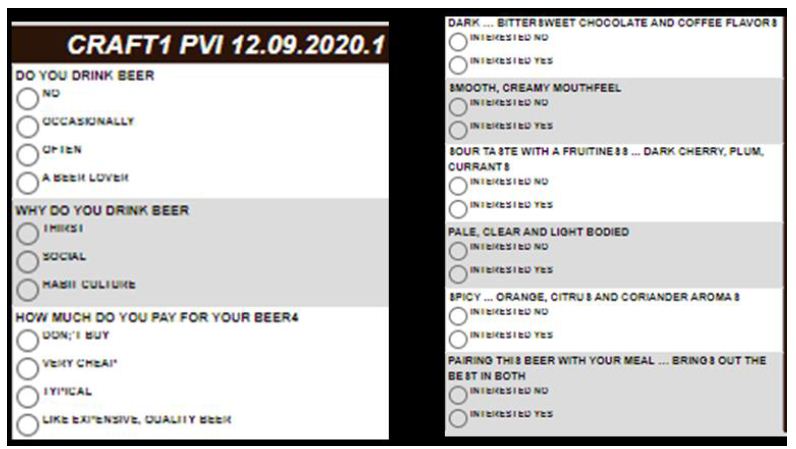
fig 7

Figure 7: The PVI for craft beer, showing the three classification questions on the left panel (not used by the PVI for assignment), and the six questions on the right panel used for assignment to one of the three mind-sets emerging from Top3 cluster analysis.

Step 18: Discover Pairwise Interactions Using ‘Scenario Analysis’

An ongoing issue in messaging, one which has never been successfully resolved, is to demonstrate on a repeatable basis that ideas interact with each other, either enhancing each other, or suppressing each other. The notion of interaction makes sense when we think about products, especially foods and beverages, where it is the combination that is liked, not the individual ingredients.

In experimental design, and in the approaches used here, the basic notion is that each element is an independent ‘actor’ in the combination. The independence is assured, at least at a statistical level, by creating vignettes where the same elements appear in different combinations so that they are statistically independent of each other. Does the Mind Genomics systemized permutation covering a great deal of the so-called ‘design space’ (potential combinations), enable the researcher to uncover hitherto unexpected synergies or suppressions of pairs of elements?

A simple way to discover these interactions builds them in at the start, creating a design which comprises both linear terms (single elements) and known combinations of elements. With six questions and six answers per question, there are 15 pairs of questions, each pair of questions responsible for 36 combinations. This comes to 540 pairwise combinations in the 6×6 Mind Genomics design used here. For the more recent, preferred 4×4 design (four questions, four answers per question) there are 6 pairs of questions, and 16 possible pairs of answers for each pair of questions, viz., 96 pairwise combinations to create and test. The design effort is simply too great, and the typical conjoint approaches cannot deal with the discovery and evaluation of pairwise interactions (Table 9).

Table 9: Scenario analysis showing how the coefficients of the elements change in terms of Price (Question 2) when the vignette with the element is constructed to have a specific origin provided by Question D.
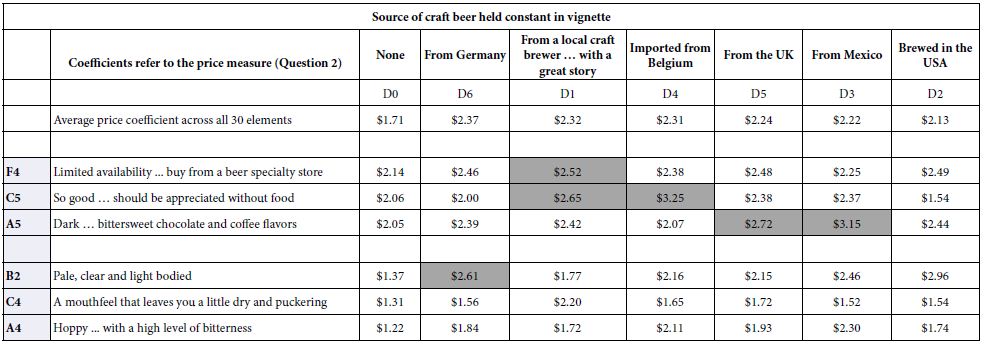
table 9

The task of uncovering pairwise and even higher order interactions can be made simpler, virtually straightforward in the Mind Genomics paradigm [15-17]. Let us illustrate it by looking for interactions of elements with question D, Source of the craft beer. There are six Sources (D1-D6), and a seventh Source (D0) where no Source is mentioned). We create a new variable, called ByD. The new variable, ByD, takes on the values 0 when the vignette has no mention of a source (viz., D does not contribute an element), and takes on the value 1-6 depending upon which specific element appears in the vignette. Thus, the variable ByD stratifies the data matrix.

One sorts data matrix according to the newly created variable, ByD. One then performs seven OLS regressions, one OLS regression for each of the seven strata, respectively. The independent variables are the remaining elements, viz., all starting elements except elements D1-D6. Thus, the independent variables are 30, rather than 36 (A1-A6; B1-B6; C1-C6; E1-E6; F1-F6).

The OLS regression returns with estimates of the 30 coefficients, for each stratum, specifically the stratum where D=0 (does not appear), where D=1 (local brewery with a great story) …D6 (from Germany). The OLS regression estimates the additive constant and the 30 coefficients when the dependent variable is Top3 (interested), and the 30 coefficients without the additive constant when the dependent variable is Price. Synergisms and suppressions appear when one compares the performance of an element in the absence of source (viz., D=0) vs. the performance of the same element in the presence of a specific source (viz., D=1). Synergism emerges when the coefficient with a source is ‘higher’ than the coefficient estimated in the absence of source (viz., D=0).

Tables 7 and 8 show the three strongest performing elements and the three weakest performing elements for the total panel, first for the dependent variable being Top3 (interest; Table 7) and for the dependent variable being Price (Table 8).

Table 7: Distribution of respondents into mind-sets based upon gender, by Top3 (what interests them), by Bot3 (what does not interest them), and by Price (what they are willing to pay). The patterns of membership differ.

Total Top M3S1 Top3 MS2 Top3 MS3
  Total 113 38 40 35
 
Gender Male 62 19 24 19
Gender Female 51 19 16 16
   
Mind-Set Top3 MS1 38 38 0 0
Mind-Set Top3 MS2 40 0 40 0
Mind-Set Top3 MS3 35 0 0 35
 
Mind-Set Price MS4 35 6 18 11
Mind-Set Price MS5 37 25 4 8
Mind-Set Price MS6 41 7 18 16
 
Mind-Set Bot3S7 47 14 21 12
Mind-Set Bot3S8 32 11 8 13
Mind-Set Bot3S9 34 13 11 10

Table 8: Scenario analysis showing how the coefficients of the elements change in terms of Top3 (interest, Question 1) when the vignette with the element is constructed to have a specific origin provided by Question D.
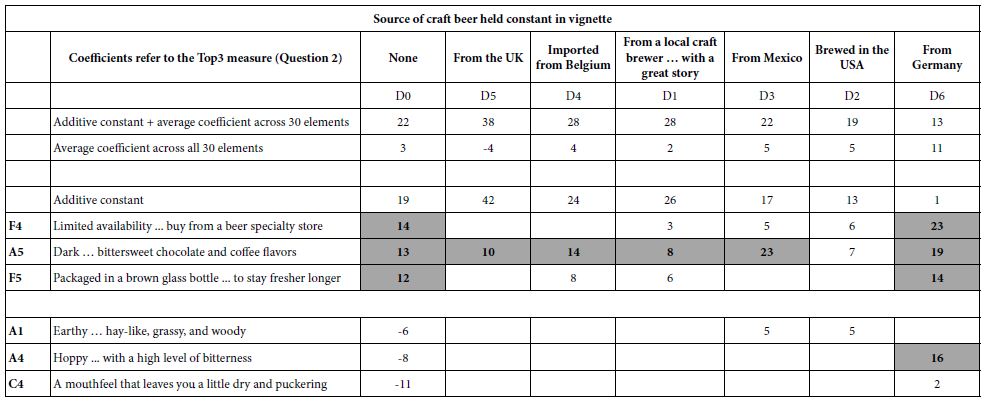
table 8

a.  The ‘strongest’ performers and the weakest performers are defined by the performance when the coefficients are estimate for the stratum where D=0 (no mention of origin).

b.  The columns are sorted by the sum of the additive constant (for Top3, not for price) and the arithmetic average of the 30 coefficients. The first column is always the coefficients for the case when the source is absent from the vignette.

The scenario analysis generates many numbers. It is easiest to see patterns and interactions by eliminating the zero and negative coefficients, to focus on the effect of the different ‘origins’ shown in the columns on a single element (shown in a row). Tables 7 and 8 show evidence of quite strong interactions in some cases, and quite weak interactions in other cases. It is important to keep in mind that these are only estimates of the possible interactions. The negative coefficients are eliminated so we can see cases when the interactions can be very power in the positive direction (Hoppy … with a high level of bitterness, a basically anti-interest element by itself) synergizing with source (Germany).

The synergisms are clearly far stronger for the elements evaluated on interest (question #1), and far weaker for elements evaluate on price. A cursory look at the six elements studied for price (Table 8) reveals, however, that all six of the elements increase in dollar value when they are associated with country of origin. It is discoveries like this, unexpected, which can lead to a new appreciation of craft beer, especially the way people think about it.

Discussion and Conclusions

The sequence of steps presented here produces an exceptionally rich database of information about the mind of the respondent, a database which is obtained within hours and days, a database whose information is achievable, and who metrics, the coefficients, have ratio-scale values, and are comparable from study to study, from topic to topic, so long as the rating scales are same.

In the spirit of Mind Genomics, the discussion is brief. The data essentially present the whole story. There is no need to plug holes in the literature, to falsify hypotheses and conjectures. There may be hypotheses to be tested with the data, but the data serves as an exploration of a topic, as an understanding of the mind of people respect to something from their ‘everyday’ experience.

Of interest from the point of view of science of the mind and decision making is the difference within the same person when the person deals with price versus when the person deals with emotion. The former, Homo Economicus, is well recognized as an entity in the scientific literature. The latter, Homo Emotionalis, is just beginning to be studied (although consumer researchers have long known about the importance of Homo Emotionalis in decision making. Those in government and public policy are just now beginning to understand the role of emotion and feeling in policy, although it has always been present, recognized perhaps but not acknowledged [18-20].

The logical next steps for Mind Genomics vary by the goal and vision of the researcher. The world of beer, of alcoholic beverages lies open for a concerted research effort. Beyond the world of the knowledge of beer is the marketing, and the benefits conferred on the marketer by knowing the three mind-sets, and how to assign a new person to a mind-set using the PVI. Inserting the PVI into digital marketing, e.g., as a game, might allow the marketer to drive the respondent’s online inquiry into a landing page appropriate for the mind-set.

At the level science, however, we have a paradigm to acquire and analyze data, and a template to store and present the results. One might imagine the happy day in a few years when these studies are done as the standard way of exploring new topics, not so much in a piecemeal way to falsify or not falsify hypotheses, but rather simply to create the aforementioned ‘wiki of the mind’ as a living, dynamic encyclopedia of life as it is experienced.

References

  1. Acitelli T, Magee T (2017) The audacity of hops: The history of America’s craft beer revolution. Chicago Review Press.
  2. Chapman NG, Lellock JS, Lippard CD (2017) Untapped: Exploring the cultural dimensions of craft beer. West Virginia University Press.
  3. Elzinga KG, Tremblay CH, Tremblay VJ (2015) Craft beer in the United States: History, numbers, and geography. Journal of Wine Economics 10: 242.
  4. Lamertz K, Foster WM, Coraiola DM, Kroezen J (2016) New identities from remnants of the past: An examination of the history of beer brewing in Ontario and the recent emergence of craft breweries. Business History 58: 796-828.
  5. Orth UR, Lopetcharat K (2006) Consumer-based brand equity versus product-attribute utility: A comparative approach for craft beer. Journal of Food Products Marketing 11: 77-90.
  6. Rice J (2016) Professional purity: Revolutionary writing in the craft beer industry. Journal of Business and Technical Communication 30: 236-261.
  7. Moskowitz HR (2012) ‘Mind genomics’: The experimental, inductive science of the ordinary, and its application to aspects of food and feeding. Physiology & behavior 107: 606-613. [crossref]
  8. Moskowitz HR, Silcher M (2006) The applications of conjoint analysis and their possible uses in Sensometrics. Food Quality and Preference 17: 145-165.
  9. Moskowitz HR, Gofman A, Beckley J, Ashman H (2006) Founding a new science: Mind genomics. Journal of Sensory Studies 21: 266-307.
  10. Porretta S, Gere A, Radványi D, Moskowitz H (2019) Mind Genomics (Conjoint Analysis): The new concept research in the analysis of consumer behaviour and choice. Trends in Food Science & Technology 84: 29-33.
  11. Shareff R (2007) Want better business theories? Maybe Karl Popper has the answer. Academy of Management Learning & Education 6: 272-280.
  12. Hargrave M (2018) Hedonic pricing. https://www.investopedia.com/terms/h/hedonicpricing.asp
  13. Kaufman L, Rousseeuw PJ (2009) Finding groups in data: an introduction to cluster analysis (Vol. 344). John Wiley & Sons.
  14. Tuma MN, Decker R, Scholz SW (2011) A survey of the challenges and pitfalls of cluster analysis application in market segmentation. International Journal of Market Research 53: 391-414.
  15. Ewald J, Moskowitz H (2007) The push-pull of marketing and advertising and the algebra of the consumer’s mind. Journal of sensory studies 22: 126-175.
  16. Gofman A, Moskowitz H (2010) Isomorphic permuted experimental designs and their application in conjoint analysis. Journal of Sensory Studies 25: 127-145.
  17. Gofman A (2006) Emergent scenarios, synergies and suppressions uncovered within conjoint analysis. Journal of Sensory Studies 21: 373-414.
  18. Archer MS (2013) Homo economicus, Homo sociologicus and Homo sentiens. In Rational choice theory 46-66.
  19. Markwica R (2018) Emotional choices: How the logic of affect shapes coercive diplomacy. Oxford University Press.
  20. Meier AN (2018) Homo Oeconomicus Emotionalis?: Four Essays in Applied Microeconomics (Doctoral dissertation, Wirtschaftswissenschaftliche Fakultät der Universität Basel).
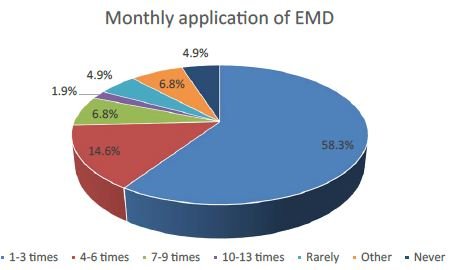
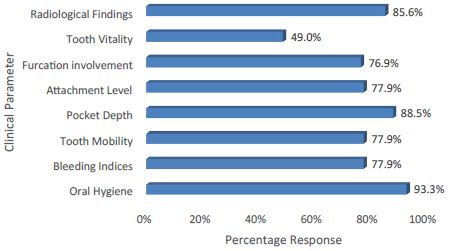
COVID-19 and Spanish Flu Pandemics – Similarities and Differences

DOI: 10.31038/JPPR.2020332

Keywords

Pandemics, Human influenza, Coronavirus, Severe acute respiratory syndrome

Summary

The aim of this paper is to analyze the similarities and differences between the COVID-19 and Spanish Flu and to predict the course of the COVID-19 pandemic. We carried out a literature search of publications in English in PubMed database with the following keywords: “COVID-19” and “Spanish Flu”. We found the following similarities between Spanish Flu and the COVID-19: the new agent, affected the whole world, similar reproductive numbers, similar case fatality rates, spreading through droplets or by touching contaminated surfaces, similar symptoms and signs, and middle-age as a dominant one among cases. The main differences are the causal agents, Spanish Flu started in the USA, while the COVID-19 started in China, currently, the number of cases and deaths was several times higher in Spanish Flu than in the COVID-19, and the incubation period is much longer in the COVID-19 (up to 28 days) than in Spanish Flu (1-2 days). Based on the experiences from Spanish Flu it may be expected that the COVID-19 pandemic may last until the end of 2021.

The current COVID-19 pandemic is causing tectonic health, economic, political and safety disturbances in the world. This is an unusual global epidemiologic event that frustrates all the world nations and health professionals because of constantly increasing number of cases and deaths and the absence of efficient treatment or vaccine [1]. To predict the course of this pandemic it may be helpful to analyze a similar previous pandemic. The pandemic that mostly resembles the COVID-19 is the Spanish Flu which devastated the world during 1918-1920. The Spanish Flu was the single most deadly epidemic in human history with around 500 million cases and 50 million deaths [2]. The main contextual difference between these two pandemics is that the Spanish Flu started during the First World War, while the COVID-19has begun in global peace. Of course, there is also a hundred years time difference between the Spanish Flu and the COVID-19that has been fulfilled with research and development in medicine.

The aim of this study is to compare the Spanish Flu and the COVID-19 pandemics using literature research. We expect that this comparison may be helpful in predicting the course of the COVID-19pandemic. We carried out a literature search of publications in English in PubMed database with the following keywords: “COVID-19” and “Spanish Flu”. A comparative analysis used usual epidemiological key parameters. The comparative data concerning the Spanish Flu and the COVID-19 are presented in Table 1.

Table 1: Comparative data concerning Spanish Flu and COVID-19.

Parameter

Spanish Flu Covid19

Reference

Time of Onset

4 March 1918 31 December 2019 [1,2]
Place of Onset Military Campus, Kansas, USA Sea-food and animal market,

Wuhan, China

[1,2]

Agent

H1N1 virus SARS CoV-2 virus [6,7]

Agent Novelty

New New

[6,7]

Duration Two years 1918-1920

Currently ten months

[1,2,5]

Cases

500 million Currently around 44 million

(28.10.2020)

[1,14]
Deaths


50 million Currently around 1,2 million

(21.10.2020)

[1,14]

Affected Region

World World [1,2]
Reproductive Number (Median) 1.8 2.5-2.9

[8,9]

Case Fatality Rate

2.5% (up to 25%) 3,4% (up to 11%) [10,11]
Incubation period 1-2 days 0-28 days

[11,12]

Common Symptoms and Signs

Fever, Dry Cough, Weakness, Hypoxia, Dyspnea, Cytokine Storm, Acute Respiratory Distress Syndrome, Pneumonia


Ibidem

[1,2]

Specific Symptoms and Signs

Purple color of the face Anosmia, Ageusia,

Hypoacusis, Diarrhoea,

Disseminated Intravascular Coagulation

[1,2]

Treatment

Symptomatic AspirinQuinineArsenics,

DigitalisStrychnine,

Epsom SaltsCastor Oil and Iodine

Symptomatic

Remdesivir, Lopinavir,  Hydroxychloroquine,

Azithromycin , Dexamethason, Heparine

[1,2]

Vaccine

No Not yet [1,2]
Way of Spreading Person to person via droplets or touching contaminated surfaces Ibidem

[1,2]

Dominant Age of Cases

W shape (Very Young, Middle Aged, Yery Old) Middle Aged [1,2]
Categories under High Mortality Risk Young Adults (18-40 years) Very Old, Chronic Diseases, Immuno-Compromised Patients)

[1,2]

Pandemic Course

Four Waves Currently Three Waves [1,2]

Public Information

Mainly Censored Mainly Uncensored

[1,2]

Public Health Measures Limited Massive

[13.14]

The main similarities are that the agent was new, the affected region was the whole world, the reproductive numbers were similar, mean case fatality rates were similar, fast spreading through droplets or by touching contaminated surfaces, major symptoms and signs were similar, and dominant age among cases was middle-aged.

The main differences are that the Spanish Flu was caused with the H1N1 influenza virus while COVID19 is caused with the SARS CoV-2 virus, the Spanish Flu started in the USA, while the COVID-19 started in China, currently the number of cases and deaths was several times higher in the Spanish Flu compared to COVID-19, the incubation period is much longer in the COVID-19 (up to 28 days) than in the Spanish Flu (1-2 days), the specific symptoms are purple face in the Spanish Flu and anosmia, ageusia, hypoacusis and disseminated intravascular coagulation in the COVID-19, in the Spanish Flu the case fatality rate was highest among young adults while in the COVID-19 it is among very old people and immuno-compromised patients, the highest case fatality rate in the Spanish Flu was 25% and much lower in the COVID-19 (11%), in the Spanish Flu the public information about the pandemic was censored due to war, while in the COVID-19 it is uncensored; finally, public health measures in terms of quarantine, isolation, and social distancing and protective masks were limited to the most developed countries in the Spanish Flu while in COVID19 they are massive.

Spanish Flu is a wrong name for the 1918 pandemic. It did not start in Spain. Spain was the first country to inform about the epidemic because it was neutral in the war conflict. In the war affected countries like France and Britain the information about the epidemic was hidden. In Spain the disease was named French Flu [3]. The index case of Spanish Flu was in a military camp and more probably in Kansas (USA) than in France [2], while in Covid-19 it was at an animal market in Wuhan, China (1). In Spanish Flu there were four waves in the period between the spring 2018 and spring 2020. The first wave is not universally regarded as Spanish Flu because it was very similar to a seasonal influenza [4]. However, in August 2016, a disastrous second wave of the Spanish Flu started and it lasted six weeks [5]. The analysis of permafrost-frozen corpses from 1918 showed that the Spanish Flu had been caused by a new strain of the H1N1 influenza virus A, and the victims usually died of secondary bacterial pneumonia due to yet undiscovered antibiotics [6]. COVID-19 was caused by a novel strain of RNA coronavirus with about 80% genetic similarity with the SARS CoV and the Middle East Respiratory Syndrome Coronavirus [7]. The median reproduction number (R0) or the number of persons an affected person can infect for the Spanish Flu was 1.80 [8] while the current data concerning COVID-19 suggest that R0 is around 2.5-2.9 [9].

The mean case-fatality rate in the Spanish Flu was about 2.5%, but in some countries it rose to 25% [10]. The mean case fatality rate of the COVID-19 is about 3, 4% and in Italy it has increased to 11% (11). A median incubation period in Spanish Flu was 1-2 days [11]. The median incubation period of the COVID-19 is between 2 and 12 days (median 5.1 days) and the full range is from 0-28 days [12]. The Spanish Flu was characterized with fever, dyspnea, dry cough, weakness and hypoxia [2]. The all-too-common sequelae of the Spanish Flu were hypoxia and death, with vivid descriptions of the purple color of the skin of those whose lungs could no longer supply their bodies with vital oxygen. That is why a common name for the Spanish Flu was “purple death”.

The main symptoms of the COVID-19 are fever, cough, fatigue, slight dyspnoea, headache, conjunctivitis and diarrhea. The specific feature of the COVID-19 is a neurotropism of SARS CoV-2 which may invade the olfactory nerve, acoustic nerve or sensory fibres of the vagus nerve [1]. The Spanish Flu was treated with Aspirin, Quinine, Arsenics, Digitalis, Strychnine, Epsom Salts, Castor Oil and Iodine. Similarly, there is no registered medicine for the COVID-19. The patients are treated with Remdesivir, Lopinavir, Hydroxychloroquine, Azithromycin, Dexamethason and Heparin [2]. In order to avoid panic among the people during the Spanish Flu many local authorities used to hide statistics about the affected and deaths [13]. Contrary to the Spanish Flu, in the COVID-19 the world statistics on the pandemic is open to the public in all countries [14].

In conclusion, the COVID-19 and the Spanish Flu are the greatest pandemics in the history of mankind with many similarities. However, there are also numerous specific features of each pandemic. This paper summarizes the results of this comparison. Based on the experiences from the Spanish Flu it may be expected that the COVID-19 might last until the end of 2021.

Conflict of Interest

The author declares no conflict of interests.

References

  1. Di Wu, Wu T, Liu Q, Yang Z (2020) The SARS-CoV-2 outbreak: what we know. Int J Infect Dis 94: 44-48. [crossref]
  2. Flecknoe D, Wakefield BC, Simmons A (2018) Plagues & wars: the ‘Spanish Flu’ pandemic as a lesson from history. Med Confl Surviv 34: 61-68.
  3. Barry JM (2004) The Great Influenza: The Story of the Deadliest Pandemic in History. London: Penguin Books Ltd.
  4. Radusin M (2012) The Spanish flu – part I: the first wave. Vojnosanit Pregl 69: 812-817. [crossref]
  5. Radusin M (2012) The Spanish flu – part II: the second and third wave. Vojnosanit Pregl 69: 917-927.
  6. Morens DM, Taubenberger JK, Harvey HA, Matthew JM (2010) The 1918 Influenza Pandemic: Lessons for 2009 and the Future. Crit Care Med 38. [crossref]
  7. Phan T (2020) Genetic diversity and evolution of SARS-CoV-2. Infect Genet Evol [crossref]
  8. Biggerstaff M, Cauchemez S, Reed C, Manoj Gambhir, Lyn Finelli (2014) Estimates of the reproduction number for seasonal, pandemic, and zoonotic influenza: a systematic review of the literature. BMC Infect Dis 14. [crossref]
  9. Peng PWH, Ho PL, Hota SS (2020) Outbreak of a new coronavirus: what anaesthetists should know. Br J Anaesth 124: 497-501. [crossref]
  10. Rosenau MJ, Last JM Maxcy-Rosenau (1980) Preventive medicine and public health. New York: Appleton-Century-Crofts.
  11. Giangreco G (2020) Case fatality rate analysis of Italian COVID-19 outbreak. J Med Virol 92: 919-923. [crossref]
  12. Lauer SA, Grantz KH, Bi Q, Forrest K. Jones, Qulu Zheng, et al. (2020) The incubation period of coronavirus disease 2019 (COVID-19) from publicly reported confirmed cases: estimation and application. Ann Int Med.; 172: 577-582. [crossref]
  13. Aligne CA (2016) Overcrowding and mortality during the influenza pandemic of 1918. Am J Public Health.; 106: 642-644 [crossref]
  14. COVID19 coronavirus pandemic. Available at <https://www.worldometers.info/coronavirus > Accessed November 5, 2020.

Thinking Climate – A Mind Genomics Cartography

Abstract

The paper deals with the inner mind of the respondent about climate change, using Mind Genomics. Respondents evaluated different combinations of messages about problems and solutions touching on current and future climate change. Respondents rated each combination on a two-dimensional scale regarding believability and workability. The ratings were deconstructed into the linkage between each message and believability vs. workability, respectively. Two mind-sets emerged,Alarmists who focus on the problems that are obvious to climate change, and Investors who focus on a limited number of feasible solutions.These two mind-sets distribute across the population, but can be uncovered through a PVI, personal mind-set identifier.

Introduction

Importance of the Weather and Climate

As of this writing, the concerns keep mounting about climate change, as can be seen in published material, whether the news or academic papers, respectively.As of this writing, the concerns keep mounting about climate change, as can be seen in published material, whether the news or academic papers, respectively.A search during mid-December 2020 reveal 416 million hits for ‘global warming,’ 350 million hits for ‘global cooling’ 886 million his for ‘weather storms’ and 608 million hits for ‘global weather change.’ The academic literature shows the parallel level of interest in weather and its changes. A retrospective of issues about climate change shows the increasing number of ‘hit’ over the past 20 years, as Table 1 shows. These hits suggest that issues regarding climate change are high on the list of people’s concerns.

Table 1a: Number of ‘hits’ on Google Scholar for different aspects of climate change.

Year

Global Warming Global Cooling Weather Storms

Global Weather Change

2000

14,900 22,300 8,370

34,300

2002

30,900 111,900 10,400

61,500

2004

39,900 126,00 13,100

75,300

2006

52,200 129,000 14,600

92,300

2008

82,200 132,000 19,600

111,000

2010

105,000 153,000 23,700

128,000

2012

112,000 154,000 26,700

137,000

2014

109,000 154,000 28,200

136,000

2016

96,300 131,000 27,900

114,000

2018

77,900 85,200 27,400

81,200

Table 1b: The four questions and the four answers to each question.

Question A: What climate impacts do people see today?
A1 Sea Levels are rising and flooding is more frequent & obvious
A2 Hurricanes are getting stronger and more frequent – just look at the news
A3 Heat Waves are damaging crops and the food supply
A4 Wildfires are more massive and keep burning down neighborhoods
Question B: What are the underlying risks in 20 years?
B1 Coastal property investments lose money
B2 Children will live in a much lousier world
B3 Governments will start being destabilized
B4 People will turn from optimistic to pessimistic
Question C: What are some actions we can take to avoid these problems?
C1 Right now, implement a global carbon tax
C2 Over time, transfer 10% of global wealth to an environment fund
C3 Create a unified global climate technology consortium for technological change.
C4 Build a solar shade that blocks 2% of sunlight
Question D: What’s the general nature of the system that will mitigate these risks today?
D1 $10trn to move all energy generation to carbon neutral
D2 $20trn to harden the grid and coastal communities
D3 $2trn to build a space based sunshade blocking 2% of sunlight.
D4 $0.02trn to spray particulate into atmosphere to block 2% of sunlight.

Beyond Surveys to the Inside of the Mind

The typical news story about climate changes is predicated on storytelling, combining historical overviews, current economic concerns, description of behavior from a social psychology or sociological viewpoint, and often adoom and gloom prediction which demands immediate action in ordertoday to be forestalled.All aspects are correct, in theory.What is missing is a deeper understanding of the inner thinking of a person when confronting the issue of climate change. There are some papers which do deal with the ‘mind’ of the consumer, usually from the point of view of social psychology, rather than experimental psychology [1].

Most conversations about climate change are general, because of the lack of specific knowledge, and the inability of people to deal with the topic in depth. The topic of climate change and the potential upheavals remains important, but people tend to react in an emotional way, often accepting everything or rejecting what sounds reasonable or what does not sound reasonable, respectively. The result is the ongoing lack of specific information, compounding the growth of anxiety, and the increasingly strident rejectionism by those who fail to respond to a believed impending catastrophe. Another result, just as inaction, is a deep, perplexing, often consuming discourse on the problem, written in way which demonstrates scholarship and rhetorical proficiency, but does not lead to insights or answers, rather to well justified polemics [2-6].The study reported here, a Mind Genomics ‘cartography’ delves into the mind of the average person, to determine what specifics of climate change are believable, what solutions are deemed to be workable, and what elements or messages about climate change engage a person’s attention. The objective is to understand the response to the notion of climate change by focusing of reactions to specifics about climate change, specifics presented to the respondent in the form of small combinations of ‘facts’ about climate [7-9].

Researchers studying how people think about climate follow two approaches, the first being the qualitative approach which is a guided, but free-flowing interview or discussion, the second being a structured questionnaire. The traditional qualitative approach requires the respondent to talk in a group about feelings towards specifics, or even talk an in in-depth, 1:1 interview. These are the accepted methods to explore thinking, so-called focus groups and in-depth interviews. Traditional discussion puts stress on the respondentto recall and state, or, in the language of the experimental psychologist, to produce and to recite. In contrast, the traditional survey presents the respondent with a topic, and asks a variety of questions, to which the respondent selects the appropriate answer, either by choice, or by providing the information.All in all, conventional research gives a sense of the idea, but from the outside in. Reading a book by research can provide extensive information from the outside. Some information from the inside can be obtained from comments by individuals about their feelings.Yet it will be… clearly from the outside, rather than a sense of peering out from the inside of the mind. The qualitative methods may reach into the mind somewhat more deeply because the respondent is asked to talk about a topic and must ‘produce’ information from inside. Both the qualitative and the quantitative methods produce valuable information, but information of a general nature. The insights which may emerge from the qualitative and quantitative methods have a sense of emerging from the ‘outside-in.’ That is, there is insight, but there is not the depth of specific material relevant to the topic, since the qualitative information is in the form of diluted ideas, ideas diluted in a discussion, whereas the quantitative information is structured description with a sense of deep specificity.

The Contribution of Mind Genomics

Mind Genomics is an emerging science, with origins in experimental psychology, consumer research, and statistics.The foundational notion of Mind Genomics is that we can uncover the ways that people make decisions about every-day topics using simple experiments, where people respond to combinations of messages abut the different aspects of the topic. These combinations, created by experimental design, present information to the respondent in a rapid fashion, requiring the respondent to make a quick judgment. The mixture of different messages in a hard-to-disentangle fashion, using experimental design, makes it both impossible to ‘game’ the system, and straightforward to identify which pieces of information drive the judgment.Furthermore, one can discover mind-sets of individuals quite easily, groups of people with similar pattern of what they deem to be important. The approach here, Mind Genomics, makes the respondents job easier, to recognize and react. The messages are shown to the respondent’s job easier, the respondents evaluate the combination, and the analysis identifies which messages are critical, viz, which messages about weather change are important. Mind Genomics approaches the problem by combining messages about a topic, messages which are specific. Thus, Mind Genomics combines the richness of ideas obtained from qualitative research with the statistical rigor of quantitative research found in surveys. Beyond that combination, Mind Genomics is grounded in the world of experiment, allowing the researcher to easily understand the linkage between the qualitatively, rich, nuanced information, presented in the experiment, and the reaction of the respondent, doing so in a manner which cannot be ‘gamed’ by the respondent, in a manner which reveals both cognitive responses (agree/disagree) and non-cognitive response (engagement with the information as measured by response time.)

Mind Genomics follows a straightforward path to understand the way people think about the everyday. Mind Genomics is fast (hours), inexpensive, iterative, and data-intensive, allowing for rapid, up-front analysis and deeper post-study analysis.Mind Genomics has been crafted with the vision of a system which would allow anyone to understand the mind of people, even without technical training. The grand vision of Mind Genomics is to create a science of the mind, a science available to everyone in the world, easy-to-do, a science which creates a ‘wiki of the mind’, a living database of how people think about all sorts of topics.

Doing a Simple Cartography – The Steps

Step 1 – Create the Raw Materials; Topic, Four Questions, Four Answers to Each Question

The cartography process begins with the selection of a topic, here the mind of people with respect to climate change. The topic is only a tool by which to focus the researcher’s mind on the bigger areas.

Following the selection of the topic, the researcher is requested to think of four questions which are relevant to the topic. The creation of these questions may sound straightforward, but it is here that the respondent must exercise create and critical thinking (got rid of word ‘some’), to identify a sequence of questions which ‘tell a story.’ The reality is that it takes about 2-3 small experiments, the cartographies,before the researcher ‘gets it,’ but once the researcher understands how to craft the questions relative to the topic, the researcher’s critical faculty and thinking patterns have forever changed. The process endows the world of research with a new, powerful, simultaneous analytic-synthetic ways to think about a topic, and to solve a problem.Once the four questions are decided upon, the researcher’s next task is to come up with four answers. The perennial issue now arises regarding ‘how do I know I have the right or correct answers?’ The simple answer is one does not. One simply does the experiment, finds out ‘what works,’ and proceeds with the next step of stimuli.After two, three, four, even five or six iterations, each taking 90 minutes, it is likely that one has learned what works and what does not. The iteration consists of eliminating ideas or directions which do not work, trying more of the type of ideas which do work, as well as other exploring other but related directions with other types of ideas.

It is important to emphasize the radically different thinking behind Mind Genomics, which is meant to be fast and iterative, and not merely to rubber stamp or confirm one’s thinking. Speed and iteration lead to a wider form of knowledge, a sense of the boundaries of a topic. In contrast, the more conventional and focused thinking lead to rejection or confirmation, but little real learning.

Step 2 – Combine the Elements into Small Vignettes that will be Evaluatedby the Respondents

The typical approach to evaluation would be to present each of the elements in Table 2 to the respondent, one element at a time, instructing the respondent to rate the element alone, using a scale.Although the approach of isolate and measure is appropriate in science, the approach carries with it the potential of misleading results, based upon the desire of most respondents to give the ‘right answer.’

Mind Genomics works according to an entirely different principle. Mind Genomics presents the answers or elements in what appear to be random combinations, but nothing could be further from the truth. The combinations are well designed, presenting different types of information. It will be the rating of the combination, and then the deconstruction of that rating into the contributions of the 16 individual elements which reveal the mind of the respondent.The experimental design simply ensures that the elements are thrown together in a known but apparently haphazard way, forcing the respondent to rely on intuitive or ‘gut responses,’ the type judgment which governs most of everyday life. Nobel Laureate Daniel Kahnemancalls this ‘System 1’ Thinking, the automatic evaluation of information in an almost subconscious but consistent and practical manner [10].

The underlying experimental design used by Mind Genomics requires each respondent to evaluate 24 different vignettes, or combinations, with a vignette comprising 2-4 elements. Only one element or answer to a question can appear in a single vignette, ensuring that a vignette does not present elements which directly contradict each other, viz., by comprising two elements from the question or silo, presenting two alternative and contradictory answers to the question. The experimental design might be considered as a form of advanced bookkeeping[11].

Many researchers feel strongly that every vignette must have exactly one element or answer from each question.Their point of view is that otherwise the vignettes are not ‘balanced’, viz., some vignettes have more information, some vignettes have less information. Their point of view is acceptable, but by having incomplete vignettes, the underlying statistics, OLS (ordinary least-squares) regression cannotestimate absolute values for coefficients. By forcing each vignette to comprise exactly one element or answer from each question, the OLS regression will not work because the system is ‘multi-collinear.’The coefficients can only be estimated in a relative sense, and not comparable across questions for the study, nor comparable across studies in the same topic, and of course not comparable for different topics.That lack of comparability defeats the ultimate vision of Mind Genomics, viz., to create a ‘wiki of the mind.’A further point regarding the underlying experimental design is that Mind Genomics explores a great deal of the design space, rather than testing the same 24 vignettes with each respondent.Covering the design space means giving up precision obtained by reducing variability through averaging, the strategy followed by most researchers who replicate or repeat the study dozens of times, with the vignettes in different orders, but nonetheless with the same vignettes. The underlying rationale is to average out the noise, albeit at the expense of testing a limited number of vignettes again and again.

Step 3 – Select an Introduction to the Topic and a Rating Scale

The introduction to the topic appears below. The introduction is minimal, setting up as few expectations as possible. It will the job of the elements to convey the information.

Please read the sentences as a single idea about our climate. Please tell us how you feel.

1) No way.

2) Don’t believe, and this won’t work.

3) Believe, but this won’t work.

4) Don’t really believe, but this will work.

5) I believe, and this will work.

The scale for this study is anchored at all five points, rather than at the lowest and at the highest point.The scale deals with both belief in that which iswritten, and belief that the strategy will work.The respondent is required to select one scale point out of the five for each vignette, respectively. The scale allows the researcher to capture both belief in the facts and belief in the solutions.

Step 4 – Invite Respondents to Participate

The respondents are invited to participate by an email. The respondents are member of Luc.id, an aggregator of online panels, with over 20 million panelists. Luc.id, located in Louisiana, in the United States, allows the researcher to tailor the specifications of the respondents. No specifics other than being US residentswere imposed on the panel. The respondents began with a short self-profiling classification questionnaire, regarding age and gender, as well as the answer to the question below:

How involved are you in thinking about the future?

1=Worried about my personal situation with my family

2=Worried about business stability

3=Worried about climate and ecological stability

4=Worried about government stability.

The respondent then proceeded to rate the 24 unique combinations from the permuted experimental design, with the typical time for each vignette lasting about 5-6 seconds, including the actual appearance time, and the wait time before the next appearance[12].The actual experiment thus lasted 2-3 minutes.

Step 6 – Acquire the Ratings and Transform the Data in Preparation for Model

In the typical project the focus of interest is on the responses to the specific test stimuli, whether there be a limited number of test vignettes (viz., not systematically permuted, but rather fixed), or answers to a fixed set of questions.The order of the stimuli or the test questions might be varied but there is a fixed, limited number. With Mind Genomics the focus will be on the contribution of the elements to the responses.Typically, the responses are transformed from a scale of magnitude (e.g., 1-5, not interested to interested), so that the data are binary (viz., 1-3 transformed to 100 to show that the respondents are not interested; 4-5 transformed to 0 to show that the respondent is interested.

As noted above, there are two scales intertwined, a belief in the proposition, and a belief that the action proposed will work. The two scales generate two new binary variables, rather than one binary variable:

Believe:Ratings of 1,2, 4 converted to 0 (do not believe the statements), ratings of 3,5 converted to 100 (believe the statements

Work (Efficacious) Ratings of 1,2,3 converted to 0 (do not believe the solution will work), ratings 4,5 converted to 100 (believe the proposed solution will work).

In these rapid evaluations we do not expect the respondent to stop and think. Rather, it turns out that ‘Believe’ is simply ‘’does it sound true?’ and Work” is simply ‘does it seem to propel people to solve the problem?Both of these are emotional responses. The end-product is a matrix of 24 rows for each respondent, one row for each vignette tested by that respondent. The matrix comprises 16 columns, one column for each of the 16 elements. The cell for a particular row (vignette) and for a particular column (element) is either 0 (element absent from that vignette) or 1 (element present in that vignette). The last four columns of the matrix are the rating (1-5), the response time (in seconds, to the nearest 10th of a second), and the two new binary values for the scales ‘Believe’ and ‘Work’ respectively (0 for not believe or not work, 100 for believe or work, depending upon the rating, plus a small random number < 10-5).

Step 7 – Create Two Models (Equations) for Each Respondent, a Model for Believe, and a Model for Work, and then Cluster the Respondents Twice, First for the Individual ‘Believe’ Models, Second for the Individual ‘Work’ Models

The experimental design underlying the creation of the 24 vignettes for each respondent allows us to create an equation at the respondent level for Believe (Binary) = k0 + k1(A1) + k2(A2) …. + k16(D4).The dependent variable is either 0 or 100, depending upon the value of the specific rating in Step 6.The small random number added to each binary transformed number ensures that there is variation in the dependent variable.

  1. Believe Models. For the variable Believe, applying OLS regression generates the 16 coefficients (k1 – k16) and the additive constant, for each of the 55 respondents. A clustering algorithm (k-means clustering, Distance = (1 – Pearson Correlation)) divides the respondents into two groups. We selected the two groups (called mind-sets) because the meanings of the two groups were clear. Each respondent was then assigned to one of the two emergent groups, viz., mind-sets,based on the respondent’s coefficients for Believe as a dependent variable[13].
  2. Work Models. A totally separate analysis was done, following the same process, but this time using the transformed variable ‘Work’.The respondents were then assigned to one of the two newly developedmind-sets, based only on the coefficient for work.

As a rule of thumb, one can extract many different sets of complementary clusters (mind-sets), but a good practice is to keep the number of such selected sets to a minimum, the minimum based upon the interpretability of the mind-sets. In the interests of parsimony, one should stop as soon as the mind-sets make clear sense.

Step 8 – CreateGroup Equations; Three Models or Equations, One for Believe, One for Work, One for Response Time

Create these sets of three models each for Total Panel, Male, Female, Younger (age 18-39), Older (age 40+), and the mind-sets.Theequations are similar in format, but not identical:

Believe = k0 + k1(A1) + k2(A2) … k16(D4)

Work = k0 + k1(A1) + k2(A2) … k16(D4)

Response Time=k1(A1) + k2(A2) … k16(D4)

For the mind-sets,create two models only.

Mind-Set based on ‘believe’:

Believe = k0 + k1(A1) + k2(A2) … k16(D4)

Response Time= k1(A1) + k2(A2) … k16(D4)

Mind-set based on ‘work’

Work =k0 + k1(A1) + k2(A2) … k16(D4))

Response Time =k1(A1) + k2(A2) … k16(D4).

Results

External Analysis

The external analysis looks at the ratings, independent of the nature of the vignettes, either structure or composition of the vignette in terms of specific elements. We focus here on a topic which is deeply emotion to some. The first analysis that we will focuses on the stability of the data for this deeply emotional topic. As noted above, the Mind Genomics process requires the respondent to evaluate a unique set of 24 vignettes. Are the ratings stable over time or is there so much random variability that by the time the respondent has completed the study the respondent is not paying any more attention, and simply pressing the rating button?We cannot plot the rating of the same vignette across the different positions for the same reason that each respondent tested a totally unique set of combinations. We can track the average rating, the average response time, and then the standard errors of both, across the 24 positions. If the respondent somehow stops paying attention, then the rating should show less variation over time.

Figure 1 shows the averages and standard errors for the two measures, the ratings actively assigned by the respondent, and the response time, not directly a product of the respondent’s ‘judgment,’ but rather a measure of the time taken to respond. The abscissa shows the order in the test, from 1 to 24, and the ordinate shows the statistic.The data show that the response time is longer for the first few vignettes (viz., test order 1-3), but then stabilizes.The data further show that for the most part, the ratings themselves are stable, although there are effects at the start and at the end. Figure 1 suggests remarkable stability, a stability that has been observed for almost all Mind Genomics studies, when the respondents are members of an on-line panel, and remunerated by the panel provided for their participation.

fig 1

Figure 1: The relation between test order (abscissa) and key measures. The top panel shows the analysis of the response times (mean RT on left, standard error of the mean on the right).The bottom panel shows the analysis of theratings (mean rating on the left, standard error of the mean on the right).

The second external analysis shows the distribution of ratings by key subgroups across all of the vignettes evaluated by each key subgroup. For each key subgroup (rows), Table 2 shows the distribution of the five scale points (A), distribution of the two scale points (3,5) points which reflect belief (3,5) distribution of the two scale points (4,5) reflecting positive feeling that the idea ‘works’ The patterns of ratings suggest that a little fewer than half the responses are believe or work. However, we do not know the specific details about which types of messages drive these positive responses. We need a different level of inquiry, an internal analysis into what patterns of elements drive the responses.

Table 2: Distribution of ratings on Net Believe Yes, and Net Work YES five-point scale, by key groups, and by key clusters of scale points.


Net Believe YES(% Rating 3 or 5)

Net Work YES(% Rating 4 or 5)

Total

45

44

Vignettes 1-12

43

43

Vignettes 13-24

47

45

Male

46

52

Female

44

36

Age 24x-9

47

49

Age 40+

43

38

Worry business

43

31

Worry about climate

50

52

Worry about family

45

48

Worry about government

43

39

Worry about ‘outside’ (business + climate)

43

35

Worry about ‘inside’ (family + government)

46

49

Belief – MS1

44

48

Belief MS2

47

40

Work – MS 3

46

47

Work – MS4

45

39

Internal Analysis – What Specific Elements Drive or Link with ‘Believe’ and ‘Work’ Respectively?

Up to now we have considered only the surface aspect of the data, namely the reliability of the data across test order (Figure 1), and the distribution of the ratings by key subgroup (Table 2). There is no sense of the inner mind of the respondent, about what elements link with believability of the facts, with agreement that the solution will work, or how deeply the respondent engages in the processing of the message, as suggested by response time. The deeper knowledge comes from OLS (ordinary least squares) regression analysis, which relates the presence/absence of the 16 messages to the ratings, as explicated in Step 8 above.

Table 3 shows the first table of results, the elements which drive ‘believability.’ Recall from the methods section that the 5-point scale had two points with the respondent ‘believing,’ and that these ratings (3,5) generated a transformed value of 100 for the scale of ‘believe’, whereas the other three rating points (1,2,4) were converted to 0.The self-profiling classification also provides the means to assign a respondent based upon what the respondent said was most concerning, worry about self (family, government), worry about other/outside (business, climate).Table 3 shows the additive constant, and the coefficients for each group. Only the Total Panel shows coefficients which are 0 or negative. The other groups show only coefficients which are positive. Furthermore, the table is sorted by the magnitude of the coefficient for the Total Panel.In this way, one need only focus on those elements which drive ‘belief’, viz., elements which demonstrate a positive coefficient. Elements which have a 0 negative coefficient are those which have no impact on believability. They may even militate against believability. Our focus is strictly what drives a person to say ‘I believe what I am reading.’

Table 3: Elements which drive ‘belief ’. Only positive coefficients are shown. Strong performing elements are shown in shaded cells.

table 3

We begin with the additive constant across all of the key groups in Table 3. The additive constants tell us the likelihood that a person will rate a vignette as ‘I believe it’ in the absence of elements. The additive constant is a purely estimated parameter, the ‘intercept’ in the language of statistics. All vignettes comprised 2-4 elements by the underlying experimental design. Nonetheless, the additive constant provides a good sense of basic proclivity to believe in the absence of elements. The additive constants hover between 40 and 50 with two small exceptions of 37 and 53. The additive constant tells us that the respondent is prepared to believe, but only somewhat. In operational terms, an additive constant of 45, for example, means that out of the next 100 ratings for vignettes, 45 will be ratings corresponding to ‘believe,’ viz., selection of rating points 3 or 5, respectively.The story of what makes a person believe lies in the meaning of the elements. Elements whose coefficient value is +8 or higher are strongly ‘significant’ in the world of inferential statistics, based upon the ‘T test’ versus a coefficient with value 0.There are only a few of these elements which drive strong belief.

The most noteworthy finding is that respondents in Q3 Inside (worried about issues close to them) start out with a high propensity to believe (additive constant = 53), but then show no differentiations among the elements. They do not believe anything. In contrast, respondents who say they worry about issues outside of them start with low belief (additive constant = 53), but there are a several of elements which strongly drive their belief (e.g., A4:Wild-Firesare more massive and keep burning down neighborhoods.)They are critical, but willing to believe in what they see, and in what is promised to them.  Table 4 shows the second table of results, elements which drive ‘work’. These elements generate positive coefficients when the ratings 4 or 5 were transformed to 100, and the remaining ratings (1,2,3) were transformed to 0. Only some elements give a sense of a solution, even If not directly a solution.The additive constants showdifferences in magnitude for complementary groups. Since the scale is ‘work’ vs. ‘not work’, the additive constant is the basic belief that a solution will work. The additive constant is higher for males than for females (52 vs. 36), higher younger vs. older (50 v 35), and higher for those who worry about themselves versus those who were about others (49 vs. 36).

Table 4: Elements which drive ‘work’. Only positive coefficients are shown. Strong performing elements are shown in shaded cells.

table 4

The key finding for ‘work’ is that there some positives on two strong ones. The respondents are not optimistic. There is only one element which is dramatic, however, D4, the plan to spray particulates into the atmosphere to block 2% of the sunlight. This element or plan performs strongly among males, and among the older respondents, 40 years and older, although in the range of studies conducted previously, coefficients of 8-10 are statistically significant but not dramatic, especially when they belong to only one element.  Our third group model concerns the response time associated with each element. The Mind Genomics program measured the total time between the presentation of the vignette and the response to the vignette. Response times of 8 seconds or longer were truncated to the value 8. OLS regression was applied to the data of the self-defined subgroups. The form of the equation for OLS regression was: Response Time = k1(A1) + k2(A2) … k16(D4). The key difference moving from binary rating to response time is the removal of the additive constant. The rationale is that we want to see the number of seconds ascribed to each element, for each group. The longer response times mean that the element is more engaging. Table 5 shows the response times for the total panel, the genders, ages, and the two groups defined by what they say worries them.Table 3 shows only those time coefficients of 1.1 second or more, response times or engagement times that are deemed to be relevant and capture the attention.The strongly engaging elements are shown in the shaded cells.

Table 5: Response times of 1.1second or longer for each element by key self-defined subgroups.

table 5

Table 5 suggests that the description of building something can engage all groups

$10trn to move all energy generation to carbon neutral

$20trn to harden the grid and coastal communities

Women alone are strongly engaged when a clear picture is painted, a picture at the personal level:

Coastal property investments lose money

Children will live in a much lousier world

Governments will start being destabilized.

One of the key features of Mind Genomics is its proposal that in every aspect of daily living people vary r in the way they respond to information. These different ways emerge from studies of granular behavior or attitudes, as well as from studies of macro-behavior or attitudes. Traditional segment-seeking research looks for mindsets in the population, trying to find them by knowing their geodemographics.  Both the traditional way of segmentation and the traditional efforts to find these segments in the population end up being rather blunt instruments. The traditional segmentation begins at a high level, encompassing a wide variety of different issues pertaining to the climate, the future, and so forth. The likelihood is minimal of finding the mind-sets with the clear granularity of these mind-sets is low, simply because in the larger scale studies there is no room for the granular, as there is in Mind Genomics, such as this study which deals with 16 elements of stability and destabilization.

Mind Genomics uses a simple k-means clustering divide individuals based upon the pattern of coefficients. The experimental design used in permuted form for each respondent allows the researcher to apply OLS regression to the binary-transformed data of each respondent.The k-means clustering was applied separately to the 55 models for Believe, and separately once again to the 55 models for Work.Both clustering programs came out with similar patterns, two mind-sets for each. The pattern suggested one be called ‘Investment focus’ and the other be called alarmist focus. The strongest performing elements from this study come from the mind-sets, classifying the respondent by the way the respondent ‘thinks’ about the topic, rather than how the respondent ‘classifies’ herself or himself, whether gender, age, or even self-chosen topic of major concern. The mind-sets are named for the strongest performing element. Group 1 (Believed MS1, Work MS4) show elementswhich suggest an ‘investment focus’.Group 2 (Believe MS2, Work MS3) shows elements which suggest an alarmist focus.

Table 6 shows the strong performing elements for the four mind-sets, as well as the most engaging elements for the mind-sets. The reader can get a quick sense of the nature of the mind-sets, both in terms of what they think(coefficients for Believe and for Work, respectively), as well as what occupies their attention and engages them (Response Time) [14].

Table 6: Strong performing coefficients for the two groups of emergent mind-sets after clustering on responses (Part1), and after clustering on response time, viz., engagement (Part 2).

table 6

The mind-sets emerging from Mind Genomics studies do not distribute in the simple fashion that one might expect, based upon today’s culture of Big Data. That is, just knowing WHO a person is does not tell us how a person THINKS. The reality is that there are no simple cross-tabulations or even more complex tabulations which directly assign a person to a mind-set.Topics such as the environment, for example, may have dozens of different facets. Knowing the mind of a person regarding one facet, one specific topic, does not necessarily tell us about the mind of that same person with respect to a different, but related facet.Table 7 gives a sense of the complexity of the distribution, and the probable difficulty of finding these mind-sets in the population based upon simple classifications of WHO is a person is.

Table 7: Distribution of key mind-sets (Investors, Alarmists).


Total

Investor (Belief) Investor (Work) Alarmist (Belief)

Alarmist (Work)

Total

56

30 24 26

32

Male

27

15 12 12

15

Female

29

15 12 14

17

Age24-39

31

14 12 17

19

Age40+

25

16 12 9

13

Worry aboutfamily

23

12 8 11

15

Worry about climate

12

8 4 4

8

Worry about government

11

7 6 4

5

Worry about business

10

3 6 7

4

Worry Other (business and climate)

21

10 12 11

9

Worry Self (Family, Government)

35

20 12 15

23

Invest from Believe

30

30 11 0

19

Invest from Work

24

11 24 13

0

Alarm from Work

32

19 0 13

32

Alarm from Believe

26

0 13 26

13

During the past four years authors Gere and Moskowitz have developed a tool to assign new people to the mind-sets. The tool, called the PVI, the personal viewpoint identifier, uses the summary data from the different mind-sets, perturbing these summary data with noise (random variability), and creating a decision tree based upon a Monte Carlo simulation. The decade PVI allows for 64 patterns of responses of six questions answered on a 2-point. The Monte simulation combined with the decision tree returns with a system to identify mind-set member in15-20 seconds.Figure 2 shows a screen shot of the PVI for this study, comprising the introduction, the additional background information stored for the respondent (option), and the six questions, patterns of answers to which assign the respondent immediately to the of the two mind-sets.

fig 2

Figure 2: The PVI for the study.

Discussion and Conclusion

The study described here has been presented in the spirit of an exploration, a cartography, a way to understand a problem without having to invoke the ritual of hypothesis. In most study of the everyday life the reality is that the focus should be on what is happening, not on presenting an hypothesis simply for the sake of conforming to a scientific approach which is many cases is simply not appropriate.The issue of climate change is an important one, as a perusalof the news of the day will reveal just about any day. The issues about the weather, climate change, and the very changes in ‘mother earth’ are real, political, scientific, and challenge all people. Mind Genomics does not deal with the science of weather, but rather the mind of the individual, doing so by experiments in communication.It is through these experiments, simple to do, easy to interpret, that we begin to understand the nature of people, an understanding which should not, however, surprise.The notion of investors and alarmists makes intuitive sense. These are not the only mind-sets, but they emerge clearly from one limited experiment, one limited cartography.One could only imagine the depth of understanding of people as they confront the changes in the weather and indeed in ‘mother earth.’ Mind Genomics will not solve those problems, but Mind Genomics will allow the problems to be discussed in a way sensitive to the predispositions of the listener, whether in this case the listener be a person interested in investment to solve the problem or the person be interested in the hue and the cry of the alarmist. Both are valid ways of listening, and for effective communication the messages directed towards each should be tailored to the predisposition of the listener’s mind. Thus, a Mind Genomics approach to the problem presents both understanding and suggestion for actionable solution, or at least the messages surrounding that actionable solution [2,15-19].

As a final note this paper introduces a novel way to understand the respondent’s mind on two dimensions, not just one. The typical Likert Scale presents the respondent with a set of graded choices, from none to a low, disagree to agree, and so forth. The Likert Scale for the typical study is uni-dimensional. Yet, there are often several response dimensions of interest.This study features two response dimensions, belief in the message, and belief that the solution will work.These response dimensions may or may not be intertwined.Other examples might be belief vs. action (would buy).By using a response scale comprising two dimensions, rather than one, it becomes possible to more profoundly understand the way a person thinks, considering the data from two aspects. The first is the message presented, the stimulus. The second is the decisions of the respondent, to select none, one, or both responses, belief in the problem and/or, belief that the solution will work

Acknowledgement

Attila Gere thanks the support of Premium Postdoctoral Research Program.

References

  1. Tobler C, Visschers VH, Siegrist M (2012) Addressing climate change: Determinants of consumers’ willingness to act and to support policy measures. Journal of Environmental Psychology 32: 197-207.
  2. Creutzig F, Fernandez B, Haberl H, Khosla R, Mulugetta Y,et al (2016) Beyond technology: demand-side solutions for climate change mitigation. Annual Review of Environment and Resources 41: 173-198.
  3. Lidskog R, Berg M, Gustafsson KM, Löfmarck E (2020) Cold Science Meets Hot Weather: Environmental Threats, Emotional Messages and Scientific Storytelling. Media and Communication 1: 118-128.
  4. Nyilasy G, Reid LN (2007) The academician–practitioner gap in advertising. International Journal of Advertising 26: 425-445.
  5. Reyes A (2011) Strategies of legitimization in political discourse: From words to actions. Discourse & Society 22: 781-807.
  6. Taleb NN (2007) The black swan: The impact of the highly improbable, Random house, Vol:2.
  7. Moskowitz HR (2012) ‘Mind genomics’: Theexperimental, inductive science of the ordinary, and its application to aspects of food and feeding. Physiology & Behavior 107: 606-613.
  8. Moskowitz HR, Gofman A, Beckley J, Ashman H (2006) Founding a new science: Mind Genomics. Journal of Sensory Studies 21: 266-307.
  9. Moskowitz HR, Gofman A (2007) Selling blue elephants: How to make great products that people want before they even know they want them. Pearson Education.
  10. Kahneman D (2011) Thinking, fast and slow. Macmillan.
  11. Box GE, Hunter WH, Hunter S (1978) Statistics for Experimenters, New York: John Wiley Vol: 664.
  12. Gofman A, Moskowitz H (2010) Isomorphic permuted experimental designs and their application in conjoint analysis. Journal of Sensory Studies 25: 127-145.
  13. Jain AK, Dubes RC (1988) Algorithms for Clustering Data. Prentice-Hall, Inc.
  14. Schweickert R (1999) Response time distributions: Some simple effects of factors selectively influencing mental processes. Psychonomic Bulletin & Review 6: 269-288.
  15. Acosta Lilibeth A, Nelson H Enano Jr, Damasa B Magcale-Macandog, Kathreena G Engay, Maria Noriza Q Herrera, et al. (2013) How sustainable is bioenergy production in the Philippines? A conjoint analysis of knowledge and opinions of people with different typologies. Applied Energy 102: 241-253.
  16. Lomborg B (2010) Smart solutions to climate change: Comparing costs and benefits. Cambridge University Press.
  17. Nerlich B, Koteyko N, Brown B (2010) Theory and language of climate change communication. Wiley Interdisciplinary Reviews: Climate Change 1: 97-110.
  18. Tol RS (2009) The economic effects of climate change. Journal of Economic Perspectives 23: 29-51.
  19. Warren R (2011) The role of interactions in a world implementing adaptation and mitigation solutions to climate change. Philosophical Transactions of the Royal Society A: Mathematical, Physical and Engineering Sciences 369: 217-241.

Personalized and Precision Medicine (PPM) as a Unique Healthcare Model of the Future to Come: Hype or Hope?

DOI: 10.31038/IMROJ.2020542

Abstract

A new systems approach to diseased states and wellness result in a new branch in the healthcare services, namely, Personalized and Precision Medicine (PPM). To achieve the implementation of PM concept, it is necessary to create a fundamentally new strategy based upon the subclinical recognition of biopredictors of hidden abnormalities long before the disease clinically manifests itself.

Each decision-maker values the impact of their decision to use PPM on their own budget and well-being, which may not necessarily be optimal for society as a whole. It would be extremely useful to integrate data harvesting from different databanks for applications such as prediction and personalization of further treatment to thus provide more tailored measures for the patients resulting in improved patient outcomes, reduced adverse events, and more cost effective use of health care resources. A lack of medical guidelines has been identified by the majority of responders as the predominant barrier for adoption, indicating a need for the development of best practices and guidelines to support the implementation of PPM!

Implementation of PPM requires a lot before the current model «physician-patient» could be gradually displaced by a new model «medical advisor-healthy person-at-risk». This is the reason for developing global scientific, clinical, social, and educational projects in the area of PPM to elicit the content of the new branch.

Кеуwords

Translational research, Personalized & precision medicine (PPM), Next-generation sequencing (NGS), Drug discovery, Educational cluster, Education-science-innovation complexes (ESIC)

Introduction

Translational Research & Applications (TRA) is a term used to describe a complex process aimed to build on basic scientific research to create new therapies, medical procedures and diagnostics [1]. It is critical that scientists are well acquainted with organogenesis and of human pathogenesis arising from microbial infection and natural errors in gene functioning. Most students and scientists do not have sufficient knowledge.

Medical scholars and students are acquainted with basic anatomy and even basic molecular biology, but their under-standing of fundamental processes located in living systems is limited. For instance, the concept of “stem cell” in human development and in pathogeneses as in the development of cancers or atherosclerotic plaque are not yet understood even in the world’s leading centers of basic and medical research.

Despite a tremendous impact of human genome project on our understanding of the pathogenesis of cancer, autoimmune and other chronic conditions and an invention of different techniques such as single cell sequencing or proteome and metabolome profiling, the current educational system is not opened and thus sufficient at preparing a next-generation specialist, which is able to use all the advances have been made [2]. For example, an implementation of NGS into clinical practice requires a “Big data” approach based on high integrity between clinical informatics, bio-informatics, and fundamental studies as well to secure finally the proper clinical decision being evidence-based. A major challenge in the clinical setting is the need to support a dynamic work-flow associated with the constant growth of the laboratory’s NGS test menu and expanding specimen volume [3]. To perform such kind of the mission it is crucial to educate specialists, which will know medical, biological and informatics aspects of the problem and will know how to use their knowledge in solving this problem as well. And that is just the tip of the iceberg. Human genetic databases are corrupted by false results. NGS studies have built in error rates of approximately 0.3 to 3.0% per base pair, which does not favor an improved understanding of diseases and the implementation of advanced therapeutics. The concept of Personalized & Precision Medicine (PPM) requires high integrity between fundamental research, industry, and clinic [4,5].

The lack of translation is the challenging problem in the various fields of medicine such as creating of human-computer interfaces or investigations of drug resistance and cancer [6-8]. We are not saying that the problem is mainly due to the obsolete education system, for example, the lack of clinical translation in cancer research can be explained by the fact that animal models is not a precise reflection of a human organism [8]. Conversion of research findings into meaningful human applications, mostly as novel remedies of human diseases, needs progress of appropriate animal models. Research methodologies to test new drugs in preclinical phases often demanded animal models that not only replicate human disease in etiological mechanisms and pathobiology but also biomarkers for early diagnosis, prognosis, and toxicity prediction. Whereas the transgenic and knockout procedures have developed guidance of rodents and other species to get greater understandings of human disease pathogenesis, but still generating perfect animal models of most human disease is not available [8].

Clinical trials themselves have limitations, and hence the results of these studies could be misunderstood [9]. The point is: in order to provide an effective «bench to bed» workflow there is a huge need for specialists, which are capable of performing a wide range of tasks. Nowadays due to a tremendous amount of available information, it is feasible to create a specialist who knows how to interconnect different areas of research and how to adapt to constantly changing conditions, whereas to create a specialist knowing how to do every-thing on his own is not. An education of these specialists is the pivotal objective for the new education system, and the creation of this system is at the top of the agenda for this paper.

Drug discovery is extremely both time- and money-consuming process. The basic translational pipeline here consists of at least eight units, namely, target to hit, hit to lead, lead optimization, preclinical trials, three stages of clinical trials, and finally, submission to launch [10]. The whole process lasts as long as a decade and a half and requires interdisciplinary-educated staff not only familiar with fundamental research but also with different techniques and approaches used in the drug discovery. A number of potential solutions to improve R&D productivity and increase clinical translation of drug candidates have been offered by Paul et al. [10]. Some of these solutions propose a total transformation of the current single company-owned R&D enterprise to one that is highly networked, partnered and leveraged (Fully Integrated Pharmaceutical Network or FIPNet) [10]. Authors also stated that in order to improve drug development it is vital to provide a cash-flow from the high expensive phase II and III trials to less expensive preclinical and 1-st phase clinical trials, thereby increasing the number of drug candidates to select the most promising ones. These candidates, in turn, would have a higher chance to be approved [10]. Obviously, both of the ideas aforementioned require a strong collaboration between research, stakeholders, and government. And we suggest that the education is the starting point to deploy such a network. Once developed, this new education system should kill two birds with one stone, namely, should prompt the collaboration between fundamental research and industry, yet also should allow to use an approach close to simulation-based medical education that has been proved to be highly effective in different areas of medical education [11-15]. The main difference of the approach proposed is the use of it in the settings of drug discovery.

Mastery learning is another approach, which could be used in the modern education system. Despite its development as early as in 1963, it has a lot of progressive features, such as clear learning objectives, deliberate skills practice, and complete mastery of the discipline selected [16]. However, it also has some considerable limitations especially meaningful in a case of drug development. One of these limitations is the unlimited time to reach the mastery. The time factor is one of the most important ones during the translation process. To reduce the negative influence of unlimited time of mastering one could involve only talented students in such a program, which expected time to acquire a new skill or master a new subject is relatively low. However, does it fit in with a standard mastery learning paradigm?

The problem of great concern is the designing of a mechanism that could detect, educate, and implicate highly motivated students and young scientists in order to meet the needs from industry and healthcare system. It is clear that somehow, we should tightly interconnect different areas of research, saving student-oriented education principles. Some attempts are already ongoing: universities are experimenting with new programs and courses to teach innovation. Within the life sciences, there is particularly strong traction in the area of biomedical technology innovation, in which a number of interesting new training initiatives are being developed and deployed. However, how this experiments will affect the healthcare system remains to be determined. System itself requires not just new courses and programs, but a total rearrangement at all.

Fundamental Aspects of the Educational Reforms

At the present stage, the main task is the development of the concept changes of Healthcare Service and creation of new medical education model. The purpose of employment of the knowledge is to predict and prevent diseases, increase the life expectancy, strengthen and preserve human health, as well as the identification and monitoring patients with underlying risk for the development of a particular pathology.

A key reason for changing the health care system became an active use in the practice of a hospital physician of advances in omics, allowing penetrating inside biostructures and creating therein conditions for visualization of lesions, previously concealed from the eyes of a clinician.

At the heart of the developed concept of PPM use there are postulates which promote change in the culture and the mindset of society as a whole. In the first place it is the awareness of individuals that they are responsible for their own health and the health of their children, an active involvement of the people in a sphere of preventive and prophylactic measures designed for promotion of individual, community-related and public health, in particular.

Meanwhile, putting PPM-tools in a public health perspective requires an apprehension of the current and future public health challenges. Those challenges are produced by the new technological developments, health transition, and the increased importance of non-communicable diseases, even in low-income environments.

The principles of PPM and efforts to approaching the right health issues in a timely manner can be applied to public health. Doing so will, however, require a careful view and concerted effort to maintain the needs of public health at the forefront of all PPM discussions and investments. Briefly, a prime concern for public health is promoting health, preventing disorder, and reducing health disparities by focusing on modifiable morbidity and mortality. In this connection, more-accurate and precise methods for measuring disease, pathogens, exposures, behaviors, and susceptibility could allow better assessment of public and individual health and development of policies and targeted programs for preventing disease and managing disorders at the individualized level whilst operating with precision tools and datasets. So, the initial drive toward PPM-based public health is occurring, but much more work lies ahead to develop a robust evidentiary foundation for use.

In this connection, one of the major organizational tasks is to carry out restructuring of the existent health care system to ensure implementation of preventive, diagnosis, remedial and rehabilitation measures designed to reduce morbidity and death rate of population, ensure maternal and infant health care and promote healthy lifestyle.

Implementation of the PPM model will lead to the replacement of the existing “doctor-patient” relationship model by the “doctor-consultant-healthy person” model. In this regard, it is obvious that the society needs a new scientific and technical school for the formation of specialists of a new generation, using non-traditional methods and a technological arsenal based on the achievements of systems biology and translational medicine.

For training of specialists it is required to restructure programs of pre-university, undergraduate, graduate and postdoctoral medical training as well as to develop fundamentally new interdisciplinary programs, focused on training of specialists in the areas related to PPM. In implementing the principle of continuity of an ongoing education a model of multi-stage training of a specialist is being built, which is characterized by a phase-by-phase process of individual development going over, while information is learned, from one level of an ongoing training to another.

In such a manner, at the 1st level of education (pre-university) school special significance is on the pre-university level is the selection of talented young specialists and involvement them into creative activities. At the 2nd (university) level, students will be offered in-depth study of fundamental and applied aspects of PPM. The core of the third (post-university) level will be interdisciplinary aspects of PPM, targeted to resident physicians and postgraduates [17-21].

An important component of the new educational model is its focus on the practical skills and the ability to apply knowledge. Many of universities has already organized ESIC for the purpose of increasing the quality of education and strengthening the liaison with the production. The specifics of ESIC consists in that thanks to the cooperation of scientific research, educational and production capacities, there is ensured a new quality of education, development of research and commercialization of the results of scientific and technological joint performance.

Some Features of the Educational Model

Currently, the first roots of the new educational program are being developed within the heart of the Russian medical community, aimed at training doctors and specialists in the field of biopharma. Within the program it is planned to train specialists for medical, pediatric and bioengineering faculties. The courses of the program are divided into three categories, i.e., basic, elective and specialized. At the first stage of pre-university training, general aspects of human physiology and anatomy, the foundations of molecular and cell biology will be considered, and also students will learn the basics of PPM. The first includes the first two courses, in which students will study the fundamental foundations of PPM (Omics, Genetic Engineering, Genomic Editing and Gene Therapy, Immunology, Biomarkers, Bioinformatics, Targeting, Technologies for Working with Proteins and Genes, Biobanks). Further, at the stage of the three-year university education will be the study of diagnostic, preventive and therapeutic diagnostic platforms of target categories of PPM, among them pharmacogenomics, oncology, pulmonology, pediatrics and others. At the next one-year training stage, students will study clinical and preclinical models with predictive-diagnostic and preventive-preventive orientation, risks, their evaluation and the formation of diagnostic protocols. At the postgraduate stage students will study preclinical and clinical trials using the biobank base, a program for managing one’s own health, including family planning, the stage of genomic scanning and clinical evaluation, clinical bioinformatics, as well as interdisciplinary aspects, including bioethics, the basis of public-private partnerships in modeling personalized and preventive medicine and questions of sociology.

An important part of program is the creation and development of fundamentally new technological platforms with elements the commercialization of the results of basic research and following introduction of them into clinical practice. For example, the development of innovative methods system of screening and monitoring will allow estimating the reserves of health, allocate among the asymptomatic contingent in the process of preventive examinations of patients and persons from risk groups with preclinical stages, and create objective prerequisites for personalized therapy. And the creation of an information system for personalized medicine prescribes the development of a new model of the patient and people at risk with using biomarkers, preclinical and predictive diagnostics technologies, and the development of new methods for targeting and motivating healthy lifestyles and active longevity. The key to implementing PPM in clinical practice is information technologies, including machine learning and artificial intelligence.

Obstacles and Problems to Battle Seems to Hamper the Implementation

World practice has shown that as soon as a country enters a phase of sustainable economic development, there is an increase in the social welfare of people and an increase in the life expectancy of the population, then at the same time an increase in the death rate of the population from cancer and cardiovascular diseases is observed. The priority struggle against socially significant ills of modern civilization is an important step, but it is not decisive in increasing the life expectancy of the population of the country. In the civilized world, there was a steady idea of ​​how to fundamentally reverse the negative trend of growth of socially significant diseases without financial bleeding of the country’s budget. More and more economically developed countries are converting their health care in line with the concept of PPM.

Changing the paradigm of health care actually entails reformatting the system for training specialists, reorienting research centers to solving health problems and creating new breakthrough technologies, and qualitatively modernizing the domestic bio-pharmaceutical industry and related industries in the Russian Federation. It is obvious that without interactive regulation and restriction of “egoistic” requests of departments, participants of this global project, any financial investments only in health care and education will be ineffective.

The implementation of the project to modernize health care in its scientific, technical and social significance is akin to a nuclear project of the USSR. Its result was not only the emergence of the country’s “atomic shield”, but also the creation of new knowledge-intensive branches of the national economy, which ensured economic progress and improved well-being of citizens. The PPM project is aimed at preserving and improving the quality of health of those who are protected by the “atomic shield” of the country. Taking into account the modern structure of the Russian economy, as well as the role of the state in regulating financial flows in the implementation of projects of such scale, it is necessary to give it a special status with the involvement of all possible sources of financing for its implementation.

If we consider the modernization of education as an element of the project with modern scientific and technical achievements, then we have a chance to transform the educational system taking into account breakthrough precision technological platforms. At the same time, in the very system of today’s education, there are yesterday’s mechanisms that inhibit its mobility and ability to reform.

Despite an ample need to Implementing new educational system into practice, there are some considerable limitations, which could hamper all the process.

First of all, how should we evaluate the impact of the reform on national health care system, quality of life, and even the employment of biopharma specialists? And, in the case of failure, what actions should be performed to prevent additional aggravations in the industry? The main issue here is that we don’t have an approach to a transparent analysis of such the data. For instance, a social return on investment – based approach seems to be a promising one due to the fact that it includes the information on the amounts of resources used by a program, in addition to program activities, and represent program value to society as a whole rather than a specific stakeholder group. Unfortunately, this approach is not devoid of flaws, such as raw methods in use and the possibility of inclusion only “appropriate” social groups in the analysis [21,22]. Additionally, several years (or even decades) should pass to enrich the data of reform outcome, and thus allowing to analyze the impact of this reform.

The second issue is the cost of the reform in a broad sense. When speaking of a total rearrangement of the educational system, it is of great importance to determine the source of financing. It seems to be obvious that both the government and the industry are interested in a new education system. However, are these sides interested enough to provide an immense amount of investments required to reach this goal, taking into account that return on investment is not expected in upcoming years? Moreover, to make the reform real it is crucial to implicate well-qualified staff, which demand a salary at least higher than average. Increased administrative expenses, expenses on reform implication, wages for workers, and on additional factors, such as new equipment, could eventually increase the cost of undergraduate and graduate education.

And finally, the educational reform is multifaceted, time-consuming process, which could be viewed as a process with its own translation pathway. Taking into account that calls for reform of graduate medical education started as early as in 1940 [18], and nothing has changed dramatically ever since (in terms of the education system), the major issue is to prevent the reform from getting stuck in the translation.

Conclusion

Health care today is in crisis as it is reactive, inefficient, and focused largely on one-size-fits-all treatments for events of late-stage disease. An answer is PPM which is Benefitting patients across many different diseases and even persons-at-risk to prevent a state of being diseased!

The first wave of PPM has entered mainstream clinical practice and is changing the way many diseases are identified, classified, and treated. The second wave (a wave of targeted therapies) has turned lots of chronic disorders from deadly ones into the states and conditions in which patients or persons-at-risk live close to normal life spans. In this sense, biopharma and biotech are becoming committed to advancing PPM-related armamentarium, and, in turn, the research and development pipeline would secure great promise for targeted therapies.

So, PPM can create efficiencies in the health care system as a whole. And to help the latter, partnerships and collaborative alliances would transform the research and development of PPM-related resources. And, especially, to increase recognition from both government and private stakeholders of the value and promise of PPM whilst resuscitating the policymaker interest for being grown. Since PPM is increasingly becoming an integral part of daily clinical care and we expect this trend to continue along with greater recognition of the value of PPM by payers and providers.

Despite the tremendous advances that have been made to date, much work is needed to further stimulate innovations in PPM. As you might see from the above-mentioned, PPM and PPM-based public health calls for an upgraded approach to support safe and effective deployment of the new enabling predictive, diagnostic and therapeutic technologies not to treat but to get cured!!! This approach (PPM and PPM-based public health) mentioned should be based on postulates which will change the incarnate culture and social mentality! And thus the above-mentioned PPM and PPM-based public health model would strongly need for novel training since the society is in bad need of large-scale dissemination of novel systemic thinking and minding. And upon construction of the new educational platforms in the rational proportions, there would be not a primitive physician created but a medical artist to be able to enrich flow-through medical standards with creative elements to gift for a patient a genuine hope to survive but, in turn, for a person-at-risk – a trust for being no diseased. So, the Grand Change and Challenge to secure our individual, community-related and public health and wellness are rooted not in Medicine, and not even in Science! Just imagine WHERE?! In the upgraded Hi-Tech Culture! To secure the next-step outcome in the therapeutic future to secure Prevention, Prophylaxis, Canonical Treatment and Rehabilitation as the New Entity!

Our model for accelerated development of continuous vocational education in the sphere of biopharmaceutics and biopharmaceutical industries is based on the combinatorial approaches (competence, module, personality-activity, program-design and problem-oriented) to the elucidation of innovative processes of modernization of the existing system. Correspondingly, the unit to build up the content of educational programs and sites is the task of pedagogics oriented for the innovation context in education development, and it allows each hearer to organically combine individual and group work with the aim to enrich oneself with the experience of the colleagues, and also to use own professional experience.

The aforestated reform of bio-pharmaceutical education, when implemented, will provide the ability to attain and maintain a professional standard of training for specialists in Russian universities, which in turn, will bring them up to world standards and promote academic, professional and inter-regional mobility. It will also enable the creation of an open system of university education, which will ensure that specialists are well enough trained to work in a constantly changing environment.

References

  1. Dougherty D, Conway PH (2008) The “3T’s” road map to transform US health care: the “how” of high-quality care. JAMA 299: 2319-2321. [crossref]
  2. Nelson EA, McGuire AL (2010) The need for medical education reform: genomics and the changing nature of health information. Genome Med 2: 18. [crossref]
  3. Roy S, LaFramboise WA, Nikiforov YE, Nikiforova MN, Routbort MJ, et al. (2016) Next-Generation Sequencing Informatics: Challenges and Strategies for Implementation in a Clinical Environment. Arch Pathol Lab Med 140: 958-975. [crossref]
  4. Bodrova TA, Kostyushev DS, Antonova EN, Slavin S, Gnatenko DA, et al. (2012) Introduction into PPPM as a new paradigm of public health service: an integrative view. EPMA J 3: 16. [crossref]
  5. Lemke HU, Golubnitschaja O (2014) Towards personal health care with model-guided medicine: long-term PPPM-related strategies and realisation opportunities within ‘Horizon 2020’. EPMA J 5: 8. [crossref]
  6. Serruya MD (2014) Bottlenecks to clinical translation of direct brain-computer interfaces. Front Syst Neurosci 8: 226. [crossref]
  7. Wijdeven RH, Pang B, Assaraf YG, Neefjes J (2016) Old drugs, novel ways out: Drug resistance toward cytotoxic chemotherapeutics. Drug Resist Updat 28: 65-81. [crossref]
  8. IWMak, Evaniew N, Ghert M (2014) Lost in translation: animal models and clinical trials in cancer treatment. Am J Transl Res 6: 114-118. [crossref]
  9. Mann DL, Mochly-Rosen D (2013) Translational medicine: mitigating risks for investigators. Nat Rev Drug Discov 12: 327-328. [crossref]
  10. Paul SM, Mytelka DS, Dunwiddie CT, Persinger CC, Munos BH, et al. (2010) How to improve R&D productivity: the pharmaceutical industry’s grand challenge. Nat Rev Drug Discov 9: 203-214. [crossref]
  11. Lopreiato JO, Sawyer T (2015) Simulation-based medical education in pediatrics. Acad Pediatr 15: 134-142. [crossref]
  12. McGaghie WC, Issenberg SB, Cohen ER, Barsuk JH, Wayne DB (2012) Translational educational research: a necessity for effective health-care improvement. Chest 142: 1097-1103. [crossref]
  13. Kalaniti K, Campbell DM (2015) Simulation-based medical education: time for a pedagogical shift. Indian Pediatr 52: 41-45.
  14. Kim J, Park JH, Shin S (2016) Effectiveness of simulation-based nursing education depending on fidelity: a meta-analysis. BMC Med Educ 16: 152. [crossref]
  15. Abdelshehid CS, Quach S, Nelson C, Graversen J, Lusch A, et al. (2013) High-fidelity simulation-based team training in urology: evaluation of technical and nontechnical skills of urology residents during laparoscopic partial nephrectomy. J Surg Educ 70: 588-595. [crossref]
  16. McGaghie WC (2015) Mastery learning: it is time for medical education to join the 21st Acad Med 90: 1438-1441. [crossref]
  17. Yates BT, Marra M (2017) Social Return On Investment (SROI): Problems, solutions … and is SROI a good investment? Eval Program Plann 64: 136-144.
  18. Ludmerer KM (2012) The history of calls for reform in graduate medical education and why we are still waiting for the right kind of change. Acad Med 87: 34-40. [Crossref]
  19. Strategy of Development of Medical Science in RF for a Period till 2025.
  20. Collection of Educational Programs, Typical Tasks and Issues. Training aid for bachelors as per direction 550800 «Chemical Technology and Biotechnolo-gy» // Shvets VI. [et al.] – Moscow: MV. Lomonosov Moscow State Acade-myof Fine Chemical Technology, 2002. – 2.4 printer’s sheet.
  21. Engineering Fundamentals of Biotechnology. Training aid for students of Higher Engineering School [Electronic learning resource]: [interactive training aid]. / Registration Certificate No. 1195 of 14 November 2001. Number of state registration 0320100382; edited by D.G. Pobedimsky.
  22. Studneva М, Mandrik M, Song Sh, Tretyak E, Krasnyuk I, et al. (2015) “Strategic aspects of higher education reform to cultivate specialists in diagnostic and biopharma industry as applicable to Predictive, Preventive and Personalized Medicine as the Medicine of the Future”, The EPMA Journal 6: 18. [crossref]