Archives

Discharge Dilemma: COVID 19 Positive Patients from Hospital

DOI: 10.31038/JCRM.2020333

Abstract

COVID 19 pandemic started as cluster of unexplained Pneumonia in Wuhan, China. More than 5 million cases have been reported so far. The disease process is variable, poorly understood and is evolving. It is highly infectious and main mode of transmission is person to person. Therefore, stringent public health measures have been in place such as social distancing, personal and hand hygiene, lockdown strategies etc to minimise the transmission. In hospital medicine, safe discharge and arranging a follow up of COVID positive patient poses a challenge and currently there are no clear guidelines available due to uncertainty of infectivity in patients (both immune competent and immune compromised). Safe discharging is very essential to restrict further cluster and outbreak of COVID19 in community.

Why is Safe Discharging Important? Infectivity and Transmission

WHO mission to China report mentioned that SARS-CoV-2 virus can be detected 1-2 days prior to onset of symptoms in nasal-oropharyngeal samples, can persist for 7-12 days in moderate cases and up to 2 weeks in severe cases [1]. Viral RNA is also detectable in faeces 4-5 weeks after symptom onset in approximately 30% of cases; however its clinical significance is not known [1]. In Singapore, prolonged viral shedding from upper airway aspirates was reported and in some cases up to at least 24 days after the onset of symptoms [2].Transmission of SARS-CoV-2 from asymptomatic individuals (or individuals within the incubation period) has also been well documented [3].

Zouet all reported that viral load is similar in both symptomatic and asymptomatic groups. Patients with no or modest symptoms had detectable viral RNA for at least 5 days indicating risk of transmission from asymptomatic patients [4].

The biologic basis for this is supported by a study of a SARS-CoV-2 outbreak in a long-term care facility, in which infectious virus was cultured from reverse transcription polymerase chain reaction (RT-PCR)-positive upper respiratory tract specimens in pre-symptomatic and asymptomatic patients as early as six days prior to the development of typical symptoms [5]. There is no data or study to determine the longest documented transmission from an asymptomatic person. Viral RNA can persist over long periods of time in bodily fluids. This does not necessarily mean that the person is still infectious. Isolation of viruses in virus culture is needed to show infectivity. Based on the data obtained it is uncertain to determine when exactly the patient will be non-infective and if precautions are not placed can lead to further outbreaks in community, which can lead to further burden on health care facilities.

Clinical Problem

Suspected and positive COVID-19 patients attending hospitals are Isolated as per clear pathways and all necessary precautions are taken with appropriate PPE. Some patients have mild respiratory compromise with normal radiographs, some have bilateral infiltrates and some are intubated and ventilated in ICU/HDU. Some patients were admitted for other medical conditions in hospital and were screened for concerns (exposure to COVID patients or clinical concerns) and were positive.

The varied presentation, spectrum and uncertainty about the illness pose a clinical challenge to arrange a safe discharge and follow up. Some of the challenges faced by our COVID teamat time of discharge of COVID patient when medically fit, stable or do not need any intervention in hospital are:

• When do you discharge COVID positive patients?

• Where do you discharge the patients? e.gin clinical situations where an elderly patient living on their own or with little support who lost mobility due to recent bilateral pneumonia/significant illness or patient who are clinically very well but have a family member at home who is immunocompromised?

• When do the patients become clear of infection?

• Is the onset of symptom history from patient reliable or the reference point should be when they were positive?

• Do COVID positive patients need any follow up?

• When do you re-image them if they had infiltrates?

• Do they need any formal respiratory follow up and is there a need of lung function testing?

• If the patients develop any new symptoms after discharge and are presumed to be non-infective as per current guidelines and re-present to the hospital, should they be isolated and retested because that can potentially expose other admitted patients?

• If the repeat swab or re-presentation to hospital is negative, is one negative swab enough to admit them in a general ward?

• What about immunocompromised, and patients with persistently positive swabs? Is their infectivity similar to the immunocompetent patients?

Current Clinical Guidelines for De-isolation of COVID-19 Cases

COVID-19 patients discharge planning is done by taking into account the existing capacity of healthcare, laboratory and diagnostic resources and the epidemiological situation at the time of discharge in that particular area. Some of the current clinical guidelines for de-isolation are:

1) Ministero della salute, Consiglio Superiore di Sanità, Italy (28 February 2020) -A COVID-19 patient can be considered cured after the resolution of symptoms and 2 negative tests for SARS-CoV-2 at 24-hour intervals. For patients who clinically recover earlier than 7 days after onset, an interval of 7 days between the first and the final test is advised.

2) CDC USA (Interim guidance) – Negative rT-PCR results from at least 2 consecutive sets of nasopharyngeal and throat swabs collected ≥ 24 hours apart from a patient with COVID-19 (a total of four negative specimens) and resolution of fever, without use of antipyretic medication, improvement in illness signs and symptoms.

3) CHINA CDC– Patients meeting the following criteria can be discharged: Afebrile for >3 days, Improved respiratory symptoms, pulmonary imaging shows obvious absorption of inflammation, and nucleic acid tests negative for respiratory tract pathogen twice consecutively (sampling interval ≥ 24 hours).

After discharge, patients are recommended to continue 14 days of isolation management and health monitoring, wear a mask, live in a single room with good ventilation, reduce close contact with family members, eat separately, keep hands clean and avoid outdoor activities. It is recommended that discharged patients should have follow-up visits after 2 and 4 weeks.

4) European Centre of Disease Prevention and Control Guidelines:

• Clinical criteria (e.g. no fever for > 3 days, improved respiratory symptoms, pulmonary imaging showing obvious absorption of inflammation, no hospital care needed for other pathology, clinician assessment)

• Laboratory evidence of SARS-CoV-2 clearance in respiratory samples; 2 to 4 negative RT-PCR tests for respiratory tract samples (nasopharynx and throat swabs with sampling interval ≥ 24 hours). Testing at a minimum of 7 days after the first positive RT-PCR test is recommended for patients that clinically improve earlier.

• Serology: appearance of specific IgG when an appropriate serological test is available.

Recommendations

Our suggestion is to classify patients who are deemed suitable for discharge from hospital, into mild, moderate and severe category based on certain clinical and radiological features. Our suggestion is to discharge patients to home or convalescent facility depending on patient’s physical, functional and home situation.

Mild Cases

Patients with no radiographic abnormalities and patient who did not require supplemental oxygen or had exercise induced desaturation to be classified as mild cases prior to discharge.

Moderate Cases

Patients with infiltrates or abnormalities on imaging requiring supplemental oxygen, who do not have significant co-morbid condition and good functional baseline, who did not require assisted ventilation can be classed as Moderate Cases prior to discharge.

Severe Cases

Patients, who had severe illness requiring NIV/High Flow Nasal Cannula/Mechanical Ventilation or had significant co-morbid conditions, or have had decline in functional capacity due to severe illness, would be classified as Severe Cases of COVID infection.

A discharge for mild cases may be considered to home if patient can isolate himself at home (e.g. single room with good ventilation, face-mask wear, reduced close contact with family members, separate meals, good hand sanitation, no outdoor activities) with follow up phone calls by specially designated health care provider due to the risk of worsening of the clinical symptoms, keeping in view the delayed onset of cytokine storm.

Moderate cases may be discharged home if they can self isolate and they are provided with Pulse oximeters and thermometers for home monitoring for further 7 days. They should be linked in with specially designated clinical nurse specialist for twice daily monitoring of symptoms and recording parameters. If patients are technology savvy and able to update symptoms and parameters on App either on Smartphone or computer, an App can be designed for maintain data of such patients and monitored centrally.

In severe cases that have experienced functional decline in terms of mobility, cognition and activities of daily living should be discharged to step-down facility with rehabilitation and multidisciplinary facility (physiotherapy, occupational therapy, pulmonary rehabilitation and geriatrician input). If the patient is not able to self-isolate due to reasons such as living in accommodation with multiple people, hostel or with immunocompromised and elderly population discharge to step down/convalescent facility speciallydesignated for similar cases should be considered to minimise cluster of infections.

COVID positive patients who had infiltrates/pneumonia or opacification on chest radiograph should have a follow up imaging to look for resolution. The timing of repeat imaging is uncertain due to the phenomenon of viral shedding and unclear infectivity of the disease. Our suggestion would be to repeat radiography 8 weeks after the onset of symptoms as viral shedding has not been observed after 6 weeks.

Current evidence suggesting viral shedding in bodily fluids for 6 weeks makes de-isolation decision difficult. At present, de-isolation guidance are unclear with a lot of institutional variability. The timeframe for de-isolation can only be provided after robust clinical trials exploring the infectivity of viral shedding in the bodily fluids to avoid clustering and re-infection. Antibody testing seems to be of benefit in cases that are immunocompromised or were COVID positive for prolonged duration. Patients who were immunocompromised or remained COVID positive on re-swabbing should be isolated on the side of precaution if they re-present to the hospital with a different medical problem.

A COVID team consisting of member of representative of medical team, infection control, microbiologist, occupational therapist and public health should have a daily meeting to determine appropriate discharge to reduce burden on health care an prevent community outbreaks.

References

  1. World Health Organization (2020) Report of the WHO-China Joint Mission on Coronavirus Disease 2019 (COVID-19). Geneva: WHO.
  2. Young BE, Ong SWX, Kalimuddin S, Low JG, Tan SY, et al. (2020) Epidemiologic features and clinical course of patients infected with SARS-CoV-2 in Singapore. JAMA.
  3. Rothe C, Schunk M, Sothmann P, Bretzel G, Froeschl G, et al.(2020) Transmission of 2019-nCoV Infection from an Asymptomatic Contact in Germany.N Engl J Med 382: 970.
  4. Zou L, Ruan F, Huang M, Liang L, Huang H, et al. (2020) SARS-CoV-2 Viral load in upper respiratory specimens of infected patients. New England Journal of Medicine 382: 1177-1179. [crossref]
  5. Arons MM, Hatfield KM, Reddy SC, Kimball A, James A, et al.(2020) Presymptomatic SARS-CoV-2 Infections and Transmission in a Skilled Nursing Facility:N Engl J Med.

A Promising Alternative to Temporal Artery Biopsy for GCA

DOI: 10.31038/JCRM.2020332

Case Report

A 57 year old gentleman was referred by GP to our Acute Medical Assessment Unit with right sided headache. He described 3 days history of right fronto-parietal headache with ‘’heaviness’’ and associated blurring of vision and dizziness. The headache was paroxysmal ‘coming in waves’’ and did not respond to first line analgesics. He is an ex-smoker, living on his own with no past medical history of note.

On examination, he had right sided temporal tenderness without any other findings. CNS exam was unremarkable. There was no evidence of proximal muscle weakness.

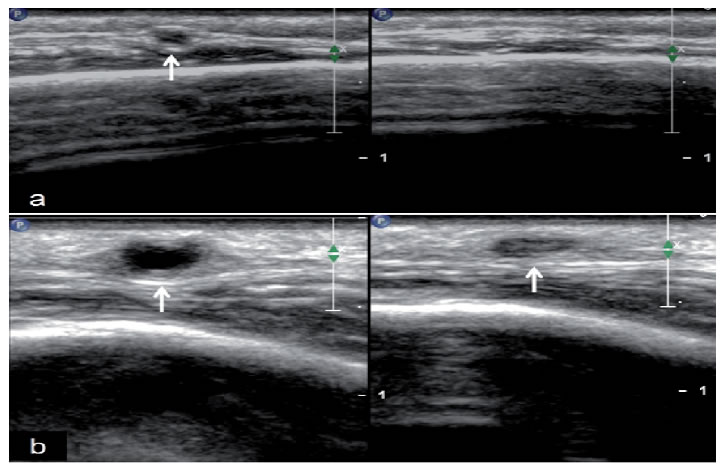
His laboratory investigations including inflammatory markers were within normal limits. A working diagnosis of Temporal Arteritis was made and he was commenced on High dose oral Steroids with bone protection and PPI. Temporal artery biopsy was performed which did not show any evidence of vasculitis. Ultrasound of Temporal Artery was organised which showed hyperechoic thickening of Right temporal artery, highly suggestive of Temporal Arteritis, thus confirming the clinical suspicion (Figure 1). He was discharged on tapering dose of steroids, PPI and bone protection and was reviewed periodically in clinic. He is clinically asymptomatic on treatment.

JCRM-3-3-316-g001

Figure 1. (a) Loss of temporal artery visibility on compression of artery. (b) Temporal artery wall maintained despite compression (‘compression sign’).

Discussion

Giant Cell Arteritis is the most common systemic vasculitis and the vascular involvement can be widespread [1]. It is common in older white males after age of 50 years with peak incidence after the age of 70 [2].

The presentation can be acute or subacute with symptoms of low grade fever, headache, jaw claudication, visual problem and constitutional symptoms. Temporal arteritis can lead to transient or permanent visual loss. There is an association between temporal arteritis and Polymyalgia Rheumatica [3].

Temporal Arteritis poses a diagnostic challenge and traditionally the diagnostic criteria used, incorporates clinical presentation, inflammatory markers and temporal artery biopsy. Temporal Artery biopsy is used to acquire the evidence of vasculitis, however it can be normal due to the presence of skip lesions [4]. The segmental nature of arteritis leads to high false negative results of biopsy and hence the sensitivity of biopsy has never been calculated. The negative biopsy results can be as high as 30-40% [5].

Colour Doppler Ultrasonography has emerged as an alternative to Temporal Artery biopsy. The two signs explained in the literature are the presence of ‘’halo’’ sign (representing mural oedema) and the presence of ‘compression sign’ (representing persistent halo after compressing artery with ultrasound probe) [6]. Albert et al. (2007) in a retrospective analysis postulated that ultrasonography has superseded temporal artery biopsy and should be reserved for situations where the imaging is inconsistent with the clinical picture [7].

High dose glucocorticoids remain the mainstay of therapy and should be commenced as soon as the diagnosis is suspected [8]. Steroid sparing agents such as Tocilizumab and Methotrexate can be used in patients who develop complications and intolerance to steroids [9]. Bone and gastric protection along with antiplatelets and Rheumatology follow up is advisable.

Conclusion

Temporal Arteritis is a debilitating form of vasculitis if left untreated. It remains a diagnostic challenge especially due to the nature of vascular involvement. Temporal biopsy can be falsely negative; colour doppler ultrasonography is emerging as a new diagnostic tool in suitable patients. The ultrasonography is non-invasive and is readily available.

References

  1. Gonzalez-Gay MA, Vazquez-Rodriguez TR, Lopez-Diaz MJ, et al. (2009) Epidemiology of giant cell arteritis and polymyalgia rheumatica. Arthritis Rheum61:1454. [crossref]
  2. Crowson CS, Matteson EL, Myasoedova E, Michet CJ, Ernste FC, et al. (2009) The lifetime risk of adult-onset rheumatoid arthritis and other inflammatory autoimmune rheumatic diseases. Arthritis Rheum63:633. [crossref]
  3. Jones JG (1991) Clinical features of giant cell arteritis.Baillieres Clin Rheumatol 5:413. [crossref]
  4. Duhaut P, Pinède L, Bornet H, Demolombe-Ragué S, Dumontet C, et al. (1999) Biopsy proven and biopsy negative temporal arteritis: differences in clinical spectrum at the onset of the disease. Groupe de Recherchesurl’Artérite à Cellules Géantes. Ann Rheum Dis 58:335. [crossref]
  5. Ashton-Key MR, Gallagher PJ (1992) False-negative temporal artery biopsy. Am J Surg Pathol16:634. [crossref]
  6. Schmidt WA, Kraft HE, Vorpahl K,Völker L, Gromnica-Ihle EJ(1997) Color duplex ultrasonography in the diagnosis of temporal arteritis. N Engl J Med337:1336. [crossref]
  7. Alberts MS, Mosen DM (2007) Diagnosing temporal arteritis: duplex vs. biopsy. QJM100:785. [crossref]
  8. Proven A, Gabriel SE, Orces C, et al. (2003) Glucocorticoid therapy in giant cell arteritis: duration and adverse outcomes. Arthritis Rheum49:  CXS703.
  9. Stone JH, Tuckwell K, Dimonaco S(2017) Trial of tocilizumab in giant-cell arteritis. N Engl J Med377:317. [crossref]

Controlled Clinical Trial on Effect of ‘Carica Papaya’ Leaf Extract on Patients with Dengue Fever

DOI: 10.31038/JCRM.2020331

Abstract

Background: Dengue is a mosquito-borne infection, which in recent decades has become a major international public health concern. Dengue is found in tropical and sub-tropical regions around the world, predominantly in urban and semi-urban areas with high morbidity and mortality rates. Up to now there is no safe and effective vaccine or therapeutic agent available for Dengue fever. Carica papaya leaf extract is the only therapeutic agent used for its platelet rising properties. In this study we are looking at other therapeutic benefits.

Aim: To compare the clinical, haematological and biochemical profiles of dengue patients treated with and without oral Carica papaya leaf extracts.

Design & Setting: Open label randomized controlled clinical trial in a Teaching Hospital in Sri Lanka.

Method: 161 Dengue suspected patients. Treatment group was given to drink leaf extract daily until discharged. Control group was not given the extract. Both groups were managed according to national dengue guidelines.

Results: 161 patients were randomized (77 treatment group and 84 control group). After exclusions, 43 patients who consumed leaf extract and 76 controls were taken for analysis.

Mean duration of fever in hospital was 1.13 days less in treatment group 1.67 ± 1.36 vs. 2.8 ± 1.79 (p <0.001). Mean duration of the illness was 0.5 days less in treatment group 6.51 ± 1.05 vs. 6.96 ± 1.32 (p <0.05).

Mean duration of hospital stay was 0.78 day less in treatment group 3.69 ± 1.08 vs. 4.47 ± 1.40 (p <0.001).

Leading to dengue haemorrhagic fever was significantly reduced (p value < 0.05) in treatment group (Proportion Normality test, p value 0.000).

Conclusion: Papaya leaf extracts has significantly reduced the duration of fever, illness, hospital stay and the incidence of conversion to dengue hemorrhagic fever.

Keywords

Carica papaya, Dengue, Dengue hemorrhagic fever, Pleural effusion, Duration of illness, Platelet count

Introduction

Background

Dengue is a mosquito-borne infection, which in recent decades has become a major international public health concern. Approximately half of the world now lives under the threat of Dengue, which is responsible for approximately 390 million infections and 20,000 deaths globally each year. Decades of attempt to eradicate dengue have not being successful at any part of the world. Up to now there is no safe and effective vaccine or therapeutic agent available [1]. Carica papaya leaf extract (CPLE) is the only therapeutic agent that has been used for its platelet rising properties [2,3].

Carica papaya (Family Caricaceae) originated in Central America. The papaya is an extraordinarily useful plant. In the tropics of the world, ripe papaya fruit is consumed as a breakfast fruit. Its juice is a popular beverage. The leaves and young stems are steamed and served as a vegetable. In some Asian countries, young leaves of papaya are steamed and eaten like spinach. Yet in other countries papaya leaves are brewed as tea and taken as a preventative measure against Malaria [4,5]. Monkeys and peacocks consumes papaya leaf at will when they enter a papaya plantation. All this points to the fact that it’s not toxic for human consumption.

Salutary Effects of CPLE in Dengue Fever (DF) patients was published in 2008 edition of the Journal of Sri Lanka Family Physicians [6]. This is most likely to be the first ever scientific biomedical study conducted to discover the salutary effects of CPLE in patients suffering from DF, reported in the world literature.

Following this study many research have been done including Randomized Controlled clinical Trials (RCT) and toxicology studies [7-24]. All have shown beneficial effects with no major adverse effects. In this study we have also looked at other therapeutic benefits, which have not been looked at before like its effects on the duration of fever, illness and most importantly prevention of conversion of DF to Dengue haemorrhagic fever (DHF).

The first contact in DF is Primary Care physicians. If an effective therapeutic agent could be given at this first consultation, it can lead to reduction in morbidity and mortality. CPLE is a potential therapeutic agent, which need further research [3,8].

Objectives

The main objective of this study is to compare the clinical (Duration of Hospital stay, Duration of fever, Plural Effusion/ percentage of conversion to DHF), Haematological (White cell  count (WBC), Packed cell volume (PCV) Platelet count (PLT) and Biochemical parameters (Alanine transaminase (SGPT), Aspartate transaminase (SGOT) ) of dengue patients treated with and without oral CPLE.

Methods

Trial Design

Open labelled Randomized Controlled clinical Trial.

Patients fulfilling the inclusion criteria were randomly allocated to the treatment and control groups.

Participants

Patients admitted to University medical unit full filling the following inclusion criteria war eligible for the study.

Inclusion criteria were acute onset of fever, 18 to 60 years of age, with a platelet count<150,000 per cu.mm and white cell count<5000 per cu.mm or with a positive dengue NS1 antigen test who wear in the febrile phase of illness and not developed DHF.

All subjects in both groups were confirmed as dengue by IgM positive after 7 days of fever. Subjects who were IgM negative after 7 days were excluded.

Exclusion criteria were patients who are in critical phase with DHF, history of allergy to papaya, pregnant mothers, patients who have already taken papaya juice extracts before admitting to hospital, patients with previously diagnosed abnormal clotting profile as per past history and medical records, patients suffering from any other illnesses which will influence the course of dengue fever, patients suffering from any other illnesses or on drugs which will influence the bone marrow function or haemopoitic system, dengue patients who have been treated with blood products.

Eligible subjects were randomly allocated to treatment and control groups Subjects were recruited until the required numbers of participants were achieved.

Study Setting

Study was conducted at University medical unit at Colombo South Teaching Hospital, Kalubowila, Sri Lanka. It is a tertiary care hospital in an urban setting where patients can present themselves to OPD on their own or referred by a family doctor or by other medical institutions.

Written Informed consent was obtained from all the patients included in the study. Patients who gave consent to take part in the study were randomized equally to treatment group and control group.

Interventions

The Treatment group was given oral CPLE, 20ml 12 hourly daily till the patient was fit to be discharged. Both groups was managed according to national guidelines in dengue [25,26].

CPLE was prepared by obtaining mature papaya leafs from previously identified and tested red lady variety papaya plantation. 100g of leaves was cut into small pieces and grinded in a grinding machine till you get a uniform pulp. This pulp was put to a juice extract to obtain the pure extract. To 50 ml of this extract, 50ml of cool boiled water was added and mixed well.

Initial preparation and subsequent preparations were assessed and standardized using high performance liquid chromatography. 20 ml of this preparation was packed in sterile glass bottles and stored in refrigerator at 4°C before giving it to the patient.

Primary Outcome

Immediately after admission and daily till discharge, a 10 ml sample of blood was withdrawn by venepuncture in both groups for the determination of WBC, PLT, PCV, SGPT and SGOT.

Both groups were examined daily by the ward registrar and the senior house officer and fever, haematological and biochemical parameters were entered in the data collecting forms. In ward ultrasound scans were done  to  detect  pleural  effusion  by  the  ward registrar who had been trained in this procedure before the commencement of the study. Pleural effusion was taken as an indicator for plasma leakage and DHF [25].

Patients in both groups were discharged according to the same criteria as given in the national guidelines of dengue fever management [26]. The discharge criteria were absence of fever with improvement of all other clinical and biochemical parameters including the absence of leakage and rise in the PLT. The dissection to discharge was made by chief consultant in charge of the unit who did not know whether the patient was in the treatment group or the control group.

Sample Size

Platelet counts were considered for sample size calculation [27].

Approximate standard deviation = (Highest typical value-Lowest typical value)/4

= (400,000-150,00028)/4

= 62,500

= Minimum difference to be detected for a significant difference/ standard deviation = 50,000/62,500

= 0.8

N = 41 for each group with 95% power

Randomization

The patients who gave consent to take part in the study was randomly allocated to treatment group and control group by the medical registrars attached to the ward by  a  concealed  method. This randomization was done by asking the patient to pick up a tag concealed in an envelope (labelled as treatment or control) from a box, which was not transparent.

Statistical Methods

Collected data were analyzed using the Shapiro-Wilk test to assess the normality of the data and it showed that p values of all the variables are less than 0.05 and the data are not normal. Mann Whitney U test (Non parametric test) had been used to assess the significance.

Trial Registration

Sri Lanka Clinical Trial Registry. SLCTR/2013/005.

Results

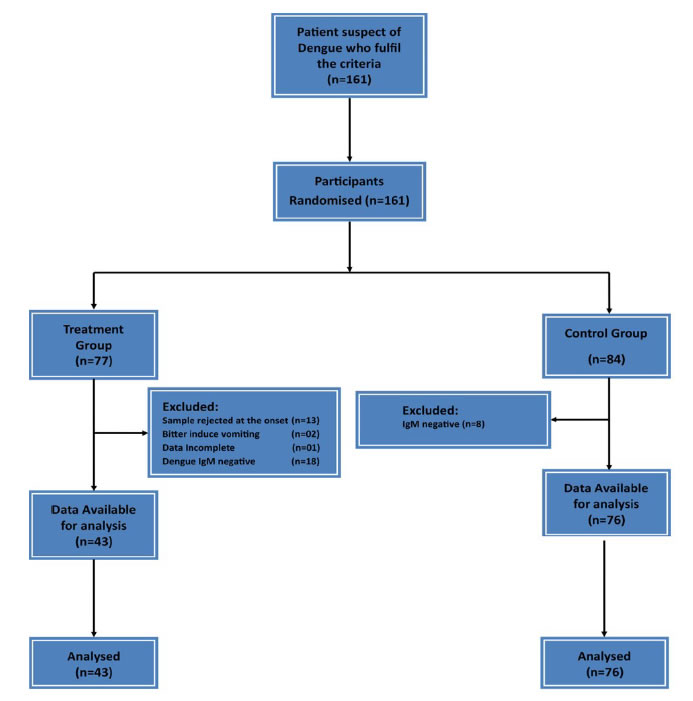
Hundred and sixty one (n=161) patients entered the study and randomized into two groups (77 patients in the treatment group and 84 patients in the control group). Thirty-four patients were excluded from the treatment group (Sample rejected at the onset n=13, Bitter induce vomiting=02, Data Incomplete n=01 Dengue IgM negative n=18). Eight patients were excluded from the control group (IgM negative N=8) (Figure 1).

JCRM-3-3-318-g001

Figure 1. Flow Chart of Study design.

After exclusion, treatment group was 43 patients and the control 76 patients. 43 patients who consumed CPLE and 76 controls were taken for analysis.

The number of Controls (n=76) were higher than the Treatment group (n=43) was mainly due to sample rejection at the onset of the study and Dengue IgM negative 18 in the Treatment group and only 8 in the Control group.

The sample rejection in the treatment group at the onset was due to some opinions given to them by their relatives due to the fear of mixing herbal drugs with western medicine. This decision was taken by these subjects after signing the consent form by going through the information sheet but clearly before starting to consume CPLE.

The data collection was conducted from June 2014 to February 2015. Recruitment was stopped after achieving the required simple size in both groups.

Age and Sex Distribution

Both groups had almost equal age and sex distribution with a male predominance (Table 1).

Table 1: Mean age & Sex distribution among treatment and control groups.

Mean Age

Standard deviation

Sex

Male

Treatment

30.58

10.28

36 (83.7%)

Control

27.36

8.24

61 (80.3%)

Female

Treatment

29.43

7.34

7(16.3%)

Control

26.60

7.93

15 (19.7%)

Total

Treatment n=43

30.40

9.80

43 (100%)

Control n=76

27.21

8.13

76 (100%)

Condition of the Patients at the Time of Entry

All the patients were in the febrile phase at the time of entry into the study. Means of number of days of fever on admission, systolic blood pressure, diastolic blood pressure, WBC, PLT and PCV counts were compared between treatment and control groups. Both groups had similar baseline values at entry to the study with no significant variation between both groups (P>0.05) (Table 2).

Table 2: Comparison of Clinical & Haematological parameters between Treatment and Control groups at the time of entry.

Variable

Treatment n=43

Control n=76

P value

Mean

Standard deviation

Mean

Standard deviation

Mean of No. of days of fever on admission

4.558

0.958

4.224

1.30

0.157

Mean systolic blood pressure(mmHg)

107.419

13.477

105.947

17.114

0.900

Mean diastolic blood pressure(mmHg)

68.884

10.395

67.368

10.433

0.568

Mean white blood cell count(109/liter)

3.950

1.592

3.847

1.659

0.434

Mean platelet count(109/liter)

105.093

41.698

107.368

45.570

0.836

Mean packed cell volume(%)

44.068

4.799

42.809

4.444

0.241

The reason for these parameters to be same in both groups was due to the fact that both treatment and control groups were entered into the study early in the illness before onset of complications.

Clinical Parameters

Clinical parameters (total days of illness, duration of fever in the hospital, duration of hospital stay and incidence of pleural effusion) were considered in the analysis and Mann Whitney U test (Non parametric test) has been used to assess the significance (Table 3).

Table 3: Comparison of Clinical & Haematological parameters between Treatment and Control groups during the study.

Variable

Treatment n=43

Control n=76

 P value

Mean

Standard deviation

Mean

Standard deviation

Mean of total days of illness/Onset of fever to discharge

6.512

1.05

6.961

1.32

0.029

Mean duration of fever in the hospital

1.674

1.36

2.803

1.79

0.001

Mean duration of hospital stay

3.698

1.08

4.474

1.40

0.001

Mean SGPT on 6th day of illness (%)

147.08

160.45

135.05

147.24

0.702

Mean SGOT on 6th day of illness (109/liter)

195.90

209.99

187.74

148.35

0.245

Mean white blood cells on 6th day of illness (109/liter)

4.59

1.98

3.95

1.86

0.077

Mean platelet count on 6th day of illness (109/liter)

67.47

33.39

60.96

33.74

0.299

Mean packed cell volume on 6th day of illness (%)

41.64

4.7

42.50

4.45

0.141

Total duration of illness was taken as from onset of fever to discharge .The mean duration of illness is significant between treatment and control group (p <0.05). Mean total days of the illness in treatment group 6.51 ± 0.05 and in the control group 6.96 ± 0.32. It shows that mean total duration of the illness is reduced by 7.3% (0.5 days) in the treatment group (Table 3).

Mean duration of fever in the hospital was 1.67 ± 1.36 and 2.80
± 1.79 in the treatment group and control group respectively and mean duration of hospital stay was 3.69 ± 1.80 and 4.47 ± 1.40 in the treatment and control groups respectively and are highly significant between treatment and control group (p  <0.001).  It  also  shows  that duration of hospital stay is reduced by 21.3% (0.78days) and duration of fever is reduced by 57.1% (1.13 days) in the treatment group (Table 3).

Clinically Evident Complications/Dengue Haemorrhagic Fever

Both groups were screened for pleural effusions throughout the study by ultrasound scanning. Presence of pleural effusion indicates that the patient is in dengue haemorrhagic fever [26].

Only two (02) patients led to pleural effusion in treatment group and twelve (12) patients led to pleural effusion in control group (Proportion Normality test, p value 0.000). Hence development of pleural effusion/leading to dengue haemorrhagic fever is significantly lowers (p value < 0.05) in treatment group when compared to control group (Table 4).

Table 4: Evidence of pleural effusion among treatment and control groups.

Treatment

Control

Pleural effusion

2 (4.7%)

12 (15.8%)

No pleural effusion

41(95.3%)

64 (84.2%)

Total

43 (100%)

76 (100%)

All these patients developed pleural effusion after allocating to the study and all the 161 patients were free of pleural effusion at the entry to the study.

Haematological Parameters

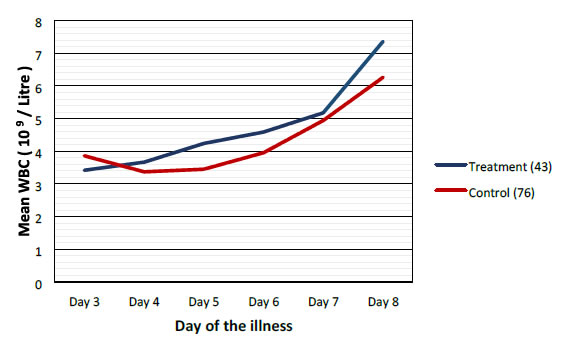
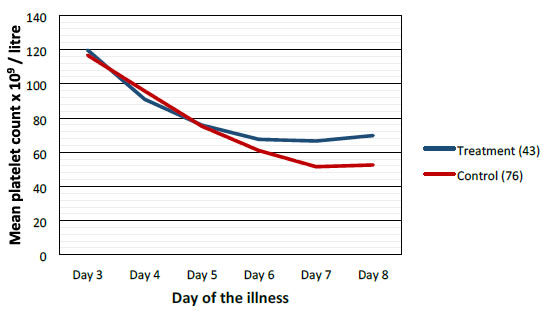
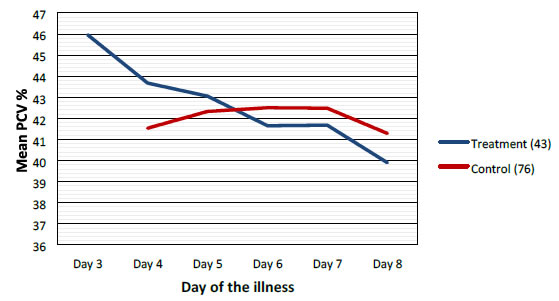
Mean values of WBC, PLT  and PCV were more favorable in  the treatment group when compared to control group as shown graphically (Figures 2-4).

JCRM-3-3-318-g002

Figure 2. Comparison of mean white blood cells between treatment and control groups.

JCRM-3-3-318-g003

Figure 3. Comparison of mean platelets between treatment and control groups.

JCRM-3-3-318-g004

Figure 4. Comparison of mean packed cell volume/Hematocrit between treatment and control groups.

Highest difference was seen on the 6th day of illness that is after 2 to 3 days of CPLE treatment. These differences in improvement were not statistically significant (Table 3).

Biochemical Parameters

There was no significant difference in the Mean SGOT and SGPT levels (U/L) on the 6th day of illness between treatment and control groups. 195.90 vs. 187.74 and 147.08 vs. 135.05 in the treatment & control groups respectively (Table 3). The mean values are high in both groups.

Discussion

Summary

This study have shown that CPLE is effective in improving clinical parameters of Dengue (Fever, Duration of illness, Hospital stay) and most importantly reduction in the incident of DHF in the Treatment Group. These clinical improvements were statistically significant (Table 3). Haematological Parameters (WBC, PLT, PCV) showed improvement in parallel to the clinical improvement though these differences were not statistically significant but they are clinically significant (Figures 2-4).

Haematological improvements were seen in the treatment group from the 5th day of the illness CPLE had taken about 24 to 48 hours to exert its action on homological parameters.

We did not observe solitary increase in the PLT without the improvement of other clinical parameters (Figures 2-4).

Strength & Limitation

Most other studies  have  looked  only  at  PLT  rising  property of CPLE. This is the only study which have looked at other clinical parameters. Most clinicians were in the opinion that CPLE only had an effect on the PLT but this research have shown that it has other actions capable of improving clinical outcomes like fever duration of illnesses and reducing the incidence of complications like DHF.

The main limitation of the study was blinding and placebo control was not possible. Blinding was not possible; as we had to give freshly prepared pure CPLE to make sure that its constituents remain stable. It is not possible to make a placebo for CPLE and that is why we conducted the research as an open labelled study.

The study was also not large enough to show any differences in clinical complications like shock, haemorrhage etc. It would have been ideal if we could have looked at the effect of CPLE from day one of the illnesses at primary care level to complete clinical and biomedical recovery in hospital. Patients entered to this study on 2nd, 3rd and 4th days of the illness and was discharged early before full biochemical improvement, to be managed by general practitioners in their home environment. Therefore we could only observe the effect of CPLE on a limited time period of the illness.

Comparison with Existing Clinical Research

Hettige S. in 2008 studied 12 consecutive Dengue patients treated with CPLE and showed that there was rapid increase in WBC, PLT and all patients recovered without hospital admission [6]. Following this study many clinical trials including RCT had shown similar results [7-24].

Otsuki N. and others in 2010 studied anti-tumor activity and immune-modulatory effects of CPLE [11]. This in-vitro study had shown that CPLE can enhance the Th1 type immunity. Research have shown that shift of DF to DHF is the result of the shift in the immune response of Th1 type immunity to Th2 type immunity [12]. According to the above research CPLE prevents the immune shift by reducing the incidence of DHF.

Norahmed N.A. and others have shown  immuno-modulatory  role of CPLE in Dengue virus infected rats [17-20]. Our study has demonstrated this effect clinically by reducing the incidence of DHF in the treatment group.

Recommendation and Generalizability

Studies have repeatedly shown potential benefit of CPLE in DF. In many Asian countries it’s now being used as tablets and capsules for its PLT rising properties [21-24,28].

The most important property of therapeutic agent in dengue would be to prevent leakage of fluid and conversion  of  DF to DHF. This study has shown that CPLE may have above mentioned therapeutic properties in addition to the improvement of other clinical parameters.

Therefore we recommend a placebo controlled similar study with a larger sample size and observe the therapeutic effects from day one of the illness to full biochemical and haematological normalization (e.g. Till the PLT reach 250-300 x 109/liter).

Abbreviations

CPLE: Carica papaya leaf extract

DF: Dengue Fever

RCT: Randomized Controlled clinical Trials

DHF: Dengue haemorrhagic fever

WBC: White cell count

PCV: Packed cell volume

PLT: Platelet count

SGPT: Alanine transaminase

SGOT: Aspartate transaminase

Declarations

Ethics Approval

Ethical approval had been obtained from Ethical approval committee of Faculty of Medical sciences University of Sri Jayewardenepura and also registered in the  Sri  Lanka  Clinical  Trial Registry SLCTR/2013/005 and World Health Organization International Clinical Trials Registry Platform.

Special approval also had been taken from the Sub Committee on Clinical Trials of Ministry of Health, Sri Lanka as this study was conducted in a tertiary care hospital in Sri Lanka.

Consent to Participate & Publication

Written consent had been obtained from all participants before they were entered to the research.

Data Sharing Statement

All the data collected are analysed and presented in this document.

The datasets used & analysed during the current study are available from the corresponding author on reasonable request.

We are willing to share the data that we have collected and presented in this article for interested parties in Dryad repository if required.

Competing Interests

None declared by the authors.

Funding

Self-Funded.

References

  1. World Health Organization, Dengue and severe dengue. http://www.who.int/mediacentre/factsheets/fs117/en/, updated May 2015, Accessed 23 September 2019.
  2. NDTV Here’s How Papaya Leaf Juice Can Be Used to Treat Dengue and Malaria: As Suggested by Luke Coutinho. https://www.ndtv.com/health/denguepapaya-leaf-juice-heres-a-simpleway-to-boost-your-platelet-count-naturally2066099 updated July 2019, Accessed 23 September 2019.
  3. SaralaN, PaknikarSS (2014) Papaya Extract to Treat Dengue: A Novel Therapeutic Option.Ann Med Health Sci Res. 4(3): 320-324. [crossref]
  4. Carica papaya, http://en.wikipedia.org/wiki/Carica_papaya, Wikipedia free encyclopedia, updated: on 26 July 2012, Accessed 16 August 2019.
  5. WHFoods, papaya, http://www.whfoods.com/genpage.php?tname=foodspice&dbid=47, www.WHfoods.org, Accessed 16 August 2019.
  6. Hettige S (2008) Salutary Effects of Carica papaya in dengue fever patients, Sri Lanka Family Physician, 2008 Vol. 29,PP. 17-19. Accepted by WHO http://apps.who.int/trialsearch/Trial2.aspx?TrialID=SLCTR/2013/005
  7. Hettige S (2019) Dengue: an escalating problem. BMJ 2002, http://www.bmj.com/rapid-response/2011/11/03/repapaya-leavesspeedyrise-platelet-count-dengue, published 29 June 2002, Accessed 16 August 2019.
  8. Hettige S (2015) ‘Guidelines in using carica papaya leaf extract for Dengue fever patients’, BMJ Clinical Review (BMJ 2015;351:h4661), pp. [Online]. Available at: https://www.bmj.com/content/351/bmj.h4661/rr-4 (Accessed:22ng October 2019).
  9. Hettige S (2016)Carica papaya leaf extract in Dengue fever. IMPA Journal|December 2015|Volume 09|Number 01, IMPA Journal; pg. 11-14. [Internet]. 2016 [cited 24February2016]; Availablefrom:https://www.dropbox.com/s/b8zejo8r7nx3l6e/09%20Impa%20Journal%20 -%20volume%2009.pdf?dl=0 (Accessed: 22ng October 2019).
  10. Subenthiran, S, Choon TC, Cheong KC, et al. (2013) Carica papaya leaves Juice significantly accelerates the rate of increase in platelet count among patients with Dengue fever and Dengue haemorrhagic fever. Evidence based complementary and alternative Medicine. 2013 (ID616737), 7 [crossref]
  11. Otsuki, N, Dang NH, Kumagai E, et al. (2010) Aqueous extract of carica papaya leaves exhibits anti-tumor activity and immunomodulatory effects. Journal of Ethnopharmacology. 127, p760-767. [crossref]
  12. Chaturvedi U, Agarwal R, Elbishbishi E (2000) Cytokine cascade in dengue hemorrhagic fever: implications for pathogenesis. 1st ed. [ebook] Elsevier Science BV, FEMS Immunology & Medical Microbiology, pp.28.[crossref]
  13. Ranasinghe P, Ranasinghe P, Abesekara WPKM, et al. (2011) In-vitro erythrocyte membrane stabilization properties of carica papaya L. leaf extracts. 3rd international conference on medicinal plants and herbal medicines. Colombo, Sri Lanka.
  14. Imaga NOA, Gbenle GO, Okochi VI, et al. (2009) Anitisicking property of carica papaya leaf extract. African Journal of Biochemistry Research. 3 (4), p102-106.
  15. Senthilvel P, Lavanya P, Kumar KM, et al. (2013) Flavonoid from Carica papaya inhibits ns2bnS3 protease and prevents Dengue 2 viral assembly. Bioinformation. 9(18):889-895.[crossref]
  16. Pangtey GS, Prakash A, Munjal YP (2016) Role of Carica papaya leaf extract for Dengue associated Thrombocytopenia. Journal of the Association of Physicians of India. 2016, [Online] Available at: http://www.japi.org/june_2016/01_Editorial_role_of_carica.pdf Accessed 14 September 2019[crossref]
  17. Norahmad NA, Razak MRMA, Misnan NM, et al. (2019) The effect of freeze dried Carica papaya leaf juice on inflammatory cytokine production during dengue virus infection in AG129 mice. BMC Complementary and AlternativeMedicine. 19:44 [crossref]
  18. Sathasivam K, Ramanathan S, Mansor SM, et al. (2009) Thrombocyte counts in mice after the administration of papaya leaf suspension. WienKlinWochenschr-The middle European Journal of Medicine. 121 (3), 19-22.
  19. HettiarachchiK (2012) Guinea pig rats fed papaya leaf juice concentrate show intriguing results – Tests recording platelet count rise may give hope for dengue patients. Sunday Times.
  20. Halim SZ, Abdullah NR, Afzan A, et al. (2011) Study of acute toxicity of Carica papaya leaf extract in spraguedawley rats. Journal of Medicinal Plants Research. 5 (2), p1867-1872.
  21. Kasture PN, Nagabhushan KH, Kumar A (2016) A multi centric double blind placebo controlled randomized prospective study to evaluate the efficacy and safety of carica papaya leaf extract as empirical therapy for thrombocytopenia associated with Dengue fever. Journal of the Association of Physicians of India. [crossref]
  22. Gadhwal AK, Ankit BS, Chahar C, et al. (2016) Effect of Carica papaya leaf extract capsule on platelet count in patients of dengue fever with Thrombocytopenia. Journal of the Association of Physicians of India [Online] Available at: http://www.japi.org/june_2016/03_oa_effect_of_carica.pdf Accessed 14 September 2019
  23. Hettige S (2017) ‘The use of dried carica papaya leaf capsules in dengue fever patients in the recent dengue epidemic in June – August 2017’, Sri Lankan Family Physician, Vol. 33 No. 1(ISSN 1391-1961), pp. 21-26 [Online]. Available at: http://cgpsl.org/wpcontent/uploads/2018/01/SLFP-October-2017PDF1.pdf (Accessed: 15th October 2019).
  24. Srikrishna HA, et al. (2018) Clinical Evaluation for the Thrombopoietic Activity of Platenza Tablet in Cases of Dengue with Thrombocytopenia – RandomizedOpen Label Comparative Clinical Study. Ann Med Health Sci Res. 8: 29-38.
  25. Kalayanarooj S. Clinical Manifestations and Management of Dengue/DHF/DSS.Tropical Medicine and Health 2011, http://www.ncbi.nlm.nih.gov/pmc/articles/PMC3317599/, published 22 Dec 2011, Accessed 16 August 2019. [crossref]
  26. Ministry of Health – Sri Lanka. Guidelines on Management of Dengue Fever &Dengue Haemorrhagic Fever InAdults.http://www.epid.gov.lk/web/images/pdf/Publication/guidelines_for_the_ma nagement_of_df_and_dhf_in_adults.pdf Accessed 16 August 2019.
  27. Conroy R. Sample size a rough guide: sample sizes and powers for comparing two means where the variable is measured on a continuous scale that is (more or less) normally distributed: 13-15.
  28. Medline Plus, platelet count, http://www.nlm.nih.gov/medlineplus/ency/article/003647.htm, updated 02 February 2013, Accessed 16 August 2019.

Personalised Approaches in Treating Early-Stage Hodgkin Lymphoma

DOI: 10.31038/IMROJ.2020531

Editorial

Early-stage Classical Hodgkin Lymphoma (HL) is now one of the most curable malignancies and one of the success stories of modern haemato-oncology. Great progress has been made since X-rays were used as one of the first examples of non-surgical cancer treatment in 1901 by Pusey.More than half a century later, the development of wide field megavoltage irradiation techniques to multiple lymph node chains led by Peters in the 1950’s and Kaplan in the 1960’s were transformational and meant for the first time there were long-term survivors treated for HL [1,2]. Increasing use of systemic chemotherapy in the 1970’s improved outcomes yet further. However, this improvement in tumour control came at a cost and follow-up in these long-term survivors led to the concerning observations that more patients were dying in later life from the consequences of their treatment than from recurrence of their HL [3,4].

In this century, the approach towards management of early-stage HL has therefore increasingly focused on improving the quality of long-term survival by aiming to decrease treatment‐induced mortality and morbidity whilst at the same time maintaining long-term disease control. The aims of treatment are to balance the best chance of cure against the risks of late side effects that may lead to reduced long-term survival and impaired quality of life. Striking the right balance in this treatment goal has in turn led to the ambition to develop a personalised approach to treating HL. However there remain many unmet challenges in achieving the goal of personalised therapy for HL and some of these will be outlined in this brief commentary. These challenges include moving beyond the well-established pre-treatment clinical risk stratification approaches, integrating [18F] fluorodeoxyglucose ([18F]FDG) Positron Emission Tomography (PET) response-adjusted therapy, integrating individual patient characteristics (age, sex, site of disease) alongside emerging biological biomarkers in the decision making.

Risk-adapted Strategies: Pre-treatment Clinical Risk Stratification and Combined Modality Therapy

Pre-treatment staging and clinical risk stratification have been important tools for treatment decision making in early-stage HL over recent decades.Most international groups have used clinical risk factors, such as number of involved nodal sites, Erythrocyte Sedimentation Rate (ESR), and the presence of mediastinal bulk or B-symptoms, to differentiate early-stage HL into favourable and unfavourable risk groups with different treatment approaches. A series of large randomised trials conducted by the German Hodgkin Study Group (GHSG) and European Organisation for the Research and Treatment of Cancer (EORTC) have used clinical risk stratification to optimise CMT approaches for early-stage HL [5-7] .The GHSG HD10 trial showed that 2 cycles of ABVD and 20Gy Involved Field Radiation Therapy (IFRT) delivered excellent long-term tumour control, with freedom from treatment failure of 91.1% at 5 years [8]. This CMT approach became widely established as a standard treatment approach in early-stage favourable HL.For early-stage unfavourable HL, the results from the GSHG HD11 using 4 x ABVD and 30 Gy IFRT provided 83% long-term Progression-Free Survival (PFS),with room for further clinical improvements [9]. In an attempt to improve outcomes further, the GHSG HD14 trial investigated intensification of chemotherapy with 2 cycles ofBEACOPPescalated plus 2 x ABVD (2+2). This approached improved PFS in early-stage unfavourable HL, with an improved 5 year PFS difference of 6.2% over the “standard arm”. However, this “2 + 2” approach was associated with more acute haematological toxicity and no difference in long-term toxicity or overall survival, therefore this more intensified approach has not been widely adopted.

Whilst pre-treatment clinical risk stratification can be used to guide treatment selection within validated treatment protocols, there are a number of limitations. These include the fact that all adverse risk factors are given equal weight in scoring, albeit that mediastinal bulk appears to have influenced treatment decisions perhaps more than other risk factors [10].In view of these limitations, pre-clinical risk stratification is less frequently applied in many UK and US early-stage HL clinical trial protocols and patients with mediastinal bulk and B-symptoms are excluded from early stage protocols and treated as advanced-stage disease. Secondly, the prognostic value of pre-clinical risk stratification in the current era of PET- risk adapted therapy has become less clear. By way of example the in the UK NCRI PET adapted “RAPID” trial, the PET response after 3 cycles of ABVD was more important than preclinical risk factors with no difference in outcomes seen between patients who initially presented with favourable- and unfavourable-risk disease [11]. Importantly patients with mediastinal bulk and B-symptoms were excluded from this trial. Finally, risk stratification does not take account of other baseline variables that may have utility in early-stage HL, including Maximum Tumour Diameter (MTD) and metabolic tumour volume [12-14].

Emerging tissue and serum biomarkers may in future help to refine pre-treatment risk stratification and develop precision medicine strategies that reflect underlying disease biology [15]. Circulating biomarkers such as serum Thymus Activation-Related Cytokine (TARC) and circulating tumour DNA have prognostic value in HL but have not yet been evaluated within early-stage HL protocols [16,17]; further assessment and standardisation is required before wider clinical application.

Response-adapted Strategies: PET-directed Treatment

PET response assessment has emerged as one of the most powerful prognostic tools in HL over recent decades [18]. A number of large, randomised trials have informed the use of PET-adapted treatment approaches, including the UK NCRI RAPID trial, EORTC H10, US intergroup 50604 Phase II trial and GHSG HD16 trials [19-22]. The principal focus of these clinical trials has been to investigate the utility of PET as an imaging biomarker to deliver response-adjusted therapy with Chemotherapy Alone (CA) for those who achieve Complete Metabolic Response (CMR). In this way, the aim has been to potentially avoid RT and further reduce RT -related long-term toxicity. The first trial to report was the RAPID trial, which included 602 patients with stage I/IIA HL and no mediastinal bulk [22]. Patients received 3 cycles of ABVD followed by PET response assessment. Those achieving a CMR (defined as Deauville score 1-2) were randomly assigned to receive 30Gy IFRT or no further treatment. Approximately two-thirds of patients enrolled had a favourable risk profile according to GHSG or EORTC risk classification. PET-negative patients in the intent-to-treat and per-protocol cohorts had PFS differences of 3.8% (3-year PFS, 94.6% vs 90.8%) and 6.3% (3-year PFS, 97.1% vs 90.8%) favouring consolidative IFRT, respectively.

In a similar fashion, the EORTC/FondazioneItalianaLinfomi performed the HD10 trial in both Early stage Favourable (F) and unfavourable (U) patients. In the standard arm, all patients received either 3 (F) or 4 cycles (U) of ABVD followed by 30Gy ISRT. In the experimental arm, patients achieving CMR after 2 cycles ABVD received chemotherapy alone, with a total of 4 (F) or 6 (U) cycles of ABVD. In a pre-planned interim analysis of PET-negative patients, futility of the trial was declared by the independent data monitoring committee because of an increased number of HL-related events in the non-RT arms [23]. The 5-year PFS rates with and without RT were 99.0% and 87.1%, respectively for favourable-risk disease, and 92.1% and 89.6%, for unfavourable-risk disease. The GHSG HD16 trial compared 2 cycles of ABVD alone with 2 ABVD plus 20Gy IFRT in patients with favourable-risk early-stage HL that achieved CMR after chemotherapy [21]. Again, there was a PFS difference in favour of CMT, with 5-year PFS rates of 93.4% with CMT and 86.1% with ABVD.

Although non-inferiority of chemotherapy alone compared with CMT could not be demonstrated, it is important to note that overall survival rates were excellent, uniformly exceeding 95% for both CMT and chemotherapy alone at 5 years. In most studies, non-HL deaths were a greater risk and outnumbered HL-related deaths, irrespective of treatment approach [21,22]. Follow-up for these studies is still relatively short and it remains to be seen whether mortality from late RT-related toxicity has an impact on survival over the decades to come, therefore the optimum approach remains unclear.

To address whether intensified therapy can improve outcomes in early-stage HL, the H10 trial evaluated a response-adapted approach based on PET assessment after 2 cycles of ABVD.In the standard arm, PET-positive patients (Deauville score 3-5) continued with ABVD to receive a total of 4 (F) or 6 (U) cycles followed by 30Gy INRT, whilst in the experimental arm, PET-positive patients were switched to an intensified treatment with 2 x BEACOPP escalated plus 30 Gy INRT. Outcomes clearly favoured the experimental arm, with 5-year PFS rates of 90.6% compared with 77.4% for PET-positive patients in the standard arm and a trend towards improved overall survival (96.0% versus 89.3%, respectively, p=0.062) [19]. This approach has been adopted as standard of care in many centres, although the degree of PET-positivity is an important consideration. An analysis of PET-positive patients in the RAPID protocol has shown that patients with stage I/IIA non-bulky HL that achieve Deauville score 3 or 4 have excellent outcomes following 3 x ABVD and 30 Gy IFRT (5-year event-free survival rates 95.3% and 93.5%, respectively), thus may potentially be spared the additional toxicity of escalated BEACOPP, whilst those with Deauville score 5 have a much higher relapse risk [11].

Personalised Approaches to Treatment

PET-adapted trials provide important information regarding the risk of disease relapse with CMT and chemotherapy approaches, but consideration of the risks of early and late toxicity is equally as important in determining the optimum treatment approach. Radiation field, dose, sex, co-morbidities and age are all important considerations. A large study of HL survivors has shown secondary malignancy rates of up to 33% at 30 years, noting that many will have received more extended-field radiotherapy than is current practice. The standard incidence ratio of cancer was highest in those diagnosed aged 15-35 years, particularly with respect to breast cancer risk in females receiving mediastinal radiotherapy [24,25]. Similarly, in a study of teenage and young adult cancer survivors, the standardised mortality ratio for cardiac-related death was 3.8 for those diagnosed with HL, with the greatest relative and absolute increase in risk for those aged 15-19 years at diagnosis [26].

Given that the large RT fields and higher radiation doses (>40 Gy) of the past were largely implicated in the late side effects of the survivors, newer RT techniques, improvements in advanced RT delivery and substantial reductions in the RT field size and dose are now used. The International Lymphoma Radiation Oncology Group have led the current international standard of care, which is Involved Site Radiation Therapy (ISRT) [27]. ISRT represents a large normal tissue volume reduction from the previous wide RT treatment fields of the past [28,29], which is anticipated to reduce, but not eliminate, late toxicity.

These trials confirm that CMT provides the best disease control and help clinicians to quantify the risk of omitting RT when informing patients. Nevertheless, a PET-based approach using chemotherapy alone for those achieving CMR remains an entirely reasonable option for selected patients based on their individual characteristics or treatment goals. The decision about whether to omit RT after chemotherapy provides an insight into the challenges of modern effective cancer medicine, where life beyond cure is now a key consideration for most patients. Randomised trial results suggest that some patients can be safely treated with chemotherapy alone and these results inform the patient-specific discussion about the increased risk of relapse omitting RT. Examples where omitting RT may be the preferred option include a young woman with axillary or mediastinal disease where receiving RT to axillary and mediastinal lymph nodes may necessitate irradiating breast tissue and substantially increase the risk of breast cancer, or where cardiac structures may receive clinically significant RT doses in addition to the potential cardiac toxicity of anthracycline-based therapies. In these patients, the individual risk of relapse and the risk of RT-associated late effects including secondary cancer should be carefully considered. In many older or co-morbid patients, minimising acute chemotherapy toxicity may be more of a concern, and RT can be useful in reducing the risk of relapse and need for salvage therapies.

Of paramount importance indecision making in early stage HL is the patient’s informed choice as to whether a 3.6 to upto 12.1% reduction in the rate of relapse with the addition of RT is worth the potential risk of additional late toxicity, which often occurs decades after delivering the RT. Some patients will elect to receive RT because they do not want to live with the increased short term risk of relapse. Others will elect to minimise the long term risks of radiotherapy and accept an increased risk of local relapse, where late radiation toxicity, such as effects on the heart and the risk of a second cancer or breast cancer in younger women, are of greater concern [30]. Based on current evidence, CMT is preferred for patients at highest risk of relapse, or where the anticipated risk of late radiation toxicity is low or negligible. However, chemotherapy alone confers excellent overall survival rates and is a valid option for selected patients, particularly where the late toxicity risks of RT may be higher.

Can modelling help with this complex clinical risk decision making in evaluating the risks and benefits with these different treatment options and the important question of whether to consolidate with RT? Early attempts to do this have started [31], although this type of modelling is certainly not ready for routine clinical application at present. Whatever model is used can only be a reflection of the input data, for example, much of the long-term outcome data is derived from older studies using more extensive radiation fields [29]. Importantly, when complex clinical outcome scenarios are modelled, often using study-level rather than individual patient data, a multitude of underlying assumptions must be made.

In summary, considerable progress has been made in moving towards personalising treatment approaches in early-stage HL and in moving away from “one size fits all” with the same treatment approach for each clinical risk group. However, we currently have much more work to do before we are able implement this personalised approach for all patients.Currently discussing and agreeing the most appropriate treatment approach can be amongst the most difficult parts of decision making for the both haemato-oncologist, radiation oncologist and the patient.We are now making progress in moving from long established pre-treatment risk stratification dictating management approaches to integrate response-adapted approaches with PET alongside patient-specific characteristics of age, sex, site of disease and patient preferences. Only such a balanced, integrated and informed approach with long term detailed follow-up will lead to the personalised care required to further improve outcomes in early-stage HL.

References

  1. Kaplan HS (1996) Role of intensive radiotherapy in the management of Hodgkin’s disease. Cancer 19: 356-367.
  2. Peters MV, Middlemiss KC(1958) A study of Hodgkin’s disease treated by irradiation. Am J Roentgenol Radium. TherNucl Med 79: 114-121. [crossref]
  3. Aleman BM, van den Belt-Dusebout AW, Klokman WJ,Van’t Veer MB,Bartelink H, et al.(2003) Long-term cause-specific mortality of patients treated for Hodgkin’s disease. J Clin Oncol 21: 3431-3439. [crossref]
  4. Ng AK,Bernardo MP,Weller E,Backstrand KH,Silver B, et al.(2002) Long-term survival and competing causes of death in patients with early-stage Hodgkin’s disease treated at age 50 or younger. J Clin Oncol 20: 2101-2108. [crossref]
  5. Engert A, Franklin J,Eich HT, Brillant C, Sehlen S, et al. (2007) Two Cycles of Doxorubicin, Bleomycin, Vinblastine, and Dacarbazine Plus Extended-Field Radiotherapy Is Superior to Radiotherapy Alone in Early Favorable Hodgkin’s Lymphoma: Final Results of the GHSG HD7 Trial. Journal of Clinical Oncology 25: 3495-3502. [crossref]
  6. Fermé C, Eghbali H,Meerwaldt JH,Rieux C,Bosq J,et al. (2007) Chemotherapy plus involved-field radiation in early-stage Hodgkin’s disease. N Engl J Med 357: 1916-1927. [crossref]
  7. Noordijk EM, Carde P,Dupouy N,Hagenbeek A,Krol AD,et al.(2006) Combined-modality therapy for clinical stage I or II Hodgkin’s lymphoma: long-term results of the European Organisation for Research and Treatment of Cancer H7 randomized controlled trials.J Clin Oncol 24: 3128-3135. [crossref]
  8. Engert A, et al.(2010) Reduced treatment intensity in patients with early-stage Hodgkin’s lymphoma. N Engl J Med 363: 640-652.
  9. Eich HT, et al.(2010) Intensified chemotherapy and dose-reduced involved-field radiotherapy in patients with early unfavorable Hodgkin’s lymphoma: final analysis of the German Hodgkin Study Group HD11 trial. J Clin Oncol28: 4199-4206.
  10. Klimm B, Goergen H, Fuchs M, von Tresckow B,Böll B,et al.(2013) Impact of risk factors on outcomes in early-stage Hodgkin’s lymphoma: an analysis of international staging definitions. Ann Oncol 24: 3070-3076. [crossref]
  11. Barrington SF, Phillips EH, Counsell N,Hancock B,Pettengell R, et al.(2019) Positron Emission Tomography Score Has Greater Prognostic Significance Than Pretreatment Risk Stratification in Early-Stage Hodgkin Lymphoma in the UK RAPID Study.J Clin Oncol 37: 1732-1741. [crossref]
  12. Illidge TM, Phillips EH, Counsell N,Pettengell R,Johnson PWM,et al.(2020) Maximum tumor diameter is associated with event-free survival in PET-negative patients with stage I/IIA Hodgkin lymphoma.Blood Advances 4: 203-206. [crossref]
  13. Kumar A, Burger IA, Zhang Z,Drill EN,Migliacci JC,et al.(2016) Definition of bulky disease in early stage Hodgkin lymphoma in computed tomography era: prognostic significance of measurements in the coronal and transverse planes. Haematologica 101: 1237:1243. [crossref]
  14. Cottereau A-S, Versari A, Loft A,Casasnovas O, Bellei M,et al.(2018) Prognostic value of baseline metabolic tumor volume in early-stage Hodgkin lymphoma in the standard arm of the H10 trial. Blood131: 1456-1463. [crossref]
  15. Mottok A, Steidl C (2018) Biology of classical Hodgkin lymphoma: implications for prognosis and novel therapies. Blood 131: 1654-1665. [crossref]
  16. Hsi ED, Li H, Nixon AB, Schöder H, Bartlett NL, et al.(2019) Serum levels of TARC, MDC, IL-10, and soluble CD163 in Hodgkin lymphoma: a SWOG S0816 correlative study. Blood 133: 1762-1765. [crossref]
  17. Spina V, Bruscaggin A, Cuccaro A, Martini M, Di Trani M,et al.(2018) Circulating tumor DNA reveals genetics, clonal evolution, and residual disease in classical Hodgkin lymphoma. Blood 131: 2413-2425. [crossref]
  18. Gallamini A, Hutchings M, Rigacci L, Specht L, Merli F, et al.(2007) Early Interim 2-[18F]Fluoro-2-Deoxy-D-Glucose Positron Emission Tomography Is Prognostically Superior to International Prognostic Score in Advanced-Stage Hodgkin’s Lymphoma: A Report From a Joint Italian-Danish Study. Journal of Clinical Oncology 25: 3746-3752. [crossref]
  19. André MPE, Girinsky T, Federico M,Reman O,Fortpied C,et al.(2017) Early Positron Emission Tomography Response-Adapted Treatment in Stage I and II Hodgkin Lymphoma: Final Results of the Randomized EORTC/LYSA/FIL H10 Trial. J Clin Oncol 35: 1786-1794. [crossref]
  20. Straus DJ, Jung SH, Pitcher B,Kostakoglu L, Grecula JC,et al.(2018) CALGB 50604: risk-adapted treatment of nonbulky early-stage Hodgkin lymphoma based on interim PET. Blood 132: 1013-1021. [crossref]
  21. Fuchs M, Goergen H, Kobe C, Kuhnert G, Lohri A, et al.(2019) Positron Emission Tomography–Guided Treatment in Early-Stage Favorable Hodgkin Lymphoma: Final Results of the International, Randomized Phase III HD16 Trial by the German Hodgkin Study Group. Journal of Clinical Oncology 37: 2835-2845. [crossref]
  22. Radford J, Illidge T,Counsell N, Hancock B,Pettengell R,et al.(2015) Results of a Trial of PET-Directed Therapy for Early-Stage Hodgkin’s Lymphoma. New England Journal of Medicine 372: 1598-1607.
  23. Raemaekers JMM, André MP, Federico M, Girinsky T, Oumedaly R, et al.(2014) Omitting Radiotherapy in Early Positron Emission Tomography–Negative Stage I/II Hodgkin Lymphoma Is Associated With an Increased Risk of Early Relapse: Clinical Results of the Preplanned Interim Analysis of the Randomized EORTC/LYSA/FIL H10 Trial. Journal of Clinical Oncology 32: 1188-1194. [crossref]
  24. Schaapveld M, et al.(2015) Second Cancer Risk Up to 40 Years after Treatment for Hodgkin’s Lymphoma. New England Journal of Medicine 373: 2499-2511.
  25. Sud A, Thomsen H, Sundquist K, Houlston RS, Hemminki K(2017) Risk of Second Cancer in Hodgkin Lymphoma Survivors and Influence of Family History. Journal of Clinical Oncology 35: 1584-1590.
  26. Henson KE, Reulen RC, Winter DL, Bright CJ,Fidler MM,et al.(2016) Cardiac Mortality Among 200 000 Five-Year Survivors of Cancer Diagnosed at 15 to 39 Years of Age: The Teenage and Young Adult Cancer Survivor Study.Circulation 134: 1519-1531. [crossref]
  27. Illidge T, Specht L,Yahalom J, Aleman B,Berthelsen AK,et al.(2014) Modern Radiation Therapy for Nodal Non-Hodgkin Lymphoma—Target Definition and Dose Guidelines From the International Lymphoma Radiation Oncology Group. International Journal of Radiation Oncology, Biology, Physics 89: 49-58. [crossref]
  28. Engert A, et al.(2003) Involved-field radiotherapy is equally effective and less toxic compared with extended-field radiotherapy after four cycles of chemotherapy in patients with early-stage unfavorable Hodgkin’s lymphoma: results of the HD8 trial of the German Hodgkin’s Lymphoma Study Group.J Clin Oncol 21: 3601-3608.
  29. Meyer RM, et al.(2011) ABVD Alone versus Radiation-Based Therapy in Limited-Stage Hodgkin’s Lymphoma. New England Journal of Medicine 366: 399-408.
  30. Bröckelmann PJ, McMullen S, Wilson JB, Mueller K, Goring S,et al.(2019) Patient and physician preferences for first-line treatment of classical Hodgkin lymphoma in Germany, France and the United Kingdom. British Journal of Haematology 184: 202-214. [crossref]
  31. Parsons SK, Kelly MJ, Cohen JT,Castellino SM, Henderson TO,et al.(2018) Early-stage Hodgkin lymphoma in the modern era: simulation modelling to delineate long-term patient outcomes. British Journal of Haematology 182: 212-221. [crossref]

Lopinavir-ritonavir (LPV/r) for the Treatment of SARS-CoV-2 (COVID-19): A Systematic Review

DOI: 10.31038/JPPR.2020321

Abstract

Background: SARS-CoV-2 is the pathogenic agent of COVID-19, which has affected more than 200 countries; infected over 4 million people and declared a global pandemic. At the time of writing, no approved definitive therapeutic treatment for COVID-19 is available. Many studies are still on-going. Lopinavir-ritonavir (LPV/r), or its combination has been advocated as a potential treatment. This study reviews the evidence of LPV/r usage in the treatment of SARS-CoV-2 infection.

Methods: A systematic review protocol was written based on the PRISMA Statement Article for review selected from electronic databases (PubMed, Embase and Medline). Inclusion criteria were: full English articles published between 2019 and 2020, accessible and peer-reviewed. The search keywords were: Lopinavir, COVID, and SARS-CoV-2. Studies fulfilling the inclusion criteria were included, regardless of study designs. Data were extracted from published reports.

Findings: As of 9 May 2020, 243 manuscripts were identified. Thirteen studies were included with a total of 494 patients. These consisted of clinical trials (n=2), case reports (n=5), case series (n=3), and retrospective cohort studies (n=3). In the thirteen studies, the use of LPV/r shortened the PCR negative-conversion time for SARS-CoV-2, the earliest as being 5 days (Range: 5 to 28 days), and clinical improvement was expected as early as 2 days (Range: 2 to 28 days).

Interpretation: Our review shows that the use of LPV/rmay be an effective treatment for non-severe COVID-19 patients, while only limited benefits were observed in severe COVID-19 patients.

Introduction

Coronavirus disease in 2019(COVID-19) is caused by SARS-CoV-2 infection, first reported from Wuhan, China in early December 2019 [1]. It spreads quickly with a reproductive number R0 between 2.2 [2] and 5.7 [3]. It has been declared a pandemic with over 200 countries affected [4]. More than 4 million patients have been infected, resulting in over 250,000 deaths (6.93% case-fatality rate) as of May 10, 2020 [5]. However, there is no definite effective treatment and vaccine against COVID-19. SARS-CoV-2 is a positive-sense single-stranded RNA virus with a diameter of 60-140nm [6]. It is a beta-coronavirus which includes MERS-CoV and SARS-CoV. It is believed to be zoonotic in origin, with close genetic linkage to bat coronavirus. The incubation period is 1-14 days, transmitted through droplets and close contacts [7]. Lopinavir and ritonavir (LPV/r) are protease inhibitors for treating HIV infection. Lopinavir is used in fix-dosage combination with ritonavir to increase bioavailability. LPV/r has been used in the treatment of SARS-CoV and MERS-CoV infection, with effective outcomes [8]. Preliminary research supported the use of LPV/r in COVID-19. It has been recommended by the Chinese Centre for Disease Control and Prevention(CDC) since their third amendment of guidelines [7]. Previously, an inconclusive rapid review was published [9]. Since then more studies have been performed on efficacy of LPV/r for COVID-19 from other Asian [10-14] and European countries [15]. This prompts a more comprehensive review. In this review, we included a summary review of thirteen studies on the usage of LPV/r for treatment of COVID-19, exploring its clinical efficacy, adverse events, and usage in special populations. The strengths and limitations of these studies will be discussed.

Methods

Search Strategy and Selection Criteria

The target reports of this review were peer-reviewed English articles that are accessible on the three electronic databases (PubMed, Embase, Medline). We limited the search period between 2019 and 2020. All patients included in the studies had COVID-19 infection confirmed by PCR testing. A systematic review protocol was written on the basis of PRISMA 2009 guidelines. The search keywords were lopinavir, COVID-19 and SARS-CoV-2. All existing literature with therapeutic data on the use of LPV/r for COVID-19 were included. Database outputs were combined to address the key issues:

1. The documentation of LPV/r for COVID-19 patients in clinical practice, regardless of patient characteristics, countries of residence, clinical settings and outcome measures.

2. Clinical outcomes of the treatment (recovery, mortality) and side effects, especially for special populations.

Study Selection and Validity Assessment

All papers fitting the inclusion criteria were selected and analysed. The inclusion criteria were:

1. Peer-reviewed English article with therapeutic data.

2. Accessible on the databases. (PubMed, Embase and Medline)

3. Published between 2019 and May 9 2020.

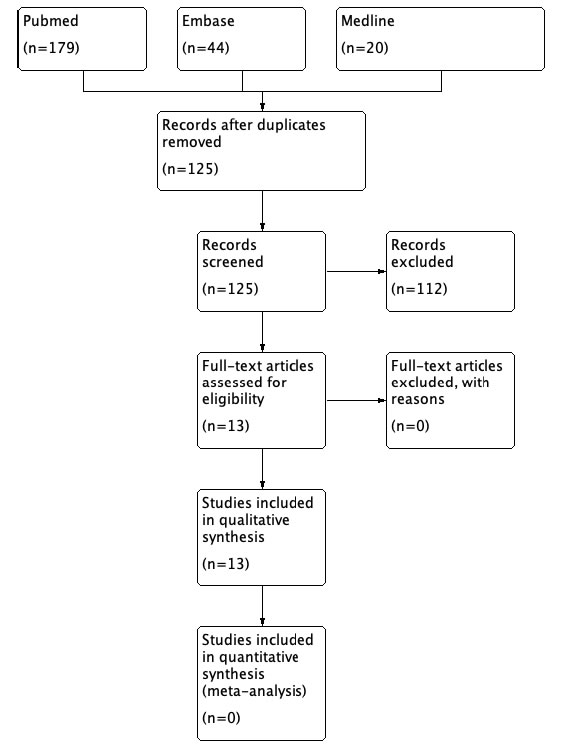
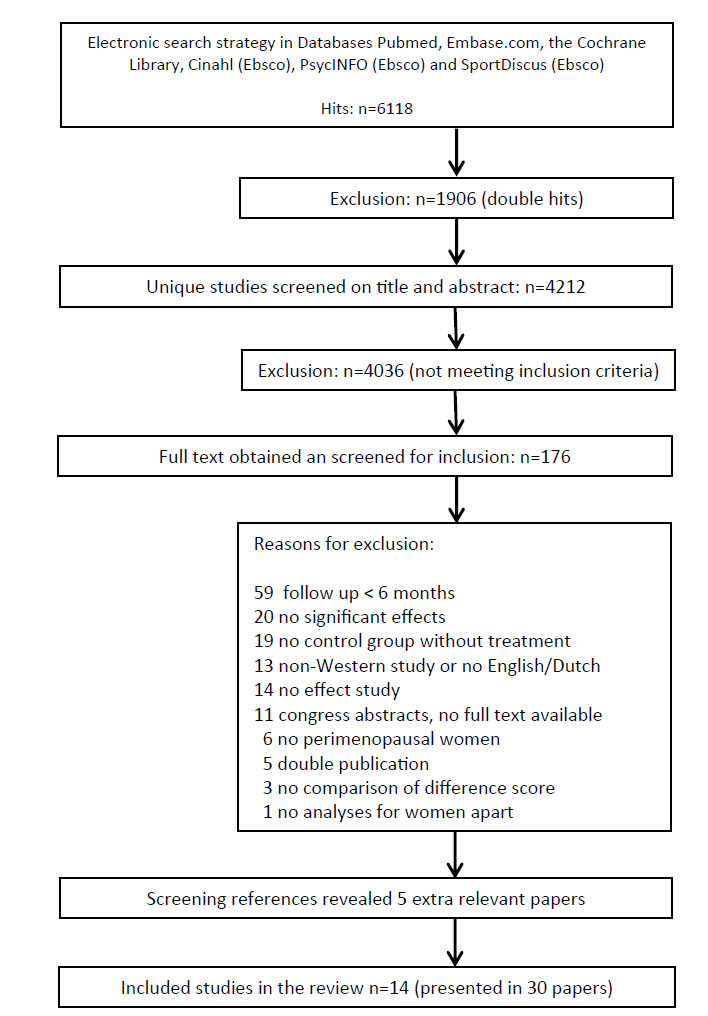
The titles, abstracts and full articles were independently screened by the authors. Following the PRISMA guidelines in PRISMA flow diagram, the study profile is shown in Figure 1. Duplicate articles were removed, and reasons for exclusions are documented in the table in Appendix. Quality assessments were assessed by CASP appraisal on each study (if appropriate). Bias or quality issues were minimized by cross-checking of quality assessments by the authors.

JPPR-3-2-312-g001

Figure 1. Study profile (PRISMA Flow Diagram).

Data Extraction and Bias Assessment

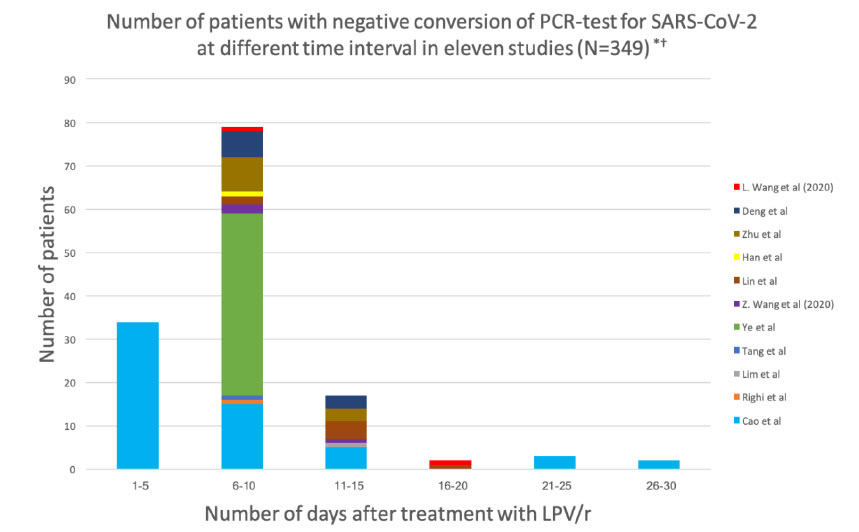
Data extraction was performed by Zhipeng Yan and Ching-Lung Lai with specific focus on: study design, population demographics, therapeutic outcomes, adverse events and other key findings (if appropriate). The principal source of potential bias was the lack of standardization of outcome measures: viral loads were measured after different days of treatment with LPV/r, usually without continuous monitoring. This review used a time-interval approach, with 5-days units, to assess the time for patients to become negative for PCR test for SARS-CoV-2. Patient recovery was classified into six different groups: 1-5 days, 6-10 days, 11-15 days, 16-20 days, 21-25 days and 26-30 days. Assessment was based on the reported data; without authors for extra or missing information.

Data Analysis

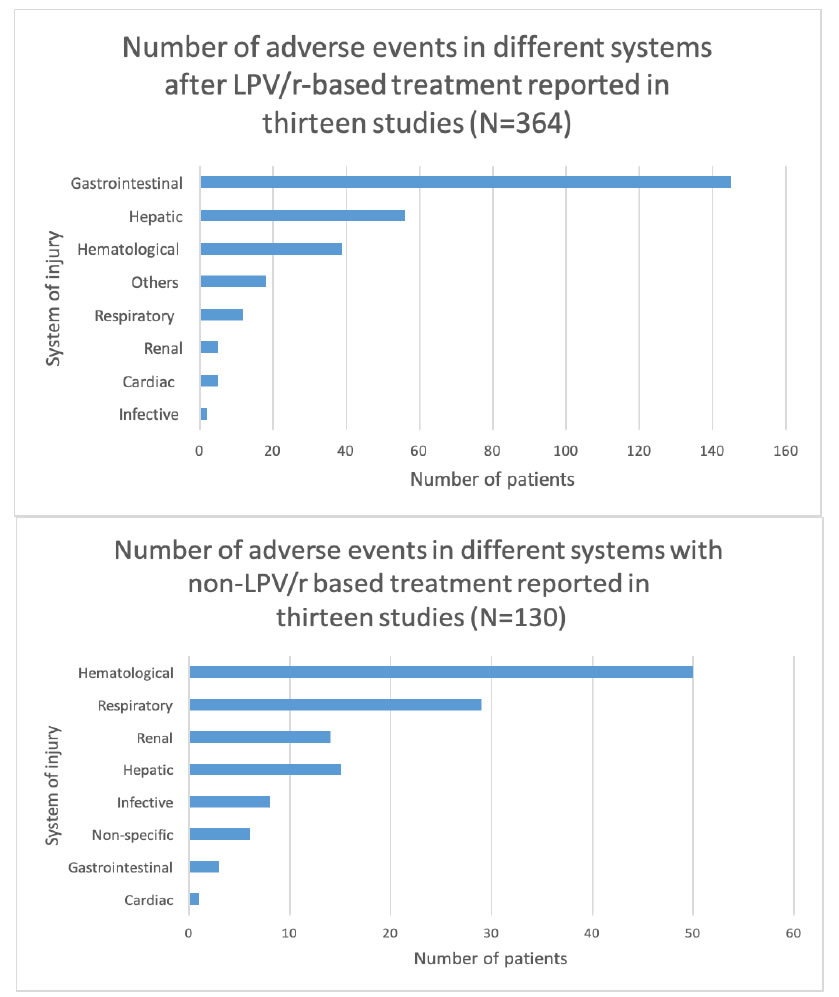
The following were analysed to assess the efficacy of LPV/r in COVID-19 patients: the time to obtain a negative-conversion of PCR test for SARS-CoV-2 and the number of adverse events affecting different systems. All analyses were conducted using Microsoft Excel 2013.

Results

As of 9 May, 2020, 243 articles were identified initially. Using the PRISMA guidelines, the reasons for inclusion and exclusion are presented in a PRISMA flow diagram (Figure 1).

Thirteen studies were finally included (Table 1) :randomised clinical trial (n=2), case reports (n=5), retrospective cohort study (n=3), and case series (n=3). Ten out of the thirteen (76.9%) studies were conducted in China including Hong Kong, and one each from Italy, South Korea and Spain.A total of 494 patients were reported in the studies. The mean age was 52.8 years (excluding the seventh study in Table 1 because data on age were not complete). The outcome measures included time to clinical improvements, days to achieve negative-conversion in PCR detection for SARS-CoV-2 and mortality (Tables 1 and 2).

Table 1: Summary of the thirteen selected studies.

Name of the study

Cityandcountry

Sample size

Age(mean)

Gender

Type of study

Therapeutic treatment

Type/Number of patients & %

Outcomes(recovery/mortality)

Quality assessment(applicable/inapplicable)

1

Cao, B., Wang, Y., Wen, D., et al. A Trial of Lopinavir-Ritonavir in Adults Hospitalized with Severe Covid-19. N Engl J Med 2020. May 7. DOI:10.1056/NEJMoa2001282

Wuhan,China

199

58 Y

120 M
79 F

Randomized
controlled trial

LPV/r

LPV/r:
99 patients, (49.7%)

Standard Care:
100 patients, (50.3%)

-No benefit was observed with LPV/r treatment beyond standard care in severe COVID-19 patients.

-19 patients on intervention arm died.

-3 premature deaths in LPV/r group within 24 hours after randomization

-A focused issue addressed.

-Randomization performed with intention-to-treat analysis.

-Population were properly accounted their inclusion

-Not blinded.

-Baseline demographics was similar in both groups.

-Primary outcome clearly specified.

-Showed little benefits without statistical significance.

-Total 5 patients dropped out: 3 premature death, 2 failedprescriptions of LPV/r by physician.

2

Hung IFN LK, Tso EYK, et al. Triple combination of interferon beta-1b, lopinavir–ritonavir, and ribavirin in the treatment of patients admitted to hospital with COVID-19: an open-label, randomised, phase 2 trial. Lancet. 2020.May 8.
DOI:10.1016/S0140-6736(20)31042-4

Hong Kong,
China

127

52 Y

68 M
59 F

Randomised controlled trial

LPV/r +
IFN-ß* + ribavirin

LPV/r + IFN-ß + ribavirin:
86 patients,
(67.7%)

LPV/r control group:
41 patients
(32.2%)

-Triple therapy group had a significantly shorter median time for negative-conversion PCR test for SARS-CoV-2:
Triple therapy group
(7 days, [IQR 5-11]) vs. control group
(12 days [IQR 8-15]); hazard ratio 4.37
[95% CI 1.86-10.24], p=0.0010

-Triple therapy group achieved a significantly shorter median time to National Early Warning Score 2 (NEWS2) of 0:
Triple therapy group
(4 days, [IQR 3-8]) vs. control group
(8 days, [IQR 7-9]), p<0.0001.

-Triple therapy achieved a significantly shorter median time to Sequential Organ Failure Assessment (SOFA) score to reach zero:
Triple therapy group
(3.0 days, [IQR 1.0-8.0]) vs.
control group
(8.0 days, [IQR 6.5-9.0])

-Shorter median duration of stay in triple therapy group:
triple therapy group
(9 days; [IQR 7-13]) vs. control group (14.5 days, [IQR 9.3-16.0])

-No patient died.

-A focused issue addressed.

-Randomization performed.

-Population were properly accounted their inclusion.

-Not blinded.

-Baseline demographics was similar in both groups.

-Primary outcome clearly specified.

-Secondary outcome clearly specified.

-1 patient in control group dropped out due to biochemical hepatitis.

3

Righi, G., & Del Popolo, G. COVID-19 tsunami: the first case of a spinal cord injury patient in Italy. Spinal Cord Ser Cases 2020, 6: 22.

Firenze,
Italy

1

56 Y

1 M

Case report

LPV/r, and HCQ†

LPV/r and HCQ:
1 patient
(100%)

-Fever subsided 2 days after treated with LPV/r and HCQ.

-Low-dose oxygen therapy was not required 3 days after treated with LPV/r and HCQ.

-Use of combination treatment that masked the real therapeutic outcome of LPV/r.

-In contrast to the spinal cord injury-induced immune depression syndrome, the patient was discharged with complete healing within 2 weeks.

-Reported that absence of cough as the presenting symptoms in spinal cord injury.

-Only one case.

-Side effects of medication not reported.

4

Lim, J., Jeon, S., Shin, H. Y., et al. Case of the Index Patient Who Caused Tertiary Transmission of COVID-19 Infection in Korea: the Application of Lopinavir/Ritonavir for the Treatment of COVID-19 Infected Pneumonia Monitored by Quantitative RT-PCR. J Korean Med Sci 2020, 35: e79.

Goyang,
South Korea

1

54 Y

1 M

Case report

LPV/r

LPV/r:
1 patient
(100%)

-Fever subsided 5 days after treatment with LPV/r.

-Undetectable viral load since the second day after taking LPV/r.

-Difficult to determine whether recovery was due to natural cause or use of LPV/r, due to the late administration of drugs.

-Only one case.

5

Fernandez-Ruiz, M., Andres, A., Loinaz, C., et al. COVID-19 in solid organ transplant recipients: a single-center case series from Spain. Am J Transplant 2020. Apr 16.
DOI:10.1111/ajt.15929

Madrid,
Spain

18

71 Y

14 M
4 F

Single centre retrospective
case series

LPV/r

HCQ

IFN-ß

IVIg‡

Tocilizumab

No antivirals

LPV/r:
1/18 (5.56%)

LPV/r + HCQ:
6/18 (33.3%)

LPV/r + HCQ + IFN-ß:
2/18 (11.1%)

HCQ:
5/18 (27.8%)

HCQ + IVIg:
1/18 (5.56%)

HCQ + IFN-ß:
1/18 (5.56%)

no anti-viral:
2/18 (11.1%)

-A total of 5 deaths: 4 receiving LPV/r died, and 1 receiving standard care without anti-viral agent died.

-For patients on HCQ, 2 showed clinical improvements, 1 showed mild ARDS, 1 showed persistent respiratory failure and 1 died.

-For patients on LPV/r together with HCQ, 2 showed clinical improvement and discharged. The other 3 showed persistent respiratory failure, mild ARDS and death respectively.

-The patient on HCQ and IVIg was discharged.

-The patients on LPV/r, HCQ and IFN-ß were discharged home.

-Patients received no antivirals resulted in 1 death and 1 low-grade fever till the end of study.

-Small sample size.

-No numerical data provided to tell the efficacy of drugs by measurement of viral load change during the study.

-Single centre.

-Only 2 patients performed cytokine study.

-Side effect of drugs not reported.

6

Tang, B., Li, S., Xiong, Y., et al. Coronavirus Disease 2019 (COVID-19) Pneumonia in a Hemodialysis Patient. Kidney Med 2020. Mar 12. DOI::10.1016/j.xkme.2020.03.001

Zhongshan,
China

1

50 Y

1 M

Case report

LPV/r and moxifloxacin

LPV/r:
1 patient
(100%)

-Nucleic acid test of SARS-CoV-2 turned negative in throat swab after 8 days of treatment.

-No observable side effects of LPV/r.

-Only one case.

-Use of moxifloxacin might masked the real therapeutic effect of LPV/r.

7

Ye, X. T., Luo, Y.L.,
Xia, S. C., et al.
Clinical
efficacy of
lopinavir/ritonavir in the treatment of Coronavirus disease 2019. Eur Rev Med Pharmacol Sci 2020, 24, 3390-3396.

Rui’an,
China

47

9 under 30 Y

38 over 30 Y

22 M
25 F

Single centre retrospective cohort study

LPV/r

Adjuvant drugs§

LPV/r:
42/47 (89.4%)

Adjuvant drugs:
5/47 (10.6%)

-Fever subsided earlier in test group.
(test group 4.8±1.94 days
vs
control group 7.3±1.53 days, p=0.0364)

-Shorter SARS-nCoV-2 RNA negative conversion time in test group.
(test group 7.83.09 days
vs
control group
12.0±0.82 days, p=0.0219)

-No observed liver toxicity.

-Single centre study.

-Unbalanced treatment arm and control arm.

8

Wang, Z., Chen, X.,
Lu, Y., Chen, F., and Zhang, W.
Clinical characteristics
and therapeutic
procedure for four
cases with 2019 novel
coronavirus
pneumonia receiving
combined Chinese
and Western medicine
treatment. Biosci
Trends 2020, 14:64-68.

Shanghai,
China

4

44.3 Y

3 M
1 F

Single centre
retrospective
observational case series

LPV/r

Arbidol

SFJDC¶

All received LPV/r, arbidol or SFJDC; or a combination of them. Detailed distribution was not provided.

-2 patients discharged with confirmed negative PCR on 2 consecutive throat swab 2019-nCoV test.

-1 patient was negative on the first virus testing of 2019-nCoV.

-All patients showed chest radiography improvement after 5-15 days of taking
anti-viral agents.

-Side effects of medication were not observed.

-Failed to mention exact regime for each patient.

-Small sample size to assess the effect of combined Chinese and western medicine treatment for COVID-19.

9

Liu, F., Xu, A., Zhang, Y., et al. Patients of COVID-19 may benefit from sustained lopinavir-combined regimen and the increase of eosinophil may predict the outcome of COVID-19 progression. Int J Infect Dis 2020. Mar 12.DOI:10.1016/j.ijid.2020.03.013

Hangzhou
China

10

42 Y

4 M
6 F

Single centre retrospective
observational case series

LPV/r

IFN-ß:

LPV/r + IFN-ß:
9/10 (90%)

LPV/r:
1/10 (10%)

-The patient on LPV/r alone was discharged after 3 days of treatment.

-3 patients on LPV/r + IFN-ß developed serious complications, persistent SARS-CoV-2 RNA PCR test positive and were transferred to more specialised unit, all presented with low eosinophil counts.

-5 patients on “LPV/r + IFN-ß” developed severe O2 desaturation <93%.

-No reported acute myocardial injury nor acute kidney injury.

-Small sample size in a single centre.

-Failed to provide the treatment details and subsequent clinical progress of the 3 transferred patients.

10

Han, W., Quan, B., Guo, Y., et al.The course of clinical diagnosis and treatment of a case infected with coronavirus disease 2019. J Med Virol 2020, 92: 461-463.

Wuwei,
China

1

47 Y

1 M

Case report

LPV/r

Steroid

IFN-α2b||
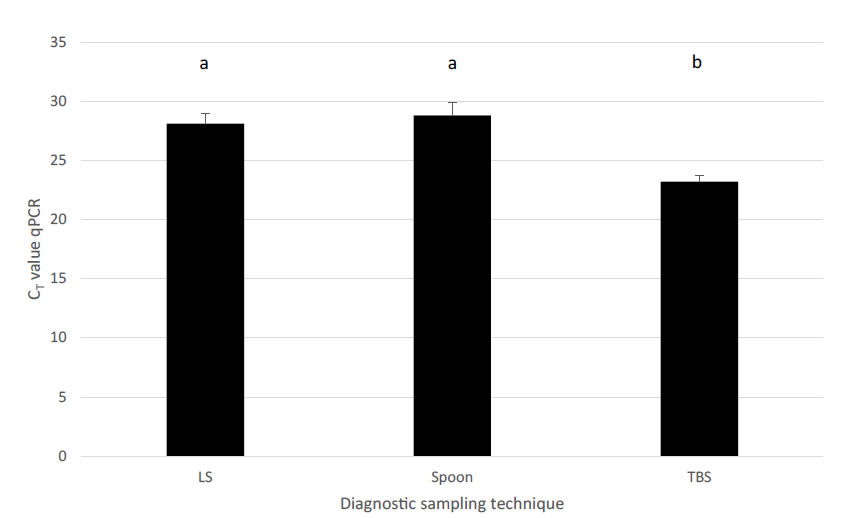
Ambroxol

Moxifloxacin

LPV/r:
1 patient
(100%)

-PCR tests for
SARS-CoV-2 were persistently negative on day 6 and 7.

-Discharged on day 10 with no reported complications during treatment period.

Failed to address whether the clinical improvement was due to LPV/r or other drugs.

11

Zhu, Z., Lu, Z., Xu, T.,
et al.Arbidol
monotherapy is
superior to
lopinavir/ritonavir in
treating COVID-19. J
Infect 2020. Apr 10.
DOI:10.1016/j.jinf.2020.03.060

Changzhou
and Wuhu,
China

50

36.0 Y

26 M
24 F

Retrospective cohort study

LPV/r

Arbidol

LPV/r:
34/50 (68%)

Arbidol:
16/50 (32%)

-None developed severe pneumonia or ARDS.

-On day 7 after treatment, higher percentage of patients with undetectable viral load in Arbidol group (50%) vs. LPV/r group (23.5%).

-On day 14 after treatment, all patients were with undetectable viral load in Arbidol group (100%) vs. LPV/r group (55.9%).

-Patients with arbidol had a shorter duration of RNA positive period. (p<0.01)

Unbalanced treatment arm and control arm.

12

Deng, L., Li, C., Zeng,
Q., et al.Arbidolcombined with LPV/rversus LPV/r aloneagainst Corona VirusDisease 2019: Aretrospective cohortstudy. J Infect 2020.Mar 11. DOI:10.1016/j.jinf.200.03.002

Zhuhai
China

33

44.6 Y

17 M
16 F

Retrospective cohort study

LPV/r

LPV/r + arbidol

LPV/r:
17/33 (51.5%)

LPV/r + arbidol:
16/33 (48,.5%)

-On day 7, more patients were tested PCR negative for SARS-CoV-2 in respiratory sample in combination group [12/16 (75%) patients] than monotherapy group [6/17 (35%) patients].

-On day 14, more patients were tested PCR negative for SARS-CoV-2 in respiratory sample in combination group [15/16 (94%) patients] than monotherapy group [9/17 (53%) patients]

-Small sample size.

-Non-randomized study.

-Selection and unmeasured confounding bias.

13

Wang L, Xu X, Ruan J,
Lin S, Jiang J, Ye H.
Quadruple therapy for
asymptomatic COVID-
19 infection patients.
Expert Rev Anti Infect
Ther. 2020. May 3.
DOI:10.1080/14787210.2020.1758066

Fujian
China

2

54.5 Y

1 M
1 F

Case report

LPV/r + arbidol + Lianhuaqingwen +
IFN-α2b
(quadruple therapy)

Quadruple therapy:
2
(100%)

-The Male and female patient had a negative PCR-test for SARS-CoV-2 after 7 days and 17 days respectively.

-After receiving quadruple therapy, CT improvement was obtained after 10 days in male patient, and 8 days in female patient.

-Only two cases.

-No control group to show the relative efficacy of quadruple therapy.

Abbreviation:
*IFN-ß: interferon-beta
†HCQ: hydroxychloroquine
‡IVIg: Intravenous Immunoglobulins
§ adjuvant drugs: interferon, arbidol, asmeton, eucalyptol limonene and penene entericsoft capsules and moxifloxacin.
¶SFJDC: Shufeng Jiedu Capsule
|| IFN-α2b: Interferon-alpha-2b.

Table2: Change of viral load, time to clinical improvement and reported side effects in thirteen studies.

Author

PCR finding of change of viral load after LPV/r-based treatment

Time to clinical improvement after LPV/r-based treatment

Adverse events (percentage of patients)

Cao et al. (2020) [20]

Percentage of patients with undetectable level SARS-CoV-2 by PCR in both arm was similar:
(Treatment arm vs. control arm)
Day 5: 34.5% vs. 32.9%
Day 10: 50.0% vs. 48.6%
Day 14: 55.2% vs. 57.1%
Day 21: 58.6% vs. 58.6%
Day 28: 60.3% vs. 58.6%
p-value not reported.

1.No significant difference when assessed by improvement in National Early Warning Score 2 (NEWS2) in intention-to-treat analysis.

2.Slightly shorter median time to obtain clinical improvement in treatment arm. Treatment arm requires 15 days and standard care requires 16 days (hazard ratio, 1.39; 95% CI, 1.00 to 1.91). But this was without statistical significance.

Lymphopenia (8.0%)
Respiratory failure (6.0%)
Nausea (4.5%)
Leukopenia (3.0%)
Thrombocytopenia (3.0%)
Abdominal discomfort (4.0%)
Diarrhoea (2.0%)
Stomach ache (2.0%)
Neutropenia (2.0%)
Increased total bilirubin (1.5%)
Severe anaemia (1.5%)
Acute kidney injury (1.5%)
Increased creatinine (1.0%)
Anaemia (1.0%)
Rash (1.0%)
Decreased appetite (1.0%)
Shock (1.0%)
Acute gastritis (1.0%)
Haemorrhage of lower digestive tract (1.0%)
Hypoalbuminemia (0.5%)
Unconsciousness (0.5%)
Prolonged QT interval (0.5%)
Facial flushing (0.5%)
Sleep disorders (0.5%)
Secondary infection (0.5%)
Disseminated intravascular coagulation (0.5%)
Pneumothorax (0%)
Sepsis (0%)
Acute heart failure (0%)

Hung et al.
(2020) [27]

Earlier PCR test negative-conversion for SARS-CoV-2 in triple therapy group in all specimens (nasopharyngeal swab, posterior oropharyngeal swab saliva, throat swab and stool):

[Triple therapy group]
Median time is 8 days,
IQR: 6-12 days

[Control group]
Median time is 13 days,
IQR: 8-15 days

The reported p-value is 0.0010.

1.Earlier achievement of NEWS2 of 0 in triple therapy group (median is 4 days, IQR= 3 – 8 days) relative to control group (median is 8 days,
IQR: 7 – 9 days). The p-value is <0.0001.

2.Earlier achievement of sequential organ failure assessment (SOFA) score of 0 in triple therapy group (median is 3.0 days; IQR:1.0-8.0 days) relative to control group (median is 8.0, IQR: 6.5 to 9.0 days). The p-value is 0.041.

Nausea (33.9%)
Diarrhoea (40.9%)
Rise of ALT (14.2%)
Hyperbilirubinemia (5.51%)
Sinus bradycardia (3.15%)

Righi et al. (2020) [15]

PCR nasopharyngeal swab turned negative on day 6 after treatment with LPV/r associated with hydroxychloroquine.

Fever ceased 2 days after LPV/r associated with hydroxychloroquine therapy.

No data.

Lim et al. (2020) [10]

PCR turned negative after 8 days treatment with LPV/r.

Fever ceased 6 days after treatment.

Psychiatric symptoms such as depression, insomnia, and suicidal thoughts (100%)

Fernandez-Ruiz
et al. (2020) [26]

No numerical data.

6 patients were discharged between 8 to 23 days with adjustment of immunosuppressant dosage.

2 asymptomatic patients were on outpatient follow-up without any complication during treatment period.

No data.

Tang et al. (2020) [11]

PCR turned negative after 8 days treatment with LPV/r.

CT and laboratory test results showed improvements after 8 days of LPV/r.

Not observable.

Ye et al. (2020) [12]

PCR test turned negative in LPV/r group earlier.
(test group: 7.8 ± 3.09 days vs. control group: 12.0 ± 0.82 days, p=0.0219)

1.Earlier return to normal body temperature in test group.
(test group: 4.8 ± 1.94 days vs. control group: 7.3 ± 1.53 days, p=0.0364)

2.Lower abnormal proportion of White blood cells, lymphocytes,
C-reactive protein (CRP) and platelets in test group.

3.Lymphocytes, haemoglobin, granulocytes and CRP gradually decreased throughout the tests.

Liver biochemistry derangement.

First measurement of liver biochemistry after treatment:

[Treatment group]
Rise of ALT (9.5%)
Rise of AST (19%)

[Control group]
Rise of ALT (25%)
Rise of AST (25%)

Conclusion:Liver biochemistry derangement was not associated with side effects of medications.

Wang et al. (2020) [13]

4 patients were reported, their time taken to turn PCRnegative were 9,7,12 days and unreported in the 4th patient who was severely ill.

1.Time taken to obtain CT improvement was 9 days, 9 days, 6 days and 11 days.

2.2 patients obtained improvement of arterial blood gas (ABG) parameter after 5 days and 11 days of treatment. 1 patient was with normal ABG throughout and the days taken for the 4th patient to obtain ABG improvement was unreported.

No data.

Liu et al. (2020) [14]

In the 7 discharged patients, viral load decreased continuously during day 3 to 14.Negative conversion of PCR was demonstrated 3 days after treatment in 1 patient, and 7-14 days in the remaining 6 patients.
(Average=11.7 days,
range=7-18 days)

3 remaining patients were with respiratory complications and transferred to other hospital. Their PCR remained positive before they were transferred, despite they were receiving LPV/r.

1.In the 7 discharged patients, radiograph improved continuously between day 6 and day 8.
2.Fever subsided after 4 days of treatment in the 7 discharged patients.

Hypokalaemia (70%)
Digestive upsets (50%)
Acute myocardial injury (0%)
Acute kidney injury (0%)

Han et al. (2020) [57]

The patient obtained PCR test negative-conversion for SARS-CoV-2 on day 6 after treatment.

CT improvement shown since day 6 and discharged on day 7.

No data.

Zhu et al. (2020) [29]

On day 7, higher proportion of patients with undetectable viral load in arbidol group (50%) than LPV/r monotherapy group (23.5%).

On day 14, higher proportion of patients with undetectable viral load in arbidol group (100%) than LPV/r monotherapy group (55.9%).

Shorter duration of positive RNA test in arbidol group patients compared with LPV/r group (p<0.01).

Higher percentage of patients with fever subsided within 7 days in arbidol group (88.2%) vs. LPV/r monotherapy group (81.3%).

Rise of ALT (17.6%)
Leukopenia (8.8%)

Deng et al. (2020) [25]

On day 7, higher proportion of patients obtained PCR test negative-conversion for SARS-CoV-2 in “LPV/r + Arbidol” combination group (75%) than LPV/r monotherapy group (35%), p<0.05.

On day 14, higher proportion of patients obtained PCR test negative-conversion for SARS-CoV-2 in “LPV/r + Arbidol” combination group (94%) vs. LPV/r monotherapy group. (53%), p<0.05.

Fewer patients showed PCR positive for stool SARS-CoV-2 in combination group (1 patient) vs. monotherapy group (3 patients).

On day 7, more patients gained CT improvement in combination group (69%) than monotherapy group (29%), p<0.05.

Elevated bilirubin (68.7%)
Digestive upsets (43.7%)
Depression (0%)
Acute confusion (0%)

Wang
et al.
(2020) [58]

On day 7, the male patient obtained a negative conversion of PCR test for SARS-CoV-2.
On day 17, the female patient obtained a negative conversion of PCR test for SARS-CoV-2.

1.Patients were asymptomatic throughout the treatment period.

2.The male patient showed CT improvement 10 days after treatment.

3.The female patient showed CT improvement 8 days after treatment.

Reported no adverse events

Studies with LPV/r in treatment regimen were classified as LPV/r-based treatment (N=364), whether as monotherapy or in combination with other agent(s). Non-LPV/r based treatment (N=130) included standard care only (N=99), hydroxychloroquine (N=9), arbidol (N=21). Standard care comprised of supplemental oxygen, non-invasive and invasive ventilation, antibiotics, vasopressor support, renal replacement therapy and extracorporeal membrane oxygenation (ECMO). Among the thirteen studies, four studies had non LPV/r-based treatment (Cao et al, Fernandez et al, Ye et al. and Zhu et al). Cao et al. included standard care only; Fernandez et al. included hydroxychloroquine, Ye et al. and Zhu et al. included arbidol.

Figure 2 shows the number of patients with PCR negative-conversion for SARS-CoV-2 at different time intervals.

JPPR-3-2-312-g002

Figure 2. Number of days after LPV/r-based treatment and number of patients with negative conversion of PCR test for SARS-CoV-2 in eleven studies.
*The study by Fernandez et al. is excluded: authors did not provide data on negative conversion of PCR test for SARS-CoV-2.
†The study by Hung et al. is excluded: the data were in median and inter-quartile range (IQR).

Figure 3 shows the number of adverse events in LPV/r-based treatment group and non-LPV/r based treatment group in the thirteen studies.

JPPR-3-2-312-g003

Figure 3. Total number of adverse events in different systems A) LPV/r-based treatment group reported in thirteen studies (N=364). B) non-LPV/r based treatment group in thirteen studies (N=130).

The distribution of adverse events in each system in respective treatment groups are as shown in Figures 4 and 5 respectively.

JPPR-3-2-312-g004

Figure 4. Distribution of adverse events in different systems in LPV/r-based treatment group in thirteen studies. (N=364).

JPPR-3-2-312-g005

Figure 5. bution of adverse events in different systems in non-LPV/r based treatment group in thirteen studies (N=130).

Discussion

This is the first comprehensive review on the use of LPV/r in COVID-19 patients. The 13 eligible articles include two randomised clinical trials; others were case reports, retrospective cohort studies or case series. LPV/r and its combination with other medications have been reported, including arbidol, interferons, ribavirin, hydroxychloroquine/chloroquine, intravenous immunoglobulins, antibiotics, corticosteroid and Chinese medicine. Quality assessment was applied to the thirteen articles. However, evidence was insufficient to conduct a meta-analysis. Most articles are of low quality; the study designs were not consistent. The studies also showed discordance in conclusions. In spite of these limitations, this review provides updated information on the therapeutic effects of LPV/r in COVID-19 patients.LPV/r had been regarded as the key therapeutic for treatment of COVID-19 patients. Its effectiveness was first proven in in vitro experiment, and included in the third amendment of the Chinese CDC treatment guidelines for severe novel coronavirus infection. De wildeet al. (2014) reported that with mean EC50 of lopinavirranging from 6.6 to 17.1 μM, lopinavir showed effective anti-viral outcome against SARS-CoV, MERS-CoV and hCoV-229E in vitro [16]. However, this was not observed with ritonavir. Previously Chu et al. (2004) reported that a lower rate of development into acute respiratory distress or death was observed in SARS patients receiving LPV/r, when compared with the control group treated with ribavirin and corticosteroids [17]. Since SARS-CoV-2, SARS-CoV and MERS-CoV are all beta-coronaviruses, it has been hypothesized that LPV/r may be effective to combat SARS-CoV-2.Choy et al. (2020) reported that lopinavir (EC50 at 26.1 μM) reduces viral RNA copy of SARS-CoV-2 in vitro, but not with ritonavir alone [18]. This is consistent with the finding of De wildeet al. (2014) on the effect of LPV/r on SARS-CoV. However, ritonavir is used with lopinavir in 1:4 ratio because it increases lopinavir bioavailability in vivo, as seen in HIV patients [19]. In the thirteen selected studies (Figure 2), most supported the use of LPV/r as a viable anti-viral agent for SARS-CoV-2. Patients were responsive to treatment with negative-conversions of PCR testing for SARS-CoV-2 after 5 to 28 days of treatment, and clinical improvement was observable as early as 2 days as reported by Lim et al. [10]. For those responsive to treatment, the majority of them had a SARS-CoV-2 negative-conversion time between 6 days to 10 days.

However, there are discordances concerning the efficacy of LPV/r for COVID-19. Liu et al. reported three severe patients receiving LPV/r who showed no obvious clinical improvement; their clinical conditions worsened and were transferred to specialised care hospital [14]. In the randomised, controlled, open-label trial involving 199 severe COVID-19 patients with median National Early Warning Score 2 (NEWS2) of 5 reported by Cao et al. , the intention-to-treat analysis showed median time to clinical improvement was only shortened by 1 day compared to the control group with standard care [20]. (hazard ratio, 1.39, 95% CI, 1.00 to 1.91). There was a better outcome of 28-day mortality (treatment group:19.2% vs standard care group: 25%; difference: -5.8%; 95% CI, -17.3 to 5.7), shorter median days of stay in Intensive Care Units (treatment group:6 days vs standard care group:11 days; difference: -5 days; 95% CI, -9 to 0) and higher percentage of patients with clinical improvement at day 14 (treatment group: 45.5% vs standard care group:30.0%; difference:15.5 percentage points; 95% CI, 2.2. to 28.8) [20]. But none of these reached statistical significance. It was concluded that LPV/r added to standard supportive care was not associated with clinical improvement or mortality in severe COVID-19 patients. However, Hung et al. showed that LPV/r-based triple therapy is effective in a study of 127 non-severe COVID-19 patients with median NEWS2 of 2, by shortening the PCR negative-conversion time to within a week in more than half of the patients.Most of the other studies with promising effects of LPV/r recruited patients with non-severe SARS-CoV-2 infection.

Severe COVID patients are defined with the following characteristics by the Chinese CDC in their Seventh Amendment of COVID-19 guideline [21]:

1. Dyspnea and tachypnea ≥ 30 breaths per minute

2. Blood oxygen saturation ≤ 93% when not in exertion

3. PaO2/FiO2 ≤ 300 mmHg.

4. Signs of respiratory failure, shock, multi-organ failure or need of mechanical ventilation and ICU admission.

In view of the insufficient clinical data to date, additional larger scale double-blinded randomized controlled trials, with classification of patient’s clinical status into severe and non-severe type, should be carried out before LPV/r can be adopted in international guidelines. Currently, it is advisable for physicians to classify the severity of COVID-19 patients. It is likely that LPV/r may be effective in reducing viral load in non-severe COVID-19 patients, but its benefits remain questionable in severe patients. Severe COVID-19 is associated with immunopathological damages such as diffuse alveolar damage with hyaline membrane formation [22]. This may be caused by cytokine storms or inflammatory processes [23]. Since 19% of patients have the severe form[24], patients should be classified soon after admission. Once recognised, they should be treated to minimize the cytokine storm. Steroid was used as adjuvant therapy in some studies [12,14,25-27]. This is debatable because Auyeunget al. (2005) showed that use of steroid was associated with adverse outcomes in SARS [28]. Combining LPV/r with other drugs seems to be an effective modality of treatment. Zhu et al. reported that arbidol monotherapy achieved better reduction of viral load to an undetectable level than LPV/r monotherapy on day 7 (arbidol: 50% vs LPV/r:23.5%) and on day 14 (arbidol:100% vs 54.9%) [29]. Deng et al. reported that an even higher proportion of negative-conversion of PCR test for SARS-CoV-2 could be achieved with “arbidol and LPV/r” combination therapy (Day 7: 75%, Day 14: 94%)than LPV/r monotherapy (Day 7:35%, Day 14: 53%) [25]. Hung et al. showed that an earlier PCR negative-conversion was also obtained in LPV/r-based triple therapy (median=8 days, IQR=6-12 days) than control group (median=13 days, IQR=8-15 days), p-value=0.0010. Combinations with remdesivir and hydroxychloroquine should also be studied together with LPV/r to explore the more effective combinations, they being inhibitors of SARS-CoV-2 through mediation of viral polymerase and the proofreading exoribonuclease [30,31]. Clinical usage of LPV/r requires extra care in special populations. Fernandez et al. reported 18 post-organ transplant patients on immunosuppressants. Therapeutic regimens and dosages were adjusted when LPV/r was initiated [26]. Calcineurin and mammalian target of rapamycin (mTOR) inhibitors were stopped, and prednisolone was reduced by 50% in these patients. The serum trough concentrations of LPV/r were obtained after 48-72 hours, with close monitoring for adjustment of dosage. The dosage of mycophenolate mofetil/mycophenolic acid (MMF/MPA) was decreased in patients receiving LPV/r. Similarly in the studies by Fan et al. and Zhang et al. on renal transplant recipients, patients were given reduced dosage of immunosuppressants and methylprednisolone [32,33]. When patients developed severe graft rejection, consideration of alternative antiviral and continuation of corticosteroid at reduced dose has been suggested [34]. Another group for special consideration are cancer patients due to drug interaction with CYP3A4, a common pathway for chemotherapeutic agents. Liang et al. showedthat cancer patients with COVID-19 were associated with higher risks of severe events compared to patients without cancers [35]. This might be due to the leukopenia and lymphopenia commonly found among COVID-19 patients [36], leading to a higher risk of super-infections. In addition, the dosage of some chemotherapeutic agents may require readjustment [37] such as docetaxel [38] anderlotinib [39]. Therefore, in managing drug interactions between chemotherapeutic and antiviral agents, it is advised to consider the following [35]:

1. Intentional postponing of adjuvant chemotherapy or elective surgery for stable cancer;

2. Strong personal protection provisions for cancer patients and survivors;

3. More intensive surveillance or treatment when cancer patients are infected with SARS-CoV-2, especially in older patients and those with comorbidities.

Another patient group with immunocompromised state are patients on hemodialysis. Hemodialysis predisposes to chronic immunocompromised state due to disorders of B cell and T cell function [40,41]. T cells play a vital role for patients’ recovery from other beta-coronavirus infection[42-44]. But lymphopeniais commonly observed in hemodialysis patients [45]. No dose adjustment is deemednecessary in the treatment of hemodialysis patients with COVID-19, probably due to the liver clearance and the high protein-binding capacity of LPV/r [26].The effects of COVID-19 on pregnancy are noteworthy. Li et al. summarized the outcomes of 55 pregnant COVID-19 women and 46 neonates: vertical transmission to neonates was not observed[46,47].This was further confirmed by Chen et al. [47]: 3 out of 4 infants tested negative for SARS-CoV-2 (consent was not obtained for the forth infant).Use of LPV/r in pregnancy is safe, as documented by a study of population-based surveillance in HIV-positive pregnancies. It found no increase in the risk of foetal anomalies, preterm birth nor low-birth weight infants [48]. This was further confirmed in pregnant mothers with COVID-19. However, it is advisable to have close surveillance of both the mothers and the neonates. In case of maternal hypoxia due to SARS-CoV-2 infection, there would be an increase of endothelin-1 and hypoxia-inducible factor, impairing placental perfusion to the fetus [49]. Therefore, at least one ultrasound after maternal recovery is recommended to monitor the potential intra-uterine growth retardation, which was observed in approximately 10% of COVID-19 pregnancies. However, SARS-CoV-2 infection during pregnancy was not found to be associated with an increased risk of spontaneous abortion and preterm birth [50]. Chen et al. did a study involving 118 pregnancy women and found that SARS-CoV-2 infection during pregnancy did not increase the risk of severe disease among pregnancy women. The risk is only half of that in the general population [51]. Pregnant women are at higher risks of hypercoagulability than the general population. Physicians should monitor possible thromboembolic events in severe COVID-19 pregnancy, because the incidence of venous thromboembolism is more than 30% in severe COVID-19 patients [52]. The side effects of LPV/r need to be monitored. These include nausea, vomiting, gastrointestinal disturbances, pancreatitis, hepatotoxicity, QT interval prolongation, PR interval prolongation, and metabolic disturbances [51]. In the 13 studies (Figures 3 and 4), of the 364 COVID-19 patients receiving LPV-r based treatment, 145 patients (39.8%) had gastrointestinal adverse effects after LPV/r treatment. Hepatic injury was observed in 56 patients (15.4%). 12 patients (3.30%) had respiratory failure. Prolongation of QT interval was only observed in 1 patient. Haematological alteration was observed in 39 patients (10.7%). Eight patients (2.20%) showed leukopenia. Granulocytes colony stimulating factor (GCSF)was prescribed whichprevented complications in 3 patients [29]. Other side effects such as metabolic disturbances and PR interval prolongation have not been reported. Because of the possible side effects, patients should be closely monitored. In digestive tract adverse effects, hydration status and electrolytes should be monitored. With severe nausea and vomiting, use of anti-emetics or stopping medication may be possible choices. However, the use of 5-HT3 receptor antagonists and neurokinin-1 receptor antagonists shall be cautious due to their risk of QT prolongation and prolonged serum concentration [53]. Liver biochemistry derangement may be due to the following causes: LPV/r induced, SARS-CoV-2 related or immune-mediated inflammation such as cytokine storm. Liver biochemistry usually returns to normal without specific treatment in mild COVID-19 [54]. Ye et al. reported liver enzyme elevations in both LPV/r-based and non LPV/r-based treatment groups, and it was found to be unrelated to treatment. However, with extensive hepatic damage orpre-existing liver diseases, close monitoring of liver biochemistry should be considered [55]. In immune-mediated inflammation, the use of glucocorticoid is unclear.

Prolonged QT interval and ventricular arrhythmia are two serious adverse effects of LPV/r.The Canadian Heart Rhythm Society has published guidelines on minimizing the risk [56]:

1. Discontinue unnecessary medications that prolong QT interval.

2. Identify low-risk outpatients who do not need further testing (no history of prolonged QT, unexplained syncope or family history of premature sudden cardiac death, no medications
which may prolong the QT interval, and/or prior known
normal QTc.

3. Performing baseline testing in hospitalized and high-risk patients. If the QTc is markedly prolonged, drugs which further prolong QTc should be avoided. Expert consultation may permit administration with mitigating precautions.

Conclusion

With the evidence to date, the review shows that LPV/r may be effective for treating non-severe COVID-19 patients, while only limited benefits are observed in severe COVID-19 patients. Clinical classification and close monitoring of drug dosage and treatment progress are recommended for special populations. Further research on LPV/r, precluding in combination with other drugs, are required to confirm its use for COVID-19 patients.

Evidence before This Study

Published studies on electronic databases such as Pubmed, Embase and Medline on the use of LPV/r in the treatment of COVID-19 patients are conflicting. Previously only an inconclusive rapid review was done. No systematic review nor meta-analysis have been performed to date to evaluate the results. The real therapeutic effect of LPV/r is debatable. A systematic search on the three electronic databases was done on 9 May, 2020 and outputs were gathered for a systematic review of the therapeutic outcome, adverse events and clinical management of special populations. Search terms used included: Lopinavir, SARS-CoV-2, COVID-19. Full peer-reviewed articles that are written in English, published between 2019 and 2020, accessible on the three databases are included in this systematic review.Items without therapeutic data were eliminated.

Added Value of This Study

The review selected thirteen articles with primary therapeutic data to look at the therapeutic effect of LPV/r, number of adverse events, distribution of adverse events in different systems and the precautions in prescribing LPV/r in special populations with COVID-19. Most studies were of low evidence value, with potential experimental bias. Their outcome measures varied. It is likely that LPV/r is effective in treating non-severe COVID-19 patients, but only limited benefits are observed in severe COVID-19 patients. Clinical classification of patients according to the severity of COVID-19 infections should be carried out for a better treatment plan.

Implications of All the Available Evidence

LPV/r may be considered in non-severe COVID-19 patients. Further research of LPV/r, preferably in combination with other antiviral agents, in severe COVID-19 patients is required for more effective treatment.

Contributions

Literature search was done by ZY, KLS and CLL. Searches screening, and article review was done by ZY, KLS and CLL. Study designs were done by ZY,KLS and CLL. Data extraction and analysis was done by ZY and CLL. Data interpretation was done by ZY and CLL. Manuscript writing was done by ZY, KLS and CLL.

Declaration of interests

Prof. Ching-Lung Lai has given sponsored lectures on hepatitis C for Abbvie Inc.

Ethical approval

No ethical approval is required since the whole review is based on published data on readily-accessible databases.

Acknowledgement

None.

Funding

None.

References

  1. Huang C, Wang Y, Li X,Lili Ren, Jianping Zhao,et al. (2020) Clinical features of patients infected with 2019 novel coronavirus in Wuhan, China. Lancet 395: 497-506.
  2. Li Q, Guan X, Wu P,Xiaoye Wang, Lei Zhou, et al. (2020) Early Transmission Dynamics in Wuhan, China, of Novel Coronavirus-Infected Pneumonia. N Engl J Med 382: 1199-1207. [crossref]
  3. Sanche S, Lin YT, Xu C, Romero-Severson E, Hengartner N, et al. (2020) High Contagiousness and Rapid Spread of Severe Acute Respiratory Syndrome Coronavirus 2. Emerg Infect Dis26. [crossref]
  4. WHO. WHO announces COVID-19 outbreak a pandemic. 2020.
  5. WHO. Coronavirus disease (COVID-19) Situation Report– 111. 2020 May 11.
  6. Hassan SA, Sheikh FN, Jamal S, Ezeh JK, Akhtar A (2020) Coronavirus (COVID-19): A Review of Clinical Features, Diagnosis, and Treatment. Cureus12. [crossref]
  7. Chinese Centre for Disease Control and Prevention. Chinese CDC “novel coronavirus infection treatment guideline third amendment”. 2020.
  8. Yao TT, Qian JD, Zhu WY, Wang Y, Wang GQ (2020) A systematic review of lopinavir therapy for SARS coronavirus and MERS coronavirus-A possible reference for coronavirus disease-19 treatment option. J Med Virol92: 556-563. [crossref]
  9. Dorward J, Gbinigie K (2020) Lopinavir/ritonavir: A rapid review of effectiveness in COVID-19.
  10. Lim J, Jeon S, Shin HY, Jung KM, Seong YM, et al. (2020) Case of the Index Patient Who Caused Tertiary Transmission of COVID-19 Infection in Korea: the Application of Lopinavir/Ritonavir for the Treatment of COVID-19 Infected Pneumonia Monitored by Quantitative RT-PCR. J Korean Med Sci35. [crossref]
  11. Tang B, Li S, Xiong Y,Ming Tian, Jianbin Yu, et al. (2020) Coronavirus Disease 2019 (COVID-19) Pneumonia in a Hemodialysis Patient. Kidney Med. [crossref]
  12. Ye XT, Luo YL, Xia SC,Sun QF, Ding JG, et al. (2020) Clinical efficacy of lopinavir/ritonavir in the treatment of Coronavirus disease 2019. Eur Rev Med Pharmacol Sci24: 3390-3396.
  13. Wang Z, Chen X, Lu Y, Chen F, Zhang W (2020) Clinical characteristics and therapeutic procedure for four cases with 2019 novel coronavirus pneumonia receiving combined Chinese and Western medicine treatment. Biosci Trends14: 64-68. [crossref]
  14. Liu F, Xu A, Zhang Y,Weiling Xuan, Tingbo Yan, et al.(2020)Patients of COVID-19 may benefit from sustained lopinavir-combined regimen and the increase of eosinophil may predict the outcome of COVID-19 progression. Int J Infect Dis 95: 83-191.
  15. Righi G, Del Popolo G (2020) COVID-19 tsunami: the first case of a spinal cord injury patient in Italy. Spinal Cord Ser Cases6.
  16. De Wilde AH, Jochmans D, Posthuma CC, Zevenhoven-Dobbe JC, Stefan van Nieuwkoop,et al. (2014) Screening of an FDA-approved compound library identifies four small-molecule inhibitors of Middle East respiratory syndrome coronavirus replication in cell culture. Antimicrob Agents Chemother58: 4875-4884. [crossref]
  17. Chu CM, Cheng VC, Hung IF,Wong MML,Chan KH, et al. (2004) Role of lopinavir/ritonavir in the treatment of SARS: initial virological and clinical findings. Thorax59: 252-256. [crossref]
  18. Choy KT, Wong AY, Kaewpreedee P,Sin Fun Sia, Dongdong Chen, et al. (2020) Remdesivir, lopinavir, emetine, and homoharringtonine inhibit SARS-CoV-2 replication in vitro. Antiviral Res 178. [crossref]
  19. Kempf DJ, Marsh KC, Kumar G,A D Rodrigues,Denissen JF, et al. (1997) Pharmacokinetic enhancement of inhibitors of the human immunodeficiency virus protease by coadministration with ritonavir. Antimicrob Agents Chemother41: 654-660. [crossref]
  20. Cao B, Wang Y, Wen D,Wen Liu,Jingli Wang, et al. (2020) A Trial of Lopinavir-Ritonavir in Adults Hospitalized with Severe Covid-19. N Engl J Med382: 1787-1799.
  21. Chinese Centre for Disease Control and Prevention. Novel coronavirus infection treatment guideline seventh edition 2020.
  22. Xu Z, Shi L, Wang Y, Jiyuan Zhang, Lei Huang,et al. (2020) Pathological findings of COVID-19 associated with acute respiratory distress syndrome. Lancet Respir Med8: 420-422. [crossref]
  23. Mehta P, McAuley DF, Brown M,Emilie Sanchez, Rachel S Tattersall, et al. (2020) COVID-19: consider cytokine storm syndromes and immunosuppression. Lancet395: 1033-1034. [crossref]
  24. Wu Z, McGoogan JM (2020) Characteristics of and Important Lessons From the Coronavirus Disease 2019 (COVID-19) Outbreak in China: Summary of a Report of 72314 Cases From the Chinese Center for Disease Control and Prevention. JAMA.
  25. Deng L, Li C, Zeng Q,Xi Liu, Xinghua Li, et al. (2020)Arbidol combined with LPV/r versus LPV/r alone against Corona Virus Disease 2019: A retrospective cohort study. J Infect 81.
  26. Fernandez-Ruiz M, Andres A, Loinaz C, Juan F Delgado, Francisco López-Medrano,et al. (2020) COVID-19 in solid organ transplant recipients: a single-center case series from Spain. Am J Transplant. [crossref]
  27. Hung IFN LK, Cheung LK,Tso EYK, Raymond Liu, Tom Wai-Hin Chung, et al, (2020) Triple combination of interferon beta-1b, lopinavir–ritonavir, and ribavirin in the treatment of patients admitted to hospital with COVID-19: an open-label, randomised, phase 2 trial.Lancet.395:1695-1704. [crossref]
  28. Auyeung TW, Lee JS, Lai WK,Chun HC, Lee KH, et al. (2005) The use of corticosteroid as treatment in SARS was associated with adverse outcomes: a retrospective cohort study. J Infect51: 98-102. [crossref]
  29. Zhu Z, Lu Z, Xu T,Cong Chen, Gang Yang, et al. (2020)Arbidol monotherapy is superior to lopinavir/ritonavir in treating COVID-19. J Infect 81. [crossref]
  30. Wang M, Cao R, Zhang L,Xinglou Yang, Jia Liu, et al. (2020) Remdesivir and chloroquine effectively inhibit the recently emerged novel coronavirus (2019-nCoV) in vitro. Cell Res30: 269-271. [crossref]
  31. Agostini ML, Andres EL, Sims AC,Rachel LG, Timothy PS, et al. (2018) Coronavirus Susceptibility to the Antiviral Remdesivir (GS-5734) Is Mediated by the Viral Polymerase and the Proofreading Exoribonuclease. mBio.
  32. Zhu L, Xu X, Ma K,Yang, Junling,GuanHanxiong, et al. (2020) Successful recovery of COVID-19 pneumonia in a renal transplant recipient with long-term immunosuppression. Am J Transplant .
  33. Guillen E, Pineiro GJ, Revuelta I,Rodriguez D, Marta Bodro, et al. (2020)Case report of COVID-19 in a kidney transplant recipient: Does immunosuppression alter the clinical presentation? Am J Transplant.
  34. Bartiromo M, Borchi B, Botta A,Bagalà A, Gianmarco L, et al. (2020) Threatening drug-drug interaction in a kidney transplant patient with Coronavirus Disease 2019 (COVID-19). Transpl Infect Dis. [crossref]
  35. Liang W, Guan W, Chen R,Wang W, Jianfu L, et al. (2020) Cancer patients in SARS-CoV-2 infection: a nationwide analysis in China. Lancet Oncol21: 335-337. [crossref]
  36. Guan WJ, Ni ZY, Hu Y,en-hua Liang, Chun-quan Ou, et al. (2020) Clinical Characteristics of Coronavirus Disease 2019 in China. N Engl J Med382: 1708-1720. [crossref]
  37. Rudek MA, Moore PC, Mitsuyasu RT,Bruce J DezubeDavid Aboulafia, et al. (2014)A phase 1/pharmacokinetic study of sunitinib in combination with highly active antiretroviral therapy in human immunodeficiency virus-positive patients with cancer: AIDS Malignancy Consortium trial AMC 061. Cancer; 120: 1194-1202. [crossref]
  38. Oostendorp RL, Huitema A, Rosing H,Robert SJ, Heine RT et al. (2009) Coadministration of ritonavir strongly enhances the apparent oral bioavailability of docetaxel in patients with solid tumors. Clin Cancer Res; 15: 4228-4233.
  39. Pillai VC, Venkataramanan R, Parise RA,Susan MC, Roberto G, et al. (2013) Ritonavir and efavirenz significantly alter the metabolism of erlotinib–an observation in primary cultures of human hepatocytes that is relevant to HIV patients with cancer. Drug Metab Dispos41: 1843-1851. [crossref]
  40. Borges A, Borges M, Fernandes J,Henrique N, SameiroFM, et al. (2011)Apoptosis of peripheral CD4(+) T-lymphocytes in end-stage renal disease patients under hemodialysis and rhEPO therapies. Ren Fail33: 138-143. [crossref]
  41. Freitas GRR, da Luz Fernandes M, Agena F, Omar Jaluul, Sérgio CS et al. (2019)Aging and End Stage Renal Disease Cause A Decrease in Absolute Circulating Lymphocyte Counts with A Shift to A Memory Profile and Diverge in Treg Population. Aging Dis 10: 49-61. [crossref]
  42. Channappanavar R, Zhao J, Perlman S (2014) T cell-mediated immune response to respiratory coronaviruses. Immunol Res59: 118-128. [crossref]
  43. Janice Oh HL, Ken-En Gan S, Bertoletti A, Tan YJ, Yee-Joo Tan (2012) Understanding the T cell immune response in SARS coronavirus infection. Emerg Microbes Infect1. [crossref]
  44. Liu WJ, Zhao M, Liu K,KunXu, GaryWong, et al. (2017)T-cell immunity of SARS-CoV: Implications for vaccine development against MERS-CoV. Antiviral Res137: 82-92.
  45. Meisner M, Lohs T, Huettemann E, Schmidt J, Hueller M, et al. (2001)The plasma elimination rate and urinary secretion of procalcitonin in patients with normal and impaired renal function. Eur J Anaesthesiol18: 79-87. [crossref]
  46. Li Y, Zhao R, Zheng S,Xu Chen, Jinxi Wanget al. (2020) Lack of Vertical Transmission of Severe Acute Respiratory Syndrome Coronavirus 2, China. Emerg Infect Dis. [crossref]
  47. Chen Y, Peng H, Wang L,Yin Zhao, Lingkong Zeng et al. (2020) Infants Born to Mothers With a New Coronavirus (COVID-19). Front Pediatr8. [crossref]
  48. Tookey PA, Thorne C, van Wyk J, Norton M (2016) Maternal and foetal outcomes among 4118 women with HIV infection treated with lopinavir/ritonavir during pregnancy: analysis of population-based surveillance data from the national study of HIV in pregnancy and childhood in the United Kingdom and Ireland. BMC Infect Dis16. [crossref]
  49. Dashraath P, Wong JLJ, Lim MXK,Mahesh Choolani, Citra Mattar, et al. (2020) Coronavirus disease 2019 (COVID-19) pandemic and pregnancy. Am J Obstet Gynecol 222.
  50. Yan J, Guo J, Fan C,Yuanzhen Zhang, Liona C. Poon,et al. (2020) Coronavirus disease 2019 (COVID-19) in pregnant women: A report based on 116 cases. Am J Obstet Gynecol.
  51. Chen L, Li Q, Zheng D,Hai Jiang, Yuan Wei, et al. (2020) Clinical Characteristics of Pregnant Women with Covid-19 in Wuhan, China. N Engl J Med. [crossref]
  52. Klok FA, Kruip M, van der Meer NJM,Arbous MS, Gommers DAMPJ, et al. (2020) Incidence of thrombotic complications in critically ill ICU patients with COVID-19. Thromb Res191: 145-147.
  53. Zheng XW, Tao G, Zhang YW, Yang GN, Huang P (2020)[Drug interaction monitoring of lopinavir / ritonavir in COVID-19 patients with cancer]. Zhonghua Nei Ke Za Zhi59: 400-404. [crossref]
  54. Fan Z, Chen L, Li J,Xin Cheng, et al. (2020) Clinical Features of COVID-19-Related Liver Damage. Clin Gastroenterol Hepatolc18.
  55. Zhang C, Shi L, Wang FS (2020). Liver injury in COVID-19: management and challenges. Lancet Gastroenterol Hepatol5: 428-430. [crossref]
  56. Sapp JL, Alqarawi W, MacIntyre CJ,Rafik Tadros, Christian Steinberg, et al. (2020) Guidance On Minimizing Risk of Drug-Induced Ventricular Arrhythmia During Treatment of COVID-19: A Statement from the Canadian Heart Rhythm Society. Can J Cardiol36: 948-951. [crossref]
  57. Han W, Quan B, Guo Y,Jun Zhang, Yong Lu, et al.(2020) The course of clinical diagnosis and treatment of a case infected with coronavirus disease 2019. J Med Virol92: 461-463. [crossref]
  58. Wang L, Xu X, Ruan J, Lin S, Jiang J, et al. (2020)Quadruple therapy for asymptomatic COVID-19 infection patients. Expert Rev Anti Infect Ther 3:1-8. [crossref]

Appendix

Appendix table. List of excluded papers

No.#

Authors

Title

Covid-19
Yes/No

Reason for exclusion

1

Khot WY, Nadkar MY. The 2019 Novel Coronavirus Outbreak – A Global Threat. J Assoc Physicians India. 2020;68:67-71.

The 2019 Novel Coronavirus Outbreak – A Global Threat

Yes

No details on LPV/r therapeutics

2

Ahmad A, Rehman MU, Alkharfy KM. An alternative approach to minimize the risk of coronavirus (Covid-19) and similar infections. Eur Rev Med Pharmacol Sci. 2020;24:4030-4.

An alternative approach to minimize the risk of coronavirus (Covid-19) and similar infections

Yes

No details on LPV/r therapeutics

3

Khan Z, Karatas Y, Rahman H. Anti COVID-19 Drugs: Need for More Clinical Evidence and Global Action. Adv Ther. 2020. Apr 29.
DOI: 10.1007/s12325-020-01351-9

Anti COVID-19 Drugs: Need for More Clinical Evidence and Global Action

Yes

Review

4

Yousefifard M, Zali A, Mohamed Ali K, Madani Neishaboori A, Zarghi A, Hosseini M, et al. Antiviral therapy in management of COVID-19: a systematic review on current evidence. Arch Acad Emerg Med. 2020;8:e45.

Antiviral therapy in management of COVID-19: a systematic review on current evidence.

Yes

Review

5

Simsek Yavuz S, Unal S. Antiviral treatment of COVID-19. Turk J Med Sci. 2020;50:611-9.

Antiviral treatment of COVID-19

Yes

Review

6

Vanden Eynde JJ. COVID-19: A Brief Overview of the Discovery Clinical Trial. Pharmaceuticals (Basel, Switzerland) 2020 Apr 10.
DOI: 10.3390/ph13040065

A Brief Overview of the Discovery Clinical Trial

Yes

Review

7

Liu YJ, Yang YL, Xu Y. [What we learned from SARS may provide important insights into understanding and management of coronavirus disease 2019]. Zhonghua Jie He He Hu Xi Za Zhi 2020 Apr 12;43:339-344.

[What we learned from SARS may provide important insights into understanding and management of coronavirus disease 2019]

Yes

Review

8

Rubin EJ, Baden LR, Morrissey S. Audio Interview: New Research on Possible Treatments for Covid-19. N Engl J Med. 2020;382:e30.

Audio Interview: New Research on Possible Treatments for Covid-19

Yes

Review

9

Lim J, Jeon S, Shin HY, Kim MJ, Seong YM, Lee WJ, et al. The Author’s Response: Case of the Index Patient Who Caused Tertiary Transmission of Coronavirus Disease 2019 in Korea: the Application of Lopinavir/Ritonavir for the Treatment of COVID-19 Pneumonia Monitored by Quantitative RT-PCR. J Korean Med Sci. 2020;35:e89.

Author’s Response: Case of the Index Patient Who Caused Tertiary Transmission of Coronavirus Disease 2019 in Korea: the Application of Lopinavir/Ritonavir for the Treatment of COVID-19 Pneumonia Monitored by Quantitative RT-PCR

Yes

No details on LPV/r therapeutics

10

Mothay D, Ramesh KV. Binding site analysis of potential protease inhibitors of COVID-19 using AutoDock. Virusdisease. 2020 2:1-6.

Binding site analysis of potential protease inhibitors of COVID-19 using AutoDock

Yes

No details on LPV/r therapeutics

11

McKee DL, Sternberg A, Stange U, Laufer S, Naujokat C. Candidate drugs against SARS-CoV-2 and COVID-19. Pharmacol Res. 2020:104859.

Candidate drugs against SARS-CoV-2 and COVID-19

Yes

Review

12

Inciardi RM, Lupi L, Zaccone G, Italia L, Raffo M, Tomasoni D, et al. Cardiac Involvement in a Patient With Coronavirus Disease 2019 (COVID-19). JAMA Cardiol. 2020. Mar 27. DOI: 10.1001/jamacardio.2020.1096

Cardiac Involvement in a Patient With Coronavirus Disease 2019 (COVID-19)

Yes

No details on LPV/r therapeutics

13

Naksuk N, Lazar S, Peeraphatdit TB. Cardiac safety of off-label COVID-19 drug therapy: a review and proposed monitoring protocol. Eur Heart J Acute Cardiovasc Care. 2020:2048872620922784.

Cardiac safety of off-label COVID-19 drug therapy: a review and proposed monitoring protocol

Yes

No details on LPV/r therapeutics

14

Kakodkar P, Kaka N, Baig MN. A Comprehensive Literature Review on the Clinical Presentation, and Management of the Pandemic Coronavirus Disease 2019 (COVID-19). Cureus 2020 Apr 06;12:1.

Comprehensive Literature Review on the Clinical Presentation, and Management of the Pandemic Coronavirus Disease 2019 (COVID-19)

Yes

Review

15

Qiu H, Wu J, Hong L, Luo Y, Song Q, Chen D. Clinical and epidemiological features of 36 children with coronavirus disease 2019 (COVID-19) in Zhejiang, China: an observational cohort study. Lancet Infect Dis. 2020. Mar 25.
DOI: 10.1016/S1473-3099(20)30198-5

Clinical and epidemiological features of 36 children with coronavirus disease 2019 (COVID-19) in Zhejiang, China: an observational cohort study

Yes

No details on LPV/r therapeutics

16

Allameh S.F. All about COVID-19 in brief. New Microbes and New Infections. 2020;35:no pagination.

All about COVID-19 in brief

Yes

No details on LPV/r therapeutics

17

Du B, Qiu HB, Zhan X, Wang YS, Kang HYJ, Li XY, et al. [Pharmacotherapeutics for the new coronavirus pneumonia]. Zhonghua Jie He He Hu Xi Za Zhi 2020 Mar 12;43:173-176.

[Pharmacotherapeutics for the new coronavirus pneumonia]

Yes

Review

18

Liu K, Chen Y, Lin R, Han K. Clinical features of COVID-19 in elderly patients: A comparison with young and middle-aged patients. J Infect. 2020. Mar 27.
DOI: 10.1016/j.jinf.2020.03.005

Clinical features of COVID-19 in elderly patients: A comparison with young and middle-aged patients

Yes

No details on LPV/r therapeutics

19

Fan Z, Chen L, Li J, Cheng X, Yang J, Tian C, et al. Clinical Features of COVID-19-Related Liver Damage. Clin Gastroenterol Hepatol. 2020. Apr 10.
DOI: 10.1016/j.cgh.2020.04.002.

Clinical Features of COVID-19-Related Liver Damage

Yes

No details on LPV/r therapeutics

20

Rosa SGV, Santos WC. Clinical trials on drug repositioning for COVID-19 treatment. Rev Panam Salud Publica. 2020;44:e40.

Clinical trials on drug repositioning for COVID-19 treatment

Yes

Review

21

Martinez MA. Compounds with Therapeutic Potential against Novel Respiratory 2019 Coronavirus. Antimicrob Agents Chemother. 2020;Apr 21.
DOI: 10.1128/AAC.00399-20

Compounds with Therapeutic Potential against Novel Respiratory 2019 Coronavirus

Yes

Review

22

Lv DF, Ying QM, Weng YS, Shen CB, Chu JG, Kong JP, et al. Dynamic change process of target genes by RT-PCR testing of SARS-Cov-2 during the course of a Coronavirus Disease 2019 patient. Clin Chim Acta. 2020;506:172-5.

Dynamic change process of target genes by RT-PCR testing of SARS-Cov-2 during the course of a Coronavirus Disease 2019 patient

Yes

No details on LPV/r therapeutics

23

Muralidharan N, Sakthivel R, Velmurugan D, Gromiha MM. Computational studies of drug repurposing and synergism of lopinavir, oseltamivir and ritonavir binding with SARS-CoV-2 protease against COVID-19. J Biomol Struct Dyn. 2020; 16:1-6.

Computational studies of drug repurposing and synergism of lopinavir, oseltamivir and ritonavir binding with SARS-CoV-2 protease against COVID-19

Yes

No details on LPV/r therapeutics

24

Song J, Kang S, Choi SW, Seo KW, Lee S, So MW, et al. Coronavirus Disease 19 (COVID-19) complicated with pneumonia in a patient with rheumatoid arthritis receiving conventional disease-modifying antirheumatic drugs. Rheumatol Int. 2020;40:991-5.

Coronavirus Disease 19 (COVID-19) complicated with pneumonia in a patient with rheumatoid arthritis receiving conventional disease-modifying antirheumatic drugs

Yes

No details on LPV/r therapeutics

25

Wang M, Zhou Y, Zong Z, Liang Z, Cao Y, Tang H, et al. A precision medicine approach to managing 2019 novel coronavirus pneumonia. Precis Clin Med. 2020;3:14-21.

A precision medicine approach to managing 2019 novel coronavirus pneumonia

Yes

No details on LPV/r therapeutics

26

McCreary EK, Pogue JM. Coronavirus Disease 2019 Treatment: A Review of Early and Emerging Options. Open Forum Infect Dis. 2020;7:ofaa105.

Coronavirus Disease 2019 Treatment: A Review of Early and Emerging Options

Yes

Review

27

Yuan J, Zou R, Zeng L, Kou S, Lan J, Li X, et al. The correlation between viral clearance and biochemical outcomes of 94 COVID-19 infected discharged patients. Inflamm Res. 2020;69:599-606.

The correlation between viral clearance and biochemical outcomes of 94 COVID-19 infected discharged patients

Yes

No details on LPV/r therapeutics

28

Han W, Quan B, Guo Y, Zhang J, Lu Y, Feng G, et al. The course of clinical diagnosis and treatment of a case infected with coronavirus disease 2019. J Med Virol. 2020;92:461-3.

The course of clinical diagnosis and treatment of a case infected with coronavirus disease 2019

Yes

No details on LPV/r therapeutics

29

Guzik TJ, Mohiddin SA, Dimarco A, Patel V, Savvatis K, Marelli-Berg FM, et al. COVID-19 and the cardiovascular system: implications for risk assessment, diagnosis, and treatment options. Cardiovasc Res. 2020. Apr 30.
DOI:10.1093/cvr/cvaa106

COVID-19 and the cardiovascular system: implications for risk assessment, diagnosis, and treatment option

Yes

Review

30

Sankar J, Dhochak N, Kabra SK, Lodha R. COVID-19 in Children: Clinical Approach and Management. Indian J Pediatr. 2020. Apr 27.
DOI: 10.1007/s12098-020-03292-1

COVID-19 in Children: Clinical Approach and Management

Yes

Review

31

Ma J, Xia P, Zhou Y, Liu Z, Zhou X, Wang J, et al. Potential effect of blood purification therapy in reducing cytokine storm as a late complication of critically ill COVID-19. Clin Immunol. 2020;214:108408.

Potential effect of blood purification therapy in reducing cytokine storm as a late complication of critically ill COVID-19

Yes

No details on LPV/r therapeutics

32

Bleasel MD, Peterson GM. Emetine, Ipecac, Ipecac Alkaloids and Analogues as Potential Antiviral Agents for Coronaviruses. Pharmaceuticals (Basel). 2020; Mar 21.
DOI: 10.3390/ph13030051.

Emetine, Ipecac, Ipecac Alkaloids and Analogues as Potential Antiviral Agents for Coronaviruses

Yes

Review

33

Arshad Ali S, Baloch M, Ahmed N, Arshad Ali A, Iqbal A. The outbreak of Coronavirus Disease 2019 (COVID-19)-An emerging global health threat. J Infect Public Health. 2020;13:644-6.

The outbreak of Coronavirus Disease 2019 (COVID-19)-An emerging global health threat

Yes

No details on LPV/r therapeutics

34

Cai Q, Huang D, Yu H, Zhu Z, Xia Z, Su Y, et al. COVID-19: Abnormal liver function tests. J Hepatol. 2020. Apr 13.
DOI: 10.1016/j.jhep.2020.04.006

COVID-19: Abnormal liver function tests

Yes

No details on LPV/r therapeutics

35

Chan KW, Wong VT, Tang SCW. COVID-19: An Update on the Epidemiological, Clinical, Preventive and Therapeutic Evidence and Guidelines of Integrative Chinese-Western Medicine for the Management of 2019 Novel Coronavirus Disease. Am J Chin Med. 2020. Mar 13.
DOI: 10.1142/S0192415X20500378

Update on the Epidemiological, Clinical, Preventive and Therapeutic Evidence and Guidelines of Integrative Chinese-Western Medicine for the Management of 2019 Novel Coronavirus Disease

Yes

Review

36

Scavone C, Brusco S, Bertini M, Sportiello L, Rafaniello C, Zoccoli A, et al. Current pharmacological treatments for COVID-19: what’s next? Br J Pharmacol. 2020.Apr 24.
DOI:10.1111/bph.15072

Current pharmacological treatments for COVID-19: what’s next?

Yes

Review

37

Tursen U, Tursen B, Lotti T. Cutaneous Side-Effects of the Potential Covid-19 Drugs. Dermatol Ther. 2020. May 5.
DOI: 10.1111/dth.13476

Cutaneous Side-Effects of the Potential Covid-19 Drugs

Yes

Review

38

Testa S, Prandoni P, Paoletti O, Morandini R, Tala M, Dellanoce C, et al. Direct oral anticoagulant plasma levels’ striking increase in severe COVID-19 respiratory syndrome patients treated with antiviral agents: The Cremona experience. J Thromb Haemost. 2020. Apr 23.
DOI: 10.1111/jth.14871

Direct oral anticoagulant plasma levels’ striking increase in severe COVID-19 respiratory syndrome patients treated with antiviral

Yes

No details on LPV/r therapeutics

39

Wu F, Zhang W, Zhang L, Wang D, Wan Y. Discontinuation of antiviral drugs may be the reason for recovered COVID-19 patients testing positive again. Br J Hosp Med (Lond). 2020;81:1-2.

Discontinuation of antiviral drugs may be the reason for recovered COVID-19 patients testing positive again

Yes

No details on LPV/r therapeutics

40

Zheng XW, Tao G, Zhang YW, Yang GN, Huang P. [Drug interaction monitoring of lopinavir / ritonavir in COVID-19 patients with cancer]. Zhonghua Nei Ke Za Zhi. 2020;59:E004.

[Drug interaction monitoring of lopinavir / ritonavir in COVID-19 patients with cancer]

Yes

Review

41

Lu H. Drug treatment options for the 2019-new coronavirus (2019-nCoV). Biosci Trends. 2020;14:69-71.

Drug treatment options for the 2019-new coronavirus (2019-nCoV)

Yes

Review

42

Holzhauser L, Lourenco L, Sarswat N, Kim G, Chung B, Nguyen AB. Early Experience of COVID-19 in Two Heart Transplant Recipients: Case Reports and Review of Treatment Options. Am J Transplant. 2020. May 7.
DOI: 10.1111/ajt.15982.

Early Experience of COVID-19 in Two Heart Transplant Recipients: Case Reports and Review of Treatment Options

Yes

Review

43

Diurno F, Numis FG, Porta G, Cirillo F, Maddaluno S, Ragozzino A, et al. Eculizumab treatment in patients with COVID-19: preliminary results from real life ASL Napoli 2 Nord experience. Eur Rev Med Pharmacol Sci. 2020;24:4040-7.

Eculizumab treatment in patients with COVID-19: preliminary results from real life ASL Napoli 2 Nord experience

Yes

No details on LPV/r therapeutics

44

Zhong H, Wang Y, Zhang ZL, Liu YX, Le KJ, Cui M, et al. Efficacy and safety of current therapeutic options for COVID-19 – lessons to be learnt from SARS and MERS epidemic: A systematic review and meta-analysis. Pharmacol Res. 2020. Apr 30.
DOI:10.1016/j.phrs.2020.104872

Efficacy and safety of current therapeutic options for COVID-19 – lessons to be learnt from SARS and MERS epidemic: A systematic review and meta-analysis

Yes

Review

45

Zhu S, Guo X, Geary K, Zhang D. Emerging Therapeutic Strategies for COVID-19 patients. Discoveries (Craiova). 2020;8:e105.

Emerging Therapeutic Strategies for COVID-19 patients.

Yes

Review

46

Cai Q, Yang M, Liu D, Chen J, Shu D, Xia J, et al. Experimental Treatment with Favipiravir for COVID-19: An Open-Label Control Study. Engineering (Beijing). 2020. Mar 18.
DOI: 10.1016/j.eng.2020.03.007

Experimental Treatment with Favipiravir for COVID-19: An Open-Label Control Study

Yes

No details on LPV/r therapeutics

47

Wang J. Fast Identification of Possible Drug Treatment of Coronavirus Disease-19 (COVID-19) through Computational Drug Repurposing Study. J Chem Inf Model. 2020. May 4.
DOI: 10.1021/acs.jcim.0c00179

Fast Identification of Possible Drug Treatment of Coronavirus Disease-19 (COVID-19) through Computational Drug Repurposing Study

Yes

No details on LPV/r therapeutics

48

Du YX, Chen XP. Favipiravir: Pharmacokinetics and Concerns About Clinical Trials for 2019-nCoV Infection. Clin Pharmacol Ther. 2020. Apr 4.
DOI: 10.1002/cpt.1844.

Favipiravir: Pharmacokinetics and Concerns About Clinical Trials for 2019-nCoV Infection

Yes

Review

49

Mullard A. Flooded by the torrent: the COVID-19 drug pipeline. Lancet. 2020;395:1245-6.

Flooded by the torrent: the COVID-19 drug pipeline

Yes

Review

50

Sapp JL, Alqarawi W, MacIntyre CJ, Tadros R, Steinberg C, Roberts JD, et al. Guidance on Minimizing Risk of Drug-Induced Ventricular Arrhythmia During Treatment of COVID-19: A Statement from the Canadian Heart Rhythm Society. Can J Cardiol. 2020. Apr 8.
DOI: 10.1016/j.cjca.2020.04.003

Guidance on Minimizing Risk of Drug-Induced Ventricular Arrhythmia During Treatment of COVID-19: A Statement from the Canadian Heart Rhythm Society

Yes

Guidelines

51

Sun J, Deng X, Chen X, Huang J, Huang S, Li Y, et al. Incidence of Adverse Drug Reactions in COVID-19 patients in China: an active monitoring study by Hospital Pharmacovigilance System. Clin Pharmacol Ther. 2020. Apr 23.
DOI: 10.1002/cpt.1866

Incidence of Adverse Drug Reactions in COVID-19 patients in China: an active monitoring study by Hospital Pharmacovigilance System

Yes

Review

52

Paital B, Das K, Parida SK. Inter nation social lockdown versus medical care against COVID-19, a mild environmental insight with special reference to India. Sci Total Environ. 2020;728:138914.

Inter nation social lockdown versus medical care against COVID-19, a mild environmental insight with special reference to India

Yes

No details on LPV/r therapeutics

53

Kim JY. Letter to the Editor: Case of the Index Patient Who Caused Tertiary Transmission of Coronavirus Disease 2019 in Korea: the Application of Lopinavir/Ritonavir for the Treatment of COVID-19 Pneumonia Monitored by Quantitative RT-PCR. J Korean Med Sci. 2020;35:e88.

Letter to the Editor: Case of the Index Patient Who Caused Tertiary Transmission of Coronavirus Disease 2019 in Korea: the Application of Lopinavir/Ritonavir for the Treatment of COVID-19 Pneumonia Monitored by Quantitative RT-PCR

Yes

Review

54

Rubel AR, Chong PL, Abdullah MS, Asli R, Momin RN, Mani BI, et al. Letter to the Editor: Lipemic serum in patients with COVID-19 undergoing treatment. J Med Virol. 2020. Apr 28.
DOI: 10.1002/jmv.25942

Letter to the Editor: Lipemic serum in patients with COVID-19 undergoing treatment

Yes

No details on LPV/r therapeutics

55

Stower H. Lopinavir-ritonavir in severe COVID-19. Nat Med. 2020;26:465.

Lopinavir-ritonavir in severe COVID-19

Yes

No details on LPV/r therapeutics

56

Bhatnagar T, Murhekar MV, Soneja M, Gupta N, Giri S, Wig N, et al. Lopinavir/ritonavir combination therapy amongst symptomatic coronavirus disease 2019 patients in India: Protocol for restricted public health emergency use. Indian J Med Res. 2020;151:184-9.

Lopinavir/ritonavir combination therapy amongst symptomatic coronavirus disease 2019 patients in India: Protocol for restricted public health emergency use

Yes

No details on LPV/r therapeutics

57

Docea AO, Tsatsakis A, Albulescu D, Cristea O, Zlatian O, Vinceti M, et al. A new threat from an old enemy: Reemergence of coronavirus (Review). Int J Mol Med. 2020;45:1631-43.

A new threat from an old enemy: Reemergence of coronavirus (Review)

Yes

Review

58

Dong L, Hu S, Gao J. Discovering drugs to treat coronavirus disease 2019 (COVID-19). Drug Discov Ther. 2020;14:58-60.

Discovering drugs to treat coronavirus disease 2019 (COVID-19)

Yes

Review

59

Xu K, Cai H, Shen Y, Ni Q, Chen Y, Hu S, et al. [Management of corona virus disease-19 (COVID-19): the Zhejiang experience]. Zhejiang Da Xue Xue Bao Yi Xue Ban. 2020;49:0.

[Management of corona virus disease-19 (COVID-19): the Zhejiang experience]

Yes

Review

60

Lenkens M, de Wit H, Danser AH, Esselink AC, Horikx A, Ten Oever J, et al. [Medication and comedication in COVID-19 patients]. Ned Tijdschr Geneeskd. 2020;164.

[Medication and comedication in COVID-19 patients].

Yes

Review

61

Zhang P, Cai Z, Wu W, Peng L, Li Y, Chen C, et al. The novel coronavirus (COVID-19) pneumonia with negative detection of viral ribonucleic acid from nasopharyngeal swabs: a case report. BMC Infect Dis. 2020;20:317.

The novel coronavirus (COVID-19) pneumonia with negative detection of viral ribonucleic acid from nasopharyngeal swabs: a case report

Yes

No details on LPV/r therapeutics

62

Plusa T. [Options for controlling new Corona virus infection – 2019-nCoV]. Pol Merkur Lekarski. 2020;48:112-9.

[Options for controlling new Corona virus infection – 2019-nCoV]

Yes

Review

63

Pavone P, Ceccarelli M, Taibi R, La Rocca G, Nunnari G. Outbreak of COVID-19 infection in children: fear and serenity. Eur Rev Med Pharmacol Sci. 2020;24:4572-5.

Outbreak of COVID-19 infection in children: fear and serenity

Yes

Review

64

Yethindra V. Role of GS-5734 (Remdesivir) in inhibiting SARS-CoV and MERS-CoV: The expected role of GS-5734 (Remdesivir) in COVID-19 (2019-nCoV)-VYTR hypothesis. International Journal of Research in Pharmaceutical Sciences. 2020 Mar 6;11:1-6.

Role of GS-5734 (Remdesivir) in inhibiting SARS-CoV and MERS-CoV: The expected role of GS-5734 (Remdesivir) in COVID-19 (2019-nCoV)-VYTR hypothesis

Yes

No details on LPV/r therapeutics

65

Md Insiat Islam R. Current Drugs with Potential for Treatment of COVID-19: A Literature Review. J Pharm Pharm Sci. 2020;23:58-64.

Current Drugs with Potential for Treatment of COVID-19: A Literature Review

Yes

Review

66

Pant S, Singh M, Ravichandiran V, Murty USN, Srivastava HK. Peptide-like and small-molecule inhibitors against Covid-19. J Biomol Struct Dyn. 2020. May 6.
DOI: 10.1080/07391102.2020.1757510

Peptide-like and small-molecule inhibitors against Covid-19

Yes

No details on LPV/r therapeutics

67

Gupta R, Ghosh A, Singh AK, Misra A. Clinical considerations for patients with diabetes in times of COVID-19 epidemic. Diabetes Metab Syndr. 2020;14:211-2.

Clinical considerations for patients with diabetes in times of COVID-19 epidemic

Yes

No details on LPV/r therapeutics

68

Wei J, Xu H, Xiong J, Shen Q, Fan B, Ye C, et al. 2019 Novel Coronavirus (COVID-19) Pneumonia: Serial Computed Tomography Findings. Korean J Radiol. 2020;21:501-4.

2019 Novel Coronavirus (COVID-19) Pneumonia: Serial Computed Tomography Findings

Yes

No details on LPV/r therapeutics

69

Li H, Wang YM, Xu JY, Cao B. [Potential antiviral therapeutics for 2019 Novel Coronavirus]. Zhonghua Jie He He Hu Xi Za Zhi. 2020;43:170-2.

[Potential antiviral therapeutics for 2019 Novel Coronavirus]

Yes

Review

70

Gyebi GA, Ogunro OB, Adegunloye AP, Ogunyemi OM, Afolabi SO. Potential Inhibitors of Coronavirus 3-Chymotrypsin-Like Protease (3CL(pro)): An in silico screening of Alkaloids and Terpenoids from African medicinal plants. J Biomol Struct Dyn. 2020. May 5.
DOI:10.1080/07391102.2020.1764868.

Potential Inhibitors of Coronavirus 3-Chymotrypsin-Like Protease (3CL(pro)): An in silico screening of Alkaloids and Terpenoids from African medicinal plants

Yes

No details on LPV/r therapeutics

71

Lu CC, Chen MY, Chang YL. Potential therapeutic agents against COVID-19: What we know so far. J Chin Med Assoc. 2020. Apr 1.
DOI:10.1097/JCMA.0000000000000318.

Potential therapeutic agents against COVID-19: What we know so far

Yes

Review

72

Beck BR, Shin B, Choi Y, Park S, Kang K. Predicting commercially available antiviral drugs that may act on the novel coronavirus (SARS-CoV-2) through a drug-target interaction deep learning model. Comput Struct Biotechnol J. 2020;18:784-90.

Predicting commercially available antiviral drugs that may act on the novel coronavirus (SARS-CoV-2) through a drug-target interaction deep learning model

Yes

No details on LPV/r therapeutics

73

Gentile D, Patamia V, Scala A, Sciortino MT, Piperno A, Rescifina A. Putative Inhibitors of SARS-CoV-2 Main Protease from A Library of Marine Natural Products: A Virtual Screening and Molecular Modeling Study. Mar Drugs. 2020. Apr 23.
DOI: 10.3390/md18040225

Inhibitors of SARS-CoV-2 Main Protease from A Library of Marine Natural Products: A Virtual Screening and Molecular Modeling Study

Yes

No details on LPV/r therapeutics

74

Zhang Y, Xu J, Li H, Cao B. A Novel Coronavirus (COVID-19) Outbreak: A Call for Action. Chest. 2020;157:e99-e101.

A Novel Coronavirus (COVID-19) Outbreak: A Call for Action

Yes

Review

75

Kupferschmidt K, Cohen J. Race to find COVID-19 treatments accelerates. Science. 2020;367:1412-3.

Race to find COVID-19 treatments accelerates

Yes

Review

76

Choy KT, Wong AY, Kaewpreedee P, Sia SF, Chen D, Hui KPY, et al. Remdesivir, lopinavir, emetine, and homoharringtonine inhibit SARS-CoV-2 replication in vitro. Antiviral Res. 2020;178:104786.

Remdesivir, lopinavir, emetine, and homoharringtonine inhibit SARS-CoV-2 replication in vitro

Yes

No details on LPV/r therapeutics

77

Kumar S, Zhi K, Mukherji A, Gerth K. Repurposing Antiviral Protease Inhibitors Using Extracellular Vesicles for Potential Therapy of COVID-19. Viruses. 2020. Apr 26.
DOI: 10.3390/v12050486

Repurposing Antiviral Protease Inhibitors Using Extracellular Vesicles for Potential Therapy of COVID-19

Yes

Review

78

Misra DP, Agarwal V, Gasparyan AY, Zimba O. Rheumatologists’ perspective on coronavirus disease 19 (COVID-19) and potential therapeutic targets. Clin Rheumatol. 2020. Apr 10.
DOI: 10.1007/s10067-020-05073-9

Rheumatologists’ perspective on coronavirus disease 19 (COVID-19) and potential therapeutic targets

Yes

Review

79

Xu X, Ong YK, Wang Y. Role of adjunctive treatment strategies in COVID-19 and a review of international and national clinical guidelines. Mil Med Res. 2020;7:22.

Role of adjunctive treatment strategies in COVID-19 and a review of international and national clinical guidelines

Yes

Review

80

Costanzo M, De Giglio MAR, Roviello GN. SARS-CoV-2: Recent Reports on Antiviral Therapies Based on Lopinavir/Ritonavir, Darunavir/Umifenovir, Hydroxychloroquine, Remdesivir, Favipiravir and Other Drugs for the Treatment of the New Coronavirus. Curr Med Chem. 2020. Apr 16
DOI:10.2174/0929867327666200416131117

SARS-CoV-2: Recent Reports on Antiviral Therapies Based on Lopinavir/Ritonavir, Darunavir/Umifenovir, Hydroxychloroquine, Remdesivir, Favipiravir and Other Drugs for the Treatment of the New Coronavirus

Yes

Review

81

Meziyerh S, Zwart TC, van Etten RW, Janson JA, van Gelder T, Alwayn IPJ, et al. Severe COVID-19 in a renal transplant recipient: A focus on pharmacokinetics. Am J Transplant. 2020. Apr 26.
DOI: 10.1111/ajt.15943

Severe COVID-19 in a renal transplant recipient: A focus on pharmacokinetics

Yes

No details on LPV/r therapeutics

82

Nham E, Ko JH, Jeong BH, Huh K, Cho SY, Kang CI, et al. Severe Thrombocytopenia in a Patient with COVID-19. Infect Chemother. 2020.

Severe Thrombocytopenia in a Patient with COVID-19

Yes

No details on LPV/r therapeutics

83

Unknown Author. Some drugs for COVID-19. Med Lett Drugs Ther. 2020;62:49-50.

Some drugs for COVID-19

Yes

Review

84

Nakamura K, Hikone M, Shimizu H, Kuwahara Y, Tanabe M, Kobayashi M, et al. A sporadic COVID-19 pneumonia treated with extracorporeal membrane oxygenation in Tokyo, Japan: A case report. J Infect Chemother. 2020. Apr 18.
DOI: 10.1016/j.jiac.2020.03.018

A sporadic COVID-19 pneumonia treated with extracorporeal membrane oxygenation in Tokyo, Japan: A case report

Yes

No details on LPV/r therapeutics

85

Yao TT, Qian JD, Zhu WY, Wang Y, Wang GQ. A systematic review of lopinavir therapy for SARS coronavirus and MERS coronavirus-A possible reference for coronavirus disease-19 treatment option. J Med Virol. 2020. Feb 27.
DOI: 10.1002/jmv.25729.

A systematic review of lopinavir therapy for SARS coronavirus and MERS coronavirus-A possible reference for coronavirus disease-19 treatment option

Yes

Review

86

Ford N, Vitoria M, Rangaraj A, Norris SL, Calmy A, Doherty M. Systematic review of the efficacy and safety of antiretroviral drugs against SARS, MERS or COVID-19: initial assessment. J Int AIDS Soc. 2020;23:e25489.

Systematic review of the efficacy and safety of antiretroviral drugs against SARS, MERS or COVID-19: initial assessment

Yes

Review

87

Baron SA, Devaux C, Colson P, Raoult D, Rolain JM. Teicoplanin: an alternative drug for the treatment of COVID-19? Int J Antimicrob Agents. 2020;55:105944.

Teicoplanin: an alternative drug for the treatment of COVID-19?

Yes

Review

88

Bartiromo M, Borchi B, Botta A, Bagala A, Lugli G, Tilli M, et al. Threatening drug-drug interaction in a kidney transplant patient with Coronavirus Disease 2019 (COVID-19). Transpl Infect Dis. 2020. Apr 12.
DOI: 10.1111/tid.13286

Threatening drug-drug interaction in a kidney transplant patient with Coronavirus Disease 2019

Yes

No details on LPV/r therapeutics

89

Zhang H, Xie C, Huang Y. Treatment and Outcome of a Patient With Lung Cancer Infected With Severe Acute Respiratory Syndrome Coronavirus-2. J Thorac Oncol. 2020;15:e63-e4.

Treatment and Outcome of a Patient With Lung Cancer Infected With Severe Acute Respiratory Syndrome Coronavirus-2

Yes

No details on LPV/r therapeutics

90

Jean SS, Lee PI, Hsueh PR. Treatment options for COVID-19: The reality and challenges. J Microbiol Immunol Infect. 2020. Apr 4.
DOI: 10.1016/j.jmii.2020.03.034

Treatment options for COVID-19: The reality and challenges

Yes

Review

91

Stebbing J, Phelan A, Griffin I, Tucker C, Oechsle O, Smith D, et al. COVID-19: combining antiviral and anti-inflammatory treatments. Lancet Infect Dis. 2020;20:400-2.

COVID-19: combining antiviral and anti-inflammatory treatments

Yes

No details on LPV/r therapeutics

92

Carmona-Bayonas A, Jimenez-Fonseca P, Castanon E. A Trial of Lopinavir-Ritonavir in Covid-19. N Engl J Med. 2020. May 5
DOI:10.1056/NEJMc2008043

A Trial of Lopinavir-Ritonavir in Adults Hospitalized with Severe Covid-19

Yes

Letter to the editor

93

Corrao S, Natoli G, Cacopardo B. A Trial of Lopinavir-Ritonavir in Covid-19. N Engl J Med. 2020. May 5.
DOI:10.1056/NEJMc2008043

A Trial of Lopinavir-Ritonavir in Adults Hospitalized with Severe Covid-19

Yes

Letter to the editor

94

Dalerba P, Levin B, Thompson JL. A Trial of Lopinavir-Ritonavir in Covid-19. N Engl J Med. 2020. May 5.
DOI:10.1056/NEJMc2008043

A Trial of Lopinavir-Ritonavir in Adults Hospitalized with Severe Covid-19

Yes

Letter to the editor

95

Havlichek D, Jr. A Trial of Lopinavir-Ritonavir in Covid-19. N Engl J Med. 2020. May 5.
DOI:10.1056/NEJMc2008043

A Trial of Lopinavir-Ritonavir in Adults Hospitalized with Severe Covid-19

Yes

Letter to the editor

96

Kunz KM. A Trial of Lopinavir-Ritonavir in Covid-19. N Engl J Med. 2020. May 5.
DOI:10.1056/NEJMc2008043

A Trial of Lopinavir-Ritonavir in Adults Hospitalized with Severe Covid-19

Yes

Letter to the editor

97

Shah B, Modi P, Sagar SR. In silico studies on therapeutic agents for COVID-19: Drug repurposing approach. Life Sci. 2020;252:117652.

In silico studies on therapeutic agents for COVID-19: Drug repurposing approach

Yes

No details on LPV/r therapeutics

98

Kim Y, Kwon O, Paek JH, Park WY, Jin K, Hyun M, et al. Two distinct cases with COVID-19 in kidney transplant recipients. Am J Transplant. 2020. Apr 26.
DOI: 10.1111/ajt.15947.

Two distinct cases with COVID-19 in kidney transplant recipients

Yes

99

Qiu L, Jiao R, Zhang A, Chen X, Ning Q, Fang F, et al. A Typical Case of Critically Ill Infant of Coronavirus Disease 2019 With Persistent Reduction of T Lymphocytes. Pediatr Infect Dis J. 2020. May 1.
DOI: 10.1097/INF.0000000000002720

A Typical Case of Critically Ill Infant of Coronavirus Disease 2019 With Persistent Reduction of T Lymphocytes

Yes

No details on LPV/r therapeutics

100

Giudicessi JR, Noseworthy PA, Friedman PA, Ackerman MJ. Urgent Guidance for Navigating and Circumventing the QTc-Prolonging and Torsadogenic Potential of Possible Pharmacotherapies for Coronavirus Disease 19 (COVID-19). Mayo Clin Proc. 2020. Apr 7.
DOI: 10.1016/j.mayocp.2020.03.024.

Urgent Guidance for Navigating and Circumventing the QTc-Prolonging and Torsadogenic Potential of Possible Pharmacotherapies for Coronavirus Disease 19 (COVID-19)

Yes

No details on LPV/r therapeutics

101

Taniguchi H, Ogawa F, Honzawa H, Yamaguchi K, Niida S, Shinohara M, et al. Veno-venous extracorporeal membrane oxygenation for severe pneumonia: COVID-19 case in Japan. Acute Med Surg. 2020;7:e509.

Veno-venous extracorporeal membrane oxygenation for severe pneumonia: COVID-19 case in Japan

Yes

No details on LPV/r therapeutics

102

Larreal Y. Pandemic of the new coronavirus SARSCoV-2 in Venezuela. [Spanish]. Investigacion Clinica (Venezuela). 2020;61:pp 1-3.

Pandemic of the new coronavirus SARSCoV-2 in Venezuela.

Yes

No details on LPV/r therapeutics

103

Nutho B, Mahalapbutr P, Hengphasatporn K, Pattaranggoon NC, Simanon N, Shigeta Y, et al. Why Are Lopinavir and Ritonavir Effective against the Newly Emerged Coronavirus 2019? Atomistic Insights into the Inhibitory Mechanisms. Biochemistry. 2020. Apr 24.
DOI: 10.1021/acs.biochem.0c00160.

Why Are Lopinavir and Ritonavir Effective against the Newly Emerged Coronavirus 2019? Atomistic Insights into the Inhibitory Mechanisms

Yes

Review

104

Ning L, Liu L, Li W, Liu H, Wang J, Yao Z, et al. Novel coronavirus (SARS-CoV-2) infection in a renal transplant recipient: Case report. Am J Transplant. 2020. Apr 10.
DOI: 10.1111/ajt.15897

Novel coronavirus (SARS-CoV-2) infection in a renal transplant recipient: Case report

Yes

No details on LPV/r therapeutics

105

Decaro N, Martella V, Saif LJ, Buonavoglia C. COVID-19 from veterinary medicine and one health perspectives: What animal coronaviruses have taught us. Res Vet Sci. 2020;131:21-3.

COVID-19 from veterinary medicine and one health perspectives: What animal coronaviruses have taught us

Yes

No details on LPV/r therapeutics

106

Ortega JT, Serrano ML, Pujol FH, Rangel HR. Unrevealing sequence and structural features of novel coronavirus using in silico approaches: The main protease as molecular target. Excli j. 2020;19:400-9.

Unrevealing sequence and structural features of novel coronavirus using in silico approaches: The main protease as molecular target

Yes

No details on LPV/r therapeutics

107

Das S, Sarmah S, Lyndem S, Singha Roy A. An investigation into the identification of potential inhibitors of SARS-CoV-2 main protease using molecular docking study. J Biomol Struct Dyn. 2020. May 2.
DOI: 10.1080/07391102.2020.1763201.

An investigation into the identification of potential inhibitors of SARS-CoV-2 main protease using molecular docking study

Yes

No details on LPV/r therapeutics

108

Young BE, Ong SWX, Kalimuddin S, Low JG, Tan SY, Loh J, et al. Epidemiologic Features and Clinical Course of Patients Infected With SARS-CoV-2 in Singapore. Jama. 2020. Mar 3.
DOI: 10.1001/jama.2020.3204.

Epidemiologic Features and Clinical Course of Patients Infected With SARS-CoV-2 in Singapore

Yes

No details on LPV/r therapeutics

109

Alpern JD, Gertner E. Off-Label Therapies for COVID-19-Are We All In This Together? Clin Pharmacol Ther. 2020. Apr 20.
DOI: 10.1002/cpt.1862.

Off-Label Therapies for COVID-19-Are We All In This Together?

Yes

Review

110

Buonaguro FM, Puzanov I, Ascierto PA. Anti-IL6R role in treatment of COVID-19-related ARDS. J Transl Med. 2020;18:165.

Anti-IL6R role in treatment of COVID-19-related ARDS

Yes

No details on LPV/r therapeutics

111

Fu B, Xu X, Wei H. Why tocilizumab could be an effective treatment for severe COVID-19? J Transl Med. 2020;18:164.

Why tocilizumab could be an effective treatment for severe COVID-19?

Yes

No details on LPV/r therapeutics

112

Calligari P, Bobone S, Ricci G, Bocedi A. Molecular Investigation of SARS-CoV-2 Proteins and Their Interactions with Antiviral Drugs. Viruses. 2020; Apr 14.
DOI: 10.3390/v12040445

Molecular Investigation of SARS-CoV-2 Proteins and Their Interactions with Antiviral Drugs

Yes

No details on LPV/r therapeutics

The Covid-19 Lockdown, Ethics, and Screening

DOI: 10.31038/IGOJ.2020313

Covid-19

The Spanish flu, SARS, and MERS are corona virus pandemics (1). For the first time in history, however, the information technology allowed us to receive large amounts of instant data regarding the impact of this upper respiratory tract infection. The spread of this new virus, the effects on vulnerable people and our unpreparedness to manage a pandemic in a socially and ethically equitable manner has shocked the free world. TB, Malaria, HIV, or childbirth, to mention only some of the devastating conditions which kill hundreds of thousands of people yearly, mainly in third world countries, do not receive such instant and intense coverage. The knee-jerk response of the politicians and of the authorities to overcrowded, understaffed, ill equipped and unprepared healthcare facilities, combined with raised public expectations, was unprecedented. They were worried about accusations of negligence, their political survival, and feared litigation. Their actions and response were a reaction to the realisation that the largest, strongest, and wealthiest economies were unprepared to receive and treat large numbers of severe causalities, for an extended period. For too long, authorities relied heavily on brain drain, underpaid, privatised and short funded healthcare. They promoted, however, democratic principle of equality, freedom, and choice. This pandemic unmasked the ill prepared, inadequate, insufficient, and unequal healthcare systems. These levels of excellence were not achieved in third world countries where healthcare is not universal, accessible, or functional. Advising, recommending, isolating, quarantining, protecting the old, the sick and the ones at risk would have been democratic and more effective. Building and equipping hospitals, employing more staff, and supplying PPE would have achieved the same results, more cost effectively and without the devastating effect on economy and the instillation of fear in the public. An undemocratic regime’s, massive lockdown, suppressed reporting and the great success prompted nationwide lockdowns and limitations of civil rights in major democracies. We sheepishly followed into lockdown. The most unreal rules were invented, implemented, and enforced by authorities. Freedom of choice, civil liberties and rights were brutally curtailed in the name of flattening a curve. This is political and media run management of a pandemic, a scary infodemic. Third world countries have followed democracies and implemented unconstitutional, undemocratic, unethical, immoral, and devastating lockdowns on their population. No science or words can explain the reasoning behind such dictatorial steps, except the poor state and ill preparedness of health services. Should the authorities have had a plan and used the lockdown to build hospitals, manufacture needed quality equipment, high quality PPE, and, enlarge stronger and safer emergency response capabilities, we would be in a better position to restart the world. Hygiene, Social distancing, and facecloths only slow down and prolong, do not avoid, or treat the pandemic. Only primary prevention and effective treatments can control a viral pandemic. Developing strong, specialised, well equipped, expandable, and rapidly deployable emergency healthcare systems, training more specialist and research staff, discovering effective antibiotics, antivirals, vaccines, and vaccine producing R&D should be the priority. This should be the duty of the state, the army or civil defence force who are rather developing better mass destruction capabilities. The annual flu kills half a million, mostly vulnerable people. Millions of new-borns, neonates and under 1-year old children die yearly and the majority could be prevented by implementing simple hygienic, proven effective primary and secondary preventative measures, disinfectants, clean water, and an antibiotic, but we do not have funds. So far, we did not reach the number of fatalities expected with an annual flu epidemic, but we are sacrificing the quality of life, wellbeing and livelihood of billions of people, with a Popular Science style, media driven, political management.

Ethically

1. The autonomy of the people was crushed. Decisions taken were with coercion and coaxing and were not based on a benefit risk analysis.

2. There is no justice in lockdowns for the old, the frail, the sick, the obese or the diabetic. The speed of the spread was slowed down but the risk of contracting the illness and of succumbing to it at a later stage, without an effective antiviral or a vaccine stayed the same. For the majority, the young, the fit and the healthy, the financial losses were enormous. In the third world, the distribution of scarce resources towards an exercise in dictatorial rules conflicting with established legislation was senseless. In the first world, at least governments released trillions of US$ to support businesses and unemployment. The third world is not coping with the repayment of the interest on borrowed money. We are releasing low risk criminals and arrest joggers, or people traveling to visit family or friends.

3. Are there any benefits from flattening the curve to those at risk? Again, in the absence of a cure or a primary preventative vaccine, it is a frustrating prolongation of the inevitable.

4. Finally, non-maleficence requires that the interventions, in this case the lockdown and closing of businesses, should not harm society. These actions did irreparable damage to most people, to employment, personal wealth, and the economy.

Restarting economies without treatment or a vaccine, after we frightened the public with this infodemic will be a difficult task. Parents, teachers, experts, opinion makers, the media, the trade unions and politicians advise, warn, blame, and worry about whose fault will it be if a child or a worker will contract the disease, or will succumb to it. The blame game has no limits, but government’s coffers has. Unemployment and poverty can only make this depression and the future bleaker. After this flu epidemic the media claims that life will not be the same, the question is why and at what cost.

Screening

For antigen or antibody is another thorny issue. Scientists have adopted the 1968, Wilson and Jugner [2] principles of scientific screening for disease. Screening is not a diagnostic test and it should be applied to a condition, based on sound scientific grounds. The condition should be an important health problem. It should have a known natural history and early diagnosis should have a benefit to the person and the society. Preventative strategies or early treatment should be better than the natural course of the disease or diagnosis and treatment at later stages of the disease. Screening should be effective and outweigh any potential harm to an otherwise healthy population. The test should be reliable, sensitive, and specific. The screening should be acceptable to the population. We should have a policy on management of positive tests, have a diagnostic test, a treatment, and facilities for managing positive individuals. A cost-benefit analysis should be performed to balance case funding in relation to general medical expenditure, and the screening should be a continuous process rather than once-off. In 2018 Dobrow [3] expanded on the 10 principles with a rather extensive systemic review and consensus. The screening performed worldwide, by the media, governments and opinion makers is costly, inefficient and unscientific. Besides the relative seriousness of this upper respiratory infection, contagion, acceptability, and ease of screening, none of the requirements for scientific screening or testing are fulfilled. Screening, without guidelines, without knowing the natural history of the condition, without tested and validated kits, without a sensitive and specific diagnostic test for infection or immunity, without facilities to deal with the infected persons and without treatment or a vaccine, is an expensive and futile repetitive process.

References

  1. Jones DS (2020) History in a Crisis-Lessonsfor Covid-19. N Engl J Med382: 1681-1683.[crossref]
  2. Wilson JMG and Jugner G (1968) Principles and practice of screening for disease. Geneva, Switzerland, WHO, Report No 34 (Public Health Papers)
  3. Dobrow MJ, Hagens V, Chafe R, Sullivan T, Robeneck L (2018) Consolidated principles of screening based on a systematic review and consensus review. CMAJ190: 422-429.[crossref]

Effective and Sustainable Lifestyle-Interventions to Reduce the Risk of Cardiovascular Diseases for Women from the Menopause: A Literature Review

DOI: 10.31038/AWHC.2020334

Abstract

Background: Each year 2.2 million women in Europe die from cardiovascular diseases. The risk of cardiovascular diseases increases from the onset of the menopause and may be reduced by a healthy lifestyle. However, insight in sustainable, effective lifestyle interventions targeted at women around the menopause is lacking. The aim of this study is to find sustainable, effective lifestyle interventions to reduce cardiovascular risk for women (starting) from the menopause, and to investigate effective strategies to enhance adherence.

Methods: Literature search for controlled studies on lifestyle-interventions for women around the menopause, that reported positive effects on cardiovascular risks.

Results: Two dietary interventions, eight exercise programs, three combined programs and one health coaching intervention reported a reduction of cardiovascular risk. The type of diets varies, but common features are reduction of fat and calories and application of behavioral change techniques. The exercise programs apply different types of movement, but are in general supervised group programs. All dietary and exercise interventions  are characterized by many contacts and professional guidance. Several strategies to improve treatment adherence are applied such as peer support, telephone calls for missed sessions, self-monitoring and incentives. In general, a high effort to keep women in the program seems to results in relatively good adherence.

Conclusion: Interventions that sustainably reduce cardiovascular risk factors for women starting from the menopause are characterized by intensive strategies such as strict diets, exercise programs with many weekly sessions, guidance by professionals and high efforts to increase adherence. It is the question whether these interventions, tested in a research setting, are applicable and attractive for a large population in daily practice. The challenge is to develop less intensive but sustainable effective interventions that require less strategies to guarantee adhere. Such interventions should be tailored to the specific needs and health problems of women from the menopause.

Keywords

Cardiovascular risk, women, dietary interventions, exercise, menopause, healthy lifestyle

Introduction

Cardiovascular Diseases (CVD) cause more than 4 million deaths each year across Europe, 2.2 million women and 1.8 million men [1]. There are obvious gender differences in the natural history of CVD and in risk pattern [2]. Women are older than men when they develop CVD, and present themselves with different complaints. Cardiovascular events are relatively rare in premenopausal women because of the protective activity of sex hormones during the reproductive age [3]. However, the risk of CVD increases rapidly around the menopause [4]. A healthy lifestyle may reduce this risk [5]. In established guidelines, a six-month lifestyle intervention is recommended in order to reduce cardiovascular risks [6, 7].

Worldwide about 37.5 million women are reaching or currently at the menopause [8], and women may be postmenopausal for 30– 40% of their lives [9]. The need for effective strategies or lifestyle interventions to prevent or  postpone  CVD  in  women  starting  from menopause is therefore high. However, effective lifestyle interventions may not be easy to find, since some studies indicate that lifestyle interventions like diet restriction  or  increasing  physical activity have less effect in women than in men [10-12]. It   is unclear whether these differences in effect exist because specific female physiological and psychosocial factors affect effectiveness   in itself, because women adhere less to interventions, or both. An intervention can only work if participants adhere to it and adherence is easier when an intervention is appealing and fits into one’s life  and situation [13]. Women have different psychological and social mediators of physical activity participation than men [14, 15] and female gender role responsibilities such as care for the family and older parents can lead to decreased participation in physical activity [13, 16] or difficulty with following a diet. In addition, most lifestyle programs have been designed for persons at high risk of CVD in general, and some of these interventions may be less appealing to women. This might be even more the case for women during the menopausal transition, since this period is accompanied with several physiological and psychological complaints, such as tiredness and feelings of depression and musculoskeletal pain [17-20]. Therefore, interventions tailored to this specific group by taking these specific complaints and stage of life into account may be more effective and easier to adhere to. As far as the authors are aware of, insight in sustainable, effective lifestyle interventions specifically targeting women around the menopause is lacking. The present study aims to fill this gap by a systematic search of the literature. In addition, the second objective of this study is to identify strategies that are used to increase adherence to these interventions.

The questions of this literature study are:

• What are sustainable, effective lifestyle interventions (or elements of lifestyle interventions) to reduce the risk of CVD for women starting from the menopause?

• What are effective strategies to enhance adherence to lifestyle interventions for this group of women?

Methods

Search strategy

Since our primary aim was to find sustainable, effective lifestyle interventions  for  women  (starting)  from  the  menopause,   we only selected studies that reported a significantly  positive  effect and had a duration of at least six months [6, 7]. Since lifestyle is culturally determined and we searched for interventions that may   be applicable in the Dutch primary care or public health domain, only studies from Western countries were included. As preparatory step for our systematic literature search we explored which specific modifiable risk factors and symptoms should be addressed with the intervention, by screening the literature on cardiovascular risks in women [2, 9, 21-35]. Risk factors found were used as search terms in the systematic  search  for  potentially  successful  interventions. A comprehensive literature search was conducted at October 11th, 2019 in the databases Pubmed, Embase.com, the Cochrane Library, Cinahl (Ebsco), PsycINFO (Ebsco) and Sport Discus (Ebsco). The following concepts were searched (including synonyms and related terms) with controlled terms (MesH in Pubmed, Emtree in Embase, Cinahl Headings, Thesaurus terms in PsycINFO and Sport discus) and free text words: ‘menopause’ AND ‘cardiovascular diseases’ or AND ‘lifestyle interventions’ AND ‘outcome’. The complete search history is presented in the Supplement S1. Reference lists of relevant reviews were screened for additional studies (snowball method). In- and exclusion criteria are presented in Box 1.

AWHC-3-2-308-b001

Procedure

A random sample of 300 titles and abstracts were scored by one author (CL). The other authors scored each 100 titles and abstracts of this sample (JK, LvD, MV). Since no difference were found between these double scores, the remaining of TIABs were scored by the first author (CL). Scoring of the full text papers and the completion of the tables was performed by CL and checked by JK.

Results

Literature search

A total of 6,118 hits resulted from the electronic database searches, of which 4,212 were unique. After screening titles and abstracts, 4,036 references were excluded. Of the remaining 176 references, full text was obtained and assessed for inclusion in our study. From this search 25 publications were selected and searching reference lists provided five extra relevant publications. Finally, a total of 30 references, reporting on 13 randomized and trails and one non randomized controlled clinical trial met all inclusion criteria [36-59] (Figure 1). Of these 14 studies, seven were presented in multiple publications. Table 1 in the additional file 2 shows the main characteristics of the 30 included publications.

AWHC-3-2-308-g001

Study Population

Two  studies were found that explicitly focused on women in   the menopausal transition [36, 55]. The other studies included postmenopausal women, varying from 40 to 75 years up. For two studies (published in three publications) minimum age is unknown [55-57]. Six studies (14 publications), focused on sedentary women [38, 39, 42-47, 49-51, 54, 58, 59, 61] and four studies (11 publications), specifically on women with overweight [42-45, 49-51, 54, 55, 59]. One study specifically included women with diabetes [56, 57] while six other studies (15 publications) explicitly excluded this group of women [37, 40, 41, 43, 45-49, 51-53, 58, 61, 62]. Most studies excluded women with (a history of) severe health conditions such as cancer, heart disease, dramatically elevated blood levels or mental of psychiatric disorders [36-54, 58, 59, 61-65] or women who had medication for weight loss[43, 45, 49, 51, 55] or for lipids or blood pressure [39, 40,53] or used hormones [46, 47, 55, 58, 62]. Six studies (15 publications) excluded women with excessive alcohol intake [36, 37, 40, 41, 43, 45-49, 51-53, 58, 61]. Almeida et al. specifically included women who suffered from hot flashes [36] and Villaverde Gutiérrez [66] included women with mood problems. In general, studies included a relatively healthy, but overweight and sedentary sample of participants.

Interventions

Identified lifestyle interventions can be divided in dietary interventions (Table 1) [37, 40, 41, 43, 45, 48, 49, 51-53, 55, 61] (supervised) physical exercise programs (Table 2) [38-40, 42-47,  49-51, 53, 54, 58, 59, 62-66] a combination of diet and exercise (Table 3), [40, 43, 45, 49, 51, 53, 56, 57] and health coaching (added to Table 3) [36]. Since some studies used a three arms design comparing a dietary intervention with an exercise intervention and with the combination of diet and exercise, these three armed studies are presented  in tables 1, 2 and 3. For the readability of this paper, references of the intervention studies are only presented in the tables, and not in the text of the results section.

AWHC-3-2-308-t001

AWHC-3-2-308-t002

AWHC-3-2-308-t003

Dietary interventions

We found four studies with positive effects of a dietary intervention on the reduction of risk factors for CVD (table 1). The Women’s Health Initiative (WHI) study implements a change of eating behavior rather than a prescribed diet. The behavioral weight loss study of Thurston and the Nutrition and Exercise in Women study (NEW) were based on the Look AHEAD [67] and Diabetes Prevention Program (DPP) [68]. In the AHAED protocol, it is recommended to replace 2 meals with liquid shakes in the first 20 weeks or follow a detailed menu plan with specific conventional foods [67] a strategy that is also used in the DPP to individuals who have difficulty achieving the weight loss goal. The Low-fat Diet and/or Exercise intervention of Cahmi et al. and Stefanic et al. was based on the National Cholesterol Education Program Step II Guidelines. All these interventions focused on a reduction of calorie and (saturated) fat intake, and did not solely focus on nutritional requirements, but also addressed different behavioral components, and strategies to increase adherence.

Behavioral components and other strategies to increase adherence with dietary interventions

Because the focus in the WHI study was on changing eating behavior rather than on following a prescribed diet, behavioral components were explicitly addressed. Women were assigned to a group of 12 members in which psychological and behavioral themes such as motivation and reinforcements, social influence and support, time management, problem-solving and coping with stress, and relapse prevention were discussed. Nutrition and behavioral strategies were integrated into each session. The first sessions focused on knowledge of sources of fat and nutrition skills such as shopping and adaptation of recipes, and later sessions emphasized behavioral skills.

In the NEW study and in the behavioral weight loss intervention of Thurston each session started with a weigh-in and women were asked to fill in food dairies which were provided with feedback. Meal replacements were offered for free [67]. The behavioral weight loss intervention of Thurston et al. was a combination of individual sessions en group sessions to enhance social support. Participants were called by professionals or other group members when they missed meetings. The program was tailored to menopausal women by addressing issues such as dietary and activity choices in context of sleep loss; behavior change in the context of family, work, and caretaking demands; and physical activity choices with aging [55]. The participants in the Low-fat Diet and/or Exercise intervention of Cahmi et al. and Stefanic et al., met with a dietitian to establish individualized dietary recommendations and received  counseling  on how to achieve dietary goals through group sessions. They had monthly contact through individual appointments, group sessions, telephone calls, and/or mailings.

Effects

The dietary interventions reduce cardiovascular risks and effects are found on a variety of outcomes (table 1). Although the sizeof the effects of the studies are difficult to compare because participants and measurement procedures differ, effects seem to be small to moderate in general.

Adherence

In the behavioral weight loss study, participants followed a median of 80% of the weight loss sessions and 81% of the participants completed all measurements. In the NEW study, the participating women followed 86% of the diet change sessions. The WHI study and the Low-fat Diet and/or Exercise study reported no information on adherence.

Exercise interventions

We found 10 studies (21 papers), with positive effects of an exercise intervention on the reduction of risk factors for CVD (Table 2). In the Dose Response to Exercise in Women (DREW) study, three intensities of cycle ergometer and treadmill training were compared with a control condition. The effects of strength and aerobic training were studied by Velthuis et al., by Villaverde Gutiérrez et al., in the exercise condition of the NEW study and in the EFOPS study. Friedenreich et al. studied the effects of an aerobic exercise intervention, but gave no details about the content, and also the exercise component of Low- fat Diet and/or Exercise intervention studied by Cahmi et al., and by Stefanic et al., was not described. Bea et al., and Gómez-Tomáz et al., studied the effects of progressive resistance training and Bernard et al., the effects of a walking program.

Strategies to increase adherence with exercise interventions

In the DREW study, participants started with six information sessions that emphasized the relevance of a healthy life and providing recommendations for healthy diet, stop smoking and alcohol reduction. Educational materials were distributed. Women were contacted when they missed a scheduled exercise session and heart rate monitors were distributed to monitor the (max 16) unsupervised exercise sessions that were allowed. Each woman was given up to $500 as an incentive to complete the study. In the aerobic exercise intervention studied by Friedenreich et al., heart rate monitors and weekly exercise logs were used to monitor adherence. Educational packages were provided that addressed relevant issues for women starting with exercising. The exercise program consisted of group sessions to permit interaction between participants. Women were contacted when they missed sessions and awarded when program milestones were reached.

The resistance training studied by Bea et al. encompassed a variety of reinforcement strategies to motivate participants such as education and skill development, self-efficacy, incentive programs, social support, and modeling. Participation was based on individual improvement rather than competition among participants. A social environment was created that challenged the women to improve their daily exercise performance. The support program further included exercise and goal-setting logs, regularly testing to monitor progress, and personal contracts. The strength and aerobic training of Velthuis et al., also used diverse techniques to enhance adherence such as group exercise sessions in combination with an individual program, personal feedback, realistic and regularly updated individual goals, and exercise logs to track frequency and duration of exercise. Training intensity was controlled by heart rate monitors. In the NEW study, session attendance was tracked to promote and monitor adherence. Women not meeting exercise targets were contacted to discuss barriers and approaches to increase activity. Exercise physiologists met regularly with a clinical health psychologist experienced in lifestyle behavior change to discuss participant progress and refine behavior modification goals according to each participant’s needs. Villaverde Gutiérrez et al., mentioned no specific adherence strategies other than social interaction with the group and the research team and a motivating approach from the trainer. In the EFOPS study, individual training logs were used to monitor attendance and compliance. Both The Low-fat Diet and/or Exercise study, and the study of Gómez- Tómas et al., on progressive resistance training, gave no information about adherence enhancing measures.

Effects

Just as the dietary interventions, the exercise interventions reduce cardiovascular risks. Diverse outcomes were measured with diverse instruments. Effects seem to be larger with increasing training intensity.[42, 44, 50].

Adherence

Adherence varied and was expressed in different manners, such as completion of planned measurements and/or attendance of the exercise sessions. In general, completion rates of the studies was high. In the walking program of Bernard et al., all participating women completed the measurements, in the strength and aerobic training programs 90- 99%, in the DREW study 89-95%, and in the study on resistance training 83%. In the EFOPS study, 78%, 79% and 69% of the women completed the measurements at two, three and 16 years follow up.

Attendance of sessions is measured differently. In the NEW study, 80% of the participants achieved the targeted 225 weekly minutes of exercise, in the aerobic exercise study of Friedenreich et al., women followed on average 3.6 of the required five weekly exercise sessions, in the strength and aerobic training 63% of the women attended more than 70% of the required sessions, and in the walking program 54% of the sessions were followed. In the EFOPS study, after three years 56% attended two of more training sessions and after 16 years, 69% of the women still exercised. The Low-fat Diet and/or Exercise study reported no information on adherence.

Interventions with a combination of diet and physical exercise

Three studies were found that combined diet and exercise (Table 3). The earlier described NEW study and Low-fat Diet and/or Exercise intervention used a three armed design and compared the effects

of diet, with those of exercise and with those of the combination of diet and exercise. Toobert et al., [56, 57] studies the effects of the Mediterranean Lifestyle Program (MLP), an intervention focusing on diet, physical exercise and stress-management together.

Behavioral components and other strategies to increase adherence

Components of the NEW study and the Low-fat Diet and/or Exercise are described earlier. The behavioral components of MLP were based on combined Social Cognitive Theory, Goal Systems, and Social Ecological Theory. Participants were able to set personal lifestyle change goals at the start of the intervention, and received ongoing peer and professional support for their goals throughout the treatment program. To enhance adherence, participants kept a log of adherence to the diet (self-monitoring), contests with cash prize were held, incentives such as small presents were given, and participants were called by professionals or group members when meetings were missed.

Effects

The combined interventions reduce cardiovascular risks and effects are found on a variety of outcomes (Table 3). In general, effects are larger than those achieved with a dietary program or physical exercise alone.

Adherence

In the NEW study 86% of diet change sessions was followed and 85% of the women complied with the targeted 225 minutes weekly exercise. In the MLP study, 85% of the women remained in the study after two years, but attendance of the meetings itself was rather poor. In the first 6 months 54% of the meetings were attended. In the next 18 months, 50% of the meetings were attended by the group that received weekly (follow up) meetings, while in the follow up condition with personalized computer-assistance attendance of the sessions was 63%. Adherence in the Low-fat Diet and/or Exercise study was not described.

Health Coaching

Almeida studied the effects of a health coaching program and found an effect on depression and anxiety. The intervention was delivered by a trained psychologist. Ninety-four percent of the women completed all measurements and 72% complied with all study procedures.

Discussion

We found 14 lifestyle interventions that report a sustainable reduction of cardiovascular risk in (post)menopausal women. These interventions apply dietary guidance, exercise programs, health coaching, or a combination of these elements. Although the type of prescribed diet varies, reduction of fat and calories are common features and all dietary interventions apply behavioral change techniques. The exercise programs vary in type of movement, but almost all are group based, supervised by a professional and performed in a fitness center, except the progressive resistance training of Gómez- Tómas et al. which was monitored on a distance by the principal investigator [62] and Bernard et al.’s walking program [39]. Exercises are in general of modest intensity.  Most interventions, dietary as  well as exercise programs, are characterized by very large number of contacts. Dietary guidance is given in group sessions, supplemented with individual face to face contacts, phone calls and/or emails. The number of exercise sessions varies from three to five times a week, with a mix of supervised exercises and home assignments. Furthermore, in all interventions participants are intensively guided by several highly educated professionals such as dietitians, fitness-trainers, physiotherapists, physiologists, stress-management instructors, and professional or lay support group leaders.

Although it is difficult to estimate the magnitude of the effects in the studies, effects seem to be small to moderate. Apparently, even a relatively small reduction of cardiovascular risks such as blood pressure and weight with lifestyle interventions requires much time and effort. However, especially in postmenopausal women even small weight loss or prevention of further weight gain and deterioration of blood values is clinically relevant [69]. Effects were largest when diet and exercise were combined, a finding that corresponds with international literature on lifestyle interventions in the general population [70]  and postmenopausal women [71]. Although the studies provide insufficient information to relate effects to the specific elements of the intervention (type of diet or exercise), a cautious conclusion may be that the exact content of an intervention matters less, as long as the interventions are intensive enough and participants adhere. This is consistent with a meta-analysis of Johnston on the effectiveness of different diet programs, who suggested that patients may best choose the diet that gives them the least challenges with adherence [72, 73]. There is little reason to believe that this is different for exercising.

It is obvious that adherence to lifestyle-interventions is an important issue, and a second aim of our study was to determine which strategies are effective to enhance adherence for women around the menopause. Although not all studies describe adherence strategies in detail, several strategies are found (Tables 1-3). Especially dietary interventions use behavioral strategies to stimulate sustainable lifestyle changes such as provision of knowledge, problem solving and coping strategies, goal setting and training of skills. Both dietary and exercise interventions used peer support to enhance adherence to   the sessions, by offering the intervention in a group, and in several studies participants were telephoned when they missed a session. Progress and adherence was measured through self-monitoring and in some studies incentives up to cash prizes of 500 dollar were given. In general, it seems that a high effort to keep women in the program results in relatively good adherence. The EFOPS study seems to be an exception to this, because no real strategies to increase adherence are applied and yet 67% of women still exercise after 16 years. Women were able to choose to participate in the exercise group themselves, and the authors interpret their results as a further indication that lifelong training is reserved for highly motivated postmenopausal women who are willing and able to attend intensive training programs [63].

The high frequency of sessions, intensive guidance of professionals and the high effort to enhance adherence in the studies indeed raise the question whether the found interventions are applicable to a large

population in daily practice. It is recognized that behavioral change such as adapting a healthy lifestyle takes time and effort. However, in the Dutch health care system, dietary guidance is reimbursed for three hours a year, unless patients are additionally insured. Most exercise programs found were performed in supervised fitness centers, and the interventions may be too expensive for some women, especially for women from a lower socioeconomic status who are more at risk for cardiovascular disease. So it is important to find other ways to achieve the same results, for example with the use of blended care in which face to face contacts with a professional in a group are combined with a Health support or through telephonic contacts such as in the health coaching intervention of Almeida [36].

In addition to possible financial barriers, it can be doubted whether such intensive physical exercise programs and diets appeal to women. Especially in the menopausal transition, women often suffer from musculoskeletal pain [17-20] which may increase with intensive exercising. Mood and stress disorders accompanying the menopause and demands from everyday family life or work, may interfere with the strict dietary demands. Remarkably, only two studies were found that focused explicitly on women in the menopausal transition and their specific health problems [36, 55]. The rather strict dietary intervention of Thurston addresses issues as dietary and activity in context of sleep loss, family, work and caretaking demands, and reduces weight and fat% [55]. Thurston also showed that women who lost weight experienced less hot flushes, and participating women reported that this was a motivator to adhere to the study.

The health coaching intervention from Almeida promotes a positive approach of the menopause  and  diminishes  depression  and anxiety [36]. The other 9 studies however, also included post- menopausal women, some of them closely around the menopause, but others up to the age of 79 years [37]. So there is obviously a gap in the literature regarding effective lifestyle programs for women in the menopausal transition. Also Jull et al. who performed a review on lifestyle interventions targeting body weight changes during the menopause transition only found one randomized (western) study from 2003 [74].

Still, we argue that the onset of the menopause could just be a good starting point for changing lifestyle, since lifestyle interventions not only reduce cardiovascular risks, but may also diminish specific symptoms of the menopause. Reductions in weight, BMI and abdominal circumference have been associated with a reduction in vasomotor symptoms and physical exercise may reduce feelings of depression and stress [55, 75, 76]. Prerequisites for such lifestyle interventions are that they are attractive for women around the menopause, take their day to day (menopausal) health problems into account and fit into women’s life and daily routines [13, 15]. In our study we have focused on interventions with sustainable, positive effects on cardiovascular risks and the result is that we have found relatively intensive interventions, that may  appeal  less to this group.  The search  for, or development  of interventions that are less intensive but still effective in reducing cardiovascular risks for women around the menopause is challenging. To reduce cardiovascular risks, people should preferably change their lifestyle for the rest of their life, so strategies need to be realistic. Based on life style coaching approaches used in the Diabetes Prevention Program, Vendetti et al assumed that problem solving approaches and self-monitoring tools are  essential to overcome  barriers to adhere  to a healthy diet and physical activity [15] so these elements should be incorporated in future interventions. Finally, we think that it is very important to take the views and experiences of the target group itself into account in the development of such strategies.

Limitations of the Study

The purpose of this study was to provide an overview of sustainable, effective lifestyle interventions to reduce the risk of CVD for women (starting) from the menopause. For that reason we selected studies that reported significant positive effects on cardiovascular risks in our target population. As a result, our study cannot be interpreted as a systematic overview of all types of interventions aiming at reducing cardiovascular risks. However, the effective interventions or elements of these interventions that were found, can be used as a starting point for further development of more feasible interventions, and by professionals in daily practice to guide women who want to decrease their CVD risk. The strength of our study is that we only selected randomized studies, which offers the highest level of evidence. A disadvantage is however, that these studies often include a relatively healthy sample of participants, which limits the generalizability to daily practice.

Conclusion

There are interventions that sustainably  reduce  cardiovascular  risk factors for women from the menopause. These interventions are characterized by intensive strategies such as meal replacements and frequent exercise sessions, frequent personal, face to face contacts, and great efforts to increase adherence. Apparently, lowering cardiovascular risks through lifestyle interventions demands considerable efforts from women, health care providers, trainers and coaches to guarantee effects and adherence. The question is whether large scale implementation is feasible with regard to costs, willingness of the target group and capacity of the professionals. The challenge is to develop sustainable effective interventions that are less intensive and require less strategies to guarantee adhere. These interventions should be tailored to the specific needs and health problems of women from the menopause, and best be developed in dialogue with the target group itself.

Supplements

S1: Search strategy. The document describes the search strategy across electronic databases and search engines.

S2: Characteristics of the included studies.

Competing Interest

Liset van Dijk received funding from Astra Zeneca, Pfizer and Abbvie for studies not related to this study; Marcia Vervloet received funding from Pfizer and Abbvie for studies not related to this study.

Funding

This research was funded  by  the  Dutch  Heart  Foundation.  The views expressed in this article are those of the authors and not necessarily those of the Dutch Heart Foundation.

Authors’Contribution

CL, JK, LvD and MV developed the design of the study and screened abstracts and titles. CL and JK screened full texts and performed the analysis. All co-authors contributed to the interpretation of the data. CL and JK drafted the manuscript and all co-authors commented on the draft and approved the final manuscript.

Acknowledgement

We would like to thank Linda Schoonmade, information specialist for designing and piloting search terms and performing the electronic searches.

References

  1. Townsend N, Wilson L, Bhatnagar P, Wickramasinghe K, Rayner M, et al., (2016) Cardiovascular disease in Europe: Epidemiological update 2016. European heart journal 37: 3232-3245. [crossref]
  2. Mosca L, Benjamin, EJ, Berra, K, Bezanson JL, Dolor RJ, et al., (2011) Effectiveness- Based Guidelines for the Prevention of Cardiovascular Disease in Women-2011 Update: A Guideline From the American Heart Association. Circulation 123: 1243- 1262.
  3. Mercuro G, Deidda M, Bina A, Manconi E, Rosano GM (2011) Gender-specific aspects in primary and secondary prevention of cardiovascular disease. Current pharmaceutical design 17: 1082-1089. [crossref]
  4. Vassalle C, Simoncini T, Chedraui P, Perez-Lopez FR (2012) Why sex matters: The biological mechanisms of cardiovascular disease. Gynecological endocrinology 28: 746-751. [crossref]
  5. Wenger NK (2011) What do the 2011 American Heart Association guidelines tell us about prevention of cardiovascular disease in women? Clinical cardiology 34: 520-523. [crossref]
  6. EXECUTIVE SUMMARY. The Third Report of the National Cholesterol Education Program (NCEP) Expert Panel on Detection, Evaluation, and Treatment of High Blood Cholesterol In Adults JAMA cardiology 2001, 285:2486-2497.
  7. Clinical Guidelines on the Identification, Evaluation, and Treatment of Overweight and Obesity in Adults. The Evidence Report. Rockville; 1998.
  8. Centers for Disease Control and Prevention, Menopause: Women’s Reproductive Health http://www.cdc.gov/reproductivehealth/WomensRH/Menopause.htm
  9. Collins P, Rosano G, Casey C, Daly C, Gambacciani M, et al., (2007) Management of cardiovascular risk in the peri-menopausal woman: A consensus statement of European cardiologists and gynaecologists. European heart journal 28: 2028-2040. [crossref]
  10. Flodgren G, Deane K, Dickinson HO, Kirk S, Alberti H, et al., (2010) Interventions to change the behaviour of health professionals and the organisation of care to promote weight reduction in overweight and obese people. The Cochrane database of systematic reviews 3: 000984. [crossref]
  11. Appelman Y, van Rijn BB, Ten Haaf ME, Boersma E, Peters SA, et al., (2015) Sex differences in cardiovascular risk factors and disease prevention. Atherosclerosis 241: 211-218. [crossref]
  12. Leblanc V, Begin C, Hudon AM, Royer MM, Corneau L, et al., (2014) Gender differences in the long-term effects of a nutritional intervention program promoting the Mediterranean diet: Changes in dietary intakes, eating behaviors, anthropometric and metabolic variables. Nutrition journal 13: 107. [crossref]
  13. Segar M, Jayaratne T, Hanlon J, Richardson CR (2002) Fitting fitness into women’s lives: effects of a gender-tailored physical activity intervention.Women’s Reproductive Health http://www.cdc.gov/reproductivehealth/WomensRH/Menopause.htm
  14. Egli T, Bland HW, Melton BF, Czech DR (2011) Influence of age, sex, and race on college students’ exercise motivation of physical activity. Journal of American college health. J Am Coll Health 59: 399-406. [crossref]
  15. Venditti EM, Wylie-Rosett J, Delahanty LM, Mele L, Hoskin MA, et al., (2014) Short and long-term lifestyle coaching approaches used to address diverse participant barriers to weight loss and physical activity adherence. The international journal of behavioral nutrition and physical activity 11: 16. [crossref]
  16. Verhoef MJ, Love EJ, Rose MS (1992) Women’s social roles and their exercise participation. Women & health 19: 15-29. [crossref]
  17. Depypere H, Pintiaux A, Desreux J, Hendrickx M, Neven P, et al., (2016) Coping with menopausal symptoms: An internet survey of Belgian postmenopausal women. Maturitas 90: 24-30. [crossref]
  18. Dugan SA, Powell LH, Kravitz HM, Everson Rose SA, et al. (2006) Musculoskeletal pain and menopausal status. The Clinical journal of pain 22: 325-331. [crossref]
  19. Frange C, Hachul H, Hirotsu C, Tufik S, Andersen ML, et al., (2018) Insomnia with Musculoskeletal Pain in Postmenopause: Associations with Symptoms, Mood, and Quality of Life. Journal of menopausal medicine 24: 17-28. [crossref]
  20. Hoga L, Rodolpho J, Goncalves B, Quirino B (2015) Women’s experience of menopause: a systematic review of qualitative evidence. JBI database of systematic reviews and implementation reports 13: 250-337. [crossref]
  21. Campesi I, Franconi F, Seghieri G, Meloni M (2017)  Sex-gender-related therapeutic approaches for cardiovascular complications associated with diabetes. Pharmacological research 119: 195-207. [crossref]
  22. Charkoudian N, Rabbitts JA (2009) Sympathetic neural mechanisms in human cardiovascular health and disease. Mayo Clinic proceedings 84: 822-830. [crossref]
  23. Collins P, Webb CM, de Villiers TJ, Stevenson JC, Panay N, et al., (2016) Cardiovascular risk assessment in women – an update. Climacteric 19: 329-336. [crossref]
  24. Di Giosia P, Passacquale G, Petrarca M, Giorgini P, Marra AM, et al., (2017) Gender differences in cardiovascular prophylaxis: Focus on antiplatelet treatment. Pharmacological research 119: 36-47. [crossref]
  25. Di Pilla M, Bruno RM, Taddei S, Virdis A (2016) Gender differences in the relationships between psychosocial factors and hypertension. Maturitas 2016, 93: 58-64. [crossreff]
  26. Katsiki N, Mikhailidis DP (2015) Emerging Vascular Risk Factors in Women: Any Differences from Men? Current medicinal chemistry 22: 3565-3579. [crossref]
  27. Llaneza P, Garcia-Portilla MP, Llaneza-Suarez D, Armott B, Pérez-López FR, et al., (2012) Depressive disorders and the menopause transition. Maturitas 71: 120-130. [crossref]
  28. McKibben RA, Al Rifai M, Mathews LM, Michos ED (2016) Primary Prevention of Atherosclerotic Cardiovascular Disease in Women. Current cardiovascular risk reports 10: 01.
  29. Mosca L, Barrett-Connor E, Wenger NK (2011) Sex/gender differences in cardiovascular disease prevention: What a difference a decade makes. Circulation 124: 2145-2154. [crossref]
  30. Pedersen LR, Frestad D, Michelsen MM, Mygind ND, Rasmusen H, et al., (2016) Risk Factors for Myocardial Infarction in Women and Men: A Review of the Current Literature. Current pharmaceutical design, 22: 3835-3852. [crossref]
  31. Prata J, Ramos S, Martins AQ, Rocha-Goncalves F, et al., (2014) Women with coronary artery disease: Do psychosocial factors contribute to a higher cardiovascular risk? Cardiology in review 22: 25-29.
  32. Roberts ME, Davis, LL (2013) Cardiovascular Disease in Women: A Nurse Practitioner’s Guide to Prevention. The Journal for Nurse Practitioners 2013: 679-687.
  33. Stranges S, Guallar E (2012) Cardiovascular disease prevention in women: A rapidly evolving scenario. Nutrition, metabolism, and cardiovascular diseases 22: 1013-1018. [crossref]
  34. Vitale C, Mendelsohn ME, Rosano GM (2009) Gender differences in the cardiovascular effect of sex hormones. Nature reviews Cardiology 6: 532-542. [crossref]
  35. Vitale C, Miceli M, Rosano GM (2007) Gender-specific characteristics of atherosclerosis in menopausal women: risk factors, clinical course and strategies for prevention. Climacteric 2: 16-20. [crossref]
  36. Almeida OP, Marsh K, Murray K, Hickey M, Sim M, et al., (2016) Reducing depression during the menopausal transition with health coaching: Results from  the healthy menopausal transition randomised controlled trial. Maturitas 92: 41-48. [crossref]
  37. Assaf AR, Beresford SA, Risica PM, Aragaki A, Brunner RL, et al., (2016) Low- Fat Dietary Pattern Intervention and Health-Related Quality of Life: The Women’s Health Initiative Randomized Controlled Dietary Modification Trial. Journal of the Academy of Nutrition and Dietetics 116: 259-271. [crossref]
  38. Bea JW, Cussler EC, Going SB, Blew RM, Metcalfe LL, et al., (2010) Resistance training predicts 6-yr body composition change in postmenopausal women. Medicine and science in sports and exercise 42: 1286-1295. [crossref]
  39. Bernard P, Ninot G, Bernard PL, Picot MC, et al., (2015) Effects of a six-month walking intervention on depression in inactive post-menopausal women: A randomized controlled trial. Aging & mental health 19: 485-492. [crossref]
  40. Camhi SM, Stefanick ML, Katzmarzyk PT, Young DR (2010) Metabolic syndrome and changes in body fat from a low-fat diet and/or exercise randomized controlled trial. Obesity (Silver Spring, Md) 18: 548-554. [crossref]
  41. Carty CL, Kooperberg C, Neuhouser ML, Tinker L, Howard B , et al., (2011) Low- fat dietary pattern and change in body-composition traits in the Women’s Health Initiative Dietary Modification Trial. The American journal of clinical nutrition 93: 516-524. [crossref]
  42. Church TS, Earnest CP, Skinner JS, Blair SN (2007) Effects of different doses of physical activity on cardiorespiratory fitness among sedentary, overweight or obese postmenopausal women with elevated blood pressure: A randomized controlled trial. Jama 29: 2081-2091. [crossref]
  43. Duggan C, Tapsoba JD, Wang CY, Campbell KL, Foster-Schubert K , et al., (2016) Dietary Weight Loss, Exercise, and Oxidative Stress in Postmenopausal Women: A Randomized Controlled Trial. Cancer prevention research (Philadelphia, Pa) 9: 835- 843. [crossref]
  44. Earnest CP, Johannsen NM, Swift DL, Lavie CJ, Blair SN, et al., (2013) Dose effect of cardiorespiratory exercise on metabolic syndrome in postmenopausal women. The American journal of cardiology 111: 1805-1811. [crossref]
  45. Foster-Schubert KE, Alfano CM, Duggan CR, Xiao L, Campbell KL, et al., (2012) Effect of diet and exercise, alone or combined, on weight and body composition in overweight-to-obese postmenopausal women. Obesity (Silver Spring, Md) 20: 1628- 1638. [crossref]
  46. Friedenreich CM, Neilson HK, Woolcott CG, Wang Q, Stanczyk FZ, et al., (2012) Inflammatory marker changes in a yearlong randomized exercise intervention trial among postmenopausal women. Cancer prevention research 5: 98-108. [crossref]
  47. Friedenreich CM, Woolcott CG, McTiernan A, Terry T, Brant R, et al., (2011) Adiposity changes after a 1-year aerobic exercise intervention among postmenopausal women: a randomized controlled trial. International journal of obesity 35: 427-435. [crossref]
  48. Howard BV, Curb JD, Eaton CB, Kooperberg C, Ockene J, et al., (2010) Low-fat dietary pattern and lipoprotein risk factors: the Women’s Health Initiative Dietary Modification Trial. The American journal of clinical nutrition 91: 860-874. [crossref]
  49. Imayama I, Alfano CM, Kong A, Foster-Schubert KE, Bain CE, et al., (2011) Dietary weight loss and exercise interventions effects on quality of life in overweight/obese postmenopausal women: a randomized controlled trial. The international journal of behavioral nutrition and physical activity 8: 118. [crossref]
  50. Kline CE, Sui X, Hall MH, Youngstedt  SD,  et al., (2012) Dose-response effects    of exercise training on the subjective sleep quality of postmenopausal women: exploratory analyses of a randomised controlled trial. BMJ open 2.
  51. Mason C, Foster-Schubert KE, Imayama I, Kong A, Xiao L, et al., (2011) Dietary weight loss and exercise effects on insulin resistance in postmenopausal women. American journal of preventive medicine 41: 366-375. [crossref]
  52. Shikany JM, Margolis KL, Pettinger M, Jackson RD, Limacher MC, et al., (2011) Effects of a low-fat dietary intervention on glucose, insulin, and insulin resistance in the Women’s Health Initiative (WHI) Dietary Modification trial. The American journal of clinical nutrition 94: 75-85. [crossref]
  53. Stefanick ML, Mackey S, Sheehan M, Ellsworth N, Haskell WL, et al., (1998) Effects of diet and exercise in men and postmenopausal women with low levels of HDL cholesterol and high levels of LDL cholesterol. The New England journal of medicine 339: 12-20. [crossref]
  54. Swift DL, Earnest CP, Blair SN, Church TS (2011) The effect of different doses of aerobic exercise training on endothelial function in postmenopausal women with elevated blood pressure: results from the DREW study. Br J Sports Medicine 46: 753- 758. [crossref]
  55. Thurston RC, Ewing LJ, Low CA, Christie AJ, Levine MD, et al., (2015) Behavioral weight loss for the management of menopausal hot flashes: a pilot study. Menopause 22: 59-65. [crossref]
  56. Toobert DJ, Glasgow RE, Strycker LA, Barrera M, Radcliffe JL, et al., (2003) Biologic and quality-of-life outcomes from the Mediterranean Lifestyle Program: a randomized clinical trial. Diabetes care 26: 2288-2293. [crossref]
  57. Toobert DJ, Glasgow RE, Strycker LA, Barrera M, Ritzwoller DP, et al., (2007) Long- term effects of the Mediterranean lifestyle program: a randomized clinical trial for postmenopausal women with type 2 diabetes. The international journal of behavioral nutrition and physical activity 4:1. [crossref]
  58. Velthuis MJ, Schuit AJ, Peeters PH, Monninkhof EM. (2009) Exercise program affects body composition but not weight in postmenopausal women. Menopause 16: 777- 784. [crossref]
  59. Swift DL, Earnest CP, Katzmarzyk PT, Rankinen T, Blair SN, et al., (2012) The effect of different doses of aerobic exercise training on exercise blood pressure in overweight and obese postmenopausal women. Menopause 19: 503-509. [crossref]
  60. Liberati A, Altman DG, Tetzlaff J, Mulrow C, Gøtzsche PC, et al. (2009) The PRISMA statement for reporting systematic reviews and meta-analyses of studies that evaluate health care interventions: explanation and elaboration. PLoS medicine 6: 1000100. [crossref]
  61. Howard BV, Aragaki AK, Tinker LF, Allison M, Hingle MD et al., (2018) A Low- Fat Dietary Pattern and Diabetes: A Secondary Analysis From the Women’s Health Initiative Dietary Modification Trial. Diabetes care 41: 680-687. [crossref]
  62. Gomez-Tomas C, Chulvi-Medrano I, Carrasco JJ, Alakhdar Y (2018) Effect of a 1-year elastic band resistance exercise program on cardiovascular risk profile in postmenopausal women. Menopause 25: 1004-1010. [crossref]
  63. Kemmler W, Kohl M, von Stengel S (2017) Long-term effects of exercise in postmenopausal women: 16-year results of the Erlangen Fitness and Osteoporosis Prevention Study (EFOPS). Menopause 24: 45-51. [crossref]
  64. Kemmler W, Lauber D, Weineck J, Hensen J, Kalender W, et al., (2004) Benefits of 2 years of intense exercise on bone density, physical fitness, and blood lipids in early postmenopausal osteopenic women: results of the Erlangen Fitness Osteoporosis Prevention Study (EFOPS). Archives of internal medicine 164: 1084-1091. [crossref]
  65. Kemmler W, von Stengel S, Weineck J, Lauber D, Kalender W, et al., (2005) Exercise effects on menopausal risk factors of early postmenopausal women: 3-yr Erlangen fitness osteoporosis prevention study results. Medicine and science in sports and exercise 37: 194-203. [crossref]
  66. Villaverde Gutierrez C, Torres Luque G, Abalos Medina GM, Argente del Castillo MJ, Guisado IM, et al., (2012) Influence of exercise on mood in postmenopausal women. Journal of clinical nursing 21: 923-928. [crossref]
  67. Look AHEAD Research Group, Wadden TA, West DS, Delahanty L, Jakicic J (2006) The Look AHEAD Study: A Description of the lifestyle intervention and the evidence supporting it. Obesity 14: 737-752. [crossref]
  68. (1999) The Diabetes Prevention Program. Design and methods for a clinical trial in the prevention of type 2 diabetes. Diabetes care 22: 623-634. [crossref]
  69. Simkin-Silverman LR, Wing RR. (2000) Weight gain during menopause. Is it inevitable or can it be prevented? Postgraduate medicine 108: 46-53. [crossref]
  70. Johns DJ, Hartmann-Boyce J, Jebb SA, Aveyard P (2014) Diet or exercise interventions vs combined behavioral weight management programs: a systematic review and meta-analysis of direct comparisons. Journal of the Academy of Nutrition and Dietetics 114: 1557-1568. [crossref]
  71. Cheng CC, Hsu CY, Liu JF (2018) Effects of dietary and exercise intervention on weight loss and body composition in obese postmenopausal women: a systematic review and meta-analysis. Menopause 25: 772-782. [crossref]
  72. Sharma AM (2015) Weight-loss diets only work when you follow them. Evidence- based medicine 20: 103-104.
  73. Johnston BC, Kanters S, Bandayrel K, Wu P, Naji F et al. (2014) Comparison of weight loss among named diet programs in overweight and obese adults: a meta-analysis. Jama 312: 923-933. [crossref]
  74. Jull J, Stacey D, Beach S, Dumas A, Strychar I, et al., (2014) Lifestyle interventions targeting body weight changes during the menopause transition: a systematic review. Journal of obesity 2014: 824310. [crossref]
  75. North American Menopause Society (2004) Treatment of menopause-associated vasomotor symptoms: position statement of The North American Menopause Society. Menopause 11: 11-33. [crossref]
  76. Huang AJ, Subak LL, Wing R, West DS, Hernandez AL, et al., (2010) An intensive behavioral weight loss intervention and hot flushes in women. Archives of internal medicine 170: 1161-1167. [crossref]

Supplementary Information

AWHC-3-2-308-s001

AWHC-3-2-308-s002

References

  1. Howard BV, Curb JD, Eaton CB, Kooperberg C, et al. Low-fat dietary pattern and lipoprotein risk factors: the Women’s Health Initiative Dietary Modification Trial. The American journal of clinical nutrition 2010, 91(4):860-874.
  2. Shikany JM, Margolis KL, Pettinger M, Jackson RD, et al. Effects of a low-fat dietary intervention on glucose, insulin, and insulin resistance in the Women’s Health Initiative (WHI) Dietary Modification trial. The American journal of clinical nutrition 2011, 94(1):75-85.
  3. Carty CL, Kooperberg C, Neuhouser ML, Tinker L, et al. Low-fat dietary pattern and change in body-composition traits in the Women’s Health Initiative Dietary Modification Trial. The American journal of clinical nutrition 2011, 93(3):516-524.
  4. Assaf AR, Beresford SA, Risica PM, Aragaki A, et al. Low-Fat Dietary Pattern Intervention and Health-Related Quality of Life: The Women’s Health Initiative Randomized Controlled Dietary Modification Trial. Journal of the Academy of Nutrition and Dietetics 2016, 116(2):259-271.
  5. Thurston RC, Ewing LJ, Low CA, Christie AJ, et al. Behavioral weight loss for the management of menopausal hot flashes: a pilot study. Menopause (New York, NY) 2015, 22(1):59-65.
  6. Church TS, Earnest CP, Skinner JS, Blair SN. Effects of different doses of physical activity on cardiorespiratory fitness among sedentary, overweight or obese postmenopausal women with elevated blood pressure: a randomized controlled trial. Jama 2007, 297(19):2081-2091.
  7. Swift DL, Earnest, C.P., Blair, S.N., Church, T.S. The effect of different doses of aerobic exercise training on endothelial function in postmenopausal women with elevated blood pressure: results from the DREW study. Br J Sports Medicine 2011, 46(10):753-758.
  8. Swift DL, Earnest CP, Katzmarzyk PT, Rankinen T, et al. The effect of different doses of aerobic exercise training on exercise blood pressure in overweight and obese postmenopausal women. Menopause (New York, NY) 2012, 19(5):503-509.
  9. Kline CE, Sui X, Hall MH, Youngstedt SD, et al. Dose-response effects of exercise training on the subjective sleep quality of postmenopausal women: exploratory analyses of a randomised controlled trial. BMJ open 2012, 2(4).
  10. Earnest CP, Johannsen NM, Swift DL, Lavie CJ, et al. Dose effect of cardiorespiratory exercise on metabolic syndrome in postmenopausal women. The American journal of cardiology 2013, 111(12):1805-1811.
  11. Velthuis MJ, Schuit AJ, Peeters PH, Monninkhof EM. Exercise program affects body composition but not weight in postmenopausal women. Menopause (New York, NY) 2009, 16(4):777-784.
  12. Bea JW, Cussler EC, Going SB, Blew RM, et al. Resistance training predicts 6-yr body composition change in postmenopausal women. Medicine and science in sports and exercise 2010, 42(7):1286-1295.
  13. Villaverde Gutierrez C, Torres Luque G, Abalos Medina GM, Argente del Castillo MJ, et al. Influence of exercise on mood in postmenopausal women. Journal of clinical nursing 2012, 21(7-8):923-928.
  14. Friedenreich CM, Woolcott CG, McTiernan A, Terry T, et al. Adiposity changes after a 1-year aerobic exercise intervention among postmenopausal women: a randomized controlled trial. International journal of obesity (2005) 2011, 35(3):427-435.
  15. Friedenreich CM, Neilson HK, Woolcott CG, Wang Q, et al. Inflammatory marker changes in a yearlong randomized exercise intervention trial among postmenopausal women. Cancer prevention research (Philadelphia, Pa) 2012, 5(1):98-108.
  16. Bernard P, Ninot G, Bernard PL, Picot MC, et al. Effects of a six-month walking intervention on depression in inactive post-menopausal women: a randomized controlled trial. Aging & mental health 2015, 19(6):485-492.
  17. Kemmler W, Lauber D, Weineck J, Hensen J, et al. Benefits of 2 years of intense exercise on bone density, physical fitness, and blood lipids in early postmenopausal osteopenic women: results of the Erlangen Fitness Osteoporosis Prevention Study (EFOPS). Archives of internal medicine 2004, 164(10):1084-1091.
  18. Kemmler W, von Stengel S, Weineck J, Lauber D, et al. Exercise effects on menopausal risk factors of early postmenopausal women: 3-yr Erlangen fitness osteoporosis prevention study results. Medicine and science in sports and exercise 2005, 37(2):194-203.
  19. Kemmler W, Kohl M, von Stengel S. Long-term effects of exercise in postmenopausal women: 16-year results of the Erlangen Fitness and Osteoporosis Prevention Study (EFOPS). Menopause (New York, NY) 2017, 24(1):45-51.
  20. Gomez-Tomas C, Chulvi-Medrano I, Carrasco JJ, Alakhdar Y. Effect of a 1-year elastic band resistance exercise program on cardiovascular risk profile in postmenopausal women. Menopause (New York, NY) 2018, 25(9):1004-1010.
  21. Mason C, Foster-Schubert KE, Imayama I, Kong A, et al. Dietary weight loss and exercise effects on insulin resistance in postmenopausal women. American journal of preventive medicine 2011, 41(4):366-375.
  22. Imayama I, Alfano CM, Kong A, Foster-Schubert KE, et al. Dietary weight loss and exercise interventions effects on quality of life in overweight/obese postmenopausal women: a randomized controlled trial. The international journal of behavioral nutrition and physical activity 2011, 8:118.
  23. Foster-Schubert KE, Alfano CM, Duggan CR, Xiao L, et al. Effect of diet and exercise, alone or combined, on weight and body composition in overweight-to-obese postmenopausal women. Obesity (Silver Spring, Md) 2012, 20(8):1628-1638.
  24. Duggan C, Tapsoba JD, Wang CY, Campbell KL, et al. Dietary Weight Loss, Exercise, and Oxidative Stress in Postmenopausal Women: A Randomized Controlled Trial. Cancer prevention research (Philadelphia, Pa) 2016, 9(11):835-843.
  25. Stefanick ML, Mackey S, Sheehan M, Ellsworth N, et al. Effects of diet and exercise in men and postmenopausal women with low levels of HDL cholesterol and high levels of LDL cholesterol. The New England journal of medicine 1998, 339(1):12-20.
  26. Camhi SM, Stefanick ML, Katzmarzyk PT, Young DR. Metabolic syndrome and changes in body fat from a low-fat diet and/or exercise randomized controlled trial. Obesity (Silver Spring, Md) 2010, 18(3):548-554.
  27. Toobert DJ, Glasgow RE, Strycker LA, Barrera M, et al. Biologic and quality-of-life outcomes from the Mediterranean Lifestyle Program: a randomized clinical trial. Diabetes care 2003, 26(8):2288-2293.
  28. Toobert DJ, Glasgow RE, Strycker LA, Barrera M, et al. Long-term effects of the Mediterranean lifestyle program: a randomized clinical trial for postmenopausal women with type 2 diabetes. The international journal of behavioral nutrition and physical activity 2007, 4:1.
  29. Almeida OP, Marsh K, Murray K, Hickey M, et al. Reducing depression during the menopausal transition with health coaching: Results from the healthy menopausal transition randomised controlled trial. Maturitas 2016, 92:41-48.

Bio-Economics of Tropical Spiny Lobster Farming in Indonesia

DOI: 10.31038/AFS.2020221

Abstract

Significant tropical spiny lobster puerulus settl ements have been found in bays around central Indonesia, leading to the development of lobster grow-out aquaculture starting in 2008. In recent years grow-out farming has all but stopped due to the development in 2013 of the export market for lobster juveniles to Vietnam, as well as the 2015 introduction of a government policy banning capture of small wild-caught lobsters. We compare results of a 2016 recall survey of 96 lobster farming households with 2011 survey data. Before the industry’s demise, lobster grow-out was only marginally profitability due to the lack of low-cost juveniles and inefficient feeding practices. We recommend lifting the government ban on wild capture of small lobster to allow the legal benefit of juvenile exports and to allow the aquaculture industry to regenerate. We suggest that the government could best serve the lobster industry by investing in research into sustainable fishing of the puerulus resource and low-cost formulated lobster diets.

Keywords

Lobster aquaculture, Indonesia, Bioeconomics, Policy

Introduction

Global production of crustaceans has been increasing exponentially since 1961 (Figure 1), almost all of which is used for human consumption. Tropical spiny lobster, also known as rock lobsters, are members of the Palinuridae family, and are highly prized throughout Asia, Europe and America, mainly due to their size and excellent meat quality [1,2]. Global demand for lobster is growing strongly, particularly in China, and prices are increasing as a consequence [3]. Farm-gate prices for wild-caught species in Indonesia are approximately USD22/kg (IDR300,000/kg) for 300-500g Panulirus homarus and USD30/kg (IDR400,000/kg) for Panulirus ornatus [3].

AFS-2-2-208-g001

Figure 1. Global production of crustaceans, 1961 – 2013 [21]

Tropical spiny lobsters are found in almost all warm seas and are particularly common in Australasia. They have an extended pelagic larval phase (up to 9 months) and their larval settlement may take place in different habitats and depths [4]. Spawning grounds for P.ornatus are considered to be in Papua New Guinea, the Philippines and, possibly, Indonesia, after which oceanography-driven connectivity causes larvae to move throughout the South-East Asian archipelago from Vietnam through Indonesia to Australia [5]. Although specific spawning aggregations for P. homarus have not been reported, larval dispersal for this species is likely to follow the same pattern. Effectively, the populations of both species in the Indo West pacific region represent a single homogeneous genetic stock [6].

Indonesian crustacean production reached 1million tonnes in 2013, of which approximately 30% was exported and 70% was consumed domestically (Figure 2). There are very few imports of crustaceans into Indonesia (approximately 12,000tonnes in 2012 and 2013). Tropical spiny lobster is a relatively small part of the crustacean sector in Indonesia, accounting for approximately 1.4% of crustacean production. There has been significant variability in capture production over the last 5 years, varying from 5,000 to17,000 tonnes (Figure 3). Export value of tropical spinylobster was approximately USD43million in 2014 [7].

AFS-2-2-208-g002

Figure 2. Production, total food supply and exports of crustaceans in Indonesia, 1961 – 2013 (FAO 2017)

AFS-2-2-208-g003

Figure 3. Tropical spiny lobster production in Indonesia, 1950 to 2016 (FAO 2018a,b)

Tropical spiny lobster production is dominated by capture production from the Western Central Pacific, and to a lesser extent, the Eastern Indian Ocean. Recorded aquaculture production of the species began in 2008, and has ranged between 161 and 488 tonnes during this time period, equating to between 2% and 6% of total tropical spiny lobster production (Figure 4). The value of production peaked at USD13million in 2013, but fell to USD2million in 2015. This data implies that spiny lobster prices have varied between USD10/kg and USD15/kg over this period. The aquaculture industry is dominated by P. homarus and P. ornatus harvested at approximately 220g, for domestic consumption. P. ornatus has significant export potential if harvest size can be increased to approximately 1kg [3].

AFS-2-2-208-g004

Figure 4. Volume and value of tropical spiny lobster aquaculture in Indonesia, 2008 – 2015 (FAO 2018b)

Aquaculture production of spiny lobster is surprisingly small compared with that of Vietnam where annual production exceeded 1,400 tonnes in 2016 [8]. The Indonesian industry is small despite a supply of puerulussettling in Indonesian coastal regionswhich is 20 times bigger than that of Vietnam [9]. Lobster aquaculture production in Indonesia was developing strongly with approximately 900tonnes of production in 2013. However, the industry has experienced a number of challenges; including a disease outbreak in 2011, reduced availability of puerulus and post-puerulus due to redirection of seed to the lucrative export market (which commenced in 2013), and lack of skills and knowledge development of best practice. The lucrative export market for seed, which promised quicker and less risky cashflow, led to the start of the downward trend in production after 2013 shown in Figure 3. This was further accentuated with the introduction, in January 2015, of the Ministry of Marine and Fisheries Regulation 1/2015 which banned the catching of Panulirus species under 8cm in carapace length. At this size, lobsters are approximately 200g. This regulation was enacted with the intention of protecting wild adult stocks from depletion and had the unintended consequence of prohibiting the taking of puerulus for aquaculture purposes.

With the collection of juvenile lobster now illegal, there are very few lobster grow-out farmers in Indonesia. This has led to loss of jobs and income for more than 5,000 peopleand associated flow-on social impacts. Ironically, despite this ban on puerulus collection, the number of puerulus caught has increased dramatically from around 600,000 seeds/year from 2008 through to 2013 to 5 million seeds/year in 2014 (before implementation of the regulation) [10] and approximately 50-60 million in 2015 (after implementation of the regulation) [11]. This spike in lobster seed export is due to development of alucrative black market for lobster seed and new sources of puerulus discovered in Sumbawa, South East Sulawesi, Java and Aceh [11]. Jones [12] argues that as the puerulus population settling in southern Java, Lombok and Sumbawa is a sink and disconnected from spawning stocks, the fishery can sustain a level of puerulusharvest without impacting the sustainability of Indonesia’s adult lobsterfishery. Unfortunately, this is benefiting the black market for exporters and Vietnam lobster grow-out producers (the destination of illegally exported puerulus from Indonesia).

The purpose of this paper is to compare the management practices and economic viability of lobster grow-out farming overtime before the introduction of the ban on puerulus collection. Factors that affect the profitability of the industry are considered in this paper and policy recommendations are made for development of a sustainable and viable lobster aquaculture industry in Indonesia into the future. The methodology is described in Section 2, results are provided in Section 3, and a discussion and conclusions are presented in Section 4.

Methodology

In 2011, Petersen et al. [13] estimated that there were approximately 1,000 lobster grow-out farmers in Indonesia. In April of that year, key informant interviews of 11 lobster households were conducted in two of the main grow-out regions in Lombok – Telong Elong/Gili Belik (5 households) and Ekas Bay (6 households) (Figure 5). All respondents were P. homarus farmers. At the time, very little lobster grow-out was conducted elsewhere in the country. The results of this survey were reported in Petersen et al. [13].

AFS-2-2-208-g005

Figure 5. Location of survey regions on Lombok Island, Indonesia

In February 2016, the same survey was implemented in the same survey region. Priyambodo et al. [11] estimates that while the number of growout producers peaked at approximately 5,000 in 2013, the number dropped to approximately 250 in 2016. The second survey was conducted with 96 randomly-selected households in the region with experience in lobster grow-out. Due to the demise of the industry, the second survey was a recall survey, asking respondents to recall data from 2014/2015. It is acknowledged that many farmers had ceased lobster production during the 12 months preceding the survey, limiting the accuracy of responses. The questionnaire contained mostly closed questions pertaining to the socio-economics of their previous lobster growout enterprise. Seventy-six percent of respondents of the 2014 survey were P. homarus farmers (73) and 34% were P. ornatus farmers (33). Ten respondents produced both P. homarus and P.ornatus.

The 2015 data generated in the second survey was inputted into a bio economic model developed and described byPetersen et al. [12] The model describes a biological model of fish growth where total biomass gain at harvest, bH, is a function of the quantity of feed during various growth phases, i, (qi) divided by the feed conversion ratio of the feed during growth phase, i, (FCRi, wet weight) as per equation (1):

This biological model is interrelated with an economic model ofcosts and returns to generate an annual enterprise gross margin, where all establishment, maintenance, and capital replacement costs were annualized. The economic model describes net revenue (NR) as total revenue (TR) (which is a function of weight of lobster production multiplied by the price of harvested lobster, minus total costs (TC) which is a function of seed, feed, labor, cage, capital, interest and contingency costs) ofper equation (2):

AFS-2-2-208-e001

AFS-2-2-208-e002

The bioeconomic model is calibrated separately using mean values from the 2011 and 2015 survey data, and output is compared. Results of the 2011 calibration are presented separately for the two regions (labelled Telong Elong and Ekas Bay), whereas the results of the 2015 calibration are presented together as East Lombok, but disaggregated by species (P. homarus and P. ornatus).

Results

The results are discussed here in seven subsections: general household information (3.1), juveniles and stocking (3.2), feeding (3.3), harvest information (3.4), bioeconomic analysis (3.5), sensitivity analysis of key model parameters (3.6), and scenario analysis of different feeding regimes and harvest sizes (3.7).Specific data are provided within the text is presented in the Appendix.

General household information

The average number of years of experience of P. homarus lobster farmers was higher in 2015 (10 years) than 2011 (4 years) reflecting the time frame between surveys. P. ornatus had approximately 6 years more experience than P. homarus households in 2015. This may reflect the origins of the Indonesian lobster aquaculture industry which drew from the success of the Vietnam lobster aquaculture industry, which specialises in P. Ornatus production. Knowledge from Vietnam was transferred through various research projects to Indonesia. The Indonesian industry later shifted to predominantly P. homarus production due to local availability of pureulus supply(Jones 2010). Reported average household size was lower in 2015 (3.1 members) than in 2011 (4.3 members). Lobster farmers have approximately 6 years of formal education.

Juveniles and stocking

The number of seacages per household and the size of these seacages, was slightly larger in Ekas Bay in 2011 compared with Telong Elong in the same year and for all respondents in 2015, leading to significantly higher seacage volume per household.

There was large variation in the price of juveniles across regions in 2011;Ekas Bay lobster farmers could source juveniles for USD0.54/juvenile (IDR3,700/juvenile) whereas Telong Elong farmers paid an average of USD1.19/juvenile (IDR8,200/juvenile). This variation was smaller in 2015. The weighted average juvenile price was found to be similar in in local currency across the years; USD0.83/juvenile in 2011 (IDR5,700/juvenile)compared with USD0.41/juvenile in 2015 (IDR5,600/juvenile). Reflecting lower juvenile prices and larger seacage capacity in Ekas bay in 2011, the number of juveniles stocked per household per year was approximately 3 times larger (1,500 juveniles/year) than in Telong Elong in 2011 (520 juveniles/year) and East Lombok in 2015 (460 juveniles/year). Stocking density was 3 times higher in Ekas Bay (24 juveniles/m3) than Telong Elong (7 juveniles/m3) in 2011, and almost 5 times higher than East Lombok in 2015 (5 juveniles/m3).

Feeding

Lobster grow-out farmers in Indonesia feed their lobsters mostly low-value finfish (also known as trash fish), most of which they catch themselves around the lobster seacages at minimal cost. Respondents found questions about the amount of feed used on a daily rate or total crop cycle to be the hardest question to answer in the questionnaires. Feeding rates and feed conversion ratios (FCRs) are provided in the Appendix with the caveat that there is reasonable uncertainty associated with these responses. Feeding rates were estimated to be approximately 5.5g/lobster/day in 2011, and significantly higher at approximately 28g/lobster/day in 2015 (with lower feeding rates for juveniles than older lobsters). With an average harvest size of 126g in 2011 and 238g in 2015, the feed conversion ratio (FCR) (quantity of food eaten divided by weight gain) was calculated to be 12 in 2011 and 25 in 2015. FCRs are high as low-value finfish lacks the complete set of nutrients required for efficient lobster growth [14]. Use of other species of molluscs and crustaceans to supplement the finfish diet may be necessary [15].

The price of purchased low-value finfish in 2011 was reported to be approximately USD0.65/KG (IDR4,500/kg), increasing in local currency terms from 2011 to 2015 (USD0.45/kg, IDR6,200/kg). However, approximately half the total quantity of feed given to lobsters was purchased, the other half caught by the farmer at minimal cost. The total quantity of feed over a grow-out season was higher in 2015 (2,200kg/grow-out season) compared with 2011 (1,000kg/grow-out season). With higher feeding rates and feed price, the cost of feed was significantly higher in 2015 (USD482/grow-out season, IDR6.6million/grow-out season) compared with 2011 (USD130/grow-out season, IDR0.9million/grow-out season).

Harvest information

The length of the grow-out season was reported to be lower in 2015 (7.0 months) compared with 2011 (8.8 months). Despite this shorter grow-out time, lobster harvest size was higher in 2015 (238g) compared with 2011 (126g). This reflects larger quantities of feed used in the later time period and possibly larger juveniles stocked. Reported survival rates have increased from an average of 70% in 2011 to 80% in 2015. Despite the smaller size of lobsters at harvest in Ekas Bay in 2011, due to the relatively large numbers of juveniles stocked and therefore harvested, total weight of household production was significantly higher (120kg) than in Telong Elong in the same year (52kg), and East Lombok in 2015 (90kg). Farm-gate prices for harvested lobster were relatively stable across years, regions and lobster species.

Bioeconomic analysis

Gross revenue (total weight of production multiplied by farm-gate price), gross costs and net revenue are presented in Figure 6. Gross revenue is higher in Ekas Bay than Telong Elong in 2011 due to significantly higher production, which in turn reflects the higher stocking rate and seacage capacity in this region. Gross costs are similar in the two regions at USD3,200/crop (IDR22million/crop). In 2015, prices and production were higher for P. homarus producers compared with P. ornatus producers (the latter due to larger seacage capacity), leading to higher gross revenue. Costs were also higher for P. homarus producers largely due to higher feeding costs.

AFS-2-2-208-g006

Figure 6. Gross revenue, gross costs and net revenue for lobster grow-out farms in Indonesia

The cost structure for lobster operations is presented in Table 1. In 2011, costs were dominated by fuel, boat, nets and other capital costs (approximately 41%). Interest and juveniles were also significant cost items (approximately 23%). In 2015, the significant cost items were also feed, boats, nets and other capital items (approximately 36%), with feed and interest being the next biggest cost items (approximately 23%). Juveniles were proportionally a smaller cost item, and feed a proportionally higher cost item, in 2015 compared with 2011.

Table 1: Cost structure (% of gross costs).

TelongElongP. homarus 2011

Ekas Bay P. homarus 2011

East Lombok P. homarus 2015

East Lombok P. ornatus 2015

Juveniles

22

24

10

11

Feed

5

3

30

19

Cages

4

2

3

3

Fuel/boat/nets

42

40

33

39

Interest

22

25

19

23

Contingency

5

5

5

5

Total

100

100

100

100

This economic analysis so far has assumed no labour costs, implying that farmers do not have other income generating opportunities for their time. This is generally not the case, as most lobster farmers also generate income from fishing.Labour has not been included so far due to uncertainty associated with the opportunity cost of their time. A sensitivity analysis is conducted on labour costs in the next section.

Net returns per crop were significantly higher in Ekas Bay than Telong Elong in 2011, and for P. homarus producers compared with P. ornatus producers in 2015. Due to poor quality and availability of juveniles in Telong Elong in 2011, stocking rates were low and net returns were negative, leading to a Benefit Cost Ratio (BCR) (gross benefits divided by gross costs) of 0.9 (Figure 7). This means that for every rupiah spent, the farmer gains 0.9 rupiah in return annually. The higher the BCR the better, and a BCR>1 is required for cost-effectiveness.With more juveniles of higher quality, Ekas Bay producers were making positive net returns (USD2,300/crop, IDR16million/crop), with a BCR of 1.7. P. Homarus production in 2015 was profitable (with net returns of approximately IDR14million/crop (USD2,000/crop) and a BCR of 1.5), while P. ornatus production was marginal (net returns approximately USD220/crop (IDR3million/crop) and a BCR of 1.2). However, including labour costs into the analysis would make P. homarus production in 2015 marginal and P. ornatus production unprofitable.For example, costing the labour of one family member atUSD800/year (IDR11million/year)(Petersen et al. 2014 accounting for inflation), leads to a labour cost of USD510/crop(IDR 7million/crop) for P. homarus and USD365/crop (IDR5million/crop) for P. ornatus, and reduces the BCR for P. homarus production to 1.2 and for P. ornatus production to 0.9.

AFS-2-2-208-g007

Figure 7. Benefit Cost Ratios for lobster grow-out farming in Indonesia

Sensitivity analysis of key model parameters

The sensitivity analysis is this section is conducted to understand the impact of low and high levels of key parameters on the BCR. Likely changes in these parameters are considered, rather than a standard percentage change, to determine the impact of realistic levels of variability in the system on cost-effectiveness.These likely changes are determined based on the authors’ knowledge of historical data for each parameter over time. In this way, the impact of possible parameter changes as observed through time are analysed. The sensitivity analysis is conducted for P. homarus and P. ornatus producers in 2015 and compared with the findings for 2011 as discussed in Petersen et al. [13]. The parameter levels used in the sensitivity analysis for P. homarus and P. ornatusare shown in columns 2 to 4 in Tables 2 and 3, respectively. Each of these parameter levels are changedindividually with all other conditions remaining the same (ceterus parabis). The impacts of this sensitivity analysis on the BCR are shown for P. Homarus in Figure 8 and P. ornatus in Figure 9. The break-even parameter levels–the parameter levels for which the BCR equals 1 –are shown in the last columns of Tables 2 and 3.

AFS-2-2-208-g008

Figure 8. Sensitivity analysis of the effect on the BCR of realistic changes in key model parameters for P. homarus production in 2015

AFS-2-2-208-g009

Figure 9. Sensitivity analysis of the effect on the BCR of realistic changes in key model parameters for P. ornatus production in 2015

Table 2: Parameter levels used in the sensitivity analysis – P. homarus.

Assumption

Low level

Standard level

High level

Break-even parameter level

Number of juveniles stocked

250

513

1,000

272

Cost of juveniles (USD/juvenile (IDR/juvenile))

0.18 (2,500)

0.37(5,100)

0.73 (10,000)

2.34 (32,000)

FCR

10

26

35

75

Feed price (USD/kg (IDR/kg))

0.11 (1,500)

0.22
(3,000)

0.44 (6,000)

0.62
(8,500)

Mortality (%/crop)

10

21

40

55

Size of harvested lobster (kg/lobster)

0.150

0.235

0.300

Through changes to the FCR

0.154

Through changes to the feeding rate

0.133

Through changes to the grow-out time-period

0.133

Harvest price (USD/kg (thousand IDR/kg))

15(200)

31(419)

58(800)

20(274)

Capital costs (USD/crop (million IDR/crop))

365(5.0)

620(8.5)

1,095(15)

1,628(22.3)

Cost of labor (USD/crop (million IDR/crop))

730(10)

1,007(13.8)

Interest (USD/crop (million IDR/crop))

182(2.5)

365(5.0)

730(10)

1,372(18.8)

Table 3: Parameter levels used in the sensitivity analysis – P. ornatus.

Assumption

Low level

Standard level

High level

Break-even parameter level

Number of juveniles stocked

150

349

700

285

Cost of juveniles (USD/juvenile (IDR/juvenile))

0.22(3,000)

0.48(6,600)

0.88(12,000)

1.20(16,500)

FCR

10

19

30

34

Feed price (USD/kg (IDR/kg))

0.11(1,500)

0.22(3,000)

0.44(6,000)

0.43(5,900)

Mortality (%/crop)

10

19

40

32

Size of harvested lobster (kg/lobster)

0.150

0.245

0.300

Through changes to the FCR

0.212

Through changes to the feeding rate

0.205

Through changes to the grow-out time-period

0.205

Harvest price (USD/kg (thousand IDR/kg))

15(200)

27(365)

44(600)

23(315)

Capital costs (USD/crop (million IDR/crop))

365(5.0)

620(8.5)

1,095(15)

876(12)

Cost of labor (USD/crop (million IDR/crop))

730(10)

255(3.5)

Interest (USD/crop (million IDR/crop))

182(2.5)

365(5.0)

730(10)

613(8.4)

As P. homarus production is more profitable than P. ornatus production, P. homarus systems are more resilient to negative changes in market, management or biological conditions. In the case of P. homarus, realistic negative changes in only a few parameters make the system unprofitable (low harvest price, number of juveniles stocked and size of harvested lobster) whereas negative impacts of almost all parameters lead to a lack of cost-effectiveness of P. ornatus production (with the exception of the cost of juveniles and the FCR). For both species, lobster grow-out farming seems to be most sensitive to harvest price. While a low harvest price can lead to poor cost-effectiveness, high harvest prices have the potential to lead to extremely good cost-effectiveness and profitability.

The results for P. homarus production in 2015 are similar to that in 2011 (Figure 10), where the system was found to be reasonably resistant to negative parameter changes (with the exception of low harvest price and high morality). In 2015, the system was also most sensitive to changes in the harvest price, with high harvest price having the potential to generate significantly high profits for lobster producers.

AFS-2-2-208-g010

Figure 10. Sensitivity analysis of the effect on the BCR of realistic changes in key model parameters for P. homarus production in Ekas Bay in 2011 [13].

The break-even labour cost for P. homarus and P. ornatus in 2015 are USD1,000/crop and USD260/crop(IDR13.8million/crop and IDR3.5million/crop), respectively. Assuming a labour cost of USD800/person/year (IDR11million/person/year), leading to a labour cost of USD510 (IDR 7million/person/crop) for P. homarus and USD365/crop (IDR5million/person/crop) for P. ornatus, the systems remain profitable until more than 2.0 people are paidin the case of P. homarus production, and more than 0.7 of a wage is paid in the case of P. ornatus production. Another perspective is that P. homarus production is equivalent to earning the wages of 2 people over the crop, and P. ornatus production is equivalent to earning the wages of 0.7 of a person.

Scenario analysis of different feeding regimes and harvest sizes

Three scenarios are considered in this section: (1) the use of pelleted feed, (2) increasing harvest size to 300g, (3) increasing the harvest size of P. ornatus to 1kg, (4) the use of pelleted feeds and increased harvest size to 300g, and (5) the use of pelleted feeds and increasing harvest size to 1kg for P. ornatus. Each of these are discussed in more detail below.

Aquaculture around the world is moving away from the use of low-value finfish to manufactured pelleted diets. Low-value finfish is relatively cheap compared with pelleted diets, although prices are increasing as finfish supply is reducing in many parts of the world. However, pelleted diets have significant advantages such as lower FCRs (due to specific nutritional formulations and reduced feed waste),reduced local pollution and water quality degradation (since a smaller mass of feed is used with greater efficiency), a longer storage life, and more stable supply (because their availability is not dependent on seasonal factors) [16]. Manufactured diets have been formulated for tropical rock lobsters, but they are not yet commercially available due to lack of demand. Petersen and Glencross [16] estimate that this kind of diet would likely cost approximately USD3/kg, which is currently equivalent to approximately USD5.80/kg (IDR40,000/kg) but was equivalent to USD3.80/kg (IDR26,000/kg) at the time their paper was written. They estimate that the FCRs of pelleted diets will be approximately 3. Scenario analysis 1 in Table 4 suggests that compared with the standard solution, at USD5.80/kg, the use of manufactured diet is likely to reduce profits of grow-out enterprises, but at USD3.80/kg, it would marginally increase profits for P. homarus producers but decrease profits for P. ornatus producers. The reduced FCR of pelleted diets is worth the extra cost for P. homarus producers, but not for P. ornatus producers who have relatively lower FCR for current diets.

Table 4: Scenario analysis for various diets and harvest sizes for P. homarus and P. ornatus production (2015).

P. homarus

P. ornatus

Net return
(USD/crop (million IDR/crop))

BCR

Net return
(USD/crop (million IDR/crop))

BCR

Standard solution

101 (13.8)

1.5

26 (3.5)

1.2

Pelleted feed

FCR=3, USD5.80/kg

74 (10.2)

1.3

-5 (-0.7)

1.0

FCR=3, USD3.80/kg

104 (14.2)

1.6

16 (2.2)

1.1

Scenario analysis 2: 300g harvest size

Through increased grow-out length

166 (22.8)a

1.8a

60 (8.2

1.4b

Through improved FCR

182 (24.9)c

2.0c

66 (9.1

1.4d

Through increased feeding rate

166 (22.7)e

1.8e

60 (8.2

1.4f

Scenario analysis 3: 1kg harvest size

Through increased grow-out length

n.a.

n.a.

501 (68.7)g

3.0g

Through improved FCR

n.a.

n.a.

594 (81.4)h

4.7h

Through increased feeding rate

n.a.

n.a.

501 (68.7)i

3.0i

Scenario analysis 4: Pelleted feed and 300g harvest size

Through increased grow-out length

169 (23.2)a

1.8a

48 (6.6)

1.3b

Through improved FCR

184 (25.2)j

2.0j

57 (7.8)k

1.3k

Through increased feeding rate

169 (23.2)l

1.8l

48 (6.6)m

1.3m

Scenario analysis 5: Pelleted feed (FCR=3, USD3.80/kg) and 1kg harvest size

Through increased grow-out length

n.a.

n.a.

463 (63.4)g

2.6g

Through improved FCR

n.a.

n.a.

585 (80.1)n

4.5n

Through increased feeding rate

n.a.

n.a.

463 (63.4)o

2.6o

n.a.=not applicable
aGrow-out period length increased from 229 to 292 days
bGrow-out period length increased from 168 to 206 days
cFCR decreased from 26.8 to 21.0
dFCR decreased from 18.6 to 15.2
eFeeding rate increased from 27.6 to 35.2g/lobster/day
fFeeding rate increased from 27.1 to 33.1g/lobster/day
gGrow-out period length increased from 5.6 to 23months
hFCR decreased from 18.6 to 4.5
iFeeding rate increased from 27.1 to 111g/lobster/day
jFCR decreased from 3.0 to 2.4
kFCR decreased from 3.0 to 2.5
lFeeding rate increased from 3.1 to 3.9g/lobster/day
mFeeding rate increased from 4.4 to 5.4g/lobster/day
nFCR decreased from 3.0 to 0.7.
oFeeding rate increased from 4.4 to 17.9g/lobster/day.

P. homarusreaches maturity at approximately 300g [17], after which growth rates decrease rapidly. This is also plate-size which is favoured by domestic consumers. Scenario analysis 2 considers the profitability of increasing harvest size of P. homarus and P. ornatus to 300g using three different methods – increasing thegrow-out period, reducing the FCR and increasing the feeding rate. In each case, profitability and cost-effectiveness is significantly improved. Of the three methods, it is most profitable for the grower to increase harvest size to 300g through improving FCRs (from 27 to 21 in the case of P. homarus, and 19 to 15 in the case of P. ornatus). However, in reality, the producer is most likely to use a combination of all three methods.

P. ornatus growth rates differ from those of P. homarus, and remain fast up until approximately 1 to 1.5kg at which size they mature [18]. Scenario analysis 3 considers the profitability of increasing the harvest size of P. ornatus to 1kg.In each case, the profitability is significantly increased, although the most profitable method for increasing harvest size is by reducing the FCR. However, this would require the FCR to decrease from 18.6 to 4.5 which is impossible for current diets of finfish. Increasing the harvest size through lengthening the grow-out period from 5.6 to 23 months is also extremely profitable, although this may be impractical and highly risky. It is just as profitable to increase harvest length by increasing feeding rates from 4.4 to 17.9g/lobster/day, although again, this is likely to be impractical. In reality, it is likely that a producer will try to do all three strategies simultaneously – reducing their FCR, increasing their grow-out length as well as increasing their feeding rates.

Scenario analyses 4 and 5 consider both a move to pelleted diets and an increase in harvest size simultaneously. In the case of P. homarus, using pelleted feeds and increasing the harvest size increases net returns, but as costs are higher, the BCRs are unchanged. In the case of P. ornatus, as the use of pelleted diets (under considered assumptions) is less profitable for the lobster businesses than current low-value finfish diets, the combination of pelleted diets and larger harvest size lead to higher profits compared with the standard solution (standard harvest size) but are not as high if the farmer focused on increasing harvest size alone (while continuing to use low-value finfish diets).

Discussion and Conclusions

Lobster grow-out aquaculture has the potential to provide a valuable income source to coastal communities where incomes are currently low and dependent on tourism and agriculture (rice and livestock production). The lobster farming industry began in 2008 and grew strongly until 2013 at which time the lucrative export market for juveniles bound for Vietnam developed. The industry’s demise was accentuated by the 2015 introduction of government regulation banning the wild capture of lobster under 8cm in carapace length (approximately 200g). Ironically, the illegal export market for juveniles has grown significantly under the regulation.

At the time of introduction of the ban on wild capture of juveniles, grow-out was profitable for P. homarus production (BCR=1.5) and marginal for P. ornatus production (BCR=1.2). However, the industry couldn’t compete with the relatively profitable activity of collecting and direct sale of puerulus for export (BCR=4.1 in 2011 [13] Hence, profitability of grow-out aquaculture was constrained by the availability of good quality seed, most of which were being exported to Vietnam. Prices of lobster seed were USD16/juvenile in Vietnam in 2013 [19] compared with USD0.50/juvenile in Indonesia.

Indonesian lobster farmers were unable to pay higher prices for seed due to the marginal profitability of their farming enterprises. Lack of skills and knowledge development of best aquaculture practices led to this poor profitability. This is most evident for feeding regimes, where lobsters are fed low-value finfish (trash fish), which do not meet their dietary requirements. Feed conversion ratios were high (27 for P. homarus, 19 for P. ornatus) and feeding rates low (although increasing) leading to low growth rates and small harvest weights (235g in the case of P. homarus, 245g for P. ornatus). Feeding rates increased between 2011 and 2015 leading to higher harvest sizes (127g compared with 238g). Yet harvest size is still smaller than the optimal 300g for P. homarus and 1kg for P. ornatus. Our research suggests that there are significant profits to be realised from increasing harvest size, and that this can be achieved through moving from finfish diets to pelleted diets (depending on the price of pelleted diets), improving the FCR of current diets, increasing the grow-out timeperiod, and increasing feeding rates. Kurniawan et al. [7] argue that harvest time is driven by the patron-client relationship, time constraints, and work complexity which may stifle a farmer’s ability to postpone harvest for higher profits. These results concur with those of Susanti et al. [20] who found that the greatest influence on the technical efficiency of lobster farming in Indonesia is the quantity of seed input, and to a lesser extent, feed inputs, experience and length to harvest time.

There is significant potential for fisheries policy reform in Indonesia. The regulation banning capture of small lobster is intended to protect wild adult lobster stocks around the Indonesian archipelago. However, adult lobster stocks, in large part, are not dependent on capture rates or size as most of the seed settling in the southern part of Indonesia have come from reproductive stocks in the Philippines and Papua New Guinea and migrate to Indonesia via ocean currents. Additional puerulus lobster populations continue to be discovered in various parts of Indonesia, including Sumbawa, South East Sulawesi, Java and Aceh. Moreover, the regulation hasn’t actually had the impact of reducing wild capture of juveniles with a thriving export black-market [21,22].

The question remains as to whether the regulation should be lifted in favour of an enforced ban on the export of juveniles. However, with extremely high prices for seed in Vietnam, enforcement of this ban would be difficult if not impossible. With such high returns to seed collection and export, it seems to be in Indonesia’s best interest to support livelihoods in Indonesia through allowing households to enjoy the benefits of high returns at low risk from this industry.

The Indonesian lobster farming industry would be well served by a comprehensive research program focussing onunderstanding the dynamics of lobster reproduction and larval dispersal to confirm the hypothesis that the puerulus population of southern Indonesia is a sink and can be exploited sustainably. Indonesia’s lobster seed resource is significantly bigger than that of Vietnam and could support a large growout industry. In future, hatchery produced seed might also contribute, but the technology for such production has remained uneconomic. Research into the production of formulated pelleted diets for lobster with low FCRs at low prices would also allow farmers to reduce their costs and increase their productivity, leading to higher harvest prices and economic returns.

We recommend that the Indonesian government remove the ban on the wild catch of seed lobsters to encourage the fledgling aquaculture industry to develop once again while allowing businesses to legally benefit from the lucrative export market. Focussing research on the sustainable fishing of naturally settling puerulus and low-cost efficient formulated lobster diets is likely to result in growth of the Indonesian lobster aquaculture industry, creating sustainable livelihood diversification opportunities for coastal communities.

Acknowledgements

This work was supported by the Australian Centre for International Agricultural Research (ACIAR) under project FIS/2014/059. We extend sincere appreciation to Ervin Nora Susanti, of Riau Kapulauan University, for conducting the key informant interviews (while at Bogor Agricultural University), and we remember the late Rina Oktaviani who was instrumental in data collection and analysis for this paper.

Funding Body

The Australian Centre for International AgriculturalResearch.

Significance Statement

This paper considers the economic profitability of lobster growout in Indonesia which grew rapidly as an industry until its demise in 2013. We make suggestions as to the cause of this demise and how the industry can regenerate again to provide valuable and sustainable livelihoods in Indonesia.

References

  1. Hart G (2009) Assessing the South-East Asian Tropical Lobster Supply and Major Market Demands. ACIAR Final Report (FR-2009-06). Canberra: Australian Centre for International Agricultural Research.
  2. Davidson A, JaineT (2006) The Oxford Companion to Food. Oxford: Oxford University Press.
  3. Ruello N (2017) A review of lobster markets and opportunities for Indonesian farmed lobster. Report presented at the annual project meeting of ACIAR FIS/2014/059 Expanding lobster aquaculture in Indonesia, Denpasar, Bali.
  4. Milton D, Satria F, Proctor CH, Prasetyo AP, Utama AA and Fausi M (2014) Environmental factors influencing the recruitment and catch of tropical Panulirus lobsters in southern Java, Indonesia. Continental Shelf Research 91: 247-255.
  5. Dao HT, Smith-Keune C, Wolanski E, Jones CM, and Jerry DR (2015a) Oceanographic currents and local ecological knowledge indicate, and genetics does not refute, a contemporary pattern of larval dispersal for the ornate Spiny Lobster, Panulirusornatus, in the south-east Asian Archipelago.  PLoSOne10: 0124568. [crossref]
  6. Dao HT, Jerry D, Smith-Keune C, Wolanski E (2015b) Genetics and recruitment of spiny lobsters Panulirusornatus and P. homarus in the Indo-West Pacific. Chapter 5.7. in: Jones, C.M. (Ed.), Spiny lobster aquaculture development in Indonesia, Vietnam and Australia. Proceedings of the International Lobster Aquaculture Symposium held in Lombok, Indonesia, 22–25 April 2014. Australian Centre for International Agricultural Research, Canberra, Australia.
  7. Kurniawan D, Oktaviani R, Sanim B, Daryanto DHK (2017) Decision analysis of harvest time for lobster businesses in Lombok Island, West Nusa Tenggara. Journal of Management and Agribusiness14: 138-151.
  8. FAO (2018b) Fishery and Aquaculture Statistics. Global aquaculture production 1950-2016 (FishstatJ). In: FAO Fisheries and Aquaculture Department, Rome.
  9. Priyambodo B (2018) The development of spiny lobster aquaculture in Indonesia through the enhancement of puerulus catch and technology transfer. PhD thesis, School of Biological, Earth and Environmental Sciences.University of New South Wales Sydney259.
  10. Jones C, Huong LL, Tuan LA, BahrawiS, and Irvan S (2015). Spiny lobster aquaculture development in eastern Indonesia, Vietnam and Australia. ACIAR Final Report (SMAR-2008-021). Canberra: Australian Centre for International Agricultural Research.
  11. Priyambodo B, Jones CM, SammutJ(2018) The status of spiny lobster aquaculture in Indonesia. Meeting presentation to the World Aquaculture Society, 24 April 2018. The University of New South Wales Sydney.
  12. Jones CM (2018). Progress and obstacles in establishing rock lobster aquaculture in Indonesia. Bulletin of Marine Science. 94 (in press).
  13. Petersen EH, Jones C, Priyambodo B (2014) Bioeconomics of spiny lobster farming in Indonesia. Asian Journal of Agriculture and Development10: 25-39.
  14. Jones CM (2010) Tropical spiny lobster aquaculture development in Vietnam, Indonesia and Australia. Journal of the Marine Biology Association of India52: 304-315.
  15. Jones CM, SuastikaM, SukadiF, SurahmanA (2007) Improving Lobster Grow-out and Nutrition in Nusa Tenggara Barat – a Feasibility Study. ACIAR-SADI Final Report. Australian Centre for International Agricultural Research.
  16. Petersen EH, Glencross B (2012) Bioeconomic Analysis of Improved Diets for Marine Aquaculture in Vietnam. Advanced Choice Economics Discussion Paper2.
  17. MehannaS, Al-Shijibi S, Al-JafaryJ, Al-Senaidi R (2012). Population dynamics and management of scalloped spiny lobster Panulirushomarus in Oman coastal waters. Journal of Biology, Agriculture and Healthcare2: 184-194.
  18. MacFarlane JW, Moore R (1986) Reproduction of the ornate rock lobsterPanulirusornatus in Papua New Guinea. Australian Journal of Marine and Freshwater Research 37: 55-65.
  19. Petersen EH, Glencross BD, Phuong TH, Tuan VA, Tuan LA (2016) Recent changes in the bioeconomics of lobster and mud crab mariculture in Vietnam. Asian Journal of Agriculture and Development13: 89-105.
  20. Susanti EN, Oktaviani R, Hartoyo S, Priyarsono DS (2017) Comparison of technical efficacy of lobster farming Panulirushomarus, sp with Panulirusornatus, sp in Lombok, West Nusa Tenggara, Indonesia. Paper presented at the annual project meeting of ACIAR FIS/2014/059 Expanding lobster aquaculture in Indonesia, Denpasar, Bali.
  21. FAO (2017a) Fishery and Aquaculture Statistics. Food balance sheets of fish and fishery products In: FAO Fisheries and Aquaculture Department. Rome.
  22. FAO (2018a) Fishery and Aquaculture Statistics. Global capture production In: FAO Fisheries and Aquaculture Department. Rome.

Extremophiles Rescue from -80°C Freeze-stocked Deep-sea Cores and Metagenomic Analysis of Living Microorganisms

DOI: 10.31038/GEMS.2020213

Abstract

The Nankai Trough, the region in which the Philippine sea plate and the Eurasian plate meet, is located off the south coast of Wakayama Prefecture, Japan. IODP drilling core samples were collected there and stored at -80 ° C in the Kochi Core Center. It is generally known that damage occurs to organisms in core samples due to the volume expansion of water during the freezing storage step. In this study, we tried to extract the bacterial flora from long-term stored core samples with an attached potential-controlled electrode. As a result, we have extracted approx. 106 cells/g of living bacteria from each core sample and analyzed the living bacterial flora in the stored deep-sea core.

Keywords

Deep sea, Extremophiles, IODP core sample, Microorganism electrical retrieval, Nankai trough

Introduction

Kochi core center (KCC) is one of four International Ocean Discovery Program (IODP) curation centers located around the world. At IODP curation centers, a lot of core samples are stored in deep freezer rooms and are provided to researchers worldwide. These are important resources for researching novel ecosystem communities, earthquake mechanisms, and methane hydrate deposits. Ideally, researchers hope to use fresh cores immediately after collection on ship. On the other hand, we know a lot of important core samples are frozen at several institute centers and we should make good use of them. In this experiment, we tried to extract the bacterial community from long-term stored core samples using an attached potential-controlled electrode. This result shows that approximately 106 cells/g of living microorganisms remained in samples stored at -80 ° C for 12 years, and that it was possible to extract living microorganism flora from the stored core samples.

Materials and Methods

Deep Sea Core Samples

The deep-sea core samples were collected by the submersible boring ship Chikyu from the Nankai Trough, Japan (Table 1 and Figure 1a, b) [1–5]. Cores 1 to 3 were collected from the Eurasia sea plate, Cores 6 to 7 from the Philippine sea plate, and Cores 4 to 5 from close to the Nankai trough (i.e., the boundary region between both plates) (Figure 1b). Prior to bacterial extraction for this research, these samples were stored at – 80 ° C at IODP Kochi Core Center (Figure 2a, b).

GEMS-2-1-403-t001

GEMS-2-1-403-g001

Figure 1. Deep-sea core collected point. a; Boring point by each expedition on the Geographical survey institute map, b; Arrow means core sampling depth.

GEMS-2-1-403-g002

Figure 2. Core Sample and Kochi Core Center (KCC). a; Frozen deep-sea core sample, b; Stored Core Sample in freezing room at KKC.

Ionic Analysis in Deep-Sea Core Samples

The core samples were suspended into PBS(-) to 0.5 g/ml. The ion composition of the deep-sea core was analyzed using the LC-20AP ionic chromatography system (Shimadzu Co.).Negative ions were separated into Shim-pack IC-SA2 (250 mm × 4.0mm) and mobile phase containing 12 mM NaHCO3 and 0.6 mM Na2CO3. Positive ions were separated into Shim-pack IC-C4 (150 mm × 4.6 mm) and mobile phase containing 3 mM oxalic acid as mobile phase. The flows were 1.0 and 1.2 ml/min at 30°C, respectively.

Attachment and Detachment of Uncultured Bacteria in the Frozen Core Sample

Wash of Electrodes and Potential Application

For metagenomic analyses of bacteria in the core samples, living bacteria were collected from the sample using an electrode chamber device. Both the Ag/AgCl electrode and the ITO/glass electrode (ABLE Co., Tokyo, JPN) (Figure 3a) were sonicated in diluted water for 5 min and immersed in 1 M NaOH for 10 min to remove any unwanted deposits. Then, the electrode chambers were sterilized by irradiation with UV light for 5 min in a clean bench.The deep-sea core samples were suspended in PBS(-) to 0.5 g/ml and stored at 4 ° C. To attach bacteria in the core sample to the ITO/glass electrode, 1 mL of the suspended core sample was poured into the chamber system and then topped up with PBS(-) until the solution touched the Ag/AgCl reference and the Pt counter electrode. The constant potential application was done using a potentiostat (ABLE Co., Tokyo, JPN) (Figure 3b). In the deep-sea core sample, −0.4 V vs. Ag/AgCl constant potential was applied to the ITO/glass electrode for 2 h at 8 ° C in PBS(-) [6].

GEMS-2-1-403-g003

Figure 3. Potential-controlled electrode. a; Ag/AgCl electrode and ITO/glass electrode, b; Potentiostat, c; Bacteria peeling device.

Detachment of Living Extremophiles Flora

The ITO/glass electrode was washed 5 times with PBS(-) at room temperature, and the bacteria attached to the electrode were detached by applying ±10-mV vs. Ag/AgCl 9-MHz triangular wave potential for 60 min with bacteria peeling device (ABLE co., Tokyo, JPN) (Figure 3c) in 10 ml of fresh PBS (-) at 8 ° C.

Fluorescence Microscopic Observation

Microorganisms were observed with a fluorescence microscope in order to count the bacteria population. The staining reagent was prepared using a LIVE/DEADBacLight Bacterial Viability Kit (Thermo Fisher Scientific K.K., Tokyo, JPN) and was added to 1 mL of the detachment sample, and then incubated at room temperature for 15 min. After being trapped on a 0.2 m black membrane filter, the microorganism survival rate was calculated by fluorescence microscopic observation (NIKON Co., Tokyo, JPN) while irradiating with wavelengths of 450 to 490 nm and 510 to 560 nm [7, 8]. Living microorganisms emit green light when irradiated with wavelengths of 450-490 nm due to the Syto9 fluorescence reagent and dead microorganisms emit red light when irradiated with wavelengths of 510-560 nm due to the PI fluorescence probe.

Metagenomic Analysis with NGS

DNA Extraction and Overhang Region Attachment

Genomic DNA of the electrically isolated microorganism in the deep-sea core was extracted using the Cetyltrimethylammonium bromide (CTAB) method [9]. The microorganism 16srRNA v4 region fragments were amplified from the CTAB extracted genomic DNA with universal primers 515F (5’-3’) and 806R (5’-3’) [10] and Q5 High-Fidelity DNA Polymerase following the recommended protocol (New England Biolabs Japan Inc., Tokyo, JPN). Both primers 515F and 806R linked overhang sequence (under line sequence) to the 5’ terminal of primers such as forward primer 5’-TCGTCGGCAGCGTCAGATGTGTATAAGAGACAGGTGCCAGCMGCCGCGGTAA-3’ and reverse primer 5’-GTCTCGTGGGCTCGGAGATGTGTATAAGAGACAGGGACTACHVGGGTWTCTAAT-3’. The following PCR program was used: 98 ° C for 30 sec, followed by 35 cycles of 98 ° C for 7 sec; 57 ° C for 20 s; and 72 ° C for 45 sec, followed by 72 ° C for 2 min. To add the index sequence to the overhang region, each 25 μl aliquot of the reaction mixture contained 5 μl of Nextera XT Index primer 1 and 2 (Illumina, Inc., San Diego, California, US) and 25 μl of 2× KAPA HiFi HotStart Ready Mix (Nippon Genetics Co.,Ltd, Tokyo, JPN) and followed thermal cycler protocol from Illumina co.[11, 12].

Metagenomic Analysis

After purification through AMPure (Beckman Coulter, Inc., Tokyo, JPN), the tagmented DNA, 5 μL freshly 0.2 N NaOH was mixed in microcentrifuge tube in order to denature the DNA.The denatured amplicon DNA was diluted to 570 μL 10 pM using the HT1 and combined with 30 μL 10 nM PhiX library. The prepared samples were then loaded onto the MiSeq, and the MiSeq program was carried out. After MiSeq program was completed, the raw data was analyzed with Geneious software (TOMY DIGITAL BIOLOGY Co., Ltd., Tokyo JPN).

Result and Discussion

Ionic Analysis in Deep-Sea Core Samples

The negative ion SO42- was markedly increased in Core 4 compared to the other core samples. That result might be due to a chemical reaction caused by the high pressure and high temperature conditions resulting from the huge friction at the plate boundary [13, 14]. Moreover, no relationship between sulfate reducing bacteria and SO42- in this Core 4 from metagenomic analysis was found. It is very interesting that none of the results showed a remarkable shift in the microorganism flora such as desulfobacteraceae, desulfobulbaceae and desulfoarculaceae families (Figure 4).

GEMS-2-1-403-g004

Figure 4. Ion concentration after ionic chromatography.

Living Microorganisms Population and Flora in the Frozen Core Sample

Negative charged electrodes work as electron donors for living microorganisms, so bacterial fimbriae contact with the ITO/glass electrode surface when a negative potential is applied [6, 15-17]. After detachment from the potential-controlled electrode, the average of living bacteria in each core sample was found to be 9.8 × 10⁵ cells/g (Figure 5) and confirmed good agreement with sequence count by metagenomic analysis. In addition, dead cells were also found in amounts corresponding to about 10% of the living cells population. Moreover, the lowest population showed in Core 4, from the deepest seafloor depth (1019.6 m), was probably caused by the extreme environment found there. This result is supported by the metagenomic analysis OTU data (Figure 6).

GEMS-2-1-403-g005

Figure 5. Bacteria population and sequence counts in each core samples after electrical retrieve.

GEMS-2-1-403-g006

Figure 6. Living bacterial flora after electrical retrieve from each core samples.

We can see the metagenomic analysis results in Figure 5. The flora composition found in Core 5 was remarkably different to the other core samples. It means an increase in the bacterial diversity. This can be seen in the pink “Others” section of the bar graph, which is much larger for Core 5 than in other core samples. Also, other bacteria grew up in this core, such as 0.9% mycobacterium, 1% oceaniserpentilla,1% halomonas, 2% Araerococcusand 1% streptophyta. Core 5 was collected from the shallow boundary region of the both plates, an environment in which it is easy to build up special bacterial flora due to the effect of external factors such as meso-pressure and the two different adjacent plates [18]. Table 2 shows the link of analyzed data by Geneious in this study. It is interesting that the chemical composition and microorganisms flora at the boundary plate region are similar to those found in extreme hot-spots in deep-sea cores. This experiment shows that we can rescue microorganism flora from core samples stored long-term at -80 ° C. The potential-controlled electrode extraction technique shows promise for the development of extremophiles research.

Table 2 : Linked URL of the metagenomic analysis result by Geneious.

Address

Core1

https://16s.geneious.com/16s/results/2d656c07-3649-4dbd-8e25-5699f6926816.html

Core2

https://16s.geneious.com/16s/results/4cd25eaf-44f3-459a-97ee-dd4f50c37dfc.html

Core3

https://16s.geneious.com/16s/results/62a825fe-d69b-4592-ac19-8b2514d3f585.html

Core4

https://16s.geneious.com/16s/results/5d7dc8ad-5907-42dd-8011-62c4fd251f06.html

Core5

https://16s.geneious.com/16s/results/f3127a1e-ca5b-4eae-b3b8-31a4f214d95c.html

Core6

https://16s.geneious.com/16s/results/1721fff5-e6be-4f26-9836-16ef810e97d9.html

Core7

https://16s.geneious.com/16s/results/f37b7765-266d-46d1-a141-e9a11fdea710.html

Acknowledgment

The authors would like to acknowledge Kochi Kore Center for supplying deep-sea core samples from IODP Expeditions 315, 316, 322, and 333 around the Nankai trough. We are grateful to Sumihiro Koyama of ABLE Co. and Biott Co. for providing method of bacterial attach and detaching technique. And we thankful for the support given by our laboratory members and David Marsh. This research was supported by KOSEN 4.0 INITIATIVE of National Institute of Technology.

References

  1. Masataka K, Harold T, Juichiro A, Gaku K, et al. (2009) Expedition 315 Site C0001.Proceedings of the Integrated Ocean Drilling Program.
  2. Masataka K, Harold T, Juichiro A, Gaku K, et al. (2009) Expedition 315 Site C0002.Proceedings of the Integrated Ocean Drilling Program.
  3. Masataka K, Harold T, Juichiro A, Gaku K, et al. (2009) Expedition 316 Site C0007.Proceedings of the Integrated Ocean Drilling Program.
  4. Saneatsu S, Michael BU, Yu’suke K, et al. (2010) Site C0011.Proceedings of the Integrated Ocean Drilling Program.
  5. Pierre H, Toshiya K, Moe Kyaw Thu, et al. (2012)SiteC0011.Proceedings of the Integrated Ocean Drilling Program.
  6. Sumihiro K, Masa-aki K, Yukari O, Tetsuya M, Yuji Hatada,et al. (2013) Attachment and Detachment of Living Microorganisms Using a Potential Controlled Electrode.Marine Biotechnology15 : 461-475. [crossref]
  7. Christine J. Bunthof, Saskia van Schalkwijk, Wilco Meijer, Tjakko Abee,HugenholtzJ, et al. (2001)Fluorescent method for monitoring cheese starter permeabilization and lysis. Appl Environ Microbiol67 : 4264-4271. [crossref]
  8. Takehiro O, Junji T, Khairul M (2012) Potentials of mouthwashes in disinfecting cariogenic bacteria and biofilms leading to inhibition of caries. Open Dent J 6 : 23-30. [crossref]
  9. Aboul-Ftooh AMN, Abdel-Sadek OH (2019) Extraction of high-quality genomic DNA from different plant orders applying a modified CTAB-based method. Bulletin of the National Research Centre 43.
  10. J. Gregory Caporaso, Christian L. Lauber, William A. Walters, et al. (2011)Global patterns of 16S rRNA diversity at a depth of millions of sequences per sample.Proceedings of the National Academy of Sciences of the United States of America108 : 4516-4522. [crossref]
  11. Bert DR, Milad A, Alice SB, Jos RW,Margot E. Smit, et al. (2014) Integration of growth and patterning during vascular tissue formation in Arabidopsis. Science345.
  12. Xin Duan, Arjun Krishnaswamy, Irina Huerta DL, Joshua R S (2014) Type II Cadherins Guide Assembly of a Direction-Selective Retinal Circuit. Cell 158 : 793-807.
  13. Sachiko W, Miho T, Masaru M (2003)Identification and determination of sulfur compounds dissolved in water from volcanic ashes of Mt. Oyama in Miyake island and their effect to the environment BUNSEKI KAGAKU52 : 997-1003.
  14. Tatsuhiko K (2015) Chemical Composition of Mantle Wedge Fluids.Journal of Geography(Chigaku Zasshi)124 : 473-501.
  15. Souichiro K (2014) Extracellular Electron Transfer: Microbial Respiration on Solid Compounds. Japanese Society of Microbial Ecology.
  16. Kengo I (2011) Microbial Extracellular Electron Transfer.Journal of Environmental Biotechnology.
  17. Gemma R, Kevin DM, Teena M, Julie SN,Mark TT, et al. (2005) Extracellular electron transfer via microbial nanowires. nature435 : 1098-1101.
  18. Takuro N, Yoshihiro T, Miho H, Shigeru S, Akiko M, et al. (2015) Hadal biosphere: Insight into the microbial ecosystem in the deepest ocean on Earth.Proceedings of the National. Academy of Sciences of the United States of America112.

Early Detection of Mycoplasma hyopneumoniae in Pigs under Field Conditions Using Tracheo-bronchial Swab Sampling

DOI: 10.31038/IJVB.2020421

Abstract

Tracheo-bronchial swab (TBS) sampling is a rapid, reliable and animal-friendly diagnostic sampling of the respiratory tract for detection of Mycoplasma hyopneumoniae (M. hyopneumoniae). This mini-review gives an overview of different diagnostic approaches for M. hyopneumoniae from clinical signs, necropsy, microscopy to detection of the pathogen by immunohistochemistry, culture and PCR techniques. Subsequently, development, validation and obtained results are described using TBS for the early detection of M. hyopneumoniae in pigs with clinical symptoms of respiratory distress from 2 weeks of age onwards. Future perspectives on the application of TBS in diagnostic concepts, epidemiology and gilt adaptions protocols are also discussed.

Keywords

Mycoplasma hyopneumoniae, Swab sampling

Introduction

Diagnostic approach for Mycoplasma hyopneumoniae

Diagnostic approach towards Mycoplasma hyopneumoniae (M. hyopneumoniae), a major pathogen in PRDC with a large economic impact on profitability of modern pig production, remains a difficult issue under practical conditions [1-3]. Throughout the years, a broad variety of diagnostic methods have been developed and evaluated for diagnosis of M. hyopneumoniae under field conditions. These diagnostic methods range from assessment of clinical signs of coughing and a coughing index [4-9], macroscopic and microscopic lesions at necropsy, including immunohistochemical [10-11] and immunofluorescent identification of M. hyopneumoniae in lung tissue samples [12-13]. Additionally, different lung scoring systems at slaughter have been developed [14]. Laboratory diagnostics include serology from complement fixation tests to ELISA based on several specific adhesion factors [15-17] and molecular identification of the pathogen in several sample types, such as lung tissue, nasal swabs (NS) [18-20], laryngeal swabs (LS), broncho-alveolar lavage fluid (BALF) [21-22] and tracheo-bronchial swabs (TBS) [22-24]. However, under field conditions and for standard monitoring purposes, swine veterinarians and routine diagnostic laboratories have limited their approach mostly to clinical signs, macroscopic and microscopic evaluation upon necropsy, including lung lesion scoring at slaughter and serological monitoring. Clinical signs and lung lesions can only give a tentative diagnosis, which needs further confirmation with laboratory tests. Recently, the use of mobile systems (SOMO; SoundTalks NV, Leuven, Belgium) for cough recording at barn level with subsequent analysis of coughing patterns have been developed and validated under field conditions [2]. This innovative tool might support early M. hyopneumoniaediagnosis, although it still remains difficult to specifically differentiate coughing by M. hyopneumoniae from other major pathogens involved in PRDC, such as IAV-S, PRRSV and A. pleuropneumoniae. Therefore, even with a positive indication on clinical M. hyopneumoniae-indicative coughing, confirmation through pathogen identification remains crucial for further implementation of treatment or preventive measures. The early detection of M. hyopneumoniae through necropsy or lung lesion scoring systems at slaughter also remains under discussion. The lesions, namely purple to grey consolidated areas affecting predominantly the apical and middle lobes and eventually the cranial part of the diaphragmatic lobes, identified in both necropsy or slaughterhouse assessment are suggestive, but not pathognomonic for M. hyopneumoniaeinfection [2]. Other pathogens such as IAV-S or P. multocida should be considered as most probable differential diagnoses [1]. Moreover, since animals are dead or slaughtered at the moment of the diagnosis, the definition of ‘early’ detection cannot really be applied and curative or preventive measures will only have an effect on the next batches of animals within the same production system. For several decades, therefore, serological tests – more specifically ELISA – have been used to detect and monitor M. hyopneumoniae at herd level. Early studies have shown a serious delay between the initial clinical signs of coughing and the first detection of M. hyopneumoniae using ELISA of about 22 days [25]. This delay in seroconversion has recently been reconfirmed for two commercially available ELISA tests, demonstrating a minimum interval of 21 days before the first incomplete seroconversion could be detected in both ELISA tests [3]. Moreover, substantial differences exist between different ELISA tests towards their reactivity following initial seroconversion [3, 17] in naive animals. Therefore, serological monitoring can neither be considered as a tool for early M. hyopneumoniae detection under field conditions. Nevertheless, for routine farm monitoring and follow-up on changes in M. hyopneumoniae infection pattern due to adaptations of management or vaccination strategy, serological tests have clearly shown their value [26].

Tracheo-bronchial swab sampling – development and validation

Taking these considerations into account, a reliable and early detection of M. hyopneumoniae in living animals under field conditions is urgently needed in order to be able to confirm an upcoming infection as early as possible. This is crucial under modern pig farming conditions to efficiently apply curative and preventive measures to omit further spread of the pathogen within the farm. Especially lactating gilts with an active M. hyopneumoniae infection present in the farrowing room imply a major risk for further transmission of M. hyopneumoniae to their offspring, resulting in a fairly high number of M. hyopneumoniae-positive piglets at weaning [18-20, 23, 27-31]. However, until recently, most M. hyopneumoniaeprevalence studies in piglets and sows have been conducted using a rather easily applicable sampling technique, namely NS [18-20, 27-28, 31]. More recently, others have applied BALF or lung tissue sampling to study M. hyopneumoniae prevalence around weaning age [29, 30] (Table 1).

Table 1 : Studies of M. hyopneumoniae prevalence at various ages (expressed as % M. hyopneumoniae-positive piglets) using different sampling techniques.

Piglet age (weeks)

Prevalence (%)
M. hyopneumoniae

Sampling technique

Reference

3

7.7-9.6

NS

Calsamiglia and Pijoan, 2000 [18]

3

2.6-13.2

NS

Ruiz et al., 2003 [27]

1-3

0.5-5.5

NS

Sibila et al., 2007 [19]

6-9

2.0-9.0

NS

Sibila et al., 2007 [19]

3

0.0-51.3

NS

Fano et al., 2007 [28]

3

10.6

BALF

Moorkamp et al., 2009 [29]

6

12.3

BALF

Moorkamp et al., 2009 [29]

2

2.0

Lung

Nathues et al., 2010 [30]

4-10

9.3

Lung

Nathues et al., 2010 [30]

3

10.7

NS

Villarreal et al., 2010 [31]

4

14.1

TBS

Fablet et al., 2012b [24]

2.5-3

3.9

NS

Nathues et al., 2013 [20]

2

1.1

TBS

Vangroenweghe et al., 2015a [33]

3-5

7.1

TBS

Vangroenweghe et al., 2015b [36]

6-11

10.9

TBS

Vangroenweghe et al., 2015b [36]

NS, nasal swab; BALF, broncho-alveolar lavage fluid; TBS, tracheo-bronchial swab

Tracheo-bronchial swab (TBS) sampling technique has been developed as a diagnostic tool to screen pigs for respiratory pathogens, such as M. hyopneumoniae, through sampling of live pigs without anesthesia at the level of the trachea-bronchial split [9, 23]. A study comparing different sampling techniques for M. hyopneumoniae recovery in piglets has demonstrated that NS have 3.89 times less sensitivity in recovering M. hyopneumoniae from infected piglets as compared to the TBS technique, with LS and BALF in an intermediate position (1.39 and 1.09 times less sensitivity compared to TBS, respectively) [23]. Moreover, the amount of DNA material recovered from TBS samples was higher as compared to other diagnostic techniques in live pigs [32-34]. Recent research into welfare aspects of respiratory tract sampling demonstrated no additional stress when sampling pigs by TBS as compared to NS [35].

Tracheo-bronchial swab sampling – technical aspects

In order to perform TBS sampling in a comfortable way, fixation of the piglet using a rope and positioning the head in a hyperextensive position is key for success. The hyperextension is important to gain easy access to the glottis to subsequently go down the trachea. A mouth opener is positioned and the catheter is passed through the mouth down to the pharyngeal region, where a slight resistance might be observed at the level of the glottis. When the piglet stops screaming, the glottis will open for inhalation and the catheter can be moved further down the trachea to the level of the trachea-bronchial split. There, the catheter tip is turned around to collect as much mucus as possible. After retraction of the catheter, the tip (max. 10 cm) is collected in a sterile transport tube (10 mL) with 1 mL of sterile physiological saline (0.9% NaCl) and transported to the analytic laboratory [33, 36] (Figure 1).

IJVB-4-2-403-g001

Figure 1.A. Set of materials needed for TBS sampling (from left under to right up), including nasal rope, sample catheter, mouth opener, scissors and a 10 mL transportation tube containing 1 mL of sterile physiological saline (0.9% NaCl) solution; B. Optimal piglet fixation and presentation to obtain a TBS sample; C. Sample catheter with mucus on the tip ready to cut in the transportation tube.

A systematic quality check can be performed during the live sampling procedure to assess for correct sampling location [37].

Tracheo-bronchial swab sampling – high detection through optimal DNA recovery

To further elaborate on the TBS sampling, performance of TBS was compared to NS and bronchial swabs (BS), BALF and lung tissue samples in relation to detection of M. hyopneumoniae [33]. Recovery of M. hyopneumoniae was overall highest (59.3%) in TBS, whereas other sampling techniques such as NS had a limited recovery rate (6.25%). All three post-mortem sampling techniques – BALF, lung tissue samples and BS – had a good recovery (46.7 to 51.0%), though as already stated earlier, for monitoring purposes, sampling techniques in live animals should be preferred. Although BALF can also be performed in live animals, to our opinion, BALF sampling technique has several disadvantages for live piglet sampling as compared to TBS. There is need to sedate animals before the procedure and a more rigid catheter is needed for the intervention, which might harm the tubular structure of trachea or larger bronchi. A major concern is the variability in recovered fluid volume from the lavage in different piglets, which might interfere with the detection limit of the M. hyopneumoniae qPCR used in these samples. Evaluation of the level of recovery of M. hyopneumoniae (based on the CT values in the qPCR) for the live piglet sampling techniques, TBS samples resulted in the lowest CT values, whereas NS had a significantly lower yield in the qPCR. Only BS samples revealed a comparable recovery to TBS with lung tissue samples and BALF obtaining intermediate results (Figure 2). However, these samples – except for BALF – can only be taken in dead animals and are therefore not suitable for the intended purpose of live monitoring to detect M. hyopneumoniae at an early stage.Another field study on fattening pigs with clinical signs typical for M. hyopneumoniae compared three sampling techniques – TBS, LS and the pharyngeal spoon technique – for their detection of M. hyopneumoniae [32, 34]. Whereas the LS collects mucus at the level of the larynx, using a speculum and a long dry cotton swab, the pharyngeal spoon technique collects mucus just cranial to the laryngeal region, using an elongated spoon. In this study, fattening pigs sampled with all three techniques were positive for M. hyopneumoniae. However, TBS consistently had the lowest CT value, indicating the highest amount of collected genetic material (DNA) from the pathogens present at the level of the respiratory tract (Figure 3).

IJVB-4-2-403-g002

Figure 2.Comparison among different diagnostic sampling techniques combined with qPCR detection for M. hyopneumoniae in relation to estimated amount of DNA material (expressed as CT value) and percentage of positively detected animals. Black bars indicate live sampling techniques, grey bars indicate sampling techniques in dead animals. NS – nasal swab; TBS – trachea-bronchial swab; BALF – broncho-alveolar lavage fluid; BS – bronchial swab; Lung – lung tissue sample (adapted from Vangroenweghe et al., 2015a).

IJVB-4-2-403-g003

Figure 3.Comparison among different diagnostic sampling techniques combined with qPCR detection for M. hyopneumoniae in relation to estimated amount of DNA material (expressed as CT value ± SEM). Different letters in superscript indicate significant differences (P = 0.046). LS – laryngeal swab; Spoon – deep pharyngeal spoon technique; TBS – tracheo-bronchial swab (adapted from Betlach et al., 2018 and Vangroenweghe et al., 2018).

Tracheo-bronchial swab sampling and early detection of M. hyopneumoniae

Early detection of M. hyopneumoniaeinfection is essential in case of SPF breeding herds. In two recent case reports, TBS-qPCR has been demonstrated to detect M. hyopneumoniae at the moment where serology and lung lesions scoring still remained negative. Therefore, TBS should be the preferred option to screen a farm for M. hyopneumoniae-free certification and to capture early introduction of M. hyopneumoniae [38-39].

Tracheo-bronchial swabs sampling: future perspectives and applications

1. Mycoplasma hyopneumoniae diagnosis should be further elaborated, especially towards the optimization of sampling protocols for specific field conditions, such as early detection of the pathogen, certification of freedom of disease or other diagnostic approaches. Nowadays, it becomes more and more important to have a rapid and reliable diagnosis and therefore PCR tests should be available wherever possible and needed. Recent evolutions towards on-farm test applications (LAMP and helicase-dependent amplification technology [40] and on-site PCR kits) should be further developed and validated in order to have immediate results. This would help to determine an efficient treatment, which could result in less antibiotic use as compared to treatment of animals already suffering from M. hyopneumoniae in a more chronic stage of the disease.

2. In the near future, technology already applied in clinical and food microbiology will become readily available for use in veterinary diagnostic laboratories. Besides automation in the form of sample-to-result instrumentation for qPCR assay, which reduces labor and limits the risk for contamination during manipulation, multiplex tests are now available that enable single specimens to be evaluated for the presence of multiple pathogens associated with various clinical syndromes. Digital PCR and next-generation sequencing will push the landscape of molecular diagnostics further, allowing for analysis of complex, polymicrobial specimens and enabling accurate quantification of organisms present at very low levels (< 0.01% of the microbial consortium) in a specimen [40]. Another promising technique is Matrix-Assisted Laser Desorption Ionization-Time to Flight MS (MALDI-TOF), which enables the identification of bacteria and other microorganisms by non-fragmenting or ‘soft ionization’ techniques [40]. If these technologies become available for M. hyopneumoniae diagnostics, faster and more accurate diagnosis can be performed, especially if combined with a sampling technique that provides a high yield of pathogenic material, such as TBS.

3. TBS combined with improved isolation methods – suchas automation of primary processing and plating, coupled with initial culture examination aided by high-resolution optics [40] – could help to improve collection of field strains to further monitor antimicrobial sensitivity (MycoPath; [41]) which in turn would assist in reducing ineffective treatments against M. hyopneumoniaein case of antimicrobial resistance.

4. Mycoplasma hyopneumoniae epidemiology remains a challenging domain of research, which still undergoes interesting new evolutions, especially within the field of early gilt exposure to M. hyopneumoniae in order to prevent excretion during lactation which might affect her piglets’ M. hyopneumoniaeinfection status. Recently, several studies have been performed to evaluate the optimal transmission of M. hyopneumoniaefrom infected to naive gilts through direct contact [42-43] or using more challenging techniques such as intra-tracheal inoculation [43] or even aerosol applications of lung homogenate [43-44]. In these cases, M. hyopneumoniae transmission success is crucial for future stability of on-farm M. hyopneumoniae infection status (Figure 4). Under these conditions, TBS could be applied to check for inoculation success in the earliest possible way. Interestingly, the above stated inoculation methods are still under development and evaluation concerning the inoculum dose, the number of subsequent exposure events and the efficacy to transmit M. hyopneumoniaeto all animals exposed [46]. Currently, no standard protocol is available and therefore, additional research should be carried out to determine the minimal exposure in order to obtain colonization of the respiratory tract. For these purposes, TBS could be applied as an early detection tool to assess inoculation success.

Table 2: Overview of M. hyopneumoniae diagnostic sampling options for specific practical situations, combined with the average interval (expressed in days) between infection moment and first possible detection moment, the positivity at first detection (expressed as % M. hyopneumoniae-positive samples) and estimated amount of DNA material collected with each specific diagnostic sampling option. Interval infection vs. positivity was based on Pieters et al., 2017.

Diagnostic sampling option and detection technique

Status
M. hyopneumoniae end of fattening period

Early
M. hyopneumoniae infection

Acute outbreak of
M. hyopneumoniae

Interval infection – positivity
(days / % positive)
M. hyopneumoniae

Estimated amount of DNA material collected

Nasal swab – PCR

±

±

5 d (14%)

+

BALF – PCR

+

++

++

5 d (19%)

++

TBS – PCR

++

+++

+++

5 d (80%)

+++

Oral fluids – PCR

+

9 – 28 d (67%)*

+

Serology – ELISA

++

21 d (12%)

N/A

Lung lesions scoring

++

N/A

N/A

* Results obtained at pen level
N/A – not available

IJVB-4-2-403-g004

Figure 4. Gilt M. hyopneumoniae exposure timeline based on the 254 days of M. hyopneumoniae detection from initial infection onwards [45] (adapted from [43]).

5. Besides the deliberate or accidental exposure of gilts to M. hyopneumoniae, checking the actual M. hyopneumoniaestatus in farms is also of major importance. A recent survey on M. hyopneumoniae gilt introduction in conventional farms revealed major room for improvement, especially towards increasing the knowledge on the M. hyopneumoniaestatus of replacement gilts at the moment of arrival into the quarantine/adaptation facilities [47]. Again, early M. hyopneumoniae detection is crucial in order to adapt the preventive measures to the current health status at gilt delivery. In case of M. hyopneumoniae-positive gilts, curative treatment might be considered, whereas in case of a M. hyopneumoniae-negative status, correct vaccination with a M. hyopneumoniae vaccine might be considered to rapidly boost the gilt’s immunity before exposure at introduction into the existing conventional M. hyopneumoniae-positive sow population [48].

6. Finally, as piglet infection status for M. hyopneumoniae at weaning is a leading indicator towards the percentage of lung lesions at slaughter [28], it still remains of major importance to monitor the M. hyopneumoniae infection status of piglets on a regular basis. Especially since it has been clearly demonstrated that between-batch variability might be high and unpredictable based on the previous batch [28]. Within these monitoring schedules focused on early detection of M. hyopneumoniae, TBS could play a predominant role in the near future. Knowledge on the ‘information’ gap between M. hyopneumoniae detection using serology and TBS is also key in case of SPF certification programs for breeding herds producing M. hyopneumoniae-free gilts, in order to guarantee continuous delivery of M. hyopneumoniae-free reproduction gilts to end-customers or for their internal replacement [36-37].

Conclusion

Early diagnosis of M. hyopneumoniae in young piglets and at first clinical symptoms can be easily performed using TBS sampling. A comprehensive overview of the different diagnostic options and their potential for early diagnosis are given in Table 2. Different diagnostic scenarios are given: M. hyopneumoniae status at the end of the fattening period, detection of early M. hyopneumoniaeinfection in piglets and in case of acute respiratory disease. Tracheo-bronchial swab sampling has the potential to both detect M. hyopneumoniae at an early stage in life and during infection, especially due to the collection of a sufficient high amount of pathogen material from the respiratory tract during sampling. This confirms TBS combined with qPCR as the preferred method for M. hyopneumoniae diagnostics.

References

  1. Sibila M, Pieters M, Molitor T, Maes D, Haesebrouck F, et al. (2009). Current perspectives on the diagnosis and epidemiology of Mycoplasma hyopneumoniae infection.Veterinary Journal181: 221-231. [crossref]
  2. Maes D, Sibila M, Kuhnert P, Segalés J, Haesebrouck F, et al. (2017) Update on Mycoplasma hyopneumoniae infections in pigs: knowledge gaps for improved disease control. Transboundary and Emerging Diseases 62: 1-15. [crossref]
  3. Pieters M, Daniels J, Rovira D (2017)Comparison of sample types and diagnostic methods for in vivo detection of Mycoplasma hyopneumoniaeduring early stages of infection. Veterinary Microbiology203: 103-109. [crossref]
  4. Morris CR, Gardner IA, Hietala SK, Carpenter TE, Anderson RJ, et al. (1995) Seroepidemiologic study of natural transmission of Mycoplasma hyopneumoniaein a swine herd. Preventive Veterinary Medicine 21: 323-337.
  5. Maes D, Deluyker H, Verdonck M, Castryck F, Miry C, et al. (1999)Risk indicators for the seroprevalence of Mycoplasma hyopneumoniae, porcine influenza viruses and Aujeszky’s disease virus in slaughter pigs from fattening pig herds. Journal of Veterinary Medicine 46: 341-352. [crossref]
  6. Thacker EL, Thacker BJ, Young TF, Halbur PG (2000) Effect of vaccination on the potentiation of porcine reproductive and respiratory syndrome virus (PRRSV)-induced pneumonia by Mycoplasma hyopneumoniae. Vaccine 18: 1244-1252. [crossref]
  7. Vicca J, Stakenborg T, Maes D, Butaye P, Peeters J, de Kruif A, Haesebrouck F (2003) Evaluation of virulence of Mycoplasma hyopneumoniae field isolates. Veterinary Microbiology97: 177-190. [crossref]
  8. Meyns T, Dewulf J, de Kruif A, Calus D, Haesebrouck F, et al. (2006) Comparison of transmission of Mycoplasma hyopneumoniae in vaccinated and non-vaccinated populations. Vaccine 24: 7081-7086. [crossref]
  9. Marois C, Le Carrou J, Kobisch M, Gautier-Bouchardon AV (2007) Isolation of Mycoplasma hyopneumoniae from different sampling sites in experimentally infected and contact SPF pigs. Veterinary Microbiology 120: 96-104. [crossref]
  10. Sarradell J, Andrada M, Ramírez AS, Fernández A, Gómez-Villamandos JC, et al. (2003)A morphologic and immunohistochemical study of the bronchus-associated lymphoid tissue of pigs naturally infected with Mycoplasma hyopneumoniae. Veterinary Pathology40: 395-404. [crossref]
  11. Rodriguez F, Ramirez GA, Sarradell J, Andrada M, Lorenzo H (2004) Immunohistochemical labeling ofcytokines in lung lesions of pigs naturally infected with Mycoplasma hyopneumoniae. Journal of Comparative Pathology 130: 306-312. [crossref]
  12. Kobisch M, Tillon J, Vannier P, Magneur S, Morvan P (1978)Pneumonie enzootique à Mycoplasma suipneumoniae chez le porc: diagnostic rapide et recherches d’anticorps. Recueil de MédecineVétérinaire 154: 847-852.
  13. Piffer I, Ross RF (1985) Immunofluorescence technique for detection of Mycoplasma hyopneumoniae in swine lungs. Pesquisa Agropecuáia Brasileira20: 877-882.
  14. Garcia-Morante B, Segalés J, Fraile L, Pérez de Rozas A, Maiti H, et al. (2016) Assessment of Mycoplasma hyopneumoniae-induced pneumonia using different lung lesions scoring systems: a comparative review. Journal of Comparative Pathology 154: 125-134. [crossref]
  15. Strait EL, Erickson BZ, Thacker EL (2004) Analysis of Mycoplasma hyopneumoniae field isolates. In: Proceedings of 35th Annual Meeting of American Association of Swine Veterinarians. Des Moines, IA. p. 95
  16. Ameri-Mahabadi M, Zhou E-M, Hsu WH (2005) Comparison of two swine Mycoplasma hyopneumoniae enzyme-linked immunosorbent assays for detection of antibodies from vaccinated pigs and field serum samples. Journal of Veterinary Diagnostic Investigation 17: 61-64. [crossref]
  17. Erlandson KR, Evans RB, Thacker BJ, Wegner MW, Thacker EL (2005) Evaluation of three serum antibody enzyme-linked immunosorbent assays for Mycoplasma hyopneumoniae. Journal of Swine Health and Production13: 198-203.
  18. Calsamiglia M, Pijoan C (2000) Colonisation state and colostral immunity to Mycoplasma hyopneumoniae of different parity sows. Veterinary Record 146: 530-532. [crossref]
  19. Sibila M, Nofrarias M, Lopez-Soria S, Segalés J, Riera P, Llopart D, Calsamiglia M (2007) Exploratory field study on Mycoplasma hyopneumoniaeinfection in suckling pigs. Veterinary Microbiology121: 352-356. [crossref]
  20. Nathues H, Woeste H, Doehring S, Fahrion AS, Doherr MG, et al. (2013) Herd specific risk factors for Mycoplasma hyopneumoniae infections in suckling pigs at the age of weaning. Acta Veterinaria Scandinavica 55: 30-42. [crossref]
  21. Kurth KT, Hsu T, Snook ER, Thacker EL, Thacker BJ, et al. (2002) Use of a Mycoplasma hyopneumoniae nested polymerase chain reaction test to determine the optimal sampling sites in swine. Journal of Veterinary Diagnostic Investigation 14: 463-469. [crossref]
  22. Marois C, Cariolet R, Morvan H, Kobisch M (2008) Transmission of pathogenic respiratory bacteria to specific pathogen free pigs at slaughter. Veterinary Microbiology129: 325-332. [crossref]
  23. Fablet C, Marois C, Kobisch M, Madec F, Rose N (2010) Estimation of the sensitivity of four sampling methods for Mycoplasma hyopneumoniae detection in live pigs using a Bayesian approach. Veterinary Microbiology143: 238-245. [crossref]
  24. Fablet C, Marois C, Dorenlor V, Eono F, Eveno E, et al. (2012) Bacterial pathogens associated with lung lesions in slaughter pigs from 125 herds. Research in Veterinary Science93: 627-630.
  25. Sørensen V, Ahrens P, Barfod K, Feenstra AA, Feld NC, et al. (1997). Mycoplasma hyopneumoniae infection in pigs: duration of the disease and evaluation of four diagnostic assays. Veterinary Microbiology54: 23-34. [crossref]
  26. Vangroenweghe F, Suls L, Van Driessche E, Maes D, De Graef E(2012)Health advantages of transition to batch management system in farrow-to-finish pig herds. Veterinarni Medicina 57: 83-91.
  27. Ruiz AR, Utrera V, Pijoan C (2003)Effect ofMycoplasma hyopneumoniae sow vaccination on piglet colonization at weaning. Journal of Swine Health and Production11: 131-135.
  28. Fano E, Pijoan C, Dee S, Deen J (2007)Effect of Mycoplasma hyopneumoniae colonization at weaning on disease severity in growing pigs. Canadian Journal of Veterinary Research71: 195-200. [crossref]
  29. Moorkamp L, Hewicker-Trautwein M, groβe Beilage E (2009)Occurrence of Mycoplasma hyopneumoniae in coughing piglets (3-6 weeks of age) from 50 herds with a history of endemic respiratory disease. Transboundary and Emerging Disease 56: 54-56. [crossref]
  30. Nathues H, Kubiak R, Tegeler R, groβe Beilage E (2010)Occurrence of Mycoplasma hyopneumoniae infections in suckling and nursery pigs in a region of high pig density. Veterinary Record166: 194-198. [crossref]
  31. Villarreal I, Vranckx K, Duchateau L, Pasmans F, Haesebrouck F, et al. (2010). Early Mycoplasma hyopneumoniaeinfections in European suckling pigs in herds with respiratory problems: Detection rate and risk factors. Veterinarni Medicina55: 318-324.
  32. Betlach A, Vangroenweghe F, Holst S, Evelsizer R, Pieters M (2018) Evaluating Mycoplasma hyopneumoniae by PCR using various sample types. In: Proceedings of Allan D. Leman Conference. Mineapolis, MN.
  33. Vangroenweghe F, Karriker L, Main R, Christianson E, Marsteller T, et al. (2015) Assessment of litter prevalence of Mycoplasma hyopneumoniaein preweaned piglets utilizing an antemorten tracheobronchial mucus collection technique and real-time polymerase chain reaction assay. Journal of Veterinary Diagnostic Investigation 27: 606-610. [crossref]
  34. VangroenwegheF, Holst S, WillemsE, Betlach A, MalasekJ, et al. (2018) Tracheobronchial swab sampling as an early diagnostic tool to confirm Mycoplasma hyopneumoniae in a central European SPF breeding herd. In: Proceedings of 5th Conference of European Association of Veterinary Laboratory Diagnosticians. Brussels, Belgium.
  35. Weiβ C, Beffort L, Renken C, Froelich S, Zoels S, et al. (2018)Effect of tracheobronchial-swabbing and other diagnostic tools on the endocrine stress response of pigs. In: Proceeding of 9th European Symposium on Porcine Health Management. Barcelona, Spain. p. 86.
  36. Vangroenweghe F, Labarque G, Piepers S, Strutzberg-Minder K, Maes D (2015)Mycoplasma hyopneumoniaeinfections in peri-weaned and post-weaned pigs in Belgium and The Netherlands: prevalence and associations with climatic conditions. Veterinary Journal205: 93-97. [crossref]
  37. Vangroenweghe F(2018)Early detection of Mycoplasma hyopneumoniae in pigs under field conditions. PhD thesis – Faculty of Bioscience Engineering, Ghent University, Ghent, Belgium.
  38. Vangroenweghe F, Willems E, Malášek J, Thas O, Maes D (2018) Use of trachea-bronchial swab qPCR test to confirm Mycoplasma hyopneumoniae seropositivity in an SPF breeding herd. Porcine Health Management4: 12-17.
  39. Vangroenweghe F, Willems E, Thas O, Maes D (2018) Confirmation of Mycoplasma hyopneumoniae in a breeding herd through tracheobronchial swab sampling and PCR. Veterinary Record183.
  40. Buchan BW, Ledeboer NA (2018) Emerging Technologies for the Clinical Microbiology Laboratory. Clinical Microbiology Reviews 27: 783-822. [crossref]
  41. Klein U, de Jong A, Moyaert H, El Garch F, Leon R, (2017) Antimicrobial susceptibility monitoring of Mycoplasma hyopneumoniae and Mycoplasma bovis isolated in Europe. Veterinary Microbiology204: 188-193. [crossref]
  42. Roos LR, Fano E, Homwong N, Payne B, Pieters M (2016) A model to investigate the optimal seeder-to-naive ratio for successful natural Mycoplasma hyopneumoniae gilt exposure prior to entering the breeding herd. Veterinary Microbiology184: 51-58. [crossref]
  43. Yeske P (2018) Mycoplasma hyopneumoniae: lateral transmission and gilt exposure methods. In: Proceedings of 49th Annual Meeting of American Association of Swine Veterinarians. San Diego, CA. p. 482-484.
  44. Nickel M, Toohill E, Lehman J (2018) Use of a hurricane fogger for Mycoplasma hyopneumoniae inoculation in nursery age gilts. In: Proceedings of 49th Annual Meeting of American Association of Swine Veterinarians. San Diego, CA. p. 97-98.
  45. Pieters M, Pijoan C, Fano E, Dee S (2009)An assessment of the duration of Mycoplasma hyopneumoniae infection in an experimentally infected population of pigs. Veterinary Microbiology 134: 261-266. [crossref]
  46. McMahon M, Garcia Morante B, Betlach A, De Abreu C, Robbins R, et al. (2020) Lung homogenate optimization for successful Mycoplasma hyopneumoniae exposure in gilts during acclimation. In: Proceedings of 51st Annual Meeting of American Association of Swine Veterinarians. Atlanta, US. p. 73.
  47. Garza-Moreno L, Segalés J, Pieters M, Romagosa A, Sibila M (2017) Survey on Mycoplasma hyopneumoniae gilt acclimatization practices in Europe. Porcine Health Management 3: 21-28.
  48. Garza-Moreno L, Segalés J, Pieters M, Romagosa A, Sibila M (2018) Acclimation strategies in gilts to control Mycoplasma hyopneumoniae infection. Veterinary Microbiology219: 23-29.