Archives

Advanced Nanomaterials for Energy and Environmental Applications

DOI: 10.31038/NAMS.2020316


The research areas in the science and engineering have been looking to develop new advance materials for energy technologies, which have the capability of improving life in the world. Globally carbon dioxide emission from fossil fuel combustion increases faster than expected, because of inefficiency in fuel and the weakening of natural carbon sinks.The major source of carbon emissions is the burning fossil fuels and other natural sources. It was observed that nanotechnology able to decrease the need for fossil fuels, thus having a positive impact on global warming. Nanotechnology and its products (or nanomaterials) mostly involve in the applications of renewable energies (such as, solar and hydrogen fuel cells and energy storage device), which result in nearly zero Co2 emissions. Increasing the use and efficiency of renewable/ecofriendly energy resources will overcome the use of burning fossil fuel, and at the same time decreasing the consumption of current fuels is one way to slow down and ultimately stop global warming. The advance development in nanomaterials is still in progress, which can economically absorb the carbon dioxide from the air, capture toxic pollutants from water and degrade solid waste into useful products. Nanomaterials are efficient catalysts and mostly recyclable.

(1) Advance Nanomaterials for Energy Storage applications:

Hydrogen today is enjoying unprecedented state in the world in emerging fields of renewable energy by substitution of fossil fuels (i.e. petroleum, natural gas and coal), which meet most of the world’s energy demand today, are being depleted fast. Combustion products of fossil fuel are creating global problems (global warming, climate change, ozone layer depletion, acid rain, oxygen depletion and pollution), which posing great danger for our environment and eventually for life on our planet. Scientists all over the world agree to replace the existing fossil fuel system with the Hydrogen Energy System. Hydrogen is the fuel of 21st century because of it being light, most abundant, storable, energy-dense, and produces no direct emissions of pollutants or greenhouse gases. Hydrogen energy has potential to solve energy problems of the planet earth giving it a sustainable and safe future, resulting into a clean planet. H2 storage and release is a key challenge which is solved by metal hydrides which can absorb hydrogen in atomic form and release it easily by raising their temperature or pressure. Lots of important advances have been resulted during last one decade for developing nanostructure materials with high volumetric and gravimetric hydrogen capabilities. There is an urgent need to developed low cost, safe and inexpensive nanostructured hydride materials having high hydrogen content and fast desorbing properties at low temperature and pressure. In the present energy scenario, most of hydrogen storage materials have storage capacities not more than 5 wt% which is not satisfactory for practical application as per DOE USA Goal. Many research groups are currently working on hydrogen storage material to get best de/absorption kinetics with ultimate H2 contents. e.g. Mg hydride is a promising hydrogen storage material with reversible hydrogen capacity up to 7.6 wt% for on board applications with fast kinetics, good cycle life and decreased hydrogen desorption temperature. Good hydrogen storage properties are possible by introducing enough catalyst and by ball milling which introduces defects with improved surface properties. Hence lot of research work is needed for improving metal hydrides properties such as hydrogenation, fast charging / discharging rate, fast kinetics, thermal and cyclic behaviour. All over the world serious type of research and development work is going on Hydrogen Energy. Internal combustion engines are being modified for hydrogen fuel. Efficient fuel cells are being developed to convert hydrogen efficiently to electricity. Research and development work on metal hydride refrigeration and air conditioning systems is in advance stages and will be available for commercial applications shortly. Hydrogen fuel subsonic and supersonic transport planes are already in their test runs,In fact hydrogen shows the solution and is capable of the progressive and non-traumatic transition of today’s world energy scenario to feasible, safe, reliable and completely sustainable energy future. Scientists are advocating use of hydrogen for all types of energy applications which was earlier possible only by fossil fuel and they have hoped for the international response to the global climate change. Hence there are enough environmental and public health benefits of direct use of hydrogen energy and justifying for moving ahead, based on what we already know about fossil fuels and their consequences.

(2) Advance Nanomaterials for Solar Cell Applications:

Solar cell materials are the current prospects for clean energy research to offering strong power outputs from low-cost raw materials that are relatively simple to process into working devices. Although the potential of the material (Perovskite based solar cells) is just starting to be understood, it has caught the attention of the world’s leading solar researchers are trying to commercialize it.e.g. organic-inorganic lead halide perovskite solar cells are contenders in the drive to provide a cheap and clean source of energy with electrical power conversion efficiencies of over 29%. The high efficient photovoltaic materials are recognized for optically high absorption characteristics and balanced charge transport properties with long diffusion lengths. Nevertheless, there are lots of puzzles to unravel to understand the fundamental basis of such advance materials. Perovskite solar cells (PSC) are economically viable from a viewpoint of efficiency, however, commercialization is still challenging because of the toxicity of lead, long term stability, and cost-effectiveness. Future research directions will benefit from finding lead-free light-absorbing materials. However, the reported efficiencies are thus far too low to commercialize PSC’s. The cost-effectiveness of the raw materials and the fabrication processes is a significant issue. High throughput fabrication strategies with reproducible materials and processes should be developed. Moreover, mechanical functionalities such as flexibility, stretchable and long term stability properties will lead to making PSC’s more economically viable.

Obesity and Inflammatory Profile: Is Physical Exercise Able to Reverse This Process? A Mini Review

DOI: 10.31038/EDMJ.2020422

Abstract

Obesity represents a public health problem resulting from several factors. The studies highlighted the practice of physical exercise performed regularly, as a strategy to deal with overweight and obesity in different audiences. The present study aims to investigate the mechanisms of obesity advancement, mainly the installation and maintenance of low-grade systemic inflammation resulting from the development of obesity and to export the benefits of regular physical exercise practices for use and disease control. The search for scientific articles in the literature was carried out in the MEDLINE, PubMed, Scielo and Scholar Google databases. Among the articles researched, review studies, observations, clinical trials and consensus positions were considered. The research carried out included the main articles published between 2010 and 2019 and few with a longer publication period due to their relevance. The selected articles present relevant content for understanding the mechanisms by which obesity develops and the role of adipose tissue dysfunction in this process, in addition to studies that discuss the mechanisms by which physical exercise is able to promote the contribution of myocins and try to rebalance the inflammatory profile affected by obesity. It was concluded that muscle contraction resulting from physical exercise can release myocins that help to change the scenario of the inflammatory profile of obese and non – obese individuals, being a non-pharmacological tool in the treatment of obesity and other chronic diseases. The anti-inflammatory role of physical exercise needs to be further investigated.

Keywords

diabetes, Inflammation, Obesity, Overweight, Physical Exercise

Introduction

Obesity is a Chronic Non-Transmissible Disease (CNCD), understood as a multifactorial disorder that assumes the condition of an epidemic, affecting individuals of different age groups and with great prevalence in different countries of the world, having a great relationship with the emergence of several other diseases and high rates of morbidity and mortality [1,2]. The terms overweight and obesity are used to describe an excess of adiposity (or fat) above the ideal for good health. The use of anthropometric indicators, assist in the classification of cutoff points of the Body Mass Index (BMI), being used in the prediction of the weight status [3]. It is possible to point out several factors that can contribute to the development of obesity, among them are diets with positive caloric balance, physical inactivity, reduced basal metabolic rate, genetic and hereditary factors [4]. The interaction of these factors is complex and has been the focus of several studies. The increase in consumption of foods rich in sugars and fat and the decrease in the practice of physical exercises are the main factors related to the development of obesity [5].The impacts that overweight and obesity have on the quality of life of children, adults and the elderly are the targets of several studies. The data found in the literature demonstrate significant reductions in quality of life, psychosocial health, self-esteem, emotional well-being, physical and functional capacities [6, 7]. Current suggestions highlight the practice of regular physical exercise, an important strategy for coping with overweight and obesity, regardless of age. Organizations focused on public health care create guidelines that support these recommendations and provide a reference for professionals who deal directly and indirectly in the prevention, control and fight against obesity [8, 9].

It is known that Adipose Tissue (AT) is an organ with an important role in energy homeostasis, insulin sensitivity, angiogenesis, metabolism, inflammatory responses, immunity, endocrine and neuroendocrine systems [7, 8]. Under conditions of overweight and obesity, it is common for endocrine and functional disorders to occur in adipocytes. In the opposite direction to sedentary lifestyle and obesity, studies have elucidated Physical Exercise (PE) can act to reduce harmful conditions associated with obesity [10]. The present study carried out a systematic review of the literature and aims to assist in understanding the progression of obesity in Brazilian society, the mechanisms involved in AT dysfunction and its low-grade, local or systemic chronic inflammation and physical exercise can modulate such an inflammatory cascade, thus helping to face this condition.

Results

Initially 940 studies were found using the keywords previously mentioned. Initially, the exclusions took into account the relationship between the title of the articles and the proposed theme, leaving 126 articles, which after analyzing the summary and later reading in full, resulted in 52 articles that served as the basis for the production of this research. The other articles were excluded from the research due to their lack of relationship with the proposed theme. Of these, 12 studies investigate the understanding of the progression of obesity in modern society, 23 studies cover the mechanisms involved in the development of obesity and low- grade systemic inflammation and 17 discuss the benefits of PE to combat low- grade systemic inflammation.

Discussion

The rise of obesity

Obesity represents a public health problem with a major impact on the quality of life of affected individuals. Obesity is part of the group of Chronic Non-Communicable Diseases (NCDs), as well as diabetes, cancer, circulatory and cardiorespiratory diseases. Also according to data from the Ministryof Health, NCDs are the main causes of death in the world, corresponding to 63% of deaths in 2008 [11]. Obesity is defined as “an abnormal or excessive accumulation of fat, with possible damage to health” [12] and is related to a large number of disabilities and morbidity and mortality in several countries, in addition to being linked to the development of other pathologies such as resistance insulin, Cardiovascular Disease (CVD), type 2 Diabetes Mellitus (DM) and some types of cancer; being identified as a disease resulting from a conglomerate of factors. [1, 2]. In Brazil, this figure reaches 72% of the causes of death. The presence and maintenance of the condition of overweight and obesity generate great social, financial and family impact for the affected individuals. Treatment for obesity is costly to the public health sectors of various governments around the world. Several authors propose to discuss the real and updated costs of the disease to the public coffers and the Unified Health System (SUS). However, in addition to the values directly attributed to obesity, several other disorders and diseases are associated with the presence of obesity, considerably increasing the costs associated with the disease. According to Bahia, in a survey carried out between 2008 and 2010, the total values for procedures and treatments for overweight and obese people, were around 2.1 billion dollars annually in Brazil [9]. In 2015, a study promoted by the Ministry of Health and the National Supplementary Health Agency, through the Risk and Protection Factors Surveillance System for Chronic Diseases by Telephone Survey [13], carried out in 27 Brazilian cities, found that 52.3% of the adult population is overweight and among them, 17% are classified as obese. The costs to the public health system budget related to obesity and morbid obesity, in 2011, totaled US $ 269.6 million, which corresponded to 1.86% of all Ministry of Health expenses with hospital and outpatient care. in Brazil [14].

It is evident that not only adults and the elderly suffer from this scenario, but also children and adolescents, which makes this an even more important topic to be discussed. Data from the World Health Organization (WHO) indicate that in 2016, almost 2 billion adults over 18 years of age were overweight, among them, more than half a billion were considered obese. As for individuals aged between 5 and 19 years old, the numbers also show a considerable increase, in 1975 only 1% of children and adolescents were classified as obese, whereas in 2016, this percentage increased to 7% worldwide [6,15]. The understanding about obesity has evolved considerably in the last century, as well as the evaluation strategies for verifying the obesity condition itself. Among the possible examples of validated models, it is common to use anthropometric indicators, which help in the classification of the percentage of fat, as well as cut points of the Body Mass Index (BMI), which has been widely used in the prediction of the state of the body weight [3]. BMI classifications vary between results below 18.5, being classified as thin, 18.5 to 24.9, normal BMI and defined overweight when the BMI reaches values between 25.0 to 29.9. The classification of obesity obeys class I with values between 30.0 – 34.9 of BMI; class II obesity, BMI values between 35.0–39.9; and obese class III, with BMI values above 40.0 [16].

Although the Body Mass Index (BMI) can be used to classify obesity in adults, its use in children and adolescents should not be used in isolation. Due to the need to take into account the variation in corpulence during growth, sex and age group [17]. In adults, body constitution should also be taken into account, due to variations in body mass, which can promote misinterpretations of BMI. The normal limit is established by percentile curves of the body mass index. Such values, which were updated in 2000 and are recognized by the World Health Organization [18, 19]. As well as the definition of obesity exposed above, excessive accumulation of fat is usually referred to in the literature as a result of the relationship of several reasons. Tavares, et al. (2010) cites obesity as a multifactorial disease, resulting from the interaction of genetic, metabolic, social, behavioral and cultural factors, in addition to physical inactivity, which is referred to as one of the determining factors for the development and maintenance of the disease. Such notes are reinforced by other authors, such as SAHOO, who discusses the main factors that are commonly associated with theprogression of obesity, among them, diets with positive caloric balance, physical inactivity, reduced basal metabolic rate, genetic and hereditary factors [4, 17]. The interaction of these factors is complex and has been the focus of several studies, however, the increase in the consumption of foods rich in sugars and fats and the decrease in the practice of physical exercises remain among the main factors related by scholars to the greater accumulation of fat and favoring the development and maintenance of obesity [5]. This accumulation comes from the ability to store fat, important for the survival of our species in past ages, however, it has become harmful in the face of the modern lifestyle, with a greater supply of foods rich in fat and lower levels of physical activity [20].

Although there are records of obese individuals who lived thousands of years ago, the disease epidemic in the modern age has become a more relevant public health problem, possibly due to the increasing life expectancy and the rise of NCDs. According to Francisqueti et al., obesity takes on the characteristics of a pandemic, due to the relationship with the emergence of other diseases. For the author, the inflammatory process inherent in the presence of obesity favors the development of cardiovascular diseases and insulin resistance [21]. Formerly it was thought that the function of TA was limited to the storage of fat, however, it is known today that adipocytes have a strong endocrine action. Under conditions of obesity, the secretion of cytokines and proteins is associated with the development of inflammatory processes. This concept is supported by the fact that obese individuals have high circulating levels of inflammation-related products [22] The maintenance of low-grade systemic inflammation in obese individuals is mentioned as one of the determining factors for the onset or development of several diseases, such as those previously mentioned. Resistance to the action of insulin, for example, may occur due to the damage that increased expression of the Tumor Necrosis Factor-alpha (TNF-a) offer the physiological action of insulin [23].

Several studies seek to elucidate the impacts that overweight and obesity cause on the quality of life of affected individuals. The findings available in the literature demonstrate significant reductions in quality of life, psychosocial health, self-esteem, emotional well-being, physical and functional capacities [24-26]. Obesity treatment strategies are very varied, including drug interventions, surgeries, dietaryreeducation, among others. The regular practice of physical exercises has been recognized for years as an important factor for health promotion, however, recent research reinforces the discovery of the ability of physical exercise to promote the secretion of myokines, which contribute to the reduction of the inflammatory profile, being adopted as a non -pharmacological importance for the fight against obesity [22, 23, 27]. Therefore, physical exercise is an important modulator of the immune response. Current suggestions in the literature highlight the practice of physical exercise performed on a regular basis as an important strategy for coping with overweight and obesity in individuals of different age groups. Organizations focused on public health care create guidelines that support these recommendations and offer references for professionals who deal directly and indirectly in the prevention, control and fight against obesity [6, 18, 19, 28]. However, although there are clear recommendations that encourage the practice of Moderate To Vigorous Physical Activity (MVPA) for at least 60 minutes daily [29], it is increasingly common that young people, adults and the elderly do not achieve the amount of daily physical activity recommended. A study carried out using questionnaires showed that 80.3% of adolescents between 13 and 15 years of age, do not reach recommended levels of MVPA worldwide. Phenomenon also observed in individuals of different age groups [30]. Innumerable factors can contribute for young people to practice physical activities or not, among them, socioeconomic, cultural, environmental issues, public policies, available infrastructure, food, relationship with parents and close people, physical self-concept and motor competence, season, body composition, among others. Such variables seem to have a great impact on the adherence of children and adolescents to the recommended practices of physical activity [30-32]. The practice of physical exercise during youth is reflected in adulthood, mainly in the level of physical activity performed, as well as in health and in the probability of developing diseases, such as obesity itself.

In addition to public policies that exhort about the value that the practice of physical activity has primarily on the health and quality of life of the population and that must be vehemently expanded and disseminated. It is extremely important that society fulfills its role as an encourager, support and practitioner, also creating adequate conditions for children, adolescents, adults and the elderly to practice physical activities regularly and comply with the goals suggested by current national and international guidelines [29, 32, 33]. It also contributes to the fight against several dysfunctions and diseases that are associated with a sedentary lifestyle. The appearance and progression of type 2 diabetes mellitus, hypertension, atherosclerosis and non-alcoholic liver steatosis, among other disorders and pathologies, make up the Metabolic Syndrome and are associated with AT dysfunction and sedentary lifestyle [34].

Inflammatory Mechanisms Involved In the Development and Persistence of Obesity

As mentioned above, overweight and obesity are recognized as a serious health risk factor, presenting a direct relationship with the appearance of several diseases, in addition to the premature death of millions of people each year. This phenomenon is recurrent mainly in developed and developing countries, such as the example used in Brazil [16, 22, 35]. It was previously thought that TA was a type of connective tissue with a restricted function of fat storage and mechanical protection for other tissues, however, the scientific literature has advanced in understanding this tissue. It is currently known that TA is an endocrine organ with autocrine and paracrine actions that are important in the regulation of metabolism, in the control of intake, in energy homeostasis, in the storage of fatty acids, among others. In conditions of obesity, TA is directly related to the development of resistance to the action of insulin in peripheral tissues such as skeletal muscle tissue and the liver. This condition favors the onset of Type 2 Diabetes Mélitus. The greater abundance of fatty acids also favors the appearance of heart diseases, especially with the formation of atheromatous plaques, characterized by the accumulation of fat on the wall of vessels and arteries. Several other diseases and some types of cancers are related to the presence of obesity and the disorders related to it [36].

Obesity is a multifactorial disease, and may derive from a conglomerate of conditions. It is common for the progression of the disease to occur as a result of a large supply of calories from the diet combined with a sedentary lifestyle, promoting an increase in the size and quantity of adipocytes [37]. It is believed that during the process of developing obesity, there is compression of the blood vessels that irrigate the adipocytes, by hypertrophied fat cells. It is possible that the anomaly in the function of these vessels impairs the supply of oxygen and other substances for adipose tissue. This process culminates in a cascade of events that lead to a condition called low-grade systemic inflammation [34, 36]. Several mechanisms have been described in the literature as resulting from this anomaly. The affected tissue recruits cells from the immune system, such as m1-type macrophages and neutrophils, which attempt to reestablish homeostasis. The recruited macrophages migrate and infiltrate the AT, resulting in increased local production of pro-inflammatory cytokines, induction of the expression of pro-inflammatory factors and death of adipocytes. This condition of hypoxia of AT increases the expression of the Hypoxia Inducing Factor 1 α (HIF-1α), which is related to the alteration of the expression of several genes, including Monocyte Chemotactic Protein 1 (MCP-1) which promotes increased attraction of macrophages to adipocytes [19, 38, 39].

The infiltration of M1-type macrophages in adipocytes favors tissue inflammation and is associated with altered release of several proteins and adipokines, which are important substances in the regulation of metabolism, immune system responses and in the control of several other organs and systems. Among the products secreted by adipocytes, we can highlight the increased expression of Leptin, which is a hormone with action in the hypothalamus, in addition to several other tissues. Leptinfavors the control of intake and caloric balance, especially after feeding and also in a circadian manner. In conditions of obesity, it is possible that increased leptin secretion occurs, accompanied by dysfunction of its receptors, impairing caloric control and other homeostatic functions regulated by the hormone [39].It is known that fat cells in the condition of obesity and cells of the immune system secrete the Tumor Necrosis Factor – Alpha (TNF-A) cytokine, and the genes that encode it are expressed in subcutaneous and visceral TA. TNF-A is associated with inflammation, apoptosis, cytotoxicity, production of other cytokines and induction of insulin resistance, mainly because it affects hormone receptors and reduces sensitivity to it. In addition to these factors, TNF-A also acts directly in several other processes, such as carbohydrate and lipid homeostasis; inhibition of lipogenesis and stimulation of lipolysis; and also in the formation of atheroma in blood vessel walls [40].

TNF-A promotes increased expression of several types of interleukins, including Interleukin-6 (IL-6) due to its important relationship with the regulation of innate and adaptive immune responses. This interleukin is produced by several immune cells and is increased in obesity. IL-6 is considered a pro-inflammatory factor and appears to inhibit the insulin signaling pathway through the positive regulation of SOCS3 gene expression, which promotes damage by favoring the phosphorylation of the insulin receptor protein (IRS1) preventing its interaction with the beta subunit of the insulin receptor and favoring the onset of Diabetes [41, 42]. In addition, IL-6 stimulates the production of Interferon-Gamma (INF-g), responsible for regulating positively a set of pro-inflammatory factors [43]. According to researcher Isabela Maia de Cruz, IL-6 may favor the increase in the production of C-Reactive Protein (CRP) by the liver. This protein is recognized for its pro-inflammatory function and is also commonly used as an acute phase inflammatory marker for individuals affected by different types of stress, injuries and pathologies, such as obesity itself [44]. CRP is also related to low back pain, especially in obese individuals.

Obese individuals are more likely to suffer from heart disease due to Angiotensinogen, which is synthesized primarily by the liver, but also abundantly by AT. According to LACERDA et al., 2016 [39], Angiotensinogen undergoes action of renin and angiotensin I is converted, which in turn becomes angiotensin II through the Enzyme Angiotensin (ACE). Angiotensin II resulting from the production by obese TA stimulates the production of prostacyclins by adipocytes, which induce the differentiation of pre-adipocytes to functional adipocytes; favors the increase in blood pressure and the production of atheromatous plaques, due to the stimulation of the production of adhesion molecule-1 and macrophage colony stimulating factor in the endothelial wall. Another important disorder occurs with the secretion of the hormone Resistin, which is directly related to insulin resistance in the muscle and liver for inducing the expression of endothelin-1 and thus contributing to endothelial dysfunction. In addition, resistin also favors a significant increase in the expression of VCAM- 1 and MCP-1, which play a decisive role in the formation of the initial atherosclerotic lesion, favoring the appearance of coronary lesions [39, 45]. The high levels of TNF-a and IL-6 have, among other effects, a reduction in the synthesis and secretion of Adiponectin, an important adipokine with several anti- inflammatory and anti-atherogenic actions. It reduces hepatic glucose production and improves insulin sensitivity in the liver and skeletal muscle; decreases serum glucose levels, free fatty acid triglycerides and the concentration of intracellular triglycerides; protective role against insulin resistance; modulates the activation of the transcription factor NF-kB (nuclear factor kappa beta), and the inflammatory response induced by TNF-a [42]. Adiponectin appears to inhibit TNF-a production and vice versa, in TA; therefore, adiponectin can indirectly inhibit the expression of IL-6 and PCR by inhibiting the production of TNF-a. Adiponectin also induces the production of an important anti-inflammatory cytokine, Interleukin-10 (IL-10), and also causes the suppression of phagocytic capacity in macrophages and potentiates apoptosis in monocytes [23].

Although cytokines such as adiponectin and IL-10 play an important role in combating the development of obesity in the low-grade systemic inflammation profile, it is known that pro-inflammatory cytokines contribute to the maintenance of inflammation and favor the expansion of obesity, causing changes in other systems, resulting in reduced satiety and increased demand for food, reduced metabolism and energy expenditure, decreased insulin sensitivity in the liver and skeletal muscle, increased hepatic glucose production and reduced oxidation of free fatty acids (AGL) [34, 46]. In contrast to the state of chronic inflammation of low local or systemic degree promoted by obese AT, it is known that EF plays an important role in combating the pro-inflammatory profile identified in obesity. New studies recognize the role of physical exercise in combating inflammation, according to KRINSKI et al., 2010,physical exercise is an important modulator of the immune response and function. The effects that justify this claim will be better addressed below [27].

Anti-Inflammatory Action Triggered by Physical Exercise

It is established in the scientific literature that the practice of physical exercises is important for the promotion and maintenance of health, due to positive adaptations, which include improvement in the lipid profile, decreased risk of developing obesity, diabetes mellitus 2 and cardiovascular diseases [44]. It is important to emphasize that not only the practice of physical exercises and the adequacy to recommended levels of weekly physical activities are important for health promotion, prevention and coping with various types of diseases, but insufficient physical activity routine is a risk factor important for the development of chronic diseases, especially those treated as Chronic Non-Communicable Diseases (DNCT), which include diabetes, hypertension, cardiovascular diseases and dyslipidemia. The term sedentary lifestyle is used to describe inactive behavior and the practice of activities that do not reach energy expenditure levels above rest levels. According to Meneguci and his collaborators, the effects of physical inactivity on health can be explained due to the fact that low muscle contraction is related to decreased use of glucose by muscles, increased insulin and lipids. These lipids are preferably stored in the AT of the visceral region, which contributes to the cascade of processes that leads to inflammation, as previously mentioned, and contributes to the development of chronic Non-Communicable Diseases (NCDs) [47,48].

A study carried out at UniversidadeEstadualPaulista with Wistar rats initially submitted to a high-fat diet in order to develop obesity in animals, found development of resistance to the action of insulin and an inflammatory profile. After the resistance training protocol, there was an improvement in peripheral sensitivity to the action of insulin and a reduction in the expression of pro- inflammatory cytokines in the soleus muscle of rats exposed to a high-fat diet and resistance training. It is assumed that these changes also occur in several other tissues not evaluated. These findings can be justified by the positive adaptations in the oxidative capacity of the soleus muscle, contributing to the increase in the metabolism of lipids, resulting in a reduction in the transcription factors of pro- inflammatory cytokines and leading to an end to the improvement in insulin sensitivity and the responses of the imune system. The functioning of the immune system, in turn, is dependent on the communication between the nervous, endocrine and immune systems through peptide and neurotransmitter substances. Several studies have shown that the immune function can be modulated by physical exercise. Krinski and his collaborators (2010), explain that the stress caused by physical exercise induces changes in homeostasis control systems, influencing the immunoneuroendocrine axis, in addition to promoting changes in the levels of metabolic substrates [27].

However, the understanding of the relationship between physical exercise and the changes observed in the immune system is based on large studies carried out in the last two decades, until today. Technological advances in the fields of genetics and molecular biology provide analyzes that favor the understanding of the mechanisms involved between the practice of physical exercises and their influence on the immune system [29]. The effects of the practice of physical exercises previously mentioned on the various aspects of health that include the regulation of metabolism, glycemic control and insulin sensitivity, hypertension, immune responses and the fight against low-grade chronic inflammation, among others. They are currently recognized as a consequence of the action of myocins. According to Whitham and Febbraio, (2016), “myokines” are described as cytokines or peptides produced and released into the circulation by skeletal muscle cells due to their contraction. Myokines exert important endocrine or paracrine effects on other cells, tissues or organs. Therefore, it is possible to point out the skeletal muscle as an endocrine organ that communicates with several other systems [47].

As previously discussed in this study, sedentary lifestyle and obesity contribute to the development of several diseases due to the increased secretion of several pro-inflammatory cytokines. In contrast, myokines secreted by muscle cells stimulated by physical exerciseseem to have a protective and antagonistic effect on pro- inflammatory adipokines from adipose cells [49]. Several machines are cataloged in the literature and their effects are widespread on different systems. Some myokines are highlighted due to practical knowledge of their effects on important health markers. Irisine, for example, is a type I membrane protein, secreted by skeletal muscle tissue after physical exercise. There is evidence that relate Irisin to the regulation of blood pressure and reduction of arterial hypertension, participation in mitochondrial biogenesis, darkening of white TA (Just like Meteorin-like 1) and improvement of obesity and glucose homeostasis. However, there may be controversies in understanding the role of irisin in heart disorders [50, 51].

The myokines that are currently best clarified is Interleukin-6. Unlike IL-6 secreted by TA and associated with the development of an inflammatory profile and other disorders, IL-6 secreted by the exercised skeletal muscle plays a different role. It is known that IL-6 as a myocin offers positive implications in several aspects, we can point out its function as an important activator of AMP-activated protein kinase (AMPK) in skeletal muscles, improving glucose uptake and insulin sensitivity; favoring lipolysis and oxidation of fatty acids in skeletal muscle; increased glucose tolerance, through the activation of glucagon as peptide 1 (GLP1) in the intestine, acting indirectly through GLP1 to reduce food intake and body weight [50]. It is possible that IL-6 also acts as an anti -inflammatory and immunoregulatorymyocin, this is due to the inhibition of TNF-a. This assumption starts from the observation of elevated levels of TNF-a in experiments carried out in knockout mice for IL-6. This suggests a negative regulation of TNF-a levels by IL-6. The anti-inflammatory effects of IL-6 are also observed due to the stimulus that this cytokine promotes for the production of other anti-inflammatory cytokines, such as the interleukin-1 receptor antagonist (IL-1ra) and the inhibitory factor of the synthesis of human cytokines IL-10 [49].

In addition to the metabolic effects, many of the myocins act directly within the skeletal muscle itself. Some examples include myostatin, LIF, IL-4, IL-6, IL-7 and IL-15, which, among other functions, regulate muscle hypertrophy and myogenesis. The regular practice of physical exercises, with consequent prolonged maintenance of the increase in circulating levels of IL-6, seems to promote improvement in the central communication of leptin and improvement of nutrient homeostasis, an important factor for the protection against diet-induced obesity and positive calorie balance. In addition, the IL-6 myocin is also related to improving metabolic homeostasis, with reduced insulin resistance promoted by a high-fat diet in mice. There is evidence in the literature that indicates an important improvement in the metabolism of pancreatic β cells and insulin secretion and an improvement in sensitivity to the hormone in several tissues [38, 49, 52]. Another important circulating factor induced in the exercised skeletal muscle is the meteorine-like protein (METRNL), which may be indirectly related to the stimulation of thermogenic genes, through the increase of eosinophils by the action of IL-4 and IL-13. These cytokines, in turn, cause changes in the macrophages in AT, with the adoption of the M2 type phenotype, which increases the expression of thermogenic and anti-inflammatory genes in AT. The increase in circulating METRNL levels is also related to stimulating energy expenditure and improving glucose tolerance [50]. The contraction of skeletal muscle through physical exercise, in addition to promoting increased production and release of several myokines, also modulates immune system responses, through cells such as monocytes, macrophages and neutrophils, in order to repair and remodel the taught muscle tissue. Such disorders promote local and systemic changes, contributing to coping with the inflammatory disorder of obese ED. Several variables imply the amplitude of the observed effects on the secretion of myokines and the production of cells of the immune system, in an acute and chronic way. It is possible to conclude that the different types of stimuli have different effects on the mentioned processes [51].

Several studies relate the sedentary lifestyle to the development of several types of cancers, such as breast cancer. There is strong evidence of myokines produced and released by skeletal muscle stimulated by physical exercise, they have an inhibitory action on the proliferation of cancer cells in breast mammary tissue. This effect has been attributed to oncostatin M, another cytokine related to the IL-6 family. In general, sedentary lifestyle and physical inactivity lead to sarcopenia and the accumulation of visceral fat, resulting in the development of a chronic inflammatory process, which leads to conditions of resistance to the action of insulin, formation of atheroma plaques, neurodegeneration and tumor growth, among other disorders that promote the appearance and progression of several diseases [49].

Conclusion

Obesity presents with a low-grade chronic inflammation resulting from the sustained state of altered immune responses, promoting metabolic complications involved in the disease, such as insulin resistance, and favoring the development of several other diseases. The recommendation to practice physical exercises is supported by studies that satisfactorily demonstrate the benefits of physical exercise to fight obesity, due to the anti- inflammatory effects mediated by changes in the expression of myocins, genes and proteins that influence metabolism and functioning various systems. The benefits of physical exercises prescribed by Physical Educators, are dependent on regularity, however, it is not defined in the literature which values volume, intensity, or even what types of exercises are the most suitable for combating obesity. Therefore, it is necessary for each individual to practice physical exercises according to their own individualities.

Conflict of Interest

We declare that there is no conflict of interest in the development of this research.

References

  1. Mushtaq MU, Gull S, Abdullah HM, Shahid U, Shad MA, et al. (2011) Prevalence and socioeconomic correlates of overweight and obesity among Pakistani primary school children. BMC Public Health 11: 2-8. [Crossref]
  2. Huang H, Yan Z, Chen Y, Liu F (2016) A social contagious model of the obesity epidemic. Sci Rep 6: 2-6.
  3. World Health Organisation (1995) Physical Status: The use and interpretation of anthropometry. WHO Tech Rep Ser854(Geneva WHO).
  4. Sahoo K, Sahoo B, Choudhury AK, Sofi NY, Kumar R, et al. (2015) Childhood obesity: causes and consequences. J Fam Med Prim care4:187-190. [Crossref]
  5. Romieu I, Dossus L, Barquera S,Blottière HM, Franks PW, et al. (2017) Energy balance and obesity: what are themain drivers? Cancer Causes Control28: 247-258. [Crossref]
  6. World Health Organization (2017) Guideline: assessing and managing children at primary health-care facilities to prevent overweight and obesity in the context of the double burden of malnutrition. Updates for the Integrated Management of Childhood Illness (IMCI), Italy.
  7. Erin EK, Jeffrey SF (2004) Adipose Tissue as an Endocrine Organ. The Journal of Clinical Endocrinology & Metabolism 89: 2548-2556. [Crossref]
  8. Tilg H, Moschen A (2006) Adipocytokines: mediators linking adipose tissue, inflammation and immunity. Nat Rev Immunol6: 772-783. [Crossref]
  9. Vigitel (2015) EstimativasSobreFrequência E DistribuiçãoSociodemográfica De Fatores De Risco E Proteção Para DoençasCrônicasNasCapitais Dos 26 EstadosBrasileiros E No Distrito Federal Em 2015. SAUvDE SUPLEMENTAR. Brasília.
  10. Gleeson M, Bishop N, Stensel D,Lindley MR, Mastana SS et al. (2011) The anti-inflammatory effects of exercise: mechanisms and implications for the prevention and treatment of disease. Nat Rev Immunol11: 607-615. [Crossref]
  11. Souza S de A, Silva AB, Cavalcante UMB, Lima CMBL, Souza TC de (2018) Obesidadeadultanasnações: umaanálise via modelos de regressão beta. Cad SaudePublica 34: 1-13.
  12. Booth FW, Roberts CK, Laye MJ (2012) Lack of Exercise Is a Major Cause of Chronic Diseases.In Comprehensive Physiology 2: 1143-1199. [Crossref]
  13. de Oliveira ML, Santos LMP, da Silva EN (2015) Direct Healthcare Cost of Obesity in Brazil: An Application of the Cost-of-Illness Method from the perspective of the Public Health System in 2011. PLoS ONE10: 4-12. [Crossref]
  14. OMS SINGH M (2015) Anthropometric measures during infancy and childhood and the risk of developing cardiovascular disease or diabetes mellitus type 2 in later life: A Systematic Review 85-92.
  15. WHM (2017) WHO | Facts and figures on childhood obesity. World Health Organization.
  16. Pietrobelli A, Faith MS, Allison DB, Gallagher D, Chiumello G, et al. (1998) Body mass index as a measure of adiposity among children and adolescents: A validation study. J Pediatr 132: 204-210. [Crossref]
  17. Tavares TB, Nunes SM, Santos MDO (2010) Obesidade e qualidade de vida: revisão da literatura. Rev Med Minas Gerais 20: 359-66.
  18. AgênciaNacional De SaúdeSuplementar(2017) 4. AbordagemEmAdultos. MANUAL DE DIRETRIZES PARA O ENFRENTAMENTO DA OBESIDADE NA SAÚDE SUPLEMENTAR BRASILEIRA; Brazil.
  19. SigrúnDaníelsdóttir, Cand Psych, Deb Burgard, Wendy Oliver-Pyatt (2008) Diretrizes da Academy of Eating Disorders paraProgramas de Prevenção da ObesidadeInfantilSigrún. AED Guidelines for Childhood Obesity Prevention Programs.
  20. Halpern A (1999) Aepidemia de obesidade. ArquivosBrasileiros de Endocrinologia&Metabologia 43: 175-176.
  21. Francisqueti FV, Nascimento AFD, Corrêa CR (2015) Obesidade, inflamação e complicaçõesmetabólicas. Nutrire81-89.
  22. Prado WLD, Lofrano MC, Oyama LM, Dâmaso AR (2009) Obesidade e adipocinasinflamatórias: implicaçõespráticaspara a prescrição de exercício. RevistaBrasileira de MedicinadoEsporte 15: 378-383.
  23. Panveloski-Costa AC, Júnior P, Correa DA, Brandão BB, Moreira RJ, et al. (2011) Treinamentoresistidoreduzinflamaçãoemmúsculoesquelético e melhora a sensibilidade à insulinaperiféricaemratosobesosinduzidospordietahiperlipídica. ArquivosBrasileiros de Endocrinologia&Metabologia55: 155-163.
  24. Griffiths LJ, Parsons TJ, Hill AJ (2010) Self-esteem and quality of life in obese children and adolescents: A systematic review. Int J PediatrObes 5: 282-304. [Crossref]
  25. Friedlander SL, Larkin EK, Rosen CL, Palermo TM, Redline S (2003) Decreased Quality of Life Associated With Obesity in School-aged Children. Arch PediatrAdolescMed 157: 1206-1211. [Crossref]
  26. Schwimmer JB, Burwinkle TM, Varni JW (2003) Health-Related Quality of Life of Severely Obese Children and Adolescents. JAMA 289:1813-1819. [Crossref]
  27. Krinski K, Elsangedy HM, Colombo H,Buzzachera CF, Soares IA, et al. (2010) Physical exercise effects in the immunological system. RBM 67: 1-5.
  28. Nutrition Education Society (2003) Guidelines for Childhood Obesity Prevention Programs: Promoting Healthy Weight in Children. Heal Weight J 17: 1-2. [Crossref]
  29. World Health Organization (2010) Global recommendations on physical activity for health. World Health Organization.
  30. Karppanen AK, Ahonen SM, Tammelin T, Vanhala M, Korpelainen R (2012) Physical activity and fitness in 8-year-old overweight and normal weight children and their parents. International journal of circumpolar health 71: 1-9. [Crossref]
  31. Utesch T, Dreiskämper D, Naul R, Geukes K (2018) Understanding physical (in-) activity, overweight, and obesity in childhood: Effects of congruence between physical self-concept and motor competence. Scientific reports 8: 1-10.
  32. Should W, Provide S, Activity P, Does H, Much H, et al. (2007) Youth Physical Activity : The Role of Schools 1-4.
  33. Sartorelli DS, Franco LJ (2003) Tendências do diabetes mellitus no Brasil: o papel da transiçãonutricional. Cadernos de SaúdePública 19: S29-S36.
  34. Cong YJ, Gan Y, Sun HL, Deng J, Cao SY, et al. (2014) Associação de comportamentosedentário com câncer de cólon e retal: umametanálise de estudosobservacionais. British Journal of Cancer110: 817-824.
  35. Galic S, Oakhill JS, Steinberg GR (2010) Adipose tissue as an endocrine organ. Molecular and Cellular Endocrinology 316: 130-136. [Crossref]
  36. Singer K, Lumeng CN (2017) The initiation of metabolic inflammation in childhood obesity. The Journal of clinical investigation 127: 65-73. [Crossref]
  37. Wagenmakers AJ, Pedersen BK (2006) The anti-inflammatory effect of exercise: its role in diabetes and cardiovascular disease control. Essays in biochemistry 42: 105-117. [Crossref]
  38. Freitas MC (2016) Efeitos do treinamentoresistido e do destreinamentonainflamação e expressão de genes do metabolismo muscular e tecidoadiposo de ratosalimentadospordietahiperlipídica. UNESP 57: 22-40.
  39. Lacerda MS, Malheiros GC, Abreu A de OW de (2016) TECIDO ADIPOSO, UMA NOVA VISÃO: AS ADIPOCINAS E SEU PAPEL ENDÓCRINO. RevistaCientífica da Faculdade de Medicina de Campos 11: 25-31.
  40. Santos LC, Torrent IF (2010) Theadipous tissue and the production of adipocines. SYNTHESIS| Revistal Digital FAPAM2: 110-119.
  41. Souza JRM, Oliveira R T, Blotta MHS, Coelho OR (2008) Serum levels of interleukin-6 (Il-6), interleukin-18 (Il-18) and C-reactive protein (CRP) in patients with type-2 diabetes and acute coronary syndrome without ST-segment elevation. Arquivosbrasileiros de cardiologia 90: 86-90.
  42. da Cruz Fernandes IM, Pinto RZ, Ferreira P, Lira FS (2018) Low back pain, obesity, and inflammatory markers: exercise as potential treatment. Journal of exercise rehabilitation 14: 168-172. [Crossref]
  43. Ribeiro SML, Santos ZAD, Silva RJD, Louzada E, Donato Junior J, et al. (2007) Leptina: aspectossobre o balançoenergético, exercíciofísico e amenorréia do esforço. ArquivosBrasileiros de Endocrinologia&Metabologia 51: 11-24.
  44. Gomes F, Telo DF, Souza HP, Nicolau JC, Halpern A, (2010) Obesidade e doença arterial coronariana: papel da inflamação vascular. Arquivosbrasileiros de cardiologia 94: 273-279.
  45. Oda E (2008) The metabolic syndrome as a concept of adipose tissue disease. Hypertension Research 31: 1283-1288. [Crossref]
  46. Sell VP, Da Cunha AF, Pitol G, Paulino R, Mostardeiro LR, (2019) ESTUDO DA PREVALÊNCIA DOS FATORES DE RISCO PARA AS DOENÇAS CRÔNICAS NÃO TRANSMISSÍVEIS (DCNT): AVALIAÇÃO DA PREVENÇÃO, MORBIDADE E MORTALIDADE, COM ABORDAGENS EM NUTRIÇÃO E SAÚDE COLETIVA. In 6º CongressoInternacionalemSaúde (No. 6).
  47. Whitham M, Febbraio MA (2016) The ever-expanding myokinome: discoverychallenges and therapeutic implications. Nature reviews Drug discovery 15: 1-9. [Crossref]
  48. Meneguci J, Santos DAT, Silva RB, Santos RG, Sasaki JE, et al. (2015) Comportamentosedentário: conceito, implicaçõesfisiológicas e osprocedimentos de avaliação. Motricidade 11: 161-171.
  49. Chen K, Zhou M, Wang X, Li S, Yang D (2019) The Role of Myokines and Adipokines in Hypertension and Hypertension-related Complications. Hypertension Research 42: 1544-1551. [Crossref]
  50. Pedersen BK, Febbraio MA (2012) Muscles, exercise and obesity: skeletal muscle as a secretory organ. Nature Reviews Endocrinology 8: 457-465. [Crossref]
  51. Petersen AMW, Pedersen BK (2005) The anti-inflammatory effect of exercise. Journal of applied physiology 98: 1154-1162. [Crossref]
  52. Antunes BDM, Rossi FE, Inoue DS, Neto JCR, Lira FS (2017) Imunometabolismo e ExercícioFísico: Uma nova fronteira do conhecimento. Motricidade 13: 85-95.

Competitive Pressures and Multiple Births in Infertility Treatment

DOI: 10.31038/AWHC.2020321

Abstract

Background: With the increase in fertility problems and delayed childbearing, demand for infertility treatments has been rising. Today, in vitro fertilization (IVF) is the most successful infertility treatment but it is costly. To meet rising demand for infertility treatment many markets have seen an increased entry of infertility clinics. Concerns have been raised of the effect of high per-treatment cost and rising competitive pressures on the outcomes of infertility treatments. The objective of this study is to examine the relationship between competitive pressures and prices charged by clinics for in vitro fertilization treatments as well as the effect of prices and competition on multiple gestations.
Method: This is a retrospective analysis of 2012-2014 clinic-level data in the United States. This study collects in vitro fertilization prices and combines the price data with the ART Fertility Clinic Success Rates Reports published by the Centersfor Disease Control and Prevention (CDC). The Herfindahl–Hirschman Index (HHI) is a widely-used measure of competition within a market. Regression analysis is used to estimate the relationship between HHI and price variables. The effect of prices and competitive pressures on multiple gestations is estimated.
Results: Multivariate regression results show that competitive pressures do decrease prices charged by IVF clinics (p-value<0.1). IVF refund programs that reimburse couples for multiple failures are more likely to be offered in more concentrated markets (p-value<0.05) and larger clinics (p-value<0.01). Lower prices translate into lower multiple rates for younger women (p-value<0.1). Controlling for prices, competitive pressures decrease multiple rates for younger women (below 35 years of age) but increase multiple rates for older women (above 40 years of age) (p-value<0.1).
Conclusions: Lower IVF prices translate into better quality as measured by the rates of multiples for younger women undergoing infertility treatments. Effect of competitive pressures on quality of care is ambiguous especially after we control for treatment cost. For older women such pressures may lead to more embryo transferred and higher rates of multiples. Further research is needed to identify the relationship between competition and quality of medical care in infertility and other markets.

Keywords

Infertility, in vitro fertilization, competition, econometrics

Background

Infertility and in vitro fertilization

About 11 percent of American women 15–44 years of age have difficulty getting pregnant or carrying a pregnancy to term [1]. Today, over 1.7 percent of all infants born in the United States every year are conceived using assisted reproductive technologies (ART) [1]. To meet this increased demand for ART, the number of infertility clinics in the United States has increased from 263 in 1995 when CDC started collecting ART success rate data to 459 in 2014. Today, in vitro fertilization (IVF) is the most successful infertility treatment but it is invasive and costly. IVF involves ovarian stimulation with prescription drugs with close monitoring by the reproductive endocrinologist to prevent overstimulation, ovarian retrieval (an outpatient surgery), fertilizing an egg with sperm outside of a woman’s body and then implanting it in her womb (another outpatient hospital procedure). Since IVF is a process, rather than a single procedure, costs include medications, laboratory tests, physician fees, hospital charges, anesthesia, and embryology lab fees. A full IVF cycle is priced at over $10,000 and a frozen embryo transfer at over $3,000 [2]. In addition, many couples have to go through several IVF cycles to achieve a live birth. CDC data indicates that only 32.98% of IVF cycles resulted in a live birth. High costs of IVF combined with relative low probability of success lead to more aggressive treatments and poor quality outcomes since patients’ immediate financial interests are best met by maximizing their pregnancy chances on each IVF cycle. Such financial incentives lead to patients transferring more than one embryo so as to limit the number of IVF treatments they undergo despite the health risks and long term costs associated with multiple gestations and births. Although IVF is a medical procedure that treats a medical problem of infertility, most private health insurers exclude it from coverage with only a quarter of insurers covering some infertility benefits [3]. To address costs, some states passed insurance mandates that require employers to cover – or offer to cover- infertility treatments. To date, few Americans have sufficient insurance to cover infertility treatments. While the Affordable Care Act extended insurance coverage to millions of uninsured Americans, IVF is not considered an “essential health benefit” under the Act and most insurers do not cover it outside of states where it is mandated.

Another factor that can address high costs of IVF is competitive pressures that lead to price competition among clinics. However, the effect of competition on IVF outcomes is ambiguous. While deciding on transferring another embryo, patients and clinics face short term benefits (higher probability of success and thus fewer IVF cycles) and long-term costs (higher probability of prematurity, C-section costs, other risks associated with higher risk pregnancy). On one hand, more competitive markets lead to lower prices which may allow patients to transfer fewer embryos per IVF cycle thus reducing multiple births. On the other hand, IVF clinics also compete for patients by advertising higher pregnancy rates and concerns have been raised that competitive pressures may lead clinics to transfer more embryos that may allow clinics to advertise higher success rates. This can lead to more multiple births.
This study examines the relationship between competitive pressures that infertility clinics face and health outcomes. We concentrate on one dimension of health outcomes: multiple gestations per ART birth. High costs of IVF procedure lead couples to transfer more embryos which leads to more multiple births (twins, triplets and high order multiples) per ART birth and thus poor quality health outcomes.

Health care providers in infertility markets compete along two dimensions: prices and quality. Due to lack of insurance coverage, price competition is more important in infertility settings relative to other areas of medical care that are better insured. This study attempts to use unique features of infertility market to distinguish between price and quality impacts of competitive pressures.

Competition and quality of health outcomes

Outside of infertility markets, the relationship between market competition and health care outcomes is ambiguous. While some studies show that hospital competition decreases mortality rates [4-7] others find higher mortality rates in competitive markets [8-9].

Empirical studies on mergers that result in accumulation of market power are similarly inconsistent.  For example, Ho and Hamilton show that mergers increase readmission rates but do not affect mortality rates while Hayford finds that hospital mergers are associated with increased treatment intensity and higher inpatient mortality rates [10,11].

Finally, Mutter, Wong and Goldfarb looked at 12 different dimensions of inpatient quality. They find that the effect of competition is not “unidirectional” with some quality measures showing improvements with greater market competition while others remain the same or even decrease [12].

Infertility treatment markets: The effect of competition

With more IVF clinics entering the market, many hypothesize that under competitive pressures doctors will pursue aggressive treatments so that the IVF clinics can advertise higher success rates. Some industry observers even propose limits on competition [13-15]. Few empirical results that exist however do not support these fears. Steiner measured competition as number of clinics in the area and found that competition did not affect pregnancy rates but decreased high order multiples (triplets and higher) [16]. Hamilton and McManus measured competition with a simple dummy variable (1=monopoly, 0-otherwise). They find that competition does not increase multiple birth rate [17]. Henne and Bundorf (2010) did not find a relationship between the number of competitors an infertility clinic has and embryo transfer decisions [10].

Infertility treatment markets: The effect of insurance mandates

Although previous literature does not exist on the effects of competition on prices of infertility treatments, several studies examined the effect of infertility mandates that make infertility treatments more affordable. Universal insurance mandates are associated with greater utilization of ART and other infertility treatments such as ovulation-inducing drugs and artificial insemination [17,19-21]. Schmidt finds that infertility mandates significantly increase first birth rates for older women [22]. The effect of insurance mandates on multiple gestations is ambiguous. On one hand, infertility mandates in New Jersey and Connecticut had no effecton embryo transfers and the rate of multiples [21]. On the other hand, a growing literature shows that infertility mandates improve outcomes of infertility treatments by decreasing treatment intensity and decreasing probability of multiple gestations per ART birth [17,19, 21]. However, Buckles estimates that state infertility mandates do not significantly affect multiple birth rates, they do increase triplet and higher-order births by 26% [24].

Previous literature on the cost and affordability of ART in the United States is limited but Chambers et al. using international data found that a decrease in a cost of an IVF cycle leads to fewer embryos transferred and higher use of single-embryo transfers. Affordability was measured as net cost of a standard IVF cycle relative to annual disposable income for thirty high and upper middle income countries [25].

Contribution to previous research

This study contributes to previous research on several fronts. First, we collect data on prices charged by IVF clinics to measure the effect of prices on multiple births. We also estimate the effect of the so-called money back programs that some IVF clinics offer. Second, we calculate Herfindahl–Hirschman Index (HHI) to measure market competition which shows more variance across markets in current data due to entry. Having both competition index and price data allows us to separate the effect of competition on prices from the effect of competition on quality. Finally, we are able to measure the effect of state insurance mandates while controlling for prices and competitive pressures.

Methods

Data sources

We use two waves 2012 and 2014of ART Fertility Clinic Success Rates Reports. The data is publicly available by Center of Disease Control and Prevention (CDC). The unit of analysis is a clinic performing ART (no patient level data is available). In this study we use data for non-donor fresh IVF cycles only. Thus, we excluded all cycles where an egg donor was used or frozen embryos were used.

All IVF cycles for each clinic were separated into three age groups since embryo transfer guidelines and IVF success rates vary by maternal age: women below 35 years of age, women between 35 and 40 years of age and women above 40 years of age. We use 2012-2014 ART Fertility Clinic Success Rates Report data to construct the following variables: number of IVF cycles by clinic (this variable captures the volume and the size of each clinic), multiple births by clinic and age group, percent of IVF cycles that underwent PGD (preimplantation genetic diagnosis) to test for genetic abnormalities for each IVF clinic, percent ICSI (intracytoplasmic sperm injection) cycles for each IVF clinic and society for assisted reproductive technologies (SART) membership which requires member compliance with strict embryo transfer guidelines.

Market area characteristics came from publicly available state and MSA-level data. Female labor force participation for years 2012 and 2014 was collected by the Bureau of Labor Statistics (BLS) at the state level. Percentage of educated women variable is based on National Center for Education Statistics report.  This data is collected at the state level and captures percent of women with at least a bachelor’s degree. MSA-level income per capita data came from the US Census Bureau. Data on state infertility mandates was obtained from the American Society for Reproductive Medicine. We also control for state-to-state differences in health care prices. We use annual average cost of living index for the health sector as reported by the Missouri Economic Research and Information Center (2015).

Competition index

We use Herfindahl–Hirschman Index (HHI) to measure market competition. The index is constructed based on total non-donor fresh IVF cycles performed for each clinic. Increases in the Herfindahl index generally indicate a decrease in competition and an increase of market power, whereas decreases indicate the opposite.  The index can vary from zero (perfect competition) to 10000 (Monopoly). We use metropolitan statistical area (MSA) as the relevant market for infertility clinics in our sample.

Price variables

State infertility mandates. Although previous studies used insurance coverage as a main price variable, currently few Americans have sufficient coverage for ART. By 2014fifteen states passed infertility mandates of which only eight states (Connecticut, Louisiana, Hawaii, Illinois, New Jersey, Massachusetts, Maryland, and Rhode Island) require all insurance plans to cover IVF. In addition, Arkansas, Montana and Ohio and West Virginia require some plans (all HMO’s or all non-HMO’s) to cover the costs IVF treatments. We use both definitions of the universal mandate to test the sensitivity of our results. It is important to note that even when insurance coverage is provided, the total value of the benefit may be capped at as low as $15,000 or the minimum number of cycles that must be covered may be as low as one [23].

In our definition of mandated infertility benefits, we do not include states like Texas that only require health insurance plants to offer infertility insurance since employers have the right to refuse such coverage. We also exclude states like California that require coverage of all infertility treatments except IVF.

IVF price measures. We supplement our analysis with price data from a health care price transparency website OkCopay. The price variable includes “one cycle of IVF procedure, using your own eggs, without monitoring” (http://www.okcopay.com/). In this study I used prices that included lab fees but not pharmaceutical prices. The data reflects cash prices, which is the charge before insurance.

In addition, many IVF clinics offer money back programs, (sometimes called IVF refund programs or IVF warranty programs) that allow a fixed fee for a number of IVF attempts and if the treatment is not successful, 80%-100% of money is refunded. Thus, couples that are successful on their first or second attempt most likely overpaid in comparison to traditional fee-for-service IVF.  But, this “overpayment” can be thought of as an “insurance premium” for money back, in the event the treatment is not successful. Data on refunds by clinics was collected from published sources (http://ivfrefund.com/about-ivf-refund.html) and verified with individual clinics. A dummy variable was created; it takes the value of 1 if a clinic offers a refund and zero otherwise.

Price data is only available for the 33.5% of clinics in the CDC sample while data on discounts is available for all 916 clinics in our sample.

Limited price information is an important limitation of this study since one might worry that the clinics that provide data to the transparency websites are systematically different from those that do not in a way that would boas the results. This is especially important since when price variable is included, all regressions are run on this selected sample of 307 clinics. To alleviate this concern we did look at the clinics with price information and did not find them to be different from clinics without price information. Separately we looked at markets where price data is available and markets where price data isnot available and did not find significant differences in market characteristics. These results increase our confidence that lack of data did not bias our empirical results.

Table 1 summarizes descriptive statistics. (Table 1)

Table 1. Descriptive statistics for selected variables

Mean

SD

Minimum

Maximum

Multiples rate for women aged under 35

29.50

17.99

0

100

Multiples rate for women aged 35-39

24.76

19.29

0

100

Multiples rate for women aged 40 and above

14.94

26.26

0

100

HHI

4054.27

3238.41

216.86

10000

Price

13,476.89

3,248.45

5,500

25,850

IVF refund

0.0877

0.283

0

1

Insurance mandate

0.171

0.377

0

1

Cost of living (health)

107.091

17.43

87.3

145.3

Volume (number of cycles)

336.73

570.27

1

7648

% PGD

5.43

10.68

0

100

% ICSI

70.96

19.48

0

100

SART membership

.835

0.370

0

1

Per capita income

49800.49

9074.61

15,200

81,068

Population, thousands

2,695,066

5,021,092

85.56

2.01e+07

% women with at least bachelor’s degree

28.34

4.62

17.4

48.6

Female labor force participation

57.81

3.202

42

69.6

Year = 2014

0.502

0.50

0

1

N
N for Price variable

916
307

Descriptive statistics show that IVF clinics markets vary from unconcentrated (HHI<1500) to monopoly (HHI=10000) although an average clinic is located in a highly concentrated market (mean HHI of 4054). As of 2014, none of the markets can be classified as competitive (HHI< 100). Probability of multiple gestations varied from an average of 14.94% for women over 40 years of age to 29.50% for women under 35 years of age. Average price in our sample was $13,477 with 8.77% of clinics offering IVF refunds.

Empirical analysis

To test the effect of HHI on costs and quality of care, two empirical models are used. First, we estimate the effect of HHI on costs:

AWHC-3-2-305-e001

We use IVF clinic price variable and availability of refunds as our main measures of IVF costs (Costi) for clinic i. Coefficient β1 captures the effect of competition in market m, coefficient β2 captures cost of living (health component), β3 captures the effect of state infertility mandates. In Clinic we control for characteristics of individual IVF clinics such as proportion of ICSI and PGD procedures performed as well as size of the clinic (measured by the volume of the IVF procedures). Variable Marketms is a vector of controls for variables that vary across MSA’s and states that might also affect costs. These include: median family income, population, female labor force participation rate, and percentage of women with at least a bachelor’s degree.  Economic theory predicts that more competitive markets should have lower prices. This relationship holds true in healthcare markets as well. Baker et al. showed that more competition among physician practices is related to lower prices for office visits [26]. Melnick et al. (1992) observed the same relationship in hospital markets: “greater hospital competition leads to lower prices” [27]. Given economic theory and previous empirical literature, we expect higher prices in more concentrated markets (positive β1) and more IVF refunds in more competitive markets (negative β1).

Second model estimates the effect of HHI on multiple gestations. We run the model with and without cost variables to gage the effect of the HHI on price and the effect of the HHI on quality competition. In this study, we concentrate on one important dimension of quality for IVF clinics: the rate of multiple births they produce. Multiple gestations are an important risk factor for preterm birth, with 11% of twins, 36% of triplets, and 67% of quadruplets and higher born very preterm (i.e. less than 32 weeks’ gestation), compared with less than 2% of singletons [28]. Preterm birth leads to increased risk for death, long-term neurological disabilities, and extended time in the hospital [29]. A recent study compared outcomes for women undergoing two IVF pregnancies with singletons and women undergoing one IVF twin pregnancy [30]. The neonatal and maternal outcomes were “dramatically” better for women undergoing two singleton pregnancies. IVF twins had higher rates of preterm births, low birth weight, respiratory complications, sepsis, and jaundice. Women delivering twins had higher rates of preeclampsia, preterm premature rupture of the membranes, and cesarean section. The authors proposed to decrease number of embryos transferred by IVF clinics to minimize the risks associated with multiple pregnancies. In our empirical model we use multiple rates per ART birth by maternal age for each clinic as a measure of quality [30].

AWHC-3-2-305-e002

where the dependent variable measures quality of health outcomes for age cohort a for clinic i. Coefficient β1 captures the effect of market competition, coefficient β2 captures costs of the procedure (prices charged by individual clinics and discounts offered by individual clinics), β3 captures the effect of state infertility mandates.  Although state infertility mandates directly affect IVF costs we treat this policy variable separately.

Although we control for market characteristics at both MSA and the state level, one major concern is that there are likely to be unobservable characteristics that are correlated with both the independent and dependent variables that are driving the estimated coefficients in (2). Therefore, we also take advantage of the panel nature of the data and run (2) with fixed effects to better control for unobservable differences.

Results

IVF costs

We estimate Equation (1) to describe the effect of HHI on IVF prices and refunds offered. Results are presented in table 2. (Table 2)

Table 2. Costs of IVF


(1)

(2)

Dependent variable

Price

IVF refund

Estimation method

OLS

Probit

 HHI

 0.0321 (0.0174)*

 0.384 (0.174)**

Mandate

0.0544 (0.0421)

0.186 (0.280)

Cost of living-health

 0.0031 (0.00244)

-0.0122 (0.00759)

West

-0.0226 (0.045)

0.842 (0.287)***

Midwest

-0.112 (0.0498)**

0.251 (0.319)

South

-0.104 (0.0502)**

0.790 (0.287)***

% PGD

0.00248 (0.00129)*

 -0.00869 (0.00759)

% ICSI

0.000919 (0.000748)

0.00472 (0.00441)

SART membership

0.0726 (0.0436)*

 -0.202 (0.227)

Volume

-0.00176 (0.0145)

0.526 (0.0899)***

Per capita income

-0.0764 (0.189)

0.454 (0.637)

Population, thousands

 0.0194 (0.00543)***

 0.103 (0.132)

% women with at least bachelor’s degree

-0.449 (0.154)***

-0.967 (0.713)

Female labor force participation

0.622 (0.419)

 2.011 (1.944)

Year = 2014

0.250 (0.170)

-1.78 (0.197)*

N

 303

 894

R2
F
Chi-squared

0.2196
4.00

84.43

Notes: All continuous variables are in log form; Robust standard errors are in parentheses.* p<.10, ** p<0.05, *** p<0.01

Table 2 shows that more concentrated markets tend to have higher prices, as economic theory predicts. At the same time, IVF refund programs are more likely to be offered in more concentrated markets and in larger clinics. This result is robust to alternative specifications of the model. Health insurance mandates do not significantly affect prices. Other significant variables include regional factors. IVF costs in the northeast are significantly higher relative to Midwest and South. Also, clinics in the South and West are more likely to offer IVF refund relative to Northeast clinics. Prices tend to be higher in more populous areas and lower in areas with more educated women.

Multiple Gestations

The goal of the paper is to examine the effect of determinants of potentially dangerous outcomes from IVF treatments: multiple births. Table 3 presents results of Equation 2 estimates for multiple rates without fixed effects. (Table 3)

Table 3. Multiple births

Dependent variable

 Multiple rate, %

 Age group

<35 year of age

 35-40 years of age

>40 years of age

 HHI

 4.419 (2.51)*

 0.253 (2.73)

-5.72 (2.57)**

Price, thousands

8.68 (4.78)*

0.029 (5.23)

-9.67 (6.79)

IVF refund

-1.93 (4.35)

-1.616 (4.73)

-0.632 (4.15)

Mandate

 3.63 (3.19)

1.18 (3.47)

-1.58 (3.13)

% PGD

 0.0252 (0.101)

-0.206 (0.109)*

0.117 (0.112)

% ICSI

-0.0368 (0.0583)

0.087 (0.067)

0.00438 (0.0608)

SART membership

1.22 (3.35)

1.01 (3.69)

7.17 (3.64)**

Volume

-1.101 (0.993)

 -1.78 (1.09)

1.19 (1.11)

Per capita income

-27.65 (12.59)**

  -14.89 (13.76)

31.02 (11.96)***

Population, thousands

 2.001 (2.009)

  1.59 (2.19)

-5.73 (2.12)***

% women with at least bachelor’s degree

10.39 (14.-5)

-8.78 (15.72)

-26.77 (14.90)*

Female labor force participation

 -38.94 (31.96)

22.36 (35.03)

44.05 (36.13)

West

-3.08 (3.42)

-3.64 (3.73)

-3.14 (3.65)

Midwest

-0.711 (4.53)

-8.57 (4.95)*

-7.01 (4.90)

South

-4.12 (4.01)

-7.62 (4.39)*

2.86 (4.32)

Year = 2014

-15.50 (13.39)

-15.66 (14.54)

22.16 (13.98)

N

294

288

184

R2

 0.217

0.218

0.235

F

2.20***

4.77***

3.65***

Notes: Robust standard errors are in parentheses.* p<.10, ** p<0.05, *** p<0.01; All continuous dependent variables are in the log form

Results in Table 3 show that effect of competition on multiple gestations is ambiguous. On one hand, competition decreases multiples through lower prices and through quality competition for women under 35 years of age. Although price variable is not important for women above 35 years of age, younger women are more sensitive with higher prices leading to more multiples for this age group. Without price variables more concentrated markets result in more multiples. Once we control for cost variables, significance  of  HHI decreases although remains positive and significant at p<0.10. Overall for younger women both price and quality competition is important. For older women (over age of 40) the effect of price and other cost measures is not significant. Thus, for this age group the effect of competition is due to quality competition alone and more concentrated markets actually lead to more multiple gestations. For women between 35 and 40 years of age, regional variables and PGD procedures are more important at determining multiples rates than economic variables.

Table 4 presents equation (2) estimates with individual clinic fixed effects. (Table 4)

Table 4. Multiple births estimates with fixed effects

Dependent variable

 Multiple rate, %

 Age group

<35 year of age

 35-40 years of age

>40 years of age

 HHI

0.304 (0.175)*

 -4.09 (7.72)

-8.84 (4.65)*

Price, thousands

8.57 (4.71)*

8.05 (18.29)

-16.22 (13.70)

IVF refund

-32.37 (11.08)***

9.79 (14.06)

-6.39 (9.35)

Mandate

 4.001 (17.69)

-7.15 (18.47)

-13.22 (14.23)

% PGD

-0.344 (0.584)

0.211 (0.645)

-0.877 0.377)**

% ICSI

-0.168 (0.146)

0.148 (0.163)

0.245 (0.117)*

SART membership

-0.691 (10.48)

1.46 (11.45)

12.79 (9.76)

Volume

-0.172 (2.44)

 -0.857 (2.89)

0.514 (1.83)

Per capita income

-69.79 (39.86)*

  51.91 (42.83)

56.91 (27.98)*

Population, thousands

 -1.03 (5.92)

  -4.46 (6.22)

-9.64 (4.68)*

% women with at least bachelor’s degree

-9.005 (50.95)

-55.62 (53.44)

-83.48 (46.67)*

Female labor force participation

48.58 (135.61)

54.33 (142.47)

215.21 (159.13)

Year = 2014

8.91 (38.04)

14.94 (40.04)

53.09 (30.09)*

N

291

285

184

R2

 0.145

0.076

0.0733

F

2.26***

3.77***

3.76***

Notes: Robust standard errors are in parentheses.* p<.10, ** p<0.05, *** p<0.01; All continuous dependent variables are in the log form

Results in table 4 are consistent with results that were observed without fixed effects. Table 4 shows that IVF refund programs significantly decrease multiple gestations for younger women although do not seem to affect multiple rates for women over 35 years of age.

Table 5 below summarizes how HHI coefficient changes with and without price controls. (Table 5)

Table 5. Effect of competition

Dependent variable

 Multiple rate, %

 Age group

<35 year of age

 35-40 years of age

>40 years of age

HHI coefficient without price, but with clinic characteristics, market and fixed effects controls

0.481 (0.187)***

4.34 (2.48)*

-4.55 (4.86)

 HHI coefficient with price, but with clinic characteristics, market and fixed effects controls (from Table 4)

0.304 (0.175)*

 -4.09 (7.72)

-8.84 (4.65)*

Table 5 finds that the effect of competitive pressures decreases when we control for prices in magnitude but remains significant for women below 35 years of age. For women over 40 years of age coefficient becomes negative and significant. Therefore, competitive pressures may affect quality differently for women of different age groups.

Overall results in tables 4 and 5 show that effect of competition changes with cost controls and may improve health outcomes for younger women but increase multiples for older women.

This study finds that health insurance mandates lead to fewer multiples (results omitted) but once we control for costs of the IVF, health insurance mandates are not statistically significant.

Discussion

Policy implications

The most important economic issues in the US IVF markets are: 1) barriers to access due to high prices and 2) health outcomes. Our empirical analysis confirms the existing consensus that competition lowers prices and lower prices translate into fewer multiples especially for younger women. Once we control for IVF costs, the effect of competition on multiple gestations is ambiguous and depends on the age of the patients.We also found fewer IVF discounts in more competitive markets. Thus, the overall effect of rising competitive pressures on health outcomes is not necessarily negative as previous literature suggests.

On one hand, competition policy is controversial in health care, compared to its use in other markets due to multiple market failures [31]. On the other hand, nothing about the unique features of health care industry suggests that market power is socially beneficial [32]. Despite expressed concerns that under competitive pressures doctors will be hard pressed to compete for patients by allowing more aggressive IVF treatments to boost clinic success rates, empirical results of this study show that this does not always hold true. At least for younger women, competitive pressures lead to fewer multiples by decreasing costs and through quality competition. Also, competitive pressures may be most helpful at improving access and equity when patients are faced with decreasing insurance funding for fertility treatments [33].

Patients searching for IVF clinics are faced with several factors they have to consider: price per cycle, success rate and multiple rate that clinics report. CDC and many IVF clinics make long-term consequences of IVF publicly available and patients are able to make comparisons of clinics by the multiples rates that they produce. This may be an important quality dimension that clinics use to attract prospective patients.

Limitations of the study

To separate the effect of competitive pressures on prices from its effect on quality, this study used the best available price data for IVF clinics to capture the cost of one fresh non-donor cycle of IVF procedure, without monitoring and pharmaceuticals. Unfortunately, this data was not available for all clinics. We did our best to verify and supplement the data but at this IVF prices with hospital and embryology lab charges are not attainable for many US clinics. Thus, low sample size is a problem. Our estimates of the effect of HHI on quality for the entire sample (without controlling for prices) show that competition leads to better quality for women under 40 and is not significant for older women. However, such estimates do not isolate the effect of prices from the effect of quality competition. As price data is becoming more available to consumers, future research is necessary to look at different ways in which competitive pressures affect prices and overall patient welfare.

This study uses only two years of available data. Although looking at a change in HHI over a longer time period may yield better results, price data is not available before 2012. As we accumulate price data to aid patients searching for health care providers, the effect of increasing over time competitive pressures that IVF clinics face can be estimated.

We use MSA as our definition of infertility market area. Since IVF is not an emergency procedure, many couples are able to search outside of their MSA area. Medical tourism allows an increasing number of Americans to cross international borders to obtain health care at a lower price and comparable quality. One may consider the entire world to be the market. In this study we assume that medical tourism is limited and most infertile couples search within their MSA.

Conclusions

This study found that lower IVF prices translate into better health outcomes as measured by the rates of multiples for women undergoing infertility treatments. Further research is needed to identify the relationship between competition and prices as well as competition and health care outcomes. With rising demand for infertility treatments, policy makers must consider the effect of ART funding on prices as well as the effect such funding has on quality and patients’ welfare in ART markets.

References

  1. Centers for Disease Control and Prevention (2016) [Crossref]
  2. Johnston J, Gusmano MK, PatrizioP (2014) Preterm births, multiple, and fertility treatment: recommendations for changes to policy and clinical practices.  FertilSteril102: 36-39.  [Crossref]
  3. Devine K, Stillman RJ, DeCherney A (2014) The Affordable Care Act: Early Implications for Fertility Medicine.  FertilSteril101:1224-1227. [Crossref]
  4. Kessler DP, McClellan MB (2000) Is hospital competition socially wasteful? Quarterly Journal of Economics 115:577-615.[Crossref]
  5. Sari N (2002) Do competition and managed care improve quality? Health Econ11:571-84.[Crossref]
  6. Schneider H (2008) Incorporating Health Care Quality into Health Antitrust Law.  BMC Health Serv Res8:89. [Crossref]
  7. Gaynor M, Moreno-Serra R, Propper C (2011) Competition could substantially benefit healthcare. BMJ 343:d4727. [Crossref]
  8. Propper C, Burgess S, Gossage D (2008) Competition and quality: evidence from the NHS internal market 1991-9. The Economic Journal118: 138-180. [Crossref]
  9. Adler JT, Sethi RK, Yeh H, Markmann JF, Nguyen LL (2014) Market Competition Influences Renal Transplantation Risk and Outcomes. Ann Surg260: 550-556. [Crossref]
  10. Ho V, Hamilton B (2000) Hospital mergers and acquisitions: does market consolidation harm patients? J Health Econ 19: 767-791.[Crossref]
  11. Hayford TB (2012) The Impact of Hospital Mergers on treatment Intensity and Health Outcomes.  Health Serv Res 47: 1008-1029.  [Crossref]
  12. Mutter RL, Wong HS, Goldfarb MG (2008) The Effects of hospital competition on inpatient quality of care. Inquiry 45: 263-279.
  13. Bergh T, Ericson A, Hillensjo T, Nygren KG, Wennerholm UB (1999) Deliveries andChildren Born after In Vitro Fertilization in Sweden 1982-95: a Retrospective Cohort Study. Lancet 354: 1579-85. [Crossref]
  14. Wells M (1999) Doctors warn on test-tube births. The Guardian. [Crossref]
  15. Kolata G (2002) Fertility Inc.: Clinics Race to Lure Clients. The New York Times.
  16. Steiner AZ, Paulson RJ, Hartmann KE (2005) Effects of competition among fertility centers on pregnancy and high-order multiple rates.  FertilSteril83: 1429-1434.  [Crossref]
  17. Hamilton BH, McManus B (2011) The Effects of Insurance Mandates on choices and Outcomes in Infertility Treatment Markets. Health Econ21: 994-1016. [Crossref]
  18. Henne MB, Bundorf MK (2010) The Effects of Competition on Assisted Reproductive Technology Outcomes. FertilSteril93: 1820-1830.  [Crossref]
  19. Henne MB, Bundorf MK (2008) Insurance Mandates and Trends in Infertility Treatments. FertilSteril. 89: 66-73. [Crossref]
  20. Bitler MP, Schmidt L (2012) Utilization of Infertility Treatments: The Effects of Insurance Mandates. Demography 49: 125-149. [Crossref]
  21. Crawford S, et al. (2016) Assisted Reproductive Technology Use, Embryo Transfer Practices, and Birth Outcomes after Infertility Insurance Mandates: New Jersey and Connecticut. Fertil and Steril105: 347-355.  [Crossref]
  22. Schmidt L (2007) Effects of infertility insurance mandates on fertility.  J Health Econ26: 431-446. [Crossref]
  23. Johnston J, Gusmano MK, Patrizio P (2015) In search of real autonomy for fertility patients. Health Econ Policy Law 10: 243-250.[Crossref]
  24. Buckles KS (2013) Infertility insurance mandates and multiple births. Health Econ22: 775-789. [Crossref]
  25. Chambers GM, et al. (2013) The Impact of consumer affordability on access to assisted reproductive technologies and embryo transfer practices: an international analysis. FertilSteril101: 191-198.  [Crossref].
  26. Baker LC, Bundorf  MK, Royalty AB, Levin Z (2014) Physician Practice Competition and Prices Paid by Private Insurers for Office Visits. JAMA 312: 1653-1662. [Crossref]
  27. Melnick GA, Zwanziger J, Bamezai A, Pattison R (1992) “The Effects of Market Structure and Bargaining on Hospital Prices”, J Health Econ11: 217-233. [Crossref]
  28. Martin JA, et al. (2013) Births: final data for 2011.National Vital Statistics Reports, Hyatsville, MD, National Center for Health Statistics. [Crossref]
  29. Johnston J, Gusmano MK, Patrizio P (2014) Pretermbirths, multiples, and fertilitytreatment: recommendations for changes to policy and clinicalpractices.  FertilSteril102: 36-39. [Crossref]
  30. Sazonova AKällen K, Thurin-Kjellberg A, Wennerholm UB, Bergh C (2013) Neonatal and maternal outcomes comparing women undergoing two in vitro fertilization (IVF) singleton pregnancies and women undergoing one IVF twin pregnancy. FertilSteril99: 731-737.  [Crossref]
  31. Hyman DA, Jacobson P (2006) Is a Dose of Competition Just What the Doctor Ordered?  J Health Polit Policy Law 31: 423-435[Crossref]
  32. Gaynor M (2006) Why Don’t Courts Treat Hospitals Like Tanks for Liquified Gases?  Some Reflections on health Care Antitrust Enforcement. J Health Polit Policy Law31: 497-510. [Crossref]
  33. Chambers GM, Hoang, VP, Illingworth PJ (2012) A reduction in public finding for fertility treatment-an economic analysis of access to treatment and savings to government.  BMC Health Serv Res12(142).  [Crossref]

Gastrointestinal Clear Cell Sarcoma Tumour of the Caecum: Case Report and Review Literature

DOI: 10.31038/CST.2020514

Abstract

Background: Clear Cell Sarcoma Gastrointestinal Tumour (CCSGIT) is a rare malignant soft tissue sarcoma which is exceptionally localized in the caecum. Due to its nonspecific symptoms the diagnosis is often late and prognosis is poor. The definitive diagnosis requires a combination of morphological, immunohistochemical and molecular techniques, with positive S100 protein marker and negative for melanocytic markers. Genetic studies show EWSR1 rearrangements in all the cases. Surgical resection is the prior treatment, as neither radiotherapy nor chemotherapy appears to be effective, with average 2-year survival after thediagnosis.

Cases Summary: We present two patients, a 41 year-old male and a 36 years-old female, who presented with acute intestinal pain and obstruction, rectal bleeding and anaemia. Both of them underwent an urgent hemicolectomy. The presence of a S100 positive protein and ESWR1 rearrangements in immunochemical and molecular studies confirmed the CCSGIT diagnosis. Postoperative chemotherapy was administrated in both cases. Both patients required a second surgery: In the first patient the second surgery was required for resection of residual aortomesenteric metastatic nodes, and hepatic metastases on the second patient. Both patients died, 4 and 12 months respectively after surgical treatment.

Conclusion: CCSGIT is a distinctive soft tissue sarcoma with nonspecific gastrointestinal symptoms, late diagnosis and poor prognosis. It mainly affects young adults and the incidence of metastatic disease at the time of diagnosis is high. Its diagnosis is based on the presence of positive S100 protein and EWSR1 gene rearrangements. The Melan A, HMB-45 and C-kit are negatives. Early diagnostic and therapeutic strategies are required to provide the best clinical care leading to long-term survival. These reported cases describe two CCSGITs of primary caecum origin; which can contribute to the development of future targeted therapies as well as offering epidemiological evidence on prevalence and prognosis.

Keywords

Caecum, C-kit, Clear cell sarcoma, EESR1 genetic rearrangements, HMB-45, Malignant gastrointestinal sarcoma, Melan A, surgical treatment, S100 protein

gCore tip: Clear cell sarcoma of gastrointestinal tract is a very rare and infrequent tumour. Classically, it can be confused with other similar tumours such as melanocytic tumours, neuroectodermaltumours and gastrointestinal stromal tumours (GIST). Their immunohistochemical characteristics are based on the presence of a positive S100 protein and negative markers for HMB-45, Melan A and GIST (CD117, DOD-1 and CD34). Other important characteristics for the diagnosis of this tumour are positive EWSR1 gene rearrangements by FISH technique studies. Frequently, the CCSGITs affect children and young adults. They are highly aggressive tumours that commonly reoccur with widespread metastatic nodal and visceral disease, even after treatment. The most frequent intestinal locations are the stomach or small bowel. Colonic location and specifically the caecum is rarely described in the literature. Nowadays the only treatment is surgical resection. However, the prognostic is bad and the overall global survival at 3 years is very low. In the future, it is possible that new targeted therapies would offer a possible better prognostic for patients with this rare sarcoma disease.

Introduction

Clear Cell Sarcoma of Gastrointestinal Tumour (CCSGIT) is a rare malignant neoplasm that originates in the wall of the stomach, small intestine or large bowel. This type of tumour is more frequent in paediatric ages and young adults, and was first described in subcutaneous tissue, tendons and aponeurosis [1-4]. In 1993, Ekfors et al. reported the first case of primary gastrointestinal CCS arising in the duodenum tract4. As of today only about 40 cases have been reported and most of these originated in the stomach and small bowel. Exceptionally, only four cases have been described in primary colon origin [5-8]. In this report we present two cases of CCSGIT originated in the ascendant colon (caecum), with an exceptional clinical occlusive presentation. We carried out a literature review with special emphasis on all diagnostic and therapeutic considerations.

Case Reports

Between 2015 and 2020 two patients, a 36 year-old female and a 41 year-old male, presented clinical signs of intestinal obstruction. Both showed abdominal pain and distension, history of rectal bleeding and anaemia. In both of them the abdominal CT scan revealed the presence of a tumour located in the caecum, with infiltration of surrounding fat and thickening of the adjacent peritoneum (fig 1). The CT also detected multiple suspicious metastatic mesenteric nodes that showed pathological uptake in the PET-CT that confirmed peritumoral nodal spread (fig 2). The colonoscopy identified a neoformative process in the caecum and the biopsy was positive for malignant tumour cells with eosinophillic cytoplasm and eccentric nucleus (rabdoid phenotype). Tumour cells were positive for vimentin, keratin AE1/AE3, EMA and S100 protein and negative for keratin CAM 5.2, Melan A, HMB 45, CD45 and DOG-1. A right hemicolectomy with regional lymphadenectomy was performed and reconstruction of the intestine with an ileocolic anastomosis.

CST-5-1-507-g001

CST-5-1-507-g002

Definitive histopathological studies showed in both cases a caecum tumour with infiltration of the wall and mucosa ulceration with affection of the muscularispropia layer and the adjacent adipose tissue. The tumour showed extensive vascular and perineural invasion nests with pseudopapillary focal pattern with a predominance of epithelial cells (with fusiform areas) with eosinophilic cytoplasm that clearly rejected the periphery with prominent nucleoli compatible with a clear cell sarcoma (fig 3). Immunohistochemical studies were positive for S100 protein, CD68 and vimentin and weakly for cytokeratin CAM 5.2, LCA8CD45), DOG-1, C-kit, chromogranin, alpha-actin, desmin, HMB-45, Melan A and myeloperoxidase (fig 4). The study of gene rearrangements by FISH technique was positive for EWSR1 gene in both patients and confirming the diagnosis of Clear Cell Sarcoma (CCS) tumour. The first patient underwent adjuvant chemotherapy treatment with 5 cycles of Adriamycin 75mg/m2 with partial response and persistence of metastatic lymph nodes. Finally, resource surgery with extended mesenteric and paraaortic lymphadenectomy was performed. The new pathological study confirmed extensive residual nodal involvement with the same initial diagnosis of CCS. In the second male patient liver metastases were detected in sequential postoperative CTs and a posterior partial hepatic surgical resection was done. Both patients developed important extensive ganglion and diffuse metastatic disease and died eight and twelve months after surgery.

CST-5-1-507-g003

CST-5-1-507-g004

Discussion

Clear Cell Sarcoma of Gastrointestinal Tract (CCSGIT) is a very infrequent tumour and until 2015 only 40 reports had been published. However only 16 of this reports described tumours that corresponded with the accepted morphological, structural and immunochemical features of a CCSGIT. The most common localization is the small bowel; the stomach and the colon are more rarely affected [1-6]. CCS is more frequent in paediatric and young to middle age adults with reported median age of 40 years (from 17 to 77) [5,6]. There seems to be an equal distribution between the sexes. The most common signs and symptoms are similar to those attributed to gastrointestinal tumours: abdominal pain, intestinal distension or obstruction, gastrointestinal bleeding and anaemia. The unspecific clinical presentation and consequent delayed diagnosis play a key role in the definitive prognosis [5-10].

This rare tumour is a source of diagnostic dilemma as it shows features of melanocytic differentiation. The main diagnosis technique for accurate diagnosis is based on its histology and immunohistochemistry, but these approaches do not distinguish between malignant melanoma and CCSGIT. CCSGIT has a histological appearance that is strikingly similar to metastatic melanoma, and also needs to be differentiated from Gastrointestinal Stromal Tumours (GIST) and poorly differentiated papillary adenocarcinoma. The tumour cells of CCSGIT are predominantly epitheloid with oval or round nuclei and a variable amount of eosinophillic or clear cytoplasm, as observed in our patients, but a case featuring oncocytic cytoplasm has been reported [10]. The nuclei display an irregular nuclear contour. Nucleoli are inconspicuous but occasionally prominent and basophilic. Necrosis and surface ulceration can be seen. Osteoclast-like multinucleated giant cells are a frequent and consistent finding. Metastatic tumours resemble the primary tumour morphological features, including the presence of osteoclast-like multinucleated giant cells. All the metastatic nodes in our patient with the extended lymphadenectomy showed the same histopathology as the primary tumour.

From an immunohistochemical point of view, it is well accepted that CCSGITs are characterized by strong and diffuse staining for the S100 protein. In addition these tumours tend to lack melanocytic specific markers including HMB-45, Melan A, Thyrosinase and macrophtalmic associate transciptor factor (MITF) [8] and they do not express GIST markers (CD117,DOG1 and CD34) [4]. Another important finding is that the EWSR1 gene rearrangements are present in CCSGITs. Antonescu et al team studied three cases of CCSGI and claimed to be the first to describe a recurrent translocation of EWS (22q12) and CREB1(2q32.3) resulting in EWS-CREB1 fusion: they concluded that these cases may present a gastrointestinal neuroectodermaltumour that expresses neuroectodermal markers and a lack of melanocytic differentiation. However, the existence of rare cases of CCSGIT with EWS-ATF-1 gene fusion that also lack melanocytic differentiation supports the theory of a common histogenesis between the two tumours [6, 11]. In our two patients the tumours were positive for S100 protein and expressed some neuroectodermal markers but lacked melanocytic differentiation. The study of gene rearrangements by FISCH technique was positive for EWSR1 gene in both patients.

In terms of treatment, surgical excision is the main therapeutic and curative approach. However, in the majority of the series, more than 30% patients presented metastatic disease at diagnosis. The adjuvant chemotherapy and/or radiotherapy do not contribute therapeutic benefits. The majority of the patients died before 2 years after diagnosis.

Conclusion

In summary, CCSGIT is a rare tissue tumour, which usually affects tendons and aponeurosis of soft tissues. Very few cases reported this tumour in the gastrointestinal tract (CCSGIT). Among them the caecum is an exceptional localisation. CCSGI is considered an aggressive malignant neoplasm with unfavourable prognosis and most patients die within two years from the diagnosis. Clinical manifestations are very unspecific, such as abdominal pain, acute intestinal obstruction, digestive haemorrhage and anaemia, which delay diagnosis and treatment. The definitive diagnosis is based on immunohistochemicqal and genetic techniques. These studies present a positive S1200 protein with negative melanocytic or GIST markers. The EWSR1 rearrangement gene is observed in all cases. In addition, this is an aggressive sarcoma tumour and has poor prognosis. Surgical resection is the only possible curative treatment, specially if indicated early. In all of these cases the discussion of therapeutic strategies in a multidisciplinary sarcoma committee is necessary.

Acknowledgements

We would like to thank the patients for allowing their cases to be reported.

Competing Interests

The authors certify that there is no conflict of interest with any financial organisation regarding the material discussed in this paper.

References

  1. Zambrano E, Reyes-Mugica M, Franchi A, Rosai J (2003) An osteoclast-rich tumour on the gastrointestinal tract with features resembling clear cell sarcoma of solft parts: repotrs of 6 cases of a GIST Simulator. Int J SurgPathol11:75-81. [Crossref]
  2. Thway K, Judson I, Fisher C (2014) Clear cell sacoma-like tumor of the gastrointestinal tract, presenting as a second malignancy lear cell sacoma-like tumor of the gastrointestinal tract, presenting as a second malignancy afthe childhood hepatoblastoma. Case Rep Med984369.[Crossref]
  3. Liu C, Ren Y, Li X, Cao Y, Chen Y, et al (2014) Absence of 19 known hotspot oncogènic mutation in solft tissue clear cell sarcoma: Two cases report with review of the literatura. Int J ClinExpPathol7:5242-5249.
  4. Antonescu CR, Nafa K, Segal NH, Dal Clin P, Ladanyi M (2006) EWS-CREB1: A recurrent variant fusion in clear cell sacoma. Association with gastrointestinal location and abscense of melanocytic differentation.Clin Cancer Res12:5356-5362. [Crossref]
  5. Ekfors TO, Ku Yan H, Isomaki M (1993) Clear cell sacoma tendons and aponeurosis (malignan melanoma of solft parts) in the duodenum: the first visceral case. Histopathology 22: 255-259. [Crossref]
  6. Stockman DL, Miettienen M, Sister S, Spagnolo D (2012) Malignant gastrointestinal neuroectodermaltumour: clinicopathologic, inmunohistochemical , ultraestructural and molecular anàlisis of 16 cases with reappraisal of clear sarcoma-like tumors of gastrointestinal tract. AM J SurgPathol36:857-868. [Crossref]
  7. D’Amico FE, Ruffolo C, Romeo S, Massani M, Dei Tos AP, et al. (2012) Clear cell sarcoma of the ileum: report of a case and review of the literatre. Int J SurgPathol20: 401-406. [Crossref]
  8. GahanbaniA,BoyleDJ,EltonE (2016) Gastrointestinalclearcellsarcoma-likeoftheascendint colon. Ann R CollSurgEngl98: e37-e39. [Crossref]
  9. MoslimMA,FalkGA,CruiseM,Morris-StiffG (2016) Simultaneousclearcellsarcomasofthe duodenum and yeyunum. Case Rep Med2016: 1534029. [Crossref]
  10. Kong J, Li N, Wu S Guo X, Gu C, Fenf Z (2014) Malignant gastrointestinal neuroectodermaltumour: A case and review literature. OncolLett(internet) 2687-2690.
  11. Wang J, Thway K (2015) Clear cell sarcoma-like tumour of gastrointestinal tract: an evolving entity. Arch Pathol Lab Med 139(3):407-12. [Crossref]

The Myth of the Corona Monster

Short Communication

The death toll, collapse of national health systems, and inability to arrest the worldwide spread of the Corona virus may seem in the eyes of the general public a fight against a sophisticated blood thirsty monster. Not only that the current devastating situation may justify such perception, scientific ignorance and fear-borne superstitions amplify the anxiety and lead to imagination of the virus as an unstoppable beast. On top of this, the terminology used in the media pictures the virus as a live creature with ambitious killing intensions.However, this perception is far from being true. First, we should not forget that this virus is a piece of RNA (ribonucleic acid) and not a live creature (creature definition: at least one cell surrounded by a biological membrane). Thus, rather than scaring the public, it could be wise to discuss in simple words the chemical nature of the virus as well as its possible origin and why does it pose a worldwide concern. Second, the redundant declarations and optimistic promises by non-professionals cannot assuage or calm down a scared public. People require logical explanations with at least putative solutions that leave some hope. Third, an international council supported by national committees of medical as well as communication experts is required to lift some pressure and better explain why may we anticipate dissipation of the virus. Such explanations can capitalize on the description of strategies and means to combat future viral as well as microbial threats, and also illustrate how previous horrible pandemics finally dissipated.

No doubt, globalization of economy and transportation along with explosion of human population enhance disease spread. We have learnt nowadays that borders closure and police and army regulations not necessarily stop this spread. Hence, in the absence of appropriate vaccine and efficient curing drug, the strategy that held sway thus far was isolation of people, cities, and entire districts. Despite this seemingly successful strategy in China and South Korea, the increasing death toll in Europe and the US implies that the world is not ready and probably unable to overcome this frightening situation. Considering a horrifying possibility of a worse future biological threats, it is critical to develop preventive and curing means, directed by the World Health Organization and supported by national brain-storming committees. Such efforts should consider development of multi-potent vaccines (e.g. monoclonal antibodies directed against viral families and based on common sequences or structural entities. The putative feasibility of such idea is currently reflected on efforts to protect infected patients by administration of purified serum derived from cured patients that survived the viral attack. The success of this initiative may be limited if the Corona virus interaction with human cells differs from that of other members of this viral family (SARS and MERS). Another putative possibility might rely on the viral need for an enzyme (polymerase) enabling multiplication of its RNA genome. Arrest of polymerase activity might stop viral propagation, but it may concomitantly affect the host. Therefore, we should seek for a way to eliminate viral propagation with minimum effect on the host. Here we may capitalize on the vast difference in RNA polymerase activity for viral multiplication compared to the lower activity rates required by the host. This difference may be exploited to arrest viral propagation in an approach similar to the so called ‘pulse-chase’ experiments in biochemistry. In these experiments a radioactive isotope (usually 14C or 32P) is used for a short duration to label freshly synthesized macromolecules (proteins, nucleic acids), and then is washed out, enabling follow up of the fate of the labeled molecules. A similar approach may be adapted to arrest polymerase activity by an inhibitor administered for short time intervals, each entailed by drug washout or dilution. Favipiravir (T-705; 6-fluoro-3-hydroxy-2-pyrazinecarboxamide) is an example of an antiviral drug that selectively inhibits the RNA-dependent RNA polymerase of influenza and some related viruses. It might be beneficial to examine whether such a drug or other existing drug derivatives would also affect the Corona polymerase.

None the less, it should be emphasized that such medical approach does not mean that infected individuals and populations should not be isolated to eliminate virus spread, as is practiced presently worldwide.The dangers to humanity imposed by biological threats put a big question-mark on the advantages of globalization. Have we approached the stage where over-populated world along with globalization endanger our existence? Sadly, as long as international conflicts lead to violence and the world is busy in developing new mass-destructive warfare, including biological weapons, humanity is exposed and under threat. Surprisingly, despite the fear, only little has been done to prevent and withstand such global disasters. Allegorically, human populations and international relationship are reminiscent of a bacterial culture growing in a flask. As long as the cells have sufficient resources to thrive, their growth is exponential. However, when density cannot be tolerated and the life supporting resources decline, many cells die and other would survive by feeding on degradation products of the dead (plateau in the growth curve). Then in the absence of sufficient resources the culture begins to collapse (decline of the growth curve) and most cells die. Would humanity extinct one day in a similar fashion?.Another questionable point is how and where was the Corona virus created. Since it is not a live creature, its progenitor belonged most likely to the SARS or MERS viral families, as indicated by the 72.8 similarity of their nucleic acid sequences. Since DNA and RNA are always prone to some rate of mutations that are either detrimental or corrected by various internal mechanisms, the question is whether such natural rate of mutations may explain the creation of Covid-19. Since the Covid-19 RNA sequence differs approximately 27% from other members of the SARS family, the natural rate of mutations can hardly explain its formation unless it happened under strong selective pressure and recombination events allowing substitution of entire RNA sequences. Since the virus is just a chain of nucleic acids, it is hard to consider a feedback mechanism responsible for such genetic capability. This raises a strong suspicion that the Corona virus has not been created by random genetic events. If true, the most rational conclusion would be that the strong selective pressure and recombination events that led to the formation of Covid-19 were directed by human hands, and insufficient control measures allowed the escape of the viral product out of its experimental niche. Not only that such a conclusion is terrible, the continuation of arms race and development of mass destructive biological weapons may seem to an extraterrestrial visitor the most foolish direction taken by mankind.

What is the most effective mouthwash in patients infected with covid-19 to minimize possible transmission by saliva? Update.

DOI: 10.31038/JDMR.2020315

Abstract

Objectives: To study if some antiseptic agent rinse can reduce the viral load of COVID-19 in the infected patients to minimize its virulence in respiratory tract, and therefore the contagious.

Materials and Methods:To analyze of scientific articles published in the last months, about the use and effectivity of some mouthwash against COVID-19 and write an update.

Results: Rinses, as an adjunctive measure for containing the COVID-19 transmission, are important to keep in mind, but there are very few articles on COVID-19 that cover mouthwashes.

Conclusions: A concentration of 1% – 1.5% hydrogen peroxide solution or 1% – 0.2% povidone-iodine seem to be an effective mouthwash to reduce the viral load in oral cavity of COVID-19.

Clinical Relevance: Due to COVID-19 pandemic, we are suffering, and growing information about this virus, questions about which antiseptic rinse to use to decrease the viral load is essential.

Keywords

COVID-19; dentistry, chlorhexidine, povidone iodine, antimicrobial mouth rinse, antimicrobial mouthwash.

Introduction

The zoonotic virus named 2019-nCoV or COVID-19, belongs to the Coronaviridae family, it is probably outbreakstarted with Chinese horseshoe bats (Rhinolophussinicus) [1], and although pangolism was initially thought of the most likely intermediate host [2], the publication on 20th February 2020 of the genetic analysis on the BioRxiv Server has showed that the conclusion was rushed.

An epidemic of coronavirus disease started in 2019, in Wuhan (China), and during a short period of time it is causing an outbreak of pneumonia known as severe acute respiratory syndrome coronavirus 2 (SARS- CoV-2) [3, 4].

From 31th December 2019 to 18th April 2020, 2197593 cases of COVID-19 have been reported (in accordance with the applied case definitions and testing strategies in the affected countries), including 153090 deaths (191726 infected, and 20043 deaths in Spain), and it has been recognized in 207 countries and territories around the world [5, 6], and the worst is that the number of confirmed cases and deaths continues increasing until today [3].

The predominant expression of ACE2 in the lower respiratory tract is believed to have determined the natural history of SARS as a lower respiratory tract infection. All patients were initially diagnosed by RT-PCR from oro- or nasopharyngeal swab specimens [7].

Nasopharyngeal and oropharyngeal samples were collected throughout the clinical course in all infected patients, with no statistically significant differences found in either viral loads or detection rates between the two samples. The earliest swabs were taken on first day of symptoms, with symptoms often being very mild or prodromal. All swabs from all patients taken between days 1 to 5 tested positive. The average virus RNA load was 6.76×10⁵ copies per whole swab until day 5 (maximum, 7.11X10⁸ copies/swab). Swab samples taken after day 5 had an average viral load of 3.44×10⁵ copies per swab and a detection rate of 39.93%. The last positive-testing swab sample was taken on day 28 post-onset. Average viral load in sputuTypical COVID-19 signs and symptoms include fever, cough, and shortness of breath [11]; potential atypical symptoms assessed included sore throat, chills, increased confusion, rhinorrhea or nasal congestion, myalgia, dizziness, malaise, headache, nausea, vomitiing and diarrhea [12-14].m was 7.00 x 10⁶ copies per mL (maximum, 2.35×10⁹ copies per mL) [8].

Apart from respiratory pathology, around one-fourth to one-third of the hospitalized patients in Wuhan (China), developed serious complications, such as arrhythmia and shock, and were therefore transferred to the intensive care unit (ICU) [9, 10].

Typical COVID-19 signs and symptoms include fever, cough, and shortness of breath [11]; potential atypical symptoms assessed included sore throat, chills, increased confusion, rhinorrhea or nasal congestion, myalgia, dizziness, malaise, headache, nausea, vomiting and diarrhea [12-14].

People of all ages are vulnerable to this new infectious disease, however elderly people and the existence of underlying comorbidities as cardiovascular disease, diabetes, hypertension, immunosuppression or hospitalization in the ICU [15], have a worse prognosis [10, 16]. According to the average age, in the early stage of the outbreak in Wuhan, it was 59 years [17], very similar to the data provided in Spain that, in 16th March 2020, with 710 analyzed cases, the median age was 51 years [18, 19], although the deaths were in 67.2% in elderly more 80 years old, in according Italian dates [20].

Crisis management in emergent public health event is a global problem and a difficult thesis for researchers worldwide, highlighted by World Health Organization for its vital importance to public sanitation and health, life quality and survival [21, 22].

In many infectious diseases, from bacterial or viral origin, affect the respiratory tract, and therefore with the presence of pathogens in saliva, mouthwashes have been used to reduce the viral load. The chlorhexidine (CHX) is an broad spectrum antiseptic the most used daily in a dental clinic. However, there are many others on the market but, which is the best to out down the viral load? These rinses, are effective of the new viruses as COVID-19? The aim of this article is to analyze the published bibliography to know which mouthwash is effective to reduce the viral load of COVID-19 in the infected patients to minimize its virulence and therefore transmission person-person.

Material and Methods

This is not a systematic review but an update about the use of rinses to reduce de viral load in oral cavity of COVID-19, and try to analyze which is the most effective to avoid the transmission patient-dentist or vice versa.

I looked for the publications in the last months that deal with coronavirus.

Results and Discussion

Mode of transmission is based, initially animal-to human and nowadays in sustained human-to-human spread [1]. The COVID-19 was recently identified in saliva of infected patients, and the 2019-nCoV sequence could be also detected in the self-collected saliva of most infected patients even not in nasopharyngeal aspirate, and serial saliva specimens monitoring showed declines of salivary viral load after hospitalization [23].

This coronavirus can remain suspended in aerosols and retain infectivity for long periods with the possibility for to be inhaled or transmitted via direct contact with conjunctival, nasal, or oral mucosa of oral healthcare personnel (OHCP) or cross-contamination between patients. Although, some authors explain that spread of SARS-CoV-2 through aerosols or vertical transmission (from mothers to their newborns) has to be confirmed yet [24].

There are three different pathways for COVID-19 to present in saliva: firstly, in the lower and upper respiratory tract that enters the oral cavity together with the liquid droplets frequently exchanged by these organs; secondly, in the blood can access the mouth via crevicular fluid, an oral cavity-specific exudate that contains local proteins derived from extracellular matrix and serum-derived proteins [25, 26]. Finally, another way for coronavirus happens in the oral cavity is by major- and minor-salivary gland infection, with subsequent release of particles in saliva via salivary ducts, suggesting that salivary gland cells could be an important source of COVID-19 in saliva [26, 27]. In other words, the saliva droplets to be considered as a fundamental concept is the transmission of the virus [28].

It is now believed that its interpersonal transmission occurs mainly via respiratory droplets (cough, sneeze, droplets from Plügge) and contact transmission through nasal or ocular mucosa (The Chinese Preventive Medicine Association 2020), many times generated during dental clinical procedures is expected [26]. In addition, there may be risk of fecal-oral transmission, as researchers have identified SARS-CoV-2 in the stool of patients from China and the United States Protocol of prevention.

Dental procedure generated aerosol is a potential source of cross-contamination in the dental office. In addition, to containing common oral bacteria it may include pathogenic bacteria, such as Mycobacterium tuberculosis or Legionella pneumophilia, and viruses such as HIV, hepatitis B or C virus, herpes simplex virus, influenza virus [29], and especially the virus that currently causing a global pandemic, COVID-19.

A recent study indicates that copper and paper can allow the virus to survive from 4 to over 24 hours. On the other hand, the infectious charge can be drastically reduced only after at least 48 hours for steel and 72 hours for plastic [30]. For this reason, it’s more urgent to implement strict and efficient infection control protocols for dental practices and hospitals in countries/regions that are (potentially) affected with COVID-19, strict and effective infection control protocols are urgently required [3, 29].

Researchers calculated the mean incubation to be 6.4 days (ranges 2.1 to 11.1 days). It was estimated for travellers from Wuhan with confirmed 2019-nCoV infection in the early outbreak phase, using their reported travel histories and symptom onset dates. This is essential to epidemiological case definitions, and is required to determine the appropriate duration of quarantine [31]. Protection measures are needed to fight against COVID-19.

This emerging pandemic and its severe outbreak in the Italian population have induced the Italian Government first and then the European Union and in many countries of the world, to promote drastic impact measures to “flatten the curve” of the COVID-19 infection and in turn avoid health systems (in particular, intensive care units) being overwhelmed, resulting in fewer deaths [32]. The limitation of people circulating outside their home, social distance the stoppage of almost all working activities and the request to the population to use protective masks and gloves have the main goal of minimizing the likelihood that people who are not infected come into contact with others who are already infected and probably still asymptomatic [33]

Healthcare workers and other patients in the hospital are in close contact with patients with symptomatic and asymptomatic COVID-19, and for this reason they are at higher risk of SARS-CoV-2 infection.

As always happens, healthcare professionals have been immediately involved in the national emergency, overworking, often day and night: unfortunately, small numbers of them have also become infected, and some have tragically died [28].

In the early stage of the epidemic, in an analysis of 138 hospitalized patients with COVID-19 in Wuhan, 41% were presumed to have been infected in hospital, including 29% health care workers and 12% patients hospitalized for other reasons [10].

As of 14th February 2020, a total of 1.716 health care workers in China were infected with SARS-CoV-2, consisting of 3.8% affected patients [10]. Actually, (4th April, 2020), in Spain the healthcare workers infected are about 6.500 [34].

According to these statements Spagnolo et al. [28], wrote in an article that, on 15 March 2020, the New York Times published an article entitled “The Workers Who Face the Greatest Coronavirus Risk”, where an impressive schematic figure described that dentists are the workers most exposed to the risk of being affected by COVID-19, much more than nurses and general physicians. For this reason, the dentists are often the first line of diagnosis, as they work in close contact with patients.

There should be action protocols, based on both existing guidelines and published research on the principles and practices to achieve control of dental infections, mainly addressing the characteristics of nosocomial infection, and SARS, in dental care settings, and providing recommendations on patient evaluation and infection control protocols in dentistry [3].

According to all these arguments, Meng at al. [29] published an article with relevant guidelines and research, recommending management protocols for dental practitioners and students in (potentially) affected areas, introducing the essential knowledge about COVID-19 and nosocomial infection in dental settings. For this reason, [29] established a protocol, since January 24, according to which they should only be attended at the School and Hospital of Stomatology, patients with emergent dental treatment need, under the premise of adequate protection measures. Procedures that are likely to induce coughing should be avoided (if possible) or performed cautiously [35].

Aerosol-generating procedures, such as the use of a 3-way syringe, should be minimized as much as possible. Moreover, rubber dams [36], and the use of saliva ejectors with a low volume or high volume can reduce the production of droplets and aerosols, or spatter in dental procedures of emergency  [28, 37].

If an intraoral X-ray for a correct diagnosis is needed, a panoramic radiography or cone beam (CBCT), are appropriate alternatives during the outbreak of COVID-19, because the radiographic plate can stimulate saliva secretion and coughing [36].

Efficient infection control can prevent the virus from further spreading, which makes the epidemic situation under control. The most important protective measures according toChinese experts consensus are: hand-cleaning- and medical-glove-related hand protection, mask- and goggles-related face protection, UV-related protection, eye protection, nasal and oral mucosa protection, outer ear and hair protection [37].

For this reason, and knowing that the risk of cross infection may be high among patients and oral healthcare practitioners in oral healthcare settings [3, 29], population must keep in mind the requirement of a close contact between healthcare workers and infected patients to collect nasopharyngeal or oropharyngeal samples, the possibility of a saliva self-collection can strongly reduce the risk of COVID-19 transmission [26].

Dental practice should be postponed at least 1 month for convalescing patients with SARS or infected with COVID-19. [29, 38].

Since the viral load contained in the human saliva is very high, rinses with antiseptic mouthwashes can only reduce the infectious amount but are not able to eliminate the virus in the saliva [29, 39]. Active virus replication in the upper respiratory tract puts the prospects of COVID-19 containment in perspective [7].

In this sense, a few important concepts would be useful to briefly report and discuss here or raise future research.

To reduce viral load, Samaranayake et al. [38] and the General Council of Dentists of Spain [40], based on the study of [39], recommended that the patient should must rinse during 1 minute, with a mouthwash of 1% hydrogen peroxide solution 1% o de 0.2% povidone-iodine (PVP-I) before urgent treatment [40], because for over 60 years, PVP-I formulations have been shown to limit the impact and spread of infectious diseases with potent antiviral, antibacterial and antifungal effects [41].

The solution 3% hydrogen peroxide was used by author such as Nobahar et al. [42] in the prevention of VAP, obtaining good results in reducing the bacterial load and recommend its use in routine care for the prevention of this type of pneumonia. Nevertheless, [43] that applied 1.5% hydrogen peroxide solution with a suction brush after applying 0.12% CHX oral solution using swab, in patients hospitalized in ICU, they did not get statistically significant differences comparing with the group control.

According to PVP-1, other authors, such as Meng et al. [29], advised that a preoperative concentration at 1% through gargle/mouthwash reduced the viral load in the dental aerosol and in the oral cavity and oropharynx, and consequently, it is an effective way to reduce the risk of experiencing contamination in the dental office. In addition, we must include others hygiene measures needed to reduce the severity of future SARS outbreaks [44].

Marui et al. [45], analyzed the effect of some rinse such as Cetylpyridinium chloride (CPC) 0.05% only or combinated (0.075% CPC, 0.28% zinc lactate, and 0.05% sodium fluoride), essential oils (like tea tree oil), CHX 0.12% or 0.2% and herbal mouthrinse, through the microbiological count of total number of colony-forming units (CFU). This number of CFU had a significant reduction (p<0.05) with a mean of 78.9% with CHX, 61.3% with essential oils and 61.2% with CPC. In this study, the use of a herbal mouthrinse did not result in a significant reduction in the number of CFU compared with the control product [45], however [46] obtained significant antibacterial effects against Staphylococcus aureus and Streptococcus pneumoniae, and for this reason it is an alternative to other rinses.

On the other hand, Koeman et al. [47] obtained satisfactory results when combining CHX with colistin (polypeptide antibiotic effective against resistant bacteria), but both cases used only in the prevention of ventilator-associated pneumonia (VAP). Oral CHX has also not been seen as decreasing the bacterial load of COVID-19, as the Guideline for the Diagnosis and Treatment of Novel Coronavirus Pneumonia (the 5th edition) released by the National Health Commission of the People’s Republic of China concludes that the most used rinses are those of CHX, may not be effective to kill 2019-nCoV.

Bioscience Laboratories (Bozeman, Montana 2016-2019) made a study to compare the virucidal effect of several oral rinses as iodine or CHX, obtaining efficacy to completely inactivate oral pathogens, taking 15 seconds and 30 seconds to inactivate coronavirus, where others products were ineffective [48]. Nevertheless, other studies describe to CLX as a poor and not effective antiviral agent against Coronavirus (Viruses, November 2012, 4, 3044-3068) [49], just as [50], said in their study: the virus is resistant to CHX, and therefore its use is not useful.

[3] described the first typical family case of COVID-19 treated using the Chinese traditional patent medicine Shuanghuanglian oral liquid (SHL), because of poor response to the western medicine. If SHL used extracts of three Chinese herbs, namely, honeysuckle, forsythia, and Scutellariabaicalensis, to treat cold, sore throat, and cough with fever.

The most reviewed articles about COVID-19 do not considered the use of mouth rinses as a measure to reduce viral load and therefore the risk of transmission by Pügge drops from patient to dentist, or vice versa [51, 52].

Conclusion

A concentration of 1% – 1.5% hydrogen peroxide solution or 1% – 0.2% povidone-iodine seems to be an effective mouthwash to reduce the viral load in oral cavity.

To provide legal help, guidance and protocols to the oral medical industry in dealing with public health emergencies is essential. On this way, if traditional Chinese medicine and the use of some herbal rinses have been successful, research should be conducted along these lines. Perhaps we will face other viruses like hartavirus in the near future, and we must be prepared.

Acknowledgments

Health professionals for their continuous fight to stop this pandemic and researchers who are still looking for the vaccine against COVID-19.

Thanks to Chang Chen for translate Chinese texts, and I would like to say thank you, personally, Dra. PíaLópezJornet for encouraging me to continue working and reading scientific literature, even if we are confined in Spain at these moments.

References

  1. Chan JF, Yuan S, Kok KH, To KK, Chu H et al. (2020) A familial cluster of pneumonia associated with the 2019 novel coronavirus indicating person-to-person transmission: a study of a family cluster. Lancet 395:514-523.
  2. Fan J, Liu X, Pan W, Douglas MW, Bao S (2020) Epidemiology of 2019 novel coronavirus disease in Gansu Province, China2020.Emerg Infect Dis. [crossref]
  3. Li ZY, Meng LY (2020) The prevention and control of a new coronavirus infection in department of stomatology. Zhonghua Kou Qiang Yi XueZaZhi 55:E001. [crossref]
  4. Olsen SJ, Chen MY, Liu YL, Witschi M, Ardoin A et al. (2020) European COVID-19 Work Group. Early Introduction of Severe Acute Respiratory Syndrome Coronavirus 2 into Europe.Emerg Infect Dis26. [crossref]
  5. European COVID-19 Work Group.European Centre of Desease Control. https://www.ecdc.europa.eu/en/geographical-distribution-2019-ncov-cases [accessed 4th April 2020]
  6. World Health Organization. 2020a. [Last update 4th April 2020]
  7. Corman VM, Landt O, Kaiser M, Molenkamp R, Meijer A et al. (2020) Detection of 2019 novel coronavirus (2019-nCoV) by real-time RT-PCR. Euro Surveill 25. [crossref]
  8. Wölfel R, Corman VM, Guggemos W, Seilmaier M, Zange S et al. (2020) Virological assessment of hospitalized patients with COVID-2019. Nature.[crossref]
  9. Huang C, Wang Y, Li X,  Ren L, Zhao J et al. (2020) Clinical features of patients infected with 2019 novel coronavirus in Wuhan, China. Lancet.
  10. Wang D, Hu B, Hu C, Zhu F, Liu X et al. (2020) Clinical characteristics of 138 hospitalized patients with 2019 novel coronavirus–infected pneumonia in Wuhan, China. JAMA. [crossref]
  11. CDC. Preparing for COVID-19: long-term care facilities, nursing homes. Atlanta, GA: US Department of Health and Human Services, CDC; 2020.
  12. Kimball A, Hatfield KM, Arons M, James A, Taylor J et al. (2020) Public Health – Seattle & King County; CDC COVID-19 Investigation Team Asymptomatic and Presymptomatic SARS-CoV-2 Infections in Residents of a Long-Term Care Skilled Nursing Facility – King County, Washington, March 2020. MMWR Morb Mortal Wkly Rep 69:377-381.
  13. Guan W, Ni Z, Hu Y, Liang W, Ou C et al. (2020) For the China Medical Treatment Expert Group for Covid-19*. Clinical characteristics of 2019 novel coronavirus infection in China. N Engl J Med.
  14. Ding Q, Lu P, Fan Y, Xia Y, Liu M (2020) The clinical characteristics of pneumonia patients co-infected with 2019 novel coronavirus and influenza virus in Wuhan, China. J Med Virol. [crossref]
  15. Cascella M, Rajnik M, Cuomo A, Dulebohn SC, Di Napoli R (2020) Features, Evaluation and Treatment Coronavirus (COVID-19). StatPearls [Internet]. Treasure Island (FL): StatPearls Publishing; 2020-2020 Mar 8.[crossref]
  16. Yang Y, Lu Q, Liu M, Wang Y, Zhang A et al. (2020) Epidemiological and clinical features of the 2019 novel coronavirus outbreak in China. medRxiv.
  17. Bassetti M, Vena A, Giacobbe DR (2020) The novel Chinese coronavirus (2019-nCoV) infections: Challenges for fighting the storm. Eur J Clin Invest 50:e13209. [crossref]
  18. CNE (Centro Nacional de Estadística) (2020) Informesobre la situación de COVID-19 en España. CNE. SiVies. CNM(ISCIII);
  19. Spanish Ministry of Health. https://www.mscbs.gob.es/profesionales/saludPublica/ccayes/alertasActual/nCov-China/home.htm
  20. Italian Ministry of Health. http://www.salute.gov.it/portale/news/p3_2_1_1_1.jsp?lingua=italiano&menu=notizie&p=dalministero&id=4232 [accessed 23rd March 2020]. Feb 24, JAMA 2020.
  21. Shen SM (2020) Study on issues for stomatological institutions responding to state public health emergencies. Zhonghua Kou Qiang Yi XueZaZhi55: E005. [crossref]
  22. Mahase E (2020) China coronavirus: WHO declares international emergency as death toll exceeds 200. BMJ368:m408.[crossref]
  23. To KK, Tsang OT, Chik-Yan Yip C, Chan KH, Wu TC et al. (2020) Consistent detection of 2019 novel coronavirus in saliva. Clin Infect Dis.[crossref]
  24. Guo YR, Cao QD, Hong ZS, Tan YY, Chen SD et al. (2020) The origin, transmission and clinical therapies on coronavirus disease 2019 (COVID-19) outbreak – an update on the status.Mil Med Res 7:11.[crossref]
  25. Zhu N, Zhang D, Wang W, Li X, Yang B et al. (2020) China Novel Coronavirus Investigating and Research Team. A novel coronavirus from patients with pneumonia in China. N Engl J Med382:727-733. [crossref]
  26. Sabino-Silva R, Jardim ACG, Siqueira WL (2020) Coronavirus COVID-19 impacts to dentistry and potential salivary diagnosis. Clin Oral Investig24:1619-1621[crossref]
  27. Liu L, Wei Q, Alvarez X, Wang H, Du Y et al. (2011) Epithelial cells lining salivary gland ducts are early target cells of severe acute respiratory syndrome coronavirus infection in the upper respiratory tracts of rhesus macaques. J Virol85:4025-4030. [crossref]
  28. Spagnuolo G, De Vito D, Rengo S, Tatullo M (2020) COVID-19 Outbreak: An Overview on Dentistry. IntJ Environ Res Public Health 17. [crossref]
  29. Meng L, Hua F, Bian Z (2020) Coronavirus Disease 2019 (COVID-19): Emerging and Future Challenges for Dental and Oral Medicine. J Dent Res12: 22034520914246. [crossref]
  30. vanDoremalen N, Bushmaker T, Morris D, Holbrook M, Gamble A et al. (2020) Aerosol and surface stability of HCoV-19 (SARS-CoV-2) compared to SARS-CoV-1. N EnglJ Med382:1564-1567[crossref]
  31. Backer JA, Klinkenberg D, Wallinga J (2020) Incubation period of 2019 novel coronavirus (2019-nCoV) infections among travellers from Wuhan, China, 20–28 January. Euro Surveill 25.[crossref]
  32. Stevens, H. Why Outbreaks like Coronavirus Spread Exponentially, and How to “Flatten the Curve”. Available online: https://www.washingtonpost.com/graphics/2020/world/corona-simulator/?itid=hp_hp-top-table-main_virus-simulator520pm%3Ahomepage%2Fstory-ans (accessed on 4th April 2020).
  33. Li R, Pei S, Chen B, Song Y, Zhang T et al. (2020) Substantial undocumented infection facilitates the rapid dissemination of novel coronavirus (SARS-CoV2). Science. [crossref]
  34. Instituto de Salud Carlos III. https://www.isciii.es/QueHacemos/Servicios/VigilanciaSaludPublicaRENAVE/EnfermedadesTransmisibles/Docu
    ments/INFORMES/Informes%20COVID-19.
    Informe%20nº%2020.%20Situación%20de%20COVID-19%20en%20España%20a%203%20de%20abril%20de%202020.pdf. [accessed 4th April 2020]
  35. World Health Organization. 2020b. Clinical management of severe acute respiratory infection when novel coronavirus (2019-nCoV) infection is suspected: interim guidance [23thMarch 2020].
  36. Vandenberghe B, Jacobs R, Bosmans H (2020) Modern dental imaging: a review of the current technology and clinical applications in dental practice. EurRadiol 20:2637-2655. [crossref]
  37. Yan Y, Chen H, Chen L, Cheng B, Diao P et al. (2020) Consensus of Chinese experts on protection of skin and mucous membrane barrier for healthcare workers fighting against coronavirus disease 2019. DermatolTher13: e13310. [crossref]
  38. Samaranayake L, Reid J, Evans D (1989) The efficacy of rubber dam isolation in reducing atmospheric bacterial contamination. ASDC J Dent Child 56:442-444. [crossref]
  39. PengX, Xu X, Li Y, Cheng L, Zhou X et al. (2020) Transmission routes of 2019-nCoV and controls in dental practice. Int J Oral Sci 12: 9.
  40. InformetécnicodelConsejo General de Odontólogos y Estomatólogos de España (COEE). [accessed 26th March 2020]
  41. Eggers M, Koburger-Janssen T, Eickmann M, Zorn J (2018) In Vitro Bactericidal and Virucidal Efficacy of Povidone-Iodine Gargle/Mouthwash Against Respiratory and Oral Tract Pathogens. Infect Dis Ther Jun 7:249-259.[crossref]
  42. Nobahar M, Razavi MR, Malek F, Ghorbani R (2016) Effects of hydrogen peroxide mouthwash on preventing ventilator-associated pneumonia in patients admitted to the intensive care unit. Braz J Infect Dis20:444-450. [crossref]
  43. Scannapieco FA, Yu J, Raghavendran K, Vacanti A, Owens SI et al. (2009) A randomized trial of chlorhexidinegluconate on oral bacterial pathogens in mechanically ventilated patients. CritCare13: R117. [crossref]
  44. Eggers M (2019)Infectious Disease Management and Control with Povidone Iodine. Infect Dis Ther8: 581-593. [crossref]
  45. Marui VC, Souto MLS, Rovai ES, Romito GA, Chambrone L et al. (2019) Efficacy of preproceduralmouthrinses in the reduction of microorganisms in aerosol: a systematic review. J Am Dent Assoc150:1015- 1026. [crossref]
  46. Baradari AG, Khezri HD, Arabi S (2012) Comparison of antibacterial effects of oral rinses chlorhexidine and herbal mouth wash in patients admitted to intensive care unit.BratislLekListy 113:556-560. [crossref]
  47. Koeman M, van der Ven AJ, Hak E, Moore HC, Kaasjager K et al. (2006) Oral decontamination with chlorhexidine reduces the incidence of ventilator-associated pneumonia. Am J RespirCrit Care Med 173:1348-1355. [crossref]
  48. https://www.oralhealthgroup.com/features/molecular-iodine-could-this-be-a-game-changer-for-dentistry/ [accessed 26th March 2020].
  49. Geller C, Varbanov M, Duval RE (2012) Human coronaviruses: insights into environmental resistance and its influence on the development of new antiseptic strategies. Viruses 4: 3044-3068.
  50. Kampf G, Todt D, Pfaender S, Steinmann E (2020) Persistence of coronaviruses on inanimate surfaces and their inactivation with biocidal agents. J Hosp Infect 104:246-251. [crossref]
  51. Sohrabi C, AlsafiZ, O’Neill N, Khan M, Kerwan A et al. (2020) World Health Organization declares global emergency: A review of the 2019 novel coronavirus (COVID-19). Int J Surg76:71-76. [crossref]
  52. Yu F, Du L, Ojcius DM, Pan C, Jiang S (2020) Measures for diagnosing and treating infections by a novel coronavirus responsible for a pneumonia outbreak originating in Wuhan, China.Microbes Infect22:74-79. [crossref]

Genetics of Hidradenitis Suppurativa

DOI: 10.31038/JMG.2020324

Abstract

HidradenitisSuppurativa(HS), also named acne inversa, which is a common chronic inflammatory skin disorder characterized clinically by painful lumps, abscesses and scarring. Thirty-five unique mutations in patients with HS have been identified in three of the genes that encode members of the γ-secretase complex: nicastrin (NCSTN), presenilin 1 (PSEN1), and presenilin enhancer 2 (PSENEN) as well as in POGLUT1, an Endoplasmic Reticulum (ER) O-glucosyltransferase that is involved in Notch signaling. This review summarizes research updates on genetics of HS.

Keywords

Hidradenitis suppurativa, γ-secretase, nicastrin, presenilin

Introduction

Hidradenitis Suppurativa (HS), also named acne inversa, is a common chronic inflammatory skin disorder characterized clinically by painful lumps, abscesses and scarring (OMIM # 142690). The prevalence of HS in the population is 0.10%, or 98 per 100,000 persons in the United States (US) [1,2] and three times more common in female patients (73.8% women) than male patients (26.2% men), 3-fold greater in African Americans and 2-fold greater in biracial populations than in the overall population [1]. Antibiotics, anti-inflammation regiments, acne washes and medicines, and surgical procedure are the premirary current treatment options [3]. Major surgery demonstrated improvements in the HS patients’ overall work and daily activity impairment [4]. However, the disease progression often causes scars leading immobility, markedly affecting quality of life in severe patients who have poor responses to treatments [5].

The etiology of HS is associated with multi-factoralsincuding genetics and others. HS increased an independent risk of all-cause mortality [6]. Obesity, smoking, family history and environmental factors such as diet, are known to be associated with the HS disease pathogenesis. Obesity is linked to skin barrier function, sebaceous glands and sebum production, sweat gland, lymphatics, and collagen structure and function, wound healing, microcirculation and macrocirculation [7]. Obesity and smoking increase the HS incidence [8] [9]. HS patients classified as Hurley III HS were 28% more likely to be smokers and obese [10] and four times more likely to be obese compared to the general population by meta-analysis of case-control studies in Asia, Europe, and the US [11]. One-third (31%) of the HS patients who eliminated smoking or made dietary alterations including a reduction in gluten, dairy, refined sugars, tomatos, or alcohol showed improvement in HS clinical symptoms [12]. Patients with HS were at higher risk for long-term opioid use compared with controls [13].

HS lesion counts are increased with low serum zinc and vitamin D levels. Supplementation of zinc, vitamin D, vitamin B12, or exclusion of dairy or brewer’s yeast reduced lesion resolution. Bariatric surgery often causes weight loss which may lead to HS improvement but oftenresults in more severe malnutrition thatworsens or even leads to new HS onset post bariatric surgery [11]. The complement (C) system wasfound to be significantly down-regulated in the HS skin and blood transcriptomes and the HS blood proteome [81]. Porphyromonas species, which are able cleave inactive C5 into C5a, have been identified in the HS microbiome.  C5a levels in serum and tissue correlate with disease activity and degree of neutrophilic infiltrates in HS, suggesting that complement inhibition is a promising and potential therapeutic target for HS [82]. HS lesions showed 83% bacterial culture anaerobes compred to 53% of control samples, and milleri group streptococci and actinomycetes in 33% and 26% of cases, respectively [83]. Microarray analysis demonstrated that HS lesional skin samples had significantly decreased expression of enzymes involved in generating ceramide and sphingomyelin, increased expression of enzymes that catabolize ceramide to sphingosine, and increased expression of enzymes involved in converting ceramide to galactosylceramide and gangliosides, which suggests that sphingolipid metabolismi saltered in HS lesional skin comparedwith normal skin [86]. In HS patients, the serum and HS skin lension levels of chitinase-3-like protein 1 (YKL-40) were significantly elevated, suggesting that YKL-40 maybe one of the biomarkers of HS [87].

HS patients demonstrate a significantly higher heart rate in the HS groups than in the population [14]. HS often co-existed with psoriasis. Compared to patients with psoriasis alone, HS patients with psoriasis were significantly younger and had a higher prevalence of obesity and smoking [15].

Macrophages in HS infiltrates release a variety of pro-inflammatory cytokines such as interlukins and tumornecrosis factor α (TNFα), exacerbating the inflammation. Obesity and smoking contribute to macrophage dysfunction [9]. Elevated expression of TNFα has been identified in skin lesions, such as skin tunnels, of HS patients alongwith a clustering of interleukins (IL‐8, IL‐16, IL‐1α and IL‐1β) [68] [69]. Gene-sets related to Notchsignalling and Interferonpathwaysweredifferentiallyactivated in HS lesionalcompared to non-lesional skin [80].

Adalimumab is a TNFα inhibitor which has been used in both USA and Europe for treating HS patients. Adalimumab reduced flare, showed a higher efficacy on nodules-abscesses than on draining tunnels and increased the number of patients achieving a Hidradenitis Suppurativa Clinical Response [91]. By a Genome-Wide Association Study (GWAS) analysis one single Linkage Disequilibrium (LD) block in the BCL2 gene was significantly associated with adalimumab response (lead Single-Nucleotide Polymorphism [SNP] rs 59532114). Meanwhile, a correlation of the most strongly associated SNP minor allele with increased BCL2 gene and protein expression in hair follicle tissues was observed with bioinformatic analysis and functional genomics experiments [66]. HLA alleles may affect the treatment response in HS patients treated with adalimumab. Threre were three protective HLA alleles (HLA-DQB1*05, HLA-DRB1*01, and HLA-DRB1*07) less prevalent and two risk HLA alleles (HLA-DRB1*03 and HLA-DRB1*011) more abundant in HS patients developing anti-drug antibodies to adalimumab than these not [67].

Genes Linked to HS

Genetics is assciated with the pathogenesis of HS. One third of HS patients have a family history with an autosomal dominant inherentance trait [16] which pattern suggests a single gene disorder. Thirty-five unique mutations in patients with familial or sporadic HS have been found in genes encoding three of the four genes comprising the γ-secretase complex: nicastrin (NCSTN), presenilin 1 (PSEN1), presenilin enhancer 2 (PSENEN)  [17] [18] [19] [20] [21] [22] [23] [24] [25] [26] [27] [28] [29] [30] [31] [32] [33] [34] [35] and in POGLUT1, an Endoplasmic Reticulum (ER) O-glucosyltransferase involving in Notch signaling [33] with a diversity of mutation types in Caucasian, Chinese, Japanese, Indian or African ethnic origin (Table 1) [34][35]. NCSTN possesses majority (74%, 26/35) of the mutations (6 missenses, 8 nonsenses, 6 frameshifts, and 6 in splice sites resulted in frameshift or in-frame deletions). A single frameshift PSEN1-P242LfsX11 mutation was detected in PSEN1[21]. Six mutations were found in PSENEN (18%, 6/34) (3 frameshifts, 1 nonsense, 1 splicing, 1 missense). Two mutations were in POGLU1 (1 nonsense, 1 splicing).  NCSTN-R117X and Q568X were identified in more than one ethnic population and multiple families; the rest HS-linked mutations are private to each HS family or subject. NCSTN-c.1799delTG is a two-base deletion that leads to a nonsense change L600X, while 2 splicing site mutations in NCSTN, c.582+1delG p. F145fs_X54 and c.1551+1G>A p.A486_T517del result in frame-shifts while the other 4 splicing mutations cause in-frame deletions (Table 1) [34]. HS-associated mutation types in NCSTN, PSEN1, PSENEN andPOGLU1 are missense 20% (7/35), nonsense 29% (10/35), frameshift 29% (10/35) and splicing site changes 22% (8/35).

Table 1.Mutation spectrum of NCSTN, PSEN1, PSENEN and POGLUT1 in HS patients

ID

Mutation category

Nucleotide Change

Amino Acid Change

TM

Ethnic origin

Reference

NCSTN

1

Missense

c. 223G>A

p.V75I

Yes

Chinese

36

2

c.553G>A

p.D185N

Yes

Caucasian

17

3

c.632C>G

p.P211R

Yes

Chinese

18

4

c.647A>C

p.Q216P

Yes

Chinese

36

5

c.944C>T

p.A315V

Yes

Chinese

19

6

c.1229C>T

p.A410V

Yes

Chinese

20

7

Nonsense

c. 349C>T

p.R117X

No

Chinese,
Caucasian,
African

21
20
22

8

c.477C>A

p.C159X

No

Chinese

23

9

c.497C>A

p.S166X

No

Chinese

24

10

c.1258C>T

p.Q420X

No

Chinese

94

11

c. 1300C>T

p.R434X

No

Caucasian

25

12

c. 1695T>G

p.Y565X

No

Chinese

18

13

c.1702C>T

p.Q568X

No

Caucasian
Japanese

95

14

c.1799delTG

p.L600X

No

Indian

26

15

Frameshift

c.210_211delAG

p.T70fsX18

No

Chinese

27

16

c.487delC

p.Q163SfsX39

No

Chinese

21

17

c.687insCC

p.C230PfsX31

No

Indian

26

18

c.1752delG

p.E584DfsX44

No

Chinese

21

19

c.1768A>G

p.590AfsX3

No

Caucasian

25

20

c.1912_1915delCAGT

p.S638fsX1

No

Caucasian

35

21

Splice Site

c.582+1delG

p. F145fs_X54

No

Japanese

95

21

c.996+7 G>A

p.L282_G332del

Yes

Caucasian

17

23

c.1101+1 G>A

p.E333_Q367del

Yes

Caucasian

28

24

c.1101+10 A>G

p.E333_Q367del

Yes

African

17

25

c.1352+1 G>A

p.Q393fs_X9

No

Chinese

27

26

c.1551+1G>A

p.A486_T517del

No

Chinese

21

PSEN1

27

Frameshift

c.725delC

P242LfsX11

Chinese

21

PSENEN

28

Frameshift

c.66delG

p.F23LfsX46

Chinese

21 29

29

c.66_67insG

p.F23VfsX98

Caucasian

17

30

c.279delC

p.P94SfsX51

Chinese

21

31

Nonsense

c.168T>G

p.Y56-101Pdel

Caucasian

30

32

Splicing

c.167-2A>G

p.G55-101Pdel

Chinese

31

33

Missense

c.194T>G

p.L65R

Chinese

31

POGLUT1

34

Nonsense

c.814C>T

p.R272*

Caucasian

32

35

Splicing

c.430‐1G>A

p.K246_392Ldel

Caucasian

33

HS patients who carry a mutation in NCSTN, PSEN1, PSENEN or POGLUT1 display severe or typical symptoms of HS lesions [36][17] [18] [19] [20] [21] [22] [23] [24] [25] [26] [27] [28] [29] [30] [31] [32][33]s. HS patients who carrying a PSENEN or POFUT1 mutation also have co-ocurrent Dowling–DegosDisease (DDD) syndrome), an abnormally dark skin coloring condition (hyperpigmentation) [32] [37] [38] [30] [33] while mutations in NCSTN and PSEN1 occur in patients with HS only. There were 2.8 -fold patients with complex HS demenstating increase in pathogenic variants of an innate immunity regulator pyrin (also known as marenostrin, MEFV) compared to the healthy controls in the general Turkish population [39].

Structures of HS-Linked Genetic Mutations

The putative functions of the HS-linked mutations were analyzed by in silico analysis of using a variety of programs. By SWISS-MODEL, most of the HS-linked nonsense, frameshift, and splice site mutations resulted in marked 3D structural changes, and a C-terminal end frameshift mutation NCSTN-E584DfsX44 led to a striking 3D structural change while another nearby downstream frameshift mutation NCSTN-p.590AfsX3 (6 amino acids apart) caused only a minor 3D change [34]. This finding suggests that this NCSTN-E584DfsX44 mutation is likely located at a critical site for NCSTN conformation [34]. By PolyPhen-2, SNP & Go and Proven prediction, among 6 NCSTN missense mutations, NCSTN-P211R and Q216P were most deleterious; PolyPhen-2 predicts that V75I is probably damaging and D185N, A315V and A410V are predicted to have benign or neutral effects. 62% (16/26) of NCSTN mutations are nonsense or frameshift mutations that causes a truncation of the protein product. Structurally, NCSTN contains a large extra cellular domain and a single TM [40], that is located at amino acid position 670-692. 39% (10/26)  of NCSTN mutations (6 missense mutations and 4 splicing site mutations) retain the TM region, while 61% (16/26) of other NCSTN nonsense, frameshift mutations and c.582+1delG [17] and c.1352+1 G>A (experimental confirmed) [27] lose the TM domain to become cytosolic proteins that cannot enter the cell to initial signaling (Table 1). Among 4 splicing site mutations that do not affect TM regions, 3 potentially affect two key NCSTN substrate recruitment sites Gry333 and Tyr337. The p. L282_G332del occurs next to a residue of the NCSTN substrate recruitment site G333; and E333_Q367del and E333_Q367del completely abolish the 2 NCSTN substrate recruitment sites Gry333 and Tyr337 [40], which suggest that these NCSTN mutations affect important substrate recruitment structures. 50% (3/6) of the NCSTN splicing site mutations affect substrate recruitment [34].

Post Translation of HS-Linked Genetic Mutations

NCSTN mutatioNS Y565X occurs on a tyrosine phosphorylation site and R434X occurs on a glycosylation site. NCSTN-R434X disrupts the protein immediately before Asn435, one of the two NCSTN prominent glycans Asn55 and Asn435 [40]. 21% (5 of 24) of the NCSTN mutations, NCTSN-P211R, L600X, C230PfsX31, P590AfsX3 and F145fs_X54 occur at cysteine residues participating in disulfide bonds [41] [42]. Six potential NCSTN ubiquitination sites are predicted:  K78, T127, K386, K403, K591 and K597. Six residues in NCSTN undergo sumolyation: G146, S341, K386, P423, T459, and D476. NCSTN-P590AfsX3 occurs immediately before the predicted ubiquitination site K591 and abolishes two ubiquitination sites – K591 and K597. F145fs_X54 abolishes sumolyation site G146. Both NCSTN- E333_Q367del and E333_Q367del abolish sumolyation site S341. NCSTN-T70fsX18 and R117X abolish all the ubiquitination and sumolyation sites and C159X and S166X abolish four of the six ubiquitination sites and five of the six sumolyation sites [34]. The C-terminal end frameshift mutation NCSTN-E584DfsX44 resulted in a striking 3D structural change suggesting that this mutation is likely located at a critical site for NCSTN conformation [34]. Ubiquitiation and sumoylation are involved in post-translational modification. A large number of NCSTN mutations affect predicted ubiquitiation and sumoylation sites, suggesting that post-translational modification might contribute to HS pathogenesis.

HS-Linkled Mutational Effect

HS associated mutations in NCSTN are predicted to cause a loss of function as a result of frameshift and premature translation termination and a loss of  the TM domain, to affect NCSTN substrate recruitment sites, to cause a loss or creation of new ligand binging sites, and to alter post-translational modifications and disulfide bonds [41] [42], all of which support the notion that the NCSTN mutations result in significantly reduced levels of NCT and reduced γ-secretase-mediated processing of Notch and signaling in the skin [43].  Silencing of the keratinocyte NCSTN by CRISPR-Cas9 in both the keratinocyte cell line HEK001 and an embryonic kidney cell line HEK293 showed a significantly increased expression of genes related to the type I interferon response pathway [44]. NCSTNWild Type (WT) were upregulated in myeloid cells including monocytes, macrophages and non-lymphoid dendritic cells [35]. NCSTN knockdown in HaCaT cells impaired γ-secretase activity and proliferation and differentiation of keratinocytes. Expression levels of several γ-secretase substrates involved in the Notch pathway were significantly attenuated in NCSTN-silencing HaCaT cells and the lesion from a HS patient. Phosphoinositide 3-kinase (PI3K) as well as AKT and its activated form pAKT were markedly elevated in NCSTN-silencing HaCaT cells [23]. NCSTN mutations led to decreased miR-30a-3p levels, which negatively regulated RAB31 expression. Moreover, enhanced RAB31 levels accelerated degradation of activated EGFR, leading to abnormal differentiation in keratinocytes. Familial HS patients and mouse knocked out for Ncstn showed impaired EGFR signaling and epidermal differentiation [45].

However, testing four NCSTN-missense mutations, V75I, D185N, P211R, and Q216P for their effects on mediating Notch processing and signaling demonstrated a vague role of HS-linked NCSTN mutations in HS pathogenesis. The NCSTN-V75I, D185N, and P211R mutants can function in Notch signaling in vivo; in contrast mutant Q216P failed to rescue Notch processing and nuclear signaling [46]. Mouse models where components of the ¡-secretase with resultant Notch dysregulation have been knocked out have resulted in the development of dermal cysts and histological features of follicular occlusion [21][47] although these models rapidly developed multiple squamous cell carcinomas,which is not consistent with the typical progression of HS [47]. These findings suggest that although NCSTN-V75I, D185N, and P211R and some other NCSTN mutations have a significant role in the pathogenesis of the disease, this role is through a mechanism(s) other than impaired Notch signaling.

A single frameshiftPSEN1-P242LfsX11 mutation is predicted to truncate the PS1 protein after the 5th TM domain at the cytosolic region of the N terminal, which would markedly alter the 3D structure of PS1. PSENEN contains three TMs, at amino acid positions 18-38, 60-80 and 85-101. The PSENEN N-terminus is cytoplasmic, followed by two short helices that dip into the membrane [40]. All the PSENEN mutations occur within TM regions: frameshift mutations F23LfsX46 and F23VfsX98 delete all 3 TM regions, while P94SfsX51 disrupts TM region 3. Nonsense Y56-101Pdel and c.167-2A>G splicing site mutations lead to similar disruptions of TM regions 2 & 3. The missense mutation PSENEN-L65R laysin the TM 2 region and is predicted to be deleterious. POGLUT1 is located in the lumen of the endoplasmic reticulum. Both POGLUT1-R272* and C.430-1G>A, K246* lead to an early termination of protein synthesis. POGLUT1-R272* is located in the C-terminal domain and results in a truncated form of POGLUT1 with partial loss of the C-terminal domain. The splicing site c.430‐1G>A mutation was identified in exon 4 of the POFUT1 gene in patients with HS and DDD syndrome, which potentially generates aberrant splicing with loss of functionality [33]. POGLUT1 is predicted to possess 17 ligand binding sites of interactions with chain A. Hydrogen bonds include A.Y117, A.S152, A.R158, A.R158, A.D196, A.V197, A.V197, A.L199, A.V214, A.A215, A.A215, A.S217, A.F218, A.R219, A.R219 and salt bridges: A.R158 and A.R219. Both POGLUT1- c.430‐1G>A (K246*) or R272* completely abolish ligand binding function and show significant alteration of global quality estimate by Qualitative Model Energy Analysis (QMEAN) values:  POGLUT1-WT:-71; POGLUT1- c.430‐1G>A (K246*): 0.90; and R272* 0.45, indicating a greater deviation in mutant forms from the POGLUT1-WT [34].

A higher and prolonged TNFα expression and differential gene expression of four cytokine or chemokines than that of PS1-WT in response to LPS stimulation was observed in overexpression of the HS-associated PSEN1 mutation PSEN1-P242LfsX11 in PMA-differentiated macrophages [34]. Of  the overexpressing PSEN1-WT and PSEN1-P242LfsX11 induced under-expressed genes [34],  LIF and CSF2 are essential for the proliferation and differentiation of hematopoietic progenitor cells into granulocytes and macrophages [48] [49], IL12 is critical for the activation and maintenance of immune responses [50], and BMP2 regulates stem cell activation in the process of hair follicle regeneration in the dermis [51]. Theincreased expression of proinflammatoryTNFα and the decreased expression of LIF, IL12B, CSF2, BMP2 and other genes associated with the overexpression of PSEN1-P242LfsX11 may promote inflammatory processes, impair the activation/maintenance of immune cells and reduce hair follicle regeneration [34]. HS patients with a PSEN1 mutation may benefit greatly from TNFα inhibiting agents such as infliximab, adalimumab, rituximab, and ustekinumab, in particular after anti-inflammatory regimens fail to control the disease process.

PSEN1 has pleiotropic nature [52]. PSEN1 is linked to early-onset familial Alzheimer’s Disease (AD) (OMIM # 104300), a neurodegenerative disorder and the most common form of dementia in the elderly [53]. A single frameshiftPSEN1-P242LfsX11 mutation was detected in familial HS patients [21]. More than 185 missense or inframe deletion mutations and promoter variants in PSEN1 have previously been found in patients with familial AD (http://www. alz.org/) and sporadic Dilated Cardiomyopathy (DCM) [54], and 685 genes have been associated with AD (www.alz.org). The familial HS patients with PSEN1-P242LfsX11 mutation did not show the symptoms of AD [21]. Significant differential expression of ErbB4, SCNB1, and Tie1 was observed in HS lesional skin, and of EphB2, EPHB4, KCNE1, LRP6, MUSK, SDC3, Sortilin1 were observed in blood specific to AD [55]. AD-associated PSEN1 mutations alters the -secretases cleavage of β-APP to increase Aβ 42/40 ratio resulting in Aβ plague formation and related AD pathology [21]. Overexpression or silencing of presenilin caused cardiac dysfunction in Drosophila [56]. Overexpression of PSEN1-P242LfsX11 in zebrafish embryos enhanced Notch signaling but did not affect γ-secretase cleavage of APP [57], which suggests that the involvement of the PSEN1 mutation in HS pathogenesis also has a mechanism that is independent of γ-secretase activity. Different from the effectiveness of administration of TNFα inhibitor Adalimumab in the treatment of HS patients, administration of the TNFα modulator etanercept in AD patients demonstrated no apparent effect on cognitive functioning, though TNFα has been implicated in the pathogenesis of AD [58] [59]. In AD patients, only one side of each TM helix in PS1 is affected, the hot spot of Leu219, Glu222, Leu226, Ser230, Met233, and Phe237 are placed on the same side of TM5 [40] while the HS-linked PSEN1-P242LfsX11 is on the other side of TM5 in PS1. This distribution or structure of AD-linked PSEN1 mutation is significantly different from HS-linked PSEN mutations which may indicate functional importance.

POGLUT1 is an Endoplasmic Reticulum (ER) O-glucosyltransferase that adds glucose moieties to serine residues in EGF-like repeats, such as NOTCH intracellular domain [60]. Mutations in POGLUT1, including W4X, R218X, R279PfsX3 and R279W, have been previously described in unrelated caucasian patients with Dowling-Degos disease (DDD) [32] [37] [38]. Mutations in POGLUT1 caused an approximately 50% weaker POGLU1 expression in patient lesional skin compared to controls, by immunohistologic staining for POGLUT1 [38]. In addition, a missense mutation in POGLUT1 was identified with patients with muscular dystrophy. Muscles from patients demonstrated decreased Notch signaling, dramatic reduction in satellite cell pool and a muscle-specific α-dystroglycanhypoglycosylation not present in patients’ fibroblasts, suggesting a Notch-dependent pathomechanism for this novel form of muscular dystrophy [60]. Mutations in PSENEN are also identified in DDD patients [30]. Evidence has suggested the association between decreased Notch activity and POFUT1 mutations [61]. The finding of POGLUT1 mutations in patients with HS-DDD syndrome indicates aberrant Notch signaling is involved in both HS and DDD pathogenesis. Notably, mutations in POGLUT1 and NCSTN are linked to dysregulation of Notch signaling which might also contribute to small vessel disease, as well as to vascular cognitive impairment [62].

Epigenetics of HS-Linked Genes

Significant epigenetic modifications were observed in HS skin lensions [63]. mRNA of all the studied genes were significantly under-expressed in lesional HS skin compared to healthy skin by RT-PCR analyses of The Expression of Translocation (TET) and Isocitrate Dehydrogenase (IDH) family genes in the lensional skins of HS patients, suggesting that epigenetic changes occur in HS tissue and that aberrant expression of the DNA hydroxymethylation regulators may play a role in the pathogenesis of HS [63]. HS was associated with a 1.69-fold increased odds of diabetes; however, the absolute risk difference was small and is probably not clinically relevant [64]. A significant overexpression of miRNA-155-5p, miRNA-223-5p, miRNA-31-5p, miRNA-21-5p, and miRNA-146a-5p was observed in lesional HS skin compared to healthy controls, suggesting that these miRNAs may be potential disease biomarkers and therapeutic targets for HS [65].

Acknowledgments

This work was supported by the National Institutes of Health [R01AG014713 and R01MH060009 to R.E.T; R03AR063271 and R15EB019704 to A.L.]; National Science Foundation [NSF1455613 to A.L] and the Cure Alzheimer’s Fund [to R.E.T].

References

  1. Garg A, Kirby JS, Lavian J, Lin G, Strunk A (2017) Sex- and Age-Adjusted Population Analysis of Prevalence Estimates for Hidradenitis Suppurativa in the United States. JAMA Dermatol 153: 760-764.[crossref]
  2. Wipperman J, Bragg DA, Litzner B (2019) Hidradenitis Suppurativa: Rapid Evidence Review. Am Fam Physician 100: 562-569.[crossref]
  3. Alikhan A, Lynch PJ, Eisen DB (2009) Hidradenitis suppurativa: a comprehensive review. J Am Acad Dermatol 60: 539-561.[crossref]
  4. Prens LM, Huizinga J, Janse IC, Horvath B (2019) Surgical outcomes and the impact of major surgery on quality of life, activity impairment and sexual health in hidradenitis suppurativa patients: a prospective single centre study. J Eur Acad Dermatol Venereol 33: 1941-1946.[crossref]
  5. Lasko LA, Post C, Kathju S (2008) Hidradenitis suppurativa: a disease of apocrine gland physiology. JAAPA 21: 23-25.[crossref]
  6. Reddy S, Strunk A, Garg A (2019) All-cause mortality among patients with hidradenitis suppurativa: A population-based cohort study in the United States. J Am Acad Dermatol 81: 937-942.[crossref]
  7. Yosipovitch G, DeVore A, Dawn A (2007) Obesity and the skin: skin physiology and skin manifestations of obesity. J Am Acad Dermatol 56: 901-916.[crossref]
  8. Acharya P, Mathur M (2020) Hidradenitis suppurativa and smoking: a systematic review and meta-analysis. J Am Acad Dermatol82:1006-1011[crossref]
  9. Shah A, Alhusayen R, Amini-Nik S (2017) The critical role of macrophages in the pathogenesis of hidradenitis suppurativa. Inflamm Res 66: 931-945.[crossref]
  10. Vankeviciute RA, Polozovaite B, Trapikas J, Raudonis T, Grigaitiene J et al. (2019) A 12-Year Experience of Hidradenitis Suppurativa Management. Adv Skin Wound Care 32: 1-7.[crossref]
  11. Choi F, Lehmer L, Ekelem C, Mesinkovska NA (2020) Dietary and metabolic factors in the pathogenesis of hidradenitis suppurativa: a systematic review. Int J Dermatol 59: 143-153[crossref]
  12. Dempsey A, Butt M, Kirby JS (2019) Prevalence and Impact of Dietary Avoidance among Individuals with Hidradenitis Suppurativa. Dermatology 1: 1-7.[crossref]
  13. Reddy S, Orenstein LAV, Strunk A, Garg A (2019) Incidence of Long-term Opioid Use Among Opioid-Naive Patients With Hidradenitis Suppurativa in the United States. JAMA Dermatol.[crossref]
  14. Miller IM, Ahlehoff O, Vinding G, Rytgaard H, Mogensen UB et al. (2018) Hidradenitis Suppurativa is Associated with Higher Heart Rate but Not Atrial Fibrillation: A Comparative Cross-sectional Study of 462 Individuals with Hidradenitis Suppurativa in Denmark. Acta Dermatovenerol Croat 26: 289-296.[crossref]
  15. Kridin K, Shani M, Schonmann Y, Fisher S, Shalom G et al.(2018) Psoriasis and Hidradenitis Suppurativa: A Large-scale Population-based Study. J Am Acad Dermatol.[crossref]
  16. Ingram JR (2016) The Genetics of Hidradenitis Suppurativa. Dermatol Clin 34: 23-28.[crossref]
  17. Pink AE, Simpson MA, Desai N, Dafou D, Hills A,et al. (2012) Mutations in the gamma-secretase genes NCSTN, PSENEN, and PSEN1 underlie rare forms of hidradenitis suppurativa (acne inversa). J Invest Dermatol 132: 2459-2461.[crossref]
  18. Li CR, Jiang MJ, Shen DB, Xu HX, Wang HS et al. (2011) Two novel mutations of the nicastrin gene in Chinese patients with acne inversa. Br J Dermatol 165: 415-418.[crossref]
  19. Zhang S, Meng J, Jiang M, Zhao J (2016) Characterization of a Novel Mutation in the NCSTN Gene in a Large Chinese Family with Acne Inversa. Acta Derm Venereol 96: 408-409.[crossref]
  20. Liu M, Davis JW, Idler KB, Mostafa NM, Okun MM et al. (2016) Genetic analysis of NCSTN for potential association with hidradenitis suppurativa in familial and nonfamilial patients. Br J Dermatol175: 414-416.[crossref]
  21. Wang B, Yang W, Wen W, Sun J, Su B et al. (2010) Gamma-secretase gene mutations in familial acne inversa. Science 330: 1065.[crossref]
  22. Chen S, Mattei P, You J, Sobreira NL, Hinds GA (2015) gamma-Secretase Mutation in an African American Family With Hidradenitis Suppurativa. JAMA Dermatol151: 668-670.[crossref]
  23. Xiao X, He Y, Li C, Zhang X, Xu H et al. (2016) Nicastrin mutations in familial acne inversa impact keratinocyte proliferation and differentiation through the Notch and phosphoinositide 3-kinase/AKT signalling pathways. Br J Dermatol 174: 522-532.[crossref]
  24. Ma S, Yu Y, Yu G, Zhang F (2014) Identification of one novel mutation of the NCSTN gene in one Chinese acne inversa family. Dermatologica Sinica 32: 126-128.
  25. Miskinyte S, Nassif A, Merabtene F, Ungeheuer MN, Join-Lambert O et al. (2012) Nicastrin mutations in French families with hidradenitis suppurativa. J Invest Dermatol 132: 1728-1730.[crossref]
  26. Ratnamala U, Jhala D, Jain NK, Saiyed NM, Raveendrababu M (2016) Expanding the spectrum of gamma-secretase gene mutation-associated phenotypes: two novel mutations segregating with familial hidradenitis suppurativa (acne inversa) and acne conglobata. Exp Dermatol 25: 314-316.[crossref]
  27. Liu Y, Gao M, Lv YM, Yang X, Ren YQ et al. (2011) Confirmation by exome sequencing of the pathogenic role of NCSTN mutations in acne inversa (hidradenitis suppurativa). J Invest Dermatol 131: 1570-1572.[crossref]
  28. Pink AE, Simpson MA, Brice GW, Smith CH, Desai N et al. (2011) PSENEN and NCSTN mutations in familial hidradenitis suppurativa (Acne Inversa). J Invest Dermatol 131: 1568-1570.[crossref]
  29. Liu Y, Miao T, Ma J, Shao L, Luo S et al. (2016) PSENEN c.66delG in sporadic acne inversa. Eur J Dermatol 26: 298-299.[crossref]
  30. Pavlovsky M, Sarig O, Eskin-Schwartz M, Malchin N, Bochner R et al. (2018)A phenotype combining hidradenitis suppurativa with Dowling-Degos disease caused by a founder mutation in PSENEN. Br J Dermatol 178: 502-508.[crossref]
  31. Zhou C, Wen GD, Soe LM, Xu HJ, Du J et al. (2016) Novel Mutations in PSENEN Gene in Two Chinese Acne Inversa Families Manifested as Familial Multiple Comedones and Dowling-Degos Disease. Chin Med J (Engl) 129: 2834-2839.[crossref]
  32. Duchatelet S, Clerc H, Machet L, Gaboriaud P, Miskinyte S et al. (2018) A new nonsense mutation in the POGLUT1 gene in two sisters with Dowling-Degos disease. J Eur Acad Dermatol Venereol.[crossref]
  33. Gonzalez-Villanueva I, Gutierrez M, Hispan P, Betlloch I, Pascual JC (2018) Novel POFUT1 mutation associated with hidradenitis suppurativa-Dowling-Degos disease firm up a role for Notch signalling in the pathogenesis of this disorder. Br J Dermatol178: 984-986.[crossref]
  34. Li A, Peng Y, Taiclet LM, Tanzi RE (2019) Analysis of hidradenitis suppurativa-linked mutations in four genes and the effects of PSEN1-P242LfsX11 on cytokine and chemokine expression in macrophages. Hum Mol Genet 28: 1173-1182.[crossref]
  35. Allard RJV, Vossen KRS, Sigrid MA, Swagemakersn JEMM de Klein, Andrew et al. (2019) A novel nicastrin mutation in a three generation Dutch family with hidradenitis suppurativa: a search for functional significance. Journal of the European Academy of Dermatology and Venereology.
  36. Zhang C, Wang L, Chen L, Ren W, Mei A et al. (2013) Two novel mutations of the NCSTN gene in Chinese familial acne inverse. J Eur Acad Dermatol Venereol 27: 1571-1574.[crossref]
  37. Mauerer A, Betz RC, Pasternack SM, Landthaler M, Hafner C (2010) Generalized solar lentigines in a patient with a history of radon exposure. Dermatology 221: 206-210.[crossref]
  38. Basmanav FB, Oprisoreanu AM, Pasternack SM, Thiele H, Fritz G et al. (2014) Mutations in POGLUT1, encoding protein O-glucosyltransferase 1, cause autosomal-dominant Dowling-Degos disease. Am J Hum Genet 94: 135-143.[crossref]
  39. Vural S, Gundogdu M, Gokpinar Ili E, Durmaz CD, Vural A et al. (2019) Association of pyrin mutations and autoinflammation with complex phenotype hidradenitis suppurativa: a case-control study. Br J Dermatol 180: 1459-1467.[crossref]
  40. Bai Y, Dai X, Harrison AP, Chen M (2015) RNA regulatory networks in animals and plants: a long noncoding RNA perspective. Brief Funct Genomics 14: 91-101.[crossref]
  41. Sun L, Zhao L, Yang G, Yan C, Zhou R et al. (2015)Structural basis of human gamma-secretase assembly. Proc Natl Acad Sci U S A 112: 6003-6008.[crossref]
  42. Bai XC, Rajendra E, Yang G, Shi Y, Scheres SH (2015) Sampling the conformational space of the catalytic subunit of human gamma-secretase. Elife4.[crossref]
  43. Pink AE, Simpson MA, Desai N, Trembath RC, Barker JNW (2013) gamma-Secretase mutations in hidradenitis suppurativa: new insights into disease pathogenesis. J Invest Dermatol 133: 601-607.[crossref]
  44. Cao L, Morales-Heil DJ, Roberson EDO (2019) Nicastrin haploinsufficiency alters expression of type I interferon-stimulated genes: the relationship to familial hidradenitis suppurativa. Clin Exp Dermatol, 44: e118-e125.[crossref]
  45. He Y, Xu H, Li C, Zhang X, Zhou P et al. (2019) Nicastrin/miR-30a-3p/RAB31 Axis Regulates Keratinocyte Differentiation by Impairing EGFR Signaling in Familial Acne Inversa. J Invest Dermatol, 139: 124-134.[crossref]
  46. Zhang X, Sisodia SS (2015) Acne inversa caused by missense mutations in NCSTN is not fully compatible with impairments in Notch signaling. J Invest Dermatol 135: 618-20.[crossref]
  47. Frew JW, Navrazhina K (2020) No Evidence that Impaired Notch Signaling Differentiates Hidradenitis Suppurativa From Other Inflammatory Skin Diseases. Br J Dermatol182:1042-1043[crossref]
  48. Nicola NA, Babon JJ (2015) Leukemia inhibitory factor (LIF). Cytokine Growth Factor Rev26(5):533-44.[crossref]
  49. Cantrell MA, Anderson D, Cerretti DP, Price V, McKereghan K et al. (1985) Cloning, sequence, and expression of a human granulocyte/macrophage colony-stimulating factor. Proc Natl Acad Sci U S A 82: 6250-6254.[crossref]
  50. Wolf SF, Sieburth D, Sypek J (1994) Interleukin 12: a key modulator of immune function. Stem Cells 12: 154-168. [crossref]
  51. Plikus MV, Mayer JA, de la Cruz D, Baker RE, Maini PK (2008) Cyclic dermal BMP signalling regulates stem cell activation during hair regeneration. Nature 451: 340-344.[crossref]
  52. Li A, Tanzi RE (2012) Pleiotropy of presenilins. Hereditary Genetics 1: e105.
  53. Knopman DS, DeKosky ST, Cummings JL, Chui H, Corey-Bloom J et al. (2001) Practice parameter: diagnosis of dementia (an evidence-based review). Report of the Quality Standards Subcommittee of the American Academy of Neurology. Neurology56: 1143-1153.[crossref]
  54. Gianni D, Li A, Tesco G, McKay KM, Moore J et al. (2010) Protein aggregates and novel presenilin gene variants in idiopathic dilated cardiomyopathy. Circulation121: 1216-1226.[crossref]
  55. Frew JW, Navrazhina K (2019) In silico Analysis of Gamma-Secretase-Complex Mutations in Hidradenitis Suppurativa Demonstrates Disease-Specific Substrate Recognition and Cleavage Alterations. Front Med (Lausanne)6: 206.[crossref]
  56. Li A, Zhou C, Moore J, Zhang P, Tsai TH et al. (2011) Changes in the expression of the Alzheimer’s disease-associated presenilin gene in drosophila heart leads to cardiac dysfunction. Curr Alzheimer Res 8: 313-322.[crossref]
  57. Newman M, Wilson L, Verdile G, Lim A, Khan I et al. (2014) Differential, dominant activation and inhibition of Notch signalling and APP cleavage by truncations of PSEN1 in human disease. Hum Mol Genet 23: 602-617.[crossref]
  58. Tobinick E, Gross H, Weinberger A, Cohen H (2006) TNF-alpha modulation for treatment of Alzheimer’s disease: a 6-month pilot study. MedGenMed 8: 25.[crossref]
  59. Butchart J, Brook L, Hopkins V, Teeling J, Puntener U et al. (2015) Etanercept in Alzheimer disease: A randomized, placebo-controlled, double-blind, phase 2 trial. Neurology 84: 2161-2168.[crossref]
  60. Servian-Morilla E, Takeuchi H, Lee TV, Clarimon J, Mavillard F et al. (2016) A POGLUT1 mutation causes a muscular dystrophy with reduced Notch signaling and satellite cell loss. EMBO Mol Med 8: 1289-1309.[crossref]
  61. Li M, Cheng R, Liang J, Yan H, Zhang H et al. (2013) Mutations in POFUT1, encoding protein O-fucosyltransferase 1, cause generalized Dowling-Degos disease. Am J Hum Genet92: 895-903.[crossref]
  62. Montagne A, Zhao Z, Zlokovic BV (2017) Alzheimer’s disease: A matter of blood-brain barrier dysfunction? J Exp Med 214: 3151-3169.[crossref]
  63. Hessam S, Gambichler T, Skrygan M, Sand M, Ruddel I et al. (2018) Reduced ten-eleven translocation and isocitrate dehydrogenase expression in inflammatory hidradenitis suppurativa lesions. Eur J Dermatol  28: 449-456. [crossref]
  64. Phan K, Charlton O, Smith SD (2019) Hidradenitis suppurativa and diabetes mellitus: updated systematic review and adjusted meta-analysis. Clin Exp Dermatol 44: e126-e132.[crossref]
  65. Hessam S, Sand M, Skrygan M, Gambichler T, Bechara FG (2017) Expression of miRNA-155, miRNA-223, miRNA-31, miRNA-21, miRNA-125b, and miRNA-146a in the Inflammatory Pathway of Hidradenitis Suppurativa. Inflammation 40: 464-472.
  66. Liu M, Degner J, Georgantas RW, Nader A, Mostafa NM et al. (2020) A Genetic Variant in the Bcl2 Gene Associates with Adalimumab Response in Hidradenitis Suppurativa Clinical Trials and Regulates Expression of Bcl2. J Invest Dermatol140: 574-582.[crossref]
  67. Liu M, Degner J, Davis JW, Idle KB, Nader A et al. (2018) Identification of HLA-DRB1 association to adalimumab immunogenicity. PLoS One 13: e0195325. [crossref]
  68. Jorgensen AR, Thomsen SF, Karmisholt KE, RingH C (2020) Clinical, microbiological, immunological and imaging characteristics of tunnels and fistulas in hidradenitis suppurativa and Crohn’s disease. Exp Dermatol29:118-123.[crossref]
  69. Mozeika E, Pilmane M, Nurnberg BM, Jemec GB (2013) Tumour necrosis factor-alpha and matrix metalloproteinase-2 are expressed strongly in hidradenitis suppurativa. Acta Derm Venereol 93: 301-314.[crossref]
  70. Byrd AS, Carmona-Rivera C, O’Neil LJ, Carlucci PM, Cisar C et al. (2019) Neutrophil extracellular traps, B cells, and type I interferons contribute to immune dysregulation in hidradenitis suppurativa. Sci Transl Med 11.[crossref]
  71. Xie L, Huang Z, Li H, Liu X, Zheng S et al. (2019) IL-38: A New Player in Inflammatory Autoimmune Disorders. Biomolecules 9. [crossref]
  72. Bernardini N, Skroza N, Tolino E, Mambrin A, Anzalone A et al. (2020) IL-17 and its role in inflammatory, autoimmune, and oncological skin diseases: state of art. Int J Dermatol59:406-411.[crossref]
  73. Thomi R, Cazzaniga S, Seyed Jafari SM, Schlapbach C, Hunger RE (2018) Association of Hidradenitis Suppurativa With T Helper 1/T Helper 17 Phenotypes: A Semantic Map Analysis. JAMA Dermatol154: 592-595.[crossref]
  74. Scala E, Di Caprio R, Cacciapuoti S, Caiazzo G, Fusco A et al. (2019) A new T helper 17 cytokine in hidradenitis suppurativa: antimicrobial and proinflammatory role of interleukin-26. Br J Dermatol181: 1038-1045.[crossref]
  75. Thomi R, Schlapbach C, Yawalkar N, Simon D, Yerly D et al. (2018) Elevated levels of the antimicrobial peptide LL-37 in hidradenitis suppurativa are associated with a Th1/Th17 immune response. Exp Dermatol27: 172-177.[crossref]
  76. Di Caprio R, Balato A, Caiazzo G, Lembo S, Raimondo A et al. (2017) IL-36 cytokines are increased in acne and hidradenitis suppurativa. Arch Dermatol Res 309: 673-678.[crossref]
  77. Hotz C, Boniotto M, Guguin A, Surenaud M, Jean-Louis F et al. (2016) Intrinsic Defect in Keratinocyte Function Leads to Inflammation in Hidradenitis Suppurativa. J Invest Dermatol 136: 1768-1780.[crossref]
  78. Manfredini M, Giuliani AL, Ruina G, Gafa R, Bosi C et al. (2019) The P2X7 Receptor Is Overexpressed in the Lesional Skin of Subjects Affected by Hidradenitis Suppurativa: A Preliminary Study. Dermatology27: 1-8.[crossref]
  79. Coates M, Mariottoni P, Corcoran DL, Kirshner HF, Jaleel T et al. (2019) The skin transcriptome in hidradenitis suppurativa uncovers an antimicrobial and sweat gland gene signature which has distinct overlap with wounded skin. PLoS One 14: e0216249.[crossref]
  80. Shanmugam VK, Jones D, McNish S, Bendall ML, Crandall KA (2019) Transcriptome patterns in hidradenitis suppurativa: support for the role of antimicrobial peptides and interferon pathways in disease pathogenesis. Clin Exp Dermatol44:882-892.[crossref]
  81. Hoffman LK, Tomalin LE, Schultz G, Howell MD, Anandasabapathy N et al. (2018) Suarez-Farinas, M.; Lowes, M. A., Integrating the skin and blood transcriptomes and serum proteome in hidradenitis suppurativa reveals complement dysregulation and a plasma cell signature. PLoS One 13: e0203672.[crossref]
  82. Grand D, Navrazhina K, Frew JW (2019) Integrating Complement into the Molecular Pathogenesis of Hidradenitis Suppurativa. Exp Dermatol.
  83. Guet-Revillet H, Jais JP, Ungeheuer MN, Coignard-Biehler H, Duchatelet S et al. (2017) Join-Lambert, O., The Microbiological Landscape of Anaerobic Infections in Hidradenitis Suppurativa: A Prospective Metagenomic Study. Clin Infect Dis65: 282-291.[crossref]
  84. Hispan P, Murcian O, Gonzalez-Villanueva I, Frances R, Gimenez P et al. (2019) Identification of bacterial DNA in the peripheral blood of patients with active hidradenitis suppurativa. Arch Dermatol Res312:159-163.[crossref]
  85. Jones D, Banerjee A, Berger PZ, Gross A, McNish S et al. (2018) Inherent differences in keratinocyte function in hidradenitis suppurativa: Evidence for the role of IL-22 in disease pathogenesis. Immunol Invest 47: 57-70.[crossref]
  86. Dany M, Elston D (2017) Gene expression of sphingolipid metabolism pathways is altered in hidradenitis suppurativa. J Am Acad Dermatol 77: 268-273.[crossref]
  87. Salomon J, Piotrowska A, Matusiak L, Dziegiel P, Szepietowski JC (2019) Chitinase-3-like Protein 1 (YKL-40) Is Expressed in Lesional Skin in Hidradenitis Suppurativa. In Vivo 33: 141-143.
  88. Miller I, Lynggaard CD, Lophaven S, Zachariae C, Dufour DN et al. (2011) A double-blind placebo-controlled randomized trial of adalimumab in the treatment of hidradenitis suppurativa. Br J Dermatol 165: 391-398.[crossref]
  89. Kimball AB, Okun MM, Williams DA, Gottlieb AB, Papp KA et al. (2016) Two Phase 3 Trials of Adalimumab for Hidradenitis Suppurativa. N Engl J Med 375: 422-34.[crossref]
  90. van der Zee HH, Longcore M, Geng Z, Garg A (2019) Weekly adalimumab treatment decreased disease flare in hidradenitis suppurativa over 36 weeks: integrated results from the phase 3 PIONEER trials. J Eur Acad Dermatol Venereol.[crossref]
  91. Caposiena Caro RD, Cannizzaro MV, Tartaglia C, Bianchi L (2019) Clinical response rate and flares of hidradenitis suppurativa in the treatment with adalimumab. Clin Exp Dermatol.[crossref]
  92. Zouboulis CC, Hansen H, Caposiena Caro RD, Damiani G, Delorme I et al. (2020) Adalimumab Dose Intensification in Recalcitrant Hidradenitis Suppurativa/Acne Inversa. Dermatology236:25-30[crossref]
  93. Grant A, Gonzalez T, Montgomery MO, Cardenas V, Kerdel FA (2010) Infliximab therapy for patients with moderate to severe hidradenitis suppurativa: a randomized, double-blind, placebo-controlled crossover trial. J Am Acad Dermatol 62: 205-217.[crossref]
  94. Yang JQ, Wu XJ, Dou TT, Jiao T, Chen XB et al. (2015) Haploinsufficiency caused by a nonsense mutation in NCSTN underlying hidradenitis suppurativa in a Chinese family. Clin Exp Dermatol 40: 916-9.[crossref]
  95. Nomura Y, Nomura T, Suzuki S, Takeda M, Mizuno O et al. (2014) A novel NCSTN mutation alone may be insufficient for the development of familial hidradenitis suppurativa.J Dermatol Sci 74: 180-182.[crossref]

Cyber Hybrid Warfare: Asymmetric threat

DOI: 10.31038/NAMS.2020315

Abstract

Cyber hybrid warfare has been known since antiquity, it is not a new terminology nor a new practice. It can have an effect even more than a regular conventional war. The implementation of the cyber hybrid war aims to misinform, guide and manipulate citizens, disorganize the target state, create panic, overthrow governments, manipulate sensitive situations, intimidate groups, individuals and even shortened groups of the population, and finally to form an opinion according to the enemy’s beliefs. Creating online events designed to stimulate citizens to align with the strategy of governments or the strategy of the enemy government is a form of cyber hybrid warfare. The cyber hybrid warfare falls under the category of asymmetric threats as it is not possible to determine how, and the duration of the cyber invasion.The success or not of a cyber hybrid war depends on the organization, the electronic equipment, and the groups of actions they decide according to the means at their disposal to create the necessary digital entities. Finally, the cyber hybrid warfare is often used to show online military equipment aimed at downplaying its moral opponent.

Introduction

The cyber hybrid warfare also includes DeepFake, a practice mentioned in Christos Beretas previous research. The cyber hybrid war aims to disrupt and hurt the adversarial state in an organized and targeted manner, mainly regarding the organizational structure of the target state and its functioning.Digital media are used to intimidate citizens, target specific groups of people, disseminate false news between political and military leadership in order to spread hatred and resentment on both sides, to divide the people, and finally the fall of the government, followed by the anger and indignation of the people. The cyber hybrid warfare is not only and exclusively applied during a period of natural war, it is a kind of war that can be waged for years and of course in times of peace. It is difficult for citizens in a cyber hybrid war to understand the truth and lies.A well-organized cyber hybrid war is difficult for people to recognize as the facts presented are so convincing that it is impossible to recognize them as false. The ways to avoid and protect against such a war are numerous and require knowledge, experience, alertness, high morale, courage and professionalism to deal with such a cyber threat from its birth.Sovereign states around the world are using the cyber hybrid warfare to blackmail, trap, mislead, both foreign governments and citizens, achieving remote results without the use of physical violence and natural disasters. The cyber hybrid war has come to stay, and it is an emerging form of war – the pressure of the strong against the weak or better of the organized states against the disorganized. As mentioned above, a great DeepFake video is capable of stirring up enormous panic and hatred in a society. It is an asymmetric threat that is increasing day by day.

Characteristics

The cyber hybrid war is an asymmetric threat that is defined when an entity uses electronic means to disturb the peace or spread panic in the target state and launch hostilities or uproot social groups residing in it. A fake video, for example, that will be sent to targeted social groups is capable of sparking riots in the crowd with demonstrations and violence. By reading this one can easily understand the reader that the cyber hybrid war is the result of an entity preceding its onset.This entity is the digital asymmetric threat which if not handled properly then evolves into a cyber hybrid war. The cyber hybrid war is not tantamount to an isolated practice, that is, it is not a common attack on the adversarial state; rather, it consists of organized methods that are often impossible to identify, such an attack may include social media, online press, videos and hostilities from different events, etc.The difference between a cyber hybrid war and conventional warfare is that except there are no killings and conflicts, there is a constant low-level influx of information affecting the target state. That is, it does not follow the logic that an event has occurred, a number of people have risen and then the digital invasion process has ended, on the contrary, the digital presence is continuous and stable at the same level as possible.

Advanced stages of a cyber hybrid war include practices such as misinformation aimed at the financial loss of the target state, intra-country turmoil from pro-country groups that launched the cyber hybrid war to compel its citizens to withdraw. for the purpose of financial loss or even the overthrow of the government.In a cyber hybrid war, the invaders’ practical ways of attacking are not one-sided but two-sided, which means that in one field they can decrease and increase in another, for example a false bent can be seen in social media news and on the contrary the volume of fake videos is growing too.A cyber hybrid war is often won when combine electronic and physical attacks in the target state, which means that in the target state it requires the penetration of disturbing elements in order to revolt and destroy the target state’s infrastructure and economy.This includes increasing crime, which will then be used in the media and social media by the adversary state as a means of corrupting the target country with the ultimate aim of reducing its reputation, spreading fear to other countries. aimed at restricting travelers, other countries’ security reviews, further financial burden, withering and global isolation.

The success or not of a  cyber hybrid war in addition to the proper organization, hardware, and staff, requires and sufficient funding for the whole venture, funding is a key success factor, with insufficient funding the result will be the opposite, as it will unprofessionalism has emerged, and it is easy for social groups to understand that this is fake news, which is equivalent to project failure and redesign.Funding can come exclusively from the state that organizes the cyber hybrid threat, it can come from friendly countries in it, as well as from organizations that are scattered around the world, usually when a cyber hybrid war is funded by organizations around the world, the communication takes place through social media or smart phone applications that offer anonymous messaging services. At this point it should be noted that there is no formal single practice or specificity in the form of steps that need to be taken to be considered a threat as a cyber hybrid threat, so there is no legal framework defining the steps that characterize that this is a threat to the target state to take legal actions, the legal framework is incomplete and that is something that countries that are waging such wars are very aware of and they are washed.

As technology evolves, asymmetric threats increase as states with sufficient funding and equipment are able to wage such wars on a large scale, which is why the cyber hybrid wars will intensify. That is why governments and security agencies around the world are trying to organize and shield themselves against the cyber hybrid war, now knowing that its impact is greater than even conventional warfare.Preparing, organizing, and preventing such attacks are the basic prerequisites for dealing with the threat. This entails writing and implementing a cyber security policy that outlines the conditions, steps to be taken, education, definitions, and how to handle such incidents.The security policy should be updated annually and adapted to the needs and the level of risk that exists per period. It must adequately specify how government agencies must act in a period of digital asymmetric threat. Allied countries need to formulate a common cyber policy so that dealing with a digital asymmetric threat is unified. It is of no use to allies and friendly countries not to implement a common strategy against digital asymmetric threats. Friendly organized countries can easily trap the enemy and destroy the plans.

Conclusion

The cyber hybrid war is made up of several entities that, depending on the smooth functioning of all entities, are judged to be successful or unsuccessful. It is an asymmetric threat, no one can know the length or the size of the area it will take place. It is a kind of war that with the development of technology will see significant development. An important factor in success is financial support and therefore the amount of money each state is willing to spend to design and implement a credit cyber hybrid war. A well-organized and implementable cyber hybrid warfare can cause severe damage to a conventional one. It is not necessary for a cyber hybrid war to be designed exclusively by wealthy and developed countries, such a war can be created by any state that has the knowledge, money, and organization to mount an asymmetric threat. In the cyber hybrid war, the chances of convicting states for war crimes are minimized, as in the cyber hybrid war there is no clear legal framework defining the methods of intruders.Identifying a digital threat is difficult due to the complexity of its actions; identifying and neutralizing a cyber hybrid threat requires knowledge and experience of such threats. Some countries in the world have developed methods and teams to detect and manage such threats, but the measures they take to protect them are found to be incomplete and not fully effective and the reason is the rapid development of technology that new methods and techniques are constantly being discovered.Finally, as has been said above, the best defense is the organization of friendly states to provide a single aid and formulate a unified security policy that will lead to massive isolation of cyber hybrid threats. Unified repression by friendly countries against such attacks is the best organized defense against hybrid threats.

References

  1. Christos Beretas(2020)DeepFake – Another One Cyber Threat.
  2. Andreas Krieg, Jean-Marc Rickli(2019) Surrogate Warfare: The Transformation of War in the Twenty-First Century.
  3. Andrew Fevery(2018) Hybrid Warfare.

Coronavirus (COVID-19): Mode of Action that Raises Questions

DOI: 10.31038/NAMS.2020314

Opinion Article

This article is a personal opinion article and nothing more.

We are all living in the last days a state of panic wherever we are in the world. This panic is justified and owe it to the well-known Coronavirus pandemic (COVID-19) as it is officially called. The virus causes from mild to very severe symptoms, such as acute respiratory infection, that is, ARF pneumonia(AcuteRespiratoryFailure). Symptoms of the virus start from a cough, fever with tithing slowly, tiredness, and shortness of breath.

So far there is no vaccine or antibody that kills the virus. The treatments are based on antibodies created to treat the flu and pneumonia. Experimental tests of cocktail antibiotics are also used which act on a case-by-case basis in conjunction with the patient’s physical condition, concomitant illness, and age.

The way of virus actions have triggered a number of questions that I’m sure they will be of concern to you, whether you have been involved or have not found answers Important questions remain unanswered, such questions are:

• The first patient how has been infected by the virus?

• In the country where the virus first appeared, did they allow the sale of animals that had been used as experimental animals before?

• Is allowed  to sell laboratory cloned animals?

• Is it permissible to import from outside of the country laboratory created cloned animals?

• Is there evidence that animals or seafood , have the virus spread or been infected?

• Are there any announcements or publications from government sources about the study, safety and protection against such corona-viruses in the past?

• Does virus analysis show mutations based on the corona-virus structure?

Focusing on time actions of the virus, again causes questions, ranging from 2 to 14 days with an average of 5 days. Sound like the virus have hooks and try to get into the human body. By adding amino acids, a virus that could threaten humans could easily mutate.

Sound like the virus enters the human body, and after it enters, stays there and shows signs of existence after a few days, this could be concealed in such a way to protect itselfto not detected and kill it early before infect the human body, also by this way may hide the exact date of infection, so that the place of infection is not easily detected.

Analyzing the above reminds me a bit of the way HIV works, where after about a week those infected with HIV show flu or simply cold symptoms, then the symptoms subside and the carrier stays asymptomatic for years, spreading ignorant the virus.

Considering all of the above, to behave the way COVID-19 might behave, this virus may be made in the laboratory, as a biological weapon that was either accidentally escaped, or applied as a test under real conditions, or for some purpose, by whom; unknown.People who believe it is a biological weapon could think of two scenarios, the first being a real-life test, and the second being that the virus escaped from a laboratory by accident in an experimental animal or a worker.

Whatever the reality is, I hope very soon all of this will be over and everything will return to normal in our lives.

References

  1. PhD Candidate in Cyber Security (Innovative Knowledge Institute) Paris, France.
  2. Member of Alpha Beta Kappa Honor Society, Alpha of Ohio, USA.

Treatment f organophenolic and organoaromatics from textile wastewater using NiCO2O4 doped Bi2O2CO3 nanocomposite

DOI: 10.31038/NAMS.2020313

Abstract

The textile wastewaters could not be treated effectively with conventional treatment processes due to high polyphenol and aromatic compounds and colour content. In this study, by doping of NiCO2O4 to  Bi2O2CO3 the generated NiCO2O4to Bi2O2CO3nanocomposite was used for the photocatalytic oxidation of COD components (CODtotal, CODdissolved, CODinert), color, organophenols and organoaromatic compounds from a textile industry wastewaters (TW) at different operational conditions such as, at different photooxidation times (5 min, 15 min, 30 min, 60 min, 80 min and 100 min), at diferent NiCO2O4ratios (0.5wt% , 1wt%, 1.5wt%, 2wt%), at different NiCO2O4 / Bi2O2CO3nanocomposite concentrations (1, 5, 15, 30 and 45 mg/L), under 10, 30, 50 and 100 W solar irradiations, respectively. The maximum CODtotal, CODinert, total flavonols, total aromatic amines (TAAs) and color photooxidation yields were 99%, 92%, 91%, 98% and 99% respectively, under the optimized conditions, at 30 mg/L Ni/BiO nanocomposite with a Ni mass ratio of 1.5 wt% under 50 W UV (ultraviolet) light, after 60 min photooxidation time, at 25°C. The photooxidation yields of kaempferol (KPL), quercetin (QEN), patuletin (PTN), rhamnetin (RMN) and rhamnazin (RHAZ) from flavonols and 2-methoxy-5-methylaniline (MMA), 2,4-diaminoanisole(DAA); 4,40-diamino diphenyl ether (DDE), o-aminoazotoluene (OAAT), and 4-aminoazobenzol (AAB) from polyaromatic amines were > 82%.The pollutants of textile industry wastewater were effectively degraded with Ni doped BiO nanocomposite.

Keywords

Flavonols; Nickel cobaltite NiCO2O4 nanocomposite; bismuth subcarbonate (Bi2O2CO3) nanocomposite; Photooxidation; Polyaromatic amines; Ultraviolet (UV) light irradiation.

Biographical notes

Delia Teresa Sponza is a Professor at the Department of Environmental Engineering, Engineering Faculty, Dokuz Eylül University,İzmir, Turkey. She graduated her MSc and PhD degrees from Dokuz Eylül University, Turkey, in Environmental Engineering. Her research interests are environmental microbiology,environmental sciences and toxicity. She has published a number ofresearch papers at the national and international journals.

Rukiye Oztekin is a Researcher at the Department of Environmental Engineering, Engineering Faculty, Dokuz Eylül University, İzmir, Turkey. She graduated her MSc and PhD degrees from Dokuz Eylül University, Turkey, in Environmental Engineering. Her research interestsinclude environmetal sciences and toxic industrial wastewater treatment.

Introduction

Textile industry is one of those industries that consume large amounts of water in the manufacturing process [1] and, also, discharge great amounts of effluents with synthetic dyes to the environment causing public concern and legislation problems. Synthetic dyes that make up the majority (60–70%) of the dyes applied in textile processing industries [2] are considered to be serious health risk factors. Apart from the aesthetic deterioration of water bodies, many colorants and their breakdown products are toxic to aquatic life [3] and can cause harmful effects to humans [4,5]. Several physico-chemical and biological methods for dye removal from wastewater have been investigated [6-8] and seem that each technique faces the facts of technical and economical limitations [7]. The traditional physical, chemical and biologic means of wastewater treatment often have little degradation effect on this kind of pollutants. On the contrary, the technology of nanoparticulate photodegradation has been proved to be effective to them. Compared with the other conventional wastewater treatment means, this technology has such advantages as: (1) wide application, especially to the molecule structure-complexed contaminants which cannot be easily degraded by the traditional methods; (2) the nanoparticles itself have no toxicity to the health of our human livings and (3) it demonstrates a strong destructive power to the pollutants and can mineralize the pollutants into carbondipxide (CO2) and water (H2O) [9].

Bi2O2CO3 has gained much attention due to its promising photocatalytic activity for wastewater treatment [10-12]. Although Bi2O2CO3 has been widely studied in the photocatalytic degradation of wastewater, little attention has been poured to investigate the microwave catalytic performance of Bi2O2CO3 for microwave catalytic oxidation degradation of wastewater, up to now. At the same time, the magnetic NiCO2O4 has intriguing advantages, such as excellent microwave absorption performance, low cost, magnetically separable property, and high stability [13]. To the best of our knowledge, NiCO2O4-Bi2O2CO3 composite as microwave catalyst for degradation o more semiconductor photocatalysts have been found to be capable of photocatalytic degradation of organic macromolecular contaminants in wastewater [14, 15]. Therefore, photocatalytic degradation has become the most environmentally friendly, energy-saving, and efficient water pollution treatment method. In view of the fact that the traditional photocatalysts (such as TiO2) have large band gap energy and low response to visible light, their application is greatly limited. Among these miconducting photocatalysts, bismuth molybdate (Bi2MoO6) as a ternary oxide compound of Aurivillius phase becomes one of the promising materials. This is because it has a unique layered structure sandwiched between the perovskite octahedral (MoO4)2sheets and bismuth oxide layers of (Bi2O2)2+ [16-18]. Its dielectric property, ion conductivity, and catalytic performance have obvious advantages in bismuth-based semiconductors [19, 20]. Nevertheless, the light absorption property of the pure Bi2MoO6 primarily appears in the ultraviolet light region, which is only a small part of the solar spectra. Meanwhile, it presents a high recombination rate of electronhole
pairs in the process of photocatalytic reaction [21]. Therefore, researchers have improved the performance of Bi2MoO6 by means of
morphology controlling, semiconductor compounding, and doping modification [22]. Among these measures, doping has proven to be an effective method to ameliorate the surface properties of photocatalysts and enhance photocatalytic performance.

It was reported that carbon-doped Bi2MoO6 exhibited significantly enhanced and stable photocatalytic properties compared with Bi2MoO6 [23], which carbon replaced the O2anion in the lattice of Bi2MoO6, resulting in lattice expansion and grain diameter reduction, enhancement of specific surface area [24]. prepared Graphene-Bi2MoO6 (G-Bi2MoO6) hybridphotocatalysts by a simple one-step process, and an increase in photocatalytic activity was observed for G-Bi2MoO6 hybrids compared with pure Bi2MoO6 under visible light. Xing et al., (2017) reported the photocatalytic activity of 0.5% Pd–3C/BMO was robustly enhanced about 5-fold for Rhodamine B (RhB) degradation within 40 min under UV + visible light irradiation and 29-fold for O-phenylphenol (OPP) degradation within 120 min under visible light irradiation in comparison with pristine Bi2MoO6, respectively. [25] prepared a B-doped Bi2MoO6 photocatalyst with hydrothermal method by using HBO3 as a dopant source. It was found that B-doping increases the amount of Bi5+ and oxygen vacancies, so that the visible light absorption of catalyst is stronger, and the band gap energy is lower, which significantly improves the photocatalytic activity of Bi2MoO6. [26] successfully synthesized sulfur-doped copper-cobalt bimetal oxide by coprecipitation method, which significantly improved the catalytic performance and stability of the catalyst. [27] fabricated Bi2MoO6 surface co-doped with Ni2+ and Ti4+ ions through an incipient-wetness impregnation technology and calcination method, with the results suggesting Ni2+ and Ti4+ codoping increases visible-light absorption by Bi2MoO6 and promotes the separation of photogenerated charge carriers. Density functional theory calculations and systematical characterization results revealed that Biself-doping could not only promote the separation and transfer of photo generated electron-hole pairs of Bi2MoO6 but also alter the position of valence and conduction band without changing its preferential crystal orientations, morphology, visible light absorption, as well as band gap energy [28, 29] synthesized pure and various contents of Ce3+ doped Bi2MoO6 nano structures by a facile hydrothermal method. The 0.5%Ce3+ doped Bi2MoO6 exhibitsthe best photocatalytic activity of 96.6% within 20 min for RhB removal.

The photocatalytic performance of NiCO2O4-doped Bi2MoO6 nanoparticles has not been investigated extensively for the removals of aromatics and polyphenols from a textile industry. In this work, the phsicochemical properties of NiCO2O4 doped Bi2O2CO3 nanocomposite was investigated using microscope (SEM), transmission electron microscopy (TEM), Fourier transform infrared spectroscopy (FT-IR), X-ray photoelectron spectroscopy (XPS), photoluminescence spectra (PL), N2 adsorption–desorption, elemental mapping, Raman and diffused reflectances pectra (DRS) analysis. The photocatalytic oxidation of pollutant parameters [COD components (CODtotal, CODdissolved, CODinert), flavonols (kaempferol, quercetin, patuletin, rhamnetin and rhamnazin), polyaromatic amines (2-methoxy-5-methylaniline, 2,4-diaminoanisole, 4,40-diamino diphenyl ether, o-aminoazotoluene, and 4-aminoazobenzol) and color] from the TW at different operational conditions such as, at increasing photooxidation times (5 min, 15 min, 30 min, 60 min, 80 min and 100 min), at diferent Ni mass ratios (0.5wt% , 1wt%, 1.5wt%, 2wt%), at different Ni-BiO photocatalyst concentrations (1, 5, 15, 30 and 45 mg/L), at different pH ranges (4, 6, 8, 10) under 10, 30, 50 and 100 W UV light irradiations, respectively, were investigated .

Materials and methods

Raw wastewater

The characterization of raw TW was given in Table 1.

Table 1. Characterization values of TW at pH=5.7 (n=3, mean values ± SD). (SD: standard deviation; n: the repeat number of experiments in this study).

Parameters

Values

Minimum

Medium

Maximum

pH

5.00 ± 0.18

5.27 ± 0.19

6.00 ± 0.21

DO (mg/L)

1.30 ± 0.05

1.40 ± 0.05

1.50 ± 0.05

ORP (mV)

85.00 ± 2.98

106.00 ± 3.71

128.00 ± 4.48

TSS (mg/L)

285.00 ± 9.98

356.00 ± 12.46

430.00 ± 15.05

TVSS (mg/L)

192.00 ± 6.72

240.00 ± 8.40

290.00 ± 10.15

CODtotal (mg/L)

931.70 ± 32.61

1164.60 ± 40.76

1409.20 ± 49.32

CODdissolved (mg/L)

770.40 ± 26.96

962.99 ± 33.71

1165.22 ± 40.78

TOC (mg/L)

462.40 ± 16.18

578.00 ± 20.23

700.00 ± 24.50

BOD5 (mg/L)

251.50 ± 8.80

314.36 ± 11.00

380.38 ± 13.31

BOD5/CODdis

0.26 ± 0.01

0.33 ± 0.012

0.40 ± 0.014

Total N (mg/L)

24.80 ± 0.87

31.00 ± 1.09

37.51 ± 1.31

NH4-N (mg/L)

1.76 ± 0.06

2.20 ± 0.08

2.66 ± 0.09

NO3-N (mg/L)

8.00 ± 0.28

10.00 ± 0.35

12.10 ± 0.42

NO2-N (mg/L)

0.13 ± 0.05

0.16 ± 0.06

0.19 ± 0.07

Total P (mg/L)

8.80 ± 0.31

11.00 ± 0.39

13.30 ± 0.47

PO4-P (mg/L)

6.40 ± 0.22

8.00 ± 0.28

9.68 ± 0.34

SO4-2 (mg/L)

1248.00 ± 43.70

1560.00 ± 54.60

1888.00 ± 66.10

Color (1/m)

70.90 ± 2.48

88.56 ± 3.10

107.20 ± 3.75

Flavonols (mg/L)

30.9 ± 1.08

38.6 ± 1.35

46.1 ± 1.61

Flavonols

Kaempferol

4.2 ± 0.20

5.7 ± 0.2

7.2 ± 0.3

Quercetin

7.3 ± 0.26

9.2 ± 0.32

11.1 ± 0.4

Patuletin

8.3 ± 0.30

10.3 ± 0.36

12.2 ± 0.43

Rhamnetin

6.0 ± 0.21

7.2 ± 0.25

8.4 ± 0.3

Rhamnazin

5.1 ± 0.18

6.15 ± 0.22

7.2 ± 0.25

TAAs (mg benzidine/L)

891.84 ± 31.21

1038 ± 36.33

1183.8 ± 41.43

Polyaromatics

2-methoxy-5-methylaniline

128.5 ± 4.5

134.6 ±  4.71

140.6 ± 4.92

2,4-diaminoanisole

250.2 ± 8.76

275.8 ±  9.7

301.3 ± 10.6

4,40-diamino diphenyl ether

146.54 ± 5.13

156.0 ± 5.5

165.4 ± 5.8

o-aminoazotoluene

265.4 ± 9.3

293.6 ± 10.3

321.7 ± 11.3

4-aminoazobenzol

101.2 ± 3.54

178 ± 6.23

254.8 ± 8.92

Chemical structure of flavonols and poliaromatics present in the TW

The structure of flavonols in the TW was shown in Figure 1. The structure of polyaromatics in the TW was given Figure 2.
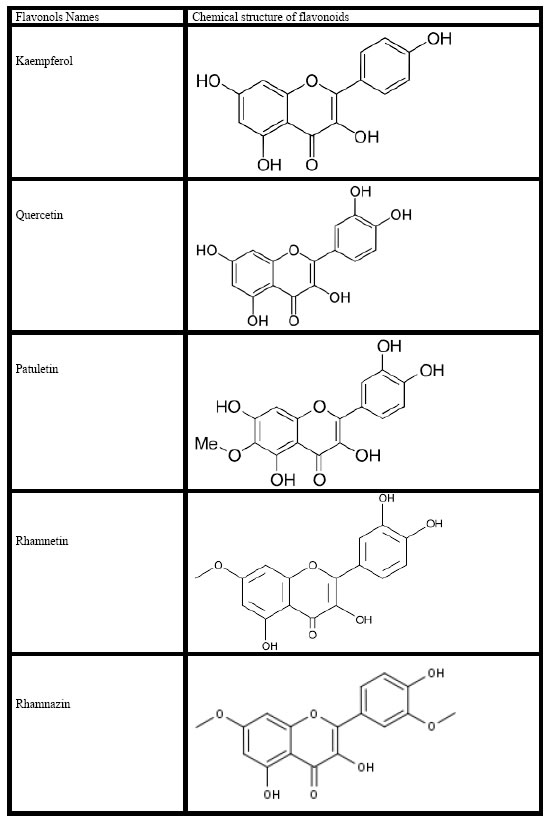
NAMS-3-1-305-g001

Figure 1. Chemical structure of flavonoids in the TW.
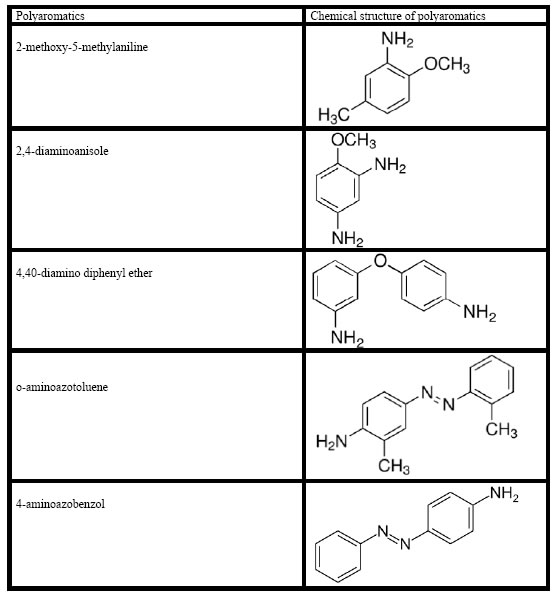
NAMS-3-1-305-g002

Figure 2. Chemical structure of polyaromatics in the TW

Preparation of photocatalysts

Ni-doped BiO nano particles were prepared by co-precipitation method using nickel nitrate hexahydrate [Ni(NO3)2.6H2O] (Analytical grade, Merck ) and Bismuthnitrate hexahydrate [Bi(NO3)2·6H2O] (Sigma, Aldrich) as the precursors of nickel and bismuth, respectively. Ni(NO3)2.6H2O and sodium carbonate anhydrous (Na2CO3) were dissolved separately in double distilled H2O to obtain 0.5 mol/Lsolutions. Nickel nitrate solution (250 mL of 0.5 mol/L) was slowly added into vigorously stirred 250 mL of 0.5 mol/L Na2CO3 solution. Nickel nitrate in the required stoichiometry was slowly added into the above solution and a white precipitate was obtained. The precipitate was filtered, repeatedly rinsed with distilled H2O and then washed twice with ethanol. The resultant solid product was dried at 100°C for 12 h and calcined at 300°C for 2 h. BiO particles were also prepared by the same procedure without the addition of nickel nitrate solution. The doping Ni mass ratios of Bismuth are expressed as wt%.

X-Ray diffraction (XRD) analysis

XRD patterns of the samples are going to carry out using a D/Max-2400Rigaku X-ray powder diffractometer operated in the reflection mode with Cu Ka (λ = 0.15418 nm) radiation through scan angle (2θ) from 20° to 80°.

Scanning electron microscopy (SEM) analysis

The morphological structures of the Ni-BiO nanocomposites before photocatalytic degradation with UV light irradiations and after photocatalytic degradation with UV by means of a SEM.

Fourier transform infrared spectroscopy (FTIR)analysis

The FTIR spectra of Ni, BiO and Ni-BiO samples were measured with FTIR spectroscopy measurements.

Photocatalytic degradation reactor

A 2 L cylinder kuvars glass reactor was used for the photodegradation experiments in the TW under different UV powers, at different operational conditions. 1000 mL TW was filled for experimental studies and the photocatalyst were added to the cylinder glass reactor. The photocatalytic reaction was operated with constant stirring during the photocatalytic degradation process. 10 mL of the reacting solution were sampled and centrifugated (at 10000 rpm) at different time intervals.

Used chemicals

Ni(NO3)2.6H2O (Analytical Grade, Merck, Germany) and Bi(NO3)3·6H2O (Analytical grade, Merck, Germany) were used as nickel and bismuth sources, respectively. Na2CO3 was purchased from Merck (Analytical grade). Helium, He(g) (GC grade, 99.98%) and nitrogen, N2(g) (GC grade, 99.98%) was purchased from Linde, (Germany). Kaempferol (99%), quercetin (99%), patuletin (99%), rhamnetin (99%), rhamnazin (99%), 2-methoxy-5-methylaniline (99%), 2,4-diaminoanisole (99%), 4,40-diamino diphenyl-ether (99%), o-aminoazotoluene (99%), 4-aminoazobenzol (99%) were purchased from Aldrich, (Germany).

Analytical methods

pH, T(°C), ORP, DO, BOD5, CODtotal, CODdissolved, total suspended solids (TSS), Total-N, NH3-N, NO3-N, NO2N, Total-P and PO4-P measurements were monitored following the Standard Methods 2310, 2320, 2550, 2580, 4500-O, 5210 B, 5220 D, 2540 D, 4500-N, 4500-NH3, 4500-NO3, 4500-NO2 and 4500-P [30]. Inert COD was measured according to glucose comparison method [31]. The samples were analyzed by high pressure liquid chromatography (HPLC) with photodiode array and mass spectrometric detection using an Agilent 1100 high performance liquid chromatography system consisting of an automatic injector, a gradient pump, a Hewlett–Packard series 1100 photodiode array detector, and an Agilent series 1100 VL on-line atmospheric pressure ionization electrospray ionization mass spectrometer to detect flavonols namely kaempferol, quercetin, patuletin, rhamnetin, rhamnazin and polyaromatics namely, 2-methoxy-5-methylaniline, 2,4-diaminoanisole, 4,40-diamino diphenyl-ether, o-aminoazotoluene, 4-aminoazobenzol, respectively. All the  metabolites were measured in the same HPLC by mass spectrometric detections. Operation of the system and data analysis were done using ChemStation software, and detection was generally done in the negative ion [M − H]– mode, which gave less complex spectra, although the positive ion mode was sometimes used to reveal fragmentation patterns—especially patterns of sugar attachment. Separation of flavonol components was made on a Vydac C18 reversed phase column (2.1 μm dia. × 250 mm long; 5-μm particle size). Columns were eluted with acetonitrile-water gradients containing 0.1% formic acid in both solvents. The quality of the raw (un-treated) and photooxidated wastewater were determined by measuring the absorbances of the supernatans at wavelengths varying between 200 nm, 250 nm, 300 nm, 350 nm and 540 nmusing an Aquamate Termoelectron Corporation UV-vis spectrophotometer.

Measurement of photonic efficiency (lr) of Ni doped BiO

The relative photonic efficiency of the catalyst is obtained by comparing the photonic efficiency of Ni-doped BiO with that of the standard photocatalyst (BiO). In order to evaluate lr, a solution of 1-Methylcyclopropene-MCP (40 mg/L) with a pH of 10 was irradiated with 100 mg of BiO and Ni-doped BiO for 60 min. From the degradation results, Ir was calculated as follows (Eq. 1).

NAMS-3-1-305-e001

Operational conditions

Under 10-30-50 and 100 W  UV light powers the photocatalytic oxidation of the pollutant parameters in the TW at different operational conditions such as at increasing Ni mass ratios in the Ni-BiOnanocomposite(0.5wt% , 1wt%, 1.5wt%, 2wt%), at increasing photooxidation times (5 min, 15 min, 30, 60 min, 80 min and 100 min), at different Ni-BiOphotocatalyst concentrations (1, 5, 15, 30 and 45 mg/L), under acidic, neutral and basic conditions, respectively.

All the experiments were carried out following the batch-wise procedure. All experiments were carried out three times and the results were given as the means of triplicate sampling with standard deviation (SD) values.

Results and analysis

XRD Analysis results

The powder XRD patterns of BiO and Ni-doped BiO with different lanthanum mass ratios are shown in Figure 3. The XRD patterns of all the Ni-doped BiO catalysts are almost similar to that of BiO, suggesting that there is no change in the crystal structure upon Ni loading. This also indicates that Ni+2 is uniformly dispersed on BiO nanoparticles in the form of small Ni2O2 cluster. However the Ni-doped samples have a wider and lower intense diffraction peaks than pure BiO. Moreover, the XRD peaks of Ni-doped BiO continuously get broader with increasing the Ni loading up to a mass ratio of 2%wt.
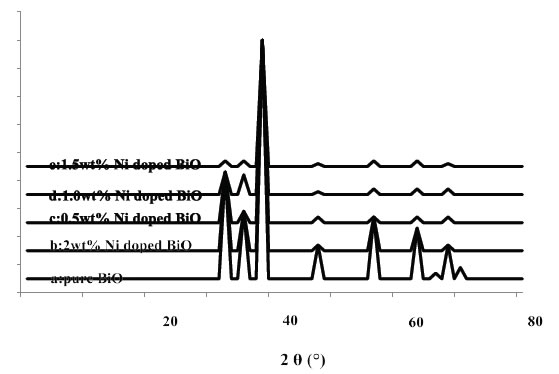
NAMS-3-1-305-g003

Figure 3. XRD patterns of BiO and Ni doped BiO (a) pure BiO, (b) 2 wt% Ni doped BiO, (c) 0.5wt% Ni doped BiO, (d) 1.0wt% Ni doped BiO, and (e) 1.5wt% Ni doped BiO.

SEM Analysis results

The morphology of nanocomposite particles is analyzed by SEM. Figure 4 shows that the nanocomposite material is partly composed of clusters containing composite nanoparticles adhering to each other with a mean size of around 20-80 nm before photooxidation process (Figure 4a) while the size increased to 24-86 nm after photooxidation (Figure 4b) with intermediates and remaining not photodegraded pollutants.
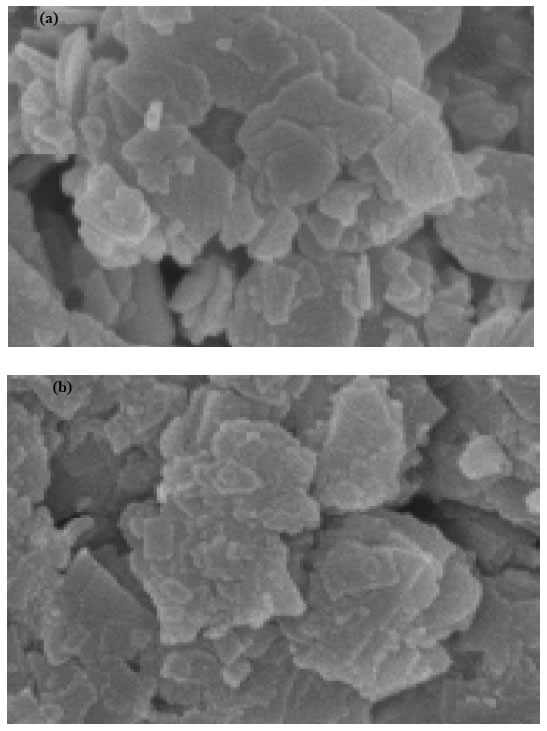
NAMS-3-1-305-g004

Figure 4. SEM micrographs of pure and nickel modified BiO, (a) pure BiO at 25°C, (b) Ni doped BiO at 25°C.

FTIR Analysis results

Figure 5 shows the FTIR spectrum of BiO and Ni-doped BiO, BiO powder synthesized under laboratory conditions. The peak between 400 and 700 cm-1 give the information of Bi–O and Ni–Bi–O on the FTIR spectra. The peak at 437–455 cm-1 give the information about stretching vibration of crystalline hexagonal zinc oxide (Bi–O stretching, vibration) and the peaks from 902 to 1020 cm-1 are attributed to the bond between lanthanum and oxygen (Ni–O). The broad peak between 3400 to 3900 cm-1 indicate the OH groups, due to the H2O which indicates the existence of atmospheric H2O adsorbed on the surface of nanocrystalline powder. An absorption band and a peak have been observed at 2350 cm-1, respectively, which arises from the absorption of atmospheric CO2 on the metal cations.
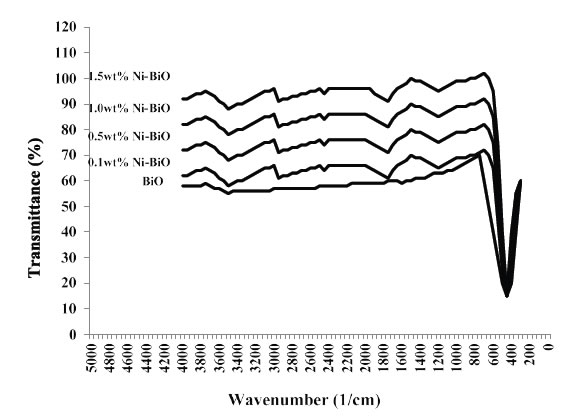
NAMS-3-1-305-g005

Figure 5. FTIR Spectra of pure BiO and Ni-doped BiO nanoparticles, with different concentration of dopant

Results and Discussions

Effect of increasing Ni-BiOnanocomposite concentrations on the removals of TW pollutants

The effects of increasing Ni-BiO nanocomposite concentrations (1 mg/L, 5 mg/L, 15 mg/L, 30 mg/L and 45 mg/L), on the photocatalytic oxidation of polutant parameters in the TW was investigated. The preliminary studies showed that the maximum removal of COD with 20 mg/L Ni-BiO nanocomposite was 89% with 70 min photooxidation time at pH=7.8 with 40 W UV power (Data not shown). Based on these yields the operational conditions for photocatalytic time were choosen as 60 min at a power of 50 W and at a pH of 8. The maximum photocatalytic oxidation removals for all pollutants in the TW were observed at 30 mg/L Ni-BiO nanocomposite concentrations, at pH=8.0, after 60 min photooxidation time and at 25°C at a power of 50 W (Figure 6). Removal efficiencies slightly decreased at 45 mg/L Ni-BiO nanocomposite concentration, because over load of surface area of Ni-BiO nanocomposites (Figure 6). This limiting the power of UV irradiation. Lower photo-removal efficiencies was measured for 1, 5, and 15 mg/L Ni-BiO concentrations due to low surface areas in the nanocomposite. On the contrarily, the surface area is high at 30 mg/L Ni-BiO nanocomposite concentrations. Therefore, the maximum photodegradation yield was observed in this nanocomposite concentration. The CODtotal, CODinert, total flavonols, total aromatic amines and color removals increased linearly as the Ni-BiO nanocomposite concentrations were increased from 1 mg/L up to 5 mg/L, to 15 mg/L, and up to 30 mg/L, respectively (Table 2 and Figure 6). Furher increase of nanocomposite concentration to 45 mg/L affect negatively the all the pollutant yields. The reason for this is the optimum amount of catalyst increases the number of active sites on the photocatalyst surface, which in turn increase the number of OH and superoxide radicals (O2 ●) to degrade pollutant parameters (COD components, flavonols, polyaromatics, color). When the concentration of the catalyst increases above the optimum value, the degradation decreases due to the interception of the light by the suspension [32]. reported that as the excess catalyst (turbidity) prevent the illumination of light, OH, a primary oxidant in the photocatalytic system decreased and the efficiency of the degradation reduced accordingly. Furthermore, the increase in catalyst concentration beyond the optimum may result in the agglomeration of catalyst particles; hence, the part of the catalyst surface becomes unavailable for photon absorption, and thereby, photocatalytic oxidation efficiency decreases [33]. Maximum CODtotal, CODinert, total flavonols, TAAs and color removal efficiencies were obtained after 60 min photooxidation process with yields of 99%, 92%, 91%, 98% and 99%, respectively, at pH=8.0, at 30 mg/L Ni-BiO nanocomposite concentration at 50 W power and at 25°C (Figure 6). Flavonols such as kaempferol, quercetin, patuletin, rhamnetin, rhamnazin removal efficiencies were 87%, 88%, 90%, 87% and 85% respectively, after 60 min photooxidation time, at pH=8.0, at 30 mg/L Ni-BiO nanocomposite concentration and at 25°C temperature (Table 2). Polyaromatic amines such as, 2-methoxy-5-methylaniline, 2,4-diaminoanisole, 4,40-diamino diphenyl ether, o-aminoazotoluene, 4-aminoazobenzol removal efficiencies after photooxidation process were 93%, 95%, 87%, 84% and 82%, respectively, after 60 min photooxidation time, at pH=8.0, at 30 mg/L Ni-BiO nanocomposite concentration at 50 W  UV power and at 25°C (Table 2).
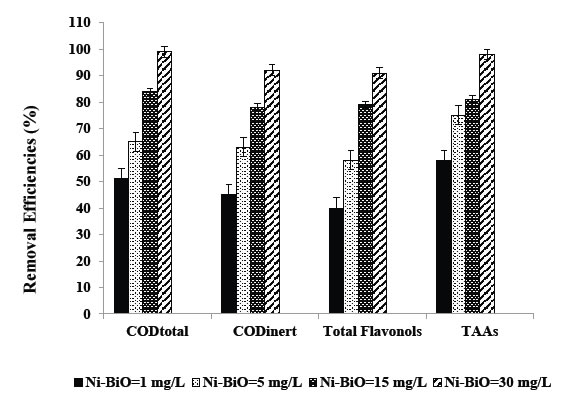
NAMS-3-1-305-g006

Figure 6. Removal efficiencies of CODtotal, CODinert, total flavonols and TAAs at Ni-BiO=1 mg/L, BiO=5 mg/L, BiO=15 mg/L and BiO=30 mg/L.

Table 2. Effect of increasing Ni-BiO nanocomposite concentrations on the TW during photooxidation process after 60 min, at 50 W UV irradiation, at pH=8.0, at 25°C.

Parameters

Removal efficiencies (%)

Ni-BiO concentrations (mg/L)

1
mg/L

5
mg/L

15
mg/L

30
mg/L

45
mg/L

CODtotal

51

65

84

99

79

CODinert

45

63

78

92

76

CODdissolved

50

64

82

98

80

Color

62

69

85

99

83

Total flavonols

40

58

79

91

72

Flavonols

Kaempferol

35

57

72

87

65

Quercetin

36

61

73

88

67

Patuletin

37

62

79

90

74

Rhamnetin

38

56

72

87

64

Rhamnazin

34

53

71

85

66

TAAs

58

75

81

98

77

Polyaromatics

2-methoxy-5-methylaniline

55

66

83

93

79

2,4-diaminoanisole

54

71

79

95

73

4,40-diamino diphenyl ether

52

58

68

87

63

o-aminoazotoluene

49

65

75

84

72

4-aminoazobenzol

47

62

76

82

70

Kaempferol metabolies such as, 3-O-[2-O,6-O-bis(α-L-rhamnosyl)-( β-D-glucosyl] quercetin, 3-O-[6-O-(α-L -rhamnosyl)-( β-D-  glucosyl]quercetin, 3-O-{2-O-[6-O-(p-hydroxy-trans-cinnamoyl)-{ )-, β-D-glucosyl]- á-L-rhamnosyl}kaempferol decreased from 5.7 mg/L to 0.86 mg/L, from 5.7 mg/L to 1.08 mg/L, from 5.7 mg/L to 1.25 mg/L, respectively, after 60 min photooxidation time, at pH=8.0, at 30 mg/L Ni-BiO nanocomposite concentration at 50 W  UV power and at 25°C (Table 3). Quercetin metabolites such as, 3-O-[6-O-( α-L -rhamnosyl)- )-(β-D-glucosyl]quercetin, 3-O-{2-O-[6-O-(p-hydroxy-trans-cinnamoyl)-( β-D -glucosyl]– á-L-rhamnosyl}quercetin reduced from 9.2 mg/L to 1.28 mg/L, from 9.2 mg/L to 2.30 mg/L, respectively, after 60 min photooxidation time, at pH=8.0, at 30 mg/L Ni-BiO nanocomposite concentration at 50 W  UV power and at 25°C (Table 3). Patuletin metabolites such as, (E)-ascladiol, (Z)-ascladiol dropped off from 10.3 mg/L to 1.55 mg/L, from 10.3 mg/L to 1.85, respectively, after 60 min photooxidation time, at pH=8.0, at 30 mg/L Ni-BiO nanocomposite concentration at 50 W  UV power and at 25°C (Table 3). Rhamnetin metabolites such as, methyl quercetin, tetrahydroxy-7-methoxyflavone decreased from 7.2 mg/L to 1.15 mg/L, from 7.2 mg/L to 1.44 mg/L, respectively, after 60 min photooxidation time, at pH=8.0, at 30 mg/L Ni-BiO nanocomposite concentration at 50 W  UV power and at 25°C (Table 3). Rhamnazin metabolites such as, Rhamnazin-3-0-β-D-glucopyranosyl-(l →5)- α-L-arabinofuranoside, Rhamnazin-3-O-β-D- glucopyranosyl-(l—»5)-[β-D-apiofuranosyl-(-1→2)]-α -L-arabinofuranoside reduced from 6.5 mg/L to 1.42 mg/L, from 6.5 mg/L to 1.66 mg/L, respectively, after 60 min photooxidation time, at pH=8.0, at 30 mg/L Ni-BiO nanocomposite concentration at 50 W  UV power and at 25°C (Table 3).

Table 3. The metabolites of flavonols in the TW.

Flavonoids

Flavonoids metabolites

Influent concentrations (mg/L)

Effluent Concentrations (mg/L)

Removal efficiencies (%)

Kaempferol

3-O-[2-O,6-O-bis(α-L-rhamnosyl)-( ß-D-glucosyl]-quercetin

5.7

0.86

85

3-O-[6-O-(α-L -rhamnosyl)-( ß-D-  glucosyl]quercetin

5.7

1.08

81

3-O-{2-O-[6-O-(p-hydroxy-trans-cinnamoyl)-{ )-, ß-D-glucosyl]- á-L-rhamnosyl}kaempferol

5.7

1.25

78

Quercetin

3-O-[6-O-(α-L -rhamnosyl)- )-( ß-D-glucosyl]quercetin

9.2

1.28

86

3-O-{2-O-[6-O-(p-hydroxy-trans-cinnamoyl)-( ß-D -glucosyl]– á-L-rhamnosyl}quercetin

9.2

2.30

75

Patuletin

(E)-ascladiol

10.3

1.55

85

(Z)-ascladiol

10.3

1.85

82

Rhamnetin

Methyl quercetin

7.2

1.15

84

Tetrahydroxy-7-methoxyflavone

7.2

1.44

80

Rhamnazin

Rhamnazin-3-0-ß-D-glucopyranosyl-(l →5)-α-L-
arabinofuranoside

6.15

1.42

77

Rhamnazin-3-O-ß-D- glucopyranosyl-(l—»5)-[ß-D-apiofuranosyl-(-1→2)]-α -L-arabinofuranoside

6.15

1.66

73

2-methoxy-5-methylaniline metabolite such as, 5-nitro-o-toluidine decreased from 134.6 mg/L to 36.34, after 60 min photooxidation time, at pH=8.0, at 30 mg/L Ni-BiO nanocomposite concentration at 50 W  UV power and at 25°C (Table 4). 2,4-diaminoanisole such as, 4-acetylamino-2-aminoanisole, 2,4-diacetylaminoanisole reduced from 275.8 mg/L to 22.06 mg/L, from 275.8 mg/L to 38.61 mg/L, respectively, after 60 min photooxidation time, at pH=8.0, at 30 mg/L Ni-BiO nanocomposite concentration at 50 W  UV power and at 25°C (Table 4). 4,40-diamino diphenyl ether metabolites such as, N,NI-diacetyl-4,4I-diaminobenzhydrol, N,NI-diacetyl-4,4 I –diaminophenylmethane dropped off from 156 mg/L to 28.08 mg/L, from 156 mg/L to 40.56 mg/L, respectively, after 60 min photooxidation time, at pH=8.0, at 30 mg/L Ni-BiO nanocomposite concentration at 50 W  UV power and at 25°C (Table 4). o-aminoazotoluene metabolites such as, hydroxy-OAT (I), 4′-hydroxy-OAAT,  2′-hydroxymethyl-3-methyl-4-aminoazobenzene, 4, 4′-bis(otolylazo)-2, 2′ -dimethylazoxybenzene decreased from 293.6 mg/L to 58.72 mg/L, from 293.6 mg/L to 79.27 mg/L, from 293.6 mg/L to 85.14 mg/L, from 293.6 mg/L to 117.44 mg/L, respectively, after 60 min photooxidation time, at pH=8.0, at 30 mg/L La-ZnO nanocomposite concentration at 50 W  UV power and at 25°C (Table 4). 4-aminoazobenzol metabolites such as phenylhydroxylamine, nitrosobenzol reduced from 178 mg/L to 39.16 mg/L, from 178 mg/L to 44.5 mg/L, respectively, after 60 min photooxidation time, at pH=8.0, at 30 mg/L Ni-BiO nanocomposite concentration at 50 W  UV power and at 25°C (Table 4).

Table 4. The metabolites of polyaromatic amines in the TW.

Polyaromatic amines

Polyaromatic amines metabolites

Influent concentrations (mg/L)

Effluent Concentrations (mg/L)

Removal efficiencies (%)

2-methoxy-5-methylaniline

5-nitro-o-toluidine

134.6

36.34

87

2,4-diaminoanisole

4-acetylamino-2-aminoanisole

275.8

22.06

92

2,4-diacetylaminoanisole

275.8

38.61

86

4,40-diamino diphenyl ether

N,NI-diacetyl-4,4I-diaminobenzhydrol

156

28.08

82

N,NI-diacetyl-4,4 I -diaminophenylmethane

156

40.56

74

o-aminoazotoluene

hydroxy-OAT (I)

293.6

58.72

80

4′ -hydroxy-OAAT

293.6

79.27

73

2′ -hydroxymethyl-3-methyl-4-aminoazobenzene

293.6

85.14

71

4, 4′-bis(otolylazo)-2, 2′ -dimethylazoxybenzene

293.6

117.44

60

4-aminoazobenzol

Phenylhydroxylamine

178

39.16

78

Nitrosobenzol

178

44.5

75

[34] researched the photocatalytic activity of pure and Ni+2-doped BiO samples for the degradation of Rhodamine B (RhB). The effect of Ni+2 doping concentration on the photocatalytic activity of RhB wasalso investigated. 9 g/L Ni+2-doped BiO with a mass ratio of 2wt% had high photocatalytic efficiency [34]. 4-nitrophenol degradation was studied in the presence of Ni doped BiO nanoparticles with a Ni mass ratio of 4% [35]. 78.26% 4-nitrophenol removal was observed the aforementioned nanocomposite after 195 min photodegradation time and at 30 W  UV light irradiation at pH=8 [35]. 68.57% Acid Yellow 29 55% Coomassie Brilliant Blue G250 and 37.27% Acid Green 25 degradations was obtained after 120 min of irradiation in the presence of 0.9% Ni-doped BiO, at 500 W UV light irradiation, under atmospheric oxygen, at 25°C, respectively [36]. The color and pollutant yields obtained in our study exhibited higher yields compared to the studies given above with low Ni-BiO nanocomposite concentrations.

Effect of increasing Ni mass ratios on 30 mg/L Ni doped BiO nanocomposite for photodegradation of TW pollutants

Were researched the effects of different La mass ratios (0.5wt%, 1wt%, 1.5wt% and 2wt% ) in 30 mg/L Ni-BiO nanocomposite concentrations on the photooxidation yields of all pollutants in the TW during photooxidation experiments. Maximum CODtotal, CODinert, total flavonols, TAAs and color removal efficiencies were 99%, 92%, 91%, 98% and 99%, respectively, after 60 min photooxidation time, at pH=8.0, at 1.5wt% Ni mass ratio and at 25°C (Table 5 and Figure 7). Removal efficiencies increased as the Ni mass ratio in the Ni doped BiO nanocomposite were increased from 0.5wt% to 1wt% and to 1.5wt%. Maximum removal efficiencies was measured at 1.5wt% Ni mass ratio in the nanocomposite. The photocatalytic degradation efficiency of BiO nanoparticles increases with an increase in the Ni loading and shows a maximum activity at 1.5 wt%. Then decreases in photooxidation yield was observed on further Ni doping (to 2 wt%). The reason of this can be explained as follows: excessive amounts of dopants can retard the photocatalysis process, because excess amount of dopants deposited on the surface of BiO increases the recombination rate of free electrons and energized holes, thus inhibiting the photodegradation process. Hence, further increase in Ni doping to 2wt% results in the decrease of photocatalytic degradation efficiency.

Table 5. Effect of increasing Ni mass ratios on the TW during photooxidation process after 60 min, at 50 W UV irradiation, 30 mg/L Ni-BiO nanocomposite concentrations, at pH=8.0, at 25°C.


Parameters

Removal efficiencies (%)

Ni mass ratios (%)

0.5wt%

1wt%

1.5wt%

2wt%

CODtotal

46

71

99

80

CODinert

40

69

92

74

CODdissolved

45

70

98

78

Color

57

76

99

81

Total flavonols

35

64

91

75

Flavonols

Kaempferol

30

63

87

68

Quercetin

31

67

88

69

Patuletin

32

68

90

75

Rhamnetin

33

62

87

68

Rhamnazin

30

60

85

67

TAAs

53

81

98

77

Polyaromatics

2-methoxy-5-methylaniline

50

72

93

69

2,4-diaminoanisole

49

77

95

75

4,40-diamino diphenyl ether

47

64

87

64

o-aminoazotoluene

44

71

84

70

4-aminoazobenzol

41

70

82

66

NAMS-3-1-305-g007

Figure 7. Removal efficiencies of CODtotal, CODinert, total flavonols and TAAs at 0.5wt%, 1wt%, 1.5wt%, and 2 wt% Ni mass ratio.

The synthesized Ni-doped BiO catalyst possesses smaller particle size distribution than pure BiO nanoparticles. Apart from their small size, as Ni+2 was doped in BiO, more surface defects are produced as reported by [37]. Consequently, the migration of the photo-induced electrons and holes toward surface defects is reasonable [37]. Thus, the separation efficiency of the electron–hole pairs of Ni-doped BiO with more oxygen defects should be more than that of the pure BiO nanoparticles. Therefore, the enhancement in the photocatalytic degradation efficiency of Ni doping BiO increases due to small particle size and higher defect concentration compared to BiO alone.

UV absorbances of Ni-doped BiO

The UV–vis absorption spectra of BiO and Ni-doped BiO are shown in Figure 8. It can be clearly seen from Figure 8. The maximum absorbance shifts is 410 nm for pure nano BiO while the maximum absorbance of Ni-doped BiO with a Ni mass ratio 0.5wt% is observed at a wavelentgh of 380 nm. The wave of absorbance of Ni-doped BiO also increases gradually with increasing the Ni loading and is much higher as compared to that of pure BiO. This could be mainly attributed to the quantum size effect as well as the strong interaction between the surface oxides of Bi and Ni. These observations strongly suggest that the Ni doping significantly affects the absorbance properties.
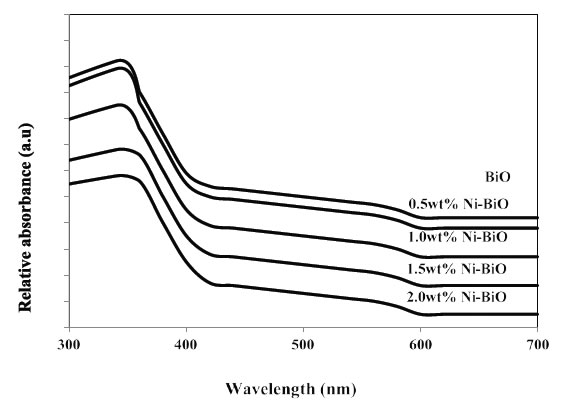
NAMS-3-1-305-g008

Figure 8. UV-vis absorption spectra of Ni doped BiO catalysts

The strong UV band gap emission (375–395 nm) results from the radiative recombination of an excited electron in the conduction band with the valence band hole. The broad visible or deep-trap state emissions (410–440 nm and 540–580 nm) are commonly defined as the recombination of the electron-hole pair from localized states with energy levels deep in the band gap, resulting in lower energy emission. These deep-trap emissions indicate the presence of defects or oxygen vacancies of BiO nanostructures [38]. Since the band gap excitation of electrons in BiO or Ni-doped BiO with 254 nm can promote electrons to the conduction band with high kinetic energy, they can reach the solid-liquid interface easily, suppressing electron–hole recombination in comparison with 365 nm. Hence, the observation of low rate at 254 nm is therefore unexpected [39]. The UV band gap emission of Ni-doped BiO nanostructures was increased between 380 and 410 nm after the photocatalytic process of pollutant parameters. The results show that 1.5 wt% Ni-doped BiO has maximum activity as compared to other photocatalysts.

Effect of increasing photooxidation time on the photooxidation yields of pollutants in the TW

Six different photooxidation times (5 min, 15 min, 30 min, 60 min, 80 min and 100 min) was examined during photocatalytic oxidation of the pollutants in the TW. To determine the optimum time for maximum removals these pollutant parameters in the TW. The maximum photocatalytic oxidation removals was observed at 60 min photooxidation time, at pH=8.0 using 30 mg/L Ni doped BiO with a La mass ratio of 1.5wt% at an UV power of 50 W (Figure 9). The removals of CODtotal, CODinert, total flavonols, total aromatic amines and color were found to increase linearly with increase in retention time from 5 min up to 80 min. A further increase in retention time to and 100 min lead to a decrease in yields of pollutant parameters. In other words the removal efficiencies of pollutant parameters (COD components, flavonols, polyaromatics, color) decreased for photooxidation time > 60 min since at long irradiation times since the surface energy of Ni doped – BiO decreases [40]. The photooxidation can form small molecules such as H2O, carbonmonoxide (CO), CO2 and benzene etc. after long irradiation; it will lead to the decrease of the polar groups and the oxygen content of pollutant surface. The dispersive component of surface energy, the density of polymer surface has great influence on dispersivity of pollutants in the TW. However, the rate of photodegradation of Ni doped-BiO blends increases with the increase of irradiation time, and is higher than that of photocrosslinking after long irradiation time, leading to the decrease of the density of the polymer surface and the dispersivity of COD, dyes and other pollutants to Ni doped–BiO [41]. The photooxidation can form small molecules such as H2O, CO, CO2 and benzene etc. after long irradiation; it will lead to the decrease of the polar groups and the oxygen content of polymer surface, therefore the dispersivity decreaeses resulting in low photooxidation yields [41]. Aromatic and phenolic metabolites which would adsorb strongly onto titania surface and block significant part of photoreactive sites.
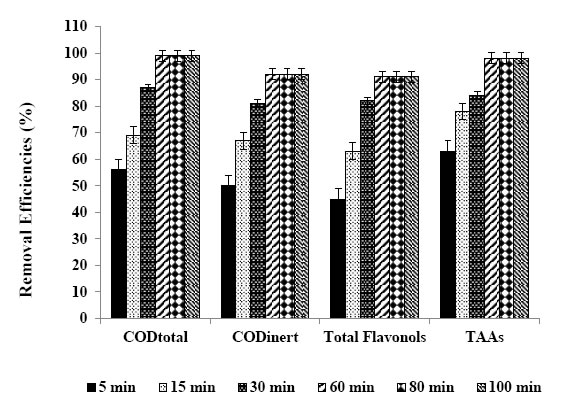
NAMS-3-1-305-g009

Figure 9. Removal efficiencies of CODtotal, CODinert total flavonols and TAAs after 5, 15, 30, 60, 80 and 100 min retention times.

The maximum CODtotal, CODinert, total flavonols, total aromatic amines and color removal efficiencies were 99%, 92%, 91%, 98% and 99%, respectively, after 60 min photooxidation time, at 1.5 wt% Ni mass ratio in 30 mg/L Ni-BiO nanocomposite concentration, at pH=8.0 and at 25°C under 50 W irradiation (Table 6). Also, flavonols such as kaempferol, quercetin, patuletin, rhamnetin, rhamnazin removal efficiencies were 87%, 88%, 90%, 87% and 85%, respectively (Table 6). The photooxidation removals of polyaromatic amines such as, 2-methoxy-5-methylaniline, 2.4-diaminoanisole, 4.40-diamino diphenyl ether, o-aminoazotoluene, 4-aminoazobenzol were 93%, 95%, 87%, 84% and 82%, respectively, after 60 min at pH=8.0 and at 25°C (Table 6). Kaempferol, quercetin, patuletin, rhamnetin, rhamnazin concentrations decreased from 5.7 to 0.741 mg/L, from 9.2 to 1.104 mg/L, from 10.3 to 1.03 mg/L, from 7.2 to 0.936 mg/L, from 6.15 to 0.923 mg/L, respectively. 2-methoxy-5-methylaniline, 2.4-diaminoanisole, 4.40-diamino diphenyl ether, o-aminoazotoluene, 4-aminoazobenzol concentrations decreased from 134.6 to 9.422 mg/L, from 275.8 to 13.79 mg/L, from 156 to 5.46 mg/L, from 293.6 to 10.28, from 178 to 6.23 mg/L, respectively.

Table 6. Effect of increasing photooxidation time on the TW during photooxidation process, at 50 W UV irradiation, at pH=8.0, 30 mg/L Ni-BiO nanocomposite concentrations, 1.5 wt% Ni mass ratio, at 25°C.


Parameters

Removal efficiencies (%)

5
min

15 min

30
min

60
min

80
min

100 min

CODtotal

56

69

87

99

99

99

CODinert

50

67

81

92

92

92

CODdissolved

55

68

85

98

98

98

Color

67

74

88

99

99

99

Total flavonols

45

63

82

91

91

91

Flavonols

Kaempferol

40

61

75

87

86

86

Quercetin

41

65

77

88

86

85

Patuletin

41

66

81

90

89

89

Rhamnetin

43

61

74

87

85

84

Rhamnazin

39

58

72

85

84

84

TAAs

63

78

84

98

98

98

Polyaromatics

2-methoxy-5-methylaniline

60

71

86

93

93

92

2,4-diaminoanisole

59

75

82

95

94

94

4,40-diamino diphenyl ether

57

62

71

87

79

78

o-aminoazotoluene

55

69

78

84

82

80

4-aminoazobenzol

51

62

75

82

81

79

The color yields obtained in this study for TW are higher than the studies given below: [42] investigated the effects of Bi0.95Ni0.05O and Bi0.90Ni0.10O on the treatment of Methylene Blue (MB) dyestuff removal under 18 UV irradiation for 1 h. 81% color yields were observed for the aforementioned Ni-Bi-O nanocomposites, respectively [42]. [43] found 80% color yields based on Reactive Black 5 after 60 min irradiation time under 90 W irradiation using Bi-Ni nanocomposite.

Effect of increasing UV powers on the yields of pollutants in the TW

In this study, four UV light powers were used (10 W, 30 W, 50 W and 100 W) to detect the optimum UV irradiation power for maximum photo-removal of the pollutant parameters in the TW using 30 mg/L Ni doped BiO nanocomposite with a Ni mass ratio of 1,5%w. The maximum photocatalytic oxidation removals was observed at 50 W  UV light irradiation, at pH=8.0, after 30 min photooxidation time and at 25°C (Table 7 and Figure 10). The CODtotal, CODinert total flavonols, total aromatic amines and color were found to increase linearly with increase in UV light irradiation from 10 W, up to 30 W, up to 50 W, respectively (Table 7 and Figure 10). Further increase of UV power up to 100 W did not affect positively the pollutant yields. Maximum CODtotal, CODinert, total flavonols, TAAs and color removal efficiencies after photooxidation process were 99%, 92%, 91%, 98% and 99%, respectively, for the aforementioned operational conditions (Figure 10). Flavonols such as kaempferol, quercetin, patuletin, rhamnetin, rhamnazin removal efficiencies were 87%, 88%, 90%, 87% and 85%, respectively, after 60 min photooxidation time, at 50 W  UV light, at pH=8.0, at 30 mg/L Ni-BiO nanocomposite concentration and at 25°C (Table 7). Polyaromatic amines such as, 2-methoxy-5-methylaniline, 2, 4-diaminoanisole, 4, 40-diamino diphenyl ether, o-aminoazotoluene, 4-aminoazobenzol removal efficiencies after photooxidation process were 93%, 95%, 87%, 84% and 82%, respectively (Table 7).

Table 7. Effect of increasing UV light irradiations on the TW during photooxidation process after 60 min, at 30 mg/L Ni-BiO photocatalyst concentration, at pH=8.0, at 25°C.

Parameters

Removal efficiencies (%)

UV light irradiation

10 W

30 W

50 W

100 W

CODtotal

49

82

99

97

CODinert

43

76

92

90

CODdissolved

48

81

98

96

Color

60

83

99

99

Total flavonols

38

76

91

90

Flavonols

Kaempferol

33

70

87

87

Quercetin

34

71

88

86

Patuletin

35

78

90

89

Rhamnetin

36

70

87

87

Rhamnazin

33

71

85

85

TAAs

56

79

98

96

Polyaromatics

2-methoxy-5-methylaniline

53

81

93

92

2,4-diaminoanisole

52

77

95

93

4,40-diamino diphenyl ether

50

66

87

86

o-aminoazotoluene

47

73

84

81

4-aminoazobenzol

45

71

82

80

NAMS-3-1-305-g010

Figure 10. Removal efficiencies of CODtotal, CODinert, total flavonols and TAAs at 10 W, 30 W, 50 W and at 100 W.

The UV power determines the extent of light absorption by the semiconductor catalyst at a given wavelength. During initiation of photocatalysis, electron–hole formation in the photochemical reaction is strongly dependent on the optimum light intensity [44]. In this study, as the UV power increase from 10 W up to 50 W might favor a high-level surface defects, which account for the increase in the defect emission relative to the UV emission as reported by [39]. Higher UV powers > 50 W decrease the defects in the surface of the nanoparticle by disturbing the active holes.

Effect of increasing pH values on the pollutant yields in the TW

The effects of increasing pH values (4.0, 6.0, 8.0 and 10.0) on the photocatalytic oxidation of polutant parameters in TW was examined by considering the solubility of BiO nanoparticles in acidic as well as in highly basic solutions. The maximum photocatalytic oxidation removals was obtained at pH=8.0, after 60 min photooxidation time with a Ni mass ratio 1.5wt% using 30 mg/L Ni-BiO nanocomposite concentration at 50 W  UV power (Table 8 and Figure 11). In acidic medium, less photocatalytic degradation of pollutant parameters (COD components, flavonols, polyaromatics, color) was observed. The extent of photocatalytic degradation of polutant parameters was found to increase with increase in initial pH to 8.0 and a decrease in maximum photocatalytic degradation was found at pH 10. The possible explanation of this is that the pH at zero point charge (zpc) of BiO is 9.0 ± 0.3 [45]. Below pH 8.0, active sites on the positively charged catalyst surface are preferentially covered by pollutant molecules. Thus, surface concentration of the polutant parameters (COD components, flavonols, polyaromatics, color) is relatively high, while those of OH and OH are low. Hence, photocatalytic degradation decreases at acidic pH. On the other hand, above pH 8.0, catalyst surface is negatively charged by means of metal-bound OH, consequently the surface concentration of the polutant parameters (COD components, flavonols, polyaromatics, color) is low, and OH is high. In addition, polutant parameters are not protonated above pH 8.0. The electrostatic repulsion between the surface charges and Ni doped BiO nanocomposite hinders the amount of polutant parameters and the adsorption, consequently surface concentration of the polutant parameters decreases, which results in the decrease of photocatalytic degradation at pH 10.0. In conclusion, pH 8.0 can provide moderate surface concentration of polutant parameters which react with the holes to form OH.

Table 8. Effect of increasing pH values on the TW during photooxidation process, at 50 W UV irradiation, after 60 min, at 25°C.


Parameters

Removal efficiencies (%)

pH values

pH=4.0

pH=6.0

pH=8.0

pH=10.0

CODtotal

53

74

99

72

CODinert

47

72

92

70

CODdissolved

52

73

98

71

Color

64

79

99

77

Total flavonols

42

68

91

66

Flavonols

Kaempferol

37

66

87

64

Quercetin

38

70

88

68

Patuletin

39

71

90

69

Rhamnetin

40

66

87

64

Rhamnazin

45

62

85

60

TAAs

60

83

98

81

Polyaromatics

2-methoxy-5-methylaniline

57

76

93

74

2,4-diaminoanisole

56

80

95

78

4,40-diamino diphenyl ether

54

67

87

65

o-aminoazotoluene

52

74

84

72

4-aminoazobenzol

50

65

82

63

NAMS-3-1-305-g011

Figure 11. Removal efficiencies of CODtotal, CODinert, total flavonols and TAAs at pH=4.0, pH=6.0, pH=8.0, pH=10.0.

Photocatalytic oxidation mechanisms of Ni doped BiOnanocomposite

The higher activity of Ni doped BiO can beattributed to successful e–h+ separation and production of ●O2 and OH. Ni-modified BiO sample manifests the highest efficiency, which may be explained by the highest number of O2 vacancies (related to the different charge and electronegativity of Ni and Bi ions) and as a result of stronger adsorption of OHions onto the BiO surface [46]. This favors the formation of OH by reaction of hole and OH. The OH and photogenerated ●O2has extremely strong non-selective oxidants lead to the degradation of the organic pollutant at the surface of Ni modified BiO [41]. The photocatalytic degradation mechanism starts with the illumination of BiO nanoparticles and production of electron–hole pairs in Eq. (2):

NAMS-3-1-305-e002

Major roles of metal ions in this study are to increase the concentration of BiO on the surface of the catalyst and to prolong the individual life-time of electrons and holes and hence, inhibit their recombination. The ability of Ni+3 to scavenge photogenerated electrons is as follows: (Eq. 3):

NAMS-3-1-305-e003

However, stabilities of Ni+3 ions may be disturbed in their reduced forms (Ni+2). This can be achieved by transferring the trapped electron to O2 [Eq. (4)]:
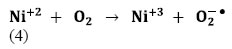
NAMS-3-1-305-e004

The produced O2● is responsible from the generation of OH, known as highly reactive electrophilic oxidants [Eqs. (5-7)]:

NAMS-3-1-305-e005-6-7

In the meantime, photogenerated holes may react with H2O molecules and produce OH (Eq. 8):

NAMS-3-1-305-e008

The color removal by photooxidation of dyes reactions were given in Eqs (9-14):
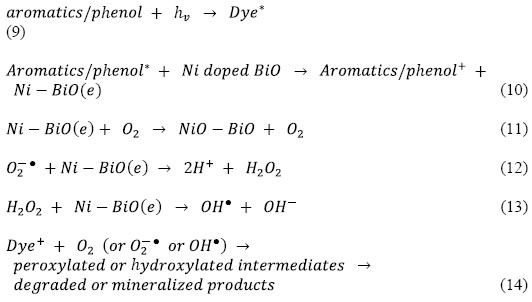
NAMS-3-1-305-e009-14

Thus, loading of metal ions such as Ni on the surface of BiO matrix can suppress the recombination of photoinduced charge carriers either with only electron capture ability or with steps forward to produce OH. For Ni–BiO, electron accepting ability, production of more OH, the highest surface roughness value and the higher dark adsorption capacity result in pronounced photoactivity. The decay profile of the products includes the subsequent attacks of OH, known as highly reactive electrophilic oxidants. The main reaction pathway (60% of OH) is the addition of the OH to the double bond of the azo group, resulting in the rapid disappearance of color; however, addition to the aromatic ring also occurs (40% of OH) [47, 48]. Further OH attacks and the increment in OH concentration in the solution increase the yield of OHadduct in the degradation progress of each product. The opening of the dye aromatic rings due to consecutive oxidation reactions leads to low-molecular weight compounds [49].

Photonic efficiency of Ni doped BiO

In order to evaluate the relative photonic efficiency (Ir), a solution of MCP (40 mg/L) adjusted to pH 10 was irradiated with 100 mg BiO (Merck) and Ni-doped BiO, separately. The relative photonic efficiencies of light of wavelengths 254 and 365 nm for BiO and Ni-doped BiO are presented in Table 9. For comparison, the relative photonic efficiency of TiO2 is also presented in Table 9. The relative photonic efficiencies of Ni-doped BiO are greater as compared to those of BiO and TiO2, revealing the effectiveness of metal-doped systems. It is also interesting to note that the relative photonic efficiency for Ni-doped BiO for light of wavelength 254 nm are much higher as compared to that for 365 nm. The results are in good agreement with degradation and mineralization studies. Comparing the high efficiency of Ni doped BiO catalysts with standard BiO and TiO2 catalyst, the photocatalytic efficiency of 1.5 wt% Ni-doped BiO is higher as compared to that of BiO and TiO2 and other Ni doped BiO nanacomposites.

Table 9. Comparison of relative photonic efficiencies in the photodegradation of pollutants in TW by BiO and Ni-doped BiO photocatalysts (*)


Parameters

Relative photonic efficiency (Ir)

256 nm

370 nm

Pure BiO

1.01 ± 0.001

0.79 ± 0.01

0.1wt% Ni–BiO

1.09 ± 0.01

0.93 ± 0.01

0.5 wt% Ni–BiO

1.28 ± 0.02

0.94 ± 0.01

1.0wt% Ni–BiO

2.59 ± 0.01

2.22 ± 0.01

1.5wt% Ni–BiO

2.98 ± 0.01

2.25 ± 0.01

2wt% Ni–BiO

1.02± 0.01

1.98 ± 0.01

Commercial BiO

1.02 ± 0.01

1.02 ± 0.01

TiO2

1.38 ± 0.01

1.03 ± 0.01

(*): pH 5; UV = 8 lamps; ë = 254 and 365 nm; 50 W UV power, 60 min photooxidation time

Reusability of Ni doped BiO

As shown in Figure 12, after the first cycle of photocatalytic oxidation within 60 min, 99% of the Ni doped BiO with a mass ratio of 1.5wt% was recovered. After three cycles, the phoooxidation ability of Ni doped BiO nanocomposite was retained at 93% of the original value. After 8th cycles the nanocomposite was reatined at 80%. One of the reasons for the slight decline in photooxidation is that the surface of the reused photocatalysts may exist with some low residual substances which did not occupy the photocatalytic sites and did not block the adsorption. The presence of Ni significantly changed the binding site of the pollutant molecules. It is possible that the oxygen atom in Ni-BiO was bound to the dopant Ni [50]. The speedily recovering of the photodegradation capacity of Ni doped BiO for pollutans photodegradation will benefit to their photocatalytic activity.
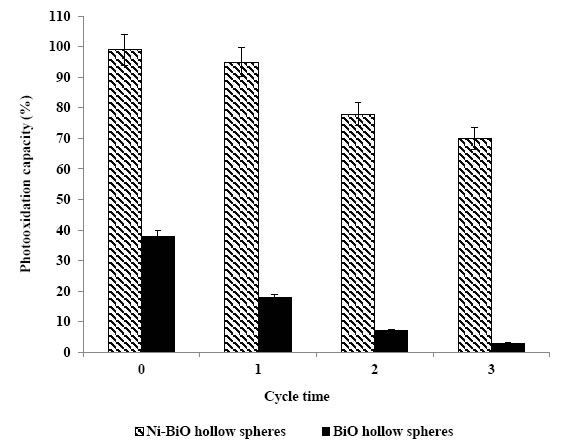
NAMS-3-1-305-g012

Figure 12. The reusability of Ni doped BiO

Conclusions

By using 30 mg/L Ni-BiO with a Ni mass ratio of 1.5w% the CODtotal, CODinert, flavonols, polyaromatics and color were photodegraded with yields as high as 82-99% within 60 min photooxidation time, at 25°C under 50 W  UV power, at pH=8.0. The addition of Ni to BiO lead to enhance the photocatalytic activity by increasing the total surface area. The flavonoids and polyaromatic amines and their metabolites in the TW were firstly determined photodegraded with high rates and photonic efficiency using 30 mg/L Ni-BiO with a Ni mass ratio of 1.5w% at pH 8.

References

  1. Lin SH, Chen ML (1997) Treatment of textile wastewater by chemical methods for reuse.Water Research31: 868-876.
  2. Van der Zee FP, Bouwman RHM, Strik DP, Lettinga G, Field JA (2001) Application of redox mediators to accelerate the transformation of reactive azo dyes in anaerobic bioreactors.Biotechnology and Bioengineering75: 691-701.[Crossref]
  3. Chung KT, Stevens SEJ (1993) Degradation of azo dyes by environmental microorganisms and helminthes.Environmental Toxicology and Chemistry 12: 2121-2132.
  4. Weisburger JH (2002) Comments on the history and importance of aromatic and heterocyclic amines in public health.Mutation Research-Fundamental and Molecular Mechanisms of Mutagenesis506: 9-20.[Crossref]
  5. Oliveira DP, Carneiro PA, Sakagami MK, Zanoni MVB, Umbuzeiro GA (2007) Chemical characterization of a dye processing plant effluent–identification of the mutagenic components.Mutation Research-Fundamental and Molecular Mechanisms of Mutagenesis626: 135-142.
  6. Robinson T, McMullan G, Marchant R, Nigam P (2001) Remediation of dyes in textile effluent: a critical review on current treatment technologies with a proposed alternative.Bioresource Technology77: 247-255.[Crossref]
  7. Van der Zee FP, Villaverde S (2005) Combined anaerobic–aerobic treatment of azo dyes—a short review of bioreactor studies.Water Research39: 1425-1440.[Crossref]
  8. Roosta M, Ghaedi M, Shokri N, Daneshfar A, Sahraei R, Asghari A (2014) ‘Experimental design based response surface methodology optimization of ultrasonic assisted adsorption of safaranin o by tin sulfide nanoparticle loaded on activated carbon. Spectrochimica Acta Part A: Molecular and Biomolecular Spectroscopy 122:  223-231.
  9. Tavakkoli H, Moayedipour T (2014) Fabrication of perovskite-type oxide La0.5Pb0.5MnO3 nanoparticles and its dye removal performance. Journal of Nanostructure in Chemistry4: 116-124.
  10. Qi X, Zhou J, Yue Z, Gui Z, Li L (2003) Auto-combustion synthesis of nanocrystalline LaFeO3.Materials Chemistry and Physics78: 25-29.
  11. Deganello F, Marcì G, Deganello G (2009) Cipate–nitrate auto-combustion synthesis of perovskite-type nanopowders: A systematic approach.Journal of the European Ceramic Society29: 439-450.
  12. Jadhav LD, Patil SP, Chavan AU, Jamale AP, Puri VR (2011)Solution combustion synthesis of Cu nanoparticles; a role of oxidant-to-fuel ratio.Micro & Nano Letters6:812-815.
  13. Shea LE, McKittrick J, Lopez OA, Sluzky E (1996) Synthesis of red-emitting, small particle size luminescent oxides using an optimized combustion process.Journal of the American Ceramic Society 79: 3257-3265.
  14. Dong SY, Feng JL, Fan MH, Pi Y, Hu L, et al. (2015) Recent developments in heterogeneous photocatalytic water treatment using visible light-responsive photocatalysts: A review.RSC Advances5: 14610-14630.
  15. Wang HL, Xu LJ, Liu CL, Lu Y, Feng Q, et al. (2019) Composite magnetic photocatalyst Bi5O7I/MnxZn1-xFe2O4:Hydrothermal-roasting preparation and enhanced photocatalytic activity.Nanomaterials 9: 118-131.
  16. Li HH, Li KW, Wang H (2009) Hydrothermal synthesis and photocatalytic properties of bismuth molybdate materials.Materials Chemistry and Physics116: 134-142.
  17. Ren J, Wang W, Shang M, Sun S, Gao E (2011) Heterostructured bismuth molybdate composite: Preparation and improved photocatalytic activity under visible-light irradiation.ACS Applied Materials & Interfaces 3: 2529-2533. [Crossref]
  18. Zhang T, Huang JF, Zhou S, Ouyang HB, Cao LY,et al. (2013) Microwave hydrothermal synthesis and optical properties of flower-like Bi2MoO6 crystallites.Ceramics International39: 7391-7394.
  19. Meng XC, Zhang ZS (2016) Bismuth-based photocatalytic semiconductors: Introduction, challenges and possible approaches.Journal of Molecular Catalysis A-Chemical423: 533-549.
  20. Jia YL, Ma Y, Tang JZ, Shi W (2018) Hierarchical nanosheet-based Bi2MoO6 microboxes for efficient photocatalytic performance.Dalton Transactions47: 5542-5547.
  21. Zhou TF, Hu JC, Li JL (2011) Er3+ doped bismuth molybdate nanosheets with exposed {010} facets and enhanced photocatalytic performance.Applied Catalysis B: Environmental110: 221-230.
  22. Wang QY, Lu QF, Wei MZ, Wei M, Guo E, et al. (2018) ZnO/-Bi2MoO6 heterostructured nanotubes: Electrospinning fabrication and highly enhanced photoelectrocatalytic properties under visible-light irradiation.Journal of Sol-Gel Scıence and Technology85: 84-92.
  23. Zhong Y, He ZT, Chen DM, Hao D, Hao W, (2019) Enhancement of photocatalytic activity of Bi2MoO6 by fluorine substitution.Applications of Surface Science467: 740-748.
  24. Wang PF, Ao YH, Wang C, Hou J, Qian J (2012) A one-pot method for the preparation of graphene- Bi2MoO6 hybrid photocatalysts that are responsive to visible-light and have excellent photocatalytic activity in the degradation of organic pollutants.Carbon50: 5256-5264.
  25. Wang M, Han J, Guo PY, Sun MZ, Zhang Y, et al. (2018) Hydrothermal synthesis of B-doped Bi2MoO6 and its high photocatalytic performance for the degradation of Rhodamine B.Journal of Physics and Chemistry of Solids 113: 86-93.
  26. Chen C, Liu L, Guo J, Zhou LX, Lan YQ (2019) Sulfur-doped copper-cobalt bimetallic oxides with abundant Cu (I): A novel peroxymonosulfate activator for chloramphenicol degradation.Chemical Engineering Journal361: 1304-1316.
  27. Wang J, Sun YG, Wu CC, Cui Z, Rao PH(2019) Enhancing photocatalytic activity of Bi2MoO6 via surface co-doping with Ni2+ and Ti4+ ions.Journal of Physics and Chemistry of Solids129: 209-216.
  28. Ding X, Ho WK, Shang J, Zhang LZ (2016) Self doping promoted photocatalytic removal of no under visible light with Bi2MoO6: Indispensable role of superoxide ions.Applied Catalysis B: Environmental182: 316-325.
  29. Zhang XH, Zhang HR, Jiang HT, Yu F, Shang ZR (2019) Hydrothermal synthesis and characterization of Ce3+ doped Bi2MoO6 for water treatment.Catalysis Letters1-11.
  30. Eaton AD, Clesceri LS, Rice EW, Greenberg AE, Franson MAH (2005) Standard Methods for the Examination of Water and Wastewater’, Ed. by Franson MAH, (21th ed.), American Public Health Association (APHA), American Water Works Association (AWWA), Water Environment Federation (WEF), American Public Health Association (APHA) 800 I Street, NW, Washington, DC: 20001-3770, USA.
  31. Germirli F, Orhon D, Artan N (1991) Assessment of the initial inert soluble COD in industrial wastewater.Water Science and Technology 23: 1077-1086.
  32. Sun J, Qiao L, Sun S, Wang G (2008) Photocatalytic degradation of orange g on nitrogen-doped TiO2 catalysts under visible light and sunlight irradiation.Journal of Hazardous Materials 155: 312-319.[Crossref]
  33. Huang M, Xu C, Wu Z, Huang Y, Lin J, et al. (2008) Photocatalytic discolorization of methyl orange solution by Pt modified TiO2 loaded on natural zeolite.Dyes and Pigments77: 327-334.
  34. Jia T, Wang W, Long F, Fu Z, Wang H, Zhang Q (2009) Fabrication, characterization and photocatalytic activity of La-doped ZnO nanowires.Journal of Alloys and Compounds484: 410-415.
  35. Khatamian M, Khandar AA, Divband B, Haghighi M, Ebrahimiasl S (2012) Heterogeneous photocatalytic degradation of 4-nitrophenol in aqueous suspension by Ln (La3+, Nd3+ or Sm3+) doped ZnO nanoparticles.Journal of Molecular Catalysis A: Chemical365: 120-127.
  36. Raza W, Haque MM, Muneer M (2014) Synthesis of visible light driven ZnO: characterization and photocatalytic performance. Applications of Surface Science322: 215-224.
  37. Zheng Y, Chen C, Zhan Y, Lin X, Zheng Q, et al. (2007) Luminescence and photocatalytic activity of ZnO nanocrystals:  correlation between structure and property.Inorganic Chemistry 46: 6675-6682.
  38. Bohle DS, Spina CJ (2009) Cationic and anionic surface binding sites on nanocrystalline zinc oxide: surface influence on photoluminescence and photocatalysis.Journal of the American Chemical Society131: 4397-4404.
  39. Selvam NCS, Vijaya JJ, Kennedy LJ, (2013) Comparative studies on influence of morphology and La doping on structural, optical, and photocatalytic properties of zinc oxide nanostructures.Journal of Colloid and Interface Science407: 215-224.
  40. Fox MA, Dulay MT (1993) Hetereogeneous photocatalysis.Chemical Reviews93: 341-357.
  41. Korake PV, Dhabbe RS, Kadam AN, Gaikwad YB, Garadkar KM (2014) Highly active lanthanum doped ZnO nanorods for photodegradation of metasystox.Journal of Photochemistry and Photobiology B-Biology130: 11-19.
  42. Suwanboon S, Amornpitoksuk P, Bangrak P, Muensit N (2013) Optical, photocatalytic and bactericidal properties of Zn1-xLaxO and Zn1-xMgxO nanostructures prepared by a sol–gel method.Ceramics International39: 5597-5608.
  43. Kaneva N, Bojinova A, Papazova K, Dimitrov D (2015) Photocatalytic purification of dye contaminated sea water by lanthanide (La3+, Ce3+, Eu3+) modified ZnO.Catalysis Today252: 113-119.
  44. Cassano AE, Alfano OM (2000) Reaction engineering of suspended solid heterogenous photocatalytic reactors.Catalysis Today58: 167-197.
  45. Anandan S, Vinu A, Venkatachalam N, Arabindoo B, Murugesan V (2006) Photocatalytic activity of ZnO impregnated Hâ and mechanical mix of ZnO/Hâ in the degradation of monocrotophos in aqueous solution.Journal of Molecular Catalysis A: Chemical256: 312-320.
  46. Anandan S, Vinu A, Mori T, Gokulakrishnan N, Srinivasu P, et al. (2007) Photocatalytic degradation of 2,4,6-trichlorophenol using lanthanum doped ZnO in aqueous suspension.Catalysis Communications8: 1377-1382.
  47. Joseph JM, Destaillats H, Hung H, Hoffmann MR (2000) The sonochemical degradation of azobenzene and related azo dyes:  rate enhancements via fenton’s reactions.Journal of Physical Chemistry A104: 301-307.
  48. Spadaro JT, Isabelle L, Renganathan V (1994) Hydroxyl radical mediated degradation of azo dyes: evidence for benzene generation.Environmental Science & Technology28: 1389-1393.
  49. Galindo C, Jacques P, Kalt A (2000) Photodegradation of the aminobenzene Acid Orange 52 by three advanced oxidation processes: UV/H2O2, UV/TiO2 and VIS/TiO2: comparative mechanistic and kinetic investigations.Journal of Photochemistry and Photobiology A-Chemistry 130: 35-47.
  50. Pala RGS, Metiu H (2007) The structure and energy of oxygen vacancy formation in clean and doped, very thin films of ZnO.Journal of Physical Chemistry C111: 12715-12722.
  51. Battle PD, Cheetham AK, Goodenough JB (1979)A neutron diffraction study of the ferrimagnetic spinel NiCO2O4.Materials Research. Bulletin14: 1013-1024.
  52. Roosta M, Ghaedi M, Daneshfar A, Darafarin S, Sahraei R,et al. (2014b) Simultaneous ultrasound-assisted removal of sunset yellow and erythrosine by ZnS:Ni nanoparticles loaded on activated carbon: optimization by central composite design.Ultrasonics Sonochemistry21: 1441-1450.
  53. Verma S, Joshi HM, Jagadale T, Chawla A, Chandra R, et al. (2008) Nearly monodispersed multifunctional NiCO2O4 spinel nanoparticles: magnetism, infrared transparency, and radio frequency absorption.The Journal of Physical Chemistry C112: 15106-15112.
  54. Wu Z, Zhu Y, Ji X (2014) NiCO2O4-based materials for electrochemical supercapacitors.Journal of Materials Chemistry A2: 14759-14772.
  55. Xing YX, Zhan J, Liu ZL,Du CF (2017) Steering photoinduced charge kinetics via anionic group doping in Bi2MoO6 for e_cient photocatalytic removal of water organic pollutants.RSC Advances7: 35883-35896.