Archives

The Impact of Accountable Care Units on Patient Outcomes

Abstract

Background: Effective hospital teams can improve outcomes, yet, traditional hospital staffing, leadership, and rounding practices discourage effective teamwork and communication. Under the Accountable Care Unit model, physicians are assigned to units, team members conduct daily structured interdisciplinary bedside rounds, and physicians and nurses are jointly responsible for unit outcomes.

Objectives: To evaluate the impact of ACUs on patient outcomes.

Design: Retrospective, pre-post design with concurrent controls.

Patients: 23,406 patients admitted to ACU and non-ACU medical wards at a large academic medical center between January 1, 2008 and December 31, 2012.

Measures: In-hospital mortality and discharge to hospice, length of stay, 30-day readmission.

Results: Patients admitted to ACUs were less likely to be discharged dead or to hospice (-1.8 percentage point decline [95% CI: -3.3, -0.3; p = .015]) ACUs did not reduce 30 day readmission rates or have a significant effect on length-of-stay.

Conclusions: Results suggest ACUs improved patient outcomes. However, it is difficult to identify the impact of ACUs against a backdrop of low inpatient mortality and the development of a hospice unit during the study period.

Keywords

quality improvement, teamwork, hospital medicine, care standardization

Introduction

Under the traditional model of inpatient staffing, hospitals nurses and allied health professionals are assigned to a unit, while hospital medicine physicians treat patients on multiple units. Care is delivered asynchronously. Physicians see patients when their schedules permit, usually early in the morning or in the late afternoon and update orders at those times. Nurses and other professionals care for patients separately. They may not see the physician during rounds, and their priorities for patient care may be different from those of the physician. In our experience, they often obtain information from second-hand sources or the often difficult-to-decipher notes in patients’ charts.

The traditional, physician-centric model of inpatient care poses significant coordination and incentive problems. Beginning in October 2010, Emory University Hospital re-organized two medical units into Accountable Care Units (ACU® units). In the ACU care model, hospital-based physicians are assigned to a home unit where they can focus on the patients in the unit and work with the same nurse team. By assigning physicians to home units with other unit-based personnel such as nurses and having teams engage in structured interdisciplinary bedside rounds, ACUs enable clinicians to recognize preventable hospital complications and signs of deterioration or diagnostic error that might otherwise have been missed and implement a coordinated response.

Previous publications on the ACU model have been mostly descriptive in nature [1–4]. Using electronic medical records and a pre-post study design with concurrent controls, we retrospectively evaluated the effect of ACUs on patient mortality, length of stay, and readmissions at Emory University Hospital.

Methods

Intervention

Emory University Hospital is a 500 bed teaching hospital in Atlanta, Georgia. Prior to the implementation of ACUs, hospital medicine physicians at Emory University Hospital treated patients in as many as eight units. In the first unit to be organized into an ACU, patients were divided between five physician care teams prior the re-organization. Beginning in October 2010, Emory University Hospital assigned two physician care teams to each of two newly-constituted ACU units. ACUs combine a number of interventions, some of which have been implemented at other hospitals [5–8] , into a single, cohesive bundle.

ACU physician teams were assigned to units and included one hospital medicine attending physician, one internal medicine resident, and three interns. Within an ACU, two teams rotated call schedules over a 24 hour period. The team on-call admitted every patient who arrived at the unit. The same nurse teams continued to staff each unit as before the reorganization.

ACUs standardize communication through a series of brief but highly scripted intra- and inter-professional exchanges to review patients’ conditions and care plans. Each shift change begins with a five minute huddle where the departing staff hands over the unit to the incoming staff. During the huddle, the departing staff alerts the incoming staff to patient- and quality-related issues. After the huddle, nurses hand over individual patients at the bedside using a structured format, highlighting patient-level factors that might indicate patient instability or are outside the expected range. Once a day, each patient’s care team meets for structured interdisciplinary bedside rounds. Structured interdisciplinary bedside rounds bring the bedside nurse, attending physician, and unit-based allied health professionals to the bedside every day with the patient and family members to review the patient’s current condition, response to treatment, care plan, and discharge plan collaboratively [5–8]. Evidence-based actions, such as “bundles” to prevent hospital acquired conditions, are embedded in structured interdisciplinary bedside rounds, and reported on by the patient’s nurse. A scripted, standard communication protocol reduces extraneous communication and focuses the structured interdisciplinary bedside round team’s attention on aspects of patients’ conditions that are responsive to staff attention and effort.

A unit leadership dyad, consisting of a nurse manager and senior physician, set explicit expectations for staff and manage unit process and performance. Physicians operating in the traditional model may be unaware of unit-level quality protocols and outcome measures. As part of the re-organization, a data analyst prepared quarterly unit-level performance reports describing rates of in-hospital mortality, blood stream infections, 30-day readmissions and patient satisfaction scores and length of stay. These reports are used by hospital administrators to set goals for the ACU leadership team and may figure into the performance evaluations of ACU administrators. Readers interested in additional details about the ACU model are urged to consult previous publications [1–4].

Following implementation of ACUs, physician teams assigned to ACUs saw patients on only 1.5 units, with 90% of their patients located in the ACUs, compared to non-ACU physician teams, which cared for patients spread across 6 to 8 units every day.1 The number of patient encounters per day for the ACU physician teams increased from 11.8 in the year before the ACUs (when the teams were not unit based) to 12.9 in the four years following implementation [1]. No changes were made to nurse staffing levels (1 to 4 or 5 nurses per patient).

During the study period, Emory University Hospital created two ACUs, but medical patients were also admitted to seven other units in the hospital. The units that became ACUs were selected because nearly all the patients were under the care of hospital medicine attending physicians so we could designate them as hospital medicine units. In other units, hospital medicine patients were mixed in with patients from other specialties (for example, cardiology). The assignment of patients to ACUs or other medical units was determined by bed control officers based on a mix of criteria that can include bed availability, relative patient wait times, and individual judgement. Bed managers know patients’ names, medical record number, and admitting diagnosis when they assign patients to units. They do not know have access to other prognostic indicators.

Study Sample

The study sample includes patients ages 18 and older admitted to the medical units of Emory University Hospital between January 1, 2008 and December 31, 2013. Following an intent-to-treat framework, we grouped patients who were transferred into ACUs during their hospital stay with non-ACU patients. Patients admitted to surgical, orthopedic, observation, or other specialty units (e.g. medical oncology) were excluded from the analysis, as were patients with cystic fibrosis who are treated only within one of the two ACUs. Patients in the control group were spread across 38 units, though 70% were in just 8 of these units.

Data and Outcome Variables

All study variables are captured in Emory’s internal electronic medical record and administrative data systems. We evaluated the impact of ACUs on in-hospital mortality, discharge to hospice, length of stay, readmission or emergency department visit to Emory University hospital within 30 days, and hospital-acquired urinary tract infection and deep vein thrombosis and pulmonary embolism. We counted a patient as having hospital-acquired urinary tract infection and deep vein thrombosis and pulmonary embolism if their records listed ICD-9 codes for these condition but not if they were among the present-on-admission ICD-9 codes.

Emory University Hospital opened an on-site hospice during the study period in November 2010, potentially reducing the barriers to transferring patients from the hospital to hospice care. While discharge to hospice is in many cases an indication of appropriate care, the opening of the inpatient hospice complicates efforts to measure trends in in-patient mortality. The opening of the unit may be responsible for changes in the site of death for patients admitted to the hospital over time. For this reason, we highlight the impact of ACUs on the combined outcome of in-hospital death or discharge to hospice.

Statistical Analysis

We compared patient characteristics between ACUs and control units using chi-squared tests. We estimated the impact of ACUs on these outcomes using a difference-in-difference study design (equivalently, a pre/post study with a concurrent control group). The pre period was January 1, 2008 to October 31, 2010. The post period was November 1, 2010 to December 31, 2012. We calculated the change in outcomes between the pre and post periods among patients admitted to the units that became ACUs and the change among patients in the control group. The difference of these changes is the difference-in-difference estimator. It assesses changes in outcomes in the units that became ACUs relative to changes in the control group. It assumes that absent any change in policy (i.e., the implementation of ACUs), trends in outcomes among patients admitted to the ACUs would have mirrored trends among patients in the control group. We calculated 95% confidence intervals for unadjusted estimates using z-tests. We used logistic regression with robust standard errors to estimate adjusted effects for in-hospital mortality and hospice discharges and readmissions. We used Poisson regression with robust standard errors to estimate adjusted effects for length of stay. We calculated standard errors and 95% confidence intervals for the difference-in-difference estimator using the Delta method [9].

In multivariable analysis, we adjusted estimates for patient age group, sex, race, primary payer, admission source (hospital or skilled nursing facility versus other), and Elixhauser comorbidities (based on all diagnosis codes) [10] that were present in at least 2.5% of patients in the sample. About one-third of the sample had missing values for admission source. We included each Elixhauser comorbidities as a separate variable in the model rather than collapsing the conditions into a count to avoid imposing unnecessary restrictions on the relationship between conditions and outcomes. Conditions are not mutually exclusive.

Estimates from difference-in-difference models may be biased if there are pre-existing trends in outcomes that differ between ACU and non-ACU units. We tested for pre-existing trends by estimating a model that included, in addition to the variables described above, indicators for the years in the pre-period (2008 to 2010) and these year indicators interacted with treatment group (ACU versus non ACU). We assessed the significance of the year-group interactions and used a likelihood ratio test to compare the model fit with a model that omitted the year-group interactions [11].

Estimates of the impact of ACUs on in-hospital mortality and hospice discharge rates may be biased by differences in length of stay. An intervention that reduces length of stay but does not affect mortality rates will reduce in-hospital mortality rates by shifting the place of death from the hospital to the community. In a sensitivity analysis we assessed the robustness of logistic regression estimates by estimating a Weibull survival model with robust standard errors of the time to hospice discharge or in-hospital death. Records for patients who were not discharged to hospice or dead are censored.

Results

There were 23,403 patients included in the study sample, of whom 10,639 were admitted to the ACU units (including patients admitted to the units before they became ACUs) and 12,764 patients in the control group. There are significant differences in some of the characteristics of ACU and control group patients in the pre and post periods (Table 1), but most differences are qualitatively small. There are some clinically meaningful differences in patients’ diagnoses. For example, in the pre-ACU period, 8.2% of patients in the control group had a solid tumor compared to 6.7% in the ACU group.

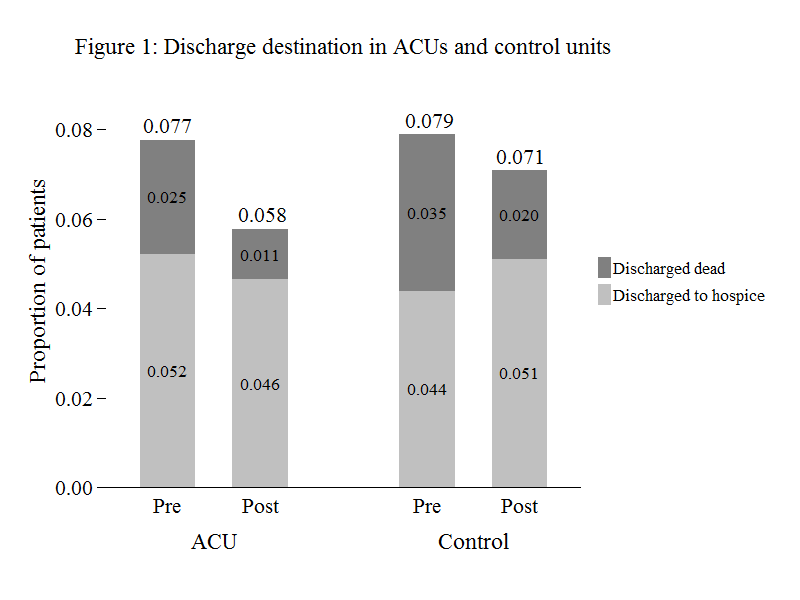
The unadjusted proportion of ACU patients discharged to hospice or dead declined from 7.7% to 5.8% (Figure 1) or -2.0 (95% CI: -2.9, -1.0) percentage points. The unadjusted proportion of patients discharged to hospice and dead both declined. A reduction in in-hospital mortality rates accounted for 70% of the decline (= [2.5–1.1] ÷ 2).
IMROJ 2019-105 - Jason Stein USA_figure1

Figure 1. Discharge destination in ACUs and control units

Table 1. Sample characteristics

  Pre

 Post


All


Control patients

ACU patients

P-value

Control patients

ACU patients

P-value

N (%)

N (%)

N (%)

N

23,403

6,219

5,499

6,545

5,140

Age

<0.001

.043

18–49

6,580

(28.1)

1,721

(27.7)

1,577

(28.7)

1,827

(27.9)

1,455

(28.3)

50–64

5,760

(24.6)

1,459

(23.5)

1,477

(26.9)

1,582

(24.2)

1,242

(24.2)

65–74

3,900

(16.7)

1,000

(16.1)

904

(16.4)

1,089

(16.6)

907

(17.6)

75–84

3,850

(16.5)

1,063

(17.1)

883

(16.1)

1,051

(16.1)

853

(16.6)

85+

3,313

(14.2)

976

(15.7)

658

(12.0)

996

(15.2)

683

(13.3)

White

11,719

(50.1)

3,314

(53.3)

2,796

(50.8)

.008

3,195

(48.8)

2,414

(47.0)

.047

Male

9,939

(42.5)

2,542

(40.9)

2,393

(43.5)

.004

2,746

(42.0)

2,258

(43.9)

.032

Insurance status

.024

.965

Medicare

12,079

(51.6)

3,144

(50.5)

2,728

(49.6)

3,470

(53.0)

2,737

(53.2)

Medicaid

2801

(12.0)

632

(10.2)

642

(11.7)

849

(13.0)

677

(13.2)

Self-pay

1598

(6.8)

416

(6.7)

400

(7.3)

439

(6.7)

343

(6.7)

Private/Other

2504

(10.7)

5,171

(83.1)

4,457

(81.1)

5,257

(80.3)

4,120

(80.2)

Admitted from facility

2504

(10.7)

798

(12.8)

503

(9.1)

<0.001

730

(11.2)

473

(9.2)

0.001

Diagnoses

Congestive heart failure

1,998

(8.5)

438

(7.0)

389

(7.1)

.948

653

(10.0)

518

(10.1)

.857

Pulmonary circulation disorders

1,211

(5.2)

331

(5.3)

252

(4.6)

.066

399

(6.1)

229

(4.5)

<0.001

Hypertension

719

(3.1)

148

(2.4)

179

(3.3)

.004

217

(3.3)

175

(3.4)

.790

Other neurological disorders

2,869

(12.3)

530

(8.5)

631

(11.5)

<0.001

867

(13.2)

841

(16.4)

<0.001

Chronic pulmonary disease

1,205

(5.1)

287

(4.6)

268

(4.9)

.511

352

(5.4)

298

(5.8)

.326

Diabetes

895

(3.8)

188

(3.0)

201

(3.7)

.057

258

(3.9)

248

(4.8)

.020

Renal failure

1,531

(6.5)

234

(3.8)

315

(5.7)

<0.001

473

(7.2)

509

(9.9)

<0.001

Liver disease

796

(3.4)

142

(2.3)

215

(3.9)

<0.001

211

(3.2)

228

(4.4)

.001

Metastatic cancer

694

(3.0)

248

(4.0)

170

(3.1)

.009

152

(2.3)

124

(2.4)

.750

Solid tumor

1,548

(6.6)

512

(8.2)

371

(6.7)

.002

365

(5.6)

300

(5.8)

.547

Fluid and electrolyte disorders

1,814

(7.8)

410

(6.6)

379

(6.9)

.519

506

(7.7)

519

(10.1)

<0.001

Deficiency anemias

672

(2.9)

150

(2.4)

176

(3.2)

.010

179

(2.7)

167

(3.2)

.104

The unadjusted proportion of patients in the control group discharged to hospice or dead declined from 7.9% to 7.1%, or -0.8 (95% CI: -1.7, 0.1) percentage points. A decline in the proportion of patients discharged dead was offset by an increase in the proportion discharged to hospice.

Adjusted estimates of the impact of ACUs are displayed in the last columns of Table 2. (Full regression results are available in the Appendix Table.) The adjusted estimate of the impact of ACUs on the composite outcome of discharged dead or to hospice is -1.8 (95% CI: -3.3, -0.3; p = .015) percentage points. The adjusted difference-in-difference estimate of the impact of ACUs on length of stay is negative but not statistically significant (-0.5 days [95% CI: -1.2, -0.3; p =.21]). The estimates for 30 day readmissions and hospital-acquired urinary tract infections are close to 0. The estimate of the impact of ACUs on the occurrence of pulmonary embolism/deep vein thrombosis was positive and borderline significant (0.6 percentage points [95% CI: -0.05, 1.3] p = .07).

Table 2. Changes in outcomes among ACU and non-ACU patients


Time period


Pre-ACU


Post-ACU


Unadjusted difference

P-value

Adjusted difference

P-value

In-hospital mortality (%)

ACU

2.5

(2.1,

2.9)

1.1

(0.8,

1.4)

-1.4

(-1.9,

-0.9)

Control

3.5

(3.0,

4.0)

2.0

(1.6,

2.3)

-1.5

(-2.1,

-1.0)

Difference

-1.0

(-1.6,

-0.4)

-0.9

(-1.3,

-0.4)

0.1

(-0.6,

0.9)

.765

-0.1

(-0.7,

0.8)

0.88

Hospice discharge (%)

ACU

5.2

(4.6,

5.8)

4.6

(4.1,

5.2)

-0.6

(-1.4,

0.3)

Control

4.4

(3.9,

4.9)

5.1

(4.6,

5.6)

0.7

(0.0,

1.5)

Difference

0.8

(0.1,

1.6)

-0.5

(-1.2,

0.3)

-1.3

(-2.4,

-0.2)

.023

-1.8

(-3.2,

-0.4)

0.013

In-hospital mortality and hospice discharge (%)

ACU

7.7

(7.0,

8.5)

5.8

(5.1,

6.4)

-2.0

(-2.9,

-1.0)

Control

7.9

(7.2,

8.6)

7.1

(6.5,

7.7)

-0.8

(-1.7,

0.1)

Difference

-0.1

(-1.1,

0.8)

-1.3

(-2.2,

-0.4)

-1.2

(-2.5,

0.2)

.083

-1.8

(-3.3,

-0.3)

0.015

Length of stay (days)

ACU

6.5

(6.3,

6.7)

6.4

(6.2,

6.6)

-0.1

(-0.4,

0.2)

Control

5.1

(4.6,

5.7)

5.4

(5.2,

5.5)

0.2

(-0.3,

0.8)

Difference

1.4

(0.8,

2.0)

1.0

(0.8,

1.3)

-0.4

(-1.0,

0.3)

.281

-0.5

(-1.2,

0.3)

0.21

30 day readmissions (%)

ACU

22.2

(21.1,

23.3)

21.0

(19.8,

22.1)

-1.2

(-2.8,

0.3)

Control

22.3

(21.3,

23.4)

20.9

(19.9,

21.9)

-1.4

(-2.9,

0.0)

Difference

-0.1

(-1.7,

1.4)

0.1

(-1.4,

1.5)

0.2

(-1.9,

2.3)

.852

0.3

(-1.8,

2.4)

0.80

Urinary tract infection (%)

ACU

5.2

(4.6,

5.8)

6.6

(6.0,

7.3)

1.4

(0.5,

2.3)

Control

5.5

(4.9,

6.0)

6.7

(6.1,

7.3)

1.3

(0.4,

2.1)

Difference

-0.2

(-1.1,

0.6)

-0.1

(-1.0,

0.8)

0.1

(-1.1,

1.4)

.819

0.01

(-1.2,

1.2)

0.99

Pulmonary embolism/Deep vein thrombosis (%)

ACU

1.8

(1.4,

2.2)

2.0

(1.7,

2.4)

0.2

(-0.3,

0.8)

Control

1.8

(1.5,

2.2)

1.6

(1.3,

1.9)

-0.2

(-0.7,

0.2)

Difference

0.0

(-0.5,

0.4)

0.4

(-0.1,

0.9)

0.5

(-0.2,

1.2)

.167

0.6

(-0.05,

1.3)

0.07

Models that included year-group interactions rejected the hypothesis of pre-existing trends for discharge status and readmissions (see Appendix for details). In the survival model estimating time to in-hospital death or discharge to hospice, the hazard ratio for the interaction of the ACU group indicator and the post period indicator was less than one but did not achieve significance at α = 0.05 threshold (0.80 [95% CI: .63 to 1.00]; p = .052).

Discussion

Results indicate that ACUs reduced the proportion of patients discharged dead or to hospice. Length of stay declined in ACUs relative to control units, but the effect was mostly driven by an increase in length of stay in control units rather than a decrease in ACUs. ACUs did not appear to affect readmission rates. The opening of an inpatient hospice unit coincided with the introduction of ACUs, making it more difficult to identify the discrete impact of ACUs. However, physicians in all units of the hospital could transfer patients to the inpatient hospice unit, and so it should not have differentially affected outcomes in ACU versus non-ACU patients. The proportion of patients discharged to hospice actually declined slightly in the units that implemented ACUs. This pattern may reflect mean-reversion (the hospice discharge rate was higher in ACU units in the pre-period).

Given the low rates of in-hospital mortality in this patient population and hospital-wide efforts to reduce in-hospital mortality, patient discharge status may not be particularly sensitive to the quality of care. The regular rotation of residents and movement of other unit staff through the hospital may have spread some of the features of ACUs and their processes, resulting in hospital-wide improvements in outcomes.

Consistent with our predetermined analysis plan, we evaluated trends in ACU units relative to trends in control units. However, there were baseline differences in mortality rates and length of stay.

ACUs did not reduce the occurrence of hospital-acquired urinary tract infections and pulmonary embolism/deep vein thrombosis, at least as measured from billing records. It is unclear whether these results reflect a failure of ACUs to improve care or whether they reflect “surveillance bias” [12] : ACU teams may be more likely to recognize and diagnose patients with these conditions. The hospital implemented an initiative to more accurately document patients’ conditions during the study period, which may account for the increase in urinary tract infection rates.

Lacking access to information about patient health after discharge, we were unable to determine the impact of being admitted to an ACU on long-term outcomes. Patients discharged too early may experience adverse outcomes. We found that readmission rates were similar between the ACU and control groups, suggesting that patients were not being discharged from ACUs prematurely.

Although we evaluated the impact of ACUs in a single, large academic medical center, there are no elements or features of the ACU model that would prevent it from being expanded to other care settings. ACUs have already been implemented in community hospitals in the US, Canada (see http: //www.rqhealth.ca/department/patient-flow/accountable-care-unit accessed April 19th 2019) and Australia (see http: //www.cec.health.nsw.gov.au/quality-improvement/team-effectiveness/insafehands accessed April 19th 2019).

Most prior studies on teams in inpatient and outpatient settings focus on single specialty teams (e.g. psychiatric care) and teams designed to address a specific quality issue (e.g., hospital acquired infections) [13,14].A recent report on the implementation of an Accountable Care Teams model, which shares many of the features of ACUs, at Indiana University Health Methodist Hospital found that implementation was associated with reductions in length of stay and costs but did not affect readmission rates or patient satisfaction [15].The assignment of hospitalists to units at Northwestern Memorial Hospital improved communication but did not increase physician-nurse agreement on patients’ care plans [16].

High risk industries with excellent safety records have recognized the value of teams to improving outcomes. ACUs, with their emphasis on patient-centered, interprofessional collaboration, were designed to address shortcomings of the traditional model of hospital organization. Our findings suggest that these and other features of the model were associated with reductions in the proportion of patients discharged dead or to hospice but did not affect other outcomes. Unfortunately, we were unable to assess the degree of fidelity of the study units to all features of the ACU model. Futures studies should include estimates of the extent to which units are implementing all four essential components of the model in estimating the effects of the model on distal outcomes.

Funding: Agency for Healthcare Research and Quality, R03 HS 022595-01

Conflicts of Interest: Dr Stein and Dr Chadwick are officers of 1Unit, a company that helps hospitals set up and run Accountable Care Units. Drs Howard, Shapiro, Murphy, and Ms Overton do not have any conflicts of interest.

References

  1. Stein J, Murphy DJ, Payne C et al. (2015) A Remedy for fragmented hospital care. Harvard Business Review-New England Journal of Medicine Online Forum: Leading Healthcare Innovation.
  2. Stein J, Payne C, Methvin A, et al. (2015) Reorganizing a Hospital Ward as an Accountable Care Unit. J Hosp Med 10: 36–40.
  3. Castle B, Shapiro S (2016) Accountable Care Units: A Disruptive Innovation in Acute Care delivery. Nurs Adm Q 40: 14–23.
  4. Shapiro S (2015) Accountable care at Emory Healthcare: Nurse-led interprofessional collaborative practice. VOICE of Nursing Leadership 13: 6–9
  5. Pronovost P, Berenholtz S, Dorman T, et al. (2003) Improving communication in the ICU using daily goals. J Crit Care 18: 71–75.
  6. O’Mahony S, Mazur E, Charney P, et al. (2007) Use of multidisciplinary rounds to simultaneously improve quality outcomes, enhance resident education, and shorten length of stay. J Gen Intern Med 22: 1073–1079.
  7. Cowan M, Shapiro M, Hays R, et al. (2006) The effect of a multidisciplinary hospitalist/physician and advanced practice nurse collaboration on hospital costs. J Nurs Adm 36: 79–85.
  8. Vazirani S, Hays RD, Shapiro MF, et al. (2005) Effect of a multidisciplinary intervention on communication and collaboration among physicians and nurses. Am J Crit Care 14: 71–77
  9. Dowd BE, Greene WH, Norton EC (2014) Computation of Standard Errors. Health Serv Res 49: 731–750.
  10. Elixhauser A, Steiner C, Harris DR, Coffey RM (1998) Comorbidity measures for use with administrative data. Med Care 36: 8–27.
  11. Volpp KG, Small DS, Romano PS (2013) Teaching hospital five-year mortality trends in the wake of duty hour reforms. J Gen Intern Med 28: 1048–1055.
  12. Bilimoria KY, Chung J, Ju MH, et al. (2013) Evaluation of surveillance bias and the validity of the venous thromboembolism quality measure. JAMA 310: 1482–1489.
  13. Bosch M, Faber M, Cruijsberg J, et al. (2009) Effectiveness of patient care teams and the role of clinical expertise and coordination: a literature review. Med Care Res Rev 66: 5S-35S.
  14. Pannick S, Davis R, Ashrafian H, Byrne BE, Beveridge I, et al (2015) Effects of Interdisciplinary Team Care Interventions on General Medical Wards: A Systematic Review. JAMA Intern Med. 175: 1288–98.
  15. Kara A, Johnson C, Nicely A, Neimeier MR, Hui SL (2015) Redesigning inpatient care: Testing the effectiveness of an Accountable Care Team model. Journal of Hospital Medicine 10: 773–779.
  16. O’Leary KJ, Wayne DB, Landler MP, et al. (2009) Impact of localizing physicians to hospital units on nurse-physician communication and agreement on the plan of care. J Gen Intern Med 24: 1223–1227.
Evaluation of a Direct Oral Anticoagulant Stewardship Program: Analysis of a Drug Consult Review Process and Population-Based Management Tool

DOI: 10.31038/JCCP.2019221

Abstract

Background: With the approval of Direct Oral Anticoagulants (DOAC), anticoagulation management has been transformed in both stroke prevention and venous thromboembolism prophylaxis and treatment. Despite evidence-based dosing guidance there has been large variation in prescribing practices that may lead to negative outcomes. The purpose of this two-part study is to evaluate the impact of a DOAC stewardship program on appropriate DOAC prescribing and use.

Methods: Patients were included in part one of the study if they were prescribed initial DOAC therapy from October 15, 2017 – October 15, 2018 with either a general or DOAC specific drug consult. A manual chart review was then conducted for data points including: anticoagulation indication, DOAC dose, serum creatinine, weight, age, consult approval or denial, and reasons for denial. Part two of the study included patients identified through a VA Population-Based Management Tool (PBMT) from January 1, 2018 – September 30, 2018. A manual chart review was then conducted for data points including: flag category, interventions made, and interventions accepted. Patients were excluded in both arms of the study if the duration of DOAC therapy was less than 20 days, incomplete chart review, or if DOAC therapy was prescribed by a non-VA provider.

Results: A total of 592 consults were included in the final analysis in part one of the study. Of the 233 general consults evaluated, 212 (91.0%) were deemed appropriate, 15 (6.4%) inappropriate, and 6 (2.6%) as clinical grey areas. Of the 233 DOAC specific drug consults evaluated, 218 (93.6%) were deemed appropriate, 1 (0.4%) inappropriate, and 14 (6.0%) as clinical grey areas. There was a significant difference in consults worked inappropriately (p=0.0004). A total of 317 PBMT interventions were included in the final analysis in part two of the study. Of those interventions that were actively acknowledged, 233 (95.9%) interventions were completed.

Conclusion: Implementation of a DOAC stewardship program in a healthcare system promotes appropriate and optimal use as well as safety monitoring of DOACs. A drug-specific consult review process improves inappropriate approval or denial of DOAC therapy while the utilization of a population-based management tool efficiently identifies critically important interventions necessary to ensure safe and appropriate use of DOACs.

Introduction

Two disease states that often require anticoagulation for either prophylaxis or treatment are nonvalvular atrial fibrillation (AF) and venous thromboembolism (VTE). Until recently, the primary option for oral anticoagulation was warfarin, a vitamin K antagonist. In 2010, the first Direct Oral Anticoagulant (DOAC), dabigatran, was FDA approved and since then, other DOACs have received FDA approval within the United States (rivaroxaban, apixaban and edoxaban) [1–4]. With the approval of these agents, anticoagulation management has been transformed in both stroke prevention and VTE prophylaxis and treatment. DOACs require no routine lab monitoring to assess anticoagulation effect due to their favorable pharmacokinetic and pharmacodynamic profile when compared with warfarin. However, DOACs are still associated with serious bleeding risks and possess characteristics different from warfarin, including: renal elimination, short duration of action, different drug-drug interactions, administration considerations, and dosing based off of appropriate indication.

Despite evidence-based dosing guidance, there has been large variation in prescribing practices that may lead to negative outcomes. Steinberg and colleagues were the first to analyze the association between DOAC doses and clinical outcomes in patients with nonvalvular AF. Their study, through the ORBIT-AF II Registry, concluded that off-label doses of DOAC therapy for prevention of stroke in nonvalvular AF are associated with increased risk for adverse events [5]. In addition to prescribing practices, adherence to anticoagulants effects patient outcomes. Shore, et al assessed the adherence component of DOAC therapy by specifically studying patients on dabigatran in Veterans Affairs (VA) hospitals. Their study found that one-quarter of patients demonstrated sub-optimal adherence to dabigatran and poor adherence was associated with an increased risk for stroke and all-cause mortality [6]. Dreijer and colleagues determined 8.3% of medication errors from the hospital and primary care settings were caused from anticoagulation agents, with most error reports concerning the prescribing phase of the medication process [7]. With these results and common practices today, it is imperative that prescribers are aware of the need for oversight of DOAC prescribing. Additionally, studies have shown that a pharmacist driven monitoring program improves appropriate prescribing and monitoring of DOACs used for FDA approved indications. Miele, et al. revealed that appropriate prescribing of DOAC therapy was improved after implementing a pharmacist driven monitoring program through a pre- and post-intervention study. They found that 32.4% of doses administered in the pre-intervention group were considered inappropriate, compared to 13.8% in the post-intervention group. Appropriate prescribing included FDA approved indications and appropriate doses of DOAC therapy based on renal function [8].

Tennessee Valley Healthcare System (TVHS) has pioneered a DOAC stewardship program that includes a DOAC drug specific consult to ensure appropriate prescribing at initiation and then long-term surveillance of patients on DOAC therapy by an ongoing population-based management tool. The goal of this stewardship program is to improve appropriate DOAC utilizations by streamlining the initial DOAC consult process along with ongoing management by utilizing anticoagulation clinical pharmacy specialists (ACC CPS) and a DOAC population-based management tool (PBMT). Previously, DOAC therapy was approved through a generic drug consult review process evaluated by a general clinical pharmacy specialist (CPS). This created a lack of consistency between DOAC approval on a patient to patient basis. The newly developed drug consult review process utilizes both a DOAC drug specific consult along with an ACC CPS. TVHS hopes to improve DOAC utilization with regards to appropriate indication, dosing, and safety through a more specific format of DOAC approval. The DOAC PBMT is used within the VA system to allow for continuous review of safety and compliance parameters for optimal care of patients who are prescribed DOAC therapy. The management tool identifies eight flags including: appropriate dosing, valve replacement, notable labs, overdue labs, critical drug interactions, active Non-Steroidal Inflammatory Drug (NSAID) use, overdue refill greater than 4 weeks and renewal due in next 30 days. It is the responsibility of the ACC CPS to actively review the PBMT daily. Upon review, if a flag is present, the ACC CPS will document their assessment in the patient’s electronic medical record; therefore, notifying the provider of a recommendation or change regarding the patient’s current DOAC therapy. In this study, we will evaluate the impact of a DOAC stewardship program on DOAC utilization at TVHS.

Methods

This multi-site, single center, retrospective cohort study was conducted at TVHS, which includes sites in Nashville and Murfreesboro, TN, as well as patients enrolled at any of the healthcare system’s 13 Community Based Outpatient Clinics (CBOCs) throughout Middle Tennessee, southern Kentucky, and northern Georgia.

Patients were included in part one of the study if they had an active DOAC prescription from October 15, 2017 to October 15, 2018 and 18 years of age or greater. Patients were excluded if the prescription was prescribed for short term therapy (inpatient use only and traveling veterans), written by orthopedics, there was an incomplete data set, or if a consult was denied based on criteria for use (CFU). Patients were included in part two of the study if they had an active DOAC prescription from January 1, 2018 to September 30, 2018 with a note title “Anticoagulation Eval and Mgt Secure Messaging” in the electronic medical record indicating an ACC CPS intervention and 18 years of age or greater. Patients were excluded if the prescription was prescribed for short term therapy (inpatient use only and traveling veterans), if the note title was used in error or the patient relocated to a different VA system. The primary endpoint of this study is to determine the appropriate use of DOAC therapy through a drug consult review process. The secondary endpoints are to determine how the drug consult review process and the utilization of a population-based management tool influences safety outcomes of initial and ongoing DOAC therapy including, concomitant antiplatelet therapy in part one and the PBMT flag categories in part two.

Patients who were prescribed direct oral anticoagulation therapy from October 15, 2017 – October 15, 2018 were identified through data warehouse extraction. A manual chart review was conducted for data points including: anticoagulation indication, DOAC dose at time of consult submission, initial or renewal consult, documented labs, documented weight, consult approval or denial, and rational for approval or denial. Evaluated consults were then categorized as appropriate, inappropriate, or clinical grey areas (Appendix 1). Patients followed by the PBMT from March 24, 2018 to September 24, 2018 were identified through data warehouse extraction using the note title “Anticoagulation Eval & Mgt Secure Messaging.” A manual chart review was conducted for data points including the PBMT flag categories (Appendix 2), interventions actively acknowledged and interventions completed. The sample size was calculated based on the primary objective to determine appropriate use of DOAC therapy through a drug consult review process. The sample included all patients who meet study criteria that received DOAC therapy during the pre-determined timeframe. We wanted to see at least a 15% difference regarding the number of appropriate approvals/denials between the generalized and the specialized consult review process. Using these two data points, the effect size was found to be 15% with alpha set at 0.05 and beta set at 0.20. The study required 133 patients in each arm to be adequately powered. Chi square and fisher exact were used to calculate the p-value for the categorical data presented.

Results

Table 1 displays the baseline demographics and clinical characteristics of the two cohorts. The two groups did not different significantly with respect to age, gender, and race. However, there was a statistically significant difference found in use of rivaroxaban and dabigatran between the two cohorts. The authors attribute this difference to the delineated questions of the drug-specific consult. (Table 1)

Table 1. Baseline characteristics for the consult review process

Generalized Consult
n = 233 (%)

DOAC Specific Consult
n = 233 (%)

P-value

Age

Average ± SD

70.9 ± 11

69.9 ± 12

0.3489

Male sex – no. (%)

231 (99.1)

227 (97.4)

0.2848

Race or ethnic group – no. (%)

White

194 (83.3)

204 (87.5)

0.2375

Black or African American

20 (8.6)

17 (7.3)

0.7323

Asian

0

1 (<1)

1.0000

Native Hawaiian or Pacific Islander

0

0 (0)

1.0000

American Indian or Alaska Native

1 (<1)

1 (<1)

1.0000

Unknown

18 (7.7)

10 (4.3)

0.1715

Direct Oral Anticoagulant (DOAC) – no (%)

Apixaban

85 (36.5)

82 (35.2)

0.8468

Rivaroxaban

56 (24)

78 (33.5)

0.0316

Dabigatran

91 (39.1)

65 (27.9)

0.0141

Edoxaban

1 (<1)

3 (1.3)

0.6156

No preference

0 (0)

5 (2.1)

0.0721

Indication for Use

Nonvalvular atrial fibrillation

162 (69.5)

177 (76)

0.1452

Venous Thromboembolism (VTE)

64 (27.5)

46 (19.7)

0.0637

Other

7 (3)

10 (4.3)

0.6212

*Indication for Use – “other” includes non-FDA approved indications

Part I: Drug consult review process

Primary Outcomes

Two thousand twenty-one unique patients were extracted from October 15, 2017 – October 15, 2018. Due to time constraints and sample size being met, after the initial data pull the date range was shortened to January 13, 2018 to July 13, 2018. All consults in the generalized cohort were evaluated (n=296) and consults in the specialized cohort were randomized to meet a matching sample size (n=296); therefore, a total of 592 DOAC consults were evaluated. In the generalized cohort, 233 consults were included for study evaluation with 63 excluded for various reasons (incomplete data set, orthopedic patients, denial based on CFU). In the specialized cohort, 233 consults for study evaluation with 63 excluded for various reasons (short term therapy, incomplete data set, orthopedic patient, denial based on CFU). Table 2 illustrates the number of evaluated consults deemed appropriate, inappropriate, and those classified as clinical grey areas. Of the 233 general consults worked, 212 were deemed appropriate, 15 inappropriate, and 6 as clinical grey areas. Of the 233 DOAC Specific Drug consults worked, 218 were deemed appropriate, 1 inappropriate, and 14 as clinical grey areas. Statistical significance was seen only in those consults worked inappropriately. (Table 2)

Table 2. Categorization of consult approval or denial

Process

Appropriate (%)

Inappropriate (%)

Clinical Grey Area (%)

Generalized (n=233)

212 (91)

15 (6.4)

6 (2.6)

Specialized (n=233)

218 (93.6)

1 (0.4)

14 (6)

P values

0.3859

0.0004

0.1075

Of the 15 consults worked inappropriately in the generalized process, inappropriate interventions identified included: non-FDA approved dosing, critical drug-drug interactions, non-FDA approved indications, no indication provided, and hepatic dysfunction. The one consult worked inappropriately in the specialized process, the inappropriate intervention identified was non-FDA approved dosing.

Secondary Outcomes

There were no interventions made in the generalized consult review process regarding concomitant antiplatelet use, however there were 29 recommendations made to either discontinue the P2Y12 inhibitor or discontinue/decrease the dose of aspirin in the DOAC specific consult process. Of the 29 recommendation that were made, 13 (45%) recommendations were completed, specifically 9 (69%) were discontinued and 4 (31%) doses were decreased.

Part II: Population Based Management Tool

One thousand fourteen notes with the title “Anticoagulation Eval and Mgt Secure Messaging” were extracted from March 24, 2018 to September 24, 2018 and randomized using Microsoft excel. Three hundred four notes were evaluated to collect the pertinent information as noted above in the “data collection” section. Two-hundred ninety-two notes were included as 12 notes were excluded for various reasons (orthopedic patient, use of wrong note title, relocation to another VA and no active DOAC prescription). Of the 292 notes that were evaluated, 267 notes only included interventions made on one flag, where as 25 notes included interventions on 2 flags resulting in a total of 317 interventions made.

Table 3 displays the number of interventions made regarding the flag category specified by the population-based management tool. By far, the intervention that was made most commonly was alerting the provider that the prescription needed to be renewed (30%), followed by overdue refill > 4 weeks (22%), overdue labs (15%) and inappropriate dosing (11%). From the 317 interventions that were made 242 (76.7%) interventions were actively acknowledged. Of those that were actively acknowledged, 233 (95.9%) interventions were completed (meaning a medication was renewed, refilled, labs were ordered, medications changed, etc.) with specific percentages regarding each flag noted in table 4. (Table 3, Table 4)

Table 3. Interventions made via the population-based management tool

Interventions made
n = 317 (%)

Overdue labs

49 (15)

Notable labs

19 (6)

Active NSAID use

35 (11)

Overdue refill > 4 weeks

69 (22)

Dosing

39 (12)

Critical drug-drug interactions

11 (3)

Valve replacement

1 (0.33)

Renewal due

95 (30)

P2Y12i use

2 (0.66)

Table 4. Interventions actively acknowledged and completed

Interventions actively acknowledged
n = 243

Interventions completed n = 233

Percent completed based on those actively acknowledge

Overdue labs

28

27

96.4%

Notable labs

12

10

83.3%

Active NSAID use

21

16

76.1%

Overdue refill > 4 weeks

53

52

98.1%

Dosing

31

24

77.4%

Critical drug-drug interactions

9

7

77.8%

Valve replacement

1

0

0%

Renewal due

87

87

100%

P2Y12i use

1

0

0%

Discussion

As the anticoagulation paradigm begins to shift from warfarin to DOAC therapy, the use of these medications should still be managed and monitored carefully to prevent unwanted harm. To our knowledge, this is the one of the first studies analyzing the implementation of an ACC CPS run DOAC stewardship program that includes a drug-specific consult and a continuous PBMT evaluated by ACC CPS. When using a generalized consult review process, more consults were deemed to be evaluated inappropriately compared to a specialized consult review process. The generalized process included a consult with minimal requirements for completion (drug, dose, and reason why patient was not candidate for preferred formulary agent, dabigatran) and was then reviewed by a general clinical pharmacy specialist. With the implementation of a DOAC stewardship program, a drug-specific consult was created and is now reviewed by an ACC CPS. For completion, the drug-specific consult must include: drug, dose, indication (as well as details associated with indication), appropriate baseline labs (Hgb/Hct, SCr, AST/ALT), bleeding history, antiplatelet use, NSAID use, and use of pillbox.

The results of this study are consistent with previous studies finding that implementing a pharmacist driven monitoring program reduced inappropriate prescribing of DOAC therapy in adult patients with an indication for nonvalvular AF and/or VTE prophylaxis and treatment [8]. In our study, the following inappropriate uses of DOAC therapy were identified: non-FDA approved indications (apical thrombus, cryptogenic stroke), critical drug-drug interaction (strong CYP3A4 and P-glycoprotein inducers), non-FDA approved dosing (lead-in dosing provided for AF, subtherapeutic use of apixaban, use of apixaban with CrCl75 years old or declining renal function, denial of dabigatran due to use of pillbox, and use of rivaroxaban for ease of compliance. By utilizing the PBMT, our study illustrates that continuous monitoring of DOAC therapy is necessary as patient’s clinical status has the potential to change while on DOAC therapy. The authors attribute the one-fourth of interventions not actively acknowledge as due to the lack of education provided to prescribers prior to the implementation of the DOAC stewardship program. However, almost 96% of the interventions that were actively acknowledge were completed, showing the importance of additional surveillance methods rather than relying on prescriber chart reviews. Moving forward, the authors plan to provide educational sessions to prescribers regarding the importance of the PBMT hoping to eliminate alert fatigue and engage providers in the ongoing efforts of the DOAC stewardship program.

There are a few limitations of this study to consider. First, when categorizing the evaluated consults, clinical grey areas have the potential to differ depending on the consult reviewer’s clinical interpretation of current literature. Second, throughout data collection, four reviewers were trained based on the derived protocol; however, due to the abundant number of unique patients and charts to be reviewed data could have been assessed differently between reviewers. Impacts of this study support the need for a DOAC stewardship program in a healthcare system to promote appropriate and optimal use as well as safety monitoring of DOACs. A drug-specific consult review process improves inappropriate approval or denial of DOAC therapy while the utilization of a PBMT efficiently identifies critically important interventions necessary to ensure safe and appropriate use of DOACs.

Appendix 1: Clinical Grey Areas

  • Use of apixaban due to age >75 years old
  • Denial of dabigatran due to use of pillbox
  • LV Thrombus (if failed or cannot take warfarin)
  • Weight (>120kg)
  • Labs not collected within 90 days
  • Use of DOAC versus heparin or enoxaparin for lead-in for treatment of VTE
  • Non-FDA approved use of DOACs per Landmark Clinical Trials
  • CrCl 15–25 mL/min for use of apixaban in A. Fib
  • CrCl 15–30 mL/min for use of rivaroxaban in A. Fib

Appendix 2: Population-Based Management Tool (PBMT) Flags

  • Overdue labs
    • Results include all patients where either their most recent hemoglobin OR most recent platelet OR most recent serum creatinine is overdue per patient’s monitoring frequency
    • Monitoring frequency defaults to 12 months for all labs except 6 months for serum creatinine for patients that are 75 years of age or more and/or have a CrCl of less than 60 mL/min
    • Once the overdue lab(s) are resulted (once daily in the morning) the patient will no longer appear in this column. In addition, after review of the patient, monitoring frequency (for serum creatinine) can be reset to 2 weeks, 1, 3, 6 or 12 months as determined clinically appropriate
  • Notable labs
    • Most recent platelets <100 x 109 /L if the second most recent value was above 100 x 109 /L OR any platelet value < 50 × 109 /L OR hemoglobin < 10 g/dL or AST/ALT > 135/120 U/L OR a hemoglobin drop > 2 g/dL since previous hemoglobin with resultant value < 13.1 g/dL for males and <11.0 g/dL for females
  • Active NSAID use
    • Patients with an active non-aspirin NSAID based on VA Drug Class MS101 and MS102
    • Active includes prescriptions with status ‘ACTIVE’, ‘SUSPENDED’, ‘PROVIDER HOLD’, ‘HOLD’, ‘PENDING’
    • This will include non-VA prescriptions
  • Valve replacement
    • Results include all patients with an ICD code for a prosthetic (bioprosthetic or mechanical) heart valve on their problem list, attached to two outpatient visits within the last 2 years, or as inpatient discharge diagnosis within the last two years
  • Dosing flag
    • Results include all patients whose renal function (by Cockcroft-Gault with actual body weight) falls above or below specified cutoffs based on agent, indication and if applicable selected drug interactions as per FDA approved package inserts
    • Results also include patients whose dose does not appear to match indication and duration or other non-renal dose modifying characteristics (e.g. high dose apixaban for PE/DVT > 6 months, low dose apixaban for PE/DVT within first 6 months, dose/indication mismatch based on age and body weight)
  • Overdue refill > 4 weeks
    • Results include patients for whom it has been more than 4 weeks since their day supply would be expected to run out (based on released date plus one additional week to allow for shipment)
    • Renewal due in next 30 days
    • Patients for whom the ordered days supply is scheduled to expire within the next 30 days
  • P2Y12i use
    • Antiplatelet therapy includes aspirin, clopidogrel (Plavix ®), ticagrelor (Brilinta®), prasugrel (Effient ®)
    • Critical drug-drug interactions

DOAC

Drug Interactions

Dabigatran

Flag if active warfarin, apixaban, edoxaban, rivaroxaban, rifampin, primidone, St. John’s Wort, phenobarbital, carbamazepime, phenytoin, dronedarone, cyclosporine, tacrolimus, itraconazole, ketoconazole, pasaconazole, voriconazole, rifampicin, saquinavir, ritonavir, indinavir, nelfinavir, amprenavir, lopinavir, fosamprenavir, atazanavir, tipranavir or darunavir

Rivaroxaban

Flag if active warfarin, apixaban, edoxaban, dabigatran, rifampin, primidone, phenobarbital, carbamazepime, phenytoin, itraconazole, ketoconazole, pasaconazole, voriconazole, rifampicin, saquinavir, ritonavir, indinavir, nelfinavir, amprenavir, lopinavir, fosamprenavir, atazanavir, tipranavir, darunavir or St. John’s Wort

Edoxaban

Flag if active warfarin, apixaban, rivaroxaban, dabigatran, rifampin, primidone, phenobarbital, carbamazepime, phenytoin, rifampicin, saquinavir, ritonavir, indinavir, nelfinavir, amprenavir, lopinavir, fosamprenavir, atazanavir, tipranavir, darunavir or St. John’s Wort

Apixaban

Flag if active warfarin, rivaroxaban, edoxaban, dabigatran, rifampin, primidone, phenobarbital, carbamazepime, phenytoin, itraconazole, ketoconazole, pasaconazole, voriconazole, rifampicin, saquinavir, ritonavir, indinavir, nelfinavir, amprenavir, lopinavir, fosamprenavir, atazanavir, tipranavir, darunavir or St. John’s Wort

  • Other critical drug interactions
  • Active cancer pharmacotherapy
  • Flag if: active VA cancer pharmacotherapy in a patient with diagnosis of DVT/PE ± atrial fibrillation or atrial flutter
  • Active includes prescriptions with status ‘ACTIVE’, ‘SUSPENDED’, ‘PROVIDER HOLD’, ‘HOLD’, ‘PENDING’ for any of the interacting drugs or cancer pharmacotherapy
  • Non-VA medications will be included in the analysis for critical drug-drug interactions. Patients with non-VA DOAC prescriptions will not be identified by this tool

References

  1. Eliquis [package insert]. New York, NY: Pfizer Pharmaceuticals, Inc; 2012.
  2. Xarelto [package insert]. Titusville, NJ: Janssen Pharmaceuticals, Inc; 2011.
  3. Pradaxa [package insert]. Ridgefield, CT. Boehringer Ingelheim Pharmaceuticals, Inc; 2011.
  4. Savaysa [package insert]. Tokyo, Japan. Daiichi Sankyo Company, Limited; 2017.
  5. Steinberg B, Shrader P, Thomas L, Ansell J, Fonarow GC, et al. (2016) Off-label dosing of non-vitamin K antagonist oral anticoagulants and adverse outcomes, The ORBIT-AF II Registry. JACC 68: 2597–2604.
  6. Shore S, Carey E, Turakhia M, Jackevicius CA, Cunningham F, et al. (2014) Aherence to dabigatran therapy and longitudinal patient outcomes: insights from the Veterans Health Administration. Am Heart J 167: 810–817.
  7. Dreijer AR, Diepstraten J, Bukkems VE, Mol PGM, Leebeek FWG, et al. (2019) Anticoagulant medication errors in hospitals and primary care: a cross-sectional study. Int J Qual Health Care 31: 346–352.
  8. Miele C, Taylor M, Shah A (2017) Assessment of direct oral anticoagulant prescribing and monitoring pre- and post-implementation of a pharmacy protocol at a community teaching hospital. Hosp Pharm 52: 207–213.

Water Heating By Solar Tile

DOI: 10.31038/NAMS.2019245

Introduction

The paper deals with the use of combination solar tiles-heat pump for domestic water heating. The paper presents testing of solar tile-heat pump combination. Black-coloured water which absorbs solar radiation flows through solar tiles made of transparent polymethyl methacrylate CH2C(CH3)COOCH3. At the same time, solar tiles are used as a roof covering and as a solar radiation collector. Hot water from solar tiles is led to the heat pump, which increases the temperature of water entering the boiler heating coil. The heat of water heated in solar tiles serves as a source of anergy for the heat pump. On that way Coefficient of Performance (COP) of heat pump is increased. Since we wanted to evaluate realistically the efficiency of combimation solar tiles-heat pump, we carried out extensive tests. The experiments were carried out in rainy, cloudy and clear weather.

Test rig

Conventionally, all types of collectors and heat pumps are used separately. In the paper, it is a suggestion to join both systems in a serial connection. Heated water that is coming from the solar tiles is led directly into the input side of a heat pump to gain the higher temperatures. This serial connection should ensure higher temperatures of heating as each heating system works independently.

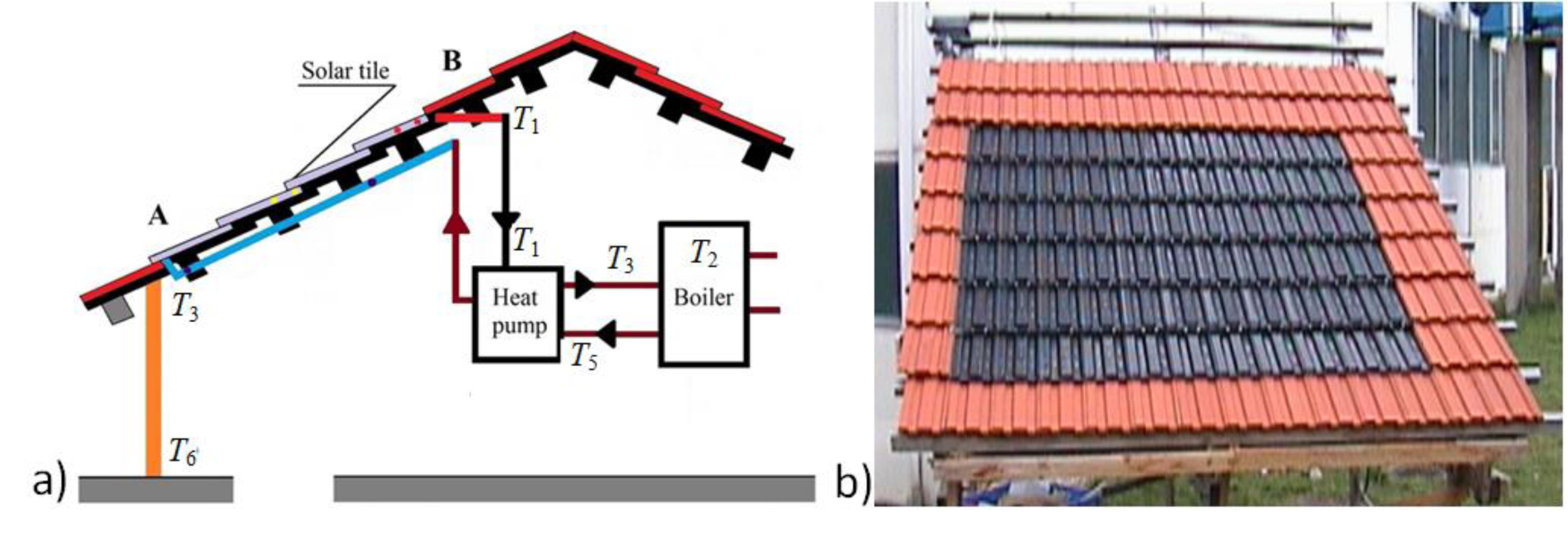
To verify the effectiveness of the serial connection solar tiles – heat pump, a convenient test rig was built. Measurements of suitable quantities were carried out and analyzed. The test rig consists of a solar tiles, water-water heat pump, and boiler.

The tests were carried under various weather conditions in the summer and winter seasons. Inlet and outlet temperatures from the flat plate collector and heat pump were measured, as well as the ambient air temperature and the water temperature in the boiler.

Figure 1a shows a measurement diagram and Figure 1b the installation of solar tiles. The surface area of tiles was 2 m2. On the lower side, the tiles were insulated, resulting in a decrease by half of the contact surface of the air with the tiles in the case of cloudy weather and darkness, when convective heat transfer prevails. The insulation is appropriate when heat is generated from the radiant part of the heat transfer. The water/water heat pump had thermal power of 1.5 kW under standard conditions and it heated a 300 l boiler. The measured parameters included:

NAMS-2019_Milan Marčič_F1

Figure 1. a) Measurement diagram, b) Installation of solar tiles

  • outlet water temperature from a solar tile (T1);
  • boiler water temperature (T2);
  • inlet water temperature to a solar tile (T3);
  • outlet water temperature from a heat pump (T4);
  • inlet water temperature to a heat pump (T5);
  • ambient air temperature (T6);
  • water flow (Q).

Tests results

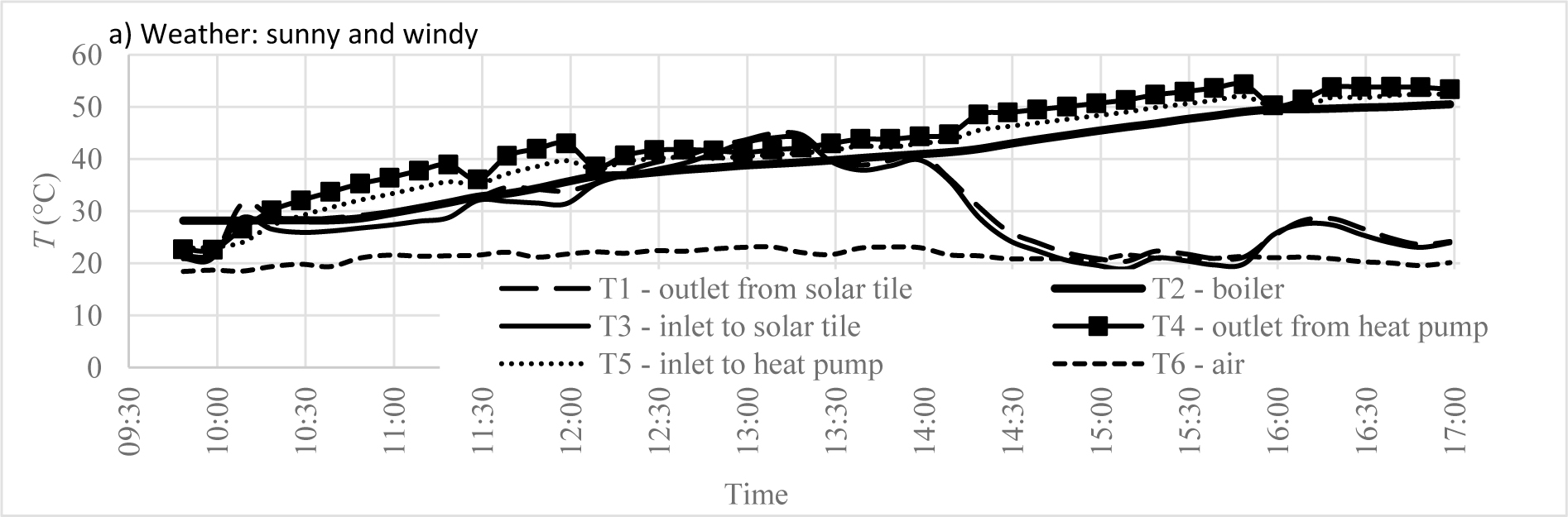
The measurements shown in Figure 2 were made in clear sunny and totally cloudy weather. The difference between temperatures T1 (outlet water temperature from a solar tile) and T6 (ambient air temperature) was as high as 20 °C. Between 13:00 and 15:30, it was totally cloudy, which is why the T1-T6 difference dropped to 0 °C. At 15:30, the sky was fully cleared and the temperature difference increased again to 8 °C. From an energy point of view, the solar tile-heat pump combination is certainly the best solution in clear weather for heating of residential  houses and domestic water.

NAMS-2019_Milan Marčič_F2

Figure 2. Temperature measurements – Weather: sunny and windy

References

  1. Dubey S and Tiwari GN (2009) Analysis of PV/T flat plate water collectors connected in series. Solar Energy 83: 1485–1498.
  2. Haložan H (2000) Heat-Pumping Technologies, Journal of Mechanical Engineering. 46: 2000: 445–453.

The social inequity across the smoking social costs

DOI: 10.31038/ASMHS.2019355

Abstract

Introduction: Tobacco consumption is a demonstrated cause of growing in morbidity and mortality between smokers. Because of that it influence hardly since the social and the economic context because of smoking social costs. Consequently these costs are determining a particular inequity according to the smoking impact.

Objective: To describe the main economics characteristics that identify to smoking like inequity cause.

Materials and methods was made a descriptive research about the main characteristics that identify to smoking as social inequity cause. Were utilized the inductive deductive like theoretical method and like empiric was utilized the bibliographic research.

Results: The inequity attributable to smoking is given by the social cost attributable to it. The direct cots by morbidity determine a socio epidemiologic inequity while the indirect cost by labor productivity loses condition a socio labor inequity. Both costs are determining a contextualized form of socioeconomic inequity.

Conclusion:The economic burden attributable to smoking is a main measurer for the socioeconomic inequity attributable to smoking. The indirect costs attributable to smoking are given mainly by labor productivity lose attributable to smoking. In these cases the labor time lose in each context is a main measurer for the social inequity attributable to smoking by this way.

Keywords

Cost, Inequity, Smoking

Introduction

Smoking is an accumulative, modifiable and socioeconomic risk factor. These classifications are a strong base to understand by the society and the fiscal authority particularly about smoking to control it. That’s why the analysis about smoking cost by cost type will contribute to apply more efficient fiscal policies for the smoking control [1]. Like socioeconomic risk factor smoking have two main variables given by the smoker number and the tobacco consumption. Then, the relation saved by these variables explicates the smoking behavior too [2]. The single variation in both carries to smoking variation in the same way. Consequently the smoking social costs are in direct relation to these variables and the smoking social inequity too. As consequence of the tobacco growing it produces high social cost irreversible at short time. These costs overcharge to no smokers and thus born the smoking social inequity. The smoking social inequity form will depend from the smoking impact over the population researched but generally is possible to determine an economic cost because of the smoking social inequity too [3]. The most evident case is the passive smokers who are exposed to tobacco smoke and because of that suffers the smoking consequences agree to the exposition rate. Then, each form to measure the smoking social inequity must include these main variables and must be agree to the smoking particularities too [4].

Social inequity across smoking social cost

Tobacco consumptions carry to health disequilibrium. This is because the smoking social impact over the health population and the real health services too. This disequilibrium determines the smoking social inequity by smoking direct cost [5]. Smoking like socioeconomic risk factor is close related with poorness and the human develop. WHO had pointed the close relation between tobacco consumption and the health services demand and the economic development because of labor productivity lose too. These are the bases for the smoking social inequity by labor productivity loses attributable to smoking [5, 6]. These arguments show how important is understand the smoking social inequity like untouchable smoking impact. That’s why the objective of this research is to describe the main characteristic that identify to smoking as social inequity cause.

Materials and methods

Was made a descriptive research about the main characteristics that identify to smoking as social inequity cause. Were utilized the inductive deductive like theorical method and like empiric was utilized the bibliographic research.

Results

The social inequity because of smoking is given by the disparities in the society because of the smoking social costs. The most important social cost attributable to smoking are the direct smoking cost related with morbidity and the health services and the indirect smoking cost related with the labor productivity lose related with morbidity and mortality because of smoking. Each of them has particular forms of social inequity attributable to smoking [6].

Inequity attributable to smoking in the consumption of health services

A significant part of the health budget is utilized attending morbidities causes attributable to smoking. Then, the no existence of smoking should mean an important social save that could able for other social objectives [7]. This disparity is given by the smoking impact over active and passive smokers. This social impact it shows by the effective demand of health services because of smoking, the smokers’ number and the morbidity attributable to smoking. That is why the economic burden is a main measurer rate for the social inequity attributable to smoking for the Public Health [7].

Socio-epidemiologic and socioeconomic social inequity across the direct social attributable to smoking

To understand the social inequity attributable to smoking since the direct social costs is necessary to difference between epidemiologic burden and economic burden attributable to smoking [8, 9]. The epidemiologic burden is given by the morbidity attributable to smoking like risk factor and represents the morbidity probability´s attributable to smoking. By other side the economic burden is given by the effective demand of health services attributable to smoking. It is equivalent to the health spend probability´s attributable to smoking [8, 9]. The morbidity attributable to smoking creates disparities in the incidence of morbidity causes related with smoking. This disparities are given by the smoking impact over the health and it show in the differences between smokers morbidity and no smokers morbidity. This type of disparity explicates the socio-epidemiologic inequity attributable to smoking, where the epidemiologic burden is the main explicative variable [8, 9]. The morbidity attributable to smoking carries to disparities accessing to the health services too. These disparities should be external or internal. The external are given by the exclusion of consumer from the health services market while the internal are given by the redistribution in the health services accessing attributable to smoking. These are the main socioeconomic inequities attributable to smoking across the direct social costs attributable to smoking.

Socio-labor and socioeconomic inequity because of the labor productivity lose attributable to smoking

The labor productivity lose attributable to smoking can be absolute or relative. The absolute is related with earlier death because of smoking while the relative is associated to the morbidity attributable to smoking [10]. The earlier death of smoker reduces the life expectative and this is an important social inequity given by the difference in life expectation between smokers and no smokers because of smoking. Also, is smoker death occur before retire age is present a socio-labor inequity because of the potential work time lose because of smoking and a socioeconomic inequity because of all economic benefits no obtained because of smoking given by the smoker earlier death [11]. The relative labor lose attributable to smoking can be by touchable absenteeism or untouchable absenteeism. The touchable absenteeism occur when the smoker worker isn´t physically present at workplace because of the morbidity attributable to smoking while the untouchable absenteeism occur when the smoker worker use part from the labor time to smoke although keep physically at workplace [10–12]. Each labor productivity lose will depend from the specific characteristic of the smoking impact. In general way can be identified two main social inequity form because of labor productivity lose attributable to smoking: a socio-labor inequity and a socioeconomic inequity. The socio-labor inequity is determined by the potential labor time lose because of smoking and the socioeconomic inequity is determined by all economic costs related to each social inequity form attributable to smoking by labor productivity lose. In general way, understand the social inequity attributable to smoking by all causes may adopt better social policies agree with the particular smoking impact. That’s why the smoking control is interesting for all societies but specially for the fiscal authorities [13, 14].

Conclusion

The smoking social costs are the best measure rate for the smoking social inequity. The direct social costs by morbidity determine the socio-epidemiologic and the socioeconomic inequity attributable to smoking by this way. In this case the epidemiologic burden and the economic burden are the main rate to explain the social inequity attributable to smoking by the smoking direct costs. By other side, smoking social costs by labor productivity lose attributable to smoking determine the socio-labor inequity and the socioeconomic inequity because of labor productivity lose attributable to smoking. In this case the potential labor time lose determines this social inequity.

References

  1. Toledo Curbelo GJ (2008) Fundamentos de Salud Pública. Segunda edición.  Pág La Habana: Ciencias Médicas Pg No: 184–186.
  2. Fernández Hernández F, Sánchez González E (2018) Algorithm to calculate the smoking economical burden in active and passive smokers. MOJ Toxicol 4: 373–375.
  3. Fernández Hernández F, Sánchez González E (2019) La carga económica del tabaquismo. España: Editorial Académica Española.
  4. Varona Pérez P, García Roche G, Willams Fogarty A, Britton J (2015) Mortalidad por cáncer de pulmón y cardiopatía isquémica atribuible al tabaquismo pasivo en Cuba – 2011. Rev Cubana HigEpidemiol 53.  Disponible en: http://www.revepidemiologia.sld.cu/index.php/hie/article/view/55.
  5. Fernández Hernández F, Sánchez González E (2019) Economic Inequity Attributable to Smoking Ratio’s for the Public Health. Health Econ Outcome Re Open Access 4: 161.
  6. Fernández Hernández F, Sánchez González E (2019) The socioeconomic inequity attributable to smoking.  Journal of Medical Practice and Review 3: 559–562. Disponible en http://jmpr.info/index.php/jmpr/index,
  7. Fernández Hernández F, Sánchez González E (2017) Impacto del tabaquismo en el presupuesto sanitario de Cuba 1997–2014. Revista del Hospital Psiquiátrico de La Habana 14. Disponible en: http://revhph.sld.cu/index.php/hph/article/view/31.
  8. Sánchez González E, Fernández Hernández F (2019) A view for the morbidity attributable to smoking since the microeconomic. Trends in Research 2: 1–2.
  9. Fernández Hernández F, Sánchez González E (2017) Carga epidemiológica vs carga económica del tabaquismo por morbilidad. Rev Ciencias Médicas 21: 60–66. Disponible en: http://scieloprueba.sld.cu/scielo.php?script=sci_arttext&pid=S1561-31942017000200009&lng=es,
  10. Sánchez González E, Fernández Hernández F (2016) La pérdida de productividad laboral atribuible al tabaquismo. Revista Cubana de Salud y Trabajo17: 57–60.
  11. Sánchez González E, Fernández Hernández F (2018) Costo social por pérdida absoluta de productividad laboral. Revista Cubana de Salud y Trabajo 19: 33–39.
  12. Fernández Hernández F, Sánchez González E (2017) Pérdida de productividad por el consumo de cigarrillos en la jornada laboral. Revista Cubana de Salud y Trabajo 18: 9–12.
  13. Sánchez González E, Fernández Hernández F (2018) La relación entre la política tributaria y el control del tabaquismo en Cuba. CCM 22: 238–249. Disponible en: http://scieloprueba.sld.cu/scielo.php?script=sci_arttext&pid=S1560-43812018000200005&lng=es.
  14. Sánchez González E, Fernández Hernández F (2017) El rol de las autoridades fiscales en el control del tabaquismo. Rev Ciencias Médicas 21: 62–67. Disponible en: http://scielo.sld.cu/scielo.php?script=sci_arttext&pid=S1561-31942017000300010&lng=es.

GPs should actively ask about Symptoms of Urinary or Faecal Incontinence in Ageing Female Patients

DOI: 10.31038/AWHC.2019264

Abstract

Objectives: To investigate how common incontinence problem is and how it could be detected in an unselected population.

Methods: Cross-sectional study in primary care population. A population survey of women born in 1948 or 1950 and living in a municipality with 19,535 inhabitants in south-western Finland in 2017. Main outcome measures were incidence of urinary or faecal incontinence.

Results: After analyzing the questionnaires and research findings, we found that urinary incontinence is a common phenomenon, reported by 50.3% of participants. According to the Urinary Incontinence Severity Score (UISS), 12.7% of them believed that the degree of disability was remarkable, and according to the Visual Analogue Scale (VAS), 18.3% considered the degree of disability to be difficult. In this study obesity was the most common feature affecting urinary incontinence.

Conclusion: Urinary incontinence is a common problem and will increase as the population ages. It can deteriorate a person’s quality of life, increase her need of care and involve considerable costs. Preventing the problem and treating it as early as possible in primary health-care is both reasonable and saves time and money.

Keywords

Conservative Treatment, Lifestyle, Medication, Quality of life, Urinary incontinence

Key message

Urinary incontinence is a common problem in the ageing female population. Many women are ashamed of their incontinence and do not even mention it during the GP’s consultation. Preventing the problem and treating it as early as possible in primary healthcare is important.

Introduction

The ageing of the population has changed morbidity rates. Part of this change can be explained by lifestyle, but part is connected only to ageing. Furthermore, some of the changes can impair one’s health related quality of life. Urinary or faecal incontinence affects many women. Based on a broad population survey, Norwegian researchers estimate that the prevalence of incontinence problems is about 25%. Estimating the extent of the problem is difficult due to the embarrassment connected with incontinence. Furthermore, diverse definitions of incontinence may complicate the estimation. According to the survey, 25% of participants experienced inconvenience that lessened their quality of life while 7% had significant incontinence problems. These women should be regarded as potential patients. Those with fewer problems should be offered information and advice on self-care [1]. Traditional predisposing factors for incontinence include ageing, childbearing, obesity and menopause [2]. Examples of lifestyle factors possibly associated with incontinence include smoking and a low level of physical activity [3]. Norwegian researchers have also found a strong association between diabetes and urinary incontinence, especially for urge incontinence and a severe degree of incontinence [4]. Many drugs can also cause incontinence, such as diuretics, cholinergics, sedatives or combinations of drugs.This pilot study aims to investigate how women needing medical treatment for their symptoms of incontinence might be detected in an unselected population. According to researchers, urinary incontinence may improve considerably through conservative treatment in general practice [5], and therefore it is important to find easy and cost-effective methods to relieve women’s symptoms.

Methods

Selection of study subjects

Information for women born in 1948 or 1950 and living in a municipality with 19,535 inhabitants (as of 31.8.2017) in south-western Finland was obtained from the Population Register Centre. The researchers mailed an information letter about the study and a consent form with a return envelope to all women in these age groups. Those who accepted the invitation and provided informed consent received questionnaires about pelvic-floor symptoms and were scheduled for an appointment during consulting hours at the gynaecological clinic of Turku University Hospital.

Questionnaires and measurements

Sociodemographic data including date of birth, marital status, education and occupation, were collected. Marital status was coded as solitary (single, divorced, widowed) or in a relationship (married, cohabiting). The participants were asked about smoking, alcohol use and medication (including systemic or local hormone treatment). Also, inquiries were made about parity and possible diseases. Height and weight were measured, and body-mass index (BMI) was calculated. BMIs were classified according to WHO criteria [6]. A trained research nurse measured blood pressure and checked the questionnaires with the examinees. Symptoms related to incontinence and their degrees of inconvenience were retrieved from the following validated questionnaires: the Urogenital Distress Inventory(UDI-6) [7], the Incontinence Impact Questionnaire (IIQ-7) [7], the Urinary Incontinence Severity Score (UISS) [8] and the Detrusor Instability Score (DIS) [9]. Quality of life was classified according to the Finnish 15-dimensional measure of health-related quality of life questionnaire (15D) [10]. We classified the results of UISS as follows: <25% indicated slight disability, 25–75% indicated clear disability and >75% indicated remarkable disability. The degree of disability with regard to incontinence was also evaluated using the Visual Analogue Scale (VAS) (10), with the degree of disability being classified from 0 to 10. We considered values 0–2 as insignificant disability, values 3–5 as remarkable disability and values 6–10 as difficult disability. A gynaecologist examined all participants and gynaecological vaginal ultrasound was performed. The cough stress test was performed with a comfortably filled bladder. In addition, general muscle condition was evaluated in this research according to the chair-stand 5 test. We used Finnish population norms for 60- to 69-year-old women. The norms are based on the Health 2000 health examination survey [11].

Statistical analysis

The research data were coded in Excel format without personal identifiers and statistical analyses were performed using the SPSS program. The data are presented as counts with percentages. Statistical comparisons of the baseline characteristics between groups were made by the χ² test. The significance level of P-values was set at 0.05.

Ethics

The research is registered with the Clinical Trials gov. ID: NCT02338726. The Ethics Committee of the Hospital District of Southwest Finland approved the study.

Results

The invitation to participate in the study was sent to 242 women, of whom 143 accepted, resulting in a participation rate of 59%. Urinary incontinence was a common phenomenon, with 72 women (50.3%) reporting that they suffered from it. The characteristics of the participants are presented in (Table 1). Faecal incontinence was suffered by 18 women (12.6%) and this had a correlation to urinary incontinence (P=0.013). According to the Finnish UISS questionnaire evaluating the degree of disability, 12.7% of the participants believed that the inconvenience of their incontinence was remarkable. One questionnaire of those that reported urinary incontinence was omitted because the answers were missing to all the questions concerning the subject at issue. According to the VAS, 41 participants (57.7%) who had reported having urinary incontinence believed that the inconvenience was insignificant, while 13 participants (18.3%) described the problem as difficult.

Table 1. Characteristics of the participants (n=143) in a population survey of Finnish women at menopause in order to detect urinary or faecal incontinence.

Women with urinary Incontinence
n = 72 (50.3%)

Women without urinary incontinence
n = 71 (49.7%)

P-value

Demographics

   solitary

19 (61.3%)

12 (38.7%)

0.17

   in a relationship

53 (47.3%)

59 (52.7%)

BMI

0.40

   normal weight

28 (46.7%)

32 (53.3%)

   overweight

25 (46.3%)

29 (53.7%)

   obese

12 (60.0%)

8   (40.0%)

   severely obese

5   (83.3%)

1   (16.7%)

   morbidly obese

1   (50.0%)

1   (50.0%)

Current smokers

9   (50.0%)

9   (50.0%)

0.98

Education

0.37

   comprehensive school

22 (47.8%)

24 (52.2%)

   vocational school

46 (54.1%)

39 (45.9%)

   college

RR systolic

   normal

   high

RR diastolic

   normal

   high

Parity

  nulliparous

  1–2parturitions

  3–5parturitions

4   (33.3%)

17 (54.8%)

55 (49.1%)

42 (49.4%)

30 (51.7%)

  5 (55.6%)

52 (53.1%)

15 (41.7%)

8   (66.7%)

14 (45.2%)

57 (50.9%)

43 (50.6%)

28 (48.3%)

  4 (44.4%)

46 (46.9%)

21 (58.3%)

0.57

0.79

0.48

Forty-two percent of the participants (n=60) were of normal weight. The combined proportion of obese, very obese or morbidly obese participants was 19.7% (n=28). Obese women reported significantly more severe urinary incontinence. In our data 4 from 60 women (8.2%) of normal weight and two from 54 overweight women (4.1%) believed that the inconvenience was extreme, while five obese women (31.3%) and two severely obese women (33.3%) estimated that the inconvenience was difficult (P=0.035). In the chair-stand 5 test measuring muscle strength, 69 women (50.0%) had a result that was better than average while 28 (20.3%) had a worse than average result. Muscle condition and urinary incontinence had no significant correlation in this population, and parity also had no influence on incontinence in this research. The number of current smokers was quite small and was equal in the group that suffered from incontinence and the group that did not, with nine (50%) found in each group. According to the AUDIT-C evaluation unhealthy alcohol use was rare. Only six women consumed more than five measures of alcohol per week which is estimated to be largest safe quantity for women [12]. Medications for hypertension, diabetes, hyperlipidaemia and thyroid insufficiency were the most commonly used: 29.6% of participants used no medication, and 54.9% used from one to four medications. No statistical correlation was found between urinary incontinence and multi-medication. The effects of hormone replacement therapy (HRT) on urinary incontinence was also studied. During the time of research, 49women (34.27%) used HRT: 26 of those women (53.06%) used vaginal oestrogen, 12 (24.49%) used systemic therapy and 11 (22.45%) used both. The use of any type of HRT did not have a statistically significant influence on urinary incontinence (P=0.81).

Discussion

This article aims to describe the problem of incontinence from the GP’s point of view. Urinary incontinence is known to be a common problem in the ageing female population. However, its assessment is complicated by the nature of the problem. Many women are ashamed of it and do not even mention their complaint if they are not asked about it during the GP’s consultation [13]. Even more hidden problem is faecal incontinence, which was quite rare in our material but was correlated to urinary incontinence. Participation rates in incontinence studies vary. In a large postal survey of 29,500 women in France, Germany, the United Kingdom and Spain, the response rate varied from 45–64% [14]. Strong evidential data suggest, however, the existence of a potentially high level of expressed but unmet need [15], so further research is needed to assess the knowledge and attitudes of primary-care staff [15]. The participation rate in our research was quite good. In a semi-urban population, such as ours, many women regularly visit their private gynaecologist and perhaps consequently might not want to participate in a study of this kind. However, better participation rates of 86% and 78% were reported in the Norwegian HUNT2 and EPINCONT studies, respectively, among women of corresponding age [1]. The complete HUNT 2 survey covered many topics, for example, mental health, cardiovascular diseases, asthma and urinary incontinence [1]. The EPINCONT study is part of a large survey (HUNT 2) where women answered a questionnaire concerning urinary incontinence [1]. The patients didn’t participate any clinical examination. The participants in our study were slightly more slender than the women in the FINRISKI 2012-study [16], but otherwise the participants were representative of the ordinary Finnish female population of corresponding age. The percentage of urinary incontinence problems was quite high in our material. This could be due to selection bias. Because we wanted to study urinary incontinence, it may be that women who suffered from the problem wanted especially to participate. On the other hand, the degree of problem can be considered quite insignificant in over half of the participants. Excess weight turned out to be a significant variable. According to international studies, obesity is the condition chiefly associated with urinary incontinence, and waist circumference is also a strong predictor for the incident of urinary incontinence [17]. Weight loss may be associated with improvement of the problem and also of the patient’s quality of life [18]. Public-health professionals should bring up the problem of incontinence when they are dealing with overweight and obese patients. People may feel that the risks of overweight are distant, particularly with regard to disease, but incontinence is often a practical concern and causes deterioration of health- related quality of life.

The benefits of sport for general health are well-known. Women should learn and practice exercises for the pelvic-floor muscles for the whole of their life, not only after giving birth. Overweight and diabetic women particularly, as well as pregnant women and those who exercise regularly for high-level athletics should remember the importance of training these muscles [19]. Although manual work is less common and working life has become easier, some occupations are still dominated by women. Lower urinary-tract symptoms are reported to be a significant concern among the female nursing workforce [20]. In our study, the participants were on average in good condition. Our research data offer much material for specialists, but the family doctor must remember the problem and ask about it. Initial diagnostic testing, such as the cough stress test, can be conducted by the general practitioner in addition to a gynaecological examination. However, this does not reveal women with an overactive bladder or urgency incontinence. There are helpful questionnaires available for this purpose. Patient education is the first step in the management of urinary incontinence. The patient can be sent to a physiotherapist for instructions in pelvic-floor muscle training. Anticholinergic medication or vaginal oestrogen therapy [21] can be initiated in general practice as well as mirabegron which is a beta-3-agonist and its efficiency on urge incontinence is like anticholinergics but side effects are different [22]. A simple questionnaire could be an easy and time-saving method for detecting patients with urinary incontinence who could be helped in primary healthcare. Correspondingly, there should be simple regional guidelines for referrals to specialist healthcare. In a recent Dutch study, it has been assumed that the prevalence and incidence of urinary incontinence will rise in an ageing population. It is therefore vital to address this problem in order to reduce it and improve the quality of life of the elderly and reduce the costs and time invested in healthcare [23]. Public health nurses play a key role in this work together with general practitioners. The weakness of our pilot study is the small size of the sample. On the other hand, the strengths of the study include the random group of population-based respondents, the fact that every participant was examined objectively and the fact that the questionnaires could be completed with the assistance of the research nurse when needed.

Conclusion

Urinary incontinence is a common problem, and it will increase with the ageing of the population, especially among those who have any other chronic problem. Urinary incontinence can lessen a person´s quality of life, increase her need of care and involve considerable costs. Preventing the problem and treating it as early as possible in primary healthcare is both reasonable and time and cost effective.

Funding support

Support was provided by Turku University Hospital EVO-funding and the Päivikki and Sakari Sohlberg Foundation.

References

  1. Hannestad Y, Rortveit G, Sandvik H, Hunskaar S (2000) A community-based epidemiological survey of female urinary incontinence: The Norwegian EPINCONT study.  J Clin Epidemiol 53: 1150–1157. [crossref]
  2. MacLennan A, Taylor A, Wilson DH, Wilson D (2000) The prevalence of pelvic floor disorders and their relationship to gender, age, parity and mode of delivery. BrJ Obstet Gynaecol 107: 1460–1470. [crossref]
  3. Hannestad YS, Rortveit G, Daltveit AK, Hunskaar S (2003) Are smoking and other lifestyle factors associated with female urinary incontinence? The Norwegian EPINCONT Study.  BrJ Obstet Gynaecol 110: 247–254. [crossref]
  4. Ebbesen M, Hannestad Y, Midthjell K, Hunskaar S (2007) Diabetes and urinary incontinence – prevalence data from Norway. Acta Obstet Gynecol Scand 86: 1256–1262. [crossref]
  5. Holtedahl K, Verelst M, Schiefloe A (1998) A population based, randomized, controlled trial of conservative treatment for urinary incontinence in women.  Acta Obstet Gynecol Scand 7: 671–7. [crossref]
  6. Global Database on Body Mass Index. BMI classification. WHO 2000.
  7. Uebersax J, Wyman J, Schumaker S, McClish DK, Fantl JA (1995) Short forms to assess life quality and symptom distress for urinary incontinence in women: the Incontinence Impact Questionnaire and the Urogenital Distress Inventory. Continence Program for Women Research Group. Neurourol Urodyn 14: 131–139. [crossref]
  8. Mäkinen J, Kujansuu E, Korhinen N, Penttinen J (1992) Evaluation and care of urinary incontinence in public health organisations. Finnish Medical Journal 47: 2372–2375.
  9. Kauppila A, Alavaikko P, Kujansuu E (1982) Detrusor instability score in the evaluation of stress urinary incontinence.  Acta Obstet Gynecol Scand 61: 137–141. [crossref]
  10. Stach-Lempinen B, Kujansuu E, Laippala P, Metsänoja R (2001) Visual analogue scale, urinary incontinence severity score and 15D-psychometric testing of three different health-related quality of life instruments for urinary incontinent women.  Scand J Urol Nephrol 35: 476–483. [crossref]
  11. Aromaa A, Koskinen S [2002] Health and functional capacity in Finland. Baseline results of the Health 2000 health examination survey. Publications of the National Public Health Institute. Helsinki 2002. The permanent address of the publication is
    http://urn.fi/URN:ISBN:951-740-262-7
  12. Kriston L, Hölzel L, Weiser AK, Berner M, Härter M (2008) Meta-Analysis: Are 3 Questions Enough to Detect Unhealthy Alcohol Use? Ann Intern Med 149: 879–888. [crossref]
  13. Shaw C, Das Gupta R, Bushnell D, Assassa P, Abrams P, et al. (2006) The extent and severity of urinary incontinence amongst women in UK GP waiting rooms. Fam Pract 23: 497–506. [crossref]
  14. Hunskaar S, Lose G, Sykes D, Voss S (2004) The prevalence of urinary incontinence in women in four European countries.  BJU Int 93: 324–330. [crossref]
  15. Shaw C, Das Gupta R, Williams K, Assassa P, McGrother C (2006) A survey of help-seeking and treatment provision in women with stress urinary incontinence. BJU Int 97: 752–757. [crossref]
  16. Männistö S, Laatikainen T, Vartiainen E. National Institute for Health and Wellfare. Finnish obesity before and now. The National FINRISK study 2012. The permanent address of the publication is http://urn.fi/URN:ISBN:978-952-302-054-2
  17. Matthews C (2014) Risk factors for urinary, fecal or double incontinence in women. Curr Opin Obstet Gynecol 26: 393–397. [crossref]
  18. Pomian A, Lisik W, Kosieradzki M, Barcz E (2016) Obesity and pelvic floor disorders: A review of the literature. Med Sci Monit 22: 1880–1886 [crossref]
  19. Newman D, Cardozo L, Siever, KD (2013) Preventing urinary incontinence in women. Curr Opin Obstet Gynecol 25: 388–394. [crossref]
  20. Pierce H, Perry L, Chiarelli P, Gallagher R (2016) A systematic review of prevalence and impact of symptoms of pelvic floor dysfunction in identified workforce groups.  J Adv Nurs 72: 1718–1734. [crossref]
  21. Keller IS, Brachlow JF, Padevit C, Kurz M, John H (2014) Urinary incontinence – what can be done by the family doctor and when is the urologist needed? Praxis 103: 1181–1189. [crossref]
  22. Duckett J, Balachandran A (2016) Tolerability and persistence in a large, prospective case series of women prescribed mirabegron. Int Urogynecol J 27: 1163–1167. [crossref]
  23. Franken M, Ramos I, Los J, Al M (2018) The increasing importance of a continence nurse specialist to improve outcomes and save costs of urinary incontinence care: an analysis of future policy scenarios. BMC Fam Pract 19: 31. [crossref]

Cone Beam Computed Tomography for Detection of Intranasal Foreign Bodies

DOI: 10.31038/JDMR.2019244

Abstract

Introduction: Intranasal foreign bodies are common among curious young children and include toys and toy parts (beads, marbles), food (corn, beans, peas, seeds, nuts, hamburger, gum), and other small items (paper wads, cotton, erasers, pebbles, screws, sponges button batteries).

Case presentation: A 13-year-old girl presented to our department with a 2-day history of painful swelling in relation to the tooth 26. Orthopantomography and Cone Beam Computed Tomography (CBCT), revealed a hyperdense material in the left nasal cavity. It was a foreign body of irregular morphology, segmented with dimensions of 93×52×38 mm. Under local anesthesia and by direct rhinoscopy a piece of a metal toy were removed.

Conclusion: Cone beam computed tomography is a reliable method for the diagnosis of nasal foreign bodies by providing the exact location and composition

Keywords

Cone Beam Computed Tomography, Metal, Nasal Foreign Body

Introduction

Intranasal Foreign Bodies (FBs) are common among curious young children, with the right nostril favoured by right-hand dominant patients [1]. They are classified as organic FBs (such as nuts, legumes, seeds, or chicken) or inorganic FBs (such as toys, pen tops, battery, or stones/shells). Overall, items of jewellery are the most common foreign bodies requiring removal in children, accounting for up to 40% of cases. In the nose, jewellery is followed by paper and plastic toys, whereas in the ears, cotton buds and pencils are the most likely culprits after jewellery [2]. Although most foreign bodies in the ears and nose can be easily removed, alimentary or respiratory FBs injuries can have a fatal outcome. In the children, the most common anatomical locations of FB injuries differed according to age. The mean ages of children with various FB injuries were as follows: ear FB injuries, 3.7 years; nose, 2.7 years; alimentary system, 2.2 years; and respiratory system, 2.9 years [3]. In a review of all Emergency Department visits in a 5-year span, there were 6418 (3.2% of all visits) visits nationwide for management of nasal foreign bodies, only 214 (0.1%) of which were adults [4]. French et al recommend in their work that increased efforts should be made to restrict child access to beads, pearls, marbles, button batteries, coins and nuts and seeds [5]. In adult patients, however, the mechanism and force of entry must be considered as there is a greater chance of violation of the skull base and possible cerebrospinal fistula [6].

Intranasal foreign bodies may cause complications such as pain, swelling, inflammation, septal perforation, infection and migration to compromised territories. To prevent these complications, FBs should be detected and extracted promptly. Considering the gap of information on the diagnostic sensitivity of Cone Beam Computed Tomography (CBCT), this study was aimed to assess CBCT’s ability to differentiate between metallic foreign bodies and batteries. The button battery should be treated as a life threatening foreign body due to its electrochemical content and rapid tissue damage.

Clinical Presentation

A 13-year-old girl presented to our department with a 2-day history of painful swelling in relation to the tooth 26. Orthopantomography showed caries in the first left upper molar, and incidentally the presence of a foreign body on the floor of the left nostril (Figure 1). CBCT (Planmeca ProMax 3D Mid) revealed a hyperdense material in the left nasal cavity. It was a foreign body of irregular morphology, segmented with dimensions of 93x52x38 mm (Figure 2–3). These images allowed the exact location of the foreign body and know that it was not a button battery. The girl did not remember history of foreign body insertion. He reported being asymptomatic, although he noticed a moderate left nasal obstruction for two years before orthopantomography. On examination, there was extensive edema with slough in the left side of the nasal cavity. In the operating room, under local anesthesia and by direct rhinoscopy a piece of a metal toy were removed. Septal perforation was not observed.

JDMR-19-130-Junquera_Spain_F1

Figure 1. Orthopantomography. Radiodense image of irregular contour on the floor of the left nostril.

JDMR-19-130-Junquera_Spain_F2

Figure 2. CBCT. Foreign body of irregular morphology, segmented with dimensions of 93×52×38 mm and without halo sign, common in button batteries.

JDMR-19-130-Junquera_Spain_F3

Figure 3. Three-dimensional reconstruction of the foreign body.

Discussion

Pediatric nasal obstruction is one of the most common problems seen in pediatric otolaryngologists. Typically, this is not an urgent diagnosis but is more commonly associated with reduced quality of life. Allergic rhinitis is one of the most common causes of pediatric nasal obstruction, which affects 8% to 16% of children and is immunoglobulin E mediated. In younger children, nasal foreign bodies must always be on the differential of nasal obstruction. Intervention is always needed for nasal foreign body removal in order to prevent further migration distally, potentially precipitating an airway emergency. The timing of removal is often based on the foreign body involved. Batteries are always considered an emergency because of the complications associated with prolonged exposure (septal perforation, saddle nose deformity, orbital injury, synechiae). However, nasal foreign bodies can often be removed without general anesthesia if the child is cooperative [7]. Alkaline batteries cause extensive necrosis and tissue destruction. Possible mechanisms include spontaneous electrolyte leakage with liquefactive necrosis and destruction of tissue, and generation of electrical current causing an electric burn [8–10].

In our case, unlike many other cases, the nasal foreign body may remain asymptomatic for a long time. Our patient had only a complaint of nasal stuffiness. This is an unusual case of a large chronic nasal foreign body with no known history of insertion. If the patient had indeed had symptoms for the previous two years, this suggests the foreign body was inserted when he was around age 11, which would be unusual in a child without learning disability. Identification and localization of foreign bodies are based on history, clinical and radiographic examinations. Various imaging modalities, including, periapical radiographs, plain radiography, Computed Tomography (CT), and ultrasonography, have been advocated for detecting FBs. Radiographs detected FBs generally considered radiopaque (gravel, glass, metal) in 98% of cases, but do not detected radiolucent (wood, plastic, cactus spine) bodies. The false-negative and false-positive rates for radiography are 50% and 1.6%, respectively [11,12]. Periapical radiographs are the primary diagnostic aid used in identifying the foreign bodies. However, these are not helpful in the identification of cases, in which foreign body sizes are <2 mm or in identifying the exact locations of the objects. These problems can be overcome by advanced diagnostic and imaging aids such as CT, and Cone Beam Computed Tomography. CBCT provides images at low dose with sufficient spatial resolution, which can be applied in diagnosis, treatment planning, and post-treatment evaluation. CBCT has higher spatial resolution and greater ability to detect high-density foreign bodies as small as 0.5 mm [13, 1 4]. In our case discarded the diagnosis of button batteries.

Conclusion

Within limits of this case report, Cone beam computed tomography is a reliable method for the diagnosis of nasal foreign bodies, by providing the exact location and composition.

References

  1. Grigg S, Grigg C (2018) Removal of ear, nose and throat foreign bodies: A review. Aust J Gen Pract 47: 682–685.
  2. Foltran F, Ballali S, Passali FM, Kern E, Morra B, et al. (2012) Foreign bodies in the airways: a meta-analysis of published papers. Int J Pediatr Otorhinolaryngol 14: 12–19.
  3. Park JW, Jung JH, Kwak YH, Jung JY (2019) Epidemiology of pediatric visits to the emergency department due to foreign body injuries in South Korea: Nationwide cross-sectional study. Medicine (Baltimore) 98: e15838.
  4. Svider PF, Sheyn A, Folbe E, Sekhsaria V, Zuliani G, et al. (2014) How did that get there? a population-based analysis of nasal foreign bodies. Int Forum Allergy Rhinol 4: 944–949.
  5. French MA, Lorenzoni G, Purnima, Azzolina D, Baldas S, et al. (2019) Foreign Body injuries in children in India: Recommendations for prevention from a comparative analysis with international experience. Int J Pediatr Otorhinolaryngol 124: 6–13.
  6. Gray ML, Kappauf C, Govindaraj S (2019) Management of an Unusual Intranasal Foreign Body Abutting the Cribriform Plate: A Case Report and Review of Literature. Clin Med Insights Ear Nose Throat 12: 1179550619858606.
  7. Smith MM, Ishman SL (2018) Pediatric Nasal Obstruction. Otolaryngol Clin North Am 51: 971–985.
  8. Bakshi SS (2019) A button battery in the nose. Intern Emerg Med 14: 185–186.
  9. Cheng SY, Shih CP (2018) Button battery insertion in nose manifested as infraorbital cellulitis. Ear Nose Throat J 97: 274.
  10. Dane S, Smally AJ, Peredy TR (2000) A truly emergent problem: button battery in the nose. Acad Emerg Med 7: 204–2006.
  11. Watanabe K, Hatano GY, Aoki H, Okubo K (2013) The necessity of simple X-ray examination: a case report of button battery migration into the nasal cavity. Pediatr Emerg Care 29: 209–211.
  12. Ryu CH, Jang YJ, Kim JS, Song HM (2008) Removal of a metallic foreign body embedded in the external nose via open rhinoplasty approach. Int J Oral Maxillofac Surg 37: 1148–1152.
  13. Demiralp KO, Orhan K, Kurşun-Çakmak E, Gorurgoz C, Bayrak S (2018) Comparison of Cone Beam Computed Tomography and ultrasonography with two types of probes in the detection of opaque and non-opaque foreign bodies. Med Ultrason 20: 467–474.
  14. Kaviani F, Javad Rashid R, Shahmoradi Z, Gholamian M (2014) Detection of foreign bodies by spiral computed tomography and cone beam computed tomography in maxillofacial regions. J Dent Res Dent Clin Dent Prospects 8: 166–171.

Sulfonylurea Use and Cardiovascular Safety Revisited

DOI: 10.31038/EDMJ.2019355

Abstract

Sulfonylurea use has been commonplace for the management of type 2 diabetes as an adjunct to metformin over the past decades.  Their effectiveness has been repeatedly demonstrated in terms of glycemic control in the short-term however, long-term sustainable control remains in question.  Over the years, FDA mandated cardiovascular safety trials have been completed involving most newer antidiabetic therapies to the market place however, the sulfonylurea class had not been studied until the recent head-to-head cardiovascular outcomes trial involving the comparison of linagliptin, an inhibitor of DPP-IV,  with glimepiride in the CARMELINA study where non-inferiority was demonstrated in both treatment groups.  While this finding seems to be reassuring, does it really confer safety of use of sulfonylurea drugs in the management of type 2 diabetes?

Keywords

Sulfonylurea, DPP-IV inhibitor, diabetes, cardiovascular disease, major adverse cardiovascular event, type 2 diabetes, hypoglycemia, arrhythmia

Guidelines

Since the evolution of the management of diabetes and hyperglycemia, respected societies globally have been providing guidance with respect to such management.  Since the availability of such drugs, the class of sulfonylurea was adapted and implemented.  After metformin was approved for use, the sulfonylurea was recognized as the second agent for intensification.  Over recent years and on the basis of newer agents which demonstrated safety that have become available, namely incretin agents and urinary SGL T2 inhibitors, the sulfonylurea class has found its way on the bottom of such algorithms, as per the American Association of Clinical Endocrinologists [1] on the basis of safety and efficacy, and as one of the executable options of those financially challenged, according to the joint consensus statement from the American Diabetes Association and European Association for the Study of Diabetes, recently revised in the first quarter of 2019 [2]. While these statements and guidelines are consensus or expert based, they are recommendations that are soundly based on their demonstrated safety and efficacy, but even then, the choice of not following such recommendations is routinely exercised.

Development of sulfonylurea

The first agents that were discovered in the sulfonylurea class was in 1942 where sulfonamides were noted to reduce blood sugar in non-human studies, leading way to the development of Carbutamide, which was very quickly withdrawn from the market place because of apparent hematologic disease, particularly on the bone marrow [3]. Second-generation sulfonylureas that became available differed from their first-generation counterparts because of differences in absorption and metabolism.  For this reason, the second-generation agents have been credited with fewer hypoglycemic events relative to their first-generation counterparts, but still differ greatly based on molecular formulation whereas glimepiride is noted to produce hypoglycemia in 2% to 4% patients compared to glyburide, noted to produce hypoglycemia in 20-30% of patients with the reason being  better preservation of prevention of insulin secretion and promotion of glucagon secretion [6].

Mechanism of action

The mechanism of action described as that of insulin secretion out of the pancreatic beta cell independent of what the blood glucose level in circulation may be in addition to having a decreased effect on hepatic insulin clearance.  This insulin secretory effect is largely as a consequence of blocking potassium inflow into the cells through a DPP dependent channel.  This leads to membrane repolarization leading to increase cellular inflow of calcium into these beta cells leading to filamentous contraction of actinomysin with subsequent secretion of large quantities of insulin from that beta cell.  While insulin is secreted in 2 phases largely, it appears that the effect of the sulfonylurea tends to be more so on the second phase of secretion.  However, review of the literature demonstrates that there might be down-regulation of sulfonylurea receptors on the surface of beta cells with long-term use, with increased expression of those very receptors after discontinuation of treatment with sulfonylurea over a certain period of time [3].

Sustainability

Large-scale clinical trials have been performed over the years to evaluate the development of microvascular and macrovascular complications associated with the management of patients with type 2 diabetes.  Amongst these were the United Kingdom Prospective Diabetes Study [4] and the ADOPT trial [5].  In both of these trials, different agents were studied that included insulin, the sulfonylurea group, and metformin.  The p-par gamma molecule, rosiglitazone, was also studied in the ADOPT trial.  It was interesting to note that in these 2 large-scale trials, the sulfonylurea class led to a rapid reduction in hemoglobin A1c that seemed to worsen by about the second year of therapy, or thereafter with a subsequent rise suggesting treatment failure.  Progressive dysfunction and worsening insulin secretion has been noted with sulfonylurea use despite better glycemic control in the short-term.  This phenomenon has been labeled as secondary failure and is an outcome shortly to be expected with chronic sulfonylurea use.  While not terribly well understood, and as mentioned above, is likely related to down-regulation of sulfonylurea receptors on beta cell surface membrane [3].  Thus there appears to be multiple factors that might be contributing to lack of sustainability in hemoglobin A1c control and these stem from increasing pressures that lead to accelerated apoptosis or cell death, and other mechanisms yet to be discovered that may perhaps be implemented in the future for beta cell preservation.  Thus on the basis of demonstrated lack of sustainability of hemoglobin A1c, one can assume that treatment with a sulfonylurea would offer very little on beta cell mass preservation or persistent improvement in beta cell function.

Safety

Use of any pharmacologic agent for management of chronic disease may have adverse events associated with them, even though they may be curtailing the natural history of the original disease state.  For the sulfonylurea class, however, the most worrisome challenges include progressive weight gain, as evidenced in numerous large-scale clinical trials, and the risk of developing significant hypoglycemia, which itself is challenging in diagnosing, particularly nocturnal hypoglycemia, which often goes unrecognized.  When reviewing the literature, there has been significant variability in nocturnal hypoglycemia listed ranging anywhere from 20-40% depending on which study was reviewed and with which sulfonylurea.  However, what is the cost of hypoglycemia?  From a physiologic standpoint, significant electrolyte aberrancies can occur including potassium shifting intracellularly as well as effect on the myocyte cycle with noted QT prolongation [7]. Such occurrences can lead to significant dysrhythmia and lethal arrhythmia.  It is thought that such unpredictable variability in glycemic control may have been part of the reason why an increased mortality may have been observed in the ACCORD Action to Control Cardiovascular Risk in Diabetes) trial where the forced titration hemoglobin A1c target was a value of less than or equal to 6%.  It is interesting to note that the majority of the cardiovascular events recorded were in the population of patients who is hemoglobin A1c did not change very much despite aggressive management, suggesting much glycemic variability [12].

Cardiovascular outcomes

Several studies have been published looking at particular cardiovascular adverse events with the use of sulfonylureas.  The data seems to be quite variable.  Data reviewing the UK Clinical Practice Research Data Link, published in 2017, reviewed short acting and nonspecific long-acting sulfonylurea with no significant increase in noted myocardial infarction, ischemic stroke or cardiovascular death between both long and short acting agents however, with significant risk of severe hypoglycemia in the long-acting agents [8].  In another study accepted for publication in June 2018 assessed whether adding or switching to sulfonylurea is associated with an increased risk of major adverse cardiovascular events including all-cause mortality.  This study did demonstrate an increased risk of myocardial infarction and all-cause mortality, with no differences in cardiovascular death or severe hypoglycemia [9].

As part of the management of diabetes, which is complex already to begin with, newer agents with lower hypoglycemic potential when used as monotherapy or combination therapy with metformin have gained significant traction on the basis of their safety record demonstrating no increased cardiovascular risk or reduction in cardiovascular risk.  Such therapies include DPP 4 inhibitors, GLP-1 receptor agonists, and urinary SGL T2 receptor blockers.  Only recently has a cardiovascular outcomes trial been completed where the DPP 4 inhibitor linagliptin was studied with the active comparator being the sulfonylurea glimepiride in the CAROLINA trial [10].  The purpose of this trial was to establish noninferiority between these 2 agents with respect to cardiovascular risk.  However, since no cardiovascular studies have been performed looking at glimepiride, cardiovascular safety was demonstrated with the DPP 4 Linagliptin versus placebo in the CARMELINA study where noninferiority was achieved [11]. In the active comparator CAROLINA (CARdiovascular Outcome study of LINAgliptin versus glimepiride in patients with type 2 diabetes) study, the primary endpoint defined as noninferiority of linagliptin versus glimepiride in time to first occurrence 3 point MACE was satisfied.  The study was an event driven trial involving 6979 patients with the median duration of the study being 2.2 years.  Population involved was on average 62 years of age with 34% having had established cardiovascular disease and 28.6% of those in the trial having been treated with a sulfonylurea agent for less than 5 years.  Noninferiority for major adverse cardiovascular events was indeed demonstrated, albeit with significantly greater hypoglycemia noted in the glimepiride treatment group (10.6% versus 37.7%).

Conclusion

Sulfonylurea use over the past decades has been welcomed by a sense of comfort and demonstrated rapid efficacy, although of limited benefit.  Weight gain and hypoglycemia still seems to be the most worrisome adverse events with these agents, and a myriad of physiologic effects as a consequence of those hypoglycemic events will pose significant challenges toward their continued use.  While electrolyte shifting and effects on QT intervals increase risk of cardiac arrhythmia, there was no increase in cardiovascular mortality that was noted in the glimepiride subgroup, treated to a maximum of 4 mg daily, in the CARMELINA study.  Of note was the fact that those enrolled in the clinical trial was a lower cardiovascular risk population, albeit older.  The fact that there was no increase in cardiovascular events noted in this clinical trial was reassuring but should not be translated to the sulfonylurea class in general as only glimepiride use was allowed by trial design.  The observed risk reduction cannot be and should not be extrapolated to other sulfonylureas, and while safety was demonstrated from a cardiovascular standpoint in this low risk population, there exists uncertainty of whether or not similar findings would be seen in a higher risk population.  Therefore, it’s important for the prescriber to be aware that differences in this class of agents need to be taken into consideration in order to avoid a false sense of reassurance.

List of abbreviations

UKPDS- United Kingdom Prospective Diabetes Study

ADOPT- A Diabetes Outcome Progression Trial

GLP-1 receptor agonist-glucagon-like peptide 1 receptor agonist

SGL T2 receptor inhibitor-sodium glucose transport protein 2 inhibitor

SU-sulfonylurea

DPP 4 or DPP IV-Dipeptidyl peptidase 4

MACE Major Adverse Cardiovascular Events

Declaration

Compliance with Ethics Guidelines

This article is based on previously conducted studies and does not contain any studies with human participants or animals performed by any of the offers of this publication

Consent for publication

The author has given his approval for the version of this manuscript to be published

Competing interests/Disclosures

Dr. Javier Morales is on the speakers Bureau of Novo-Nordisk, Eli Lilly and company, Boehringer Ingelheim, Janssen pharmaceuticals, Mylan pharmaceuticals, and Abbott Laboratories, and serves as consultant, as well as having participated in advisory board meetings for the above-named entities.

Authorship

The author meets the International Committee of Medical General Editors (ICMJE) criteria for authorship for this article, take responsibility for the integrity of the work as a whole

Availability of data and material

This article is based on previously conducted studies and thorough literature review was conducted during authorship of this manuscript

Funding

No funding or sponsorship was received for this publication or article processing charges

Acknowledgments

No editorial assistance was provided by any entity or company during the development of this manuscript.

References

  1. Alan J Garber, Martin J Abrahamson, Joshua I Barzilay, Lawrence Blonde, Zachary T Bloomgarden, et al. (2019) Consensus Statement By The American Association Of Clinical Endocrinologists And American College Of Endocrinology On The Comprehensive Type 2 Diabetes Management Algorithm – 2019 Executive Summary. Endocrine practice 25: 1
  2. Introduction: Standards of Medical Care in Diabetes (2019) Diabetes Care. 42: 1-2.
  3. Daniele Sola, Luca Rossi, Gian Piero Carnevale Schianca, Pamela Maffioli, Marcello Bigliocca, et al. (2015) Sulfonylureas and their use in clinical practice. Arch Med Sci 11: 840–848.
  4. UK Prospective Diabetes Study (UKPDS) Group (1998) Effect of intensive blood-glucose control with metformin on complications in overweight patients with type 2 diabetes (UKPDS 34).  The Lancet 352: 854–865.
  5. Giancarlo Viberti, Steven E. Kahn, Douglas A Greene, William H Herman, Bernard Zinman, Rury R Holman, et al. (2002) A Diabetes Outcome Progression Trial (ADOPT). Diabetes Care 25: 1737–1743.
  6. Mark T Keegan (2013) Pharmacology and Physiology for Anesthesia.
  7. Laitinen T, et al. (2008) Ann Noninvasive Electrocardiology 13: 97–105.
  8. Antonios Douros, Hui Yin, Oriana Hoi Yun Yu, Kristian B. Filion, Laurent Azoulay and Samy Suissa (2017) Pharmacologic Differences of Sulfonylureas and the Risk of Adverse Cardiovascular and Hypoglycemic Events. Diabetes Care 40: 1506–1513.
  9. Antonios Douros, Sophie Dell’Aniello, Oriana Hoi Yun Yu, Kristian B Filion, Laurent Azoulay, et al. (2018) Sulfonylureas as second line drugs in type 2 diabetes and the risk of cardiovascular and hypoglycaemic events: population based cohort study 362
  10. CAROLINA: Cardiovascular Outcome Study of Linagliptin versus Glimepiride in Patients with Type 2 Diabetes. ClinicalTrials.gov
  11. Rosenstock J, Perkovic V, Johansen OE, Cooper ME, Kahn SE, Marx N, et al. (2019) Effect of Linagliptin vs Placebo on Major Cardiovascular Events in Adults With Type 2 Diabetes and High Cardiovascular and Renal Risk: The CARMELINA Randomized Clinical Trial. JAMA 321: 69–79.
  12. Effects of Intensive Glucose Lowering in Type 2 Diabetes (2008) N Engl J Med 358: 2545–2559

Migraine, A Review of Basic, Clinical, and Translational Approaches to New Treatment

DOI: 10.31038/AWHC.2019263

Abstract

Migraine is a debilitating neurological primary headache disorder characterized by recurring unipolar headaches lasting 4–72 hours with accompaniment of nausea and sensory sensitivities. Migraine is the most common headache disorder resulting in seeking of medical care [1, 2], in addition to being one of the most debilitating chronic disease conditions in terms of both morbidity and lost economic productivity. Migraine incidence has been observed since ancient times to disproportionately affect women, and most current epidemiological assessments put current incidence estimates at 12% overall for US populations, with an incidence of 18% in women and 6% in men when stratified by sex. This dimorphism of incidence is crucial when assessing overall health of a community, specifically when concerning women’s health and therefore must be taken into consideration when developing both clinical and basic models of migraine to enact the best possible outcomes of combined translational research efforts. While major recent advances have been made in the field of pharmacologic intervention for migraine with the recent approval of the anti CGRP and anti CGRP receptor antibody medications, prohibitive cost and limited access have made older treatments, such as the triptans and NSAIDs, still the most commonly utilized medications to combat migraine attacks. Current preclinical research models are heavily interested in modulation of the neuropeptide CGRP, and the phenomenon of cortical spreading depression (CSD), believed to be the underlying trigger of migraine with aura, via pharmacological intervention. Modulations of these phenomena has found to be correlated with menstrual events in women, tying back to the overarching theme of higher morbidity in women. With the advent of pharmacogenomics and personalized medicine, a new epoch of potential customizable treatments looms on the horizon, endearing those afflicted with this severely debilitating condition a new glimmer of hope as research progresses into its next phase.

Acronyms: AMPP: American Migraine Prevalence and Prevention study. NIH: National Institute of Health. ICHD-3: International Classification of Headache Disorders, 3rd edition. NHIS: National Health Interview Survey. NSAID: Non-Steroidal Anti-Inflammatory Drug. CGRP: Calcitonin Gene Related Peptide. 5HT1: 5-Hydroxytryptamine (Serotonin) Receptor, Subfamily 1. FDA: Food and Drug Administration. CNS: Central Nervous System. MOH: Medication Overuse Headache. PGE2: Prostaglandin E2. CSD: Cortical Spreading depression. fMRI: Functional Magnetic Resonance Imaging. GWAS: Genome Wide Association Study. SNP: Single Nucleotide Polymorphism.

Background

Migraine is a highly debilitating neurological disorder characterized by recurring unipolar headaches with a duration of 4–72 hours, accompanied by nausea and sensory sensitivities [3]. Migraine is classified as a primary headache disorder, indicating no known underlying cause, and is the most common of all the headache disorders to result in patients seeking medical care [1, 2]. Migraine is also one of the most prevalent and disabling chronic disease conditions, in terms of both individual morbidity and lost economic productivity, with 18% of women and 6% of men in the US suffering from some form of migraine [1], with an incidence in women nearly triple that of men according to the National Health Survey. The economic burden of migraine has been assessed by the American Migraine Prevalence and Prevention study (AMPP) and estimates a mean direct annual healthcare cost burden of $4,144 per chronic migraineur in addition to an average of $5,392.03 of lost economic productivity annually [4]. When quantifying the high degree of morbidity associated with migraine, it quickly becomes evident that the need for better understanding of the underlying pathophysiology be accomplished through basic and clinical research models to aid in ablating the impact of this public health issue.

Migraine Types/Epidemiology

Migraine has been classified into several categories depending on the clinical presentation and description of the patient, these are 1) migraine without aura, 2) migraine with aura, this class includes hemiplegic migraine (including familial and sporadic), migraine with brainstem aura, retinal migraine and aura without headache. 3) chronic migraine (CM), which is defined by 15 or more “headache days” per month, for three months, in absence of medication overuse. Aura is described as a temporary visual disturbance appearing as zigzag lines, flashing lights, or temporary visual loss according to the NIH. Episodic migraine (EM) is classified as having less than 15 headache days per month for three months according to the ICHD-3. While precise estimates of migraine incidence can be difficult to ascertain due to differences in study methodology, the most recent and largest of these was the AMPP, a longitudinal study focused on 120,000 surveyed US households with recipients based on US census data. Overall incidence of migraine was reported as 12%, with 18% of women and 6% of men reporting experiencing at least one migraine attack in the previous year. Upon stratifying by gender, 17.4% of women and 5.7% of men had EM, while 1.29% of women and 0.48% of men meet diagnostic criteria for CM [5]. The disease burden of migraine is carried much more heavily by women.

Sexual dimorphism in migraine presentation: Often, migraine begins at menarche for girls, and continues until approximately age 40, at which symptomology levels off [1, 2]. It was also noted that women experience more severe pain intensity and associated disability when compared to men [6, 7]. This finding is highly significant as these are the most economically productive years for an individual woman and instantiates an even higher degree of cost burden when factoring in the higher observed incidence rate of migraine in women. Coupled to this phenomenon is the degree to which female sex hormone fluctuation during the menstrual cycle, pregnancy, and post-partum periods has been positively observed to impact not only incidence of migraines attacks, but also perceived severity [6, 7]. This chronic level of unpredictability can cause a severe amount of stress and disability at a time in a woman’s life when she is expected to be at her peak performance, both economically and in terms of social and familial commitments. For those women with children, the crippling effect of chronic or episodic migraine attacks is a cost burden most simply not afford, and those suffering under the severe duress from a typical migraine attack will still be expected to perform career duties, child care duties, social duties etc. The crippling morbidity of this condition cannot be understated, as the buildup of chronic stress due to migraine results in lost economic productivity, lost time to care for offspring, lost ability to invest in pleasurable activities, which can all contribute to a noticeable decline in long term mental health. It doesn’t take long to connect the dots here and realize the agonizingly debilitating effect this condition has on the nearly one fifth of women who suffer from it, and why addressing it is a grave public health concern to society. While studies in the US have found an inverse relationship between income and migraine [8], European studies have been more nebulous about this association, failing to replicate the results seen in the US [6].

Migraine and Race: Migraine incidence varies by race in the US, according to the AMPP study white women and men had the highest incidence (20.4%, 8.4%), followed by African Americans (16.2%, 7.2%), and lowest among Asian Americans (9.2%, 4.2%) [9]. Further surveys of underrepresented populations undertaken by the NHIS indicate highest prevalence in American Indians and Alaska Natives (19.2%), followed by whites (15.5%), African Americans (15%), Hispanic and Latinos (14.9%), Native Hawaiians and Pacific Islanders (13.2%) and Asians (10.1%) [6]. Overall, migraine is a functional pain disorder that disproportionally impacts women during their most productive years, regardless of race.

Clinical Aspects

Diagnostic criteria for the several subtypes of migraine are laid out in the ICHD-3 manual. For use as a type example, the diagnostic criteria for migraine with aura is as follows: Recurrent attacks, lasting minutes, of unilateral fully-reversible visual, sensory or other central nervous system symptoms that usually develop gradually and are usually followed by headache and associated migraine symptoms. Diagnoses of migraine invariably depend on self report by patients, and therefore accurate estimation of true disease prevalence can be difficult [10]. Patients suffering from migraine are currently treated with a host of pharmaceutical agents developed to either abort an acute migraine attack, or act as a prophylactic treatment against future attacks [11].

Treatment and sex sensitivity: Currently, the US headache consortium has outlined a 6 point objective plan to help guide physicians in treating acute migraine attacks. These are 1) treat attacks rapidly and consistently without recurrence; 2) restore patient’s ability to function; 3) minimize the use of back-up and rescue medications; 4) optimize self-care and reduce subsequent use of resources; 5) to be cost-effective for overall management; 6) have minimal or no adverse events, however achieving all of these is typically not possible with available treatments. Treatment criteria also differs by region, as some pharmaceuticals are approved in one are while others are not (ergotamines). NSAIDs and acetaminophen, with or without caffeine, are typically first line treatment for a migraine attack [12], due to their easy availability and lack of harmful side effects from frequent use. These are typically used for a mild to moderate migraine sufferer. Triptans are the current first line medications for treating moderate to severe migraine [12], they have agonist activity at the 5HT1 receptors and are believed to work through suppression of CGRP release. They are well-tolerated and demonstrate efficacy in 68% of patients in one meta-analysis [13, 14]. Use of triptans, however, are limited to a maximum use limit of 8–9 doses per month, due to fear of medication overuse headache and the potential of serotonin syndrome [15]. Some first line combination agents exist, such as sumatriptan-naproxen to maximize efficacy of both compounds. Recently on the market are the anti CGRP monoclonal antibodies and anti CGRP receptor monoclonal antibodies. These drugs have yet to be classified in this hierarchy of use, due to their prophylactic nature (once monthly/quarterly administration) and prohibitive cost (estimated cost for erenumab, $6900 annually). While considered safe by the FDA, utilization of any monoclonal antibody does carry some degree of risk of autoimmune induction. This is a relevant point here as CGRP has been shown to have immune function in both the CNS and periphery [16]. However due to the very recent availability of these drugs some time must pass before an in depth analyses can be made. A more cost effective and longer standing approach to migraine prophylaxis lies in the application of the beta blocker drug class. Being the first in their class in terms of application towards migraine treatment, they are still extensively utilized as a prophylactic treatment with the benefit of a much lower cost and tolerable side effect profile [17]. Second line drugs for acute migraine treatment include those of the anti-emetic class, such as promethazine and chlorpromazine. Last resort agents include opiates, barbiturates, ergotamines and valproate, due to either contradicting results, abuse potential, risk of medication overuse headache, or lack of current approval. Medication overuse headache (MOH) is a phenomenon observed from overuse of migraine and pain disorder medications [13, 14]. the ICHD-3 defines MOH as headache occurring on 15 or more days per month, for three months due to over-usage of acute or symptomatic headache medication. The prevalence of MOH is 1–2% globally, however it is one of the costliest neurological disorders known due to its extremely debilitating effects and treatment resistance [18]. A variety of medication have been observed to cause MOH, however findings have specifically found analgesics such as opioids to be the highest risk class for causing MOH, with triptans being at most equal to opiates for relative risk of developing MOH [13, 14]. Demonstration of not only lack of efficacy of classic analgesics, but the ability for them to increase relative risk for MOH demonstrates the pertinent need for new therapeutics.

Divergence in Female Treatment Response Sensitivity: While the current literature is somewhat lacking in this study metric, fitting within the narrative of this review it would be prudent to assess relevant clinical observational data that is currently available. While many studies have been performed assaying treatment efficacy, there seems to be an overall dearth of results stratified on gender in respect to observed efficacy of pharmaceutical migraine treatment. However, studies have observed a higher female preponderance to developing medication overuse headache; this could be an artifact of the higher overall incidence of migraine in women, higher usage of medication by women, and higher seeking of medical care by women vs men, and underdiagnosing of migraine in men [10]. Moreover, specific agents that induce MOH were not discussed. A recent study has outlined differences in pharmacokinetics in women vs men for the triptan drug class, particularly noting the substantially higher peak plasma concentration of triptans observed in women, which can have far reaching effects on the differences observed in treatment response in men vs women [10]. Regarding the new anti CGRP drugs, studies are under way to assess different response in women and men when treated. However, the few studies that have been done have not been able to definitively state a difference in response to the monoclonal antibodies [19].

Preclinical Research Models

While the precise mechanisms of Migraine are yet to be elucidated, numerous preclinical and basic research models are available, including in vitro, in vivo, and ex vivo models. While the complete understanding of migraine pathophysiology is beyond the scope of this review, a major recent success has arisen from focusing on the interplay of CGRP, the neurovascular unit, and the trigeminal nerve complex [20]. This has led to the development of several new treatments based on inhibiting activity of CGRP. Current preclinical models include a multitude of models to mirror physiological phenomena believed to be impacted in contributing, all or in part, to overall cellular and neurobiological states resulting in a migraine episode. The inflammatory soup model is one such example. This model is based upon the hypothesis that migraine progression is based upon abnormal functioning of neurons in several brain regions [21]. It is essentially an animal model upon which a cocktail of proinflammatory compounds are introduced into the brain, and fMRI imaging is utilized to map the alterations in brain response, cellularly and chemically, to the introduced disruption [21]. The cocktail itself is an acidic mix of bradykinin, serotonin, histamine and prostaglandin PGE2. This paradigm was conceptualized from samples of inflamed human tissue, utilized to induce a state of allodynia and hyperalgesia in an animal model [22]. Migraine has been observed to be induced by a host of triggers, and in clinical settings it was noticed cardiac angina patients undergoing nitroglycerin therapy demonstrated a high degree of headache incidence from this treatment. This observation led to the development of the use of the NO donor in preclinical studies to serve as a migraine attack trigger in animal and ex vivo models [23], due to the documented vasodilative properties of NO and NO donor chemicals. An interesting observation made in the clinic also found that over 50% of migraine without aura is highly correlated with the menstrual cycle [24]. This has translated into application of progesterone treatment in basic research models, in vitro and animal models to simulate this phenomenon in the laboratory to corroborate possible application of contraceptive medications in pursuit of alleviating menstrual associated migraine without aura with these readily available medications. In addition to many other factors, a major mechanism of action of progesterone only contraceptives are believed to down regulate expression of estrogen receptors in the trigeminal vascular system, thereby reducing nociceptive response to elevated estrogen levels associated with menstrual cycles [24]. in further exploring the myriad of possible triggers producing a migraine response, it would be prudent of the preclinical researcher to investigate inroads into possible environmental triggers of a migraine episode. One such tool developed for this purpose is umbellone, an environmental irritant that has found recent application in studying possible activation of transient receptor potential ankyrin-1 (TRPA1) channels and possible contribution to induction of a migraine event [25].

While a notable amount of current research is being focused on modeling and understanding the cortical spreading depression (CSD) event, it must be noted that it has been observed that not all CSD events result in triggering of migraine event, or any type of headache for that matter. This duality is important to note, as CSD events are hypothesized to be an underlying mechanism for migraine with aura10, direct evidence of this has not yet been fully elucidated and ongoing efforts to model it are being pursued to fully tease out the full impact of a CSD event, as pathological brain conditions other than migraine also demonstrate association with CSD [26]. all of these models and study paradigms have been essential in advancing the field of migraine research in basic and preclinical laboratories in institutions across the globe. As more research is clearly needed to elucidate the sex specific reasons women are affected at a much higher rate with migraine, sex specific models are being developed to further investigate this phenomenon. One immediate and simple method of accomplishing this is by simply including female animals, tissue, or female animal derived primary cell cultures for use in experiments. This paradigm can also be carried further into the clinic for translational studies by the usage of female participants for IRB approved studies. The Dussor research group has developed several models for investigating sex-based differences in progesterone signaling leading to higher incidence of migraines observed in females. An animal model has been developed and utilized by this group to explore the relationship between elevated estrogen levels and specific response patterns to fluctuations of these female sex hormones, further relating to the translational application of progesterone as a treatment [27]. The Dussor and Russo labs have also investigated the differences of CGRP expression in a female model. Due to the hypothesized impact of CGRP on development of migraine, it would be prudent to assess if a difference in expression patterns of this neuropeptide could be contributing to the observed difference in migraine incidence [28]. while this research is still in its infancy, the new avenues being opened by pharmacogenomic technology and the approach of personalized medicine will potentially allow for a new zenith of breakthroughs, as the apocryphal working hidden within our DNA becomes available for study.

Future Direction of Field and Precision Medicine

The recent development of the new class of anti CGRP and anti CGRP receptor antibodies has been an exciting advance in the field of migraine research, however their high cost makes access to all who could benefit from their use impractical. With the emerging concept of precision medicine and pharmacogenomics becoming more and more optimized and readily available, the possibility of applying these technologies to new treatments looms ever closer on the horizon. Due to the high degree of genetic variation within each migraineur, different variants of the enzymes, transporters, and receptors will be more or less responsive to a unique blend of polytherapy, as coding variants for each of these proteins will respond ever so slightly different to each blend of agent utilized to treat migraine [29]. GWAS analyses is proving to be an extremely powerful tool in analyzing single nucleotide polymorphism (SNP) variants across populations [30, 31]. Emerging research has indicated familial migraine contains a higher pathologic gene load associated with migraine than sporadic cases [32], while another study has begun to map possible loci containing genes involved in migraine pathology, specifically locating 38 new loci [15]. In addition to physiologic aspects, applications of high end computing are being utilized to analyze high volumes of drug safety data [33]. This approach utilizing personalized medicine has already been put into translational studies for cardiovascular anti-coagulant drugs, such as warfarin, which has highly variable therapeutic windows depending on the DNA variants encoding enzymes in its metabolic pathway. Moving forward it is hoped to be able to adapt this individual tailoring approach to create a treatment plan specifically optimized for a given patient. The urgency for this approach is highlighted by the fact that only 50% of migraineurs respond to acute or prophylactic treatment [29]. It is hoped that by moving forward with entrenched research tools in the laboratory, best practices observed in the clinic, and the wealth of knowledge and potential unlocked by pharmacogenomic technology, a new synergistic approach to migraine treatment may be made in order to alleviate this horrifically debilitating condition.

References

  1. Lipton RB, Munjal S, Alam A, Buse DC, Fanning KM, et al. (2018) Migraine in America Symptoms and Treatment (MAST) Study: Baseline Study Methods, Treatment Patterns, and Gender Differences. Headache: The Journal of Head and Face Pain 58: 1408–1426. [crossref]
  2. Lipton RB, Munjal S, Buse DC, Alam A, Fanning KM, et al. (2019) Unmet Acute Treatment Needs From the 2017 Migraine in America Symptoms and Treatment Study. Headache 59: 1310–1323. [crossref]
  3. Schwedt TJ, Alam A, Reed ML, Fanning KM, Munjal S, et al. (2018) Factors associated with acute medication overuse in people with migraine: results from the 2017 migraine in America symptoms and treatment (MAST) study. J Headache Pain 19: 38. [crossref]
  4. Messali A, Sanderson JC,  Blumenfeld AM, Goadsby PJ, Buse DC (2016) Direct and Indirect Costs of Chronic and Episodic Migraine in the United States: A Web Based Survey. Headache: The Journal of Head and Face Pain 56: 306–322. [crossref]
  5. Buse DC, Loder EW, Gorman JA, Stewart WF, Reed ML, et al. (2013) Sex differences in the prevalence, symptoms, and associated features of migraine, probable migraine and other severe headache: results of the American Migraine Prevalence and Prevention (AMPP) Study. Headache: The Journal of Head and Face Pain 53: 1278–1299. [crossref]
  6. Burch R (2019) Epidemiology and Treatment of Menstrual Migraine and Migraine During Pregnancy and Lactation: A Narrative Review. Headache: The Journal of Head and Face Pain [crossref]
  7. Burch R, Rizzoli P, Loder E (2018) The Prevalence and Impact of Migraine and Severe Headache in the United States: Figures and Trends From Government Health Studies. Headache: The Journal of Head and Face Pain 58: 496–505.
  8. Lanteri-Minet M (2014) Economic burden and costs of chronic migraine. Curr Pain Headache Rep 18: 385. [crossref]
  9. Lipton RB, Stewart WF, Diamond S, Diamond ML, Reed M (2001) Prevalence and Burden of Migraine in the United States: Data From the American Migraine Study II. Headache: The Journal of Head and Face Pain 41: 646–657. [crossref]
  10. van den Maagdenberg AMJM, Nyholt DR, Anttila V (2019) Novel hypotheses emerging from GWAS in migraine?. J Headache Pain 20: 5. [crossref]
  11. Munakata J, Hazard E, Serrano D, Klingman D, Rupnow MF, et al. (2009) Economic Burden of Transformed Migraine: Results From the American Migraine Prevalence and Prevention (AMPP) Study. Headache: The Journal of Head and Face Pain 49: 498–508. [crossref]
  12. Mayans L, Walling A (2018) Acute Migraine Headache: Treatment Strategies. Am Fam Physician 97: 243–251.
  13. Teppe SJ (2019) Acute Treatment of Migraine. Neurologic Clinics 37: 727–742. [crossref]
  14. Thorlund K, Sun-Edelstein C, Druyts E, Kanters S, Ebrahim S, et al. (2016) Risk of medication overuse headache across classes of treatments for acute migraine. J Headache Pain 17: 107. [crossref]
  15. Evans RW, Tepper SJ, Shapiro RE, Sun-Edelstein C, Tietjen GE (2010) The FDA alert on serotonin syndrome with use of triptans combined with selective serotonin reuptake inhibitors or selective serotonin-norepinephrine reuptake inhibitors: American Headache Society position paper. Headache 50: 1089–99. [crossref]
  16. Russell FA, King R, Smillie SJ, Kodji X, Brain SD (2014) Calcitonin gene-related peptide: physiology and pathophysiology. Physiol Rev 94: 1099–142. [crossref]
  17. Danesh A, Gottschalk PCH (2019) Beta-Blockers for Migraine Prevention: a Review Article. Curr Treat Options Neurol 21: 20.
  18. Gormley P, Anttila V, Winsvold BS, Palta P, Esko T, et al. (2016) Meta-analysis of 375,000 individuals identifies 38 susceptibility loci for migraine. Nat Genet 48: 856–866. [crossref]
  19. Melo-Carrillo A, Noseda R, Nir RR, Schain AJ, Stratton J, et al. (2017) Selective Inhibition of Trigeminovascular Neurons by Fremanezumab: A Humanized Monoclonal Anti-CGRP Antibody. J Neurosci 37: 7149–7163. [crossref]
  20. Loder S, Sheikh HU, Loder E (2015) The Prevalence, Burden, and Treatment of Severe, Frequent, and Migraine Headaches in US Minority Populations: Statistics From National Survey Studies. Headache: The Journal of Head and Face Pain 55: 214–228. [crossref]
  21. Becerra L, Bishop J, Barmettler G, Kainz V, Burstein R, et al. (2017) Brain network alterations in the inflammatory soup animal model of migraine. Brain Res 1660: 36–46. [crossref]
  22. De Felice M, Eyde N, Dodick D, Dussor GO, Ossipov MH, et al. (2013) Capturing the aversive state of cephalic pain preclinically. Ann Neurol 74: 257–265. [crossref]
  23. Ashina, Messoud, Hansen, Jakob Møller Dunga, Bára Oladóttir, et al. (2017) Jes Human models of migraine, short-term pain for long-term gain, Nature Reviews Neurology, Nature Publishing Group, a division of Macmillan Publishers Limited.
  24. Allais G, Chiarle G, Sinigaglia S, Airola G, Schiapparelli P, et al. (2017) Treating migraine with contraceptives. Neurol Sci 38: 85–89.
  25. Edelmayer RM, Le LN, Yan J, Wei X, Nassini R, et al. (2012) Activation of TRPA1 on dural afferents: a potential mechanism of headache pain. Pain 153:1949–1958. [crossref]
  26. Charles A, Baca S. (2013) Cortical spreading depression and migraine. Nat Rev Neurol 9: 637–644. [crossref]
  27. Sandweiss AJ, Cottier KE, McIntosh MI, Dussor G, Davis TP, et al. (2017) 17-β-Estradiol induces spreading depression and pain behavior in alert female rats. Oncotarget 8: 114109–114122. [crossref]
  28. Russo AF. (2015) Calcitonin gene-related peptide (CGRP): a new target for migraine. Annu Rev Pharmacol Toxicol 2015 55: 533–552. [crossref]
  29. Daniela Pietrobon, Michael A. Moskowitz (2013) Pathophysiology of Migraine, Journal Article, 2013 Annual Review of Physiology, Annual Review of Physiology February 75: 365.
  30. Ayata C, Lauritzen M (2015) Spreading Depression, Spreading Depolarizations, and the Cerebral Vasculature. Physiol Rev 95: 953–993. [crossref]
  31. Thorlund K, Mills EJ, Wu P, Ramos E, Chatterjee A, et al. (2014) Comparative efficacy of triptans for the abortive treatment of migraine: A multiple treatment comparison meta-analysis. J Cephalalgia 34: 258–267 [crossref]
  32. de Boer I, van den Maagdenberg AMJM, Terwindt GM. (2019) Advance in genetics of migraine. Curr Opin Neurol 32: 413–421. [crossref]
  33. Danysz K, Cicirello S, Mingle E, Assuncao B, Tetarenko  N, et al. (2019) Artificial Intelligence and the Future of the Drug Safety Professional. Drug Saf 42: 491–497. [crossref]

Disseminated Tumor Cells in Bone Marrow In gastric Cancer Patients with Obesity

DOI: 10.31038/CST.2019452

Background

Obesity is a risk factor for cancer development and is associated with poor prognosis in multiple tumor types. There is emerging evidence of a strong association between obesity and gastrointestinal cancer. The molecular mechanism underlying gastric cancer invasion and metastasis is still poorly understood. Problem of Disseminated Tumor Cells (DTCs) in gastric cancer remains to be relevant for clinics and less is known concerning this problem for patients with obesity.

Aim

This study was aimed to evaluate how incidence of DTCs in bone marrow is conditioned by excess of adipocites in tumor microenvironment of patients with gastric cancer and obesity.

Results

There was not found the associations between availability of DTCs in BM as well CXCR4-positive cells in tumor and body mass index (BMI) but incidence of DTC in BM was associated with high density of Cancer-Associated Adipocytes (CAAs) as well with high number of CXCR4-positive cells in tumor of patients with BMI<25 and BMI>25<30 but it was not true for patients with BMI>30 where frequency of DTCs finding in BM was significantly decreased and that was statistically significant.

Conclusion

In patients with BMI>30 high density of CAAs and high number of CXCR4-positive cells in tumor may create specific tumor microenvironment that prevent tumor cells to leave primary lesion.

Obesity is associated with poor prognosis in multiple tumor types [1]. There is emerging evidence of a strong association between obesity and gastrointestinal cancer [2]. In contrast to the convincing evidence that obesity (measured by body mass index, BMI) increases the risk of many different types of cancer, there is an ambiguity in the role of obesity in survival among cancer patients [3, 4]. Some studies suggested that higher BMI decreased mortality risk in cancer patients, a phenomenon called the obesity paradox [1]. Changes that occur in the obese state and the biologic mechanisms underlying the connections of these changes to increased cancer risk are poorly understood [5–6]. Many types of solid tumors grow in proximate or direct contact with adipocytes and adipose-associated stromal and vascular components. During interaction with cancer cells adipocytes dedifferentiate into pre-adipocytes or are reprogrammed into Cancer-Associated Adipocytes (CAAs) that modulate the tumor microenvironment by promoting angiogenesis, affecting immune cells and altering metabolism to support growth and survival of metastatic cancer cells [7]. Quail D et al. indicate that special consideration of the obese patient population is critical for effective management of cancer progression [8].

During tumor progression, cells can acquire the capability for invasion and metastasis to escape the primary tumor, first of all, from breast, lung, colorectal and prostate, and colonize new organs [9, 10]. Tumor cells leaving primary site can settle mainly in Bone Marrow (BM) as a common homing-organ for Disseminated Tumor Cells (DTCs) with potency to form the metastases [11–13]. The most important factors controlling cellular migration are chemokines and their receptors. Stem cell receptor CXCR4 as a transmembrane chemokine receptor and its specific ligand CXCL12 (Stromal Cell-Derived Factor 1, SDF-1α) play a vital role in dissemination of tumor cells from primary sites, transendothelial migration as well as homing of cancer stem cells. In the tumor microenvironment under hypoxic condition cells of a growing tumor are reprogrammed to express the CXCR4 receptor thereby enhancing the metastatic potential of the tumor cells. [14–17]. the molecular mechanism underlying gastric cancer invasion and metastasis is still poorly understood. Problem of DTCs in gastric cancer remains to be relevant for clinics [18] and less is known concerning this problem for patients with overweight and obesity [19]. Therefore our study was aimed to evaluate how of CAA density, CXCR4 expression in primary tumor affect presence of DTCs in BM of patients with gastric cancer according to the Body Mass Index (BMI).

Patients and Methods

Patients

A total of 94 patients (60 men and 34 women) with primary gastric cancer were diagnosed and treated at the City Clinical Oncological Center (Kiev). No patient received any pre-operative anti-cancer therapy. Tumors were classified and staged according to the 2002 version of the UICC staging system [20]. Histological types of tumor were evaluated by WHO histological classification (2000) [21]. Tissue samples were taken immediately after tumor excision. Preoperatively, 2.0–3.0 ml of BM aspirates from the sternum with conventional cautions to avoid the hit of skin epithelial cells into the sample were obtained. All patients were thoroughly informed about the study that was approved by the local ethics committee.

Immunocytochemical Examination of Bone Marrow

Detection of tumor cells (cytokeratin-positive cells, CK-positive cells) in BM cytospin preparations fixed in acetone was provided by APAAP method (alkaline phosphataseantialkaline phosphatase) and visualization system EnVision G/2 System/AP Rabbit/Mouse (Permanent Red) (Dako Cytomaiton, Denmark). Monoclonal mouse antibodies against panCK (clone AE1/AE3, Dako Cytomation, Denmark) were used as primary antibodies. Each assay was controlled negatively by staining of one cytospin preparation with nonspecific IgG1 (MOPC21, Sigma). Number of tumor cells (CK-positive cells) was expressed on 106 BM mononuclear cells. BM samples were scored “positive” if the presence of two or more CK-positive cells per 106 mononuclear cells were detected (from 6 to 12 slides per patient were screened).

Immunohistochemical Examination of Tumor Tissue

Expression Perilipin (Plin5+) as a marker for viable adipocytes as well expression of CXCR4 were provided on deparaffinized slides using specific polyclonal rabid antibodies (Perilipin-5/OXPAT Antibody, Termoscientific, USA) dilution 1:200 and specific monoclonal mouse antibodies: clone AB2074 (Abcam, UK), respectively. Slides for evaluation of Plin5+ were covered with 1% of Bovine Serum Albumin (BCA) and incubated with polyclonal antibodies during for 1hour and then washed in Phosphate-Buffered Saline (PBS). Immunoreactions were detected and visualized with the polymer-peroxidase method (EnVision+/HRP and 3, 3-diaminobenzidine; DakoCytomation, Denmark) followed by counterstaining with Mayer hematoxylin. Negative control was employed in which the primary antibody was replaced by Phosphate-Buffered Solution (PBS). Immunopositive cells were counted per 1000 cells in each slide and the number of positive cells was reported as percent. When the tumor consisted of more than 10% of CXCR4-positive cells, the case was scored as positive.

Body Mass Index (BMI, Kg M−2)

Patients were classified according to BMI, following the WHO definitions, as underweight, normal (18.5–<25.0 kg/m2), overweight (25.0–<30.0 kg/m2) or grade 1 obesity (30.0–<35.0 kg/m2).

Statistical Analysis

All statistical analyses were conducted using the NCSS 2000/PASS 2000 and Prism, version 4.03 software packages. Prognostic values of relevant variables were analyzed by means of the Cox proportional hazards model using Odds ratio and χ2 test. Two-tailed p values <0.05 were considered statistically significant.

Results

Caas in Tumors of Patients According To BMI

Individual patient data from a total 94 histological confirmed gastric cancer patients were included in this study. Median number of CAAs in tumors was 26.5%. We defined this number as the cut-off value and classified all cases into high- or low-density groups. Overall, 48.4% of tumors were characterized by a low density of CAAs and 51.6% by high CAAs during follow-up. 39.5%, 46.4%, 89.5% of patients with BMI<25, BMI>25<30, BMI>30, respectively, had high CAAs in tumors. The probability of availability of high density of CAAs in tumor of patients with BMI>30 is increased by a factor of almost 9 (OR 8.84, χ2 = 13.47, 95%CI 16.777–4.665, P<0.01) as compared with BMI<30. Data obtained demonstrate that adipocytes are as major component of the microenvironment of gastric cancer, especially under obesity.

CK-Positive Cells in Bone Marrow

 Overall, 88.3% of patients have been with M0 category. It was determined that CK-positive cells were detected in BM of 50.1% gastric cancer patients among all investigated. There was no association between DTCs in BM and clinicopathological characteristics. It makes no difference between of groups of patients according to BMI concerning the availability of DTCs in BM: 47.6%, 56.2% and 41.2% of patients with BMI<25, BMI>25<30, BMI>30 had DTCs in BM, respectively. Meanwhile, it was found the association between the presence of DTCs in BM and density of CAAs in tumors: DTCs in BM were detected in 41.3% and in 58.7% of patients when tumors characterized by low and high density of CAAs, respectively. When tumors characterized by high density of CAAs appearance of tumor cells in BM has been found in 35.7% of patients with BMI>30 as compare with 70.6% and 62.5% of patients with BMI<25 and BMI>25<30. In patients with obesity frequency of DTCs finding in BM was significantly decreased and it was statistically significant (OR 4.33, χ2 = 3.82, 95%CI 9.341–2.007, P<0.05) as compare with patients with BMI<25. It may be suggested that adipocites, namely CAAs, playing an essential role in the regulation of metabolic functions in the variety of processes involved in metastatic spread of tumor cells.

CXCR4-Positive Cells in Tumor Tissue

Overall, 83.1% of patients had tumors with CXCR4-positive cells. Statistically significant correlation between CXCR4-positivity of tumors and clinical characteristics was not found. The median number of CXCR4+ cells was 24.2% (range of 13.4–81.0%). It makes no difference between of groups of patients according to BMI concerning the CXCR4-positive cells: 66.7%, 65% and 60% of patients with BMI<25, BMI>25<30, BMI>30 had high number of CXCR4-positive cells in tumor, respectively. Meanwhile, it was found the association between high number of CXCR4-positive cells and density of CAAs in tumors. High number of CXCR4-positive cells were detected in 35.3% and in 72.7% of patients when tumors characterized by low and high density of CAAs, respectively (OR 7.3, χ2 = 12.45, 95%CI 13.654–4.208, P<0.01).

The mean number of CXCR4-cells in tumors with high density of CAAs was 47.4±1.9%, 37.8±4.1% and 48.5±2.9% in patients with BMI<25, BMI>25<30, BMI>30, respectively.When tumors characterized by high density of CAAs presence of high number of CXCR4-positive cells have been found in 77.8%, 62.5% and 71.4% of patients with BMI<25 and BMI>25<30 and. BMI>30, respectively, and presence of DTCs in BM in these groups of patients was the following: 88.9% of patients with BMI<25, in 58.3% of patients with BMI>25<30 and in 18.2% of patients with BMI>30.It is notably important to note that in patients with BMI>30 having high density of CAAs and high number of CXCR4-positive cells in primary tumor the incidence of DTCs in BM was rather low. It may be supposed that under obesity additional mechanisms may be switched off in tumor microenvironment modulated by excess of adipocites to prevent cells escaping.When tumors characterized by low density of CAAs low number of CXCR4-positive cells was detected in 33.3%, 51% and 44.1% of patients with BMI<25 BMI>25<30 and. BMI>30, respectively. Presence of DTC in BM in these groups of patients was the following: in 31.5% of patients with BMI<25, in 44.6% of patients with BMI>25<30 and in 41.1% of patients with BMI>30.

Conclusion

There was not found the associations between availability of DTCs in BM as well CXCR4-positive cells in tumor and BMI but incidence of DTC in BM and high number of CXCR4-positive cells in tumor associated with high density of CAAs of patients with BMI<25 and BMI>25<30 but it is not true for patients with BMI>30 where frequency of DTCs finding in BM was significantly decreased and that is statistically significant.In patients with BMI>30 high density of CAAs and high number of CXCR4-positive cells in tumor may create specific tumor microenvironment that prevent tumor cells to leave primary lesion. Understanding the metabolic changes that occur in obese individuals may also help to elucidate more effective treatment options for these patients when they develop cancer.

References

  1. Wang J, Yang DL, Chen ZZ, Gou BF (2016) Associations of body mass index with cancer incidence among populations, genders, and menopausal status: A systematic review and meta-analysis. Cancer Epidemiol 42: 1–8.
  2. Donohoe CL, Pidgeon GP, Lysaght J, Reynolds JV (2010) Obesity and gastrointestinal cancer. Br J Surg 97: 628–642.
  3. Renehan AG, Tyson M, Egger M, Heller RF, Zwahlen M (2008) Body-mass index and incidence of cancer: a systematic review and meta-analysis of prospective observational studies. Lancet 37: 569–578.
  4. Iyengar NM, Gucalp A, Dannenberg AJ, Hudis CA (2016) Obesity and Cancer Mechanisms: Tumor Microenvironment and Inflammation. J Clin Oncol 34: 4270–4276.
  5. Renehan AG, Zwahlen M, Egger M (2015) Adiposity and cancer risk: new mechanistic insights from epidemiology. Nat Rev Cancer 15: 484–498.
  6. Hopkins BD, Goncalves MD, Cantley LC (2016) Obesity and Cancer Mechanisms: Cancer Metabolism. J Clin Oncol 34: 4277–4283.
  7. Nieman KM, Romero IL, Van Houten B, Lengyel E (2013) Adipose tissue and adipocytes support tumorigenesis and metastasis. Biochim Biophys Acta 10: 1533–1541.
  8. Quail D, Olson OC,  Bhardwaj P, Walsh LA, Akkari L, et al. (2017) Obesity alters the lung myeloid cell landscape to enhance breast cancer metastasis through IL5 and GM-CSF. Nat Cell Biol 19: 974–987.
  9. Gupta GP, Massagué J (2006) Cancer metastasis: building a framework. Cell 127: 679–695.
  10. Valastyan S, Weinberg RA (2011) Tumor metastasis: molecular insights and evolving paradigms. Cell 147: 275–292.
  11. Pantel K, Alix-Panabières C, Riethdorf S (2009) Cancer micrometastases. Nat Rev Clin Oncol 6: 339–351.
  12. Pantel K, Hayes D (2018) Disseminated breast tumour cells: biological and clinical meaning. Nat Rev Clin Oncol 15: 129–131.
  13. Pantel K, Brakenhoff RH, Brandt B (2008) Detection, clinical relevance and specific biological properties of disseminating tumour cells. Nat Rev Cancer 8: 329–340.
  14. Sun X, Cheng G, Hao M, Zheng J, Zhou X, et al. (2010) CXCL12 / CXCR4 / CXCR7 chemokine axis and cancer progression. Cancer and Metastasis Rev 29: 709–722.
  15. Burger J, Kipps T (2006) CXCR4: a key receptor in the crosstalk between tumor cells and their microenvironment. Blood 107: 1761–1767.
  16. Zhang Z, Ni C, Chen W, Wu P, Wang Z, et al. (2014) Expression of CXCR4 and breast cancer prognosis: a systematic review and meta-analysis. BMC Cancer 14: 49.
  17. Xiang Z, Zhou Z-J, Xia G-K, Zhang XH, Wei ZW, et al. (2017) A positive crosstalk between CXCR4 and CXCR2 promotes gastric cancer metastasis. Oncogene 36: 5122–5133.
  18. O’Sullivan J, Lysaght J, Donohoe CL, Reynolds JV (2018) Obesity and
    gastrointestinal cancer: the interrelationship of adipose and tumour microenvironments. Nat Rev Gastroenterol Hepatol 15: 699–714.
  19. International Union Against Cancer (2002) TNM Classification of malignant tumors, edited by L. H. Sobin and C. Wittekind, Wiley-Liss, New York, NY, USA, 6th edition, 2002.
  20. C Fenoglio-Preiser, F Carneiro, P Correa, et al. (2000) “Gastric carcinoma,”in World Health Organization Classification of tumors. Tumours of the Stomach. In: S. R. Hamilton and L. A. Aaltonen (eds.). vol. 3, chapter 3, Pg No: 39–52, IARC Press, Lyon, France, 2000.

Synthesis of Nanolignin Following Ozonation of Lignocellulosic Biomass

DOI: 10.31038/NAMS.2019244

Introduction

The non-food valorization of biomass represents a major axis of research currently animating a large number of scientists. Whether for energy purposes, replacing fossil fuels such as oil, or as innovative strategies for access to new bio-sourced products, modern valorization approaches are above all respectful of the principles of green chemistry, and generally refer to processes or to the use of eco-compatible products. Renewable polymers have emerged as an attractive alternative to conventional metallic and organic materials for a variety of different applications, due to their biocompatibility, biodegradability and low cost of production [1].Renewable biomass can provide many industrial solutions as it is composed primarily of cellulose (30–35%), lignin (15–30%) and hemicellulose (20–35%).Among them, lignin is known as one of the main bio-resource raw material that can be used for the synthesis of environmentally friendly polymers, thus a good candidate for replacing regular industrial aromatic polymers and fine chemicals. Due to its chemical and structural diversity, lignin valorization remains a major challenge for achieving a viable biomass-based economy [2]. Lignins are composed of polymerized monolignols and their derivatives. Particularly grass lignins contain important amounts of alkenes yielding up to 10–15% by weight aldehydes [3].

Lignin extraction from lignocellulosic biomass

The lignocellulosic biomass has to be treated before any widespread utilization of its components. As a decrease in the lignin content in plants results in an increase in biodegradability, lignin removal from this biomass is a crucial pretreatment step [4,5]. A large number of chemophysical pretreatment approaches has been investigated on a wide variety of feedstock [6]. These methods require the use of hazardous materials such as acids, alkalis and/or organic solvents. They are currently four industrial processes to extract pure lignin: sulfite, kraft, organosolv and soda processes [7, 8]. Kraft pulping accounts for approximately 85% of the produced lignin. The delignification process is performed at high temperatures (170°C) and high pH 13 or 14, during which the lignin is dissolved in sodium hydroxide and sodium sulfide (white liquor) [9].

The sulfite process involves the reaction between lignin and a metal sulfite and sulfur dioxide, with calcium, magnesium or sodium acting as counter ions; the pH can vary between 2 and 12, and the temperature between 120 and 180 °C, with a digestion time of 1–5 h [10]. The soda process is typically used for the treatment of grass, straw and sugarcane bagasse, which accounts for 5% of the total pulp production [11]. The biomass is digested at temperatures that vary between 140 and 170 °C in the presence of 13–16% by weight of aqueous solution of sodium hydroxide. The soda lignin contains no sulfur which is not the case of the kraft and sulfite processes.

The organosolv process is based on the treatment of the biomass using organic solvents including ethanol, methanol, acetic and formic acid that are usually mixed with water at temperatures that range from 170 to 190°C [12]. The recovery and separation of the dissolved lignin and hemicelluloses can be done by precipitation of lignin or evaporation of the organic solvent, after adjusting the temperature, pH and concentration of the organic solvent. Organosolv pulping is one of the most efficient options for the further valorization of lignin and it also preserves the native structure of the lignin [13]. The obtained lignin is sulfur-free, with lower ash-content, and it has higher purity.

The removal of lignin by different technologies originates different product streams. Beyond the production costs and the environmental impact the lignin extraction method has to be selected depending on the use that will be given to the extracted lignin. In general, the kraft and sulfite processes allow extracting lignin at reasonable costs, while the organosolv method continues to be an expensive technology but still with high quality extracted lignin. However, the soda extraction process generates lower production costs and low environmental impact.

Ozonation of lignocellulosic biomass

Ozonation can circumvent the different issues of the above extraction processes that require the use of hazardous materials (acids, alkalis and/or organic solvents), as it is considered as a green process. Ozone (O3) is a powerful oxidizing agent (E° = 2.07 V). It is one of the most promising lignocellulosic biomass oxidative pretreatment for selective lignin degradation with minimal effects on the hemicellulose and cellulose contents [14]. It provides low production of inhibitory compounds such as furfural and HMF (Hydroxymethylfurfural), and more importantly it requires no chemical additives during all the pretreatment process. However, ozonation demands high energy generation costs but this aspect can be avoided by optimizing the ozonation process. Ozone has a high affinity for phenol and polyphenols such as lignin and tannic acid. During ozonation lignin is converted to soluble products which to a great extent are biodegradable and thus yield a useful byproduct [15].

It has been reported the ozonolysis of grass lignin to selectively cleave aromatic aldehydes by limiting the reaction residence time to a few minutes for preventing over oxidation of targeted products [16], the ozonation was done in acidic media to avoid the production of secondary ozonides usually done at neutral pH media [17]. Ozone has been used to remove lignin from different biomass such as wheat and rye straw [18], cotton stalk [19], magazine pulps [20], among others.

Lignin presents a very complex assembly which limits enormously their interaction with host polymer matrices for industrial applications. It has been reported that only 2% of the annually extracted lignin from paper and pulp industry is used for applications such as fillers, adhesives and dispersants; the remaining lignin is burned as industrial waste for energy generation [21].

Synthesis of lignin nanoparticles

One way to overcome the limitations of lignin pointed out in the above section is to reduce the size of lignin particles until the nanometric size (less than 100 nm). At this scale, new functionalities and properties of materials are observed and used for a wide range of novel applications. As the size of the particles is reduced to the nanoscale range, the surface to volume ratio of the particles gradually increases which in turn increases the reactivity of the particles and changes their mechanical, electrical and optical properties [22] (Adusei-Gyamfi and Acha, 2016).These lignin nanoparticles hold huge potential for downstream valorization due to their unique morphology and abundant multifunctional groups. Thus the idea is to prepare lignin nanoparticles, which will greatly improve their reactivity and solubility with host matrices, and will provide a morphological and structural control of these structures for different high-value applications [21].

Several different methods have been published to synthesize nanolignin. Frangville et al. reported nanolignin obtained by precipitation in HCl. The resulting nanoparticles were crosslinked with glutaraldehyde, getting good stability over a wide range of pH [23]. Gilca et al. prepared nanolignin by sonication, they identified two main reaction patterns resulting in chain cleavage (depolymerization) and oxidative coupling (polymerization), both probably promoted by the hydroxyl and superoxy radicals generated by ultrasound [24]. Hydroxypropyl lignin nanoparticles were reported to be prepared by reacting an alkaline lignin solution with propylene oxide, then acidifying and centrifuging the mixture to precipitate the nanoparticles [25]. It has been reported also the use of a solution precipitation from alkaline lignin with either ethylene glycol or alkaline solution, which resulted in smaller nanoparticles [26]. Of all the methods mentioned above, the precipitation method in HCl seems to be the easiest for the synthesis of lignin nanoparticles.

Applications of lignin nanoparticles

As for the applications for lignin nonmaterial’s, lignin shows unique properties such as antioxidant and antibacterial properties, ultraviolet absorption, and high toughness [27]. To produce novel materials with improved properties, nanolignin particles can be incorporated in polymers for use in food packaging with the properties mentioned above, such as polyvinyl alcohol/Chitosan (providing UV absorbance, antioxidant and antibacterial properties), glycidyl methacrylate grafted polylactic acid (providing UV-absorbance and antibacterial properties), polylactic acid(providing UV-absorbance and antibacterial properties) [28], among others.

Lignins are known by their free radical scavenging activity due to their complex phenolic structure, which make them recognized as efficient natural antioxidants [29]. The incorporation of natural antioxidants to food packaging materials has been widely studied in order to improve protection of light and/or oxygen sensitive products [30]. Lignins have been proposed as antioxidants for polylactic acid films [31]. Lignin nanoparticles have been reported to exhibit higher antioxidant activity than neat lignin [26, 32, 33].

Nanolignin particles have also been involved in production of antimicrobial materials. Richter et al. [34] produced nanolignin loaded with silver ions and coated with a cationic polyelectrolyte layer capable of adhering to bacterial cell membranes. The nanoparticles killed both Gram-negative and Gram-positive bacteria while using at least 10 times less silver than conventional silver nanoparticles, thus reducing the environmental impact produced by silver nanoparticles. Films based on polylactic acid [35], chitosan, and/or polyvinyl alcohol [36] added with nanoparticles of lignin presented activity against Gram-negative bacteria, indicating that the films containing nanolignin particles could be used as antibacterial food packaging.

UV radiation accelerates oxidation rates in food [37] and also photodegradation of organic polymers [38]. The UV-absorbing capacity of lignin was tested by Yearla and Padmasree [32] by monitoring survival rates of UV-irradiated E. coli. In the absence of lignin compounds, the mortality of E. Coli was 100% after 5 minutes of UV exposure, while their survival was improved in the presence of lignin in proportion to their concentration. This study was done based on the fact that Escherichia coli suffer intracellular oxidative damage and death caused by UV radiation. In addition, because lignin nanoparticles have superior UV protection over ordinary lignin, the survival rate results were much better when nanolignin was used. Bionanocomposite films made of gluten-lignin nanoparticles have been reported to absorb UV radiation [99], thus these materials could be applied in food packaging with UV protective features, such as nuts and other food products that are prone to lipid oxidation.

Conclusion

Lignin as a renewable polymer is an attractive alternative to conventional metallic and organic materials due to its biocompatibility and biodegradability. Ozone has proved its efficiency as pretreatment method of lignocellulosic biomass for removing lignin. Ozonation is a green method requiring no hazardous compounds such as acids or alkalis, and needs moderate reaction conditions such as room temperature and atmospheric pressure. Lignin is a very complex polymer limiting its applications. One way to solve this problem is to reduce the size of ordinary lignin particles at the nanoscale, where new properties are being harnessed for novel applications. Lignin nanoparticles are good candidates for the next generation functional nanocomposites as they present very interesting properties such as UV light blockers, radical scavengers, and antioxidants very promising for potential applications in the food sector such as packaging.

References

  1. Clark JH, Budarin V, Deswarte EIF, Hardy JJE, Kerton FM, et al. (2006) Green chemistry and the biorefinery: a partnership for a sustainable future. Green Chem 8: 853–860.
  2. Bule MV, Gao AH, Hiscox B, Chen S (2013) Structural modification of lignin and characterization of pretreated wheat straw by ozonation. J Agric Food Chem 61: 3916–3925.
  3. Figueiredo P, Lintinen K, Hirvonen JT, Kostiainen MA (2018) Properties and chelical modifications of lignin: Towards lignin-based nanomaterials for biomedical applications. Progress in Mater Sc 93: 233–269.
  4. Binder A, Pelloni L, Fiechter A (1980) Delignification of straw with ozone to enhance biodegradability. European J ApplMicrobiolBiotechnol 11: 1–5.
  5. Margellou A, Triantafyllidis K (2019) Catalytic transfer hydrogenolysis reactions for lignin valorization to fuels and chemicals. Catalysts 4: 43.
  6. Doherty WOS, Mousavioun P, Fellows CM (2011) Value-adding to cellulosic ethanol: lignin polymers. Ind Crops Prod 33: 259–276.
  7. Capolupo L, Faraco, V (2016) Green methods of lignocellulose pretreatment for biorefinery development. ApplMicrobiolBiotechnol 100: 9451–9467.
  8. Maurya DP, Singla A, NegiS (2015) An overview of key pretreatment processes for biological conversion of lignocellulosic biomass to bioethanol. 3 Biotech 5: 597–609.
  9. Chaturvedi V, Verma P (2013) An overview of key pretreatment processes employed for bioconversion of lingolellulosic biomass into biofuels and value added products. 3 Biotech 3: 415–431.
  10. Zakzeski J, Bruijnincx PC, Jongerius AL, Weckhuysen BM (2010) The catalytic valorization of lignin for the production of renewable chemicals. Chem Rev 110: 3552–3599.
  11. Galkin MV, Samec JS (2016) Lignin valorization through catalytic lignocellulosic fractionation: a fundamental platform for the future biorefinery. ChemSusChem 9:1544–1558.
  12. De la Torre MJ, Moral A, Hernández MD, Cabeza E, Tijero A (2013)Organosolvligninforbiofuel. IndEngChem Res 45: 58–63.
  13. Mesa L, Gonzales E, Cara C, Gonzales M, Castro E, et al. (2011) The effect of organosolv pretreatment variables on enzymatic hydrolysis of sugarcane bagasse. ChemEng J 168:1157–1162.
  14. Travaini R, Martin-Juarez J, Lorenzo-Hernando A, Bolado-Rodriguez S (2016) Ozonolysis: An advantageous pretreatment for lignocellulosic biomass revisited. BioresourTechnol 199: 2–12.
  15. Shi F, Xiang H, Li Y (2015) Combined pretreatment using ozonolysis and ball milling to improve enzymatic saccharification of corn straw. BioresourTechnol 179:444–451.
  16. Silverman JR, Danby AM, Subramaniam B (2019) Intensified ozonolysis of lignins in a spray reactor: insights into product yields and lignin structure. ReactChemEng 4:1421–1430.
  17. Danby AM, Lundin MD, Subramaniam B (2018) Valorisation of grass lignins: Swift and selective recovery of pendant aromatic groups with ozone. ACS Sustainable ChemEng 6:71–76.
  18. Garcia-Cubero MA, Gonzales-Benito G, Indacoechea I, Coca M, Bolado S (2009) Effect of ozonolysis pretreatment on enzymatic digestibility of wheat and rye straw. BioresourTechnol 100:1608–1613.
  19. Kaur U, Oberoi HS, Bhargav VK, Sharma-Shivappa R, Dhaliwal SS (2012) Ethanol production from alkali- and ozone-treated cotton stalks using thermotolerant Pichia kudriavzevii HOP-1. Ind Crops Prod 37: 219–226.
  20. Kojima Y, Yoon SL (2008) Improved enzymatic hydrolysis of waste paper by ozone pretreatment. J Mater Cycles Waste Manage 10:134–139.
  21. Tian D, Hy J, BaoJ, Chandra RP, Saddler JN, et al.(2017) Lignin valorization: lignin nanoparticles as high-value bio-additive for multifunctional nanocomposites. Biotechnol Biofuels10:192.
  22. Adusei-Gyamfi J, Acha V (2016) Carriers for nanozerovalent iron (nZVI) : synthesis, application and efficiency. RSC Adv 6: 91025–91044.
  23. Frangville C, RutkevidusM, Richter AP, Velev OD, Stoyanov SD, et al. (2012) Fabrication of environmentally biodegradable lignin nanoparticles. ChemPhysChem13: 4235–4243.
  24. Gilca IA, Popa VI, Crestini C (2015) Obtaining lignin nanoparticles by sonication. UltrasonSonochem 23: 369–375.
  25. Chen P, Zhang L, Peng S, Liao B (2006) Effects of nanoscale hydroxypropyl lignin on properties of soy protein plastics. J Appl. Polym101: 334–341.
  26. Ge Y, Wei Q, Li Z (2014) Preparation and evalauation of the free radical scavenging activities of nanoscale lignin biomaterials. Bioresources 9: 2299–6706.
  27. Laurichesse S, Avérous L (2014) Chemical modification of lignins: Towards biobased polymers. ProgPolymSci 39: 1266–1290.
  28. Beisl S, Friedl A, Miltner A (2017) Lignin from micro- to nanosize: Applications. IntJMolSc18: 2367.
  29. Dizhbite T, Telysheva G, Jurkjane V, Viesturs U (2004) Characterization of the radical scavenging activity of lignins-natural antioxidants. BioresourTechnol 95: 309–317.
  30. Gomez-Estaca J, Lopez-de-Dicastillo C, Hernandez-Munoz P, Catala R, Gavara R (2014)Advances in antioxidant active food packaging. Trends Food SciTechnol 35: 42–51.
  31. Domenek S, Louaifi A, Guinault A, Baumberger S (2013) Potential of lignins as antioxidant additive in active biodegradable packaging materials. JPolym Environ 21: 692–701.
  32. Yearla SR, Padmasree K (2015) Preparation and characterization of lignin nanoparticles: evaluation of their potential as antioxidants and UV protectants. J ExperNanosci11: 289–302.
  33. Lu Q, Zhu M, Zu Y, Liu W, Yang L, et al. (2012) Comparative antioxidant activity of nanoscale lignin prepared by a supercriticalantisolvent (SAS) process with non-nanoscale lignin. Food Chem 135: 63–67.
  34. Richter AP, Brown JS, Bharti B, Wang A, Gangwal S, et al. (2015) An environmentally benign antimicrobial nanoparticle based on a silver-infused lignin core. Nature Nanotechnol 10: 817–823.
  35. Yang W, Fortunati E, Dominici F, Giovanale G, Mazzaglia A, et al. (2016) Synergic effect of cellulose and lignin nanostructures in PLA based systems for food antibacterial packaging. Eur Poly J 79: 1–12.
  36. Yang W, Owczarek JS, Fortunati E, Kozanecki M, Mazzaglia A, et al. (2016) Antioxidant and antibacterial lignin nanostructures in polyvinyl alcohol/chitosan films for active packaging. Ind Crop Prod 94: 800–811.
  37. Shahidi F, Zhong Y (2010) Lipid oxidation and improving the oxidative stability. Soc Rev 39: 4067–4079.
  38. FengYJ, Li DQ, Wang Y, Evans DG, Duan X (2006) Synthesis and characterization of a UV absorbent-intercalated Zn-Al layered double hydroxide. PolymDegrad Stab 91: 789–794.
  39. Yang W, Kenny JM, Puglia D (2015) Structure and properties of biodegradable wheat gluten bio nanocomposites containing lignin nanoparticles. Ind Crop Prod 74: 348–356.