Archives

Platinum Plus Gemcitabine as the Most Effective Regimen in the First Line of Chemotherapy in Advanced Squamous Cell Lung Cancer

DOI: 10.31038/CST.2017212

Abstract

Purpose: Platinum-based doublet chemotherapy had been the standard first-line treatment for advanced NSCLC, regardless of histologic subtypes. We report overall survival (OS) and time to treatment failure (TTF) in patients with squamous cell lung cancer (SCC) receiving doublet of platinum.

Patients and Methods: Patients (N = 82) with advanced NSCLC received doublet of platinum. Sixty five (79,2%) patients were treated with a combination of platinum plus gemcitabine and 17 (20,7%) received microtubules inhibitor (3 patients were treated with vinorelbine, 3 patients with docetaxel and 11 patients with paclitaxel).

Results: Median TTF was 2,53 months CI95% [2,21 – 2,84] and median OS was 8,246 months CI95% [5,8 –2,6]. Regarding doublet of chemotherapy, in patients in which gemcitabine was used there was an improvement in TTF of 1,2 months (p= 0,107; log rank) and 4,75 months in OS (p= 0,018; log rank).

Conclusion: Gemcitabine plus platinum must be the chemotherapy of ghoice in advanced SCC. Randomized clinical trials with gemcitabine in advanced SCC are needed.

Keywords

squamous cell lung cancer, chemotherapy, gemcitabine

Introduction

Primary lung cancer is the most common malignancy and the first death related causes from cancer in the worldwide. Nowadays, it is the most important cause of cancer mortality in men and women. Lung cancer is still increasing both in incidence and mortality worldwide. In Spain, more than 21,000 men were diagnosed of lung cancer in 2012, while over 17,000 died. Lung cancer is the leading cause of dead among Spanish men. Figures in women were near 5,000 and more than 3,500 respectively. Women got into the habit of smoking some decades later than men in Spain [1]. Non-small-cell lung cancers (NSCLC) account for 85%–90% of lung cancers. NCSLC includes several histologic subtypes such as adenocarcinoma, squamous cell carcinoma (SCC), and large cell carcinoma. Platinum-based doublet chemotherapy had been the standard first-line treatment for advanced NSCLC, regardless of histologic subtypes [2].

New agents has been developed recently (anti folate, anti VEGF, antiEGFR, etc) [3]. These agents play a crucial role in first-line systemic therapy for nonsquamous histology while they do not have activity in SCC.

On the other hand, several regimens of platinum-based doublet chemotherapy are currently the standard first-line therapy for advanced lung SCC, including platinum combined with gemcitabine, docetaxel, paclitaxel, or vinorelbine and these scheludes have similar effectiveness [4].

There are not any phase III studies focused on determining what is the most active platinum-based chemotherapy regimen to treat advanced lung SCC. This study examined the comparative effectiveness of various platinum-based regimens as first-line therapy for advanced lung SCC.

Material and Methods

Patients

This is a retrospective study. The study population included patients with newly diagnosed lung SCC from 2012 to 2014 in the University General Hospital of Ciudad Real (Spain). The following inclusion criteria were used to identify eligible patients: (1) pathologically proven initial diagnosis of lung SCC as the single primary cancer; (2) age ≥ 18 years; and (3) advanced disease stage at diagnosis, which was defined as stage IIIB or stage IV disease according to the American Joint Committee on Cancer, 7th edition.5 Patients who underwent surgery during the first course of treatment and those who underwent radiotherapy with curative intent (which was defined as a cumulative dose > 50 Gy) were excluded.

All patients received chemotherapy for advanced lung SCC. Main regimens considered in our study including cisplatin (P), carboplatin (CP), gemcitabine (G), docetaxel (D), paclitaxel (T), or vinorelbine (V). Platinum agent was considered and patients were classified into patients who received cisplatin or carboplatin.

Objective

The main objective was overall survival (OS). OS was determined according to the date of diagnosis of advanced lung SCC to the date of death.

Statistical analysis

Baseline demographic and clinical variables were summarized with descriptive statistics. Regard chemotherapy, G were recoded as antimetabolite and D, T, V as microtubules inhihitor (MI).

The OS was estimated using the Kaplan-Meier method, and the differences between the study groups were compared using the log-rank test. The Cox proportional hazard model was used to estimate the univariate or adjusted hazard ratios and associated 95% confidence intervals for detecting differences in the effects of treatments on overall mortality. The sex, age, brain metastases and type of platinum were adjusted in the Cox proportional hazard model. Subgroup analyses defined according to sex, age (< 70 or ≥ 70 years) and platinum were performed as sensitivity analyses to determine whether the differences in effects on mortality of platinum + antimetabolite compared with those of P + MI. Two-sided P values of ≤ .05 were considered statistically significant. All analyses were performed by SPSS for windows v. 18.

Results

Baseline characteristics

Eighty two patients were included in this study. Among them, 79 (96.3%) were men, 41 (50%) were aged ≥ 70 years, and 2 (2,7%) had brain metastases (Table 1). Sixty five (79,2%) patients were treated with a combination of platinum plus gemcitabine and 17 (20,7%) received microtubules inhibitor (3 patients were treated with vinorelbine, 3 patients with docetaxel and 11 patients with paclitaxel). Patients aged < 70 years were more likely to receive chemotherapy with microtubules inhibitors than older patients (70,6% vs. 44,6%, P = 0.057). Up to December the 31th, 2014, 66 patients (80,5%) were with progression disease, 68 (82,2%) had died and 45 patients (54,9%) were controlled by the Palliative Care Unit. The median follow-up time was 6 months (table 1).

Table 1. Baseline characteristics of patients with advanced lung squamous cell carcinoma in our series


Baseline Characteristics

Gemcitabine


Microtubule inhibitor


All p
N (%) 65 (79,2%) 17 (20,7%) 82 (100%)
Age (median, range) 71 (44-88) 64 (40-81) 70 (40-84) 0,118
Years (n, %)

<70 años

>70 años


29 (44,6)

36 (55,4)


12 (70,6)

5 (29,4)


41 (50,0)

41 (50,0)


0,057

Gender (n, %)

Male

Female


63 (96,9)

2 (3,1)


16 (94,1)

1 (5,9)


79 (96,3)

3 (3,7)


0,583

Brain Metastases (n, %)

No

Yes


63 (96,9)

2 (3,1)


17 (100,0)

0 (0,0)


80 (97,6)

2 (2,4)


0,464

Platinium (n,%)

Cisplatin

Carboplatin


21 (32,3)

44 (67,7)


3 (17,6)

14 (82,4)


24 (29,3)

58 (70,7)

0,237
Progression first line (n, %)

No

Yes


11 (16,9)

54 (83,1)


5 (29,4)

12 (70,6)


16 (19,5)

66 (80,5)

0,247
Second line  (n, %)

Taxanes

Gemcitabine

TKI

27 (41,5)

21 (77,7)

0 (0,0)

6 (22,2)

  4 (23,5)

2 (50,0)

1 (25,0)

1 (25,0)

31 (37,8)

23 (74,19)

1 (3,3)

7 (22,5)

0,173
Control by Palliative Care Unit (n, %)

No

Yes


29 (44,6)

36 (55,4)


8 (47,1)

9 (52,9)


37 (45,1)

45 (54,9)

0,857
Estatus

Alive

Exitus


12 (18,5)

53 (81,5)


2 (11,8)

12 (88,2)


14 (17,1)

68 (82,9)

0,514

In patients, the main causes of death were progression disease in 59 patients (86,7%), pulmonary embolism in 2 patients (2,9%), stroke in 1 patient (1,47%), chronic obstructive pulmonary disease in 3 patients (4,4%), myocardial infarction in 1 patient (1,47%), hemoptysis in 1 patient (1,47%) and chemotherapy related toxicity in 1 patient (1,47%) (Figure 1).

Figure 1. main causes of death of patients

Figure 1. main causes of death of patients

Time to treatment failure

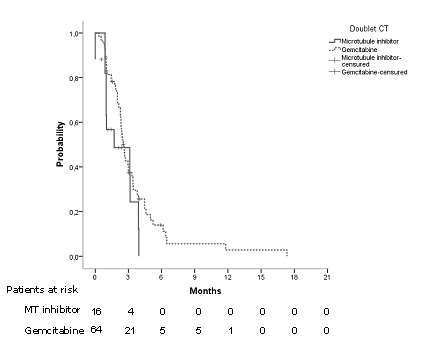
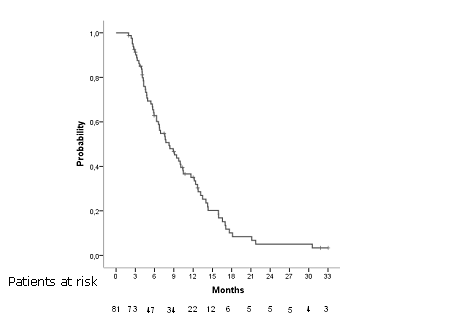
Median TTF was 2,53 months CI95% [2,21 – 2,84] (Figure 2). Considering age, sex, brain metastases, platinum compound and doublet of chemotherapy, we did not find differences (Table 2). Regarding doublet of chemotherapy, in patients in which gemcitabine was used there was an improvement in TTF of 1.2 months (p= 0.107, log rank) (Figure 3).

Figure 2. Median time to treatment failure in all patients

Fig 2.Median time to treatment failure in all patients

Figure 3. Time to treatment failure regarding doublet of chemotherapy.

Fig3.Time to treatment failure regarding doublet of chemotherapy.

Table 2. Medians and hazard ratios of time to treatment failure regarding age, sex, brain metastases, platinum compound and doublet of chemotherapy

  Median months, IC95%


P, log rank Hazard ratio, IC95% P, cox
Age

<70 años

>70 años


2,9 [2,07-3,9]

2,3 [2,1-2,5]


0,264


0,757 [0,46-1,24]


0,269

Sex

Male

Female


2,5 [2,2-2,8]

1,9 [0,0-5,04]


0,714


0,806 [0,25-2,6]


0,718

Brain Metastases (n, %)

No

Yes


2,5 [2,1-2,8]

2,3 [n.r.]


0,771


0,747 [0,1-5,5]


0,774

Platinum (n,%)

Cisplatin

Carboplatin


2,3 [2,01-2,7]

2,6 [1,9- 3,2]


0,895


1,037 [0,6-1,7]


0,896

Doublet of CT (n, %)

Microtubules inhibitor

Gemcitabine


1,7 [0,0-4,3]

2,5 [2,2- 2,8]


0,107


1,677 [0,8-3,1]


0,115

Overall survival

Median OS was 8,246 months CI95% [5,8 –2,6] in all patients (Figure 4). Overall survival rate al 6, 12 and 18 months were 62,8%, 35,1% and 3,8% respectively. Considering age, sex, brain metastases, platinum compound and doublet of chemotherapy there were statistically significant differences regard sex and doublet of CT (Table 3).

Figure 4. Overall survival in all patients

Fig 4. Overall survival in all patients

Table 3. Medians and hazard ratios of time to treatment failure regarding age, sex, brain metastases, platinium compound and doublet of chemotherapy

  Median months, IC95%


P, log rank Hazard ratio, IC95% P, cox
Age

<70 años

>70 años


7,5 [4,6-10,5]

8,9 [6,4-11,3]


0,619


0,884 [0,54-1,43]


0,619

Sex

Male

Female


8,3 [6,2-10,5]

3,2 [2,4-4,1]


0,006


0,217 [0,06-0,719]


0,012

Brain Metastases (n, %)

No

Yes


8,2 [5,8-10,6]

4,3 [n.r.]


0,596


1,466 [0,35-6,1]


0,599

Platinium (n,%)

Cisplatin

Carboplatin


10,48 [3,9-17,02]

7,65 [4,9- 10,33]


0,260


0,764 [0,42-1,2]


0,263

Doublet of CT (n, %)

Microtubules inhibitor

Gemcitabine


5,7 [3,8-7,6]

9,45 [6,7- 12,1]


0,018


1,989 [1,1-3,5]


0,021

In multivariate analyses adjusted for sex, age (< 70 or ≥ 70 years) and platinium the first line chemotherapy regimen based in antimetabolites was a predictor of OS (p=0.018).

Second line

Only 31 (37,8%) patients received second line therapy of treatment. Most common agents were docetaxel (17 patients, 54,8%), paclitaxel (6 patients, 19,9%), erlotinib (6 patients, 19,4%), gefitinib (1 patient, 3,2%) and gemcitabine (1 patient, 3,2%).

Median OS posprogression (OSpp) was 6,637 months CI95% [5,4 –7,8]. With respect to type of treatment, patients treated with docetaxel had a median of 9,01 months CI95% [5,1 –12,9], patients treated with paclitaxel 6,6 months CI95% [0,5 –12,7] and patients treated with erlotinib 5,8 months CI95% [4,6 –7,1]. Patient treated with gefitinib and gemcitabina were alive while 5,4 months and 3,2 months respectively. There were statistically significant differences in median OSpp regarding type of treatment (p=0,026 log rank). Hazard ratio for use of taxanes was 0,695, CI95% [0,26 –1,83], p=0,4.

Discussion

Squamous cell NSCLC is a particularly aggressive type of lung cancer, and few treatments are effective [6]. The NCCN and ESMO frontline recommendations include chemotherapy doublets, which are considered the cornerstone of initial therapy for squamous NSCLC [7,8]. To our knowledge, no prospective clinical trial has specifically compared cytotoxic chemotherapies for advanced lung SCC so there is is uncertainty about the best option of treatment.

Respect gender, women is represented in 3,7% in our study. In most published studies, little is reported about women diagnosed of advanced squamous NCSLC treated with CT. Overall survival among women in our study is poor (3,2 months versus 8,3). Recently, it has been described that females patients with squamous NCSLC had a significantly higher rate of human papillomavirus (HPV) infection compared to males with SCC [9] and HPV infection appears to be involved in cancer progression in SCC by promoting the expression of p53. On the other hand, patterns of mutation in SCC are unknown being KRAS, FGFR1 and PIK3CA most frequently reported and women seem to have less PIK3CA mutation than men. Moreover, there may exist unknown endocrine mechanisms this particularly lack of response and bad prognosis in women. To our knowledge, there are no differences in smoking patters that could explain this fact [10].

Elderly and young patients, defined by >70 years or <70 years, have similar proportion in our series. Although doublets with microtubule inhibitors are less used in old patients overall survival is similar in both groups. The definition of elderly patients varies widely across trials and and an uniform definition is lacking. Particularly in the actual world setting, older patients are often untreated even even when free of comorbid illnesses. Most studies in advanced NSCLC define elderly patients as those older than 70 years for the treatment of advanced NSCLC [11] and the benefit of platinum-based doublet regimens in this population seems to be greater than single-agent chemotherapy. So avoiding the use of doublets in elderly  is not justified in absence of comorbid status. Studies in elderly patients show similar response rates than in younger ones even with aggressive regimens of chemotherapy.

Palliative Care Unit (PCU) has played a preeminent role in the management of patients. More than half of our patients were remitted to PCU (45 patients, 54,9%) This fact allowed better control of symptoms, especially at home, and ultimately improved patients’ quality of life [12]. Early integration of palliative care into the treatment strategy should be mandatory because it may improve quality of life, particularly end-of-life care and improve overall survival. Our institution is working to make success this target.

Median time to treatment failure was 2,53 months and overall survival 8,24 months. The use of cisplatin or carboplatin has no impact on TTF or on OS, although use of cisplatin has a tendency to improve overall survival in 3 months over the use of carboplatin. Our data are similar to the reported about Veterans Health Administration data [12]. The use of gemcitabine as platinum doublet has demonstrated increased survival in our patients over microtubule inhibitors (9,45 months versus 4,7 months). A phase III trial of cisplatin and pemetrexed compared with cisplatin and gemcitabine revealed a statistically significant improvement in OS with cisplatin and gemcitabine in patients with squamous cell histology (10.8 vs 9.4 months) [13,14]. A retrospective study in patients with advanced lung SCC, revealed the use of various regimens did not have a significant effect on survival outcomes [15].

Finally, 31 patients (37,8%) received second line of treatment being docetaxel the most common agent used in this setting followed by paclitaxel and erlotinib. Although the number of patients is small, there is an improvement in survival in the group treated with taxanes respect to the group treated with tyrosine kinase inhibitor TKI). In TITAN phase III study, [16] patients were randomized to receive TKI or CT (taxanes or pemetrexed) and both treatments were similar in efficacy with different toxicity profiles.

We conclude that gemcitabine must be the CT of choice in advanced SCC. On the other hand, female patients had worse prognosis, patients aged >70 years old must receive a double of platinum, cisplatin is similar to carboplatin and cisplatin must be used when there is no contraindication for its use. Aditional agents and strategies must be developed in this setting to improve quality of life and survival.

References

  • Ferlay J, Steliarova-Foucher E, Lortet-Tieulent J, Rosso S, Coebergh JW, et al. (2013) Cancer incidence and mortality patterns in Europe: estimates for 40 countries in 2012. Eur J Cancer 49: 1374-1403. [crossref]
  • Le Chevalier T, Scagliotti G, Natale R, Danson S, Rosell R, et al. (2005) Efficacy of gemcitabine plus platinum chemotherapy compared with other platinum containing regimens in advanced non-small-cell lung cancer: a meta-analysis of survival outcomes. Lung Cancer 47: 69-80.
  • Reck M, Popat S, Reinmuth N, De Ruysscher D, Kerr KM, et al. (2014) Metastatic non-small-cell lung cancer (NSCLC): ESMO Clinical Practice Guidelines for diagnosis, treatment and follow-up. Ann Oncol 25 Suppl 3: iii27-39. [crossref]
  • Schiller JH, Harrington D, Belani CP, et al. (2002) Comparison of four chemotherapy regimens for advanced non small-cell lung cancer. N Engl J Med 346: 92-8.
  • Edge SB, Compton CC (2010) The American Joint Committee on Cancer: the 7th edition of the AJCC cancer staging manual and the future of TNM. Ann Surg Oncol 17: 1471-1474. [crossref]
  • McKeage MJ, Jameson MB, et al. (2010) Comparative outcomes of squamous and non-squamous non-small cell lung cancer (NSCLC) patients in phase II studies of ASA404 (DMXAA): retrospective analysis of pooled data. J Thorac Dis 2:199-204.
  • Ettinger DS, Wood DE, Akerley W, Bazhenova LA, Borghaei H, et al. (2014) Non-small cell lung cancer, version 1.2015. J Natl Compr Canc Netw 12: 1738-1761. [crossref]
  • Reck M, Popat S, Reinmuth N, De Ruysscher D, Kerr KM, Peters S (2014) ESMO Guidelines Working Group. Metastatic non-small-cell lung cancer (NSCLC): ESMO Clinical Practice Guidelines for diagnosis, treatment and follow-up. Ann Oncol 25 Suppl 3: iii27-39.
  • Fan X, Yu K, Wu J, Shao J, Zhu L, et al. (2015) Correlation between squamous cell carcinoma of the lung and human papillomavirus infection and the relationship to expression of p53 and p16. Tumour Biol 36: 3043-3049. [crossref]
  • Qiong Z, Na WY, Bo W2, Zhu Z, Ling P, et al. (2015) Alterations of a spectrum of driver genes in female Chinese patients with advanced or metastatic squamous cell carcinoma of the lung. Lung Cancer 87: 117-121. [crossref]
  • Owonikoko TK, Ramalingam SS2 (2015) Minimize toxicity or preserve efficacy? A delicate trade-off in the management of older patients with lung cancer. J Clin Oncol 33: 534-536. [crossref]
  • Wagner B, Meffert C2, Becker G2 (2015) [Availability and integration of palliative medicine at certified lung cancer centers]. Pneumologie 69: 218-224. [crossref]
  • Santana-Davila R, Szabo A, Arce-Lara C, Williams CD, et al. (2014) Cisplatin versus carboplatin-based regimens for the treatment of patients with metastatic lung cancer. An analysis of Veterans Health Administration data. J Thorac Oncol 9: 702-9.
  • Scagliotti GV, Parikh P, von Pawel J, et al. (2008) Phase III study comparing cisplatin plus gemcitabine with cisplatin plus pemetrexed in chemotherapy-naive patients with advanced-stage non-small-cell lung cancer. J Clin Oncol 26:3543-3551.
  • Liao BC, Shao YY, Chen HM, Shau WY, Lin ZZ, et al. (2015) Comparative effectiveness of first-line platinum-based chemotherapy regimens for advanced lung squamous cell carcinoma. Clin Lung Cancer 16: 137-143. [crossref]
  • Ciuleanu T, Stelmakh L, Cicenas S (2012) Efficacy and safety of erlotinib versus chemotherapy in second-line treatment of patients with advanced, non-small-cell lung cancer with poor prognosis (TITAN): a randomised multicentre, open-label, phase 3 study. Lancet Oncol 13:300-8.

Humanized Monoclonal Antibodies in Pulmonology: An Integrated Review

DOI: 10.31038/IMROJ.2017213

Abstract

Asthma is an important chronic disease affecting a lot of people worldwide. Treatment options for asthma like biological agents are being developed more frequently nowadays. Despite a lot of treatment options, some patients still remain symptomatic. As more and more practitioners choose treatment with biologic agents as a convenient way of therapy, biologic agents and other valuable methods must be discovered in order to cope with a growing number of treatment agents. This manuscript emphasizes on new generation monoclonal human (ized) antibodies in asthmatics and off-label use. The first developed biologic agent is the anti- immunoglobulin E monoclonal antibody called omalizumab. Currently it is an approved treatment option for asthma.

Introduction

Asthma is an important chronic disease affecting a lot of people worldwide [1]. Treatment options for asthma like biological agents are being developed more frequently nowadays. Despite a lot of treatment options, some patients still remain symptomatic. As more and more practitioners choose treatment with biologic agents as a convenient way of therapy, biologic agents and other valuable methods must be discovered in order to cope with a growing number of treatment agents. This special issue emphasizes on new generation monoclonal human (ized) antibodies in asthmatics [2-4].

The pathophysiological mechanisms underlying asthma, which is a heterogeneous disease, are characterized by interactive responses among various cell types and the hematopoietic cells of the adaptive and innate immune systems. Frequently is conventional therapy like inhaled steroids and beta-agonists sufficient for asthma symptoms. However, a little minority of the asthmatics is not controlled with conventional therapy. Therefore, are new treatment options essential for severe asthmatic patients [5].

Anti-IL-5 Molecules

Interleukins derived from T-helper-2 (Th2) cells and innate lymphoid cells play an important role in the pathogenesis of asthma. Monoclonal antibodies targeting these cytokines as treatment for severe asthma are expected to be beneficial [6]. Eosinophilic inflammation is an important event in the pathogenesis of asthma. IL-5 is a key cytokine that arranges eosinophil production, survival, maturation and recruitment of eosinophils to the inflammation [7]. Mepolizumab, reslizumab, and benralizumab are new developed monoclonal antibodies that target the cytokine IL-5. Mepolizumab and reslizumab have been approved by the US Food and Drug Administration (FDA) for the treatment of patients with severe asthma with an eosinophilic phenotype [8,9]. Mepolizumab and reslizumab binds directly to IL-5 ligand. These molecules effectively decreased circulating and sputum eosinophil counts, but they failed to improve airway mucosal eosinophilia, acute exacerbation rates, lung function and symptom scores in several studies. These disappointing results may be affected from inappropriate selection of the patients. In order to overcome the probable mechanistic limitations of early anti-IL-5 agents, an anti-IL5R monoclonal antibody was developed and called as benralizumab. Benralizumab, previously known as MEDI-563, is a humanized recombinant IgG1-k isotype monoclonal antibody. It was constructed from the mouse anti-human IL-5Rα mAbs generated by mice immunized with recombinant human IL- 5Rα [10]. Clinical studies revealed that anti-interleukin 5 monoclonal therapies for asthma could be safe for slightly improving FEV1 (or FEV1% of predicted value), quality of life, and reducing exacerbations risk and blood and sputum eosinophils. However these drugs have no significant effect on PEF, and SABA rescue use. These may be a result of patient selection. Further trials are required to clarify the optimal antibody for different patients [7].

Anti-IL-4/IL-13 Molecules

Another investigated cytokine important in the inflammatory pathways in the pathogenesis of asthma is anti-IL-4. IL-4 is a pleiotropic cytokine secreted mainly by activated T cells. Mast cells, basophils, and eosinophils can also secret IL-4 [10,11]. IL-4 is important in inducing IgE isotype switching, T cell polarization into Th2 cells, and generation of IL-4, IL-5, and IL-13 by Th2 cells. IL-4Rα is expressed on CD4+ and CD8+ T cells, B cells, macrophages, lung epithelial cells, airway goblet cells, and smooth muscle cells [11]. There is a functional homogeniety between IL-4 and IL-13. IL-4 can activate a heterodimeric receptor complex consisting of the IL-4 receptor α- subunit (IL-4Rα) and a γC subunit. IL-13 can activate the IL-4Rα and the IL-13 receptor α1-subunit (IL-13Rα1) [5]. Both IL-4 and IL-13 can bind to heterodimeric combination of the α-subunit of the IL-13 receptor and the α-subunit of the IL-4 receptor. And this leads to signaling of both IL-4 and IL-13. Therefore, will blocking IL-4R α with an antibody of this receptor chain expected to block the effects of both IL-4 and IL-13 [6].

Pascolizumab and VAK694 are anti-IL-4 neutralizing monoclonal antibodies. Also, IL-4 receptor antagonist drugs like dupilumab, pitrakinra and AMG-317 have been discovered. Even a recombinant IL-4Rα that captures soluble IL-4 and prevents their binding to IL-4 receptors, has been developed. It is called altrakincept. However, further research on this drug was discontinued by its manufacturer, since the phase 3 clinical trial failed to confirm its earlier promising results. Since there is a high redundancy of IL-4 and IL-13 signaling, blocking of both IL-4 and IL-13 has been expected to be more efficient [11]. Dupilumab is a drug that inhibits signaling from IL- 4 and IL-13 concomitantly. It is a molecule that binds to the alpha subunit of the IL-4 receptor. Phase II trials for dupilumab showed that asthma exacerbations were decreased in patients using this drug [12,13]. Dupilumab also improved lung function. It reduced the inhaled corticosteroid dose in the patient group. There was also an associated reduction in fractional exhaled nitric oxide with reduced serum concentrations of Th2-associated inflammatory markers such as CCL17 (TARC), CCL26 (eotaxin-3), and IgE [6]. These results are promising and further clinical trials will us show us the long-term efficacy of dupilumab [11].

Another similar drug that targets IL-4 is pitrakinra. It is a recombinant human IL-4 variant that competitively inhibits IL-4Ra to interfere with the actions of both IL-4 and IL-13. Studies on this competitive antagonist called pitrakinra revealed that it leads to significant reduction in asthma exacerbations and improves asthma symptoms in patients with eosinophilia [14]. Pitrakinra also attenuated the late-phase asthmatic response to allergen challenge in patients with mild atopic asthma [6]. The other drug called AMG317 was evaluated in another phase II trial in approximately 300 patients with moderate to severe asthma. Weekly injections over 12 weeks were well tolerated but did not have significant effects on the Asthma Control Questionnaire score (ACQ score; the primary outcome) [14].

Interleukin 13 shares 30% homology with interleukin 4. IL-13 is secreted by Th2 cells, ILC2s, mast cells, basophils, and eosinophils. IL-13 has the potential to increase goblet-cell differentiation, and activation of fibroblasts. IL-13 production can induce an increase in bronchial hyperresponsiveness, and switching of B-cell antibody production towards IgE [6]. IL-13 is similar to IL-4 and uses the same signaling pathways. The high-affinity receptor of IL-13 is a heterodimer of IL-4Rα/IL- 13Rα1. IL-13Rα1 is present on eosinophils, B cells, monocytes, macrophages, smooth muscle cells, lung epithelial cells, airway goblet cells, and endothelial cells. Biologicals that target IL-13 are anti-IL-13 mAbs: anrukinzumab, dectrekumab, GSK679586, IMA-026, lebrikizumab, RPC-4046, and tralokinumab [11].

Patients with severe asthma often have elevated levels in sputum despite therapy with high dose inhaled or oral corticosteroids. Lebrikizumab is one of the many humanized monoclonal antibodies that have been developed to specifically bind to IL-13 and inhibit its function [14]. In a randomized, double-blind, placebo- controlled study were 219 asthma patients observed and evaluated whether the drug lebrikizumab could alter the course of asthma. Lebrikizumab treatment was associated with improved lung function. Patients with high pretreatment levels of serum periostin had greater improvement in lung function with lebrikizumab. This therapy needs futher evaluation before being utilized in clinics [15]. Another monoclonal antibody called tralokinumab, an investigational human IL-13-neutralising immunoglobulin G4 monoclonal antibody, has been evaluated in adults with moderate to severe uncontrolled asthma despite controller therapies. Patients were randomly assigned to receive tralokinumab or placebo subcutaneously every 2 weeks for 13 weeks. Although it had an acceptable safety and tolerability, it did not reduce asthma exacerbations [16].

Antithymic stromal lymphopoietin

Thymic stromal lymphopoietin (TSLP) is an epithelial cell derived cytokine that may trigger allergic inflammation and, thus, play a role in allergic asthma [17]. It is an epithelial-derived cytokine and makes its effect through its receptor, TSLP-R, which is a heterodimeric receptor that consists of the IL-7 receptor alpha chain (IL-7Rα) and the TSLP receptor alpha chain 1 (TSLPRα). In hematopoietic cells, TSLP-R is mainly expressed in DCs, monocytes, B cells, T cells, NK cells, invariant natural killer T (iNKT) cells, eosinophils, basophils, and mast cells [11].

A human anti TSLP monoclonal immunoglobulin G2 lambda (AMG 157) that binds human TSLP and prevents receptor interaction was assessed in a trial. Randomly assigned 31 patients with mild allergic asthma received AMG 157 (700 mg) or placebo intravenously, once a month for three doses. The primary outcome, the maximum percentage decrease in the FEV during the late asthmatic response was 45.9 percent less in the AMG 157 group than the placebo group on day 84. AMG 157 reduced allergen induced bronchoconstriction and airway inflammation. No serious adverse effects were reported. Further studies on this drug are planned to clarify its use in clinical practice [17].

Anti-IL-9 Monoclonal Antibody

IL-9 is a Th2 cytokine and a T cell and mast cell growth factor. Anti-IL-9 antibody-treatment has been shown to protect from allergen-induced airway remodeling, with a concomitant reduction in mature mast cell numbers and activation. It can also decrease expression of the profibrotic mediators transforming growth factor (TGF)-b1, vascular endothelial growth factor (EGF), and fibroblast growth factor-2 (FGF-2) in the lung. The function of IL-9 in allergy has been investigated for its pleiotropic activities on cell types associated with allergic diseases including Th2 lymphocytes, mast cells, B cells, eosinophils, and airway epithelial cells. An anti-IL-9 monoclonal antibody (MEDI-528) has been studied in a clinical trial on 327 asthmatic subjects. Patients were randomized to receive placebo or one of three doses of MEDI-528 (dosage 30, 100, or 300 mg s.c. twice weekly for 4 weeks) in addition to their usual asthma medications. The addition of MEDI-528 to existing asthma controller medications did not improve ACQ-6 scores, asthma exacerbation rates, or FEV1 values. Further clinical trials are needed to explore this drug for altering the course of asthma. Thus, the potential clinical benefit of targeting IL-9 or its receptor in the treatment of asthma remains to be shown in further studies [5].

Anti-IL-2 antibody

Allergen exposure can stimulate IL-2 and its receptor expression (IL -2R) a chain (sCD25) in airways of patients with severe asthma. Daclizumab is a humanized monoclonal antibody that binds specifically to a subunit (CD25) of the high-affinity IL-2R, and inhibits IL-2 binding and its biological activity. Daclizumab can inhibit various T cell functions, including T cell proliferation and cytokine production. It has been investigated in a randomized controlled study. The drug has the potential to improve pulmonary function and asthma control in patients moderate to severe chronic asthma [18]. The risk of immunosuppression in clinical practice needs to be clarified.

Anti-GATA3-spesific DNAzyme

Approximately half of the asthmatic patients exhibit a Th2 type in response to allergen exposure. This Th2 endotype is characterized by a predominant activation of Th2 cells that produce cytokines such as interleukins 4, 5, and 13. The expression and production of all these Th2 cytokines have been shown to be controlled by the zinc finger transcription factor GATA3, which is essential for Th2-cell differentiation and activation. It is considered to be the master transcription factor of the Th2 pathway of immune activation. Therefore, could be interventions to disrupt this immune network, a synthetic DNA molecule (DNAzyme), that binds to GATA3 messenger RNA and cleaves it, a solution. This synthetic molecule called SB010 could significantly attenuate both late and early asthmatic responses after allergen provocation in patients with allergic asthma. Biomarker analysis after this drug showed an attenuation of Th2-regulated inflammatory responses [19].

Anti-IL-17 antibody

Although half of the asthma patients exhibit a Th2 type endotype, some remaining patients exhibit a Th17 driven endotype. This subpopulation is characterized with a Th17 driven inflammation. Th17 cells can contribute to airway hyperresponsiveness by recruiting both eosinophils and neutrophils. Therefore, has been IL-17 receptor blocking suggested to beneficial in asthma treatment [20]. Biologicals targeting IL-17 include an anti-IL-17A mAb: secukinumab and an anti-IL- 17 receptor mAb: brodalumab. Although the inhibition of IL-17 receptor A had no effect on subjects with asthma as a whole, a subgroup analysis showed an effect with uncertain significance. Further studies are needed to determine the role of secukinumab in asthma [11]. Brodalumab (AMG 827) is a human, anti–IL-17RA immunoglobulin G2 (IgG2) monoclonal antibody that binds with high affinity to human IL-17RA, blocking the biologic activity of IL- 17A, -17F, -17A/F heterodimer, and -17E (IL-25). Brodalumab can block IL-25 activity and IL-17A and IL-17F. In a randomized controlled study were 302 patients taking this drug evaluated and at the end of the study there was no evidence for an effect of brodalumab in these patients. Further studies may clarify the potential of this drug [20].

Anti TNF antibodies

In addition, human(ized) monoclonal antibodies (HMA) evaluated for the treatment of severe persistent asthma (SPA), but not approved after Phase II trial are as follows; Infliximab (Recombinant human–murine chimeric anti-TNFα monoclonal antibody Infliximab), etanercept (Soluble TNFα receptor fusion protein), and golimumab (Fully human TNFα-blocking antibody) [5]. The expression of TNF alfa is increased in asthma in association with airway neutrophilia. Berry and colleagues have demonstrated that the TNF-α axis is upregulated in patients with refractory asthma, as evidenced by the increased expression of membrane-bound TNF-α, TNF receptor 1, and TNF-α– converting enzyme by peripheral-blood monocytes [21]. Treatment with golimumab did not demonstrate a favorable risk-benefit profile in patients with severe persistent asthma [22]. A study with etanercept showed a small decrease in asthma exacerbations was observed in a randomized placebo controlled study [23]. In a case-series report was it told that in severe, uncontrolled, steroid-dependent asthma infliximab could reduce exacerbations and hospitalizations [24]. In some severe refractory asthma endotypes anti-TNFα therapy may have a role. However, it should be kept in mind that these agents have some safety concerns and should use carefully only in some severe refractory asthma endotypes [5].

ANTI-IgE

The first developed biologic agent is the anti-immunoglobulin E monoclonal antibody called omalizumab. Currently it is an approved treatment option for asthma [5].

The other human(ized) promising monoclonal antibody drug developed, but not approved yet is ligeluzimab. Ligeluzimab binds with very high affinity to the Cε3 domain of IgE. Ligeluzumab may provide longer supression of IgE. Trials with this biologic agent are ongoing [5].

Anti-ige: off-label use non-atopic asthma

The off-label use of omalizumab in patients with uncontrolled non-atopic asthma has resulted in a decrease in exacerbation rates and improvement in asthma symptom scores. In a study conducted in 2013, omalizumab was administered to 266 patients with severe allergic asthma and 29 patients with non-atopic severe asthma for two years, and the study found a decline in the exacerbation rate, increase in the quality of life, and significantly improved disease control in both groups [25-27]. In two studies which used omalizumab in a group of patients with non-atopic severe asthma, the authors observed downregulation of FcRI expression in the basophils and increased FEV1.

Nasal polyposis, allergic rhinitis, and allergic bronchopulmonary aspergillosis

Allergic bronchopulmonary aspergillosis affects 7 to 9% of patients with cystic fibrosis (CF) and 1 to 2% of patients with asthma, posing a diagnostic challenge [28,29]. Cases series related to ABPA were first published in 2007. In a series of eight cases with cystic fibrosis and ABPA published by Tanou et al. [30] in 2014, the authors reported increased FEV1, improved respiratory symptoms, and reduced steroid consumption. In a series of six cases with CF diagnosed with ABPA published by Lehman et al. [31], the authors reported improved symptoms in patients receiving omalizumab, whereas the efficacy of the treatment was less pronounced in patients diagnosed with ABPA and long disease duration and in patients who developed progressive lung problems [31]. In a series of 14 patients with severe asthma and ABPA in 2015, Aydın et al. [32] showed that 11 patients achieved complete and three patients achieved partial response. The authors also reported an overall improvement in the pulmonary functions and respiratory symptoms with a statistically significant reduction in the use of oral corticosteroids (OCS) and number of disease episodes. Also, the patients with a total immunoglobulin E (IgE) level of <1,000 IU showed a better response to omalizumab, compared to those with a total IgE level of >1,000 IU. However, this finding was found to have a low-evidence level, considering the lack of large-scale, prospective case series and randomized and placebo- controlled studies.

Efficacy and safety of omalizumab were first evaluated in a randomized, double-blind, placebo-controlled study of 221 patients with seasonal allergic rhinitis in 2002 [33]. This study reported a significant symptomatic relief up to 48% in the combination treatment group (specific immunotherapy [SIT]+omalizumab), compared to SIT group alone. A randomized study in Japan reported a significant improvement in daily nasal and eye symptoms in patients with seasonal allergic rhinitis receiving omalizumab [34].

In 2007, a randomized placebo-controlled study of eight patients was the first to report reduced rates of postoperative polyp recurrence in patients with atopic asthma and nasal polyps (NP) [35]. In a study of 19 patients with severe asthma and NP in 2011, Vennera et al. [36] reported symptom reduction and disease stabilization with the use of omalizumab treatment. In addition, Tajiri et al. [37] evaluated omalizumab in patients with severe asthma and NP, and reported significant improvements in nasal symptoms, asthma control, and sinus tomography results. However, not all studies were able to show the beneficial effects of the treatment. In a randomized, double-blind, placebo-controlled study of patients with chronic rhinosinusitis receiving omalizumab, Pinto et al. [38] showed improvement in the Sino-Nasal Outcome Test (SNOT-20) scores at three, five, and six months, although there was no significant difference in the scores compared to the control group. The aforementioned study did not observe any changes in the quality of life, symptom scores, cellular inflammation, nasal passage, and olfactory test parameters.

Atopic Dermatitis And Food Allergy

In a series of three patients published in 2005, the authors reported no response after four months of treatment [39], while Lane et al. [40] published a series of three patients in the same study period and reported successful treatment outcomes of severe AD using omalizumab [40]. In addition, a pilot study of 21 patients published in 2009 found a statistically significant clinical improvement in all patients [41]. Another series of three patients published in 2011 reported significant improvement in the Eczema Area and Severity Index (EASI) and itching severity score in patients with severe AD unresponsive to conventional treatment and those with elevated IgE levels [42]. A study of 11 patients published in the same year reported reduced SCORing Atopic Dermatitis (SCORAD) scores, reduced symptoms, and significant improvement in the quality of life (3). The efficacy of omalizumab was also evaluated in 20 adults with severe AD in a prospective, 28-week, open-label study conducted by Hotze et al. [43] in 2014. The authors reported no response to treatment in seven patients harboring filaggrin gene mutation (FLG), while there was a significant improvement in the remaining eight patients. The authors also concluded that the patients with FLG gene mutation were prone to achieve lower response to omalizumab.

Furthermore, in food-related immunotherapy (IT) studies, omalizumab initiated before or received simultaneously with the treatment facilitated the development of tolerance. In a series of 11 patients with cow milk allergy scheduled for IT, 10 patients tolerated daily intake of 8 g cow milk after the initiation of omalizumab, nine weeks before IT, and combination with IT treatment, thereafter [44]. Another use of this treatment is to facilitate a rapid and safe transition to the maintenance phase in patients with food allergy receiving oral IT [45]. Another use of the treatment in food allergy is eosinophillic esophagitis developing in association with multiple food allergies. Also, in a study administered omalizumab to patients with eosinophillic esophagitis, the authors found reduced allergic symptoms and improved quality of life, although there was no change in endoscopic and histologic characteristics of the disease [46].

Food Allergy and Anaphylaxis

Anaphylaxis can occur as a result of exposure to various allergens such as food, drug, and venom; however, no triggering factor can be shown in some cases, of which the latter is known as idiopathic anaphylaxis. The patients with elevated baseline tryptase levels or those diagnosed with mastocytosis are expected to have higher rates of anaphylaxis with a more aggressive course of disease. In particular, patients with venom allergy on IT may experience some difficulties in switching to maintenance dose. Severe anaphylactic episodes can be observed in patients diagnosed with mastocytosis on IT due to venom allergy. In addition, IT combined with omalizumab has enabled a safe transition to the maintenance phase in this group of patients [47-49]. Addition of omalizumab to rush and ultra-rush venom IT protocols has increased the success of IT and enabled a safer transition to the maintenance phase. Another use of omalizumab is to prevent recurrent anaphylactic episodes in patients who are unable to be controlled with conventional therapies [50- 55]. There are case reports on the role of this treatment in preventing idiopathic anaphylactic episodes [56-58].

Several studies have reported asthma symptom control, improved quality of life, and development of tolerance to aspirin in two patients with the use of omalizumab in patients with aspirin-induced airway disease, nasal polyps, and severe asthma [59, 60]. Two patients with recurrent insulin allergy, despite the use of desensitization protocols, and one patient of carboplatin allergy during carboplatin therapy due to ovarian cancer successfully continued their treatment with the addition of omalizumab to the treatment [61-63].

In conclusion, although omalizumab has been approved for the treatment of severe allergic asthma and chronic idiopathic urticaria, it offers an off-label use as a final resort in many allergic diseases. Recent studies have shown that omalizumab is effective in treating bullous pemphigoid, Stevens-Johnson syndrome (SJS)/toxic
epidermal necrolysis (TEN, Type-III/IV reaction, such as graft versus host disease), Netherton syndrome, asthma and chronic obstructive pulmonary disease overlap syndrome (ACOS). Its effects on soluble inflammatory markers, such as sCD200, sTRAIL, hematopoietic cells, Th1/2 cytokines (CXCL8; IL-1β; IL-4; IL-5; IL17A), total antioxidant capacity, hydrogen peroxide, malondialdehyde and total nitric oxide concentrations were demonstrated in several studies [64-70].

Monoclonal antibodies are a candidate for use in several indications with the contribution of large-scale studies to the literature in the near future.

Declaration of Interest

All authors declare that they have no conflict of interest.

Acknowledgements

Prof.Dr. Tse Wen Chang, Prof.Dr.Saadet Gumuslu, Prof.Dr. Fatih Uz, Prof.Dr Arzu Mirici.

References

  • Beasley R, Semprini A, Mitchell EA (2015) Risk factors for asthma: is prevention possible? Lancet 386: 1075-1085. [crossref]
  • Yalcin AD, Celik B, Gumuslu S (2014) D-dimer levels decreased in severe allergic asthma and chronic urticaria patients with the omalizumab treatment. Expert Opin Biol Ther 14:283-6.
  • Yalcin AD (2015) Advances in anti-IgE therapy. Biomed Res Int 2015: 317465. [crossref]
  • Yalcin AD, Cilli A, Bisgin A, et al. (2013) Omalizumab is effective in treating severe asthma in patients with severe cardiovascular complications and its effects on sCD200, d-dimer, CXCL8, 25-hydroxyvitamin D and IL-1ß levels. Expert Opin Biol Ther 13:1335-41.
  • Mitchell PD, El-Gammal AI, O’Byrne PM (2016) Emerging monoclonal antibodies as targeted innovative therapeutic approaches to asthma. Clin Pharmacol Ther 99:38-48.
  • Chung KF (2015) Targeting the interleukin pathway in the treatment of asthma. Lancet 386: 1086-1096. [crossref]
  • Wang FP, Liu T, Lan Z, Li SY, Mao H (2016) Efficacy and Safety of Anti-Interleukin-5 Therapy in Patients with Asthma: A Systematic Review and Meta-Analysis. PLoS One 11: e0166833. [crossref]
  • Ortega HG, Liu MC, Pavord ID, Brusselle GG, FitzGerald JM, et al. (2014) Mepolizumab treatment in patients with severe eosinophilic asthma. N Engl J Med 371: 1198-1207. [crossref]
  • Castro M, Zangrilli J, Wechsler ME et al. (2015) Reslizumab for inadequately controlled asthma with elevated blood eosinophil counts: results from two multicentre, parallel, double-blind, randomised, placebo-controlled, phase 3 trials. Lancet Respir Med 3:355-66.
  • Khorasanizadeh M, Eskian M, Assa’ad AH, Camargo CA Jr, Rezaei N,  et al. (2016) Efficacy and Safety of Benralizumab, a Monoclonal Antibody against IL-5Rα, in Uncontrolled Eosinophilic Asthma. Int Rev Immunol 35: 294-311. [crossref]
  • Tan HT, Sugita K, et al. (2016) Novel Biologicals for the Treatment of Allergic Diseases and Asthma. Curr Allergy Asthma Rep 16: 70. [crossref]
  • Wenzel S, Ford L, Pearlman D, Spector S, Sher L, et al. (2013) Dupilumab in persistent asthma with elevated eosinophil levels. N Engl J Med 368: 2455-2466. [crossref]
  • Wenzel S, Castro M, Corren J, et al. (2016) Dupilumab efficacy and safety in adults with uncontrolled persistent asthma despite use of medium-to-high- dose inhaled corticosteroids plus a long-acting ß2 agonist: a randomised double-blind placebo-controlled pivotal phase 2b dose-ranging trial. Lancet 388:31-44.
  • Hambly N, Nair P (2014) Monoclonal antibodies for the treatment of refractory asthma. Curr Opin Pulm Med 20: 87-94. [crossref]
  • Corren J, Lemanske RF, Hanania NA, Korenblat PE, Parsey MV, et al. (2011) Lebrikizumab treatment in adults with asthma. N Engl J Med 365: 1088-1098. [crossref]
  • Piper E, Brightling C, Niven R, Oh C, Faggioni R, et al. (2013) A phase II placebo-controlled study of tralokinumab in moderate-to-severe asthma. Eur Respir J 41: 330-338. [crossref]
  • Gauvreau GM, O’Byrne PM, Boulet LP, et al. (2014) Effects of an anti-TSLP antibody on allergen-induced asthmatic responses. N Engl J Med 370:2102-10.
  • Busse WW, Israel E, Nelson HS, et al. (2008) Daclizumab improves asthma control in patients with moderate to severe persistent asthma: a randomized, controlled trial. Am J Respir Crit Care Med 178:1002-8.
  • Krug N, Hohlfeld JM, Kirsten AM, et al. (2015) Allergen-induced asthmatic responses modified by a GATA3-specific DNAzyme. N Engl J Med 372:1987-95.
  • Busse WW, Holgate S, Kerwin E, et al. (2013) Randomized, double-blind, placebo-controlled study of brodalumab, a human anti-IL-17 receptor monoclonal antibody, in moderate to severe asthma. Am J Respir Crit Care Med 188:1294-302.
  • Berry MA, Hargadon B, Shelley M, Parker D, Shaw DE, et al. (2006) Evidence of a role of tumor necrosis factor alpha in refractory asthma. N Engl J Med 354: 697-708. [crossref]
  • Wenzel SE, Barnes PJ, Bleecker ER, et al. (2009) A randomized, double-blind, placebo-controlled study of tumor necrosis factor-alpha blockade in severe persistent asthma. Am J Respir Crit Care Med 179:549-58.
  • Morjaria JB, Chauhan AJ, Babu KS, et al. (2008) The role of a soluble TNFalpha receptor fusion protein (etanercept) in corticosteroid refractory asthma: a double blind, randomised, placebo controlled trial. Thorax 63:584-91.
  • Taillé C, Poulet C, Marchand-Adam S, Borie R, Dombret MC, et al. (2013) Monoclonal Anti-TNF-α Antibodies for Severe Steroid-Dependent Asthma: A Case Series. Open Respir Med J 7: 21-25. [crossref]
  • Domingo C, Pomares X, Angril N, Rudi N, Amengual MJ, et al. (2013) Effectiveness of omalizumab in non-allergic severe asthma. J Biol Regul Homeost Agents 27: 45-53. [crossref]
  • Garcia G, Magnan A, Chiron R, et al. (2013) A proof-of-concept, randomized, controlled trial of omalizumab in patients with severe, difficult-to-control, nonatopic asthma. Chest 144:411-9.
  • de Llano LP, Vennera Mdel C, Álvarez FJ, Medina JF, Borderías L, et al. (2013) Effects of omalizumab in non-atopic asthma: results from a Spanish multicenter registry. J Asthma 50: 296-301. [crossref]
  • Laufer P, Fink JN, Bruns WT, Unger GF, Kalbfleisch JH, et al. (1984) Allergic bronchopulmonary aspergillosis in cystic fibrosis. J Allergy Clin Immunol 73: 44-48. [crossref]
  • Greenberger PA, Patterson R (1988) Allergic bronchopulmonary aspergillosis and the evaluation of the patient with asthma. J Allergy Clin Immunol 81: 646-650. [crossref]
  • Tanou K, Zintzaras E, Kaditis AG (2014) Omalizumab therapy for allergic bronchopulmonary aspergillosis in children with cystic fibrosis: a synthesis of published evidence. Pediatr Pulmonol 49:503-7
  • Lehmann S, Pfannenstiel C, Friedrichs F, Kröger K, Wagner N, et al. (2014) Omalizumab: a new treatment option for allergic bronchopulmonary aspergillosis in patients with cystic fibrosis. Ther Adv Respir Dis 8: 141-149. [crossref]
  • Aydin Ö, Sözener ZÇ, Soyyigit S et al. (2015) Omalizumab in the treatment of allergic bronchopulmonary aspergillosis: One center’s experience with 14 cases. Allergy Asthma Proc 36:493-500.
  • Kuehr J, Brauburger J, Zielen S, et al. (2002) Efficacy of combination treatment with anti-IgE plus specific immunotherapy in polysensitized children and adolescents with seasonal allergic rhinitis. J Allergy Clin Immunol 109:274-80.
  • Okubo K, Nagakura T (2008) Anti-IgE antibody therapy for Japanese cedar pollinosis: omalizumab update. Allergol Int 57: 205-209. [crossref]
  • Penn R, Mikula S (2007) The role of anti-IgE immunoglobulin therapy in nasal polyposis: a pilot study. Am J Rhinol 21: 428-432. [crossref]
  • Vennera Mdel C, Picado C, Mullol J, Alobid I, Bernal-Sprekelsen M (2011) Efficacy of omalizumab in the treatment of nasal polyps. Thorax 66: 824-825. [crossref]
  • Tajiri T, Matsumoto H, Hiraumi H, Ikeda H, Morita K, et al. (2013) Efficacy of omalizumab in eosinophilic chronic rhinosinusitis patients with asthma. Ann Allergy Asthma Immunol 110: 387-388. [crossref]
  • Pinto JM, Mehta N, DiTineo M, et al. (2010) A randomized, double-blind, placebo- controlled trial of anti-IgE for chronic rhinosinusitis. Rhinology 48:318-24.
  • Krathen RA, Hsu S (2005) Failure of omalizumab for treatment of severe adult atopic dermatitis. J Am Acad Dermatol 53: 338-340. [crossref]
  • Lane JE, Cheyney JM, Lane TN, Kent DE, Cohen DJ (2006) Treatment of recalcitrant atopic dermatitis with omalizumab. J Am Acad Dermatol 54: 68-72. [crossref]
  • Sheinkopf LE, Rafi AW, Do LT, Katz RM, Klaustermeyer WB (2008) Efficacy of omalizumab in the treatment of atopic dermatitis: a pilot study. Allergy Asthma Proc 29: 530-537. [crossref]
  • Thaiwat S, Sangasapaviliya A (2011) Omalizumab treatment in severe adult atopic dermatitis. Asian Pac J Allergy Immunol 29: 357-360. [crossref]
  • Hotze M, Baurecht H, Rodríguez E, et al. (2013) Increased efficacy of omalizumab in atopic dermatitis patients with wild-type filaggrin status and higher serum levels of phosphatidylcholines. Allergy 69:132-5.
  • Nadeau KC, Schneider LC, Hoyte L, Borras I, Umetsu DT (2011) Rapid oral desensitization in combination with omalizumab therapy in patients with cow’s milk allergy. J Allergy Clin Immunol 127: 1622-1624. [crossref]
  • Bégin P, Dominguez T, Wilson SP, Bacal L, Mehrotra A, et al. (2014) Phase 1 results of safety and tolerability in a rush oral immunotherapy protocol to multiple foods using Omalizumab. Allergy Asthma Clin Immunol 10: 7. [crossref]
  • Rocha R, Vitor AB, Trindade E, Lima R, Tavares M, et al. (2011) Omalizumab in the treatment of eosinophilic esophagitis and food allergy. Eur J Pediatr 170: 1471-1474. [crossref]
  • Kontou-Fili K. High omalizumab dose controls recurrent reactions to venom immunotherapy in indolent systemic mastocytosis. Allergy 63:376-8.
  • Sokol KC, Ghazi A, Kelly BC, Grant JA (2014) Omalizumab as a desensitizing agent and treatment in mastocytosis: a review of the literature and case report. J Allergy Clin Immunol Pract 2: 266-270. [crossref]
  • da Silva EN, Randall KL (2013) Omalizumab mitigates anaphylaxis during ultrarush honey bee venom immunotherapy in monoclonal mast cell activation syndrome. J Allergy Clin Immunol Pract 1:687- 8.
  • Douglass JA, Carroll K, Voskamp A, Bourke P, Wei A, et al. (2010) Omalizumab is effective in treating systemic mastocytosis in a nonatopic patient. Allergy 65: 926-927. [crossref]
  • Jagdis A, Vadas P (2014) Omalizumab effectively prevents recurrent refractory anaphylaxis in a patient with monoclonal mast cell activation syndrome. Ann Allergy Asthma Immunol 113:115-6.
  • Paraskevopoulos G, Sifnaios E, Christodoulopoulos K, Mantopoulou F, Papakonstantis M, et al. (2013) Successful treatment of mastocytic anaphylactic episodes with reduction of skin mast cells after anti-IgE therapy. Eur Ann Allergy Clin Immunol 45: 52-55. [crossref]
  • Matito A, Blázquez-Goñi C, Morgado JM, Alvarez-Twose I, Mollejo M, et al. (2013) Short-term omalizumab treatment in an adolescent with cutaneous mastocytosis. Ann Allergy Asthma Immunol 111: 425-426. [crossref]
  • Bell MC, Jackson DJ (2012) Prevention of anaphylaxis related to mast cell activation syndrome with omalizumab. Ann Allergy Asthma Immunol 108: 383-384. [crossref]
  • Kibsgaard L, Skjold T, Deleuran M, et al. (2014) Omalizumab induced remission of idiopathic anaphylaxis in a patient suffering from indolent systemic mastocytosis. Acta Derm Venereol 94:363-4.
  • Lee J (2014) Successful prevention of recurrent anaphylactic events with anti-immunoglobulin E therapy. Asia Pac Allergy 4: 126-128. [crossref]
  • Demirtürk M, Gelincik A, ColakoÄŸlu B, Dal M, Büyüköztürk S (2012) Promising option in the prevention of idiopathic anaphylaxis: omalizumab. J Dermatol 39: 552-554. [crossref]
  • Jones JD, Marney SR Jr, Fahrenholz JM (2008) Idiopathic anaphylaxis successfully treated with omalizumab. Ann Allergy Asthma Immunol 101:550-1.
  • Bobolea I, Barranco P, Fiandor A, et al. (2010) Omalizumab: a potential new therapeutic approach for aspirin-exacerbated respiratory disease. J Investig Allergol Clin Immunol 20:448-9.
  • Matheu V, Franco A, Perez E, Hernández M, Barrios Y (2007) Omalizumab for drug allergy. J Allergy Clin Immunol 120: 1471-1472. [crossref]
  • Cavelti-Weder C, Muggli B, Keller C, et al. Successful use of omalizumab in an inadequately controlled type 2 diabetic patient with severe insulin allergy. Diabetes Care 35:e41.
  • Yong PF, Malik R, Arif S, Peakman M, Amiel S, et al. (2009) Rituximab and omalizumab in severe, refractory insulin allergy. N Engl J Med 360: 1045-1047. [crossref]
  • Ojaimi S, Harnett PR, Fulcher DA (2013) Successful carboplatin desensitization by using omalizumab and paradoxical diminution of total IgE levels. J Allergy Clin Immunol Pract 2:105-6.
  • Uzun R, Yalcin AD, Celik B, et al. (2016) Levofloxacin Induced Toxic Epidermal Necrolysis: Successful Therapy with Omalizumab (Anti-IgE) and Pulse Prednisolone. Am J Case Rep 17:666-71.
  • Yalcin AD (2015) A case of netherton syndrome: successful treatment with omalizumab and pulse prednisolone and its effects on cytokines and immunoglobulin levels. Immunopharmacol Immunotoxicol 38:162- 6.
  • Yalcin AD, Celik B, Yalcin AN (2016) Omalizumab (anti-IgE) therapy in the asthma-COPD overlap syndrome (ACOS) and its effects on circulating cytokine levels. Immunopharmacol Immunotoxicol 38:253-6.
  • Yalcin AD, Genc GE, Celik B, Gumuslu S (2014) Anti-IgE monoclonal antibody (omalizumab) is effective in treating bullous pemphigoid and its effects on soluble CD200. Clin Lab 60: 523-524. [crossref]
  • Yalcin AD, Bisgin A, Gorczynski RM (2012) IL-8, IL10, TGF-ß and GCSF levels were increased in severe persistent allergic asthma patients with the anti-IgE treatment. Mediators inflamation
  • Yalcin AD, Bisgin A (2012) The Relation of sTRAIL Levels and Quality of Life In Omalizumab Using Severe Persistent Allergic Asthma Patients. (WISC 2012: WAO Outstanding Abstract Award) Med Sci Monit 18: LE9-10.
  • Yalcin AD, Ucar S, Gumuslu S, Strauss L (2015) Effects of Omalizumab on Eosinophil Cationic Peptid, 25-Hydroxyvitamin-D, IL-1ß, and sCD200 in a cases of Samter’s syndrome: 36 Months follow-up. Immunopharmacology And Immunotoxicology.

The Usefulness of the Rate Pressure Product (RPP) for Cardiac Rehabilitation Exercise Prescription

DOI: 10.31038/IMROJ.2017212

Introduction

The autonomic nervous system (ANS) is an arm of the nervous system surrounded by the peripheral nervous system (PN) and the central nervous system (CNS). It is responsible for the regulation of involuntary bodily functions such as the beating of the heart to the way in which food is digested [1-4]. This system further separates into two division: the sympathetic nerves (SNs) and the parasympathetic nerves (PNs) with each carrying efferent (motor) signals to the heart and afferent responses to the brain [2,3]. In maintaining the body’s homeostasis, each nerve fibre triggers internal or external stimulus. Stimulations coming from the SNs releases epinephrine and norepinephrine prepare the body for stressful or emergency situations or what is best known as the fight or flight state [2]. SNs activities increase heart rate, cardiac output, contractility, conduction velocity and blood pressure during physical stimuli such as exercise [2]. SNs also makes the palm of the hand sweat, the pupils to dilate, and causes the hair on the body to stand on end [2].

In contrast, the PNs which originate from the brain stem and the sacral portion of the spinal cord releases acetylcholine to conserve energy during normal relaxed situations [2]. The efferent outflow termed the vagus nerve operates the parasympathetic to transmit nerves fibres to the lung, heart and other organs [2, 3,]. These nerves work to lower blood pressure (BP), to slow the heart rate (HR) down and to control digestive functions [2].

The SNs and PNs work in opposite direction of each other and as such the SNs enhance automaticity, while the PNs inhabit it [5]. A good demonstration of SNs and PNs operating in opposed action would be if the heart receives a neural stimulus from the parasympathetic branch; it would slow the heart down whereas sympathetic activities would speed up the heart. There is a wide consent suggesting that any changes between the systems play a role in pathological dysfunctions of the ANS [3-5]. For example, a cascade of adverse cardiac events takes place if parasympathetic vagal tone decreases [3, 5-6]. Hypertension-related diseases, coronary heart disease, heart failure and myocardial ischemia are various heart conditions caused by chronic SNs activation [5-8]. The shifts to a more sympathetic overdrive are a catastrophe for ANS impairment. As such any treatment whether by drug action or with exercise training that tilts the autonomic balance toward greater parasympathetic dominance and less sympathetic activity significantly improve prognosis [3].

Moreover, cardiovascular autonomic functions or dysfunctions are clinically evaluated by measuring resting heart rate (RHR), heart rate (HR), BP or heart rate recovery (HRR) [6]. Whether done directly or indirectly these autonomic parametres are good indicators in determining how the heart is working during conditions like exercise or stress [6,7,5,9]. In clinical practices, more specifically in cardiac rehabilitation (CR), several autonomic parametres are used in assessing patients ANS function and their physical capacity. Unfortunately, because of the difficulties and the lack of experience to perform some tests, and the time it takes to do the test, some methods are not applicable in CR setting [4].

In looking at different nerve simulations, clinical research studies found that ANS parametres were risk markers for cardiovascular diseases [5,7,9]. A decline in heart rate variability (HRV), for example, was associated with many cardiac conditions including sudden death [9]. Indeed clinical procedures like HRV in monitoring autonomic processes are necessary with patients. They are practical to check if the ANS is operating normally or to see if a disease or disorders are attacking the system. In this paper, we briefly look at the RPP and how the usefulness of this autonomic test is to CR. The RPP has been quoted in the literature, but it is now accepted as a reliable tool for making clinical decisions for exercise prescription.

Cardiac Rehabilitation and Exercise Testing (ET)

Cardiac rehabilitation is an outpatient health programme delivered by a multidisciplinary team of health professionals (i.e. physicians, nurses, exercise physiologist, dieticians) following cardiac incidents [10-13]. The plan typically provides a multifaceted offering of health services such as low to moderate exercise training, health education, risk factor modifications, counselling and social services [10-12]. The objective of CR is to enhance secondary prevention by lessening cardiac symptoms thereby reducing cardiac mortalities and morbidities for patients with cardiovascular disease [13]. Evidence demonstrate the efficacy of CR interventions where these schemes have improved patient’s quality of life (i.e. reduce depression, better risk profile, enhanced functional status) [12-14]. In one study a CR exercise-based programme was safe to improve cardiopulmonary function with patients who had preserved left ventricular ejection fraction (LVEF) and reduced LVEF [15]. In another research, the authors suggested following coronary artery bypass surgery exercise has the potential to better the long-term prognosis and lower the need for hospital care in cardiac patients [16]. CR is indicative in supporting cardiac autonomic functions to improve the long-term health and well-being of cardiac patients and their families.

Exercise prescription in CR is a determinant on patient’s ET results. Before the start of a CR programme, it is standard practice for all patients to undergo clinical assessments which include ET [11]. With a goal to boost patient’s clinical outcome, ET is done by evaluating left ventricular function (LVF) using an echocardiography or with a maximal exercise test limited by symptoms [11,17-20]. Before the beginning and ending of the programme, ET is the most critical testing component in CR. It provides plenty of information about patients’ functional capacity, their hemodynamic adaptation to maximal and submaximal levels of exercise HR and BP, their residual myocardial ischemia, and their cardiac arrhythmias which can be either induced or worsens with activity [20]. CR exercise testing also let us knows the amount needed to calculate patients training heart rate (THR) for the aerobic exercise [20].

The cardiopulmonary graded test or CPX is the gold standard and approved method used for CR exercise testing. Testing is conducted by treadmill walking, ergometre cycling, stepping, or performing a 12 minute timed walking test [11, 18-20]. During the CPX, patient’s peak oxygen uptake (VO2peak), their anaerobic threshold, their VE/VCO2 and O2 are observed as well as other parametres such as their maximal workload, and their resting and exercised BP and HR [20]. VO2peak is the most frequently analysed CPX parametre as it determines patients’ functional capacity, and it is the strongest prognostic for cardiovascular disease [20]. VO2peak provides information on exercise intensity with a percentage of 50% to 70% the most acceptable [18, 20]. Under the supervision of a healthcare professional patient’s workload is monitored at various exercise stage [18, 20]. They are asked about the perception of exercise intensity using the well-known Borg Rating of Perceived Exertion Scale (RPE) [11, 20]. Furthermore, it is advisable the patient completes each stages of exercise [11]. However, with their discretion, the physician or cardiologist could terminate the test at a particular heart rate or at the request of the patient [11].

Following the completion of ET patients HR, BP and their total VO2peak are recorded and analysed [20]. As a component of functional capacity, the VO2peak decides exercise prescription and is cited as an independent predictor of all-cause mortality in patients with cardiac conditions [11, 20]. After they have been discharged from CR, studies show patient’s functional capacity gets better [20]. The VO2peak test appears to be a valuable clinical assessment in the planning of patients’ management. If the test is not available to measure patients’ fitness capacity, the one metabolic equivalent (MET) formula is applied [11, 20]. The one METs is a very simple procedure to express the energy cost of physical activities as multiples of resting metabolic rate [11]. It is a measurement of the exertion intensity of physical activity, and it is defined by the amount of oxygen consumed while sitting quietly at rest and is equal to 3.5 ml O2 per kg body weight x min (i.e. 3.5 ml O2/kg/min) [11, 20]. For example, a physical activity requiring an 8-MET resting metabolic rate represents a VO2 of 28 ml • kg-1 • min-1. In calculating the absolute oxygen requirement of the activity with 8 MET the individual’s body weight is multiplied by the VO2 (kg-1 • min-1) (i.e. VO2 (kg-1 • min-1 =28 kg-1 • min-1 x 70 kg = 1.960 ml • min-1). A noted feature of the metabolic equivalent is that men and women do not produce the same values (i.e. METs= 14.7 – 0.11 x age for males and respectively 14.7 – 0.13 x age for females.) [20]. This gender difference in computation accounts for women’s having lower level of work capacity [11].

As mentioned earlier, patients’ exertion level in CR is estimated from the RPE scale. The scale ranges from 6 to 20, but the American Association of Cardiovascular and Pulmonary Rehabilitation (AACPR) suggest a RPE of 11 to 15 as a safe zone for patients [11]. An important characteristic of the RPE is that it works linearly with HR and with exercise intensity [11,21]. As such you can estimate the HR value of various levels of work intensity by adding a zero to each point on the PRE [21]. For instance, RPE of 6 becomes 60 and represents HR at rest, and 20 becomes 200, which may represent patients maximal HR [21]. Subsequently, you can use the RPP to know patients’ maximal HR and training workload. Case in point, if a patient develops some discomfort in the chest (i.e. angina pectoris) at a given level of exercise intensity, for safety the CR health professional should advise the patient to workout at a lower intensity. In this way, it would help to keep his training HR below the threshold where he may experience physical symptoms. The RPP is complementary to the RPE while having the ability to support safe CR exercise prescription for cardiac patients who might experience mild chest pain while they are exercising.

Rate Pressure Product (RPP)

To determine the energy requirement and establish the amount of stress put on the heart during exercise, cardiac specialist or exercise physiologists use the RPP. It is an observation of myocardial oxygen consumption (MVO2) [22-26] representing the internal myocardial workload when the heart beats while the external myocardial work is a reflection of different stages of exercise. [27]. Expressed as the product of systolic blood pressure (SBP) and resting heart rate, you can calculate the RPP by multiplying the SBP by the RHR and dividing by 100 (i.e. RPP = SBP x HR/100) [21-27]. PNs and SNs mediate both HR and SBP with SBP only affected by SN [25]. What’s more, depending on the individual physical or health condition RPP score may vary. Fornitano and de Godoy suggested RPP above 30,000 mmHg bpm are good values to predict the absence of obstructive coronary artery disease in patients with positive ET [27].

Heart Rate and Blood Pressure on Exercise Training

The heart needs sufficient amount of oxygen to work properly, and if there is not enough supply, it will cause the heart to weaken (e.g. heart failure) [22]. In this case, the RRP is important in providing information on patients’ myocardial oxygen consumption [20]. Blood pressure and HR is a determinant of physical fitness since they both increase during exercise, but not at the same pace [20, 24, 25]. In subjects with BP between 110 to 120 systolic and 60-80 diastolic whereas resting heart rate (RHR) is 65 to 70 beats per minute (bpm) is considered normal [26]. Under these conditions, the heart does not need to work as hard because the oxygen demand is less [26]. Conversely, in patients with BP over 140/90 mm Hg and an RHR of 85 bpm or higher the heart works harder as it requires more oxygen [26].

Typically, an increase in HR during exercise is a sign that more blood and oxygen is travelling to the working muscles, while elevated BP indicates more blood gets pumped to the heart [24, 26]. As noted, increased BP and HR do not occur at the same time. Thus, a rise in HR triggers blood vessels to widen which in turn helps to keep BP under control [24]. This situation is why healthy people can recover much faster from exercise as compared to someone with a medical condition [20, 22]. The quick recovery is also a sign that there is more parasympathetic vagal tone and less sympathetic activity, which also accounts for the reduction in HR [22].

Extensive clinical and rehabilitation studies on the impact of RPP noted its efficacy as a reliable index to assess patients’ with cardiovascular conditions or related complications on myocardial oxygen consumption during their exercise. Coelho and colleague identified positive changes in MVO2 values following training in patients with ischemic heart disease [28]. Keyhani and co-authors investigated the effects of an eight-week CR aerobic exercise programme on BP, HR, and RPP in patients with congestive heart failure (CHF) found their cardiac functional capacity improved as well as their autonomic function [29]. Still, Adams et al. compared peak RPP values with various modes of aerobic exercise after CR training discovered treadmill walking to associate with a higher score while resistance training produced a much lower number [21].

Looking at the RPP and autonomic responses of Tai Chi practitioners and non-practitioners at rest and using two different stressors: hand gripping and standing Figueroa and colleagues saw improved autonomic function (i.e. parasympathetic tone) with the Tai Chi group [27]. The Tai Chi practitioners’ sympathetic outflow and RPP were also significantly lower at rest suggesting they were better efficient in myocardial oxygen use during resting and pathological stress [27]. The positive outcomes are a testament that the RPP is a reliable tool and an acceptable approach in observing patient’s cardiac autonomic exercise responses that favour greater parasympathetic tone.
The magnitude and the time BP and HR changes after the cessation of exercise are not without discrepancies [28]. When compared to pre-exercise during the first hour of recovery, Somers et al. [30] found lower BP levels, whilst Pescatello et al. [30] saw a significant fall that was up to 12 hours following exercise. Equally, post-exercise HR was reported to enhance, cause no change or decrease [30]. These observations give us a hint that different exercise intensity, duration, and mode significantly influence BP and HR responses following training. Forjaz et al. [31] study recognised that exercise training at a lower intensity, does not only generate a small increase in RPP during exercise, but it also decreases post-exercise rate at rest. By doing so, this reduces myocardial oxygen consumption and lower cardiovascular risks after exercise. In regards to exercise at moderate or high intensity, RPP appears to be greater during training but it decreases below baseline following the recovery period [31]. As cited RPP varies with exercise and there is evident it has clinical implications in providing exercise prescription with those experiencing medical conditions [30].

Conclusion

In addition to standardised CR exercise tests, the RPP supplements with other ET. This autonomic measurement is efficient as gives clues and evaluates patient’s physical or cardiac functional capacity, exercise tolerance and oxygen demand during CR exercise testing and training. Importantly, its utilisation offers support to CR health professionals in selecting the right exercise intensity or training method for those patients whom may show cardiac risk.

References

  • Shields RW Jr (1993) Functional anatomy of the autonomic nervous system. J Clin Neurophysiol 10: 2-13. [crossref]
  • Freeman JV, Dewey FE, Hadley DM, Meyers J, Froelicher VF (2006) Autonomic nervous system interaction with the cardiovascular system during exercise. Pro ardiovasc Dis 48: 342-362.
  • Curtis BM, O’Keefe JH Jr (2002) Autonomic tone as a cardiovascular risk factor: the dangers of chronic fight or flight. Mayo Clin Proc 77: 45-54. [crossref]
  • Zygmunt A, Stanczyk J (2010) Methods of evaluation of autonomic nervous system function. Arch Med Sci 6: 11-18. [crossref]
  • Sztajzel J (2004) Heart rate variability: a noninvasive electrocardiographic method to measure the autonomic nervous system. Swiss Med Wkly 134: 514-522.
  • Martin B, Papelier Y, Laursen PB, Ahmaidi S (2007) Noninvasive assessment of cardiac parasympathetic function: postexercise heart rate recovery or heart rate variability? Am Jf Physiol Heart Circ Physiol 293: H8-H10.
  • Ruediger H, Seibt R, Scheuch K, Krause M, Alam S (2004) Sympathetic and parasympathetic activation in heart rate variability in male hypertensive patients under mental stress. J Hum Hypertens 18: 307-315.
  • Palatini P, Julius S (2009) The role of cardiac autonomic function in hypertension and cardiovascular disease. Curr Hypertens Rep 11: 199-205. [crossref]
  • Del Pozo JM, Gevirtz RN, Scher B, Guarneri E (2004) Biofeedback treatment increases heart rate variability in patients with known coronary artery disease. Am Heart J 147: 545.
  • National Health and Medical Research Council: Strengthening cardiac rehabilitation and secondary prevention for Aboriginal and Torres Strait Islander Peoples: a guide for health professionals. Canberra, Australia: Australian Government; 2005.
  • Goble AJ, Worcester M (1999) Best practice guidelines for cardiac rehabilitation and secondary prevention. Victoria, Australia: Heart Research Centre – on behalf of Department of Human Services Victoria
  • Cardiac rehabilitation: a model of care for South Australia. Australia: South Australia Department of Health, Statewide Service Strategy division.
  • Cardiac rehabilitation: evidence-based best practice guidelines. New Zealand: Heart Foundation; 2002.
  • Williams MA, Ades PA, Hamm LF, Keteyian SJ, LaFontaine TP, et al. (2006) Clinical evidence for a health benefit from cardiac rehabilitation: an update. Am Heart J 152: 835-841. [crossref]
  • Chul K, Choi HE, Lim YJ (2016) The effect of cardiac rehabilitation exercise training on cardiopulmonary function in ischemic cardiomyopathy with reduced left ventricular ejection fraction. Ann Rehabil Med 40: 647-656.
  • Hedbäck B, Perk J, Hörnblad M, Ohlsson U (2001) Cardiac rehabilitation after coronary artery bypass surgery: 10-year results on mortality, morbidity and readmissions to hospital. J Cardiovasc Risk 8: 153-158.
  • Zoneraich S (1983) Exercise testing and cardiac rehabilitation in patients with coronary artery disease. Bull N Y Acad Med 59: 635-659. [crossref]
  • Pina IL, Balady GJ, Hanson P, Labovitz AJ, Madonna DW, Myers J (1995) Guidelines for Clinical Exercise Testing Laboratories A Statement for Healthcare Professionals From the Committee on Exercise and Cardiac Rehabilitation, American Heart Association. Circulation 91:912-21.
  • Fletcher GF, Balady GJ, Amsterdam EA, Chaitman B, Eckel R, et al. (2001) Exercise standards for testing and training a statement for healthcare professionals from the American Heart Association. Circulation 104: 1694-1740.
  • Niebauer J (2011) Cardiac rehabilitation manual.
  • Adams J, Hubbard M, McCullough-Shock T, Simms K, et al. (2010) Myocardial work during endurance training and resistance training: a daily comparison, from workout session 1 through completion of cardiac rehabilitation. In Baylor University Medical Center.
  • Rishu S, Gupta V, Walia L, Mittal N (2013) Rate pressure product predicts cardiovascular risk in type 2 diabetics with cardiac autonomic neuropathy. Nat J Physiol, Pharma and Pharmacology 3: 43-47
  • Miyai N, Arita M, Miyashita K, Morioka I, Shiraishi T, Nishio I (2002) Blood pressure response to heart rate during exercise test and risk of future hypertension. Hypertension 39:761-6.
  • Gobel FL, Norstrom LA, Nelson RR, Jorgensen CR, Wang Y (1978) The rate-pressure product as an index of myocardial oxygen consumption during exercise in patients with angina pectoris. Circulation 3: 549-556.
  • Figueroa MA, Demeersman RE, Manning J (2012) The autonomic and rate pressure product responses of tai chi practitioners. N Am J Med Sci 4: 270-275. [crossref]
  • Sembulingam P, Sembulingam K, Ilango S, Sridevi G (2015) Rate pressure product as a determinant of physical fitness in normal young adults. IOSR-JDMS 1: 8-12.
  • Fornitano LD, Godoy MF (2006) Increased rate-pressure product as predictor for the absence of significant obstructive coronary artery disease in patients with positive exercise test. Arquivos brasileiros de cardiologia 86:138-44. 28
  • Coelho EM, Monteiro F, Da Conceição JM, Cruz J, Cunha D, et al. (1982) The rate pressure product: fact of fallacy? Angiology 33: 685-689. [crossref]
  • Keyhani D, Kargarfard M, Sarrafzadegan N, Sadeghi M (2013) Autonomic function change following a supervised exercise program in patients with congestive heart failure. ARYA atherosclerosis 9:150.
  • Al-Shamma YMH, Mhous AJ, Mousawi AM (2008) Heart Rate and Blood Pressure Changes After Exercise In Normal Adolescent In Relation To Body Mass Index. Kufa J Med 11: 437-447
  • Forjaz CL, Matsudaira Y, Rodrigues FB, Nunes N, Negrão CE (1998) Post-exercise changes in blood pressure, heart rate and rate pressure product at different exercise intensities in normotensive humans. Braz J Med Biol Res 31: 1247-1255. [crossref]

Revisiting ‘what causes cancer?’

DOI: 10.31038/CST.2017211

Letter to the Editor

A thoughtful editorial previously published in Cancer Studies and Therapeutics pondered the question of “What is the Main Cause of Cancer?’ [1]. Certainly there are no simple answers.

Perhaps a study by Poutahidis et al (2015) [2] provides some clues to this ‘What Causes Cancer?’ enigma. Their studies in animal models revealed multigenerational cancer phenomena that were transplantable using fecal microbiota alone. These findings raise the possibility that disrupted microbiota, arising from societal practices such as refined diets or antibiotics during earlier generations, may have carcinogenic consequences in subsequent generations. The authors postulated that detrimental microbial effects in utero and during infancy lead to a dysregulated host immune system featuring premature thymic involution, possibly via epigenetic mechanisms. Under these immune-suppressed conditions, future infant mucosal surfaces become more permeable to environmental threats including sepsis [3]. Extrapolating across generations, microbiota may function as part of a quorum sensing mechanism ultimately influencing host immune and hormonal homeostasis, thus altering cancer susceptibility of progeny animals [4]. In those studies, grandchildren of mice consuming ‘fast food’ diets were at high risk to develop cancer at a young age, even without other predisposing genetic or environmental risks.

These intriguing data are supported by other findings suggesting that bacteria should be on our ‘What Causes Cancer?’ radar screen [5-7]. Firstly, direct evidence exists in humans with Helicobacter pylori infection and inflammation-associated gastric cancer [8]. Likewise, in the lower bowel, infection with a related microbe H. hepaticus leads to inflammation-associated colon and mammary tumors in mice [9, 10]. Further, certain pathogenic Escherichia coli organisms are shown to cause DNA damage in gut epithelia [6], and even to invade the bloodstream and extra-intestinal tissues. Indeed, E. coli has been implicated in mastitis and breast cancer in women [11], whereas Lactobacillus sp apparently inhibits mammary cancer development [12]. This raises the possibility that certain microbiota serve as invisible mutagens or guardians that help to explain the enigma.

And there’s more. Many studies have now shown that cancer-fighting capacity of our immune system can be mobilized or inhibited by our gut bacteria [10, 13-15]. Animal model systems mimicking complex cancer processes in human subjects reveal that microbes indirectly modulate tissue injury repair capacity and risk for tumor development and progression [3, 7, 9, 13-17]. For example, Poutahidis et al (2013) found that microbe therapy in mice led to proficient wound repair occurring twice-as-fast as in untreated controls [16]. Another study by Varian et al (2016) showed that microbe monotherapy was sufficient to increase thymus gland size, inhibit intestinal polyp formation, and increase lifespan in mouse models [18]. The proposed immune mechanisms involved microbial up-regulation of transcription factor Forkhead box protein N1 (FoxN1), the protein that is entirely lacking in athymic nude mice rendering them without T lymphocytes and as a result highly permissive to cancer growth [18, 19].

This leads us back to the original question of ‘What causes Cancer?’. The original author posited that for a theory of to be widely accepted, the answer should explain the striking differences in cancer risk by age and among tissues [1]. We should at least consider the possibility that our modernized lifestyle practices using antibiotics, Caesarian births, and refined diets have depleted valuable diversity and beneficial organisms in our microbiome with carcinogenic consequences to future generations. After all, oral supplementation with a model organism Lactobacillus reuteri, once believed to be widespread in humans but now dwindling to <4% of people worldwide [4], was sufficient to rescue multigenerational health impairments in infant mice [2, 20].

Further research is needed to better understand the roles of microbiota among the many possibilities for “What is the Main Cause of Cancer?’. However, based on existing data, opportunities abound for engineering diets and microbe cocktails to reinforce host balance and extinguish cancer for generations to come.

References

  • López-Lázaro M (2016) What is the Main Cause of Cancer? Can Stu The J 1:1-2.
  • Poutahidis T, Varian BJ, Levkovich T, Lakritz JR, Mirabal S, et al. (2015) Dietary microbes modulate transgenerational cancer risk. Cancer Res 75: 1197-1204. [crossref]
  • Erdman SE, Poutahidis T (2015) Gut bacteria and cancer. Biochim Biophys Acta 1856: 86-90. [crossref]
  • Erdman SE, Poutahidis T (2016) Microbes and Oxytocin: Benefits for Host Physiology and Behavior. Int Rev Neurobiol 131: 91-126. [crossref]
  • Rao VP, Poutahidis T, Fox JG and Erdman SE (2007) Breast cancer: should gastrointestinal bacteria be on our radar screen? Cancer Res 67:847-850.
  • Arthur JC, Perez-Chanona E, Muhlbauer M, Tomkovich S, et al. (2012) Intestinal inflammation targets cancer-inducing activity of the microbiota. Science 338:120-123.
  • Erdman SE (2016) Gut microbiota: Microbes offer engineering strategies to combat cancer. Nat Rev Gastroenterol Hepatol 13:125-126.
  • Wroblewski LE, Peek RM, Jr. and Wilson KT (2010) Helicobacter pylori and gastric cancer: factors that modulate disease risk. Clinical microbiology reviews 23:713-739.
  • Erdman SE, Poutahidis T, Tomczak M, Rogers AB, Cormier K, et al. (2003) CD4+ CD25+ regulatory T lymphocytes inhibit microbially induced colon cancer in Rag2-deficient mice. Am J Pathol 162: 691-702. [crossref]
  • Rao VP, Poutahidis T, Ge Z, Nambiar PR, et al. (2006) Innate immune inflammatory response against enteric bacteria Helicobacter hepaticus induces mammary adenocarcinoma in mice. Cancer Res 66:7395-7400.
  • Urbaniak C, Gloor GB, Brackstone M, Scott L, Tangney M, et al. (2016) The Microbiota of Breast Tissue and Its Association with Breast Cancer. Appl Environ Microbiol 82: 5039-5048. [crossref]
  • Lakritz JR, Poutahidis T, Levkovich T, Varian BJ, et al. (2014) Beneficial bacteria stimulate host immune cells to counteract dietary and genetic predisposition to mammary cancer in mice. Int J Cancer 135:529-540.
  • Erdman SE, Rao VP, Olipitz W, Taylor CL, Jackson EA, et al. (2010) Unifying roles for regulatory T cells and inflammation in cancer. Int J Cancer 126: 1651-1665. [crossref]
  • Vétizou M, Pitt JM,  Daillère R,  Lepage P2, Waldschmitt N3, et al. (2015) Anticancer immunotherapy by CTLA-4 blockade relies on the gut microbiota. Science 350: 1079-1084. [crossref]
  • Sivan A, Corrales L, Hubert N, Williams JB, et al. (2015) Commensal Bifidobacterium promotes antitumor immunity and facilitates anti-PD-L1 efficacy. Science 350:1084-1089.
  • Poutahidis T, Kearney SM, Levkovich T, Qi P, Varian BJ, et al. (2013) Microbial symbionts accelerate wound healing via the neuropeptide hormone oxytocin. PLoS One 8: e78898. [crossref]
  • Dvorak HF (2015) Tumors: wounds that do not heal-redux. Cancer Immunol Res 3: 1-11. [crossref]
  • Varian BJ, Goureshetti S, Poutahidis T, Lakritz JR,  et al. (2016) Beneficial bacteria inhibit cachexia. Oncotarget 7: 11803-11816. [crossref]
  • Erdman SE (2016) Microbes and healthful longevity. Aging (Albany NY) 8: 839-840. [crossref]
  • Buffington SA, Di Prisco GV, Auchtung TA, Ajami NJ, et al. (2016) Microbial Reconstitution Reverses Maternal Diet-Induced Social and Synaptic Deficits in Offspring. Cell 165:1762-1775.

Basic Food Safety Practise of Open-Air-Market Vending In The Eastern Highlands Of Papua New Guinea

DOI: 10.31038/IMROJ.2017211

Abstract

A cross-sectional survey was conducted to appraise basic food safety practises by street or open-air market vendors about the township of Goroka in late 2014. Study subjects were randomly selected over a period of two months. Of the one hundred and twenty food vendors observed in the survey, most had unconventional methods of handling food or allowed consumers to pick up food with bare hands if they choose. Use of gloves was hardly observed. Only thirty-two percent handled cooked food with thongs or fork which was apparent at barbeque sites. Twenty-one percent of the subjects in the survey did not provide proper food wrappers. Water use was limited to fresh fruit sale but obviously lacking in all others. Practically all cooked-food vendors did not use covers on food containers consequently increasing the risk of environmental or fly contamination. This survey clearly demonstrates that street food vendors either possess limited knowledge of food safety and hygiene, or just improvise to earn a living. The activity is widespread and unregulated. However, such practise can easily set the stage for an outbreak of food-borne infection. Vulnerable consumers could be at particular risk and the practise could also help maintain and spread existing infections.

Key Words

Street food safety, sanitation, street food, vending and Papua New Guinea

Background

Easy access to clean water and proper sanitation relates to better health as much they are essential preconditions for promoting basic food safety [1-4]. Maintenance of hand hygiene through washing and use of gloves can lessen the level of contamination thereby ensuring food safety [4-7]. Contamination can occur during handling, processing or storage but can be minimised if appropriate safety measures are observed and those involved have a clear knowledge of basic food safety practises [8-10]. Some studies have found that the level of food contamination is associated with hygiene awareness and the attitudes of people involved in the business [11-13]. Contamination risk is nevertheless heightened if there is a notable gap in basic food safety knowledge and practise. [1, 3]. In Papua New Guinea, most diarrhoeal infections originate from contaminated food or water subsequent to poor sanitation or inaccessibility to clean water [14]. Cooked food sale in the open environment in the highlands is common. It is an informal sector practised by locals including the unemployed. Food such as cooked vegetables, meat, rice or floor is often prepared at homes and brought to the vending site. The food is usually packed in large bowls, or cooking pots and transported to vending site as opposed to static food warmers used in restaurants or other established outlets where a certain level of food safety is assured. Ready-to-eat food sale in open- air-market or street could be possibly compromised if there is a lax in food safety during preparation or storage for the duration of vending [15, 16]. On the other hand, vendors may not be obliged to adhere to basic food safety measures as the activity is not regulated [17, 18]. This survey aims to identify key gaps in basic food safety practise with respect to handling, protection from environmental contamination and easy access to clean water.

Materials and Methods

A cross-sectional survey was conducted in late 2014. It involved observing and recording the sale of ready-to-eat food, particularly cooked food by open-air-market or street vendor about the township of Goroka in the eastern highlands of Papua New Guinea. Sample size determination was not necessary as target subjects were limited and variable at the different sites visited. Data was obtained by observing key questions in a brief questionnaire without having to making verbal contact or interviewing subjects involved in the cooked-food sale. The anonymous approach by this this survey guaranteed confidential use of data. Questions were rather basic with the assumption that most of the vendors would possess basic concepts of hygiene and food safety despite having no formal training on food safety. Different sites were visited including the main market in town where such activities are competitive and frequent. Each questionnaire was completed through up-close examination of food containers, covers used on containers, serving utensils such as thongs, food wrapping and use of gloves. Observations were done on different occasions but it is possible some subjects may have appeared more than once in the survey as cooked food sale is common in the area. Necessary details of the vending events were captured in the questionnaire and analysed using Ms Excel.

Figure 1. Observed food safety measures

Figure 1. Observed food safety measures

Results

Following the survey, majority of the street and open-air-market vendors failed to maintain basic food safety. Categories of food observed in the survey were basically local, cooked food (Table 1). The hundred and twenty (n=120) vendors observed apparently demonstrated a low level of hygiene or food safety practise. Glove use (0%) was not observed through the entire duration of the survey although most vendors applied irregular measures of food handling (32%). It is probable that such food were prepared in similar manner and transported. Food wrapping (21%) appeared to be improvised in some instances where old newspapers were used. On the other hand, local consumers had a tendency to pick up food with bare hand or simply choose to eat despite the obvious. Hygiene about the vending sites was questionable as running water or basic sanitation infrastructure was non-existent with periodic waste management. It is a widely known concept that hand hygiene is maintained through washing particularly during food preparation. However, water use was only observed in peeled, fresh-fruit sale (31%). Virtually all food containers or boxes had covers stripped off (16%) purposely to allow visibility of food to prospective consumers. This practise exposed food to environmental or fly contamination. In contrast to barbeques, most other cooked food sale did not maintain heat so evidently food went cold after a while. The practise appeared to be regular throughout the duration of the survey with similar method of food preparation. All measures undertaken by vendors to ensure food safety were documented (Figure 1).

Table 1. Types of ready-to-eat food sold at streets or open-air-markets

Types of ready-to-eat food
Barbeques (sausages, pork, lamb etc,.)
Deep fried floor balls
Fried potatoes
Peeled fresh fruits
Plain bread balls/sandwiches
Boiled vegetables
Fried eggs

Discussion

Sale and consumption of ready-to-eat food in streets or open-air-markets in the highlands of Papua New Guinea is common amongst locals simply because they are within a consumer’s means and convenient than restaurants or established fast-food outlets [16]. However, open-markets are makeshift and mobile, therefore lack the necessary structure to protect and maintain food safety [17]. Poor regulation of the practise and overall insanitary conditions of the environment and vending sites raises serious issues of both health and food safety [18]. The apparent lack of water and sanitation infrastructure at designated markets should be also be a concern for overall public health safety [13, 18]. It was evident that individuals involved in this trade were semi-educated and possessed limited knowledge of basic food safety or would have had partial exposure to such information including personal hygiene [15]. The activity cannot be banned as it is an income-generating for many locals and unemployed town residents. The consistent demand for these easily accessible and cheap foods will certainly encourage and sustain the trade. This survey emphasizes the need to develop street-food safety by initiating awareness and education on basic food safety and raises the need to formulate appropriate codes of practise in accordance with the Hazard Analysis Critical Control Point (HACCP) guidelines [19, 20]. Moreover, public health authorities could consider developing policies aimed at training and registering or licensing street-food vending.

Conclusion

This survey clearly demonstrates that there is a poor level of food safety observance by vendors and consumer alike. In a region where diarrhoeal diseases are endemic and sanitation is deplorable, such vending practise has the potential to trigger enteric disease outbreaks [14, 21]. However, these vending practises are likely to continue unhindered unless relevant authorities step up. Contamination of food is likely and can easily set the stage for an outbreak of food-borne infection or associated diarrhoeal illness particularly amongst the vulnerable populations [13]. In addition, the practise could also help maintain and spread existing infections. Further study is required to determine the extent of microbial contamination on food samples and hands of food handlers in the open-air-market vending business. A major limitation to this study is the obvious lack of a structured interview to establish individual knowledge of food safety and use of raw materials for food preparation.

References

  • Fewtrell L, et al. (2005) Water, sanitation, and hygiene interventions to reduce diarrhoea in less developed countries: a systematic review and meta-analysis. The Lancet Infectious Diseases 5:42-52.
  • Annette Prüss, D.K., Lorna Fewtrell, and Jamie Bartram, Estimating the Burden of Disease from Water, Sanitation, and Hygiene at a Global Level. Environmental Health Perspectives 110: 6.
  • Bartram J, Cairncross S (2010) Hygiene, sanitation, and water: forgotten foundations of health. PLoS Med 7: e1000367. [crossref]
  • Curtis V, Schmidt W, Luby S, Florez R, Touré O, et al. (2011) Hygiene: new hopes, new horizons. Lancet Infect Dis 11: 312-321. [crossref]
  • Ayçiçek H, et al. (2004) Assessment of the bacterial contamination on hands of hospital food handlers. Food Control 15: 4253-259.
  • Malhotra R, et al. (2006) Study of hand hygiene and enteroparasite infestation among food handlers working in a medical college of North India. Indian Journal of Pathology & Microbiology 49: 296-301.
  • Green LRR, Vincent Mason, Ryan Bushnell, Lisa Reimann, David W, Mack James C (2007) Motsinger, Michelle D.; Stigger, Tammi; Selman, Carol A., Factors Related to Food Worker Hand Hygiene Practices. Journal of Food Protection
  • Lues JFR and I Van Tonder (2007) The occurrence of indicator bacteria on hands and aprons of food handlers in the delicatessen sections of a retail group. Food Control 18:326-332.
  • Brown KL and S Wray (2014) Control of airborne contamination in food processing, in Hygiene in Food Processing (Second edition), HLM Lelieveld, Holah JT, and Napper D, Editors, Woodhead Publishing. 174-202.
  • Skovgaard N (2007) New trends in emerging pathogens. Int J Food Microbiol 120: 217-224. [crossref]
  • Angelillo IF, Viggiani NM, Rizzo L, Bianco A (2000) Food handlers and foodborne diseases: knowledge, attitudes, and reported behavior in Italy. J Food Prot 63: 381-385. [crossref]
  • Bas M, Azmi Safak Ersun and Kivanç G (2006) The evaluation of food hygiene knowledge, attitudes, and practices of food handlers’ in food businesses in Turkey. Food Control 17:
  • Isara AR, Isah EC, Lofor PV, Ojide CK (2010) Food contamination in fast food restaurants in Benin City, Edo State, Nigeria: Implications for food hygiene and safety. Public Health 124: 467-471. [crossref]
  • Horwood P, Greenhill A (2012) Cholera in Papua New Guinea and the importance of safe water sources and sanitation. Western Pac Surveill Response J 3: 3-5. [crossref]
  • FAO (2014) Food for the Cities: Food processing and street foods.
  • FAO (2014) Food for the Cities: Street Foods, 2014.
  • Chander Pal Thakur, Chahat Narula RM, Swati Mahapatra and Kalita TJ (2013) Food safety and hygiene practices among street food vendors in Delhi, India. International Journal of Current Research
  • Regulators F.W.G.F.o.F.S (2002) The experience of improving the safety of street food via international technical assistance.
  • Ekanem EO (1998) The street food trade in Africa: safety and socio-environmental issues. Food Control 9: 211-215.
  • Unnevehr LJ and Jensen H (1999) The economic implications of using HACCP as a food safety regulatory standard. Food Policy 24: 625-635.
  • Bukenya, Nwokolo GB, Compound Hygiene N (1991) Presence of Standpipe and the Risk of Childhood Diarrhoea in an Urban Settlement of Papua New Guinea. International Journal of Epidemiology 20: 534-539.

Introduction to the Special Issue on Type 2 Diabetes Mellitus (T2DM) in Pediatric Patients

Introduction

Type 2 Diabetes Mellitus (T2DM) in children and adolescents is a recent chronic disease facing the medical community in many countries [1-5]. Recent data from the United States (US) has demonstrated an incidence of 8.1 per 100 000 person years in the 10- to 14-year age group and an incidence of 11.8 per 100 000 person years in the 15- to 19-year group. In this survey, the highest rates were found in descending order from American Indian, African American, Asian/Pacific Islander and Hispanic youth, and the lowest incidence occurred in non-Hispanic white youth [1, 3] A recent Canadian survey has demonstrated a similar incidence of T2DM in youth <18 years of age of 1.54 per 100 000 children per year [2-3]. In this survey, 44% of children with new onset T2DM were of Aboriginal origin, 25% Caucasian, 10.1% Asian, 10.1% African/Caribbean and the remaining of other or mixed ethnic origin (2-3). About 45% of new cases of diabetes mellitus (DM) in youth were estimated to be T2DM. The SEARCH for Diabetes in Youth study (SEARCH) has shown that in the US alone in 2010, over 20 000 individuals below 20 years of age had T2DM. Moreover, the survey predicted that this number may increase up to 30 000 by 2020 and up to 84 000 by 2050 [4].

Considering that T2DM in pediatric patients is a relatively new clinical entity, Healthcare professionals (HCP) have had little chance to generate clinical experience in the management of hyperglycaemia and risk factors in pediatric patients with T2DM. Furthermore, very few clinical trials exist to guide clinical practice in T2DM pediatric patients. Therefore, current management guidelines rely largely on data from adult studies and expert consensus [5-6]. However, information regarding adults with T2DM may not always be applicable to youth with the disease.

Also because T2DM in pediatric patients is strongly associated with pediatric obesity current management guidelines rely also on those from pediatric obesity [6-9]. Unfortunately, the literature on the management and treatment for both T2DM and its complications in the pediatric population remains limited. The lack of information about pediatric T2DM may influence the care delivered by HCP. It is hoped that with a well-organised approach in the treatment and prevention that we would be able to stop the onset and progression of this complicated disease. This special issue aims to highlight in a single document what is known about pediatric T2DM and to try to feed most gaps as possible in our understanding of this metabolic disorder.

The review does not address in details all the complications associated with T2DM in this population. Minimal inferences are also made on the metabolic syndrome; a disorder closely associated with T2DM. All the articles mentioned address mostly T2DM. This special issue does not address research about T1DM, except when comparisons with T2DM are required. Similarly, it does not address research about T2DM in adults, but sometimes it is necessary to better document the topics discussed.

In the second article, I will first give you the definition of pediatric T2DM. Then, I will discuss the risk factors and consequences associated with T2DM in pediatric patients. Subsequently, in the third article, I will describe the approaches to prevent T2DM in this age group that are highly comparable to those used to prevent pediatric obesity already discussed in some of my previous publications and books (8-11). The “6As” model for counseling and motivational interviewing methods in primary care clinical practice validated in obese pediatric patients are two effective methods that can certainly be useful to manage T2DM in pediatric patients and has not be discussed yet. Therefore, these methods will be described in details in the fourth article of this special issue on the management of T2DM in pediatric patients. There are only 2 pharmacologic molecules that can be used to treat T2DM in pediatric patients. These 2 molecules will be discussed in the fourth article as well as few other potential molecules that are still not authorized in children for the treatment of T2DM. Therefore, in the subsequent article (article number 5), it seems reasonable to discuss briefly the barriers and potential solutions surrounding the clinical research with pediatric patients suffering from T2DM. The article number 6 is probably the most practical; it is composed of a case report using questions and answers in order to consolidate the information discuss in the previous articles of this special issue. Similarly, pediatric T2DM is difficult to treat, and around 50% of patients treated with Metformin will become less responsive to this drug and this may be due to clinical characteristics of the patients as well as the molecular characteristics of the drug itself used to treat T2DM.That is why I consider useful to introduce in the article number 7 a relatively new concept in this area; this concept is the pharmacogenomics or pharmacogenetics of T2DM with the ultimate goal of having a personalized treatment for those patients i.e., being able to provide a treatment that will be more efficient, more secure and more adapted to a specific patient with T2DM. The fructose metabolism is completely different than the sucrose metabolism and it is associated with a higher risk of obesity and cardiovascular disorders. That is why I decided in the article # 8 to make the point on the issue of fructose to ensure that all the readers are on the same footing regarding this issue. In the article number 9, I discussed the issue of hypoglycemia unawareness. Although this disorder is more frequent in older patients, there is a possibility to get this disorder even in adolescents especially in those that are not highly concerned by their symptoms of diabetes or decide to ignore them, which is frequent in the follow-up of T2DM adolescent patients. Therefore, it seems highly appropriate to already discuss this concept in the context of this document. Finally, I put some energy at finding what should be the best definition of metabolically healthy but obese (MHO) patients as we have observed that many definitions of this concept exist in adults. In this final short review (article # 10), after considering that having diabetes at a young age and for a longer period of time is associated with a very high risk of cardiovascular disorder later in life, I found that the definition of MHO in pediatric patients should be as restrictive as adult patients in order to reduce obesity-associated complication.

For this special issue, I first did a literature search, which searches primarily from January 2006 to December 2016. This research in children and adolescents focuses on the following themes: Pediatric T2DM, primary care, diet, physical activity, sedentary behavior, behavior modification, prevention, T2DM management, fructose, hypoglycemia unawareness, pharmacogenomic and pharmacogenetic. I selected the most recent articles to better reflect current knowledge. Selected documents come from Scopus, Medline and the database of systematic consultation such as Cochrane Reviews.

References

  • Nadeau K and Dabelea D (2008) Epidemiology of type 2 diabetes in children and adolescents Endocr Res 33:35-58.
  • Amed S, Dean HJ and Panagiotopoulos C (2010) Type 2 diabetes, medication-induced diabetes, and monogenic diabetes in Canadian children: a prospective national surveillance study Diabetes Care 33: 786-791.
  • Public Health Agency of Canada (2011) Chapter 5 – Diabetes in children and youth Diabetes in Canada: Facts and figures from a public health perspective.
  • Hamman RF, Bell RA, Diabelea D et al. (2014) For the SEARCH for Diabetes in Youth Study Group. The SEARCH for Diabetes in Youth Study: Rationale, Findings and Future Directions. Diabetes Care. 37:3336-3344.
  • Panagiotopoulos C, Riddell MC and Sellers AC (2013) Canadian Diabetes Association Clinical Practice Guidelines Expert Committee. Type 2 Diabetes in Children and Adolescents.
  • Plourde G, Prud’homme Denis (2012) Managing Obesity in Adults in Primary Care. CMAJ 184:1039-1044.
  • Plourde G (2008) Recommendations on prevention and management of paediatric obesity. Can Fam Physicians 52:322-328,.
  • Plourde G (2014) Paediatric obesity: A guide on diagnosis, prevention and management.
  • Plourde G (2014) Les Jeunes et l’Obésité: Diagnostics et Interventions. Les Presses de l’Université Laval, Editors.
  • Plourde G (2013) Six As Model of Counselling in Obesity. Can Fam Physician 59:353-354.
  • Plourde G, Prud’homme D (2012) The authors respond. CMAJ 184:1603-1604.

Complications Associated with Type 2 Diabetes Mellitus in Pediatric Patients

Introduction

T2DM in pediatric patients is a serious public health problem that requires the attention of stakeholders at different levels. It is associated with immediate health and metabolic problems and it constitutes an important risk factor for early morbidity and mortality. In this second article, I want to define pediatric T2DM and do a small but representative inventory of the causes that could explain its development and discuss briefly its short and long term consequences. In addition, I aim to make uniform these important concepts to ensure that all stakeholders are on an equal step. Obviously, in this special issue, there will be often links made to pediatric obesity as it is the main cause of pediatric T2DM.

Definition

Diabetes mellitus (DM) consist of a heterogeneous group of disorders characterized by intolerance to glucose to eventually develop in hyperglycemia. In clinical practice, Type 1 Diabetes Mellitus (T1DM) contains about 96% of all affected children, and is characterized by an absolute insulin deficiency due to autoimmune destruction of insulin producing β-cells of the pancreas. Unfortunately, affected children will die unless insulin therapy is instituted [1-2].

In contrast, T2DM occurs when insulin secretion is insufficient to meet the increased insulin needs caused by tissue insulin resistance [1-2]. T2DM is frequently associated with obesity, dyslipidaemia, hypertension (HTN), albuminuria, ovarian hyperandrogenism, non-alcoholic fatty liver disease (NAFLD), and obstructive sleep apnoea [1- 2]. T2DM is also associated with component of systemic inflammation as estimated by elevated C-reactive protein, inflammatory cytokines and white blood cell counts [1-2].

As explained earlier, the natural history of pediatric T2DM starts with fasting hyperinsulinaemia, exacerbated by obesity [1-3]. This is followed by postprandial hyperglycaemia, when the pancreatic β-cells are unable to maintain high enough circulating insulin levels to respond to a glucose load as demonstrated by an impaired glucose tolerance (IGT) on an oral glucose tolerance test (OGTT) [3-4]. Due to the combination of both lipid and glucose toxicity on β-cells, increasing tissue insulin resistance and hepatic glucose output, fasting hyperglycaemia follows [1-4] and then T2DM develops.

Genetics of type 2 diabetes mellitus

Several genome wide association studies (GWAS) have been helpful to help highlight the genetic basis of T2DM and several single nucleotide polymorphisms (SNPs) have been discovered to be associated with T2DM. The majority of these SNPs are in non-coding regions or nearby a gene and few are missense mutations (such as the rs1801282 in the PPAR-γ characterized by a C-to-G substitution encoding a proline to alanine substitution at codon 12) [5].

These GWAS studies have demonstrated that the majority of gene variants associated with T2DM are in genes expressed in the β-cells [5]. While the majority of these studies have been conducted in large cohorts of adults, information about these associations in children and adolescent is limited but there is no reason to believe that these observations could be different from those in adults. Dabble et al. genotyped the rs12255372 and rs7903146 variants in or near the TCF7L2 gene in a multiethnic cohort with 1239 (240 cases and 999 controls) children and adolescents enrolled in the SEARCH study; they observed that in African Americans the rs7903146 variant was associated with almost two folds increased odds of T2DM occurrence [6].

Barker et al. genotyped 16 SNPs, found to be associated with diabetes by GWAS studies, in a population of over 6000 children and adolescent, and investigated whether they may be additionally associated with fasting glucose levels [7]. Baker et al. observed that 9 loci were associated with the fasting plasma glucose levels. In particular, they confirmed 5 previously discovered SNPs and discovered 4 more loci associated with fasting plasma glucose. The strongest associations were with the G6PC2 rs560887, MTNR1B rs10830963, and GCK rs4607517, and the effect size of the confirmed loci was similar to that observed in adults. The latter observation confirms that the effect of certain gene variants is constant over time and may not be influenced by changes in insulin secretion and sensitivity occurring with age [7]. Again, the discovery of this SNPs and Loci may represent a great advent for the treatment of T2DM in a sense that children having specific gene may have different glucose level target, different medication and/ or different dosage of the same medication and less risk of developing adverse drug reactions. This interesting topic will be further discussed in the article number 7 of this special issue.

Many studies have demonstrated that the co-occurrence of more risk alleles does not improve the ability to predict the development of T2DM when compared to the clinical risk factors, such as BMI or family history of diabetes and other risk factors [5]. More recently, a significant association between the co-occurrence of risk alleles and T2DM has been observed by the investigators of the CARDIA study [8]. They followed young adults into middle adulthood and observed that the co-occurrence of 38 gene variants predicted the incidence of T2DM over 24 years follow up. In addition, it has been shown that the genetic predisposition to T2DM may be stronger in the pediatric population [8]. In fact, Vassy JL et al. have demonstrated that the co-occurrence of five common variants in or near the genes modulating insulin secretion are associated with a higher risk of developing pre-diabetes and T2DM in children and adolescents. Vassy JL, et al. asked whether the co-occurrence of risk alleles in or near the 5 genes discovered by GWAS studies (TCF7L2 rs7903146, IGF2BP2 rs4402960, CDKAL1 rs7754840, the HHEX rs1111875, and HNF1A rs1169288) might be associated with a higher risk of IGT or T2DM in obese children and adolescents [8]. With a higher number of risk alleles, there is a higher chance of progression from NGT to IGT or T2DM. For those who were IGT at baseline, a higher number of risk alleles were associated with lower odds to revert back to NGT [8].

Despite the strength of these associations, the portion of heritability explained by the identified loci is estimated to be less than 10%. Although the sample size of GWAS studies continues to increase revealing new associations, each newly associated variant has an incrementally smaller effect size to the cumulative variation of the phenotype. GWAS may be reaching the limits of its ability to reveal genetic variations underlying complex traits associated with T2DM [5].

Risk Factors

Risk factors for the development of T2DM in children include the following [9-22]; 1). history of T2DM in a first- or second-degree relative; 2). being a member of a high-risk population (e.g. people of Aboriginal, Hispanic, South Asian, Asian or African descent); 3). obesity; 4). IGT; 5). PCOS; 6). exposure to diabetes in utero; 7). acanthosis nigricans; 8). HTN and dyslipidemia; 9). NAFLD; 10). atypical antipsychotic medications and 11). neuropsychiatric disorders. In the following paragraphs I will only discussed some of these risks factors. However, while you perform the medical history of a new pediatric patient with T2DM all of the above should be considered.

Family factors

An important risk factor in the increase risk of developing T2DM in youth is the genetic influence [23] as discussed above. A strong family history of diabetes is present in 45% to 80% of children with T2DM. Having parents with T2DM is a risk factor for the development of T2DM among pre-pubertal youth. Children born to mothers with T2DM are particularly at increased risk for T2DM when compared to children and adolescents whose fathers had T2DM. The risk is higher for boys than for girls for a ratio of 2 for 1. More females than males are diagnosed with T2DM during puberty; however, among adults, more males than females are diagnosed with T2DM according to the data from the Public Health Agency of Canada [23].

Insulin resistance

Insulin resistance associated with T2DM means an impaired response to the physiological actions of insulin on glucose, lipid and protein metabolism and on endothelial function [1-3]. The main tissues affected by insulin resistance are the liver, muscle and fat. In the liver this impaired insulin-related action leads to an increased hepatic glucose output which exacerbates hyperglycaemia. In muscle, insulin resistance leads to reduced transport of glucose into muscle combined with lipid deposition in muscle cells which results in impaired exercise ability and reduced the threshold for fatigue in response to physical activity. In fat tissue, there is impaired insulin mediated reduction of hormone-dependent lipase, with breakdown of lipids to free fatty acids and glycerol, contributing to dyslipidaemia [1-3].

Insulin resistance is a key factor in the development of T2DM in both adults and pediatric patients [1-3]. While insulin resistance is most commonly associated with obesity, it is not all obese children that have insulin resistance and conversely insulin resistance is seen also in non-obese children. As briefly discussed above, several genes linked to beta cell function and insulin sensitivity have been demonstrated to be associated with T2DM in different population. For Instance, the T2DM protective variant Pro12Ala in PPAR-ϒ is associated with higher insulin sensitivity in Caucasian children [5] which suggest that this variant can be considered as a possible molecule for the treatment of T2DM in pediatric patients (See article # 7).

Overweight and Obesity

Obesity is the major contributor to the rising prevalence of T2DM in children [1-3]. Globally, overweight and obesity are extremely common in T2DM, affecting about 90% of children and adolescent and 92% have two or more cardiovascular (CVD) risk factors at the time of diagnosis of T2DM [24]. For instance, HTN affects approximately 23% of children and adolescent with T2DM and lipid abnormalities about 33% of them. Clearly, youth who are overweight or obese have a higher risk for early T2DM development. Weight loss and/or weight maintenance is effective in preventing T2DM in at-risk children and adolescent. As expected, youth with T2DM tend to be less active, less physically fit, and more sedentary when compared with aged matched non-diabetic children and adolescent which emphasis our role in putting in place public health measures to keep our youth active. Risk prediction models estimated that by 2035, up to 100,000 excess cases of CVD could be attributable to increased obesity in children and adolescent. This is likely to get worst by the earlier age of onset of T2DM [24]. In Canada, currently almost 1 in 7 children and youth are obese. Rates vary based on sociodemographic factors such as age, sex, socioeconomic status and place of residence. But the good news is that overall; the rates of excess weight have been relatively stable over the past decade [25].

T2DM is associated with a twofold excess risk for a wide range of CVD, including coronary heart disease, stroke, and vascular deaths, after adjusting for age, sex, smoking status, BMI, and systolic blood pressure [24]. The causes for this increased risk for CVD complications and mortality in T2DM compared with T1DM are not well understood. Certainly, obesity and a greater degree of insulin resistance in obese youth with T2DM compared with obese peers with normoglycemia and compared with youth with T1DM may be the underlying factors for this higher CVD risk, with an added effect related to chronic exposure to hyperglycemia. According to Bacha F and Gidding SS, hyperglycemia and insulin resistance are associated with increased oxidative stress and increased advanced glycation end-products, which have been implicated in microvascular and macrovascular complications [24].

Puberty

Puberty is a period of dynamic physiologic change, including activation of the reproductive axis and subsequent secretion of sex steroids hormones, acceleration in growth, and accumulation of both lean and fat mass. There is also a well-known physiologic decrease in insulin sensitivity during puberty. The presence of relative insulin resistance in puberty was first described by Amiel et al. in 1986 in a study designed to explore reasons for deterioration of glycemic control in pubertal children with T1DM (26). The authors found that pubertal children, both with and without diabetes, had lower insulin sensitivity than prepubertal children and adults [26]. This transient pubertal reduction in insulin sensitivity has been confirmed in multiple cross-sectional and longitudinal studies [26-27].

Puberty is also a period of change in other cardiometabolic risk factors, such as lipids, blood pressure, and adipokines. This has significant implications for obese children and adolescents. In fact, there is evidence that puberty is one of the greatest risk factors for transition from metabolically healthy to unhealthy obesity [28]. Furthermore, the incidence of youth-onset T2DM is tightly linked with puberty as mentioned before. For these reasons, it is critical to understand the normal physiology of metabolic changes during puberty and the additional impact of obesity on these changes. In healthy youth, this decline in insulin sensitivity discussed above is accompanied by compensatory insulin secretion that recovers after puberty is completed. In contrary, there is evidence that obese youth do not recover baseline insulin sensitivity at the end of puberty [27].

Antipsychotic Medications

Children and adolescent receiving treatment with antipsychotic medication are particularly susceptible to weight gain, T2DM and its associated metabolic disorders [29]. The risk of T2DM is 2 to 3 fold that of the general population, it starts early in the course of treatment, and reflects the effects of weight gain in conjunction with the direct effects of antipsychotics on the hypothalamus, the pancreatic β-cells and the insulin-sensitive peripheral tissues. Regular monitoring with early intervention through lifestyle intervention is essential with the use of this medication, Switching for antipsychotics with less deleterious metabolic effects and adjunctive treatment with metformin are modalities available to mitigate weight gain and improve cardiometabolic health in these patients [29].

Comorbidities

Short-term complications in pediatric patients with T2DM include diabetic ketoacidosis (DKA) and hyperglycemic hyperosmolar state (HHS). Around 10% of Canadian children and adolescent with T2DM present DKA at the time of diagnosis of T2DM (23, 30-31). Up to 37 % of mortality rates have been reported in youth presenting with combined DKA and HHS at the onset of T2DM. Evidence suggests that early-onset of T2DM is often associated with severe and early-onset of microvascular complications, including retinopathy, neuropathy and nephropathy [23, 30-31]. Micro- or macroalbuminuria has been observed frequently in children and adolescent at the time of diagnosis of T2DM [23, 30-31]. For the purpose of this article, it is impossible to discuss all the co-morbidities associated with T2DM in details. Therefore, my discussion will be limited to the most common one.

Cardiovascular complications

One reason for the possible future of CVD is that the high density lipoprotein (HDL) size shifts to smaller particles in children and adolescent with T2DM [24, 31]. A major cause to explain this shift is the insulin resistance. The changes that occur in T2DM patients are influenced by the changes observed in obesity. For example, carotid intima-media thickness (CIMT) has been noted to be thicker and stiffer among obese adolescents with T2DM than among non-obese adolescents without T2DM [32]. Regardless of the causative factor, these vascular changes can predispose obese adolescents with T2DM to stroke and myocardial infarction later in life [32].

Unfortunately, many of the lifestyle behaviors associated with these risk factors in adults, such as physical inactivity (sedentary lifestyle), poor eating habits, smoking and others, origin in childhood and adolescence, and the risk factors for both CVD and T2DM that can be tracked from childhood into adulthood increase the likelihood of adverse health outcomes in adulthood [33]. Therefore, it is evident that early screening for these risk factors in children and adolescents and early interventions to address these unhealthy lifestyle behaviors will help prevent the development of these diseases in later years [33]. Given the unfortunate rise in both of these diseases in pediatric populations, it is increasingly important to begin prevention efforts in childhood or even prenatally (this will be further discussed in the following article of the current issue).

Vascular Health in Children and Adolescent with Obesity and T2DM

Results from autopsy studies of individuals dying from non-cardiac causes demonstrated a strong association between obesity and the extent and severity of early coronary atherosclerosis in adolescents and young men [32]. In large population-based cohort studies, a strong linear association was found between BMI in childhood and adolescent and risk for coronary artery disease (CAD) in adulthood [24, 32]. These studies clearly indicated a clear relationship between obesity in the childhood years and subsequent CVD in adulthood [24, 32-33]. This has led to an effort to better understand the pathophysiology of vascular injury in children and adolescent using surrogate measures of subclinical vascular disease to help in risk prediction. These methods include the peripheral endothelial function measures (PEFM), the brachial artery reactivity measurement (BARM), the carotid intima-media thickness (CIMT), aortic pulse wave velocity (a-PWV), and peripheral arterial tonometry (PAT) measurements among others. PWV is a marker of arterial stiffness and is associated with CVD and predictive CV mortality in adults. CIMT is a marker of atherosclerosis and is predictive of CV morbidity and mortality in adults.

Using these methods, it was found that the BARM was adversely affected by overweight/obesity and hyperinsulinemia in children suggesting that these patients has less brachial artery distensibility compared to normal subjects [24]. Children and adolescent with T2DM and with obesity were found to have elevated a-PWV compared with normal weight controls suggesting a higher risk for arterial stiffness in this population. Youth with T2DM had higher CIMT compared with lean and obese normoglycemic controls indicating a higher risk for atherosclerosis. Finally, an association was found between CIMT and glycemia, as reflected by the HbA1c, whereas vascular stiffness measure by the a-PWV was mainly related to insulin resistance and inflammation.

These findings suggest that different aspects of the vasculature are differentially affected by different metabolic disturbances associated with childhood obesity and T2DM. These findings also demonstrate that the presence of early coronary artery calcification in these obese youth. These calcifications were mainly related to total body fat and abdominal adiposity measures independent of the traditional CVD risk factors of blood pressure and dyslipidemia [24]. Globally, these studies of surrogate markers of vascular health indicate premature aging of the vascular system in children with obesity and T2DM and a higher propensity for early-onset CVD events in young adulthood.

Retinopathy and nephropathy

In addition to macrovascular changes, T2DM can also present with major microvascular induced complications such as retinopathy, microalbuminuria, neuropathy and nephropathy [34-35]. According to the authors, one of the reasons for the increase in diabetic microvascular complications among adolescents with T2DM is due to the increased in blood hypercoagulability secondary to an elevation in D-dimer and in the total serum cholesterol levels [34-35].

However, even though retinal abnormalities i.e., retinal venular dilation occur very early in the course of T2DM, the clinical picture may remain occult during childhood and adolescence. For example, most diabetic retinopathy during childhood and adolescence remains only as background retinopathy. Therefore, glycemic control during childhood and adolescence is essential in order to delay or to prevent the development of diabetic retinopathy later in life [34-35].

Non-Alcoholic Fatty Liver Disease (NAFLD)

The deposition of fat in the liver is commonly associated with T2DM, with approximately 25% of children having NAFLD at the time of diagnosis of T2DM [5]. NAFLD is determined by an elevated serum liver enzyme levels because of infiltration and accumulation of large triglyceride droplets within the hepatocytes [5]. Adolescents with T2DM have nearly three times as much hepatic triglyceride as adolescents of a comparable weight but without T2DM (36-37). As a consequence of this elevated tryglyceride levels, NAFLD occurs and it is the most common cause of childhood liver disease and is common in pediatric patients with T2DM, dyslipidemia, and abdominal obesity. Approximately 3% to 10% of children in the general population and 40% to 70% of obese children have NAFLD [5].

Recent studies in obese children and adolescents have demonstrated the effect of hepatic steatosis on insulin sensitivity. In a multiethnic group of 118 obese adolescents, it was observed that independent of obesity, that the severity of fatty liver disease was associated with the presence of pre-diabetes i.e., IGT with and without IFG [36]. In parallel to the severity of hepatic steatosis, there was a significant decrease in insulin sensitivity and impairment in beta-cell function in these obese adolescents. Moreover, it was observed with the increasing severity of fatty liver disease, that there was a significant rise in the prevalence of the metabolic syndrome, suggesting that hepatic steatosis may be a strong predictive factor of metabolic syndrome in obese children and adolescents [36].

In recent studies, the role of hepatic fat content in modulating insulin sensitivity was shown [37-39). The authors studied two groups of adolescents, one group with hepatic steatosis and the other group without this disorder. The two groups had similar visceral fat and intramyocellular lipid (IMCL) contents [37]. The obese subjects with hepatic steatosis showed an increased in muscular and hepatic insulin resistance; although not statistically significant, and a trend towards increased adipose tissue insulin resistance was also noted [37]. In a recent longitudinal study it was shown that the baseline hepatic fat content correlates with the 2-hour glucose, insulin sensitivity, and the insulin secretion at follow-up. These data indicate that the deleterious effect of intra-hepatic fat accumulation influences the insulin sensitivity at a multi-organ level, playing a bigger role than the other ectopic compartments [38].

Hepatic steatosis is only the first step of a more complex disease known as NAFLD, which has become the most common cause of liver disease in obese pediatrics patients [38-39]. NAFLD is defined by the presence of macrovescicular steatosis in more than 5% of the hepatocytes in the absence of drug consumption, alcohol abuse and other determinants that may result in fatty liver (38-39). NAFLD encompasses a range of disease severity, from simple steatosis to non-alcoholic steatohepatitis (NASH) and cirrhosis [39].

Therefore, the screening for NAFLD should be recommended to overweight and obese children (40) and also in children and adolescents with T2DM. Although liver histology is the gold standard for diagnosing NAFLD, performing biopsies in regular clinical practice to determine disease prevalence is not always possible. Children with NAFLD typically have elevated liver enzyme values [aspartate aminotransferase (AST), and alanine aminotransferase (ALT)] in absence of other causes of steatosis. Therefore, elevated serum levels of liver enzymes, even though they often misrepresent the entity of intrahepatic damage, are used as a non-invasive test to screen for pediatric NAFLD along with liver ultrasound (US), that can detect the disease when steatosis involves >30% of hepatocytes. Although it does not represent the imaging gold standard, performing liver US has several advantages as a screening tool including it’s: 1) relative low cost; 2) large diffusion in medical community, and 3) feasibility in the pediatric population (41). However, a diagnosis based upon elevated liver enzymes is not necessarily sufficient to diagnose NAFLD. If ALT levels are elevated three times the upper limit of normal for more than six months, an abdominal examination using liver US should be performed to rule out the possibility of viral hepatitis. Liver biopsy is required for accurate diagnosis and staging of the NAFLD [40].

Computed tomography (CT) scan is not recommended in pediatric setting to screen for NAFLD because of the unjustified radiation exposure involved in the process (41). Magnetic resonance spectroscopy (MRS) and magnetic resonance imaging (MRI) have been demonstrated to be the best methods to assess and quantify the amount of lipids present in the liver, but these techniques are too expensive to be used in clinical practice [38].

NAFLD, as well as reduced insulin sensitivity, may be reversible by application of even a short-term diet and exercise program that induces weight loss [3]. If left untreated, however, NAFLD is progressive and may ultimately lead to cirrhosis later in either childhood or adulthood. Other complications associated with NAFLD include a possible progression to hepatocarcinoma, liver-related death in adulthood, and the development of CVD.

Dyslipidemia

Pediatric patients with T2DM have an increased prevalence of dyslipidemia, with ~ 45% of children reported to have dyslipidemia at the time of diagnosis. There is recommended to, screen for dyslipidemia at diagnosis of T2DM and every 1 to 3 years as clinically indicated thereafter [30].

In pediatric patients, dyslipidemia is significantly worse among those with T2DM when compared to those who are obese but without T2DM. Even with tight glycemic control, the dyslipidemia may persist [31-32]. Nevertheless, data on dyslipidemia in pediatric patients with T2DM remain limited. The problem is complicated by the differences among ethnic groups. For example, Canadian Aboriginal children with T2DM were less likely to present with dyslipidemia than White children with T2DM [23, 30]. The control of elevated triglycerides is important in preventing the development of CVD as dyslipidemia including elevated levels of triglycerides are also risk factors for the development of CVD and atherosclerosis in patients with T2DM [23, 30, 43-44].

These risk factors are highly prevalent in children and adolescents with T2DM early in the presentation of the disease. Moreover, youth with T2DM appear to be at higher risk for these complications when compared with children and adolescents with T1DM. In the SEARCH for Diabetes in Youth study, youth with T2DM exhibited a more atherogenic lipid profile compared with youth with T1DM, with higher fasting total cholesterol, higher LDL-C, and triglycerides and lower HDL-C, for a similar degree of HbA1c elevation [45].

The first step in the treatment of dyslipidemia should be weight loss through diet and exercise, as both of which are known to have a significant impact on cholesterol levels (discussed in article number 4). If the use of drug is not needed or if other options are available they should first be used. If the cholesterol levels continue to increase with age and if other signs of CVD are discovered perhaps statins would be something that needs to be considered. However, statin is not approved to be used in children and it’s not worth risking the side effects associated with statins when long term effects are unknown. Statins should only be use if the benefits outweigh the risks and there are no alternatives [30].

In children with familial dyslipidemia and a positive family history of early CVD events, a statin should be started if the LDL-C level remains >4.1 mmol/L after a 3- to 6 months of unsuccessful life style interventions (LSI). The goals of the therapy are to maintain LDL-C below 2.6 mmol/L, triglycerides below 1.7 mmol/L, and HDL-C above 0.9 mmol/L. Statins are the first line of therapy in these patients. However, long term effects have not yet been determined and they are known for have mild side effect of headache, GI distress, and myalgia [42-43].

Hypertension (HTN)

HTN (BP ≥ 95th percentile for age, sex, and height and confirmed on two visits is present in 20–30% at initial diagnosis of T2DM. Blood Pressure (BP) should be checked at diagnosis and with every clinical visit afterwards [30]. When HTN is associated with proteinuria, it can progress to end-stage renal disease (ESRD) and requires aggressive treatment [46]. HTN may be responsible for 35–75% of micro- and macrovascular problems in T2DM. HTN is uncommon in the general pediatric population. However, HTN is more common among children with T2DM than children with T1DM. Among children with T2DM, rates for HTN range from 12% to 36% [46].

As for dyslipidemia, the development of HTN also varies according to ethnicity and the family history of HTN. Minimal weight loss and LSI is most of the time sufficient to correct HTN in obese pediatric patients with T2DM. However, if the HTN is not corrected after 3–6 months of LSI, treatment using angiotensin converting enzyme inhibitors (ACEI) or angiotensin receptor blockers (ARB) might be considered (Further detail will be provided in the article number 4).

Pancreatic complications

β-cells function in overweight and obese adolescents is impaired relative to the reduction in insulin sensitivity in pediatric patients with T2DM [46]. This is due to the fact that β-cell function is rapidly declining, even without significant changes occurring concurrently, with peripheral or hepatic insulin sensitivity. At the time of diagnosis of T2DM, adolescents already present with β-cell dysfunction that is comparable to that observed in their adult counterparts. In response to β-cell dysfunction, it is recommended to use the HbA1c as a screening tool to investigate the progression and even the reversal of T2DM risk in such adolescents [47].

Polycystic Ovary Syndrome (PCOS)

PCOS is seen in obese and T2DM women, including adolescents [48-50]. The diagnosis criteria are not fully defined in teens because several features of PCOS are only seen during the course of normal puberty. However, emphasis on using more rigorous criteria for teen PCOS diagnosis has gained more support, including the recently revised Rotterdam criteria; these involve having oligo- or anovulation or primary amenorrhea at 16 years of age, clinical and biochemical hyperandrogenism, and ovarian volume of ≥ 10 cm3 on ultrasound (need 3 of 3) [51]. Patients with PCOS require an OGTT as there is a higher rate of dysglycemia associated with the diagnosis of PCOS. Some of the features of PCOS result from excess insulin actions including increasing ovarian testosterone production and reducing hepatic sex hormone-binding globulin production [51].

The treatment of PCOS involves LSI; in addition, combined oral contraceptive pills, antiandrogens (e.g., spironolactone), and insulin sensitizers including metformin all play a role in different patients [47]. For more information on the management of PCOS in pediatric obese patients, please consult the book of Dr. Plourde on the management of pediatric obesity, especially on chapter 7 of this book and in the learning module for the BMJ [49-50].

Proteinuria

Microalbuminuria (≥2.5 mg/mmol) or macroalbuminuria is far more common in T2DM when compared to T1DM. Microalbuminuria was present in 22.2% of T2DM versus 9.2% in T1DM patients [34-35, 46, 52]. It was observed in Canada that 14.2% of T2DM subjects had proteinuria (30). The rate of progression of microalbuminuria is also faster in T2DM. Screening for proteinuria should start at diagnosis and annually afterwards. It should be confirmed on 2-3 samples [30].

Screening can be done initially with a random or early morning albumin: creatinine ratio (ACR), and, if the result is abnormal, this should be confirmed with another early morning ACR 4 weeks later. If the two results are abnormal, a timed overnight urine collection for ACR should be done. The diagnosis is made by repeated samples over 3-4 months, and, if persistent over 6–12 months, then a referral to nephrology specialist for further evaluation is warranted. A patient with T2DM should be tested several times a year for protein in the urine [30, 52].

This is a sign that there is diabetes related kidney damage as the kidney is allowing protein to escape the body without being absorbed. An extremely high amount of protein may be a sign of kidney disease [34, 52]. Kidney malfunctions and diabetes are related as kidneys are one of the organs that respond to the body’s glucose intolerance [34, 52].

Renal injury

Chronic kidney disease (CKD) and end-stage renal disease (ESRD) can begin in childhood, particularly in children who are obese and have T2DM (35). In fact, diabetic kidney disease (DKD) remains a leading cause of morbidity and mortality in people with T2DM. The 2011 US Renal Data System reported that DKD accounted for 44.5 % of all cases of ESRD. In 2009, overall Medicare expenditure for people with CKD and diabetes accounted for $18 billion [53]. The prevalence of DKD has remained relatively stable over the last 20 years, despite increasing prevalence of T2DM, likely related to improved glycemic control, blood pressure, and weight control, since evidence-based therapies directly targeting DKD are rather rare. However, children and adolescents with T2DM are at higher risk for developing primary renal disease (e.g., IgA nephropathy, membrano-proliferative glomerulonephritis) and a four-fold increased risk for developing renal failure. As such, children and adolescent diagnosed with T2DM should be screened with regards to glomerular filtration rate (GFR), blood pressure, and urinary albumin excretion rate [30, 52, 54-55]. The detection of microalbuminuria is the earliest possible marker for renal disease; it is also an independent predictor for future CVD morbidity and mortality [35, 52, 54-55]. However, renal disease cannot be reliably determined only by clinical and laboratory findings. Renal biopsy is needed to provide accurate diagnosis of renal disease. T2DM and HTN are the 2 leading causes of ESRD. The risks for developing diabetic nephropathy are further increased by the presence of the co-existing risk factors of hyperlipidemia and/or obesity [34]. The risk factors for DKD in T2DM include female sex, obesity, triglycerides, hyperglycemia, CVD, insulin resistance, and elevated uric acid (39). Children and adolescent with T2DM have increased risk for earlier onset and accelerated progression of albuminuria when compared with both their T1DM counterparts and adults with T2DM of similar duration [54-55]. Furthermore, children and adolescent with T2DM have an extended lifetime exposure to these risk factors [34].

As discussed earlier, β-cell failure may have a negative impact on nephropathy progression [26-27, 34]. In addition, worsening of glycemic control among teens and young adults with T2DM is responsible for both earlier and increased cumulative microvascular complications [54-55]. Longitudinal data from the T2DM in Adolescents and Youth (TODAY) study predict that children and adolescents diagnosed with T2DM may have a much more aggressive course of disease with an increased risk for early HTN and nephropathy when compared with adolescents with T1DM. [56] A higher prevalence of hyperlipidemia, NAFLD, and inflammatory markers further contributes to the concern for cumulative lifetime nephropathy risk in children and adolescents with T2DM [57-61].

Sustained motivation of youth with T2DM to adhere to LSI is often difficult. Also, the compliance with medical therapy and LSI recommendations is often hampered by a multitude of contributing psychosocial, medical, and physiologic factors [49-50]. Effectively addressing the underlying factors that contribute to deteriorating glycemic control, HTN, and obesity in adolescent is critical to reducing renovascular disease risk in T2DM pediatric patients [5]. This very important issue will be discussed in depth in the article number 4. In the previous book and learning module from Dr Plourde, the use of motivational interviewing clearly explain how to proceed to help manage the issue of non-compliance and lack of motivation in pediatric patients having chronic diseases such as obesity [49-50].

Conclusion

To date, a huge number of complications have been identified regarding T2DM in children and adolescents including cardiovascular (coronary heart disease, macrovascular and microvascular changes, HTN), metabolic (dyslipidemia), hepatic (NAFLD), pancreatic (â– cell dysfunction), pulmonary (altered peak oxygen intake, sleep disorders), and renal (CKD, ESRD). Considering, the high number of complications associated with T2DM, it is, therefore, essential that major effort be put in place at the prevention level to ensure that this number will not further increase. Efforts should also be put in place to rapidly diagnose and treat these patients. Which further increase the need of rending available to the HCP, and to other stakeholders relevant information on the prevention and on the management of T2DM in pediatric patients?

References

  • Barnett T (2013) Type 2 diabetes mellitus: incidence, management and prognosis. Pediatrics and Child Health 23 :163-167
  • Ramkumar S, Tandon N (2013) Type 2 diabetes mellitus in children and youth. Indian J Pediatr 80 Suppl 1: S87-94. [crossref]
  • Flint A and Arslanian S (2011) Treatment of Type 2 Diabetes in youth. Diabetes Care 34: S177-S183
  • Plourde G (2013) Reversal of Type 2 Diabetes in an Obese Man: Role of Diets and Physical Activity. Clinical Nursing Studies 1:38-42.
  • Van Name M, Santoro N (2013) Type 2 diabetes mellitus in pediatrics: a new challenge. World J Pediatr 9: 293-299. [crossref]
  • Dabelea D, Dolan LM, D’Agostino R Jr, Hernandez AM, McAteer JB, et al. (2011) Association testing of TCF7L2 polymorphisms with type 2 diabetes in multi-ethnic youth. Diabetologia 54: 535-539. [crossref]
  • Barker A, Sharp SJ, Timpson NJ, Bouatia-Naji N, Warrington NM, et al. (2011) Association of genetic Loci with glucose levels in childhood and adolescence: a meta-analysis of over 6,000 children. Diabetes 60: 1805-1812. [crossref]
  • Vassy JL, Durant NH, Kabagambe EK, Carnethon MR, Rasmussen-Torvik LJ, et al. (2012) A genotype risk score predicts type 2 diabetes from young adulthood: the CARDIA study. Diabetologia 55: 2604-2612. [crossref]
  • Nadeau K, Dabelea D (2008) Epidemiology of type 2 diabetes in children and adolescents. Endocr Res 33: 35-58. [crossref]
  • Amed S, Dean HJ, Panagiotopoulos C (2010) Type 2 diabetes, medication-induced diabetes, and monogenic diabetes in Canadian children: a prospective national surveillance study Diabetes Care 33: 786-791.
  • Pinhas-Hamiel O, Zeitler P (2007) Acute and chronic complications of type 2 diabetes mellitus in children and adolescents. Lancet 369: 1823-1831. [crossref]
  • Pinhas-Hamiel O, Dolan LM and Daniels SR (1996) Increased incidence of non-insulin-dependent diabetes mellitus among adolescents. J Pediatr 128: 608-615.
  • Weiss R, Taksali SE, Tamborlane WV, Burgert TS, Savoye M, et al. (2005) Predictors of changes in glucose tolerance status in obese youth. Diabetes Care 28: 902-909. [crossref]
  • Palmert MR, Gordon CM, Kartashov AI, Legro RS, Emans SJ, et al. (2002) Screening for abnormal glucose tolerance in adolescents with polycystic ovary syndrome. J Clin Endocrinol Metab 87: 1017-1023. [crossref]
  • Dabelea D RL, Hanson RS (2000) Lindsay Intrauterine exposure to diabetes conveys risks for type 2 diabetes and obesity: a study of discordant sibships Diabetes 49: 2208 2211
  • Young TK, Martens PJ, Taback SP, Sellers EA, Dean HJ, et al. (2002) Type 2 diabetes mellitus in children: prenatal and early infancy risk factors among native canadians. Arch Pediatr Adolesc Med 156: 651-655. [crossref]
  • Mendelson M, Cloutier J, Spence L, Sellers E, Taback S, et al. (2011) Obesity and type 2 diabetes mellitus in a birth cohort of First Nation children born to mothers with pediatric-onset type 2 diabetes. Pediatr Diabetes 12: 219-228. [crossref]
  • Stoddart ML, Blevins KS and Lee Cherokee ET (2002) Diabetes Study. Association of acanthosis nigricans with hyperinsulinemia compared with other selected risk factors for type 2 diabetes in Cherokee Indians: the Cherokee Diabetes Study. Diabetes Care 25: 1009-1014.
  • Weiss R, Dziura J, Burgert TS, Tamborlane WV, Taksali SE, et al. (2004) Obesity and the metabolic syndrome in children and adolescents. N Engl J Med 350: 2362-2374. [crossref]
  • Perseghin G, Bonfanti R, Magni S, Lattuada G, De Cobelli F, et al. (2006) Insulin resistance and whole body energy homeostasis in obese adolescents with fatty liver disease. Am J Physiol Endocrinol Metab 291: E697-703. [crossref]
  • Panagiotopoulos C, Ronsley R and Davidson J (2009) Increased prevalence of obesity and glucose intolerance in youth treated with second-generation antipsychotic medications Can J Psychiatry 54: 743-749.
  • Levitt Katz LE, Swami S, Abraham M, Murphy KM, Jawad AF, et al. (2005) Neuropsychiatric disorders at the presentation of type 2 diabetes mellitus in children. Pediatr Diabetes 6: 84-89. [crossref]
  • Public Health Agency of Canada (2011) Chapter 5 – Diabetes in children and youth Diabetes in Canada: Facts and figures from a public health perspective.
  • Bacha F, Gidding SS (2016) Cardiac Abnormalities in Youth with Obesity and Type 2 Diabetes. Curr Diab Rep 16: 62. [crossref]
  • Rao DP, E. Kropac E, Do, Roberts KC et al. (2016) Childhood overweight and obesity trends in Canada. Public Agency of Canada. Health Promotion and Chronic Disease Prevention in Canada Research, Policy and Practice 36:194-196.
  • Amiel SA, Sherwin RS, Simonson DC, Lauritano AA, Tamborlane WV (1986) Impaired insulin action in puberty. A contributing factor to poor glycemic control in adolescents with diabetes. N Engl J Med 315: 215-219. [crossref]
  • Kelsey MM, Zeitler PS2 (2016) Insulin Resistance of Puberty. Curr Diab Rep 16: 64. [crossref]
  • Plourde G and Karelis A (2014) Current Issues in the Identification and Treatment of Metabolically Healthy but Obese Individuals. Nutrition, Metabolism and Cardiovascular Disease 24:455-459.
  • Pramyothin P, Khaodhiar L (2015) Type 2 diabetes in children and adolescents on atypical antipsychotics. Curr Diab Rep 15: 53. [crossref]
  • Panagiotopoulos C, Riddell MC and Sellers AC (2013) Canadian Diabetes Association Clinical Practice Guidelines Expert Committee. Type 2 Diabetes in Children and Adolescents.
  • Jordan DN and Jordan JL (2012) Pediatric type 2 diabetes mellitus complications: a systematic review of the literature. J of Diab Res & Clin Met 1-6.
  • Urbina EM, Gao Z, Khoury PR, Martin LJ, Dolan LM (2012) Insulin resistance and arterial stiffness in healthy adolescents and young adults. Diabetologia 55: 625-631. [crossref]
  • Plourde G (2002) Impact of obesity on glucose and lipid profiles in adolescents at different age groups in relation to adulthood. BMC Fam Pract 3: 18. [crossref]
  • Solis-Herrera C, Triplitt CL, Lynch JL (2014) Nephropathy in youth and young adults with type 2 diabetes. Curr Diab Rep 14: 456. [crossref]
  • Wong J, Constantino M, Yue DK (2015) Morbidity and mortality in young-onset type 2 diabetes in comparison to type 1 diabetes: where are we now? Curr Diab Rep 15: 566. [crossref]
  • Cali AM, De Oliveira AM, Kim H, Chen S, Reyes-Mugica M, et al. (2009) Glucose dysregulation and hepatic steatosis in obese adolescents: is there a link? Hepatology 49: 1896-1903. [crossref]
  • D’Adamo E, Cali AM, Weiss R, Santoro N, Pierpont B, et al. (2010) Central role of fatty liver in the pathogenesis of insulin resistance in obese adolescents. Diabetes Care 33: 1817-1822. [crossref]
  • Kim G, Giannini C Pierpont B, et al. (2013) Longitudinal effects of MRI-measured hepatic steatosis on biomarkers of glucose homeostasis and hepatic apoptosis in obese youth. Diabetes Care 36:130-136.
  • Mencin AA, Lavine JE (2011) Advances in pediatric nonalcoholic fatty liver disease. Pediatr Clin North Am 58: 1375-1392, x. [crossref]
  • Chalasani N, Younossi Z, Lavine JE et al. (2012) The diagnosis and management of non-alcoholic fatty liver disease: Practice guideline by the American Gastroenterological Association, American Association for the Study of Liver Disease and American College of Gastroenterology. Gastroenterology 142: 1592-1609.
  • Schwimmer JB, Deutsch R, Kather T, et al. (2006) Prevalence of fatty liver in children and adolescents. Pediatrics 108:1388-1393.
  • Onge ES, Miller SA, Motycka C, DeBerry A (2015) A review of the treatment of type 2 diabetes in children. J Pediatr Pharmacol Ther 20: 4-16. [crossref]
  • Reinehr T (2013) Type 2 diabetes mellitus in children and adolescents. World J Diabetes 4: 270-281. [crossref]
  • Samaan MC (2013) Management of Pediatric and Adolescent Type 2 Diabetes. Int J of Pediatrics 1-9.
  • Hamman RF, Bell RA, Dabelea D, D’Agostino RB Jr, Dolan L, et al. (2014) The SEARCH for Diabetes in Youth study: rationale, findings, and future directions. Diabetes Care 37: 3336-3344. [crossref]
  • Thomas MC, Cooper ME and Zimmet P (2016) Changing epidemiology of type 2 diabetes mellitus and associated chronic kidney disease. Nature Reviews Nephrology 12: 73-79.
  • Bacha, F, Gungor N, Lee S and Arslanian SA (2012) Progressive deterioration of â–cell function in obese youth with type 2 diabetes. Diabetes.
  • Sjaarda L A, Michaliszyn S F, Lee S, Tfayli H, Bacha F, Farchoukh L, et al. (2012) HbA1c Diagnostic Categories and β-cell Function Relative to Insulin Sensitivity in Overweight/Obese Adolescents. Diabetes Care 35:2559-63.
  • Plourde G (2014) Les Jeunes et l’Obésité: Diagnostics et Interventions. Les Presses de l’Université Laval, Editors.
  • Plourde G (2014) Paediatric obesity: A guide on diagnosis, prevention and management.
  • Legro RS, Arslanian SA, Ehrmann DA, Hoeger KM, Murad MH, et al. (2013) Diagnosis and treatment of polycystic ovary syndrome: an Endocrine Society clinical practice guideline. J Clin Endocrinol Metab 98: 4565-4592. [crossref]
  • Bjornstad P, Cherney DZ, Maahs DM, et al. (2016) Diabetic Kidney Disease in Adolescents With Type 2 Diabetes: New Insights and Potential Therapies. Curr Diab Rep 16: 11. [crossref]
  • Collins AJ, Foley RN, Herzog C, Chavers B, Gilbertson D, et al. (2011) US Renal Data System 2010 Annual Data Report. Am J Kidney Dis 57: A8, e1-526. [crossref]
  • Eppens MC, Craig ME, Cusumano J, Hing S, Chan AK, et al. (2006) Prevalence of diabetes complications in adolescents with type 2 compared with type 1 diabetes. Diabetes Care 29: 1300-1306. [crossref]
  • TODAY Study Group (2013) Rapid rise in hypertension and nephropathy in youth with type 2 diabetes: the TODAY clinical trial. Diabetes Care 36: 1735-1741. [crossref]
  • Amin R, Widmer B, Prevost AT, Schwarze P, Cooper J, et al. (2008) Risk of microalbuminuria and progression to macroalbuminuria in a cohort with childhood onset type 1 diabetes: prospective observational study. BMJ 336: 697-701. [crossref]
  • TODAY Study Group, Zeitler P, Hirst K, Pyle L, Linder B, et al. (2012) A clinical trial to maintain glycemic control in youth with type 2 diabetes. N Engl J Med 366: 2247-2256. [crossref]
  • TODAY Study Group (2013) Lipid and inflammatory cardiovascular risks worsens over 3 years in youth with Type 2 diabetes : the TODAY clinical trial. Diabetes Care 36:1758-1764.
  • Maric-Bilkan C (2013) Obesity and diabetic kidney disease. Med Clin North Am 97: 59-74. [crossref]
  • Tsioufis C, Dimitriadis K, Aztoniadis D et al. (2004) Inter-relationships of microalbimunuria with the other surrogate of the atherosclerotic cardiovascular disease in hypertensive subjects.. Am J Hypertens 17:470-474.
  • Wadwa RP, Urbina EM, Anderson AM, Hamman RF, Dolan LM, et al. (2010) Measures of arterial stiffness in youth with type 1 and type 2 diabetes: the SEARCH for diabetes in youth study. Diabetes Care 33: 881-886. [crossref]

Prevention of T2DM in Pediatric Population

Introduction

The large numbers of children and adolescent with obesity suggests that we have the potential for greater numbers of youth developing T2DM in the near future. Prevention of T2DM in the pediatric population requires prevention of obesity, particularly in at risk groups such as children and adolescent from ethnic minorities, children and adolescent with a family history of T2DM and others as discussed in the previous article. Prevention of T2DM involves reversing inadequate eating and sedentary habits in homes, schools and communities that lead to excess calorie intake and decreased energy expenditure. Chapter 2 of the book from Dr Plourde as well as his learning module provide very useful information on the prevention of pediatric obesity that can also be applied to pediatric patients with T2DM [1-2].

As explained in these documents, most lifestyle interventions (LSI) to prevent pediatric T2DM at the individual or family level should target changes in dietary and physical activity habits [1-3]. In a recent study the participants were able to reverse obesity-related markers of inflammation after 3 months of participation in LSI despite negligible changes in body weight (4). There were significant decreases in body fat mass and insulin resistance confirming that LSI approaches are very useful tools to prevent T2DM in pediatric patients [1-4].

A multicomponent family-based randomised controlled trial (RCT) with severely obese children has shown improvements in cardiometabolic factors that persisted into follow-up even though differences in weight between the intervention group and the usual care participants did not persist [5]. In this RCT, LSI has focused more exclusively on manipulating the macronutrient composition of the diet without the inclusion of an exercise component [6]. Again this study confirm that LSI is very helpful at preventing T2DM and supports the concepts discuss in the book and articles by Plourde that involving the family in the treatment of obese children and adolescent further increases the chance for success [1-3]. In a study conducted in obese adolescents, it was found that a low glycemic index diet through home provision of water and diet beverages to displace consumption of sugar-sweetened beverages (SSBs) was superior to a more traditional low-fat diet for weight loss and improving insulin resistance [7] which goes in the sense of the recommendation of no added sugar and no SSBs to promote weight loss in overweight or obese youth [1-3]. There is no doubt that this recommendation is also applicable to T2DM pediatric patients since the majority of them are overweight or obese.

The PREMA study (Prediction of Metabolic Syndrome in Adolescence) has identified other risk factors that could be associated with a higher risk of developing T2DM in youth that are important to consider in the medical history of a pediatric patient presenting with T2DM. These risk factors include low birth weight, small head circumference, and parental history of overweight and obesity [8]. Therefore, prenatal interventions with prospective parents may be useful to reduce future risk of T2DM in children and adolescent. Unfortunately, it may be difficult to create changes at the individual level since our current environment or societal influence is so unfavorable. Even with targeted early prevention programs, overcoming these larger societal issues is difficult [9].

As stated earlier, before the development of T2DM in youth, at-risk children and adolescent progress through a period of IGT due to insulin resistance accompanied by β-cells dysfunction [10-11]. Establishing adequate lifestyle routines and decreasing sedentary behaviours time before puberty may be especially important to help prevent T2DM, given that T2DM in youth generally develops during the adolescent years and especially at the time of mid-puberty as explained earlier.

Furthermore, physical inactivity has an additive impact upon the patient who may already show signs of insulin resistance before puberty [12-14]. In the other hand, increased isometric muscle strength and cardiorespiratory fitness in children and adolescent with insulin resistance and β-cells dysfunction has been associated with reductions in fasting insulin level, HOMA-IR and HOMA-B in young adulthood [15]. Considering that the prevention and even the reversal of inadequate glycemic control is possible with LSI [16-17] it is essential that our public health efforts should be oriented on the prevention of T2DM throughout LSI. To be successful in this prevention effort, we need the collaboration of the entire community. In the following sections of this article, I am presenting the role of various groups in the prevention of T2DM and its associated complications. Since the prevention of T2DM in this population is tightly linked to the prevention of pediatric obesity in the following paragraphs I also include pediatric obesity in the discussion.

Parents

While it is apparent that the involvement and support of parents in behavior change programs is critical for the success in the prevention and treatment of children and adolescent at risk for T2DM and CVD, the long-term impact of family-based LSI efforts toward prevention of risk factors for T2DM and eventually CVD deserves our attention [18]. Some experts in the obesity field would argue that efforts to prevent the devastating health effects of obesity should begin in early childhood and it is the same with T2DM in pediatric patients. As for the treatment of pediatric obesity, children are not the only individuals targeted by LSI since parental weight loss has been shown to predict weight loss in overweight children when parents have been encouraged to lose weight along with their children. In fact, it was found that for every 1 BMI unit reductions in parents, their children experienced a 0.255 reduction in BMI units [19]. Therefore, encouraging weight loss in parents who are overweight should be included in any family- or home-based obesity prevention program for children. Since pediatric obesity is highly linked to pediatric T2DM, this approach is suitable for the latter.

Improving the health of prospective parents may be an important focus in T2DM prevention efforts. Family-based interventions are important, as the analysis of the community-based pediatric obesity prevention program, “Be Active Eat Well,” (http://www.healthinfonet.ecu.edu.au/key-resources/programs-projects?pid=50) suggests [20]. This analysis demonstrates that the home environment has more influence on zBMI than the school environment, but other studies have shown that community-based programs to prevent obesity in children benefit from the inclusion of dietary and physical activity components that are implemented within the schools as well [21-22].

Peer and Social Support

As adolescents with T2DM often report feeling isolated from peers, marginalized and that support for behaviour change is essential in changing lifestyle, we can argue that peer-led approaches may be necessary for behaviour change in children and especially adolescent with T2DM. It was found that young children receiving curriculum that supported healthy living behaviours from older peers experienced significantly greater reductions in measures of adiposity and noted improvements in healthy living knowledge. Children and adolescent living with and at risk for T2DM often require programmes more relevant to their immediate needs and often their immediate needs is to be accepted by the groups, not being isolated from peers and other primary needs even more immediate than losing weight [1-3].

School-/Community-Based Interventions

A multicomponent lifestyle intervention delivered to inner city was also tested in a minority of children and adolescent at risk for T2DM within the school [23]. In this study the authors investigated the addition of coping skills training (CST) and health coaching to see if these would improve outcomes by addressing participants’ barriers to incorporating lifestyle changes. Schools were randomized to either the CST intervention (four schools) or the general education (GE) intervention (two schools). All seventh graders in the schools received the same nutrition and activity educational component (eight classes), but the CST schools received an additional five classes in CST and the youth identified as at-risk for T2DM received 9 months of telephone health coaching. Interestingly, the participants from the schools randomized to the CST intervention evidenced improvements in some key markers of metabolic risk such as decreased BMI of T2DM patients at the end of the intervention. Recent reviews suggest that school-based obesity prevention interventions can be effective in reducing BMI among children [24-25], particularly for those programs with more comprehensive content, involving parental support, and duration longer than 1 year. It was concluded that there is strong evidence that school-based studies of physical activity, that include a home component, improve obesity outcomes [26] and even though not studied in children and adolescent with T2DM indirectly we can conclude that these approach would have a similar impact. Two of the three studies reviewed by Wang et al [27] focused on reducing sedentary activity, which may have contributed to the positive results. In addition, combined interventions of diet and physical activity interventions in schools that included home and community involvement should be more effective [1-3].

Public Health Initiatives and Interventions

Savoye and colleagues [16] evaluated the effects of the Bright Bodies (BB) Healthy Lifestyle Program (http://www.brightbodies.org/program.html) on 2-h OGTT results in comparison with adolescents receiving standard of care. The intervention group attended exercise and nutrition/behavior modification classes over the course of 6 months. The BB program significantly decreased 2-h glucose in children at high risk for T2DM after 6 months. In addition, the intervention group lowered BMI z scores by maintaining weight close to baseline values, while the control group continued to gain weight. The BB group also had greater improvements in systolic blood pressure, fasting triglycerides, reduced total body fat, improvements in insulin sensitivity, and statistically and clinically significant improvements in glucose tolerance.

Several public health initiatives have been created at the national and international levels in an effort to reduce children’s CVD risk factors [28]. The World Heart Federation has created a program for children and adolescent called the Youth for Health (Y4H) campaign (http://hriday-shan.org/?page_id=439) in which children and adolescent are encouraged to mentor and educate their peers on the importance of preventing CVD risk factors in their lives. The American Heart Association, the Clinton Foundation and the Alliance for a Healthier Generation work across several sociocultural levels, families, schools, corporations, and HCPs, to prevent childhood overweight and obesity which indirectly would have an impact on the prevention of T2DM in pediatric patients (https://www.healthiergeneration.org/). The First Lady’s signature program, “Let’s Move!,” seeks to improve children’s health and decrease CVD risk factors by increasing children’s physical activity, improving the nutritional quality of their school lunches, and increasing families’ access to healthy food and activity (http://www.letsmove.gov/) which would also have an impact on the prevention of T2DM in pediatric patients.

The Creating Opportunities for Personal Empowerment (COPE) (https://www.cope2thriveonline.com/) intervention provides promising evidence that the inclusion of educational materials that promote self-efficacy, problem solving, stress management, coping and communication can positively influence both mental and biological health outcomes in overweight adolescents. Compared to standard intervention that promoted simple healthy living messages, the COPE-enhanced programme led to significant short and long-term reductions in adiposity, improvement in social skills and lower substance use in overweight adolescents. Among children and adolescents, the promotion of structured physical activity, particularly within schools, is an effective approach for reducing depression. The effects were particularly robust among adolescents older than 13 years and those that are overweight or obese. Although no data are published for children and adolescent with T2DM, there is no doubt that such program is also beneficial for them.

The Centers for Disease Control and Prevention’s Steps program (also known as the Steps to a Healthier US program) (http://www.cdc.gov/nccdphp/dch/programs/healthycommunitiesprogram/evaluation-innovation/pdf/stepsinaction.pdf) is another initiative targeting the prevention of chronic diseases such as T2DM and CVD in children and adolescent [29]. The biomedical results from a state-level study, the Carolina Abecedarian Project (ABC), have recently been analyzed. This early intervention initiative targeted disadvantaged children and adolescent between ages 0 and 5 years resulted in significantly lower prevalence of risk factors for CVD and metabolic diseases when the participants were assessed in their mid- 30s [29]. This is an example of initiative that can be used by other states or other countries with the chances of resulting on positive preventive impact on their at risk population.

The ABC project has demonstrated the persistence of early intervention benefits into adulthood, and more such longitudinal studies are needed to determine whether lifestyle-induced changes targeting cardiometabolic risk factors in childhood persist over the long term [29]. Although LSI aimed at reducing the risk of T2DM and CVD have traditionally focused on dietary and physical activity behaviors, there is strong evidence identifying other modifiable risk behaviors that should be included as targets in LSI to prevent non communicable diseases such as T2DM and CVD.

Smoking, sleep, and mental health such as depression are a few examples of the concerns that warrant attention in the design of future risk reduction efforts. While smoking has long been associated with CVD risk, it has been implicated as a risk factor for T2DM as well [30- 31]. Smoking initiated at an early age (age 16) has been found to be associated with increased risk for T2DM in men [32]. Therefore, CVD and T2DM prevention efforts with children and adolescent would benefit from including smoking cessation treatment components in their LSI efforts [33-34]. There is evidence in adults that there is a relationship between sleep duration and T2DM risk since both long and short sleep durations have been found to be associated with increased risk for T2DM [35-37]. Additional research into the role of sleep disturbance and risk for T2DM and CVD in children and adolescent is warranted since Matthews et al. [38] found a relationship between short sleep duration and insulin resistance in youth but not for long sleep duration.

Social Networks and Social Media

Social media is largely present in the lives of adolescents and significantly influence their behaviour. The American Heart Association recently released a statement regarding the efficacy of social networks in the prevention and management of childhood obesity [39] and indirectly T2DM. There is significant evidence that behaviours related to weight are associated with individuals within social networks, in some cases in a dose-response manner [40-41]. As overweight and obese children and adolescent are more likely to be socially isolated [42], the use of social media may be an attractive approach to support behaviour modification, particularly using a peer-based approach [40-44].

Systematic reviews of web-based approaches to behaviour modification in children and adolescent revealed mixed results [45]. In most cases, internet-based approaches lead to changes in lifestyle behaviours and in some cases reductions in adiposity. The effects of the interventions are often modest; however, these approaches are often used in clinical practice with very good succes. Future studies aimed at behaviour modification for lifestyle management in youth with T2DM may want to consider these approaches.

For the Health Care Providers and Policy Makers

The ADA (in 2000) and ISPAD (in 2011) have formulated recommendations for screening asymptomatic children with T2DM predominantly based on BMI and family history. Screening should be initiated from 10 y of age or at onset of puberty; if puberty occurs earlier, and repeated every 2 y. Screening is done by measuring HbA1C, FPG, or performing OGTT. The OGTT is a more sensitive test than FPG, because OGTT detects patients with diabetes early in the development of their disease when the FPG may not be elevated. It is recommended to use fasting glucose and HbA1C for screening routinely and to use OGTT when results are discrepant, with intermediate (FPG 5.5-7.0 mmol/L or HbA1C 5.7–6.4%) values or clinical suspicion for T2DM is strong. In children with blood glucose in pre-diabetic range, repeat testing should be done annually and LSI initiated to induce weight loss.

HCPs can use the following simple slogan to promote a healthy lifestyle among youth and their families: “5, 3, 2, 1, 0”, designating five [5] portions and more of fruits and vegetables per day, three [3] structured meals per day (including breakfast), two (2) hours or less of television or video games per day an (1) hour or more of moderate to vigorous physical activity daily and no (0) sugary drink or added sugar. It is a great message of prevention to leave to pediatric patients and their parents. His promotion to the general public, through the media, is also recommended [1-3]. Policy makers and Governments should work at different levels in order to create an environment facilitating the acquisition of better eating and physical activity habits among young people and promote their implementation at the school, family and community levels, i.e. by changing the environment so that the choices presented to children are favourable to a healthy lifestyle. They should opt for a strategy named ‘create default options’ by which a pre-selected choice is created with the purpose of producing the desired behaviour change. However, the patient and his/her parents remain free to choose a different option to the proposed one but it becomes more difficult to obtain. In the field of the treatment of obesity or T2DM, «create default options» means changing the food environment and physical activity of the population, so that the default options are not favourable to obesity or T2DM, but favourable to a healthy lifestyle [1-3].

Conclusion

There is some evidence from the National Health and Nutrition Examination Survey (NHANES) that indicates that childhood obesity rates in the US may have stabilized in the past several years, with some decreases in preschool-age groups, although the results should be interpreted with caution. In Canada, currently almost 1 in 7 children and youth are obese. But overall; the rates of excess weight have been relatively stable over the past decade [47]. Consequently, there may be small, but hopeful changes in the overall prevalence of childhood obesity as a result of current obesity intervention and prevention efforts. Since T2DM is highly linked to obesity in the pediatric population, it may not be too speculative to hypothesis that we will also observe a decrease in the prevalence of T2DM in this population in a near future.

Intensive public health efforts are needed and should involve a variety of different stakeholders to target changes at personal, environmental, and socioeconomic levels. Such efforts need to be sustainable, economically feasible, and culturally acceptable so the policies can be effectively implemented across multiple domains. Prevention of T2DM may be classified as primary and include the prevention of overweight or obesity. Prevention of T2DM can also be classified as secondary and include the prevention of weight regain following weight loss, or limiting weight gain in obese people who have not been successful at losing weight. In order to prevent obesity in children and the possibility of developing obesity-associated T2DM, it has been suggested that LSI should focus on those children at high risk for obesity: children with BMIs in the 85th–95th percentiles, who have a family history of obesity in one or both parents or those coming from specific minorities.

Prevention of childhood overweight and obesity may be an even more appropriate target for preventing T2DM, particularly since obesity is very challenging to treat once it is established. For these reasons, organizations such as the National Institute for Health and Care Excellence guidelines (https://www.nice.org.uk/guidance/ng28) recommend a focus on all people achieving and maintaining a healthy weight in order to have the most substantial impact on the prevalence and financial costs of T2DM. The National Heart, Lung, and Blood Institute’s (NHLBI) Expert Panel’s Guidelines for Cardiovascular Health and Risk Reduction in Children and Adolescents also notes the importance of maintaining a healthy weight in childhood to prevent the development of CVD in adulthood (48). LSI have primarily focused on changing dietary and physical activity behaviors, but interventions designed to prevent T2DM may improve prevention outcomes by targeting additional health behaviors such as sleep habits, stress management or mental health treatment, and smoking [48].

Our prevention efforts have lagged way behind in embracing technology to help effective targeting of this population. Much of our research investigating LSI for young people and their families have relied upon traditional education and behavior change methodology such as paper and pencil self-monitoring of eating and exercise behaviors, hard or soft-bound educational materials and handouts, in-person coaching, and teaching in clinics or other community settings. However, the children and adolescent today are familiar with and more comfortable using web based applications, even available on their cell-phone, to learn new information and to track weight and behavior changes. More research is needed to determine in what ways these web-based applications and computing devices as well as social media can be used to impact health behaviors to reduce the risk of T2DM in youth. Therefore, it is hoped that early screening and intervention to address the unhealthy lifestyle behaviors may help prevent the development of T2DM in later years.

References

  • Plourde G (2014) Paediatric obesity: A guide on diagnosis, prevention and management.
  • Plourde G (2014) Les Jeunes et l’Obésité: Diagnostics et Interventions. Les Presses de l’Université Laval, Editors.
  • Plourde G (2013) Six As model of counseling in obesity. Can Fam Physician 59: 353. [crossref]
  • Balagopal P, George D, Patton N et al. (2005) Lifestyle-only intervention attenuates the inflammatory state associated with obesity: a randomized controlled study in adolescents. J Pediatr 146:342-348.
  • Kalarchian MA, Levine MD, Azslanian SA et al. (2009) Family-based treatment of severe pediatric obesity: randomized controlled trial. Pediatrics 124:1060-1068.
  • Garnett SP, Gow M, Ho M, Baur LA, Noakes M, et al. (2013) Optimal macronutrient content of the diet for adolescents with prediabetes; RESIST a randomised control trial. J Clin Endocrinol Metab 98: 2116-2125. [crossref]
  • Ebbing CB, Feldman HA, Osganian SA et al. (2006) Effects of decreasing sugar-sweetened beverage consumption on body weight in adolescents: a randomized controlled pilot study. Pediatrics 117:173-680.
  • Efstathiou SP Skeva II, Zorbela E, et al. (2012) Metabolic syndrome in adolescent can it be predicted from natal and parental profile? The prediction of metabolic syndrome in adolescent (PREMA) study. Circulation 125:902-910.
  • Beyerlein A, Kusian D, Ziegler AG, et al. (2014) Classification tree analysis reveal limted potential for early targeted prevention against childhood overweight. Obesity 22:512-517.
  • Giannini C, Weiss R, Cali A, et al. (2012) Evidence for early defects in insulin sensitivity and secretion before the onset of glucose dysregulation in obese youths: a longitudinal study. Diabetes 61:606-614.
  • Weiss R (2007) Impaired glucose tolerance and risk factors for progression to type 2 diabetes in youth. Pediatr Diabetes 8 Suppl 9: 70-75. [crossref]
  • Pivovarov JA, Taplin CE, Riddell MC (2015) Current perspectives on physical activity and exercise for youth with diabetes. Pediatr Diabetes 16: 242-255. [crossref]
  • Van Buren DJ, Tibbs TL (2014) Lifestyle interventions to reduce diabetes and cardiovascular disease risk among children. Curr Diab Rep 14: 557. [crossref]
  • McGavock J, Dart A, Wicklow B (2015) Lifestyle therapy for the treatment of youth with type 2 diabetes. Curr Diab Rep 15: 568. [crossref]
  • Grontved A,Ried-Larsen A, Ekelund U, et al. (2013) Independent and combined association of muscle strength and cardiorespiratory fitness in youth with insulin resistance and beta cell function. The European Youth Heart Study. Diabetes Care 36:2575-2581.
  • Savoye M, Caprio S, Dziura J, et al. (2014) Reversal of abnormalities in glucose metabolism in obese youth: results of an intensive lifestyle randomized controlled trial. Diabetes Care 37:317–324.
  • Plourde G (2013) Reversal of Type 2 Diabetes in an Obese Man: Role of Diets and Physical Activity. Clinical Nursing Studies 1:38-42.
  • Boutelle KN, Cafri G, Crow SJ (2012) Parent predictors of child weight change in family based behavioral obesity treatment. Obesity 20:1539–1543.
  • Wrotniak BH, Epstein LH, Paluch RA, Roemmich JN (2004) Parent weight change as a predictor of child weight change in family-based behavioral obesity treatment. Arch Pediatr Adolesc Med 158: 342-347. [crossref]
  • Johnson BA, Kremer PJ, Swinburn BA, de Silva-Sanigorski AM. (2012) Multilevel analysis of Be Active Eat Well intervention: environmental and behavioral influences on reductions in child obesity risk. Int J Obes 36:901–907.
  • Flynn MA, McNeil DA, Maloff B, Mutasingwa D, Wu M, et al. (2006) Reducing obesity and related chronic disease risk in children and youth: a synthesis of evidence with ‘best practice’ recommendations. Obes Rev 7 Suppl 1: 7-66. [crossref]
  • Bleich SN, Segal J, Wu Y, Wilson R, Wang Y (2013) Systematic review of community-based childhood obesity prevention studies. Pediatrics 132: e201-210. [crossref]
  • Grey M, Jaser SS, Holl MG, Jefferson V, Dziura J, et al. (2009) A multifaceted school-based intervention to reduce risk for type 2 diabetes in at-risk youth. Prev Med 49: 122-128. [crossref]
  • Patrick K, Norman GJ, Davila EP, Calfas KJ, Raab F, et al. (2013) Outcomes of a 12-month technology-based intervention to promote weight loss in adolescents at risk for type 2 diabetes. J Diabetes Sci Technol 7: 759-770. [crossref]
  • Vivian EM, Colbert LH2, Remington PL3 (2013) Lessons Learned from a Community Based Lifestyle Intervention for Youth at Risk for Type 2 Diabetes. J Obes Weight Loss Ther . [crossref]
  • Paul JH, Piehl MD, Logarde WH (2011) ENERGIZE! A community-based lifestyle intervention targeting at-risk, overweight children. N C Med J 72: 381. [crossref]
  • Wang Y, Wu Y, Wilson RF, et al. (2013) Childhood obesity prevention programs: comparative effectiveness review and meta-analysis. Comparative Effectiveness Review No. 115.
  • King A, Fuster V (2010) Children are key to CVD prevention. Nat Rev Cardiol 7: 297. [crossref]
  • Nichols P, Ussery-Hall A, Griffin-Blake S, Easton A (2012) The evolution of the steps program, 2003–2010: transforming the federal public health practice of chronic disease prevention. Prev Chronic Dis 9: E50.
  • Campbell F, Conti G, Heckman JJ, et al. (2014) Early childhood investments significantly boost adult health. Science 343:1478–1485.
  • Wannamethee SG, Shaper AG, Perry IJ; British Regional Heart Study (2001) Smoking as a modifiable risk factor for type 2 diabetes in middle-aged men. Diabetes Care 24: 1590-1595. [crossref]
  • Willi C, Bodenmann P, Ghali WA, Faris PD, Cornuz J (2007) Active smoking and the risk of type 2 diabetes: a systematic review and meta-analysis. JAMA 298: 2654-2664. [crossref]
  • Kim SJ, Jee SH, Nam JM, Cho WH, Kim JH, et al. (2014) Do early onset and pack-years of smoking increase risk of type II diabetes? BMC Public Health 14: 178. [crossref]
  • Tobacco M, Butterbrodt M (2007) The need to prevent nicotine addiction and diabetes in our youth: the role of school health programs. School Nurse News Sept:13–14.
  • Holliday EG, Magee CA, Kritharides L, Banks E, Attia J (2013) Short sleep duration is associated with risk of future diabetes but not cardiovascular disease: a prospective study and meta-analysis. PLoS One 8:E82305.
  • Reutrakul S, Van Cauter E (2014) Interactions between sleep, circadian function, and glucose metabolism: implications for risk and severity of diabetes. Ann NY Acad Sci 1311:151–173.
  • Tuomilehto H, Peltonen M, Partinen M, et al. (2009) Sleep duration, lifestyle intervention, and incidence of type 2 diabetes in impaired glucose tolerance: the Finnish prevention study. Diabetes Care 32:1965–1971.
  • Matthews KA, Dahl RE, Owens JF, Lee L, Hall M (2012) Sleep duration and insulin resistance in healthy black and white adolescents. Sleep 35: 1353-1358. [crossref]
  • Li JS, Barnett TA, Goodman E, et al. (2013) Approaches to the prevention and management of childhood obesity: the role of social networks and the use of social media and related electronic technologies: a scientific statement from the American Heart Association. Circulation127:260–267.
  • Moreno MA, Whitehill JM (2012) New media, old risks: toward an understanding of the relationships between online and offline health behavior. Arch Pediatr Adolesc Med 166:868–869.
  • O’Keeffe GS, Clarke-Pearson K; Council on Communications and Media (2011) The impact of social media on children, adolescents, and families. Pediatrics 127: 800-804. [crossref]
  • Strauss RS, Pollack HA (2003) Social marginalization of overweight children. Arch Pediatr Adolesc Med 157: 746-752. [crossref]
  • Christakis NA, Fowler JH (2007) The spread of obesity in a large social network over 32 years. N Engl J Med 357: 370-379. [crossref]
  • Fletcher A, Bonell C, Sorhaindo A (2011) You are what your friends eat: systematic review of social network analyses of young people’s eating behaviours and bodyweight. J Epidemiol Community Health 65:548–555.
  • An JY, Hayman LL, Park YS, et al. (2009) Web-based weight management programs for children and adolescents: a systematic review of randomized controlled trial studies. ANS Adv Nurs Sci 32:222–240.
  • Amed S, Dean HJ, Panagiotopoulos C (2010) Type 2 diabetes, medication-induced diabetes, and monogenic diabetes in Canadian children: a prospective national surveillance study Diabetes Care 33: 786-791.
  • Rao DP, E. Kropac E, Do, Roberts KC et al. (2016) Childhood overweight and obesity trends in Canada. Public Agency of Canada. Health Promotion and Chronic Disease Prevention in Canada Research, Policy and Practice 36:194-196.
  • National Heart, Lung, and Blood Institute Expert panel on integrated guidelines for cardiovascular health and risk reduction in children and adolescents: summary report. Pediatrics 128(Suppl 5):S213

Counselling on Pediatric T2DM

Introduction

T2DM occurs when insulin secretion is inadequate to meet the increased demand due to insulin resistance then progressively there is apparition of hyperglycemia [1-5]. These children/adolescent are most of the time overweight or obese and commonly are associated either with acanthosis nigricans, PCOS, hyperlipidemia, HTN, and NAFLD. In 75 % of the cases they have strong family history of T2DM [4-5]. The presentation often coincides with the peak of pubertal insulin resistance as explained earlier [8-9].

In contrast to TIDM, children with T2DM may already have microvascular or macrovascular complications by the time they are diagnosed [10]. The differential diagnosis clearly includes T1DM, usually distinguished by the presence of autoantibodies GAD, ICA and IAA; but also diabetes secondary to monogenic causes, transplant and immunosuppression, and other rarer syndromes [9]. The SEARCH for Diabetes in Youth population-based study found that the proportion of T2DM among 10–19 y-olds to vary greatly by ethnicity in the US: 6 % for non-Hispanic whites, 22 % for Hispanics, 33 % for blacks, 40 % for Asians/Pacific Islanders and 76 % for Native Americans [11].

As discussed previously, the average age of T2DM diagnosis in youth is around 14 years, with female predominance. This age of presentation is likely to be related to a time of puberty-mediated insulin resistance in combination with increased body weight. T2DM can be detected while screening asymptomatic children or adolescent because they are belonging to a high-risk population [6, 10].

Some children and adolescents present with diabetes-related symptoms including polyuria, polydipsia, tiredness, blurred vision, vaginal moniliasis, and weight loss [12]. They may also present with acute metabolic decompensation including ketosis, DKA, and HHS but there is no associated islet cell autoimmunity or HLA specificity [12]. Management includes confirming the diagnosis of T2DM; screening for its associated metabolic and vascular complications and initiating lifestyle, dietary and exercise advice to decrease calorie intake and increase energy expenditure combine with metformin or insulin therapy, depending on their glucose control and other risk factors or comorbidities as explained below [10, 12].

Children with T2DM can have three types of clinical presentation: 1). Acute symptomatic: children with T2DM can present acutely with DKA or non-ketotic hyperglycemic coma (NKHC); among children presenting with DKA, 13 % were found to have T2DM; 2). Chronic symptomatic: symptoms are due to hyperglycemia and include polyuria, polydipsia, nocturia and less commonly, weight loss. Adolescent girls may present with vaginal discharge or vulvovaginitis due to monilial infection; 3). Asymptomatic: most commonly, these children are usually identified by routine screening [10, 12]. As mentioned earlier, screening in high-risk groups is recommended to start at the age of 10 years or when puberty starts if it is sooner than that, using FPG every 2 years. The HbA1c target for optimal glycaemic control is less than 7.0%, but the initial target for treatment is negotiated on a mutual agreement depending on their glucose control as discussed below and based on many personal aspects.

Since 95 % of adolescents with T2DM present with obesity, the approach in the counselling of these patients is not much different from the one we use with obese pediatric patients, except for those patients with T2DM that need urgent care. The approach discuss here is the approach mainly recommended in the context of general clinical practice [13-15].

Globally this approach is essentially based on the choice of strategies that will promote the acquisition and maintenance of good lifestyle habits and the motivation to maintain this therapy on the long-term. These strategies will help to change the bad lifestyle habits related to weight gain. Adequate counseling is essential to effectively act on these elements of intervention. To succeed in these tasks, it is highly recommended that family physicians, pediatricians and other HCPs (nurses, dietitians, nutritionists, kinesiologists, psychologists and others) use the “6As” model of counseling that consists of the following mnemonic: “ask, assess, advice, agree, assist, arrange” [13- 15]. This counselling model is use in parallel with the motivational interviewing approach that is very useful to keep the patients in the action and maintenance phases. It is not the purpose of this article to fully detail this approach but mainly to provide the essential information that can be applied in the counseling of T2DM pediatric patients. For more information, please consult the following articles and reviews [13-15].

Ask

In this ‘6 As’ model of counselling, the collaboration of parents is essential and since most children with T2DM first presents with obesity the first think you should do is to ask the permission to talk with the children and their parents about the weight problem of their children [13-15]. Later in the counselling you will have the opportunity to ask questions related to T2DM. Being obese is a delicate issue, because patients and parents are often embarrassed by this condition. It is therefore important not to judge, blame or cause a sense of guilt in patients with weight problems and their parents. You should limit medical jargon and opt for an approach that is sensitive and respectful [13-15].

Asking for permission also allows the HCP identifying barriers and family factors that could have a negative effect on the management of child’s glucose target and child’s body weight. Thus, counseling may be adapted on the basis of these barriers and family factors [13-15]. It is essential that parents are aware of the difficulties, considering that obesity and T2DM are clinical problems which have repercussions on health.

Asking for permission leads to explore attitudes and aptitudes to changes which, among others, are essential to the success of future interventions. Asking permit to determine the perception of children and their parents of their skills to participate in nutritional and physical activity interventions and to make changes in their lifestyle in order to obtain and maintain glucose targets and body weight. It is a way of assessing the availability of the family (children and parents) and social support [13-15].

Ask to assess readiness to change for the patient and his relatives according to the following steps:

  • Pre-contemplation: stage where patients and parents have no intention or no interest to change in the near future.
  • Contemplation: stage where they start to recognize the reality of the problem and that something needs to be done, but without proposing action;
  • Preparation: step where they intend to perform certain actions in the coming months, but nothing concrete is still made.
  • Action: step whose time can range from 1 day to 6 months, where they modify their behaviour and their environment to act on the problem;
  • Maintenance stage: for a period of more than 6 months, during which they work to reduce relapse and consolidate the gains achieved during the stage of action.

During this stage of the counseling, the HCPs can use motivational interviewing to move patients and parents to the next stages of change; first to the stage of action and possibly in the maintenance stage. The goal of this approach is to bring the child and his parents to make decisions based on their values and their resources, rather than to tell them what to do, as is sometimes the case with the traditional approach [13-15]. The motivational interviewing approach includes the following components:

  • Ask the permission to the young and his parents to discuss the issue with the child and their parents. The objective is to provide our support and appropriate information to the patient and his parents.
  • Building the report by using active listening, HCPs, seeks to understand the motivations, values and the barriers to change of the patient and his family; the objective is to establish a relationship of trust with them in order to obtain their cooperation.
  • Encourage discussion on the changes by guiding the conversation towards the possibility of a change in behaviour; list the positive arguments offered by the patient and his parents and promote other positive arguments. The HCPs must not oppose resistance to the changes proposed by the patient or his parents and should encourage them to propose other solutions, as necessary;
  • Guide the conversation towards the realisation of a change and guide the patient and his parents through their change planning in discussing realistic steps and follow-up

Motivational interviewing is a strategy to help patients and their parents to think differently their behaviours and to consider what can be earned by a change. This interview is considered safe and effective for the modification of behaviours associated with obesity [13-15] and is also appropriate for the management of T2DM in pediatric patients. It is based on clarifying expectations, while helping patients and parents to appreciate the values of change and explore the differences between what they think and the reality [13-15]. In addition, motivational interviewing allows building a good patient-doctor relationship, including expressing empathy and congratulating children and parents for good actions towards a positive change in behavior and finding solutions towards failure to achieve appropriate change [13-15].

Assess

Assessment of a child overweight or obese and a child with T2DM should include a complete medical history, a general physical examination, completed by appropriate laboratory tests. Indeed, some children and adolescents present frequently with T2DM-related symptoms including polyuria, polydipsia, tiredness, blurred vision, vaginal moniliasis, and weight loss. The evaluation should include a history of the development of the child, including growth profile, weight gains, compared with the history of growth of parents, a child psychosocial history, including depression, disorders of food, quality of life, self-esteem, as well as a detailed history of risk factor without forgetting the family history of T2DM [10, 12]. The risk factors for the development of T2DM in children discussed earlier should be part of the assessment (see article # 2). Assess if periods are regular, are they painful or heavy, and does the girl suffer from excessive body hair. Consider the risk for obstructive sleep apnoea and assess if there is any nighttime snoring or daytime sleepiness. Other health problems related to obesity include orthopaedic problems such as slipped upper femoral epiphysis; pancreatitis, cholecystitis, and idiopathic intracranial hypertension [13-15].

The medical history should also include the medication list including the, antidepressants and antipsychotic agents and others and those that the mother took during pregnancy, as well as the description of the socio-economic and environmental factors, including home, school and the community environment. The involvement of parents is critical to the assessment of the child and is used to validate the information gathered with the youth [13-15].

Evaluation of nutritional aspects

In this evaluation, it must be relevant to assess for the presence of bad eating habits in children and his family; to assess if the child eats sitting at the family table or in front of the television or in front of other screens; if he eats compulsively, if there is other food problems and if he uses the power of food to manage his emotions [sadness, anxiety, boredom and others] and if the parents use food as a reward [13-15]. Assess also if the child eats food in large quantities, for fun, despite the absence of hunger, and if he feels guilty later. Also assess the consumption of sugary drinks and foods containing added sugars. It is also relevant to assess if the child eats in family or rather in isolation and if he skips meals, especially breakfast [13-15].

Assess with parents for the presence of some habits, such as eating in restaurant in a regular basis and the frequency of meals containing junk food and processed meals [prepared and frozen meals] which often contain a lot of added sugars and salt [13-15]. We must also inquire about the choice of food of the child: is he eating the same thing as the other children in the family? Obviously, in this assessment, it will be recalled that the energy needs of a child may be less or higher than those of the other members of the family. It is essential to assess for the presence of barriers to good nutrition in children and his family, such as the lack of knowledge about the choice, the content, the portions and the cooking, assess with the parents how the child is eating [speed at which meals are eaten, seated at the table, etc.], the ways he resists the temptations and the external pressures promoting excessive intakes, how he deals with the unexpected, the meal planning and, finally, the management of food drives [13-15].

Also assess if the parents know the effects on health of a poor or unhealthy diet, not only in children, but for all members of the family. We must discuss the cost and availability of healthy foods over junk food and understand how personal tastes and culture can affect the choice of food. Finally, we must validate with the child and his parents the information withheld if there were consultations with a nutritionist or a dietitian [13-15].

Evaluation of the level of activity

During this assessment, we must quantify the time allocated to physical activity, i.e. the frequency, duration, intensity, the type of exercise, with which these activities are carried out and finally consider the level of activity in the week compared with the weekend [16]. Also we need to quantify with the young and his parents the time allocated to sedentary behavior, including the time spent in front of the TV or the computer, and the use of video games, phone and other electronic devices. It is important to note the availability for physical activity at home and in school, as well as the obstacles to physical activities. The lack of knowledge, the safety issues and the access to safe equipment, as well as the financial problems in the family that interfere with the regular practice of physical activity should be assessed. Assess if consultations with a specialist in physical activities were performed and analyse the lessons learned from these consultations [13-15]. Finally, it is important to document any conditions that may interfere or be contraindications to regular physical activity in order to adapt the physical activity program to the condition of the patient, as necessary [13-15].

Assessment of psychosocial aspects

Since there is a lot of psychological aspects that we need to take into account in the evaluation of an obese and/or T2DM pediatric patients. It is essential to verify the beliefs of the patient and their parents about the causes and effects of the problem of the child’s, because often these beliefs are based on erroneous perceptions [13- 15]. In addition, do not forget the influences of the cultural and socio-economic problem of the child’s condition. As discussed previously, it is essential to determine the level of preparation for lifestyle changes, the degree of confidence in their ability to make changes as well as their expectations and attitudes towards weight and T2DM management. Also assess the parenting skills; whether parents are authoritarian, or controlling or permissive? It goes the same for family organization: is it a big family, family is disorganized and what is the time available for the child? These elements will help determine the potential for family involvement and the support they can provide to the child [13-15].

Physical examination

It is recommended to include observation of the general appearance, including the severity of obesity and fat distribution in physical examination (peripheral vs. central). Afterwards, you will need to determine the severity of obesity using the BMI. On examination, almost all affected children with T2DM are overweight or obese, with a BMI above the 85th centile for age and sex is defined as overweight while a BMI above the 95th centile for age and sex is defined as obese [13-15]. There is often acanthosis nigricans, a pigmented velvety thickening affecting skin flexures such as the neck, axillae and groins; this is a manifestation of insulin resistance. Blood pressure is often raised (systolic or diastolic blood pressures above 95th centile for age, sex and height. Obviously the physical exam is based on your medical history and should be performed in order to investigate the risk factors and the comorbidities associated with T2DM. Your assessment will be followed by the appropriate laboratory diagnostic tests and those coming from your medical history and physical examination [13-15].

Laboratory testing

A capillary or laboratory plasma or venous glucose is necessary to make the diagnosis of T2DM. It is also helpful to have a baseline HbA1c, to provide an estimation of the duration of hyperglycaemia before diagnosis. In addition to routine measurements should include an assessment for ketone production; urea and electrolytes for assessment of osmolarity and dehydration; assessment for infection [urinary tract, respiratory tract, skin]; autoantibodies to rules out T1DM; and baseline liver function [5].

The C-peptide test is to ensure that the T2DM diagnosis is not being confused with T1DM. C-peptide level is based on blood sugar level and is a sign that the body is producing insulin. A low levels or no insulin C-peptide means that the pancreas is producing little or no insulin. In T1DM, there is a lack of insulin production caused by destruction of β-cells. In T2DM, insulin is produced but the tissues are insulin resistant and in the body therefore there is an increased need for insulin. To combat this, the pancreas produces more insulin but after too long the pancreas loses the ability to produce insulin at all [17]. The other laboratory testing should be performed to assess the complications associated with T2DM.

  • Dysplipidemia should be screened at diagnosis of T2DM and every 1-3 years thereafter as clinically indicated. Dyslipedimia should be assessed by measuring the fasting level of total cholecterol, HDL-C, Triglycerides and calculated LDL-C [6].
  • Hypertension should be screened at diagnosis of T2DM and at every diabetes-related encounter, thereafter [at least twice annually]. The blood pressure should be assessed by using appropriately sized cuff [6].
  • NAFDL should be assessed yearly beginning at diagnosis of T2DM. NAFDL should be assessed by using the ALT and the diagnosis is made when the ALT level is 3 X the normal level [6].
  • Nephropathy should be screened yearly commencing at diagnosis of T2DM. Nephropathy should be assessed by measuring the first morning [preferred] or random ACR (albumin to creatinine ratio). An abnormal ACR will require confirmation at least one month later with either a first morning ACR or a timed overnight urine collection for ACR; Repeated sampling should be done every 3 to 4 months over a 6- to 12-month period to demonstrate persistence [6];
  • Neuropathy should be screened yearly commencing at diagnosis of T2DM. Questioned and examined for: Symptoms of numbness, pain, cramps and paresthesia: vibration, sense, light touch and ankle reflexes [6];
  • PCOS should be screened yearly commencing at diagnosis of T2DM in pubertal females Clinical assessment on history and physical exam should assess for oligo/amenorrhea, acne and/or hirsutism [6];
  • Retinopathy should be screened yearly commencing at diagnosis of T2DM. The assessment should include the seven-standard field, the stereoscopic colour fundus photography with interpretation by a trained reader (gold standard); or the direct ophthalmoscopy or the indirect slit-lamp funduscopy through dilated pupil; or the digital fundus photography [6]

Diagnosis of T2DM

According to the American Diabetes Association (ADA) criteria, T2DM is defined as FPG levels of 125 mg/dL (7.0 mmol/L) and above or plasma glucose levels of 200 mg/dL (11.1 mmol/L) and above two hours after an OGTT, while IGT is defined as plasma glucose levels of 140 mg/dL (7.7 mmol/L) and above after an OGTT. In addition to IGT, another prediabetic state has been described: IFG. IFG is defined as serum fasting glucose levels from 100 mg/dL to 125 mg/dL (5.5- 7.0 mmol/L) [5, 17-18].

Epidemiological studies indicate that IFG and IGT are two distinct categories of individuals and only a small number of subjects meet both criteria, showing that these categories overlap only to a very limited extent in children. Recently, the ADA has recommended testing the HbA1c to diagnose T2DM in children. In particular, 6.5% is the lower limit used to diagnose T2DM? This value was chosen on the basis of cross sectional and longitudinal studies conducted in adult subjects showing that a lower limit of 6.5% identifies about one third of cases of undiagnosed T2DM and that subjects have a long term higher prevalence of microvascular complications. Subjects with an HbA1c between 5.7% and 6.4% have been defined as “at increased risk of diabetes” [5, 17-18].

Differential diagnosis of type 2 diabetes in children

  • Type 1 diabetes. This is associated with diabetes autoantibodies in about 85% of affected children, and children have an absolute insulin requirement [5, 17-18].
  • Apparent type 2 diabetes with coexistent autoimmunity. About 10% of children with an apparent diagnosis of T2DM are found to have antibodies to Glutamate Decarboxylase (GAD), islet cells (ICA), or insulin (IAA). Pancreatic beta cell function is significantly less in antibody positive children and adolescent, and there is more rapid development of insulin dependence. It is likely that these children have T1DM with obesity [5, 17-18].
  • Flatbush diabetes. This is seen in some children of African- Caribbean origin, with a strong family history, sometimes autosomal dominant, and with a female preponderance, no HLA association and diabetes autoantibody negative. These children may present with ketoacidosis or ketosis and require insulin initially; but can be weaned off insulin while maintaining relatively good glycaemic control [5, 17-18].
  • Monogenic diabetes [formerly Maturity Onset Diabetes of the Young]. This usually presents in families with autosomal dominant history; affects no more than 1% of children with diabetes; is not associated with obesity beyond the prevalence in the background population; and is not associated with insulin resistance [5, 17-18].

Advice

This step leads us to discuss the recommendations of national food guidelines about portions, the variety of food to eat each day, as well as the consumption of foods and beverages low in calories, fat, sugar or sodium. We can emphasize to parents the importance of reading the labels of foods and beverages to make healthier food purchases, to choose products that contain fewer calories, fat, sugar and sodium [13-15]. At this step you can also provide information on the risks to health, which can be reduced by increasing physical activity with or without weight loss and highlight the importance of replacing sedentary activities by physical activity of low to moderate intensity such as using the stairs rather than the elevator or even plan a gradual increase in physical activity for previously sedentary patients, for example starting with short sessions of 5-10 minutes and increasing gradually until the desired physical activity of 60 minutes per day [13-15]. Advice can also note that the management of T2DM is to improve the health and well-being of child and also to reduce and maintain an appropriate management of glucose control as reflected by the number indicated on the glucometer scale [13-15].

Management

The current management plans for T2DM involve lifestyle intervention (LSI) and pharmacotherapy, as necessary [17-22]. The treatment of T2DM requires a family-focused plan delivered by a multidisciplinary team with expertise in dealing with T2DM in children and adolescents. Success in treating T2DM requires addressing the main mechanisms that lead to its development, including insulin resistance and β-cells failure. The multidisciplinary team includes a combination of primary care physicians, pediatricians, endocrinologists, diabetes nurse educators, dietitians, physical activity specialists, social workers, psychologists, and behavioral therapists and may also require the involvement of additional medical subspecialties to address the comorbidities or complications associated with T2DM, as necessary [17-22]. It is important to note that T2DM is associated with other comorbidities that are related to insulin resistance, and some of these comorbidities are present at diagnosis [17-22].

The management plan should be intensive with frequent contacts with family and youth and personalized to the individual patient taking into account the family’s financial resources and being receptive and respectful of ethnic and cultural attributes of the family [13-15]. Engaging the patient and family early and frequently is critical to minimize attrition, which is a common problem in this population. The goals of T2DM management include: 1). achieving and maintaining glycemic control; 2). weight maintenance or weight loss if possible and prevention of weight regain; 3). acquisition of healthy lifestyle habits and skillsets; 4). management of comorbidities, and; 5]. prevention of complications [17-22].

One important study has been published about the role of different treatment modalities in T2DM is the treatment options for T2DM in youth (TODAY) study [23-24]. This was a large, longitudinal, randomized, multicenter study that recruited 699 children and adolescents with an age range of 10–17 years and female to male ratio of 2: 1. These patients were randomized to three treatment groups that included metformin alone or in combination with LSI or rosiglitazone. The mean time since diagnosis of T2DM was 7.8 months and HbA1c less than 8% on enrollment. The primary outcomes, defined as failure to maintain HbA1c less than 8% over 6 months or metabolic decompensation requiring insulin therapy at diagnosis or restarting after stopping insulin within 3 months, occurred in 51.7%, 46.6%, and 38.6% in the above groups, respectively. Metformin alone was no different from metformin plus LSI in improving metabolic outcomes, and higher failure rates in black participants were noted. Combination therapy of metformin plus rosiglitazone offered better success rates especially in girls but was associated with more weight gain [23-24]. This study revealed that, even with intensive LSI and pharmacotherapy, a significant number of T2DM patients fail to achieve adequate glycemic control. In addition, the treatment options available to youth with T2DM are limited when compared to adults, with insulin and metformin being the main agents used. This emphasis the need to find solutions for the development of clinical trials testing new molecules adapted to pediatric patients presenting with T2DM. This issue will be discussed in depth in the articles number 5. Similarly with the development in the use of pharmacogenomics and the pharmacokinetic, it will become possible to individualize therapy for the treatment of T2DM; to offer treatment that will be more efficient to a specific individual with less adverse drug reactions. This issue will be further discussed in the article number 6 of the current issue.

The risk of microvascular and macrovascular complications in adults increases with both the duration of T2DM and lack of glycaemic control, so it is vital to achieve and sustain metabolic control through normalization of glycaemia; and control of co-morbidities. Therefore, reducing the risk of microvascular and macrovascular complications may require even tighter and longer glucose control in childhood with T2DM than in adults [23-24].

Life style intervention Program [LSI]

The main emphasis in the management of T2DM is on lifestyle modification [20-22]. LSI defined as an increase in physical activity, decrease in sedentary activities and a change in dietary patterns that result in a daily caloric deficit, is considered the main component in the management of T2DM and its-associated complications in pediatric patients [20-22]

LSI works best when the whole family is engaged in learning process about supporting the child, and these recommendations may be helpful for other family members who may suffer from obesity and but not still diagnosed T2DM [13-15]. Parents and caregivers need to be informed of the importance of modeling healthy behaviors in a way to encourage children to acquire appropriate lifestyle habits [13- 15]. They also need to maintain positive reinforcement of success and avoid penalizing failures. The key is to build collaborative relationships and avoid combative interactions when it comes to managing T2DM with their child [13-15]. The present section examines the lifestyle management efforts to prevent and treat T2DM and its associated co-morbidities in children.

Nutrition

Regarding nutrition, the focus should be on formulating a nutrition plan that involves food composition and eating behaviors that reduce excess caloric intake [13-15]. Recommendations regarding controlling portion size and setting up regular meal and snack times are important. Equally important is eating meals as a family and elimination of distractions during meal times including TV, computers, or other disturbances to slow down eating and improve social interactions [13-15].

Other recommendations include avoiding snacking especially while watching TV, using the computer, and late at night. In addition, the elimination of sugary drinks and foods with high fat or caloric content is also critical in reducing caloric intake in order to promote weight maintenance or weight loss and better promote glucose control.

Parents, caregivers, and youth need to be taught how to read food labels to understand the nutritional value of consumed foods and to emphasize the importance of consuming less fat including saturated fatty acids, increasing fiber intake, and reducing sugar intake and eating out in restaurant or eating prepared food that contains a lot of sugar and salt [13-15].

The most prevalent goal is to stop weight gain in order to obtain better glucose control. The focus may not always be on caloric restriction as that may interfere with growth but the focus should be on keeping the blood glucose and HbA1C within the normal range. This can be done through lifestyle changes such as decrease of high calorie and high fat foods, as well as foods high in simple carbohydrates, especially sugar [13-15].

Nutrition education should be provided in a way that encourages regular meals and regular healthy snack each day, as well as regular physical activity. Total carbohydrate consumption will need to be monitored as recommended by the diabetes nurse. These carbohydrates should be complex carbohydrates [esp. legumes, fruits, vegetables, and oats] that help the patient increase his fiber intake as it takes the small intestine longer time to absorb high fiber foods and therefore affects less glucose levels.

Because many patients with T2DM their kidney is not functioning properly; as demonstrated by the presence of protein in their urine, they will have to be careful not to consume more than 0.8 g/kg or ~10% of total kcal at least until there is no longer protein present in their urine and then the patients should consume no more than 20% of their total kcals from protein. Their total fat consumption should not exceed 25-35% of total kcal and saturated fat should not be higher than 7% of total kcals [13-15].

The Committee [Consensus statements of Focus on a Fitter Future on T2DM prevention using diet and physical activity] supports dietary intervention to manage weight, specifically a low glycemic index [GI] diet implemented by registered dietitians, to influence metabolic risk factors for T2DM in pre-diabetic children. More-severe carbohydrate restriction may be considered for severely obese children with pre-diabetes under medical supervision [25]. Reducing sugar-sweetened beverages (SSBs) intake in children and adolescent has been shown to have a positive impact on weight. Plourde [13-15] and others go even further on this issue by recommending “0” SSB or added sugar to overweight and obese children. Please also note that the simple slogan “5, 3, 2, 1, 0” discussed in the prevention section is also applicable in the treatment approach of pediatric T2DM.

Intensive dietary interventions without adjunct exercise therapy elicit a ~2 % (95%CI −2.40 to −1.23 %) weight loss defined as weight, BMI, % body fat, waist circumference or skinfold thickness, relative to controls receiving standard dietary recommendations. In a recent position statement from the Academy of Nutrition and Dietetics, four dietary strategies for eliciting weight loss in overweight and obese children and adolescents were recommended: (1) modified traffic light diet, (2) low carbohydrate diet, (3) reduced glycaemic load (GI) diet, and (4) non-diet approach. Systematic reviews have determined that these strategies are effective in improving body composition in the short term among overweight and obese children and adolescents [25].

Physical Activity

According to the 2008 Physical Activity Guidelines for Americans, “being physically active is one of the most important steps that Americans of all ages can take to improve their health”. Children and adolescents should engage in 60 min daily of moderate-to-vigorous PA (MVPA). The recommendations by the American Academy for Pediatric and the World Health Organization are essentially identical. Current data suggest that only 8% of U.S. youth meet the 60-min/day MVPA recommendation, based on accelerometer data, and that many children and adolescents exhibit sedentary behavior and are subsequently largely physically inactive. A similar picture is also observed in our youth in Canada [26].

We should focus on the health risks of sedentary behavior because physical inactivity has been identified as the fourth leading risk factor for global mortality. Therefore, it is essential that more information be obtained regarding physical activity and sedentary behaviors in T2DM youth in order to be able to intervene on the main sedentary behaviours as demonstrated in a recent article by Plourde [16]. The beneficial effects of increased physical activity and decreased sedentary behavior are extremely important in youth with T2DM because of the markedly increased long-term risk of cardiovascular disease in this population compared to persons without T2DM [13-15, 27].

The independent role of exercise training without caloric restriction on reducing insulin resistance is recently recognised as an adjunct in the management of T2DM in children. In fact, some recent studies observed that both the aerobic and resistance type of exercise training without calorie restriction resulted in meaningful changes in insulin sensitivity, suggesting that exercise alone is an effective therapeutic strategy in overweight and obese youth. As observed in adults, this beneficial effect occurs through multiple adaptations such as improved glucose uptake of skeletal muscles and body composition changes in overweight children and adolescents [13-15, 27-28].

Physical activity and cardiorespiratory fitness in children and adolescents are both correlated with insulin sensitivity independent of adiposity, especially when physical activity is at higher intensities. Fedewa and colleagues conducted a meta-analytic review to determine the effect of exercise training on predictors of T2DM in children and adolescents. They found small to moderate effect sizes for exercise training on fasting insulin providing support for the inclusion of physical activity in lifestyle management programs to prevent and treat T2DM in youth [29]. Taken together, results from these systematic reviews reveal that intensive, structured lifestyle interventions, particularly those that include both exercise and dietary modifications, yield modest but meaningful improvements in adiposity in obese children and adolescents [13-15]. These data suggest that similar strategies may also be beneficial for obese youth living with T2DM. Among overweight and obese youth, lifestyle interventions confer favourable effects on serum lipoprotein profiles, fitness, insulin sensitivity and systolic blood pressure. These results explain why often it is not necessary to introduce medication to treat dyslipidemia and/or HTN in pediatric or adult patients presenting T2DM as physical activity and modest weight loss are often sufficient to correct these T2DM-associated disorders [13-15, 28].

A) Intervention Techniques:

Techniques taught to children and adolescents as well as family members include self-awareness, goal setting, stimulus control, coping skills training (CST), cognitive behaviour strategies and contingency management. Importantly, parents played a key role in the intervention and were taught to play role modelling of healthy behaviours and coping strategies. In the recent book and review articles by Plourde [13-15] there are good examples on how to use these techniques with youth presenting weight problems and their family members? Studies demonstrate that these techniques are associated with significant reductions in BMI, body weight, body fat and percent body weight and fat. The improvement in body composition was associated with significant improvements in total cholesterol and fasting insulin. These effects also translated into an increased rate of remission from IGT in obese children with abnormal glucose levels. The effects of these interventions techniques, suggest that under ideal conditions, clinically relevant weight loss and positive metabolic health outcomes are achievable and sustainable in obese children and adolescents by using these techniques [13-15].

B) What are the established barriers to exercise participation?

Children and adolescents with T2DM experience similar exercise barriers than those who are overweight or obese, such as lack of time and motivation, inability to access facilities and others [13- 15]. These individuals are most of the time are overweight or obese and may feel that the benefits of exercise do not provide a sufficient gain and commonly report physical discomfort, boredom, and lack of time as the major barriers to exercise [13-15]. Similarly, children and adolescents with T2DM are more likely to be discouraged from exercising because of physical discomfort. Body-related concerns, such as being seen by others while exercising, are also frequent barriers to exercise, particularly in overweight girls [13-15].

Another factor to consider with regard to exercise participation in both children and adolescents is peer influence. With peer presence, some studies suggest children are able to increase participation by 54%, however negative peer perceptions may also have a negative impact on exercise in those children and adolescent. Given the social stigma associated with being overweight or obese, and the perceived negative body image barrier of adolescents, peer influence may impede obese individuals from exercising [13-15]. Importantly, recent data also suggests adverse exercise kinetics may be a significant barrier to sustaining an exercise program in children and adolescents with T2DM. Nadeau et al showed that children and adolescents with T2DM have decreased maximal oxygen uptake (VO2 peak), lower maximal work rates, and significantly prolonged VO2 kinetics compared with obese non-diabetic controls. Thus, it appears that exercise at the required intensity for health benefits may be inherently more difficult, uncomfortable, and the metabolic adaptations to intense effort slower, resulting in greater levels of overall discomfort for those with T2DM [30].

C) Strategies to overcome barriers to participation.

Adolescents with T2DM may be relatively unconcerned about long-term consequences of poor metabolic control. Also, these youth often have other family members with T2DM, and modeling of good exercise habits may thus be problematic within the household family unit. Therefore, it is important for both youth and parents to be aware of and understand the long-term consequences of poorly managed T2DM.

Support from parents and family members are also critical for encouraging exercise in children and adolescents with T2DM. When children are given action-oriented support, rather than verbal prompts, they are more likely to be active [13-15]. Not only should families engage in activities with children and adolescents, but they should also help the child overcome body-related barriers [13- 15]. It is important to help youth understand the benefits of exercise and establish concrete realistic goals. Additionally, teaching those that are overweight or obese to reduce the value of esthetics can help reduce social pressures and improve body-esteem, could help them to better adhere to an exercise prescription.

For adolescents specifically, support from peers with T2DM could be beneficial. Adolescents may find it very helpful to share and learn from experiences of other adolescents with T2DM, and the absence of peers may negatively influence management. Along with support and education, it is important to consider the child’s interests and capabilities. It is important to be aware that enjoyment is a key and developmentally important factor in exercise for children and adolescents, and may improve adherence to exercise. Self-efficacy should also be considered to avoid setting unattainable goals that can diminish adherence to physical activity programs [13- 15]. Therefore, as in overweight or obese children and adolescents, individual behavioral approaches with family support should be emphasized to facilitate exercise in youth with T2DM.

Sedentary behaviors

Increased screen time is associated with increased sedentary time and obesity. While there are no specific guidelines to address screen time use in T2DM, the recommendations for prevention of childhood obesity by the American Academy of Pediatrics is limiting screen time to two hours per day excluding use for academic purposes or for work and seem reasonable to follow in T2DM [13-15]. Sustaining LSI is a challenge in the T2DM population, and in one study only 17% of patients have lowered their BMI over 1 year of LSI implementation, and 23% were off medications over 2 years. LSI is essential not only to manage T2DM per se but more so to deal with its associated complications including fatty liver disease and to modulate future CVD risk [13-15].

Electronic media use in T2DM youth seems to be very high with on average 3.6 h for boys and 2.9 h/day for girls, of which the majority is spent watching TV. Rothman et al. reported that only 32% of their population watched one hour of TV or less per day, while the remained watched 2 or more hours [31]. Compared to youth without diabetes, those with T2DM seem to engage in markedly more sedentary behaviors. Minimizing sedentary behavior during waking hours is likely beneficial for the prevention and management of T2DM in the pediatric population. Evidence suggests that ~80% of waking hours during the preschool years are spent sedentary [31]. Therefore, there is a lot of room for reducing this component of LSI and increasing physical activity to improve the management of pediatric patients with T2DM.

Pharmacotherapy

LSI is important to provide the basis for acquiring healthy lifestyle habits in T2DM. Even though, the success rates of maintaining glycemic targets based on LSI alone is important, often starting pharmacotherapy at diagnosis is appropriate [19, 32-36]. The aims of pharmacological therapy are to decrease insulin resistance (e.g. metformin), increase insulin secretion [e.g. sulphonylureas, not recommended in children], slow postprandial glucose absorption [acarbose, not recommended in children], or finally to increase glucose entry into cells (insulin). For children, the choice is limited to insulin and metformin as these are the only two molecules authorised for the treatment of T2DM in pediatric patients [6].

Metformin

Metformin is now considered as first line oral antidiabetic drug (OAD) in pediatric population with T2DM by ADA (American Diabetes Association) and ISPAD (International Society of Pediatric and Adolescent Diabetes) [17-18]. US-FDA has approved metformin in children above 10 y of age. It is a biguanide that lowers blood glucose levels via several mechanisms including: i). reducing hepatic glucose output by inhibiting gluconeogenesis; ii). increasing insulin-stimulated glucose uptake in muscle and adipose tissue; iii). inhibiting inflammation in cells by inhibiting the NFκB pathway which, when active, interferes with insulin signaling; iv), increasing fatty acid oxidation in muscle and inhibiting fatty acid synthesis in fat and liver by upregulating AMPK activity; and v) enhancing the secretion of GLP-1 from the gut [19, 32-36]. Metformin has an initial anorexic effect and may result in modest weight loss. It lowers HbA1c by 1-2% and is to be taken with food to minimize its gastrointestinal (GI) adverse drug reactions including nausea, vomiting, diarrhea, and abdominal pain [19]. There are slow release preparations such as Glucophage XR and others that have less GI side effects and are taken once daily, which may improve compliance, and pediatric trials are ongoing to evaluate their efficacy.

Importantly, metformin use is rarely associated with hypoglycemia. GI adverse events are common with metformin but they can be minimized by taking the OAD after meals, slow titration of doses or by the use of extended release preparations. Titration of metformin is done as follows: start with pills of metformin 250 mg once a day for 3 to 4 days and if tolerated, increase to 250 mg twice daily. The dose is slowly titrated upwards by 500 mg per week over a period of 3 to 4 week to a maximum of 2000 mg/day, given as two divided doses or as single dose of sustained release preparation. Metformin reduces HbA1C by 1–2 % [19]. Metformin should be avoided in children with severe renal impairment, hepatic dysfunction, or cardio respiratory dysfunction due to the risk for lactic acidosis [19]. However, the risk of lactic acidosis is relatively rare. Most HCPs treat patients with new-onset T2DM who are asymptomatic, have HbA1c less than 9%, or have blood glucose concentrations in the low to mid-200s with metformin before initiating insulin treatment [17-18].

The results of the TODAY study demonstrated that the rates of treatment failure include HbA1C ≥ 8.0 % or metabolic decompensation were 51.7 % with metformin alone, 38.6 % with metformin plus rosiglitazone, and 46.6 % with metformin plus LSI. Metformin plus rosiglitazone was associated with a 25.3% decrease in treatment failure as compared with metformin alone (P=0.006); the outcome with metformin plus LSI was intermediate but did not differ significantly from the outcome with metformin alone or with metformin plus rosiglitazone [23]. But it is essential noting that the rates of failure observed with metformin alone or with metformin plus LSI are rather high.

In the review made by Scheen AJ [37], it has been shown that metformin is carried into the hepatocytes by an organic cation transporter 1 (OCT1), which is encoded by the gene SLC22A1. The data from animal and human have demonstrated that OCT1 is important for the therapeutic action of metformin. These data also indicated that the genetic variation in OCT1 may contribute to variation in response to the OAD [38]. The effects of metformin in OGTT were significantly lower in individuals carrying the reduced function polymorphisms of OCT1. Therefore, it is possible to explain that the rate of failure observed in the TODAY study might be explained in part by this genetic variation in OCTI [37].

Severe metformin intolerance has also been associated with this reduced function of the OCT1 variants. In the GoDARTS study, GI intolerance to metformin has been observed four times more frequently in individuals with the two reduced-function of the OCT1 alleles who were treated with the OCT1 inhibitors [39]. These results, which were confirmed in another study, suggest that high inter-individual variability and the severe GI intolerance to metformin shares a common underlying mechanism [40]. These data seems to suggest that patients carrying these genetic variations in the OCT1 respond less to metformin and are more associated with GI adverse drug reactions. Which means that the identification of this genetic variation before initiating the treatment with metformin could contribute to a more personalized and safer metformin treatment [40]? Finally, genetic variants associated with metformin response could be used to predict both the glucose-lowering efficacy and tolerance profile of metformin treatment in patients before they take the drug, a step forward in the path towards personalized medicine [41-42]. The latter concept will be further discussed in the article number 7 of the current issue.

Failure of metformin as monotherapy indicates the need for addition of insulin. The goals of therapy should be to achieve HbA1C

Insulin

It cannot be stressed enough that if there is any doubt about the diagnosis of T2DM, then it is much safer to commence insulin treatment and revise the diagnosis later [35-36]. As you will see in the article number 5 this approach complicates the eligibility of pediatric T2DM patients in participating in clinical trials having the goals of finding more efficient new OAD to treat this complicated metabolic disorders.

Insulin reduces islet glucotoxicity and has a paradoxical effect on improving insulin sensitivity in the context of insulin resistance. Insulin is used at presentation if the patient is hyperglycemic including blood glucose > 11.1 mmol/L, ketotic, or ketoacidotic or if the HbA1c is ≥ 9%. The goal of insulin therapy is to reverse the acute metabolic decompensation noted in some patients at presentation and may be used for few weeks at diagnosis and then is withdrawn gradually thereafter [35-36].

In some cases, it is not possible to de discharged from insulin. In addition, insulin is usually needed for few years after the initial diagnosis on a maintenance basis due to β-cell failure. There are few pediatric data on the insulin regimens used, but they all seem to have equal efficacy [35-36]. Insulin may be the only prescribed agent in pediatric patients with T2DM. The main side effects of insulin include weight gain and hypoglycemia; two major adverse effects that need close monitoring.

Other Medications

There are limited data on the use of additional OAD to treat T2DM in pediatric patients compared to adults. Amylin (pramlintide), incretinmimetics/ glucagon like peptide-1 receptor agonists (exetanide), DPP-1 V inhibitors (vildagliptin, sitagliptin, saxagliptin, linagliptin) and á-glucosidase inhibitors are not approved in patients

Sulfonylureas [SU]

Sulfonylureas are insulin secretagogues and therefore are only effective if residual pancreatic insulin secretion is present. They bind to the sulfonylurea receptor on the β-cells; this results in closure of the KATP channel and depolarization of the cell membrane and then calcium influx through the calcium channels, which results in insulin release [19, 32-36].

From a physiologic point of view, the clinical response to sulphonylurea has been widely associated with a number of gene polymorphisms, particularly those involved in insulin release [37]. The hepatocyte nuclear factor- 1 alpha (HNF1-α) gene mutations are the commonest cause of monogenic diabetes. Diabetic patients with HNF1-α gene mutations are particularly sensitive to the glucose-lowering effect of sulphonylureas and therefore patients presenting these mutations can respond more efficiently to this OAD [43].

As far as T2DM is concerned, genetic markers of genes that predict treatment outcomes of sulphonylurea therapy have been recently reviewed: especially, the ABCC8 (SUR1), KCNJ11 (Kir6.2), TCF7L2 (transcription factor 7-like 2), and IRS-1 (insulin receptor substrate-1). A convincing pattern for poor sulphonylurea response was observed in Caucasian T2DM patients with the rs7903146 polymorphisms of the TCF7L2 gene [44-45]. Another example is the Arg (972) insulin receptor substrate-1 (IRS-1) variant which is associated with an increased risk for secondary failure to sulphonylurea [46].

In addition to the effects of genetic variants on target genes, variation in the enzymes responsible for sulphonylurea metabolism also can affect the OAD efficacy [37]. An increased sensitivity to sulphonylurea, with a potential higher risk of hypoglycaemia, has been reported in T2DM patients with reduced function alleles at CYP2C9, resulting in a reduced metabolism of the OAD [47]. As a consequence, the total oral clearance of all studied sulphonylureas [tolbutamide, glibenclamide (glyburide), glimepiride, glipizide] was only about 20% in persons with the CYP2C9*3/*3 genotype compared with carriers of the wild type genotype CYP2C9*1/*1, and the clearance in the heterozygous carriers was between 50% and 80% of that of the wild type genotypes [48]. However, the resulting differences in sulphonylurea-associated glucose-lowering effects were much less pronounced. Nevertheless, CYP2C9 genotype-based dose adjustments derived from PK studies may reduce the incidence of adverse reactions, especially hypoglycaemia [48]. However, because of important limitations in available studies, further studies are necessary before developing personalized medicine for T2DM management with sulphonylurea [49].

Thiazolidinediones [TZD]

Rosiglitazone and pioglitazone are the only remaining OADs from TZD family in clinical use, and rosiglitazone was used in the TODAY study [23]. Rosiglitazone binds to peroxisome proliferator-activated receptor gamma [PPAR-γ] in metabolic cells. This is a transcription factor and master regulator of fat and carbohydrate metabolism and is an insulin sensitizer. In adults, rosiglitazone reduces HbA1c by 0.5–1.3% [19].

From a biologic point of view, CYP2C8 and CYP3A4 are the main enzymes catalyzing the biotransformation of pioglitazone, whereas rosiglitazone is metabolized by CYP2C9 and CYP2C8 [48, 50]. Please note that troglitazone, a TZD has been withdrawn from the market because of hepatotoxicity. The genes coding for the CYP2C8 and the PPAR-γ are the most extensively studied to date and the selected polymorphisms may contribute to the respective variability in the pioglitazone pharmacokinetics and pharmacodynamics, which may impact both the efficacy and toxicity of the OAD [51]. The CYP2C8*3 polymorphism was found to be associated with lower plasma levels of rosiglitazone and thus with a reduced therapeutic response but also to a lower risk of developing oedema. These observations suggest that the individualized treatment with rosiglitazone on the basis of the CYP2C8 genotype may therefore be possible [52]. However, the studies that looked at the association between CYP polymorphisms and TZD toxicity were inconsistent and generally did not produce statistically significant results [53].

Specific genetic variations in the genes involved in the pathways regulated by TZDs could also influence the variability in the treatment with these OADs [54]. A first study showed that the Pro12Ala variant in the PPAR-γ gene does not affect the efficacy of pioglitazone in patients with T2DM, suggesting that the glucose-lowering response is independent from the pharmacogenetic interactions between PPAR-γ and its ligand pioglitazone [55]. However, in a more recent meta-analysis, which synthesized the currently available data on the PPAR-γ Pro12Ala polymorphism, the carriers had a more favourable change in fasting blood glucose from baseline as compared to the patients with the wild-type Pro12Pro genotype [51].

In a study investigating the influence of the S447X variant in the lipoprotein lipase [LPL] gene on the response to therapy with the TZD pioglitazone, the S447X genotype conferred a statistically significant reduction in the glucose-lowering response rate to pioglitazone as well as a less favourable lipid lowering response relative to the S447S genotype [56]. In a study in Chinese patients with T2DM, the adiponectin gene polymorphism rs2241766 T/G was associated with a higher pioglitazone efficacy [57]. Therefore, pharmacogenomics and pharmacogenetics studies may be important tools in drug individualization and therapeutic optimization when prescribing TZDs in patients with T2DM [54]. However, progress still remains to be made before more evidence becomes available in children. This important issue will be further discussed in a following article.

Incretin Mimetics

This class of OADs includes glucagon-like peptide-1 (GLP-1) receptor agonist, which is a peptide secreted by the L cells of the small intestine in response to food, and has a half-life of 2 minutes [32], making it impractical for clinical use. It enhances insulin secretion in response to glucose, suppresses glucagon production, delays gastric emptying, prolongs satiety, and reduces HbA1c and weight. It is given subcutaneously twice daily, which may limit compliance in teens. Some of its side effects include nausea, vomiting, diarrhea, dyspepsia, and headache [19].

Studies are ongoing to validate its use in T2DM pediatric patients. Incretins are gut hormones that were originally discovered because studies of insulin release demonstrated greater insulin release to oral glucose than to glucose given intravenously. It was then postulated that this difference in insulin secretion was secondary to the effect of hormones produced by the gut and to the effects of incretins. Although there are several incretins, only three of them, the gastric inhibitory peptide (GIP) and the glucagon-like peptides 1 and 2 [GLP- 1 and GLP-2] are strong insulin secretagogues [32].

GIP also stimulates glucose uptake by adipocytes, thus enhancing lipogenesis. Although all three of these incretins can improve glucose homeostasis, the late phase insulin response to GIP was found to be absent in individuals with T2DM. GLP-2 is an epithelial growth factor, so studies have focused on GLP-1 as a potential therapeutic OAD. GLP-1 is secreted by the L cells of the distal ileum largely in response to carbohydrate and fat, which act directly on the L cells to stimulate GLP-1 secretion. This in turn results in insulin secretion and in a concurrent decrease in plasma glucose concentrations. Studies in adolescents have shown that these drugs have helped them to lose weight [32] which is essential for reducing insulin resistance in patients with T2DM. The most common adverse drug reaction associated with this drug is pancreatitits [19]. This underscores the need for continuous monitoring for serious adverse events with the use of this OAD as it has only been in use for a relatively short time. This serious adverse drug reaction would certainly limit its development for the treatment of T2DM in pediatric patients.

The most commonly used GLP-1 agonists are exenatide (Byetta), given twice daily with meals, and liraglutide (Victoza), a once daily analogue [19]. In order to attempt to improve adherence with an injectable medication in patients with T2DM, a long-acting analogue (LY2189265) that can be given once weekly has been developed. Studies of pharmacodynamics of escalating doses of LY2189265 in six patients indicated increase in glucose dependent insulin secretion and decreased glucose excursions during an OGTT at all doses studied (0.1– 12 mg), but there was an increased pulse rate with doses of at least 1.0mg and an increased diastolic blood pressure with doses of at least 3.0 mg [58]. GI adverse drug reactions also increased with increasing doses, indicating that the low dose, but not the high dose, appears to be well tolerated and effective. Further research are needed before these OADs be authorised in pediatric patients.

DPP-IV Inhibitors

These OADs inhibit dipeptidyl peptidase- (DPP-) IV, the enzyme that degrades incretin hormones. DPP-IV inhibitors thus increase the activity of endogenous GLP-1 [32]. They do not affect gastric emptying, satiety, or weight; issues that are important for youth with T2DM, since most of whom are overweight or obese. They are given once daily orally with metformin, and there are no pediatric data to evaluate their role in T2DM.

Amylin

This is a peptide released with insulin by the β-cells at a ratio of 1: 100. It reduces glucagon production, slows gastric emptying, and reduces food intake. It is given to patients who are on insulin and causes a mild reduction in the HbA1c and mild weight loss but is associated with nausea and hypoglycemia that requires the reduction of insulin dosing by as much as 50% [32]. There are no data on its use in T2DM children and adolescents. Amylin, is an islet amyloid polypeptide co-secreted with insulin by the β-cells of the pancreas [19].

Pramlintide acetate (Symlin) was approved by the FDA in 2005 for adults with T1DM or insulin-dependent T2DM. It is given subcutaneously prior to meals with insulin. The most clinically significant risk is hypoglycemia, especially in individuals with T1DM. Side effects are mainly GI, including nausea, anorexia, and vomiting. In the late 1990s and early 2000s pramlintide acetate was demonstrated to improve glycemic and weight control through the control of postprandial glucose excursions in adults with T1DM and insulin- dependent T2DM [32]. But this molecule has not been approved yet in children and adolescents for the treatment of T2DM.

Alpha Glucosidase Inhibitors

This class of OADs delays the absorption of carbohydrates by inhibiting the breakdown of oligosaccharides in the small intestine. It can reduce HbA1c by 0.5–1% [19]. It needs to be taken before every meal, and flatulence is a side effect [19]. Both of these reasons make them less desirable for the T2DM teen.

Bariatric Surgery

In adults, bariatric surgery results in the remission of T2DM and discontinuation of medications in many situations [6]. In the only pediatric study published so far, 11 adolescents with T2DM who underwent Roux-en-Y gastric bypass were compared to those who were medically managed; the surgical group had around 34% reduction in BMI and improved their control of HTN and dyslipidemia. In 10 patients from the surgical group, T2DM disappeared and they did not require pharmacotherapy [59]. The experience with bariatric surgery in adolescents with T2DM is very limited with specific eligibility criteria including BMI >35 kg/m2; Tanner stage IV or V, and skeletal maturity. Furthermore, all other approaches must be taken first, primarily the initiation of a healthy lifestyle that includes a healthy diet as well as exercise for a period of 6-12 months [13-15]. As this is a new procedure in T2DM teens, longitudinal studies are needed to validate its feasibility.

Extremely obese diabetic adolescents experience significant weight loss, remission of T2DM, improvements in insulin resistance, improvements in beta-cell function, and CVD risk factors after Roux-en-Y gastric bypass surgery [60]. Although the long-term efficacy of Roux-en-Y gastric bypass is not known, these findings suggest that it is an effective option for the treatment of extremely obese adolescents with T2DM. In RCTs of treatment with the gastric banding procedure vs. a lifestyle weight loss program for adolescents with severe obesity, more than 50 % weight loss was achieved with complete resolution of the metabolic syndrome and insulin resistance with the surgical approach and this effect was sustained over 2 y of follow-up after the surgical procedure [60-61].

Management of Comorbidities/Complications

It is not the purpose of this section to discuss the management of all the complications associated with T2DM and the discussion will be limited to the most common ones that include hypertension, renal impairments and dyslipidemia. The readers can have access to further information concerning the management of other comorbidities by consulting previous documents by Plourde [13-15].

Hypertension

Screening for high blood pressure should begin at the time of diagnosis of T2DM and continue to be taken at every diabetes-related clinical encounter thereafter, since up to 36% of adolescents with T2DM have HTN. The Treatment of high normal blood pressure i.e., systolic or diastolic blood pressure consistently above the 95th percentile for age, sex and height should include LSI to reduce weight. If target blood pressure is not reached after 3 to 6 months of LSI, pharmacologic treatment should be considered. ACE inhibitors are teratogenic and should be cautiously used in sexually active adolescent girls. The goal of treatment is a blood pressure <130/80 or below the 90th percentile for age, sex and height whichever is lower. Combination therapy may be required if HTN does not normalize on single agent. If ACE inhibitors are not tolerated angiotensin receptor blocker (ARB) can be considered. [6, 17]. Most of the time minimal weight loss and adherence to LSI is sufficient to correct HTN in overweight or obese T2DM patients.

Renal Impairments

Urine albumin at concentrations >30 mg/g creatinine should be considered as a continuous risk marker for CVD events. Microalbuminuria should be treated with an ACE inhibitor or if not tolerated, ARB similar to the management of HTN. Combination therapy may be required if albuminuria does not normalize on single agent. In patients with T2DM, HTN and microalbuminuria, both ACE inhibitors and ARBs have been shown to delay the progression of macroalbuminuria In patients with T2DM, HTN, macroalbuminuria, and renal insufficiency (serum creatinine >1.5 mg/dL), ARBs have been shown to delay the progression of nephropathy [6, 17]. The presence of renal impairment should be considered when selecting both the type and the dose of oral glucose-lowering agents in patients with T2DM [19]. More particularly, this is the case for metforminm, incretin-based therapies (DPP-4 inhibitors and GLP-1 receptor agonists) and SGLT2 inhibitors. The risk of hypoglycaemia is also increased in T2DM patients receiving sulphonylureas in the presence of renal insufficiency [19].

Dyslipidemia

Children with T2DM have an increased prevalence of dyslipidemia with 44.8% of Canadian children reported to have dyslipidemia at the time of diagnosis [6]. Testing for dyslipidemia should be performed soon after the diagnosis when blood glucose control has been achieved and annually thereafter. The goal is LDL-cholesterol 1.9 mmol/l. In children with familial dyslipidemia and a positive family history of early CVD events, a statin should be started if the LDL-C level remains >4.1 mmol/L after a 3- to 6-month trial of LSI. As for HTN, most of the time minimal weight loss and adherence to LSI is sufficient to correct dyslipidemia in overweight or obese T2DM patients.

Mutual agreement

We are making progress in terms of how we are treating T2DM. We are now going for a more individualized approach that is why this component of the “6As” model of counselling is so important. Through our understanding of some of the pathophysiology of T2DM, disease and patient’s characteristics we are now able to be more patient-specific on treatment targets. Specifically, the ADA has put forward a very nice graphical representation of individual physiologic and patient-centered aspects [https://durobojh7gocg.cloudfront.net/ content/diacare/38/1/140/F1.large.jpg] that one should incorporate in the selection of the treatment target that we can then negotiate with the patient in the ‘agree’ step of this “6As” model of counselling. This is not something that takes a long time. When we sit with a patient, it takes only few minutes to discuss some of their disease characteristics such as their risk for hypoglycemia, how long they have had the disease, whether they have other important comorbidities, their risk of weight gain, their motivation status. Based on this information, you can easily achieve a mutual agreement on an initial treatment target HbA1c goal. I recommend that you put it in the patient’s chart so that other HCP who see the patient will have a perspective and a rationale for why you are approaching treatment the way you do [13-15].

Again, since for most of the patients with T2DM are overweight or obese, it is agreed that obtaining an ideal BMI is not a realistic goal for the majority of children and adolescents with T2DM. Considering that non-realistic goals may lead to failure [13-15], one of the first objectives should be to stabilize the weight during growth in order to standardize the BMI at long term while ensuring growth and normal development. With the aim of reducing obesity and all its physical and psychosocial consequences, intervention with young and his family should first be the acquisition of healthy diet, regular practice of physical activities and the reduction of sedentary behaviour [13-15].

For many patients, it is preferable to start by reducing sedentary behaviours, and gradually add regular physical activity to promote fitness and well-being, without seeking only to burn calories. Reducing the bad eating and physical activity habits and work to improve the good ones is just as important. These approaches used alone or in combination will contribute to the acquisition of a healthy lifestyle and weight control in the short and long term. The success of the intervention, which is different for each individual, requires realistic and sustainable treatment strategies. It can be defined as a better quality of life, a greater self-esteem, a greater body image, higher energy levels and others [13-15]. For some patients, the prevention or slowing of weight gain may be the only realistic goal. On the other hand, the resumption of weight should not be regarded as a failure; it is rather a natural and expected consequence of a chronic health problem [13-15]. To ensure proper tracking, child and parents have interest to keep a copy of the objectives to be achieved. Finally, in the treatment of patient with T2DM, your chance of success will be considerably better if you could get a mutual agreement on a glucose target and on realistic weight loss goals.

Assist

It is important to assist patients and parents in their goals towards good management of T2DM and obesity of their child, because they have many obstacles to overcome, such as stress, lack of time, fear to be blamed, little or no access to recreational facilities and socio-economic factors [13-15]. To help them we need to transmit documentation adapted to the patient, to their interests and to the needs of the family. For example, you can provide them with a detailed diet model, respecting the dietary recommendations based on the energy needs of the child as well as an array of energy expenditure by physical activity based on the weight of the child, the intensity and the duration of physical activity such as the documents provided by the Canadian Society for Exercise Physiology (www.csep.ca).

Assist means also to help the child, and his entire family develop healthier habits, better ways of promoting the weight maintenance and glycemic control, such as daily weighing, glucose monitoring and the definition of realistic objectives, and to identify stimuli that may influence the success of interventions including people, situations, emotions that trigger eating unhealthy and those limiting physical activity in order to change them.

According to the American Association of Diabetes Educators (https://www.diabeteseducator.org/), there are many steps to educating those with T2DM. The main step is healthy eating as mentioned above, followed by being active. We should teach the patient and his family members different ways to incorporate exercise into their lifestyle such as going on family walk, taking more family outings that gets the family out of the home for hiking, walking, biking, swimming and others that are inexpensive alternatives to watching television. We should then teach the patient and his family about monitoring and taking medication. This would have to be under the supervision of the parents. Monitoring would include how to use a blood sugar glucose meter, knowing when to check the numbers and the meanings of these numbers, the target range, and how to record blood sugar levels. Monitoring should also include how to keep the patient’s food and physical activity journal especially at school. Any medications prescribed by the physician should also be monitored. I would stress the importance to patient and his parents how important it is to follow the regimen prescribed by the HCP. As discussed in the next section, to ensure that all the patient is adequately educate about all the aspects of his disease, you will arrange for him and his family to be seen by a T2DM specialized nurse.

The next step is problem solving which looks at situations in which the patient may struggle to stick to her new, healthy lifestyle. It consists of seven steps: 1) definition of the problem as accurately as possible; [2] clarification of the problem by putting it in its context (reformulate the problem can help in its clarification]; [3] collection of the greatest number of solutions [brainstorming]; [4] analysis of the impact of each proposed solution [weigh the pros and cons of each of the solutions]; [5] selecting the best solution or combination of solutions; [6] implementation of the selected solution [define the stages of implementation of this solution]; [7] evaluation of results and corrections of the different stages if necessary [13-15].

By using this approach to each problem experienced by the patient and his family, they become, with a little practice, more autonomous in the management of the problems affecting their T2DM and weight management goals [13-15]. Meetings with the child and his parents, it is also very important to find, or at least provide appropriate suggestions to address personal and family barriers as well as to assist in the development of the skills of family organization promoting the achievement of adequate behaviours. Finally, it is important to plan for the unexpected and relapses by providing information and resources [13-15]. If necessary, a psychology or psychiatry consultation may be necessary to help the patient to understand and solve psychological problems such as esteem self-esteem, body image, acceptance or depression problems related to the condition of the child [13-15]. All of these steps would not be included in one session as that is a lot to take in but handouts are available on the American Association of Diabetes Educators website. Also, I would talk with the patient and his family about enrolling in a diabetes camp in order to meet other kids in similar situations and hopefully help ease the adjustments into this new lifestyle, while finding support [13-15].

Education around lifestyle modification involves not just the child but also his/her family. The whole family may need education to understand the principles of treatment for T2DM and the critical importance of lifestyle changes if chronic complications are to be prevented. The whole family should be encouraged to change their diet consistent with healthy eating recommendations, including individualized counselling for weight reduction, reduced total and saturated fat intake and increased fibre intake [13-15]. The key areas that have been found important in children include elimination of sugar-containing soft drinks and juice; taking meals on schedule and in one place, with no other activity at the same time such as watching TV, and ideally as a family group; portion control by reducing portion sizes; and limiting high fat, high calorie density food in the home [13-15].

Exercise management means developing individual exercise programs that are enjoyable, affordable for the family, and participated in by at least one other family member. Families should be encouraged to develop an achievable daily exercise program, including reducing sedentary time. Opportunities may include using stairs instead of elevators; walking part of the way to school; using an exercise machine at home, or exercise DVDs; and walking with a family member after school [13-15].

Assist aims to intervene on the perception of children and parents, and to raise awareness of the predisposition to gain weight, the severity of the problem of weight and the benefits of treatment on health and quality of life [13-15]. Assist aims to discuss about self-esteem, body image and to learn how to decode the emotions that often push the kids to eat well beyond their needs. Assist is intended to help in the development of communication with the patient and in the development of parental skills as well as to increase knowledge about the regulation of body weight and in the control of glucose levels. Assist aims to understand what a healthy diet is and why it is necessary to increase physical activity and reduce sedentary behaviors to help in the management of T2DM. Assist aims to provide information on the ways to modify certain negative behaviours related to a mismanagement of body weight and glucose control. An essential aspect of the assist part of the “6As” model of counselling is to teach the patient and his parent how to establish appropriate goals in terms of weight loss, nutrition and physical activity and glucose targets [13- 15]. Finally, the following simple slogan to promote a healthy lifestyle among youth and their families: “5, 3, 2, 1, 0”, designating five [5] portions and more of fruits and vegetables per day, three [3] structured meals per day [including breakfast], two [2] hours or less of television or video games per day an [1] hour or more of moderate to vigorous physical activity daily and no [10] sugary drink is certainly a good toll to assist T2DM pediatric patients achieving their treatment goals.

Arrange

Scientific evidences support the need for a multidisciplinary approach in the management of T2DM pediatric patients [13- 15]. They also confirm that a follow up with the family doctor, pediatrician and other HPC is essential to the acquisition and maintenance of glucose targets, weight loss goals and healthy habits [13-15]. This follow-up must be arranged with the patients and their parents, especially when other HPC or specialists are concerned, because in some cases, this can lead to unexpected financial expenses [13-15]. This monitoring can cause different emotions, especially when a medical specialist should be consulted. Given the chronic nature of T2DM, a long-term monitoring is essential, the “arrange” component of the “6As” model of counselling becomes an integral part in the monitoring of T2DM in pediatric patients. The frequency of meetings may vary depending on the patient and the treatment objectives [case by case] and must also be decided and discussed with parents, because this follow-up requires certain family organizations. The success of the treatment is directly related to the frequency of contacts, while the lack of follow-up or interventions can certainly lead to failure [13-15]. Arrange for follow-up may take the form of a brief phone call, from an email or a texto, or the use of a web applications or a return to the clinic, as needed.

Monitoring is essential to quickly identify any problematic situation, social or psychological aspects related to wrong eating or physical activity habits, which have repercussions and are responsible for failures to treatment. At meetings, it is important to discuss with the parents and the patient of what worked or not, to encourage behaviour which have been successful, in order to find solutions to improve or correct behaviour with little success and, above all, to support the family in its efforts, while establishing a good relationship with them to promote their returns if and keep them motivated and to provide additional support as needed [13-15].

The patient and his family should be educated on self-monitoring of blood glucose (SMBG). It is important to teach both the patient and his parents because the child are often too young and may need assistance until they get used to the system. SMBG is recommended with individuals with T2DM because it has been found to be very effective in controlling blood glucose levels. And for that you will need to arrange that the patient and his family be seen by a specialized diabetes nurse. Once T2DM is diagnosed, the patient will need to be followed regularly for early detection of complications. Once glycaemic goals have been met, the frequency of monitoring may be reduced to 2 to 3 fasting and 2 to 3 postprandial capillary checks per week. Clearly, children on insulin therapy should be undertaking more frequent testing. HbA1c should be assessed every 3 months if on insulin treatment.

Conclusion

HCP are in a very good position for supporting appropriate efficient intervention for the treatment of T2DM in pediatric patients. The reasons why the approach discussed above has more chance of success is that the work of behavior change is not taken on solely by the HCP. The main role for the HCP is to start sensitive conversations, achieve agreement on following through with effective treatment strategies, and support the patient in the initiatives that he or she undertakes. The 6As model of counselling comprises a manageable evidence-based behavioral intervention strategy that has the potential to improve the success of T2DM management with T2DM pediatric patients within primary care as this approach as already being successful for other metabolic disorders including pediatric obesity [13-15].

References

  • Onge ES, Miller SA, Motycka C, DeBerry A (2015) A review of the treatment of type 2 diabetes in children. J Pediatr Pharmacol Ther 20: 4-16. [crossref]
  • Jordan DN and Jordan JL (2012) Pediatric type 2 diabetes mellitus complications: a systematic review of the literature. J of Diab Res & Clin Met: 1-6.
  • Reinehr T (2013) Type 2 diabetes mellitus in children and adolescents. World J Diabetes 4: 270-281. [crossref]
  • Samaan MC (2013) Management of Pediatric and Adolescent Type 2 Diabetes. Int J of Pediatrics 1-9.
  • Barnett T (2013) Type 2 diabetes mellitus: incidence, management and prognosis. Pediatrics and Child Health 23: 163-167
  • Panagiotopoulos C, Riddell MC and Sellers AC (2013) Canadian Diabetes Association Clinical Practice Guidelines Expert Committee. Type 2 Diabetes in Children and Adolescents.
  • Public Health Agency of Canada (2011) Chapter 5 – Diabetes in children and youth Diabetes in Canada: Facts and figures from a public health perspective.
  • Amiel SA, Sherwin RS, Simonson DC, Lauritano AA, Tamborlane WV (1986) Impaired insulin action in puberty. A contributing factor to poor glycemic control in adolescents with diabetes. N Engl J Med 315: 215-219. [crossref]
  • Kelsey MM, Zeitler PS2 (2016) Insulin Resistance of Puberty. Curr Diab Rep 16: 64. [crossref]
  • Bailey CJ, Aschner P, Del Prato S, LaSalle J, Ji L, et al. (2013) on behalf of the Global Partnership for Effective Diabetes Management. Individualized glycaemic targets and pharmacotherapy in type 2 diabetes. Diab & Vasc Dis Res 10: 397–40.
  • Hamman RF, Bell RA, Dabelea D, D’Agostino RB Jr, Dolan L, et al. (2014) The SEARCH for Diabetes in Youth study: rationale, findings, and future directions. Diabetes Care 37: 3336-3344. [crossref]
  • Flint A and Arslanian S (2011) Treatment of Type 2 Diabetes in youth. Diabetes Care 34: S177-S183
  • Plourde G (2014) Paediatric obesity: A guide on diagnosis, prevention and management.
  • Plourde G (2014) Les Jeunes et l’Obésité: Diagnostics et Interventions. Les Presses de l’Université Laval.
  • Plourde G (2013) Six As model of counseling in obesity. Can Fam Physician 59: 353. [crossref]
  • Plourde G, and Marineau JM (2011) Reducing sedentary behaviours in obese patients: If they won’t exercise more – try to make them sit less. Parkhurst Exchange 63-71.
  • American Diabetes Association (2011) Executive summary: standards of medical care in diabetes–2011. Diabetes Care 34 Suppl 1: S4-10. [crossref]
  • Zeitler P, Fu J, Tandon N, Nadeau K, Urakami T, et al. (2014) ISPAD Clinical Practice Consensus Guidelines 2014. Type 2 diabetes in the child and adolescent. Pediatr Diabetes 15 Suppl 20: 26-46. [crossref]
  • Plourde G (2011) Oral Diabetes medications: How to Personalize Therapy. Parkhurst Exchange. November/December 2011:50-53.
  • Praveen PA, Kumar SR, Tandon N (2015) Type 2 diabetes in youth in South Asia. Curr Diab Rep 15: 571. [crossref]
  • Van Buren DJ, Tibbs TL (2014) Lifestyle interventions to reduce diabetes and cardiovascular disease risk among children. Curr Diab Rep 14: 557. [crossref]
  • McGavock J, Dart A, Wicklow B (2015) Lifestyle therapy for the treatment of youth with type 2 diabetes. Curr Diab Rep 15: 568. [crossref]
  • TODAY Study Group, Zeitler P, Hirst K, Pyle L, Linder B, et al. (2012) A clinical trial to maintain glycemic control in youth with type 2 diabetes. N Engl J Med 366: 2247-2256. [crossref]
  • Narasimhan S, Weinstock RS2 (2014) Youth-onset type 2 diabetes mellitus: lessons learned from the TODAY study. Mayo Clin Proc 89: 806-816. [crossref]
  • Hoelscher DM, Kirk S, Ritchie L, Cunningham-Sabo L (2013) Academy Positions Committee. Position of the Academy of Nutrition and Dietetics: interventions for the prevention and treatment of pediatric overweight and obesity. J Acad Nutr Diet 113:1375-1394.
  • Active Healthy Kids Canada (2012) Is Active Play Extinct? The Active Healthy Kids Canada 2012. Report Card on Physical Activity for Children and Youth, Toronto, Active Healthy Kids Canada.
  • Pivovarov JA, Taplin CE, Riddell MC (2015) Current perspectives on physical activity and exercise for youth with diabetes. Pediatr Diabetes 16: 242-255. [crossref]
  • Plourde G, Prud’homme D (2012) Managing obesity in adults in primary care. CMAJ 184: 1039-1044. [crossref]
  • Fedewa MV, Gist NH, Evans EM, Dishman RK (2014) Exercise and insulin resistance in youth: a meta-analysis. Pediatrics 133: e163-174. [crossref]
  • Nadeau KJ, Zeitler PS, Bauer TA, Brown MS, Dorosz JL, et al. (2009) Insulin resistance in adolescents with type 2 diabetes is associated with impaired exercise capacity. J Clin Endocrinol Metab 94: 3687-3695. [crossref]
  • Rothman RL, Mulvaney S, Elasy TA, VanderWoude A, Gebretsadik T, Shintani A, et al. (2008) Self-management behaviors, racial disparities, and glycemic control among adolescents with type 2 diabetes. Pediatrics 121:e912e9.
  • Wood JR, Silverstein J (2013) Incretins and amylin in pediatric diabetes: new tools for management of diabetes in youth. Curr Opin Pediatr 25: 502-508. [crossref]
  • Jones KL, Arslanian S, Peterokova VA, Park JS, Tomlinson MJ (2002) Effect of metformin in pediatric patients with type 2 diabetes: a randomized controlled trial. Diabetes Care 25: 89-94. [crossref]
  • Copeland KC, Silverstein J, Moore KR, Prazar GE, Raymer T, et al. (2013) Management of newly diagnosed type 2 Diabetes Mellitus (T2DM) in children and adolescents. Pediatrics 131: 364-382. [crossref]
  • Inzucchi SE, Bergenstal RM, Buse JB, et al. (2012) Management of Hyperglycemia in Type 2 Diabetes: A Patient-Centered Approach Position Statement of the American Diabetes Association (ADA) and the European Association for the Study of Diabetes (EASD). Diabetes Care 35: 1364 -1379
  • Rosenbloom AL, Silverstein JH, Amemiya S, Zeitler P, Klingensmith (2009) ISPAD Clinical Practice Consensus Guidelines 2009 Compendium. Type 2 diabetes in children and adolescents. Pediatric Diabetes 10: S17–32.
  • Scheen AJ (2016) Precision medicine: The future in diabetes care? Diabetes Res Clin Pract 117: 12-21. [crossref]
  • Dujic T, Zhou K, Donnelly LA, Tavendale R, Palmer CN, et al. (2015) Association of Organic Cation Transporter 1 With Intolerance to Metformin in Type 2 Diabetes: A GoDARTS Study. Diabetes 64: 1786-1793. [crossref]
  • Dujic T, Causevic A, Bego T, Malenica M, Velija-Asimi Z2, et al. (2016) Organic cation transporter 1 variants and gastrointestinal side effects of metformin in patients with Type 2 diabetes. Diabet Med 33: 511-514. [crossref]
  • GoDarts, Group UDPS, Wellcome Trust Case Control C, Zhou K, Bellenguez C, Spencer CC, et al. (2011) Common variants near ATM are associated with glycemic response to metformin in type 2 diabetes. Nat Genet 43:117–20.
  • Reitman ML, Schadt EE (2007) Pharmacogenetics of metformin response: a step in the path toward personalized medicine. J Clin Invest 117: 1226-1229. [crossref]
  • Scheen AJ (2014) Personalising metformin therapy: a clinician’s perspective. Lancet Diabetes Endocrinol 2: 442-444. [crossref]
  • Shepherd M, Shields B, Ellard S, Rubio-Cabezas O, Hattersley AT (2009) A genetic diagnosis of HNF1A diabetes alters treatment and improves glycaemic control in the majority of insulintreated patients. Diabet Med 26:437–41.
  • Pearson ER, Donnelly LA, Kimber C, Whitley A, Doney AS, et al. (2007) Variation in TCF7L2 influences therapeutic response to sulfonylureas: a GoDARTs study. Diabetes 56: 2178-2182. [crossref]
  • Holstein A, Hahn M, Körner A, Stumvoll M, Kovacs P (2011) TCF7L2 and therapeutic response to sulfonylureas in patients with type 2 diabetes. BMC Med Genet 12: 30. [crossref]
  • Sesti G, Marini MA, Cardellini M, Sciacqua A, Frontoni S, Andreozzi F, et al. (2004) The Arg972 variant in insulin receptor substrate-1 is associated with an increased risk of secondary failure to sulfonylurea in patients with type 2 diabetes. Diabetes Care 27:1394–8.
  • Pearson ER (2016) Personalized medicine in diabetes: the role of ‘omics’ and biomarkers. Diabet Med 33: 712-717. [crossref]
  • Kirchheiner J, Roots I, Goldammer M, Rosenkranz B, Brockmoller J (2005) Effect of genetic polymorphisms in cytochrome p450 (CYP) 2C9 and CYP2C8 on the pharmacokinetics of oral antidiabetic drugs: clinical relevance. Clin Pharmacokinet 44:1209–25
  • Loganadan NK, Huri HZ, Vethakkan SR, Hussein Z (2016) Genetic markers predicting sulphonylurea treatment outcomes in type 2 diabetes patients: current evidence and challenges for clinical implementation. Pharmacogenomics J 16:209-219.
  • Scheen AJ (2007) Pharmacokinetic interactions with thiazolidinediones. Clin Pharmacokinet 46: 1-12. [crossref]
  • Kawaguchi-Suzuki M, Frye RF (2013) Current clinical evidence on pioglitazone pharmacogenomics. Front Pharmacol 4:147.
  • Stage TB, Christensen MM, Feddersen S, Beck-Nielsen H, Brosen K (2013) The role of genetic variants in CYP2C8, LPIN, PPARGC1A and PPARgamma on the trough steady-state plasma concentrations of rosiglitazone and on glycosylated haemoglobin A1c in type 2 diabetes. Pharmacogenet Genomics 23:219–27.
  • Avery P, Mousa SS, Mousa SA (2009) Pharmacogenomics in type II diabetes mellitus management: steps toward personalized medicine. Pharmgenomics Pers Med 2:79–91.
  • Della-Morte D, Palmirotta R, Rehni AK, Pastore D, Capuani B, et al. (2014) Pharmacogenomics and pharmacogenetics of thiazolidinediones: role in diabetes and cardiovascular risk factors. Pharmacogenomics 15: 2063-2082. [crossref]
  • Blüher M, Lübben G, Paschke R (2003) Analysis of the relationship between the Pro12Ala variant in the PPAR-gamma2 gene and the response rate to therapy with pioglitazone in patients with type 2 diabetes. Diabetes Care 26: 825-831. [crossref]
  • Wang G, Wang X, Zhang Q, Ma Z (2007) Response to pioglitazone treatment is associated with the lipoprotein lipase S447X variant in subjects with type 2 diabetes mellitus. Int J Clin Pract 61:552–7.
  • Yang H, Ye E, Si G2, Chen L, Cai L, et al. (2014) Adiponectin gene polymorphism rs2241766 T/G is associated with response to pioglitazone treatment in type 2 diabetic patients from southern China. PLoS One 9: e112480. [crossref]
  • Bernington P, Chen J, Tibaldi F et al. (2011) LY2189265, a lobg-acting glucagon-like peptide-1 analogue showed a dose-dependent effect in insulin secretion in healthy subjects. Diabetes Obes Metab 13:434-438.
  • Inge TH, Miyano G, Bean J, Helmrath M, Courcoulas A, et al. (2009) Reversal of type 2 diabetes mellitus and improvements in cardiovascular risk factors after surgical weight loss in adolescents. Pediatrics 123: 214-222. [crossref]
  • Nadler EP, Reddy S, Isenalumhe A, et al. (2009) Laparoscopic adjustable gastric banding for morbidly obese adolescence affects android fat loss, resolution comorbidities, and improved metabolic status. J Am Coll Surg 209:638–644.
  • O’Brien PE, Sawyer SM, Laurie C, Brown WA, Skinner S, et al. (2010) Laparoscopic adjustable gastric banding in severely obese adolescents: a randomized trial. JAMA 303: 519-526. [crossref]
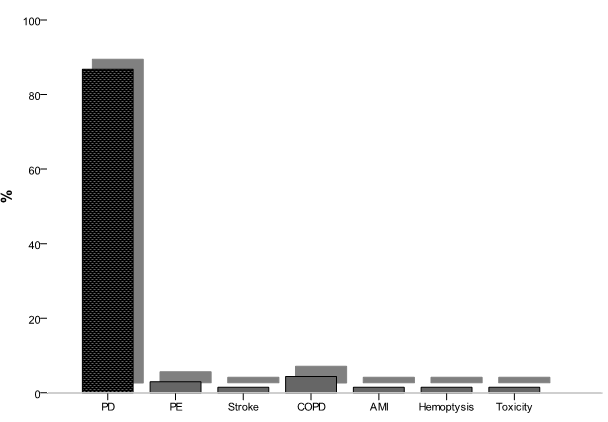
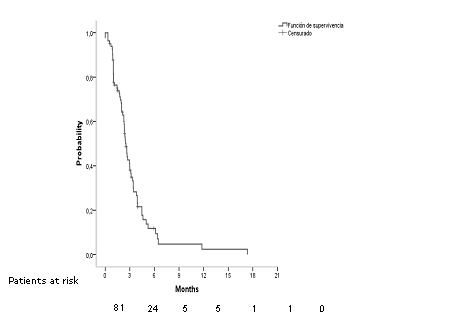
Development Process for Drugs for Pediatric Patients Suffering from T2DM

Introduction

Despite the large increase in the number of cases of T2DM in children and adolescents over the last 15 to 20 years, this metabolic disorder remains relatively rare. The National Institutes of Health (NIH) estimates that there are around 40,000–50,000 children and adolescents with T2DM in the US currently [1]. A number that is far lower than the maximum number of 200,000 to be considered an orphan disease by the US FDA (http://www.fda.gov/ForIndustry/ DevelopingProductsforRareDiseasesConditions/ucm2005525.htm). This number is also a lot lesser compared to the more than 18 million adults with T2DM in the US. Furthermore, the annual incidence of T2DM in children and adolescent has been estimated by the SEARCH for Diabetes in Youth Study to be approximately 3700 in the US but not much as 5000 new cases per year [2].

Nonetheless, these numbers are still much less than the estimate of 15,000 new cases of childhood T1DM or the more than 1 million new cases of T2DM among adults each year [3]. Unlike in the adult population, undiagnosed T2DM is rare in high-risk obese adolescents [4], with less than 0.5 % of at-risk obese minority of children and adolescents being identified with T2DM via screening of FPG, OGTT, or HbA1c. Therefore, almost all children/adolescents with T2DM are identified clinically, and the registry-based estimates of diagnosed cases of T2DM in the US and Canada most likely reflect the total number of individuals under 18 years-old with the disease. Thus, potential clinical trials are very limited as they begin with a small pool from which to draw participants [5]. In the following article, we will discuss the factors that further limit eligibility of clinical trial participants as well as possible solutions to overcome these limitations.

Barriers to clinical trial participation

Pediatric T2DM represents a disorder with substantial risk for long-term metabolic, CVD, and renal morbidity and mortality. It is also an important individual and societal burden. Growing literature suggests that the disorder may have unique biological features, including accelerated loss of β-cell function relative to adults with T2DM, as well as a high risk of development of micro-and macrovascular complications. However, despite the availability of many novel oral anti-diabetic drugs (OADs) for the treatment of T2DM in adults, little information is available regarding the efficacy and safety of these OADs in the pediatric population [5]. Few results from pediatric studies have been reported, and approved treatment options remain limited to metformin and insulin. Furthermore, the results of the TODAY study demonstrated a high level of treatment failure with the use of metformin alone or in combination with LSI. Similarly, with the development of T2DM patients may have to switch or add other OADs to the initial regimen to better control their T2DM. Therefore, there is a high need in pediatric patients suffering from T2DM to have access to new OADs with higher efficacy and safety. A number of demographic, economic, and social challenges have limited the recruitment and the retention in pediatric T2DM clinical trials [5]. In the following sections we will discussed some limitations that could have an impact on the eligibility for clinical trials of pediatric patients with T2DM.

Early initiation of therapy

Despite the rise in prevalence of T2DM among children and adolescents, T1DM still remains more common, and an adolescent presenting with new-onset diabetes is still more likely to have T1DM [3]. Considering that many pediatric patients with T1DM will also present with obesity it becomes very difficult to reliably distinguish individuals with T2DM on the clinical basis alone since most of the T2DM pediatric patients are also obese. Therefore, even among those children and adolescent at highest risk i.e., obese patients, certain minorities and those in the middle of their puberty, the possibility of T1DM is high enough that many clinicians will decide to initiate insulin therapy until the diagnosis has been formally determined through antibody testing [6]. In addition, in regular clinical practice, if there is any doubt about the diagnosis of T2DM, then it is much safer to commence insulin treatment and revise the diagnosis later in order to avoid possible metabolic decompensation. However, once insulin is initiated, a certain degree of glycemic control is often achieved which means that the individual no longer meets the HbA1c criteria for clinical trial participation. Furthermore, insulin is often used as glycemic treatment in clinical studies of OADs and previous exposure to insulin limits the interpretation of results. Thus, the pool of naïve patients eligible for clinical trials is small, and identifying such patients requires careful coordination among HCPs and the research teams [7-8].

Glycemic Control

Most newly diagnosed patients initially respond well to treatment, and measures of glycaemia, including FPG and HbA1c, rapidly decrease. For instance, in the TODAY study, 90 % of participants were able to achieve a median HbA1c of 5.9 % after a median of 10 weeks on metformin [9]. Therefore, individuals who have been treated for more than a few weeks may no longer be suitable for clinical trials, since the main primary study objectives generally call for enrollment of participants with limited exposure to insulin or metformin and with inadequate glycemic control at baseline in order to demonstrate efficacy through reductions in HbA1c. To complicate matters further, the withdrawal of insulin or metformin in stably treated patients in order for them to qualify for placebo-controlled clinical trials is not ethically acceptable in this vulnerable population. Thus, randomised clinical trials with new OAD for the treatment of pediatric patients with T2DM are limited to the small pool of potential participants consisting of patients identified before treatment is initiated, including patients responding poorly to treatment, or those in whom insulin or metformin is discontinued on clinical grounds but who maintain HbA1c within the inclusion range after discontinuation [5].

Inclusion and exclusion criteria

Common additional inclusion/exclusion criteria further limit the number of eligible patients. For instance, there is a high prevalence of NAFLD in children and adolescents with T2DM [10], with up to one third having ALT values greater than three times the upper limit of normal. This is representative of common exclusion criteria in clinical trials of OADs [5]. In several studies of adolescents with T2DM a large percentage of screened patients do not meet eligibility criteria due to the high prevalence of obesity-related comorbidities, such as HTN, hyperlipidemia, menstrual irregularities, and obstructive sleep apnea, which result in failure to most patients to meet the minimal inclusion and/or exclusion criteria. In addition, exposure to atypical antipsychotics or oral corticosteroids for asthma is prevalent in this population of T2DM and both are often exclusions for study participation due to the potential diabetogenic properties of these compounds [11]. The combination of the upper age limit of 17 for pediatric studies and the median age at diagnosis of 14 means that the average duration of potential eligibility for a pediatric T2DM study is only 3–5 years [12]. Considering, all these exclusion criteria, the pool of candidate for clinical trial in pediatric T2DM is rather small [5]. Therefore, there is a need to find solution to overcome these barriers in order to be able to develop new OAD molecules for the unmet of this population of pediatric patients.

Loss of Compliance

The investigators of the TODAY trial reported that it was difficult to recruit patients with T2DM for duration beyond 6 months [12], as patients on oral therapy alone often begin to routinely miss clinic appointments for their diabetes care. This suggests that beyond the initial few months after diagnosis, enthusiasm of patients to participate in clinical trials, or to receive clinical care for their T2DM, decreases. Secondly, the mean HbA1c of 3 months prior to loss of glycemic control in TODAY study was 6.8 % suggesting that loss of glycemic control in children and adolescents with T2DM is significant and the time during which individuals on oral monotherapy will remain in the HbA1c window for inclusion into a clinical trial will be limited. Thirdly, TODAY results indicate that patients who fail metformin monotherapy have lower β-cell function than other individuals, thus, may be different from those responding to metformin monotherapy, potentially limiting the generalizability of a trial including too many of these patients [13-14]. Finally, given the potential for rapid metabolic deterioration of individuals failing metformin monotherapy, clinicians and investigators are cautious about enrolling such children and adolescents in placebo-controlled trials and will rather opt to initiate insulin therapy rapidly [5]. Adolescents as a group are generally less adherent than younger pediatric and adult cohorts to oral treatment regimens and study visits. Self-reported reasons for non-compliance included: forgetfulness, jobs busy schedules, less developed concepts of illness, less perceived vulnerability, higher levels of denial, and less cohesive future orientation [5]. Many adolescents may also leave home to attend college or live independently while others may have parents who are absent or poorly concerned about their child’s condition [5]. Patients report that major facilitators to research participation are positive peer and family influences, program incentives including money and school credit, spending time with friends, commitment, and personal gain.

Socioeconomic Challenges

The enrolment of potential study participants into any clinical trial requires a thorough understanding of the basic demographic characteristics of potential subjects [15]. Children and adolescents in the US with T2DM are obese; two thirds are female and are almost always pubertal. They are socio-economically disadvantaged i.e., 41.5 % are from a household having a total annual income of <$25,000; they are predominantly living in a single-parent home, and they are overrepresented in most ethnic minority groups [5]. They are poorly educated i.e., their highest level of education attained by a parent/ guardian in the household is less than a high school graduate in 26.3 %, and they are almost all have a strong family history of T2DM. In Europe, most of the reported cases have been among immigrant groups in the UK and Germany [17]. In China and in India, like in the USA, most new cases were in individuals who were pubertal and obese i.e., with a BMI above the 95th percentile [17-18]. Overall, these characteristics present particular challenges in designing and implementing clinical trials for pediatric patients with T2DM. There are other barriers inherent to the adolescent population, including changing housing and unstable home environments, unreliable transportation for travel to and from appointments, difficult communication between participant and research team because of suboptimal parental support for research participation, high rates of missed medical visits, poor adherence to medical therapy in part due to large financial burdens related to the costs of present-day diabetes care, and others [19].

Sponsor and Regulatory Challenges

In Canada, to have a medication authorised and marketed, pharmaceutical companies have the obligations to systematically demonstrate the safety and efficacy of their products and the risk/ benefice ratio should be favorable. Pediatric patients should be given medicines that have been appropriately evaluated for their use. Their product should be safe and effective for pediatric patients and their approval requires the timely development of information on the proper use of medicinal products in pediatric patients of various ages and, often, the development of pediatric formulations of those products [5]. Obtaining knowledge of the effects of medicinal products in the pediatric patients is an important goal. However, this should be done without compromising the well-being of pediatric patients participating in clinical studies [5]. This responsibility is shared by companies, regulatory authorities, health professionals, and society as a whole (http://www.hc-sc.gc.ca/dhp-mps/alt_formats/hpfb-dgpsa/ pdf/prodpharma/e11-eng.pdf).

In USA, the establishment of the Pediatric Review Committee (PeRC) under the Pediatric Research Equity Act (PREA) and the FDA Amendment Act in 2007 further permitted the FDA to specifically require assessment of the safety and effectiveness of a product in pediatric patients in all applications for new active ingredients, new indications, new dosage forms, new dosing regimens, or new routes of administration unless this requirement is waived, deferred, or inapplicable [5, 20-22]. PeRC reviews the requested pediatric plans and provides assessment and recommendations to FDA as a part of the New Drug Application (NDA) approval process and reviews all requests for deferral and waiver. In general, deferral is granted so that the approval for use in the adult population is not delayed.

In Europe, similar regulations have been established to govern requirement for pediatric investigation during the drug approval process by the Pediatric Committee of the European Medicines Agency (EMA) [23-24]. Despite the incentive of patent exclusivity or the statutory requirement from the EMA, it has remained challenging to initiate, conduct, and complete studies in the pediatric T2DM population for the reasons discussed above [5]. In addition, from the sponsor point of view, clinical research in the pediatric population has other barriers to overcome including the lack of financial incentive to conduct clinical trials in T2DM pediatric populations considering the limited market and the recruitment difficulties [5]. In the past few years, a number of new OADs with novel mechanism of action have emerged, and many studies in the pediatric T2DM population have been required by the FDA, the EMA and Health Canada. The success of novel OAD development has inadvertently made the challenges of conducting pediatric T2DM studies even more difficult because of the continually increasing competition for the limited number of eligible study patients. Currently, clinical safety and efficacy studies and PK studies for DPP-4 inhibitors and insulin Determir have been completed within the last 2 years. However, clinical trials for GLP-1 analogues, SGLT2 inhibitors, insulin glargine, and others, seeking to randomize a total of over 1000 new study subjects remind us that recruitment issues remain a limiting factor in pediatric T2DM drug development [25].

To make the situation worse, more clinical safety and efficacy studies have already been committed to as a condition of new drug approval and will need to be initiated in the near future, and more studies will be required for applications that are either under regulatory review or to be submitted in the near future. These pediatric studies will evaluate not only novel active ingredients but also new dosage forms and dosing regimens including extended-release formulations, oral suspension, and fixed-dose combination of approved agents.

Unfortunately, new OAD development against pediatric T2DM seems to be a necessity since data from the TODAY study suggests that metformin monotherapy failure rates to be higher in children than adult population [26].

However, there are potentials solutions to overcome these barriers and in the following paragraphs some of these solutions will be briefly discussed.

Possible Solutions

What can be done to improve clinical research in pediatric T2DM patients so as to provide meaningful clinical trial data to inform treatment decisions? To reduce the burden on performing clinical trials with the very limited patient pool, it would be useful to consider the patients’ and the HCPs’ point of view in setting the priorities for clinical research in pediatric T2DM. From this perspective, it can be argued that it is more logical to selectively assess the most promising OADs and treatment regimens, instead of testing each new OAD and having them evaluated and authorised by regulatory agencies [5].

Create a Consortium

One interesting approach is to create a consortium of clinical research experts, together with other key stakeholders, to identify and prioritize the development of OADs and strategies needed to improve T2DM management in pediatric patients. The Drug Safety and Efficacy Network (DSEN) is an example of such a consortium which works in collaboration with the Canadian Institute of Health Research (CIHR) and many other stakeholders to identify appropriate therapy for patients who have already failed initial treatment. They work to identify and prioritize the clinical trial hypotheses, to determine the most promising OADs to be tested, and to design and conduct the clinical studies, utilizing a network of clinical trial sites representing centers most commonly tertiary hospital centers with clinical and research expertise in pediatric T2DM to undertake and perform the designed trials. This consortium and others require collaboration rather than competition between the HCPs, the clinical research experts, the medical societies, the pharmaceutical sponsors, the regulatory agencies, and the patient group representatives [26].

Adaptive design

Over the past few years, the use of adaptive designs in clinical research and in drug development based on accumulated data has become very popular because of its flexibility and its efficacy [27]. Based on the adaptations applied to the initial clinical trial during the drug development, this can lead to a reduction in the duration and the number of patients in the adaptive study and indirectly limit the exposure of patients to ineffective placebo or active comparators with less efficacy and known adverse drug reactions. A study performed by Spann et al. demonstrated, using an adaptive design, the same conclusion regarding the effectiveness of a treatment by using 50% fewer patients when compared to the initial trial. The number of patients had been reduced from 311 to 156; exposure to the placebo was reduced from 54 to 30 and exposure to the active comparator, with known side effects, was reduced from 126 to 60, compared to what was initially planned [28]. However, it must be ensured that the actual population of patients after the modifications does not deviate from the initial patient population, therefore avoiding a type I error i.e., to affirm the effectiveness of a drug by mistake while it is not effective, thus decreasing the possibility of arriving at inadequate conclusions or results difficult to interpret [29-30].

In addition, important adaptations to clinical trials and/or statistical procedures during development can make these clinical trials totally different from those initially designed and therefore these changes render us unable to adequately answer the scientific or medical issues raised initially. Traditionally, the clinical trial protocol must be carefully planned a priori and all clinical aspects related to this new protocol must be clearly documented and must comply with the requirements for clinical trials. Any significant changes in the design of the protocol, once started, must be authorized by a regulatory agency. In addition, changes made to the initial statistical procedures must be approved before their implementation, because these changes may represent a potential risk of bias, thus compromising the results of the clinical trial. In conclusion, the adaptive study plans allow a study protocol to be modified from its initial version based on new data from external sources or from an interim analysis of the data obtained from the ongoing clinical trial. However, any changes to the design or analysis of data from the study must be planned in advance and the situations where these changes will be introduced should also be previously specified.

While increased efficiency is an important goal in the development of drugs, this should not compromise the safety of the participants in clinical trials. The FDA says in its Guidance Document (www.fda. gov/downloads/Drugs/…/Guidances/ucm201790.pdf) that adaptive clinical trials may be suitable for the products with prior experience of known security or for products with adverse events with known pathophysiological mechanisms. The use of adaptive designs can certainly contribute to shortening the drug development timeframe by allowing the initiation of larger trials (Phase III) before smaller studies (Phase II) are fully completed and analyzed. However, the identification of adverse reactions may be inappropriately missed due to a reduced number of exposed patients combined with a reduction in duration of drug exposure. With this approach, the side effects associated with new drugs occurring in the long term can pass unnoticed, placing pressure on the is sufficiently similar between adults and children; 2) the response to treatment is sufficiently similar between adults and children; and 3) adults and children have a sufficiently similar exposure-response relationship. Considering that the drugs that require development in the pediatric population suffering from T2DM are mainly required in adolescents (mean age of 14) and that the response to treatment and the adverse drug reactions we are following are mainly the same as in adults, we can conclude that we meet the criteria for extrapolation from adult studies according to the FDA regulations. If needed, PK data to allow for the determination of an appropriate pediatric dosage and additional pediatric safety information can also be submitted using the 14 and above year-old group as mentioned above. development of prevention activities in post-approval phase.

Extrapolation from adult studies

The FDA has put in place the following rule that could be beneficial for the development of new drug that could also be applicable in pediatric patients suffering from T2DM. “Where the course of the disease and the effects of the drug are sufficiently similar in adults and pediatric patients, FDA may conclude that pediatric effectiveness can be extrapolated from adequate and well-controlled studies in adults usually supplemented with other information obtained in pediatric patients, such as PK studies. Studies may not be needed in each pediatric age group, if data from one age group can be extrapolated to another.” [21 CFR 314.55(a); 21 CFR 601.27(a)]. This extrapolation is based on three evidence-based assumptions as follows: 1) the course of the disease is sufficiently similar between adults and children; 2) the response to treatment is sufficiently similar between adults and children; and 3) adults and children have a sufficiently similar exposure-response relationship. Considering that the drugs that require development in the pediatric population suffering from T2DM are mainly required in adolescents (mean age of 14) and that the response to treatment and the adverse drug reactions we are following are mainly the same as in adults, we can conclude that we meet the criteria for extrapolation from adult studies according to the FDA regulations. If needed, PK data to allow for the determination of an appropriate pediatric dosage and additional pediatric safety information can also be submitted using the 14 and above year-old group as mentioned above.

Health Canada has also put in place the following rule regarding the extrapolation from adult studies: When a medicinal product is to be used in the pediatric population for the same indication(s) as those studied and approved in adults, the disease process is similar in adults and pediatric patients, and the outcome of therapy is likely to be comparable, extrapolation from adult efficacy data may be appropriate. In such cases, pharmacokinetic studies in all the age ranges of pediatric patients likely to receive the medicinal product, together with safety studies, may provide adequate information for use by allowing selection of pediatric doses that will produce blood levels similar to those observed in adults. If this approach is taken, adult pharmacokinetic data should be available to plan the pediatric studies as discussed above (http:// www.hc-sc.gc.ca/dhp-mps/alt_formats/hpfb-dgpsa/pdf/prodpharma/ e11-eng.pdf) .

Clinical trials combining adult and pediatric patients

Another interesting approach is to include a subgroup of pediatric patients within the adult’s clinical trials and perform the statistical analysis by subgroup based on the age of patients. Considering, that the mean age that the pediatric patients that develops T2DM is around the mid-puberty, which is around 14 years-old, therefore, having a subgroup aged 13-17 years-old would be acceptable where compared to control group of the same age similar weight or body surface area. Obviously consideration should be given to extrapolation from adult studies as mentioned above. It is not the purpose of this paragraph to discuss the design and the statistical methods used for this combine clinical trial. Briefly, these clinical trials should follow the ICH-E6 Guideline for Good Clinical Practice (http://www.ich.org/fileadmin/Public_ Web_Site/ICH_Products/Guidelines/Efficacy/E6/E6_R1_Guideline. pdf), the ICH-E9 on Statistical Principles for Clinical Trials (http:// www.ich.org/fileadmin/Public_Web_Site/ICH_Products/Guidelines/ Efficacy/E9/Step4/E9_Guideline.pdf) and must be authorised on a case by case basis by a regulatory agency such as the FDA, the EMA or Health Canada.

Conclusions

Pediatric T2DM represents an emerging disorder with substantial risk for long-term metabolic complications, CVD, and renal morbidity and mortality, as well as individual and societal burden. A number of demographic, economic, and social barriers limit the recruitment and the retention of patients in pediatric T2DM clinical trials resulting in limited studies with limited population. We have also discussed a certain number of potential solutions to overcome these barriers. These solutions could facilitate timely completion of the required clinical trials sponsored by pharmaceutical companies, and acknowledge the mandate of regulatory agencies to ensure the availability of safe and well-studied OADs for affected pediatric patients with T2DM. If successful, these potential solutions could also serve as a model for clinical trials in other rare and understudied pediatric disorders.
How might we improve recruitment and retention of pediatric patients in clinical trials? Studies outside the field of pediatric T2DM offer some promising strategies. Villarruel et al. [31] showed that a combination of incentives including money and school credit for participation, flexible program start times, continued contact with project staff including more frequent reminders, increasing the interactive components of follow-up, and recognizing the importance of potential mobility limitations among adolescents and their families contributed to a reduction in risky sexual behavior in Latino youth. Finally, we suggest that more should be done to find young patients in the places where they are most comfortable i.e., at their local clinics, in their neighborhoods, and at their schools. Rather than asking patients to come to us, perhaps we should consider that we, as HCPs and research investigators, go to them [32].

References

  • National Diabetes Statistics, 2014.
  • Nadeau KJ, Anderson BJ, Berg EG, Chiang JL, Chou H, et al. (2016) Youth-Onset Type 2 Diabetes Consensus Report: Current Status, Challenges, and Priorities. Diabetes Care 39: 1635-1642. [crossref]
  • Writing Group for the SEARCH for Diabetes in Youth Study Group, Dabelea D, Bell RA, D’Agostino RB Jr, Imperatore G, et al. (2007) Incidence of diabetes in youth in the United States. JAMA 297: 2716-2724. [crossref]
  • Baranowski T, Cooper DM, Harrell J, Hirst K, Kaufman FR, et al. (2006) Presence of diabetes risk factors in a large U.S. eighth-grade cohort. Diabetes Care 29: 212-217. [crossref]
  • Zeitler P, Chou HS, Copeland KC, Geffner M (2015) Clinical trials in youth-onset type 2 diabetes: needs, barriers, and options. Curr Diab Rep 15: 28. [crossref]
  • Klingensmith GJ, Pyle L, Arslanian S, Copeland KC, Cuttler L, et al. (2010) The presence of GAD and IA-2 antibodies in youth with a type 2 diabetes phenotype: results from the TODAY study. Diabetes Care 33: 1970-1975. [crossref]
  • Copeland KC, Silverstein J, Moore KR, et al. (2013) Management of newly diagnosed type 2 diabetes mellitus (T2DM) in children and adolescents: clinical practice guidelines. Pediatrics 131:364–382.
  • Zeitler P, Fu J, Tandon N, Nadeau K, Urakami T, et al. (2014) ISPAD Clinical Practice Consensus Guidelines 2014. Type 2 diabetes in the child and adolescent. Pediatr Diabetes 15 Suppl 20: 26-46. [crossref]
  • Laffel L, Chang N, Grey M, et al. (2012) Metformin monotherapy in youth with recent onset type 2 diabetes: experience from the pre-randomization run-in phase of the TODAY study. Pediatr Diabetes 13:369–375.
  • Hudson OD, Nunez M, Shaibi GQ (2012) Ethnicity and elevated liver transaminases among newly diagnosed children with type 2 diabetes. BMC Pediatr 12: 174. [crossref]
  • Bobo WV, Cooper WO, Stein CM, Olfson M, Graham D, et al. (2013) Antipsychotics and the risk of type 2 diabetes mellitus in children and youth. JAMA Psychiatry 70: 1067-1075. [crossref]
  • Copeland KC, Zeitler P, Geffner M, Guandalini C, Higgins J, et al. (2011) Characteristics of adolescents and youth with recent-onset type 2 diabetes: the TODAY cohort at baseline. J Clin Endocrinol Metab 96: 159-167. [crossref]
  • Bacha F, Pyle L, Nadeau K, Cuttler L, Goland R, et al. (2012) Determinants of glycemic control in youth with type 2 diabetes at randomization in the TODAY study. Pediatr Diabetes 13: 376-383. [crossref]
  • TODAY Study Group (2013) Effects of metformin, metformin plus rosiglitazone, and metformin plus lifestyle on insulin sensitivity and â-cell function in TODAY. Diabetes Care 36:1749–1757.
  • Liese AD, D’Agostino Jr RB, Hamman RF, SEARCH for Diabetes in Youth Study Group, et al. (2006) The burden of diabetes among U.S. youth: prevalence estimates from the SEARCH for Diabetes in Youth Study. Pediatrics 118:1510–1518.
  • Reinehr T, Kiess W, Kapellen T, Wiegand S, Holl RW (2011) APV and DPV Wiss Study Group and German Competence Net Obesity (2010) Children with diabetes mellitus type 2 in Europe: an underserved population. Arch Dis Child 95: 954. [crossref]
  • Fu JF, Liang L, Gong CX, Xiong F, Luo FH, et al. (2013) Status and trends of diabetes in Chinese children: analysis of data from 14 medical centers. World J Pediatr 9: 127-134. [crossref]
  • Prasad AN (2011) Type 2 diabetes mellitus in young need for early screening. Indian Pediatr 48: 683-688. [crossref]
  • TODAY Study Group, Wilfley D, Berkowitz R, Goebel-Fabbri A, Hirst K, et al. (2011) Binge eating, mood, and quality of life in youth with type 2 diabetes: baseline data from the today study. Diabetes Care 34: 858-860. [crossref]
  • Food and Drug Administration Amendments Act of 2007.
  • Pediatric Review Committee.
  • The United States of America. Pediatric Research Equity Act of 2 0 0 3.
  • Regulation (EC) No 1901/2006 of the European Parliament and of the Council of 12 December 2006 on medicinal products for paediatric use.
  • Regulation (EC) No 1902/2006, an amending regulation in which changes to the original text were introduced relating to decision procedures for the European Commission.
  • National Institutes of Health (2016) ClinicalTrials.gov Bethesda, MD2016.
  • TODAY Study Group, Zeitler P, Hirst K, Pyle L, Linder B, et al. (2012) A clinical trial to maintain glycemic control in youth with type 2 diabetes. N Engl J Med 366: 2247-2256. [crossref]
  • Wise L, Parkinson J, Raine J, Breckenridge A (2009) New approaches to drug safety: a pharmacovigilance tool kit. Nat Rev Drug Discov 8: 779-782. [crossref]
  • Spann M, Lindborg S, Seaman J, et al. (2009) Bayesian adaptive non-inferiority with safety assessment: retrospective case study to highlight potential benefits and limitations of the approach. J of Psychiatric Research 43:561-67.
  • Chow SC, Chang M (2008) Adaptive design methods in clinical trials – a review. Orphanet J Rare Dis 3: 11. [crossref]
  • Chow SC, Corey R (2011) Benefits, challenges and obstacles of adaptive clinical trial designs. Orphanet J Rare Dis 6: 79. [crossref]
  • Villarruel AM, Jemmott LS, Jemmott JB, Eakin BL (2006) Recruitment and retention of Latino adolescents to a research study: lessons learned from a randomized clinical trial. J Spec Pediatr Nurs 11:244–250.
  • Gemmill JA, Brown RJ, Nandagopal R, Rodriguez LM, Rother KI (2011) Clinical trials in youth with type 2 diabetes. Pediatr Diabetes 12: 50-57. [crossref]