Archives

Epidemiological, Diagnostic, Therapeutic and Prognosis Aspects of Soft Tissues Sarcomas at Dakar Cancer Institute

DOI: 10.31038/CST.2016125

Abstract

Purpose: The purpose of this work was to specify the epidemiological profile of soft tissue sarcomas at the Dakar Cancer Institute and to evaluate their diagnostic and therapeutic management.

Patients and Methods: This was a prospective study involving 40 patients with soft tissue sarcomas treated at the Dakar Cancer Institute during a 3-year period from August 1, 2009 to July 30, 2012.

Results: Soft tissue sarcoma represents 0.4% of cancer cases at the Dakar Cancer Institute. The average age was 41.2 years. The sex ratio was 0.6. There was a family history of cancer in 5 patients. History of type 1 neurofibromatosis was found in 2 patients and irradiation for pelvic cancer in 1 patient. The average time for consultation was 17.2 months. The most frequent localizations were the thigh (17.5%) and the shoulder (12.5%). The mean lesion size was 14.3 cm. Imaging showed metastasis in 9 patients (24.4%) and extension to neighboring organs in 17 patients (42.5%). The most common histological type was Rhabdomyosarcoma (20%) followed by Dermatofibrosarcoma (17.5%). High grade sarcoma was found in 5 patients (12.5%). Excision was the most common type of surgery (30%). Chemotherapy was performed in 13 patients (32.5%) including 8 cases of palliative chemotherapies. Radiotherapy was performed in 5 patients (12.5%). The goal was neo adjuvant in 2 patients, adjuvant in 1 patient and palliative in 2 patients. After a 52-month follow-up period, 1 patient presented a local recurrence and 18 patients died.

Keywords

sarcoma; surgery; chemotherapy; radiotherapy; recurrence.

Introduction

Soft tissue sarcomas represent all malignant tumors with mesenchymal differentiation in all extra-bone tissues with the exception of lymph nodes and glial tissue [1]. It is a rare cancer. The prognosis depends on the initial stage, the histological type, the grade, the location and the initial treatment [2]. The objective of this work was to specify the epidemiological profile of soft tissue sarcomas at the Dakar Cancer Institute and to evaluate their diagnostic and therapeutic management.

Patients and methods

We carried out a descriptive prospective study involving 40 patients with soft-tissue sarcomas treated at the Dakar Cancer Institute for a period of 3 years from August 1, 2009 to July 30, 2012.

Results

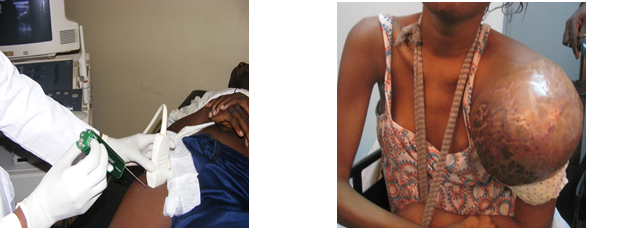
Soft tissue sarcoma represents 4 patients per 1000 cases at the Dakar Cancer Institute. The mean age was 41.2 years with extremes of 9 and 81 years. There was a female predominance with a sex ratio of 0.6. There was a family history of cancer in 5 patients. History of type 1 neurofibromatosis was found in 2 patients and irradiation for pelvic cancer in 1 patient. Mean follow-up was 17.2 months after onset of symptomatology. The most frequent localizations were the thigh (n = 7) [Figure 1] and the shoulder (n = 5) [Figure 2]. The size of the lesions varied from 5 to 35 cm with an average of 14.3 cm. The majority of patients (n = 37) had a single lesion. The initial lesion was bifocal in 2 patients and 1 patient had 4 lesions. The imaging assessment used CT for 20 patients, MRI for 11 and ultrasound in 6 cases. It showed the presence of metastasis in 9 patients (24.4%) at the time of diagnosis and an extension to neighboring organs in 17 patients. Surgical biopsy was the most common modality (26 cases, 67%) followed by ultrasound guided biopsy (6 cases, 15%). The most common histological type was Rhabdomyosarcoma (20%) followed by Dermatofibrosarcoma (17.5%) [Table 1]. A high-grade sarcoma was found in 19 patients (47.5%). Surgery was performed in 24 patients (60%). Wide resection was the most common type of surgery (n = 12). Chemotherapy was performed in 13 patients including 8 palliative chemotherapies. The Adriamycin-Cisplatin chemotherapy protocol was the most widely used (n = 11). Radiotherapy was performed in 5 patients. The goal was neo adjuvant in 2 patients, adjuvant in 1 patient and palliative in 2 patients. After a 52-month follow-up period, 2 patients had local recurrence and 18 patients died [Table 2].

Figure 1. deep limb localization Figure 2. shoulder localization of a rhabdomyosarcoma

Fig1.deep limb localization                    Fig2.shoulder localization of a rhabdomyosarcoma

Table 1. Different histologic types of STS

Histologic  type Frequencies Percentage (%)
Angiosarcoma 1 2,5
Chondrosarcomea 1 2,5
Dermatofibrosarcoma protuberans 7 17,5
Fibrosarcoma 5 12,5
Atypical Fibroxantoma 1 2,5
Atypical Hémangioendothelioma 1 2,5
Endemic  Kaposi Sarcoma 1 2,5
Leimyosarcoma 1 2,5
Liposarcoma 2 5,0
Neurosarcoma 3 7,5
Rhabdomyosarcoma 8 20
Fusiform Cells Sarcoma 3 7,5
Phyllod Sarcoma 1 2,5
Pleomorph Sarcoma 2 5
Synovialosarcoma 3 7,5
Total 40 100

Table 2. Results of follow up

Evolution Frequencies Percentage(%)
Décès 18 45
Récidive 2 5
Patients en cours de traitement 7 17,5
Patients traités  sans récidive 13 32,5
Total 40 100

Discussion

Soft tissue sarcoma (STS) accounts for 0.5-1% of malignant tumors in adults. Their incidence is estimated at 30 cases per million inhabitants [1]. The frequency of soft tissue sarcomas increases in adults with age, and half of the patients are older than 50 years [2]. There is a slight male predominance especially after 60 years [3]. Several genetic factors including Gardener syndrome, Li Fraumeni syndrome and type 1 neurofibromatosis predispose to the onset of STS [4]. The sarcomas of the limbs represent approximately 60% of the sites, 45% of which are in the lower limbs [5, 6]. They are characterized by their large sizes [7,8]. It is a very lymphophilic tumor in the higher grades, in the associated forms in particular carcinosarcomas and in certain histological types such as synovialosarcomas and rhabdomyosarcomas [9]. One patient in four is metastatic at the time of diagnosis and secondary lesions are predominantly located at lymph nodes and lungs [10, 11]. MRI is the main method of imaging in STS. In association with PET-SCAN, its role is increased in the diagnosis of recurrences [12, 13]. The scanner is only used in the local assessment if MRI is contraindicated. Ultrasound is of limited utility except in the superficial small masses. The delay of consultation, very long in case of limited resources are bad prognoses factors [2]. The most frequent histological types are liposarcomas, leiomyosarcomas and malignant histiocytofibromas [14].

The treatment need a multidisciplinary approach and is better considered in a reference center [2]. Surgery regardless of location is the basic treatment. It is more functional and more conservative thanks to multidisciplinary teams and the development of new techniques like the isolated perfusion of the limb. The objective is to minimize functional sequelae and amputation rates [15, 16]. Chemotherapy occupies an important place in neo adjuvant situation in the locally advanced sarcomas and the high grades [2]. The question of adjuvant chemotherapy is generally left to the appreciation of multidisciplinary consultations [17]. Radiotherapy, in particular radio chemotherapy, has produced encouraging results in the neo-adjuvant period for locally advanced tumors [18]. The surgical excision followed by complementary radiotherapy is the standard loco regional treatment of limbs and operable and localized STS [19]. Abstinence from adjuvant radiotherapy is possible for superficial or strictly intramuscular tumors for which surgery showed clear margins [20].

The best survival rate, obtained in the reference centers, is of the order of 60 to 70% at 5 years in the early stages and of 2 months in the advanced stages [2, 11].

Conclusion

Soft tissue sarcoma is a rare cancer. It occurs sporadically or on specific genetic situations. Histological forms and grade determine susceptibility to treatment and prognosis. High grade and long delay are the cause of poor prognosis in limited resources situations. The main goal is first conservative and functional treatment. It needs multidisciplinary approach associating mainly surgery and radiotherapy. High grade sarcomas and metastatic stages have very poor prognosis.

Conflict of interest: None declared.

Source of funding: None.

Consent: Written informed consent was obtained from the patients.

Acknowledgments: None.

Author Contribution: Ka conceived this presentation while Diouf and Dem participated in quality control of this manuscript. All authors read and approved the final manuscript.

References

  • Fletcher DM, Unnik K and Mertens F (2002) World Health Organization classification of tumors. Pathology and genetics of tumors of soft tissue and bone. Lyon: IARC Press.
  • Honoré C, Méeus P, Stoeckle E, Bonvalot S (2015) Soft tissue sarcoma in France in 2015: Epidemiology, classification and organization of clinical care. J Visc Surg 152: 223-230. [crossref]
  • Jørgensen PH, Lausten GS, Pedersen AB (2016) The Danish Sarcoma Database. Clin Epidemiol 8: 685-690. [crossref]
  • Ducimetière F, Lurkin A, Ranchère-Vince D, Decouvelaere AV, Isaac S, et al. (2010) [Incidence rate, epidemiology of sarcoma and molecular biology. Preliminary results from EMS study in the Rhône-Alpes region].Bull Cancer 97: 629-641. [crossref]
  • Chang AE, Rosenberg SA (1988) Clinical evaluation and treatment of soft tissue tumors. In: Enzinger FM, Weiss SW. Soft tissue tumors (2nd ed) St Louis, Toronto, London: CV Mosby Co 19–42.
  • Coindre JM, Terrier P, Bui NB, Bonichon F, Collin F, Le Doussal V (1996) Prognostic factors in adult patients with locally controlled soft tissue sarcoma. A study on 546 patients from the French Federation of Cancer Centers Sarcoma Group. J Clin Oncol 14:869–77.
  • Mazeron JJ, Suit HD (1987) Lymph nodes as sites of metastases from sarcomas of soft tissue. Cancer 60: 1800-1808. [crossref]
  • Pisters PW, Harrison LB, Leung DH, Woodruf JM, Casper ES (1996) Long-term results of a prospective randomized trial of adjuvant chemotherapy therapy in soft tissue sarcoma. J Clin Oncol 14:859–68.
  • Davis CH, Yammine H, Khaitan PG, Chan EY, Kim MP (2016) A multidisciplinary approach to giant soft tissue sarcoma of the chest wall: A case report. Int J Surg Case Rep 28:211-213.
  • Christie-Large M, James SL, Tiessen L, Davies AM, Grimer RJ (2008) Imaging strategy for detecting lung metastases at presentation in patients with soft tissue sarcomas. Euro Journ Cancer 44: 1841-45.
  • Marudanayagam R, Sandhu B, Perera MT, Bramhall SR, Mayer D, et al. (2011) Liver resection for metastatic soft tissue sarcoma: an analysis of prognostic factors.Eur J Surg Oncol 37: 87-92. [crossref]
  • Choi YY, Lee IS, Kim SJ, Kim JI, Choi KU, et al. (2013) Analyses of short-term follow-up MRI and PET-CT for evaluation of residual tumour after inadequate primary resection of malignant soft-tissue tumours.Clin Radiol 68: 117-124. [crossref]
  • Shapeero LG (1990) MRI of the foot and ankle. In: Gooding CR editor, Diagnostic radiology. San Francisco: University of California Press 454–66.
  • Ferté C, Pascal LB, Penel N (2009) [Prognostic and predictive factors of soft tissue sarcoma: a daily use of translational research].Bull Cancer 96: 451-460. [crossref]
  • Stoeckle E, Italiano A, Stock N, Kind M, Kantor G, et al. (2008) [Surgical margins in soft tissue sarcoma]. Bull Cancer 95: 1199-1204. [crossref]
  • Aisen AM, Martel W, Braunstein EM, McMillin KI, Phillips WA, et al. (1986) MRI and CT evaluation of primary bone and soft-tissue tumors. AJR Am J Roentgenol 146: 749-756. [crossref]
  • Fayette J, Blay JY, Ray-Coquard I (2006) [Soft tissues sarcomas: good medical practices for an optimal management]. Cancer Radiother 10: 3-6. [crossref]
  • Casali P, Jost L, Sleijfer S, Verweij J, Blay JY (2008) Soft tissue sarcomas: ESMO clinical recommendations for diagnosis, treatment and follow-up. Ann Oncol 19:89-93.
  • Cheng EY, Dusenbery KE, Winters MR, Thompson RC (1996) Soft tissue sarcomas: preoperative versus postoperative radiotherapy. J Surg Oncol 61: 90-99. [crossref]
  • Suit HD, Mankin HJ, Wood WC, Proppe KH (1985) Preoperative, intraoperative, and postoperative radiation in the treatment of primary soft tissue sarcoma. Cancer 55:2659-67.

Epidemiological, Diagnostic, Therapeutic and Prognostic Aspects of Melanoma of Black Skin in an African Cancer Institute

DOI: 10.31038/CST.2016124

Abstract

Objectives: To describe the epidemiological, clinic, histologic, therapeutic and prognosis aspects of cutaneous melanoma in African black at the Dakar cancer Institute.

Materials and methods: This was a 6 years retrospective study that included all cases of cutaneous melanoma at the Institute of Dakar cancer. The clinical, epidemiological, clinical and histological parameters as well as the treatment and prognosis were analyzed.

Results: There were 21 black skin patients with malignant melanoma. The sex ratio is 0.75. The average age of our patients was 60.8 years and the average time of consulting, 32.8 months. The plantar melanoma accounted for 76% of cases (n = 16). The mean tumor size was 7.1 cm. The presence of inguinal lymphadenopathy was noted in 12 patients or 57% of cases. Pathology showed an acral lentiginous melanoma in 18 patients or 85.7%, and a nodular melanoma in 2 patients or 9.5%. The Breslow thickness was more than 5 in half of the patients. Staging showed at thoraco abdominal CT, secondary locations in 9 patients (43%). Surgical excision was performed in 8 patients while inguinal lymph node dissection was performed in 12 patients. We performed chemotherapy in 5 patients (23.8%). Palliative haemostatic radiotherapy was successfully performed in 1 patient. The mean time follow-up was 16.1 months with extremes of 1 and 66 months. We recorded 10 deaths (47.6%) during the period of study.

Keywords

melanoma; black skin; stage; surgery; prognosis.

Introduction

Malignant melanoma is the most aggressive skin cancer with a high metastatic potential. There are 200 000 new cases each year and it is the leading cause of death from skin cancer [1]. It is a rare in black people about which the skin is better protected by melanin. Surgery is the best treatment at early stage. The advent of targeted therapies and immunotherapy has improved survival in advanced cases [2]. Because of the low incidence in Africa melanoma of the black skin is understudied. The objective of this study was to report the epidemiology, diagnostic, therapeutic characteristics and outcomes of malignant melanoma of black skin at the Dakar Cancer Institute.

Materials and Methods

This was a retrospective study over a period of 6 years from January 2008 to December 2013. We evaluated the epidemiologic, clinical, histological, therapeutic and oncologic results.

Results

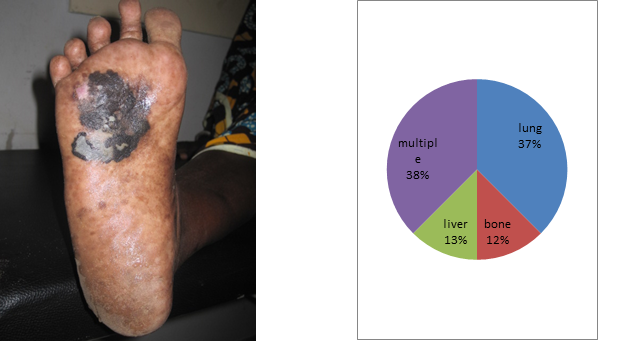
It was about 21 patients with malignant melanoma skin cancer of 136 cases or 15.4% of cases. They found 12 women to 9 men for a ratio of 0.75. The average age of our patients was 60.8 years, ranging from 29 years to 85 years. The average time of consultation was 32.8 months with extremes of 4 to 108 months. All patients were black subjects. No family history of melanoma was found. Plantar melanoma accounted for 76% of cases (n = 16) [Figure 1]. The trunk was the second site of localization [Table 1]. The average tumor size was 7.1 cm with extremes of 2.5 and 15 cm. Inguinal lymphadenopathy was noted in 12 patients (57%). Pathotology showed an acral lentiginous melanoma in 18 patients (85.7%) and a nodular melanoma in 2 patients (9.5%). The Breslow thickness was more than 5 in half of the patients. Staging showed at thoraco abdominal CT secondary locations in 43% of patients (n = 9), 3 in lungs (37.5%), 1 in liver (12.5%), 1 in bones (12.5%) and 3 cases of multiple locations (37.5%) [Figure 2]. Surgery was performed in 14 patients or 66.7%. The excision was carried out in 8 patients with macroscopic margins of 3 cm. Amputation or dislocation was performed in 6 patients. The surgical margins were healthy in 8 patients 57% of cases. The inguinal lymph node dissection was performed in 12 patients. The average number of lymph nodes removed was 7.16 nodes with a range of 2 to 10 nodes. Node-metastasis was founds in 5 patients (41.7%). Chemotherapy was given to 5 patients (23.8%). Palliative haemostatic radiotherapy was successfully performed in 1 patient with melanoma of the chest wall, at a dose of 8 Gy in one session. Among the 8 patients who had secondary locations, the coup average time was 12 months. The mean follow-up was 16.1 months with extremes of 1 and 66 months. We recorded 10 deaths or 47.6% during the study period.

Table 1. Distribution by tumor site

  Nombre Percentage (%)
Foot plant                                                   16 76
Trunk                                         3 14,4
Right Hallux                                           1 4,8
3rd toe                                            1 4,8
TOTAL 21 100
Figure 1. Plantar melanoma Figure 2. Different locations of metastases

Figure 1. Plantar melanoma                              Figure 2. Different locations of metastases

Discussion

Malignant melanoma is the most common skin cancer in light skin populations in areas where there is strong sunlight [3]. The reasons are genetic and environmental. The redhead phenotype depends on the MC1R gene and some areas like Australia are most exposed [4]. In Africa, it is less common than squamous cell carcinomas [5]. The occurrence of non-melanoma skin cancer depends on the immune status and many co-factors such as UV and HPV exposure [6]. It is an ubiquitous cancer for people aged 50 to 60. Family history plays an important role in the occurrence of melanoma [7]. Feet localizations are more frequent on black skin. It is essentially sporadic. Surveillance of plantar zone is difficult. That’s probably why plantar melanoma stages are advanced and are characterized by important tumor sizes, ulceration and budding. At resection, it has a clue high Breslow. The most common histological type is acral lentiginous melanoma [1,8]. It is the most common form in non-caucasian, hispanic and oriental populations [5]. The cause of its preferential localization at foot plant is not yet clear. Extension of this melanoma uses lymphatic, blood and step by step ways. The extension can be done to the bones, joints and muscles of the feet; typically we can found skip metastasis along the lower limb or regional, inguinal and popliteal lymphadenopathy and even retro and under peritoneum lymph nodes. Metastases are frequently seen at diagnosis. They are most commonly lung, brain and bones [9]. The later stages characterized the diagnosis in Africa. Most of the plantar location, by diagnostic errors and traditional treatments before medical care and the limited resources of patients are seen lately. The treatment is local, loco regional and systemic and depends on the stage of the disease. The surgical resection is more effective when the Breslow thickness is low. Amputation is frequent in our conditions. The node involvement varies. The prognosis depends more on local excision in early stage of the treatment of lymph node and distant metastases [10]. In early stages, the sentinel node biopsy reduces intra operative surgical risk, post-operative complications and distance lymphedema of the lower limb [9,11]. Lymph node dissection in advanced stages decreases inguinal recurrence but does not change the prognosis [12]. Iliac dissection using under peritoneal route without a formal indication in non-metastatic patients, seems to improve the prognosis [13]. Advanced stages raise the problem of therapeutic choice between palliative surgery sometimes mutilating such as limb amputations in patients with poor prognosis and systemic treatment alone or no treatment. Chemotherapy slightly modified melanoma prognosis. Radiotherapy is considered rather palliative. It is preconized in adjuvant situation for large lesions and after inguinal lymphadenectomy [14]. The melanoma-related mortality in advanced stages is very high. The low socioeconomic level in Africa is therefore indirectly a poor prognosis factor. Immunotherapy with the advent of anti PD1 and anti CTLA 4 increases significantly survival of melanoma [2,15].

Conclusion

Melanoma remains the most aggressive skin cancer with high metastatic potential. Its frequency in developed countries is a major public health problem. Its specific locations and socioeconomic level in black people in Africa makes the mortality very high. Surgery is more palliative than curative. Choosing a mutilating radical treatment is frequently an option. The advent of targeted therapies and immunotherapy revolutionizes its treatment and improves survival rates. Their availability is a priority in Africa.

Conflict of interest: None declared.

Source of funding: None.

Consent: Written informed consent was obtained from the patients.

Acknowledgments: None.

Author Contribution: Ka conceived this presentation while Diouf and Dem participated in quality control of this manuscript. All authors read and approved the final manuscript.

References

  • Erdei E, Torres SM (2010) A new understanding in the epidemiology of melanoma. Expert Rev Anticancer Ther 10: 1811-1823. [crossref]
  • Philips GK, Atkins M2 (2015) Therapeutic uses of anti-PD-1 and anti-PD-L1 antibodies. Int Immunol 27: 39-46. [crossref]
  • Grange F1 (2005) [Epidemiology of cutaneous melanoma: descriptive data in France and Europe]. Ann Dermatol Venereol 132: 975-982. [crossref]
  • Giles GG, Armstrong BK, Burton RC, Staples MP, Thursfield VJ (1996) Has mortality from melanoma stopped rising in Australia? Analysis of trends between 1931 and 1994. BMJ 312: 1121-1125. [crossref]
  • Pitche P, Tchamdja S, Napo koura G, Bakonde P et al. (1997)Les cancers cutanés en consultation dermatologique à Lomé(Togo). Méd Afr Noir 44:15-17.
  • Reusser NM, Downing C2, Guidry J3, Tyring SK4 (2015) HPV Carcinomas in Immunocompromised Patients. J Clin Med 4: 260-281. [crossref]
  • Payette MJ, Katz M 3rd, Grant-Kels JM (2009) Melanoma prognostic factors found in the dermatopathology report. Clin Dermatol 27: 53-74. [crossref]
  • Phan A, Touzet S, Dalle S, Ronger S, Balme B, Thomas L (2007) Acral lentiginous melanoma: histopathological pronostic feature of 121 cases. Br J Dermatol 157:311-318.
  • Homolak D, Šitum M, Cupic H (2015) Clinico-pathological features of patients with melanoma and positive sentinel lymph node biopsy: a single institution experience. Acta Dermatovenerol Croat 23:122-9.
  • Arcangeli F, Catrani S, Greco I, Pierleoni M, Landi G (2010) Prevention and early diagnosis of melanoma: a regional experience in Italy. Jour Eur Acad Dermatol Venereo 2:207-210.
  • Duvernay A, Henault B, Danino MA, Trost O, Dalac S, et al. (2012) [Complications associated with sentinel lymph node biopsy for cutaneous melanoma. A retrospective study of 127 patients]. Ann Chir Plast Esthet 57: 151-157. [crossref]
  • Mozzillo N, Caracò C, Marone U, Di Monta G, Crispo A, et al. (2013) Superficial and deep lymph node dissection for stage III cutaneous melanoma: clinical outcome and prognostic factors. World J Surg Oncol 11: 36. [crossref]
  • Giudice G, Robusto F, Nacchiero E (2016) The surgical treatment of a melanoma patient with macroscopic metastasis in peri and retrocaval lymph nodes and with a positive sentinel lymph node in the groin. Ann Ital Chir 4: 87.
  • Burmeister BH, Henderson MA, Ainslie J, Fisher R, et al. (2012) Adjuvant radiotherapy versus observation alone for patients at risk of lymph-node field relapse after therapeutic lymphadenectomy for melanoma: a randomised trial. Lancet Oncol 13:589-97.
  • Blank CU, Enk A (2015) Therapeutic use of anti-CTLA-4 antibodies. Int Immunol 27: 3-10. [crossref]

Re-igniting the PE debate

DOI: 10.31038/IMROJ.2016123

Case Report

Abstract: We describe the case of patient with a sub-massive pulmonary embolus and the evidence based management.

Learning points: The decision to thrombolyse or not to thrombolyse a sub-massive PE is difficult and several clinical factors need to be taken into consideration.

Key words: sub-massive, pulmonary embolus, thrombolysis

Joseph Mackenzie (JM): A 78 year old female patient presented 4 days ago with 3 day history of sudden onset breathlessness and dizziness. She was known to have chronic unspecified gromerulonephritis and had a WHO performance score of 1. Her regular medications included anti-hypertensives and quinine for night cramps. She was a never smoker with no dust exposure.

Initially, her pulse rate was 76 beats per minute, her oxygen saturations 95 per cent on air and blood pressure 105 over 76 mm of mercury. Her inflammatory markers were normal but her urea and creatinine had risen to 27.9 mmol per litre and 238 ummol per litre. Her chest radiograph and electrocardiogram was normal.

She was admitted under the care of the elderly team, was rehydrated and her nephrotoxics stopped. On the second day of admission, she had a syncopal episode with a spontaneous return to circulation: An arterial blood gas done on air showed a pCO2 of 3.2 KPascals, a pO2 of 8.9 KPascals, a base excess of -10mmol/L and oxygen saturations of 94 per cent.

The next day, a D-dimer was checked- that was more than 20.00 mg/L (normal being <0.50). Her hypotension was fluctuating. An echocardiogram was done- it showed a flattened septum throughout the cardiac cycle suggesting right ventricular (RV) overload, mildly impaired systolic function, moderate tricuspid regurgitation with a pulmonary arterial systolic pressure (PASP) estimated at 70mm mercury added to the right atrial pressure and a tricuspid annular plane systolic excursion of 1cm.

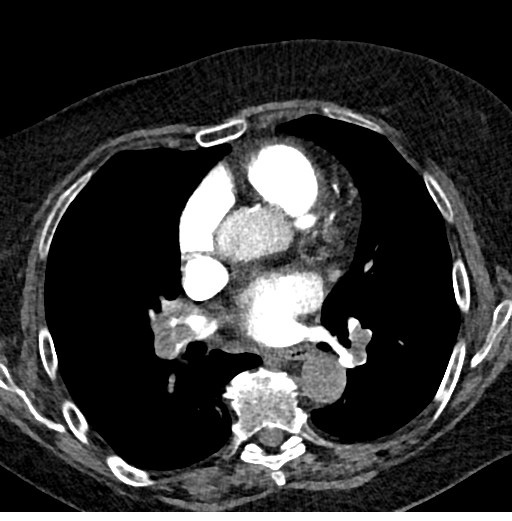
A computed tomography pulmonary angiogram was then performed which showed massive pulmonary embolism(PE) bilaterally in upper, middle and lower lobe pulmonary arteries, bilateral main pulmonary arteries (Fig 1) with significant right ventricular strain noted with reflux of contrast into IVC and hepatic veins.

She was started on full dose low molecular weight heparin and warfarin. Her current International Normalised Ratio (INR) is 1.8

Figure 1. CT scan showing massive bilateral pulmonary emboli and RV strain

Figure 1. CT scan showing massive bilateral pulmonary emboli and RV strain

Avinash Aujayeb (AA): Her initial Wells score was 31(only scored yes for PE being likely diagnosis), which puts her in a moderate risk group and combined with a high D dimer initially, she certainly warranted further investigation.

Her alveolar–arterial oxygen tension difference (PA–aO2) was 7 kPa.

The PA–aO2 is a measure of the difference between the alveolar concentration (A) of oxygen and the arterial (a) concentration of oxygen. In room air (inspiratory oxygen fraction of 0.21) at sea level (atmospheric pressure of 760 mmHg) assuming 100% humidity in the alveoli, a simplified version of the equation is 21−((PaCO2/0.8)−PaO2), 0.8 being the respiratory quotient. Whilst her peripheral saturations might appear normal, her high tension difference suggests a ventilation-perfusion mismatch and in a never smoker with a normal chest radiograph, a vascular event needs excluding.

The echocardiographic findings are worrisome. The main cause of death in acute PE is RV failure due to pressure overload. The abrupt increase in pulmonary vascular resistance results in RV dilation, which alters the contractile properties of the RV myocardium via the Frank-Starling mechanism. The increase in the RV afterload also causes the tricuspid valve to fail and the PASP is a marker of that. TAPSE is a simple echocardiographic measure of RV ejection fraction and any value below 2 cm is considered normal. Echocardiographic examination is not recommended as part of the diagnostic work-up in haemodynamically stable, normotensive patients with suspected (not high-risk) PE2, but in a suspected high-risk PE, a normal echocardiogram can exclude it.

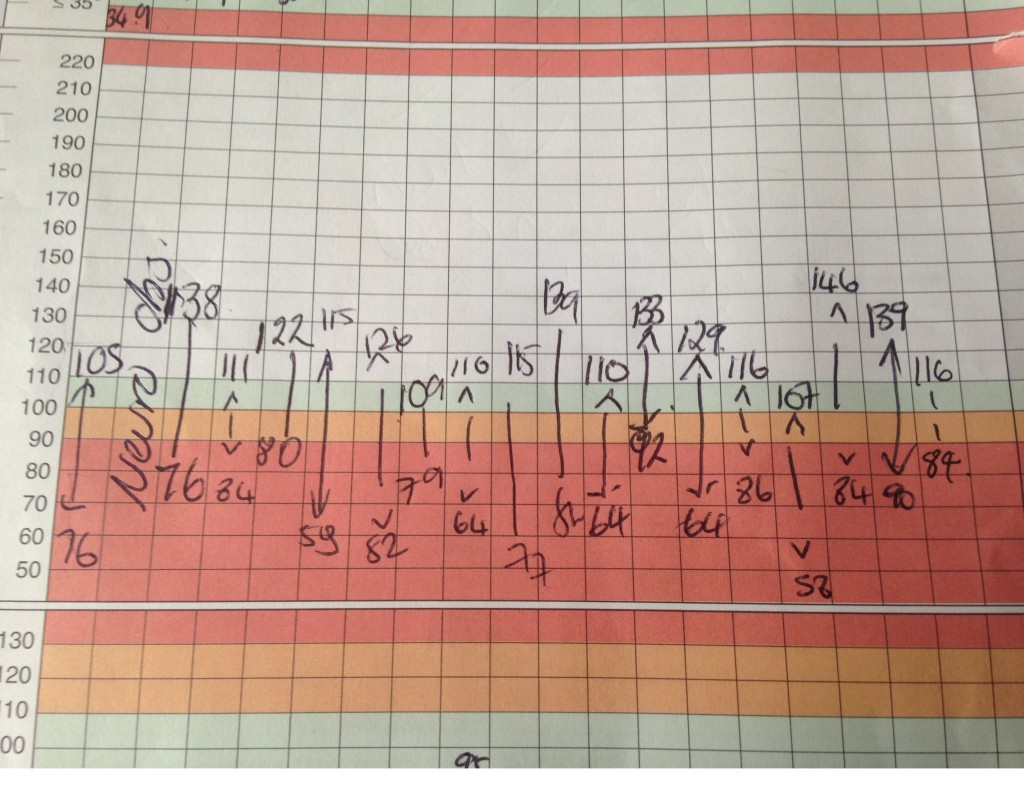
Joseph Mackenzie (JM): The patient has had no further syncopal episodes but has been more breathless today, and is now requiring 2litres via nasal cannulae to maintain oxygen saturations at 95%. Her respiratory rate has increased to 26 per minute and her blood pressure chart is as in Figure 2. A troponin T is 114 nanograms/L (normal range 0-14) and her lactate is 3.3 millimol/L (normal 0.5-2.2)- that was previously 1.9. This is now almost 7 days after she developed the initial symptoms. I note her INR of 1.8 but wonder if she would benefit from thrombolysis.

Figure 2. Observation chart showing fluctuations in blood pressure

Figure 2. Observation chart showing fluctuations in blood pressure

Avinash Aujayeb (AA): Patients with PE and shock or hypotension are at high risk of death, particularly in the first few hours after admission. The clinical classification an acute PE is based on estimated early mortality risk (in-hospital or 30-day)2 and shock or hypotension in PE is defined as a systolic blood pressure less than 90mm of mercury or a systolic sustained drop of more than 40mm of mercury over more than 15 minutes, in the absence of arrythmia, hypovolemia and sepsis. Hence, by strict definition, at the moment, she has a submassive PE (confirmed PE in a normotensive patient with evidence of RV dilatation and/or RV dysfunction and/or pulmonary hypertension) but I note the fluctuation hypotension.

There have been excellent debates of the pros and cons of thrombolysis in submassive PE recently.

The con arguments3 are that large registries suggest 90 day mortality in thrombolysed patients to be around 3% and in the heparin only group to be around 2%, that RV dilatation is a dynamic process and some studies have shown that 93% of such patients have normalised their RV at 6 months and that there is no evidence proving that early haemodynamic improvements has survival benefits, prevents recurrence and development of chronic thromboembolic pulmonary hypertension. The PETHIO trials2 also suggested statistically significant differences in bleeding complications (2% incidence of haemorrhagic stroke after thrombolytic treatment and 6% risk of major non-intracranial bleeding events).

However, I think that her initial presenting symptoms are important and I agree with thrombolysis. There is a relative contraindication that her INR is 1.8 but I think her risk of death is high.

I have sought a second opinion on this from a cardiologist who agrees with thrombolysis.

She has markers of significant myocardial necrosis and RV dysfunction. Her initial presentation with syncope and hypotension is an adverse prognostic sign and even though her outward haemodynamics have normalised now, her rising lactate suggests otherwise. Thrombolysis can quickly restore pulmonary perfusion and resolve pulmonary resistance to improve RV function4. The greatest benefit occurs when the agent is administered within 48 hours of the primary event, but benefit has been proven for patients up to 14 days down the line2.

The ESC guidelines2 would classify her to be in the intermediate high risk group, where thrombolysis should not be routinely considered, unless there is haemodymanic decompensation. A rising lactate is a proven maker of this5.

Joseph Mackenzie (JM): The patient provided written consent to thrombolysis.

10mg of alteplase was given over 2 minutes followed by 90mg over 2 hours. Continuous haemodynamic and neurological monitoring was performed with no anomalies detected. There was a small brisk episode of epistaxis which was self limiting and subcutaneous bruising appeared. Within 4 hours of administration, oxygen levels increased to 100 per cent on 2L nasal cannulae and remained at 96% on air afterwards. The patient’s breathlessness disappeared and full dose low molecular weight heparin was restarted as well as warfarin loading.

After a brief period of rehabilitation, she has now been discharged and will have follow up in the thrombosis clinic with a repeat echocardiogram in 3 months.

References

  • http://www.mdcalc.com/wells-criteria-for-pulmonary-embolism-pe/ (Accessed 3.3.16)
  • http://www.escardio.org/Guidelines-&-Education/Clinical-Practice-Guidelines/Acute-Pulmonary-Embolism-Diagnosis-and-Management-of (Accessed 3.3.16)
  • Simpson AJ (2014) Thrombolysis for acute submassive pulmonary embolism: CON viewpoint. Thorax 69: 105-107. [crossref]
  • Howard LS (2014) Thrombolytic therapy for submassive pulmonary embolus? PRO viewpoint Thorax 69:103-5.
  • Fuller, Brian M, Phillip Dellinger R (2012) “Lactate as a Hemodynamic Marker in the Critically Ill.” Current opinion in critical care 18.3 267–272.

Evidence-Based Medicine (EBM) and Clinical Practice

DOI: 10.31038/IMROJ.2016122

Editorial

The interest around EBM was born from the belief that it might reduce the concerns raised in recent years about health care. Such concerns involve the quality of medical practice, the unwarranted variation in the use of medical procedures, and the risk of decreasing quality of care of physicians as they progress in their practice, as outlined in the following paragraphs.

There is evidence that the quality of medical practice is not consistent with the ongoing development of the medical knowledge [1,2]. Diagnostic and therapeutic practices of proven effectiveness are often underused, whereas other practices are overused in contrast with trustworthy clinical practice guidelines, and their improper use can result in.

A pointer of such inconsistencies is the well-demonstrated existence of considerable variation of care in the clinical practice, not explained by patients’ characteristics or preferences, and instead related to local clinical routine, physicians’ specialties, training and opinions, and other factors [3,4].

Finally, there is evidence that doctors frequently perform their practice as a series of automatic interventions according to the standard formula [if…then…], a practice resulting in lower professional skills and in providing lower quality of care as they progress in their medical career [5,6].

Can EBM contribute to overcome these concerns?

“Within 5 years of the first proposal [in 1992], evidence-based medicine (EBM) has received enthusiastic endorsement from editors of prominent medical journals, achieved the publicational outlet of its own new journal, and acquired the sanctity often accorded to motherhood, home, and the flag” [7]. Though ironic, this statement by Feinstein and Horwitz provides an exact account of the fervent acceptance of EBM in the medical literature. According to the precepts of EBM, clinicians should identify and adopt methodologically sound published evidence when deciding on the treatments or diagnostic procedures for their patients. However, EBM has been conceived according to two different approaches: EBM as a new paradigm of clinical practice, or EBM as a component of the physician’s expertise in the care of an individual patient.

EBM as the new paradigm of clinical practice. According to the Evidence-Based Medicine Working Group (chaired by Gordon Guyatt): “A new paradigm for medical practice is emerging. Evidence-based medicine de-emphasizes intuition, unsystematic clinical experience, and pathophysiologic rationale as sufficient grounds for clinical decision making and stresses the examination of evidence from clinical research” [8]. In Kuhnian terms, EBM should replace the “no longer tenable paradigm of traditional medical practice,” as re-affirmed and expanded in the three editions of the Users’ Guides to the Medical Literature published up to date [9-11]. This concept of EBM disregards the clinical expertise of physicians in caring individual patients, acquired through a lifelong habit of learning and reflection at the workplace. Population-derived research evidence has its role but cannot overlook the physician’s approach to the care to the individual patient.

EBM as a component of the expertise of clinicians and of the preferences and values of patients can contribute to approach the current concerns on the quality of medical practice. This EBM model was introduced by David Sackett “Evidence-based medicine involves the conscientious, explicit and judicious use of current best evidence in making decisions about the care of individual patients. The practice of evidence-based medicine consists of integrating individual clinical expertise with the best available external evidence from systematic research. By individual clinical expertise we mean the proficiency and judgement that individual clinicians acquire through clinical experience and clinical practice.” [13].

However, EBM is not of help to approach two cardinal components of the clinical expertise, ie diagnosis and patient-doctor relationship.

EBM and diagnosis

The diagnosis and the diagnostic process are weak points of EBM. In the publications by the Sackett’s group the chapter on diagnosis is fully dedicated to diagnostic tests. The Users’ Guides to the Medical Literature (3rd edition) report the standard distinction between “pattern recognition” and “probabilistic diagnostic reasoning”, the latter representing an inadequate and partial definition of the analytic diagnostic process [14]. Neither the series of publications by the Sackett’s group nor the Users’ Guides contain any information on the cognitive aspects of the diagnostic process (e.g. generating hypotheses, comparing the information provided by patients with memorized illness scripts, or the important issue of diagnostic errors). Eventually, the Fowler’s statement that, “evidence-based medicine only follows when a correct diagnosis has been made” appears to be appropriate [15].

EBM and the patient-doctor relationship

The physicians’ attitude towards establishing a sound relationship with the patients represents a key element of good practice [16, 17]. As written by Osler: “Medicine is more than the sum of our knowledge about diseases. Medicine concerns the experiences, feelings and interpretations of human beings in often extraordinary moments of fear, anxiety and doubt.” The seeds of this concept should be conveyed to students in the medical school, and then developed in their professional career. Instead, there is evidence that the natural empathy and patient-centered approach of the medical students tends to decline as they progress in their clinical curriculum [18], and that patients frequently complain about inappropriate behavior of physicians, stressing disrespect, misinformation and perceived unavailability [19]. Although this aspect clearly would require special attention, there is no element in the EBM-related educational initiatives to foster a positive and compassionate relationship of physicians with their patients.

Outside EBM: deliberate practice

Another citation from Osler is relevant here: “To study the phenomena of disease without books is to sail an uncharted sea, while to study books without patients is not go to sea at all.” Beyond and before the search and use of population-derived evidence from the literature and in contrast with a practice performed routinely by means of automatic interventions, the performance of “deliberate practice” [20], is a key for a sound approach to the medical profession. “Deliberate practice” i.e. a practice associated with reflection and continuous learning at the workplace is a key factor of the medical profession as shown by the relationship between large volume of medical practice and improved outcome in many clinical areas (e.g. myocardial infarction, heart failure, pneumonia, and surgery [21, 22]). The EBM movement should not bring about the unintentional effect of distracting young trainees from deliberate practice and continuous learning in the workplace.

Moving towards a tentative conclusion: EBM can be conceived as the search, evaluation and use of literature evidence to support the approach to clinical problems. EBM, i.e. the search and use of published evidence, is only a component and not a new paradigm of physicians’ professional skills and clinical expertise.

References

  • McGlynn EA, Asch SM, Adams J, Keesey J, Hicks J, et al. (2003) The quality of health care delivered to adults in the United States. N Engl J Med 348: 2635-2645. [crossref]
  • Mangione-Smith R, DeCristofaro AH, Setodji CM, Keesey J, Klein DJ, et al. (2007) The quality of ambulatory care delivered to children in the United States. N Engl J Med 357: 1515-1523. [crossref]
  • Chassin MR, Brook RH, Park RE, Keesey J, Fink A, et al. (1986) Variations in the use of medical and surgical services by the Medicare population. N Engl J Med 314: 285-290. [crossref]
  • Wennberg JE (2005) Variation in the use of Medicare Services among regions and selected academic medical centres: is more better? Duncan W. Clark Lecture, New York Academy of Medicine.
  • Choudhry NK, Fletcher RH, Soumerai SB (2005) Systematic review: the relationship between clinical experience and quality of health care. Ann Intern Med 142: 260-273. [crossref]
  • Southern WN, Bellin EY, Arnsten JH (2011) Longer lengths of stay and higher risk of mortality among inpatients of physicians with more years in practice. Am J Med 124: 868-874. [crossref]
  • Feinstein AR, Horwitz RI (1997) Problems in the “evidence” of “evidence-based medicine”. Am J Med 103: 529-535. [crossref]
  • Evidence-Based Medicine Working Group (1992) Evidence-based medicine. A new approach to teaching the practice of medicine. JAMA 268: 2420-2425. [crossref]
  • Guyatt G, Rennie D (2002) Users’ guides to the medical literature. A manual for evidence-based clinical practice. JAMA & Archives Journals.
  • Guyatt G, Rennie D, Meade MO, Cook DJ (2008) Users’ guides to the medical literature. A manual for evidence-based clinical practice. Second Edition. JAMA & Archives Journals, the McGraw Hill Companies.
  • Guyatt G, Rennie D, Meade MO, Cook DJ (2015) Users’ guides to the medical literature. A manual for evidence-based clinical practice. McGraw Hill Education.
  • Kahneman D (2012) Pensieri lenti e veloci. A. Mondadori Editore,
  • Sackett DL, Rosenberg WMC, Gray JAM, Haynes RB, Richardson WS (1996) Evidence-based Medicine. What it is and what it isn’t. It’s about integrating individual clinical expertise and the best external evidence. BMJ 312:71-72
  • Pagliaro L, Bobbio M, Colli A (1997) La Diagnosi in Medicina. Raffaello Cortina Editore. Milano
  • Fowler PBS (1997) Evidence-based diagnosis. J Eval Clin Pract 3:153-59
  • Ridd M, Shaw A, Lewis G, Salisbury C (2009) The patient-doctor relationship: a synthesis of the qualitative literature on patients’ perspectives. Br J Gen Pract 59: e116-133. [crossref]
  • Truog RD, 200th Anniversary article. Patients and doctors – the evolution of a relationship. N Engl J Med 2012; 366: 581-85
  • Hojat M, Mangione S, Nasca TJ, Rattner S, Erdmann JB, et al. (2004) An empirical study of decline in empathy in medical school. Med Educ 38: 934-941. [crossref]
  • Wofford MM, Wofford JL, Bothra J, Kendrick SB, Smith A, et al. (2004) Patient complaints about physician behaviors: a qualitative study. Acad Med 79: 134-138. [crossref]
  • Ericsson KA (2008) Deliberate practice and acquisition of expert performance: a general overview. Acad Emerg Med 15: 988-994. [crossref]
  • Birkmeyer JD, Siewers AE, Finlayson EV, Stukel TA, Lucas FL, et al. (2002) Hospital volume and surgical mortality in the United States. N Engl J Med 346: 1128-1137. [crossref]
  • Davoli M, Amato L, Minozzi S, Bargagli AM, Vecchi S, et al. (2005) [Volume and health outcomes: an overview of systematic reviews]. Epidemiol Prev 29: 3-63. [crossref]

Cystatin C is not Useful to Predict Approaching Acute Kidney Injury in Unstable Critical Care Patients

DOI: 10.31038/IMROJ.2016121

Editorial

The Concept of Acute Kidney Injury (AKI) has changed very much lately. Some decades ago, it was considered a benign condition and needed only supportive treatment. But it is proven now that it may have devastating consequences. Study reported that, in the community; the patients who recovered from AKI have increased risk of death (HR:1.5) also they have increased risk to become a chronic renal failure patients (HR:1.91) in the United States of America [1]. Therefore, in the community, in the hospitals or in the Intensive Care Units patient with risk must be protected from developing of AKI. To do this we should have better biomarkers than conventional ones which are considered serum creatinine and several other urinary markers. The most important reasons of these unwanted outcomes should be delayed diagnosis of AKI. Better biomarkers should alert us beforehand should be practical and applicable in any conditions.

More than 30 different definitions were used for the definition of AKI hitherto which both caused difficulties to interpret and compare the studies. These definitions were developed based on the serum creatinine level which was considered late marker of AKI because it was not start to increase unless kidney functions decline 50% or more. It was suggested that re-evaluation of the definition of AKI was mandatory. For the consensus of the definition and improvement of the quality of studies on AKI, Acute Dialysis Quality Initiative (ADQI) group was developed. They recommended the term of AKI instead of ARF, and indicated that spectrum of AKI is broader and covers different degrees of severity of the disease. In 2002, for a uniform definition of AKI, they described three categories for severity (Risk of ARF, Injury of the kidney, and Failure of kidney function) and two classes for kidney outcome (Loss of kidney function and ESRD), which is called shortly RIFLE criteria [2].

Later, they excluded outcome categories and made some corrections and developed AKIN criteria[3] . Finally, in 2013 guideline of AKI definition was improved and took the final version; accepted by the nephrologists’ in almost all around the world. But in any case, these definitions were based on the serum creatinine level so, they were good for established AKI, but not as early as to prevent and not useful to warn the upcoming AKI threat.

Many researches had being going on during the last decade to discover new biomarkers for AKI, since the conventional biomarkers were not sensitive enough to diagnose AKI beforehand. NGAL(Neutrophyl Gelatinase Associated Lipocaline) and CysC (Cystatin C) were the most studied ones among the others. Many investigators have proposed that CysC may be more sensitive to early AKI development and small changes in the GFR than conventional markers, such as creatinine.[4] On the contrary, a large multicenter study has revealed that CysC is less sensitive than creatinine for the early diagnosis of AKI [5]. We intend to investigate comparing these two biomarkers recently in Intensive Care Unit patients in point of the time of AKI developed.

The sNGAL, uNGAL and sCysC levels were determined at 48 hours of admission and surprisingly we found that sNGAL , uNGAL(AUC-ROC: 0.77, p = 0.005; 0.78, p = 0.002) but not CysC (0.54, p = 0.657)were useful for predicting of the development of AKI following 3-7 days in the ICU[6].

CysC was not found as efficient as serum and urine NGAL to show AKI risk in ICU in this Study. So, we thought that it was wise to detect urine and/or serum NGAL at the 48 hours in ICU admission to estimate AKI risk, even though this biomarker might be affected by so many factors in ICU.

References

  • Bucaloiu ID, Kirchner HL, Norfolk ER, Hartle JE 2nd, Perkins RM (2012) Increased risk of death and de novo chronic kidney disease following reversible acute kidney injury. Kidney Int 81: 477-485. [crossref]
  • Bellomo R, et al. (2004) Acute renal failure – definition, outcome measures, animal models, fluid therapy and information technology needs: the Second International Consensus Conference of the Acute Dialysis Quality Initiative (ADQI) Group. Crit Care 4: R204-12.
  • Joannidis M, Metnitz B, Bauer P, Schusterschitz N, Moreno R, et al. (2009) Acute kidney injury in critically ill patients classified by AKIN versus RIFLE using the SAPS 3 database. Intensive Care Med 35: 1692-1702. [crossref]
  • Herget-Rosenthal S, Marggraf G, Hüsing J, Göring F, Pietruck F, et al. (2004) Early detection of acute renal failure by serum cystatin C. Kidney Int 66: 1115-1122. [crossref]
  • Spahillari A, Parikh CR, Sint K, Koyner JL, Patel UD, et al. (2012) Serum cystatin C- versus creatinine-based definitions of acute kidney injury following cardiac surgery: a prospective cohort study. Am J Kidney Dis 60: 922-929. [crossref]
  • Kamis F, et al. (2016) Neutrophil gelatinase-associated lipocalin levels during the first 48 hours of intensive care may indicate upcoming acute kidney injury. J Crit Care 34: p. 89-94.

Rare Cause of Pacemaker Lead Interference: Tricuspid Valve Myxoma

DOI: 10.31038/CST.2016123

Abstract

Introduction: Primary tumors of the heart are a rare finding, and the most common benign tumors are cardiac myxomas, accounting for up to 80% of cases. They are of endocardial origin therefore the prevalence of myxomas in the atrial septum is highest. Among myxomas left atrial ones are the most common (75%), followed by right atrial ones (18%).

Case Presentation: We present a case of a cardiac myxoma of the tricuspid valve with a very unusual clinical presentation of ventricular pacemaker leads interference. A 71-year-old male with history of chronic atrial fibrillation, acute coronary artery syndrome, heart failure with ICD-CRT(Implantable cardioverter Defibrillator-Cardiac Resynchronization Therapy) implantation and mitral regurgitation. A transthoracic echocardiogram showed a right atrial filamentous mass originating from the posterior leaflet of the tricuspid valve and causing inappropriate sensing of the ventricular pacemaker leads. He underwent resection of the mass which on pathology was revealed to be a cardiac myxoma.

Conclusions: Cardiac masses are relatively rare findings and the clinical presentation is characterized by nonspecific signs and symptoms, such as embolism, dyspnea, pulmonary edema, fever, fatigue and weight loss, which lead to a wide differential diagnosis. It is crucial for clinicians to consider cardiac myxomas among the possible diagnoses. This case report described an unusual clinical presentation of cardiac myxomas.

Key words

Cardiac myxoma, tricuspid valve myxoma, pacemaker leads

Introduction

Primary tumors of the heart are a rare finding, with an incidence of 0.0017 to 0.33% at autopsy [1]. The most common benign tumors are cardiac myxomas, accounting for up to 80% of cases 2. Cardiac myxomas are defined as neoplasms composed of stellate to plump cytologically bland mesenchymal cells set in a myxoid stroma [2]. They are of endocardial origin, and project from the endocardium into the cardiac chambers; cells giving rise to such tumors are thought to be multipotent mesenchymal cells that persist as embryonal residues [3]. As a result, the prevalence of myxomas in the atrial septum is highest.

We are reporting a case of cardiac myxoma of the right side of the heart with an unusual initial presentation of pacemaker leads interference.

Case Report

A 71-year-old male with past medical history of chronic atrial fibrillation, acute coronary artery syndrome treated with multiple stents on the circumflex coronary artery, heart failure with ICD-CRT implantation and mitral regurgitation treated with the percutaneous MitraClip system, was presented to our department due to repeated episodes of noise sensed from the right ventricular electrode recognized inappropriately as ventricular fibrillation (no shock delivered due to the short-lasting episode).

The goals of the initial evaluation were to ascertain whether the documented episode could be reproduced and whether the ICD-CRT leads were correctly positioned within the right ventricle. A trial was done and upon deep breathing a long episode of noise interference was detected and inappropriately sensed as an R wave, with consequent pacing deficit and asystole, in a pacemaker-dependent patient.

Both chest x-ray (CXR) and transthoracic echocardiography (TTE) were later performed to assess the pacemaker catheters and cardiac function.

TTE showed good results of the previous MitraClip implant, with mild mitral regurgitation; dilated left atrium and left ventricle (DTD 60mm, EF 50%); presence of a filiform mass attached to the atrial aspect of the tricuspid valve posterior leaflet of 12mm in dimensions, consistent with a hypothesis of fibroelastoma; moderate tricuspid valve regurgitation (++) and presence of pacemaker catheter within the right ventricle.

Laboratory findings were as follows: WBC 10.5 x10⁹/L, Hb 13.8 g/dL, Hct 41.2%, Platelets 170 x109/L. Electrolyte panel showed: Na+ 139.2 mmol/L, K+ 4.60 mmol/L, Mg2+ 0.92 mmol/L, Creatinine 1.23 mg/dL, indirect bilirubin 0.62 mg/dL, LDH 210 U/L, and glucose 97 mg/dL.

A diagnosis of tricuspid valve fibroelastoma was made and the patient underwent surgery with resection of the right atrial mass (reported intraoperative dimensions of 15mm), reconstruction of the posterior leaflet of the tricuspid valve, tricuspid valve annuloplasty due to annular dilation resulting in tricuspid insufficiency, and closure of an atrial septal defect (ostium secundum type).

Postoperative EKG showed normal pacemaker-dependent rhythm, with good function and positioning of the ICD-CRT catheters (on chest x-ray and TTE). The patient recovered well and was discharged on post-operative day 4. Pre-discharge transthoracic echocardiography showed good result of mass excision, no residual tricuspid valve regurgitation or stenosis, and a left ventricular ejection fraction of 50%.

Unexpectedly, tissue biopsy of the mass came back positive for cardiac myxoma.

Discussion

Cardiac myxomas are rare benign tumors accounting for 45% of primary cardiac tumors in adults, and among myxomas left atrial ones are the most common (75%), followed by right atrial (18%), left and right ventricular masses (2.5-4%) [4].

Two types of macroscopic appearance are observed: polypoid and papillary types [5]. The former is the most common, usually compact, round or oval with a smooth or gently lobulated surface. The less common papillary myxomas have a surface with multiple fine villous extensions; these tend to be gelatinous and fragile and are at increased risk of breaking off [5]. The rate of growth of myxomas is unknown, however they are thought to grow rather quickly [6].

Myxomas can be detected in any age group but are particularly frequent between the third and sixth decade, and mainly in females [7]. Most commonly occurring sporadically, familial cardiac myxomas have been reported as part of a the Carney complex syndrome; a disorder of young (mean age 24 years) men (66%), often multicentric and associated with other rare conditions, such as skin myxomas, skin pigmented lesions and endocrine tumors [8].

Clinical Characteristics

Clinical features of myxomas are determined by their location, size and mobility. They may be completely asymptomatic, especially in the case of small masses (20% of cases). However, the most common triad of presentation is embolism, intracardiac obstruction and constitutional symptoms, such as fatigue, fever, exanthematous rash, myalgia, weight loss and laboratory abnormalities. Embolism occurs in approximately 30 to 40 % of patients, and being the majority located in the left atrium, systemic embolism to cerebral arteries is particularly frequent [9].

Myxomas give rise to signs of obstructed filling of the left and right ventricles with subsequent dyspnea, pulmonary edema and heart failure. Furthermore, the rocking back and forth of the mass on the atrioventricular valves may be responsible for damage to the leaflets or to the subvalvular apparatus, resulting in chordal rupture and valve insufficiency [5].

Imaging techniques

Among the various diagnostic tests available, echocardiography, computed tomography (CT) scan and magnetic resonance imaging (MRI) are of primary importance for the detection of cardiac masses.

Echocardiography is the gold standard, readily available and non-invasive tool. Both transthoracic and transesophageal echocardiography are used to determine location, size and shape; however, the latter is particularly useful in detecting the site of insertion and morphologic features, such as cysts and calcification [10]. However, the technique is operator-dependent and lacks the ability of discriminating specific tissue qualities.

Cardiac tumors can be identified by CT and MRI; both have emerged as alternative techniques, non-invasive, operator independent and capable of providing sectional and orthogonal views. MRI is capable of demonstrating tissue characteristics therefore can demonstrate masses of various etiologies [11]. As a consequence, MRI is better suited for suggesting etiology, delineating the extent, the relationship to adjacent structures and presence of any hemodynamic effects, despite the possible limitations related to cardiac and respiratory motion artifacts [12]. CT scan is another important, non-invasive tool with a higher density resolution to distinguish soft tissue mass and measure both fatty content and calcifications. This allows not only measurement of the morphologic character of cardiac myxomas (solid, liquid, hemorrhagic, fatty) but also the tumor pedicle diameter and its modification over time [13].

Differential diagnosis

Whenever an intracardiac mass is detected, differential diagnosis takes into account benign and malignant primary heart tumors, metastasis, thrombi and vegetations. Secondary or metastatic tumors, via lymphatic or hematogenous spread, are 20-40 times more frequent than primary cardiac tumors. Both are accompanied by constitutional symptoms, like fever, anemia, weight loss, leukocytosis and elevated erythrocyte sedimentation rate (ESR) values [14].

The formation of thrombi, instead, mainly occurs in patients with regional or global wall-motion abnormalities, like dilated cardiomyopathy, myocardial infarction and atrial fibrillation. Left atrial thrombi are generally attached to the posterior left atrial wall, while ventricular thrombi are rare in patients with normal left ventricular function [15]. Vegetations are another important aspect to be evaluated and ruled out.

Treatment

Treatment of choice is surgical excision performed promptly to avoid embolic complications. The root of the pedicle should be excised and in the case of atrial septal defect it should be corrected via direct suture or pericardial patch closure. Reported short and long-term prognosis is generally very good, with an operative mortality as low as 0-3% [16]. Postoperative atrial arrhythmias or atrioventricular conduction abnormalities have been described in the literature [17]. Moreover, patients may have increased risk of developing recurrence of myxomas or other cardiac masses, as high as 5%, posing indication to thorough follow-up [18].

Conclusion

Cardiac masses are relatively rare findings and the clinical presentation is characterized by nonspecific signs and symptoms which lead to a wide differential diagnosis. However, it is critical for clinicians to consider cardiac myxomas, the most common benign cardiac mass, as part of the possible diagnoses. This is a rare case of ventricular pacemaker lead interference by a tricuspid valve myxoma.

Disclosures

Authors have no conflicts of interest or financial ties to disclose.

References

  • Wold LE, Lie JT (1980) Cardiac myxomas: a clinicopathologic profile. Am J Pathol 101: 219-240. [crossref]
  • Travis WD, Brambilla E, Müller-hermelink HK, Harris CC (2004) World Health Organization Classification of Tumours WHO Classification Tumours of the Lung , Pleura , Thymus and Heart Pathology & Genetics Tumours of the Lung , Pleura , Thymus and Heart.
  • Vito A Di, Mignogna C, Donato G, A DV, Mignogna C, Donato G, Vito A Di (2015) The mysterious pathways of cardiac myxomas?: a review of histogenesis , pathogenesis and pathology. Histopathology. 66:321–332.
  • MacGowan SW1, Sidhu P, Aherne T, Luke D, Wood AE, et al. (1993) Atrial myxoma: national incidence, diagnosis and surgical management. Ir J Med Sci 162: 223-226. [crossref]
  • Reynen K1 (1995) Cardiac myxomas. N Engl J Med 333: 1610-1617. [crossref]
  • Malekzadeh S1, Roberts WC (1989) Growth rate of left atrial myxoma. Am J Cardiol 64: 1075-1076. [crossref]
  • Wang JG, Li YJ, Liu H, Li NN, Zhao J, et al. (2012) Clinicopathologic analysis of cardiac myxomas: Seven years’ experience with 61 patients. J Thorac Dis 4: 272-283. [crossref]
  • Carney JA (1985) Differences between nonfamilial and familial cardiac myxoma. Am J Surg Pathol 9: 53-55. [crossref]
  • Blondeau P1 (1990) Primary cardiac tumors–French studies of 533 cases. Thorac Cardiovasc Surg 38 Suppl 2: 192-195. [crossref]
  • Engberding R, Daniel W, Erbel R, Kasper W, Lestuzzi C, et al. (1993) Diagnosis of heart tumours by transesophageal echocardiography: a multicentre study in 154 patients. Eur Heart J 14:1223–8.
  • Kaminaga T, Takeshita T, Kimura I (2003) Role of magnetic resonance imaging for evaluation of tumors in the cardiac region. Eur Radiol 4:L1–10.
  • Gulati G, Sharma S, Kothari SS, Juneja R, Saxena A, et al. (2004) Comparison of echo and MRI in the imaging evaluation of intracardiac masses. Cardiovasc Intervent Radiol 27: 459-469. [crossref]
  • Quan H, Liang P, Tan Y. The Value of Multi-slice CT Imaging in Cardiac Myxomas in Comparison with Follow-Up Screening in Thoracoscopic Surgery. Cell Biochem Biophys. 2015;73:565–569.
  • Chan O, Igwe M, Breburda CS, Amar S (2016) Burkitt Lymphoma Presenting as an Intracardiac Mass: Case Report and Review of Literature. Am J Case Rep 17: 553-558. [crossref]
  • Lee WC, Huang MP, Fu M (2015) Multiple intracardiac masses: myxoma, thrombus or metastasis: a case report. J Med Case Rep 9: 179. [crossref]
  • Rahmanian PB, Castillo JG, Sanz J, Adams DH, Filsoufi F (2010) Cardiac myxoma?: preoperative diagnosis using a multimodal imaging approach and surgical outcome in a large contemporary series. Interact Cardiovasc Thorac Surg 6:479–483.
  • Pinede L, Duhaut P, Loire R (2011) Clinical presentation of left atrial cardiac myxoma. A series of 112 consecutive cases. Medicine (Baltimore) 80:159–72.
  • Vohra HA, Vohra H, Patel RL (2002) Cardiac myxoma with three recurrences. J R Soc Med 95: 252-253. [crossref]

Tyrosine Kinase Inhibitors in Advanced Adenocarcinoma of Lung Cancer: Are able to fight the disease or not?

DOI: 10.31038/CST.2016122

Abstract

Cancer of the lungs is among the leading causes of cancer in the world. It has two forms; small cell lung cancer (SCLC), and non-small-cell lung cancer (NSCLC). NSCLC constitutes about 85% of cases of lung cancer. Epidermal growth factor receptor (EGFR) and its mutations are found to have an important role in this cancer. Therefore, EGFR tyrosine kinase inhibitors (TKIs) can work effectively against NSCLC. Gefitinib, which is a first generation TKI, and Afatinib, which is a second-generation TKI, are effective as a first-line therapy for advanced NSCLC. Erlotinib is effective as a second-line therapy for advanced NSCLC. However, further studies are required in cases of combination of TKIs with chemotherapeutic agents as some studies show negative outcomes while others show better outcomes. Patients of advanced NSCLC can also develop resistance to TKIs, and in that case, some other therapeutic strategies such as radiotherapy can help. This paper deals with several aspects of NSCLC, EGFR mutations, TKIs, and their resistance. It also gives future guidelines in the use of TKIs against NSCLC.

Key words

Lung cancer, NSCLC, Target therapy, EGFR, TKI

Introduction

Lung cancer is among the leading causes of cancer in both genders in the U.S. The median five-year survival rate for the cancer is about 5% in the world. There are two main categories of the lung cancer based on their histological characteristics; one is Small Cell Lung Cancer (SCLC) and the other is Non-Small Cell Lung Cancer (NSCLC) [1].

SCLC constitutes about 15% of the cases of lung cancer and NSCLC constitutes about 85% of the cases of lung cancer. Most of the patients of NSCLC have unresectable and advanced disease (in the stage of IIIB or stage IV). Median survival of the patients of NSCLC is below 6 months, if it is not properly treated. The preliminary therapeutic strategy usually involves the use of platinum agents along with taxane.

Another highly accepted therapeutic strategy in the treatment of the patients of advanced NSCLC is to target the epidermal growth factor receptor (EGFR) [2].

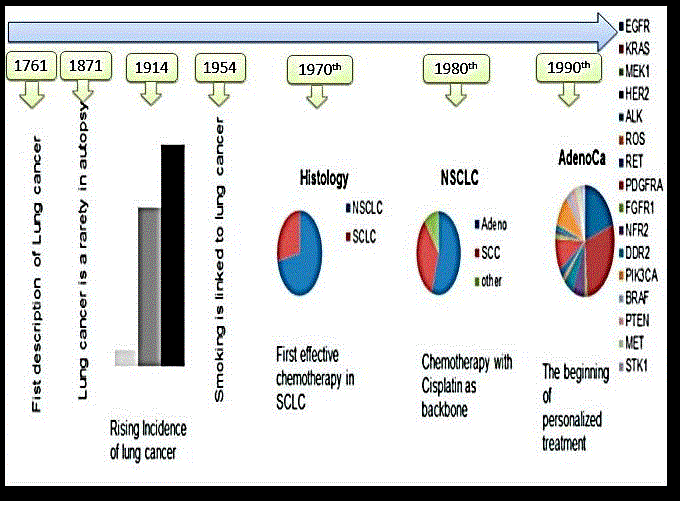
Recently, the NSCLC classified as squamous cell carcinoma and non-squamous which include adenocarcinoma and large cell type [Figure 1].

Figure 1. Story of lung cancer diagnosis

Figure 1. Story of lung cancer diagnosis

Epidermal Growth Factor Receptor (EGFR)

Epidermal growth factor was initially studied by Stanley Cohen and collaborators [3], who got Nobel Prize in 1986 for this discovery, and in 1988, Mendelsohn and collaborators obtained the receptors showing that EGFR can be a promising anticancer target [Table 1].

In May 2004, researchers found that the somatic mutations in the kinase domain of EGFR are positively related to the potent response of EGFR Tyrosine Kinase Inhibitors (TKIs) against advanced NSCLC [2].

EGFR, also known as ErbB1, and it belongs to receptors commonly referred to as receptor tyrosine kinases (RTKs) of the family of ErbB. Among the other members of the family of these receptors are ErbB2 (also known as HER2), ErbB3 (also known as HER3), and ErbB4 (also known as HER4) [4].

All of these receptors share a structural architecture consisting of a transmembrane domain, an extracellular ligand-binding domain, as well as an intracellular domain having tyrosine kinase activity to transducer the signals. The attachment of the ligand to EGFR starts a series of intracellular signaling that finally results in the appearance of cellular effects as cell proliferation as well as survival [2].

Table 1. EGFR TKI in the first line treatment of NSCLC compared with chemotherapy: phase III trials

Study No. patients TKI Control arm Median PFS P value
IPASS 1217
216 mutant EGFR
176 non mutant
Gefitinib Carbo/paclitaxel 9.8 vs 6.4 significant
WJTOG-3405 177 all Mutant Gefitinib Cisplatin/Docetaxel 9.2 vs 6.3 significant
NEJ-02 230 all mutant Gefitinib Carbo/paclitaxel 10.8 vs 5.4 significant
First signal 313
42 Mutant EGFR
Gefitinib Cisplatin/Gem 8 vs 6.4 significant
OPTIMAL 165 all mutant Erlotinib Carbo/Gem 13.1 vs 4.6 significant
EURTAC 173 all mutant Erlotinib Platinum based +
(Gem or Doct.)
9.7 vs 5.2 significant
LUX-lung 3 345 all mutant Afatinib Cisplatin/pemetrexed 11.1 vs 6.9 significant
LUX-lung 6 364 all mutant Afatinib Cisplatin/Gem 11 vs 5.6 significant

IPASS: Iressa Pan-Asia Study
NEJ: North East Japan
FIRST-SIGNAL: First-line Single Agent Iressa Versus Gemcitabine and Cisplatin Trial in Never-Smokers with Adenocarcinoma of the Lung;
OPTIMAL: Randomised Phase III Study Comparing First-line Erlotinib versus Carboplatin Plus Gemcitabine in Chinese Advanced Non-Small-Cell Lung Cancer Patients with EGFR Activating Mutations;
EURTAC: Erlotinib versus Standard Chemotherapy as First-line Treatment for European Patients with Advanced EGFR Mutation-Positive Non-Small-Cell Lung Cancer;
LUX-Lung 3: Phase III Study of Afatinib or Cisplatin Plus Pemetrexed in Patients With Metastatic Lung Adenocarcinoma With EGFR Mutations;
LUX-Lung 6: a Randomized, Open Label, Phase III Study of Afatinib Versus Gemcitabine/Cisplatin as First-line Treatment for Asian Patients With EGFR Mutation-Positive Advanced Adenocarcinoma of the Lung;

EGFR Mutations

EGFR mutations were first considered as important cancer causing factors when gefitinib, which is among the first TKIs developed to work on the EGFR intracellular tyrosine kinase domain, showed significant decrease in the size of tumor in some patients having EGFR mutations. Mutations in the EGFR tyrosine kinase are found in nearly 15% of NSCLC adenocarcinomas in the U.S., and it is most commonly found in women and non-smokers. However, incidences of the disease in East Asian populations range from 22% to 62% [2].

In NSCLC, two most commonly encountered EGFR mutations include L858R mutation in exon 21 as well as the exon 19 deletions. Both of these mutations are drug sensitizing and represent over 85% of EGFR mutations. Research shows that purified intracellular domain of EGFR L858R and the representative deletion mutant show a huge difference in sensitivity to EGFR TKIs as compared to wild-type receptor [2, 5].

It has been found that exons 18-21 results in the coding of a part of the EGFR tyrosine kinase domain and T to G mutation in exon 21 is considered as the most frequently found alteration resulting in the replacement of arginine with leucine at the position of 858 (L858R). It has also been found that in the exon 19 deletion (del.), there is a removal of four amino acids [2, 6].

EGFR mutations with L858R and del 19 can activate EGFR signalling pathway in the mutant EGFR-positive cancer causing cells. Some of the mutations also result in higher level of sensitivity to TKIs as compared to the cases having wild-type EGFR. On the other hand, resistance mutations can also be found either in the start of the mutations or after sustained exposure to TKIs. Some of the most important examples of EGFR mutations resulting in resistance are PTEN, KRAS, and BRAF mutations [7] that are commonly involved in developing resistance to EGFR TKIs in cases of NSCLC.

Other common resistance mutations are T790M in the EGFR gene, which can be primary or acquired, and also epithelial-mesenchymal transition (EMT) and MET amplification, which are usually acquired.

Some other EGFR mutations of unidentified clinical significance can also occur in the advanced NSCLC. However, they are small in number as compared to the well-known EGFR mutations, which are of clinical importance. These mutations involve the substitution of amino acid in G719, E709, L861, and S768. Their connection to the efficacy of EGFR TKIs needs further studies.

The mutation divided into favorable and un-favorable in which the mutation in L861 and G719 are rare but it can result in favorable efficacy of EGFR TKIs, whereas other mutations can result in poor responses to EGFR TKIs.

Use of EGFR Tkis to Treat NSCLC

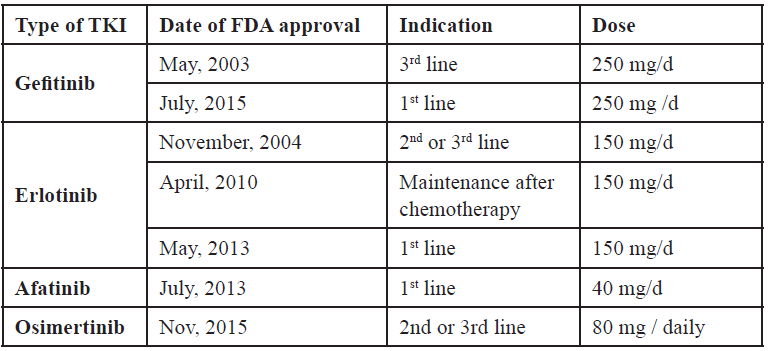
Gefitinib, which is a first generation EGFR TKI, got accelerated approval from the U.S. Food and Drug Administration (FDA), in 2003, for the treatment of advanced NSCLC as a second-line treatment. Studies showed the efficacy of the drug in the form of response rate (RR) of over 9% in Caucasian participants and over 25% in Japanese participants. In the year 2004, erlotinib got approval for the treatment of the cancer.

It was founded that the erlotinib monotherapy resulted in 2-month survival advantage in comparison to best supportive care in cancer patients having chemotherapy-refractory NSCLC in the advanced stages. Erlotinib monotherapy gave a RR of about 9% while placebo gave RR below 1% [2, 6].

Nodaway TKIs used both as a first-line therapy in advanced stages of NSCLC as well as second-line therapy and also as third-line therapy for EGFR mutation-positive cancer [Table 1].

Use of EGFR Tkis as a First-Line Therapy For NSCLC

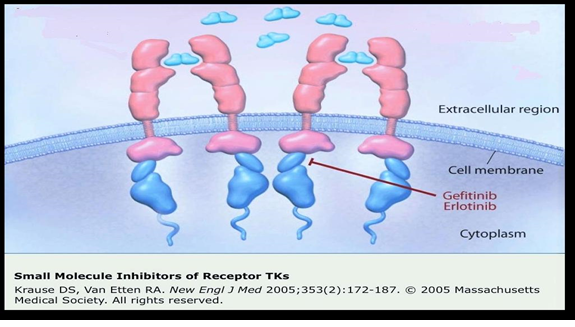
Gefitinib has been found effective as a first-line treatment in patients having EGFR-mutated NSCLC in advanced stages [8] [Figure 2].

Figure 2. Site of action of 1st Generation TKI

Figure 2. Site of action of 1st Generation TKI

In a study on patients having active EGFR mutations, the tumor samples of the patients were checked retrospectively for EGFR mutations as these mutations functioned as an important biomarker to know about the working of EGFR TKIs. Researchers found that tumor RRs were about 71% with gefitinib in patients having EGFR activating mutations as compared to about 41% in the chemotherapy group. Researchers found significant effect by considering the prolongation of life, i.e. 9.4 months in gefitinib treatment group as compared to 6.4 months in the other group. During the study, most of the patients, who were previously getting first-line chemotherapy, were moved to the gefitinib treatment, as the drug showed significant benefits [8] [Table 2].

Table 2. EGFR TKI in treatment NSCLC combined with chemotherapy as 1st line: phase III

Study No. of patients TKI+ chemo Type of chemotherapy Primary end point outcome
INTACT1 1093 Unselected (EGFR) Gefitinib Cisplatin/Gem. OS Negative
9.9 vs 10.9
months
INTACT 2 1037 Unselected (EGFR) Gefitinib Carboplatin/paclitaxel OS Negative
9.8 vs 9.9
months
TRIBUTE 1079 Unselected (EGFR) Erlotinib Carboplatin/paclitaxel OS Negative
Positive in
nonsmoker
TALENT 1172 Unselected (EGFR) Erlotinib Cisplatin/Gem. OS Negative
10.8 vs 11

INTACT: The Iressa NSCLC Trial Assessing Combination Treatment
TRIBUTE: Tarceva responses in conjunction with paclitaxel and carboplatin
TALENT: Tarceva Lung Cancer Investigation

Subsequent multiple trials, in which patients having EGFR mutations were considered, also showed the efficacy of EGFR TKIs as compared to standard doublet chemotherapy that was platinum-based. Randomized studies show substantially higher RRs as well as prolonged progression free survival (PFS), further showing the effectiveness of EGFR TKIs as a first-line therapy for patients having advanced stages of NSCLC with EGFR mutations [2].

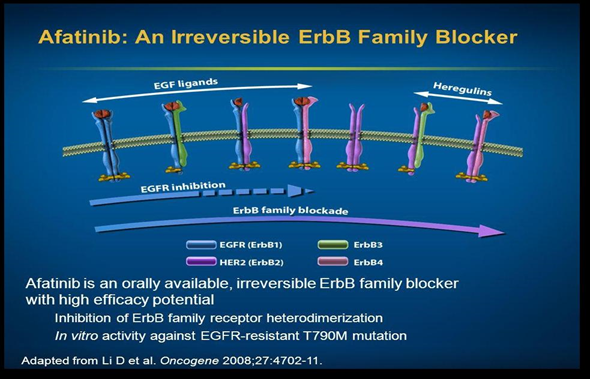
In 2013, FDA approved afatinib, a second-generation EGFR TKI. It is an irreversible TKI and is helpful as a first-line therapeutic option in patients of advanced metastatic NSCLC with EGFR mutations [6].

This drug binds with ATP attachment sites on the tyrosine kinases resulting in long lasting inhibitory effect on HER2 receptor. First-line afatinib has been found effective in improving the overall survival (OS) of patients having advanced stages of NSCLC with EGFR exon 19 deletion. Moreover, this improvement in the OS of patients was independent of race of patients. Studies consisting of a worldwide population showed that a median OS was over 30 months with the use of afatinib that is more than the median OS with chemotherapy. Although researchers found no considerable difference between the afatinib group and chemotherapy group in OS in patients having L858R mutations, but still afitinib can be a better treatment option for patients of L858R mutations [2] [Figure 3].

Figure 3. Site of action of 2nd Generation TKI

Figure 3. Site of action of 2nd Generation TKI

Use of EGFR Tkis as a Second-Line Therapy for NSCLC

Studies on erlotinib also show the effectiveness of the drug against wild-type EGFR NSCLC. In a study, researchers compared the effectiveness of docetaxel with erlotinib as a second-line treatment in patients having progressive wild-type EGFR NSCLC, who were initially treated with a platinum-based substances as a first-line therapeutic regimen. Researchers found that the median OS was about 8.2 months in patients using docetaxel while the median OS was about 5.4 months in patients using erlotinib. Moreover, PFS was substantially better in patients using docetaxel (i.e. 2.9 months) as compared to patients using erlotinib (i.e. 2.4 months). This showed that in spite of the efficacy of erlotinib, chemotherapy shows more effectiveness in the treatment of patients having advanced stages of wild-type EGFR NSCLC [2] [Table 3].

Table 3. EGFR TKI in NSCLC as 2nd or 3rd line (monotherapy): phase III

Study No. of patients TKI+ chemo Type of chemotherapy Primary end point outcome
ISEL 1129 Non selected Gefitinib Supportive care OS Negative trial
BR.21 731 Non selected Erlotinib Supportive care OS Positive
6.7 vs 4.7
months
INTEREST 1466 Non selected Gefitinib Docetaxel OS (non-inferior) Positive
7.6 vs 8 months
DELTA 301
50 EGFR
M+
Erlotinib Docetaxel PFS Negative
TITAN 424 unselected Erlotinib Docetaxel or
pemetrexed
OS Negative
5.3 vs 5.5
TAILOR 222
EGFR
wild
Erlotinib Docetaxel OS Negative
5.4 vs 8.2

ISEL trail: Iressa Survival Evaluation in Lung Cancer
INTEREST: Iressa NSCLC Trial Evaluating Response and Survival Versus Taxotere
Delta: The Docetaxel and Erlotinib Lung Cancer Trial
TaILOr: Tarceva Italian Lung Optimization tRial

Combination of EGFR Tkis with Chemotherapy in the Treatment of Advanced NSCLC

Combination of EGFR TKIs with chemotherapy show poor outcomes in the treatment of advanced NSCLC. Several randomized studies show that the platinum-based regimen along with EGFR TKI has no or reduced benefits as compared to chemotherapy alone, thereby requiring further studies [9].

Studies have also been done on finding the negative effects of EGFR TKIs on chemotherapy, and researchers are of opinion that EGFR TKIs protect G1 phase of the cell cycle from the action of chemotherapy, thereby affecting the overall action of the combination therapy. It has also been found that concurrent administration of erlotinib with M phase-specific taxane results in decreased levels and a prolonged shorter apoptosis duration. In another study, it has been found that patients having wild-type EGFR tumors may show elevated rates of progressive disease as well as inferior survival on receiving combination of erlotinib with chemotherapy as compared to chemotherapy alone. The similar outcomes were reported for patients having activating EGFR mutations. On the other hand, some studies on Asian population have shown better median PFS in case of combining chemotherapy with erlotinib as compared to chemotherapy alone [2].

Resistance to Tkis

Researchers have found that tumor having exon 20 insertions show insensitivity to EGFR TKIs. However, this problem has been found in about 4% of the cases of NSCLC. Approximately 20% of the cases of NSCLC show primary resistance caused by alteration in the KRAS signaling protein, which is commonly found in former as well as current smokers. Some other mutations that can result in primary resistance to TKIs include MEK, PTEN, and ALK-fusion [10].

Resistances can also develop in patients having advanced EGFR mutation–positive NSCLC getting gefitinib or erlotinib as a treatment strategy. Disease progression can appear after nearly one year of therapy with any of these drugs. Most commonly found acquired resistance is due to mutation in T790M in which alteration occurs in exon 20 resulting in the replacement of methionine with threonine at the position 790. The 790M residue could disturb the attachment capacity of the TKIs with the ATP binding site. The EGFR exon 20 T790M mutations may result in up to 65% of cases of acquired resistance to TKIs [2, 10] [Figure 4].

Figure 4. LUX-Lung 7 study

Figure 4. LUX-Lung 7 study

Amplification of MET is also found to be an important mechanism behind the development of acquired resistance. Studies show that MET amplification may occur in about 10% of cases. Some other types of acquired resistance, which are in need of further studies, are caused by transformations to SCLC, 3CA mutation, epithelial-mesenchymal transition (EMT), and stimulation of insulin-like growth-factor receptor pathway [10].

Management of the condition with acquired resistance to Tkis

The resistant is either primary, secondary (usually involves exon 20 (T790M), or tertiary (C797S mutation). Other mechanisms including: (1) amplification of c-met 5-20%, (2) amplification of her-2 in 12%, (3) mutation in BRAF 1 %,( 4) transformation to small cell lung ca in 3-14%.Resistance occurs usually with median of 9 – 13 months and commonly due to T790M mutation.

On November 13, 2015, the U. S. Food and Drug Administration granted accelerated approval to osimertinib once daily tablets, for the treatment of patients with metastatic epidermal growth factor receptor (EGFR) T790M mutation-positive non-small cell lung cancer (NSCLC), as detected by an FDA-approved test, who have progressed on or after EGFR tyrosine kinase inhibitor (TKI) therapy [Table 4].

Table 4. Approval of different EGFR TKI

Table 4. Approval of different EGFR TKI

The approval was based on two multicenter, single-arm, open-label clinical trials in patients with metastatic EGFR T790M mutation-positive NSCLC who had progressed on prior systemic therapy, including an EGFR TKI (Study 1 and 2). All patients were required to have EGFR T790M mutation-positive NSCLC as detected by the cobas® EGFR mutation test and received osimertinib 80 mg once daily. The major efficacy outcome measure was objective response rate (ORR) according to RECIST v1.1 as evaluated by a Blinded Independent Central Review (BICR). Duration of response (DOR) was an additional outcome measure.

It has been found that doublet chemotherapy, which is platinum-based, can be a standard choice for treatment of patients of advanced stages of NSCLC, who are EGFR TKI-resistant. On the other hand, when there is metastasis of the cancer to the brain, treatment of choice is radiotherapy [2].

Concluding Remarks and Future Directions

In the last few years, EGFR TKIs have been found to be among the most helpful treatment options for advanced NSCLC. Those substances were studied after the discovery of EGFR mutation, which is an important determinant of NSCLC. Moreover, the study of mutations helps the scientists to work on personalized medicine [Figures 5,6,7].

Figure 5. work up for advance NSCLC (adenocarcinoma)

Figure 5. work up for advance NSCLC (adenocarcinoma)

Figure 6. Treatment algorithm of metastatic NSCLC (adenocarcinoma) with sensitizing EGFR mutation

Figure 6. Treatment algorithm of metastatic NSCLC (adenocarcinoma) with sensitizing EGFR mutation

Figure 7. Treatment of metastatic NSCLC progressed on EGFR TKI

Figure 7. Treatment of metastatic NSCLC progressed on EGFR TKI

Finally, we can conclude that; in the era of molecular study and personalized therapy, TKIs nowadays are able to fight with the disease more effectively. However, further studies are required in reducing the resistance of the cancer against TKIs.

Furthermore, optimization of the combination therapy is required, so that patients would be either fully cured or live longer because of the better treatment.

References

  • Holland JC, Breitbart W S, Jacobsen PB, Loscalzo MJ, Butow PN, et al. (2015) Psycho-Oncology: Oxford University Press.
  • Ogunleye F, Ibrahim M, Stender M, Kalemkerian G, Jaiyesimi I (2015) Epidermal Growth Factor Receptor Tyrosine Kinase Inhibitors in Advanced Non-Small Cell Lung Cancer. The American Journal of Hematology/Oncology 11: 16-25.
  • Taylor JM, Cohen S, Mitchell WM (1970) Epidermal growth factor: high and low molecular weight forms.Proc Natl Acad Sci U S A 67: 164-171. [crossref]
  • Lappano R, De Marco P, De Francesco EM, Chimento A, Pezzi V, et al. (2013) Cross-talk between GPER and growth factor signaling. J Steroid Biochem Mol Biol 137: 50-56. [crossref]
  • Lee VH, Tin VP, Choy TS, Lam KO, Choi CW, et al. (2013) Association of exon 19 and 21 EGFR mutation patterns with treatment outcome after first-line tyrosine kinase inhibitor in metastatic non-small-cell lung cancer.J Thorac Oncol 8: 1148-1155. [crossref]
  • Reungwetwattana T, Dy GK2 (2013) Targeted therapies in development for non-small cell lung cancer.J Carcinog 12: 22. [crossref]
  • Carneiro JG, Couto PG2, Bastos-Rodrigues L2, Bicalho MA3, Vidigal PV4, et al. (2014) Spectrum of somatic EGFR, KRAS, BRAF, PTEN mutations and TTF-1 expression in Brazilian lung cancer patients. Genet Res (Camb) 96: e002. [crossref]
  • Maemondo M, Minegishi Y, Inoue A, Kobayashi K, Harada M, et al. (2012) First-line gefitinib in patients aged 75 or older with advanced non-small cell lung cancer harboring epidermal growth factor receptor mutations: NEJ 003 study. J Thorac Oncol 7: 1417-1422. [crossref]
  • Cufer T, Ovcaricek T, O’Brien M E (2013) Systemic therapy of advanced non-small cell lung cancer: major-developments of the last 5-years. European journal of cancer 49: 1216-1225.
  • Gainor JF, Shaw AT (2013) Emerging paradigms in the development of resistance to tyrosine kinase inhibitors in lung cancer. J Clin Oncol 31: 3987-3996. [crossref]

Programming Of Transcription and HPA Responses to Stress

DOI: 10.31038/CST.2016121

Abstract

The signaling pathways link neuronal activity to transcription, revealing both the transcription factors that mediate this process and the neuronal activity-regulated genes. The neuronal activity regulates a complex program of gene expression involved in many aspects of neuronal development. Human genetic studies have revealed that the disruption of the activity-regulated gene expression program in humans gives rise to neurological disorders. Social states can affect health in further life. It is a completely revolutionary idea. Stress changes methylation and influence the whole life.

Introduction

The central aim is to formulate results based on studies in the fields of neurobiology and genetics to understand more human behavior at the level of neuropsychology. We have now a detailed molecular mechanism by which is possible to understand why social states can affect health in further life. It is a completely revolutionary idea.

The cellular and molecular mechanisms underlie to the experience-driven changes in neural connectivity. Sensory experience results in neurotransmitter release at synapses within a neural circuit and leads to membrane depolarization, calcium influx into individual neurons. Which triggers a wide variety of cellular changes with these neurons capable of altering synaptic connectivity of the circuit. Changes such as the activation of calcium-sensitive signaling cascades lead to posttranslational modifications of proteins, at the regulation of mRNA translation [1]. It’s resulting in the production of new proteins locally at the sites of calcium entry and play critical roles in altering synaptic function in a synapse-specific manner.

Materials and Methods

We have used the studies cited in the references to make a review from the latest results at the field of neurobiology, genetics, and neuropsychology to analyze what are the mechanisms regulating human behavior at neural and psychological level under conditions of stress. We try to formulate how sensory information influences response behavior by semi-analytical, information theoretical, statistical and neuropsychological methods.

To understand more human behavior in the psychological conditions of stress we must start from the underlying principles of neurobiology and genetics. It can be done by the method of relating neurobiological models to behavioral models of signaling pathways.

Calcium influx can alter cellular function by activating new gene transcription

Calcium influx into the postsynaptic neuron can alter cellular function by activating new gene transcription. Calcium influx activates a number of signaling pathways converging on transcription factors within the nucleus, which in turn control the expression of a large number of neuronal activity regulated genes. Signaling pathways mediate activity-dependent transcription in experience-dependent neural development and plasticity. This neuronal activity regulates by the signal transduction pathways the activity-dependent gene expression program. On the other side, neuronal activity-regulated genes showing how this activity-regulated program controls neuronal development [1, 2].

The c-fos mRNA is induced by synaptic activity resulting from sensory experience due the Fos protein with Jun family members comprised the AP-1 transcriptional complex, which is critical for the organism’s adaptive responses to experience. A brain-specific deletion of the c-fos gene displays deficits in synaptic plasticity and defects in learning and memory. Loss of Fos-dependent transription gives raise to additional behavioral deficits. [3]

The activity-regulated transcriptional program uncovered a mechanism by which calcium-dependent gene induction alters the function of specific synapses. The translation of select mRNAs can occur at individual synapses through the actions of microRNAs (miRNAs) which inhibit the translation of mRNAs having nucleotide sequences closely matching the miRNAs. The level of miR-134 is increased by neuronal activity. The miRNA could be a component of the local mRNA translation machinery allowing proteins to be translated in a synapse-specific manner. This transcriptional program is critical in coordinating both dendritic and synaptic remodeling.

The transcriptions of c-fos and other immediate early genes

The transcriptions of c-fos and other immediate early genes (IEGs) increases in many cells of the body in response to extracellular factors inducing proliferation or differentiation of the cells. IEGs mediate cellular responses to changes in the cell’s environment. Recent studies have identified a subset of genes that is activated specifically in response to excitatory synaptic transmission that triggers calcium influx into the postsynaptic neuron. One gene is specifically induced by neuronal activity in neurons: bdnf encodes a neurotrophin important in neural development. The level of the bdnf mRNA increases in neurons in response to physiological stimuli, such as fear conditioning and seizure induction. The induction of the bdnf mRNA is due to an increase in transcription of the bdnf gene [4].

Transcripts of these promoters splice from their first exon to a common downstream exon, which contains the entire open reading frame encoding the BDNF protein. This diversity could explain how BDNF can control such a large number of distinct processes during nervous system development. Neuronal activity sharply increases the rate of transcription initiation with most transcripts ending within the central intron. These coordinate transcriptional events rapidly convert a constitutive gene to an IEG and regulate the expression of functionally different Homer 1 proteins. The short forms modulate the properties of the long forma and are critically involved in activity-dependent alterations of synaptic structure and function. [1- 3]

The switch from constitutive to activity-dependent expression

The switch from constitutive to activity-dependent expression entails intronic to exonic sequence conversion, transcript termination within the central intron of the Homer 1 gene. Homer proteins play key roles in signal transduction in the brain [1-3]. Hypothalamic-pituitary-adrenal (HPA) responses to stress suggesting a causal relation among epigenetic state, glucocorticoid receptor (GR) expression and the maternal effect on stress responses in the later offspring. There are increasing number of the results confirming that an epigenomic state of a gene may be established through forms of an environmental and programming and this is potentially reversible. [4]

Variations in maternal behavior are connected with development of individual differences in behavioral and HPA responses to stress in the offspring. They serve as a mechanism for the nongenomic transmission of individual differences in stress reactivity across generations. Recent findings suggest that the mechanisms of these maternal effects, or other forms of environmental programming, remain sustained over the lifespan. [5]

Maternal behavior in the rat permanently alters the development of HPA responses to stress through tissue-specific effects on gene expression. The magnitude of the HPA response to stress is a function of hypothalamic corticotropin-releasing factor (CRF) release, thus activating the pituitary-adrenal system. There are also some modulatory influences, like glucocorticoid negative feedback, which inhibits CRF synthesis and release, dampening HPA responses to stress. [4]

Epigenetic programming

The changes in Avp expression were restricted to the parvocellular subpopulation of neurons in the hypothalamic paraventricular nucleus (PVN) in those neurons that drive the HPA axis. Research data verify the critical role of arginine vasopressin (AVP) in driving the disturbed endocrine phenotype in stressed mice. This hypothesis was supported by the observation that the methyl CpG-binding protein 2 (MeCP2) phosphorilation was prominently increased in parvocellular AVP-expressing neurons in the PVN. Phosphorilation of MeCP2 at S438 is critical for MeCP2 function as a reader and interpreter of the DNA methylation signal at the Avp enhancer. MeCP2 serves as an epigenetic integration platform on which synergistic cross-talk between histone deacyclation, K3K9 methylation and DNA methylation act to confer gene silencing. [1,2,4]

Research data suggests that stress tilts the balance toward persistent hypomethylation and Avp overexpression by inducing reductions in MeCP2 binding. Phosphorilation of MeCP2 appears to be a carrier of experience-driven changes in gene expression, as a important mediator of the persistent effects of stress. By DNA methylation, there are evidence for postmitotic epigenetic modifications in neuronal functions. Modifications can facilitate or disfavor physiological and behavioral adaptations [2]. Epigenetic marks and their initiators, mediators and readers (MeCP2) bring new evidences for understanding the molecular basis of stress-related disorders of the brain.

Glucocorticoid programming

Genetic background might predispose to early-life events as maternal care, which can change the genetic profile through epigenetic signaling pathways. The programming effect of maternal behavior is associated with a single gene: the glucocorticoid (GR) gene. The offspring of caring mothers had higher hippocampal GR expression, owing to demethylation of a cysteine residue at the 5’NGF1A binding region in the exon 1, promoter [1]. Corticosteroids operate in both stress-system modes through mineralcorticoid (MR) and GR receptors co-expressed in the neurons of limbic structures. MR acts in the appraisal process and the onset of the stress response. GR is only activated by large amounts of corticosteroid, terminates the reactions to competition (the stopping rule). GR also promotes memory storage in preparing for future events [4, 6].

Behavioral programming

In vivo studies suggest that the effect of maternal behavior on GR gene expression is accompanied by an increased hippocampal expression of nerve growth factor-inducible protein A (NGFI-A). The non-coding exon 1 region of the hippocampal GR includes a promoter region, exon , containing a binding site for NGFI-A. Splice variants of the GR mRNA containing the exon sequence are found predominantly in the brain.

Use of promoter is enhanced as a function of maternal care, what explain the increased GR expression in the neonate. Maternal care alters DNA methylation of the GR exon promoter, and these changes are stably maintained into adulthood, associated with differences in GR expression and HPA responses to stress. Variations in maternal care directly alter the methylation status of the exon promoter of the GR gene. DNA methylation pattern can be established also through a behavioral programming without germ line transmission [4]. Postnatal de novo methylation of the Hoxa5 and Hoxb5 genes in development was documented also in another study [7].

Thus, maternal programming of the exon GR promoter involves DNA methylation, histone H3-K9 acetylation and alterations in NGFI-A binding [4, 6]. The afferent input from limbic networks converts purely psychological stress reactions to the HPA axis. Above interplay of limbic inputs from the hippocampus, amygdala and prefrontal cortex with HPA axis activity may lead to a vulnerable phenotype for mental illness [4, 5].

Environmental programming

We have now evidence that maternal behavior produces stable alterations of DNA methylation and chromatine structure, providing a mechanism for the long-term effects of maternal care on gene expression in the offspring. Such a gene-environment interactions during development result in the sustained environmental programming of gene expression and function of defensive responses through increased HPA activity over the lifespan [4, 5]. Natural selection shaped offspring to respond to subtle variations in parental behavior as forecast of the environmental conditions. They serve as a major source of epigenetic variations in gene expression and mediating such maternal effects. Effects on chromatine structure serve as an intermediate process imprinting dynamic environmental experience on the fixed genome with stable variations in phenotype [1, 2,5].

Environment-assisted invariance

The state of composite object (consisting of the system S and the environment E) can be ignorant of the state of S alone. Environment-assisted invariance, or envariance based on symetry allows observer to use perfect knowledge of SE as a proof of his ignorance of S: when a US acting on S alone, can be undone by a transformation acting solely on E, and the joint state of SE is unchanged. This state is said „envariant“ with respect to US. Envariant properties not belong S alone. Entanglement between S and E enables envariant and implies ignorance about S. Envariance is associated with phases of the Schmidt decomposition of the state representing SE. It anticipates the consequences of environment – induced superselection („einselection“) of the preferred set of pointer states, they remain unperturbed to immersion of the system in the environment. The state of combined SE expressed in the Schmidt form is: |ψSE 〉 = ∑ ∝kk 〉|Ek〉 . Schmidt states are in an intimate relationship with the pointer states and have been regarded as „instantaneous pointer states“ [8]. Quantum Darwinism brings new focus on the environment as a communication channel. This explains the emergence of objectivity. Even hazy environment will communicate a very clear image [9].

Adaptational programming

Limbic pathways activated by psychological stressors of competition are parts of the afferent pathways activating the CRH neurons in the PVN. The interface between incoming sensory information and the appraisal is converted by limbic brain structures (the hippocampus, amygdala and prefrontal cortex-PFC).

Not only homeostatic disturbance, but purely psychological code can determine the stress response to competition. Its determinants include the ability predict upcoming events and getting control over the situation. The adaptive competition stress-related processes take place in limbic brain regions. An inappropriate response to the winner-take-all instabilities (WTAIs) produces a vulnerable phenotype leaving genetically predisposed individuals at an increased risk of stress-related brain disorders. [5, 10].

Multiple peaks of activity appear simultaneously within a single frontal or parietal region, they compete against each other through inhibitory antagonism. This can be seen in biased competition mechanism of visual attention. During colour-cue period preferring the given colour pushes group of cells towards stronger activity than others and causes the competition in dorsal premotor cortex (PMd) to become unbalanced, because one peak increases its activity, while the other is suppressed. Since neural activities are noisy, competition between distinct peaks of activity cannot follow a simple winner-take-all rule, or random fluctuations will determine the winner each time. If activity of a given choice becomes sufficiently strong, than it should be allowed to suppress its opponent and conclusively win the competition. But the cost of reinstating homeostasis also might become too high, causing through WTAIs an allostatic load with increased risk of mental illness [5,11-19].

Dynamics of the winner-take-all instability

To derive an equation for the dynamics of the winner-take-all instability, we express the dynamical variables as x = xSS + xY(T) + … where Y represents the slow dynamics along the critical eigenvector and T is a slow time scale. The reflection symmetry of the system implies the dynamics of Y should be invariant under the transformation Y → – Y and this switches the identity of x1 and x2. The increase in input I is common to both x1 and x2 leads to the developing decision in the winner-take-all system and is thus the bifurcation parameter. The linear growth rate of the spontaneous state must be proportional to the difference between the presynaptic input and the value of the input at the bifurcation with an unknown prefactor, i.e. μ(I – I). The difference in inputs I1 – I2 breaks the reflection symmetry thereby introducing a constant term which, to first approximation, must be proportional to that difference with an unknowvn prefactor, i.e. η(I1 – I2). These two facts, coupled with the reflection symmetry, lead to the form of the equation describing the time evolution of Y: δTY = η(I1 – I2) + μ(I – I)Y + ϒY3, where I = I only when ∝ = β identically, i.e. at point of instability, and δT is a time derivative with respect to the slow time T. For I1 – I2 the equation is invariant under Y → – Y as it should be, Y3 is the lowest order nonlinearity which obeys reflection symmetry. For more complex systems, which exhibit winner-take-all behavior, above euation captures the qualitative dynamics of the system near the bifurcation in general [20].

Concluding Remarks

During adaptation sensory experience driven changes in neural connectivity, transcription, and HPA axis responses to stress are complex and multifactorial: they cannot be attributed to mutations in single gene, or to a single external event, but rather, result from the concerted actions of many subtle genetic polymorphisms and external events, the effects of which might accumulate over time. Once traumatic life events, in combination with genetic disposition, have engrained long-lasting changes in MR and GR signaling, a vulnerable phenotype emerges [5].

DNA methylation is behind the changes associated with stress. It is based on differences in the gene encoding AVP, a hormone associated with mood and cognitive behavior. After stress, there was lover level of methylation in the regulatory region of the Avp gene in the brain. This hypomethylation was specific to a subset of neurons in the hypothalamic paraventricular nucleus – a brain area involved in regulating hormones linked to stress [1, 2].

The decreases in methylation in stressed subjects result from the inactivation of a protein MeCP2, involed in the start of the DNA methylation. It is a detailed molecular mechanism by which is possible to understand why social states as sensory experience can affect health in further life. It is a completely revolutionary idea [2]. Stress changes methylation and influence the whole life. Depression may be facilitated by a failure in competition to contain the biological stress response to challenge of unemployment at the time of the trauma, resulting in a cascade of alterations leading to recollections of the WTAIs, avoidance of the reminders to event and symptoms of hyperarousal [5]. From psychological and biological data we may hypothesize that the pathological mechanism of stress-related brain disorders depend on distress connected with inhibitory antagonism produced by winner-take-all instabilities. Mechanism is triggered by interactive behavior of an appraisal of unit P probabilities trade-off with environment. Stressors can kill with information itself through probabilities. Probabilities are the killer by information [9].

Sensory information itself, as first communication of diagnosis, may act as psychic stressor, psychological weapon (of mass destruction) due stress-related brain disorders [11-18]

It is well documented in recent large population-based study about men newly diagnosed with prostate cancer, they were at higher risk of cardiovascular events and suicide. The excess risks were highest during the first week after diagnosis, suggesting that stress of diagnosis itself plays a critical role. The emotional stress as an information itself caused a cardiovascular morbidity increase immediately after communication of the diagnosis [18].

Emotionally stressful competition events may lead to altered function of the heart, a stress-related left ventricular dysfunction [15]. Increased risk of myocardial infarction was documented following the Athen earthquake in 1983 [14]. Emotional stress brought on by viewing a World cup soccer match was reported to raise the risk for cardiovascular morbidity and mortality [17]. Being informed about diagnose of prostate cancer may also serve as a stressor of substantial weight. About 20% of the prostate cancer patients were reported as having no one to confide in Fall K, et al. [18]. On the basis of above results bring a hypothesis of the weights function in a framework of feedback paradigm as the psychological code. Possible mechanism may be the emotional shock caused by the information of diagnosis, anxiety, together with emotional isolation.

References

  • Bottai D, Guzowski JF, Schwarz MK, Kang SH, Xiao B, et al. (2002) Synaptic activity-induced conversion of intronic to exonic sequence in Homer 1 immediate early gene expression. J Neurosci 22: 167-175. [crossref]
  • Cisek P (2007) Cortical mechanisms of action selection: the affordance competition hypothesis. Philos Trans R Soc Lond B Biol Sci 362: 1585-1599. [crossref]
  • Fall K, Fang F, Mucci LA, Ye W, Andrén O, et al. (2009) Immediate risk for cardiovascular events and suicide following a prostate cancer diagnosis: prospective cohort study. PLoS Med 6: e1000197. [crossref]
  • Flavel SW and Greenberg ME (2009) Ann Rev Neurosci 2008:31:583-590
  • Hershko AY, Kafri T, Fainsod A, Razin A (2003) Methylation of HoxA5 and HoxB5 and its relevance to expression during mouse development. Gene 302: 65-72. [crossref]
  • Leor J, Poole WK, Kloner RA (1996) Sudden cardiac death triggered by an earthquake. N Engl J Med 334: 413-419. [crossref]
  • Li J, Hansen D, Mortensen PB, Olsen J (2002) Myocardial infarction in parents who lost a child: a nationwide prospective cohort study in Denmark. Circulation 106: 1634-1639. [crossref]
  • Li J, Laursen TM, Precht DH, Olsen J, Mortensen PB (2005) Hospitalization for mental illness among parents after the death of a child. N Engl J Med 352: 1190-1196. [crossref]
  • Katsouyanni K, Kogevinas M, Trichopoulos D (1986) Earthquake-related stress and cardiac mortality. Int J Epidemiol 15: 326-330. [crossref]
  • Meisel SR, Kutz I, Dayan KI, Pauzner H, Chetboun I, et al. (1991) Effect of Iraqi missile war on incidence of acute myocardial infarction and sudden death in Israeli civilians. Lancet 338: 660-661. [crossref]
  • Murgatroyd C, Patchev AV, Wu Y, Micale V, Bockmühl Y, et al. (2009) Dynamic DNA methylation programs persistent adverse effects of early-life stress. Nat Neurosci 12: 1559-1566. [crossref]
  • de Kloet ER, Joëls M, Holsboer F (2005) Stress and the brain: from adaptation to disease. Nat Rev Neurosci 6: 463-475. [crossref]
  • Roxin A, Ledberg A (2008) Neurobiological models of two-choice decision making can be reduced to a one-dimensional nonlinear diffusion equation. PLoS Comput Biol 4: e1000046. [crossref]
  • Schairer C, Brown LM, Chen BE, Howard R, Lynch CF, et al. (2006) Suicide after breast cancer: an international population-based study of 723,810 women. J Nat Cancer Inst 98: 1416-1419. [crossref]
  • Seckl JR, Meaney MJ (2004) Glucocorticoid programming. Ann N Y Acad Sci 1032: 63-84. [crossref]
  • Wilbert-Lampen U, Leistner D, Greven S, Pohl T, Sper S, et al. (2008) Cardiovascular events during World Cup soccer. N Engl J Med 358: 475-483. [crossref]
  • Wittstein IS, Thiemann DR, Lima JA, Baughman KL, Schulman SP, et al. (2005) Neurohumoral features of myocardial stunning due to sudden emotional stress. N Eng J Med 352: 539-548. [crossref]
  • Weaver IC, Cervoni N, Champagne FA, D’Alessio AC, Sharma S, et al. (2004) Epigenetic programming by maternal behavior. Nat Neurosci 7: 847-854. [crossref]
  • Zurek WH (2002) arXiv: 0211.037 v1 [quant-ph]
  • Zwolak M, Quan HT, Zurek WH (2009) arXiv: 0904.0418v2 [quant-ph]

Developing Nutrition Awareness in First Year Medical Students

DOI: 10.31038/IMROJ.2016116

Abstract

Across the medical training continuum, nutrition education efforts often fail to deliver practical knowledge and current practice, with professional and accrediting organizations recommending expansion of nutri¬tion education within undergraduate and graduate curricula. Conclusions from a review of recent nutri¬tion education efforts strongly recommend that programs “be creative and think out of the box when developing a nutrition curriculum”.

Why the Idea or Change was Necessary

Understanding barriers to change is fundamental to patient counseling. While physicians routinely “prescribe” dietary interventions; no studies describe medical students’ nutrition awareness or knowledge of adherence barriers to dietary change. Therefore, this report describes an innovative nutrition experience, “thinking out of the box”, to enhance: (1) medical students’ food awareness and (2) recognition of barriers to dietary change.

What was Done

As one topic in a required first-year course, 98 medical students received instruction for completing their own 3-day dietary intake food records. One week later, students were randomly assigned to either a low carbohydrate (Atkins) or low fat (Ornish) diet for three days and 3 day dietary intakes again recorded. The following week students met in nine-member, two hour groups led by nutritionists and family practice physicians. Discussion questions examined: changes in awareness of food intake and eating habits as a result of the diet records; ability to analyze intake in comparison to the Food Guide Pyramid recommendations (study was done prior to the MyPyramid guidelines); sense of controversy surrounding current dietary recommendations; experiences in modifying diet; responses to diet modification; and, changes in personal perspectives or understanding of patients.

Evaluation of the Results

Sixty three percent of the students completed the three-day diet records and 25 each tried the low carbohydrate and high carbohydrate diet, respectively. In group discussions, students indicated that they became more aware of personal diet and eating habits through record keeping. Most found that their diets needed improvement (e.g., inadequate fruits and vegetables). Many did not understand the controversy over recent dietary recommendations. This provided a teachable moment for nutritional principles such as changes in calcium intake, good fats-bad fats, and consumption of whole grains in relation to glycemic index. Students recognized a primary barrier of complexity, expressing concern that “if they had trouble with understanding these changing recommendations then the general public must be very confused.” Other barriers recognized were: “being overwhelmed with school; lacking time to follow the diet or prepare foods; limited food choices at school; emotional and energy level changes related to the diet; and, disliking food choices.” Students discussed the challenge of change in conflict with circumstances, in their case during examinations, highlighting the importance of timing and social stressors. Students found the exercises to be a worthwhile, helping prepare them for patient-centered care.

Although these assessments are largely subjective, they were gathered systematically, represent this particular student population, and were similar across groups. It appears that students may develop a greater sense of empathy and patient understanding when they experience firsthand their own nutritional inadequacies and challenges

Key words

Nutrition Education, Dietary Interventions, Atkins Diet, Ornish Diet, Anthropometrics

Introduction

Over 20 years have passed since the National Academy of Sciences recognized that nutrition education was deficient in medical training [1] Medical organizations [1,2] recommended expansion of nutri­tion education within the undergraduate and graduate curricula and new programs such as the 1997 Nutrition Academic Award (NAA) Program were established to “support the development and enhancement of nutrition curricula for medical students, res­idents and practicing physicians to learn principles and prac­tice skills in nutrition.”  From this work a number of new learning methodologies emerged to integrate nutrition into the medical school curricula [4-6]. An important finding, lesson learned from these efforts was “be creative and think out of the box when developing a nutrition curriculum”[7].

Because health parameters have been shown to decline in medical students across training,[8] methods and data on student nutrition should be of value to the research community. Regarding food intake and dietary composition of medical students, a brief review of the medical literature revealed only three studies [9-11] describing food intake in medical students outside the United States of America (USA); there were no studies reported for USA medical students. These studies from outside of the USA reported that the nutrition of first- and third-year students was irregular and different in the time and number of meals. Only 20% of students daily ate 400 g of fruit and vegetables as recommended by the World Health Organization. Students, especially males, used excessive amounts of animal fat. Every seventh student consumed excess salt and students consumed insufficient amounts of grains and other products that constitute the basis of the pyramid for healthy nutrition. Twenty-three percent of males and nearly as many females used alcohol once per week. Nearly one-half of students did not exercise at all, and 9.1% of third-year female and 14.5% of third-year male students were overweight.

The current study examines in one US medical school the food intake and dietary composition of first year medical students obtained during experiential dietary activities.

Methods

As part of a required first-year course, 98 medical students (55 male; 45 female) were given verbal and written instruction on how to complete detailed, 3-day dietary intake records – including portion sizes, hunger levels, meal settings, and time of meals.  Students were also asked to record their weight and height. Also standard dietary intake forms were provided to the students with instructions for filling out the forms.

One week after recording their normal 3-day food intakes, students were randomly assigned to either a low carbohydrate [12] (Atkins) or low fat [13](Ornish) diet for 3 days; these diets were chosen to represent two contrasting dietary approaches from what was anticipated to be “more normal” for the students. Students assigned to the low carb condition were given 3 keto-sticks and asked to record their urinary ketones. Complete instructions for the Atkins [14] and Ornish [18] diets – as well as meal recipes for these diets- were provided along with websites for these contrasting dietary approaches. Students were instructed to keep 3-day food intake records while on the low carb or low fat diets.

Following these dietary exercises, the medical students met for 2 hours in small, 9-member student groups led by an RD or PhD trained nutritionist and a family practice physician.  Prior to the group meetings the following five questions were developed to facilitate group discussion and to examine student experiences with the dietary exercises. Faculty preceptors guided the discussion around the following questions: (1) Was your awareness of your dietary intake and eating habits heightened as a result of your personal 3-day diet records? (2) Were you able to analyze your dietary intake in comparison to the Food Guide Pyramid recommendations (study was done prior to the MyPyramid guidelines)? (3) Do you understand the controversy surrounding current dietary recommendations? (4) What experiences did you have modifying your diet and how did you respond to the diet modification? 5) Did your awareness of diet modification help you relate to “patient centered care”? At the end of the discussion period, students were asked to turn in their food records [9-11].

The results reported here summarize these discussions and provide a dietary analysis of food intake. Only complete 3-day diet records for both normal and experiential dietary consumption were analyzed using Nutritionist Pro (Version 2.1, First DataBank, Inc. San Bruno CA) [13]. Kruskal-Wallis and t-tests for independent samples were used as non-parametric (Kruskal-Wallis) and parametric (t-test alternatives, respectively, for determining significant differences between normal diets for males and females and comparison of normal and intervention dietary treatment groups for each gender.  P values were set at ≤0.05 for all analyses. The study was approved by the Institutional Review Board.

Results

Diet Records

Sixty two of the 98 students (30 females; 32 males) completed the normal 3-day diet records (overall compliance = 63%). Of the students assigned to the low carbohydrate diet (Atkins), 8 females (38.1%) and 17 males (62.9%) completed the diet records. For students assigned to the Ornish diet, 19 females (90.5%) and 6 males (22%) completed the food records.

Anthropometrics/Dietary Intake Analysis

As depicted in Table 1, the average body mass index (BMI) of both male and female students indicated a normal, low-risk BMI (normal range is 18.5 to 24.9).

The average nutrient intake for the medical students consuming their normal diets is shown in Table 2. Not surprisingly, statistically significant (*) differences exist between males’ and females’ absolute nutrient intake.

Table 1. Anthropometric measurements of first-year medical students (Average ± SD)

Height (inches) Weight (lbs) BMI
Male 70.9 ± 3.0 179 ± 29.1 24.9 ± 3.0
Female 64.7 ± 3.2 127 ± 16.7 21.4 ± 2.0

Table 2. Average nutrient intake of first-year medical students’ 3-day “Normal” diet.

Units Male Student Average DRI Male Female Student Average DRI Female Male Student (Average units/Kg) DRI Male (U/Kg) Female Student (Average units/Kg) DRI Female (U/Kg)
Kilocalories kcal *2172.0 1576 27 28
Protein g *93.0 56 66 46 1.1 0.7 1.1 1
Carbohydrate g *275.0 130 210 130 3.5 1.6 3.8 2.7
Fat, Total g *72.0 54 0.9           – 0.9           –
Alcohol g *10.0 0.7 0.1           – 0           –
Cholesterol mg *245.0 172 3           – 2.8           –
Saturated Fat g *24.0 17.5 0.3           – 0.3           –
MUFA g 19 14 0.2           – 0.2           –
PUFA g 9 7 0.1           – 0.1           –
Vitamin A (RE) RE 928 900 819 700 11.4 11 14.4 14.6
Vitamin C mg 83 90 71.7 75 1.1 1.1 1.3 1.6
Calcium mg *853.0 1,000.00 573 1,000.00 10.4 12.2 10 20.8
Iron mg 15 8 13 18 0.2 0.1 0.2 0.4
Vitamin D ug 3 5 1.8 5 0 0.1 0 0.1
Vitamin E mg 5 15 5.1 15 0.1 0.2 0.1 0.3
Thiamin mg *1.4 1.2 1.1 1.1 0 0 0 0
Riboflavin mg *1.8 1.3 1.3 1.1 0 0 0 0
Niacin mg *21.5 16 16.1 14 0.3 0.2 0.3 0.3
Pyridoxine (B6) mg *1.6 1.3 1 1.3 0 0 0 0
Folate (Total) mg *280.0 400 212 400 3.5 4.9 3.6 8.3
Cobalamin (B12) µg 4.1 2.4 2.9 2.4 0.1 0 0.1 0.1
Biotin µg 23.5 30 16 30 0.3 0.4 0.3 0.6
Pantothenic Acid µg 3.5 5 2.6 5 0 0.1 0.1 0.1
Vitamin K µg *11.7 120 39.6 90 0.1 1.5 0.7 1.9
Phosphorus mg *1068.0 700 799.7 700 13.1 8.5 13.8 14.6
Iodine µg 15.5 150 24.7 150 0 1.8 0.1 3.1
Magnesium mg *204.0 400 153 310 2.6 4.9 2.7 6.5
Zinc mg *10.0 11 6.5 8 0.1 0.1 0.1 0.2
Copper mg *0.8 0.9 0.6 0.9 0 0 0 0
Manganese mg 1.2 2.3 8.7 1.8 0 0 0 0
Selenium µg *65.0 55 40.3 55 0.8 0.7 0.7 1.2
Fluoride µg *501.0 400 230.7 300 5.9 4.9 4.4 6.3
Chromium µg 0 0.3 0.5 0.3 0 0 0 0
Molybdenum µg 17 45 15.3 45 0.2 0.6 0.3 0.9
Dietary Fiber g *15.0 38 13.4 25       *0.2 0.5 0.2 0.5
Sugar, Total g *104.0 73.6 1.3           – 1.4           –
Caffeine mg 98 77 1.2           – 1.3           –

FOOTNOTE: Data are expressed as absolute units/day and as units/Kg body weight (82 Kg as average weight for males and 48 Kg as average weight for females) (* = p≤0.05 for comparison between Male and Female student) (italics = consumption of less than 80% of DRI)

However, with the exception of dietary fiber – which was consumed in higher amounts by females – these differences disappeared when adjusted for bodyweight. More importantly, the data show that many of the nutrients consumed do not meet the dietary recommended intakes (DRIs). That is, females consumed less than 80% of calcium, iron, vitamin D, E, folate, biotin, pantothenic acid, vitamin K, iodine, magnesium, zinc, copper, selenium, fluoride, molybdenum and fiber (nutrients in italics) than recommended. Males consumed less than 80% of the DRIs for calcium, vitamin D, E, folate, biotin, pantothenic acid, vitamin K, iodine, magnesium, copper, manganese, chromium, fluoride, molybdenum and fiber [16].

The dietary intakes of students on the Atkins or Ornish diets, compared to their normal dietary intake, are illustrated in Tables 3 and 4. Compared to the male students, it appears that the female students assigned to the Atkins diet showed better adherence – as noted by the trend toward increased protein and fat intake and decreased carbohydrate intake. There were no differences in adherence noted for male students who “normally” consumed a higher protein/high fat diet. Both males and females assigned to the Ornish diet showed similar lower intakes of total calories, protein, and fat [13].

Table 3. Comparison of medical students’ “Normal” versus Atkins diets

Units Male Normal Male Atkins Female Normal Female Atkins
Kilocalories kcal 2482 2121 1576 1180
Protein g 109 92 66 96
Carbohydrate g 308 250 210 *40.0
Fat, Total g 85 74 54 69
Alcohol g 9 14 0.7 0.4
Cholesterol mg 283 261 172 534
Saturated Fat g 30 25 17.5 23
MUFA g 21 21 14 23
PUFA g 10.2 9.2 7 11
Vitamin A (RE) RE 1100 769 819 594
Vitamin C mg 111 53 71.7 32.3
Calcium mg 1028 801 573 437
Iron mg 20 *14.0 13 7.4
Vitamin D ug 3.9 2.9 1.8 1.7
Vitamin E mg 7.5 4.3 5.1 4.1
Thiamin mg 1.8 1.3 1.1 0.7
Riboflavin mg 2.3 1.7 1.3 1.3
Niacin mg 24.5 21.9 16.1 21.7
Pyridoxine (B6) mg 1.9 1.5 1 1.3
Folate (Total) mg 327 262 212 173
Cobalamin (B12) µg 4.1 6.2 2.9 5.1
Biotin µg 42.4 15.5 16 18.7
Pantothenic Acid µg 5 3 2.6 3.9
Vitamin K µg 15 9.7 39.6 75.5
Phosphorus mg 1283 1003 799 980
Iodine µg 20 0 24.7 12.5
Magnesium mg 249 183 153 123
Zinc mg 13.6 9 6.5 8.1
Copper mg 1 0.8 0.6 0.5
Manganese mg 1.6 0.9 8.7 0.6
Selenium µg 77.6 61.6 40.3 90
Fluoride µg 610 499 230.7 220
Chromium µg 0 0 0.5 0
Molybdenum µg 21.5 15.3 15.3 20.5
Dietary Fiber g 18.4 13.8 13.4 4.1
Sugar, Total g 115.1 80.6 73.6 16.2
Caffeine mg 127.5 87 77 75

* = p≤0.05 for comparison between Normal and Atkins diet

Table 4. Comparison of medical students’ “Normal” versus Ornish diets

Units Male Normal Male Ornish Female Normal Female Ornish
Kilocalories kcal 2,172.00 1692.6 1576 1252.3
Protein g 93 65.2 66 46.4
Carbohydrate g 275 266.2 210 201.8
Fat, Total g 72 45.3 54 30.8
Alcohol g 10 0.6 0.7 2.7
Cholesterol mg 245 168 172 72.3
Saturated Fat g 24 14.8 17.5 8.7
MUFA g 19 10.5 14 7.8
PUFA g 9 5.8 7 5.4
Vitamin A (RE) RE 928 1385.8 819 1031.4
Vitamin C  mg 83 203.6 71.7 120.1
Calcium  mg 853 675.1 573 586.4
Iron mg 15 13.2 13 12.3
Vitamin D ug 3 2.4 1.8 2.3
Vitamin E mg 5 7.6 5.1 5.2
Thiamin mg 1.4 2.5 1.1 1.6
Riboflavin mg 1.8 1.3 1.3 1.1
Niacin mg 21.5 16.5 16.1 12.9
Pyridoxine (B6) mg 1.6 1.4 1 1.2
Folate (Total) mg 280 306.8 212 318.7
Cobalamin (B12) µg 4.1 3.2 2.9 2.6
Biotin µg 23.5 28.5 16 20.6
Pantothenic Acid µg 3.6 3.3 2.6 2.7
Vitamin K µg 11.7 47.1 39.6 43.7
Phosphorus mg 1068 817.2 799.7 691.1
Iodine µg 15.5 22.4 24.7 17.5
Magnesium mg 204 218.4 153 203.6
Zinc mg 10 7.9 6.5 6.1
Copper mg 0.8 1 0.6 0.7
Manganese mg 1.2 1.3 8.7 1.7
Selenium µg 65 41.1 40.3 39.3
Fluoride µg 501 289.2 230.7 529.1
Chromium µg 0 0.1 0.5 0.03
Molybdenum µg 17 16.2 15.3 13.5
Dietary Fiber g 15 18.3 13.4 18.9
Sugar, Total g 104 109 73.6 64.7
Caffeine mg 98 55 77 49.6

* = p≤0.05 for comparison between Normal and Ornish diet

Small Group Discussions

Impact of exercise on awareness of personal dietary practices

When asked in the small group discussions whether or not they became more aware of their dietary intake and eating habits by keeping a diet record, the majority of students agreed – regardless of whether they partially or fully completed the 3-day food record. Not unexpectedly, most recognized that their diets needed improvement [16].

Ability to analyze personal dietary practices

As in the general population  [1], most students reported less than the recommended intake of fruits and vegetables per the Food Guide Pyramid guidelines. Interestingly, most students did not understand the current controversy over dietary recommendations – which provided prime fodder for further small group discussion. Examples of topics included the recommendations for changes in calcium intake, good fats-bad fats, and increased consumption of nuts, whole grains and glycemic index. Students expressed concern that “if they had trouble with understanding these changing recommendations then the general public must be very confused”.

Perceptions of dietary modification

Students’ responses to the question “What experiences did you have through modification of your diet and how did you respond to the diet modification?” were extremely varied. Some typical responses, similar to what might be expressed by patients trying dietary interventions, were

  • “I was overwhelmed with school and didn’t have time to follow the diet.”
  • “Food choices were limited at school and I didn’t have time to prepare the food!”
  • “Tried it – but it was too much trouble.”
  • “At the end of the day, I was lethargic and cranky because of the diet.”
  • “Didn’t like the food choices.”

Impact on understanding of patients that might enhance patient centered care

Other negative experiences also enabled students to become cognizant of the barriers their patients might face if they were instructed to successfully plan and follow a diet. For example, students faced with a major dietary change during course examinations indicated particular frustration with adherence – highlighting the importance of timing and social stressors.  Lastly, all faculty preceptors reported that the majority of students in their small group settings found the dietary exercises to be a worthwhile and that the experience helped them better relate to “patient-centered care” with greater awareness and empathy.

Discussion

The adequacy of nutrition instruction in undergraduate medical education remains an issue of concern, [17] and progress to integrate nutrition into medical school curricula was the topic of discussion at a the 2005 Experimental Biology Symposium [18] – which yielded the following observations: (1) students currently receive 23.9 contact hours of nutrition instruction during medical school (range: 2–70 hours); (2) only 40 schools require the minimum 25 hours recommended by the National Academy of Sciences; (3) most instructors (88%) expressed the need for additional nutrition instruction at their institutions; (4) a substantial portion of the total nutrition instruction occurs outside courses specifically dedicated to nutrition; and (5) the amount of nutrition education in medical schools remains inadequate [15]. Unfortunately little has changed in the last ten years as recently reported in an article on “The State of Nutrition Education at US Medical Schools [19]; “Most US medical schools (86/121, 71%) fail to provide the recommended minimum 25 hours of nutrition education; 43 (36%) provide less than half that much. Nutrition instruction is still largely confined to preclinical courses, with an average of 14.3 hours occurring in this context. Less than half of all schools report teaching any nutrition in clinical practice; practice accounts for an average of only 4.7 hours overall.”

To address this inadequacy, the present study demonstrates an innovative means of introducing meaningful nutrition education into the medical school curriculum in an experiential manner that raises self-awareness and awareness of patient concerns [17,18]. Although these assessments are largely subjective, it appears that students may develop a greater sense of empathy and understanding related to others when they experience firsthand their own nutritional inadequacies and difficulties altering eating behaviors.

Aknowledgements

This work was supported by NIH grant 5 R25 AT000682-05.

References

  • National Academy of Sciences (1985) Nutrition education in U.S. medical schools. Washington, DC: National Academy Press.
  • National Nutritional Monitoring and Related Research Act of 1990. Public Law 1101-445/HR 1608: 302.
  • Pearson TA, Stone EJ, Grundy SM, McBride PE, Van Horn L, et al. (2001) Translation of nutritional sciences into medical education: the Nutrition Academic Award Program. Am J Clin Nutr 74: 164-170. [crossref]
  • Tobin B, Welch K, Dent M, Smith C, Hooks B, et al. (2003) Longitudinal and horizontal integration of nutrition science into medical school curricula. J Nutr 133: 567S-72S. [crossref]
  • Eaton CB, McBride PE, Gans KA, Underbakke GL (2003) Teaching nutrition skills to primary care practitioners. J Nutr 133: 563S-6S. [crossref]
  • Carson JA (2003) Pocket tape measure for waist circumference: training medical students and residents on a simple assessment of body composition. J Nutr 133: 547S-9S. [crossref]
  • Hark LA (2006) Lessons learned from nutrition curricular enhancements. Am J Clin Nutr 83: 968S-970S. [crossref]
  • Mitchell SD, Eide R, Olsen CH, Stephens MB (2008) Body composition and physical fitness in a cohort of US military medical students. J Am Board Fam Med 21: 165-167. [crossref]
  • Tengvall M, Lars Ellegard MS. Dietary intake in Swedish medical students. Scan J Food & Nutrition, Volume 51, Issue 2 2007 , pages 79 – 84
  • Mammas I, Bertsias G, Linardakis M, Moschandreas J, Kafatos A (2004) Nutrient intake and food consumption among medical students in Greece assessed during a Clinical Nutrition course. Int J Food Sci Nutr 55: 17-26. [crossref]
  • Aoki S1, Endo T, Hasegawa H, Nakaji S, Sugawara K, et al. (1996) [Dietary patterns and intake of nutrients, energy, and dietary fiber in medical students]. Nihon Koshu Eisei Zasshi 43: 632-643. [crossref]
  • Foster GD, Wyatt HR, Hill JO, McGuckin BG, Brill C, et al. (2003) A randomized trial of a low-carbohydrate diet for obesity. N Engl J Med 348: 2082-2090. [crossref]
  • Ornish D, Scherwitz LW, Billings JH, Brown SE, Gould KL, et al. (1998) Intensive lifestyle changes for reversal of coronary heart disease. JAMA 280: 2001-2007. [crossref]
  • Atkins Diet – home page http://atkins.com/ 10/10/2004 updated 7/11/2008
  • Ornish Diet – home page http://my.webmd.com/content/pages/9/3068_9408.htm. 10/10/2004 updated 7/11/2008
  • Guenther PM, Dodd KW, Reedy J, Krebs-Smith SM (2006) Most Americans eat much less than recommended amounts of fruits and vegetables. J Am Diet Assoc 106: 1371-1379. [crossref]
  • Adams KM, Lindell KC, Kohlmeier M, Zeisel SH (2006) Status of nutrition education in medical schools. Am J Clin Nutr 83: 941S-944S. [crossref]
  • (No authors listed) (2005) An evidence-based approach to medical nutrition education. Proceedings of a symposium held at Experimental Biology. Am J Clin Nutr 83:929S-987S.
  • Adams KM, Butsch WS, Kohlmeier M (2015) The State of Nutrition Education at US Medical Schools. J Biomed Edu Article ID 357627, http://dx.doi.org/10.1155/2015/357627

Adherence To Long-Term Complex Medication Regimen After Hospital Discharge From An Academic Geriatric Center: General Practitioners’ Attitude

DOI: 10.31038/IMROJ.2016115

Abstract

Background: Pharmacotherapy in old age is a very complex process during which adherence to medication recommendations is a key point. Little is known about general practitioner (GP)-related barriers to prescribing medication according to geriatrician recommendations.

Objective: To provide a snapshot of the reality of continuity of care and information about factors that modulate GP adherence.

Design: Observational and prospective pilot study.

Setting: One academic center of geriatric rehabilitation and the associated community.

Measurements: Number of prescribed medications at admission time, discharge and four months later. GP attitudes were investigated using a short and specific questionnaire (14 items, 5 minutes to respond).

Participants: Consecutive patients discharged from the Strasbourg hospital geriatric division whose reference GP was known. 150 patients (84.8±6.5 years-old; 69.3% women) were included and their GPs contacted by telephone. Of the 72 GPs who accepted to participate, 39 GPs answered the first part of the survey and 24 completed the entire survey.

Results: The cohort of 150 patients suffered from 4.9±2.1 co-morbidities and took 8.4±3.2 medications at admission time and 7.9±3.0 upon their discharge (p=0.038). The 39 patients associated with GPs who responded were not different compared to the initial cohort. During their hospital stay, 79 therapeutic modifications were done with a 10.5% overall reduction in the number of treatments (p=0.03). Four months later, a further 16.0% reduction was observed (p=0.02). The most modified therapeutic classes were ACE inhibitors, β-blockers, statins, oral anticoagulants and proton pomp inhibitors. (4 months later, patients were back to the initial number of medication even more?).

According to GPs’ answers, 58.0% were satisfied with the medical reports (sent 3 to 4 weeks after hospital discharge) in terms of expectations and the quality. For 91.6%, GPs considered that the therapeutic changes were mentioned in the report, and 83.3% were properly explained. The usefulness of the report was highlighted by 83.0% while 46.0% judged that the optimization of prescribing medications at discharge did not facilitate patient management. At 4 months, 60.9% of GPs had made further therapeutic modifications. Weakness in transition and continuity of care were particularly underlined by the last open-ended question of the questionnaire.

Conclusion: This pilot study emphasizes that hospital discharge is a crucial time for non-adherence and reinforces the need not only to enhance the quality of transition but also the continuity of care between hospital and community.

Key words

Geriatric patients, anti-hypertensive drugs, anti-platelets, Evidence-based-medicine

Introduction

The proportion of older people aged 65 years and over is rising faster than any other sector of the general population. This pattern also means there is a steadily increasing number of people with multimorbidity, which generates polypharmacy. Polypharmacy, in turn, is the most consistent predictor of inappropriate prescribing medication, adverse drug events (ADEs) and other drug-related problems, [1] which is now a serious and escalating public health problem. [2]

Pharmacotherapy in old age is a complex process during which errors can occur at any stage. [3, 4] Medication adherence is one of the crucial points of this process and non-adherence increases the risk of negative health outcomes (i.e. poor disease control, therapeutic failure, worsening of functional abilities), more frequent health service utilization and greater health care expenditure, and a higher risk of death. [5-7]

While older people appear to have a number of risk factors that predispose them to medication non-adherence, [8, 9] the majority of published data indicates that age itself is a poor independent predictor. [10] The reasons for medication non-adherence may be varied and include treatment, patient, health system and prescriber-related factors. [3, 11, 12] With the aim of optimizing pharmacotherapy in older adults, the understanding of general practitioner (GP)-related barriers to prescribing medication according to geriatrician recommendations is, in our opinion, a very important question.

The purpose of this prospective pilot study of GPs was to: (i) provide a snapshot of the reality of continuity of care; (ii) evaluate the participation rate of GPs in such a study; and (iii) provide information about factors that modulate GP adherence with discharge instructions concerning pharmacotherapy. The overall aim was to identify key factors allowing the design of a multicenter intervention study to favor continuity of care between hospital settings and the community.

Materials and methods

Study design

This pilot study was divided into two steps. The first step was the retrospective collection of data and analysis of socio-demographic characteristics and changes in medication operated during the stay in hospital, using the final medical report and the patient’s medical file. The second step was the prospective collection of medications prescribed 4 months later by GPs and the analysis of the adherence with therapeutic recommendations and changes in medication prescribed at discharge. For this step, the GPs or their secretaries were first contacted by telephone in order to present the study and to organize an appointment to complete the questionnaire.

In case of 3 unsuccessful attempts, the questionnaire was then directly sent by post and/or electronic mail with a letter describing the study (i.e. rationale and objectives). Four months after discharge, the complete list of patient’s medication was collected from GPs who replied. The second step was completed either by phone, e-mail or post. For patients who lived in nursing homes, the complete list of medication was obtained directly from the nurse in charge of the patient in the institutional setting. The questionnaire was distributed over a 5-month period from 1st May to 30th September 2014. A reminder by e-mail was sent to all GPs one month after the first contact; there was no reminder by post.

Population study and sampling method

Data were prospectively collected from 200 consecutive patients aged 75 years or older discharged from the academic geriatric rehabilitation division of the University Hospital of Strasbourg (France) within a 4-month period (1st January to 31st April 2014). Patients were randomly selected throughout the hospitalisation list. Among them, we selected GPs who were taking care of only one patient in order to focus our attention on the factors influencing GPs’ prescriptions (patients whom GP were already candidates through another patient were not included). In addition, non-inclusion criteria for all patients were missing data for the medication list either at admission time, at discharge, or after 4 months, and patients for which the GP was not reachable. Criteria for secondary exclusion were withdrawal because of patient’s death before the end-point, patients for whom the GP was no longer in charge, patients who were hospitalized at the time of the interview with the GP, and GPs who withdrew from the study or who did not answer to the questionnaire despite three calls and one reminder. As depicted on the flow chart (figure 1), 150 GP/patient duos were identified; 95 were contacted by telephone (55 couldn’t be contacted); and 72 GPs consented to participate.
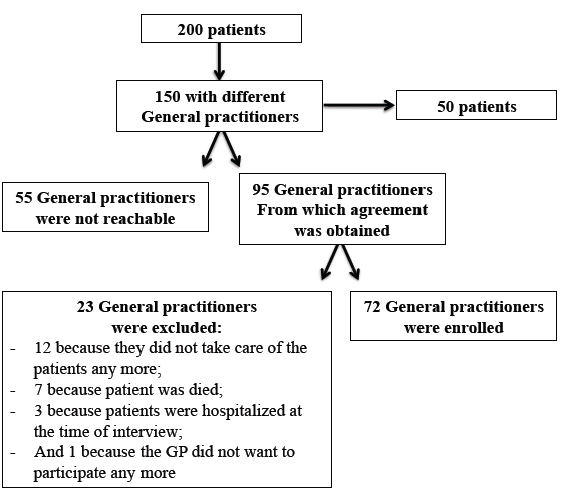
Figure 1. Flow chart of the population study

Figure 1. Flow chart of the population study

Appropriateness of prescribing medication during the hospital stay

In the present pilot study, all patients enrolled were admitted for rehabilitation following hospitalization either for acute medical conditions or orthopaedic surgery where interdisciplinary healthcare management was provided from admission to discharge. The interdisciplinary team consisted of the geriatric healthcare team with one full-time professor, one assistant senior physician and two fellows for the medical staff, supported by geriatric nurses, ancillary staff, physical therapists and psychologists. Specifically for psychiatric care, when necessary, an additional part-time senior geriatric-psychiatrist complemented the team. This interdisciplinary team designed, implemented and monitored comprehensive care and discharge plans for patients across a care continuum. This approach included a therapeutic plan with the aims of (i) limiting harmful effects through drug-drug or drug-disease interactions; (ii) ensuring the prescription of medications at the right doses and for the correct durations; (iii) systematically balancing the clinical benefit and the risk of adverse drug events (ADE) associated with any prescription with the patient’s needs, quality of life and expectations; and (iv) reducing the rate of omission of indicated medications with proven efficacy according to the patient’s level of functionality and life expectancy. [4] The medical team was present in the unit on a daily basis, participated in daily medical rounds and weekly interdisciplinary meetings and had direct contact with patients, care givers and patients’ families. For every patient admitted, a complete medication history was performed with the help of the patient’s GP if necessary. At their discharge, specific therapeutic recommendations were transmitted to their GP by telephone ( 1 day around the discharge day according to GP’s availability) and via the medical report usually sent by post within 3-4 weeks after discharge.

Elaboration of the questionnaire for General Practitioners (GPs)

The questionnaire was structured in 5 sections with 13 closed-ended questions (yes or no) and 1 open-ended question for personal comments. The average time to complete the survey was estimated to be 5 minutes.

The first section was dedicated to the list of medications prescribed 4 months after the hospital discharge. The GP or the referent nurse (if the patient was living in an institutional setting) filled it out. Changes in therapeutics were defined by the modification of at least one pharmaceutical molecule between the list at discharge and 4 months later. The remaining 4 sections were dedicated to GPs. Two sections focused on the prescriber’s characteristics (i.e. age, gender, year of installation), his continuing medical training and the type of activity (i.e. own practice, health clinic, and/or practitioner who practices in an institutional setting, training). The last two sections were dedicated to GPs’ expectations and more particularly the quality of therapeutic information transmitted (4 items); the issue of the complexity of therapeutic recommendations was also addressed (2 items).

Before starting the present study, the questionnaire was first tested on 3 GPs (not included in the present study) during the last quarter of 2013 in order to confirm that the questionnaire fitted both the study objectives and was acceptable according to GPs’ activity.

Complementary data collection

At the inclusion time, in addition to the treatment list upon admission, at discharge (M0) and 4 months later (M4), socio-demographic data (age, gender, living conditions) and health status were recorded by either the senior or attending physician. Thus, for each patient, the number co-morbidities was also recorded. For medications, the active pharmaceutical ingredient was considered as a statistical unit (for example, if in one pill two antihypertensive drugs were combined, two active pharmaceutical ingredients were recorded).

Statistical analysis

Results pertaining to numerical variables are presented as mean ± standard deviation (SD). For prescriptions of medicines, the median, maximum and minimum numbers of medications are also presented. For categorical variables, number and percentage are presented. Comparative analyses were computed with SAS software (version 9.1, SAS Institute, Cary, NC). Categorical outcomes were tested using the Chi2 (Χ2) test or Fisher’s exact test, and Student’s t-test or the Wilcoxon signed rank test for paired samples were used for numerical outcomes as appropriate. The level of significance was set at p = 0.05 for all analyses.

Results

The sample of 150 patients was aged 84.8 ± 6.5 years on average (max-min: 94-74 years); 69.3% were women. They suffered, on average, from 4.9 ± 2.1 co-morbidities (max-min: 10-1) and took 8.4 ± 3.2 medications every day at admission time and 7.9 ± 3.0 at upon their discharge (p = 0.038) corresponding to 1257 and 1196 active pharmaceutical ingredients respectively. The details of medications prescribed at both these times are presented in figure 2.
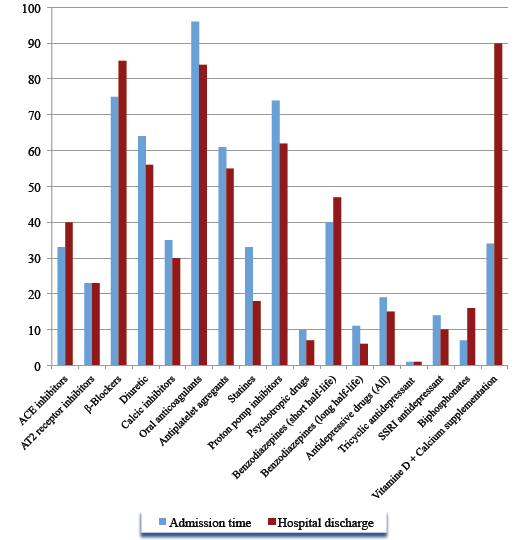
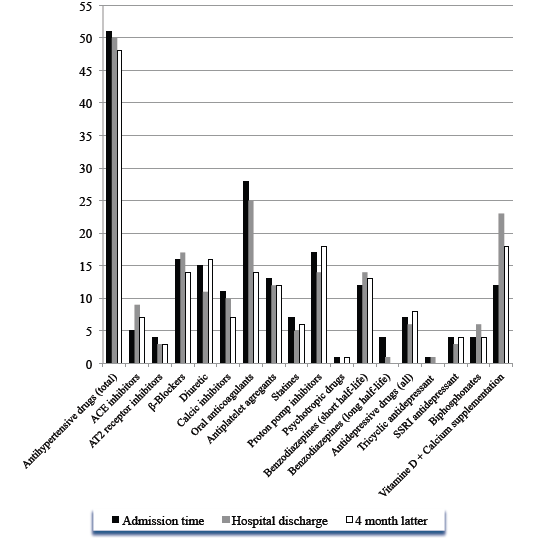
imroj_103_figure2_1

Figure 2. Descriptive analysis of the number of medications prescribed at admission time and upon discharge among 150 geriatric patients. Results are given according to therapeutic class (ACE, angiotensin-converting enzyme inhibitor; AT2, Angiotensin-2 receptor inhibitor; SSR, specific serotonin-reuptake inhibitor)

Figure 2. Descriptive analysis of the number of medications prescribed at admission time and upon discharge among 150 geriatric patients. Results are given according to therapeutic class (ACE, angiotensin-converting enzyme inhibitor; AT2, Angiotensin-2 receptor inhibitor; SSR, specific serotonin-reuptake inhibitor)

On the 72 GPs initially enrolled in the study, only 78.0% participated in the first part of the study concerning the medication list 4 months after discharge and 61.5% answered the sections about their attitudes toward therapeutic recommendations formulated in the final medical report. The corresponding 39 aged patients were not significantly different from the initial sample of 150 in terms of age, gender, co-morbidities and average number of medications at admission and upon discharge (p>0.05). These 39 patients accounted at admission time and discharge for 342 (8.8±3.7) and 306 (7.8±3.5) different medications respectively. During the hospital stay in the rehabilitation centre, 79 therapeutic modifications were done by the medical team with a 10.5% overall reduction of the number of treatment (p=0.03). Four months after discharge, a further 16.0% reduction of prescribed medication was also observed (6.6±3.5) corresponding to 257 molecules for a total reduction of 24.8% since admission time (p=0.02). For 17 patients, treatment was strictly similar (43.6%). As shown in figure 3, the most modified therapeutic class was antihypertensive drugs, which accounted for 33.0% of therapeutic modifications occurring during the hospital stay. With an overall reduction of 5.8%, 77.0% of antihypertensive treatments adapted during the hospital stay were maintained 4 months later. However, underuse of ACE inhibitors and β-blockers was observed during the stay. Conversely, the number of prescribed anti-calcics and AT2-inhibitors was dramatically reduced. One quarter of statins were stopped during the stay, and this recommendation was maintained 4 month latter in 97.4% of cases. Oral anticoagulants were dramatically reduced not only during the stay but also after discharge (by 25.6% in total). With respect to proton pomp inhibitors, the overall reduction during the stay was 18.2%. However, 4 months later, for proton pomp inhibitors, patients were back to initial values or even more (+4.5%). The main indication was the combination with anti-platelets.
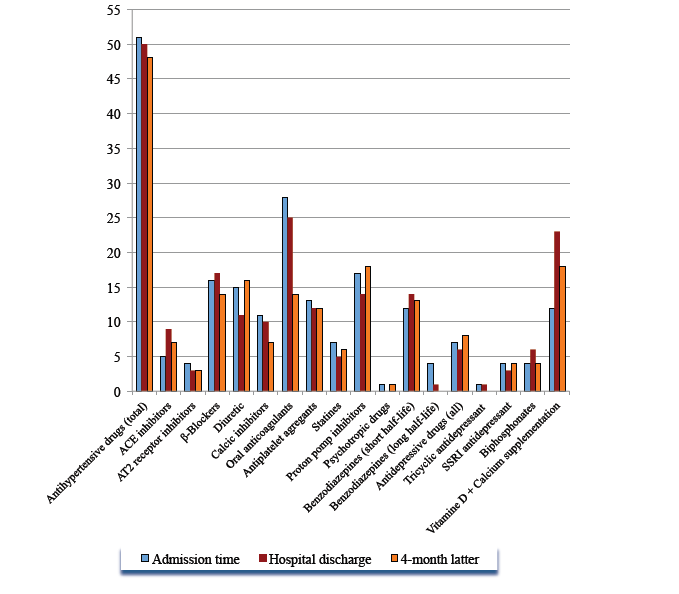
Figure 3. Descriptive analysis of the number of medications prescribed at admission time, discharge and 4 months later among 39 geriatric patients whose GPs responded to the questionnaire. Results are given according to therapeutic class (ACE, angiotensin-converting enzyme inhibitor; AT2, Angiotensin-2 receptor inhibitor; SSRI, specific serotonin-reuptake inhibitor)

Figure 3. Descriptive analysis of the number of medications prescribed at admission time, discharge and 4 months later among 39 geriatric patients whose GPs responded to the questionnaire. Results are given according to therapeutic class (ACE, angiotensin-converting enzyme inhibitor; AT2, Angiotensin-2 receptor inhibitor; SSRI, specific serotonin-reuptake inhibitor)

Among the 39 GPs who answered the questionnaire, 87.5% were men and 2/3 were aged 50 years or over. On average 15.0% of their ambulatory patients were aged 70 or over and 91.0% of them were working at least part time, in institutional settings (e.g. nursing homes, long term care facilities).

With respect to expectations for and the required level of medical report, GPs were (58.0%) satisfied with a report sent 3 to 4 weeks after hospital discharge. For 91.6% of them, GPs considered that the therapeutic changes were mentioned in the report and for 83.3%, had been properly explained. The usefulness of the report for the medical follow-up by GPs was highlighted by 83.0% of the GPs while 46.0% judged that the optimization of medications prescribed at discharge did not facilitate patient management. At 4 months, 60.9% of GPs had operated further modifications on the medication list prescribed at discharge; the reasons for are presented in figure 4.
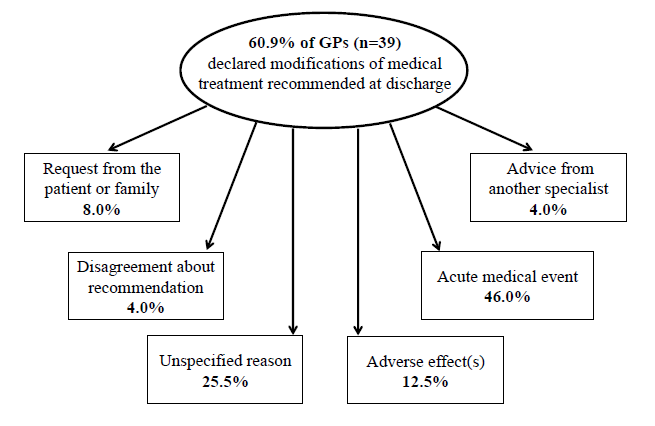
Figure 4. Description of reasons motivating changes in medications prescribed by general practitioners during 4 months following discharge from the hospital

Figure 4. Description of reasons motivating changes in medications prescribed by general practitioners during 4 months following discharge from the hospital

The analysis of answers to the open-ended question revealed that most of GPs considered the hospital as expert for optimizing pharmacotherapy. They also underlined that some of the modifications operated were not always appropriate for ambulatory patients. One of the most frequent GP requests was that the hospital physicians keep the same active pharmaceutical ingredient when a treatment was unchanged during the stay. The second one was that a direct contact should be established between the hospital medical team and GPs before any treatment modifications or, at least, when the patient was discharged.

Discussion

This pilot study investigated GPs’ therapeutic adherence for patients discharged from a geriatric rehabilitation center. The first lesson provided is that, from an initial selected sample of 150 patients, the participation rate by GPs is very low (26.0%). This result was obtained despite an initial contact by telephone, with three successive attempts and one reminder by e-mail or post with an explicative letter. Moreover, the questionnaire sent was presented in a very short format and was composed by close-ended questions. The second observation is that the therapeutic optimization made during the hospital stay was maintained in only 43.6% patients. During the stay, the mean number of medications was reduced by 25.0%. Four months after discharge, it was reduced by 15.3%. While nearly 60% of secondary modifications after discharge were motivated by medication side effects or the occurrence of an acute medical event, 25.5% were unexplained, 8% were related to patient or patient’s family requests, or on basis of a secondary opinion given by another specialist. While most of the GPs considered the hospital setting as an expert environment for pharmacotherapy optimization, we did not use any tool or specific protocol to drive the optimization and assess its quality during the stay. Commonly, Evidence-Based Medicine (EBM) is used to standardize clinical practice and prevent errors. Based on EBM, guidelines are intended to help clinicians to prescribe appropriately. However, EBM does not often reflect age-specific differences, the high level of medical complexity of older patients, the presence of geriatric syndromes, and general geriatric vulnerability. [13] Guideline-driven prescribing does not help in achieving the goal of appropriate drug treatment and most of the time leads to substantial polypharmacy. [14, 15]

Thus, for patients with multiple conditions and polypharmacy, successful interventions included structured medication review, medication regimen simplification, administration aids and medication reminders, but no firm conclusion in favor of any particular intervention could be made. On average each patient considered in the present study suffered from 4.9 co-morbidities and took 8.4 different medications every day at admission time. Interventions to optimize geriatric pharmacotherapy focused most commonly on pharmacological outcomes (drug appropriateness, adverse drug events, adherence). [3] Systematic reviews, which have analyzed the effect of interventions to reduce inappropriate prescribing across healthcare settings [16-18], have shown that geriatric medicine services (involving geriatrician consultation, comprehensive geriatric assessment, multi-disciplinary geriatric team input into care or specialist case conferences) and multi-disciplinary team interventions (mostly pharmacist and physician collaboration or continuing education) reliably reduce inappropriate prescribing. [3]

At their discharge from the geriatric rehabilitation division, the number of prescribed medications for the 150 patients was significantly reduced, corresponding to 1196 active pharmaceutical ingredients compared to 1257 initially (figure 2). However prescribing appropriateness is not only reducing polypharmacy, but it also encompasses the use of medicines where the clinical benefits outweigh the risk of ADEs. It also includes the use of medicines that reduce the likelihood of drug-drug and drug-disease-interaction, the mis-prescribing of medicines (incorrect dose, frequency and duration) and the under-use of clinically indicated medicines. [16, 19]

With this in mind, the STOPP/START set of criteria can provide additional benefits to interdisciplinary geriatric team when it is necessary to design an intervention protocol. These criteria cover both common and important instances of potentially inappropriate prescribing and potentially serious errors of prescribing omission in older people. [20] Moreover, since the first iteration in 2008, it has been demonstrated that STOPP criteria medications are significantly associated with ADEs, and STOPP and START criteria applied as an intervention within 72 hours of admission significantly reduce adverse drug reactions and improve medication appropriateness [19, 21, 22]. Moreover, this effect was maintained 6 months post-intervention when subsequent recommendations to the attending clinicians to modify the prescription medications accordingly were notified into final medical reports. This is explained not only because this set of criteria represents the consensus views of a panel of experts in prescribing for older people but also because the clear wording of each criterion gives the opportunity to illustrate easily and precisely all medication changes operated during the stay. This reinforces comments obtained from the open-ended question of the questionnaire sent to GPs. Indeed, GPs had mentioned the quality of the medical report and how it has to be informative about the changes of the treatment regimen during the stay. This is of particular interest because among prescriber-associated barriers to optimal adherence are multi-professional communication and the transition and continuity of care. [3] A range of strategies has been implemented to increase adherence by targeting modifiable provider-related barriers. Although numerous systematic reviews have been published, no conclusion about the effectiveness of strategies to counteract non-adherence could be drawn. [23, 24] Furthermore, interventions were delivered by a single group of professionals and did not respect the geriatric medicine principles of teamwork and multi-professionality. However, when studies demonstrated statistically significant improvement in adherence, a significant reduction in mortality, better control of chronic conditions and reduced overall healthcare costs were observed. [3] There were many different classes of drugs for which GPs were non-adherent. Cardiovascular treatment was the most adjusted system during the stay, with introduction of β-blockers, ACE inhibitor and reduction of oral-anticoagulant treatment, cholesterol-lowering drugs and calcic-inhibitors. It was also the system that was the most readapted by GPs with proton pomp inhibitors (figure 3). No information in the present study concerned the appropriateness or not of these changes.

Thus, given that optimizing pharmacotherapy can be extraordinarily challenging and complex for physicians, in order to gain maximal benefit from pharmacotherapy and to achieve the best possible quality of life for the patient, one important step towards successful outcomes for complicated pharmacotherapeutic strategies is to favour the patient’s capacity to adhere to a complex treatment regimen. For that, it is necessary for GPs to set treatment priorities. However, this step is probably the most difficult because disease-specific guidelines do not capture the full clinical complexity of the patient’s pharmacotherapy. Thus, the GP’s judgement, experience, skills and attitudes are critical in determining whether or not the patient will have positive therapeutic outcomes from pharmacotherapy.

Despite limitations (e.g. small sample size, no measurement of appropriateness of prescribing recommendations), this pilot study emphasizes that the hospital discharge is an important time for non-adherence to prescribing medication according to geriatricians’ recommendations. It reinforces the need not only to enhance the quality of transition but also continuity of care between hospital and community. Thus, it could be tested in a future research protocol the impact of “faxmed” (i.e. a brief summary of the hospital stay with the complete list of medications sent by fax or e-mail the day before or the day of one patient’s discharge) or of systematic successive contacts by phone (i.e. at admission time, 48 to 72 hours before discharge, and at discharge) to discuss of medications with GP, and/or of the role that could play nurse practitioners. In that way, it could also be interesting to develop specific guidelines for writing prescriptions for GPs in which, for example, it should be systematically mentioned, in addition to medicines that have been introduced recently, those that have been stopped and those for which the dosage has been adapted with the reason for. This study also suggests the interest of specialized geriatric medical training to improve GPs’ skills and knowledge concerning pharmacotherapy in old age.

Acknowledgement

We would like to sincerely thank all the General Practitioners who made my project of medical thesis project a reality.

References

  • O’Mahony D, Cherubini A, Petrovic M (2012) Optimizing pharmacotherapy in older patients: a European perspective. Drugs Aging 29: 423-425. [crossref]
  • Ferner RE, Aronson JK (2010) Preventability of drug-related harms – part I: a systematic review. Drug Saf 33: 985-994. [crossref]
  • Topinková E, Baeyens JP, Michel JP, Lang PO (2012) Evidence-based strategies for the optimization of pharmacotherapy in older people. Drugs Aging 29: 477-494. [crossref]
  • Lang PO, Vogt-Ferrier N, Hasso Y, Le Saint L, Dramé M, et al. (2012) Interdisciplinary geriatric and psychiatric care reduces potentially inappropriate prescribing in the hospital: interventional study in 150 acutely ill elderly patients with mental and somatic comorbid conditions. J Am Med Dir Assoc 13: 406. [crossref]
  • Fallis BA, Dhalla IA, Klemensberg J, Bell CM (2013) Primary medication non-adherence after discharge from a general internal medicine service. PLoS One
  • Haynes R, Ackloo E, Sahota N, et al. (2008) Interventions for enhancing medication adherence. Cochrane Database Syst Rev.
  • Conn VS, Hafdahl AR, Cooper PS, et al. (2009) Interventions to improve medication adherence among older adults: metaanalysis of adherence outcomes among randomized controlled trials. Gerontologist 49: 447-62.
  • Hughes CM (2004) Medication non-adherence in the elderly: how big is the problem? Drugs Aging 21: 793-811. [crossref]
  • Cooper C, Carpenter I, Katona C, Schroll M, Wagner C, et al. (2005) The AdHOC Study of older adults’ adherence to medication in 11 countries. Am J Geriatr Psychiatry 13: 1067-1076. [crossref]
  • Gellad WF, Grenard JL, Marcum ZA (2011) A systematic review of barriers to medication adherence in the elderly: looking beyond cost and regimen complexity. Am J Geriatr Pharmacother 9: 11-23. [crossref]
  • Osterberg L, Blaschke T (2005) Adherence to medication. N Engl J Med 353: 487-497. [crossref]
  • McDonald HP, Garg AX, Haynes RB (2002) Interventions to enhance patient adherence to medication prescriptions: scientific review. JAMA 288: 2868-2879. [crossref]
  • Wehling M (2011) Guideline-driven polypharmacy in elderly, multimorbid patients is basically flawed: there are almost no guidelines for these patients. J Am Geriatr Soc 59: 376-7.
  • Van den Akker M, Buntinx F, Metsemakers JF, et al. (1998) Multimorbidity in general practice: prevalence, incidence, and determinants of co-occurring chronic and recurrent diseases. J Clin Epidemiol 51:367-75.
  • Boyd CM, Darer J, Boult C, Fried LP, Boult L, et al. (2005) Clinical practice guidelines and quality of care for older patients with multiple comorbid diseases: implications for pay for performance. JAMA 294: 716-724. [crossref]
  • Spinewine A, Schmader KE, Barber N, Hughes C, Lapane KL, et al. (2007) Appropriate prescribing in elderly people: how well can it be measured and optimised? Lancet 370: 173-184. [crossref]
  • Kaur S, Mitchell G, Vitetta L, et al. (2009) Interventions that can reduce inappropriate prescribing in the elderly: a systematic review. Drugs Aging 26:1013-28.
  • Steinman MA, Hanlon JT (2010) Managing medications in clinically complex elders: “There’s got to be a happy medium”. JAMA 304: 1592-1601. [crossref]
  • O’Mahony D, Gallagher P, Ryan C, Byrne S, Hamilton H, et al. (2010) STOPP & START criteria: A new approach to detecting potentially inappropriate prescribing in old age. Eur Geriatr Med 1: 45-51.
  • Lam MP, Cheung BM (2012) The use of STOPP/START criteria as a screening tool for assessing the appropriateness of medications in the elderly population. Expert Rev Clin Pharmacol 5: 187-197. [crossref]
  • Hamilton H, Gallagher P, Ryan C, Byrne S, O’Mahony D, et al. (2011) Potentially inappropriate medications defined by STOPP criteria and the risk of adverse drug events in older hospitalized patients. Arch Intern Med 171:1013-9.
  • Gallagher PF, O’Connor MN, O’Mahony D (2011) Prevention of potentially inappropriate prescribing for elderly patients: a randomized controlled trial using STOPP/START criteria. Clin Pharmacol Ther 89: p. 845-54.
  • Conn VS, Hafdahl AR, Cooper PS, et al, (2009) Interventions to improve medication adherence among older adults: meta- analysis of adherence outcomes among randomized controlled trials. Gerontologist 49:447-62.
  • Haynes R, Ackloo E, Sahota N, et al. (2008) Interventions for enhancing medication adherence. Cochrane Database Syst Rev 4: CD000011.